Awards: National Medal – granted 22 September 1987
Act of Bravery –
Born: ?
[divider_dotted]
Report of the NSW Police Department for the year ended 31 December 1978.
Sergeant 3rd Class Con Sergeeff—Whilst investigating an incident at Fairfield West on 7th November, 1978, the Sergeant found a young woman firing shots at a house from a parked car. Although threatened by the woman, who was affected by alcohol, the Sergeant positioned himself behind the vehicle while other Police attempted to persuade the offender to surrender. After about half an hour the Sergeant, seeing an opportunity, sprang forward, seized the rifle and disarmed the offender,
whereupon, other Police took her into custody.
[divider_dotted]
William Keith WILLIAMSON
| 09/09/2015
William Keith WILLIAMSON
aka Bill & Blinky Bill
New South Wales Police Force
Regd. # 7243
Rank: Inspector
Stations: ?, Fairfield O.I.C. 34 Division ( in 1970’s )
Service: From ? to ?
Awards: ?
Born: ?
Died on: 15 November 2003
Cause: ?
Age: 78
Funeral date: ?
Funeral location: ?
Buried at: ?
[alert_yellow]BILL is NOT mentioned on the Police Wall of Remembrance[/alert_yellow] *NEED MORE INFO
[divider_dotted]
Funeral location: ?
[divider_dotted]
FURTHER INFORMATION IS NEEDED ON THIS MEMBER
[divider_dotted]
Bill Williamson was the OIC of Fairfield when Stephen Moore was the Inspectors Clerk there in 1979. Bill was replaced by Phil Child in late 1979. From memory Bill was an Olympic sculler in the same crew as former Commissioner Merv Wood. 1948 or 1952 Olympics. At the same time we had Frank Murphy at Fairfield as assistant Inspector and he was an Olympic Diver.
[divider_dotted]
Richard John GERSBACH
| 09/09/2015
Richard John GERSBACH
New South Wales Police Force
AKA RICK
Late of ?
[alert_yellow]Regd. # 8569[/alert_yellow]
Rank: Probationary Constable – appointed 29 October 1956
Senior Constable – appointed 29 October 1966
Detective – appointed ? ? ?
Detective Sergeant 3rd Class – appointed 31 March 1973
Unfortunately, Arthur ended his police career after returning from light duties following major abdominal surgery and an injury sustained when called out to a Yugoslav Wedding reception that went wrong and where Arthur was beaten and unable to return to duty. Several years later, he was boarded out as medically unfit for duty due to the injuries sustained from the beating – and moved to Manilla NSW and later to Tamworth NSW.
Service: From Monday 30 May 1960 to 13 June 1987 = 27 years, 0 months, 14 days Service
National Service: 77 days of continuous training at Puckapunyal
Follow Up Training: For the next two years, he undertook Citizen Military Force training doing weekend drills in the foothills of Canberra and Singleton. Whilst at Singleton, he received a letter to commence Police training in Goulburn. Approval to cease Citizen Military Force training was granted by the Army.
Basic Training: ?
Next of Kin: ?
Medals: None for display
[/blockquote]
Police Awards: National Medal –granted15 September 1980 ( Sgt 3/c )
Born: Thursday 12 December 1940 in Harden, NSW
Died on: Monday 4 October 2004 in Tamworth Base Hospital, NSW
Cause: Cancer
Age: 63 yrs 9 mths 22 days
Funeral date: Thursday 7 October 2004
Funeral location: St Nicholas Catholic Church, White St, Tamworth, NSW
Funeral Type: Burial
Buried at: Lincoln Grove Gardens, 1040 Gunnedah Rd, Tamworth, NSW
Grave Location: FYP – 4 – A ( Family Plot )
GPS of Grave: -31.075638 150.849480
ARTHUR is NOT mentioned on the Police Wall of Remembrance *NEED MORE INFO
Funeral location:
Arthur, back in the late 1970’s, was working the caged trucks of Fairfield and Cabramatta Police Stations ( both 34 Division ).
No further details are known of his death.
Arthur Stephen McKenna (extract from his Eulogy – dictated by Arthur prior to his passing)
One day reading the Sydney Morning Herald during his lunch break, he noticed an advertisement calling for people to apply for the NSW Police Force and he sent in an application.
Prior to being accepted, Arthur was called up for National Service in 1958 and underwent his medical by Dr Rag Holmes at Yass. Arthur did 77 days of continuous training at Puckapunyal.
The following two years, he undertook Citizen Military Force training doing weekend drills in the foothills of Canberra and Singleton. Whilst at Singleton, he received a letter to commence Police training in Goulburn. Approval to cease Citizen Military Force training was granted by the Army and he started on Monday, 30th May 1960 in the NSW Police Force.
After five weeks training and on the 4 July 1960, Arthur was sworn in and did 12 months probationary training when he was 19½ years.
Stationed at Darlinghurst No.3 at Taylor Square, he lived in the area for 12 months and passed his final exams and became fully fledged. On the eve of this graduation, he polished his boots with such vigour that next morning he was shocked to discover that all the leather had lifted from his boots – but his graduation proved a happy day for Arthur and his parents.
He was then stationed at Goulburn and Queanbeyan. During 1967, Arthur had the distinction of opening the door of Parliament House for the President of the United States of America – Linden B Johnstone and Deputy Prime Minister Jack McKeon.
Arthur later returned to Sydney and worked in the mid 1960’s at Regent Street No.2 Division Camperdown. Arthur and another rookie constable were called to escort prisoners to Long Bay Goal from Central Court. After setting off, the rookie, who was driving, asked Arthur which way? How do I know said Arthur, I’m from the bush to which the rookie replied so am I! After several circuits of the city they stopped and asked a policeman for directions to Long Bay.
He meritoriously served the Government and the people of NSW as a member of the NSW Police Force registered No 9677 from 30 May 1960 to 13 June 1987 and was honourably discharged upon reaching the rank of 2nd Class Sergeant. He was also awarded the National Medal.
Arthur had a beautiful singing voice and he was a valued and proud member of the NSW Police Choir which gave him great pleasure.
Arthur later transferred to Fairfield No.34 Division and finally to Cabramatta. He loved to work in plain clothes in court processing with great friend, Joan Lockley and had more time to spend with his young children. Later, he decided to return to uniform and took up a posting at Cabramatta where he went back on the beat.
Unfortunately, Arthur ended his police career after returning from light duties following major abdominal surgery and an injury sustained when called out to a Yugoslav Wedding reception that went wrong and where Arthur was beaten and unable to return to duty. Several years later, he was boarded out as medically unfit for duty due to the injuries sustained from the beating – and moved to Manilla NSW and later to Tamworth NSW.
Arthur was an avid reader and claimed to travel the world by reading books. The last book, Arthur was reading was “To Protect and to Serve” which is not only the motto of the NSW Police Force but also mirrored his devotion to his family and friends.
Canberra Times (ACT : 1926 – 1995),
Thursday 11 March 1965, page 13
Queanbeyan Court: Constable says loud record was obscene
The section of the Vagrants Act, 1902, relating to the maximum penalty for offensive behaviour was criticised by a magistrate at Queanbeyan
yesterday.
Mr. Hughes. S.M., said the maximum fine of £5 was inadequate for some types of offences.
He convicted Michael James Coffey, of H.M.A.S. Melbourne, of offensive behaviour in Queanbeyan on July 24 last year.
He fined Coffey £5 and said he regretted that it was not more.
The case was heard ex-parte.
Const. Arthur Stephen McKenna told Mr. Hughes that he heard loud music coming from the Coffee Bean restaurant in Cassidy’s Arcade, Queanbeyan, on the morning of July 24.
The music was coming from a record called Bawdy Songs Go to College. The track being played was Study of Anatomy.
In the restaurant a number of people, both male and female, were sitting around.
Const. McKenna said he told Coffey that in his opinion the record was obscene.
The song was being played very loudly and could be heard from Monaro Street, the main street of Queanbeyan,. Const. McKenna said.
After convicting Coffey, Mr. Hughes commended Const. McKenna on his action.
Joined NSW Police Force via the NSW Police Cadet system on 13 May 1963
Cadet # 1847
Rank: NSW Police Cadet – commenced 13 May 1963
Probationary Constable – appointed 5 July 1966
Constable – appointed 5 July 1967
Detective Senior Constable – appointed 31 August 1975
Detective Senior Constable – death
Stations: ( Cadet ) – Redfern – 7 Division, (Uniform ) – Blacktown – 27 Division, Police Driver Training – St Ives, Surveillance Unit, Fairfield – Detective – ( 34 Division ) – Death
Service: From 13 May 1963to 7 April 1983 = 19+ years Service
Awards: ? National Medal – granted 18 November 1982
Born: Saturday 5 July 1947
Died on: Thursday 7 April 1983
Cause: Heart attack – whilst seated at his desk, Mick complained of pain in his jaw before having the heart attack
Event location: Inside the Detectives office, the old Fairfield Police Stn, Smart St, Fairfield
Age: 35
Funeral date: Monday 11 April 1983
Funeral location: Pinegrove Cemetery
Buried at: Cremated. Mike’s Ashes are laid under a Memorial plaque at Pinegrove
[alert_red]MICK is NOT mentioned on the Police Wall of Remembrance[/alert_red] * BUT SHOULD BE
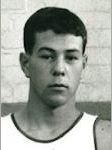
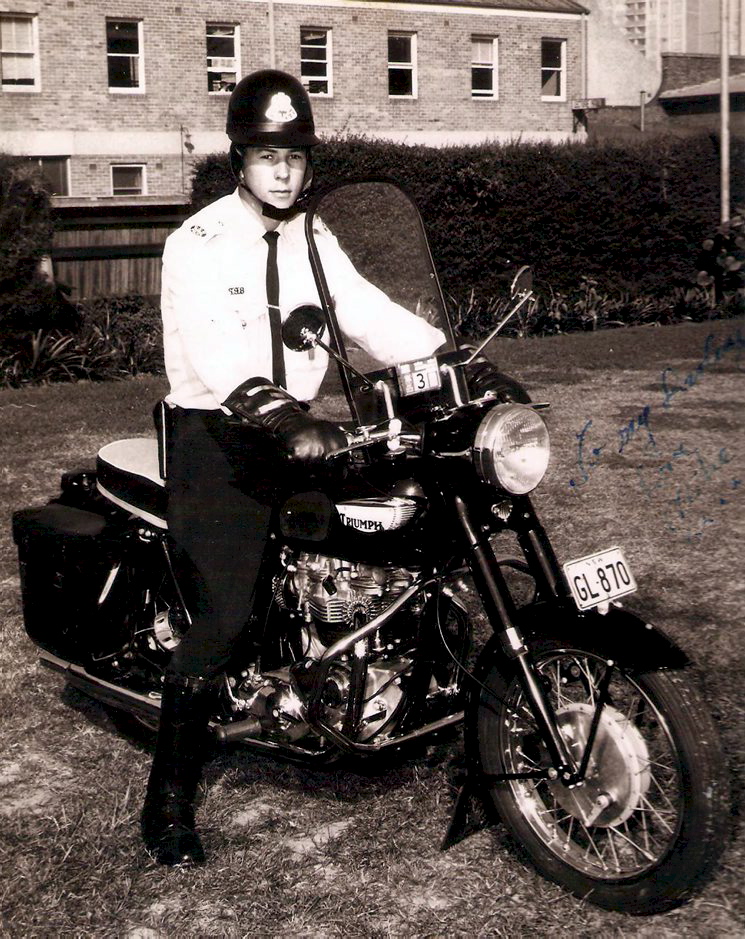
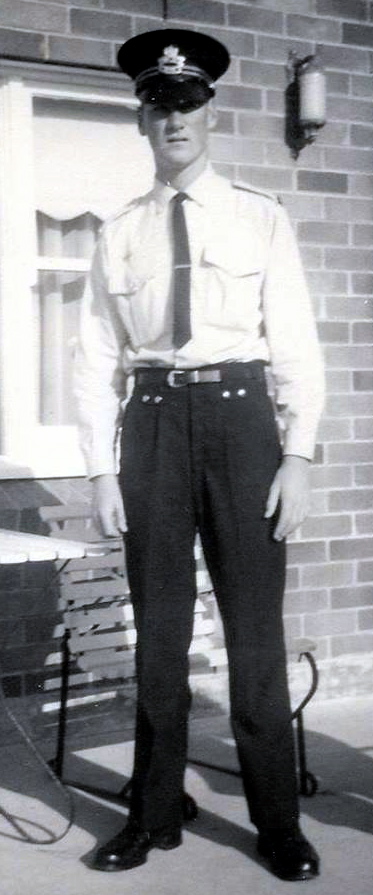
Cadet Mick Middleton
Michael John MIDDLETON. Written on front: To my Darling. Love Mike. xxxx
[divider_dotted]
The Detectives office being on the ground floor of the 3 storey building on the left – looking down the ( then ) driveway, from Smart St, which went between both buildings.
When Mick arrived at work in the morning, he complained of a tooth ache / pain in his jaw. He was sitting at his desk and said he did not feel good and collapsed to the floor. His workmates were later told that he was gone before he hit the ground. He was survived by a wife and two young daughters.
Mick was a nice bloke and always approachable.
[divider_dotted]
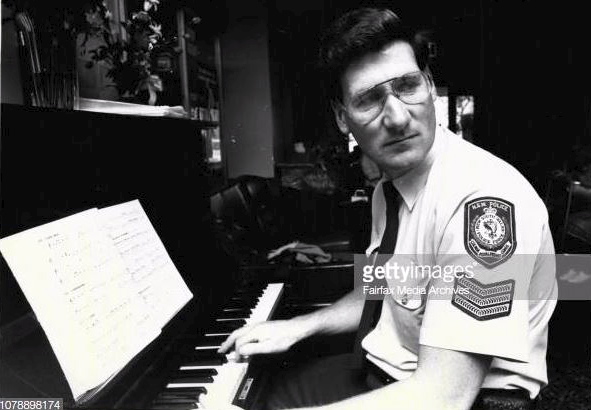
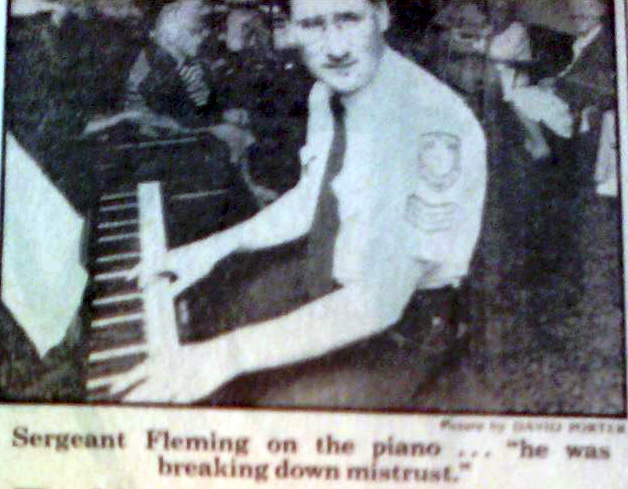
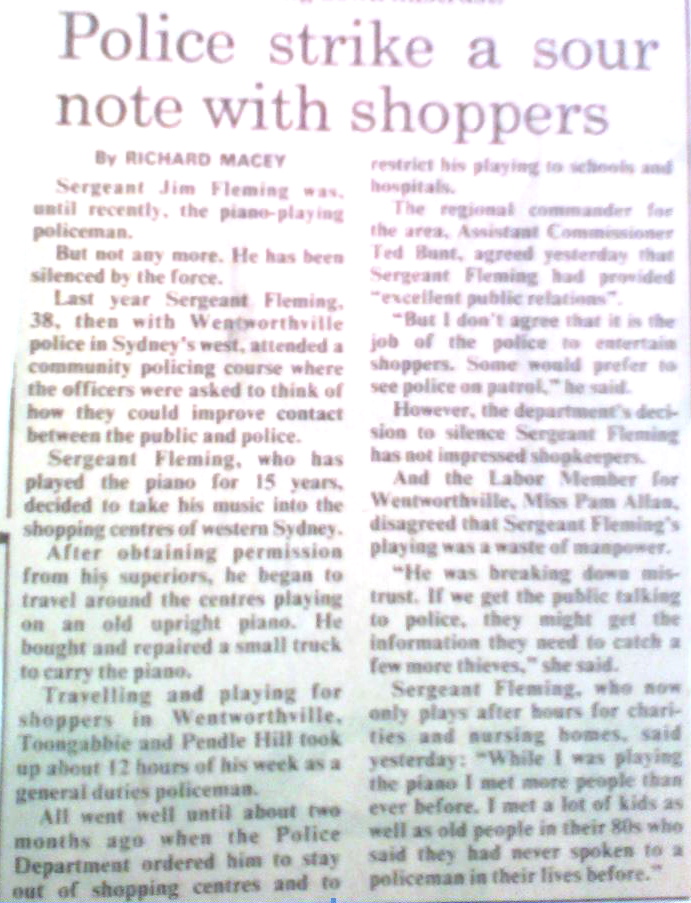
James Francis FLEMING
| 09/09/2015
James Francis FLEMING
( Late of Elderslie )
aka Jim
New South Wales Police Force
Son of retired member – Bill Fleming – Regd # 5551 ( also a Cadet # 501 )
Regd. # 13889
Joined NSW Police Force via NSW Police Cadet system on 15 May 1967
Cadet # 2281
Rank: NSW Police Cadet – commenced 15 May 1967
Probationary Constable – appointed 19 October 1969
Senior Constable – appointed 19 October 1978
Sergeant 3rd Class – appointed 19 November 1985
Sergeant – Retirement
Stations: ?, Wentworthville – 1984
Service: From 15 May 1967 to ? = 30+ years Service
Awards: National medal – granted 10 September 1986
1st Clasp to National medal – granted 6 June 1997
Born: Thursday 19 October 1950
Died on: Sunday 30 August 2015
Cause: ?
Age: 64 yrs 10 mths 11 days
Funeral date: Monday 7 September 2015 @ 10.30am
Funeral location: Chapel, Forest Lawn Memorial Park Cemetery, 11 Camden Valley Way, LEPPINGTON
Buried at: Forest Lawn Cemetery
Standard Lawn Site, Churchyard Lot 32, Site 7
Cadet Jim Fleming
JAMES is NOT mentioned on the Police Wall of Remembrance *NEED MORE INFO
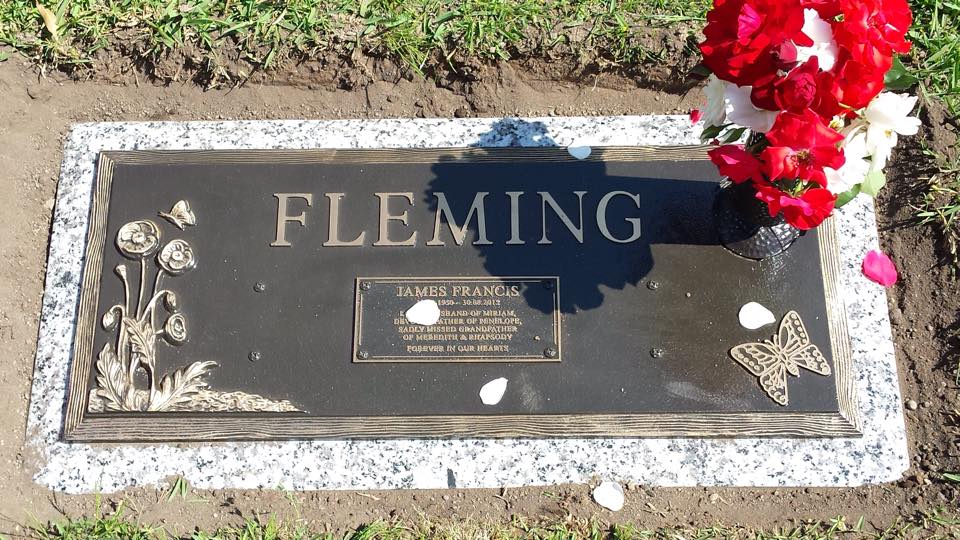
FLEMING, James Francis
19.10.1950 – 30.08.2015
Sergeant of Police (r’td).
Passed away peacefully on 30 August 2015.
Late of Elderslie.
Beloved husband of Miriam. Devoted father of Penny and grandfather of Meredith and Rhapsody. Much loved son of Nita & Bill and dear brother of Elizabeth (dec), Paul, Cathy, John, Margaret, Helen, Anthony and Gregory.
Rest In Peace
A Celebration of JAMES’ Life was held at the Forest Lawn Memorial Park Cemetery, Leppington on MONDAY (September 7, 2015).
RICHARDSON Ronald Bruce “Ron” Late of Penrith, formerly of Kimbriki.
Passed away peacefully after his brave fight against cancer on Friday 28th August 2015.
AGED 69 YEARS
Dearly loved Husband of Jan. Much loved Dad of David & Blanche, Andy & Wendy. Adored Pa of Georgia and Sophie.
Will be sadly missed by all his extended family and friends.
Ron’s Funeral Service will be held in the Nabiac Uniting Church, commencing at 10.00am on Friday 4th September, prior to his interment in the Failford Cemetery.
In lieu of flowers donations to The Nepean Cancer Care Centre would be gratefully appreciated.
Tuesday, 1 September 2015
Our sincere condolences to Jan & Family at the sad loss of our dear friend Ron. Our thoughts, prayers and love are with you all.
~
Sandy & John Tuininga,
Melbourne, Victoria
Published in The Manning River Times on Sept. 2, 2015
August 29th, 1985, Police Officer Lyncon Robert Dix Williams from Holden Hill police was murdered at Blair Athol. First Class Constable Lyncon (Lync.) Williams Aged 30 years, of Holden Hill Patrol Base, died in his patrol car after he responded with his junior partner to reports of gunfire at Ross Avenue Blair Athol. A 17-year-old shot him as he arrived on the scene. He had not even had the chance to step out of his car ahead of the fatal shot.
Police arrested and charged the shooter with murder. He was convicted and sentenced to imprisonment at the Governor’s pleasure. A non-parole period was later fixed at 13-and-a-half years.
Police Association President Peter Alexander reflected on William’s death as he laid a wreath at a Police Remembrance Day memorial service. “I didn’t know Lync Williams personally but, I’ll always remember the circumstances of that murder”, he said.
’I remember the shock of it and the grief for his family and workmates. It was a tragedy that was reflected right across the job.’
[divider_dotted]
Government and General Order
| 09/09/2015
The Sydney Gazette and New South Wales Advertiser Saturday 14 April 1821 page 1 of 4
Government and General Order
Colonial Secretary’s Officer
Sydney, 14th April, 1821
CIVIL DEPARTMENT.
His Honor the Lieutenant Governor ( in the Absence of His Excellency the Governor ) has been pleased to appoint Thomas Trotter to be a Constable in the District of Botany Bay, in the Room of Robert Gardiner, dismissed for improper Conduct.
His Honor is further pleased to direct, that Andrew Kenny, recently appointed a Constable for the District of Bathurst, shall also do Duty in the District of Melville.
The Australian ( Sydney ) Friday 23 July 1830 page 1 of 6
SPIRIT
OF THE GOVERNMENT ACTS, BILLS, ORDERS, NOTICES, &c.
This morning’s and Saturday’s Gazette contain nothing under the above head, in addition to our last, except the following :-
Col. Sec. Office. 26th July 1830. – Goulburn Plains, Argyle — Daniel Geary, holding a ticket of leave, to be constable in the room of Richard Devine, resigned ; to bear date from the 18th day of May last. —
Lower Portland Head — John Smith, per Marquis Huntley, to be scourger, in the room of John Donohoe, dismissed ; to bear date from the 1st of April last. —
Patrick’s Plains, Hunter’s River — John Allen to be watch-house keeper, from the 1st instant, in the room of Thomas Fuller resigned.
Certificate of Freedom, 26th July, 1830, – 39. Tickets of Leave cancelled, 4.
The Sydney Gazette and New South Wales Advertiser Saturday 26 March 1831 page 1 of 4
Government Notice.
Colonial Secretary’s Office,
Sydney, March 25, 1831.
HIS Excellency the Governor has been pleased to approve of the following Alterations in the Police of the Colony, viz. –
Parramatta – To be discontinued from the 31st instant – District Constable, W. Comber, Ordinary Constables P. Rodgers, and J. Browne ; District Constable, J. Roberts, Melville ; Ordinary Constables, R. Chapman, Melville; J. Browne, Concord ; R. Hathaway, Seven Hills; J. James, Baulkham Hills ; W. Moore, Castle Hill, and J. Swanborough, Prospect ; and the Constable at Barren Ridges, from the 17th instant.
Inverary – Thomas Hyams, per Champion, to be Scourger, from the 31st January last, in the room of John Nowlan, deceased.
Goulburn Plains – Malcolm Livingston, per Asia, holding a Ticket-of-Leave, to be Constable, from the 25th ultimo, in the room of John Price, resigned.
Was 1 of 50 ‘free men’ who volunteered and were accepted to join the Loyal Sydney Association set up by Governor Hunter to quell a possible uprising by ‘the Irish’. They were under the control of a civilian by the name of William Balmain. Frederick was involved in the Battle of Vinegar Hill in 1804. The 50 were known as armed volunteer Police (Militia)
1811 – 1828.
Sworn in 1811 as Constable under the newly formed NSW Police set up by Governor Macquarie.
Served at Liverpool 1822-1828 becoming Chief Constable in 1826.
Believed to have resigned in *1828 to become the first Post Master at Liverpool Post Office.
A story, below, indicates that Meredith – as the Chief Constable of Liverpool, was shot in both legs during a bush-ranger’s robbery in 1830.
Awards: ?
Born: 5 October 1763 in Dinham, Ludlow, Shropshire, England
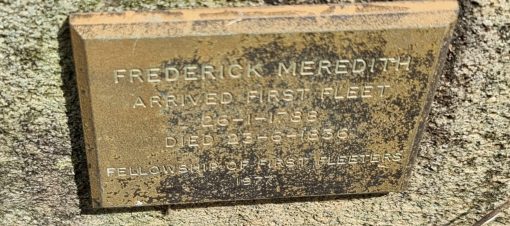
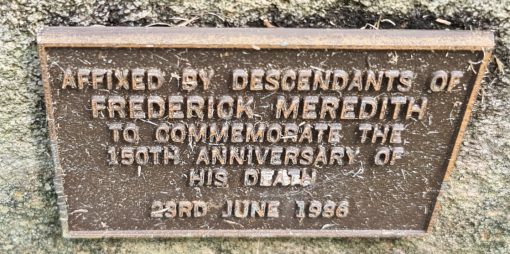
Died on: Thursday 23 June 1836
Event location: Bankstown, NSW
Cause: ?
Age: 73
Funeral date: ?
Funeral location: ?
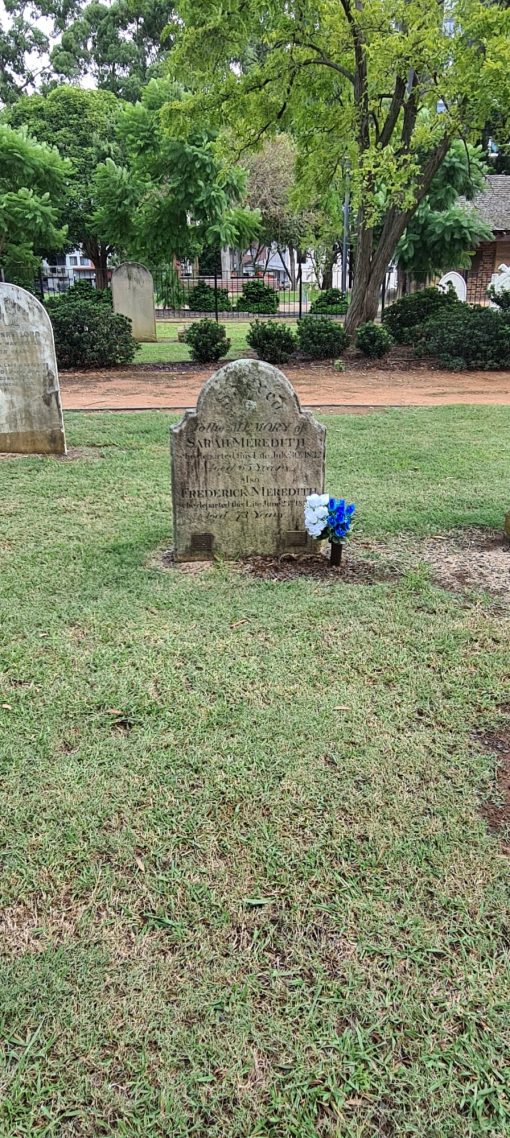
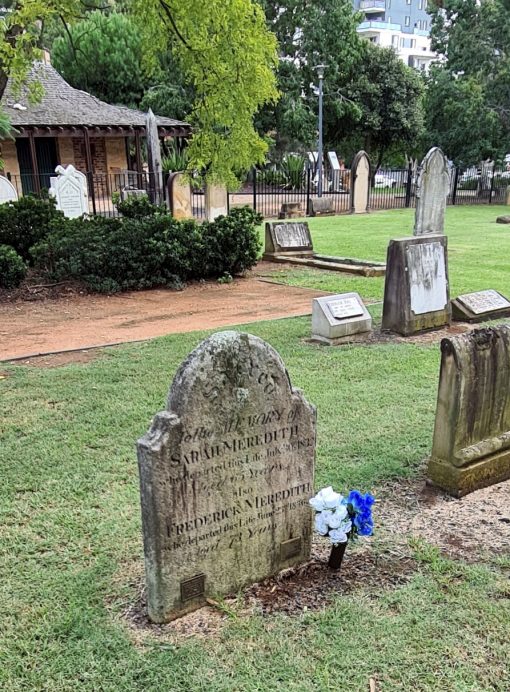
Buried at: Pioneer Memorial Park, Liverpool
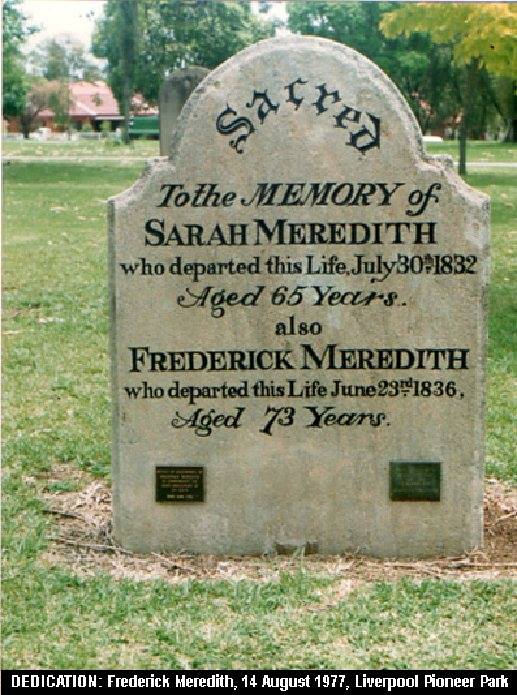
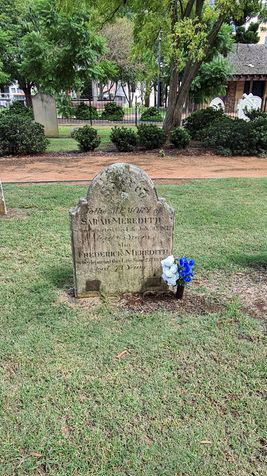
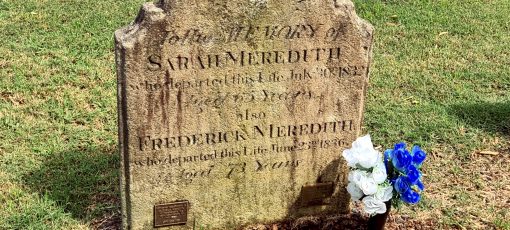
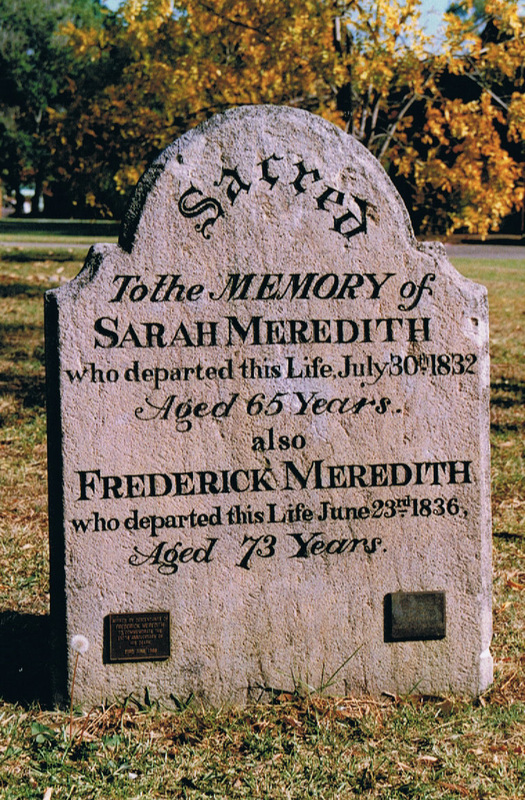
Frederick MEREDITH – Headstone in Liverpool Pioneer Park – 14 August 1977
FREDERICK is NOT mentioned on the Police Wall of Remembrance *NEED MORE INFO
Funeral location: ?
Frederick is believed to be the “third” Chief Constable of Liverpool until 1833.
He arrived on the First Fleet on the Scarborough.
His grave is at Liverpool Cemetery.
In 1811 Frederick joined Governor Macquarie’s police force. He was later appointed the first constable, then the “third” chief constable of Liverpool.
He remained in the police until 1833, holding positions of Constable, Chief Constable & District Constable.
Info via Jay Chappo – Beyond Courage FB page – 20 August 2015
They Sydney Gazette & New South Wales Advertiser Saturday 7 February 1835 page 2 of 4
SUPREME COURT.
FRIDAY, FEBRUARY 6.
(Before Mr. Justice Dowling and a Civil Jur..)
In a murder trial in the Supreme Court on Friday 6 February 1835, Frederick MEREDITH describes himself to the Court as “Chief Constable at Liverpool”
They Sydney Gazette & New South Wales Advertiser Thursday 7 July 1836 page 3 of 4
DIED.
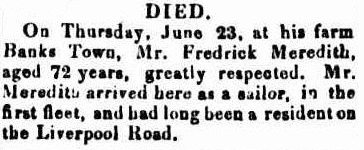
On Thursday, June 23, at his farm Banks Town, Mr. Fredrick Meredith, aged 72 years, greatly respected. Mr. Meredith arrived here as a sailor, in the first fleet, and had long been a resident on the Liverpool Road.
Ordinary constables appointed to operate under Macquarie’s 1811 regulations were, John Jones, John Godwin, Edward Tulby, Matthew Quinn, Patrick Field, Samuel Reid, George
Cochrane, John Ayres, Joseph Evans, John Smith, James Mannek, William Goodman, William Donnelly, Abraham Lee, William Welch, Joseph Welch, Michael Simpson, John
Pauley, John Webb, Thomas Colebrook, James Phelan, William Thorn, Charles Evans, Thomas Jones, Abraham Bateman, George Atkins, John Anslie, William Foster, John Randall, Robert McAlister, Aaron Packenham, Thomas Mansfield, John Burgess, Thomas Salmon, John Smith, George Phillips, Ambrose McGuiggan, Gilbert Baker, Frederick Meredith, Joseph Smith, John Lyster, Thomas Dunn, James Chamberlin (also shown as Chamberlain).
Matthew Gibbons was Clerk of the Market and William Hawkins was Assistant Clerk of the Market.
Daniel Cubitt was Gaoler. In 1811, Macquarie also introduced traffic regulations.
NSW Police Heritage Story p231
Liverpool Police complained in July, 1845, that the police establishment there was completely without serviceable firearms. Consistent with outlying districts of Sydney in
those days, Liverpool District was plagued at times by bushrangers. Liverpool Police, like police throughout the colony, faced dangerous situations in which they depended on
their government issue firearms.
For instance, in 1830, Liverpool’s Chief Constable Frederick Meredith, was seriously wounded in a clash with a bushranger gang. ( Later reading, below, indicates that this would have been Frederick Meredith ( Jnr ). )
In March, 1830, a gang of 6 bushrangers entered a public house on the Liverpool Road and stole 8 pounds in cash, plus 5 gallons of spirits and a brace of pistols.
The robbers later entered the residence of a man named Jackson on the Liverpool Road and gained entry to the premises by posing as constables.
When the robbers entered the premises, the men were confronted by Jackson and Chief Constable Meredith. The candle illuminating the inside of Jackson’s place was extinguished and an affray followed, resulting in Jackson and his wife being injured. Meredith was shot in both legs.
One of the gang was captured, but the other bushrangers escaped, leaving behind a number of firearms.
Two of the bushrangers were John McNamara and William Dalton.
Following the demise of Dalton and McNamara, in June, 1830, McNamara was shot dead by Samuel Horn, wardsman of Parramatta, and Dalton came to the end of his life on the
hangman’s rope, Frederick Meredith was given a land grant for his conduct in protecting Jackson’s premises.
The Governor also commended Jackson for his conduct against the bushrangers. Jackson’s assigned servant William Johnston, received a ticket of leave for courageously protecting his master’s property.
Frederick Meredith
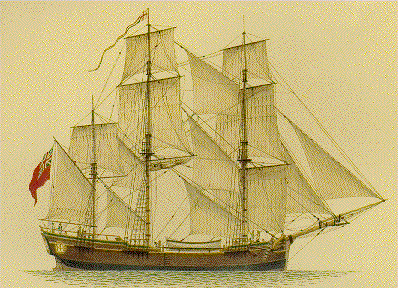
Frederick Meredith arrived with the First Fleet as a steward to Captain John Marshall of the convict transport Scarborough. He came before a magistrate for exchanging a “squirrel” for rum, apparently on the orders of the captain, and was sentenced to 100 lashes. Governor Phillip reduced the sentence to 50 lashes on representations from the captain and others. Shortly before the Scarborough sailed to China, he signed on to the HMS Sirius with the duties of a baker. He was twenty three and gave his birthplace as Denham Wales.
Convict transport Scarborough
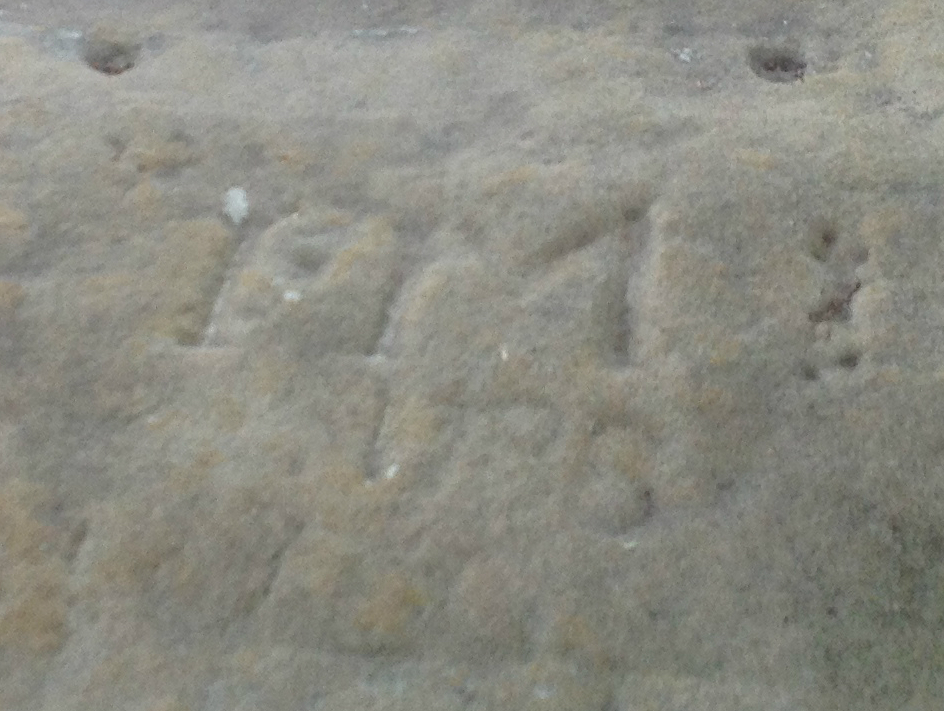
His initials are still visible at Garden Island where the crew were assigned to preparing a garden. After the Sirius was wrecked off the coast of Norfolk Island on 19 March 1790, Frederick and some of the other crew members returned to Port Jackson on HMS Supply.
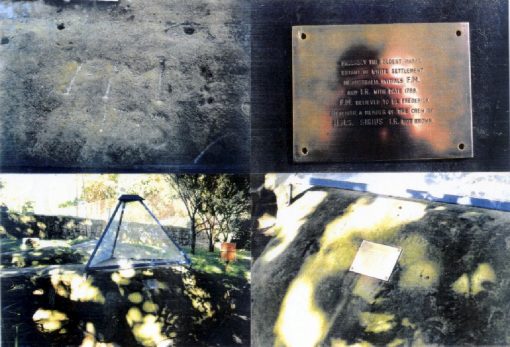
Frederick Merediths initials at Garden Island ” Possibly the oldest marks er?ant of white settlement in Australia. Initials F.M. and I.R. with date 1783. F.M. believed to be Frederick MEREDITH, a member of the crew of H.M.S. SIRIUS. I.R. not known. ” Frederick Meredith’s initials at Garden Island
Captain Hunter of the wrecked Sirius and the crew embarked for England in March 1791. Frederick was then paid off by the navy in 1792 and decided his future lay in Botany Bay.
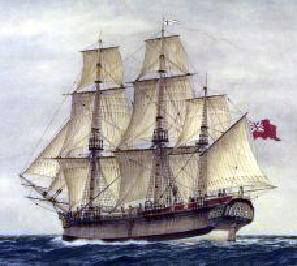
HMS Sirius
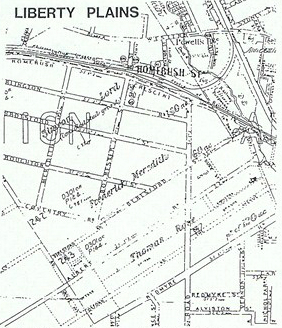
He returned on the Bellona in 1793 with a small group of the first free settlers. They were given land grants at Liberty Plains (now Strathfield). His second grant was 60 acres, where Rhodes railway station is today. Both land grants were unsuited to farming.
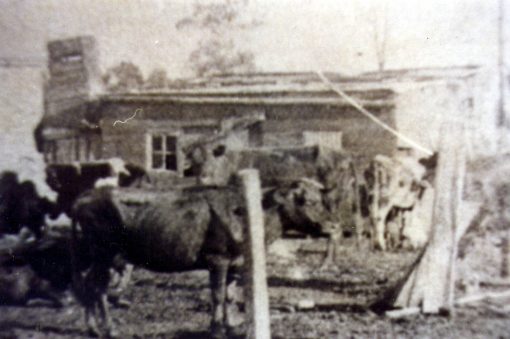
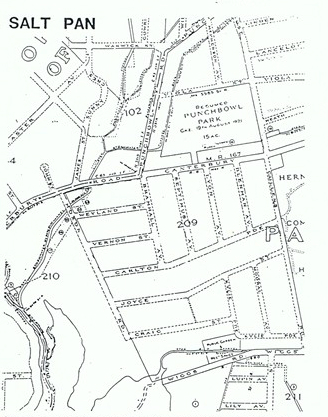
Frederick received a further grant of 120 acres near his farm at Salt Pan Creek (pictured at left and now part of Punchbowl) in 1809, for aiding a neighbour in an affray with the aborigines.
He also had a bakery in Chapel Row (now Castlereagh Street) which he sold in 1810.
Frederick had several children with convict women: Charlotte born to Mary Allen (Allein) in 1790; Amelia to Anne Case in 1793; and Charlotte to Mary Kirk in 1794.
Salt Pan Creek Grant
In 1800, Governor Hunter set up the Loyal Sydney Association, following reports of rebellion by Irish convicts. Frederick enrolled as a volunteer armed policeman and was involved in the Vinegar Hill uprising.
Frederick married Sarah Mason, a convict who also arrived on the Bellona. Their relationship had begun in 1800 and they were married in 1811 when Frederick joined Governor Macquarie’s police force. He was later appointed the first constable, then chief constable of Liverpool. Their children were Frederick junior, born in 1801, Sophia in 1803, Elizabeth in 1806, William in 1807, Anne in 1811 and Eleanor in 1813.
In 1823 he joined the Liverpool and surrounding districts police force. He remained in the police until 1828, holding positions of Constable, Chief Constable and District Constable. His final land grant was 60 acres at Liverpool Road, Banks Town in 1826. The farm was called Gunsborough.
The first post office was opened at Liverpool in 1828 and Frederick acted as the first postmaster until Donald MacLeod took up his appointed position.
Frederick and Sarah lived at Gunsborough until her death in 1832. He married Mary Ann Day in 1833. He died at the property in 1836 and was buried next to Sarah at Liverpool Cemetery.
Birth
Death Marriage
Spouse
Marriage
Spouse
Marriage
Spouse
Marriage
Spouse
Marriage
Spouse
Father
Mother
Sibling/s
Children
5 October 1763
23 June 1836 (didn’t marry)
Mary Allen
(didn’t marry)
Anne Case
(didn’t marry)
Mary Kirk
26 February 1811 Sarah Mason
19 February 1833
Mary Ann Day Charlotte Allen(mother; Mary Allen)
Amelia Case (mother; Anne Case)
Charlotte M Kirk/Meredith (mother; Mary Kirk) Frederick Meredith (mother; Sarah Mason)
Sophia Meredith (mother; Sarah Mason)
Elizabeth Meredith (mother; Sarah Mason)
William Meredith (mother; Sarah Mason)
Ann Meredith (mother; Sarah Mason)
Eleanor Caroline Meredith (mother; Sarah Mason)
Dinham, Ludlow, Shropshire, England
Bankstown, Sydney, New South Wales, Australia Sydney, New South Wales, Australia Liverpool, Sydney, New South Wales, Australia
Frederick Meredith was born on the 5th of October 1763. It is thought that he was born in Dinham, Ludlow, Shropshire, England. It is unclear where exactly Frederick was born, with people speculating that he may have been born in Denham, Buckinghamshire, London, England which is just South East of Harefield, home to many bakers, which Frederick later became (see Frederick Meredith by David Swinfield).
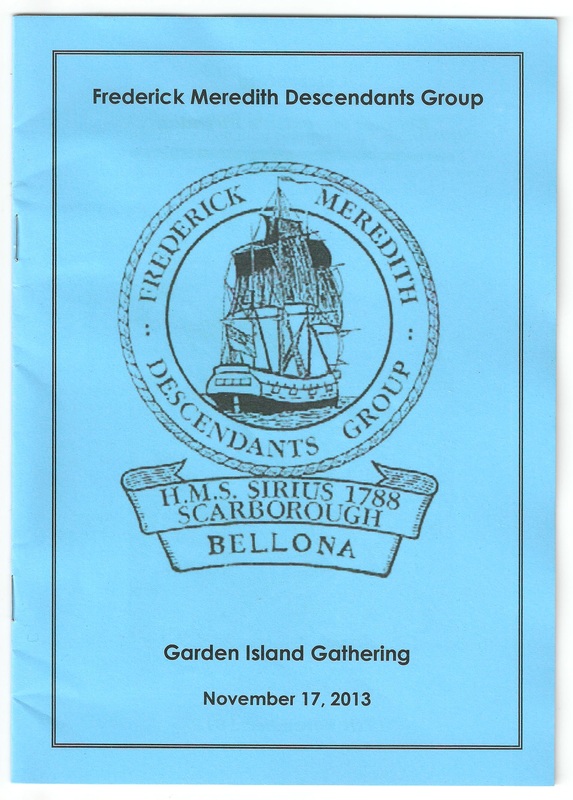
Many of his descendants are currently using DNA research to try and narrow down an area of the UK he and his ancestors are from. If you are one of Frederick’s descendants and would like to know more you can get in touch with Paul Gallagher at the Frederick Meredith Descendants Group (FMDG).
Not much is known of Frederick’s early life in England.
On the 13th of May 1787 Frederick left from Portsmouth, England on board the “Scarborough” as part of the First Fleet. There were 208 male convicts onboard. Frederick came free as steward to Captain John Marshall.
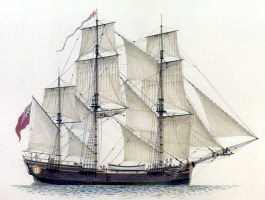
The Scarborough by marine artist Frank Allen
The “Scarborough” was a ship of 430 tons built at Scarborough in 1782. She was 111 feet (34m) long and 30 feet (9m) wide. The prison deck was very small and cramped. The height of the space was only 53 inches (135cm). The ship had a contract with the British Government to carry convicts. The owners were paid at a rate of 10 shillings per ton per month. They had to agree to keep the prisoners secure and in safe custody. After transporting the convicts to New South Wales, the “Scarborough” was under contract to work for the East India Company. The “Scarborough” sailed back to England and returned to Port Jackson in the Second fleet. Apart from the ‘Sirius’ and ‘Supply’, she was the only other ship from the first fleet to return.
The First Fleet consisted of 11 ships which sailed from Great Britain on the 13th of May 1787 with about 1,487 people, including 778 convicts (192 women & 586 men), to establish the first European colony in Australia. The fleet was led by Captain Arthur Phillip.
The ships arrived at Botany Bay between 18 & 22 January 1788. HMS Supply arrived on the 18th of January. The “Alexander”, “Scarborough” & “Friendship” on the 21st of January. The remaining ships, “Charlotte”, “Lady Penrhyn”, “Prince of Wales”, “Borrowdale”, “Fishburn”, “Golden Grove” & “Sirius” on the 22nd of January.
So on the 21st of January 1788, aged 24 years, Frederick arrived in Botany Bay, Sydney, with 201 male convicts, 30 crew and 50 marines surviving the 251 day voyage aboard the “Scarborough”. They sailed into Port Jackson (Sydney Harbour) on the 26th of January. The new site had everything the first settlers needed; deep water close to the shore, shelter and fresh water. Phillip named the site Sydney Cove, after Lord Sydney the British Home Secretary. Today this date is still celebrated as Australia Day, marking the beginnings of European settlement.
This was one of the world’s greatest sea voyages — eleven vessels carrying about 1,487 people and stores had travelled for 252 days for more than 15,000 miles (24,000 km) without losing a ship. Forty-eight people had died on the journey, a death rate of just over three per cent. Given the rigours of the voyage, the navigational problems, the poor condition and sea-faring inexperience of the convicts, the primitive medical knowledge, the lack of precautions against scurvy, the crammed and foul conditions of the ships, poor planning and inadequate equipment, this was a remarkable achievement.
On the 22nd of February 1788 Frederick was charged with exchanging goods with convict James Stow. Frederick had given the convict beef and bread as well as rum in exchange for a ‘curious beast’ a possum. Such exchanges were against government orders, and although Meredith had his master’s
permission, he was sentenced to receive 100 lashes, on his bare back, with a cat of nine tails, in the middle of the convict’s camp. Governor Phillip reduced the sentence to 50 lashes in response, said surgeon Arthur Bowes Smyth, to appeals from ‘several gentlemen’ who respected Meredith and who believed the punishment too harsh for the crime. He was the fourth person to appear before the magistrate and received 50 lashes as punishment.
In 1788 Frederick was assigned to look after the vegetable patch on Garden Island in Sydney Harbour. While there Frederick, along with 2 other European Settlers, carved his initials FM along with the year 1788 in a rock.
The other initials are believed to belong to marine private Joseph Redford of HMS Sirius and William Bradley, first lieutenant of HMS Sirius, who was a cartographer. Frederick was chosen because of his ability to both read and write and thus his ability to document the time spent there. All three men were crew members of HMS Sirius during the winter months of 1788 at a time when Sirius was anchored off Garden Island and the ship’s crew had planted a garden there to grow vegetables to help the reduction of scurvy.
Frederick’s initials carved in sandstone at Garden Island, Sydney Harbour in 1788. Possibly the oldest marks extant of European settlement in Australia.
Frederick was on the “HMS Sirius” when it sailed from Sydney in October 1788 for the Cape of Good Hope, South Africa in search of food for the starving colony. They returned to Sydney in May 1789.
On the 9th of May 1790 a daughter was born to Mary Allen. She was named Charlotte.
In Sydney he was given the care of 25 sheep and lambs, the property of commissary John Palmer. In August, Frederick and Mary gave evidence before the Court of Criminal Jurisdiction in the trial of Hugh Low, charged with stealing one of the lambs. Low was sentenced to death and executed the next day. Judge-Advocate David Collins noted that no leniency could be extended because ‘the preservation of our stock was an object of so much consequence to the colony’.
After being back in Sydney for 1 month he then departed aboard the Dutch merchant ship “Waakzaamheid” (alternate spelling “Waaksamheyd”) bound for England, with 125 men on board. He was hired to sail to Batavia to collect supplies and then on to England for Captain John Hunter to face court-martial, for the loss of HMS Sirius, in which he was eventually honourably acquitted.
On the 22nd of April 1792, Frederick arrived in Portsmouth, England aboard the “Waakzaamheid”. Owing to her bad sailing, contrary winds, and calms, the voyage to Batavia had lasted for 26 weeks (onboard they only had provisions for 16 weeks). While attempting to get provisions at Mindanao, the party had a serious affray with the Malays, fortunately without sustaining any loss.
Unknown to him, back in Sydney his daughter Charlotte had died in May 1792 and the child’s mother Mary Allen was living with another convict, Edward Pales.
Frederick departed Gravesend in Kent, England on the 8th of August 1792 aboard the “Bellona”. After a 163 day voyage the “Bellona” arrived in Sydney Harbour on the 16th of January 1793.
The ship was carrying 17 female convicts, including Ann Case whom he had impregnated during the voyage and Sarah Mason who was to become his future wife and mother to 6 of his children. His daughter, Amelia Meredith, born to Ann Case, was born on the 10th of May 1793. The affair with Ann was brief and by the time Amelia died, on the 27th of February 1794, Frederick had formed a liaison with Mary Kirk, who was transported on the “Royal Admiral” in 1792.
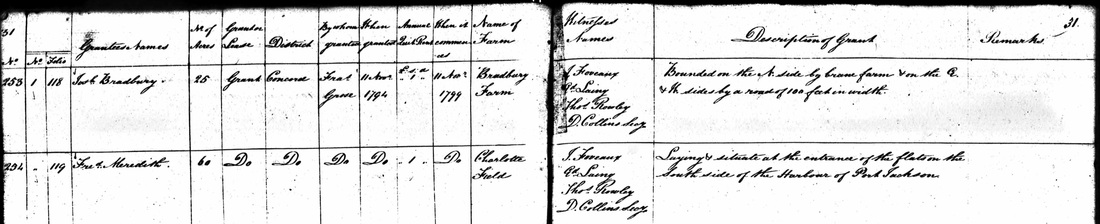
On the 28th of May 1793 Frederick was granted 60 acres of land at Liberty Plains (now Strathfield) which he named “Charlotte Farm”. He later sold this property to Thomas Rose, as it was unsuitable for farming.
The earliest use of the name Liberty Plains is found in the description of grants of land to Thomas Rose, Frederick Meredith, Thomas Webb and Edward Powell on 28 May 1793. They had arrived as passengers on the “Bellona” in January of the same year. With the help of families and servants, they cleared the land and grew wheat and corn. However, the fertility of the ground was exhausted within four to five years, so that their families were dependent on government rations.
Clearing the land was slow. Samuel Crane was killed in 1794 by a falling tree when felling timber on his 25 acres at Concord. His farm was advertised for sale as having ‘a comfortable hut, four acres planted to corn and half an acre to potatoes’.
The grant can be seen to the south of the railway line, between Strathfield and Homebush stations. Meredith Street, Homebush, runs down to one corner of the grant.
Meredith St, Homebush
Frederick St, Bankstown
Meredith St, Bankstown
On the 26th of April 1794, Frederick fathered another child, this time to Mary Kirk. The daughter was named Charlotte. Charlotte and a man named William Stewart had 3 children; Jane Rebecca, Robert, and John, born in 1812, 1816, and 1818. Charlotte then married James Charles Farrell in 1825. Their children were James Lawrence (1825), Mary Elizabeth (1828), Charlotte Rosina (1831), Charles Frederick (1833), and William Thomas (1835). She died in 1852 in Port Macquarie, New South Wales, aged 58.
On the 11th of November 1794 Frederick received his 2nd land grant, 60 acres at Concord which he named “Charlotte Field”. He later sold this property in 1798 to John Colethread/Coulthread for 87 pounds, as it too was unsuitable for farming.
On the 17th of March 1801, Frederick’s partner Sarah Mason gave birth to a boy, Frederick Meredith Junior. Frederick and Sarah would have 6 children in total; Frederick, born 1801, Sophia, born 1803, Elizabeth, born 1805, William, born 1807, Ann, Born 1811, and Eleanor Caroline, born in 1813. Frederick and Sarah would later marry in 1811.
In September 1800 he was subscribed to the rules and orders of the Sydney Loyal Association (an armed body which was formed to guard against the possibility of an insurrection by seditious Irish convicts). Governor Hunter set up the Sydney Loyal Association in 1800, following reports of rebellion by Irish convicts. Frederick volunteered as an armed policeman & was involved in the Vinegar Hill uprising.
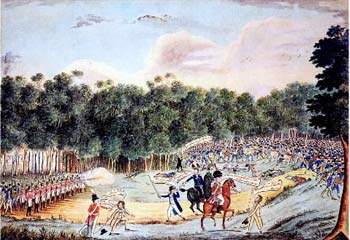
On 4 March 1804, 233 convicts led by Phillip Cunningham, escaped from a farm, intent on capturing ships to sail to Ireland. In response, martial law was quickly declared in New South Wales. The mostly Irish rebels, having gathered reinforcements, were hunted by the colonial forces until they were sequestered on 5 March 1804 on a hillock nicknamed Vinegar Hill. Under a flag of truce, Cunningham was arrested and troops charged and the rebellion was swiftly crushed by raid. Of the nearly 300 rebels directly engaged in the battle, 15 were killed, nine executed, seven whipped with 200 or 500 lashes then allotted to the Coal River chain gang, 26 sent to the Newcastle coal mines, others put on good behaviour orders against a trip to Norfolk Island, and most pardoned as having been coerced into the rising. Cunningham was court martialled under the Martial Law and hanged at the Commissariat Store at Windsor. It was the first and only convict uprising in Australian history.
In March 1809 Frederick had resumed his trade as a baker. He had a bakehouse in Chapel Row (now Castlereagh St, Sydney).
On the map it may be seen to be bounded by Moxon Rd, Canterbury Rd, Punchbowl Rd, Ross St, Cullens Rd, and Wiggs Rd.
Frederick was awarded a 3rd Land Grant of 120 acres by Governor Lachlan Macquarie in the Botany Bay district Salt Pan Creek (now Punchbowl) on the 1st of January 1810. It was called “Meredith’s Farm” and was bounded on the southern side by a line of ponds, which provided the property with water. This grant was awarded for aiding a neighbour in an affray with the aborigines.
New farms bordered the pathways to the Georges River, Kogarah Bay and Salt Pan Creek, and when William Bond and Frederick tried to occupy their land between Cox’s Creek and Salt Pan Creek, they had to battle a possession dispute with Aboriginal leader Tedbury and his group, the Gwea Gal tribe. During this clash, a spear went close enough to graze Frederick’s ear. Frederick and the other settlers retreated, only to return when the aborigines had moved on.
In 1811 Governor Lachlan Macquarie formed a regular police force and Frederick was among those appointed as constable. He eventually became the first Chief Constable at Liverpool NSW Australia.
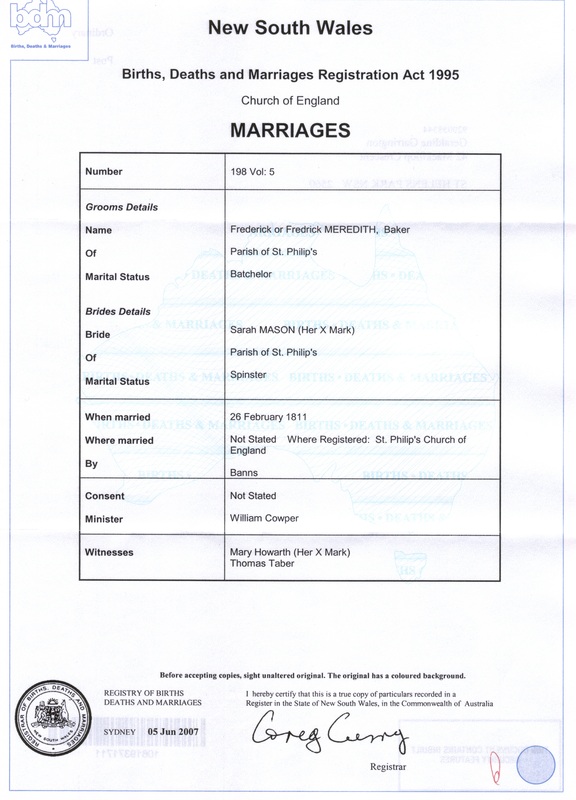
He married Sarah Mason on the 26th of February 1811 at the St Phillip’s Church of England in Sydney.
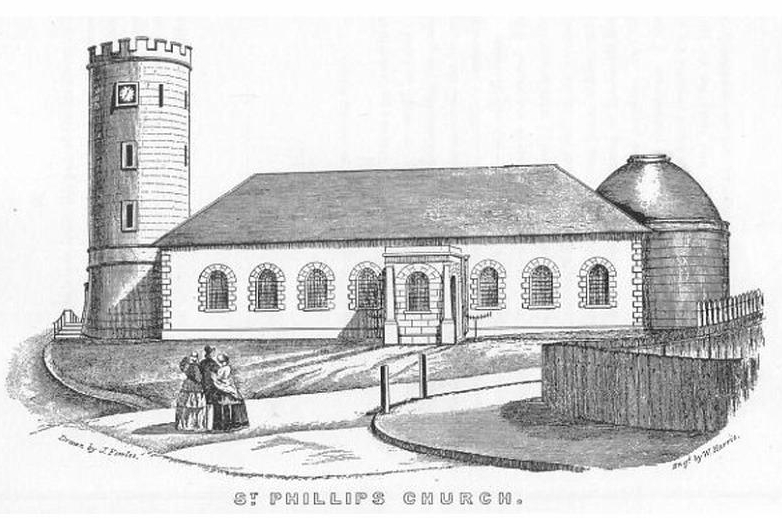
St Phillip’s Church 1798-1856, was on part of the site now covered by Lang Park, which is bounded by York, Grosvenor and Lang Streets, Sydney NSW Australia. The church had a 150-foot high, round clock tower. It was made from poor materials and gained a reputation as “the ugliest church in Christendom”. The church was named in honour of the colony’s first Governor, Arthur Phillip.
On the 23rd of May 1822, he was appointed constable at Liverpool. On the 11th of March 1823, Frederick was nominated to act as Chief Constable at Liverpool.
In 1828, when the first post office was opened at Liverpool, Frederick acted as the first postmaster until Donald MacLeod took up his appointed position.
Frederick remained Chief Constable at Liverpool up until at least 1833.
In 1831, aged 68, a 4th Land Grant was awarded to Frederick of 60 acres at Liverpool Rd, Bankstown (now the Hume Highway). Although promised earlier (by Governor Macquarie) the grant was not made legal until signed by Governor Darling. The farm was named “Gunsborough”.
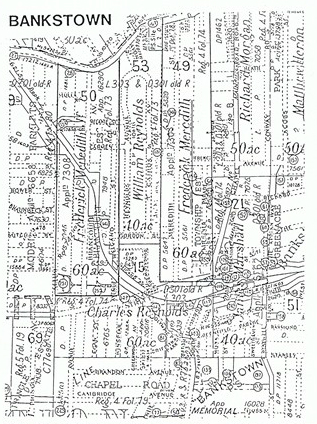
The position of the grant is clearly marked by the line of present day Meredith St which runs from North to South through the full length of the farm. To the West lay Frederick Meredith Junior’s grant – called “Merefield”.
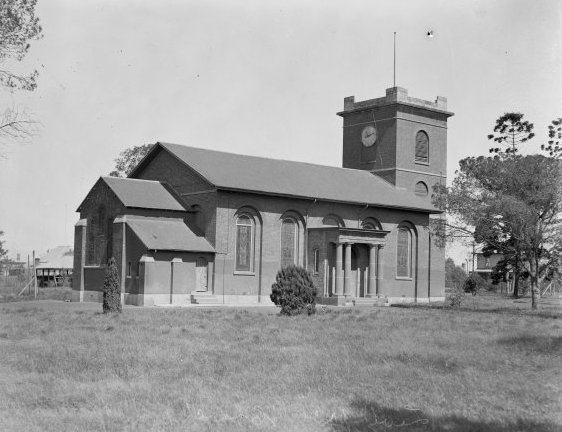
St Luke’s Anglican Church, Liverpool; built in 1815, it is the oldest Anglican Church in Australia.
On the 19th of February 1833, aged 69, Frederick married Mary Ann Day at St Luke’s, Liverpool.
Frederick died on the 23rd of June 1836 at his residence “Gunsborough” Liverpool Rd, Bankstown aged 72 years.
7 July 1836, The Sydney Gazette and New South Wales Advertiser, page 3
He is buried alongside Sarah Mason at Liverpool Pioneers Memorial Park.
In 2013 they met at Garden Island, where Frederick’s initials are carved, on the 200th anniversary of the birth of his youngest child Eleanor Caroline Meredith.