Joined NSW Police Force via NSW Police Cadet system on Monday 2 February 1976
Cadet # 3221
Redfern Police Academy Class 157
New South Wales Police Force
Regd. # 17762
Rank: NSW Police Cadet – commence 2 February 1976 ( aged 17 years, 2 months, 9 days )
Probationary Constable – appointed 24 November 1977 ( aged 19 years, 0 months, 0 days )
Constable – appointed ? ? ?
Detective – appointed ? ? ? ( YES )
Detective Constable 1st Class – appointed 24 November 1982
Senior Constable – appointed 24 November 1986
Final Rank: ?
Stations: ?, Mossman, Mudgee ( G.D’s then ‘ A ‘ List Detectives), Dubbo – death
Service: From 2 February 1976to? ? ( 1990’s )
Awards: ? National Medal – granted 15 January 1996 ( can’t verify this is the same person )
Born: Monday 24 November 1958
Died on: Saturday 24 May 1997
Cause: Suicide – (1) Attempted – unsuccessful Drug over dose ( 2 ) Committed – Police revolver
Age: 38 years, 6 months, 0 days
Event location: Dubbo – at home
Funeral date: ?
Funeral location: ?
Buried at: plaque in a rose garden at Western Districts Memorial Park, Boothenba Rd, Dubbo, NSW
Memorial at: ?
JOE is NOT mentioned on the Police Wall of Remembrance, nor the Remembrance Wall, Sydney Police Centre, Surry Hills ( last checked Oct 2022 ) * BUT SHOULD BE
Funeral location: ?
FURTHER INFORMATION IS NEEDED ABOUT THIS PERSON, THEIR LIFE, THEIR CAREER AND THEIR DEATH.
Joe GARDEN was at Mudgee Police Station around 1987-88 in uniform. Not sure where he was prior to that.
Joe started in the Detectives office as an ‘A’ lister around that time. He was left high and dry after the designated detectives moved on and he was forced to run the detectives office ‘one out’.
Apparently Joe hit the bottle quite badly and finished up banging up a police vehicle ‘on duty’ whilst intoxicated.
Had some major fights with ‘senior officers’ and was forced onto sick leave.
Joe was ‘Force transferred’ to Dubbo Intelligence Office and worked there for a year or two before he drew his service revolver, went home and shot himself.
It is believed that Joe was aged in his late 20’s or early 30’s, married with young kids at the time.
( 2019 ) Information is that Joe had attempted a drug over dose and had been admitted to Dubbo Base Hospital where, apart from other methods, he was orally administered ‘charcoal’ to absorb the poison.
He was seen, in Hospital, by a Mental Health worker who asked how he was. Joe’s forceful reply was ” I’m FINE !! ” and Joe repeated that statement.
Later, that morning, Joe was discharged home.
Joe attended Dubbo Police Station where he picked up his Police issued revolver and went home where he placed a pillow slip over his head before fatally shooting himself, in the head, whilst on the lawn.
May you forever be at Peace Joe.
Further information is sought about this man, his life and his death.
Internet searches have failed to find anything further as of this date – 1 June 2016 or 5 June 2019 – on this man.
Ashley is NOT mentioned on the Police Wall of Remembrance
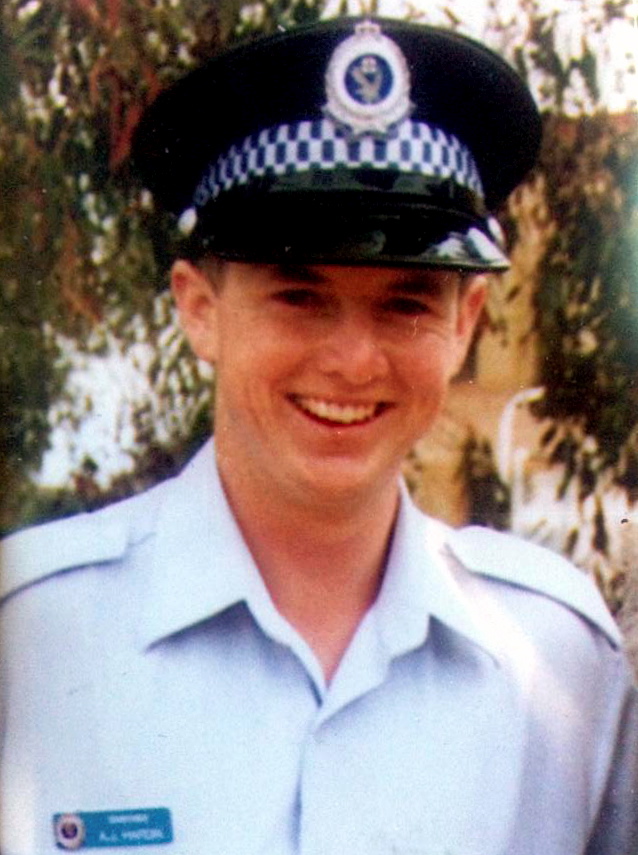
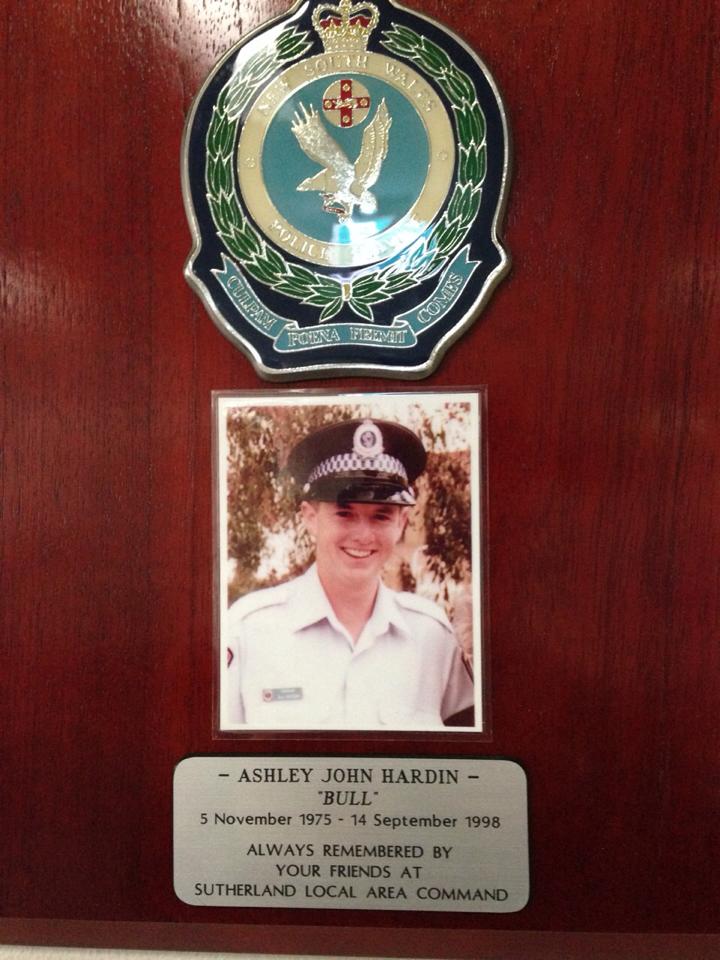
Constable Ashley John HARDIN, NSWPF
Ashley HARDIN, aka Bull, died as the result of a gun shot wound to the head with his service revolver.
He committed suicide as a result of how Police management treated him in relation to a 181D ( show cause why his employment should not be terminated ).
The NSW Police Commissioner at the time was Peter Ryan.
Plaque in the Muster Room of Sutherland Police Station in memory of Ashley John HARDIN
14 September 2015:
Ray Lambie: Gosh it is bad today! I went to Sutherland in 1998 & I was a team leader there. Bull was on my team and had suffered a malicious complaint arising from a domestic dispute that had occurred prior to his entry to the academy. Every time the domestic dispute was re visited a complaint was lodged with NSWPOL. He was cleared to enter the job, cleared whilst in the job on a number of occasions. In 1998 when the domestic complaint was raised again PIAB decided to give Bull a 181D ostensibly to make him do the work to get out of the complaint merry go round. He was suspended. He one day came in and took his service revolver to Darks Forest and committed suicide. On the day of his funeral I returned to the Sutherland Police Station and submitted my resignation. An absolute disgrace.
Morgan James HILL
| 21/05/2016
Morgan James HILL
New South Wales Police Force
Goulburn Police Academy Class # ???
Regd. # 40683
Rank: Commenced Training at Goulburn Police Academy on ? ? ?
Probationary Constable – appointed ? ? ?
Constable – appointed ? ? ?
Constable 1st Class – appointed ? ? ?
Final Rank: Constable 1st Class
Stations: Waverley
Awards: Commissioner’s Unit Citation for actions on Sunday 11 December 2005
Service: From 29 April 2005 to 27 March 2009 = 3+ years Service
Born: Tuesday 25 January 1983
Died: Friday 27 March 2009
Age: 26 years, 2 months, 2 days old
Cause: Severe PTSD – Suicide – self inflicted gunshot wound, with Service Glock, at Fishermans Rd, Malabar
Funeral date: Thursday 2 April 2009
Funeral location: Our Lady of Sacred Heart Church, 193 Avoca St, Randwick
Grave location: Ashes Interned at Botany Cemetery on 25 January 2010
RC6 – Roman Catholic FM 6 – 560
Morgan commenced his shift at Waverley Police Station at 8pm on the evening of 27 March 2009.
At 8.39pm, at Fisherman’s Road, Malabar, in his private vehicle, Morgan ended his life whilst suffering severe depression induced by the effects of anti-depressant medication he had been prescribed.
Morgan was born on 25 January 1983 and joined the New South Wales Police Force on 29 April, 2005.
He was 26 years of age at the time of his death by suicide and stationed at Waverley, Eastern Suburbs Local Area Command.
Morgan is NOT mentioned on the Police Wall of RemembranceBut Should be
MORGAN ( as of 2017 ) IS mentioned on the NSW Police Wall of Remembrance
* Stemming from the continued work of the wives of four Fallen NSW Police to Suicide – those four names will now be included in the newly refurbished NSW Police Wall of Remembrance, Sydney, as of 2017
Congratulations to those family members who fought the fight to right this wrong.
Commissioner Scipione has telephoned each of us today to advise that our loved ones names are being added to the replacement NSW Police Force Wall of Remembrance, to be unveiled in the next few weeks.
We would like to thank everyone who has offered support over a long and difficult journey and truly hope this sets a precedent for all police departments, not only in Australia but the global policing community.
It is so very important to remember that policing can and often does have a detrimental effect on those who serve.
We believe that the inclusion of suicide deaths, stemming from a work related psychological injury, is the most compassionate way of showing that the police hierarchy truly cares.
7 years ago this Easter Sunday, on 27 March, we lost our only brother and son, Morgan Hill. He took his life on duty that night. I would never wish this type of grief on another family. What has made it worse than losing Morgan though is being subjected to the stigma attached to suicide. With every year that goes by this is reinforced by NSW Police that Morgan’s death (and many before and since) are not worthy of the respect they deserve, because of HOW they died. But…we will continue to highlight this injustice and the shame is not on Morgan or our family…it is actually on YOU – the high ranking officials of the NSW Police Force – and leaders of any Force – that perpetuates this stigma by specifically excluding them from your Wall of Remembrance!
The response, from the Commissioner of Police, to the above Coroners report:
On 2 April 2012, Police Commissioner AP Scipione APM advised the Coroner as follows:
“The NSW Police Force established a Self Harm Prevention Advisory Panel (the Panel) in 2010, following a recommendation of the Deputy State Coroner Dillon in 2009 arising from the death of Sgt Ian Muir. The role of the Panel was recently reviewed and amendments are currently being made to its charter to oversight the NSW Police Force response to Recommendations in all coronial matters involving self-harm by police officers.”
I’d just like to say that it’s my hope sometime down the road after Code Nine has met with much success and people are being helped instead of silenced. I hope I never have to write another poem like this again. Because ending stories like this is what they’re all about. Please remember Mr Hills family and friends in prayer and ask that they be comforted by the memories they treasure. And not haunted by the way his life so suddenly ended. Thanks to all of you for praying. Sincerely Edwin C Hofert
This poem is one of a series of poems written by me for Code Nine Officer Needs Assistance And is intended to honor the fallen officers and their families that are to be featured in the finished documentary. As well as all others.
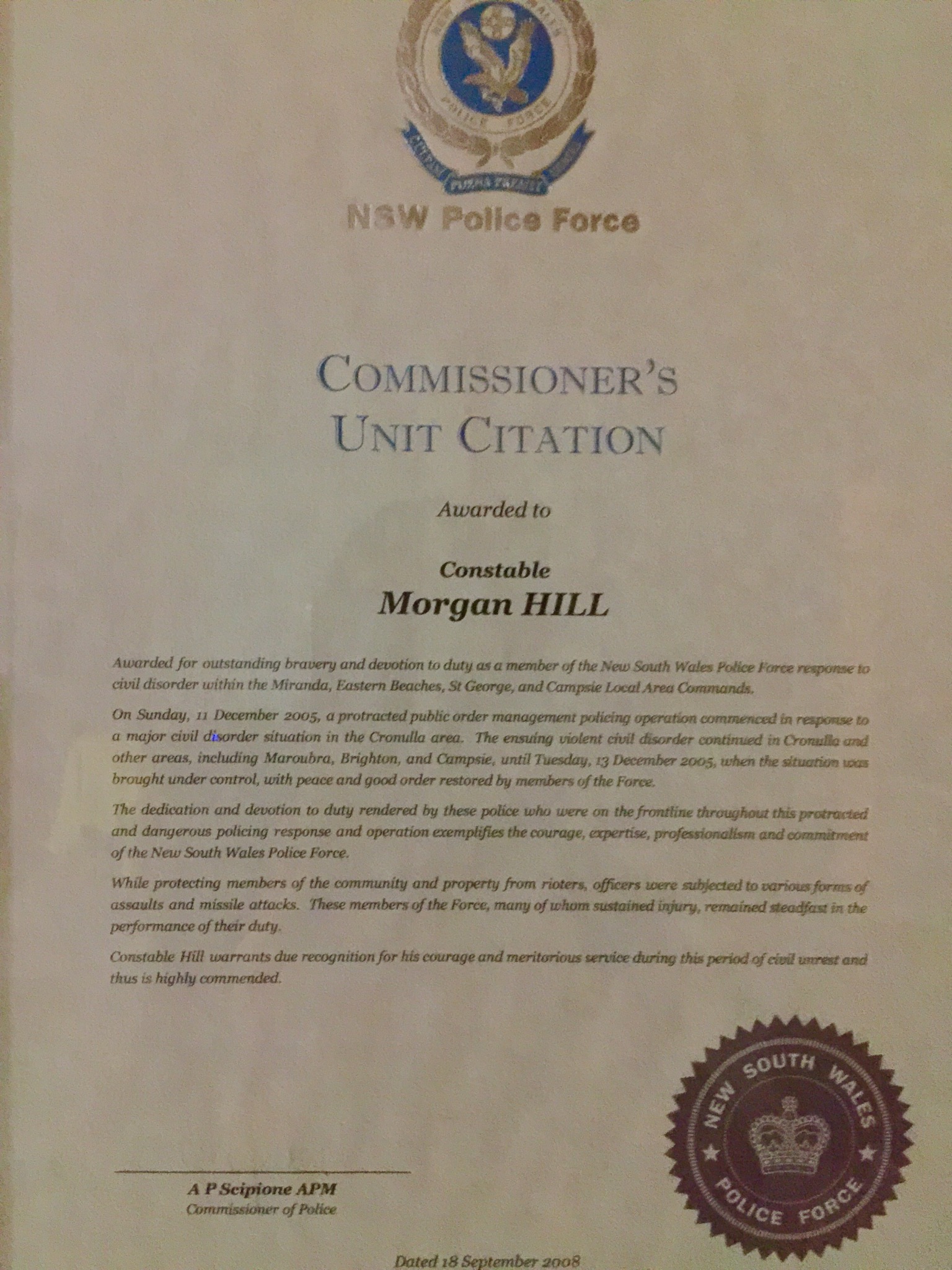
Morgan Hill – Commissioners Unit Citation re 2005 Cronulla Riots
NSW Police Force
Commissioner’s Unit Citation
Awarded to Constable Morgan Hill
Awarded for outstanding bravery and devotion to duty as a member of the New South Wales Police Force response to civil disorder within the Miranda, Eastern Beaches, St George, and Campsie Local Area Commands.
On Sunday, 11 December 2005, a protracted public order management policing operation commenced in response to a major civil disorder situation in the Cronulla area. The ensuing violent civil disorder continued in Cronulla and other areas, including Maroubra, Brighton, and Campsie, until Tuesday, 13 December 2005, when the situation was brought under control, with peace and good order restored by members of the Force.
The dedication and devotion to duty rendered by these police who were on the frontline throughout this protracted and dangerous policing response and operation exemplifies the courage, expertise, professionalism and commitment of the New South Wales Police Force.
While protecting members of the community and property from rioters, officers were subjected to various forms of assaults and missile attacks. These members of the Force, many of whom sustained injury, remained steadfast in the performance of their duty.
Constable Hill warrants due recognition for his courage and meritourious service during this period of civil unrest and thus is highly commended.
A P Scipione APM
Commissioner of Police
Dated 18 September 2008 but NOT signed.
‘Despite the above Commendation being dated 18 September 2008 ( 6 months before Morgan’s death ), the Certificate was handed to the family Posthumously on the very same day that they were also handed documentation stating that Morgan was NOT going to be mentioned on the Wall of Police Remembrance due to the fact he suicided.
These documents were not given to the family until late 2010.’
Today Tonight TV programme Channel 7, aired this show on Wednesday 23 July 2014.
The below comments were copied and pasted from the TodayTonightadelaide website on 23 March 2016
Jean Simpson says: The Government should be looking at a change in the whole health system , to ask the question why are so many young , old , just so many of the population coming down with Depression , (The Back Dog) . Definitely more counselling services. As well as the government ,we should all try to be more considerate , compassionate to all in society , there is so much suffering out there , and so many issues to deal with today than there was a few years ago. Teresa Cranes comments about the corruption , threats and underhanded dealings within the force has been talked about for as long as i can remember. It makes me really sad to see the young adults of today joining the force with all good intent , with a passion to help our society , only to find that they go to work each day fighting against an epidemic of corruption within there own work place. Like Teresa on this page i knew of an elderly Sergeant who has now retired , because he was told to take an early retirement . To find someone in the force that is not corrupt would be a hard task. How does the average person tell who is who anymore? So sorry for the ones that are trying to make this world a better place , for the opinion of a lot of people is that unfortunately they get tarred with the same brush , one can only imagine the affect on the innocent ones , Wow what a fight they have on there hands ! Love and light to all .
: 4 likes
Amanda Schultz says: Teresa Crane you got it spot on! My dad took hi s life in 1981, right in those good old corrupt years! Made a boss aged 32. Took his life aged 37. Left a wife and three daughters. What else do you do when your “boys” are on the take and the bosses buried their heads? I think there needs to be Royal Commissions to make the brass accountable and expose those we know were hypocrites and criminals. SA Police took a good man and destroyed him and his family….we live with it everyday.
: 0 likes
Peter Roberts says: Very interesting story and definitely needs looking into
: 1 likes
Heather Johns says: It’s unfortunate that they aren’t required to debrief or to talk about an issue without being labelled. It is not just police, fire, ambos, we see it a huge amount in defence too. Why can’t we remove the stigma of PTSD & depression & help those in need as they are helping us? Where is the government funding for more counselling services?
: 0 likes
Ross Beckley says: Great story and thanks for making this public. All emergency service personnel are suffering silently and their organisational management need to start addressing these concerns raised in this story.
: 1 likes
Trevor Hardy says: SAPOL officers need to find themselves a good private psychologist and see them regularly. You can work through problems and if SAPOL are going to continue to sweep the problems under the carpet, then members need to do it for themselves. Or quit. No job in this Universe is worth killing yourself over.
: 0 likes
Jessica Courtney Evans says: Yep…. Someone I’m my family was an officer in nz and took his own life. It’s tragic and awful. They need more support….
: 1 likes
Tanya Eldridge-Tregenza says: It’s no bloody secret it’s been happy for a long time.
: 1 likes
Lynette Millowick says: Missed out on story was working
: 1 likes
Clare Heiss says: Oh poo!! Was really looking forward to seeing it! Thanks for letting us know though!
: 3 likes
Today Tonight Adelaide says: Unfortunately we cannot load the video until it has aired in Perth – at the moment it looks like it may run tomorrow so the video won’t be online until Monday morning
: 2 likes
Berrick Boland says: Today Tonight, rocks.
: 4 likes
Lauren Busbridge says: Same with paramedics!!!!!
: 4 likes
Today Tonight Adelaide says: The video will be uploaded tomorrow
: 1 likes
Clare Heiss says: I can’t find the story in this link @TodayTonight
: 2 likes
Ann Krieg says: PTSD needs to be told and understood. We need to know what and how it happens and to whom. The service men, whether police, or army or navy or air, or whether it is from work and a bad boss or bad experience from an accident, we need to know. 🙂
: 3 likes
Berrick Boland says: The Forgotten 300 Facebook page come on and like us for the families of PTSD and Police suicide victims.
: 12 likes
Anne Heinrich says: Well I am only one of many people I know who admire the police for their kindness and care of those in need, their patience and persistence and tenacious spirit to keep people alive! Maybe if more people told them so (and I include the media) they might feel more appreciated and needed. Don’t give up guys- there are lots of us who think you’re great!
: 2 likes
Sandy McLellan says: I have known many Policeman, but one in particular tells me of the many who simply cannot cope with the ghastly things they have to deal with. We have NO idea how bad it is, very sad. They put their lives on the line for us all the time. Maybe they need much more support on the job and from us, the public.
: 3 likes
Tony Crowley says: They should cover SAPOL . We are not clean either
: 10 likes
John Hirst says: Be good to see it’s getting some publicity and not ‘swept under the carpet’. Lost a few good colleagues from this and there are so many more stepping close to the line with little or no support from the employer. Tony Crowley for your info.
Posted Monday 20 June 2016:
CORONERS COURT
Morgan James Hill:
Deputy State Coroner Mitchell On 9 September 2011 at Glebe and Parramatta
FINDINGS.
I find that Morgan Hill who was born on 25 January 1983 died at Fishermans Road Malabar NSW at about 8.39 pm on 27 March 2009 of a gunshot wound to the head, self inflicted while suffering severe depression.
RECOMMENDATIONS;
That a psychiatrist or psychiatrists be employed in the Health and Well being Unit of Welfare Safety Command or retained so as to ensure qualified psychiatric oversight of all police fitness assessments where mental health or emotional stability are an issue.
2. That appropriate criteria be developed and established to guide and inform police medical officers in assessing the fitness of police officers for various duties within the police force and the fitness of police officers to have possession of a firearm.
3. In particular, that the criteria so developed and established provide that fitness for duty and to carry a firearm is not merely a matter of the absence of a diagnosable psychiatric condition or mental illness.
4. That police medical officer be encouraged to explore with police officers referred by commanders for a fitness assessment the history of that officer and any current or recent medical diagnoses and treatment plan or plans and the identity of that officer’s medical practitioner and to seek the consent of the police officer to that medical practitioner providing appropriate medical information to the police medical officer and that unwillingness to provide that consent be among the matters to be reported to the referring commander.
5. That psychologists assisting in the preparation of fitness assessments be accorded independence from police medical officers.
6. That police medical officer be reminded of the provisions of the Health Records and Information Privacy Act 2002 and, so far as the provision of information to commanding officers is concerned, be encouraged to act in accordance with its terms.
7. That the practice of placing reliance on psychological tests in the preparation of fitness assessments be reviewed by an independent expert.
8. That the freedom of commanding officers to make their decisions as to the removal or restoration of firearms informed by considerations other than those dealt with by police medical officers be encouraged.
9. That commanding officers be reminded of their entitlement to the provision of information pursuant to the Health Records and Information Privacy Act 2002.
10. That consideration be given to the establishment of a mentoring system of young officers by more senior officers with a view to the guidance, support and oversight of the performance of those young officers.
RESPONSE
On 2 April 2012, Police Commissioner AP Scipione AMP advised the Coroner as follows:
“The NSW Police Force established a Self Harm Prevention Advisory Panel (the Panel) in 2010, following a recommendation of the Deputy State Coroner Dillon in 2009 arising from the death of Sgt Ian Muir.
The role of the Panel was recently reviewed and amendments are currently being made to its charter to oversight the NSW Police Force response to Recommendations in all coronial matters involving self-harm by police officers.
”Please click here to link to a table which sets out the full Police Force response to the recommendations made by Coroner Mitchell. (Unavailable)
Denise HodderThis is hideous that these precious lives are lost and no one in power seems to care ….?
Clare HeissI can tell you, as Morgan’s sister, whom attended this inquest for the two weeks duration it ran, that our family have not once heard about any follow up to these recommendations. Furthermore my parents were invited to be on the “self harm committee” when it began, BEFORE the inquest mind you, but attended maybe two meetings and as far as we know either does not exist anymore or is called something else, but either way we have not been asked to continue to be a part of the panel in terms of reviewing the recommendations made by then Coroner Scott Mitchell (now deceased) nor any ongoing consultation as a family who have lost a police officer to suicide.
[alert_red]Robert is NOT mentioned on the Police Wall of Remembrance[/alert_red] * BUT SHOULD BE
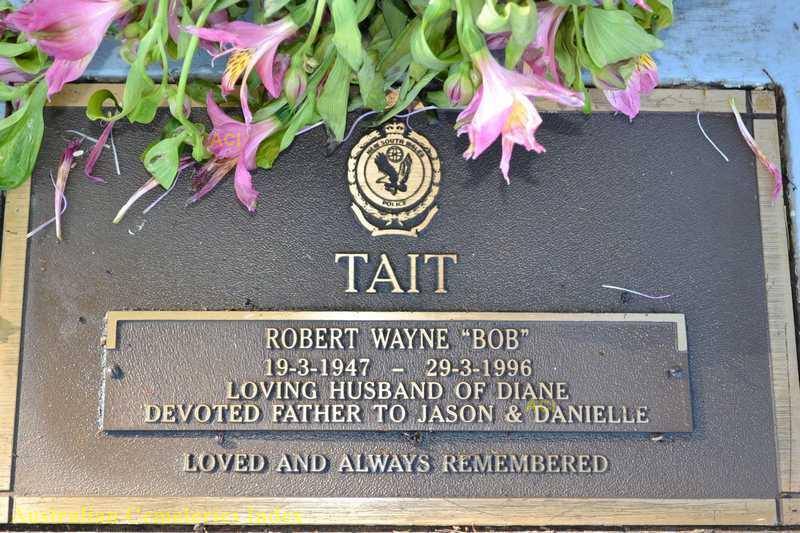
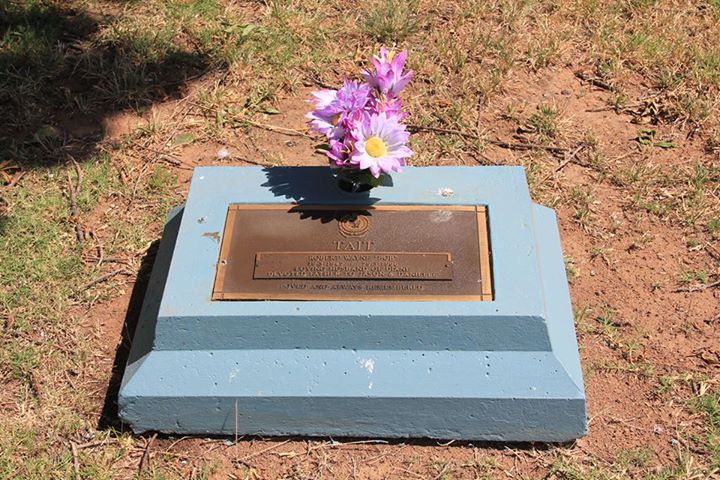
Robert Wayne TAIT headstone – Narrabri Lawn Cemetery. Portion A2, row Q
Robert Wayne TAIT – Grave
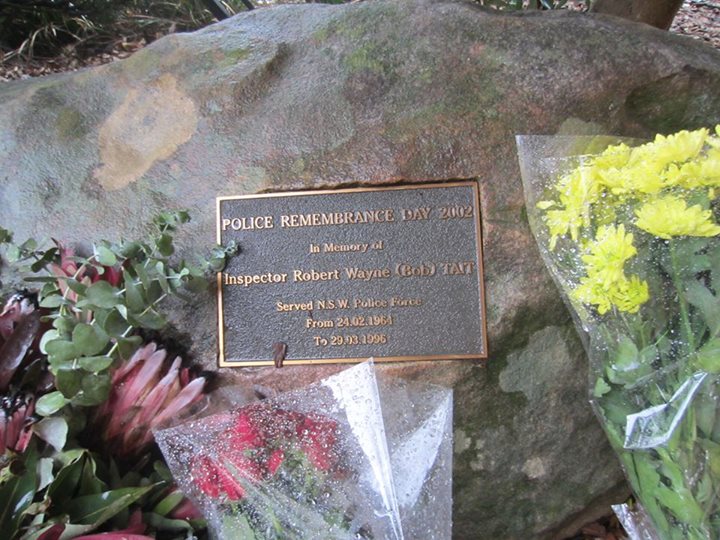
Robert Wayne TAIT – Memorial Stone outside of Narrabri Police Station. Rob’s mother also planted an Olive Tree there at the same time. 29 September 2002
In 1996 Inspector Bob Tait was the officer in charge of police at Narrabri. On the morning of Friday 29 March of that year he ended his own life at the Narrabri Police Station.
The Northern Daily Leader of 30 March, 1996 reported the death.
Stunned colleagues and the Narrabri community are this morning trying to come to terms with why such a respected policeman would kill himself. Inspector Robert Tait, 49, went to work yesterday morning, where he had been serving as the patrol commander, walked into an unoccupied office, took his service revolver and ended his life.
The inspector joined the New South Wales Police Force on 24 February, 1964 as a cadet, and was sworn in on 19 March, 1966. At the time of his death he was stationed at Narrabri, where he was the patrol commander.
It took up 451 hearing days, heard from 902 public witnesses and cost an estimated $64 million. Malcolm Brown reports on the Wood royal commission, 10 years on.
It began on June 15, 1995, when an unnamed Annandale detective jumped to his death from the seventh floor of a building, apparently through fear of the Wood royal commission. The detective’s suicide was followed by those of Ray Jenkins, a dog trainer (July 10), and Inspector Robert Tait, the acting patrol commander at Narrabri ( March 29, 1996 ). Nineteen days later a former Wollongong alderman, Brian Tobin, gassed himself.
On May 8 the same year, Peter Foretic gassed himself the day after giving evidence about pedophilia. On September 23, Detective Senior Constable Wayne Johnson shot himselfand his estranged wife after being adversely named in the royal commission. On November 4, David Yeldham, a retired judge about to face the royal commission on questions of sexual impropriety, killed himself. A month later Danny Caines, a plumber and police confidant, committed suicide at Forster, on the North Coast.
Altogether, 12 people enmeshed in the Wood royal commission took their own lives. Scores of others were so profoundly affected by proceedings that their supporters and families believe it shortened their lives. A former detective, Greg Jensen, suffered a recurrence of the stomach cancer that ultimately ended his life, while another former detective, Ray McDougall, who faced the threat that commission investigators might expose his extramarital affair if he did not co-operate, succumbed to motor neurone disease.
There is no doubt that the Royal Commission into the NSW Police Service, headed by the Supreme Court judge James Wood, purged the force of a rollcall of rotters. A total of 284 police officers were adversely named, 46 briefs of evidence were sent to the Director of Public Prosecutions and by 2001 nine officers had pleaded guilty to corruption offences and three not guilty. Seven police officers received jail sentences, including the former Gosford drug squad chief Wayne Eade and a former chief of detectives, Graham “Chook” Fowler.
Several high-profile police ended their careers in disgrace, including Ray Donaldson, an assistant commissioner, whose contract was not renewed, and Bob Lysaught, the commissioner’s chief of staff, whose contract was torn up. Charges against 14 officers were dismissed because of irregularities in search warrants and their execution.
That left the question of what to do with police who were on the nose but who could not be brought to account by normal means. The solution was the creation of section 181B of the Police Service Act, under which the police commissioner could dismiss an officer on the basis of what had come out of the royal commission. Section 181D allowed the police commissioner to serve an officer with a notice indicating that he “does not have confidence in the police officer’s suitability to continue as a police officer”. The officer could show cause as to why he should be retained, and if dismissed could appeal to the Industrial Relations Tribunal.
In the wake of the two legislative changes, 380 officers were targeted for dismissal or internal investigation. By March 1998, 19 police officers had been dismissed under section 181B and three under 181D. Another had been dismissed under a separate provision of the act, 14 had resigned, four had been medically discharged and 15 had been given performance warning notices. Others were under consideration, and as the Police Integrity Commission – a legacy of the royal commission which became a permanent watchdog – has demonstrated, even officers who had been corrupt many years before were not necessarily in the clear.The former independent MP John Hatton, who was instrumental in setting up the royal commission, said he thought the Police Integrity Commission was the royal commission’s “greatest achievement”. The Child Protection Enforcement Agency, which launched a purge of sex offenders, is another positive legacy of the royal commission.But 10 years on, was the exercise worth it?To some there were considerable benefits. Some appalling malpractice – known as “process” or “noble cause” corruption – prompted Wood to wonder at one point about the quality of a lot of police evidence he had accepted over the years.Despite this, many officers still believe the royal commission was too puritanical. They claim the investigators, not able to grapple with the really big issues, jumped on anything they could: “They had to have runs on the board,” says Michael McGann, who as a policeman in 1984 participated in the so-called Kareela Cat Burglar case, in which police used mace on an unco-operative thief and sex offender. To some critics this treatment did no serious harm and only required a word of caution. But under the spotlight of the royal commission 12 years later, it ended the careers of high-flying police such as John Garvey, Brian Harding and Steve York.A decade later, Harding works in corporate security but insists that the real sting was that the investigators had fabricated evidence. When that finally came out, he says, the group received a confidential settlement, but it did little to redress the feelings of outrage.
Another former policeman, Dr Michael Kennedy, says the commission was a political response to the police commissioner, Tony Lauer, bringing about the downfall of the then police minister, Ted Pickering.
The attorney-general, ministry and judiciary took little responsibility for the state of the force, Kennedy says, while the responsibility of the police rank-and-file grew to “the size of a Pacific driftnet”. “I don’t think the royal commission contributed anything to the reform process except to provide a template for double standards,” he says.
“Chook Fowler put $200 into his pocket from Louis Bayeh. Chook was a lazy, good-for-nothing drunk. But he was put into the same category as Ray Williams and HIH.”McGann says that against the string of petty corrupt activities uncovered, “you have to look at what the government did and did not do with gambling and vice, over the decades. There have been direct links to Parliament for 50 or 60 years. That is hypocrisy.”The critics’ view is that the royal commission has left a demoralised police force, tarnished and rudderless, with limited operational effectiveness and the problem of corruption unsolved. Seven police officers have taken their lives since 2001, including two this year.”It highlights the fact that the structure no longer takes in the needs of the NSW police force,” says Mike Gallacher, the Opposition police spokesman, and a former internal affairs police officer.Gallacher believes, as does the NSW Police Commissioner, Ken Moroney, that the tentacles of corruption no longer spread to embrace entire squads or larger units. But it does not prevent low-level incidents of corruption and there are continuing nests of corruption.In its most recent report, the Police Integrity Commission said it had undertaken 21 major investigations in 2005-06. These dealt with extortion, theft, unauthorised disclosure of confidential government information and perverting the course of justice, police brutality and the handling of $250,000 stolen from automatic teller machines. The then police integrity commissioner, Terry Griffin, said there had been 51 investigations in the 12 months, compared with 44 in 2004-05, and the 1141 written complaints represented a 15 per cent increase.Moroney says all these reports are disappointing, but one of the significant statistics was the number of police who were reporting on other police. “You go back a decade and the number of informants who were police was 5 to 10 per cent,” he says. “In the Ombudsman’s last report, that figure was 49 per cent.”The mechanism for dealing with internal complaints has been expedited: “I have not been afraid to use a section 181D notice,” Moroney says.He believes there is a different mentality in the force. A video of the royal commission had been shown at a recent reunion dinner of the old criminal investigation branch. “It is part of our history. But the interesting thing is that when Chookie came onto the screen, everyone booed. That was a signal to the Fowlers and the Eades that those found to have acted corruptly would not be accepted.”
However, Moroney accepts that corruption is not a thing of the past. “In the contemporary period, there are huge monies to be made from the illicit drug environment. You are talking in some cases of millions of dollars. It is the greatest menace in society today. And the greatest menace to officers is drug money. That is why rotation of officers out of specialist squads on a regular basis is important.”Taking over as commissioner five years ago, he had brought a low-key “Uncle Ken” influence, sorely needed, and had had to balance the principles of police accountability against the public demand for law and order, and the task has been awkward.A senior counsel told the Heraldthis week that the focus on integrity, scrutiny of professional standards and attacks by defence lawyers meant that talented police prepared to do the dirty work were deterred. “In the old days the best and the brightest went into plain-clothes,” he said. “But when the police perceive that when they have to go the extra yard [to get convictions], they are crucified – ‘Why should I go to plain-clothes when I can just get some uniform job with a 12-hour shift, and a second job?”‘Clive Small, a former assistant commissioner who set up crime agencies and established the child protection unit, says that after so many detectives were disgraced in the royal commission, the police force sought to take the spotlight off detectives and put more of the onus of responsibility for crime control onto local area commands. Crime agencies had a continual battle to keep up to strength. Regionalising responsibility for crime control reflected a lack of understanding. “A lot of crime spreads through the metropolitan area, across the state and across the nation,” he says.Kennedy, now a university lecturer, says the “business model” approach is incompatible with good police work. “We cannot expect police to behave like they are in the private sector, where competence is measured in terms of productivity,” he says.Kennedy attended the recent CIB reunion dinner and sat at a table with former drug squad detectives who remained friends of Wayne Eade. He takes issue with Moroney‘s claim that people at the dinner made catcalls when Fowler came on screen. “No one supported Chook,” he says. “But the animosity of the crowd was directed straight at Justice Wood and his commission.”Clive Small, who was also at the dinner, says: “I think it is really a matter of interpretation who they were booing. There were things the royal commission did not take care about. There was a lot of collateral damage. And the implementation [of its recommendations] has been pretty ordinary.”
CRUSADER WHO MADE THE CALL
JOHN HATTON well remembers the audience on May 11, 1994, when he made his speech calling for a royal commission into the NSW Police Service. MPs were listening, of course, but it was a gallery above him, packed with the “top brass of the police force – the commissioner himself, the deputy commissioner, superintendents – they were an intimidating force on the Parliament”.
“They thought they could stare down the Labor Party support for my motion,” Hatton, now retired, says. “It was probably the best indicator of the way in which the police force thought they could control the agenda.”
Hatton won the day, putting paid to a claim by then police commissioner, Tony Lauer, that “systemic corruption” was “a figment of the political imagination”. Hearings started on November 24, 1994, and Justice James Wood delivered his final report on August 26, 1997.
Ten years later, Hatton believes he was vindicated. He says Wood was “the right man” to head the commission and the recruitment of interstate police was crucial, along with the decision to use phone taps and surveillance.
The 11 volumes of material Hatton gave the royal commission had been accumulated over 14 years, he says, from the time he had first spoken up. He had received information on illegal gambling, drug trafficking and police involvement with the mafia.
There had been earlier moves to address police corruption, including inquiries by the Independent Commission Against Corruption, but these had only scratched the surface. “I can remember on one occasion I reported a death threat which had to do with the McKay murder in Griffith and 48 hours later the bloke who had given the information was threatened by a shotgun at his door in Queensland,” Hatton says.
The royal commission came into being because Hatton and other independent MPs held the balance of power in Parliament. The Labor Party may have had high public motives, but also saw a chance to attack the Fahey government. Labor stipulated that an inquiry into police protection of pedophiles, previously in the hands of the ICAC, become part of the royal commission.
The process of gathering information was helped greatly by Trevor Haken, a detective who became an informer and covert investigator as part of a deal to avoid being prosecuted himself.
Hatton says Haken‘s entry was “out of the blue”. Though useful, in the long term it had had a detrimental effect on the fight against corruption. Living in fear and watching his back, Haken had provided “the greatest disincentive for someone coming forward to finger corruption in the system”.
Malcolm Brown
[divider_dotted]
i. ROBERT TAIT
Inspector Tait was a member stationed at Narrabri in 1996. Tait received a letter from the Royal Commission, which set out:
“This is to notify you that evidence will be adduced shortly from a witness who is to be called to give evidence before the Royal Commission into the NSW Police Service to the effect that you did fail to report or investigate complaints of criminal conduct.”
There is ample evidence to support the change in TAIT ‘s demeanour and behaviour following receipt of this letter. He was seen by the Police Psychologist and his own Doctor but on the 26-3-96 he shot himself in his office with his service revolver. He left a note clearly indicating how tortured he had become as a result of being named.
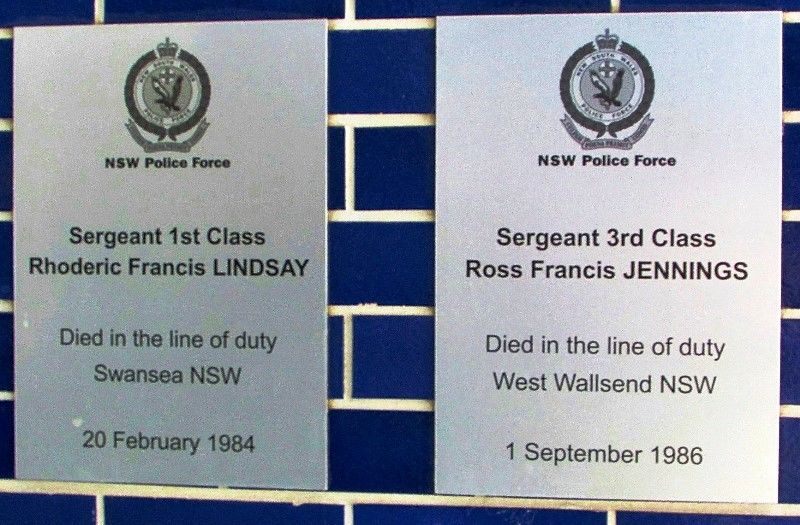
On the afternoon of 20 February, 1984 Sergeant Lindsay and Senior Constable Calman were both off duty and fishing in the sergeant’s boat off Swansea. About 6.10pm the yacht Melody radioed for assistance after running aground on the bar at Swansea Channel. Sergeant Lindsay and Senior Constable Calman then set out to assist the stricken vessel. Securing a line to the Melody they attempted to tow the vessel to safety, but as their efforts were hampered by heavy seas the sergeant released the line from the yacht. Constable Calman then noticed that Sergeant Lindsay was missing from his boat and seeing blood in the water, dived into the sea to rescue his friend. Constable Calman, assisted by surf club members, then conveyed the injured sergeant to shore however it was found then that he had died of his injuries.
It appears that Sergeant Lindsay was either knocked or was washed overboard where he suffered extensive head injuries when struck by his boat’s propeller.
He was posthumously awarded the Royal Humane Society Bronze Medal and the Police Commissioner’s Commendation for Outstanding Courage and Devotion to Duty.
The sergeant was born in 1935 and joined the New South Wales Police Force on 12 April, 1955. At the time of his death he was stationed at Newcastle.
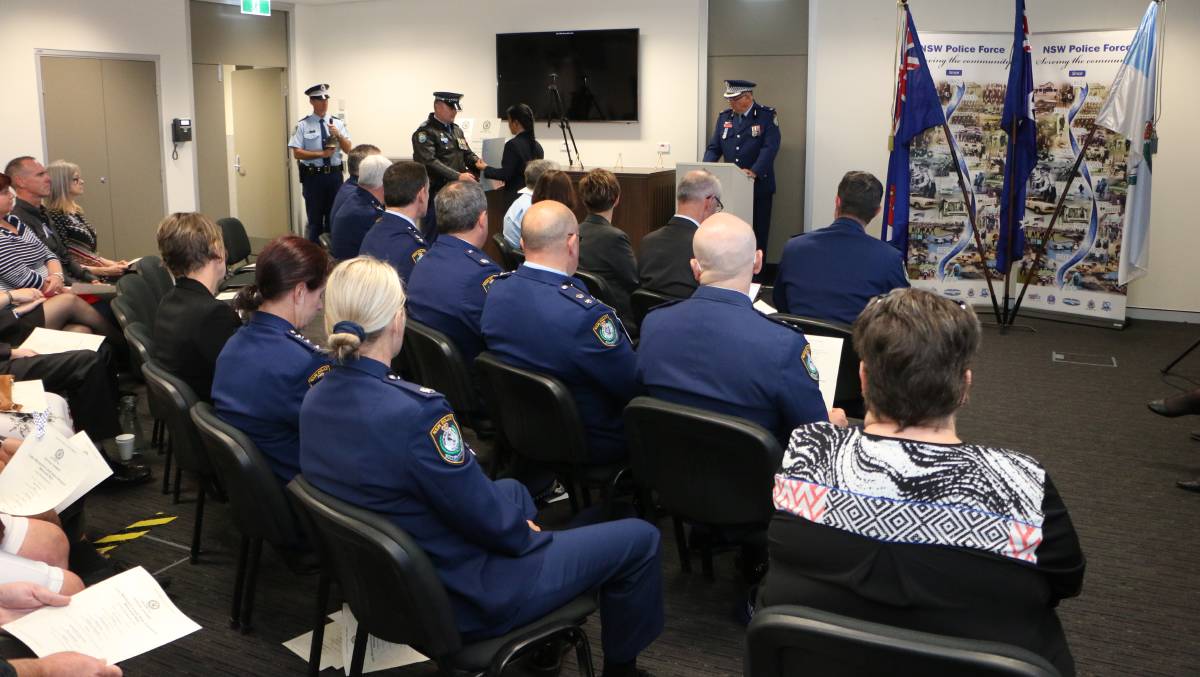
National Police Remembrance Day ceremony in Lake Macquarie
David Stewart
September 29 2017 – 4:27PM
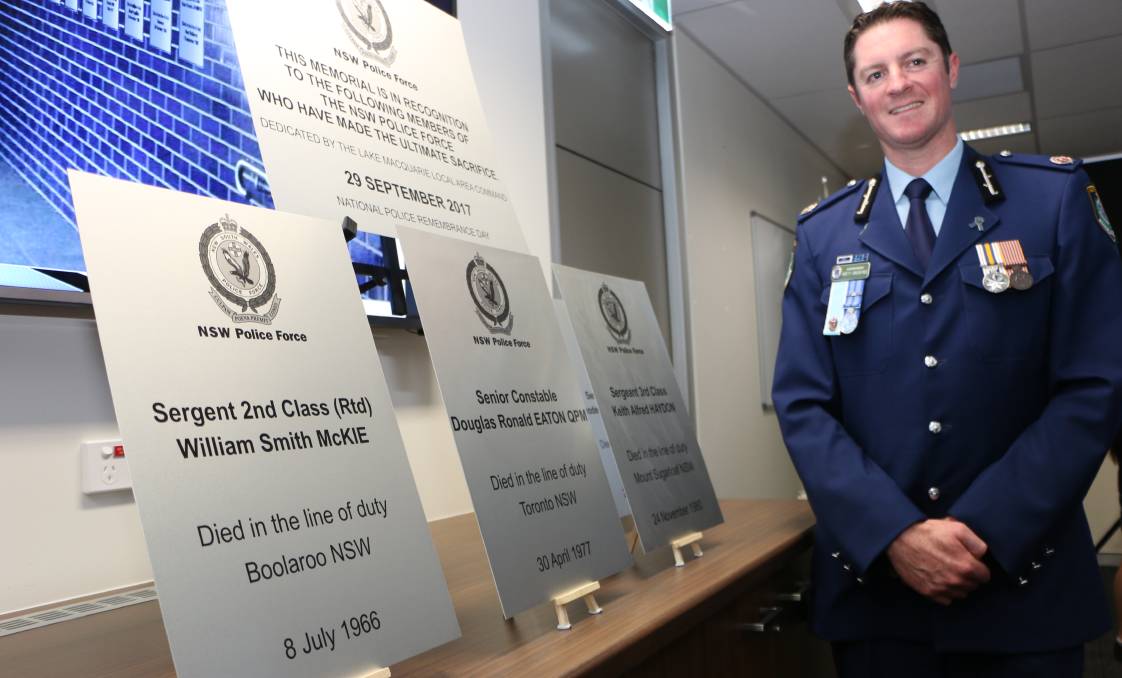
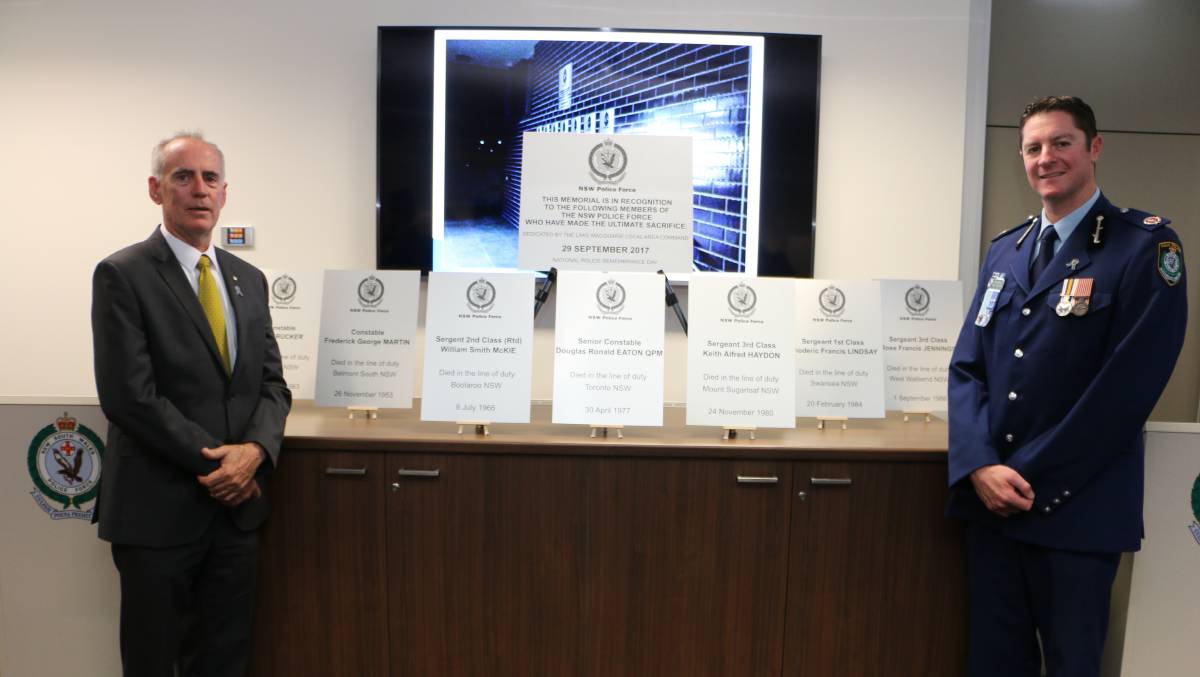
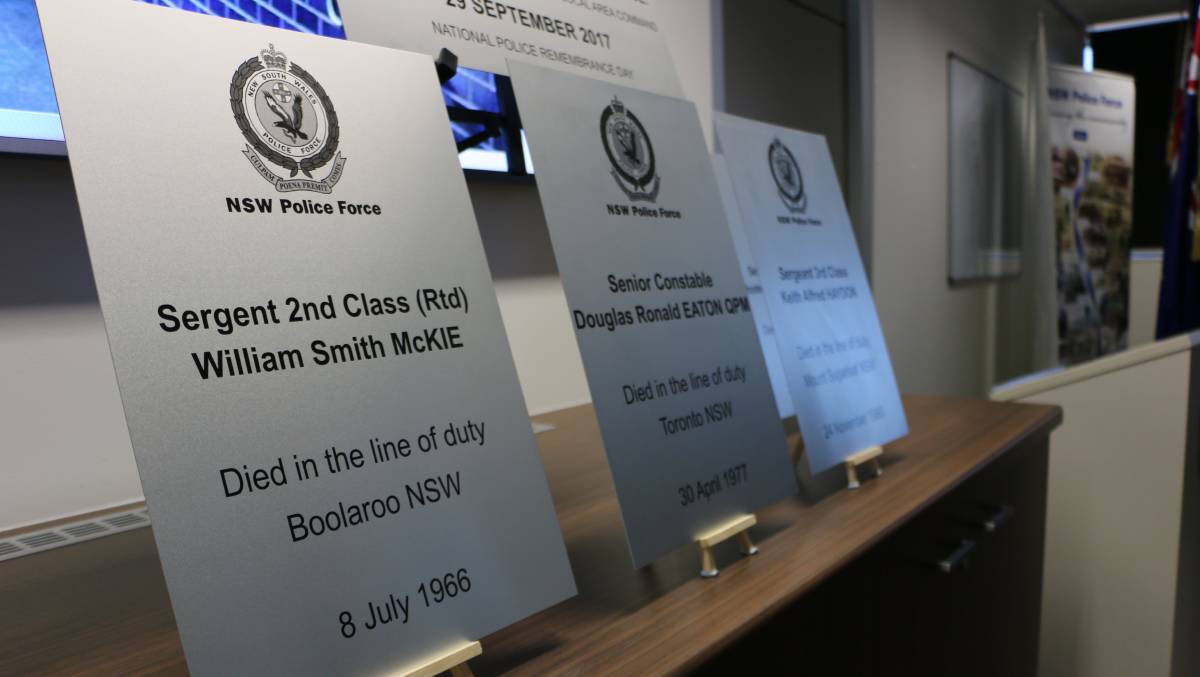
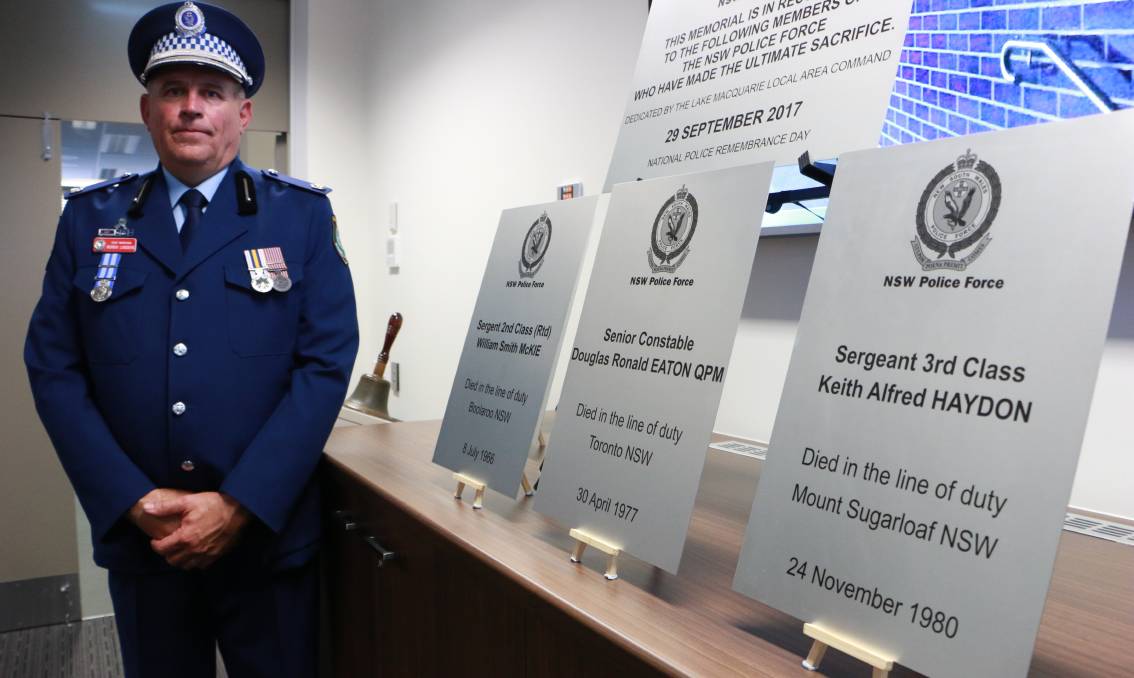
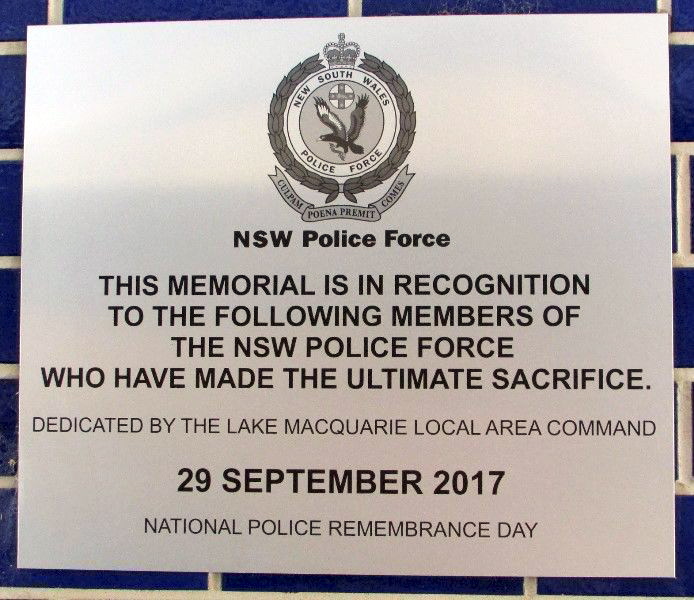
POLICE from Lake Macquarie Local Area Command have unveiled plans for a memorial wall at Belmont to honour the seven local officerskilled in the line of duty since 1863.
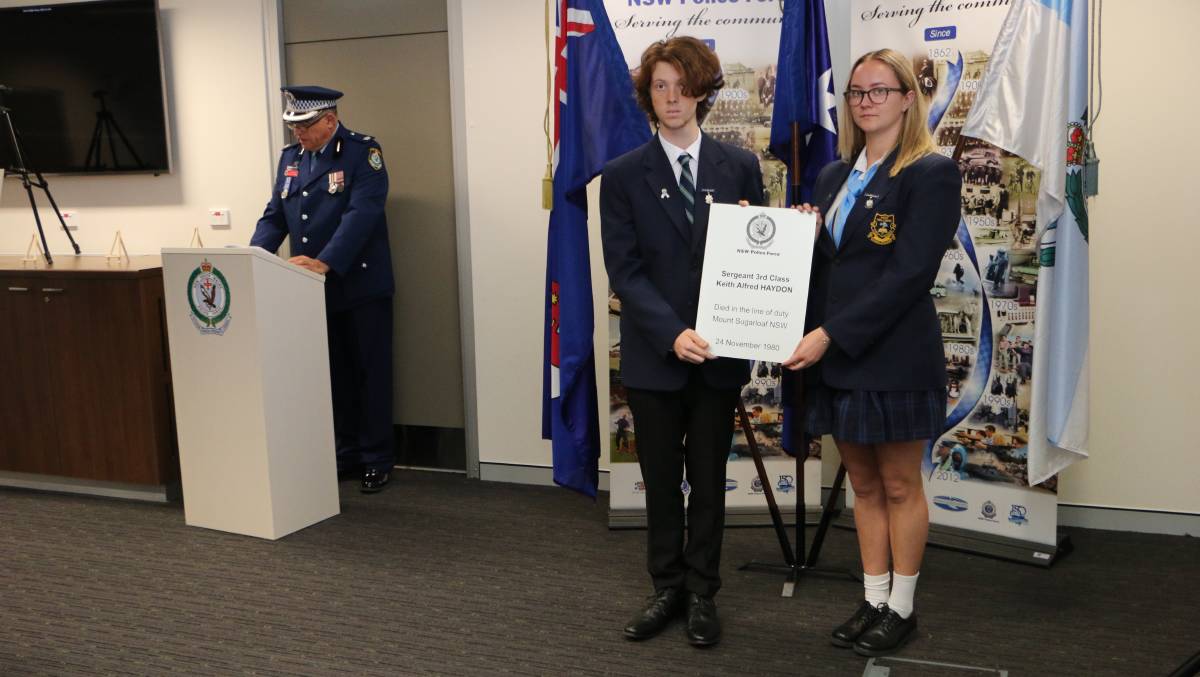
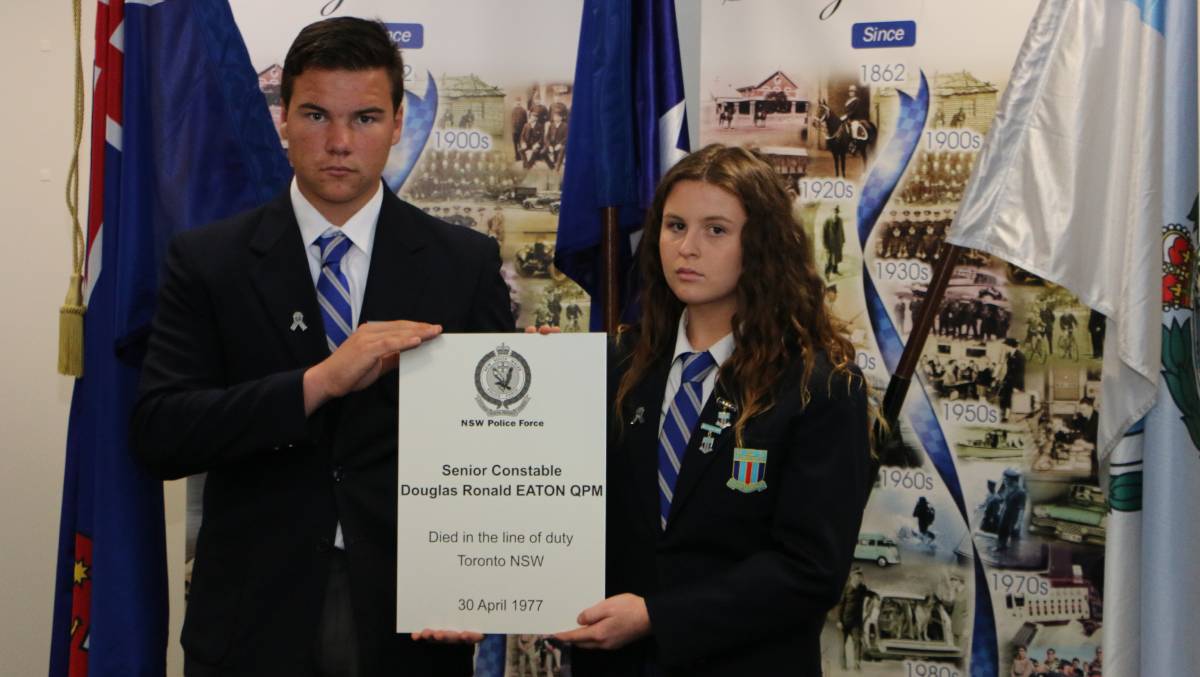
Plaques commemorating the seven officers were dedicated to the wall in a ceremony at Belmont police stationthis afternoon, National Police Remembrance Day.
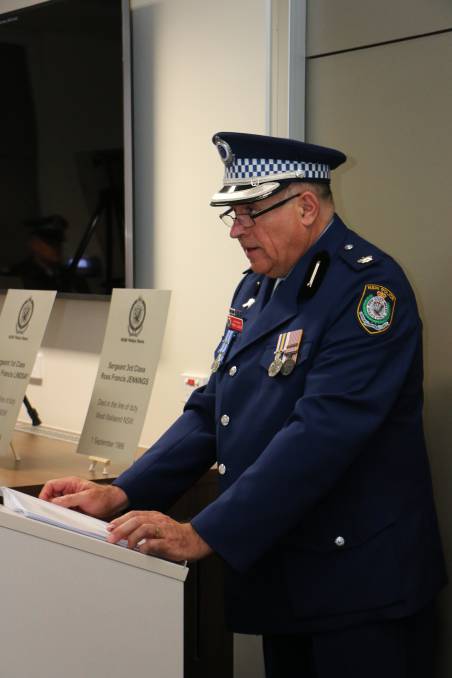
Chief Inspector Murray Lundberg of Lake Macquarie LAC presided over a private ceremony attended by police, local high school students, and the families of the fallen officers.
“This is a time for reflection on the ultimate sacrifice that police officers can give in the execution of their duty,” Chief Inspector Lundberg said.
Acting Assistant Commissioner Brett Greentree, the Northern Region Commander, said the wall of remembrance, to be created on the distinctive blue wall at the entrance to the police station, would be striking.
“It will be a sight to treasure,” Acting Assistant Commissioner Greentree said.
“I want the officers, as they are walking out the front doors of this police station, to stop and reflect on the names, stop and reflect on the sacrifice.”
He said he hoped that the inaugural plaques to be installed on the wall were also the last.
“My dream is that we never, ever, add another name to this wall. I hope and pray that our wall is now complete.”
Acting Assistant Commissioner Greentree reached out to the families of the fallen officers.
“No commemoration or recognition can make good the loss that is unfairly carried by family members,” he said.
“I can only offer you my heartfelt condolences. Please know that your loved ones, who are no longer with us, will always be remembered.”
Across NSW, ceremonies were held to commemorate the service and sacrifice of the 269 officers who have lost their lives in the line of duty, and through injury or illness, since the formation of the NSW Police Force in 1862.
Joseph Edward Matthew GIBB
| 21/05/2016
Joseph Edward Matthew GIBB
AKA Joe GIBB
Nickname: ?
Late of Tarren Point, NSW
Relations in ‘the job’: Patrick GIBB, NSWPF # 3673
“possible” relation in ‘the job‘: ?
NSW Police Training Centre – Redfern – Class # 111
Last Class to be issued with the Webley Scott semi auto pistol
New South Wales Police Force
Regd. # 12679
Rank: Commenced Training at Redfern Police Academy on Monday 15 May 1967 ( aged 23 years, 6 months, 25 days )
Probationary Constable- appointed Monday 26 June 1967 ( aged 23 years, 8 months, 6 days )
Constable – appointed ? ? ?
Final Rank: = Constable
Stations: ?, Miranda ( 24 Division ) – Death
Service: From 15 May 1967to23 January 1972 = 4 years, 8 months, 8 days Service
Retirement / Leaving age: = ?
Time in Retirement from Police: ?
Awards: No Find on Australian Honours system
Born: Wednesday 20 October 1943
Died on: Sunday 23 January 1972
Age: 28 years, 3 months, 3 days
Organ Donor: Y / N / ?
Cause: Accidentally Shot – own weapon during a violent arrest
Event location: ? , Miranda, NSW
Event / Diagnosis date: Sunday 23 January 1972
Funeral date: Wednesday 26 January 1972
Funeral location: St Joseph’s Catholic Church, Rosa St, Oatley, NSW
LIVE STREAM N/A
Wake location: ???
Wake date: ???
Funeral Parlour: ?
In Loving Memory of Joseph Edward Matthew GIBB. Loved husband of Therese, fond father of Jude and Josephine. Loved son of Pat & Ella. Died 23.1.1972, aged 28 years. Also Jude Thomas, 3.1.1971. Erected by the New South Wales Police in Recognition of ?, Constable Joseph Edward Matthew GIBB.
Buried at: Woronora Memorial Park, Linden St, Sutherland, NSW
On the afternoon of 23 January, 1972 Constable Gibb was in a police vehicle with Constable Michael Buckley and another constable.
In Shirley Road, Miranda they spotted a stolen vehicle and gave chase.
During a brief pursuit the stolen vehicle drove into a dead-end street where it collided with a fence. Three offenders emerged from the vehicle and ran to a nearby house, with Constables Gibb and Buckley in pursuit.
As the offenders split up the pursuing police each fired a warning shot into the air.
Constable Gibb caught up with the offender he was chasing as he attempted to scale a fence and as the constable took hold of him he began to struggle violently.
While he was grappling with the offender the constable’s service revolver discharged and he was shot in the chest.
Constable Gibb was conveyed to the Sutherland District Hospital where he was pronounced dead on arrival.
POLICE OFFICER SHOT DEAD
SYDNEY. Sunday – A 28-year-old police constable was shot dead today in a struggle with a young man only 70 yds from the policeman’s home at Taren Point, a southern Sydney suburb.
The policeman, Constable Joseph E. M. Gibb, is believed to have been shot through the heart with his own service revolver.
Three young men were being questioned tonight at Sutherland Police Station.
Mrs Therese Gibb, who is expecting a baby in about five weeks, collapsed when she heard of her husband’s death and was taken by ambulance to Sutherland District Hospital.
She had been shopping and arrived home to find the street full of police cars.
Police said Constable Gibb had been just about to finish work at Miranda police station at 3 pm and was getting a lift home with his workmate Constable Michael Buckley.
They had seen a small sedan they suspected had been stolen and had given chase.
The sedan, containing three young men, had turned into a dead-end street and had crashed into a wire fence of Consolidated Timber Pty Ltd at the end.
Three men had jumped out of the car. Constable Buckley had pursued two of the suspects who had climbed a fence and run into bush at the right side of the back garden. Constable Gibb had gone to the left of the house into the back garden and grappled with the other suspect.
A shot had been heard and Constable Gibb had been found dead.
Constable Buckley was too upset later to be interviewed.”
The constable was born in 1943 at Darlinghurst and joined the New South Wales Police Force on 15 May, 1967.
At the time of his death he was stationed at Miranda.
He is listed in the official NSW Police Honour Roll.
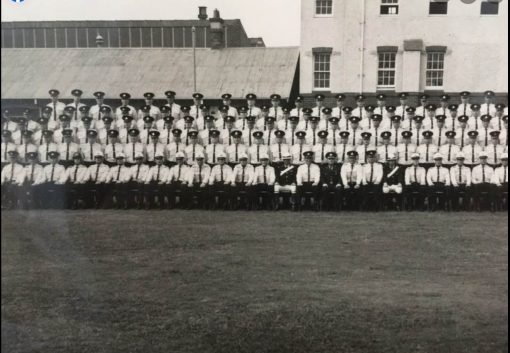
picture of Class 111 Sworn In on 26th June, 1967. All the cyclists have the first of the white helmets. They didn’t last long either’, once they realised that the broken necks were coming from the bad design, where the back of the helmet sat at the perfect point to break your neck, if your head was snapped backwards. Second white helmets issued hurriedly, ‘say no more’..!
Funeral Service
Nothing further, than what is recorded above, is known about this person at the time of publication and further information and photos would be appreciated.
The Sydney Morning Herald dated 25 May, 1946 printed the following brief account of the death of Constable Jackson. Nothing further is known of the incident.
CONSTABLE DIES AFTER SHOOTING
Constable Hubert Jackson, 38, who was found shot through the head, with his service revolver lying near him, at his home in Clift Street, Northbridge on Saturday morning, died in Sydney Hospital on Saturday night. When he had failed to report for duty another policeman went to his home and found him lying unconscious.
The inquest into the death of the constable was told that “it was stated that Jackson’s pistol was on a bed and nearby was a cleaning rag when Constable Henry Grover called to see why he was not on duty.” As the constable was shot in the forehead, and given the presence of the cleaning rag, suicide appears far less likely than this simply being an unfortunate accident.
At the time of his death the constable was aged 38 years and was stationed at North Sydney.
Sergeant Robert ROBINSON
| 21/05/2016
Sergeant Robert ROBINSON
Accidentally Shot
Muckerawa
22 January, 1864
The sergeant was among a party of police who intervened in a dispute between two parties of Chinese people at Muckerawa on the Macquarie River, near Stuart Town. He disarmed one of the people involved, taking a rifle from him, and then took hold of the weapon by the muzzle and smashed it over a log. As he did so the rifle discharged, killing him instantly.
The sergeant was born in 1815 and joined the police force on 1 April, 1852. In 1862 he became a member of the newly-formed New South Wales Police Force.