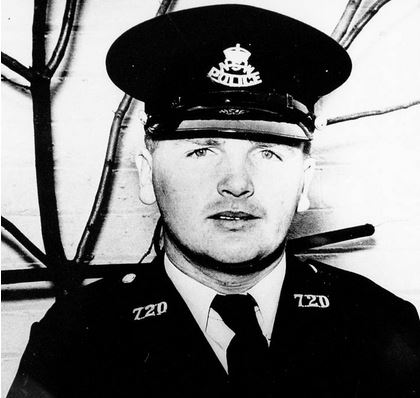
Commissioners Valour Award ( VA ) ( Posthumously )
Born: Friday 1 June 1962
Died On: Friday 5 May 1989
Event: Shot – wounded – Murdered
Event location: Woolloomooloo
Event Date: 24 April 1989
Died: 5 May 1989 ( 9 days after event )
Cause: Murdered – shot twice
Age: 26 yrs 11 mths 4 days
Funeral date: 9 May 1989
Funeral location: St Mary’s Anglican Church
Buried at: Cremated. East Ballina Cemetery, McQueen Family Wall, Sec: Niche, Lot # 2
GPS: 28*51’47″S / 153*35’26″E
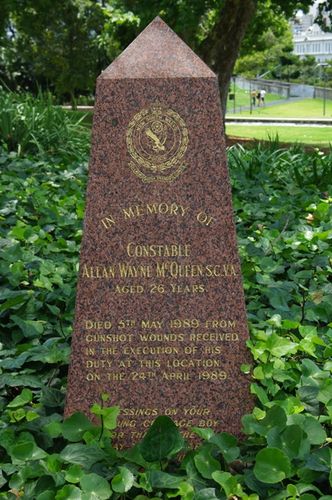
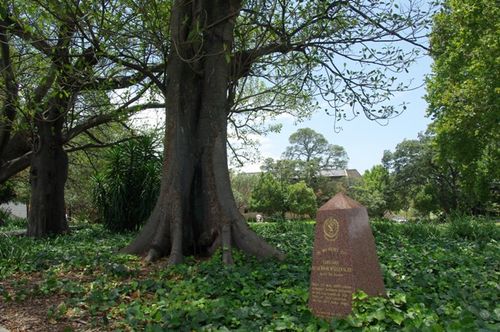
Memorial: 1/ Yurong Parkway, Phillip Park , Sydney, 2000
GPS: Lat: -33.872583 / Long: 151.213778
2/ Sydney Police Centre, McQueen Room, 151 – 241 Goulburn Street, Surry Hills.
3/ Police Launch McQueen???.
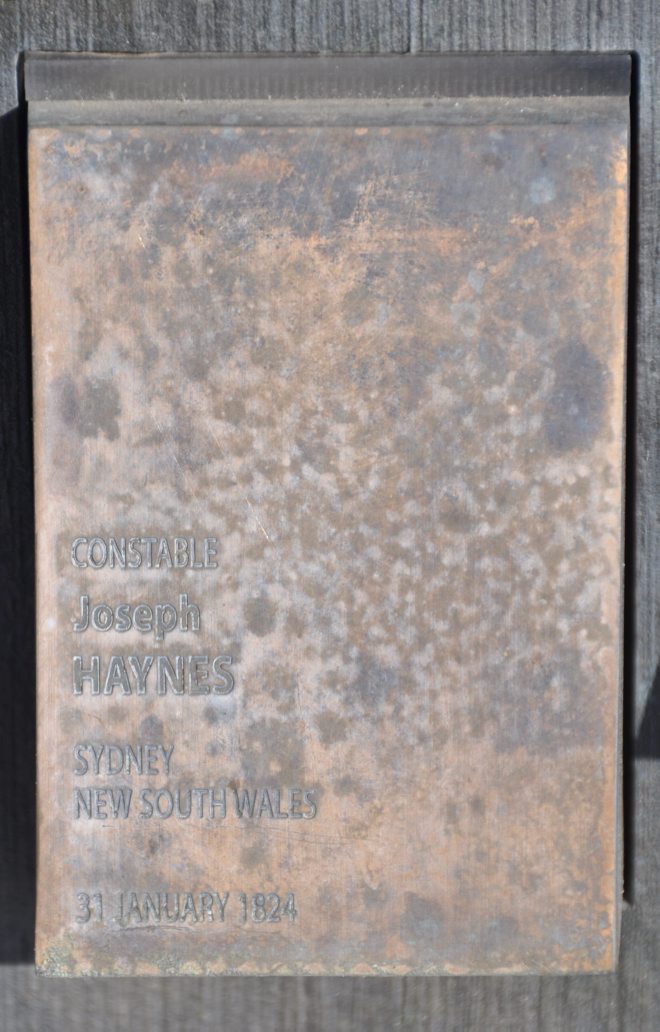
Allan’s touch plate was polished today, this 27th anniversary, 5 May 2016, by a mate, Craig Coleman, at the National Police Wall of Remembrance, Canberra.
ALLAN IS mentioned on the Police Wall of Remembrance
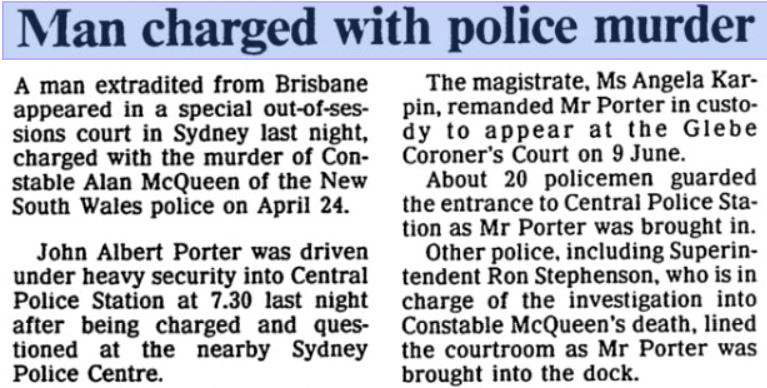
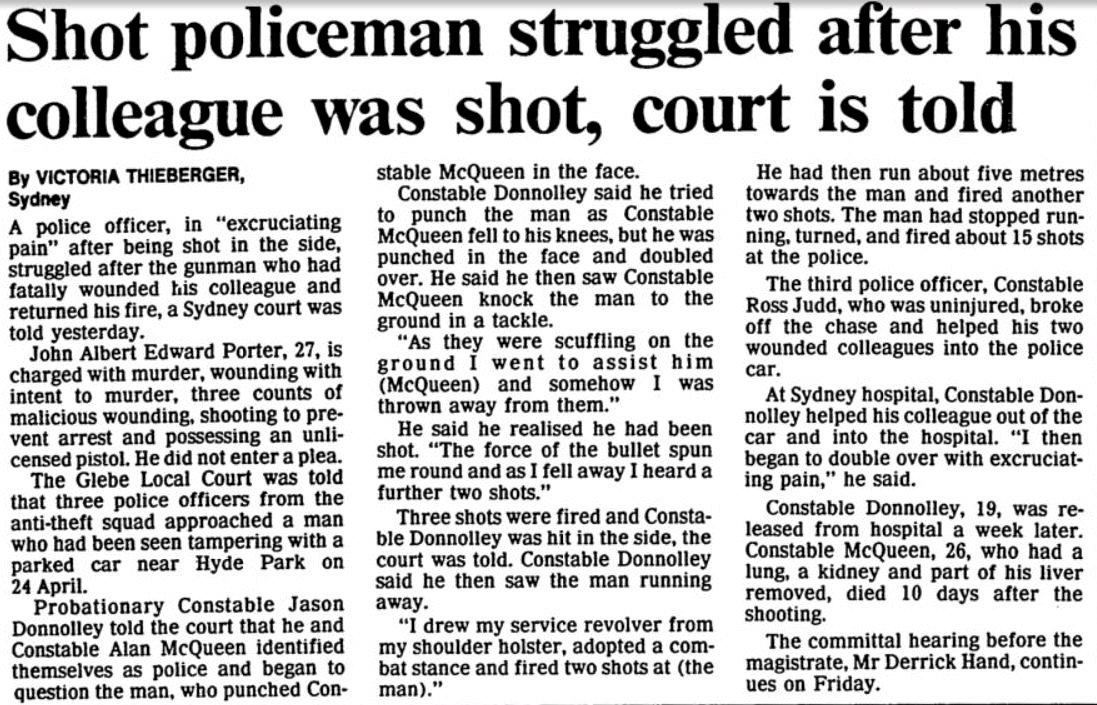
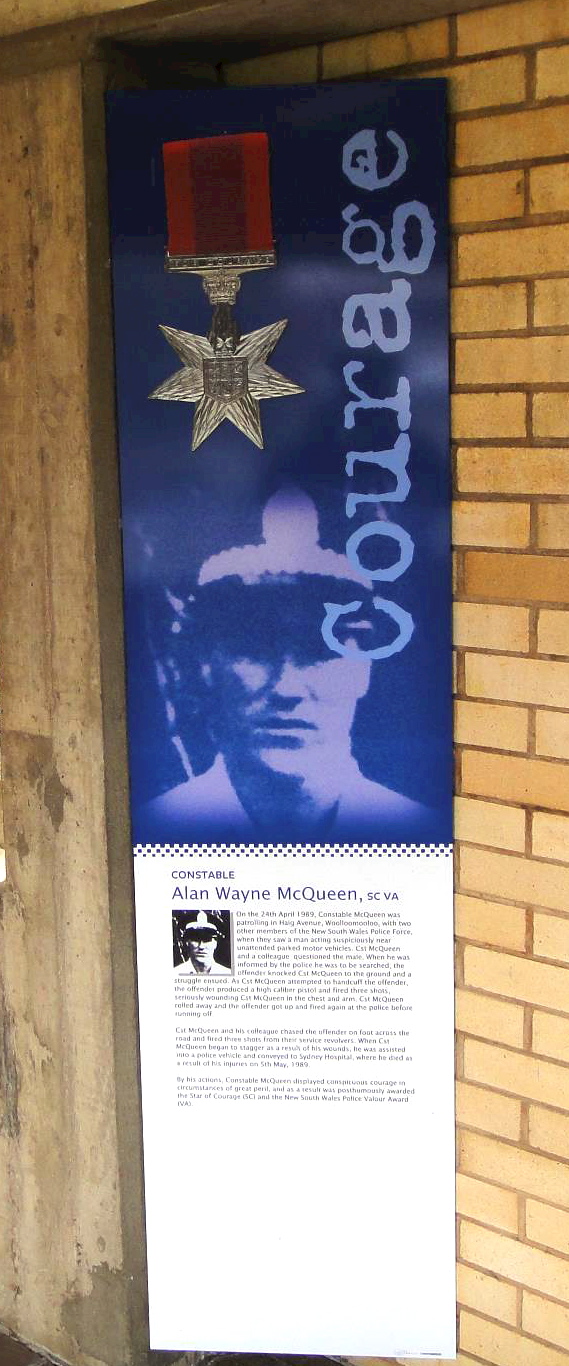
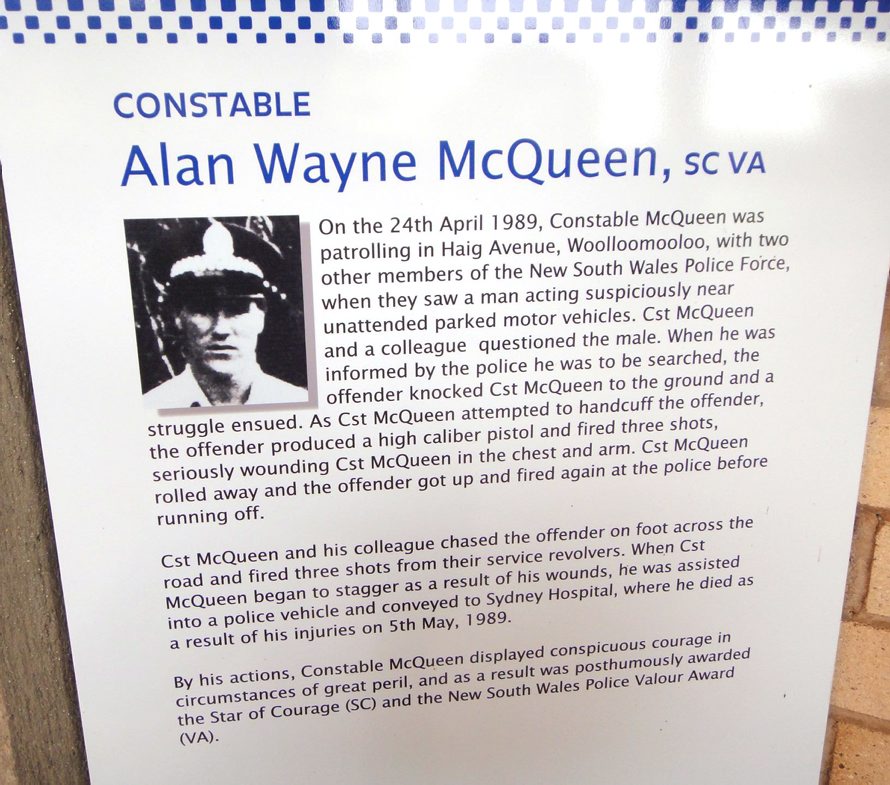
On the morning of 24 April, 1989 Constable McQueen, Constable 1st Class Ross Judd and Probationary Constable Jason Donnelly were patrolling the Woolloomooloo area. All were members of the District Anti-Theft Squad. About 11.35am they saw the offender Porter, apparently attempting to break into a motor vehicle. While Constable Judd parked the police vehicle, Constables McQueen and Donnelly went to speak to the offender. As he was being detained, the offender produced a concealed weapon and shot Constable McQueen twice in the chest and Constable Donnelly in the abdomen. Both constables then chased the offender, who continued firing at them, until both collapsed from their wounds. Constable Ross Judd also pursued and fired at the offender before returning to assist his colleagues. He then carried both wounded constables to the police car and drove them to the Sydney Hospital.
Constable Donnelly was to recover from his wounds however Constable McQueen had sustained extensive internal injuries and died on 5 May, 1989. The offender was later arrested by Queensland Police.
The Canberra Times of 12 July, 1990 reported on the result of the trial of the offender.
CONVICTION IN POLICE DEATH SYDNEY:John Albert Edward Porter has been found guilty of the murder last year of Sydney police constable Allan McQueen. A Supreme Court jury deliberated for nearly 10 hours before finding Porter, 28, guilty of shooting the policeman on April 24 last year. Porter was remanded in custody for sentencing on August 3. The jury also found Porter guilty on one count of shooting with intent to cause grievous bodily harm and three counts of shooting to avoid arrest. He was found not guilty on a sixth charge of attempting to murder Constable Jason Donnelly.
Justice Badgery-Parker had directed the jury to find Porter not guilty on the charge of attempting to murder Constable Donnelly. Porter had pleaded not guilty to all charges.
Friends and relatives of Constable McQueen sat comforting each other in the public gallery as the verdict was returned. Constable McQueen, 26, died in St Vincent’s Hospital nine days after the April 24 shooting.
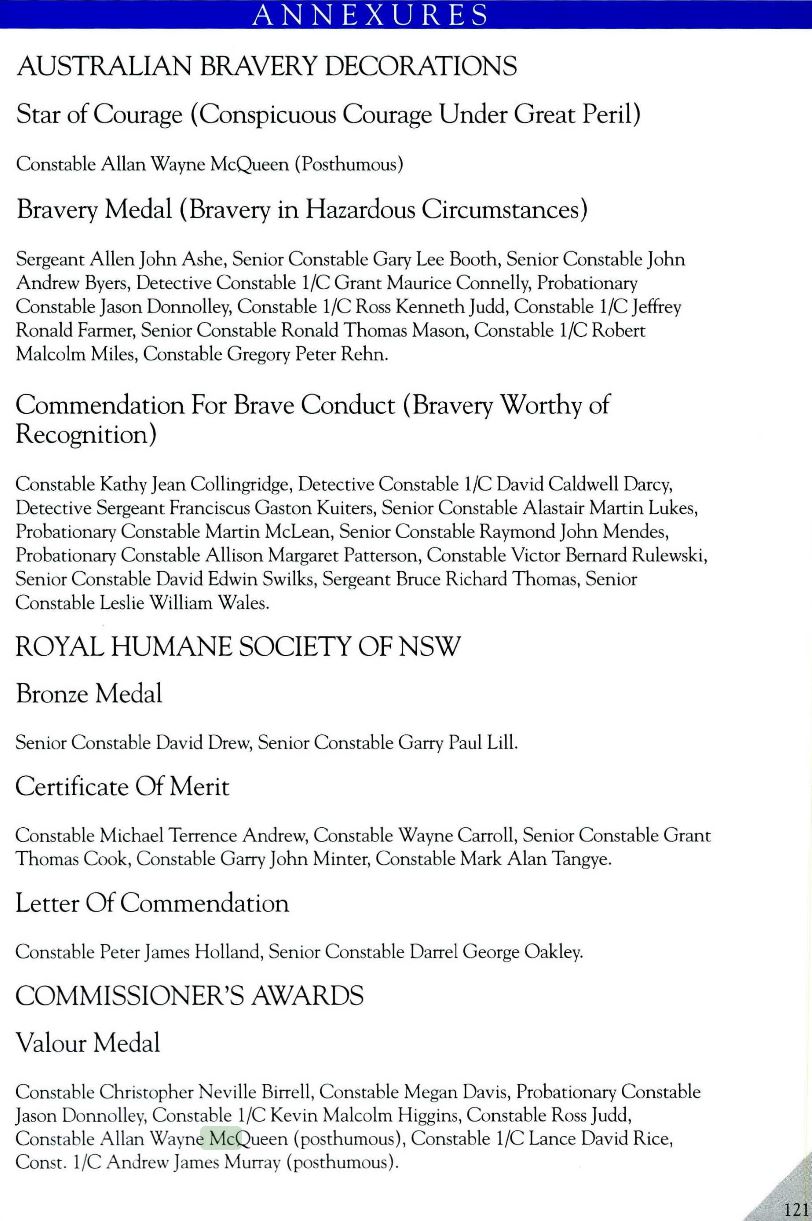
The constable was born in 1962 and joined the New South Wales Police Force on 27 June, 1987. At the time of his death he was attached to the Sydney District Anti-Theft Squad. He was posthumously awarded the Commissioner’s Medal for Valour and the Star of Courage.
Date: 24 August 1989. Memorial unveiled on corner of Haig Ave & Boomerang St, sydney.
November 2013
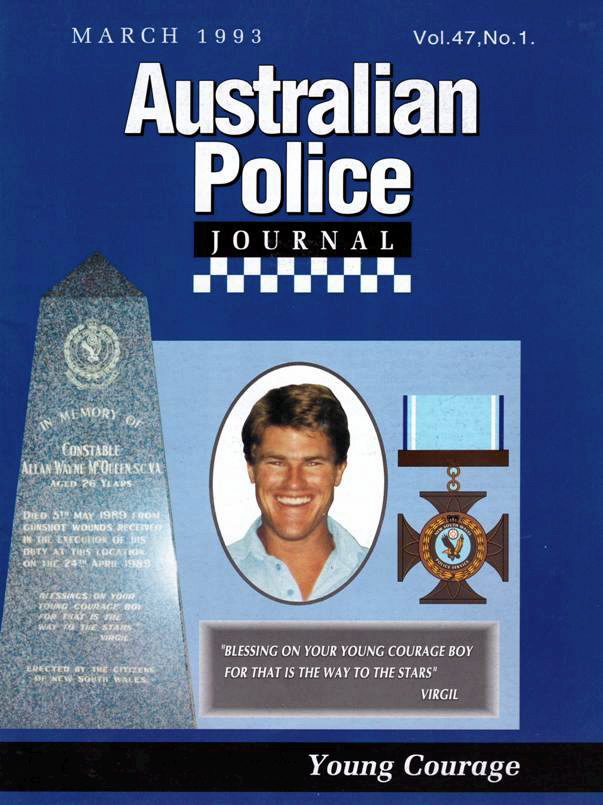
Constable Allan Wayne McQueen
Constable Allan Wayne McQueen : November 2013
Photographs supplied by Peter F Williams
Memorial erected in memory of Constable Allan James McQueen who was shot in the line of duty and died from his injuries on the 5th May 1989.
On the morning of 24 April 1989, Constable McQueen, Constable 1st Class Ross Judd (MV, BM ), and Probationary Constable Jason Donnelly (MV, BM ) were patrolling the Woolloomooloo area. All were members of the District Anti-Theft Squad. About 11.35am they saw the offender Porter apparently attempting to break into a motor vehicle. While Constable Judd parked the Police vehicle Constables McQueen and Donnelly went to speak to the offender. As he was being detained the offender produced a concealed weapon and shot Constable McQueen twice in the chest and Constable Donnelly in the abdomen. Both Constables then chased the offender who continued firing at them until both collapsed from their wounds. Constable Ross Judd also pursued and fired at the offender before returning to assist his colleagues. He then carried both wounded Constables to the Police car and drove them to the Sydney Hospital. Constable Donnelly was to recover from his wounds however Constable McQueen had sustained extensive internal injuries and died on 5 May 1989. The offender was later arrested by Queensland Police.
Front Inscription
IN MEMORY OF
CONSTABLE
ALLAN WAYNE McQUEEN S.C.,V.A.
AGED 26 YEARS
DIED 5TH MAY 1989 FROM
GUNSHOT WOUNDS RECEIVED
IN THE EXECUTION OF HIS
DUTY AT THIS LOCATION
ON THE 24TH APRIL 1989
Location
Address:
Yurong Parkway, Phillip Park , Sydney, 2000
State:
NSW
Area:
AUS
GPS Coordinates:
Lat: -33.872583
Long: 151.213778 Note: GPS Coordinates are approximate.
By LINDSAY SIMPSON ” Chief Police Reporter As one of “Big Al’s” best mates read a moving eulogy, burly police officers, hats in hands, bowed their heads and cried. Big Al was Constable Allan Wayne McQueen, the well-mannered policeman from Kyogle who died in the line of duty, shot trying to apprehend a suspected car thief in Sydney.
Constable McQueen, who had been in the force two years, had been picked to work with the Anti-theft Squad a training ground for young officers on their way to becoming detectives. Big Al, who spent three years trying to become a police officer, was known by that name “not so much because of his height but because of his heart”, said Cheryl Coleman, whose husband had shared a house with Constable McQueen in Coffs Harbour.
As Senior Constable Steve Tedder, who gave one of the eulogies said, “Big Al had the basic love and desire to become a police officer”. In 1986, while running his own cleaning business in Coffs Harbour, he built his own house and several local police officers became his flatmates. At that stage he had five jobs and was studying at night for his HSC English in an attempt to become a police officer. About this time, before he was even in the force, he saved a man’s life. The man had quarrelled with his girlfriend outside a local night club and had head-butted a pane of glass. The glass had cut his throat and Al tore his shirt off and stemmed the flow of blood while waiting for the ambulance.
Big Al. who trained as a boxer and played Rugby League, was not always the muscle builder he was at the time he joined the force. His former Rugby League coach at Kyogle High School, Mr Stan McBride, said that in the 14-year-old competition he had been the second smallest kid in the group.
Ballina townspeople also came to the funeral service. One local, Mrs Val Studdert, said she had never met Allan McQueen but had come out of respect for what he had done. “If we don’t have law and order, we have nothing,” she said.
The pallbearers wore pistols. Perhaps that’s the way it has to be these days, but they touched the pretty white wooden church in the green countryside with vulgarity. They were big, strong young men and their bulky police uniforms made them bigger, so that when they came to the narrow church door carrying their mate’s coffin, they could barely squeeze through. In any case, the coffin seemed too narrow for a young man as big as Allan McQueen.
Nearly 300 police went to his funeral in Ballina yesterday along with his mother and father, Mr John and Mrs Shirley McQueen, and 300 family and friends. They spilled out of St Mary’s Anglican Church into a church hall, where the service was shown on video, and out of the hall on to the grass, where they listened through loudspeakers.
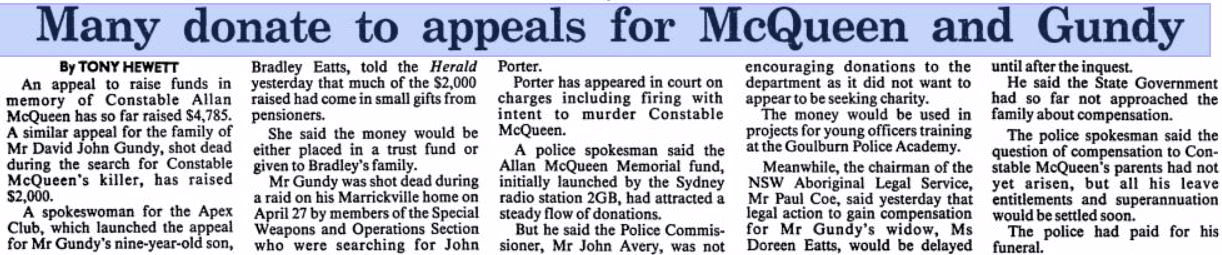
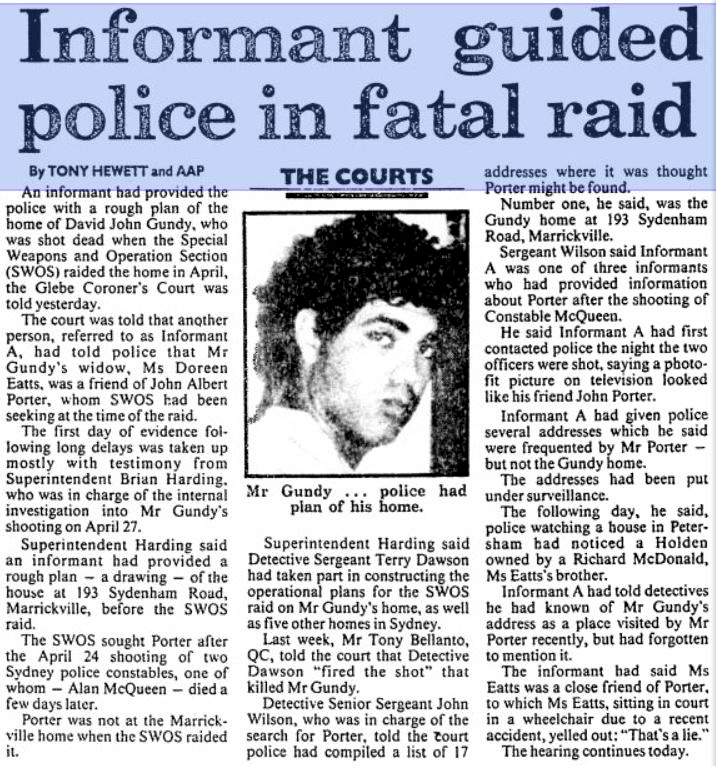
If we are to still violence, we must cherish life. Yesterday, 26-year-old Allan McQueen’s life was cherished. Today, others will cherish the life of 32-year-old David Gundy, the unarmed man killed in a police raid following Constable McQueen’s mortal wounding. Spring had sung in both men for only a while before life escaped them in violence. Senior Constable Graham White told the mourners that Allan McQueen had been a man of honour, love and integrity and a man whose word could be relied upon. He did not search for riches but for life itself, said Constable White. “Today he would be saying, ‘Let’s get on with it. Let’s not have all this fuss and bother’.”
Detective Senior Constable Steve Tedder said that the day McQueen received the letter of his acceptance into the force, “his face lit up as if Manhattan had lit up”.’ Constable Tedder lived with Constable McQueen in Manly and called his mate “Big Al”. “What a joy he was to live with,” he said. Constable McQueen had made more friends in 18 months in Manly than Constable Tedder had in 28 years.
Colleagues of slain policeman Allan McQueen weep as he is laid to rest in Ballina yesterday. One of his favourite expressions was: “Not a problem“. Another was: “I’m here for a good time, not a long time.” Constable Tedder said it was somehow appropriate that Allan McQueen began his long battle for life on April 24, the day before Anzac Day. That was the day Allan McQueen became a hero. Police Commissioner John Avery said Constable McQueen had exhibited the qualities of a police leader of the future. “His father said it was a waste of a fine young life, and I agree,” said the Commissioner. “His was an unforgettable example of courageous service that will enshrine his name in the annals of the history of NSW.” Mr Avery quoted Virgil: “Blessings on your young courage, boy, for that is the way to the stars.”
Outside the church, a senior policeman said: “There’s a finality to heroism.” Mr Athol McQueen, a cousin and the boxer who knocked down champion Joe Frazier in the 1964 Olympic Games, said: “I hope there are more young blokes around like him.”
” The police band played a funeral march for their colleague, past Sunnyhaven Flats. The open-faced country folk let the tears run down their cheeks. As the cortege passed a place called Camelot, on the way to the Lismore Crematorium and another place called Goonellabah, an old woman stood at the roadside and said : “Poor little fellow.” At the crematorium flowers spelled out the letters NSWP -New South Wales Police on the hillside.
A young policeman picked up a rose and handed it to a young woman. , ‘ Mr John McQueen wipes away a tear as he stands with his wife Shirley at their son’s funeral.
Rank: Probationary Constable – appointed 7 November 1955
Senior Constable – appointed 7 November 1966
Senior Constable – Death
Stations: East Gresford Police Station
Service: From pre 7 November 1955 to 13 August 1971 = 15+ years Service
Awards: No find on It’s An Honour
Born: 31 January 1933
Died: 13 August 1971
Age: 38
Cause: Shot – Murdered
Event location: East Gresford Police residence
Funeral Date: ?
Funeral location: ?
Buried at: ?
[alert_green]William IS mentioned on the Police Wall of Remembrance[/alert_green]
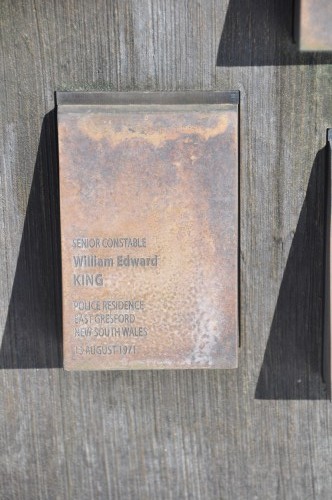
William KING
About 6.45pm on 13 August, 1971Senior Constable King went home to the East Gresford police residence for dinner. When he later answered a knock on the front door he was shot in the chest. He died a short time later. Enquiries later revealed that Senior Constable King had arrested the offender, a sixty-two year old labourer, the previous year for a drink driving offence (DUI). The offender was arrested two hours after the murder of Senior Constable King and later sentenced to life imprisonment.
The constable was born in 1933 and joined the New South Wales Police Force on 7 November, 1955. At the time of his death he was stationed at East Gresford.
William Edward KING
Location of Police residence
[divider]
The Canberra Times Tuesday 17 August 1971 3 of 20
Murder of constable alleged
NEWCASTLE, Monday. — Mr Arthur Clement Warr, 63, timber worker, of Church Street, East Gresford, appeared in Maitland court today charged with the murder of Senior-constable William Edward King, of East Gresford, last Friday.
The police prosecutor, Sergeant B. Bourne, said it would be alleged that last Friday Mr Warr had drunk at a Gresford hotel then had driven to East Gresford police station and that when Constable King had come from the residence in uniform Mr Warr had shot and fatally wounded him with a .22 rifle.
The Canberra Times Friday 24 September 1971 page 6 of 18
Man for trial over death
NEWCASTLE, Thursday.
A 62-year-old labourer was committed in Maitland Court today for trial at the Newcastle Supreme Court on November 8 on a charge of murdering a policeman.
Mr Wilde, SM, refused bail for the man, Mr Arthur Clement Warr, of East Gresford, who is charged with having murdered Senior Constable William Edward King at East Gresford on August 13.
A Gresford station hand, Mr Howard Huckstadt, told the court that Mr Warr had sung out to him, “I shot King Billy”.
He said he had heard Mr Warr refer to Constable King, of Gresford police station, as “King Billy” before.
Mr Warr had asked him if he had any bullets, but he had replied, “no”. He had then said that he had wanted the bullets “to shoot the cop that would come after him”.
Mr Huckstadt said he had asked Mr Warr why he shot Constable King and Mr Warr had replied, “He was all the time picking on me”.
The Canberra Times Saturday 20 November 1971 page 12 of 42
‘Life’ for murder
NEWCASTLE, Friday. — Mr Arthur Clement Warr, 63, fencing contractor, of Gresford, was jailed for life at Newcastle Supreme Court today for the murder of a police constable.
He had pleaded not guilty to a charge of having murdered Constable William Edward King, 38, at Gresford on August 13. Mr Warr did not give evidence or make a statement during his trial.
*** Although NOT confirmed, another article was found with this offenders name and the age between 1943 – 1971 is correct. ***
The Sydney Morning Herald Tuesday 31 August 1943 page 3 of 9
MILITIAMEN ON THEFT CHARGE
U.S. Army Clothing
Charges of having stolen United States Army clothing at Alexandria railway goods yard on August 17 were made against three australian militiamen, at a court-martial yesterday.
They were Privates Roy Westland Smith, 20; Arthur Edward Roberts, 47: and Arthur Clement Warr, 34.,
Alternative charges of having been unlawfully in possession of the goods were dismissed. On the charges of stealing the Court did not announce its decision.
Evidence was that the three men, members of an employment unit, were on duty at the goods yard unloading trucks. A warrant officer said that he saw the accused moving between two lines of trucks in a shed, and on being challenged they dropped several pairs of United States Army trousers.
Each of the accused said he had seen the articles lying on the ground and had picked them up, intending to examine the article in a better light. It was unusual, they said, to see anything lying about in the yards.
At a previous trial, Private John Henry Hanson, 27 was charged with having unlawfully removed a case containing 24 pairs of United States Army trousers from a railway truck at Alexandria on August 17.
Hanson, who pleaded not guilty, said he had not touched any of the clothing.
POLICE KILLED OR WHO DIED FROM INJURIES RECEIVED IN THE EXECUTION OF THEIR DUTIES
On 13th August, 1971, Senior Constable William Edward King, who was then the officer-in-charge of police, East Gresford, was shot dead at East Gresford Police Station by a man who fired upon him with a rifle.
On 29th August, 1971, Constable 1st Class Patrick Mark Hackett died from injuries received in a motor accident at Polis, Cyprus, whilst performing duty with the New South Wales Police component of the Australian Police Contingent of the United Nations Peace Keeping Force.
On 30th September, 1971, Sergeant Second Class William Watson Riley and Senior Constable Maurice Raymond McDiarmid, both then attached to Blacktown Police Station, were shot dead in a house at Toongabbie which they had entered to arrest a man who a short time before had murdered his brother and raped a woman in the same house.
A police funeral with full ceremonial honours was accorded these deceased officers at which appropriate tributes were paid.
In recognition of their outstanding courage Sergeant Riley and Senior Constable McDiarmid were posthumously promoted by me to Sergeant 1st Class and Sergeant 3rd Class respectively. In addition, I submitted recommendations to the Premier for favour of consideration of Royal Awards being granted in both cases.
To assist the widows of the deceased police the Premier approved the payment to each of them of the sum of $12,500 as a gratuity. This payment did not in any way affect their entitlements to payments under the provisions of the Police Regulation (Superannuation) Act.
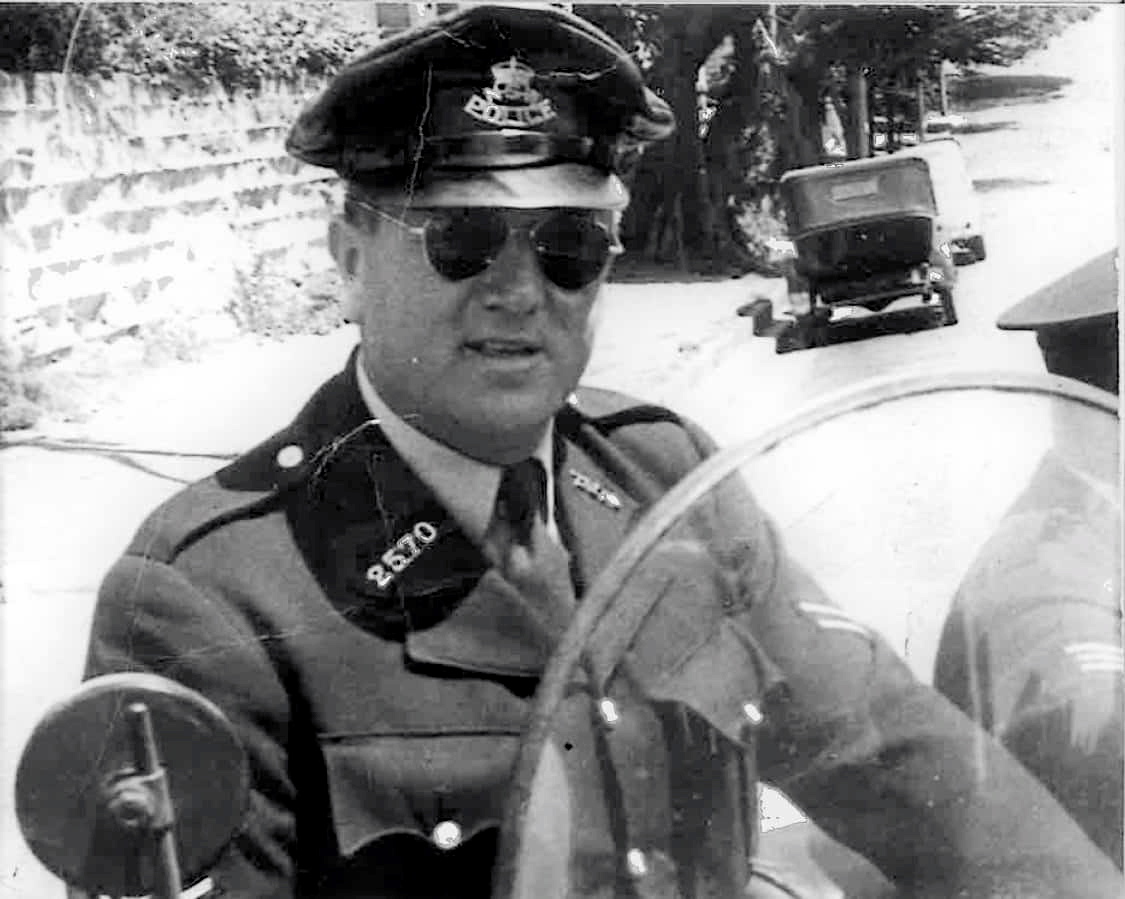
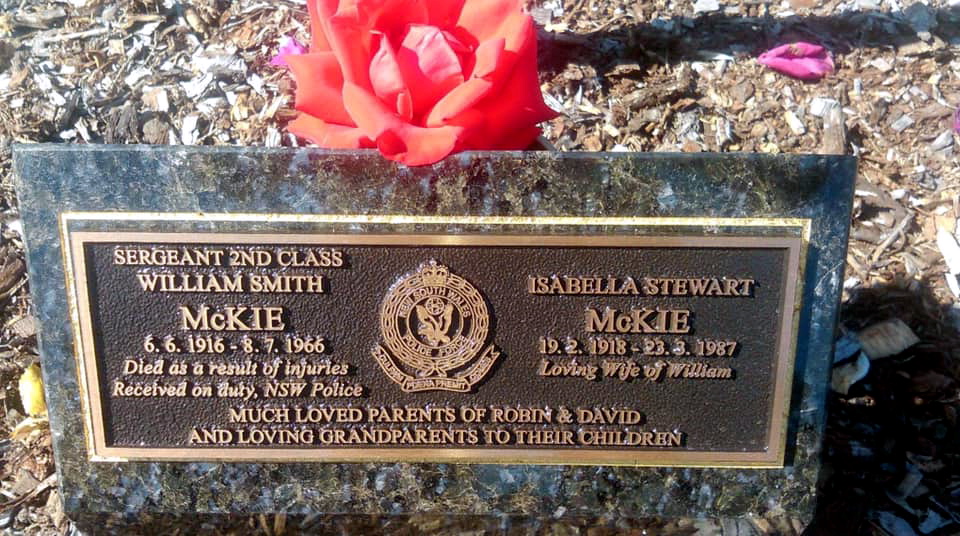
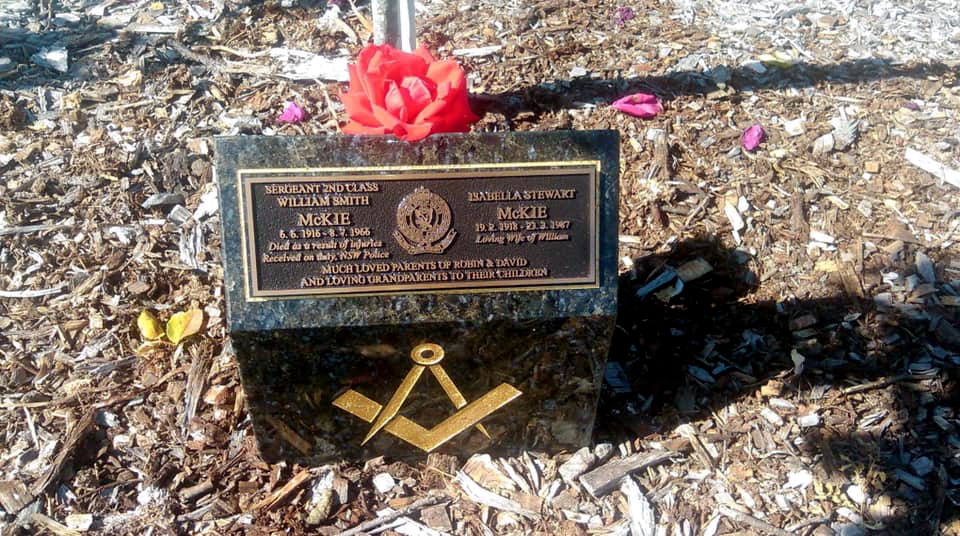
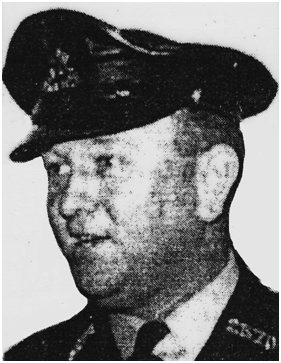
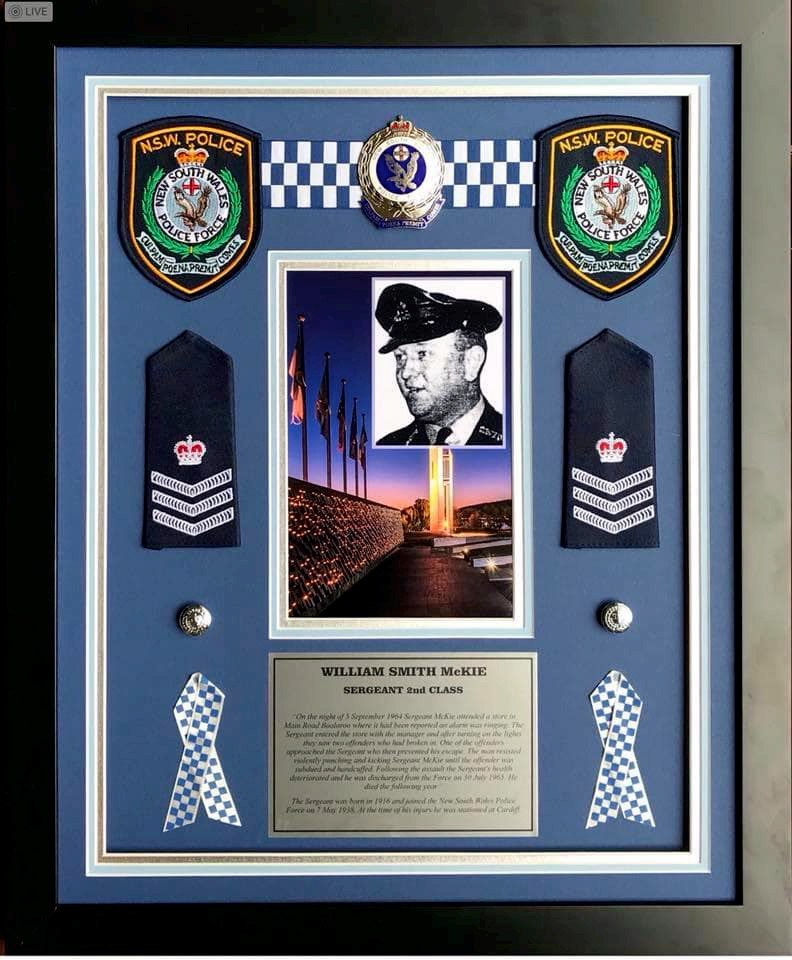
On the night of 5 September, 1964 Sergeant McKie attended a store in Main Road, Boolaroo where it had been reported an alarm was ringing. The sergeant entered the store with the manager and after turning on the lights they saw two offenders who had broken in. One of the offenders approached the sergeant who then prevented his escape. The man resisted violently, punching and kicking Sergeant McKie until he was subdued and handcuffed. Following the assault the sergeant’s health deteriorated and he was discharged on 30 July, 1965. He died the following year.
The sergeant was born in 1916 in Scotland and joined the New South Wales Police Force on 7 May, 1938. At the time of his injury he was stationed at Cardiff.
[divider_dotted]
National Police Remembrance Day ceremony in Lake Macquarie
David Stewart
September 29 2017 – 4:27PM
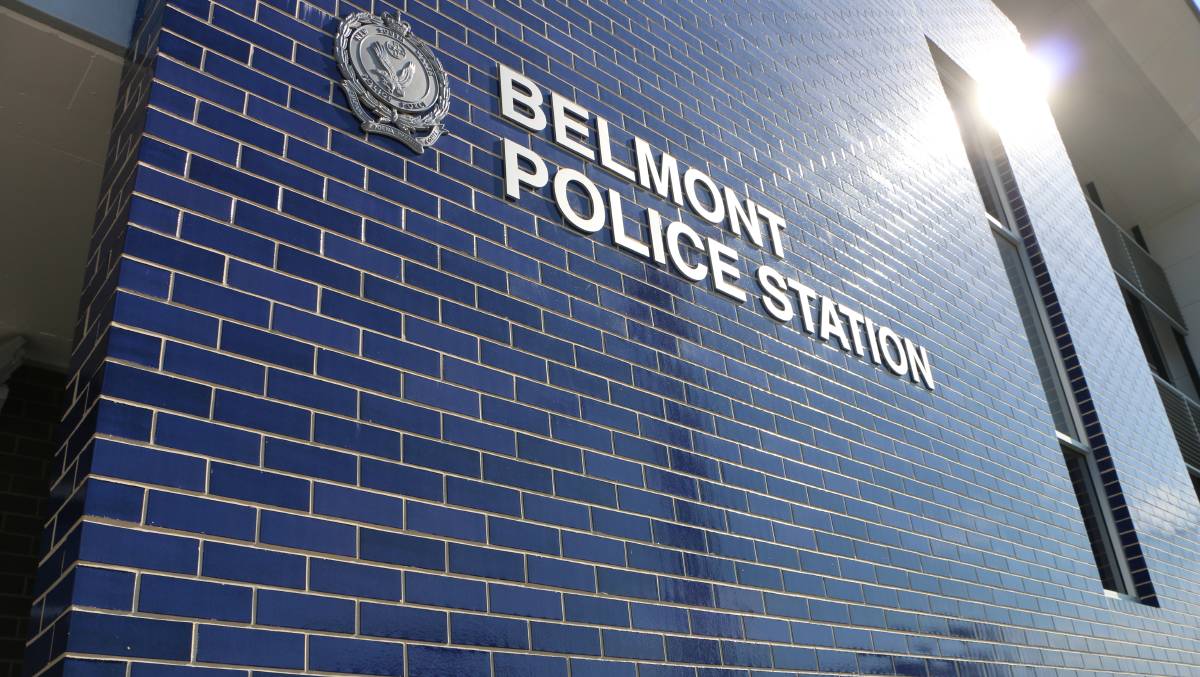
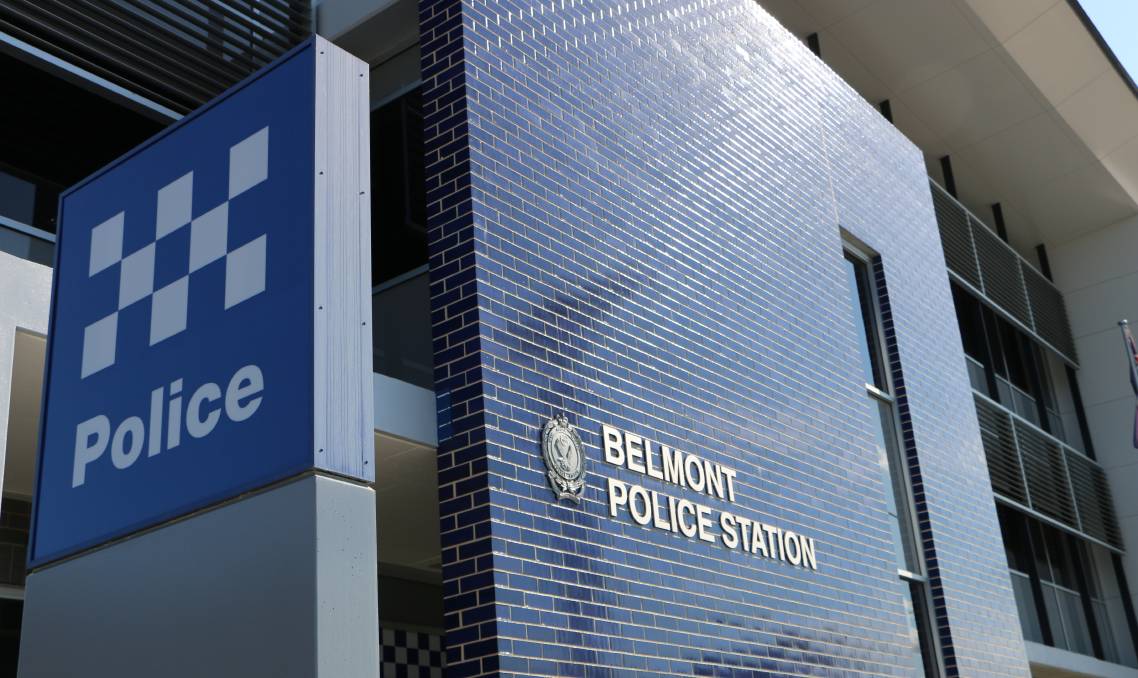
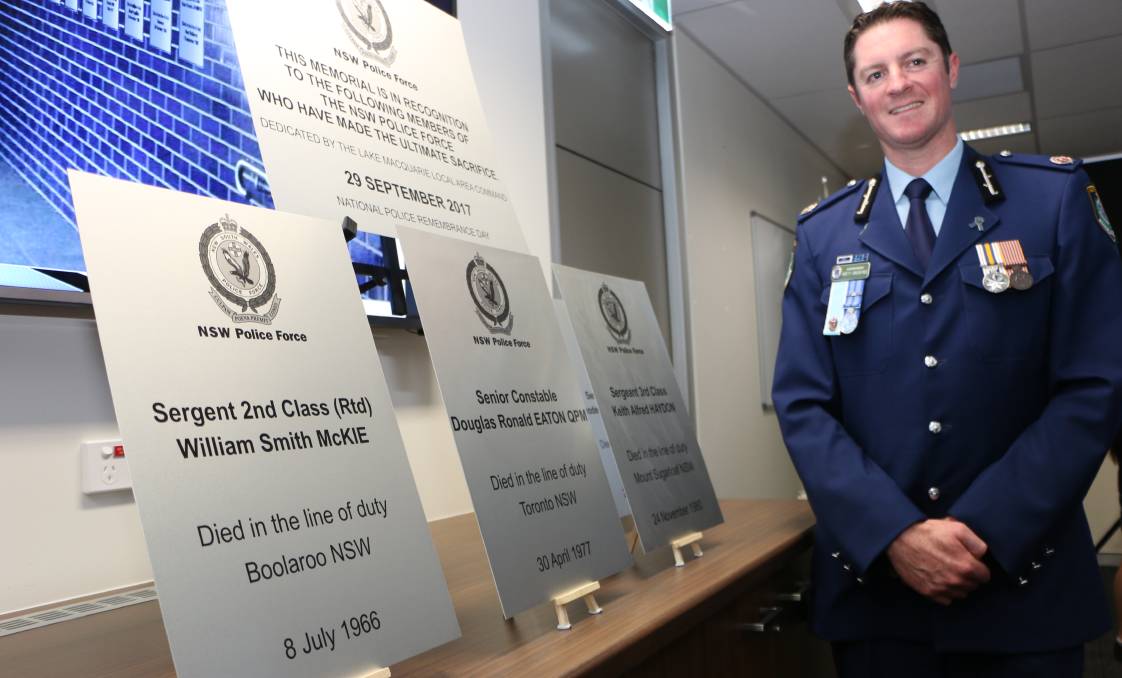
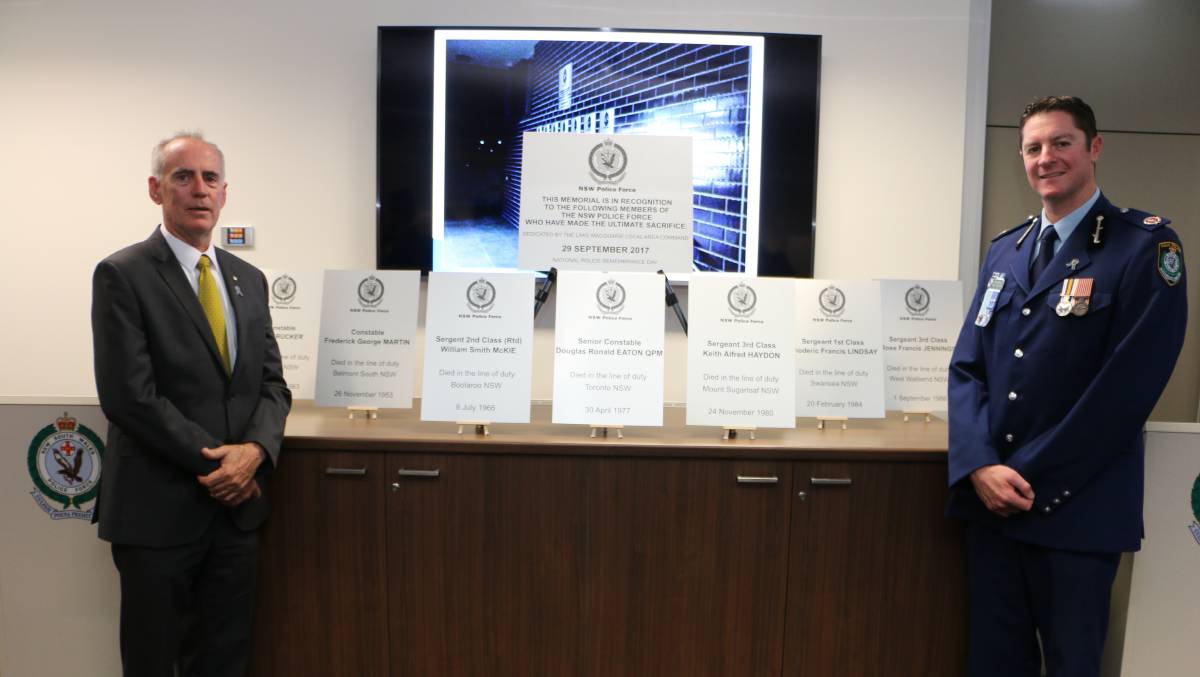
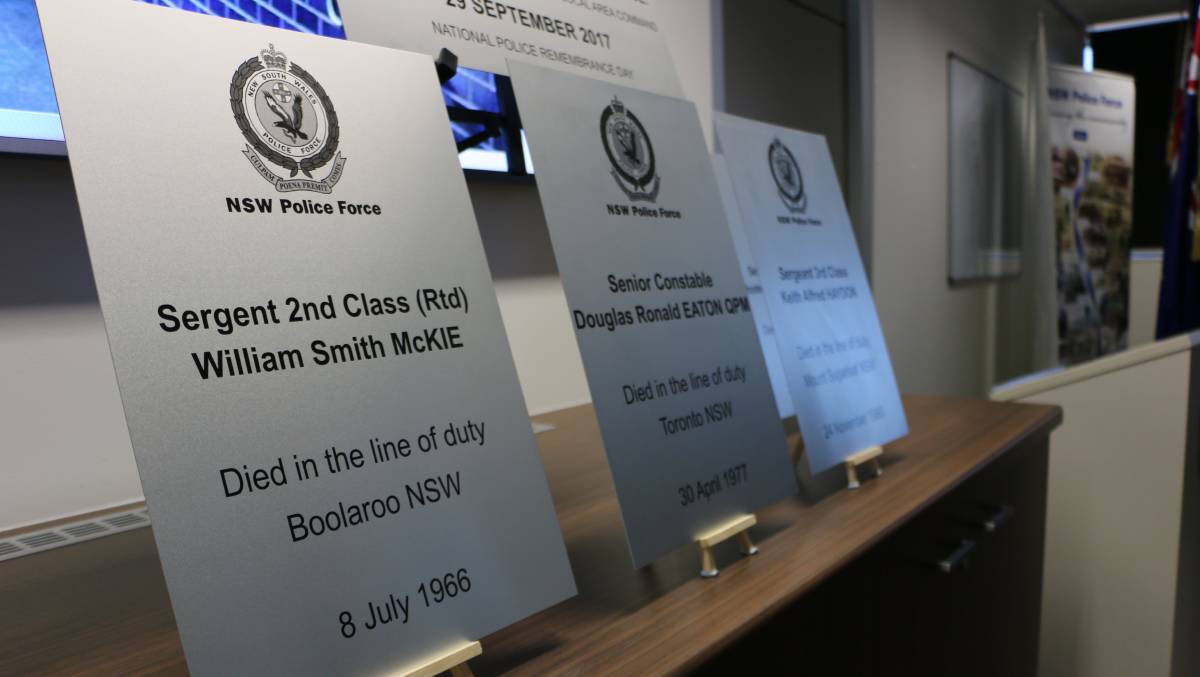
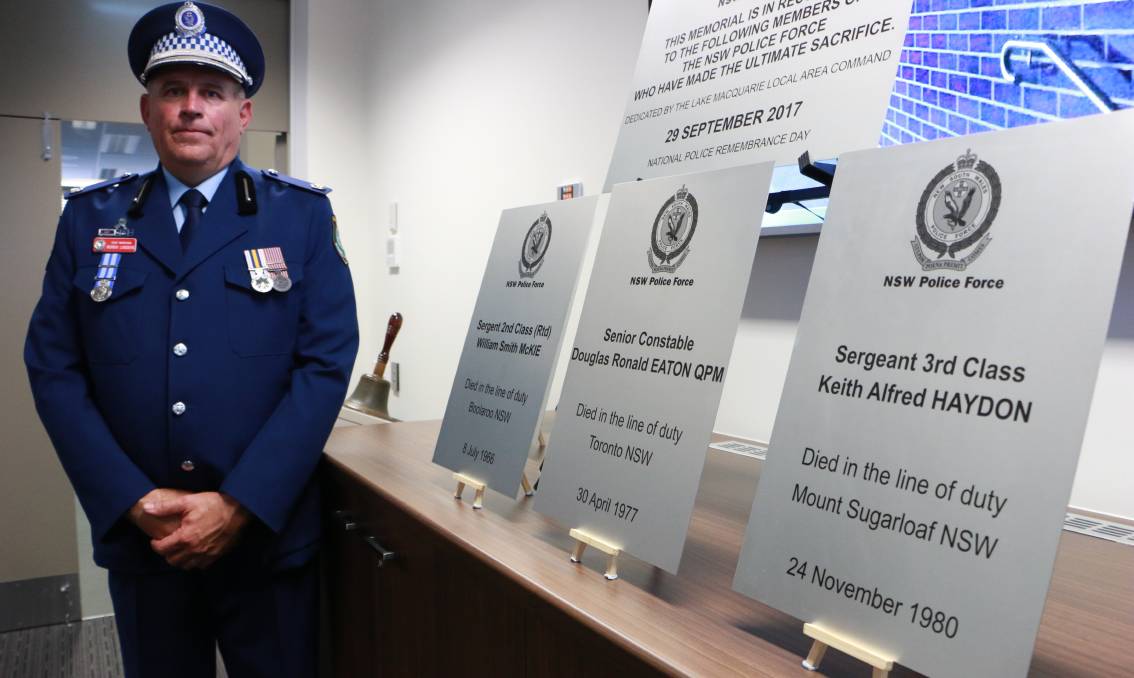
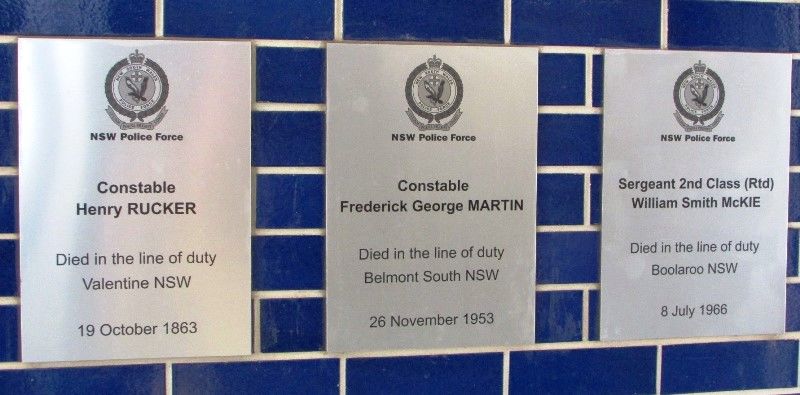
POLICE from Lake Macquarie Local Area Command have unveiled plans for a memorial wall at Belmont to honour the seven local officerskilled in the line of duty since 1863.
Plaques commemorating the seven officers were dedicated to the wall in a ceremony at Belmont police stationthis afternoon, National Police Remembrance Day.
Chief Inspector Murray Lundberg of Lake Macquarie LAC presided over a private ceremony attended by police, local high school students, and the families of the fallen officers.
“This is a time for reflection on the ultimate sacrifice that police officers can give in the execution of their duty,” Chief Inspector Lundberg said.
Acting Assistant Commissioner Brett Greentree, the Northern Region Commander, said the wall of remembrance, to be created on the distinctive blue wall at the entrance to the police station, would be striking.
“It will be a sight to treasure,” Acting Assistant Commissioner Greentree said.
“I want the officers, as they are walking out the front doors of this police station, to stop and reflect on the names, stop and reflect on the sacrifice.”
He said he hoped that the inaugural plaques to be installed on the wall were also the last.
“My dream is that we never, ever, add another name to this wall. I hope and pray that our wall is now complete.”
Acting Assistant Commissioner Greentree reached out to the families of the fallen officers.
“No commemoration or recognition can make good the loss that is unfairly carried by family members,” he said.
“I can only offer you my heartfelt condolences. Please know that your loved ones, who are no longer with us, will always be remembered.”
Across NSW, ceremonies were held to commemorate the service and sacrifice of the 269 officers who have lost their lives in the line of duty, and through injury or illness, since the formation of the NSW Police Force in 1862.
Government Gazette of the State of New South Wales (Sydney, NSW : 1901 – 2001), Friday 27 January 1967 (No.8), page 292
IN the matter of the estates of the undermentioned deceased persons, and pursuant to the Wills, Probate and Administration Act, 1898-1954;
the Public Trustee Act, 1913, as amended; Testator’s Family Maintenance and Guardianship of Infants Act, 1916-1954; and Trustee Act, 1925-1942; the Public Trustee hereby gives notice that creditors and others having any claipi against or to the estate of any of the under mentioned deceased persons who died on or about the respective dates hereunder mentioned, and representation of whose estates was obtained by the Public Trustee in the manner and upon the dates hereunder mentioned, are required to send particulars of their claims to the said Public Trustee at his Branch Office hereunder mentioned, on or before the eighth day of April, 1967, at the expiration of which time the said Public Trustee will distribute the assets of the respective deceased persons to the respective persons entitled, having regard only to the claims of which he then has notice.
William Smith McKie, late of Merewether, N.S.W., retired Police sergeant, died 8th July, 1966; an election to administer, with the will dated 29th July, 1940, appointing the Public Trustee executor, annexed, was filed on 17th January, 1967.
Southern Mail (Bowral, NSW : 1889 – 1954), Friday 8 June 1945, page 1
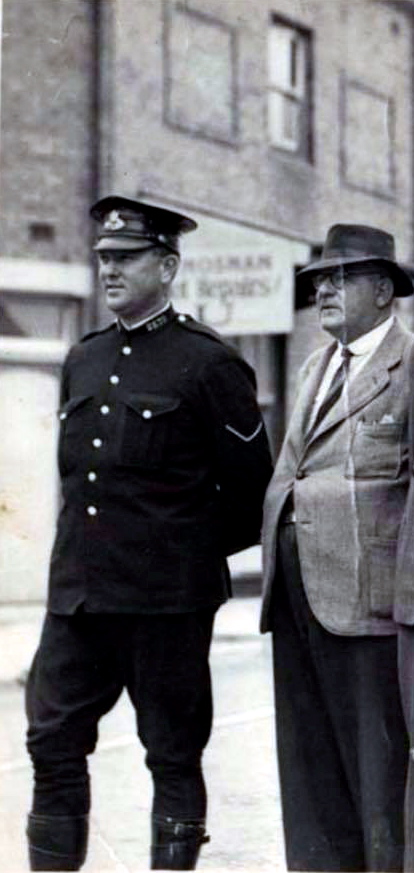
At the P.C.A. dance at Kangaloon on Thursday night last, the president ( Mr. E. R. Alcorn ) said farewell to Constable McKie, who is leaving Robertson for Newcastle.
Mr. and Mrs. McKie had been welcome visitors to all social functions at Kangaloon, and Mr. McKie was an able and conscientious officer who did his work with sympathy and understanding.
On behalf of their Kangaloon friends he wished them all the best in their new home.
Mr. Alcorn also extended a hearty welcome to Constable Bowden, who succeeds Constable McKie, and said he trusted that the same cordial relations would continue during his stay in the district.
Southern Mail (Bowral, NSW : 1889 – 1954), Friday 27 April 1945, page 3
Illicit Still Near Robertson
A sensational development long expected by some local residents occurred at Mount Murray on Wednesday. Police and Customs officers seized an illicit still built in heavily timbered country.
One man was arrested at Albion Park and two were questioned at Robertson.
Police smashed a large cask of illicit spirit and casks containing hundreds of gallons of sugar wash.
From a farmhouse nearby Customs men seized 8,000 lbs. of raw sugar which with various articles was taken to Robertson police station.
Later police took small quantities of illicit spirit from two houses near Albion Park.
The raids followed a long investigation of traffic in illicit spirits in South Coast towns.
At dawn on Tuesday police and officers of the special investigation branch of the Customs Department left Wollongong for a search in mountainous country between Albion Park and Robertson.
They searched right through the day and night without sleep, hampered by undergrowth and cutting paths through heavily timbered country.
Those who took part in the raids were Customs officers J. H. McLennan, and N. E. Mitchell, Detective sergt Debney and Detective Marsh, of Wollongong, Constable Farthing, of Albion Park, and Constable McKie, of Robertson.
Southern Mail (Bowral, NSW : 1889 – 1954), Friday 6 April 1945, page 1
At the annual meeting of Robertson Boys’ Club, the following officers were elected : —
President, Mr. W. Missingham; vice-presidents, Mr. E. Ginns and Mr. A. P. Schofield; secretary, Mr. B. A. Badgery; treasurer, Mr. Roberts; supervisor, Mr. C. Walker.
Owing to the probability of his departure from the district, Constable McKie declined re-election as supervisor, and was accorded a hearty vote of appreciation of his services in organising the club and acting as supervisor for the past year.
Southern Mail (Bowral, NSW : 1889 – 1954), Friday 19 May 1944, page 1
Constable McKie has met with remarkable success in his effort to establish a Boys’ Club at Robertson to meet the needs of the surrounding districts.
An influential committee, including representatives for Myra Vale and Kangaloon, has been formed, with Mr. W. Missingham as president; Mr. Bevan Badgery secretary; and Mr. W. G. Jenkin treasurer.
Boys from 8 to 18 are eligible for membership. No sporting events are to be engaged in on Sundays.
Government Gazette of the State of New South Wales (Sydney, NSW : 1901 – 2001), Thursday 24 December 1942 (No.172), page 3278
SHIRE OF WINGECARRIBEE.— Inspector of Slaughter houses.—
Notice is hereby given that the Council of the Shire of Wingecarribee has appointed Constable William Smith McKie, of Robertson, as Inspector for the Shire under the provisions of the Cattle Slaughtering and Diseased Animals and Meat Act, 1902, as amended. It is further notified that the appointment of Constable Charles Herbert Chalmers, notified in Government Gazette of 28th August, 1936, is hereby cancelled.
South Coast Times and Wollongong Argus (NSW : 1900 – 1954), Friday 9 October 1942, page 14
ROBERTSON.
Constable McKie, who was accompanied by his wife, has arrived at Robertson to take up duties in place of Constable Chalmers, who has been transferred to Windsor.
For the purposes of this website ‘Q‘ represents those Police joining between 1 March 1862 ( commencement of NSWPF ) – 23 February 1915 ( Commencement of NSWPF current numbering system )
Rank: Probationary Constable – appointed 14 January 1887
Sergeant 1st Class – appointed ? ? ?
Stations: Gloucester, Paterson, Minmi, and other places & Dungog ( 9 years to death ) ( Port Stephens LAC )
Service: From 14 January, 1887 to4 March 1916 = 29+ years Service
Awards: ?
Born: ? ? 1859 at Uralla, NSW
Died on: Saturday 4 March 1916
Cause: Assault – Murder?
Event location: Dungog, NSW
Event date: ? January 1916
Age: 55
Funeral date: Sunday 5 March, 1916
Funeral location: Church of England cemetery, Dungog, NSW
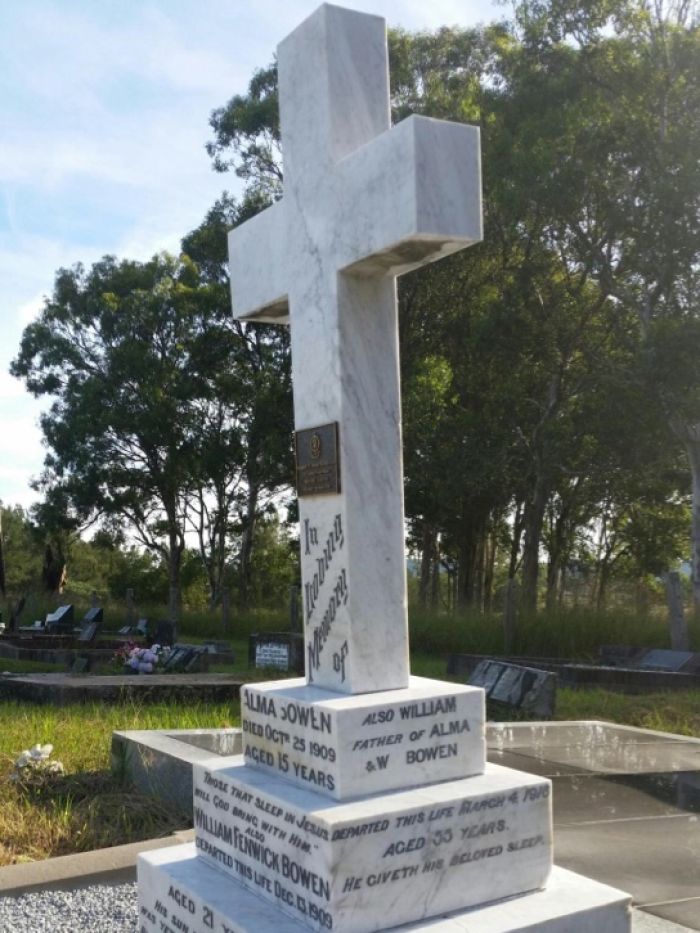
Buried at: Church of England cemetery with his only son & youngest daughter, Alma
Dungog Cemetery,
Tabbil Creek, NSW,
3 references for the grave
Latitude: -32.419403
Longitude: 151.738657
GPS: -32 25.16418, 151 44.31976
-32.418649, 151.738825
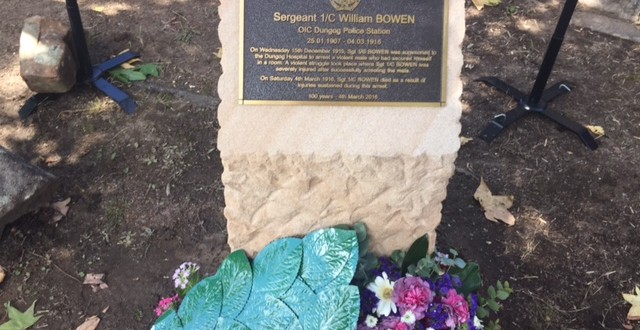
Memorial: Memorial & Plaque unveiling at Dungog Police Station on 4 March 2016
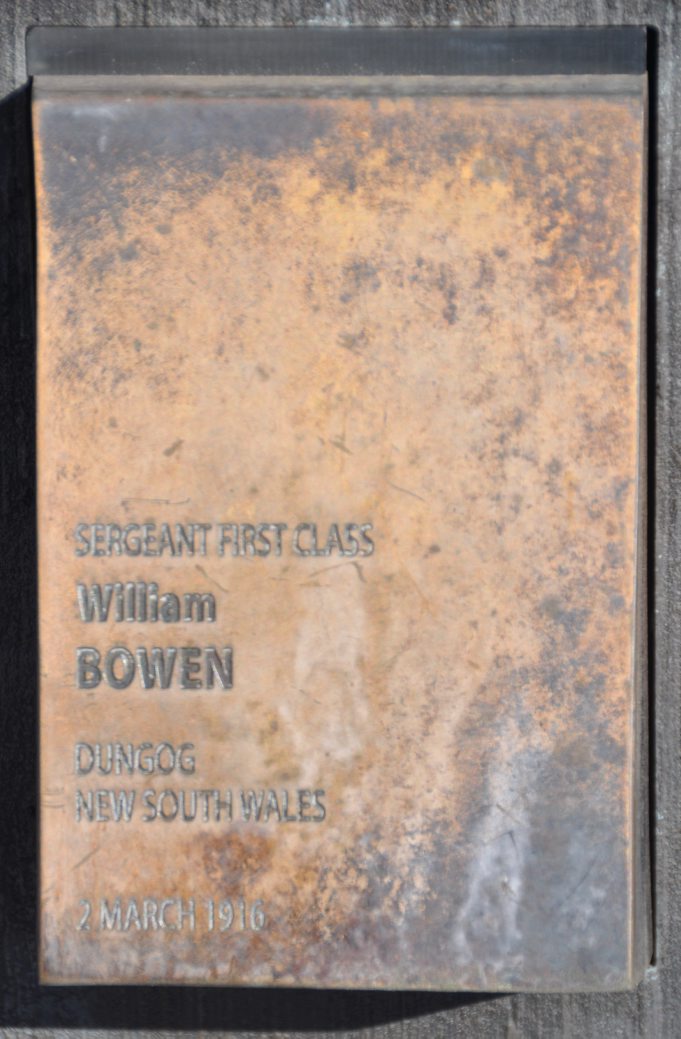
WILLIAM IS mentionedon the National Police Wall of Remembrance
Touch plate at the National Police Wall of Remembrance, Canberra Incorrect date of death is displayed on plate.
The sergeant suffered serious internal injuries at Dungog when he was assaulted after detaining a mentally ill man in January, 1916. The sergeant had been called to the Dungog Hospital in relation to a violent and disturbed man. He arrested the man and took him to the local police station. Shortly after their arrival at the station the man again went berserk, kicking the sergeant and attacking him with a chair. The sergeant was taken to hospital for treatment and was eventually admitted to Sydney’s St Vincent’s Hospital where he died.
The Sydney Morning Herald of 7 March, 1916 reported news from Dungog to the effect that “The funeral of Senior Sergeant Bowen, of Dungog, who died at St. Vincent’s Hospital. Sydney, on Saturday, took place here yesterday, being one of the largest that have taken place at Dungog.”
The sergeant was born in 1859 and joined the New South Wales Police Force on 14 January, 1887. At the time of his death he was stationed at Dungog.
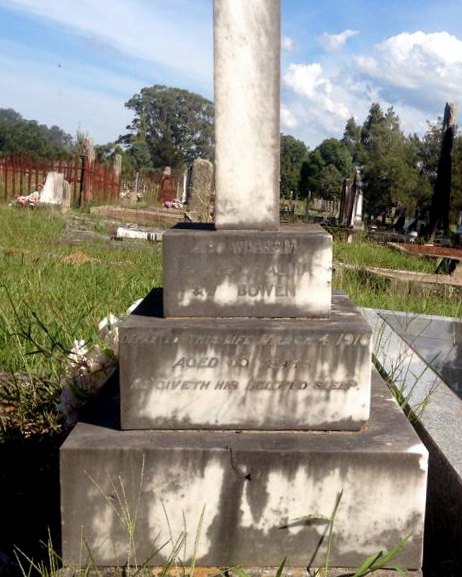
** officially recorded as Thursday 2 March 1916 but correct death date appears to be Saturday 4 March 1916. Date of Death on the grave stone also is 4 March 1916.
Dungog Chronicle
Tuesday 7 March 1916 p 2 of 6
Death.
Senior Sergeant Bowen
It is with deep regret that we record the death of Senior-Sergeant William Bowen, of Dungog. It will be remembered that deceased, who had been ill a short time, was taken to Sydney on Friday last ( 3 March 1916 ) to consult a specialist. He was accompanied by Mrs Bowen, and was conveyed to St. Vincent’s Hospital, and several specialists, including Sir Alex. McCormack, were called in consultation, but these were unable to diagnose the cause of the trouble, and an operation was recommended, as soon as he was strong enough to bear it, but the patient did not rally, and he passed away early on Saturday morning ( 4 March 1916 ). Such a sudden ending was totally unexpected, although it was noticed that the Sergeant had been failing for some time past. He thought he was a victim to acute dispepsia, but there was evidently something more seriously wrong.
Deceased was born at Uralla, 56 years ago, and had been 30 years in the service, the past nine years he had been stationed at Dungog. Previously he had been at Gloucester, Paterson, Minmi, and other places.
He was a very painstaking, conscientious officer, who discharged his duties with the utmost impartiality. He was very considerate to the men under him, and only those who were acquainted with him intimately knew what a very kind and thoughtful man he was, ever cheerful under the most adverse circumstances, and apparently never harboring an ill-thought about anybody. He will be hard to replace.
He leaves a sorrowing widow and three daughters ( Mrs J. Hunt, Mrs O. E. Carter, and Miss Myra Bowen ) to mourn their loss, to whom we extend our sincere sympathy.
His remains were brought from Sydney on Saturday ( 4 March 1916 ) and interred beside those of his only son ( who was killed at Minmi a few years ago ) and his youngest daughter Alma, in the Church of England cemetery.
The funeral took place on Sunday afternoon ( 5 March 1916 ) and was one of the largest ever seen in Dungog. The pall bearers were Sergt. Haynes ( Paterson ), Constable Capp ( Gresford ), Constable Vaughan ( Clarence Town ), and Constables Parker and Bates ( Dungog ).
The chief mourners were his two brothers, Tim ( Uralla ), and John ( Newcastle ), his brother-in-law Mr Reece ( Homebush ), and Mr O. E. Carter ( son-in-law ). Local justices and townspeople followed the chief mourners, walking, and then came a long cavalcade of vehicles and horsemen. The burial service was conducted by the Ven. Archdeacon Luscombe, who paid a fitting tribute to the memory of deceased at the graveside. Amongst the numerous wreaths sent was a beautiful one from the bench of magistrates and one from the local police.
Police Court On Monday last, before Mr McDougall, S.M., John Dwyer, of Dungog, was charged with stealing about 40 pairs of *naves ( *possibly the central part of a wheel; hub ), valued at £10, the property of Mrs K. B. Walker. Sgt. Bowen represented, the police prosecution ; Mr Borthwick appearing for the accused. Dwyer pleaded guilty and was fined £10, with a fortnight to pay. in default two months in Maitland goal. The fine would be reduced to £5 if the naves were returned to the owner within a week.
Superintendent Childs, of the West Maitland police, received a message from the police at Bullahdelah on Tuesday, giving brief particulars of a sensational shooting incident at the Crawford River.
The message, which came from Constable Sturgiss, stated that Walter John Edwards, 35 years of age, had shot Frederick Soorley, wounding him in the back. He also shot his father, Henry Edwards.
Edwards, who was stated to be apparently insane, is at large, armed with a shot gun. He is described as being 5ft 7in. high, of medium build and having a fair moustache.
Upon receipt of the message, the Superintendent immediately despatched information to all police stations in the locality.
Later.
Superintendent Childs received a telegraphic message from the police at Bullahdelah, stating that the man Walter John Edwards, who was wanted in connection with the shooting sensation at Crawford River, had been arrested between Bullahdelah and Bungwahl. After the shooting, Edwards cleared off, armed with a shot gun. He was charged with shooting with intent to murder, and with maliciously wounding. Arrangements were also made to prefer a charge of lunacy against him. He is stated to have previously been under mental treatment.
Another message from Bullahdelah states that Mr Edwards, sen., was not shot, but was attacked with a tomahawk. The insane man was found hiding in blackberry bushes and they were set alight. He then came out and was captured. Edwards had put his gun down and could not find it again, otherwise there might have been a casualty amongst the captors. The news of the shooting spread rapidly and upset the whole district. People from the Crawford River and other parts left their homes and went to Bullahdelah for safety. The news of the capture of Edwards was a great relief all round.
It will be remembered that Edwards was in Dungog Hospital some years ago and caused a sensation. He went partially insane and smashed up things generally. When the police were securing him at the Hospital he savagely assaulted the late Sgt. Bowen, breaking his hand with a chair.
May I refer to another Edwards, an old schoolmate, ‘Dodger’ Edwards ( Walter John EDWARDS ). He was a super lad also. There were 50 odd pupils at school at Bendolba and some of them up to 18 years of age. Not one of them ever brought down Dodger in a game of football. When the ball went to Dodger it was a ‘try.’ Most times the football was made of rags. Our coach then was Mr. Gardiner, our schoolteacher. I think he replaced Mr. Lord, father ofMr. Dick Lord, of Dungog.
In later years, Dodger left our district and went to Gloucester to live. One evening he left Gloucester River to come over to Salisbury on horse back. He got bushed between Whispering Gully and Flag Staff. He unsaddled his horse and to this day the horse was never found. But ‘Dodger‘ came through. I think the trials experienced slightly derainged his mind.
The late Sgt. Bowen was called to the hospital and nearly met his death from a blow that Dodger gave him by hitting him over the head with a chair.
Some two years later, the late Anthony Hudson, his son Tony, and the late Les Middlebrook and I were out beyond Flag Staff and a horse neighed. Old Tony said: ‘Did you hear that,’ We all did, and we were sure there was a horse somewhere. It was over three weeks before we got that horse to mate up with ours. Eventually we succeeded in bringing that horse back. He was a real outlaw, but it was Les Magennis who mastered him. I think this horse was sold later to a circus. I have never solved the problem; was the horse Dodger’s, or whose was It?
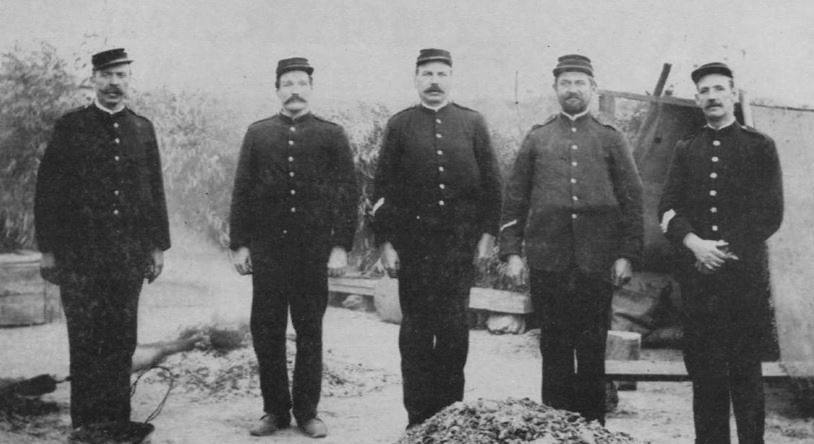
An old photograph of policeman near Dungog. Senior Sergeant William Bowen is among the officers shown.
BELINDA-JANE DAVIS
A Dungog policeman who suffered serious injuries on the job and died a century ago will be remembered in a special ceremony.
Senior Sergeant William Bowen suffered serious internal injuries when a mentally ill man kicked him and attacked him with a chair at Dungog Police Station in December 1915.
He had arrested the man at Dungog Hospital a short time earlier, after reports the man was being violent and disturbing staff and patients.
Sergeant Bowen, 56, was taken to hospital for treatment, but never fully recovered from the incident.
His failing health led him and his wife to travel to St Vincent’s Hospital in Sydney on March 3 to see a specialist.
Several specialists, including Sir Alex McCormack, assessed him but were unable to diagnose his condition.
They suggested an operation when he was feeling stronger but Sergeant Bowen continued to deteriorate that day and died in hospital unexpectedly the next morning.
NSW Police Force Commissioner Andrew Scipione and deputy commissioner Catherine Burn are expected to attend a ceremony at Dungog Police Station on March 4 at 11am, which will mark 100 years since Sergeant Bowen’s death.
NSW Deputy Premier Troy Grant and Dungog community groups will also attend and witness a plaque being unveiled, which will commemorate his service.
The Dungog Chronicle recorded Sergeant Bowen’s death on March 7, 1916, saying he would be “hard to replace”.
“He was a very painstaking, conscientious officer, who discharged his duties with the utmost impartiality,” the article said.
“He was very considerate to the men under him, and only those who were acquainted with him intimately knew what a very kind and thoughtful man he was, ever cheerful under the most adverse circumstances, and apparently never harboring an ill-thought about anybody.”
Sergeant Bowen’s body returned to Dungog on March 4 and he was buried in the town’s Church of England Cemetery on March 5 alongside his only son, who was killed in an accident at Minmi a few years earlier, and his youngest daughter Alma, who died of an illness.
It was one of the largest funerals the town had ever seen.
He was survived by his wife, three daughters, Mrs J Hunt, Mrs O.E Carter and Miss Myra Bowen, his two brothers John and Tim, and his brother-in-law Mr Reece and son-in-law Mr O.E. Carter.
Dungog police Senior Constable Mitch Parker said Sergeant Bowen, who was born in Uralla in 1859, joined the police force on January 14, 1887 and spent 29 years serving the region at Gloucester, Paterson, Minmi, Dungog and other stations.
He spent nine years in Dungog before his death.
Senior Constable Parker urged anyone who wanted to pay tribute to Sergeant Bowen’s service to attend the ceremony.
The story Policeman who died a century ago to be remembered first appeared on The Maitland Mercury.
His name adorns the National Police Memorial, but until recently, the death of Dungog policeman William Bowen a century ago went unrecognised in the town he called home.
Today that changed, thanks to years of research and a lot of hard work.
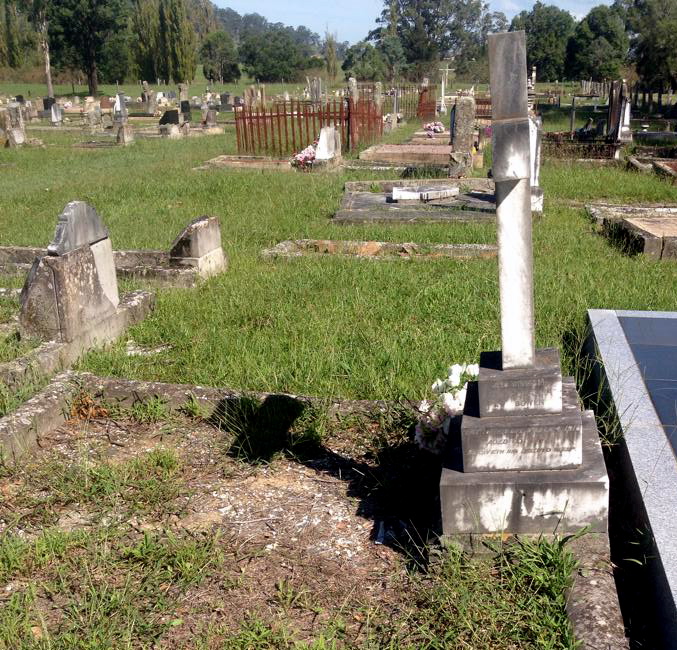
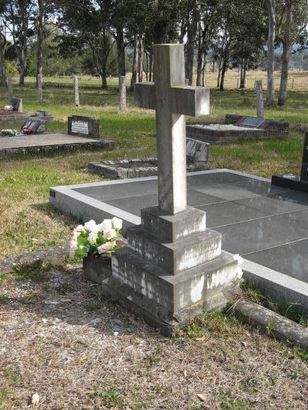
The restored headstone at Sgt William Bowen’s grave site
Posted
Restoration work has been completed on the grave site of Sgt William Bowen, who died on March 4, 1916 after being attacked on duty at Dungog in the NSW Hunter Valley.
Commemorating 100yr anniversary of officer’s death in the Hunter
The New South Wales Police Commissioner Andrew Scipione will be in the Hunter Valley today to commemorate the 100-year anniversary of the death of a Dungog police officer.
Sergeant William Bowen died on March the 4, 1916, three months after he was attacked by a mentally ill man who had barricaded himself inside Dungog hospital.
Today the commissioner will attend the unveiling of a plaque in his honour.
The man had barricaded himself in the committee room, ordered that all patients be killed in the hospital, and then armed himself with surgical instruments.
Snr Constable Mitch Parker, Dungog Police
Dungog police officer, senior constable Mitch Parker, said sergeant Bowen suffered serious injuries as he bravely tried to protect the Dungog community in December 1915.
“There was a patient of the Dungog hospital who had smashed a number of windows and items within the nurses quarters and a wardsman attempted to restrain him and he got viscously assaulted,” he said.
“Police were sent for and the sergeant, who was living in the police lock-up which we still have today, went up the hill to the hospital.
“By this stage the man had barricaded himself in the committee room and he ordered that all patients be killed in the hospital, and then armed himself with surgical instruments of the day — mostly steel and glass.
“Sergeant Bowen, who was 55 years of age at the time, had been in the police for 30 years, forced his way into the room.
“He successfully arrested and apprehended the male, notwithstanding some injuries himself,” he said.
“They brought him back down to the police lock-up and his health just deteriorated from there.
“Several months later he was sent to St Vincent’s Hospital and was seen by a world-renowned surgeon. Unfortunately he passed away in St Vincent’s Hospital before they could ascertain what was wrong with him.”
Senior constable Parker said as part of today’s commemoration, restoration work had also been carried out on sergeant Bowen’s grave.
“With assistance from the Commissioner’s office, the NSW Police Force and Police Association of NSW, we’ve had the original stone-makers who created the gravesite back in the day have restored it.
“It’s quite a long story, but the sergeant’s been put to rest beside his 15-year-old daughter and 20-year-old son who died five years prior, in pretty horrific circumstances themselves.
“So his grave has been redone and we’ve got the plaque unveiling here at the station,” he said.
“There’ll be the police commissioner coming up, and other important people from different agencies, community groups, schools.
“There’ll also be a lot of retired police from the area, who’ve worked here, finished their service and remained in the area.”
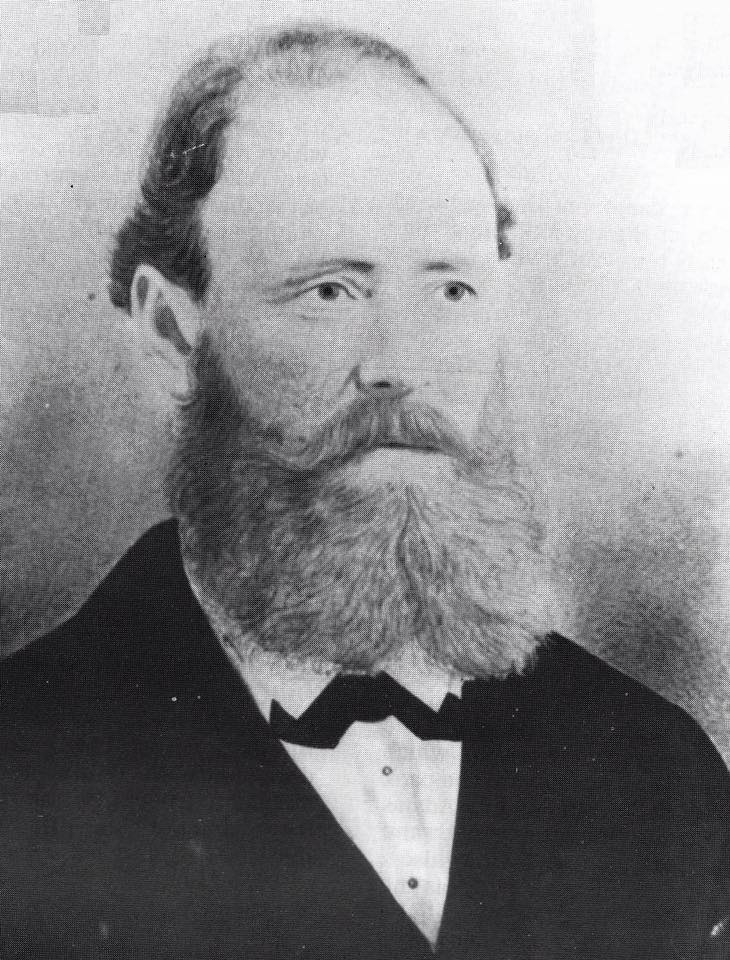
Thomas Edward WALLINGS
| 27/10/2012
Thomas Edward WALLINGS
New South Wales Police Force
Regd. # ‘ P ‘ 716
( ‘P’ = Pre 1862 when NSWPF “Officially” commenced )
Rank: Mounted Constable – 15 July 1855
Senior Constable – appointed 1 March 1862
Sergeant 2nd Class – appointed 1 June 1868
Senior Sergeant – appointed 1 November 1877
Stations: , Molong ( January 1865 ), Mudgee ( September 1869. Sgt In Charge of Mudgee to Bathurst Gold Escort ), Dubbo – death
Service: From 15 July 1855 to 20 September 1878 = 23+ years Service
Awards: ?
Born: ? ? 1838 in Dubbo ( although other records state a native of England )
Died on: Friday 20 September 1878
Cause: Shot – Murdered
Event location: Marthaguy Creek, ( near Warren ), NSW
Age: 40
Funeral date:
Funeral location:
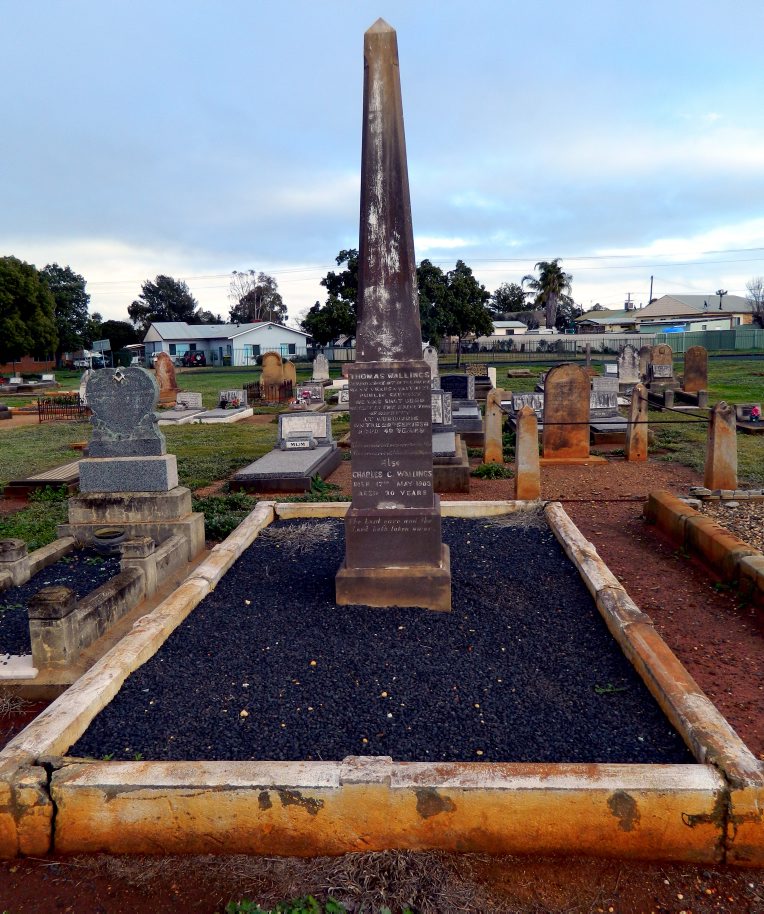
Buried at: Old Dubbo Cemetery, Myall St, Manera Hts, Dubbo, Church of England Portion, Section R2
Memorial location:
Thomas WALLINGS
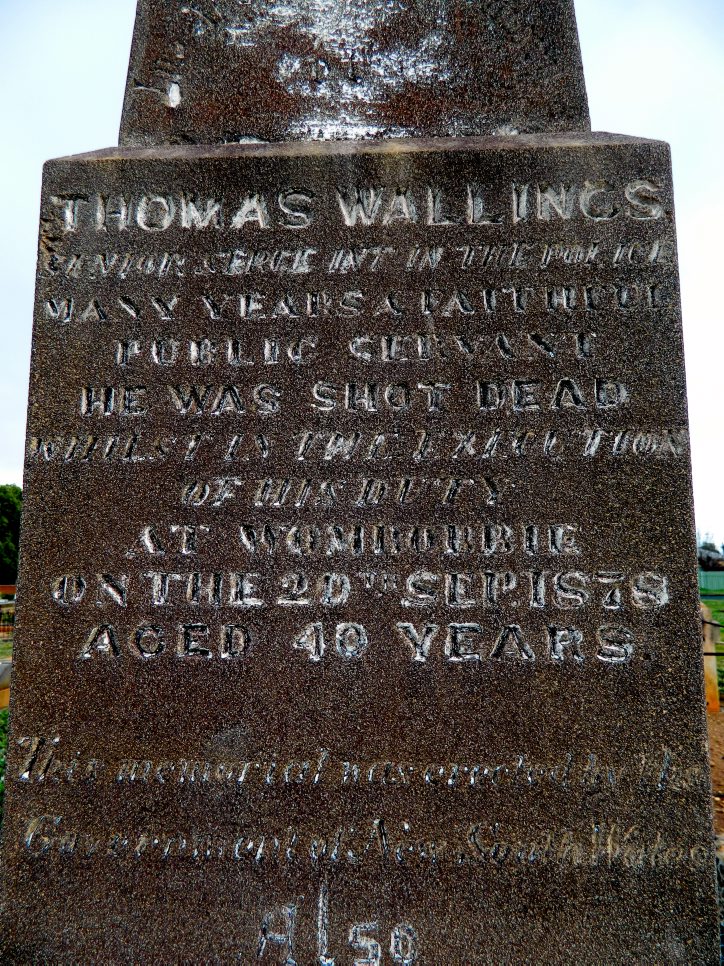
INSCRIPTION: THOMAS WALLINGS ? in the Police many years a faithful public servant He was shot dead whilst in the execution of his duty at Wombobbie on the 20th Sep. 1878 aged 40 years This memorial was erected by the Government of New South Wales also Charles C. WALLINGS died 17th May 1903 aged 30 years The Lord gave and the Lord hath taken away.
INSCRIPTION: THOMAS WALLINGS ? in the Police many years a faithful public servant He was shot dead whilst in the execution of his duty at Wombobbie on the 20th Sep. 1878 aged 40 years This memorial was erected by the Government of New South Wales also Charles C. WALLINGS died 17th May 1903 aged 30 years The Lord gave and the Lord hath taken away.
Thomas IS mentioned on the Police Wall of Remembrance
On the night of Thursday 19 September, 1878Sergeant Wallings, Senior Constable William Souter and Constable John Walsh were searching for a gang of bushrangers ( Captain Midnight & his gang ) when they set up a bush camp near the Wonbobbie Inn, Marthaguy Creek (near Warren).
The following day ( Friday 20 September ) at 6am the three police rode to the inn where they suspected they might find the bushrangers. Constables Souter and Walsh remained on guard outside while Sergeant Wallingsapproached the inn. Meanwhile, Constable Souter saw a man about 50 metres away carrying a rifle. He rode over to him and was told he would be shot if he came any closer. Souter called to the other police who rode down to him.
Sergeant Wallings then fired a warning shot and told the man to surrender, however the man replied that he himself would fire if the police came any closer. Sergeant Wallings then advanced on the man and pointed his revolver at him. The man then turned suddenly and dropped to one knee. As he did so, he fired at the sergeant, hitting him in the chest. In the confusion the offender ran a short distance away and took cover from the police. A short gun battle took place, however, the offender, being far better armed with a rifle, compared to the police revolvers, managed to escape. The two constables then directed their attention to assisting the wounded sergeant. The wound suffered by Sergeant Wallings ( shot through the heart and lung ) proved to be severe, and he unfortunately passed away almost immediately.
A few weeks later, the Sydney Morning Herald dated 10 October, 1878 reported the death of the murderer, informing its readers that “News has just reached the metropolis that the man who shot Senior Sergeant Wallings at Dubbo has been killed by the police, shortly after he committed the murder. The cold-blooded villain shot Wallings in the execution of his duty. He was pursued by Sub-Inspector Duffy and Constables Latton and Gray of Bourke, in the most unrelenting manner, and traced to the borders of Queensland, where he made a desperate resistance. The police shot at the horse he was riding and fatally wounded the murderer, whose name is said to be George Gibson. This man’s death is one which has not in any way been regretted by the general community. It was such a death as luckily there is not much necessity for now-a-days. The police deserve the congratulations of the public here for their bravery in this instance, which however, is only of a piece with much the New South Wales police have accomplished in the suppression of crimes of this nature. A movement has been initiated for relieving the widow and eight children of Wallings.
The sergeant was born in 1838 and joined the police force on 15 July, 1855. In 1862 he became a member of the newly-formed New South Wales Police Force. At the time of his death he was stationed at Dubbo. The offender was the bushranger “Midnight“.
John Vance BLAIN
| 27/10/2012
John Vance BLAIN
New South Wales Police Force
Regd. # 2481
Rank: 1st Class Constable ( Foot Policeman – not mounted )
Description: 5′ 11.5″ tall, blue eyes, fair hair, fair complexion. Single. Previously a farmer. He was Protestant.
Stations: Darlinghurst
Service: From 26 December 1874 to 20 June 1877 = 2+ years Service
Awards: a valuable gold watch and chain for the gallant capture of a convicted burglar, named Wright
Born: ? ? 1850 in Ireland
Event date: Thursday 22 March 1877
Died on: Monday 11 June 1877 @ Wooloomooloo
Cause: Assault with a Police Baton & other assaults
Age: 26
Funeral date: Tuesday 12 June 1877 @ 2.15pm
Funeral location: Graveside
Buried at: Rookwood Cemetery
Memorial location:
A record of his brave conduct for arresting and bringing to justice a notorious burglar at whose hands he received such savage injuries as to ultimately cause his death
[alert_red]JOHN is NOT mentioned on the Police Wall of Remembrance[/alert_red] * BUT SHOULD BE
Just after 4pm on Thursday 22 March, 1877 Constable Blain was on duty in Bourke Street, Wooloomooloo when he saw two men carrying a “bundle” in Forbes Street. He called on them to stop, however they ignored him and ran off, quickly pursued by the constable. One of the men then stopped and threw himself at Constable Blain, whose baton unfortunately had dropped to the ground during the chase. As he grappled with one offender, another took up the dropped baton and struck the constable several severe blows to the head, inflicting terrible wounds. Blain bravely held his ground however, and succeeded in handcuffing one of his assailants before staggering a short distance to the home of Dr Pattison. The doctor assisted the stricken Blain and also quickly sent a message to the police for assistance.
Constable Williamson ( possibly Williams ) soon attended and spoke to Constable Blain, who told him that he had arrested and handcuffed one of his attackers before walking to the doctor’s home. Williamson then attended the site of the incident where he indeed found one of the offenders (John Wright) lying handcuffed and bleeding in the street. The courageous Blain had in fact arrested one of his own murderers (a rare accomplishment), as his injuries were to prove fatal.
Prior to his death the Mercurynewspaper of Friday 23 March, 1877 reported the story of Constable Blain’s encounter with the offender John Wright and his unknown accomplice.
The article indicated that “The constable who was so barbarously assailed is suffering greatly from the wounds he received. His extraordinary courage and resolution in securing the man in the manner he did is worthy of lasting record.” And thus it is.
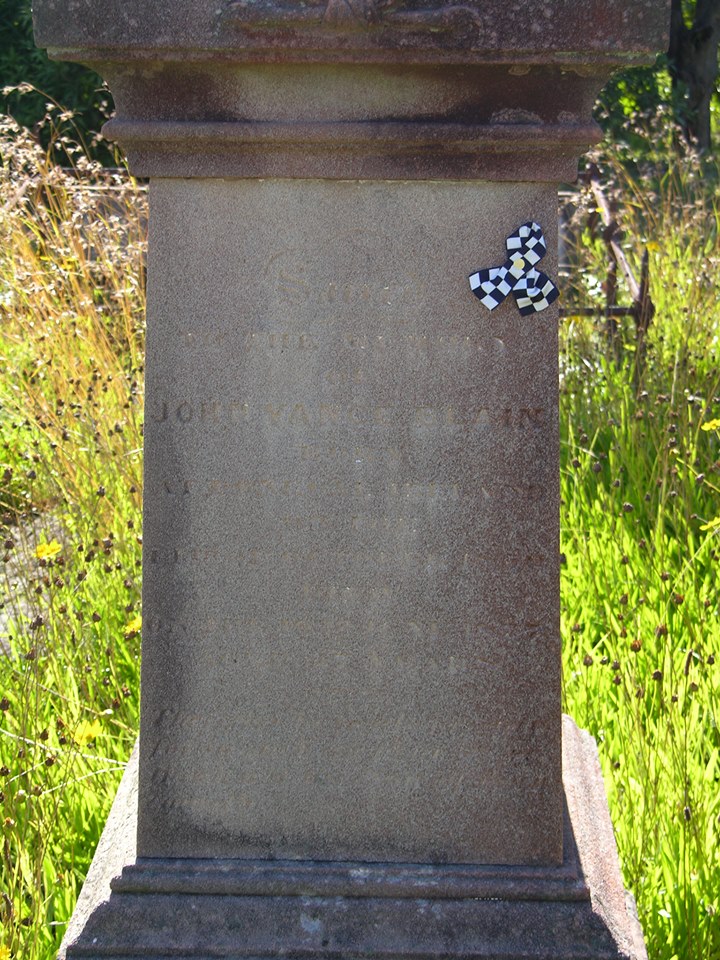
His headstone at Sydney’s Rookwood Cemetery reads: “A record of his brave conduct for arresting and bringing to justice a notorious burglar at whose hands he received such savage injuries as to ultimately cause his death”.
The constable was born in 1850, and at the time of his death he was stationed at Darlinghurst.
[divider_dotted]
The Sydney Morning Herald Friday 16 March 1877
“SERIOUS ENCOUNTER WITH A BURGLAR.
Some time on Thursday night the premises of Mr J C W Hinsch of 160 Pitt Street, were broken into, and a number of Crimean shirts and other goods valued at about £20, were stolen. Shortly after 4 o’clock yesterday morning, Constable Blain who was on duty in Bourke Street, Woolloomooloo, saw two men carrying a bundle in Forbes Street. He called upon them to stop but as they took no notice he gave chase, and gained upon them. One of the men threw himself down in front of the constable who fell upon him. In running after the men the constable’s truncheon dropped out of his pocket, and the second man took it up and struck the constable several heavy blows inflicting very severe wounds on the back of the head. The constable, though stunned by the blow, bravely grappled with the man, and after a most desperate struggle succeeded in over-powering and handcuffing his assailant. Becoming weak from loss of blood he had just sufficient strength to reach the residence of Dr. Pattison, when he fainted from exhaustion. Dr Pattison sent information to the police that a constable was at his house who had been nearly murdered in the street. Constable Williams, who soon arrived in obedience to the summons, found Blain lying on a sofa bleeding from wounds on his head, and scarcely able to speak. Eventually he learned from him that a man whom he had captured was handcuffed in the street, and on proceeding to the spot indicated, he found the man lying and bleeding from the head. He was conveyed first to the Infirmary, and afterwards to the Darlinghurst Police Station.
Later in the day Detectives Wilmott and Camphin found one blanket and 31 Crimean shirts in a sack on a piece of waste ground near Judge Street, Woolloomooloo… The constable who was so barbarously assailed is suffering greatly from the wounds he received. His extraordinary courage and resolution in securing the man in the manner he did is worthy of lasting record.”
Then on Saturday 16 June, 1877 the Australian Town and Country Journal reported the death of Constable Blain, including the following information.
“It will be remembered that, a short time ago, the Inspector-General of Police, on behalf of various citizens, presented constable Blain with a valuable gold watch and chain for the gallant capture of a convicted burglar, named Wright, who brutally assaulted that officer when being arrested for the burglary at the premises of Mr. J. O. W. Hinsch, in March last. Wright was sentenced to six years hard labour.
Blain, who was assaulted on the head with a policeman’s baton, recovered somewhat from the effects of the affray; but three weeks ago was again brutally assaulted by some roughs in Oxford-street.
About a fortnight ago he went into the Infirmary for medical treatment, and typhus fever setting in, he expired early on Monday morning. It is alleged that his death was caused by the effects of the beatings he received. It is said that a foul drain under the bedroom which Blain had occupied, in Stanley-street, was the cause of his taking ill. Blain had been about three years in the Force. He was unmarried. His grade was first class constable; and he was a young man of superior intelligence and some promise, and a most efficient officer.”
The constable was born in 1850, and joined the New South Wales Police Force on 26 December, 1874. At the time of his death he was stationed at Darlinghurst. His headstone at Sydney’s Rookwood Cemetery reads: “A record of his brave conduct for arresting and bringing to justice a notorious burglar at whose hands he received such savage injuries as to ultimately cause his death”. He is not listed in the official New South Wales Police Honour Roll.
[divider_dotted]
The Sydney Morning Herald Tuesday 12 June 1877 page 1 of 10
DEATHS:
BLAIN. — June 10, at the Sydney Infirmary, John Vance Blain, aged 26.
The Sydney Morning Herald Tuesday 12 June 1877 page 10 of 10
THE FRIENDS of the deceased Mr. JOHN VANCE BLAIN, late of the Sydney Police, are respectfully invited to attend his Funeral ; to move from the Infirmary THIS DAY, Tuesday, at a quarter-past 2 o’clock, to the Necropolis.
The Evening News ( Sydney ) Wednesday 13 June 1877 p 2
Constable Blain’s Funeral,
Yesterday afternoon, the remains of that efficient and lamented young police officer, constable Blain, were interred at Haslem Creek Cemetery. The funeral was attended by the Inspector General of Police ( Mr. Fosberry ), Inspector Read, Sub-Inspectors Waters, Anderson, and Johnson, and a large number of his fellow officers. The procession, as it moved through the city, attracted general attention, and considerable regret was expressed at the untimely end of a promising a young officer. The members of the force, as may be seen from an advertisement, intend erecting a monument over his grave.
The Evening News ( Sydney ) Saturday 4 August 1877 p 4
Monument to Constable Blain.
It is satisfactory to learn that there has been a prompt and generous response to the proposal for a monument over the remains of that distinguished but unfortunate police officer, Constable Blain. It will be remembered that Blain had a desperate encounter with a burglar who had broken into Mr. Hinch’s establishment in Pitt-street, and that he received such severe injuries as accelerated, if they were not mainly
the cause of his death shortly afterwards in the Infirmary. The Inspector-General and his officers and the whole force accorded his remains every honor by following them to the grave ; but they thought something more ought to be done, A suitable monument over the grave was proposed, and the matter having been taken in hand by Mr. Smart, J.P., the necessary funds were subscribed in the course of a few days. We have been shown the design of the monument together with the inscriptions, and it deserves to be said that the selection has been dictated by good taste and judgment.
Service: From? ? ?to 25 October 1852 = ? years of Service
Awards: ?
Born: ? ? ? about 1827, Downpatrick, Co. Down, Ireland.
Event date: Saturday 14 February 1852
Event location: outside of the Horse and Jockey Hotel, Hunter St, O’Connell St, Sydney @ 9pm
Event type: Assault – kicking
Died on: Monday 25 October 1852
Place of death: ?
Cause: Illness – Tuberculosis
Age: 26
Funeral date: Wednesday 27 October 1852
Funeral location: ?
Buried at: St John’s Anglican Cemetery, Menangle Rd, Camden
Grave location: very end of Row E, Plot 107
Memorial at:
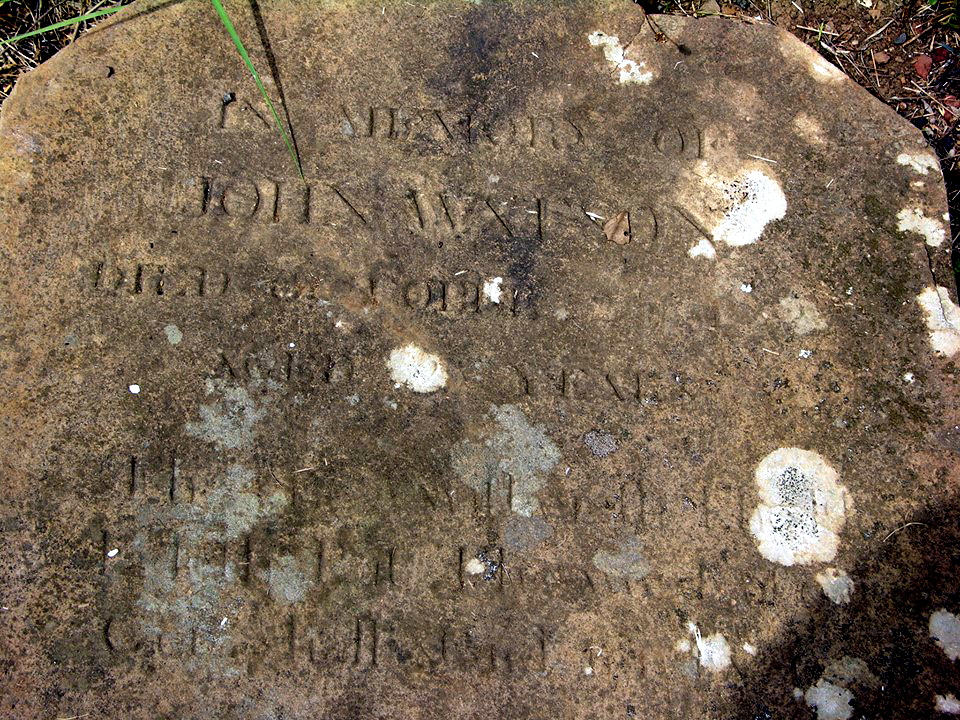
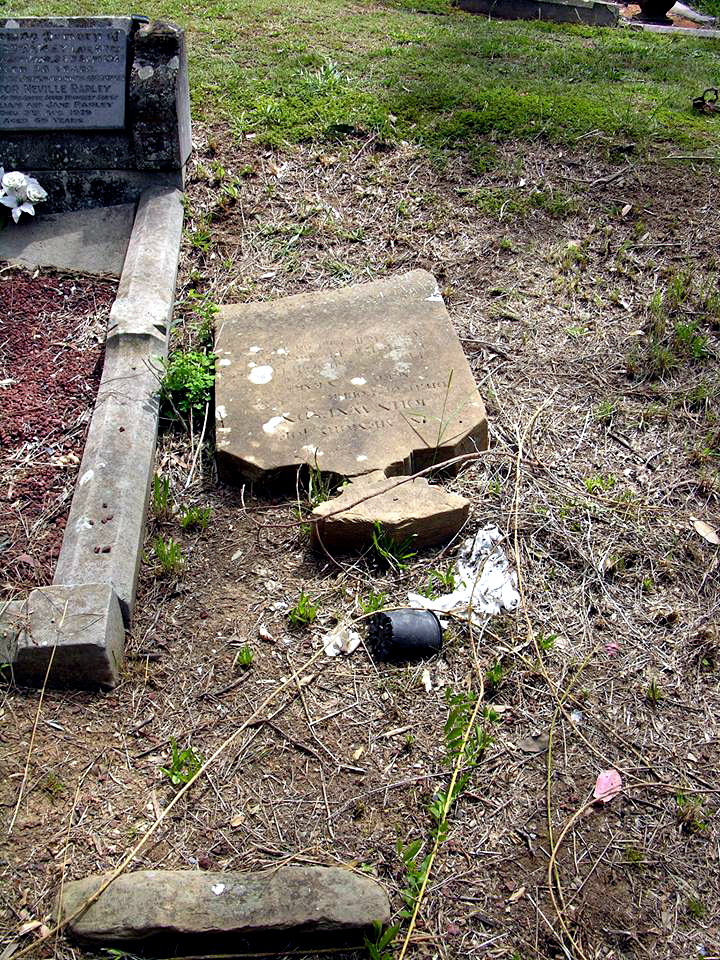
Inscription: In Memory Of John WATSON who died 25th Oct 1852. Aged 26. At Rest ??????
JOHN is NOT mentioned on the Police Wall of Remembrance
* BUT should be
Sergeant John Watson was born c1827, Downpatrick, Co. Down, Ireland.
He, along with his wife Susan Watson (nee Gillespie) 1830-1912, arrived in Sydney 15/10/1851 aboard the “Earl Grey”. During the voyage his wife gave birth to a son John Watson, 1851-1918. Sergeant Watson died 1 year and 10 days after arriving in Sydney.
He is buried in the St. Johns Anglican Church cemetery, Camden, NSW.
Buried at the very end of Row E, plot 107.
♥ Kevin Bannister 041120
Sergeant Watson is thought to have died on 25 October, 1852 as a result of the onset of tuberculosis following an assault by a prisoner he was escorting to a police station.
He was buried at Camden on 27 October, 1852 at which time his residence was recorded as Sydney.
Few details are yet known of the incident, however the Sydney Morning Herald of 24 May, 1860 when reporting on the death of Inspector Alexander McGee, included the following clue.
We are happy to say that we have been informed by the superintendent of Police that a pension to the widow [of McGee] of ” £50 can be afforded out of the Police Fund. It is a somewhat singular coincidence that this will be the second instance of relief from the Police Fund which Mrs. McGee will receive. She was formerly married to a man of the name of Watson, in the police force, who, while conveying a prisoner to the watchhouse, was so seriously kicked in the back that consumption was induced, and he speedily died. On that occasion the donation of ” £100 was paid to the widow out of the Police Fund. Still we think that some testimonial from the citizens in token of their approval of the gallant conduct of McGee is eminently due.
The sergeant was aged 26 years when he died and was apparently stationed in the Sydney Metropolitan Area.
SYDNEY POLICE COURT. – Saturday ( Before the Police Magistrate, and J. McLerie, Esq., J.P. )
ASSAULTING A CONSTABLE.- A well-dressed young man, named William Byrnes, was charged with assaulting Constable Watson, in O’Connell street, at nine o’clock on Saturday night ( 14 February 1852 ).
It appeared from the evidence that some man, whose name is unknown, assaulted the defendant, and knocked him down. The constable interfered for the defendant, and apprehended his assailant, in return for which the defendant struck the constable several blows, and also kicked him in the stomach.
The defendant did not deny the assault, for which he expressed his contrition. The bench sentenced the defendant to pay a fine of 2/., and 2s. 6d. costs, in default to be imprisoned during fourteen days.
Bell’s Life in Sydney and Sporting Reviewer (NSW : 1845 – 1860), Saturday 21 February 1852, page 3
THE POLICE REGISTER.
The Height of Ingratitude. – Police constable Watson answered in the most lively and sonorous manner to his name when called upon to give evidence against William Byrnes, a stiff built nautical, for having inflicted divers kicks upon witness whilst engaged in affording him the protection of the law.
At the late hours on Saturday night Watson was doing his duty in O’Connell-street, when he saw the defendant levelled to the earth by a human fist.
Witness took the offender into custody; whereupon up rose Byrnes, and most ungraciously pitched into his Indigo friend, from whose grasp he rescued his antagonist. ” I am naturally mild,” cried Watson, ” but human flesh and blood cannot stand this. Come to the watchhouse.” ” Not I.” replied Byrnes, ” take me if you can.”
Watson sounded his whistle shrilly, but the Royal Civils did not start up around as did the clansmen – of Roderick Dhu – Watson was left alone with a very pretty little piece of work cut out for him. However, he tightened his belt, and went at Byrnes like a hero, and after a struggle of half an hour placed him carefully under lock and key.
The defendant had nothing to offer in explanation of his conduct but the police office cuckoo note – I was uncommon drunk – knew nothing of it – dare say he’s right – a man don’t like to be pulled and hauled about – did my best to prevent it, no doubt.
This plea was held insufficient by the P.M., who fined him in forty shillings and costs for base Ingratitude to his protector.
The Empire ( Sydney, NSW ) Wednesday 5 May 1852 p 3
PUBLICANS’ ANNUAL LICENSING MEETING,
The Court of Petty Sessions for considering applications for Publicans’ Licenses, adjourned from the 30th of last month, resumed its sittings yesterday.
The Right Worshipful the Mayor presided, and was assisted by the following Justices. The Police Magistrate, the Superintendent of Police, Messrs. Allen, Hill, Chambers, Moriarty, Mitchell, Brenan, Grant, and Brown.
George Snell Clark, applied for license for the Horse and Jockey, in Hunter-street. Mr. Cory appeared for the applicant, who was opposed by Inspector Holmes, for having, on the 14th of February, refused to assist a constable in the City Police, named John Watson, who had a prisoner in custody at the time, and which prisoner was rescued from his custody by a person who assaulted constable Watson, and inflicted severe injuries upon him. The objection further alleged that when a pair of handcuffs were handed to Mr. Clark to assist in securing the prisoner, he threw the handcuffs down on the ground.
Constable Watson related the facts of the case, and said that he had been unwell ever since the night the assault was committed upon him. In reply to a question put to him by Mr. Cory, Watson admitted that Mr. Clark had picked up his truncheon for him, Mr. McLerie stated that no complaint was made against the manner in which the applicant had hitherto conducted his licensed house, and he would therefore consent to withdraw, the objection, which had been raised to let publicans plainly understand that they were bound when called on in similar cases to render aid to the Police. The objection was then withdrawn, and the license granted.
NSWBDM = John WATSON. Death registration # 1131/1852 V1852113138B age 26
Camden General Cemetery is located on the corner of Cawdor and Burragorang Rds, Camden & was established in the late 1800’s.
The above information may have been contaminated with some of the below dates.
Further investigation needed. ( Cal 27 Oct 2016)
Danny WEBSTER has a person by the same name recorded as thus ( 2016 )
Sergeant John WATSON
St James Police Station
Assault Injuries – 25 October, 1852
Resting Place – St John’s Anglican Cemetery, Camden
Sergeant Watson is thought to have died on 25 October, 1852 as a result of the onset of tuberculosis following an assault by a prisoner he had removed from a hotel in Sydney.
On or about the 21 January, 1852 Sergeant Watson and Constables Clifford and Clarke attended the Lemon Tree Hotel and were asked by the proprietor to remove a man from the premises after he had refused to leave until he was served another drink.
The police were forced to drag the man from the premises and a hostile crowd soon formed outside to witness the ensuing brawl.
The Empire of 25 January, 1852 reported on the incident.
ASSAULTING THE POLICE
Robert Thompson appeared to answer the charge preferred against him by Sergeant Watson, for assaulting him in the execution of his duty, in Phillip-street, between the hours of nine and ten o’clock, on Wednesday evening. The defendant bore evident marks of ill-usage, his eyes being severely bruised.
Mr. Cory appeared for the prosecution, Mr. G. Wright, as amicus curia attended on behalf of the defendant.
It appeared from the evidence of Watson and two other constables that the son of Mr. Tuohy, a publican in Phillip-street, called at the St. James’ station-house, requesting the police to eject the defendant from his father’s house, as he was conducting himself in a disorderly manner.
Sergeant Watson went with two constables to Mr. Tuohy’s house, and defendant was ordered to quit, which he refused to do.
The policemen then ejected defendant from the house, and ordered him to go home. He refused, and caught hold of Watson by the legs, and endeavoured to throw him down.
The two constables released the sergeant from the defendant’s grasp, and he then kicked the sergeant in the breast.
The sergeant then said, “Take him to the watch-house.” The defendant was in liquor, and his conduct was very violent while being conveyed to the watch-house.
Several witnesses were called for the defendant, who testified that the policemen ill-used the defendant after the arrest, and that they beat him while conveying him to the watch-house.
The defendant was fined one shilling, and half-a-crown costs, which he immediately paid.
The offender later took civil action against the three police officers, who were defended in court by a Mr Nichols, who said in their defence, “The constables were human beings, and situated as they were, with a mob of upwards of one hundred people surrounding them, and calling out to them to let the man go, must naturally have been excited…
One witness had sworn that a constable waved his stick, and threatened a person in the crowd, but he would call a witness to prove that that constable had no stick with him…
The now complainant had been charged with assaulting a constable, one of the now defendants, and has been convicted and fined…
In conclusion, I would remark that the defendants were duty bound to apprehend the complainant, and they used no more violence than was necessary to take him.”
The hotel proprietor, a Mr Tuohy gave the following evidence during the hearing.
I am a publican residing in Phillip-street. On the night of the late Mayoral election the complainant was in my house between the hours of eight and nine o’clock.
I saw the constables, the three defendants, at my house.
My son went for them, in consequence of Mr. Thompson using threatening language, and saying that he could beat me, and my whole family.
Sergeant Watson told the complainant to go home with his wife. Complainant asked the sergeant if he knew his duty, and told him that his duty was outside instead of inside. I desired the constables to put complainant out of the house, as I was in dread of him. They again requested him to go home, which he refused to do. I was afraid he would do me some injury, because I had refused to draw more liquor for him, and again told the constables to turn him out. They took hold of him quietly, and he rushed against them, and tried to shut the door. They forced him outside, and then twice told him to go home. He replied, that he would remain there as long he liked. When down, he took the sergeant by the legs and the constables tried to loosen his hold. The sergeant caught hold of one of the verandah posts, to save himself from falling.
Thompson’s conduct was violent. I saw him kick when down outside my door. I could not say who he kicked at. I do not think the constables used more violence than necessary during the time I saw them.”
The matter was dismissed by the magistrate.
The sergeant was aged 26 years when he died and was stationed at the St James Police Station.
He was buried at Camden on 27 October, 1852 at which time his residence was recorded as Sydney.
He is not listed in the official New South Wales Police Honour Roll.
Peter PROSSER
| 27/10/2012
Peter PROSSER
AKA ?
Late of ?
New South Wales Police Force
Regd. # Not listed on NSW State Govt. Archives – Registers of Police
Service: From? ? ?to23 January 1839 = ? years Service
Awards: No find on It’s An Honour
Born: ? ? 1812 – 1813?
Died on: Wednesday 23 January 1839
Age: 26
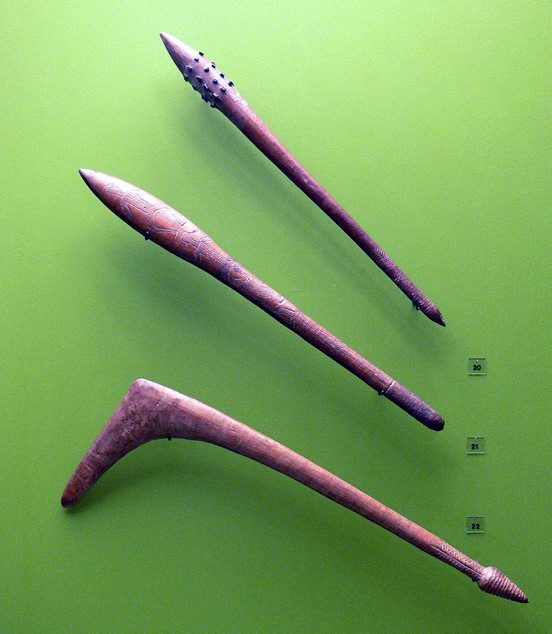
Cause: Murdered – Clubbed to death with a Nulla Nulla ( Waddy ) * see below
Event location: Phillip St, Sydney
Event date: Monday 21 January 1839
Funeral date: Friday 25 January 1839
Funeral location: ?
Wake location: ?
Funeral Parlour: ?
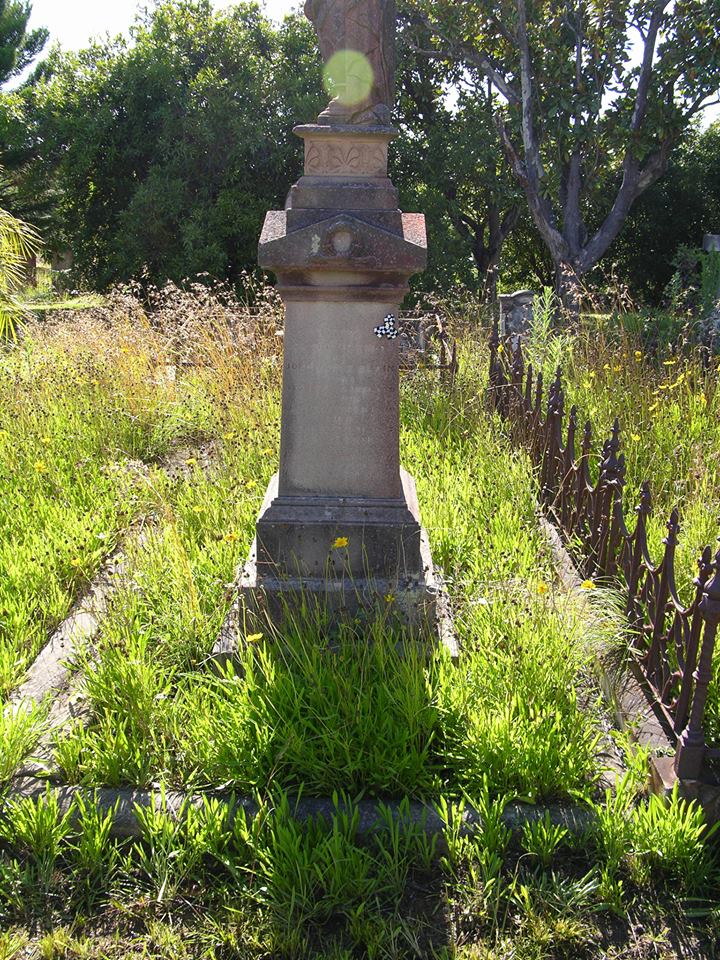
Buried at: Devonshire St Cemetery, Sydney – January 1839.
In 1901 his remains were exhumed to make space for Central Railway Station and re-interred, with thousands of others and 2285 tombstones of the first settlers in Australia, at the new cemetery at La Perouse, named Bunnerong Cemetery.
In 1976, the Botany Cemetery Trust destroyed most of these historic monuments by creating a new, low maintenance lawn area. The remaining 746 headstones were reinstalled in concrete strips, unrelated to the graves below them. The new lawn was named Pioneer Memorial Park.
The words recorded as being on his original tombstone are “Peter, the son of Edward and Mary Ann PROSSER, who was struck by John PENDER; in the execution of his duty 25th January 1839 which caused his death in 48 hours. He was an Inspector in the Sydney police and an Active officer. also sisters Adeliza and Jane, passengers in the ship ‘Fairlie’.
Adeliza buried at the Cape in October ???? Jane aged 16 years. Adeliza aged 29 years. Peter aged 26 years”.
Memorial located at: ?
[alert_green] PETERIS mentioned on the Police Wall of Remembrance[/alert_green]
[divider_dotted]
FURTHER INFORMATION IS NEEDED ABOUT THIS PERSON, THEIR LIFE, THEIR CAREER AND THEIR DEATH.
On the afternoon of 21 January, 1839 a man named John Pender ( known to Sydney police as “Jack the Waterman“ ) was behaving in an indecent manner in Raynor’s Public House, Sydney. As a result of his behaviour he was arrested by Inspector Prosser who began to march him to the Sydney Police Watch-house.
En route they passed Pender‘s home in Phillip Street where a mob attacked the inspector and dragged his prisoner into the house. Prosser clung to his prisoner desperately however, until he received a blow from a club to the back of his neck, which resulted in his death a few days later in hospital. Pender was quickly apprehended and charged with murder, while five others were also charged in relation to the riot.
The Sydney Gazette and New South Wales Advertiser of 24 January, 1839 reported the incident in some detail.
BRUTAL MURDER.
On Monday afternoon a man named John Pender, well known about the town as the driver of a water-cart, and a bad character, went into the public-house of Mr. Rayner at the corner of Hunter and Phillip-streets and in the absence of the landlord was guilty of much indecent behaviour.
He was remonstrated with by the landlady, but this seemed to have the effect of urging him on to still farther excesses. He approached Mrs. R., who was behind the bar, when she took up a New Zealand waddy to defend herself; this the brute wrested from her, and after having struck her he left the house, flourishing the weapon over his head and making a great noise.
He was perceived at the time by Inspector Prosser, who was approaching alone. Prosser came up behind him unperceived and took the waddy from him, and desired him to accompany him to the watch-house.
Pender accompanied the Inspector a short distance, when, stopping suddenly, he turned round and struck Prosser a violent blow on the face with his fist, which knocked him down. While he was on the ground, the man stooped down and snatched the waddy from the hands of the Inspector, and as the latter was rising to his feet he struck him a tremendous blow with it on the back of his neck, and then ran into his own house which was close at hand.
“A mob of blackguards, as usual on such occasions, soon assembled on the spot, and although they witnessed this unprovoked outrage none among them were inclined to render the poor fellow any assistance, but rather endeavoured to screen the villain and hasten his escape. After a few moments Prosser was seen to get on his feet with difficulty and move on towards the watch-house, holding his hands to his head. He shortly afterwards met Sergeant Kilpatrick, and desired him to go and apprehend Pender who, he said, had murdered him.
Killpatrick hastened to the station-house for assistance, and procured that of the two keepers, the only persons present, and the three then returned to Phillip-street.
In the meantime, the wounded Inspector got to the watch-house, and was shortly afterwards found by Sergeant Partington lying across one of the benches, nearly dead; he called for assistance, and Mr. Driver, the publican, attended and with vinegar attempted to revive him.
Dr. Whittle, who was near the spot, was then sent for; he immediately attended and by copious bleeding restored animation, but Prosser continued in such a dangerous state that his immediate removal to the Hospital was recommended and performed.
The Police had in the interim secured Pender and five or six other persons who appeared to take a prominent part in the mob assembled in Phillip Street.”
The Sydney Morning Herald dated 25 January, 1839 printed the following brief account of the inquest into Inspector Prosser‘s death.
An inquest was held at the same place the same day, on the body of Peter Prosser, lately an Inspector of the Sydney Police. The evidence was very lengthy but the substance was very simple, viz, that Prosser had a man named Pender in custody, and that Pender in order to make his escape struck the deceased a blow on the head with a New Zealander’s waddy, which was so violent as to cause an extra vasation of blood on the brain, from the effects of which Prosser died. The Jury returned a verdict of willful murder against Pender, who was committed on the Coroner’s warrant.
At the time of his death the inspector was aged 26 and was attached to the Sydney Police.
Judging by newspaper accounts of the time, he was a courageous and energetic policeman who seemed to have worked tirelessly against violent offenders in the inner city of Sydney. He is not listed in the official New South Wales Police Honour Roll.
A ‘waddy’, it is believed, is similar to an Aboriginal nulla nulla. A waddy is a heavy club constructed of carved timber and could also be a walking stick. No doubt, the ‘green stone’ referred to, was attached to the end of the Nulla Nulla and held in place with tree resin.
It would appear that the Rank structure of this period ( 1835 ) was:
Patrolman –
Constable –
Conductor –
Inspector –
Sydney Gazette and New South Wales Advertiser (NSW : 1803 – 1842), Saturday 9 August 1834, page 4
Government Gazette
WEDNESDAY, AUGUST 6.
HIS Excellency the GOVERNOR has been pleased to approve of the following Alterations in the Police of the Colony, namely
SYDNEY.
APPOINTMENTS
John Price, free, to be Conductor, from the 18th June.
To be Patrolman – James Woodward, free, from the 25th June; John Murray, free, from the 5th July ; Peter Prosser, free, from the 8th ultimo; John Gorman, free, from the 14th ultimo ; Edward Tierney, free, and John McCarthy, free, from the 15th ultimo ; Bryant Naughton, free, from the 16th ultimo ; Michael Armstrong, free, from the l7th ultimo, and James Cook, free, from the 18th ultimo.
Thomas McConnell, free, to be Constable at the North Shore, from the 16th June, and James Woodward, free, to be Constable of the Water Police, from the 5th July.
RESIGNATION
John William Smith, Constable, North Shore, on the 15th June.
DISMISSALS
Patrolmen – John Sullivan, on 24th June ; Patrick Muleady, on the 7th ultimo; James Drew and Patrick Dougharty, on the 13th ultimo ; David Leighton, on the 14th ultimo , George Stewart, on the 15th ultimo; and Patrick Curran, and John Sheehy, on the 17th July.
Water Police Constable — Alexander Lee, on the 4th July,
STRATHALLAN.
William Berry, free, to be Constable in the room of William Carroll, resigned.
MAITLAND.
Edward Gaynor, holding a Ticket-of-Leave, to be Constable, from the 14th ultimo, in the room of Daniel McFarlane, resigned.
PORT STEPHENS.
Michael Cotton, holding a ticket-of-Leave, to be Constable, in the room of John Jaggers, resigned.
New South Wales Government Gazette (Sydney, NSW : 1832 – 1900), Wednesday 21 January 1835 (No.151), page 45
Colonial Secretary’s Office,
Sydney, 20th January, 1835.
HIS Excellency the GOVERNOR has been pleased to approve of the following alterations in the Police of the Colony ; namely,—
SYDNEY.
To be Conductors.— Edward Rollins and Peter Prosser, raised from Patrolmen, from the 1st instant.
To be Patrolmen.— William Elkins, and to be Market Constable, from the 1st instant ; Mark Gilmore, Michael O’Neal, William Howarth, Thomas Barrett, James Carwell, and William Barnett, from the 1st instant ; James Matthews, Robert Lodge, John Hundley, and James Kennedy, from the 9th instant ; and John McCarthy, from the 13th instant.
Conductors Dismissed.— William Barnett, reduced to Patrolman.
Patrolmen Dismissed.— George Brereton, Market Constable ; Herbert Green, James Matthews, John Cummings, James Carwell, John Smith, Peter Butler, Peter Christie, and Peter Colgan.
New South Wales Government Gazette (Sydney, NSW : 1832 – 1900), Wednesday 29 April 1835 (No.165), page 257
Colonial Secretary’s Office,
Sydney, 28th April, 1835.
HIS Excellency the GOVERNOR has been
pleased to approve of the following alterations
in the Police of the Colony, namely :—
SYDNEY.— To be Wardsman : George Mitchell, from the 6th instant.
To be Conductors : Philip Boyce, from the 1st, John Moore, from the 7th, William Hanson, from Joe 14th, and John Matthews, from the 20th of April.
To be Patrolmen : Peter Prosser, James Shaw, Archibald Kelley, and Dennis Connelly, from the 1st instant ; Thomas Kinchela, from the 14th instant, ; John Thorn, John Pendar, James Jackson and William Troop, from the 16th instant ; John Price, and William Vernon, from the 17th, and Patrick Galvin, from the 20th of April.
Wardsman resigned : John Skinner.
Conductors Dismissed : Peter Prosser, Patrick Ogan, and John Price.
Patrolmen resigned : William Howarth, John Gorman, James Tobin.
Patrolmen dismissed : Robert Grindle, James Cone, John Carey, John Connor, James Wells, Patrick Fitzpatrick, and L. Walsh.
LIVERPOOL.— George Harvey, holding a Ticket-of-leave, to be Constable, from the 20th Instant, in the room of Denis McCarthy, resigned.
PENRITH.— John Baxter, free, to be Constable, from the 26th Ultimo, in the room of John Brown, dismissed.
BONG BONG.— John Coffee and Lawrence Larken, free, to be Constables— the former in the room of, James Harper, resigned, and the latter from the 20th Instant, in the room of William Austin, dismissed.
YASS.— James Donald, free, to be Constable, from the 20th of February last.
MERTON.— Jeremiah Burns, holding a Ticket-of-leave, to be Constable, from the 6th Ultimo, in the room of Thomas Boline, resigned.
PORT STEPHENS.— John McCarthy, free, to be Constable, in the room of Edward Frost, resigned.
HIS EXCELLENCY the Governor has been pleased to approve of the following alterations in the Police of the Colony, viz. :—
SYDNEY.
To be Wardsman.— William Abbott, from the 1st instant.
To be Conductors.— Matthew Thomkins and John Price, from the 1st instant ; James Shaw, from the 4th instant ; Peter Prosser, from the 12th instant.
To be Patrolmen.— Patrick Conner, William Moore, William Cox, John Kelly and Stephen Bunen, from the 1st instant ; Thomas Lynskey, from the 4th instant ; Timothy Foley and Andrew White, from the 8th instant ; James Pearson, Samuel Deacon, and Samuel Freebury, from the 12th instant.
Wardsman resigned.— William Small.
Conductor resigned.— Constantine Molloy.
Conductor Patrick Reid, reduced to Patrolman on 30th ultimo.
Wardsman dismissed.— William Abbott.
Patrolmen dismissed.— William Brown, William McCready, James McGruggan, William Noop, Patrick Petty, Thomas Phillips, John Hauley, Michael Armstrong.
LIVERPOOL.
Daniel McCarthy, holding a Ticket-of-leave, to be Constable, from the 18th instant, in the room of James Silvester, resigned.
PENRITH.
William Rossborough, holding a Ticket-of-leave, and Thomas Shuttleworth, also holding a Ticket-of leave, to be Constables, in the room of Ralph Hodgson and Henry Workman, dismissed— the former from the 10th and the latter form the 30th ultimo.
PATRICK’S PLAINS.
Constable John Brest, dismissed on the 20th instant.
Sydney Monitor and Commercial Advertiser (NSW : 1838 – 1841), Wednesday 13 February 1839, page 2
Before Mr. Justice Willis and a Civil Jury.
John Pendar, alias “‘ Jack the Waterman” was tried yesterday for the murder of Inspector Prosser.
The case occupied Mr Justice Willis and a civil Jury up to half-past nine o’clock, when the Jury returned a verdict of manslaughter.
Mr Windeyer was counsel for the defence, and raised three objections – which were,
that there was no proof of drunkenness to warrant the deceased in taking the prisoner into custody,
that the prisoner would have been justified in using force to any degree to expel the constable, who was in fact transgressing on his premises, and
lastly the learned gentleman relied upon a statute ; which he believed was in force, as far back as Henry the Eighth ( which had never been repealed ; rendering fatal any indictment not drawn up in intelligible English, and
contended that ” Waddy” was not an English word, and therefore fatal to the indictment.
These objections were reserved and the prisoner remanded for sentence.
Commercial Journal and Advertiser (Sydney, NSW : 1835 – 1840), Wednesday 20 February 1839, page 2
James Pendar alias Jack the Waterman, for the manslaughter of Inspector Prosser, was brought up for sentence yesterday, and ordered to be transported for the term of his natural life to Norfolk Island.
Sydney Gazette and New South Wales Advertiser (NSW : 1803 – 1842), Thursday 21 February 1839, page 2
Supreme Court.
MONDAY, FEBRUARY 19, 1839.
(Before their Honors the Chief Justice and Mr. Justice Willis.)
On this day there being no cases ready for trial, the prisoners remanded during the Sessions were brought up for sentence.
John Pender was next placed at the bar. The prisoner had been tried for the wilful murder of Peter Prosser, a policeman, and had been found guilty of manslaughter.
Mr. Justice Willis, before whom the case was tried, said to the prisoner that the mercy of the Jury had saved his life in finding him guilty of manslaughter – the manslaughter was of a more aggravated nature than he had ever known or heard of.
The police must be protected in their duty, and should be protected.
His sentence was that he should be transported for life.
Sydney Gazette and New South Wales Advertiser (NSW : 1803 – 1842), Saturday 26 January 1839, page 2
DOMESTIC INTELLIGENCE.
Coroner’s INQUEST. –
On Thursday morning at nine o’clock an Inquest was held upon the body of Prosser, the late Inspector of Police, who died in the General Hospital on the preceding day. The Jury assembled at the sign of the Bunch of Grapes ( King St ), whence they proceeded to the Hospital to view the body, and then returned to the Jury room, where the following evidence was taken :
John Pender, the man charged with the murder, being in custody.
Jane Rayner, of Phillip-street, being sworn stated, I knew the deceased Peter Prosser, and the prisoner before the Court ( John Pender ); I keep a public-house.
On Monday afternoon the prisoner came into my house very tipsey; he made use of very bad language to me, and I refused to serve him, telling him if he could not use better language to me he should leave the place; he then turned round and exposed his naked person to me twice ; I took up a jug of water and threw it over him, and desired him to be off about his business for an impudent blackguard ; that appeared to enrage him the more ; he turned towards me as if he would strike me; I took up a New Zealand waddy to defend myself as he was making to me ; he snatched it from me, and struck me a blow across the shoulder, and afterwards made several blows at me with the waddy, which I avoided ; I thought he would kill me, and I sent my little girl to the watch-house for a constable ; the prisoner then went into the street making a noise, and flourishing the waddy ; in the mean time Prosser came up, and seeing how badly the prisoner behaved, who was storming violently, and flourishing the waddy, he approached him, and I cautioned him of the weapon the prisoner held in his hand ;
Prosser came up behind the prisoner, and took the waddy out of his hand ; and collared him ; the prisoner forced himself into my house in the custody of the deceased, and said he would not go to the watch-house; I told the deceased of his bad behaviour, and said I would appear the next day against the prisoner;
the deceased then told him he must go to the watch-house ; the prisoner tried to get away by the back door, but the deceased stopped him ; at this time a mob of persons had come into the house ; with some difficulty the deceased induced the prisoner to go quietly with him ; they left the house together; I cannot say which of them had the waddy as I was so confused ; I did not leave the place to look outside to see which way they went, but I saw that they turned towards the watch-house ; they had to pass the prisoner’s house on their way there; the deceased had much difficulty with the prisoner in the house ; I cannot say whether the prisoner was struck ; the deceased had to scuffle with him to make him submit and go with him ; I am dull of hearing, and cannot say whether the prisoner made use of any threatening language to the deceased, but they struggled a good deal with each other ; I saw nothing after they left the house.
By the Prisoner. – I cannot say that I saw any blows struck ; there was much struggling; several people were in the house; Mr. Roberts‘ servant was there.
George Clark, free, was then sworn. I recollect seeing the deceased and prisoner in Mrs. Rayner‘s house on Monday last; I saw Mrs. Rayner point out and give charge of the prisoner to deceased ; Prosser came behind him, snatched the waddy out of his hand, and dragged the prisoner towards the watch-house; the prisoner struggled, and seized hold of a fence, on which the deceased pushed at him with the staff or waddy ; they both got back to Rayner‘s ; I looked in and saw a struggle ; the prisoner attempted to get out by the back door and the deceased either struck or knocked him down ; he was down ; they had some high words in the house, and the prisoner took the staff from Prosser, on which the latter attempted to get it again ; the prisoner refused to let him have it, and said he should not have it, but he would go to the watch-house ; they then went quietly that way, the prisoner holding the staff;
I stood at the corner to watch them ; as they passed the prisoner’s house the prisoner forced himself in ; they had a scuffle ; I went down to them, and saw that Prosser had got the staff from him, and was shaking the prisoner to get him to the watch-house; the prisoner refused, on which the deceased struck him a blow on the head ; the prisoner refused to go to the watch-house, and wanted to get into his own house; I cannot say what occurred immediately in the house ; in about a minute I saw Prosser staggering out holding his hands to his head ; I could not tell whether he said any thing, as there was such a noise at the time; a young man had the waddy in his hand, and said, ” that shall not be used again.”
No one else came out of the house but the deceased ; Prosser went towards the watch-house; he continued reeling as he walked along the street as far as four or five houses; I was not exactly opposite the prisoner‘s house, and could not see into it ; the young man before mentioned was in the yard of the prisoner about a minute after the deceased came but ; the deceased was then going out of the yard, and the prisoner was in his own house; I saw some blood coming down the head of the deceased, but I saw no mark upon his face ; I did not notice the young man who had the waddy until after Prosser came out of the house ; if he had come out of the house I must have seen him ; I walked out of the yard after the deceased into Phillip-street, as I thought he would fall, and I did not return ; Prosser was coming out of the prisoner‘s house when I arrived ; he had no hat on ; I heard no noise of blows when I came to the door ; I should know the person of the young man who had the waddy if I were to see him again; the prisoner and the deceased struggled very much for about seven or eight minutes before they went into the house ; they remained in about three or five minutes; I did not see Prosser fall, nor did I observe any marks of a fall upon his clothes; in about three minutes after I lost sight of Prosser while I was conversing with Mr. West opposite Pender‘s house ; I saw the prisoner standing opposite his fence going down the street, and two constables running round him to get in front of him ; the prisoner got over his fence, and was defending himself with the waddy, and the constables striking with their staves.
By the Prisoner.- I saw the deceased hit you several times; there were several marks upon you.
William Badcock examined- I recollect on Monday last, seeing the prisoner and the deceased in Phillip-street ; I saw the prisoner before he was in custody and afterwards ; I saw the struggle, and saw Prosser lay hold of the prisoner’s hair, and endeavour to knock his head against the door of Mr. Rayner‘s house; I also saw him endeavour to kick him, which the prisoner prevented by holding up his leg ; the prisoner got up and said he wished to speak to Prosser; they went quietly along Phillip-street, till another came up to the assistance of the deceased ; when opposite the prisoner‘s house a scuffle ensued ; I can’t say whether it was occasioned by the violence of the other constable or a desire of the prisoner to get into his house ; the other constable was evidently drunk, and struck the prisoner with his staff on the head ; the prisoner got to his own door, and Prosser sent the other constable away for assistance; the deceased had the waddy in his hand when he entered the house; I did not see the deceased strike prisoner any blows in the struggle that took place as they entered the house ; there was blood on the prisoner‘s face and shirt, which was produced by the blow of the drunken constable ; they entered the house and I followed them ; they were struggling on the bed, the deceased being uppermost ; Prosser was holding the prisoner‘s shirt collar with one hand, and thrusting his knuckles into his throat ; in my opinion with the intention of strangling him, and with the other arm trying to hold the waddy from the prisoner; in the struggle the prisoner succeeded in getting the waddy out of Prosser‘s hand, and the deceased held his hand upon the arm of the prisoner that had the waddy in it ; it was then the prisoner struck the deceased with the flat part of the waddy upon the top of his head ; he did not fall from the blow, but he put his hand to his head and cried “oh,” and walked out of the house and down Phillip-street as far as I then could see him ; he went away without his hat; I did not see the deceased strike the prisoner with the waddy ; I do not believe he struck him at all ; the prisoner was very drunk ; after the drunken constable had been despatched for assistance, the prisoner continued his resistance and violence to Mr. Prosser; I did not consider he intended to injure Mr. Prosser ; he was very lenient to him, and it was only on the deceased taking him by the throat, as I thought to strangle him, that he struck him ; I did not hear the sound of the blow, but it evidently stunned him ; I was so interested in the proceeding that I noticed only the actions of the parties; there was no other person in the house ; after the deceased left the house the prisoner pulled off his shoes and stockings, brandished the waddy, and was more violent than ever ; he only struck one blow ; he appeared stupidly as well as furiously drunk ; when in liquor he appeared almost mad ; I did not hear Prosser say anything to the prisoner in the house, he attempted to conquer him by force.
( Constable Bradley being produced, was identified by him as having struck the prisoner on the head. )
Sergeant ( William ) Kilpatrick of the Police was next examined.- He stated, on Monday last I was in the station-house when Bradley came in, between one and two o’clock, and said that a number of persons had assembled in Phillip street, and that Mr. Prosser was beaten and wanted assistance; I went there immediately with Bradley ; I met the deceased about fifteen or twenty yards from the prisoner‘s house ;
he held both his hands to his head and had his handkerchief to the left side of his face, where a scar appeared ; he turned round and pointed to the prisoner, who was in view with blood upon his shirt, and said, ” there’s the man, Kilpatrick, that struck me, take him into custody ;” he then walked on towards the watch-house ; I went in pursuit of the prisoner, who had a waddy in his hand and put himself in a posture to attack me; I secured him in his own house ; Bradley was with me, he struck the prisoner in my presence; he was perfectly sober.
( The witness here observed that almost immediately afterwards Bradley came to him in the watch-house and said that he heard that a charge of drunkenness had been preferred against him, and he wished him to smell his breath to see if he could distinguish any smell of liquor, he did so but could discover none. )
Bradley struck the prisoner so did I ; I made several blows at his hand with my staff to make him drop the waddy ; Bradley was not violent but cool and deliberate ; the prisoner did not say anything respecting Prosser; he was intoxicated and very violent; he made one determined blow at me with the waddy which I caught on my staff, the dent occasioned by it still remains ; I afterwards saw Prosser in the station-house, he seemed feeble and almost dead. ( The prisoner put a few unimportant questions that did not affect the evidence. )
One of the Jurymen, Mr. Driver, here stepped forward and observed to the Coroner that he saw Constable Bradley about ten minutes after the transaction, and he was then perfectly sober.
Dr. Robertson certified that the deceased was received into the Hospital about ten o’clock on Monday evening in a state of insensibility. There was a small scar of recent formation on his left cheek. On a post mortem examination of the body, he found on opening the skull a large quantity of extravasated blood on the back part of the brain, and the whole of the back part of the brain appeared to have been in a violent state of inflammation, sufficient to produce death. The effects, he was of opinion, were such as would have been produced by the blow of a flat, heavy instrument applied violently, such as a waddy. The extravasation and inflammation consequent thereon produced death.
Dr. Whittel corroborated the evidence of the other Doctor, as to the appearances on the post mortem examination. He in addition, stated that he had been called to attend the deceased shortly after he received the blow ; he bled him and recommended his removal to the Hospital.
The Coroner had commenced summing up the evidence, when it was intimated that a young man was present who was there at the time the blow was given.
He was called in and examined. He stated that his name was Manuel Josephson, and that he arrived at Pender‘s house when the deceased held the prisoner against the wall of the house. On their entering the house he could not tell which carried the waddy, but when they were inside ( the witness having followed them ) he saw the waddy lying on a chest beside the bed. As soon as Prosser observed it there he took it up to secure it, on which the prisoner snatched at it ; they struggled and the deceased got Pender down on the bed, but the prisoner succeeded in getting possession of the instrument with which he struck the deceased on his naked head.
Prosser arose from the bed after receiving the blow, and, uttering a cry, he staggered out of the house ; and shortly afterwards Pender was apprehended. He added, that in his opinion the deceased used no unnecessary violence in securing the prisoner.
The Coroner having summed up the evidence and explained the distinctions between manslaughter and murder, pointed out the fact of the prisoner being in the commission of an unlawful act, was given into the custody of a peace-officer, whose attempts to take him to the watch-house he resisted with a deadly instrument.
The jury, after a short consultation, returned a verdict of wilful murder against John Pender, who was forthwith committed on the Coroner’s warrant.
The prisoner is a man of low stature but of great apparent strength of body and very muscular, whereas the deceased was a man of very delicate habits of body.
Sydney Gazette and New South Wales Advertiser (NSW : 1803 – 1842), Saturday 1 August 1835, page 4
By His Excellency’s Command,
ALEXANDER McLEAY.
Colonial Secretary’s Office, Sydney,
28th July 1835.
HIS Excellency the Governor has been pleased to approve of the following alterations in the Police of the Colony, vis –
SYDNEY.
To be Wardsman – William Abbott, from the 1st instant.
To be Conductors – Matthew Thompkins and John Price, from the 1st instant ; James Shaw, from the 4th instant ; Peter Prosser, from the 12th instant.
To be Patrolmen – Patrick Connor, William Moore, William Cox, John Kelly, and Stephen Bunen from the 1st instant ; Thomas Lynskey, from the 4th instant ; Timothy Foley and Andrew White,
from the 8th instant ; James Pearson, Samuel Deacon, and Samuel Freebury, from the 12th instant.
Wardsman resigned – William Small.
Conductor resigned – Constantine Molloy
ConductorPatrick Reid, reduced to Patrolman on the 30th ultimo.
Wardsman dismissed – William Abbott.
Conductor dismissed – Henry Ball.
Patrolmen dismissed – William Brown. William McCready, James McGruggIn, William Noop,Patrick Petty, Thomas Phillips, John Hanley, Michael Armstrong.
LIVERPOOL.
Daniel McCarthy, holding a Ticket-of-Leave, to be Constable, from the 18th instant, in the room of James Silvester, resigned.
PENRITH.
William Rossborough, holding a Ticket-of-Leave, and Thomas Shuttleworth, also holding a Ticket of Leave, to be Constables, in the room of Ralph Hodgson and Henry Workman, dismissed-the former from the 10th and the latter from the 30th ultimo.
PATRICK’S PLAINS.
Constable John Brest, dismissed on the 30th instant.
Sydney Monitor and Commercial Advertiser (NSW : 1838 – 1841), Friday 26 April 1839, page 2
Perjury
Joseph Cutts , a free man, in the service of Mr. Thompson of Phillip-street, was charged by Constable Callaghan with assaulting him in the execution of his duty.
Callaghan deposed, that as he was passing a dray standing in Phillip-street, about half past seven on Monday evening, a dog under the dray ( chained ) flew at him.
He struck it in return. The prisoner said, he might as well strike him as strike his dog, and he would serve him as Prosser had been served by Jack the Waterman, and immediately struck him, the witness.
The drayman had a child in his arms, which he gave to a woman to hold, while he struck witness. He then made into his master’s house, and witness followed him, and struck him with his staff. He also sprang his rattle.
The prisoner denied having struck the constable, and called witnesses. —
Mary Mahany, a soldier’s widow, residing opposite the master of the prisoner, in Phillip street, deposed, that a person left a loaded team standing opposite her door, with a dog on the chain to guard it, while he went over the way to get tea, and she promised to mind it.
The constable came up drunk, the dog barked, and the constable began to irritate it with his staff, and said, if he had it off the chain, he would knock its brains out.
Witness told him, he had better let the dog alone, and go about his business. He called her a dirty w—–.
The prisoner, who was by with his child in his arms, said, he ought to be ashamed to make use of such language to the mother of children. He immediately ran over and knocked prisoner down twice with his child in his arms, and began springing his rattle and making a disturbance.
John Thomas, a dealer, deposed, that the constable was drunk, and corroborated the evidence of the last witness, as far as it went.
The constable also spit in witness’s face, and would have taken witness to the watch house, had he, witness, not got out of the way. ( When the last witness went into the box, he asked the constable if he had any recollection of him? He denied ever having seen his face before. I thought so, said the witness, you were too drunk. )
Case dismissed.
The constable was ordered to be reported.
Such is the case, as handed to us by our reporter.
We are surprised that men of such tact as Messrs. Windeyer and Innes, did not either order the witness into the box for gross perjury, or the constable; for grosser and more malicious impudent lies, were never told in a court of justice, than what must have been told by one or more of these opposing witnesses.
If Magistrates and Judges will not take the trouble to prosecute for perjury so glaring and open, as that which has evidently been committed by one or other of the witnesses in this case, the land will never be purged of this abominable and daily committed crime.
JOHN PENDER was an ardent collector of curios. In his rough, ignorant fashion, he expressed his love of the beautiful by picking up, from all the seaports of the world, things that were odd and rare, and fetching them to his bachelor home on the Strawberry Hills in Sydney.
Of the hardy sea-faring men of the ‘thirties he was one of the most adventurous. Wanderlust had taken him back and forth over the seven seas, to strange ports and strange lands. His little cottage was a veritable museum of curiosities, a centre of attraction for half the population of Sydney when the owner was ashore after one of his exciting voyages.
Pender, as is not uncommon with men of his calibre and peculiar mental composition, was loquacious concerning his exploits, and insistently eager to confirm the impression that he was more than an ordinary being.
Towards the end of 1838, Pender landed in Sydney after an adventurous trip to New Zealand, bringing back with him a large collection of Maori weapons, including a huge club with a greenstone head, taken by him in single-handed fight with a tattoed chief of the savages.
This curiously carved weapon was regarded by the sailor as the gem of his collection. He never tired relating the story of the fight that made it his, and day by day, he grew more boastful about its alleged intrinsic value.
Throughout the Christmas festivities, he paraded the street with the club over his shoulder, chanting war songs in outlandish tongue, and generally making a nuisance of himself to the more peaceably inclined citizens.
Inspector Peter Prosser, of the Sydney Police Force, did not look with any favor on Pender and his boisterous ways. On several occasions he reprimanded the sailor sternly for his obstreperous behaviour, once or twice driving him off the streets when his boasting and warlike antics with the greenstone club terrified passers by.
Pender was more disturbed than he showed by this unceremonious treatment at the hands of a high officer of the law. Having come to believe that his prowess gave him the right to swagger and riot through the streets of any sea-port town, he bitterly resented that his inclinations should be frustrated In the place where he had made his home, and on Monday, January 21, he was very much in evidence, parading the streets with the club in his hand and a Maori rug tied about his shoulders, loudly proclaiming that he was afraid of no man.
His eccentric behaviour did not seriously impede Sydney’s general affairs during the forenoon, and Inspector Prosser not being about, he progressed from inn to inn accumulating large quantities of spirits. During early afternoon he wandered into the bar of Mrs. Jane Rayner’s Inn in King Street, and, thumping the counter with his club, called for drinks for those assembled. The loungers about the place were only too willing to partake of his hospitality, but as the audience was too insignificant for the sailor, he visited the various parlors and tap-rooms and extended his invitation to the occupants. In this way he gathered another eight men into the bar, but at one parlor his peremptory invitation to drink was as peremptorily refused.
Three squatters from the interior, discussing a matter of important business, so resented his intrusion on their privacy that they threatened stern measures if he did not take himself off.
Pender was not far enough gone in drink to be thoroughly quarrelsome, but nevertheless he expressed his opinion of the squatters with such disgusting profanity that they rose to their feet. One of them rushed the sailor, and, taking him by the shoulders, thrust him down a passage into the street. Then he returned and, calling on his friends, left the house; Before going, however, he informed the landlady that neither he nor any of his associates would patronise the tavern again.
Loss of Profits
Mrs. Rayner was considerably put out at losing such profitable customers, and upbraided Pender in vigorous terms when he re-entered the bar a minute later. The seafarer, now furious and irresponsible, threatened to smash up the bar if anything more were said. The landlady was just as brave and determined as the sailor.
Seizing the war-club, which was lying on the counter, she brought it down with a heavy thwack on Pender‘s shoulders and threatened to crack his skull if he did not leave the premises. From her fortress behind the bar, the landlady whirled the stoneheaded weapon, striking at Pender whenever he attempted to seize it.
The half-crazed man was shouting loudly, and using dreadful language as he rushed about the room, creating such an uproar that a crowd quickly gathered in the street. When the disturbance was at its height, Inspector Prosser entered the bar. Taking in the situation at a glance, he rushed at the sailor, grasped him about the middle, and hurled him through the door. While Pender was attempting to rise, the inspector rushed him again and tried to handcuff him. Both men were of like build, and both in perfect physical condition. The sailor, despite the quantity of drink he had absorbed during the morning, was not greatly affected by his libations, and began to fight for his liberty. For half an hour the pair struggled and fought in the Street, none of the crowd offering to interfere.
Prosser, a skilful boxer, plied his fists vigorously, battering his antagonist’s face until it was a mask of blood, Pender, employing tactics of the sea-front, used his feet and hands impartially, but with scant success.
At length Prosser, planting a blow on Pender‘s jaw, felled him insensible to the ground.
When the sailor recovered he was manacled and helpless.
Signifying his intention to proceed quietly to the watch-house, he was permitted to rise, and, held by Prosser, moved down the street. Over his shoulder the inspector carried the war-club. As they were walking along, the sailor informed his captor that he would like to visit his home before going to prison, there being two cats and several birds in the house he desired to liberate.
Prosser, yielding to persuasion, diverted his progress towards Strawberry Hills, and a quarter of an hour later entered the sailor’s cottage with his prisoner. At the door the inspector was seen to unlock the handcuffs on the sailor’s wrists, a proceeding that many of those among the crowd that followed considered a dangerous proceeding.
No warning of this was shouted to the police officer, but when a few moments later he came reeling out through the door to collapse on the ground, those present realised that something tragic had occurred. In the Inspector‘s head was a ghastly wound, clearly caused by a blow from the war-club.
Two men, George Clark and Richard Roberts -rushed into the house. On the floor of the front room they found the blood-stained club. Pender they beheld escaping through the gate at the rear.
Sergt. W. Kilpatrick and Constable Boadley were soon in pursuit of the murderer. Through the streets they chased him, Pender running at a tangent, and screaming insanely of men he had killed in other parts of the world. People dashed from his path and took shelter in the houses. Doors were slammed in his face, but none attempted to lay hold of him. The police took him at last near the Hyde Park Barracks. He had turned at bay, producing a long sailor’s knife, with which he menaced his pursuers. The constables, however, furious at the death of their superior, braved the maddened seafarer, and overwhelmed him with their truncheons.
They battered him into unconsciousness and then, securing a wheelbarrow, trundled him to the Watch-house where he regained his senses.
At his trial some months later, Pender was the most unconcerned man in the court. He sat in the dock eating pears from a bag and spitting out the skin at the constables.
He refused to plead, or give any explanation of the tragic happening in the cottage, a course which decided his fate.
The Judge had nothing else to do but to order his execution.
The green-stone war-club was given to Mrs. Jane Rayner by a formal order of the court, for what reason was not apparent, and her descendants may have it to this day. .
Thanks to Wayne Hill and his research regarding the discovery of his headstone.
Constable Joseph HAYNES touch plate at the National Police Wall of Remembrance, Canberra.
Constable Haynes and Constable Thompson were on duty shortly after midnight on 26 January, 1824 in Sydney when they heard someone call out, “Stop thief”, which set up the hue and cry. They soon heard the footsteps of a number of people running towards them, and seized their opportunity to spring on the man being chased. Constable Thompson was quickly thrown or knocked down, and as he grappled with the offender, Haynes attempted to assist. Two other men then appeared and began attacking the two constables. At this time Thompson“received a blow on the head, which rendered him senseless, it is thought, for a considerable time”, and when he began to recover he heard a deep groaning sound nearby. On investigation he found Constables Haynes lying senseless in a pool of his own blood. The unfortunate man was immediately taken to hospital where he passed away about five days later. He had suffered severe head injuries, almost certainly caused by his own staff, which was found to have a considerable amount of blood and “small particles of skull” adhering to it.
A contemporary account of the circumstances of the constable’s death appeared in the Sydney Gazette and New South Wales Advertiser of the 5 February, 1824, declaring that “The murderous wretches, as there are three concerned, will not long escape it is devoutly to be hoped, the arm of relentless and crying justice.”
(The “hue and cry” meant that every able-bodied man in the vicinity had to join in the pursuit of the criminal. This practice evolved into the “warrant”. The staff carried by each constable was for his own protection. Sydney police weren’t given firearms as a general issue for another seventy years after this incident.)
Haynes had arrived in Australia on the First Fleet aboard the ship Alexanderand received his Certificate of Freedom in 1810. He was originally tried at Gloucester on 13 July, 1785 for receiving stolen goods and was transported for 14 years. He was a married man and his wife Mary later made an application to the Governor of New South Wales for a police pension. He is sometimes recorded as Haines, Haynes or Hynes.
At the time of his death the constable was aged 52 years and was serving in Sydney. He served as a constable for over seven years.
Very pleased to announce that the Police Minister, The Hon. Troy Grant MP has awarded a grant to the NSW Police Memorial & Historical Society Inc in the amount of $55,000 to continue the work of marking and restoring the graves of NSW Police officers killed on duty.
Sincere thanks to Danny Webster and Ken Medway, who collectively provided much of the background research and information to support the application, and Ministry staff. A thank you also to those that have offered to assist and be a local point of contact for some of the memorial sites.
A priority list of sites for restoration has been prepared based on criteria such as those sites that remain unmarked, or in need of urgent repairs. We hope to attend to over 20 locations with this funding.
This is a significant step in carrying out much needed work on these sites, we are extremely grateful to the Minister, and hope this will lead to ongoing support. I’d appreciate it if you could share this around your police contacts.
[divider_dotted]
HAYNES, Joseph. Per “Alexander“, 1788
1810 Jun 23
Received certificate of freedom (Reel 6038; SZ758 p.64)
1821 Sep 8
Constable. On list of all persons victualled from H.M. Magazines; with wife (Reel 6016; 4/5781 p.60)
1822
Signatory to petition from the ordinary constables of Sydney complaining of the diminution of their rations (Reel 6055; 4/1760 p.43c)
1824
Constable of Sydney. Murdered Jan 1823 (Reel 6061; 4/1780 p.233)
HAYNES, Mary. Wife of Joseph Haynes, per “Alexander”, 1788
1821 Sep 8
On list of all persons victualled from H.M. Magazines (Reel 6016; 4/5781 p.60)
1824 Aug
Widow. Petition for pension (Reel 6061; 4/1780 p.233)
1824 Dec 31
Received pension as widow of Constable Joseph Haynes (Reel 6039; 4/424 p.445)
The Sydney Gazette and New South Wales Advertiser Thursday 5 February 1824 page 2 of 4
An inquest was convened by George Milndr Slade Esq. Coroner, on Sunday last ( 1 February ), on the body of Joseph Hynes, a constable in the Town of Sydney. It appeared that the deceased was on duty on the previous Monday night ( 26 January ), near Hill’s Tavern, in company with another constable, named Thompson. Between the hours of 12 and 1 o’clock, there was the hue and cry of ” Stop thief” set up ; and, at the same moment, the steps of some persons running towards them. The watchmen put themselves in a detecting posture, and sprang at one man with a hat under his arm ; a scuffle ensued ; and Thompson was thrown down by his opponent. Hynes, the lamented deceased, forthwith went to his assistance ; and, whilst in the act of attempting to secure the fellow, and release Thompson from his grasp, the latter observed two other men, as he lay on the ground, advancing towards them ; and immediately afterwards received a blow on the head, which rendered him senseless, it is thought, for a considerable time.
When Thompson recovered from the violence he had experienced, the first thing that attracted attention was deep groaning. He went to the spot, and found unfortunate Hynes prostrate, weltering in his blood ; The villain had left the hat behind him which, with the staff and hat of the deceased, were lying close to him. The poor man was carried to the Hospital, where, notwithstanding every effort of skill and humanity, he lingered till Saturday night last ( 31 January ), when death relieved him from intense suffering. The deed appears to have been committed with the staff, as it was much stained with blood, and had some small particles of the skull adhering to it, from the severity of the blows.
The murderous wretches, as there are three concerned, will not long escape it is devoutly to be hoped, the arm of relentless and crying Justice.— The inhabitants should co-operate in every possible way, with Government, to bring the monsters to an early doom.— The Verdict was — Wilful Murder against some person or persons unknown.
If we may at liberty to suggest an opinion upon the above transaction, we think that pecuniary reward can have but little influence upon the mind of a murderer. There are, it is said, three parties concerned, dreading each other : as to confidence, there can be but little. If one of the three had only a hope of securing himself, the two would speedily be within the precincts of Justice, and the other would have to wander out his days, like a true descendant of Cain.
The Sydney Gazette and New South Wales Advertiser Thursday 12 February 1824 page 3 of 4
TWO HUNDRED DOLLARS REWARD. POLICE OFFICE. 3rd FEBRUARY, 1824.
WHEREAS Joseph Hynes, a Constable at Sydney, was, on the Night of the 26th of January last, whilst in the Execution of his Duty, and having Charge of a Prisoner for Felony, violently beat and so severely wounded and injured, by some Person or Persons unknown; that the said Joseph Hynes hath since died of the Wounds he received on that Occasion ;— And the Coroner’s Inquest having pronounced a Verdict of Wilful Murder against some Person or Persons unknown ; in Order to bring the Offender or Offenders to Justice, a Reward of Two Hundred Spanish Dollars is hereby offered and will be paid to any Person who shall come forward and give such Information as will convict the Offender or Offenders, concerned in the said Murder.
MORE than 200 years after Constable Joseph Luker was bashed to death while investigating a robbery near a Sydney brothel, the officer’s grave has finally been found again.
With the discovery of Constable Luker‘s original grave underTown Hall, the police have solved a Sydney mystery over the burial site of the first officer in Sydney to die on duty.
As the force prepares to commemorate fallen officers on Police Remembrance Day today, the story of Constable Luker’s final resting place can finally be told.
After years searching graveyard records, recent excavations under the Town Hall have revealed Constable Luker was buried in the Old Sydney Burial Ground, which was used from 1792 to 1820. Constable Luker’s grave was marked “assassinated“.
Records show the bodies of three policemen, including Constable Luker, were exhumed in 1869 when building began on the Town Hall site and they were interred at Rookwood Cemetery in Sydney’s west.
“It is important to police as an organisation that we ensure we honour and pay respect to those who have served before us and that is why we have continued to search for Joseph Luker’s burial place,” Police Commissioner Andrew Scipione said yesterday.
“Joseph Luker paid the highest price for protecting the citizens of the then fledgling colony. No organisation should ever forget the sacrifices of its staff.”
Sydney City Council found records showing another two officers, Constables Joseph Haynes and John Farmer, were buried on the Town Hall site but nothing is known about how they died.
Constable Luker was on a midnight patrol after a spate of burglaries near prostitute Mary Breeze’s brothel in Phillip St, then known as Back Row, east Sydney Town, in August 1803.
He had been beaten to death and his cutlass guard was wedged in his skull when his body was found near Macquarie St.
In one of the first scandals to rock the police, two of his colleagues were suspected but were never convicted.
A message to his killers was posted on his headstone at the Town Hall site telling them: “My midnight vigils are no more, Cold Sleep and Peace succeed . . . But when my murderers appear, before JEHOVAH’s Throne, Mine will be to vanquish there, And theirs t’endure alone.”
The 35-year-old was a convict who served seven years transportation before joining a fledgling police force.
Mr Scipione urged people to wear a blue ribbon on the right-hand side of their shirt today to show support for police. He said remembering lost officers was a way to offer continued support and comfort to their families.
“It means we will never forget their courage and sacrifice,” he added.
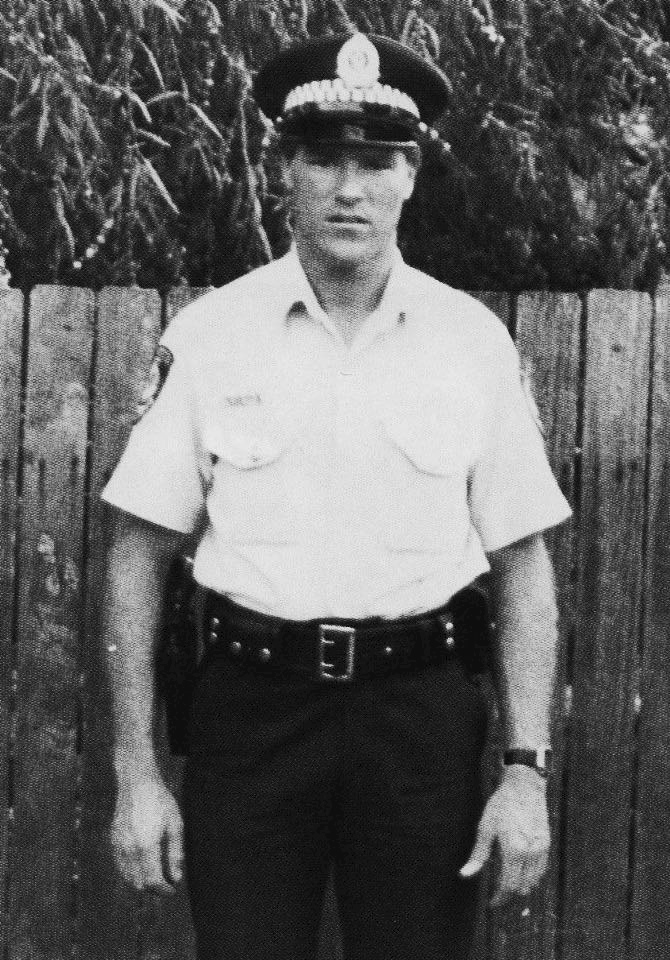
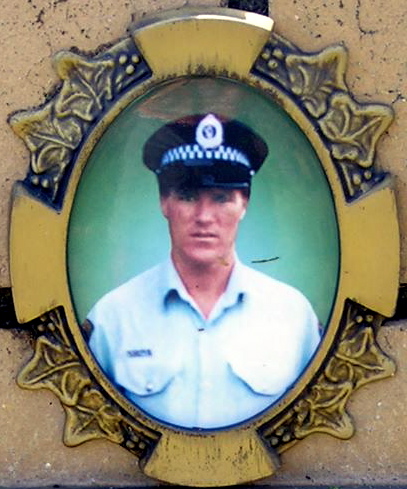
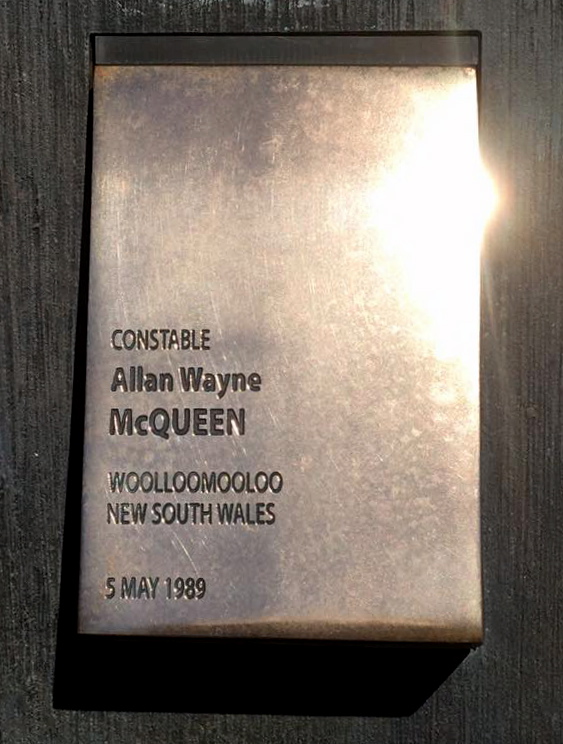
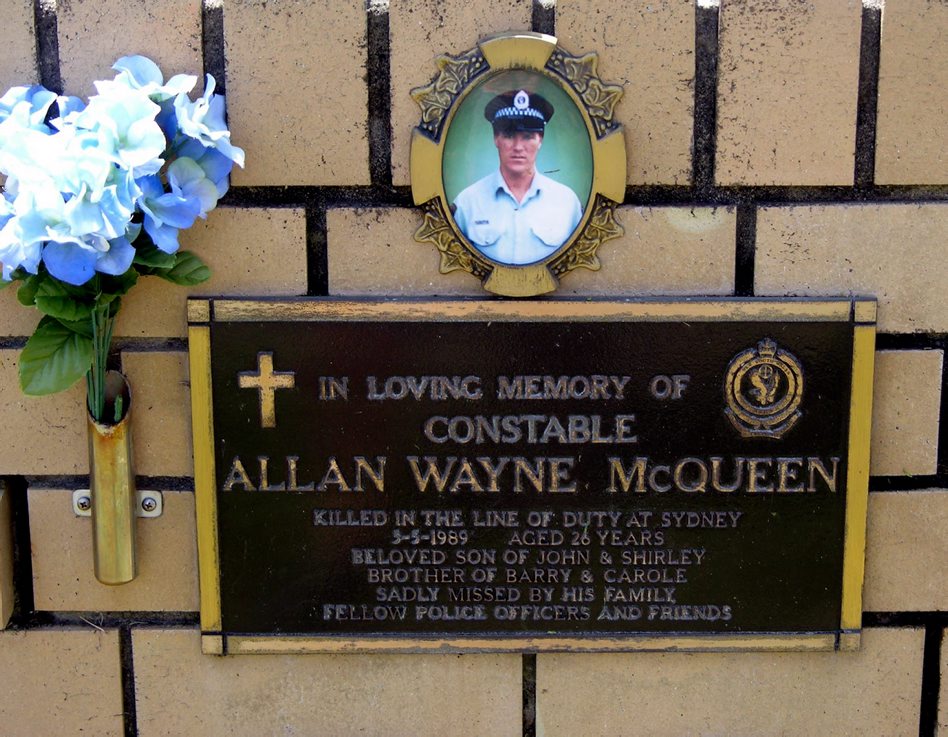
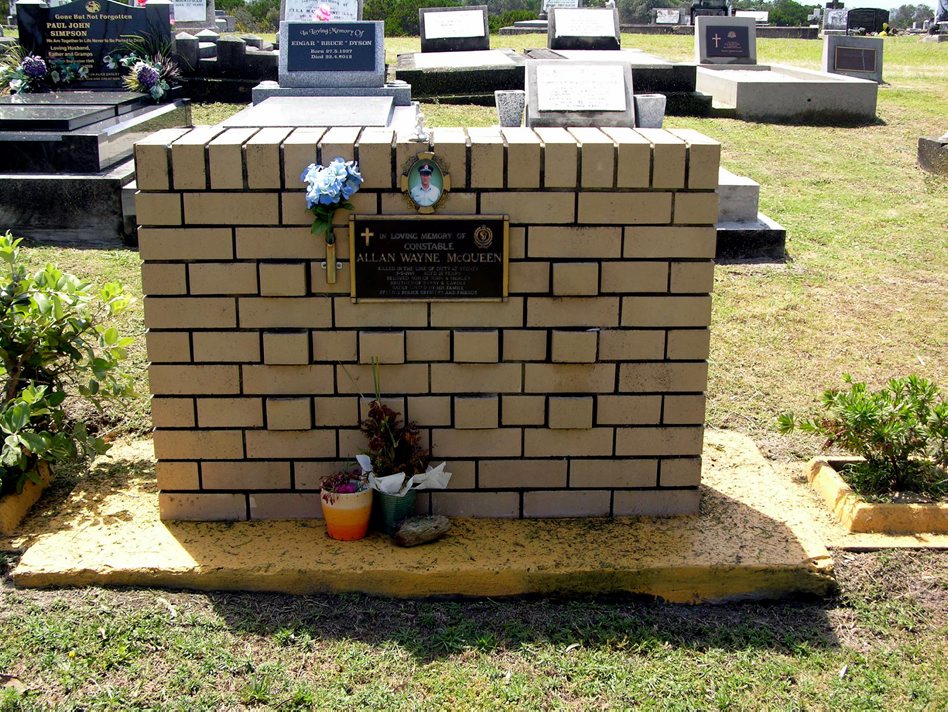
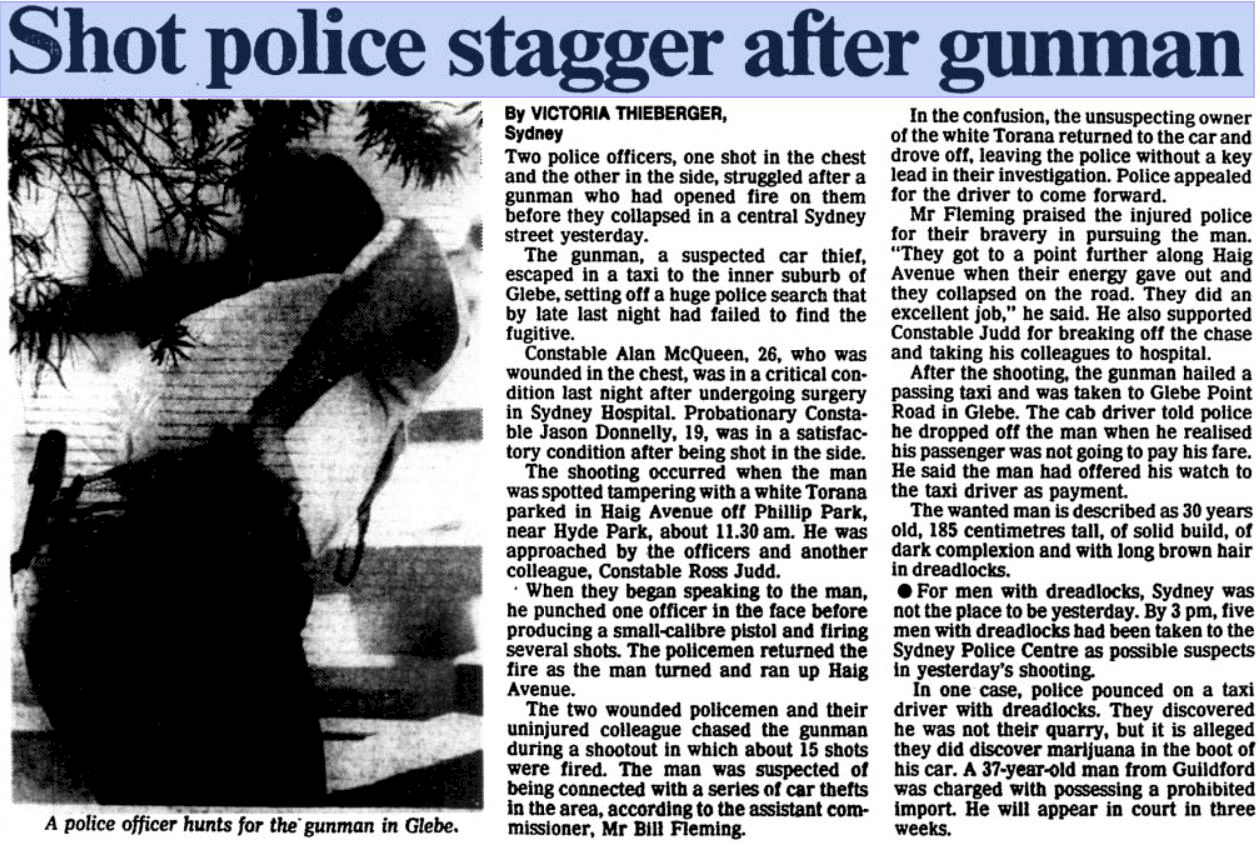
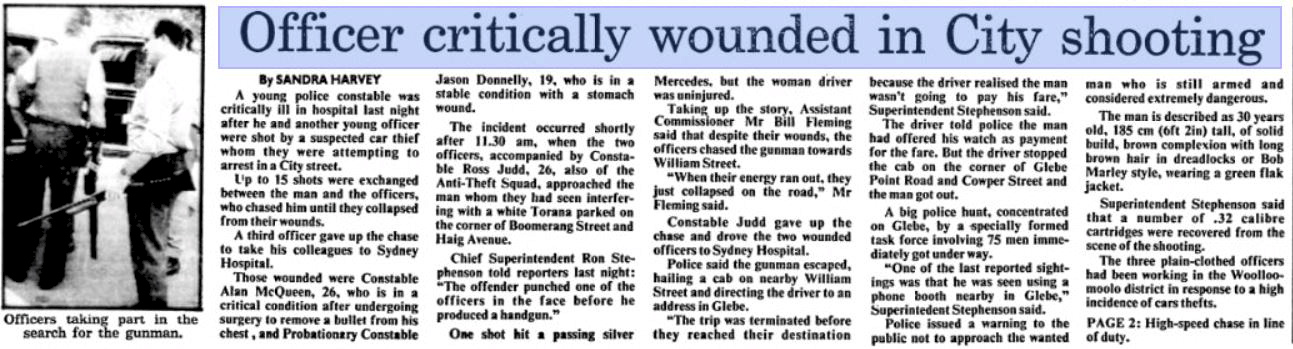
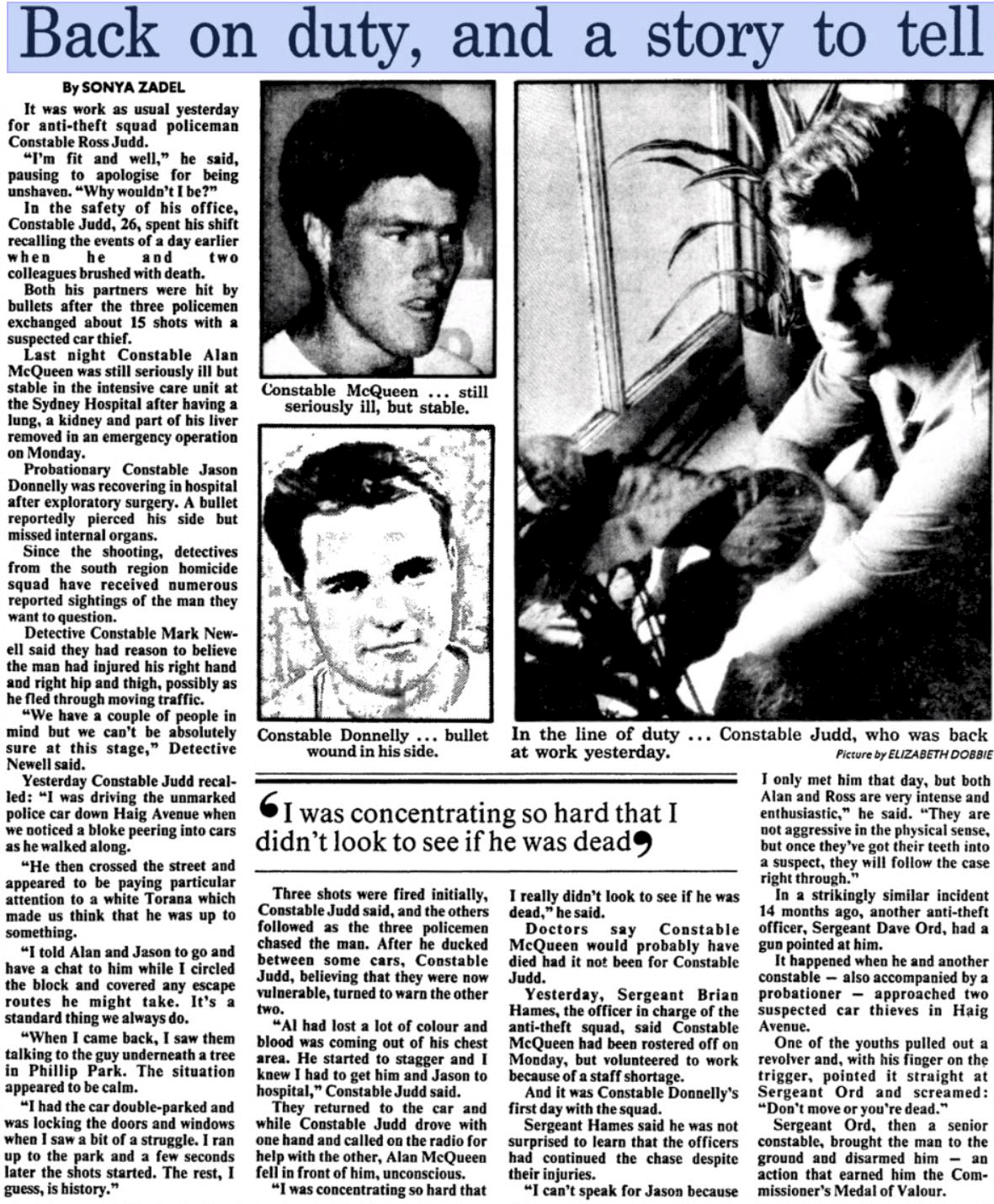
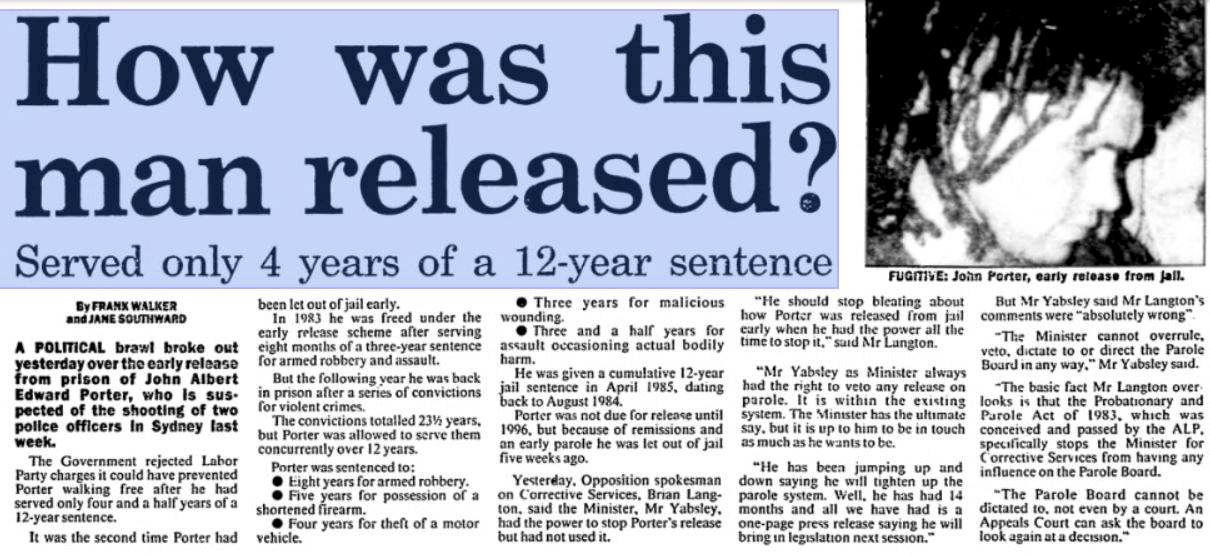
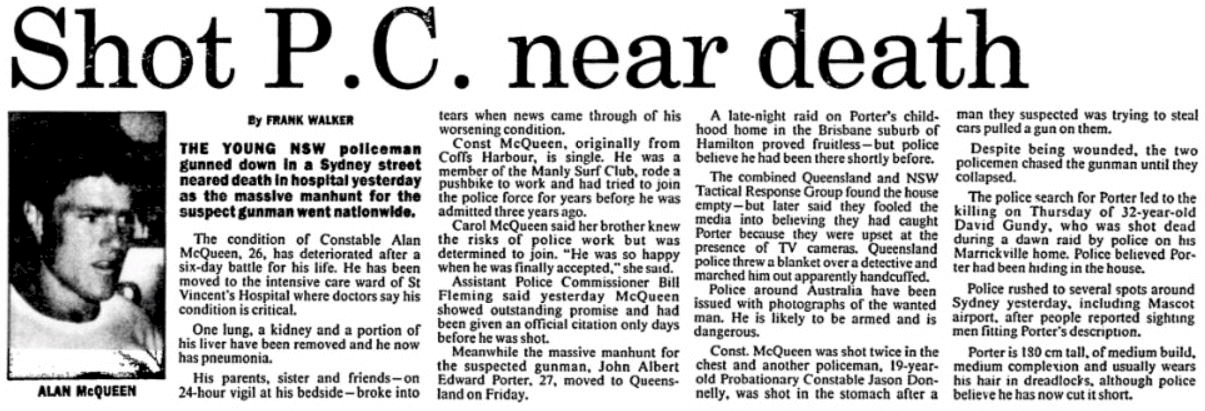
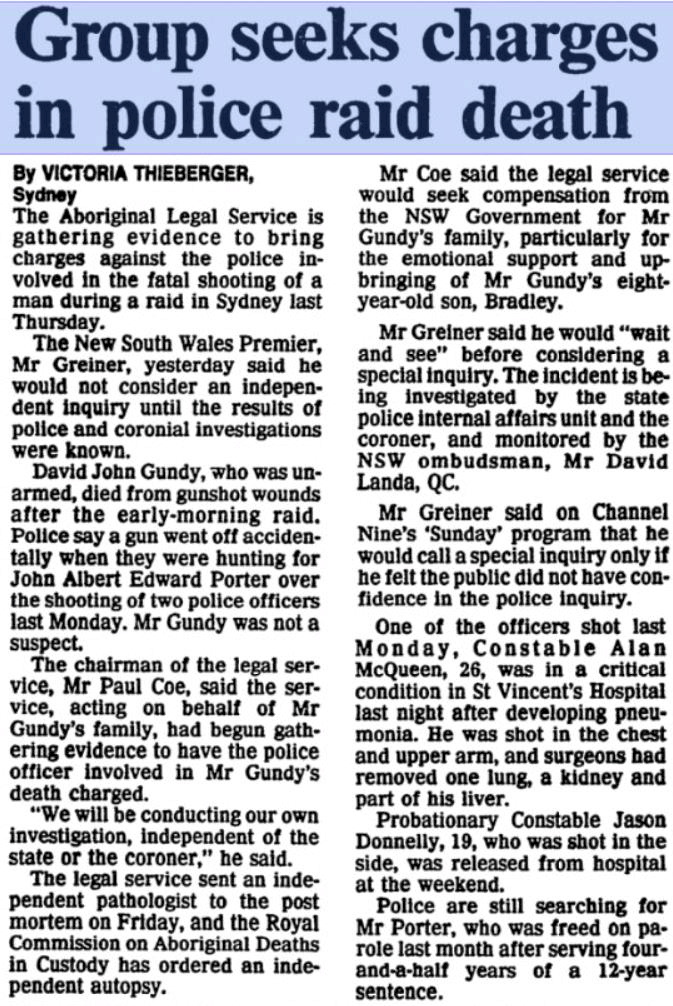
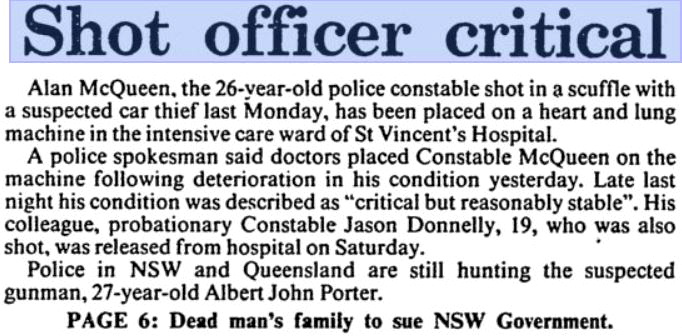

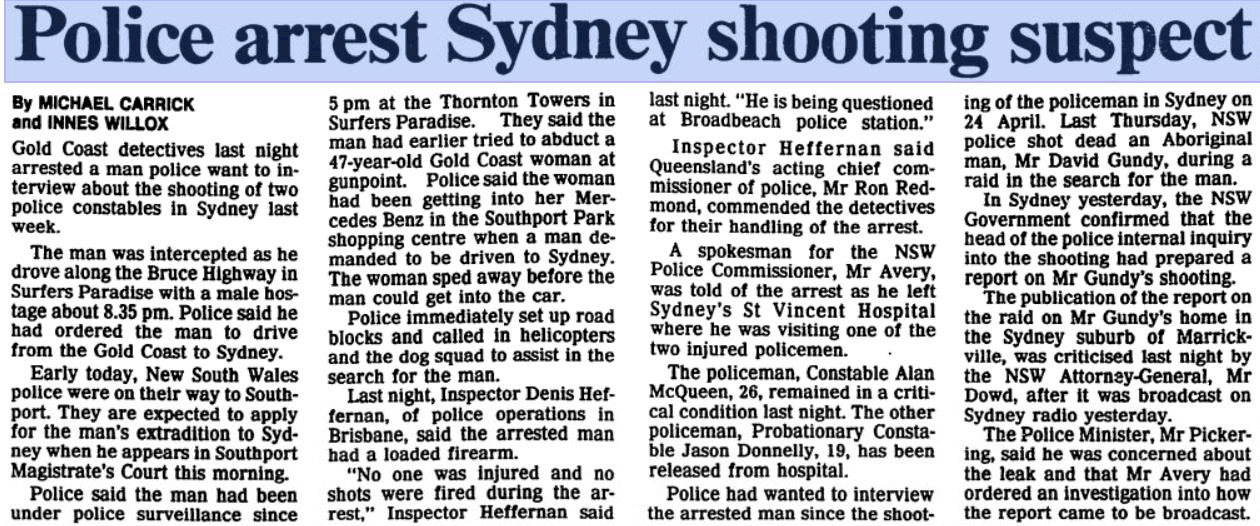
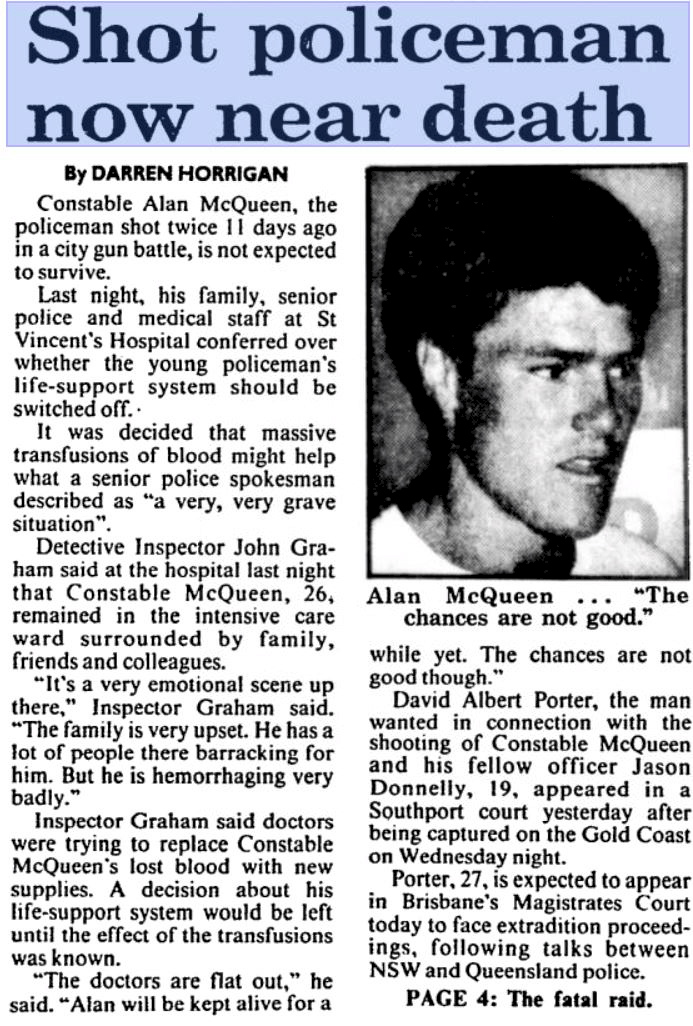
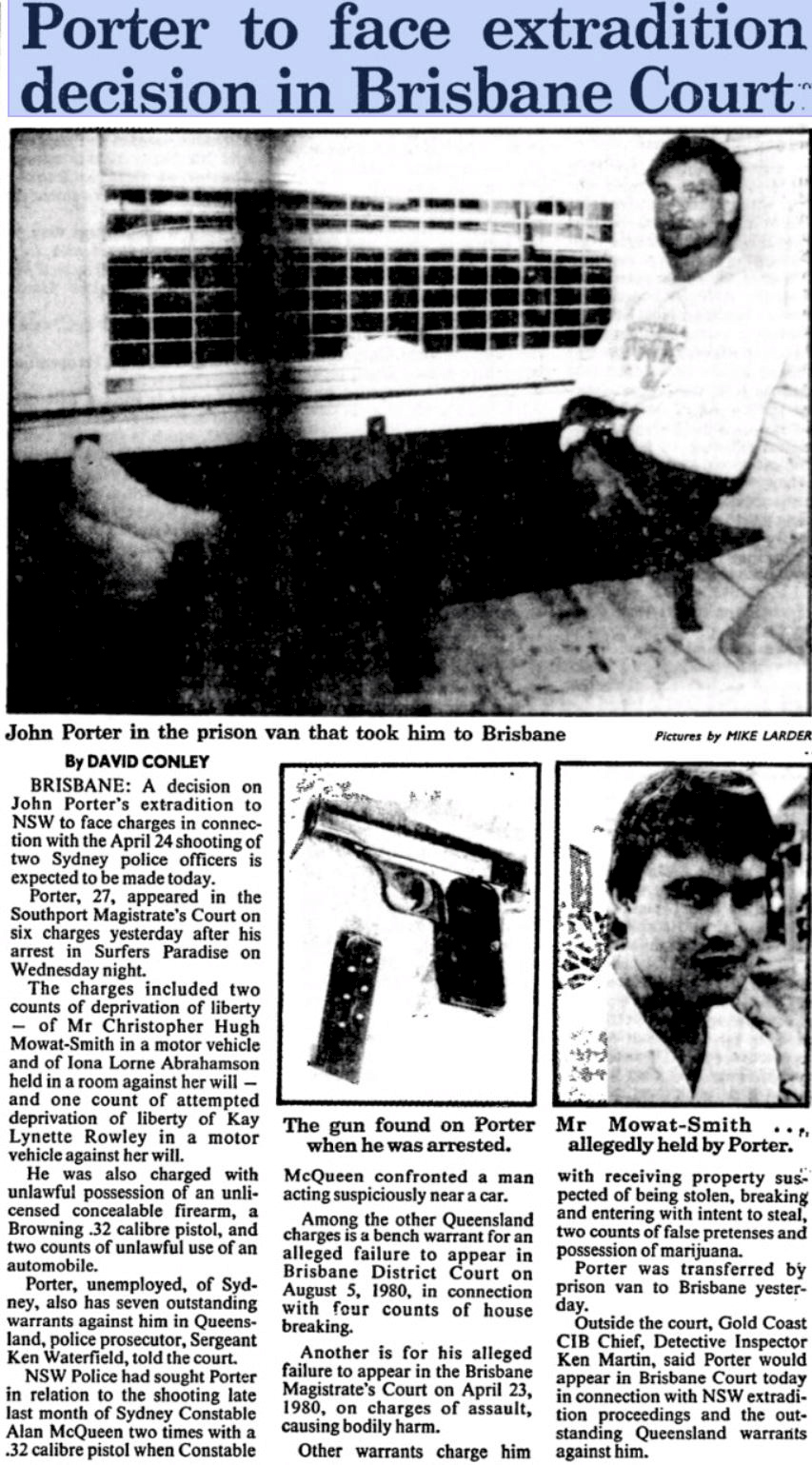

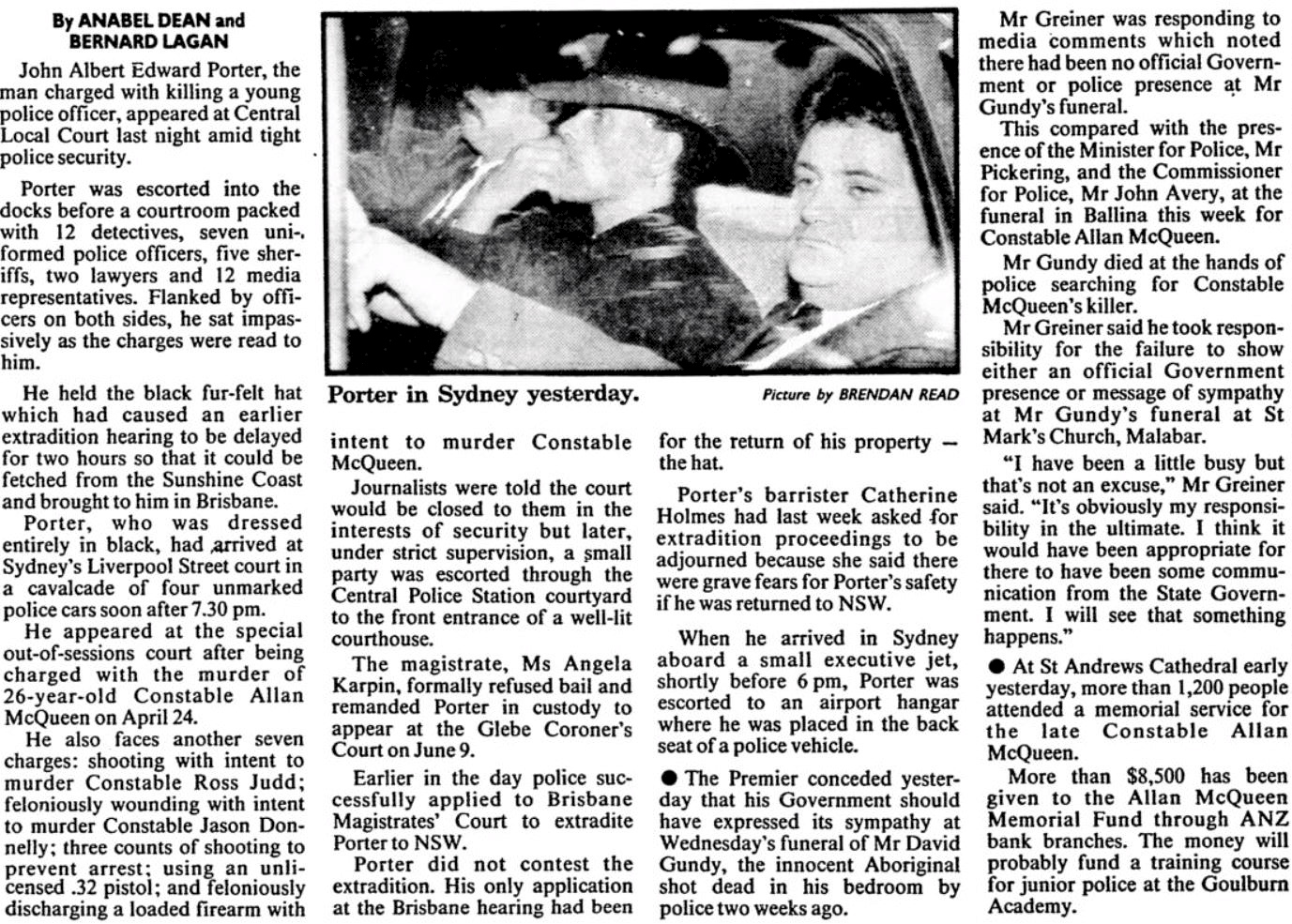 The Sydney Morning Herald 12 May 1989 p2 of 74