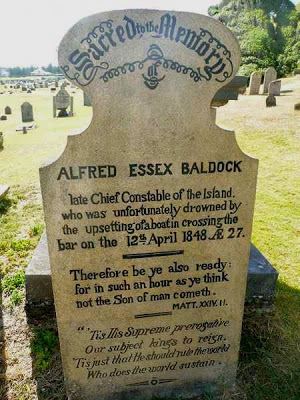
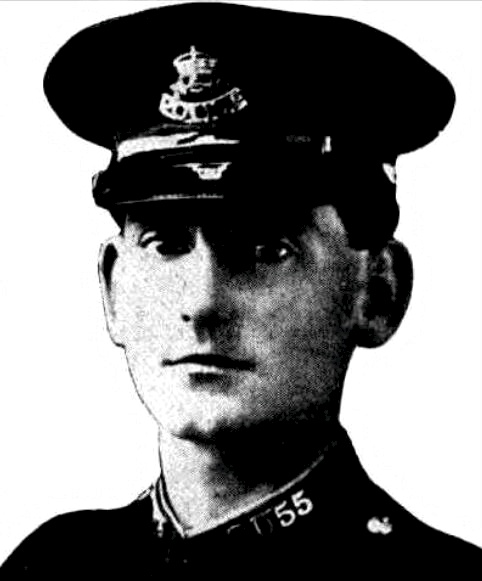
Alfred Essex BALDOCK – grave stone – Norfolk Island
INSCRIPTION:
Sacred to the memory of Alfred Essex BALDOCK late Chief Constable of the Island. who was unfortunately drowned by the upsetting of a boat in crossing the bar on the 12th April 1848 aged 27.
Therefore be ye also ready for in such an hour as ye think not the Son of man cometh Matt. XXIV II.
” ‘Tis His Supreme prerogative Our subject kings to reign. ‘Tis just that He should rule the world Who does the world sustain.
Way back in 2002 we went on a holiday to Norfolk Island. I can’t believe that was ten years ago. How time flies when you get old. Anyway back to the story.
Norfolk Island is a small island in the Pacific Ocean between Australia and New Zealand. It has a very colourful history. It was colonised by the British as part of Australia in 1788. It served as a penal colony for the worst convicts until 1794. From 1856 it was settled by free settlers and in1901 it became a territory of Australia and it still is today. It is also a tax haven. Today the island’s primary economic activity is tourism due to its historical buildings and colourful history including the Pitcairn Islanders and the Mutiny on the Bounty. So we did our bit for their economy and joined in the many tourist activities that they provide. (photos have been scanned from photo album)
One of the activities was a Murder Mystery Dinner, where you become a character in a murder mystery story. You have to ask questions of the other characters and try to find out who is the murderer. At this party the murder mystery was based on a true event that happened in Norfolk Island’s past. We were given a booklet that gave us some background information on the characters and the crime. We had to dress up as the character we were given.
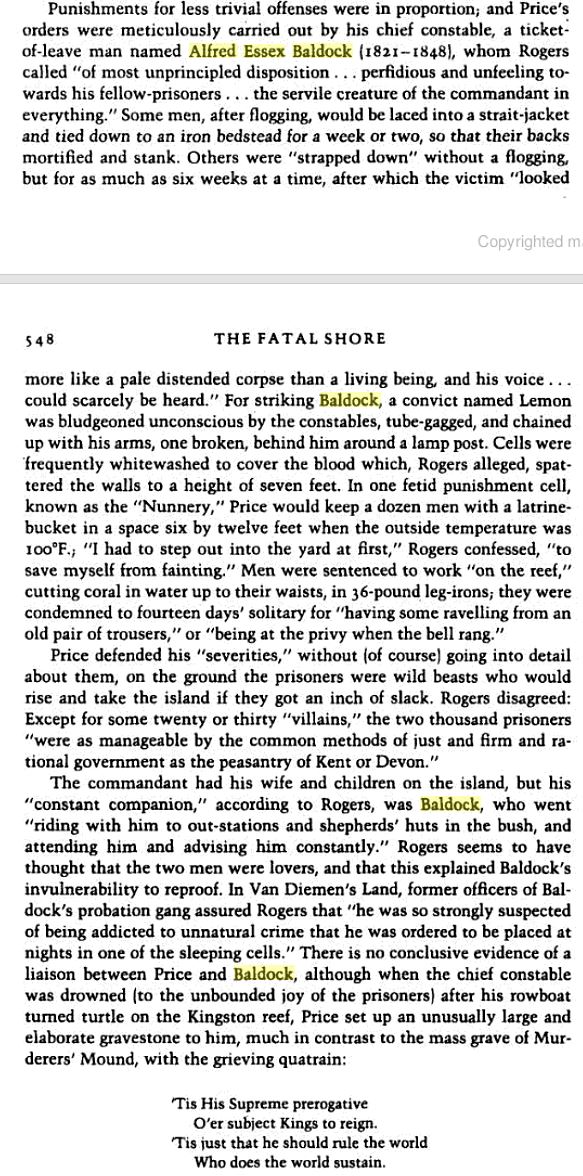
I was the Commandant’s wife and Bill was the Chief Constable, Alfred Baldock. He was detested by most on the island, he was a former convict but now mistreated the rest of the unfortunates. He was a homosexual which was against the law then. As you can tell we had loads of fun trying to find out which one of us was the murderer.
The next day we went exploring and visited the Norfolk Island Cemetery and Bill found the grave stone of his character Alfred Essex Baldcock.
Alfred Essex Baldock late Chief Constable of the island, who was unfortunately drowned by the upsetting of a boat in crossing the bar on 12 th April 1848 aged 27. (click on pic to enlarge). The right hand pic is from the web and the headstone has been restored and so have many of the others. This cemetery dates back to 1825 but there is evidence of earlier burial grounds on the island.
Senior Constable Paul Kennedy, aged 51, died whilst on holidays at Scotts Head, NSW, on Thursday 4 October, 2001, as a result of a heart attack & drowning in the surf.
Paul had been performing General Duties at the Wollongong ( NSW ) Local Area Command prior to his death.
His funeral Service was held at Parson’s Funeral Parlours, 278 Princes Hwy, Bulli, at 10am on Wednesday 10 October which was followed by a private cremation service at the Wollongong Crematorium.
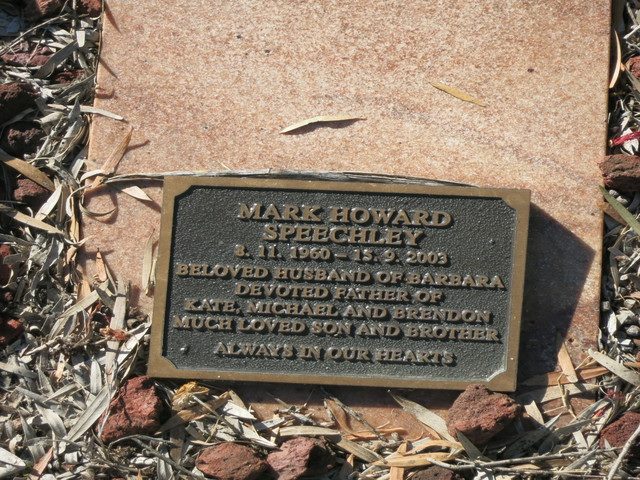
Mark Howard SPEECHLEY
| 14/11/2014
Mark Howard SPEECHLEY
aka Spike
Late of ?
NSW Redfern Police Academy Class # 190
New South Wales Police Force
Regd. # 20668
Rank: Probationary Constable – appointed 14 January 1983 ( aged 22 years, 2 months, 6 days )
On 23 March, 1989 Constable Murray and his family were holidaying at Byron Bay. About 3.05pm on that day they were at Tallows Beach when the constable saw a young woman in distress in the water. He then took his surf ski and paddled out through a rough, two metre swell to assist. The girl’s boyfriend at this time also entered the water and managed to help her to safety. Constable Murray had at this time unfortunately been tipped off his surf ski and was seen with an arm raised, indicating that he was having difficulties. He was again spotted a short time later floating about fifty metres out, on the surface. Despite an extensive search the constable was not seen again. It is thought that he may have been struck on the head by the ski when tipped off it, or perhaps injured when dumped in the heavy seas.
The constable was born in 1962 and joined the New South Wales Police Force on 20 July, 1981. At the time of his death he was stationed at Tabulam.
[divider_dotted]
Canberra Times (ACT : 1926 – 1995), Sunday 26 March 1989, page 2
Police scale down sea search
SYDNEY: Police and rescue workers scaled down the search yesterday for Andrew James Murray, 26, a young police man who disappeared in rough surf on Thursday at Byron Bay, on the Far North Coast.
Off-duty Constable Murray, of Tabulam police station, was swept out to sea after going to the rescue of a swimmer in trouble about 3pm.
Constable Murray paddled over to the distressed swimmer but was knocked off his surf ski by a wave.
He was caught in a strong rip and dragged out to sea.
The swimmer managed to struggle back to shore and alerted emergency services.
A police spokeswoman said today that there was little hope of finding the constable alive and the search was being scaled down.
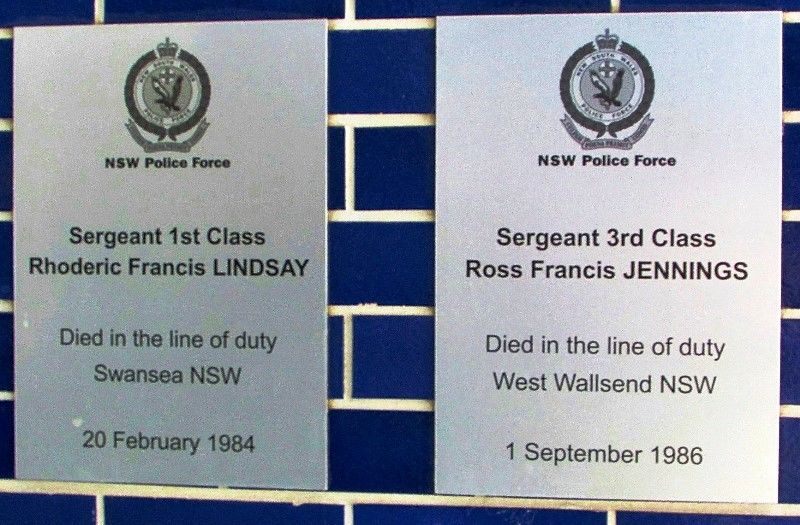
On the afternoon of 20 February, 1984 Sergeant Lindsay and Senior Constable Calman were both off duty and fishing in the sergeant’s boat off Swansea. About 6.10pm the yacht Melody radioed for assistance after running aground on the bar at Swansea Channel. Sergeant Lindsay and Senior Constable Calman then set out to assist the stricken vessel. Securing a line to the Melody they attempted to tow the vessel to safety, but as their efforts were hampered by heavy seas the sergeant released the line from the yacht. Constable Calman then noticed that Sergeant Lindsay was missing from his boat and seeing blood in the water, dived into the sea to rescue his friend. Constable Calman, assisted by surf club members, then conveyed the injured sergeant to shore however it was found then that he had died of his injuries.
It appears that Sergeant Lindsay was either knocked or was washed overboard where he suffered extensive head injuries when struck by his boat’s propeller.
He was posthumously awarded the Royal Humane Society Bronze Medal and the Police Commissioner’s Commendation for Outstanding Courage and Devotion to Duty.
The sergeant was born in 1935 and joined the New South Wales Police Force on 12 April, 1955. At the time of his death he was stationed at Newcastle.
National Police Remembrance Day ceremony in Lake Macquarie
David Stewart
September 29 2017 – 4:27PM
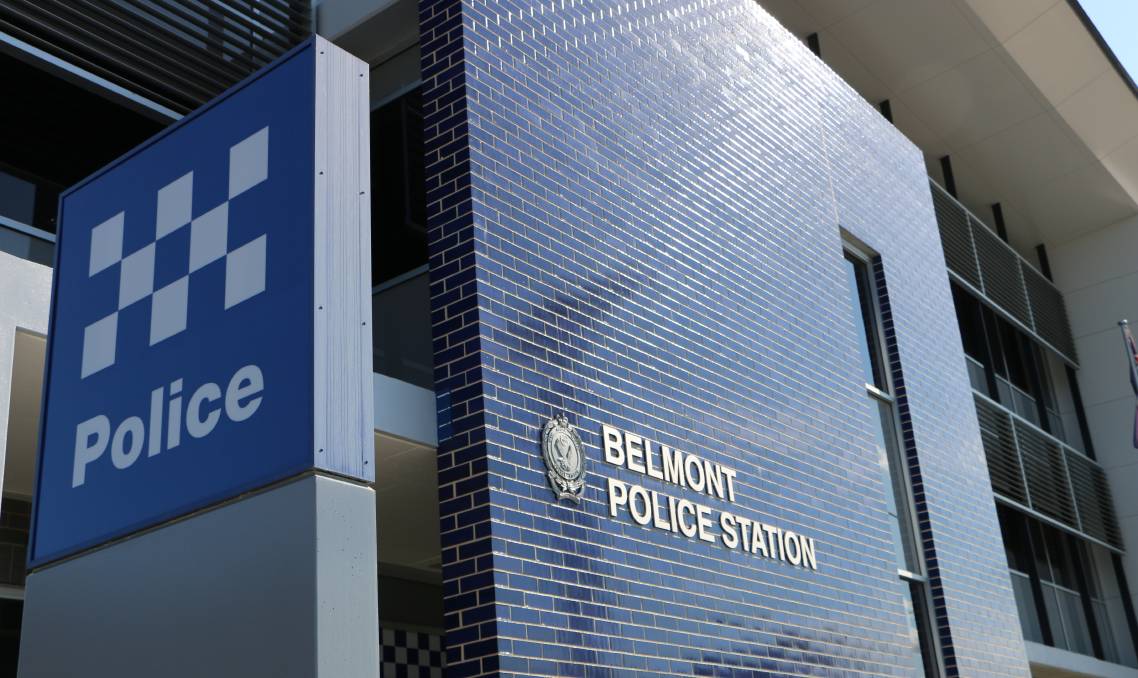
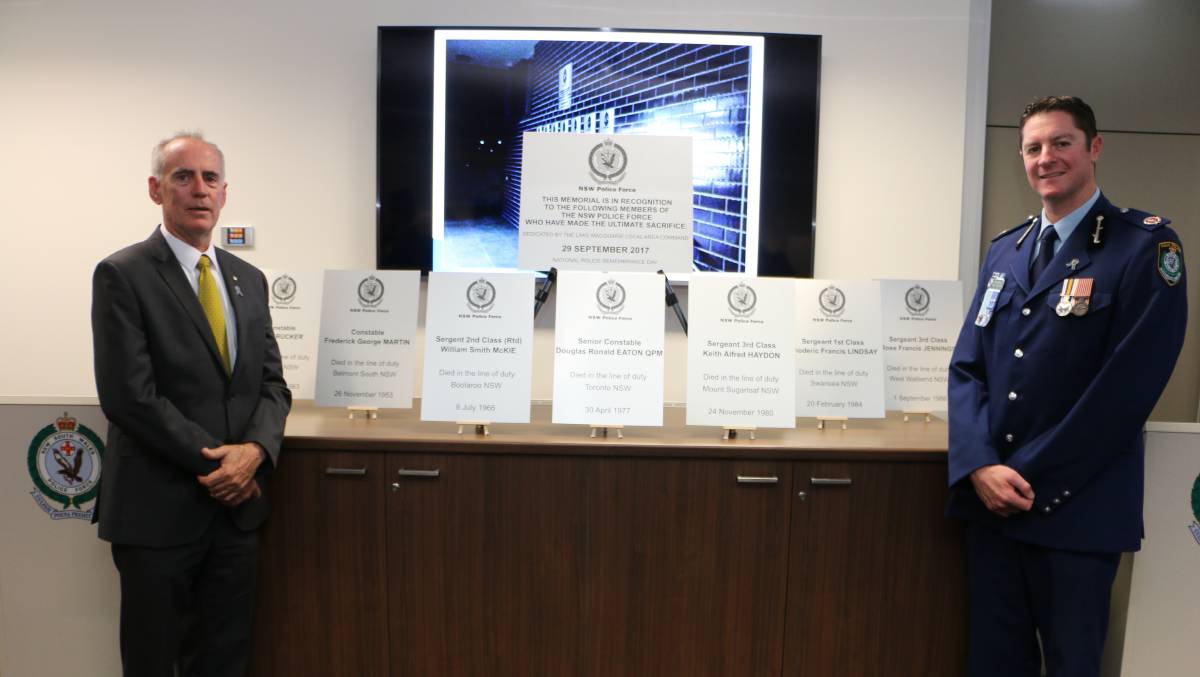
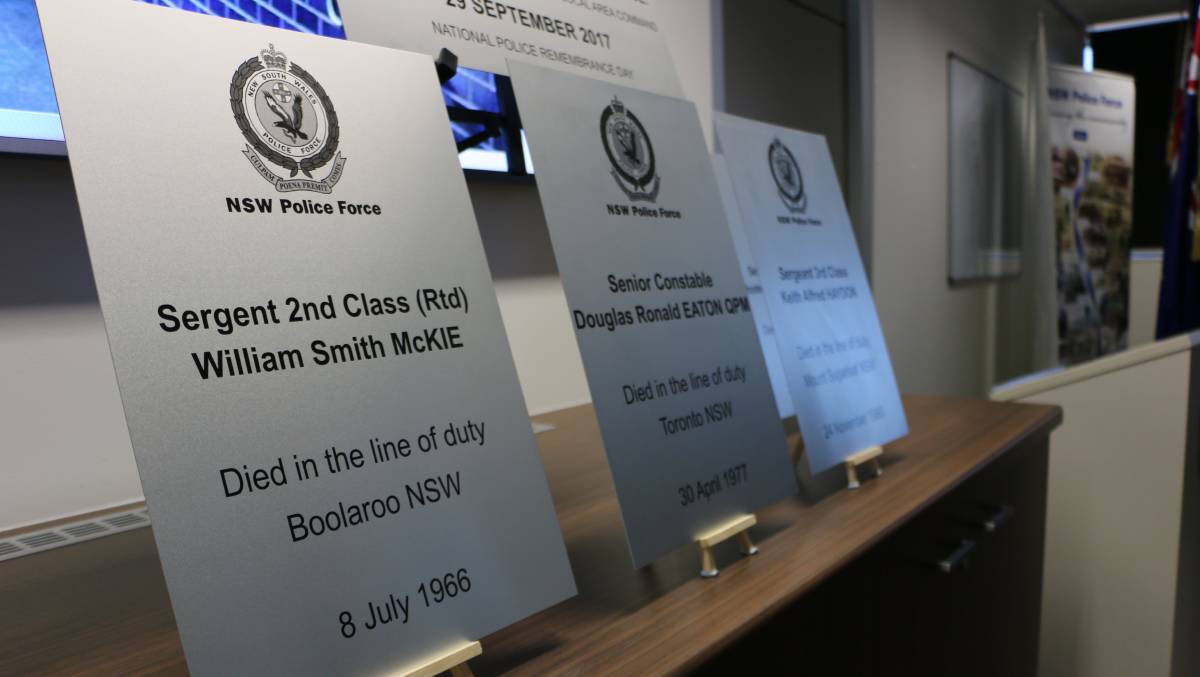
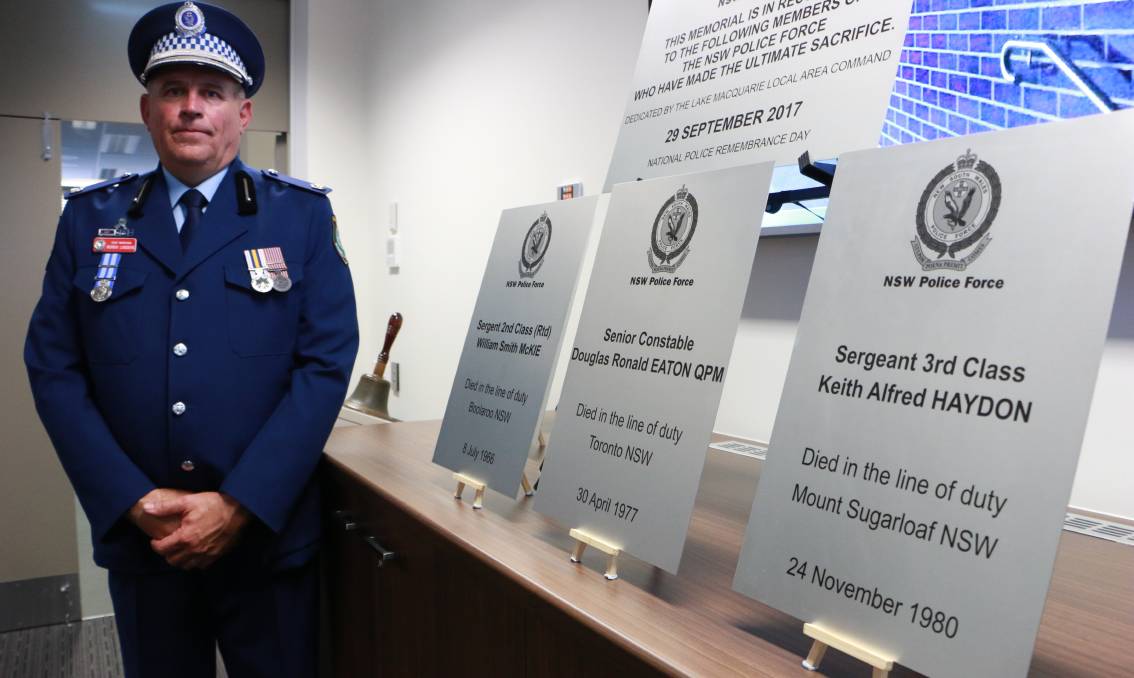
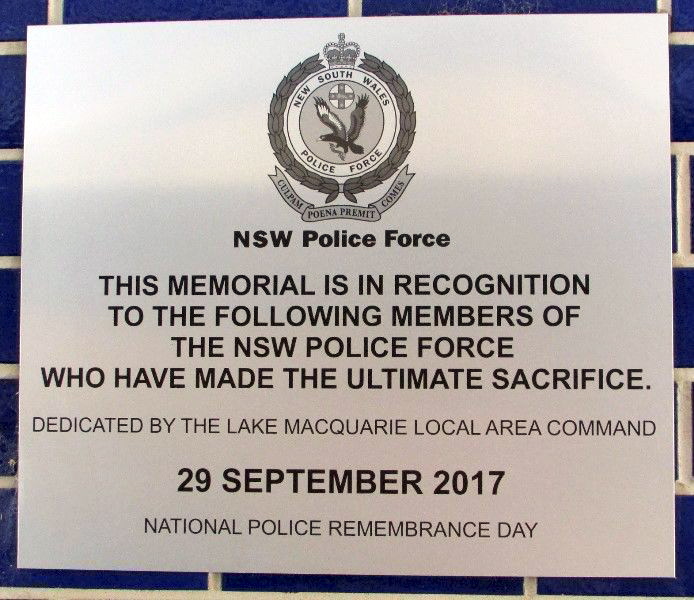
POLICE from Lake Macquarie Local Area Command have unveiled plans for a memorial wall at Belmont to honour the seven local officerskilled in the line of duty since 1863.
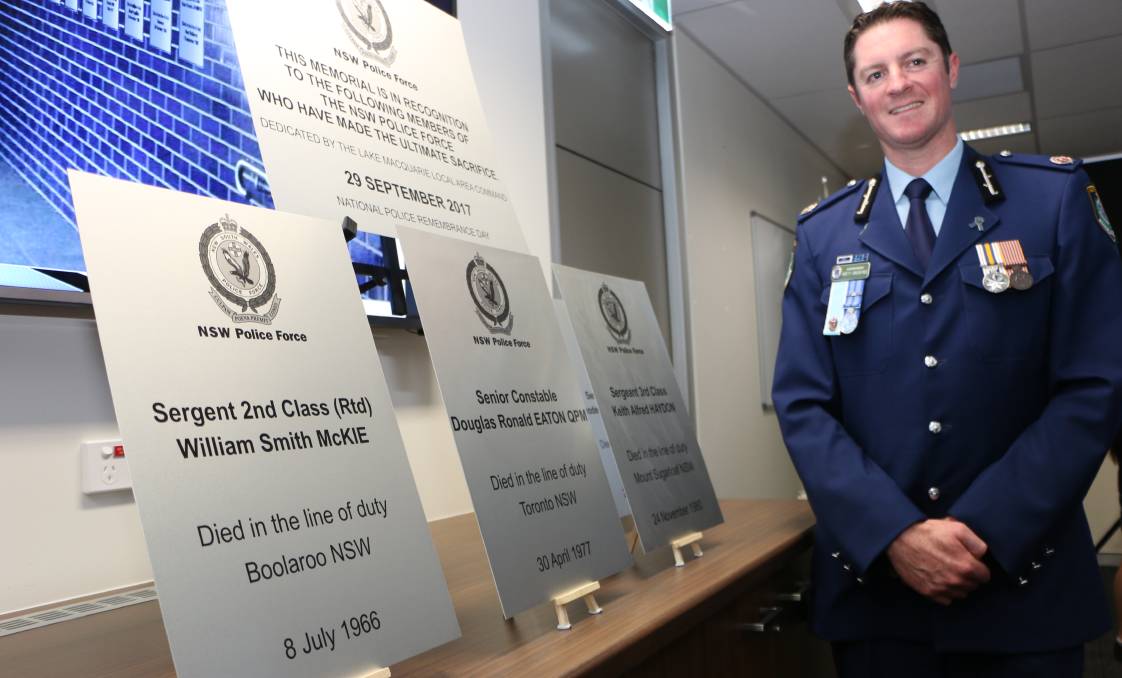
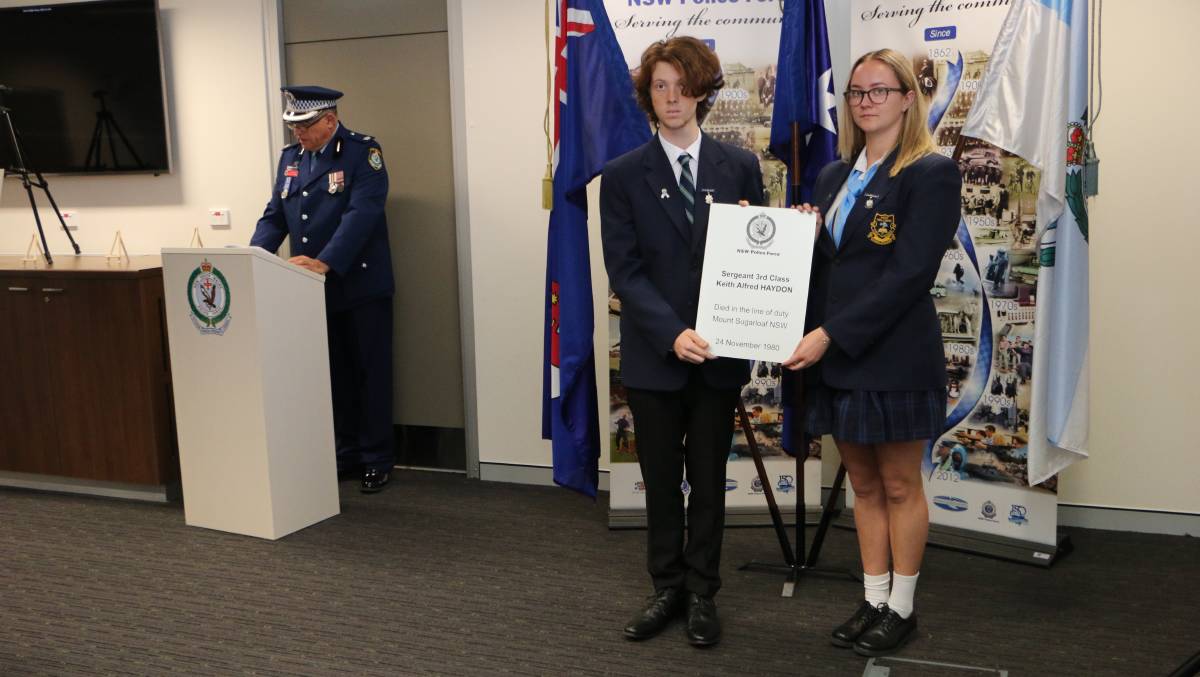
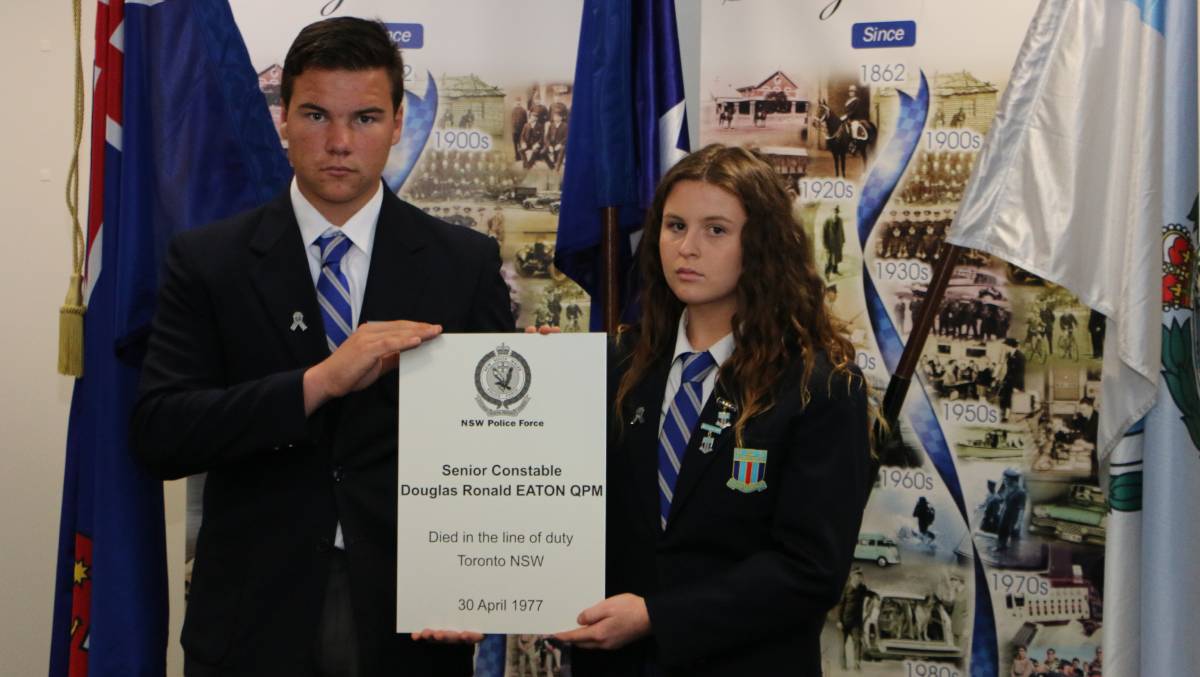
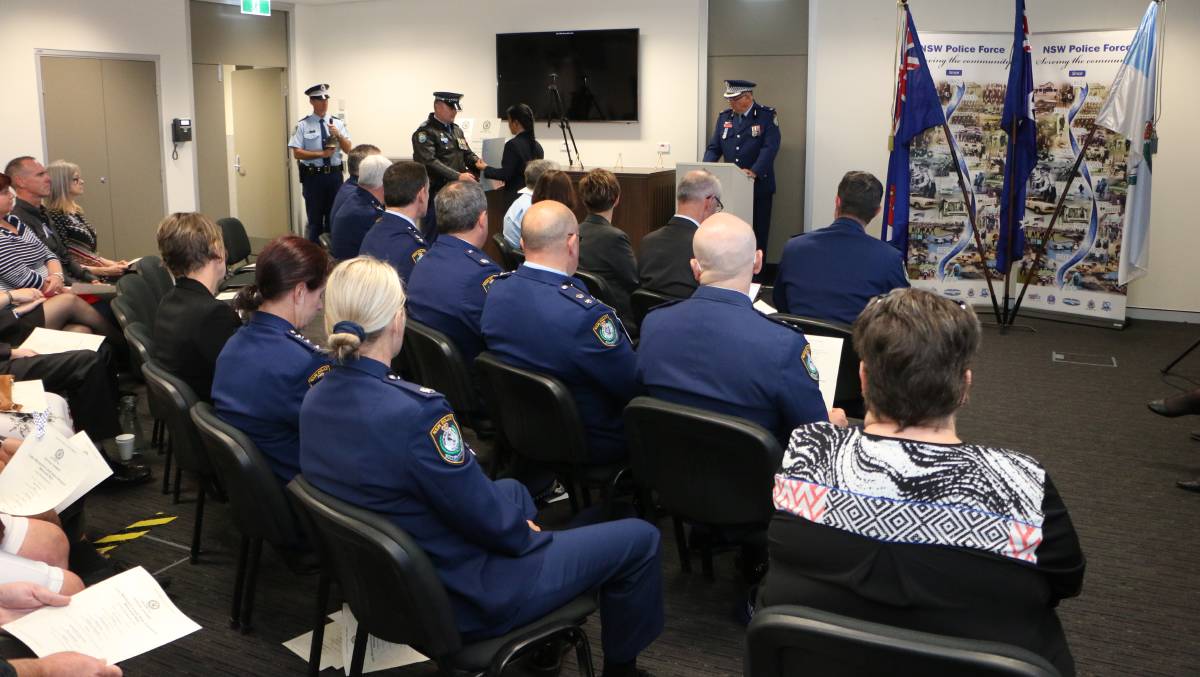
Plaques commemorating the seven officers were dedicated to the wall in a ceremony at Belmont police stationthis afternoon, National Police Remembrance Day.
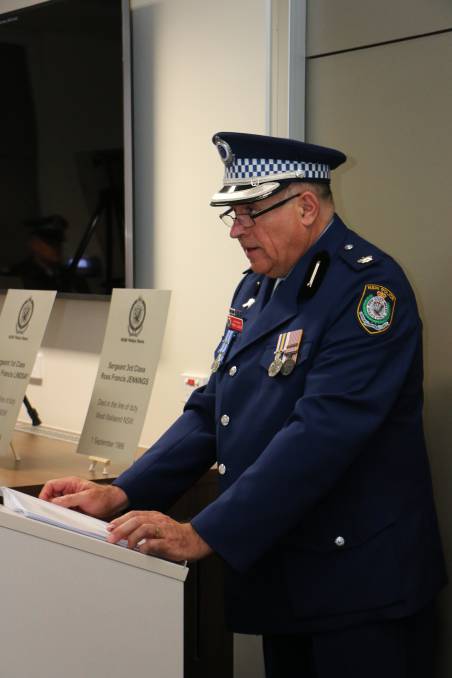
Chief Inspector Murray Lundberg of Lake Macquarie LAC presided over a private ceremony attended by police, local high school students, and the families of the fallen officers.
“This is a time for reflection on the ultimate sacrifice that police officers can give in the execution of their duty,” Chief Inspector Lundberg said.
Acting Assistant Commissioner Brett Greentree, the Northern Region Commander, said the wall of remembrance, to be created on the distinctive blue wall at the entrance to the police station, would be striking.
“It will be a sight to treasure,” Acting Assistant Commissioner Greentree said.
“I want the officers, as they are walking out the front doors of this police station, to stop and reflect on the names, stop and reflect on the sacrifice.”
He said he hoped that the inaugural plaques to be installed on the wall were also the last.
“My dream is that we never, ever, add another name to this wall. I hope and pray that our wall is now complete.”
Acting Assistant Commissioner Greentree reached out to the families of the fallen officers.
“No commemoration or recognition can make good the loss that is unfairly carried by family members,” he said.
“I can only offer you my heartfelt condolences. Please know that your loved ones, who are no longer with us, will always be remembered.”
Across NSW, ceremonies were held to commemorate the service and sacrifice of the 269 officers who have lost their lives in the line of duty, and through injury or illness, since the formation of the NSW Police Force in 1862.
Francis Laurel BURKE
| 14/11/2014
Francis Laurel BURKE
Late of ?
New South Wales Police Force
Regd. # ????
Rank: Constable
Stations: ?, Redfern – Death
Service: From 20 June 1955 to 20 January 1961 = 5+ years Service
On 20 January, 1961 Constable Burke was holidaying on the South Coast with his family. In the afternoon of that day the family were at Kiama Beach when the constable was informed by his son that two boys were in difficulties in an undertow.
Constable Burke entered the water and swam out through the heavy surf to assist. Unfortunately he collapsed during his efforts and after being seen floating face downwards in the water, was carried onto the beach. He failed to respond to resuscitation and was conveyed to the Kiama District Hospital where life was pronounced extinct.
The constable was born in Condobolin in 1927 and joined the New South Wales Police Force on 20 June, 1955. At the time of his death he was stationed at Redfern. He is listed in the official New South Wales Police Honour Roll.
There is a Francis L BURKE buried at Rookwood ( as detailed above ) but no other verifying details via internet search.
There is also a Francis Neil BURKE mentioned in the Kiama Independent on 25 January 1961 having died at Kiama, late of Sydney.
Nothing found on Trove.
Acts of Bravery by Police
The late Constable F. L. Burke was posthumously awarded the Bronze Medal and Certificate of Merit of the Royal Shipwreck Relief and Humane Society for gallantry in attempting to save the lives of two boys in the surf at Kiama on the 20th January, 1961. The Constable lost his own life on this occasion although the boys were saved.
Police Killed in the Execution of Their Duty
Constable Francis Laurel Burke.
Drowned at Kiama on the 20th January, 1961, whilst assisting two boys who were in difficulties in the water. The Constable was On annual leave at the time and holidaying with his family at Kiama.
Mentioned twice, on page 29 of 1962 Parliament of NSW – Report of the Police Department for 1961
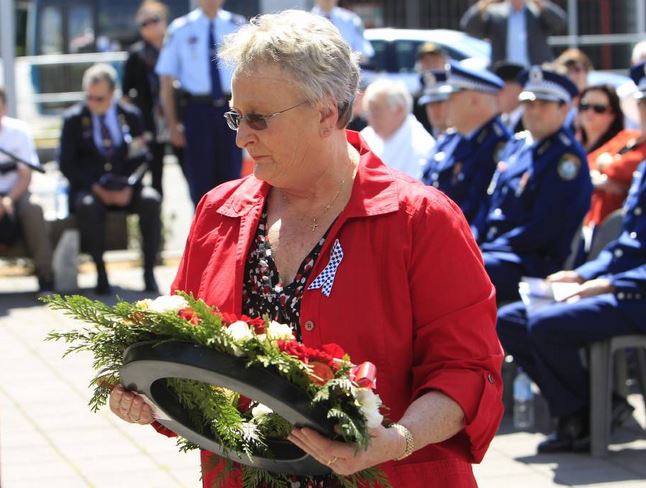
A family member of Constable Francis Laurel Burke, who died in 1961, laid a wreath at the Police Remembrance Day commemorations on Monday. Picture: ANDY ZAKELI
Almost 60 years on, Kenneth Nash still misses his uncle Allen.
Sergeant Allen William Nash, aged 40, was killed in the line of duty by a gun-wielding offender at Primbee in 1956.
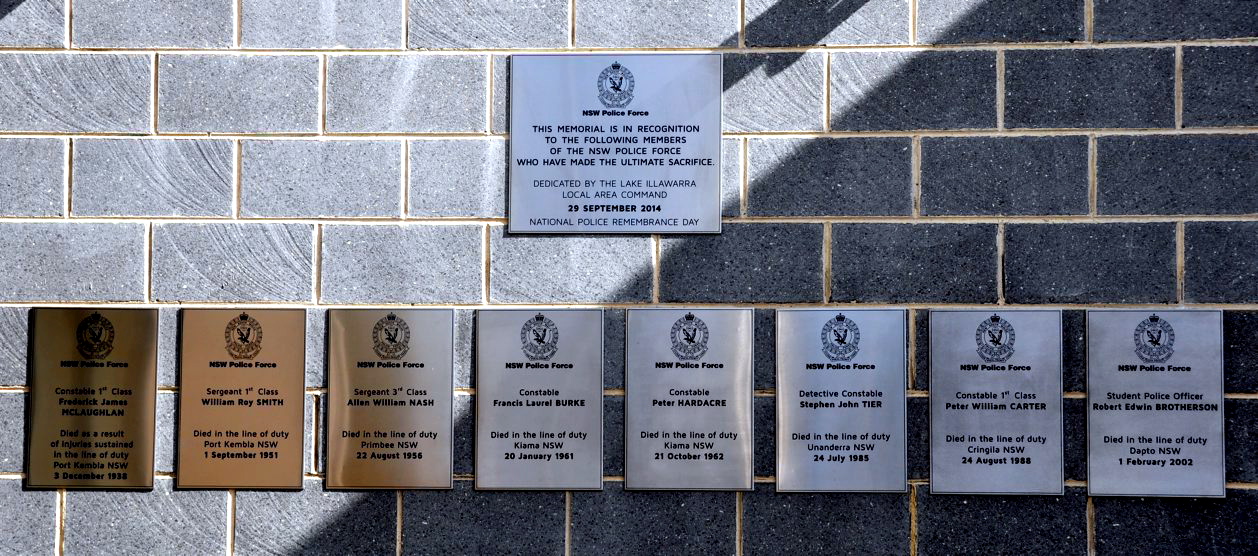
Sgt Nash was one of eight officers stationed in the Lake Illawarra local area command who were recognised with memorial plaques on a wall of honour outside Lake Illawarra police station on Monday, as part of Police Remembrance Day commemorations.
Dozens of current and retired officers, families, friends, politicians, councillors and members of the public gathered at Oak Flats for a ceremony to unveil the memorial wall, and honour past and present officers.
THURSDAY 4 SEPTEMBER 2014
Since 1862, more than 250 NSW Police officers have died in the line of duty.
The Sydney Morning Herald from Sydney, New South Wales …
www.newspapers.com › newspage
Gave Life For Boys
He was Constable Francis Laurel Burke, 34, of Redfern, who gave his life while saving the two boys. He was holidaying with his wife and …
Trevelyn Cuthbert NOWLAND
| 14/11/2014
Trevelyn Cuthbert NOWLAND
New South Wales Police Force
Constable
Drowned
31 years
Bendemeer
6 October, 1931
In 1931 Constable Nowland was the lone policeman attached to the Bendemeer Police Station. On the night of Sunday 4 October, 1931 a man came to the station to complain that he had been camped under the bridge at the river and had been accosted by a “madman” who had threatened to kill him. He requested that the constable come down to the bridge, which was at the McDonald River, a distance of less than 300 metres to look for the madman. The constable obliged, however after a brief search under and around the bridge, the alleged “madman” could not be found. The following night the man again came to the police station with the same complaint. (It was believed to have been the same man both nights as Mrs Nowland heard his voice on both visits, although she never actually saw him). The constable took his revolver and set out to search the bridge area again. When he failed to return home by the morning Mrs Nowland telephoned the police at Tamworth.
Police from Tamworth quickly travelled to Bendemeer and, with the assistance of an Aboriginal tracker, began to search for the missing man. Later that afternoon Constable Nowland’s body was found and recovered from the McDonald River. He was still fully clothed, except for his cap, and the body had no apparent signs of violence, although apparently the constable’s nose had been bleeding before he fell or was thrown into the water. At the spot where the body was found the water was only three to four feet (about 1 metre) deep.
The Brisbane Courier dated 7 October, 1931 reported that “The police believe that Nowland was insensible or dead before he entered the water. It is thought that Constable Nowland did not reach the bridge last night. His way would have taken him past a hotel, and beneath brilliant lights, and it is considered that he would certainly have been seen had he gone direct to the bridge from the police station. It is thought probable that he was attacked almost as soon as he left the police station, and was then taken to the river and thrown into the water insensible. The police are handicapped by the absence of any description of the man who twice called at the police station and spoke of the lunatic. Constable Nowland was the only one who saw him.”
The Sydney Morning Herald of 10 November, 1931 reported the open finding of the inquest into the constable’s death, as follows.
“BENDEMEER MYSTERY – CORONER’S OPEN VERDICT.
TAMWORTH. Monday.
The inquest into the death of Constable Nowland, whose body was found in the McDonald River on October 5, came to an end to-day, when the coroner (Mr. Geikie, P.M.) returned an open verdict. Six sessions of the inquest have been held, and 24 witnesses have been examined. In delivering his finding, Mr. Glekie said that the case was marked by many conflicting and mysterious statements. If it was suicide, then the deceased must either have been sane or insane. If he was sane, the first thing was to look for the motive, and the evidence adduced no such motive. If he was insane, no motive need be looked for. There was not a tittle of direct evidence of mental derangement in the constable up to the time of his death. His finding would be that Nowland was found dead in the McDonald River without any marks on the body; further, that death was due to drowning, but how or by what means drowning came about the evidence did not say.”
The mystery of what exactly happened to the unfortunate Constable Nowland has apparently never been solved, although theories ranging from suicide to poisoning to murder have long been put forward. A coroner’s inquest into the death gave the cause of death as drowning, however the surrounding circumstances remain unknown.
The constable was born in 1901 and was aged 31 years when he died. He joined the New South Wales Police Force on 25 August, 1922. At the time of his death he was stationed at Bendemeer. He is not listed in the official New South Wales Police Honour Roll.
[divider_dotted]
Joseph LEES
| 14/11/2014
Trooper Joseph LEES
New South Wales Police Force
Drowned
Grafton
7 January, 1867
On 7 January, 1867 the trooper was on duty collecting the electoral roll and agricultural returns near Grafton. Shortly after 1pm on that day he was attempting to cross First Falls on the Upper Clarence River when his horse reared, throwing him into the water, where he drowned. Trooper Lees was a married man with two children and a wife then expecting their third child.
The Maitland Mercury dated 15 January, 1867 contained the following brief notice, indicating that “We regret to learn that Trooper Leece [sic] of the Grafton Police Force, in attempting to cross the First Falls, at the Upper Clarence, yesterday, shortly after noon, in the execution of his duty, was carried down by the current and drowned. Information of the sad event reached Grafton last evening when the police boat was immediately dispatched with grapnels to drag for the body, which had not been recovered up to the time our informant left.â€
At the time of his death the trooper was stationed at Grafton.
Constable Jeremiah O’HORRIGAN
| 14/11/2014
Constable Jeremiah O’HORRIGAN
Drowned
Forbes
25 February, 1863
On Wednesday 25 February, 1863 the constable was away from his station patrolling the Weddin Mountains. On his return journey to Forbes he was required to cross the flooded Lachlan River. As he did so the strong current began to carry his horse along. Constable O’Horrigan attempted to check the horse however it rolled over, throwing him into the water. As he was unable to swim, the constable was drowned. His body was recovered downstream some hours later.
The constable was born in 1831 and joined the police force on 1 May, 1860. In 1862 he became a member of the newly-formed New South Wales Police Force. At the time of his death he was stationed at Forbes.
Constable Christian SEIDTZ
| 14/11/2014
Constable Christian SEIDTZ
Drowned
Grafton
29 April, 1861
The constable is believed to have drowned in the Clarence River at Grafton while trying to save the life of a young boy (eleven-year-old Daniel Forde) who had fallen into the water at a spot nearly opposite the constable’s house. The Sydney Morning Herald dated 15 May, 1861 printed the following article in relation to the inquiry into the deaths of the constable and young Daniel Forde.
MAGISTERIAL INQUIRY – Upon the bodies of Daniel Forde and Christian Seidtz.
James Hovenden, Chief Constable, stated: About noon I met the deceased boy (Forde) near Pound Street; carrying meat on horseback; shortly after, one of his brothers informed me that he had been thrown from his horse into the water in Pound Street; I procured the drags and went to the spot to endeavour to recover the body; medical aid was in attendance when the body was found, about three quarters of an hour afterwards.
Solomon Cooper sworn : I knew the deceased Christian Seidtz; about noon on Monday my wife called my attention to someone crossing a flooded part of Pound Street, near my residence; I ran out and saw a boy struggling in the water; Seidtz, who lived opposite, came out of his house and plunged in to assist the lad, and sunk immediately; I never saw him rise after he went into the water; I gave an alarm and Richard Barrett immediately swam out; Mr. Sanders and myself did all we could, but not being able to swim could not go out of our depth; the water was about ten feet deep; the body was not recovered for about three-quarters of an hour; Dr. Little saw the body but could not restore animation.
Carl Meyer, sworn, stated: I live in Pound Street, near the deceased’s place; I heard Mrs. Seidtz call out that her husband was drowning; I ran up and saw a lad struggling in the water, and his horse by the side; I could not see Seidtz for some time then his face showed for a moment and disappeared; I could not swim; I gave information to the chief constable; every effort was made to rescue the deceased.
The deceased, Seidtz, was a man much respected; a native of Germany; and had been three years in the Grafton police force, during which time there was no complaint against him. He was a remarkably fine-made man, thirty-five years of age; and a very sober industrious person. This sudden event has left his unfortunate wife and four young children totally unprovided for.”
At the time of his death the constable was 35 years old and was stationed at Grafton. He is sometimes recorded as ‘Seitz’ or ‘Leitz’