Service: 3 February 1975 to ? ? 1990 = 14+ years Service
Awards: National Medal – granted 27 August 1992 ( Former SenCon )
Born: Thursday 29 August 1957
Age: 46 yrs 2 mths 12 days
Died on: Monday 10 November 2003
Cause: Suicide – Hanging
Funeral date: Monday 17 November 2003
Funeral location: Wauchope, NSW
Funeral location 2: Gold Coast, Qld
Buried at: Wauchope Cemetery, NSW
PAT is NOT mentioned on the Police Wall of Remembrance *NEED MORE INFO
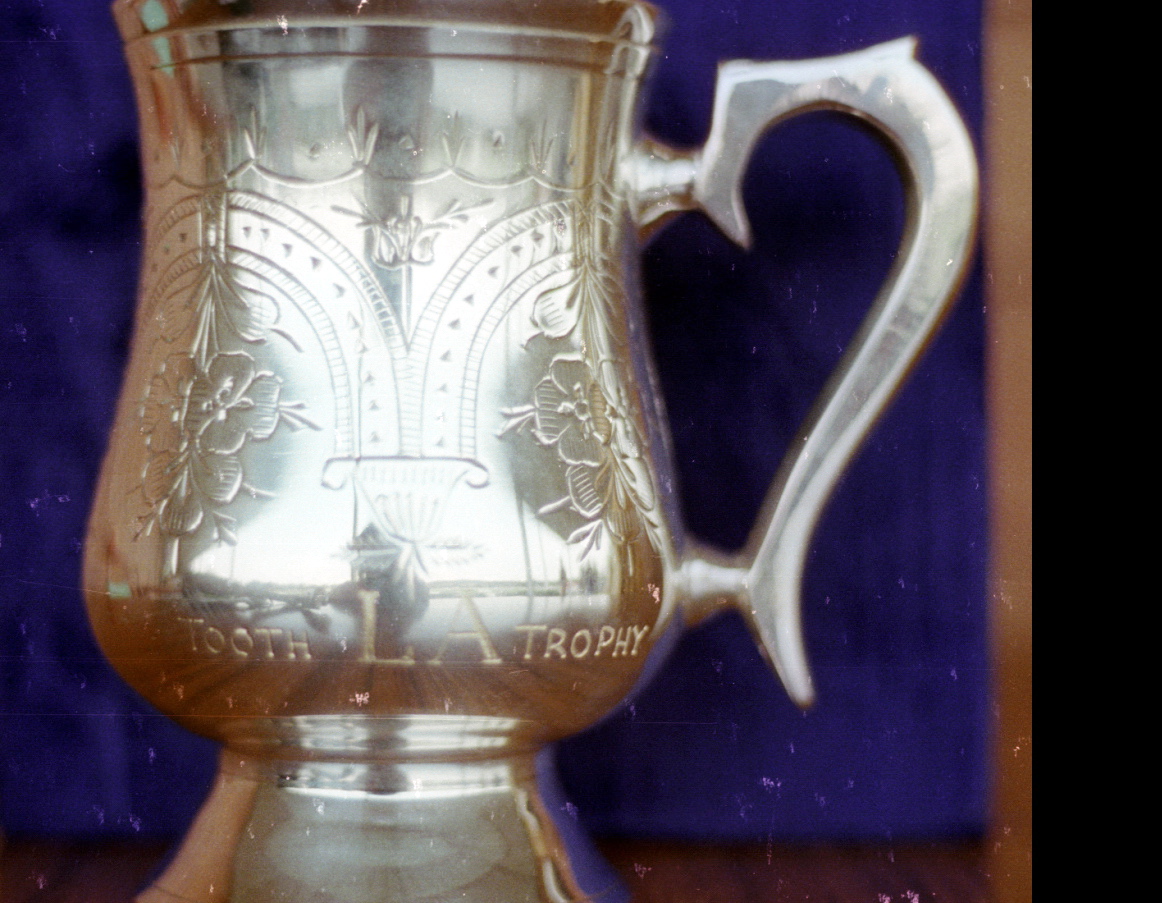
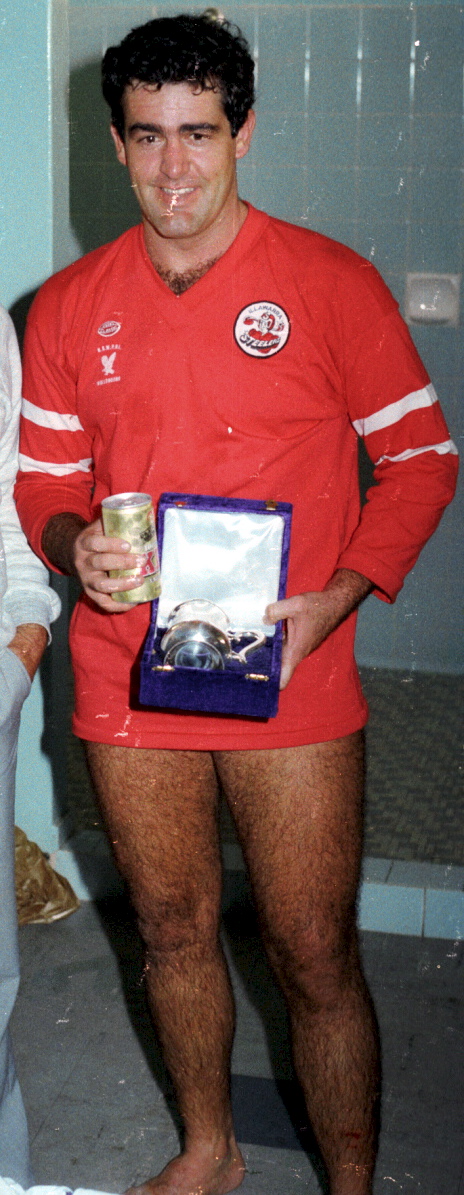
POLICE FOOTBALL. CONSTABLE PAT CARNEY, FROM WOLLONGONG POLICE, RECEIVED THE TOOTH L.A. MAN OF THE MATCH TROPHY IN THE DRESSING SHED OF LYSAGHTS FOOTBALL FIELD, FIGTREE.
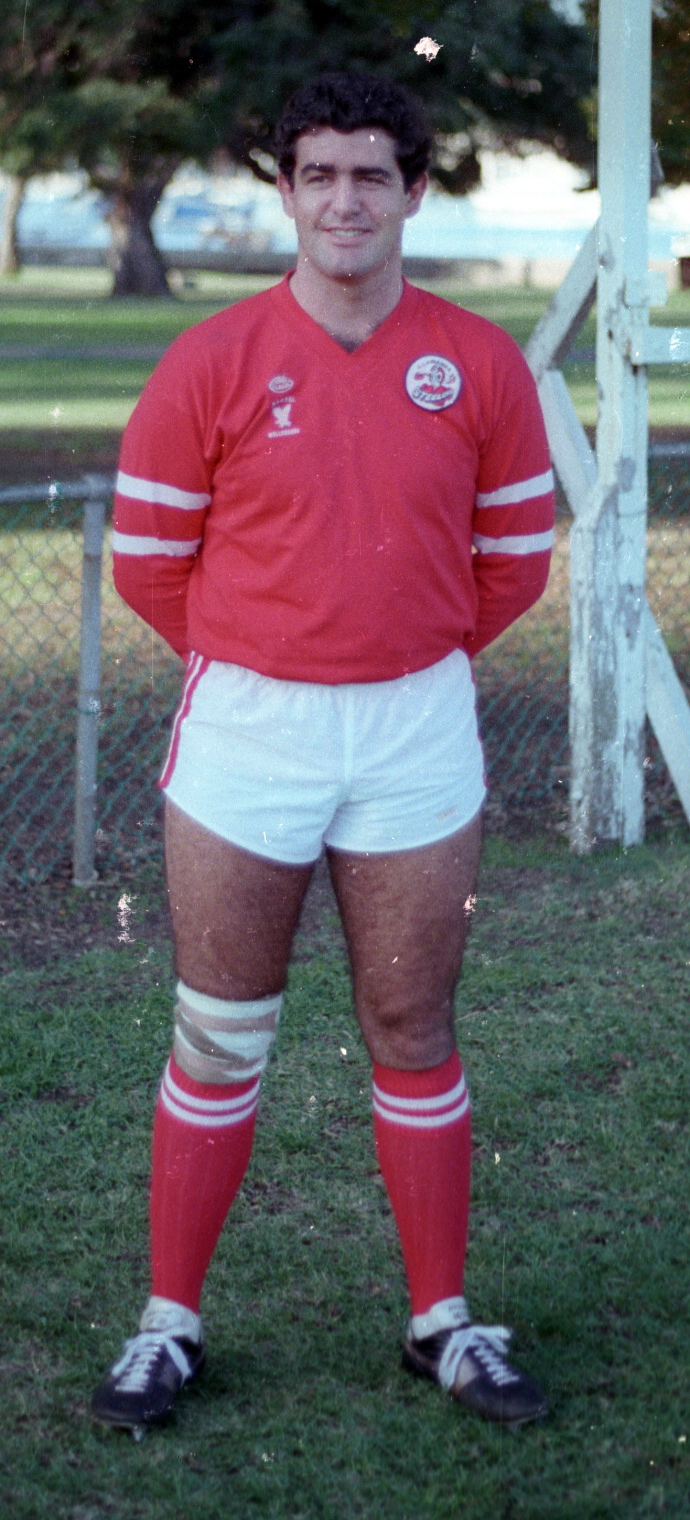
POLICE FOOTBALL AT ROSE BAY. CONSTABLE PAT CARNEY, WOLLONGONG POLICE. 20 APRIL 1983
POLICE FOOTBALL. CONSTABLE PAT CARNEY, FROM WOLLONGONG POLICE, RECEIVED THE TOOTH L.A. MAN OF THE MATCH TROPHY IN THE DRESSING SHED OF LYSAGHTS FOOTBALL 13 APRIL 1983
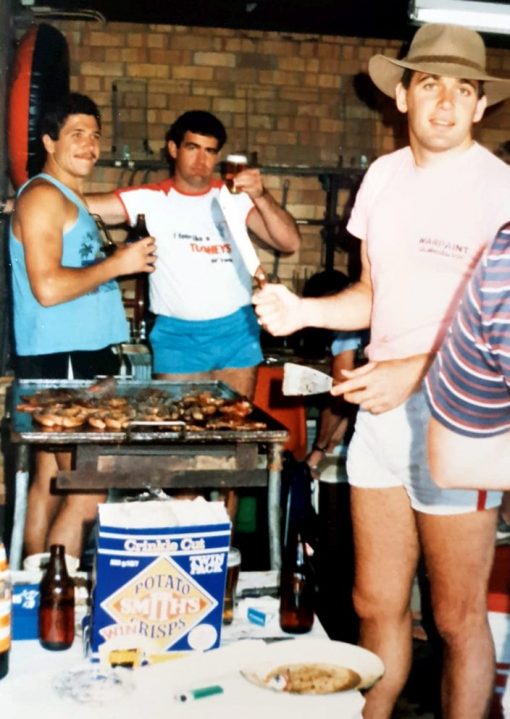
1985 or 1986, Surfers Paradise, Qld
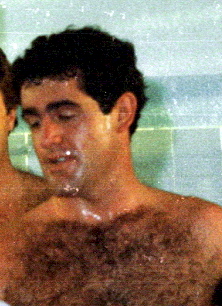
Darren STARLING, Pat COONEY ( RIP ), Gary THATCHER ( RIP ) at the home of John HITCHCOCK. This would have been a Police Footy BBQ.
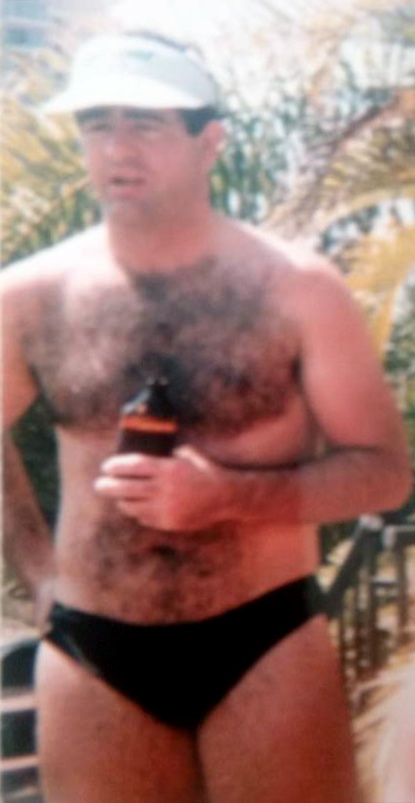
Pat was born and bred in Wauchope, NSW, and joined the New South Wales Police Force via the Police Cadet system, aged 16, and commenced at the Redfern Police Academy on the 3 February 1975 and was assigned Cadet # 3097.
After the Police Academy, Pat was stationed at various locations including Sutherland. He was later transferred to Wollongong General Duties and also performed duties at Unanderra as part of the District Foot Patrol.
Pat was a funny bastard and always up for a practical joke. He was also a great footballer, playing in the NSW Police Football competition and playing for Wollongong District.
He served his final years back at Wollongong in the Prisoner Security Unit ( PSU ) until his resignation in 1990.
Two funeral Services were held for Pat. One in his old home town of Waucope, NSW, where he was laid to rest and the second was held on the Gold Coast where Pat resided.
Pat was born on the 29 August 1957.
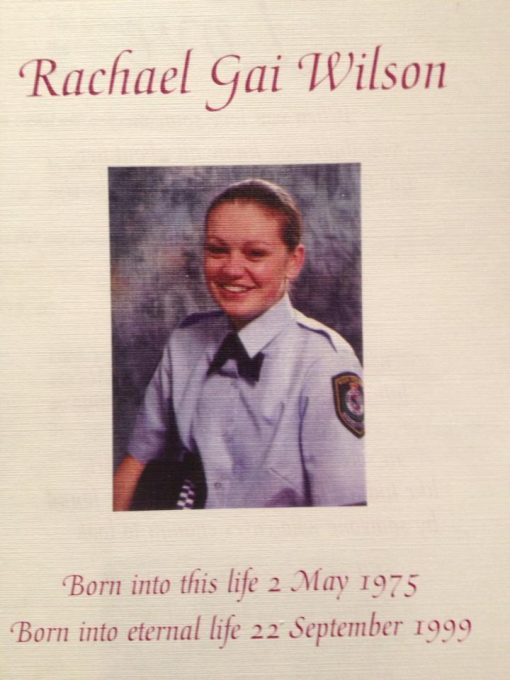
Rachael Gai WILSON
| 13/11/2013
Rachael Gai Wilson
Constable
New South Wales Police Force
Class 266
Registered #: ?????
Died at Rydalmere, NSW,
Service: From ? ? 1996 to 22 September 1999 = 3 years Service
24 old
Suicide – shot – Service Pistol to chest
Stationed: Mt Druitt, Quaker’s Hill, Seven Hills, Penrith, Ermington Police Station – Plain clothes – Anti Theft Squad – Death
Funeral: Winston Hills on 28 September 1999
Rachael was a plain clothes constable performing proactive duties at Ermington, NSW.
Rachael suffered psychological injuries which were later declined by the insurer.
She slipped into a greater depression and subsequently died from a self inflicted gun shot wound from her own Service weapon, whilst On Duty, after she drove to Eric Primrose Reserve, Rydalmere.
A beautiful smile no longer shines, but her light lives on in the hearts of her loved ones and friends.
May Rachael forever Rest In Peace.
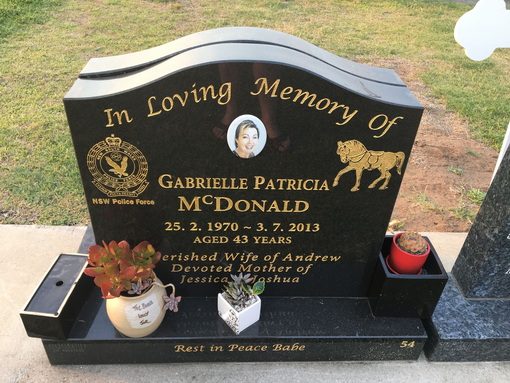
Gabrielle Patricia McDONALD
| 13/11/2013
Gabrielle Patricia McDONALD – nee Eggleston
aka Gabby
late of Maryland
Wife to Andrew McDonald # 22289
NSW Police Academy Class # 242C
“possibly” a Rejoinee
New South Wales Police Force
Regd. # 26685
Rank: Commenced training at Goulburn Police Station on Sunday 30 July 1989 ( aged 19 years, 5 months, 5 days )
Probationary Constable – appointed 25 January 1990 ( aged 19 years, 11 months, 0 days )
Constable – appointed ? ? ?
Detective – appointed ? ? ? ( YES )
Constable 1st Class – appointed ? ? ?
Senior Constable – appointed ? ? ?
Sergeant 3rd Class – appointed ? ? ?
Final Rank: Detective Sergeant
Stations: ?, Inner City ( Sydney ), Newtown Detectives, Balmain ( 8 Division ), Newcastle, Lake Macquarie L.A.C., Northern Region Professional Standards
Service: From 30 July 1989 to 3 July 2013 = 23 years, 11 months, 3 days Service
Awards: No Find on Australian Honours
Born: Wednesday 25 February 1970
Died on: Wednesday 3 July 2013
Cause: Depression – Suicide – hanging – ON DUTY
Previous attempt in 2012 inside Newcastle Police Stn
Age: 43 years, 4 months, 8 days
Funeral date: Thursday 11 July 2013 @ 11am
Funeral location: Our Lady of Victories Catholic Church, Sandgate Rd, Shortland
GABBY is NOT mentioned on the Police Wall of Remembrance – Canberra
* BUT SHOULD BE. Last checked 2 Aug 2019 24 Jan 2024
GABBY IS mentioned on the Police Wall of Remembrance – NSW Domain
Grave location:
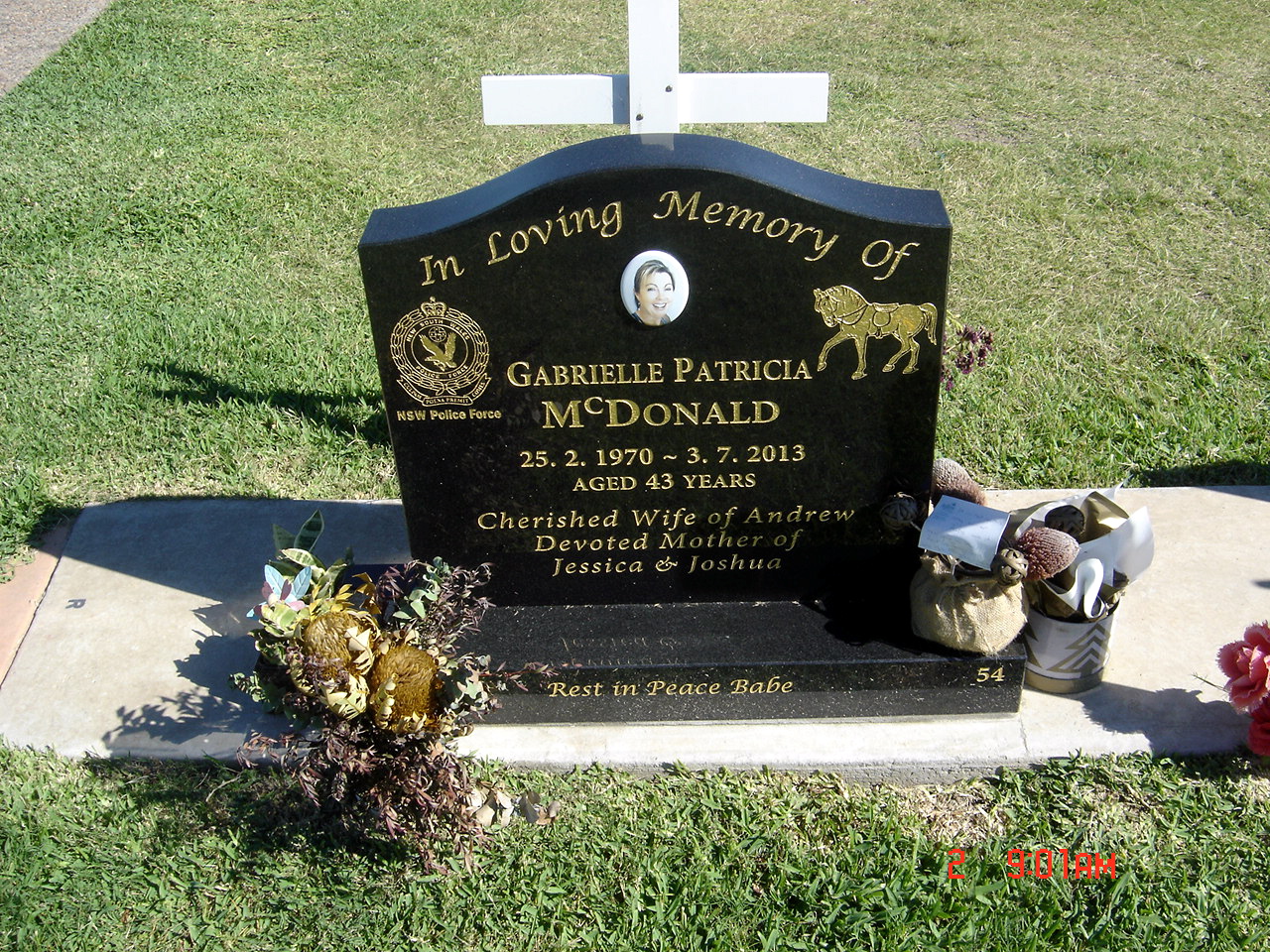
Grave of Gabrielle Patricia McDONALD – nee Gabby Eggleston
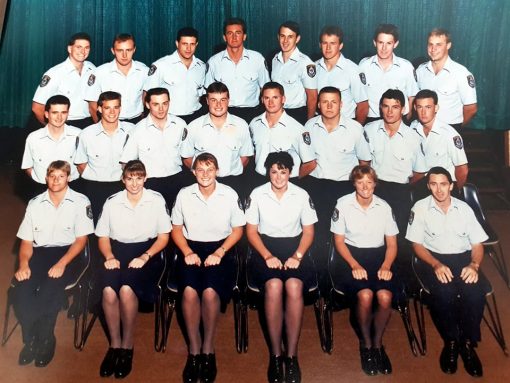
Class 242C Goulburn – Attested 25 January 1990 Gabby EGGLESTON, Front row, 3rd from right
Late of Maryland
Gabrielle passed away on 03/07/2013.
Her funeral is proposed to be held at 11am on Thursday 11th Instant at Our Lady of Victories Catholic Church, 262 Sandgate Road, SHORTLAND.
Dearly loved wife of ANDREW, loving mother of JESSICA and JOSH. Loved daughter and daughter-in-law of CARMEL and NORM (dec’d) EGGLESTON, FRAN and WARREN McDONALD.
Sister and sister-in-law of PETER and MAREE, MEL and JULIE, MARIA and MARK, ANDREW and AREEYA, ANGELA and MARK, SUE and STEVE, PATRICK and CAROLINE, NICOLE and NIGEL, GREG and loved aunty of their FAMILIES.
The Relatives and Friends of GABRIELLE are warmly invited to attend her Funeral to be held in Our Lady of Victories Catholic Church, Sandgate Rd, Shortland on THURSDAY 11/7/13 Funeral Liturgy commencing at 11am. An interment will follow at Sandgate Lawn Cemetery.
Family of NSW policewoman who took her own life suing state for millions
Exclusive by the National Reporting Team’s Lorna Knowles
Updated
The family of a policewoman who took her own life is suing the state of New South Wales for millions of dollars, for allegedly failing to protect her from harm.
[blockquote]
Key points:
Andrew McDonald has filed three negligence claims against the state
The claim alleges his wife did not receive adequate care after attending several traumatic incidents
It also alleges police failed to investigate a previous suicide attempt
Newcastle mother-of-two Sergeant Gabrielle McDonald developed post-traumatic stress disorder (PTSD) and depression after witnessing a string of horrific incidents on the job.
She took her own life on July 3, 2013, the day after a police medical officer had declared her as fit for duty.
Her husband Andrew McDonald has filed three negligence claims against the state of NSW on behalf of himself and his two children, Jessica and Joshua.
His statement of claim, filed to the NSW District Court, said over the course of her career, McDonald attended numerous traumatic incidents, including domestic disputes, assaults, car accidents, suicides and murders.
She was particularly distressed by the drowning of a 17-year-old boy in 2009 and a double road fatality in 2010, but did not receive any counselling, debriefing or monitoring after the incidents, the statement of claim alleges.
In late 2010, she was promoted to Detective Sergeant in the Professional Standards Unit, Northern Region. But she struggled with the heavy workload, which included two stints relieving for her supervisor.
In 2012, McDonald attempted suicide in an office at the Newcastle police station, but police never investigated the incident.
“It’s investigation 101,” Mr McDonald, who was also a police officer, told the ABC.
“That’s what police do and it’s appalling that it was never done.”
Police medical officer found suicide attempt ‘was not genuine’
The day before McDonald took her own life, she was sent to see a police medical officer, Dr Naresh Verma.
Mr McDonald told the ABC, Dr Verma determined her previous suicide attempt was not genuine and he did not believe she had PTSD.
“All the staff thought well, OK, things must be on the improve, maybe Gabrielle is not sick at all, maybe she’s pulling the wool over our eyes and that was clearly wrong,” Mr McDonald said.
Dr Verma did not respond to repeated requests for comment.
The police force determined that McDonald should be transferred to another police station the next day.
According to the statement of claim, she was summoned to a meeting without warning and without a support person to be told she was being moved.
McDonald left the meeting in a distressed state, drove to a state forest and took her life.
Mr McDonald said he had one last telephone conversation with his wife.
“She said I can’t go on any more. I’m not getting better. I’m such a burden. They keep kicking me down at work. All I’m trying to do is keep my hours up. You know, this is hopeless,” he said.
“And I said: ‘You can’t do this’. I pleaded with her and begged her not to.
“She said I love you and the kids. We talked about all the things we’d done together, but nothing I said would make sense to her, she was just that determined to do it”.
McDonald ‘did not receive proper monitoring’
Mr McDonald’s lawyers allege that the police service ought to have known the meeting would cause her distress and that she was at risk of self harm.
They allege the NSW police force was negligent because it failed to maintain a safe system of work to avoid injury to McDonald.
It had also allegedly failed to provide her with adequate training to perform her duties and to take precautions for her safety, “putting her in a position of peril”.
The service is also accused of failing to provide adequate training on how to recognise the symptoms of psychiatric injury.
“The deceased did not receive any or proper monitoring of her condition while she continued to work in a stressful environment,” the claim states.
The claim also alleges the police force had failed to devise a system for the flagging of police officers involved in numerous distressing or traumatic incidents.
As a result of its negligence, McDonald had suffered a major depressive disorder, chronic PTSD, alcohol abuse and death by suicide, it is alleged.
Mr McDonald said he now suffered from an adjustment disorder with depression and anxiety.
He was on track to become a superintendent, before he was medically retired.
He is claiming about $900,000 in future lost earnings, in addition to damages and interest. He is also seeking damages on behalf of his two children.
Damages are limited to $750,000 in the NSW District Court, but it does have the discretion to lift the cap.
In a statement to the ABC, the NSW police force said it could not comment specifically on the tragic circumstances which led to the death of a serving officer.
“NSW police continues to improve its practices and procedures, having made significant advances over many years to minimise the psychological impact of policing duties on our officers, who frequently undertake stressful and difficult work,” the statement said.
“As a major priority, NSW police encourages the reporting of these impacts and offers a range of services to support, guide and educate our staff.
“These support services are comprehensive and effective.
“It is well understood that every officer’s circumstances are unique and most often extremely complex with regard to the impacts of psychological injury.”
Gabby was my partner Newtown D’s. She was rock solid, loyal and supportive. She spoke her mind and was honest in opinion and views.
Gabby was from the Eggleston family of the Hunter & loved horses and racing. She taught riding to kids with patience & care. Gabby also helped place horses with the Mounted Section NSW Police.
Along with Gabby & Deb Hayton, we had a tough feminine perspective to our office in the 90’s.
Sad to know when she was in need, Gabby felt alone.
Gabby was loved by many and will be missed by all!
Grant Charles EASTES
| 13/11/2013
Grant Charles EASTES
New South Wales Police Force
Regd. # 18467
Joined via NSW Police Cadets on 4 July 1977
Cadet # 3345
Class 161 of 1978
Rank: NSW Police Cadet – started 4 July 1977
Probationary Constable – appointed 9 February 1979
Service: From 4 July 1977 to 13 January 1990 = 12+ years Service
Awards: No find on It’s An Honour
Born: Tuesday 9 February 1960
Died: Saturday 13 January 1990
Age: 29 yrs 11 mths 4 days
Cause: Illness – Suicide – overdose – P.T.S.D.
at Fortitude Valley, Brisbane, Qld
Funeral date:?
Funeral location:
Buried at: Casino Lawn Cemetery
Memorial location:
Grant IS mentioned on the Police Wall of Remembrance
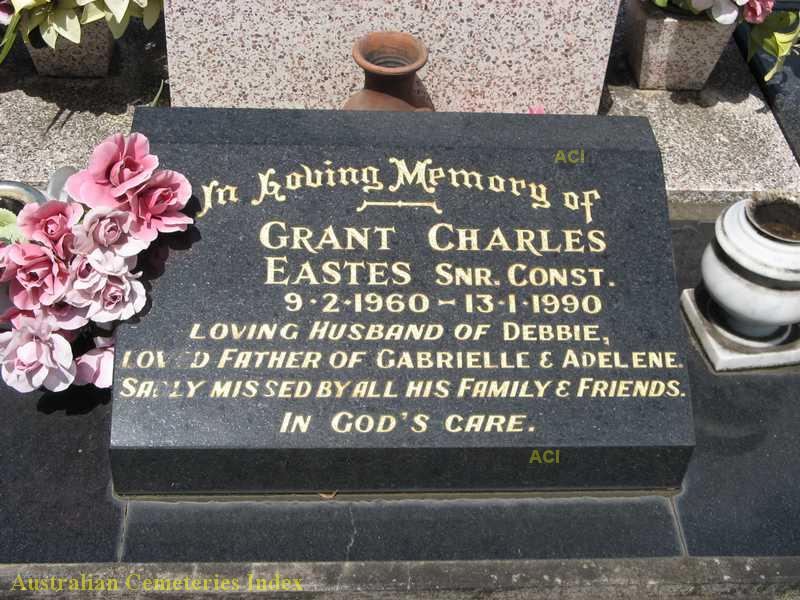
Senior Constable Grant Charles EASTES – Grave. Casino Lawn Cemetery, NSW.
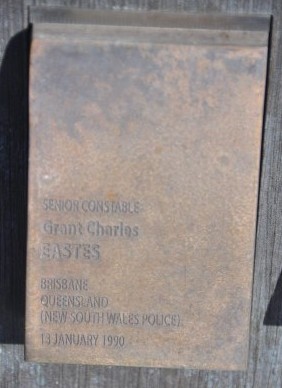
Senior Constable Grant Charles EASTES touch plate at the National Police Wall of Remembrance, Canberra.
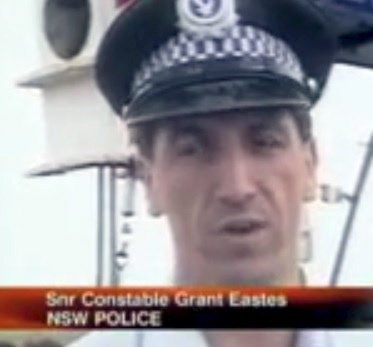
On 13 January, 1990 Senior Constable Eastes took his own life in a Brisbane Motel. On 20 October, 1989 he had been one of the first police to arrive on the scene of the horrific bus crash upon the Pacific Hwy, Cowper, ( commonly referred to as the Grafton bus crash ) in which twenty one people died and twenty two more were injured. At the time it was the worst road accident in Australia’s history. Following the accident the senior constable reported off duty on sick report, suffering from Acute Post Traumatic Shock Syndrome.
The constable was born in 1960 and joined the New South Wales Police Force as a Cadet on the 4 July, 1977. At the time of his death he was attached to the Lismore District Accident Investigation Squad.
[blockquote]It was during that time that I had a lengthy conversation with a highway patrol officer, Grant Eastes. I could sense that this man was in quite a bad way, finding it hard to cope. It was just his attitude, what he was saying, how he expressed how he was feeling. As we talked he brought up all these other incidents on the highway that he’d attended in recent months. I was so concerned that I mentioned the conversation to some senior police officers and later, Major Errol Woodbury, who was one of the State’s senior police chaplains at the time.[/blockquote]
A postscript to the Grafton tragedy. Three months after the accident, 29 year old Senior Constable Grant Eastes, the officer I was so concerned about on the night of the tragedy, was found dead in a motel room in the Brisbane suburb of Fortitude Valley. He’d taken an overdose of pills.
Grant’s father Ken told journalists his son’s life had been destroyed by the sight of the dead and injured at the Grafton bus crash scene.
I’m afraid to say his suicide didn’t surprise me. Here was a crash investigation officer who had witnessed a real slathering of fatal accidents up and down that highway. The bus crash was the catalyst for his suicide. It was just too much.
Rank: Commenced Training at Goulburn Police Academy on 18 August 1986
Probationary Constable – appointed 7 November 1986
Final Rank: Probationary Constable
Stations: Pennant Hills October 1986 to 3 June 1987
Awards: Nil
Service:
From 18 August 1986to 3 June 1987 = 11 months
Born: ? ? 1966
Died: Wednesday 3 June 1987
Age: 20
Cause: Illness – Suicide by Service firearm
Location: at Lane Cover River Park, Lane Cove.
Funeral date: ?
Funeral location:
Eastwood
Grave Location:Cremated
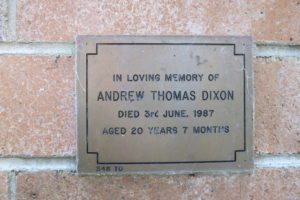
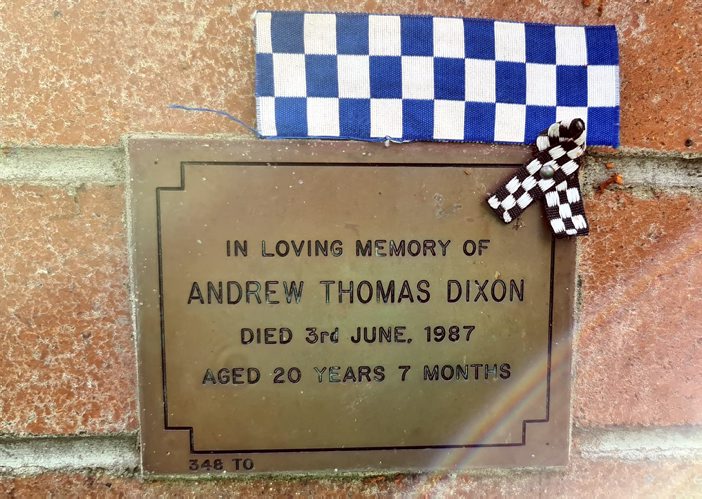
Memorial plaque at Northern Suburbs Crematorium, Delhi Road, North Ryde, NSW
Niche: Row ‘TO’, plaque # 348
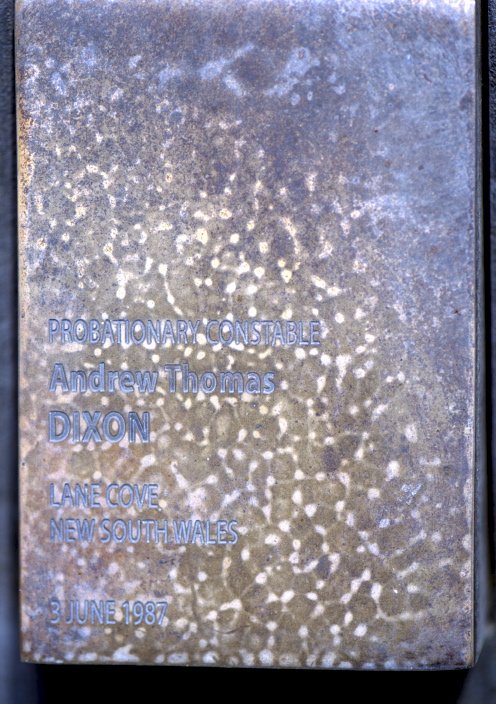
Touch plate at the National Police Wall of Remembrance, Canberra.
Andrew Thomas DIXON. Plaque condition as of 8/9/2020
ANDREW IS mentioned on the Police Wall of Remembrance
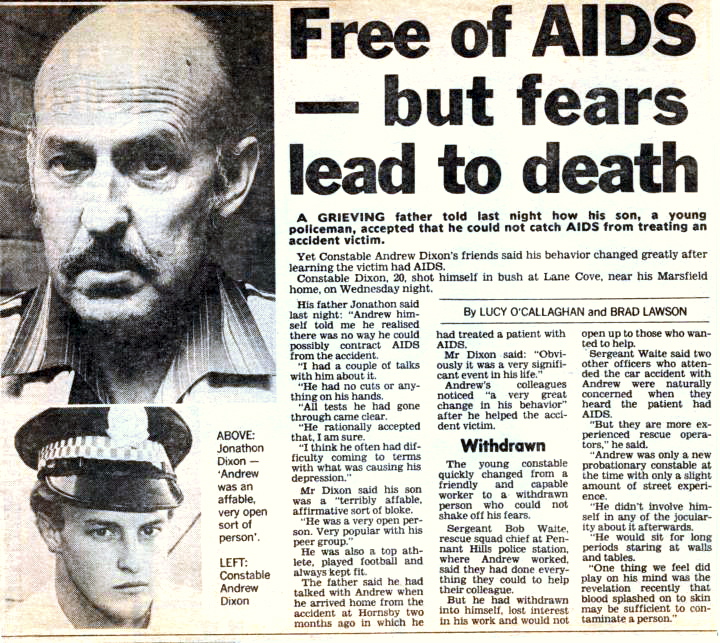
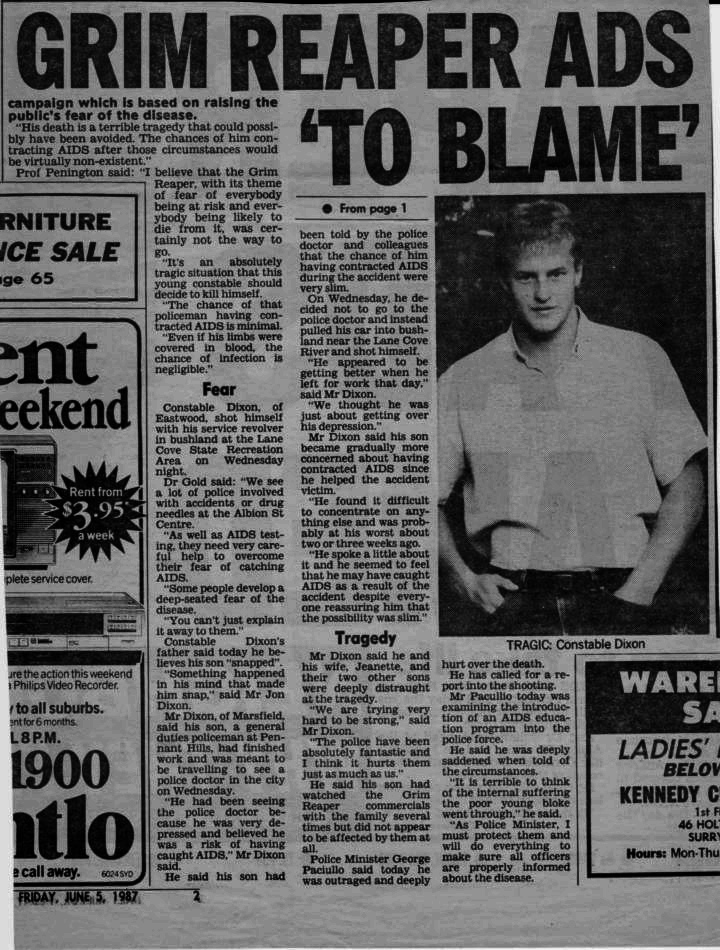
In April, 1987 Constable Dixonand other police attended a serious motor vehicle accident at Mt Colah. A person trapped in the vehicle became violent when released and Constable Dixon assisted in restraining him. During the struggle the constable was covered in a considerableamount of the injured person’s blood. It was later discovered that this person suffered from HIV/AIDS. Due to stress and concern over the disease, Constable Dixon drove to the Lane Cove River Park on 3 June, 1987 and committed suicide.
The constable was born in 1966 and joined the New South Wales Police Force on 18 August, 1986. At the time of his death he was stationed at Pennant Hills.
From Kevin Banister – I remember this very well. I was working at Pennant Hills when Andrew arrived as a fresh faced Probationary Constable. He was a fine young man built like a brick s**thouse. When he was told that the accident victim had HIV/AIDS he began to withdraw very quickly. All at the station were concerned for his welfare and tried to help where possible.
On the afternoon of 3/06/87 Andrew had worked morning shift and I was on afternoon shift. At the hand over Andrew said goodbye with a smile on his face and went home, or so I thought. I was not aware that he was supposed to be attending the PMO (Police Medical Officer) for an appointment after work. I got a call from his mother just before sundown to say that Andrew had not come home and were concerned for his welfare. Pennant Hills was a Rescue Squad/General duties station at the time and I was the senior operator rostered on. I made a number of phone calls including to the Lane Cove station and Marrickville Rescue base. Not long after we received info that Andrew’s car had been located in a dead end street off Delhi Road beside the Lane Cove river.
As a result I and my offsider Bob Hanson attended in the Rescue vehicle. Numerous other Police vehicles arrived along with the Water Police. I organised a number of search parties and headed into the scrub towards the river. Reached the riverbank and saw that the Water Police had also began a search in the area we were in. Again, a short time later I and my offsider found the body of Andrew with his service revolver by his side. I indicated to the Water Police to come over (not using the radio) and told them that they were no longer required. The boat crew saluted and left the scene. A discrete message was sent to the command post as I knew that his parents were at the post and could hear the radio transmissions.
When we emerged from the bush with Andrew’s body many of the Police were in tears as he was a local boy and well known. His funeral was standing room only and the street blocked off for the overflow. During the period of the time of the accident and Andrew’s death he had a number of blood samples taken, but due to the technology of the time he was told that it could be some time before they knew if he had became infected. About a month after his death we were informed that he had not become infected. R.I.P. my friend.
Grave Location: Roman Catholic Monumental Section 3 – Plot: 0493
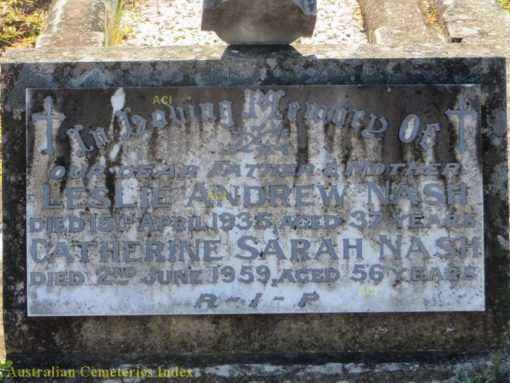
In Loving Memory of our dear father and mother. Leslie Andrew NASH, Died 15 April 1935 aged 37 years. Catherine Sarah NASH, Died 2 June 1959, aged 56 years. R.I.P.
Coroners Inquest: Tuesday 30 April 1935
LESLIE is NOT mentioned on the National Police Wall of Remembrance ( 2021 ) * BUT SHOULD BE
Constable Nash is thought to have been shot to death, possibly while on duty, on 15 April, 1935. It was thought that he had committed suicide however little is known about this incident and to some extent it remains a mystery.
The Hurstville Propeller newspaper dated 18 April, 1935 published the following article.
CONSTABLE FOUND SHOT AT HURSTVILLE POLICE STATION.
First-Class Constable Leslie Andrew Nash, station officer at the Hurstville Police Station, was found dead at the station early on Monday morning. Constable Nash commenced duty at 5 a.m. Constable Harvey left the station and when he returned Nash was missing. A search revealed his body in the bathroom attached to the station. Nash’s service revolver was nearby.
The Sydney Morning Herald of 16 April, 1935 added a bit more to the story.
POLICEMAN FOUND SHOT.Constable Leslie Andrew Nash, 38, was found dead in the bathroom at the Hurstville Police Station yesterday morning with a bullet wound in his head. A revolver was found nearby. Nash was to have sat for an examination yesterday morning and had been in ill-health for some time. For the last eight years, Nash, who was a first class constable with 14 years service, had been stationed at Hurstville and was well liked and respected in the district. He had previously been stationed at Sutherland. He is survived by a widow and five children.
The constable was born in 1897 and joined the New South Wales Police Force on 5 April, 1921. At the time of his death he was stationed at Hurstville.
Newcastle Morning Herald & Miners’ Advocate
Tuesday 30 April 1935 P9
WORRIED OVER LECTURES
Constable Committed Suicide
SYDNEY, Monday,
Forgetting what he had been told at lectures, Constable Leslie Nash, 37, committed suicide at Hurstville Police Station on April 15.
At the inquest today, Constable James Harvey said that Nash told him that he was worrying over a departmental examination that day, and had forgotten what he had been told.
Returning a verdict of suicide, the Coroner said that the case was very sad.
Armidale Express and New England General Advertiser (NSW : 1856 – 1861; 1863 – 1889; 1891 – 1954),
Monday 15 April 1935, page 1
CONSTABLE SUICIDES
Strain of ill-Health Too Great
Sydney, Monday.
Constable Leslie Andrew Nash (38), was found dead at the Hurstville Police Station early this morning with a gun shot wound in the head.
He was acting as station officer. It appears that the man, who had been in ill health, had been told that he would have to undergo a serious operation. Some time later he was missing, and a search resulted in the discovery of his body in the bathroom attached to the station, with a revolver lying nearby.
Constable Leslie Andrew Nash. aged 38, was today found dead at the Hurstville Police Station, where he had performed duty as station officer.
Nash, who has been in ill health and had been told that he would have to undergo a serious operation, began duty at 5 a.m. He asked Constable Harvey to go on an errand, and when Harvey returned Nash was missing.
A search revealed his body in the bath room attached to the station. His service revolver was nearby.
Nash left a widow and four children.
He had been in the force for 14 years and was a first-class constable.
Today he was to have sat for an examination, which his inspector said he would have passed without the slightest difficulty.
NA8H.- H.A.C.B.S. St. DECLAN’S BRANCH, No. 659.- The Officers and Members of the above Branch are requested to attend the Funeral of their late Bro.. LESLIE A. NASH: to leave St. Declan’s Catholic Church. Penshurst, THIS DAY. at 2.30 p.m., for Woronora Cemetery. By road.
The Coroners Inquest returned a verdict of “Effects of a bullet wound in his head, wilfully self inflicted“
Inquest was concluded on 29 April 1935.
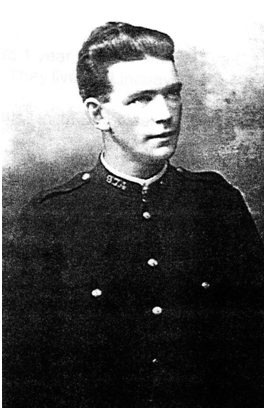
In the attached photo, his Uniform # is 87A or 97A.
The ‘ A ‘ used to depict the District that the member was attached to. ‘ A ‘ District was Sydney – so he may, at the time of the photo being taken, have been stationed at one of the Sydney CBD Stations.
NSWBDM
Birth = 6089/1898 Father = Patrick Mother = Amelia District = Parkes
Marriage = 2105/1925 Bride = McDonnell or MacDonnell District = Kempsey
Death = 7008/1935 Father = Patrick Mother = Amelia District = Hurstville
Leslie was born in 1898, the son of Patrick and Amelia, Leslie married on 10 Jan 1925 to Catherine McDonnell. Leslie was a First Class Constable Leslie passed away 15 Apr 1935 (aged 36)
Sources
NSW BDM
BIRTH NASH LESLIE A 6089/1898 PATRICK AMELIA PARKES
MARRIAGE 2105/1925 NASH LESLIE A MCDONNELL CATHERINE KEMPSEY
DEATH NASH LESLIE A 7008/1935 PATRICK AMELIA HURSTVILLE
RYERSON INDEX
NASH Leslie Andrew Death notice 15APR1935 Death 37 at Hurstville, late of Penshurst Sydney Morning Herald 16APR1935
The Sydney Morning Herald NSW 1842 – 1954
Tue 16 Apr 1935 DEATH NASH-April 15, 1835, suddenly, at Hurstville, Leslie Andrew, of 6 Clarence-street, Penshurst, dearly beloved husband of Catherine and father of Pat, Francis , Alma, John and Peter aged 37 years. Requiescat in pace.
The Sydney Morning Herald NSW 1842 – 1954 Tue 16 Apr 1935 Page 9 FUNERAL NASH.-The Relatives and Friends of Mrs. CATHERINE NA8H and FAMILY are kindly Invited to attend the Funeral of her dearly beloved HUSBAND and their FATHER. First Class Constable Leslie Andrew Nash: which will leave St. Declan’s Church. Penshurst, THIS TUESDAY, at 2.30 p.m., for the Catholic Cemetery. Woronora. Mrs. P. KIRBY and SON. LTD.. Leadlng Funeral Directors. phone, M2221-2. 263 Elizabeth-street, Sydney.
NASH.-‘The Friends of Mr. WILLIAM ROSS are kindly invited to attend the Funeral of his friend, the Late Mr. Leslie A. Nash: lo leave St. Declan’s Church. Penshurst, THIS DAY (Tues day. For further details please see above notice.
NASH.- H.A.C.B.S. St. DECLAN’S BRANCH, No. 659.-The Officers and Members of the above Branch are requested to attend the Funeral of their late Bro.. LESLIE A. NASH: to leave St. Declan’s Catholic Church. Penshurst, THIS DAY. at 2.30 p.m., for Woronora Cemetery. By road. W. J. MEACHMAN. Tres. R. J. MADDEN. Sec.
NASH Leslie Andrew Death notice 16APR1935 Death at Hurstville Sydney Morning Herald 22APR1935
The Sydney Morning Herald (NSW : 1842 – 1954)
Mon 22 Apr 1935 Page 8 Family Notices
DEATH
NASH.—April 16 (suddenly), at Hurstville, Les- lie Andrew, beloved brother, brother-in-law, and darling uncle of Bob, Rene, and Aileen.
Death aged 37 at Hurstville, late of Penshurst
BURIAL Woronora Memorial Park
Sutherland, Sutherland Shire, New South Wales, Australia PLOT RC 3 0493
For the purposes of this website ‘Q‘ represents those Police joining between 1862 ( commencement of NSWPF ) – 23 February 1915 ( Commencement of NSWPF current numbering system )
Rank: Constable – appointed 16 December 1895
Detective
Sergeant 2nd Class
Final Rank = Detective Sergeant 2nd Class
Stations: ?, North Sydney ( 23 years ), Sydney CIB ( from 1919 – death ) – Death
Service: From 16 December 1895 to 21 August 1923= 27+years Service
Awards: No find on It’s An Honour
Born: ? ? post 21 Aug 1867 in Victoria
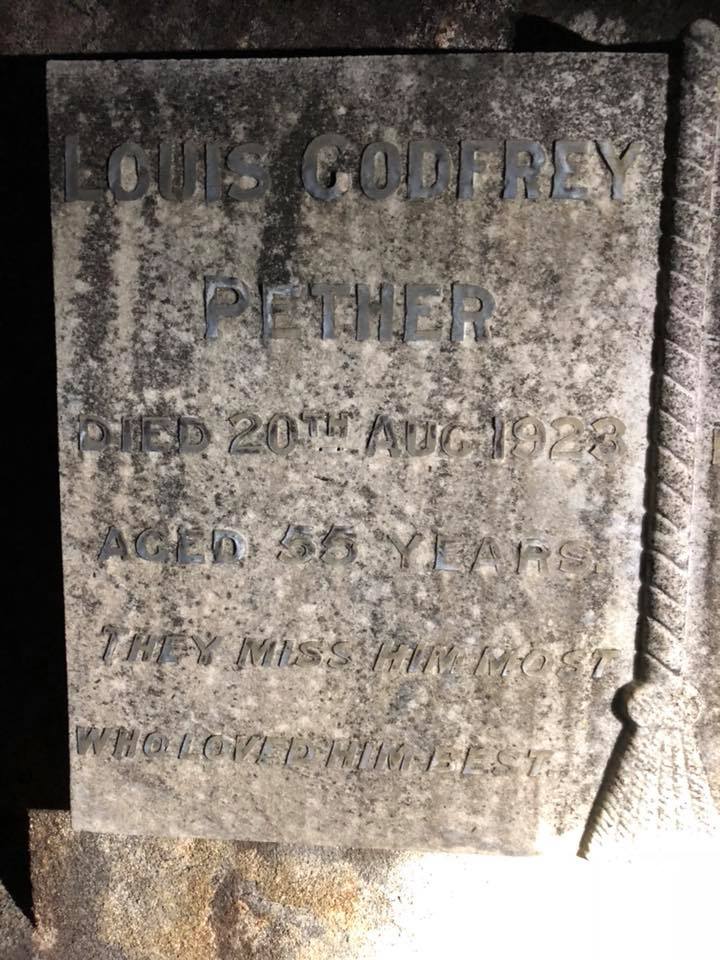
Died on: Monday 20 August 1923
Age: 55
Cause: Suicide – Firearm – “possible” Service weapon
Event location: Toilet, Police Headquarters, Sydney
Event date: Monday 20 August 1923
Funeral date: Wednesday 22 August 1923
Funeral location: ?
Wake location: ?
Funeral Parlour: ?
Buried at: Rookwood Cemetery, Rookwood
Zone C, Section 07, Row ?, Grave 883
Interred in the same grave:
Olivia May PETHER, aged 58, Interred on 23 Sept 1927
Memorial located at: ?
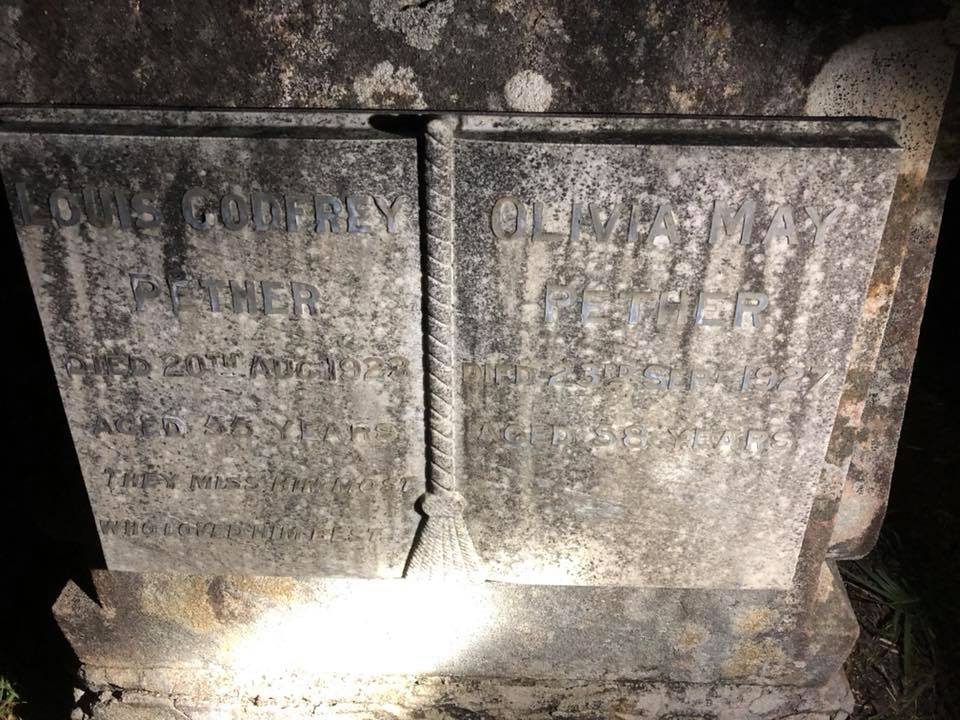
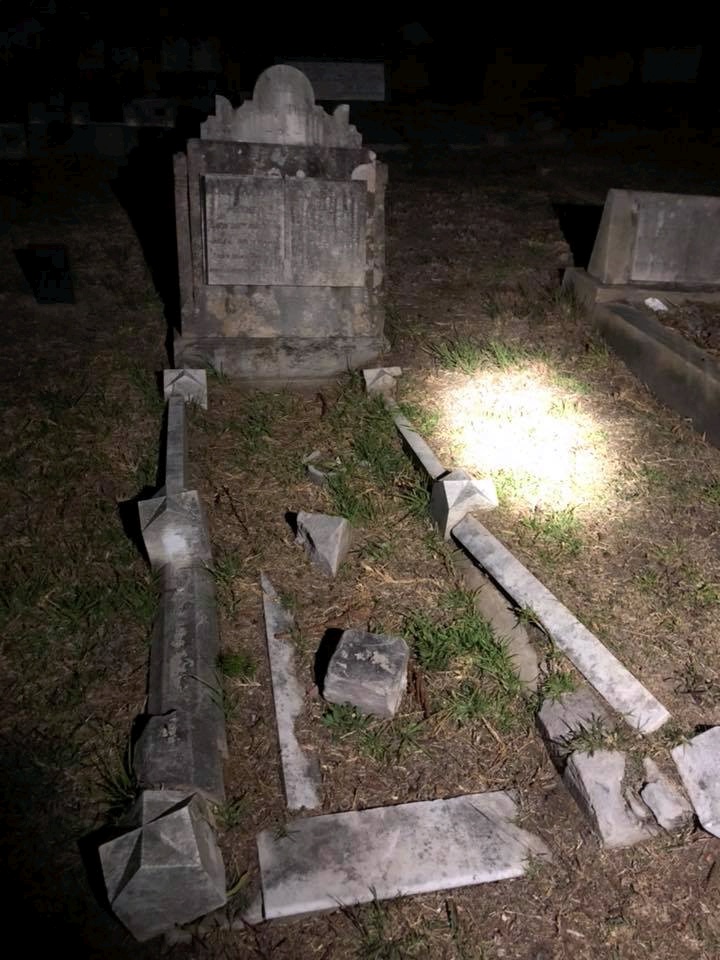
Grave of Detective Sergeant 2nd Class Louis Godfrey PETHER & wife – Olivia May PETHER
[alert_yellow]LOUIS is NOT mentioned on the Police Wall of Remembrance[/alert_yellow] *NEED MORE INFO – BUT MOST PROBABLY SHOULD BE
[divider_dotted]
Grave location: TBA
[divider_dotted]
FURTHER INFORMATION IS NEEDED ABOUT THIS PERSON, THEIR LIFE, THEIR CAREER AND THEIR DEATH.
The Examiner newspaper dated 21 August, 1923 reported the following account of the death of Detective Sergeant Pether.
Detective Found Dead, Sydney, Monday.
Detective Sergeant Louis Godfrey Pether was found dead to-day in a lavatory at the police headquarters, Sydney. He had a bullet wound in his head, and an automatic revolver was lying by his side. He was aged 56 years, and had been in the New South Wales Police Force since 1895.
The Sun of 23 August, 1923 shed a little more light on the tragedy.
“DRIVING ME MAD” – Detective Pether’s Suicide
Detective-Sergeant Louis Godfrey Pether committed suicide at Police Headquarters last Monday while suffering from mental aberration. This was the verdict recorded to-day by the City Coroner (Mr. Jamieson).
Pether contracted influenza two years ago and never recovered. Chest trouble developed, and he suffered from defective memory. Early last Monday morning Pether remarked to Detective Bowie that his illness was driving him mad. A few seconds afterwards a revolver shot was heard, and Pether was found unconscious in the basement and bleeding from a wound behind the ear.
Pether died before he reached Sydney Hospital.”
The sergeant was born about 1867 and joined the New South Wales Police Force about 1895. At the time of his death he was attached to the Sydney Criminal Investigation Bureau, and had previously been stationed at North Sydney.
Detective Sergeant Louis Pether was found dead with a bullet wound in his head in the lavatory at police headquarters, Sydney. He had been indisposed for some time, and had been away from duty for several
months. He visited the office this morning to make application for work at a country station. For the last five years, deceased had been attached to the criminal investigation department.
Sydney Morning Herald (NSW : 1842 – 1954), Tuesday 21 August 1923, page 9
FOUND SHOT.
DETECTIVE-SERGEANT PETHER.
Early yesterday morning Detective-Sergeant Louis Godfrey Pether was found lying in the lavatory, at the police headquarters, at the corner of Hunter and Phillip streets, with a bullet wound in his bead. An automatic revolver was lying at his side. The Civil Ambulance conveyed him to the Sydney Hospital, where Dr. Taylor pronounced life extinct.
Detective-Sergeant Pether, “who was 56 years of age, joined the police force in 1895, and for 23 years was stationed at North Sydney. In 1919 he was attached to the Criminal Investigation Branch. For several months past he had been in bad health, and had intended going to the country for a holiday. He was regarded as a capable and conscientious officer.
Suicide while temporarily insane was the Coroners verdict after his inquiry into the death of Detective Pether who was found shot in a lavatory at Police Headquarters on Monday.
Detective Bowie said that he saw Pether near the lavatory, and inquired how he was. Pether replied: “I am bad — bad — bad: it is driving me mad!” witness advised him not to give way and asked him to wait a minute, and they would go together to see the doctor. He returned in a couple of minutes, and could not see Pether. There was a report of a shot in the lavatory, and when the door was forced open, Pether was found with a bullet wound in the head.
Pether was taken to Sydney Hospital, but was dead on arrival.
Subsequently witness discovered some pencilled words in Pether’s hand writing on the wall of the lavatory.
The message was:-
” I could not have been treated with more consideration by the doctor and my officers: but I feel that I am losing my reason, having already lost my memory. ” Underneath were the Initials ‘G.P’
Stations: Sydney, Richmond River, thence to Armidale, Tenterfield ( Cst 1/c ), Inverell, and on the 26th November, 1909, he was again transferred to Armidale ( Cst 1/c – SenCon ) as lookup-keeper & police prosecutor
Service: From 12 July 1893 to 7 November 1911 = 18+ years Service
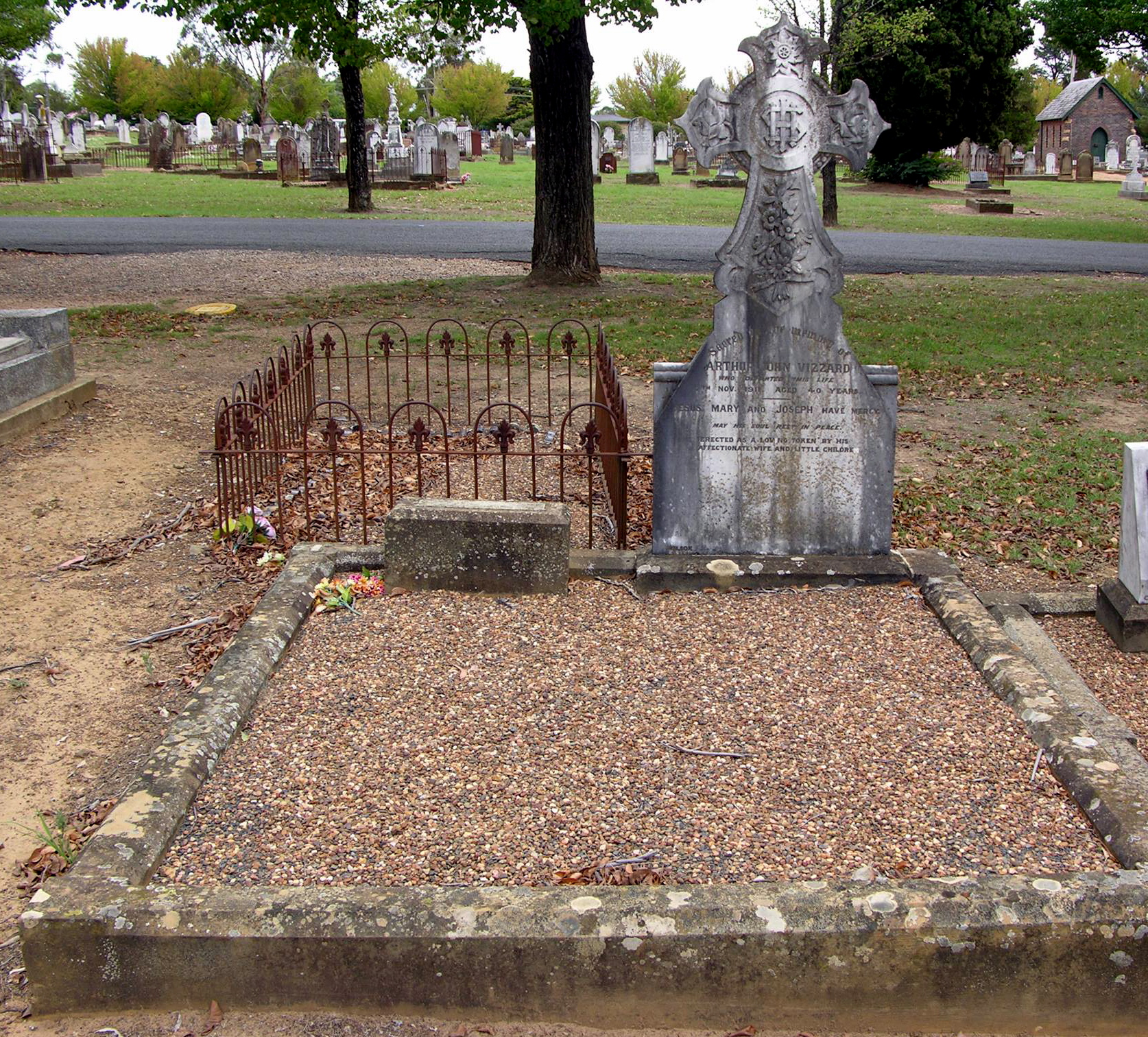
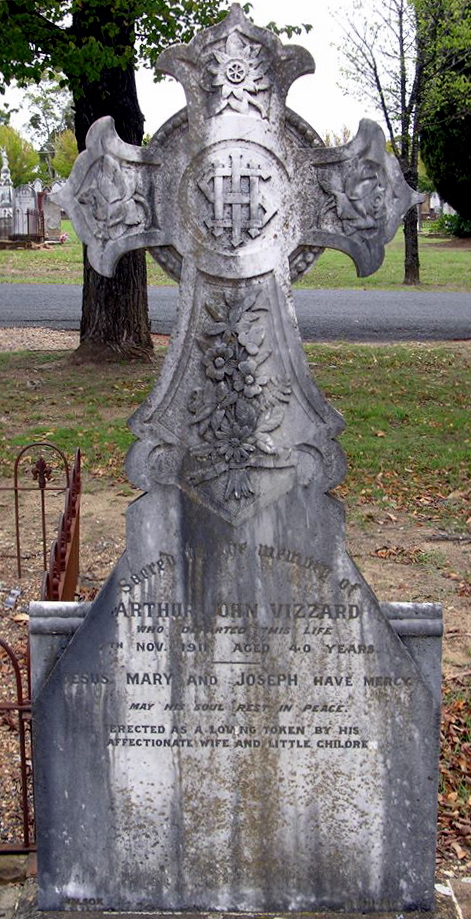
Arthur John VIZZARD Grave: Inscription: Sacred to the memory of ARTHUR JOHN VIZZARD WHO DEPARTED THIS LIFE 7TH NOV. 1911. AGED 40 YEARS JESUS, MARY AND JOSEPH HAVE MERCY MAY HIS SOUL REST IN PEACE. ERECTED AS A LOVING TOKEN BY HIS AFFECTIONATE WIFE AND LITTLE CHILDREN.
ARTHUR is NOT mentioned on the Police Wall of Remembrance * BUT SHOULD BE
As of November 2020 – VIZZARD is still NOT recognised as having died as a result of Work Related Injuries.
GRAVE LOCATION:
Shortly after 10.30am on 7 November, 1911 the constable was at the Armidale Police Station, where he was the Lockup Keeper.
He walked into the yard of the station where it appears he inflicted a fatal wound to his head with his service revolver.
He died three hours later.
He had been on sick report for about two months, suffering from rheumatism, insomnia and depression.
The Clarence and Richmond Examiner of 14 November, 1911 reported that:
” A mild sensation was caused in Armidale when it was known that Senior Constable Vizzard, who was in charge of the lockup, had been found in the lockup yard with a bullet wound in the head.
The unfortunate officer had been suffering greatly lately from muscular rheumatism and insomnia and had been on sick leave for the past few weeks.
During the last few days he appeared very despondent, but nobody suspected he would commit such a rash act.
He was removed into the house in a dying condition.
Senior Constable Vizzard, who came to Armidale from Inverell, was only recently promoted.
He has a wife and three young children. “
The senior constable was born at Corowa in 1871 and joined the New South Wales Police Force on 11 July, 1893. At the time of his death he was stationed at Armidale.
The issue regarding ill health for Senior Constable Arthur Vizzard dates back from approximately 5 years earlier as a result from contracting Dengue Fever when he was required to travel to Queensland and back to execute an interstate warrant and convey back a prisoner. Both he and the prisoner contracted Dengue.
He had ongoing health issues in the following years because of it and as we all know from the inquest findings he finally took his life whilst on “sick leave‘.
I have been aware of full story for about 18 years now. There are three descendants currently working in the NSW Police Force and there was an article in the Police Weekly about the family last decade.
I appreciate what you have said regarding eligibility for inclusion, which I was made aware of prior to the commemoration of the 10th anniversary of the National Police Memorial being opened.
This year will be 2 years since I got the e-mail. Still nothing progressed. Tell me this? Why was I personally notified almost 18 months ago that the inclusion was going to happen, then everything goes silent? It is disappointing to say the least.
I know the effect it had on my Grandmother the stigma growing up, her Mother never coped afterwards and the family ended up having to be split up. It is what it is. 106yrs latter the status quo remains. All we can do is wait and watch this space.
Darling Downs Gazette (Qld. : 1881 – 1922),
Friday 5 May 1905, page 3
DENGUE FEVER AT INVERELL
IMPORTED BY A CONSTABLE INVERELL, Wednesday.
Queensland dengue fever has been introduced into Inverell under conditions which were not to be avoided.
A week or so ago Constable Vizzard was despatched to Charleville to escort a prisoner back to Inverell, and while in the sister State, he contracted dengue.
He returned with his charge on Friday last, and on Saturday took ill.
On Sunday the case was diagnosed as dengue fever, and the patient was at once isolated in a ward at the local hospital.
Another case has since been reported, the victim being Ben. Bridge, the prisoner who was escorted back by Constable Vizzard. Bridge has also been sent to the hospital.
Both victims have the malady in an acute form.
News of the disease being in Inverell has caused some alarm among residents.
A mild sensation was caused in Armidale yesterday morning, when the shocking intelligence was made known that Senior-Constable Vizzard had been found in the yard of the lockup in a serious condition.
As was well known, Constable Vizzard had been in indifferent health for the past couple of months. He was a sufferer from muscular rheumatism, which brought on that dreaded complaint insomnia, but not even his nearest relatives anticipated that his career would be terminated in such a tragic manner.
At about 10.30 yesterday morning he appeared to be much the same, and walked through the kitchen of his residence, where his wife and nurse were, out into the lockup yard. The women were shortly afterwards startled by hearing the sounds of a revolver shot, and, proceeding to the spot from whence the sound came, the nurse was horrified to see her charge lying on the ground with a gaping wound in the temple, and a revolver lying close beside the body.
Assistance was promptly summoned, and Dr. Mummery was also quickly on hand, when the unfortunate constable was conveyed into the house.
From the outset, the doctor held out no hope of recovery, his prediction proving all too true, as the end came a few minutes after two o’clock.
The late Constable Vizzard was a zealous, capable, and conscientious officer, in fact, as Senior-Sergeant Hogan remarked to the writer when speaking of his late lieutenant, he was over conscientious.
The deceased was born, at Corowa in October, 1871, and was thus 40 years of age at the time of his sudden death.
As a young man of 22 he joined the New South Wales Police Force, and after going through his term of probation at the barracks, was sent to do duty on the Richmond River, thence to Armidale, Tenterfield, Inverell, and finally on the 26th November, 1909, he was again transferred to Armidale as lookup-keeper.
He was ever active and energetic, and his zeal was not long in being rewarded, for he rose from a constable to a first-class constable, and then to senior-constable.
Although he always did his duty – and a policeman’s work is ofttimes unpleasant – he ” tempered justice with mercy,” thereby gaining for himself universal respect and admiration from all sections of the community.
As prosecutor in the police court, the late officer displayed undoubted ability and knowledge of the law, and was worthy of any attorney’s ” steel. ” Here, again, could be seen his generous disposition for he was always strictly fair and honourable in any cases he was in charge of.
He is survived by a sorrowing wife and three young children, to whom much sympathy has been extended in their hour of affliction.
The North Western Advocate & the Emu Bay Times ( Tas. ) Wed. 8 Nov. 1911 page 3 of 4
NEW SOUTH WALES.
POLICE CONSTABLE’S DEATH.
SUICIDE SUSPECTED.
SYDNEY. Tuesday, — Senior Constable Drizzard was found in the lockup yard at Armidale to-day in a dying condition with a bullet wound in his head. He suffered from insomnia and is supposed to have committed suicide.
SYDNEY, Tuesday. — Senior Constable Drizzard shot himself, while in the lock-up yard at Armidale. The unfortunate officer had been suffering from insomnia, and is in a dying condition .
An inquest concerning the death of Senior-Constable Vizzard, which occurred under tragic circumstances in the yard of the Armidale lockup on Tuesday morning last, was held by the Deputy-Coroner ( Mr. C. A. Jackes ) in the Courthouse on Wednesday. The following evidence was elicited:
Frederick Wm. Vizzard, brother of the deceased, said the deceased was born on 9th October, 1871, at Corowa. He was a married man, with three children. Witness had not seen his brother, previous to that day, for nine months.
Senior-Sergeant Hogan deposed to knowing the deceased for the past eight or nine years. At about 11 o’clock on Tuesday morning he received a call to go to the lockup, which place deceased was the keeper of. With Constable Eagleton, witness went to the charge-room, and there saw deceased lying on a stretcher. The mark of a bullet wound was noticeable on his left temple, and blood was oozing from the place. He was unconscious, but breathing strongly.
Witness next went to the cell yard-room, and there saw a large quantity of blood on the floor. The deceased’s hat was lying near the door, with his pipe. Close by was a police revolver, containing four loaded cartridges and one recently exploded shell. Witness afterwards went to a drawer in the charge room, which was always kept locked. The lock of the drawer had been forced open, evidently by a tomahawk as such implement was lying in the drawer in the place where deceased’s revolver had been put when not in use. Deceased had been off duty for two months, through illness. He complained of muscular rheumatism and attacks of insomnia. When first going on sick leave, he went to Dr. Nash’s private hospital, but returned, and for the remainder of the time was with his wife and family in their own home. Deceased gave no reason for the police to anticipate that he would take his own life. In conversation with witness on Sunday morning, deceased said, ” I would give everything I possess to be able to resume duty on Monday. ”
Witness told him not to resume until the doctor had given permission to do so. Deceased was an efficient officer, trustworthy, and very painstaking.
To the Superintendent : During his nine months in Armidale, witness was practically all the time in deceased’s confidence. Deceased had never at any time expressed dissatisfaction with his position or work in the police force.
Dr. N. Howard Mummery said that shortly after 11 o’clock on the fatal morning he, in answer to a summons, proceeded to the lockup. He found the deceased lying on a stretcher, and being attended to by a nurse. He appeared unconscious. There was a wound on the right temple, the skin around which was stained with gun-powder. There was another and larger wound on the left temple. It was obvious he could not live long. The wound in the head had been caused by a bullet, which had passed through deceased’s head, struck the brick wall of the yard, and rebounded into the middle of the yard, where witness picked it up.
Dr. J. A. J. Murray stated that on his arrival at the scene of the tragedy, deceased was being cared for by Dr. Mummery. Deceased had been ailing since last August. While still on duty, he complained of insomnia, indigestion, and occasional fits of depression. In September he also had an attack of asthma, which was followed by influenza, the after effects of which he never appeared to shake off. He seemed to be in an anxious and dispirited condition. Witness urged him to get a holiday immediately, because no treatment seemed to do him much good. Deceased took the holiday in Sydney, and, on his return, about three weeks ago, witness was again called in. Deceased was then in a worse condition than when he went away. Witness visited him at intervals up to Monday. Deceased had such a serious nervous breakdown that it was necessary for him to undergo a complete rest cure, and witness had made arrangements for him to enter a suitable hospital for the purpose. Deceased had told witness that some times he felt as if he didn’t care to live, but, from the way he said it, witness did not think he contemplated taking his own life – it was said more to express to witness how really depressed he was. The idea of taking his life would come on him suddenly, owing to the condition he was in.
Nurse Ethel Sheerman, residing in Victoria-street, Sydney, said she came to nurse the deceased, and arrived on Monday. She had been sent by Dr. Nash. At about 10.30 on the morning in question, deceased said he was going down the yard to cut some kindling wood. He then seemed in a normal condition. About five minutes afterwards, witness, who was in the kitchen with deceased’s wife, beard the report of a firearm. Witness and Mrs. Vizzard immediately rushed to the spot. Deceased was reclining on the spot. Deceased was reclining on his left side. There was a great quantity of blood flowing from the wound in the head. She picked a revolver up, which was lying near the body, and threw it on the step. Deceased never regained consciousness, and died about two o’clock. Witness had not the faintest suspicion that deceased contemplated such a rash act.
John Purkiss said that between 10.30 and 11 a.m. on Tuesday morning he heard a woman scream, and immediately ran across. He met Mrs. Vizzard, who said, ” My husband has shot himself in the charge-room. ” and then fainted. Telling another woman to attend to Mrs. Vizzard, witness went into the charge-room and then followed the nurse into the cell-yard, where deceased was lying. With the assistance of the nurse, witness carried the deceased into the charge-room.
The Coroner returned a verdict that the deceased, Arthur John Vizzard, met his death from a bullet wound self-inflicted, whilst- temporarily insane.
The remains of the late Senior Constable Vizzard,. whose tragic death was reported in our last issue, were interred in the Roman Catholic Cemetery on Wednesday afternoon. The funeral was largely attended by members of the M.U.I.O.F. and local police force marching in the cortege. The Rev. Dean Tobin officiated at the graveside, M. Hirschberg having charge of the arrangements.
In the Estate of ARTHUR JOHN VIZZARD, late of Armidale, in the State of New South Wales, Senior Constable of Police, deceased in testate, –
APPLICATION will be made after Fourteen Days from the publication hereof, that Administration of the Estate of the abovenamed deceased may be granted to MARY VIZZARD, the Widow of the said deceased. Creditors are requested to send their Accounts to, and all Notices may be served at, the Office of the undersigned.
H. WEAVES,
Proctor,
Faulkner street, Armidale.
By his Agents MESSRS. Weaver & Allworth,
Australasia Chambers, Martin Place, Sydney… . . i87
For the purposes of this website ‘Q’ represents those Police joining between 1862 ( commencement of NSWPF ) – 23 February 1915 ( Commencement of NSWPF current numbering system )
Rank: Constable – appointed 15 March 1880
Final Rank = Senior Constable
Stations: ?, Deniliquin – Lockup Keeper ( ? ? ? – 1891 ), Moama ( 7 years ) – Death
Service: From? ? 1880?to 19 January, 1898 = 18 years Service
Awards: No find on It’s An Honour
Born: ? ? 1857 – Victoria
Died on: Wednesday 19 January 1898 about 11.30am
Age: 40
Cause: Illness – Depression – Suicide – Firearm
Event location: inside Moama Police Station, NSW
Event date: Wednesday 19 January 1898 about 11.30am
Funeral date: Thursday 20 January 1898
Funeral location: Moama Cemetery
Wake location: ?
Funeral Parlour: ?
Buried at: Unmarked & Unknown grave location within Moama Cemetery
Memorial located at: ?
[alert_red] JAMES is NOT mentioned on the Police Wall of Remembrance[/alert_red] * BUT SHOULD BE
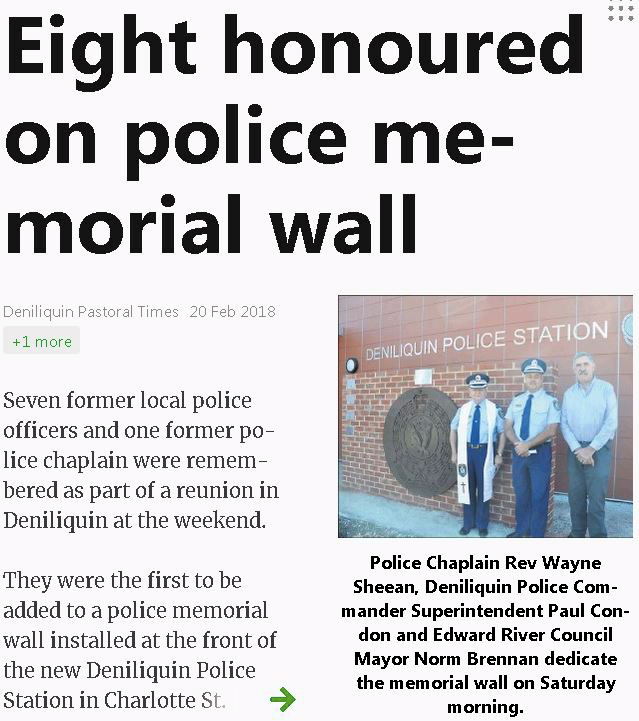
[alert_pink] JAMES IS mentioned on the Memorial Wall, Deniliquin Police Station – 2018[/alert_pink]
[divider_dotted]
FURTHER INFORMATION IS NEEDED ABOUT THIS PERSON, THEIR LIFE, THEIR CAREER AND THEIR DEATH.
Little is known of the death of Constable Morrison other than the following brief newspaper extracts. The Dubbo Liberal and Macquarie Advocate of 22 January, 1898 printed the following.
SUICIDE OF A CONSTABLE.
A wire from Deniliquin dated Wednesday says, “A telegram was received today announcing the suicide of Senior Constable Morrison, of Moama. The Small Debts Court was being held when the news was received by Mr. N. C. O’Neill, P.M., and he immediately adjourned the case on account of having to proceed to Moama to conduct an inquest. The news caused quite a sensation locally, as Morrison, who was previously lockup keeper at Deniliquin, was always regarded as a zealous officer. No cause is assigned for the deed.
The Camperdown Chronicle of 22 January, 1898 also reported on the death, as follows.
A CONSTABLE’S SUICIDE AT MOAMA.
At halfpast 11 on Wednesday morning a report reached Echuca that Senior Constable Morrison, in charge of the Moama police station, had shot himself. Dr. Eakins was quickly on the spot, but pronounced life to be extinct. Deceased was highly esteemed in the police department, having been 18 years in the force. He was 40 years of age, and had been stationed at Moama for seven years. He leaves a wife and family of eight children, the eldest being 14 years of age. Deceased was on duty in the morning and appeared to be in good spirits until informed of the terrible accident which had befallen Mr. Miller, manager of the Bank of New South Wales, when he seemed greatly depressed. He, however, spoke to his wife, appeared rational, and started doing his office work. Suddenly his wife heard the report of firearms, and rushing in found her husband lying on the floor, with his rifle beside him. The bullet had gone into the mouth and blown the top of the head off.
At the time of his death the constable was aged about 40 years and is thought to have joined the New South Wales Police Force about 1880. He was stationed at Moama.
So far, I have not found any information as to what the initial ‘J‘ stands for ( in relation to his Christian name ).
In NSW State Archives – Registers of Police, there is a James MORRISON – # ‘Q’ 3661 who was born in 1857 in Victoria and appointed to the Police on 15 March 1880.
It is very possible that this James MORRISON is the J. MORRISON in this Memorial Post but that, at this time, has not been confirmed.
BUT the below article from the NSW Government Gazette # 558, page 4964, dated Tues 21 July 1896, throws another angle to this story – naming MORRISON as having the Christian name of William – 2019
Further research finds an Erratum in the NSW Government Gazette, issue 616, page 5375, dated Fri 7 Aug 1896
New South Wales Government Gazette (Sydney, NSW : 1832 – 1900), Friday 7 August 1896 (No.616), page 5375
ERRATUM.
WITH reference to notification in Government Gazette of 21st ultimo, appointing Senior-constable William Morrison to act as Clerk of Petty Sessions at Moama, — for Senior-constable “William” Morrison read Senior-constable ” James ” Morrison.
Newcastle Morning Herald and Miners’ Advocate (NSW : 1876 – 1954), Friday 21 January 1898, page 5
TERRIBLE DISASTERS. DENILIQUIN , Thursday.
A serious accident happened yesterday to Mr. Peter Millar, manager of the Bank of New South Wales at Moama.
He rode a spirited horse across the Murray Bridge from Moama to Echuca Railway Station, where he saw a friend off by the train. He was about to return to Moama, when his horse became exceedingly fractious, and bolted.
The animal careered madly for some distance, till near the railway crossing, when the saddle shifted to the animal’s withers, and the horse plunged and reared, and threw Mr. Millar on to the road, his head striking the metal, causing concussion of the brain, internal hemorrhage, and paralysis of the left side.
No hopes are held out for his recovery.
Additional particulars are to hand with reference to the suicide of Senior Constable Morrison, of Moama.
Yesterday, on the arrival of the train from Deniliquin, he as usual went to the post office for the morning mail and seemed in the best of spirits. He was informed of the accident to Mr. Millar, with whom he was a close friend, and he immediately became depressed and walked into the police station.
He then took down a Martini-Henry carbine hanging on the wall, and putting the barrel into his month, blew his brains out.
His wife heard the report, and went into the room, where she found her husband dying on the floor, blood and brains being scattered all around.
Morrison had been at Moama for seven years, and altogether eighteen years in the police force.
Deceased was 40 years old, and leaves a wife and eight young children.
Yesterday morning the inquiry, commenced the previous afternoon at the Police Court building, Moama, before Mr N. o. O’Neill, coroner, was resumed.
On the previous afternoon Dr. Eakins‘ testimony was given.
Yesterday the following evidence was called:
Janet Morrison, widow of the deceased, gave evidence to the effect that she last saw her husband alive on Wednesday morning, about 11 o’clock. He was then in the office at the police station. He arose that morning at about half-past seven o’clock, but had no breakfast – only a cup of tea. About a quarter past 10 he went out, when he seemed very low spirited. A few minutes before 11 he returned to the office. Witness did not then notice anything peculiar about her husband, except that he was very low spirited. She did not speak to him about it. He seemed to be in trouble, but had made no complaint to her about it.
She left the office to make him a cup of cocoa, leaving him alone. She then heard the report of a firearm and, rushing back, found that her husband had shot himself.
She ran outside in search of help and saw a man named Barber, who accompanied her back to the office. The doctor was then sent for. There was no domestic unhappiness of any sort. Deceased was a good husband and father. Deceased, who was 40 years of age, left eight children, but was not possessed of any means,
George Thomas Barber, a farmer, residing near Moama, stated be had been acquainted with the late Senior-Constable Morrison.
On Wednesday he was driving past the police station at about 11 o’clock, when he saw Mrs Morrison run out. She called out to him, and he sprang over the fence and went in. He found deceased lying on the floor, with the rifle lying alongside of his body. The bullet had passed through his mouth, cutting his lip, and had gone out of the top of his head. Deceased’s hat was lying on the floor with the crown blown out, and the pugaree lying alongside. Witness ran across and told his mother, who lived nearly opposite, and got her to go down to aid Mrs Morrison. He then sent Henry Howard for the doctor. As there was no constable at the station he drove over to the look-up and acquainted Constable Flood. He had seen deceased several times lately, but he had not seen him under the influence of drink.
William James Martin, Justice of the Peace, stated he had seen the dead body of the late Senior-Constable Morrison.
He last saw him alive at about 25 minutes to 11 o’clock on Wednesday morning in Meninya street, opposite Chanter, Martin and Co.’s office. Just as he arrived witness and Mr Charles Opitz spoke to him about an accident which had occurred to Mr Miller. The deceased seemed to be rather cut up about the accident. They then dispersed, but, later on, witness and Mr Opitz again met, when it was remarked that deceased was not looking the same that morning as usual. When he last saw deceased he was going in the direction of the police station.
It seemed to him (witness) that deceased had a worried look. He was not so bright in conversation, and seemed dull. He had known deceased for nearly seven years. Of late – during the past 12 months – he had not been so steady in his habits as previously. It was even more noticeable during the past three months. To his (witness’) knowledge deceased had been drinking more than he should have during the past week. Other wise he bore a very good reputation. He knew of no domestic troubles and, speaking from outside judgement, he never saw a father who seemed to look after his family better. He did not know anything about his financial position.
Constable Schweicher, stationed at Moama, said he last saw deceased alive near the Federal store, opposite the Bridge Hotel, shortly before eleven o’clock. Witness spoke to him when he appeared to be despondent on account of Mr Miller‘s accident.
When he left witness deceased went towards the police station. During the past few days witness noticed that deceased was worrying or fretting over something. He was not quite positive on this point, but he imagined that there was something peculiar about him. Usually he was of a distant and reserved disposition. After parting company with deceased witness proceeded on his way collecting returns. Half an hour afterwards he received a message to go to the barracks and he immediately went then. On arrival he saw the body lying on the floor of the office. Deceased was lying fully dressed, with his head against the wall and with fresh blood on his hands and face. Dr Eakins was then present.
The regulation rifle ( produced ) was lying on his right side. It had stains of blood on it. The empty cartridge ( produced ) had been taken out of the rifle by Dr Eakins and it was lying alongside the weapon. The hat ( produced ) with the top blown out, was also found on the floor. The bullet had, apparently, gone through the ceiling of the office.
He had known deceased for the last three years, but had only known him intimately for the last eight months — since he had been stationed at Moama. He searched the body and the office, but found nothing leading to the belief that suicide was contemplated.
This concluded the evidence and the coroner found that deceased met his death by injuries to the brain and skull inflicted by a bullet.
Yesterday afternoon the remains of the deceased were interred in the Moama cemetery, when a large number of citizens of Echuca and Moama paid a last tribute to one who had been held in such great respect in life. The Rev. J. C. Johnstone, M.A., conducted the funeral ceremony, and, in speaking of deceased at the grave, referred to his good qualities in life. The utmost sympathy was felt towards the bereaved widow and family.
One of the most painful features of the sad case is that the widow and family have been left without adequate means of support. The Mayor of Moama ( Ald W. J. Martin ), who was an intimate friend of the deceased, on finding out the condition of affairs, at once took steps to help the bereaved family in their misfortune and has inaugurated a subscription fund. It is his intention to appeal to the country friends of the deceased as well as to those who reside in Echuca and Moama. The following donations have already been made :- Chanter, Martin and Co., £2 2s; Dr. Eakins, £2 2s ; C. L. Blair, £1 1s; W. Milledge, £1 1s; D. McLaren, senr., 10s 6d ; P. Mackey, 10s 6d. The Mayor of Moama will be pleased to take charge of further subscriptions..
New South Wales Government Gazette (Sydney, NSW : 1832 – 1900), Tuesday 21 July 1896 (No.558), page 4964
[633] Department of Justice,
Sydney, 20th July, 1896.
HIS Excellency the Governor, with the advice of the
Executive Council, has been pleased to appoint the undermentioned Officers of the Police Force to act as Clerks of Petty Sessions at the places specified in connection with their respective names, namely:—
Sergeant Charles Earskin Parker, Camden;
Senior-constable William Morrison, Moama;
Sergeant James McIntosh, Murrumburrah
Senior-constable Thomas Johnson, Nundle;
Sergeant Alfred Percy Young, Nymagee
Senior-constable John McNeely, Richmond;
Senior-constable Henry Edgar Ferris, Trunkey,—
to take effect from the 16th instant.
Senior-sergeant Alfred Amos Sykes, Berrima;
Sergeant William Tennent Moss, Crookwell j
Senior constable William Payne, Swamp Oak,
— to take effect from the date of commencing duty.
About four o’clock yesterday morning Senior-Constable Morrison, of Moama, brought to the hospital a man named John Turner, who was suffering from severe burns.
Dr. Smith was quickly in attendance and he found that the patient had been burned along the right arm, the hip, and side, whilst his face was also badly seared. He stated that he went to sleep by a fire at his camp, close to the Murray bridge, and during the night a log from the fire rolled on him. His cries attracted attention, and Senior-Constable Morrison was informed. He found Turner in great pain and with the least possible delay had him placed under medical care. The wounds, though not dangerous, are of a most painful character, and will be some time before the man can leave the hospital.
Age (Melbourne, Vic. : 1854 – 1954), Friday 19 April 1895, page 6
CHARGE OF HORSE STEALING.
ECHUCA, Thursday.
A man named McKenzie, alleged to be an old offender, was arrested by Senior Constable Morrison, of Moama, yesterday, on a charge of horse stealing. McKenzie called at the police station and offered to sell the constable a fine looking draught horse for 30s. The price asked was so low that Morrison became suspicious, and having read an account of a similar animal having been stolen from a Mr. Patrick O’Loughlin, of Myers Flat, near Bendigo, he detained the vendor.
Sending a telegram to Eagle-hawk, he soon after received a reply giving a description of the horse stolen. As this tallied with the appearance of the horse in the yard, he arrested McKenzie, and soon found that he was an old offender, well known to the police, having served several sentences for similar offences.
His last appearance was before the Echuca court.
McKenzie was brought before the Moama court this morning and remanded to Eaglehawk.
Constable Thomas Foss, ( ‘Q’ 5448 ) who has been stationed at Moama for a long time, has received promotion, and it is expected that he will leave Moama on Thursday next. Constable Foss will take charge of a station at Hatfield, near Balranald. During his stay in Moama he has gained many friends.
A little boy, a son of Senior-constable Morrison, of Moama, met with a serious accident on Thursday. Whilst playing in the yard the little fellow fell, striking his forehead against a piece of wood. No particular notice was taken of the accident at the time. Towards Friday morning, however, the condition of the child became worse, necessitating medical assistance.
For the purposes of this website ‘Q‘ represents those Police joining between 1862 ( commencement of NSWPF ) – 23 February 1915 ( Commencement of NSWPF current numbering system )
Stations: Goulburn, Araluen, Braidwood Lock Up Keeper – Death
Awards: No find on It’s An Honour
Service: From 13 April 1892to 15 November 1895 = 3+ years Service
Born: ? ?1870 – Wallsend
Died: Friday 15 November 1895
Age: 24
Cause: Suicide – Firearm – Service issue – right temple
Inquest date: Saturday 16 November 1895 during the afternoon
Funeral date: Sunday 17 November 1895
Funeral location: Graveside service by Rev. J.S. Dobson
Buried at: Braidwood General Cemetery, Uabba Rd, Braidwood, NSW
There are 2 entries in the Braidwood General Cemetery index both with the same date of death. 1st is Constable John Howard, age 24, C of E, Headstone. 2nd is John Howard, age 24, C of E, Unmarked.
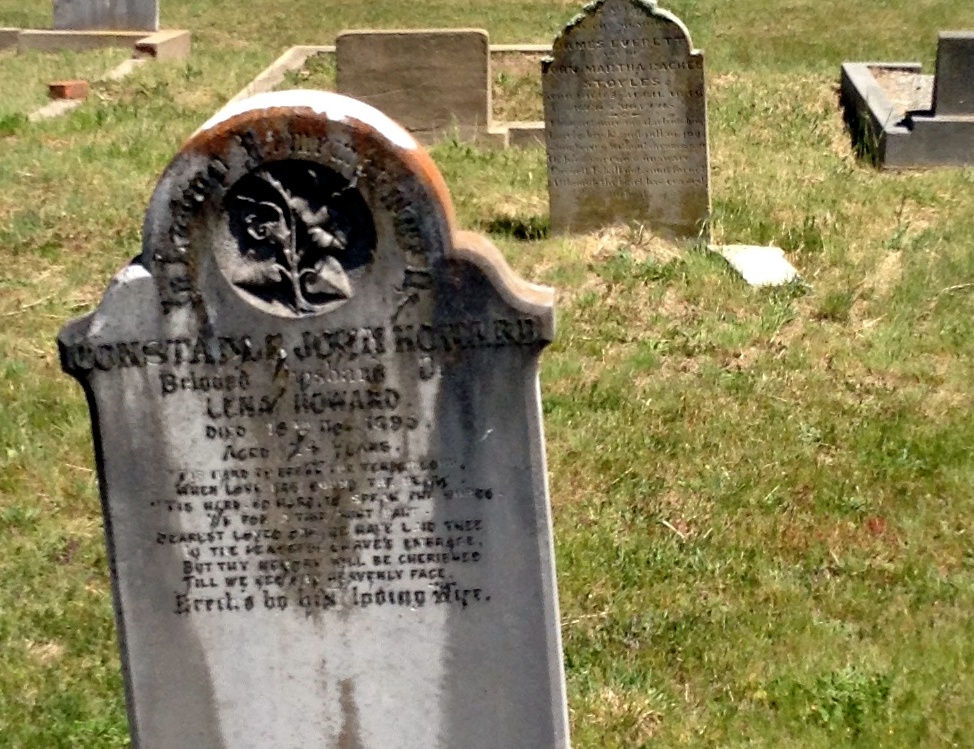
INSCRIPTION: In ? Constable John HOWARD Beloved husband of Lena HOWARD Died 15 th Nov 1895 Aged 24 years Line: ? Line: When love Line: Tis Line: ? Line: Dearest ? ? ? ? laid there Line: By the ? ? ? Line: But thy ? will be ? Line: Till we ? Line: Erected by his loving wife
[alert_red]John is NOT mentioned on the Police Wall of Remembrance[/alert_red]
Grave location:
The following article appeared in the South Australian Register of 16 November, 1895.
SUICIDE OF A CONSTABLE – Sydney, November 15.
Constable John Howard shot himself at Braidwood in unusual circumstances today. He was the plaintiff in a slander case against A. Graham and claimed £200 damages. Damages amounting to a farthing were awarded, and Judge Fitzhardinge remarked that according to the evidence the plaintiff had no character to lose. Howard at once returned to the barracks and shot himself.
At the time of his death the constable was stationed at Braidwood.
A shocking tragedy occurred at Braidwood on Friday, when Constable John Howard shot himself through the right temple with a police service revolver.
Howard was the plaintiff in a slander action against A. Graham, which was heard at the District Court on the same morning ; £200 damages were claimed.
A large amount of evidence was taken, and the Judge gave a verdict for the plaintiff, with one farthing damages without costs.
His Honor explained that, although there was no truth in the particular slander complained of, he must find for plaintiff. Yet the evidence of another witness, who admitted certain matters in connection with Howard, was such that he could not give damages.
After the case Howard walked out of the court, and went to the police barracks. There he met the black tracker in charge of the constables’ room, and told him to tell his wife the result of the case.
Howard apparently shot himself immediately afterwards.
On the black tracker‘s return with the message from Mrs. Howard to her husband to come to her, he found the constable lying on the floor with the revolver beside him. Death was instantaneous.
Howard had charge of the lockup, which is about seventy-five yards from the scene of the tragedy.
Kiama Independent, and Shoalhaven Advertiser (NSW : 1863 – 1947), Tuesday 19 November 1895, page 4
A CONSTABLE SHOOTS HIMSELF.
A painful sensation was caused at Braidwood on Saturday by the suicide of Constable John Howard under peculiar circumstances.
At the District Court, before Judge Fitzhardinge, Howard had sued a local resident for alleged slander, claiming £200 damages.
During the hearing of the evidence some disclosures were made against Howard‘s character, and his Honor commented adversely on his conduct.
A verdict for plaintiff for one farthing damages without costs, being returned.
Howard immediately left the courthouse, walked to the barracks, a short distance away and apparently took a loaded six chambered revolver from the armoury, and fired it into his temple, blowing out his brains, and dying instantly.
The deceased had sent the black tracker, who saw him last, on a message.
The tracker returned in a few minutes, and found Howard lying on the floor dead, with the revolver beside him.
Horsham Times (Vic. : 1882 – 1954), Tuesday 19 November 1895, page 4
SINGULAR SUICIDES.
Constable John HOWARD shot himself at Braidwood, N.S.W. under unusual circumstances on Friday.
He was plaintiff in an action for slander against A. Graham, and claimed £200 damages. Damages amounting to a farthing were awarded.
Judge Fitzhardinge remarking that according to the evidence the plaintiff had no character to lose.
Howard at once left the court, sent a message to his wife announcing the result of the case and shot himself.
At the inquest the following letter, written by the deceased just before he died, was read :
“To My Darling Wife, Children, Mother, and all at Home. – I cannot face the world after what has come out today. Forgive me for what I am about to do. Good-bye to all. J.H.”
A very high character was given to the deceased by his superior officer, and no complaints have ( says the Argus ) ever been made against him here.
Goulburn Evening Penny Post (NSW : 1881 – 1940), Saturday 16 November 1895, page 2
Suicide of a Constable at Braidwood.
BRAIDWOOD, Friday. – A shocking tragedy occurred here to-day, when Constable John Howard shot himself through the right temple with a police service revolver.
Howard was the plaintiff in a slander action against Albert Graham ( a local resident ), which was heard at the District Court this morning; £200 damages were claimed.
A large amount of evidence was heard.
His Honor explained that, although there was no truth taken, and the Judge gave a verdict for the plaintiff, with one farthing damages without costs, in the particular slander complained of, he must find for plaintiff. Yet the evidence of another witness, who admitted certain matters in connection with Howard, was such that he could not give damages.
After the case Howard walked out of the court, and went to the police barracks. There he met the black tracker in charge of the constable’s room, and told him to go and tell his wife the result of the case.
Howard apparently shot himself immediately afterwards. On the black tracker‘s return with the message from Mrs. Howard to her husband to come to her, he found the constable lying on the floor with the revolver beside him. Death was instantaneous.
Howard had charge of the lookup, which is about seventy-five yards from the scene of the tragedy. The affair has created quite a sensation.
Howard leaves a widow and two young children.
[ Deceased was stationed in Goulburn about two years ago, and married a Miss McKenzie, who was employed at Bryant’s Hotel.] –
An inquest was held this evening by Mr. J. W. Bunn, the coroner, on the body of Constable Howard.
The jury returned a verdict that the deceased shot himself while temporarily insane.
In his pocket was found the following letter written previous to his committing the rash act :- ” To my darling wife and children, mother, and all at home. — i cannot face the world after what has come out to-day. Forgive me for what I am about to do. Good.bye to all. – J.H.”
A very high character was given him by his superior officers, and no complaints were ever made against him during the four years he was in the police force.
It was mentioned in the evidence that deceased was of a very sensitive disposition.
He was a native of Newcastle, where his parents reside.
Constable John Howard, who shot himself at Braidwood on Friday, was a native of Wallsend, where his parents still reside.
Prior to joining the police, a little over three years ago, he assisted his father, who is a dealer, and was also a member of the 4th Regiment.
He had an unblemished record, and in a measure owed his appointment to the police force to the excellent recommendation given by ex-Sergeant Grennan ( Regd # Q 1350 ), the officer then in charge of the Wallsend station.
The officer under whom he served also gave him a very high character, stating that no complaints were ever made against him during the time he was in the force.
At the inquest which was held by Mr. J. W. Bunn, the coroner, the jury returned a verdict of suicide while temporarily insane.
The following pathetic note was found in the deceased’s pocket : ” To my darling wife and children, mother, and all at home. I cannot face the world after what has come out to-day. Forgive me for what I am about to do. Good-bye to all. J.H. ”
Goulburn Evening Penny Post (NSW), Thu 21 Nov 1895,
Page 2
The Funeral of the late Constable Howard.
The funeral of Constable Howard took place on Sunday afternoon last. No better indication of the esteem in which the deceased was held in the town
and the deep sympathy which was felt for his widow and children in their terrible bereavement could be found than the large attendance which assembled to pay their last tribute of respect to his remains.
The gathering was representative of every interest in the community. Not alone in this direction did public feeling find expression, but numerous wreaths and crosses were forwarded by many people in the town whose pulse had been deeply moved by the distressing circumstances under which the deceased met his
death.
Mr. Howard, senr., who resides at Wallsend, in the Newcastle district, where he is in business, and a sister and two brothers of Mrs. Howard were the chief mourners.
They arrived in town on Saturday morning, and, as may readily be imagined, were deeply shocked at the distressing nature of the tragedy which had cast such a gloom over the town.
The coffin was borne to and from the hearse by two of Constable Howard’s late comrades, who by the way selected the site for the grave in the Church of England portion of the cemetery.
The Rev. J. S. Dobson conducted the service at the grave in a most impressive manner, and at its conclusion briefly addressed the large assemblage, referring to the exceptionally sad circumstances under which they had met together, and expressing his warmest sympathy with the heart-stricken widow and fatherless children in their sad bereavement.
The rev. gentleman dwelt warmly on the circumstances which led to Constable Howard’s death. He said he owed his death to the vile breath of slander, which had blasted more reputations and caused more misery and heartburnings than could ever be repaired.
He earnestly exhorted those present to keep their tongues from lying and slandering and their minds from evil thinking, in other words, he said, people should mind their own business.
If every one of them, he added, had every one of their little errors and sins they had committed placarded on their backs or proclaimed from the housetops, there were none who would not hang their heads in shame. The rev. gentleman went on to refer to the deceased as a capable and zealous officer, a man who always did his duty, however unpleasant it might be to his feelings, fearlessly and intelligently, and had earned for himself not only the respect of his superior officers, but the esteem of all respectable townsmen.
He had made a mistake-and all were liable to make mistakes-but he would say to them in the words of our Blessed Master when He was rebuked by the multitude for speaking words of comfort to the adultress, “Let him who is himself without sin cast the first stone.”
The stone at the grave was a most impressive and pitiful one.
The widow of the deceased utterly collapsed, and during the course of the church service and Mr. Dobson’s subsequent remarks, numbers of women wept freely, while tears bedimmed the eyes of not a few of the male portion of the large crowd, whose hearts were touched by the inexpressibly sad circumstances under which John Howard parted with this life.
The members of the deceased’s family must have derived a large amount of satisfaction-if indeed it is possible to experience such a feeling under circumstances of such a melancholy character-from the fact that they unquestionably had the heartfelt sympathy of the large crowd assembled round the grave.
IN addition to the particulars given in our last, we gather the following details from the Braidwood Dispatch.
The action in the district court tried on Thursday before his Honor Judge Fitzhardinge was brought by deceased, John Howard, constable of police, stationed at Braidwood, to recover from Albert Graham the sum of £200 damages for slander.
Mr. Ross for plaintiff and Mr. Davidson for defendant, who pleaded not guilty and justification.
The slander consisted of statements alleged to have been made to the effect that the plaintiff had pulled a girl about and that he had had to square the matter with her father for £10. In her evidence the girl denied that this had occurred, and plaintiff also denied it.
Statements in relation to plaintiff’s conduct towards other girls came out in evidence, but formed no portion of the charge of slander.
One of these girls, aged sixteen, admitted that Howard had seduced her; this he denied.
The judge in giving his verdict said he was quite satisfied that the evidence of the witnesses in Araluen as to the statements Graham made concerning plaintiff and the girl Casey were substantially correct.
Nothing had been shown in the evidence that defendant’s statements were true, and consequently it could not have been in the public interest for Graham to retail this spicy gossip to a meeting of ladies in Araluen.
He consequently had to find a verdict for plaintiff.
With regard to the question of the damage which plaintiff’s character had sustained by the publication of this scandal, he regretted that he had no hesitation in coming to the conclusion from the evidence of the girl Carlon, which was to be believed and which had to be forced from her, that plaintiff had no reputation.
Though he would have to find a verdict for plaintiff he would allow only one farthing damage, without costs.
The following are the particulars of the tragedy itself :
The court was occupied till about half-past eleven o’clock bearing the suit. After the judge gave his decision Howard walked to his quarters at the lockup at the rear of the courthouse.
His wife, who had been suffering great mental anxiety over the case, was lying on her bed taking a rest. Howard sat down beside her. They commenced talking about the case, Howard informing her that the case had gone against him and that he was surprised at the result.
Howard, taking hold of her hand, kissed it, and getting up kissed her face. He then walked out, Mrs. Howard being under the impression that he had gone back to the courthouse. Instead of that he walked to the barracks, some sixty yards away. On Joe Alick, the blacktracker, following him into the room a minute or two subsequently, he found Howard sitting on the corner of the table in the room. Alick spoke to him about the case, and Howard asked him to go and see how his wife was getting on. Alick saw Mrs. Howard, who asked him to go back and tell her husband she wanted him. Alick on his return was horrified to find Howard lying on the floor, apparently dead, with a revolver beside him.
He rushed out and told Constable Clemensha ( most probably Constable Wordsworth CLEMESHA # ‘Q‘ 4655 ) of the occurrence.
Dr. Llewellyn, who happened to be passing was called in and found Howard was dead.
He had evidently taken one of the revolvers from the stand, and placed the muzzle against his right temple, pulled the trigger, and blown out his brains. The bullet entered the temple passed clean through his head and lodged in the wall at the back of him. Death must have been instantaneous.
The following note was found in his waistcoat-pocket:— To my darling wife, children, mother, and all at home, I cannot face the world after what has come out today. Forgive me for what I am about to do. Good-by to all. J.H.
The writing gives a fair indication of the great mental struggle which must have been agitating his brain, an it was not written in nearly so good a hand as he usually writes.
The news created a profound sensation throughout the community.
When the judge was giving his verdict, it could readily be seen that deceased felt his position, keenly-being a sensitive and impulsive man he naturally would-but when he walked out of the Court he did not present the appearance of a man who was going to meet his doom.
The only reasonable assumption is that he became temporarily insane after leaving his wife, and hastily decided to take the course he did.
Universal regret was expressed for Mrs. Howard and her two children, of whom all those who are in a position to know join in saying he was very fond.
The terrible agony Mrs. Howard suffered on hearing of the dreadful occurrence may be more readily imagined than described — also was almost demented, and could not be pacified till she had learned all there was to know.
Howard had been stationed at Braidwood for about fifteen months, coming from Araluen. He was a most painstaking officer, assiduous in the performance of his official duties, courteous and obliging to everyone.
Sub-inspector Langworthy ( possibly William – # Q 1291 ) says that a more zealous officer he had never had under him.
An inquest was held on Friday before the coroner, when a verdict of suicide while laboring under a temporary fit of insanity was returned.
Goulburn Evening Penny Post (NSW : 1881 – 1940), Tuesday 12 May 1896, page 4
BRAIDWOOD.
At the Small Debts Court, on Wednesday, Mrs. Howard, widow of the late Constable Howard, was summoned by Malone Brothers for 30s, coach hire for four passengers to and from Araluen, for which defendant’s husband was alleged to be liable, and through him defendant as executrix of the estate.
A verdict was given for the amount, with 10s costs.
The amount of the claim was defrayed immediately afterwards by a subscription list.
New South Wales Government Gazette (Sydney, NSW : 1832 – 1900), Tuesday 10 April 1894 (No.218), page 2355
THE Bench of Magistrates at Araluen have this day appointed Constable John Howard Bailiff of the Small Debts Court at that place, vice G. Taylor, deceased,— from 2nd instant.