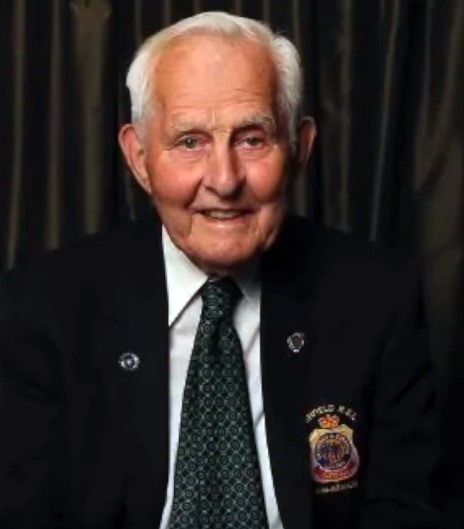
1

Hedley BOVARD

Hedley BOVARD

Queensland Police Force

Regd. # ?

Rank:  Senior Sergeant

Stations?, Nth Queensland in different centres.  O.I.C. – Bundaberg, Maryborough, Acting Inspector at Chllagoe.  O.I.C. – South Brisbane, Hamilton & various other Brisbane stations.

Service:  From  ? ? 1905  to  ?

Awards?

Born?

Died on:  14 January 1928

Cause:  Heart condition

Age:  46

Funeral date?

Funeral location?

Buried at? in Sydney alongside of his 3 brothers & mother


[alert_blue]HEDLEY is NOT mentioned on the Police Wall of Remembrance[/alert_blue] * NOT JOB RELATED

 [divider_dotted]

 Funeral location?

[divider_dotted]

Northern Star ( Lismore )       Thursday  26 January 1928       page 12 of 12

DEATH OF SERGEANT BOVARD

Mr. N. C. Hewitt writes:—         Old residents of Lismore will regret to learn of the death of Sergeant Hedley Bovard, of the Queensland Police Force, who was for over twenty years a resident of Lismore. His death took place at the Mater Misericordiae private hospital, South Brisbane, on January 14th at the early age of 46 years.

The late Senior Sergeant Bovard was a son of the late Mr. and Mrs. Bovard, for many years resident in Ewing Square, Lismore.

Coming to the district when quite a small boy the family for some years were engaged in farming at Goonellabah on the farm now owned by Mr. Alf. James. This was in the latter “eighties.” He was educated at the Goonellabah public school. When the family removed to Lismore, if I mistake not, he entered the employ either of Mr. W. D. Lamotte or of Mr. C. Balzer, who had livery stables in Molesworth-street near the Freemasons’ Hotel.

In 1905 he joined the Queensland police and was for some years stationed in North Queensland in different centres and in difficult situations, afterwards being in charge at Bundaberg and Maryborough. Later he was acting-inspector at Chillagoe, but the climate forced him to apply for a change to the south. Then he was placed in charge at South Brisbane, Hamilton and various other Brisbane stations. His men under him held him in the highest regard.

As one remarked to the writer “If Bo. could not do you a good turn he would never do you a bad one.”

Quite recently Sergeant Bovard developed heart trouble and at the end of September he had to go into hospital. His two sisters, Mrs. Lee and Mrs. Pitt, went up from Sydney and he appeared to make a wonderful recovery. He decided to retire on a pension well earned for service in the climatically unfavourable North.

Early this year the heart trouble returned with dramatic suddenness and his sisters, including Miss Ethel Bovard, were summoned from Sydney when alarming symptoms manifested themselves. His condition rapidly became worse and he passed away peacefully as stated.

His death came as a shock to his comrades as well as to his sisters. The remains were taken to Sydney for interment beside those of his mother and three brothers and were accorded a State servant’s funeral, attended by all the available members of the force.

Sergeant Bovard’s death is a particularly sad one. By his passing the last surviving male member of the Bovard family passes away without leaving a descendant to carry on a name that was honoured in Lismore a quarter of century ago.

Fifteen years ago the family included four strapping sons – young men of fine physique of whose lives one could have taken a lease.

The first break came when Senior Constable Claude Bovard of Wellington Police Force died under pathetic circumstances. Then during the pandemic Cecil (who served his apprenticeship with the Northern Star) of the G.P.O. staff died from influenza, shortly to be followed by his elder brother Percy of the same department, from pneumonia.

Percy was one of the first, if not actually the first telephonist in Lismore.

The shock of losing her three sons was too much for the grief-stricken mother who shortly afterwards was called to her rest. Now the sole surviving son in the prime of life has been carried to that bourne whence no traveller returns.

The deceased gentleman was a devout member of the Church of England. To the bereaved sisters the sympathy of all who remember the family will go out.

This is the third death within six months of sergeants of police in Queensland who hailed from the Richmond RiverSergt. King, Sergt. D’Arcy McDonough and Sergt. Bovard — and it can be written of each that he was a credit to the sons of the Richmond River district who in peace or war have won new fame and glory.

http://trove.nla.gov.au/ndp/del/article/93659129

[divider_dotted]


Arthur Alexander John FORD

 Arthur Alexander John FORD

( late of St James Ave, Glebe )

New South Wales Police Force

Regd. # ?

Rank:  Constable

StationsBathurst, Grenfell, Petersham

Service:  From  to  19 December 1927.  Went onto sick report on 14 December 1927

Awards?

Born?

Died on:  Monday  19 December 1927 about 10am

Cause:  Murder / Suicide – firearm

Event location:  Leichhardt

Age:  49

Funeral date:  Wednesday  21 December 1927

Funeral location?

Buried at:  Presbyterian Section, Rookwood Cemetery


[alert_yellow]ARTHUR is NOT mentioned on the Police Wall of Remembrance[/alert_yellow]  *NEED MORE INFO


 [divider_dotted]

 Funeral location:

[divider_dotted]

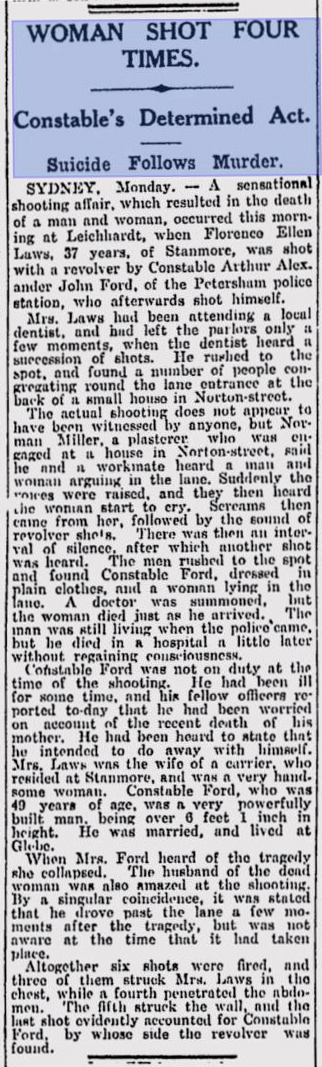
Arthur Alexander John Ford died 19/12/1927 aged 49 from self inflicted gun shot wound to the head. He lived in Glebe with his wife and was stationed at Petersham at the time.

He shot Mrs Florence Laws in a lane way off Norton St, Leichhardt close to Parramatta Road. Mrs Laws lived in Stanmore.

The inquest stated that she was shot twice. Other accounts said that 5 shots were fired. Fords wife stated that he had ‘troubles’ following fractures to the base of his skull and above his left eye (not known if they were job related) and suffered fits of violence.

A couple of letters were not admitted into evidence but it was noted that Ford loved his wife.

Death is due to temporary insanity.

The information came out after the inquest. Unbeknown to Mrs Ford maybe until his final day(s) Ford had ‘known‘ Mrs Laws for some time. In one of the letters that was not read at the inquest he professors his love for his wife and said to her ‘you know all’ I think meaning he told her of Mrs Laws.

The letter that Mrs Laws wrote told of her deep love for Ford and just wanted to be with him. It would appear that on the day of their deaths, she had a dental appointment in Norton St, Leichhardt and she said to the dentist “I have a friend waiting outside”.

A friend says that he would hear the voice of his very young daughter who had died 2 years previously asking him to play a particular tune on the pianola (perhaps due to the affects of his head injuries).

Now comes the finale. He is buried in the Presbyterian section of Rookwood Cemetery. A report in the press has it that just as they finished the readings over his coffin, the coffin of Mrs Laws passed by and she was buried “a few yards” from Ford.

[divider_dotted]

Northern Standard ( Darwin )       Tuesday  20 December 1927       page 3 of 4

STANMORE SHOOTING

Sydney, Monday.

Mrs. Florence Ellen Laws, of Percival Road, Stanmore, wife of  a master builder, was shot dead in a lane off Norton Street, Leichhardt, yesterday morning, following a quarrel with Constable Arthur Alexander John Ford, of Petersham. The policeman is alleged to have killed Mrs. Laws and to have turned the revolver on himself. He also  died. Ford fired five shots, four of which took effect on the woman, who died instantly. Ford was also married. When his wife heard, of the tragedy she collapsed.

http://trove.nla.gov.au/ndp/del/article/48032233#pstart3153593

[divider_dotted]

The Age          20 December 1927       page 9 of 11

The Age 20 December 1927
The Age
20 December 1927

https://news.google.com/newspapers?nid=1300&dat=19271220&id=5-BVAAAAIBAJ&sjid=9dcDAAAAIBAJ&pg=4199,5706836&hl=en

[divider_dotted]

Truth ( Sydney )          Sunday  25 December 1927     page 13 of 20

MYSTERY LETTERS IN LEICHHARDT LOVE SHOOTING

‘MY OWN DEAREST LOVE’ Passionate Expressions to Policeman Who Killed Woman and Then Himself

“ALL MY LOVE UNTIL I SEE MY DARLING!”

MYSTERY letters, pulsating with terms of love and endearment, were found in the pockets of tall, strapping, handsome Constable Arthur Ford when he and Mrs. Florence Laws met death from revolver bullets in a little dead-end lane at Leichhardt on Tuesday morning.   They were all unsigned. Only crosses to denote kisses concluded their amatory passages..

WHO – were these letters from? That is a big question for the Coroner when he delves into   the tragedy that shocked the city, wrecked two homes and took a handsome man and an attractive and sunny-natured woman, from the earth. A wondering, heartbroken wife weeps silently in a little home in Glebe, mourning     the death of her husband.   “A fine man, Mr. Ford,” everyone said. He was big and straight and frank.

But on Wednesday he was buried, having gone from life by his own hand. On the fourteenth of this month he went off duty from the Petersham police station— ill.  The next day he saw a doctor, who prescribed, and gave him a certificate which substantiated his application – for sick leave. His poor health apparently preyed upon his mind — a mind worried a good deal about other things. His mother had died and he mourned her passing. But there was more. And his thoughts turned to a little home in Percival-road, Stanmore, and to a little woman who lived there with her husband and her family.

Constable Arthur Ford and Mrs. Florence Laws were very firm friends and probably more, if the letters were penned by her, then they were lovers — passionately enamored. In her Stanmore home an astonished husband and father grieves at almost   incredible news. Reddened, tear-stained eyes tell of the anguish of three sons, the youngest about 15, and of a pretty   daughter. Their mother was her usual bright and cheery self on Monday morning. She left home, trim, petite, dark and well dressed and called at the grocery store just around the corner in Parramatta road.   She left and walked smartly along Parramatta-road to Norton-street, where she went to the dental surgery of Dentist C. G. Everingham.

She was well-known there as a genial, lovable and striking woman, with a radiant personality and an unfailingly bright outlook on life. The adventure of existence was real to her. She revelled in it, and she had the happy knack of making others feel that life is worth while. At the surgery she submitted a plate to be repaired. It had been broken— by being dropped on to the floor, she explained. It was broken in such a way that a blow on her mouth might have conceivably been the cause. Only a few minutes she had been in the surgery, chatting away, when she excused herself by saying that a friend was waiting outside for her. The pair spoke on the pavement, and he walked along with her about ten yards, leading the way into a little dead end laneway between two houses facing Norton-street.

There the man, 49 years of age, and the woman, who was 12 years his junior, but who looked only 30, had a conversation which will never be known. Something was worrying Ford, and   he told her about it.

Was there another man, – apart altogether from the husband?  Or did he want her to be his own, and give up her home and children? The Coroner will he faced with a difficult task in elucidating this.

Whatever the discussion, they disagreed.   Ford spoke plainly and bluntly.

The woman sensed danger and wanted to get away. In a frenzy he grasped her and tore her clothing. Then she saw the deadly service revolver being drawn out. There was one awful second of realisation. She screamed. In a frightful tattoo five shots barked out in rapid succession, tearing into her body on their work of destruction. The bullets emerged and bespattered the wall. She crumpled up and, with a little murmuring cry, fell dead, the red blood of life pouring from her, staining the green grass that grew along the wall at the side of the lane.

Without any hesitation Ford turned the revolver on himself. Just one shot. It was aimed true, and it seared through his head and brain. He was breathing still when horror-stricken people rushed to the laneway, but he died after being hurried away towards hospital.

Six shots had been fired. Two lives were taken. And a ruptured romance the cause of it all. Just what they were to each other is the problem that at once presents itself. The wife of Ford, attached and devoted to him, was in a state of collapse when police officers had told her the facts of the tragedy.

The husband of Mrs. Laws could shed little light on the matter beyond saying that he had met Ford, had, in fact, been introduced to him by his wife, who told him that Ford had helped her with a punctured tyre one day. Patrolling Parramatta-road, the stalwart constable must have met the woman   in difficulties with her car. She drove herself about and had been a motorist for years, having in her home no lack of anything she desired; good clothes, jewellery, a car, and seemingly no lack of ready cash. Her husband is a master carrier, partner in a business concern.   Whatever their association was it must have been heart whole. If the batch of letters found on the dead man came from the woman. Mr. Laws told the police that the writing was like that of his wife. Many of the screeds were on red ruled foolscap paper. Most had been posted in Sydney, and some in Annandale, but not one bore a signature except the crosses, crosses, crosses.

Sometimes the mystery she who wrote them would add a cross or two to the back of the letter for good measure. ‘My Own Dearest Love,’ was the favored form of introduction.   Then the screed went on to messages of burning affection. “I’m sitting all alone thinking of my sweetheart,” read one. “I’ve been doing that all day. I’ve never been deceitful to you since I’ve known you. . .” and more like that. “I feel I must see you before I go to bed at night, and in the morning I wake up at four or five and think of my loved one . . ” One letter was apparently in reply to a criticism levelled regarding attendance at a dance, or possibly to forestall criticism. “I went to a dance last night,” wrote the mystery woman of the letters. “I danced with only one person all night, and I was wishing that you were with me . . .” And then followed fervent passages addressed to “Dear Sweetheart” speaking of lovely kisses and declaring that if he ever tired of her it would kill her. But apparently, if Mrs. Laws was the writer, poor Ford grew anything but tired of her. His passion seemed to transcend all reason, all restraints.   Two of the letters in the batch are particularly significant regarding an   obviously clandestine association,   and the difficulties of avoiding detection. One letter, with no other date than “Sunday, 5 p.m.,” I read:   “My Own Dearest   Love,— I got   your letter in the box this morning, sweetheart, at ten-past six, early for Sunday morning. I tried to keep awake on Saturday night, so I could hear you pass, but sleep overtook   me.   I woke about four o’clock this morning, and never went to sleep after thinking of you, darling, and of the happy hours we spent together. My Dear Arthur, you still seem to doubt me that I love you. I wish you would not think that. I have proved, dear, how much I do LOVE YOU, and I will never, never give you up. I read your sweet letter over and over again, and loved it. I was thinking of you out in the cold on Saturday night at the dogs. Darling, you must have nearly freezed. Did you ring here about 9.30? Somebody rang, and I thought it might   have been you. Somebody else   answered the ‘phone, and there was no answer. If you ring me on Tuesday let it be after 4. G. goes then. All my love and thoughts till I see my darling. X X X X X x F.L. x x xxx The F.L., thinly traced in a multitude of kisses, seems to have been the only attempt at signature. Both letters were capitals.

Another letter spoke of the suspicions that had been raised by the association of the writer and the Constable.

Dated only ‘Sunday,’ in much the same way as the other, it read:— My Own Dearest Love,— I’ve been thinking of you, love, since I saw you yesterday. You shouldn’t have come over to the car to speak to me after what I told you in the morning. I was that upset I didn’t know what I was talking about. Arthur, dear, you ought to have a little consideration for me when you know how I’ve been talked about. I Just feel I could clear a thousand miles away. Darling, when you see the little kid, N, I mean, don’t ask about me. I will tell you why when I see you. I will try and see you on Wednesday at lunch-time. I will drop you a note before then, sweetheart. All my love till I see you, dear. Then followed those little crosses that mean kisses – thirteen of them. An unlucky number !

http://trove.nla.gov.au/ndp/del/article/168681165?searchTerm=florence%20laws&searchLimits=l-decade=192|||l-year=1927|||l-month=12#pstart16113201


[divider_dotted]

The Sydney Morning Herald      Friday  13 January 1928     page 12 of 20

LEICHHARDT TRAGEDY.

CONSTABLE “UNDOUBTEDLY INSANE.”

CORONER’S VERDICT.

” There cannot be the slightly doubt that Ford was suffering from some temporary insanity, ” said the Acting City.

Coroner (Mr. Flynn) at the conclusion yesterday of an inquiry into the death, on the morning of December 19, of Arthur Alexander John Ford, aged 49 years, a police constable, stationed at Petersham, and Mrs. Florence Ellen Laws, aged 37 years, of Percival-road, Stanmore, in a lane off Norton-street, Leichhardt.

The evidence was to the effect that Ford, after a quarrel with Mrs. Laws, drew his service revolver, and fired two shots at her, killing her instantly. He then turned the weapon on himself, inflicting a wound in the side of the head, from the effects of which he died a few minutes after admission to the Royal Prince Alfred Hospital.

Summing up the evidence, Mr. Flynn said the letters left behind by Ford showed that he regarded his wife with deep affection. All the evidence indicated that be was subject to an increasing mania for some time before his death, and the tragedy had occurred in one of his fits of violence.

Linda Beatrice Ford, wife of the constable, said that he had suffered, some considerable time before the occurrence, two fractures of the skull, one at the base and the other over the left eye. Shortly before the tragedy, he had continually complained of gnawing under the points of fracture. Witness had also noticed a change in his mental disposition. One night, seated at the pianola, he had asked for the roll “Rock of Ages,” stating: “Margery is calling me to play it.” Margery, witness explained, was an adopted daughter, who had been dead two years. On December 18 Ford told witness that he had a confession to make, and spoke of a woman named Florrie. Ford was perfectly sober when he left home on the morning of the tragedy. He was not a heavy drinker.

At this stage a letter was produced, and objected to by counsel for the relatives. In upholding the objection, Mr, Flynn said Ford was obviously insane when he wrote it. It was addressed in very affectionate terms to his wife. Another letter, found on the dead man, was not admitted, the Coroner explaining that it was a letter, couched in affectionate terms, from a certain person to Ford.

The Coroner found, that Mrs. Laws died from the effects of bullet wounds inflicted on her by Ford whilst he was suffering from some temporary mental aberration, and that Ford died from wounds self-inflicted whilst in the same condition of mind.

Mr. Sproule (of Messrs. R. D. Meagher, Sproule, and Co.) appeared for the relatives of Ford; Mr. Thomas Green for the relatives of Mrs. Laws; and Inspector Horsell for the police.

http://trove.nla.gov.au/ndp/del/article/16433671#pstart1204768


[divider_dotted]


The Braidwood Review & District Advocate

Tuesday  3 January 1928    page 4 of 8

STRANGE COINCIDENCE

When Constable Ford murdered Mrs. Laws and then shot himself at Leichhardt recently, he completed a tragic triangle of death.   He was the third constable who has served at Grenfell to die by violence.

Constables Claude Bovard and George J. Duncan were the other two.  Over ten years ago Ford and Bovard served together at Grenfell, and Duncan was stationed there soon after they left.

http://trove.nla.gov.au/ndp/del/article/119404489


[divider_dotted]


Albert Ernest CARLYLE

Albert Ernest CARLYLE

New South Wales Police Force

Regd. # ?

Rank:  Constable

Stations?, Lawson, Lismore ( Lockup Keeper )

Service:  From  ? about 1930  to  6 March 1952 = 22 years of Service

Awards?

Born?

Died on:  Thursday  6 March 1952

Cause?

Age:  42

Funeral date:  Sunday  9 March 1952 @ 1.30pm

Funeral location:  St. Andrew’s Church of England, Lismore

Buried at:  Lismore Church of England cemetery ( Lismore Memorial Gardens )


[alert_yellow]ALBERT is NOT mentioned on the Police Wall of Remembrance[/alert_yellow]  *NEED MORE INFO


 [divider_dotted]

 Funeral location:

[divider_dotted]

Northern Star  ( Lismore, NSW )          Friday  7 March 1952          page 4 of 8

Sudden Death Of Constable

Lismore Police Station lockup keeper, Constable Albert Ernest Carlyle died last night while on his way to Sydney on the Brisbane Express.

Const. Carlyle was travelling to Sydney to enter the police ward at Prince Henry Hospital for medical treatment.

He died while the train was nearing Wauchope.

Const., Carlyle has been a member of the N.S.W. police force for more than twenty years. He has been stationed at Lismore for four years.

He is survived by his widow four sons and a daughter.

http://trove.nla.gov.au/ndp/del/article/96548039?searchTerm=albert%20carlyle&searchLimits=l-decade=195#reloadOnBack

[divider_dotted]

Northern Star  ( Lismore, NSW )          Saturday  8 March 1952          page 4 of 9

CONSTABLE A. E. CARLYLE.

The death occurred on the train at Wauchope on Thursday night while travelling to Sydney to enter hospital for medical treatment of Constable Albert Ernest Carlyle, 42, a police constable attached, to the staff of the Lismore Police Station for the past four years.  During the short period he has resided in Lismore, Constable Carlyle had become particularly well known in the district and made many friends. He was very well known among the bowling fraternity in the Northern Rivers, and as a member of the Lismore City Club achieved much success as a player. When 20 years of age, Constable Carlyle joined the police in Sydney and served in various metropolitan districts.

He was particularly well known, in the Paddington and Bondi districts, and was attached to the police station at Lawson for four years prior to coming to Lismore.

A widow, four sons and a daughter survive. They are Ronald, Raymond, Kevin John and Joyce.

His funeral will leave St. Andrew’s Church of England, Lismore, on Sunday, after a service commencing at 1.30 p.m., for the Lismore cemetery.

Lismore Police today will accord full funeral honours to the late Constable Carlyle.

Inspector J. E. Forsyth said last night that four motor cycles and 20 uniformed police would precede the hearse through the main part of the city.

[divider_dotted]

Funeral Notices.

CARLYLE. — The FUNERAL of Constable ALBERT ERNEST CARLYLE, of the staff of the Lismore Police Station, will move from St. Andrew’s Church of England,  Lismore, TOMORROW (SUNDAY), following a service commencing at 1.30 p.m. for the Church of England portion of the Lismore cemetery.

WILL RILEY & SON,

Funeral Directors.

http://trove.nla.gov.au/ndp/del/article/96548162?searchTerm=albert%20carlyle&searchLimits=l-decade=195#reloadOnBack

[divider_dotted]

Northern Star  ( Lismore, NSW )          Monday  10 March 1952          page 6 of 8

OBITUARY

40 Police March In Funeral Tribute

Police officers from all parts of the Lismore Police District, representing stations throughout the Richmond and Tweed River districts, paid a tribute at the funeral in Lismore yesterday of their comrade, Constable Albert Ernest Carlyle.

A member of the staff of the Lismore station, Constable Carlyle collapsed and died while on his way to Sydney seeking specialist attention.

Inspector J. E. Forsyth, Inspector in charge of the Lismore Police District, marched with about 40 members of the force in front of the hearse through the streets of the city, escorted by four police motor cyclists.

The police officers were transferred to cars at the intersection of Conway and Dawson Streets and paid a further tribute in the Lismore Church of England cemetery, where they formed a guard of honour and preceded the casket to the graveside.

The Rector of Lismore, Rev. J. V. Robinson, conducted a service in St. Andrew’s Church of England and also officiated at the cemetery.

Many representatives of district bowling clubs attended the funeral, and the president of the N.R.D.B. Association, Mr. W. Blair, represented that body.

The casket was draped with the Union Jack and was  carried at the church and cemetery by six senior constables.   They were Constables G. Barwick (Ballina), W. Botterill  (Alstonville), K. Clark (Broadwater), H. T. Radnedge (Mullumbimby),  J. P. O’Neill (Lismore) and H. McDonald (Casino). Constable N. Patterson, of Tabulam, was in charge of the police movement in the cortege.

The wreaths were carried by Messrs. J. G. Hicks (president), C. Brossman (secretary),  G. Brown, J. A. Mariangon, H. Riddle, J. Charleston, D. Wotherspoon (City Bowling Club), R. Coombes, N. C. McGuiness (South Lismore Bowling Club), T. Smith, F. Andrews and W. Blair (N.R.D.B.A. president).

The funeral arrangements were carried out by Will Riley and Son.

http://trove.nla.gov.au/ndp/del/article/96507496#pstart10167962

[divider_dotted]


Peter Ronald LINCOLN

Peter Ronald LINCOLN

 New South Wales Police Force

Regd. # 11598

Rank:  Commenced Training at Redfern Police Academy on

Probationary Constable – appointed 16 August 1965

Constable – appointed

Constable 1st Class – appointed

Senior Constable – appointed

Sergeant 3rd Class – appointed 28 July 1981

Sergeant 2nd Class – appointed


Sergeant 2nd Class – Retired

Stations:  Warilla HWP, Wollongong HWP, Wollongong GD’s

Service:  From  to  ?

Awards:  National Medal – granted 15 April 1981 ( SenCon )

1st Clasp to National Medal – granted 28 May 1992 ( Sgt )

2nd Clasp to National medal – granted 4 September 2001 ( Sgt )

Born:  Saturday  18 May 1946

Died on:  Tuesday 14 April 2009

Cause:  Heart attack

Age:  62 years, 10 months, 27 days

Funeral date:  Wednesday  22 April 2009

Funeral location:  Wesley Uniting Church, Crown St Mall, Wollongong

Buried at:  Cremated

Sergeant Peter Lincoln


PETER is NOT mentioned on the Police Wall of Remembrance * NOT JOB RELATED


 Funeral location


 Peter Lincoln – Funeral pamphlet


Peter Lincoln giving a Send Off speech to Mark Luchetti & Eric Renes on 10 February 1989
Peter Lincoln giving a Send Off speech to Mark Luchetti # 16913  & Eric Renes # 19791 on 10 February 1989


Harry Desmond TUPMAN

 Harry Desmond TUPMAN  QPM

( late of Ashfield, NSW )

Husband to Yvonne TUPMAN, nee ROBERTSON, NSWPF Police Woman # ???

Father to Judge Robyn TUPMAN

New South Wales Police Force

Regd. # 5450

Rank:  Commenced Training at ? Academy on Monday 11 November 1946 ( aged 25 years, 9 months, 6 days )

Probationary Constable – appointed ? ? ?

Constable – appointed ? ? ?

Detective – appointed ? ? ? ( YES )

Constable 1st Class – appointed ? ? ?

Senior Constable – appointed ? ? ?

Sergeant 3rd Class – appointed ? ? ?

Sergeant 2nd Class – appointed 1 April 1968

Sergeant 1st Class – appointed ? ? ?

Inspector 3rd Class – appointed 7 January 1976


Final Rank:  Detective Inspector – Retired


Stations?, 21 Division, Arson Squad, Special Crime Squad, Homicide Squad


ServiceFrom 11 November 1946  to  4 February 1981 = 34 years, 2 months, 24 days Service

Age at Retirement: 59 years, 11 months, 30 days

Years in Retirement:  34 years, 2 months, 3 days ( was Retired just about as long as he Served )


Awards:  Queen’s Police Medal ( QPM ) for Gallantry ( Imperial ) – granted 3 June 1978 ( Insp )


Born:  Saturday 5 February 1921

Died on:  Tuesday  7 April 2015

Cause:  Alzheimer’s disease

Age:  94 years, 2 months, 2 days

Death location:  Hospital

Harry Desmond TUPMAN, Harry TUPMAN
Harry Desmond TUPMAN QPM

Funeral date:  Monday  13 April 2015 @ 2pm

Funeral location:  Magnolia Chapel, Macquarie Park Crematorium, Plassey Road, NORTH RYDE

Buried at:  Cremated


HARRY is NOT mentioned on the Police Wall of Remembrance * NOT JOB RELATED


 Location of Funeral


TUPMAN, Harry Desmond, QPM
Detective Inspector (Retired) NSW Police
05.02.1921 – 07.04.2015
Late of Ashfield

Loved husband of Yvonne for 65 years. Beloved father of Robyn and Lyn and father-in-law of Geoff Graham. Proud and treasured grandfather of Jessica, Paul, Emily, Aleisha and Tom and great grandfather to his namesake, Harry. Younger brother of Kath, Connie and Peggy (all deceased) and brother-in-law of Eric Robertson.

A gentleman and a man of integrity. He will be missed by his family and friends and will be remembered always.

Aged 94 years.

HARRY’S family and friends are warmly invited to attend a Celebration of his Life to be held Monday (April 13, 2015) in the Magnolia Chapel of the Macquarie Park Crematorium, Plassey Road, North Ryde to commence at 2pm.

TREVOR LEE & SON
FUNERAL DIRECTORS
Australian Owned
All Suburbs 9746 2949
F.D.A of N.S.W.

Published in The Sydney Morning Herald on Apr. 8, 2015

http://tributes.smh.com.au/obituaries/smh-au/obituary.aspx?n=harry-tupman&pid=174576391


National Advocate ( Bathurst )
Tuesday  25 April 1950                        page 1 of 4

MAN DECLARED HABITUAL CRIMINAL

Companion Warned

SYDNEY, Monday: Judge Lloyd in the Quarter Sessions today declared a 24-year-old shopbreaker an habitual criminal, and warned a younger man that he was heading for a similar punishment.

Norman Benaldo Brazemall ( 24 ) and Alwayn John Howard, ( 19 ), pleaded guilty to five shop robberies.

Judge Lloyd sentenced Brazemall to three years and declared him an habitual criminal. He sentenced Howard to two years.

Detective Harry Tupman, of 21 Division, said that both men had been released from gaol in February. They had almost immediately begun a series of robberies, using stolen motor cars.

Brazemall had had convictions since he was 15 and Howard’s convictions went back to 1947.

http://trove.nla.gov.au/ndp/del/article/161200306


The Sydney Morning Herald
Saturday  2 June 1951  page 36 of 36
TUPMAN (nee Robertson). — May 25, at Crown Street Hospital, to Yvonne and Harry — a daughter (Robyn).
http://trove.nla.gov.au/ndp/del/article/18223470

The Australian Women’s Weekly
Wednesday  26 July 1972   page 6 of 104
By KAY KEAVNEY

The MYSTERY of MARY and EMMA GOFFMAN

Ben Goffman returned to his home at Mosman, N.S.W., from an average working day last summer. His wife and youngest daughter were not   there. They have never been seen since. Here are the clues in a tragic story for which the police ending is, temporarily, “missing, believed murdered”.

STRANGERS have bought the house that Mary Goffman made.

Husband Ben used to say, in better times:  ” Look around. This house is Mary. ”

Last February 11, in broad daylight, with her little daughter Emma, Mary disappeared from the white house in the quiet suburban street on the north side of Sydney.

It may have been the scene of their murder.

On July 1 police informed Ben that the “grave fears” he had entertained from the first appeared to be justified.

Mary and Emma were almost certainly dead. So was their probable killer, Robert John Hynes.

Thin, dark, and bearded, with convictions for robbery while armed, Hynes died of injuries suffered in a car crash on June 20. while trying to evade police.

He had rented the car in the name of a Missing Person, Allan John McColm.

In the wreck, in a briefcase, police found a sawn-off rifle, and certain property of Allan McColm’s.  Later, after an anonymous tip, they found McColm’s body in bush at the side of the Mona Vale Road.  He had been shot through the head with a bullet from the same sawn-off rifle.

( During the long months of uncertainty, while Mary and Emma too were Missing Persons, Ben often said: ” There’s so much heavy bush on the north side. They could be dead in there, where nobody might ever find them. ” )

There were other alarming developments.

When Hynes was taken from the wreck, a telephone number was inked on his hand.

Police traced it to a housewife at North Curl Curl, also on the north side. She told a terrifying story.

On June 16 a man had telephoned in the name of a well-known carrying company. He was checking, he   said, that someone would be at home to help him with a heavy parcel.

The housewife was instantly suspicious. She was expecting no parcel, and said so.

But in due course the man appeared. He was thin, dark, and bearded.

The housewife let him leave the heavy parcel. But she resisted every pretext he gave to get inside the house.

That parcel contained sand. The man she has now identified as Robert John Hynes.

Her quick wits that day had probably saved her life.  But how often, the alarmed police wondered, had Hynes used this ploy and succeeded’?

In Hynes’ house at West Ryde, they found certain names and telephone numbers. Allan McColm’s was among them.

So, on a slip of paper, was B. C. Goffman’s.

The detectives called for the Missing Persons file on Mary and Emma.

What they read deepened their fears. On July 1 they cabled the English police to contact Ben.

By then, the house that Mary made had been sold to strangers. Over the months, Ben had found it increasingly unbearable to live there.

And besides, he needed money.

Since February, desperate to turn up information, he had spent hundreds of dollars on advertisements.

He had even employed a private detective.

And on that afternoon of February 11 when his loved ones disappeared, a “bearded man” had gone to his bank with two cheques signed by Mary.

They cleaned the Goffman’s joint account of all   $44.

Ben needed money badly.

Late in June, broken in heart and health, he went back to his native London.

Jane (9) and Sarah were soon to follow.

Teddy the dog, beloved of Mary, had been found a new home.

Mary’s elderly mother, pencil-thin from the months of anguish, still lived about 50 yards up the road from the white house.

But she too planned to leave Australia.

She had never believed for a moment that Mary had willingly left home and family.

But the news, when it came, nearly killed her.

In distant London, Ben reacted bitterly. From the first, he insisted, the police should have regarded the case as a homicide.

On July 3 he rang me.

I never met Mary or Emma, but I heard the story through a mutual friend.

Before he left, I spent weeks, off and on. with Ben, his friends, and family, probing what seemed a impenetrable mystery.

Now, with the link to the man Hynes, we knew at least part of the answer.

But Ben wanted us to publish this story. Some clue might emerge, some reader come up with information that would help solve the rest of the mystery.

Detectives in charge of the case concurred strongly.

Here. then, is what I learnt of the Goffmans, and the known events of that February day.

It was a golden Friday. Second daughter Sarah had just turned six and Mary ( the most devoted of mothers ) was planning a birthday party to be held the next day.

Youngest daughter Emma was small for her age – almost four. Ben describes her as ” build medium, eyes blue, straight hair, light-brown to honey-blonde; probably wearing a short-sleeved navy-blue dress; articulate, trained to quote her name, address, and telephone number. ”

Mary was 43. ” build slim, complexion tanned, height 5ft, 7in., hair brown and greying, speaking with an attractive Border lilt; probably wearing slacks, a yellow   knit top, a distinctive ring, and a man’s Omega calendar watch. ”

She and Ben had been married ten years. It was Mary’s first marriage, his second.

They met on a boat that brought them to Sydney, him from New Zealand, her from the United States. A telephonist, she had lived and worked in several countries since leaving Britain.

She passionately wanted children. In the ten years she had Jane, Sarah. Emma, and a miscarriage.

Friends and neighbors testify that the couple were unusually close. So does Mrs. White, Mary’s mother, who migrated to Australia to be near them.

Mary enjoyed home-making and was good at it, though she suffered at times from ” suburban ennui. ”

Ben handled all the business, including paying the bills and marketing in bulk.

Mary had a very real flair for interior decoration, and turning up bargains in antique shops.

With their own hands, she and Ben transformed the broken-down old house they were paying off at Mosman into a distinctive and charming home.

Dozens of books, records, photographic equipment, testified to the Goffmans’ catholic interests.

So did their friends, ranging (said one of them) “from professors to the man who runs a stall at the city markets; from quiet suburbanites to pot-party goers.”

Last year there was a minor burglary at the house and Mary was nervous. She never went out without double-locking doors and windows and fixing the fly screens.

Nor would she go out, even to garden, without wearing sunglasses.

All these facts have significance in the story.

Throughout, like a leit- motif, is a “bearded man.”

The first mention came from Mary herself, to Ben, her mother, and a woman neighbor, a week before she disappeared.

Ben’s car was advertised for sale. A bearded man (she said) called at the house to inspect it, presumably on foot.

Something about him Bearded man at Goffmans’ house frightened her. She described him to Ben, to her mother, and to a woman friend as “sick.”  He asked her to go with him in the car for a test drive. She refused. (She herself never drove.)

When she suggested he leave his briefcase with her as surety, he appeared to take umbrage and walked off.

( Says Detective-Sergeant Harry Tupman, now in charge of the case: “No wonder he took umbrage. That briefcase probably contained the sawn-off rifle.” )

That same night Ben sold the car to quite another buyer, later paying the cheque into the couple’s joint current account at a local bank.

It turned a deficit into a credit. On that Friday, February 11, the credit stood at exactly $744.

That morning, Ben testifies, all seemed normal when   he left for work. Mary was to deliver Teddy, their airedale, to a dog salon at the Spit for clipping and shampooing.

She and Emma did, around 9 a.m. The salon offered to ring when Teddy was finished.

Mary said not to bother, she’d call back before five.

Nothing in her manner caused remark.

A neighbor who spoke to her walking back found her “perfectly normal.”

The local milkman was waiting to collect his weekly money. He found her “her usual bright self.”

He thinks she was wearing dark jeans and a darkish top (but only a yellow-knit top appears to be missing).

Emma, he thinks, “wore a plain dark dress.”

Mary went into the house and got the money. The milkman gave her change and a receipt. He got into his van and drove away.

He estimates the time at 10.15 a.m.

And no one who knows Mary and Emma has seen them since, or at least has come forward to say so.

They were still (Ben says) in the house at 12.30. He rang from his city office, as he did at least once a day.

He said, “She sounded a bit sick, but she had a period, and both she and Emma had colds. Also we’d been out late the night before.

“She talked a bit about Sarah’s party, and at the end seemed quite bright and normal.”

Around 1.30, the elderly couple next door heard Emma coughing in the yard.

“Shortly after lunch” (the police were told later), a man claiming to be Ben rang the bank with a query about the state of the joint account.

About 2.20. Mary rang her mother.

Mrs. White’s last sight of her daughter had been late on the night before. The Goffmans had been to a dinner party, and the grandmother “baby-sat.” Mary and Teddy walked her home, as they always did, and at the gate Mary kissed her and said. “See you tomorrow. Mother.”

Her manner then was “normal.” Now it was markedly agitated.

She asked Mrs. White to pick up Jane and Sarah after school. This was by no means unusual. What followed was.

“She asked me to bring them hack to my place, instead of taking them home.”  said Mrs. White. “That had never happened before, never once.

“She asked me to keep them there till she called. I thought she must be preparing some surprise for Sarah’s   birthday next day.

“I said. “Yes, of course, dear. But what about Emma’?’

“For about a week, after being on the waiting list for months, Emma had been going to a nearby pre-school in the afternoons. I think Mary must have kept her home that day because of her cold.”

Mrs. White’s voice shook.  “Mary.” she went on, “said, in such a funny way. ‘I’ve got Emma.’ Got. She put an emphasis on ‘got.’

“I said, ‘Mary, are you all right’?’ and she said ‘Yes, Mother’ and hung up.”

And that was the last time anyone has heard Mary’s voice, or at least has come forward to say so.

“I nearly went down,” said Mrs. White. “Only 50 yards away. How I wish I had! But I was afraid she’d think me foolish.”

Some time around three, the elderly woman next door saw “a tall, thin man with a small beard” standing across the road from the Goffmans’, looking toward the house.

“He held a handkerchief up to his face,” she said. ” I watched him for some time. until he noticed me at the window. Then he turned on his heel and walked up the road.

“He made me so nervous I wore all my rings when I went shopping a bit later. On the way, I saw him walking back toward the Goffmans’. ”

There was no sign of him, and all seemed quiet, when she got home around 4.30.  At 4.55, just on closing time, a bearded man entered the Goffmans’ bank and presented two cheques.

Together they totalled $700. Both were signed “Mary C. Goffman.”

The signatures were unmistakably Mary’s. But she invariably added the words: “per B. C. and M. C. Goffman.”  They appeared on neither cheque.  ( Ben: “I’m positive she signed under duress, perhaps from a threat to Emma.  Mary wasn’t businesslike. I think she believed leaving off the extra words would invalidate the cheques.” )

Both cheques were apparently legal.  Even so, the teller referred them to a superior,  who referred them to the manager.  The manager came out and looked at the man. who seemed perfectly at ease.

The bank officers later described him to the police as: “about 30. 5ft. 10in., slim build, dark complexion, dark wavy hair, beard closely cropped, no moustache, dark glasses, well dressed in a dark suit.” ( They have since identified him as Robert John Hynes. )

When the manager saw no sign of Ben or Mary, he rang both the Goffman house and Ben’s office. Neither answered.

Meanwhile, the bank doors had been closed and locked. Still the bearded man seemed unperturbed.

The bank felt obliged to honor the cheques, for $50 and $650. When they paid over the cash, it left $44 in the joint account.

The bearded man asked to be let out by the back door, which led into a Mosman car park.

The bank officers are said to have watched him, intending to note his car number.

But he walked calmly out of the car park and was lost to sight.

Ben Goffman takes up the story: “After work I’d been to the markets to buy vegetables, as I always did on a Friday night.  “I drove up about ten to six in the new car, expecting to find the whole family, including Teddy, at home.

“But the bedroom blinds were drawn and all the windows shut.  “I pressed the front-door bell and it didn’t work. So I got out my key. The door opened right away, which meant it wasn’t double locked. That wasn’t like Mary, if she were going out.

“As soon as I got inside I saw why the bell hadn’t worked. The plastic casing and two of the batteries were lying on the floor, along with some of Emma’s toys.  “The receipt for the milk money and some change were still on the hall table.

All this seemed strange.  “Beside them on the table were her sunglasses.  “I went through to the kitchen and tried the back door. It was locked, but not chained, again not like Mary since the burglary.

” The vitamiser was on the sink, with the remains of some milk in it. It was new, and Mary was fanatical about washing it right after use. Alongside was an empty yoghurt carton. She’d often give Emma milkshake with yoghurt for lunch.

“The kitchen window was shut but not locked, and the flyscreen not replaced properly.  “And the whole knife drawer from the cupboard under the sink was missing.

“Later I found it on the bed in the spare bedroom off the kitchen.

” I couldn’t understand any of it. I thought perhaps they’d all gone down to the dog salon, and drove there via the park.

” The salon had closed at five. When Mary hadn’t turned up as promised, they’d left Teddy at the adjoining vet’s.

” Then I tried Mary’s mother’s, and found Jane and Sarah there, and heard about Mary’s phone call.

” Even then I was puzzled rather than scared. I had no reason to suspect anything sinister. Mother and I took the girls home, thinking it would soon be Emma’s bed time.”

By 8.15, after vainly checking with various friends, Ben was ringing the police, while his closest friend, Ron Poison, tried the hospitals.

The police came, and that night two more names were added to the bulging files of Missing Persons.

” I don’t know what I thought.” Ben said. ” That she’d had some sort of breakdown, all sorts of things. But a breakdown between breakfast and lunchtime? I didn’t know then about the cheques and the bearded man.”

Next morning, late, he rang nine little girls, to cancel Sarah’s birthday party.

He and Mrs. White, Ben said, searched the house to see what was missing.

” She seemed to have gone just in old slacks and the yellow top, and Emma in the thin navy-blue dress. So far as we could see, she had no purse, no bag, nothing warm for Emma, and was without any sunglasses.”

Mrs. White discovered that one of a pair of highly distinctive large sheets was missing. They were a gift from Mary’s brother in the United States, and would certainly be rare in Australia.

The sheet was a tan color, with a pattern of white flowers on a black grid,   labelled “Vera Collection by Burlington.”

Also missing were the scissors Mary kept in the kitchen.  (A large pair of scissors was found in Hynes’ home, identified as Mary’s by Mrs. White. There was also a broken pair of sunglasses.)

A joint savings-account book containing $600 (held by Mary for her mother) was safely hidden.   But the chequebook was missing.

That was what sent Ben to the bank on Monday morning, to be told about the two signed cheques and the bearded man.

Ben said, “From that moment, I was sure Mary and Emma had come to harm.”

In those days before either of us had heard of Robert John Hynes, many things   puzzled me.

If Mary had the wit to leave off the extra words, why not sign even more incorrectly, to alert the bank?

“I think she tried to.” Ben said. “The cheque immediately preceding those two has never been presented. She could have used it first that day, signing it incorrectly.

“But there were several things in the house signed “Mary C. Goffman.’ The man could have checked with them, and forced her to tear the cheque up.

“So leaving off the initials was the best she could do.”

How did he get the two away, in broad daylight, and without an outcry?

“Mary would do anything,” Ben said, “if he threatened Emma. Or perhaps they were dead when he took them out.”

Always Ben came back to the “bearded man”, who called about the car, and frightened Mary.

At first, the man was to inspect the car at night, when Ben was home.

“Then he rang back and cancelled, ‘because he had to work back at a Parramatta pharmacy’, and arranged to go out to the house when I wasn’t there.

“Afterwards my friends and I, then the private detective, combed Parramatta but we never found that man.”

Ben’s life over those months was torture.

It happened when he was especially tired, closest to breakdown. Very soon he would think: Not Mary. Mary wouldn’t have just run away, deserting Jane and Sarah too, putting him and her mother on this rack, causing Teddy to fret. Not Mary.

Had she broken down? Were she and Emma wandering about in God knew what condition?

One witness thought so. After reading a newspaper story, she identified them as a lost-looking, dirty woman and child she had seen wandering about at Circular Quay.

Ben felt the descriptions didn’t fit. But for a long time afterward, he haunted the Quay.  Deep down, though, he knew the truth from that first moment in the bank, when he heard about the bearded man.

His last words to me before he left were: “That man killed them, and hid them somewhere in the bush.”

Now Ben and the police appeal for aid.

If you observed anything on that February day, or before, or since, which might   be of assistance, please contact your local police or the   Sydney C.I.B. (Tel. 20966).

Det.-Sgt. Tupman: ” Someone may have seen Hynes acting in unusual or suspicious circumstances. He may have used his own car or a stolen one.

” Particularly contact us if you were ever approached, either by telephone or in person, in a similar manner to the North Curl Curl housewife.

“Someone may have seen the missing sheet from the Goffman home, or Mary’s distinctive ring.

” Any information, however slight, may help us to break this case, and who knows how many others? ”
http://trove.nla.gov.au/ndp/del/article/47473545/4906874


The Canberra Times
Tuesday  5 December 1972    page 7 of 24

Missing woman believed murdered

SYDNEY, Monday. – A missing Sydney woman and her three year-old daughter are believed to have been murdered by a man killed in a car accident while being pursued by police on June 16 this year, police said today.

The Senior City Coroner, Mr K. M. Waller, SM, today opened a magisterial inquiry into the disappearance of Mrs Mary Crozier Goffman, 43, and her daughter Emma, of Mosman, on February 11.

Detective Sergeant Harry Desmond Tupman, of the Special Crime Squad, told the Coroner he believed that Mrs Goffman and her daughter had been killed by Mr Robert John Hynes.

He said Mr Hynes had been involved in a car accident on June 16 after being pursued by police and had died as a result of his injuries on June 19 in the Royal North Shore Hospital.

Sergeant Tupman said police inquiries had shown that on February 11, two cheques for $50 and $650 had been drawn from the Goffman’s joint account by a man who had later been identified as Mr Hynes by bank officials from a photograph.

The manager of the Mosman branch of the Commercial Bank of Sydney, Mr Henry John Barnard, told the court he had tried to ring Mrs Goffman at work but had been unsuccessful in contacting them.

Mr Barnard said he had initialled the cheques and the money, in $10 notes had been handed to the man.

He said the amount of the cheques, the fact that they were to be presented in cash and that it was not Mr Goffman accepting the money, had worried him.

However, the man’s actions had not revealed any fear and he bad not acted suspiciously.

“I felt at that point that I was satisfied it was all right”, he said.

The hearing was adjourned.

http://trove.nla.gov.au/ndp/del/article/110623865


The Canberra Times

Wednesday  6 December 1972     page 3 of 36

Finding of murder

SYDNEY, Tuesday. – A coroner acting as a Justice of the Peace found today that Mrs Mary Crazier Gofman, 43, and her daughter Emma, of Mosman, died on February 11 this year at the hands of a person since deceased.

The Senior City Coroner, Mr Wallen, SM, said, “But as to the manner and cause of death and place, the evidence does not enable me to say. I further   find that although no bodies have been found I am   satisfied death actually took place”.

He said he was satisfied that they had been killed by Mr Robert John Hynes who, he had been told at an earlier inquiry, had died in Royal North Shore Hospital on June 19 after a car accident while being pursued by police.


http://trove.nla.gov.au/ndp/del/article/110623946


The Canberra Times

Tuesday  9 July 1972     page 10 of 18

Identified

SYDNEY, Monday. —

Police positively identified today two skeletons found at Ingleside on Friday as Mrs Mary Goffman, 43, and her daughter, Emma, 3.

At a coroner’s inquiry on December 5, 1972, Mr K. M. Walker, SM, found the mother and daughter had been murdered by Robert John Hynes, 34, who died in a car accident while being chased by police on June 19, 1972.

http://trove.nla.gov.au/ndp/del/article/110718575


 The Canberra Times

Friday  21 January 1977        page 1 of 24


Sailor, 19, charged over Nowra fire

A junior sailor had been charged by the Navy yesterday afternoon with a number of serious offences in relation to the fire at the Nowra naval air station on December 4, the Minister for Defence, Mr Killen, said in a statement yesterday.

Able Seaman G. J. Trent, 19, of the base, was charged after lengthy questioning at the base yesterday.

A spokesman for Mr Killen said that the man had been charged under the Naval Discipline Act, but no further details of the charges were available yet. He is in naval custody.

12 aircraft

Investigations into the fire, which damaged or destroyed 12 Grumman Tracker aircraft and a hangar, have been in progress since the fire.

Mr Killen said that the investigation had been greatly assisted by the NSW Police Arson Squad, led by Detective Inspector Harry Tupman, Common wealth Police and Navy officers had also inquired.

http://trove.nla.gov.au/ndp/del/article/110836319


‘Relentless’ Harry Tupman – ‘the detective’s detective’ – dies at 94

LEGENDARY detective Harry Tupman, whose arrests included prison escapee and killer Ronald Ryan, passed away yesterday aged 94.


LEGENDARY detective Harry Tupman, whose arrests included prison escapee and killer Ronald Ryan, died yesterday aged 94.

Mr Tupman, the first head of the state’s homicide squad when it was formed in 1977, was known as the “detective’s detective” in the days before CCTV, DNA, the internet and mobile phones made the job easier.

Among his high-profile cases was the tracking down and arrest of Ryan, who had shot and killed a prison officer during an escape from Melbourne’s Pentridge Prison in 1965. Ryan was caught while visiting a woman in Sydney in a car with a boot full of loaded firearms and became the last man to be hanged in Australia.

In 1960, the former detective inspector Tupman solved the kidnapping and murder of eight-year-old Graeme Thorne, whose father had won $£100,000 on the Opera House lottery, the equivalent of more than $5 million in today’s money. The killer, Stephen Bradley, was tracked down after he fled to Sri Lanka and was extradited to Australia.

Mr Tupman was guest of honour at a recent reunion of the elite homicide squad when those who had worked with him as young officers spoke of him as a “super sleuth”, a “relentless hunter” and a meticulous professional. Mr Tupman said at the time that technology would never replace the key to being a good detective, which was to be a good listener.

Mr Tupman had suffered from Alzheimer’s disease and died in hospital, leaving his wife Yvonne, 94, their daughters Robyn Tupman — a NSW District Court judge — Lyn Bardetta, five grandchildren and a great-grandson.


‘Relentless’ Harry Tupman – ‘the detective’s detective’ – dies at 94 | Daily Telegraph


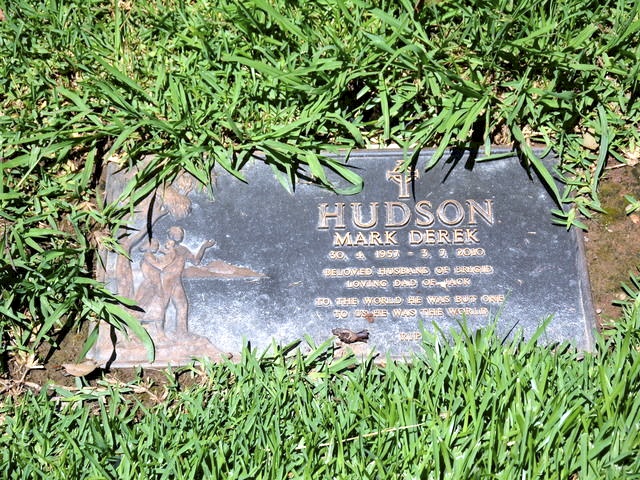
Mark Derek HUDSON

Mark Derek HUDSON

aka Huddo

( late of Mt Annan )

New South Wales Police Force

[alert_yellow]Regd. # 19989[/alert_yellow]

Rank: Probationary Constable – appointed 4 December 1981

Constable 1st Class – appointed 4 December 1986

Senior Constable with many stints as relieving Sergeant between 1990 – 2008.

Retired ( Medical discharge – Chronic PTSD – HOD )

Stations:  No. ( Division ), Burwood, Five Dock, NSW Police Prosecutors, Highway Patrol No 9 Division, Highway Patrol Bankstown / Campsie Patrols, Crime Stoppers Unit, Police Media Unit, Highway Patrol – Mid West / Endeavour Regions ( including Five Dock & Petersham ), Traffic Camera Unit and Traffic Services.

Service:  From  14 September 1981  to  21 August 2008 = 26+ years Service

Awards:  22 November 1991 – COP Commendation for Courage:  Awarded Commissioner’s Commendation – Courageous resolution of a suicide attempt by an armed, disturbed man at Gladesville Hospital.

National Medal – granted 28 August 1997

NSW Police Medal & 2nd Clasp for NSW Police Medal – granted 30 June 2004

1st Clasp to the National Medal – granted 17 May 2007

3rd Clasp for NSW Police Medal – granted 11 February 2009 ( posthumously )

Assistant Commissioner Award ( Traffic ) for outstanding service to the people of NSW in contribution to the reduction of road toll and other Traffic Services as a NSW Highway Patrol Officer.

Born:  30 April 1957

Died on:  Saturday  3 July 2010

Cause: Cancer – Brain ( right side ) Grade 4 Glioblastoma Multiforme ( Diagnosed in October 2009 )

Age:  53

Funeral date:  Wednesday  7 July 2010 @ 10.30am

Funeral location:  St Paul’s Catholic Church,

cnr John & Mitchell St’s, Camden

Buried at:  Sydney Catholic Garden Cemetery, Western Rd, Kemps Creek


Mark Derek HUDSON


Grave location

Lawn Grave: St Andrew area:  R47:  # 5

GPS:  -33.89627130390685, 150.77976189912795


[alert_yellow]MARK is NOT mentioned on the Police Wall of Remembrance[/alert_yellow]  *NEED MORE INFO

[alert_pink]MARK  IS mentioned on the Sydney Police Centre Memorial Wall[/alert_pink] * Added to Wall on Wednesday 26 September 2018

[blockquote]

Memorial:

HUDSON

Mark Derek

30.4.1957 – 3.7.2010

Beloved husband of Brigid

Loving dad of Jack

To the world he was but one

To us he was the world

[/blockquote]

 [divider_dotted]


John William MURPHY

 John William MURPHY

New South Wales Police Force

Regd. # 7436

Rank:  Plain Clothes Constable ( 11 years )

Stations:  Newcastle ( all his service )

Service:  From  20 December 1899  to  7 September 1913 = 14 years

Awards?

Born? ? 1870

Event: Tuesday 2 September & Wednesday 3 September 1913

Died on:  Sunday  7 September 1913

Cause:  pneumonia

Age:  41

Funeral date:  5.30am, Monday  8 September 1913

Funeral location:  Sandgate Cemetery

Buried at:  Roman Catholic portion of Sandgate Cemetery

Catholic 1 Portion, Section 13, Lot 11

Location of Grave: 

GPS:  -32.87081693341898   151.70432472502705

NSW Death Registration # 13497/1913

[alert_red]JOHN is NOT mentioned on the Police Wall of Remembrance[/alert_red]  *BUT SHOULD BE


 [divider_dotted]

 Newcastle Morning Herald & Miner’s Advocate                             Monday  8 September 1913                        page 5 of 8

CONSTABLE JOHN MURPHY.   DEATH IN HOSPITAL.

Plain-clothes Constable John Murphy died in the Newcastle Hospital at half-past five yesterday morning, after a short illness. On Thursday he was admitted to the hospital suffering from an attack of pneumonia. His condition was very serious, and but little hope was held out of his recovery.

Forty-one years of age, Plain-clothes Constable Murphy had had about fourteen years’ service in the police force, during all of which he was stationed at Newcastle, and he had been doing plain-clothes duty for about eleven years.

A smart, capable detective, he was associated as a plain-clothes constable for over eight years with Senior-detective McHattie, and during that time those officers did some very creditable work in clearing up some forgeries and big railway robberies. He was also associated for a time with Plain-clothes Constable (now Detective) Ramsay.

Since the transfer of First-class Detective Surridge from Sydney to Newcastle, ten months ago, Plain-clothes Constable Murphy had been working with him, and they were instrumental in clearing up a number of serious and minor offences. He was popular with his colleagues, and particularly well liked by those with whom he came into immediate contact ; and his good-nature was well-known. On many occasions he has put his hand in his pocket to help even those who had come within the reach of the law. He was also popular with the public, and his death will be regretted by a large circle of friends.

His last duty was with Detective Surridge on Tuesday and Wednesday nights last attending to certain offences that had been committed between Hornsby and Newcastle, necessitating both officers spending two nights in the bush. He complained on Thursday morning of feeling ill on the return journey to Newcastle, and later in the day he was ordered into the hospital.

His father is Mr. Edward Murphy, a grazier, of Collingwood station, Murrumburrah, to whom telegrams have been forwarded. His sister, Mrs. F. Cooper, and her husband arrived at Newcastle yesterday from Sydney.

The funeral will leave the Newcastle Hospital at twenty minutes to three o’clock this afternoon for the Roman Catholic portion of the Sandgate Cemetery. The district police will be present, and Mr. Day, the Inspector- General, last night gave his sanction for the Police Band from Sydney to attend if the members could be notified in time for them to catch the train this morning.

http://trove.nla.gov.au/ndp/del/article/137026937

[divider_dotted]

Newcastle Morning Herald & Miner’s Advocate                             Tuesday  9 September 1913                        page 4 of 8

LATE CONSTABLE MURPHY. THE FUNERAL.

The funeral of Constable John Murphy, who died in the Newcastle Hospital at an early hour on Sunday morning took place yesterday afternoon from the hospital, and the large attendance was a tribute to the deceased’s popularity.

The procession, which attracted hundreds of people along the line of march, proceeded by way of Telford-street, Hunter street, Extended, and Watt-street, to the railway station.

The Newcastle and district police, under Acting Superintendent Banks and Sub-inspector McHardy, to the number of nearly 100, headed the procession, then came the hearse and the general public. The length of the procession may be estimated when it is stated that the front portion had turned into Watt-street before the rear had reached the municipal jubilee memorial in the park.

The pall-bearers were Senior Detective McHattie, Detective Surridge, and Constables A. Roberts and G. Ferguson. Wreaths were sent by Miss Zoe Brady, Mr. Myer Cohen, Mr. and Mrs. E. W. Hough, Mr. and Mrs. J McHattie, Mr. Banfield, Mr. and Mrs. Howden, Mr. and. Mrs. J. Probert, Mr. E. W. Bearby, and the Newcastle and sub-district police. The police also sent a beautiful wreath of immortelles.

The chief mourner was Mrs. Cooper, a sister of deceased. At the graveside, the Rev. Father M Keenan, of St. Mary’s, Newcastle, conducted the service, which was of a most impressive character, the deceased being buried with all the rites of the Roman Catholic Church.

http://trove.nla.gov.au/ndp/del/article/137022758

[divider_dotted]

The Maitland Daily Mercury ( NSW )                Saturday  13 September 1913     page 6 of 12

Constable T. Ryan who for some time has been lockup-keeper at Wallsend, has been appointed to the plain-clothes branch of the Newcastle police, in succession to the late Constable John Murphy. By the way, it is stated as a sad circumstance in connection with the death of the popular officer named, that he was to have been married on the date of his demise.

http://trove.nla.gov.au/ndp/del/article/120458401

[divider_dotted]

This man is NOT recorded on the Police Memorial system but it is apparent, from reading these two articles, that the man contracted pneumonia from direct exposure over two nights in the bush in order to capture offenders.

He returns to his station on the 3rd day, and is directed to hospital where he dies three days later from pneumonia.

That sounds like a duty related death under those circumstances to me.

Cal

25 March 2014 ( 100 years later. )


Gregory Allen RODGERS

Gregory Allen RODGERS

aka  Buck

NSW Redfern Police Academy Class 192 ?

New South Wales Police Force

joined NSW Police as a Junior Trainee – 19 July 1982

( late of Woronora Hts )

[alert_yellow]Regd. # 20847[/alert_yellow]

Rank: Junior Trainee – commenced 19 July 1982

Probationary Constable – appointed 11 March 1983

Constable 1st Class – appointed 11 April 1988

Sergeant – Retired

StationsBurwood Police Boys Club Concert Band ( mid 1970’s ) – Euphonium player, Burwood, 9 Division HWP, 24 Division HWP, Endeavour Region HWP ( Canterbury ( 1985 – ? ), Ashfield

ServiceFrom 19 July 1982  to  2 June 2006 = 24 years Service

Awards:  National Medal – granted 24 March 2000

Born:  28 February 1964

Died on:  early a.m. on Monday  23 March 2015 at Calvary Hospital, Kogarah, NSW.

Cause:  Cancer – Brain – ( ? side ) Grade 4 Glioblastoma Multiforme

Age:  51

Funeral date:  Friday  27 March 2015 @ 1pm

Funeral location:  South Chapel, Woronora General Cemetery & Crematorium,

121 Linden St, Sutherland

Buried at?


[alert_yellow]GREG is NOT mentioned on the Police Wall of Remembrance[/alert_yellow]  *NEED MORE INFO

Greg 'Buck' Rogers & Val Bryant in New Yourk, USA in 2013
Greg ‘Buck’ Rodgers & Val Bryant in New York, USA in 2013

Greg Rogers - A Few Extra Months appeal - 3 September 2014
Greg Rodgers – A Few Extra Months appeal – 3 September 2014

http://www.gofundme.com/dyn36w

[divider_dotted]

Location of funeral

Gregory Rodger funeral pamphlet – 2015

 [divider_dotted]

From the ‘Go Fund Me’ website, to which Greg made 3 Posts from 3 September 2014:

Update #3:  6 months ago.

In January this year I was diagnosed with Grade 4 Glioblastoma Multiforme. I have had Radiotherapy and Chemotherapy . In June this year a portion of a second brain tumour was removed. The standard Chemotherapy used for Brain Cancer has to this date been unsuccessful and the tumour continues to grow. My biggest hurdle at present is the swelling of the brain. An alternative Chemotherapy will help with this swelling and may give me an extra couple of months with my family. There is little or no government subsidy and we have sought help through foundations which have been unsuccessful. I am asking for a small donation from my family and friends to help with the cost of further treatment.

[divider_dotted]

Update #2:  6 months ago.

Thank you again to all the wonderful people who have donated. My health is poor but my heart is healed. The support and love shown by so many people is truly unbelievable.

[divider_dotted]

Update #3:  3 September 2014.

To all the wonderful people out there. Please watch our video.
Thank you


Daniel Bernard MARKHAM

 Daniel Bernard MARKHAM

Late of ‘ Myall ‘, 22 Carey street, Marrickville

New South Wales Police Force

Regd. # ????

RankSergeant

Stations:  Nth Sydney, Traffic Dept, No. 4 Division, Clarence St, No. 4 Division ( Traffic Sgt )

Service:  From  ? ? 1907  to  19 February 1934 = 27+ years Service

Awards?

Born? ? 1884 to Martin & Julia at West Maitland  NSWBDM  24190/1884

Died on19 February 1934

CauseSuicide by pistol stemming from a Nervous Illness

Event location:  Erskinville Street Police Station

Age:  48

Funeral date:  Monday  22 February 1934 @ 1.30pm

Funeral location:  St. Brigid’s Church, Marrickville

Buried atWoronora Cemetery,

Roman Catholic Monumental:  Section 2, position 0680

DANIEL is NOT mentioned on the Police Wall of Remembrance  *NEED MORE INFO


 [divider_dotted]

Barrier Miner ( Broken Hill )

Saturday  20 January 1934   page 8 of 12

SYDNEY, : Saturday. – Sergeant Daniel Markham (48), of Marrickville, was found fatally wounded yesterday in a telephone box in Erskineville street Police Station. A revolver, one chamber of which had been discharged, was beside him. He had recently suffered a severe illness.

http://trove.nla.gov.au/ndp/del/article/49496616

[divider_dotted]

Northern Star ( Lismore )

Saturday  20 January 1934   page 7 of 14

Police Sergeant’s Death

SYDNEY, Friday.

Hearing a report of firearms at Erskine-street lock-up to-night a constable rushed to the front of the building where he found Sergeant Daniel Markham fatally shot through the head. The officer, who was 48, had been in ill-health for a number of years.

http://trove.nla.gov.au/ndp/del/article/94557571


[divider_dotted]

The Sydney Morning Herald

Saturday  20 January 1934   page 14 of 26

MARKHAM. – The Relatives and Friends of the late DANIEL BERNARD MARKHAM ( Sergeant of Police ) are kindly invited to attend his Funeral leaving his late residence Myall, 22 Carey street, Marrickville, Next MONDAY AFTERNOON, at 1.30 o’clock, for Catholic Cemetery Woronora. W. N. Bull, Ltd., Funeral Directors.

http://trove.nla.gov.au/ndp/del/article/17041590

[divider_dotted]

News ( Adelaide )

Saturday  20 January 1934    page 1 of 8

LOYAL TO SERVICE TO THE LAST

SYDNEY. Saturday.- Sgt. Daniel Markham, aged 48, who was found fatally shot in the Erskine Street Police Station yesterday was loyal to his service to the last. Because of a nervous illness the Commissioner of Police (Mr Childs) and the Metropolitan Superintendent (Mr MacKay) frequently suggested that he refrain from duty, but he refused.

http://trove.nla.gov.au/ndp/del/article/128834363

[divider_dotted]

The Sydney Morning Herald

Monday  22 January 1934   page 7 of 16

MARKHAM.-The Relatives and Friends of Mrs. EDITH MARKHAM and FAMILY are kindly Invited to attend the Funeral of her late beloved HUSBAND and their dear FATHER, Daniel Bernard; to leave his late residence, Myall. Carey-street, Marrickville, THIS (Monday) AFTERNOON, at 1.45 o’clock, for the Catholic Cemetery, Woronora. A train leaving Tempe Station at 2.24 p m. will arrive at Sutherland at 2.55 p m.

W. N. BULL, LTD.,

Funeral Directors,

http://trove.nla.gov.au/ndp/del/article/17042105

[divider_dotted]

Catholic Freeman’s Journal ( Sydney )    Thursday  15 February 1934    page 4 of 40

SERGEANT DANIEL BERNARD MARKHAM.

The death took place at Sydney, on the 19th ult., of Sergeant Daniel Bernard Markham, who was attached to No. 4 Division of the New South Wales Police Force. Mr. Markham, who was only 48 years of age, was one of the most popular and efficient members of the Force.   He had been in ill-health for some time, but bravely performed his duties despite his illness.

Being 6 feet 2 inches in height, of magnificent physique, and possessed of a bright and genial disposition he was a popular figure with his comrades and the general public.

Mr. Markham was a devout Catholic and a member of the A.H.C. Guild at St. Brigid’s, Marrickville.  His numerous acts of kindness towards the poor and needy brought him numerous friends wherever he went.

Joining the N.S.W. Police Force in 1907, Mr. Markham was attached to North Sydney Division for some time. He later was transferred to the Traffic Department, and afterwards to No. 4 Division, where he continued to perform traffic duty for many years.

He was a popular figure along the water front, where he handled the heavy traffic with tact and courtesy. As a result Mr. Markham was promoted to the rank of first-class constable, and later to the rank of sergeant. It is safe to say that no promotion was more popular or so well deserved.

From the formation of the Police Association Mr. Markham was president of No. 4 Branch, from 1920 to 1925. The popularity of that branch was to a great extent, due to his personality. He was transferred to Clarence-street Division, where he performed varied duties, and finally was Assistant-traffic Sergeant of that very busy and important portion of Sydney. In January, 1933, Sergeant Markham was sent back to his old Division (No. 4) as Sergeant in charge of traffic there. It was during this latter period that he was stricken with a serious illness. It was hoped that he had recovered, but, to the extreme grief of his devoted wife and young family, death took place as already stated.

Mr. Markham was a native of New South Wales, and a member of a large family, all of whom are devoted members of the Catholic Church.

A Requiem Mass was celebrated at St. Brigid’s Church, Marrickville, on the 22nd ‘ult. The cortege leaving the church proceeded to the Sergeant’s late residence at Carey-street, Marrickville. A police funeral was accorded deceased.

Superintendent Lynch ( representing the Commissioner of Police ). Inspectors Winter, Collings, and Stanton, and a large squad of uniform and plain-clothes police under Sergeant Rodding, were in attendance.

Beautiful and solemn music was rendered by the Police Band as the sad procession wended its way to Woronora Cemetery. Thousands of people watched the sad procession.  The burial took place in the Catholic portion of the cemetery, in the presence of a large number of his old comrades and many prominent citizens.

The last prayers were recited by the Rev. Father Lloyd (Cronulla), who afterwards paid a tribute to the Sergeant’s sterling qualities.

The chief mourners were Mrs. Markham (widow), Master George Markham (son), Misses Dorothy and Joan Markham (daughters), and James, Thomas, Frank, and Vaughan Markham (brothers), Misses Margaret and May Markham, and Mrs. A. Swanson and Mrs. F. Bullivant (sisters).

http://trove.nla.gov.au/ndp/del/article/146406578

[divider_dotted]


John MORROW

John MORROW

New South Wales Police Force

Regd. # ????

Rank:  Sub Inspector

Stations?, Albury, Wagga Wagga, Deniliquin, Wagga Wagga

ServiceFrom  ? ? ?  to  15 September 1866 = ? years of Service

Awards:  No find on It’s An Honour

Born? ? ?

Died on:  Saturday  15 September 1866

Causeaffection of the throat stemming from exposure

Age27 years, 10 mths

Funeral date:  Monday 17 September or Saturday  22 September 1866

Funeral location:  Wagga Wagga

Buried at:  Buried at Wagga Wagga Monumental Cemetery

Reg. # M-05744  Loc:  Ang – R – 4 – 0001


[alert_yellow]JOHN is NOT mentioned on the Police Wall of Remembrance[/alert_yellow]  *NEED MORE INFO


Grave location:

 [divider_dotted]

The Sydney Morning Herald                                                    Wednesday  19 September 1866                                page 1 of 8

Deaths:…..

On the 15th instant, at Wagga Wagga, JOHN MORROW, Esq., Sub-inspector in the New South Wales Police Force, and formerly a Lieutenant in the Royal Longford Rifles.

http://trove.nla.gov.au/ndp/del/article/13137006?searchTerm=inspector%20morrow&searchLimits=l-decade=186|||l-month=9|||l-year=1866|||sortby=dateAsc|||l-category=Family+Notices#reloadOnBack

[divider_dotted]

The Sydney Morning Herald                                              Friday  21 September 1866                               page 5 of 8

DEATH OF Sub INSPECTOR MORROW, – I have the painful duty of recording the death of Mr sub-inspector Morrow at Wagga Wagga, on Saturday last. I fear he may be regarded as another of the victims to the heavy and severe expenditure kept up when the bushranger Morgan was infesting the neighbourhood. A disease of the throat was, doubtless, accelerated and rendered more severe by the exposure thus occasioned, and after trying change of air, after consultation with eminent physicians in this colony and New Zealand, after all that attention and care could do, he sank under its fatal influence.

The Government has lost a conscientious officer, whose efficiency was impaired only by his inability, and the district will lose one to whom may be applied the highest eulogium – a Christian gentleman.

I am not aware of Mr Morrow’s exact age ; he could scarcely have reached what is generally called the prime of life, and was unmarried.

http://trove.nla.gov.au/ndp/del/article/13137161?searchTerm=inspector%20morrow&searchLimits=l-decade=186|||l-year=1866|||sortby=dateAsc|||l-month=9|||l-category=Article#reloadOnBack

[divider_dotted]

Wagga Wagga Express & Murrumbidgee District Advertiser ( NSW )      Saturday  22 September 1866         page 2 of 4

DIED ………..

At Waterview, Wagga Wagga, the residence of F.A. Tompson, on Saturday, the 15th instant, after a protracted and distressing illness, induced by exposure in the prosecution and discharge of his public duty, JOHN MORROW, Esq., Sub Inspector of Police for the district of Wagga Wagga, second son of Hugh Morrow, Esq., of Charlton Lodge, Auckland, New Zealand ( formerly of Coraboola House, County Longford, Ireland ) aged 27 years and 10 months.

He bore his long suffering with the most touching and enduring patience and gentleness and passed away in the fullness of faith and hope.

He died deeply loved and lamented by many, and esteemed by all who knew him.

http://trove.nla.gov.au/ndp/del/article/105998956#reloadOnBack


[divider_dotted]

Wagga Wagga Express & Murrumbidgee District Advertiser ( NSW )      Saturday  22 September 1866         page 2 of 4

Town Talk .- The sythe of the King of Terrors has been busy around us during the last few days, no less than three residents, if not of the town, at least of its immediate vicinity, having, in startling succession, been gathered from our midst. Sombre clothing has met the eye at every turn, blinds have been drawn, shutters have been closed, and long funerals have wound through the streets, creeping slowly on their way to the home of the dead. No wonder then that the town has been gloomy and sad. The death of Sub-Inspector Morrow could not be called sudden, and though the news came, as it ever does, at last with a shock, it was still only what people had long been prepared for, and could not occasion any feeling of surprise. But in the other two cases it was very different.

Even the families of those that are gone were quite   unprepared for the calamities that have visited them, and to others the first tidings that have reached them have been, not of sickness, but of-death. And now in speaking on these topics, we cannot do better than call the attention of our townsmen to the disgraceful state of the cemetery. In the old country the village churchyard is a hallowed spot, invariably kept in the neatest and nicest order, but here we loosly pale in a plot of ground, with a rotten fence, and then leave it to be over run with weeds, or turned into a feeding ground for stray stock. We noticed one day last week a horse grazing there, and trampling at pleasure over the graves. But the presence of an occasional horse, though by no means a creditable circumstance to those whose duty it should be to preserve   the ground from desecration, is but a trifling evil in comparison with the slovenly and illkept appearance of the ground in the whole, and the graves in particular. The fence is delapidated, and the whole place is choked with weeds and coarse grasses. No paths have been formed, and at every funeral the bearers and mourners are compelled to stumble and trample over the graves of those who have been buried before. In some eases these have been trodden down level with the surrounding soil, and in others their appearance is absolutely repulsive from the sinking of the earth as the coffins below have decayed. Several instances may be observed where the soil is cracking and falling in wards from this cause, and in many more it has so sunk down that the site of a grave is often marked by a regular hollow, in which, the water collects in pools after every storm. The cemetery in its present condition is a scandal and disgrace to the town, and immediate steps ought to be taken to place it in something approaching to a decent state. The expense of rooting out the weeds, grubbing up the bushes, placing the fence in good repair, and laying out a few paths, could not amount to very much, and funds would, we believe, be readily subscribed if the slightest effort was made to collect them.

http://trove.nla.gov.au/ndp/del/article/105998953?searchTerm=john%20morrow%20sub%20inspector&searchLimits=l-decade=186|||l-month=9|||l-year=1866|||sortby=dateAsc|||l-category=Article#reloadOnBack


[divider_dotted]


Wagga Wagga Express & Murrumbidgee District Advertiser ( NSW )      Saturday  22 September 1866         page 2 of 4

DEATH OF SUB-INSPECTOR MORROW.   IT is with deep regret we have to announce that, on Saturday last, this indefatigable officer of police breathed his last. Mr. Morrow‘s illness has been of long duration, and was, no doubt, in a great manner, induced by continued campings and exposure in the bush when in pursuit of the ruffian Morgan. Constant wettings and exposure at length brought on an affection of the throat, which so far deprived him of his voice that he was unable to carry on any conversation in higher tones than an ordinary whisper.

After leaving Wagga Wagga, he was for a time stationed at Deniliquin, but some seven or eight months ago he obtained leave of absence, and proceeded to New Zealand on a visit to his relatives, for the benefit of his health. He there received the best medical attendance the colony could afford, and his health so improved that he confidently looked forward to its complete restoration, and to the recovery of his voice, and he, therefore, in May last, returned to his official duties in Wagga Wagga.

The climate here, however, did not seem to suit his constitution, and his health again began to fail. He at first regularly attended to his police duties, but these were, after a time, occasionally interrupted by attacks of illness, which gradually increased in frequency and intensity, until at length he became altogether laid up.

For the last month he has been confined to the house, never seeing anyone but a few personal friends, and at length, on Saturday morning last, the spirit left him.

The deceased gentleman was twenty-seven years of age, and was the second son of Hugh Morrow, Esq., of Charlton Lodge, Auckland, New Zealand, and formerly of Coraboola House, County Longford, Ireland.

The funeral took place on Monday last. Every place of business was either wholly or partially closed, and the procession of those who were anxious to show their respect for the memory of the deceased gentleman, by following his remains to their silent home, was one of the largest ever witnessed in Wagga Wagga.


http://trove.nla.gov.au/ndp/del/article/105998950?searchTerm=inspector%20morrow&searchLimits=l-decade=186|||l-year=1866|||sortby=dateAsc|||l-month=9|||l-category=Article#reloadOnBack

[divider_dotted]


Empire ( Sydney )                                                         Monday  24 September 1866                            page 5 of 8

Our readers will be sorry to hear that Police Inspector Morrow died last-Saturday, at Wagga Wagga, from some affection of the throat. The deceased gentleman was formerly stationed at Albury, where his many good qualities won for him the esteem of a large circle of friends. Inspector Morrow was one of the pluckiest and most efficient officers of the force, and in his indefatigable exertions to capture bushrangers, he met with many hair-breadth escapes.

In fact his death may be attributed to his zeal in the performance of duty; for whilst scouring the country in search of Morgan, Inspector Morrow contracted the disorder which has ever since made him an invalid, and has ultimately caused his death. Camping out in the winter time without covering, for many successive nights, and undergoing all sorts of other privations in the bush, has ruined many an iron constitution; and a man must be something more than human to be able to stand it with impunity.

And so Inspector Morrow has passed away from us, and indirectly we can scarcely help regarding him as one of Morgan’s victims. – Border Post.

http://trove.nla.gov.au/ndp/del/article/60600139?searchTerm=john%20morrow%20sub%20inspector&searchLimits=l-decade=186|||l-month=9|||l-year=1866|||sortby=dateAsc|||l-category=Article#reloadOnBack

[divider_dotted]


The Sydney Morning Herald                                             Wednesday  26 September 1866                             page 5 of 8


initial story is the same as those above but ends:……..

-To the foregoing, we append the sympathetic tribute of a warm personal friend of the deceased. The writer says :-” Mr. Morrow died deeply loved and lamented by many, and esteemed by all who knew him.

He was out with young Mr. McLerie. They both contracted disease from exposure in the wet season of 1861. Poor McLerie was at once carried off by acute inflammation of the lungs, but Mr. Morrow‘s affliction assumed the character of follicular laryngitis, by which he lost his voice and suffered otherwise from its effects on the bronchial tubes.

The poor fellow expended nearly all his means in surgical expenses, but the disease was never checked, and after two years of great suffering he rendered up his life, having been literally starved to death by inability to swallow food.

He bore his long suffering with the most touching and enduring patience, and gentleness, and passed away in the fulness of faith and hope.”

http://trove.nla.gov.au/ndp/del/article/28613245?searchTerm=inspector%20morrow&searchLimits=l-decade=186|||l-year=1866|||sortby=dateAsc|||l-month=9|||l-category=Article#pstart1471221


[blockquote]…….Poor McLerie was at once carried off by acute inflammation of the lungs…..

Who was Mr McLerie who died between 1861 – 1866 ???


Could it have been Supt. John Aitcheson McLerie? [/blockquote]

[divider_dotted]