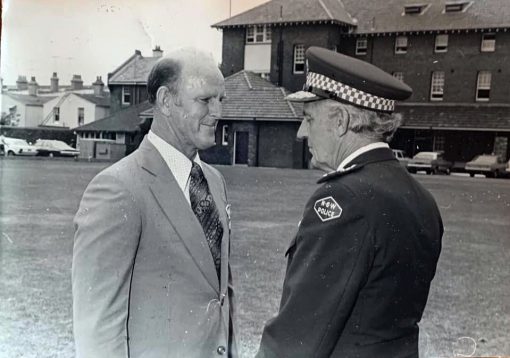
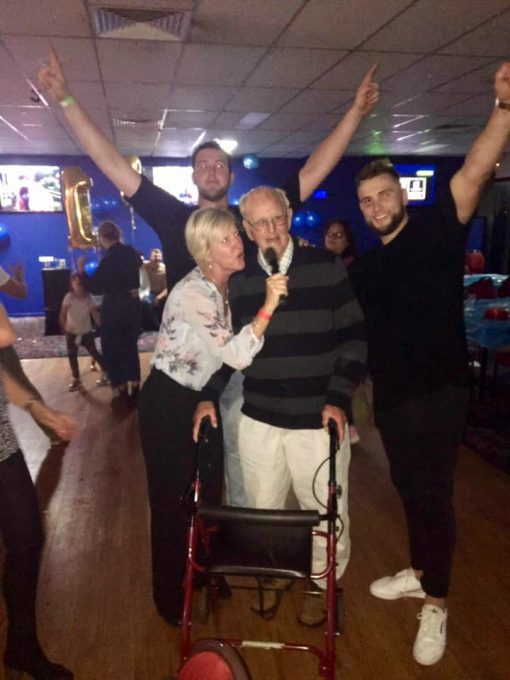
Nothing further, than what is recorded above, is known about this person at the time of publication and further information and photos would be appreciated.
‘Is this a joke by my mates?’: The retired detective wrongly accused by NSW police
By Malcolm Brown
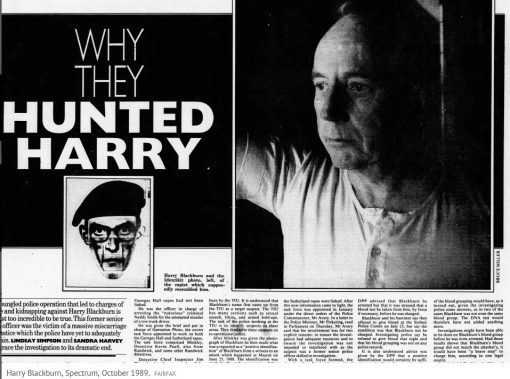
HARRY BLACKBURN: 1930–2023
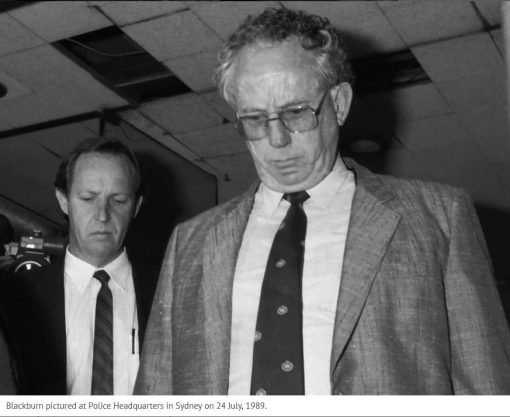
“What is this that is happening?” Harry Blackburn remembers thinking on the day a team of police came to arrest him at his workplace. “Is this a joke by my mates? It’s not my birthday!”
Indeed, it was not his birthday, and it was not a joke. The NSW police were there to arrest the 59-year-old retired detective superintendent and charge him with 25 serious offences, including rape, robbery and kidnapping over a period from 1969 to 1985.
Without the slightest idea of what they were on about, Blackburn found himself paraded in front of the media – the reports with his picture going nationally and even overseas. Without so much as a court appearance, he was branded a serial offender who had hidden for years behind his police badge. Now he was being undone by fearless police, unafraid to deal with their own.
On the day of the arrest – July 24, 1989 – the then Assistant Police Commissioner, Tony Lauer, said: “This operation has demonstrated that the NSW Police Service is more than capable of handling an extensive and highly sensitive inquiry.”
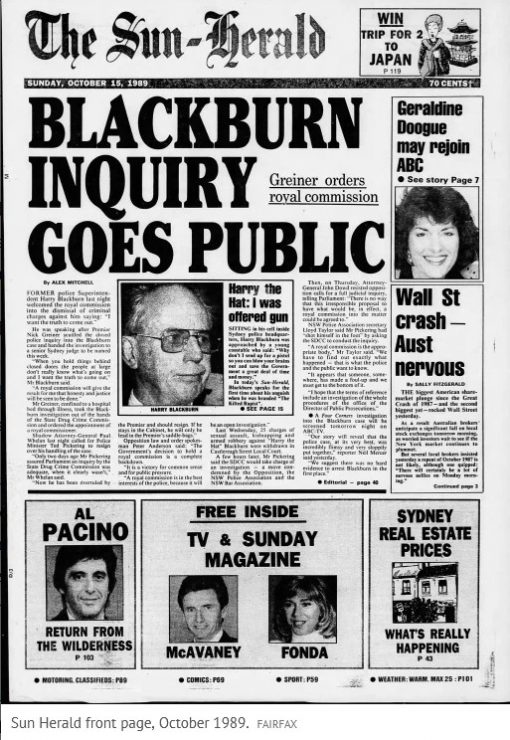
Blackburn found himself in a cell at the NSW Police Centre. Elsewhere, a police officer reportedly said: “We should slip a gun into his cell and let him blow his brains out and save the government a great deal of time and money.”
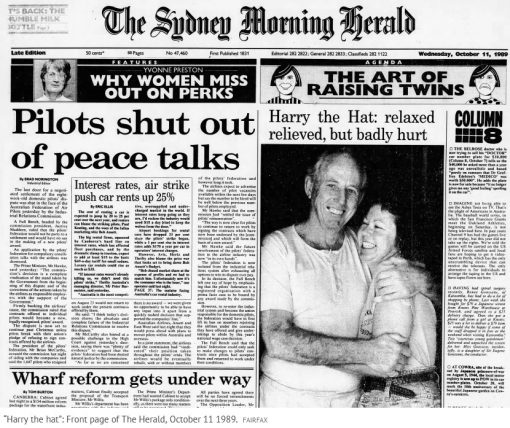
The prospective prosecution of Harry (“Harry the Hat”) Blackburn did not in fact last long. Following a change in personnel in charge of the case, diligent police officers Detective Inspector Clive Small and Detective Sergeant Ron Shaw reviewed the evidence and realised it was full of holes.
Small, against trenchant opposition from the police hierarchy, recommended the charges be dropped. They were abandoned on October 6 that year, but not before Blackburn’s wife, Lyn, devastated by the turn of events, had suffered a miscarriage.
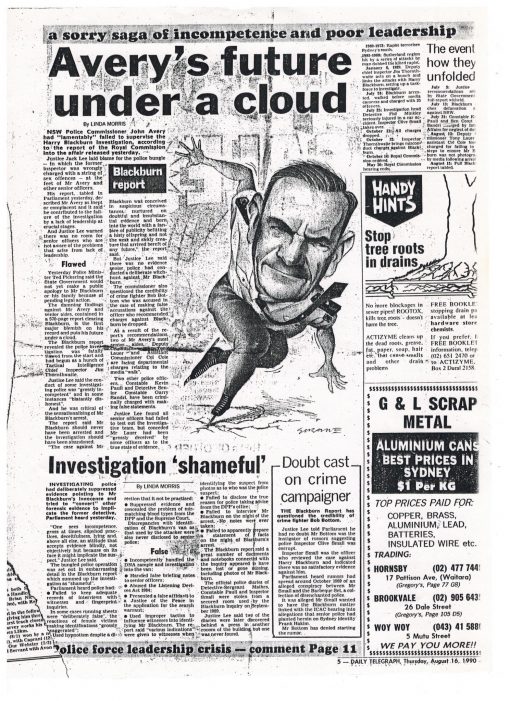
The resulting royal commission, conducted by Justice Jack Lee, found the investigation and gathering of evidence was so clumsy and slipshod that Harry Blackburn should never have been considered a suspect. “It destroyed his life at the time,” said Clive Steirn SC, who was to represent Blackburn.
Harry James Blackburn was born in Lithgow on April 21, 1930, one of three children of a coal miner, James Blackburn, and Eileen (nee Hovey). He went to school in Lithgow and in 1947, as soon as he had turned 17, he joined the NSW Police Force, taking advantage of the fact the police commissioner was a Catholic, this being a time of reported conflict in the force between Catholics and Masons.
Blackburn began duties as a superintendent’s clerk in Goulburn, then joined the Scientific Investigation Service, where he worked for 19 years, playing rugby union for the Goulburn Waratahs. He married Norma, with whom he had children, Tracy and John. In 1970, he moved to Rockdale as a detective sergeant, followed by postings to Parramatta and Katoomba.
His marriage ended in divorce, and he married Ada. This marriage also ended in divorce. He moved on professionally and went back to police scientific work as an inspector. In 1982 he met Lyn Foster, 22 years his junior, who was a civilian employee in the NSW Police Department.
In 1985, he was promoted to superintendent and put in charge of the Physical Evidence Section, requiring him among other things to handle gun amnesties announced by the government. He was also awarded the Long Service and Good Conduct Medal. In 1987 he married Lyn.
But unknown to Blackburn, there were storm clouds gathering. There had been some savage rapes and robberies over the years, the offender usually wearing a mask and sneaking up to couples cuddling up in cars at night in lover’s lane trysts.
The first series had started in October 1969 and continued until August 1970. The second, known as the “Sutherland” series, lasted from August to December 1985. Police had obtained descriptions of one of the assailants. One happened to vaguely represent Blackburn, who then became the subject of covert police attention.
On July 14, 1988, the couple were blessed by a daughter, Holly. Blackburn retired in November that year and went to work with the War Crimes Commission. On July 24, 1989, when Lyn was three months pregnant with their second child, police swooped, and the family’s whole world was turned upside down.
The charges were laid, and Blackburn was granted bail. On August 6, Lyn had her miscarriage. On October 6, he and his wife were informed that all charges had been withdrawn. Blackburn decided not to resume with the War Crimes Commission. “The wind had been knocked out of his sails,” Lyn said.
The royal commission was held under Justice Lee, Chester Porter QC as counsel assisting, and Blackburn being ably represented by Kevin Murray QC, with Steirn as his junior. The deficiencies in the investigation soon came to light.
In December that year, Maureen, wife of Blackburn’s son, John, suffered a miscarriage. The family decided not to tell Harry just then. In April 1990, Blackburn complained that four departmental charges had been laid against him, including such things as misuse of petrol and an incident where he had thrown a jug of water over somebody, Blackburn being known to be occasionally temperamental.
He said the charges were just an attempt to discredit him, and they went nowhere. On June 29, 1990, Justice Lee handed down his report. In July, Blackburn launched proceedings against the NSW government for wrongful arrest, malicious prosecution and defamation, seeking unspecified damages.
His experience had given him a new perspective on justice, how prone the system was to misbehaviour. He was to give evidence that while sitting in his cell at the police centre on July 25, 1989, he had overheard a detective telling a prisoner that if he did not plead guilty to nine charges, he would charge him with another four.
Blackburn with his wife and child retired to Robina on the Gold Coast, and in November 1990 Blackburn got his licence as a private inquiry agent, putting a picture of a hat as his motif on his business card.
His litigation continued, a psychiatrist diagnosing him with “reactive depression”. The position of Inspector-General of the NSW Police Force was created and filled by a Canadian, Don Wilson, whose task was to “clean-up” management of the NSW Police Force, which Justice Lee had described as “lamentable”.
There would never be another bungle like Blackburn, Wilson said. The NSW government settled with Blackburn in November 1991; the agreement ratified in the Supreme Court. Blackburn, with substantial damages in his favour, did do some minor investigate work. Otherwise, he contented himself with golf, normally six days a week, looked after his wife and daughter Holly, and jogged along the beach.
Lyn went back to study and became a child psychologist. Holly did a Bachelor of International Business degree and went to work in the tertiary sector. Harry Blackburn celebrated his 93rd birthday in April, and was in good spirits’, his wife said, but then there was a sudden downturn over the following two weeks.
He died on May 9. He is survived by his widow; his three children, 10 grandchildren and two great-grandchildren. A memorial service is to be held on the Gold Coast at a time to be fixed.
Nothing further, than what is recorded above, is known about this person at the time of publication and further information and photos would be appreciated.
( Due to current Govt. restrictions on ‘Gatherings’ due to Corona19 Virus Pandemic, some families may wish to have a Memorial Service / Wake with friends and family at a later date )
Buried at: Cremated. Ashes to be scattered from the Point beyond where the Shellharbour boat ram where the surfers go. One of Roy’s favourite fishing spots.
Memorial / Plaque / Monument located at: ?
Dedication date of Memorial / Plaque / Monument: Nil – at this time ( December 2022 )
ROY is NOT mentioned on the Police Wall of Remembrance * NOT JOB RELATED
FURTHER INFORMATION IS NEEDED ABOUT THIS PERSON, THEIR LIFE, THEIR CAREER AND THEIR DEATH.
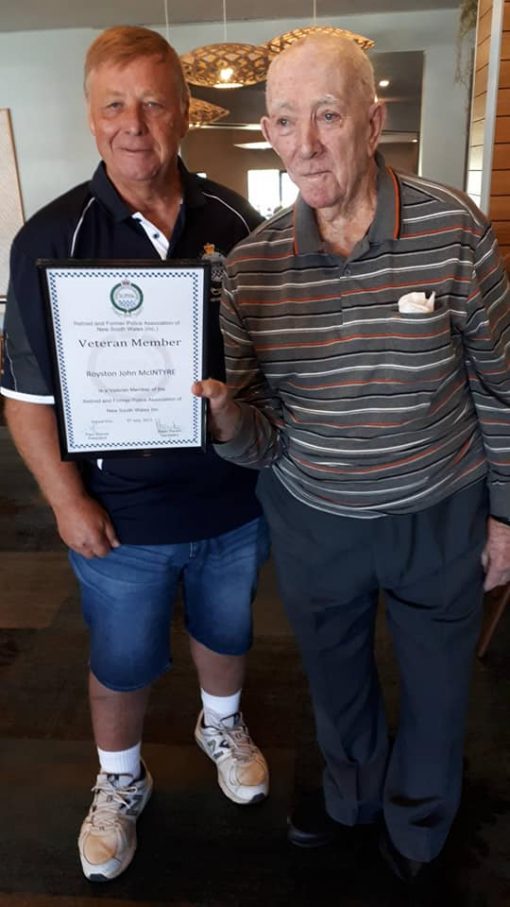
My Dad Royston John McIntyre left us yesterday afternoon at 5:30pm.
Mum Betty and all his six daughters Ellen, Alison, Jean, Susan, Megan and Roslyn were with him, and his son-in-law Malcolm.
We had told him Lell was coming home from overseas and Susan would arrive yesterday morning from Gove. He smiled and said “All our daughters will be with us”. He waited for that.
We watched him and held him as he took his last breath, and we saw the colour drain from his face. It was momentary and very peaceful.
We sat with him for a few hours, drank champagne and shared our most vivid memories of him. Together we cried and laughed – the McIntyre way – and enjoyed being a family with him once again.
We observed as the palliative care nurse examined and declared him ( deceased ) then the funeral home people wrapped him up and solemnly took him away.
I like to believe he’s now with his mum Sadie, his beloved sister Heather, his two sons-in-law John Nash and John Tomashek and all his friends who have gone before him. At 91 he was the last one.
He asked for a Police funeral, to be cremated and his ashes spread from the point beyond the Shellharbour boat ramp where the surfers go. A favourite fishing spot.
We don’t have a date yet for the funeral because it depends on the police.
If you wish to attend Dad’s funeral, please personal message or phone one of us for the details.
Rest now peacefully our beautiful Dad – everybody’s favourite. We will always adore you.
Nothing further, than what is recorded above, is known about this person at the time of publication and further information and photos would be appreciated.
( Due to current Govt. restrictions on ‘Gatherings’ due to Corona19 Virus Pandemic, some families may wish to have a Memorial Service / Wake with friends and family at a later date )
Funeral Parlour: ?
Buried at: Cremated
Memorial / Plaque / Monument located at: ?
Dedication date of Memorial / Plaque / Monument: Nil – at this time ( March 2022 )
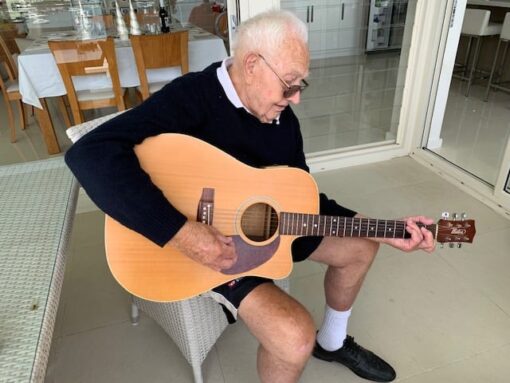
Wally TUCHIN on his 97th birthday, playing guitar on 11 December 2020
WALLY is NOT mentioned on the Police Wall of Remembrance * NOT JOB RELATED
FURTHER INFORMATION IS NEEDED ABOUT THIS PERSON, THEIR LIFE, THEIR CAREER AND THEIR DEATH.
TUCHIN
Walter Keith (Wally)
Formerly of Miranda,
late of Croydon.
Passed away 27th February 2022.
Beloved husband of Valerie (dec).
Dearly loved and loving father of Kate (Ellen), Lorraine, Greg and Peter.
Father in-law of Doug, Peter, Narelle and Tessa (dec).
Adored Grandpa Wal of 13 grandchildren and 19 great grandchildren.
98 Years young.
Forever in our hearts.
A service to Celebrate Wally’s life, will be held at St Paul’s Anglican Church, 205-207 Burwood Rd, Burwood on Thursday 10th March 2022, commencing at 11.00am.
Privately Cremated.
Proudly Australian Owned
Family Operated All Suburbs
9555 7551 9555 7092
Sydney Morning Herald
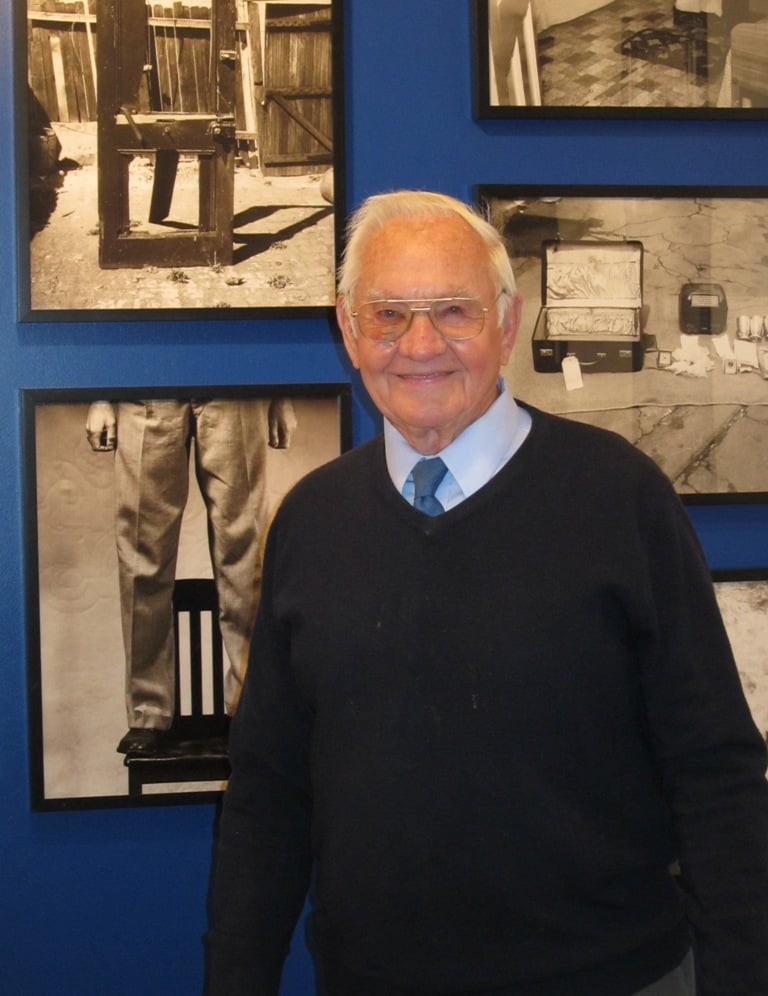
Wally TUCHIN at the Justice and Police Museum exhibition, Circular Quay, Sydney, with a collection of his photos – c 2000
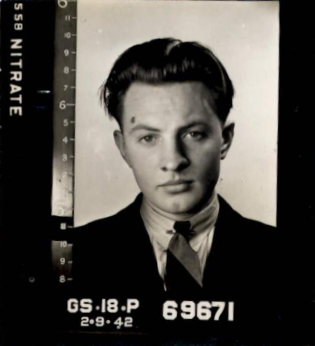
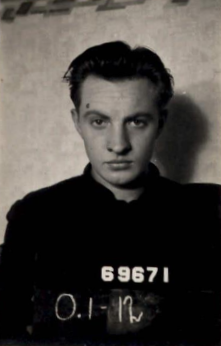
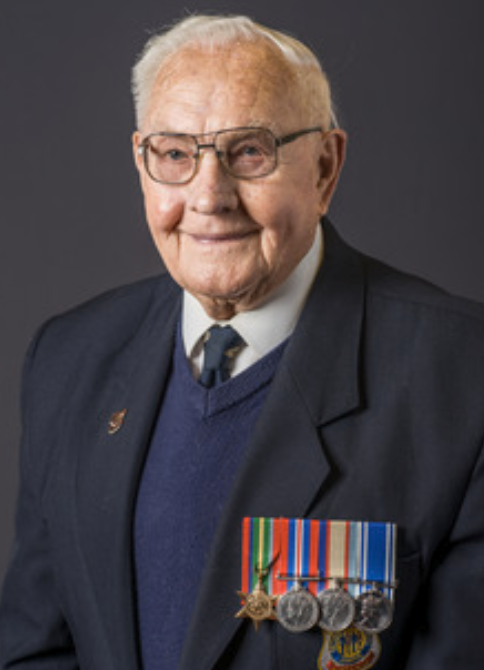
Studio portrait of 69671 Leading Aircraftman Walter Keith Tuchin who served during the Second World War. ‘Reflections – Honouring Australian Second World War Veterans’ is a project spanning from 2015 – 2017. During this time span 450 Australian Institute of Accredited Photographers from around Australia photographed 6,500 World War Two Veterans. This digital archive was gifted to the Australian War Memorial by the Australian Institute of Professional Photography (AIPP) in 2017.
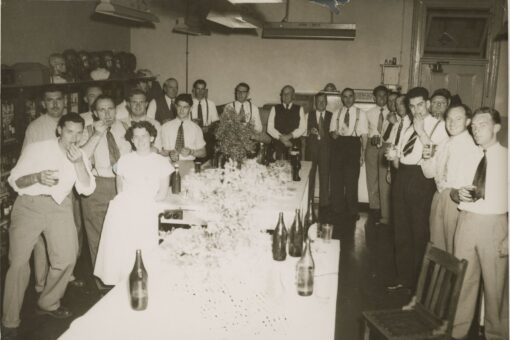
Scientific Investigation Bureau – c1956. Wally TUCHIN is 2nd from right
Follow all the Spotify Podcasts as told to Greg TUCHIN – by his father – Wally TUCHIN, Crime Scene photographer in the Scientific Investigation Bureau of NSW Police.
Nothing further, than what is recorded above, is known about this person at the time of publication and further information and photos would be appreciated.
**********
Cal
15 March 2022
Vira Helen JENKINS nee Vira DEW
| 18/07/2023
Vira Helen JENKINS
nee Vira DEW
Wife to Retired Superintendent Eric DEW # ????
AKA ?
Late of ?
NSW Police Training Centre – Redfern / Police Training College – Penrith Class # ? ? ?
Rank: Commenced Training at ? Police Academy on ? ? ?
Probationary Constable- appointed ? ? ?
Constable – appointed ? ? ?
Constable 1st Class – appointed ? ? ?
Detective – appointed ? ? ? ( NO )
Senior Constable – appointed ? ? ?
Leading Senior Constable – appointed ? ? ? ( N/A )
Sergeant 3rd Class – appointed ? ? ?
Sergeant 2nd Class – appointed ? ? ?
Final Rank = Sergeant
Stations: ?, School Lecturing Section – Sydney ( 4 Years ), School Lecturing Section – Newcastle ( 3 November 1952 – ? ), Newcastle – Retirement ( aged 56 )
Retirement / Leaving age: = 56
Time in Retirement from Police: 47 years
Awards: No Find on Australian Honours system
Born: ? April 1918
Died on: Saturday 15 May 2021
Age: 103 years,
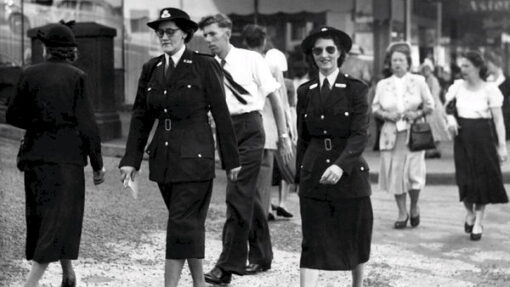
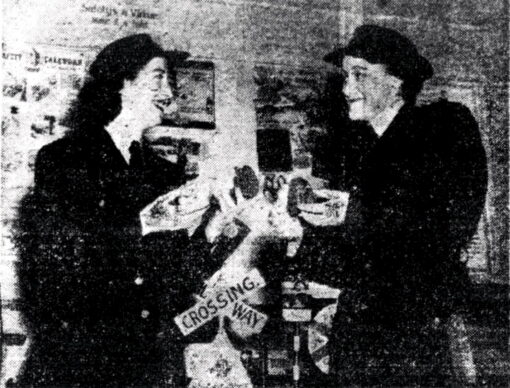
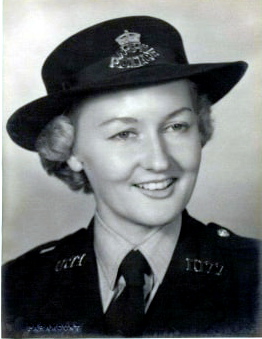
Vira Dew is pictured on the left with another officer in navy blue uniform circa 1940s.
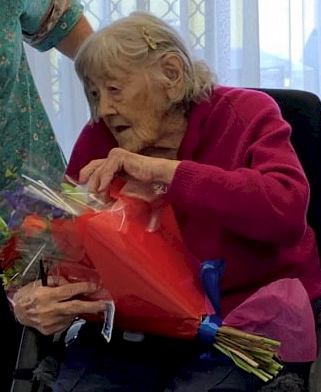
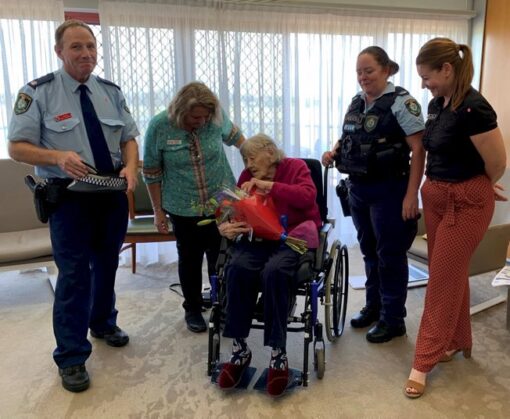
NSW Police Legacy 7 April 2021 Congratulations to NSW Police Legatee Vira Dew, who last week turned 103! Vira was one of the first policewomen to work in the Newcastle area. After retiring at the age of 56, she lived on a farm in Maitland with her husband, retired Superintendent Eric Dew, for several years. Vira is pictured here with Chief Inspector Tony Townsend, Snr Sgt Alyssa Willetts, and Det Snr Sgt Maree Maynard, who all visited to wish her well. Happy birthday Vira!
NSW Police Legacy 7 April 2021 Congratulations to NSW Police Legatee Vira Dew, who last week turned 103! Vira was one of the first policewomen to work in the Newcastle area. After retiring at the age of 56, she lived on a farm in Maitland with her husband, retired Superintendent Eric Dew, for several years. Vira is pictured here with Chief Inspector Tony Townsend, Snr Sgt Alyssa Willetts, and Det Snr Sgt Maree Maynard, who all visited to wish her well. Happy birthday Vira!
Cause: Natural – Old Age
Event location: ?
Event date: ?
Funeral date: ? ? ?
Funeral location: Uniting Church, 347 Ken Tubman Dve, Maitland, NSW
( Due to current Govt. restrictions on ‘Gatherings’ due to Corona19 Virus Pandemic, some families may wish to have a Memorial Service / Wake with friends and family at a later date )
Funeral Parlour: ?
Buried at: ?
Memorial / Plaque / Monument located at: ?
Dedication date of Memorial / Plaque / Monument: Nil – at this time ( May 2021 )
VIRA is NOT mentioned on the Police Wall of Remembrance * NOT JOB RELATED
FURTHER INFORMATION IS NEEDED ABOUT THIS PERSON, THEIR LIFE, THEIR CAREER AND THEIR DEATH.
Special Constables Sue Elliott and Vira Jenkins make the acquaintance of some of the ‘props’ they will use daring their lectures to school children.
Newcastle Sun (NSW : 1918 – 1954),
Tuesday 4 November 1952, page 10
” Women In Blue ” to Lecture In Schools
Two young women who will soon be familiar figures to all school children in the district are Special Constables Vira Jenkins and Sue Elliott.
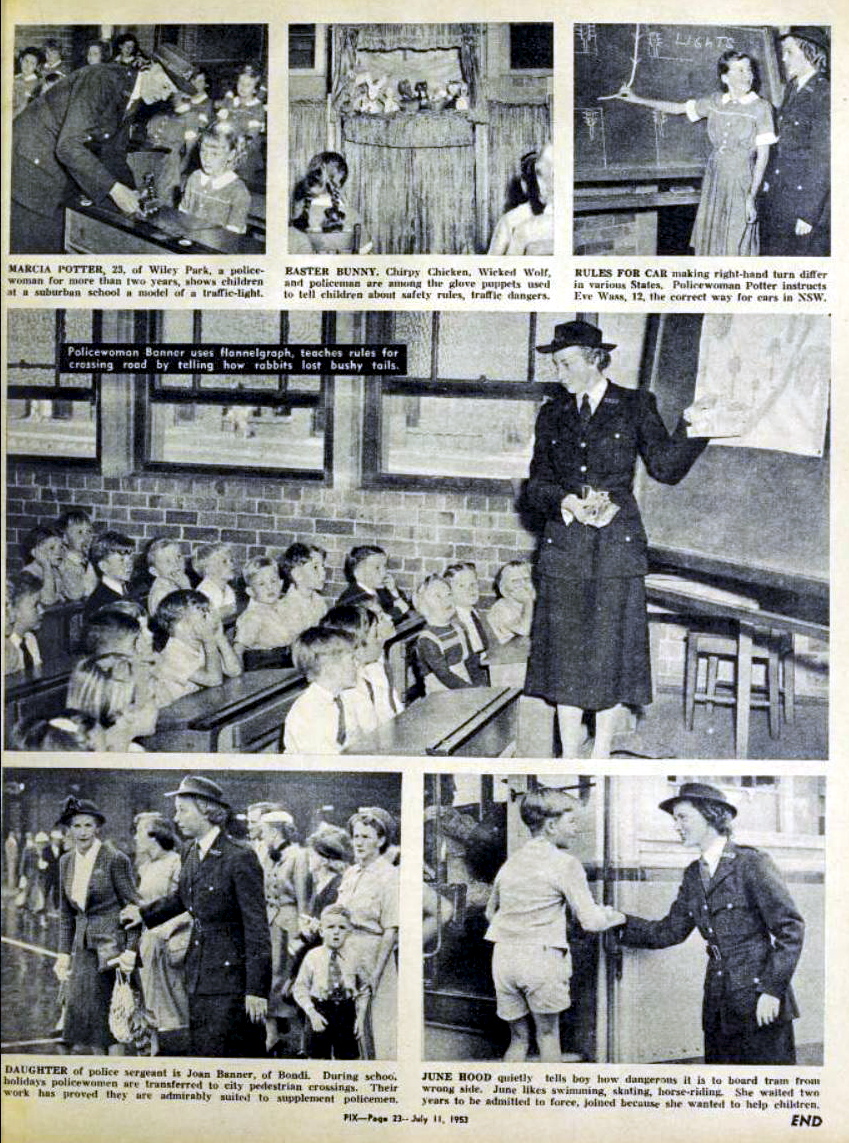
Special Constables Sue Elliott and Vira Jenkins make the acquaintance of some of the ‘props’ they will use daring their lectures to school children. The puppets include a policeman, a small girl and a villain. Posters, cut-out paper figures and miniature road signals are also part of their equipment.
They started work yesterday with the Newcastle school lecturing section of the police force and will assist Constables D. Pike and R. Mann in covering the 266 schools in the district.
While on duty the women wear the navy uniform and wide – brimmed hat designed for women police. They will travel to schools by bus or in the utility belonging to the section. Both are from Newcastle.
Miss Jenkins, who was a nurse before she joined the police force six years ago, will be living at home for the first time for years. She has been four years with the school lecturing section in Sydney.
Mrs. Elliott is a policeman’s widow. She joined up only two months ago and has been in Sydney to train for the work.
With her six-year-old son, she is now living at Lambton.
Traffic Duty
As well as lecturing at schools on road safety, snake bite, fire hazards ” and anything else affecting the safety of children, ” Miss Jenkins said, they will also do traffic duty at school crossings. ”
As soon as we have learnt our lines, we will ‘use puppets in our lectures, ” she said. ” We have to rig up a special stage and dress the puppets.
They have been used now in Sydney for some time and are immensely popular with the kiddies. ”
Miss Jenkins said there were now 36 women in the N.S.W. Police Force, 18 in uniform and 18 in plain clothes. This was the maximum number allowed and had been specified by an Act of Parliament.
ON MONDAY Constables D. Pike and R. Mann, of the Road Safety Control branch, gave a demonstration at Mayfield West School and Special Constables Vira Jenkins and Sue Elliott, who accompanied them, concentrated on the infants’ department where the children were taught road safety by means of nursery rhymes and poems.
The balance of the results of the 1935 final examinations of the Technical Education Branch were made available to-day.
The letters, “A,” “B,” and “C” indicate the grade of pass in each subject. Then each subject. The letter “P” indicates a pass in early stages of subjects where the results are not graded. The passes are not given in order of merit. In the trades courses the pass shown is the grade award for all subjects embraced in the course.
Enrolments for the 1936 session will be accepted as from February 17.
Successful Newcastle District Pupils in Primary Final Examination
QUALIFIED FOR PROMOTION TO HIGHER SCHOOLS
OFFICIAL LISTS ISSUED HIGH PERCENTAGE OF PASSES
The result of the Primary Schools’ final examination issued to-day disclosed that the percentage of passes secured this year is very high.
DISAPPOINTMENT was expressed by some of the school teachers that children who passed very high in every subject but did not secure the necessary percentage of points in arithmetic failed to secure a pass.
The results of the bursary examination will not be made available for some time.
Nothing further, than what is recorded above, is known about this person at the time of publication and further information and photos would be appreciated.
Cal
250521
Raymond James SMITH
| 18/07/2023
Raymond James SMITH
AKA ?
Late of Camden South, NSW
NSW Police Training College – Penrith Class # 019
New South Wales Police Force
Regd. # 5632
Service: From? February 1947 to27 May 1978 = 31 years Service? ? ?
Rank: Commenced Training at Penrith Police College on ? Feb 1947 ( aged 27 years )
Probationary Constable- appointed Monday 28 April 1947 ( aged 27 years, 7 months, 26 days )
Constable – appointed ? ? ?
Constable 1st Class – appointed ? ? ?
Detective – appointed ? ? ?
Senior Constable – appointed ? ? ?
Leading Senior Constable – appointed ? ? ? ( no such rank during this period )
( Due to current Govt. restrictions on ‘Gatherings’ due to Corona19 Virus Pandemic, some families may wish to have a Memorial Service / Wake with friends and family at a later date )
Funeral Parlour: ?
Buried at: ?
Memorial / Plaque / Monument located at: ?
Dedication date of Memorial / Plaque / Monument: Nil – at this time ( February 2021 )
RAYMOND is NOT mentioned on the Police Wall of Remembrance *NEED MORE INFO
FURTHER INFORMATION IS NEEDED ABOUT THIS PERSON, THEIR LIFE, THEIR CAREER AND THEIR DEATH.
Circumstances surrounding a disturbance in a picture bus returning from Lithgow to Cullen Bullen on March 14 were outlined in yesterday’s court when a young Blackman’s Flat man faced four charges.
Before the court was Eric Lane, who, pleaded not guilty to charges of assault, malicious damage to two bus windows valued at £5, behaving in an offensive manner in a bus and maliciously injuring a sports coat valued at £7.
The case remained part heard after lengthy evidence for the prosecution had been given and was set down for resumption next Tuesday.
John Robert McGregor Collins, bus driver, of 45 Main-street West, an employee of Eric Newham Bus Service, told the court he was driving a crowded bus down Main-street at 11.20 p.m. on March 14 when a number of people called out to him to stop the bus and open the automatic doors. He did so and, amid considerable noise, a number of standing passengers surged out of the bus. ” They scrambled over one another to get out, ” Collins said. ” I did not see anything, but Marjoram came down to me and said he wanted to give Lane in charge.” Collins added he drove to Dunn’s corner, locked the bus door to prevent anyone getting out and asked his employer to ring for the police.
Walter Stanley Marjoram, of Marrangaroo, a shiftman employed at the State Mine, victim of the alleged assault, said in evidence he had been to the Trades Hall pictures and, with his wife and daughter, aged 13, he went to the back of the bus. His wife obtained a seat and his, daughter was being nursed while he stood. He noticed a second vacant seat and Marjoram said he told a girl who was also standing that there was a seat for her. ” There was a chap sitting there, occupying about two-thirds of the seat for two people and, after I stood for a while, I decided I might as well have a seat, Marjoram said. ” I went to where defendant was sitting and put my hand down to move his legs. He moved them a little and I sat down. ”
Wanted Seat, Not Fight
Marjoram detailed a conversation he then had in which he claimed Lane asked him if he thought he was smart but he said he did not want to fight, he merely wanted some of the seat. ” He kept arguing and got up and said ‘ come outside and I’ll fix you’, ” Marjoram added. ” He then sat down again and said ” if you don’t shut up I’ll job you. ” I said ‘good-oh’ and he jumped up, pushed me back into the seat and hit me about five or six times about the forehead. ” Marjoram said he was dazed by the punches and had to have two stitches in a wound above the right eye. Afterwards he noticed that the bus windows were broken, that his sports coat was torn an his other clothes covered with blood.
Marjoram said he had lost three days from work as a result of the incident and lost an additional two days while attending court. He had thus lost five days’ work at £3/6/-per day.
Evidence of having gone to Dunns Corner and arresting Lane was given by Constables Cliff Love( Clifford Stanley LOVE # 4958 ) and Raymond James Smith ( # 5632 ).
They said Lane admitted punching Marjoram who, he claimed, was ” trying to stand over him. ”
‘Lane added Marjoram had grabbed his legs and attempted to pull them off the seat.
Both police witnesses said that Lane admitted breaking one window, but claimed the other was already cracked.
It was the usual thing for prisoners under the influence of liquor to hammer on the cell doors, a police constable said during a traffic hearing in this week’s court.
The policeman, Const. Raymond James Smith, said that sometimes they “got sick of it” and sometimes they “kept it up.”
Const. Smith was giving evidence in a charge of driving under the influence of intoxicating liquor against Cecil John Green of South Bowenfels.
Defendant, who was at present on a bond in relation to a similar offence, was fined £20 by Mr. C. K. Ward, S.M., and was told by the magistrate that he was fortunate in not being gaoled.
Through Mr. I. Higgins defendant pleaded not guilty to having driven a car in Main-street whilst under the influence of liquor on August 30.
Principal witness was Sergt John Talbot Parkinson ( # ???? ), who told the court he was a passenger in the police truck, driven by Const. Peisley, ( # 6890 ) at 4.30 p.m. on August 30, when he saw defendant drive a vehicle from a parked position. ” We were travelling west along Main-street and defendant drove a motor car from the eastern side of the street near Lithgow street,” the police officer said.
Claimed Defendant Stumbled From Car
He alleged defendant did not give a hand signal and drove on approximately the centre of the roadway. At the intersection defendant made a wide left hand turn and entered Lithgow-street on the incorrect side, swerved suddenly back to the correct side and again back to the centre of the street, Sergt. Parkinson said.
Defendant was then halted and told to alight, which he did by stumbling out of the car. “I told him to stand away from the car and he released his grip of the door and stood swaying violently on his feet. ” Defendant, who said he had three beers, smelt strongly of intoxicating liquor, his speech was very thick and he could not articulate his words,” witness said.
Collided With Door Post
He added that defendant had to be assisted up the Police Station steps as his condition had deteriorated and he was in danger of falling. Going through the door defendant had collided with the door post. He had asked for Dr. Doutreband, but that doctor was not available.
Stating that he had 27 years experience as a police officer, Sergt. Parkinson said in his opinion, defendant was in an advanced state of being under the influence of intoxicating liquor.
Corroborative evidence was given by Const. W. R. Peisley ( William ‘Bill’ PEISLEY # 6890 ), who, in cross-examination, said he did not know defendant had subsequently seen Dr. Doutreband after his release.
When he received the charge against defendant Const. Smith, who was on duty as station constable, said he smelt a strong smell of intoxicating liquor about defendant.
“Defendant appeared to be considerably affected by intoxicating liquor,” Const. Smith added.
In lengthy cross-examination Const. Smith said he visited the cells after defendant had been lodged there.
Heard Him Fall To Ground
“When I was opening the door I heard defendant hammering on the other side and just as I opened the door I heard him fall to the ground ” Const. Smith said.
Mr. Ward over-ruled an objection by the prosecutor to this line of questioning. Mr. Higgins stating that his client had never been told that Dr. Doutreband would not be coming and that he was clamoring and asking for a doctor.
Const. Smith denied there had been an conversation in the cells about a doctor.
When bailed out at 8.15 pm defendant was not under the influence, Const Smith added.
Re-examined by the prosecutor, Const Smith said he heard defendant hammering on the cell doors ” a considerable time ” before he visited him at seven o’clock. Mr. Higgins said his client did not wish to give evidence.
Sgt. C. G. Bush ( # 3831 ), police prosecutor, said defendant was still serving a three years’ bond which had more than two years to run.
Mr. Higgins submitted that his client was a man who worked exceptionally hard in the bush and was a married man with a wife and three children to support.
Was Considering Gaol Sentence
” I realise there is a grave breach of the law here, but I ask Your Worship to make the penalty pecuniary, otherwise there will be great hardship to his wife and family.” the solicitor said. There was no evidence that anyone had been endangered by defendant’s driving, he added.
Mr. Ward said it appeared defendant was very much under the influence of liquor and probably had more liquor than he was prepared to admit to police. “I was considering sending him to gaol, but in view of your representations, I will make it a fine,” the magistrate told Mr. Higgins.
Defendant was given one month to pay the fine of £20.
Government Gazette of the State of New South Wales (Sydney, NSW : 1901 – 2001),
Friday 13 November 1964 (No.128), page 3596
The 24th day of October, 1964 BY virtue of the authority vested in me by the District Courts Act, 1912 – 1961, I hereby appoint Sergeant 3rd Class Raymond James Smith as Bailiff of the District Court holden at Deniliquin.
Nothing further, than what is recorded above, is known about this person at the time of publication and further information and photos would be appreciated.
Cal
Marcel John BAILEY
| 18/07/2023
Marcel John BAILEY
AKA JACK
Late of Quakers Hill Nursing Home, NSW
Jacks widow – Janet Bailey passed away, peacefully, in her sleep on Saturday 27 March 2021 and will be laid to rest with Jack at the Pinegrove Cemetery on Saturday 3 April 2021. May they both, forever, Rest In Peace.
NSW Penrith Police College Class # 027
New South Wales Police Force
Regd. # 7224
Uniform # 3565 & 909
Rank: Commenced Training at Penrith Police College on 11 February 1952 ( aged 22 years, 5 months, 2 days )
Probationary Constable- appointed 31 March 1952 ( aged 22 years, 6 months, 22 days )
Constable – appointed 31 March 1953
Constable 1st Class – appointed 1 July 1958 ( 4 months loss of Seniority somewhere )
Liverpool GDs ( 22 Division )( ProCst )( 21 April 1952 – 9 June 1952 ),
was to be transferred to Moss Vale – but that was Cancelled,
Parramatta GDs ( 18 Division )( 10 June 1952 – 20 June 1954 ) – whilst at Parramatta, he assisted the Army at Windsor through the catastrophic floods,
Traffic Branch ( 21 June 1954 – PSB, later STP – Solo Cyclist – Probation ),
Traffic Branch ( 10 August 1954 – 30 June 1955, PSB, later STP – Solo Cyclist – Permanent ),
Liverpool STP – Solo cyclist ( 1 July 1955 – 17 Jan. 1961 ),
Camden – STP ( Cst 1/c )( 18 Jan. 1961 – 13 Feb. 1966 )( 22 Division in those days but 35 Division now ),
Liverpool STP Solo Cyclist ( 14 Feb. 1966 – 16 June 1966 ),
Liverpool STP – STP – Car Crew ( 117 June 1966 – 23 June 1968 )
Liverpool STP – Assistant to Sgt In Charge, STP ( 24 June 1968 – 21 December 1969 )( Promoted to Sgt during this time and Assistant Sgt in Charge of STP, Liverpool,
Liverpool STP – Sgt In Charge, STP ( 22 December 1969 – 6 Sept. 1975 ),
( Due to current Govt. restrictions of 20 – 50 persons at a Funeral due to the Cornona19 Virus Pandemic – this will be a Private Funeral )
Future Wake location: ???TBA
( Due to current Govt. restrictions of 50 persons only at ‘Gatherings’, there won’t be an immediate Wake )
Future Wake date: ???
( Due to current Govt. restrictions on ‘Gatherings’ due to Corona19 Virus Pandemic, some families may wish to have a Memorial Service / Wake with friends and family at a later date )
6′ 1.5″ tall, weighed 14 st. 2 lb, had hazel eyes, brown hair and a fair complexion.
He was born in Croydon Park, NSW & Married on 23 October 1954.
He was previously employed at a Parcel Sorter – 2 weeks, Process Worker – 3 months, Fitter and Machinist 6.5 years.
He held the school Intermediate Certificate and held a Trade Certificate as Fitter & Machinist.
He failed his 1st attempt at the Cst 1/c course on 21 August 1956 but Passed on 24 June 1958 – which would explain his loss of 3 months Seniority.
He Passed his Sgt 3/c exam on 20 May 1965 and Passed his Sgt 1/c exam on 13 May 1975.
He was approved to Ride ( as a Solo Cyclist ) on 17 July 1952,
Approved ( O ) on 24 August 1953, ( I don’t know what the ‘O’ represents )
Approved S-hp on 10 August 1954 ( I don’t know what the ‘S-hp’ represents )
Approved to drive Departmental vehicles on 29 October 1958 and approved to drive General Duty utilities & light trucks on 29 January 1964.
He was approved as a High Speed Manual transmission driver on 23 May 1966.
At the time of publication, I have no further information – other than what is posted above.
Cal
25 June 2020
Email received from Jack’s daughter – Lynne on 30 June 2020.
Good morning,
I can’t help but be impressed with the respect you all have for each other even though dad retired around 36 years ago.
Inspector Scott Smith and six Police Officers from Mt Druitt took the time to attend the West Chapel at Pinegrove to honour dad and my mother Janet, Friday 26th June 2020. Family and friends were touched by the tribute and some footage and photos are available.
Dad was devoted to my mum (retired nurse/midwife) who had a stroke in 2010 that affected her right side and speech. Dad maintained the family home and spent every day (unless unwell) with mum. He decided in January this year to sell the home to spend more time with mum. He had a few health issues but was on the mend. He had a strength and determination you had to admire, no excuses.
He passed away peacefully in his sleep early in the morning on Sunday 21st June 2020 close to his loving wife of 65 years.
I have two photos that we used at the service of the graduation of the class of 1952. It was taken at the Penrith academy and they were found when preparing the Braidwood and Schofields properties for sale.
I will soon email them to you and Jody McLeod for your records.
I have another early picture of dad in what appears his motor cycle uniform. A few photos later in his career on his bike and in his uniform at Wagga Wagga with a departmental just before he retired on the 8th September 1984. There is a photo taken at his send off where he was presented with two plaques, one a hand made copper plaque and other memorabilia.
There are more photos and slides to go through and if I locate any that may be of interest to your group I will forward them to you.
I am custodian of his long service good conduct medal which was presented to him by Prime Minister Gough Whitlam who had gone out of his way to congratulate Dad and shake his hand.
I was not aware of his commendation through the fires and if it was written I hope I locate it as I still have some personal items to sift through.
I have his trade certificate, Discharge from the Police Force and other certificates and happy to share if it is of interest.
When stationed at Parramatta he assisted the army at Windsor through the catastrophic floods.
I recall some of his time at Liverpool Police Station through the mid to late 70s and I would often visit him there on my way home from work.
He was on duty at Liverpool ( Feb ) 1977 when the train derailed at Granville and Mum was a nurse at Fairfield where many of the casualties were taken. ( If Jack was stationed at Liverpool in Feb 1977 then his timeline of station attachments must be wrong. Cal )
Dad was proud of his years in the force and valued the mateship. He retired at 55 to spend time and travel around the state with mum in their van and later a Winnebago.
Kind regards
Lynne Bak
nee Bailey
********************
Response:
Hi Lynne,
Our condolences on the loss of your father and I hope that you, and the family, gain strength from knowing that he wasn’t forgotten by those who knew him.
We look forward to attaching any, and all, the photos and video that you might like to share with us and any other memories that you may care to share.
Would also like to attach any funeral pamphlet that may have been made and a copy of his Service record and Eulogy.
much respect
Greg ‘Cal’ Callander
NSWPF # 17463
1975 – 2004
On Thursday 1 April 2021 – Lynne returned an email with the below attachments and also with the sad news that her mother, Janet Bailey, passed away peacefully in her sleep on Saturday 27 March 2021.
Janet will be laid to rest with Jack at Pinegrove Cemetery on Saturday 3 April 2021.
Kenneth Roy CURRAN OAM
| 18/07/2023
Kenneth Roy CURRAN OAM
AKA Bluey
Late of Frenchs Forest, NSW
NSW Redfern or Penrith Police Academy Class # ? ? ?
New South Wales Police Force
Regd. # ????
Rank: ?
Final Rank = ?
Stations: ?
Service: From? ? 1950to? ? 1956 = 6 years Service
Awards: Medal of the Order of Australia ( OAM ) granted 12 June 2006
For service to the community, particularly through pipe bands & aged care organisations, & to a range of military and law enforcement authorities as an instructor.
Born: Wednesday 9 September 1925
Died on: Thursday 27 June 2019
Age: 93yrs 9mths 18days
Cause: On 24 May 2019 – Ken was in Arcardia, Pittwater Private Hospital after a heart attack
Event location: ?
Event date: ?
Funeral date: Thursday 4 July 2019 @ 10.30am
Funeral location: St. Martin de Porres Catholic Church, Prahran Avenue, Davidson, NSW
Wake location: ?
Funeral Parlour: Ann Wilson Funerals – 02 9971 4224
Buried at: ?
Memorial located at: ?
In the 1954 Electoral rolls, Ken is living at 91 Connaught St, Dee Why – along with Dory Mary, who was possibly his wife – and his occupation is recorded as ‘Policeman’.
Norma ( dec ), mentioned in his obituary “may have been” his second wife.
Cal via Kevin Banister.
BLUEY is NOT mentioned on the Police Wall of Remembrance * NOT JOB RELATED
FURTHER INFORMATION IS NEEDED ABOUT THIS PERSON, THEIR LIFE, THEIR CAREER AND THEIR DEATH.
Date listed: 29/6/2019CURRAN, Kenneth Roy OAM NX202327
1st Commando Company “BLUEY”
Aged 93
Late of Frenchs Forest Passed away peacefully 27 June 2019
Dearly loved husband of Norma (dec).
Adored father of Neville, Graeme, Jenny and their partners.
Devoted Pop of seven grandchildren and ten great-grandchildren.
Loved by all his family.
In God’s Care
A Requiem Mass for the repose of the soul of Ken will be held at St. Martin de Porres Catholic Church, Prahran Avenue, Davidson on Thursday, 4 July, 2019 at 10.30am.
Inducted into the A.M.A.H.O.F.(Inc) for 2012
Lifetime Achievement – Army Unarmed Combat
Inducted into the W.K.U.H.O.F. for 2012
Lifetime Achievement – Army Unarmed Combat
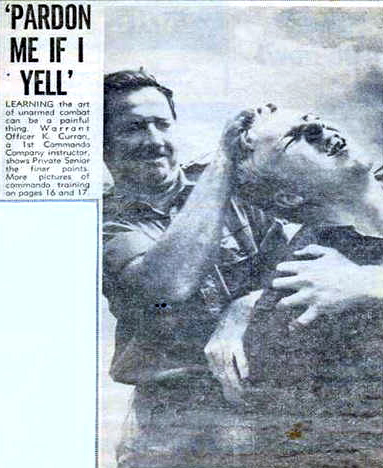
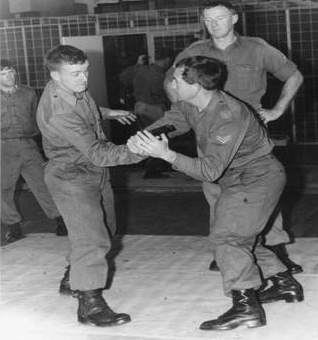
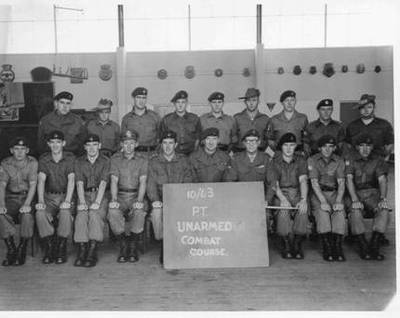
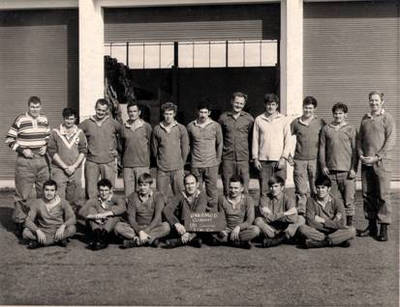
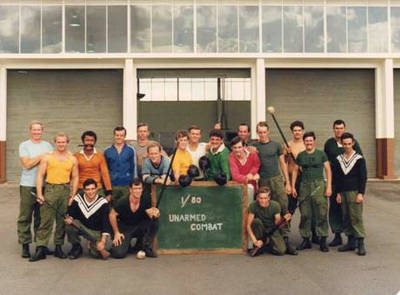
Blue Curran on an unarmed combat course in the early 1960’s
Kenneth Roy “Blue” Curran was born on 9th September 1925 in Waverly NSW. He first joined the army during WW II in 1943 at 18 years of age. His service number was NX 202327 he served in Australia and after reaching 19 years of age and therefore being eligible for overseas operational deployment transferred from Infantry to Commandos. He saw service in 2/11 Cavalry Regiment Commando Squadron, he completed his commando training in far North Queensland and later saw service in Moratai, Labuan, British Borneo and Rabaul before the end of the war.
At wars end he returned to civilian life but reenlisted in the military as a Citizen Military Force (CMF) member of the newly raised 1 Commando Company (1 Cmdo Coy) in 1955 at the age of 30. His CMF service number was 2242907.
Blue was an active member of 1 Cmdo for twenty years up until 1975 when he officially retired from military service. However, as a result of Blue’s experience and skills relating to Military Unarmed Combat (MUC) training over the years he has been retained as a consultant from time to time to the military to assist in MUC training well into the new millennia.
As a consultant to the military he had conducted training for commandos, infantry battalions and other unit’s right through to 2000. From 2004 to 2007 he was requested by the Infantry Training Center at Ingleburn to conduct training in bayonet fighting. In addition to his service to the military Blue has also trained the first members of the then newly raised NSW Police Tactical Response Group (TRG) and continued to provide training support as requested. He has trained numerous other law enforcement groups, prison services and members of the Sheriff’s Department. He has also conducted security training for security firms, and personal self defence training for members of the community. He continues to train security officers in self defence and the use of batons and handcuffing techniques.
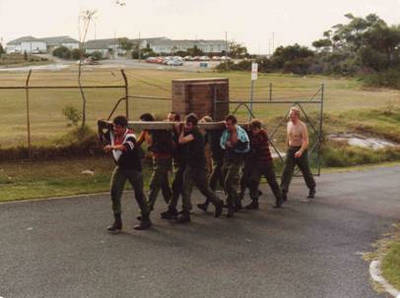
Physical fitness in MUC training is heavily emphasized by Blue
During his time in the Australian Military Blue was responsible for keeping alive MUC from his initial training in WW II to its resurgence in the mid 1950’s with the raising of 1 Cmdo Coy. He was also instrumental in the continual review and development of the MUC training program ensuring that outdated techniques were dropped from the syllabus and new information added to keep the MUC syllabus relevant to the changing needs of the military. This also comprised the inclusion of skills from civilian martial arts either through serving soldiers with previous experience or through association with martial arts instructors. However, it was always advocated that any changes to the syllabus was relevant to the operational requirements of the military and were not a stylised application of complicated techniques that did not fit military needs or application.
Blue over time would later become the Army’s senior MUC instructor and the person primarily responsible for its propagation to the next generation of MUC instructors in the early to mid 1960’s who in later years would guide MUC within the military. In this role Blue was the last then serving WWII Commando with MUC training and operational experience remaining from the WW II era. Those instructors who later would have their own significant contributions to MUC that would benefit from this knowledge and experience included Major Greg Mawkes, Major John Whipp, and WO1 Denis Gaskell to name a few.
In 1980 Blue was officially acknowledged for his services related to MUC training within the military and was awarded the Order of Australia Medal. In later years he was recognized further by membership to the International Close Quarter Fighting Instructors Association. Ken currently lives with his wife in French’s Forrest Sydney.
Blue supervising training on a MUC course in the 1950’s
Dialogue and Interview with Ken “Blue” Curran OAM, JP
Recorded by Glen Gardiner 1st April 2010, Sydney
I first joined the army in 1943 when I was 18 years old. I went to recruit training in Warwick in Queensland and returned to Sydney where I was posted to a young soldier infantry battalion.
At that time you could not be deployed overseas on operations until you were 19 years of age. So those of us who were under 19 years of age would end up in these young soldier battalions. There were three of these battalions located in Sydney at the time.
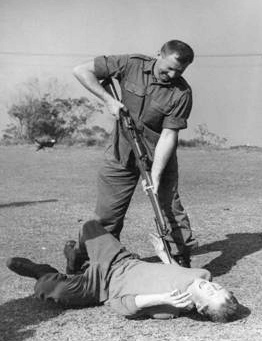
Bayonet training is integral to MUC
While posted to Sydney I was involved in the development of beach defences in and around Sydney. I attended my first Military Unarmed Combat (MUC) course in Sydney which was run by an ex professional wrestler named Alf Vockler. He was a Warrant Officer 2nd Class (WO 2) and the only instructor on the course. In those days MUC was virtually unheard of. To the best of my memory he was posted to the military as a Sgt because of his wrestling experience. He may have come from a corps of instructors but I am not certain.
The MUC course was conducted in the French’s Forrest area at Terry hills around the Xmas period of 1943/1944. The course duration was for a period of 2 weeks, the courses official title was Physical Training and Unarmed Combat Course. There were approximately 20 participants on the course from the infantry corps. To my knowledge all passed the training and qualified as an exponent. In those days the army did not run instructors courses that I am aware of and relied on military personnel with previous experience recruited specifically to instruct.
The training consisted mostly of holds and restraints with a heavy focus on wrestling. There was a little bit of disarm techniques related to pistols. Not much was done with rifles or knives even. Counters to open handed attack with the counters mainly being throw downs was also conducted. There was a very heavy amount of work related to physical fitness training.
Later that year after completing the MUC course I was sent to Cowra as a reinforcement when Japanese POW’s made an attempt to escape. After that I returned to Sydney where I turned 19 and was then sent to Canungra. The course at Canungra was jungle training before we were deployment north on operations. After completing training at Canungra I and 3 others volunteered to be transferred from infantry to Commandos. 3 of us were accepted into 2/11 Commando Cavalry Squadron. This unit had formally been a cavalry unit in the Middle East with the 9th Division prior to their return to Australia. From Canungra I was posted to the Atherton Tablelands with 2/11 Commando Sqn (Divisional Commando with 3 Commando units attached to each Division) at Raven hoe where we conducted pre deployment training. We concluded commando training here in 1944. It included infantry training, MUC, explosives training, etc.
I was used to conduct the MUC training as an instructor for the unit as I was the only one in the unit who had done an MUC course that I was aware of. During this period at Raven hoe which was only several months. During this time I trained the personnel in platoon sized groups. I think would have trained 2 platoons in this period. It was difficult to train more or formalize the training as in those days the members of the unit were scattered all over the place conducting various forms of training before deployment. This was all prepatory to us doing invasion training which was later conducted near Cairns if my memory is correct. Members of the unit would conduct training at the Atherton Tableland and then go to Cairns to do training changing from ships to landing craft, cargo nets and practicing beach landings. The troops would then return to the tableland and do other forms of training some of which included MUC depending on availability. We then were deployed in the invasion of Moratai in 1944 (2/11 Cmdo Cav Regt, 24 Bde, 9 Div). After Moratai we boarded steamers and conducted the invasion of Labuan (1944). After the capture of Labuan we were deployed to British Borneo, Papar on the Padus River pushing up the rail link to Jesselton. While we were in Jesselton we received news that the war was over.
Blue and Lionel “Pup” Currell both WWII Cmdo and MUC Instructors
The 2/11 Cmdo Cav Regt was disbanded and I was sent to Rabaul for several months guarding prisoners as well as being involved in infrastructure rebuilding. I then returned to Australia and after a period when I was hospitalised with malaria I was demobed at the School of Artillery at North Head after I had recovered from my bout of malaria.
After the war I completed my apprenticeship as a photo engraver and joined the NSW police force from 1950 to 1956. I then worked for the NSW railway as a fireman on the steam engines for a year. I then returned to my trade. During my working life I did a lot of different jobs.
In 1955 I joined the Citizen Military Forces (CMF) the pre cursor to the Reserves. I did my CMF recruit course at 1 Commando Company at Georges Heights, Mossman. I remained in that unit until 1975. During this period I instructed MUC courses for the unit and other members of the Army. The chief instructor for MUC training at 1 CMDO at this time was WO 2 Lionel Currell (“PUP” Currell).
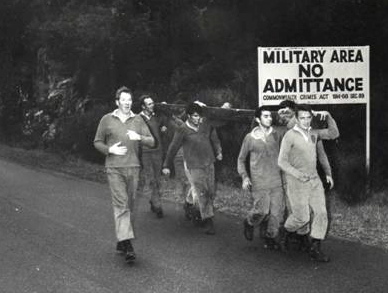
Standing Blue last right with John Whipp second from left 1970’s
It was during this period that I requalified as a MUC exponent and later qualified as an Instructor. During my time with Commandos I later assumed the position of chief instructor teaching MUC at 1 Commando. WO 2 Lionel Currell was a regular army soldier and a WW II commando veteran. When I joined 1 Cmdo, he was the 1 Cmdo Coy, Company Sergeant Major (CSM). He was posted to the unit from Western Australia where he was involved in a parachute unit. I have no idea where he learnt MUC but he was very proficient, a disciplinarian and I was his assistant instructor. After his 4 year posting to the unit he was reposted and I became the senior instructor for 1 Cmdo Coy. Prior to his leaving I had risen through the ranks and I was promoted to the position of CSM 1 Cmdo Coy, the first CMF member to reach this position. The Officer Commanding (OC) of 1 Cmdo Coy during this time was a regular army officer, Major Grant, a veteran of WWII and Korea who was later promoted to Brigadier and an ex WWII Commando. He is now living in Melbourne I believe.
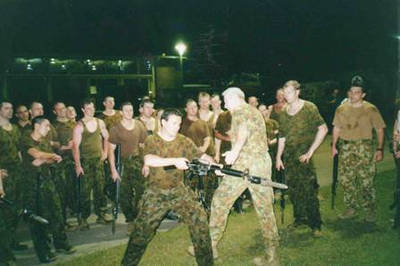
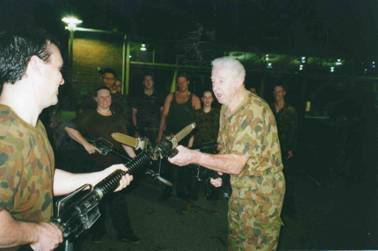
Blue teaching counters to Bayonet attacks at 1 Cmdo in 2007
During my time with 1 Cmdo I trained many units over the years in MUC. I trained the Special Air Service Regiment (SASR) on 4 occasions in Perth as well as their members at 1 Cmdo Coy. The majority of SAS instructors came from 1 and 2 Cmdo with a lot of their first members coming from these units as well. I also gave training to 3rd battalion Royal Australian Regiment (3 RAR) and the 1/19 battalion CMF Bushman’s Rifles at Ingleburn.
It is hard to remember all the courses I instructed on. A lot of the courses would be conducted at 1 Cmdo Coy. After I retired from the CMF in 1975 I would still be asked to conduct MUC courses for my old unit and others. In 2004 I was called by Major Davis at Singleton to teach bayonet work in trenches. I did this as a volunteer for a period of 3 and half years.
I think while I was at 1 Cmdo I ran approximately 2 courses a year from 1955 to 1975. In addition to this I was also involved in conducting training for police instructing the first course for the NSW police Tactical Response Group (TRG) at 1 Cmdo Coy. In subsequent years I conducted follow up training with the police as well as the NSW prisons department and later the Corrective Services, Australian Protective Services, and Sheriff’s Department. I have also conducted numerous self defence and training courses for commercial security personnel in the security industry. I am currently 84 years young and still conducting self defence and security officer training teaching self defence, batons and handcuffing techniques.
“Blue”, who were the Instructors of MUC and what was their backgrounds when you first started training and then through your subsequent time teaching MUC?
The first MUC instructor I met was WO 2 Alf Vockler who was a professional wrestler. As a young digger this man was god to us. I believe he had joined and was recruited by the military to teach MUC. Later in the 1950’s while at 1 Cmdo Coy I met WO 2 Lionel Currell who was the senior instructor for MUC at 1 Cmdo Coy before being posted from the unit. I am not sure where he learnt MUC but he was quite good at it. I believe Lionel was initially trained possibly by British instructors. I am not aware if he had previous training in martial arts other than MUC. I remember that he was a strong disciplinarian.
Blue taking PT on a MUC course in 1980 when he was 55 years old
To your knowledge “Blue” was MUC also being trained in other non commando units and was it widespread in the Army as well as other services during WWII?
I am not certain about that because during this time you only new about what your particular mob was doing. But thinking about it, it is quite possible that this was the case.
After World War II can you describe the attitude toward MUC training by the military command in commandos and the wider military?
After WWII MUC training disappeared within the Australian military. It did not gain resurgence until the formation of the CMF commandos in 1955.
Senior military commanders had lost touch with MUC and felt that it was a specialist skill and not something that was regularly conducted within the wider Army. It was thought of as being more relevant for Special Forces (SF). However, non SF units would contact 1 Cmdo Coy requesting this form of training.
“Blue”, was there a resurgence of MUC training with the onset of the Korean War and if so who were the instructors and where were the courses conducted and what did the syllabus contain?
I am not sure if MUC was taught for the Korean War but it was 1 and 2 Cmdo Coy which revitalized MUC in the Australian army from the mid 1950’s. In 2 Cmdo Coy the main Instructor was Ted Malone. I also qualified Major Greg Mawkes from the SASR in Swanbourne in the 1960’s. He later became OC of 2 Cmdo Coy and then was responsible for MUC training in the SASR.
John Whipp was another instructor qualified by me in 1962 prior to going to Vietnam. He was in an infantry battalion at the time and did the course at 1 Cmdo here in Sydney. John and Greg would both later play important roles in MUC training within the Australian military.
During this period the syllabus for MUC had changed dramatically to that of WWII. The main emphasis now was on killing techniques. This was developed through seeing what was being done in military circles as well as civilian martial arts and then adapting that information for the various roles required in the military. The courses were continually updated for current techniques of the day with the syllabus still displaying a strong emphasis on physical training, rolls and break falls, pressure points, throws, striking techniques, defence against weapons including firearms, knives, machetes, bayonet fighting, elimination techniques and prisoner control.
Blue instructing on a MUC course at 1 Cmdo Coy in 1980
“Blue”, did you feel that the support for MUC by the military command was cyclic and stop and go during your years of association with MUC training?
Yes support for MUC in the Australian military was very up and down dependent on the individual interest of senior commanders within the army. Some military commanders understood the value others did not and MUC either benefited or not from this situation.
The problem was however, that after a period of non support the Army would need to re-invent the wheel again and had to either find remaining qualified personnel or start again. I think the cycle now is going downhill once again after some support in recent years.
“Blue”, was there a renewal and subsequent wane of interest in MUC in the Vietnam War era?
Prior to going to Vietnam there was interest by personnel to conduct training however, this conflicted with the need for unit commanders to train troops prior to deployment in normal infantry soldier skills and not ones seen as value added such as MUC.
“Blue”, do you feel that MUC in the Australian military developed in different directions as members of the defence force promoted MUC in the Army as well as the other services for different needs, what can you tell us about this?
Yes I did see MUC go in different directions, but I still think that MUC should be under one banner with different corps requirements being managed under one guiding direction. Each one has its own core requirement but needs to be managed so that MUC heads in one direction; to make my point Military Police don’t need to be taught how to kill for example. But they also need to know techniques for an operational focus.
“Blue”, during the period that you have been involved with MUC training in the military have you seen it evolve and if so what are your thoughts about that evolution?
Yes, MUC has evolved and I think for the best as new techniques are added that support the soldiers role for today.
“Blue”, in your opinion do you feel that there is still a place for MUC training in the military in the 21st century and if so what it is?
Yes, without a doubt. MUC is required to enable our Army to stay relevant with other nations and to develop soldierly skills and techniques that are required on operations.
Blue in his mid 80’s still teaching Bayonet fighting skills
“Blue”, what is your opinion concerning the military sourcing civilian martial artists to teach soldiers, do you think it relevant and are these instructors suitable to teach for various operational roles?
I maintain that an instructor needs to have a military background but it is commonsense to take knowledge from wherever we can find it and adapt it for the military role. You must update to stay current. I don’t think civilian instructors though are the complete answer. But certainly take the knowledge and adapt it for the militaryusing military instructors or previous civilian instructors who are in the military.
“Blue”, in your opinion what do you feel would be the way forward for MUC training today for today’s military?
Training needs to be relevant to the needs of the Army, it is unfortunate that currently MUC in today’s military is not as widespread throughout the military as it should be as in other nations. I think that it is difficult for military commanders to recognize the value of MUC and to support MUC. Until this happens MUC will remain as it always has and will be reliant on the support of individual commanders as they come and go. In today’s Army MUC should be integral in training developing skills and confidence.
“Blue”, can you describe what the training was like? How hard? Injury rates etc
Injury rates in the WWII MUC courses were very low and the same applied during my time teaching MUC. High injury rates are a sign of bad instruction. Training was hard, we had to prove a point, and a lot of the techniques were designed for killing. Physical fitness was a big part of training, it was important to teach soldiers to develop the will to still keep going. It still is important.
“Blue” you have lived to a very fortunate age what pearls of wisdom can you impart to the younger generations on conducting self defence/defensive tactics training?
As is, Keep it up and keep it going, it is something that is needed. Use commonsense, make sure there are no injuries and impart knowledge as best you can.
“Blue” what advice would you give people regarding avoiding fights and once in a fight what should they do?
Walk away from it if possible, if you cannot walk away you have to do the best you can. If you are in it you are in it to win. I don’t care if I have to use dirty tactics to win and survive.
“Blue”, what are your views of the Australian soldier from when you were serving and the current Aussie soldier today?
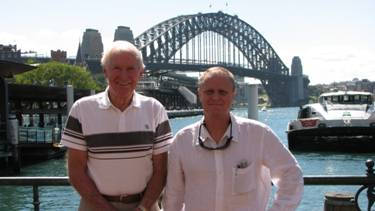
Blue and the Author, former MUC instructor Glen Gardiner
I think today they are far superior to the soldier of the past. The soldier of the past came up through the depression days. He had to learn the ropes the hard way. Today’s young soldiers in my opinion are far better educated and sophisticated and willing to learn. A far better type of lad mentally and physically to previous years. As an example one participant as a private learning MUC was a qualified medical doctor and he had a genuine desire to learn.
Buried at: Cremated – Garden Chapel of Castlebrook Crematorium, Windsor Road, Rouse Hill
Memorial located at: ?
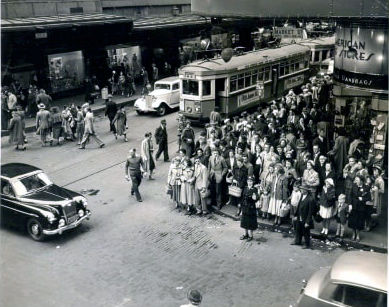
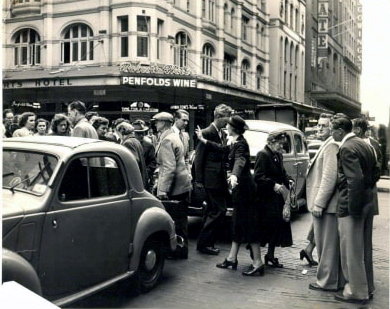
Eileen Patricia WILSON – Point Duty – Sydney CBD
Eileen Patricia WILSON – Point Duty – Sydney CBD
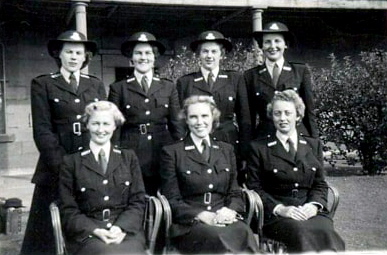
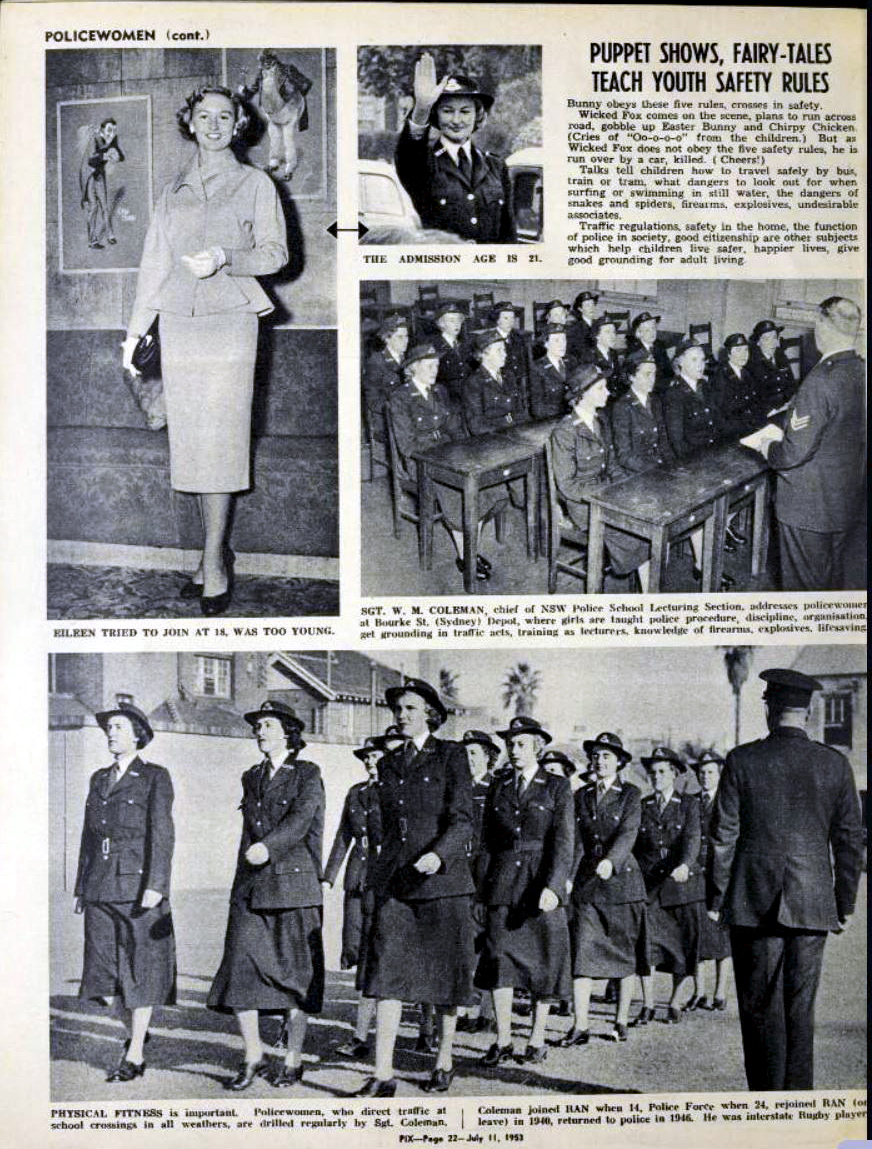
Back Row (L-R): Marsia POTTER P/W 0013 ( was a Sgt 2/C ), June STRATHMORE ( was a Sgt 2/c ) ( R.I.P. ), ?, ? Front Row: Eileen Patricia ‘Pat WILSON, Inness ? ( R.I.P. ), ?
EILEEN is NOT mentioned on the Police Wall of Remembrance * NOT JOB RELATED
Funeral location: TBA
FURTHER INFORMATION IS NEEDED ABOUT THIS PERSON, THEIR LIFE, THEIR CAREER AND THEIR DEATH.
September 1955: Eileen Patrician WILSON, a Constable with the School Lecturing Section at Darlinghurst married Cecil Alfred Shaw, a Constable and member of 22 Division, Liverpool. They married at St. Patricks Catholic Church, Parramatta.
( Source: Liverpool Police History – 1788 – 2016 )
SHAW, Eileen Patricia ” Pat “
28/07/1930 – 19/07/2019
Aged 88 Years
Passed away peacefully in hospital surrounded by family.
Settled in Canley Vale home with beloved husband Cecil Ike (deceased).
Dearest sister to Josie (deceased).
Loving Mother of Wayne, Debbie, Lisa, Melinda, Nicole and Louise.
Mother-in-law to 3.
Proud Grandmother to 20 and
Great Grandmother to 7 with two little souls on the way.
In God s Loving Care
Relatives and friends of Pat are warmly invited to attend her funeral service that will be held at 1.30pm on Friday 26th July 2019, at St Matthew s Catholic Church, 12 Tebbutt Street Windsor.
Following the service, the cortege will proceed to the Garden Chapel of Castlebrook Crematorium, Windsor Road, Rouse Hill.
Hey Greg, just to let you know that mum passed away on Friday, at 22:10
Us 5 girls have been with her all day every day and all day with our children as well on Friday, as we knew time was growing shorter.
Mum was resting peacefully, probably hearing us all around her, chatter and recalling older days.
One grandson was reading out the crossword puzzle clues as we all tried to guess the answers.
It was, I suppose, an early birthday gathering for mum because she would have turned 89 next Sunday, July 28.
Debbie and Louise had planned to stay the night… we all wanted to but that was impossible.
We all slowly left through the night, one by one, with plans to return in the morning, as mum’s breathing was steady.
She was given morphine every four hours to help her rest and breathe easily, which she was.
There was no change until the last person left, leaving Debbie and Louise to settle in for the night.
3 minutes later mum’s breathing began to slow down. Minutes later she quietly slipped away,
Debbie and Louise were by her side, gently talking to her, telling her to go to Dad as they held her hands.
They said she was very, very peaceful,.
I really believe that she was waiting for us to go so she could go with dad.
On Thursday I sat by her bedside and held her hand for 9 hours. Whispering to her come by letting her know that I was not going anywhere. We were all taking it in shifts.
Every time I went to pull my hand away, just to change position, she would squeeze my hand. She knew I was there and I am just so glad I was there.Greg, all the laughs you had with mum and dad through the years and when you were patrolling with Wayne, the whole Shaw household loved your presence… except for my dog.
Thank you for your kind words too.
You are right.
Mum has been without dad for so long now.
25 years in fact!
I imagine she has gone rushing back to dad’s arms….. free from her poor old body.
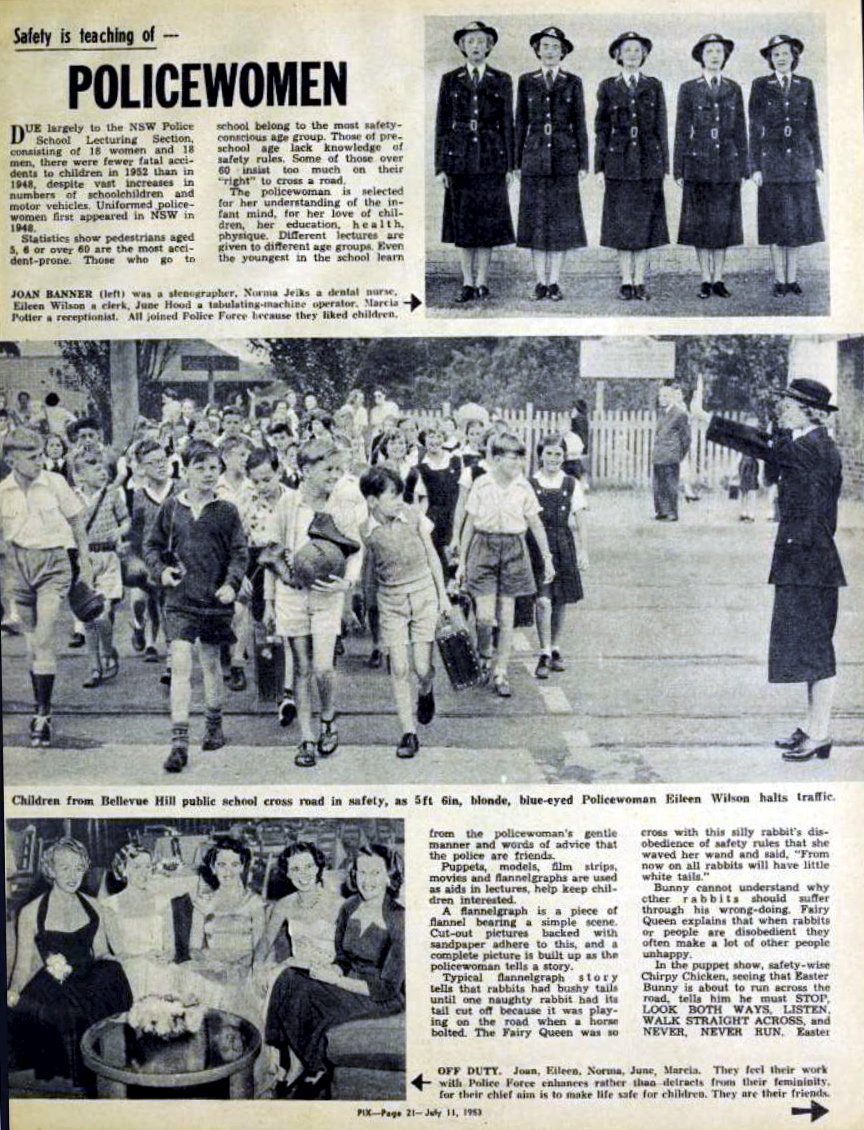
NSW Police School Lecturing Unit – 11 July 1953 PIX MAGAZINE Volume 30, No. 5 ( 11 July 1953 ) Pages 21 – 23
Cumberland Argus (Parramatta, NSW : 1950 – 1962),
Wednesday 28 September 1955, page 9
WEDDING OF POLICEMAN, POLICEWOMAN
Seventy yards of billowing tulle and exquisite Chantilly lace, worn over slipper satin, went into the beautiful bridal gown, which Eileen Patricia Wilson wore at her marriage to Cecil Alfred Shaw, in St, Patrick’s Catholic Church, Parramatta.
Both bride and groom are members of the N.S.W. Police Force.
Eileen, who is the eldest daughter of Mr. and Mrs. H. Wilson, of Blaxcell Street, Granville, was attached to the school lecturing division, Bourke Street, Darlinghurst.
Cecil, eldest son of Mr. and Mrs. A. Shaw, is a member of No. 22 Division, Liverpool.
Eileen’s bridal gown, together with the maid’s frock, fashioned by her friend, Mrs. E. Hawke, of Granville, featured a lace-fitted bodice, long sleeves and a lace draped apron front, continued to the back and finishing with a bustle bow and two hemline tails. The tulle skirt was cut with an eight foot train. Her short, four-tiered veil was held by a crown of lily of-the-valley.
Large camellias, surrounded by white hyacinths, comprised the bridal bouquet.
Josephine Anne Wilson, her only attendant, wore a full-length frock of salmon flecked nylon, with a plain salmon nylon apron front and bustle bow. She wore a halo of tuber roses in her hair.
Best man was Bernard Russell Shaw, the groom’s brother.
One hundred guests were received at ” Westella, ” Auburn, Lilac Ballroom, by Mrs. Wilson, who chose a blue figured nylon frock, topped with a blue and white coat.
Mrs. Shaw chose a lemon romaine beaded frock and black accessories.
The bride changed for her Coolangatta honeymoon in to a champagne, sculptured nylon frock, over which she wore a powder-blue velvet coat and a small matching petal hat.
JOAN MUDIE GAY 8 February 2019
Passed away peacefully at Bourke Street Health Service, Goulburn.
Much loved wife of William Gordon (dec).
Loving mother and mother-in-law of Peter, Robert & Marcell, Maureen & Terry, Patricia & Barry and Margaret.
Very proud and loving nan to her seventeen grandchildren and a much loved great ‘Nanny Gay’ to all of their children.
Aged 89 years.
‘Forever In Our Hearts’
Joan’s family and friends are invited to attend her Mass of Christian Funeral commencing at 1:30pm Friday 15 February 2019 at St Peter & Pauls Cathedral, Bourke Street Goulburn. A private cremation will take place.
R. J. Sidney Craig Funeral Directors
EST. 1837 – AFDA / FDA (NSW)
298 Sloane St, Goulburn NSW 2580
Telephone: (02) 4821 2122