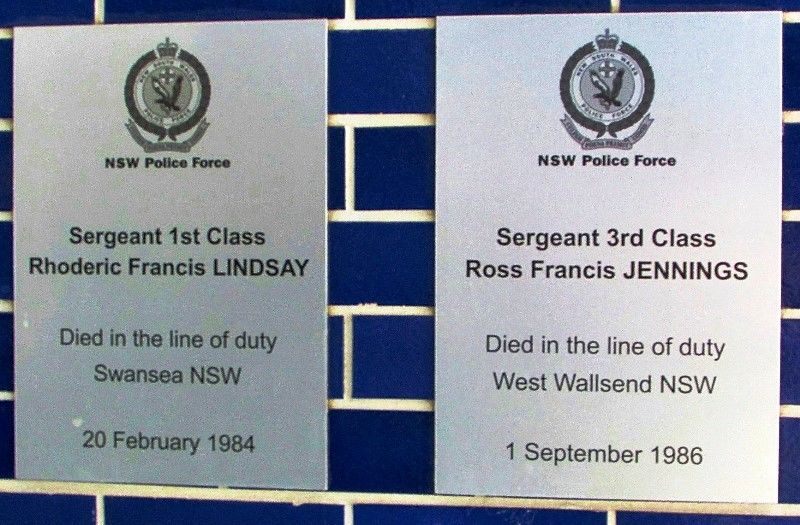
On the afternoon of 20 February, 1984 Sergeant Lindsay and Senior Constable Calman were both off duty and fishing in the sergeant’s boat off Swansea. About 6.10pm the yacht Melody radioed for assistance after running aground on the bar at Swansea Channel. Sergeant Lindsay and Senior Constable Calman then set out to assist the stricken vessel. Securing a line to the Melody they attempted to tow the vessel to safety, but as their efforts were hampered by heavy seas the sergeant released the line from the yacht. Constable Calman then noticed that Sergeant Lindsay was missing from his boat and seeing blood in the water, dived into the sea to rescue his friend. Constable Calman, assisted by surf club members, then conveyed the injured sergeant to shore however it was found then that he had died of his injuries.
It appears that Sergeant Lindsay was either knocked or was washed overboard where he suffered extensive head injuries when struck by his boat’s propeller.
He was posthumously awarded the Royal Humane Society Bronze Medal and the Police Commissioner’s Commendation for Outstanding Courage and Devotion to Duty.
The sergeant was born in 1935 and joined the New South Wales Police Force on 12 April, 1955. At the time of his death he was stationed at Newcastle.
National Police Remembrance Day ceremony in Lake Macquarie
David Stewart
September 29 2017 – 4:27PM
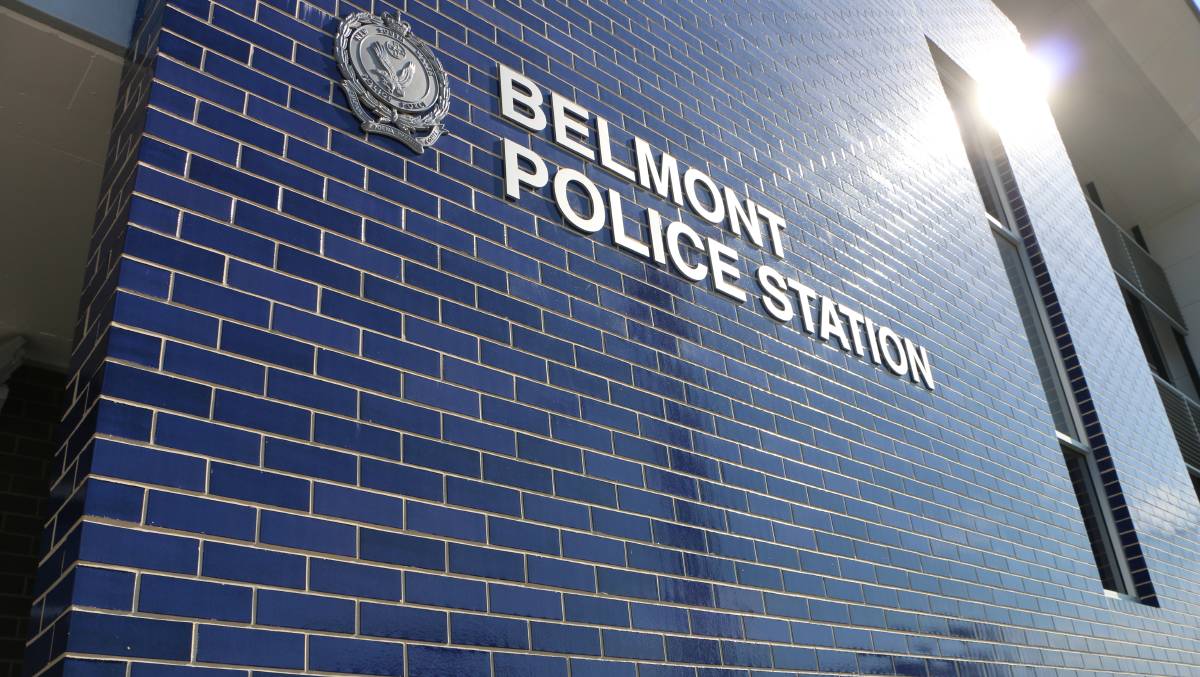
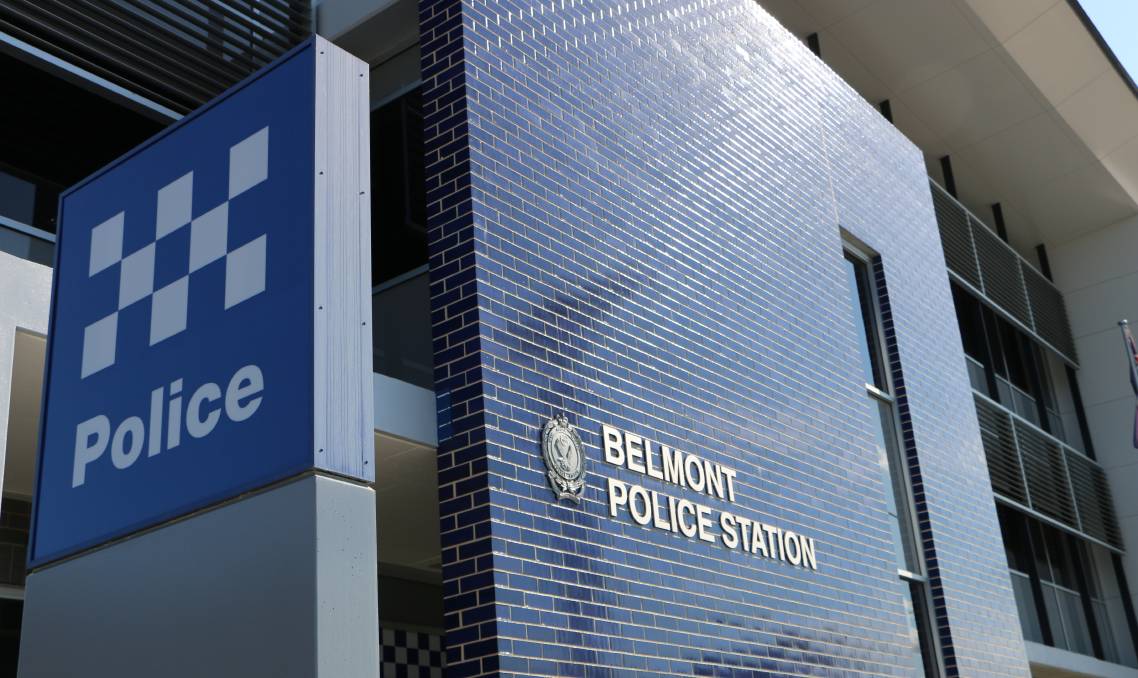
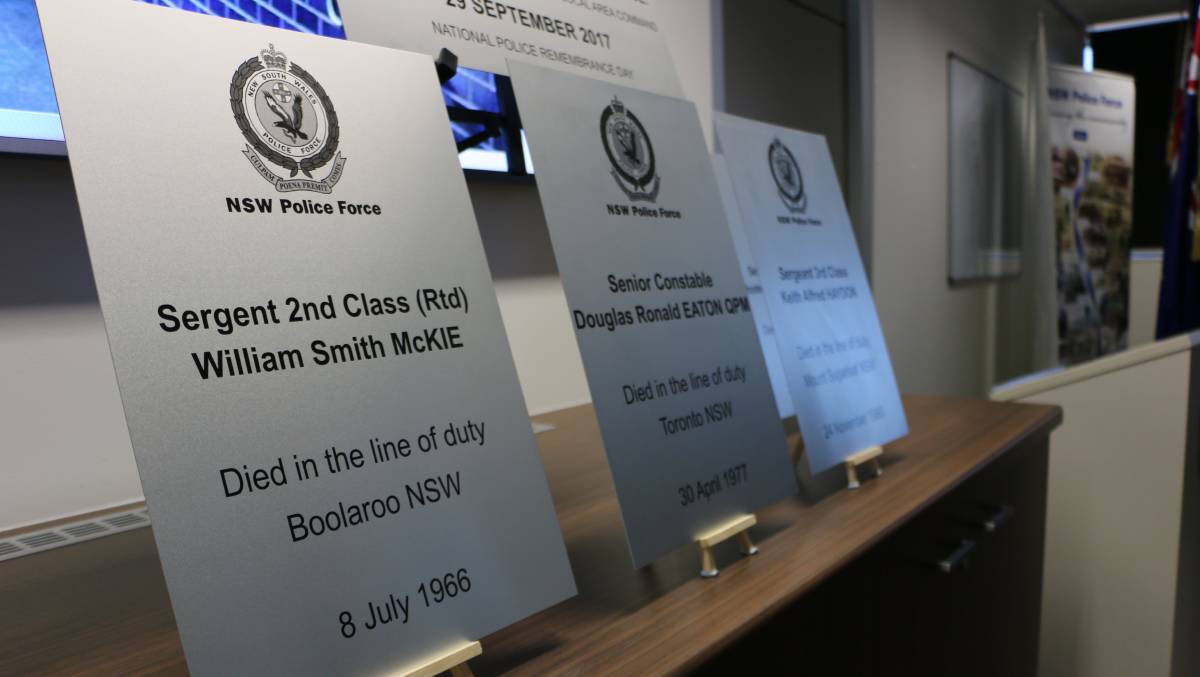
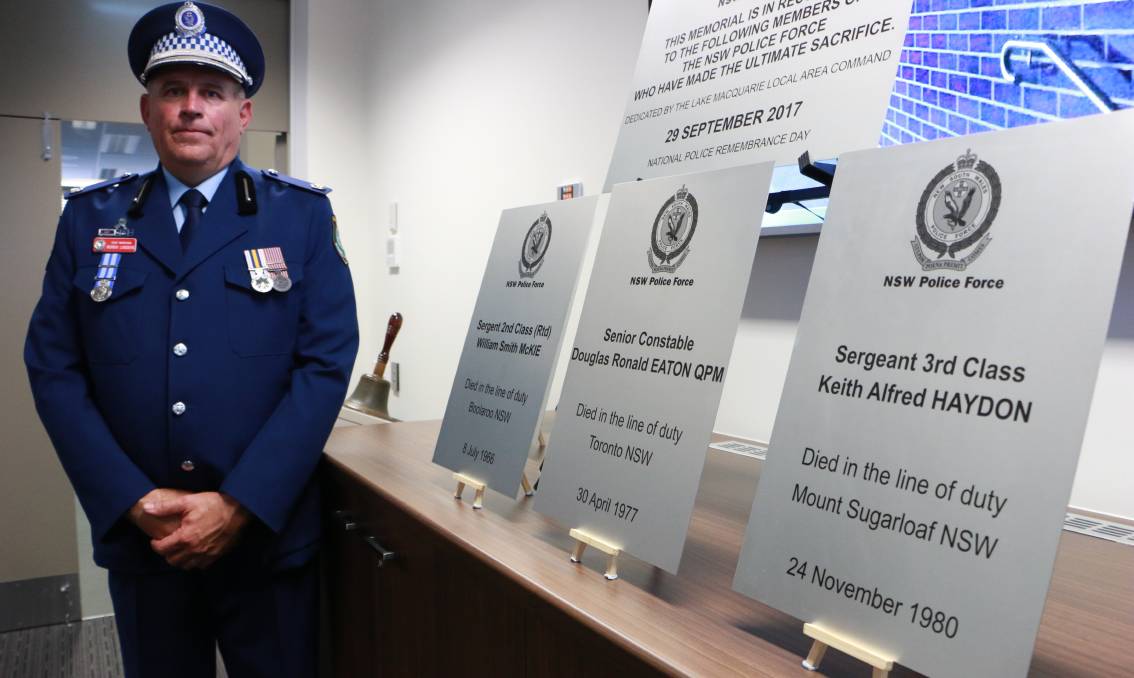
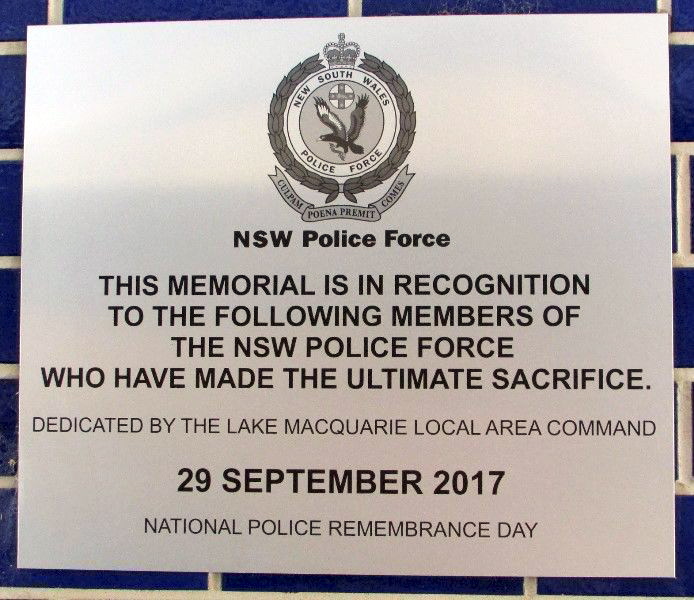
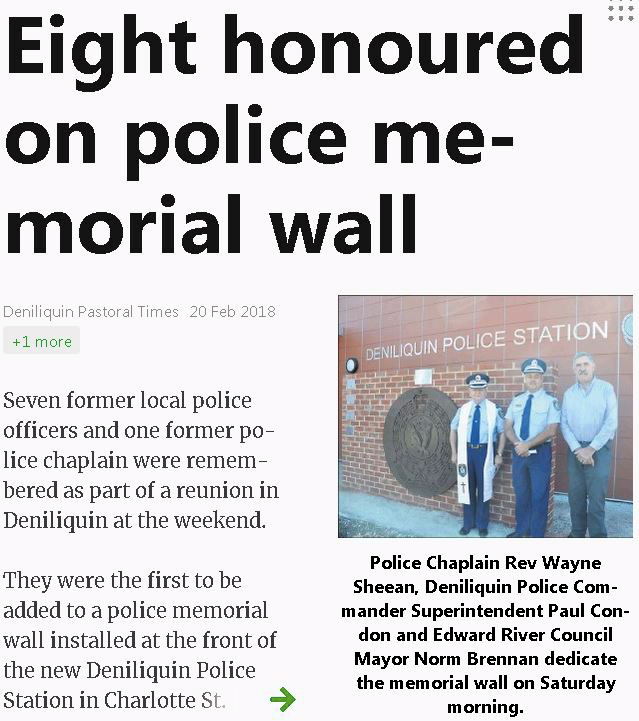
POLICE from Lake Macquarie Local Area Command have unveiled plans for a memorial wall at Belmont to honour the seven local officerskilled in the line of duty since 1863.
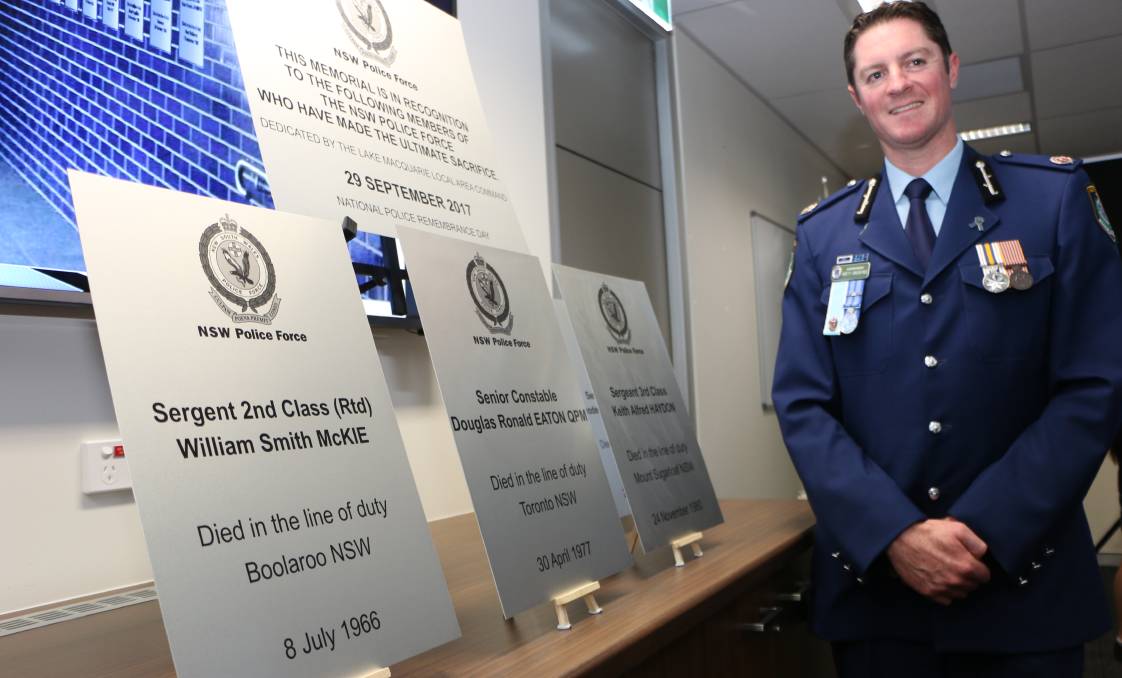
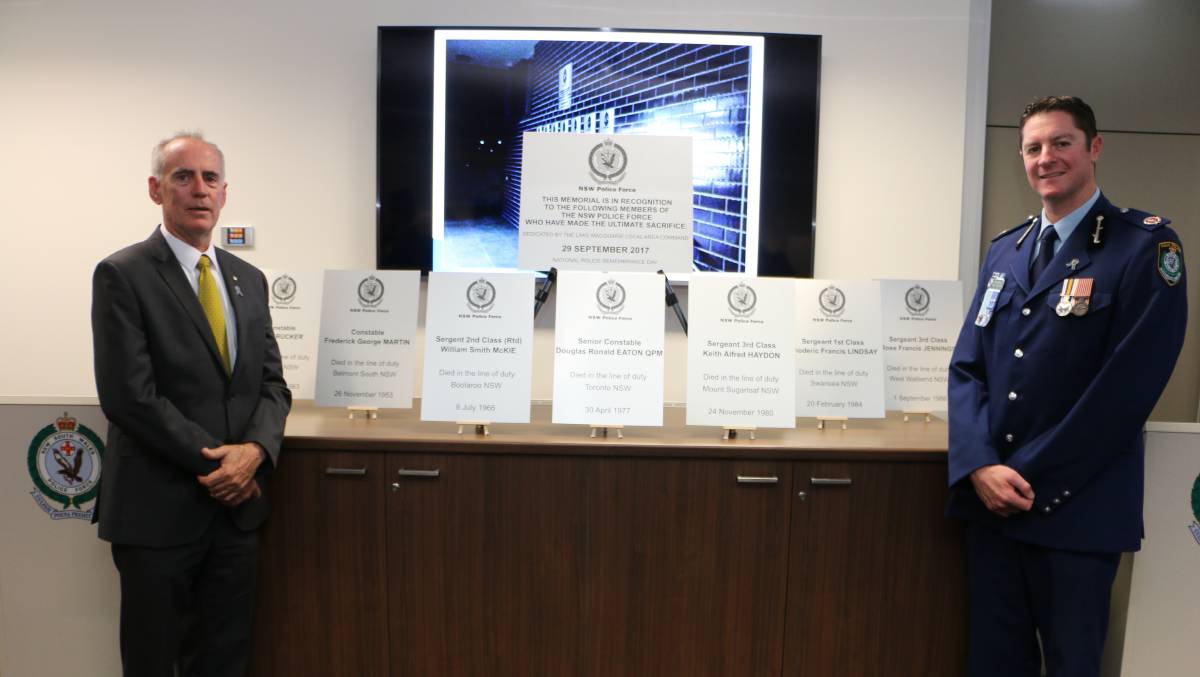
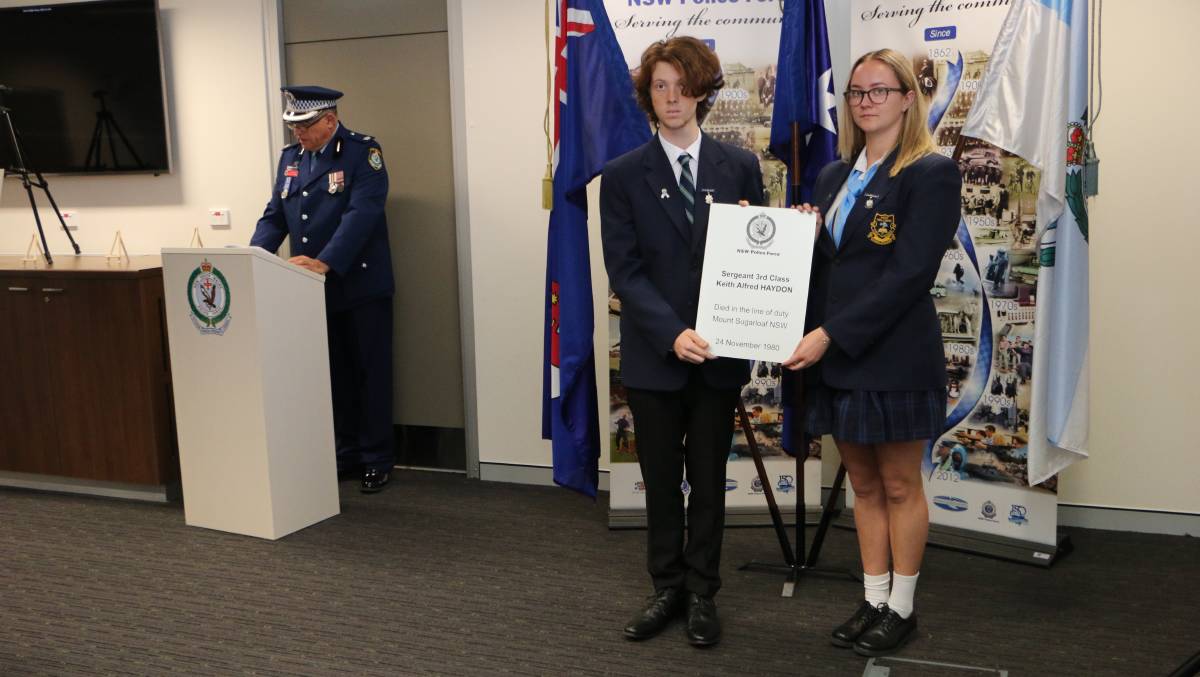
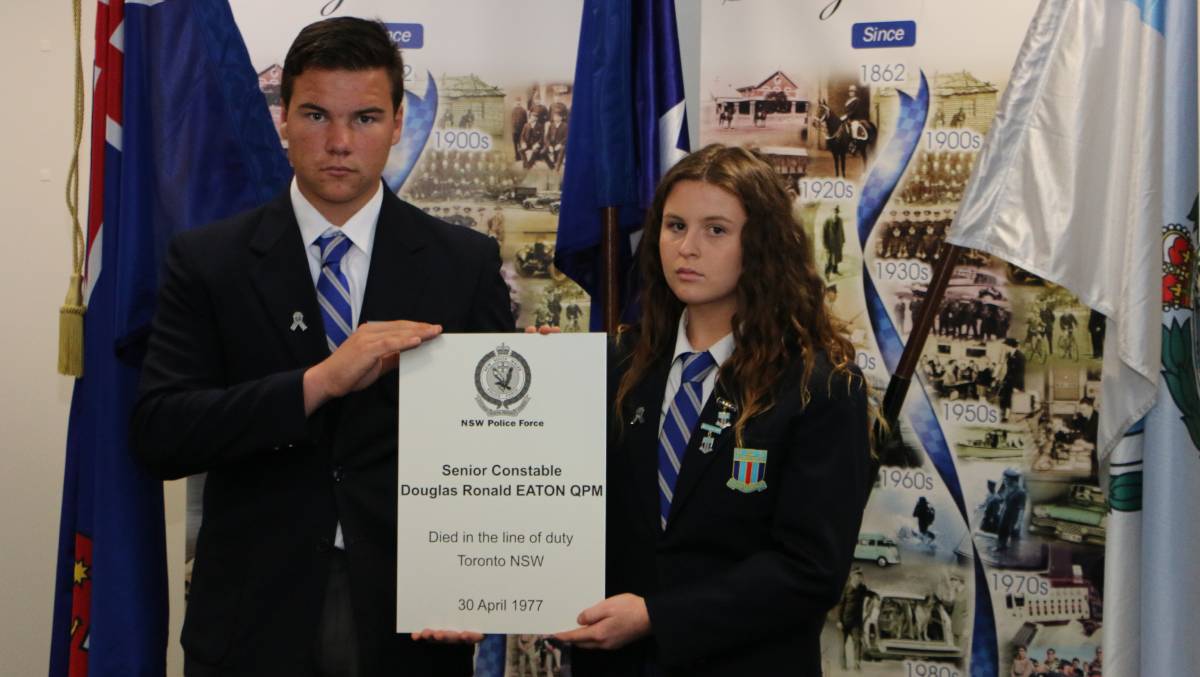
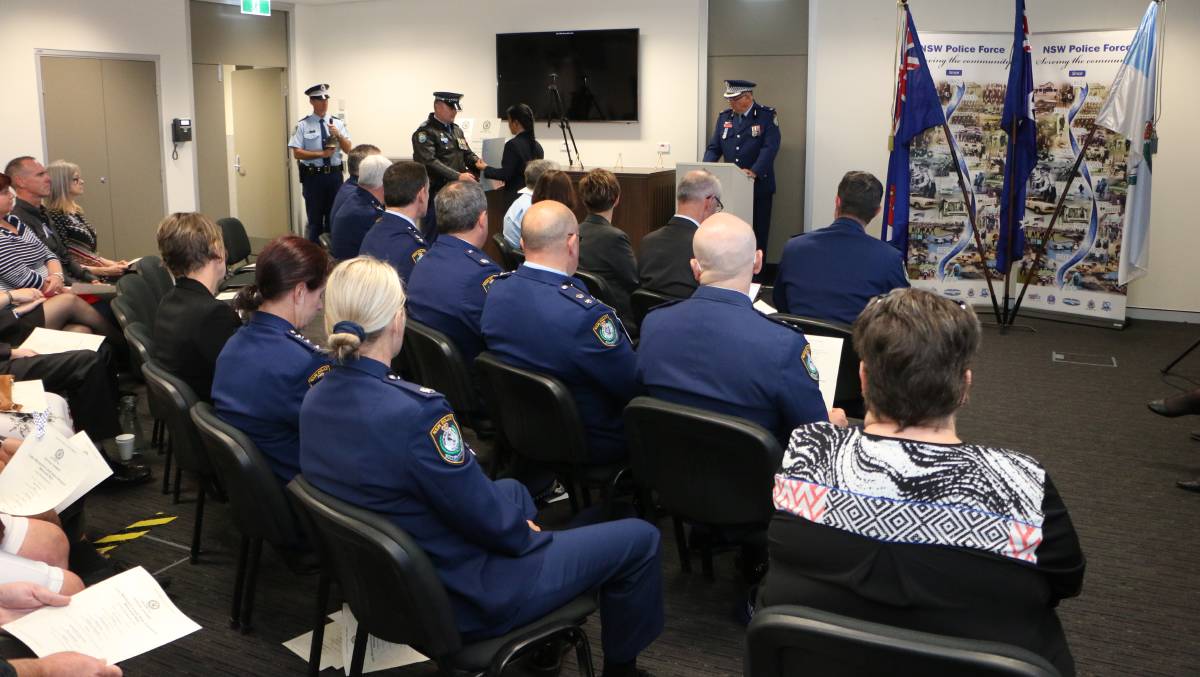
Plaques commemorating the seven officers were dedicated to the wall in a ceremony at Belmont police stationthis afternoon, National Police Remembrance Day.
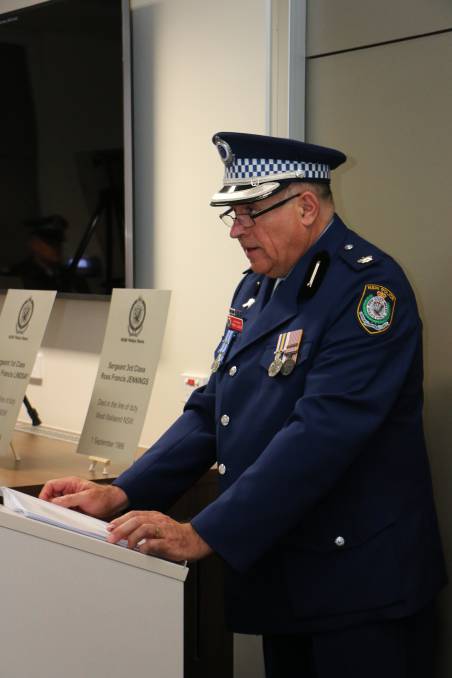
Chief Inspector Murray Lundberg of Lake Macquarie LAC presided over a private ceremony attended by police, local high school students, and the families of the fallen officers.
“This is a time for reflection on the ultimate sacrifice that police officers can give in the execution of their duty,” Chief Inspector Lundberg said.
Acting Assistant Commissioner Brett Greentree, the Northern Region Commander, said the wall of remembrance, to be created on the distinctive blue wall at the entrance to the police station, would be striking.
“It will be a sight to treasure,” Acting Assistant Commissioner Greentree said.
“I want the officers, as they are walking out the front doors of this police station, to stop and reflect on the names, stop and reflect on the sacrifice.”
He said he hoped that the inaugural plaques to be installed on the wall were also the last.
“My dream is that we never, ever, add another name to this wall. I hope and pray that our wall is now complete.”
Acting Assistant Commissioner Greentree reached out to the families of the fallen officers.
“No commemoration or recognition can make good the loss that is unfairly carried by family members,” he said.
“I can only offer you my heartfelt condolences. Please know that your loved ones, who are no longer with us, will always be remembered.”
Across NSW, ceremonies were held to commemorate the service and sacrifice of the 269 officers who have lost their lives in the line of duty, and through injury or illness, since the formation of the NSW Police Force in 1862.
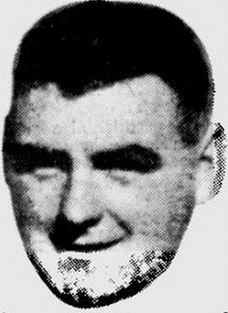
Ian Donald WARD
| 27/10/2012
Ian Donald WARD
late of Padstow, NSW
New South Wales Police Force
Joined via NSW Police Cadets on 21 February 1966
Cadet # 2109
Rank: NSW Police Cadet – commenced 21 February 1966
Probationary Constable – 12 April 1968
Constable 1st Class ( Acting Sergeant in Cyprus )
Regd. # ? – Most possibly between 13171 – 13193
Stations: ? & Cyprus as part of the 11th Australian Contingent of UN Peacekeeping Mission
UNFICYP AUSCIVPOL
Service: From 21 February 1966 to 12 November 1974 = 8+ years Service
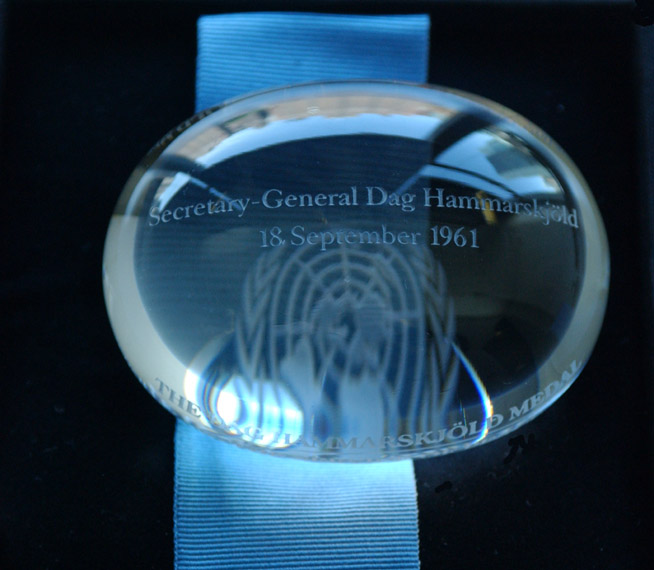
Awarded the Dag Hammarskjöld Medal. The U.N. Secretary-General established the Dag Hammarskjöld medal for posthumous award to members of peacekeeping operations who lost their lives during service with a peacekeeping operation under the operational control and authority of the United Nations.
Born: 12 April 1949 at Ryde, NSW
Died: Tuesday 12 November 1974
Cause of death: Murdered – Land Mine Explosion
Event location: near Lefka, Cyprus ( 5 days after arriving in the country )
Age: 25
Funeral date: 26 November 1974
Funeral location: ???
Grave location: Rookwood Cemetery, Rookwood
Ian Donald WARD
On 12 November, 1974 Constable Ward was serving with the Eleventh Australian Police Element in Cyprus. Whilst travelling in a Land Rover near Lefka the vehicle hit a landmine in the buffer zone. As a result Constable Ward was killed and Constable 1st Class John Woolcott was seriously injured.
Constable Ward is the 3rd and last Australian to die in Cyprus.
The constable was born in 1949 and joined the New South Wales Police Force on 12 April, 1968. At the time of his death he was stationed in Cyprus and an Acting Sergeant.
John Woolcott recovered from his injuries and ” Wooly ” later retired from NSW Police Force either as an Sergeant at Manly Police Station or an Inspector at North Sydney / Mosman. This, is yet, to be confirmed. ( 10 August 2017 ).
[divider_dotted]
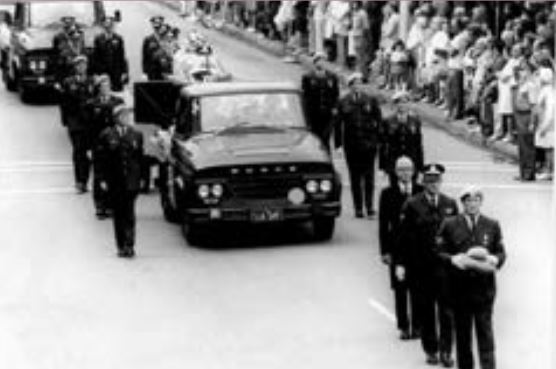
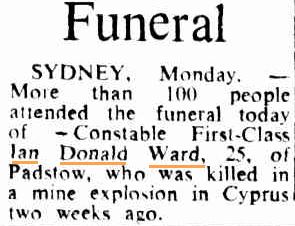
1974 – the funeral for Sergeant Ian Ward
[divider_dotted]
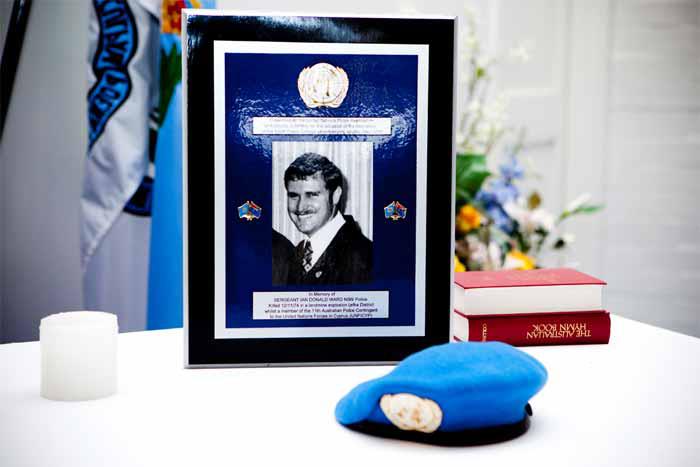
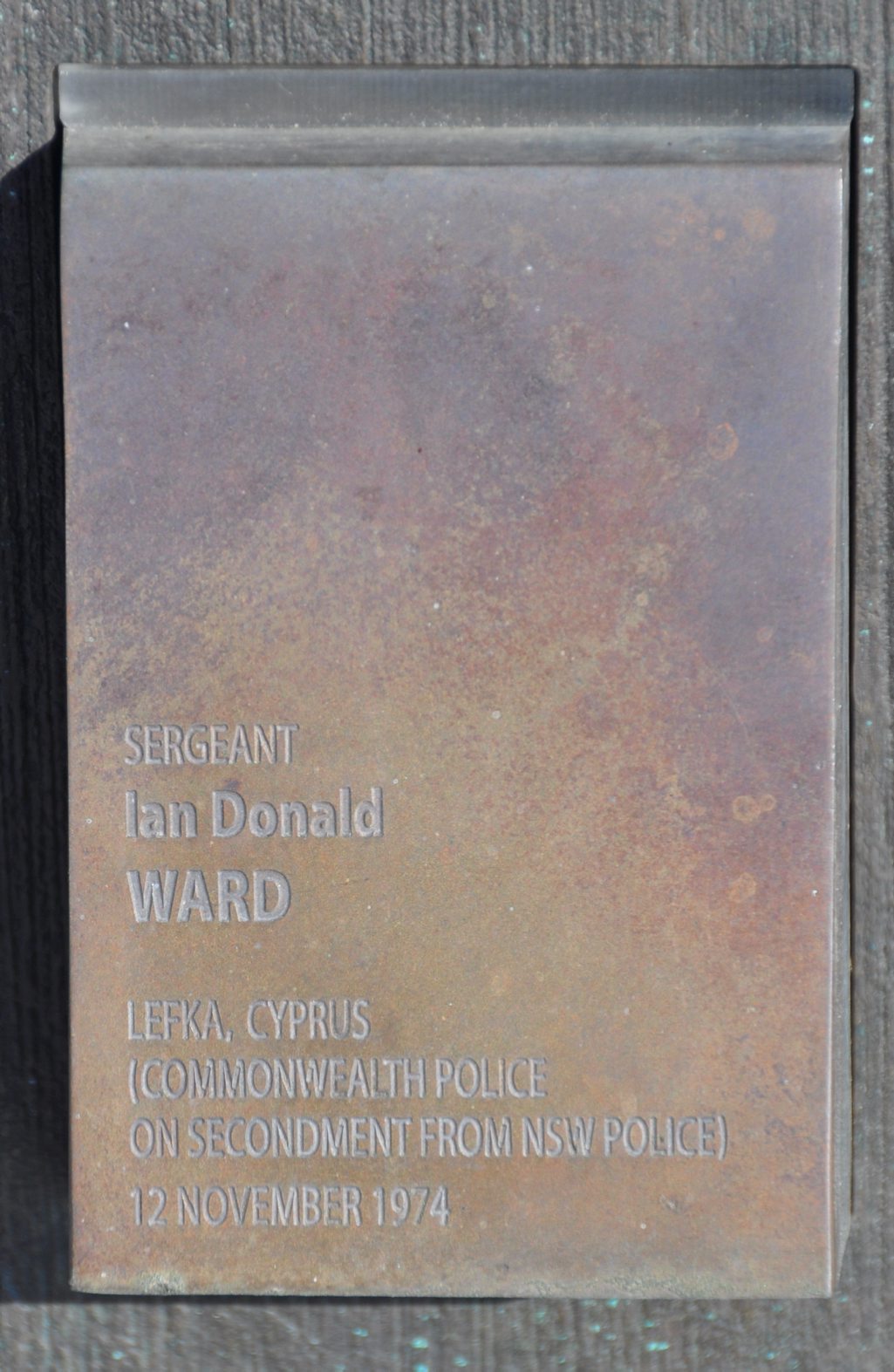
National Police Wall of Remembrance Touch Plate for Ian WARD
[divider_dotted]
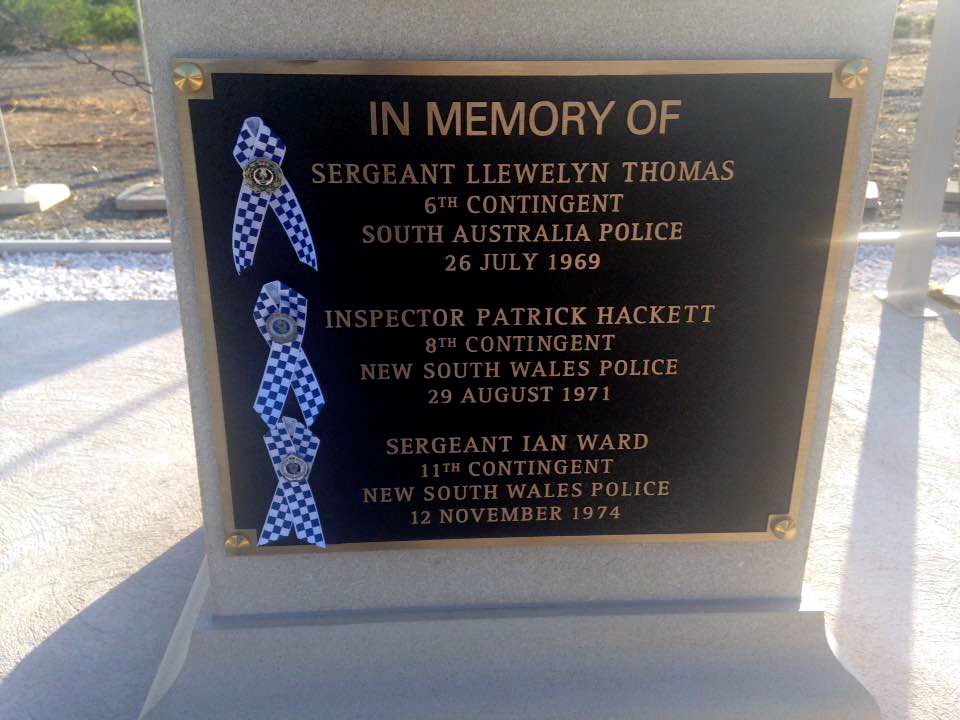
17 June 2017 – Malaysia Memorial in Cyprus taken today as Australian Police complete the long mission and are leaving Cyprus.
[divider_dotted]
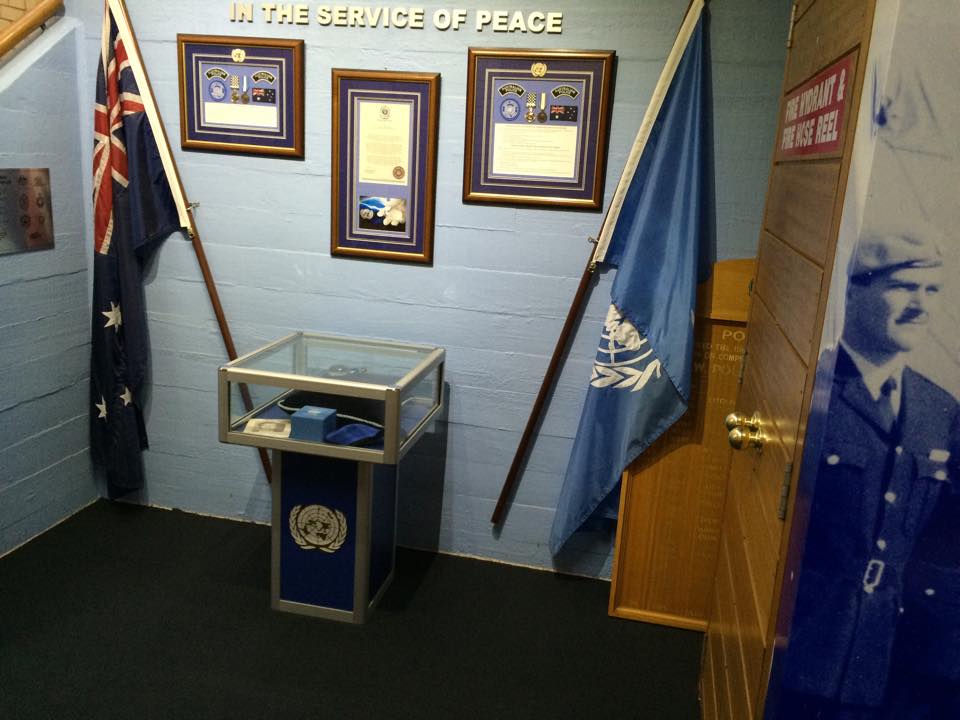
Ian’s memorial at the Goulburn Police Academy.
[divider_dotted]
Dag Hammarskjold Medal
[divider_dotted]
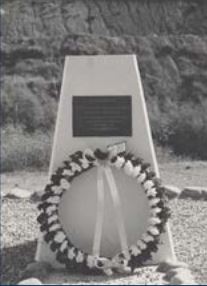
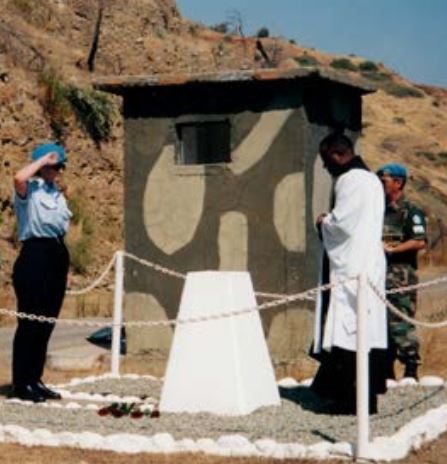
Memorial to Ian WARD – unveiled in 1985
2003 Police Remembrance Day is marked with a ceremony at the cairn erected in memory of Sergeant Ian Ward.
[divider_dotted]
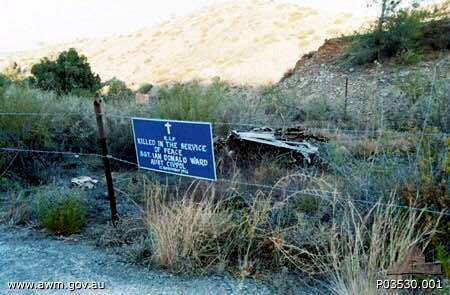
Inscription: Killed in the service of peane Sgt Ian Donald Ward Aust. CivPol
The closure of Nicosia Airport meant a circuitous route to Cyprus for the second half of the eleventh contingent led by Merv Beck.
Although it was not known at the time, conditions on the Island and consequent reduction in UNFlCYP strength would make this the
last November rotation.
The group left Sydney on 6 November and were welcomed some days later at Akrotiri after flying with Qantas to London then busing to
the Brize Norton RAF Base near Oxford and thence via Malta to Cyprus.
RAF flights were ‘dry’ and the seats faced the rear, so the Australians appreciated the traditional welcome at Limassol Headquarters.
The newcomers ‘pumped’ the old hands for news of the war while they themselves were pressed for information about events in Australia.
The new arrivals were soon split up. Ray Leister was assigned Control Room duties while others went to Ktima and Polis.
After only five days on the Island the unthinkable happened near a road-block approaching Lefka.
Ian Ward, a replacement from New South Wales, was killed and John Woolcott injured when their Land Rover detonated a land-mine in an unmarked field.
The Australians were conveying a Turkish Cypriot family from Ayios Nicolaos to the Turkish Cypriot controlled area at Lefka and one of the four passengers was killed and the other three seriously injured.
The fatality cast a pall over the contingent.
A number of moving ceremonies were held before his body was flown home to Australia.
Twelve months later a cairn was erected to commemorate the tragedy and each twelve months a short service is held near the memorial.
Geoff Baker was a member of the Board of Inquiry convened under British military regulations to investigate the incident.
Land-mines were the major component of fortifications along the confrontation zone. UNFICYP had lodged a number of protests about mine-laying procedures and the fact that many fields were neither marked nor adequately recorded. UNFICYP began a special programme to remedy the deficiencies, but two UNFICYP soldiers were killed in similar circumstances during the following twelve months.
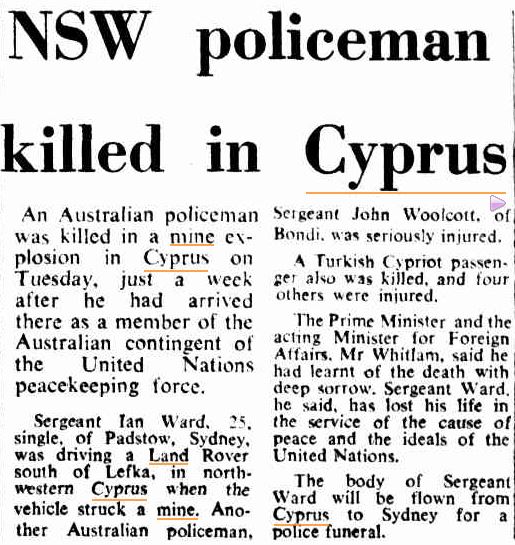
Canberra Times (ACT : 1926 – 1995), Wednesday 20 November 1974, page 3
Service
LONDON, Tuesday (AAP). – Representatives of all United Nations peace keeping forces in Cyprus will take part in a memorial service today for Sergeant Ian Ward, 25, a Commonwealth policeman of Sydney, who was killed in landmine explosion last week. His body will later be flown to Sydney for burial.
Located within the Honour Precinct is an original ornate marble tablet featuring early losses of New South Wales Police Officers. The tablet is flanked by the New South Wales state flag and the New South Wales Police Force flag.
The Peacekeeping Display honours all members of the NSW Police Force who have served in peacekeeping operations throughout the world and houses the Dag Hammerskjold medal belonging to the late SGT Ian Donald Ward who died in UNFICYP. This was donated to the NSW Police College on the 29th May, 2010 from Mr Ken Ward, OAM, father of SGT Ward.
On the 12th November, 1974, a member of this Force, Constable 1st Class I. D. Ward, who had arrived in Cyprus a few days before, and Constable 1st Class J. Woolcott, also of this Force, were carrying out humanitarian work transporting refugees. The United Nation’s land rover in which they were travelling struck a land mine on a road between Limassol and Lefka resulting in the death of Constable 1st Class Ward and severe injuries to Constable 1st Class Woolcott, Constable 1st Class Ward was posthumously awarded the United Nations Medal, Cyprus Division.
BERNARD IS mentioned on the Police Wall of Remembrance
On 26 February, 1955 Constable Orrock of the Sydney Water Police was performing flood rescue duties in the Maitland area during the horrendous 1955 floods. While travelling with Army and Air Force personnel in an Army Duck toward the Louth Park area, the wireless aerial on the Duck struck live high tension power lines. As a result, Constable Orrock and two Army Signallers, Sergeant William McGrath and Signaller Eric Chard, were killed. The cause of death was asphyxiation caused by electrocution.
He was posthumously awarded the Queen’s Police Medal for Gallantry and a Bronze Medal from the Royal Shipwreck and Humane Society for his actions in the floods that ultimately led to his death.
The constable was born in 1930 and joined the New South Wales Police Force on 22 January, 1951. At the time of his death he was attached to the Sydney Water Police.
Canberra Times (ACT : 1926 – 1995),
Tuesday 22 November 1955, page 5
AWARDS FOR GALLANTRY IN N.S.W. FLOODS
SYDNEY, Monday.
The Queen has conferred awards for services during the floods of last February and March.
The awards were announced by the Governor, Sir John Northcott, and the Prime Minister, Mr.Menzies, yesterday.
……….The Superintendent of Newcastle Police, Peter F. McLouglin or McLachlan, and Mr Ian Stuart Black, of Denman, receive the British Empire Medal.
The Queen’s Police Medal for gallantry was awarded posthumously to Constable Bernard Alfred Orrock, of the Sydney Water Police who was killed during rescue operations.
The Queen’s Commendation for Brave Conduct was awarded to four policemen and four civilians.
Inspector Peter McLachlan, of Newcastle, who was awarded the British Empire Medal, personally took part in more than 100 rescues in the Singleton district.
He was without sleep for four days and nights directing dozens of other rescue operations, including the organisation of an aerial flood lift into Singleton, and emergency accommodation for hundreds of homeless people.
Constable Bernard Alfred Orrock, 24, of Alpha Rd, Willoughby, who was awarded the Queen’s Police Medal for Gallantry ( posthumous award ) was attached to the Water Police when he was electrocuted on an Army duck at Maitland on February 26.
The duck on which Orrock was travelling hit a 66,000 volt high tension wire near the Maitland railway bridge while trying to reach 100 people who were stranded there.
Before he was killed he assisted in the rescue and evacuation of about 70 people.
Constable Marius Joseph William John Bourke, Rudolph Luvaine Munns and Svend Aage Ivarsson, awarded the Queen’s Commendation for brave conduct, are all of the Sydney Water Police.
Washed Over Dam In Boats
There were in two police flood boats, which were washed over a dam, near Singleton, while trying to get Inspector McLachlan into Singleton at night.
Constables Bourke and Ivarsson later in Singleton, took part in scored of rescues under Inspector McLachlan.
Constable Munns worked with Constable Orrock at Maitland and took part in more than 100 rescues.
Wash from a ship’s propeller swept a man to death beneath a wharf at Walsh Bay yesterday.
A wharf foreman, who plunged fully clothed into the water to rescue him, received cuts and bruises when he was buffeted against the wharf.
Drowned was John Allan Mitchell, 57, of Nicholson Street, Balmain.
Mitchell, a welder, was working on the stern of the motor vessel Braeside, moored at No. 7 wharf.
He was standing on scaffolding on a raft floating between the ship’s stern and the wharf, when wash from another ship, Muliama, rocked the raft, overturned the scaffolding, and sent him tumbling into the water.
A wharf foreman, James Curry, of Cascade Street, Paddington, dived into the water and supported Mitchell until Maritime Services Board employees Stewart Dutton, of Herne Bay, and Leslie Lindwall, of Seaview Street, Dulwich Hill, reached them in a launch.
Mitchell was given artificial respiration before the arrival of the police launch Typhon, with Constables B. Orrock and W. Atkins aboard.
Central District Ambulance took Mitchell to Sydney Hospital, but he was dead on arrival.
Water Police yesterday rescued a man clinging to a pylon in three feet of water under a wharf at Walsh Bay.
The man, William McCormack, 60, of Victoria, told police he did not know how he got into the water, but must have been there for hours.
He was blue with cold, and on the point of collapse when rescued by Constable B. Orrock, assisted by Sergeant D. Lechleitner and Constable J. Nicholson.
McCormack was admitted to Sydney Hospital suffering from immersion.
In 1941 Constable Lees was the Officer-in-Charge of Jerry’s Plains Police Station. On the day of his death he was patrolling the district on horseback, calling in at local properties. Later in the day the constable’s riderless horse was found by a farmer near Hobden’s Hill. He searched the area and eventually located the body of the constable lying in a roadside ditch beside the Jerry’s Plains, Singleton Road. It appeared that the roadway had collapsed underneath Constable Lees’ horse, causing the animal to stumble and fall into the ditch, crushing the rider.
The constable was born in 1914 and joined the New South Wales Police Force on 11 January, 1937. At the time of his death he was stationed at Jerry’s Plains.
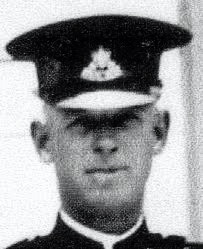
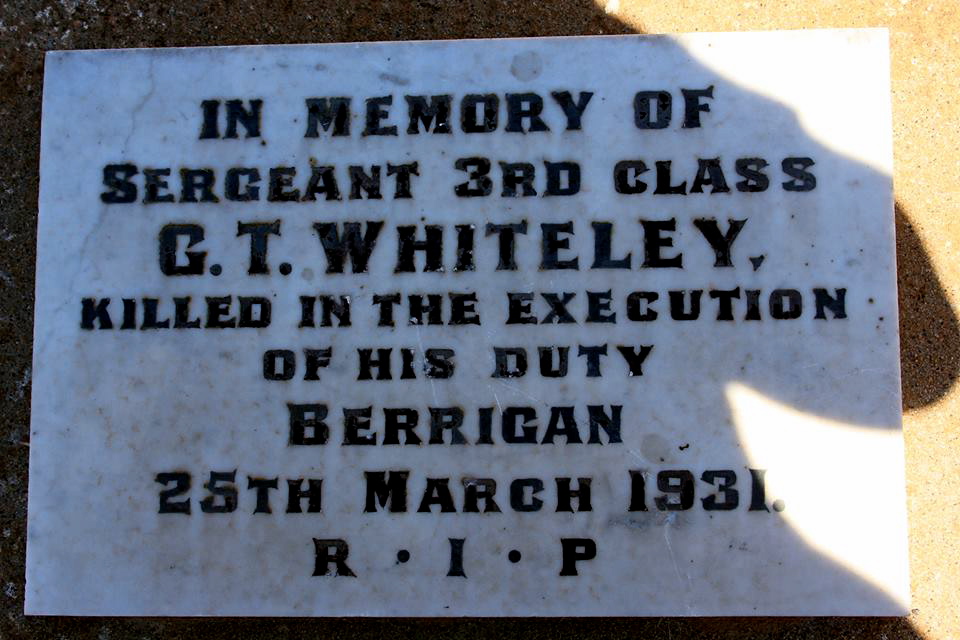
George Thomas WHITELEY
| 27/10/2012
George Thomas WHITELEY
AKA ?
Late of ?
NSW Penrith Police Academy Class # ? ? ?
New South Wales Police Force
Regd. # ‘Q‘ 9081
For the purposes of this website ‘Q‘ represents those Police joining between 1862 ( commencement of NSWPF ) – 23 February 1915 ( Commencement of NSWPF current numbering system )
Rank: Constable ( Mounted Police Trooper ) – appointed 15 March 1910
Sergeant 3rd Class – appointed ? ? ?
Final Rank = Sergeant 3rd Class
Stations: ?, Hill End ( Constable – 1913 ), Fifield ( SenCon 1920 ), Berrigan ( 2 years ) – Death
Service: From 15 March 1910 to25 March 1931 = 20+ years Service
Embarkation: 201014 at Sydney on H.M.A.T. A14 ‘Euripides”
Age at embarkation: 25 yrs 10 mths
Occupation: Mounted Police Trooper
Address: Bega
Next of kin: Father: George Edward WHITELEY – A farmer
Religion: Roman Catholic
Single / Married: Single
Returned to Australia: 191018 from Plymouth, England on D24, “Sardinia”
Awards: 1914 /15 Star, Returned Solider badge # 87105
Injuries: gunshot ( shrapnel ) wound to lower lip – 130515. 9 days under treatment. Gunshot wound to left leg, left foot & right side of head. He stated that while serving in Gallipoli, he suffered from indigestion for the first time and has suffered on and off whit it ever since. In the past twelve ( months ) the attacks of pain with occasional vomiting have been more frequent…. Twelve days before admission and on the 5th July, he vomited about a couple of pints of blood.
Attributable to service during war and active service conditions in Gallipoli.
Discharge #: 56009
Previously Served in the Colonial Force.
Description: 5′ 8″ tall, fair complexion, blue eyes and fair hair. Chest = 34.5 – 40″. 11 stone 12 lbs. No marks on body.
[/blockquote]
Sgt George Thomas WHITELEY ( 29 old ) of 1st Division H.Q., ( The Hutment Camp, Abbotsbury Rd, Wyke Regis, U.K. married Kate HARPER ( 22 old ), Spinster of 2 Block A, The Flats, Tidworth, England ( occupation: Clerk ) at St. Augustine’s Chapel, Dorchester Rd, Melcombe Regis, Weymount, England by Roman Catholic Priest Thomas Sheehan on the 3 October 1918. Registrar’s Reference # 80.
In 1936 – after the explosion, his wife was living at 134 Railway Pde, Carlton, NSW. This address ( 2019 ) is / was the Westpac Bank, Kogarah.
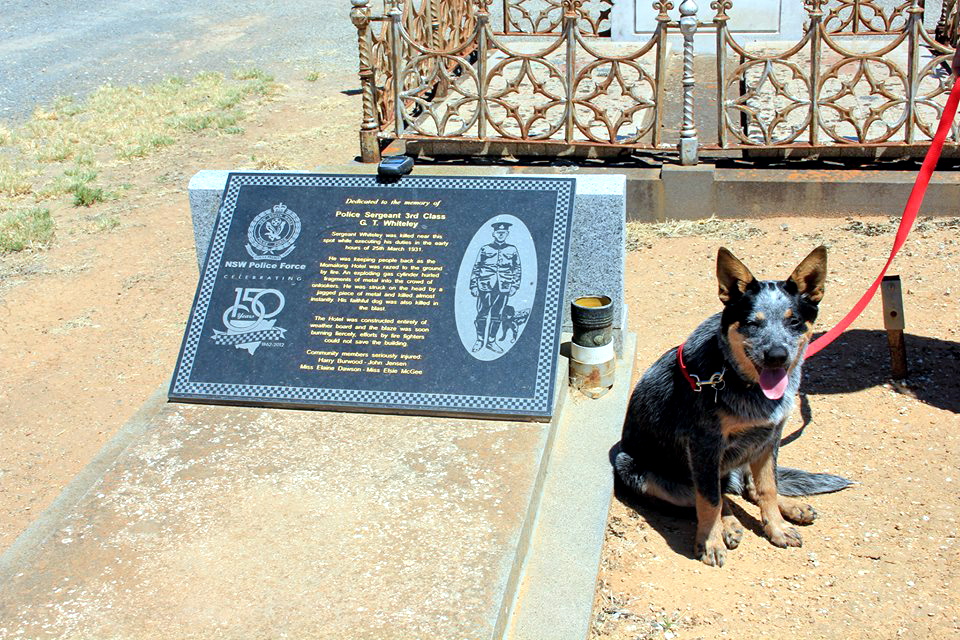
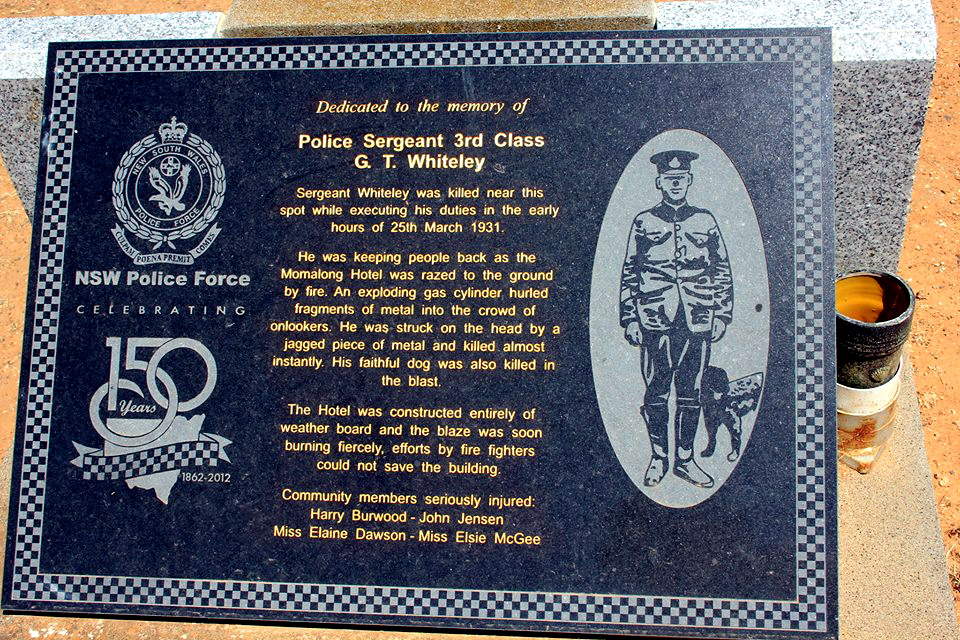
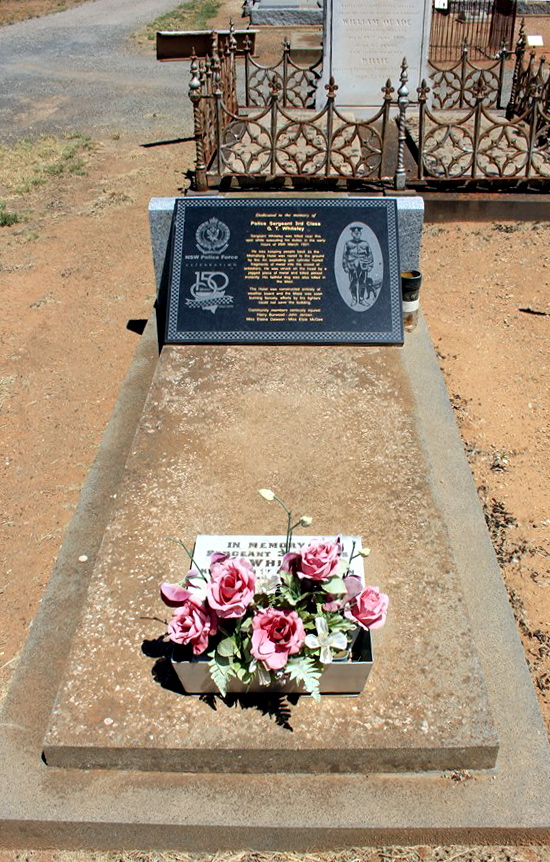
About 4am on 25 March, 1931Sergeant Whiteley and Constable McRae attended a fire at the Momalong Hotel, Berrigan.
During the fire both police officers were standing on the roadway outside the hotel when a gas cylinder exploded and a piece of flying metal struck the sergeant in the face, causing “injuries of a terrible nature” and killing him instantly.
Three bystanders (of an estimated two thousand who were watching the blaze) were also badly injured in the blast and another five were hit by flying steel, however all others recovered.
The sergeants faithful dog, which was standing beside his master, was also struck by flying debris and killed instantly.
The Canberra Times of 26 March, 1931 carried the following account of the incident.
FATAL EXPLOSION IN FIRE AT BERRIGAN. Police officer killed by flying steel.
Sydney, Wednesday.
The explosion of a gas cylinder occurred during a fire at the Momalong Hotel, Berrigan. Within a few minutes the entire population had turned out. The flames spread with great rapidity. The occupants of the hotel made a speedy exit. When the cylinder exploded with a terrific roar, Sergeant Whiteley and Constable McRae were standing in the centre of the roadway. A piece of steel became embedded in Whiteley’s head. He was quickly conveyed to a local surgery where life was pronounced extinct.
Michael Hurood, Elsie McGee, and Elaine Dawson were struck by flying steel and badly injured about the body. They are expected to recover.
A bucket brigade did splendid work.
More than two thousand persons turned out to watch the fire, but when the explosion occurred there was a wild dash for safety.
Whiteley, who was 41, suffered injuries of a terrible nature, while a dog standing beside him was killed instantly.
Five other men were hurt by flying steel.
Whiteley was married with five children.
The sergeant was born in Bega in 1886 and joined the New South Wales Police Force on 15 March, 1910.
At the time of his death he was stationed at Berrigan.
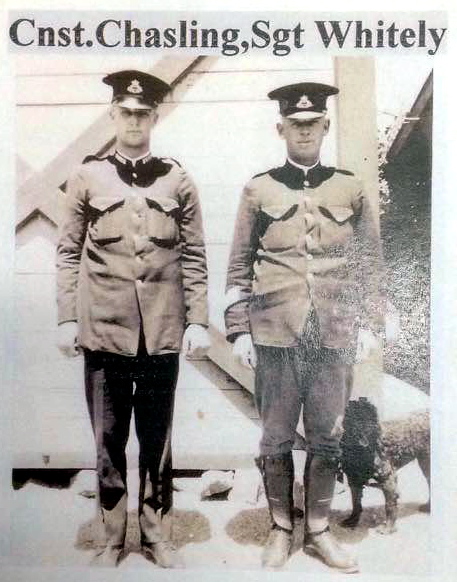
Constable Chasling & Sgt Whitely ( Whiteley ) at Berrigan Police Station. And, no doubt, the “faithful dog of Sgt Whiteley” also killed in the explosion.
Western Argus ( W.A. ) Tuesday 31 March 1931 page 13 of 36
GAS CYLINDER EXPLODES POLICE SERGEANT KILLED. DISASTROUS FIRE AT BERRIGAN. Sydney, March 25.
A police sergeant was killed, three people were hurt and nearly 1000 others scattered in terror when, during a fire at the Momolong Hotel, Berrigan, a gas cylinder exploded. The dead man is Sergeant C. George Whitley (41) married, with five children.
Whitley saw service at the war, and was at the Gallipoli landing. Mick Hurwood, Miss McGee and Miss Elaine Dawson ( was a former Echuca girl, living in High Street ) were injured by flying fragments of steel and wood. The two girls were taken to hospital.
The entire population of 2000 turned out when a fire engine rushed up the main street at 4.30 a.m. Hundreds of people assisted the firemen in trying to quell the outbreak, but the hotel was burned to the ground. In the hotel was a 40 lb. gas cylinder, which exploded during the height of the blaze. With a terrific roar it burst into flames, and sparks shot high in the air. The crowd scattered in terror. Whitley and Constable McRae were standing in the middle of the roadway assisting the fire fighters when there was a yell from the crowd. “Look out,” shouted a number of men, and they and the police ran for safety. McRae tried to catch hold of Sergeant Whitley and threw himself flat on the ground. A piece of steel, became embedded in Whitley’s head. McRae was not injured. Pieces of steel and wood cut their way into Hurwood’s leg, and the two girls were hurt about the body. They are expected to recover. The cause of the fire is unknown. Residents of the hotel hurriedly left the building, which was a single storied one, when the outbreak occurred.
Daily Standard (Brisbane, Qld. : 1912 – 1936), Thursday 26 March 1931, page 9
POLICE SERGEANT KILLED BY EXPLOSION
FIRE BURSTS CYLINDER.
SYDNEY, Wednesday.
Police-sergeant George Thomas Whitley, 41, married, with five children, was killed, three persons hurt, and about 1000 others scattered in terror this morning, when, during a fire at the Momolong Hotel, Berrigan, a gas cylinder burst.
A fire broke out at 4.30 o’clock, and the entire population turned to in an effort to save the hotel. Nothing, however, could be saved, and the hotel was burnt to the ground, though adjoining premises were saved from destruction.
There was a 40lb cylinder of carbonic acid gas in the hotel, and during the fire this exploded with a terrific roar.
Sergeant Whitley was standing in the roadway with Constable McRae when the cylinder burst. McRae threw himself to the ground, endeavoring to pull Whitley with him, but a piece of steel embedded in Whitley’s head, killing him instantly.
Michael Hurwood, Elsie McGee, and Elaine Dawson were injured about the legs and body by flying steel, all being seriously hurt. They were taken in motor cars to Corowa Hospital.
Whitley was a well-known and popular officer, aged 43, and joined the force 21 years ago.
NSW Government Gazette – issue 108, page 3292. Friday 4 June 1920
Electoral Appointments
Second Class Constable George Thomas WHITELEY, Fifield ( near Trundle ). – Electoral District: Murrumbidgee – Polling place: Fifield In lieu of McLean – on leave. To take effect on 22 March 1920
Bathurst Times (NSW : 1909 – 1925), Wednesday 8 January 1913, page 4
POLICEMAN ASSAULTED.
CASE AT HILL END.
HILL END, Tuesday.
Considerable interest was centred in the local Police Court proceedings on Saturday morning, when Vivian Clyde Cook, a resident of Hill End, was charged with assaulting Constable George Thomas Whitley while in the execution of his duty.
The accused was represented by Mr. Casey, solicitor, from Orange, and Inspector Rank appeared for the police.
The facts of the case as stated by Constable Whitley were that on New Year’s night he was in Clarke-street when he heard the Roman Catholic Church bell ringing. He hastened away to the church, and when near there heard stones being thrown on the church. He also saw three men running away.
Witness and Constable Creevy gave chase. After running about 400 yards he came up with one of them, whom he recognised to be the accused. Witness said, “Alright, Cook, I will give you a summons for this.” Then he turned to run after the other two. When he had gone a few paces he was hit on the head with a stone, which knocked him down on the ground. He got up again quickly, and saw the accused lying on the ground, he also heard him saying someone had hit him.
Then witness and Creevy arrested Cook, and locked him up for the night.
Dr. Michael John Ryan stated that about 2.30 on New Year’s morningConstable Whitley was brought to him suffering from a severe wound on the head. He dressed the wound and put in two stitches. The wound was about a quarter of an inch from the temple.
The doctor said that he considered the constable was out of danger, but Constable Whitley could not go on duty for at least one week yet.
At this stage, Mr. Casey, solicitor, made a very strong appeal to the P.M. not to send the accused to gaol.
He pointed out that he had never been before the Court before; that he was a hard-working young man; that he was extremely sorry for what he had done, and that he belonged to a very respectable family.
There were a number of young men, most of whom were in the Court, at the time, who had made up their minds to give the police all the trouble they could. They were known as the “Kelly Gang.”
The police had had no trouble whatever with anyone.
The P.M. said that the case was a very serious one indeed, and on hearing the doctor’s evidence he had made up his mind to send accused to gaol.
The accused promised to be of good behavior.
The P.M. then imposed a fine of £15 and £3/4/ costs.
Four days were allowed in which to pay.
Two other charges— one for insulting language and the other riotous behavior were withdrawn.
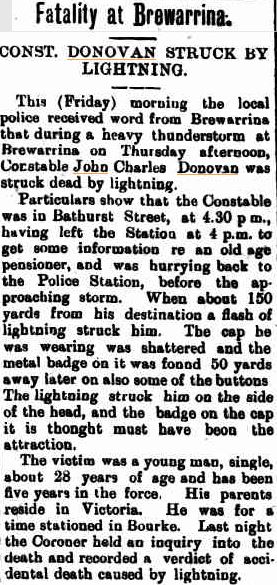
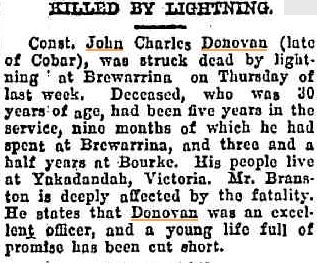
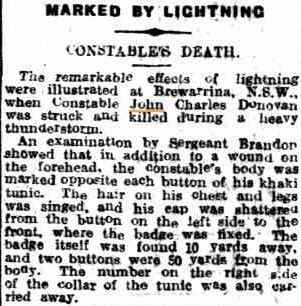
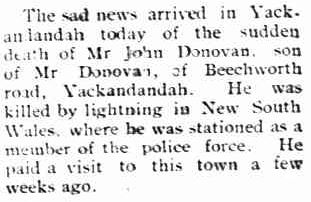
About 4pm on 12 January, 1922 Constable Donovan left the Brewarrina Police Station to carry out some enquiries. About 45 minutes later he was hurrying back to the police station to avoid an approaching thunderstorm when he was hit by lightning in Bathurst Street, about 150 metres from the station. A subsequent inquest heard that the cap badge and metal buttons had been blown off the constable’s uniform with some buttons being found up to 50 metres from the body.
The Sydney Morning Herald of 13 January, 1922 included the following brief paragraph.
CONSTABLE KILLED BY LIGHTNING.
A telegram was received last evening by the Inspector-General of Police (Mr. Mitchell) from Sergeant Brandon at Brewarrina, stating that Constable Donovan of that station had been struck dead by lightning at 4.15 p.m.
The constable was aged 28 years at the time of his death and was stationed at Brewarrina.
Amazingly, the only two recorded NSW police deaths by lightning strike occurred on the same date, sixty years – to the day, apart. The other being Constable James QUINN who was struck at Cockatoo Island, Sydney, NSW, on the 12 January 1862.
From Ken Medway on 5 April 2014 on Beyond Courage Facebook page:
A thorough search of the cemetery at Brewarrina, NSW, failed to locate the grave of John Charles DONOVAN aka DONAVON who is also recorded as being buried there. Inquiries with Brewarrina Shire revealed that all records were destroyed some years ago so his precise whereabouts will probably never be known.
From Cal: “See Yackandandah Times story in this article. Body re-interred in Yackandandah Cemetery, Victoria, pre 27 January 1922.”
The Tragic End of Constable J. C. Donovan. A Yackandandah Native.
The township of Brewarrina is situated in the western portion of New South Wales on the Barwon River, a tributary of the Darling. In April last year Constable J. C. Donovan, son of Mr John Donovan, of Yackandandah, was transferred from Cobar. On Thursday afternoon Constable Donovan went on duty at 4.30 p.m., and immediately left the police station to make some official inquiries and was hurrying back to the station to avoid an approaching storm when he was struck down in the street by lightning, within 150 yards of the station. From the medical examination, it was apparent that the lightning struck him on the forehead over the left eye, which corresponded with the position of the metal button on the peak of the cap. The body was also scorched and burnt just where the buttons would be on the police uniform. The buttons and metal numbers were found blown off the uniform, several buttons being found in the street 50 yards away. The right heel and left sole of the boots were also blown off. Two men named Hutchinson and Smith were also in the street at the time and felt the shock the lightning. At the inquest the Coroner paid a tribute to deceased, and stated the whole town and district would mourn the loss of such an efficient and promising officer.
Requiem Mass was celebrated in St Patrick’s Church by the Rev. Father Behan, P.P., for the repose of the soul of the departed officer on Friday morning. Sergeant Brandon and Constable Korn, his brother officers, were the very esence of kindness throughout the lamentable affair and were deeply affected by the tragedy. The funeral left the Court House at 4 o’clock on Friday afternoon and was largely attended. The handsome silver mounted casket containing the remains was completely smothered in floral tributes. The last sacred rites at the grave-side were performed by the Rev. Father Behan (says the Brewarrina Times). When the body was lowered to the grave (which is beside that of the Late Constable B. J. J. Dowling, who was killed in 1822) the large concourse of people returned to the town, and thus has passed away one to whom the words of Mark Antony referring to the death of Brutus, can well be applied : —
His life was gentle and the elements
So mixed in him that Nature might stand up
And say to all the world ” This was a man. ”
Prayers were read on Sunday in St. Patrick’s Church by the Rev. Father Behan for the repose of the soul of Constable Donovan, after which Chopin’s funeral march was impressively played by Mrs Butler.
Sergeant Brandon in the course of a lengthy letter of condolence to the bereaved relatives said : — ” Mass was said for him this morning at 7 a.m. and the good Priest attended at the Police Station and performed the last sad rites at the bed side. Candles were burned, which I am preserving and am forwarding some floral tributes and cards of sympathy, which I have been requested to convey to you. You will see by them that your dear boy was held in the highest esteem both by rich and poor. His sudden death has cast quite a gloom over the little township. I intend to arrange for a paragraph of ” Return Thanks’ ” to appear in the local paper on your behalf. You will quite understand that the cards of sympathy are addressed to me because his friends here did not know where to send them. I do hope that it will be consoling to you to know and see the respect and esteem shown ; when you take into consideration the short period he has resided here. He arrived at Brewarrina on transfer from Cobar on the 5th. April, 1921, and has been a credit to his Parents, the Police Department and himself. I can assure you no one will miss him more than I will. It is very difficult to replace men of his character and ability, strictly sober, no day too long when there was work to do, confidential, scrupulously clean and tidy in his person and room, and most reliable in the performance of his duty. I mourn with you in the loss you and the Department have sustained by his death ”
The relatives decided to have the body re-interred in Yackandandah Cemetery.
The coffin was railed to Albury from Brewarrina and conveyed to Yackandanduh cemetery on Saturday afternoon by motor. A large attendance of mourners waited at the gate of the cemetery and several others drove along Albury road and formed a cortege to accompany the motor hearse.
Father Griffin read the service at the grave-side. The late Mr John Donovan, who was born in Yackandandah, resided in this township during his young days, and was well known and highly respected. Within the last few months he paid a visit to the district and renewed old friendships. His untimely end is regretted throughout the district and the deepest sympathy is felt for his relatives.
From the Yackandandah Times, Victoria, dated Friday 20 January 1922, page 1 of 4, states ” Some difficulty occurred at Brewarina, New South Wales, where John Donovan died, owing to no lead coffin being available, so that the corpse could be transported to Yackandandah for burial. This difficulty has now been overcome and the body will be re-interred in Yackandand cemetery on Saturday afternoon. ( indicating Saturday 21 January 1922 and the reason why he was originally buried at Brewarrina ).
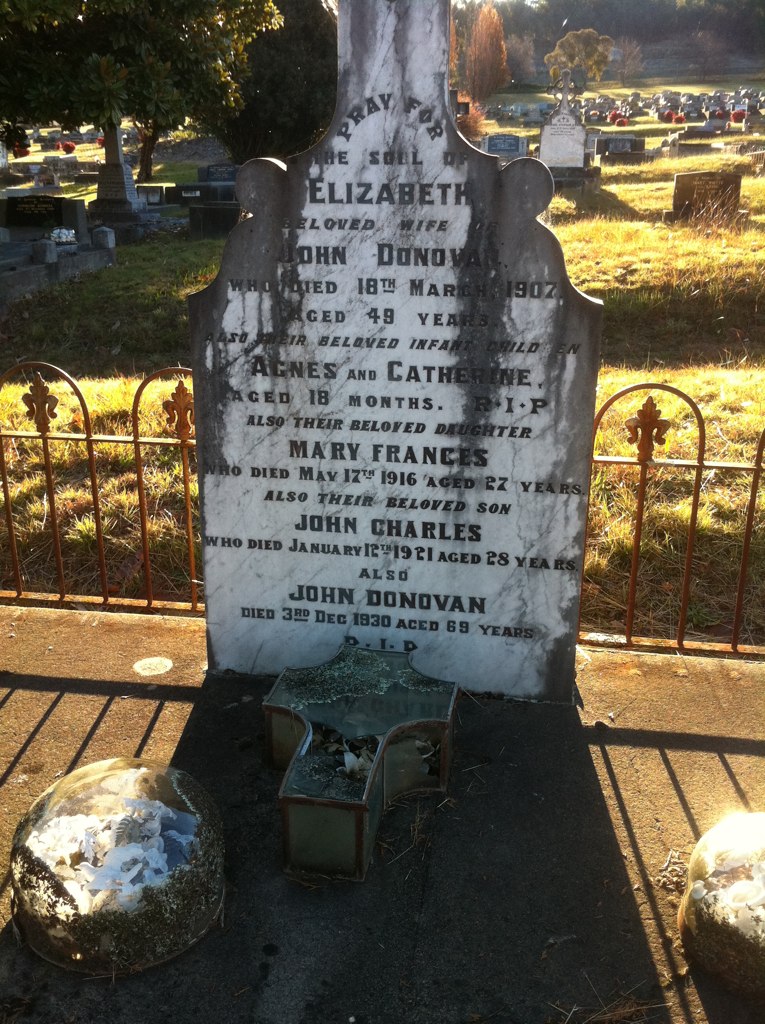
[google-map-v3 shortcodeid=”19a35ff5″ width=”350″ height=”350″ zoom=”12″ maptype=”roadmap” mapalign=”center” directionhint=”false” language=”default” poweredby=”false” maptypecontrol=”true” pancontrol=”true” zoomcontrol=”true” scalecontrol=”true” streetviewcontrol=”true” scrollwheelcontrol=”false” draggable=”true” tiltfourtyfive=”false” enablegeolocationmarker=”true” enablemarkerclustering=”false” addmarkermashup=”false” addmarkermashupbubble=”false” addmarkerlist=”-36.303766, 146.851609{}catholicgrave.png{}Grave of DONOVAN” bubbleautopan=”true” distanceunits=”km” showbike=”false” showtraffic=”false” showpanoramio=”false”]
Epitaph & Description: Pray for the Soul of Elizabeth Donovan, Beloved Wife of John Donovan; aged 49 years Also their beloved infant children: Agnes and Catherine, aged 18 months; Their beloved daughter, Mary Frances Donovan, aged 27 years; Their Beloved son, John Charles Donovan, aged 28 years; John Donovan, aged 69 years R.I.P. Lat: -36.303766 Lon: 146.851609
Cal:
Due to the fact that all of the newspaper articles and other documentation state that DONOVAN died on the 12 January 1922, I would say, with a fair deal of certainty, that the date on this grave stone of 12 January 1921 is INCORRECT.
John DONOVAN was originally buried at Brewarrina, NSW, the day after his death but re-interred at Yackandandah Cemetery, Victoria, pre 27 January 1921.
Donovan was buried at Brewarrina close to these co-ordinates:
GPS Location 29 58′ 10S / 146 50′ 46E
Old Catholic Section right over on western fence
William JUSTIN
| 27/10/2012
Constable 1st Class William JUSTIN
New South Wales Police Force
Horse Accident
Thuddungra
8 March, 1905
On the day of his death Constable Justin was patrolling about ten miles from Thuddungra (Young district) when his horse became skittish and began to buck. The constable was driven into a wire fence by the animal, where he sustained severe injuries to his face and hands. He was found some three hours after the incident by some girls going home from school, and was quickly taken to the home of a Mr Webb. He was taken to Young Hospital the next day however he unfortunately passed away.
The constable was born in 1859 and joined the New South Wales Police Force on 19 November, 1881. At the time of his death he was stationed at Young.
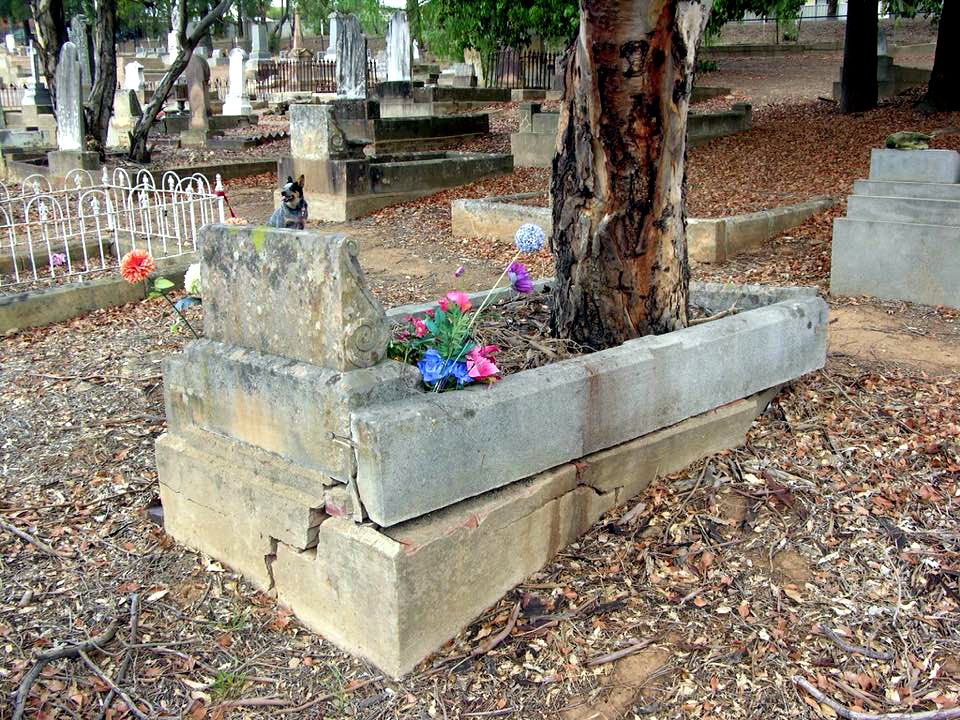
Today, Missy and I paid a visit to William JUSTIN at Young.
*
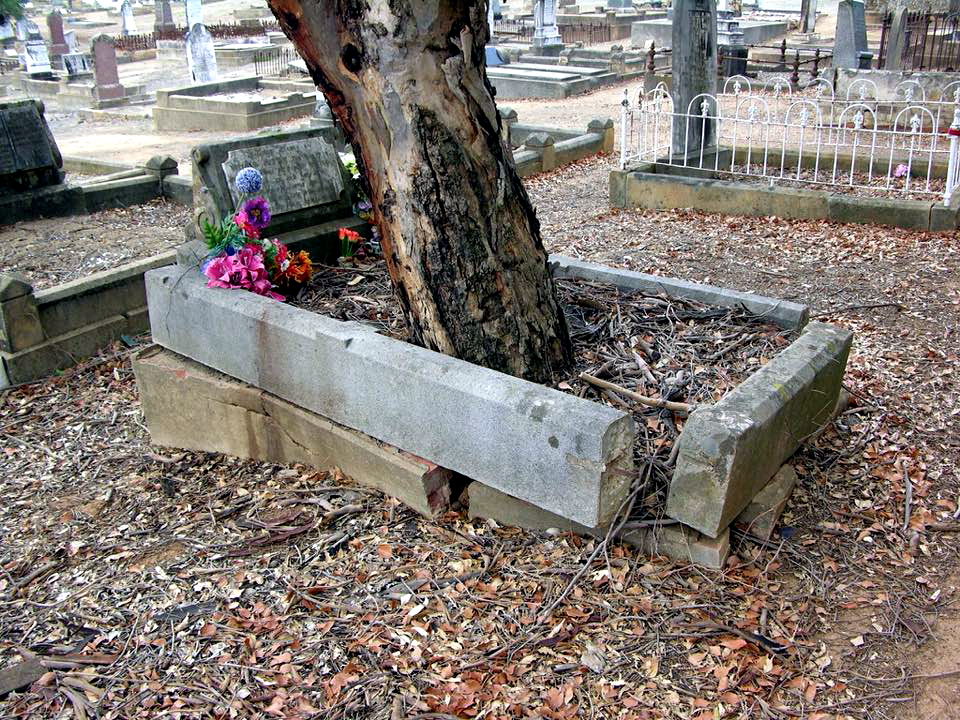
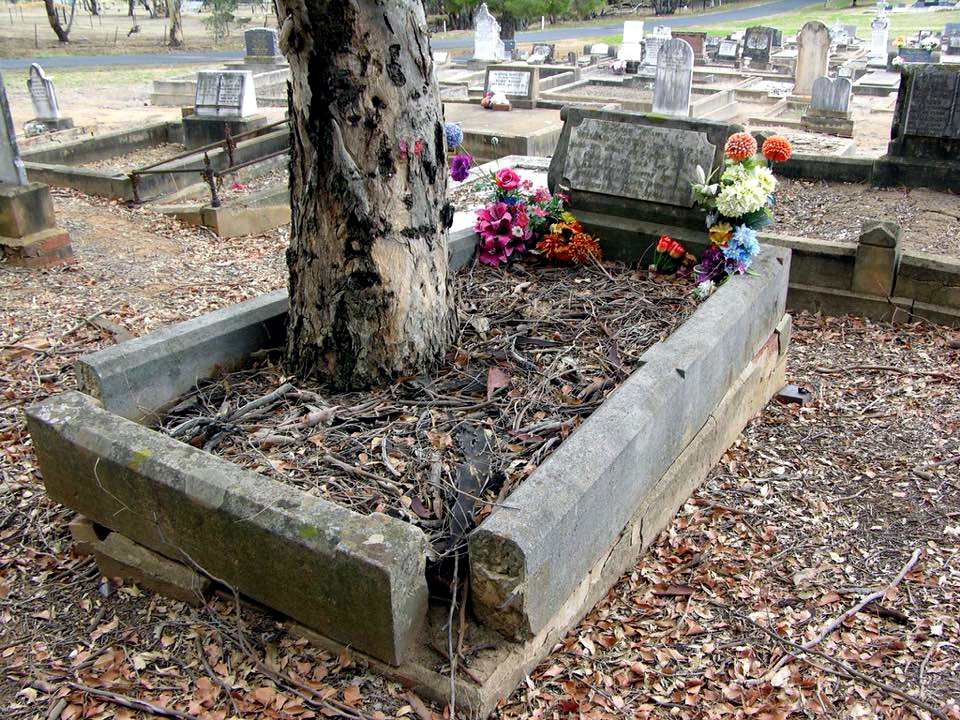
As you can see from these and previous photos of this grave, there is a bloody huge gum tree growing right on top of him. There is a remembrance day ribbon pinned to the tree and the flowers and trinkets have obviously been placed in recent years.
Please take the time to read a little about NSWPF history, or at least just have a look at the state of a grave that belongs to an officer killed in the line of duty, Cst 1/c William Justin. Yes- that is a large tree growing through the centre of the grave.
I’m at a loss to understand how the grave of a Police officer, who died in the service of this state, can be allowed to reach this condition. I seriously wonder what his family and colleagues would think of us.
Remembered…
Constable 1st Class William JUSTIN
Young Police
Horse Accident – 8 March, 1905
Resting Place – Young General Cemetery, Young
In early March, 1905 Constable Justin was patrolling about ten miles from Thuddungra (Young district) when his horse became skittish and began to buck. The constable was driven into a wire fence by the animal, where he sustained severe injuries to his face and hands. He was found some three hours after the incident by some girls going home from school, and was quickly taken to the home of a Mr Webb. He was taken to Young Hospital the next day however he unfortunately passed away. The Shoalhaven Telegraph dated 29 March, 1905 reported the following some weeks later.
“DEMISE OF FIRST-CLASS CONSTABLE JUSTIN.
[Written by Daniel McMillan, an old and sympathetic Friend.]
A great gloom was cast over this neighbourhood and surrounding district on Monday week last, when the sad news became known that First-class Constable Justin had succumbed to injuries which he received through being thrown from his horse whilst on duty the Wednesday previous, some 20 miles from Young, at which place he has been stationed for a considerable time. It would appear from the evidence adduced that while Mr Justin was in the act of shutting a gate, which was a complicated one, his horse, being a spirited animal, started to buck, and ran away, causing the rider to lose his balance and fall to the ground. The unfortunate man, being dragged a considerable distance by the stirrup, was brought into contact with a barb-wire fence, thence with a tree. It is also surmised that the horse kicked him on the head. He was found in an unconscious state some hours, it is supposed, after the accident occurred. At the time of the accident Constable Justin was over 20 miles away from his home. He was found by a Mr Webb, a farmer residing some distance away from the scene of the untoward incident, who took him to his home, and did all that he could to relieve the sufferer until medical aid was obtained, From the first but little hope was entertained of his recovery. He only regained consciousness for a few minutes before his death, which sad event took place on the Saturday evening following, at 8 o’clock. Mr Justin, who was, it may be said, in the prime of life, being only 45 years of age at the time of his death, was the eldest son of the late Mr W. Justin, so long and favourably known in connection with the Harbors and Rivers Department; he was born in Sydney, and whilst only a child removed with his parents to Shoalhaven, where his aged mother still re sides, with several other members of the family. The deceased, at the early age of 21, joined the police force, with which he had been associated ever since, and during his 24 years’ service he had been stationed at many places in New South Wales, including Goulburn, Braidwood, Myrna, Queanbeyan, Frogmore, Young, and other stations. In referring to the deceased gentleman, an up-country paper says: ‘He was the popular constable, who was loved and respected by all, and will be greatly missed.’ The same can be said by everybody at every place where he has been. Besides a wife and 5 children, the deceased leaves a mother, 2 brothers, and 4 sisters, together with a large circle of friends and acquaintances, to mourn their loss. The funeral, which took place at Young on Sunday week, was largely attended…”
The constable was born in 1859 and joined the New South Wales Police Force on 19 November, 1881. At the time of his death he was stationed at Young. He is listed in the official New South Wales Police Honour Roll.
https://police.freom.com/william-justin/
https://police.freom.com/william-justin/
https://police.freom.com/william-justin/
Francis William GRUNDY
| 27/10/2012
William Francis GRUNDY
New South Wales Police Force
Constable
35 old
Horse Accident
Holbrook
20 March, 1898
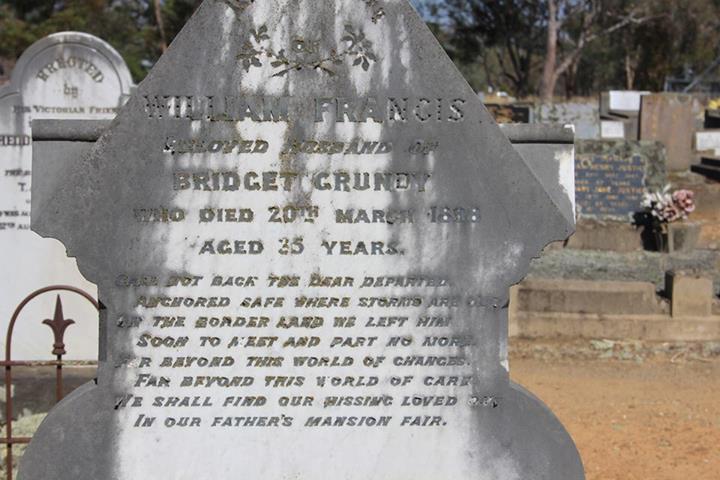
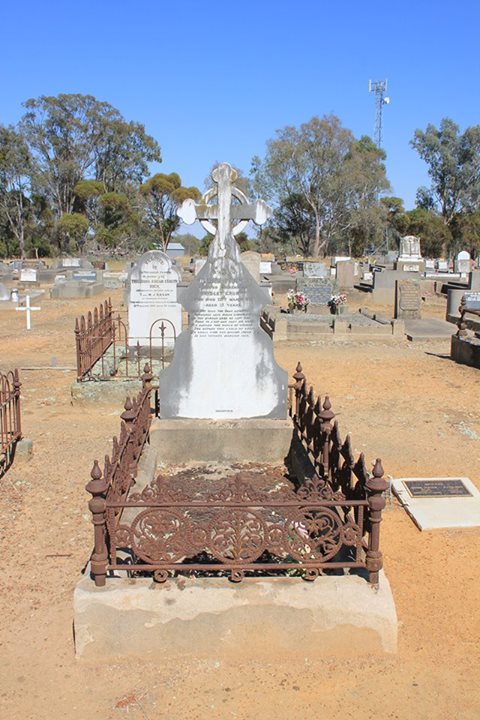
Grave Stone of Constable William Francis GRUNDY – Holbrook Cemetery, NSW. Photos courtesy of Ken Medway via Beyond Courage FB page – 13 Jan 2014
Inscription reads:
[blockquote]
‘Care not back the dear departed Anchored safe where storms are o’er On the border land we left him Soon to meet and part no more Far beyond this world of changes Far beyond this world of care We shall find our missing loved one In our Father’s mansion fair’.
[/blockquote]
Grave Stone of Constable William Francis GRUNDY – Holbrook Cemetery, NSW.
The constable was critically injured when he fell from his horse about 18 miles from Holbrook on the 15 March, 1898. He was later found by the Tarcutta mailman and taken to Holbrook in an unconscious condition, where he passed away on the 20 March 1898. The Argus newspaper of 1 April, 1898 carried the following brief story. ALBURY, Thursday. An inquest was held yesterday at Germanton into the circumstances attending the death of Constable Grundy, who succumbed to injuries received by a fall from his horse. Allegations were made that the Deceased was compelled to ride a horse which had fallen with him on other occasions. The evidence of the officer in charge of the Germanton Station to a great extent bore out the allegations. He stated that the horse was notoriously unsafe, and that Grundy had complained that it would break his neck some day. When advised to report the animal he said that it was no use doing so as he would only get another just as bad. Deceased was thrown off the horse while proceeding at night along a road beyond Germanton, he then being in search of sheep stealers. The superintendent of police gave evidence denying that the horse was unsafe. He admitted that the horse was timid and required careful handling. A verdict was recorded that Deceased met his death by injuries received by being thrown from his horse. At the time of his death the constable was stationed at Germanton (now Holbrook).
Sergeant John McGUFFIE
| 27/10/2012
Sergeant John McGUFFIE
New South Wales Police
Horse Accident
Adelong
30 January, 1897
The sergeant died on 30 January, 1897 as a result of being thrown from his horse on 2 January, 1897. It is not known whether this incident was an on-duty death or not. The Bathurst Free Press and Mining Journal of 1 February, 1897 briefly described the incident.
A POLICE SERGEANT KILLED. ” A wire from Adelong says: Sergeant M’Guffie, who had been in charge of the police station here for the past twelve months, died early on Saturday morning from the effects of being thrown from his horse whilst returning from the racecourse on the 2nd instant.
At the time of his death the sergeant was stationed at Adelong, where he had been for some years. In 1896 he had replaced Sergeant Thomas Cassin (who had passed away) as the Officer-in-Charge and Gold Receiver.
Yesterday I dropped in on Sergeant John McGuffie at Adelong. Anyone who has missed his grave could be excused because the headstone has been collapsed for some time face down on the grave. To say I was a bit cranky was an understatement at the state of this grave.
*
Anyway, I have turned the headstone over and lets hope that the LAC will now jump in and carry out some repairs. Here are some photos and the
GPS co-ordinates are 35 18 45S/148 03 08E
*
Page 76 in Beyond Courage.
Bernard Joseph John DOWLING
| 27/10/2012
Bernard Joseph John DOWLING
New South Wales Police Force
Constable
Horse Accident
Brewarrina
22 old
Death: Reported as 11 January, 1882 but grave stone indicates he died on 19 January 1882.
On 11 January, 1882 the constable was riding near Milroy Station, Brewarrina, when his horse bolted and threw him against a tree. He landed across the saddle and was then dragged some distance. Unfortunately Constable Dowling had received severe injuries and despite being treated by a doctor, he passed away the following day.
The Maitland Mercury reported on 14 January, 1882 that “Yesterday evening while mounted Constable Bernard Dowling was riding near Mrs. Whitmarsh’s on Milroy Station, his horse bolted with him and ran him against a tree. He was thrown across the saddle and dragged some distance. A messenger came in for the police and doctor. Dowling was still insensible when the messenger left which was about an hour after the accident. Senior Constable Steele and the doctor left here about midnight.”
The constable was born in Ireland about 1860 and was a single man. At the time of his death he was stationed at Brewarrina.
[blockquote]
Launceston Examiner newspaper, Thursday 2 February 1882, page 1 of 4
DEATHS
DOWLING – Near Brewarrina, N.S.W., Bernard J., son of the late W. P. Dowling, of Launceston, aged 22 years.
Inscription: In Memory of Bernard Joseph John DOWLING born at Launceston Tasmania July 17th 1883 Died Jan’ry 19th 1882 R.I.P.
5 April 2014: From Ken Medway, Beyond Courage Facebook page:
We recently visited Brewarrina and located the grave of Bernard Joseph John DOWLING who died in January 1882 as a result of a horse accident.
*
According to his headstone he died on 19 January and was 22 years old being born on 17 July 1859 at Launceston.
*
GPS Location 29 58′ 10S / 146 50′ 46E
Old Catholic Section right over on western fence
Beyond Courage Page 69.
*
A thorough search of the cemetery failed to locate the grave of John Charles DONOVAN aka DONAVON who is also recorded as being buried there. Inquiries with Brewarrina Shire revealed that all records were destroyed some years ago so his precise whereabouts will probably never be known.
NOTE:
From Cal: “See Yackandandah Times story article attached to the death of John Charles DONOVAN. Body re-interred in Yackandandah Cemetery, Victoria, pre 27 January 1922.”