1

Eric George BAILEY GC

Eric George BAILEY GC

Arrested his own Murderer

Father to John ‘Jack’ George BAILEY – NSWPF # 6293

Grandfather to Stephen Colin MARTIN, NSWPF # 24821

New South Wales Police Force

NSW Redfern Police Academy Class # ???

( Class # 001 was in March 1947 – so Eric pre dates that. )

Regd. # 2382


Rank: Commenced Training on ? ? ?

Probationary Constable – appointed Wednesday 16 March 1927

Constable 1st Class – appointed 23 April 1938

Constable 1st Class – posthumously promoted to Sergeant 3rd Class


Stations: No. 4 Division from 14 June 1927,

The Rocks in 1928, then Gundagai, Narrandera & other rural stations.

Moruya 1938 then Blayney from 4 January 1945


ServiceFrom 16 March 1927 to 12 January 1945 = 18 years Service


Awards:  * George Cross  ( GC ) awarded, Granted 20 October 1946 – posthumously

also the George Lewis Trophy.

Bravery Commendation re arrest at Batemans Bay in 1940.

Highly Commended and awarded six months seniority for Conspicuous Bravery for the rescue of survivors, at sea, off Moruya on the 3 August 1942, after a fishing trawler had been attacked by a Japanese submarine.  Also received a Certificate of Merit from Royal Shipwreck Relief and Humane Society of NSW.


Born:  Sunday  14 October 1906 at Tenterfield

Died:  Friday  12 January 1945

Age:  38 years, 2 months, 29 days old

Cause:  Shot – Murdered

Event location:  Outside of Exchange Hotel, Adelaide St, Blayney


Funeral date:  Monday  15 January 1945

Funeral location:  Buried in Rookwood Cemetery


Grave location:  Anglican Section, Rookwood Cemetery.  Zone C, Section 08, Grave 1959

GPS:  -33.87119050511541,  151.05958014008522

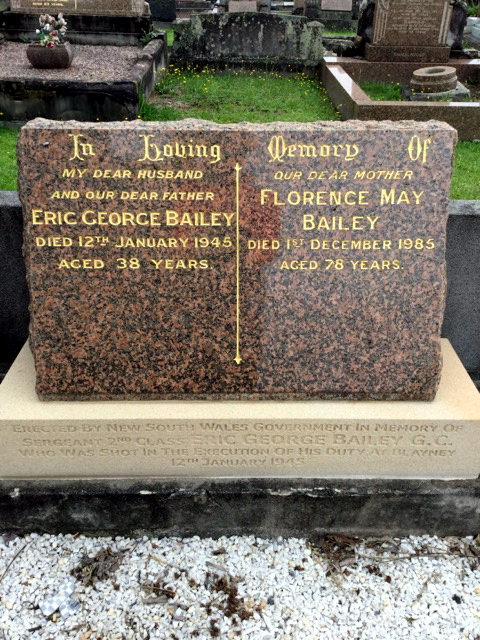
Grave

Inscription:<br /> In Loving Memory of<br /> My Dear Husband and our Dear Father<br /> Eric George BAILEY<br /> Died 12th January 1945<br /> Aged 38 years<br /> Our Dear Mother<br /> Florence May BAILEY<br /> Died 1st December 1985<br /> Aged 78 years.<br /> Erected by New South Wales Government in Memory of Sergeant 2nd Class Eric George BAILEY G.C. who was shot in the Execution of his Duty at Blayney<br /> 12th January 1945.<br />

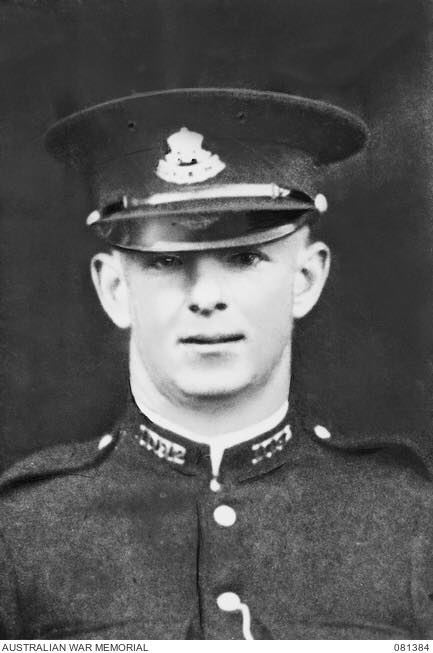
Sergeant Eric George Bailey ( 1945 )

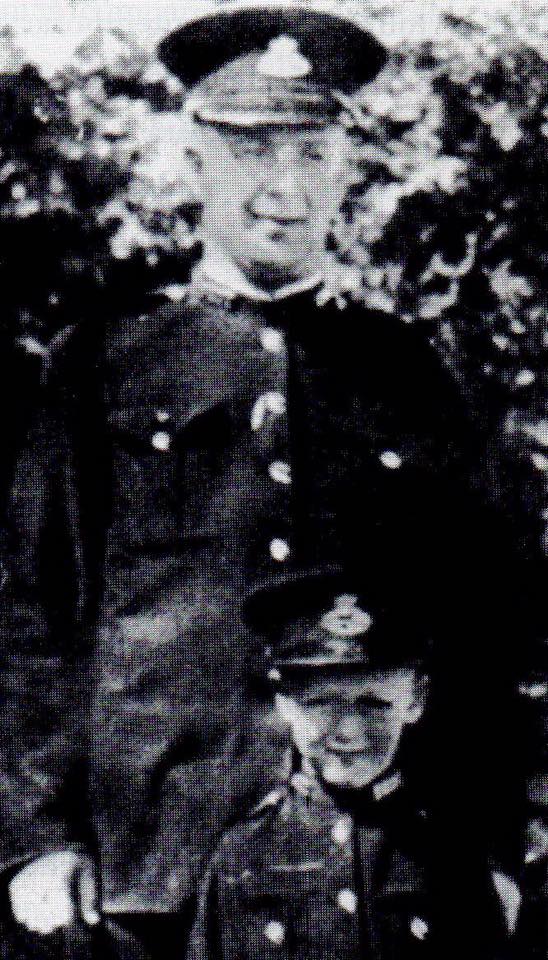
Eric George BAILEY and his son - John
Eric George BAILEY and his son – John “Jack” BAILEY ( NSWPF # 6293 )


ERIC IS mentioned on the Police Wall of Remembrance
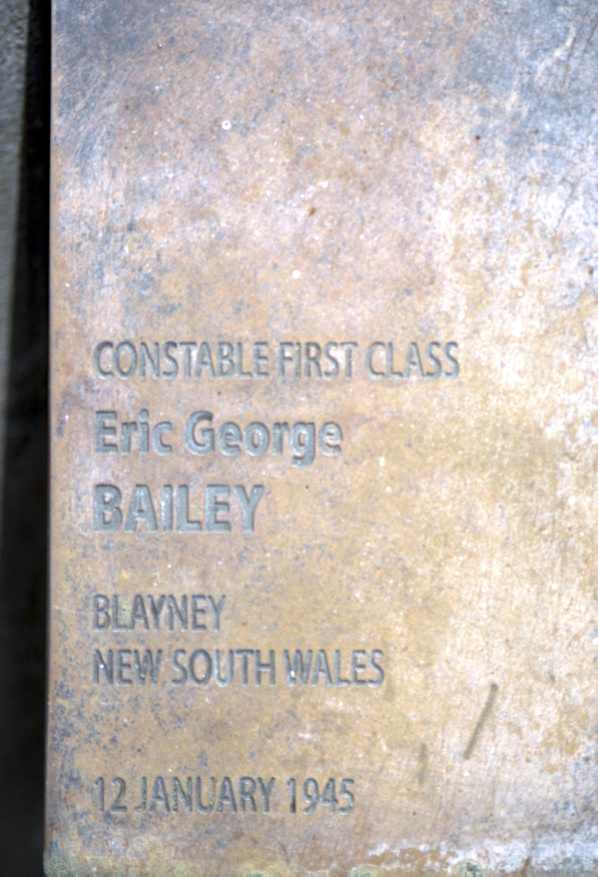
 

Eric George BAILEY GC. Touch plate at National Police Wall of Remembrance, Canberra
Touch plate at National Police Wall of Remembrance, Canberra

Memorial location:  Below plaque is located at the location of the murder.
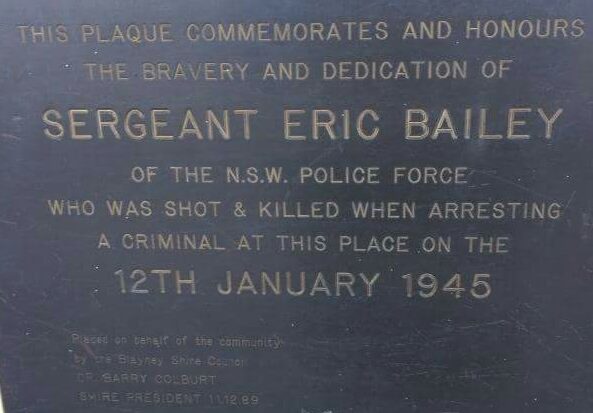
This plaque commemorates and honours the bravery and dedication of Sergeant Eric Bailey of the N.S.W. Police Force who was shot and killed when arresting a criminal at this place on the 12th January 1945. Placed on behlaf of the community by the Blayney Shire Council by Barry Colburt, Shire President, 11 December 1989.

On 4 January 1945, Constable 1st Class Bailey commenced duty at Blayney Police Station.  On his 8th day at that station, he was dead.

On a hot summer evening, eight days later, while on duty in Adelaide Street, he was informed that a drinker at the Exchange Hotel was displaying a revolver.

Shortly after 8pm on 12 January 1945, Constable 1st Class Bailey spoke to a man, Cyril Norman, who was dressed in an American Naval Uniform outside the Exchange Hotel, Blayney. The constable told the man that he intended to search him and his belongings regarding his alleged possession of a revolver. The man suddenly produced the revolver and shot Constable Bailey in the stomach. The constable then took hold of the offender and during the ensuing struggle two more shots were fired and the offender was wounded in the wrist. Three railway employees quickly came to the constable’s aid and the offender was handcuffed and detained until the arrival of Constable GradyBailey told Grady: ” He shot me through the back.  Don’t let him get away …I had a go.  I didn’t squib it “.

The wound suffered by Constable Bailey proved to be severe and he died on admission to the Orange Base Hospital with his wife by his side. He had in fact arrested his own murderer.


Allegations were later made suggesting that the offender was a contract killer sent to murder another local policeman, Constable Stan Grady, who had been enthusiastically investigating sly grog sellers and SP bookies in the area. The offender was said to have inadvertently shot Constable Bailey, whom he mistook for Grady, who was off duty at the time. When shot, Constable Bailey was in mounted police uniform, and until that day Stan Grady had been the only mounted constable in Blayney, thus the offender’s error. The offender, well-known Sydney criminal Cyril Normanalias Thomas Couldrey – was convicted and sentenced to death.

Norman was charged with the murder of Bailey and that of Maurice Hannigan, a Sydney shopkeeper from whom he had stolen guns and ammunition. Although he was convicted, the death sentence was later commuted to life imprisonment.


Bailey was posthumously awarded the George Cross, instituted in 1940 by King George VI and intended primarily for civilians, which recognized ‘acts of the greatest heroism or of the most conspicuous courage in circumstances of extreme danger’.

The first Australian policeman to be so honoured, he was also posthumously promoted sergeant 3rd class and awarded the George Lewis trophy in 1945 for the most courageous act by a policeman.

Bailey was accorded an official police funeral in Sydney and was buried in the Anglican section of Rookwood cemetery. His daughter and son John, who was to join the New South Wales police at the age of 16, also survived him.

( John ‘Jack’ George BAILEY, NSW Police Cadet # 0613, Regd. # 6293 )


28 May 2020

Maz Herrmann His son John “Jack” Bailey an ex cadet was our boss at Albury during the 80s and the day he retired I spoke to him that evening and said “Jack what are you fkn doing at work; today is your last day”? He said “I’m just tidying up some things before I go.
I knew Jack when he was a Snr Sgt at Wollongong and I was the Inspectors Clerk in 1977-1980.
I joined the cops the following year 1981 – then I had to call him Sir!
He was definitely an old school copper – enough said.
May he R.I.P.

https://www.facebook.com/groups/1087842541279097/


The Sydney Morning Herald of 11 September, 1947

announced the presentation of Sergeant Bailey’s George Cross by Sir William McKell.


GEORGE CROSS AWARD – INVESTITURE BY MR. McKELL.

Mrs. F. M. Bailey, of Cleveland Street, Moore Park, widow of Police Sgt. Eric G. Bailey, yesterday received the George Cross awarded to her husband for holding a man who had fatally wounded him until assistance arrived, at Blayney in January, 1945. The decoration was made at an investiture held by the Governor General, Mr. McKell, at Government House.


Sergeant Bailey was born in 1906 and joined the New South Wales Police Force in 1927. At the time of his death he was stationed at Blayney. He was posthumously promoted to Sergeant 3rd Class ( Although his grave states Sgt 2/c ) and awarded the George Cross and the George Lewis Trophy.

* Eric BAILEY is the ONLY Australian Police Officer to be awarded the Imperial Honour, namely the George Cross Medal.


Bailey, Eric George (1906–1945)

by Christa Ludlow

This article was published in Australian Dictionary of Biography, Volume 13, (MUP), 1993

Eric George Bailey (1906-1945), policeman, was born on 14 October 1906 at Tenterfield, New South Wales, ninth child of Arthur Peter Bailey, compositor, and his wife Jane, née Bush, both native-born. Eric worked as a postal assistant before joining the New South Wales Police Force on 16 March 1927. After training, he was transferred to Sydney’s No.4 Division on 14 June, and sent to The Rock in 1928; he then served at Gundagai, Narrandera and other rural stations. Bailey was confirmed an ordinary constable on 16 March 1928. He married Florence May O’Connor at Mount Carmel Catholic Church, Waterloo, on 24 November that year.

Promoted constable 1st class on 23 April 1938, Bailey was next stationed at Moruya on the south coast. In 1940 he arrested a criminal at Batemans Bay and was commended for bravery, cool-headedness and devotion to duty. Learning that a fishing trawler had been attacked by a Japanese submarine off Moruya on 3 August 1942, he and Sergeant Horace Miller set out at night in a pleasure launch in heavy seas to assist with the rescue of the survivors. Bailey was highly commended and awarded six months seniority for conspicuous bravery; he also received a certificate of merit from the Royal Shipwreck Relief and Humane Society of New South Wales.

On 4 January 1945 Bailey was transferred to Blayney, south-west of Bathurst. On a hot summer evening eight days later, while on duty in Adelaide Street, he was informed that a drinker at the Exchange Hotel was displaying a revolver. When Bailey questioned the offender, Cyril Norman, and declared that he would search his room, Norman drew a revolver and shot him. In the ensuing struggle two more shots were fired, but Bailey managed to handcuff Norman and restrain him until Constable Grady arrived. Bailey told Grady: ‘He shot me through the back. Don’t let him get away . . . I had a go. I didn’t squib it’. Fatally wounded by the first shot, Bailey died hours later on 12 January 1945 in Orange Base Hospital, his wife at his side.

Norman was charged with the murder and that of Maurice Hannigan, a Sydney shopkeeper from whom he had stolen guns and ammunition. Although he was convicted, the death sentence was later commuted to life imprisonment.

Bailey was posthumously awarded the George Cross, instituted in 1940 by King George VI and intended primarily for civilians, which recognized ‘acts of the greatest heroism or of the most conspicuous courage in circumstances of extreme danger’. The first Australian policeman to be so honoured, he was also posthumously promoted sergeant 3rd class and awarded the George Lewis trophy in 1945 for the most courageous act by a policeman. Bailey was accorded an official police funeral in Sydney and was buried in the Anglican section of Rookwood cemetery. His daughter and son John, who was to join the New South Wales police at the age of 16, also survived him.

Select Bibliography

  • I. Bisset, The George Cross (Lond, 1961)
  • L. Wigmore (ed), They Dared Mightily (Canb, 1963)
  • Police News (Sydney), Feb 1945, p 7, Sept 1945, p 9, Oct 1947, p 44
  • Sydney Morning Herald, 14, 20 Jan, 8, 22 Feb, 5 Aug 1945, 30 Oct 1946, 11 Sept 1947
  • Sun (Sydney), 17 Jan 1979
  • service records of E. G. Bailey (police registry, New South Wales Police Dept, Sydney).

Citation details

Christa Ludlow, ‘Bailey, Eric George (1906–1945)’, Australian Dictionary of Biography, National Centre of Biography, Australian National University, http://adb.anu.edu.au/biography/bailey-eric-george-9403/text16527, published first in hardcopy 1993, accessed online 6 January 2015.

Life Summary [details]

Birth

14 October 1906
Tenterfield, New South Wales, Australia

Death

12 January 1945

Orange, New South Wales, Australia

Religious Influence
Occupation
Workplaces


This article was first published in hardcopy in Australian Dictionary of Biography, Volume 13, (MUP), 1993

http://adb.anu.edu.au/biography/bailey-eric-george-9403
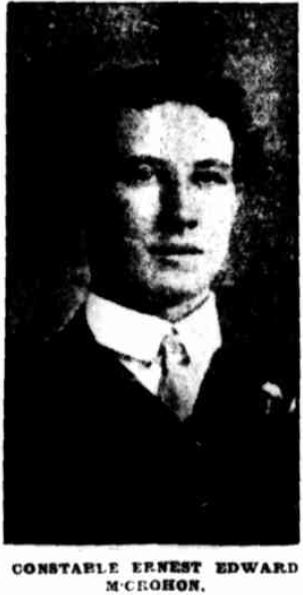


Ernest Edward McCROHON

Ernest Edward McCROHON

Late of  14 Keir Avenue, Hurlstone Park, NSW

Grandson to John McCROHON – NSWPF – # ????

Uncle to Victor Harry McCrohon – NSWPF – # 5009

Great Uncle to Vicki Alexis McCrohon – NSWPF – NSWPF – P/W 0123 – Class 120 ( 1964 ) & Rejoinee P/W 0202 – Class 141 ( 1974 )

New South Wales Police Force

Regd. #  ‘Q‘ 9403

For the purposes of this website ‘Q‘ represents those Police joining between 1 March 1862 ( commencement of NSWPF ) – 23 February 1915 ( Commencement of NSWPF current numbering system )


Rank: Probationary Constable – appointed 1 April 1912

Final Rank:  Sergeant 2nd Class – Death


Stations?, Central Police Station – 1 Division, Belmore ( 1916 ), Regent St – 2 Division, Newtown – 5 Division ( ? – 26 March 1939 ), Wagga Wagga ( 27 March 1939 ‘ Sgt ‘ – ? ),

13 Division,  Clarence St Police Station – Death


ServiceFrom  1 April 1912  to  17 March 1944 =  31+ years Service


Awards:   No find on It’s An Honour


Born:   21 September 1887 – Barraba, NSW

Died on:   Friday  17 March 1944 during the evening

Age:  56

Cause:   Collision – hit by train

Event location:   Hurlstone Park

Event date:   Friday  17 March 1944


Funeral date:   Monday  20 March 1944

Funeral location:   Rookwood Crematorium

Funeral Parlour: Walters and Son, Dulwich Hill

Buried at:   Cremated ?

 Memorial located at:   ?

Constable Ernest Edward McCROHON<br /> the young policeman, who at Newtown a fortnight ago, had a sensational chase after four suspects and about 3a.m. on Saturday, arrested a man who had been behaving in a suspicious manner. On handcuffing his man, after a struggle, he found that he had a revolver in his hip pocket.<br />
Constable Ernest Edward McCROHON
the young policeman, who at Newtown a fortnight ago, had a sensational chase after four suspects and about 3a.m. on Saturday, arrested a man who had been behaving in a suspicious manner. On handcuffing his man, after a struggle, he found that he had a revolver in his hip pocket.


ERNEST is NOT mentioned on the Police Wall of Remembrance * NOT JOB RELATED


FURTHER INFORMATION IS NEEDED ABOUT THIS PERSON, THEIR LIFE, THEIR CAREER AND THEIR DEATH.

PLEASE SEND PHOTOS AND INFORMATION TO Cal


May they forever Rest In Peace


The Sydney Morning Herald of

18 March, 1944 reported the following double tragedy surrounding the death of Sergeant McCrohon.


POLICE SERGEANT  KILLED – MAN DIES GIVING  FIRST AID.

Police Sergeant Edward McCrohon, 56, attached to No. 1 Police Station, was killed by a train last night while crossing the railway track between Hurlstone Park and Canterbury stations.

John Whitfield, a railway employee, who was a passenger on the train, collapsed and died as he began to give first aid to McCrohon.

Sergeant McCrohon was on his way home when he was killed.


The sergeant was born on 21 September, 1887 and joined the New South Wales Police Force on 1 April, 1912. He served at Metropolitan Divisions 1, 2, 5 and 13, as well as at Wagga Wagga. At the time of his death he was stationed at No. 1 Division (Central).

trove.nla.gov.au/ndp/del/article/17883834


Sydney Morning Herald (NSW : 1842 – 1954),

Monday 20 March 1944, page 8

McCROHON. – The Relatives and Friends of the late Ernest Edward McCrohon ( Police Sergeant, No. 1 Division ), of 14 Keir Avenue, Hurlstone Park, are invited to attend his Funeral to leave our Funeral Chapel, This Monday, at 11 a.m., for the Crematorium Rookwood.

Walters and Son, Dulwich Hill Terminus.

LM1676

https://trove.nla.gov.au/newspaper/article/17863922#


Army News (Darwin, NT : 1941 – 1946),

Monday 20 March 1944, page 2

WHILE CROSSING THE RAILWAY LINES between Hurlstone Park and Canterbury railway stations on Friday night, Sergeant Edward Ernest McCrohon, 56, of the Clarence Street police station was struck by a train, and killed.

When John Whitfield, 62, night officer at the Belmore railway station who was a passenger on the train, alighted to give assistance, he had a sudden seizure and collapsed. He died beside the body of the police sergeant.

https://trove.nla.gov.au/newspaper/article/47690819#


Daily Advertiser (Wagga Wagga, NSW : 1911 – 1954),

Tuesday 28 March 1939, page 4

PERSONAL

Sergeant E. E. McCrohon, formerly of Newtown, Sydney, took up duty in Wagga yesterday in succession to Sergeant Kidd, who has been transferred to Newtown.

https://trove.nla.gov.au/newspaper/article/143641736


Sun (Sydney, NSW : 1910 – 1954),

Saturday 23 December 1916, page 5

BRAVE CONSTABLE

EFFORT TO SAVE CHILD

Mr. H. Richardson Clark, Parramatta coroner, at an inquest at Bankstown on the dead body of a boy named Thomas Adamson, aged 11½ years, who was drowned in a waterhole in Punchbowl, through getting out of his depth while searching for his sister’s shoe, complimented a brave constable.

The waterhole is in a very secluded position, about eight feet in diameter, and very deep, with no shallow approach, so that directly the hole is entered the water, is about six feet deep, and the sides of it are of clay, being extremely slippery.

The Belmore police were informed of the accident, and Constable McCrohon proceeded to the place with all speed.

He there found a man who was fishing for the boy with a rake, whereupon the constable immediately disrobed and took a header right into the hole.

Before he went in the man with the rake warned him against diving in, as it was dangerous, but notwithstanding that the constable dived right in and brought up the child at once.

The evidence at the Inquest was that the constable knew nothing whatever of the waterhole, and had never seen it before, and that after he recovered the body he and Dr. Miller worked upon it three-quarters of an hour to restore life, but unfortunately without success.

Dr. Miller, in his evidence, stated that he thought the conduct of the constable was most praiseworthy, as had there been any rocks or snags or old stumps in the waterhole McCrohon might have broken his neck when he dived in.

The coroner, in finding a verdict of accidental death, said that he had great pleasure in concurring with the opinion of Dr. Miller as to the conduct of Constable McCrohon, and that he would bring it under the favorable notice of the Inspector-General of Police.

https://trove.nla.gov.au/newspaper/article/223383214


Sun (Sydney, NSW : 1910 – 1954),

Thursday 29 April 1915, page 4

MIDNIGHT STRUGGLE.

ALLEGATIONS AGAINST POLICE

At the Newtown Police Court yesterday, in a case in which Charles Joseph Wall, aged 27, was charged with assault, the evidence of Constable McCrohon was that while he was arresting a man at midnight of April 21, his prisoner resisted, and Wall and others tried to drag the prisoner free.

Finally witness was forced to let the man go, and he then arrested Wall.

Sergeant J. D. Scott said that at the police station Wall accused the constable of having assaulted him. Witness, at his request, looked at Wall‘s mouth, but it was not cut, and there was no sign of blood.

Wall, in defence, said he did not assist the prisoner to escape, all he did was to put his hand on McCrohon and say: ” Constable, let him go quietly. ” McCrohon was then down and was hitting the prisoner as he lay on the ground.

After the prisoner escaped, witness said to the policeman: ” I think you hit that man terrible with the baton. I think it is my place to go up and give evidence against you. ” McCrohon then arrested witness; and in the station he got witness by the mouth and shook him. His mouth was cut, and he was spitting blood.

Sydney Alexander Colls, a barman at the Oxford Hotel, Newtown, said that Wall did not interfere with the constable while the latter was struggling with his prisoner. The defendant was not intoxicated.

Sergeant Moran said he saw no injury. Defendant was shouting and was abusive.

The magistrate ( Mr. Payten ) said that he would not ask for any evidence to be called in rebuttal of the allegations against the police, but as the department might deem it necessary to hold an inquiry, he ordered a copy of the depositions to be forwarded.

In regard to the case itself, he did not think that the probability was that the constable, while violently struggling with his prisoner; could say that Wall was the man who assaulted him when there were other men there too.

No assault was disclosed that would merit punishment.

The case was dismissed.

https://trove.nla.gov.au/newspaper/article/229330809


Other articles involving McCROHON:

https://trove.nla.gov.au/newspaper/article/229243434

https://trove.nla.gov.au/newspaper/article/239753085

https://trove.nla.gov.au/newspaper/article/245911889


Sun (Sydney, NSW : 1910 – 1954),

Friday 19 December 1913, page 2

PLUCKY POLICEMAN.

CAPTURE OF RUNAWAY HORSE.

The plucky action of Constable McCrohon led to the timely capture of a runaway on the Newtown railway bridge last night. A horse in a spring cart, driven by Clarence O’Loughlan, of 163 Lennox-street, Newtown, bolted from the bottom of the Newtown Tramway Depot yard, and, when heading for King-street, had put on a fine turn of speed.

McCrohon, who was crossing the bridge, noticed the galloping steed, and without hesitation caught the horse’s head as it dashed by. He was dragged a little distance, but brought the runaway to a stop before any harm was done.

Many people were about at the time, and the constable’s bravery was favorably commented upon.

https://trove.nla.gov.au/newspaper/article/229354676


Sun (Sydney, NSW : 1910 – 1954),

Wednesday 2 July 1913, page 4

TORE THE POLICEMAN’S PANTS. —

Constable McCrohon was in King-street, St. Peters, on June 21, and when he saw Aubrey Harrison, aged 27, urge a dog to attack a horse in a cart he asked Harrison for his name and address. The man refused, and as the policeman closed with him, Harrison called to the dog, and it tore the officer’s trousers.

On the way to the watchhouse the prisoner used indecent language.

At the Newtown Police Court to-day Harrison was charged with offensive behavior, using Indecent language, assaulting McCrohon, and damaging his uniform. He was defended by Mr. L. Gannon.

Harrison denied the truth of the Charges.

The magistrate ( Mr. Smithers ) imposed fines and costs amounting to £7 11s 6d. The option was two months’ gaol.

In regard to a request that time be allowed to pay the magistrate said he would grant seven days to pay in three cases, but as far as the charge of indecent language was concerned he would, if he had the power, order Harrison to gaol.

Filthy language, he said, was the outcome of a filthy mind, and seemed to be part of the nature of a man who used it.

https://trove.nla.gov.au/newspaper/article/229679782


Evening News (Sydney, NSW : 1869 – 1931),

Wednesday 4 June 1913, page 14

RECOGNISING BRAVERY.

A few weeks ago Constable McCrohon of the Newton Police, captured a burglar under sensational circumstances, and the total municipal council at the instance of Alderman Lewis, sent a letter to the Inspector-General of Police expressing its appreciation of the bravery of the constable.

At the last meeting of the council a communication was received from Mr. Day stating that he was pleased to know of the council’s views in the matter, which coincided with his own, and he had ordered a favorable entry to be made on the constable’s record sheet.

https://trove.nla.gov.au/newspaper/article/113358852


Daily Telegraph (Sydney, NSW : 1883 – 1930),

Wednesday 16 April 1913, page 18

MEN RAN AWAY.

CONSTABLE FIRED FOUR SHOTS.

About 2 o’clock yesterday morning Constable McCrohon and Watchman Taylor, who were in King-street, Newtown, noticed two men outside Selig’s pawn office. Being suspicious concerning the men, because of the early hour; the constables went towards them. The men made off immediately, one of them dropping an iron bar about 3 foot long.

They ran down Bucknell street towards McDonaldtown railway station.

Constable McCrohon hurried after the men, calling upon them to stop. They took no notice of his command, and he fired over their heads without effect upon their movements. Three more shots were fired, but the men disappeared and have not been traced since.

An examination of the premises near where the men were first soon showed that nothing had been interfered with.

https://trove.nla.gov.au/newspaper/article/238937172

https://trove.nla.gov.au/newspaper/article/229847876


NSWBDM:

Birth:   35058/1887

Death: 1489/1944


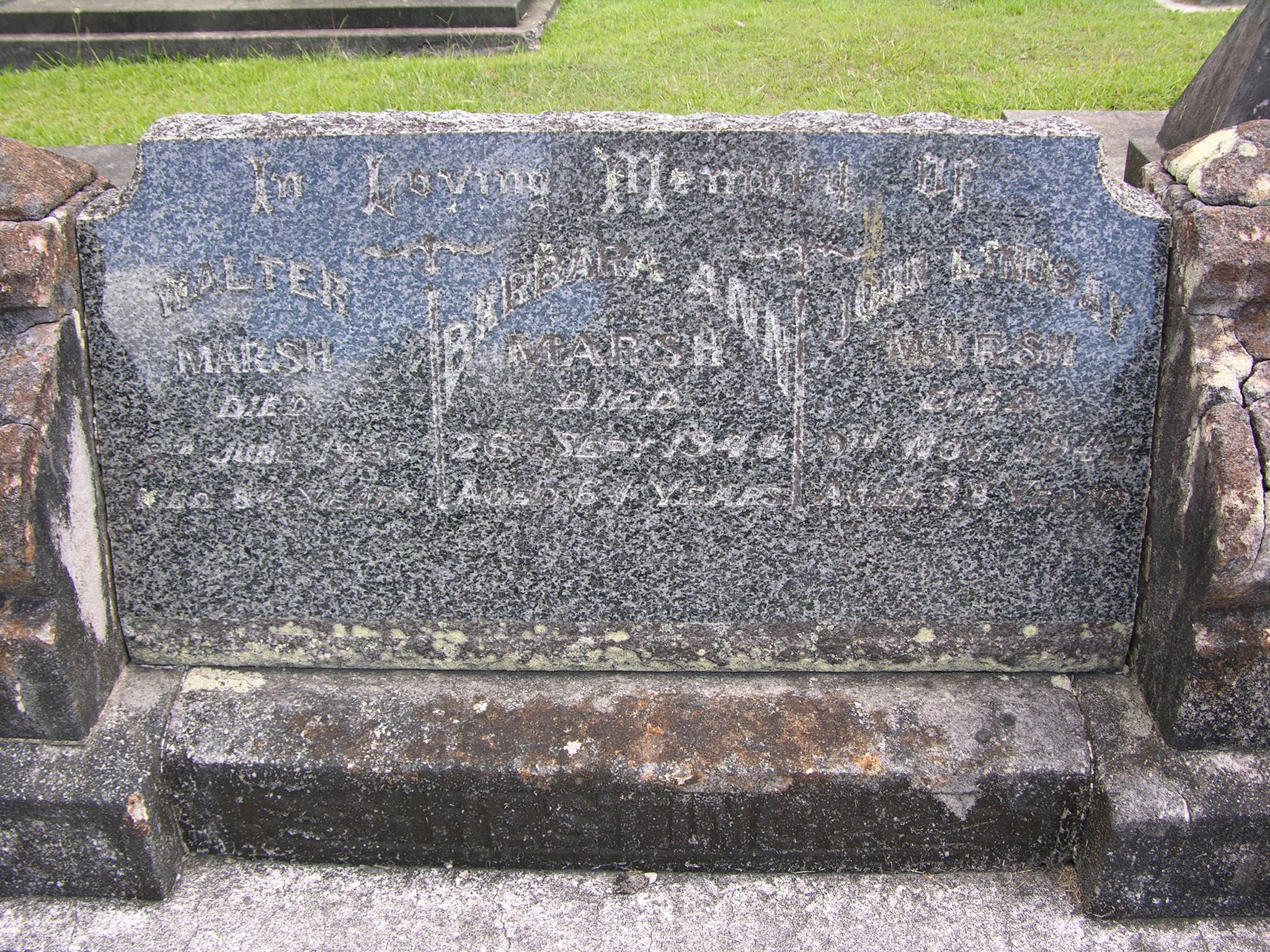
John Lindsay MARSH

John Lindsay MARSH

New South Wales Police Force

Regd. #  ?

Rank:  Constable 1st Class

Stations?, Glenn Innes ( 5 – 6 years ), Gloucester ( 10 months ) – death

ServiceFrom  8 January 1930  to  9 November 1943 = 13+ years Service

Awards?

Born? ? 1909

Died on:  Monday 9 November 1942 about 2pm

Event location:  southern end of Church St, Gloucester

Death location:  at MVA scene

Cause: Motor Vehicle Accident, Police bike & sidecar – Rider

Age:  33

Funeral date:  Wednesday  11 November 1942 @ 2pm

Funeral location:  St James Church of England, Maclean

Buried : Maclean General (Anglican).

Cameron Street, Maclean.

Anglican, Section C, Row CC, Lot 13

GPS: -29.466111, 153.201944

Memorial at:

Touch plate at National Police Wall of Remembrance, Canberra


John Lindsay MARSH Maclean General (Anglican). Cameron Street, Maclean. GPS 29 27' 58S / 153 123' 07E
John Lindsay MARSH
Maclean General (Anglican). Cameron Street, Maclean.

 [alert_green]JOHN is included in the NSW Police Honour Roll.[/alert_green]

On 9 November, 1942 Constable Marsh was riding a police motor cycle outfit in Church Street, Gloucester. The cycle collided with a post, overturned and threw the constable to the roadway. As a result Constable Marsh suffered a fractured skull and despite being taken to hospital, died the same day.


The constable was born in 1909 and joined the New South Wales Police Force on 8 January, 1930. At the time of his death he was stationed at Gloucester.

[divider_dotted]

The Dungog Chronicle                                 Friday,  13 November, 1942                          page 3 of 4

“SHOCKING ACCIDENT.    CONSTABLE MARSH KILLED.

A distressing fatality occurred in the southern end of Church Street, Gloucester, on Monday afternoon, when Constable John Lindsay Marsh was thrown from his motor cycle and received severe head injuries from which he died within a few minutes. The occurrence happened about 2 p.m., just at a small culvert almost in front of the home of Mrs. J. West, Sen. The constable left town and was on his way to Ward’s River on official duty. A few minutes before he was at the motor garage of Mr. A. Grahame and in excellent spirits. Mr. Jack West, who saw the happening from his home, said Mr. Marsh seemed to be doing something to the gears of the cycle. It suddenly veered to the left-hand side of the road way and the wheel of the sidecar struck the guide post of the culvert. The rider was thrown into the air and in falling his head appeared to come in contact with the hard road. The machine overturned, also, and skidded partly under the injured man. Constable Marsh was unconscious when help arrived, within a short space of time, but passed away without regaining consciousness, some fifteen or twenty minutes later. In addition to his parents, widow and son, the deceased is survived by four sisters: Mrs. Boon and Mrs. Moses, of Kogarah; Mrs. William S. Friar, 19 Boyce Street, Taree; and Mrs. Farlow, of Maclean.”

[divider_dotted]


NSWBDM

Born   – 5214/1909       Father = Walter   Mother = Barbara A         MacLean District

Married 1932 to Sheila Daphne MARSH nee THOMAS in Narrabri, NSW – born 1912

Death – 26323/1942    Father = Walter   Mother = Barbara Ann

[divider_dotted]


Daily Examiner (Grafton, NSW : 1915 – 1954), Wednesday 11 November 1942, page 2


CONSTABLE KILLED

Lower River Native To Be Given Police Funeral AT MACLEAN TO-DAY.

First-class Constable John Lindsay Marsh, who was killed while on duty at Gloucester on Monday afternoon, will be accorded a police funeral at Maclean this afternoon.

This will be the first police funeral held in the Grafton district for many years. Fifteen police in charge of Inspector B. H. Baxter, of Grafton, will attend the funeral.

Constable Marsh, who was a native of the Lower Clarence, had been stationed at Gloucester for nearly a year. On Monday afternoon he was riding a motor cycle along the main road on the outskirts of the town when the machine skidded on some rough road and crashed into a post, throwing Constable Marsh heavily to the ground. He received severe head injuries from which he died about half an hour later before he could be removed to hospital.

The body was taken to Taree and put on the train for Grafton. It was taken from Grafton to Maclean yesterday afternoon for the funeral at Maclean at 2 o’clock this afternoon.

Constable Marsh, whose parents, Mr. and Mrs. Walter Marsh, of Palmer’s Island, are well-known residents of the Lower River, was born at Maclean 33 years ago, and joined the New South Wales police force about 13 years ago. He was stationed al places in the north-west of the State and at Glen Innes, and went to Gloucester about a year ago. During the time that he was stationed at Gloucester he proved a most efficient officer and won the esteem and affection of a very large circle of friends, who were deeply grieved to learn of his tragic death.

As Constable Marsh had been killed on duty it has been decided that he be given a police funeral, and Inspector Baxter, whose district the funeral will take place, has been instructed to arrange for this. Police from Grafton, South Grafton, Ulmarra. Maclean. Brushgrove, Lawrence; and Harwood Island, will be in Maclean for the funeral this afternoon. They will march ahead of the hearse, and at the cemetery will form a guard of honor. Some of them will also act as pall-bearers.

http://trove.nla.gov.au/newspaper/rendition/nla.news-article194064086.txt


[divider_dotted]

Gloucester Advocate (NSW : 1905 – 1954), Tuesday 10 November 1942, page 2


Shocking Accident,

CONSTABLE MARSH KILLED.

A distressing fatality occurred in the southern end of Church Street, Gloucester yesterday afternoon, when Constable John Lindsay Marsh was thrown from his motor cycle and received severe head injuries from which he died within a few minutes.

The occurrence happened about 2 p.m., just at a small culvert almost in front of the home of Mrs. J. West, Sen. The Constable left town and was on his way to Ward’s River on official duty. A few minutes before he was at the motor garage of Mr. A. Grahame and in excellent spirits.

Mr. Jack West, who saw the happening from his home, said Mr. Marsh seemed to be doing something to the gears of the cycle. It suddenly veered to the left-hand side of the road and the wheel of the side-car struck the guide post of the culvert. The rider was thrown into the air and in falling his head appeared to come in contact with the hard road. The machine overturned, also, and skidded partly under the injured man.

Constable Marsh was unconscious when help arrived, within a short space of time, but passed away with out regaining consciousness some fifteen or twenty minutes later. The Ambulance, from Taree, was sent for immediately after the happening and on its arrival the body was conveyed from Mrs. West’s residence to Howard’s funeral parlour.

An inquest into the cause of the accident and death will be held.

Constable Marsh had been stationed in Gloucester for the past eleven months. He succeeded Constable Jack Casey when this officer was transferred to Glen Innes. He was an extremely likeable officer and had gained the goodwill of all sections of the community. He was of a happy disposition and displayed same in the course of his duty, and in the spending of his leisure hours.- To us he seemed the type that might genuinely be termed a good sport, and gave evidence of the trait in a man’s make-up that makes for this quality on a number of occasions, both in and out of Court.

During the past few months, whenever Constable Marsh had an hour or two away from the more serious duties of his job, he spent same in the garden and grounds at the Police Station. The trim and well-kept appearance there tell more plainly than words of his gardening ability and the. pride and pleasure shown in’ its doing.

Genuine regret will be general at this popular officer’s sad and sudden passing.

Mr. W. T. Howard . took the body to Taree by, hearse, last evening to be conveyed, later to Maclean, where Constable Marsh’s parents live.

Deceased will be accorded a Police funeral.

http://trove.nla.gov.au/newspaper/rendition/nla.news-article160198670.txt

[divider_dotted]


Henry Stanley LEES

Constable Henry Stanley LEES

New South Wales Police Force

Horse Accident

Jerry’s Plains

22 August, 1941


In 1941 Constable Lees was the Officer-in-Charge of Jerry’s Plains Police Station. On the day of his death he was patrolling the district on horseback, calling in at local properties. Later in the day the constable’s riderless horse was found by a farmer near Hobden’s Hill. He searched the area and eventually located the body of the constable lying in a roadside ditch beside the Jerry’s Plains, Singleton Road. It appeared that the roadway had collapsed underneath Constable Lees’ horse, causing the animal to stumble and fall into the ditch, crushing the rider.


The constable was born in 1914 and joined the New South Wales Police Force on 11 January, 1937. At the time of his death he was stationed at Jerry’s Plains.


John Edward DUNN

John Edward DUNN

New South Wales Police Force

Shot – Murdered

Detective Constable 1st Class

35 years

Wollongong

25 April, 1940


Detective Constable 1st Class John Edward DUNN Shot at Wollongong 25 April, 1940
Detective Constable 1st Class John Edward DUNN
Shot at Wollongong
25 April, 1940


On 25 April, 1940 Sergeant Hall attended a dwelling in Ocean Street, Wollongong where an offender named Hinsby had beaten his wife to death.

After he was confronted and threatened by the offender, who had now taken siege in the house, he called for reinforcements.

Among those to attend were Detectives John Dunn and R.A. Debney.

While negotiations were taking place with the offender, a piece of paper was thrown from a window, and, assuming that it was a note from the offender, Detective Debney crept up to the window to retrieve the paper. As he did so, a shot was fired from inside the house, through the window. The shot struck Detective Dunn, who was waiting nearby and watching Detective Debney. The bullet hit Detective Dunn in the forehead and he was killed instantly.

Tear gas was then used in an effort to flush the offender out, however it was soon found that Hinsby had committed suicide.


The Advocate newspaper of 22 May, 1940 reported briefly on the inquest into the matter.


RISKED LIFE ONLY TO SEE COMRADE SHOT

SYDNEY, Tuesday – “You two are married, I’m single. I’ll go and get it.” Saying this to two other detectives, Detective Debney went to a window of a house in which an armed murderer was holding the police at bay at Wollongong on April 25 to receive a paper which had fallen from the window.

When he reached the window a shot was fired and Detective Dunn, one of the detectives who had remained behind, fell fatally wounded.

This story was told at the inquest to-day into the death of Detective John Edward Dunn (35), George Hinsby (55), and his wife, Amelia Devine Hinsby (45).

The Coroner found that Hinsby murdered his wife and Detective Dunn and committed suicide while temporarily insane.

It was stated in evidence that since an accident 15 years ago Hinsby had been subject to ungovernable fits of rage.”


The detective constable was born in Victoria in 1904 and joined the New South Wales Police Force on 27 March, 1929.

At the time of his death he was stationed at Wollongong.


National Police Memorial


John was, reportedly, married to Lawna DUNN nee COOK.


Sergeant Frank LUND

Sergeant Frank LUND

New South Wales Police Force

Illness – Suicide

41 years

Hunters Hill

13 January, 1940


The sergeant died from a self-inflicted bullet wound at the Hunters Hill Police Station on Saturday 13 January, 1940. Nothing further is known about this incident.


The Sydney Morning Herald of 15 January, 1940 reported the following.


POLICE SERGEANT SHOT.

When a constable called at the Hunters Hill Police Station on Saturday he discovered the body of Sergeant Frank Lund, 41, in a cell with a service revolver near his right hand. There was a bullet wound through Sergeant Lund’s head and a note in his handwriting was found nearby. Sergeant Lund lived at the station, and earlier in the day his family left to visit friends. For some time Sergeant Lund had been suffering from nerves and the note he left indicated that he feared that his mind might become affected.


At the time of his death the sergeant was 41 years old and was stationed at Hunters Hill.


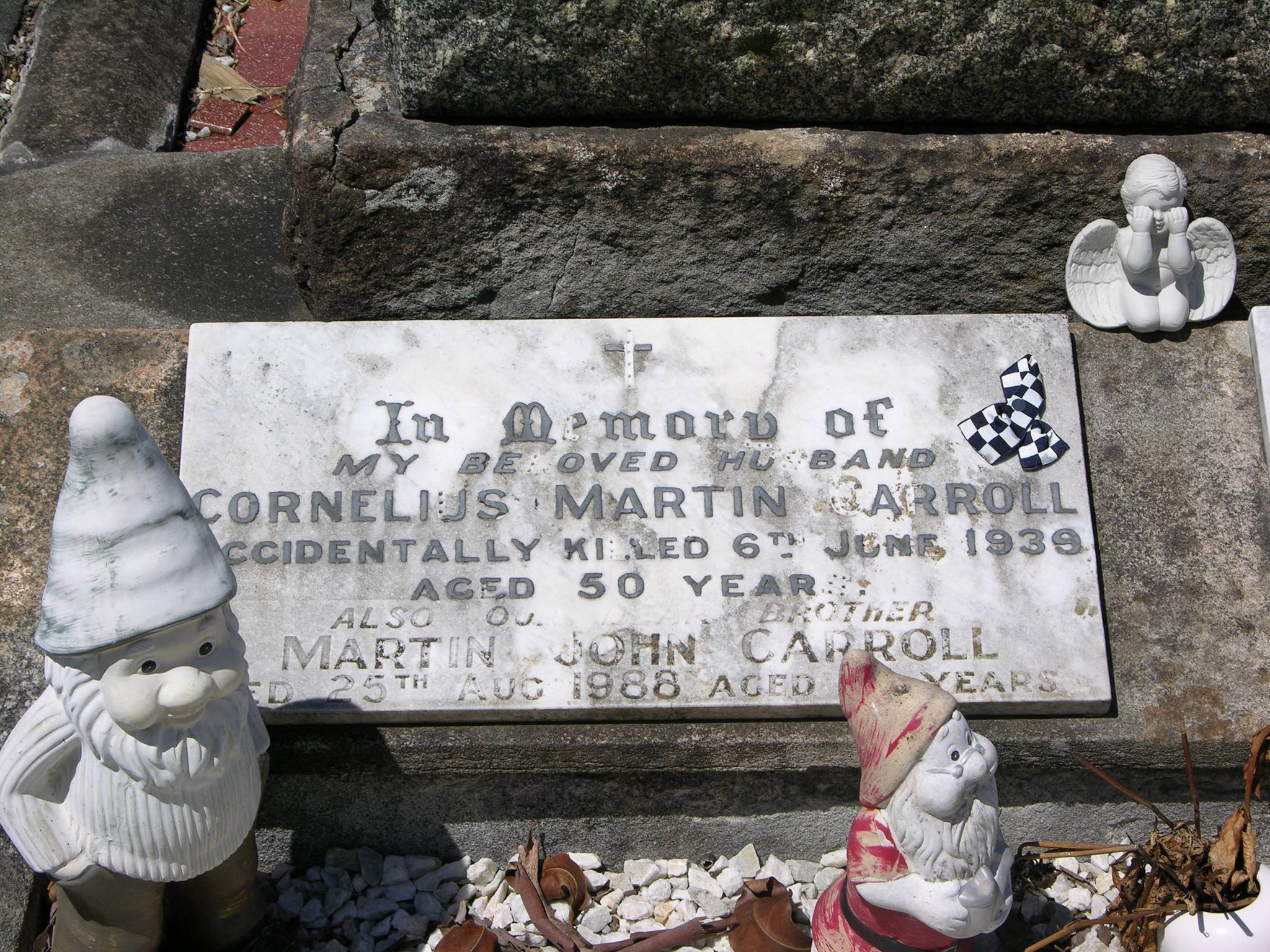
Cornelius Martin CARROLL

Cornelius Martin CARROLL

aka  Con

( late of 8 St David’s Road, Concord )

New South Wales Police Force

Regd. #   ??

Rank:  Detective Sergeant 3rd Class

Stations: ?, Burwood, Petersham ( O.I.C. – Detectives )

ServiceFrom  24 February 1915  to  6 June 1939 = 24+ years Service

Awards: No Find on It’s an Honour

Born? ? 1888 in Ireland

Died on:  Tuesday  6 June 1939

Cause:  Struck by a Motor Vehicle

Event location:  Parramatta Rd, near Ross St, Camperdown

Age: 50

Funeral date:   Thursday  8 June 1939 @ 8am

Funeral location: St Mary’s Church, Concord

Buried at:  Rookwood Catholic Cemetery @ 2.30pm

Section:  Mortuary 2 – 12  533

Lat / Long:  -33.88171, 151.05267

 In memory of my beloved husband Cornelius Martin CARROLL. Accidentally killed 6th June 1939. Aged 50 years. Also our beloved brother Martin John CARROLL Died 25th August 1988 aged 71 years

 CORNELIUS IS mentioned on the Police Wall of Remembrance

About 6pm on 6 June, 1939 Detective Sergeant  ‘ Con ‘ Carroll, the Officer in Charge of Detectives at Petersham, left his station to meet with an informant near the Sydney University.

In Parramatta Road near Ross Street, Camperdown he was accidentally hit by a car and was killed instantly. A report of the death was published in the Sydney Morning Herald of 7 June,1939.


DETECTIVE KILLED – Knocked Down by Car.  1939

Detective Sergeant Cornelius Carroll, 50, of St David’s Road, Concord was knocked down and killed by a motor car in Parramatta Road near Ross Street, Forest Lodge last night. Detective Sergeant Carroll had been in the police force 25 years, mostly in the Burwood and Petersham areas. He was in charge of the detectives at Petersham.

Detectives Brown and Rowland were informed that Detective Sergeant Carroll was either walking across the road or had just alighted from a tram when the accident occurred. The driver of the motor car did not see him until the impact, which fractured Detective Sergeant Carroll’s skull and limbs, killing him instantly.

Detective Sergeant Carroll’s body was taken to the Royal Prince Alfred Hospital by the Central District Ambulance. Detective Brown who was a close friend did not know whose death he was investigating until Detective Sergeant Carroll’s papers were found at the city morgue.

http://trove.nla.gov.au/newspaper/article/17604312

Anyone who witnessed the accident is asked to communicate with Detective Parmeter or Detective Wiggins at the Camperdown police station.


The sergeant was born in 1888 and joined the New South Wales Police Force on 24 February, 1915.

At the time of his death he was stationed at Petersham.

He was buried at Rookwood Catholic Cemetery.


As an aside, there was a Cornelius Daniel CARROLL who joined the NSW Police Force, as a Police Cadet, on the 12 February 1941.  Cadet # 309.

It is not known if C.D. Carroll is related to Cornelius CARROLL who died in June 1939.


The Sydney Morning Herald

Thursday  8 June 1939    p8

CARROLL – June 6 1939 suddenly Cornelius John ( Con ) Carroll detective sergeant of police dearly loved husband of Catherine Mary Carroll and father of Martin Josephine (Greta) Mary and Cornelius ( Conny ) aged 51 years Requiescat in pace.

http://trove.nla.gov.au/newspaper/article/17612052


Crookwell Gazette

Wednesday  21 June 1939    p 1

FULLERTON NEWS

SERGT. CARROLL’S DEATH SUCCUMBED TO INJURIES

On June 6 th. Detective-Sergeant Cornelius Carroll (“Con” to every one) had just signed off from duty at 6 p.m. and was waiting on the Parramatta Road, near the University, Sydney, for a bus to take him home to Concord, when he observed that a car coming along was one he was looking for.

On the impulse he stepped in front of the car to stop the driver, but the car crashed right into Carroll, who was flung and carried 100 yards.

He was picked up and given medical attention but died very shortly afterwards from his injuries.

The driver had gone on and escaped.  ( This doesn’t appear to be true – after reading other articles stemming from the Coroners Court )

The funeral on Thursday went from Burwood R.C. Church to the R.C. portion of Rookwood Cemetery.

The cortege was headed by the Sydney Police Band playing The Dead March. Over 200 police followed as a tribute of respect to a comrade who had always been popular in the Force for his geniality and readiness to do a good turn.

He was well known to the “underworld,” who regarded him as a “holy terror.”

Con Carroll was liked and known to many of the people of the Fullerton district, as up to a few years ago he was a frequent visitor to his parents-in-law, Mr. and Mrs. Philip Horgan, of Cartwright’s Creek, he having married their eldest daughter. Besides his widow, he is survived by his four children, Martin, the Misses Gretta and Mary and Cornelius.

Detective Carroll was born in Ireland 51 years ago and always retained a great love for his native country and his church. He came to Sydney as a young man and had been in the Police Force in the Sydney district ever since his arrival in Australia. He had resided at Davis Street, Concord, for many years. The sudden tragedy came as a great shock to his aged mother-in-law, Mrs.

Mary Anne Hogan, who always looked upon the deceased as one of her own sons.

http://trove.nla.gov.au/newspaper/article/221299636


The Sydney Morning Herald

Tuesday  11 July 1939    p16

DETECTIVE’S DEATH.

Finding of Accident.

The City Coroner Mr Oram at an adjourned inquest yesterday into the death of Detective sergeant Cornelius John Carroll, 50, of Davidson Street Concord who was knocked down by a motor car in Parramatta Road Forest Lodge on June 6, found that he was killed accidentally.

In previous evidence it had been stated that Carroll was on his way to keep an appointment with a female informer near the University grounds when he met his death.

In announcing his finding Mr Oram said that he could not commit the driver of the car for trial on a charge of manslaughter. Evidence was conflicting but it seemed to suggest that the car that struck the dead man was travelling in excess of 30 miles an hour in a built up area when the accident occurred. It was a border line case but there was no evidence that the driver displayed gross carelessness amounting to criminal negligence.

http://trove.nla.gov.au/newspaper/article/17616515


Other readings can be found at:

http://trove.nla.gov.au/newspaper/article/17595388

http://trove.nla.gov.au/newspaper/article/133740103

http://trove.nla.gov.au/newspaper/article/133733182


The Newcastle Sun ( NSW )

Tuesday  12 September 1939     p 8

SERGT.’S DEATH IN ACCIDENT

Motor Driver Fined For Negligence

SYDNEY. Tuesday

A trail of broken glass for 120 feet and a blood trail 33 feet long were described by Constable Cecil Stanley Jardine in the Traffic Court to-day when Archibald William Johnson, of Ashfield. was convicted by Mr. Wood. S.M., of negligent driving and fined £7.plus 23s 6d costs and expenses.

The charge arose out of an accident in Parramatta-road, Forest Lodge, on June 6, which resulted in the death of Detective-Sergeant Cornelius John Carroll, of Petersham. James Aubrey Gibson told of a man crossing the road as though to board a tram when a car approached fast. It had dim lights. The man put a hand up but the car hit him and carried him along the road 40 or 50 yards.

Johnson, who is a printer, pleaded not guilty. He said he eased to about 12 miles an hour and then increased speed to about 30. He felt a bump and saw a form disappear in front of the radiator. ” I applied the brakes and drew into the side, ” said Johnson.

Mr. Wood said he would recommend the Transport Department to test whether Johnson was fit to drive a car. Either he had not been paying proper attention or there was a defect in his vision.

http://trove.nla.gov.au/newspaper/article/167327081


Riverine Herald ( Vic. )

Friday  17 February 1933     p3

DETECTIVE WOUNDED.

Accidental Discharge of Revolver.

SYDNEY, Thursday

Although wounded in one shoulder when his companion’s revolver was accidentally fired last night, Detective Cornelius Carroll insisted on carrying on with the task of searching for burglars in a house before going to hospital.

When Mr W. T. Coggins, of Chalmers Rd, Strathfield, returned home last night he saw lights burning in the house and rang the police on a neighbor’s telephone.

Detective Carroll, Detective Clifton and Constable Gordon answered the call. Sir Coggins and Constable Gordon went to the rear of the dwelling, while Detectives Carroll and Clifton approached the front.

Carroll, with revolver drawn, was walking a few yards in front. Clifton was drawing his revolver from its holster when it went off, and the bullet, ricocheting off a brick wall, buried itself in the fleshy part of Carroll’s right shoulder.

Carroll took part in a search of the house, saying that the wound was a mere scratch. The burglars had decamped, however, taking £20 worth of clothing.

Examination at the hospital revealed the detective’s injury was not serious, but the bullet was still embedded.

So little did Carroll think of it that he rang the Burwood police station to inform officers there of his injury, joking with his mates and asking them to send him along a pair of slippers.

http://trove.nla.gov.au/newspaper/article/116480254


Goulburn Evening Penny Post

Friday  3 March 1933     p 2

Detective Carroll, who was shot accidentally during a raid in search of suspects at Ashfield, is Cornelius John Carroll, a son-in-law of Mr. and Mrs. Philip Hogan, of Cartwright’s Creek, Fullerton. ” Con. ” is often to be seen in Crookwell when on a visit to his wife’s parents. His genial nature and his coolness and pluck are outstanding attractions of this big, genial Irishman.

http://trove.nla.gov.au/newspaper/article/102864809


Constable Nicholas Glen SMITH & Constable Alistar Royal OSGOOD

Constable Nicholas Glen SMITH

&

Constable Alistar Royal OSGOOD


Motor Vehicle Accident

Homebush

28 February, 1939


On 28 February, 1939 Constable Smith was a passenger in a Police Public Safety Bureau motor cycle outfit driven by Constable Osgood. Whilst they were in Parramatta Road, Homebush they were pursuing and attempting to stop a motor vehicle when the cycle outfit collided with a heavy truck which had pulled across the roadway in front of them. Both constables sustained fractured skulls in the accident and both died shortly afterwards.


The West Australian newspaper of 29 February, 1939 carried the following account of the tragedy.


TWO CONSTABLES KILLED – CYCLE CRASHES INTO MEAT WAGGON.

SYDNEY, Feb. 28 – Constables Nicholas Glen Smith (24) and A.R Osgood (26), members of the police safety squad, were killed tonight when their motor cycle and sidecar crashed into the side of a heavy meat waggon in Parramatta Road, Homebush. Both men were hurled with terrific force against the side of the waggon and had their skulls fractured, among other injuries. Constable Smith was killed instantly but Constable Osgood lived until an ambulance took him to hospital. He died before he could be admitted. Witnesses informed the police that the two constables were chasing a motor car along Parramatta Road towards the city. The Police have been unable to discover whether the car was one reported stolen, or if the driver had merely committed a traffic breach – probably speeding.


Constable Smith was born in 1914 and joined the New South Wales Police Force on 22 November, 1937. At the time of his death he was attached to the Public Safety Bureau.


Constable Osgood was born in 1912 and joined the Police Force on 6 January, 1936. At the time of his death he was attached to the Public Safety Bureau.


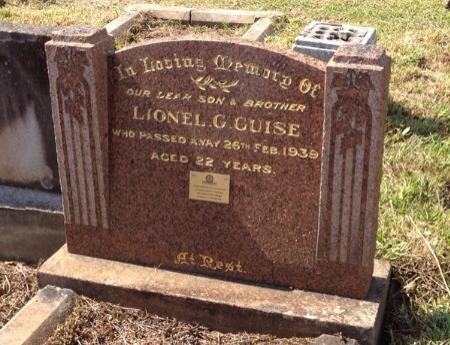
Lionel George GUISE

Lionel George GUISE

New South Wales Police Force

Constable

Regd. #  ?

Stationed at Newtown Police Station

Murdered – Shot

Newtown

Born  1916

Joined NSW Police Force on 22 November 1937

22 old

Died  26 February, 1939

Buried in Rookwood cemetery


Lionel George GUISE - Grave
Lionel George GUISE – Grave

On the afternoon of 26 February, 1939 Constable Guise and Sergeant Werner were patrolling the Newtown area when they were advised of a possible break and enter offence occurring in Marion Street, Newtown. On attending the address, the police stopped their vehicle beside a truck which had apparently been used in the offence. As they stopped, two men jumped from the truck and fled on foot, pursued by the two police. As Constable Guise caught up with one of the offenders the man turned and threw a torch, striking the constable in the chest. In the struggle that followed the offender managed to shoot the constable in the abdomen. Constable Guise died in hospital a short time later.


The Advertiser dated 14 June, 1939 reported on the trial of the murderer Leslie Murphy.


CONSTABLE SHOT WHILE MAKING ARREST-

ACCUSED SENT TO GAOL FOR MANSLAUGHTER.

SYDNEY, June 13Leslie William Murphy, 28, was found guilty before Mr. Justice Owen and a jury in the Central Criminal Court this morning with the manslaughter of Constable Lionel George Guise, 22, and was sentenced to three years’ imprisonment. Constable Guise was fatally shot at Newtown early in the morning of February 26 and died in hospital about seven hours later. The Crown Prosecutor (Mr. L.J. McKean K.C.) said that the Crown alleged that Murphy had been doing an unlawful act in attempting to resist apprehension. If a person resisted lawful apprehension and did something which brought about the death of a police constable, then, the Crown contended, such person would be guilty of manslaughter. Following the theft of a lorry a struggle took place between Guise and Murphy and Guise lost his life while lawfully apprehending Murphy.


The dying depositions of Constable Guise, taken at the hospital, were read in court. They were as follows: “We had a fight and my own gun went off. The other man did not have a gun. I don’t know the people. One ran one way, one another. I caught one and he threw a torch and missed. We had a scuffle. My gun went off and I felt a terrible pain. I shot from the ground at the man. I don’t know whether I hit him or not. He was about 35 years old.”


The constable was born in 1916 and joined the New South Wales Police Force on 22 November, 1937. At the time of his death he was stationed at Newtown.


[divider_dotted]


NEWTOWN LOCAL AREA COMMAND POLICE COMMEMORATION SERVICE

http://www.parliament.nsw.gov.au/prod/parlment/hansart.nsf/V3Key/LA20130508056

Page: 20259

Ms CARMEL TEBBUTT (Marrickville) [7.07 p.m.  8 May 2013]: Recently at Rookwood Cemetery I attended a memorial service to commemorate police officers from the Newtown local area command killed in the line of duty. The moving service was attended by Deputy Police Commissioner Nick Kaldis, Superintendent Simon Hardman, the commander of the Newtown Area Local Command, many other police representatives, and relatives and descendants of the police officers. Those attendees included Ms Avona Wallace, Mr and Mrs Norman Stephenson, Mrs Lynette Everton and Ms Edna Stevenson. Representatives from the emergency services and community members were also in attendance. The member for Campbelltown, Bryan Doyle, attended representing the Premier.

The five officers being remembered at the ceremony gave their lives to protect the community. They were Constable First Class John Wallace, Constable First Class Ruston Stephenson, Constable Lionel Guise, Detective Inspector Reginald Stevenson and Constable Pashalis Katsivelas. The ceremony to mark the sacrifice of these officers reflected on the enormity of their contribution to the community, as well as the impact of their death on their families. It is often said, and it is true, that police officers leave their homes for each shift uncertain of what any day may bring and whether they will return at the end of the day. We owe these men and women our deepest gratitude for the risks they face and take every day in their job. At Rookwood Cemetery we visited each of the graves of those officers who lost their lives in the line of duty and behind each individual was an illuminating life story.

We began at the grave of Constable First Class Ruston Stephenson, who died 80 years almost to the day of the commemoration. Constable Stephenson joined the Police Force in 1912, and four years later enlisted in the army, later joining the fight in France during the First World War. He was awarded the Distinguished Conduct Medal for conspicuous gallantry in rescuing injured soldiers while under fire. Remarkably, when he returned he rejoined the Police Force and continued to serve until his death on 9 April 1933 after a tragic accident involving a motorcycle at the then Newtown Stadium while performing general duties policing.

We were also told the story of Detective Inspector Reginald Hugh Stevenson—I was honoured on the day to meet his widow, Ms Edna Stevenson, who still had strong memories of the incident that led to Inspector Stevenson’s death. Detective Inspector Stevenson joined the NSW Police Force as a cadet in 1943 at the age of 17. In an act of extraordinary selflessness, Detective Inspector Stevenson was on annual leave on 9 December 1974 when he decided to go to work to assist in the planned arrest of a dangerous offender in Newtown, at the time telling his wife, “I don’t want my boys doing this on their own.” During the operation he was shot in the chest after leading his team in pursuit of the offender.

Detective Inspector Stevenson partially recovered and was awarded the Queen’s Commendation for Brave Conduct and the Queen’s Police Medal for Distinguished Service. However, he died in 1980 of a heart attack, deemed to be the result of the injuries he sustained on duty in 1974. These officers are just a few of many across New South Wales whose lives have been cut short as they have gone about performing their duty. I pay tribute to them all. They will not be forgotten and local events such as this are a powerful reminder of their sacrifice.

I also take this opportunity to acknowledge two Marrickville police officers, Sergeant Stewart and Constable Steele, who on Monday of this week rescued an intellectually disabled person from a house fire in Marrickville. Thankfully, those two officers who took huge risks survived and are quite rightly being hailed as heroes by their colleagues and the community. It is yet another example of the risk our police men and women take every day in order to keep the community safe. I take this opportunity to pay tribute to them.

[divider]


Harold William STURGISS

Harold William STURGISS

( late of Emu Plains )

New South Wales Police Force

Regd #.  1943

Uniform #  I690

Rank:  Constable 1st Class

StationsGeorge St North Police Station, Granville, Penrith ( since 11 December 1928 ) – Death

Service:  From  29 October 1924  to  2 February 1939 = 14+ years Service

Awards:  No Find on It’s An Honour

Born? ? 1902 in Tarago in the Goulburn District

Died on:  Thursday  2 February 1939

Cause: Motor Vehicle Accident – Police motor cycle rider

Location:  High Street, Penrith approaching ( Victoria Bridge ) Nepean River bridge

Age:  36

Funeral date:  Friday  3 February 1939

Funeral location:  C of E portion of Penrith general cemetery

Buried atPlot 14, Row AB, Anglican 1 Section ( unmarked grave ),

Cox Ave, Kingswood

Grave updated:  On Tuesday,  11 July 2017, the UNMARKED grave of Cst Sturgiss was suitably MARKED.


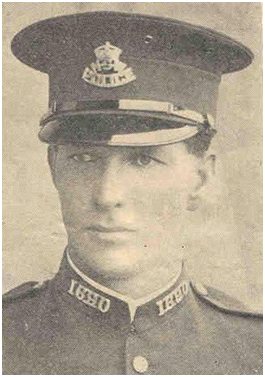
Constable Harold Sturgiss ( 1939 )


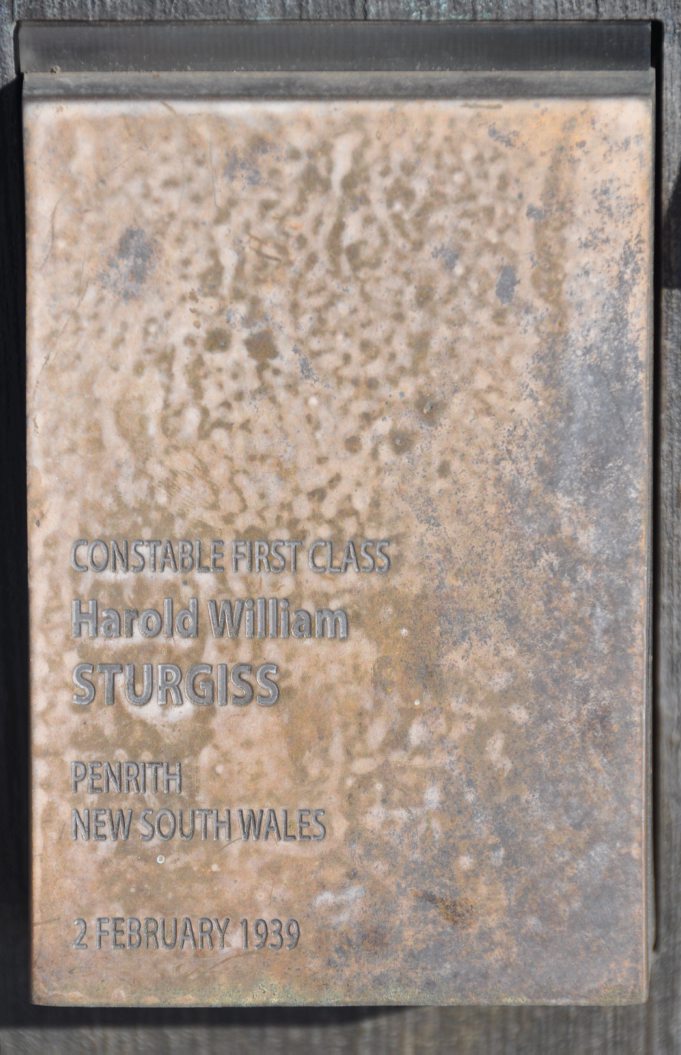
Touch plate at the National Police Wall of Remembrance - Canberra
Touch plate at the National Police Wall of Remembrance – Canberra


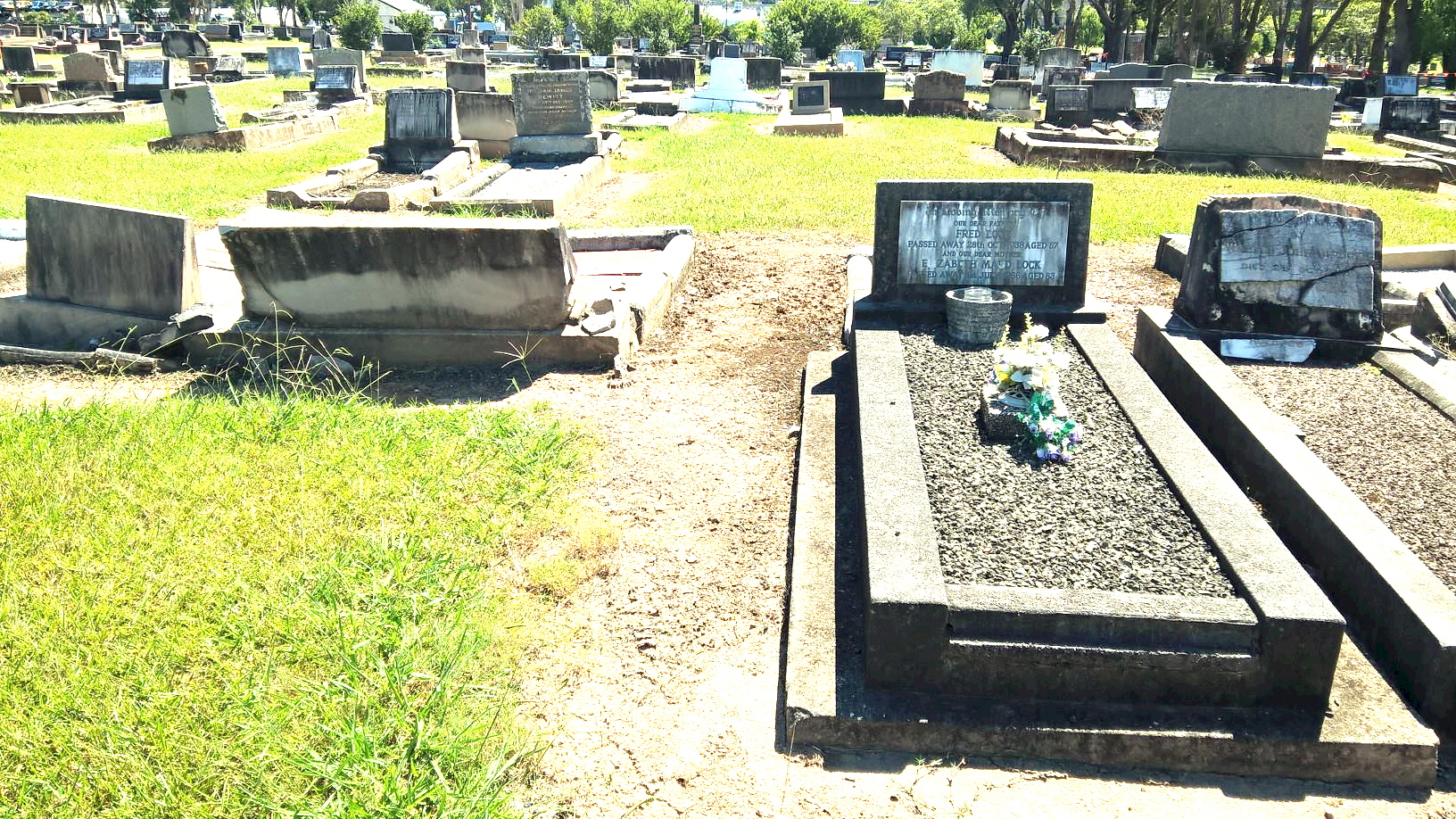
The burial site of the late Harold William Sturgiss, unfortunately his burial site of Plot 14 is unmarked, the monument next to his burial site is Elizabeth and Frederick Lock, Plot 13, Row AB, Anglican 1 Section.<br /> In the photo, his burial site is to the left of the Lock Monument.<br />
The burial site of the late Harold William Sturgiss, unfortunately his burial site of Plot 14 is unmarked, the monument next to his burial site is Elizabeth and Frederick Lock, Plot 13, Row AB, Anglican 1 Section.
In the photo, his burial site is to the left of the Lock Monument.

The unmarked grave of Harold is the dirt to the left of the well kept grave in the foreground

HAROLD IS mentioned on the Police Wall of Remembrance


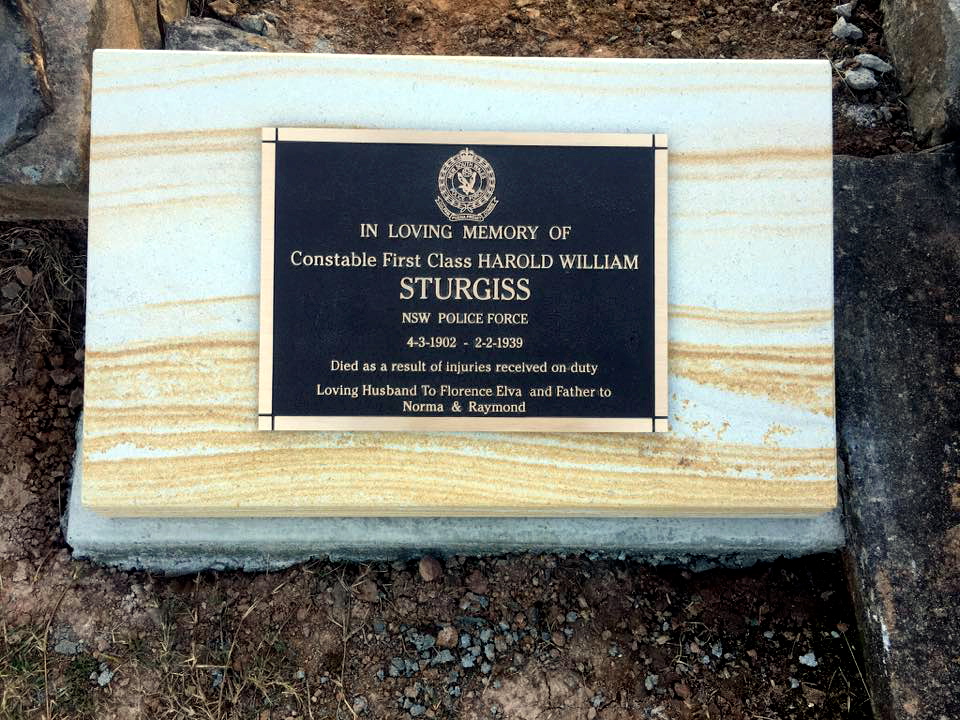
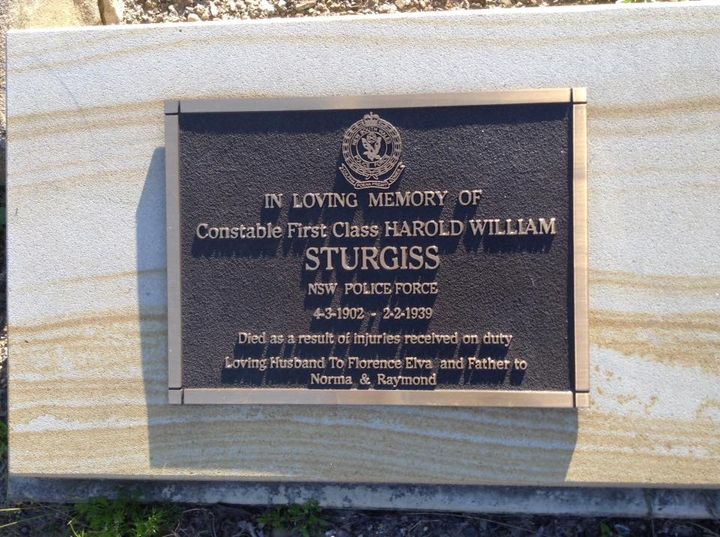
IN LOVING MEMORY OF CONSTABLE FIRST CLASS HAROLD WILLIAM STURGISS, NSW POLICE FORCE, 4-3-1902 - 2-2-1939. DIED AS A RESULT OF INJURIES RECEIVED ON DUTY Loving Husband to Florence Elva and Father to Norma and Raymond.
Another graves project completed today ( Tuesday 11 July 2017 ). Constable First Class Harold William Sturgiss died on the 2nd February 1939 as a result of a motor cycle accident on Victoria bridge Penrith, whilst on duty. It is with great satisfaction that today a 78 year old oversight has been remedied, and we are able to advise Cst 1/c Sturgiss’ elderly daughter that the work ( a properly marked grave ) has been completed.


Harold William STURGISS - as seen by Col Colam on Friday 28 August 2020.
As seen, by Col Colman on Friday 28 August 2020.


On the afternoon of 2 February, 1939, Constable Sturgiss was riding a police motorcycle outfit along High Street, Penrith. As he was negotiating a bend approaching the bridge over the Nepean River, the wheel of the sidecar struck the kerbing of the roadway. The cycle veered across the roadway and collided with a truck travelling in the opposite direction. Constable Sturgiss was thrown heavily to the roadway, sustaining severe injuries. He died in hospital a short time later.


The West Australian dated 3 February, 1939 contained the following brief paragraph relating to the constable’s death.


CONSTABLE’S FATAL INJURIES. SYDNEY, Feb. 2 –

Constable Harold William Sturgiss (37) died in the Nepean District Hospital today from injuries he received when his police motor cycle collided with a motor lorry on the eastern end of the bridge over the Nepean River at Penrith.


The constable was born in 1902 and joined the New South Wales Police Force on 29 October, 1924. At the time of his death he was stationed at Penrith.


NSW Birth, Deaths & Marriages

Birth:    12276/1902  to David J & Margaret E STURGISS

Death:  3196/1939


The Sydney Morning Herald    Friday  3 February 1939  p 9 of 26

STURGISS.- The Relatives and Friends of Mrs.

H. W. STURGISS and FAMILY, of Emu Plains, are invited to attend the Funeral of her dearly beloved HUSBAND and their dear FATHER, Harold William Sturgiss; to leave his late residence, Emu Plains, This Day, at 3.30 p.m.. for the Church of England Cemetery, Kingswood.


T. J. ANDREWS, A.F.D.A..

23-25 Enmore Road, Newtown.

Phones, L2873-4.

http://trove.nla.gov.au/ndp/del/article/17559160?searchTerm=harold%20william%20sturgiss&searchLimits=#pstart1173406


Nepean Times ( Penrith )    Thursday  9 February 1929  p 1 of 8

Fatality at River Bridge

DEATH OF CONSTABLE STURGISS

As briefly mentioned in the second edition of last issue, Constable Harold William Sturgiss  (36), of Penrith Police Force, died in Nepean District Hospital last Thursday afternoon from injuries received shortly before when a motor cycle and sidecar he was riding got out of control at the eastern end of the Victoria Bridge, over the Nepean River, and ran into a motor lorry. The accident happened shortly after 1 p.m., when the constable was returning to his home at Emu Plains.

Approaching the bridge the constable was travelling on his correct side of the roadway, when the wheel of the sidecar struck the kerbing along the footpath. The wheel, it seemed, travelled hard on to the kerb and then suddenly swung across the roadway to the right hand side, striking the off front corner of a heavy motor truck carrying five tons of sand and travelling east.

Apparently the constable’s chest came in contact with the off corner of the lorry and then slid along the side, striking the off rear wheel. This threw him off the machine on to the roadway.

INQUEST

The district coroner, Mr E. F. Rule, held an inquiry into the fatality at Penrith Court House yesterday.

Sergeant Sheridan stated that approaching the bridge from the eastern end there was a very sharp curve to the left, and eyewitnesses stated that as the motor cycle was being driven around the curve the wheel of the sidecar struck the kerbing on the left hand side going west, and then suddenly the cycle swung to the left with the sidecar up in the air. Deceased appeared to make every effort to right the cycle, but failed to do so, with the result that it struck the motor truck with great force.

The Ambulance was soon on the scene and he was taken to Penrith Hospital.

Deceased was regarded as a very careful motor cycle rider, stated the Sergeant, and had been riding departmental bikes for ten years. The bike   used on this occasion was in good repair, added the Sergeant.

Cedric Russell Neville, contractor, residing at Merrylands, stated that he was at present employed carting gravely sand, and blue stone from the Emu   Plains Gravel Coy’s. works to the Water Board’s construction works at Eastern Creek. At the eastern end of the river bridge his lorry was doing about 10 – 15 miles an hour. The motor cycle ridden by the constable came round the bend on its correct side. Witness was on his correct side. The sidecar wheel bumped the kerb, and the car immediately jumped into the air. Then the cycle swerved across to witness’s lorry, striking the off rear wheel. Witness stopped immediately Some lady in the vicinity immediately rang for the Ambulance.

Dr. Barrow, who examined deceased at the Hospital, stated that his injuries were a fractured right arm, a   double fracture of the right forearm, extensive fractures to the ribs on the right side of the back, pelvis bone fracture, and extensive shock. The cause of death was shock and visceral

injuries.

The coroner extended sympathy to the bereaved widow, and stated that deceased’s record as a police officer was of the highest, and it was a tragedy that the career of a man so young   should be cut off in this way.

A verdict of accidental death was returned.

DECEASED’S CAREER

The late Constable Sturgiss was born at Tarrago 36 years ago and was the son of Mr and Mrs D. Sturgiss, of that town. Deceased joined the New South Wales police force in Sydney on 29th October, 1924. He was attached to George Street North and Granville stations before coming to Penrith on 11th December, 1928, and had carried on duties here as a motor cyclist of the force. He had been residing   at Emu Plains since 18th March, 1929.

Constable Sturgiss was a very efficient officer of the force and both in   his official and private capacity enjoyed the esteem of many who knew   him. He was obliging, courteous, and conscientious, and his tragic passing is a great sorrow to many friends.

He is survived by Mrs Sturgiss, a son (Ramond) and daughter (Norma).

THE FUNERAL

The funeral, on Friday afternoon, was one of the most largely attended in Penrith for some time, the force and the civilian population being well represented. It was Impressive evidence of the esteem in which the deceased was held as an officer and as a citizen.

The cortege left deceased’s residence at Emu Plains at 3.30 p.m., escorted by four police motor cyclists, who acted as pall-bearers.

At Riley Street the procession was joined by the Police Band and a contingent of police of Penrith and surrounding stations, as well as some from the city.

Inspector Cannell, of Parramatta, represented the Commissioner of Police.

The Police Band and police unit escorted the cortege as far as the police station, after which the members proceeded to the cemetery by cars.

The interment was in the C. of E. portion of Penrith general cemetery, the service being conducted by the Rector. Rev. R. S. Capple.

Numerous wreaths were forwarded including wreaths from Penrith and Parramatta police and the Police Officer’s Association, Sydney.

It was an official funeral and the casket was draped with a Union Jack.

The P.A.F.S. and L.O.L. Orders were largely represented, deceased being secretary of the local lodges in each ease.

http://trove.nla.gov.au/ndp/del/article/101057355?searchTerm=harold%20william%20sturgiss&searchLimits=#pstart10719157


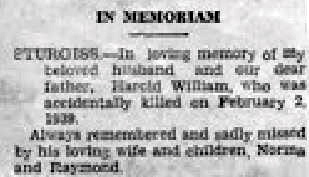
STURGISS - In loving memory of my beloved husband and our dear father, Harold William, who was accidentally killed on February 2, 1939. Always remembered and sadly missed by his loving wife and children, Norma and Raymond.
IN MEMORIUM STURGISS – In loving memory of my beloved husband and our dear father, Harold William, who was accidentally killed on February 2, 1939. Always remembered and sadly missed by his loving wife and children, Norma and Raymond.