Service: From 23 September 1968to? ? ? = ? years Service
Awards: National Medal – granted 8 June 1988
1st Clasp to National Medal – granted 8 December 1993
Born: 17 June 1943
Died on: 19 December 2014
Cause: Cancer
Age: 70
Funeral date: 29 December 2014
Funeral location: Norwood Park Crematorium, Canberra
Buried at: Cremated
[alert_blue] Bob is NOT mentioned on the Police Wall of Remembrance[/alert_blue] * NOT JOB RELATED
Information from Russell Perkins via NSW Fallen Police FB page:
For any of you older blokes that may have come across Bob McGoogan, ex ACT Police then transitioned into the AFP with the amalgamation, he passed away on the 19th December after a battle with cancer.
Funeral at Norwood Park Crematorium in Canberra 29th December
Funeral Service location:
ROBERT JAMES CHARLES MCGOOGAN “BOB” 17 June 1943 – 19 December 2014 Beloved husband of Margaret. Father of Guy, Michael, Mark, Matthew, Morgan and Buddy….
“To McGoo….for all those years from Safety Ed to the other ‘work’..to your wonderful attitude to kids to the the attitude adjustments delivered to those in need. A spinner of tales some possibly…” – Gary Brown
“Bob was truly a larger, and louder, than life character. I always enjoyed his company, in my office, or at his home. His bear hugs of my staff were something to behold. My sincerest sympathy to you…” – Fred Barnes
Awards: Meritorious Unit Citation for work in East Timor.
Commendation for efforts in disarming a male carrying a replica pistol in Honiara Court.
Born: ?
Died on: Wednesday 22 December 2004
Cause: Shot – Murdered
whilst deployed on official duties at Honiara, Solomon Islands
Age: 26
Funeral date: Thursday 30 December 2004
Funeral location: ANZAC Memorial Chapel,
Royal Military College, Duntroon, ACT
Buried at: Cremated
Memorial: The main street of a new AFP training village in Canberra was named Adam Dunning Drive in his memory.
Adam DUNNING
Adam IS mentioned on the Police Wall of Remembrance
Tears for the fallen as Adam comes home
By Craig Skehan and Aban Contractor December 24, 2004
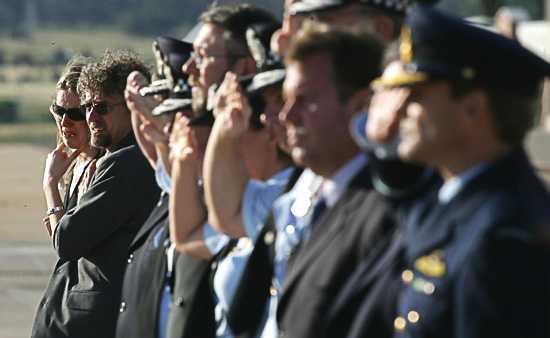
AFP officers farewell their mate Adam Dunning after loading his coffin into a RAAF jet at Honiara Domestic Airport. Photo: Andy Zakeli
They had slow-marched their comrade’s casket to the plane that would take him home.
Their backs were straight, but the emotions were too much: tears tumbled down the cheeks of the Australian Federal Police pallbearers as they did Adam Dunning this last honour.
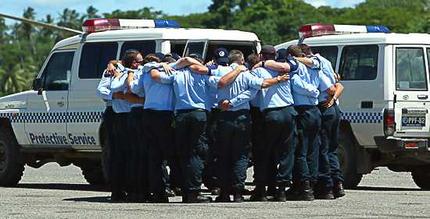
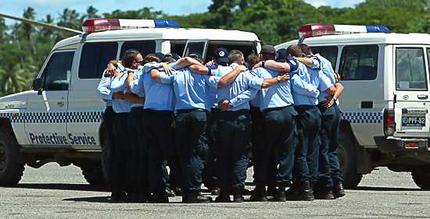
Then, once his body was stowed in the hold of the RAAF jet on the tarmac in Honiara, his mates made a last gesture of solidarity with the colleague they were farewelling forever – forming a circle, heads bowed, arms locked around each other’s shoulders.
Adam Dunning, the 26-year-old AFP protective service officer who was killed by a sniper in the early hours of Wednesday morning, was accompanied home by the Minister for Justice, Chris Ellison, and the Opposition’s home affairs spokesman, Robert McClelland, but at Fairbairn air base in Canberra, where the RAAF 737 touched down just before 6pm, it was Mr Dunning’s family and friends – his parents, Michael and Christine, his sisters, Sarah and Emma, and his girlfriend, Elise Wiscombe – who formed the guard of honour.
Standing in two straight lines, they faced the plane.
With the Australian Federal Police Commissioner, Mick Keelty, standing watch nearby, Mr Dunning’s parents held their heads high, and his sisters and Ms Wiscombe quietly sobbed as eight AFP pallbearers bore his flag-draped casket from the plane. His parents held hands and seemed to stand even straighter as their only son was placed in the hearse that would take him to the mortuary.
In the Solomons, police are questioning a taxi driver about several suspects in the murder. A Solomon Islands police source told the Herald that the taxi – seen near the murder scene with several passengers before the shooting – had been seized.
On a narrow, potholed road on the outskirts of the Solomons capital, Honiara, locals offered heartfelt apologies for the shooting.
“I am so very sorry,” said one young man. “He came here to help us.”
By the roadside at Zion Junction, investigating officers had cut the long grass to help search for clues to the identity of the person who, in darkness shortly after 3am on Wednesday, shot Mr Dunning while he was on patrol in a Toyota Land Cruiser.
Zion Junction does not have a particularly dangerous reputation. Rather, locals said, other settlements further along the same ridge were known for trouble, ranging from extortion to payback shootings.
Moffat Suiga, a community elder who was awakened by the shots that killed Mr Dunning, said he and others were at a loss to explain the murder.
A middle-aged businessman said the overwhelming majority of Solomon Islanders wanted to see those responsible put in jail. He said it would be a good thing if the Australian-led intervention force remained for the next 40 years.
At a commemoration service earlier in Honiara, Mr Keelty said Mr Dunning had “died for peace”.
The Solomon Islands Prime Minister, Sir Allan Kemakeza, said the young man had been helping the country overcome ethnic strife and crime. “We will not forget him,” he said.
A police funeral will be held for Mr Dunning on a day to be announced.
AFP officers farewell their mate Adam Dunning after loading his coffin into a RAAF jet at Honiara Domestic Airport.
Photo: Andy Zakeli
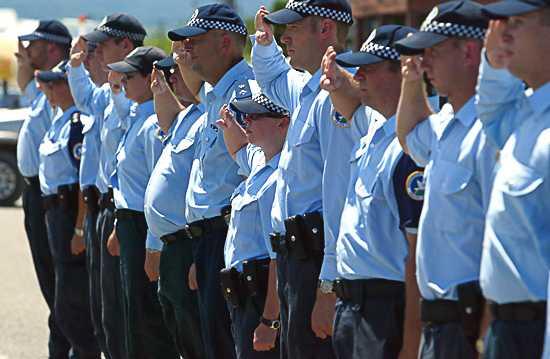
Australian Protective Services officers salute the coffin in a guard of honour at Honiara Domestic Airport before Adam Dunning’s coffin was flown back to Australia.
Photo: Andy Zakeli
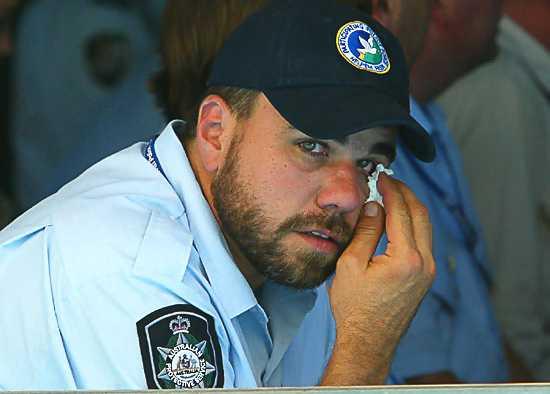
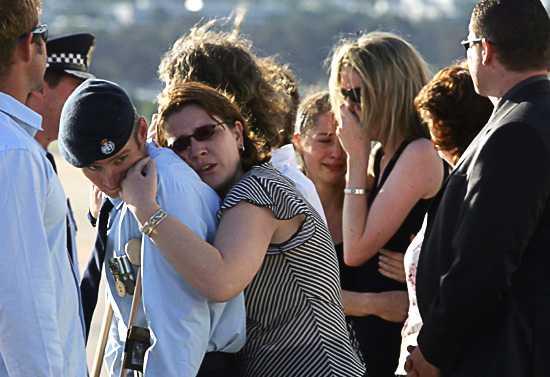
Australian Protective Services officer Robert Turnbull sheds a tear at the official wake in the compund before Adam Dunning’s coffin flew back to Australia.
Photo: Andy Zakeli
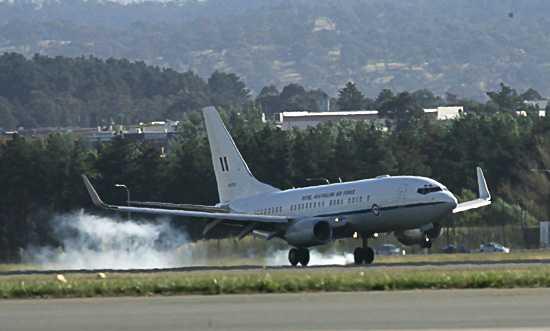
The RAAF jet carrying Adam Dunning’s body touches down.
Photo: Andrew Taylor
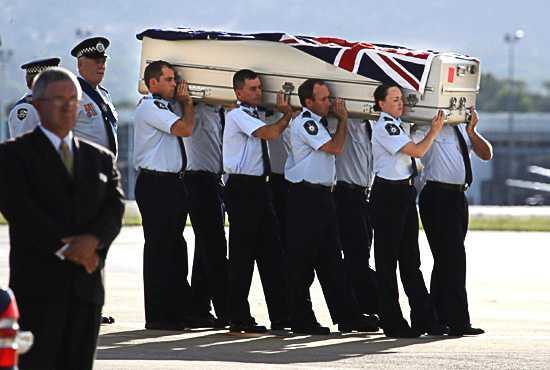
Adam Dunning’s coffin is loaded from the aircraft to a hearse at the RAAF Base at Fairbairn.
Photo: Andrew Tayl
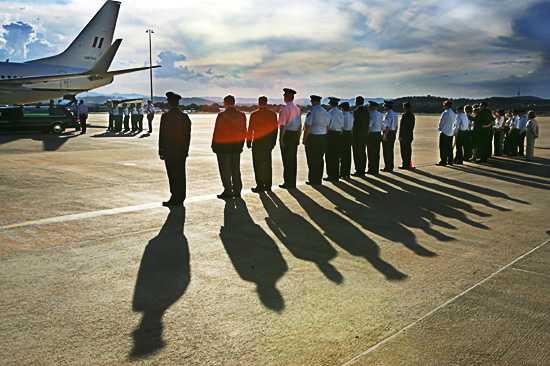
Senior officers and other dignatories, along with family members, watch Adam Dunning’s coffin being loaded from the aircraft to a hearse at the RAAF Base at Fairbairn in Canberra.
Photo: Andrew Taylor
The girlfriend of Adam Dunning, Elise Wiscombe (far left), cries as police salute the farewell of the coffin.
Photo: Andrew Taylor
Friends of Adam Dunning after the hearse had left the tarmac.
Photo: Andrew Taylor
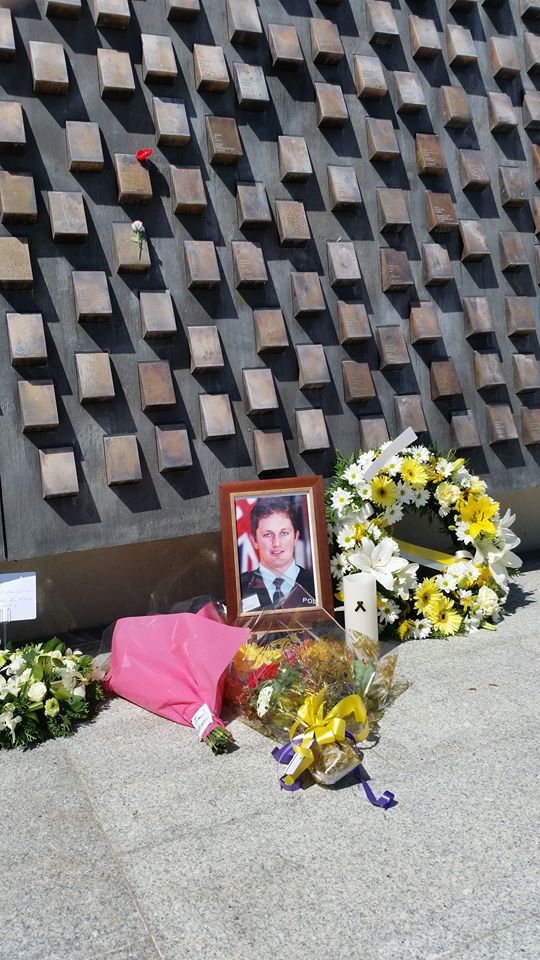
Memorial Tribute to Adam DUNNING, 10 years on. 22 December 2014, National Police Wall of Remembrance, Canberra.
Excellent turnout at NPM this morning for Adam and his family. RIP and we remember.
Peacekeeper killed ADG’s funeral brings Air Force and police together
By FLGOFF Fiona Peacock
The funeral of LAC Adam Dunning, a member of the PAF and Air Force Active Reserve.
LAC Adam Dunning.
LEADING Aircraftman Adam Dunning, an ADG with No. 28 (City of Canberra) Squadron and former member of No. 2 Air Field Defence Squadron, was killed in December last year while on operational duty with the Australian Federal Police as part of the Regional Assistance Mission to the Solomon Islands (RAMSI).
In the early hours of December 22, LAC Dunning and an Australian Protective Service colleague were on a routine vehicle patrol in Honiara, protecting the Prime Minister’s and Governor General’s residences.
A concealed gunman shot at the vehicle, fatally wounding LAC Dunning, who was 26.
He deployed to the Solomons in October and, after only six weeks there, was awarded a commendation for disarming a man in front of the Magistrates Court.
At LAC Dunning’s funeral, members of 28SQN played a part in recognising his Air Force service. The squadron’s honorary air commodore, Air Commodore Justice Terence Higgins, represented 28SQN among the official party of Service chiefs.
Members of the Air Field Defence Wing provided the firing party and the guard of honour for receiving VIPs. The RAAF Ensign was carried by Pilot Officer Shane McGaughey and was escorted by Flight Sergeant John Forth.
Two close friends of LAC Dunning, Leading Aircraftmen Tim Gresham and David Pauli, were members of the bearer party. The President of 28SQN Association, Steve Williams, represented former 28SQN members. 28SQN members joined AFP personnel to form a guard of honour.
AFP Commissioner Mick Keelty praised No. 34 Squadron for the way it handled bringing LAC Dunning’s body back to Australia.
By Misha Schubert
Political correspondent
Canberra December 31, 2004
They stood side by side. Two long lines of blue uniforms facing each other along the tree-lined road. Like a slow Mexican wave, each snapped to attention and saluted as the body of one of their own passed by.
Adam Dunning, murdered by a sniper while on patrol in the Solomons early last week, had begun the last leg of his journey home.
Earlier, these men and women of the Australian Federal Police and the Royal Australian Air Force had wept openly as Mr Dunning was farewelled with full police and military honours in the Duntroon chapel. “He was a great man,” said his federal police mate Pat Castle.
The nation’s military chiefs turned out to pay tribute, as did Prime Minister John Howard, Governor-General Michael Jeffery and senior cabinet ministers.
But this ritual belonged to those who knew and loved Adam Dunning.
His mother, Christine, read from a tribute that she and her husband, Mike, had written to their son in February. They had praised his courage, sensitivity and mettle.
His partner, Elise, who had brought red roses for the man she had loved, said he was her greatest friend. “He was my strength, my inspiration, my love.”
Peacekeeper Beau Tennant, who was with Mr Dunning the night before he died, broke down as he recalled his friend’s generosity.
“Before he left me, his last words were: ‘Are you right for money mate?’ That was the kind of bloke he was,” he said.
Federal Police Commissioner Mick Keelty said Mr Dunning would live on in the memories of grateful Solomon Islanders.
“Adam Dunning died for peace and law and order. His work and his death will always be remembered by his colleagues,” he told mourners.
The federal police hope to build a memorial to Mr Dunning at their new training centre for overseas police peacekeepers.
Mr Dunning also served with RAAF in Timor before joining the AFP.
Police believe his murder and another attack on police on October 21 were carried out by three former members of the Malaitan Eagle Force militia.
They have charged two men – John Ome and Philip Kwaimani – over the attacks and are hunting James Tatau, who Mr Keelty said was present at both events and had access to a cache of weapons.
Police believe the trio were working on their own, with no sign of any broader uprising against the peacekeeping effort.
It fell to Emma, who had adored her older brother, to claim his service medals and caps from the flag-shrouded coffin and hand them to her grieving parents.
As his police mates carried Mr Dunning’s coffin from the chapel into the sunlight, drummers and bagpipers ushered him on his way. A police motorcade led the cortege through Canberra’s streets to a private service and cremation.
A plane carrying the body of murdered Australian peacekeeper Adam Dunning has landed in his home town of Canberra.
The 26-year-old Australian Protective Services officer was shot twice in the back by a sniper while serving as part of a peacekeeping mission in the Solomon Islands yesterday morning.
Members of Mr Dunning’s family, and his colleagues were on hand to formally receive his body.
Australian Federal Police Commissioner Mick Keelty returned from the Solomon Islands about half an hour before the plane bearing Officer Dunning’s body landed.
He was among those waiting for Justice Minister Chris Ellison and Labor’s homeland security spokesman Robert McClelland, who accompanied the body on the flight back to Canberra.
Commissioner Keelty, Senator Ellison, Mr McClelland and AFP officers formed a guard of honour before the coffin was removed from the plane.
Family members, including Officer Dunning’s parents Mike and Christine, and girlfriend Elise Wiscombe, stood arm in arm watching proceedings.
A guard of honour, carrying Officer Dunning’s hat, led the flag-draped coffin to the hearse.
Eight pall bearers stood tall under the weight, as Officer Dunning’s police colleagues watched on.
A cavalcade of AFP motorcycles is waiting to lead the hearse to Canberra’s mortuary.
A full police funeral will be held for Officer Dunning on a day to be announced.
Officer Dunning’s parents took the time to thank those who attended the short ceremony before the hearse headed for Kingston mortuary under police escort.
Senator Ellison later said the Solomons people were behind RAMSI and Australia’s efforts to bring law and order to the country.
He said some adjustments might be made to the conduct of night patrols but any final decision would depend on recommendations from the AFP.
He denied the Government had too quickly reduced the AFP’s military support in the Solomons.
“We’ve made fantastic progress in the Solomons and we never underestimated the danger that our people faced,” he told ABC television
By Craig Skehan and Cynthia Banham December 23, 2004
Australia is rushing 100 extra troops to the Solomon Islands in defiant reaction to the sniper murder of Adam Dunning, the nation’s first peacekeeper to be killed by hostile fire.
The murder highlights the perils of the new interventionist role in the Pacific islands, but the Prime Minister, John Howard, vowed the mission to the Solomons would go on “undeterred, unrestrained, unaffected by what’s happened”.
“We won’t be cowed by this,” the Foreign Minister, Alexander Downer, added.
Mr Dunning, a 26-year-old Australian Protective Service officer from Canberra who had dodged bullets while serving in East Timor, was shot twice in the back while on a patrol in a four-wheel drives Toyota Land Cruiser in the capital, Honiara, at 3.10am on Wednesday. The bullets were among six shots fired rapidly from a high-powered military rifle.
“It looks as though the person who fired it had training in the use of such firearms,” a Solomon Islands official said.
Members of former ethnic militias – who had formed gangs and reduced the country to anarchy – are now being questioned. Australian investigators say the involvement of former Solomon Islands police officers, or an individual officer, cannot be ruled out.
At his Canberra home, Mr Dunning’s father, Michael, was distraught as he spoke of his son’s honourable death.
“It is sad as he cared for the [Solomons] people so much and was doing something really good on their behalf,” Mr Dunning told the Herald. “He always has been a decent person, tough and soft-hearted at the same time. He was totally honourable and very stubborn – nobody could make him do anything that he did not think was right. He was a credit to us.”
Adam Dunning had been planning a future with his 22-year-old girlfriend, Elise Wiscombe, on his return home next month. “I’m very, very proud of what he’s done over there,” she said. “He’s one of the greatest people I’ve ever met.”
Mr Dunning was part of the regional intervention force which has been seeking to stem ethnic and criminal violence in the Solomons since July last year.
A rapid-response, 100-member infantry company from the First Royal Australian Regiment was to leave Townsville on Thursday for the Solomons, just a day after the murder. The Defence Minister, Robert Hill, said: “This is to send a clear message to the thugs … that we will not tolerate the murder of our police officers.”
A meeting of departmental secretaries in Canberra recommended extra forces to support the 160 defence force personnel already there. Those troops are backing the 147 Australian Federal Police members who are serving in the Regional Assistance Mission to the Solomon Islands (RAMSI) – about 95 of them from the Australian Protective Service, which comes under the federal police. The Justice Minister, Chris Ellison, and the Federal Police Commissioner, Mick Keelty, flew to Honiara on Wednesday night. Australian forensic experts also flew in.
Mr Keelty said: “Over 4000 arrests have been made and over 3700 weapons have been seized [since the intervention began]. Clearly this indicates that there are some in the community in the Solomon Islands who are not happy about RAMSI’s presence.”
He said the hot tropical climate – and the large number of weapons already recovered – were among the reasons body armour had not been used for regular patrols. However, this is now under review.
Mr Keelty called Mr Dunning “a brave and courageous young Australian” and said his killing emphasised “the danger that our people face”.
The Solomons Prime Minister, Sir Allan Kemakeza, described the killing as barbaric and cowardly.
Mr Dunning’s partner on patrol, who had been driving, tried to resuscitate him.
The murder scene, on the outskirts of Honiara, was close to two settlements which are known to be frequented by former ethnic militiaman who formed criminal gangs.
The Australian police contingent has been at the forefront of efforts to clean up local police and officers have been charged with offences from corruption to assault and robbery. A number of local politicians are either under investigation or already facing various charges.
Mr Keelty said the ammunition used indicated the murder weapon was an SLR or possibly an AK-47. This was consistent with some of the weapons used before the arrival of the intervention force. The looting of many SLRs and other military-style weapons from Solomons police armouries had fuelled the five years of unrest that prompted the intervention of the Australian-led force.
There was a major riot at the Central Prison in Honiara this year, when inmates threw rocks at Australian personnel and painted anti-Australian slogans. Two months ago, an intervention force vehicle patrol was fired on.
Protective Service Officers were deployed along with other Australian law enforcement officers in the Solomon Islands as part of RAMSI. The peacekeeping force suffered their first casualty on 22 December 2004 when PSO1 Adam Dunning was shot and killed while deployed on official duties in the Solomon Islands. Two former members of a local militia were charged but acquitted of Dunning’s murder.[5] Officer Dunning was buried with full police honours.
The main street of a new AFP training village in Canberra was named Adam Dunning Drive in his memory.[6] The $2.8 million training facility at Mount Majura just outside Canberra, has been designed to replicate situations in regional countries to which personnel might be assigned.
The main street of a new training village for Australian Federal Police and other personnel being sent overseas has been named after murdered peacekeeper Adam Dunning.
The $2.8 million training facility at Majura, just outside Canberra, has been designed to replicate situations in regional countries to which personnel might be assigned.
Prime Minister John Howard officially opened the facility on Thursday in the presence of police chiefs from across the country as well as from several regional nations.
Australian Protective Service officer Mr Dunning, 26, was fatally shot twice in the back while on night patrol in the Solomon Islands capital of Honiara in December.
He was serving as part of the Regional Assistance Mission to the Solomons.
His parents attended the opening of the village, through the centre of which runs a road now named Adam Dunning Drive.
“The loss of Adam Dunning signified that this is very dangerous work,” Justice Minister Senator Chris Ellison said.
“That was the ultimate sacrifice paid in the course of his duties.”
Mr Howard said the new facility reflected the new security reality for Australia and its region.
“Events of the last five years have totally transformed both the demands and the expectations of the Australian community on the Australian Federal Police,” he told the gathering.
“In that five-year period we have seen the threatening arrival of international terrorism.
“We’ve (also) seen the emergence of an ongoing need on the part of this country, in cooperation with our friends in the Pacific region, to involve ourselves in the restoration of conditions of law and order and cooperation with police services and governments of those countries.”
The training village, to be used by a range of emergency services personnel as well as police, recreates the environment that police experience when on overseas missions.
Designed to reflect the streetscape of a small overseas township, it enables true-to-life scenario training which helps to prepare police for unknown and sometimes dangerous challenges.
It includes 18 buildings and structures including a corner store, a town hall, a police station, a school, a pub, a marketplace and even a cemetery, reflecting the fact that police are sometimes required to perform exhumations in the course of their work.
The spokesman said 124 personnel had already trained at the complex which was completed in March.
When depression and ” the job ” is obvious to the family.
A letter from a daughter to the Commissioner of Police.
8 years on and still ‘ no response ‘
Monday 21st August 2006
ATTN: Ken Maroney
Commissioner of Police
Sydney Police Centre
GPO Box 45
Sydney NSW 2000
Dear Ken,
It is with regret that I write this letter to you. A letter of this nature should not ever need to be written and the events that led to the writing of this letter should not have taken place.
I am writing to tell you about my father, James Breeze. My father is a Bravery Award winning Vietnam Veteran who joined the Police Force 25 years ago. Since joining dad has spent the full 25 years on the front line. During those 25 years he has added value to the NSW Police Force not just in his front line duties, but also as a Protocol Officer, a Gay Liaison Officer, an Aboriginal Liaison officer, a Leading Senior Const., training other officers and has also been a proactive and positive member of the NSW Police Force.
Dad is a leader among his pears, in the last 25 years I have been fortunate enough to meet some of dad’s peers and work mates and I am always so proud of my dad. Work mates and colleagues have so much respect for my dad and the contributions he has made but most importantly the support he has given them. His accolades include; a Good Conduct Medal, Long Service and the St John’s Life Saving Award (presented by you in 1994).
Also over the last 25 years, I have been less fortunate to see the effect my fathers chosen vocation has had on him as an individual. 25 years as a front line Police Officer has really taken its toll on my father. Growing up I began to be able to tell a good day from a ‘bad’ day. When I say bad; visiting an accident, witnessing family violence, violence on children, jumping in a car to hold someone’s body together, literally, while you wait for help to come, pulling the deceased from the wreck of car. Worst of all, pulling your deceased mate from a car wreck. For 5 years my dad ran a one man station at Barellan. Country life and people were fantastic, everyone knew everyone. No one preempted hard it would be to pull your dead mate from a car. I have heard my dad cry, I have seen his eyes when he comes home from a ‘bad’ day. I know there are things so horrible, that they are far beyond description. At times I have asked dad to share his load, and he has just looked at me and cried, he has said that there are people and things in this life worth not knowing.
The most recent of these ‘bad’ days, was in February when a young girl walked into Bowral Police Station and attempted suicide by Police. She held a gun up to my father and after time so did he. This was the event that changed my fathers life. My father is a broken man. Due to this recent event, my father has taken sick leave from work. His family and friends have grouped around him, each day is a challenge, and each day is hard. You see, the Police Force defines who my dad is, he loves his job, he lives and breathes the police force and now, he feels as though they have forgotten all the good he did, all the sacrifices he made.
Two days ago, a GSO (administration officer) called my father and told him that on his behalf, they have a medical discharge for him to sign! After 25 years of devoting your life to an organization regardless of whether they service the Australian community or not, you deserve more than a phone call telling you are no longer needed and that your condition is not being recognized. No one calling to sympathies, no superior calling to see ‘how you are’, no one calling to see what assistance they can lend you, what help they can give you after all the years of giving yourself to them. Talk about putting a nail in the coffin! What is the NSW Police Force trying to do to my father? Can you please tell whoever is making these decisions that I would like my dad at my wedding in November, and I would like him there for Xmas, and I would like him one day to meet his grand kids, but most of all, tell them I need him here, and I need him in my life. If you don’t help him and give him the assistance and respect he deserves, you will push him over the edge. I am outraged that my father has been treated like this, not only by an individual, but by the NSW Police Force.
If dad had of fallen pregnant, the Police Force would have issued him another shirt and given him all the necessary assistance and a new position.
Please give my father his dignity.
Ken, I would like to meet with you to discuss this further. I am really hoping with every bone in body that you are not aware of this treatment and that you can help me and my father.
Looking forward to hearing from you.
Regards
Carolyn Breeze
Annette Vicki BROWN (nee Heather)
| 22/12/2014
Annette Vicki BROWN ( nee Heather )
New South Wales Police Force
Regd. # ?
Rank: Unsworn – V.I.P.
Stations: Mounted Unit, Redfern ( as a 16 year old ‘work experience’ )
V.I.P. ( Volunteer In Policing) – Camden L.A.C.
Service: From ? to ?
Awards: ?
Born: 24 August 1964
Died on: 5 December 2012
Cause: Illness – alcohol
Age: 48
Funeral date: 12 December 2012
Funeral location: ?
Buried at: Castlebrook cemetery, Rouse Hill
Annette Vicki BROWN
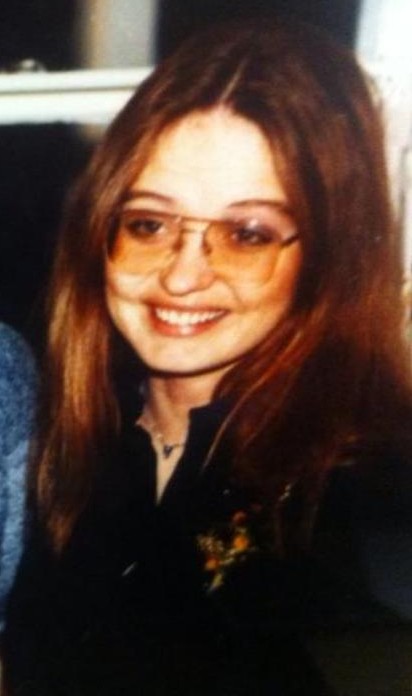
An unsworn officer that I thought I’d tell you about – my mum.
Her name is is Annette Vicki BROWN ( nee Heather ). Growing up she had some terrible things happen to her in her life and there was nothing more that she wanted than to help people.
She loved horses and with her two passions, she wanted to join the NSWP mounted unit.
In 1980/1981 she was 16 years old and undertook work experience with the NSWP Mounted Police. She thoroughly enjoyed her time and became friends with Wayne (?) from the unit.
It was during her time with the Police she was the victim of a crime. Still wanting to fulfil her dream she reapplied as an adult however was too thin for the old height and weight restrictions.
At 25 she got married and had her first born daughter, Michelle. At 33 she was re married and had her second and third daughters Caitlin and Lisa. Still never letting go of her dream she applied to be a Volunteer In Policing and worked for the Camden LAC.
She very much loved being part of the Police and was very interested in forensics. She learnt how to lift fingerprints and enjoyed pulling finger prints around the house.
She was the victim of a number of crimes in the latter part of her life and the post traumatic effects were more than she could handle. She self medicated with alcohol.
She was found deceased on December 5, 2012.
She had a big heart and was too kind in a cruel world. Everyone who met her would know how kind she was. She never forgot a birthday, and always went above and beyond for everyone. She loved her daughters and she will be missed forever.
Born 24.08.1964
died 5.12.12
aged 48 years
Michelle
[divider_dotted]
Sidney WALL
| 22/12/2014
Sidney WALL
New South Wales Police Force
Regd. # ?
Rank: Senior Constable – Resigned 1980
Stations: Jindabyne, 1974 – 1980
Service: From ? to 1980
Awards: ?
Born: ?
Died on: Friday 12 December 2014
Cause: Injuries. Died from being trapped under an upturned tractor
Age: 65
Funeral date: ? TBA
Funeral location: ? TBA
Buried at: ?
[alert_blue] Sidney is NOT mentioned on the Police Wall of Remembrance[/alert_blue]
Summit Sun
Jindabyne man dies after becoming trapped under tractor
Dec. 13, 2014, 6:50 a.m.
Police will prepare a report for the Coroner following the death of a man on a rural property near Jindabyne.
Shortly after 3.30pm Friday 12 December police and emergency services were called to a property in East Jindabyne.
Upon arriving at the location, emergency services personnel were met by a 35-year-old man and a 67-year-old woman who directed them to an injured 65-year-old man.
The man had sustained a number of injuries after becoming trapped under a tractor he had been using to mow the property’s grass paddocks.
Ambulance paramedics performed CPR on the man until a doctor arrived via Southcare rescue helicopter a short time later.
However, the man was unable to be revived and was pronounced dead a short time later.
Police will now prepare a report for the Coroner, outlining the full circumstances surrounding the man’s death.
Sid was stationed at Jindabyne between 1974 – 1980. He was up for promotion from Senior Constable to Sergeant but resigned because he did not want to move, from Jindabyne, for the promotion.
[divider_dotted]
Jonathan PATON
| 22/12/2014
Jonathan PATON
New South Wales Police Force
Regd. # ?
Rank: ? – Resigned
Stations: Queanbeyan
Service: From ? to ? 1999
Awards: ?
Born: ?
Died: 15 December 1999
Cause: Suicide – drowning – Queanbeyan River
Age: ?
Funeral date: 24 December 1999
Funeral location: ?
Buried at: ?
[alert_yellow]Johnathon is NOT mentioned on the Police Wall of Remembrance[/alert_yellow]
Jonathan Paton worked at Queanbeyan Police Station and resigned from the police about six weeks before he died.
He was deeply disturbed ( emotionally ) and started hearing voices.
He committed suicide by drowning himself in the Queanbeyan River on the 15 December 1999.
His funeral was held on Christmas Eve that year.
FURTHER INFORMATION IS NEEDED ABOUT THIS MAN.
Albert Spencer Thomas BAKER
| 22/12/2014
Albert Spencer Thomas BAKER
New South Wales Police Force
Regd. # ?
Constable
Stations: Central Police Station
Awards: ?
Service: From ? to 5 November 1906
Born: 1899
Died: 3 November 1926
Age: 27
Cause: Suicide – gunshot – Service revolver
Funeral date: ?
Funeral location: ?
Grave location: ?
The constable was killed by a single gunshot wound to the head in his bedroom at the police barracks at Central Police Station, Sydney. He was a single man who was to be married two weeks from the date he died. An inquest into the death returned a finding of suicide. The Evening News of 3 November, 1926 reported briefly on the tragedy.
CONSTABLE SHOT – TRAGEDY AT CENTRAL AFTER ILL-HEALTH
CONSTABLE ALBERT BAKER, 27, was found shot dead at the Central Police Station today. A service revolver was lying alongside him. The constable was a native of Cargo, near Orange, and had been in the force for about 18 months. He had recently been in ill-health, and for that reason had been granted leave. Baker, who was a single man, lived at the police barracks at the Central [sic]. The Central District Ambulance took the body to the morgue.”
The constable was born about 1899 and joined the New South Wales Police Force in 1925. At the time of his death he was stationed at Newtown.
[divider_dotted]
BARRACKS TRAGEDY.
Constable Shot Dead. Sydney, Nov. 3
The West Australian ( Perth ) Thursday 4 November 1926 page 11 of 20
Constable Albert Baker (27) was shot dead in his bedroom at the Central Police Barracks to-day. He was found lying on the floor with a bullet wound in the forehead, and with a service revolver lying smoking beside his right hand. Shortly before 10 o’clock, police at the barracks were startled by the sound of a revolver shot in one of the dormitories. Another constable was sleeping in the same room at the time, and was awakened suddenly by the report, which occurred a few feet from his bed.
Sergeant Hardiman, the barracks sergeant, called the Central District Ambulance, which conveyed Baker to the Sydney Hospital, where he was examined by Dr. Wallace, and found to be dead. The body was taken to the morgue.
This morning Baker breakfasted as usual and appeared to be in good spirits.
The following notifications appear in yesterday’s Gazette –
APPOINTMENTS – SergeantCharlesW. Brayne as an inspector of magazines under the 34th section of the Gun-powder and explosive Consolidation Act of 1876 (40 Victoria No 1), for the purpose of laying complaints and taking legal proceedings as prescribed in the 58th section of such Act.
The Sydney Morning Herald Saturday 5 July 1884 page 8 of 20
[divider_dotted]
The great Kiama fire
IN THE early hours of Sunday morning, October 1, 1899 a fire broke out that was to be the most extensive and destructive one that had ever visited the township of Kiama. It would also change the face of Terralong Street forever.
The fire started in the Wood Brothers general store and within minutes the place was ablaze. With the help of a strong southerly breeze, the fire spread to adjoining buildings and according to William H Bayley, author of Bluehaven: History of Kiama Municipality, “half the block of shops fronting Terralong Street from Collins Street towards Shoalhaven Street caught fire at 2am and was destroyed soon after dawn.”
The Sydney Morning Herald dated Monday, October, 2 1899, reported: “By the time the local police and many others were on the spot, and under the direction of Senior-Sergeant Brayne, Alderman Hindmarsh and others, many willing hands made great efforts to prevent the flames catching the Royal Hotel. In spite of their efforts the hotel soon ignited.
“This building being in part lath and plaster outside blocked the advance of the fire for a time: but ultimately the fire got hold of the place, and being a two-storey wooden structure it soon became a burning maze belching out tongues of fire against the adjoining building.”
Unfortunately there was no fire fighting equipment in Kiama at the time – hoses and tank water being the best on offer – so extinguishing the blaze became a huge problem. There are conflicting reports about how the fire was eventually stopped. No lives were lost but 12 families were left homeless, and 16 shops and the hotel were destroyed.
The total cost of the damage was estimated at between £5000 and £6000.
Brayne, Charles W., Sub-Inspector 2nd class, to be Sub-Inspector 1st class, 351 ( I ‘think’ 351 ‘might’ relate to a page number ?? )
[divider_dotted]
Nepean Times ( Penrith ) Saturday 30 December1922 page 1 of 6
Obituary
Mr. C. W. Brayne.
Mr. Charles Walter Brayne, who died at Braidwood on December 22 in his 75th year, was for many years in the Police Force, from which he retired some 15 years ago. As a young man he saw some of the stirring life of the goldfields days in the southern district, and had good knowledge of the bushranging exploits which culminated in the execution in Sydney in 1867 of Tommy and Johnny Clarke. Joining the police in 1873, Mr. Brayne gained rapid promotion. He was stationed at Penrith as a trooper over 40 years ago, and was given charge of the Shoalhaven district in 1885, and remained at Nowra many years, being transferred to Kiama, and later to Braidwood as inspector. His wife pre-deceased him by some 15 years, and a daughter ( Mrs. A. E. Prott, of Nowra ) in July last, from which time he appeared to have broken down in health. The late Mr. Brayne leaves to(sic) daughters and one son, viz., Mrs. A. C. Upton (Penrith), Mrs. A. Coleman ( Condoblin ), and Mr. Charles Brayne ( Darlinghurst ).
Mrs. Upton spent the last week with her father. The funeral took place on Sunday and was headed by members of the Police Force.
The Sydney Morning Herald Friday 9 August 1940 page 6 of 12
BRAYNE – August 8 1940 at Gloucester House. William Henry loved husband of Gentilla Brayne and father of C W Brayne. aged 66 years.
[divider_dotted]
BRAYNE.- The relatives and Friends of the late WILLIAM HENRY BRAYNE Late Police Sergeant, Fivedock, are invited to attend his funeral to leave T. J. Andrews’s Funeral Chapel, 25 Enmore Road, Newtown, THIS DAY, at 3.30 p.m., for Methodist Cemetery, Rookwood.
T. J ANDREWS, A.F.D A.,
21-25 Enmore Rd
Phones: L2373. etc. Newtown.
[divider]
George BRAYNE
| 22/12/2014
George BRAYNE
New South Wales Police Force
Regd. # ?
Rank: Sergeant
Stations: Parramatta 1873 – 1880, Hill End, Tambaroora,
Bathurst, Mundooran, Denison Town 1885, Girilambone,
Rylstone, Wollar, Carcoar, Peak Hill March 1901 – 5 November 1906
Awards: ?
Service: From 1873 to 5 November 1906
Born: 1850? – 1851?, Brighton, England
Died: Monday 5 November 1906
Age: 56
Cause: Pneumonia
Funeral date: Tuesday 6 November 1906
Funeral location: ?
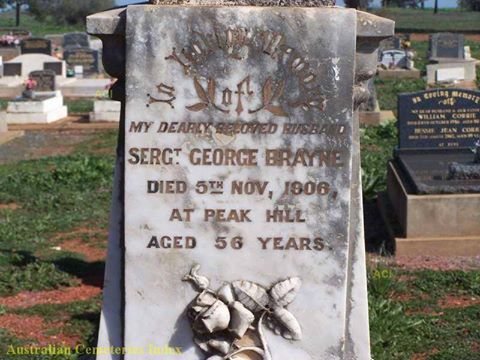
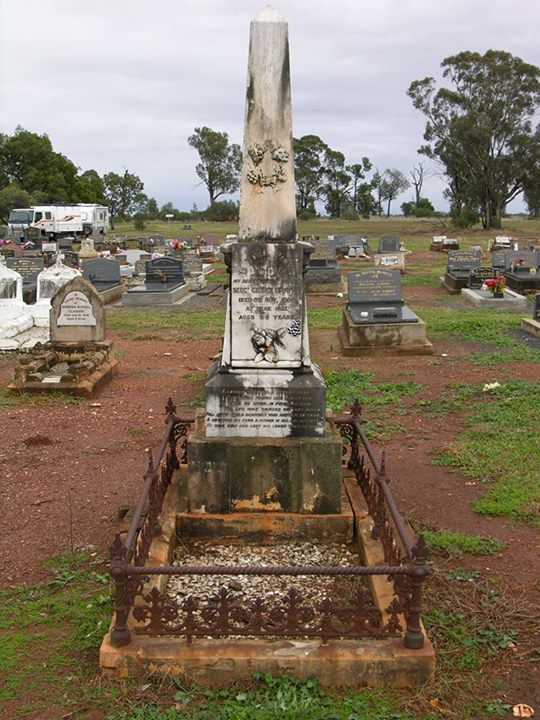
Grave location: Peak Hill Cemetery, Anglican Section, Row N, Lot 17
[alert_yellow]George is NOT mentioned on the Police Wall of Remembrance[/alert_yellow]
George BRAYNE
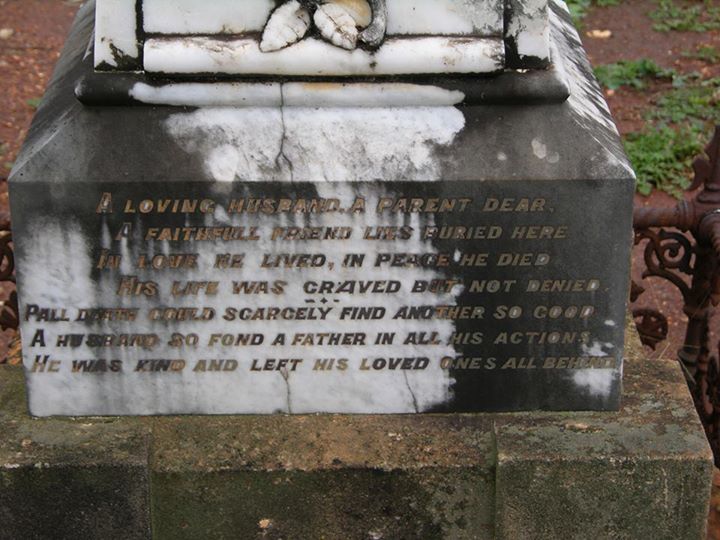
George Brayne grave
OBITUARY.
Sergeant George Brayne.
The Peak Hill Express ( NSW ) Friday 9 November 1906 page 10 of 20
It is with feelings of the very deepest regret that we are called upon to announce the death of Sergeant George Brayne, which sad event took place shortly after midnight on Sunday. The deceased gentleman had long been a sufferer from asthma and heart trouble, but no one to see his stalwart and robust figure — Sergeant Brayne was a man of fine physique — a month or so ago would have thought that he was ever troubled with ill health, or that his hours had been numbered —
” In the midst of life we are in death. ”
A few weeks ago Sergeant Brayne received notice of his removal to the charge of Sunny Corner police station, and in consequence he disposed of his household furniture, &c., but while waiting to hand over his papers to his successor contracted pneumonia and was obliged to take to his bed. Mrs. Brayne was also taken seriously ill about the same time, but subsequently recovered. A private nurse ( Mrs. Thos. Golding ) tenderly nursed the sick officer, and Dr. Corfe was in attendance night and day, but it soon became apparent that there was little hope of a recovery. Sergeant Brayne lingered for a couple of weeks and passed away as stated, the immediate cause of death being heart failure.
Sergeant Brayne was a native of Brighton, England, and was 56 years of age at the time of his death. He was a son of the late Charles G. J. Brayne, at one time head gaoler at Dubbo, and who died some twenty years ago. When seven years of age young George Brayne came to New South Wales with his parents, and 33 years ago entered the police force, his first station being Parramatta. Seven years later he was appointed to the charge of a station, and proving himself a zealous and capable officer rose to the rank of Sergeant. During his career he was stationed at Hill End, Tambaroora, Bathurst, Mundooran, Denison Town, Girilambone, Rylstone, Wollar, Carcoar, and five years ago last March was appointed to succeed Sergeant O’Brien at Peak Hill. About a year ago Sergeant Brayne was offered the charge of Parkes police station, but preferred to remain at Peak Hill. Had the Sergeant lived another few years he would have been eligible to retire on a well-earned pension. In 1874 Sergeant Brayne married Miss Amelia Gallagher at Parramatta, daughter of the late Constable Gallagher of that city, and together they reared a family of two sons and six daughters — Messrs. George and Ernest, Mrs. Barton, and Misses Edith, Clara, Muriel, Victoria and Minnie. Deceased was a brother to Inspector C. W. Brayne of Braidwood, Constable W. H. Brayne, of Double Bay, and a brother of Mrs. S. Howlett, Parramatta.
Telegrams and letters sympathising with the bereaved widow and family were received from Mrs. Howlett and Miss L. Laver (Parramatta), Mrs. Wilson (Sydney), Mrs. Egan (Carcoar), Mrs. Coleman (The Oaks), Mrs. F. R. C. Hopkins (Carcoar), Mr. P. Mikkleson (Blayney), Mr. G. M. Links (Carcoar), Mr. J. W. Lees (Tomingley), Mr. A. W. Page (Carcoar), Mr. P. Gallagher (Sydney), Mr. C. Higgs (Carcoar), Mr. J. Bouchier (Narromine), Mr. H. Barton (Wollar), Mr. A. Davey (Parramatta), Mr. W. H. Brayne (Edgecliffe), Mr. C. W. Brayne (Braidwood), Mr. G. Fletcher (Canowindra), Mr. R. Gallagher (Woollahra), Mr. J. J. Pettingell (Kiama), Mrs. R. Long (Albion Park), Miss C. Barton (Randwick), Mrs. Brady (Carcoar), Mr. and Mrs. Petersen (Carcoar), Mrs. Hawkins (Carcoar), Mr. and Mrs. Tucker (Carcoar), Members Myalls-Peak Hill Band, Mr. and Mrs. Thos Ring, Mr. E. H. Allan, Mr. and Mrs. J. S. Christophers, Dr. Hansard, Mrs. Wynne, Mr. and Mrs. E. Wooden, Mr. and Mrs. A. C. Upton (Penrith), Mr. and Mrs. J. J. Clements and family.
The funeral took place on Monday afternoon, and was very largely attended, the sad cortege being considerably over a quarter of a mile in length.
Sergeant McLeay, Constables Williams (Tomingley), Dixon (Alectown), Hill and Pope (PeakHill) acted as pall-bearers, and in trooper’s uniform, and on horseback, preceded the hearse to the cemetery where the remains of their late comrade were laid to rest in the Church of England portion, the burial service being conducted by the Rev. H. G. Wiltson.
The lovely cedar casket was literally smothered with wreaths sent by Mr. and Mrs. W. B. Wynne, Mrs. McAtamney and family, Mr. and Mrs. H. N. Gibson, Mr. and Mrs. M. P. Hartas, Mr. and Mrs. Franks and family, Mr. and Mrs. P. D. Fraser and Misses Jenner, Mrs. Williamson and family, Mrs. W. Oxley and family, Sisters of St. Joseph, Mrs. Brooks, Miss E. Golding, Misses Cavanagh, Miss T. Barrett, Mr. and Mrs. A. N. Davey, Mrs. H. and Miss Stanford, Mr. and Mrs. A. Dow, Mrs G. Carrington, Mr. and Mrs. E. J. H. Williams and family, Mrs. H. Pears and Mrs. S. Hartin, Mr. J. Marks and family, Mr. and Mrs. G. Stanford and family, Mr. and Mrs. E. J. Phillips, Mr. and Mrs. J. Barrett, Mrs. J. Matthews and family, Mr. and Mrs. J. Whiting, Mr. and Mrs. McLean and family, Mr. and Mrs. D. McAuliffe, Mr. and Mrs. DeLacy, Mr. and Mrs. W. Norris, Peak Hill Police, Mr. and Mrs. S. Wildie, Mr. J. Harvey, and Mrs. Veitch and family.
The Express tenders its deepest sympathy with the bereaved widow and family in this, one of the greatest of earthly trials that they could be called upon to bear.
The Maitland Daily Mercury ( NSW ) Wednesday 7 November 1906 page 4 of 8
Sergeant George Brayne, who has been over 30 years in the police service of New South Wales, died at Peak Hill on Monday, after a month’s illness. The deceased officer, who was known to many of the old diggers of Araluen now resident in the Newcastle district, had just been transferred to Sunny Corner, but was unable to go to his new station, having contracted pneumonia. With his brother*, Sub-inspector C. W. Brayne, of Braidwood, he was previously a miner working in the claims at Araluen in the palmy days.
* This article states that George & Charles were brothers, whilst other articles have them as father & son.
[divider_dotted]
The Braidwood Dispatch & Mining Journal ( NSW ) Saturday 17 November 1906 page 2 of 6
The Death of Sergeant Brayne – The Peak Hill Express says that the death of Sergeant George Brayne has been greatly lamented by all in that district. After lingering for a couple of weeks he passed away on Sunday week at the age of 56. He was a brother* of Sub Inspector Brayne, of Braidwood. He was a native of Brighton, England. He has been in the police force 33 years. A few weeks before his death he received notice of his removal to Sunny Corner, and in consequence had disposed of his personal effects, and was only waiting to hand over his papers to his successor when he was laid low with pneumonia, which rapidly took him off. His funeral was very largely attended, the cortege being considerably over a quarter of a mile long.
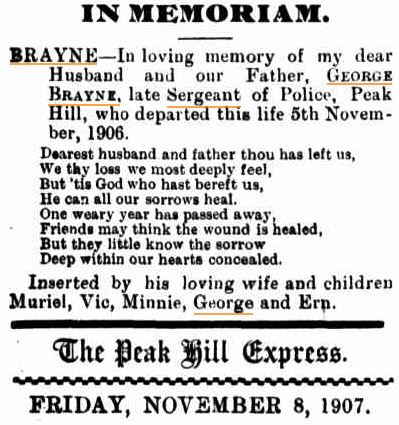
George PAYNE – Memorial post 1907 Peak Hill Express Friday 8 November 1907 page 10 of 20
[divider_dotted]
Location of cemetery:
[divider_dotted]
the Cumberland Argus & Fruitgrowers Advocate ( Parramatta ) Wednesday 30 August 1939 page 11 of 12
The Widow
After a brief illness, Mrs. Amelia Brayne, of 108 Wigram-street, Harris Park, died at Parramatta District Hospital on Monday. She was aged 85 years. She was the widow of the late Police-Sergeant Geo. Brayne, of Peak Hill, and had resided at Harris Park for 32 years. She is survived by Mr. George Brayne (Harris Park) and Mr. Ernest Brayne (Punchbowl), sons, and Mrs. H. Barton (Westmead), Mrs. A. R. Warren (Rosehill), and Mrs. O. Rock (Concord), daughters.
The funeral left the parlors of Charles Innes and Son, Parramatta, on Tuesday afternoon for the Church of England Cemetery, Rookwood. Rev. G. F. B. Manning officiated. Numerous floral tributes were forwarded.