1

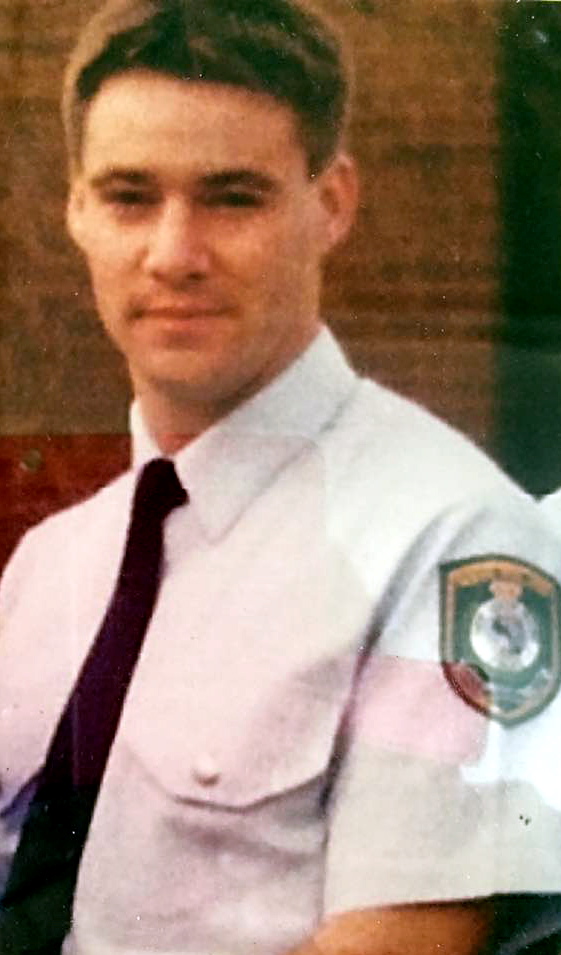
Ryan David WEAVER

Ryan David WEAVER

AKA ?

Late of Coffs Harbour, NSW

NSW Goulburn Police Academy Class # 259

New South Wales Police Force

Regd. # 29664

Rank:  Commenced at Goulburn Police Academy on Monday 22 August 1994

Probationary Constable – Friday 17 February 1995

?

Final Rank?

Stations:  Ermington, Granville until 1999 then transferred to Coffs Harbour – GDs & OSG

Service:  From  22 August 1994 to 17 January 2000 = 5+ years Service

Awards: No Find on Australian Honours

Born:  Wednesday  24 April 1974

Died  Monday  17 January 2000

Age:  25 yrs  8 mths

Cause:  Illness – Suicide – Hanging

Event location:  Home

Event date:  Monday  17 January 2000

Funeral date?

Funeral location?

Wake location?

Funeral Parlour?

Buried at:  Dawson River Cemetery, ( off Lansdowne Rd Taree ), Cundletown, NSW

Grave location:  Portion: Flower Garden, Row 1, In the flower garden in the roundabout at the end of the road in (Dawson River Cemetery Road)


Ryan is NOT mentioned on the Police Wall of Remembrance


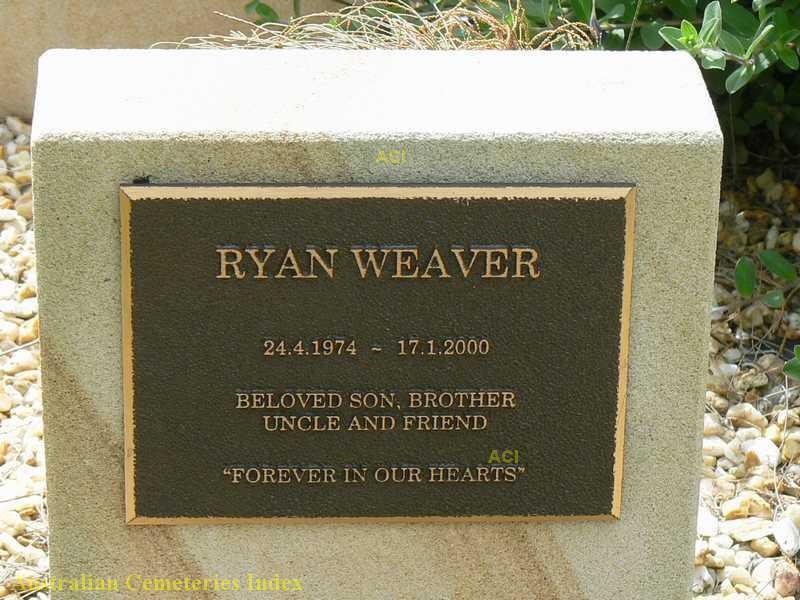
Ryan Weaver memorial stone, Taree Cemetery


Ryan was due to commence day shift at Coffs Harbour Police Station on the 17 January 2000 but was late for his shift.

His house mate, another Policeman, was at Coffs Harbour waiting for Ryan to relieve him from his night shift.  His mate phoned Ryan to ask why he was late and Ryan told him that he was leaving now and would be at the station shortly.

When Ryan failed to turn up half hour after the conversation, his house mate went home to ascertain what the problem was, only to find Ryan had hung himself in the garage.

Ryan was 25 years of age.

May he forever Rest In Peace.


John Edward BARNES

John Edward BARNES

New South Wales Police Force

Regd. # 13471

Rank:  Detective Sergeant at Parkes

Senior Sergeant at Casino ( Patrol Tactician )

Inspector

Stations:  Parkes, Casino

Awards:  National Medal – granted 13 November 1984

Born  28 December 1946

Died  29 June 1993 at home in Casino

46 old

Illness – Heart attack or similar

Funeral: ?

Buried:  Ballina Cemetery, NSW


John Edward BARNES
John Edward BARNES

John Edward BARNES
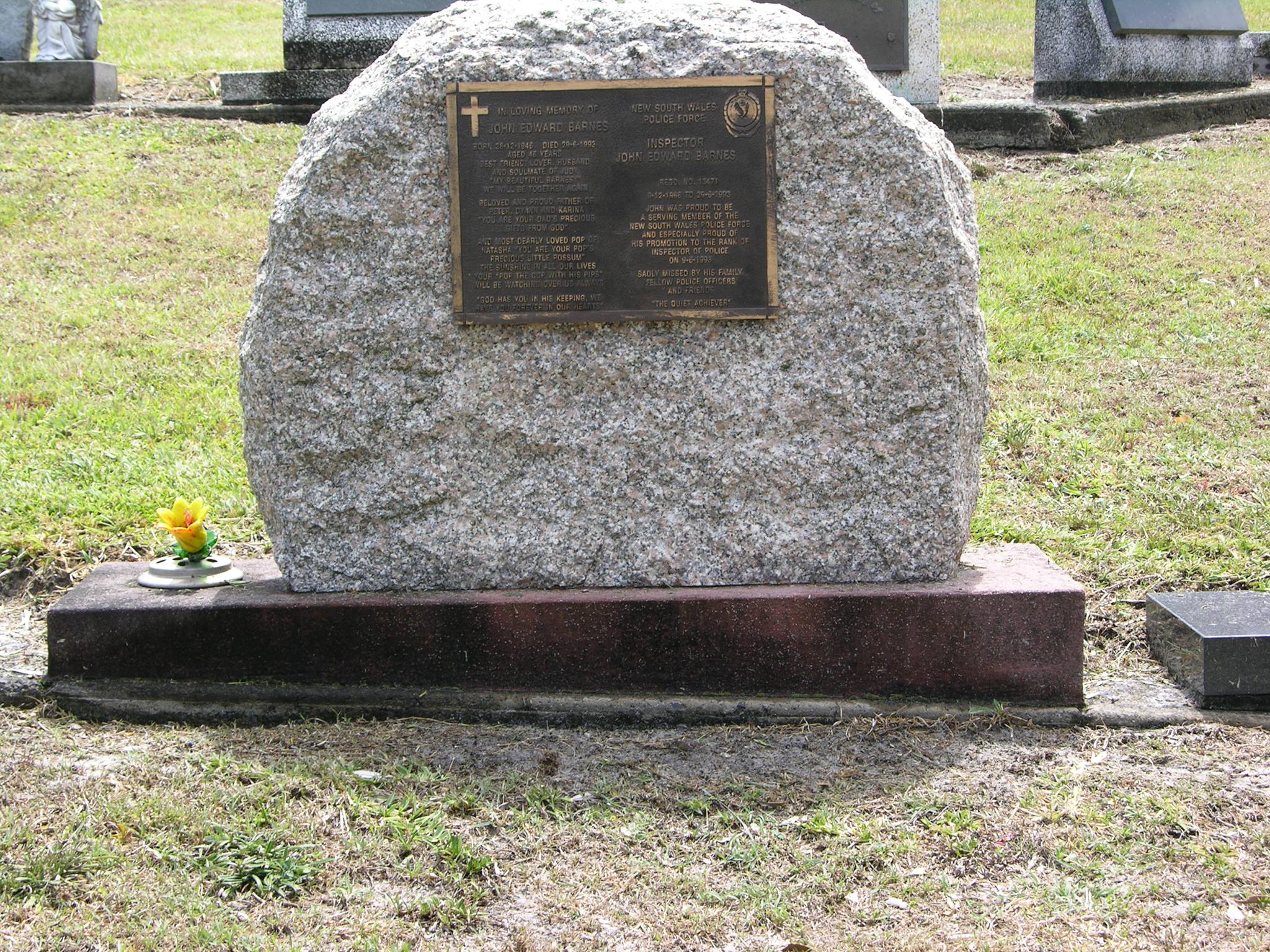
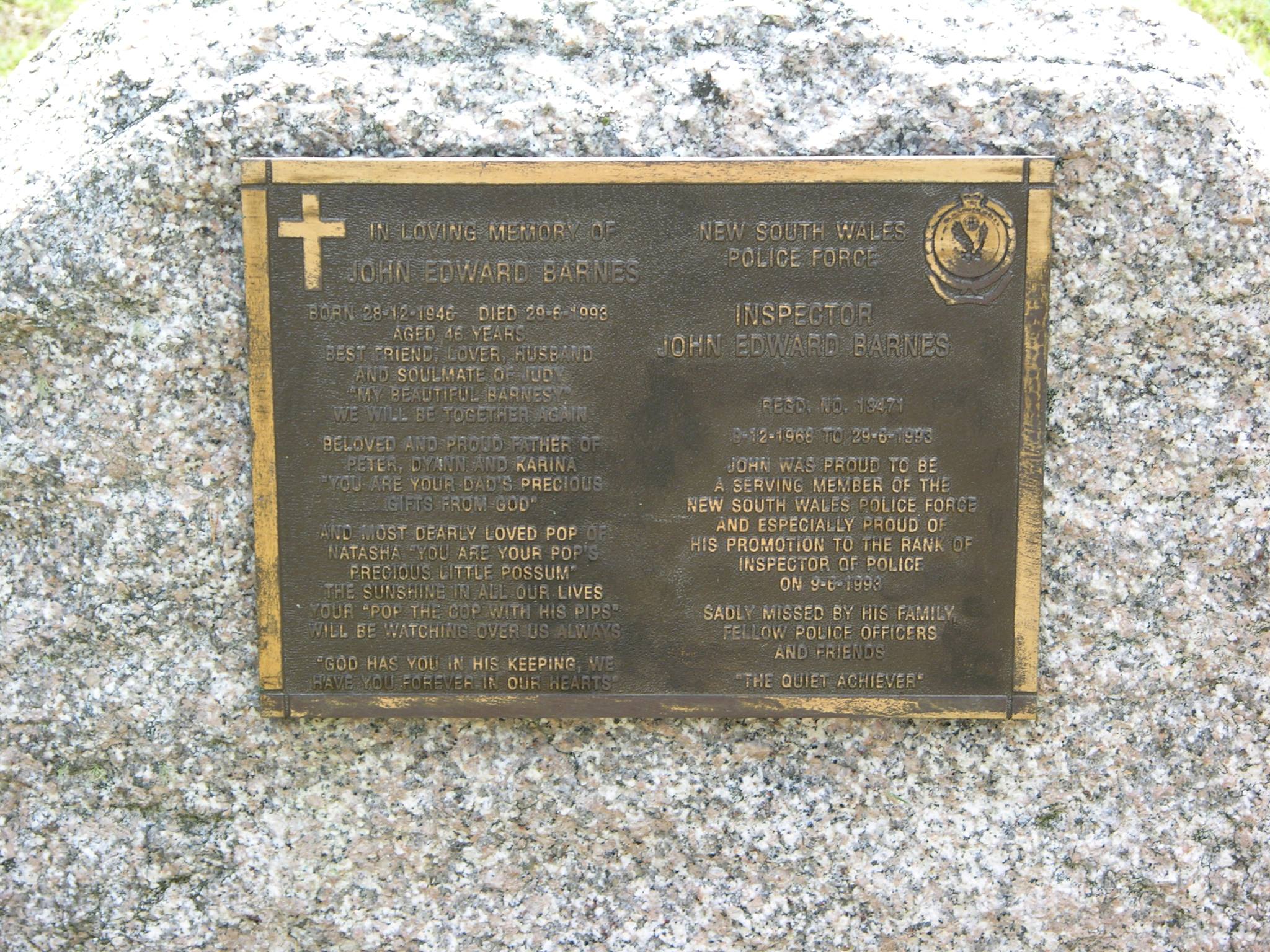
John Edward BARNES – Grave stone – Ballina Cemetery

Grave plate reads:


[blockquote]

In loving memory of John Edward BARNES.

Born 28-12-1946   Died  29-6-1993

aged 46 years

Best friend, lover, husband and soulmate of Judy.  ” My beautiful Barnesy ”  We will be together again

Beloved and proud father of Peter, Dyann and Karina  ” You are your dad’s precious gifts from god ”

And most dearly loved pop of Natasha ” you are your pop’s precious little possum ”

The sunshine in all our lives

Your ” Pop the cop with his pips ” will be watching over us always

” God has you in his keeping, we have you forever in our hearts ”


New South Wales Police Force

Inspector John Edward BARNES

Regd. No. 13471

9-12-1968 to 29-6-1993

John was proud to be a serving member of the New South Wales Police Force and especially proud of his promotion to the rank of Inspector of Police on 9-6-1993

Sadly missed by his family, fellow Police Officers and friends.

” The quiet achiever ”

[/blockquote]


* Note:  Died 20 days after his promotion to Inspector.

[divider_dotted]


Peter James McGRATH

Peter James McGRATH

New South Wales Police Force

Member of Police Academy Class  227

Regd. #  23807

Rank: Probationary Constable – appointed 26 June 1987

Constable – appointed 26 June 1988

Detective Senior Constable – Death

Stations:  Petersham ( 1987 ) – 11 Division, Annandale Police Station

ServiceFrom Pre June 1987  to 15 June 1995 = 8+ years Service

Awards? Nil

Born:  11 April 1963

Died on:  15 June 1995

Cause:  Suicide – jumped from 7th floor

Event location:  Camperdown, NSW

Age:  32

Funeral date?

Funeral location:

Buried at: Cremated at Rookwood
 

Peter James McGRATH


At 4.15pm on 15 June, 1995 the senior constable fell to his death from a building in Glebe. He was off duty and on sick leave at the time. It was later determined that he was suffering from work related Post Traumatic Stress Disorder, depression and anxiety as a result of his policing experiences.


The senior constable was born in 1963 and joined the New South Wales Police Force on 26 June, 1987.


This member IS mentioned on the National Police Memorial Wall.


Death Of Detective Constable Peter McGrath

Legislative Council by date

24 October 1996

About this Item
Speakers Gallacher The Hon Michael
Business Adjournment, Condolence

DEATH OF DETECTIVE CONSTABLE PETER McGRATH
The Hon. M. J. GALLACHER [4.49]: I bring to the attention of all honourable members yet another example of bureaucracy gone wrong. On 17 August 1992 Detective Constable Peter McGrath attended the scene of an armed robbery in progress at the Associazione Polysportiva Italo-Australiana club, the APIA club. Offenders were present and were armed. They had taken eight hostages and were in the process of collecting $60,000 from the armed robbery when the police arrived. It was a classic stand-off situation, with the offenders and police pointing loaded firearms at each other. The cool head of this officer and his partner resulted in both offenders eventually giving up. On 26 November 1992 Detective McGrath together with another officer whilst off duty were viciously attacked by approximately 12 males, resulting in serious injury to Detective McGrath’s companion and grave psychological illness to himself.

During the course of Detective McGrath’s duty he attended a domestic situation in which a mother and her de facto partner had placed a baby into a bath of boiling water before picking the skin off the baby and putting it to bed. The baby died a few months afterwards. Detective McGrath had to attend the post mortem. At the time of the trial of the offenders the detective’s wife had given birth to a son. In May 1993, as a result of the assault in November 1992, Detective McGrath began to show signs of depression, which were accepted by the Police Service as illness related to the course of his duty. His doctor supplied information to the Police Service regarding his illness and it was accepted that he had been hurt on duty.

By June 1995 Detective McGrath’s psychological condition had deteriorated. He believed that he was being followed by personnel from the Royal Commission into the New South Wales Police Service. He believed that he was going to be set up by police in relation to a crime. On 15 June 1995 he went to work at Annandale with the purpose of resigning. Detective McGrath’s supervisor realised that he was suffering from depression, talked him out of handing in his resignation and sent him home on annual leave. Later that afternoon Detective McGrath told his wife that he was going to resign. He left his home but instead of attending the police station he went to a high-rise block of flats in Camperdown and jumped to his death.

Contrary to rumours, Detective McGrath was not the subject of any royal commission inquiry, and I am in possession of correspondence to that effect from Mr Michael Finnane, QC, who represents the Police Service at the royal commission. Detective McGrath’s integrity is not in question. The Police Service and the people of New South Wales can ill afford to lose police of the calibre of Detective McGrath. I resigned from the Police Service and within three weeks received my superannuation payment. Detective McGrath died on 15 June 1995 but his wife did not receive his superannuation payment until August 199614 months after his death. On 26 June 1996 she received a letter from the Police Service telling her that his death was not as a result of his police work.

Detective McGrath has left a wife and two children, Kata aged four and David who is now two. His wife must go it alone without any support from the Police Service. I have written to the Commissioner of Police in regard to the appalling treatment that this woman has received and I look forward to hearing from him that the decision made earlier this year will be reversed. On 19 September 1996 Mrs McGrath personally filed an application for determination with the Compensation Court of New South Wales to challenge the decision of the Police Service so that she might be entitled to a pension. She has to pay for those proceedings herself. The money that Mrs McGrath is using is money from the family, money that would be better used for the children.

I do not believe that this case has been accorded the credit to which it is certainly entitled. The Commissioner of Police must immediately reinvestigate this matter to ensure that Mrs McGrath is treated justly. It is important that all wives and husbands and all children whose fathers and mothers work for the Police Service know that if they are unfortunate enough to lose their loved ones they will be protected. Psychological illness does not disbar an officer from consideration for compensation from the Police Service. I firmly believe that this matter is one that deserves just consideration and I hope that the Commissioner of Police accords it such consideration expeditiously.

Motion agreed to.

House adjourned at 4.53 p.m. until Tuesday, 29 October 1996, at 2.30 p.m.

http://www.parliament.nsw.gov.au/prod/parlment/hansart.nsf/V3Key/LC19961024053


http://www.smh.com.au/news/national/holding-judgement/2007/06/08/1181089328815.html?page=fullpage

June 9, 2007

It took up 451 hearing days, heard from 902 public witnesses and cost an estimated $64 million. Malcolm Brown reports on the Wood royal commission, 10 years on.


It began on June 15, 1995, when an unnamed Annandale detective jumped to his death from the seventh floor of a building, apparently through fear of the Wood royal commission. The detective’s suicide was followed by those of Ray Jenkins, a dog trainer (July 10), and Inspector Robert Tait, the acting patrol commander at Narrabri ( March 29, 1996 ). Nineteen days later a former Wollongong alderman, Brian Tobin, gassed himself.

On May 8 the same year, Peter Foretic gassed himself the day after giving evidence about pedophilia. On September 23, Detective Senior Constable Wayne Johnson shot himself and his estranged wife after being adversely named in the royal commission. On November 4, David Yeldham, a retired judge about to face the royal commission on questions of sexual impropriety, killed himself. A month later Danny Caines, a plumber and police confidant, committed suicide at Forster, on the North Coast.

Altogether, 12 people enmeshed in the Wood royal commission took their own lives. Scores of others were so profoundly affected by proceedings that their supporters and families believe it shortened their lives. A former detective, Greg Jensen, suffered a recurrence of the stomach cancer that ultimately ended his life, while another former detective, Ray McDougall, who faced the threat that commission investigators might expose his extramarital affair if he did not co-operate, succumbed to motor neurone disease.

There is no doubt that the Royal Commission into the NSW Police Service, headed by the Supreme Court judge James Wood, purged the force of a rollcall of rotters. A total of 284 police officers were adversely named, 46 briefs of evidence were sent to the Director of Public Prosecutions and by 2001 nine officers had pleaded guilty to corruption offences and three not guilty. Seven police officers received jail sentences, including the former Gosford drug squad chief Wayne Eade and a former chief of detectives, Graham “Chook” Fowler.

Several high-profile police ended their careers in disgrace, including Ray Donaldson, an assistant commissioner, whose contract was not renewed, and Bob Lysaught, the commissioner’s chief of staff, whose contract was torn up. Charges against 14 officers were dismissed because of irregularities in search warrants and their execution.

That left the question of what to do with police who were on the nose but who could not be brought to account by normal means. The solution was the creation of section 181B of the Police Service Act, under which the police commissioner could dismiss an officer on the basis of what had come out of the royal commission. Section 181D allowed the police commissioner to serve an officer with a notice indicating that he “does not have confidence in the police officer’s suitability to continue as a police officer”. The officer could show cause as to why he should be retained, and if dismissed could appeal to the Industrial Relations Tribunal.

In the wake of the two legislative changes, 380 officers were targeted for dismissal or internal investigation. By March 1998, 19 police officers had been dismissed under section 181B and three under 181D. Another had been dismissed under a separate provision of the act, 14 had resigned, four had been medically discharged and 15 had been given performance warning notices. Others were under consideration, and as the Police Integrity Commission – a legacy of the royal commission which became a permanent watchdog – has demonstrated, even officers who had been corrupt many years before were not necessarily in the clear.The former independent MP John Hatton, who was instrumental in setting up the royal commission, said he thought the Police Integrity Commission was the royal commission’s “greatest achievement”. The Child Protection Enforcement Agency, which launched a purge of sex offenders, is another positive legacy of the royal commission.But 10 years on, was the exercise worth it?To some there were considerable benefits. Some appalling malpractice – known as “process” or “noble cause” corruption – prompted Wood to wonder at one point about the quality of a lot of police evidence he had accepted over the years.Despite this, many officers still believe the royal commission was too puritanical. They claim the investigators, not able to grapple with the really big issues, jumped on anything they could: “They had to have runs on the board,” says Michael McGann, who as a policeman in 1984 participated in the so-called Kareela Cat Burglar case, in which police used mace on an unco-operative thief and sex offender. To some critics this treatment did no serious harm and only required a word of caution. But under the spotlight of the royal commission 12 years later, it ended the careers of high-flying police such as John Garvey, Brian Harding and Steve York.A decade later, Harding works in corporate security but insists that the real sting was that the investigators had fabricated evidence. When that finally came out, he says, the group received a confidential settlement, but it did little to redress the feelings of outrage.

Another former policeman, Dr Michael Kennedy, says the commission was a political response to the police commissioner, Tony Lauer, bringing about the downfall of the then police minister, Ted Pickering.

The attorney-general, ministry and judiciary took little responsibility for the state of the force, Kennedy says, while the responsibility of the police rank-and-file grew to “the size of a Pacific driftnet”. “I don’t think the royal commission contributed anything to the reform process except to provide a template for double standards,” he says.

Chook Fowler put $200 into his pocket from Louis Bayeh. Chook was a lazy, good-for-nothing drunk. But he was put into the same category as Ray Williams and HIH.”McGann says that against the string of petty corrupt activities uncovered, “you have to look at what the government did and did not do with gambling and vice, over the decades. There have been direct links to Parliament for 50 or 60 years. That is hypocrisy.”The critics’ view is that the royal commission has left a demoralised police force, tarnished and rudderless, with limited operational effectiveness and the problem of corruption unsolved. Seven police officers have taken their lives since 2001, including two this year.”It highlights the fact that the structure no longer takes in the needs of the NSW police force,” says Mike Gallacher, the Opposition police spokesman, and a former internal affairs police officer.Gallacher believes, as does the NSW Police Commissioner, Ken Moroney, that the tentacles of corruption no longer spread to embrace entire squads or larger units. But it does not prevent low-level incidents of corruption and there are continuing nests of corruption.In its most recent report, the Police Integrity Commission said it had undertaken 21 major investigations in 2005-06. These dealt with extortion, theft, unauthorised disclosure of confidential government information and perverting the course of justice, police brutality and the handling of $250,000 stolen from automatic teller machines. The then police integrity commissioner, Terry Griffin, said there had been 51 investigations in the 12 months, compared with 44 in 2004-05, and the 1141 written complaints represented a 15 per cent increase.Moroney says all these reports are disappointing, but one of the significant statistics was the number of police who were reporting on other police. “You go back a decade and the number of informants who were police was 5 to 10 per cent,” he says. “In the Ombudsman’s last report, that figure was 49 per cent.”The mechanism for dealing with internal complaints has been expedited: “I have not been afraid to use a section 181D notice,” Moroney says.He believes there is a different mentality in the force. A video of the royal commission had been shown at a recent reunion dinner of the old criminal investigation branch. “It is part of our history. But the interesting thing is that when Chookie came onto the screen, everyone booed. That was a signal to the Fowlers and the Eades that those found to have acted corruptly would not be accepted.”
However, Moroney accepts that corruption is not a thing of the past. “In the contemporary period, there are huge monies to be made from the illicit drug environment. You are talking in some cases of millions of dollars. It is the greatest menace in society today. And the greatest menace to officers is drug money. That is why rotation of officers out of specialist squads on a regular basis is important.”Taking over as commissioner five years ago, he had brought a low-key “Uncle Ken” influence, sorely needed, and had had to balance the principles of police accountability against the public demand for law and order, and the task has been awkward.A senior counsel told the Herald this week that the focus on integrity, scrutiny of professional standards and attacks by defence lawyers meant that talented police prepared to do the dirty work were deterred. “In the old days the best and the brightest went into plain-clothes,” he said. “But when the police perceive that when they have to go the extra yard [to get convictions], they are crucified – ‘Why should I go to plain-clothes when I can just get some uniform job with a 12-hour shift, and a second job?”‘Clive Small, a former assistant commissioner who set up crime agencies and established the child protection unit, says that after so many detectives were disgraced in the royal commission, the police force sought to take the spotlight off detectives and put more of the onus of responsibility for crime control onto local area commands. Crime agencies had a continual battle to keep up to strength. Regionalising responsibility for crime control reflected a lack of understanding. “A lot of crime spreads through the metropolitan area, across the state and across the nation,” he says.Kennedy, now a university lecturer, says the “business model” approach is incompatible with good police work. “We cannot expect police to behave like they are in the private sector, where competence is measured in terms of productivity,” he says.Kennedy attended the recent CIB reunion dinner and sat at a table with former drug squad detectives who remained friends of Wayne Eade. He takes issue with Moroney‘s claim that people at the dinner made catcalls when Fowler came on screen. “No one supported Chook,” he says. “But the animosity of the crowd was directed straight at Justice Wood and his commission.”Clive Small, who was also at the dinner, says: “I think it is really a matter of interpretation who they were booing. There were things the royal commission did not take care about. There was a lot of collateral damage. And the implementation [of its recommendations] has been pretty ordinary.”

CRUSADER WHO MADE THE CALL

JOHN HATTON well remembers the audience on May 11, 1994, when he made his speech calling for a royal commission into the NSW Police Service. MPs were listening, of course, but it was a gallery above him, packed with the “top brass of the police force – the commissioner himself, the deputy commissioner, superintendents – they were an intimidating force on the Parliament”.

“They thought they could stare down the Labor Party support for my motion,” Hatton, now retired, says. “It was probably the best indicator of the way in which the police force thought they could control the agenda.”

Hatton won the day, putting paid to a claim by then police commissioner, Tony Lauer, that “systemic corruption” was “a figment of the political imagination”. Hearings started on November 24, 1994, and Justice James Wood delivered his final report on August 26, 1997.

Ten years later, Hatton believes he was vindicated. He says Wood was “the right man” to head the commission and the recruitment of interstate police was crucial, along with the decision to use phone taps and surveillance.

The 11 volumes of material Hatton gave the royal commission had been accumulated over 14 years, he says, from the time he had first spoken up. He had received information on illegal gambling, drug trafficking and police involvement with the mafia.

There had been earlier moves to address police corruption, including inquiries by the Independent Commission Against Corruption, but these had only scratched the surface. “I can remember on one occasion I reported a death threat which had to do with the McKay murder in Griffith and 48 hours later the bloke who had given the information was threatened by a shotgun at his door in Queensland,” Hatton says.

The royal commission came into being because Hatton and other independent MPs held the balance of power in Parliament. The Labor Party may have had high public motives, but also saw a chance to attack the Fahey government. Labor stipulated that an inquiry into police protection of pedophiles, previously in the hands of the ICAC, become part of the royal commission.

The process of gathering information was helped greatly by Trevor Haken, a detective who became an informer and covert investigator as part of a deal to avoid being prosecuted himself.

Hatton says Haken‘s entry was “out of the blue”. Though useful, in the long term it had had a detrimental effect on the fight against corruption. Living in fear and watching his back, Haken had provided “the greatest disincentive for someone coming forward to finger corruption in the system”.

Malcolm Brown


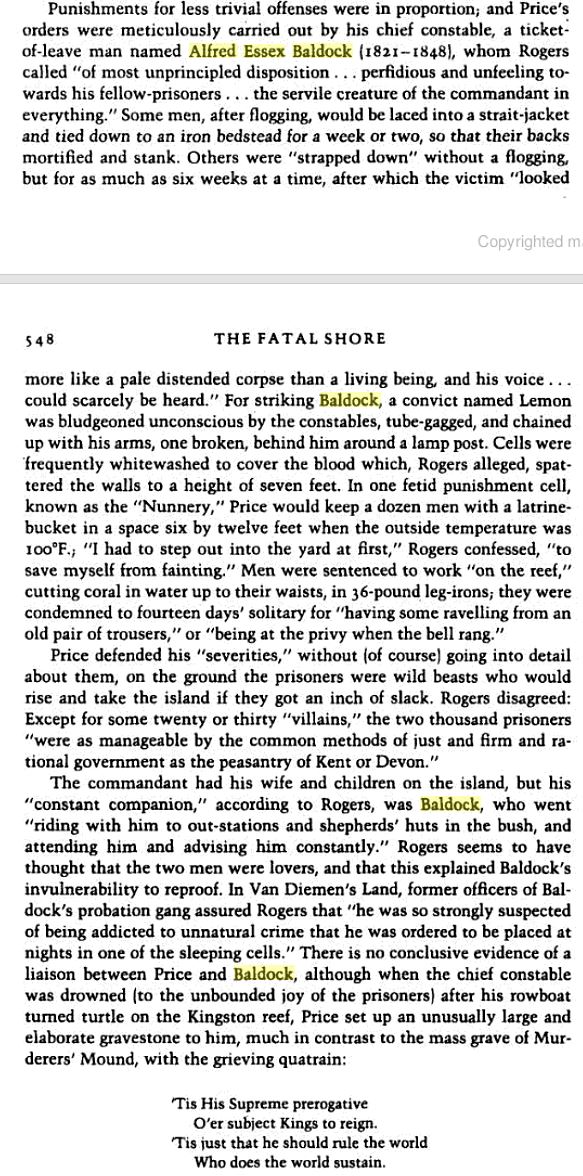
Alfred Essex BALDOCK

Alfred Essex BALDOCK

New South Wales Police Force

Chief Constable

Stations:  Norfolk Island

Born:  1821

Died  12 April 1848

27 old

Funeral  13 April 1848

Norfolk Island cemetery

Kingston, Norfolk Island


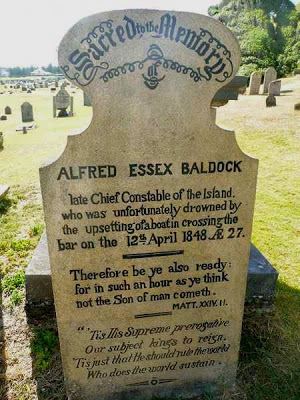
Alfred Essex BALDOCK - grave stone - Norfolk Island
Alfred Essex BALDOCK – grave stone – Norfolk Island

INSCRIPTION:

Sacred to the memory of Alfred Essex BALDOCK late Chief Constable of the Island. who was unfortunately drowned by the upsetting of a boat in crossing the bar on the 12th April 1848 aged 27.

Therefore be ye also ready for in such an hour as ye think not the Son of man cometh  Matt. XXIV II.

” ‘Tis His Supreme prerogative  Our subject kings to reign.  ‘Tis just that He should rule the world  Who does the world sustain.


[divider_dotted]


MURDER MYSTERY

 http://diane-adventurebeforedementia.blogspot.com.au/2012/02/murder-mystery.html
Way back in 2002 we went on a holiday to Norfolk Island. I can’t believe that was ten years ago. How time flies when you get old. Anyway back to the story.
Norfolk Island is a small island in the Pacific Ocean between Australia and New Zealand. It has a very colourful history. It was colonised by the British as part of Australia in 1788. It served as a penal colony for the worst convicts until 1794. From 1856 it was settled by free settlers and in1901 it became a territory of Australia and it still is today. It is also a tax haven. Today the island’s primary economic activity is tourism due to its historical buildings and colourful history including the Pitcairn Islanders and the Mutiny on the Bounty. So we did our bit for their economy and joined in the many tourist activities that they provide. (photos have been scanned from photo album)

One of the activities was a Murder Mystery Dinner, where you become a character in a murder mystery  story. You have to ask questions of the other characters and try to find out who is the murderer. At this party the murder mystery was based on a true event that happened in Norfolk Island’s past. We were given a booklet that gave us some background information on the characters and the crime. We had to dress up as the character we were given.

I was the Commandant’s wife and Bill was the Chief Constable, Alfred Baldock. He was detested by most on the island, he was a former convict but now mistreated the rest of the unfortunates. He was a homosexual which was against the law then. As you can tell we had loads of fun trying to find out which one of us was the murderer.
The next day we went exploring and visited the Norfolk Island Cemetery and Bill  found the grave stone of his character Alfred Essex Baldcock.
Alfred Essex Baldock late Chief Constable of the island, who was unfortunately drowned by the upsetting of a boat in crossing the bar on 12 th April 1848 aged 27. (click on pic to enlarge). The right hand pic is from the web and the headstone has been restored and so have many of the others. This cemetery dates back to 1825 but there is evidence of earlier burial grounds on the island.
[divider_dotted]

Alfred Essex BALDOCK - the Fatal Shore
Alfred Essex BALDOCK – the Fatal Shore

http://books.google.com.au/books?id=nKVlKHn29xcC&pg=PA547&lpg=PA547&dq=Alfred+Essex+BALDOCK&source=bl&ots=Rqgp4TIn_q&sig=UFx7gLVpVxUpsXrHb5H3fYjJySE&hl=en&sa=X&ei=mX5lVP6uFaPZmgW0roKABw&ved=0CE8Q6AEwCA#v=onepage&q=Alfred%20Essex%20BALDOCK&f=false

[divider_dotted]


  Cemetery location


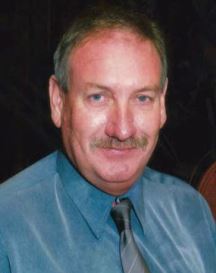
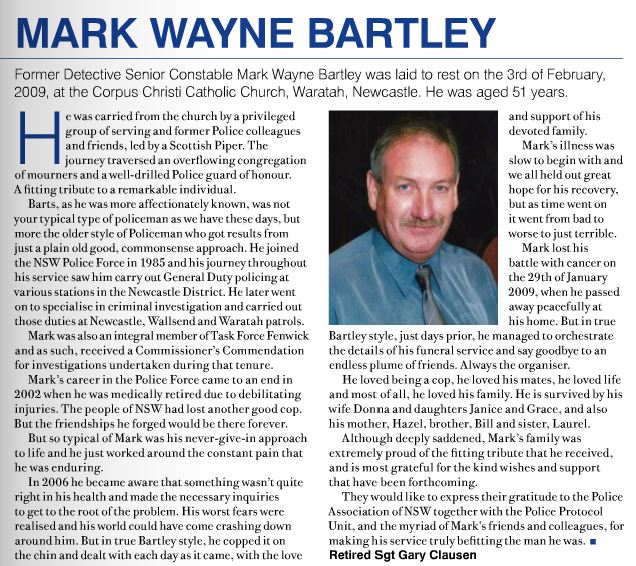
Mark Wayne BARTLEY

Mark Wayne BARTLEY

aka  Barts

New South Wales Police Force

Regd. # 22486

Detective Senior Constable – Retired 2002 HOD

Stations:  G.D’s in Newcastle District.  Detectives at Wallsend & Waratah Patrols.

Task Force Fenwick

Died  29 January 2009

Cancer – at home

51 old

Funeral  3 February 2009

Corpus Christi Catholic Church, Waratah, Newcastle

Mark Wayne BARTLEY
Mark Wayne BARTLEY

[divider_dotted]


Mark Wayne (Barts) BARTLEY
Retired Police Officer
Passed away 29th January 2009
Late of Warabrook

Dearly loved husband of DONNA, loving father of JANICE and GRACE, much loved son of AUBREY (dec) and HAZEL and son-in-law of BERNARD and JOAN (dec) FARRELL, adored brother, brother-in-law and uncle of LAUREL and LAURIE, BILL and MARIJA, GREG and COLLEEN and their FAMILIES.
Aged 51 Years.


Family and Friends of MARK are invited to attend a Celebration of his Life this TUESDAY (3/2/2009) commencing at 10.30am in Corpus Christi Catholic Church, Cnr Bridge and Platt Sts, Waratah. A private cremation will follow this Service.
In lieu of flowers, donations in memory of MARK may be left at the Church for Cancer Research.


[divider_dotted]

Mark Wayne BARTLEY - NSWPF - 3 Feb 2009


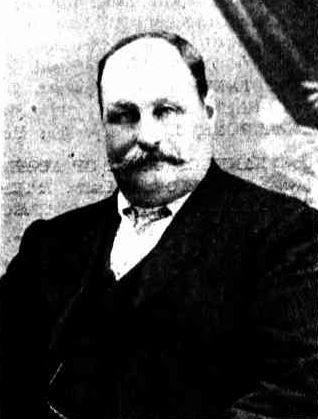
George JEFFES

George JEFFES

New South Wales Police Force

Constable 1st Class 1885

Senior-constable in 1889

Sergeant in 1895

Regd. # ?

Stations:  Darlinghurst, Botany,

Darlinghurst ( again ), Regent Street ( No. 2 Division )

Injuries: Traffic Accident – pedestrian with tram
Haymarket

Event:  2 November 1911

Died:  3 November, 1911

58 old

Funeral:  4 November 1911

Buried:  Rookwood RC Cemetery. Freeman St, Rookwood.

Reference: SEC*M2*C**939

George JEFFES
George JEFFES

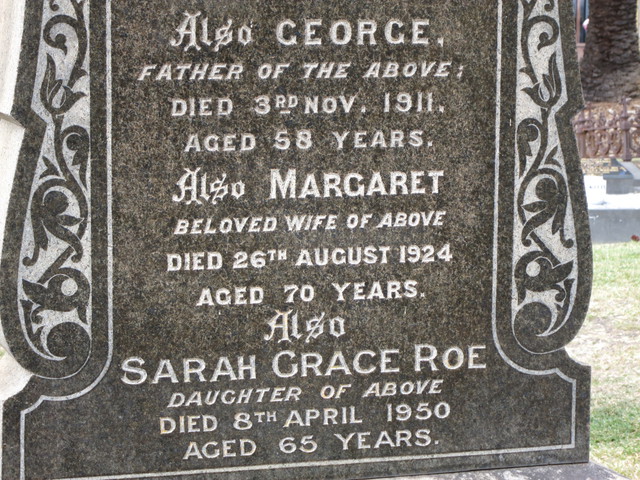
George JEFFES - Gravestone
George JEFFES – Gravestone

About 4pm on 2 November, 1911 the sergeant was on duty carrying out inspections of pawn shops. At the intersection of Campbell and Castlereagh Streets he failed to hear a tram coming in his direction (he was suffering from diminished hearing) and he was struck by the tram and knocked to the roadway. He was quickly conveyed to the Sydney Hospital suffering from a fractured skull and other head injuries; however he passed away the following day.

[divider_dotted]

The Evening News of 3 November, 1911 carried quite a lengthy report of the tragedy.

“SERGEANT JEFFES KILLED.
KNOCKED DOWN BY A TRAM. AN OLD SYDNEY POLICEMAN
Sergeant George Jeffes died in Sydney Hospital early this morning as the result of a city tram accident. He was on duty delivering pawn slips and inspecting pawn shops in the No. 2 (Regent-street) Police District yesterday afternoon, and while crossing Castlereagh-street, at the corner of Campbell-street, he was knocked down by tram No.81 proceeding from the railway station to Circular Quay. Senior-constable Young spoke to Jeffes at the corner of Campbell and Liverpool streets, and a few seconds later on seeing a crowd collect he went to the scene and found his comrade badly injured. He secured the Civil Ambulance, which conveyed the injured man to the hospital where he was admitted with a fractured skull. He was operated on and a lot of blood removed from his brain, but he never rallied. He will be given a police funeral tomorrow afternoon, the cortege leaving the corner of Elsternwick-street and Allen-street, Leichhardt at 1.30 p.m. for Rookwood Cemetery.

Sergeant Jeffes, who was 58 years of age, was an Englishman, and served as a bluejacket till 1882, when he came to Australia, and joined the New South Wales force. He was made a first class constable in 1885, senior-constable in 1889, and sergeant in 1895. He had thus 30 years’ service and could have retired two months ago, taking six months’ leave, but being still strong, he was, at his own desire, allowed to continue in harness, and was working in plain clothes on light duty among the pawn shops.

THE GOOD SHEPHERD. ” Sergeant Jeffes was for many years known as, the good shepherd, and he did great work   reclaiming white girls from the Chinese dens, and children from the slums and from parental hurt to their care. He was associated with Mr. Sherwood in the famous Botany poisoning case, in 1888, when Louisa Collins was hanged.

Senior-constable Sherwood ( now Metropolitan Superintendent of Police ), and Jeffes, then a constable, had charge of the cases.  Superintendent Mitchell, who is acting, said this morning that Sergeant Jeffes was a good and capable officer who had the interests of the service and the community at heart, and was most energetic in the discharge of his duties. A daughter of Sergeant Jeffes was murdered in George-street a little over twelve months ago, being shot by a young man.”

With regard to the death of the sergeant’s daughter, the Evening News of 3 July, 1909 reported that “Miss Kate Jeffes, 21, the young woman who was shot in the arm and breast by a French Canadian, named Felix Perrier, in George-street on the night of June 21, died at the Sydney Hospital at 3.30 this morning from the effects of the wounds, accentuated by the shock. She was the daughter of Sergeant Jeffes, of No. 2 Police Station”.

Evening News ( Sydney )                                              Friday  3 November 1911                                Page 9 of 16

[divider_dotted]

The sergeant was born about 1853 and joined the New South Wales Police Force in 1882. At the time of his death he was stationed at Regent Street Police Station. He is buried at Rookwood Cemetery.

[alert_red]He is NOT included in the NSW Police Honour Roll.[/alert_red]

[divider_dotted]

SERGEANT JEFFES’ DEATH.

CORONER’S INQUIRY.

The Coroner, Mr. Murphy, yesterday held an

inquiry Into the death of Sergeant George Jeffes, who was knocked down by a tram at the intersection of Castlereagh and Campbell streets, on Thursday afternoon last.

Evidence was tendered to the effect that the deceased was crossing the street at the intersection of Castlereagh and Campbell streets at about 4 pm. As the car approached, a witness called out to him, and the driver sounded the gong, cut off the current, and applied the emergency brake. The car moved on a couple of yards after striking deceased, who was carried along by the cow-catcher. Deceased’s hearing, it was stated, had been defective of late.

The Coroner found that death had resulted from injuries accidentally received through   being knocked over by a tram.

The Sydney Morning Herald                                               Tuesday  7 November 1911                        page 11 of 14


[divider_dotted]

DEATH OF SERGEANT JEFFES.

The ” Good Shepherd. ” A RESPECTED MEMBER OF THE   SYDNEY POLICE FORCE.

As the result of a tram accident on Thursday afternoon last, the death occurred on Friday of a well-known figure in the Sydney police force, and a much-respected and admired officer – Sergeant George Jeffes, at the age of 58 years.

Born at Northwich, Cheshire, young Jeffes was apprenticed to the ironworking trade, beginning work when but 8 years of age, in a foundry in Salford, Manchester. At 15 he was seized with the adventurous spirit, and ran away to sea, completing a term of service in the Imperial Navy. Returning to Salford, he joined the fire brigade, and in this capacity had his first experience as a police officer, for in those days the fire-fighter did dual duty. Soon he was again seized by the wanderlust, and landed in Victoria in 1879. A year later Mr. Jeffes arrived in New South Wales, shortly afterwards joining the police.

He was first stationed at Darlinghurst, but subsequently was transferred to Botany, where he was instrumental in bringing to justice Louisa Collins, the last woman who suffered the extreme penalty of the law in New South Wales. In 1889, he was again stationed at Darlinghurst, and promoted to the rank of senior-constable. He was next promoted to Sergeant, when, in 1896, he was attached to Regent-street Police Station, where he ended his career.

To a large extent the suppression of opium traffic, rampant in Sydney a few years back, was the work of Sergeant Jeffes, who, while engaged in this duty, was responsible for saving countless unfortunate women from infamy, earning for himself the sobriquet of the ” Good Shepherd ” for the splendid success attending his efforts. Although stern with Chinese law-breakers, Sergeant Jeffes had the confidence of the whole Chinese quarter. He was regarded in the slums as one whose inclination was more to assist that portion of humanity generally regarded as homeless, than to treat them with the harshness which is generally their lot. His knowledge of the back streets and the opium trade was vast ; and Sergeant Jeffes could always openly enter houses and places that might prove dangerous indeed to any other officer.

His untimely death is greatly deplored in the police force, and by many whom he succeeded in setting on the right path again. The later Sergeant Jeffes was a staunch and practical Catholic, and a member of the Sacred Heart Confraternity. He leaves a widow and two children — a daughter and a son. The Rev. Father Darby was in attendance at the last, and administered spiritual consolation.

The funeral took place on Saturday afternoon, and the cortege conveyed an idea of the esteem in which the late sergeant was held. The Police Band played the ” Dead March in Saul ” and the ” Funeral March, ” and 70 uniformed policemen accompanied the hearse from deceased’s residence in Leichhardt to Petersham Railway Station, where the remains were entrained for Rookwood. There was a large gathering at the graveside, and among the mourners were his widow, Thomas Jeffes (son), Sarah Grace Jeffes (daughter), Messrs. Mark Anthony Jeffes and Charles Jeffes (brothers), Robert, Steve and Mark Jeffes (nephews), Mr. and Mrs. James Ryan ; Mr. and Mrs. Peter Ryan, Mr. and Mrs. James Paxton, Mr. and Mrs. Michael Ryan ; Mr. and Mrs. Thomas Ryan, Mr. and Mrs. Denis Ryan, Mrs. Tyler, Misses Tyler (2), Mr. and Mrs. Wm. Landrigan and Miss Mary Landrigan, Mrs. Thomas O’Toole, and Mrs. Wm. O’Toole, Mrs. J. O’Toole, Mr. and Mrs. James O’Toole, Mrs. Coghlan, Mrs. Crooks, Mr. Murphy, Mr. McQuirk, Mrs. Kembo, Mrs. Byrom, Mrs. Moran, Mrs. Hayes, Miss Vaughan, Mrs. Danhy, Mr. and Mrs. Sheedy, Miss L. Murphy, Miss Vera Jeffes, Mr. Fitzgerald, Mrs. Keating, Mrs.   Angles, Mrs, Corcoran, Mr, Kilcoyne. Six brother-sergeants acted as pall-bearers, their names being Sergeants Curry, J. Hogg, Sherwood, Curtis, Corcoran and Walker. Others present were: Superintendent Mitchell ( representing the Inspector-General ) Sub- Inspectors Kelly, Brookes and Davis, ex-Inspectors Collins and Broderick, Senior Sergeant O’Dea, Sergeant Meahan, Detective Pauling ( representing the Detective Office ), Senior-Constable’s Young, Meadth, Gambold, Neary, and Mr. Twiss ( ex-senior-constable ), There were also representatives of the different branches of the police, and the Chinese community, and a number of retired officers and friends of Mr. Jeffes’s. The Rev. Father J. Peoples, assisted by the Rev. Father M. Kirby, said the last prayers. The Police Band then played ” The Long Day Closes ”

. ” – R.I.P.

[divider_dotted]

Burial Location:

[divider]

A City Sensation.

A YOUNG WOMAN SHOT. SUICIDE OF HER ASSAILANT.

A sensational shooting affray took place in George-street, near Goulburn-street, city, about half-past 9 o’clock on Monday night, during which Kate Jeffes, 21, a daughter of Sergeant Jeffes, a well-known officer connected with the Regent-street Police Station, was wounded twice, while her assailant committed suicide.

Some weeks ago, Miss Jeffes took a situation in a Pitt-street cafe, where Felix Perrier, a French-Canadian, 35 years of age, was employed as cook. Perrier, it appears, conceived a strong attachment for the young woman, but his attentions were not encouraged, although he occasionally accompanied her to the tram of an evening, at the close of the day’s work. Perrier became so persistent in his attentions that Miss Jeffes decided to leave, and she secured a situation in dining rooms in George-street.

Eventually Perrier found out where she was employed, and called there on Monday, but she refused to see him, and he went away. On ceasing work a little after 9 o’clock, Miss Jeffes started for home, and on reaching the corner of George and Goulburn streets, saw Perrier on the footpath. He addressed her, but she refused to have anything to say to him, upon which the man drew a revolver, and at close quarters fired two shots at her. The first bullet penetrated the cartilage of the left arm and spent itself in a brown paper parcel, which contained her apron and a blouse, and which she was carrying under her arm at the time. The second bullet had a more serious effect striking her beneath the right breast. The bullet did not penetrate very deeply, however, but struck the breast-bone, which caused it to deflect, and travel around a rib under the left arm, eventually embedding itself in the back portion of her left side. She fell bleeding to the footpath, and Perrier, evidently believing that his second shot had taken fatal   effect, placed the muzzle of the revolver in his own mouth, and fired.

Naturally a crowd soon gathered, and Miss Jeffes was placed in a Cab, and taken to the Sydney Hospital. The Civil Ambulance was sent for and took Perrier to the Sydney Hospital, where life was pronounced extinct, and the body was conveyed to the Morgue, at Circular Quay. The bullet in Perrier’s case had entered at the mouth, and travelled upwards towards the brain. Dr. Parry extracted the bullet from Miss Jeffes’ side, and she was admitted to the hospital, where she is progressing satisfactorily, the wounds not being regarded as serious.

Evening News ( Sydney )                      Tuesday  22 June 1909                      page 6 of 8

[divider_dotted]

A Cook’s Terrible Crime

ATTEMPTED MURDER AND SUICIDE SENSATION IN SYDNEY

Sydney. Monday

A cook named Felix Perrier, 35, employed at the Glenrock Cafe, Pitt Street and residing at Druitt Street, City, created a sensation to night by attempting to murder Kate Jeffes, 21, daughter of Sergeant Jeffes, of the Metropolitan police, by shooting her with a revolver, and afterwards shooting himself.

The affair took place in George Street, Perrier had been keeping company with Miss Jeffes, but she resented his intentions. To night when he met her in George Street near Druitt Street, he spoke to her and she refused to answer. He then drew a revolver and fired two shots. One bullet entered the young lady’s left arm and the other the side of the right breast. Neither wound is serious. Perrier then fired another shot and put an end to his own life.

National Advocate ( Bathurst, NSW )    Tuesday  22 June 1909                  page 2 of 4

[divider_dotted]

A GEORGE-ST. TRAGEDY.

ATTEMPTED MURDER AND SUICIDE.

A DISAPPOINTED LOVER TRIES TO MURDER A YOUNG WOMAN.

THEN BLOWS HIS BRAINS OUT.

Felix Perrier, 35, lately living in Druitt-street, city, attempted to murder a young woman named Kate Jeffes, 21, in George-street, near Goulburn-street, at about 9.30 last night. He fired two shots at her at a range of less than a couple of feet, both of which took  effect, and then put the muzzle of the revolver into his own mouth and blow his brains out.

Perrier, who was apparently a foreigner, has been employed as a cook at a cafe in Pitt-street for some time, and the young woman,  who is a daughter of Sergeant Jeffes, at the No. 2 police station, met him at the cafe some nine weeks ago, when she took a situation there as a waitress. Perrier conceived a strong affection for the young woman, but she refused to encourage him. She, however, occasionally allowed him to see her to the tram of a night when work was over. He eventually became so persistent in his attentions that the young woman was compelled to leave her situation at the cafe and seek employment elsewhere. She afterwards obtained work as a waitress at some dining rooms in George-street, and her troubles with Perrier ceased for a while. But he eventually found out where she was, and, yesterday afternoon, he called at the premises in George-street, and asked to be allowed to see her. Miss Jeffes refused to see him, and in order to be free of him, she asked one of the girls in the cafe to inform Perrier that she had left the place. Perrier, on receiving this information, took his departure. After work Miss Jeffes started for home shortly before 9.30, and was walking down George-street. On nearing Goulburn-street she noticed Perrier standing on the footpath. She tried to evade him, but he stepped up to her and said: “Good night.” The young woman turned her head away, and refused to speak to him, whereupon he drew a five-chambered Belgian revolver, and fired two shots point blank at her. The first bullet penetrated the cartilage of the left arm, and spent itself in a brown paper parcel, which contained her apron and a blouse, and which she was carrying under her arm at the time. The second bullet had a more serious affect, striking her beneath the right breast. The bullet did not penetrate very deeply, however, and luckily struck the breast-bone, which caused it to deflect and travel around a rib under the left arm, eventually embedding itself in the back portion of her left side. She fell bleeding to the footpath, and Perrier, evidently believing that his second shot had taken fatal effect, placed the muzzle of the revolver in his own mouth and fired. The shots had been fired at such short range that the sleeve of the young woman’s blouse was burned with powder, and powder marks were visible on the front of her dress.

There were a number of people about, and a large crowd soon gathered. A woman named Eliza O’Connor, living in Francis street, Hyde Park, who was close by at the time, put Miss Jeffes in a cab, and took her to the hospital, while a traffic constable rang up the Civil Ambulance, which was speedily in attendance, and removed Perrier to the hospital, where Dr. Parry pronounced life extinct.     The body was then removed to the Morgue.

The bullet in Perrier’s case had entered at the mouth, and travelled upwards towards the brain. Dr. Parry extracted the bullet from Miss Jeffes’ side, and she was admitted to the hospital; where she made a statement to the police. Her injuries are not considered serious.

The revolver which Perrier used was a Belgium make, and contained four cartridges, three of which had been discharged.

Edward Crampton, a tobacconist, of 48 Druitt-street, who identified the body, and with whom Perrier had lately been living, stated that Perrier bought a revolver on Saturday last, and said that a young woman had been “pulling his leg.” His French blood would get the better of him,’ he said, and he would shoot her. The revolver was taken from him, together with a number of cartridges, but he appears to have regained possession of it. On the body were found Perrier’s discharge papers from the South African Light Horse, dated   1902. These show that he was a French Canadian by birth.

The Sydney Morning Herald                Tuesday  22 June 1909           page 7 of 12


[divider_dotted]

ATTEMPTED MURDER AND SUICIDE

PERRIER’S FRENCH BLOOD. MUST SHOOT THE GIRL

Sydney, June 22.

Felix Perrier, who last night shot at Kate Jeffs and then committed suicide, was a French-Canadian and had served in the South African light horse. Edward Crampton, with whom Perrier resided, told the police that Perrier bought a revolver on Saturday last. He told Crampton that a young lady had been ‘pulling his leg’ and that his French blood would ‘ get the better of him and he would shoot her ‘. Crampton took the revolver and cartridges from him, but Perrier, however, again got possession of them.

Miss Jeffs is not seriously hurt.

Kalgoorlie Miner ( W.A. )                    Wednesday  23 June 1909               page 5 of 10

[divider_dotted]

George-street Tragedy.

DEATH OF THE VICTIM.

Miss Kate Jeffes, 21, the young woman who was shot in the arm and breast by a French Canadian, named Felix Perrier, in George-street on the night of June 21, died at the Sydney Hospital at 3.30 this morning from the effects of the wounds, accentuated by the shock. She was the daughter of Sergeant Jeffes, of No. 2 Police Station.

Evening News  ( Sydney )                      Saturday  3 July 1909                         page 8 of 16

[divider_dotted]

THE GEORGE-STREET TRAGEDY.

MISS JEFFES’ DEATH.

Kate Jeffes, 21, the young woman who was shot in the arm and breast by Felix Perrier, a French Canadian in George-street near Goulburn-street, on the night of June 21 last, died at the Sydney Hospital early on Saturday morning from the effects of the wounds and the subsequent shock. She was the daughter of Sergeant Jeffes of No 2 Police Station.

The wound in Miss Jeffes’s breast proved more serious than was at first believed but it was not anticipated that it would cause death. While in hospital, however, deceased suffered considerably from shock and was unable to sleep. On Wednesday and Thursday last she was in a low state but rallied on Friday morning. At 11 o’clock on Friday night she became worse and gradually sank, death taking place at about 3.30 a.m. on Saturday.

The Sydney Morning Herald                Monday  5 July 1909                         page 7 of 12

[divider_dotted]

THE GEORGE-ST.   TRAGEDY.

SHOOTING OF MISS JEFFES. EVIDENCE AT THE INQUEST. VERDICT OF MURDER AND SUICIDE.

Mr.. H. Hawkins, P.M., at the City Coroner’s Court yesterday, held an inquiry into the deaths of Felix Perrier, 35, a cook, and Catherine Margaret Jeffes, 21 a waitress, the principals   in the tragedy on the night of June 21,  when Perrier mortally wounded Miss Jeffes and afterwards took his own life by firing two shots into his head, in George-street, near Goulburn street, City.

Edward Crampton, hairdresser and tobacconist, carrying on business in Druitt-street, City, said he had known Perrier for some time. He was a French-Canadian by birth, and a native of Montreal. Perrier came to lodge at his place on June 19, and told witness he was employed at a cafe in Pitt-street. Next day Perrier brought a revolver to the house, and witness asked him what he wanted it for. He replied, ‘I want to fight a duel.’ Witness, however, obtained the weapon. On June 21 Perrier asked.; him for it, saying that the man he was going to fight with had disappeared, and he wanted to raise a few shillings on the gun. Witness gave it to him.

George Jeffes, sergeant of police, stationed at the Regent-street Police Station, and living at 135 Rose-street, Darlington, said Catherine Jeffes was his daughter. He last saw her alive about half past 7 on the morning of June 21, in George-street. She was then going to work at a cafe in Pitt-street. Witness did not know his daughter was acquainted with Perrier. Catherine came home one night not long ago, and said she wasn’t going to business the next morning. Witness asked why, and his daughter replied, ‘A man is pestering me, and has   made appointments to meet me.’ Witness   then said, ‘You stay at home. I don’t want you to work’

Dr. Edmund Pauling said Perrier was dead when taken into Sydney Hospital. Miss Jeffes was admitted, a bullet having passed through the cartilage of the left arm, and one having entered the body below the right breast. She died on Thursday night last. Dr. Palmer, who made a post-mortem examination, said the cause of death was a bullet wound in the head.

Maria Webber, living in Lewis-street, Redfern, said she was in George-street on the night   of June 21. When near Goulburn-street she saw a man accost a girl, and say, ‘Good night.’ The girl did not take any notice, and the man put his hand to his hip pocket. He fired a revolver at the girl, and she screamed, and cried out, ‘My God!’ The man fired again, and the girl dropped to the ground insensible. Perrier then shot himself twice in the head, and dropped. Witness heard no quarrel.

Sarah Williamson, a resident of Glebe, corroborated the previous witness’ evidence.

Traffic Constable Wilson searched Perrier’s body at the Morgue. He found military discharge papers in one of the pockets. Eliza O’Connor, living at 32 Francis-street, Hyde Park, deposed she was outside Messrs. Anthony Hordern and Son’s business premises, George-street, about 9.30 on the night of June 21. Witness heard three revolver shots, and rushed round into Goulburn-street. A young woman was lying on the ground. She told witness she had been shot by a man, and asked to be taken home. Witness took her to Sydney Hospital.

Senior-constable Leary had a conversation with Catherine Jeffes at Sydney Hospital on the night of June 21. She told him she went to work at the Glenrock Cafe, in Pitt-street, about four months ago. She stayed there for some time, and made the acquaintance of a man named Perrier, who was employed as a cook at the same place. They exchanged letters. She soon afterwards left the Pitt-street cafe, and went to one in King-street. Perrier pestered her there, and she had tried to avoid him.

Mark Anthony Jeffes, uncle of the deceased girl, narrated a conversation he had had with his niece two days after the shooting. She told him that she did not want to have any thing to do with Perrier.

The Coroner found that Catherine Jeffes was murdered by Felix Perrier, and that Perrier committed suicide.

Evening News ( Sydney )                                      Friday  9 July 1909                     page 3 of 12

[divider_dotted]

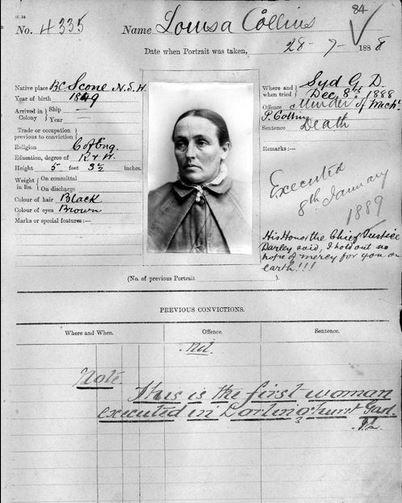
Louisa Collins - last woman hanged in NSW
Louisa Collins – last woman hanged in NSW


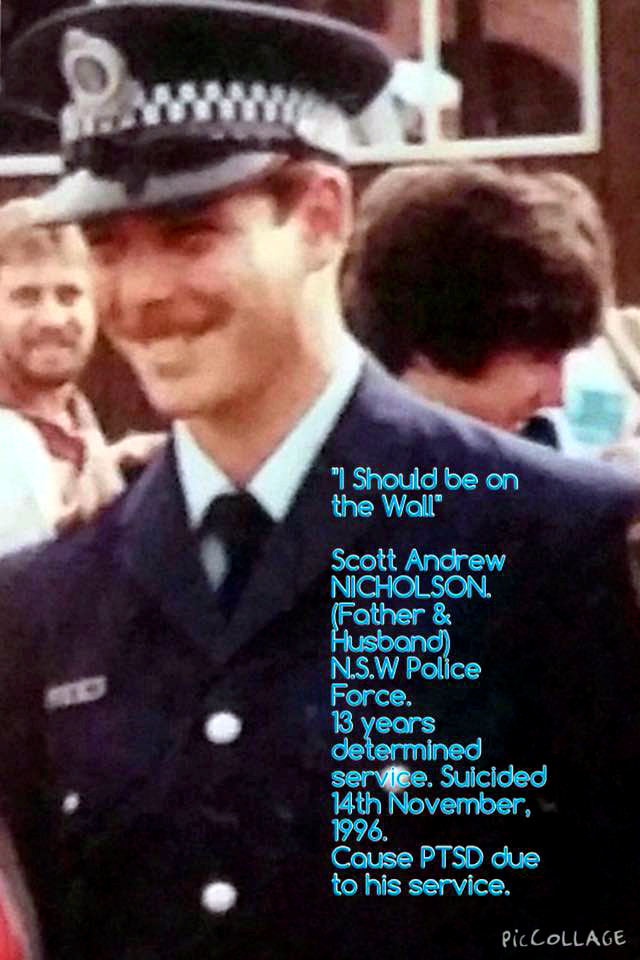
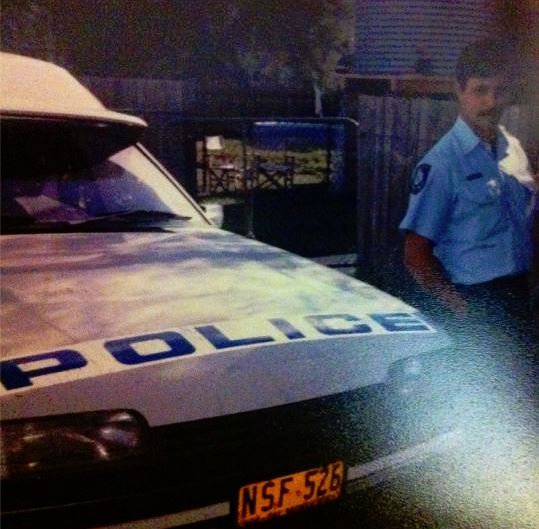
Scott Andrew NICHOLSON

Scott Andrew NICHOLSON

New South Wales Police Force – Resigned

Regd. #  20237

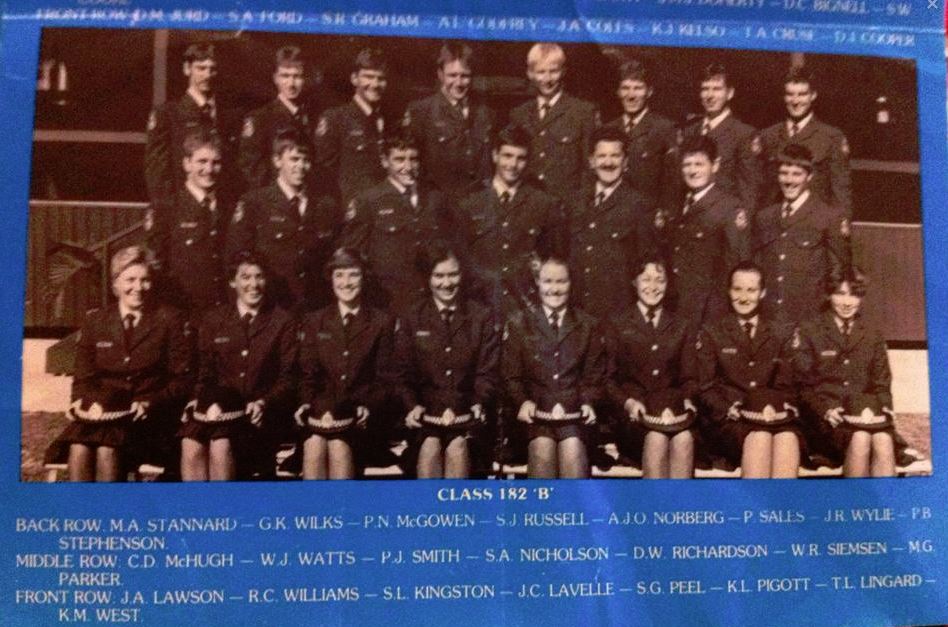
Redfern Police Academy Class 182 B

Rank: Probationary Constable – appointed 28 May 1982

Constable 1st Class – appointed 28 May 1987

Detectives Training Course 28/ 20 May – 28 June 1991

Senior Constable – level 9 upon Resignation

“possibly” Acting Detective Sergeant – Resigned

After resignation ( due to PTSD ) Scott was a Ranger with Liverpool Council until his death

Stations:  Campbelltown ( 1980’s ), Camden,

Bulga, Fraud Squad, Child Mistreatment Unit

Service:  From ? February 1982 to ? ? 1996 = 13 years Service

Awards:  No find on It’s An Honour

Illness: – PTSD – Suicide – carbon monoxide gassing in vehicle

Born:  4 April 1959

Died:  14 November 1996

Age:  37 old

Funeral:  Leppington Lawn Cemetery

Funeral date? ? ?

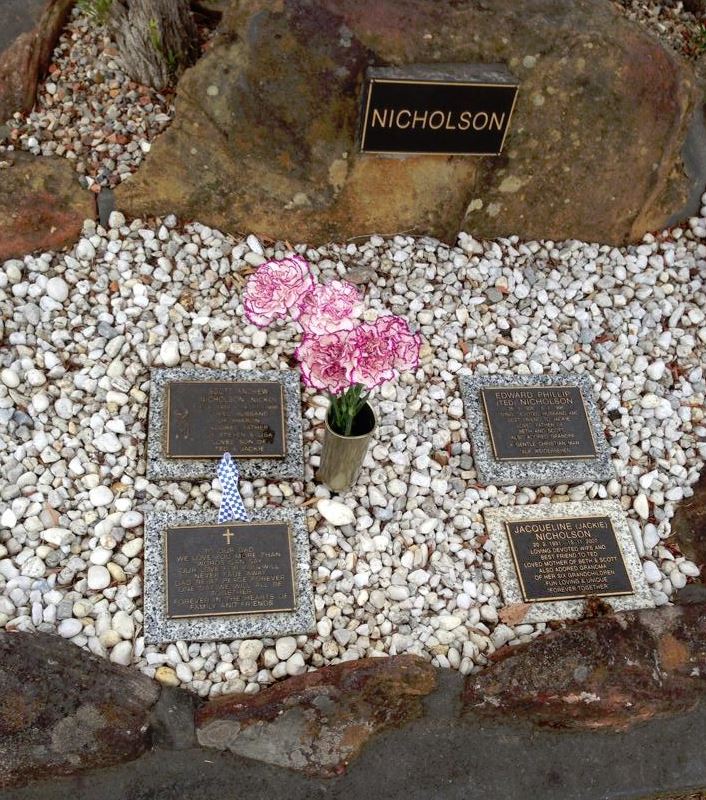
Buried at:  Cremated & Resting in the Fountain Garden, Nicholson plot,

Location: Beside Cafe Pagona Area

Section: Gazebo 3 bed 3

Lot:

Lat/Lng: -33.95538, 150.83279


"I should be on the Wall." I was once a Policeman, I served you for years, I saw so much pain, It reduced me to tears. I saved many lives, Did the best I could do, I served with distinction, All to protect you. Year after year, Without self regard, I lived for the job, No matter how hard. The toll it was taking, Eventually broke through, My brain now was broken, I did not know what to do. I keep telling myself, It will get better in time, Just keep pushing yourself, All will be fine. But it did not get better, It only got worse, The trauma I suffered, Became my own curse. It brought to an end, The job that I live, I can't do this anymore, No more I could give. The pain did not stop, In fact it just grew, The demons took over, I did not know what to do. I was empty inside, Lost and in pain, I tried to fight on, But I could no longer remain. The trauma had won, I saw no other way, So I took my own life, On a cool summer day. It was because of Policing, You all know it's true, It destroyed who I was, From the things I went through. The trauma of death, Seen hundreds of times, The witnessing of evil, The wickedest of crimes. Yet now I'm forgotten, By the job I died for, Even though I gave my all, After everything I saw. If I had died on duty, Answering the same call, You would all see my name, My name on the wall. I was still on duty, I just could not let go, I was still a Policeman, My brain made it so..... Written 12.2.15.
“I should be on the Wall.”
I was once a Policeman,
I served you for years,
I saw so much pain,
It reduced me to tears.
I saved many lives,
Did the best I could do,
I served with distinction,
All to protect you.
Year after year,
Without self regard,
I lived for the job,
No matter how hard.
The toll it was taking,
Eventually broke through,
My brain now was broken,
I did not know what to do.
I keep telling myself,
It will get better in time,
Just keep pushing yourself,
All will be fine.
But it did not get better,
It only got worse,
The trauma I suffered,
Became my own curse.
It brought to an end,
The job that I live,
I can’t do this anymore,
No more I could give.
The pain did not stop,
In fact it just grew,
The demons took over,
I did not know what to do.
I was empty inside,
Lost and in pain,
I tried to fight on,
But I could no longer remain.
The trauma had won,
I saw no other way,
So I took my own life,
On a cool summer day.
It was because of Policing,
You all know it’s true,
It destroyed who I was,
From the things I went through.
The trauma of death,
Seen hundreds of times,
The witnessing of evil,
The wickedest of crimes.
Yet now I’m forgotten,
By the job I died for,
Even though I gave my all,
After everything I saw.
If I had died on duty,
Answering the same call,
You would all see my name,
My name on the wall.
I was still on duty,
I just could not let go,
I was still a Policeman,
My brain made it so…..
Written 12.2.15.


Scott Andrew NICHOLSON


Scott Andrew NICHOLSON - Class photo taken at Redfern Police Academy. Class 182 'B'
Scott Andrew NICHOLSON – Class photo taken at Redfern Police Academy. Class 182 ‘B’


Scott Andrew NICHOLSON - Memorial
Scott Andrew NICHOLSON – Memorial

[alert_red]Scott is NOT mentioned on the Police Wall of Remembrance[/alert_red]  * BUT SHOULD BE

SCOTT ( as of 2017 ) IS mentioned on the NSW Police Wall of Remembrance

 SCOTT ( as of March 2019 ) IS NOT mentioned on the NATIONAL Police Wall of Remembrance – Canberra * BUT SHOULD BE


* Stemming from the continued work of the wives & parents of four Fallen NSW Police to Suicide – those four names will now be included in the newly refurbished NSW Police Wall of Remembrance, Sydney, as of 2017

Congratulations to those family members who fought the fight to right this wrong.

*

Commissioner Scipione has telephoned each of us today to advise that our loved ones names are being added to the replacement NSW Police Force Wall of Remembrance, to be unveiled in the next few weeks.

We would like to thank everyone who has offered support over a long and difficult journey and truly hope this sets a precedent for all police departments, not only in Australia but the global policing community.

It is so very important to remember that policing can and often does have a detrimental effect on those who serve.

We believe that the inclusion of suicide deaths, stemming from a work related psychological injury, is the most compassionate way of showing that the police hierarchy truly cares.

The following names will be added:

Detective Sergeant Ashley Bryant

Sergeant Tom Galvin

Senior Constable Scott Nicholson

Constable Morgan Hill

#OneWallForAll


Scott was a member of the New South Wales Police Force for 13 years and, suffering from the effects of PTSD ( Post Traumatic Stress Disorder ) took his own life on the 14 November 1996 by gassing himself in a car and leaving behind two children, aged 6 & 9 ( at the time ) and a wife.

Scott worked at various stations such as Campbelltown in the 1980’s, Camden and the One Man station at Bulga before leaving the Police Force and gaining employment as a Ranger with Liverpool Council.


Dimmy Nicholson Hi, my late husbands name is Scott Andrew Nicholson reg number 20237 who died by gassing himself on 14th November 1996 shortly after he resigned from the job when he could no longer cope with his PTSD, worked at Campbelltown police, Camden, one Man Bulga Police Station, Fraud Squad both in uniform & D’s, Child Mistreatment & others. Hope that’s enough info & thank you for all u do
Wife = Sharon
Dimmy Nicholson

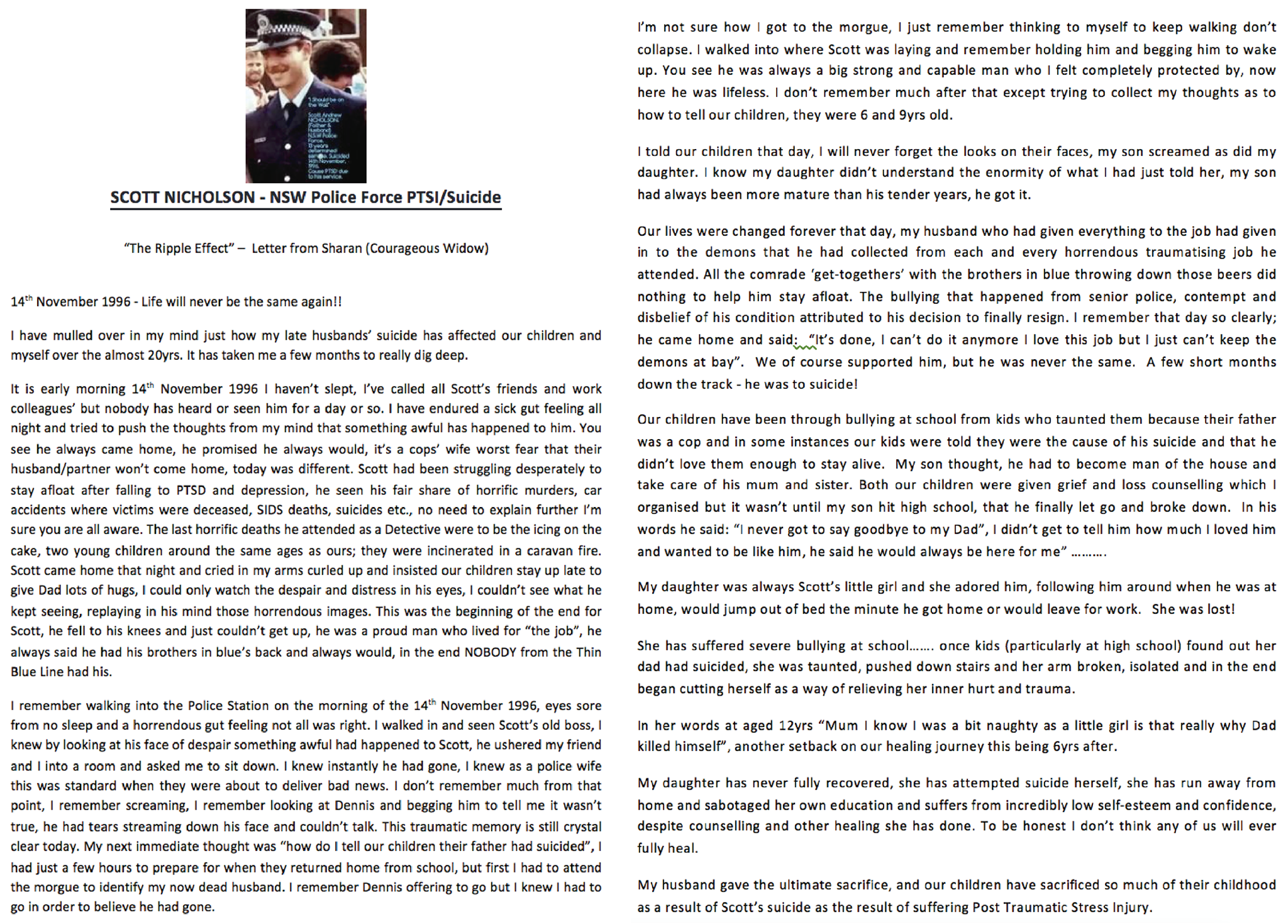
Scott Nicholson - NSW Police Force PTSI / Suicide

PLEASE EVERYONE I ASK THAT YOU TAKE THE TIME OUT OF YOUR LIVES TO READ MY STORY. I’M LISA NICHOLSON AND MY FATHER WAS SCOTT NICHOLSON.

PLEASE JUST READ LIKE AND SHARE!!!!!!!!


[blockquote]Hi my name’s Lisa Nicholson and my father is Scott Nicholson. They say we are one big police family and we look after our own yet they don’t even care to see the damage there doing. My dad suicided when I was just 6 years old he was my world my life my everything. The day he died my world fell apart and the older I got the harder it hit me. I suffered and battled countless years of depression, I was raped and beat as a child and teenager and I had the balls to follow this through with court. But, tragically, all of this led to many suicide attempts.

Thankfully my dad had my back though I actually believed the world was so awful and painful that I belonged with my dad. I had a very hard time seeing other officers thinking that’s my dad he is as good a officer as you, yet why is he not remembered!??

He was so proud to be an officer and truly lived through his work right to the end! The end that the line of work he did helped drive him too!!! He worked his ass off to get the respect and acknowledgement that he gained and I’ve always been so proud to say that my daddy was a police officer!! Yet here these ass wipes are claiming that everything my father worked for his whole life everything he believed in and followed isn’t recognised. They claim that we’re one big family and in truth it has felt like that thanks to police legacy but then there’s the fact that I’ve got to, every single day, deal with the emotional grief that I will never see my daddy again and then there’s the fact that the man I love so much and am so proud to say he was an officer will never meet my daughter and my daughter will never meet her grandfather and that, in itself, has me pretty low but on top of all that these guys wanna destroy me; even more, give me no choice and take whatever is left in me to fight to have my daddy’s name on the police Remembrance wall; a wall that all our fallen officers are on, all except the ones who took things into there own hands. We’re one big family yet not only has their line of work taken my father and my daughters grandfather but they wanna take everything that I’ve left because they won’t respect what they’d say “one of our own” my dad deserves that respect and so do so many others and again they say we’re one big family but can they even see that their own choices, actions are killing us even more!!!!

I know I’m not the only one but I can only speak on behalf of myself. I wanna know why?? my daddy, the man that the only image I can recall is of him in his uniform, the man who tragically lost his life, the man who they claim death is not tragic enough to be remembered. Why??? I wanna know why?? my dad’s dead the same as officers who’ve died in the line of duty. Dead not coming back; he died from the pain and suffering from his job and they die in the line of duty but they’re telling me my dad’s death isn’t good enough or tragic enough.

No wonder half the population have lost faith in these guys. I will continue to support and stand tall and for as long as I can with everyone else and I won’t ever stop speaking out.

Your secret is no longer!

He will be remembered.

Thank you for reading my story. Please like and share this around. The more this gets around the more I hope will get in their face and finally remember all our lost men and women.

[/blockquote]

Thank you for sharing such a deeply personal and heart wrenching story of your journey Lisa! This is so courageous of you. The impact that your father’s death had on you and your family is something that the Police force haven’t been around to witness, acknowledge or support and sadly have contributed to your grief in doing so!
Glad to have you on this journey with us Lisa! Xx
Like · Reply · 3 · 2 hrs
  • Sharona Sione Tylern Orlando Aweee hunni so heartbreaking thinking of you sweetie. X x x
    Like · Reply · 2 · 1 hr
  • Lisa Nicholson No thank you for allowing me to share this!!! It is such a raw painful subject but I’ve had enough of holding it in and I can only hope that others have the courage to do the same. Will be on this journey till the end!!!!
    Like · Reply · 1 · 1 hr
    Resting place of Scott


    When Sharan’s happy-go-lucky husband became a monster

    By CYDONEE MARDON

    Sharan Nicholson-Rogers has a plea for the minister: "Don't let any more families lose their husband, wife or parent by not making changes that you know will make a difference.'' Picture: CHRISTOPHER CHAN
    Sharan Nicholson-Rogers has a plea for the minister: “Don’t let any more families lose their husband, wife or parent by not making changes that you know will make a difference.” Picture: CHRISTOPHER CHAN

    Sharan Nicholson-Rogers watched her husband change from a happy-go-lucky police officer into an unpredictable man prone to violent and emotional outbursts.

    The gentle bloke she loved grabbed hold of her one day and shoved his gun down her throat, telling her he couldn’t live any more because of what he was doing to their family.

    Eighteen months later, Detective Sergeant Scott Andrew Nicholson took his own life.

    That was 19 years ago.

    Today Mrs Nicholson-Rogers is as determined as she was the day her husband died to bring about change.

    [blockquote]” There is complete contempt for anyone who falls. They will kick you to the kerb. “[/blockquote]

    She is calling for the establishment of a centre of excellence – a place where police officers can go for respite, support and treatment from mental health professionals.

    “I know guys in the job right now who are crippled with PTSD [post-traumatic stress disorder],” Mrs Nicholson-Rogers said.

    “They’re still working, doing their best to stay in the job, but they need help.

    “So many have gone through poor management and there is complete contempt for anyone who falls. They will kick you to the kerb.

    “[Sufferers] need a place where they can go, feel safe, be honest about the fact they need help to cope and a place where they can get the best available support from experts in the field.”

    Mrs Nicholson-Rogers sought help for her husband when she saw the signs he was losing control.

    “He became this monster, he couldn’t help it, everything triggered him,” Mrs Nicholson-Rogers recalls.

    “I’d find him curled up in the foetal position, crying and crying.

    “One night we had a bunch of friends over, we cooked lamb on the Weber and I brought it in for him to cut up and he just lost it. He started smashing the kitchen up and screaming.”

    Later he revealed the charred lamb reminded him of two children he’d seen burnt to death in a caravan.

    Detective Sergeant Scott Andrew Nicholson with his family.
    Detective Sergeant Scott Andrew Nicholson with his family.

    “The kids were the same ages as ours,” Mrs Nicholson-Rogers said.

    She urged her husband to talk to his boss about his emotional well-being and asked him to contact police welfare.

    “He said to me ‘Are you serious? They’ll say go to the pub and have a drink, get over it’.

    “He didn’t drink much then but he soon learnt to so he wouldn’t be labelled a ‘sheila’.

    “They get this sick sense of humour, that’s the way they get through it. Down at the pub or the bowlo for a debrief then the wives are left to pick up the mess at the end.”

    Mrs Nicholson-Rogers and her two children have been to hell and back since her husband’s 1996 suicide.

    It was only through counselling that Mrs Nicholson-Rogers, a health promotions officer with NSW Health, realised the true impact on her children.

    “The day Scott had the gun down my throat, my seven-year-old son witnessed that. I didn’t know at the time. It’s impacted on them terribly. As they got older they realised the enormity of what had happened. It’s been a really rough road for us.”

    Scott spent 13 years in the job, with stints in Camden, Campbelltown and a one-man station in the country.

    He died aged 37.

    Mrs Nicholson-Rogers reached out for help when things got really bad.

    “I contacted police welfare the day after he went off his head about the barbecue, I told them he wasn’t well. He had his gun taken off him [temporarily]. They suggested maybe he should stay home, play housewife more, take more holidays, go for walks at night, debrief with his mates, that’s it.

    “He was suffering PTSD and he was told the best thing he could do is exercise.”

    Then one night Detective Sergeant Nicholson came home and told his wife he had resigned. Six months later he was dead.

    “We had been asking for help for a while, through his bosses. I tried senior management,” she said.

    “At one point when he got violent with me I said I’d had enough and I would have him charged if something didn’t change.

    “They said ‘Please don’t because we will have to take his gun off him’. I told them he needed help, he was a loose cannon, he will hurt someone.”

    Mrs Nicholson-Rogers said suggestions he and other struggling officers were simply not right for the job was a cop-out.

    “I hear the same thing today, young guys now being told maybe they’re not right for the job, maybe they should get out. Well no-one is right for a job where day in, day out, they deal with trauma. Layer on layer it consumes them and no-one can take that without the proper support.”

    Mrs Nicholson-Rogers with her children.
    Mrs Nicholson-Rogers with her children.

    Mrs Nicholson-Rogers, a nurse familiar with the trauma of frontline emergency, is one of several police wives willing to work with government and police officials to create the centre of excellence.

    “We can give a family perspective to help them set up a place where police can go in the short term and stay if they need to and feel safe, where they are not going to feel compromised or spied on by insurance companies.

    “We need change. The attitude of senior management has got to change.

    “Right now, if you say you’ve got a problem, you’re not coping, the bosses think ‘Oh great there’s another one off sick. That means a man down, overtime, it’s the cost.”

    Mrs Nicholson-Rogers and a group of police wives believe they have a solution and are urging NSW Police Minister Stuart Ayres to work with them.

    "We need change. The attitude of senior management has got to change.''
    “We need change. The attitude of senior management has got to change.”

    “We need change. The attitude of senior management has got to change.”

    “I’m one of the lucky ones who have healed to a degree and married again to a man who totally supports my fight for change,” she said.

    “I would like to see him meet with us, it’s not about us canning him, it’s about working together collectively with all our experience as families, to pick our brains on what they can do to make a change. Hiding from it is not the answer.

    “They can’t keep turning their back. There are more and more suicides and experienced cops are dropping out. They are losing an experienced workforce that can be real value.”

    Mrs Nicholson-Rogers has a plea for the minister: “Don’t let any more families lose their husband, wife or parent by not making changes that you know will make a difference.

    “Just take a minute or two of your time to listen to my children if you can’t talk to me, see the pain and grief in their eyes and I assure you it will change your mind and you will work to make positive changes.”

    The NSW Police Minister was contacted by the Mercury but so far has not responded.

    The NSW Police Force has provided details of the programs and initiatives already in place for preventing PTSD and supporting its officers.


    For help and counselling: Lifeline 131114; Suicide Call Back Service 1300 65946 

    [divider_dotted]


  • Please keep running these stories, there needs to be a ground swell of public contempt for this culture within the policing system. Only that way will there be some light at the end of the tunnel for these men and women, and their families, who are having their lives ruined whilst serving and protecting the public.

    So proud of you sharon !!! Step by step change is coming !!!
    We cant change the past but we can change the future and prevent other families feeling the same pain . Much love to you and the girls so proud ox

    Not everyone is mentally able to absorb the rigours of the Military or Emergency services.
    I note that the Police “spokesman” has declared that they have in place procedures to help if PTSD becomes a factor.
    Having some knowledge of this issue Why are the recruits not adequately assessed during training rather than waiting for the nightmare to begin?
    It may not catch all , but may help some before their life is destroyed.
    The military at least have programs to assess their recruits and place them in areas of higher or lower degrees of capability to absorb stress. it cannot be that difficult.
    I thank God my daughter changed her decision and followed nursing.

    Im not sure that you can 100% assess how a person will handle situations. I see myself as pretty resilient but that may all change if i saw the aftermath of a bunch of children stabbed to death.
    I guess u just never know.

    You are a strong woman Sharon for campaigning for this and no doubt keeping the wounds raw for you. It is horrible that your husband was not given the support he needed, and I’m sure there are many others suffering in silence like a ticking time bomb.

    There used to be government run places people could go but they had a few issues that the media beat up and politicians could see a few bucks in selling off the real estate to themselves so……………………………………………………………………thank the dumb Aussie people.

    http://www.illawarramercury.com.au/story/2807747/when-sharans-happy-go-lucky-husband-became-a-monster/?cs=4401


Scott Andrew NICHOLSON - Detectives Course # 28/1991
Scott Andrew NICHOLSON – Detectives Course # 28/1991 – Memorial Port


13 January 2015

She said that they develop a “Sick Sense Of Humour” her husband put a gun in her mouth in front of her children, he took his own life some time after. She said they turn into monsters , and they lose track of reality and develop this “sick sense of humour” Black humour I know cops call it.. but those of us with a sense of balance and compassion, would call it “sick”.. Because it is “sick” Its as sick as the criminals they chase and lock up for doing “sick’ things, they themselves have a “sick” way after a while.. And it gets worse not better over time ..

“Sharan Nicholson-Rogers watched her husband change from a happy-go-lucky police officer into an unpredictable man prone to violent and emotional outbursts.

The gentle bloke she loved grabbed hold of her one day and shoved his gun down her throat, telling her he couldn’t live any more because of what he was doing to their family.

Eighteen months later, Detective Sergeant Scott Andrew Nicholson took his own life.

That was 19 years ago.

Today Mrs Nicholson-Rogers is as determined as she was the day her husband died to bring about change.

“There is complete contempt for anyone who falls. They will kick you to the kerb.”

She is calling for the establishment of a centre of excellence – a place where police officers can go for respite, support and treatment from mental health professionals.

“I know guys in the job right now who are crippled with PTSD [post-traumatic stress disorder],” Mrs Nicholson-Rogers said.

“They’re still working, doing their best to stay in the job, but they need help.

“So many have gone through poor management and there is complete contempt for anyone who falls. They will kick you to the kerb.

Mrs Nicholson-Rogers sought help for her husband when she saw the signs he was losing control.

“He became this monster, he couldn’t help it, everything triggered him,” Mrs Nicholson-Rogers recalls.

“I’d find him curled up in the foetal position, crying and crying.
She urged her husband to talk to his boss about his emotional well-being and asked him to contact police welfare.

“He said to me ‘Are you serious? They’ll say go to the pub and have a drink, get over it’.

“He didn’t drink much then but he soon learnt to so he wouldn’t be labelled a ‘sheila’.

“They get this sick sense of humour, that’s the way they get through it. Down at the pub or the bowlo for a debrief then the wives are left to pick up the mess at the end.”

Mrs Nicholson-Rogers and her two children have been to hell and back since her husband’s 1996 suicide.

It was only through counselling that Mrs Nicholson-Rogers, a health promotions officer with NSW Health, realised the true impact on her children.

“The day Scott had the gun down my throat, my seven-year-old son witnessed that. I didn’t know at the time. It’s impacted on them terribly. As they got older they realised the enormity of what had happened. It’s been a really rough road for us.”

Scott spent 13 years in the job, with stints in Camden, Campbelltown and a one-man station in the country.

He died aged 37.

Mrs Nicholson-Rogers reached out for help when things got really bad.

“I contacted police welfare the day after he went off his head about the barbecue, I told them he wasn’t well. He had his gun taken off him [temporarily]. They suggested maybe he should stay home, play housewife more, take more holidays, go for walks at night, debrief with his mates, that’s it.

“He was suffering PTSD and he was told the best thing he could do is exercise.”

Then one night Detective Sergeant Nicholson came home and told his wife he had resigned. Six months later he was dead.

“We had been asking for help for a while, through his bosses. I tried senior management,” she said.

“At one point when he got violent with me I said I’d had enough and I would have him charged if something didn’t change.

“They said ‘Please don’t because we will have to take his gun off him’. I told them he needed help, he was a loose cannon, he will hurt someone.”

Mrs Nicholson-Rogers said suggestions he and other struggling officers were simply not right for the job was a cop-out.

“I hear the same thing today, young guys now being told maybe they’re not right for the job, maybe they should get out. Well no-one is right for a job where day in, day out, they deal with trauma. Layer on layer it consumes them and no-one can take that without the proper support.”


Tom Rigby PTSD is a terrible burden for anyone to wear, unfortunately though societies answer is exactly as written in the article ” Go to the pub and have a drink!”


Alan Hardy If you carnt handle the heat get out of the kitchen


Stephen Evelyn Wall Just wondering Alan what job do you do??
These ppl do a wonderful job but doing that job they see and experience terrible things we can’t imagine. All the training in the world doesn’t prepare you for what they have to face.


N.S.W Police Watch You need to do some more research Evelyn, many are not doing a wonderful job at all and then many above them cover for it..


N.S.W Police Watch http://books.google.com.au/…/Enemies_of_the_State.html…

Tim Priest is a former police detective who was on the front line in the war against crime and drugs in…
books.google.com.au


Alan Hardy You are right Evelyn wall ,but if you can not handle your job ,what ever that job is quit and get another job. It’s a job not your life


Alan Medhurst Revell Well, well, well…. Looky ere…


N.S.W Police Watch Have edited Jeff, apologies for that.

For more read on below

http://www.illawarramercury.com.au/…/when-sharans-happy-go…/


Desmond TRANNORE

Desmond TRANNORE

Queensland Police Force

Regd. # 5091

Rank  Senior Constable

Stations  Gordonvale, Cairns, Thursday Island & Brisbane

Born:  1928  –  Shepparton, Victoria

Joined QPol in 1951 aged 22

Died  27 October 1964 at Little Mulgrave, FNQ

Funeral

Buried  Gordonvale Cemetery, FNQ

Plot 10408, Site 181 Division SR  Sect. Mon, Row RC


 On Sunday October 26 it will be 50 years since Des Trannore (pictured) was shot and killed by John Thomas Verney. (Queensland Police Media)

On Sunday October 26 it will be 50 years since Des Trannore (pictured) was shot and killed by John Thomas Verney. (Queensland Police Media)

24 October, 2014 12:07PM AEST

Remembering a hero: Senior Constable Des Trannore

Desmond Trannore is more than just a name on a far north Queensland bridge or the name of a Gordonvale police officer; it is the name of a hero who lost his life in the line of duty and saved the lives of two children in the process.

Sergeant Steve Webb has spent a lot of his life researching what happened on that fateful day and descibed the experience to the ABC’s Phil Staley.

Born in Shepparton, Victoria, Senior Constable Trannore came to Queensland to work in the cane fields before deciding he wanted to be a police officer.

“Des couldn’t swim a stroke before deciding to join the police force, so he actually used to jump off the old bridge to teach himself to swim,” said Sgt Webb.

After being sworn in he served at Gordonvale, Cairns, Thursday Island and Brisbane, before coming back to serve in Gordonvale in 1956.

Sgt Webb describes it as a time where in the small farming town of Gordonvale police officers were well known local figures in the community and some like Senior Constable Trannore were something more.

“He was a bit of a knock about bloke, he played Aussie rules and he taught boxing and he was well known to give a few of the young blokes a fair kick up the backside if they played up,” he said.

“He was well respected in that town amongst the young people and the older people, and he still is to this day.”

A dark day for FNQ

On the evening of October 27, 1964 Senior Constable Trannore was on the 4pm to midnight shift alone.

At 5:45pm he received a call saying there was a domestic disturbance on a property at Little Mulgrave.

“Des wrote a note that said ‘5:45pm, domestic brawl, Little’s place, Little Mulgrave’ and left it on the typewriter so that the officer-in-charge would know what was going on if anything happened,” said Sgt Webb.

“You’ve got to bear in mind that in those days radios were pretty well non-existent and there was no such thing as mobile phones.”

Mr Verney had assaulted one of his stepsons and was assaulting his wife.

“Verney had caught Clifford and his sister Karen playing in the creek down the road and he attempted to drown Clifford and he smashed Clifford’s head against the side of his utility,” said Sgt Webb.

“Mrs Little came down and tried to intervene and told Clifford to go to the neighbours and get them to call the police.

“Des arrived at the neighbour’s house where he saw young Clifford and he told him to get into the police car.”

Senior Constable Trannore then drove to the farmhouse and asked Mrs Verney and her daughter to get in the police car.

Mr Verney confronted Senior Constable Trannore, threatened him and repeatedly ordered him off the property before disappearing into the house.

He came back out with a .310 rifle and aimed it at Senior Constable Trannore.

“Desmond turned around, approached Verney with no fear and said ‘that’s it, I’ve had enough, give me the bloody rifle’,” said Sgt Webb.

“And with that Verney pointed the rifle and fired from the hip through Des Trannore’s chest – piercing his heart.

“Des turned and ran 20 metres towards the children and said to them ‘run for your life’ before collapsing to the ground.”

Clifford ran towards the cane fields as Mr Verney lifted his rifle to shoot at him.

“He didn’t get a shot out because Clifford disappeared into the cane,” said Sgt Webb.

Mrs Verney heard the shot and ran outside to where Senior Constable Trannore was lying dying.

She attempted to resuscitate him, but he died at the scene. Mr Verney, meanwhile ,fled in his ute.

When word got back to Gordonvale, one of the largest manhunts in far north Queensland history began.

Around 300 on and off-duty police joined the hunt for Mr Verney as well as a large group of Gordonvale residents.

The following day Mr Verney presented himself at the Cairns police station.

“It is thought that Verney got word of the lynch mob at Gordonvale and surrendered for his own safety,” said Sgt Webb.

John Thomas Verney was charged and later convicted of the wilful murder of Senior Constable Trannore and sentenced to life in prison.

Remembering Desmond Trannore

A quote from an unknown Gordonvale resident in the Cairns Post on Tuesday October 27, 1964 reads:

“[Senior Constable Desmond Trannore] was a terrific man and one of the most popular police officers we have ever had, if they ever brought the killer here I would not give much for his chances.”

A letter by Clifford Little describes the event and praises Senior Constable Trannore as a hero and a man unlike any other.

Here is an excerpt from that letter:

“He died with dignity and kept that dignity to his last breath. Desmond Trannore was a humanitarian. His actions that day went beyond that of a serving police officer. Concern for fellow human beings is the most honourable emotion. It becomes even more commendable when the courage of one’s convictions is carried out. I knew a man that other men could only hope to be.”

Researching the case became a passion of Sergeant Webb and in 2009 he suggested the new bridge over the Mulgrave River be named after Senior Constable Desmond Trannore.

“People should remember who he was and the fact that he gave his life to save a family and he did save that family,” he said.

http://www.abc.net.au/local/stories/2014/10/24/4114006.htm

[divider_dotted]

area of murder

[divider_dotted]

Media Statements

Minister for Main Roads
The Honourable Craig Wallace

Monday, December 07, 2009

Local officer honoured in naming of Mulgrave River bridge

Main Roads Minister Craig Wallace today announced the new bridge over the Mulgrave River at Gordonvale will be officially named ‘Desmond Trannore Bridge’ as part of Queensland’s 150th birthday celebrations.

“This name is chosen in honour of Senior Constable Desmond Trannore, whose bravery and dedication to both the community and his profession is held in high regard by many Gordonvale locals,” Mr Wallace said.

“Mr Trannore was a well respected police officer and member of the Gordonvale community, where he was stationed throughout most of the late 1950s and early 1960s.

“He was heavily involved in community activities – teaching boxing at the local youth club and running the Gordonvale Pony Club, Aussie Rules, tennis and cricket clubs.

“Mr Trannore was tragically killed in the line of duty in 1964 while attending a domestic dispute at Little Mulgrave, north of Gordonvale, and this bridge naming is a community tribute to his bravery.”

Mr Wallace said the bridge name was chosen from more than 50 nominations received across the community.

“It is wonderful to see the Gordonvale and greater Cairns community getting behind this Q150 initiative,” he said.

Mr Wallace said members of the Trannore family will join local members and representatives of the Cairns community in celebrations to officially commission and name the $48 million bridge on Thursday, 17 December.

Jim Turnour, Federal Member for Leichhardt, will join Curtis Pitt, State Member for Mulgrave, on the banks of the Mulgrave River to officially commission the $48 million bridge and unveil the new name sign for the bridge.

“The new bridge is a valuable and vital piece of road infrastructure for Far North Queensland,” Mr Turnour said.

“It will reduce the duration of closures due to wet season flooding and better serve to stabilise the local economy by keeping communities connected all year round.”

The new bridge is part of the Rudd Government’s commitment to improving flood immunity and accessibility between Cairns and Townsville.

“The new 480-metre-long bridge, which opened to traffic in April this year, ahead of time and under budget, is providing significant benefits for far north Queensland.

“Standing five metres higher than the existing bridge and located on a better road alignment, this bridge will limit disruptions to residents and motorists during the wet season by minimising delays caused by wet season flooding.”

The bridge was just one component of the Australian Government’s $347 million Accelerated Bruce Highway Upgrade Package, delivered by the state government.

The majority of works have been delivered, with remaining projects to be completed in early 2010.

Mr Wallace said naming the new bridge over the Mulgrave River after Desmond Trannore recognised the integral role people have in building a community.

“We have chosen a name that recognises an important local identify and also reflects community spirit and local history,” he said.

“This is what the Q150 bridge naming celebrations are all about – Queenslanders having their say on what makes our state unique and being able to recognise these things through the naming of significant road structures.”

http://statements.qld.gov.au/Statement/Id/67777

[divider_dotted]

NPRD RIBBONA memorial ceremony will be held at the Gordonvale Police Station this week:

WHEN:        10.30am Friday 24 October 2014

WHERE:      Police Station, Cannon Street, Gordonvale

Gordonvale Police and members of the Trannore family would like to extend an invitation to members of the community, to help commemorate and honour the memory of Senior Constable Desmond Trannore, who so bravely gave his life in service to the community.

http://mypolice.qld.gov.au/farnorth/2014/10/21/senior-constable-des-trannore-honoured-50th-anniversary-death/

[divider_dotted]

Qld Police Vessel "D.TRANNORE" - Brisbane
Qld Police Vessel “D. TRANNORE” – Brisbane

“D. Trannore II” Moreton Bay
A 8.25 metre glass reinforced epoxy resin planing catamaran powered by twin 225 h.p. Outboard motors.


Qld Police Vessel "D.TRANNORE" - Brisbane
Qld Police Vessel “D.TRANNORE III” – Brisbane

“D. Trannore III”

The “D. TRANNORE III” was launched on the 9th April 2009 by Senior Constable Trannore’s widow (see photo right) in the presence of the Police Minister Neil Roberts, Deputy Commissioner Kathy Rynders and invited guest.

Capable of speeds in excess of 45 knots the “D. TRANNORE II” was built by Swift Marine of the Gold Coast and is a rigid hull inflatable speedboat capable of carrying up to 12 people. The “D. TRANNORE II” was purpose built for use by the Redland Bay Water Police to patrol the waterways and islands of Moreton Bay.

Widow of the late Constable Desmond Trannore launches the D Trannore III

[divider_dotted]

Queensland Police Service remembers fallen colleagues during Cairns march

RESPECT: Cairns police march down the Esplanade and towards St John's Anglican church to mark National Police Remembrance Day. The Federal Police canine squad participated in the march. Picture: Brendan Radke.
RESPECT: Cairns police march down the Esplanade and towards St John’s Anglican church to mark National Police Remembrance Day. The Federal Police canine squad participated in the march. Picture: Brendan Radke.

KATELIN and Kieren Trannore never got to meet their grandfather, but yesterday the Queensland Police Service showed them just how exceptional his sacrifice was.

As the rain came down, the 16-year-old and 14-year-old marched with their dad, Shane Trannore, Aunty Karen Trannore, and Cairns police as part of National Police Remembrance Day.

The Trannores’ father and grandfather was recognised at this year’s Cairns service for the 50th anniversary of his death.

“I didn’t know much about my grandfather except that he died in the force and just being here is really nice, I am really proud,” Katelin said.

Katelin said it was overwhelming to be part of the day which honoured her grandfather.

“It was, just being part of the march and walking down the street,” she said.

“It was amazing, I really enjoyed it.”

Senior Constable Desmond Trannore was stationed at Gordonvale in 1964 when he attended a domestic disturbance and was gunned down while he was trying to get the mother and the children medical attention.

Senior Constable Trannore’s daughter, Karen, who was only a child when her father was killed, said it was a great honour to be there.

“It was very important and quite emotional to march with the officers,” she said.

“It’s such a hard job to do and I respect each and every one of them and they always have our support.”

RESPECT: Cairns police march down the Esplanade and towards St John's Anglican church to mark National Police Remembrance Day. Picture: Brendan Radke.
RESPECT: Cairns police march down the Esplanade and towards St John’s Anglican church to mark National Police Remembrance Day. Picture: Brendan Radke.

Just under 80 Queensland Police and Australian Federal Police officers marched in the parade.

Acting Chief Superintendent, Brett Schafferius said the dangers involved in policing were always in the back of officers’ minds.

“Today is the most important day on the policing calendar, it is the day we get to recognise and remember the sacrifice police women and men have made over the past 150 years of policing in Queensland,” he said.

“We acknowledge our job at times can be inherently dangerous, that’s why we are here, we are here for the community and to attend those matters on their behalf.”

The names of the 140 fallen police officers were read out during the service.

There are about 850 sworn officers in the Far North district and about 1050 employees overall.

Over the past 150 years, 25 fallen Queensland officers have been from the Far North district.


[divider_dotted]

Desmond Trannore Bridge, Gordonvale, Qld: 

[divider_dotted]

Gordonvale Cemetery: 


David James GUFF

David James GUFF

aka  ‘ Guffy ‘

NSW Goulburn Police Academy  Class # 229

New South Wales Police Force

ProCst # 98810

Regd. # 24260

Rank:  Commenced training at Goulburn Academy on 29 June 1987 ( aged 24 years, 8 months, 4 days )

Probationary Constable – appointed 18 September 1987 ( aged 24 years, 11 months, 13 days )

Constable – appointed ? ? ?

Senior Constable – appointed ? ? ?


Final Rank:  Senior Constable

Stations:  Petersham ( late 1980s ), Gladesville, Ryde, Zetland Police Rescue Squad, Pennant Hills GDs & Rescue Squad

Born: Friday  5 October 1962

Died:  Tuesday  17 August 2004

Cause: Illness – Suicide possibly due to departmental ‘ proceedings ‘

Age:  41 years, 10 months, 12 days

Funeral date:  25 August 2004

Buried in Vaughan Catholic Lawn Cemetery,

Grave location:  Row 1A, Grave 0084,

Freeman Ave, Macquarie Park, Nth Ryde.


David is NOT mentioned on the Police Wall of Remembrance


David James GUFF - 2nd from left. Pennant Hills Rescue Squad.
David James GUFF2nd from left. Pennant Hills Rescue Squad.


David James GUFF
Dave working in with Polair

David James GUFF
Dave ( on right ) working in with Polair ( unknown operator )

It is believed that David was subject of a departmental ‘ proceeding ‘ and that he may have been on long term sick report.

It is understood that he committed suicide by hanging himself inside the family garage.


Pennant Hills Police Rescue Squad - around 2000
Pennant Hills Police Rescue Squad – around 2000


David James GUFF
as seen on 7 September 2020

David James GUFF

David James GUFF

David James GUFF


May he forever Rest In Peace

Ellen Marshall - daughter of David.
Ellen Marshall – daughter of David.

Ellen Marshall - daughter of David.
Ellen Marshall – daughter of David.


Grave location ( Row 1A )


Nigel John ATKINS

Nigel John ATKINS

aka  ‘ Daisy ‘

Victoria Police

Sergeant

Regd. # 21187

Commenced with VicPol  1978

Stations:  Hastings Traffic Management Unit,

Cardinia TMU,  Pakenham TMU

Born:  ?

Died on: ??

Illness:  Suicide

Funeral:  Victoria Police Academy Chapel,

Viewmount Rd, Glen Waverley on

MONDAY (Mar. 24, 2013) at 1.00 p. m.

Buried / Cremated at:  ?

 [alert_red]Nigel is NOT mentioned on the Police Wall of Remembrance[/alert_red]


 Sergeant Nigel Atkins
Sergeant Nigel Atkins

DETECTIVES have taken more than 100 statements as part of an investigation into an officer’s suicide.

The wife of veteran traffic officer Nigel Atkins has ­alleged workplace bullying was a factor in her husband’s death.

Sgt Atkins’ is one of four police suicides — three of which involve bullying allegations — which are the subject of an inquiry by the Coroner.

Sylvia Atkins has been told her husband’s death is the subject of an active Victoria Police investigation being directed by a steering committee chaired by Deputy Commissioner Tim Cartwright. The Independent Broad-based Anti-corruption Commission, WorkSafe and the force’s professional standards command will oversee the probe.

Investigators have taken 120 statements from colleagues and others as part of the probe into Sgt Atkins’ death on March 7 this year.

Mrs Atkins said his troubles began in 2007 when he received an email from a senior officer over his booking of a motorist who was aggrieved at getting a number of vehicle ­infringements.

A picture with then Chief Commissioner Mick Miller was one of Nigel Atkins’ prized possessions.

The officer, who knew the man charged, questioned whether it was necessary to give him a “hamburger” (charges amounting to “the lot”).

Mrs Atkins said this led to friction with the superior when he stood his ground in a reply.

“Nigel took great umbrage to that. Nigel treated everyone equally,” Mrs Atkins said.

She said there was further trouble the next year when he was the subject of “scurrilous” allegations of misconduct by three colleagues. Sgt Atkins was later exonerated, but he was relieved of his officer-in-charge responsibilities at the traffic unit.

“How humiliating. It was against the principle of natural justice,” Mrs Atkins said.

Mrs Atkins said her husband had said his preparedness to book colleagues for speeding made him a target.

She said he told her of becoming the subject of nasty pranks around the station.

A police pursuit which was the subject of internal scrutiny dogged Sgt Atkins in his final months.

His gold class licence was removed after a review of the chase found he had failed to undertake risk ­assessments, did not communicate having driven at 160km/h in an 80km/h zone, failed to provide ongoing and adequate information during the pursuit, may have continued travelling at high speed after the pursuit was terminated and that he did not support the force’s pursuit and urgent duty driving policy.

Sgt Atkins agreed in response there were things that could have been done better but that he had conducted the pursuit safely and made the “sound and definitive” decision to terminate it.

A police statement said: “Victoria Police take all allegations of bullying seriously and conduct a thorough investigation into any complaint.”

The force was like his second family

POLICING was a huge part of Sgt Nigel Atkins’ life.

A treasured photograph shows him shaking the hand of respected former Chief Commissioner Mick Miller on the day of his graduation in 1978.

He started off on foot patrols and worked his way through a vast range of the force’s roles.

But his most recent years were spent as a road traffic cop, succeeding in reducing road trauma rates in the areas in which he was put in charge.

Commendations and letters of appreciation from his superiors and community groups were among his prized possessions.

His wife Sylvia speaks with pain and pride when she tells of the things she would never forget about her husband.

“I will always be proud of his leadership, loyalty and dedication to Victoria Police,” she said.

“More importantly, because he did it with great strength and honour.

“He was a great protector. My best friend.” Mrs Atkins said it was her husband’s aim to reach 40 years of service.

Despite having his problems in recent years, he was always eager to get to work, often turning up hours early to prepare.

“It was his second family. Sometimes, you’d think it was his first family,” she said.

IF YOU OR SOMEONE YOU KNOW NEEDS HELP, CONTACT LIFELINE ON 13 11 14.

mark.buttler@news.com.au


Obituary:

ATKINS. The Funeral Service for Nigel John Atkins will be held at the Victoria Police Academy Chapel, Viewmount Rd, Glen Waverley on MONDAY (Mar. 24, 2013) at 1.00 p. m. A Private Family Committal Service will then follow. Family and friends of Nigel are invited to join the family for refreshments in the Reflection Room at Springvale Botanical Cemetery, Princes Hwy, Springvale from 2.30 – 5.00 p. m. In lieu of flowers, a donation towards the creation of a Sacred Memorial Garden in memory of Nigel would be appreciated. Envelopes will be available at the Chapel.
Funerals
Published in Herald Sun on 18/03/2014

[divider_dotted]

ATKINS Nigel John My Loving Husband I am comforted knowing that you have entered the mansions of The Lord to enjoy eternal life. I know you will patiently wait for me; watching over me, protecting me from above. When you entered my life you also entered my heart and soul. Nothing can break that. I understand, respect and always have and always will love you.
Your loving wife,
Mrs Sylvia Atkins
Obituaries
Published in Herald Sun on 12/03/2014

– See more at: http://tributes.heraldsun.com.au/notice/28872018

Nigel ATKINS 3 - VicPol - Suicide - 2014
[divider_dotted]
ATKINS. Nigel. All staff at work areas within the Cardinia Police Service Area mourn the sudden passing of a well respected and dedicated work colleague.
Deepest sympathy to Sylvia and family.
Obituaries
Published in Herald Sun on 19/03/2014
VicPol Crest - black and white
[divider_dotted]
ATKINS. Nigel John. Rest well, friend Deepest sympathy to family On behalf of Past and Present Members Hastings HWP UNI CIU.
Obituaries
Published in Herald Sun on 18/03/2014
[divider_dotted]
ATKINS. Nigel John. Sergeant 21187 You were more than my mentor, you were also a great friend. I am honoured that I saw the “real you. I know in my heart you will be watching over us all and protecting us. You will be forever missed. My deepest sympathies to Sylvia and the Atkins family. Strength and Honour
Mel Hardie.
Obituaries
Published in Herald Sun on 17/03/2014
 [divider_dotted]

ATKINS. Nigel. Fond memories of a compassionate, loyal and a respected member at the Chelsea Police Station. For everyone, he did his best. Eternal Rest
Betty B.
Obituaries
Published in Herald Sun on 15/03/2014
 [divider_dotted]

ATKINS. Nigel (Daisy). Sergeant 21187 Rest in Peace mate The Dog, Squad 20 of 1978.
Obituaries
Published in Herald Sun on 14/03/2014
 [divider_dotted]

ATKINS. Nigel (Daisy). Sergeant 21187 Great memories of an esteemed colleague and respected squad mate. Squads 20/21 of 1978.
Obituaries
Published in Herald Sun on 13/03/2014
 [divider_dotted]

ATKINS Nigel Nigel, you were a boss, a mentor and a true friend. You lived your life to the fullest and you were loved by those who knew the real you. Nigel, you gave all you had until there was nothing left to give. Angels will forever be safe on the highways of Heaven. A hole in our hearts that can never be filled. “Strength and honour
Mal, Sonia and Aaron.
Obituaries
Published in Herald Sun on 13/03/2014
 [divider_dotted]

ATKINS. Nigel. Deepest sympathy to the family.
Ray and Jo.
Obituaries
Published in Herald Sun on 13/03/2014
 [divider_dotted]

ATKINS. Nigel Sergeant 21187 Great memories of our early policing career together. Sincere condolences to all his family.
Ken and Rosemary Hine.
Obituaries
Published in Herald Sun on 13/03/2014
 [divider_dotted]

ATKINS Nigel John
Dear Dad, we miss you so much already. Hope you are finally in a peaceful place now. You will forever be in our hearts. All our love, Dad
Dennis, Leanne and Adam
Obituaries
Published in Herald Sun on 12/03/2014
[divider_dotted]
ATKINS. Nigel. The President, Executive and Members of The Police Association mourn the passing of Sergeant Atkins and extend their deepest sympathy to his family. At Rest
Obituaries
Published in Herald Sun on 12/03/2014
[divider_dotted]

ATKINS. Nigel John. Sergeant 21187 The Chief Commissioner, Officers and Employees of Victoria Police regret the tragic death of their colleague and offer their deepest sympathy to his family.
Obituaries
Published in Herald Sun on 12/03/2014

[divider_dotted]