1

Harry GRUGEON

HARRY GRUGEON 

AKA  HENRY
Late of Deniliquin

New South Wales Police Force

Regd. #  ‘Q‘ 3415

For the purposes of this website ‘Q’ represents those Police joining between 1862 ( commencement of NSWPF ) – 23 February 1915 ( Commencement of NSWPF current numbering system )

Rank:  Constable – appointed 22 February 1879

Senior Sergeant – appointed ? ? ?

Sub Inspector – appointed ? ? 1897

First Class Sub Inspector – appointed April 1903 at Hay ( could this ‘possibly’ be ‘Q’ # 3036 ??? )

First Class Sub Inspector – appointed 1 April 1906

Superintendent 3rd Class – appointed 1 July 1909

Final Rank = Superintendent

Stations:  Narrandera ( 1897 – Sub Inspector ), Hay ( 2nd Class – 1st Class Sub Inspector – 1903 ), Parramatta ( 1906 – 1909 Inspector ), Deniliquin ( July 1909 – Supt ) – Death

ServiceFrom 22 February 1879  to  10 January 1911 =  32 years Service

Awards:   No find on It’s An Honour

Born:   ? ? c1855 at Edmonton in England

Died on:   Tuesday 10 January 1911 about 6am

Age:  56

Cause:   Vehicle accident – Horse Buggy – Driver – Ejected – Head injuries

Event location:  Mathoura Rd 3.5 miles from Deniliquin, NSW

Event date:  Tuesday 10 January 1911

Funeral date:   Thursday 12 January 1911

Funeral location:   ?

Wake location:  ?

Funeral Parlour:  ?

Buried at:   Deniliquin Cemetery, Wirraway Dve, Deniliquin, NSW

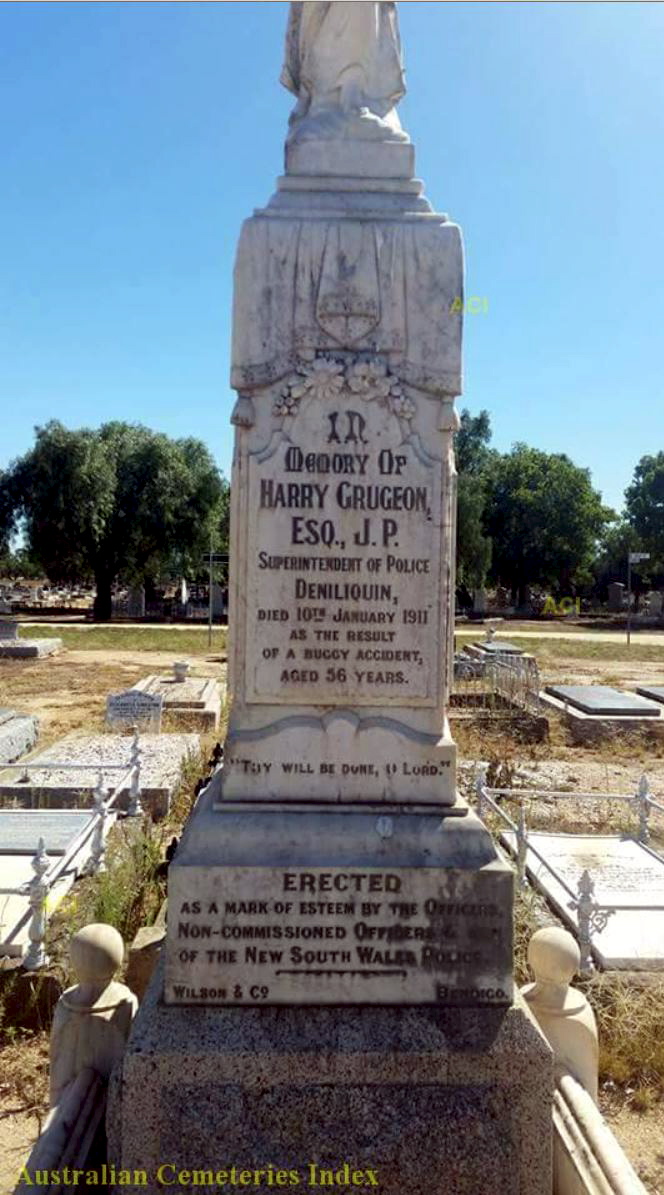
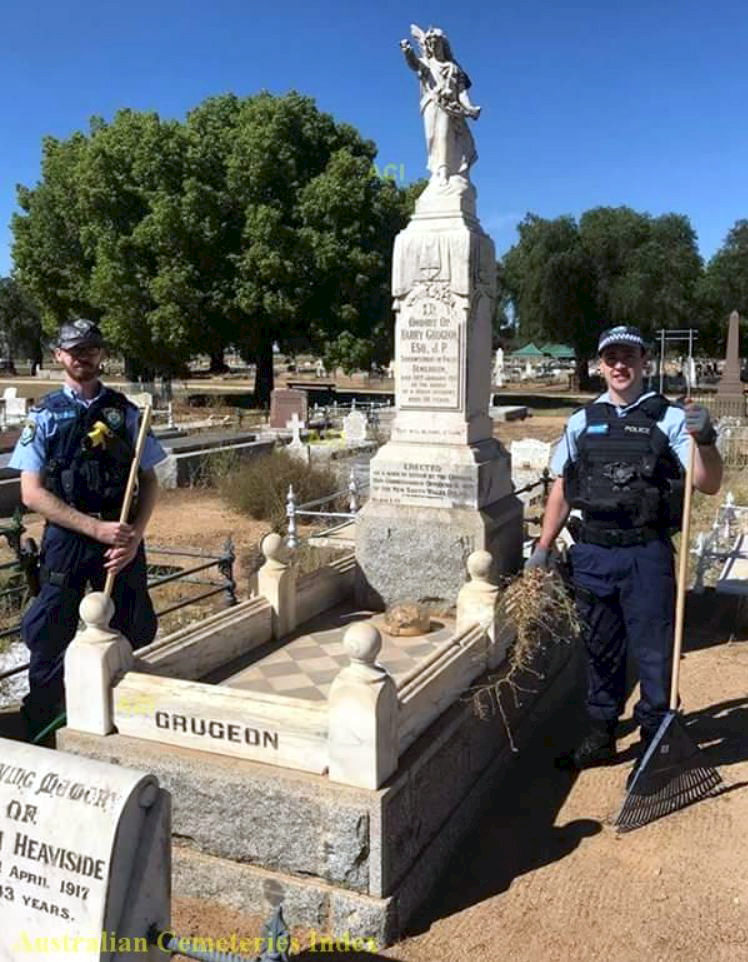
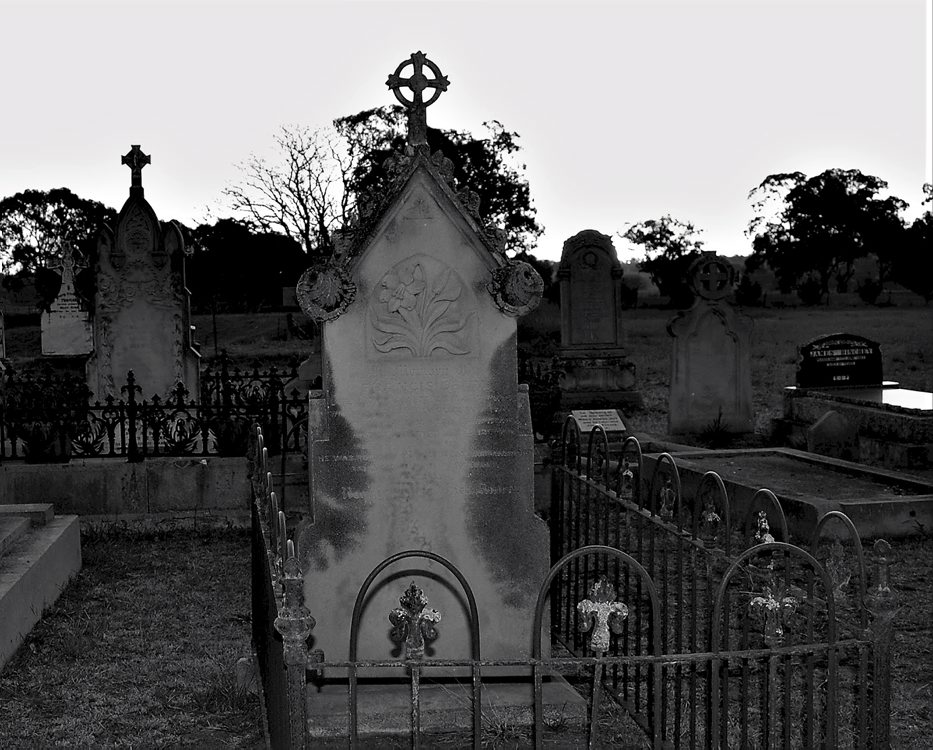
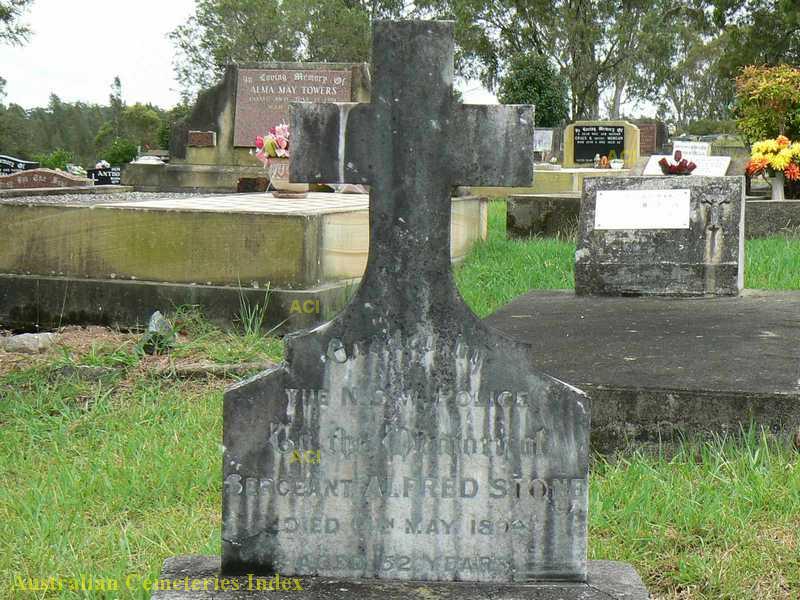
 Memorial located at1/ Deniliquin Cemetery – Marble tombstone over grave

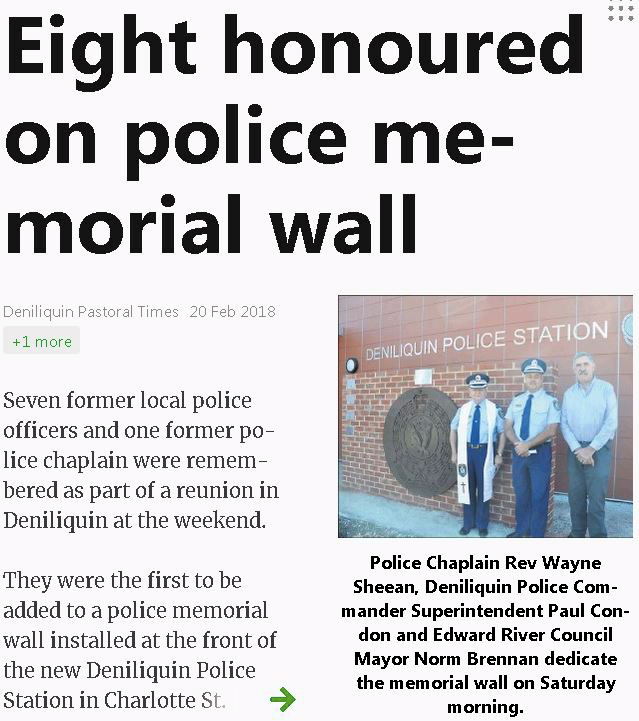
2/  Memorial Wall plaque – Deniliquin Police Station – 2018
 

HARRY GRUGEON

HARRY GRUGEON

HARRY GRUGEON

HARRY is NOT mentioned on the Police Wall of Remembrance * NOT JOB RELATED

HARRY IS mentioned on the Deniliquin Police Station Memorial Wall – 2018


FURTHER INFORMATION IS NEEDED ABOUT THIS PERSON, THEIR LIFE, THEIR CAREER AND THEIR DEATH.

PLEASE SEND PHOTOS AND INFORMATION TO Cal


May they forever Rest In Peace


Superintendent Henry ‘Harry’ GRUGEON
Born c1855 at Edmonton, England.
Died 10/1/1911, Deniliquin, NSW.
32 years service.
Buried Deniliquin, NSW
1881. Married Johannah HENNESSY, Deniliquin, NSW
1897. Promoted from Senior Sergeant to Sub Inspector
1898. Was a Sub Inspector at Narrandera.

15/10/1898, in the Australian Town and Country news paper.
The police district is under the control of Sub-inspector Grugeon, and the local force comprises, in addition, four footmen and three troopers. The gaol is in charge of Senior constable Bowman.

1906. Promoted from Sub Inspector to Inspector
1906-1909. Would appear that he was stationed at Parramatta as an Inspector
1909. Promoted from Inspector to Superintendent.

17/7/1909, Evening News Newspaper
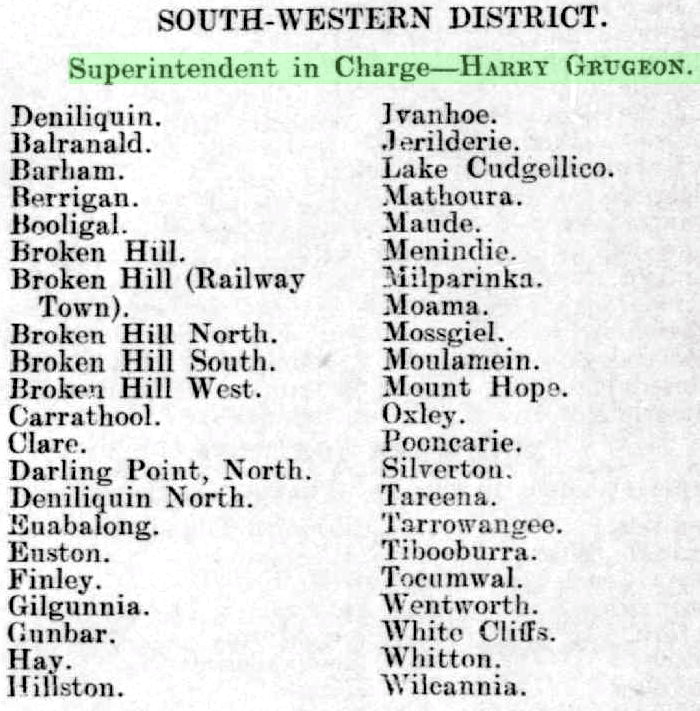
Police Superintendent Grugeon was entertained at the Woolpack Hotel, Parramatta, at a farewell fraternal gathering, on the eve of his departure for Deniliquin to take charge of the South Western Police District. The Mayor (Alderman Haugh) presided, and there was a large attendance of prominent residents, magistrates, court officials, and others.
Among the speakers were Colonel Ferris, -ex -Superintendent Brennan, Mr. M. S. Love, S.M., Superintendent Day, Mr. G. Addison, C.P.S. and Parramatta Chamber Magistrate, Father O’Reilly, Dr. Kearney, and Sergeant Lucas.

During the evening Mr. Love, on behalf of the court officials, handed Superintendent Grugeon a cheque with which to buy a buggy on his arrival at Deniliquin. (Note that he was given a cheque to buy a buggy)

14/1/1911, Nepean Times.

FATAL BUGGY ACCIDENT.
Superintendent of Police Henry Grugeon, of Deniliquin, died about 6 o’clock on Tuesday morning, as the result of a buggy accident. It appears that the superintendent was out driving in his buggy, with a pair of horses, accompanied by his son Stephen and daughter Mary. The horses became restive on Mathoura road, about three and a half miles from Deniliquin, and bolted, and, on turning short, the buggy capsized, throwing the occupants out.

Mr Grugeon fell on his head, and received several nasty cuts on the head and face. He was unconscious.
His son at once went to the freezing works and telephoned to Dr. Marsden, who went out and brought Mr Grugeon to his home, where he was attended by Dr Marsden and Hoskin, but never regained consciousness.
The son and daughter received only a few scratches.
Mr Grugeon was inspector in charge of Parramatta before being appointed superintendent at Deniliquin.
At the Parramatta Police Court on Tuesday sympathetic reference was made to the death of Superintendent Grugeon by Mr E L Maitland, S.M., by Mr E K Bowden on behalf of the legal profession, and by Inspector Bedingfield ( possibly Q # 2799 ) ( deceased’s successor at Parramatta) on behalf of the police.

His death was also mentioned in ‘The Argus’ Melbourne. Not transcribed.

He left a wife, 6 daughters and 3 sons. His wife Johannah died 28/7/1945 at Lewisham Private Hospital.


2/1/2019, Deniliquin Times.

Eight honoured on police memorial wall’ –

Seven former local police officers and a former police chaplain were honoured during a police reunion in Deniliquin.
They were the first to be added to the police memorial wall at the new Deniliquin police station.
Honoured were
Constable Charles Chapman (died 5/3/1866),
Senior Const J Morrison (19/1/1898),
Senior Const Thomas Smith (19/4/1910),
Superintendent Henry Grugeon (10/1/1911),
Sergeant George Thomas Whiteley (25/3/1931),
Detective Senior Const Risto Vic Baltoski (2/1/1989) and
Senior Const Jennifer Louise Edgerton (August 2015) and

Rev David Bond.


HARRY GRUGEON


Cumberland Argus and Fruitgrowers Advocate (Parramatta, NSW : 1888 – 1950), Saturday 26 August 1911, page 6


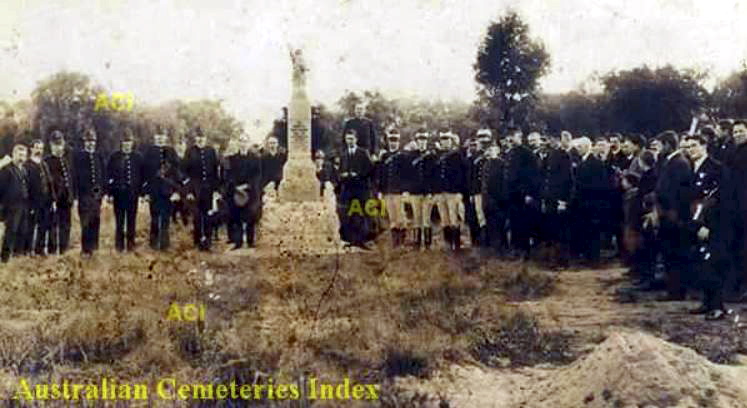
On Sunday afternoon (reports the Deniliquin ‘Independent’ of August 18) a large number of representative towns people, including the aldermen, of the municipality, attended at the local cemetery to witness the unveiling of the beautiful monument erected by a section of the police force of New South Wales, to perpetuate the memory of the Late Superintendent Grugeon, who was killed by an unfortunate buggy accident in January last.
All the members of the local police force were present.
Messrs. J. and H. ( Harry ) Grugeon, two of deceased’s sons, had also journeyed to Deniliquin, to be present at the ceremony.
The monument is a beautiful piece of work, and was executed by Messrs. Wilson and Co., of Bendigo, which firm was represented at the unveiling by Mr. H. M. Hammer.
The design is a very choice one, being a pedestal with carved drapery, surmounted by a beautifully carved figure representing an angel with arm extended dropping flowers on the grave beneath. The pedestal and figure are worked from the best Carram marble. The monument is supported by a base of Harcourt granite, with two sets of kerbings of the same stone. Marble posts with marble kerbings, neatly moulded, take the place of the customary iron railing, while the inside of the grave is covered with black and white marble tiles.
The monument bears the inscription, ‘In memory of Harry Grugeon, Esq., J.P., Superintendent of Police, Deniliquin, died 10th January, 1911, as the result of a buggy accident.
Aged 56 years.
‘Thy will be done, O Lord.’
Erected as a mark of esteem by the officers, non-commissioned officers, and men of the New South Wales Police Force.”
https://trove.nla.gov.au/newspaper/article/85990366

Bendigo Independent (Vic. : 1891 – 1918), Monday 3 July 1911, page 3


POLICE MEMORIAL.

In the early part of this year, the popular Superintendent of Police at Deniliquin Mr. Harry Grugeon, J.P., died from injuries received in a buggy accident and since then the members of the New South Wales police force have decided to commemorate his memory by the erection of a monument over his grave in the Deniliquin Cemetery.

The design selected is very choice, being a pedestal with carved drapery surrounded by a beautifully carved figure representing an angel with arm extended dropping flower’s on to the grave beneath. The pedestal and figure are worked from the best Carrara marble. The monument is supported by a base of Harcourt granite with two sets of kerbings of the same stone. Marble posts with marble kerbing neatly moulded take the place of the customary iron railing while the inside of the grave is to be covered with black and white marble.

The inscription has been cut out and filled with lead, making it of a lasting character. It reads thus: – ” In memory of Harry Grugeon, Esq. J.P. Superintendent of Police, Deniliquin, died on January 10, 1911, as the result of a buggy accident. Aged 56 years. Thy Will be done O Lord. Erected as a mark of esteem by the officers, non-commissioned officers and men of the New South Wales police. ”

The work has been entrusted to Messrs J. B. Wilson and Co., the well known firm of monumental sculptors of this city and is being prepared by them at their works in Mitchell street.

https://trove.nla.gov.au/newspaper/article/226828887

Daily Telegraph (Sydney, NSW : 1883 – 1930), Friday 11 August 1911, page 12

THE COUNTRY.

DENILIQUIN, Thursday.
A marble tombstone, suitably inscribed, has just been completed over the grave of the late Superintendent of Police, Mr. Harry Grugeon, the cost of which was borne by the police of the South-western and Parramatta districts.
The Inspector-General of Police, Mr. Day, will unveil the monument at the cemetery here next Sunday.
https://trove.nla.gov.au/newspaper/article/238869305

Riverine Grazier (Hay, NSW : 1873 – 1954), Tuesday 3 September 1907, page 4


FROM DAY TO DAY.

Happenings Outside tho District.

Mr Harry Grugeon, who is leaving Narrandera, after a residence of ten years, during the greater part of which period he had been engaged in the law office of Mr Quirk, was tendered a farewell by his many friends on Wednesday evening at the Railway Hotel, and presented with a valuable gold albert.

Mr Grugeon, who is a son of Inspector Grugeon, has accepted a position with Messrs Atkinson and Warren, solicitors, of Hunter street, Sydney.

https://trove.nla.gov.au/newspaper/article/141260885

Narrandera Argus and Riverina Advertiser (NSW : 1893 – 1953), Friday 2 July 1909, page 4


LOCAL AND GENERAL.
New Justices. —
In a batch of 260 names added to the Commission of the Peace on Monday last are included the following:—  Harry Grugeon, Superintendent of Police, Deniliquin……
https://trove.nla.gov.au/newspaper/article/99753953

HARRY GRUGEON


Francis DRUM

Francis DRUM

AKA  ?

Late of Marengo, NSW

New South Wales Police Force

Regd. #  ‘P‘ 0086

For the purposes of this website ‘P‘ = represents those Police joining Pre 1862 when NSWPF “Officially” commenced

Rank: Constable – commenced 24 February 1862

Senior Constable

Final Rank = Senior Constable

Stations?, Morangarell ( 1875 ), Murringo, Marengo – Death 

ServiceFrom  24 February 1862  to 12 January 1882 =  20 years Service

Awards:   No find on It’s An Honour

Born:   31 March 1838, Auchandinard, Bally Connell, Fermanagh, Ireland

Died on:  Thursday  12 January 1882

Age:  45

Cause:   Fall from horse whilst On Duty – Fractured neck

Event location:  near Warrangong Station, Marengo

Event date:  Thursday  12 January 1882

Funeral date:   Tuesday  17 January 1882

Funeral location:   Murringo Cemetery, Murringo Rd, Murringo, NSW, 2586

Wake location:  ?

Funeral Parlour:  ?

Buried at: Murringo Cemetery, Murringo Rd, Murringo, NSW, 2586


 Memorial located at:   ?

Widow:  Mary Agnes DRUM & 6 children of Marengo in the Colony of NSW


FRANCIS is NOT mentioned on the Police Wall of Remembrance  * BUT SHOULD BE

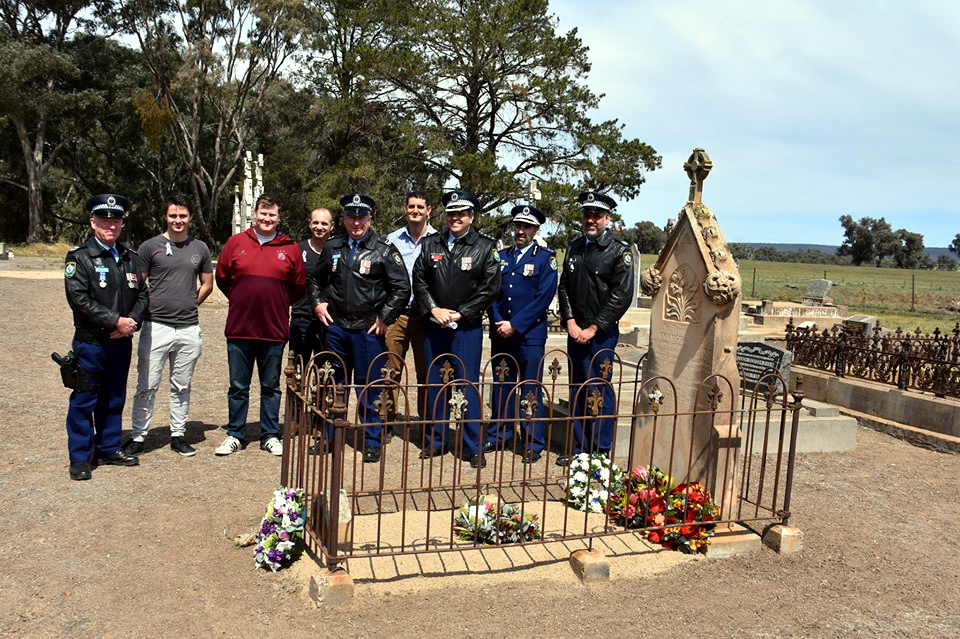
On Friday 27 September 2019 an omission was rectified with the name of Senior Constable Francis DRUM being added to the NSW Police Wall of Remembrance together with the National Police Wall of Remembrance, Canberra.


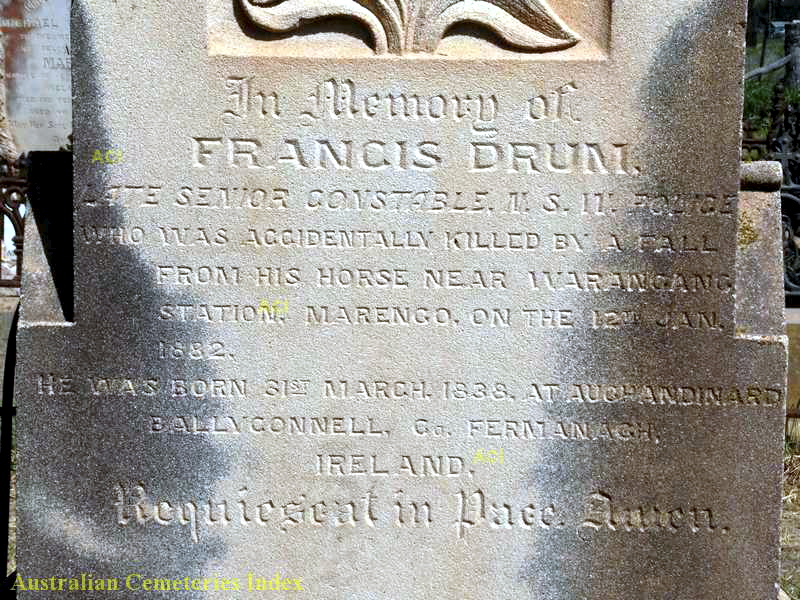
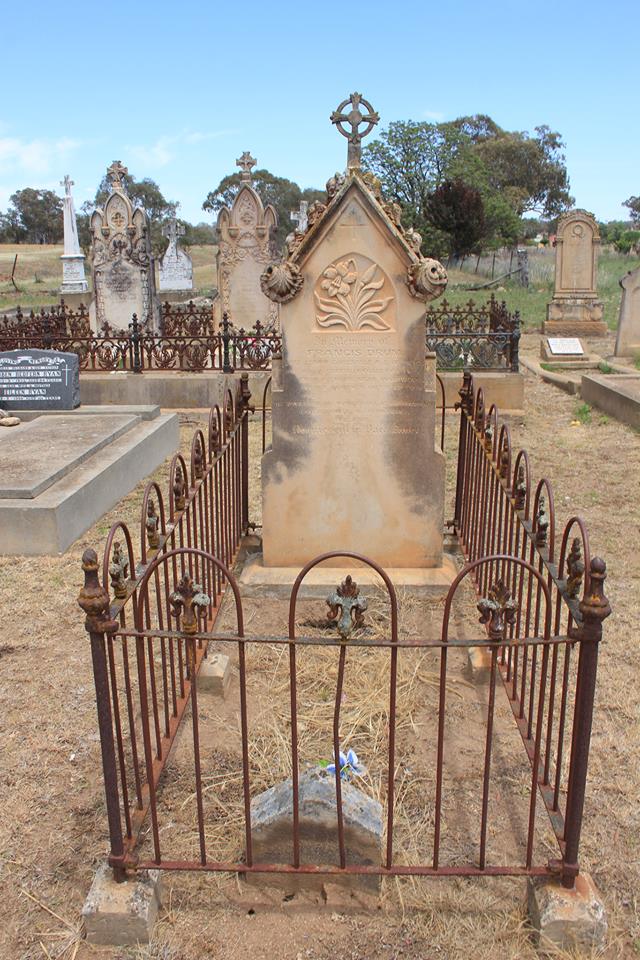
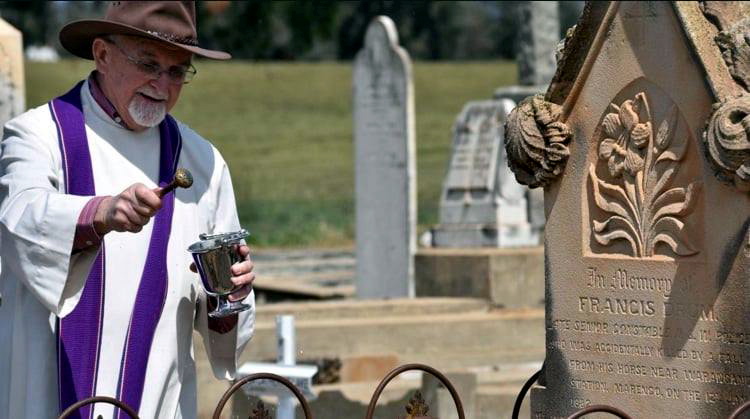
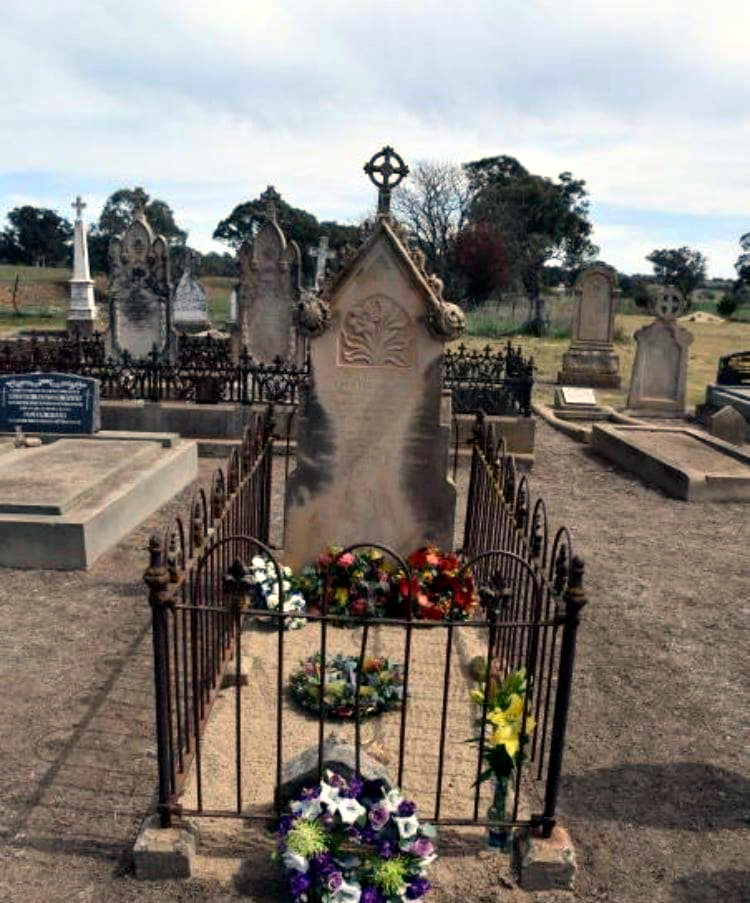
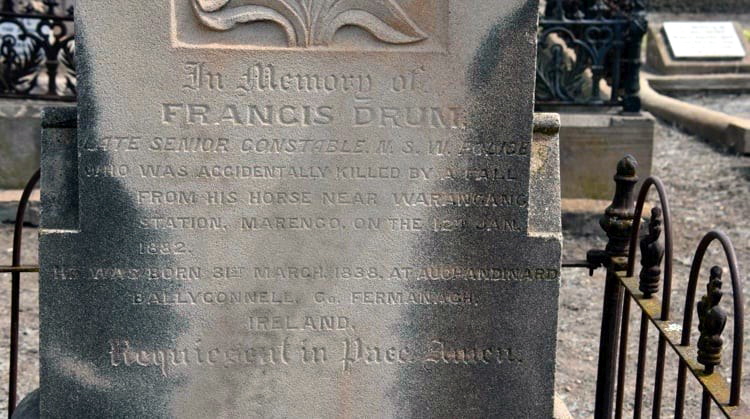
INSCRIPTION: In memory of FRANCIS DRUM Late Senior Constable N.S.W. Police who was accidentally killed by a fall from his horse near Warangang Station, Marengo, on the 12th Jan. 1882. He was born 31st march, 1838, at Auchandinard, Bally Connell, Co. Fermangagh, Ireland. Requieseat in Pace. Amen.

INSCRIPTION: In memory of FRANCIS DRUM Late Senior Constable N.S.W. Police who was accidentally killed by a fall from his horse near Warangang Station, Marengo, on the 12th Jan. 1882. He was born 31st march, 1838, at Auchandinard, Bally Connell, Co. Fermangagh, Ireland. Requieseat in Pace. Amen.

INSCRIPTION: In memory of FRANCIS DRUM Late Senior Constable N.S.W. Police who was accidentally killed by a fall from his horse near Warangang Station, Marengo, on the 12th Jan. 1882. He was born 31st march, 1838, at Auchandinard, Bally Connell, Co. Fermangagh, Ireland. Requieseat in Pace. Amen.

FURTHER INFORMATION IS NEEDED ABOUT THIS PERSON, THEIR LIFE, THEIR CAREER AND THEIR DEATH.

PLEASE SEND PHOTOS AND INFORMATION TO Cal


May they forever Rest In Peace


Regarding Senior Constable Francis DRUM. I received a message from Inspector Jacob REEVES, OIC of Young Police 3 days ago. My apologies for not posting earlier, it was in my ‘other’ messages.

“Hello Kevin, just FYI, Senior Constable Patrick Smith of Young Highway Patrol has been lobbying to have S/Cst Drum added to the NSW Police Force Honour Roll in the Domain and has been successful. S/Cst Drum will be added in time for Police Remembrance Day 2019 and will also be sent to Canberra for inclusion on the National Wall. We will be having a ceremony in Murringo to mark this event on Friday 27th September. The Hume Police District Facebook page will have details shortly.”

Outstanding.


In 1882 Senior Constable Francis Drum paid the ultimate price in the execution of his duty. Unfortunately his death has not been accepted as duty-related by the various Commissioners (and Inspectors General) of the Police.

Francis Drum, a twenty year veteran, was thrown from his horse near Murringo while collecting crop returns and electoral lists. Sadly, his fatal fall was not regarded as being in the line of duty.

It has since been shown that in a report by Edmund Fosbery Inspector General of Police to the Principal Under-Secretary of the NSW Police Department that most country police had this task as a normal part of their duties at that time. “These duties and others such as the collection of the Electoral Lists, Jury List, Stock and Crop Returns interfere more or less with legitimate police work and occupy much time, but there is some counter-balancing advantage by bringing the police into contact with people they would not otherwise meet, whereby they acquire information of service to them in a police point of view”. (see Police Duties in NSW 1862 – 1915).

We have been in contact with a serving Police Officer who wishes to facilitate the process of getting Francis Drum recognised as his due right and to have his name included on the Police Honour Roll.

https://www.change.org/p/nsw-police-commissioner-michael-fuller-apm-help-us-get-senior-constable-francis-drum-on-the-nsw-police-honour-roll?recruiter=632287451&utm_source=share_petition&utm_medium=facebook&utm_campaign=psf_combo_share_initial.pacific_email_copy_en_gb_4.v1.pacific_email_copy_en_us_3.control.pacific_email_copy_en_us_5.v1.pacific_post_sap_share_gmail_abi.gmail_abi.lightning_2primary_share_options_more.control&utm_term=psf_combo_share_initial.pacific_email_copy_en_us_3.control.pacific_email_copy_en_gb_4.v1.pacific_email_copy_en_us_5.v1.pacific_post_sap_share_gmail_abi.gmail_abi.lightning_2primary_share_options_more.variant&utm_content=fht-14070029-en-au%3Av2&fbclid=IwAR3hxWZYVGIIIUMVwZeH7Kff20FlTTdohBLINB_AiifiCyHeO502G3LT4gI


Burrowa News (NSW : 1874 – 1951),

Friday 20 January 1882, page 2

INQUEST ON SENIOR-CONSTABLE DRUM.

The coroner (Mr. S. Robinson) and a jury of five held an inquest at the dwelling house of the late Senior-constable Drum, Marengo, on Tuesday, touching the death of that officer.

John McSpadden deposed : I am boundary rider to Mr. W. B. Suttor ; I know the deceased Senior-constable Drum ; I saw him yesterday morning ; be called at the station and asked me the road to Beplate‘s ; he was collecting the electoral roll ; I went on horseback with him ; we had ridden about three quarters of a mile from Warrangong station ; there was a storm rising ; Drum said he would turn back ; his horse gave two or three turns round ; Drum stuck the spurs into the animal ; she made a bound and deceased’s hat fell off ; the mare then bolted ; deceased could not hold her ; after going about 300 yards I saw the mare fall right through a six-wire fence, on the top of the rider ; I galloped up, and found deceased bleeding copiously from the mouth and ear ; he was quite dead ;

I then went and reported the circumstances to the overseer of the station ; Mr. Johnson, I, and my wife, went to where the body was ; we then took the body to the station ;

Mr. Woodbridge, who is a neighbour, afterwards reported to the police, and the body was then brought to Marengo, by order of the coroner ; the mare from the start was restless ; she appeared to be a very fiery animal ; I thought she was not a safe animal to ride ; I brought the mare here from Warrangong this morning ; she is marked in several places by the wire fence.

Charles Henry Thompson deposed : I am a constable stationed at Marengo ; Senior-constable Drum was in charge of the Marengo station ; from information I received I went yesterday to Bang Bang, distant from here about 25 miles ; I there saw Constable Drum ; he said he had been sick, but that he was then all right ; Mrs. Drum spoke to me on Wednesday night ; she said she had heard her husband was sick at Bang Bang ; she further requested me to take a buggy and bring him home ; I and Mr. Connor, inn-keeper, started at 12 o’clock on Wednesday night, and got to Bang Bang at 5 on Thursday morning ; Drum was better, and started to finish the electoral roll at about a quarter past eight in the morning ; while I was with deceased he had one glass of brandy ; he said he had a touch of sunstroke on Monday last ; I arrived home about noon yesterday, and about two hours afterwards news came to me that Drum had been killed ; I telegraphed to the police, and also to the coroner, and upon the order of the coroner, I had the body brought home ;

he, deceased, left home on Monday morning : I have been ten weeks here ; I have known Drum for nearly four years ; I never saw him drunk ; when he started from Bang Bang on Thursday the mare was very fidgetty, and was prancing about ; I told Drum if the mare was too much for him that I would ride her and finish taking the roll ; I don’t think the mare is safe to ride ; she is flash and has a bad temper ; I would not care to ride or have charge of her ; Drum used to say that she required watching.

Michael O’Connor deposed : I am an innkeeper, residing in Marengo ; I knew the deceased, Senior-constable Drum ; I have known him on and off for about twelve years ; on Wednesday evening about 10 o’clock Mrs. Drum came to my house and said she had heard that her husband was sick at Bang Bang ; she asked me if I would go with my buggy and bring him home ; she said that Constable Thompson would accompany me ; I consented to go ;

I started with Constable Thompson about 12 o’clock, and arrived at Bang Bang at five in the morning ; when we arrived I saw Drum coming out of the stable ; Drum said, “Where are you going ?” I did not tell him my object in coming ; he appeared to have been sick, but not from drink ; I only saw him have one drink that morning ; the mare Drum rode was very fidgetty ; we afterwards left and came home ;

Drum was a very regular man, and not in the habit of drinking.

The verdict of the jury was that deceased met his death by falling from his horse over a six-wire fence on the 12th instant, which fall dislocated his neck.

The jury added a rider to the effect that they were of opinion that the mare was not a fit animal to be supplied to the police force.

The funeral of Senior-constable Drum took place on the evening of the inquest, and was followed by a large concourse of people, vehicles and horsemen.

The burial service was read by the Rev. Father Long, of Burrowa.

A public subscription is being raised for the purpose of erecting a memorial stone over the grave of the deceased.

There is no doubt that the primary cause of the accident was the temper of the mare, which appears to have been very bad. She has passed through several hands and was given up each time by the possessor as being unsafe to ride.

It is said that she killed a man sometime ago in another district, and was brought over here for the use of an officer of rank in the service, who declined to have her, since which she has been sent away from place to place with the object of exchanging her.

Under these circumstances it is not creditable to the authorities to allow animals of this class to be ridden by the police, who, of all men, require horses which can he kept thoroughly under control. It is to be hoped that the rider to the verdict will have some effect in the proper quarter.

Assuming however, that the horse had been a quite animal, then the Government would still be blameable for permitting the use of wire fences without a top rail, at any rate along public roads.

Only a few months back another trooper lost his life over a similar fence to the one in question. And so the affair as usual, rests, until death after death at last compels the selfish red taped authorities to move in the matter.

There is a fence of this class on a main road not many miles from Young, and as a matter of course, it is impossible for man or beast to see it by night, nor indeed often by day. What is of more common occurence than, for say a vehicle to run slightly off the track of a bush road on a night, not necessary dark, and if the fences are not discernible, what guide is there for a driver. A matter of this kind could be easily regulated by a brief Act, and would prevent many an accident to life and limb. — Argus (Young.) .

https://trove.nla.gov.au/newspaper/article/107930196


Burrangong Argus (NSW : 1864 – 1913),

Saturday 1 August 1868, page 2


DRUNK AND DISORDERLY.

Thomas Evans was brought from Murrumburrah by constable Francis Drum, charged with the above offence. Fined 10s., or three days’ imprisonment.

OBSCENE LANGUAGE.

Thomas Evans was charged with using obscene language. Constable Francis Drum deposed that, when attempting to arrest defendant, he made use of the language complained of, a repetition of which would be unfit for publication. Fined 1/., or fourteen days’ imprisonment.

ASSAULTING POLICE.

Thomas Evans was charged with assaulting the constable in the execution of his duty. Constable Francis Drum deposed that, when arrested, defendant refused to walk, after which he got up, kicked him in the stomach, and tried to turn his thumb back. Eventually he had to obtain the assistance of Mr. Dillon. Defendant resisted all the way to the lockup. He was the worst man he (constable) ever had his hand on. Fined 2/., or one month in gaol. Locked up in default.

https://trove.nla.gov.au/newspaper/article/247265628


The Hume Police District

Friday 27 September 2019 ( National Police Remembrance Day )

Young Sector – Police Remembrance Day

Today on duty and off duty police from Young Sector gathered at Murringo Cemetery to commemorate Police Remembrance Day and the addition of the Late Senior Constable Francis Drum, Officer in Charge of Marengo, (as it was then known) to the NSW Police Force Roll of Honour.

Senior Constable Drum was killed on duty in a horse riding accident in 1882.

Research and hard work from the Murringo First Families Group, Young and District Family History Group and Leading Senior Constable Pat Smith of Young Highway Patrol, supported by the Mayor and Local Member, saw Senior Constable Drum included on the Roll in time for this year’s Remembrance Day.

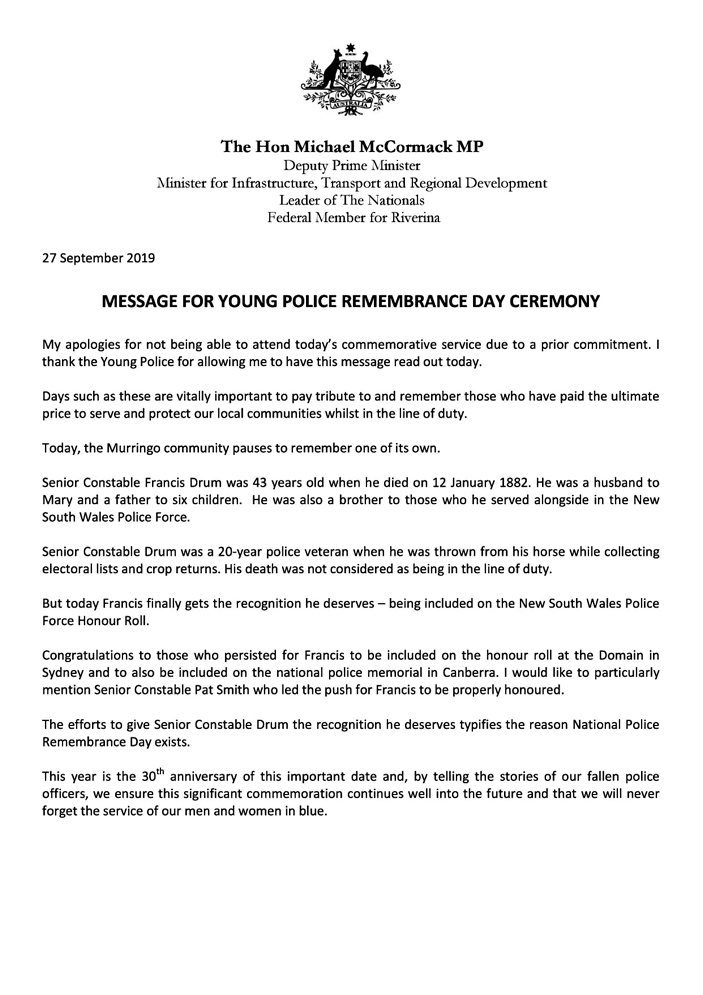
A message from the Deputy Prime Minister was read, our Local Member Steph Cooke MP made the opening remarks and a prayer service was officiated by Fr Allen of St Mary’s Young.

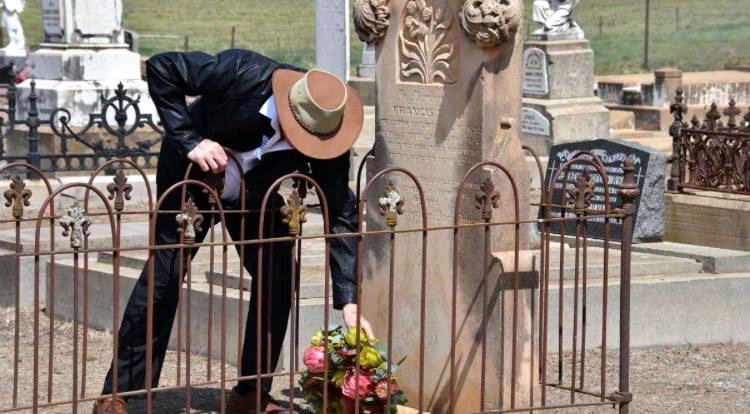
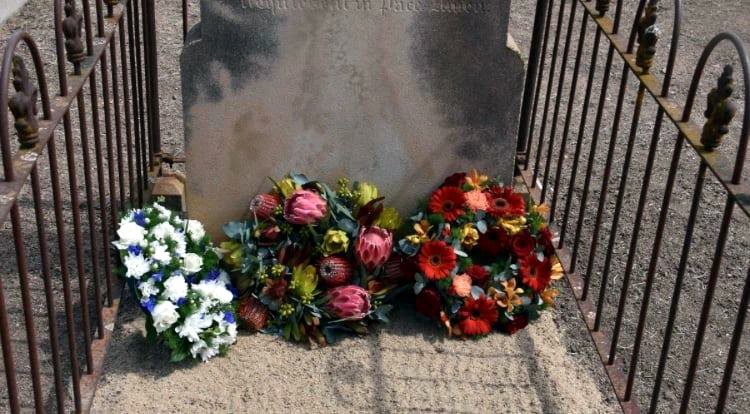
Wreaths were laid by our Local Member, our Mayor, the great-grandson of Senior Constable Drum and also by Leading Senior Constable Smith.

We paused for a moment at the grave of another police officer who died of illness in 1904 before we gathered for lunch at the Murringo Memorial Hall.

A day in remembrance of our fallen colleagues.

Francis DRUM

Francis DRUM

Francis DRUM

Francis DRUM

Francis DRUM

Francis DRUM

Francis DRUM(Thanks to the Young Witness for the photos)


Michael Thomas DeCourcey O’BRIEN

Michael Thomas DeCourcey O’BRIEN

Late of  ?

New South Wales Police Force

Regd. #  ‘Q‘  6158

For the purposes of this website ‘Q‘ represents those Police joining between 1862 ( commencement of NSWPF ) – 23 February 1915 ( Commencement of NSWPF current numbering system )

Rank:  Probationary Constable – Death

Stations:  Central – 1 Division – Death

ServiceFrom  17 March 1891  to  31 May 1891 = 6 WEEKS Service

Awards:   No find on It’s An Honour

Born:   ? ? c1865 – Ireland

Died on:   Sunday  31 May 1891 about 1pm at Sydney Hospital

Age:  25

Cause:   Horse accident – struck by horse and run over by buggy

Event location:  Goulburn St & George St, Sydney CBD

Event date:  Saturday  30 May 1891 about 8am

Funeral date:   Wednesday  3 June 1891

Funeral location:   Rookwood Necropolis

Funeral Parlour:  ?

Buried at:   Catholic Section, Sec M1, FF, 144

Grave location

Memorial located at:   ?

Sacred to the Memor of Constable M. T. De Courcey O'BRIEN  Native of Limerick, Ireland Aged 25 years Killed in the execution of his duty at Sydney 30 May 1891 R.I.P.

Sacred to the Memor of Constable M. T. De Courcey O'BRIEN  Native of Limerick, Ireland Aged 25 years Killed in the execution of his duty at Sydney 30 May 1891 R.I.P.

[alert_green]MICHAEL IS mentioned on the Police Wall of Remembrance[/alert_green] * Added to National Police Memorial in 2017

 [divider_dotted]


FURTHER INFORMATION IS NEEDED ABOUT THIS PERSON, THEIR LIFE, THEIR CAREER AND THEIR DEATH.

PLEASE SEND PHOTOS AND INFORMATION TO Cal

[divider_dotted]

May they forever Rest In Peace

[divider_dotted]

Kevin Banister
NSW Fallen Police FB Group   Thursday  31 May 2018

Probationary Constable Michael Thomas DeCourcey O’BRIEN
Born c1865 Ireland.
Died 31/5/1891 aged 26. About 8am on Saturday 30 May, 1891 Probationary Constable O’Brien was on duty in the vicinity of Goulburn and George Streets, Sydney when he attempted to stop a runaway horse and buggy. As he did so he was struck by the horse, knocked to the ground, and was run over by the buggy. He was taken to the Sydney Hospital suffering from extensive head injuries however he passed away about 1pm the following day. He was in the Police for only 6 weeks.  He was a single man.

A number of newspaper reports state that he had a large funeral attended by many Police from the Inspector General down with a long Police procession leaving from Sydney hospital where he died from his injuries.
According to the SMH 2/6/1891 the funeral was to leave the Sydney Hospital at 1.30pm on 3/6/1891 for the Necropolis (Rookwood). (Catholic Section) O’Brien, Michael Thomas, 03 Jun 1891, 26, SEC*M1*FF**144.

[divider_dotted]

Sydney Morning Herald (NSW : 1842 – 1954), Monday 1 June 1891, page 4


MONDAY, JUNE 1, 1891.

CONSTABLE Michael Thomas O’Brien, who was injured in George-street on Saturday morning whilst attempting to arrest the progress of a runaway horse, died in the Sydney Hospital yesterday afternoon.

https://trove.nla.gov.au/newspaper/article/13826481

[divider_dotted]


Australian Star (Sydney, NSW : 1887 – 1909), Monday 1 June 1891, page 5


the late constable O’Brien.

The Inspector-General of Police has received with extreme concern the report of the death of Constable Thomas De Coursey O’Brien, which adds another number to the honorable list of the police who have sacrificed their lives in the execution of their duty, the force and the public having in this instance lost the services of a promising and efficient officer.

Mr. Fosbery desires that every respect may be shown at the deceased’s funeral by the attendance of as many of his officers and comrades as can be safely spared from duty.

Mr. Fosbery will be present himself.

https://trove.nla.gov.au/newspaper/article/228177990

[divider_dotted]


Australian Star (Sydney, NSW : 1887 – 1909), Monday 1 June 1891, page 6


STOPPING A RUNAWAY.

A Constable Injured.

In his efforts to stop a runaway this morning Constable O’Brien, of No. 1 Station, was somewhat seriously injured. He was on duty in George-street, and when passing the tobacco shop of Messrs. Craig and Aitken a horse attached to a cart belonging to the firm bolted; owing to someone throwing a cracker in front of the animal.

Immediately the runaway made off O’Brien started in pursuit; and, catching up to the horse, seized hold of the reins, when, through the animal swerving, the constable was struck in the chest by the shaft and knocked down.

Before the officer could regain his feet the wheels passed over his body, and O’Brien was left lying on the ground seriously hurt. On being admitted to the Sydney Hospital the victim was seen to have received one or two very nasty scalp wounds, in addition to being seriously injured about the chest and body.

https://trove.nla.gov.au/newspaper/article/228177996

[divider_dotted]


Australian Star (Sydney, NSW : 1887 – 1909), Thursday 4 June 1891, page 6


FUNERAL OF THE LATE CONSTABLE O’BRIEN.

The funeral of the late Constable O’Brien, who succumbed in the Sydney Hospital on Sunday to injuries received the previous day, in a plucky attempt to stop a runaway in George-street, took place this afternoon.

Though only a recent addition to the force, O’Brien had placed himself on the most friendly terms with men and officers alike, and the young fellow’s frank and jovial disposition won what it merited — the high esteem and respect of every comrade.

The funeral, which started from the hospital, was numerously attended, and among those who paid the last tribute to the memory of the deceased were the Inspector-General of Police (Mr. E. Fosbery), Mr. Superintendent Read and nearly all the inspectors of the metropolitan divisions.

About 100 constables walked on foot, preceding the hearse, while about an equal number, including commissioned and non commissioned officers, brought up the rear in cabs and other vehicles. Immediately following the hearse were two mourning couches containing the brother and more intimate friends of the deceased.

https://trove.nla.gov.au/newspaper/article/228176420

[divider_dotted]


Evening News (Sydney, NSW : 1869 – 1931), Thursday 4 June 1891, page 6


Yesterday’s Brevities

Constable O’Brien, who was knocked down in attempting to stop a runaway horse on Saturday, and who succumbed to his injuries in the Sydney Hospital on Sunday, was buried at the Roman  Catholic Cemetery, Rookwood, today.

The Inspector-General of Police, the superintendent, a number of inspectors, sub-inspectors, and about 150 men attended the funeral, out of respect to the deceased gallant young officer.

https://trove.nla.gov.au/newspaper/article/113883023

[divider]


John McCROHON

John McCROHON

Late of  ?

Grandfather of NSWPF member – Ernest Edward McCrohon – # ‘Q’ 9403

Great Grandfather of NSWPF member – Victor Harry McCROHON – # 5009

Great Great Grandfather of NSWPF member – Vicki McCROHON – Police Woman 0123 who rejoined as Police Woman 0202

New South Wales Police Force

Regd. #  ????


Rank:  Chief Constable – appointed 9 March 1836 – Resigned 10 October 1837

Reappointed, in place of Constable James Jordan, in July 1838 & served until May 1839

Chief Constable – appointed 23 July 1838 until 6 May 1839


Stations?, Paterson ( 1836 – 1837 ) & ( 1838 – 1839 )

Service 1From 9 March 1836  to  10 October 1837 = 19 Months Service


Service 2:  From 23 July 1838  to  6 May 1839 = 10 Months Service

Total Service:  2 years 5 months


Awards:   No find on It’s An Honour


Born:   ? ? 1795 – Limerick, Ireland

Died on:   Monday 6 May 1839

Age:  44. ( Other sources have him aged 39 at time of death which makes his birth 1800 )

Cause:   Fall from his horse whilst ON Duty

Event location:   Between Maitland & Paterson, NSW

Event date:  Monday  6 May 1839


Funeral date:   ? ? ?

Funeral location:   ?

Funeral Parlour:  ?


Buried at:   Unmarked grave, Glebe Cemetery, George St, East Maitland, NSW

 Memorial located at:   ?


 JOHN is NOT mentioned on the Police Wall of Remembrance  * BUT SHOULD BE


FURTHER INFORMATION IS NEEDED ABOUT THIS PERSON, THEIR LIFE, THEIR CAREER AND THEIR DEATH.

PLEASE SEND PHOTOS AND INFORMATION TO Cal


May they forever Rest In Peace


 The Sydney Herald     Friday  10 May 1839    page 3

At Paterson, on the 6th instant, Mr. John McCrohan, late Chief Constable there, in consequence of a fall from his horse, when proceeding on duty to Maitland, leaving a wife and seven small children, nearly destitute, to deplore his loss.

The deceased, by his vigilance and good conduct, had gained the confidence and respect of the magistracy and settlers of the district, as he previously had done that of the Officers of the 4th of King’s Own Regiment of Foot, from which corps he honorably retired as Quarter-master Serjeant (sic ), in the enjoyment of a pension which ceases with his demise.


https://trove.nla.gov.au/newspaper/article/12858096#


John McCROHON

Male 1795 – 1839  (44 years)

Name John McCROHON
Born 1795 Limerick, Ireland Find all individuals with events at this location
Gender Male
Occupation 07 Aug 1838 Paterson, New South Wales, Australia Find all individuals with events at this location
  • Appointed chief constable 1838
Died 06 May 1839 Paterson, New South Wales, Australia Find all individuals with events at this location  [1, 2]
  • The Sydney Herald (NSW : 1831 – 1842), Friday 10 May 1839, page 3http://nla.gov.au/nla.news-article12858096At Paterson, on the 6th instant, Mr. John McCrohan, late Chief Constable there, in consequence of a fall from his horse, when proceeding on duty to Maitland, leaving a wife and seven small children, nearly destitute, to deplore his loss. The deceased, by his vigilance and good conduct, had gained the confidence and respect of the magistracy and settlers of the district, as he previously had done that of the Officers of the 4th or King’s Own Regiment of Foot, from which corps he honorably retired as Quarter-master Serjeant, in the enjoyment of a pension which ceases with his demise.The Sydney Monitor and Commercial Advertiser (NSW : 1838 – 1841), Monday 13 May 1839, page 3http://nla.gov.au/nla.news-article32164046At Paterson, on the 6th instant, Mr. John McCrohan, late Chief Constable there, in consequence of a fall from his horse, when proceeding on duty to Maitland.
Notes 
  • Irishman of the 4th Regiment of Foot in either England, Ireland or France.John was born 1795 Limerick, enlisted at Cueta as a 15 yr old, 25/5/1810. His service was 3 yrs in Portugal & Africa, 2 years in France, 6 yrs 391 days in West Indies (5/4/1819 – 1/4/1826), Married at Chatham in June 1826 and then served 1 year and 3 months in Portugal ( where son John born ) and then 3 years 6 months in NSW. After resigning from the Regiment, John joined the Police Force at Paterson in NSW where he was killed in a horse accident on 6/5/1839.
Person ID I20751 Rossow-Beitzel
Last Modified 9 Oct 2017
 http://www.rossow-beitzel.com/getperson.php?personID=I20751&tree=First

No find on NSW BDM.

The Gympie Researcher
Gympie Family History Society Inc
Nov 2014    No. 77
Researcher Article for November Issue 2014
My name is Jennifer Chantrill. I was born in Adelaide in 1955 ……..
Page 14
My paternal grandmother Veronica Hunt also hailed from interesting stock. She was the great-great granddaughter of Sgt John McCrohon and his wife Amelie Ducroix; John had
served in France and Portugal during the Napoleonic wars, and their first child was born in Portugal. John discharged from the Kings Own 4th Regiment in Sydney and became the Chief Police Constable at Newcastle (NSW).
Their descendent Maxwell McCrohon went to America as a foreign correspondent for the Sydney Morning Herald; he stayed and eventually obtained the post of Chief Editor of the Washington Post in the time of President Ronald Reagan.


Death Cert Emily McCROHON 1891
« on: Saturday 25 March 2018 06 07:24 GMT (UK) »

I have an unwanted Death Certificate of Emily McCrohon who was the daughter of Sydney Peter McCrohon NSW and Sarah Tindel of Ireland.  Emily was born in 1868 Rockhampton Qld.

She unfortunately died aged 23 years in 1891 Petersham NSW.

I had been trying to obtain the death cert of her grandmother, also named Emily McCrohon alias Amelia McCrohon nee Du Croix.

http://www.rootschat.com/forum/index.php?topic=142438.0

View Full Version : John Patrick McCrohon

Ammanda Schutz
26-11-10, 21:33

Name – John Patrick McCrohon

Date and place of birth: May 1795, St John’s Parish, Limerick, Ireland

Names of parents: John McCrohon and Margaret Unknown

Date and place of baptism – Unknown

Details of each of his or her marriages – married Amelia (Emily) du Croix at St Thomas, Winchester Hampshire (Unconfirmed)

Date of marriage: 23/06/1826 (Unconfirmed)

Occupation(s) – Sergeant Major; 4th Regiment of Foot, Lancaster King’s Own Regiment: Served in Portugal and occupied France after Waterloo. Regiment posted to garrison duty in NSW 1832 – 1837  ( Some researchers claim he was a Quartermaster. Not easy to verify as the regimental records were largely destroyed. )
NSW Constabulary: 1837-39. Appointed Chief Constable at Paterson NSW, 23/7/1838

Addresses where they lived: East Maitland, NSW

Date, place and cause of death: May 6, 1839, thrown from his horse on the road between Maitland and Paterson, NSW while on duty.

Date and place of burial. Buried at Glebe Cemetery

Details of will / administration of their estate – Unknown
Memorial inscription – Unknown

tenterfieldjulie
26-11-10, 22:08
Ammanda, I have John’s Military Service Records – he enlisted at Cueta, Africa 25 May 1810 at 15 years of age. His service ended on 8 Feb 1837 in Australia. From 5 April 1819 until 1 April 1826 he served in the West Indies. He was a Sergeant for 8 years and 55 days and Quarter Master Sergeant for 5 years and 106 days.
I was looking for their marriage in Portgual/France, so that information, although unsubstantiated, is news to me. 😀 Thanks Julie
Ammanda Schutz
27-11-10, 13:29
Julie: The information was given to me by a Cantwell researcher. They did not give me any documentation so I cannot verify. According to the researcher John was posted back to England, a base in Hampshire, and he and Emily were married there.
I would be glad of a copy of his service record. Thanks, A
btw did you get my email with the copy of the church register for the Gray/Dillon marriage?
Merry
27-11-10, 16:03

That marriage date would appear to be for this entry, from the FS pilot site:

Groom’s Name: John Mccrohon
Groom’s Birth Date:
Groom’s Birthplace:
Groom’s Age:
Bride’s Name: Emily Banham
Bride’s Birth Date:
Bride’s Birthplace:
Bride’s Age:
Marriage Date: 23 Jun 1826
Marriage Place: Saint Thomas,Winchester,Hampshire,England
Groom’s Father’s Name:
Groom’s Mother’s Name:
Bride’s Father’s Name:
Bride’s Mother’s Name:
Groom’s Race:
Groom’s Marital Status:
Groom’s Previous Wife’s Name:
Bride’s Race:
Bride’s Marital Status:
Bride’s Previous Husband’s Name:
Indexing Project (Batch) Number: M13675-1
System Origin: England-ODM
Source Film Number: 1041222
Reference Number:
Collection: England Marriages, 1538–1973

but the bride has a different surname. Might she have been previously married?

Ammanda Schutz
28-11-10, 00:56
As far as I know Emily was not previously married. It seems to me that the other researcher has made an error. McCrohon is not a common name but one branch of the family moved to England, and still lives there, and this John is probably one of from that group.
Thanks for looking, Merry, and clearing up that question. Back to the drawing board.
tenterfieldjulie
28-11-10, 07:59
Merry, From the marriage reigster, would it be possible to see the original entry, or would you need to buy a certificate, in case there is a mistake with transciption of Emily’s surname?
As he was in the military from age 15, would he have needed Official Permission to marry? Would there be records?
Thanks Ammanda have received the Gray cert I will pm you. Julie
Merry
28-11-10, 11:18

It’s too early for a civil certificate (1837+) but you could get a copy of the Parish Register entry from the Hampshire RO, for a fee!

Otherwise, you should also check the Chaplains Returns marriages (overseas ones and I think they may include some UK army marriages as well) if you haven’t already (they are on FMP 1796-1880, but you’ll need a sub) and bear in mind both their surnames are open to being listed under different letters of the alphabet!!

I’m not sure about the permission bit. Certainly at various times one needed permission from a commanding officer to marry, but I think sometimes it made a difference what rank you were and at what time in history you were marrying. Plus of course, needing permission didn’t mean that permission was always sought!

Merry
28-11-10, 11:21

As he was in the military from age 15, would he have needed Official Permission to marry? Would there be records?

Ammanda, I have John’s Military Service Records

If there was a record of permission, his army papers would be the place to look, so if it’s not there……………..

Ammanda Schutz
28-11-10, 13:05
I found a record of the birth of one child to John McCrohon and Emily
Henry William Mccrohon
11 Apr 1832
St. Mary’s, Chatham, Kent, England
There may be more but it was late when I found this one.
It seems that there was a John and Emily in England and they were still there in 1832.
Thanks for the help. A
Merry
28-11-10, 15:43
I found a record of the birth of one child to John McCrohon and Emily
Henry William Mccrohon
11 Apr 1832
St. Mary’s, Chatham, Kent, England
There may be more but it was late when I found this one.
It seems that there was a John and Emily in England and they were still there in 1832.When did yours go to Australia? I had assumed Henry Wm was theirs, particularly being born in Chatham.Amelia (Emily) du CroixDo you have her birthplace or parentage?
Ammanda Schutz
28-11-10, 21:16
Merry, their first child, John McCrohon Jr, was born in Portugal in 1827.
After that there are two children born, according to one researcher, in England. William Denis McCrohon and Jeremiah Joseph McCrohon. Both of these children are said to have died in 1834. John Sr and his family went with his regiment to NSW in 1832/33.
Therefore the two boys would have died in NSW and I can find no evidence of this in the NSW records after trying all the variations of the spelling of the name McCrohon that I can think of nor can I find any record of their births in England. The next child was born in NSW in 1833, Sidney Peter.
It is possible, I suppose, that the birth of two boys were recorded in some military records.
Seems kind of speculative to me, but once we start looking back in time it is all a bit foggy. Like my brain.
Ammanda Schutz
28-11-10, 21:22
Oh, forgot to respond to the second part of your question. Amelia/Emily du Croix is a bit of a mystery; could be French, maybe from Belguim, no-one knows for certain. No date of birth just a C1798 for the year. Her parents are said to be Sidney Pierre du Croix and Sarah Unknown. That a lot of help, isn’t it?
tenterfieldjulie
28-11-10, 22:02
According to John’s Service Records from the National Archives, it was noted that he served in the West Indies from April 1819 to April 1826. (I think this is noted because in his pension? they were only allocated half pay). The next positive fact is when John Junior is born in Portugal as Ammanda says. John and Emily therefore could have been married in the West Indies, England, Portugal, France or Belgium – if you can find the marriage Merry, you are an absolute genius.
tenterfieldjulie
28-11-10, 22:06
The two boys I believe had headstones in Sydney in an early burial ground , but I think the cemetery has since disappeared. I think someone sent me some details, I’ll email them when I find them Ammanda.
tenterfieldjulie
29-11-10, 06:31
Amanda I will email you.
I found listed in Monumental Inscriptions at Bunnerong (the headstones etc were moved here after the Elizabeth & Devonshire Street Cemeteries were cleared.) Grave No. 1409: William Denis and Jeremiah Joseph McCROHON the sons of Quarter Master Serg’t John & Emily McCROHON of the 4th or Kings Own Reg’t, the former died 18th February 1834 aged 4 years and 10 months, and the latter died 15th June 1834 aged 4 years and 5 days. In 1969 the Headstone was Upright and the Condition Good.
So William was born April 1829 and Jeremiah born June 1830, what a tragedy.
Ammanda Schutz
30-11-10, 02:41
Julie: Thanks for the information. Wonder why there are no records for the deaths. I can’t find their births in England either. More mystery. A
kiterunner
30-11-10, 07:56
Not really a mystery, Ammanda – they were born before civil registration started in the UK and died before civil registration started in NSW, weren’t they?
tenterfieldjulie
30-11-10, 09:12
Yes 1856 in Australia. I compiled a pre-compulsory-registration BDM register for Tenterfield from church records, newspapers, family bibles and family traditions. The earliest being 1844, this area was only opened up in the the late 1830s. Seeing as how the priest/minister carried his notebook in his saddlebag and the areas were huge, it is simply amazing that any records survived. Tenterfield Catholic records were found in Grafton, Armidale and Ipswich.
Ammanda Schutz
01-12-10, 14:24
Now that I have John’s service record (thanks to Julie) and seeing where the Regiment was deployed I have doubts that he met Amelia du Croix in France. He was not at Waterloo and so she probably is not from Belgium. On the other hand there is a prodigious length of time from his deployment with the Army of Occupation in France, 1815 through part of 1818, until his first child is born in 1827.
It seems more likely to me that he met her in the Caribbean where he served for almost seven years; the entire time the Regiment was deployed there. The 4th then came back to England for a short time in 1826 and went straight on to Portugal from December 1826 to July 1827. John Patrick was born there July 27, 1827.
Perhaps we should be looking for Amelia and a marriage in the French West Indies. That covers a lot of islands but at least we can rule out Haiti.
I have given it a go but no joy yet.
tenterfieldjulie
12-03-11, 04:45
Ammanda I was looking through some photos that I took at the Gray reunion at Elsmore. There were printed sheets on the walls on the McCrohons. Some of these sheets were hard to photograph because they were covered in plastic.
Under UK Military Records it had: John McCrohon joined 3rd/East Kent Regt 1806. Lieutenant 1808. Retired injured as captain on half-pay. Father of John & William? Have you heard anything of this? This could explain how John born 1795 Limerick, ended up enlisting at Cueta aged 15, if his father was in the military based in England.
It also had that the second child of John & Emily, William Dennis was born in Scotland April 1829 and third child, Jeremiah Joseph, born England 10 June 1830.
tenterfieldjulie
20-03-11, 08:46
Well you just think you know something and they something else crops up.
Tonight talking to a relie she tells me that she has a record someone gave her from the IGI for John McCrohon’s baptism (from his military records he was born 1795 in Limerick) it is RC Crondon Park, Essex Name John McCrohon (not sure if the surname is spelt like that) parents John and Margaret, baptism 1 March 1807. All I can think is that either he hadn’t been baptised or they didn’t have a record of his baptism for his confirmation. Can anyone view the original record and see if it gives his age?
HarrysMum
20-03-11, 08:53
Is there some way you can connect the Limerick John with Essex John?
tenterfieldjulie
20-03-11, 08:59
Parents names are the same, John and Margaret. There also was a John McCrohon who was in the East Kent Regiment at that time. I haven’t followed through with checking, but I feel this could be why John Junior was enlisting at Cueta aged 15. I just hoped that the baptism register of this John might say his age which the IGI doesn’t.
HarrysMum
20-03-11, 09:00
Do you know what IGI search it was??? I can’t find anything.
tenterfieldjulie
20-03-11, 09:04
No I don’t unfortunately I tried too. M. isn’t computer literate and said it was from the IGI and what did that mean!! The problem with McCrohon is spelt in all sorts of funny ways – I’ve seen McCrone, McCrohan, even Crone and that is in Australia!!
HarrysMum
20-03-11, 09:14
There are 10 people with John McCrohon born 1795 Limerick in ther GR trees. Have you contacted any of them?
tenterfieldjulie
20-03-11, 09:16
No I should but I get a bit wary after what people have said about the unsubstantiated records that people put on there. I think Ammanda has as she has quoted from Allycat.
HarrysMum
20-03-11, 09:19

Some of the same people have Thomas Gray so probably rellies you already know. Any results you get from anyone are unsubstantiated until you’ve found them yourself so that’s not really a problem.

It’s only an issue when you take what others say as gospel without double checking.

That’s from experience….lol

tenterfieldjulie
20-03-11, 09:22
Yo. When I get to the library I will look see. If Jan H. is on there, I was in correspondence with her years ago and she was very good. As are Ian M and Marcel.
HarrysMum
20-03-11, 09:23
I’ll have a look……are you a paid member??? I don’t think you can send messages unless you are.
tenterfieldjulie
20-03-11, 09:26
No I’m not. If I look it at the Library and see what is on there and who is saying it, I can probably get in contact. Especially as there is a reunion at Easter.
HarrysMum
20-03-11, 09:27

One is a McCrohon and one is a Gray who have John McCrohon.

I can send them a message.

tenterfieldjulie
20-03-11, 09:38
Thanks Lib, I will talk to you tomorrow. A bit too tired now to think up what to say lol
kiterunner
20-03-11, 15:58
That baptism on the IGI is an “extracted record” and it gives his age at baptism as 1.
tenterfieldjulie
20-03-11, 20:21
When he enlisted on 24 August 1810 it gave his age as 15 and under age (he officially didn’t get a pension until he turned 18). It gave his date and place of birth 1795 Limerick and this is on the original handwritten records. On the extracted baptism record if he is “our” John McCrohon his age should read 11 not 1?
HarrysMum
20-03-11, 20:40

It does say 1 Julie. You could always order the original from LDS and have a look.

Did I ask before……………..do you know if John had any siblings?

tenterfieldjulie
20-03-11, 20:42
Yes it is worth a try. How did they spell McCrohon please?
How it could be disproved if a marriage could be found in Essex.
HarrysMum
20-03-11, 20:47

McCrohon. There aren’t any others in that batch, but that’s only baptisms and that one could be on the changeover year for that batch…

Have you looked for a marriage in England?

Ammanda Schutz
20-03-11, 21:36
I looked and found nothing.
According to our Brisbane researcher there was a brother William McCrohon, 1807 but no place of birth. It seems that this is a real connection as William also joined the 4th and went to NSW with his family.
There was a John McCrohan born at Colchester 1814, I think. Fairly close by but I don’t know the significance, if there is one. Perhaps the same family and the younger John died.
McCrohan and McCrohon are always being mixed up so the spelling doesn’t signify.
There is a family tree on Ancestry that has a Margaret Manning married to a John McCrohon at about the right time but I can’t link them to us.
Julie, MS gives the marriage for Emily and John at 1818, no documentation.
HarrysMum
20-03-11, 21:52

Oh Ammanda…don’t you just hate it when someone gives you some info and can’t give you the source????? lol

I’ve had so many on my tree particularly from one person who is determined to connect us to royalty I’m sure. She has this beautiful tree without any sources and that’s because they’re aren’t any…………..lol

I think you need to contact the brisbane person and ask for all the sources. Anybody who has done a tree would expect to be asked for that so I can’t see a problem. Then you need to check all their sources yourself.

I’ve been caught badly by not rechecking another person’s work……

Ammanda Schutz
20-03-11, 23:40
Tell me about it. Down the garden path and back again. I am such a believing soul, gullible is probably a better word, that I have had to be burned really badly to learn the lesson.
Julie knows him and he probably will be at the reunion in April so she can talk to him first hand. However, I take your point. If I can find an email address I will whisk one off.
I sound confident but some folk don’t like their research challenged so I have to tread carefully especially as this is the ‘definitive’ work on the McCrohons.
The good thing about the family is that the name is uncommon. The rotten part is that it is spelled in every conceivable way and then some.
HarrysMum
21-03-11, 01:10

Thanks Ammanda……………….not sourced at all really is it???

The index list is just that…I’d like to see some certs and PRs before I’d say anything.

So John and Amelia marry in 1818………..where was that supposed to be??? If John was in the army, why didn’t he need permissiom to marry??? And if he did marry without permission, wasn’t he supposed to re-marry??

Has anyone found his actual records??? That should have exactly where he was and when.

There’s a 9 year gap between the marriage and the first child. Not sure of the significance of that yet….

A lot of the historical parts are general history. I’ve got very similar in my book on the Moores from Ireland.

I’ll print it out and highlight the parts I’m not sure about I think the I might get a better idea.

Ammanda Schutz
21-03-11, 01:56
Well, you have hit upon some of the issues and in short order.
We have his complete military record and can trace him from his earliest date in Ceuta.
I think he chose the 1818 because it was at the end of the time that John was in France with the occupation army. However, the rest doesn’t make any sense to me. Why wouldn’t she go with him to the West Indies? If she was outcast from her family where else would she go?
If the other marriage, Emily Banham, is anything to go by they started having children right away, as any Catholic couple would. Well, not just Catholic at that time. I think Emily had 9 children with John so there was no time to waste.
I had thought that if Emily DuCroix was on one of the French Islands in the Caribbean, after all they French had lost the war and control of their islands, at least nominally, then he could have met and married her there. I found no records to that end.
When the record in Winchester came to light I thought it more than probable. All the elements fit; John was at Chatham after returning from the West Indies and in between being sent back to Portugal. Their first child was born in Portugal in just over a year.
Also, even if Emily Banham was a widow and DuCroix was her maiden name, as the daughter of ‘some high official’ wouldn’t she be educated. She could not sign her name on the register but marked it with an X.
I also wonder how John got to Ceuta? He was obviously educated, could read and write and was a Quarter Master Sergeant. Maybe his father was already in the Military and the reference Julie found to a John McCrohon in the East Kent 3rd Regiment may be right on. The 3rd fought in Spain and Portugal during the war with Napoleon and perhaps his son was with him. Perhaps at Gibraltar just across from Ceuta. Ceuta is still a Spanish enclave in Morocco and was always an occupied military port.
Well, I am raving now. Off to bed.
Thanks for taking a look.
The
tenterfieldjulie
21-03-11, 02:51
Most of “MS” “History of the McCrohon Family in Australia” is I believe based on documentation, but the sources are not quoted. (He refers to study at State Librariers, LDS, State Archives etc) The part about the runaway marriage is I think is a family story, how they supposedly met her in France and had a runaway marriage. We know now that John McCrohon, 4th Foot, married a Emily Banham at St. Thomas Winchester 23 June 1826 (have copy of the marriage registration). Their son John was supposedly born in Portugal 25 July 1827 according to MS, which would fit with the marriage. Whether the birth information was recorded in a Family Bible, we hope to find out. We have the TNA records of John’s Military Records – when, where he joined 4th Foot etc, his ranks and times and places of service, including seven years in West Indies. Some of this MS seems to refer to, but I can see some errors in assumption. I think it would be better to speak to MS privately. I think he is an older person who did this out of respect for an elderly uncle who was related to him by marriage. He has very generously made this information available with no copyright claimed and fair use for non-profit purposes is permitted. His History comprises over 40 pages and so there is a lot of time and effort put into the McCrohon story.
HarrysMum
21-03-11, 03:03

I think talking to him about his sources would be a good idea Julie. Getting info from LDS is a bit dodgy unless you see the actual film. I must admit to not know about submitted entries when i started this lark and that gave me all sorts of trouble.

I’ve also got bad info from the State Library by using others’ trees and stories. One has a bit of wrong info and the next embellishes it and it goes on.

I wonder if the Ducroix story was along the lines of a tryst rather than an actual marriage. Those things can grow legs if people start talking…..lol.

I don’t think Amelia DuCroix and Emily Banham are the same person. Of course I can’t prove that but there are many things pointing that way.

My ggg grandfather’s marriage of 1818 is documented in his records. He was a sergeant at the time. The records also tell when he took leave etc. Although he was in the WI and other places, he managed to get home to ‘pro-create’ every couple of years.

Maybe if you tell him, you’ve been trying to find certain records and ask if he’d help you, at least you’ll know where he got them from.

tenterfieldjulie
21-03-11, 03:35
Well I found my buried records.
Death Registration of John McCrohon 20 June 1900 at Tingha NSW Born Portugal in Aust 58 years, Parents John McCrohon Quartermaster Sergeant in the army, Mother Emily Ducroi (x, more like t, possibly c). When this John’s son (another John died) his obit said he was the son of Mr. & Mrs. Patrick McCrohon who had migrated to Australia from Ireland.
Then the youngest child of John and Emily – Louis Estall died 3 May 1924 parents John McCrohon Miner and Agnes Decrow? (informant his son)
No wonder things are confused…
I.M. another researcher says in 2000: John – Born St. John’s Parish, Limerick July 1795, Brother William born Jan 1807 Crondon Park, Essex. John christened son of John and Margaret Crondon Park Rc 1 March 1807. Military Service – Returned Winchester 1 April 1826. Emily Ducroix Born France ca 1800 Seamstressi n Parish at time of British occupation 1816. First marriage to – Banham? John and Emily married 23 June 1826 at St. Thomas Rc Winchester.
Ammanda Schutz
21-03-11, 12:23
My head is swimming! Lots of information and I wonder where it leads.
Thanks for digging it out of the coffins Julie. lol
http://www.genealogistsforum.co.uk/forum/archive/index.php?t-7228.html
http://www.genealogistsforum.co.uk/forum/showthread.php?t=7228


James COADY

James COADY

Late of  ?

New South Wales Police Force

Regd. #  ‘ Q ‘ 1801

For the purposes of this website ‘Q‘ represents those Police joining between 1862 ( commencement of NSWPF ) – 23 February 1915 ( Commencement of NSWPF current numbering system )

Rank:  Constable – Trooper

Stations: ?, Cooma ( about 2 years ), Braidwood from 11 April 1870 – Death

ServiceFrom  21 June 1867  to  10 June 1870 = 3 years Service

Awards?

Born? ? 1842 in Ireland

Died on:  Saturday  11 June 1870 @ 3am

Age:  32

Cause:  Horse riding accident – Fell and crushed under horse.  Coronial Inquest found that the deceased “was accidentally killed by a fall from his horse while in the execution of his duty”

Event location:  3 miles from Braidwood – between Jembaicumbene ( Bell’s Paddock ) & Braidwood

Event date:  Thursday  9 June 1870 just before 5pm

Funeral date:  Sunday  12 June 1870 – during the afternoon

Funeral location:  Roman Catholic Cemetery, Braidwood Cemetery

Buried at:  Braidwood Cemetery in unmarked grave.  Wallace & Cowper St’s, Braidwood

He was buried “close to the graves of the special constable who were murdered at Jinden”

 Memorial located at?


[alert_red]JAMES is NOT mentioned on the Police Wall of Remembrance[/alert_red] *BUT SHOULD BE

 [divider_dotted]

FURTHER INFORMATION IS NEEDED ABOUT THIS PERSON, THEIR LIFE, THEIR CAREER AND THEIR DEATH.

PLEASE SEND PHOTOS AND INFORMATION TO Cal

[divider_dotted]

May they forever Rest In Peace

[divider_dotted]

NSWBDM      DEATH:  1870/3052
[divider_dotted]

Coady, James (Trooper) 1870


The Sydney Morning Herald  Saturday 11th June, 1870 – Braidwood, Friday – Trooper Coady, yesterday met with an accident, which, it is feared, will prove fatal. When returning from Bell’s paddock, on duty, his horse fell and rolled over him, seriously injuring his spine. He is now lying in hospital. Coady is a single man.

Evening News Monday 13th June, 1870 – Braidwood, Saturday – Constable Coady, died last night from the effects of injuries sustained by his horse falling and rolling over him. Herald

The Goulburn Herald and Chronicle Wednesday 17th June, 1870 – Dreadful Accident – A very serious and distressing accident occurred to Constable James Coady, stationed at Braidwood, who was riding home from Jembaicumbene on Thursday last with Senior Constable Walsh, when his horse fell with him to the ground and rolled over him. It is supposed that the animal put his foot in a hole. Coady was so severely injured as to be left utterly insensible.

Senior Constable Walsh caught Coady’s horse and rode into town (a distance of about three miles), when Senior Constable Duffy sent out a horse and cart, and Coady was brought into town about eight o’clock in the evening.

DR Gentle was immediately called to attend upon him, but has very little hope of his recovery; his spine being broken in several places. Coady has not been long in Braidwood – about three months. He was formerly stationed at Cooma for about two years. The only relative he has in the colony is a brother stationed at Grafton, we are informed. On Friday the unfortunate young man showed no signs of improvement, and his recovery is considered almost impossible – Braidwood Despatch

(A telegram to SM Herald, dated Saturday, says: Constable Coady died last night from the effects of injuries sustained by his horse falling and rolling over him.)

NSW BDM  – 1870/3052 – James Cody, aged 32 years, Died Braidwood, NSW; buried in unmarked grave Braidwood Cemetery.

State RecordsRegisters of Police – Regd # 1801 – James Coady, Date of birth 1842, Ireland, Appointed 21st June, 1867

[divider_dotted]


Manaro Mercury, and Cooma and Bombala Advertiser (NSW : 1862 – 1931), Saturday 25 June 1870, page 3


DEATH OF CONSTABLE COADY.

The accident reported in our ( Braidwood Dispatch ) last issue as having happened to constable Coady on Thursday last, terminated fatally on Saturday morning. The poor young man expired at about 3 o’clock that morning, he having been in a sinking state from the time he was brought home. As we said before, he has only been about three months stationed in Braidwood, having previously been stationed at Cooma for two years. He has no relations in the colony but one brother, who is also in the police force and stationed in the Clarence district ( Grafton ). Deceased during his short sojourn in Braidwood was much respected by the other members of the police force and other persons with whom he had become acquainted. His remains were buried in the Roman Catholic Cemetery on Sunday afternoon, the funeral being attended by the members of the force and a considerable number of the townspeople. His body was interred close to the graves of the special constables who were murdered at Jinden.

An inquest was held upon the body at the Police Station on Saturday afternoon, before the Coroner and a jury of twelve, when the following evidence was taken :-

Francis Duffy deposed :- I am senior- sergeant of police Stationed at Braidwood. I knew the deceased, James Coady. He was a foot constable, stationed here since the 11th April last. On the 8th instant I directed him, with senior constable Walsh, to proceed the following morning in the execution of warrants. I told him he could either ride my horse or that of constable Bragg, as we would both be engaged at the Police Court next day. Constable Bragg, who was present, said, ” Yes, Coady, you can take my horse if you wish. ” Coady replied, ” I will take the sergeant’s. ”

On the morning of the 9th senior constable Walsh and deceased left here about 9 o’clock. Both were mounted. The deceased was riding my horse. A little after 5 p.m. senior constable Walsh returned to the station and informed me that constable Coady‘s horse ran away with him, fell, and rolled over him, and that he was lying by the side of the road between here and Jembaicumbene. I at once proceeded on foot, and found deceased lying a little way off the road, about four miles from here on the road to Bellevue. Deceased was lying on his back. He was moaning very much. There appeared to be some vomited matter about his head and face, and he smelt very strongly of spirits. At first I thought he was lying in a very drunken fit. On raising him to a sitting posture, he moaned and said, ” Oh, my back ” I spoke to him. He knew me and mentioned my name. His face was cut and bleeding, and I then knew that he was seriously hurt.

Before leaving Braidwood I had given directions for the police dray to follow me. It arrived while I was there, and we had deceased conveyed to the Police Station without delay, where Dr. Gentle attended him the same evening, I believe about 4 o’clock.

James O’Brien deposed :- I am a storekeeper, residing at Bellevue. I saw deceased, James Coady, on Thursday last, about 3 p.m. I saw him first at my store, and we went across the road to Mrs. McManus’ public-house, which is directly opposite. Mrs. McManus is a connection of mine, and I act for her when she is away. On this occasion I went behind the bar and shouted for deceased. He had a nobbler of whiskey. He stopped some little time talking, and then went away. He appeared to me to be sober when he came and seemed sober when he went away. Senior constable Walsh was with him. He could have had some grog before he came over to my store. He came there to get change of a cheque, I think it was a £10 cheque. He wanted me to change it, and take out of it the price of some refreshments he and constable Walsh had had previous to coming over to me. He had nothing after he had the whiskey. The day was a very cold one. The deceased was dressed in the ordinary police uniform, and had no over coat. He left at a canter.

Constable Walsh was about one hundred and fifty yards before deceased, whose horse was very restive while he was mounting. He did not seem a first class rider, and Walsh‘s horse having gone on made his hone restive. He had a revolver in his belt when he went away. It was about ten minutes after I treated the constables that they started.

By the Jury:- They both tried to mount at the same time, but Walsh mounted and rode off quicker than the other. I did not see the constables arrive.

William Walsh deposed :- I am a senior constable of police stationed at Braidwood. I went out to execute some warrants on Thursday, 9th instant. We went to the Chinese Camp, at Jombaicumbene, and arrived there about 10 a.m. We remained at the Camp about five minutes, and then proceeded to a locality known as Moreing’s Flat, where the Chinamen we were in search of were supposed to be. When we got there they had left. We searched the claims and the hut, as I was informed they had been there a short time previous. We then went back to Bell’s Paddock, to a Chinamen’s camp there. I waited there while a Chinaman went to look for those we were in search of. He could not find them. I then wrote a note to Senior constable Stapylton, informing him that there were warrants out for these men, and that they were supposed to be at Major’s Creek. After that, hearing that the men were back in the house we first searched; we went back, but could not find them, as they were not there. We then went towards Braidwood.

We stopped at Mrs. McManus’s public-house at Bellevue, as constable Coady wished to see Mr. O’Brien. Mrs. O’Brien asked us if we would have some dinner. We had some bread and cheese and a glass of ale each. We then went across the street to the store. Constable Coady had some conversation there. I was then going away when Mr. O’Brien asked us to have a drink before we went, as it was very cold. We each had a glass of whiskey, and started for Braidwood.

About a mile and a half this side of Mr. O’Brien’s, constable Coady’s horse went into a gallop. I pulled up, and he pulled in in three or four hundred yards. About three miles and a half this side of Mr. O’Brien’s we went to have a trot. I was trotting, and he was cantering. He kept on the old road, and I went down a new track. The roads are about forty or fifty yards apart. I looked across and saw the horse rising up and Constable Coady on the ground in the middle of the road. I followed and caught the horse and brought him back. I asked the deceased if be was hurt. He did not speak. I bathed his head with water which was close by. I again asked him if he was hurt. He said ‘Yes.’ I asked him where; he said his back. I lifted him on his feet and found he could not stand. He did not try to stand. I laid him down, and kept bathing him. With the assistance of some teamsters who came up I put him on the horse, but he said he could not ride, that his back was broken. I took him down, and carried him about thirty yards off the road to a small ridge. I rode into Braidwood as quickly as possible for assistance, and he was brought in in the police dray.

Cross-examined by the jury :- We had had a glass of grog about five hours before we went to O’Brien‘s. It was at Miller‘s, close to the Chinese Camp to which we first went. There was no appearance on the deceased as if he was at all affected by grog before we began to trot. He was a very poor rider. The horse did hot appear as if it had bolted with him at the time he was thrown. It had bolted with him the previous time. He had trotted with me in the morning when we first went out. All we drank at McManus‘s was a glass of ale and a glass of whiskey each. The road was very rough where the horse appeared to have fallen on deceased. I came to the conclusion that the horse must have rolled over deceased when I saw the saddle marked with the earth. The bar of the bit was bent on the near side, as if the horse had fallen with his head on the ground. There was earth on the bit. The bit produced is the one I speak of. It is bent on the off side. There was some red earth on the horse’s head, on both sides, when I caught him, as if he had rolled over. There were some men breaking stones about a mile or a mile and a half from where the accident occurred. I saw no men nearer. I was not riding with deceased when we passed the men breaking stones. As we passed the men the horse bolted a second time. Deceased appeared to be trying to pull him in. I pulled up, and called to deceased to do the same. The horse galloped pretty smartly when he bolted, but was not at full gallop. He rode with a double-bridle, but I think he used the check rein. When the horse bolted in the morning I was in front. This was before we called at Miller‘s. He did not fall off any of these times, although the horse was galloping quick. I do not think he was rider enough to manage that horse. He waited for me when he pulled up after passing the stone breakers. We went a mile before we again commenced to canter. I was abreast of deceased when his horse fell. I only saw deceased have one glass at Miller‘s; he could have had another glass without me seeing him. I only saw deceased take one glass of ale and one glass of whiskey at McManus‘s. I now recollect that Mrs. O’Brien served him with a glass of brandy or something else before the ale. I saw not the slightest effect of grog upon him after we left McManus‘s. Deceased said that his horse was so lively that he almost jumped from under him. I consider the horse a quiet one. When I went with deceased I told him to bring his revolver and handcuffs with him. When I searched about deceased I found the handcuffs and ammunition pouch, but not the revolver. Deceased told me yesterday morning that he must have dropped the revolver where he fell. I found two belts on deceased when I searched him, but no revolver.

Dr. Gentle deposed that be believed the cause of death was the fracture of the spine. He had no hope of the recovery of the deceased from the time he first saw him. A fall from a horse would cause such a fracture, which might make man vomit.

The jury returned a verdict that deceased was accidentally killed by a fall from his horse while in the execution of his duty.

http://trove.nla.gov.au/newspaper/article/113961112

[divider_dotted]


Maitland Mercury and Hunter River General Advertiser (NSW : 1843 – 1893), Thursday 1 July 1869, page 2


MANNING RIVER.

( From the Manning River News, June 26. )

ACCIDENT AT TAREE:- A rumour has been current for some days past that *Senior Constable John Coady was thrown suddenly to the ground a few nights since by coming in contact with a clothes-line stretched across the Court-yard. He was much bruised by the fall, but is again in the discharge of his ordinary duties.

http://trove.nla.gov.au/newspaper/article/18738035

*It is probable, that SenCon COADY ( in this article ) is the brother of Constable James COADY


Cal

[divider_dotted]


Illawarra Mercury (Wollongong, NSW : 1856 – 1950), Friday 4 September 1868, page 2


Telegraphic Intelligence.

Thursday evening.

A DEPLORABLE PICTURE OF A FAMILY IN THE BUSH.

The fearful results of drunkenness are shown in the following paragraph, taken from the ‘Monaro Mercury ‘ of Friday last : — ‘We never witnessed in Cooma so painful a spectacle or so deplorable an instance of the effects of drunkenness as that brought before the Police Magistrate on Tuesday last. A woman, named Rudd, aged about 30 years, and apparently a strong able person, appeared before the Bench, as an idle and disorderly character.

From the evidence given in support of the charge it would seem that the woman was arrested by sergeant Lenthall, assisted by Constable Coady, in the Market square, on Monday, she then being in a state of intoxication, her daughter, Catharine, sitting near to her.

Both mother and daughter were conveyed to the lock-up, and the police, being aware there were other members of the family, proceeded to where the woman had been in the habit of camping, a short distance from Cooma; Here the officers found a miserably constructed shelter composed of rags and boughs, seated outside of which was the oldest girl, Eliza Rudd, comfortably enjoying a pipe of tobacco, a child about three yearn of age, in a shocking state of filth, lying on the ground close by; within the hut, if it could be so called, they discovered the boy, James Rudd, and to judge from his appearance, soap and water or any cleansing process was an litter stranger to him, and had been so far a considerable time past. The children, together with what few articles of clothing that could be seen, were taken to the lookup.

The case of the children formed the first committal in Cooma under the Industrial Schools Act.

http://trove.nla.gov.au/newspaper/article/135808271


[divider_dotted]


Henry James FETHERSTON

Henry James FETHERSTON

Late of  ?

Queensland Police Force

Regd. #  ????

Rank:  Senior Constable

Stations: ?, Maryborough ( from 1879 )

ServiceFrom  ? ? 1878  to  23 February 1885 = 7 years Service

Awards?

Born? ? 1859 in Ireland

Died on:  23 February 1885 @ 7am

Age:  26

Cause:  Thrown from bolting Police horse which then fell upon him

Event location:  the Police Paddocks in Tinana

Event date:  22 February 1885

Funeral date? ? ?

Funeral location?

Buried at:  Maryborough Cemetery, Walker St, Maryborough, Qld

 Memorial located at?

In Memory of Henry James FETHERSTON who died 23rd February 1885 aged 26 years. Mark the perfect man, and behold the upright , for the end of that man is peace. Pslam 37 vers 37. His life was gentle, and the elements so mixed in him that nature might stand up and say to all the world - this was a man. Shakespere. This monument was erected in remembrance of a faithful comrade and beloved friend, by the members of the Wide Bay Police Force and Citizens of Maryborough.
Photograph 7 July 2014


In Memory of Henry James FETHERSTON who died 23rd February 1885 aged 26 years. Mark the perfect man, and behold the upright , for the end of that man is peace. Pslam 37 vers 37. His life was gentle, and the elements so mixed in him that nature might stand up and say to all the world - this was a man. Shakespere. This monument was erected in remembrance of a faithful comrade and beloved friend, by the members of the Wide Bay Police Force and Citizens of Maryborough.
Photograph 7 July 2014


[alert_green]HENRY IS mentioned on the Police Wall of Remembrance[/alert_green]


 [divider_dotted]

 Approximate Grave location


[divider_dotted]

FURTHER INFORMATION IS NEEDED ABOUT THIS PERSON, THEIR LIFE, THEIR CAREER AND THEIR DEATH.

PLEASE SEND PHOTOS AND INFORMATION TO Cal

[divider_dotted]

May they forever Rest In Peace

[divider_dotted]

Ceremony to unveil restored monument to fallen officer

Retired police officer of 41 years Noel Sparks and his wife stumbled across the dilapidated grave of Senior Constable Henry James Fetherston when visiting the Maryborough Cemetery after the 2012 floods to check on Denise's great-grandmother's grave.
Retired police officer of 41 years Noel Sparks and his wife stumbled across the dilapidated grave of Senior Constable Henry James Fetherston when visiting the Maryborough Cemetery after the 2012 floods to check on Denise’s great-grandmother’s grave.


WHEN Noel Sparks stumbled across the dilapidated grave of a young policeman who died in 1885, he did not know he was starting a journey that would result in the official recognition of the officer’s sacrifice.

Mr Sparks, himself a retired police officer, and his wife Denise visited Maryborough Cemetery in 2012 to check on Denise’s great-grandmother’s grave after the floods.

With a reading from Psalms and verses by Shakespeare on the side of the monument, Mr Sparks knew immediately that Senior Constable Henry James Fetheston ( misspelt – should be Fetherston ), who was just 26 when he died, had been a well-respected member of the community.

He would spend the next five years working towards honouring Snr Const Fetheston‘s sacrifice and helping to ensure the monument marking the young man’s grave would be completely restored to its former glory.

Yesterday ( 11 August 2017 ) a crowd of about 50 police officers, the restoration team, dignitaries and the public gathered to unveil the monument.

Snr Const Fetheston was born in Ireland and was sworn into the the Queensland Police Force in 1878 after migrating to Australia.

In 1879 he was posted to Maryborough.

Snr Const Fetheston was riding through the Police Paddocks in Tinana on February 23, 1885 when his horse bolted.

As he tried to calm him, he was thrown off, landing on a log before being crushed by the falling horse.

He was found at 5am and died at 7am the next day from internal injuries. ( this sentence is poorly worded. He died on 23rd, so either this sentence is wrong or the accident happened at 5am on the 22nd February and died at 7am the next day = 23rd )

Just prior to Police Remembrance Day last year ( 2016 ), his name was added to the Queensland Police Honour Roll and the national police Memorial in Canberra, acknowledging the officer had died while on duty.

After his death the community funded the monument that stands over his grave.

It was estimated that the monument would cost at least $70,000 to build if it was made today.

The well respected young man attended Maryborough’s Anglican church regularly and was a member of the rowing club and a local cricket club.

They sought the help of Warren Harland of Wide Bay Memorials.

“We worked under his direction and Warren was responsible for the restoration of the stone works including the marble and sandstone on the monument,” Noel said.

https://www.frasercoastchronicle.com.au/news/ceremony-unveil-restored-monument-fallen-officer/3211656/
[divider_dotted]

Senior Constable Henry James Fetherston Grave

Senior Constable Henry James Fetherston died from injuries sustained from a horse-riding incident in Maryborough in 22 February 1885.  He was 26 years of age and was subsequently buried in the Maryborough Cemetery.

A substantial monument commemorates his death and appears to be in a reasonable state of repair.

The FQPM propose to examine the monument in detail with a view to arranging the cleaning and restoration of the headstone and surrounds.

The President and Secretary were fortunate to meet with retired QPS representatives who have an interest in the restoration of police graves, in particular in the Maryborough area.  We spoke with retired QPS member Noel Sparks and his wife, who were keen to coordinate the necessary work on the Fetherston’ grave.

Noel has made a preliminary assessment of the work required and is of the view that the monument has been slightly undermined and requires additional support.  The remaining work would include cleaning the monument, painting the iron fence and cleaning the grave surface and perhaps covering with weed mat and decorative stones.

It is believed that much of the restoration can be achieved with volunteer labour and any other work necessary quotes obtained.  FQPM would consider any submissions for financial support.

http://www.friendsqpmuseum.com.au/projects/

[divider_dotted]


Patrick Francis CURTIN

Patrick Francis CURTIN

Late of

Victoria Police Force

Regd. #  1564

Rank:  Trooper / Mounted Constable

Stations?, Euroa Police Station

ServiceFrom  17 June 1859  to  28 May 1872 = 12+ years Service

Previous member of the Irish Constabulary

Awards:  No find on It’s An Honour

Victoria Police Star – awarded 22 March 2017

Born:  17 March 1836 in Faithlegg, Waterford, Ireland

Died on:  28 May 1872 near Violet Town, Victoria

Age:  36

Cause:  Horse riding incident – whilst in a wagonette – see article below

Event location:   Violet Town to Euroa Rd, Victoria

Funeral date? ? ?

Funeral location?

Buried at:  Euroa Public Cemetery, Hume Fwy

Roman Catholic – Section A

 Memorial located at?


[alert_green]PATRICK is mentioned on the Police Wall of Remembrance[/alert_green]


 [divider_dotted]

 Funeral location TBA

[divider_dotted]

FURTHER INFORMATION IS NEEDED ABOUT THIS PERSON, THEIR LIFE, THEIR CAREER AND THEIR DEATH.

PLEASE SEND PHOTOS AND INFORMATION TO Cal

[divider_dotted]

May they forever Rest In Peace

[divider_dotted]

Policeman honoured

by

March 27, 2017

Former Euroa public cemetery caretaker Max Burnside never expected to discover the grave of a police officer who died in the line of duty almost 150 years ago.

He was busy mowing the lawn at the cemetery about 10 years ago when he spotted some white marble sticking out of the ground.

‘‘I thought it was just a stone that would hit the mower and do some damage one day, but it turned out to be a headstone completely under the ground,’’ Mr Burnside said.

The headstone belonged to Victoria Police Mounted Trooper Constable Patrick Francis Curtin, who was born in Ireland on March 17, 1836, and died near Violet Town on May 28, 1872.

Mr Burnside managed to uncover Const Curtin’s headstone and cleaned it up.

Having an active interest in history, Mr Burnside then went home and started researching the police officer’s death.

It was believed Const Curtin was the first police officer to serve at the Euroa police station and died when he was travelling back from Violet Town by wagonette after obtaining a warrant.

While attempting to avoid a rough area on the road the horse stopped, causing Const Curtin to be thrown from the wagon.

The incident caused Const Curtin’s pistol to perforate his bowel and his neck was broken during the incident.

He died a short time later, aged 36, and was buried at the Euroa public cemetery, where he quietly rested until his grave was brought to the attention of police in 2009 when a break-in happened at the cemetery’s storage shed.

During this event Mr Burnside met Leading Senior Constable Simon Hutchings, who was stationed at Euroa police station and showed a keen interest in the discovery.

Leading Sen Const Hutchings obtained a range of records about Const Curtin’s service and brought the grave to the attention of the Victoria Police Graves Committee.

The committee was known to restore graves of police officers who died in the line of duty and hold ceremonies to honour the sacrifice they made in the line of duty.

Const Curtin was honoured during a grave re-dedication ceremony on Wednesday at the Euroa public cemetery.

The service was attended by Victoria Police Chief Commission Graham Ashton, who spoke about the importance of these ceremonies in showing police that their service would never be forgotten.

Const Curtin’s great-great-granddaughter Dawn De Vond accepted a Victoria Police Star from Chief Comm Ashton.

Ms De Vond said it was wonderful for her great-great-grandfather to receive recognition.

‘‘When I got the initially phone call I was just blown out of the world, I just thought this is incredible,’’ Ms De Vond said.

‘‘I’m proud to be here, it’s just really lovely and I didn’t expect such an occasion.’’

Before Victoria Police contacted Ms De Vond she did not know a lot about Const Curtin.

She said the Victoria Police Star she accepted on her great-great-grandfather’s behalf would be donated to the historic society.

http://www.sheppnews.com.au/2017/03/27/80830/policeman-honoured
[divider_dotted]

Benalla Ensign and Farmer’s and Squatter’s Journal (Vic. : 1869 – 1872), Saturday 29 April 1871, page 2


SHOCKING DEATH AT EUROA. Dr. Henry, M.B., deputy coroner for the Benalla district, held an inquest on Wednesday, the 26th inst., at the Pilgrim Inn, Euroa, on the body of Fritz Bohlmann, a waggoner.

The jury consisted of Messrs. Joseph Freeman, foreman ; James Fraser, David Cree, John Morgan, Charles Pratt, William Hewish, William Hogg, William Beaton, Andrew McGee, Charles Clusky, Thomas Lake, and John Gordon.

The jury having viewed the body, Daniel Kelly, carrier, residing at Benalla, deposed on oath.- I know the deceased Fritz Bohlmann. Have been acquainted with him seven or eight years. He was about 40 years of age. He was born in Holstein-Schleswig. He was, I believe, a single man. I saw him last alive at the Duck Ponds about 12 o’clock noon yesterday. He was a little the worse for drink when I first saw him; and I advised him to go into his waggon and have a sleep, and I promised to drive his team till we came to Euroa, which I did. When I went to awaken him I found he was dead. He was lying with his face downwards on his blankets. His head was lower than his feet, which were resting on some sheep. skins. I reported the matter to the police immediately.

By the Foreman. – It is five miles from the Duck Ponds to Euroa. I saw him several times during the journey, and he had not altered his position. He never spoke to me after he got into the waggon. I did not disturb him thinking him to be asleep.

By the Police. – He has a brother in Melbourne. He has a waggon and seven horses. On the waggon were some sheepskins and a hide. The harness was complete all but one set.

John Nicholson, M.D., deposed.- I am a legally.qualified medical practitioner, residing at Benalla. I have this day made a post-mortem examination of the body of deceased Fritz Bohlmann, now lying dead at the Pilgrim Inn. The body is of a stout, muscular build, height about 5 feet 7 1/2 inches, and aged I should say about 40. The head,, neck, and upper part of the chest were very much congested and black. There were no marks of violence externally, nor any old scars. Internally the lungs were gorged with blood; all the other organs were healthy. It appears to me that deceased died from suffocation. Lying on his face in the manner described by last witness, during a state of intoxication, would be sufficient to account for the suffocation. There was no blood in the pleural cavity. I did not examine the stomach.

Patrick. Francis Curtin, police constable stationed at Euroa, deposed.- From Information I received yesterday I proceeded to a waggon in the main street of Euroa. nearly opposite the Pilgrim Inn. – I found the deceased Fritz Bohlmann, and had him removed to the Pilgrim Inn. I searched him in company with several others. and found 17s. in one pocket and 6d. in another, also a knife. I and two others searched the waggon by candlelight to see if we could find any money, as the deceased was supposed to have some. Not finding any last night I tried again to-day in company with others, and found three £5 notes and two half-crowns. The total amount in my possession is £16 2s 6d., together with seven horses, a waggon and harness, a hide, and some sheepskins When I went first to the waggon he was partly sitting, one leg being bent under him.

The jury brought in the following verdict:- ” That Fritz Bohlmann did, on the 25th day of April, 1871, on his journey from the Duck Ponds to Euroa, die of suffocation, and that there were no marks of external injury on the body of deceased.”

http://trove.nla.gov.au/newspaper/rendition/nla.news-article66839741.txt
[divider_dotted]

Benalla Ensign and Farmer’s and Squatter’s Journal (Vic. : 1869 – 1872), Saturday 15 April 1871, page 2


FATAL ACCIDENT AT EUROA.

A magisterial inquiry was held by Mr Gall, on Friday evening, the 8th instant, at the Seven Creeks Hotel, Euroa, touching the death of Henry Bond, who had been run over that morning.

John Wakenshaw, residing at Model Farm, near Violet Town, deposed — I have seen the deceased, Henry Bond. He was in my employment about seven weeks. He was assisting me to break in a young horse to harness for Alexander Munroe, and to see him safely on the road. Henry Bond took charge of the break at the incline on the bridge where the floods washed it away. I was in charge of the body horse when going up the incline, and I looked back and saw the wheel go over the deceased’s body. I called to Mr Munroe to stop the team, but seeing that the wheel was likely to come back on the body I called to him to go on to level ground. I then assisted deceased to the nearest hotel. He then said he thought he was dying. Deceased was perfectly sober at the time.

Alexander Munroe deposed — The deceased, Henry Bond, was helping me with a young horse to break it into harness. When we came to the Euroa bridge I asked him to take charge of the break. Next saw him lying on the road. I stopped the horses and came back to his assistance. Deceased said that the wheel of the dray had gone over him. Assisted to carry him to the nearest hotel. The weight on the dray was about 35cwt. There were three horses in the dray at the time of the accident. We started this morning from Mr Garrett’s, Euroa. The accident happened about half-past 11 this day (Friday).

John De Boos deposed — At about half-past 11 o’clock to-day I saw the deceased Henry Bond, and assisted him into my hotel and placed him on a bed, having heard he had been run over. I assisted to undress him. A doctor who was in the township arrived 10 minutes after the accident. In answer to the doctor, deceased said that the wheel of the dray had gone over his body. The doctor examined deceased and said that he could not do anything for him at the present, that the injuries were internal, and deceased was bleeding internally. Remained with deceased until he expired, which was at 12 o’clock at noon. The doctor, being under engagement to attend a patient at the Broken River was unable to be present at this inquiry.

Thomas Bond, son of John Bond, farmer, residing at the Bald hills, near Violet Town, deposed — At about half-past 12 o’clock to-day (Friday) I received information that my brother Henry Bond was hurt at Euroa. Arrived at Euroa at about 1 o’clock, and then saw my brother dead. He was about 22 years of age, and in the employment of John Wakenshaw.

Patrick Francis Curtin, police constable stationed at Euroa, deposed — At about half-past 11 o’clock to-day from information received I ran from the tollhouse on to the road. I saw Mr Wakenshaw assist Henry Bond off the road. Mr Munroe came up nearly at the same time. I spoke to deceased and asked him what had happened to him. He told me that the wheel of the dray had gone over his loins. He then walked about 70 yards with the assistance of two men to the Seven Creeks Hotel, at which place he was supplied with a bed and other necessaries. His clothing and boots were taken off. Mr Clarke was sent for. The doctor was in attendance in about 12 minutes after he was placed on the bed. From the time of the accident up to his death was about half an hour.

The finding was that the deceased, Henry Bond, was accidentally killed by a loaded dray going over him on the bridge at Euroa.

http://trove.nla.gov.au/newspaper/article/66839681
[divider_dotted]

Benalla Ensign and Farmer’s and Squatter’s Journal (Vic. : 1869 – 1872), Friday 1 April 1870, page 2


Inspectors of slaughter yards have been gazetted within the shire of Benalla as follows.:. Constables Patrick Francis Curtin, Euroa;. Timothy Riordan, Violet Town; William Arthur, Benalla, and Augustus Harris Purcell at Longwood.
[divider_dotted]

Argus (Melbourne, Vic. : 1848 – 1957), Saturday 5 June 1869, page 5


THE GAZETTE.

The Gazette of Friday evening contains the following announcements –

Appointments: –

Patrick Francis Curtin, constable to be clerk of petty sessions (acting) at Violettown,

http://trove.nla.gov.au/newspaper/rendition/nla.news-article5819343.txt

[divider_dotted]


Patrick J. CURTIN

Patrick J. CURTIN

Late of

Queensland Police Force

Regd. #  ?

Rank:  Constable

Stations?, Rockhampton, Mount Morgan, Central Division, Charleville – Death

ServiceFrom  ?  ?  ?  to  10 July 1891 = ? years Service

Awards:  No find on It’s An Honour

Born? ? ?

Died on:  10 July 1891

Age?

Cause:  Horse riding accident

Event location:   Adavale, Qld

Funeral date? ? ?

Funeral location?

Buried at?

 Memorial located at?


[alert_green]PATRICK is mentioned on the Police Wall of Remembrance[/alert_green]


 [divider_dotted]

 Funeral location TBA

[divider_dotted]

FURTHER INFORMATION IS NEEDED ABOUT THIS PERSON, THEIR LIFE, THEIR CAREER AND THEIR DEATH.

PLEASE SEND PHOTOS AND INFORMATION TO Cal

[divider_dotted]

May they forever Rest In Peace

[divider_dotted]

Morning Bulletin (Rockhampton, Qld. : 1878 – 1954), Saturday 18 July 1891, page 5


The Charleville Times of the 11th instant says :- Constable Patrick Curtin was accidentally killed at Adavale through his horse running him against a tree.  The deceased had served several years in the Central Division, and was transferred here during the strike.” The deceased was well-known both in Rockhampton and at Mount Morgan, having been stationed at each place for a considerable time. He left here for the south in December last.

newspaper/rendition/nla.news-article52347753.txt

[divider_dotted]


Joseph William GILHOLM

Joseph William GILHOLM

New South Wales Police Force

Regd. #   ‘ Q ‘ 5869

For the purposes of this website ‘Q‘ represents those Police joining between 1 March 1862 ( commencement of NSWPF ) – 23 February 1915 ( Commencement of NSWPF current numbering system )

Rank:  Constable


Stations?, Camden Haven, Kerrabee, Gloucester, Forster O.I.C. – Death


ServiceFrom 26 September 1889  to  22 February 1902 = 12+ years Service


Awards:  No find on It’s An Honour


Born? ? about April – June 1866 of Rothbury, England

Died on:  Saturday  22 February 1902

Age:  36

CauseInjuries received when thrown from horse returning from the Taree races on Duty.  5 broken right ribs, rupture of lower lobe of left lung, laceration to right kidney.

Event date:  Saturday  15 February 1902

Event location:  Brown’s Creek hill – between Racecourse & Taree, NSW

Death date:  Saturday  22 February 1902

Death location:  Manning River District Hospital, Taree @ 10.30am


Inquest date:  Taree Court on Saturday 22 February 1902


Funeral date:  Sunday 23 February 1902 @  ?pm

Funeral location:  Dawson River Cemetery, Lansdowne Rd, Cundletown, NSW

Buried at:  Dawson River Cemetery

Unmarked Grave, Exact Location Unknown.
31°53’19.6″S 152°30’08.8″E

Memorial at?


( 2016 ) JOSEPH is NOT mentioned on the Police Wall of Remembrance  * BUT SHOULD BE

In 2017, Joseph’s name was added to the National Police Wall of Remembrance


FURTHER INFORMATION IS NEEDED ABOUT THIS PERSON, THEIR LIFE, THEIR CAREER AND THEIR DEATH.

PLEASE SEND PHOTOS AND INFORMATION TO Cal


May they forever Rest In Peace


THIS MAN WAS KILLED ‘ON DUTY’ BUT IS NOT MENTIONED ON THE POLICE WALL OR REMEMBRANCE


Manning River Times and Advocate for the Northern Coast Districts of New South Wales (Taree, NSW : 1898 – 1954),

Wednesday 26 February 1902, page 3


Death of Constable Gilholm.

MAGISTERIAL INQUIRY.

A Magisterial Inquiry was held at the Court House, Taree, on Saturday afternoon last, by the District Coroner, Mr. W. N. Dove, P.M., concerning the death, in the M. R. D. Hospital at 10.30 that morning, of Constable J. W. Gilholm, of Forster, who received injuries while returning from duty at the Taree races on the previous Saturday afternoon.

Sergeant Hogan deposed: I am a Sergeant of Police, stationed at Taree. I have seen the body of Joseph William Gilholm, now lying dead at the Taree Hospital this day. He was 36 years of age, and was a native of Rothbury, England. He has been a member of the N. S. W. police force for over 12 years, and was till the time of his death in charge of Forster police station.

On the evening of the 12th instant he arrived at Taree station, for special duty at the Taree Show. On the morning of the 15th. about 8 a.m., I gave him instructions to attend the Taree races that day, with other mounted men.

About 8 p.m. on the 18th I saw deceased in the Taree Hospital. He was then conscious, and lying in bed. He complained of great pain in his chest and body, pointing more particularly to his left side. I asked him how the accident occurred. He said he and Constable Stein were riding home to Taree after the races were over, and that as they were coming near Brown’s Creek a man named McInherney joined them. After crossing Brown’s bridge slowly, he and McInherney started off in a canter ; and after going a short distance, his horse shied off the road. He said a little further on something struck him on the head and knocked him on to the back of the saddle; and that was the last he remembered. I said to him : ” Were you and McInherney racing ? ” He said ” No ; McInherney was on the road, and I was on the side..”

I have seen deceased from three to five times a day since, and was present when he died. He made no complaints against any person. He was quite conscious up to within half-an-hour of his death. The only complaints he made were of great pain, and he could not get his breath. I have known him about 10 years, and have always found him a sober man. He has left a wife and three children. He is possessed of no property, and no banking account. He owns one horse, and some furniture at the police station. His life was insured, but the premiums have not been paid for the last four years, in the Widows’ Fund.

John William Gormley deposed: I am a duly qualified medical practitioner, and am Government Medical Officer residing at Taree. I have seen the body of Constable Gilholm, and have held a post mortem examination thereon.

On Saturday, 15th. instant, on returning from the races, I found the constable doubled up upon the side of the road. I asked Constable Stein and McInherney, who were with him, to take him to the Hospital at once. This, was done. I saw him put into a sulky, and went on to the Hospital to get everything ready for, his reception.

I received him into the Hospital that evening and at once directed Dr. Curtayne to be sent for. We had a consultation then the next morning we had a farther consultation, with Dr. MacQueen. I was then in attendance on the man till to-day, when he died.

The post-mortem disclosed that five ribs on the right side were fractured, and had penetrated the lung. On the left side there was a rupture of the lower lobe of the lung. The right kidney was also lacerated as to be almost divided at the upper third. I consider that death was due to the resulting shock. During the time that deceased was in the Hospital he received every attention. The man was too ill from the first – to enable a diagnosis to he made. He could not be moved about. Deceased was a splendidly built man. The injuries disclosed by the post-mortem, were necessarily fatal. There was no sign of drink on the deceased, and I had seen him a few minutes before leaving the race-course, and he was then quite sober.

When approaching Brown’s’ Creek bridge on the evening of the 15th, I saw deceased’s horse shy off the road to the left, and a moment after I saw deceased all doubled up on the ground. I did not see what he struck, but I hurried on, and when I got to where he was I saw it must have been the stay of the telegraph post. He seemed to duck to getaway from the obstruction. I am of opinion, from what I saw, that he was compressed between the stay and the saddle. The injuries I discovered at the post-mortem could have been thus brought about.

Frederick Ernest Stein deposed ; I am a constable, and reside at Cundletown. On the 15th inst. I was on duty at Taree races, with the deceased ( Constable Gilholm ) and other constables. Deceased and I left the course to return to Taree a little after 6 p.m. We were riding our troop horses. When near Brown’s Creek hill, John McInherney joined us. McInherney was talking to deceased, and we rode along at a walking pace to the bridge. It was then raining sharply, and when we got on to the bridge McInherney and deceased cantered on. Neither had waterproof coats. I stopped behind, keeping my horse at a walking pace, soon after they left me, when they had gone 20 or 30 yards, deceased’s horse left the road, and swerved towards the fence on the left hand side, and dashed under the strut of the telegraph pole. Deceased struck the strut, and fell backwards over the horse’s rump. I was at that time about 70 yards behind them. McInherney kept on up the main road. I went to Gilholm‘s assistance, and found him unconscious on the ground ; He was lying on his face, with deep cut over the right eye. This was bleeding freely.

McInherney came back and at the same time Dr. Gormley drove up, and I asked him to see the deceased. Constables McKenna and Dowsett also rode up. Deceased was taken to the Hospital, and was admitted not more than 15 minutes after the accident, and was at once attended by Dr.Gormley. I saw Gilholm on the course often during the day. I saw no sign of drink on him. I have known him about 10 years. The horse deceased was riding seemed to be quiet. He was in the procession with the Premier, and so far as I know was quietly, ”

John Joseph McInherney deposed : I am a farmer, and reside at the Lansdowne River. On Saturday, 15th inst., I was at the Taree races. I left the course about 6 p.m. and rode towards Taree. On my way in I overtook Constables Stein and Gilholm. I joined them, and rode with them to the foot of the hill at Brown’s bridge. When we crossed the bridge Gilholm and I started at a canter. He was on my left hand. We went about 60 yards, when his horse galloped past me riderless. I looked around and saw Gilholm lying on the ground ; I went back. Stein was with Gilholm, and Dr. Gormley arrived immediately afterwards.

We put Gilholm into a sulky, and took him to the Hospital. I have not seen Gilholm since. We were not racing. Nothing was said about our racing. It had just started to rain, and that is why we cantered. I was a bit ahead of Gilholm, and saw nothing of how be fell, Gilholm was perfectly sober. I did not in any way jostle Gilholm, or force him out off the road. The accident occurred close to the end of the bridge fence.

The Coroner found ” That the deceased, Joseph William Gilholm died at the Manning River District Hospital on Saturday, 22nd February, 1902, of shock arising from injuries to the lungs, ribs, and kidneys, caused by his being accidentally thrown from his horse while on duty. ”

The funeral took place at the Dawson Cemetery on Sunday afternoon, when the cortege was a very large and representative one, The Rev. R. H. Phillips conducted the service.

http://trove.nla.gov.au/newspaper/article/172468922


NSW Government Gazette – Event date – 1 February 1899 – Event place: Kerrabee


Joseph William Gilholm – Constable – Gloucester Station – Port Stephens Police District

Inspector of Slaughter-Houses as of 15 January 1900

http://trove.nla.gov.au/newspaper/article/221012009


NSWBDM – Death – 3219/1902 – Father = Edward.  Mother = Elizabeth

NSWBDM – Marriage – 5447/1884    ‘possibly’ married Mary L MOORE at Inverell in 1884


Alfred Francis STONE

Alfred Francis STONE

New South Wales Police Force

Regd. #  ‘ Q ‘ 2722

For the purposes of this website ‘Q‘ represents those Police joining between 1862 ( commencement of NSWPF ) – 23 February 1915 ( Commencement of NSWPF current numbering system )

Rank:  Sergeant – OIC of Taree

Stations?, West Maitland ( Senior Constable ),  Taree ( 22 October 1897 – 14 May 1899 )

ServiceFrom  13 April 1876  to  14 May 1899 = 22+ years Service

Awards:  No find on It’s An Honour

Born? ? 1847? in Canada

Event location:  Nabiac Sawmill, Bullock Wharf, Wallamba River, Taree ( 19 miles from Taree )

Event date:  Wednesday  10 May 1899 about 4.30pm

Died on:  Sunday  14 May 1899 about 11am

Age:  52

Cause:  Thrown from Police Horse Regd. # 801 whilst On Duty

Funeral dateMonday  15 May 1899

Funeral location?

Buried at:  Dawson River Cemetery, Taree.    Portion:  RC   Row:  F/53

Taree’s Dawson River Cemetery is approximately 6km from the CBD. Take the Manning River Drive towards Cundletown and, at the airport, turn left onto Lansdowne Road. From here it is 0.6km to the cemetery lane and a further 0.5 km to the cemetery.

 Memorial at?

 [alert_red]ALFRED  is NOT mentioned on the Police Wall of Remembrance[/alert_red]  * BUT SHOULD BE

This incident came to light in November 2016 and to date ( June 2018 ) his name has still not be included on the Wall of Remembrance


 [divider_dotted]

 Funeral location ?

[divider_dotted]

FURTHER INFORMATION IS NEEDED ABOUT THIS PERSON, THEIR LIFE, THEIR CAREER AND THEIR DEATH.

PLEASE SEND PHOTOS AND INFORMATION TO Cal

[divider_dotted]

May they forever Rest In Peace

[divider_dotted]

Manning River Times and Advocate for the Northern Coast Districts of New South Wales (Taree, NSW : 1898 – 1954), Saturday 10 February 1900, page 4


Memorial to Sergeant Stone.

It will be remembered when the late Sergeant Stone was buried at the Dawson Cemetery, in May last, a movement was made in the police force to erect a memorial headstone and iron railing. This has now been accomplished — the railing being set on brick in cement. The stone is a white marble cross, standing on a brick and cement base, the lettering being in lead, as follows :— ‘ Erected by the N.S.W. Police to the memory of Sergeant Alfred Stone. Died 14th May, 1899 ; aged, 52 years.”

The expenses have been borne by the police in the north-eastern district— and their memento is a credit to their kindness of heart and forethought.

The work was executed by Mr. David Mudford, of Cundletown.

Constable Stein acted as Secretary and Treasurer to the movement, and very great credit is due to him for the successful manner in which he carried it out. Mr. Mudford, we understand, did not charge for his labor in erecting the memorial stone and railing, and the late sergeant’s comrades feel greatly indebted to him for his kindness.


Manning River Times and Advocate for the Northern Coast Districts of New South Wales (Taree, NSW : 1898 – 1954), Saturday 20 May 1899, page 5


Magisterial Inquiry.

THE LATE FATAL ACCIDENT.

On Wednesday morning last, at 11 o’clock, the District Coroner ( Mr. T. B. Boyce, J.P. ), held a, Magisterial inquiry at the residence of Mr. G. C. Hickson, Bullock Wharf, Wallamba River, touching the death of Alfred Francis Stone, Sergeant of Police. The inquiry lasted about two hours, and was then adjourned to Taree for the purpose of taking Dr. Gormley‘s evidence. Inspector Baker was present at the inquiry, and examined the witnesses.

The following was the evidence adduced : —

John Joseph Walsh deposed : I am an engineer in the employ of Mr. Hickson, at the Bullock Wharf Sawmills, Nabiac. I remember the afternoon of Wednesday, 10th instant. About 4 o’clock I saw Sergeant Stone ride up to the mill, which was then in full work — the engine and saws making the usual noise. I afterwards saw him in the mill, and bid him ” Good-day, ” and saw his horse tied up to a post of the mill. The Sergeant was in his uniform, and was thoroughly sober. About half-past 4 I saw the Sergeant come round to the front of the lathe-room, in which I was working. He was then leading his horse, and was about three or four yards from where the horse had been hanging up. He stopped the horse, and put the bridle over its head, put his foot in the stirrup, and mounted the horse, with his left foot in the stirrup, but before he was able to get his right foot in the stirrup, and become properly seated, the horse bolted at full gallop for about 10 yards, when he began to buck. The horse gave about two bucks, which took him. about twelve yards further, when the Sergeant was thrown off, falling sideways on to his head on a log. I heard the fall, and his head strike the log. I ran up to him, only being about fifteen yards from him when he fell, as I feared he would come off when I saw the horse bucking. He was lying on his back, with his eyes wide open. I picked him up— that is, lifted his head up and found a large cut on the left side of his head, at the back, about two and a half inches long, with blood pouring from it. I had deceased’s head on my knees. Several other of the mill hands came, and we bandaged his head up. He was unconscious. We then carried him to Mrs. Greenaway’s. Subsequently he spoke, but in a rambling manner. Before he was removed to Mrs.Greenaway’s a messenger was sent for Dr. Gormley, who arrived about nine o’clock in the evening. During the evening he muttered ” Oh, my head ” — but was quite delirious. I helped to lift him into a wagon the next afternoon, to be conveyed to Taree. Whilst doing so he said ” Don’t hurt me. ” He still seemed to be delirious.

Noel Eller Gorton deposed : I am a middle man at the Bullock Wharf Sawmills. I remember seeing Sergeant Stone ride up to the mill on the afternoon of Wednesday, 10th instant. He hung his horse up to the mill, walked in, and stood by the boards for a little time. He passed through then to the other end of the mill. When he was coming back we had just finished cutting the piece of timber we were at, and I met him and was speaking to him. I asked him if the affairs of the late Mr. Thomas Cocking, on whom an inquest had been held, were settled, as there was some money due to me in connection with the funeral. The Sergeant replied that he had been speaking to Mr. Flett about the matter, but it was not quite settled. The Sergeant was perfectly sober. I then went back to work, and deceased went to his horse. I saw him take the bridle off the post. The next I saw was the horse bucking over the skids, with the saddle and bridle on. Walsh, the previous witness, then called ” The man has got a fall,” and I went out to where he was. The Sergeant was laying on the ground unconscious, bleeding from a bad cut in the back of the head. He was bandaged up, and then removed to Mrs. Greenaway’s. I had known Sergeant Stone for about ten years.

Daniel Underwood Greenaway deposed : I am a bench hand at the Nabiac Sawmills at Bullock Wharf. I remember Wednesday afternoon, 10th instant. I saw Sergeant Stone leading his horse near the mill, and afterwards hang it up at the mill. The horse seemed to be fidgetty after being hung up, evidently from the noise of the mill. The sergeant after hanging his horse up walked through the mill. When coming back he talked to Mr. Gorton, the previous witness. He then went to his horse, and took it away, leading it from the mill. I saw no more of him, until I saw the horse in the air, and the Sergeant falling off. He came down on his head and shoulder on a log. I went to him shortly after, and saw Mr. Walsh holding his head up. There was a cut on the back of his head, which was bleeding freely, and he was unconscious. He was removed to my mother’s place, but did not appear to get any better — being about the same all through., Dr. Gormley arrived about half-past 8 o’clock, and attended to him, and saw him again early the next morning. He was removed the next afternoon — Thursday, the 11th instant— to Taree, never having regained consciousness. I did not consider the horse a dangerous one to ride. I saw the Sergeant riding it up towards the mill, and it was then going quietly. It was also ridden away after the accident, and after making a bit of a jump went quietly.

Frederick Ernest Stein deposed : I am a police constable stationed at Cundletown. I knew the police horse that Sergeant Stone was riding up to the time of his death. Its number was 801. The Sergeant had been riding the horse since the 20th February last, when it arrived at Taree from Maitland. I have seen him riding it, and ridden along side of him — being all day with him on the 7th April — and have seen him mount and dismount the horse without any trouble. I never saw the horse near any sawmill, or other going machinery. Sergeant Stone told me when we were riding together, that the horse was a bit too good for him, as he was inclined to buck. He also said “ I am getting old.” This was said casually, whilst talking about the horse, after I had remarked that it appeared to be a good one. Sergeant Stone was twenty-two years in the force, and had been stationed at Taree since the 22nd October, 1897, He was 52 years of age. He was a native of Canada, and has left a widowhis second wife – and a family of four sons and two daughters by his first wife. His life was insured — the total value of his policy now being £242, in the National Mutual Life Association. Bullock Wharf is 19 miles from Taree— and Sergeant Stone was in the habit of making frequent patrols here. I have seen the entry in the Duty Book at the Taree Police Station of Wednesday, the 10th May, instant, showing that Sergeant Stone left the station that morning at 10 o’clock ; on patrol to Nabiac. Deceased’s full name was Alfred Francis Stone.

The inquiry at this stage was adjourned to Taree, where it was resumed at 8 p.m., when

John William Gormley deposed ; I am a duly registered medical practitioner and Government Medical Officer, residing at Taree. On Wednesday evening, the 10th instant, I received a telegram asking me to go to Nabiac to attend Sergeant Stone, who had met with an accident. I went out and saw him at Mrs. Greenaway‘s house, close by the Bullock Wharf Sawmill. I found him in a semi-conscious condition, but unable to give any account of how his accident occurred. He was suffering from injury to the head, and had a scalp wound at the back of his head. I remained at Nabiac for the night, and in the morning he seemed if anything a little better. I then returned to Taree and had a conveyance sent to bring him in. He remained in the same condition until Friday morning, when he became more unconscious, in which state he remained until Sunday morning, dying about 11 ‘o’clock. The immediate cause of death was pressure on the base of the brain. A fall from a horse would cause such an injury — especially if he fall on his head. There was no evidence of the skull being fractured.

FINDING

The presiding magistrate recorded the following finding: — “ I am of opinion that the deceased, Alfred Francis Stone, came to his death at Taree, on Sunday, the 14th. May, 1899, through pressure on the base of the brain, caused by deceased having been thrown from his horse at Bullock Wharf, Wallamba River, whilst in the execution of of his duty as a police officer, on the afternoon of Wednesday, the 10th instant, and that the occurrence was purely accidental. ”

http://trove.nla.gov.au/newspaper/rendition/nla.news-article171618993.txt


[divider_dotted]


Newcastle Morning Herald and Miners’ Advocate (NSW : 1876 – 1954) , Thursday 18 May 1899, page 8


 Senior-constable Patrick Hogan, of Branxton, has been promoted to the rank of sergeant, at Taree, vice Sergeant Alfred Stone, deceased.
Sergeant Hogan has been associated with the police of the district for a number of years, and has proved himself to be a capable and intelligent officer, popular with his comrades, and respected by his superior officers. .He will be succeeded by Constable McCurley, of Denman.


[divider_dotted]

Newcastle Morning Herald and Miners’ Advocate (NSW : 1876 – 1954) , Tuesday 16 May 1899, page 8


 News of the death of Sergeant Alfred Stone, of Taree, was received in the Maitland district with regret.
The deceased officer was for a number of years one of the senior-constables on the West Maitland police station, and was respected by his superiors and comrades as well as by the general public
He leaves a widow and a family of sons and daughters.
[divider_dotted]