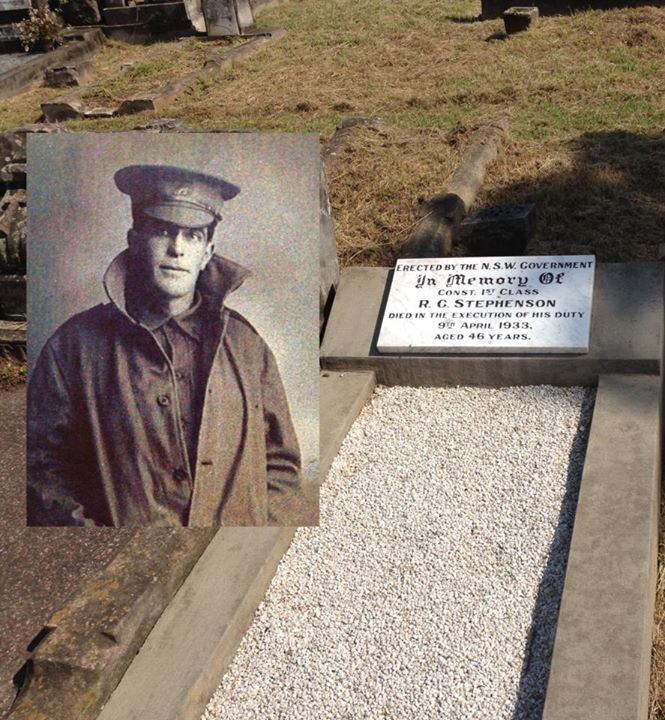
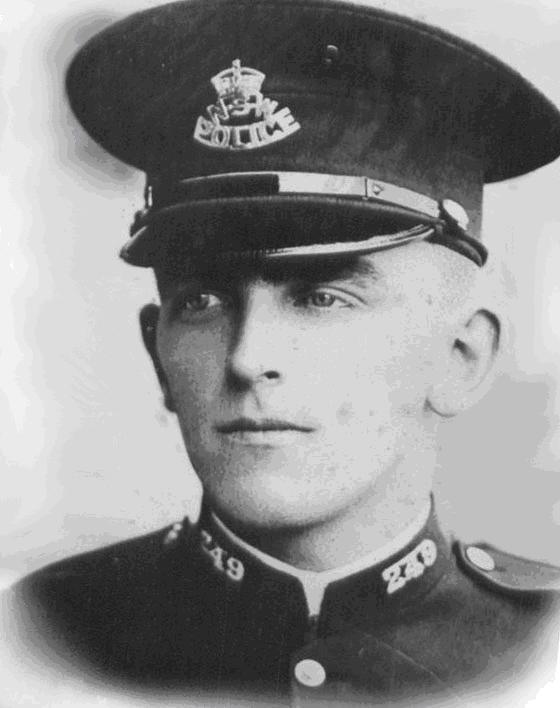
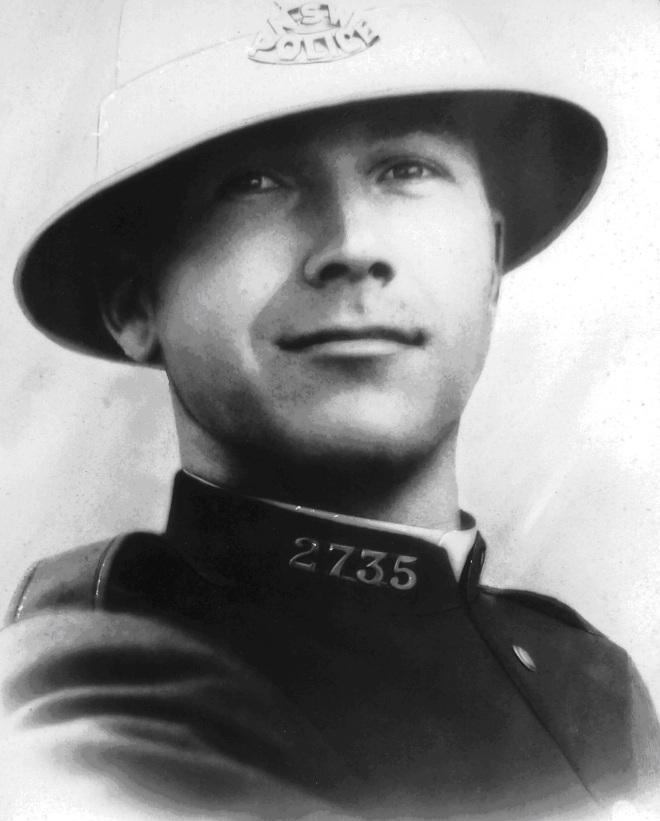
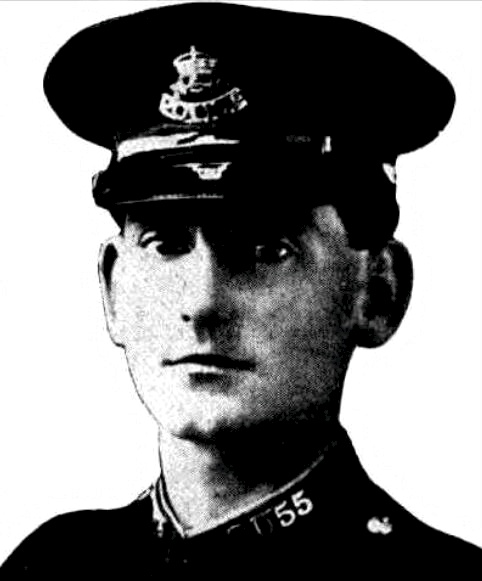
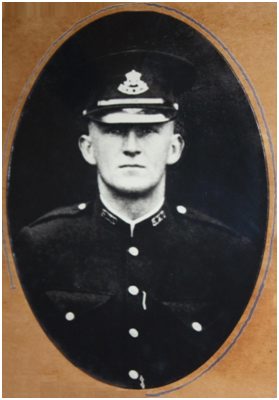
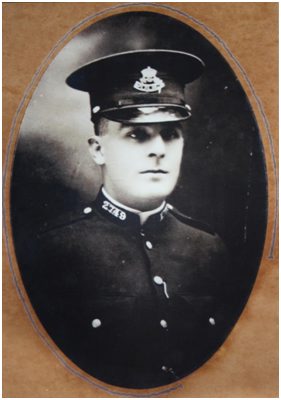
Ruston George STEPHENSON – NSWPF – Killed 9 April 1933
On 8 April, 1933 Constable George Stephenson of the Newtown Police Station travelled with a group of other police to the Newtown Stadium. They parked the police vehicle in Erskineville Road and as the constable stepped out from behind the car he was hit by a passing motor cycle outfit. Constable Stephenson sustained severe injuries and died in hospital the following morning. An 18 month old child passenger of the motor cycle outfit, Fay Joyce Moon, was also killed in the accident.
The Northern Standard newspaper dated 13 April, 1933 reported that “Constable Stephenson who was killed by a motorist while on duty, was a famous athlete, and had a distinguished war record, winning the D.S.O and Military Medal. Five hundred uninformed men spontaneously attended his funeral [in Sydney] today.”
The constable was born in 1886 and joined the New South Wales Police Force on 9 July, 1912. At the time of his death he was stationed at Newtown. He was awarded the Distinguished Conduct Medal during World War 1.
Ruston joined the NSW Police Force in 1912 and in 1916 enlisted in the army, later joining the fight in France during the First World War. He was awarded the Distinguished Conduct Medal for conspicuous gallantry in rescuing injured soldiers while under fire. Remarkably, when he returned home, he rejoined the Police Force and continued to serve until his death at the then Newtown Stadium while performing general duties policing.
[divider_dotted]
NEWTOWN LOCAL AREA COMMAND POLICE COMMEMORATION SERVICE
Ms CARMEL TEBBUTT (Marrickville) [7.07 p.m. 8 May 2013]: Recently at Rookwood Cemetery I attended a memorial service to commemorate police officers from the Newtown local area command killed in the line of duty. The moving service was attended by Deputy Police Commissioner Nick Kaldis, Superintendent Simon Hardman, the commander of the Newtown Area Local Command, many other police representatives, and relatives and descendants of the police officers. Those attendees included Ms Avona Wallace, Mr and Mrs Norman Stephenson, Mrs Lynette Everton and Ms Edna Stevenson. Representatives from the emergency services and community members were also in attendance. The member for Campbelltown, Bryan Doyle, attended representing the Premier.
The five officers being remembered at the ceremony gave their lives to protect the community. They were Constable First Class John Wallace, Constable First Class Ruston Stephenson, Constable Lionel Guise, Detective Inspector Reginald Stevenson and Constable Pashalis Katsivelas. The ceremony to mark the sacrifice of these officers reflected on the enormity of their contribution to the community, as well as the impact of their death on their families. It is often said, and it is true, that police officers leave their homes for each shift uncertain of what any day may bring and whether they will return at the end of the day. We owe these men and women our deepest gratitude for the risks they face and take every day in their job. At Rookwood Cemetery we visited each of the graves of those officers who lost their lives in the line of duty and behind each individual was an illuminating life story.
We began at the grave of Constable First Class Ruston Stephenson, who died 80 years almost to the day of the commemoration. Constable Stephenson joined the Police Force in 1912, and four years later enlisted in the army, later joining the fight in France during the First World War. He was awarded the Distinguished Conduct Medal for conspicuous gallantry in rescuing injured soldiers while under fire. Remarkably, when he returned he rejoined the Police Force and continued to serve until his death on 9 April 1933 after a tragic accident involving a motorcycle at the then Newtown Stadium while performing general duties policing.
We were also told the story of Detective Inspector Reginald Hugh Stevenson—I was honoured on the day to meet his widow, Ms Edna Stevenson, who still had strong memories of the incident that led to Inspector Stevenson’s death. Detective Inspector Stevenson joined the NSW Police Force as a cadet in 1943 at the age of 17. In an act of extraordinary selflessness, Detective Inspector Stevenson was on annual leave on 9 December 1974 when he decided to go to work to assist in the planned arrest of a dangerous offender in Newtown, at the time telling his wife, “I don’t want my boys doing this on their own.” During the operation he was shot in the chest after leading his team in pursuit of the offender.
Detective Inspector Stevenson partially recovered and was awarded the Queen’s Commendation for Brave Conduct and the Queen’s Police Medal for Distinguished Service. However, he died in 1980 of a heart attack, deemed to be the result of the injuries he sustained on duty in 1974. These officers are just a few of many across New South Wales whose lives have been cut short as they have gone about performing their duty. I pay tribute to them all. They will not be forgotten and local events such as this are a powerful reminder of their sacrifice.
I also take this opportunity to acknowledge two Marrickville police officers, Sergeant Stewart and Constable Steele, who on Monday of this week rescued an intellectually disabled person from a house fire in Marrickville. Thankfully, those two officers who took huge risks survived and are quite rightly being hailed as heroes by their colleagues and the community. It is yet another example of the risk our police men and women take every day in order to keep the community safe. I take this opportunity to pay tribute to them.
[divider]
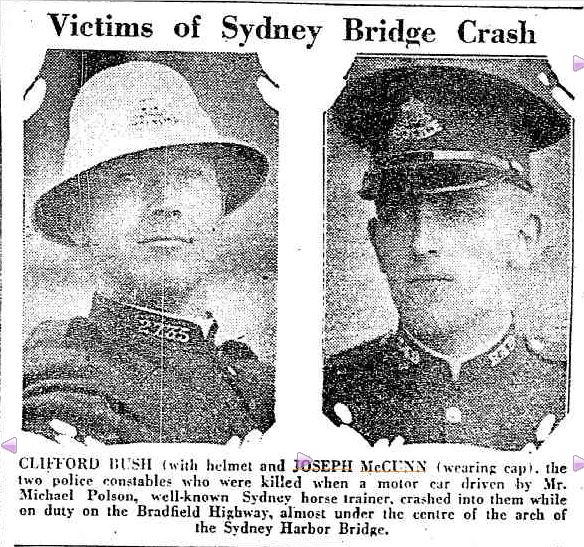
Joseph McCUNN & Clifford James BUSH
| 26/10/2012
Constable Joseph McCUNN
23 old
Constable Joseph McCunn
Constable Clifford James BUSH
26 old
Constable Clifford James BUSH
New South Wales Police Force
both Stationed: Clarence St Police Station
Struck by a Motor Vehicle
Dawes Point
Event & Death 5 August 1932
Funeral 8 August 1932
both buried, side by side, in the Church of England portion of Rookwood Cemetery.
On the evening of 5 August, 1932 Constables McCunn and Bush were performing special traffic duty at the southern end of the Sydney Harbour bridge. During the operation they were on foot and stopping passing vehicles, using a torch. A vehicle appeared travelling from the northern side of the harbour and was signalled to stop by one of the constables. The vehicle did not stop, however, and struck both constables with considerable force. Constable Bush died instantly and Constable McCunn died about an hour later at the Royal North Shore Hospital.
The Mercury newspaper of 9 August, 1932 described the funeral of the two constables as follows:
CONSTABLES’ FUNERAL – An Impressive Spectacle Viewed by 100,000 Persons.
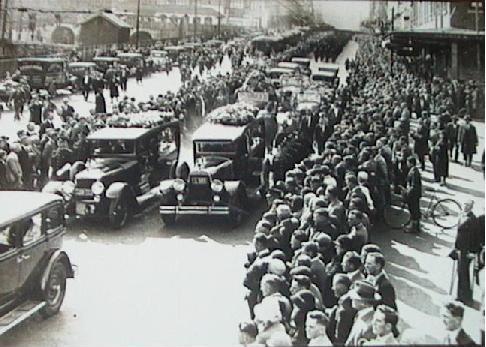
Sydney, August 8 – There have been few more impressive spectacles in Sydney than the funeral to-day, amid affecting ceremonial, of Constables Joseph McCunn and Clifford James Bush, who met their deaths in tragic circumstances while on duty on the Sydney Harbour Bridge, and whose remains were laid to rest side by side under great ramparts of beautiful flowers in the Church of England portion of the Rookwood Cemetery. Pathetic figures in the vast assemblage at the gravesides were the men’s widows, one of whom collapsed during the service, and had to be carried to her motor-car. One hundred thousand persons or more, with bared heads, viewed the long and impressive cortege. The police force was represented by 500 or more men and officers of all ranks. Among the others present was the ex-Commissioner of Police, Mr. James Mitchell.
Constable McCunn was born in 1909 and joined the New South Wales Police Force on 30 October, 1929. At the time of his death he was stationed at No. 11 Division ( Petersham ).
Constable Bush was born in 1906 and joined the New South Wales Police Force on 26 October, 1927. At the time of his death he was stationed at No. 1 Division ( Central Police Station ).
Constable Joseph McCUNN & Constable Clifford James BUSH funeral procession.
[divider_dotted]
The Sydney Morning Hearld
Saturday 6 August 1932 page 13 of 22
TWO CONSTABLES KILLED ON BRIDGE.
Car Driver Arrested
Two constables were killed on the Harbour Bridge last night, when a motor car which, it is alleged, they had signalled to stop, crashed into them.
They were:- Constable Clifford James Bush, 26, of the Clarence-street Police Station. Constable Joseph McCunn, 23, of the same station.
The driver of the car was subsequently arrested and charged with manslaughter.
The two police were on special patrol duty near the southern pylon shortly before 9 o’clock last night. They were engaged in checking the tail lights on passing motor cars and frequently stopped and cautioned motorists whom they considered were travelling at too fast a speed or were infringing any other traffic regulations. They were both standing in the centre of the bridge roadway, one watching in either direction. Traffic was exceptionally light at the time.
A large sedan car swung on to the bridge from the northern end, and the police watched the dazzling headlights crossing the harbour. As it approached them, one of the constable, the Police alleged, signalled the driver to stop. The car crashed into the two men, with a terrific jar.
TERRIBLE INJURIES.
The two police, it is assumed, were struck by the bumper bars of the vehicle, which were ripped off by the force of the impact. One constable was flung to one side of the roadway, and the other in the opposite direction. Bush was hurled bodily into the iron railing on the side of the bridge, and his body was found lying in a crumpled heap in the gutter. He had been terribly mangled. Both his legs were broken in two places, and the flesh had been shockingly lacerated. His head had struck the iron work, and he had died instantly.
His companion was lying on his back on the road. He had received frightful injuries to his body, concussion, compound fracture of both legs, and extensive abrasions.
Constable Pike, of the George-street North police, who was on duty at the toll office, saw the two bodies lying on the roadway. He rushed to the scene, and called an ambulance. He was more than 300 yards away from the two men when he noticed a motor car, the radiator of which had been crushed back against the engine, and the windscreen and lights had been shattered. According to his story, the three men inside the car were apparently unaware that they had hit anything. The engine was still running. All the men appeared to be dazed.
The two constables were taken to the Royal North Shore Hospital in the Central District Ambulance. Constable McCunn was admitted immediately for attention, but died later in the night.
The Metropolitan Superintendent of Police, Mr. Mackay, happened to be passing at the time, and attracted by the long queue of cars and onlookers, he pulled in to make investigations, and immediately took charge of the inquiries.
It was learned that the three occupants of the car, who are well-known city men, had been returning from a function at a North Sydney golf club when the accident occurred. They were taken to the George-street North police station for interrogation, and were later interviewed by the Commissioner of Police, Mr. Childs, and the Chief of the Criminal Investigation Branch, Mr. Prior. Detective-sergeant Almond and Detectives Alford, McDermott, Robinson, and Gregory were assigned to the case.
The victims of the tragedy, both of whom are married, will be accorded a police funeral.
MAN CHARGED.
Early this morning, Michael William Polson, of Cook-road, Randwick, was charged with having feloniously and maliciously slain the two policemen. He was admitted to bail in £100 on each charge. The police state that the other two men in the car were John Ferrier, of Manly, and Joseph Bannister.
TWO DEAD No Negligence COURT SEQUEL SYDNEY, Saturday.
At the Central Court today, Michael William Polson (48) appeared on a charge of having feloniously and maliciously slain Constables Clifford Bush and Joseph McCunn. He was also charged with having driven a motor car on Bradfield Highway in a manner dangerous to the public.
Detective-Sergeant Allmond said the two constables were on duty on the Harbour Bridge last night when the car failed to stop, and crashed into them. Both were killed. Witness said defendant was a well known man. He had an excellent reputation and a good record as a motor driver.
Mr. Dovey, for Polson, said It was a perfectly clear accident, in no way due to criminal negligence on the part of his client, ” who, more than anyone else, regrets the unfortunate happening. ”
Polson was remanded until August 22 on bail of £200.
TERRIFIC BLOW
Earlier Press reports of the double fatality show that it occurred with distressing suddenness.
The constable were patrolling the roadway of the bridge, Seeing the car approaching, they stepped towards the centre of the roadway, apparently to stop it. The car continued forward, and struck both constable. One was hurled 10 feet to one side, and the second policeman 20 feet on the other.
The force of the impact was so severe that the front portion 0f the car was badly damaged – the radiator was knocked out of position, the headlights were smashed, and the bumper bars torn off.
LYING ON ROADWAY .
Constable Pike, who was on patrol duty on the southern approach, did not actually see the accident, but observed two forms lying on the roadway, near the pylon. He ran forward, passing the car, which had come to a standstill, and picked up one of the constables. Realising that one was dead, and the other in a dying condition, he raced back to the police watch house to telephone for medical assistance.
The driver of the car, and two passengers, one of them an estate agent, and the other the father of a prominent golfer, accompanied the police to No. 4 Police Station, where they were questioned.
CONSTABLES CLIFFORD JAMES BUSH and JOSEPH McCUNN will leave the Private Mortuary Chapel of Mrs P Kirby and Son Ltd, 265 Elizabeth street Sydney THIS MONDAY at 1.15 p m for the Church of England Cemetery Rookwood. The Dean of Sydney Rev. Dean Talbot will conduct the services at the Chapel and graveside.
Mrs P KIRBY and SON LTD, Motor Funeral Directors
Phone M2221-2 265 Elizabeth street, Sydney
McCUNN
The Relatives and Friends of Mrs ELINOR McCUNN and ADRIAN are kindly invited to attend the Funeral of her dearly beloved HUSBAND and his FATHER, Constable JOSEPH McCUNN which will leave the Private Mortuary Chapel of Mrs P Kirby and Son Ltd, 265 Elizabeth street Sydney THIS MONDAY at 1.15 p m for the Church of England Cemetery Rookwood
Mrs P KIRBY and SON LTD
Motor Funeral Directors
Phone M2221-2 265 Elizabeth street Sydney
McCUNN – The friends of Misses ANNIE and JEAN McCUNN are kindly Invited to attend the funeral of their dearly beloved BROTHER Constable Joseph McCunn which will leave the Private Mortuary Chapel of Mrs P Kirby and Son Ltd 265 Elizabeth street Sydney THIS MONDAY at 1.15 p m for the Church of England Cemetery, Rookwood.
There have been few more impressive spectacles in Sydney than the funeral yesterday, amid affecting ceremonial, of Constables Joseph McCunn and Clifford James Bush, who met their deaths in tragic circumstances while on duty on the Sydney Harbour Bridge, and whose remains were laid to rest, side by side, under great ramparts of beautiful flowers in the Church of England portion of Rookwood Cemetery.
Pathetic figures in the vast assemblage at the gravesides were the men’s widows, one of whom collapsed during the service, and had to be carried to her motor car.
An unobtrusive figure in the assemblage was that of Mr. Michael W Polson, who was accompanied by Messrs. J. B. Ferrier and J. Bannister. The floral tributes, which were conveyed in several cars, and which were placed on one car in striking pyramidal form, included two massive wreaths from Mr. Polson.
One hundred thousand people or more, with bared heads, viewed the long and impressive cortege as it proceeded from Mrs. Kirby’s funeral parlours in Elizabeth-street, along that thoroughfare, under the railway bridge into Hay-street, and thence along Pitt street, and past Central Square to the Mortuary Station, en route to Rookwood, where there was another vast concourse. Drawn together by a common bond of sympathy, the spectators occupied every vantage point. From countless windows in the city, thousands of people momentarily stayed their daily course to watch the passing of the cortege.
As an imposing official ceremonial, impressive in the quiet dignity of its pageantry, it was a striking expression of a city’s sympathy and respect for two men who had died at their posts.
From the funeral parlours to the hearses, side by side, and through an impressive avenue lined by the police as a guard of honour, to the gravesides, six stalwart, broad-shouldered constables carried each of the coffins. Mounted constables headed the cortege. Then came the Police Band, with muffled drum; then a big detachment of uniformed police, and immediately in front of the hearses, the Deputy Premier (Mr. Bruxner) and the Chief Secretary (Mr. Chaffey), representing the State Government; the Commissioner of Police (Mr. Childs), and the Under Secretary.
Chief Secretary’s Department (Mr. Harkness). Walking on both sides and at the rear of the hearses were small detachments of police. Next came several cars laden with floral tributes; another long file of uniformed police, plainclothes men, police roundsmen, representing the Sydney Press; representatives of the Central District Ambulance ; a big body of Sydney’s fire fighters, whose helmets glittered in the bright sunshine, and the representatives of other allied establishments.
Every now and again there ran down the long line of officers and men the swelling and sinking notes of the Funeral March as the bandsmen walked with slow, measured steps behind the brilliant cavalcade of men sitting their horses like statues. Thus, amid striking manifestations of respect for their memory, were the two constables laid to rest, with the hymn “Abide With Me” being softly rendered.
The Police Force was represented by 500 or more men and officers of all ranks. Among the others present was the ex-Commissioner of Police (Mr. James Mitchell).
DEAN TALBOT’S TRIBUTE.
Dean Talbot, in his address at the graveside, said the city had been deeply grieved at the deaths of these two men; the scene that day was a touching expression of its sorrow. The men whose passing the city mourned were the representatives of a force which, with untiring vigilance, protected the lives and the property of the community. The police, in the execution of their duty, were frequently in danger, and were conspicuous in such circumstances by their heroism and bravery. The police of New South Wales had won the admiration of all law-abiding citizens, and it was in that spirit of admiration, mingled with feelings of sorrow, that the community had that day paid its striking tribute. Those whom they mourned that day had been taken with tragic suddenness. The community sympathised with their relatives, and trusted that God would comfort them in their great grief.
The chief mourners were the widows of the two men and their families, and a large number of relatives.
LARGE CROWDS Funeral of Constables HARBOUR BRIDGE SMASH SYDNEY, Monday. Thousands of people assembled in Elizabeth and Oxford Streets this afternoon, to witness the funerals of Constables Clifford James Bush and Joseph McCunn, who were struck by a car and fatally injured on the Sydney Harbour Bridge on Friday night. The crowd was so dense that traffic was disorganised.
After a short, impressive service in the chapel of the funeral parlours, the coffins were carried to the waiting hearses, and preceded by a detachment of mounted police, the cortege moved off for the mortuary station. Immediately behind the mounted police came the Police. Band, and 400 police representing all ranks. Among the members were the Commissioner of Police (Mr. W. H. Childs), the principal administrative officers in the metropolitan area, the Chief Fire Officer ( Mr. Nance ) and 100 members of the Metropolitan Fire Brigades.
The hearses travelled side by side, and were followed by six cars laden with floral tributes. Two magnificent wreaths were sent by Mr. M. W. Polson, the driver of the car which was involved in the fatal smash. Mr. Polson also attended the funeral. There was another large crowd at the Rookwood Cemetery. The Chief Secretary ( Mr. F. A. Chaffey ) and the Minister for Transport ( Mr. M. F. Bruxner ) represented the State Government.
BRIDGE LIGHTING RESTORED.
One result of the tragedy is that the authorities have directed that until further notice the bridge shall be fully illuminated. A few weeks ago the Transport Department issued instructions that the number of lights should be reduced by two-thirds in order to save £4000 a year in the cost of electricity.
At the Central Court, today, Michael William Polson, horse trainer, was charged with having feloniously slain Constables Joseph McCunn and Henry James Bush on the Harbour Bridge on August 9 and with having driven in a manner dangerous to the public.
He was remanded until August 30. It was stated that the coroner’s inquiry would be held on that day.
The Coronial inquiry commenced today into the deaths of Constables Clifford James Bush (26) and Joseph McCunn (23), who were killed on the Harbour Bridge on the night of August 5.
Michael Polson, horse trainer, who was charged with manslaughter, was present in court.
Detective Robinson told the court that Polson said to him, ” I didn’t see them. I did feel a bump and the car seemed to get out of control. I had difficulty in stopping. The light on the bridge is very bad, and I was not driving at more than 25 miles an hour. ”
Raymond Mcintosh stated that he noticed the two constables standing 10 to 12 feet from the railing. They were in the shadow between the lighted lamps, and appeared to be comparing notes, and not aware of the approach of the car. Witness said there was a crash, and he saw one of the constables hurled into the air.
The City Coroner (Mr. May) yesterday found that Constables Clifford James Bush and Joseph McCunn met their deaths from injuries accidentally received through being knocked down by a motor car on Bradfield Highway on the evening of August 5.
When Mr. Barry (for the police) stated that there was no further evidence to offer on charges of manslaughter and dangerous driving against Michael William Polson, the driver of the car, the coroner ordered that he should be discharged.
Mr. May said that no doubt the widows, with their children, would have the deepest sympathy of everyone. The two young constables had left their homes full of health, and in doing what they conceived to be their duty met an untimely end. He reminded them that Mrs. Bush was a widow for the second time.
He added that he considered that the Crown had taken the right course, but there was no evidence that Polson drove in a manner dangerous to the public or at a speed dangerous to the public.
Detective Robinson said he interviewed Polson and Ferrier and Bannister, who were with him, on the night of the accident. Polson said he did not see the constables. He felt a bump, and after that the car seemed to get out of control. He had difficulty in stopping the car, and when he did stop it Ferrier got out and went back. He returned and said there had been an accident.
Witness said Polson told him that he had been to the Manly Golf Club playing in a competition all day. They did not return direct from the golf club to the city. They stopped for about half an hour at Furlong’s Hotel. Polson told him he did not have a drink there, but the others might have had a couple.
Detective Robinson added: ” Polson said he was not going faster than 25 miles an hour at the time of the accident. He said he was not a fast driver. I asked him how he came to run the constables down. He replied that he did not know. He did not see them. The lights on the bridge were very bad. ”
“NO SIGNS OF LIQUOR.”
In reply to Mr. De Baun, for Mrs. McCunn, witness said he did not detect any sign of liquor on Polson when he saw him after the accident.
The following questions were asked Polson by Detective Robinson at an interview on the night of the accident, and were contained in a statement handed to the coroner:
” Your statement in respect to the amount of liquor you had is somewhat at variance to the statement by Mr. Ferrier and Mr. Bannister in respect to you having a drink at Furlong’s Hotel on the way from the club – Mr. Polson: I may have had a lager there, but I am sure I did not have two lagers. They may have been paid for, but I did not have them.
Did you purchase the two bottles of liquor which were in your car at the time of the accident? – No. I did not. They do not belong to me.
Mr. Ferrier states that you purchased the liquor at the club-house about 7 p.m. – Polson ( to Ferrier, who was present at the interview ) : I am sure you are making a mistake. I had no need to purchase liquor.
Raymond Edgar Mcintosh, engineer, said he was driving across the bridge in the direction of Newcastle on the night of the accident. The constables were standing together in a shadow between two lighted lamps. Witness was 50 yards away when he first noticed them. He saw their faces, which appeared like two discs suspended in the air. A second or two later he realised they were policemen.
Witness said he noticed a car approaching from the north end of the bridge. The constables had their backs to it. They seemed to be unaware of the approach of the car, and witness realised that an accident would be certain. There was a crash, and he saw one of the constables being hurled in the air. At the time of the accident every third light on the bridge was lighted. The car which struck the policemen continued on for 100 or 150 yards before pulling up.
SUPERINTENDENT MACKAY.
Superintendent Mackay said he questioned Polson on the bridge, and added: “I said to Poison, ‘It appears to me that you have had a drink.’ He said, ‘Yes; I have been to the Manly Golf Club, and had a couple of lagers there.’ I then said to Bannister, ‘You also appear to have partaken of drink.’ He said, ‘Yes, I was with Polson at the golf club. We had a presentation there. Afterwards we had some drink.’ Ferrier did not appear to have had drink, and I did not question him. I said to Polson, ‘What speed were you doing?’ and he replied ‘Between 25 and 30 miles an hour.’ I said to him, ‘Did you not see the constables?’ and he said, ‘I did not see them, and I was looking ahead at the time. I had no idea I struck them. This is a dreadful affair. I wish to – the bridge had not been built.’ ”
Witness said he asked Polson and the others questions in the presence of Dr. Angus Murray. Afterwards he took Dr. Murray aside, and the doctor said to him, “They have had drink, but in my opinion they are not under the influence to such an extent as to render Polson incapable of driving a car.”
Witness added that when he (witness) was on the bridge the visibility was bad. Extra caution should have been taken in driving a car on the bridge on that night.
Bannister told witness that he thought a piece of the bridge had fallen on them.
In reply to Mr. Dovey (for Polson), witness said the observant motorist would have seen the constables as objects rather than as men. Any speed over 25 miles an hour was excessive on that night. The proper speed was between 15 and 20 miles an hour.
Superintendent Bennetts said the constables had received their instructions. Their duties should not necessarily have brought them together. All traffic constables were issued with white gloves, but he did not know whether the two constables had them on on the night of the tragedy.
Constable Charles Ernest Pike, who was on duty at the bridge on the evening of August 5, said he approached a car driven by a man he now knew as Polson. The engine of the car was racing and the car was moving slowly ahead. Witness applied the hand brake, and asked Polson where he was going. He replied that he was going home. Witness asked Polson if he knew there had been an accident. Polson replied that he did not, and asked where it was. A man he now knew as Bannister, who was in the back of the car, said there was a bump, but he thought it was only a rise in the roadway.
Witness added that the men in the car, with the exception of Polson, smelt strongly of intoxicating liquor.
CLASH WITH WITNESS.
Edward Hatton, taxi-driver, said he crossed the Harbour Bridge between 8.45 p.m. and 9 p.m. on the evening of August 5. He said he saw the constables 60 or 70 yards away. He saw another car approaching him.
Mr. Barry: Did you tell Detective Robinson that that car was travelling at 60 to 70 miles an hour? – Perhaps I did.
To the Coroner witness said the car was travelling at a good speed.
In reply to Mr. Dovey, witness said he called on Mr. Polson on the night following the bridge tragedy.
Mr. Dovey: You told him you could do him a lot of good and a lot of harm?
Witness: I did not.
Did you tell him you were broke? – No.
Are you broke? – No. I have a bob or two.
After that, you called on Mr. Hickey at his office? – Yes.
Uninvited? – No.
Witness said he did not call on Mr. Polson unasked.
Mr. Dovey: Who Invited you to call on Mr. Polson? – I do not know the man’s name.
You were ordered out of Mr. Hickey’s office?
– No, I was not.
You telephoned me at my private home?
Yes
Didn’t I tell you I thought you were a bad man, and would have nothing to do with you? – Yes.
Later, you came out to my home? – Yes.
And I told you I thought you were a blackmailer? – Yes.
And I threatened to get the police? – You had a stick: otherwise I would have punched you on the nose.
Have you ever been convicted? – That has nothing to do with the case.
Then, Mr. Dovey said (to the Coroner) : “I say openly in this court that the witness is nothing more or less than a blackmailer.”
Detective Robinson, recalled, said the white gloves of the constables were found in their bags at one of the toll houses.
To Mr. De Baun, John Ferrier, secretary of the Manly Golf Club, said he was of the opinion that the car was not travelling at more than 20 miles an hour. He knew that something had happened when the glass on the windscreen broke and pieces flew over Bannister and himself. Polson immediately began to pull up and came to a stop 80 to 100 yards away. Witness got out of the car and ran back. The liquor found in the car was purchased by him.
Mr. Dovey: Were you perfectly sober? Witness: Perfectly.
Joseph Bradshaw Bannister, bookmaker, said he was with Polson in the front of the car. He estimated the speed at between 20 and 25 miles an hour.
Mr. Barry appeared for the police to assist the coroner; Mr. W. R. Dovey (instructed by Messrs. John Hickey and Quinn) appeared for Polson; Mr. De Baun and Mr. Leonard ( instructed by Messrs. McCulloch and Buggy ) for the relatives of Constable McCunn; and Mr. Buggy for the relatives of Constable Bush and the Police Association.
POLICE FUND Under the direction of Superintendent Mackay and Sergeant Lendrum, the fund to buy homes for the widows of Constables McCunn and Bush, who were killed by a motor car while on duty on the bridge, is growing rapidly. Receipts already total £300.
In 1931 Constable Nowland was the lone policeman attached to the Bendemeer Police Station. On the night of Sunday 4 October, 1931 a man came to the station to complain that he had been camped under the bridge at the river and had been accosted by a “madman” who had threatened to kill him. He requested that the constable come down to the bridge, which was at the McDonald River, a distance of less than 300 metres to look for the madman. The constable obliged, however after a brief search under and around the bridge, the alleged “madman” could not be found. The following night the man again came to the police station with the same complaint. (It was believed to have been the same man both nights as Mrs Nowland heard his voice on both visits, although she never actually saw him). The constable took his revolver and set out to search the bridge area again. When he failed to return home by the morning Mrs Nowland telephoned the police at Tamworth.
Police from Tamworth quickly travelled to Bendemeer and, with the assistance of an Aboriginal tracker, began to search for the missing man. Later that afternoon Constable Nowland’s body was found and recovered from the McDonald River. He was still fully clothed, except for his cap, and the body had no apparent signs of violence, although apparently the constable’s nose had been bleeding before he fell or was thrown into the water. At the spot where the body was found the water was only three to four feet (about 1 metre) deep.
The Brisbane Courier dated 7 October, 1931 reported that “The police believe that Nowland was insensible or dead before he entered the water. It is thought that Constable Nowland did not reach the bridge last night. His way would have taken him past a hotel, and beneath brilliant lights, and it is considered that he would certainly have been seen had he gone direct to the bridge from the police station. It is thought probable that he was attacked almost as soon as he left the police station, and was then taken to the river and thrown into the water insensible. The police are handicapped by the absence of any description of the man who twice called at the police station and spoke of the lunatic. Constable Nowland was the only one who saw him.”
The Sydney Morning Herald of 10 November, 1931 reported the open finding of the inquest into the constable’s death, as follows.
“BENDEMEER MYSTERY – CORONER’S OPEN VERDICT.
TAMWORTH. Monday.
The inquest into the death of Constable Nowland, whose body was found in the McDonald River on October 5, came to an end to-day, when the coroner (Mr. Geikie, P.M.) returned an open verdict. Six sessions of the inquest have been held, and 24 witnesses have been examined. In delivering his finding, Mr. Glekie said that the case was marked by many conflicting and mysterious statements. If it was suicide, then the deceased must either have been sane or insane. If he was sane, the first thing was to look for the motive, and the evidence adduced no such motive. If he was insane, no motive need be looked for. There was not a tittle of direct evidence of mental derangement in the constable up to the time of his death. His finding would be that Nowland was found dead in the McDonald River without any marks on the body; further, that death was due to drowning, but how or by what means drowning came about the evidence did not say.”
The mystery of what exactly happened to the unfortunate Constable Nowland has apparently never been solved, although theories ranging from suicide to poisoning to murder have long been put forward. A coroner’s inquest into the death gave the cause of death as drowning, however the surrounding circumstances remain unknown.
The constable was born in 1901 and was aged 31 years when he died. He joined the New South Wales Police Force on 25 August, 1922. At the time of his death he was stationed at Bendemeer. He is not listed in the official New South Wales Police Honour Roll.
[divider_dotted]
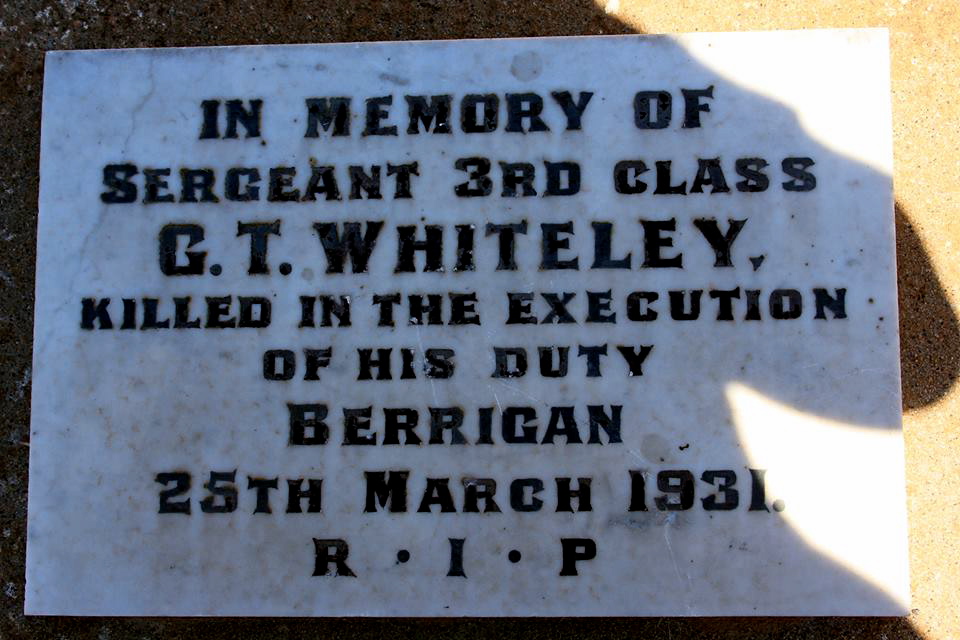
George Thomas WHITELEY
| 26/10/2012
George Thomas WHITELEY
AKA ?
Late of ?
NSW Penrith Police Academy Class # ? ? ?
New South Wales Police Force
Regd. # ‘Q‘ 9081
For the purposes of this website ‘Q‘ represents those Police joining between 1862 ( commencement of NSWPF ) – 23 February 1915 ( Commencement of NSWPF current numbering system )
Rank: Constable ( Mounted Police Trooper ) – appointed 15 March 1910
Sergeant 3rd Class – appointed ? ? ?
Final Rank = Sergeant 3rd Class
Stations: ?, Hill End ( Constable – 1913 ), Fifield ( SenCon 1920 ), Berrigan ( 2 years ) – Death
Service: From 15 March 1910 to25 March 1931 = 20+ years Service
Embarkation: 201014 at Sydney on H.M.A.T. A14 ‘Euripides”
Age at embarkation: 25 yrs 10 mths
Occupation: Mounted Police Trooper
Address: Bega
Next of kin: Father: George Edward WHITELEY – A farmer
Religion: Roman Catholic
Single / Married: Single
Returned to Australia: 191018 from Plymouth, England on D24, “Sardinia”
Awards: 1914 /15 Star, Returned Solider badge # 87105
Injuries: gunshot ( shrapnel ) wound to lower lip – 130515. 9 days under treatment. Gunshot wound to left leg, left foot & right side of head. He stated that while serving in Gallipoli, he suffered from indigestion for the first time and has suffered on and off whit it ever since. In the past twelve ( months ) the attacks of pain with occasional vomiting have been more frequent…. Twelve days before admission and on the 5th July, he vomited about a couple of pints of blood.
Attributable to service during war and active service conditions in Gallipoli.
Discharge #: 56009
Previously Served in the Colonial Force.
Description: 5′ 8″ tall, fair complexion, blue eyes and fair hair. Chest = 34.5 – 40″. 11 stone 12 lbs. No marks on body.
[/blockquote]
Sgt George Thomas WHITELEY ( 29 old ) of 1st Division H.Q., ( The Hutment Camp, Abbotsbury Rd, Wyke Regis, U.K. married Kate HARPER ( 22 old ), Spinster of 2 Block A, The Flats, Tidworth, England ( occupation: Clerk ) at St. Augustine’s Chapel, Dorchester Rd, Melcombe Regis, Weymount, England by Roman Catholic Priest Thomas Sheehan on the 3 October 1918. Registrar’s Reference # 80.
In 1936 – after the explosion, his wife was living at 134 Railway Pde, Carlton, NSW. This address ( 2019 ) is / was the Westpac Bank, Kogarah.
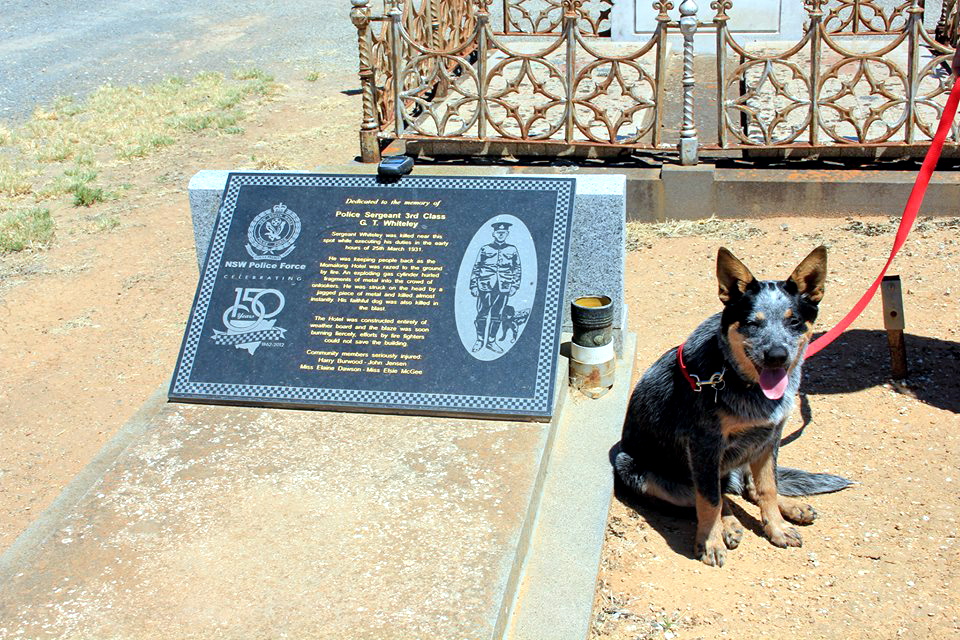
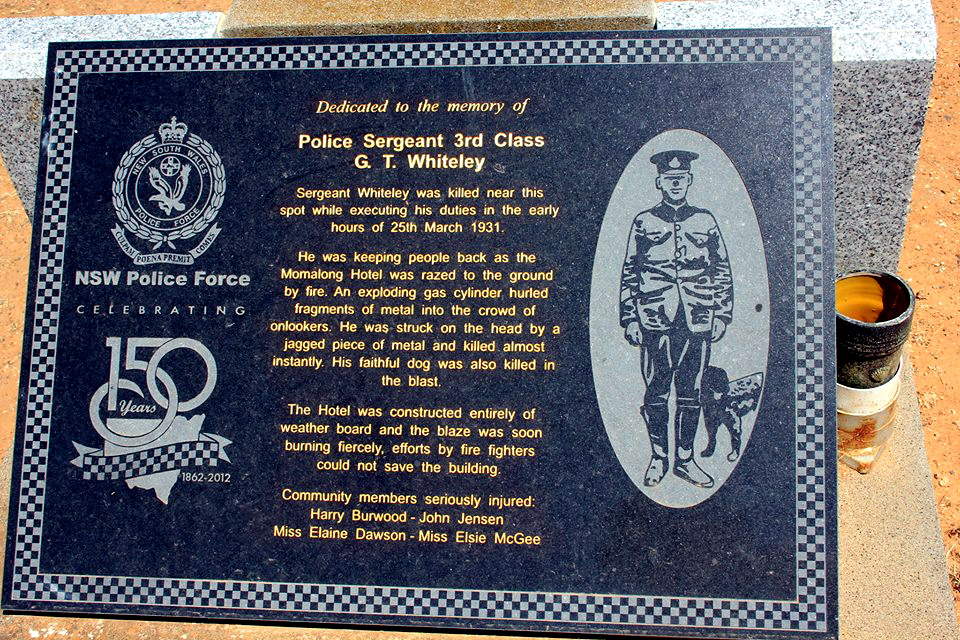
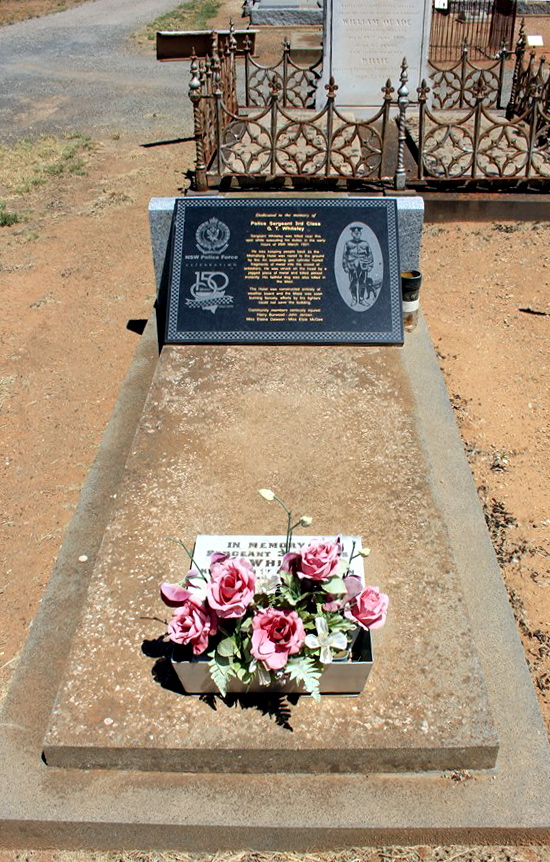
About 4am on 25 March, 1931Sergeant Whiteley and Constable McRae attended a fire at the Momalong Hotel, Berrigan.
During the fire both police officers were standing on the roadway outside the hotel when a gas cylinder exploded and a piece of flying metal struck the sergeant in the face, causing “injuries of a terrible nature” and killing him instantly.
Three bystanders (of an estimated two thousand who were watching the blaze) were also badly injured in the blast and another five were hit by flying steel, however all others recovered.
The sergeants faithful dog, which was standing beside his master, was also struck by flying debris and killed instantly.
The Canberra Times of 26 March, 1931 carried the following account of the incident.
FATAL EXPLOSION IN FIRE AT BERRIGAN. Police officer killed by flying steel.
Sydney, Wednesday.
The explosion of a gas cylinder occurred during a fire at the Momalong Hotel, Berrigan. Within a few minutes the entire population had turned out. The flames spread with great rapidity. The occupants of the hotel made a speedy exit. When the cylinder exploded with a terrific roar, Sergeant Whiteley and Constable McRae were standing in the centre of the roadway. A piece of steel became embedded in Whiteley’s head. He was quickly conveyed to a local surgery where life was pronounced extinct.
Michael Hurood, Elsie McGee, and Elaine Dawson were struck by flying steel and badly injured about the body. They are expected to recover.
A bucket brigade did splendid work.
More than two thousand persons turned out to watch the fire, but when the explosion occurred there was a wild dash for safety.
Whiteley, who was 41, suffered injuries of a terrible nature, while a dog standing beside him was killed instantly.
Five other men were hurt by flying steel.
Whiteley was married with five children.
The sergeant was born in Bega in 1886 and joined the New South Wales Police Force on 15 March, 1910.
At the time of his death he was stationed at Berrigan.
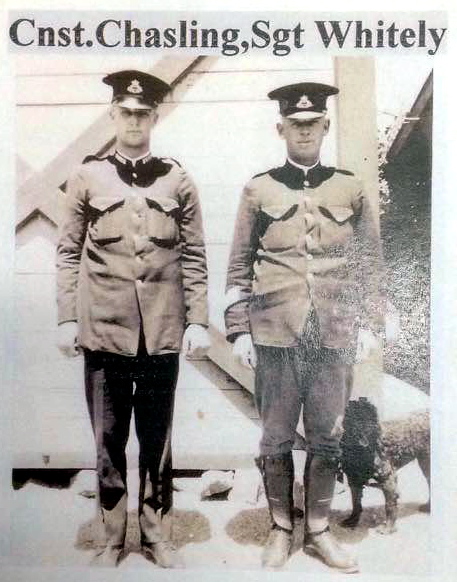
Constable Chasling & Sgt Whitely ( Whiteley ) at Berrigan Police Station. And, no doubt, the “faithful dog of Sgt Whiteley” also killed in the explosion.
Western Argus ( W.A. ) Tuesday 31 March 1931 page 13 of 36
GAS CYLINDER EXPLODES POLICE SERGEANT KILLED. DISASTROUS FIRE AT BERRIGAN. Sydney, March 25.
A police sergeant was killed, three people were hurt and nearly 1000 others scattered in terror when, during a fire at the Momolong Hotel, Berrigan, a gas cylinder exploded. The dead man is Sergeant C. George Whitley (41) married, with five children.
Whitley saw service at the war, and was at the Gallipoli landing. Mick Hurwood, Miss McGee and Miss Elaine Dawson ( was a former Echuca girl, living in High Street ) were injured by flying fragments of steel and wood. The two girls were taken to hospital.
The entire population of 2000 turned out when a fire engine rushed up the main street at 4.30 a.m. Hundreds of people assisted the firemen in trying to quell the outbreak, but the hotel was burned to the ground. In the hotel was a 40 lb. gas cylinder, which exploded during the height of the blaze. With a terrific roar it burst into flames, and sparks shot high in the air. The crowd scattered in terror. Whitley and Constable McRae were standing in the middle of the roadway assisting the fire fighters when there was a yell from the crowd. “Look out,” shouted a number of men, and they and the police ran for safety. McRae tried to catch hold of Sergeant Whitley and threw himself flat on the ground. A piece of steel, became embedded in Whitley’s head. McRae was not injured. Pieces of steel and wood cut their way into Hurwood’s leg, and the two girls were hurt about the body. They are expected to recover. The cause of the fire is unknown. Residents of the hotel hurriedly left the building, which was a single storied one, when the outbreak occurred.
Daily Standard (Brisbane, Qld. : 1912 – 1936), Thursday 26 March 1931, page 9
POLICE SERGEANT KILLED BY EXPLOSION
FIRE BURSTS CYLINDER.
SYDNEY, Wednesday.
Police-sergeant George Thomas Whitley, 41, married, with five children, was killed, three persons hurt, and about 1000 others scattered in terror this morning, when, during a fire at the Momolong Hotel, Berrigan, a gas cylinder burst.
A fire broke out at 4.30 o’clock, and the entire population turned to in an effort to save the hotel. Nothing, however, could be saved, and the hotel was burnt to the ground, though adjoining premises were saved from destruction.
There was a 40lb cylinder of carbonic acid gas in the hotel, and during the fire this exploded with a terrific roar.
Sergeant Whitley was standing in the roadway with Constable McRae when the cylinder burst. McRae threw himself to the ground, endeavoring to pull Whitley with him, but a piece of steel embedded in Whitley’s head, killing him instantly.
Michael Hurwood, Elsie McGee, and Elaine Dawson were injured about the legs and body by flying steel, all being seriously hurt. They were taken in motor cars to Corowa Hospital.
Whitley was a well-known and popular officer, aged 43, and joined the force 21 years ago.
NSW Government Gazette – issue 108, page 3292. Friday 4 June 1920
Electoral Appointments
Second Class Constable George Thomas WHITELEY, Fifield ( near Trundle ). – Electoral District: Murrumbidgee – Polling place: Fifield In lieu of McLean – on leave. To take effect on 22 March 1920
Bathurst Times (NSW : 1909 – 1925), Wednesday 8 January 1913, page 4
POLICEMAN ASSAULTED.
CASE AT HILL END.
HILL END, Tuesday.
Considerable interest was centred in the local Police Court proceedings on Saturday morning, when Vivian Clyde Cook, a resident of Hill End, was charged with assaulting Constable George Thomas Whitley while in the execution of his duty.
The accused was represented by Mr. Casey, solicitor, from Orange, and Inspector Rank appeared for the police.
The facts of the case as stated by Constable Whitley were that on New Year’s night he was in Clarke-street when he heard the Roman Catholic Church bell ringing. He hastened away to the church, and when near there heard stones being thrown on the church. He also saw three men running away.
Witness and Constable Creevy gave chase. After running about 400 yards he came up with one of them, whom he recognised to be the accused. Witness said, “Alright, Cook, I will give you a summons for this.” Then he turned to run after the other two. When he had gone a few paces he was hit on the head with a stone, which knocked him down on the ground. He got up again quickly, and saw the accused lying on the ground, he also heard him saying someone had hit him.
Then witness and Creevy arrested Cook, and locked him up for the night.
Dr. Michael John Ryan stated that about 2.30 on New Year’s morningConstable Whitley was brought to him suffering from a severe wound on the head. He dressed the wound and put in two stitches. The wound was about a quarter of an inch from the temple.
The doctor said that he considered the constable was out of danger, but Constable Whitley could not go on duty for at least one week yet.
At this stage, Mr. Casey, solicitor, made a very strong appeal to the P.M. not to send the accused to gaol.
He pointed out that he had never been before the Court before; that he was a hard-working young man; that he was extremely sorry for what he had done, and that he belonged to a very respectable family.
There were a number of young men, most of whom were in the Court, at the time, who had made up their minds to give the police all the trouble they could. They were known as the “Kelly Gang.”
The police had had no trouble whatever with anyone.
The P.M. said that the case was a very serious one indeed, and on hearing the doctor’s evidence he had made up his mind to send accused to gaol.
The accused promised to be of good behavior.
The P.M. then imposed a fine of £15 and £3/4/ costs.
Four days were allowed in which to pay.
Two other charges— one for insulting language and the other riotous behavior were withdrawn.
Served: From 14 May 1926 & Resigned then rejoined on 26 September 1928 to 3 January 1931 = 3+ years Service
Awards: No find on It’s An Honour
Born: ? ? 1901
Died: 3 January 1931
Age: 29
Cause: Shot – Murdered at Bondi Junction
Funeral date: 5 January 1931
Funeral location: Rookwood Cemetery
Buried: Buried in Rookwood Cemetery ( side by side with Ernest Andrews )
Zone: C Section: 09 Grave 4212
DOUBLE POLICE MURDER
Memorial location:
Constable Norman Thomas Allen ( 1931 )
Constable Ernest Andrews ( 1931 )
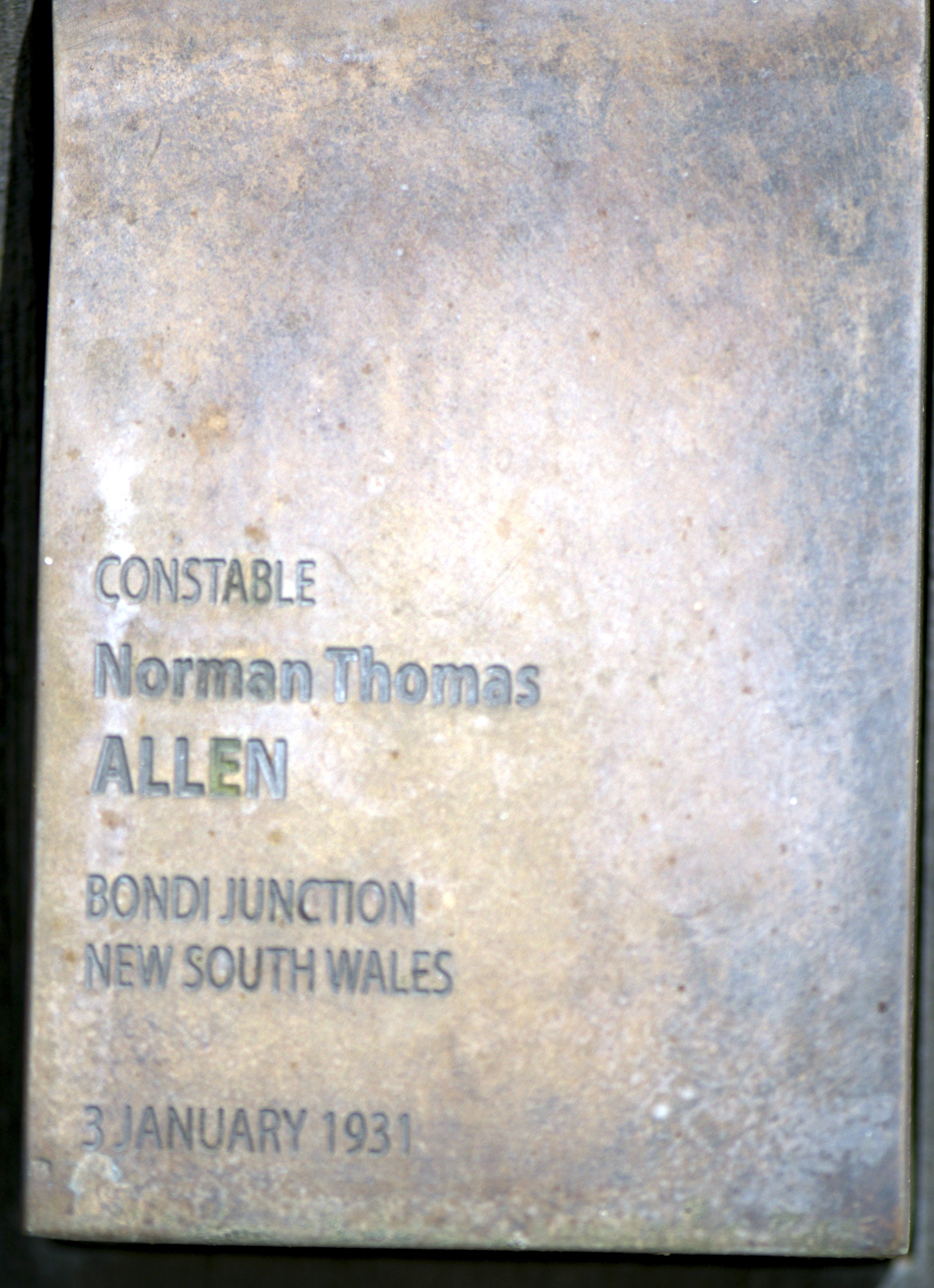
Norman Thomas ALLEN touch plate at the Australian National Police Wall of Remembrance
[alert_green]NORMAN IS mentioned on the Police Wall of Remembrance[/alert_green]
Constable Allen was shot in the street at Bondi Junction while attempting to detain an armed, deranged man named Kennedy who had earlier had an altercation with a local shopkeeper. The constable had been directing traffic and when informed of the dispute he found and confronted the offender. As he approached Kennedy from behind, the man spun around and shot Constable Allen in the chest at point blank range. He then shot the constable twice more in the heart. At this time Constable Andrews – unarmed, off duty and heading for the beach – passed by in a tram and saw a crowd gathered around the body of Constable Allen. Alighting from the tram he joined in the pursuit of Kennedy who managed to reach his home in nearby Lawson Street.
On arriving and finding the front door locked Constable Andrews went to the rear of the dwelling and burst through the back door. Unfortunately Kennedy was waiting with rifle raised and as Andrews lunged at him he shot him twice in the chest. He then took a knife and stabbed the constable in the throat. Sergeant Seery and Constable Johnson from Waverley Police then arrived and began to smash their way in through the front door. Although fired at by Kennedy, Constable Johnson returned fire, hitting Kennedy in the chest. Seery and Johnson then smashed their way in and found the offender in a bedroom bleeding to death. He died that night.
In the aftermath of the murders, the Brisbane Courier dated 5 January, 1931 published a complete account of the entire incident, and concluded with the following.
COMMISSIONER PRAISES MURDERED POLICE.
Both murdered constables were highly efficient and popular officers. Allen leaves a widow and young child. He lived in New Street, Bondi. Constable Andrews was single, his only relative in Australia being a sister, Mrs Clark. The men will be buried tomorrow with full police honours. The Commissioner of Police Mr. Childs, in an appreciation, said “I wish to pay a tribute to the manner in which both these young men carried out their duty according to the best traditions of the service. They saw their duty before them, and did not hesitate a moment in the execution of it. Although I would not make any distinction between them I cannot help referring to the action of Constable Andrews, who, though unarmed, rushed in to effect the arrest of a man who had already shot Constable Allen. “
Constable Norman Thomas ALLEN was born in 1901, joined the New South Wales Police Force on 14 May, 1926 and shortly thereafter resigned. He rejoined on 26 September, 1928. At the time of his death he was stationed at Waverley.
Constable Ernest ANDREWS was born in 1908 and joined the New South Wales Police Force on 24 April, 1929. At the time of his death he was stationed at George Street North Police Station.
[divider_dotted]
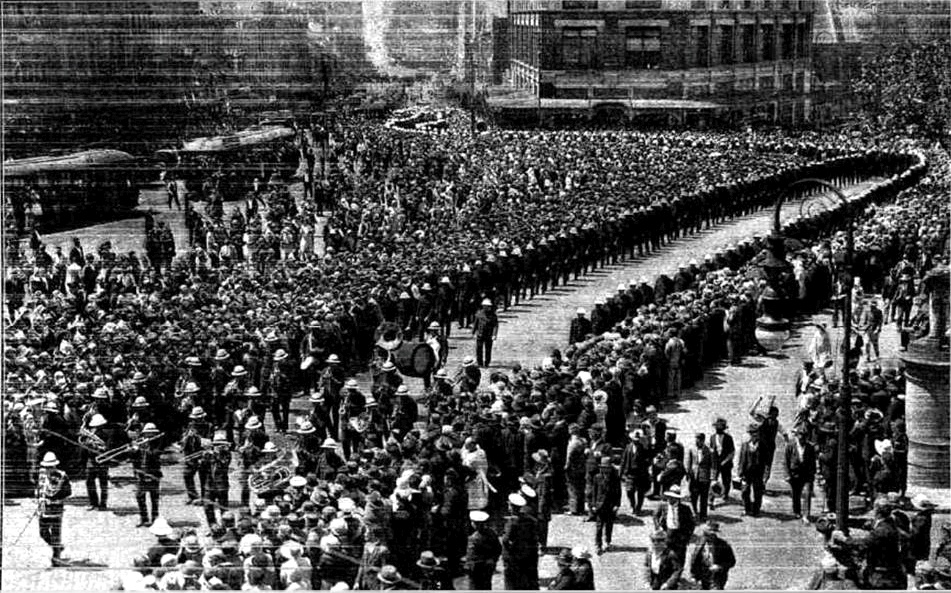
Funeral procession through Railway Square in 5 January 1931 for two police constables, Allen and Andrews, killed in the line of duty. Source: Sydney Mail newspaper 7 January 1931
[divider_dotted]
The Sydney Morning Herald Tuesday 6 January 1931 page 10 of 14
DEAD POLICEMEN.
Impressive Scenes at Funeral.
THOUSANDS PAY TRIBUTE.
The State paid homage yesterday to the two policemen, Constable Norman Thomas Allen and Constable Ernest Andrews who met their death at the hands of a madman at Bondi Junction on Saturday. There were mourners from almost every part of New South Wales.
Many thousands lined the route as the funeral cortege moved from Wood Coffill’s funeral parlours George-street to the mortuary station; the mortuary platform was thronged when the funeral train moved off to Rookwood and thousands had assembled in the cemetery.
The scene in the vicinity of Wood Coffill’s funeral parlours is likely to be remembered by the thousands of people who thronged the streets leading into Railway-square. Early in the morning bearers of wreaths and floral tributes passed through the doors to deposit their tokens of sympathy. At the approach of noon people began to assemble on the footpath and many entered the chapel to view the coffins. The near relatives arrived at 1 o’clock and the chapel was cleared while Constable Allen’s widow and her mother approached the silver mounted caskets which rested on trestles side by side. An affecting scene followed. Then the simple Church of England burial service was conducted by the Rev Frederick Riley and the coffins were borne to the waiting hearses.
MUFFLED DRUMS
The scene was unforgettable. A solid mass of people crowded the thoroughfares. Presently the mounted troopers urged their restive horses forward and with the deep roll of muffled drums the cortege moved off. Thousands of hats were removed.
Handel’s Dead March in “Saul” was played by the Police Band. Behind the band came a contingent of foot police under the direction of Superintendent Leary. Two hundred men drawn from the various stations, marched behind. Then came the hearses, the wreath-laden carriages, and the chief mourners, Firemen, the sun glinting on brightly-polished helmets, were represented by over 40 uniformed officers and men. At the end of the slow-moving procession came numbers of retired men, friends of the dead officers, and business people from the eastern suburbs.
Along the route to the mortuary thousands stood bareheaded as the cortege passed. At the mortuary gates another huge crowd paid tribute to the dead men.
Among those who marched in addition to the police and firemen, were employees of motor bus companies in the eastern suburbs.
“THEY SAW THEIR DUTY.”
A most affecting scene at the graveside in the Church of England section of the Rookwood Cemetery was the playing by the police band of the hymns “Lead Kindly Light” and “Abide With Me.” The remains were buried side by side.
“Let men’s opinions be what they may,” said the Rev. Frederick Riley in an address at the graveside, ” we should be doing violence to the most sacred emotions of human life if we were to allow our brethren to depart without a word of farewell. We are met here today to pay honour to the memory of two men who were comrades of yours men whom we all respected and loved. Let us remember that these two men died in the carrying out of their duty. They served their King and country as men and soldiers who fall for their King on the battlefield. They saw their duty and the fear of death could not deter them. They have not created a new tradition for the traditions of the police force of New South Wales are amongst the highest in the world already, but these two men have added a new lustre to the traditions of your past. These two young men Norman Thomas Allen and Ernest Andrews, died in the execution of their duty. There is no higher glory to which a man can aspire. We pray to God that those who have been so suddenly bereaved may share the comfort which we know these two brave men are experiencing in the nearer presence of God.”
MAGISTRATE’S TRIBUTE
At the Burwood Police Court yesterday Mr. G. R. Williams, S.M. commented on the bravery of the two constables. They acted nobly and upheld the traditions of the force,” he said.
PALL BEARERS AND MOURNERS.
The pall bearers were.- For late Constable Allen: Constables Tomkins, Martin, Moore, Hudson, Steele and White. For late Constable Andrews: Constables Booth, Kimber, Fraser, O’Neill, Morgan, and Wright.
The principal mourners were Relatives of the late Constable Allen: Mrs Allen (widow), Mrs Prankish (mother-in-law), Mr and Mrs N. Frankish (brother In law and sister in law), Mr and Mrs Sutcliffe (uncle and aunt) Mrs Lamb, Mrs Hourigan, and Mrs Cummings (aunts) and Mr Rowland Allen (cousin).
Relatives of the late Constable Andrews: Mr and Mrs Edward Clarke (sister and brother in law).
The Government was represented by Mr Gosling (Chief Secretary) and Mr McKell (Minister for local Government). Police representatives in addition to the non commissioned officers and men who marched were Mr W H Childs (Commissioner) Superintendents Leary, Mackay and Linegar, Inspectors Winter, Weir, Bennetts, McCauley, Woodrow, Lynch, Duffell, Roberts, McMaster, O’Brien, Chaseling, Anderson, White, Long, Roser, Scott, Michaelis, Robson, Allen, Farley and Fowler.
Retired members of the police force who attended were ex-Commissioner James Mitchell, ex-Superintendents Roche, Cook, McIntosh, Sinclair, Thom, Drew and Park, ex Inspectors Fullerton, W J Jones (also representing the Navy and Army Veterans Association) Fraser, Tracey, Bolton, Smith, Fewster, Doran, Mankletow, Stutchbury, Briggs, Ewen, Dunn, O’Dea and Robertson, ex-Sergeants McDonald, T. Dobson, Payne, A. Smith, Taylor, J. Salmon, J. Loomes, R. C. Harper, Bath and Butcher, ex-Constables Swan and Dixon.
The Board of Fire Commissioners of New South Wales was represented by Mr T J Smith, M.L.C. (president) Mr J McNamara (Commissioner), and Mr H M Webb (secretary and executive officer).
Mr Nance chief officer New South Wales Fire Brigades was present and 38 men marched under Mr Grimmond (deputy chief officer). Inspector Neeve, District Officer McLachlan, and Station Officers Arthur, Neville, Parkes, McCarthy, Rust, Currier and Sclater.
Others who attended were:- Judge Sheridan, Mir George Cann, ex M.L.A., Mr J Herlihy ( Under-Secretary for Lands) representatives of the Prisons Department including Mr Seery (superintendent of the Long Bay Penitentiary) Mr T.W. Irish (Assistant Under Secretary for Lands) Mr H. B. Mathews, (Surveyor General Department of Lands).
Mr N. W. Bond (representing the head office Bank, of New South Wales) representatives of ambulance divisions, Mr. and Mrs. C. R. Law, Mr. A. L. Parker (representing Superintendent O. H. Parker, of Goulburn) Mr Foster Doolan (vice president Police Association), Mr B Fortescue (secretary Police Association), Mr C T Thackeray (Police Association staff), Mr F M Jackson (representing Mr F C Hackett of Merriwa), Mr W T Missingham,
M.L.A., Mr A J Pollack, M.L.A., Mr W P Monaghan (Waverley Cemetery bus service), Mr W M Niland Mrs A Shuttleworth, Mr H L Harnett (representing Mr F M Burke, Speaker of the Legislative Assembly), Mr W E Clapin (representing Sir John Peden, President of the Legislative Council), Alderman David Hunter (Mayor of Waverley), Mr T J Thompson (Deputy Town Clerk of Waverley), Mr and Mrs A Williams, Miss Williams, Miss Beryl Williams, Miss Brady, Mr and Mrs McMorland, ex Warder Charles Stone, ex Warder Little and a number of eastern suburbs business people.
The wreaths Included those from the mother and other relatives of the late Constable Allen, relatives of the late Constable Andrews, the New South Wales Police Commissioned Officers Association, comrades of No 2 Division, Redfern Police, New South Wales Police Association, members of the Railway Detective Office, officers, detectives, and staff of the C.I.B., No 3 Police, comrades of No. 10 Division, cyclists and drivers of police headquarters, officers and men of Circular Quay Fire Station, comrades at No. 4 Station, police at No 7 Station, “police pals at Bondi Junction.” end eastern suburbs bus drivers and conductors.
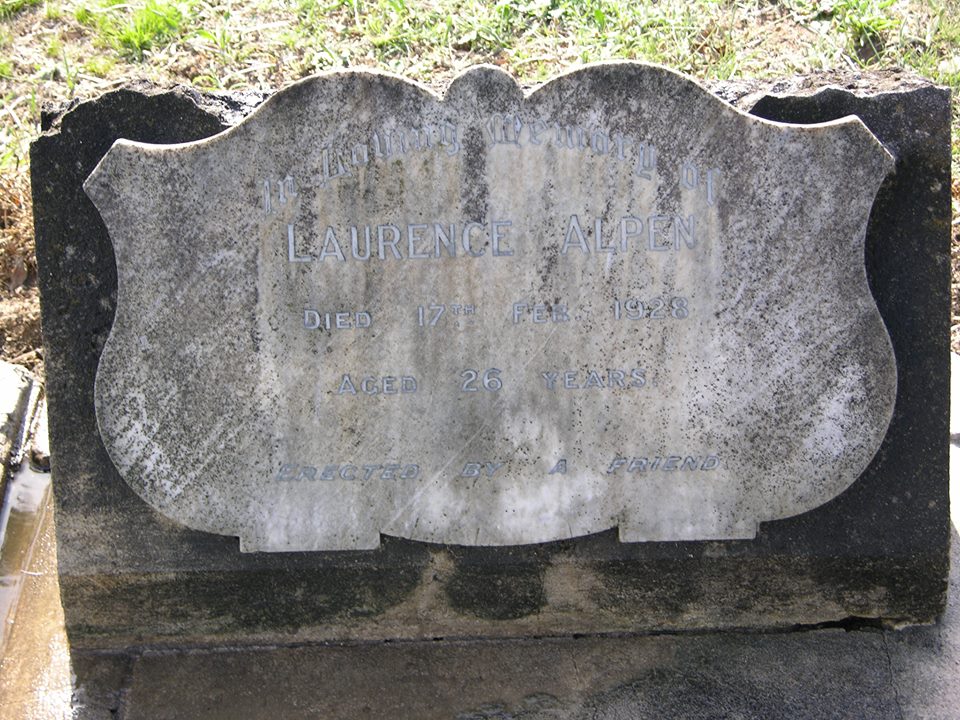
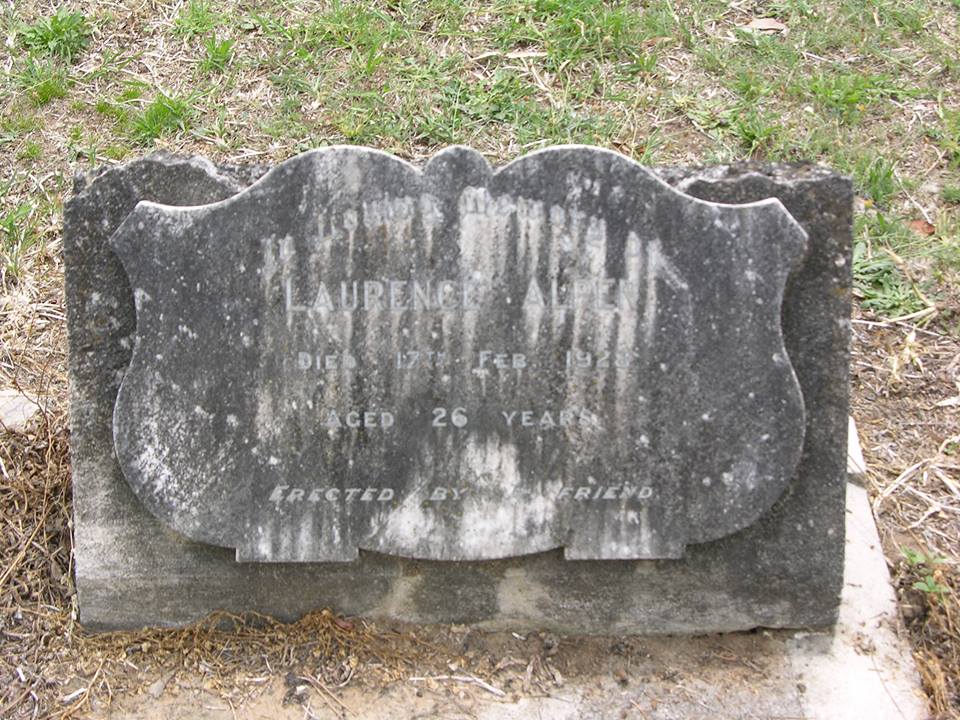
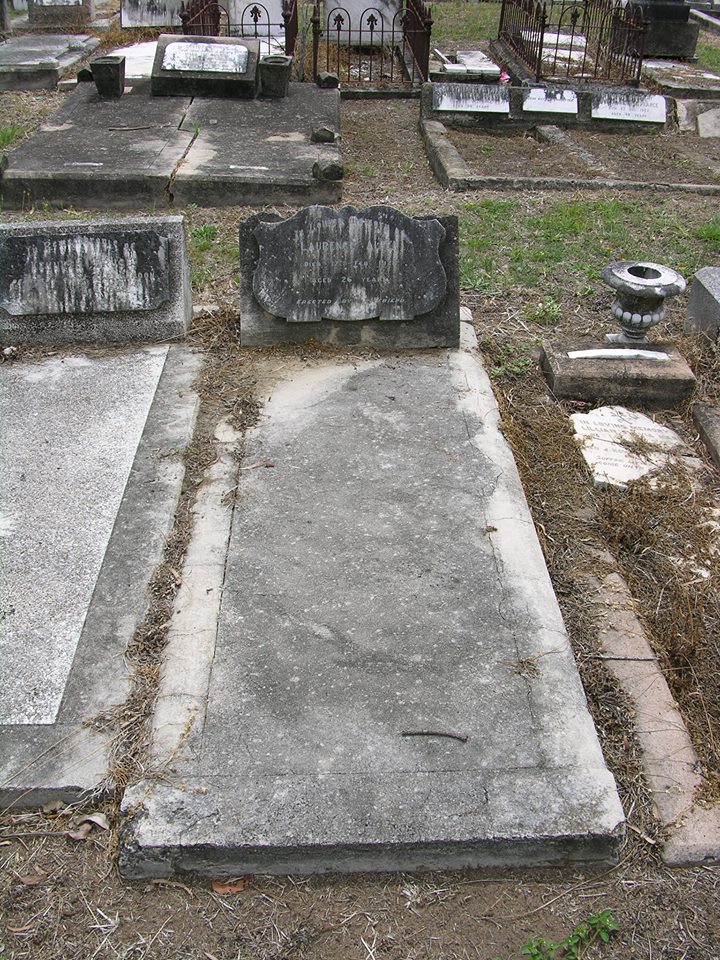
The constable was a mounted policeman and the officer-in-charge of a temporary police station which had been established at Richmond Gap during the building of the Kyogle-to-Brisbane railway line. On 17 February, 1928 during severe flooding in the area, he was assisting with the clearing of debris from a bridge across Grady’s Creek when he fell from the bridge and was swept away and drowned in the floodwaters. His body was recovered thirty minutes later however resuscitation failed to revive him.
The Brisbane Courier dated 18 February, 1928 reported that ” Constable Laurence Alpen, who was drowned at Grady’s Creek today, was in charge of the temporary police station on the Kyogle-Brisbane railway construction works. He was a native of Narrabri, and was 26 years of age. He joined the force in 1924 and after five months service in the Police Department at Redfern was for seven months with the mounted police at Lismore. Later he went to Casino from where he was transferred to Richmond Gap. He was spoken of in the highest terms by his superiors. “
The constable was born in 1901 and joined the New South Wales Police Force on 27 May, 1924. At the time of his death he was stationed at Richmond Gap (Kyogle area).
[divider_dotted]
[alert_green]Laurence IS mentioned on the Police Wall of Remembrance[/alert_green]
Edgar John WILLIAMS
| 26/10/2012
Edgar John WILLIAMS
New South Wales Police Force
Sergeant 2nd Class
Served for over 25 years
Motor Vehicle Accident
Coolah
Died Saturday 28 August, 1926
Funeral ?
About 2pm on 28 August, 1926 Sergeant Williams was a passenger travelling with two other men in a vehicle returning from the Dunedoo Court. Along the Leadville Road the vehicle skidded, left the roadway and somersaulted, ejecting all three men. The sergeant was killed instantly, while the other two men were seriously injured in the accident. The Mercury newspaper dated 30 August, 1926 briefly reported the accident.
MOTOR CAR SOMERSAULTS – POLICE SERGEANT KILLED.
SYDNEY. ( Saturday ) August 28 – A shocking motoring accident occurred on the Leadville Road, three miles from Coolah, about 2 o’clock this afternoon. A car was returning from the Dunedoo Police Court, with Harold Fraser (driver), Fred Haynes and Sergeant Edgar John Williams, when it skidded. The front wheels locked and the car ran off the road. It turned a complete somersault, and the occupants were thrown out. Sergeant Williams was killed almost instantly. Haynes and Fraser were injured.
The sergeant was born in 1873 and joined the New South Wales Police Force on 21 May, 1900. At the time of his death he was probably stationed at Louth.
Sergeant Williams was a member of the police force for over 25 years, and was just due for six months long service leave. He was a second class sergeant for nearly eleven years. He had also served at Cobar and Louth. He is survived by Mrs. Williams, three daughters and one son.
Recorder ( Port Pirie, S.A. ) Monday 30 August 1926 page 1 of 4
FATAL CAPSIZE.
Police Sergeant Killed.
SYDNEY, Sunday. ( 29 Aug. )
Sergeant Edgar Williams, of the Coolah police, was killed instantly in a car capsize yesterday, three miles from Coolah, near Mudgee.
Williams and Frederick Haynes were (returning) turning from the Dunedoo Court in a car driven by Harold Fraser, 25, when for some unknown reason the car turned over, and Williams was pinned underneath and crushed to death. He leaves a widow and four children. Haynes was unhurt, while Fraser was Injured in the back
There is some confusion in relation to the correct date of death.
Newspaper articles have him being killed on Saturday 28 August 1926 but his grave stone states the date of death as 29 August 1927. ???
Further investigations continuing as to the correct date of death – July 2014.
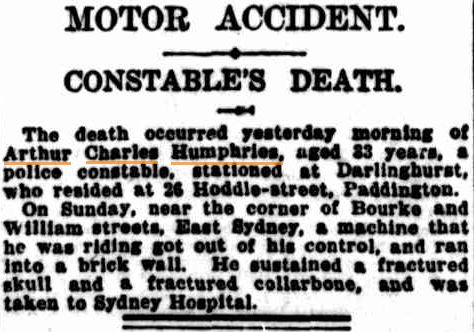
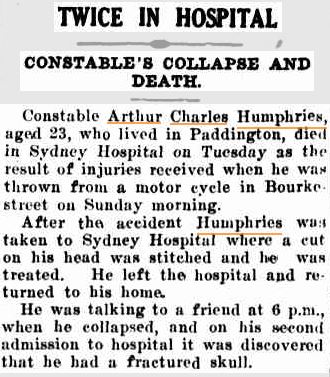
Arthur Charles HUMPHRIES
| 26/10/2012
Arthur Charles HUMPHRIES
New South Wales Police Force
Constable
Motor Vehicle Accident
Darlinghurst
7 April, 1925
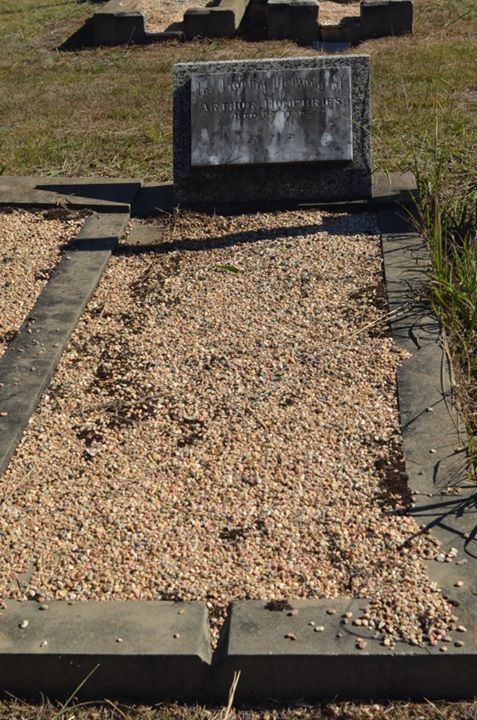
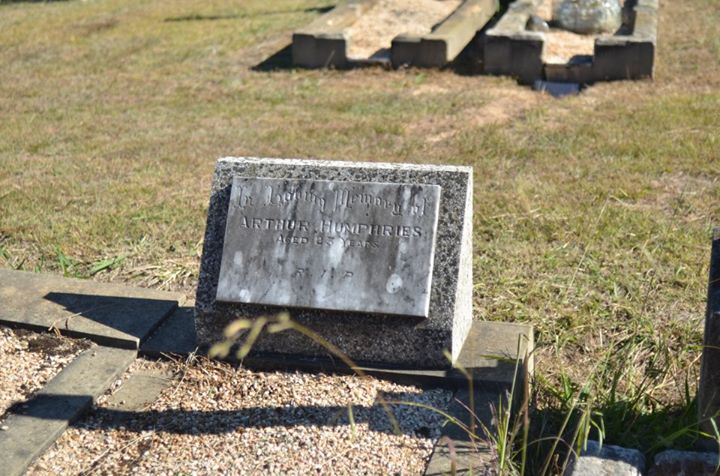
Cst Arthur Charles HUMPHRIES. Grave is located at Collector cemetery next door to the Police Station. When you walk in facing the back of the cemetery, it is around the middle and to the left.
Cst Arthur Charles HUMPHRIES
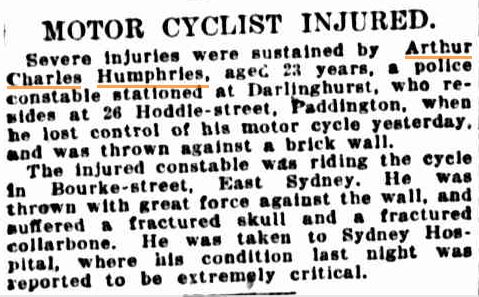
On Sunday 5 April, 1925 the constable was riding his motor cycle in Darlinghurst when the cycle collided with a brick wall at the intersection of Bourke and William Streets. He sustained a fractured skull and broken collar bone and was conveyed to the Sydney Hospital in a ( as reported in The Sydney Morning Herald ) critical condition but another newspaper article in the Singleton Argus, dated 11 April, states that he was treated and allowed to leave hospital to return home and that he was talking to a friend at 6pm when he collapsed and upon his second admission to hospital, it was discovered that he had a fractured skull.
He died on Monday, 6 April, 1925. It is not known if this death occurred on duty.
The Sydney Morning Herald dated 6 April, 1925 reported that “Severe injuries were sustained by Arthur Charles Humphries aged 23 years, a police constable stationed at Darlinghurst, who resides at 20 Hoddle Street, Paddington, when he lost control of his motor cycle yesterday and was thrown against a brick wall. The injured constable was riding the cycle in Bourke Street, East Sydney. He was thrown with great force against the wall, and suffered a fractured skull and a fractured collarbone. He was taken to Sydney Hospital where his condition last night was reported to be extremely critical.”
The NSW Register of Coroners Inquests and Magisterial Inquiries, 1834-1942 indicates that an inquest was held into the constable’s death at the Sydney City Coroner’s Court on 14 April, 1925 where it was found that the death was caused from “injuries accidentally received through being thrown from his motorcycle.”
The constable was born in Goulburn in 1903 and at the time of his death was stationed at Darlinghurst.
The Sydney Morning Herald Monday 6 April 1925 page 12 of 20
The Sydney Morning Herald Tuesday 7 April 1925 page 11 of 20
Singleton Argus Saturday 11 April 1925 page 6 of 8
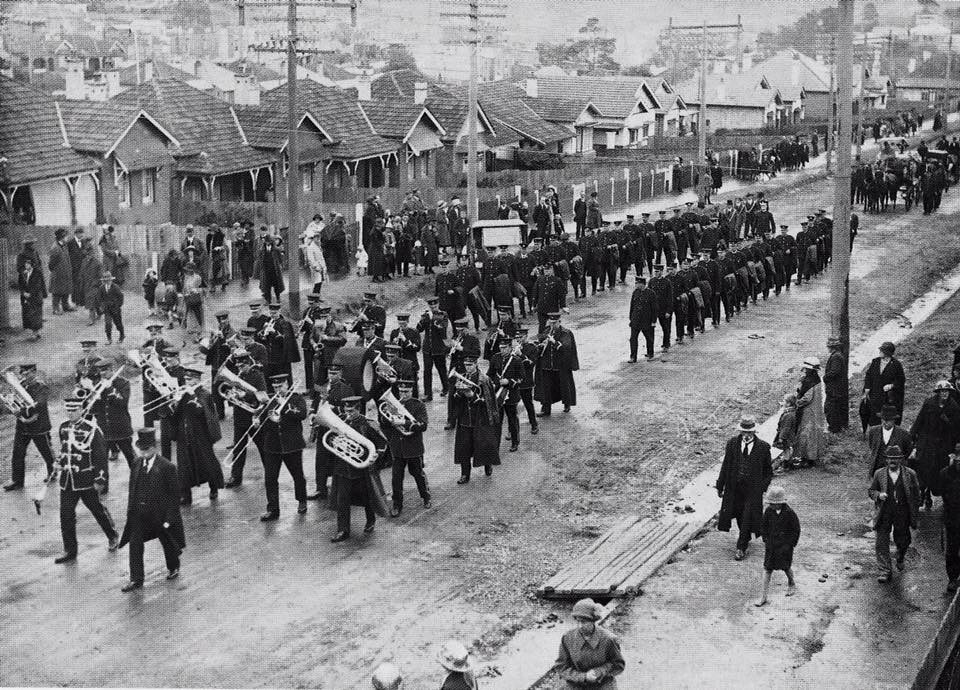
Funeral procession of Constable Leeds at North Sydney
[alert_red]HARRY is NOT mentioned on the Police Wall of Remembrance[/alert_red] * BUT SHOULD BE
Constable Harrie Leeds was killed in a tramway accident at McMahon’s Point, Sydney on Thursday 21 August, 1924. Another man was also killed and several people were injured in the incident. Incredibly, the Inspector General of Police Mr James Mitchell did not consider this death to be “killed on duty”. This decision was later the subject of numerous unsuccessful representations by the Police Association of New South Wales. It was at the very least the death of a constable travelling to work, regardless of other factors and disputed facts.
The publication “Serving the Force”, 75 Years of the Police Association of New South Wales 1921 – 1996 briefly describes how Constable Leeds bravely leapt onto the running board of a runaway tram as it sped through McMahon’s Point. The constable was trying to help stop the tram and had been yelling to passersby to keep clear. Unfortunately, the tram hit an obstacle and the constable was thrown to his death. He was not classified as being killed on duty and his wife and five children received a pittance of a pension because he had only been in the force a short time. [17 years is probably not a “short time”]
One of the bewildering issues with this event is the fact that there were and are many versions of it, as indicated in an article in the Sydney Morning Herald dated 22 August, 1924, which reported that “Constable Harry Leeds, who lived at Willoughby, was on his way to duty when he met his tragic and shocking death. Of the circumstances in which he lost his life there are different versions. One story is that he was pluckily assisting to try to avert the disaster when he was crushed. It is stated, again, that he was on the leading car, and that as he jumped on to the roadway when the cars tore across the rails the rear car hit him and pinned him helplessly underneath it. He was dead when his body was recovered after much effort.”
And again, the Sydney Morning Herald dated 2 October, 1924 reported a lengthy description of the coroner’s findings, including the following extract.
Herbert Gillies Ruthven, a passenger on the tram, described his experience. He said that shortly before the smash he had been conversing with the deceased Leeds. Leeds seemed frightened when the tram had gathered speed while descending the other declines on the route from Victoria Avenue. [Ruthven] had said to him, “How about getting off here, Leeds, and walking down?” That was when the tram stopped at East Crescent Street. Just then the tram started, and the constable did not reply. Witness next saw him crouching in a hesitating manner as if he were about to take the risk of jumping from the tram. He was still on the footboard when the tram first left the rails.
The constable was born in 1885 at Trial Bay, New South Wales and joined the New South Wales Police Force on 28 May, 1907. At the time of his death he was stationed at George Street North Police Station. He lived at Willoughby and had previously served at Goulburn, Araluen, Crookwell, North Sydney and Phillip Street Police Stations.
[divider_dotted]
The Sydney Morning Herald Friday 22 August 1924 page 9 of 16
CASUALTY LIST.
KILLED.
HARRY LEEDS, 47, of Penkivil-street, Willoughby, a police constable attached to the George-street North station.
FREDERICK MAURICE LAMBERT, 30, engineer, of the corner of Alleyne and Mann streets, Willoughby.
The Sydney Morning Herald Friday 22 August 1924 page 7 of 16
FUNERALS:
LEEDS – The Relatives and Friends of the late Constable HARRY LEEDS are invited to attend his Funeral ; to leave his late residence, Innisfail, Penkivil-street, Willoughby, THIS FRIDAY, at 2pm, or Catholic Cemetery, Northern Suburbs.
WOOD COFFILL LIMITED, Funeral Directors.
*
LEEDS. – The Relatives and Friends of Mrs. ALICE E. LEEDS and FAMILY are invited to attend the Funeral of her beloved HUSBAND and their FATHER, Harry ; to leave Innisfail, Penkivil-street, Willoughby, THIS FRIDAY, at 2pm for Catholic Cemetery, Northern Suburbs.
*
LEEDS – Relatives and friends of Mr. HARRY LEEDS, Senior, and Miss ELSIE LEEDS, of Parramatta, are invited to attend the Funeral of his beloved SON and her BROTHER, Harry ; to leave Innisfail, Penkivil-street, Willoughby, THIS FRIDAY, at 2pm, for Catholic Cemetery, Northern Suburbs.
*
LEEDS.- The Friends of Mr. and Mrs. NEIL BOYLE, Mr. and Mrs. FRANK PALMER, Mr. and Mrs. Neil LEEDS, Mr. and Mrs. RICHARD LEEDS, of Summer Hill, are invited to attend the Funeral of their beloved BROTHER, Harry Leeds ; to leave Innisfail, Penkivil-street, Willoughby, THIS FRIDAY, at 2pm, for Catholic Cemetery, Northern Suburbs.
*
LEEDS – The Friends of Mrs. O’REGAN, ELLA & DONA HOWE, of Cairo-Street, North Sydney, are invited to attend the funeral of their beloved SON-IN-LAW and BROTHER-IN-LAW, Harry Leeds ; to leave Innisfail, Penkivil-street, Willoughby, THIS FRIDAY, at 2pm, for Catholic Cemetery, Northern Suburbs.
*
LEEDS. – The Friends of Mr. and Mrs. J. T. LEVITT and FAMILY, of Ashfield, are invited to attend the Funeral of their beloved BROTHER-IN-LAW and UNCLE, Harry Leeds; to lave Innisfail, Penkivil-street, Willoughby, THIS FRIDAY, at 2pm for Catholic Cemetery, Northern Suburbs.
WOOD COFFILL LIMITED
*
LEEDS – N.I.O.O.F., LOYAL PERSEVERANCE LODGE – The Sisters and Brothers of the above lodge are invited to attend the Funeral of the late Brother H. LEEDS; to leave his late residence, Innisfail, Penkivil-street, Willoughby, at 2pm TODAY.
Evening News ( Sydney ) Friday 22 August 1924 page 7 of 12
LAST TRIBUTE TO CONSTABLE LEEDS
A large crowd attended the funeral of Constable Harry Leeds, one of the victims of the North Sydney tramway smash, to-day. It was striking tribute to a popular officer.
The cortege, which left his home in Penkivil-street. Willoughby, for the Northern Suburbs cemetery, was headed by the Police Band playing the Dead March. About a hundred police representative of the whole metropolitan division, besides a number of tramway men marched in procession. The principal mourners were the widow and five young children, Mrs. Boyle, Mrs. Benn, Mrs. Davison, Mrs. Dickman, Mrs Palmer and Miss Elsie Leeds (sister). Mr. Harry Leeds (father). Messrs. Neil and Richard Leeds (brothers). Among those present were Mr. James Mitchell, Inspector-General of Police, Inspector Souter, North Sydney, Mr. G. Holt. District Superintendent of Tramways, North Sydney – (representing the Tramway Department), Mr. Charles Thackeray (representing the Police Association). Many beautiful wreaths were sent by the police. Including several from C.I. Branch and No. 4 Division.
The Sydney Morning Herald Saturday 23 August 1924 page 16 of 26
LATE CONSTABLE LEEDS.
IMPRESSIVE FUNERAL.
The funeral of Constable Harry Leeds, who was killed in the tram accident at McMahon’s Point, took place yesterday afternoon in the Roman Catholic portion of the Northern Suburbs cemetery.
A large crowd assembled in the vicinity of the late Constable Leed’s home in Penkivil- street, Willoughby, and, as the coffin was placed in the hearse, the crowd stood bare-headed, while Inspectors Beatty (George-street North station), to which Constable Leeds was attached and Souter (North Sydney) stood at the salute, at one side, and members of the Loyal Perseverance Lodge (Independent Order of Oddfellows) stood at the other side.
The Police Band, with muffled and draped drums, led the procession, and following the band, there came between 50 and 60 non-commissioned officers and men of the police force, representing 15 divisions. Marching immediately in front of the hearse were the Inspector-General of Police (Mr. James Mitchell) and Inspector Souter. The pall-bearers were Constables Cole, Hansen, Malcolm (No. 6 Division), and Jackson, Kerr, and Reece (No. 4 Division). Following the hearse were the mourning coaches conveying members of the family and other relatives of the deceased, then came members of the Loyal Perseverance Lodge, and about 30 motor cars and other vehicles, conveying friends of the late constable.
The route from the late Constable Leeds’s home to the cemetery was between three and four miles, and practically all the way crowds gathered to view the procession. A large number of people had assembled at Mowbray-road, and as the procession passed into the main street of Chatswood to the strains of the Dead March the scene was a solemn and striking one. The sidewalks of the thoroughfare were crowded, the men standing bare-headed, and the police on street duty standing at the salute as the hearse passed. After crossing the railway line at Chatswood the Police Band and members of the force opened out and halted while the procession passed through. Motor buses conveyed the band and police to the entrance to the cemetery, and on arrival of the hearse and mourners the procession was again formed and marched to the grave. The Rev. Father J. Wall officiated at the graveside, the service being simple but impressive.
The principal mourners were Mrs. Leeds (widow) and five young children, Messrs. Harry Leeds (father), Neil and Richard Leeds (brothers), and Mrs. Boyle, Mrs. Palmer Mrs. Benn, Mrs. Davidson, Mrs. Dickman, and Miss Elsie Leeds (sisters).
Others present Included Mr. G. Holt, District Superintendent of Tramways, North Sydney (representing the Tramway Department), District-officer F. A. Tuck, Crow’s Nest (representing the New South Wales Fire Brigade), Mr. Charles Thackeray (representing the Police Association), ex-Inspector J. Fullarton, Aldermen J. S. Muir, W. L. M. Fry, E. J. Parkes (Willoughby Council), and Messrs. G. A. Bailey (town clerk), Hughes (health Inspector), and Murdock (building Inspector), H. B. Perringnon (Department of Labour and Industry), T. Proctor, H. C. Coulter, P. K, Gorrick, and E. Hewitt.
POLICE TO HELP WIDOW.
At North Sydney Police Court yesterday appreciative remarks regarding the late Constable Leeds were made by Mr. Daley and Mr. Thomas on behalf of the legal profession. Mr. Daley said that he had known Constable Leeds for 15 years, and he was an efficient, courageous, and loyal officer.
Inspector Souter expressed regret on behalf of the police force, and said that it was unfortunate that Constable Leeds had left a widow and five young children. He was sure, however, that the police as a body would not fail to alleviate the suffering of the late constable’s relatives.
The Catholic Press ( Sydney ) Thursday 4 September 1924 page 25 of 52
Tram Accident Victim.
CONSTABLE HARRY LEEDS.
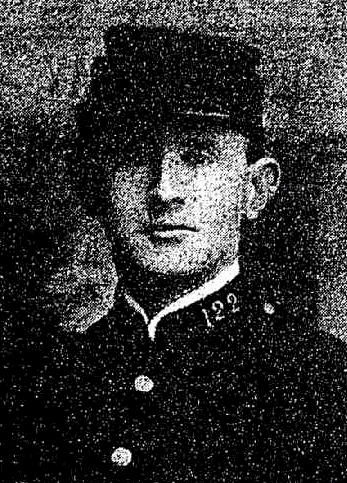
Constable Harry LEEDS
THE LATE CONSTABLE LEEDS.
The recent tram accident at North Sydney was the cause of the death, of Constable Harry Leeds. Constable Leeds was one of the most popular men in the metropolitan area, and news of his death came as a severe shock to his colleagues. He joined the force in 1907, and was appointed to Goulburn, where he was married, and transferred to Araluen. From there he was sent to Crookwell, and later on to North Sydney, where he did duty for a number of years; but for the past five years he was connected with George-street North Police Station.
On the 22nd ult., at the North Sydney Police Court, Mr. Daley and Mr. Thomas, on behalf of the legal profession, paid a tribute to the worth of Constable Leeds, and offered their deep sympathy to his relatives. Inspector Souter said they could ill afford to lose such men of long service and experience. Constable Leeds leaves a widow and five young children, the youngest being a boy only six months old.
The funeral was an impressive tribute to the memory of deceased. The Police Band, under Bandmaster Hawkins and Drum-Major Flynn, together with a squad of sergeants and constables, drawn from the whole of the 15 divisions of the Metropolitan Police Force, led the cortege, and six police pals of the dead man carried the coffin, laden with wreaths. The hearse, too, was piled with wreaths.
The Inspector-General of Police (Mr. Mitchell) walked in the cortege, accompanied by Inspectors Beatty and Souter. The pall-bearers were Constables Cole, Hansen, Malcolm (No. 6 Division), Jackson, Kerr, Reece (No. 4 Division). Also in the cortege were Mr. G. Holt (District Superintendent, North Sydney), representing the Government Tramways Department), District Officer F. A. Tuck (representing New South Wales Fire Brigades), Mr. C. Thackeray (representing Mr. B. Fortesene and Police Association), Alderman Muir (representing the Mayor and Alderman of Willoughby). First-Class Constable Walsh marshalled the cortege to the Catholic portion of the Northern Suburbs Cemetery. The streets through which the cortege passed were lined on each side with thousands of people, who stood with bowed heads. Arriving at the cemetery, the police formed an avenue, through which the cortege passed, and Rev. Father J. Wall, of Ryde, officiated at the graveside.
While the coffin was being lowered, the Police Band played ‘Abide With Me.’
The chief mourners were: The widow and five children, Mr. Harry Leeds (father), Neil and Richard (brothers), Mesdames Boyle, Benn, Davison, Dickman, Miss Elsie Leeds (sisters) Mrs. O ‘Regan, Mrs. Levett, Miss Howe, Miss O’Regan (mother and sisters of the widow). — R.I.P.
Freeman’s Journal ( Sydney ) Thursday 4 September 1924 page 19 of 48
THE LATE CONSTABLE HARRY LEEDS.
Constable Leeds, the victim of the recent tram accident at North Sydney, was one of the most popular men in the metropolitan area, and news of his death came as a severe blow to his colleagues.
He joined the police force in 1907 and was appointed to Goulburn, where he married. He was transferred to Araluen, and from there he went to Crookwell, and later on to North Sydney, where he did duty for a number of years. For the past five years he had been connected with George-street North Police Station.
On August 22, at the North Sydney Police Court, Mr. Daley and Mr. Thomas, on behalf of the legal profession, paid a tribute to the worth of Constable Leeds, and offered their deep sympathy to his relatives. Inspector Souter said they could ill afford to lose men of such experience and long service.
Constable Leeds leaves a widow and five young children, the youngest being a boy only six months old.
The funeral, which took place on Friday, August 22, was an impressive tribute to the memory of deceased. A large concourse of people gathered at ‘Innisfail,’ Penkivil-street, Willoughby, and genuine sorrow was manifested, particularly among those who knew the bond of affection which existed in the domestic life. At 2 p.m. the Police Band, together with a squad of sergeants and constables drawn from the whole of the fifteen divisions of the metropolitan police force, formed up outside, and six police pals of the dead man carried the coffin, laden with wreaths. The hearse was piled with wreaths. As the coffin was borne out, Inspectors Beatty (George-street North) and Souter (North Sydney) stood at the salute at one side, and six members of the Loyal Perseverance Lodge (I.O.O.F.) with bowed heads at the other.
The Inspector-General of Police (Mr. Mitchell) walked in the cortege, accompanied by Inspectors Beatty and Souter. The pall-bearers were Constables Cole, Hansen, Malcolm (No. 6. Division), Jackson, Kerr, and Reece (No. 4 Division). Also in the cortege were Mr. G. Holt (District Superintendent of North Sydney; representing Government Tramways Department), District Officer F. A. Tuck (representing N.S.W. Fire Brigades), Mr. C Thackeray (representing Mr. B. Fortescue and the Police Association), Alderman Muir (representing the Mayor and aldermen of Willoughby); Mr. Scott Fell was also represented.
First-Class Constable Walsh marshalled the cortege to the Catholic portion of the Northern Suburbs Company. The Police Band, under Bandmaster Hawkins, with Drum-Major Flynn at its head, led off with the ‘Dead March in Saul.’ The Loyal Perseverance Lodge (N.I.O.O.F.), with N.G. Bro. C. Bolger and Secretary Bro. Dimond, were also in the procession. The streets, through which the cortege passed, was lined on each side with thousands of people, who stood with bowed heads and tear-dimmed eyes. Arriving at the cemetery, the police formed an avenue through which the cortege passed, and the Rev. Father J. Wall, of Ryde, officiated at the graveside. While the coffin was being lowered the Police Band played ‘Abide With Me.’ The chief mourners were the widow and five children, Mr. Harry Leeds (father), Messrs. Neil and Richard (brothers), Mesdames Boyle, Benn, Davison, and Dickman, Miss Elsie Leeds (sisters), Mrs. O’Regan, Mrs. Levett, Miss Howe, Miss O’Regan (mother and sisters of the widow). — R.I.P.
Evening News ( Sydney) Monday 29 September 1924 page 5 of 10
McMAHON’S PT. SMASH
The Coroner’s inquiry into the cause of the McMahon’s Point tram crash on August 21, in which Constable Harry Leeds and Frederick Maurice Lambert were killed, has been fixed for next Wednesday at 10 a.m.
The Sydney Morning Herald Tuesday 30 September 1924 page 6 of 15
TRAM DISASTER.
The City Coroner’s inquest into the deaths of Constable Harry Leeds, and Frederick Maurice Lambert, in the tram disaster at McMahon’s Point on August 21 is listed to be held tomorrow.
Newcastle Morning Herald & Miners’ Advocate Thursday 2 October 1924 page 5 of 8
SYDNEY TRAM SMASH. CORONER’S VERDICT :
The Sydney Coroner to-day held an inquiry, into the deaths of Frederick Lambert, aged 39, an engineer, of Willoughby, and Constable Harry Leeds, aged 47, of Willoughby, who were killed in the tram smash at McMahon’s Point, North Sydney, on the morning of August 21. It was through the alleged failure of the brakes that a double-set ran down the steep incline towards McMahon’s Point, but when rounding a curve the front car left the rails and crashed into a house. The rear car piled itself up on to the first car, and in the smash Lambert and Leeds were killed, and a number of other passengers injured.
Edward Chambers, electrical subforeman in the Tramway Department, said that on August 20 the two cars, 544 and 543, went into traffic at 6.20a.m., and arrived back at 8.57a.m., and were booked up as ” O.K. ” On August 21, at 1a.m., they were again booked up as ” O.K. ” At 5.49a.m. they went into traffic again, and were in good order. At 7.50a.m. he saw them at McMahon’s Point, after the accident. It was driver’s duty to report any defects in the running of a car.
Thomas Elias James, the driver of the car, was then called. He said that when they left Willoughby on the fatal trip for McMahon’s Point, he found that the controller was jambed (sic), and he could not move it one way or another. He then drove the tram from the rear of the car, and left Conductor Cowan in charge of the air brake in the front. As they neared the long hill near the terminus, he felt the car getting out of control. He attempted to use the third emergency, but found it could not be used, owing to the air control being on. He was absolutely helpless to do anything. Witness considered he had taken the best course in giving Cowan control of the air brake, as it was a very foggy morning. He attributed the accident to the greasy condition of the rails.
Conductor James Cowan, who stuck to the front of the car throughout, and who suffered severe concussion when it left the rails and crashed into the wall, was the next witness.
Mr. D. R. Hall, his solicitor, explained that his memory, so far as the accident was concerned, was an absolute blank, and he was still a very sick man. Consequently he was only asked a few questions. He told the coroner that he could not remember anything of the run down the hill or the final crash.
“I would like to say how greatly I and the public admire him for sticking to his post right up to the end,” said the coroner, as Cowan was assisted from the box. “I an sure he will have the good wishes of the court for his speedy recovery, and its admiration for the way in which he retained his position, in the face of what looked like certain death.”
Edward Wills, chief inspector, said that the working orders put the driver in charge of the tram, and the only part of his duty he could delegate to a conductor when he had to drive from the rear was the operation of the bell and the sand. Wills maintained that the driver delegated his powers to the conductor, and thereby broke the regulations. The conductor, in this case, was in charge of the tram.
The Coroner: A man might easily make a mistake about the meaning of this rule.
Mr. Hall: A department whose motto is “Safety first” might have expressed it in more simple English and more clearly.
The coroner returned a verdict of accidental death.
On a Saturday morning in 1924 Sergeant Ellis of the Brewarrina Police Station ended his life by shooting himself in the chest and head. Little is known of the sergeant and his death other than a brief extract from the local (Brewarrina) newspaper which indicates that: “Sergeant Ellis was up and about on the Saturday morning attending to his duties and seemed as cheerful as ever, and Constable Woodward received a rude shock on going for the sergeant to accompany him to breakfast, to find him lying dead in a pool of blood on the floor. An examination by Dr. Duncan showed that Sergeant Ellis had shot himself twice, over the heart and in the temple. The body of the Sergeant was placed in a lead-lined coffin and forwarded to Singleton yesterday morning for interment”
The NSW Register of Coroners Inquests and Magisterial Inquiries, 1834-1942 indicates that an inquest was held into the sergeant’s death on 12 May, 1924 at Brewarrina. It was found that Sergeant Ellis died at Brewarrina as a result of a “bullet wound in the head wilfully self-inflicted.”
A year after the sergeant’s death the following announcement appeared in ‘In Memoriam’ column of The Argus, dated 9 May, 1925: ELLIS – In fond and loving memory of my dear fiance, Sergeant James Ellis, who died at Brewarrina, N.S.W. on 10th May, 1924. The link that bound us here below still binds my heart to thine. (Inserted by Flora Thomson, Hampton.)
The sergeant was a native of Wyalong and in 1919 was transferred from Broken Hill to Tibooburra as the officer-in-charge of that station. He was then transferred to Brewarrina on 4 March, 1924. He had only been at Brewarrina for two months when he died at the age of 39 years.