The constable was killed when he was struck by lightning while on duty at Cockatoo Island on the night of 11 January, 1862. The Sydney Morning Herald of 14 January, 1862 reported at some length on inquest into Constable Quinn’s death. It is reproduced here, almost in its entirety, due to the subtle poise and clarity of the writer in describing the sad events which led to the death of the young constable.
THE LATE FATAL ACCIDENT BY LIGHTNING – An inquest was held in the coroner’s office, yesterday, on the body of Constable James Quinn, who, as stated in our issue of yesterday, died from the effects of being struck by lightning on Cockatoo Island on last Saturday night. It appeared that the deceased had only joined the City Police Force on the 2nd of December last, and went over to do duty on Cockatoo Island on the 7th of the present month. At eight o’clock on Saturday night, he, in company with Constable Campbell, went on duty in the prison yard. At about nine o’clock a heavy thunderstorm broke over the island, and in a few minutes there came a flash of lightning more vivid than those that had preceded it, and Inspector Lane, who was sitting in his quarters, heard a heavy crash, and thought the prison had been knocked down. He ran out and saw one constable at his post in the verandah, he then ran to the back and saw another at his post, everything appearing to be alright, but after standing a minute he (the inspector) was conscious of a strong smell of sulphur. As, however, nothing appeared to be touched, he returned indoors, when, in a few minutes, his attention was called to the cry of fire he again ran out and found the prisoners were calling out “fire, fire!” He shook the gate, and the guard having opened it, he inquired where the fire was, but could not ascertain, he called for Constable Campbell, who, after two or three calls, replied in a faint voice, “I am here, sir,” and by the lightning, which was very vivid, he saw him lying on the floor of the building known as the chapel, his head covered with blood. The inspector was under the impression on seeing the blood that some of the prisoners had escaped, and had attacked him. He accordingly at once ordered a double sentry to surround the prison, and enquired of Campbell what was the matter, to which he replied he did not know, but had been knocked down, enquiry was then made as to where his mate was, and Campbell replied “Poor fellow, I saw him over there,” pointing to a shed covered with galvanised iron in the yard.
Thither the inspector went, and inside saw Quinn leaning with his back against the wall, he went up to him, touched his head and found it cold, he then called for the dispenser (there being no qualified medical practitioner resident on the island), who came, and after the injured man had been removed, administered medicine, which revived him. Inspector Lane forthwith sent the police guard boat to Sydney, with messages requesting the immediate attendance of Dr West, and Dr. Rutter, the latter of whom at once responded to the call. On arrival at the island he found Quinn strongly convulsed, requiring several men to hold him. He ordered what he deemed requisite and then left, returning again the next morning, when the injured man was found to be much better. There being no hospital (beside the hospital for prisoners) on the island, Dr. Rutter recommended his removal to the Sydney Infirmary, and thither he was conveyed, arriving there at about one o’clock. Dr Roberts saw him soon after his admission, and treated him as he considered his case required. The sufferer never rallied, but expired about four o’clock on the same afternoon.
It came out in evidence that the rifle carried by the deceased at the time he was struck was untouched by the electric fluid, as also the ammunition on his person, but a gold chain attached to his watch was burnt through in several places. It appeared that the lightning struck the highest port of the building in which the deceased was found, descended through the coping to a lamp, close to the spot where he was discovered. There were no lightning-conductors on the island. The deceased had formerly been in the Irish Constabulary Force, he was a native of Ireland, a steady well conducted man, and about twenty eight years of age. He has left a widow and two children. The jury returned a verdict of “Died from being struck by the electric fluid on Cockatoo Island on the evening of the 11th instant.” The body of the deceased was interred in the Roman Catholic burial ground, in Devonshire Street, yesterday afternoon, all the available police, dressed in uniform, with white gloves and white cap-covers, following him to the tomb.
The constable joined the Sydney Police Force on 2 December, 1861 and at the time of his death he was stationed on Cockatoo Island. He was 28 years of age, and was a former member of the Royal Irish Constabulary.
Amazingly, the only two recorded NSW police deaths by lightning strike occurred on the same date, sixty years – to the day, apart. The other being Constable John Charles DONOVAN who was struck at Brewarrina, NSW, on the 12 January 1922.
Constable Christian SEIDTZ
| 23/10/2012
Constable Christian SEIDTZ
Drowned
Grafton
29 April, 1861
The constable is believed to have drowned in the Clarence River at Grafton while trying to save the life of a young boy (eleven-year-old Daniel Forde) who had fallen into the water at a spot nearly opposite the constable’s house. The Sydney Morning Herald dated 15 May, 1861 printed the following article in relation to the inquiry into the deaths of the constable and young Daniel Forde.
MAGISTERIAL INQUIRY – Upon the bodies of Daniel Forde and Christian Seidtz.
James Hovenden, Chief Constable, stated: About noon I met the deceased boy (Forde) near Pound Street; carrying meat on horseback; shortly after, one of his brothers informed me that he had been thrown from his horse into the water in Pound Street; I procured the drags and went to the spot to endeavour to recover the body; medical aid was in attendance when the body was found, about three quarters of an hour afterwards.
Solomon Cooper sworn : I knew the deceased Christian Seidtz; about noon on Monday my wife called my attention to someone crossing a flooded part of Pound Street, near my residence; I ran out and saw a boy struggling in the water; Seidtz, who lived opposite, came out of his house and plunged in to assist the lad, and sunk immediately; I never saw him rise after he went into the water; I gave an alarm and Richard Barrett immediately swam out; Mr. Sanders and myself did all we could, but not being able to swim could not go out of our depth; the water was about ten feet deep; the body was not recovered for about three-quarters of an hour; Dr. Little saw the body but could not restore animation.
Carl Meyer, sworn, stated: I live in Pound Street, near the deceased’s place; I heard Mrs. Seidtz call out that her husband was drowning; I ran up and saw a lad struggling in the water, and his horse by the side; I could not see Seidtz for some time then his face showed for a moment and disappeared; I could not swim; I gave information to the chief constable; every effort was made to rescue the deceased.
The deceased, Seidtz, was a man much respected; a native of Germany; and had been three years in the Grafton police force, during which time there was no complaint against him. He was a remarkably fine-made man, thirty-five years of age; and a very sober industrious person. This sudden event has left his unfortunate wife and four young children totally unprovided for.”
At the time of his death the constable was 35 years old and was stationed at Grafton. He is sometimes recorded as ‘Seitz’ or ‘Leitz’
Alexander McGEE
| 23/10/2012
Alexander McGEE
New South Wales Police Force
Regd. # ?
Rank: Inspector
Stations: B District – Sydney
Service: From? ? ?to 22 May 1860 = about 20? years Service
Awards: ?
Born: ? ? ?
Event location: Castlereagh Street near Liverpool St, Sydney, NSW
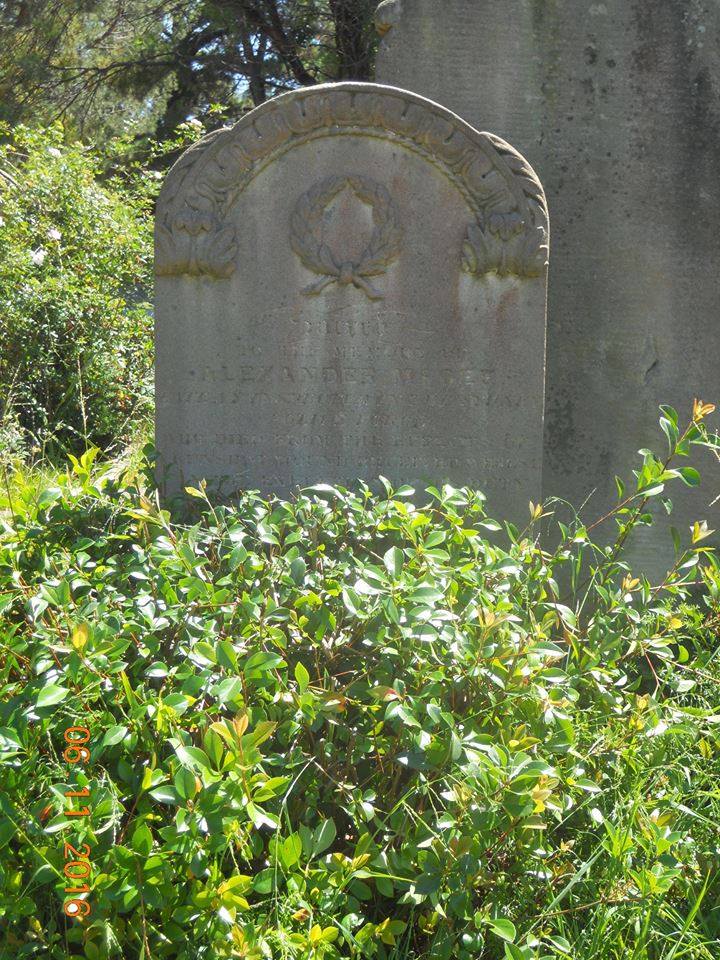
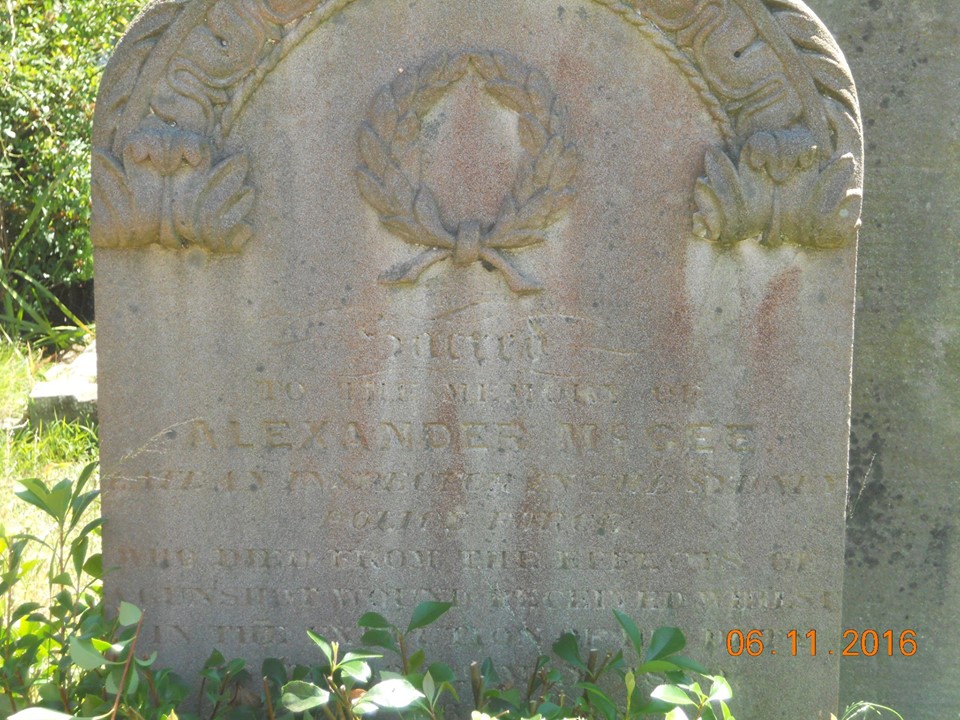
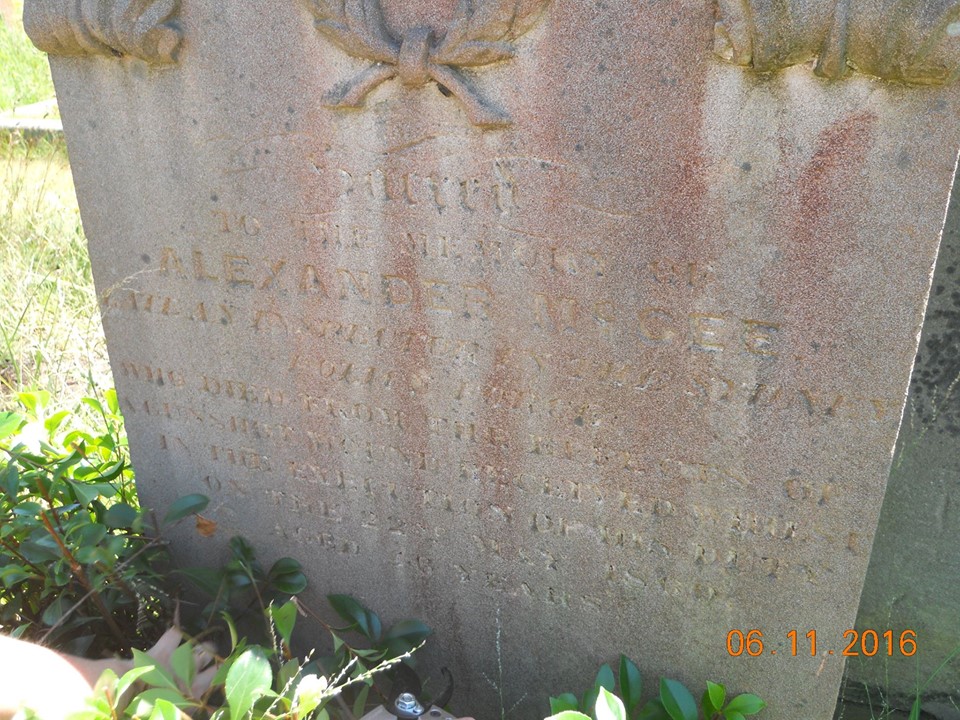
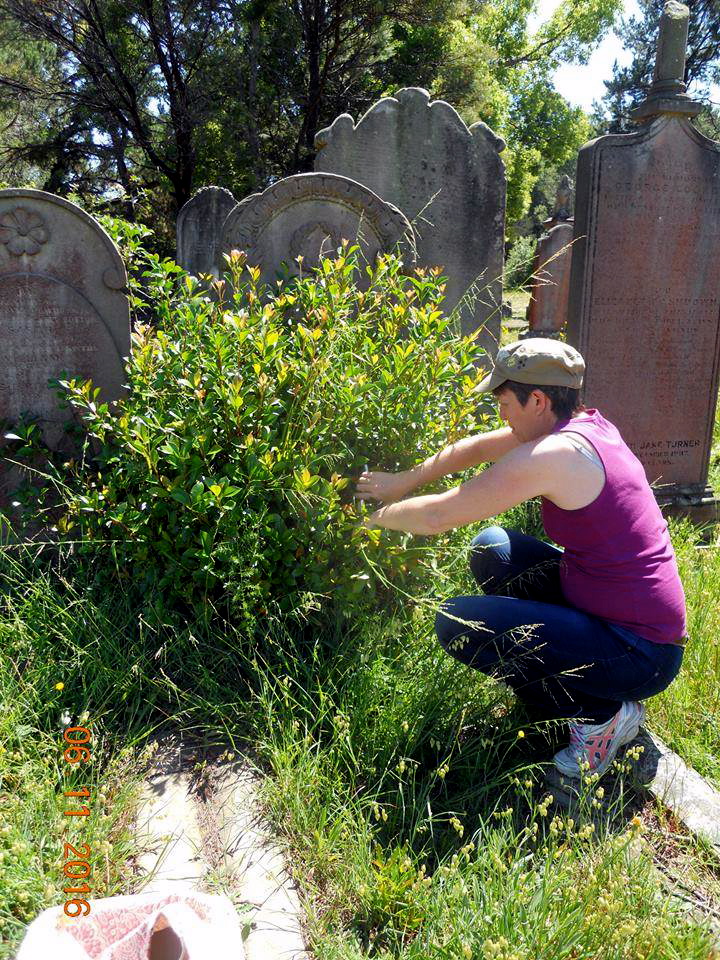
Alison Carter, who is not associated with NSW Police, but went out of her way and took the time to locate & take photos of the grave of our fallen brother – Alexander McGee on 6 November 2016. Thank you Alison.
ALEXANDER is NOT mentioned on the Police Wall of Remembrance
* But should be
Between 11pm and 12 midnight on 26 March, 1860 Constable Connaughty was on duty in Goulburn Street, Sydney when he saw two soldiers ( William Pike and Patrick Hughes ) carrying rifles. Believing them to be deserters he followed them along Sussex Street, across the Haymarket and along Pitt Street until he spotted Inspector McGee, Sergeant James Rush and Sergeant Francis Rooney, who were out looking for soldiers who had deserted from the 12th Regiment.
The four police officers then followed the soldiers until, when near Liverpool Street, they began to run. Rush and Rooney quickly caught up with Hughes while McGee and Connaughty chased Pike into Castlereagh Street where he suddenly stopped and pointed his rifle at the inspector.
Pike then said, ” If you attempt to take me I will shoot you. “ McGee replied, ” Do not fire, coward. “ Pike then ran a few steps, chased by McGee, before turning around and firing at the inspector from point blank range. The bullet struck the inspector in the right groin area, exiting from his lower back. He died from the effects of the wound four weeks later.
The Sydney Morning Herald of Tuesday 12 June, 1860 reported that ” The Central Criminal Court is sitting. The two soldiers, Pike and Hughes, have been tried for shooting Inspector McGee. Hughes was acquitted, but Pike convicted of manslaughter, and sentenced to three years hard labour in gaol. Hughes was in custody when the shot was fired, and as to Pike, as he was only carrying firearms, which at present is no offence against the law, the arrest of him was not justified as an act of police duty…”
At the time of his death the inspector was aged 46 years and had been a police officer for about 20 years. At the time of his death he was stationed in B Division, Sydney.
NSWBDM – Death Reg 707/1860
Bathurst Free Press and Mining Journal ( NSW )
Saturday 31 March 1860 p 3
OUTRAGE.
Two soldiers belonging to the 12th regiment were brought before the Court in their regimental dress by constable Connaughty, charged, the first with feloniously, shooting, intending to murder Inspector Alexander McGee, and the second with aiding and abetting in the same. Their names are William Pike and Patrick Hughes.
Witness stated, that between 11 and 12 o’clock last night I saw the prisoners in Goulburn-street with firearms in their possession (two Enfield rifles.) Believing they were about to desert, I followed them along Sussex-street down to the Haymarket and from thence into Pitt-street. I there met Inspector McGee, Sergeant Rooney, and Sergeant Rush. We then followed the prisoners into Liverpool-street, where they began to run. Hughes was pursued by Sergeants Rush and Rooney, who succeeded in apprehending him.
The other prisoner continued running and was pursued by Inspector McGee and myself. As he turned the corner of Castlereagh-street, prisoner (Pike) said ‘ If you attempt to follow me I’ll shoot.‘ Finding that we were still pursing him, he presented his rifle. McGee, who was close beside at the time said ” don’t fire you coward,” and prisoner immediately run on for about 10 or 15 yards, and when we got within about a length of his rifle, he turned round, and without saying anything, shot McGee through the thigh. So soon as the prisoner fired McGee said ‘ I am shot.’ I asked him where ? he replied through the thigh. In the mean time I secured the prisoner, who the moment he fired, said, ‘ Oh, you have pulled the trigger. ”
Sergeant Rush deposed as follows : About twenty minutes past 11 o’clock last evening, I was at Cowell’s public house at the corner of Goulburn street, in plain clothes. Pike came in with a rifle, the barrel of which was partly covered by the skirt of a woman’s dress. I noticed blood on his hands. Immediately after entering, he called Hughes in, who was standing at the door, but the latter replied, ” No ; don’t you see, you b—-y fool?” Hughes then put his piece, which was clipped, to the charge. They both then went away, and l fancied that, although in plain clothes, Hughes knew me. I then followed them into Sussex-street where, whilst turning round they saw me, and brought their pieces to the charge. Hughes at length said to me, ” Can you tell me where the old Australian Inn is ?” their pieces being still charged towards me. I told them, yes, and that I would go and show them if they chose.
They then brought their pieces to the trail, and I proceeded in company with them. I said, you seem to have just come off a long journey, having your firearms with you. They said they had just come from Melbourne, and were going to a place near Dixon’s mill.
After we had got near the spot indicated, Hughes said, ‘ You had better not come any further.’ but I persisted in following them to the Hay Market, where they had some conversation. They then presented their arms at me and I went away and put on my uniform coat. Immediately after I came up with them again in Pitt-street, where I also saw Inspector McGee and told him what had occurred.
Prisoners next went into Liverpool street and instantly began to run. Sergeant Rooney was at this time close behind, and whilst McGee pursued, Pike stopped Hughes, who thereupon brought his piece to bear. I knocked it aside twice with one hand and struck him in the head with my fist, which caused him to stagger. I took advantage of the opportunity and clasped him round the waist with my two arms, including in the fold the rifle also.
In the mean time Rooney came up and wrenched the rifle from his grasp. Whilst in the act of apprehending him, I heard some one ‘say, ” If you come any further I’ll shoot you, ” and soon after I heard the report of a gun.
I produce the rifle which we took from Hughes. It is loaded and capped. On searching him at the station house, I found in his possession 19 rounds of ball cartridge and 25 percussion caps which I also produce. ( Several rounds of ball cartridges, together with some percussion caps, were also found on the other prisoner. )
Sergeant Rooney gave evidence much to the same effect as that of the previous witnesses.
John Marshland, a sergeant belonging to the 12th Regiment, recognised the two prisoners, who he said had no authority to be out last night. He believed that they effected their escape by climbing the walls. Soldiers were never allowed to carry firearms through the streets except when on duty.
As Inspector McGee is at present dangerously ill in the Infirmary the Bench remanded the case until this day week. — Empire of Wednesday.
Died on the 22nd instant, Mr. Alexander McGee, aged 46 years, late Inspector of police, after a lingering illness from the effects of a gunshot wound on the 26th March, leaving a wife and large family and a numerous circle of friends to mourn his loss.
FUNERAL.— The Friends of the late Mr. ALEXANDER McGEE, late Inspector of police, are respectfully requested to attend his Funeral. The procession to move from his late residence, Police Station, George-street South, on THURSDAY AFTERNOON, at a quarter-past 3 o’clock.
THE Officers and Members of Lodges No. 260, 206, and 207, are respectfully requested to attend the FUNERAL of Brother ALEXANDER McGEE, late of 260 ; to move from his late residence, Police Station, George-street South, THIS DAY, 24th instant, at 3 o’clock p.m.
H. WILSON, Secretary pro tem.
* * *
FUNERAL.-The Friends of the late Mr ALEXANDER McGEE, late Inspector of Police, are respectfully requested to attend his Funeral. The procession to move from his late residence, Police Station, George street South, THIS (Thursday) AFTERNOON, at a 4 o’clock.
IN our obituary of yesterday we had to record the death of Inspector Alexander McGee, of the police force, of Sydney. ” We have long been expecting to make this announcement, for it was on the 26th of March last that McGee, in the firm and intrepid performance of his duties, received the gunshot wound from which, to use the more than ordinary picturesque language of the bar, he, up to the 22nd May ” did live and languish, and languishing ” did die.
The particulars of the occurrence which caused this lamentable event have been recorded in our columns, and are reproduced in the appended, report of the inquest which took place yesterday. The funeral will take place at three o’clock to-day ; and, when it is over, we shall have to add some particulars of Mr. McGee’s career in the police force, all of which we may say are highly creditable to him as a public officer in whatever grade or rank he moved. We are happy to say that we have been informed by the superintendent of Police that a pension to the widow of £50 can be afforded out of the Police Fund.
It is a somewhat singular coincidence that this will be the second instance of relief from the Police Fund which has Mrs. McGee will receive. She was formerly married to a man of the name of Watson, in the police force, who, while conveying a prisoner to the watchhouse, was so seriously kicked in the back that consumption was induced, and he speedily died. On that occasion the donation of £100 was paid to the widow out of the Police Fund. Still we think that some testimonial from the citizens in token of their approval of the gallant conduct of McGee is eminently due.
THE INQUEST.
Mr. J. S. Parker, the city coroner, having, assembled a jury, and viewed the body, commenced the inquest in his office at ten o’clock yesterday morning. The names of the gentlemen who composed the jury are as follows : James Carroll, foreman ; Morris Castle, Edward Sadlier, J. J.E. Lisak, Frederick M. Moore, William Hankin, Thomas S. Pope, R. C. Hordern, John Balantine, Patrick Fox, Timothy Lane, Charles Frazer, and David Baxter.
William Pike, the soldier charged with firing the shot at the deceased ; and Patrick Hughes, charged. with being an accessory thereto, on remand from the Police Court, were brought before the Court by Inspector Foran. The first named prisoner is a young man of about eighteen years of age ; and the other is ‘ something above twenty. The former held down his head, and throughout the inquiry appeared to feel the awful nature of the situation in which his misconduct had placed him ; but the latter appeared intelligent, and asked a number of questions from several of the witnesses.
James Rush, sergeant of police in the B. Division, on being called, deposed as follows : At about half past eleven o’clock on the night of the 26th March last, I went into the Sportsman Inn, at the corner of Pitt and Goulburn streets ; was in plain clothes at the time ; while in the act of drinking a glass of ale a soldier, whom I believe to be the prisoner Pike, came in with a rifle in his hand ; I observed blood on the back of his left hand, and on the rifle something like part of a woman’s dress ; I thought there was something wrong in the soldier having a rifle with him ; I gave Mr. Cowell, the publican, a wink, and turned round for the purpose of closing the door, when I observed another soldier outside with his rifle at the charge pointed towards the house ; the soldier inside said, ” come in and have a drink,” to which the soldier outside replied ” come out of that you b—-y fool, don’t you see ? ” I did not think it safe to interfere ; the soldier in the house, after drinking a glass of ale, went out ; I remarked to Cowell “there is something wrong; I will follow them ; ” I did follow them ; they went down Goulburn-street, and passed constable Potter ; when I came up to constable Potter I told him to follow them at some distance ; when they reached Sussex-street they turned to the left, and went down Sussex-street South ; I saw a Policeman standing at the corner of Sussex and Goulburn streets, and he was joined by constable Potter immediately afterwards ; as I followed after the soldiers I heard one of them remark, ” I tell you it is not ;” I saw that the rifles were capped ; I came up by the men, and Hughes said to me, ” where is the Old Australian Inn? ” I replied ” I do not know ; I know Stewart’s Australian Inn, and I will show it you.” I further remarked ” I suppose you are strangers in Sydney, having your rifles, and come off a long journey;” Hughes replied ” we have just come up from Melbourne by the steamer,” which I knew to be false. When the prisoners got near Mr. Cooper’s wine stores, Sussex-street South, they turned to the right. I said ” you had better not go that way or you will get bogged, it takes you into the harbour.” Hughes said “you had better come no further.” I said ” I will ; I live that way, and am going home; I will show to you the house you asked for,” I saw two policemen coming down Sussex street towards us. The soldiers proceeded into George-street, and passed over to the Haymarket, talking to each other, but I did not hear what they said ; while passing over the Haymarket they turned round and presented their rifles at me ; I thought it best to retreat, which I did very slowly ; as soon as I got out of the soldiers’ sight I ran in to Goulburn street, and asked Mr. Quigley, a publican, to lend me a black coat, which he did ; I went up Goulburn street and met inspector McGee coming out of Durand’s-alley with a female prisoner and several constables ; I said to inspector McGee “there are two soldiers out with rifles, and I think they mean mischief :” he asked ” Where are they? ” and at the same time the soldiers passed up Pitt-street. McGee said ” Come on, let us take them ” I laid hold of the inspector and said ” You had better not go, they will shoot you ; I have changed my clothes since the soldiers last saw me, they will not know me; I will get them into a public-house, and while there you can come up with some other men and secure them;” he replied “that will be the best way ; I followed the soldiers up Pitt-street ; they turned into Liverpool-street, and as soon as they turned the corner I heard some person running ; the soldiers turned round and commenced running also ; I was on the prisoners’ right at the time, and I stepped over and faced Hughes; he presented his rifle at me ; I hit the rifle aside, and struck at the man, but the blow did not take effect ; the soldier stepped back and placed his rifle on my chest ; I knocked the rifle aside again and struck the man on the forehead, which cut his forehead and staggered him ; I flung my arms around him and the rifle and held him tight ; at that moment I saw sergeant Rooney passing, and I called out to him to come and take the rifle ; he came and wrenched the rifle from the prisoner Hughes’ hands ; I then let the man go and knocked him down, and while he was down I, with the assistance of sergeant Rooney, secured him ; I then said to sergeant Rooney, “go and see where the inspector is,” and at the same moment I heard the words ” stop or I will shoot you ” ; in reply, I heard the deceased say, ” Don t fire, you coward ;” immediately afterward I heard the report of a gun ; about half a minute after that sergeant Rooney and constable Connaughty came round with the prisoner Pike ; I took the rifle and found by the smell of gunpowder, as also by its feeling warm, that it had been recently used ; I then picked up the rifle lying on the ground, and found it was loaded and half cocked; with the assistance of the other two officers I took the two prisoners to the B station-house ; I searched Hughes and found on him nineteen rounds of ball cartridge, between twenty and thirty percussion caps, and a stopper to fit in the rifles; I also saw nineteen rounds found on the prisoner Pike; each prisoner had a package broken, as though a charge had been taken out of them ; the next morning the prisoners were brought before the Police Court : on that day (27th March), I went to the Victoria Barracks, and in my presence the charge now produced was drawn from the rifle taken from Hughes ; in the afternoon, as the prisoners were being brought out of the Central Police Court, the prisoner Pike said, “How is the man that was shot? I replied “He is very bad ; you had better not say anything to me about this charge, or I shall give it in evidence against you ; ” he then said, I did not intend to shoot him ; ” I said. ” you did very wrong in bringing your rifles out at all ” ; he answered, ” we wanted something before we left Sydney, as we intended to have taken the bush if you had not come across us.”
By a juryman : I do not know whether the prisoners knew me when they first saw me at the public-house ; they had ample opportunity to shoot me while I was following them ; had I not gone away when they told me, at the Haymarket, I should have been in danger of my life.
By the Coroner : I produce a piece of lead given me by Mr. Dixon, who said he found it in his house ; he lives in Castlereagh. Street, near where the deceased was shot ; the prisoners appeared to know what they were doing, but they were excited ; I saw Mr. McGee at the Dungate Inn the same night, and asked him if he was much hurt ; he replied, ” hurt, yes. ‘ The prisoners declined to ask this witness any questions.
Francis Rooney, sergeant of police in the B division, deposed : On the night of the 26th March last was on duty in company with the deceased, inspector McGee, in Goulburn-street ; sergeant Rush came and reported to us that two soldiers, having guns in their possession, were in Pitt-street, and that one of them had his hands smeared with blood ; all three of us proceeded into Pitt-street at once, and we observed the soldiers going along the middle of the street towards Liverpool -street ; each of the soldiers had a gun ; they turned up from Pitt to Liverpool street, and were walking quickly ; we followed them ; we were dressed in police uniform, and the soldiers were dressed in their military uniform ; we ran after the soldiers, and they, apparently seeing us, ran up toward Castlereagh-street ; sergeant Rush was in advance of me and the deceased ; I saw sergeant Rush lay hold of the prisoner Hughes by the neck and put his arms round his (Hughes’) arms ; the prisoner still held the gun under his arm, and sergeant Rush tried to shift it ; I and the deceased came up, when the prisoner pointed the gun at me ; I caught hold of the gun, pushed it aside, and wrenched it out of his hands ; sergeant Rush then knocked the prisoner down and secured him ; the deceased started off after the other prisoner (Pike), who turned round into Castlereagh-street; a few seconds afterwards, I heard a report of a gun in the direction in which the prisoner had ran ; I left the prisoner Hughes in charge of sergeant Rush, and followed after the deceased, and when I turned the corner I saw the deceased being carried by two men into the Dungate Inn ; I followed after the prisoner Pike, and when I came up to him he was in the custody of constable Connaughty ; I assisted to secure the prisoner, and we proceeded with him to where I had left sergeant Rush with the prisoner Hughes, and we then took both prisoners to the B division watch house ; both prisoners appeared sober, cool, and fluent ; The same night a report was received from the military barracks that Patrick Hughes and William Pike were absent from the barracks with firearms and ammunition ; I am not positive whether the prisoners wore belts when apprehended ; they had no side firearms ; the gun taken from Hughes was loaded. The prisoners declined to ask this witness any questions.
Timothy A. Cowell said ; I keep the inn known by the sign of the Sportsman, at the corner of Pitt and Goulburn streets ; at about five minutes after eleven o’clock on the night of the 26th March last, the prisoner Hughes and a civilian came into my bar ; the civilian called for a pint of ale, which he paid for, and which was drunk between them ; Hughes drank part of his and went outside, and during his absence sergeant Rush came in in plain clothes ; both prisoners came immediately afterwards, each having a rifle in his hand ; Mr. Rush looked at the men with suspicion, and appeared as though he was going to close the doors on them ; one of the rifles had part of a woman’s skirt on it, much smeared with blood I said to Mr. Hush ” there is something wrong them” he replied, ” I will follow them and see what they are up to;” the soldiers then went away, and Mr. Rush followed them; half an hour afterwards I saw the two soldiers come up Pitt-street, and Mr. Rush came up Goulburn-street ; Mr. Rush had changed his coat ; he was followed by inspector McGee and three or four constables, and they all followed the soldiers up Pitt-street ; I closed my door and followed after the police ; just after turning the corner of Liverpool-street, the soldiers commenced running, and the police after them ; I saw Mr. Rush seize hold of Hughes, and I went to assist him I saw Hughes twice place his rifle against Mr. Rush’s breast, as if he wanted to let the rifle off ; before I could render any assistance, sergeants Rush and Rooney had Hughes on the ground and secured ; I then went into Castlereagh -street and saw the barrel of a rifle projecting from a butcher’s shop, and I saw Mr. McGee and two other police officers in front of the rifle ; the rifle was let off, and Mr. McGee said “I am shot;” I took hold of him and assisted him to sit down, and also assisted to put the handcuffs on Pike ; I then assisted to carry Mr. McGee into the Dungate Inn ; I went to the Police Station with the police, and saw a quantity of ammunition taken from both prisoners ; I heard Pike, when he was on his way to the station house, say he was sorry what he had done; when I saw the rifle projecting from the butcher’s shop I heard someone say ” I will fire,” when Mr. McGee said, ” don’t fire you coward;” I think the distance Between Mr. McGee and the rifle, when it went off, was about ten yards ; the rents in the clothes now produced corresponded with those caused by the gunshot wounds, the rifle, when it went off, was pointed in the direction of Mr. Dixon’s house ; Pike was very much excited when apprehended.
By the prisoner Hughes : Sergeant Rush was in front of you when you had your rifle against him ; there was part of a skirt of a dress on your rifle ; I cannot say whether there was any blood on the rifle.
Sergeant John Marsland, of the 12th Regiment, deposed : I know the prisoners before the court ; Hughes belongs to my company, and has been in the regiment since he was a boy ; Pike landed here on the 9th July last and they are both in the habit of drinking, and they have been punished for it ; on the 26th March last Hughes’ was confined in barracks, and was reported absent at about half-past eight o’clock p.m. ; 1 hour later Pike was reported missing ; their rifles were also found to be missing ; it is contrary to the regulations to take arms out of the barracks without orders ; the men are served with twenty rounds ammunition each for their Enfield rifles ; after the prisoners were reported missing I got a picket, by order of the commanding officer, and went down to the town to look for the missing men. ; I reported the absence of the men at the different police stations ; I left the picket at the Detective Police Office, and went with inspector Hogg in search of the prisoners ; we were informed by a constable of the shooting of inspector McGee by one of the prisoners ; I believe Pike was apprehended once before for being a deserter but he had not his rifle with him then ; the men have to be in barracks by eight o’clock in the winter, and at nine o’clock in the summer.
By the prisoner Hughes : The cause of your misfortunes in the regiment is drink.
By the Coroner : I believe that Hughes struck a non commissioned officer once. By the prisoner Hughes : You are a pretty good soldier when sober.
Constable James Potter said : The clothes produced are those worn by Inspector McGee on the night of the 26th March inst. I helped to strip him and to convey him to the infirmary : I was present when he was shot ; and I heard the prisoner Pike say ” stand back or I’ll shot you ; ” and I heard Mr McGee say, ” don’t fire, you coward ;” I saw the rifle go off, and heard Mr. McGee say ” I am shot,” you pulled the trigger yourself ; ” There was no person near enough to Pike when he fired the rifle to pull the trigger but himself.
By the prisoner Hughes : The night was too dark to see the trigger or Pike’s rifle.
Constable Patrick Connaughty, who was also present at the affray, corroborated the testimony of the other witnesses.
Richard Dixon, a tailor residing at 366, Castlereagh–street, deposed : On the night of the 26th March last, I heard the report of a gun ; I got out of bed, procured a light, and found at the foot of my bed the piece of lead now produced ; it appears that one of the posts of my bed had been struck by the bullet : I found the upper square of glass in my window shattered.
John Cecil Read, inspector of the B division, said, the deceased inspector McGee was an inspector under me in the division ; he was shot on the night of the 26th March last, and I had him conveyed to the Infirmary ; I understand he has been twenty years in the police service ; I have known him for five years ; he was generally liked both by the police and the public ; he was a very active police officer ; he leaves a wife and five children not well provided for.
James Robertson, M.D., surgeon to the Sydney Infirmary deposed : Alexander McGee was admitted as an in-patient into the Sydney Infirmary on the 27th March, and died on the 22nd May. He had received a wound on the right groin, immediately to the outside of the artery in that part. There was also a wound in the buttock of the same side. These wounds were no doubt caused by a bullet, the first mentioned being the point of entrance, the latter the place of exit. He died from the effects of this wound. The bullet passed between the points mentioned through the arch of the thigh bone. The wound was almost certain to prove fatal from the first. After death I made an internal examination of the wounded parts. I did not find any foreign body therein ; the deceased told me he had been shot by a soldier ; such a wound might have been caused by such a bullet as that now shown me.
The Coroner then summed up, and the jury, after five minutes’ consideration, agreed to the following verdict :- ” We find that the deceased. Alexander McGee, died from the effects of a gun shot wound, fired by William Pike at inspector McGee, and we pronounce him guilty of wilful murder ; and we find Patrick Hughes guilty of being an accessory before the act, and pronounce him guilty of wilful murder.”
The jury appended the following rider to their verdict:-” We (the jury) unanimously beg, in the strongest possible manner, to recommend the unfortunate widow and five children of the late inspector McGee to the kind consideration of the Government, and more especially after the many years that the late Mr. McGee has discharged his duties with so much, credit to himself, and with such utility to the public. And we also consider it our duty to record, on our behalf as well as on the part of the public generally, our high approval of the conduct of sergeant Rush, who was not on duty on the night in question, and of the conduct of sergeant Rooney and constables Potter and Connaughty.”
The prisoners Pike and Hughes were then removed in custody to the gaol, at Darlinghurst, to await their trial at the next sitting of the Central Criminal Court.
The SPEAKER took the chair at half-past three o’clock.
THE LATE INSPECTOR McGEE.
Mr. ROBERTSON in reply to a question from Mr. Hoskins, said that the widow of Alexander McGee, late Inspector of Police, recently deceased, who died from the effects of a wound received in the execution of his duty, would receive an allowance, which would be provided from the Police Superannuation Fund, under the recommendation of the Board who managed it.
William Pike and Patrick Hughes, private soldiers of the 12th Regiment, were indicted for having at Sydney, on the 26th March, 1860, feloniously, wilfully, and of their malice aforethought, killed one Alexander McGee.
The Attorney-General conducted the prosecution. The prisoners were defended by Mr. Isaacs.
The first witness called was constable Connaughty, of the Sydney police. He deposed that on the day named in the indictment, Monday, 30th March, he saw the prisoners going along Goulburn-street, with fire-arms in their possession. Followed them into Pitt-street, where witness was joined by inspector McGee, and two other police officers. The prisoner Hughes was arrested by sergeants Rush and Rooney. Witness and deceased pursued Pike into Castlereagh-street. When they passed Liverpool-street, Pike turned round and said, that if they attempted ” to come near him,” or ” apprehend him” he would shoot them, McGee said, ” don’t fire, you coward,” he afterwards ran up Castlereagh-street, followed by witness and deceased, When they were within three or four yards of the prisoner he turned round and fired, and deceased called out ” I am shot.” The prisoner said ” you pulled the trigger yourself.” Deceased was not near enough to touch the rifle. About half-a-minute elapsed between the time when the prisoner said he would fire and the time when deceased was shot. Prisoner had run about twelve yards. Pike was subsequently taken by witness and some other constables. On his person were found nineteen rounds of ball cartridge and some percussion caps.
Cross-examined by Mr. Isaacs : Witness and deceased were equally close to the prisoner when be fired. Believed that constable Potter was close behind. As the prisoner went along, he had his piece at the trail.
By the Attorney-General: Did lose sight of Pike between his leaving the Haymarket and firing his piece, but did not lose sight of him after he threatened to shoot until he fired.
By his Honor : Before the shot was fired McGee said nothing to the prisoner except what had already been told. After the shot was fired, be said “secure that scoundrel.”
Sergeant Rush, of the Sydney police, deposed that, on the night of the day named in the indictment, he saw the prisoner Hughes drinking ale in Cowell’s public house at the Haymarket. He observed that he had his rifle. Witness was not on duty, and was not in uniform. He observed that Hughes had the skirt of a woman’s gown on his rifle, and that there was blood on the back of his hand. Witness saw Pike outside with his rifle at the charge, pointing into the public-house. Hughes called to him to come in and have a drink, when Pike said ” come out of that you b—-y fool, don’t you see ?” Hughes came out, and both went away, followed by witness. The prisoners asked witness where was the Old Australian Inn, and witness said he knew where Stewart’s Australian Inn was, and he would show it to them. Witness said ” you must be strangers in Sydney, as you have your rifles, and don’t know your way.” Hughes said,”yes, we have just arrived from Melbourne.” After proceeding some distance, one of the prisoners said that he had better not follow them any farther, and witness said he was going home, and would show them the house they asked for. Having gone a little farther, the prisoners turned round and presented their pieces, telling the witness to go away. Believing himself to be in danger, be walked away slowly, until be met inspector McGee, and some other policemen. Witness subsequently apprehended Hughes. Before he was taken he twice placed the rifle at the breast of witness, and kept rambling in his packet for a cap. While he was securing Hughes, he heard someone call out ” Don’t come any nearer or I will fire,” and heard McGee voice calling out ” Don’t fire, you coward.” Witness subsequently took both the prisoners to the watch-house assisted by other officers. Saw the charge produced drawn out of Hughes’ rifle at the watch-house. On Tuesday, after the prisoners were remanded. Pike asked witness ” How is the man who was shot. ‘ On witness making some reply, he said ” I did not intend to shoot him.” Witness said ” You did wrong in coming out of the barracks with your rifles at all.” Pike said ” We wanted something before we left Sydney, as we intended to take the bush for it,”
Cross-examined: It was between eleven and twelve at night when witness saw the prisoners at the public house. Was standing in front of the bar when Hughes came in. Believed it was Hughes that came in and drank at the bar. Believed that he said it was Hughes that came in and Pike that stood outside when he gave his evidence on former occasions. (The witness’ deposition were here placed in his hands.) Believed still that it was Pike who stood outside. He had his piece at the charge, but not presented. When the conversation took place about the Old Australian Inn, the prisoner had their pieces at the trail. Believed he had never said that they had their arms at the charge at this time. [The depositions were handed to the witness.] When witness was apprehending Hughes the prisoner twice brought the piece to the present. The first was not a good present; the second was. At the second time, witness threw his arms round the prisoner, and called to sergeant Rooney, who took the rifle away.
By the Attorney-General: From the time when Hughes first presented his piece till he was arrested, a very short period elapsed.
By Mr. Isaacs : Could have heard the words, ” Don’t come any further,” or ” Don’t follow me,” distinctly, but was otherwise engaged, and did not recollect the exact words.
Sergeant Rooney, of the Sydney police, corroborated the evidence of the preceding witnesses. He accompanied inspector McGee in pursuit of the prisoners. Followed them at a distance of about twenty yards. When they turned round the corner, at the Sugar Works, witness and McGee ran. When they came into Liverpool-street, saw Rush and Hughes scuffling, and took the rifle away. Rush knocked Hughes down and witness handcuffed him. On the way to the station Pike said that if he shot the man he would suffer for it. The prisoners appeared to be sober.
Cross-examined : Witness took the rifle from the prisoner. Never said that it was Rush who took away the rifle.
By his Honor : While witness and McGee were together, neither spoke to the prisoners.
Dr. Robertson, surgeon to the Sydney Infirmary, de-posed to McGee having been received into that institution. He was suffering from a gun-shot wound in the groin. The wound was the cause of death. The ball had gone through the neck of the thigh-bone.
By Mr. Isaacs : Such a wound would almost necessarily be fatal from the first. Never knew a case of recovery wherein the thigh-bone was shattered. The ball had gone right through the neck of the thigh-bone at a place where the bone is thick. Examined the body after death, and observed a variety of symptoms, the natural result of the wound. The external orifice of the wound had at one time completely healed ; that was proper treatment, inasmuch aa the matter passed out at another opening below.
By his Honor : The ball entered in front. If the par-ties were close, the weapon must have been pointed downwards. Deceased appeared to be rather a tall man.
By Mr. Isaacs: McGee died on the 22nd May, and witness first saw him on the 27th March. Did not say that the wound was necessarily fatal from the first, but that it was almost so. That was not a long period for a man to survive after receiving a fatal wound.
Alfred Cowell, a publican, living at the corner of Pitt and Goulburn streets, corroborated the evidence of the preceding witnesses, as to what occurred at his house. Hughes was in company with a civilian when be first came to the house. The witness was also present when McGee was shot, and he accompanied the prisoners to the watch-house. Heard Pike say that he was sorry of what he had done.
By Mr. Isaacs : Could not say how near the rifle was to McGee when it was first presented. When it was fired McGee was about twelve feet away, the rifle projecting from the side of a wooden house, close to which the prisoner stood.
By his Honor: Was distant about ten or twelve yards from McGee and the soldier when tho shot was fired. When Hughes first came into the public-house, he had not the rifle with him. He wanted to take out some drink ; and witness not allowing him to do so, he went out, and came back in company with the other soldier, Hughes this to,e carrying his rifle. It was between his coming in and going out that Rush came in. Pike only took one step inside the door. He d d not come up to the bar.
Constable Potter, of the Sydney police, corroborated the proceeding evidence, as to what took place at the time when McGee was shot.
By Mr. Isaacs : Saw the prisoners go along Goulburn street in the course of the night. Noticed nothing particular about them, except that they had fire-arms, and that the barrels of the rifles were covered up. Witness was behind McGee when the shot was fired. Was not in a line with the deceased, but was a little towards one side. Deceased was at the curb, prisoner was in a gateway. Heard the words used by Pike-” Stand back, or I’ll shoot you,” or some words to that effect. The caution was spoken twice. After it was spoken the second time deceased did not advance. To the best of his belief, McGee was about two yards from Pike when the shot was fired. The prisoner was in a gateway, but was not out of sight or behind a corner.
By his Honor : There were marks of fire both on the coat and trousers of deceased.
Richard Dickson, residing in Castlereagh-street, deposed that on the day following the occurrence, a bullet was found in his house, which was opposite the place where the shot was fired. The bullet had struck the wall about sixteen feet from the ground.
Sergeant Marsden, of the 13 th Regiment, proved that one of the two rifles produced belonged to Hughes ; who the other belonged to, he could not say. Saw the prisoners on the evening of the 27th. Did not see them again till he saw them in the Court.
Mr. Isaacs submitted that there was no case to go to the jury, in regard to either of the prisoners.
His Honor said be could not understand why the case should be shut out from the jury ; but he would like to hear what evidence there was that the police were in the execution of their duty in arresting the men.
The Attorney-General said there was no immediate evidence to that effect; but it was quite clear that a man had lost his life by the acts of the accused.
Mr. Isaacs still adhered to his opinion. He submitted that in regard to Hughes there was no case whatever. It was not shown there was any previous compact, and therefore. Hughes could not be an accessory before the fact.
The Attorney-General submitted that it was clear from the evidence that there was a ” joint object on the part of the prisoners, from beginning to end, namely, to shoot whomsoever interfered with them, in the proceeding which they had adopted, of going about the city at a late hour at night with loaded firearms in their hands.
His Honor thought there was no evidence to show a joint intention to kill anyone, and that, therefore, there was no evidence to criminate Hughes. The only offence of which the prisoners were shown to have been guilty, in the first instance, was carrying loaded fire-arms through the streets, and that was no offence at the present time, although it was an offences three months ago. He should direct the jury to return a verdict of not guilty in the case of Hughes. ‘ ‘
Mr. Isaacs then proceeded to argue that there was no case against the prisoner. There was nothing to justify the police in interfering with the men. No felony had been committed ; there was no reason to suppose that a felony had been committed. The Arms Act, be believed, was not in existence since November last ; but at all events, it was sufficient for his purpose that the Act was not now in force; and if it were, the military were exempt from its operation. There was not word addressed to the men from beginning to end by any policeman in uniform, except the words used by deceased, ” don’t shoot, you coward ;” and there was no reason to believe that the accused were not themselves looking for deserters, and therefore having the best cause to keep themselves aloof from other persons. The learned counsel cited two cases in support of his argument ; but eventually admitted that the several cases went rather to show that the circumstances on which he laid stress, simply went to reduce the crime for murder to a lesser offence.
The Attorney-General contended that the charge of murder was sustainable, inasmuch as the aggression came from the prisoner Pike. That he was the aggressor was shown by the fact that be had, before receiving any provocation from the deceased, either by word or act, held out a threat, saying, ” If you follow me, I will shoot you.”
Mr. Isaacs addressed the jury, for the defence.” He commenced by urging upon them to disabuse their minds of any impression which they might have received from the extensive discussion which the case had received in the public prints and otherwise. He submitted that if they arrived at the conclusion that the prisoner believed the police were about to arrest him, then the crime was reduced from murder to manslaughter, for the deceased had no more right in law to arrest the prisoners than to arrest him, while he was addressing the jury. He contended, however, that there was good reason to believe that the rifle went off accidentally, looking at the fact that the prisoner previously had ample occasion to fire after the commencement of the pursuit, and had, half a-minute before, presented the weapon without firing.
The Attorney-General declined to reply.
His Honor summed up.
The jury, after a consultation of twenty minutes, returned a verdict of not guilty in the case of Hughes, finding Pike guilty of manslaughter.
His Honor sentenced Pike to be imprisoned and kept to hard labour in the gaol at Darlinghurst, for a period of three years. Hughes was remanded to the custody of the military authorities.
Buried at: Unmarked grave at Araluen Catholic Cemetery
Trooper SMITH lies in an unmarked grave at Araluen Catholic Cemetery.
[alert_yellow]JOHN is NOT mentioned on the Police Wall of Remembrance[/alert_yellow]
The trooper was drowned in severe floods at Araluen in February, 1860. The Sydney Morning Herald of Monday 20 February, 1860 graphically reported the floods, advising of “Losses to life and property, the extent of which are yet not known, from a subject of a dark page in the annals of Braidwood and surrounding districts.” It went on to describe the sad death of Trooper Smith.
….The next calamity to human life occurred at the police camp. Trooper Smith, who had lately joined the force, was endeavouring to escape to Mr. Sweeney’s house, when the current carried him off, and his corpse was discovered when the water subsided; it was entirely buried in the sand, part of the arm projecting. Several bodies not known have been recovered, and it is anticipated that at least seventeen human beings have lost their lives in the Araluen flood. ……..
At the time of his death the trooper was stationed at Araluen. No further details are known as yet.
[divider_dotted]
The Goulburn Herald ( NSW ) Saturday 18 February 1860 p 2 of 4
…….
One of the Troopers of the Southern Patrol, a fine young man named John Smith, was drowned while endeavouring to cross from the police camp to the Cornstalk Inn. In fact the destruction is general and conceivably great. …..
The Empire ( Sydney ) Monday 20 February 1860 p 3 of 8
……. At the Police Camp the water rushed in, and one of the troopers named Smith, whilst making his way from there to Sweeney’s public house, was carried away by the rushing torrent and met with a watery grave : his body, together with the bodies of two Chinamen, have been recovered. ……
Stations: Cheshire Creek Barracks (Bathurst/Peel area), Wyagden
Served: From about 1854 to 22 December 1857
Awards: ?
Born: In Madras, India, about 1836
Died: 22 December 1857
Age: ?
Cause: Shot – Murdered
Bathurst
Funeral Date: ? December, 1857
Funeral location: ?
Buried at: ?
Trooper Robert Dowker CODRINGTON
On 22 December, 1857 Trooper Codrington rode out to meet the gold escort from the Turon Valley. His duties included escorting the gold and mail being carried either by coach or packhorse down the steep Wyagdon Hill and into Bathurst. After he was reported missing, a search was conducted and his body, shot through the heart, was found off the side of the Bathurst – Turon Road in a ravine at the top of Wyagdon Hill. Bushes were found nearby piled on the roadside and it is thought that the bushrangers who probably killed the trooper had hidden at that spot to await and rob the escort. No other satisfactory reason could be found for the murder, although the escort passed the spot unmolested on that day. Local legend has it that the trooper was killed by an old enemy who then returned to England after the murder, however this remains unsubstantiated.
In late 1860 John Higgins (alias John Davis) appeared before the Albury Police Court charged with “having, on the 22nd day of November [sic], 1857, shot one Robert Codrington, a mounted trooper, in the District of Sofala, Bathurst”. He was found not guilty. An alleged witness to the murder was Richard Henry Mills Sampson, who was a man known for giving false evidence in a previous, unrelated trial. His statement, which may or may not be truthful, was as follows:
At that time I was going from Louisa Creek to Bathurst to spend Christmas. I there met the prisoner with three other men, two of them were travelling with the deceased trooper. I rode up sharply, and was immediately covered by a gun by one of the men. The prisoner, whom I now distinctly recognise, shot the trooper Codrington, and afterwards proposed to shoot me. A man named Cole, whom I have known for years, was one of the party…[and he] said I would not blab. The murder took place about 3 o’clock in the afternoon. I was about 50 yards from them when I first saw them. The prisoner said several times, “Shoot him,” and called the others cowards. He then shot Codrington himself, and was the only one of the party who had a gun. I did not see what they did with the body.
The constable was born about 1832 and joined the Gold Escort about 1854. At the time of his death he was stationed at Cheshire Creek Barracks (Bathurst/Peel area).
Robert IS mentioned on the Police Wall of Remembrance
[divider_dotted]
Location of ( Wiagdon ) Wyagdon:
[divider]
Born in Madras ( India ) in 1836 to Robert Codrington and Louisa. Robert Dowker married Louisa Kershaw on 5 April 1856 and had a child – Robert William, born 27 November 1856 or 1857 & died 2 April 1930 in NSW. Robert Dowker CODRINGTON passed away on 22 Dec 1858
My great great grandfather, Robert Dowker Codrington, a gold trooper (mounted policeman) who was shot at Kelso in about 1856. He migrated to Australia in 1853 from England.
Bathurst Free Press and Mining Journal Saturday 26 December 1857 page 2 of 4
HORRIBLE MURDER. Intelligence reached town on Thursday morning, that one of the Gold Escort named Robert Codrington, stationed at Wyagden, had been found murdered under Wyagden Hill. On further enquiry we found that the report was too true. It seems that it had been customary that the trooper stationed at this place, should go out to meet the escort on its return from Sofala, and it is supposed that some party or parties, aware of this circumstance, availed themselves of the opportunity to commit this horrible crime, evidently with the ulterior intention of attacking the Gold Guard. The ill fated man, who had been missing since Tuesday morning, his horse having returned to the Police Station without him, was discovered after a lengthy search by Sergeant Giles, lying headforemost down the hill, with his arms outstretched, and his feet carefully placed together. The body was in a state of partial decomposition, but the marks of a bullet shot through the stomach were plainly apparent, and the arms, including a carbine and pistol, and all the accoutrements had been removed. The deceased was twenty years of age, bore an excellent character, was the son of a commissioned officer in the Indian army, and was a young man of remarkably fine presence. We regret to add that he leaves a wife and child to mourn his untimely fate. Expresses have been sent out in various directions in quest of the guilty parties, and no pains will be spared to bring the perpetrators of this heinous crime to justice.
The Sydney Morning Herald Tuesday 29 December 1857 page 5 of 8
Bushranging. – Accounts have reached town of the wilful murder of trooper Robert Codrington, of the Mounted Police, on the 22nd instant, near Wyagden, when on the way to meet the gold escort. The return of Codrington’s horse, without either rider or trappings, was the first intimation that anything had happened, and on instituting a search the body of the poor fellow was found, having fiveshotandslugwounds in his body, which would cause instant death. His arms ( firearms ) and accoutrements are missing.
Empire ( Sydney ) Saturday 2 January 1858 page 5 of 6
THE TRAGEDY AT WYAGDEN.
(From a Correspondent of the Bathurst Free Press.)
Our quiet neighbourhood has been thrown into a state of great excitement, in consequence of Trooper Codrington, of the Gold Police being shot, at the top of Wyagden Hill.
It appears that Robert Codrington, trooper in the Gold Police, left the Police Barracks, at Cheshire Creek, where he was stationed, about 8 o’clock on Tuesday morning last, for the purpose of meeting the Gold Escort coming from Sofala; and by his not returning that day, some excitement was caused ; it was conceived that he had ‘received some fresh orders, and had gone on to Sofala. On the Wednesday morning his horse was discovered at the stable, with the saddle on, but without his bridle. So soon as this was known, a search was commenced along the road, but no traces could be discovered. Night coming on, instructions were given, that as many horsemen as could be procured, should be ready by daylight the following morning to renew the search. Just as we were on the point of starting from Wyagdon, our doubts were set at rest, by the arrival of Sergeant Major Giles, of the Gold Police, who communicated that the body of Robert Codrington had been found in a gulley on the top of Wyagden Hill. We immediately hastened to the spot, and found that the trooper bad been shot on the road, and the body dragged down the gulley some distance. The scene was most heartrending, and became still more so by the presence of his wife, a fine young woman in the bloom of life, with her baby about twelve months old, who had hastened to the spot so soon as the bad tidings had been made known to her, anxious to see the last of her affectionate husband.
On the arrival of Dr. Andrews from Sofala, who had been sent for, an inquiry was instituted in the presence of J. B. Suttor and Hugh Bridson, Esquires, magistrates.
It was found necessary to remove the body to the nearest public-house, for the purpose of a post-mortem examination. Evidence was taken to show that the deceased had been shot, and that six buck shots had passed through the heart. From inquiry it would appear that a plot had been made to waylay the mail, for the purpose of robbing it, and Codrington happening to pass up first, he was shot by the supposed robbers, and while they were getting him out of the way, the mail must have passed down in safety. It was quite evident from the way the bushes were placed, forming a sort of ambush just on the top of the first point, where the mailman always pulled up to put on the drags, and the guards generally get off, that the intention must have been to have shot the guards, for the purpose of robbing the mail only ; as one pound two shillings was found in Codrington’s pockets, which was all the money he was supposed to have had about him. The carbine and pistols were taken away.
The unfortunate victim of this lawless outrage was a young man of high respectability, and descended from a very high family, who have always stood foremost in the defence of their country ; and he was very much respected in this neighbourhood.
We very much regret that the serious illness of Mr. Johnson, the Gold Commissioner, has prevented his ready aid and presence on this melancholy occasion.
Every praise is due to Sergeant Major Giles and his troopers, in making every exertion to discover the body ; and it is to be hoped that his well-known experience will enable him and his troopers to discover the perpetrators of this awful murder.
After this tragical sacrifice to mistaken policy and economy, it is to be hoped that the Government will see the necessity of increasing the gold police force, as well as the rural police in the neighbourhood of the diggings.
Bathurst Free Press and Mining Journal Saturday 9 January 1858 page 4 of 4
MURDER OF TROOPER CODRINGTON. Public Meeting.
At a Public Meeting held at the ” Carrier Inn, ” Bathurst, W. Hall Palmer, Esquire – P.M. in the Chair, it was proposed by W. H. Suttor, Esquire, seconded by W. Lee, Esquire :-
” 1st. That the recent barbarous murder of Trooper Codrington, at Wyagden, imperatively calls for some movement upon the part of the public in the district, having for its object, the discovery of the murderer or murderers. Carried. Proposed by A. Campbell, Esquire, seconded by J. B. McGuyigan, Esquire.
” 2nd. That a public Subscription be at once set on foot, the amount of which shall be offered as a reward to any person or persons who shall give such information as shall lead to the conviction of the parties concerned in the perpetration of the murder. Carried. Proposed by R. Y. Cousins, Esquire, seconded by Mr. D. Kenna.
” 3rd. That John Blight Suttor, Esquire, be requested to act as Treasurer, and A. G. Shadforth, Esquire, as Secretary, and that they shall at as earl a date as practicable, cause to be published in such of the colonial newspapers as they may deem advisable, the amount of the reward offered. Carried.
Charles Fox was Chief Constable of Muswellbrook when he took his own life on Monday 25 August, 1856. The following paragraph appeared in the Sydney Morning Herald of 29 August, 1856.
On Monday, the 25th, an enquiry was held at the courthouse, Muswellbrook, before the coroner, Mr J.B.West, and a jury of twelve, touching on the death of Mr Charles Fox, chief constable, who, on the same morning, had committed suicide, by shooting himself with a pistol. It appeared on evidence that the deceased was latterly under medical treatment for general debility and depression of the mental faculties and had been for some time past labouring under hypochondria. It seemed on a view of the body, which presented a shocking spectacle that he had placed the muzzle of the weapon in his mouth, which dreadfully shattered… A finding of ‘Destroyed himself while labouring under temporary insanity’ was accordingly made. The deceased was much respected as a steady inoffensive man, and has left a widow and one son.
At the time of his death the chief constable was stationed at Muswellbrook.
Chief Constable George WOOD
| 23/10/2012
Chief Constable George WOOD
New South Wales Police
Illness/Exposure
East Maitland
6 January, 1855
The death of the chief constable followed a boating incident during a search for a body, and was described by the Maitland Mercury and Hunter River General Advertiser of10 January 1855.
DEATH OF MR. GEORGE WOOD – Many of our distant readers will learn with great regret that the well-known chief constable of Maitland, Mr. George Wood, is dead. Few officers holding such a position have more deservedly merited the universal sorrow his death has caused in Maitland. Uniting cool and determined courage with the greatest gentleness, vigour and promptness with the kindest forbearance, Mr. Wood was in the highest sense of the word a peace officer, and to his exertions and example it has been greatly owing that this district has been so quiet and well-ordered for many years past. His long and well-tried services may be said to have been fitly closed by a death resulting in part from the performance of duty. After a recent fatal accident by drowning, Mr. Wood was as usual one of the most persevering in his efforts to find the body; and while so engaged the boat he was in was upset, he got entangled among the lines and ropes in use, and being unable to swim, he was quite exhausted before he could be got out of the water. For two or three years past his frame had shown signs of increased suffering under the effect of old wounds and injuries, and the shock he now received threw him on a sick bed, and brought on an attack of old disease, from which he appeared likely at first to recover, but a relapse occurring, he died on Saturday morning last. His funeral on Sunday was attended by a great number of persons, twenty carriages, above fifty gigs, a hundred and fifty horsemen, and many persons on foot, following his remains to the grave.
At the time of his death the constable was aged 52 years and was chief constable at Maitland Police Station. He left a wife and seven children.
Nick WilesI’m putting together the map of police graves and I’ve come across the Grave of Chief Constable Woods. It looks that the current state of this grave is deplorable. The grave is in the East Maitland Anglican Cemetery (aka Glebe Burial Ground) off George Street in East Maitland. It’s such a shame that a man who was held in such esteem he had “twenty carriages, above fifty gigs, a hundred and fifty horsemen, and many persons on foot” at his funeral and his grave is no longer remembered or tendered to.
Grave Location: positioned right hand side upon the entry gate
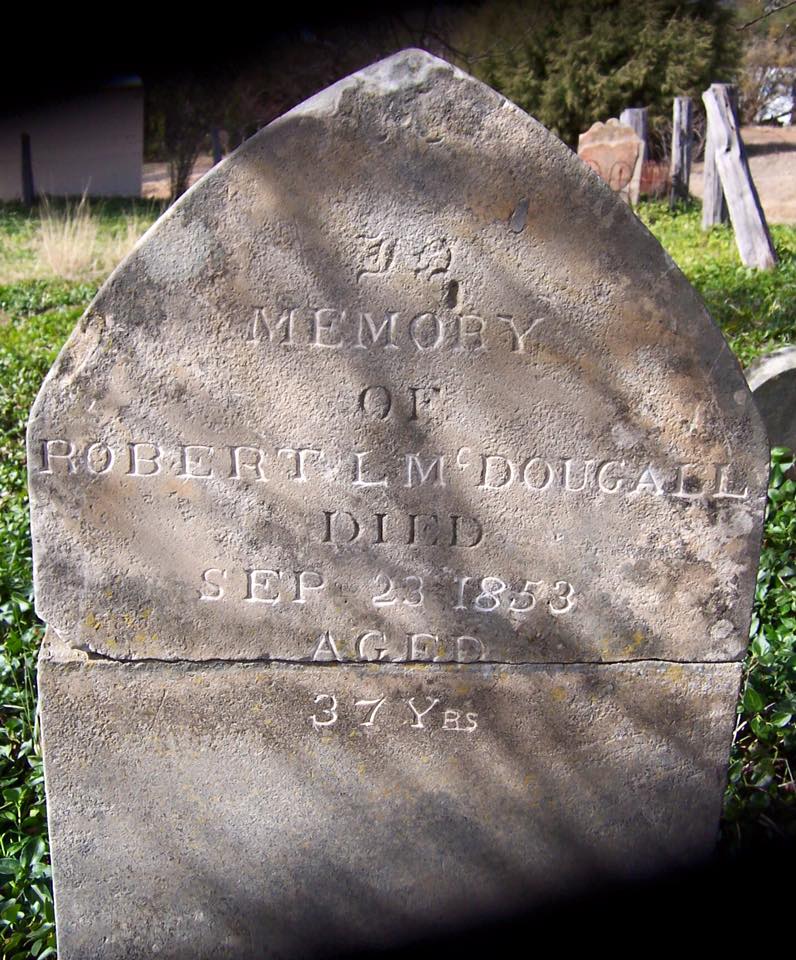
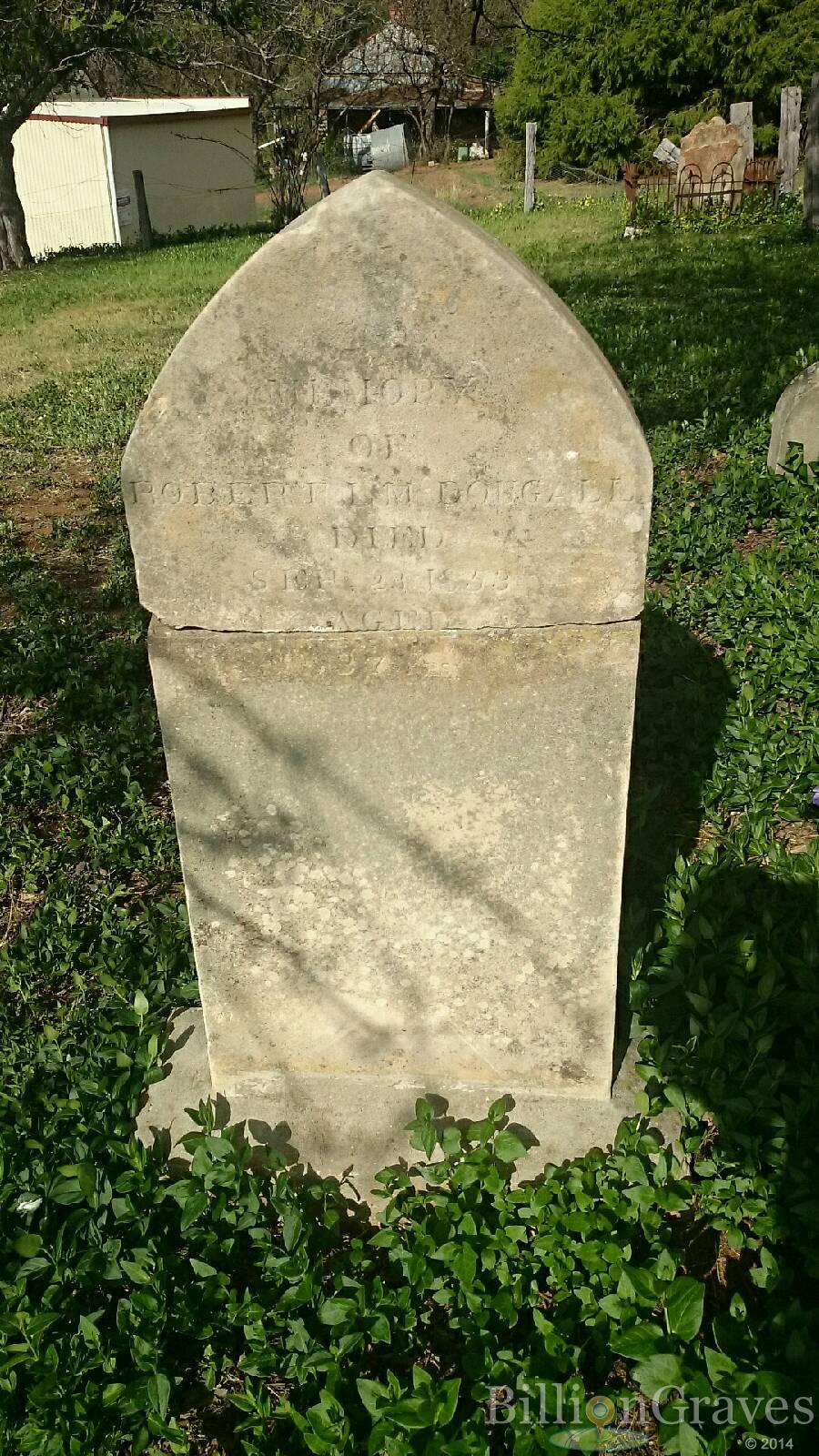
Robert Lovell McDOUGALL gravestone
ROBERT IS mentioned on the Police Wall of Remembrance
It appears that Corporal McDougall met his death in 1853 when returning to Sofala from Wattle Flat, where he had been inspecting gold licences and executing a warrant with another policeman possibly named Johnson. McDougall and Johnson had each then set out for Sofala via different routes, for some reason. As McDougall rode along the road over Whalan’s Hill his horse took fright going down a steep incline and he was thrown. It would appear that one of his feet became caught in a stirrup and he was dragged along, inflicting fatal injuries. When his riderless horse returned to town late that night a search was immediately launched and the unfortunate corporal was found about 2am. He died shortly after being taken home. He left a widow, Mary Ann McDougall and five children. His headstone at Sofala reads”McDougall” however most documents located so far indicate that the correct spelling is probably “MacDougall“.
The Sydney Morning Herald of Wednesday 5 October, 1853, p3, carried the following account of the incident.
A melancholy accident, which terminated fatally occurred last week to Corporal MacDougall of the mounted police. It appears that the deceased was returning from the new diggings on Thursday evening when about half a mile from Sofala his horse stumbled and fell, probably on the top of him. The fall unseated him, but unfortunately one of’ his feet got entangled in the stirrup, and he must have been dragged a considerable distance on the road, as his body was in a very mutilated condition. The horse arriving in town late at night without the rider, a search was at once instituted, but it was not until two o’clock on Friday morning that he was found on the side of a hill, half a mile from Sofala in a state of insensibility. Deceased was at once removed to Sofala, and medical assistance procured, but the injuries he received were of so severe a nature that he expired on Friday evening. A magisterial enquiry was held by Mr Commissioner Johnson, when a verdict of accidental death was returned. He was a most efficient officer of the police, and the respect in which he was held by the inhabitants of Sofala was fully testified by the large concourse of all classes and denominations which last Sunday followed his remains to their last resting place. He was in the 27th year of his age, and has left a wife and five children.”
A report submitted on 26 September, 1853 by Assistant Gold Commissioner Johnson of Bathurst, sheds a little more light on Corporal McDougall, as follows.
AGC Office Sofala 26th Sept/53. No. 53/112.
Sir,
I regret to have to report to you the death of Crpl Robt MacDougall of the Gold Police of this State who died on the 23rd instant from the effects of a fall which he received from his horse on returning from executing a warrant on the 22nd instant.
1. No-one witnessed the occurrence but from the evidence given by persons who were with MacDougall immediately prior to it he appears to have been perfectly sober and that the horse he was riding was very restive.
2. The deceased had been in the Police at Sofala for nearly two years during which period he bore the character of a steady, sober and efficient policeman having never been brought up for any misconduct whatever.
3rd. He has left a wife and five children the youngest being only just born and who by this sudden bereavement are left almost destitute. I would therefore urge whether taking into considerations the good character and efficient service of the deceased a gratuity, or pension may not be bestowed upon his widow.
Signed W Johnson AGC
The Gold Commissioner
Western Districts
Bathurst
The corporal was born in 1816 and enlisted in the Gold Escort on 1 October, 1851. At the time of his death he was stationed at Sofala.
Robert Lovell McDougall (son of Samuel McDougall and Margaret McCormack) was born 1816 in Coleraine Londonderry Ireland, and died 1853 in Sofala NSW Australia.He married Mary Ann Saul.
More About Robert Lovell McDougall:
Burial: 1853, Sofala NSW Australia.
Children of Robert Lovell McDougall and Mary Ann Saul are:
+Mary McDougall, b. 1844, Bermuda West Indies, d. date unknown.
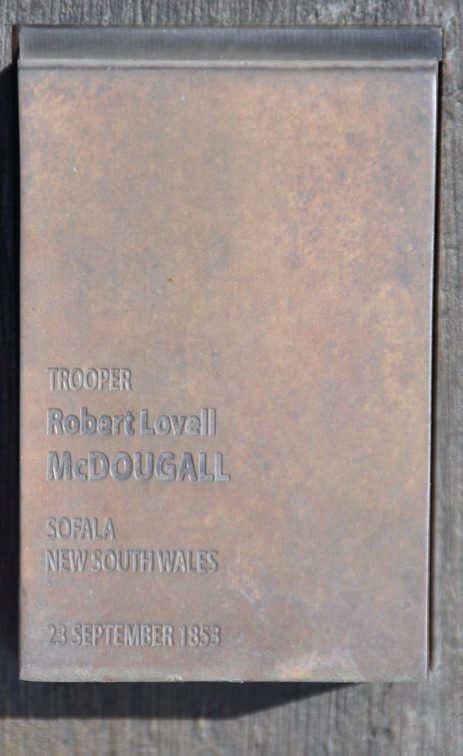
National Police Wall of Remembrance touch plate inscription: – differs slightly on date of joining, his rank and station but especially the date of death.
Trooper Robert Lovell McDOUGALL
Sofala NSW
29 September 1853
Jurisdiction: New South Wales
Year of Birth: 1816
I have found the headstone of Corporal Robert Lovell MACDOUGALL has broken in half & the inscription has almost been weathered away. He was buried at Sofala C of E cemetery in 1853, positioned right hand side upon the entry gate.
His widow Mary Ann remarried to another Trooper, Owen Valentine PARSLEY, her Headstone is to be found beside that of Corporal MacDougall. Robert was born in Coleraine, Londonderry, Ireland. 1816
He married Mary Ann (Marion) SAUL, their first child Mary was born in Bermuda.
Two sons were then born in Donegal, Ireland. On arrival in Sydney a daughter Jane Leslie was born, their last child Margaret was born in Sofala a few months before Robert’s death on 26th September, 1853.
Thanking you in anticipation
Janet Aubrey
Married Eliza Santer (d: 4 Jan 1869 in Mudgee) on 4 June, 1829 in Benenden, England,
Father of Albert, Mary A., Own, Rachael, Jane E. Arnold & William I. Oxley
Appointed Constable at Mudgee in 1851
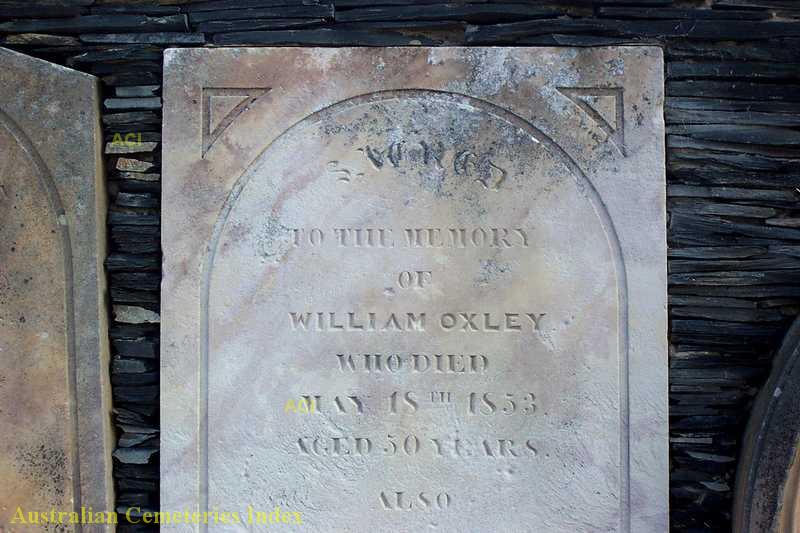
49 old
19 May, 1853
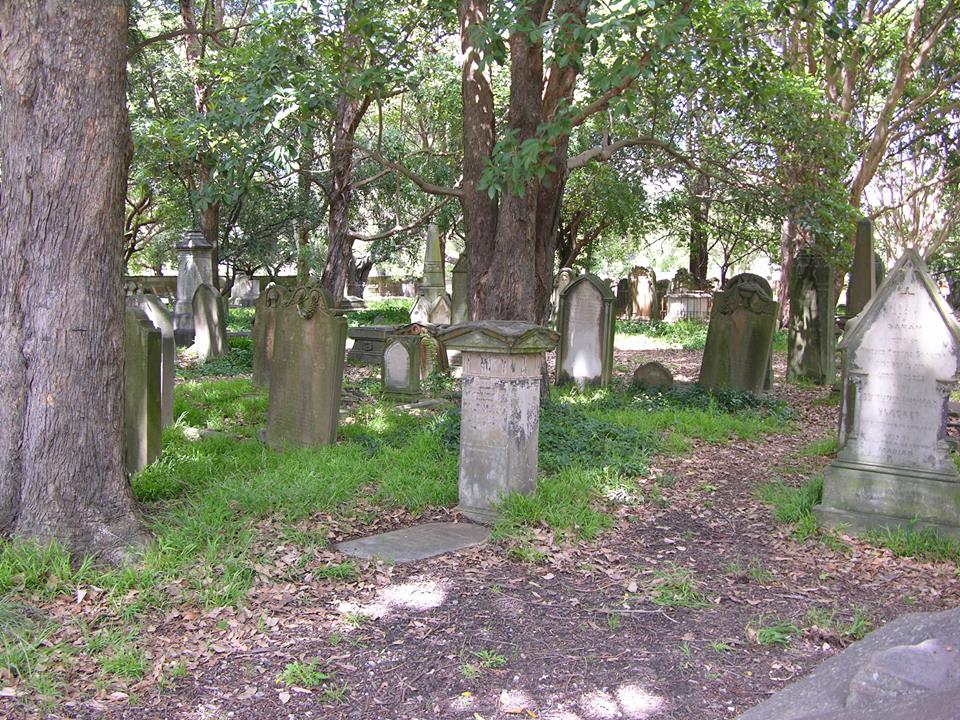
Gravestone in Mudgee Pioneer Park
On the evening of 29 April, 1853 Maurice Dalton, a former publican, attempted to gain entry to Freeman’s Public House in Mudgee. After being refused entry by the owner Freeman, Dalton threw a large stone into the building. He then crossed the street where he came upon a man named Brandon who was playing a clarinet. Dalton knocked Brandon to the ground, asking him what business he had playing the instrument. Brandon then went and reported the incident to Constable Oxley. A short time later Oxley located Dalton and asked him, “Is that you, Maurice Dalton?” Dalton replied, “Who are you?” and then went on, “Oh, I know you for a b—– trap by your buckle.” He then struck Oxley a severe blow to the side of his head with a large stick, knocking the constable to the ground. He then kicked the fallen constable as he lay on the ground.
The Maitland Mercury and Hunter River General Adviser of Wednesday 8 March, 1854 informed the community that “Oxley lived for 19 days after, and even performed duties at times, but at length died from apoplexy induced by the wound, the brain being greatly inflamed under the wound. The jury returned a verdict of manslaughter, and prisoner was remanded for sentence.”
The constable joined the police force in June, 1851. At the time of his death he was 49 years old and was stationed at Mudgee.
SERIOUS CHARGE AGAINST A PUBLICAN.- In the month of April ultimo, Maurice Dalton, a publican at the Maitland Bar, on the Turon, was committed for trial by the Mudgee Bench of Magistrates for assaulting a policeman named Oxley. Mr. Dalton was admitted to bail, but as the case assumed a serious aspect, and Oxley has died, Mr. Dalton’s sureties surrendered him to the Gold Police, from whom he effected his escape, and is still at large.-Empire, May 30.
Empire ( Sydney ) Friday 6 January 1854 page 5 of 8
MURDER. – A man named Maurice Dalton was placed in the dock by Sergeant McGhee, charged with having committed a violent assault on Constable Oxley, of the Mudgee Police, from the effects of which the constable had subsequently died. The offence was committed in the month of April last, near Bathurst, and prisoner was apprehended on a warrant from the Mudgee Bench, which had since been sent to Port Phillip, where it was supposed he was residing. The prisoner denied the charge laid against him. At the request of Mr. Wearin, he was remanded till this morning.
Empire ( Sydney ) Saturday 7 January 1854 page 3 of 8
MURDER AT MUDGEE. — Maurice Dalton was again placed before the Court. A witness named Hugh O’Donnell deposed, that he lived some time since at Mudgee, and knew a person named Maurice Dalton ; witness did not believe the prisoner was the same man ; if so, he had very materially altered in appearance. Sergeant McGhee produced the Hue and Cry, wherein, under date 28th April, 1853, was given the description of a man named Dalton, charged with a violent assault on Constable Oxley, from the effects of which the latter afterwards died. The description published corresponded exactly with the personelle of prisoner. A letter was found on the defendant, having reference to the alleged assault. Their Worships, after consultation, remanded prisoner to the Mudgee Bench for examination.
The Sydney Morning Herald Monday 13 February 1854 page 5 of 8
On Friday the 27th ultimo, Maurice Dalton, who had been apprehended in Sydney for the murder of William Oxley, one of our constables, in May last, was brought into our township and safely lodged in the lockup.
The Sydney Morning Herald Thursday 16 February 1854 page 3 of 8
MAURICE DALTON — This somewhat notorious individual was forwarded from Bathurst to Mudgee about a fortnight ago, to be present at the investigation touching the death of the policeman who fell by his hands, at the last Mudgee races. He was fully committed to take his trial at the forthcoming assizes for an assault resulting in the death of the attacked, and reached Bathurst on Monday last.
Empire ( Sydney ) Saturday 4 March 1854 page 3 of 8
TUESDAY, FEBRUARY 28, 1854.
MURDER.
Maurice Dalton was indicted for that he, on the 29th April 1853, at Mudgee, in New South Wales, did feloniously, wilfully, and of his malice aforethought, kill and murder one William Oxley.
The ATTORNEY-GENERAL stated the facts of the case, and called
James Lucas Brandon: I live at Mudgee ; I lived there in April last ; I saw the prisoner on 28th April ; he insulted me, and knocked me down ; I was going home, playing the clarionet, when the prisoner came across and asked me what business I had playing that bloody thing, and knocked me down ; I went to constable Oxley, and told him, and he told me to go home ; when I got home I heard stones thrown against my hut ; I was frightened to stop, and I went out for constable Oxley, and then I saw the prisoner : Oxley spoke to prisoner, and asked what he was about, kicking up that row at that time of the night for ; prisoner asked him who he was, and said, I know you are a b—dy trap, I know you by your buckle ; I then saw Oxley fall, no one was near him when he fell but prisoner ; I was 100 yards off ; I could not say whether prisoner had a stick or a stone in his hand ; when Oxley fell I went up to him, and found him bleeding profusely from a cut on the head, he was not able to speak, he appeared to be insensible ; I think Oxley lived for a month afterwards.
Cross-examined by Mr. Holroyd : After he was knocked down, and before his death I often saw him on duty in the streets of Mudgee ; I had been playing the clarionet in Tuckerman’s public house, in Mudgee. I drunk nothing that day but peppermint and ginger beer – three glasses of port wine in the evening.
William Freeman : I live in Mudgee ; I recollect 28th April, 1853 ; I recollect seeing prisoner that night ; he used to keep a public house at Maitland Bar ; on that night I was called up by the mistress, who said some one was breaking into the house ; I went outside and found prisoner there ; I told him to go away, but he would not go away ; I then went back to my house and he followed me round and threw a large stone into my house, which fell on my wife and child ; I spoke to him, about throwing the stone, and he then went away ; I saw him then walk towards the witness Brandon, who was coming down the street, and I saw them scuffling, and Brandon called out for Oxley ; I afterwards saw Oxley bleeding about the head, about half an hour after I saw prisoner scuffling with Brandon.
Cross examined by Mr. HOLROYD; He had no stick in his hand after he threw it on my wife’s bed.
Donald McDonald ; I am a surgeon, I knew the late William Oxley ; I was called to see him in the morning of 29th April, 1853 ; he was lying on his bed, bleeding-profusely from a cut on his head, it was a contused wound such as might have been caused by a stone ; he lived eighteen or nineteen days after I first saw him ; I made a post mortem examination ; I should say that his death was caused by the injury received on his head ; I knew deceased for several years, he was a healthy man ; the scalp was inflammed, and on opening the cranium I found the membranes of the brain were inflammed, caused by the wounds ; other causes might have accelerated his death.
Cross-examined by Mr. HOLROYD : I think the wounds were sufficient to cause death ; I believe deceased was a free liver, and had the appearance of a man that drank ; I saw deceased do duty as a constable ; I cautioned him not to drink ; I believe but apoplexy was caused by the blows on the head.
David Picton: I live at Mudgee ; I recollect the night Oxley was wounded ; I saw a man near Brandon’s, house ; whilst I was in Brandon’s house two stones were thrown in ; Brandon then went to Oxley for assistance ; Oxley went up to the man and said, “Is that you, Maurice Dalton?”. Prisoner said, “Who are you?” and then said “0, I know you are a bl–dy trap, by your buckle” and struck him a blow with a large stone. Oxley fell when he got the blow ; I helped Brandon to pick him up.
Cross-examined by, Mr. HOLROYD : I was 20 yards off Oxley when the blow was struck. .
Mr. Bailey, Clerk of Petty Sessions, Mudgee:
I knew William Oxley, the constable ; I know he is dead ; Oxley was examined before the Bench on the 30th April, 1835 ; the magistrates present were M. P. Bayley, and Basil Dickenson. ( Deposition put in and read. )
Mr. HOLROYD addressed the jury for the defence, and contended that the death was caused by other causes, and called the following witnesses in support of such a view of the case :-
John Ashton : I am a constable in Mudgee ; I knew the deceased, I recollect his meeting with this injury ; I know that he had fits ; he had one on 26th February last year between the time of the accident and his death ; he went on duly 12 miles from Mudgee ; he went on horseback ; this was about 15 or 16 days after he received the injury.
Cross-examined by the ATTORNEY-GENERAL :
The first time I saw him in a fit was on 26th February last year ; I don’t know what caused the fit ; I never saw him have another fit ; he appeared a very healthy man.
George Taylor ; I am an innkeeper at Mudgee ; I knew Oxley the deceased ; I recollect his taking a journey to Cloudy Bay ; after his return from Cloudy Bay, I saw him in a fit ; this was in the morning ; I saw deceased lying in a fit on the ground ; I assisted him by lo??ing his handkerchief, and then went for the doctor ; he was very apoplectic looking ; I saw him occasionally on duty from the time of the assault to his death.
Cross examined by the ATTORNEY-GENERAL : He went to Cloudy Bay some days after he got the wound ; it was not quite healed.
Alexander-Watt : I knew the prisoner whilst he was in my employment ; he was a very well behaved man.
Cross-examined, by the ATTORNEY-GENERAL ; It is ten or twelve years since he was in my service ; he was a few weeks in my service employed mowing.
The ATTORNEY-GENERAL replied at some length.
After an address of some length from the Judge and a careful recapitulation of the evidence by him, the Jury returned their verdict of
Bathurst Free Press and Mining Journal ( NSW ) Saturday 4 March 1854 page 3 of 6
WILFUL MURDER Maurice Dalton was indicted for the wilful murder of William Oxley on the 29th April last, at Mudgee. He pleaded not guilty and was defended by Mr. Holroyd. Attorney — Mr. Serjeant.
James Lucas Brandon deposed that about 1 o’clock of the morning of the 29th. April, he was proceeding homeward, playing a clarinet, when the prisoner walked up to him and after asking him what he wanted playing that b____y thing, knocked him down. He applied to constable Oxley for assistance who advised him to go home. He did so, and shortly afterwards stones were thrown at his door and upon the house. Again he went for Oxley for assistance who came out, and no sooner made his appearance than the prisoner accosted him in these words— “you’re a B____y trap, I know you by your buckle.” Upon proceeding to the spot he found deceased lying senseless and bleeding, the wound having been inflicted on the side of the head. Cross-examined by Mr. Holroyd. He frequently saw the deceased upon duty afterwards in Mudgee— never saw him the worse for liquor, but recollected taking a glass with him on the Thursday before his death.
William Freeman saw the prisoner at Mr. Arthur Cox’s on the 29th April last, who was making a great noise. He ordered him away and was requested by him not to tear his shirt. In a moment afterwards prisoner seized a big bludgeon which he threw inside upon the bed in which his wife and children were sleeping. At this time the prisoner had a stone in his hand. He saw the deceased who was capable of walking unsupported.
Dr. Macdonald attended the deceased who had a wound upon the side of the head, which did not appear to he dangerous. Besides this he subsequently discovered, when holding a post mortem examination upon his body, another and more serious wound at the back part of the head, but from which no external injury appeared. He had no doubt but the blow’s accelerated, if they did not cause his death. There was a considerable effusion of blood upon the brain. Cross-examined by Mr. Holroyd : He did not know that the deceased drank, but he had the appearance of a free- liver. He saw deceased a few days before his death and heard of his falling over a scraper. From that period he had a succession of apoplectic fits which continued until death.
David Picton saw a man whom he did not know to be the prisoner near Brandon’s, at whose house he threw two stones. Shortly afterwards he saw Oxley leave his house and heard him speak to this man whom he named Dalton, and who in reply called him “b___y trap” ‘ A moment or two afterwards he saw Dalton strike deceased with a thick stick which felled him to the earth : blood flowed freely from the wound thus caused. He (witness) might be 20 yards from them at the time Brandon and he stood near each other.
Mr. F. Bailey proved that a charge for a violent assault was preferred against Dalton who was committed to take his trial at the Quarter Sessions on the 30th. January. Some time afterwards Oxley died and an inquiry was held upon his remains. The depositions were written by him as Clerk of the Court at Mudgee.
This evidence closed the case for the Crown. Mr. Holroyd addressed the jury in behalf of the prisoner. This case, he said, involved a charge of murder without malice, as from the evidence which had been given it was impossible to conceive that the prisoner could have been actuated by any such feeling. There was nothing before the jury to show that they were even acquainted, and from the nature of the wounds the blows must have been of a very trivial character. When the witness Freeman reached deceased he was standing upon his legs, and could not therefore have been very seriously wounded. There was moreover a discrepancy in the testimony of Picton and Brandon which showed plainly that both could not speak truth. The former estimated the distance at which they stood at the time the deceased fell at 100 yards, whilst the latter fixed it at about 20. Clearly this was no case of murder, and he could not for one moment imagine how it was to be reduced even to manslaughter upon such trumpery evidence. According to Dr. Macdonald’s testimony the deceased had a predisposition towards apoplexy, and this predisposition was increased by ardent spirits of which it appeared probable he partook. It would also be fresh in the recollection of the jury that the deceased had fallen against a scraper a few days before his death, and had then most probably received the injury at the back of the head which caused apoplexy and hastened his death. To his mind it appeared that an assault was the worst charge that could be fixed upon the prisoner.
He then called Constable Ashton of Mudgee who knew the deceased and remembered that on the 26th. February 1853 he had a fit about 7 miles from Mudgee, and was insensible for about three quarters of an hour, but had never seen him in one before nor since. Witness attributed his illness on that occasion to the fact that they had been travelling all day with a flock of sheep, and deceased had not broken his fast. About 16 days after the assault deceased was on duty and went with a letter for the coroner to Cloudy Bay, and did not return until the following day.
Mr. George Taylor, Innkeeper of Mudgee, remembered deceased’s going to Cloudy Bay in the early part of May in last year ; it was after the assault — had never seen him in a fit until he returned from Cloudy Bay. On the morning after his return, heard some one screaming, and on going out saw deceased on the ground in a fit – knew that he had been on duty occasionally after the 29th. of April. Cross- examined, by the Attorney-General : The wound in the head was not quite healed at the time he went to Cloudy Bay and witness thought he was not able to do as much duty as before the assault. He did not appear to suffer from any other cause than the wound in the head.
Mr. Alexander Watt was called to give the prisoner a character. He said he had known him for ten or twelve years, and on one occasion had employed him during the harvest — had also heard other persons speak of him, and believed that when sober, he was quiet and well behaved, but when in liquor very violent. Beyond this he did not know very much about him.
The Attorney-General replied and made some stringent remarks about gentlemen appearing to give prisoners a good character of whom they know but little, the natural consequence of which was that the cases of those who really deserved a good character were materially injured. In reference to the case before the court he cited some cases to show that it was a matter of no importance whether the deceased was aged and infirm, or young and strong, but if his death was accelerated by the conduct of the prisoner the charge against him was sustained. He also directed the attention of the jury to the expression used by the prisoner at the time of the assault calling deceased a “B___y trap” &c., kicking him after he had knocked him down, and said if deceased had drunk too much or taken too much exercise after the assault it would not make an atom of difference ; for Dr. McDonald had declared that death had resulted from the effects of the blows upon the head. His Honor, in summing up, laid before they jury very clearly and distinctly the difference between murder and manslaughter, and said that in cases of homicide the law presumed the existence of malice ; and it was for the defendant to show that he had just cause for his conduct in the affair. After reiterating the evidence he left the case in the hands of the jury. The jury found a verdict of manslaughter. Prisoner who was remanded for sentence.
The Sydney Morning Herald Wednesday 8 March 1854 page 5 of 8
THE ATTORNEY-GENERAL AND THE MAGISTRACY.
(From Saturday’s Bathurst Free Press.)
In opening the case against Maurice Dalton, for the wilful murder of Constable Oxley, at Mudgee, the learned Attorney-General prefaced his review of its leading features by the following observations upon the general recklessness which prevails with regard to the issue of licences : –
This, he said, was one of the many instances which had recently come under his notice of individuals being intrusted with a publican’s license who were most palpably and flagrantly unfitted for such a position. Here was a man arraigned for the wilful murder of a fellow creature – a murder committed whilst in a state of maddening intoxication, who by some means or other had obtained a license as a publican. And how came this? Would it not be quite as safe, nay infinitely more so, to place deadly weapons in the hands of a maniac and turn him loose upon society, than to intrust a person of bad moral character, and a notorious drunkard to boot, with the power and opportunity of inflicting such a vast amount of mischief upon the community. Only that very day it had transpired in evidence upon another case that the prisoner had been a publican at Carcoar, and was known to the bench to be an habitual drunkard. Nay, one of the magistrates himself who appeared as a witness had admitted that when he called to see him about the money which he was accused of stealing, he was so drunk as to be unable to speak sensibly and that he never saw him sober ; yet, notwithstanding these facts, known personally to himself, and occurring under the very nose of the Bench, his license was subsequently renewed. What security, he would ask, could there be for the preservation of public order and against the commission of crime whilst magistrates thus culpably neglected their duty? One bad man invested with the privileges and opportunities of evil which appertained to such a calling, could accomplish a vast amount of mischief in promoting and fostering vice and crime, and in aiding in the demoralization of those by whom he was sure to be surrounded. It would be better to arm a madman with a firebrand and trust to consequences, than enable a person so devoid of character and principle to scatter about him the moral poison of his depraved nature. The frequency of late of such cases as those upon which he was now commenting impelled him thus publicly to call attention to the circumstance. And he must say if magistrates tolerated such evils by neglect of duty, they were responsible for the consequences.
Such was the emphatic language employed by one of the highest legal authorities of the country under circumstances which demanded a strong expression of opinion ; and it is a fortunate thing for the colony that the position is filled by a gentleman who, regardless of personal considerations, has the moral courage to administer a castigation so well merited. We agree with him, that to place such men as Henrys and Dalton in the situation of a licensed publican is to laugh at the law and treat public order and decency with contempt. A ruffian and debauchee are not to be placed in situations where duly imperatively requires an unremitting self-control, and in which temptation is continually beckoning the most discreet from the path of rectitude with seductive arts and fascinating smiles. There is too little care taken in investigating the characters of applicants for licenses, and the consequence is witnessed in the fact that whilst the great majority of licensed publicans are men of good repute and undoubted integrity, many, very many, have crept into the trade who would do little credit to any calling or position of life in which they might be found,
And herein principally lies the misfortune. Similarity of tastes and disposition surrounds such men with the criminal and the vile. At such houses their depredations are planned, and there the wages of crime are dissipated. Money thus easily earned is recklessly squandered, and heedless of the source whence it has been procured, if not directly concerned in the plans of his rascally associates, the unprincipled tapster grows fat upon the spoils which have been wrung from the honest and unwary. There sins and malpractices are, therefore, not only connived at, but encouraged. They form a perennial spring of profit whose amount is not to be despised. True to one instinct of our natures, where better sentiments are inoperative, he sells his grog, pockets their ill-earned cash, and ask no questions. To him the clever and successful thief is worth infinitely more as a customer than twenty honest and reputable men, and hence such company is infinitely preferred. The wealth of a plundered community flows into his pockets, and for this consideration he is ready to administer in any shape to the base ( and brutal passions of his customers.
The above may be an extreme case, but there are many which differ only in degree. Men of loose or unfixed principles are not apt to be over-scrupulous where business is to be done. The tap runs freely whilst the cash is responsive, and under such circumstances little heed is taken of irregularities, improprieties, or the Licensed Victualler’s Act. The free and easy style of such establishments suits the tastes of the reckless and the profligate ; and hence it ¡s that the respectable publican, whose regard for his own character and the reputation of his house will not permit any gross violation of law or decency, is most materially injured.
But we are very far from imagining that the rapid strides by which intemperance is stalking over the country are to be stayed by the most active magisterial superintendence. The root of the evil lies out of the reach of all law – beyond the grasp of the most vigilant police. To read lectures to the magistracy will do little towards the correction of an evil which has eaten its way into the very vitals of our social system, and overshadows the land with gloom. All the powers of legislation and machinery of our courts of justice are unequal to the task of eradication. Society must expurgate itself, and it can only do so by the universal action of some powerful moral agency. No class is free from the taint of this cankering vice, and sermons upon temperance delivered to the masses will be of little force or efficacy whilst the power of example is wanting in the ranks of those who claim the right to sermonize.
It is true that much crime and irregularity might be prevented by a stricter exercise of the discretionary power vested in the magistracy, but the public may fairly share the blame of recklessly licencing all applicants. No matter what the character, five respectable householders will be found to parade their names in the way of recommendation, and it is notorious that profit has often more to do than principle with the matter. In this manner men of indifferent or bad repute have passed through the magisterial ordeal into a public-house, and have thus visited one of the sins of the community upon its own head. First – Mr. So and so, storekeeper, signs, because he is anxious to secure a customer, and uses his influence with a friend or two. Several good names being already attached, they become a guarantee of the applicant’s eligibility for a license. Others are therefore easily obtained, and the bench by no means unwilling to forego the trouble of an inquiry which promises more kicks than half-pence, take it for granted that the applicant is what he is represented to be. The learned Attorney-General could therefore have very well afforded to give his castigation a much wider amplitude.
The Sydney Morning Herald Wednesday 15 March 1854 page 3 of 12
Maurice Dalton, manslaughter, was sentenced to five years hard labour on the roads or other public works, the two first to be worked in irons. He presented a petition to his Honor setting forth amongst other things that his victim had died from the effects of falling upon the scraper, but this his Honor stated to be impossible, the wound behind the head was caused by a blunt not a sharp instrument, a fact which was established by the circumstance that the skin was not cut outside. His conduct he said had been most savage and unprovoked and he would mark it by very severe sentence.
Grave location is: Mudgee Memorial Park
NOTE: 1 June 2014:
It has been revealed that this person is NOT mentioned in the States Honour Roll nor the National Honour Roll of Fallen Police.
The following message has been sent, this date, to the NSW Facilitator for this to be remedied:
G’day Andy
It has come to my notice that Constable William OXLEY, killed as a result of work related assault, who died on the 19 May 1853, is NOT mentioned in the National, nor NSW Honour Roll.
See my website: https://police.freom.com/william-oxley/
I have listed all the relevant newspaper articles of the time, in relation to the matter and it is shown that the offender ( Maurice Dalton ) was finally convicted of the Manslaughter of Constable William OXLEY who is buried at the Mudgee Pioneer Park.
Service: From 16 November 1852 to 4 May 1853 = 6 months
Awards:
Born: ? ? 1819
Died on: 4 May 1853
Cause: Illness – severe cold – Exposure
Age: 33
Funeral date:
Funeral location:
Grave location: Constable TWISS was interred at the Camperdown Cemetery but his grave is unmarked and location unknown.
[alert_red]ALEXANDER is NOT mentioned on the Police Wall of Remembrance[/alert_red] * BUT SHOULD BE
Constable Alexander Twiss served in the Sydney Police Force from 16 November 1852 until his death on 4 May 1853. His cause of death is recorded as having been ” from the effects of a severe cold caught when on escort duty at night “ .No further details are known as yet.
The constable joined the police force on 16 November, 1852. At the time of his death he was 34 years old and was attached to the Sydney Police. He left a widow named Sarah.