Service: From? ? ?to 25 October 1852 = ? years of Service
Awards: ?
Born: ? ? ? about 1827, Downpatrick, Co. Down, Ireland.
Event date: Saturday 14 February 1852
Event location: outside of the Horse and Jockey Hotel, Hunter St, O’Connell St, Sydney @ 9pm
Event type: Assault – kicking
Died on: Monday 25 October 1852
Place of death: ?
Cause: Illness – Tuberculosis
Age: 26
Funeral date: Wednesday 27 October 1852
Funeral location: ?
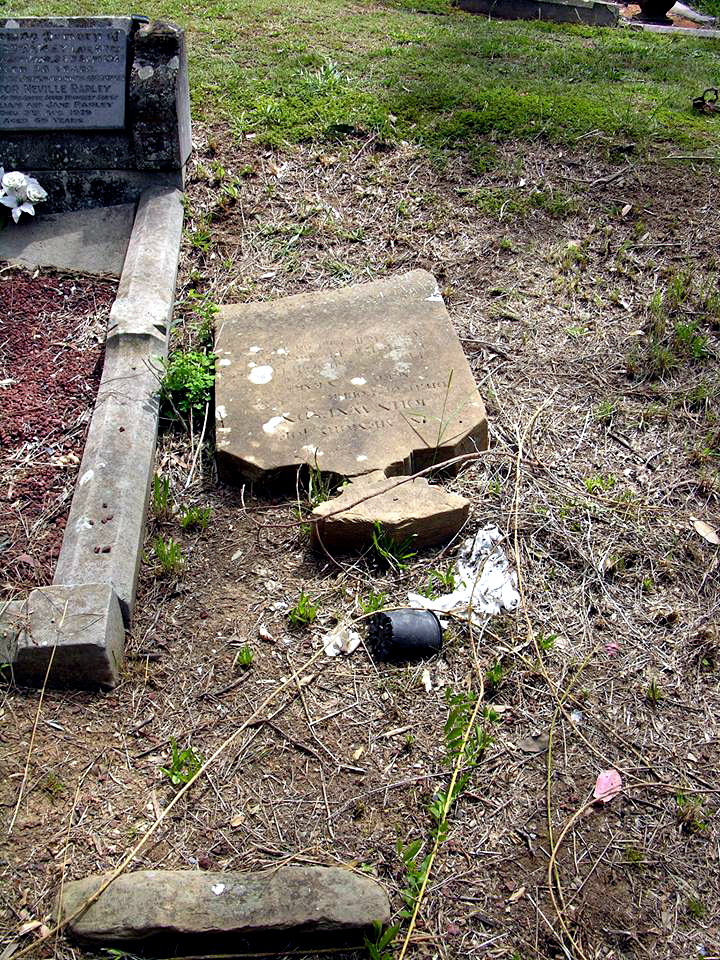
Buried at: St John’s Anglican Cemetery, Menangle Rd, Camden
Grave location: very end of Row E, Plot 107
Memorial at:
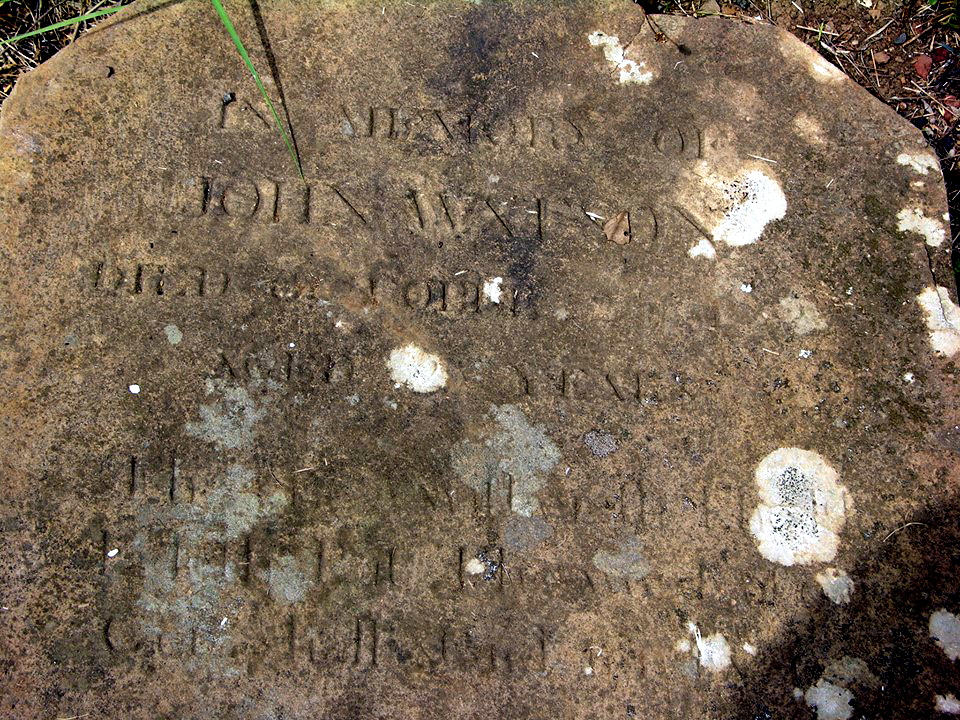
Inscription: In Memory Of John WATSON who died 25th Oct 1852. Aged 26. At Rest ??????
JOHN is NOT mentioned on the Police Wall of Remembrance
* BUT should be
Sergeant John Watson was born c1827, Downpatrick, Co. Down, Ireland.
He, along with his wife Susan Watson (nee Gillespie) 1830-1912, arrived in Sydney 15/10/1851 aboard the “Earl Grey”. During the voyage his wife gave birth to a son John Watson, 1851-1918. Sergeant Watson died 1 year and 10 days after arriving in Sydney.
He is buried in the St. Johns Anglican Church cemetery, Camden, NSW.
Buried at the very end of Row E, plot 107.
♥ Kevin Bannister 041120
Sergeant Watson is thought to have died on 25 October, 1852 as a result of the onset of tuberculosis following an assault by a prisoner he was escorting to a police station.
He was buried at Camden on 27 October, 1852 at which time his residence was recorded as Sydney.
Few details are yet known of the incident, however the Sydney Morning Herald of 24 May, 1860 when reporting on the death of Inspector Alexander McGee, included the following clue.
We are happy to say that we have been informed by the superintendent of Police that a pension to the widow [of McGee] of ” £50 can be afforded out of the Police Fund. It is a somewhat singular coincidence that this will be the second instance of relief from the Police Fund which Mrs. McGee will receive. She was formerly married to a man of the name of Watson, in the police force, who, while conveying a prisoner to the watchhouse, was so seriously kicked in the back that consumption was induced, and he speedily died. On that occasion the donation of ” £100 was paid to the widow out of the Police Fund. Still we think that some testimonial from the citizens in token of their approval of the gallant conduct of McGee is eminently due.
The sergeant was aged 26 years when he died and was apparently stationed in the Sydney Metropolitan Area.
SYDNEY POLICE COURT. – Saturday ( Before the Police Magistrate, and J. McLerie, Esq., J.P. )
ASSAULTING A CONSTABLE.- A well-dressed young man, named William Byrnes, was charged with assaulting Constable Watson, in O’Connell street, at nine o’clock on Saturday night ( 14 February 1852 ).
It appeared from the evidence that some man, whose name is unknown, assaulted the defendant, and knocked him down. The constable interfered for the defendant, and apprehended his assailant, in return for which the defendant struck the constable several blows, and also kicked him in the stomach.
The defendant did not deny the assault, for which he expressed his contrition. The bench sentenced the defendant to pay a fine of 2/., and 2s. 6d. costs, in default to be imprisoned during fourteen days.
Bell’s Life in Sydney and Sporting Reviewer (NSW : 1845 – 1860), Saturday 21 February 1852, page 3
THE POLICE REGISTER.
The Height of Ingratitude. – Police constable Watson answered in the most lively and sonorous manner to his name when called upon to give evidence against William Byrnes, a stiff built nautical, for having inflicted divers kicks upon witness whilst engaged in affording him the protection of the law.
At the late hours on Saturday night Watson was doing his duty in O’Connell-street, when he saw the defendant levelled to the earth by a human fist.
Witness took the offender into custody; whereupon up rose Byrnes, and most ungraciously pitched into his Indigo friend, from whose grasp he rescued his antagonist. ” I am naturally mild,” cried Watson, ” but human flesh and blood cannot stand this. Come to the watchhouse.” ” Not I.” replied Byrnes, ” take me if you can.”
Watson sounded his whistle shrilly, but the Royal Civils did not start up around as did the clansmen – of Roderick Dhu – Watson was left alone with a very pretty little piece of work cut out for him. However, he tightened his belt, and went at Byrnes like a hero, and after a struggle of half an hour placed him carefully under lock and key.
The defendant had nothing to offer in explanation of his conduct but the police office cuckoo note – I was uncommon drunk – knew nothing of it – dare say he’s right – a man don’t like to be pulled and hauled about – did my best to prevent it, no doubt.
This plea was held insufficient by the P.M., who fined him in forty shillings and costs for base Ingratitude to his protector.
The Empire ( Sydney, NSW ) Wednesday 5 May 1852 p 3
PUBLICANS’ ANNUAL LICENSING MEETING,
The Court of Petty Sessions for considering applications for Publicans’ Licenses, adjourned from the 30th of last month, resumed its sittings yesterday.
The Right Worshipful the Mayor presided, and was assisted by the following Justices. The Police Magistrate, the Superintendent of Police, Messrs. Allen, Hill, Chambers, Moriarty, Mitchell, Brenan, Grant, and Brown.
George Snell Clark, applied for license for the Horse and Jockey, in Hunter-street. Mr. Cory appeared for the applicant, who was opposed by Inspector Holmes, for having, on the 14th of February, refused to assist a constable in the City Police, named John Watson, who had a prisoner in custody at the time, and which prisoner was rescued from his custody by a person who assaulted constable Watson, and inflicted severe injuries upon him. The objection further alleged that when a pair of handcuffs were handed to Mr. Clark to assist in securing the prisoner, he threw the handcuffs down on the ground.
Constable Watson related the facts of the case, and said that he had been unwell ever since the night the assault was committed upon him. In reply to a question put to him by Mr. Cory, Watson admitted that Mr. Clark had picked up his truncheon for him, Mr. McLerie stated that no complaint was made against the manner in which the applicant had hitherto conducted his licensed house, and he would therefore consent to withdraw, the objection, which had been raised to let publicans plainly understand that they were bound when called on in similar cases to render aid to the Police. The objection was then withdrawn, and the license granted.
NSWBDM = John WATSON. Death registration # 1131/1852 V1852113138B age 26
Camden General Cemetery is located on the corner of Cawdor and Burragorang Rds, Camden & was established in the late 1800’s.
The above information may have been contaminated with some of the below dates.
Further investigation needed. ( Cal 27 Oct 2016)
Danny WEBSTER has a person by the same name recorded as thus ( 2016 )
Sergeant John WATSON
St James Police Station
Assault Injuries – 25 October, 1852
Resting Place – St John’s Anglican Cemetery, Camden
Sergeant Watson is thought to have died on 25 October, 1852 as a result of the onset of tuberculosis following an assault by a prisoner he had removed from a hotel in Sydney.
On or about the 21 January, 1852 Sergeant Watson and Constables Clifford and Clarke attended the Lemon Tree Hotel and were asked by the proprietor to remove a man from the premises after he had refused to leave until he was served another drink.
The police were forced to drag the man from the premises and a hostile crowd soon formed outside to witness the ensuing brawl.
The Empire of 25 January, 1852 reported on the incident.
ASSAULTING THE POLICE
Robert Thompson appeared to answer the charge preferred against him by Sergeant Watson, for assaulting him in the execution of his duty, in Phillip-street, between the hours of nine and ten o’clock, on Wednesday evening. The defendant bore evident marks of ill-usage, his eyes being severely bruised.
Mr. Cory appeared for the prosecution, Mr. G. Wright, as amicus curia attended on behalf of the defendant.
It appeared from the evidence of Watson and two other constables that the son of Mr. Tuohy, a publican in Phillip-street, called at the St. James’ station-house, requesting the police to eject the defendant from his father’s house, as he was conducting himself in a disorderly manner.
Sergeant Watson went with two constables to Mr. Tuohy’s house, and defendant was ordered to quit, which he refused to do.
The policemen then ejected defendant from the house, and ordered him to go home. He refused, and caught hold of Watson by the legs, and endeavoured to throw him down.
The two constables released the sergeant from the defendant’s grasp, and he then kicked the sergeant in the breast.
The sergeant then said, “Take him to the watch-house.” The defendant was in liquor, and his conduct was very violent while being conveyed to the watch-house.
Several witnesses were called for the defendant, who testified that the policemen ill-used the defendant after the arrest, and that they beat him while conveying him to the watch-house.
The defendant was fined one shilling, and half-a-crown costs, which he immediately paid.
The offender later took civil action against the three police officers, who were defended in court by a Mr Nichols, who said in their defence, “The constables were human beings, and situated as they were, with a mob of upwards of one hundred people surrounding them, and calling out to them to let the man go, must naturally have been excited…
One witness had sworn that a constable waved his stick, and threatened a person in the crowd, but he would call a witness to prove that that constable had no stick with him…
The now complainant had been charged with assaulting a constable, one of the now defendants, and has been convicted and fined…
In conclusion, I would remark that the defendants were duty bound to apprehend the complainant, and they used no more violence than was necessary to take him.”
The hotel proprietor, a Mr Tuohy gave the following evidence during the hearing.
I am a publican residing in Phillip-street. On the night of the late Mayoral election the complainant was in my house between the hours of eight and nine o’clock.
I saw the constables, the three defendants, at my house.
My son went for them, in consequence of Mr. Thompson using threatening language, and saying that he could beat me, and my whole family.
Sergeant Watson told the complainant to go home with his wife. Complainant asked the sergeant if he knew his duty, and told him that his duty was outside instead of inside. I desired the constables to put complainant out of the house, as I was in dread of him. They again requested him to go home, which he refused to do. I was afraid he would do me some injury, because I had refused to draw more liquor for him, and again told the constables to turn him out. They took hold of him quietly, and he rushed against them, and tried to shut the door. They forced him outside, and then twice told him to go home. He replied, that he would remain there as long he liked. When down, he took the sergeant by the legs and the constables tried to loosen his hold. The sergeant caught hold of one of the verandah posts, to save himself from falling.
Thompson’s conduct was violent. I saw him kick when down outside my door. I could not say who he kicked at. I do not think the constables used more violence than necessary during the time I saw them.”
The matter was dismissed by the magistrate.
The sergeant was aged 26 years when he died and was stationed at the St James Police Station.
He was buried at Camden on 27 October, 1852 at which time his residence was recorded as Sydney.
He is not listed in the official New South Wales Police Honour Roll.
Stephen KIRK & Luke DUNN
| 23/10/2012
Corporal Stephen KIRK
&
Trooper Luke DUNN
Burnt to Death
Heathcote
12 & 21 November, 1845
On 12 November, 1845 the two mounted troopers were riding along the new Wollongong Road through Bottle Forest (now Heathcote). Bush fires were raging in the area and the two troopers were advised by a local landowner, Mr Nicholson, not to go on due to the danger the fires presented. Ignoring that advice both troopers and an Illawarra publican, Mr McAulay, set out toward the fires. The Sydney Morning Herald of 21 November, 1845 described the events which followed.
About an hour after their departure Mr McAulay’s horse came up to the door of Mr Nicholson’s house; McAulay’s hat was off, he was not holding the reins, and he was much burnt and confused, so that he was only able to request to be lifted off his horse; he said that one of the policemen was burnt. Mr Nicholas most promptly and considerately despatched five or six men to search for, and, if possible, to aid the policemen. After going about three miles they met Luke Dunn crawling along, dreadfully burnt, on his hands and knees, and scarcely able to move,. They men carried him back to the house, while others went on to the place where Dunn said he had left the remains of Kirk, burnt and quite dead. His hands were extended upwards as if in the act of praying; both horses were dead. Dunn said that seeing his comrade’s firearms go off, he returned to go after him, and in doing so got so much burnt, otherwise his injuries would have been comparatively trifling.
Stephen Kirk was burned to death in the fire, while the gallant and courageous Luke Dunn who, in the greatest of Australian traditions “went back for his mate”, lingered for nine days before he finally succumbed, no doubt in extreme agony. The scene of the incident was present-day Heathcote.
(At the time of this tragedy there were almost a hundred men in the Sydney Police Force and about 32 mounted police stations across New South Wales. The two police killed in this incident were members of the Military Mounted Police, which had been formed in 1825. It was disbanded in 1850 when it was replaced by a civil mounted police unit. This in turn was destined to be absorbed into the new state police force which was created on 1 March, 1862 by Captain John McLerie.)
At the times of their deaths both troopers were seconded soldiers attached to the Mounted Police Force and were stationed at Campbelltown. Stephen Kirk was aged 32 years and Luke Dunn was aged 33 years.
John RUTLEDGE
| 23/10/2012
John RUTLEDGE
New South Wales Police Force
Rank: Constable
Stations: Cassilis
Service: From???to 5 May 1843 = ? years of Service
Awards: ?
Born: ?
Died on: 5 May 1843
Cause: Shot – murdered
Event location: Cassilis
Age: ?
Funeral date: ?
Funeral location: ?
Buried at: ?
[alert_red]JOHN is NOT mentioned on the Police Wall of Remembrance – BUT SHOULD BE[/alert_red]
The constable was shot and killed during a prisoner escort to Merton on 5 May, 1843. It appears that two constables were escorting three prisoners and during their journey they stopped for a break at a hut at Pickering at about 10am. For some reason the constables then removed the handcuffs from the prisoners while they were resting. At one stage Constable Rutledge went inside the hut, leaving his musket outside, and the prisoner Harris walked outside, took hold of the musket, presented it at the constable and said that if he did not give up his ammunition he would shoot him. The constable refused and started to walk out of the hut. Harris stepped back a step or two, and fired the musket through the doorway, inflicting a fatal wound to Constable Rutledge’s stomach. The ammunition belt was then taken from his body. Harris then ran off when the other two prisoners came out of the hut. The other two prisoners did not try to escape and gave themselves up.
The story of the capture of the murderer Benjamin Harris by Constable Doyle appeared in the Maitland Mercury newspaper of the 8 July, 1843. (Note that Doyle was a convict constable).
CAPTURE OF HARRIS THE BUSHRANGER.
Harris, the bushranger who murdered Constable Rutledge, of Cassilis, while under escort in May last en route to Merton, was captured on the 28th ult., by Constable Doyle, of the Cassilis establishment; and the prisoner is now on his route to Merton, in which district he stands charged with the murder of Rutledge. Doyle is a prisoner of the crown holding the Governor’s ticket and it is to be hoped that his Excellency will for the praiseworthy conduct he has displayed on this occasion grant him a free pardon. He has been out for a month, fully determined to apprehend Harris, and he captured him without assistance.
At the time of his death the constable was stationed at Cassilis.
[divider_dotted]
The Sydney Morning Herald Saturday 13 May 1843 p 3 of 4
TWENTY-FIVE POUNDS REWARD on A FREE PARDON.— It having been represented to the Government, that Constable Rutledge, of the Cassilis Police, was, on the 6th instant, shot dead at a station of Captain Pike’s, about twelve miles from Merton, by Benjamin Harris, a prisoner of the Crown, per ship James Laing, on escort from Cassilis to Merton, who is now at large, having absconded with the Constable’s arms and ammunition ;
His Excellency the Governor has directed it to be notified, that a reward of twenty-five pounds will be paid to any free person or persons who may apprehend and lodge the said Benjamin Harris in any of Her Majesty’s gaols ; and that if the said Benjamin Harris be apprehended and secured by a prisoner of the Crown, application will be made to Her Majesty for the allowance to him of a Free Pardon.
Description — Benjamin Harris, per ship James Laing, a runaway from the Newcastle Boat’s Crew, 37 years of age, born in Staffordshire, a soldier, 5 feet 5 ¾ inches in height, sallow complexion, brown hair, hazel grey eyes, JHEHJ knot, wreath, BH inside lower right arm, sun inside lower left arm, heart and 7 dots back of left hand.
The Maitland Mercury & Hunter River General Advertiser
Saturday 15 July 1843 p 3 of 4
THE WIDOW OF CONSTABLE RUTLEDGE. –
We are happy to hear that £50 has been raised by subscription in this neighbourhood, and a similar sum has been given by the government, for the use and support of the wife and family of the late constable Rutledge, who was shot by Harris the bushranger.
The Maitland Mercury & Hunter River General Advertiser
Saturday 23 September 1843 p 4 of 4
MURDER.
Benjamin Harris was indicted for the wilful murder of John Rutledge, by shooting him with a gun, on the 5th May last, at Merton.
It appeared that the prisoner was being escorted from Cassilis to Merton by the deceased, along with two other prisoners ; they were not linked or chained together, and only one of them was handcuffed.
On arriving at a station of Captain Pike’s, about twelve miles from Merton, the prisoners went into the hut, and were followed by the constable, who left his musket outside; the prisoner went out of the hut, seized the musket, and said if the constable did not give up his ammunition he would put the contents of the piece through him. The constable said, ” Do it,” and advanced towards the prisoner, who stepped back a few paces ; the constable went out, and in less than a minute the gun was fired, and on the men going out of the hut they found the constable dead. The prisoner took his ammunition, belt, and pouch, and the musket, and made off to the bush. He was apprehended by Patrick Doyle on the 27th June, with the musket, belt, and pouch in his possession.
The prisoner put in a written defence, in which he stated that the gun went off accidentally, and that he was at times, particularly when he had liquor, subject to an affection of the head, owing to some wounds he had received while he was a soldier.
Some evidence was taken for the prisoner on this latter point, but it was not established.
His Honor then summed up, and the jury returned a verdict of guilty. Sentence of death was passed upon the prisoner.
The Sydney Morning Herald Monday 25 September 1843 p 4 of 4
MURDER.
Benjamin Harris was indicted for the wilful murder of John Rutledge, at Merton, by shooting him with a gun, on the 5th May last.
Robert Leaton : Was a prisoner of the crown, and in April last he was punished by the Merton bench, and ordered to be returned to government ; he was given in charge to constable Rutledge, along with the prisoner at the bar and another man, to be brought to Merton ; the constable had a musket and an ammunition belt and pouch; they arrived at Pickering about ten o’clock on the morning of the third day ; they went into the hut, and in a few minutes Rutledge came in leaving his musket outside ; the prisoner went out, took the musket, presented it at the constable, and said that if he did not give up his ammunition he would put its contents through him ; the constable refused to give it, and went out. Harris stepped back a step or two, and fired the musket. Witness went out directly after, and saw Rutledge lying on the ground dead. The ammunition belt was taken from his body ; the ball entered just below the stomach. The prisoner made off when witness went out of the hut, and he saw no more of him until he was apprehended. Witness and the other prisoner went back and gave themselves up.
Patrick Dawe, Innkeeper at Captain Pike’s station : Remembered a constable and two or three prisoners coming to the station ; he did not know the constable ; the prisoners were in charge, one of them had a pair of handcuffs on ; the last witness was one of those in charge ; he could not say whether the prisoner was ; the prisoners went into the hut and sat down ; the constable came in and went to the fire ; the prisoner next the door went out, took up the musket, cocked it, and demanded the ammunition from the constable ; the prisoners were not chained or linked together ; the constable approached him, and said, ” Do it !” Prisoner said he would if he did not give up his ammunition ; prisoner drew back, and the constable went out, and witness soon after heard the report of the musket ; witness went out, saw the constable lying on the ground, and the prisoner took away the ammunition belt and pouch, and went away with the musket ; the other prisoners said they would give themselves up, and left the hut for that purpose.
William Everness, chief constable, Merton : Knew constable Rutledge, his name was John , witness went to Captain Pike’s station in May last, and saw Rutledge dead , the body was covered with a piece of bark, about fifteen or twenty yards from the hut, there was a gun shot wound in the belly, witness found three warrants in his coat pocket, he had known Rutledge about five or six years , had known the prisoner five or six years, he had been a watchman on Mr. Blaxland’s station.
Patrick Doyle : Knew the prisoner , apprehended him on the 25th last as a bushranger ; the magistrates ordered him to
be forwarded to Newcastle to be dealt with, witness saw him off with escort, on the 8th May, heard of the murder, and set out in pursuit on the 14th, and apprehended him on the 27th June, with the constable’s ammunition, pouch, and musket on him, he delivered him up to the Merton Bench , the belt and musket were produced in Court and identified.
This closed the case for the Crown.
The prisoner put in a written defence, which was read, and in which he stated that the constable was shot by him accidentally.
Robert Eden : Had known the prisoner for some years, did not know that he had anything amiss in his mind, had never observed that he was easily excited by drink.
Mr. Charles Boydell, one of the jurors : Knew the prisoner as a shepherd in the late Mr. John Blaxland’s employment ; he was much given to drinking, and Mr. Blaxland said when in liquor he appeared to lose his senses, which Mr. Blaxland attributed to some wounds which he had received in his head while a soldier.
His Honor then summed up, and the Jury without retiring from the box, returned a verdict of guilty.
His Honor then passed sentence of death upon the prisoner in a solemn and impressive manner, exhorting him to prepare for eternity, as there could be no hope of mercy shown towards him in this world.
Constable Slattery was shot to death at Bungendore during a prisoner escort from Queanbeyan to Goulburn. Four prisoners were being escorted at the time by Constable Slattery and Constable William Burton of Queanbeyan Police and had stopped for the night at Mr Dwyer’s public house at Bungendore.
The story of the sad incident was told in the Sydney Morning Herald of Saturday 14 January, 1843:
Murder of a Constable. “A prisoner of the name of Porter, with three others, on their way down from Queanbeyan to Goulburn, who were escorted by two constables, had arrived at Bungendore, on Thursday evening, and put up for the night at Mr Dwyer’s public house; the constables allowed them to have their irons off, and put them into a room to sleep, one constable was to watch and the other was to sleep: both however dozed off, and one of the prisoners seized the opportunity, got up, laid hold of the carbine belonging to him who was to have kept watch, and shot him through the breast; he died almost immediately. An inquest was held on Friday evening, and a verdict of wilful murder was returned, and the scoundrel was committed by the coroner to take his trial for the same. Corporal Hewitt, of the Mounted Police, whose services are well known, apprehended the prisoner on a charge of robbery, near Queanbeyan, and from which Bench he was committed to take his trial for the offence, was sent for, who conducted and lodged him safely in Goulburn Gaol, on Saturday evening. Too much praise cannot be given to Mr Dwyer for his valorous conduct: the moment he heard the shot he rushed in and secured the other firearms, and bailed up the whole of the prisoners before he knew of the tragic affair which had taken place.
At the time of his death the constable appears to have been stationed at Queanbeyan.
Chief Constable Patrick KINSELA
| 23/10/2012
Chief Constable Patrick KINSELA
Horse & Cart Accident
Queanbeyan, NSW
23 February, 1841
On 23 February, 1841 Chief Constable Kinsela and Constable John Scott were travelling in a cart returning to Queanbeyan. While they were crossing a dry creek bed near the Elmsall Inn the cart overturned, killing Constable Kinsela. Scott luckily survived the accident and was later able to give coronial evidence. It is not known whether this accident occurred while the constable was on duty or not, however it is believed that he was, and research is continuing into this aspect of the incident. In those days police were considered to be always on duty.
Rumours were apparently circulated at the time that both Kinsela and Scott were drunk when the accident occurred, however this was soon discredited. The Sydney Gazette of 11 March, 1841 printed information from a correspondent who informed the readers that he had seen a person who has just come from Limestone; he reports that the Chief Constable and another man were killed by the upsetting of a dray in a creek in that neighbourhood; it is said the parties were drunk, but this is contradicted, as Kinsela was a sober man. (In other words, Kinsela did not drink alcohol at all).
The Australasian Chronicle of 4 March, 1841 reported the following.
QUEANBEYAN, FEBRUARY 27- There was an inquest held here on the 24th instant, on the body of Mr. Patrick Kinsala [sic], chief constable, who came by his death by the upsetting of his cart in crossing a creek close to his own house. The night was very dark, and he was thrown with such force on his head that his neck was dislocated. Kinsala was a very active officer, a friend to the poor, and always ready to attend when called on. He had obtained a few enemies for himself by being zealous in the discharge of his duty. He has left a wife and two children to deplore his loss, the youngest only nine days old…
Patrick Kinsela was a native of Ireland and had arrived at Queanbeyan in 1836. On 1 January, 1838 he became the first Chief Constable of Queanbeyan and Limestone Plains (Canberra) on an annual salary of £75. His appointment as Chief Constable was published in the Colonial Secretary’s Notice dated 7 February, 1838 which also listed ordinary constable appointments to Queanbeyan as James Pegg, Lockup Keeper, and Peter Connel and James Crossley. Captain Alured Tasker Faunce was also appointed as the Police Magistrate to Queanbeyan about the same time. Kinsela married Joanna Wigmore (nee Mehegan) on 6 February, 1838 and the couple had two children James and Mary. The constable is thought to have been buried in the Oaks Burial Grounds at Queanbeyan.
At the time of his death the constable was stationed at Queanbeyan and had been a police officer for a little over three years.
Source: Beyond Courage
Peter PROSSER
| 23/10/2012
Peter PROSSER
AKA ?
Late of ?
New South Wales Police Force
Regd. # Not listed on NSW State Govt. Archives – Registers of Police
Service: From? ? ?to23 January 1839 = ? years Service
Awards: No find on It’s An Honour
Born: ? ? 1812 – 1813?
Died on: Wednesday 23 January 1839
Age: 26
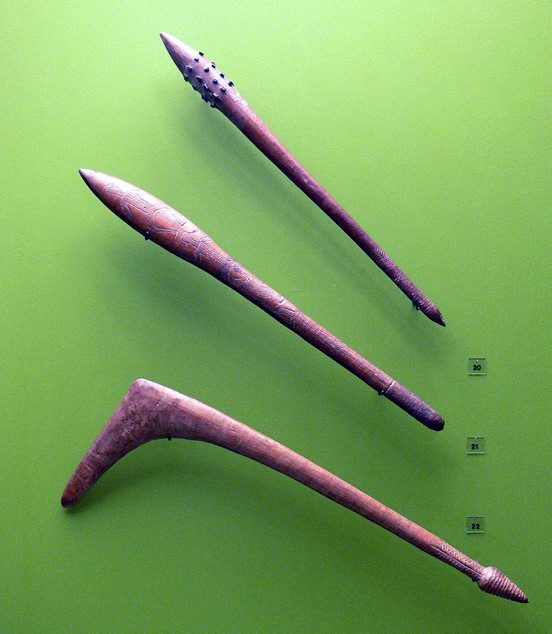
Cause: Murdered – Clubbed to death with a Nulla Nulla ( Waddy ) * see below
Event location: Phillip St, Sydney
Event date: Monday 21 January 1839
Funeral date: Friday 25 January 1839
Funeral location: ?
Wake location: ?
Funeral Parlour: ?
Buried at: Devonshire St Cemetery, Sydney – January 1839.
In 1901 his remains were exhumed to make space for Central Railway Station and re-interred, with thousands of others and 2285 tombstones of the first settlers in Australia, at the new cemetery at La Perouse, named Bunnerong Cemetery.
In 1976, the Botany Cemetery Trust destroyed most of these historic monuments by creating a new, low maintenance lawn area. The remaining 746 headstones were reinstalled in concrete strips, unrelated to the graves below them. The new lawn was named Pioneer Memorial Park.
The words recorded as being on his original tombstone are “Peter, the son of Edward and Mary Ann PROSSER, who was struck by John PENDER; in the execution of his duty 25th January 1839 which caused his death in 48 hours. He was an Inspector in the Sydney police and an Active officer. also sisters Adeliza and Jane, passengers in the ship ‘Fairlie’.
Adeliza buried at the Cape in October ???? Jane aged 16 years. Adeliza aged 29 years. Peter aged 26 years”.
Memorial located at: ?
[alert_green] PETERIS mentioned on the Police Wall of Remembrance[/alert_green]
[divider_dotted]
FURTHER INFORMATION IS NEEDED ABOUT THIS PERSON, THEIR LIFE, THEIR CAREER AND THEIR DEATH.
On the afternoon of 21 January, 1839 a man named John Pender ( known to Sydney police as “Jack the Waterman“ ) was behaving in an indecent manner in Raynor’s Public House, Sydney. As a result of his behaviour he was arrested by Inspector Prosser who began to march him to the Sydney Police Watch-house.
En route they passed Pender‘s home in Phillip Street where a mob attacked the inspector and dragged his prisoner into the house. Prosser clung to his prisoner desperately however, until he received a blow from a club to the back of his neck, which resulted in his death a few days later in hospital. Pender was quickly apprehended and charged with murder, while five others were also charged in relation to the riot.
The Sydney Gazette and New South Wales Advertiser of 24 January, 1839 reported the incident in some detail.
BRUTAL MURDER.
On Monday afternoon a man named John Pender, well known about the town as the driver of a water-cart, and a bad character, went into the public-house of Mr. Rayner at the corner of Hunter and Phillip-streets and in the absence of the landlord was guilty of much indecent behaviour.
He was remonstrated with by the landlady, but this seemed to have the effect of urging him on to still farther excesses. He approached Mrs. R., who was behind the bar, when she took up a New Zealand waddy to defend herself; this the brute wrested from her, and after having struck her he left the house, flourishing the weapon over his head and making a great noise.
He was perceived at the time by Inspector Prosser, who was approaching alone. Prosser came up behind him unperceived and took the waddy from him, and desired him to accompany him to the watch-house.
Pender accompanied the Inspector a short distance, when, stopping suddenly, he turned round and struck Prosser a violent blow on the face with his fist, which knocked him down. While he was on the ground, the man stooped down and snatched the waddy from the hands of the Inspector, and as the latter was rising to his feet he struck him a tremendous blow with it on the back of his neck, and then ran into his own house which was close at hand.
“A mob of blackguards, as usual on such occasions, soon assembled on the spot, and although they witnessed this unprovoked outrage none among them were inclined to render the poor fellow any assistance, but rather endeavoured to screen the villain and hasten his escape. After a few moments Prosser was seen to get on his feet with difficulty and move on towards the watch-house, holding his hands to his head. He shortly afterwards met Sergeant Kilpatrick, and desired him to go and apprehend Pender who, he said, had murdered him.
Killpatrick hastened to the station-house for assistance, and procured that of the two keepers, the only persons present, and the three then returned to Phillip-street.
In the meantime, the wounded Inspector got to the watch-house, and was shortly afterwards found by Sergeant Partington lying across one of the benches, nearly dead; he called for assistance, and Mr. Driver, the publican, attended and with vinegar attempted to revive him.
Dr. Whittle, who was near the spot, was then sent for; he immediately attended and by copious bleeding restored animation, but Prosser continued in such a dangerous state that his immediate removal to the Hospital was recommended and performed.
The Police had in the interim secured Pender and five or six other persons who appeared to take a prominent part in the mob assembled in Phillip Street.”
The Sydney Morning Herald dated 25 January, 1839 printed the following brief account of the inquest into Inspector Prosser‘s death.
An inquest was held at the same place the same day, on the body of Peter Prosser, lately an Inspector of the Sydney Police. The evidence was very lengthy but the substance was very simple, viz, that Prosser had a man named Pender in custody, and that Pender in order to make his escape struck the deceased a blow on the head with a New Zealander’s waddy, which was so violent as to cause an extra vasation of blood on the brain, from the effects of which Prosser died. The Jury returned a verdict of willful murder against Pender, who was committed on the Coroner’s warrant.
At the time of his death the inspector was aged 26 and was attached to the Sydney Police.
Judging by newspaper accounts of the time, he was a courageous and energetic policeman who seemed to have worked tirelessly against violent offenders in the inner city of Sydney. He is not listed in the official New South Wales Police Honour Roll.
A ‘waddy’, it is believed, is similar to an Aboriginal nulla nulla. A waddy is a heavy club constructed of carved timber and could also be a walking stick. No doubt, the ‘green stone’ referred to, was attached to the end of the Nulla Nulla and held in place with tree resin.
It would appear that the Rank structure of this period ( 1835 ) was:
Patrolman –
Constable –
Conductor –
Inspector –
Sydney Gazette and New South Wales Advertiser (NSW : 1803 – 1842), Saturday 9 August 1834, page 4
Government Gazette
WEDNESDAY, AUGUST 6.
HIS Excellency the GOVERNOR has been pleased to approve of the following Alterations in the Police of the Colony, namely
SYDNEY.
APPOINTMENTS
John Price, free, to be Conductor, from the 18th June.
To be Patrolman – James Woodward, free, from the 25th June; John Murray, free, from the 5th July ; Peter Prosser, free, from the 8th ultimo; John Gorman, free, from the 14th ultimo ; Edward Tierney, free, and John McCarthy, free, from the 15th ultimo ; Bryant Naughton, free, from the 16th ultimo ; Michael Armstrong, free, from the l7th ultimo, and James Cook, free, from the 18th ultimo.
Thomas McConnell, free, to be Constable at the North Shore, from the 16th June, and James Woodward, free, to be Constable of the Water Police, from the 5th July.
RESIGNATION
John William Smith, Constable, North Shore, on the 15th June.
DISMISSALS
Patrolmen – John Sullivan, on 24th June ; Patrick Muleady, on the 7th ultimo; James Drew and Patrick Dougharty, on the 13th ultimo ; David Leighton, on the 14th ultimo , George Stewart, on the 15th ultimo; and Patrick Curran, and John Sheehy, on the 17th July.
Water Police Constable — Alexander Lee, on the 4th July,
STRATHALLAN.
William Berry, free, to be Constable in the room of William Carroll, resigned.
MAITLAND.
Edward Gaynor, holding a Ticket-of-Leave, to be Constable, from the 14th ultimo, in the room of Daniel McFarlane, resigned.
PORT STEPHENS.
Michael Cotton, holding a ticket-of-Leave, to be Constable, in the room of John Jaggers, resigned.
New South Wales Government Gazette (Sydney, NSW : 1832 – 1900), Wednesday 21 January 1835 (No.151), page 45
Colonial Secretary’s Office,
Sydney, 20th January, 1835.
HIS Excellency the GOVERNOR has been pleased to approve of the following alterations in the Police of the Colony ; namely,—
SYDNEY.
To be Conductors.— Edward Rollins and Peter Prosser, raised from Patrolmen, from the 1st instant.
To be Patrolmen.— William Elkins, and to be Market Constable, from the 1st instant ; Mark Gilmore, Michael O’Neal, William Howarth, Thomas Barrett, James Carwell, and William Barnett, from the 1st instant ; James Matthews, Robert Lodge, John Hundley, and James Kennedy, from the 9th instant ; and John McCarthy, from the 13th instant.
Conductors Dismissed.— William Barnett, reduced to Patrolman.
Patrolmen Dismissed.— George Brereton, Market Constable ; Herbert Green, James Matthews, John Cummings, James Carwell, John Smith, Peter Butler, Peter Christie, and Peter Colgan.
New South Wales Government Gazette (Sydney, NSW : 1832 – 1900), Wednesday 29 April 1835 (No.165), page 257
Colonial Secretary’s Office,
Sydney, 28th April, 1835.
HIS Excellency the GOVERNOR has been
pleased to approve of the following alterations
in the Police of the Colony, namely :—
SYDNEY.— To be Wardsman : George Mitchell, from the 6th instant.
To be Conductors : Philip Boyce, from the 1st, John Moore, from the 7th, William Hanson, from Joe 14th, and John Matthews, from the 20th of April.
To be Patrolmen : Peter Prosser, James Shaw, Archibald Kelley, and Dennis Connelly, from the 1st instant ; Thomas Kinchela, from the 14th instant, ; John Thorn, John Pendar, James Jackson and William Troop, from the 16th instant ; John Price, and William Vernon, from the 17th, and Patrick Galvin, from the 20th of April.
Wardsman resigned : John Skinner.
Conductors Dismissed : Peter Prosser, Patrick Ogan, and John Price.
Patrolmen resigned : William Howarth, John Gorman, James Tobin.
Patrolmen dismissed : Robert Grindle, James Cone, John Carey, John Connor, James Wells, Patrick Fitzpatrick, and L. Walsh.
LIVERPOOL.— George Harvey, holding a Ticket-of-leave, to be Constable, from the 20th Instant, in the room of Denis McCarthy, resigned.
PENRITH.— John Baxter, free, to be Constable, from the 26th Ultimo, in the room of John Brown, dismissed.
BONG BONG.— John Coffee and Lawrence Larken, free, to be Constables— the former in the room of, James Harper, resigned, and the latter from the 20th Instant, in the room of William Austin, dismissed.
YASS.— James Donald, free, to be Constable, from the 20th of February last.
MERTON.— Jeremiah Burns, holding a Ticket-of-leave, to be Constable, from the 6th Ultimo, in the room of Thomas Boline, resigned.
PORT STEPHENS.— John McCarthy, free, to be Constable, in the room of Edward Frost, resigned.
HIS EXCELLENCY the Governor has been pleased to approve of the following alterations in the Police of the Colony, viz. :—
SYDNEY.
To be Wardsman.— William Abbott, from the 1st instant.
To be Conductors.— Matthew Thomkins and John Price, from the 1st instant ; James Shaw, from the 4th instant ; Peter Prosser, from the 12th instant.
To be Patrolmen.— Patrick Conner, William Moore, William Cox, John Kelly and Stephen Bunen, from the 1st instant ; Thomas Lynskey, from the 4th instant ; Timothy Foley and Andrew White, from the 8th instant ; James Pearson, Samuel Deacon, and Samuel Freebury, from the 12th instant.
Wardsman resigned.— William Small.
Conductor resigned.— Constantine Molloy.
Conductor Patrick Reid, reduced to Patrolman on 30th ultimo.
Wardsman dismissed.— William Abbott.
Patrolmen dismissed.— William Brown, William McCready, James McGruggan, William Noop, Patrick Petty, Thomas Phillips, John Hauley, Michael Armstrong.
LIVERPOOL.
Daniel McCarthy, holding a Ticket-of-leave, to be Constable, from the 18th instant, in the room of James Silvester, resigned.
PENRITH.
William Rossborough, holding a Ticket-of-leave, and Thomas Shuttleworth, also holding a Ticket-of leave, to be Constables, in the room of Ralph Hodgson and Henry Workman, dismissed— the former from the 10th and the latter form the 30th ultimo.
PATRICK’S PLAINS.
Constable John Brest, dismissed on the 20th instant.
Sydney Monitor and Commercial Advertiser (NSW : 1838 – 1841), Wednesday 13 February 1839, page 2
Before Mr. Justice Willis and a Civil Jury.
John Pendar, alias “‘ Jack the Waterman” was tried yesterday for the murder of Inspector Prosser.
The case occupied Mr Justice Willis and a civil Jury up to half-past nine o’clock, when the Jury returned a verdict of manslaughter.
Mr Windeyer was counsel for the defence, and raised three objections – which were,
that there was no proof of drunkenness to warrant the deceased in taking the prisoner into custody,
that the prisoner would have been justified in using force to any degree to expel the constable, who was in fact transgressing on his premises, and
lastly the learned gentleman relied upon a statute ; which he believed was in force, as far back as Henry the Eighth ( which had never been repealed ; rendering fatal any indictment not drawn up in intelligible English, and
contended that ” Waddy” was not an English word, and therefore fatal to the indictment.
These objections were reserved and the prisoner remanded for sentence.
Commercial Journal and Advertiser (Sydney, NSW : 1835 – 1840), Wednesday 20 February 1839, page 2
James Pendar alias Jack the Waterman, for the manslaughter of Inspector Prosser, was brought up for sentence yesterday, and ordered to be transported for the term of his natural life to Norfolk Island.
Sydney Gazette and New South Wales Advertiser (NSW : 1803 – 1842), Thursday 21 February 1839, page 2
Supreme Court.
MONDAY, FEBRUARY 19, 1839.
(Before their Honors the Chief Justice and Mr. Justice Willis.)
On this day there being no cases ready for trial, the prisoners remanded during the Sessions were brought up for sentence.
John Pender was next placed at the bar. The prisoner had been tried for the wilful murder of Peter Prosser, a policeman, and had been found guilty of manslaughter.
Mr. Justice Willis, before whom the case was tried, said to the prisoner that the mercy of the Jury had saved his life in finding him guilty of manslaughter – the manslaughter was of a more aggravated nature than he had ever known or heard of.
The police must be protected in their duty, and should be protected.
His sentence was that he should be transported for life.
Sydney Gazette and New South Wales Advertiser (NSW : 1803 – 1842), Saturday 26 January 1839, page 2
DOMESTIC INTELLIGENCE.
Coroner’s INQUEST. –
On Thursday morning at nine o’clock an Inquest was held upon the body of Prosser, the late Inspector of Police, who died in the General Hospital on the preceding day. The Jury assembled at the sign of the Bunch of Grapes ( King St ), whence they proceeded to the Hospital to view the body, and then returned to the Jury room, where the following evidence was taken :
John Pender, the man charged with the murder, being in custody.
Jane Rayner, of Phillip-street, being sworn stated, I knew the deceased Peter Prosser, and the prisoner before the Court ( John Pender ); I keep a public-house.
On Monday afternoon the prisoner came into my house very tipsey; he made use of very bad language to me, and I refused to serve him, telling him if he could not use better language to me he should leave the place; he then turned round and exposed his naked person to me twice ; I took up a jug of water and threw it over him, and desired him to be off about his business for an impudent blackguard ; that appeared to enrage him the more ; he turned towards me as if he would strike me; I took up a New Zealand waddy to defend myself as he was making to me ; he snatched it from me, and struck me a blow across the shoulder, and afterwards made several blows at me with the waddy, which I avoided ; I thought he would kill me, and I sent my little girl to the watch-house for a constable ; the prisoner then went into the street making a noise, and flourishing the waddy ; in the mean time Prosser came up, and seeing how badly the prisoner behaved, who was storming violently, and flourishing the waddy, he approached him, and I cautioned him of the weapon the prisoner held in his hand ;
Prosser came up behind the prisoner, and took the waddy out of his hand ; and collared him ; the prisoner forced himself into my house in the custody of the deceased, and said he would not go to the watch-house; I told the deceased of his bad behaviour, and said I would appear the next day against the prisoner;
the deceased then told him he must go to the watch-house ; the prisoner tried to get away by the back door, but the deceased stopped him ; at this time a mob of persons had come into the house ; with some difficulty the deceased induced the prisoner to go quietly with him ; they left the house together; I cannot say which of them had the waddy as I was so confused ; I did not leave the place to look outside to see which way they went, but I saw that they turned towards the watch-house ; they had to pass the prisoner’s house on their way there; the deceased had much difficulty with the prisoner in the house ; I cannot say whether the prisoner was struck ; the deceased had to scuffle with him to make him submit and go with him ; I am dull of hearing, and cannot say whether the prisoner made use of any threatening language to the deceased, but they struggled a good deal with each other ; I saw nothing after they left the house.
By the Prisoner. – I cannot say that I saw any blows struck ; there was much struggling; several people were in the house; Mr. Roberts‘ servant was there.
George Clark, free, was then sworn. I recollect seeing the deceased and prisoner in Mrs. Rayner‘s house on Monday last; I saw Mrs. Rayner point out and give charge of the prisoner to deceased ; Prosser came behind him, snatched the waddy out of his hand, and dragged the prisoner towards the watch-house; the prisoner struggled, and seized hold of a fence, on which the deceased pushed at him with the staff or waddy ; they both got back to Rayner‘s ; I looked in and saw a struggle ; the prisoner attempted to get out by the back door and the deceased either struck or knocked him down ; he was down ; they had some high words in the house, and the prisoner took the staff from Prosser, on which the latter attempted to get it again ; the prisoner refused to let him have it, and said he should not have it, but he would go to the watch-house ; they then went quietly that way, the prisoner holding the staff;
I stood at the corner to watch them ; as they passed the prisoner’s house the prisoner forced himself in ; they had a scuffle ; I went down to them, and saw that Prosser had got the staff from him, and was shaking the prisoner to get him to the watch-house; the prisoner refused, on which the deceased struck him a blow on the head ; the prisoner refused to go to the watch-house, and wanted to get into his own house; I cannot say what occurred immediately in the house ; in about a minute I saw Prosser staggering out holding his hands to his head ; I could not tell whether he said any thing, as there was such a noise at the time; a young man had the waddy in his hand, and said, ” that shall not be used again.”
No one else came out of the house but the deceased ; Prosser went towards the watch-house; he continued reeling as he walked along the street as far as four or five houses; I was not exactly opposite the prisoner‘s house, and could not see into it ; the young man before mentioned was in the yard of the prisoner about a minute after the deceased came but ; the deceased was then going out of the yard, and the prisoner was in his own house; I saw some blood coming down the head of the deceased, but I saw no mark upon his face ; I did not notice the young man who had the waddy until after Prosser came out of the house ; if he had come out of the house I must have seen him ; I walked out of the yard after the deceased into Phillip-street, as I thought he would fall, and I did not return ; Prosser was coming out of the prisoner‘s house when I arrived ; he had no hat on ; I heard no noise of blows when I came to the door ; I should know the person of the young man who had the waddy if I were to see him again; the prisoner and the deceased struggled very much for about seven or eight minutes before they went into the house ; they remained in about three or five minutes; I did not see Prosser fall, nor did I observe any marks of a fall upon his clothes; in about three minutes after I lost sight of Prosser while I was conversing with Mr. West opposite Pender‘s house ; I saw the prisoner standing opposite his fence going down the street, and two constables running round him to get in front of him ; the prisoner got over his fence, and was defending himself with the waddy, and the constables striking with their staves.
By the Prisoner.- I saw the deceased hit you several times; there were several marks upon you.
William Badcock examined- I recollect on Monday last, seeing the prisoner and the deceased in Phillip-street ; I saw the prisoner before he was in custody and afterwards ; I saw the struggle, and saw Prosser lay hold of the prisoner’s hair, and endeavour to knock his head against the door of Mr. Rayner‘s house; I also saw him endeavour to kick him, which the prisoner prevented by holding up his leg ; the prisoner got up and said he wished to speak to Prosser; they went quietly along Phillip-street, till another came up to the assistance of the deceased ; when opposite the prisoner‘s house a scuffle ensued ; I can’t say whether it was occasioned by the violence of the other constable or a desire of the prisoner to get into his house ; the other constable was evidently drunk, and struck the prisoner with his staff on the head ; the prisoner got to his own door, and Prosser sent the other constable away for assistance; the deceased had the waddy in his hand when he entered the house; I did not see the deceased strike prisoner any blows in the struggle that took place as they entered the house ; there was blood on the prisoner‘s face and shirt, which was produced by the blow of the drunken constable ; they entered the house and I followed them ; they were struggling on the bed, the deceased being uppermost ; Prosser was holding the prisoner‘s shirt collar with one hand, and thrusting his knuckles into his throat ; in my opinion with the intention of strangling him, and with the other arm trying to hold the waddy from the prisoner; in the struggle the prisoner succeeded in getting the waddy out of Prosser‘s hand, and the deceased held his hand upon the arm of the prisoner that had the waddy in it ; it was then the prisoner struck the deceased with the flat part of the waddy upon the top of his head ; he did not fall from the blow, but he put his hand to his head and cried “oh,” and walked out of the house and down Phillip-street as far as I then could see him ; he went away without his hat; I did not see the deceased strike the prisoner with the waddy ; I do not believe he struck him at all ; the prisoner was very drunk ; after the drunken constable had been despatched for assistance, the prisoner continued his resistance and violence to Mr. Prosser; I did not consider he intended to injure Mr. Prosser ; he was very lenient to him, and it was only on the deceased taking him by the throat, as I thought to strangle him, that he struck him ; I did not hear the sound of the blow, but it evidently stunned him ; I was so interested in the proceeding that I noticed only the actions of the parties; there was no other person in the house ; after the deceased left the house the prisoner pulled off his shoes and stockings, brandished the waddy, and was more violent than ever ; he only struck one blow ; he appeared stupidly as well as furiously drunk ; when in liquor he appeared almost mad ; I did not hear Prosser say anything to the prisoner in the house, he attempted to conquer him by force.
( Constable Bradley being produced, was identified by him as having struck the prisoner on the head. )
Sergeant ( William ) Kilpatrick of the Police was next examined.- He stated, on Monday last I was in the station-house when Bradley came in, between one and two o’clock, and said that a number of persons had assembled in Phillip street, and that Mr. Prosser was beaten and wanted assistance; I went there immediately with Bradley ; I met the deceased about fifteen or twenty yards from the prisoner‘s house ;
he held both his hands to his head and had his handkerchief to the left side of his face, where a scar appeared ; he turned round and pointed to the prisoner, who was in view with blood upon his shirt, and said, ” there’s the man, Kilpatrick, that struck me, take him into custody ;” he then walked on towards the watch-house ; I went in pursuit of the prisoner, who had a waddy in his hand and put himself in a posture to attack me; I secured him in his own house ; Bradley was with me, he struck the prisoner in my presence; he was perfectly sober.
( The witness here observed that almost immediately afterwards Bradley came to him in the watch-house and said that he heard that a charge of drunkenness had been preferred against him, and he wished him to smell his breath to see if he could distinguish any smell of liquor, he did so but could discover none. )
Bradley struck the prisoner so did I ; I made several blows at his hand with my staff to make him drop the waddy ; Bradley was not violent but cool and deliberate ; the prisoner did not say anything respecting Prosser; he was intoxicated and very violent; he made one determined blow at me with the waddy which I caught on my staff, the dent occasioned by it still remains ; I afterwards saw Prosser in the station-house, he seemed feeble and almost dead. ( The prisoner put a few unimportant questions that did not affect the evidence. )
One of the Jurymen, Mr. Driver, here stepped forward and observed to the Coroner that he saw Constable Bradley about ten minutes after the transaction, and he was then perfectly sober.
Dr. Robertson certified that the deceased was received into the Hospital about ten o’clock on Monday evening in a state of insensibility. There was a small scar of recent formation on his left cheek. On a post mortem examination of the body, he found on opening the skull a large quantity of extravasated blood on the back part of the brain, and the whole of the back part of the brain appeared to have been in a violent state of inflammation, sufficient to produce death. The effects, he was of opinion, were such as would have been produced by the blow of a flat, heavy instrument applied violently, such as a waddy. The extravasation and inflammation consequent thereon produced death.
Dr. Whittel corroborated the evidence of the other Doctor, as to the appearances on the post mortem examination. He in addition, stated that he had been called to attend the deceased shortly after he received the blow ; he bled him and recommended his removal to the Hospital.
The Coroner had commenced summing up the evidence, when it was intimated that a young man was present who was there at the time the blow was given.
He was called in and examined. He stated that his name was Manuel Josephson, and that he arrived at Pender‘s house when the deceased held the prisoner against the wall of the house. On their entering the house he could not tell which carried the waddy, but when they were inside ( the witness having followed them ) he saw the waddy lying on a chest beside the bed. As soon as Prosser observed it there he took it up to secure it, on which the prisoner snatched at it ; they struggled and the deceased got Pender down on the bed, but the prisoner succeeded in getting possession of the instrument with which he struck the deceased on his naked head.
Prosser arose from the bed after receiving the blow, and, uttering a cry, he staggered out of the house ; and shortly afterwards Pender was apprehended. He added, that in his opinion the deceased used no unnecessary violence in securing the prisoner.
The Coroner having summed up the evidence and explained the distinctions between manslaughter and murder, pointed out the fact of the prisoner being in the commission of an unlawful act, was given into the custody of a peace-officer, whose attempts to take him to the watch-house he resisted with a deadly instrument.
The jury, after a short consultation, returned a verdict of wilful murder against John Pender, who was forthwith committed on the Coroner’s warrant.
The prisoner is a man of low stature but of great apparent strength of body and very muscular, whereas the deceased was a man of very delicate habits of body.
Sydney Gazette and New South Wales Advertiser (NSW : 1803 – 1842), Saturday 1 August 1835, page 4
By His Excellency’s Command,
ALEXANDER McLEAY.
Colonial Secretary’s Office, Sydney,
28th July 1835.
HIS Excellency the Governor has been pleased to approve of the following alterations in the Police of the Colony, vis –
SYDNEY.
To be Wardsman – William Abbott, from the 1st instant.
To be Conductors – Matthew Thompkins and John Price, from the 1st instant ; James Shaw, from the 4th instant ; Peter Prosser, from the 12th instant.
To be Patrolmen – Patrick Connor, William Moore, William Cox, John Kelly, and Stephen Bunen from the 1st instant ; Thomas Lynskey, from the 4th instant ; Timothy Foley and Andrew White,
from the 8th instant ; James Pearson, Samuel Deacon, and Samuel Freebury, from the 12th instant.
Wardsman resigned – William Small.
Conductor resigned – Constantine Molloy
ConductorPatrick Reid, reduced to Patrolman on the 30th ultimo.
Wardsman dismissed – William Abbott.
Conductor dismissed – Henry Ball.
Patrolmen dismissed – William Brown. William McCready, James McGruggIn, William Noop,Patrick Petty, Thomas Phillips, John Hanley, Michael Armstrong.
LIVERPOOL.
Daniel McCarthy, holding a Ticket-of-Leave, to be Constable, from the 18th instant, in the room of James Silvester, resigned.
PENRITH.
William Rossborough, holding a Ticket-of-Leave, and Thomas Shuttleworth, also holding a Ticket of Leave, to be Constables, in the room of Ralph Hodgson and Henry Workman, dismissed-the former from the 10th and the latter from the 30th ultimo.
PATRICK’S PLAINS.
Constable John Brest, dismissed on the 30th instant.
Sydney Monitor and Commercial Advertiser (NSW : 1838 – 1841), Friday 26 April 1839, page 2
Perjury
Joseph Cutts , a free man, in the service of Mr. Thompson of Phillip-street, was charged by Constable Callaghan with assaulting him in the execution of his duty.
Callaghan deposed, that as he was passing a dray standing in Phillip-street, about half past seven on Monday evening, a dog under the dray ( chained ) flew at him.
He struck it in return. The prisoner said, he might as well strike him as strike his dog, and he would serve him as Prosser had been served by Jack the Waterman, and immediately struck him, the witness.
The drayman had a child in his arms, which he gave to a woman to hold, while he struck witness. He then made into his master’s house, and witness followed him, and struck him with his staff. He also sprang his rattle.
The prisoner denied having struck the constable, and called witnesses. —
Mary Mahany, a soldier’s widow, residing opposite the master of the prisoner, in Phillip street, deposed, that a person left a loaded team standing opposite her door, with a dog on the chain to guard it, while he went over the way to get tea, and she promised to mind it.
The constable came up drunk, the dog barked, and the constable began to irritate it with his staff, and said, if he had it off the chain, he would knock its brains out.
Witness told him, he had better let the dog alone, and go about his business. He called her a dirty w—–.
The prisoner, who was by with his child in his arms, said, he ought to be ashamed to make use of such language to the mother of children. He immediately ran over and knocked prisoner down twice with his child in his arms, and began springing his rattle and making a disturbance.
John Thomas, a dealer, deposed, that the constable was drunk, and corroborated the evidence of the last witness, as far as it went.
The constable also spit in witness’s face, and would have taken witness to the watch house, had he, witness, not got out of the way. ( When the last witness went into the box, he asked the constable if he had any recollection of him? He denied ever having seen his face before. I thought so, said the witness, you were too drunk. )
Case dismissed.
The constable was ordered to be reported.
Such is the case, as handed to us by our reporter.
We are surprised that men of such tact as Messrs. Windeyer and Innes, did not either order the witness into the box for gross perjury, or the constable; for grosser and more malicious impudent lies, were never told in a court of justice, than what must have been told by one or more of these opposing witnesses.
If Magistrates and Judges will not take the trouble to prosecute for perjury so glaring and open, as that which has evidently been committed by one or other of the witnesses in this case, the land will never be purged of this abominable and daily committed crime.
JOHN PENDER was an ardent collector of curios. In his rough, ignorant fashion, he expressed his love of the beautiful by picking up, from all the seaports of the world, things that were odd and rare, and fetching them to his bachelor home on the Strawberry Hills in Sydney.
Of the hardy sea-faring men of the ‘thirties he was one of the most adventurous. Wanderlust had taken him back and forth over the seven seas, to strange ports and strange lands. His little cottage was a veritable museum of curiosities, a centre of attraction for half the population of Sydney when the owner was ashore after one of his exciting voyages.
Pender, as is not uncommon with men of his calibre and peculiar mental composition, was loquacious concerning his exploits, and insistently eager to confirm the impression that he was more than an ordinary being.
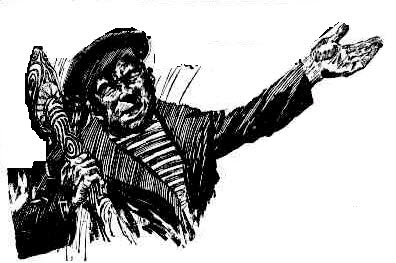
Towards the end of 1838, Pender landed in Sydney after an adventurous trip to New Zealand, bringing back with him a large collection of Maori weapons, including a huge club with a greenstone head, taken by him in single-handed fight with a tattoed chief of the savages.
This curiously carved weapon was regarded by the sailor as the gem of his collection. He never tired relating the story of the fight that made it his, and day by day, he grew more boastful about its alleged intrinsic value.
Throughout the Christmas festivities, he paraded the street with the club over his shoulder, chanting war songs in outlandish tongue, and generally making a nuisance of himself to the more peaceably inclined citizens.
Inspector Peter Prosser, of the Sydney Police Force, did not look with any favor on Pender and his boisterous ways. On several occasions he reprimanded the sailor sternly for his obstreperous behaviour, once or twice driving him off the streets when his boasting and warlike antics with the greenstone club terrified passers by.
Pender was more disturbed than he showed by this unceremonious treatment at the hands of a high officer of the law. Having come to believe that his prowess gave him the right to swagger and riot through the streets of any sea-port town, he bitterly resented that his inclinations should be frustrated In the place where he had made his home, and on Monday, January 21, he was very much in evidence, parading the streets with the club in his hand and a Maori rug tied about his shoulders, loudly proclaiming that he was afraid of no man.
His eccentric behaviour did not seriously impede Sydney’s general affairs during the forenoon, and Inspector Prosser not being about, he progressed from inn to inn accumulating large quantities of spirits. During early afternoon he wandered into the bar of Mrs. Jane Rayner’s Inn in King Street, and, thumping the counter with his club, called for drinks for those assembled. The loungers about the place were only too willing to partake of his hospitality, but as the audience was too insignificant for the sailor, he visited the various parlors and tap-rooms and extended his invitation to the occupants. In this way he gathered another eight men into the bar, but at one parlor his peremptory invitation to drink was as peremptorily refused.
Three squatters from the interior, discussing a matter of important business, so resented his intrusion on their privacy that they threatened stern measures if he did not take himself off.
Pender was not far enough gone in drink to be thoroughly quarrelsome, but nevertheless he expressed his opinion of the squatters with such disgusting profanity that they rose to their feet. One of them rushed the sailor, and, taking him by the shoulders, thrust him down a passage into the street. Then he returned and, calling on his friends, left the house; Before going, however, he informed the landlady that neither he nor any of his associates would patronise the tavern again.
Loss of Profits
Mrs. Rayner was considerably put out at losing such profitable customers, and upbraided Pender in vigorous terms when he re-entered the bar a minute later. The seafarer, now furious and irresponsible, threatened to smash up the bar if anything more were said. The landlady was just as brave and determined as the sailor.
Seizing the war-club, which was lying on the counter, she brought it down with a heavy thwack on Pender‘s shoulders and threatened to crack his skull if he did not leave the premises. From her fortress behind the bar, the landlady whirled the stoneheaded weapon, striking at Pender whenever he attempted to seize it.
The half-crazed man was shouting loudly, and using dreadful language as he rushed about the room, creating such an uproar that a crowd quickly gathered in the street. When the disturbance was at its height, Inspector Prosser entered the bar. Taking in the situation at a glance, he rushed at the sailor, grasped him about the middle, and hurled him through the door. While Pender was attempting to rise, the inspector rushed him again and tried to handcuff him. Both men were of like build, and both in perfect physical condition. The sailor, despite the quantity of drink he had absorbed during the morning, was not greatly affected by his libations, and began to fight for his liberty. For half an hour the pair struggled and fought in the Street, none of the crowd offering to interfere.
Prosser, a skilful boxer, plied his fists vigorously, battering his antagonist’s face until it was a mask of blood, Pender, employing tactics of the sea-front, used his feet and hands impartially, but with scant success.
At length Prosser, planting a blow on Pender‘s jaw, felled him insensible to the ground.
When the sailor recovered he was manacled and helpless.
Signifying his intention to proceed quietly to the watch-house, he was permitted to rise, and, held by Prosser, moved down the street. Over his shoulder the inspector carried the war-club. As they were walking along, the sailor informed his captor that he would like to visit his home before going to prison, there being two cats and several birds in the house he desired to liberate.
Prosser, yielding to persuasion, diverted his progress towards Strawberry Hills, and a quarter of an hour later entered the sailor’s cottage with his prisoner. At the door the inspector was seen to unlock the handcuffs on the sailor’s wrists, a proceeding that many of those among the crowd that followed considered a dangerous proceeding.
No warning of this was shouted to the police officer, but when a few moments later he came reeling out through the door to collapse on the ground, those present realised that something tragic had occurred. In the Inspector‘s head was a ghastly wound, clearly caused by a blow from the war-club.
Two men, George Clark and Richard Roberts -rushed into the house. On the floor of the front room they found the blood-stained club. Pender they beheld escaping through the gate at the rear.
Sergt. W. Kilpatrick and Constable Boadley were soon in pursuit of the murderer. Through the streets they chased him, Pender running at a tangent, and screaming insanely of men he had killed in other parts of the world. People dashed from his path and took shelter in the houses. Doors were slammed in his face, but none attempted to lay hold of him. The police took him at last near the Hyde Park Barracks. He had turned at bay, producing a long sailor’s knife, with which he menaced his pursuers. The constables, however, furious at the death of their superior, braved the maddened seafarer, and overwhelmed him with their truncheons.
They battered him into unconsciousness and then, securing a wheelbarrow, trundled him to the Watch-house where he regained his senses.
At his trial some months later, Pender was the most unconcerned man in the court. He sat in the dock eating pears from a bag and spitting out the skin at the constables.
He refused to plead, or give any explanation of the tragic happening in the cottage, a course which decided his fate.
The Judge had nothing else to do but to order his execution.
The green-stone war-club was given to Mrs. Jane Rayner by a formal order of the court, for what reason was not apparent, and her descendants may have it to this day. .
The death of Constable Burns (possibly Byrne or Byrnes) is mentioned in Colonial Secretary; NRS 905, Main Series of letter received, 1837 [4/2371.3 Letter No. 37/5856] as having died on 16 January, 1837. Unfortunately there are no further details and as such it is not yet known if this death was on duty or not.
On the 4 July 1837 in a short list of police appointments, the Colonial Secretary’s Office announced: “Merton – James Charlton to be Constable from the 31st May, in the room of Jeremiah Burns, Deceased”.
(Merton was a private village established from about 1824 at the junction of the Hunter and Goulburn Rivers opposite where the town of Denman now stands. It was also the centre of a designated Police District at that time. The population in 1841 was 137.)
At the time of his death the constable was stationed at Merton.
Merton – James Chorlton, to be Constable from the 31st May, in the room of Jeremiah Burns, deceased.
Chorlton -v- Charlton – difference in spelling of this first article.
Jeremiah Burns was convicted at Waterford, Ireland in 1823 and sentenced to transportation for life. They sailed from Cork, Ireland on 28 September 1823 on the transport ship Castle Forbes and arrived in Sydney, New South Wales 15 January 1824.
James HARDMAN
| 23/10/2012
James HARDMAN
New South Wales
Corporal
Regd. # ?
Stations: Bathurst Mounted Police
Awards: ?
Service: From ? to 9 August 1836
Born: ?
Died: 9 August 1836
Age: 27 old
Cause: Shot – Murdered
Location: near Bathurst
Date of event: 9 August, 1836
Funeral date: ?
Funeral location: ?
Grave location: ?
[alert_green]James IS mentioned on the Police Wall of Remembrance[/alert_green]
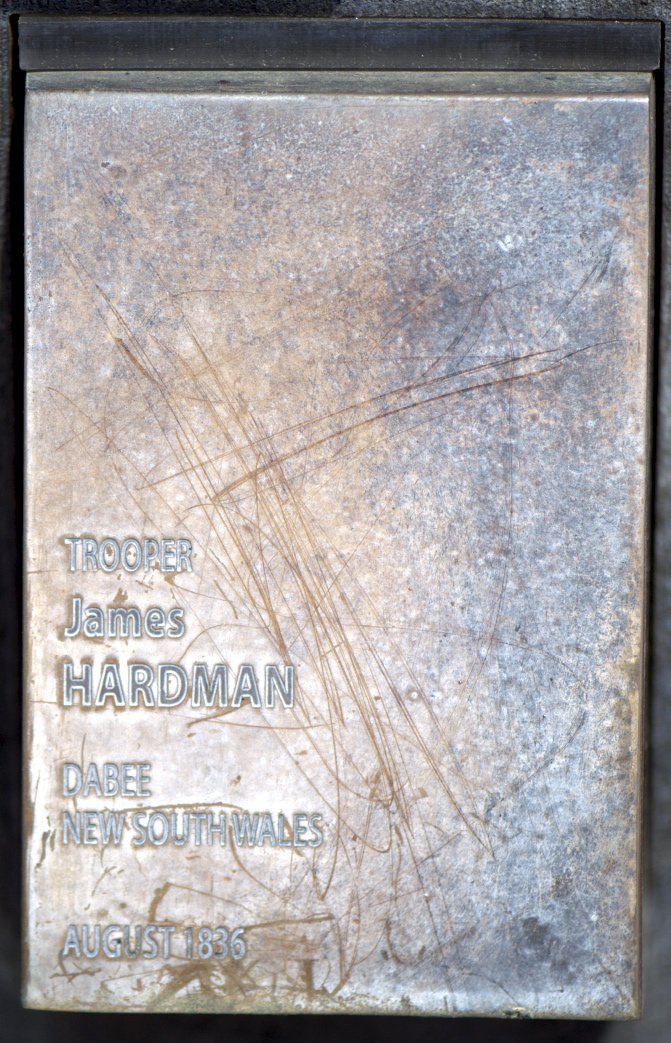
NSW Trooper James HARDMAN touch plate at the National Police Wall of Remembrance.
( Dabee – as mentioned on the touch plate, is an area near Rylstone / Kandos, NSW which is part of the Mudgee area. There is also a property by the name of Dabee in the Kandos region )
Mounted Trooper Hardman ( formerly of the 17thand 28th Regiments ) was shot to death by bushrangers near Bathurst, however few details are known other than those contained in a couple of brief newspaper articles of the time. A reward of fifty pounds, or a conditional pardon, was offered on 22 October, 1836 for information leading to the apprehension of those who had ” most wickedly and barbarously murdered “ Corporal Hardman in August of that year.
The Sydney Morning Herald of 7 November, 1836 reported that ” On Saturday, Alexander Lambert was convicted of aiding and assisting in the wilful murder of Corporal Hardman of the Mounted Police. The deceased and another policeman were in the act of apprehending the prisoner, when another bushranger [ John Halloran ] who was in company with him, fired at Hardman, and shot him dead, and then made his escape. Lambert is to be executed this morning. ”
Halloran was later arrested and the Sydney Monitor of 22 May, 1837 carried the following, slightly cryptic, story.
John Halloran, charged with the murder of a mounted policeman.
The Attorney-General stated, that in consequence of a person named Kenny swearing that the prisoner was the man who fired the shot which killed the policeman, he was committed for trial on the 2nd February, but the day before Sessions, from the evidence obtained, it appeared improbable that the prisoner could have fired the shot. Their Honors then directed the case stand over, but ordered that strict enquiry should be made into the circumstances.
At the time of his death the trooper was 27 years of age and was attached to the Bathurst Mounted Police. He is sometimes referred to as Harman or Harding.
[divider_dotted]
John KELLY
| 23/10/2012
John KELLY
Constable
Assault – Rock
Yass
10 April, 1835
On 10 April, 1835 the constable was serving summonses on a number of offenders in the Yass district in relation to the sale and purchasing of alcoholic spirits without a licence.
Between Yass and Bogolong he met a man named Andrew Gillies and after a conversation both men went to have a drink of water in a nearby creek.
Another man, John Hoy, witnessed the event and told the Supreme Court of New South Wales on 13 February, 1837 that “…when we came to the creek, Kelly and the prisoner went down to drink, while I held the horses; Gillies first drank; then Kelly went, leaving his musket on the bank; when he (Kelly) stopped to drink, I saw Gillies pick up a stone of about two or three pounds weight, and threw it sideways at Kelly; I know it struck Kelly, because he immediately fell on his mouth; Gillies then rushed down and seizing him by the collar, struck him several blows towards the back of the head with a stone which would weigh perhaps seven or eight pounds…”
The body of the constable remained undiscovered in the bush outside Yass for about eighteen months before witness Hoy revealed its location to Chief Constable Edward Roach of Yass Police in late 1836.
The accused Gillies was convicted and sentenced to death. He was executed on 15 July, 1837
The Australian newspaper of 17 February, 1837 reported that “Andrew Gillies underwent the awful sentence of the law on Monday last, for willful murder. The unfortunate culprit was attended in his last moments by the Rev. Mr. McEnroe, and he appeared to pay great attention to the Reverend Gentleman’s instructions, and joined firmly in prayer. He protested to the last moment that he was innocent of the charge for which he was to undergo the awful sentence of the law.”
At the time of his death the constable was aged 28 years and was stationed at Yass. The scene of his murder was Jugyong (Jugiong) Creek, Yass.
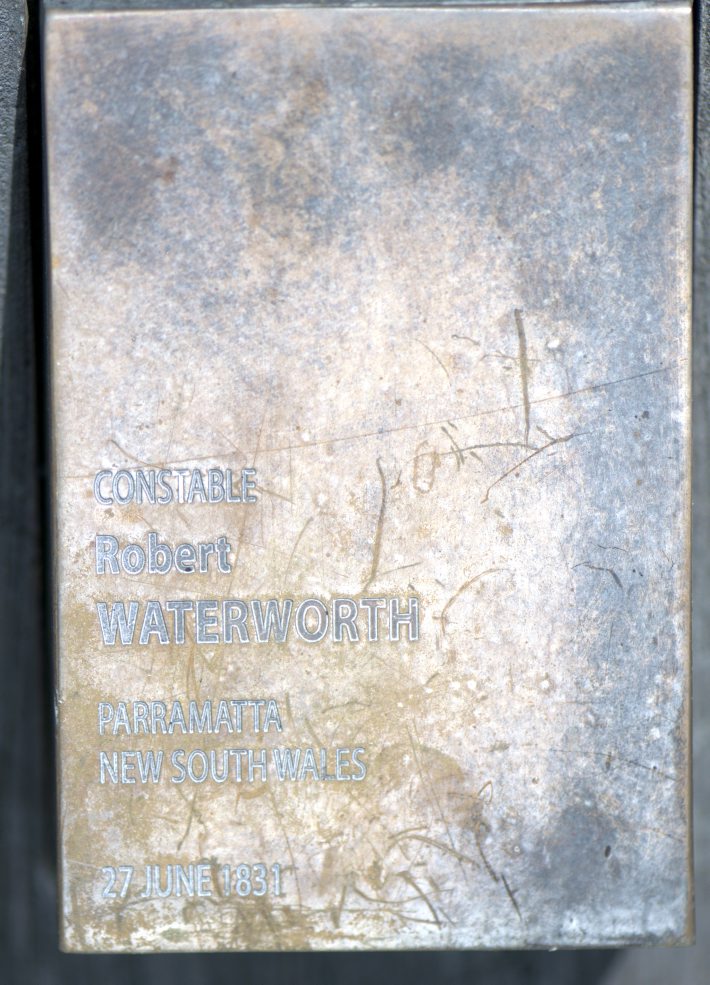
On 27 June, 1831Constable Waterworth was searching an area between the Windsor Road and the Governor’s Arms Hotel, Parramatta for five bushrangers who had held up and robbed a cart the previous Saturday morning. Near an area referred to as the “Veteran’s Huts” he came upon one of the bushrangers named Thomas Lucas who was cutting shingles with an axe. Lucas engaged the constable in a conversation before suddenly attacking him, striking him three times to the head and inflicting fatal head injuries. Lucas later said that he had gone into the bush to retrieve some hidden bags of sugar, proceeds of the robbery, when Waterworth appeared and, fearing the constable would discover he was one of the men he was searching for, he decided to kill him.
The court records of the trial of Lucas and two accomplices, Moylan and Knowles, indicates that “Lucas attacked Robert Waterworth & with an axe held in both hands inflicted a wound to the left side of the face & head, a wound & fracture of breadth of 4 inches & a depth of 1 inch“.
The Sydney Gazette and New South Wales Advertiser of 10 September, 1831 reported on the trial.
WEDNESDAY, SEPTEMBER 7.
Thomas Lucas was indicted for the willful murder of Robert Waterworth, at Parramatta, on the 27th of June last; and John England, as an accessory after the fact.
Mr. John Thorn – I am chief constable at Parramatta; I knew the deceased; his name was Robert Waterworth; he was a constable for the district of Parramatta, about forty years of age, and six feet in height; the last time I saw him was on the 26th of June in the present year, when I accompanied him on the Windsor road, in search of some persons suspected of a cart robbery; he was armed with a gun, a pistol, and a cutlass. On the 27th or 28th, I can’t say which, he was reported absent to me by his wife, who lives on my farm, and on whom I called to enquire after him; on the 3rd of July following I saw him dead at a place called the Governor’s Arms, in the bush, about three miles from Parramatta; near some huts erected for the Veterans; he was lying on the broad of his back, with his arms stretched out, and the left side of his skull beaten in; he was dressed in a blue jacket, white duck trousers, striped waistcoat, white shirt, black handkerchief, and laced half-boots, but no hat; his feet were lying under a small oak tree which drooped over him; on the 4th of August, I found a pistol, about four miles from the spot where the body was found…
Constable Waterworth had arrived in Sydney as a convict on 22 September 1820 aboard the ship Agamemnonand was granted his Ticket of Leave on 30 May, 1828. At the time of his death he was aged about 42 years and was stationed at Parramatta.
Robert Waterworth was transported to NSW, Australia, departing England on 22 April 1820 with 178 other convicts and arriving in NSW on 22 September 1820.
He was employed as a labourer in England but was Sentenced to Life for Sheep stealing. He was convicted at York Assizes.
When he landed in NSW, Robert was assigned to the Reverend Samuel Marsden as a farm servant on Marsden’s farm at Cabramatta. He was 31 years old
although the shipping file shows him as 21 years, Height 6 foot, of fair complexion, brown hair, hazel eyes.
1825: Married Mary Hayes who died in 1828 aged 37.
1829: Married Sarah Duggan (Princess Charlotte) she was 24 and Robert 40. They had a son James born 1830.
Sydney Gazette and New South Wales Advertiser (NSW : 1803 – 1842),
Saturday 10 September 1831, page 3
SUPREME COURT
WEDNESDAY, SEPTEMBER 7.
(Before Mr. Justice DOWLING.)
Thomas Lucas was indicted for the wilful murder of Robert Waterworth, at Parramatta, on the 27th of June last ; and John England, as an accessory after the fact.
The ATTORNEY GENERAL, with whom was Mr. MOORE, stated the case to the Jury, and proceeded to call the following witnesses :
Mr. John Thorn – I am chief constable at Parramatta, I knew the deceased ; his name was Robert Waterworth ; he was a constable for the district of Parramatta, about forty years of age, and six feet in height ; the last time I saw him was on the 26th of June in the present year, when I accompanied him on the Windsor road, in search of some persons suspected of a cart robbery ; he was armed with a gun, a pistol, and a cutlass ; on the 27th or 28th, I can’t say which, he was reported absent to me, by his wife, who lives on my farm, and on whom I called to enquire after him ; on the 3rd of July following I saw him dead at a place called the Governor’s Arms, in the bush, about three miles from Parramatta; near some huts erected for the Veterans ; he was lying on the broad of his back, with his arms stretched out, and the left side of his skull beaten in ; he was dressed in a blue jacket, white duck trowsers, striped waistcoat, white shirt, black handkerchief, and laced half-boots, but no hat ; his feet were lying under a small oak tree which drooped over him ; on the 4th of August, I found a pistol, about four miles from the spot where the body was found ; I was acquainted with the deceased for some time, and am quite positive of the identity of his person, although the face was much disfigured ; the pistol I found by the direction of a man named Monaghan, who went with me, and pointed it out ; it was in a damp place, covered over with bushes, and not loaded ; the pan was shut, and I believe it was on half cock ; I did not know the pistol, but it was similar to that which Waterworth had ; I also found a musket, about 50 yards from where the body of the deceased was found ; this was on the 4th of August ; I was taken to the place by Monaghan ; the musket was loaded, and was of the same sort of musket as had been issued to Waterworth ; on the same day, I found three empty sugar-bags, on the side of the Kissing Point Road, in the bush, by the information of Monaghan ; the place where I found the bags was about three miles from where the body lay ; I took the whole of the articles I found to the police office ; on the tree, towards which the feet of the body lay, were marks such as an axe would make ; about a fortnight ago, I got an axe from the prisoner England‘s, at Parramatta, and another at Patrick Goggin‘s who lives opposite to England‘s ; the axe at England‘s was lying openly in the yard ; after searching at Goggin‘s, for some time, I could not find the axe, but as I was going away, Goggin called me, and gave it to me ; a man named Cohen, who was in charge of England‘s place, was with me at the time ; the axe so given by Goggin was quite damp, and seemed as if it had been buried in sand ; on the head of it I observed some hairs, but whether human hair or the hair of a beast I could not say; I saw one long hair on it which I believed to be the hair of a human being, and I also observed a soft fleshy substance on the head of the axe ; the iron part of the axe was marked with the initials of England‘s name, I. E. ; when I left the deceased on the 26th of June, he had no musket with him, but he then went home, and I saw his musket standing at his door; the arms issued to the deceased by Government, were a musket, a pistol, and a cutlass ; the body was found about 2½ miles from the house of the deceased ; I have not been in the house since he was missing.
Thomas Atkinson – -I am a Sawyer, and live between the rocks, at the back of the Darling Mills, on the Parramatta river ; I knew the deceased , I saw him last, on the 29th of June ( 2 days after the official death date ), between 11 and 12 o’clock ; he came to my saw-pit in the creek, between the Governor’s Arms and the Windsor road ; he had then a gun and a horse pistol ; he asked me if I had seen any strangers ; I replied no ; he told me that a cart had been robbed on the Saturday evening before by five bushrangers ; he stayed about half-an-hour, during which time, Thomas Wilson, a mate of mine was present ; he asked us the way to the Veterans’ huts, which we told him, and he went away in that direction ; the Veterans’ huts are about a mile or better from my pit ; about half-an-hour or rather better, after he was gone, I heard the report of a gun, in the direction of the Veterans’ huts, as well as I could judge ; we stopped sawing and listened, but heard nothing further ; I did not see Waterworth any more till I saw him carried dead to the hospital ; the features were gone, and I could not swear to the body, but I saw his clothing, and I was then perfectly satisfied that he was the same person.
Thomas Wilson corroborated the evidence of the last witness ; I am not sure of the date of the day on which I saw the deceased at the saw-pit.
Charles Jones — I live with John Duck, at Parramatta, I knew the deceased ; I saw him last alive three or four days before he was murdered ; I was stockman to Duck, and drove cattle to and from the bush for him ; I used to have a dog with me ; whilst I was in the bush, I heard the dog barking and went to the spot, and found the dead body of a man who afterwards turned out to be Waterworth ; at the time I found the body, I did not know for certain whose body it was ; the body was lying on the back without a hat, and putrifying ; eight days after, I found a straw hat about two yards from where the body was found ; after I found the body, I drove my cattle home, and gave information to the police ; I know the prisoner, Lucas ; some time before I saw the dead body, I met him and another man-of whom I took no notice-in the bush, near the Governor’s Arms ; they were in a cart at the time, and appeared to be going towards Penant Hills, about two miles off ; Lucas asked me if I saw any shingles by the road side, and I told him I did not ; I saw nothing in the cart but Lucas and the other man ; they were coming in the direction from Parramatta.
Cross-examined by Lucas — I knew you for eight or ten months at Parramatta, and knew you to work at the Governor’s Arms, splitting shingles; I did not know who worked with you ; you have frequently met me in the bush before when you asked me if I saw any shingles, but I never saw you with a horse and cart in the bush before ; I do not recollect frequently going to you where you used to work, while the cattle were feeding in the bush ; I do not know how you got your living, but I remember having frequently seen you in the neighbourhood of the Governor’s Arms, where you asked me if I had seen any shingles ; I never saw you at work there; but I have frequently seen bundles of shingles tied up there.
By a Juror — The place where I saw the horse and cart was about two miles from where the body was found.
By the Court — I have frequently seen the prisoner with a horse and cart in the streets of Parramatta ; I do not know how he got his living ; he was reported to be a free man.
By the prisoner, Lucas — I do not know how long before the murder I saw you with the horse and cart in the bush; it was before the murder ; I don’t remember having seen you at work splitting shingles, but you have told me that the shingles I saw in the bush belonged to you ; I remember you living in a house belonging to my master, and that a man named Jelly lived with you, but I have never heard you talking together about splitting shingles in the bush; I have seen you bring wood in a cart to my master’s house, but I do not know where you got it ; I believe the horse and cart belonged to Jelly, who lived with you ; when I met you in the bush with the horse and cart, you were driving slowly ; I did not know the man who was with you ; I did not see any thing to lead me to suppose that you were about any thing improper ; I saw nothing in the cart ; I saw no fire arms with you ; I think you were sitting on the side of the cart.
By the Court. — I know Jelly; he was not the man I saw with Lucas in the cart.
Dr. Anderson. — I am a surgeon on the Colonial establishment, at Parramatta; I knew the deceased, about the 9th or 10th of July, his body was brought to the hospital ; I knew it to be the body of Waterworth, having been in the habit of seeing him frequently ; the head and neck were in a far-advanced state of putrefaction ; the skull, on the left side, was beaten into numerous fragments, and the jaw of the same side was also fractured; the injury to the skull was quite sufficient to have caused death ; the fractures appeared to have been done with some weapon, but whether sharp or obtuse I can’t say ; the integuments of the head were completely destroyed.
Cross-examined by Mr. THERRY. — I examined the body superficially ; I observed no other wounds but the fractures I have mentioned, and I think if there had been, I should have observed them ; I observed nothing like a gun-shot wound ; a ball might have entered the head, but the fractures I saw were not such as would be made by a gun-shot wound ; I was quite satisfied that the death was caused by the fractures I saw; I am quite satisfied it was body of Waterworth I saw ; he was known by the name of Waterworth or Watersworth ; the head was in such a state of decomposition, that other wounds might have been inflicted on it besides what I saw ; the deceased might have come by his death from a bullet, if it had entered in the place where I saw the fractures on the head.
James Monaghan an approver. — I am a free man I know the prisoners, I have known Lucas for eight or ten months, and England eight or ten weeks ; Lucas and I worked together, stumping a piece of ground on Mr. Foster‘s farm, at Kissing Point ; on a Monday, about ten weeks ago, or perhaps more, I was at the house of England ; Lucas and I came in on the Saturday before to Parramatta, and stopped at the house of a man named William Wilson, till about 9 o’clock ; on the Monday morning, I was at England‘s house with Lucas, who told me that he was going for his (England‘s) horse and cart to bring in some sugar ; this was said at England‘s where we previously had something to drink ; he said the sugar was at a place called the Governor’s Arms; he asked the cart of England, who said ” Yes my boy” or “my lad” ; Lucas said he wanted six bags to put the sugar in, and an axe to cut some wood ; England gave him the bags and the axe, and said to Lucas ” you know where the mare is, go and harness her yourself;” Lucas then told me to go and meet him at the side of the steam-engine on the road to the Governor’s Arms, which I did, and stopped till he came up, with the horse and cart ; this was on Monday, about 10 o’clock in the morning ; I went into the cart with Lucas, and when we came up to where one of the bags was, he pointed it out to me, and I alighted, and put it into the cart, we then went on a little farther and got another bag of sugar; I asked him why he brought six bags, when there were only three bags of sugar, I having brought in one the same morning ; he told me that England would not give his mare for the sake of three bags, which was the reason he said there were six ; after putting in the second bag he stopped the cart, and I went on to get the third where I had “planted” having been concerned in the robbery of it ; I was away about thirty minutes ; when I found the bag, I heard a shot fired, and went to where the cart was, where I saw Lucas with an axe raised over his shoulder, in both hands ; I saw the axe hit a man, who, I believe, was Waterworth, the constable ; when I came down to him, Lucas said to me, ” D–n your soul, plant that gun,” which was lying near Waterford, who was stretched on the ground, and Lucas standing over him with an axe in his hand ; I took the gun and laid it down beside a tree about twenty yards off ; I then returned, and Lucas said to me, ” I called you several times but you did not answer;” I replied I did not hear him ; he said, speaking of the dead man, ” I gave him three blows, and the last was the finishing blow, and that it was better that one man should suffer than three or four“; he said he had been “chopping, chopping beside the tree, till he got the chance, but God spared him his two arms, which never deceived him ;” the dead man was then lying on his back, and the blood flowing from his head ; Waterworth was a constable near Mr. Blaxland’s, and it was his dead body I saw; I know him by the name of Waterworth, but I knew him best by the name of “Big Bob, the constable ;” it was his dead body I saw ; Lucas and I then got into the cart, and went up by another road; and on the way we met, I believe, the town stock-keeper, in the direction of the Governor’s Arms ; Lucas asked him did he see any shingles in such a place — naming some place in the bush, which I have forgotten — and the stock-keeper said he did, or did not, I forget which, for I was very much frightened and did not take much notice; we went on to a place above a place called the Burn’t Bridge ; when we got there, we emptied the sugar bags into two of the canvass bags which we brought from England‘s ; one bag was filled, but the remainder of the sugar did not fill the other bag ; we left the empty sugar-bags behind us, and Lucas then covered the bags of sugar in the cart with the remainder of the canvass bags, which were four ; I told him to go into Parramatta in the cart, and that I should walk in on foot, for fear of us both being seen together, on account of what had happened ; he left me then and went by the high-road, I following through the bush by a bye-road ; when I got to Parramatta, I went to England‘s house, and found Lucas there, in the stable; England was out, and Lucas went after him, and returned in about half an hour ; he went in through the big gate, and England came through the house into the yard where the sugar was, and took one bag of it out of the cart, carried it into the house, and laid it in a room ; he then came for the other bag, which he laid in the same place ; Lucas, England, and I then went into the house, and had each a glass of rum, when Lucas told England that he had saved his cart and mare for him on account of killing the constable, saying “ it is better for one to lose his life than three or four,” on which England said, I believe, ” It is my boy; the Devil’s cure to him ;” we had something more to drink, and about two or three hours after, one bag of sugar was weighed by us together, with a stick across our shoulders — I believe the handle of the fire-shovel-and the steelyards were suspended from it ; after one bag was weighed, England agreed to take both bags at three hundred weight ; we began drinking again, and about eight o’clock two men, named Moyan and Knowles, came to enquire after Lucas, who said ” Here I am my boys;” they spoke a few words, and we then went together into a back room, where we had something to drink ; Moyan said to Lucas, ” Give me a pound for myself and my comrade, on account of what has happened,” by which I thought he had been telling them about the murder ; Lucas asked England for a pound, who gave him five dollars, and he gave them to Moyan ; we then began drinking and playing cards, and I got very drunk, and, I believe, got fighting with some of them ; in the morning I found myself lying by the kitchen fire, in England‘s house ; shortly after that, Lucas and I left the house, and went to Wilson‘s, and from that to the farm where we were working ; in two or three days after, we came into town again, and went to England‘s, where Lucas and I agreed to go and burn the dead body of the constable; England was not present at the first of our agreement to do so ; after this Lucas asked England for some powder and ball, to protect us when we went to burn the dead body, which he gave to Lucas, saying if he, meaning the constable; was out of the way, there would be no danger then, there was no discovery then ; we were going out for the deceased’s pistol which was on the farm where we were working, about ten o’clock at night, but when we got about a mile from England‘s, I “cowed” and would not consent to go ; Lucas called me ” a d–d coward,” and we went on to the farm, where we stopped at the hut, and worked for three or four days, and hearing nothing of the discovery of the body, we came into Parramatta, and returned back the same day ; Lucas took a job of splitting some shingles, for Mr. Foster‘s nephew, and I then left the farm, as I was frightened of Lucas that he would take my life some time, and went to Parramatta; after this I went out to him for the pistol, which he said belonged to the deceased, but he would not give it to me ; I wanted it to commit more robberies if I could ; he would not give it to me, and said he would not trust it in any one’s hands unless he was present himself; in about six or seven weeks after the death of Waterworth, I was taken up for a robbery at Mr. Nash’s at Parramatta; before this Lucas had got a beating on the farm, and came into Parramatta, to the brickmaker‘s, where I was ; this was on a Saturday, and I was taken up on the Wednesday following, on Monday he told me where the pistol was on the farm, and I went out and got it in a hollow log where he told me it was, and “planted” it under some rubbish and leaves, about half a mile from the town, where it lay till I told Mr. Thorn of it, on the Saturday after I was apprehended ; I went with Mr. Thorn and pointed out to him the place where it was ; I also pointed out the musket which I had laid alongside the tree, about 30 rods from where the dead man lay ; I also pointed out the sugar-bags which had been emptied, to him ; Lucas told me that he himself had fired the shot the report of which I heard while I was looking for the sugar in the bush ; I asked him if the constable fired, and he said no, that it was he ; the axe went in along with the sugar, to England‘s place, but I do not know what became of it ; I have since seen an axe that resembles it.
Cross-examined by Dr. WARDELL. — I was an approver in several cases of receiving, about four years ago, against two men named Ford and Bridle ; I was the principal thief myself; Ford was acquitted by persons swearing contrary to what I stated ; I was sent to this colony for cattle stealing ; I was sent to an iron-gang here, for a robbery, or being in the bush, I forget which ; I also got three years to a penal settlement for absconding three times ; I have committed nine or ten robberies, but never a highway robbery but one ; I have known England for 9 or 10 weeks ; I don’t know that I was known at Parramatta as a notorious informer ; if I was, I do not suppose Lucas would have gone with me to commit a robbery ; Waterworth was a very stout man, much stouter than the prisoner, Lucas; I heard only one shot fired ; the deceased’s pistol was discharged, but I did not examine the gun ; I did not live at England‘s house, but I went there several times both before and after the murder; Lucas told me that the constable, when he met him, had no suspicion of him, but that he kept talking to him about old times, and chopping at the tree, until he got an opportunity of striking him with the axe; he said he killed him for fear I should come up with the sugar while he was there, and that when he knocked him down the pistol fell out of his hand, which he (Lucas) fired off to alarm me ; I do not consider myself a good man ; I will tell the truth about every thing I have done ; I gave the information because I could not sleep night or day for thinking of the murdered man, who, I fancied, was constantly appearing to me; I had continual dreams of him; I told, after I was apprehended for a robbery, fearing that I might be accused of the murder also ; I think murder should not be concealed, and I would tell it, even of my brother, if he were guilty of it.
To the prisoner, Lucas. — I have known you about 6 months ; I have been confined in the Sydney gaol, for an offence committed at Windsor ; I was kept separate for fear of some men against whom I had given information ; you desired me to ” plant ” the musket, and I laid it at the foot of a tree, about 30 rods from the body of the deceased ; I saw you standing over the deceased as he lay on the ground, and striking him on the head with the axe ; had I known, when we went for the sugar, that you intended to commit a murder, I would not have gone with you ; I don’t think you knew any thing about my character.
By the Court — After we left the dead body of the deceased, we drove the cart pretty quickly, the mare was trotting ; when we got to Parramatta, she was in a very great heat, owing to her having been driven very hard, and we two, together, with the sugar, being in the cart ; the conversation with the stock keeper, whom we met, lasted about a minute ; the witness, Charles Jones, is the stock-keeper of whom I speak, to the best of my knowledge ; he wore a plaid cap similar to that which Jones now holds in his hand.
The witness, Jones, recalled by the Court, said, I never recollect seeing Lucas and the strange man in a cart, in the bush, or any other occasion but the one I speak of; I cannot say how long this was before the body of the deceased was found by me ; the place where Lucas stopped to speak to me, is about a mile and a half from where the body lay ; the road which they were travelling would take them to Parramatta, but by a round-about way.
Robert Harris — I live at Parramatta, and am a horse doctor; I know the prisoner, Lucas, and the witness, Monaghan ; I remember meeting them at England‘s house, before Watersworth‘s body was found ; it was on a Monday, some time in June, but I am not positive as to the month ; about ten days or a fortnight after, Waterworth‘s body was found ; I saw Monaghan first in the house ; in the evening I saw Lucas and Monaghan, who were accompanied by two blacksmiths, in the house when England was present ; previous to this I saw England‘s mare in the stable ; I was called out by a man named Kehoe, to look at the mare, to see the state she was in ; she was quite sweating, as if she had been driven hard or over-laden ; coming out of the stable, Kehoe went to the cart out of which he took some straw, and I saw some bags in the cart, full of something ; I returned into the house, and found Monaghan there ; this was about 2 or 3 o’clock in the afternoon, and in the evening Lucas and the other man came ; I do not know the names of the blacksmiths who came to enquire for Lucas, but I think I should if I heard them ; they had supper and something to drink, a quarrell ensued between the parties, in the course of which Kehoe was struck by some person, but I do not remember by whom ; some constables were procured, and the two blacksmiths were taken to the watch-house, but Monaghan remained in England‘s house all night ; he was very drunk, and slept by the kitchen fire ; I believe Moylan and Knowles were the names of the blacksmiths ; the constables did not take Lucas or Monaghan into custody, as they were free men.
Cross-examined by Mr. ROWE — I never saw the mare in such a state as on that day ; I can’t say how many bags were in the cart, or whether they contained sugar ; England was in the habit of bringing grain and other matters from his farm, and he might leave such things in his cart in the yard ; I knew Watersworth ; I have heard him called by that name by numbers of persons since his death, but he was more generally known by the name of “Big Bob” ; I cannot say positively that I heard him called by the name of Watersworth.
To the prisoner Lucas — You once lodged in England‘s house, and therefore there was nothing remarkable in being there ; you did not lodge there then ; I recollect the evening in question, on account of the disturbance that took place.
By the ATTORNEY GENERAL — Since the death of the deceased, I heard him called Watersworth, in his life time, I knew him only by the name of “Big Bob.”
James Hansell — I am a quarryman, in the service of Mr. Peyton, of Parramatta ; about 9 or 10 weeks ago, I saw England going towards the Governor’s Arms ; I spoke to, and asked him what o’clock it was, and he said half-past two ; he said his cart was gone to the Governor’s Arms for a load of shingles, and he feared something had happened to it ; on the same day, I heard that Waterworth was missing; he was found about 9 or 10 days after, as I heard.
To the prisoner, Lucas — I did not see you pass on that day ; I worked within three rods of the road, but you might have passed when I was not there ; I went to work about 8 o’clock in the morning, and remained till after 1 o’clock, and during that time I saw no cart pass, nor did I see you.
Re examined — There are two roads in that neighbourhood.
William Cohen — I am a gardener, living at the prisoner, England‘s, at Parramatta ; I remember the evening it was reported that Monaghan was taken up; about dusk in the evening I was in the garden, and saw England come there with an axe in his hand, which he threw down among some growing barley, about a foot high, and pulled up a handful, which he threw over it; that was not the usual place in which he kept his axe ; it remained there till England was taken up ; after that I took it to cut wood, and Mr. Thorn came for it a few days after, and took it away ; a man named Goggin gave it to Mr. Thorn ; I had taken it over to Mrs. Walsh‘s to cut wood, and it was there that Goggin gave it to Mr. Thorn.
Cross-examined by Mr. THERRY — I lodged in England‘s house two nights ; I was never charged with robbing him ; I never had any dispute with him, nor do I owe him any spite ; I will not undertake to swear that the axe given to Mr. Thorn was the axe I saw England put among the barley ; I did not know Waterworth, but I have heard people talk of “Long Bob.”
Patrick Goggin — I live at Parramatta, and am a labouring man , I reside nearly opposite to the house of the prisoner England , I remember Mr. Thorn coming to me for an axe, after England was apprehended ; the axe was left by Cohen at my place, where he had been cutting some wood ; I gave Mr. Thorn the same axe that Cohen had brought to my place.
Mr. John Thorn recalled, said, this is the axe I got from Patrick Goggin, and which has been in the Police-office some time ; I was in England‘s house on the morning of the night Moylan and Knowles, the two blacksmiths, were taken ; the constables reported to me about 2 o’clock in the morning that they had taken these men, and I ordered them to remain at England‘s till I went there, which I did at day-light; I found Lucas, Monaghan, England, Bob Harris, and two other men there; Monaghan was lying on the floor in the front room ; the two blacksmiths were taken to the watch-house, for being absent from their duty, they being prisoners of the crown employed in the Lumber-yard ; I knew the deceased ; he was a constable for 18 months ; I knew him by the name of Waterworth; he always answered to that name ; he never said his name was Watersworth ; he might have been called so by many persons, but I always called him Waterworth ; I was present at the inquest ; I do not know what he was called there, whether Waterworth or Watersworth.
Cross-examined by Mr. ROWE — I do not know that he went by the name of ” Big Bob ;” he might ; I can’t tell whether people call him Waterworth or Watersworth ; I cannot swear that I ever heard him called Waterworth; I may have heard him called “Big Bob,” but not frequently; I apprehended Monaghan on suspicion of robbery, and he was taken to the police-office ; he asked to speak to me in private, but never asked me if he pointed out the murderer of Waterworth, would he be released from the charge he was then under; he said nothing like that to me, nor did I make him any offers ; I did not tell him I would recommend him for mercy ; I found some bags, full of wheat, at England‘s house.
By the Jury — An hour might have elapsed between the time the constables took the two blacksmiths, into custody, and their return to England‘s house by my directions.
William Cohen recalled, said, I think I should know the axe I left at Goggin‘s house, as I drove in an iron wedge between the head and the handle; this axe is like it, but I do not observe the mark on it which I should know it by ; I think it is the same.
Cross-examined by Mr. THERRY — I can’t swear to the axe ; I do not see the iron wedge of which I spoke.
This was the case for the prosecution.
The prisoner, Lucas, on being called upon for his defence, declined saying any thing to the Jury, but stated to the Court, that he had subpoenaed some witnesses from the neighbourhood of Parramatta, and had enclosed the subpoenas, by post, to Mr. Thorn, the chief constable, but that they had not been served, and those witnesses were not in attendance.
Mr. Thorn said, he had never received any such subpoenas ; it was possible that the prisoner might have sent them, and that the letter might be then lying in the Post-office, at Parramatta, although, if it were, he thought he should have received notice of it.
The prisoner then produced, as witnesses, two men, brought up from the gaol, by an order of the Court; but what the evidence was which he expected them to give did not appear, as they denied all knowledge of the prisoner, further than having accidentally seen him once or twice before.
On behalf of the prisoner, England,
Dr. WARDELL contended that the evidence did not support the information which charged him with being an accessory after the fact — an unusual course of proceeding in a case like the present, and for a very good reason ; namely the difficulty of proving the charge, as contemplated by law. The information charged the prisoner, England, that he, after the commission of the felony and murder aforesaid, the said John Lucas did “assist, harbour, relieve, comfort, and maintain” &c. ” Now, he contended, that the mere act of receiving the principal felon, by a party who knew that a felony had been committed, did not constitute the offence of accessory after the fact ;– that there must be some act of the party, done with a view to prevent the apprehension, trial, or the suffering the punishment of his offence, by the individual who committed the felony. In the present case the only evidence against England was, that he had merely received the prisoner, Lucas, into his house; there was no proof that he had afforded him any aid whatsoever, with reference to the danger he might be in.
Mr. THERRY and Mr. ROWE followed on the same side ; and also submitted, as in defending the accessory, they had a right if they could, to controvert the guilt of the principal, that there was no positive evidence, but that the deceased might have met his death from a gun-shot wound, and not from wounds inflicted by an axe, as laid in the information.
The learned Judge held that the objections raised by counsel were questions of fact to go to the Jury, upon the evidence of the approver.
Mr. ROWE then contended, that the information laying the name of the deceased asRobert Waterworth, was not supported by the evidence ; he having been spoken of by the majority of the witnesses, as Watersworth, or ” Big Bob.” Upon this point, the learned counsel called Mr. Hugh Taylor, who stated that he had been for several years in the constabulary at Parramatta ; that he had known the deceased, and always called him Watersworth, to which name he invariably answered ; witness has called him by that name at least one hundred times, and has heard other persons also call him so more than twice that number of times ; has heard him called Waterworth ; he would answer indifferently to either ; he was sometimes called “Long Bob,” and he would answer to that name.
Mr. ROWE again contended at great length, that, at the plurarity of times, the deceased was called Watersworth, and not Waterworth ; and that, upon the authority of several decided cases, which he quoted, the variance between the namelaid in the information, and the evidence, was fatal, and the prisoners were entitled to their acquittal.
The learned Judge said, as there was conflicting testimony, he would leave it to the Jury, as a preliminary question, to say, upon the evidence, what the name of the deceased really was.
His Honor then read over those parts of the evidence of the several witnesses who spoke of the name by which the deceased was known, leaving it to the Jury to determine what his name really was ; observing, if they should find it to be Watersworth, and not Waterworth, the variance, upon the authority of the cases cited from the bar, would be fatal and he should order the information to be quashed, leaving it open to the Attorney-General to adopt another course of proceedings.
The Jury retired for some time, and on their return into Court, stated that they could not find, from the evidence they had heard, what the name of the deceased was.
The Court enquired of the Attorney General what course he would pursue, after the intimation from the Jury, and the learned gentlemen said he would consent to their being discharged without giving a verdict.
The Jury were accordingly discharged, and the prisoners were remanded.
FRIDAY 9th.
(Before the CHIEF JUSTICE)
Thomas Lucas and John England were again put to the bar this morning, and about to be arranged before a new Jury, upon the same information, upon which they were tried on Wednesday.
Dr. WARDELL, Mr. THERRY, and Mr. ROWE, contended at great length against the liability of the prisoners to be again indicted on the same information.
The learned Judge reserved his decision to Monday next, after which we shall fully report the arguments of Counsel and the judgment.
Sydney Gazette and New South Wales Advertiser (NSW : 1803 – 1842),
Saturday 17 September 1831, page 4
[code]It would appear that the Crown could not prove the correct spelling of the surname of this Constable and because of that lack of proof and the ‘spelling’ in the indictment for the murder, and for the indictment for Accessory After the Fact, of the Constable, the Crown could not “prove” those indictments against the offenders.
You can not be convicted of Murdering a person who does not exist on record ( unless you plea guilty ). You can not be convicted of Murdering Joe Blow if, in fact, the victims name is Fred Flintstone. In this case, the Indictment would have ( possibly ) had the surname as WATERWORTH when is surname was ( possibly ) WATERSWORTH. Thus was the argument in this case and so the offenders were not convicted of these offences – however, they were then charged with the original Highway Robbery on the person of Charles Martin, and stealing from his person, some money, a knife, a hat, his property, and five bags of sugar, the goods of Thomas Fibbett, at Parramatta, on the 29th June last.
Thomas Lucas, John Moylan and Henry Knowles were either found guilty or plead guilty. In any case, all THREE were sentenced to Death. LUCAS was hanged on 23 September 1831.
Sydney Gazette and New South Wales Advertiser (NSW : 1803 – 1842), Tuesday 31 May 1831, page 4
IMPOUNDED, at Baulkham Hills,
on the 25th Instant,
One Bullock, branded on the near hip, with a bell ; white face; a little down horned; while back and belly; red sides; the near hind leg white ; off hind leg white, with a red spot ; the fore legs red, with a white ring round each fore leg.
If the above is not claimed within 21 days from, the above date, it will be sold, at the public Market-place, Parramatta, to defray expenses.
Sydney Gazette and New South Wales Advertiser (NSW : 1803 – 1842),
Saturday 27 March 1830, page 1
Government Notice,
Colonial Secretary’s Office,
SYDNEY, March 26th, 1830.
HIS Excellency the Governor has been pleased to approve of the following Alterations in the Police of the Colony, namely
Parramatta – Robert Waterworth, holding a Ticket of Leave, to be Ordinary Constable, in the District of the Field of Mars, from the 20th Instant, in the room of Joseph Eyles, resigned, and
Joseph Thompson, Free by servitude, to be Scourger, from the 23d Instant, in the Room of James Walton, dismissed for highly improper Conduct.
Penrith.- John Franks, holding a Ticket of Leave, to be Ordinary Constable, from the 10th Ultimo, in the Room of George Hughes, dismissed for improper Conduct.
Sutton Forest-Christopher Rhall, dismissed on the 19th Instant, for repeated Neglect of Duty, and other misconduct.