1

Geoffrey Gordon SMITH

 Geoffrey Gordon SMITH

New South Wales Police Force

Regd. # 5150

Rank:  ?

Stations?

Service:  From  to  ?

Awards?

Born?

Died on:  17 December 2014

Cause?

Age:  93

Funeral date:  22 December 2014 @ 11am

Funeral location:  St Brigid’s Catholic Church, DUBBO.

Buried at?


[alert_blue]   ?  is NOT mentioned on the Police Wall of Remembrance[/alert_blue]

With regret I advise the death of Geoffrey Gordon SMITH, 93 old, former Regd. No. 5150, a Veteran Member of the Dubbo District Branch of the RPA.

Geoff passed away on 17/12/2014 and his funeral is proposed to be held at 11am on Monday 22nd Instant at St Brigid’s Catholic Church, DUBBO.

Church Service location


Sidney WALL

Sidney WALL

New South Wales Police Force

Regd. #  ?

Rank:  Senior Constable – Resigned 1980

Stations:  Jindabyne, 1974 – 1980

Service:  From  to  1980

Awards?

Born?

Died on:  Friday  12 December 2014

Cause:  Injuries.  Died from being trapped under an upturned tractor

Age: 65

Funeral date? TBA

Funeral location? TBA

Buried at?


[alert_blue]   Sidney  is NOT mentioned on the Police Wall of Remembrance[/alert_blue]

Summit Sun

Jindabyne man dies after becoming trapped under tractor

Dec. 13, 2014, 6:50 a.m.


Police will prepare a report for the Coroner following the death of a man on a rural property near Jindabyne.

Shortly after 3.30pm Friday 12 December police and emergency services were called to a property in East Jindabyne.

Upon arriving at the location, emergency services personnel were met by a 35-year-old man and a 67-year-old woman who directed them to an injured 65-year-old man.

The man had sustained a number of injuries after becoming trapped under a tractor he had been using to mow the property’s grass paddocks.

Ambulance paramedics performed CPR on the man until a doctor arrived via Southcare rescue helicopter a short time later.

However, the man was unable to be revived and was pronounced dead a short time later.

Police will now prepare a report for the Coroner, outlining the full circumstances surrounding the man’s death.

http://www.summitsun.com.au/story/2762457/jindabyne-man-dies-after-becoming-trapped-under-tractor/?cs=1887


[divider_dotted]


Sid was stationed at Jindabyne between 1974 – 1980.  He was up for promotion from Senior Constable to Sergeant but resigned because he did not want to move, from Jindabyne, for the promotion.

[divider_dotted]


Jonathan PATON

Jonathan PATON

New South Wales Police Force

Regd. # ?

Rank:  ?     – Resigned

Stations:  Queanbeyan

Service:  From  to  ? 1999

Awards:  ?

Born:  ?

Died:  15 December 1999

Cause:  Suicide – drowning – Queanbeyan River

Age: ?

Funeral date:  24 December 1999

Funeral location:  ?

Buried at:  ?


[alert_yellow]Johnathon is NOT mentioned on the Police Wall of Remembrance[/alert_yellow]

Jonathan Paton worked at Queanbeyan Police Station and resigned from the police about six weeks before he died.
He was deeply disturbed ( emotionally ) and started hearing voices. 

He committed suicide by drowning himself in the Queanbeyan River on the 15 December 1999.
His funeral was held on Christmas Eve that year.
FURTHER INFORMATION IS NEEDED ABOUT THIS MAN.


Charles Walter BRAYNE

Charles Walter  BRAYNE

New South Wales Police Force

Regd. # ?

Inspector – Retired around 1907

Stations:  Penrith ( 1880’s), Shoalhaven District ( Nowra – O.I.C. 1885 ),

Kiama ( 1899 ) then Braidwood

Awards:  ?

Service:  From  1873 to  1907

Born:  1846? – 1847?, Brighton, England

Died  22 December 1922 @ Braidwood

Age:  75

Cause: ?

Funeral date:  Sunday  24 December 1922 @ Braidwood

Funeral location: Braidwood Cemetery

Grave location:  Church of England section


[alert_yellow]C.W. is NOT mentioned on the Police Wall of Remembrance[/alert_yellow]

[divider_dotted]

Brother to Sergeant George BRAYNE – deceased 5 November 1906, aged 56

Brother to Constable William Henry BRAYNE – deceased 8 August 1940, aged 66

[divider_dotted]

GOVERNMENT GAZETTE.

The following notifications appear in yesterday’s Gazette –

APPOINTMENTSSergeant Charles W. Brayne as an inspector of magazines under the 34th section of the Gun-powder and explosive Consolidation Act of 1876 (40 Victoria No 1), for the purpose of laying complaints and taking legal proceedings as prescribed in the 58th section of such Act.

The Sydney Morning Herald       Saturday  5 July 1884       page 8 of 20

[divider_dotted]


The great Kiama fire

IN THE early hours of Sunday morning, October 1, 1899 a fire broke out that was to be the most extensive and destructive one that had ever visited the township of Kiama. It would also change the face of Terralong Street forever.

The fire started in the Wood Brothers general store and within minutes the place was ablaze. With the help of a strong southerly breeze, the fire spread to adjoining buildings and according to William H Bayley, author of Bluehaven: History of Kiama Municipality, “half the block of shops fronting Terralong Street from Collins Street towards Shoalhaven Street caught fire at 2am and was destroyed soon after dawn.”

The Sydney Morning Herald dated Monday, October, 2 1899, reported: “By the time the local police and many others were on the spot, and under the direction of Senior-Sergeant Brayne, Alderman Hindmarsh and others, many willing hands made great efforts to prevent the flames catching the Royal Hotel. In spite of their efforts the hotel soon ignited.

“This building being in part lath and plaster outside blocked the advance of the fire for a time: but ultimately the fire got hold of the place, and being a two-storey wooden structure it soon became a burning maze belching out tongues of fire against the adjoining building.”

Unfortunately there was no fire fighting equipment in Kiama at the time – hoses and tank water being the best on offer – so extinguishing the blaze became a huge problem. There are conflicting reports about how the fire was eventually stopped. No lives were lost but 12 families were left homeless, and 16 shops and the hotel were destroyed.

The total cost of the damage was estimated at between £5000 and £6000.

http://www.kiamaindependent.com.au/story/314816/the-great-kiama-fire/

[divider_dotted]


New South Wales Police Gazette – 1906   page 4

Brayne, Charles W., Sub-Inspector 2nd class, to be Sub-Inspector 1st class, 351  ( I ‘think’ 351 ‘might’ relate to a page number ?? )

[divider_dotted]


Nepean Times ( Penrith )                   Saturday  30 December 1922                            page 1 of 6

Obituary  

Mr. C. W. Brayne.

Mr. Charles Walter Brayne, who died at Braidwood on December 22 in his 75th year, was for many years in the Police Force, from which he retired some 15 years ago. As a young man he saw some of the stirring life of the goldfields days in the southern district,   and had good knowledge of the bushranging exploits which culminated in the execution in Sydney in 1867 of Tommy and Johnny Clarke. Joining the police in 1873, Mr. Brayne gained rapid promotion. He was stationed at Penrith as a trooper over 40 years ago, and was given charge of the Shoalhaven district in 1885, and remained at Nowra many years, being transferred to Kiama, and later to Braidwood as inspector. His wife pre-deceased him by some 15 years, and a daughter ( Mrs. A. E. Prott, of Nowra ) in July last, from which time he appeared to have broken down in health. The late Mr. Brayne leaves to(sic) daughters and one son, viz., Mrs. A. C. Upton (Penrith), Mrs. A. Coleman ( Condoblin ), and Mr. Charles Brayne ( Darlinghurst ).

Mrs. Upton spent the last week with her father. The funeral took place on Sunday and was headed by members of the Police Force.

trove.nla.gov.au/ndp/del/article/104678027?searchTerm=charles w. brayne&searchLimits=#pstart10735592

[divider_dotted]


Cemetery location


William Henry BRAYNE

William Henry BRAYNE

New South Wales Police Force

Regd. # ?

Sergeant

Stations:  Double Bay

Awards:  ?

Service:  From  ?   to  ?

Born:  1873? – 1874?, Brighton, England

Died  Thursday  8 August 1940 at Gloucester House

Age:  66

Cause: ?

Funeral date:  Friday  9 August 1940

Funeral location:  T. J. Andrews Funeral Chapel, 25 Enmore Rd, Newtown

Grave location:  Methodist Cemetery, Rookwood


[alert_yellow]C.W. is NOT mentioned on the Police Wall of Remembrance[/alert_yellow]

brother to Sergeant George BRAYNE – deceased 5 November 1906, aged 56

brother to Inspector Charles William BRAYNE – deceased 22 December 1922, aged 75

[divider_dotted]

The Sydney Morning Herald                          Friday  9 August 1940                    page 6 of 12

BRAYNE – August 8 1940 at Gloucester House.  William Henry loved husband of Gentilla Brayne and father of C W Brayne. aged 66 years.

[divider_dotted]

BRAYNE.- The relatives and Friends of the late WILLIAM HENRY BRAYNE Late Police Sergeant, Fivedock, are invited to attend his funeral to leave T. J. Andrews’s Funeral Chapel, 25 Enmore Road, Newtown, THIS DAY, at 3.30 p.m., for Methodist Cemetery, Rookwood.

T. J ANDREWS, A.F.D A.,

21-25 Enmore Rd

Phones: L2373. etc. Newtown.

[divider]


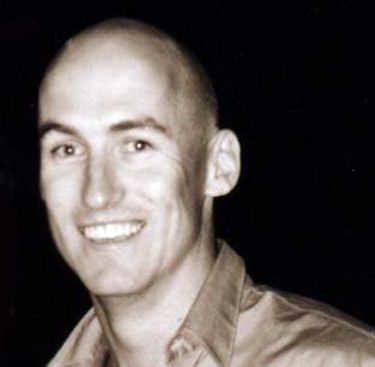
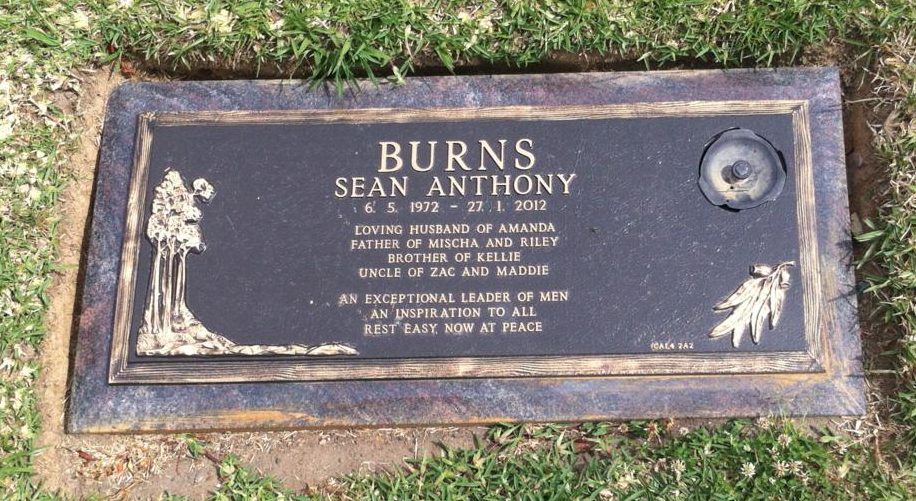
Sean Anthony BURNS

Sean Anthony BURNS

late of Castle Hill

New South Wales Police Force

Academy Class 250

Regd. # 28438

Rank:  Senior Constable

Stations:  Cabramatta ( 34 Division ), SPG Tactical Response, Blacktown ( 27 Division ), Castle Hill

ServiceFrom: 27 January 1992  to   ? ? ? ( Retirement – Medical discharge – PTSD ) =  ? years Service

Awards:  No find on It’s An Honour – although

National Medal, NSW Police Medal with 1st Clasp & 3 Commanders Commendations

Born:  6 May 1972

Died on:  27 January 2012 ( 20 years to the day he entered the Academy )

Age:  39

Cause:  PTSD – Suicide

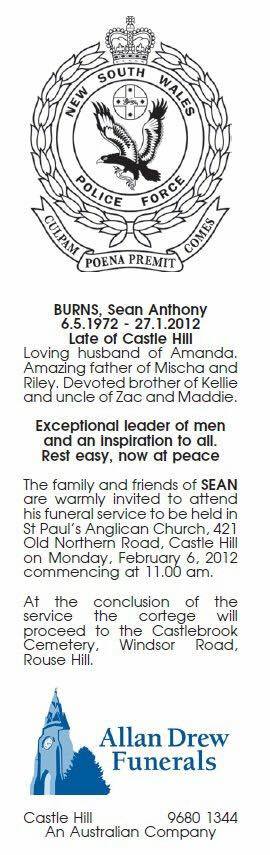
Funeral date:  Monday  6 February 2012 @ 11am

Funeral location:  St Paul’s Anglican Church,  421 Old Northern Rd, Castle Hill

Grave site location:  Castlebrook Memorial Park,

Windsor Rd, Rouse Hill, NSW

Location:  Calvary 1/2

Lat/Lng: -33.69364, 150.92201

Memorial location:

There is a memorial scholarship with Police Legacy in his name.

FURTHER INFORMATION IS NEEDED ABOUT THIS MEMBER

[alert_red]Sean is NOT mentioned on the Police Wall of Remembrance[/alert_red]

  • BUT SHOULD BE


[divider_dotted]

He was 39 when he passed and he had a lifetime of achievement including a successful career with the tactical response group ( T.R.G. ) of the police force and then retraining and rising to the top of the sport strength and conditioning field culminating in becoming the head trainer for an Australian professional NRL team (this was what he was doing when he passed).

His death stunned and impacted on many. He had been a leader of men and an inspiration to many. His legacy of giving everything in life 100 percent lives on in all those who knew him.

https://www.facebook.com/puttingafaceonsuicide/photos/a.411200978961948.98475.109654835783232/411594218922624/?type=3&theater

[divider_dotted]

Sean Anthony BURNS - NSWPF - Suicide 27 January 2012 - obituary


[divider_dotted]

BURNS, Sean Anthony
6.5.1972 – 27.1.2012
Dearly loved son of Terry and Kae. “Our Pride & Joy”
Missing from our lives, never from our hearts.
Rest In Peace Mate
In Memoriam
Published in The Daily Telegraph on 27/01/2015

[divider_dotted]

BURNS, Sean Anthony

BURNS, Sean Anthony
6.5.1972 – 27.1.2012
Forever missed and loved. Rest in peace mate. Love always Mum and Dad
In Memoriam
Published in The Daily Telegraph on 27/01/2016
[divider_dotted]

Belle Property Castle Hill

https://www.eventbrite.com.au/e/sean-burns-memorial-scholar… Belle Property Castle Hills major fundraising initiative for 2016 is NSW Police Legacy and the Sean Burns Memorial Scholarships. We are delighted to be hosting a dinner and charity auction on Friday March 18th at Castle Hill RSL. Tickets are only $79 each and a fantastic night of food, live music and entertainment is guaranteed !  If you are unable to attend the event but are a business that is interested in donating an item for the auction we would love to hear from you !

Event Description

Sean Burns was a former member of the NSW Police Force who tragically passed away in 2012. He had been a highly regarded member of the force for 20 years across a range of areas culminating in several years with the elite tactical operations unit (TOU). He had a passion for sport and had been a representative swimmer, runner and rugby league player in his youth as well as completing tertiary studies in the areas of sports physiology and strength and conditioning. When he passed he was the Strength and Conditioning coach for Parramatta Eels NRL football team. The inaugural Sean Burns Memorial Scholarships were awarded this year to two young people whose deceased fathers had served with the NSW Police Force, to assist them in the pursuit of their sporting goals. These scholarships are administered through NSW Police Legacy who are an organisation that supports NSW Police and their families particularly in times of hardship and loss.

[divider_dotted]


Michael CUNNINGHAM

Michael CUNNINGHAM

aka  Mick

New South Wales Police Force

Regd. # 26xxx ?

Rank:  ?

Stations:  Parramatta, Ermington

Awards:  ?

Served:   From  to  ?

Born:  7 June 1969

Age:  29

Death date:  1 May 1999

Cause:  Brain tumour

Funeral date:  ?

Funeral location:  at a school Chapel at Mt Druitt / Rooty Hill area somewhere ?

Grave location:  ?


Mick was at Parramatta and left ” the job ” and later took up employment with Australia Post but died short after from a brain tumour.

Mick was also ‘ possibly ‘ a re-joinee.


FURTHER INFORMATION IS REQUIRED ABOUT THIS MAN


Clinton James MOLLER

Clinton James MOLLER

New South Wales Police Force

Possibly from Academy Class 238 ( the 1st PREP class beginning 31 July 1988 )

Regd. # ?

Rank:  ?

Stations:  Bondi

Awards:  ?

Service:  From ‘possibly’ from 31 July 1988 ?   to   ?

Born:  ?

Died:  Saturday  12 April 1997

Age:  27

Cause:  Suicide – hanged himself at Parklea Gaol

Funeral date:  ?

Funeral location:  ?

Grave location:  ?


-Policeman Clinton Moller found hanged at Parklea Gaol – was a sentence for contempt – was told he was being transferred to Gaol
but, according to his lawyer Ken Madden, the decision to transfer to Berrima was designed to place pressure on Moller.

[divider_dotted]


[alert_yellow]Clinton is NOT mentioned on the Police Wall of Remembrance[/alert_yellow]


Death Of Clinton James Moller

Speakers Neilly Mr Stanley; Debus Mr Bob
Business Questions Without Notice, Condolence

DEATH OF CLINTON JAMES MOLLER
Mr NEILLY: My question without notice is addressed to the Minister for Corrective Services, and Minister for Emergency Services. Would the Minister advise what information he has about the prison classification of former police officer Clinton James Moller?

Mr DEBUS: I am sure that honourable members understand the shock, grief and disbelief that the Moller family is experiencing at losing a family member under the circumstances they have heard of in recent days. A coronial inquest will be held, so I am constrained in what I can say publicly about the circumstances of Mr Moller’s death. But I am gravely concerned by allegations by inmate Moller‘s solicitor, Mr Ken Madden, who this morning told radio 2BL:

        A lot of pressure had come from somewhere very high up to keep him – that is, Mr Moller at Long Bay.

That is a grave allegation. I am advised by the Department of Corrective Services that the facts are as follows. Mr Moller was extradited from New Zealand in August last year and held at the Long Bay Correctional Centre. He applied for bail before Justice John Dowd, who in refusing bail stated that Moller should “be placed in such protection either in the Special Purposes Unit at Long Bay or Berrima or such other similar protection as can be provided for him”. As a result, Mr Moller was placed in strict protection – a classification to protect him from other inmates. On Friday, 15 November 1996, Mr Moller was convicted of contempt of the royal commission. On 21 November the Long Bay classification committee met to assess Mr Moller‘s classification rating. Four members of the committee recommended that Mr Moller be sent to the Berrima Correctional Centre. However the chairman of the committee and the manager of classification dissented.

The matter was then sent, as departmental operating procedures required, to the director of classification for adjudication – as is always the case when that committee cannot agree on a recommendation. The director considered several factors before allocating Mr Moller an A2 classification, a classification that ensured that he would be held in a high security prison and therefore not in Berrima. The factors included the fact that Mr Moller had been the subject of an extensive international search by police and an extradition order; that he was facing serious charges of supplying commercial quantities of amphetamines and ecstasy; and, most pertinently, that on 5 October 1996 a scheduled visitor to Mr Moller had been apprehended at Long Bay carrying amphetamines. During a search of the visitor’s handbag two plastic resealable bags containing amphetamines weighing 1.7 grams were found. The visitor was interviewed by police and charged with possessing a prohibited drug.

On 26 November Mr Moller‘s solicitors, Walter Madden Jenkins, wrote to me and my department requesting information on his classification. The solicitors were informed of the decision of the director of classification. But, most importantly, the solicitors also wrote to the Ombudsman raising the issue of Mr Moller‘s classification. After examining the classification process and interviewing Mr Moller the Ombudsman wrote to his solicitors advising that she was satisfied that the department was not unreasonable in its refusal to transfer the inmate to Berrima. The department informed me that last week Mr Moller again requested to be moved to Berrima. Instead, and in accordance with the principles I have described, he was moved to the strict protection unit at Parklea prison on 11 April. The circumstances surrounding his death on Saturday, 12 April, will, as I have said, be the subject of a coronial inquiry.

http://www.parliament.nsw.gov.au/prod/parlment/hansart.nsf/V3Key/LA19970415010

[divider_dotted]


Moller’s Jail Death Likely An Accident

Illawarra Mercury

Thursday December 18, 1997

Former police officer Clinton Moller may have accidentally killed himself when he tied a skipping rope around his neck and hanged himself in his prison cell, a coroner found yesterday.

Coroner Derrick Hand said Moller‘s actions may have only been an attempt to get the attention of prison authorities and be moved to another prison.

The 27-year-old former Bondi police officer was found dead in his cell in Parklea prison’s protective wing, wearing only his underpants and with a jumper tied around his neck, on April 12 this year.

Moller was serving an eight-month jail sentence for contempt of the Police Royal Commission after he failed to appear before it and fled to New Zealand. He was also awaiting trial on drug charges. Mr Hand said there was no evidence Moller had suicidal tendencies and in fact evidence showed he had a positive attitude he would successfully defend the drug charges.

http://www.skippingrope.com.au/skipping-rope-articles/1997/12/18/mollers-jail-death-likely-an-accident/

[divider_dotted]


Richard John HAZEL

Richard John HAZEL

aka  Rick

New South Wales Police Force

Regd. # ?

Rank:  Detective

Stations:  Redfern ( about 1985 ), Kings Cross

Awards:  ?

Service:  From  to  ?

Born:  ?

Age:  ?

Died:  September 2002

Cause:  Suicide at Caringbah. Knife in the chest, but also a suspected murder.

Funeral date:  ?

Funeral location:  ?

Grave site:  ?

FURTHER INFORMATION IS NEEDED ON THIS PERSON

[alert_yellow]HAZEL is NOT mentioned on the Police Wall of Remembrance[/alert_yellow]


It should be noted that there was a suicide of a former Police officer by the name of Hazell who killed himself allegedly surrounded by news articles of the 1996 Royal Commission, in which he had been summonsed as a witness at the time.

It shows the long lasting and continued effects of the Royal Commission on those involved.

[divider_dotted]

Letter to Bronwyn Bishop, Parliament House in 2002

Standing Committee on Legal and Constitutional affairs – 19 Feb 2003


[divider_dotted]

Not obscured by the thin blue line

Date

Review By Malcolm Brown

Read more: http://www.smh.com.au/entertainment/books/not-obscured-by-the-thin-blue-line-20120419-1x87f.html

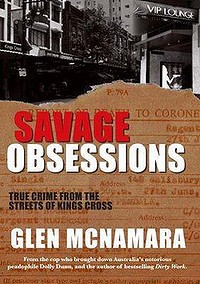
Glen McNamara – who was set up in the police force by corrupt officers he investigated, then was cleared, then pensioned off – is presented here as the archetypal honest cop who flew in the face of a corrupt system and was savaged by it. Even though he is writing about himself, it has a ring of authenticity. A former investigator with the National Crime Authority and with the NSW Police, where he was a detective stationed in Kings Cross and Sydney’s south, he gave evidence to the NSW Police Royal Commission about alleged police protection of paedophiles.

With Savage Obsessions: True Crime from the Streets of Kings Cross, McNamara has joined other former police, such as former assistant commissioner Clive Small, in writing about crime, capitalising on its popularity – as exemplified by the success of the Underbelly TV series – and drawing on the vast volume of inside information available to police.

His chapters are fairly short and each tells a different story. But the linking theme, about criminal obsession (”The criminal mind is self-obsessed and determined, and I realised that this trait knows no boundaries, professional or otherwise”) seems to work.

What amounts to a series of snapshots of police work does give some revealing insights, including into the corruption and brutality once prevalent in Kings Cross, seen from the inside.

Savage Obsessions by Glen McNamara. New Holland, $29.95.

Some insights are new, such as the horrific sexual abuse paedophile ”Dolly” Dunn committed while on the staff of Catholic schools – an aspect of Dunn’s life hinted at but never disclosed. It does raise the question of how he continued so long.

McNamara confirms what was suggested as a defence in the Schapelle Corby case, that there has been a corrupt ring of airport baggage handlers dealing in illicit drugs, and mentions the case of an unnamed couple who got right through the international barriers and then found drugs in their bag.

He goes in detail into the wretched tangle surrounding drug dealer Warren Lanfranchi and his supposed girlfriend Sally Ann Huckstepp. Also, he deals with the wretchedness of Rick Hazell, who was drawn into paedophile protection, gave evidence to the Police Royal Commission and died in circumstances a coroner found were an accident but which McNamara believes was murder.

Like any account by a former cop, the presentation is all black and white, with no attempt at interpretation on sociological lines. People are either law abiders or rotters.

There could be no compassion for sex offender Bruce Synold who, according to McNamara, boasted that he would crawl naked into people’s bedrooms, slither across the floor like a snake and touch the sleeping couple lightly ”to see if they would stir”. Or cat burglar John Harvey Rider, who sneaked into the bedrooms of sleeping children. There is no doubt that a ”homicidal maniac”, Mark Hampson, with his Rasputin-like beard and his penchant for swords, was a bad man. And so were rapist Bilal Skaf and adoptive parent-killer Heidi McGarvie.

But the selection of cases rather glosses over, by omission, the vast array of other stories that could be told about people who have committed offences. Qualifications can be written into some accounts of crime to explain how these dreadful things happened. And, from time to time, how people are wrongly convicted.

SAVAGE OBSESSIONS
Glen McNamara
New Holland, 147pp, $29.95

Read more: http://www.smh.com.au/entertainment/books/not-obscured-by-the-thin-blue-line-20120419-1x87f.html#ixzz3MXLsGCO8

[divider_dotted]


Gregory Joseph JENSEN

Gregory Joseph JENSEN

New South Wales Police Force

Redfern Police Academy – Class 203

( 1st Class at the new Goulburn Police Academy )

Regd. # 21470

Rank:  Commenced Training at Redfern Police Academy on Monday 7 May 1984

Probationary Constable – appointed 20 July 1984

Constable – appointed 20 July 1985

Constable 1st Class – appointed ?

Detective- appointed ? ? 1991

Senior Constable – appointed ? ? ?


Stations:  Regional Crime Squad, Nth West ( Parramatta ), ?


ServiceFrom:  7 May 1984   to  To? ? ?


Awards:  No Find on Australian Honours system


Born:  Thursday 25 July 1963

Died? ? ?

Cause:  Stomach Cancer – H.O.D.


Funeral date?

Funeral location?


Grave site location?


FURTHER INFORMATION IS NEEDED ABOUT THIS MEMBER


GREG IS Mentioned on the Police Memorial Wall, Sydney Police Centre, Surry Hills as of October 2022


25 October 2022

This afternoon, in a quiet and deeply-felt ceremony at the Sydney Police Centre, another thirteen names were added, and the memories of another thirteen dedicated NSW Police Force employees were honoured, at the NSW Police Force Service Memorial:
Detective Senior Constable Vaughan Anthony Hau
Detective Senior Constable Gregory Joseph Jensen
Senior Sergeant John Kelly
Senior Constable David John Koen (Ret’d)
Constable Joseph Lees
Senior Constable Matthew Joseph Rees
Senior Constable Caroline Roberts


http://www.smh.com.au/news/national/holding-judgement/2007/06/08/1181089328815.html?page=fullpage

June 9, 2007

It took up 451 hearing days, heard from 902 public witnesses and cost an estimated $64 million. Malcolm Brown reports on the Wood royal commission, 10 years on.


It began on June 15, 1995, when an unnamed Annandale detective jumped to his death from the seventh floor of a building, apparently through fear of the Wood royal commission. The detective’s suicide was followed by those of Ray Jenkins, a dog trainer (July 10), and Inspector Robert Tait, the acting patrol commander at Narrabri ( March 29, 1996 ). Nineteen days later a former Wollongong alderman, Brian Tobin, gassed himself.

On May 8 the same year, Peter Foretic gassed himself the day after giving evidence about paedophilia. On September 23, Detective Senior Constable Wayne Johnson shot himself and his estranged wife after being adversely named in the royal commission. On November 4, David Yeldham, a retired judge about to face the royal commission on questions of sexual impropriety, killed himself. A month later Danny Caines, a plumber and police confidant, committed suicide at Forster, on the North Coast.

Altogether, 12 people enmeshed in the Wood royal commission took their own lives. Scores of others were so profoundly affected by proceedings that their supporters and families believe it shortened their lives. A former detective, Greg Jensen, suffered a recurrence of the stomach cancer that ultimately ended his life, while another former detective, Ray McDougall, who faced the threat that commission investigators might expose his extramarital affair if he did not co-operate, succumbed to motor neurone disease.

There is no doubt that the Royal Commission into the NSW Police Service, headed by the Supreme Court judge James Wood, purged the force of a rollcall of rotters. A total of 284 police officers were adversely named, 46 briefs of evidence were sent to the Director of Public Prosecutions and by 2001 nine officers had pleaded guilty to corruption offences and three not guilty. Seven police officers received jail sentences, including the former Gosford drug squad chief Wayne Eade and a former chief of detectives, Graham “Chook” Fowler.

Several high-profile police ended their careers in disgrace, including Ray Donaldson, an assistant commissioner, whose contract was not renewed, and Bob Lysaught, the commissioner’s chief of staff, whose contract was torn up. Charges against 14 officers were dismissed because of irregularities in search warrants and their execution.

That left the question of what to do with police who were on the nose but who could not be brought to account by normal means. The solution was the creation of section 181B of the Police Service Act, under which the police commissioner could dismiss an officer on the basis of what had come out of the royal commission. Section 181D allowed the police commissioner to serve an officer with a notice indicating that he “does not have confidence in the police officer’s suitability to continue as a police officer”. The officer could show cause as to why he should be retained, and if dismissed could appeal to the Industrial Relations Tribunal.

In the wake of the two legislative changes, 380 officers were targeted for dismissal or internal investigation. By March 1998, 19 police officers had been dismissed under section 181B and three under 181D. Another had been dismissed under a separate provision of the act, 14 had resigned, four had been medically discharged and 15 had been given performance warning notices. Others were under consideration, and as the Police Integrity Commission – a legacy of the royal commission which became a permanent watchdog – has demonstrated, even officers who had been corrupt many years before were not necessarily in the clear.The former independent MP John Hatton, who was instrumental in setting up the royal commission, said he thought the Police Integrity Commission was the royal commission’s “greatest achievement”. The Child Protection Enforcement Agency, which launched a purge of sex offenders, is another positive legacy of the royal commission.But 10 years on, was the exercise worth it?To some there were considerable benefits. Some appalling malpractice – known as “process” or “noble cause” corruption – prompted Wood to wonder at one point about the quality of a lot of police evidence he had accepted over the years.Despite this, many officers still believe the royal commission was too puritanical. They claim the investigators, not able to grapple with the really big issues, jumped on anything they could: “They had to have runs on the board,” says Michael McGann, who as a policeman in 1984 participated in the so-called Kareela Cat Burglar case, in which police used mace on an uncooperative thief and sex offender. To some critics this treatment did no serious harm and only required a word of caution. But under the spotlight of the royal commission 12 years later, it ended the careers of high-flying police such as John Garvey, Brian Harding and Steve York. A decade later, Harding works in corporate security but insists that the real sting was that the investigators had fabricated evidence. When that finally came out, he says, the group received a confidential settlement, but it did little to redress the feelings of outrage.

Another former policeman, Dr Michael Kennedy, says the commission was a political response to the police commissioner, Tony Lauer, bringing about the downfall of the then police minister, Ted Pickering.

The attorney-general, ministry and judiciary took little responsibility for the state of the force, Kennedy says, while the responsibility of the police rank-and-file grew to “the size of a Pacific driftnet”. “I don’t think the royal commission contributed anything to the reform process except to provide a template for double standards,” he says.

Chook Fowler put $200 into his pocket from Louis Bayeh. Chook was a lazy, good-for-nothing drunk. But he was put into the same category as Ray Williams and HIH.”McGann says that against the string of petty corrupt activities uncovered, “you have to look at what the government did and did not do with gambling and vice, over the decades. There have been direct links to Parliament for 50 or 60 years. That is hypocrisy.”The critics’ view is that the royal commission has left a demoralised police force, tarnished and rudderless, with limited operational effectiveness and the problem of corruption unsolved. Seven police officers have taken their lives since 2001, including two this year.”It highlights the fact that the structure no longer takes in the needs of the NSW police force,” says Mike Gallacher, the Opposition police spokesman, and a former internal affairs police officer. Gallacher believes, as does the NSW Police Commissioner, Ken Moroney, that the tentacles of corruption no longer spread to embrace entire squads or larger units. But it does not prevent low-level incidents of corruption and there are continuing nests of corruption.In its most recent report, the Police Integrity Commission said it had undertaken 21 major investigations in 2005-06. These dealt with extortion, theft, unauthorised disclosure of confidential government information and perverting the course of justice, police brutality and the handling of $250,000 stolen from automatic teller machines. The then police integrity commissioner, Terry Griffin, said there had been 51 investigations in the 12 months, compared with 44 in 2004-05, and the 1141 written complaints represented a 15 per cent increase. Moroney says all these reports are disappointing, but one of the significant statistics was the number of police who were reporting on other police. “You go back a decade and the number of informants who were police was 5 to 10 per cent,” he says. “In the Ombudsman’s last report, that figure was 49 per cent.”The mechanism for dealing with internal complaints has been expedited: “I have not been afraid to use a section 181D notice,” Moroney says.He believes there is a different mentality in the force. A video of the royal commission had been shown at a recent reunion dinner of the old criminal investigation branch. “It is part of our history. But the interesting thing is that when Chookie came onto the screen, everyone booed. That was a signal to the Fowlers and the Eades that those found to have acted corruptly would not be accepted.”
However, Moroney accepts that corruption is not a thing of the past. “In the contemporary period, there are huge monies to be made from the illicit drug environment. You are talking in some cases of millions of dollars. It is the greatest menace in society today. And the greatest menace to officers is drug money. That is why rotation of officers out of specialist squads on a regular basis is important.”Taking over as commissioner five years ago, he had brought a low-key “Uncle Ken” influence, sorely needed, and had had to balance the principles of police accountability against the public demand for law and order, and the task has been awkward.A senior counsel told the Herald this week that the focus on integrity, scrutiny of professional standards and attacks by defence lawyers meant that talented police prepared to do the dirty work were deterred. “In the old days the best and the brightest went into plain-clothes,” he said. “But when the police perceive that when they have to go the extra yard [to get convictions], they are crucified – ‘Why should I go to plain-clothes when I can just get some uniform job with a 12-hour shift, and a second job?”‘Clive Small, a former assistant commissioner who set up crime agencies and established the child protection unit, says that after so many detectives were disgraced in the royal commission, the police force sought to take the spotlight off detectives and put more of the onus of responsibility for crime control onto local area commands. Crime agencies had a continual battle to keep up to strength. Regionalising responsibility for crime control reflected a lack of understanding. “A lot of crime spreads through the metropolitan area, across the state and across the nation,” he says.Kennedy, now a university lecturer, says the “business model” approach is incompatible with good police work. “We cannot expect police to behave like they are in the private sector, where competence is measured in terms of productivity,” he says.Kennedy attended the recent CIB reunion dinner and sat at a table with former drug squad detectives who remained friends of Wayne Eade. He takes issue with Moroney‘s claim that people at the dinner made catcalls when Fowler came on screen. “No one supported Chook,” he says. “But the animosity of the crowd was directed straight at Justice Wood and his commission.”Clive Small, who was also at the dinner, says: “I think it is really a matter of interpretation who they were booing. There were things the royal commission did not take care about. There was a lot of collateral damage. And the implementation [of its recommendations] has been pretty ordinary.”

CRUSADER WHO MADE THE CALL

JOHN HATTON well remembers the audience on May 11, 1994, when he made his speech calling for a royal commission into the NSW Police Service. MPs were listening, of course, but it was a gallery above him, packed with the “top brass of the police force – the commissioner himself, the deputy commissioner, superintendents – they were an intimidating force on the Parliament”.

“They thought they could stare down the Labor Party support for my motion,” Hatton, now retired, says. “It was probably the best indicator of the way in which the police force thought they could control the agenda.”

Hatton won the day, putting paid to a claim by then police commissioner, Tony Lauer, that “systemic corruption” was “a figment of the political imagination”. Hearings started on November 24, 1994, and Justice James Wood delivered his final report on August 26, 1997.

Ten years later, Hatton believes he was vindicated. He says Wood was “the right man” to head the commission and the recruitment of interstate police was crucial, along with the decision to use phone taps and surveillance.

The 11 volumes of material Hatton gave the royal commission had been accumulated over 14 years, he says, from the time he had first spoken up. He had received information on illegal gambling, drug trafficking and police involvement with the mafia.

There had been earlier moves to address police corruption, including inquiries by the Independent Commission Against Corruption, but these had only scratched the surface. “I can remember on one occasion I reported a death threat which had to do with the McKay murder in Griffith and 48 hours later the bloke who had given the information was threatened by a shotgun at his door in Queensland,” Hatton says.

The royal commission came into being because Hatton and other independent MPs held the balance of power in Parliament. The Labor Party may have had high public motives, but also saw a chance to attack the Fahey government. Labor stipulated that an inquiry into police protection of paedophiles, previously in the hands of the ICAC, become part of the royal commission.

The process of gathering information was helped greatly by Trevor Haken, a detective who became an informer and covert investigator as part of a deal to avoid being prosecuted himself.

Hatton says Haken‘s entry was “out of the blue”. Though useful, in the long term it had had a detrimental effect on the fight against corruption. Living in fear and watching his back, Haken had provided “the greatest disincentive for someone coming forward to finger corruption in the system”.

Malcolm Brown