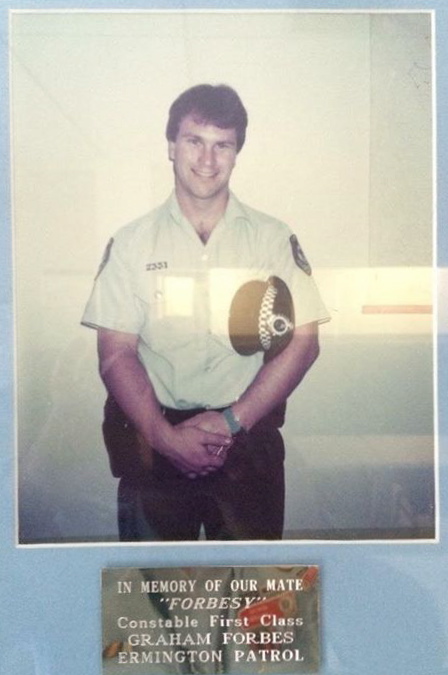
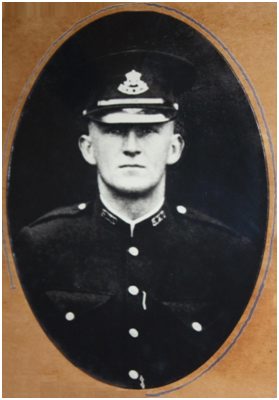
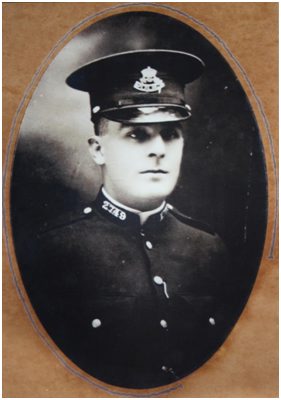
Constable 1st Class Graham FORBES – Ermington Patrol. Hanging in Granville Police Station.
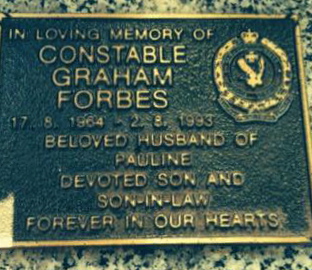
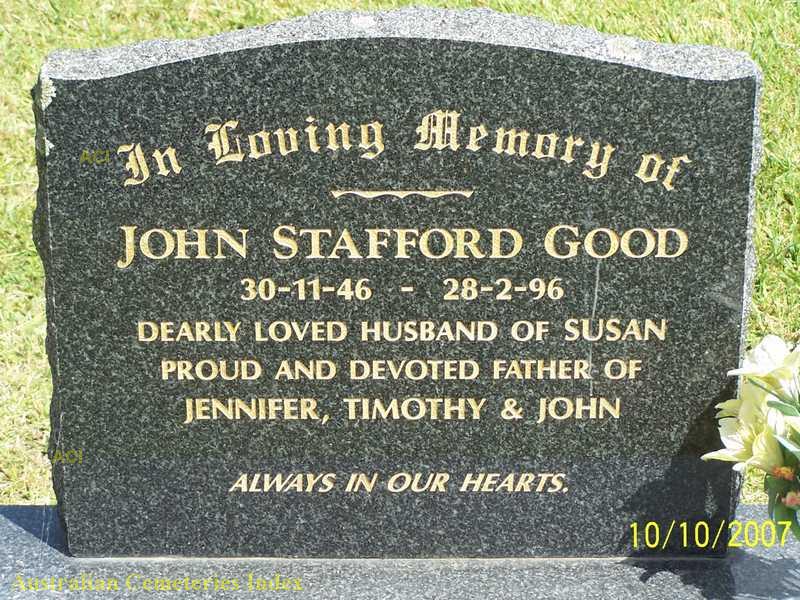
Constable 1st Class Graham FORBES – Grave plaque – Pinegrove Cemetery
[alert_blue]GRAHAM is NOT mentioned on the Police Wall of Remembrance[/alert_blue] * NOT JOB RELATED
[divider_dotted]
It is believed that Graham was standing at the boot of his vehicle whilst parked outside of an old school mates house, in Toongabbie, when he was struck from behind by another vehicle, resulting in the death of Graham.
Police Dog EDGE
| 13/04/2015
Police Dog EDGE
Queensland Police Force
Regd. # ?
Rank: Police Dog
Stations: ?
Service: From ? to ?
Awards: ?
Born: ?
Died on: Saturday 4 April 2015
Cause: ?
Age: ?
Funeral date: ?
Funeral location: ?
Buried at: ?
[alert_yellow]EDGE is NOT mentioned on the Police Wall of Remembrance[/alert_yellow] *NEED MORE INFO
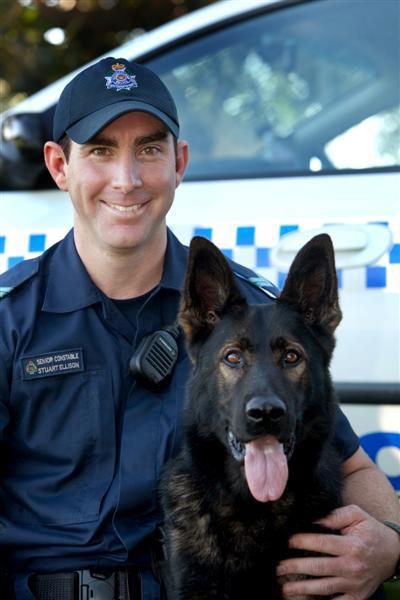
Senior Constable Stuart Ellison & Police Dog EDGE.
It is with sadness we announce the sudden passing of police dog and TV star PD Edge overnight. ( Saturday 4 April 2015 )
PD Edge, who starred in Channel Nine’s factual program Send in The Dogs in 2011, served as a general police dog with the Brisbane Dog Squad alongside Senior Constable Stuart Ellison.
His exceptional skills were demonstrated on many occasions throughout his five years of service with the QPS, often assisting tactical police, drug squad and SERT.
The seven-year-old German Sheppard was responsible for tracking a large number of offenders and became well-known amongst other officers for his ability and skill, especially on Brisbane’s Southside.
Overnight, while off-duty and enjoying rest over the Easter break, PD Edge was unwell and rushed to hospital where he underwent surgery but could not be saved.
Police dogs and their handlers form an incredible bond, working and living together.
Our thoughts are with Senior Constable Ellison and his family who are obviously devastated with the loss of PD Edge.
Rank: Probationary Constable – appointed 9 September 1988
Senior Constable – death
Stations: ?, State Transfers – Parramatta, Water Police during 2000 Olympics ( Jet ski ), Broken Bay Water Police – death
Service: From: attested 9 September 1988 to 1 June 2002 = 13+ years Service
Awards: ?
Born: 9 October 1966
Died on: 1 June 2002
Cause: Football injury
Age: ?
Funeral date: ?
Funeral location: ?
Buried at: Cremated.
Ashes were spread off Resolute Beach, Pittwater, Kurinai National Park
[alert_blue]ANDREW is NOT mentioned on the Police Wall of Remembrance[/alert_blue] *NOT WORK RELATED
Senior Constable Andrew Warner
[divider_dotted]
From the history of the Hornsby Rugby Club. – The club endured a particularly tragic event on June 1st 2002 when first grade playerAndrew Warner died as a result of injuries sustained during a home game against Oatley Rugby Club match at Waitara oval.
Andrew was a club stalwart who had played over 100 games for the club and was also a coach with the club.
Andrew is remembered at the annual Back to Hornsby day when the first grade teams play for the Andrew Warner Memorial trophy.
** FURTHER INFORMATION NEEDED **
[divider_dotted]
From David Buchanan: Wednesday 14 February 2018:
This is the funeral for Andy Warner in June 2002. (This is perhaps the only photo where you will witness the NSW Water Police marching.)
Andy was attached to Broken Bay Water Police at the time of his death. He tragically died as a result of an accident playing football at Waitara on the 1st June 2002. He was a well-liked member of the Broken Bay unit – and the entire Water Police, his football club and the local community.
His death made us realise how close Police are around this nation. I was working with Craig Goozee on that day, and Andy’s mates informed us of the accident and his subsequent death soon after it occurred. Apart from the obvious shock and grief that Craig and I had at the time, we set about making the necessary phonecalls and enquiries to one and all, but we learned that Andy’s parents were somewhere in northern Australia between Katherine and Broome on a caravanning holiday – and no phone contact. (I might add that many members of our Water Police unit just came into work to assist wherever they could.) Craig and I thought this was going to be a lengthy process in locating them. We found them after 3 phonecalls and advice from the local coppers – Katherine Police, the NT/WA border station, and Kununurra Police in WA. The Senior Constable at Kununurra located Andy’s parents them within 10 minutes after the call, but before delivering the message, he gathered the local clergy as support. Still hard to believe that we had located Andy’s parents within the hour.
What occurred after resulted in commendations being delivered via our commissioner. The local police in WA and NT pooled together and drove Andy’s parents in relay to Darwin, organised and placed them on a flight to Sydney. They also drove their car and caravan from Kununurra to Katherine and placed same in safe storage. Made us realise that Police are all a family no matter what uniform they wear.
Andy Warner’s ashes were spread off Resolute Beach in Pittwater, a remote and peaceful beach in the Kuringai National Park. RIP Andy.
This is perhaps the only photo where you will witness the NSW Water Police marching.
Service: From? ? ? to 15 September 1866 = ? years of Service
Awards: No find on It’s An Honour
Born: ? ? ?
Died on: Saturday 15 September 1866
Cause: affection of the throat stemming from exposure
Age: 27 years, 10 mths
Funeral date: Monday 17 September or Saturday 22 September 1866
Funeral location: Wagga Wagga
Buried at: Buried at Wagga Wagga Monumental Cemetery
Reg. # M-05744 Loc: Ang – R – 4 – 0001
[alert_yellow]JOHN is NOT mentioned on the Police Wall of Remembrance[/alert_yellow] *NEED MORE INFO
Grave location:
[divider_dotted]
The Sydney Morning Herald Wednesday 19 September 1866 page 1 of 8
Deaths:…..
On the 15th instant, at Wagga Wagga, JOHN MORROW, Esq., Sub-inspector in the New South Wales Police Force, and formerly a Lieutenant in the Royal Longford Rifles.
The Sydney Morning Herald Friday 21 September 1866 page 5 of 8
DEATH OF Sub INSPECTOR MORROW, – I have the painful duty of recording the death of Mr sub-inspector Morrow at Wagga Wagga, on Saturday last. I fear he may be regarded as another of the victims to the heavy and severe expenditure kept up when the bushranger Morgan was infesting the neighbourhood. A disease of the throat was, doubtless, accelerated and rendered more severe by the exposure thus occasioned, and after trying change of air, after consultation with eminent physicians in this colony and New Zealand, after all that attention and care could do, he sank under its fatal influence.
The Government has lost a conscientious officer, whose efficiency was impaired only by his inability, and the district will lose one to whom may be applied the highest eulogium – a Christian gentleman.
I am not aware of Mr Morrow’s exact age ; he could scarcely have reached what is generally called the prime of life, and was unmarried.
Wagga Wagga Express & Murrumbidgee District Advertiser ( NSW ) Saturday 22 September 1866 page 2 of 4
DIED ………..
At Waterview, Wagga Wagga, the residence of F.A. Tompson, on Saturday, the 15th instant, after a protracted and distressing illness, induced by exposure in the prosecution and discharge of his public duty, JOHN MORROW, Esq., Sub Inspector of Police for the district of Wagga Wagga, second son of Hugh Morrow, Esq., of Charlton Lodge, Auckland, New Zealand ( formerly of Coraboola House, County Longford, Ireland ) aged 27 years and 10 months.
He bore his long suffering with the most touching and enduring patience and gentleness and passed away in the fullness of faith and hope.
He died deeply loved and lamented by many, and esteemed by all who knew him.
Wagga Wagga Express & Murrumbidgee District Advertiser ( NSW ) Saturday 22 September 1866 page 2 of 4
Town Talk .- The sythe of the King of Terrors has been busy around us during the last few days, no less than three residents, if not of the town, at least of its immediate vicinity, having, in startling succession, been gathered from our midst. Sombre clothing has met the eye at every turn, blinds have been drawn, shutters have been closed, and long funerals have wound through the streets, creeping slowly on their way to the home of the dead. No wonder then that the town has been gloomy and sad. The death of Sub-Inspector Morrow could not be called sudden, and though the news came, as it ever does, at last with a shock, it was still only what people had long been prepared for, and could not occasion any feeling of surprise. But in the other two cases it was very different.
Even the families of those that are gone were quite unprepared for the calamities that have visited them, and to others the first tidings that have reached them have been, not of sickness, but of-death. And now in speaking on these topics, we cannot do better than call the attention of our townsmen to the disgraceful state of the cemetery. In the old country the village churchyard is a hallowed spot, invariably kept in the neatest and nicest order, but here we loosly pale in a plot of ground, with a rotten fence, and then leave it to be over run with weeds, or turned into a feeding ground for stray stock. We noticed one day last week a horse grazing there, and trampling at pleasure over the graves. But the presence of an occasional horse, though by no means a creditable circumstance to those whose duty it should be to preserve the ground from desecration, is but a trifling evil in comparison with the slovenly and illkept appearance of the ground in the whole, and the graves in particular. The fence is delapidated, and the whole place is choked with weeds and coarse grasses. No paths have been formed, and at every funeral the bearers and mourners are compelled to stumble and trample over the graves of those who have been buried before. In some eases these have been trodden down level with the surrounding soil, and in others their appearance is absolutely repulsive from the sinking of the earth as the coffins below have decayed. Several instances may be observed where the soil is cracking and falling in wards from this cause, and in many more it has so sunk down that the site of a grave is often marked by a regular hollow, in which, the water collects in pools after every storm. The cemetery in its present condition is a scandal and disgrace to the town, and immediate steps ought to be taken to place it in something approaching to a decent state. The expense of rooting out the weeds, grubbing up the bushes, placing the fence in good repair, and laying out a few paths, could not amount to very much, and funds would, we believe, be readily subscribed if the slightest effort was made to collect them.
Wagga Wagga Express & Murrumbidgee District Advertiser ( NSW ) Saturday 22 September 1866 page 2 of 4
DEATH OF SUB-INSPECTOR MORROW. IT is with deep regret we have to announce that, on Saturday last, this indefatigable officer of police breathed his last. Mr. Morrow‘s illness has been of long duration, and was, no doubt, in a great manner, induced by continued campings and exposure in the bush when in pursuit of the ruffian Morgan. Constant wettings and exposure at length brought on an affection of the throat, which so far deprived him of his voice that he was unable to carry on any conversation in higher tones than an ordinary whisper.
After leaving Wagga Wagga, he was for a time stationed at Deniliquin, but some seven or eight months ago he obtained leave of absence, and proceeded to New Zealand on a visit to his relatives, for the benefit of his health. He there received the best medical attendance the colony could afford, and his health so improved that he confidently looked forward to its complete restoration, and to the recovery of his voice, and he, therefore, in May last, returned to his official duties in Wagga Wagga.
The climate here, however, did not seem to suit his constitution, and his health again began to fail. He at first regularly attended to his police duties, but these were, after a time, occasionally interrupted by attacks of illness, which gradually increased in frequency and intensity, until at length he became altogether laid up.
For the last month he has been confined to the house, never seeing anyone but a few personal friends, and at length, on Saturday morning last, the spirit left him.
The deceased gentleman was twenty-seven years of age, and was the second son of Hugh Morrow, Esq., of Charlton Lodge, Auckland, New Zealand, and formerly of Coraboola House, County Longford, Ireland.
The funeral took place on Monday last. Every place of business was either wholly or partially closed, and the procession of those who were anxious to show their respect for the memory of the deceased gentleman, by following his remains to their silent home, was one of the largest ever witnessed in Wagga Wagga.
Empire ( Sydney ) Monday 24 September 1866 page 5 of 8
Our readers will be sorry to hear that Police Inspector Morrow died last-Saturday, at Wagga Wagga, from some affection of the throat. The deceased gentleman was formerly stationed at Albury, where his many good qualities won for him the esteem of a large circle of friends. Inspector Morrow was one of the pluckiest and most efficient officers of the force, and in his indefatigable exertions to capture bushrangers, he met with many hair-breadth escapes.
In fact his death may be attributed to his zeal in the performance of duty; for whilst scouring the country in search of Morgan, Inspector Morrow contracted the disorder which has ever since made him an invalid, and has ultimately caused his death. Camping out in the winter time without covering, for many successive nights, and undergoing all sorts of other privations in the bush, has ruined many an iron constitution; and a man must be something more than human to be able to stand it with impunity.
And so Inspector Morrow has passed away from us, and indirectly we can scarcely help regarding him as one of Morgan’s victims. – Border Post.
The Sydney Morning Herald Wednesday 26 September 1866 page 5 of 8
initial story is the same as those above but ends:……..
-To the foregoing, we append the sympathetic tribute of a warm personal friend of the deceased. The writer says :-” Mr. Morrow died deeply loved and lamented by many, and esteemed by all who knew him.
He was out with young Mr. McLerie. They both contracted disease from exposure in the wet season of 1861. Poor McLerie was at once carried off by acute inflammation of the lungs, but Mr. Morrow‘s affliction assumed the character of follicular laryngitis, by which he lost his voice and suffered otherwise from its effects on the bronchial tubes.
The poor fellow expended nearly all his means in surgical expenses, but the disease was never checked, and after two years of great suffering he rendered up his life, having been literally starved to death by inability to swallow food.
He bore his long suffering with the most touching and enduring patience, and gentleness, and passed away in the fulness of faith and hope.”
Funeral location: Port Stephens Uniting Church, Salamander Bay, NSW
Buried at: ?
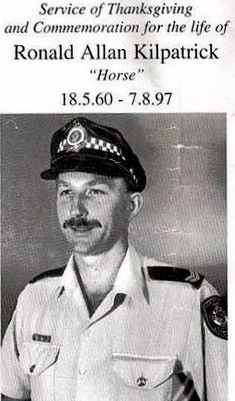
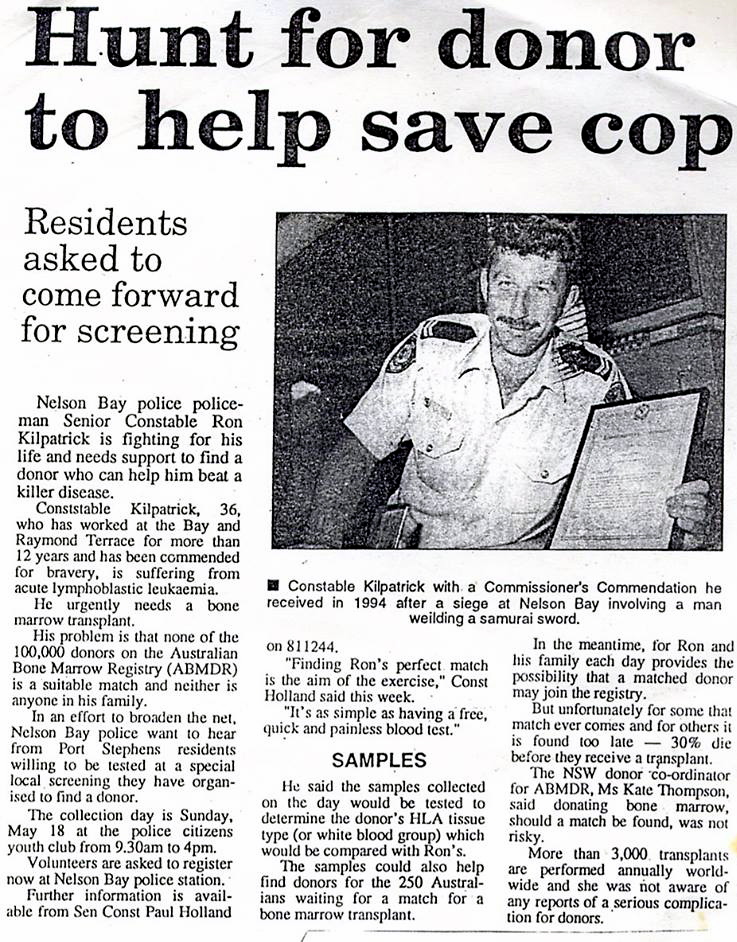
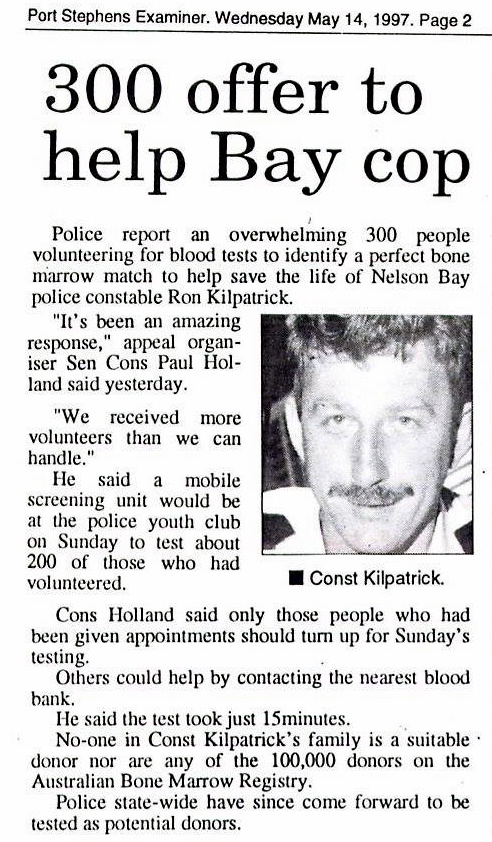
Ronald Allan KILPATRICK
[alert_blue] RONALD is NOT mentioned on the Police Wall of Remembrance[/alert_blue] * NOT JOB RELATED
[divider_dotted]
Ronald Allan Kilpatrick – Blood appeal
Ronald Allan Kilpatrick – Blood appeal
[divider_dotted]
John NORTON
| 13/04/2015
John NORTON
New South Wales Police Force
Regd. # ?
Rank: Constable
Stations: Lock Up Keeper, Hay, NSW
Service: From ? to 5 December 1860
Awards: ?
Born: ? 1825
Died on: 5 December 1860
Cause: Drowned
Age: 35
Funeral date: ?
Funeral location: ?
Buried at: Hay
[alert_blue] JOHN is NOT mentioned on the Police Wall of Remembrance[/alert_blue] * NOT JOB RELATED
[divider_dotted]
The Lockup-keeper at Lang’s Crossing-Place, Norton, about ten days ago whilst not in very sober state, left his quarters at night with a candle in his hand and has not been heard of since. It is imagined he may have walked into the Murrumbidgee. (Sydney Morning Herald, 25 December 1860)
The body of Police Constable Norton was found in the river after the Albury had passed up, the disturbance caused by the paddlewheels probably caused the body to be freed from submerged snags. (SMH, 8 January 1861)
The Argus ( Melbourne ) Wednesday 26 December 1860 page 7 of 8
SUICIDE AT HAY. – On Wednesday, the 12th inst., the body of John Norton was found floating on the Murrumbidgee, opposite the crossing yards at Hay. It was very much decomposed, so much so as almost to preclude identification, yet many swore to it as his body. A watch and ring were discovered on the person, and recognised as Norton’s.
A magisterial inquiry was held by the police magistrate, when the facts detailed in my communication of the 11th inst. were elicited. The conclusion arrived at was, ” that the deceased, while in a state of temporary insanity, produced by excessive indulgence in ardent spirits, committed suicide by drowning himself.”
Norton was of a very respectable family in Ireland, and had not been in the colony more than three years. – Southern Courier, Dec. 21.
Rank: Probationary Constable – appointed 9 December 1968
Senior Constable – appointed 9 December 1977
Sergeant – deceased
Stations: Central Fingerprint Bureau, Police Armoury ( in the old Hat Factory 1973 ), Cumnock, Robertson ( 1980 ), Narooma, Dapto, Warilla, Albion Park
Service: From ?pre 9 December 1968 to 28 February 1996 = 27+ years
Constable David John Donnelly 24/3/71 – 13/1/15
Registered Number 48748 – attached to Lachlan Local Area Command
It is with deep regret that we advise that Constable Dave Donnelly lost his battle with cancer and passed away in Condobolin yesterday evening. Our thoughts go out to Stephanie, Jake, Amelia and Jemima, and his extended family.
[divider_dotted]
Location of Church Service:
[divider_dotted]
David was also a member of this websites Policing Forum, the Thin Blue Line and was known as Dave2877 and “The Duck” .
He joined our Forum on the 13 June 2011 as a Civilian. On 26 July 2011 he was upgraded to the Wannabe Blue Group and on 31 August 2012 upgraded to Blue Group – being stationed at Parkes.
On the 5 June 2014 he changed his Username from Dave2877 to The Duck.
May David forever Rest In Peace
[divider_dotted]
Ernest ANDREWS
| 13/04/2015
Ernest ANDREWS
New South Wales Police Force
Rank: Constable
Regd. # 31??
Stations: George Street North Police Station
Served: From 24 April 1929 to 3 January 1931 = 1+ years Service
Awards: No find on It’s An Honour
Born: ? ? 1908
Died: 3 January 1931
Age: 23
Cause: Shot – Murdered at Bondi Junction
Funeral date: 5 January 1931
Funeral location: Rookwood Cemetery
Buried: Buried in Rookwood Cemetery ( side by side with Norman Thomas ALLEN )
Zone: C Section: 09 Grave 4211
DOUBLE POLICE MURDER
Memorial location:
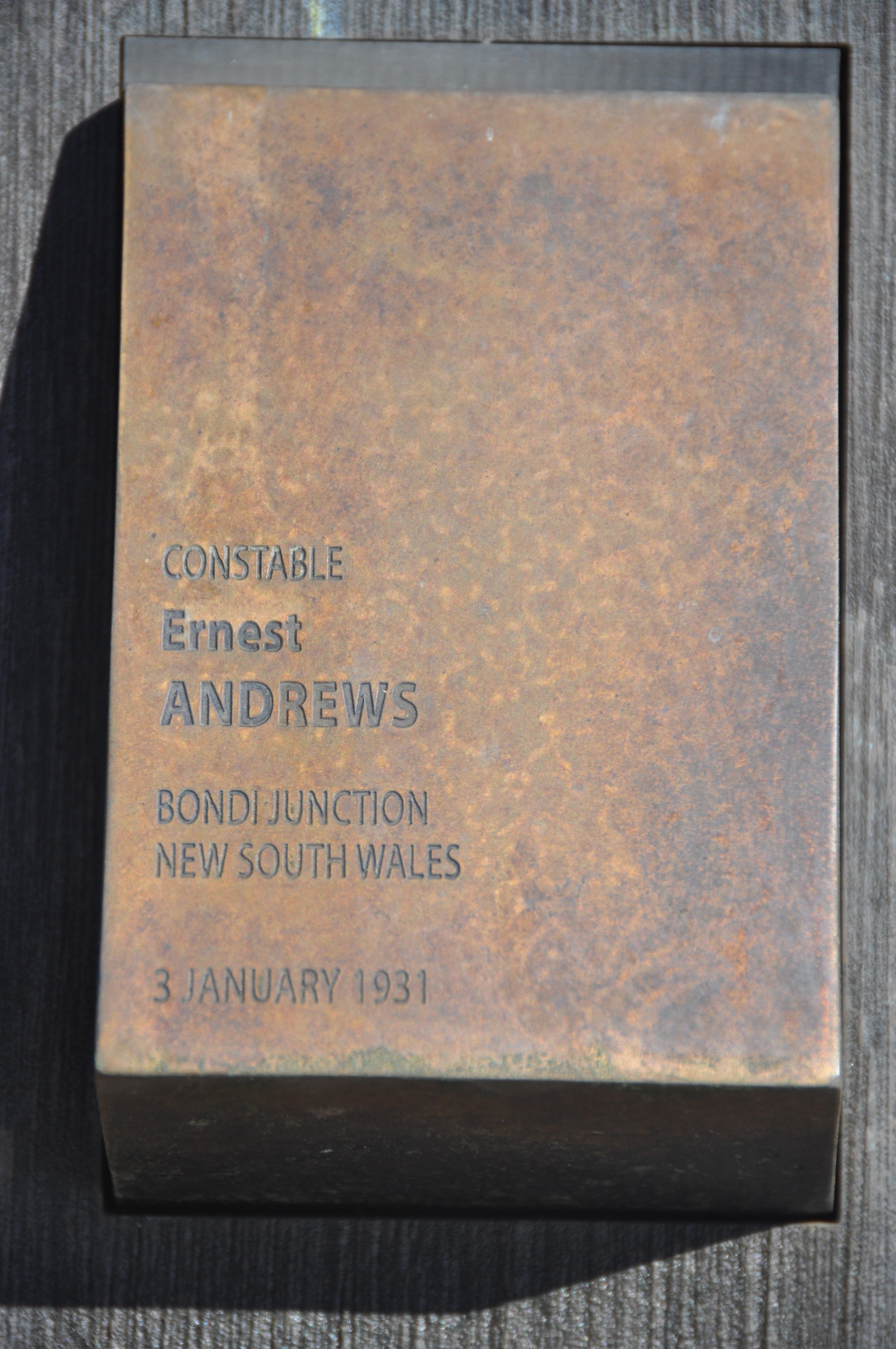
Ernest ANDREWS touch plate at the National Police Wall of Remembrance, Canberra
Ernest IS mentioned on the Police Wall of Remembrance
Constable Norman Thomas Allen ( 1931 )
Constable Ernest Andrews ( 1931 )
Constable Allen was shot in the street at Bondi Junction while attempting to detain an armed, deranged man named Kennedy who had earlier had an altercation with a local shopkeeper. The constable had been directing traffic and when informed of the dispute he found and confronted the offender. As he approached Kennedy from behind, the man spun around and shot Constable Allenin the chest at point blank range. He then shot the constable twice more in the heart. At this time Constable Andrews – unarmed, off duty and heading for the beach – passed by in a tram and saw a crowd gathered around the body of Constable Allen. Alighting from the tram he joined in the pursuit of Kennedy who managed to reach his home in nearby Lawson Street.
On arriving and finding the front door locked Constable Andrews went to the rear of the dwelling and burst through the back door. Unfortunately Kennedy was waiting with rifle raised and as Andrews lunged at him he shot him twice in the chest. He then took a knife and stabbed the constable in the throat. Sergeant Seery and Constable Johnson from Waverley Police then arrived and began to smash their way in through the front door. Although fired at by Kennedy, Constable Johnson returned fire, hitting Kennedy in the chest. Seery and Johnson then smashed their way in and found the offender in a bedroom bleeding to death. He died that night.
In the aftermath of the murders, the Brisbane Courier dated 5 January, 1931 published a complete account of the entire incident, and concluded with the following.
COMMISSIONER PRAISES MURDERED POLICE.
Both murdered constables were highly efficient and popular officers. Allen leaves a widow and young child. He lived in New Street, Bondi. Constable Andrews was single, his only relative in Australia being a sister, Mrs Clark. The men will be buried tomorrow with full police honours. The Commissioner of Police Mr. Childs, in an appreciation, said “I wish to pay a tribute to the manner in which both these young men carried out their duty according to the best traditions of the service. They saw their duty before them, and did not hesitate a moment in the execution of it. Although I would not make any distinction between them I cannot help referring to the action of Constable Andrews, who, though unarmed, rushed in to effect the arrest of a man who had already shot Constable Allen. “
Constable Norman Thomas ALLEN was born in 1901, joined the New South Wales Police Force on 14 May, 1926 and shortly thereafter resigned. He rejoined on 26 September, 1928. At the time of his death he was stationed at Waverley.
Constable Ernest ANDREWS was born in 1908 and joined the New South Wales Police Force on 24 April, 1929. At the time of his death he was stationed at George Street North Police Station.
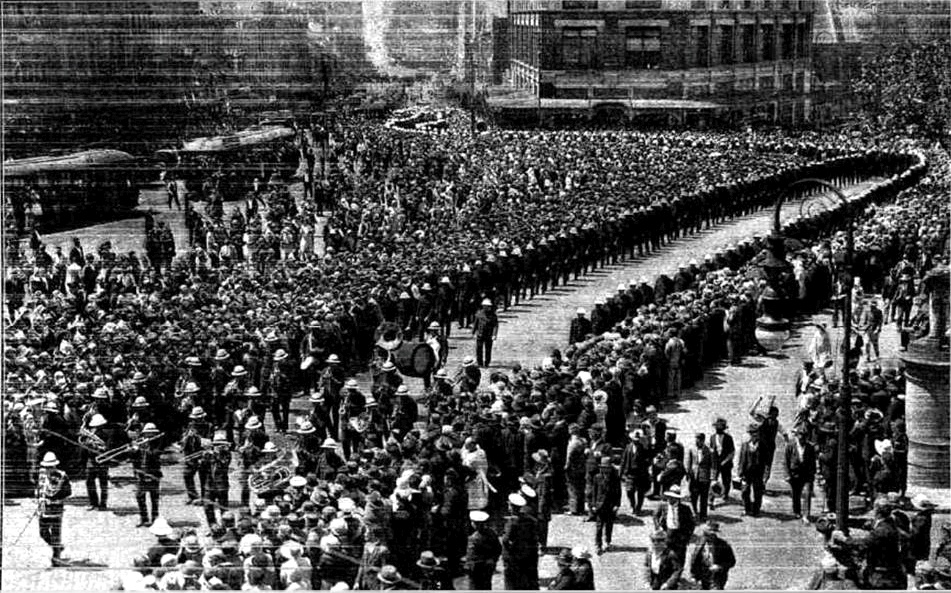
Funeral procession through Railway Square in 5 January 1931 for two police constables, Allen and Andrews, killed in the line of duty. Source: Sydney Mail newspaper 7 January 1931
The Sydney Morning Herald
Tuesday 6 January 1931 page 10 of 14
DEAD POLICEMEN.
Impressive Scenes at Funeral.
THOUSANDS PAY TRIBUTE.
The State paid homage yesterday to the two policemen, Constable Norman Thomas Allen and Constable Ernest Andrews who met their death at the hands of a madman at Bondi Junction on Saturday. There were mourners from almost every part of New South Wales.
Many thousands lined the route as the funeral cortege moved from Wood Coffill’s funeral parlours George-street to the mortuary station; the mortuary platform was thronged when the funeral train moved off to Rookwood and thousands had assembled in the cemetery.
The scene in the vicinity of Wood Coffill’s funeral parlours is likely to be remembered by the thousands of people who thronged the streets leading into Railway-square. Early in the morning bearers of wreaths and floral tributes passed through the doors to deposit their tokens of sympathy. At the approach of noon people began to assemble on the footpath and many entered the chapel to view the coffins. The near relatives arrived at 1 o’clock and the chapel was cleared while Constable Allen’s widow and her mother approached the silver mounted caskets which rested on trestles side by side. An affecting scene followed. Then the simple Church of England burial service was conducted by the Rev Frederick Riley and the coffins were borne to the waiting hearses.
MUFFLED DRUMS
The scene was unforgettable. A solid mass of people crowded the thoroughfares. Presently the mounted troopers urged their restive horses forward and with the deep roll of muffled drums the cortege moved off. Thousands of hats were removed.
Handel’s Dead March in “Saul” was played by the Police Band. Behind the band came a contingent of foot police under the direction of Superintendent Leary. Two hundred men drawn from the various stations, marched behind. Then came the hearses, the wreath-laden carriages, and the chief mourners, Firemen, the sun glinting on brightly-polished helmets, were represented by over 40 uniformed officers and men. At the end of the slow-moving procession came numbers of retired men, friends of the dead officers, and business people from the eastern suburbs.
Along the route to the mortuary thousands stood bareheaded as the cortege passed. At the mortuary gates another huge crowd paid tribute to the dead men.
Among those who marched in addition to the police and firemen, were employees of motor bus companies in the eastern suburbs.
“THEY SAW THEIR DUTY.”
A most affecting scene at the graveside in the Church of England section of the Rookwood Cemetery was the playing by the police band of the hymns “Lead Kindly Light” and “Abide With Me.” The remains were buried side by side.
“Let men’s opinions be what they may,” said the Rev. Frederick Riley in an address at the graveside, ” we should be doing violence to the most sacred emotions of human life if we were to allow our brethren to depart without a word of farewell. We are met here today to pay honour to the memory of two men who were comrades of yours men whom we all respected and loved. Let us remember that these two men died in the carrying out of their duty. They served their King and country as men and soldiers who fall for their King on the battlefield. They saw their duty and the fear of death could not deter them. They have not created a new tradition for the traditions of the police force of New South Wales are amongst the highest in the world already, but these two men have added a new lustre to the traditions of your past. These two young men Norman Thomas Allen and Ernest Andrews, died in the execution of their duty. There is no higher glory to which a man can aspire. We pray to God that those who have been so suddenly bereaved may share the comfort which we know these two brave men are experiencing in the nearer presence of God.”
MAGISTRATE’S TRIBUTE
At the Burwood Police Court yesterday Mr. G. R. Williams, S.M. commented on the bravery of the two constables. They acted nobly and upheld the traditions of the force,” he said.
PALL BEARERS AND MOURNERS.
The pall bearers were.- For late Constable Allen: Constables Tomkins, Martin, Moore, Hudson, Steele and White. For late Constable Andrews: Constables Booth, Kimber, Fraser, O’Neill, Morgan, and Wright.
The principal mourners were Relatives of the late Constable Allen: Mrs Allen (widow), Mrs Prankish (mother-in-law), Mr and Mrs N. Frankish (brother In law and sister in law), Mr and Mrs Sutcliffe (uncle and aunt) Mrs Lamb, Mrs Hourigan, and Mrs Cummings (aunts) and Mr Rowland Allen (cousin).
Relatives of the late Constable Andrews: Mr and Mrs Edward Clarke (sister and brother in law).
The Government was represented by Mr Gosling (Chief Secretary) and Mr McKell (Minister for local Government). Police representatives in addition to the non commissioned officers and men who marched were Mr W H Childs (Commissioner) Superintendents Leary, Mackay and Linegar, Inspectors Winter, Weir, Bennetts, McCauley, Woodrow, Lynch, Duffell, Roberts, McMaster, O’Brien, Chaseling, Anderson, White, Long, Roser, Scott, Michaelis, Robson, Allen, Farley and Fowler.
Retired members of the police force who attended were ex-Commissioner James Mitchell, ex-Superintendents Roche, Cook, McIntosh, Sinclair, Thom, Drew and Park, ex Inspectors Fullerton, W J Jones (also representing the Navy and Army Veterans Association) Fraser, Tracey, Bolton, Smith, Fewster, Doran, Mankletow, Stutchbury, Briggs, Ewen, Dunn, O’Dea and Robertson, ex-Sergeants McDonald, T. Dobson, Payne, A. Smith, Taylor, J. Salmon, J. Loomes, R. C. Harper, Bath and Butcher, ex-Constables Swan and Dixon.
The Board of Fire Commissioners of New South Wales was represented by Mr T J Smith, M.L.C. (president) Mr J McNamara (Commissioner), and Mr H M Webb (secretary and executive officer).
Mr Nance chief officer New South Wales Fire Brigades was present and 38 men marched under Mr Grimmond (deputy chief officer). Inspector Neeve, District Officer McLachlan, and Station Officers Arthur, Neville, Parkes, McCarthy, Rust, Currier and Sclater.
Others who attended were:- Judge Sheridan, Mir George Cann, ex M.L.A., Mr J Herlihy ( Under-Secretary for Lands) representatives of the Prisons Department including Mr Seery (superintendent of the Long Bay Penitentiary) Mr T.W. Irish (Assistant Under Secretary for Lands) Mr H. B. Mathews, (Surveyor General Department of Lands).
Mr N. W. Bond (representing the head office Bank, of New South Wales) representatives of ambulance divisions, Mr. and Mrs. C. R. Law, Mr. A. L. Parker (representing Superintendent O. H. Parker, of Goulburn) Mr Foster Doolan (vice president Police Association), Mr B Fortescue (secretary Police Association), Mr C T Thackeray (Police Association staff), Mr F M Jackson (representing Mr F C Hackett of Merriwa), Mr W T Missingham,
M.L.A., Mr A J Pollack, M.L.A., Mr W P Monaghan (Waverley Cemetery bus service), Mr W M Niland Mrs A Shuttleworth, Mr H L Harnett (representing Mr F M Burke, Speaker of the Legislative Assembly), Mr W E Clapin (representing Sir John Peden, President of the Legislative Council), Alderman David Hunter (Mayor of Waverley), Mr T J Thompson (Deputy Town Clerk of Waverley), Mr and Mrs A Williams, Miss Williams, Miss Beryl Williams, Miss Brady, Mr and Mrs McMorland, ex Warder Charles Stone, ex Warder Little and a number of eastern suburbs business people.
The wreaths Included those from the mother and other relatives of the late Constable Allen, relatives of the late Constable Andrews, the New South Wales Police Commissioned Officers Association, comrades of No 2 Division, Redfern Police, New South Wales Police Association, members of the Railway Detective Office, officers, detectives, and staff of the C.I.B., No 3 Police, comrades of No. 10 Division, cyclists and drivers of police headquarters, officers and men of Circular Quay Fire Station, comrades at No. 4 Station, police at No 7 Station, “police pals at Bondi Junction.” end eastern suburbs bus drivers and conductors.
The constable was killed by a single gunshot wound to the head in his bedroom at the police barracks at Central Police Station, Sydney. He was a single man who was to be married two weeks from the date he died. An inquest into the death returned a finding of suicide. The Evening News of 3 November, 1926 reported briefly on the tragedy.
CONSTABLE SHOT – TRAGEDY AT CENTRAL AFTER ILL-HEALTH
CONSTABLE ALBERT BAKER, 27, was found shot dead at the Central Police Station today. A service revolver was lying alongside him. The constable was a native of Cargo, near Orange, and had been in the force for about 18 months. He had recently been in ill-health, and for that reason had been granted leave. Baker, who was a single man, lived at the police barracks at the Central [sic]. The Central District Ambulance took the body to the morgue.”
The constable was born about 1899 and joined the New South Wales Police Force in 1925. At the time of his death he was stationed at Newtown.
[divider_dotted]
BARRACKS TRAGEDY.
Constable Shot Dead. Sydney, Nov. 3
The West Australian ( Perth ) Thursday 4 November 1926 page 11 of 20
Constable Albert Baker (27) was shot dead in his bedroom at the Central Police Barracks to-day. He was found lying on the floor with a bullet wound in the forehead, and with a service revolver lying smoking beside his right hand. Shortly before 10 o’clock, police at the barracks were startled by the sound of a revolver shot in one of the dormitories. Another constable was sleeping in the same room at the time, and was awakened suddenly by the report, which occurred a few feet from his bed.
Sergeant Hardiman, the barracks sergeant, called the Central District Ambulance, which conveyed Baker to the Sydney Hospital, where he was examined by Dr. Wallace, and found to be dead. The body was taken to the morgue.
This morning Baker breakfasted as usual and appeared to be in good spirits.