1

Arthur John VIZZARD

Arthur John VIZZARD

New South Wales Police Force

Regd. #   Q 6588  

( Q  = NSWPF – those who worked between 1862 – 23 Feb 1915 )

Great Great Grandfather to Andrew NEW, NSWPF # 22417, Anthony NEW and one other Serving NSWPF members.

Rank: Constable – appointed 12 July 1893 ( aged 22 )

Senior Constable – appointed 1 June 1910

Senior Constable – Death

Stations: Sydney, Richmond River, thence to Armidale, Tenterfield ( Cst 1/c ), Inverell, and on the 26th November, 1909, he was again transferred to Armidale ( Cst 1/c – SenCon ) as lookup-keeper & police prosecutor

ServiceFrom 12 July 1893  to 7 November 1911 = 18+ years Service

Awards:  No find on It’s An Honour

Born:  Monday  9 October 1871 in Corowa, NSW

Died on:  Tuesday  7 November 1911

Cause:  Illness – Suicide – service firearm

Event location:  Armidale Police Station, Cell yard

Age:  40

Funeral date:  Wednesday  8 November, 1911

Funeral location:  Roman Catholic Cemetery, Armidale

Buried at:  Roman Catholic Cemetery, Lynches Rd, Soudon Hts, Armidale, NSW

GPS:  -30.5286111  /  151.65972222222223
Arthur John VIZZARD

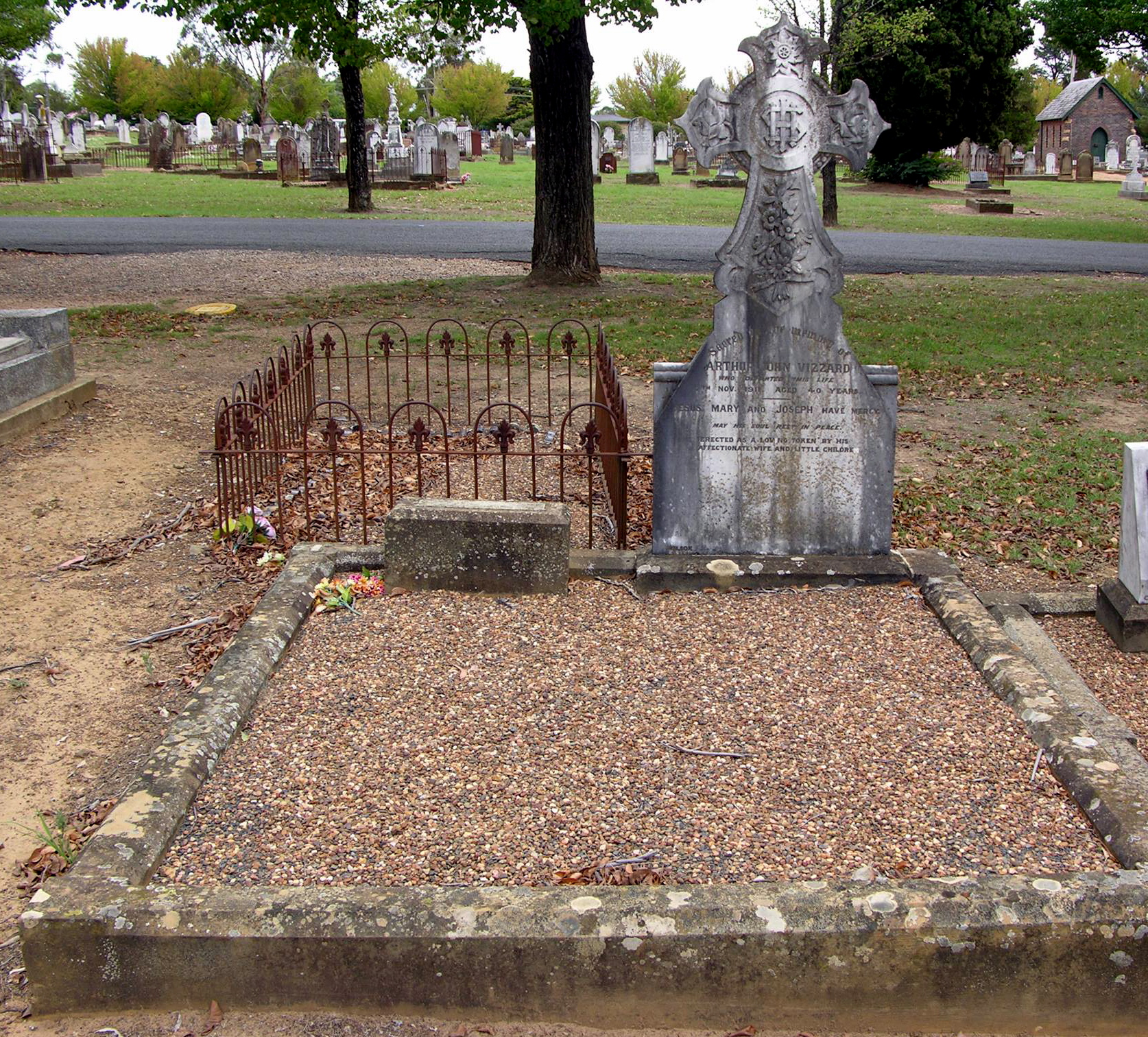
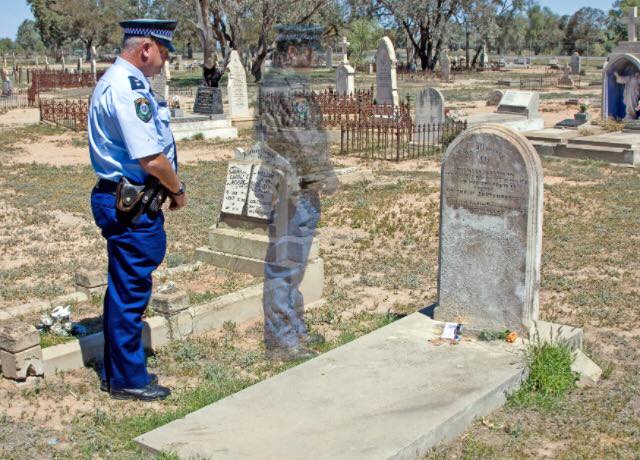
Arthur John VIZZARD Grave

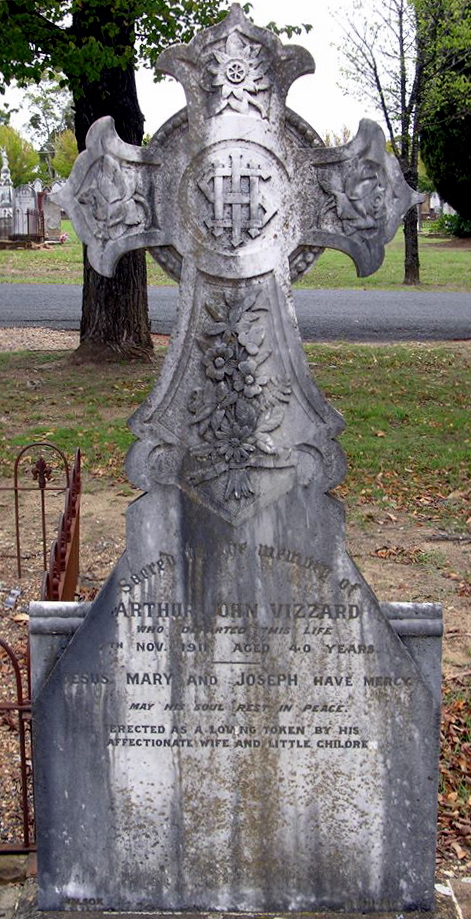
Arthur John VIZZARD Grave. Inscription Sacred to the memory of ARTHUR JOHN VIZZARD WHO DEPARTED THIS LIFE 7TH NOV. 1911. AGED 40 YEARS JESUS, MARY AND JOSEPH HAVE MERCY MAY HIS SOUL REST IN PEACE. ERECTED AS A LOVING TOKEN BY HIS AFFECTIONATE WIFE AND LITTLE CHILDREN
Arthur John VIZZARD Grave:   Inscription:    Sacred to the memory of ARTHUR JOHN VIZZARD WHO DEPARTED THIS LIFE 7TH NOV. 1911.   AGED 40 YEARS    JESUS, MARY AND JOSEPH HAVE MERCY   MAY HIS SOUL REST IN PEACE.    ERECTED AS A LOVING TOKEN BY HIS AFFECTIONATE WIFE AND LITTLE CHILDREN.


 ARTHUR is NOT mentioned on the Police Wall of Remembrance  * BUT SHOULD BE

As of November 2020 – VIZZARD is still NOT recognised as having died as a result of Work Related Injuries.


GRAVE LOCATION


Shortly after 10.30am on 7 November, 1911 the constable was at the Armidale Police Station, where he was the Lockup Keeper.

He walked into the yard of the station where it appears he inflicted a fatal wound to his head with his service revolver.

He died three hours later.

He had been on sick report for about two months, suffering from rheumatism, insomnia and depression.


The Clarence and Richmond Examiner of 14 November, 1911 reported that:

A mild sensation was caused in Armidale when it was known that Senior Constable Vizzard, who was in charge of the lockup, had been found in the lockup yard with a bullet wound in the head.

The unfortunate officer had been suffering greatly lately from muscular rheumatism and insomnia and had been on sick leave for the past few weeks.

During the last few days he appeared very despondent, but nobody suspected he would commit such a rash act.

He was removed into the house in a dying condition.

Senior Constable Vizzard, who came to Armidale from Inverell, was only recently promoted.

He has a wife and three young children. “


The senior constable was born at Corowa in 1871 and joined the New South Wales Police Force on 11 July, 1893. At the time of his death he was stationed at Armidale.


The issue regarding ill health for Senior Constable Arthur Vizzard dates back from approximately 5 years earlier as a result from contracting Dengue Fever when he was required to travel to Queensland and back to execute an interstate warrant and convey back a prisoner. Both he and the prisoner contracted Dengue.

He had ongoing health issues in the following years because of it and as we all know from the inquest findings he finally took his life whilst on “sick leave‘.

I have been aware of full story for about 18 years now. There are three descendants currently working in the NSW Police Force and there was an article in the Police Weekly about the family last decade.

I appreciate what you have said regarding eligibility for inclusion, which I was made aware of prior to the commemoration of the 10th anniversary of the National Police Memorial being opened.

This year will be 2 years since I got the e-mail. Still nothing progressed. Tell me this? Why was I personally notified almost 18 months ago that the inclusion was going to happen, then everything goes silent? It is disappointing to say the least.

I know the effect it had on my Grandmother the stigma growing up, her Mother never coped afterwards and the family ended up having to be split up. It is what it is. 106yrs latter the status quo remains. All we can do is wait and watch this space.


Darling Downs Gazette (Qld. : 1881 – 1922),

Friday 5 May 1905, page 3

DENGUE FEVER AT INVERELL

IMPORTED BY A CONSTABLE INVERELL, Wednesday.

Queensland dengue fever has been introduced into Inverell under conditions which were not to be avoided.

A week or so ago Constable Vizzard was despatched to Charleville to escort a prisoner back to Inverell, and while in the sister State, he contracted dengue.

He returned with his charge on Friday last, and on Saturday took ill.

On Sunday the case was diagnosed as dengue fever, and the patient was at once isolated in a ward at the local hospital.

Another case has since been reported, the victim being Ben. Bridge, the prisoner who was escorted back by Constable Vizzard. Bridge has also been sent to the hospital.

Both victims have the malady in an acute form.

News of the disease being in Inverell has caused some alarm among residents.

05 May 1905 – DENGUE FEVER AT INVERELL – Trove


NSW State Records

Service # 6588   Reel 3043  Item 8/3253

http://srwww.records.nsw.gov.au/indexes/searchhits.aspx?table=Registers%20of%20Police&id=31&frm=1&query=Surname:vizzard;Firstname:arthur


The Armidale Chronicle ( NSW )

Wednesday  8 November 1911   page 4 of 8

Death of Sen-Constable Vizzard.

TRAGIC ENDING.

A mild sensation was caused in Armidale yesterday morning, when the shocking intelligence was made known that Senior-Constable Vizzard had been found in the yard of the lockup in a serious condition.

As was well known, Constable Vizzard had been in indifferent health for the past couple of months. He was a sufferer from muscular rheumatism, which brought on that dreaded complaint insomnia, but not even his nearest relatives anticipated that his career would be terminated in such a tragic manner.

At about 10.30 yesterday morning he appeared to be much the same, and walked through the kitchen of his residence, where his wife and nurse were, out into the lockup yard. The women were shortly afterwards startled by hearing the sounds of a revolver shot, and, proceeding to the spot from whence the sound came, the nurse was horrified to see her charge lying on the ground with a gaping wound in the temple, and a revolver lying close beside the body.

Assistance was promptly summoned, and Dr. Mummery was also quickly on hand, when the unfortunate constable was conveyed into the house.

From the outset, the doctor held out no hope of recovery, his prediction proving all too true, as the end came a few minutes after two o’clock.

The late Constable Vizzard was a zealous, capable, and conscientious officer, in fact, as Senior-Sergeant Hogan remarked to the writer when speaking of his late lieutenant, he was over conscientious.

The deceased was born, at Corowa in October, 1871, and was thus 40 years of age at the time of his sudden death.

As a young man of 22 he joined the New South Wales Police Force, and after going through his term of probation at the barracks, was sent to do duty on the Richmond River, thence to Armidale, Tenterfield, Inverell, and finally on the 26th November, 1909, he was again transferred to Armidale as lookup-keeper.

He was ever active and energetic, and his zeal was not long in being rewarded, for he rose from a constable to a first-class constable, and then to senior-constable.

Although he always did his duty – and a policeman’s work is ofttimes unpleasant – he ” tempered justice with mercy,” thereby gaining for himself universal respect and admiration from all sections of the community.

As prosecutor in the police court, the late officer displayed undoubted ability and knowledge of the law, and was worthy of any attorney’s ” steel. ” Here, again, could be seen his generous disposition for he was always strictly fair and honourable in any cases he was in charge of.

He is survived by a sorrowing wife and three young children, to whom much sympathy has been extended in their hour of affliction.

http://trove.nla.gov.au/ndp/del/article/188117660


The North Western Advocate & the Emu Bay Times ( Tas. )   Wed.  8 Nov. 1911   page 3 of 4

NEW SOUTH WALES.       

POLICE CONSTABLE’S DEATH.     

SUICIDE SUSPECTED.

SYDNEY. Tuesday, — Senior Constable Drizzard was found in the lockup yard at Armidale to-day in a dying condition with a bullet wound in his head.   He suffered from insomnia and is supposed to have committed suicide.

http://trove.nla.gov.au/ndp/del/article/64352863


Daily Telegraph ( Launceston, Tas. )

Wed.  8 Nov. 1911     page 4 of 8

ATTEMPTED SUICIDE         

CONSTABLE SHOOTS HIMSELF.        

( ” DAILY TELEGRAPH ” SPECIAL copyright. )

SYDNEY, Tuesday. — Senior Constable Drizzard shot himself, while in the lock-up yard at Armidale. The unfortunate officer had been suffering from insomnia, and is in a dying condition .

http://trove.nla.gov.au/ndp/del/article/152347646


The Armidale Chronicle ( NSW )

Saturday  11 November 1911   page 2 of 10

Death of Sen.-Constable Vizzard.

The Inquest.

An inquest concerning the death of Senior-Constable Vizzard, which occurred under tragic circumstances in the yard of the Armidale lockup on Tuesday morning last, was held by the Deputy-Coroner ( Mr. C. A. Jackes ) in the Courthouse on Wednesday. The following evidence was elicited:

Frederick Wm. Vizzard, brother of the deceased, said the deceased was born on 9th October, 1871, at Corowa. He was a married man, with three children. Witness had not seen his brother, previous to that day, for nine months.

Senior-Sergeant Hogan deposed to knowing the deceased for the past eight or nine years. At about 11 o’clock on Tuesday morning he received a call to go to the lockup, which place deceased was the keeper of. With Constable Eagleton, witness went to the charge-room, and there saw deceased lying on a stretcher.  The mark of a bullet wound was noticeable on his left temple, and blood was oozing from the place. He was unconscious, but breathing strongly.

Witness next went to the cell yard-room, and there saw a large quantity of blood on the floor. The deceased’s hat was lying near the door, with his pipe. Close by   was a police revolver, containing four loaded cartridges and one recently exploded shell. Witness afterwards went to a drawer in the charge room, which was always kept locked. The lock of the drawer had been forced open, evidently by a tomahawk as such implement was lying in the drawer in the place where deceased’s revolver had been put when not in use. Deceased had been off duty for two months, through illness. He complained of muscular rheumatism and attacks of insomnia. When first going on sick leave, he went to Dr. Nash’s private hospital, but returned, and for the remainder of the time was with his wife and family in their own home. Deceased gave no reason for the police to anticipate that he would take his own life. In conversation with witness on Sunday morning, deceased said, ” I would give everything I possess to be able to resume duty on Monday.

Witness told him not to resume until the doctor had given permission to do so. Deceased was an efficient officer, trustworthy, and very painstaking.

To the Superintendent : During his nine months in Armidale, witness was practically all the time in deceased’s confidence. Deceased had never at any time expressed dissatisfaction with his position or work in the police force.

Dr. N. Howard Mummery said that shortly after 11 o’clock on the fatal morning he, in answer to a summons, proceeded to the lockup. He found the deceased lying on a stretcher, and being attended to by a nurse. He appeared unconscious. There was a wound on the right temple, the skin around which was stained   with gun-powder. There was another and larger wound on the left temple. It was obvious he could not live long. The wound in the head had been caused by a bullet, which had passed through deceased’s head, struck the brick wall of the yard, and rebounded into the middle of the yard, where witness picked it up.

Dr. J. A. J. Murray stated that on his arrival at the scene of the tragedy, deceased was being cared for by Dr. Mummery. Deceased had been ailing since last August. While still on duty, he complained of insomnia, indigestion, and occasional fits of depression. In September he also had an attack of asthma, which was followed by influenza, the after effects of which he never appeared to shake off. He seemed to be in an anxious and dispirited condition.   Witness urged him to get a holiday immediately, because no treatment seemed to do him much good. Deceased took the holiday in Sydney, and, on his return, about three weeks ago, witness was again called in. Deceased was then in a worse condition than when he went away. Witness visited him at intervals up to Monday. Deceased had such a serious nervous breakdown that it was necessary for him to undergo a complete rest cure, and witness had made arrangements for him to enter a suitable hospital for the purpose. Deceased had told witness that some times he felt as if he didn’t care to live, but, from the way he said it, witness did not think he contemplated taking his own life – it was said more to express to witness how really depressed he was. The idea of taking his life would come on him suddenly, owing to the condition he was in.

Nurse Ethel Sheerman, residing in Victoria-street, Sydney, said she came to nurse the deceased, and arrived on Monday. She had been sent by Dr. Nash. At about 10.30 on the morning in question, deceased said he was going down the yard to cut some kindling wood. He then seemed in a normal condition. About five minutes afterwards, witness, who was in the kitchen with deceased’s wife, beard the report of a firearm. Witness and Mrs. Vizzard immediately rushed to the spot. Deceased was reclining on the spot. Deceased was reclining on his left side. There was a great quantity of blood flowing from the wound in the head. She picked a revolver up, which was lying near the body, and threw it on the step. Deceased never regained consciousness, and died about two o’clock. Witness had not the faintest suspicion that deceased contemplated such a rash act.

John Purkiss said that between 10.30 and 11 a.m. on Tuesday morning he heard a woman scream, and immediately ran across. He met Mrs. Vizzard, who said, ” My husband has shot himself in the charge-room. ” and then fainted. Telling another woman to attend to Mrs. Vizzard, witness went into the charge-room and then followed the nurse into the cell-yard, where deceased was lying. With the assistance of the nurse, witness carried the deceased into the charge-room.

The Coroner returned a verdict that the deceased, Arthur John Vizzard, met his death from a bullet wound self-inflicted, whilst- temporarily insane.

http://trove.nla.gov.au/ndp/del/article/188117719


The Armidale Chronicle ( NSW )

Wednesday  8 November 1911   page 4 of 8

The remains of the late Senior Constable Vizzard,. whose tragic death was reported in our last issue, were interred in the Roman Catholic Cemetery on Wednesday afternoon. The funeral was largely attended by members of the M.U.I.O.F. and local police force marching in the cortege. The Rev. Dean Tobin officiated at the graveside, M. Hirschberg having charge of the arrangements.

http://trove.nla.gov.au/ndp/del/article/188117733


The Armidale Chronicle ( NSW )

Saturday  18 November 1911   page 7 of 10

In the Supreme Court of

New South Wales.

PROBATE JURISDICTION.

In the Estate of ARTHUR JOHN VIZZARD, late of Armidale, in the State of New South Wales, Senior Constable of Police, deceased in testate, –

APPLICATION will be made after Fourteen Days from the publication hereof, that Administration of the Estate of the abovenamed deceased may be granted to MARY VIZZARD, the Widow of the said deceased. Creditors are requested to send their Accounts to, and all Notices may be served at, the Office of the undersigned.

H. WEAVES,

Proctor,

Faulkner street, Armidale.

By his Agents MESSRS. Weaver & Allworth,

Australasia Chambers, Martin   Place, Sydney… . . i87

http://trove.nla.gov.au/ndp/del/article/188117888


George Robert ARMYTAGE & Michael COSTIGAN

George Robert ARMYTAGE

New South Wales Police Force

Constable

&

Michael COSTIGAN

New South Wales Police Force

Constable

Shot – Murdered

Bourke

11 September, 1877

Double Police Murder

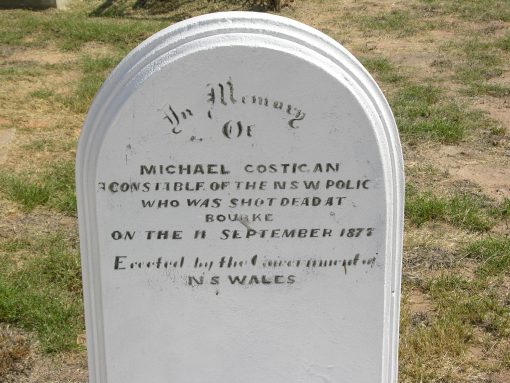
Grave of Michael COSTIGAN

On Tuesday 11 September, 1877 Samuel Getting, a barman at the Royal Hotel in Bourke, was speaking with Constable Michael Costigan in the bar of the hotel. The constable had just paid Getting for his room and board, and after having a drink and chatting with the barman for a short time, he left the bar.

Getting, for some unknown reason, also left the bar about that time and went to his room in the hotel, where he took possession of his rifle. He then left his room and walked to the front of the hotel, where he saw Constable Costigan and Constable George Armytage standing on the verandah, having a conversation. He immediately shot both constables from behind before running into the street and attempting to reload his rifle.

Sub Inspector James Keegan, who was nearby, noticed people running toward the river, and when he asked what was happening he was told that Sam, the barman, had shot two of the police and was running away with a loaded gun in his possession.

He then saw Getting running along the bank of the river with a gun in his hand, being chased by several people. The inspector then went towards these people and told them to move away from Getting so he could speak with him. He then followed Getting for a short distance along the river until he stopped and waited for the inspector to approach. The inspector then spent some time talking with the offender and trying to get him to surrender, all the while edging closer as he spoke.

At a later inquest, the inspector described what happened next.

 “I rushed at him, being at this time between 10 and 15 paces from him. The ground was very muddy, and there was a gully between us. I got my hands upon him being beneath the gun, and we both stumbled and nearly fell. He again got a few paces from me, turned round, took deliberate aim, and shot at me. He called to me to keep back. I knew I was shot, but it did not weaken me, and I still went forward.

He then raised the gun, holding it by the barrel, and struck me on the head. I put up my arm to ward off the blow, and it bruised my arm very much and cut my head. He struck me several times, and I at length secured the gun. He then ran parallel with the river for a few yards, and as I followed him he suddenly plunged into the river, and kept his head beneath the water until he was drowned. He went but a short distance into the river.

That is his body I have recently seen lying in an outhouse. He had plenty of opportunity of shooting me at first had he so desired, but he did not attempt to do so until I sought to arrest him. When he shot at me, one shot struck me near the eye, two shots went into my coat, two entered my chest, and two others grazed it

The Deceased…was a man of very good character and very good behaviour, and I can ascribe no motive for his acts. He said he had no intention of doing what he did, and that he had loaded the gun to go out for some duck shooting.”


Constable Costigan was born in 1853 and joined the New South Wales Police Force on 11 September, 1873. At the time of his death he was stationed at Bourke.

Constable Armytage was born in 1855 and joined the New South Wales Police Force on 4 May, 1877. At the time of his death he was stationed at Bourke.

Grave Location/s:

1396911675_73051 (4)

ARMITAGE: 30 06′ 03S / 145 56′ 12E
Old C of E, Bourke

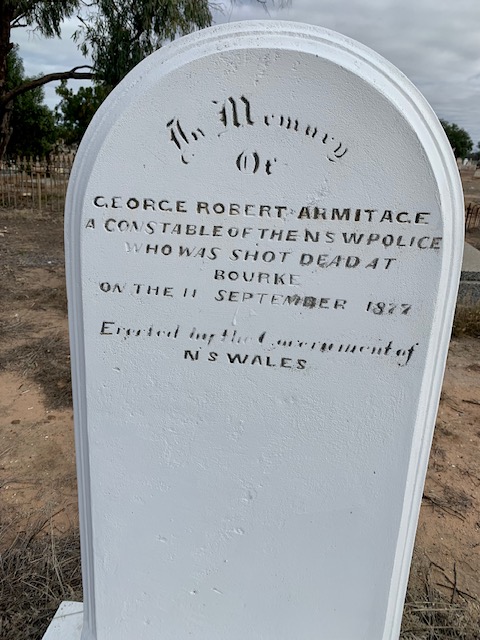
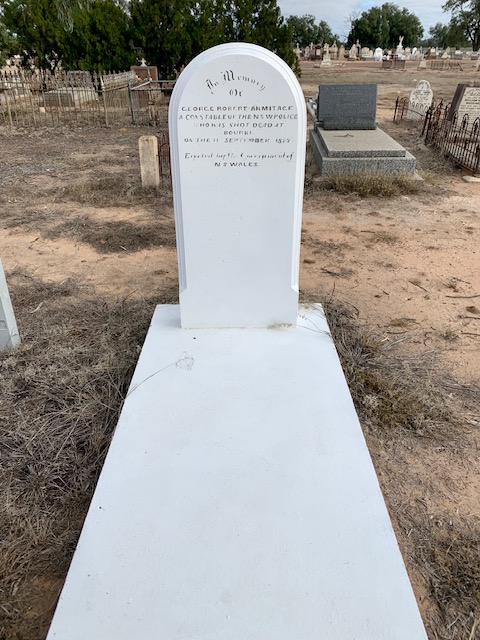
George Robert ARMITAGE, George ARMITAGE - Grave
As seen in June 2022.
Photo: Alan BLAKE # 19779

George Robert ARMITAGE, George ARMITAGE - Grave
As seen in June 2022.
Photo: Alan BLAKE # 19779

1396911699_73053 (4)

COSTIGAN: 30 06′ 05S / 145 56′ 14E
Old Catholic, Bourke


Michael COSTIGAN - Grave as seen in 2007
as seen in April 2007
Photo: Ken Owen

Michael COSTIGAN - Grave as seen in April 2014
as seen in April 2014
Photo: Ken Owen

Michael COSTIGAN - Grave as seen in April 2014
as seen in April 2014
Photo: Ken Owen


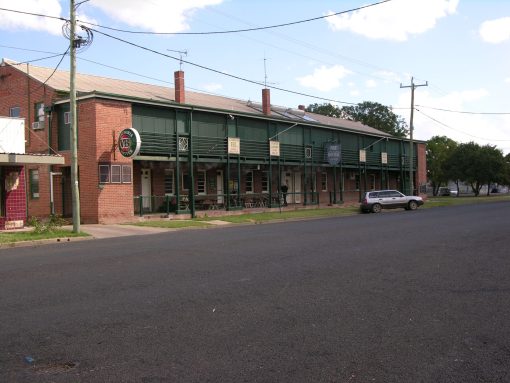
Location of Old Royal Hotel
32 Mitchell St, Bourke, 2840
GPS: -30.088854, 145.936134

2014: Port of Bourke Hotel which was formerly the Old Royal Hotel where these murder took place.


John Vance BLAIN

John Vance BLAIN

New South Wales Police Force

Regd. #  2481

Rank:  1st Class Constable ( Foot Policeman – not mounted )

Description: 5′ 11.5″ tall, blue eyes, fair hair, fair complexion.  Single.  Previously a farmer.  He was Protestant.

Stations:  Darlinghurst

ServiceFrom  26 December 1874  to  20 June 1877 = 2+ years Service

Awards:  a valuable gold watch and chain for the gallant capture of a convicted burglar, named Wright

Born? ? 1850 in Ireland

Event date:  Thursday  22 March 1877

Died on:  Monday  11 June 1877 @ Wooloomooloo

Cause:  Assault with a Police Baton & other assaults

Age:  26

Funeral date:  Tuesday  12 June 1877 @ 2.15pm

Funeral location:  Graveside

Buried at:  Rookwood Cemetery

Memorial location:

A record of his brave conduct for arresting and bringing to justice a notorious burglar at whose hands he received such savage injuries as to ultimately cause his death

[alert_red]JOHN is NOT mentioned on the Police Wall of Remembrance[/alert_red]    * BUT SHOULD BE

Just after 4pm on Thursday 22 March, 1877 Constable Blain was on duty in Bourke Street, Wooloomooloo when he saw two men carrying a “bundle” in Forbes Street. He called on them to stop, however they ignored him and ran off, quickly pursued by the constable. One of the men then stopped and threw himself at Constable Blain, whose baton unfortunately had dropped to the ground during the chase. As he grappled with one offender, another took up the dropped baton and struck the constable several severe blows to the head, inflicting terrible wounds. Blain bravely held his ground however, and succeeded in handcuffing one of his assailants before staggering a short distance to the home of Dr Pattison. The doctor assisted the stricken Blain and also quickly sent a message to the police for assistance.


Constable Williamson (  possibly Williams )  soon attended and spoke to Constable Blain, who told him that he had arrested and handcuffed one of his attackers before walking to the doctor’s home. Williamson then attended the site of the incident where he indeed found one of the offenders (John Wright) lying handcuffed and bleeding in the street. The courageous Blain had in fact arrested one of his own murderers (a rare accomplishment), as his injuries were to prove fatal.

Prior to his death the Mercury newspaper of Friday 23 March, 1877 reported the story of Constable Blain’s encounter with the offender John Wright and his unknown accomplice.


The article indicated that “The constable who was so barbarously assailed is suffering greatly from the wounds he received. His extraordinary courage and resolution in securing the man in the manner he did is worthy of lasting record.” And thus it is.

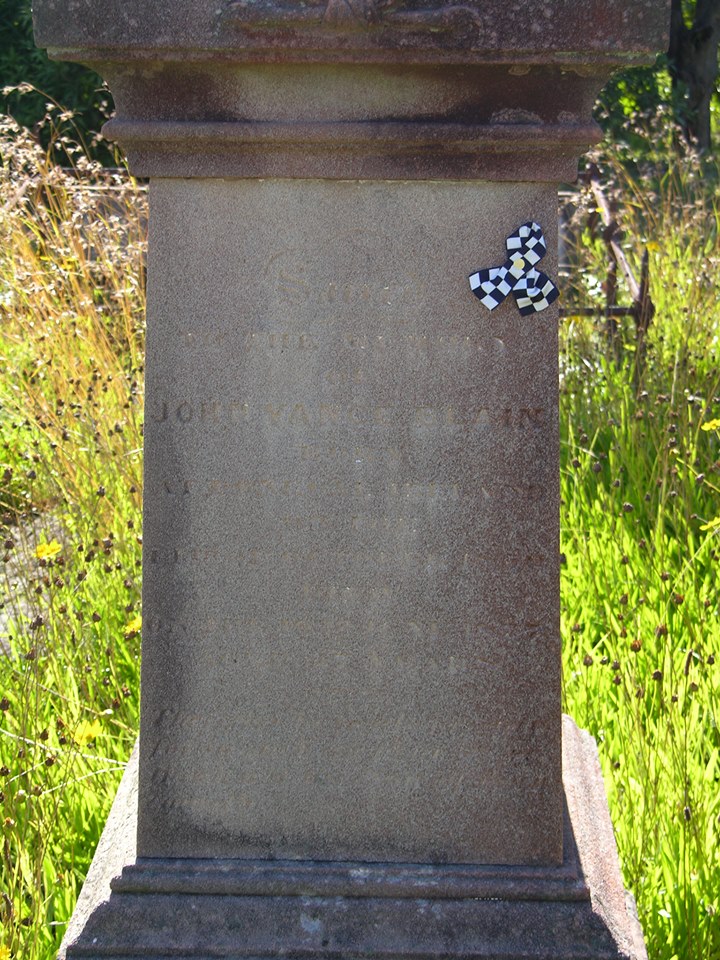
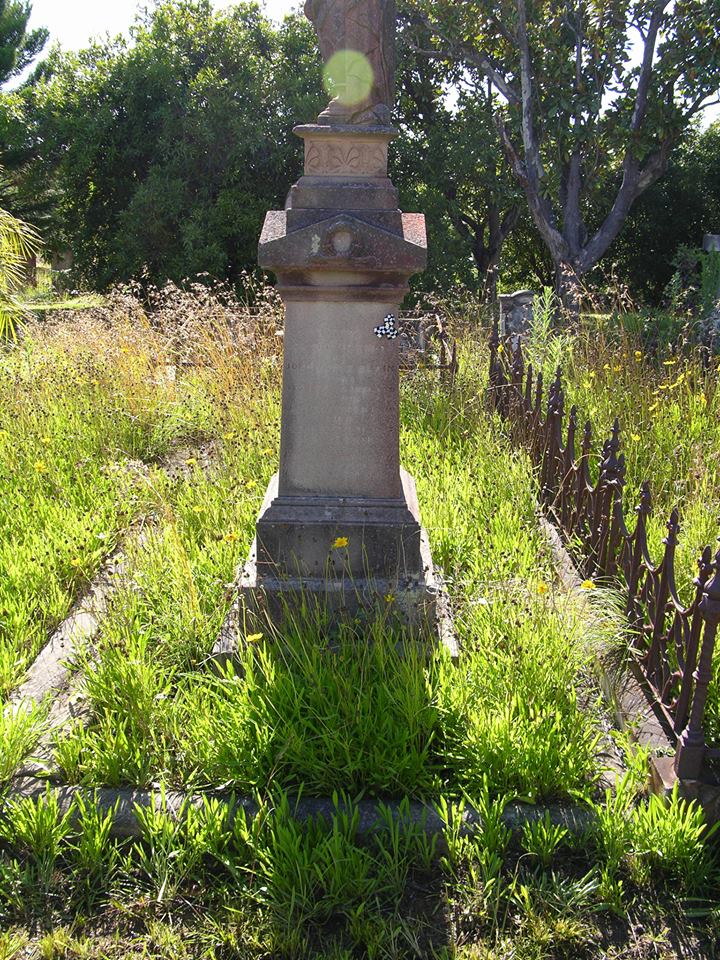
His headstone at Sydney’s Rookwood Cemetery reads: “A record of his brave conduct for arresting and bringing to justice a notorious burglar at whose hands he received such savage injuries as to ultimately cause his death”.


The constable was born in 1850, and at the time of his death he was stationed at Darlinghurst.

[divider_dotted]


The Sydney Morning Herald        Friday 16 March 1877

SERIOUS ENCOUNTER WITH A BURGLAR.
Some time on Thursday night the premises of Mr J C W Hinsch of 160 Pitt Street, were broken into, and a number of Crimean shirts and other goods valued at about £20, were stolen. Shortly after 4 o’clock yesterday morning, Constable Blain who was on duty in Bourke Street, Woolloomooloo, saw two men carrying a bundle in Forbes Street. He called upon them to stop but as they took no notice he gave chase, and gained upon them. One of the men threw himself down in front of the constable who fell upon him. In running after the men the constable’s truncheon dropped out of his pocket, and the second man took it up and struck the constable several heavy blows inflicting very severe wounds on the back of the head. The constable, though stunned by the blow, bravely grappled with the man, and after a most desperate struggle succeeded in over-powering and handcuffing his assailant. Becoming weak from loss of blood he had just sufficient strength to reach the residence of Dr. Pattison, when he fainted from exhaustion. Dr Pattison sent information to the police that a constable was at his house who had been nearly murdered in the street. Constable Williams, who soon arrived in obedience to the summons, found Blain lying on a sofa bleeding from wounds on his head, and scarcely able to speak. Eventually he learned from him that a man whom he had captured was handcuffed in the street, and on proceeding to the spot indicated, he found the man lying and bleeding from the head. He was conveyed first to the Infirmary, and afterwards to the Darlinghurst Police Station.

Later in the day Detectives Wilmott and Camphin found one blanket and 31 Crimean shirts in a sack on a piece of waste ground near Judge Street, Woolloomooloo… The constable who was so barbarously assailed is suffering greatly from the wounds he received. His extraordinary courage and resolution in securing the man in the manner he did is worthy of lasting record.”


Then on Saturday 16 June, 1877 the Australian Town and Country Journal reported the death of Constable Blain, including the following information.

“It will be remembered that, a short time ago, the Inspector-General of Police, on behalf of various citizens, presented constable Blain with a valuable gold watch and chain for the gallant capture of a convicted burglar, named Wright, who brutally assaulted that officer when being arrested for the burglary at the premises of Mr. J. O. W. Hinsch, in March last. Wright was sentenced to six years hard labour.

Blain, who was assaulted on the head with a policeman’s baton, recovered somewhat from the effects of the affray; but three weeks ago was again brutally assaulted by some roughs in Oxford-street.

About a fortnight ago he went into the Infirmary for medical treatment, and typhus fever setting in, he expired early on Monday morning. It is alleged that his death was caused by the effects of the beatings he received. It is said that a foul drain under the bedroom which Blain had occupied, in Stanley-street, was the cause of his taking ill. Blain had been about three years in the Force. He was unmarried. His grade was first class constable; and he was a young man of superior intelligence and some promise, and a most efficient officer.”

The constable was born in 1850, and joined the New South Wales Police Force on 26 December, 1874. At the time of his death he was stationed at Darlinghurst. His headstone at Sydney’s Rookwood Cemetery reads: “A record of his brave conduct for arresting and bringing to justice a notorious burglar at whose hands he received such savage injuries as to ultimately cause his death”. He is not listed in the official New South Wales Police Honour Roll.


[divider_dotted]

The Sydney Morning Herald         Tuesday   12 June 1877   page 1 of 10

DEATHS:

BLAIN. — June 10, at the Sydney Infirmary, John Vance Blain, aged 26.

http://trove.nla.gov.au/ndp/del/article/13387308#pstart1437955

[divider_dotted]


The Sydney Morning Herald         Tuesday   12 June 1877   page 10 of 10

THE FRIENDS of the deceased Mr. JOHN VANCE BLAIN, late of the Sydney Police, are respectfully invited to attend his Funeral ; to move from the Infirmary THIS DAY, Tuesday, at a quarter-past 2 o’clock, to the Necropolis.

JAMES CURTIS.

http://trove.nla.gov.au/ndp/del/article/13387287

[divider_dotted]


The Sydney Morning Herald         Wednesday  13 June 1877      page 8 of 12

MONUMENT over the Remains of the late Constable JOHN VANCE BLAIN – SUBSCRIPTIONS received in aid of the above at the Central Police Station.

J. WALTER SMART.

http://trove.nla.gov.au/ndp/del/article/13390255

[divider_dotted]


The Evening News ( Sydney )     Wednesday  13 June 1877   p 2

Constable Blain’s Funeral,

Yesterday afternoon, the remains of that efficient and lamented young police officer, constable Blain, were interred at Haslem Creek Cemetery. The funeral was attended by the Inspector General of Police ( Mr. Fosberry ), Inspector Read, Sub-Inspectors Waters, Anderson, and Johnson, and a large number of his fellow officers. The procession, as it moved through the city, attracted general attention, and considerable regret was expressed at the untimely end of a promising a young officer. The members of the force, as may be seen from an advertisement, intend erecting a monument over his grave.

http://trove.nla.gov.au/newspaper/article/108196448

[divider_dotted]


The Evening News ( Sydney )     Saturday  4 August 1877     p 4

Monument to Constable Blain.

It is satisfactory to learn that there has been a prompt and generous response to the proposal for a monument over the remains of that distinguished but unfortunate police officer, Constable Blain. It will be remembered that Blain had a desperate encounter with a burglar who had broken into Mr. Hinch’s establishment in Pitt-street, and that he received such severe injuries as accelerated, if they were not mainly

the cause of his death shortly afterwards in the Infirmary. The Inspector-General and his officers and the whole force accorded his remains every honor by following them to the grave ; but they thought something more ought to be done, A suitable monument over the grave was proposed, and the matter having been taken in hand by Mr. Smart, J.P., the necessary funds were subscribed in the course of a few days. We have been shown the design of the monument together with the inscriptions, and it deserves to be said that the selection has been dictated by good taste and judgment.


http://trove.nla.gov.au/newspaper/article/108200225

[divider_dotted]


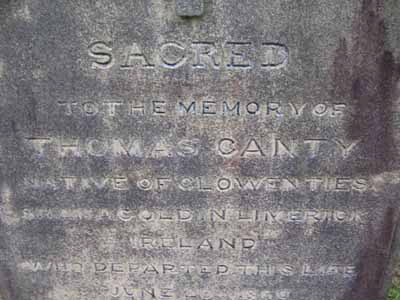
Thomas CANTY

Thomas CANTY

New South Wales Police Force

Regd. #

Rank:  Constable

Stations?, ( Berrima Police Force & stationed at Nattai

ServiceFrom ? ? ?  to  25 June 1866 = around 5 years Service

Awards?

Born: ? ? ?, Glowenties, Shanagold in Limerick, Ireland

Event date: Monday  25 June 1866

Event location:  New Sheffield (Mittagong)

Died on:  Wednesday  27 June 1866

Cause:  Fall

Age: 49

Funeral date: Friday  29 June 1866

Funeral location:

Buried atBerrima cemetery, Olbury Rd, Berrima

Catholic Section, Row 6, Plot 14

Memorial location:

SACRED / TO THE MEMORY OF / THOMAS CANTY / NATIVE OF GLOWENTIES / SHANAGOLD IN LIMERICK / IRELAND / WHO DEPARTED THIS LIFE / JUNE 20TH 1866 / AGED 49 YEARS / REQUIESCAT IN PACE

[alert_red]THOMAS is NOT mentioned on the Police Wall of Remembrance[/alert_red]   * BUT SHOULD BE

Constable Canty died following a fall down a railway cutting at New Sheffield at night, as he made his way home to Berrima. He had earlier been to Bowral to warn a witness for court. He suffered severe spinal injuries in the fall and lay injured at the base of the cutting until morning. New Sheffield is now Mittagong.

The incident was reported in some detail by the Empire dated Saturday 30 June 1866.


FATAL ACCIDENT AT NEW SHEFFIELD.  ”An accident of a fatal character, resulting in the death of Constable Canty, of the Berrima police, occurred on Monday last. The deceased ( who was stationed at New Sheffield ) had been to Bowral to warn a witness to attend before the Berrima bench of magistrates on the following day to give his evidence in a case which was there to be brought before them and was on his return home when he fell down a cutting of the Great Southern Railway on the Mittagong side of the Gib tunnel.

The night was pitch dark and miserably wet, and it is supposed that the foot of the deceased must have slipped over some of the clay soil, which abounds in the neighbourhood. The cutting was about sixty feet deep, and the unfortunate man lay in a pool at the bottom for several hours, until some workmen were on the following morning attracted to the spot by the howling of the deceased’s dog. Having ascertained that somebody was lying below, the men took prompt measures to effect his release, and afterwards conveyed him to his home.

A messenger was immediately despatched to Berrima for medical aid, and no time was lost by Dr. Williamson in repairing to the scene of the sad and melancholy disaster.

Notwithstanding, however, that every effort was made which medical skill could suggest, the unfortunate man breathed his last at a late hour on Wednesday night. On Thursday a magisterial inquiry was held before G. H.Rowley, Esq., P.M., and a post mortem examination was made by Dr. Williamson, who found that the immediate cause of death was a spinal injury, which had doubtless been received by Canty in his fall.

The deceased had been in the police force of this colony up-wards of five years, and was always held in good repute as an efficient officer. A lasting testimony to the esteem in which he was held by residents in the district was afforded by the large and respectable assemblage which followed his remains to their resting place in Berrima cemetery on Friday last.  A wife and a large family are left to lament their loss.

http://trove.nla.gov.au/newspaper/article/60598138


At the time of his death the constable had apparently been a member of the police force for about five years and was stationed at Berrima.

[divider_dotted]


The Maitland Mercury & Hunter River General Advertiser     Tuesday  3 July 1866    p 4

Constable Canty, of the Berrima police, was recently out on duty, and in the darkness of the night fell down a cutting of the Great Southern Railway, sixty feet deep. The next morning some people were attracted to the spot by the howling of his dog and be was removed ; but on the following day he died from the spinal injury he had suffered.

http://trove.nla.gov.au/newspaper/article/18722657


[divider_dotted]


The Sydney Morning Herald      Wednesday  24 January 1866     p 7

ALLEGED MURDER AT NEW SHEFFIELD.

…………  Thomas Canty, being duly sworn, deposed:  I am a constable attached to the Berrima police force, and am stationed at Nattai  ‘ about 1 o’clock on Sunday morning last, John Forward knocked at my door ………..

http://trove.nla.gov.au/newspaper/article/13125295

[divider_dotted]


Chief Constable George WOOD

Chief Constable George WOOD

New South Wales Police

Illness/Exposure

East Maitland

6 January, 1855


The death of the chief constable followed a boating incident during a search for a body, and was described by the Maitland Mercury and Hunter River General Advertiser of10 January 1855.


DEATH OF MR. GEORGE WOOD – Many of our distant readers will learn with great regret that the well-known chief constable of Maitland, Mr. George Wood, is dead. Few officers holding such a position have more deservedly merited the universal sorrow his death has caused in Maitland. Uniting cool and determined courage with the greatest gentleness, vigour and promptness with the kindest forbearance, Mr. Wood was in the highest sense of the word a peace officer, and to his exertions and example it has been greatly owing that this district has been so quiet and well-ordered for many years past. His long and well-tried services may be said to have been fitly closed by a death resulting in part from the performance of duty. After a recent fatal accident by drowning, Mr. Wood was as usual one of the most persevering in his efforts to find the body; and while so engaged the boat he was in was upset, he got entangled among the lines and ropes in use, and being unable to swim, he was quite exhausted before he could be got out of the water. For two or three years past his frame had shown signs of increased suffering under the effect of old wounds and injuries, and the shock he now received threw him on a sick bed, and brought on an attack of old disease, from which he appeared likely at first to recover, but a relapse occurring, he died on Saturday morning last. His funeral on Sunday was attended by a great number of persons, twenty carriages, above fifty gigs, a hundred and fifty horsemen, and many persons on foot, following his remains to the grave.


At the time of his death the constable was aged 52 years and was chief constable at Maitland Police Station. He left a wife and seven children.


Nick Wiles I’m putting together the map of police graves and I’ve come across the Grave of Chief Constable Woods. It looks that the current state of this grave is deplorable. The grave is in the East Maitland Anglican Cemetery (aka Glebe Burial Ground) off George Street in East Maitland. It’s such a shame that a man who was held in such esteem he had “twenty carriages, above fifty gigs, a hundred and fifty horsemen, and many persons on foot” at his funeral and his grave is no longer remembered or tendered to.

https://mapsengine.google.com/map/edit…


Alexander TWISS

Alexander TWISS

New South Wales Police Force

Regd. #  ?

Rank:  Constable

Stations:  Sydney Police

ServiceFrom  16 November 1852  to  4 May 1853 = 6 months

Awards:

Born? ? 1819

Died on:  4 May 1853

Cause:  Illness – severe cold – Exposure

Age:  33

Funeral date:

Funeral location:

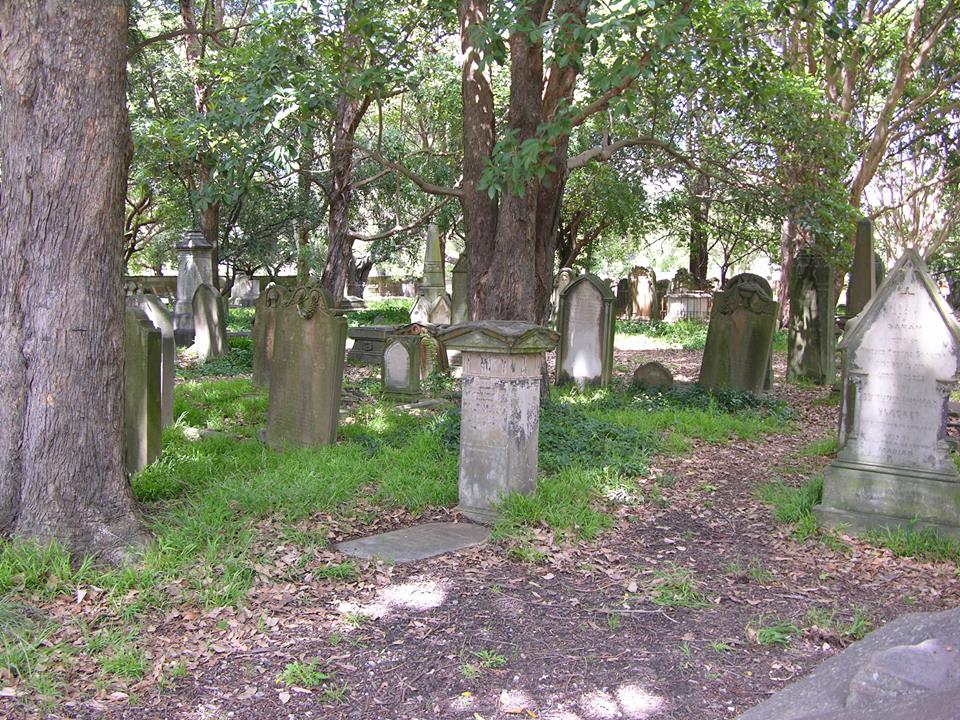
Grave location:  Constable TWISS was interred at the Camperdown Cemetery but his grave is unmarked and location unknown.

Alexander TWISS - NSWPF - ILLENSS - 4 May 1853 - Grave

[alert_red]ALEXANDER is NOT mentioned on the Police Wall of Remembrance[/alert_red]  * BUT SHOULD BE

Constable Alexander Twiss served in the Sydney Police Force from 16 November 1852 until his death on 4 May 1853. His cause of death is recorded as having been ” from the effects of a severe cold caught when on escort duty at night “  .No further details are known as yet.


The constable joined the police force on 16 November, 1852. At the time of his death he was 34 years old and was attached to the Sydney Police.  He left a widow named Sarah.

[divider_dotted]


John WATSON

John WATSON

New South Wales Police Force

Regd. #  ????

Rank:  Constable

Stations: ?, City Police ( Sydney )

ServiceFrom ? ? ?  to  25 October 1852 = ? years of Service

Awards?

Born? ? ? about 1827, Downpatrick, Co. Down, Ireland.

Event date:  Saturday  14 February 1852

Event location:  outside of the Horse and Jockey Hotel, Hunter St, O’Connell St, Sydney @ 9pm

Event type:  Assault – kicking

Died on:  Monday 25 October 1852

Place of death?

Cause:  Illness – Tuberculosis

Age:  26

Funeral date:  Wednesday  27 October 1852

Funeral location?

Buried at:  St John’s Anglican Cemetery, Menangle Rd, Camden

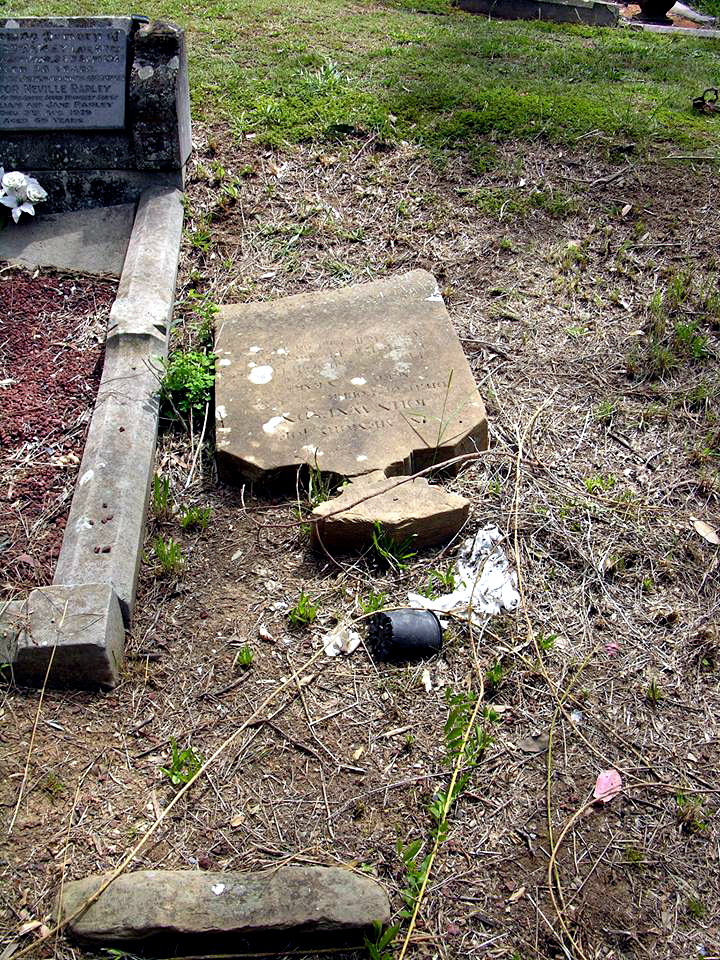
Grave location:  very end of Row E, Plot 107

Memorial at:

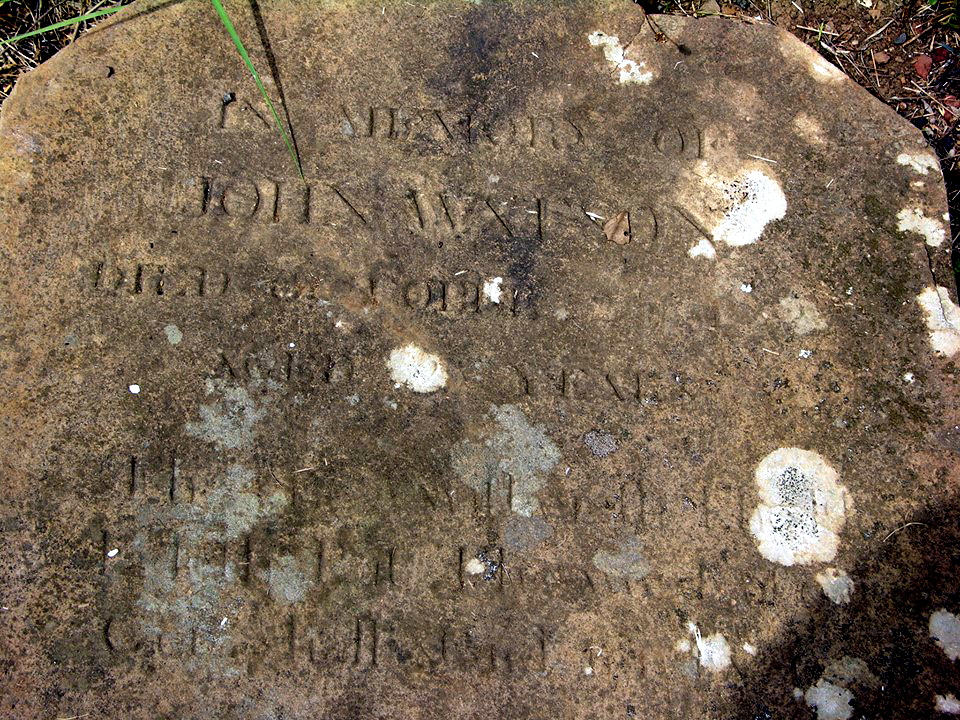
Inscription:<br /> In Memory Of John WATSON who died 25th Oct 1852. Aged 26. At Rest ??????
Inscription:
In Memory Of John WATSON who died 25th Oct 1852. Aged 26. At Rest ??????

JOHN is NOT mentioned on the Police Wall of Remembrance

* BUT should be


Sergeant John Watson was born c1827, Downpatrick, Co. Down, Ireland.
He, along with his wife Susan Watson (nee Gillespie) 1830-1912, arrived in Sydney 15/10/1851 aboard the “Earl Grey”. During the voyage his wife gave birth to a son John Watson, 1851-1918. Sergeant Watson died 1 year and 10 days after arriving in Sydney.
He is buried in the St. Johns Anglican Church cemetery, Camden, NSW.
Buried at the very end of Row E, plot 107.

♥ Kevin Bannister  041120


Sergeant Watson is thought to have died on 25 October, 1852 as a result of the onset of tuberculosis following an assault by a prisoner he was escorting to a police station.

He was buried at Camden on 27 October, 1852 at which time his residence was recorded as Sydney.

Few details are yet known of the incident, however the Sydney Morning Herald of 24 May, 1860 when reporting on the death of Inspector Alexander McGee, included the following clue.


We are happy to say that we have been informed by the superintendent of Police that a pension to the widow [of McGee] of ” £50 can be afforded out of the Police Fund. It is a somewhat singular coincidence that this will be the second instance of relief from the Police Fund which Mrs. McGee will receive. She was formerly married to a man of the name of Watson, in the police force, who, while conveying a prisoner to the watchhouse, was so seriously kicked in the back that consumption was induced, and he speedily died. On that occasion the donation of ” £100 was paid to the widow out of the Police Fund. Still we think that some testimonial from the citizens in token of their approval of the gallant conduct of McGee is eminently due.


The sergeant was aged 26 years when he died and was apparently stationed in the Sydney Metropolitan Area.


Empire (Sydney, NSW : 1850 – 1875),    Tuesday 17 February 1852,    page 2

SYDNEY POLICE COURT. – Saturday   ( Before the Police Magistrate, and J. McLerie, Esq., J.P. )

ASSAULTING A CONSTABLE.- A well-dressed young man, named William Byrnes, was charged with assaulting Constable Watson, in O’Connell street, at nine o’clock on Saturday night ( 14 February 1852 ).

It appeared from the evidence that some man, whose name is unknown, assaulted the defendant, and knocked him down. The constable interfered for the defendant, and apprehended his assailant, in return for which the defendant struck the constable several blows, and also kicked him in the stomach.

The defendant did not deny the assault, for which he expressed his contrition. The bench sentenced the defendant to pay a fine of 2/., and 2s. 6d. costs, in default to be imprisoned during fourteen days.

http://trove.nla.gov.au/newspaper/rendition/nla.news-article60127917.txt


Bell’s Life in Sydney and Sporting Reviewer (NSW : 1845 – 1860),    Saturday 21 February 1852,    page 3

THE POLICE REGISTER.

The Height of Ingratitude.Police constable Watson answered in the most lively and sonorous manner to his name when called upon to give evidence against William Byrnes, a stiff built nautical, for having inflicted divers kicks upon witness whilst engaged in affording him the protection of the law.

At the late hours on Saturday night Watson was doing his duty in O’Connell-street, when he saw the defendant levelled to the earth by a human fist.

Witness took the offender into custody; whereupon up rose Byrnes, and most ungraciously pitched into his Indigo friend, from whose grasp he rescued his antagonist. ” I am naturally mild,” cried Watson, ” but human flesh and blood cannot stand this. Come to the watchhouse.” ” Not I.” replied Byrnes, ” take me if you can.”

Watson sounded his whistle shrilly, but the Royal Civils did not start up around as did the clansmen – of Roderick Dhu – Watson was left alone with a very pretty little piece of work cut out for him. However, he tightened his belt, and went at Byrnes like a hero, and after a struggle of half an hour placed him carefully under lock and key.

The defendant had nothing to offer in explanation of his conduct but the police office cuckoo note – I was uncommon drunk – knew nothing of it – dare say he’s right – a man don’t like to be pulled and hauled about – did my best to prevent it, no doubt.

This plea was held insufficient by the P.M., who fined him in forty shillings and costs for base Ingratitude to his protector.

http://trove.nla.gov.au/newspaper/rendition/nla.news-article59774081.txt


The Empire ( Sydney, NSW )     Wednesday  5 May 1852      p 3

PUBLICANS’ ANNUAL LICENSING MEETING,

The Court of Petty Sessions for considering applications for Publicans’ Licenses, adjourned from the 30th of last month, resumed its sittings yesterday.

The Right Worshipful the Mayor presided, and was assisted by the following Justices. The Police Magistrate, the Superintendent of Police, Messrs. Allen, Hill, Chambers, Moriarty, Mitchell, Brenan, Grant, and Brown.


George Snell Clark, applied for license for the Horse and Jockey, in Hunter-street. Mr. Cory appeared for the applicant, who was opposed by Inspector Holmes, for having, on the 14th of February, refused to assist a constable in the City Police, named John Watson, who had a prisoner in custody at the time, and which prisoner was rescued from his custody by a person who assaulted constable Watson, and inflicted severe injuries upon him. The objection further alleged that when a pair of handcuffs were handed to Mr. Clark to assist in securing the prisoner, he threw the handcuffs down on the ground.

Constable Watson related the facts of the case, and said that he had been unwell ever since the night the assault was committed upon him. In reply to a question put to him by Mr. Cory, Watson admitted that Mr. Clark had picked up his truncheon for him, Mr. McLerie stated that no complaint was made against the manner in which the applicant had hitherto conducted his licensed house, and he would therefore consent to withdraw, the objection, which had been raised to let publicans plainly understand that they were bound when called on in similar cases to render aid to the Police. The objection was then withdrawn, and the license granted.

http://trove.nla.gov.au/newspaper/rendition/nla.news-article60130047.txt


NSWBDM =  John WATSON.  Death registration #  1131/1852  V1852113138B  age 26

Camden General Cemetery is located on the corner of Cawdor and Burragorang Rds, Camden & was established in the late 1800’s.


The above information may have been contaminated with some of the below dates.

Further investigation needed.  ( Cal 27 Oct 2016)


Danny WEBSTER has a person by the same name recorded as thus ( 2016 )


Sergeant John WATSON
St James Police Station
Assault Injuries – 25 October, 1852
Resting Place – St John’s Anglican Cemetery, Camden

Sergeant Watson is thought to have died on 25 October, 1852 as a result of the onset of tuberculosis following an assault by a prisoner he had removed from a hotel in Sydney.

On or about the 21 January, 1852 Sergeant Watson and Constables Clifford and Clarke attended the Lemon Tree Hotel and were asked by the proprietor to remove a man from the premises after he had refused to leave until he was served another drink.

The police were forced to drag the man from the premises and a hostile crowd soon formed outside to witness the ensuing brawl.


The Empire of 25 January, 1852 reported on the incident.

ASSAULTING THE POLICE
Robert Thompson appeared to answer the charge preferred against him by Sergeant Watson, for assaulting him in the execution of his duty, in Phillip-street, between the hours of nine and ten o’clock, on Wednesday evening. The defendant bore evident marks of ill-usage, his eyes being severely bruised.

Mr. Cory appeared for the prosecution, Mr. G. Wright, as amicus curia attended on behalf of the defendant.

It appeared from the evidence of Watson and two other constables that the son of Mr. Tuohy, a publican in Phillip-street, called at the St. James’ station-house, requesting the police to eject the defendant from his father’s house, as he was conducting himself in a disorderly manner.

Sergeant Watson went with two constables to Mr. Tuohy’s house, and defendant was ordered to quit, which he refused to do.

The policemen then ejected defendant from the house, and ordered him to go home. He refused, and caught hold of Watson by the legs, and endeavoured to throw him down.

The two constables released the sergeant from the defendant’s grasp, and he then kicked the sergeant in the breast.

The sergeant then said, “Take him to the watch-house.” The defendant was in liquor, and his conduct was very violent while being conveyed to the watch-house.

Several witnesses were called for the defendant, who testified that the policemen ill-used the defendant after the arrest, and that they beat him while conveying him to the watch-house.

The defendant was fined one shilling, and half-a-crown costs, which he immediately paid.

The offender later took civil action against the three police officers, who were defended in court by a Mr Nichols, who said in their defence, “The constables were human beings, and situated as they were, with a mob of upwards of one hundred people surrounding them, and calling out to them to let the man go, must naturally have been excited…

One witness had sworn that a constable waved his stick, and threatened a person in the crowd, but he would call a witness to prove that that constable had no stick with him…

The now complainant had been charged with assaulting a constable, one of the now defendants, and has been convicted and fined…

In conclusion, I would remark that the defendants were duty bound to apprehend the complainant, and they used no more violence than was necessary to take him.”


The hotel proprietor, a Mr Tuohy gave the following evidence during the hearing.

I am a publican residing in Phillip-street. On the night of the late Mayoral election the complainant was in my house between the hours of eight and nine o’clock.

I saw the constables, the three defendants, at my house.

My son went for them, in consequence of Mr. Thompson using threatening language, and saying that he could beat me, and my whole family.

Sergeant Watson told the complainant to go home with his wife. Complainant asked the sergeant if he knew his duty, and told him that his duty was outside instead of inside. I desired the constables to put complainant out of the house, as I was in dread of him. They again requested him to go home, which he refused to do. I was afraid he would do me some injury, because I had refused to draw more liquor for him, and again told the constables to turn him out. They took hold of him quietly, and he rushed against them, and tried to shut the door. They forced him outside, and then twice told him to go home. He replied, that he would remain there as long he liked. When down, he took the sergeant by the legs and the constables tried to loosen his hold. The sergeant caught hold of one of the verandah posts, to save himself from falling.

Thompson’s conduct was violent. I saw him kick when down outside my door. I could not say who he kicked at. I do not think the constables used more violence than necessary during the time I saw them.”

The matter was dismissed by the magistrate.


The sergeant was aged 26 years when he died and was stationed at the St James Police Station.

He was buried at Camden on 27 October, 1852 at which time his residence was recorded as Sydney.

He is not listed in the official New South Wales Police Honour Roll.


Matthew James EVERINGHAM

Matthew James EVERINGHAM

New South Wales Police Force

Regd. # ????

Rank:  District Constable – appointed ? ? 1816

Stations: ?, Portland Head ( Hawkesbury area )

Service:   From  ?  ?  1816    to 25 December 1817 = 1 year Service

Awards

Born: 12 July 1768   London, Middlesex, England

Died on:  25 December 1817

Cause:  Drowned

Event location:  Hawkesbury River

Age:  48

Funeral date

Funeral location

Buried at:  ( St John’s Cemetery ) Wilberforce Cemetery, Old Sackville Rd, Wilberforce, NSW

( approx. 600 mts east of the Putty Rd )

Grave Location:  right section, Row 7, Plot 20

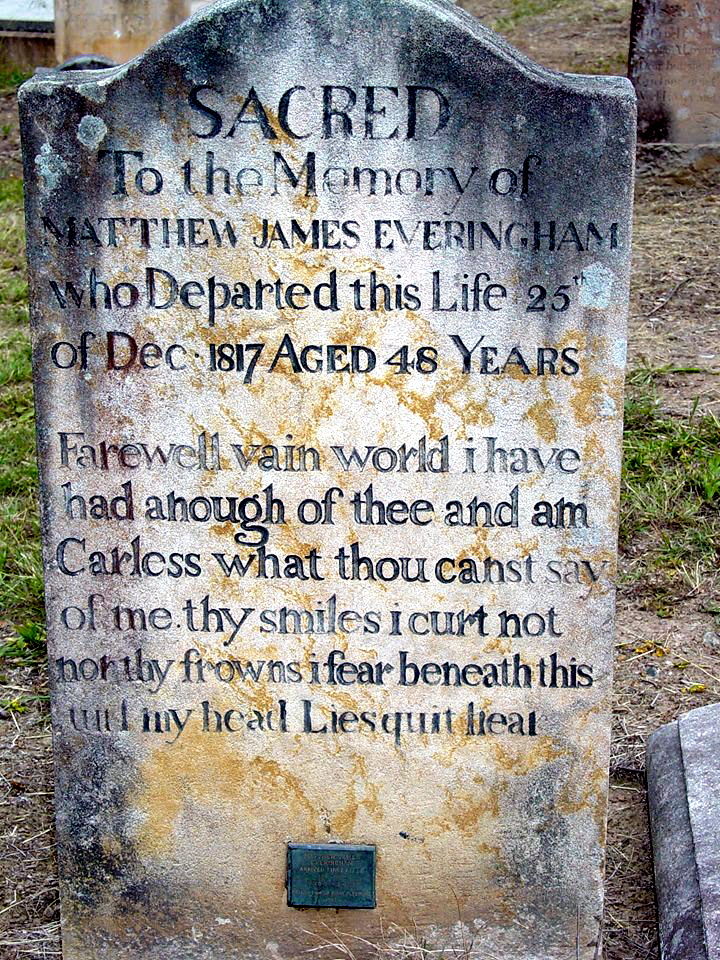
Sacred to the memory of Matthew James Everingham who departed this life 25th of Dec. 1817 aged 48 years.<br /> Farewell vain world I have had anough of thee and am carless what thou canst say of me. they smiles i curt not non thy frowns i fear beneath this and my head Liesquit heal.


MATTHEW is NOT mentioned on the Police Wall of Remembrance


The Sydney Gazette dated 3 January, 1818 reported that “On Friday last Mr. Matthew Everingham, settler and district constable at Portland Head, fell overboard from a Hawkesbury boat, and was unfortunately drowned. On the finding of the body an Inquest was convened, who returned a Verdict Accidental Death. He leaves a large family to deplore his premature destiny.”


Constable Everingham was still news well over a century after his death. The Barrier Miner of 4 June, 1929 reported the following story.


Matthew James Everingham arrived in Sydney on the ship Scarborough in 1788. In 1791 he was married at Parramatta to Elizabeth Rhymes by the Rev. Samuel Marsden. In the same year he was granted 50 acres of land, then described as “at the Ponds two miles N.E. of Parramatta“.  Later he settled on the Hawkesbury River, on the farm afterwards known as Andrew Everingham’s Farm. He also became the owner of land at “Richmond Hills“, believed to be now in the Kurrajong district. He was appointed and remained district constable till his death in 1817. In that year he was drowned in the Hawkesbury River and was buried at Wilberforce, where his grave can still be seen.


At the time of his death the constable was stationed at Portland Head (Hawkesbury).


Matthew James EVERINGHAM
Photos by cpple7 on 8 January 2016

Matthew James EVERINGHAM & Elizabeth REMES

Matthew James EVERINGHAM & Elizabeth REMES

Matthew James EVERINGHAM & Elizabeth REMES
Wife to Matthew Everingham

Matthew James EVERINGHAM & Elizabeth REMES


NSW BDM = Marriage:  125/1791 V1791125 3A &  125/1791 V1791125 147A

NSW BDM = Death:         3920/1817 V18173920


EVERINGHAM, MATTHEW JAMES (1769-1817), settler, was convicted in London on 7 July 1784 and sentenced to transportation for seven years. Shortly before his conviction he was employed as a ‘servant‘ by an attorney of the Middle Temple, hence the subsequent references to him as ‘attorney’s clerk‘. Allegedly ‘in great distress’ he had obtained two books by false pretences from the servant of another attorney, and these he had offered for sale.

http://trove.nla.gov.au/people/1465540?q=Matthew+James+EVERINGHAM&c=people


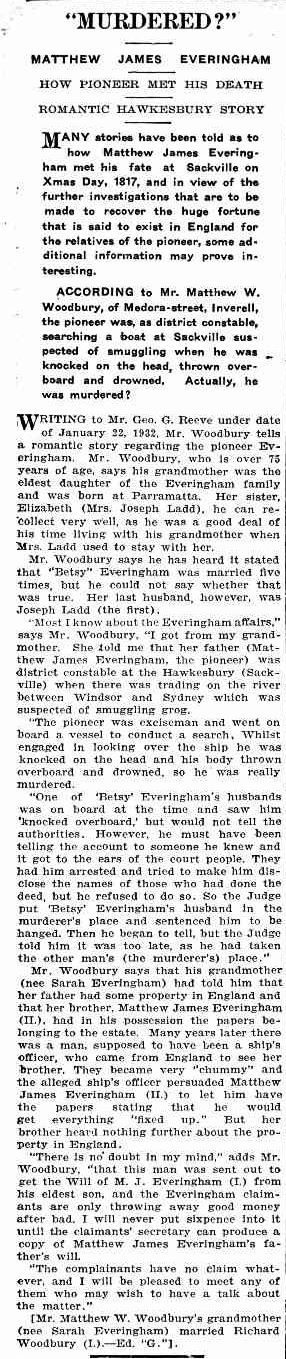
Windsor and Richmond Gazette, NSW. Friday 5 February 1932 page 6 of 12 http://trove.nla.gov.au/ndp/del/page/8914125?zoomLevel=3&searchTerm=Matthew%20James%20EVERINGHAM&searchLimits=
Windsor and Richmond Gazette, NSW. Friday 5 February 1932 page 6 of 12
http://trove.nla.gov.au/ndp/del/page/8914125?zoomLevel=3&searchTerm=Matthew%20James%20EVERINGHAM&searchLimits=


Matthew James Everingham - 2512-1817 - News article 1


Windsor and Richmond Gazette NSW Friday 21 June 1929 Page 11 of 16
Windsor and Richmond Gazette NSW
Friday 21 June 1929
Page 11 of 16


Windsor and Richmond Gazette (NSW : 1888 – 1954),

Friday 23 August 1929, page 7

THE EVERINGHAM FORTUNE?.

NEWCASTLE CLAIMANT

NEWCASTLE has produced a claimant for the Everingham millions in Mr. Ernest Edward Chaseling, who declares that he is a direct descendant of Matthew James Everingham.

He says that his grandmother, Ann Everingham, was a daughter of Matthew. She married John Chaseling in 1818, and his father, Joshua Watford Chaseling, was a son of that union. Mr. Chaseling has two brothers and two sisters.

Matthew Everingham, history tells, was drowned in the Hawkesbury River before he could leave for England to claim £200,000. That was in the early part of last century. Interest on the money has accumulated until the sum of eleven million pounds is said to be now awaiting its rightful claimant.

Mr. John Chaseling, son of Thomas Chaseling I., who married Miss Ann Everingham, one of the three daughters of pioneer Matthew J. Everingham (obit. 1817), is interred, as also is his wife, Mrs. Ann Everingham Chaseling, in the private vault of Matthew James Everingham II., which is situated at ‘Knight’s Retreat Farm,’ near Sackville, on land specially set aside by the will of second Matthew James Everingham as a burial place for any of the Everinghams in descent, or kindred. — “MARMINGA.”

http://trove.nla.gov.au/newspaper/rendition/nla.news-article85927804.txt


Everingham, Matthew James (1769–1817)

by A. J. Gray

Matthew James Everingham (1769-1817), settler, was convicted in London on 7 July 1784 and sentenced to transportation for seven years. Shortly before his conviction he was employed as a ‘servant’ by an attorney of the Middle Temple, hence the subsequent references to him as ‘attorney’s clerk’. Allegedly ‘in great distress’ he had obtained two books by false pretences from the servant of another attorney, and these he had offered for sale.

He arrived in the First Fleet transport Scarborough and was employed by Assistant Commissary Zachariah Clark. On 13 March 1791 Everingham married Elizabeth Rymes of London, who had arrived in the Neptune on 28 June 1790 and in July he settled on a 50-acre (20 ha) grant near Parramatta. In December Watkin Tench noted that ‘the Attorney’s Clerk’ appeared to find the cultivation of his own land ‘not half so easy a task as he formerly found that of stringing together volumes of tautology to encumber or convey that of his neighbours’; but for once Tench was unjust. Far from being ‘out of his province’ Everingham succeeded as a settler. In 1800 he signed the address to Governor John Hunter setting out ‘the grievous and intolerable burdens’ under which the settlers at the Field of Mars had long laboured; soon afterwards he disposed of his grant to Andrew Hume and like many of the early grantees moved to the Hawkesbury where farming prospects were better. By 1803 he was well established at Portland Head, but in 1804 his home and farm buildings were burned by natives and he, his wife and servant were speared, though happily their wounds were not fatal. In 1816 he acquired 130 acres (53 ha) at Richmond Hill, and became a district constable. A year later, on 25 December 1817, he was accidentally drowned in the Hawkesbury. In a memorial to the colonial secretary in 1825 his widow claimed, apparently without financial result, that he had died while in the execution of his constabulary duties.

Everingham was survived by five sons and four daughters, and was buried in St John’s cemetery, Wilberforce. His career was not spectacular, but over a long period he discharged his duties faithfully and worked steadily as a pioneering settler.

http://adb.anu.edu.au/biography/everingham-matthew-james-2030


Matthew married Elizabeth Rimes on 13 March 1791 and from that union they had 11 children.
1. Mary (23 December 1791–24 January 1792)
2. Sarah Elizabeth (9 June 1793–29 March 1874)
3. Matthew James (10 May 1795–22 November 1884)
4. William (6 August 1797–6 September 1859)
5. George (9 December 1799–15 April 1881)
6. Ann (7 November 1802–19 March 1849)
7. Elizabeth (10 June 1805–24 June 1879)
8. John Rymes (October, 1806–?)
9. James (25 December 1809–25 July 1895)
10. Maria (6 August 1811–24 February 1835)
11. John (20 July 1814–29 May 1875)

Matthew passed away Hawkesbury River, New South Wales

Matthew James Everingham (1768-1817), settler, was born in London on 25? July 1768, son of Joseph Everingham and his wife Mary.

He was convicted in London on 7 July 1784 and sentenced to transportation for seven years.

Shortly before his conviction he was employed as a ‘servant’ by an attorney of the Middle Temple, hence the subsequent references to him as ‘attorney’s clerk’. Allegedly ‘in great distress’ he had obtained two books by false pretences from the servant of another attorney, and these he had offered for sale.

He arrived in the First Fleet transport Scarborough and was employed by Assistant Commissary Zachariah Clark.

On 13 March 1791 Everingham married Elizabeth Rymes of London, who had arrived in the Neptune on 28 June 1790 and in July he settled on a 50-acre (20 ha) grant near Parramatta.

In December Watkin Tench noted that ‘the Attorney’s Clerk’ appeared to find the cultivation of his own land ‘not half so easy a task as he formerly found that of stringing together volumes of tautology to encumber or convey that of his neighbours’; but for once Tench was unjust.

Far from being ‘out of his province’ Everingham succeeded as a settler.

In 1800 he signed the address to Governor John Hunter setting out ‘the grievous and intolerable burdens’ under which the settlers at the Field of Mars had long laboured; soon afterwards he disposed of his grant to Andrew Hume and like many of the early grantees moved to the Hawkesbury where farming prospects were better.

By 1803 he was well established at Portland Head, but in 1804 his home and farm buildings were burned by natives and he, his wife and servant were speared, though happily their wounds were not fatal.

In 1816 he acquired 130 acres (53 ha) at Richmond Hill, and became a district constable.

A year later, on 25 December 1817, he was accidentally drowned in the Hawkesbury.

In a memorial to the colonial secretary in 1825 his widow claimed, apparently without financial result, that he had died while in the execution of his constabulary duties.

Everingham was survived by five sons and four daughters, and was buried in St John’s cemetery, Wilberforce.

His career was not spectacular, but over a long period he discharged his duties faithfully and worked steadily as a pioneering settler.

Birth
12? July 1768
London, Middlesex, England
Death
25 December 1817
Wilberforce, New South Wales, Australia
Cause of Death
drowned
Cultural Heritage
English
Religious Influence
Anglican
Passenger Ship
Scarborough (1788)
Occupation
convict
emancipist
farmer
police officer
Key Events
First Fleet (1788)
settler/indigenous contact

by A. J. Gray
From the Australian Dictionary of Biography, Volume 1, 1966


https://www.findagrave.com/memorial/63359906/matthew-james-everingham