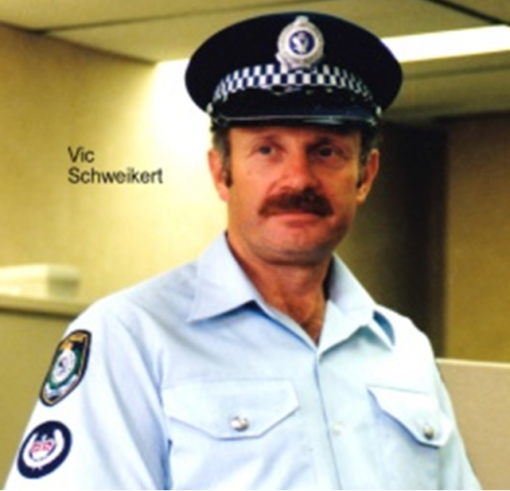
Victor was a Fitter and Turner prior to entering employment with the NSWP.
Prior to commencing employment with the NSWPF, Vic started rowing at Leichhardt Rowing Club in 1953 – 1954; this was the rowing club of his father and brother.
In 1957 Vic raced in the King’s Cup ( the Australian Championships ) held in Brisbane, Qld.
There he rowed in the eight’s oared race, earning 2nd place.
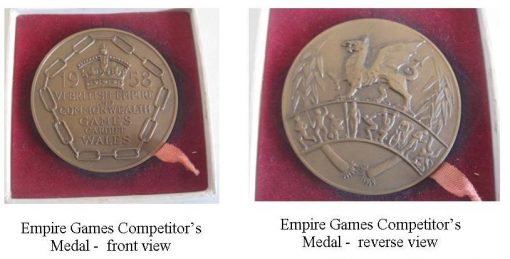
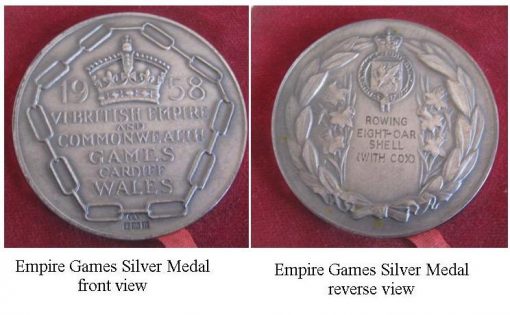
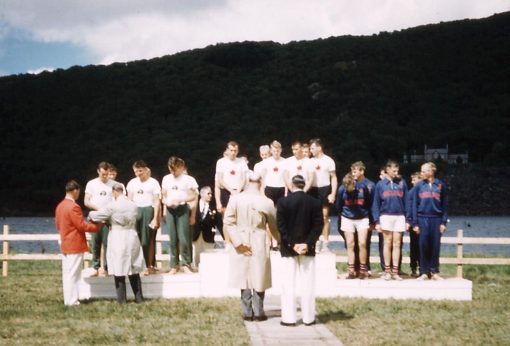
In 1959 he participated in the Empire Games ( currently known as the Commonwealth Games ) in the sport of rowing, where he was awarded a Silver Medal after coming second to the Russians.
They were presented with a ‘Silver Medal’ by the Duke of Edinburgh – Prince Phillip. The photo shows the Australian Team receiving their medal.
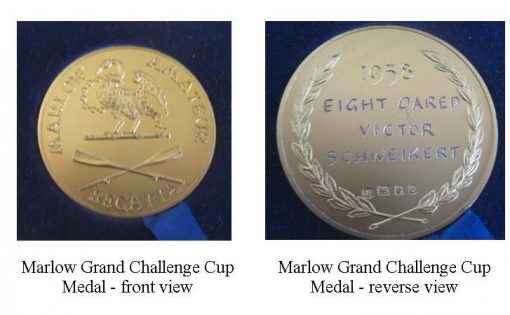
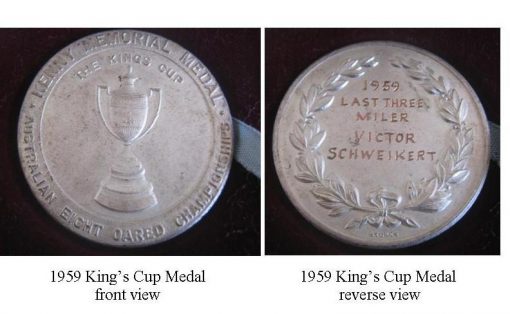
Vic, in 1959, was selected to row in the Kings Cup, at Perth WA, and after a three mile race on the Swan River, his team came first earning a ‘gold medal’.
Source: Joe Stanioch – Liverpool Police Time Line ( 1788 – 2022 )
Info – Victor Schweikert and later Mrs Schweikert.
Vale – Victor Schweikert | Leichhardt Rowing Club
Published Fri 05 Jan 2024
Lionel Robberds AM QC (Leichhardt Rowing Club Patron) advises that Victor Schweikert, former National, State and Club representative passed way in recent days (late December 2023).
Vic’s success on the water followed the Leichhardt Eights win over the NSW State crew, when preparing for the 1958 Empire Games at Cardiff in Wales. Five Leichhardt oarsmen, with Lionel as Coxswain, represented Australia in the Eight, winning the Silver medal.
Vic was also in the 1959 NSW Kings Cup Eight mainly comprised of Leichhardt Oarsmen, winning the Kings Cup for the first time since 1951.
The Schweikert family of Bert, Carl and Eric had been successful Coaches at Leichhardt. It was Eric’s son Victor, who had crewed in the Kings Cup from 1957 to 1957 and again in 1960,
In his younger days Vic had been a member of the winning Shore Eight in the Head of the River going on to win the Australian Schoolboys Championship.
As a former retired Police officer, Vic was a regular attendee at relevant functions for retirees from Police and Rowing.
May he rest in peace.
Barry Moynahan – Leichhardt RC Life Member; Rowing NSW Life Member
In 1959, a crew made up of LRC and Mosman rowers won the King’s Cup in Perth, by quite a margin as the picture above shows! This was the last time the King’s Cup was raced over 3 miles.
Left to right: Max Annett, Peter Waddington, Ted Curtain, Ken Railton, Victor Schweikert, Graeme ‘Mick’ Allen, John Hudson, Ralfe Currall, next to the coxswain is the emergency, Bruce Evans and on the far right is the manager Frank McLeod.
The crew training in Perth. Bow – Ralfe Currall 2 – John Hudson 3 – Ken Railton, Mosman RC 4 – Victor Schweikert 5 – Graeme ‘Mick’ Allan, Mosman RC 6 – Max Annett 7 – Ted Curtain Stroke – Peter Waddington Coxswain – Lionel Robberds
Left to right: first is Max Annett, beside him is stroke Peter Waddington, then in the blazer is coach Phil Cayzer, then peeking from the rear is the seven man, Ted Curtain. To the left of Ted is the three man Ken Railton from Mosman, beside him and a bit to the front is Victor Schweikert, behind Victor is the five man Graeme ‘Mick,’Allan from Mosman. The coxswain Lionel Robberds, holding the King’s Cup and with a stop watch on his left leg, then on the left of Lionel is bow, Ralfe Currall, then the two man John Hudson, on his left is the reserve Bruce Evans from Mosman RC, on Bruce’s left is the Manager, Frank Mcleod.
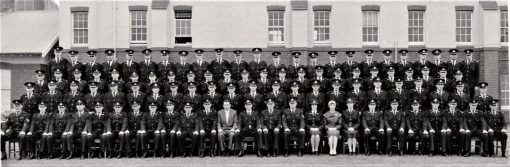
L. C. Bennett; D. W. Stolle # 9460; M. W. Kirk # 9512; R. C. Landers; B. Symons; A. Southall # 9527; J.C. Dunbar # 9482; P. J. Martin # 9528; B. K. Leaney # 9533; D. W. McLaughlin; J. R. Dorsett # 9498; P. W. Medway # 9444; J. McGregor # 9518; F. J. Ryder # 9506; R. N. Morris # 9517; P. R. Clemson # 9523; J. O. Parry; P. J. Woodward # 9478; D. C. Newton # 9480; R. L. Power # 9477; A. W. McDonald # 9510; B. A. Kearns; P. R. Leembruggen # 9530; R. G. Dunn.
3rd row ( l to r ):
E. H. Williamson # 9507; S. K. Isedale # 9490; T. G. Purcell # 9468; A. J. Murphy # 9509; A. P. Lynch # 9500; R. W. Stone # 9488; M. C. Adams; H. J. P.
Munro # 9484; J. E. Hawley # 9522; S. C. Heckenberg # 9487; H. T. Auliff # 9464; B. A. Melouney # 9492; M. R. Turk # 9526; A. C. Frost # 9516; C. A. Hermanson # 9525; E. F. Doherty # 9446; W. McCormick # 9529; K. J. Williams # 9461; M. C. Moy # 9449; K. G. McNeill # 9455; A. D. Morris # 9469; R. L. Scarf # 9457; J.R. Press # 9462; R. J. Mahoney # 9514.
2nd row ( l to r ):
J. J. McNamara # 9465; T. J. Webber # 9504; B. A. Bennett # 9453; J. F. Bostock # 9535; R. N. Thornett; W. A. Allan; K. J. Hall; M. R. Hay # 9452; Ken. Waters # 9494 or 9505; Keith. Waters # 9494 or 9505; G. N. Crouch # 9532; R. C. Rogerson # 9536; D. S. McAfee # 9459; G. A. Wilson # 9470; B. Garland # 9511; J. Peterlin # 9503; T. C. Coleman # 9496; R. J. Canning # 9473; V. A. Schweikert # 9458; R. Pearson; B. Kerrison # 9485; J. G. Kinnane; L. R. Kriss # 9483.
Front row – seated- ( l to r ):
Sergeant 3/c. Ben Hall; C. C. Greenham; G. R. Gibb # 9445; R. C. Jenner # 9486; J. C. McGingley; D. W. Cluff # 9463; R. J. Graham # 9467; D. E. Nelson # 9481; F. B. McGoldrick; E. G. Mercer # 9515; E. W. Kell
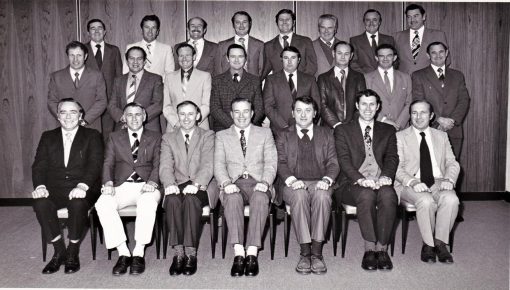
Sgts Course 6 of 1978 – 12 June – 28 July 1978Back row ( L to R ) –
Bernie Webb; John Walton; Alan Doyle; Peter Lowrey; Phil Loughlin; Laurie Campbell; Ted Coleman; Bill Ellis # 9559.
Middle Row ( L to R ) – Vic Schweikert # 9458; John Cummins # 9601; Barrie Sherlock # 9635; Ron Kitson # 9670; Carl Hermanson; Mike Blackburn # 9630; Ken Williams # 9461; Max Bailey # 9667.
Front row ( L to R ) –
Alan Walker; Nev Bent # 9586; Brian Milward (Instructor) # 9108; Bryan Binns Instructor) # 7953; Harold. E. John Symons (Instructor) # 8331; Denis Bowden # 9384; Pat Cioccarelli # 9580.
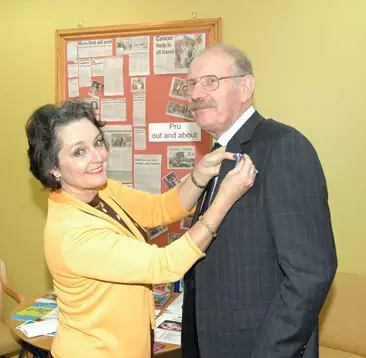
REWARDED: Pru Goward pinning the diligent and ethical service medal on Victor Schweikert. Photo by Ben McClellan
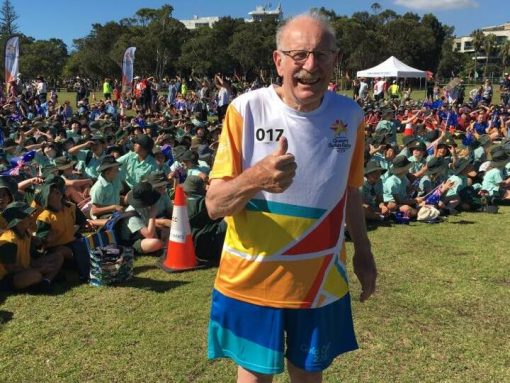
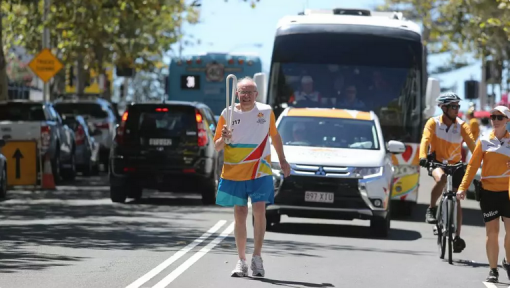
QUEEN’S BATON RELAY: Commonwealth Games Queens Baton Relay Wollongong baton bearer Victor Schweikert. Picture: Robert Peet. 2000
* Story behind any Nickname:
Nothing further, than what is recorded above, is known about this person at the time of publication and further information and photos would be appreciated.
( Due to current Govt. restrictions on ‘Gatherings’ due to Corona19 Virus Pandemic, some families may wish to have a Memorial Service / Wake with friends and family at a later date )
Funeral Parlour: ROBERT B WALKER FUNERALS Kempsey,
South West Rocks & Districts
Ph 6562 4329
Buried at: Cremated
Memorial / Plaque / Monument located at: ?
Dedication date of Memorial / Plaque / Monument: Nil – at this time ( February 2021 )
JOHN is NOT mentioned on the Police Wall of Remembrance * NOT JOB RELATED
FURTHER INFORMATION IS NEEDED ABOUT THIS PERSON, THEIR LIFE, THEIR CAREER AND THEIR DEATH.
Constable John BOURKE NSW Police Motor cycle BG-723
Inspector John BOURKE – Goulburn Police Academy
BOURKE, John Kevin
JOHN KEVIN BOURKE APM
Passed away 16th February 2021
Aged 91 years
Late of Crescent Head.
Beloved husband of Lorna.
Loving father and father in law of Robert and Lee, Glenn, Michael (deceased).
Adored Pop of Daniel, Kate, Scott, Hannah, Misheal and to his
great grandchildren Nate and Isobelle.
Relatives and friends of John are invited to his funeral service at the chapel of Walkers Crematorium & Memorial Gardens Frederickton on Monday 22nd February 2021 commencing at 10.00am, then for cremation.
ROBERT B WALKER FUNERALS Kempsey,
South West Rocks & Districts
Ph 6562 4329
This was published 7 years ago
Bent police officer’s pre-emptive strike
The NSW Ombudsman’s investigation into the likely illegal bugging of more than 100 police officers faces one very substantial challenge.
It was called Operation Mascot and it started in January 1999. The ”white knights” of the NSW Police special crime and internal affairs unit (SCIA), along with the NSW Crime Commission, were chasing corrupt NSW police officers.
The ace up their sleeve was a corrupt detective, code named M5.
Worried about being confronted with his own corruption, M5 had made a pre-emptive strike. He voluntarily went to the crime commission in December 1998 and confessed his misdeeds. Early the next year, with SCIA and the commission working hand in glove, he was sent ”under cover” to covertly record his workmates, some of whom were close friends.
Judging by documents obtained by Fairfax Media, Mascot – which ran for more than two years – was not an investigation that built slowly.
Within a few weeks of M5 going to work, Justice Graham Barr of the NSW Supreme Court had approved a listening device warrant that allowed M5 to bug 119 people, almost all of them serving and former police.
An affidavit was presented to Justice Barr giving the reasons the 119 deserved to have their private conversations covertly recorded.
That affidavit has never been made public so what the judge was told is not known.
But one Operation Mascot affidavit has surfaced. It was granted on September 14, 2000, the day before the start of the Sydney Olympics. Justice Virginia Bell of the NSW Supreme Court – who is now a High Court judge – approved a listening device warrant that allowed M5 to bug 114 people. She approved the use of seven listening devices, some to be worn by M5, others to be placed in his house, car and briefcase.
Among those who were to be recorded were some who were corrupt. But dozens of others who M5 was legally allowed to record were honest police such as then Superintendent Nick Kaldas and Superintendent Bob Inkster. Kaldas is now a NSW Police Force Deputy Commissioner. Inkster is now, somewhat ironically, a senior member of the NSW Crime Commission which was a key player in trying to bug him more than a decade ago.
According to the warrant approved by Justice Bell, Kaldas and Inkster and the other 112 were suspected of a range of offences – money laundering, conspiracy, tampering with evidence.
Essentially, the accusation was that they were corrupt. The Herald makes no suggestion that either man was, or is, corrupt.
Justice Bell approved the bugging on the basis of a 57-page affidavit from the crime commission.
The Herald has seen a copy of the affidavit. It contains allegations of corruption against many police and is, in parts, quite detailed.
Justice Bell, who had been counsel assisting at the Wood royal commission into the NSW Police five years earlier, was told the affidavit was truthful and accurate.
But an investigation by the Herald has uncovered evidence that parts of the affidavit were either fabricated or wrong.
The documents and the evidence gathered by the Herald suggest that from 1997 to 2001 more than 20 NSW Supreme Court judges were lied to or seriously misled by some officers working within SCIA, which was set up in the 1990s by then commissioner Peter Ryan.
Which brings us to the affidavit of September 14, 2000, specifically paragraph 5.33, which comprises only 13 lines.
Much of the affidavit is taken up with details of conversations between M5 and some corrupt colleagues secretly recorded in police stations such as Manly and at pubs, clubs and farewell functions – often while M5 and his mates were engaged in marathon drinking sessions.
The paragraph reads: “On 10 December, 1999, [M5] unexpectedly met with former NSW Police inspector John Kevin Bourke in The Corso, at Manly. Bourke engaged [M5] in conversation regarding assistant commissioner Clive Small. Bourke used words to the effect, ‘I have the best brief on him’.”
The affidavit says Bourke went on to describe Small’s involvement in the corrupt “release of information” to another police officer which resulted in a drug trafficker escaping conviction.
The affidavit continues: “I suspect Bourke has information or evidence which he believes incriminates assistant commissioner Small.
”I suspect Bourke meant to indicate that he would use that information or evidence to protect himself, if necessary, from investigation or prosecution, or both.”
The Herald has tracked down and spoken with Bourke, who was for many years involved in detective training. He retired in 1989. After being read the allegation about his ”meeting” with the detective known as M5 on The Corso, as detailed in the sworn affidavit, Bourke said: “It is very simple for me to answer, that is all nonsense, poppycock, because it never ever occurred.”
In a subsequent email, Bourke said: “The name [M5] is not significant to me. I can confirm with absolute confidence I have never met any such named person on the Manly Corso at any time in my lifetime.”
He added: “I didn’t like Clive’s haircut and I thought he was a bit self-important. But I admired Clive Small for many reasons. I always found Clive a very trustworthy person in my dealings with him.”
He said the claim in the affidavit that he had the conversation was ”based on a fabrication”.
He said he was prepared to give evidence on oath that this was the case.
Bourke said he had no idea how his name could have been put in an affidavit or on a listening device warrant. He had never been contacted by anyone about the alleged meeting on The Corso or the ”allegations” against Small.
Small had a distinguished career in law enforcement. In the late 1970s, he worked on the Woodward royal commission into drug trafficking and then on a long inquiry into the collapse of the Nugan Hand Bank.
As an inspector, and despite considerable pressure from his superiors, he cleared former NSW Police superintendent Harry Blackburn who had been wrongfully charged with multiple rapes in an inept investigation by NSW Police. A subsequent royal commission into the Blackburn case proved him correct.
In the 1990s he was the commander of the taskforce that led to the conviction of backpacker murderer Ivan Milat. After the Wood royal commission into police corruption in the mid-1990s, he was appointed the head of crime agencies and, as such, was the boss of the major squads such as homicide. He was later chief investigator for the Independent Commission Against Corruption.
When the Herald first showed the affidavit to Small he said there was “something clearly wrong” with the document.
Late last week he told the Herald that to the best of his knowledge he had not seen Bourke since the early 1970s. He said he had never been interviewed or spoken to by anyone about the ”allegation” in the affidavit and had no idea which drug case was being referred to.
He said given Bourke’s categorical denial of the affidavit, “it would appear to me a criminal offence has been committed by one of more people or at a minimum, a serious misconduct”.
He said the allegations about misconduct within SCIA had ”been known to both the government and the opposition for about 10 years”.
“I would seek for the matter to be fully investigated immediately. I don’t want this buried for another two years while the ombudsman investigates.”
The Herald has also obtained NSW Police documents which cast doubt on another claim in the same affidavit presented to Justice Bell: that M5 and other officers ”verballed” or made up admissions by a career criminal, Craig Cant, one of three men charged in 1994 with a violent attempted armed robbery.
On page 7 of the affidavit, it says M5 and another police officer “fabricated an unsigned record of interview with Cant”.
The Herald has obtained a copy of M5’s own record of interview with Cant and the brief of evidence in the case. Cant makes no admission to the crime and, in fact, repeatedly denies knowing anything about it.
When M5 puts a number of allegations to Cant and asks if he has anything to say, Cant repeatedly answers “nothing”.
Asked what he wants to say about phone records which showed a call from a co-offender at 4am at the time and date of the offence, Cant replies: “Nothing. Look I don’t want to be rude but how much longer is this going to take?”
In a second interview, he repeatedly answers “no comment”.
The Herald showed a number of the documents to Small. He said it appeared the police, including M5, had evidence against Cant based on phone and motel records, his credit card and driver’s licence which were all admissible in court.
“In the interviews, Cant’s answers are neutral or denials. I don’t see what the ‘verbal’ could be.”
Charges against all three men eventually fell through because of the alleged police fabrications. One of Cant’s co-accused later went to work for SCIA. He told officers within the unit he and Cant and the other man had indeed committed the crime, which involved breaking into a home at 4am and putting pistols to the heads of a young couple.
How it unfolded
On December 16, 1998, an experienced but troubled NSW detective walked into the offices of the NSW Crime Commission in Kent Street and voluntarily admitted to numerous acts of corruption.
According to documents leaked to Fairfax Media, he was under intense pressure. Some colleagues had come under suspicion and the detective, who became known as M5, feared he was in the firing line.
Drinking heavily, “depressed and anxious”, the documents reveal he said he wanted to “unload”. He admitted to corruption going back to the late 1980s and named other serving and former detectives as bent.
But the confession didn’t have the cathartic effect M5 might have hoped for. In fact it made things worse.
M5’s psychiatrist, Michael Diamond, would later write: “It placed extra pressure on him because he had to keep ‘disappearing’ (from his normal police duties) in order to attend these interviews … he felt suicidal”.
According to Mr Diamond, M5 was in intense distress. A concerned relative had him admitted to a psychiatric unit at Manly, where he stayed for 10 days.
What happened next is remarkable. He was sent to work under cover by the ”white knights” in the NSW Police special crime and internal affairs unit (SCIA). They wanted scalps and M5 was ideally placed to produce them.
The documents reveal M5 was debriefed by SCIA in January 1999 – within days of leaving the psychiatric ward – and transferred to Manly detectives. An SCIA officer, Cath Burn, now a deputy commissioner, said M5 “volunteered” to go under cover and record his fellow detectives, some of whom were undoubtedly involved in corruption and later jailed.
But in advice to the human resources branch on September 16, 2003, a solicitor from the NSW Police legal services branch, Alan Bloomfield, recommended M5 be granted a ”hurt on duty” pension because he had been “forced” to co-operate.
Mr Bloomfield said: ”A memo from Supt [Cath] Burn states that he ‘voluntarily’ offered to assist, but in a practical sense, he did not have much choice.”
M5 kept working as a detective from early 1999 until mid-2001. He was also covertly recording his workmates.
The documents reveal that SCIA bugged M5’s house, car and briefcase, and had listening devices on M5.
Much of the recording was done in pubs, clubs and at functions – and during marathon drinking sessions.
When M5 couldn’t take it any longer, he sued for compensation in the form of a ”hurt on duty” pension.
In 2002 Mr Diamond, advising on M5’s claim for compensation, criticised SCIA’s decision to employ him under cover just after he had left a psychiatric institution.
M5 won his claim and it is understood he was also given an ex gratia payment. His payments are believed to total hundreds of thousands of dollars.
He told Mr Diamond he had been used by someone in SCIA to “settle old scores”. One of the “old scores” appears to have been then Superintendent Nick Kaldas. M5 was sent to see him five or six times. Mr Kaldas had had a serious disagreement with a senior SCIA officer, Superintendent John Dolan. Even police within SCIA were seriously concerned at the targeting of Mr Kaldas.
“I smelt a rat,” M5 told his psychiatrist. “I’ve done stuff you wouldn’t do to your worst enemy … I’ve been used.”
Operation Mascot
1350 boxes of documents (handed over by the NSW Police/Police Integrity Commission/NSW Crime Commission)
20 NSW Supreme Court judges (involved in approving the listening device warrants)
7 investigators (working for Operation Prospect)
$3.5m (extra money given to Ombudsman for inquiry)
114 serving and former police officers and civilians named in controversial listening device warrants approved by Justice Virginia Bell
1984 applications for telephone taps by NSW Police, PIC, Crime Commission in 2011-12
(source: Commonwealth Attorney-General’s report)
Dedication date of Memorial / Plaque / Monument: Nil – at this time ( October 2020 )
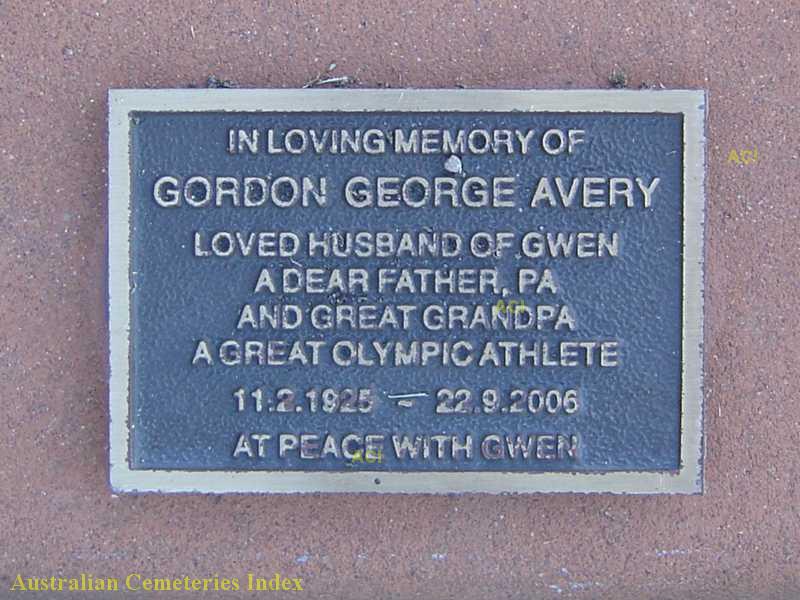
Gwendoline Elsie AVERY nee Friedwald was born 18 June 1925, Married ‘ George ‘ in 1947 and passed on 26 July 2006 ( 3 months before Gordon ). Gwen is also buried at the same location.
GORDON is NOT mentioned on the Police Wall of Remembrance *NEED MORE INFO
FURTHER INFORMATION IS NEEDED ABOUT THIS PERSON, THEIR LIFE, THEIR CAREER AND THEIR DEATH.
A torch aloft. A flickering flame. A solitary runner. For an Olympic movement that has done its level best to dishonour its own stature, what does it say about such an event where three simple symbols can convey as much meaning and emotion as a gold medal?
Since its successful candidature, nearly seven years ago, the 2000 Olympics have been Sydney’s Games. The lighting of the flame in Olympia, Greece, on May 12 will be the single act which converts the Games into a truly national event and celebration of nationhood. Sydney’s Games will, hopefully, become Australia’s Games.
It will be a chance for Sydney, a city that in recent years had become somewhat self-obsessed to the exclusion of the other 15 million Australians – remember them? – to reach out to the rest of the nation.
It will be a rare opportunity, too, for the city to engage with the country and vice-a-versa.
So the torch relay is one of those unique sporting events that manage to surpass sport itself. But, above all, it will be a chance for ordinary Australians to prove how extraordinary they can be.
Nearly four years ago, ordinary Americans took part in the torch relay as it passed through the United States on its way to Atlanta.
The expressions on their faces were a contrast to some of the gold-medal-winning athletes, whose faces were often a portrait of arrogance and domination, especially on the running track where the Olympics go onto what is near enough to a war-footing.
Once participation was enough. Now winning is all. Even the IOC’s elaborate advertising campaign refers to the belief that you don’t win silver, you lose gold.
But the torch relay may be a vestige of the more traditional values of the Games in which participation was paramount.
There is an honesty about the relay that seems to have been lost from the broader event.
Now it’s the turn of Australians like Mr Gordon George Avery, of Bulli, named today as a 2000 torch-bearer. Mr Avery, who turns 75 on February 11, won silver at the 1948 London Olympics in the triple jump.
His thoughts typify the spirit of the relay and the old values of the Games: “The Olympic torch for me is the symbol of the Olympic Games. If you have ever been an Olympian and competed against all these people from other nations you can understand why an Olympian feels like he does.
“We feel like we understand the rest of the world, because we’ve lived and competed on a level playing field with all nations. Often they’re our very best friends without a thought of race, colour or creed.”
John Konrads, an extraordinary Australian whom no ordinary Australian could begrudge carrying the torch, agrees. “The torch is one of the very important elements … it brings the Olympics back to its origins in ancient Greece and relays that heritage to the current Olympic city,” said the 57-year-old who won gold in the 1500m freestyle at the 1960 Rome Games.
“It brings back very fond memories of other Olympic ceremonies I have attended. I will be very proud when I am running with the torch, which will be a permanent souvenir to keep as a family heirloom.”
The organisers like to describe the torch relay as the real start of the Games, but they’re saying so with a degree of desperation now.
The start of the relay can’t come a moment too soon for the IOC and SOCOG, eager to galvanise a jaundiced world and host nation in support of the Olympics.
Even a cynic studying the torch relay’s route around the continent would have to concede that it is brilliantly conceived. It’s a retirees’ blueprint for the ultimate round-Australia trip.
Keep the map. A few of us may choose to use it one day – Mount Isa to Mount Kosciuszko, Broome to Byron Bay, Darwin to Dubbo.
The torch relay is one of the few creations of Nazi Germany that the civilised world has not rejected. Not even the residue of hatred and bitterness from a world war was sufficient for London to abandon the relay at the 1948 Olympics.
Government Gazette of the State of New South Wales (Sydney, NSW : 1901 – 2001),
Friday 10 September 1976 (No.114), page 3817
LOCAL GOVERNMENT ACT, 1919
Appointment of Members of the Parking Advisory Committee for the City of Newcastle.
HIS Excellency the Governor, with the advice of the Executive Council and in pursuance of section 270d of the Local Government Act, 1919, has been pleased to approve the appointment of Inspector 3rd Class John Victor Waring, Department of Police, vice Inspector 3rd Class Gordon George Avery, as a member of the Parking Advisory Committee for the City of Newcastle, for a period expiring on 22nd January, 1978.


 CLASS 0654 row ( l to r )
 Sgts Course 6 of 1978 – 12 June – 28 July 1978Back row ( L to R ) –