The constable was shot by an offender named Shaw at Redfern whilst attempting to arrest him and another man for passing counterfeit coins. Following an incident involving a storekeeper, Constable Guilfoyle had sought the assistance of an off-duty member, Constable Michael Maher, and after checking several shops the offenders had been in they located them in Shepherd Street. As the two constables approached the offenders, one produced a revolver and shot Constable Maher three times. Shaw then also produced a pistol and shot Constable Guilfoyle twice. Constable Maher later recovered, however Constable Guilfoyle’s wounds proved to be fatal. Shaw then made good his escape, making his way to Victoria.
Constable Guilfoyle was a native of Ireland, having been born at Scariff in County Clare. He arrived in Sydney in 1885 and joined the New South Wales Police Force in November of that year. He did his initial training at the old Belmore Barracks and was first sent to Bathurst, where he remained for about two years. He was then transferred to Redfern in 1887, and was destined to remain attached to that station until his death. He was described as a very powerful, muscular man of nearly 17 stone. Prior to his death the constable had recently been severely injured in an accident and after a spell in hospital had been incapacitated for five or six weeks. He also had the misfortune to recently lose three of his children, one of them being a girl 12 years old. Although he could have retired from the police force on half pay, he apparently preferred to continue to work, and had continued working ‘street duty’ at Redfern and Darlington.
(About 11am on 12 October, 1902 Constable Richard Johnston was off duty at his home at Elwood (Victoria) when a neighbour informed him that a man had attempted to abduct her eight year-old daughter. The constable quickly set off on his bicycle after the suspect and located him a short distance away. When he saw the approaching policeman the offender drew a revolver and shot Constable Johnston, inflicting fatal wounds. The offender then left the scene, only to commit suicide a short time later when confronted by other police. It was later found that the man who had murdered Constable Johnson was the same offender (Shaw) who had murdered Constable Guilfoyle at Redfern (NSW) three months earlier.)
Constable Guilfoyle was born in 1859 and joined the New South Wales Police Force on 7 November, 1885. At the time of his death he was stationed at Redfern.
James BREMNER
| 25/10/2012
James BREMNER
( late of 264 Bourke Street )
New South Wales Police Force
Regd. # ?
Rank: Inspector
Stations: ?, No. 3 Division Darlinghurst ( O.I.C. for 17 years )
Service: From? ? about 1864 to2 January 1901 =
Awards: ?
Born: ? ? 1841
Died on: Wednesday 2 January 1901
Cause: Horse accident – pedestrian
Event date: Tuesday 1 January 1901
Event location: Centennial Park
Age: ?
Funeral date: Thursday 4 January 1901
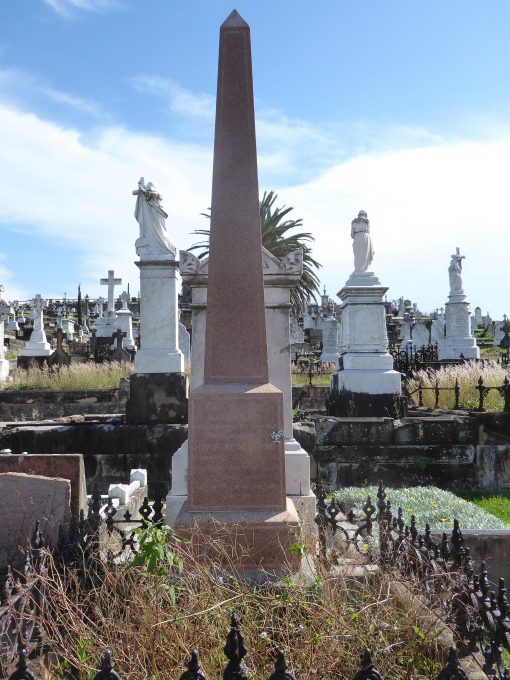
Funeral location: Presbyterian portion of Waverley Cemetery
Buried at: Presbyterian portion of Waverley CemeterY
General Vault, Section 16
Memorial at: ?
JAMES IS mentioned on the Police Wall of Remembrance
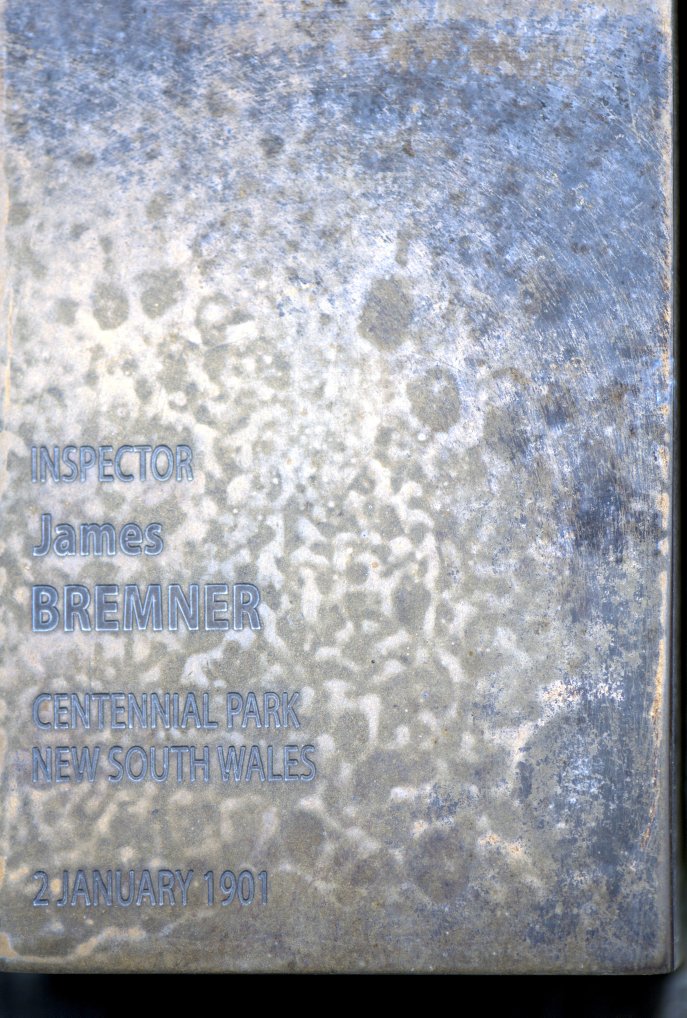
National Police Remembrance Wall Touch Plate
FURTHER INFORMATION IS NEEDED ABOUT THIS PERSON, THEIR LIFE, THEIR CAREER AND THEIR DEATH.
The inspector was knocked down and killed by a military horse during Commonwealth of Australia celebrations at Centennial Park, Sydney ( 1 January 1901 ). At the time he was supervising 200 police who were maintaining order amongst a large crowd awaiting the Commonwealth Day Procession. As the procession began, a trooper’s horse took fright and bolted into the crowd. Inspector Bremner was knocked down, sustaining severe spinal injuries. He was conveyed to St Vincent’s Hospital where he died at 2.15am the following morning. He had been due to retire a few weeks earlier but stayed on to assist with the Commonwealth of Australia celebrations.
The inspector was a well-known policeman in Sydney. He had arrived in Sydney from the north of Scotland some 37 years earlier and had almost immediately joined the police (about 1864). He had been the officer-in-charge of No. 3 Division for seventeen years, supervising the police stations at Randwick, Waverley, Botany and Woollahra. He was apparently a huge man of about twenty stone in weight. He left behind a widow but no children.
The Sydney Morning Herald of 4 January, 1901 reported on the very impressive funeral which was afforded the inspector.
FUNERAL OF THE LATE INSPECTOR BREMNER.
The funeral of the late Inspector James Bremner, who died at St Vincent’s Hospital on Wednesday from injuries received in the discharge of his duties during the swearing in ceremony of the Governor General at the Centennial Park on the previous day, took place yesterday afternoon. The interment was made in the Presbyterian portion of Waverley Cemetery. The cortege left the late residence of the deceased, 264 Bourke Street, at 3pm. The popularity and respect in which the deceased officer was held were marked by the large presence of all classes of the community, who assembled at the place of departure and along the whole line of route. Moreover, numerous evidences of mourning were displayed throughout Oxford Street. At Darlinghurst Law Courts voluntary guards of honour were formed by the bandsmen of the Irish Rifles and St George s Regiment, who were playing in the neighbourhood. Opposite Marshall’s Brewery a number of blue-jackets who were returning from the review lined up and saluted the coffin as it passed. Passing Centennial Park the same tribute of respect was paid by the troops encamped there…
The inspector was born in 1841 and joined the New South Wales Police Force about 1864. At the time of his death he was the Officer-in-Charge of No.3 Division (Darlinghurst).
Francis William GRUNDY
| 25/10/2012
William Francis GRUNDY
New South Wales Police Force
Constable
35 old
Horse Accident
Holbrook
20 March, 1898
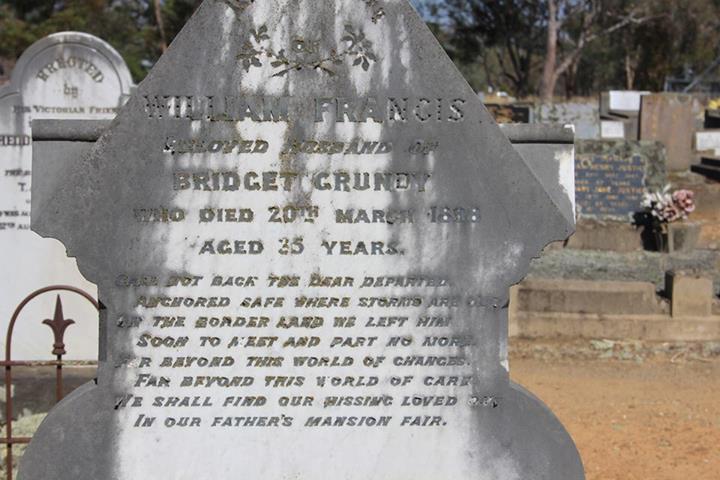
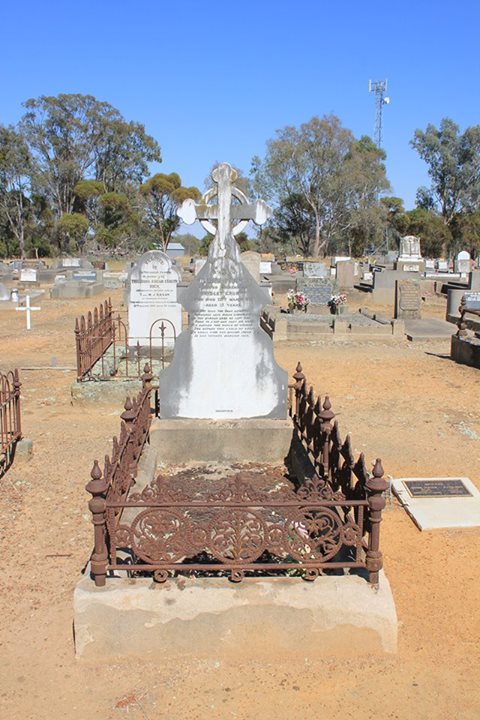
Grave Stone of Constable William Francis GRUNDY – Holbrook Cemetery, NSW. Photos courtesy of Ken Medway via Beyond Courage FB page – 13 Jan 2014
Inscription reads:
[blockquote]
‘Care not back the dear departed Anchored safe where storms are o’er On the border land we left him Soon to meet and part no more Far beyond this world of changes Far beyond this world of care We shall find our missing loved one In our Father’s mansion fair’.
[/blockquote]
Grave Stone of Constable William Francis GRUNDY – Holbrook Cemetery, NSW.
The constable was critically injured when he fell from his horse about 18 miles from Holbrook on the 15 March, 1898. He was later found by the Tarcutta mailman and taken to Holbrook in an unconscious condition, where he passed away on the 20 March 1898. The Argus newspaper of 1 April, 1898 carried the following brief story. ALBURY, Thursday. An inquest was held yesterday at Germanton into the circumstances attending the death of Constable Grundy, who succumbed to injuries received by a fall from his horse. Allegations were made that the Deceased was compelled to ride a horse which had fallen with him on other occasions. The evidence of the officer in charge of the Germanton Station to a great extent bore out the allegations. He stated that the horse was notoriously unsafe, and that Grundy had complained that it would break his neck some day. When advised to report the animal he said that it was no use doing so as he would only get another just as bad. Deceased was thrown off the horse while proceeding at night along a road beyond Germanton, he then being in search of sheep stealers. The superintendent of police gave evidence denying that the horse was unsafe. He admitted that the horse was timid and required careful handling. A verdict was recorded that Deceased met his death by injuries received by being thrown from his horse. At the time of his death the constable was stationed at Germanton (now Holbrook).
James MORRISON
| 25/10/2012
James MORRISON
AKA ?
Late of Moama
New South Wales Police Force
Regd. # ‘Q‘ 3661
For the purposes of this website ‘Q’ represents those Police joining between 1862 ( commencement of NSWPF ) – 23 February 1915 ( Commencement of NSWPF current numbering system )
Rank: Constable – appointed 15 March 1880
Final Rank = Senior Constable
Stations: ?, Deniliquin – Lockup Keeper ( ? ? ? – 1891 ), Moama ( 7 years ) – Death
Service: From? ? 1880?to 19 January, 1898 = 18 years Service
Awards: No find on It’s An Honour
Born: ? ? 1857 – Victoria
Died on: Wednesday 19 January 1898 about 11.30am
Age: 40
Cause: Illness – Depression – Suicide – Firearm
Event location: inside Moama Police Station, NSW
Event date: Wednesday 19 January 1898 about 11.30am
Funeral date: Thursday 20 January 1898
Funeral location: Moama Cemetery
Wake location: ?
Funeral Parlour: ?
Buried at: Unmarked & Unknown grave location within Moama Cemetery
Memorial located at: ?
[alert_red] JAMES is NOT mentioned on the Police Wall of Remembrance[/alert_red] * BUT SHOULD BE
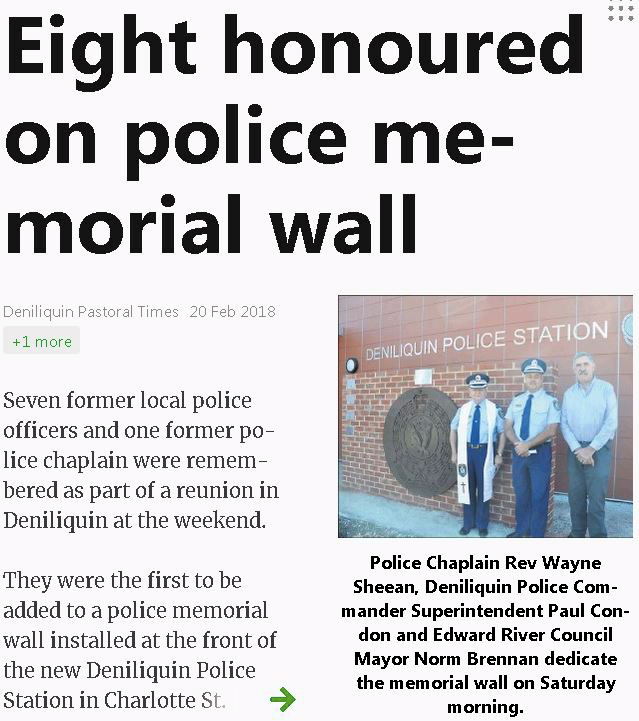
[alert_pink] JAMES IS mentioned on the Memorial Wall, Deniliquin Police Station – 2018[/alert_pink]
[divider_dotted]
FURTHER INFORMATION IS NEEDED ABOUT THIS PERSON, THEIR LIFE, THEIR CAREER AND THEIR DEATH.
Little is known of the death of Constable Morrison other than the following brief newspaper extracts. The Dubbo Liberal and Macquarie Advocate of 22 January, 1898 printed the following.
SUICIDE OF A CONSTABLE.
A wire from Deniliquin dated Wednesday says, “A telegram was received today announcing the suicide of Senior Constable Morrison, of Moama. The Small Debts Court was being held when the news was received by Mr. N. C. O’Neill, P.M., and he immediately adjourned the case on account of having to proceed to Moama to conduct an inquest. The news caused quite a sensation locally, as Morrison, who was previously lockup keeper at Deniliquin, was always regarded as a zealous officer. No cause is assigned for the deed.
The Camperdown Chronicle of 22 January, 1898 also reported on the death, as follows.
A CONSTABLE’S SUICIDE AT MOAMA.
At halfpast 11 on Wednesday morning a report reached Echuca that Senior Constable Morrison, in charge of the Moama police station, had shot himself. Dr. Eakins was quickly on the spot, but pronounced life to be extinct. Deceased was highly esteemed in the police department, having been 18 years in the force. He was 40 years of age, and had been stationed at Moama for seven years. He leaves a wife and family of eight children, the eldest being 14 years of age. Deceased was on duty in the morning and appeared to be in good spirits until informed of the terrible accident which had befallen Mr. Miller, manager of the Bank of New South Wales, when he seemed greatly depressed. He, however, spoke to his wife, appeared rational, and started doing his office work. Suddenly his wife heard the report of firearms, and rushing in found her husband lying on the floor, with his rifle beside him. The bullet had gone into the mouth and blown the top of the head off.
At the time of his death the constable was aged about 40 years and is thought to have joined the New South Wales Police Force about 1880. He was stationed at Moama.
So far, I have not found any information as to what the initial ‘J‘ stands for ( in relation to his Christian name ).
In NSW State Archives – Registers of Police, there is a James MORRISON – # ‘Q’ 3661 who was born in 1857 in Victoria and appointed to the Police on 15 March 1880.
It is very possible that this James MORRISON is the J. MORRISON in this Memorial Post but that, at this time, has not been confirmed.
BUT the below article from the NSW Government Gazette # 558, page 4964, dated Tues 21 July 1896, throws another angle to this story – naming MORRISON as having the Christian name of William – 2019
Further research finds an Erratum in the NSW Government Gazette, issue 616, page 5375, dated Fri 7 Aug 1896
New South Wales Government Gazette (Sydney, NSW : 1832 – 1900), Friday 7 August 1896 (No.616), page 5375
ERRATUM.
WITH reference to notification in Government Gazette of 21st ultimo, appointing Senior-constable William Morrison to act as Clerk of Petty Sessions at Moama, — for Senior-constable “William” Morrison read Senior-constable ” James ” Morrison.
Newcastle Morning Herald and Miners’ Advocate (NSW : 1876 – 1954), Friday 21 January 1898, page 5
TERRIBLE DISASTERS. DENILIQUIN , Thursday.
A serious accident happened yesterday to Mr. Peter Millar, manager of the Bank of New South Wales at Moama.
He rode a spirited horse across the Murray Bridge from Moama to Echuca Railway Station, where he saw a friend off by the train. He was about to return to Moama, when his horse became exceedingly fractious, and bolted.
The animal careered madly for some distance, till near the railway crossing, when the saddle shifted to the animal’s withers, and the horse plunged and reared, and threw Mr. Millar on to the road, his head striking the metal, causing concussion of the brain, internal hemorrhage, and paralysis of the left side.
No hopes are held out for his recovery.
Additional particulars are to hand with reference to the suicide of Senior Constable Morrison, of Moama.
Yesterday, on the arrival of the train from Deniliquin, he as usual went to the post office for the morning mail and seemed in the best of spirits. He was informed of the accident to Mr. Millar, with whom he was a close friend, and he immediately became depressed and walked into the police station.
He then took down a Martini-Henry carbine hanging on the wall, and putting the barrel into his month, blew his brains out.
His wife heard the report, and went into the room, where she found her husband dying on the floor, blood and brains being scattered all around.
Morrison had been at Moama for seven years, and altogether eighteen years in the police force.
Deceased was 40 years old, and leaves a wife and eight young children.
Yesterday morning the inquiry, commenced the previous afternoon at the Police Court building, Moama, before Mr N. o. O’Neill, coroner, was resumed.
On the previous afternoon Dr. Eakins‘ testimony was given.
Yesterday the following evidence was called:
Janet Morrison, widow of the deceased, gave evidence to the effect that she last saw her husband alive on Wednesday morning, about 11 o’clock. He was then in the office at the police station. He arose that morning at about half-past seven o’clock, but had no breakfast – only a cup of tea. About a quarter past 10 he went out, when he seemed very low spirited. A few minutes before 11 he returned to the office. Witness did not then notice anything peculiar about her husband, except that he was very low spirited. She did not speak to him about it. He seemed to be in trouble, but had made no complaint to her about it.
She left the office to make him a cup of cocoa, leaving him alone. She then heard the report of a firearm and, rushing back, found that her husband had shot himself.
She ran outside in search of help and saw a man named Barber, who accompanied her back to the office. The doctor was then sent for. There was no domestic unhappiness of any sort. Deceased was a good husband and father. Deceased, who was 40 years of age, left eight children, but was not possessed of any means,
George Thomas Barber, a farmer, residing near Moama, stated be had been acquainted with the late Senior-Constable Morrison.
On Wednesday he was driving past the police station at about 11 o’clock, when he saw Mrs Morrison run out. She called out to him, and he sprang over the fence and went in. He found deceased lying on the floor, with the rifle lying alongside of his body. The bullet had passed through his mouth, cutting his lip, and had gone out of the top of his head. Deceased’s hat was lying on the floor with the crown blown out, and the pugaree lying alongside. Witness ran across and told his mother, who lived nearly opposite, and got her to go down to aid Mrs Morrison. He then sent Henry Howard for the doctor. As there was no constable at the station he drove over to the look-up and acquainted Constable Flood. He had seen deceased several times lately, but he had not seen him under the influence of drink.
William James Martin, Justice of the Peace, stated he had seen the dead body of the late Senior-Constable Morrison.
He last saw him alive at about 25 minutes to 11 o’clock on Wednesday morning in Meninya street, opposite Chanter, Martin and Co.’s office. Just as he arrived witness and Mr Charles Opitz spoke to him about an accident which had occurred to Mr Miller. The deceased seemed to be rather cut up about the accident. They then dispersed, but, later on, witness and Mr Opitz again met, when it was remarked that deceased was not looking the same that morning as usual. When he last saw deceased he was going in the direction of the police station.
It seemed to him (witness) that deceased had a worried look. He was not so bright in conversation, and seemed dull. He had known deceased for nearly seven years. Of late – during the past 12 months – he had not been so steady in his habits as previously. It was even more noticeable during the past three months. To his (witness’) knowledge deceased had been drinking more than he should have during the past week. Other wise he bore a very good reputation. He knew of no domestic troubles and, speaking from outside judgement, he never saw a father who seemed to look after his family better. He did not know anything about his financial position.
Constable Schweicher, stationed at Moama, said he last saw deceased alive near the Federal store, opposite the Bridge Hotel, shortly before eleven o’clock. Witness spoke to him when he appeared to be despondent on account of Mr Miller‘s accident.
When he left witness deceased went towards the police station. During the past few days witness noticed that deceased was worrying or fretting over something. He was not quite positive on this point, but he imagined that there was something peculiar about him. Usually he was of a distant and reserved disposition. After parting company with deceased witness proceeded on his way collecting returns. Half an hour afterwards he received a message to go to the barracks and he immediately went then. On arrival he saw the body lying on the floor of the office. Deceased was lying fully dressed, with his head against the wall and with fresh blood on his hands and face. Dr Eakins was then present.
The regulation rifle ( produced ) was lying on his right side. It had stains of blood on it. The empty cartridge ( produced ) had been taken out of the rifle by Dr Eakins and it was lying alongside the weapon. The hat ( produced ) with the top blown out, was also found on the floor. The bullet had, apparently, gone through the ceiling of the office.
He had known deceased for the last three years, but had only known him intimately for the last eight months — since he had been stationed at Moama. He searched the body and the office, but found nothing leading to the belief that suicide was contemplated.
This concluded the evidence and the coroner found that deceased met his death by injuries to the brain and skull inflicted by a bullet.
Yesterday afternoon the remains of the deceased were interred in the Moama cemetery, when a large number of citizens of Echuca and Moama paid a last tribute to one who had been held in such great respect in life. The Rev. J. C. Johnstone, M.A., conducted the funeral ceremony, and, in speaking of deceased at the grave, referred to his good qualities in life. The utmost sympathy was felt towards the bereaved widow and family.
One of the most painful features of the sad case is that the widow and family have been left without adequate means of support. The Mayor of Moama ( Ald W. J. Martin ), who was an intimate friend of the deceased, on finding out the condition of affairs, at once took steps to help the bereaved family in their misfortune and has inaugurated a subscription fund. It is his intention to appeal to the country friends of the deceased as well as to those who reside in Echuca and Moama. The following donations have already been made :- Chanter, Martin and Co., £2 2s; Dr. Eakins, £2 2s ; C. L. Blair, £1 1s; W. Milledge, £1 1s; D. McLaren, senr., 10s 6d ; P. Mackey, 10s 6d. The Mayor of Moama will be pleased to take charge of further subscriptions..
New South Wales Government Gazette (Sydney, NSW : 1832 – 1900), Tuesday 21 July 1896 (No.558), page 4964
[633] Department of Justice,
Sydney, 20th July, 1896.
HIS Excellency the Governor, with the advice of the
Executive Council, has been pleased to appoint the undermentioned Officers of the Police Force to act as Clerks of Petty Sessions at the places specified in connection with their respective names, namely:—
Sergeant Charles Earskin Parker, Camden;
Senior-constable William Morrison, Moama;
Sergeant James McIntosh, Murrumburrah
Senior-constable Thomas Johnson, Nundle;
Sergeant Alfred Percy Young, Nymagee
Senior-constable John McNeely, Richmond;
Senior-constable Henry Edgar Ferris, Trunkey,—
to take effect from the 16th instant.
Senior-sergeant Alfred Amos Sykes, Berrima;
Sergeant William Tennent Moss, Crookwell j
Senior constable William Payne, Swamp Oak,
— to take effect from the date of commencing duty.
About four o’clock yesterday morning Senior-Constable Morrison, of Moama, brought to the hospital a man named John Turner, who was suffering from severe burns.
Dr. Smith was quickly in attendance and he found that the patient had been burned along the right arm, the hip, and side, whilst his face was also badly seared. He stated that he went to sleep by a fire at his camp, close to the Murray bridge, and during the night a log from the fire rolled on him. His cries attracted attention, and Senior-Constable Morrison was informed. He found Turner in great pain and with the least possible delay had him placed under medical care. The wounds, though not dangerous, are of a most painful character, and will be some time before the man can leave the hospital.
Age (Melbourne, Vic. : 1854 – 1954), Friday 19 April 1895, page 6
CHARGE OF HORSE STEALING.
ECHUCA, Thursday.
A man named McKenzie, alleged to be an old offender, was arrested by Senior Constable Morrison, of Moama, yesterday, on a charge of horse stealing. McKenzie called at the police station and offered to sell the constable a fine looking draught horse for 30s. The price asked was so low that Morrison became suspicious, and having read an account of a similar animal having been stolen from a Mr. Patrick O’Loughlin, of Myers Flat, near Bendigo, he detained the vendor.
Sending a telegram to Eagle-hawk, he soon after received a reply giving a description of the horse stolen. As this tallied with the appearance of the horse in the yard, he arrested McKenzie, and soon found that he was an old offender, well known to the police, having served several sentences for similar offences.
His last appearance was before the Echuca court.
McKenzie was brought before the Moama court this morning and remanded to Eaglehawk.
Constable Thomas Foss, ( ‘Q’ 5448 ) who has been stationed at Moama for a long time, has received promotion, and it is expected that he will leave Moama on Thursday next. Constable Foss will take charge of a station at Hatfield, near Balranald. During his stay in Moama he has gained many friends.
A little boy, a son of Senior-constable Morrison, of Moama, met with a serious accident on Thursday. Whilst playing in the yard the little fellow fell, striking his forehead against a piece of wood. No particular notice was taken of the accident at the time. Towards Friday morning, however, the condition of the child became worse, necessitating medical assistance.
HENRY IS mentioned on the Police Wall of Remembrance
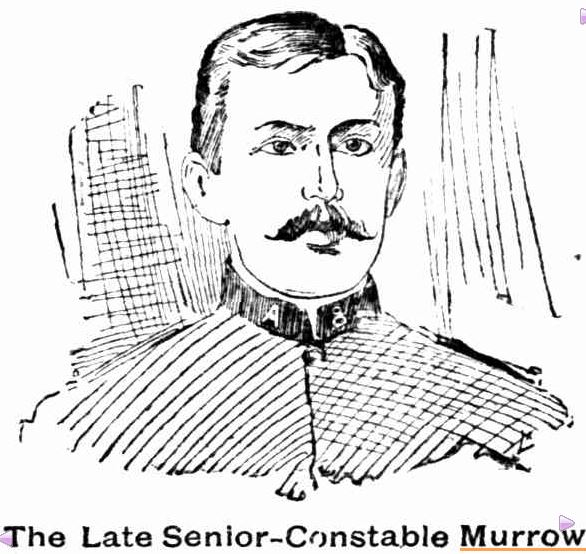
On 4 October 1897 Constable Murrow attempted to arrest a man by the name of Daniel Conway in the vicinity of Argyle Street, The Rocks. During the scuffle the constable fell to the ground, heavily striking his head. Taken to the Sydney Hospital and treated for what was thought to be merely a scalp wound, the constable was allowed to return to his home. Later that night he became very ill and died. It was subsequently found that he had suffered a fractured skull. Although Conway was charged with murder he was later convicted of manslaughter and sent to gaol.
The Sydney Morning Herald of 7 October, 1897 described the constable’s inquest and funeral, concluding with the following:
The funeral of the deceased took place yesterday afternoon. The procession, which included 160 members of the police force in uniform and a number of Freemasons, left the deceased’s late residence, at 117 Underwood Street, Paddington, shortly before 3 o’clock, and proceeded to Waverley Cemetery, where the interment took place. The coffin was covered with floral tributes. The Police Band played the Dead March en route. At the grave a special Masonic service was read, as well as the usual burial service. Amongst the officers of the department who were present were Superintendent Head, Inspectors Bremner, Potter and Lawless, and Sub-inspectors Scott and Elliott. In the funeral procession there were also a large number of civilians.
The senior constable was born in 1861 and joined the New South Wales Police Force on 9 June, 1883. At the time of his death he was stationed at Phillip Street Police Station, Sydney.
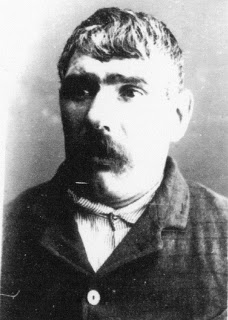
Figure 9. Daniel Conway, photographed in 1897 at Darlinghurst Gaol for the manslaughter of Constable Henry Murrow of No 4 Station. (NSW State Records NRS 2138, photo 7218)
Police death in the course of duty
Senior Constable Henry Murrow (1869–1897) of No 4 Station died from an injury received on duty. Born in England, Murrow had settled with his parents in New Zealand where he joined the New Zealand Police Force before moving to Sydney and joining the NSW Police Force in 1883.
On 4 October 1897, Murrow, while on duty in The Rocks was hailed by Jane Jones, publican of the Orient Hotel who was having trouble with a drunken patron, Daniel Conway. Jones asked Murrow to move Conway along. This he did, requesting that Conway go home. Conway left with another man, walking south along George Street, closely followed by Murrow, as witnessed by George Howlett. Nearing the Port Jackson Hotel (now the Russell Hotel) on the corner of Globe Street, Conway’s companion was swearing, at which point Murrow overtook them and clasped his hand on the man’s shoulder. This resulted in a fight during which Murrow struck his head on the woodblock paving of George Street. Howlett intervened, helping Murrow to his feet. Conway then fled back towards Argyle Street and Howlett assisted Murrow to the nearby No 4 Police Station.
Murrow was escorted to Sydney Hospital where wound was dressed. It appeared to be minor so Murrow was dismissed. Meanwhile Conway was delivered into the custody of water police Constable William Cleugh who took him to the Water Police Station in Phillip Street where he was charged with assaulting Morrow while he was on duty.
At 10.30pm at his home at Paddington, Murrow lost consciousness and died around 12.30am. Doctors were summoned and determined that he had concussion, an autopsy confirmed it. Conway, was charged with murder but convicted on the lesser charge of manslaughter and sentenced to six months hard labour at Darlinghurst Gaol.[9]
[9] Daily Telegraph, 7 and 8 October 1897
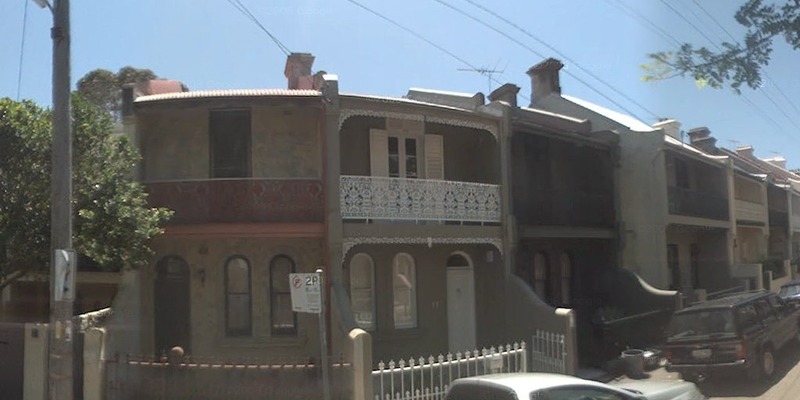
117 Underwood St, Paddington. Home of Senior Constable Henry MURROW when he was murdered in October 1897.
[divider_dotted]
Goulburn Evening Penny Post Thursday 7 October 1897 page 2 of 4
THE DEATH OF CONSTABLE MURROW.
The City Coroner, Mr. J. C. Woore, J.P., on Wednesday initiated an inquest into the circumstances touching the death of Senior-constable Henry Murrow. A somewhat painful scene occurred when the witnesses were called in to see the body identified. Mrs. Murrow, widow of the deceased, was present to identify the body, and when Daniel Conway, the young fireman, who attended the inquest in custody, was brought in a fit of uncontrollable indignation took possession of the bereaved woman, and she tried to get at close quarters with Conway. Evidence was then taken.
Caroline Barbara Murrow stated that deceased was her husband, was a native of England, and 32 years of age. He left three children, and no property. At 9.30 a.m. on the 4th instant he left home in his usual health to go on duty. He was home again about half-past 8 on the evening of that day, and when she came in at that time after having been out all day she found him lying on the bed in an unconscious condition and bleeding from a wound in the head. She applied carbolic oil to the wound, and bandaged deceased’s head. Dr. Walton Smith was sent for, and remained with her husband until he died. Dr. Quaife was also present at the time of his death.
Dr. Rennie, who in conjunction with Dr. Jameson had made a post-mortem examination of the body, stated that he found a star-shaped cut about 2in. in length on the back of the head. The cut penetrated to the bone, but the skull was not fractured. On opening the skull he found a large clot of blood compressing the left side of the brain, which was lacerated, and it was to this laceration of the brain that death was due.
Similar evidence was given by Dr. Jameson.
Dr. Smith stated that he was called in to see deceased on the night of the 4th instant, and at once came to the conclusion that he was dying, and suggested a consultation. Dr. Quaife was sent for, and together they saw deceased about 10.45 p.m. The took two stitches out of the scalp wound and found that there had been no fracture of the skull.
Jane Jones, a widow, and licensee of the Orient Hotel, corner of Argyle and George streets, ( The Rocks, Sydney ) stated that on the 4th instant, at about 12.45 p.m., she called deceased’s attention to the fact that Daniel Conway, the man in custody, was causing her annoyance. Murrow told Conway to go home, and the two went away in the same direction, Conway being about 10 yards in advance of Murrow. She did not see what happened subsequently.
George Howlett, a fireman employed on the steamship Echuca, stated that he saw Murrow following Conway and another man, and when deceased put his right hand on the latter’s shoulder Conway struck him twice. Deceased struck the other man and knocked him down. The latter then got up and ran away. Murrow then closed with Conway and tried to handcuff him. Conway struck him in the face and tripped him up. Deceased fell in the roadway, and his head struck the ground. Conway got up and ran away. In answer to Conway witness said that he saw deceased strike Conway after the latter had struck him.
Dr. W. H. Harris stated that he stitched the wound in deceased‘s head, but did not consider it serious enough to justify his detaining the man in the hospital. Murrow told him that he had slipped on an orange peel at Circular Quay. The inquest was then adjourned till 10 o’clock next day.
The funeral of the deceased took place in the afternoon. The procession, included 160 members of the police force in uniform and a number of Freemasons.
An inquest was commenced this morning at the United Service Hotel, Oxford-street, Paddington, on the body of Senior-Constable Henry Murrow, who died from injuries received near Circular Quay on Eight-hour Day.
Daniel Conway, who is alleged to have assaulted the constable, was present in custody, charged with having caused the death of Murrow.
Caroline Barbara Murrow stated that deceased was her husband, and resided with her at 117 Underwood-street, Paddington. He was 32 years of age, and left three children.
Dr. Rennie deposed that, in company with Dr. Jamieson, he yesterday afternoon made a post-mortem examination of the body. He found a star-shaped wound at the back of the head, extending about two inches in either direction, down to the bone. There were no other external marks of violence on the body. A large clot of blood beneath this wound was compressing the left side of the brain, and that side of the brain was lacerated. There was no fracture of the skull. The cause of death was laceration of the brain and compression of the brain by the blood-clot described.
Dr. Sydney Jamieson gave corroborative medical testimony. (Proceeding) .
An inquest was commenced this morning at the United Service Hotel, Oxford-street, Paddington, on the body of Senior-Constable Henry Murrow, who died from injuries received near Circular Quay on Eight-hour Day.
Daniel Conway, who is alleged to have assaulted the constable, was present in custody, charged with having caused the death of Murrow. Caroline Barbara Murrow stated that deceased was her husband, and resided with her at 117 Underwood-street, Paddington. He was 32 years of age, and left three children.
Dr. Rennie deposed that, in company with Dr. Jamieson, he yesterday afternoon made a post-mortem examination of the body. He found a star-shaped wound at the back of the head, extending about two inches in either direction, down to the bone. There were no other external marks of violence on the body. A large clot of blood beneath this wound was compressing the left side of the brain, and that side of the brain was lacerated. There was no fracture of the skull. The cause of death was laceration of the brain and compression of the brain by the blood-clot described. Dr. Sydney Jamieson gave corroborative medical testimony. (Proceeding.)
The inquest into the circumstances surrounding the death of Senior-constable Henry Murrow, who died on Monday night from injuries received while endeavoring to arrest a man near Circular Quay on that day, was resumed this morning at the United Service Hotel, Oxford Street, Paddington.
James Codd, grocer, living at 17 Market-street, said that he met deceased at about 11 o’clock on Monday morning, and remained with him until about half-past 12. During that time they had one drink each. He was perfectly sober. After warning two men about whom, he had received a complaint at the Orient Hotel deceased walked towards the station. On the way an altercation took place with Conway ( the man before the court ). Conway struck deceased, who returned the blow. They then closed and fell together, the constable being underneath. His feet seemed to slip from under him. Witness was about ten yards away at the time. Deceased tried to rise, but fell back, and blood came from his mouth. Conway ran towards Argyle Cut. Prior to Conway striking the constable the latter placed his hand on the shoulder of the other.
Charles Nolan, draper, at 247 George-street, deposed to running after Conway when the constable fell. He called to him to stop. Conway did so, and came back towards witness. Two members of the water police were in sight, and witness hailed them, and told them what had occurred. They took Conway to No. 4 Station.
Constable James Finn took deceased to the hospital. Witness described the attention which Murrow received there. After remaining ten or fifteen minutes deceased walked out, gave his address to the cabman, and proceeded home. Witness saw no blood issue from the mouth of deceased.
To Conway: I told the doctor at the hospital what deceased told me as to the cause of the injury. Deceased told me that he went to arrest a man, when another man came up, struck him, and knocked him down on the back of his head on the blocks. During the progress of the inquiry the accused Conway, who is a powerfully built fireman, and who gave his age as 26, cross-examining the various witnesses to show that he received provocation from the deceased. He appears to be deaf, and held his hand to his ear while the evidence was being tendered, apparently only half understanding the proceedings. When the answers to his questions were, not satisfactory, he hinted at the witnesses making false statements.
The taking of evidence was concluded at noon, and the coroner having briefly summed up, the jury retired to consider their verdict.
The City Coroner, Mr. J. C. Woore, J.P., on Wednesday initiated an inquest into the circumstances touching the death of Senior-constable Henry Murrow. A somewhat painful scene occurred when the witnesses were called in to see the body identified. Mrs. Murrow, widow of the deceased, was present to identify the body, and when Daniel Conway, the young fireman, who attended the inquest in custody, was brought in a fit of uncontrollable indignation took possession of the bereaved woman, and she tried to get at close quarters with Conway. Evidence was then taken.
Caroline Barbara Murrow stated that deceased was her husband, was a native of England, and 32 years of age. He left three children, and no property. At 9.30 a.m. on the 4th instant he left home in his usual health to go on duty. He was home again about half-past 8 on the evening of that day, and when she came in at that time after having been out all day she found him lying on the bed in an unconscious condition and bleeding from a wound in the head. She applied carbolic oil to the wound, and bandaged deceased’s head. Dr. Walton Smith was sent for, and remained with her husband until he died. Dr. Quaife was also present at the time of his death.
Dr. Rennie, who in conjunction with Dr. Jameson had made a post-mortem examination of the body, stated that he found a star-shaped cut about 2in. in length on the back of the head. The cut penetrated to the bone, but the skull was not fractured. On opening the skull he found a large clot of blood compressing the left side of the brain, which was lacerated, and it was to this laceration of the brain that death was due.
Similar evidence was given by Dr. Jameson.
Dr. Smith stated that he was called in to see deceased on the night of the 4th instant, and at once came to the conclusion that he was dying, and suggested a consultation. Dr. Quaife was sent for, and together they saw deceased about 10.45 p.m. The took two stitches out of the scalp wound and found that there had been no fracture of the skull.
Jane Jones, a widow, and licensee of the Orient Hotel, corner of Argyle and George streets, stated that on the 4th instant, at about 12.45 p.m., she called deceased’s attention to the fact that Daniel Conway, the man in custody, was causing her annoyance. Murrow told Conway to go home, and the two went away in the same direction, Conway being about 10 yards in advance of Murrow. She did not see what happened subsequently.
George Howlett, a fireman employed on the steamship Echuca, stated that he saw Murrow following Conway and another man, and when deceased put his right hand on the latter’s shoulder Conway struck him twice. Deceased struck the other man and knocked him down. The latter then got up and ran away. Murrow then closed with Conway and tried to handcuff him. Conway struck him in the face and tripped him up. Deceased fell in the roadway, and his head struck the ground. Conway got up and ran away. In answer to Conway witness said that he saw deceased strike Conway after the latter had struck him.
Dr. W. H. Harris stated that he stitched the wound in deceased’s head, but did not consider it serious enough to justify his detaining the man in the hospital. Murrow told him that he had slipped on an orange peel at Circular Quay. The inquest was then adjourned till 10 o’clock next day.
The funeral of the deceased took place in the afternoon. The procession, included 160 members of the police force in uniform and a number of Freemasons.
Benefits of Life Insurance.— One of the last acts performed by Constable Murrow before meeting with the injuries which caused his violent death at Circular Quay on Monday evening was the payment by him on Saturday last of the premium, then overdue, upon his life policy for £200 with the Mutual Life Association of Australasia. Strangely enough the policy had lapsed through non-payment of premium on the 1st of August but, thanks to the practice of the Mutual Life Office, a special letter was written to Murrow on the 14th ultimo, strongly urging him not to allow so valuable a provision for his family to be lost.
On 2nd instant, as above stated, the conditions necessary for reinstating the policy were complied with by the deceased, with the result that the general manager ( Mr. J. C. Remington ) has caused a notification to be sent to the widow that the amount of her late husband’s assurance is available immediately the necessary legal documents are forthcoming.
Mrs. C. R. MURROW, Paddington, desires to express her sincere THANKS to her late husband’s comrades and her many friends for their kind sympathy, floral wreaths, letters of condolence, &c., kindly sent her in her late sudden bereavement.
CHARGE OF MURDER. CONSTABLE MURROW’S DEATH. CONWAY ON TRIAL.
Daniel Conway, a fireman, was placed upon his trial before his Honor Judge Stephen at the Central Criminal Court this morning, the charge against him being that of having wilfully murdered Henry Murrow, a senior-constable in the police force of New South Wales, upon last Eight Hour Day. The case for the Crown, as stated in counsel’s opening address, was that Murrow had endeavored, while on duty in George-street North, near Circular Quay, to arrest a man who, it is alleged, was making use of indecent language. The prisoner, Conway, was in this man’s company, and offered resistance to the officer, who then endeavored to effect his arrest. A struggle ensued, in which both men fell to the ground, the constable being underneath. Murrow’s head struck the roadway with some force, and he lay there unconscious. Accused rose, looked at the prostrate man for a second or two, and then ran away. He was subsequently arrested.
Murrow was taken to the police station, and thence to the Sydney Hospital. He afterwards went home, but died the same night from laceration of the brain tissues, caused by the injury received.
Conway, who pleaded not guilty, was defended by Mr. J. C. Gannon, instructed by Mr. Mark Williamson. Mr. C. G. Wade prosecuted on behalf of the Crown.
James Codd, a grocer, stated that he had known deceased for about six years, and was in his company on the morning of last Eight-hour Day for about an hour and a half before the alleged assault. During that time they had one drink at an hotel. Murrow was perfectly sober. Witness saw accused assault deceased, who was endeavoring to arrest his mate.
George Howlett, a fireman of the steamer Echuca, stated that he was in George-street North on the day in question, and heard a man using indecent language. A constable endeavored to arrest him when accused, who was in the offender’s company, struck the officer. The senior-constable, Murrow, then released the first man, striking him at the same time, and turned his attention to accused, who hit him in the chest. Murrow put his hand behind him with the evident intention of disengaging his handcuffs, when Conway again hit him, tripping him at the same time. Murrow fell, and lay there insensible. (Proceeding.)
At the Central Criminal Court Daniel Conway was charged with the murder of Henry Murrow, constable of No. 4 Station. Murrow was making an arrest near the Quay, when Conway, it was said, interfered, and the officer was thrown, dying from laceration of the brain. The jury returned a verdict of manslaughter, with a strong recommendation to mercy. Mr. Justice Stephen sentenced Conway to six mouths with hard labor.
MURROW—WALSH. — April 24, 1889, at Holy Trinity Church, Argyle-street, Sydney, by the Rev. Cecil King, Henry, eldest son of W. H. Murrow, of Napier, New Zealand, to Carrie Barbara, youngest daughter of the late Nicholas Walsh, of Argyle-street, Sydney.
MURROW-In loving memory of my dear husband, Henry Murrow, who was accidentally killed in Lower George street, 4th October, 1897, whilst in the execution of his duty.
MURROW.- In loving memory of my dear husband and our father, Senior countable Murrow, who died from injuries received whilst in the execution of his duty, October 4th, 1897. Inserted by his loving wife and family, Caroline B Murrow.
MURROW-EVANS.- March 12, 1925, at Holy Trinity Church, Orange, by the Rev. Canon Taylor, Mr. Albert H. S. Murrow, only son of the late Henry Murrow, of Paddington, to Miss Nellie Evans, youngest daughter of Mrs. A. Evans, of Sydney.
For the purposes of this website ‘Q‘ represents those Police joining between 1862 ( commencement of NSWPF ) – 23 February 1915 ( Commencement of NSWPF current numbering system )
Stations: Goulburn, Araluen, Braidwood Lock Up Keeper – Death
Awards: No find on It’s An Honour
Service: From 13 April 1892to 15 November 1895 = 3+ years Service
Born: ? ?1870 – Wallsend
Died: Friday 15 November 1895
Age: 24
Cause: Suicide – Firearm – Service issue – right temple
Inquest date: Saturday 16 November 1895 during the afternoon
Funeral date: Sunday 17 November 1895
Funeral location: Graveside service by Rev. J.S. Dobson
Buried at: Braidwood General Cemetery, Uabba Rd, Braidwood, NSW
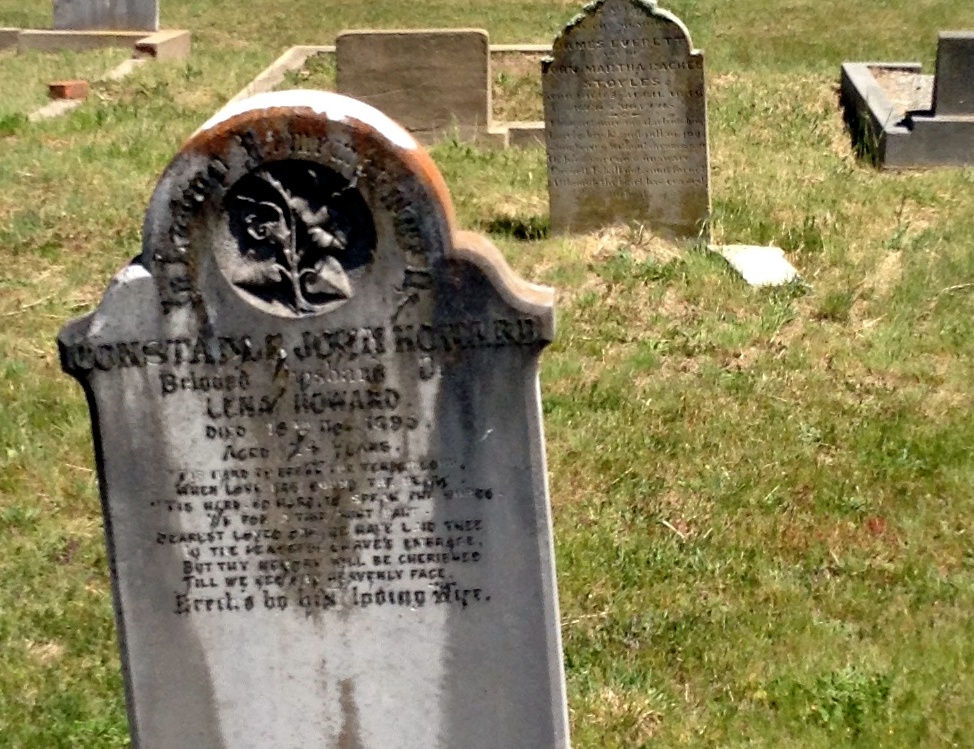
There are 2 entries in the Braidwood General Cemetery index both with the same date of death. 1st is Constable John Howard, age 24, C of E, Headstone. 2nd is John Howard, age 24, C of E, Unmarked.
INSCRIPTION: In ? Constable John HOWARD Beloved husband of Lena HOWARD Died 15 th Nov 1895 Aged 24 years Line: ? Line: When love Line: Tis Line: ? Line: Dearest ? ? ? ? laid there Line: By the ? ? ? Line: But thy ? will be ? Line: Till we ? Line: Erected by his loving wife
[alert_red]John is NOT mentioned on the Police Wall of Remembrance[/alert_red]
Grave location:
The following article appeared in the South Australian Register of 16 November, 1895.
SUICIDE OF A CONSTABLE – Sydney, November 15.
Constable John Howard shot himself at Braidwood in unusual circumstances today. He was the plaintiff in a slander case against A. Graham and claimed £200 damages. Damages amounting to a farthing were awarded, and Judge Fitzhardinge remarked that according to the evidence the plaintiff had no character to lose. Howard at once returned to the barracks and shot himself.
At the time of his death the constable was stationed at Braidwood.
A shocking tragedy occurred at Braidwood on Friday, when Constable John Howard shot himself through the right temple with a police service revolver.
Howard was the plaintiff in a slander action against A. Graham, which was heard at the District Court on the same morning ; £200 damages were claimed.
A large amount of evidence was taken, and the Judge gave a verdict for the plaintiff, with one farthing damages without costs.
His Honor explained that, although there was no truth in the particular slander complained of, he must find for plaintiff. Yet the evidence of another witness, who admitted certain matters in connection with Howard, was such that he could not give damages.
After the case Howard walked out of the court, and went to the police barracks. There he met the black tracker in charge of the constables’ room, and told him to tell his wife the result of the case.
Howard apparently shot himself immediately afterwards.
On the black tracker‘s return with the message from Mrs. Howard to her husband to come to her, he found the constable lying on the floor with the revolver beside him. Death was instantaneous.
Howard had charge of the lockup, which is about seventy-five yards from the scene of the tragedy.
Kiama Independent, and Shoalhaven Advertiser (NSW : 1863 – 1947), Tuesday 19 November 1895, page 4
A CONSTABLE SHOOTS HIMSELF.
A painful sensation was caused at Braidwood on Saturday by the suicide of Constable John Howard under peculiar circumstances.
At the District Court, before Judge Fitzhardinge, Howard had sued a local resident for alleged slander, claiming £200 damages.
During the hearing of the evidence some disclosures were made against Howard‘s character, and his Honor commented adversely on his conduct.
A verdict for plaintiff for one farthing damages without costs, being returned.
Howard immediately left the courthouse, walked to the barracks, a short distance away and apparently took a loaded six chambered revolver from the armoury, and fired it into his temple, blowing out his brains, and dying instantly.
The deceased had sent the black tracker, who saw him last, on a message.
The tracker returned in a few minutes, and found Howard lying on the floor dead, with the revolver beside him.
Horsham Times (Vic. : 1882 – 1954), Tuesday 19 November 1895, page 4
SINGULAR SUICIDES.
Constable John HOWARD shot himself at Braidwood, N.S.W. under unusual circumstances on Friday.
He was plaintiff in an action for slander against A. Graham, and claimed £200 damages. Damages amounting to a farthing were awarded.
Judge Fitzhardinge remarking that according to the evidence the plaintiff had no character to lose.
Howard at once left the court, sent a message to his wife announcing the result of the case and shot himself.
At the inquest the following letter, written by the deceased just before he died, was read :
“To My Darling Wife, Children, Mother, and all at Home. – I cannot face the world after what has come out today. Forgive me for what I am about to do. Good-bye to all. J.H.”
A very high character was given to the deceased by his superior officer, and no complaints have ( says the Argus ) ever been made against him here.
Goulburn Evening Penny Post (NSW : 1881 – 1940), Saturday 16 November 1895, page 2
Suicide of a Constable at Braidwood.
BRAIDWOOD, Friday. – A shocking tragedy occurred here to-day, when Constable John Howard shot himself through the right temple with a police service revolver.
Howard was the plaintiff in a slander action against Albert Graham ( a local resident ), which was heard at the District Court this morning; £200 damages were claimed.
A large amount of evidence was heard.
His Honor explained that, although there was no truth taken, and the Judge gave a verdict for the plaintiff, with one farthing damages without costs, in the particular slander complained of, he must find for plaintiff. Yet the evidence of another witness, who admitted certain matters in connection with Howard, was such that he could not give damages.
After the case Howard walked out of the court, and went to the police barracks. There he met the black tracker in charge of the constable’s room, and told him to go and tell his wife the result of the case.
Howard apparently shot himself immediately afterwards. On the black tracker‘s return with the message from Mrs. Howard to her husband to come to her, he found the constable lying on the floor with the revolver beside him. Death was instantaneous.
Howard had charge of the lookup, which is about seventy-five yards from the scene of the tragedy. The affair has created quite a sensation.
Howard leaves a widow and two young children.
[ Deceased was stationed in Goulburn about two years ago, and married a Miss McKenzie, who was employed at Bryant’s Hotel.] –
An inquest was held this evening by Mr. J. W. Bunn, the coroner, on the body of Constable Howard.
The jury returned a verdict that the deceased shot himself while temporarily insane.
In his pocket was found the following letter written previous to his committing the rash act :- ” To my darling wife and children, mother, and all at home. — i cannot face the world after what has come out to-day. Forgive me for what I am about to do. Good.bye to all. – J.H.”
A very high character was given him by his superior officers, and no complaints were ever made against him during the four years he was in the police force.
It was mentioned in the evidence that deceased was of a very sensitive disposition.
He was a native of Newcastle, where his parents reside.
Constable John Howard, who shot himself at Braidwood on Friday, was a native of Wallsend, where his parents still reside.
Prior to joining the police, a little over three years ago, he assisted his father, who is a dealer, and was also a member of the 4th Regiment.
He had an unblemished record, and in a measure owed his appointment to the police force to the excellent recommendation given by ex-Sergeant Grennan ( Regd # Q 1350 ), the officer then in charge of the Wallsend station.
The officer under whom he served also gave him a very high character, stating that no complaints were ever made against him during the time he was in the force.
At the inquest which was held by Mr. J. W. Bunn, the coroner, the jury returned a verdict of suicide while temporarily insane.
The following pathetic note was found in the deceased’s pocket : ” To my darling wife and children, mother, and all at home. I cannot face the world after what has come out to-day. Forgive me for what I am about to do. Good-bye to all. J.H. ”
Goulburn Evening Penny Post (NSW), Thu 21 Nov 1895,
Page 2
The Funeral of the late Constable Howard.
The funeral of Constable Howard took place on Sunday afternoon last. No better indication of the esteem in which the deceased was held in the town
and the deep sympathy which was felt for his widow and children in their terrible bereavement could be found than the large attendance which assembled to pay their last tribute of respect to his remains.
The gathering was representative of every interest in the community. Not alone in this direction did public feeling find expression, but numerous wreaths and crosses were forwarded by many people in the town whose pulse had been deeply moved by the distressing circumstances under which the deceased met his
death.
Mr. Howard, senr., who resides at Wallsend, in the Newcastle district, where he is in business, and a sister and two brothers of Mrs. Howard were the chief mourners.
They arrived in town on Saturday morning, and, as may readily be imagined, were deeply shocked at the distressing nature of the tragedy which had cast such a gloom over the town.
The coffin was borne to and from the hearse by two of Constable Howard’s late comrades, who by the way selected the site for the grave in the Church of England portion of the cemetery.
The Rev. J. S. Dobson conducted the service at the grave in a most impressive manner, and at its conclusion briefly addressed the large assemblage, referring to the exceptionally sad circumstances under which they had met together, and expressing his warmest sympathy with the heart-stricken widow and fatherless children in their sad bereavement.
The rev. gentleman dwelt warmly on the circumstances which led to Constable Howard’s death. He said he owed his death to the vile breath of slander, which had blasted more reputations and caused more misery and heartburnings than could ever be repaired.
He earnestly exhorted those present to keep their tongues from lying and slandering and their minds from evil thinking, in other words, he said, people should mind their own business.
If every one of them, he added, had every one of their little errors and sins they had committed placarded on their backs or proclaimed from the housetops, there were none who would not hang their heads in shame. The rev. gentleman went on to refer to the deceased as a capable and zealous officer, a man who always did his duty, however unpleasant it might be to his feelings, fearlessly and intelligently, and had earned for himself not only the respect of his superior officers, but the esteem of all respectable townsmen.
He had made a mistake-and all were liable to make mistakes-but he would say to them in the words of our Blessed Master when He was rebuked by the multitude for speaking words of comfort to the adultress, “Let him who is himself without sin cast the first stone.”
The stone at the grave was a most impressive and pitiful one.
The widow of the deceased utterly collapsed, and during the course of the church service and Mr. Dobson’s subsequent remarks, numbers of women wept freely, while tears bedimmed the eyes of not a few of the male portion of the large crowd, whose hearts were touched by the inexpressibly sad circumstances under which John Howard parted with this life.
The members of the deceased’s family must have derived a large amount of satisfaction-if indeed it is possible to experience such a feeling under circumstances of such a melancholy character-from the fact that they unquestionably had the heartfelt sympathy of the large crowd assembled round the grave.
IN addition to the particulars given in our last, we gather the following details from the Braidwood Dispatch.
The action in the district court tried on Thursday before his Honor Judge Fitzhardinge was brought by deceased, John Howard, constable of police, stationed at Braidwood, to recover from Albert Graham the sum of £200 damages for slander.
Mr. Ross for plaintiff and Mr. Davidson for defendant, who pleaded not guilty and justification.
The slander consisted of statements alleged to have been made to the effect that the plaintiff had pulled a girl about and that he had had to square the matter with her father for £10. In her evidence the girl denied that this had occurred, and plaintiff also denied it.
Statements in relation to plaintiff’s conduct towards other girls came out in evidence, but formed no portion of the charge of slander.
One of these girls, aged sixteen, admitted that Howard had seduced her; this he denied.
The judge in giving his verdict said he was quite satisfied that the evidence of the witnesses in Araluen as to the statements Graham made concerning plaintiff and the girl Casey were substantially correct.
Nothing had been shown in the evidence that defendant’s statements were true, and consequently it could not have been in the public interest for Graham to retail this spicy gossip to a meeting of ladies in Araluen.
He consequently had to find a verdict for plaintiff.
With regard to the question of the damage which plaintiff’s character had sustained by the publication of this scandal, he regretted that he had no hesitation in coming to the conclusion from the evidence of the girl Carlon, which was to be believed and which had to be forced from her, that plaintiff had no reputation.
Though he would have to find a verdict for plaintiff he would allow only one farthing damage, without costs.
The following are the particulars of the tragedy itself :
The court was occupied till about half-past eleven o’clock bearing the suit. After the judge gave his decision Howard walked to his quarters at the lockup at the rear of the courthouse.
His wife, who had been suffering great mental anxiety over the case, was lying on her bed taking a rest. Howard sat down beside her. They commenced talking about the case, Howard informing her that the case had gone against him and that he was surprised at the result.
Howard, taking hold of her hand, kissed it, and getting up kissed her face. He then walked out, Mrs. Howard being under the impression that he had gone back to the courthouse. Instead of that he walked to the barracks, some sixty yards away. On Joe Alick, the blacktracker, following him into the room a minute or two subsequently, he found Howard sitting on the corner of the table in the room. Alick spoke to him about the case, and Howard asked him to go and see how his wife was getting on. Alick saw Mrs. Howard, who asked him to go back and tell her husband she wanted him. Alick on his return was horrified to find Howard lying on the floor, apparently dead, with a revolver beside him.
He rushed out and told Constable Clemensha ( most probably Constable Wordsworth CLEMESHA # ‘Q‘ 4655 ) of the occurrence.
Dr. Llewellyn, who happened to be passing was called in and found Howard was dead.
He had evidently taken one of the revolvers from the stand, and placed the muzzle against his right temple, pulled the trigger, and blown out his brains. The bullet entered the temple passed clean through his head and lodged in the wall at the back of him. Death must have been instantaneous.
The following note was found in his waistcoat-pocket:— To my darling wife, children, mother, and all at home, I cannot face the world after what has come out today. Forgive me for what I am about to do. Good-by to all. J.H.
The writing gives a fair indication of the great mental struggle which must have been agitating his brain, an it was not written in nearly so good a hand as he usually writes.
The news created a profound sensation throughout the community.
When the judge was giving his verdict, it could readily be seen that deceased felt his position, keenly-being a sensitive and impulsive man he naturally would-but when he walked out of the Court he did not present the appearance of a man who was going to meet his doom.
The only reasonable assumption is that he became temporarily insane after leaving his wife, and hastily decided to take the course he did.
Universal regret was expressed for Mrs. Howard and her two children, of whom all those who are in a position to know join in saying he was very fond.
The terrible agony Mrs. Howard suffered on hearing of the dreadful occurrence may be more readily imagined than described — also was almost demented, and could not be pacified till she had learned all there was to know.
Howard had been stationed at Braidwood for about fifteen months, coming from Araluen. He was a most painstaking officer, assiduous in the performance of his official duties, courteous and obliging to everyone.
Sub-inspector Langworthy ( possibly William – # Q 1291 ) says that a more zealous officer he had never had under him.
An inquest was held on Friday before the coroner, when a verdict of suicide while laboring under a temporary fit of insanity was returned.
Goulburn Evening Penny Post (NSW : 1881 – 1940), Tuesday 12 May 1896, page 4
BRAIDWOOD.
At the Small Debts Court, on Wednesday, Mrs. Howard, widow of the late Constable Howard, was summoned by Malone Brothers for 30s, coach hire for four passengers to and from Araluen, for which defendant’s husband was alleged to be liable, and through him defendant as executrix of the estate.
A verdict was given for the amount, with 10s costs.
The amount of the claim was defrayed immediately afterwards by a subscription list.
New South Wales Government Gazette (Sydney, NSW : 1832 – 1900), Tuesday 10 April 1894 (No.218), page 2355
THE Bench of Magistrates at Araluen have this day appointed Constable John Howard Bailiff of the Small Debts Court at that place, vice G. Taylor, deceased,— from 2nd instant.
For the purposes of this website ‘P‘ = represents those Police joining Pre 1 March 1862 before the amalgamated of all other Policing Units in NSW. i.e. Mounted Police, Boarder Police, Native Police, Gold Escort Police, Water Police etc.
Rank: Commenced Training as a Probationary Constable – appointed 5 February 1858 ( aged 22 years, 4 months, 15 days )
Constable – appointed 18 February 1858
Constable 1st Class – appointed ? ? ?
Detective – appointed ? ? ?
Senior Constable – appointed ? ? ?
Leading Senior Constable – appointed ? ? ? ( N/A )
Sergeant 3rd Class – appointed ? ? ? ( N/A )
Sergeant 2nd Class – appointed ? ? ?
Sergeant 1st Class – appointed ? ? ?
Final Rank: = Sergeant
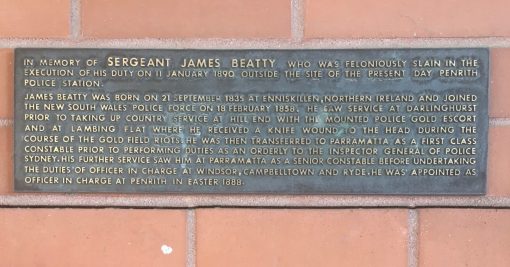
Stations: Darlinghurst ( 3 Division ), Hill End ( Mounted Police gold Escort ), Lambing Flat, Parramatta ( 1st Class Constable ), Orderly to the Inspector General of Police – Sydney, Parramatta ( Senior Constable ), Windsor ( O.I.C. ), Campbelltown O.I.C., Ryde O.I.C., Penrith O.I.C. ( J District )( Easter 1888 – Death )
Service: From 5 February 1858 to11 January 1890 = 31 years, 11 months, 6 days Service
Retirement / Leaving age: = 54 years, 3 months, 21 days
Time in Retirement from Police: Zero
Awards: No Find on Australian Honours system
Born: Monday 21 September 1835 Enniskillen, Northern Ireland
Died on: Saturday 11 January 1890
Age: 54 years, 3 months, 21 days
Organ Donor: N/A
Cause: Murdered – Stabbed – On Duty
Event location: Outside of Penrith Police Station, NSW ( site of the current Station )
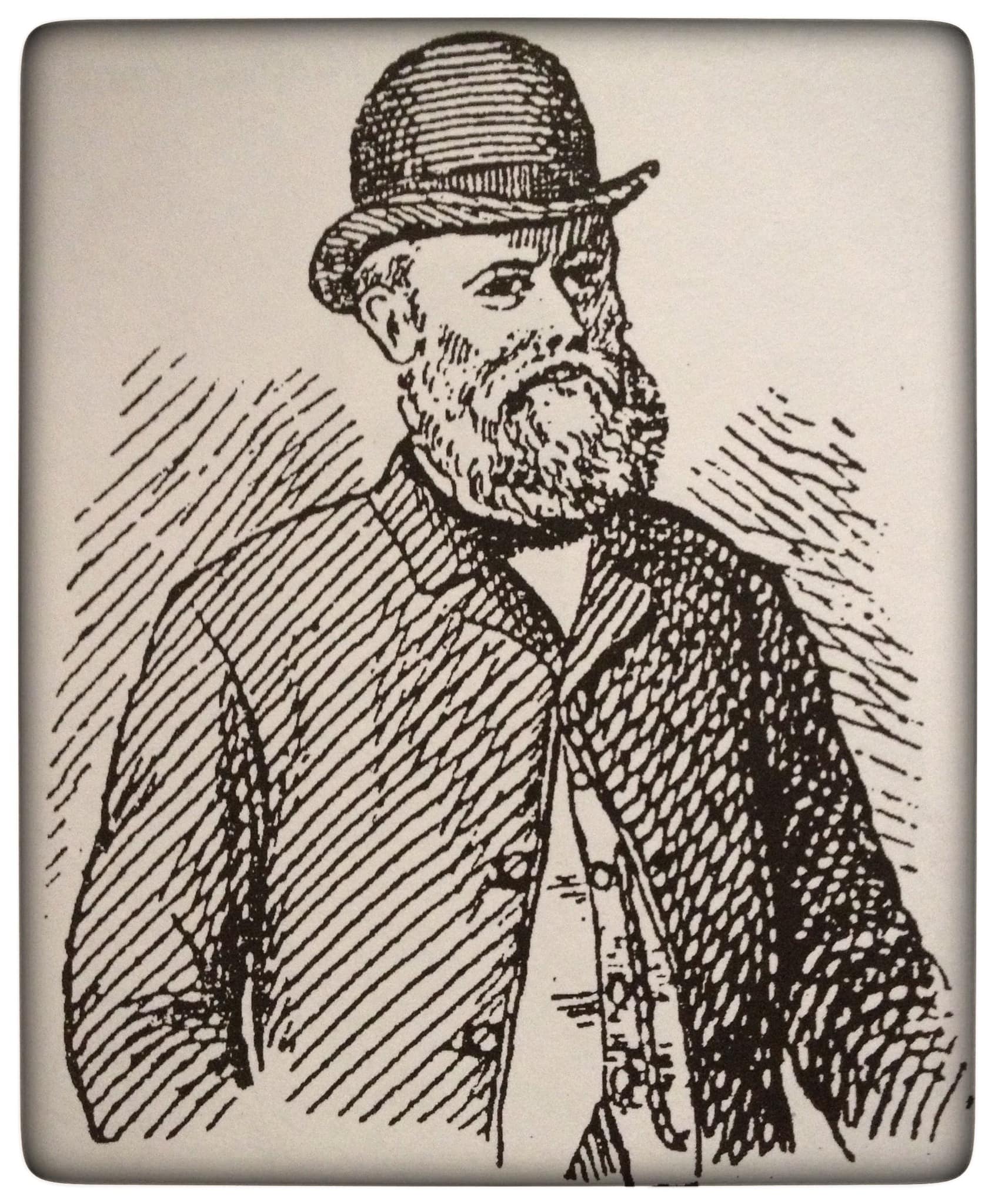
On 11 January, 1890 outside the Penrith Police Station, the sergeant had occasion to speak to an Indian vagrant whom he had earlier asked to leave town.
The man suddenly leapt at Sergeant Beatty, stabbing him five times.
Local people and Constable William Moseley then pursued the offender and cornered him however the man threw a brick which struck the constable in the chest.
Constable Moseley then drew his service revolver and shot the offender, wounding him.
The constable and locals then threw themselves on the offender and he was arrested.
The offender died later that night.
Unfortunately, the wounds inflicted upon Sergeant Beatty also proved to be fatal.
The sergeant was born in 1835 and joined the police force on 5 February, 1858. In 1862 he became a member of the newly-formed New South Wales Police Force. At the time of his death he was stationed at Penrith.
James BEATTY’s mother died five days before his own demise.
James had previously suffered a knife wound to the head during the course of the Gold Field Riots at Lambing Flat, NSW.
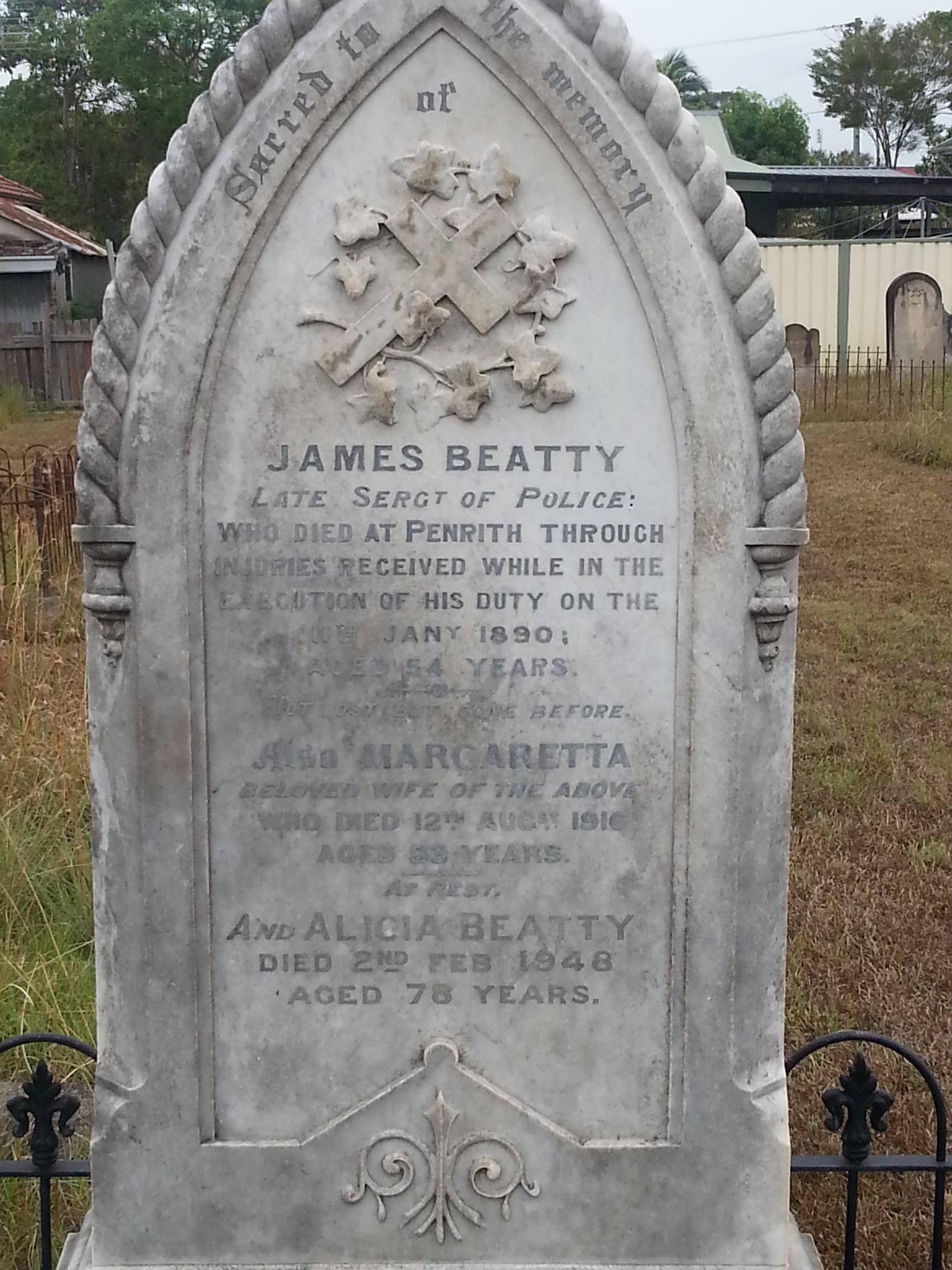
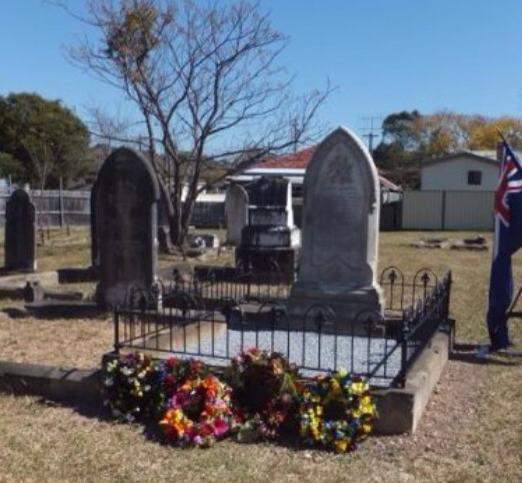
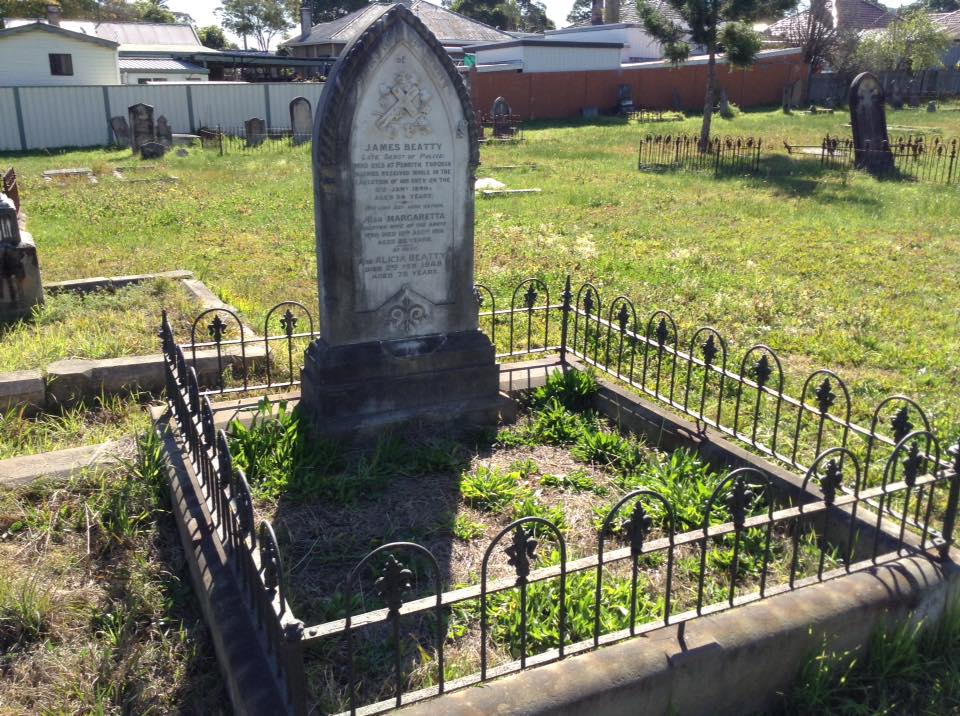
Sgt Beatty’s grave, photo courtesy of Windy Gale – FB
The Launceston Examiner of 11 January, 1990 provided the following news of the tragedy.
TERRIBLE TRAGEDY. A terrible tragedy was enacted this afternoon at Penrith. A coloured man, a stranger in the town, was observed by Sergeant Beatty to be throwing stones at passers-by.
The officer warned him to desist, and was in the act of arresting him when he drew a knife and stabbed Beatty in the chest, the weapon going completely through his body.
Beatty called out, and Constable Mosley came to his assistance, armed with a revolver.
Mosley[Moseley] fired at the coloured man, who was in the act of running away, but missed. A second shot, however, took effect, and the fugitive reeled and was about to fall, when a young man named Zolliner [John Zahnliter] seized him.
Both men rolled over on the street, and the coloured man drew the knife again and stabbed Zolliner.
He was ultimately seized and taken to the lock-up.
Sergeant Beatty, who is not expected to recover, has had his dying depositions taken. Zolliner‘s wound is not serious.
As seen by Col Colman on Friday 28 August 2020 Col Colman Also visited St. Stephens. Anglican Church High Street Penrith and the Cemetery at the rear to visit the grave site of Police Officer James Beatty. Site was cleaned in 2012 by Police and Penrith Council and is in reasonable condition did a little weeding.
Published on Friday, 14 September 2012 06:52 | Written by Mary Thorne | |
On 10th January 1890 Sergeant James Beatty, a long serving officer in the NSW Police Force was fatally stabbed in High Street Penrith. Sergeant Beatty was buried with full police honours in St Stephen the Martyr churchyard cemetery, Fulton Lane, Penrith.
“About 1.30pm on 10 January 1890, Sergeant James Beatty had occasion to interact with an itinerant Cingalese named James in High Street, Penrith outside the Convent of the Sisters of St Joseph. During that interaction the Sergeant was stabbed in the chest.
In the meantime, the offender was contained by townspeople pending the arrival of Constable Moseley who shot the offender. A good Samaritan named John Zahnliter was also stabbed during the melee. Sergeant Beatty died of his wound on the evening of 11 January 1890. He was survived by his widow Margaretta, four sons and two daughters.”
St Joseph’s Convent, High Street Penrith (now Officeworks)
Penrith City Council Library Local Studies collection
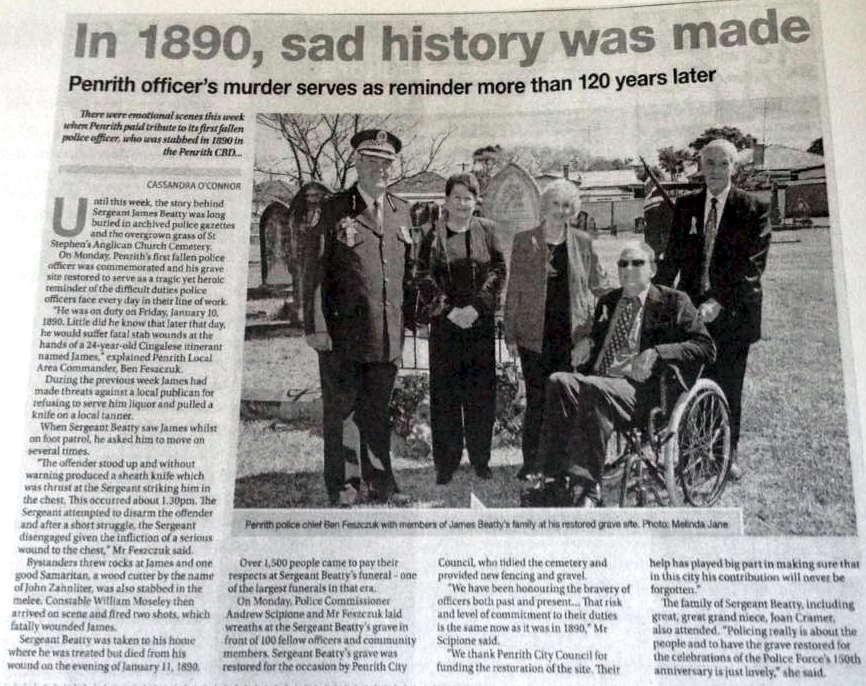
On 3rd September, 2012, as part of the 150th Anniversary of the NSW Police Force, a commemorative service was held at Sergeant Beatty’s gravesite to honour his sacrifice, the event a joint venture between Council and Penrith Local Area Command.
Sergeant Beatty’s monument was in a dilapidated and damaged state. Council arranged and funded the restoration of the monument to its former glory by master stonemasons, Monuments in Memoriam who are based at Rookwood Necropolis. All restoration work was in accordance with the National Trust of Australia (NSW) Guidelines for Cemetery Conservation, the Burra Charter and Penrith City Council’s LEP.
Since 1982, Penrith City Council has been the trustee of this significant churchyard cemetery which dates from 1838 with full responsibility for its care and maintenance. The Public Domain Amenity and Safety two man cemeteries crew, maintain five cemeteries, Penrith, St Marys, Emu Plains, Castlereagh and St Stephens.
In preparation for the occasion an intensive clean up of the cemetery took place with staff from the City Presentation Group – Parks, Public Domain and Cemetery Operations spending a day in the cemetery. The heritage nature of the cemetery and fragility of the monuments meant that whipper snipers could not be used and all trimming around and inside monuments was by hand.
Fragile heritage cemeteries are protected by the grasses that grow around and inside the monuments. Plans of Management are currently being prepared for the cemeteries under Council’s control and the consultant’s recommendation for St Stephens is that we should avoid overly detailed or manicured works. The Cemetery should look old, avoid pristine maintenance and maintain the wild character of the grasses within the grave enclosures.
The commemorative service to honour the memory of Sergeant James Beatty was attended by Andrew Scipione APM, Commissioner of Police, Nick Kaldas APM, Deputy Commissioner of Police (Field Operations), Ben Feszczuk APM, Local Area Commander, former Commissioner of Police, Tony Lauer APM, Hon David Bradbury MP, Stuart Ayres MP, Beatty family descendants, Councillor Greg Davies, Mayor of Penrith, Councillor Ross Fowler OAM, Alan Stoneham, General Manager, Barry Husking, Director, David Burns, Group Manager – City Presentation, managers Yvonne Perkins and Barbara McGee, council officers and police personnel.
Mary Thorne, Cemeteries Project Officer
Nepean Times (Penrith, NSW : 1882 – 1962),
Thursday 12 February 1948, page 6
Old Tragedy Recalled
DAUGHTER. OF SERGT. BEATTY PASSES.
Miss Alicia Beatty (68), who died on 2nd inst. and was buried in St. Stephen’s cemetery, Penrith on 3rd, was the daughter of Sergt James Beatty, who was fatally stabbed by a Cingalese in High Street, Penrith, on January 10, 1890, an incident that is often referred to by the older generation of the district.
The story, briefly told, is that the Cingalese had been prowling around the town for a few days and on the day of the tragedy was ” moved on ” by the Sergt, who followed him for some distance. The man then sat down on the pavement near the Convent and Sergt. Beatty, not liking his appearance, again ordered him to clear out.
The Cingalese started to his feet and, without any warning, drew a sheath knife and, rushing in, stabbed the Sergeant in the chest.
A man named John Zahnliter tried to disarm the assailant and was stabbed in the side.
The Cingalese was shot by Constable Moseley.
Sergt Beatty and the Cingalese died subsequently of their wounds, and Zahnliter recovered, though he suffered severe physical disability, for which he received a pension, till his death many years afterward.
Miss Beatty was buried alongside her late father and mother, in the old St. Stephen’s cemetery. Mrs. Beatty died on August 12, 1916.
Cousin to Senior Constable William SUTHERLAND, NSWPF ‘Q‘ “Possibly” 4257 ( born 1854 in Scotland & joined NSWPF on 26 Sept. 1882 ) OR6417 ( BORN 1869 in Scotland & joined NSWPF on 27 May 1892 )
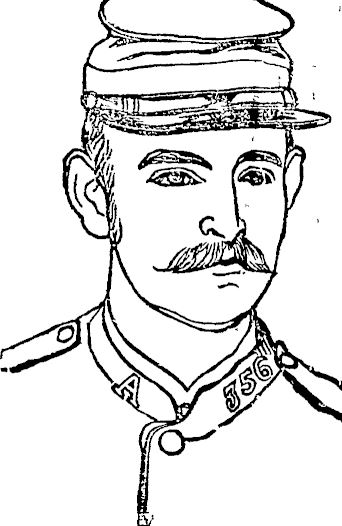
Uniform # A 356
Regd. # ‘Q‘ 5460
For the purposes of this website ‘Q‘ represents those Police joining between 1 March 1862 ( commencement of NSWPF ) – 23 February 1915 ( Commencement of NSWPF current numbering system )
Rank: Constable
Stations: Darlinghurst ( No. 3 Division ) – Death
Service: From 11 October 1887to 3 June 1889 = 1+ years Service
Awards: ?
Born: ? ? 1863 @ Canterbury, New Zealand
Died on: Monday 3 June 1889
Cause: Shot – Murdered
Event location: MaCleay St, Potts Point, NSW
Age: 25 – unmarried
Inquest date: Thursday 6 June 1889
Funeral date: Wednesday 5 June 1889
Funeral location: ?
Buried at: Waverley Cemetery, cnr St Thomas St & Trafalgar St, NSW
Grave Location: C of E, Sec 9, Grave 941
Memorial at: ?
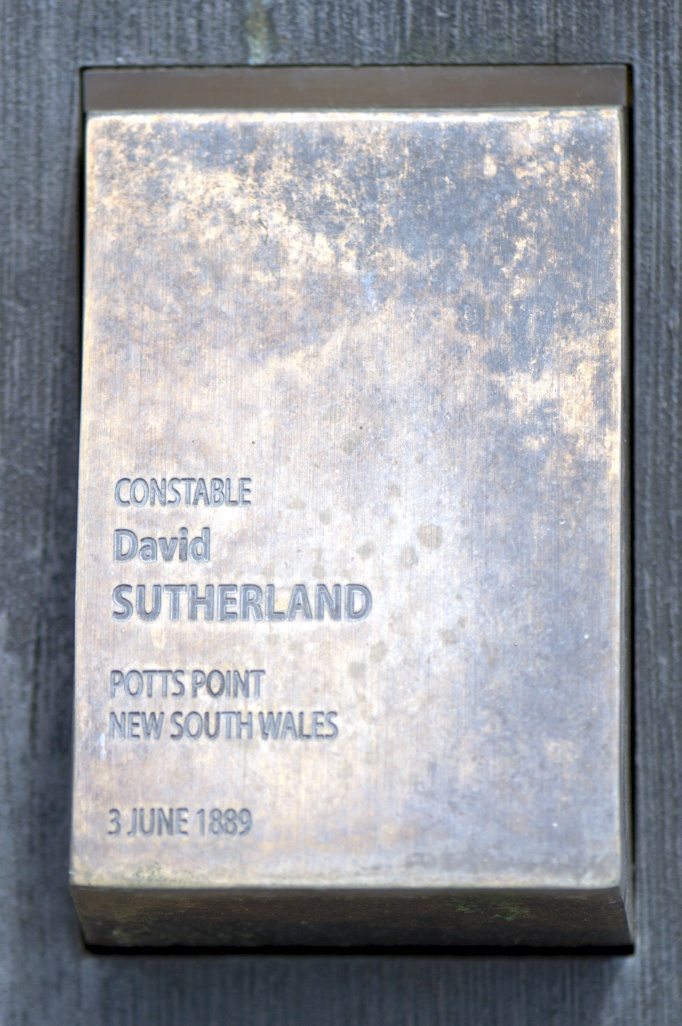
DAVID IS mentioned on the Police Wall of Remembrance
Touch plate at the National Police Wall of Remembrance, Canberra
Funeral location: ?
FURTHER INFORMATION IS NEEDED ABOUT THIS PERSON, THEIR LIFE, THEIR CAREER AND THEIR DEATH.
About 3am on 3 June, 1889 the constable was patrolling MaCleay Street, Potts Point when he saw a man enter a yard and walk to the rear of a dwelling. He detained the man a short time later as he left the premises and spoke to him regarding his actions. When the man attempted to leave, the constable took hold of him and again asked what he was doing. The offender told the constable to let him go or he would shoot him. A struggle ensued and when both men lost their balance, the offender shot the constable in the abdomen.
While they were on the ground the offender again fired at the constable who drew his baton and struck his attacker. Constable Sutherland was then able to take the revolver from the offender, but as he was quickly losing his strength due to his wounds, the offender quickly retrieved the weapon and escaped. He was very soon arrested by Senior Sergeant Robertson and Sergeant Hogan.
Constable Sutherland died later that day, however not before providing his colleagues with a dying deposition and a positive identification of his attacker, John Morrison.
This death was a major factor which led to the general arming of Sydney Police in 1894. Previously, country and mounted police had always been armed, but the Sydney foot police for some reason had not.
The constable was born in 1863 and joined the New South Wales Police Force on 11 October, 1887.
At the time of his death he was stationed at Darlinghurst.
David SUTHERLAND was identified by his Cousin, Constable William SUTHERLAND after the murder.
William SUTHERLAND was later to be murdered in 1901 by a ‘kosh’ on the head.
Evening News ( Sydney ) Monday 3 June 1889 p5 of 8
POOR SUTHERLAND WAS INSURED.
Mr. G. F. Murnin, resident secretary of the Australian Widows’ Fund, 263, George-street, informs us that Constable David Sutherland, who was murdered this morning, was insured for £250, the policy having only been taken out in April last.
The inquest on the body of Constable David Sutherland, who was shot by a burglar at Potts Point, was commenced yesterday afternoon.
The prisoner, James Morrison, was in custody, handcuffed.
There was a crowded court.
Morrison is a powerful fellow, 28 years of age, and the mark of a heavy blow over the left eye is still visible.
Constable William Sutherland identified the body as that of his cousin. He was a native of Canterbury, New Zealand. He was a single man. His mother, three sisters, and four brothers were living there.
Medical evidence showed that the bullet severed the main artery of the groin.
Benjamin Backhouse, architect, residing at Potts Point, deposed that he was awakened by the reports of a shot. On hearing the second shot, he also heard cries for help. He then saw a man running away. The man was of similar appearance as prisoner. A fence over which the man scrambled was examined afterwards and showed blood marks.
Further evidence similar to that reported already was also given.
The inquiry is still proceeding.
Melbourne, Wednesday.
The Melbourne police have identified the photograph of James Morrison, who is charged with the murder of Constable Sutherland, as that of a man known to them as Jackson, who has recently done two and a half-years in Victoria for an impudent forgery.
Goulburn Herald ( NSW ) Thursday 6 June 1889 p2 of 4
THE MURDER OF CONSTABLE SUTHERLAND.
We subjoin further particulars of the tragedy in Macleay-street, Potts Point, reported by telegraph in our last issue: It appears that at about 3 a.m. on Monday, as Senior-sergeant Robertson and Sergeant Hogan were standing at the corner of William and Victoria streets, they saw a man walking towards them. He was proceeding at a very quick pace, and noticing that he was very much excited and out of breath, they stopped him. His trousers, coat, and vest were all smeared with blood, and there was a severe wound over his left eye. While they were questioning him Mr. McElhone junior came up, and said that there was at constable lying on the footpath in Macleay street. The senior-sergeant and Mr. McElbone at once took a cab and went to where the constable was reported to be lying, and in the meanwhile the blood-smeared man was conveyed to the Darlinghurst lookup.
Sutherland ( the constable ) was found lying, as indicated by Mr. McElbone, dangerously wounded, but conscious . He was taken to the hospital, where he was found to be wounded in the abdomen, no hope of his recovery being entertained. Sutherland unhesitatingly identified the man who had been arrested, and who gave the name of John Morrison, as the man who had shot him, and Morrison, who had been brought to the hospital for the purpose of identification, responded, ” Well, it’s wrong of you to say that. I did not shoot you.”
Subsequently the deposition of the wounded man was taken, and he succumbed to his injuries shortly before seven o’clock on Monday morning.
The substance of Sutherland’s deposition was as follows: – At half-past 2 a.m., while the constable was standing near the residence of Mr. C. J. Roberts, Chatsworth, he saw a man enter the gates in front of the adjacent house and pass towards the rear of the premises. After the man had been inside the gates for a minute or two some dogs which were there began to bark, and they continued doing so until the man left and walked into the middle of the road. The constable and the man exchanged a “ good-night ” greeting, and the constable observed, ” you’re out early. ” The man then attempted to make off. The officer, however, caught hold of him, and asked what he was doing. The man replied, “ let me go. If you don’t I’ll shoot you, ” and he immediately thrust his right hand into his trousers pocket. A struggle ensued, and just as they were about to fall the man fired his revolver. Whilst on the ground he again fired. The constable, however, could not say whether the latter shot took effect. Before either of them regained his feet the constable drew his baton and gave the man a severe blow on the head. Owing, however, to his weak state the blow was not as severe as he hoped it would be. The constable, though wounded, wrested the revolver from the man, but as he was very weak the other soon got the better of him, and raising himself, snatched back the revolver, and made off. Whilst the injured constable’s depositions were being taken, the prisoner, who had been brought to the bedside of the wounded man, inquired whether the revolver did not go off accidentally. Replying to this the dying man said, ” no, you pointed it direct at me. ”
The next piece of evidence as to the fatal affray is furnished by Mr. Benjamin Backhouse, a gentleman living close to the scene. He was awakened by a pistol-shot, which was followed shortly after by a second report. He then saw a man running at full speed along Rockwell-street, and at the same time heard loud cries for help. He got out of the house in time to see the man who ran down the street scale the fence at the end of the street, and he became lost to view. He then found the wounded constable and afforded him what assistance he could until the arrival of the police and others.
When the scene of the affray was examined later on, a large morticing chisel was found, and this instrument corresponds with a number of marks on premises in the locality. A six-chambered nickel plated revolver was found concealed in the grass in Mr. McElhone’s paddock, close to where Mr. Backhouse saw the man scale the fence. Four of the chambers were loaded, and the remaining two had been discharged. A third article was also discovered, namely, a cloth tweed hat of large size, which gives colour to the report of the captured man having had an associate.
Constable Sutherland was a young and energetic officer, only twenty-five years of age, and unmarried. He had been about twenty months in the force, and was highly spoken of by his superior officers and comrades. Morrison is also a young man of about twenty-five, stiflly built, and described as a cabinet maker by trade. He is said to be a native of England, and was previously unknown to the police. He has a wound over the left eye, such as would be caused by a constable’s baton. When brought before the police court this morning he made no reply to the charge of murder, and has so far maintained silence as to the part he is supposed to have played. He was remanded to the coroner’s court.
The coroner commenced an inquest on Tuesday, when William Sutherland, a police constable stationed at the Glebe, identified the body of the deceased as that of his cousin David Sutherland, who was twenty-five years of age, and a native of Canterbury, New Zealand. He was a single man. He had left £32 in the Savings’ Bank, Oxford-street, Sydney, and a life policy for £250. Deceased had left a mother and a number of brothers and sisters in New Zealand. Evidence was given in substantiation of the facts above detailed, and the inquiry was adjourned to Thursday.
South Australian Weekly Chronicle ( Adelaide, S.A. ) Saturday 8 June 1889 p21 of 24
THE MURDER OF CONSTABLE SUTHERLAND.
( By Telegraph )
Sydney, June 6.
The coroner’s Inquest relative to the death of Constable David Sutherland, who was shot whilst arresting a burglar at Pott’s Point on Monday morning, was concluded to-day, a verdict of wilful murder being returned against James Morrison, the man who fired the shot.
Morrison will come up for trial at the Quarter Sessions, commencing July 15. Whilst Sergeant Hogan, one of the two officers who arrested Morrison, was giving evidence to-day the prisoner told him that he had better tell the truth. When asked if he had any questions to put to Hogan, Morrison said — ‘ No, your honor. He would only tell lies If I was to. ‘
The coroner, in summing up, said there was a great deal of circumstantial evidence to bear out the statement made by the deceased constable that the fatal shot was wilfully fired. To their verdict the jury added a rider recommending that in future no constables should be allowed to go on night duty in the suburbs or on lonely beats singly, but in pairs, so that in case of emergency they might be in a better position to act. The foreman added that this course would entail an extra expense, but the money would be well spent in the protection thus afforded to life and property.
The Maitland Mercury and Hunter River General Advertiser ( NSW )
Sat. 8 June 1889
Funeral of Constable Sutherland.
The remains of the late Constable David Sutherland, who met his death early on Monday morning by being shot by a burglar, were conveyed to the Waverley Cemetery on Wednesday afternoon, followed by an imposing procession of the police, the military, and sympathetic citizens.
The funeral was timed (reports the Herald) to leave No. 3 Police Station at 2.30, and almost to the minute the coffin was borne to the hearse by the comrades of the deceased. The streets and roads in the vicinity of the station and Darlinghurst prison were blocked up by some thousands of people, and traffic was consequently suspended along Oxford street as far as the Victoria Barracks, and thence at intervals throughout the route of the cortege. The spectacle was one suggestive of the most marked tribute of respect that could have been paid to the deceased. Four mounted troopers headed the Permanent Artillery Band in the march to the cemetery, followed closely by the hearse and two mourning coaches, carrying the relatives of the deceased; then came upwards of 200 constables four deep, with their officers, Mr. Fosbery, the Inspector – General, Mr. Read, the superintendent, Inspectors Anderson, Larkins, McKay, and Camphin, Sub-inspectors Bremner, Potter, Atwill, Cotter, Long, Hyam, and Lawless. The Permanent Artillery under Major Airey and Lieutenant Kyngdon were next in order, with a body of the Permanent Mounted Infantry on foot, together with the Staff Sergeants and Captains Cuthell and Bayly representing the Permanent Staff. A carriage, containing Sir Henry Parkes and Mr. C. Roberts, M.L.A., was followed by the Mayor’s carriage and a large number of vehicles.
The cemetery was reached shortly after 4 o’clock, and some thousands of persons were in waiting to witness the lowering of the coffin into the grave. The Rev. A. Gardiner was the officiating clergyman, and after reading the burial service he asked to be allowed to utter a few sentences touching the impressive and solemn occasion. It was always, he said, a solemn thing to stand about an open grave and reflect how suddenly the summons of death might come, but there were special circumstances surrounding the present bereavement which tended to make it more solemn and impressive. Probably not many who were gathered around the grave had known David Sutherland, but their hearts were touched with sympathy under the circumstances, and they felt it due to his memory to give him that ennobling mark of respect. There was always something sad about the death of a young man just beginning life, with prospects before him such as the deceased had, but there was something very bad in the terrible consequences which led to his death. He died at his post ; he was faithful even unto death, and perhaps the last words that fell from his lips, like Nelson at Trafalgar, were, ” I have done my duty.”
The fidelity and worth of the people of Sydney had been touched on this occasion by the disaster which overcame the deceased, and yet why should they mourn so much for his departure ? Though young, and called away under such circumstances, it should be remembered that he had faith in God and knew that he was going to a better scene ; he had a knowledge of the divine truth, and hoped in Christ. As for his own part, he would ten thousand times rather be David Sutherland that day lying in his grave than the man who was the cause of his death. Two lessons were taught in the death of the deceased, namely, to be faithful to duty, and to do from day to day what was felt to be right, at any cost. It was gratifying to see the people of Sydney so much moved, because it showed that their hearts were on the right side, and they sympathised with the deceased for his resolution and determination to stand at his post at the cost of his life. It was that spirit that distinguished the British nation more than any other. The benediction was then pronounced by Rev. C. F. Garnsey. The coffin was covered with wreaths of flowers. One came from the ladies of Macleay-street, as a tribute of respect, another from the gardeners of Potts Point, and a third from his comrades.
The inquest relative to the death of Police-constable David Sutherland was concluded on June 6th. The jury returned a verdict of wilful murder against the prisoner, James Morrison, who was accordingly committed for trial at the next sittings of the Central Criminal Court.
A rider recommending that in the suburbs and on lonely beats, two constables should patrol together was added. The prisoner appeared to feel his position keenly, and towards the conclusion of the inquiry his agitation became apparent. He never asked a question and only spoke twice, on each occasion denying the veracity of a witness.
Sir Henry Parkes has sent the following letter to the Inspector-General of Police with reference to the late Constable David Sutherland: — ” Sir, — You will be good enough to convey to the members of the police force the expression of my deep regret for the loss which the Government has sustained by the murder of Constable David Sutherland. The highest conduct of man in any station of life consists of the fulfilment of trust and the performance of duty. David Sutherland did his duty to the very death. His steady sense of obligation, and his heroic effort to perform his part when his life-blood was ebbing away, furnish an example which could hardly be excelled in front of the enemy on the battle field. His conduct in life and death reflects highest credit upon the force of which he was a member, and will make his memory respected by all good men. ”
In accordance with the request of the Premier the letter has, under the direction of the Inspector General of Police, been recorded in the Orders, and read on parade at the various stations to all of the metropolitan police force, and was published yesterday in the Police Gazette for the Information of the police generally.
OBJECTION TO ARMING THE POLICE. Sydney, February 5.
The Inspector-General of Police [Fosberry] says that one objection to arming the police with revolvers is that the use of firearms may become too common, and if the public get familiar with the snap of the revolver a similar state of things to that prevailing in the United States may be brought into existence. Concerning the two men injured the constables are improving in health.
The same newspaper on 27 February, 1894:
REVOLVERS USED BY THE POLICE. Sydney, February 26.
Two police had an exciting contest last night at Redfern, when they were arresting four men on a charge of thieving. Directly the constables sought to detain them a rough-and-tumble fight occurred, a number of roughs seeking to enable the suspects to escape. Eventually two of the four men broke away, and the others were on the point of being rescued when the police drew their revolvers and threatened to fire on the larrikins. The presentation of firearms completely cowed them, and the constables succeeded in conveying two of the men arrested to the station. This is the first occasion on which the police have found it necessary to use revolvers since their issue, and had they not been available the constables would have been severely maltreated.
John MITCHELL
| 25/10/2012
John MITCHELL
New South Wales Police Force
Regd. # Q 3302
( For the purposes of this website ‘Q’ represents those Police joining between 1 March 1862 ( commencement of NSWPF ) – 23 February 1915 ( Commencement of NSWPF current numbering system )
Rank: Constable – appointed 27 September 1878
Constable 1st Class- appointed February 1884
Stations: Bathurst, Coonamble – Death
Service: From 27 September 1878 to 13 March 1885 = 6.5 years
Awards: ?
Born: 18 August 1856 in Uig, Ross & Cromarty, Scotland
( This cemetery no longer exists and was turned into a Park around 1970 and the headstones removed. See *below )
JOHN IS Mentioned on the Police Wall of Remembrance
John MITCHELL – National Police Wall of Remembrance, Canberra – 2015
Early in the morning of 12 March, 1885 two prisoners in the lockup at Coonamble overpowered a warder by the name of Michael Langley who had gone into their cell to place leg irons on a third prisoner by the name of Courtney.
He was knocked to the floor and his revolver taken from him.
Hearing the scuffle, Constable Mitchell, acting Gaoler at the time, arose from his bed and ran to the cells to assist.
One of the prisoners, a man named Angel, warned the constable not to come into the cell however Mitchell ignored this and lunged at the prisoner. As he did so he was shot in the chest. He died about 7am the following day.
In a dying deposition given to the Coonamble Police Magistrate on 12 March, Constable Mitchell said, ‘I am acting Gaoler at Coonamble gaol; at about a quarter past six this morning the 12th March inst., I opened the door of the guard room Coonamble Gaol; the Warder just then came into the cell where the convicted prisoners Angel, Thurston, and Courtney were confined; I heard a noise in the cell as if a man was being strangled; I came in and the warder was lying down on the cell floor; Angel was strangling him and Thurston was taking the revolver from him; I made a rush and Courtney knocked me over; Angel then got the revolver and both he and Thurston rushed at the cell door; Angel said “Keep back or I’ll shoot you”; I made a rush to try and get the revolver from Angel when he shot me; they then shut the warder and myself together with Courtney, who did not get away owing to Warder Langley’s threatening to kill him if he moved in the cell and rushed away. “
Both Angel and Thurston managed to escape, however both were later shot to death by police.
James Alfred Courtney, the third prisoner, was later found not guilty of involvement in the murder as he had been found by other police after the murder and escape, still in the cell attempting to assist Constable Mitchell by bathing his wound with cold tea (there was no water in the cell). A recommendation was then made to have his previous sentence reduced.
The constable was born in 1855 and joined the New South Wales Police Force on 27 September, 1878. At the time of his death he was stationed at Coonamble, and had previously been stationed at Bathurst.
The original general cemetery in Coonamble was in operation from 1869 to 1912 when it was deemed to be full and closed to further burials. Many years later (probably around 1970), Council removed the headstones and converted the area into a park.
In the preface to her book, “Coonamble Memorial Wall Pioneer Profiles”, local historian Joan McKenzie explains: “When the old cemetery at the end of Warrena Street was cleared about thirty years ago, a number of headstones were retained and embedded on and around a large mound of earth. In 1993, a Federal Government grant enabled the Shire Council to move those headstones to the cemetery in West Coonamble, which had been established circa 1902. ”
Appropriately, the site chosen by Council to devote to the display of those old stones adjoined the historically significant Sexton’s Hut, erected in 1912. The display was organised into three sections: a covered double-sided memorial wall, a group of sandstone monuments and a group of marble monuments. The work was completed to a high standard and dedicated on 12 September 1993. A list of 611 names of persons whose deaths were registered at Coonamble during the period that the old cemetery was in operation, and known or presumed to have been buried at the old site, was inscribed and mounted on the side of the Sexton’s Hut.
Statue of Constable Mitchell who was shot while trying to prevent the escape from gaol of bushrangers Angel and Thurston in 1885. Front Inscription Dedicated to the memory of Constable First Class John Mitchell. Born Scotland 1856. NSW Police Service 27.9.1878 to 13.3.1885. Shot whilst on duty near this site on 12.3.1885 during the escape from Coonamble lock-up by prisoners, Thomas Angel (alias Hobson) and William White (alias Thurston). Constable Mitchell died from his wounds 13.3.1885 and was laid to rest in the old Coonamble Cemetery. Erected in his honour by the police and citizens of Coonamble and District 12.3.1996. Actual Monument Dedication Date: Tuesday 12th March, 1996 GPS of monument: Lat: -30.952500 Long: 148.388056 Note: GPS Coordinates are approximate. Unveiled by his great grandson.
John Mitchell – Photo Obelisk erected by the Government on the grave of John Mitchell in the old Coonamble Cemetery – no longer in existence.
Bathurst Free Press & Mining Journal ( NSW ) Friday 13 March 1885 page 2 of 4
FRIGHTFUL TRAGEDY AT COONAMBLE.
– * –
A CONSTABLE SHOT.
ESCAPE OF PRISONERS.
( BY TELEGRAPH )
[ FROM OUR OWN CORRESPONDENT. ]
Coonamble, Friday.
A shocking tragedy occurred at Coonamble gaol yesterday morning, in a cell where a prisoner named Angel, who had been sentenced to four years for cattle stealing, another prisoner named Courtney, and a prisoner named Thurstone, who had served a sentence at Berrima gaol, were confined.
When the turnkey ( Warder Langley ) entered to leg iron Courtney and Angel, one of the prisoners pounced upon him, and knocked him down and took his revolver. The turnkey called aloud, when Mitchell, a constable, and formerly of Bathurst, hearing the scuffle, rushed out of bed. The prisoner Angel, who had the revolver, told Mitchell not to dare to come in, Mitchell, however, advanced, and Angel fired. The bullet entered Mitchell’s breast just below the heart, and went right through his body and out at the back. Mitchell at once fell, and the three prisoners made their escape with the revolver.
Five miles from town they pulled a boy off his horse, and the escapees got on to the horse, and galloped into the bush. They have been tracked, and hopes are entertained that they will be soon captured. They are armed with revolvers taken from the gaolers.
The tragic affair has cast quite a gloom over the town.
The warder, Mitchell, is still lingering, but no hopes are held out of his recover.
Later.
On the prisoners getting to the gaol yard, they cut Thurstone‘s irons, leaving the sockets on the legs, and crossed the river at the upper end of the scrub, near the old engine, McMahon’s station. The Police Magistrate and trackers on on their tracks.
Constable Mitchell died at 7 am. to-day. Warder Langley is much prostrated, and quite ill from the effects of the encounter, and will not be able to resume his duties for a time.
The South Australian Advertiser Monday 16 March 1885 page 5 of 8
A good deal of excitement prevails at Coonamble consequent upon the death of Mitchell, the gaolor (sic) of the local prison, from the effects of a wound caused by his being shot at by a prisoner named Angel, who recently escaped from gaol with another prisoner named Thurston.
The men Angel and Thurston, who escaped into the bush, have not yet been tracked, although search parties are in pursuit.
The Government has offered £200 reward for their capture.
The Brisbane Courier Tuesday 17 March 1885 page 6 of 8
The troopers sent out in search of the escaped prisoners Angel and Thurstone, who are charged with the murder of gaoler Mitchell at Coonamble, returned last night without finding any trace of the criminals.
Bathurst Free Press & Mining Journal Tuesday 17 March 1885 page 3 of 4
THE TRAGEDY IN COONAMBLE GAOL.
The following, which is a more detailed account of the shooting of the gaoler, Constable Mitchell, and the escape of two prisoners from the Coonamble gaol, is abridged from the Coonamble Independent : —
After the trial of the prisoner Thomas Angel, at the Quarter Sessions, he, together with two other convicted men, Thurston and Courtney, was locked up for the night in a cell in the gaol.
Thurston had riveted irons on, whilst Angel, who it was surmised was shamming illness, and Courtney, were unfettered.
On the following morning, Mitchell gave orders to the warder to leg-iron Courtney, who was told off to act as cook. The warder was in the act of stooping down to leg-iron Courtney when the three prisoners set upon him, got him down, and endeavoured to strangle him. They seized his revolver in the struggle, leaving him powerless and half stunned. Mitchell jumped into the cell to assist the warder, and it is surmised, was tripped up by Courtney. Mitchell regained his feet and Angel was standing at the cell door with the revolver in his hand, Thurston having gone outside, and Courtney being on the inside.
Angel told the warder that if he (the latter) attempted to stir he would blow his brains out. At this juncture Mitchell jumped from Courtney towards Angel, when the latter deliberately shot at Mitchell. The gaoler fell from the effects of the shot, leaving the warder disabled, and Courtney in the cell. The door of the cell was thereupon bolted by either Angel or Thurston on the outside.
Thurston rushed down the passage with a tomahawk in his hand, and Angel went into the guard room. Angel ran quickly to a Mrs. Canham who was present, caught hold of her by the hand, and wanted to lock her up in a cell. She refused to go, when Angel held the revolver to her forehead. After some parleying, Angel let Mrs. Canham’s hand go, and the two men went through the front door.
Drs. Cortis and Tressider, were quickly in attendance, and upon examination it was found that poor Mitchell was shot in the right breast, the bullet having passed clean through his body, coming out at the lower portion of his back.
From the first the case was pronounced hopeless and the deepest sympathy was evinced for the unfortunate gaoler, his wife, and family.
Poor Mitchell, after lingering until Friday morning, succumbed to the effects of the bullet wound, and his untimely end is universally and deeply regretted. He was a thoroughly efficient officer, esteemed at headquarters, and deservedly respected in Coonamble.
He leaves a wife and children totally unprovided for.
Launceston Examiner ( Tasmania ) Tuesday 24 March 1885 page 2 of 4
A verdict of wilful murder has been returned against the escaped prisoner Angel and his companion Thurston, also against another prisoner who was in the cell at Coonamble Gaol when Warder Mitchell was shot.
The two men have not as yet been re-captured, and the Government have offered £200 reward.
Bathurst Free Press & Mining Journal ( NSW ) Wednesday 25 March 1885 page 2 of 8
MURDER OF ACTING-GAOLER MITCHELL —
The following notice appears in Friday’s Gazette:-
Whereas on the morning of the 12th instant, two prisoners, named William White, alias Thurston and Thomas Angel Hobson, escaped from the Coonamble Gaol ; and whereas one of the said offenders, previous to escape, fired at and mortally wounded Constable John Mitchell, the Acting-Gaoler, who has since died; and whereas at a Coroner’s inquest held upon the body of the said John Mitchell, a verdict of wilful murder was returned against the said offenders, William White, alias Thurston and Thomas Angel alias Hobson, and James Alfred Courteney, who was confined in the same cell with the two prisoners who escaped.
Notice is hereby given that a reward of £200 will be paid by Government for such information as shall lead to the apprehension of each of the said offenders, William White alias Thurston and Thomas Angel alias Hobson.
Description of Offenders. —
White alias Thurston, is 29 years of age, 5 feet 9 inches high, medium build, brown hair and eyes ; a native of New South Wales ; a drover.
Angel alias Hobson, is 27 years of age, 5 feet 9 inches high, dark, beard and whiskers, good looking.
The Goulburn Evening Penny Post Thursday 26 March 1885 page 2 of 6
The Coonamble Outrage.
The Dubbo Despatch regrets to say that the men Angel and Thurston, who escaped from Coonamble gaol, and who have been declared by the Coroner’s jury guilty of the murder of Warder Mitchell, are still at large.
Some information regarding their movements has been gathered by Senior-constable Cusack, of Gilgandra.
On Monday he reached a hut in the warrumbungles, and discovered that the two had been there on the previous Saturday night, Thurston only then got the leg-irons off. He had out the connecting chain, and tied up along each leg the piece of chain. It was not, however, till he reached the hut that he managed to get the rivetted rings off his legs, which were in a fearful condition. They were very much swollen.
Thurston was scarcely able to walk, and several times he had to be carried on his companion’s back. Cusack and other troopers are now hunting the pair in the mountains.
The Government has offered a reward of £200 each for the apprehension of Angel and Thurston.
The following is their description: White, alias Thurston, is 20 years of age, 5 feet 9 inches high, medium build, brown hair and eyes, a native of New South Wales, a drover;
Angel, alias Hobson, is 27 years of age, 5 feet inches high, dark beard and whiskers, good looking.
Courtney, who was also included in the coronial jury’s verdict of murder, arrived at Dubbo on Wednesday, and is now in gaol.
Evening News ( Sydney ) Friday 27 March 1885 page 3 of 8
COWRA. March 25.
The Victim of a Ruffian.— The deepest regret and sympathy were evinced here when it became known that Constable Mitchell, formerly lock-up keeper of this town, had been shot dead by one of the prisoners in the gaol at Coonamble, where he was acting gaoler at the time of his melancholy death.
The deceased leaves a wife — very ill at the time of the occurrence — and two little children.
All the particulars of the case are by this time very well known to our readers, so that we will not state them here.
After the perpetration of the cowardly deed, the murderer and one of his accomplices escaped from the gaol, and have since eluded all attempts at capture. A large reward has been offered for their capture.
Bathurst Free Press & Mining Journal Saturday 28 March 1885 page 2 of 12
THE COONAMBLE TRAGEDY.
The following is the principal evidence taken at the inquest on the body of Acting-Gaoler Mitchell, who was shot by the escaped prisoner Angel: —
Michael Langby states, I am warder at the Coonamble Gaol ; I remember the morning of the 12th inst. Thursday ; about a quarter past six o’clock I knocked at the outer gaol door ; the door was opened by the Acting-Gaoler ; received the keys of the cells from him ; put my revolver on me as usual before I entered the cells ; unlocked the door opened it and went in ; Mitchell was then in the passage but had no arms on him; I knelt down to put the leg irons on the prisoner Courteny; the prisoners knocked me down ; the three prisoners in the cell were Angel, Thurston and Courteny ; I could not see who knocked me down because I was kneeling ; they must have stunned me for I don’t recollect hardly what happened for a few minutes after ; when I came to my senses again I was lying on my back; Angel was at the door of the cell with my revolver in his hand, he pointed the revolver at me and said, ‘ I’ll shoot you dead if you stir ;’ with that the gaoler jumped from the corner of the cell to the door ; Mitchell was then in the cell ; saw the shot fired by the prisoner Angel, it took effect on the gaoler Mitchell in the breast; Mitchell stated in the presence of Courtney that Courteny tripped him up before the shot was fired ; Mitchell fell after receiving the shot ; I heard the prisoners Angel and Thurston outside the cell door for a few minutes ; after the prisoner Courteny made some attempt to move near the door ; I was then standing on my feet as Mitchell received the shot ; the other prisoners did not attempt to rescue Courtney, but left him behind ; when Mitchell was shot Angel, Mitchell, Courtney and I were present ; Thurston had gone out into the passage ; when the prisoner Angel went out, he bolted the door and left Mitchell, Courtney and I in the cell ; Mitchell got up once after he was shot and then fell again ; Courtney wouldn’t let me put the leg irons on ; afterwards put on one of the leg irons, and I believe Constable Newby put the other on; saw the wound in Mitchell‘s breast it was such a one as would be made by a bullet.
By a Juror: It might be a quarter of an hour or 20 minutes from the time the cell door was closed upon me before the police came; can’t say which of the three prisoners took the revolver from me; had my senses when the shot was fired ; I saw Angeldeliver the shot ; knew the prisoners were dangerous characters; my orders are when I have committed men in charge to put on my side-arms or revolver ; when I first saw Mitchell at the cell he was standing behind the door, in the passage ; I think when Mitchell sprang from the cell he was engaged with Courtney ; I don’t think I did sing out for Mitchell ; I might have done so when I was stunned ; I don’t remember doing so.
James Alfred Courtney, a confinee in Coonamble gaol, deposed to Langley‘s coming into the cell to leg-iron him ; somebody gave Langley a shove behind, and knocked him and me over ; it must have been either Angel or Thurston; I was getting up, when Angel hit me in the eye and knocked me down ; I went to get up again when Langley caught me by the throat and Mr. Mitchell rushed into the cell ; he knocked against me, and sent me flying into the corner of the cell ; saw Angel at the door pointing a revolver at Langley ; Mitchell left me and made a rush at Angel, when the latter fired the revolver ; the shot struck Mitchell in the right breast; Mitchell staggered, and I caught him. ( After some words as to the putting on of the leg-irons, witness continued ) : I went and sat down alongside Mitchell; Mitchell said, ” Courtney, get me some water, for God’s sake ;” afterwards bathed Mitchell‘s head with some tea, and then searched and found where he had been wounded ; Mitchell said ” My God, Courtney, I’m dying ;” the sergeant then came to the cell door, walked in, and asked what was the matter, and Mitchell said ” I’m shot;” Mr. Boyd asked who shot him, and Mitchell replied ” Angel;”. the other prisoners did not call out after them — they did not speak to me that I know of ; Mr. Mitchell did not say anything to me when he put his hands on me ; he may have said to me ” You vagabond, you’re as bad as any of them ;” I don’t recollect him saying so ; Mr. Mitchell made no remark about the blood on my neck ; I can’t swear he never mentioned anything about throttling me ; am positive Angel struck me in the face ; I did not know the prisoners were going; I was not assisting or abetting in any way in the escape.
By a Juror : The night before the other prisoners were not sleeping together; did not hear any conversation in the night ; I went to sleep; previous to going to sleep heard Thurston say, ” The mountains would be a good place, or the gulf;” heard Thurston say “Oh, curse these irons.”
By the Coroner: the prisoners did not take me into their confidence at all ; they were strangers to me ; did not assist in taking, nor did I see who took the revolver from Langley ; did not intentionally trip Mitchell; the Gaoler and I were good friends ; he was as good as a father to me ; never struck a blow at Mitchell in anyway ; never heard prisoners planning to escape ; the only thing I heard was Thurston saying one day, ” If he goes to sleep we can get away out of the carriage.”
Harry Tressider, legally qualified practitioner residing in Coonamble, deposed having made a post mortem examination of the body of deceased and as to the cause of death by the bullet wound. ‘The death of Mitchell was consequent upon a gunshot injury.
James Newby, Constable of the Police deposed : I remember Thursday, the 12th inst., on the morning of that day when opening the cell door, heard a great row inside and asked what was up. Saw prisoner Courtney standing in the middle of the floor unironed. Afterwards completed putting on the irons in consequence of Langley‘s being much exhausted; whilst I was putting on the irons Constable Mitchellcrawled over to me on his hands and knees and took hold of me by the hand, I said, ” Who shot you;” the prisoner Courtney said, “It was a cruel b — — y thing of Angel to shoot him like that,”Mitchell said ” You vagabond, you’re as bad as any of them you held the old man’s feet;”Mitchell said, ” When I came in the door was open, they had the old man down and Thurston trying to strangle him, Angel was trying to get the revolver from him, I rushed and struck at Thurston, and when I did this man knocked me down (meaning prisoner Courtney) ; he said we both fell and got our holts in the corner and I throttled him; the next thing I heard, was somebody saying if you move I’ll shoot you; on looking up I saw Tom Angel with the revolver pointing, I jumped up and rushed at him and as I rushed at him I was shot.
Prisoner Courtney was sitting down 3 or 5 feet from me during the conversation which lasted 2 or 3 minutes ; I looked at Courtney‘s neck to see if he had been throttled and I saw three distinct marks as if done by finger nails on his neck and I said, ” You did throttle the wretch. “ I then left and went to the door and saw Warder McGuier ; Prisoner never tried to contradict Mitchell‘s statement about knocking him down.
The dying declaration of John Mitchell, taken before the P.M. Coonamble, 12th March instant. ‘I am acting Gaoler at Coonamble gaol; at about a quarter past six this morning the 12th March inst., I opened the door of the guard room Coonamble Gaol ; the Warder just then came into the cell where the convicted prisoners Angel, Thurston, and Courtney were confined ; I heard a noise in the cell as if a man was being strangled ; I came in and the warder was lying down on the cell floor ; Angel was strangling him and Thurston was taking the revolver from him ; I made a rush and Courtny knocked me over; Angel then got the revolver and both he and Thurston rushed at the cell door; Angel said ” Keep back or I’ll shoot you ;” I made a rush to try and get the revolver from Angel when he shot me; they then shut the warder and myself together with Courtney, who did not get away owing to Warder Langley’s threatening to kill him if he moved in the cell and rushed away. “ After the Coroner’s address to the jury, explaining the law as applicable to the case, a verdict was returned by the jury as follows : ‘ That the deceased John Mitchell came to his death on Friday, the 13th inst., from the effects of a gun shot wound inflicted on him by Thomas Angel, and we also find that William Thurston and James Alfred Courtney were accomplices in the act, and therefore find a verdict of wilful murder against the three of them.’
The Sydney Morning Herald Tuesday 31 March 1885 page 7 of 12
A man was arrested at Granville last evening by Constables Harrison and Wilson on suspicion of being Angel, the Coonamble gaol escapee, who shot Warder Mitchell on the 12th instant. The man corresponds in almost every particular with the description given of Angel. He is very reticent, however, and, in reply to the questions of the police, he merely slated that he was a shearer. He will be brought up before the local Bench to-morrow.
The South Australian Advertiser dated 13 April, 1885 described the shooting and capture of the murderers.
CAPTURE AND DEATH OF THE COONAMBLE MURDERERS. Sydney, April 13.
The Coonamble murderers were captured on Friday night by Sergeant Burns and Constable McKinley at Mr. Stewart’s store, Green’s Swamp. On the arrival of the police at the door of the store Thurston immediately shot Stewart dead. Constable McKinley and Sergeant Burns then fired simultaneously, and killed Thurston and severely wounded Angel, who has since been removed to the Gulgong lockup. Medical assistance was immediately obtained. Inquests will be held to-morrow. Later intelligence has just been received stating that the prisoner Angel died on Sunday morning in gaol. Both prisoners were fully identified. The tragedy caused great excitement.
Our Sydney correspondent telegraphed last night : –Mrs. Georgina Mitchell, matron of the Central Police Station, Sydney, died suddenly on Monday night. She was a recognised fingerprint authority, and had a remarkable memory for prints. Her husband, Constable John Mitchell, was shot dead by two prisoners, Angel and White, when they were escaping from “Coonamble Gaol in 1885.”
Richmond River Herald and Northern Districts Advertiser (NSW : 1886 – 1942),
Friday 11 April 1919, page 4
Tragic Memories Recalled.
DEATH OF MRS. MITCHELL.
The sudden collapse and death last Monday night of Mrs. Georgina Mitchell, matron at the Central Police Station, while she was collecting a parcel at the parcels office on the Central Railway Station, removes an interesting figure in the gaol history of New South Wales. Most of Mrs. Mitchell‘s services was in the position of matron at the old Water Police Station, in Phillip Street, which she occupied for a great number of years.
She was a recognised fingerprint authority, and always assisted the police in the taking of the prints of criminals convicted at the Water Police Court.
It is said that her memory for prints was remarkable.
When the Water Court was abandoned, Matron Mitchell was transferred to the Central Station.
Mrs. Mitchell‘s husband was Constable John Mitchell, acting gaoler at Coonamble lock-up, whose murder in 1885 was a very tragic incident in a sensational escape from the cells made by two notorious criminals, Angel and White.
This affair involved two cold blooded murders.
Mitchell was called into the cell in which the two prisoners were confined on the pretext that one of them was ill. The constable was bending over the man, who was shamming sickness, when the other knocked him down, and, snatching his revolver from his belt, shot him dead. The ruffians then secured the keys of the gaol, and, having let themselves out, took to the bush.
When they reached a store near Mudgee, which they intended to stick up, the men were not a little surprised to find the police awaiting their arrival, and, thinking that the storekeeper had given the warning, they shot him dead too. The police opened fire on the murderers, one of whom was despatched with a bullet, while the other was captured by Senior Sergeant Day, who afterwards became Inspector-General of Police, after he was wounded. He died the following day. Mrs. Mitchell was 58 years old. One of her sons is a member of the postal detective staff at the G.P.O., and another is Ald. J. G. A. Mitchell, of Coraki, G.M. of the North Coast District M.U., I.O.O.F., to whom the sympathy of many friends will go out in his bereavement.
After migrating to Australia some time before about 1876, John Mitchell spent the first few months in Queensland before moving to New South Wales where he spent the remaining years of his life.
He worked as a coachman before joining the Foot Police on 27 September 1878. When 25 years old he married Georgina Diehm (24) at Lidsdale, Wallerawang. John Mitchell was promoted to Constable First Class on February 1884. He was transferred to Coonamble to replace the lockup keeper who had died from heatstroke on 7 January. On 12 March 1885 he was shot when trying to prevent the escape from gaol of bushrangers Angel and Thurston. He died the next day. With his wife and two children – three year old John George Alexander and six month old William James McRae – John Mitchell had been living in the residential portion of the building which had been erected in Aberford Street in 1877 as the Court House/Watch House. At that time and until 1886, it served as the Police Station as well as lockup keeper’s residence attached to the gaol.
A statue of John Mitchell, standing on a pedestal in front of the Police Station in Aberford Street, Coonamble, was unveiled by his great grandson on 12 March 1996. Police and civic dignitaries, Coonamble citizens and Mitchell family descendants were present at the ceremony. John Mitchell was shot in the building which stood on the site in 1885. The plaque reads:
Dedicated to the memory of Constable First Class John Mitchell, Born Scotland 1856
NSW Police Service 27.9.1878 to 13.3.1885
Shot whilst on duty near this site on 12.3.1885 during the escape from Coonamble lock-up by prisoners
Thomas Angel (alias Hobson) and William White (alias Thurston).
Constable Mitchell died from his wounds 13.3.1885 and was laid to rest in the old Coonamble Cemetery
Erected in his honour by the police and citizens of Coonamble and District 12.3.1996.
Georgina Diehm was born 16 February 1860 at Swyers Swamp, NSW, daughter of Johann Georg Michael Diehm and Maria Eva Flegler (see separate file in First Families 2001).
Georgina married her husband John Mitchell at Lidsdale in 1880. After only five years of marriage, she was widowed. She raised her two sons alone and most of spent the remaining years of her life in Sydney.
You and Your Family:
I am Kathy Pearson, nee Dwyer, wife of Bruce Pearson who is the great grandson of John and Georgina. We have three adult children and three grandchildren. My email address is kathypea@yahoo.com.au and we live in Cundletown, NSW. Apart from the first generation of children of each couple, I have entered only my, or Bruce’s, direct line of descent, for the purpose of protecting the privacy of those relatives who may not wish to have their details included. However, if any other descendants of these couples wish to have their families included, please contact me.
See also Margaret Bohan; Annie Clement; William Clement; Melina Clothier; Sarah Coleman; James Colley; Johann Georg Michael Diehm; Oliver Dwyer; Eleanor Ewing; John Farley; Maria Farley; Maria Eva Flegler; Lucy Hetherington; Jemima Hughes; George Hutchinson; Margaret MacFarlane; Donald McDermid; Duncan McDermid; Sarah McDermid; Christopher McRae; Jonathan Pearson; Anne Taylor Pretty; Mary Stewart; Peter Thomas; James Pater Field Walker; Josiah Wesley Walker.
Life Before Australia:
John Mitchell was born in Glasgow in 1856, the son of John Mitchell and Ellen McRae.
Descendants
Children
MITCHELL, John George Alexander 1
MITCHELL, William James McRae 2
Grandchildren
MITCHELL, Minnie Florence 1
Great Grandchildren
PEARSON, Bruce Trevor 1
NB: Superscript behind each descendant name represents the lineage number of that descendant.
This family information was last updated by KATHY PEARSON on the 11 February, 2001.
Death: Reported as 11 January, 1882 but grave stone indicates he died on 19 January 1882.
On 11 January, 1882 the constable was riding near Milroy Station, Brewarrina, when his horse bolted and threw him against a tree. He landed across the saddle and was then dragged some distance. Unfortunately Constable Dowling had received severe injuries and despite being treated by a doctor, he passed away the following day.
The Maitland Mercury reported on 14 January, 1882 that “Yesterday evening while mounted Constable Bernard Dowling was riding near Mrs. Whitmarsh’s on Milroy Station, his horse bolted with him and ran him against a tree. He was thrown across the saddle and dragged some distance. A messenger came in for the police and doctor. Dowling was still insensible when the messenger left which was about an hour after the accident. Senior Constable Steele and the doctor left here about midnight.”
The constable was born in Ireland about 1860 and was a single man. At the time of his death he was stationed at Brewarrina.
[blockquote]
Launceston Examiner newspaper, Thursday 2 February 1882, page 1 of 4
DEATHS
DOWLING – Near Brewarrina, N.S.W., Bernard J., son of the late W. P. Dowling, of Launceston, aged 22 years.
Inscription: In Memory of Bernard Joseph John DOWLING born at Launceston Tasmania July 17th 1883 Died Jan’ry 19th 1882 R.I.P.
5 April 2014: From Ken Medway, Beyond Courage Facebook page:
We recently visited Brewarrina and located the grave of Bernard Joseph John DOWLING who died in January 1882 as a result of a horse accident.
*
According to his headstone he died on 19 January and was 22 years old being born on 17 July 1859 at Launceston.
*
GPS Location 29 58′ 10S / 146 50′ 46E
Old Catholic Section right over on western fence
Beyond Courage Page 69.
*
A thorough search of the cemetery failed to locate the grave of John Charles DONOVAN aka DONAVON who is also recorded as being buried there. Inquiries with Brewarrina Shire revealed that all records were destroyed some years ago so his precise whereabouts will probably never be known.
NOTE:
From Cal: “See Yackandandah Times story article attached to the death of John Charles DONOVAN. Body re-interred in Yackandandah Cemetery, Victoria, pre 27 January 1922.”