1

Thomas SMYTH

Thomas SMYTH

Late of  ?

New South Wales Police Force

Regd. #  ????

Rank:  Senior Sergeant – Death

Stations:  ?, Lambing Flat, Albury – Death

Service:  From  8 February 1858  to  4 September 1864 =  6+ years Service

Awards:   No find on It’s An Honour

Born:   ? ? 1830

Died on:   29 September 1864 in the Imperial Hotel, Albury

Age:  33 – 34

Cause:   Shot – Murdered

Event location:  Doodle Cooma Swamp

Event date:   4 September 1864

Funeral date:   ? ? ?

Funeral location:   ?

Funeral Parlour:

Buried at:   Albury Cemetery, 460 Buckingham St, North Albury, NSW

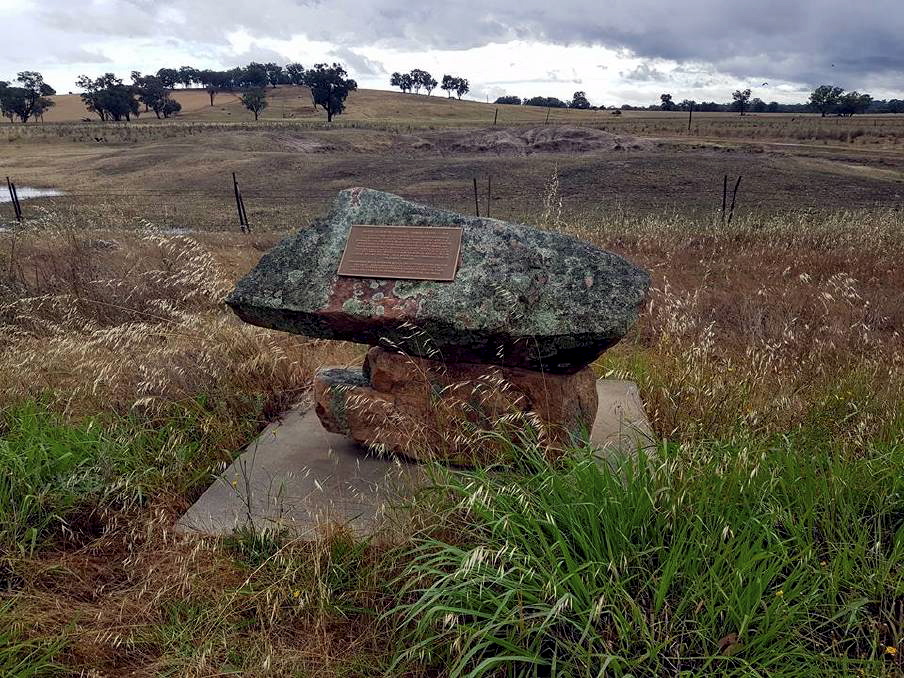
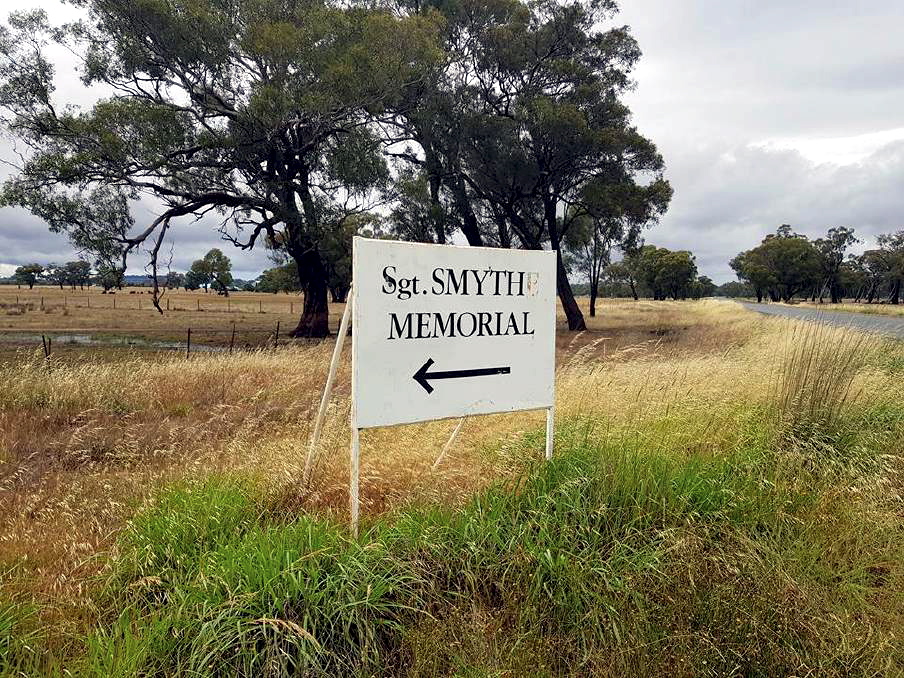
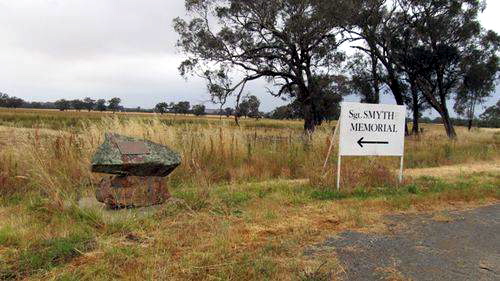
 Memorial located at:   Memorial stone and plaque are located 2 kms west of Henty on Pleasant Hills Rd ( the Lockhart Rd )

[alert_green]THOMAS  IS mentioned on the Police Wall of Remembrance[/alert_green]
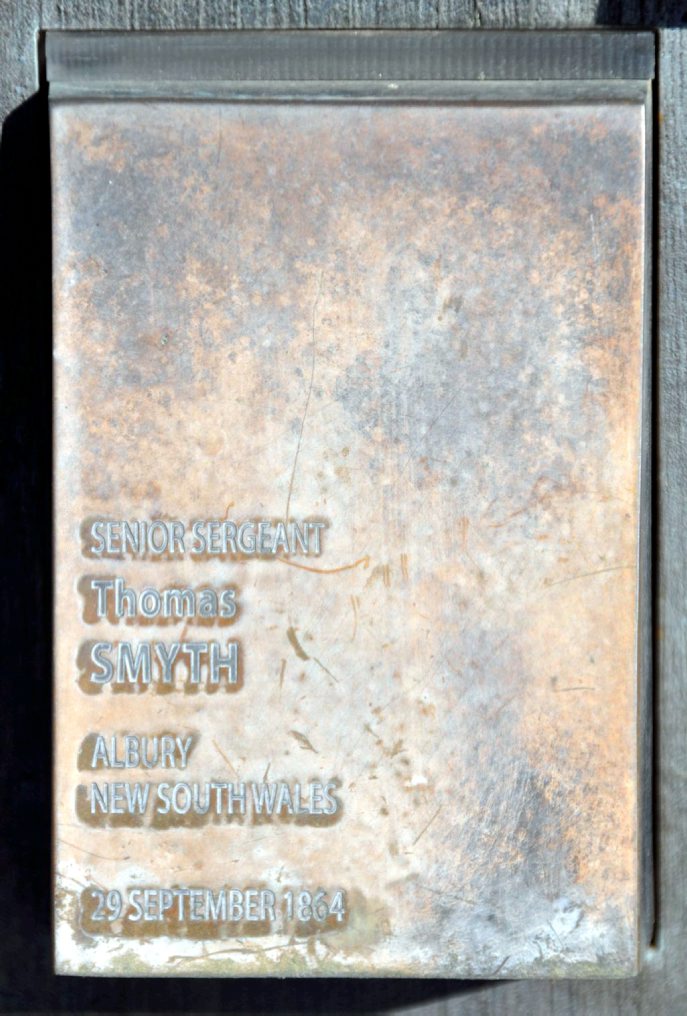
Thomas SMYTH touch plate at the National Police Memorial - Canberra
Thomas SMYTH touch plate at the National Police Memorial – Canberra


Thomas SMYTH
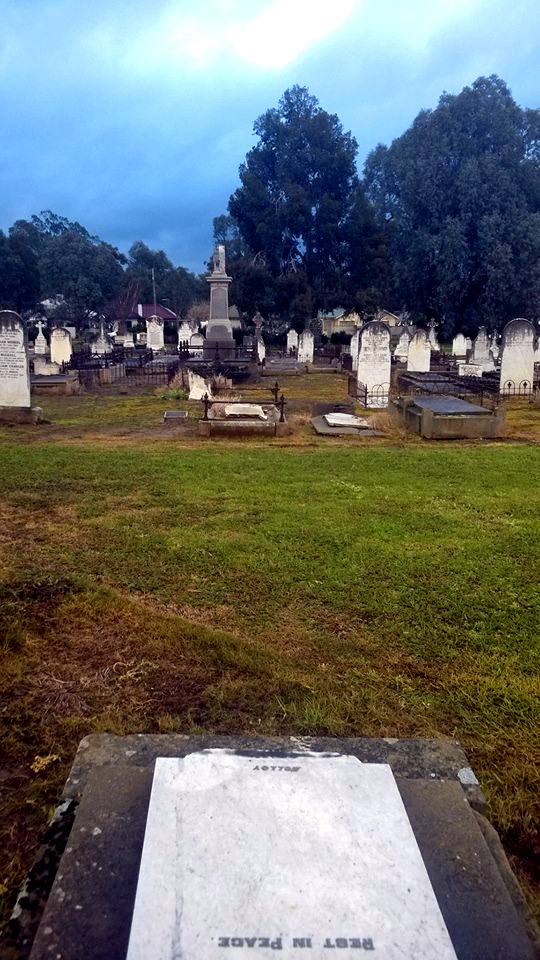
and this is his grave! (The unmarked one in the background).

 [divider_dotted]

FURTHER INFORMATION IS NEEDED ABOUT THIS PERSON, THEIR LIFE, THEIR CAREER AND THEIR DEATH.

PLEASE SEND PHOTOS AND INFORMATION TO Cal

[divider_dotted]

May they forever Rest In Peace

[divider_dotted]

In late September, 1864 the sergeant was camped in the bush with three troopers near Albury during a search for bushrangers, when two men, one of whom the bushranger Daniel Morgan, crept up and fired several shots into the police tent. One shot hit the sergeant, entering his shoulder and exiting through his back. Despite these wounds the sergeant was able to return fire, forcing the offenders to retreat and escape. Sergeant Smyth was soon treated by a doctor however he died of the effects of the wound within a couple of days. The vicious Morgan was shot to death by a farmhand in April, 1865.


The Empire newspaper dated 5 October, 1864 printed the following brief account of the incident.


DEATH OF SERGEANT SMYTH – It is with deep regret that we have to record the death of Senior-Sergeant Smyth, at Albury, on Thursday night, from the wound he received in the cowardly night attack a few weeks back at Doodle Cooma Swamp. It was at first hoped that the unwearied care of Dr Wilkinson would have brought him round; but haemorrhage having set in, little hopes were entertained of his recovery, and he gradually sank until he yielded up his brave spirit on Thursday night. He was a very deserving officer, possessed of more than average intelligence and shrewdness, which eminently fitted him for a police officer. His courage was unquestionable. Previous to his being stationed at Albury he was at Lambing Flat, on leaving which town be was presented with an address by the inhabitants, expressive of their appreciation of his valuable services in the repression of crime on that large goldfield.

The McIvor Times and Rodney Advertiser of 23 September, 1864 printed a detailed account of the incident.

THE BUSHRANGER MORGAN.

A party of police, consisting of Senior Sergeant Smyth, Senior Constable Baxter, Constables Connor, and Maguire, and a blackfellow named Jimmy Reed, were camped on Sunday night at Dougal’s [sic] Swamp, near Keighran’s station. They had just got tea, and were lying in the tent yarning, as is usually done by persons camped out. They had no sentry on guard – that duty being delayed until they “turned in” for the night. Suddenly their discourse was cut short by a volley being fired into the tent amongst them. Sergeant Smyth immediately jumped to his feet, calling on his men to follow him – he firing two shots in the direction he fancied the volley came from. The men who rushed out of the tent immediately after him, scoured the bush in every direction, as well as the darkness would allow them, but failed to find any traces of the ruffians; but, from the tracks discovered at daylight next morning, they must have overrun the bushrangers in the dark.

“They remained in the scrub about an hour, when they, after some consultation, deemed it better to return to the tent, which, considering that the night was dark, arid the surrounding scrub would completely shelter the attacking party, was, to say the least, attended with some danger. Baxter and Connor crawled on their hands and knees to the tent, and found Smyth lying on his back dangerously wounded, and fast bleeding to death. They took everything out of the tent and, having covered poor Smyth up in the few blankets they had, they managed to convey him to Keighran’s station, he still bleeding and suffering great pain, where they remained until daylight. Constable Baxter and the blackfellow then took up the track near the tent, and started to follow the ruffians up. The other two constables proceeded to the Ten Mile Creek, to give information and obtain medical aid for Smyth.

Superintendent McLerie who was proceeding to Sydney on sick leave, happened to be at that place; and he immediately ordered his buggy to be taken off its springs, and the body to be used as a stretcher to convey Smyth to Ten Mile Creek. From the position of the bullet holes in the tent, there cannot have been less than five bushrangers. There are seven bullet holes in the tent; the bullets were picked up inside of it, some of them belonging to a large bore pistol. Constable Connor had a very narrow escape. He was lying down, leaning on his elbow, in the tent, when one of the balls went through the sleeve of his coat, inflicting a slight wound about two inches above the elbow joint. Superintendent McLerie has deemed it necessary to return to Albury for the present. Sub-inspector Morrow and a party of police have started from Albury in pursuit of the bushrangers; and Sub-inspector Zouch has left Wagga Wagga on similar duty.

“A strange incident occurred in connection with this cowardly attack. Shortly after the party were camped, two men came up and were admiring the site chosen for the camp, remarking that they could not have chosen better. They are well known as bush “telegraphs,” being the two men to whose house Sergeant Carroll traced Morgan some time back. Sergeant Smyth’s wound is a very dangerous one. The ball entered immediately above the nipple of the left breast, following the course of the ribs, and came out under the left shoulder-blade; so that, while the wound may not be considered mortal, yet fatal results may ensue from it. The people are greatly excited on this murderous attack, which in cold-blooded treachery far surpasses the Lachlan escort robbery.”

The Empire newspaper dated 5 October, 1864 printed the following brief account of the death of the sergeant.

DEATH OF SERGEANT SMYTH
It is with deep regret that we have to record the death of Senior-Sergeant Smyth, at Albury, on Thursday night, from the wound he received in the cowardly night attack a few weeks back at Doodle Cooma Swamp. It was at first hoped that the unwearied care of Dr Wilkinson would have brought him round; but haemorrhage having set in, little hopes were entertained of his recovery, and he gradually sank until he yielded up his brave spirit on Thursday night. He was a very deserving officer, possessed of more than average intelligence and shrewdness, which eminently fitted him for a police officer. His courage was unquestionable. Previous to his being stationed at Albury he was at Lambing Flat, on leaving which town he was presented with an address by the inhabitants, expressive of their appreciation of his valuable services in the repression of crime on that large goldfield.”

In April 1865 the vicious and cowardly bushranger Morgan was shot to death by a farmhand in at Peechelba Station, near Wangaratta (Vic).

The sergeant was born in 1830 and joined the police force on 8 February, 1858. In 1862 he became a member of the newly-formed New South Wales Police Force. At the time of his death he was stationed at Albury.


http://trove.nla.gov.au/ndp/del/article/30580797

[divider_dotted]


Senior Sergeant Thomas Smyth to get a proper gravesite after he was murdered by bushranger ‘Mad Dog’ Dan Morgan in 1864.

Marguerite McKinnon
Marguerite McKinnon@@marguerite_mck1


It’s taken 153-years but moves are finally underway to give some restitution to Senior Sergeant Thomas Smyth, who was murdered by notorious bushranger ‘Mad DogDan Morgan in the hills near Henty in 1864.

Sergeant Smyth’s unmarked grave is now set to receive a memorial headstone to rectify what is believed to have been an administrative oversight lost in the 1951 transferral of Albury’s three cemeteries from church to council.

Police officers, both active and retired, had bemoaned as “a sad end and undignified burial” of Senior Sergeant Smyth after he was shot trying to recapture the bushranger, who had been terrorising the region.

In 1864, ‘Mad DogMorgan had recently committed his second and third murders before he arrived in the Henty area. Widespread fear and an outcry from the press at the time saw the reward for Morgan’s capture raised to £1000, and parties of special police were sent to track and capture him.

On September 4, Senior Sergeant Smyth had set up camp with three troopers in the Henty hills, when Morgan and another man crept up and fired several shots into the police tent, hitting the sergeant in the shoulder and exiting through his back. Morgan later said he had been watching the camp for some time.

Despite his wounds, the sergeant ran out of the tent and returned fire, forcing the offenders to retreat. The wounded officer then collapsed. He was transferred to Kiamba and then Albury where doctors claimed he was recovering, before he hemorrhaged several times.

The Empire newspaper dated October 5, 1864 reported that “he yielded up his brave spirit on Thursday night. He was a very deserving officer, possessed of more than average intelligence and shrewdness, which eminently fitted him for a police officer. His courage was unquestionable”.

Senior Sergeant Smyth was buried in an unmarked grave in an Albury cemetery, however there is a memorial stone on Pleasant Hills Road just outside Henty.

NSW Police is hoping to rectify other unmarked police graves. Dan Morgan was holding hostages when he was shot dead in Victoria by a farmhand in April,1865.

This excerpt is from an Australian Government site about bushrangers:

Daniel Morgan brought discredit to the popular ‘currency heroes’ by his mixture of violence, abuse and seemingly meaningless murders. Morgan claimed his innocence at his first conviction in 1854, at the diggings near Castlemaine, which he said was ‘framed‘ by a squatter. During his time at Pentridge Prison, he developed a violent dislike for police. Upon his release, he began a campaign against society at large and the police in particular.

Morgan once took issue with an overseer’s wife when the man was away on business, demanding money from her as he forced her against a blazing fire until she suffered severe burns to her legs. Morgan also tried to burn squatter Isaac Vincent by setting fire to his woolshed after he had tied Vincent to a nearby fence. After Morgan bailed up coaches, he would stampede the horses – sending them and their drivers to destruction.

Eventually he was shot and captured in 1865 after being outwitted by a nursemaid and station hand at Peelhelba Station near Wangaratta, owned by the McPhersons.”
 

Thomas SMYTH
MEMORIAL: Senior Sergeant Thomas Smyth will get a memorial headstone on his unmarked grave in Albury, after he was shot by bushranger Dan Morgan in 1864.


Thomas SMYTH
MEMORIAL: The memorial stone to Senior Sergeant Thomas Smyth is two kilometres west of Henty on Pleasant Hills Rd (the Lockhart road).


Thomas SMYTH<


Thomas SMYTH
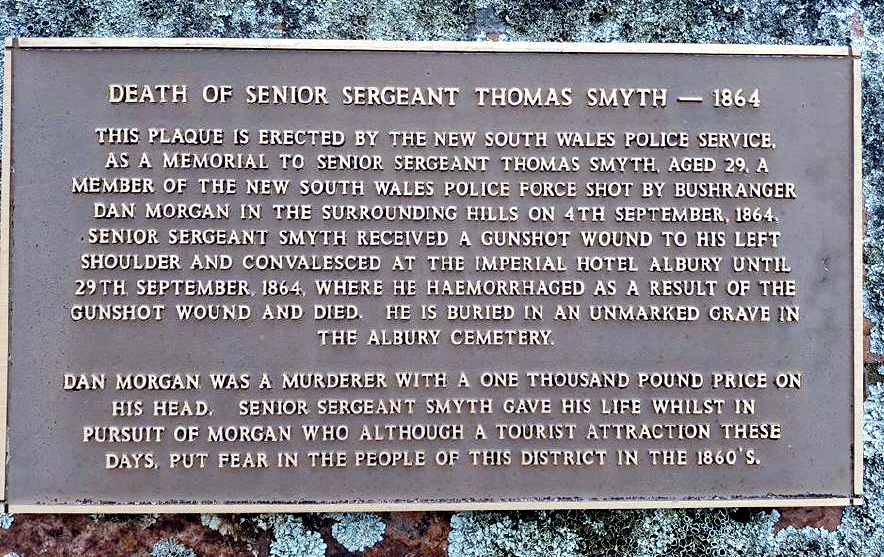
DETAIL: The plaque detailing the death of Senior Sergeant Thomas Smyth after he was shot by bushranger ‘Mad Dog’ Dan Morgan in September 1864.


Thomas SMYTH
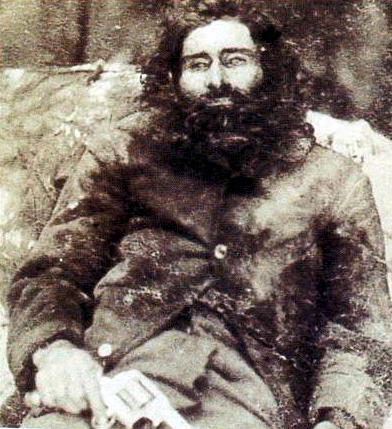
MURDERER: A post-mortem photograph of notorious bushranger ‘Mad Dog’ Dan Morgan who murdered several people, including Senior Sergeant Thomas Smyth.


The story Restitution for murdered police officer after outcry over his unmarked grave | Photos first appeared on The Daily Advertiser.

http://www.theland.com.au/story/5105955/restitution-for-murdered-police-officer-after-outcry-over-his-unmarked-grave-photos/?cs=4951

[divider_dotted]


John SMITH

John SMITH

New South Wales Police Force

Regd. #  ?

Rank:  Trooper

Stations? , Araluen

ServiceFrom  ?  to  10 February 1860

Awards?

Born? ? ?

Died on:  10 February 1860

Cause:  Drowned

Event location:  Crown Flat, Araluen

Age:  ?

Funeral date ?

Funeral location ?

Buried at: Unmarked grave at Araluen Catholic Cemetery

Trooper SMITH lies in an unmarked grave at Araluen Catholic Cemetery.

[alert_yellow]JOHN is NOT mentioned on the Police Wall of Remembrance[/alert_yellow]


The trooper was drowned in severe floods at Araluen in February, 1860. The Sydney Morning Herald of Monday 20 February, 1860 graphically reported the floods, advising of “Losses to life and property, the extent of which are yet not known, from a subject of a dark page in the annals of Braidwood and surrounding districts.” It went on to describe the sad death of Trooper Smith.


….The next calamity to human life occurred at the police camp. Trooper Smith, who had lately joined the force, was endeavouring to escape to Mr. Sweeney’s house, when the current carried him off, and his corpse was discovered when the water subsided; it was entirely buried in the sand, part of the arm projecting.  Several bodies not known have been recovered, and it is anticipated that at least seventeen human beings have lost their lives in the Araluen flood. ……..

http://trove.nla.gov.au/ndp/del/article/13036792?searchTerm=trooper%20john%20smith&searchLimits=l-decade=186|||l-year=1860

At the time of his death the trooper was stationed at Araluen. No further details are known as yet.

[divider_dotted]


The Goulburn Herald ( NSW )  Saturday  18 February 1860  p 2 of 4

…….

One of the Troopers of the Southern Patrol, a fine young man named John Smith, was drowned while endeavouring to cross from the police camp to the Cornstalk Inn.  In fact the destruction is general and conceivably great. …..

http://trove.nla.gov.au/ndp/del/article/103400139?searchTerm=trooper%20john%20smith&searchLimits=l-decade=186|||l-year=1860|||l-month=2#reloadOnBack

[divider_dotted]


The Empire ( Sydney )  Monday  20 February 1860  p 3 of 8

……. At the Police Camp the water rushed in, and one of the troopers named Smith, whilst making his way from there to Sweeney’s public house, was carried away by the rushing torrent and met with a watery grave : his body, together with the bodies of two Chinamen, have been recovered. ……

http://trove.nla.gov.au/ndp/del/article/64097583?searchTerm=trooper%20john%20smith&searchLimits=l-decade=186|||l-year=1860|||l-month=2

[divider_dotted]


Chief Constable Charles FOX

Chief Constable Charles FOX

New South Wales Police Force

Illness –  Suicide

Muswellbrook

25 August, 1856


Charles Fox was Chief Constable of Muswellbrook when he took his own life on Monday 25 August, 1856. The following paragraph appeared in the Sydney Morning Herald of 29 August, 1856.


On Monday, the 25th, an enquiry was held at the courthouse, Muswellbrook, before the coroner, Mr J.B.West, and a jury of twelve, touching on the death of Mr Charles Fox, chief constable, who, on the same morning, had committed suicide, by shooting himself with a pistol. It appeared on evidence that the deceased was latterly under medical treatment for general debility and depression of the mental faculties and had been for some time past labouring under hypochondria. It seemed on a view of the body, which presented a shocking spectacle that he had placed the muzzle of the weapon in his mouth, which dreadfully shattered… A finding of ‘Destroyed himself while labouring under temporary insanity’ was accordingly made. The deceased was much respected as a steady inoffensive man, and has left a widow and one son.


At the time of his death the chief constable was stationed at Muswellbrook.


Matthew James EVERINGHAM

Matthew James EVERINGHAM

New South Wales Police Force

Regd. # ????

Rank:  District Constable – appointed ? ? 1816

Stations: ?, Portland Head ( Hawkesbury area )

Service:   From  ?  ?  1816    to 25 December 1817 = 1 year Service

Awards

Born: 12 July 1768   London, Middlesex, England

Died on:  25 December 1817

Cause:  Drowned

Event location:  Hawkesbury River

Age:  48

Funeral date

Funeral location

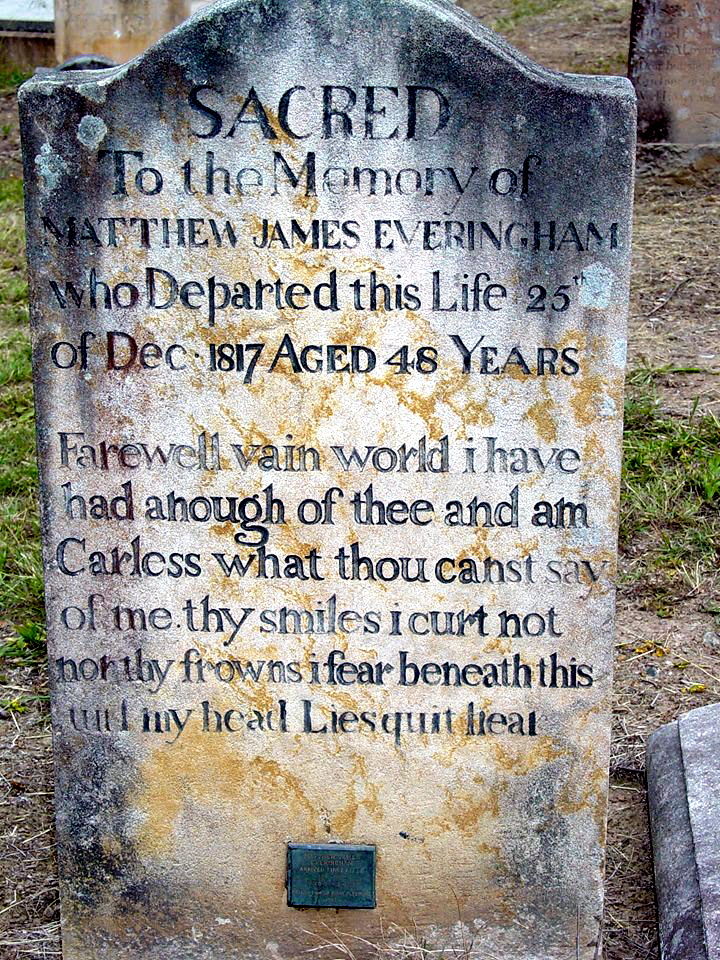
Buried at:  ( St John’s Cemetery ) Wilberforce Cemetery, Old Sackville Rd, Wilberforce, NSW

( approx. 600 mts east of the Putty Rd )

Grave Location:  right section, Row 7, Plot 20

Sacred to the memory of Matthew James Everingham who departed this life 25th of Dec. 1817 aged 48 years.<br /> Farewell vain world I have had anough of thee and am carless what thou canst say of me. they smiles i curt not non thy frowns i fear beneath this and my head Liesquit heal.


MATTHEW is NOT mentioned on the Police Wall of Remembrance


The Sydney Gazette dated 3 January, 1818 reported that “On Friday last Mr. Matthew Everingham, settler and district constable at Portland Head, fell overboard from a Hawkesbury boat, and was unfortunately drowned. On the finding of the body an Inquest was convened, who returned a Verdict Accidental Death. He leaves a large family to deplore his premature destiny.”


Constable Everingham was still news well over a century after his death. The Barrier Miner of 4 June, 1929 reported the following story.


Matthew James Everingham arrived in Sydney on the ship Scarborough in 1788. In 1791 he was married at Parramatta to Elizabeth Rhymes by the Rev. Samuel Marsden. In the same year he was granted 50 acres of land, then described as “at the Ponds two miles N.E. of Parramatta“.  Later he settled on the Hawkesbury River, on the farm afterwards known as Andrew Everingham’s Farm. He also became the owner of land at “Richmond Hills“, believed to be now in the Kurrajong district. He was appointed and remained district constable till his death in 1817. In that year he was drowned in the Hawkesbury River and was buried at Wilberforce, where his grave can still be seen.


At the time of his death the constable was stationed at Portland Head (Hawkesbury).


Matthew James EVERINGHAM
Photos by cpple7 on 8 January 2016

Matthew James EVERINGHAM & Elizabeth REMES

Matthew James EVERINGHAM & Elizabeth REMES

Matthew James EVERINGHAM & Elizabeth REMES
Wife to Matthew Everingham

Matthew James EVERINGHAM & Elizabeth REMES


NSW BDM = Marriage:  125/1791 V1791125 3A &  125/1791 V1791125 147A

NSW BDM = Death:         3920/1817 V18173920


EVERINGHAM, MATTHEW JAMES (1769-1817), settler, was convicted in London on 7 July 1784 and sentenced to transportation for seven years. Shortly before his conviction he was employed as a ‘servant‘ by an attorney of the Middle Temple, hence the subsequent references to him as ‘attorney’s clerk‘. Allegedly ‘in great distress’ he had obtained two books by false pretences from the servant of another attorney, and these he had offered for sale.

http://trove.nla.gov.au/people/1465540?q=Matthew+James+EVERINGHAM&c=people


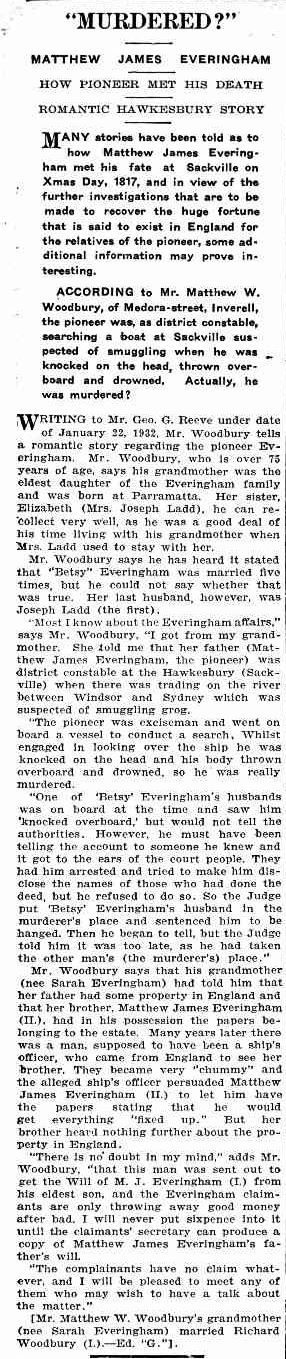
Windsor and Richmond Gazette, NSW. Friday 5 February 1932 page 6 of 12 http://trove.nla.gov.au/ndp/del/page/8914125?zoomLevel=3&searchTerm=Matthew%20James%20EVERINGHAM&searchLimits=
Windsor and Richmond Gazette, NSW. Friday 5 February 1932 page 6 of 12
http://trove.nla.gov.au/ndp/del/page/8914125?zoomLevel=3&searchTerm=Matthew%20James%20EVERINGHAM&searchLimits=


Matthew James Everingham - 2512-1817 - News article 1


Windsor and Richmond Gazette NSW Friday 21 June 1929 Page 11 of 16
Windsor and Richmond Gazette NSW
Friday 21 June 1929
Page 11 of 16


Windsor and Richmond Gazette (NSW : 1888 – 1954),

Friday 23 August 1929, page 7

THE EVERINGHAM FORTUNE?.

NEWCASTLE CLAIMANT

NEWCASTLE has produced a claimant for the Everingham millions in Mr. Ernest Edward Chaseling, who declares that he is a direct descendant of Matthew James Everingham.

He says that his grandmother, Ann Everingham, was a daughter of Matthew. She married John Chaseling in 1818, and his father, Joshua Watford Chaseling, was a son of that union. Mr. Chaseling has two brothers and two sisters.

Matthew Everingham, history tells, was drowned in the Hawkesbury River before he could leave for England to claim £200,000. That was in the early part of last century. Interest on the money has accumulated until the sum of eleven million pounds is said to be now awaiting its rightful claimant.

Mr. John Chaseling, son of Thomas Chaseling I., who married Miss Ann Everingham, one of the three daughters of pioneer Matthew J. Everingham (obit. 1817), is interred, as also is his wife, Mrs. Ann Everingham Chaseling, in the private vault of Matthew James Everingham II., which is situated at ‘Knight’s Retreat Farm,’ near Sackville, on land specially set aside by the will of second Matthew James Everingham as a burial place for any of the Everinghams in descent, or kindred. — “MARMINGA.”

http://trove.nla.gov.au/newspaper/rendition/nla.news-article85927804.txt


Everingham, Matthew James (1769–1817)

by A. J. Gray

Matthew James Everingham (1769-1817), settler, was convicted in London on 7 July 1784 and sentenced to transportation for seven years. Shortly before his conviction he was employed as a ‘servant’ by an attorney of the Middle Temple, hence the subsequent references to him as ‘attorney’s clerk’. Allegedly ‘in great distress’ he had obtained two books by false pretences from the servant of another attorney, and these he had offered for sale.

He arrived in the First Fleet transport Scarborough and was employed by Assistant Commissary Zachariah Clark. On 13 March 1791 Everingham married Elizabeth Rymes of London, who had arrived in the Neptune on 28 June 1790 and in July he settled on a 50-acre (20 ha) grant near Parramatta. In December Watkin Tench noted that ‘the Attorney’s Clerk’ appeared to find the cultivation of his own land ‘not half so easy a task as he formerly found that of stringing together volumes of tautology to encumber or convey that of his neighbours’; but for once Tench was unjust. Far from being ‘out of his province’ Everingham succeeded as a settler. In 1800 he signed the address to Governor John Hunter setting out ‘the grievous and intolerable burdens’ under which the settlers at the Field of Mars had long laboured; soon afterwards he disposed of his grant to Andrew Hume and like many of the early grantees moved to the Hawkesbury where farming prospects were better. By 1803 he was well established at Portland Head, but in 1804 his home and farm buildings were burned by natives and he, his wife and servant were speared, though happily their wounds were not fatal. In 1816 he acquired 130 acres (53 ha) at Richmond Hill, and became a district constable. A year later, on 25 December 1817, he was accidentally drowned in the Hawkesbury. In a memorial to the colonial secretary in 1825 his widow claimed, apparently without financial result, that he had died while in the execution of his constabulary duties.

Everingham was survived by five sons and four daughters, and was buried in St John’s cemetery, Wilberforce. His career was not spectacular, but over a long period he discharged his duties faithfully and worked steadily as a pioneering settler.

http://adb.anu.edu.au/biography/everingham-matthew-james-2030


Matthew married Elizabeth Rimes on 13 March 1791 and from that union they had 11 children.
1. Mary (23 December 1791–24 January 1792)
2. Sarah Elizabeth (9 June 1793–29 March 1874)
3. Matthew James (10 May 1795–22 November 1884)
4. William (6 August 1797–6 September 1859)
5. George (9 December 1799–15 April 1881)
6. Ann (7 November 1802–19 March 1849)
7. Elizabeth (10 June 1805–24 June 1879)
8. John Rymes (October, 1806–?)
9. James (25 December 1809–25 July 1895)
10. Maria (6 August 1811–24 February 1835)
11. John (20 July 1814–29 May 1875)

Matthew passed away Hawkesbury River, New South Wales

Matthew James Everingham (1768-1817), settler, was born in London on 25? July 1768, son of Joseph Everingham and his wife Mary.

He was convicted in London on 7 July 1784 and sentenced to transportation for seven years.

Shortly before his conviction he was employed as a ‘servant’ by an attorney of the Middle Temple, hence the subsequent references to him as ‘attorney’s clerk’. Allegedly ‘in great distress’ he had obtained two books by false pretences from the servant of another attorney, and these he had offered for sale.

He arrived in the First Fleet transport Scarborough and was employed by Assistant Commissary Zachariah Clark.

On 13 March 1791 Everingham married Elizabeth Rymes of London, who had arrived in the Neptune on 28 June 1790 and in July he settled on a 50-acre (20 ha) grant near Parramatta.

In December Watkin Tench noted that ‘the Attorney’s Clerk’ appeared to find the cultivation of his own land ‘not half so easy a task as he formerly found that of stringing together volumes of tautology to encumber or convey that of his neighbours’; but for once Tench was unjust.

Far from being ‘out of his province’ Everingham succeeded as a settler.

In 1800 he signed the address to Governor John Hunter setting out ‘the grievous and intolerable burdens’ under which the settlers at the Field of Mars had long laboured; soon afterwards he disposed of his grant to Andrew Hume and like many of the early grantees moved to the Hawkesbury where farming prospects were better.

By 1803 he was well established at Portland Head, but in 1804 his home and farm buildings were burned by natives and he, his wife and servant were speared, though happily their wounds were not fatal.

In 1816 he acquired 130 acres (53 ha) at Richmond Hill, and became a district constable.

A year later, on 25 December 1817, he was accidentally drowned in the Hawkesbury.

In a memorial to the colonial secretary in 1825 his widow claimed, apparently without financial result, that he had died while in the execution of his constabulary duties.

Everingham was survived by five sons and four daughters, and was buried in St John’s cemetery, Wilberforce.

His career was not spectacular, but over a long period he discharged his duties faithfully and worked steadily as a pioneering settler.

Birth
12? July 1768
London, Middlesex, England
Death
25 December 1817
Wilberforce, New South Wales, Australia
Cause of Death
drowned
Cultural Heritage
English
Religious Influence
Anglican
Passenger Ship
Scarborough (1788)
Occupation
convict
emancipist
farmer
police officer
Key Events
First Fleet (1788)
settler/indigenous contact

by A. J. Gray
From the Australian Dictionary of Biography, Volume 1, 1966


https://www.findagrave.com/memorial/63359906/matthew-james-everingham