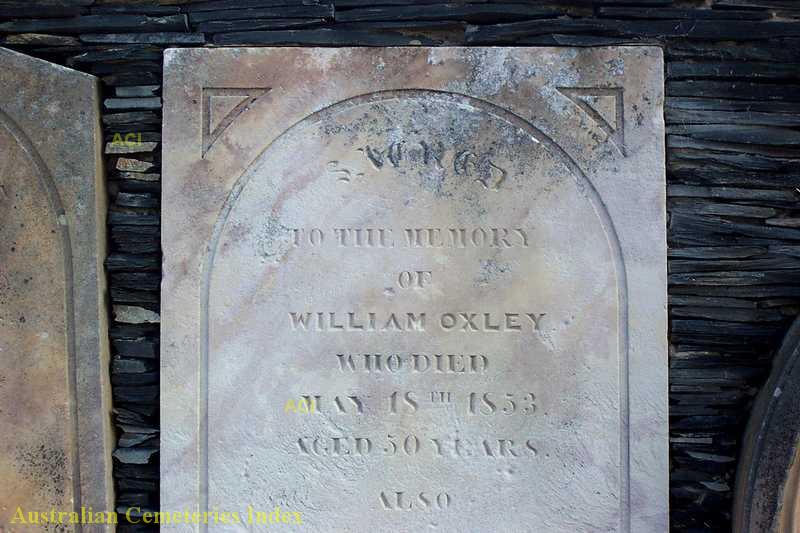
1

Edmund PARRY

Edmund PARRY

New South Wales Police Force

New South Wales Detective Force

Regd. #  ????

Rank:  Sergeant

Stations?, Gundagai

ServiceFrom 5 May 1862  to 16 November 1864 = 2+ years Service

Awards?

Born? ? 1832

Died on:  Wednesday  16 November 1864

Cause:  Shot – Murdered

Event location:  Jugiong

Age:  32

Funeral date: Saturday  19 November 1864

Funeral location

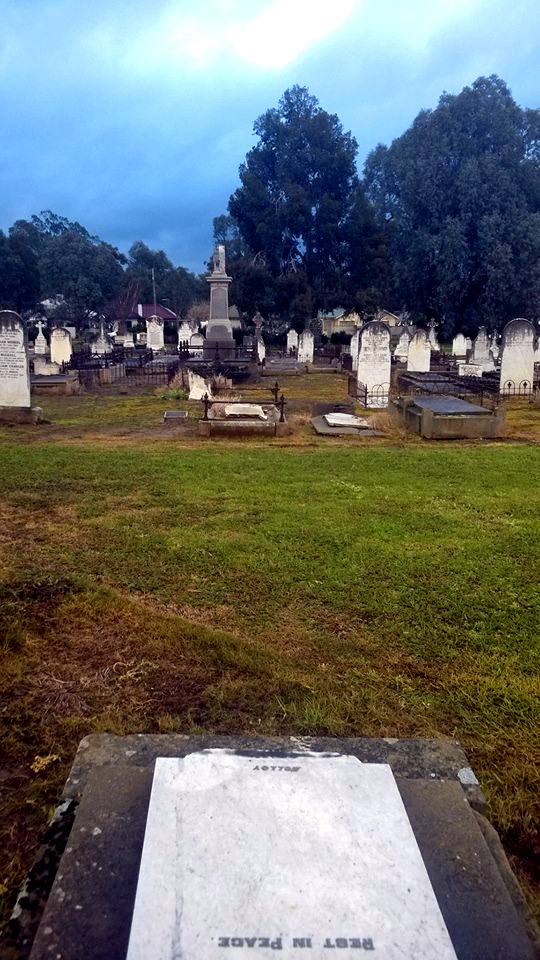
Buried at: Gundagai Cemetery

( GPS:  Lat: -35.051389
Long: 148.111944 )

Memorial location:  Old Hume Highway (Riverside Drive) , Jugiong Memorial Park, Jugiong, 2726

( GPS:  Lat: -34.823664
Long: 148.326496 )
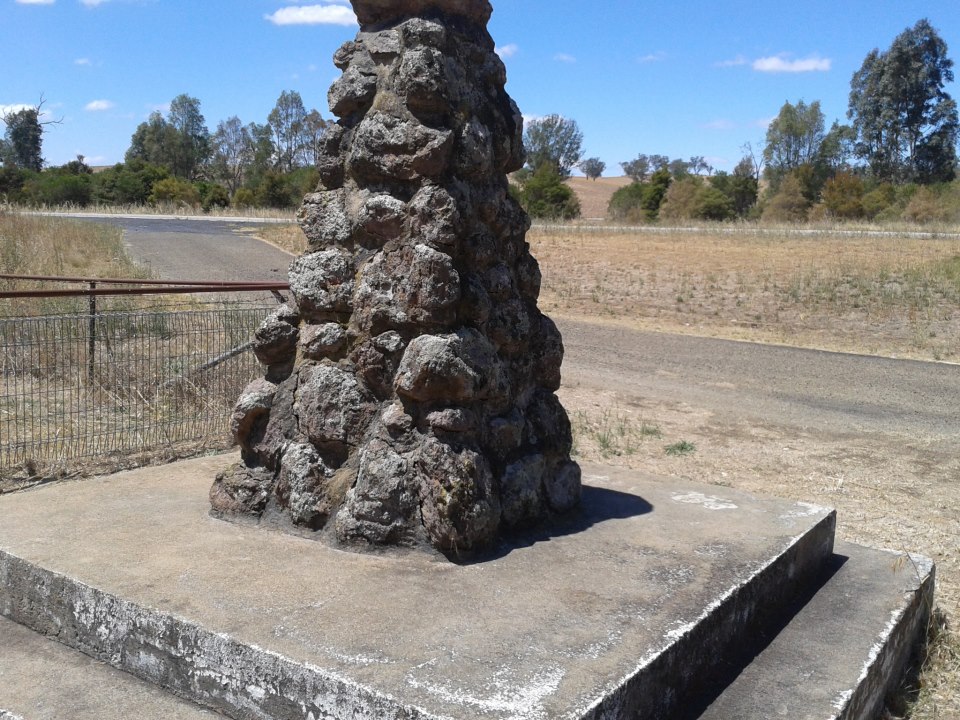
 Located on the north bound lane of the Hume Hwy near Jugiong.
Located on the north bound lane of the Hume Hwy near Jugiong.


EDMUND IS mentioned on the Police Wall of Remembrance

On 16 November, 1864 Sergeant Parry ( Gundagai ), Sub Inspector O’Neill ( Gundagai ) and Constable Roche ( Yass Police ) formed the mounted police escort for the Gundagai mail coach on its journey to Yass. Roche was seated beside the coach driver, Gundagai Police Magistrate Mr Rose was inside the coach and Parry and O’Neill followed on horseback. Shortly before 3pm as the coach approached the township of Jugiong, the escort was attacked by bushrangers Hall, Dunn and GilbertSub Inspector O’Neill closed with Dunn and Hall and when he had emptied his rifle he hurled the weapon at Hall, striking him on the head. He then drew his revolver and fired at Dunn. Meanwhile, Parry and Gilbert fired on each other, with the bushranger calling on the sergeant to surrender. Parry continued to fight until he was fatally shot in the head.


The Australian News for Home Readers dated ( Monday ) 19 December, 1864 carried the results of an inquest into the sergeant’s violent death, informing its readers that “An inquest was held before Mr Rose, at Jugiong, on the body of the brave sergeant of police, when the jury returned the following verdict: ‘That on the 16th day of November, in the year of our Lord 1864, at a spot about four miles to the south of Jugiong ( the Black Springs ), in the colony of New South Wales, the deceased Edmund Parry did die from the effects of a gunshot wound, at that time and in that place wickedly, maliciously, and feloniously inflicted upon him by one John Gilbert, and that two other certain persons, named Benjamin Hall and John Dunn, were then and there unlawfully aiding and abetting the said John Gilbert in so feloniously destroying the life of the said Edmund Parry.”


The murderer Gilbert and accomplice Hall would later be shot dead by police in separate incidents, while Dunn (who would murder Constable Samuel Nelson at Collector less than two months after this incident) was destined to be hanged for his crimes.


The sergeant was born in 1832 and joined the New South Wales Police Force on 5 May, 1862. At the time of his death he was stationed at Gundagai.

Sgt Parry is buried at the Gundagai cemetery.
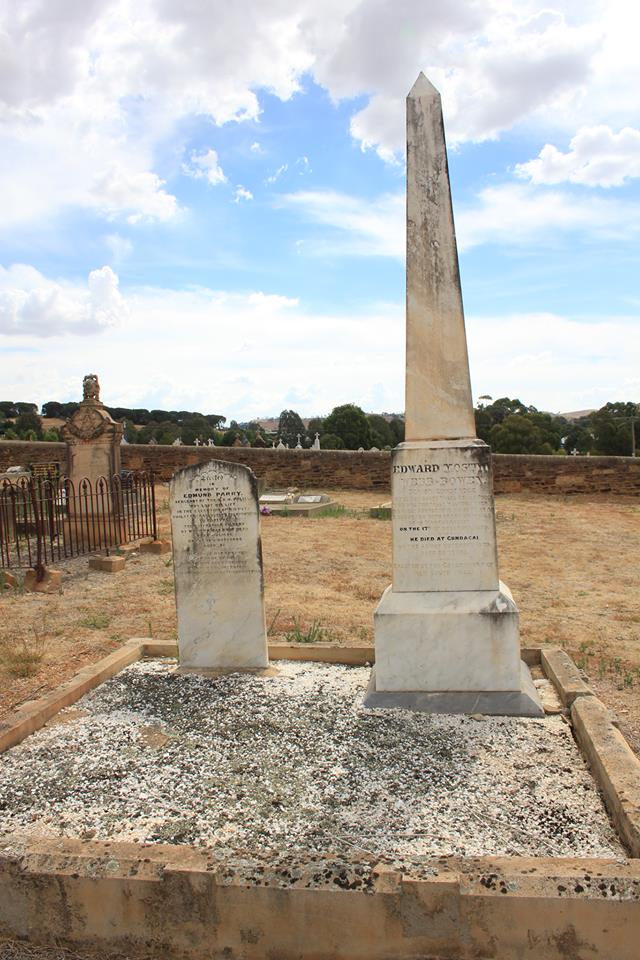
 

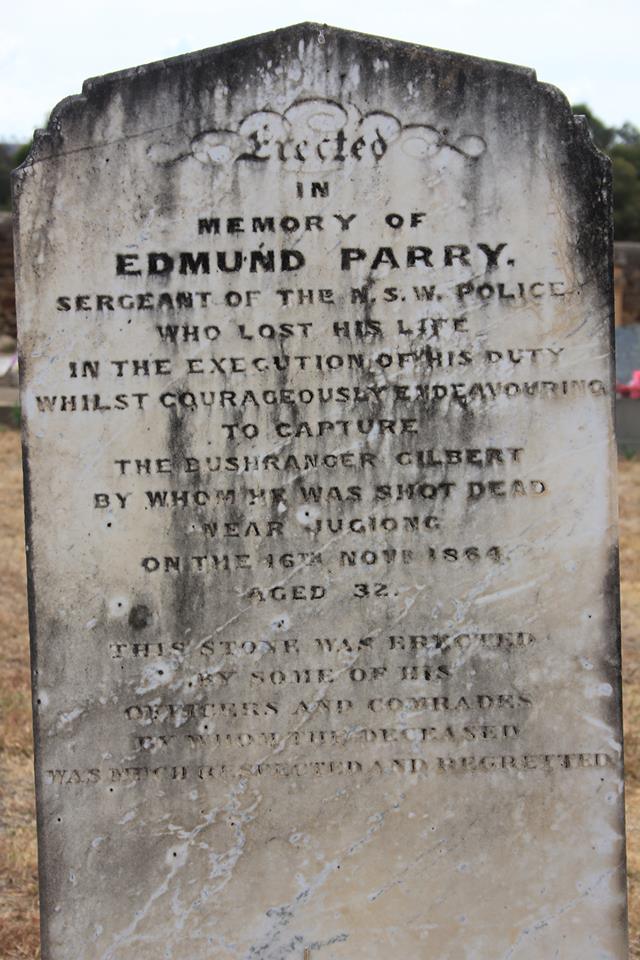
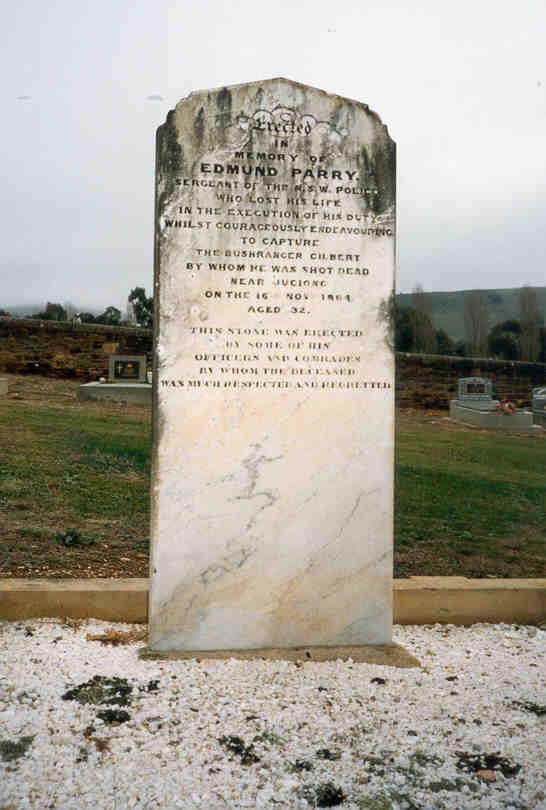
Sergeant Edmund PARRY - Grave


 Erected In Memory Of Edmund Parry, Sergeant Of The N.S.W. Police, Who Lost His Life In The Execution Of His Duty Whilst Courageously Endeavouring To Capture The Bushranger Gilbert By Whom He Was Shot Dead Near Jugiong On 16th Nov 1864 Aged 32 This Stone Was Erected By Some Of His Officers And Comrades By Whom The Deceased Was Much Respected And Regretted
Erected In Memory Of Edmund Parry, Sergeant Of The N.S.W. Police, Who Lost His Life In The Execution Of His Duty Whilst Courageously Endeavouring To Capture The Bushranger Gilbert By Whom He Was Shot Dead Near Jugiong On 16th Nov 1864 Aged 32 This Stone Was Erected By Some Of His Officers And Comrades By Whom The Deceased Was Much Respected And Regretted


Sergeant Edmund PARRY - Grave


Senior Constable Wes Leseberg (NSW Police) portrays Sgt Edmund Parry in this upcoming Australian movie. Opening in December 2016.

first-look trailer for upcoming Australian bushranger film The Legend Of Ben Hall, out December 1, 2016. Start practising your pistol-twirling now…

Senior Constable Wes Leseberg as Sergeant Edmund Parry in "The Legend of Ben Hall"
Senior Constable Wes Leseberg as Sergeant Edmund Parry in “The Legend of Ben Hall”


(Plaque) (Logo) NEW SOUTH WALES POLICE FORCE CULPAM POENA PREMIT COMES NSW Police Force Sergeant Edmund PARRY Killed in the courageous execution of his duty on the 16th of November, 1864 in a gun battle with the Hall Gang at Black Springs, Jugiong New South Wales
(Plaque) (NSWPF Logo) NEW SOUTH WALES POLICE FORCE CULPAM POENA PREMIT COMES NSW Police Force Sergeant Edmund PARRY Killed in the courageous execution of his duty on the 16th of November, 1864 in a gun battle with the Hall Gang at Black Springs, Jugiong New South Wales


Yesterday, took a detour to Jugiong and checked out the memorial there to Sgt Edmund Parry. A very fitting tribute to a brave man.
*
GPS Co-ords 34 49 25S/148 19 35E.
*
Can I also say that the Police Station and residence at Jugiong were immaculate. Not something you see often these days but a pristine NSW Flag flying (not a tattered mess hanging from the flag pole that we see so often) and the yard and surrounds a credit to the OIC who no doubt works the majority of the time in Cootamundra or Tumut or Young or all three.

Parry, Edmund (1832–1864)

from South Australian Advertiser

On Tuesday afternoon the mail from Gundagai reached the hill at Deep Creek, about four or five miles on the Yass side of Jugiong, between 4 and 5 o’clock. Mr. Sheahan, of Jugiong, the mail contractor, and Mr. Bradbury, of Queanbeyan, were passengers by the coach, and had alighted to walk up he hill. They were some distance in advance of the coach. Mr. Sheahan was in the act of pointing out the spot where the mail was stuck-up a few weeks before, when three horsemen appeared on the top of the hill, and spreading out—one on each aide, the third in the centre of the road—they galloped towards the coach. On coming near it was noticed that each had a revolver in his hand, and the order was given by Ben Hall to “Bail up.” Hall pointed and told them to “walk up there; we have got a little township there.” After going up the hill for some distance, they were ordered to turn off to the left, and approached a spot where twelve teams were stock up, as well as a number of horsemen. The mail was then stopped. Mr. Sheahan was asked if he had any money; he replied that he had not, and they might search him if they liked. Hall declined to search, remarking that Mr. Sheahan was not a “bad sort of fellow.” Bradbury was then searched; although he handed them a cheque for one pound, stating that that was all he had, yet they examined his pockets, and asked him if he had not a watch. They got nothing from him but the cheque, and subsequently, on his telling them it was all he had to carry him on the road, the cheque was returned. Hall and his companions then took out the mail bags, six in number, and cut them all open. Before proceeding to examine the letters they asked Mr. Sheahan and Mr. Bradbury if they would have some wine. They answered “Yes,” when Hall called to one of the teamsters to “fetch over port wine.” The wine was brought, in a quart pot, and a portion of it drunk by those present. The examination of the mail-bags meanwhile proceeded, the three bushrangers sitting down on the ground with the bags before them. The letters were speedily ransacked of any bank-notes they contained, Mr. Bradbury remarking to them that they sorted the letters much quicker than was generally done in Sydney. Mr. Sheahan asked if he would be allowed to sit down, and Hall told him he could do so. Mr. Sheahan availed himself of an empty mail-bag close beside him, and noticing a large number of whole and half cheques, remarked that they were of no use to them, and asked permission to gather them up. The bushrangers consented, and Mr. Sheahan was enabled to bring on to the Yass Post Office his coat pocket as full of cheques as it would hold, as well as three bank drafts. The coach and passengers were kept an hour before they were permitted to depart, Mr. Sheahan and Mr. Bradbury gathering up the remains of the letters and placing them in a mail bag. On the bushrangers completing their work, the driver of the coach pushed on as fast as possible to Yass, and reached here only half an hour behind time. The matter was instantly reported to Sub-Inspector Brennan, who, with a couple of mounted men, took the road within half an hour.

It was fully expected in town that the mail on Wednesday would also be robbed, and the spot where it was expected to take place was mentioned to the police before they left Yass. The anticipation was realised, and even the locality surmised as the scene of the outrage proved to be the spot selected. The mail is due in Yass at eleven a.m., and as it is generally very punctual to the time, and not having arrived at a quarter to twelve, it began to be thought very likely that it had been stopped. A few minutes before twelve it was heard approaching, and much anxiety was felt to learn what had occurred to cause its detention. It was then ascertained that on the mail leaving Gundagai, Constable Roche, of the Yass police, who had gone as guard of the mail the previous day to Gundagai, and Mr. Rose, police magistrate of Gundagai, were its occupants. It was escorted by Sub-Inspector O’Neill, and Sergeant Edmund Parry, of the Gundagai police. On reaching within about four miles of Jugiong, at a place known as the Black Springs, Hall and his companions appeared from behind some rocks. The moment they were noticed a signal was made from the coach to the Sub-Inspector and Sergeant to ride up, which they at once did; and one of the bushrangers remarking that “the bobbies” were with the coach, Gilbert said “There are only two of them; come on, let us rush them.” They then darted towards the coach, and on getting near the police called out “Come on you —— wretches; we will fight you like men.” A deadly encounter followed, in which poor Parry, who acted very bravely throughout, was shot through the shoulder and dropped dead. Before, however, narrating what transpired in the encounter with the police, we may state that Hall, Gilbert, and Dunn took up their position on the road early in the day, and stuck up a large number of teams and two carts, the latter followed by 20 or 30 Chinamen. Amongst those detained were a son of Mr. Owen Ryan, of Derrengullen Creek; Mr. Hayes, wife, and young man, who were in a buggy; and others, to the number of 40 or 50. Some considerable time before the coach came up Constable McLaughlin, of the Gundagai police, approached, leading a pack horse. Gilbert rode up to him and ordered him to surrender, but he replied by a shot from his revolver, which was returned by Gilbert, who then turned his horse and rode off a short distance. Hall then took up his position and fired at the constable, who again discharged his revolver. Hall’s horse stumbled, and Dunn rode up and fired at McLaughlin. The constable discharged the six barrels of his revolver in the encounter, and then surrendered, some nine or a dozen shots having previously been fired at him by the bushrangers. Dunn remarked that one of the constable’s shots was a very good one, and they would “have it in for him” on that account.” The constable was added to the mob of captives. The coach subsequently came in sight, and the affray commenced as stated above. Constable Roche, who was on the coach armed with two large pistols, a six barrel revolver, and a carbine, is stated to have slipped off the coach when the fight began, and to have darted into the bush, carrying his firearms along with him. He did not subsequently appear on the scene. Gilbert fought with Sergeant Parry, who refused to surrender, and discharged every barrel of his revolver before he fell; Hall and Dunn attacked Sub-Inspector O’Neill, who first discharged his carbine, and then several shots from a revolver. On Parry falling dead, the Sub-Inspector surrendered. The bushrangers disarmed him, and took from him a ring and his watchchain, but we believe he was permitted to keep his watch on his informing them it had belonged to his father. The horse Mr. O’Neill rode was, however, taken, one of the bushrangers remarking it would make “a good pack-horse.” It seems singular that the driver of the coach did not take advantage of the proceedings going on to put his horses to their mettle and save the mails. This, however, he did not do, for Hall and his mates on the termination of the fight ordered Mr. Rose to throw out the bags, which the bushrangers cut open in the usual manner, and appropriated all they desired. The mail was a very heavy one, and it is supposed they secured a large amount of money. From Constable McLaughlin they took £7105; from Mr. Rose a watch and chain. We have not heard what was taken from Mr. Hayes, but he was searched; the lady who accompanied him they did not molest. Gilbert is said to have turned over poor Parry’s body, and to have remarked—”He’s got it in the cobra (head) ; I am sorry for him, as he was a game fellow.”

We may state that the bushrangers informed the police that they intended to rob the mail next day (Thursday), and told them to send as many police men as they liked, and they would fight them. On the mail reaching Yass on Wednesday night Sergeant Scully, who was in charge of the force in the absence of Sub-Inspector Brennan, at once despatched five mounted men, four of whom are connected with the Goulburn force, and had reached Yass the previous day, after eight days’ unsuccessful search for the whereabouts of the bushrangers.

The coroner’s jury returned the following verdict:—”That on the 16th day of November, in the year of our Lord, 1864, at a spot about four miles to the south of Jugiong, in the colony of New South Wales, the deceased Edmund Parry did die from the effects of a gunshot wound, at that time and in that place wickedly, maliciously, and feloniously inflicted upon him by one John Gilbert; and two other certain persons, named Benjamin Hall and John Dunn, were then and there unlawfully aiding and abetting the said John Gilbert in so feloniously destroying the life of the said Edmund Parry.”

http://oa.anu.edu.au/obituary/parry-edmund-13623


Parry, Edmund (1832–1864)

from Portland Guardian (Vic)

Sergeant O’Neill‘s report of the recent murderous affray with Hall and his gang: Gundagai. 17th November.

“Just returned from Jugiong with the remains of Sergeant Parry. Yesterday morning early I started with Constable O’Loughlin to Jugiong, with instructions to the police station there to be at readiness to relieve Sergeant Parry and myself, who would escort the down mail to Jugiong.

At 11 a.m. Sergeant Parry and I left here riding behind the coach. Constable Roach, from Yass, was with the driver on the box set. When we got within four and a half miles of Jugiong, we there found sixty or seventy people, including Constable McLoughlin, some carriers, a lot of Chinese, and others, stuck up by Mr. Hall, Gilbert, and John Dunn.

Sergeant Parry and myself charged the bushrangers, when a deadly encounter ensured.

Ben Hall and Dunn opened fire on me and Gilbert on Parry. We all fired simultaneously several times. I had one bullet pass through the upper part of my sleeve, and one in left side of coat, neither injuring me.

Sergeant Parry was less fortunate. He received two mortal wounds, one in his left side and another in the back of his head, and he died immediately.

Constable Roach, on witnessing the engagement, took his carbine, revolver, and two old pistols with him and bolted into a paddock of Pring’s, where he took shelter. Had he stood by us Parry‘s life would have been spared, and Gilbert shot.

After emptying my revolver and rifle, I let the latter fly at Hall, striking him severely on the left side of his head. He and Dunn then had hold of my horse, and all was over—Parry shot, I a prisoner and Roach an absconder. The party having rifled the mail bags left.”

http://oa.anu.edu.au/obituary/parry-edmund-13623/text24380


Sydney Morning Herald     Saturday  19 November 1864     p6

GUNDAGAI.   Friday, 8 p.m.

After Hall’s gang left the scene of the encounter with the mail escort, the dead body of sergeant Parry was taken on to Jugiong, where an inquest was held, Mr. Rose, district coroner, who was a passenger in the coach, was an eye-witness of the tragedy. A verdict of wilful murder was given against John Gilbert, Benjamin Hall, and John Dunn, and warrants issued for their apprehension.

The remains of Sergeant Parry was brought in a coffin to Gundagai yesterday, and buried to-day with every mark of respect and commisseration for the fate of so brave a man. All business was suspended during the day.

The encounter was witnessed by several persons, who were detained by the bushrangers, and who, as well as Mr. Rose, speak in the highest terms of the courage of sub-inspectors O’Neill and sergeant Parry.


Illustrated Sydney News     Friday  16 December 1864     p5

MURDEROUS ENCOUNTER BETWEEN HALL’S GANG & THE

POLICE, AND DEATH OF SERGEANT PARRY.

IT has unhappily been our duty during the past few months to record a series of high-handed outrages and deeds of blood, which are rendering this Colony a bye-word throughout the civilised world. Our exchanges from every part of the globe contain annals of crime committed by the bushrangers of New South Wales, — crimes unparalleled save by the banditti of Italy, degrading to us as a people, the commission of which renders the Government of the Colony positively criminal for the apathetic and ineffectual efforts which they have made. The time for mincing our words has long since past. The position of affairs in the interior of New South Wales is a disgrace to any civilised community. Our legislators appear to be too much engrossed in party quarrels, and our Government in their own aggrandizement, to properly estimate the enormity of the crimes which are being daily committed in our southwestern districts, within a couple of hundred miles of the head-quarters of a police system which cost a colony containing some 350,000 inhabitants, during the past year £242,715 7s. 11d. What wonder will it be if we hear of the people whose lives and properties have been rendered insecure taking the law into their own hands, and, following the example of California, establishing Lynch Law. Much as such a system is to be deplored, we question if it would not be preferable to the present state of things.

During the past four months Morgan has murdered two police sergeants and and unoffending bushman. His immunity from arrest has probably rendered Hall and his gang from paying much regard to human life, for we find them following his example with all the recklessness which has marked Morgan’s career. The culminating act of Hall, Gilbert, and Co.’s villainous career has been that perpetrated on the 16th ultimo. On the morning of that day Hall, Gilbert, and Dunn took up their position on the road about four miles from Jugiong, and stopped all passers by. Among the number were several residents of Tumut, Mr. Johnstone, of Gundagai, about a dozen teamsters, and thirty Chinese. About noon Constable McLaughlin, going to Jugiong, was stopped by two bushrangers. Gilbert rode up and ordered him to surrender ; his reply was a shot from his revolver, which was returned by Gilbert, who then rode off a short distance. Hall then fired at the constable, who again returned it. Dunn also fired. Some of the shots cut McLaughlin’s bridle rein, and slightly wounded his horse. Having used the whole of his ammunition, and being hotly pressed, he galloped away hoping to be able to reload ; but Dunn being better mounted followed, and, firing at him, ordered him to surrender. Having no other alternative he did so, and was conducted to where the other persons were detained. On searching McLaughlin they took £7 10s. and his watch and chain, but returned the latter to him, as they admired his bravery in resisting three of them.

About three o’clock the mail from Gundagai came in sight, escorted by Sub-Inspector O’Neil and Sergeant Parry on horseback, and Constable Roach, who was seated on the box with the driver. The bushrangers rode down the hill to meet the coach, and on being perceived by Mr. Rose, Police Magistrate at Gundagai, who was a passenger, that gentleman raised his handkerchief as a signal for the police to close up, and as they did so the bushrangers turned and rode off, but seeing there were only two policemen they drew their revolvers, and rode back to meet them, screaming like madmen. The first shot fired was the signal for Constable Roach to drop from his seat and bolt into the bush, leaving O’Neil and Parry to maintain the murderous contest ; the former being opposed to Hall and Dunn, and the latter to Gilbert — the two latter fired shot for shot. Parry was first wounded in the head, but refused to surrender, and, having fired every shot in his revolver, was in the act of unslinging his carbine when Gilbert again fired. The ball entered his back on the left side, passed through his body — and the brave fellow fell from his horse a corpse. O’Neil continued fighting until his ammunition was expended, when, seeing the uselesness of prolonging the contest, he surrendered, and was taken prisoner. Dunn and Gilbert then mounted guard on the road, while Hall ransacked the mail bags ; the latter asked O’Neil where the other constable had gone to, and, on hearing he had bolted, remarked, “You should dismiss the fellow at once ; he is a coward and wretch to leave you and your mate to fight ; but I will say this for you both, you are two game men.” Hall then addressed himself to Mr. Rose, asking his name. Mr. Rose gave it, and told them in a fearless manner that he was Police Magistrate of Gundagai, to which Hall replied, “You are as bad as the —— traps.” “That may be,” said Mr. Rose, I am what I am.” After disposing of all the booty the bushrangers decamped, taking the police horses and arms. The remains of Sergeant Parry were removed to Jugiong, where an inquest was held next day by Mr. Rose. The jury returned a verdict of wilful murder against John Gilbert, Benjamin Hall, and John Dunn, against whom warrants were issued.

Sergeant Parry was formerly a member of the detective force, and during his residence in this city was remarkable for his good conduct.

The Government have recently issued a proclamation offering £1,000 reward each for Hall, Gilbert, and Dunn, and we trust that some energetic colonist may speedily enrich himself, and rid the country of one of its plague spots.

http://trove.nla.gov.au/newspaper/rendition/nla.news-article63512220.txt


Queanbeyan Age and General Advertiser

Thursday 1 December 1864, page 2
BY ELECTRIC TELEGRAPH. SYDNEY.  Thursday afternoon. BEN HALL and his gang are visiting the Bathurst district.
Constable ( William ) Roach was tried before the Yass bench on Tuesday, and found guilty of deserting his comrades in the late encounter with Gilbert’s gang.
He was fined five pounds with the alternative of a month’s imprisonment.
[divider_dotted]


Thomas SMYTH

Thomas SMYTH

Late of  ?

New South Wales Police Force

Regd. #  ????

Rank:  Senior Sergeant – Death

Stations:  ?, Lambing Flat, Albury – Death

Service:  From  8 February 1858  to  4 September 1864 =  6+ years Service

Awards:   No find on It’s An Honour

Born:   ? ? 1830

Died on:   29 September 1864 in the Imperial Hotel, Albury

Age:  33 – 34

Cause:   Shot – Murdered

Event location:  Doodle Cooma Swamp

Event date:   4 September 1864

Funeral date:   ? ? ?

Funeral location:   ?

Funeral Parlour:

Buried at:   Albury Cemetery, 460 Buckingham St, North Albury, NSW

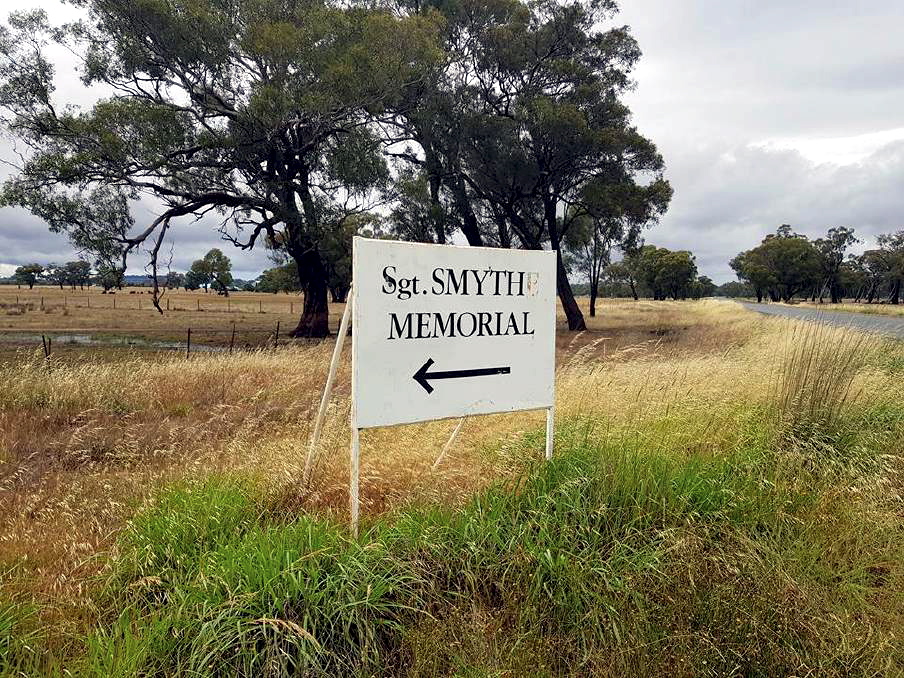
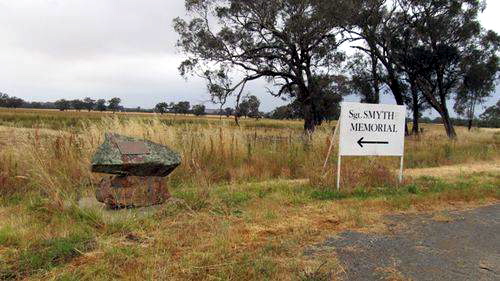
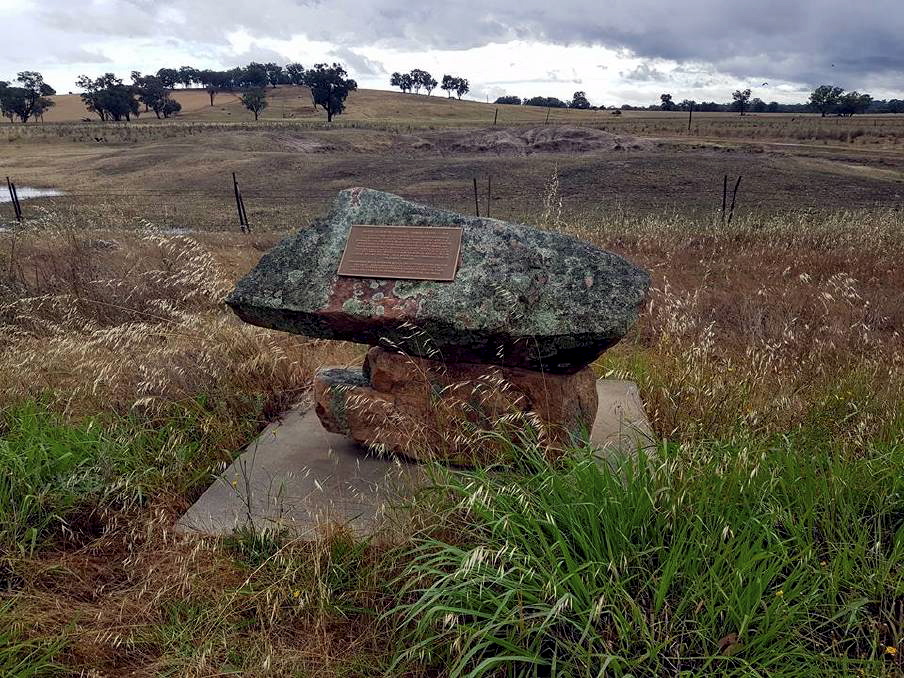
 Memorial located at:   Memorial stone and plaque are located 2 kms west of Henty on Pleasant Hills Rd ( the Lockhart Rd )

[alert_green]THOMAS  IS mentioned on the Police Wall of Remembrance[/alert_green]

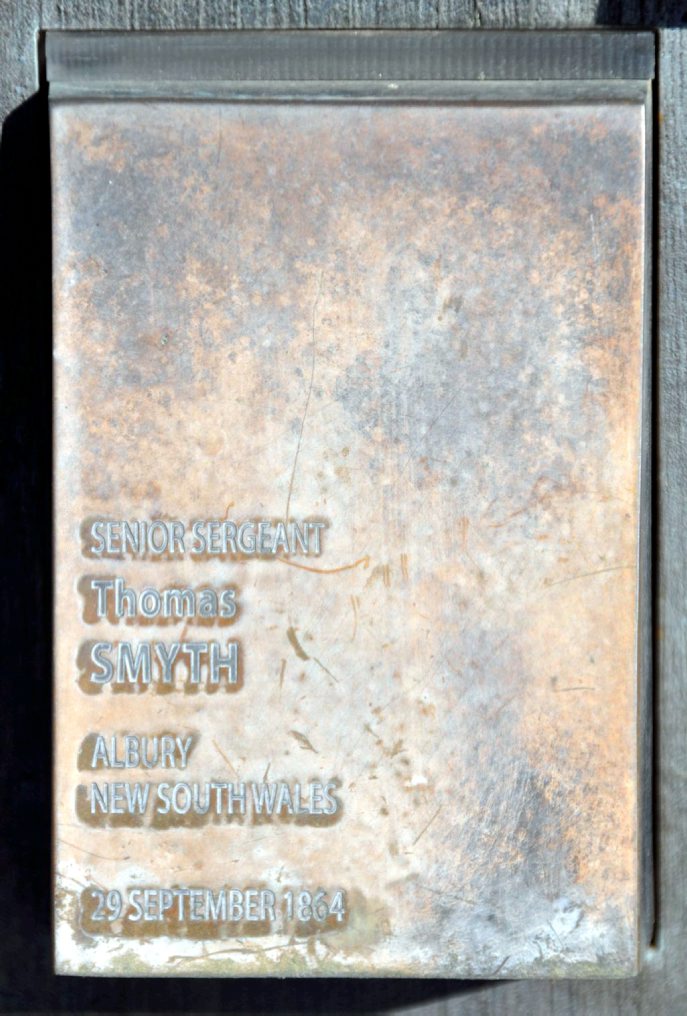
Thomas SMYTH touch plate at the National Police Memorial - Canberra
Thomas SMYTH touch plate at the National Police Memorial – Canberra


Thomas SMYTH
and this is his grave! (The unmarked one in the background).

 [divider_dotted]

FURTHER INFORMATION IS NEEDED ABOUT THIS PERSON, THEIR LIFE, THEIR CAREER AND THEIR DEATH.

PLEASE SEND PHOTOS AND INFORMATION TO Cal

[divider_dotted]

May they forever Rest In Peace

[divider_dotted]

In late September, 1864 the sergeant was camped in the bush with three troopers near Albury during a search for bushrangers, when two men, one of whom the bushranger Daniel Morgan, crept up and fired several shots into the police tent. One shot hit the sergeant, entering his shoulder and exiting through his back. Despite these wounds the sergeant was able to return fire, forcing the offenders to retreat and escape. Sergeant Smyth was soon treated by a doctor however he died of the effects of the wound within a couple of days. The vicious Morgan was shot to death by a farmhand in April, 1865.


The Empire newspaper dated 5 October, 1864 printed the following brief account of the incident.


DEATH OF SERGEANT SMYTH – It is with deep regret that we have to record the death of Senior-Sergeant Smyth, at Albury, on Thursday night, from the wound he received in the cowardly night attack a few weeks back at Doodle Cooma Swamp. It was at first hoped that the unwearied care of Dr Wilkinson would have brought him round; but haemorrhage having set in, little hopes were entertained of his recovery, and he gradually sank until he yielded up his brave spirit on Thursday night. He was a very deserving officer, possessed of more than average intelligence and shrewdness, which eminently fitted him for a police officer. His courage was unquestionable. Previous to his being stationed at Albury he was at Lambing Flat, on leaving which town be was presented with an address by the inhabitants, expressive of their appreciation of his valuable services in the repression of crime on that large goldfield.

The McIvor Times and Rodney Advertiser of 23 September, 1864 printed a detailed account of the incident.

THE BUSHRANGER MORGAN.

A party of police, consisting of Senior Sergeant Smyth, Senior Constable Baxter, Constables Connor, and Maguire, and a blackfellow named Jimmy Reed, were camped on Sunday night at Dougal’s [sic] Swamp, near Keighran’s station. They had just got tea, and were lying in the tent yarning, as is usually done by persons camped out. They had no sentry on guard – that duty being delayed until they “turned in” for the night. Suddenly their discourse was cut short by a volley being fired into the tent amongst them. Sergeant Smyth immediately jumped to his feet, calling on his men to follow him – he firing two shots in the direction he fancied the volley came from. The men who rushed out of the tent immediately after him, scoured the bush in every direction, as well as the darkness would allow them, but failed to find any traces of the ruffians; but, from the tracks discovered at daylight next morning, they must have overrun the bushrangers in the dark.

“They remained in the scrub about an hour, when they, after some consultation, deemed it better to return to the tent, which, considering that the night was dark, arid the surrounding scrub would completely shelter the attacking party, was, to say the least, attended with some danger. Baxter and Connor crawled on their hands and knees to the tent, and found Smyth lying on his back dangerously wounded, and fast bleeding to death. They took everything out of the tent and, having covered poor Smyth up in the few blankets they had, they managed to convey him to Keighran’s station, he still bleeding and suffering great pain, where they remained until daylight. Constable Baxter and the blackfellow then took up the track near the tent, and started to follow the ruffians up. The other two constables proceeded to the Ten Mile Creek, to give information and obtain medical aid for Smyth.

Superintendent McLerie who was proceeding to Sydney on sick leave, happened to be at that place; and he immediately ordered his buggy to be taken off its springs, and the body to be used as a stretcher to convey Smyth to Ten Mile Creek. From the position of the bullet holes in the tent, there cannot have been less than five bushrangers. There are seven bullet holes in the tent; the bullets were picked up inside of it, some of them belonging to a large bore pistol. Constable Connor had a very narrow escape. He was lying down, leaning on his elbow, in the tent, when one of the balls went through the sleeve of his coat, inflicting a slight wound about two inches above the elbow joint. Superintendent McLerie has deemed it necessary to return to Albury for the present. Sub-inspector Morrow and a party of police have started from Albury in pursuit of the bushrangers; and Sub-inspector Zouch has left Wagga Wagga on similar duty.

“A strange incident occurred in connection with this cowardly attack. Shortly after the party were camped, two men came up and were admiring the site chosen for the camp, remarking that they could not have chosen better. They are well known as bush “telegraphs,” being the two men to whose house Sergeant Carroll traced Morgan some time back. Sergeant Smyth’s wound is a very dangerous one. The ball entered immediately above the nipple of the left breast, following the course of the ribs, and came out under the left shoulder-blade; so that, while the wound may not be considered mortal, yet fatal results may ensue from it. The people are greatly excited on this murderous attack, which in cold-blooded treachery far surpasses the Lachlan escort robbery.”

The Empire newspaper dated 5 October, 1864 printed the following brief account of the death of the sergeant.

DEATH OF SERGEANT SMYTH
It is with deep regret that we have to record the death of Senior-Sergeant Smyth, at Albury, on Thursday night, from the wound he received in the cowardly night attack a few weeks back at Doodle Cooma Swamp. It was at first hoped that the unwearied care of Dr Wilkinson would have brought him round; but haemorrhage having set in, little hopes were entertained of his recovery, and he gradually sank until he yielded up his brave spirit on Thursday night. He was a very deserving officer, possessed of more than average intelligence and shrewdness, which eminently fitted him for a police officer. His courage was unquestionable. Previous to his being stationed at Albury he was at Lambing Flat, on leaving which town he was presented with an address by the inhabitants, expressive of their appreciation of his valuable services in the repression of crime on that large goldfield.”

In April 1865 the vicious and cowardly bushranger Morgan was shot to death by a farmhand in at Peechelba Station, near Wangaratta (Vic).

The sergeant was born in 1830 and joined the police force on 8 February, 1858. In 1862 he became a member of the newly-formed New South Wales Police Force. At the time of his death he was stationed at Albury.


http://trove.nla.gov.au/ndp/del/article/30580797

[divider_dotted]


Senior Sergeant Thomas Smyth to get a proper gravesite after he was murdered by bushranger ‘Mad Dog’ Dan Morgan in 1864.

Marguerite McKinnon
Marguerite McKinnon@@marguerite_mck1


It’s taken 153-years but moves are finally underway to give some restitution to Senior Sergeant Thomas Smyth, who was murdered by notorious bushranger ‘Mad DogDan Morgan in the hills near Henty in 1864.

Sergeant Smyth’s unmarked grave is now set to receive a memorial headstone to rectify what is believed to have been an administrative oversight lost in the 1951 transferral of Albury’s three cemeteries from church to council.

Police officers, both active and retired, had bemoaned as “a sad end and undignified burial” of Senior Sergeant Smyth after he was shot trying to recapture the bushranger, who had been terrorising the region.

In 1864, ‘Mad DogMorgan had recently committed his second and third murders before he arrived in the Henty area. Widespread fear and an outcry from the press at the time saw the reward for Morgan’s capture raised to £1000, and parties of special police were sent to track and capture him.

On September 4, Senior Sergeant Smyth had set up camp with three troopers in the Henty hills, when Morgan and another man crept up and fired several shots into the police tent, hitting the sergeant in the shoulder and exiting through his back. Morgan later said he had been watching the camp for some time.

Despite his wounds, the sergeant ran out of the tent and returned fire, forcing the offenders to retreat. The wounded officer then collapsed. He was transferred to Kiamba and then Albury where doctors claimed he was recovering, before he hemorrhaged several times.

The Empire newspaper dated October 5, 1864 reported that “he yielded up his brave spirit on Thursday night. He was a very deserving officer, possessed of more than average intelligence and shrewdness, which eminently fitted him for a police officer. His courage was unquestionable”.

Senior Sergeant Smyth was buried in an unmarked grave in an Albury cemetery, however there is a memorial stone on Pleasant Hills Road just outside Henty.

NSW Police is hoping to rectify other unmarked police graves. Dan Morgan was holding hostages when he was shot dead in Victoria by a farmhand in April,1865.

This excerpt is from an Australian Government site about bushrangers:

Daniel Morgan brought discredit to the popular ‘currency heroes’ by his mixture of violence, abuse and seemingly meaningless murders. Morgan claimed his innocence at his first conviction in 1854, at the diggings near Castlemaine, which he said was ‘framed‘ by a squatter. During his time at Pentridge Prison, he developed a violent dislike for police. Upon his release, he began a campaign against society at large and the police in particular.

Morgan once took issue with an overseer’s wife when the man was away on business, demanding money from her as he forced her against a blazing fire until she suffered severe burns to her legs. Morgan also tried to burn squatter Isaac Vincent by setting fire to his woolshed after he had tied Vincent to a nearby fence. After Morgan bailed up coaches, he would stampede the horses – sending them and their drivers to destruction.

Eventually he was shot and captured in 1865 after being outwitted by a nursemaid and station hand at Peelhelba Station near Wangaratta, owned by the McPhersons.”


Thomas SMYTH
MEMORIAL: Senior Sergeant Thomas Smyth will get a memorial headstone on his unmarked grave in Albury, after he was shot by bushranger Dan Morgan in 1864.


Thomas SMYTH
MEMORIAL: The memorial stone to Senior Sergeant Thomas Smyth is two kilometres west of Henty on Pleasant Hills Rd (the Lockhart road).


Thomas SMYTH<


Thomas SMYTH
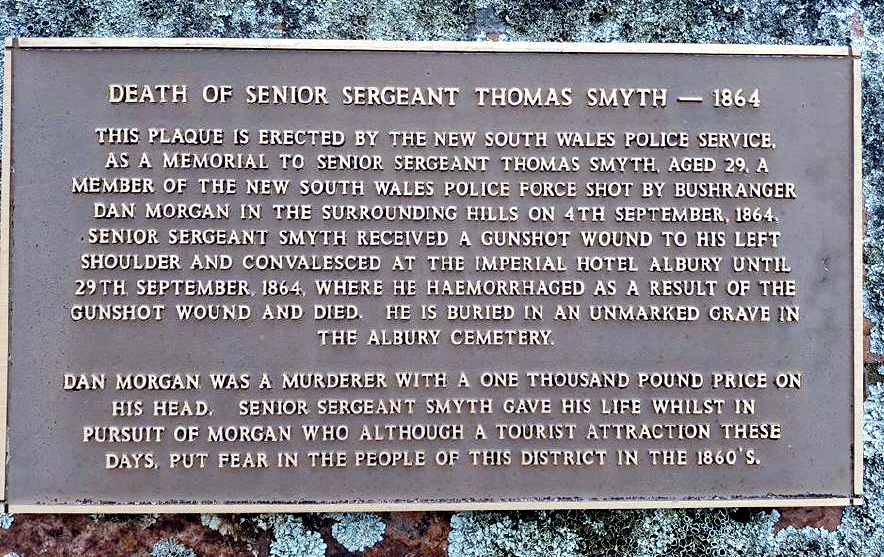
DETAIL: The plaque detailing the death of Senior Sergeant Thomas Smyth after he was shot by bushranger ‘Mad Dog’ Dan Morgan in September 1864.


Thomas SMYTH
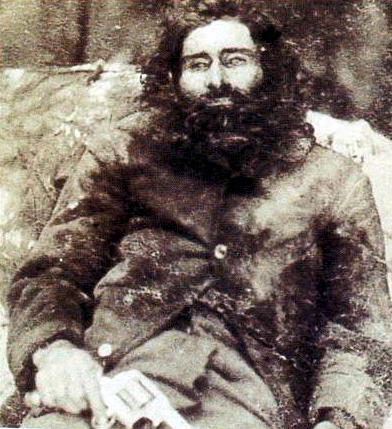
MURDERER: A post-mortem photograph of notorious bushranger ‘Mad Dog’ Dan Morgan who murdered several people, including Senior Sergeant Thomas Smyth.


The story Restitution for murdered police officer after outcry over his unmarked grave | Photos first appeared on The Daily Advertiser.

http://www.theland.com.au/story/5105955/restitution-for-murdered-police-officer-after-outcry-over-his-unmarked-grave-photos/?cs=4951

[divider_dotted]


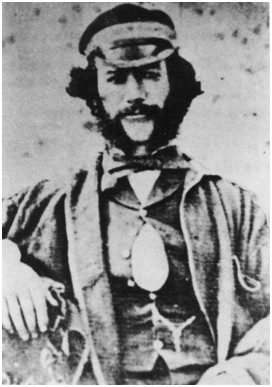
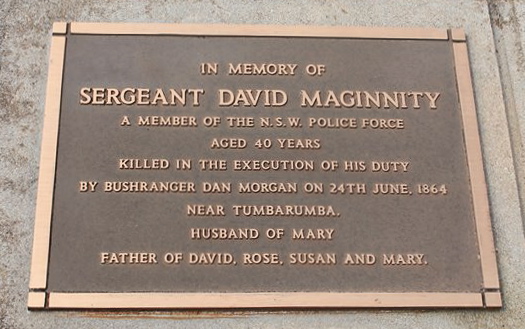
David MAGINNITY

 Sergeant David MAGINNITY

Murdered – Shot

Tumbarumba

24 June, 1864

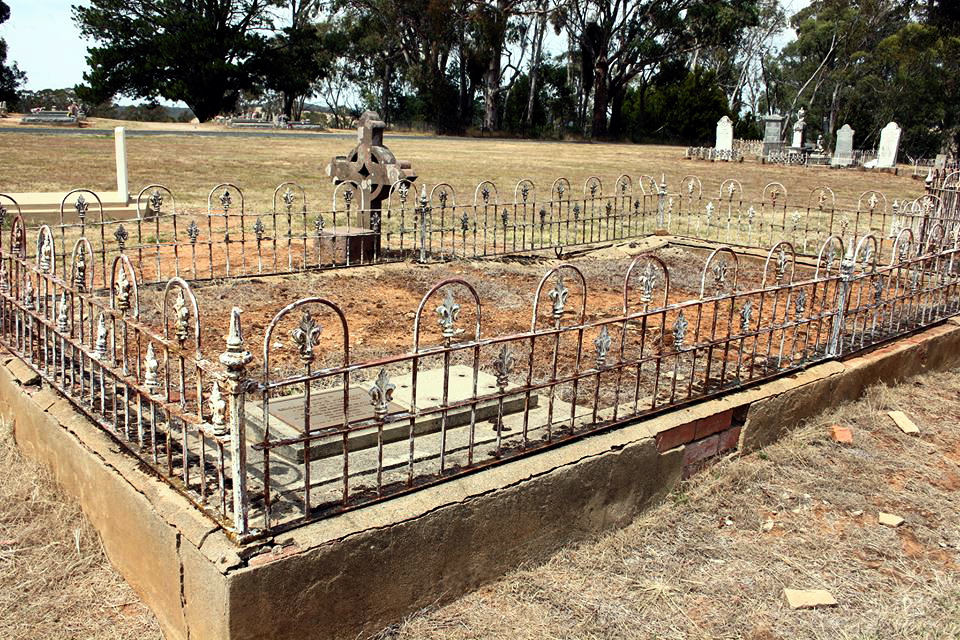
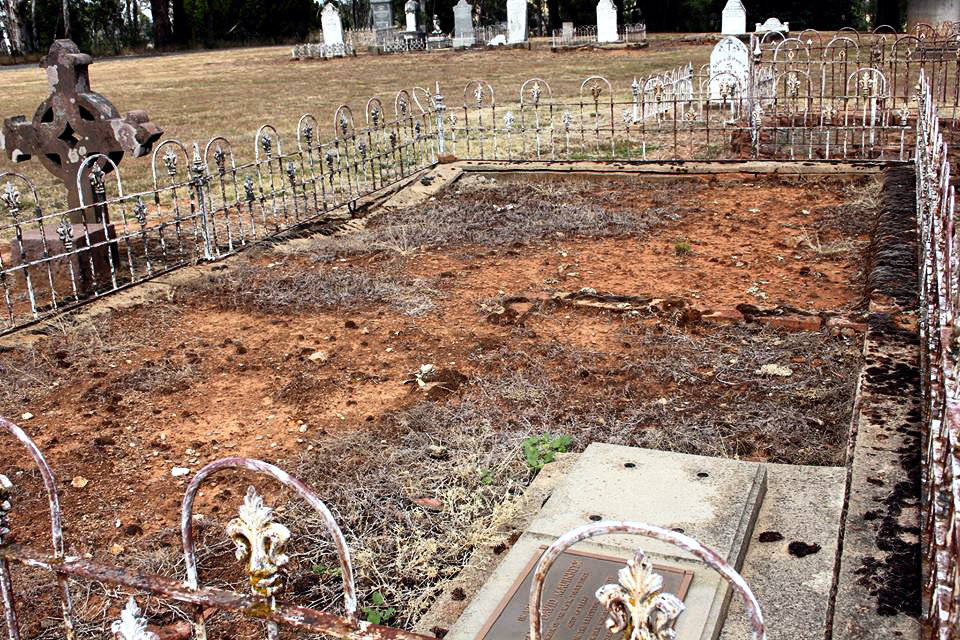
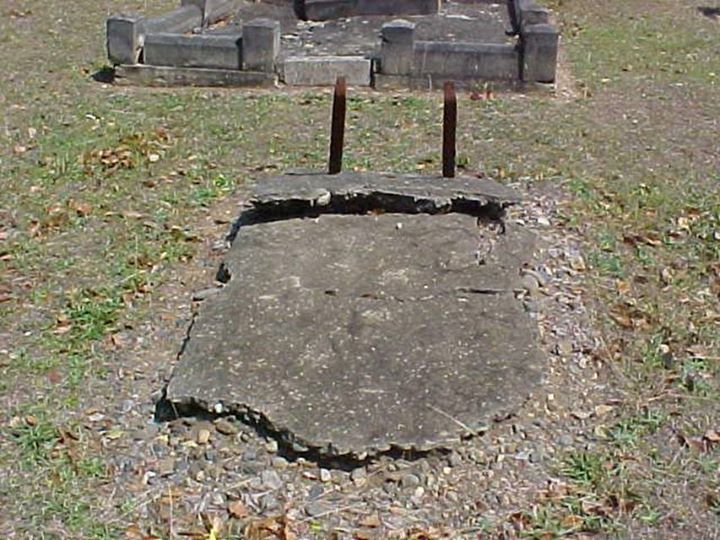
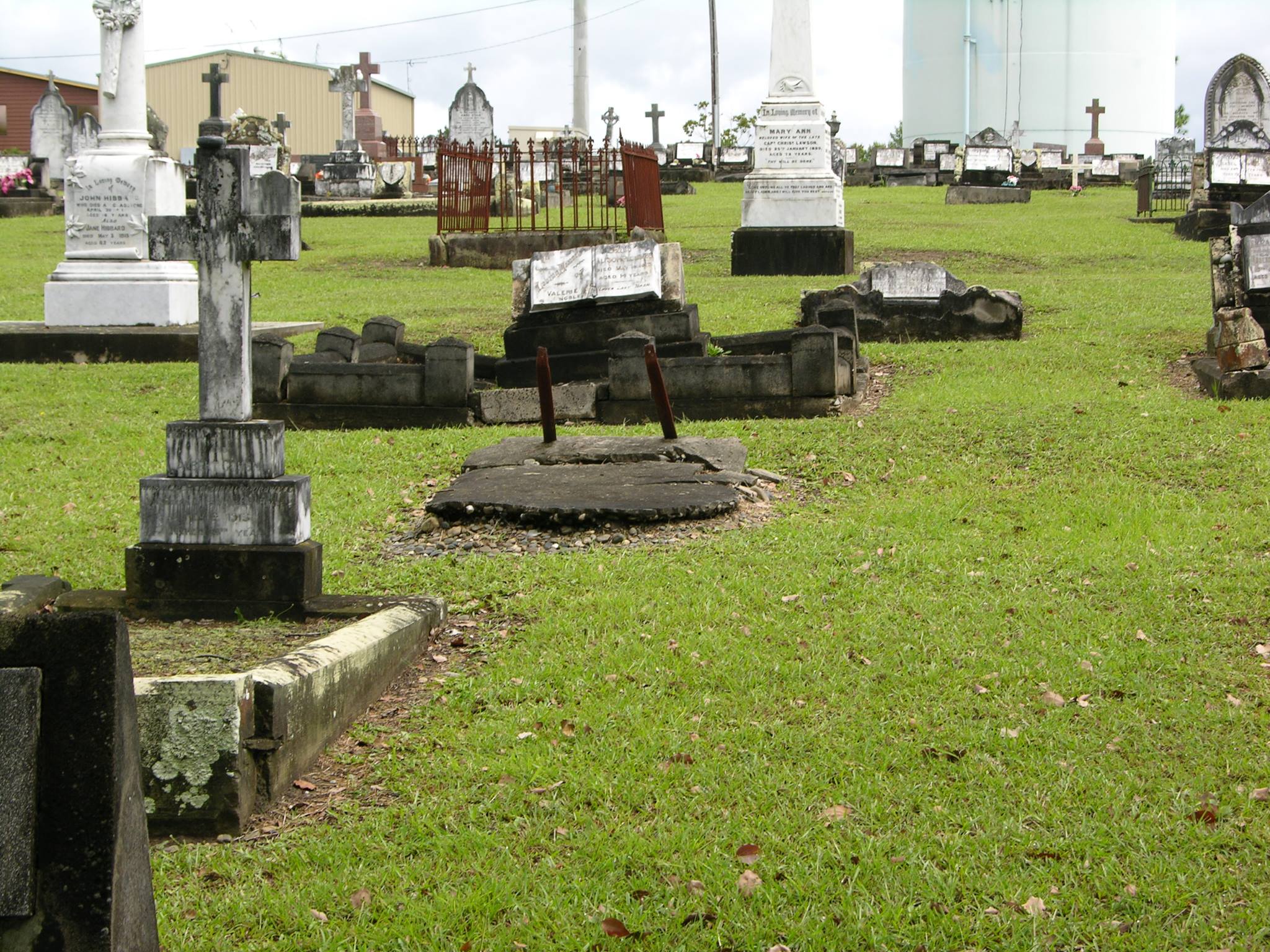
Sergeant David Maginnity ( 1864 )

Grave of Sgt David Maginnity - courtesy of Ken Medway ( Beyond Courage FB Page 120114
Grave of Sgt David Maginnity – courtesy of Ken Medway ( Beyond Courage FB Page 120114 )

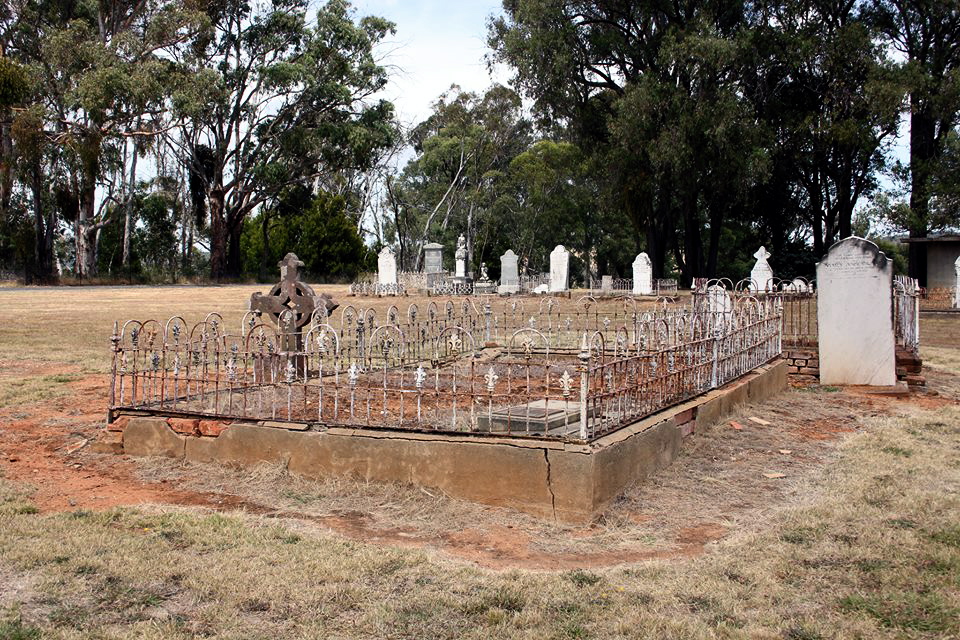
Grave of Sgt David Maginnity - courtesy of Ken Medway ( Beyond Courage FB Page 120114
Grave of Sgt David Maginnity – courtesy of Ken Medway ( Beyond Courage FB Page 120114 )

Grave of Sgt David Maginnity - courtesy of Ken Medway ( Beyond Courage FB Page 120114
Grave of Sgt David Maginnity – courtesy of Ken Medway ( Beyond Courage FB Page 120114 )

Grave of Sgt David Maginnity - courtesy of Ken Medway ( Beyond Courage FB Page 120114
Grave of Sgt David Maginnity – courtesy of Ken Medway ( Beyond Courage FB Page 120114 )


The sergeant was returning to Tumbarumba from a patrol to Copabella with Constable Charles Churchley when they encountered another rider on the road. When the sergeant cantered up to the rider a shot was fired almost instantly. The sergeant’s horse then plunged into the bush, carrying its mortally wounded rider. The stranger was later identified as the bushranger Daniel Morgan. The sergeant’s body was recovered the following day. The Wynyard Times newspaper dated 27 June, 1864 carried the following account.


THE ENCOUNTER WITH MORGAN AND DEATH OF SERGEANT MAGINNITY.

It is our painful duty to record the death of Senior-sergeant David Maginnity, of Tumbarumba, who was, on Friday last, shot dead by the notorious bushranger Morgan. It appears that early on Thursday, Sergeant Maginnity, accompanied by constable Churchley, left Tumbarumba for Copabella, a distance of twenty miles. On their return next morning, they encountered Morgan within five miles of Copabella, at about half-past ten o’clock. At this time Churchley was a little in advance of Maginnity, when the latter, seeing Morgan, cantered up to Churchley, and hurriedly inquired of him who that was. Almost before receiving a reply, he rode smartly up to Morgan’s side, Churchley being about fifteen or twenty yards to the rear. Morgan instantly fired at Maginnity, whose horse thereupon rushed into the bush. At the same time, Morgan’s horse took the opposite direction, leaving Churchley on the road, but as his horse was completely knocked up he soon lost sight of both of them.


The vicious and violent Morgan, who also murdered Senior Sergeant Thomas Smyth near Albury three months after Sergeant Maginnity’s murder, was shot to death by a farmhand in April, 1865.


The sergeant was born in 1815 and joined the police force on 8 July, 1853. Previously a member of the Mounted Road Patrol, in 1862 he became a member of the newly-formed New South Wales Police Force. At the time of his death he was stationed at Tumbarumba.


Edward HAMPSON

Edward HAMPSON

New South Wales Police Force

Rank:  Constable

Regd. #:  ? * A search of the ‘on-line’ State Archives does NOT reveal a HAMPSON, or similar, as being a member of the Police

Stations:  East Kempsey ( Lock up Keeper )

ServiceFrom ? ? ? to pre March 1862 = ? years Service

Awards:  No find.

Born:  Sunday 15 May 1825, Lancashire, England

Emigrated:  from USA to Australia between July 1853 and before Nov 1854

Died:  Wednesday 24 December 1862

Cause:  Horse Accident – against a tree

Event location:  East Kempsey – near the Yarrabandinni gates

Age37 – 39?

Funeral date:

Funeral location?

Buried at:  Frederickton Cemetery, Great North Rd, Frederickton, NSW:

Anglican section  row G # 67

GPS:  31 02′ 02S / 152 52′ 38E

Grave location

[alert_red]Edward IS NOT mentioned on the Police Wall of Remembrance[/alert_ed]

Constable Edward HAMPSON - grave
Constable Edward HAMPSON – grave

Constable Edward HAMPSON - grave
Constable Edward HAMPSON – grave

The constable is believed to have suffered fatal injuries when he was either thrown or fell from his troop horse at East Kempsey.

Some 62 years later the Macleay Chronicle of 7 May, 1924 in a related story recounted that the constable had been “killed while riding near the Yarrabandinni gates on Christmas Eve, 1862”. In a contemporary account however, the Empire newspaper of the 5 January, 1863 reported the following.

ACCIDENT
On the 24th instant, a settler named Edward Hampson came by his death through a fall from a young horse he was riding. It appeared from the evidence given before the coroner that the deceased was thrown with so much violence against the spur of a tree as to cause instantaneous death.”

Few details are known at present, however the Macleay Chronicle of 7 May, 1924 reported that the constable had been ” killed while riding near the Yarrabandinni gates on Christmas Eve, 1862 “.


At the time of his death the constable is thought to have been the lockup-keeper at the East Kempsey Police Station, where he had been stationed since at least early 1856 (he is mentioned in the New South Wales Police Gazette of 16 February, 1856).

In 1862 he became a member of the newly-formed New South Wales Police Force.

He is not listed in the official New South Wales Police Honour Roll.

Beyond Courage

[divider_dotted]


MacLeay River Historical Society     November 2012      page 2

An enquiry was received from Kempsey Police re Edward Hampson who was killed Christmas Creek, near Yarrabandinni Gates on Christmas Eve 1862 when his young horse threw him against a tree.

It was believed Edward was a police constable and had died on duty, and the information was required for a book on police killed in the line of duty.

A death certificate in Research records however gave Edward’s occupation as a farmer, as did a marriage certificate for his oldest son, Wright Harrison Hampson. It appears Edward was a police constable at some stage but had left the Force prior to his death.

http://www.kempseymuseum.org/userfiles/newsletters/newsletter%201211.pdf


Edward and his wife Eliza arrived from the United States of America sometime in the late 1840s or early 1850, with three children. They had immigrated to the USA from England, however for some reason they changed their mind about settling in America and came to Australia.

After their arrival, at least another four children were born, 1854 Thomas, 1856 William, 1857 Edward, 1860 Henry and 1862 Mary. The majority of the children’s place of births are registered as Macleay River.

Their father Edward HAMPSON, became a Police Officer, however he was killed while on duty in 1862 near a river.

http://archiver.rootsweb.ancestry.com/th/read/AUS-NSW-NORCO/2005-03/1111738684


[divider_dotted]


From: “Janice Doughty” <adoughty01@optusnet.com.au>
Subject: Re: [NORCO] EDWARD HAMPSON-Police Constable
Date: Sun, 27 Mar 2005 09:24:51 +1000
References: <000001c53113$2b468a30$295d1ed3@ADOUGHTY> <80977F0C-9E24-11D9-88D6-000A95EAA358@ceinternet.com.au>

Thank you to Rod and also to the many other Listers who have helped with my enquiry regarding the Hampson family of Macleay River district.

Within a day of requesting help with the HAMPSON family, I have found out so much from this wonderful List and I would like to share the HAMPSON story with you so far.

Edward HAMPSON was Christened on 15th May 1825, at Saint Michael, Ashton Under Lyne, Lancashire, England. His parents being Thomas and Nancy HAMPSON. Family rumour has it that this family was very well off, living in a large home in the town of Ashton Under Lyne in Lancashire.

Eliza HARRISON was Christened on 23 May 1824 at Saint Michael, Ashton Under Lyne, Lancashire. Her parents were James and Alice HARRISON.

Edward HAMPSON at 20 years of age, married Eliza HARRISON also 20, on 1st January 1844 at the Cathedral, Manchester, Lancashire ENGLAND.

Some time between 1844 and 1848, Edward and Eliza HAMPSON sailed for the United States, and settled on the east coast of the USA. It is believe that there were already relatives of Edward’s living in the U.S.

Children born in the U.S.A were.:-

Wright Harrison HAMPSON born 1848 in Salem, Mass.
Desdemona Ann HAMPSON born 1851 Newark New Jersey
Alice Maria HAMPSON b.1853 Boston, Mass.

After the birth of Alice in Boston in July 1853 and before the birth of Thomas in Australia in Nov 1854, the family sailed from Boston to old Sydney Town, Australia. What ship they sailed on is at the moment unknown.

Children born in the Colony were:-

Thomas 1854,

William 1856,

Edward 1857,

Henry 1860 and

Mary 1862.

All except Thomas, who may have been born in Sydney, not long after the family arrived in Sydney Cove, were born in the Macleay River district. The family settled somewhere near Kempsey, at the moment it is unknown exactly where their property was. Any help with establishing where the family actually lived, would be very much appreciated.

As previously stated, the father Edward joined the police force, and was tragically killed on Christmas Eve 1868 when he was thrown against a tree.
More work has to be done regarding the death of Edward. Not sure if he was on duty when he died.

It was only six month before, when Edward and Eliza‘s son Thomas, at 14 years of age was killed in an accident in July, while driving a team of bullocks, when one of the wheels got on the end of a slab, suddenly lifting the other end, which struck Thomas on the head killing him on the spot.
Thomas at the time was in the employ of Mr. James Ducat (Manning River New – 11.07.1868). Thomas was recovering from a broken arm at the time of his death.

The surviving children all married:-

1870 Wright Harrison HAMPSON, married Isabella Emmeline Reid at Port Macquarie. She died in 1886 and Wright’s second wife was Ellen Berman and they married in 1906, also in Port Macquarie.

Desdemona Ann HAMPSON married Edwin James CLOUGH in 1868 at Macleay River.

Alice Maria HAMPSON married John JONES in 1868 at Macleay River. (The sisters may have married on the same day).

William HAMPSON married Elizabeth BOLSTER in 1884 at Kempsey.

Edward HAMPSON married Annie KELLARD IN 1882 in Sydney.

Henry Frank HAMPSON married Ada Caroline KELLY in 1881 in Sydney.

Mary Amelia HAMPSON married Arthur Pringle STEWART in 1881 in Newtown.

The one member of this family whose name survives today, through his wonderful exploits is Wright Harrison HAMPSON, through his colourful career as a mail contractor and coach driver for Cobb & Co. He was well known for playing on his bugle “The Girl I Left Behind Me”, when his coach was leaving town. There was also his stories of the Boer War, he was 52 years of age when he joined up.

Wright Harrison HAMPSON, died in 1929 in Granville, his son Wright Harrison HAMPSON Jnr, died five years before his father in 1924 at Parramatta.

Again, a big thank you to everyone who contributed to put this story together.

Regards,
Janice
Belrose – Sydney

—– Original Message —–

From: Rod Gow <rgow@ceinternet.com.au>
Subject: Re: [NORCO] EDWARD HAMPSON-Police Constable
Date: Sun, 27 Mar 2005 04:25:59 +1000
References: <000001c53113$2b468a30$295d1ed3@ADOUGHTY>
In-Reply-To: <000001c53113$2b468a30$295d1ed3@ADOUGHTY>


Dear Janice,

We had a look at some newspaper indexes relating to HAMPSON of the Macleay River and found the following which may be of some interest…


Manning River News newspaper – 11 July, 1868     page 2    columns 5 and 6

Another accident happened at Moonebah, by which a boy, named Hampson, lost his life whilst driving a team of bullocks. One of the wheels got on the end of a slab, suddenly lifting the other end, which struck the boy on the head killing him on the spot.

The lad who was killed at Moonebah by being struck on the head by a rail as mentioned by our regular correspondent, was named Thomas Hampson. He was in the employ of Mr. James Ducat. A magisterial enquiry was held.


Manning River News newspaper – 11 September, 1869         page 3 column 3

A son of a Mrs. Hampson has had his leg broken. It is stated that the boy belongs to a particularly unfortunate family. His father was killed by being thrown against a tree, his eldest brother had his arm broken, and had no sooner recovered from that accident than he was suddenly killed, and now this lad comes in for his share of trouble. The boy’s mother certainly deserves the sympathy of her neighbours, and pecuniary aid too, if she needs it.

Also, Janice, in the “NSW – Patriotic Fund Subscribers – Crimean War (1855) index” there is the following entry extracted from the


Sydney Morning Herald …  Hampson EKempsey & Macleay River  16 Aug 1855  page 6 column 1

If this is one of the family it may establish that he was in the Macleay district in 1855

Also, is Wright Hampson one of the family you are researching ? He married Miss Berman on 3 January, 1907.

Hope the above is of some assistance.

Best wishes,

Rod & Wendy Gow


[divider_dotted]

On 25 Mar 2005, at 7:18 PM, Janice Doughty wrote:

Good evening Listers,

I am new to this list and am hoping that SKS maybe able to assist me.
I am helping the wife of my husband’s cousin to find out some history on her gg grandfather one Edward HAMPSON.

Edward and his wife Eliza arrived from the United States of America sometime in the late 1840s or early 1850, with three children. They had immigrated to the USA from England, however for some reason they changed their mind about settling in America and came to Australia.

After their arrival, at least another four children were born, 1854 Thomas, 1856 William, 1857 Edward, 1860 Henry and 1862 Mary. The majority of the children’s place of births are registered as Macleay River. Their father Edward HAMPSON, became a Police Officer, however he was killed while on duty in 1862 near a river. The lady I am helping thinks she can remember the cause of death was a fall from a horse.

Any help regarding this family would be very much appreciated.


Regards,
Janice
Sydney

[divider_dotted]


2013 – Beyond Courage

Chris Stafford Good evening everyone, yesterday I received Edward Hampson Death Certificate and unfortunately, at the time of his death, Edward was no longer a Constable, but was a farmer and settler in the Fredo/East Kempsey (East was the original township). This was back up by one of his children’s marriage certificate.
Even though I have found written reference in newspaper that did indicate Edward was the Lock up Keeper for East Kempsey, but it seems by 1862, at the creation of the NSW Police Force, he was no longer a serving member.
This maybe the reason while there is no record on the NSW Honour Roll or the Canberra Wall. However, I am still going to attempt to fix his grave up and place a new plaque stating Edward as a former Police Officer.


Alexander McGEE

Alexander McGEE

New South Wales Police Force

Regd. #  ?

Rank:  Inspector

Stations:  B District – Sydney

ServiceFrom  ? ? ?  to  22 May 1860 = about 20? years Service

Awards?

Born? ? ?

Event locationCastlereagh Street near Liverpool St, Sydney, NSW

Event date:  26 March 1860

Died on:  Tuesday 22 May 1860

Place of death?

Cause:  Shot – murdered

Age:  46

Funeral date:  Thursday  24 May 1860 @ 3.15pm

Funeral location?

Buried atDevonshire St Cemetery

Upon the closing of Devonshire St Cemetery, McGee’s body was exhumed and relocated to

Rookwood Cemetery, Presbyterian Section, 5C,  Plot 4554

Memorial at:

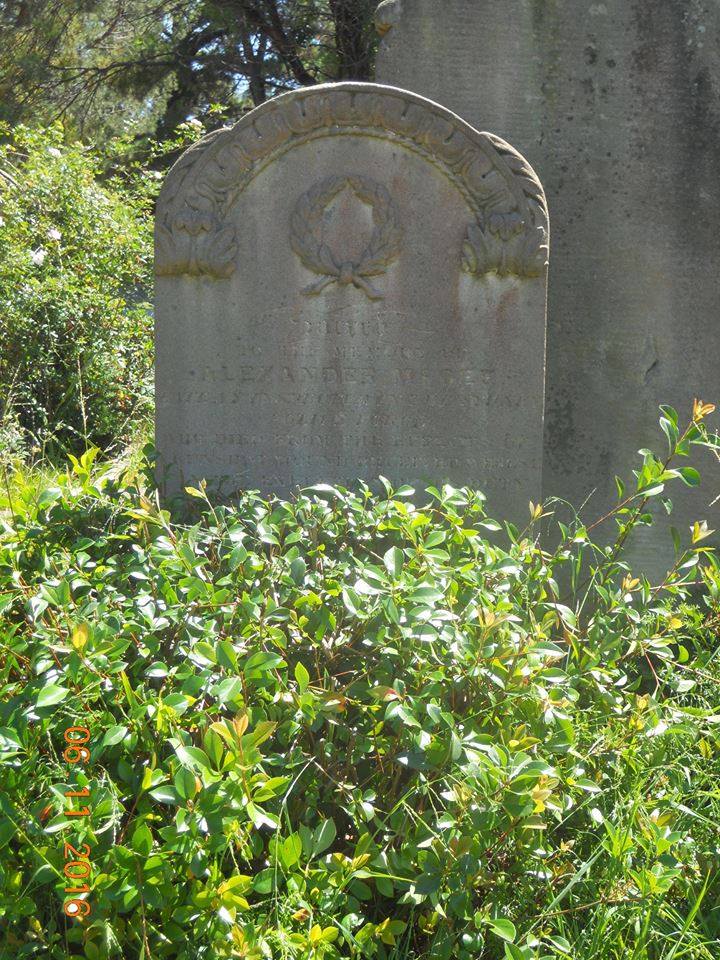
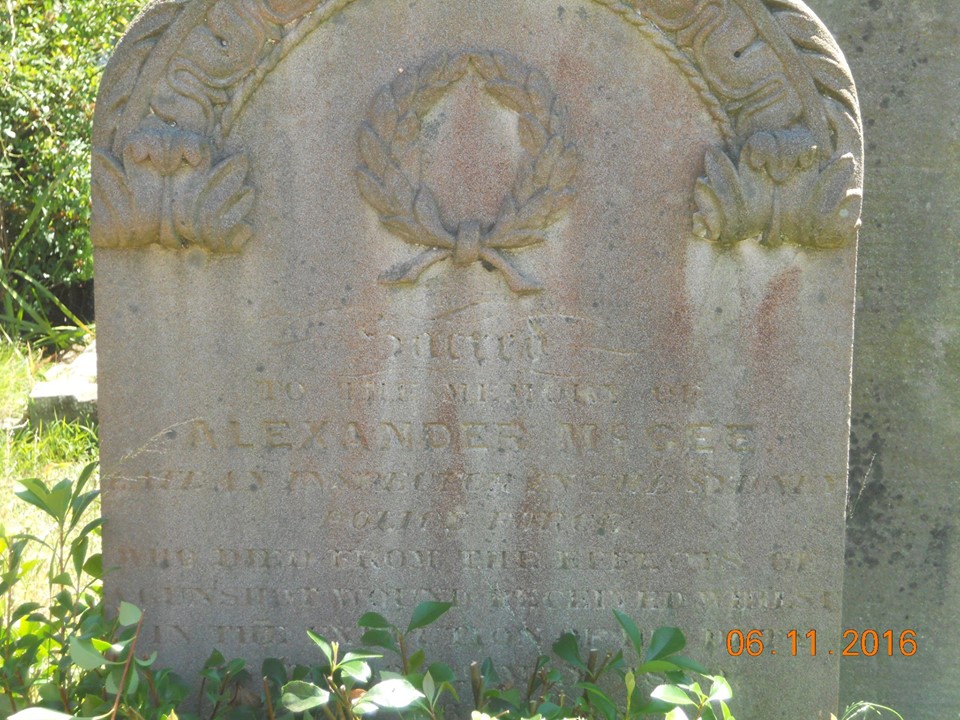
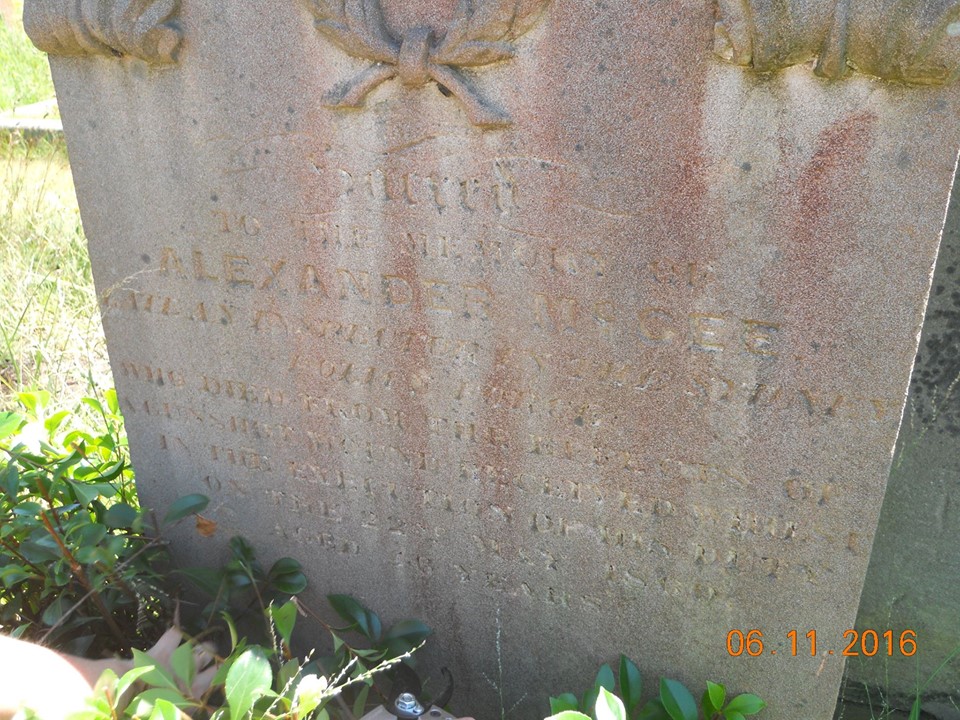
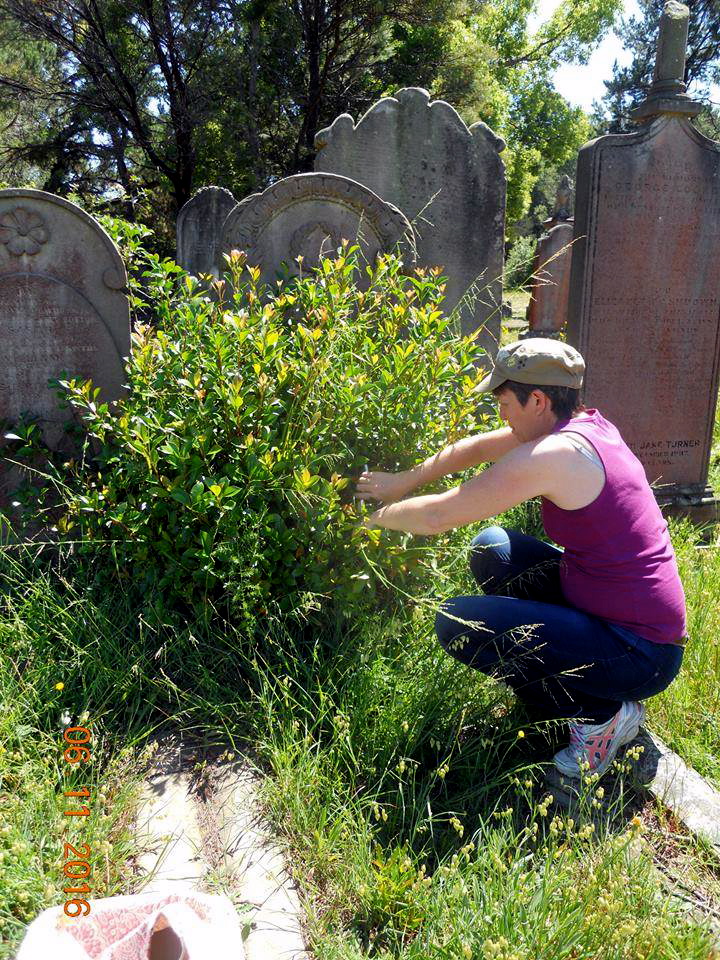
Alison Carter, who is not associated with NSW Police, but went out of her way and took the time to locate & take photos of the grave of our fallen brother - Alexander McGee on 6 November 2016. Thank you Alison.
Alison Carter, who is not associated with NSW Police, but went out of her way and took the time to locate & take photos of the grave of our fallen brother – Alexander McGee on 6 November 2016. Thank you Alison.

ALEXANDER is NOT mentioned on the Police Wall of Remembrance

*  But should be


Between 11pm and 12 midnight on 26 March, 1860 Constable Connaughty was on duty in Goulburn Street, Sydney when he saw two soldiers ( William Pike and Patrick Hughes ) carrying rifles. Believing them to be deserters he followed them along Sussex Street, across the Haymarket and along Pitt Street until he spotted Inspector McGee, Sergeant James Rush and Sergeant Francis Rooney, who were out looking for soldiers who had deserted from the 12th Regiment.

The four police officers then followed the soldiers until, when near Liverpool Street, they began to run. Rush and Rooney quickly caught up with Hughes while McGee and Connaughty chased Pike into Castlereagh Street where he suddenly stopped and pointed his rifle at the inspector.

Pike then said, ” If you attempt to take me I will shoot you. “ McGee replied,  ” Do not fire, coward. “ Pike then ran a few steps, chased by McGee, before turning around and firing at the inspector from point blank range. The bullet struck the inspector in the right groin area, exiting from his lower back. He died from the effects of the wound four weeks later.


The Sydney Morning Herald of Tuesday 12 June, 1860 reported that  ” The Central Criminal Court is sitting. The two soldiers, Pike and Hughes, have been tried for shooting Inspector McGee. Hughes was acquitted, but Pike convicted of manslaughter, and sentenced to three years hard labour in gaol. Hughes was in custody when the shot was fired, and as to Pike, as he was only carrying firearms, which at present is no offence against the law, the arrest of him was not justified as an act of police duty…”


At the time of his death the inspector was aged 46 years and had been a police officer for about 20 years. At the time of his death he was stationed in B Division, Sydney.


NSWBDM – Death Reg  707/1860


Bathurst Free Press and Mining Journal ( NSW )

Saturday  31 March 1860     p 3

OUTRAGE.

Two soldiers belonging to the 12th regiment were brought before the Court in their regimental dress by constable Connaughty, charged, the first with feloniously, shooting, intending to murder Inspector Alexander McGee, and the second with aiding and abetting in the same. Their names are William Pike and Patrick Hughes.

Witness stated, that between 11 and 12 o’clock last night I saw the prisoners in Goulburn-street with firearms in their possession (two Enfield rifles.) Believing they were about to desert, I followed them along Sussex-street down to the Haymarket and from thence into Pitt-street. I there met Inspector McGee, Sergeant Rooney, and Sergeant Rush. We then followed the prisoners into Liverpool-street, where they began to run. Hughes was pursued by Sergeants Rush and Rooney, who succeeded in apprehending him.

The other prisoner continued running and was pursued by Inspector McGee and myself. As he turned the corner of Castlereagh-street, prisoner (Pike) said ‘ If you attempt to follow me I’ll shoot.‘ Finding that we were still pursing him, he presented his rifle. McGee, who was close beside at the time said ” don’t fire you coward,” and prisoner immediately run on for about 10 or 15 yards, and when we got within about a length of his rifle, he turned round, and without saying anything, shot McGee through the thigh. So soon as the prisoner fired McGee said ‘ I am shot.’ I asked him where ? he replied through the thigh. In the mean time I secured the prisoner, who the moment he fired, said, ‘ Oh, you have pulled the trigger. ”

Sergeant Rush deposed as follows : About twenty minutes past 11 o’clock last evening, I was at Cowell’s public house at the corner of Goulburn street, in plain clothes. Pike came in with a rifle, the barrel of which was partly covered by the skirt of a woman’s dress. I noticed blood on his hands. Immediately after entering, he called Hughes in, who was standing at the door, but the latter replied, ” No ; don’t you see, you b—-y fool?Hughes then put his piece, which was clipped, to the charge. They both then went away, and l fancied that, although in plain clothes, Hughes knew me. I then followed them into Sussex-street where, whilst turning round they saw me, and brought their pieces to the charge. Hughes at length said to me, ” Can you tell me where the old Australian Inn is ?” their pieces being still charged towards me. I told them, yes, and that I would go and show them if they chose.

They then brought their pieces to the trail, and I proceeded in company with them. I said, you seem to have just come off a long journey, having your firearms with you. They said they had just come from Melbourne, and were going to a place near Dixon’s mill.

After we had got near the spot indicated, Hughes said, ‘ You had better not come any further.’ but I persisted in following them to the Hay Market, where they had some conversation. They then presented their arms at me and I went away and put on my uniform coat. Immediately after I came up with them again in Pitt-street, where I also saw Inspector McGee and told him what had occurred.

Prisoners next went into Liverpool street and instantly began to run. Sergeant Rooney was at this time close behind, and whilst McGee pursued, Pike stopped Hughes, who thereupon brought his piece to bear. I knocked it aside twice with one hand and struck him in the head with my fist, which caused him to stagger. I took advantage of the opportunity and clasped him round the waist with my two arms, including in the fold the rifle also.

In the mean time Rooney came up and wrenched the rifle from his grasp. Whilst in the act of apprehending him, I heard some one ‘say, ” If you come any further I’ll shoot you, ” and soon after I heard the report of a gun.

I produce the rifle which we took from Hughes. It is loaded and capped. On searching him at the station house, I found in his possession 19 rounds of ball cartridge and 25 percussion caps which I also produce. ( Several rounds of ball cartridges, together with some percussion caps, were also found on the other prisoner. )

Sergeant Rooney gave evidence much to the same effect as that of the previous witnesses.

John Marshland, a sergeant belonging to the 12th Regiment, recognised the two prisoners, who he said had no authority to be out last night. He believed that they effected their escape by climbing the walls. Soldiers were never allowed to carry firearms through the streets except when on duty.

As Inspector McGee is at present dangerously ill in the Infirmary the Bench remanded the case until this day week. — Empire of Wednesday.

http://trove.nla.gov.au/newspaper/rendition/nla.news-article63597117.txt


The Sydney Morning Herald

Wednesday  23 May 1860     p 1

Died on the 22nd instant, Mr. Alexander McGee, aged 46 years, late Inspector of police, after a lingering illness from the effects of a gunshot wound on the 26th March, leaving a wife and large family and a numerous circle of friends to mourn his loss.

http://trove.nla.gov.au/newspaper/article/13040895


The Sydney Morning Herald

Wednesday  23 May 1860     p 8

FUNERAL.— The Friends of the late Mr. ALEXANDER McGEE, late Inspector of police, are respectfully requested to attend his Funeral. The procession to move from his late residence, Police Station, George-street South, on THURSDAY AFTERNOON, at a quarter-past 3 o’clock.
REUBEN THOMAS, undertaker,

141, York-street, late of 54, King-street.


Empire ( Sydney )
Thursday  24 May 1860     p 8
MASONIC.
THE Officers and Members of Lodges No. 260, 206, and 207, are respectfully requested to attend the FUNERAL of Brother ALEXANDER McGEE, late of 260 ; to move from his late residence, Police Station, George-street South, THIS DAY, 24th instant, at 3 o’clock p.m.
H. WILSON, Secretary pro tem.
*   *   *
FUNERAL.-The Friends of the late Mr ALEXANDER McGEE, late Inspector of Police, are respectfully requested to attend his Funeral. The procession to move from his late residence, Police Station, George street South, THIS (Thursday) AFTERNOON, at a 4 o’clock.
REUBEN THOMAS, Undertaker, 141, York-street,

late of 64, King.street.


The Sydney Morning Herald
Thursday  24 May 1860         p 3

THE LATE INSPECTOR McGEE.

IN our obituary of yesterday we had to record the death of Inspector Alexander McGee, of the police force, of Sydney. ” We have long been expecting to make this announcement, for it was on the 26th of March last that McGee, in the firm and intrepid performance of his duties, received the gunshot wound from which, to use the more than ordinary picturesque language of the bar, he, up to the 22nd May ” did live and languish, and languishing ” did die.

The particulars of the occurrence which caused this lamentable event have been recorded in our columns, and are reproduced in the appended, report of the inquest which took place yesterday. The funeral will take place at three o’clock to-day ; and, when it is over, we shall have to add some particulars of Mr. McGee’s career in the police force, all of which we may say are highly creditable to him as a public officer in whatever grade or rank he moved. We are happy to say that we have been informed by the superintendent of Police that a pension to the widow of £50 can be afforded out of the Police Fund.

It is a somewhat singular coincidence that this will be the second instance of relief from the Police Fund which has Mrs. McGee will receive. She was formerly married to a man of the name of Watson, in the police force, who, while conveying a prisoner to the watchhouse, was so seriously kicked in the back that consumption was induced, and he speedily died. On that occasion the donation of £100 was paid to the widow out of the Police Fund. Still we think that some testimonial from the citizens in token of their approval of the gallant conduct of McGee is eminently due.

THE INQUEST.

Mr. J. S. Parker, the city coroner, having, assembled a jury, and viewed the body, commenced the inquest in his office at ten o’clock yesterday morning. The names of the gentlemen who composed the jury are as follows : James Carroll, foreman ; Morris Castle, Edward Sadlier, J. J.E. Lisak, Frederick M. Moore, William Hankin, Thomas S. Pope, R. C. Hordern, John Balantine, Patrick Fox, Timothy Lane, Charles Frazer, and David Baxter.

William Pike, the soldier charged with firing the shot at the deceased ; and Patrick Hughes, charged. with being an accessory thereto, on remand from the Police Court, were brought before the Court by Inspector Foran. The first named prisoner is a young man of about eighteen years of age ; and the other is ‘ something above twenty. The former held down his head, and throughout the inquiry appeared to feel the awful nature of the situation in which his misconduct had placed him ; but the latter appeared intelligent, and asked a number of questions from several of the witnesses.

James Rush, sergeant of police in the B. Division, on being called, deposed as follows : At about half past eleven o’clock on the night of the 26th March last, I went into the Sportsman Inn, at the corner of Pitt and Goulburn streets ; was in plain clothes at the time ; while in the act of drinking a glass of ale a soldier, whom I believe to be the prisoner Pike, came in with a rifle in his hand ; I observed blood on the back of his left hand, and on the rifle something like part of a woman’s dress ; I thought there was something wrong in the soldier having a rifle with him ; I gave Mr. Cowell, the publican, a wink, and turned round for the purpose of closing the door, when I observed another soldier outside with his rifle at the charge pointed towards the house ; the soldier inside said, ” come in and have a drink,” to which the soldier outside replied ” come out of that you b—-y fool, don’t you see ? ” I did not think it safe to interfere ; the soldier in the house, after drinking a glass of ale, went out ; I remarked to Cowell “there is something wrong; I will follow them ; ” I did follow them ; they went down Goulburn-street, and passed constable Potter ; when I came up to constable Potter I told him to follow them at some distance ; when they reached Sussex-street they turned to the left, and went down Sussex-street South ; I saw a Policeman standing at the corner of Sussex and Goulburn streets, and he was joined by constable Potter immediately afterwards ; as I followed after the soldiers I heard one of them remark, ” I tell you it is not ;” I saw that the rifles were capped ; I came up by the men, and Hughes said to me, ” where is the Old Australian Inn? ” I replied ” I do not know ; I know Stewart’s Australian Inn, and I will show it you.” I further remarked ” I suppose you are strangers in Sydney, having your rifles, and come off a long journey;” Hughes replied ” we have just come up from Melbourne by the steamer,” which I knew to be false. When the prisoners got near Mr. Cooper’s wine stores, Sussex-street South, they turned to the right. I said ” you had better not go that way or you will get bogged, it takes you into the harbour.” Hughes said “you had better come no further.” I said ” I will ; I live that way, and am going home; I will show to you the house you asked for,” I saw two policemen coming down Sussex street towards us. The soldiers proceeded into George-street, and passed over to the Haymarket, talking to each other, but I did not hear what they said ; while passing over the Haymarket they turned round and presented their rifles at me ; I thought it best to retreat, which I did very slowly ; as soon as I got out of the soldiers’ sight I ran in to Goulburn street, and asked Mr. Quigley, a publican, to lend me a black coat, which he did ; I went up Goulburn street and met inspector McGee coming out of Durand’s-alley with a female prisoner and several constables ; I said to inspector McGee “there are two soldiers out with rifles, and I think they mean mischief :” he asked ” Where are they? ” and at the same time the soldiers passed up Pitt-street. McGee said ” Come on, let us take them ” I laid hold of the inspector and said ” You had better not go, they will shoot you ; I have changed my clothes since the soldiers last saw me, they will not know me; I will get them into a public-house, and while there you can come up with some other men and secure them;” he replied “that will be the best way ; I followed the soldiers up Pitt-street ; they turned into Liverpool-street, and as soon as they turned the corner I heard some person running ; the soldiers turned round and commenced running also ; I was on the prisoners’ right at the time, and I stepped over and faced Hughes; he presented his rifle at me ; I hit the rifle aside, and struck at the man, but the blow did not take effect ; the soldier stepped back and placed his rifle on my chest ; I knocked the rifle aside again and struck the man on the forehead, which cut his forehead and staggered him ; I flung my arms around him and the rifle and held him tight ; at that moment I saw sergeant Rooney passing, and I called out to him to come and take the rifle ; he came and wrenched the rifle from the prisoner Hughes’ hands ; I then let the man go and knocked him down, and while he was down I, with the assistance of sergeant Rooney, secured him ; I then said to sergeant Rooney, “go and see where the inspector is,” and at the same moment I heard the words ” stop or I will shoot you ” ; in reply, I heard the deceased say, ” Don t fire, you coward ;” immediately afterward I heard the report of a gun ; about half a minute after that sergeant Rooney and constable Connaughty came round with the prisoner Pike ; I took the rifle and found by the smell of gunpowder, as also by its feeling warm, that it had been recently used ; I then picked up the rifle lying on the ground, and found it was loaded and half cocked; with the assistance of the other two officers I took the two prisoners to the B station-house ; I searched Hughes and found on him nineteen rounds of ball cartridge, between twenty and thirty percussion caps, and a stopper to fit in the rifles; I also saw nineteen rounds found on the prisoner Pike; each prisoner had a package broken, as though a charge had been taken out of them ; the next morning the prisoners were brought before the Police Court : on that day (27th March), I went to the Victoria Barracks, and in my presence the charge now produced was drawn from the rifle taken from Hughes ; in the afternoon, as the prisoners were being brought out of the Central Police Court, the prisoner Pike said, “How is the man that was shot? I replied “He is very bad ; you had better not say anything to me about this charge, or I shall give it in evidence against you ; ” he then said, I did not intend to shoot him ; ” I said. ” you did very wrong in bringing your rifles out at all ” ; he answered, ” we wanted something before we left Sydney, as we intended to have taken the bush if you had not come across us.”

By a juryman : I do not know whether the prisoners knew me when they first saw me at the public-house ; they had ample opportunity to shoot me while I was following them ; had I not gone away when they told me, at the Haymarket, I should have been in danger of my life.

By the Coroner : I produce a piece of lead given me by Mr. Dixon, who said he found it in his house ; he lives in Castlereagh. Street, near where the deceased was shot ; the prisoners appeared to know what they were doing, but they were excited ; I saw Mr. McGee at the Dungate Inn the same night, and asked him if he was much hurt ; he replied, ” hurt, yes. ‘ The prisoners declined to ask this witness any questions.

Francis Rooney, sergeant of police in the B division, deposed : On the night of the 26th March last was on duty in company with the deceased, inspector McGee, in Goulburn-street ; sergeant Rush came and reported to us that two soldiers, having guns in their possession, were in Pitt-street, and that one of them had his hands smeared with blood ; all three of us proceeded into Pitt-street at once, and we observed the soldiers going along the middle of the street towards Liverpool -street ; each of the soldiers had a gun ; they turned up from Pitt to Liverpool street, and were walking quickly ; we followed them ; we were dressed in police uniform, and the soldiers were dressed in their military uniform ; we ran after the soldiers, and they, apparently seeing us, ran up toward Castlereagh-street ; sergeant Rush was in advance of me and the deceased ; I saw sergeant Rush lay hold of the prisoner Hughes by the neck and put his arms round his (Hughes’) arms ; the prisoner still held the gun under his arm, and sergeant Rush tried to shift it ; I and the deceased came up, when the prisoner pointed the gun at me ; I caught hold of the gun, pushed it aside, and wrenched it out of his hands ; sergeant Rush then knocked the prisoner down and secured him ; the deceased started off after the other prisoner (Pike), who turned round into Castlereagh-street; a few seconds afterwards, I heard a report of a gun in the direction in which the prisoner had ran ; I left the prisoner Hughes in charge of sergeant Rush, and followed after the deceased, and when I turned the corner I saw the deceased being carried by two men into the Dungate Inn ; I followed after the prisoner Pike, and when I came up to him he was in the custody of constable Connaughty ; I assisted to secure the prisoner, and we proceeded with him to where I had left sergeant Rush with the prisoner Hughes, and we then took both prisoners to the B division watch house ; both prisoners appeared sober, cool, and fluent ; The same night a report was received from the military barracks that Patrick Hughes and William Pike were absent from the barracks with firearms and ammunition ; I am not positive whether the prisoners wore belts when apprehended ; they had no side firearms ; the gun taken from Hughes was loaded. The prisoners declined to ask this witness any questions.

Timothy A. Cowell said ; I keep the inn known by the sign of the Sportsman, at the corner of Pitt and Goulburn streets ; at about five minutes after eleven o’clock on the night of the 26th March last, the prisoner Hughes and a civilian came into my bar ; the civilian called for a pint of ale, which he paid for, and which was drunk between them ; Hughes drank part of his and went outside, and during his absence sergeant Rush came in in plain clothes ; both prisoners came immediately afterwards, each having a rifle in his hand ; Mr. Rush looked at the men with suspicion, and appeared as though he was going to close the doors on them ; one of the rifles had part of a woman’s skirt on it, much smeared with blood I said to Mr. Hush ” there is something wrong them” he replied, ” I will follow them and see what they are up to;” the soldiers then went away, and Mr. Rush followed them; half an hour afterwards I saw the two soldiers come up Pitt-street, and Mr. Rush came up Goulburn-street ; Mr. Rush had changed his coat ; he was followed by inspector McGee and three or four constables, and they all followed the soldiers up Pitt-street ; I closed my door and followed after the police ; just after turning the corner of Liverpool-street, the soldiers commenced running, and the police after them ; I saw Mr. Rush seize hold of Hughes, and I went to assist him I saw Hughes twice place his rifle against Mr. Rush’s breast, as if he wanted to let the rifle off ; before I could render any assistance, sergeants Rush and Rooney had Hughes on the ground and secured ; I then went into Castlereagh -street and saw the barrel of a rifle projecting from a butcher’s shop, and I saw Mr. McGee and two other police officers in front of the rifle ; the rifle was let off, and Mr. McGee said “I am shot;” I took hold of him and assisted him to sit down, and also assisted to put the handcuffs on Pike ; I then assisted to carry Mr. McGee into the Dungate Inn ; I went to the Police Station with the police, and saw a quantity of ammunition taken from both prisoners ; I heard Pike, when he was on his way to the station house, say he was sorry what he had done; when I saw the rifle projecting from the butcher’s shop I heard someone say ” I will fire,” when Mr. McGee said, ” don’t fire you coward;” I think the distance Between Mr. McGee and the rifle, when it went off, was about ten yards ; the rents in the clothes now produced corresponded with those caused by the gunshot wounds, the rifle, when it went off, was pointed in the direction of Mr. Dixon’s house ; Pike was very much excited when apprehended.

By the prisoner Hughes : Sergeant Rush was in front of you when you had your rifle against him ; there was part of a skirt of a dress on your rifle ; I cannot say whether there was any blood on the rifle.

Sergeant John Marsland, of the 12th Regiment, deposed : I know the prisoners before the court ; Hughes belongs to my company, and has been in the regiment since he was a boy ; Pike landed here on the 9th July last and they are both in the habit of drinking, and they have been punished for it ; on the 26th March last Hughes’ was confined in barracks, and was reported absent at about half-past eight o’clock p.m. ; 1 hour later Pike was reported missing ; their rifles were also found to be missing ; it is contrary to the regulations to take arms out of the barracks without orders ; the men are served with twenty rounds ammunition each for their Enfield rifles ; after the prisoners were reported missing I got a picket, by order of the commanding officer, and went down to the town to look for the missing men. ; I reported the absence of the men at the different police stations ; I left the picket at the Detective Police Office, and went with inspector Hogg in search of the prisoners ; we were informed by a constable of the shooting of inspector McGee by one of the prisoners ; I believe Pike was apprehended once before for being a deserter but he had not his rifle with him then ; the men have to be in barracks by eight o’clock in the winter, and at nine o’clock in the summer.

By the prisoner Hughes : The cause of your misfortunes in the regiment is drink.

By the Coroner : I believe that Hughes struck a non commissioned officer once. By the prisoner Hughes : You are a pretty good soldier when sober.

Constable James Potter said : The clothes produced are those worn by Inspector McGee on the night of the 26th March inst. I helped to strip him and to convey him to the infirmary : I was present when he was shot ; and I heard the prisoner Pike say ” stand back or I’ll shot you ; ” and I heard Mr McGee say, ” don’t fire, you coward ;” I saw the rifle go off, and heard Mr. McGee say ” I am shot,” you pulled the trigger yourself ; ” There was no person near enough to Pike when he fired the rifle to pull the trigger but himself.

By the prisoner Hughes : The night was too dark to see the trigger or Pike’s rifle.

Constable Patrick Connaughty, who was also present at the affray, corroborated the testimony of the other witnesses.

Richard Dixon, a tailor residing at 366, Castlereagh–street, deposed : On the night of the 26th March last, I heard the report of a gun ; I got out of bed, procured a light, and found at the foot of my bed the piece of lead now produced ; it appears that one of the posts of my bed had been struck by the bullet : I found the upper square of glass in my window shattered.

John Cecil Read, inspector of the B division, said, the deceased inspector McGee was an inspector under me in the division ; he was shot on the night of the 26th March last, and I had him conveyed to the Infirmary ; I understand he has been twenty years in the police service ; I have known him for five years ; he was generally liked both by the police and the public ; he was a very active police officer ; he leaves a wife and five children not well provided for.

James Robertson, M.D., surgeon to the Sydney Infirmary deposed : Alexander McGee was admitted as an in-patient into the Sydney Infirmary on the 27th March, and died on the 22nd May. He had received a wound on the right groin, immediately to the outside of the artery in that part. There was also a wound in the buttock of the same side. These wounds were no doubt caused by a bullet, the first mentioned being the point of entrance, the latter the place of exit. He died from the effects of this wound. The bullet passed between the points mentioned through the arch of the thigh bone. The wound was almost certain to prove fatal from the first. After death I made an internal examination of the wounded parts. I did not find any foreign body therein ; the deceased told me he had been shot by a soldier ; such a wound might have been caused by such a bullet as that now shown me.

The Coroner then summed up, and the jury, after five minutes’ consideration, agreed to the following verdict :- ” We find that the deceased. Alexander McGee, died from the effects of a gun shot wound, fired by William Pike at inspector McGee, and we pronounce him guilty of wilful murder ; and we find Patrick Hughes guilty of being an accessory before the act, and pronounce him guilty of wilful murder.”

The jury appended the following rider to their verdict:-” We (the jury) unanimously beg, in the strongest possible manner, to recommend the unfortunate widow and five children of the late inspector McGee to the kind consideration of the Government, and more especially after the many years that the late Mr. McGee has discharged his duties with so much, credit to himself, and with such utility to the public. And we also consider it our duty to record, on our behalf as well as on the part of the public generally, our high approval of the conduct of sergeant Rush, who was not on duty on the night in question, and of the conduct of sergeant Rooney and constables Potter and Connaughty.”

The prisoners Pike and Hughes were then removed in custody to the gaol, at Darlinghurst, to await their trial at the next sitting of the Central Criminal Court.


Empire ( Sydney )
Saturday  26 May 1860     p 4

LEGISLATIVE ASSEMBLY.

FRIDAY, 25th MAY.

The SPEAKER took the chair at half-past three o’clock.

THE LATE INSPECTOR McGEE.

Mr. ROBERTSON in reply to a question from Mr. Hoskins, said that the widow of Alexander McGee, late Inspector of Police, recently deceased, who died from the effects of a wound received in the execution of his duty, would receive an allowance, which would be provided from the Police Superannuation Fund, under the recommendation of the Board who managed it.


Empire ( Sydney )
Wednesday  6 June 1860     p 3

CENTRAL CRIMINAL COURT.-Tuesday.

BEFORE Mr. Justice Wise.

MURDER.

William Pike and Patrick Hughes, private soldiers of the 12th Regiment, were indicted for having at Sydney, on the 26th March, 1860, feloniously, wilfully, and of their malice aforethought, killed one Alexander McGee.

The Attorney-General conducted the prosecution. The prisoners were defended by Mr. Isaacs.

The first witness called was constable Connaughty, of the Sydney police. He deposed that on the day named in the indictment, Monday, 30th March, he saw the prisoners going along Goulburn-street, with fire-arms in their possession. Followed them into Pitt-street, where witness was joined by inspector McGee, and two other police officers. The prisoner Hughes was arrested by sergeants Rush and Rooney. Witness and deceased pursued Pike into Castlereagh-street. When they passed Liverpool-street, Pike turned round and said, that if they attempted ” to come near him,” or ” apprehend him” he would shoot them, McGee said, ” don’t fire, you coward,” he afterwards ran up Castlereagh-street, followed by witness and deceased, When they were within three or four yards of the prisoner he turned round and fired, and deceased called out ” I am shot.” The prisoner said ” you pulled the trigger yourself.” Deceased was not near enough to touch the rifle. About half-a-minute elapsed between the time when the prisoner said he would fire and the time when deceased was shot. Prisoner had run about twelve yards. Pike was subsequently taken by witness and some other constables. On his person were found nineteen rounds of ball cartridge and some percussion caps.

Cross-examined by Mr. Isaacs : Witness and deceased were equally close to the prisoner when be fired. Believed that constable Potter was close behind. As the prisoner went along, he had his piece at the trail.

By the Attorney-General: Did lose sight of Pike between his leaving the Haymarket and firing his piece, but did not lose sight of him after he threatened to shoot until he fired.

By his Honor : Before the shot was fired McGee said nothing to the prisoner except what had already been told. After the shot was fired, be said “secure that scoundrel.”

Sergeant Rush, of the Sydney police, deposed that, on the night of the day named in the indictment, he saw the prisoner Hughes drinking ale in Cowell’s public house at the Haymarket. He observed that he had his rifle. Witness was not on duty, and was not in uniform. He observed that Hughes had the skirt of a woman’s gown on his rifle, and that there was blood on the back of his hand. Witness saw Pike outside with his rifle at the charge, pointing into the public-house. Hughes called to him to come in and have a drink, when Pike said ” come out of that you b—-y fool, don’t you see ?” Hughes came out, and both went away, followed by witness. The prisoners asked witness where was the Old Australian Inn, and witness said he knew where Stewart’s Australian Inn was, and he would show it to them. Witness said ” you must be strangers in Sydney, as you have your rifles, and don’t know your way.” Hughes said,”yes, we have just arrived from Melbourne.” After proceeding some distance, one of the prisoners said that he had better not follow them any farther, and witness said he was going home, and would show them the house they asked for. Having gone a little farther, the prisoners turned round and presented their pieces, telling the witness to go away. Believing himself to be in danger, be walked away slowly, until be met inspector McGee, and some other policemen. Witness subsequently apprehended Hughes. Before he was taken he twice placed the rifle at the breast of witness, and kept rambling in his packet for a cap. While he was securing Hughes, he heard someone call out ” Don’t come any nearer or I will fire,” and heard McGee voice calling out ” Don’t fire, you coward.” Witness subsequently took both the prisoners to the watch-house assisted by other officers. Saw the charge produced drawn out of Hughes’ rifle at the watch-house. On Tuesday, after the prisoners were remanded. Pike asked witness ” How is the man who was shot. ‘ On witness making some reply, he said ” I did not intend to shoot him.” Witness said ” You did wrong in coming out of the barracks with your rifles at all.” Pike said ” We wanted something before we left Sydney, as we intended to take the bush for it,”

Cross-examined: It was between eleven and twelve at night when witness saw the prisoners at the public house. Was standing in front of the bar when Hughes came in. Believed it was Hughes that came in and drank at the bar. Believed that he said it was Hughes that came in and Pike that stood outside when he gave his evidence on former occasions. (The witness’ deposition were here placed in his hands.) Believed still that it was Pike who stood outside. He had his piece at the charge, but not presented. When the conversation took place about the Old Australian Inn, the prisoner had their pieces at the trail. Believed he had never said that they had their arms at the charge at this time. [The depositions were handed to the witness.] When witness was apprehending Hughes the prisoner twice brought the piece to the present. The first was not a good present; the second was. At the second time, witness threw his arms round the prisoner, and called to sergeant Rooney, who took the rifle away.

By the Attorney-General: From the time when Hughes first presented his piece till he was arrested, a very short period elapsed.

By Mr. Isaacs : Could have heard the words, ” Don’t come any further,” or ” Don’t follow me,” distinctly, but was otherwise engaged, and did not recollect the exact words.

Sergeant Rooney, of the Sydney police, corroborated the evidence of the preceding witnesses. He accompanied inspector McGee in pursuit of the prisoners. Followed them at a distance of about twenty yards. When they turned round the corner, at the Sugar Works, witness and McGee ran. When they came into Liverpool-street, saw Rush and Hughes scuffling, and took the rifle away. Rush knocked Hughes down and witness handcuffed him. On the way to the station Pike said that if he shot the man he would suffer for it. The prisoners appeared to be sober.

Cross-examined : Witness took the rifle from the prisoner. Never said that it was Rush who took away the rifle.

By his Honor : While witness and McGee were together, neither spoke to the prisoners.

Dr. Robertson, surgeon to the Sydney Infirmary, de-posed to McGee having been received into that institution. He was suffering from a gun-shot wound in the groin. The wound was the cause of death. The ball had gone through the neck of the thigh-bone.

By Mr. Isaacs : Such a wound would almost necessarily be fatal from the first. Never knew a case of recovery wherein the thigh-bone was shattered. The ball had gone right through the neck of the thigh-bone at a place where the bone is thick. Examined the body after death, and observed a variety of symptoms, the natural result of the wound. The external orifice of the wound had at one time completely healed ; that was proper treatment, inasmuch aa the matter passed out at another opening below.

By his Honor : The ball entered in front. If the par-ties were close, the weapon must have been pointed downwards. Deceased appeared to be rather a tall man.

By Mr. Isaacs: McGee died on the 22nd May, and witness first saw him on the 27th March. Did not say that the wound was necessarily fatal from the first, but that it was almost so. That was not a long period for a man to survive after receiving a fatal wound.

Alfred Cowell, a publican, living at the corner of Pitt and Goulburn streets, corroborated the evidence of the preceding witnesses, as to what occurred at his house. Hughes was in company with a civilian when be first came to the house. The witness was also present when McGee was shot, and he accompanied the prisoners to the watch-house. Heard Pike say that he was sorry of what he had done.

By Mr. Isaacs : Could not say how near the rifle was to McGee when it was first presented. When it was fired McGee was about twelve feet away, the rifle projecting from the side of a wooden house, close to which the prisoner stood.

By his Honor: Was distant about ten or twelve yards from McGee and the soldier when tho shot was fired. When Hughes first came into the public-house, he had not the rifle with him. He wanted to take out some drink ; and witness not allowing him to do so, he went out, and came back in company with the other soldier, Hughes this to,e carrying his rifle. It was between his coming in and going out that Rush came in. Pike only took one step inside the door. He d d not come up to the bar.

Constable Potter, of the Sydney police, corroborated the proceeding evidence, as to what took place at the time when McGee was shot.

By Mr. Isaacs : Saw the prisoners go along Goulburn street in the course of the night. Noticed nothing particular about them, except that they had fire-arms, and that the barrels of the rifles were covered up. Witness was behind McGee when the shot was fired. Was not in a line with the deceased, but was a little towards one side. Deceased was at the curb, prisoner was in a gateway. Heard the words used by Pike-” Stand back, or I’ll shoot you,” or some words to that effect. The caution was spoken twice. After it was spoken the second time deceased did not advance. To the best of his belief, McGee was about two yards from Pike when the shot was fired. The prisoner was in a gateway, but was not out of sight or behind a corner.

By his Honor : There were marks of fire both on the coat and trousers of deceased.

Richard Dickson, residing in Castlereagh-street, deposed that on the day following the occurrence, a bullet was found in his house, which was opposite the place where the shot was fired. The bullet had struck the wall about sixteen feet from the ground.

Sergeant Marsden, of the 13 th Regiment, proved that one of the two rifles produced belonged to Hughes ; who the other belonged to, he could not say. Saw the prisoners on the evening of the 27th. Did not see them again till he saw them in the Court.

Mr. Isaacs submitted that there was no case to go to the jury, in regard to either of the prisoners.

His Honor said be could not understand why the case should be shut out from the jury ; but he would like to hear what evidence there was that the police were in the execution of their duty in arresting the men.

The Attorney-General said there was no immediate evidence to that effect; but it was quite clear that a man had lost his life by the acts of the accused.

Mr. Isaacs still adhered to his opinion. He submitted that in regard to Hughes there was no case whatever. It was not shown there was any previous compact, and therefore. Hughes could not be an accessory before the fact.

The Attorney-General submitted that it was clear from the evidence that there was a ” joint object on the part of the prisoners, from beginning to end, namely, to shoot whomsoever interfered with them, in the proceeding which they had adopted, of going about the city at a late hour at night with loaded firearms in their hands.

His Honor thought there was no evidence to show a joint intention to kill anyone, and that, therefore, there was no evidence to criminate Hughes. The only offence of which the prisoners were shown to have been guilty, in the first instance, was carrying loaded fire-arms through the streets, and that was no offence at the present time, although it was an offences three months ago. He should direct the jury to return a verdict of not guilty in the case of Hughes. ‘ ‘

Mr. Isaacs then proceeded to argue that there was no case against the prisoner. There was nothing to justify the police in interfering with the men. No felony had been committed ; there was no reason to suppose that a felony had been committed. The Arms Act, be believed, was not in existence since November last ; but at all events, it was sufficient for his purpose that the Act was not now in force; and if it were, the military were exempt from its operation. There was not word addressed to the men from beginning to end by any policeman in uniform, except the words used by deceased, ” don’t shoot, you coward ;” and there was no reason to believe that the accused were not themselves looking for deserters, and therefore having the best cause to keep themselves aloof from other persons. The learned counsel cited two cases in support of his argument ; but eventually admitted that the several cases went rather to show that the circumstances on which he laid stress, simply went to reduce the crime for murder to a lesser offence.

The Attorney-General contended that the charge of murder was sustainable, inasmuch as the aggression came from the prisoner Pike. That he was the aggressor was shown by the fact that be had, before receiving any provocation from the deceased, either by word or act, held out a threat, saying, ” If you follow me, I will shoot you.”

Mr. Isaacs addressed the jury, for the defence.” He commenced by urging upon them to disabuse their minds of any impression which they might have received from the extensive discussion which the case had received in the public prints and otherwise. He submitted that if they arrived at the conclusion that the prisoner believed the police were about to arrest him, then the crime was reduced from murder to manslaughter, for the deceased had no more right in law to arrest the prisoners than to arrest him, while he was addressing the jury. He contended, however, that there was good reason to believe that the rifle went off accidentally, looking at the fact that the prisoner previously had ample occasion to fire after the commencement of the pursuit, and had, half a-minute before, presented the weapon without firing.

The Attorney-General declined to reply.

His Honor summed up.

The jury, after a consultation of twenty minutes, returned a verdict of not guilty in the case of Hughes, finding Pike guilty of manslaughter.

His Honor sentenced Pike to be imprisoned and kept to hard labour in the gaol at Darlinghurst, for a period of three years. Hughes was remanded to the custody of the military authorities.


John SMITH

John SMITH

New South Wales Police Force

Regd. #  ?

Rank:  Trooper

Stations? , Araluen

ServiceFrom  ?  to  10 February 1860

Awards?

Born? ? ?

Died on:  10 February 1860

Cause:  Drowned

Event location:  Crown Flat, Araluen

Age:  ?

Funeral date ?

Funeral location ?

Buried at: Unmarked grave at Araluen Catholic Cemetery

Trooper SMITH lies in an unmarked grave at Araluen Catholic Cemetery.

[alert_yellow]JOHN is NOT mentioned on the Police Wall of Remembrance[/alert_yellow]


The trooper was drowned in severe floods at Araluen in February, 1860. The Sydney Morning Herald of Monday 20 February, 1860 graphically reported the floods, advising of “Losses to life and property, the extent of which are yet not known, from a subject of a dark page in the annals of Braidwood and surrounding districts.” It went on to describe the sad death of Trooper Smith.


….The next calamity to human life occurred at the police camp. Trooper Smith, who had lately joined the force, was endeavouring to escape to Mr. Sweeney’s house, when the current carried him off, and his corpse was discovered when the water subsided; it was entirely buried in the sand, part of the arm projecting.  Several bodies not known have been recovered, and it is anticipated that at least seventeen human beings have lost their lives in the Araluen flood. ……..

http://trove.nla.gov.au/ndp/del/article/13036792?searchTerm=trooper%20john%20smith&searchLimits=l-decade=186|||l-year=1860

At the time of his death the trooper was stationed at Araluen. No further details are known as yet.

[divider_dotted]


The Goulburn Herald ( NSW )  Saturday  18 February 1860  p 2 of 4

…….

One of the Troopers of the Southern Patrol, a fine young man named John Smith, was drowned while endeavouring to cross from the police camp to the Cornstalk Inn.  In fact the destruction is general and conceivably great. …..

http://trove.nla.gov.au/ndp/del/article/103400139?searchTerm=trooper%20john%20smith&searchLimits=l-decade=186|||l-year=1860|||l-month=2#reloadOnBack

[divider_dotted]


The Empire ( Sydney )  Monday  20 February 1860  p 3 of 8

……. At the Police Camp the water rushed in, and one of the troopers named Smith, whilst making his way from there to Sweeney’s public house, was carried away by the rushing torrent and met with a watery grave : his body, together with the bodies of two Chinamen, have been recovered. ……

http://trove.nla.gov.au/ndp/del/article/64097583?searchTerm=trooper%20john%20smith&searchLimits=l-decade=186|||l-year=1860|||l-month=2

[divider_dotted]


Robert Dowker CODRINGTON

Robert Dowker CODRINGTON

New South Wales Police Force – Trooper

Regd. #  ?

Trooper

Stations:  Cheshire Creek Barracks (Bathurst/Peel area), Wyagden

Served:  From  about 1854  to  22 December 1857

Awards:  ?

Born:  In Madras, India, about 1836

Died:  22 December 1857

Age:  ?

Cause:  Shot – Murdered

Bathurst

Funeral Date:  ? December, 1857

Funeral location:  ?

Buried at:  ?


Trooper Robert Dowker CODRINGTON

On 22 December, 1857 Trooper Codrington rode out to meet the gold escort from the Turon Valley. His duties included escorting the gold and mail being carried either by coach or packhorse down the steep Wyagdon Hill and into Bathurst. After he was reported missing, a search was conducted and his body, shot through the heart, was found off the side of the Bathurst – Turon Road in a ravine at the top of Wyagdon Hill. Bushes were found nearby piled on the roadside and it is thought that the bushrangers who probably killed the trooper had hidden at that spot to await and rob the escort. No other satisfactory reason could be found for the murder, although the escort passed the spot unmolested on that day. Local legend has it that the trooper was killed by an old enemy who then returned to England after the murder, however this remains unsubstantiated.


In late 1860 John Higgins (alias John Davis) appeared before the Albury Police Court charged with “having, on the 22nd day of November [sic], 1857, shot one Robert Codrington, a mounted trooper, in the District of Sofala, Bathurst”. He was found not guilty. An alleged witness to the murder was Richard Henry Mills Sampson, who was a man known for giving false evidence in a previous, unrelated trial. His statement, which may or may not be truthful, was as follows:


At that time I was going from Louisa Creek to Bathurst to spend Christmas. I there met the prisoner with three other men, two of them were travelling with the deceased trooper. I rode up sharply, and was immediately covered by a gun by one of the men. The prisoner, whom I now distinctly recognise, shot the trooper Codrington, and afterwards proposed to shoot me. A man named Cole, whom I have known for years, was one of the party…[and he] said I would not blab. The murder took place about 3 o’clock in the afternoon. I was about 50 yards from them when I first saw them. The prisoner said several times, “Shoot him,” and called the others cowards. He then shot Codrington himself, and was the only one of the party who had a gun. I did not see what they did with the body.


The constable was born about 1832 and joined the Gold Escort about 1854. At the time of his death he was stationed at Cheshire Creek Barracks (Bathurst/Peel area).


Robert IS mentioned on the Police Wall of Remembrance

[divider_dotted]

Location of ( Wiagdon ) Wyagdon:

[divider]

Born in Madras ( India ) in 1836 to Robert Codrington and Louisa. Robert Dowker married Louisa Kershaw on 5 April 1856 and had a child – Robert William, born 27 November 1856 or 1857 & died 2 April 1930 in NSW.  Robert Dowker CODRINGTON passed away on 22 Dec 1858

http://records.ancestry.com/robert_dowker_codrington_records.ashx?pid=3644377

[divider_dotted]

My great great grandfather, Robert Dowker Codrington, a gold trooper (mounted policeman) who was shot at Kelso in about 1856.  He migrated to Australia in 1853 from England.

http://www.stephencodrington.com/dempsey/Great_Grandparents.html

[divider_dotted]

Witnesses to History

By Eric Pratt QC

See chapter 9:  The Murder of Robert Codrington

https://books.google.com.au/books?id=JRMM7n-E_EEC&pg=PA102&lpg=PA102&dq=Robert+Dowker+CODRINGTON&source=bl&ots=BwZ8HDrg6Y&sig=YsTHtPskKJsO3qP6xTcyBDJRdAI&hl=en&sa=X&ei=tR6YVIHYKozZ8gWgqICwBQ&ved=0CDYQ6AEwBA#v=onepage&q=Robert%20Dowker%20CODRINGTON&f=false

 [divider_dotted]
Screen reader users: click this link for accessible mode. Accessible mode has the same essential features but works better with your reader.Bathurst Free Press and Mining Journal             Saturday  26 December 1857        page 2 of 4
HORRIBLE MURDER. Intelligence reached town on Thursday morning, that one of the Gold Escort named Robert Codrington, stationed at Wyagden, had been found murdered under Wyagden Hill. On further enquiry we found that the report was too true. It seems that it had been customary that the trooper stationed at this place, should go out to meet the escort on its return from Sofala, and it is supposed that some party or parties, aware of this circumstance, availed themselves of the opportunity to commit this horrible crime, evidently with the ulterior intention of attacking the Gold Guard. The ill fated man, who had been missing since Tuesday morning, his horse having returned to the Police Station without him, was discovered after a lengthy search by Sergeant Giles, lying headforemost down the hill, with his arms outstretched, and his feet carefully placed   together. The body was in a state of partial decomposition, but the marks of a bullet shot through the stomach were plainly apparent, and the arms, including a carbine and pistol, and all the accoutrements had been removed. The deceased was twenty years of age, bore an excellent character, was the son of a commissioned officer in the Indian army, and was a young man of remarkably fine presence. We regret to add that he leaves a wife and child to mourn his untimely fate. Expresses have been sent out in various directions in quest of the guilty parties, and no pains will be spared to bring the perpetrators of this heinous crime to justice.

http://trove.nla.gov.au/ndp/del/article/62046770?searchTerm=robert%20codrington&searchLimits=l-decade=185|||l-year=1857#pstart6174174

[divider_dotted]


The Sydney Morning Herald                  Tuesday  29 December 1857               page 5 of 8
Bushranging. – Accounts have reached town of the wilful murder of trooper Robert Codrington, of the Mounted Police, on the 22nd instant, near Wyagden, when on the way to meet the gold escort. The return of Codrington’s horse, without either rider or trappings, was the first intimation that anything had happened, and on instituting a search the body of the poor fellow was found, having five shot and slug wounds in his body, which would cause instant death. His arms ( firearms ) and accoutrements are missing.
[divider_dotted]
Empire ( Sydney )                                Saturday  2 January 1858                        page 5 of 6

THE TRAGEDY AT WYAGDEN.  

(From a Correspondent of the Bathurst Free Press.)

Our quiet neighbourhood has been thrown into a state of great excitement, in consequence of Trooper Codrington, of the Gold Police being shot, at the top of Wyagden Hill.

It appears that Robert Codrington, trooper in the Gold Police, left the Police Barracks, at Cheshire Creek, where he was stationed, about 8 o’clock on Tuesday morning last, for the purpose of meeting the Gold Escort coming from Sofala; and by his not returning that day, some excitement was caused ; it was conceived that he had ‘received some fresh orders, and had gone on to Sofala. On the Wednesday morning his horse was discovered at the stable, with the saddle on, but without his bridle. So soon as this was known, a search was commenced along the road, but no traces could be discovered. Night coming on, instructions were given, that as many horsemen as could be procured, should be ready by daylight the following morning to renew the search. Just as we were on the point of starting from Wyagdon, our doubts were set at rest, by the arrival of Sergeant Major Giles, of the Gold Police, who communicated that the body of Robert Codrington had been found   in a gulley on the top of Wyagden Hill. We immediately   hastened to the spot, and found that the trooper bad been shot on the road, and the body dragged down the   gulley some distance. The scene was most heartrending,   and became still more so by the presence of his wife, a fine young woman in the bloom of life, with her baby   about twelve months old, who had hastened to the spot   so soon as the bad tidings had been made known to her, anxious to see the last of her affectionate husband.

On the arrival of Dr. Andrews from Sofala, who had been sent for, an inquiry was instituted in the presence of J. B. Suttor and Hugh Bridson, Esquires, magistrates.

It was found necessary to remove the body to the nearest public-house, for the purpose of a post-mortem examination.   Evidence was taken to show that the deceased had been shot, and that six buck shots had passed through the heart. From inquiry it would appear that a plot had been made to waylay the mail, for the purpose of robbing it, and Codrington happening to pass up   first, he was shot by the supposed robbers, and while they were getting him out of the way, the mail must have passed down in safety. It was quite evident from the way the bushes were placed, forming a sort of ambush just on the top of the first point, where the mailman always pulled up to put on the drags, and the guards generally get off, that the intention must have been to have shot the guards, for the purpose of robbing the mail only ; as one pound two shillings was found in Codrington’s pockets, which was all the money he was supposed to have had about him. The carbine and pistols were taken away.

The unfortunate victim of this lawless outrage was a young man of high respectability, and descended from a very high family, who have always stood foremost in the defence of their country ; and he was very much respected in this neighbourhood.

We very much regret that the serious illness of Mr. Johnson, the Gold Commissioner, has prevented his   ready aid and presence on this melancholy occasion.

Every praise is due to Sergeant Major Giles and his troopers, in making every exertion to discover the body ; and it is to be hoped that his well-known experience will enable him and his troopers to discover the perpetrators of this awful murder.

After this tragical sacrifice to mistaken policy and   economy, it is to be hoped that the Government will see the necessity of increasing the gold police force, as well as the rural police in the neighbourhood of the diggings.

http://trove.nla.gov.au/ndp/del/article/60260878?searchTerm=robert%20codrington&searchLimits=l-decade=185|||l-year=1858|||sortby=dateAsc#pstart5720918

[divider_dotted]


Bathurst Free Press and Mining Journal               Saturday  9 January 1858            page 4 of 4

MURDER OF TROOPER CODRINGTON.               Public Meeting.

At a Public Meeting held at the ” Carrier Inn, ”  Bathurst, W. Hall Palmer, Esquire –  P.M. in the Chair, it was proposed by W. H. Suttor, Esquire, seconded by W. Lee, Esquire :-

1st. That the recent barbarous murder of Trooper Codrington, at Wyagden, imperatively calls for some movement upon the part of the public in the district, having for its object, the discovery of the murderer or murderers. Carried.  Proposed by A. Campbell, Esquire, seconded by J. B. McGuyigan, Esquire.

2nd. That a public Subscription be at once set on foot, the amount of which shall be offered as a         reward to any person or persons who shall give such information as shall lead to the conviction of the parties concerned in the perpetration of the murder. Carried.    Proposed by R. Y. Cousins, Esquire, seconded by Mr. D. Kenna.

3rd. That John Blight Suttor, Esquire, be requested to act as Treasurer, and A. G. Shadforth,                   Esquire, as Secretary, and that they shall at as earl a date as practicable, cause to be published in such of the colonial newspapers as they may deem advisable, the amount of the reward offered. Carried.

http://trove.nla.gov.au/ndp/del/article/64378016?searchTerm=robert%20codrington&searchLimits=l-decade=185|||l-year=1858|||sortby=dateAsc#reloadOnBack

[divider_dotted]


Chief Constable Charles FOX

Chief Constable Charles FOX

New South Wales Police Force

Illness –  Suicide

Muswellbrook

25 August, 1856


Charles Fox was Chief Constable of Muswellbrook when he took his own life on Monday 25 August, 1856. The following paragraph appeared in the Sydney Morning Herald of 29 August, 1856.


On Monday, the 25th, an enquiry was held at the courthouse, Muswellbrook, before the coroner, Mr J.B.West, and a jury of twelve, touching on the death of Mr Charles Fox, chief constable, who, on the same morning, had committed suicide, by shooting himself with a pistol. It appeared on evidence that the deceased was latterly under medical treatment for general debility and depression of the mental faculties and had been for some time past labouring under hypochondria. It seemed on a view of the body, which presented a shocking spectacle that he had placed the muzzle of the weapon in his mouth, which dreadfully shattered… A finding of ‘Destroyed himself while labouring under temporary insanity’ was accordingly made. The deceased was much respected as a steady inoffensive man, and has left a widow and one son.


At the time of his death the chief constable was stationed at Muswellbrook.


Robert Lovell McDOUGALL

Robert Lovell McDOUGALL

New South Wales Police Force – Mounted Police – Gold Police

Regd. #  ?

Rank:  Corporal

Stations: , Sofala ( under 2 years )

ServiceFrom  1 October 1851   to 23 September 1853 = 2+ years

Awards?

Born? ? 1816 in Coleraine, Londonderry, Ireland

Died on:  Friday  23 September 1853

Cause:  Horse Accident

Event location:  Sofala

Age: 37

Funeral date: Sunday  25 September 1853

Funeral location:

Buried at:  Sofala Cemetery ( Anglican Christ Church ), Sofala Rd, Sofala, NSW

Grave Location:  positioned right hand side upon the entry gate


Robert Lovell MacDOUGALL gravestone
Robert Lovell McDOUGALL gravestone


Robert Lovell McDOUGALL - NSWPF - Died 23 Sept 1853 - grave 1

ROBERT IS mentioned on the Police Wall of Remembrance

Robert Lovell McDOUGALL, Trooper McDOUGALL


It appears that Corporal McDougall met his death in 1853 when returning to Sofala from Wattle Flat, where he had been inspecting gold licences and executing a warrant with another policeman possibly named Johnson. McDougall and Johnson had each then set out for Sofala via different routes, for some reason. As McDougall rode along the road over Whalan’s Hill his horse took fright going down a steep incline and he was thrown. It would appear that one of his feet became caught in a stirrup and he was dragged along, inflicting fatal injuries. When his riderless horse returned to town late that night a search was immediately launched and the unfortunate corporal was found about 2am. He died shortly after being taken home. He left a widow, Mary Ann McDougall and five children. His headstone at Sofala reads”McDougall” however most documents located so far indicate that the correct spelling is probablyMacDougall“.


The Sydney Morning Herald of Wednesday 5 October, 1853, p3,  carried the following account of the incident.


A melancholy accident, which terminated fatally occurred last week to Corporal MacDougall of the mounted police. It appears that the deceased was returning from the new diggings on Thursday evening when about half a mile from Sofala his horse stumbled and fell, probably on the top of him. The fall unseated him, but unfortunately one of’ his feet got entangled in the stirrup, and he must have been dragged a considerable distance on the road, as his body was in a very mutilated condition. The horse arriving in town late at night without the rider, a search was at once instituted, but it was not until two o’clock on Friday morning that he was found on the side of a hill, half a mile from Sofala in a state of insensibility. Deceased was at once removed to Sofala, and medical assistance procured, but the injuries he received were of so severe a nature that he expired on Friday evening. A magisterial enquiry was held by Mr Commissioner Johnson, when a verdict of accidental death was returned. He was a most efficient officer of the police, and the respect in which he was held by the inhabitants of Sofala was fully testified by the large concourse of all classes and denominations which last Sunday followed his remains to their last resting place. He was in the 27th year of his age, and has left a wife and five children.”

A report submitted on 26 September, 1853 by Assistant Gold Commissioner Johnson of Bathurst, sheds a little more light on Corporal McDougall, as follows.


AGC Office Sofala 26th Sept/53.  No. 53/112.

Sir,

I regret to have to report to you the death of Crpl Robt MacDougall of the Gold Police of this State who died on the 23rd instant from the effects of a fall which he received from his horse on returning from executing a warrant on the 22nd instant.

1.   No-one witnessed the occurrence but from the evidence given by persons who were with MacDougall immediately prior to it he appears to have been perfectly sober and that the horse he was riding was very restive.

2.  The deceased had been in the Police at Sofala for nearly two years during which period he bore the character of a steady, sober and efficient policeman having never been brought up for any misconduct whatever.

3rd.   He has left a wife and five children the youngest being only just born and who by this sudden bereavement are left almost destitute. I would therefore urge whether taking into considerations the good character and efficient service of the deceased a gratuity, or pension may not be bestowed upon his widow.


Signed W Johnson AGC

The Gold Commissioner

Western Districts

Bathurst


The corporal was born in 1816 and enlisted in the Gold Escort on 1 October, 1851. At the time of his death he was stationed at Sofala.


Robert Lovell McDougall (son of Samuel McDougall and Margaret McCormack) was born 1816 in Coleraine Londonderry Ireland, and died 1853 in Sofala NSW Australia.He married Mary Ann Saul.
More About Robert Lovell McDougall:
Burial: 1853, Sofala NSW Australia.
Children of Robert Lovell McDougall and Mary Ann Saul are:

  1. +Mary McDougall, b. 1844, Bermuda West Indies, d. date unknown.
  2. +Samuel McDougall, b. 1846, d. date unknown.
  3. +John McDougall, b. 1849, d. date unknown.
  4. +Jane Leslie McDougall, b. 1851, Sydney NSW Australia, d. 1940, Kandos NSW Australia.
  5. +Margaret May McDougall, b. 1853, Sofala NSW Australia, d. 1892, Sofala NSW Australia.

http://www.genealogy.com/ftm/j/a/c/Cindy-Jackson-Rylstone/WEBSITE-0001/UHP-0004.html


National Police Wall of Remembrance touch plate inscription:  – differs slightly on date of joining, his rank and station but especially the date of death.

Trooper Robert Lovell McDOUGALL
Sofala NSW
29 September 1853
Jurisdiction:  New South Wales
Year of Birth:  1816


I have found the headstone of Corporal Robert Lovell MACDOUGALL has broken in half & the inscription has almost been weathered away. He was buried at Sofala C of E cemetery in 1853, positioned right hand side upon the entry gate.
His widow Mary Ann remarried to another Trooper, Owen Valentine PARSLEY, her Headstone is to be found beside that of Corporal MacDougall.
Robert was born in Coleraine, Londonderry, Ireland. 1816
He married Mary Ann (Marion) SAUL, their first child Mary was born in Bermuda.
Two sons were then born in Donegal, Ireland. On arrival in Sydney a daughter Jane Leslie was born, their last child Margaret was born in Sofala a few months before Robert’s death on 26th September, 1853.
Thanking you in anticipation
Janet Aubrey


William OXLEY

William OXLEY

Is the Great Grandfather of Constable John Frederick YORKE – NSWPF

New South Wales Police Force

Constable

Assault with Stick – Murder

Mudgee

Born 1804 in Rolvenden, Kent, England

Married Eliza Santer (d: 4 Jan 1869 in Mudgee) on 4 June, 1829 in Benenden, England,

Father of Albert, Mary A., Own, Rachael, Jane E. Arnold & William I. Oxley

Appointed Constable at Mudgee in 1851

49 old

19 May, 1853

Gravestone in Mudgee Pioneer Park

William OXLEY - NSWPF - Manslaughter - 19 May 1853 - Gravestone 1

On the evening of 29 April, 1853 Maurice Dalton, a former publican, attempted to gain entry to Freeman’s Public House in Mudgee. After being refused entry by the owner Freeman, Dalton threw a large stone into the building. He then crossed the street where he came upon a man named Brandon who was playing a clarinet. Dalton knocked Brandon to the ground, asking him what business he had playing the instrument. Brandon then went and reported the incident to Constable Oxley. A short time later Oxley located Dalton and asked him, “Is that you, Maurice Dalton?” Dalton replied, “Who are you?” and then went on, “Oh, I know you for a b—– trap by your buckle.” He then struck Oxley a severe blow to the side of his head with a large stick, knocking the constable to the ground. He then kicked the fallen constable as he lay on the ground.


The Maitland Mercury and Hunter River General Adviser of Wednesday 8 March, 1854 informed the community that “Oxley lived for 19 days after, and even performed duties at times, but at length died from apoplexy induced by the wound, the brain being greatly inflamed under the wound. The jury returned a verdict of manslaughter, and prisoner was remanded for sentence.”


The constable joined the police force in June, 1851. At the time of his death he was 49 years old and was stationed at Mudgee.


The Maitland Mercury and Hunter River General Advertiser ( NSW )  Wednesday  1 June 1853  page 2 of 4

SERIOUS CHARGE AGAINST A PUBLICAN.- In the month of April ultimo, Maurice Dalton, a publican at the Maitland Bar, on the Turon, was committed for trial by the Mudgee Bench of Magistrates for assaulting a policeman named Oxley.  Mr. Dalton was admitted to bail, but as the case assumed a serious aspect, and Oxley has died, Mr. Dalton’s sureties surrendered him to the Gold Police, from whom he effected his escape, and is still at large.-Empire, May 30.


http://trove.nla.gov.au/ndp/del/article/60148027?searchTerm=%22Maurice%20Dalton%22&searchLimits=l-decade=185

Empire ( Sydney )  Friday  6 January 1854  page 5 of 8

MURDER. – A man named Maurice Dalton was placed in the dock by Sergeant McGhee, charged with having committed a violent assault on Constable Oxley, of the Mudgee Police, from the effects of which the constable had subsequently died. The offence was committed in the month of April last, near Bathurst, and prisoner was apprehended on a warrant from the Mudgee Bench, which had since been sent to Port Phillip, where it was supposed he was residing. The prisoner denied the charge laid against him. At the request of Mr. Wearin, he was remanded till this morning.


http://trove.nla.gov.au/ndp/del/article/60148077?searchTerm=%22Maurice%20Dalton%22&searchLimits=l-decade=185

Empire ( Sydney )  Saturday 7 January 1854  page 3 of 8

MURDER AT MUDGEE. — Maurice Dalton was again placed before the Court. A witness named Hugh O’Donnell deposed, that he lived some time since at Mudgee, and knew a person named Maurice Dalton ; witness did not believe the prisoner was the same man ; if so, he had very materially altered in appearance. Sergeant McGhee produced the Hue and Cry, wherein, under date 28th April, 1853, was given the   description of a man named Dalton, charged with a violent assault on Constable Oxley, from the effects of which the latter afterwards died. The description published corresponded exactly with the personelle of prisoner. A letter was found on the defendant, having reference to the alleged assault. Their Worships, after consultation, remanded prisoner to the Mudgee Bench for examination.


http://trove.nla.gov.au/ndp/del/article/12957656?searchTerm=constable%20%22william%20oxley%22&searchLimits=l-decade=185|||l-year=1854#pstart1504921

The Sydney Morning Herald  Monday 13 February 1854  page 5 of 8

On Friday the 27th ultimo, Maurice Dalton, who had been apprehended in Sydney for the murder of William Oxley, one of our constables, in May last, was brought into our township and safely lodged in the lockup.


http://trove.nla.gov.au/ndp/del/article/12952100?searchTerm=%22Maurice%20Dalton%22&searchLimits=l-decade=185

The Sydney Morning Herald  Thursday 16 February 1854  page 3 of 8

MAURICE DALTON — This somewhat notorious individual was forwarded from Bathurst to Mudgee about a fortnight ago, to be present at the investigation touching the death of the policeman who fell by his hands, at the last Mudgee races. He was fully committed to take his trial at the forthcoming assizes for an assault resulting in the death of the attacked, and reached Bathurst on Monday last.


http://trove.nla.gov.au/ndp/del/article/60149821?searchTerm=constable%20%22william%20oxley%22&searchLimits=l-decade=185|||l-year=1854

Empire ( Sydney )  Saturday 4 March 1854  page 3 of 8

TUESDAY, FEBRUARY 28, 1854.

MURDER.

Maurice Dalton was indicted for that he, on the 29th April 1853, at Mudgee, in New South Wales, did feloniously, wilfully, and of his malice aforethought, kill and murder one William Oxley.

The ATTORNEY-GENERAL stated the facts of the case, and called

James Lucas Brandon: I live at Mudgee ; I lived there in April last ; I saw the prisoner on 28th April ; he insulted me, and knocked me down ; I was going home, playing the clarionet, when the prisoner came across and asked me what  business I had playing that bloody thing, and knocked me down ; I went to constable Oxley, and told him, and he told me to go home ; when I got home I heard stones thrown against my hut ; I was frightened to stop, and I went out for constable Oxley, and then I saw the prisoner :   Oxley spoke to prisoner, and asked what he was about, kicking up that row at that time of the night for ; prisoner asked him who he was, and said, I know you are a b—dy trap, I know you by your buckle ; I then saw Oxley fall, no one   was near him when he fell but prisoner ; I was 100 yards off ; I could not say whether prisoner had a stick or a stone in his hand ; when Oxley fell I went up to him, and found him bleeding profusely from a cut on the head, he was not able to speak, he appeared to be insensible ; I think Oxley lived for a month afterwards.

Cross-examined by Mr. Holroyd : After he was knocked down, and before his death I often saw him on duty in the streets of Mudgee ; I had been playing the clarionet in Tuckerman’s public house, in Mudgee. I drunk nothing that day but     peppermint and ginger beer – three glasses of port wine in the evening.

William Freeman : I live in Mudgee ; I recollect 28th April, 1853 ; I recollect seeing prisoner   that night ; he used to keep a public house at Maitland Bar ; on that night I was called up by the mistress, who said some one was breaking into the house ; I went outside and found prisoner there ; I told him to go away, but he would not go away ; I then went back to my house and he followed me round and threw a large stone into my house, which fell on my wife and child ; I spoke to him, about throwing the stone, and he then went away ; I saw him then walk towards   the witness Brandon, who was coming down the street, and I saw them scuffling, and Brandon called out for Oxley ; I afterwards saw Oxley bleeding about the head, about half an hour after I saw prisoner scuffling with Brandon.

Cross examined by Mr. HOLROYD; He had no stick in his hand after he threw it on my wife’s bed.

Donald McDonald ; I am a surgeon, I knew the late William Oxley ; I was called to see him in the morning of 29th April, 1853 ; he was lying on his bed, bleeding-profusely from a cut on his head, it was a contused wound such as might have been caused by a stone ; he lived eighteen or nineteen days after I first saw   him ; I made a post mortem examination ; I   should say that his death was caused by the injury received on his head ; I knew deceased for several years, he was a healthy man ; the scalp was inflammed, and on opening the cranium I found the membranes of the brain were inflammed, caused by   the wounds ; other causes might have accelerated his death.

Cross-examined by Mr. HOLROYD : I think the wounds were sufficient to cause death ; I believe deceased was a free liver, and had the appearance   of a man that drank ; I saw deceased do duty as a constable ; I cautioned him not to drink ; I believe but apoplexy was caused by the blows on   the head.

David Picton: I live at Mudgee ; I recollect   the night Oxley was wounded ; I saw a man near Brandon’s, house ; whilst I was in Brandon’s house two stones were thrown in ; Brandon then went to Oxley for assistance ; Oxley went up to the man and said, “Is that you, Maurice   Dalton?”. Prisoner said, “Who are you?” and then     said “0, I know you are a bl–dy trap, by your buckle” and struck him a blow with a large stone. Oxley fell when he got the blow ; I helped Brandon to pick him up.

Cross-examined by, Mr. HOLROYD : I was 20 yards off Oxley when the blow was struck. .

Mr. Bailey, Clerk of Petty Sessions, Mudgee:

I knew William Oxley, the constable ; I know he is dead ; Oxley was examined before the Bench   on the 30th April, 1835 ; the magistrates present were M. P. Bayley, and Basil Dickenson. ( Deposition put in and read. )

Mr. HOLROYD addressed the jury for the defence, and contended that the death was caused   by other causes, and called the following witnesses in support of such a view of the case :-

John Ashton : I am a constable in Mudgee ; I knew the deceased, I recollect his meeting with this injury ; I know that he had fits ; he had one   on 26th February last year between the time of the accident and his death ; he went on duly 12   miles from Mudgee ; he went on horseback ; this was about 15 or 16 days after he received the injury.

Cross-examined by the ATTORNEY-GENERAL :

The first time I saw him in a fit was on 26th February last year ; I don’t know what caused the fit ; I never saw him have another fit ; he appeared a very healthy man.

George Taylor ; I am an innkeeper at Mudgee ; I knew Oxley the deceased ; I recollect his taking a journey to Cloudy Bay ; after his return from Cloudy Bay, I saw him in a fit ; this was in the morning ; I saw deceased lying in a fit on the ground ; I assisted him by lo??ing his handkerchief, and then went for the doctor ; he was very apoplectic looking ; I saw him occasionally on duty from the time of the assault to his death.

Cross examined by the ATTORNEY-GENERAL :   He went to Cloudy Bay some days after he got the wound ; it was not quite healed.

Alexander-Watt : I knew the prisoner whilst he was in my employment ; he was a very well behaved man.

Cross-examined, by the ATTORNEY-GENERAL ; It is ten or twelve years since he was in my service ; he was a few weeks in my service employed mowing.

The ATTORNEY-GENERAL replied at some   length.

After an address of some length from the Judge and a careful recapitulation of the evidence by him, the Jury returned their verdict of

Guilty of Manslaughter.


http://trove.nla.gov.au/ndp/del/article/12954704?searchTerm=constable%20%22william%20oxley%22&searchLimits=l-decade=185|||l-year=1854#pstart1505077

http://trove.nla.gov.au/ndp/del/article/30939843?searchTerm=%22Maurice%20Dalton%22&searchLimits=l-decade=185

The Sydney Morning Herald  Wednesday  15 March 1854  page 3 of 12

Maurice Dalton, manslaughter, was sentenced to five years hard labour on the roads or other public works, the two first to be worked in irons. He presented a petition to his Honor setting forth amongst other things that his victim had died from the effects of falling upon the scraper, but this his Honor stated to be impossible, the wound behind the head was caused by a blunt not a sharp instrument, a fact which was established by the circumstance that the skin was not cut outside. His conduct he said had been most savage and unprovoked and he would mark it by very severe sentence.


Grave location is:  Mudgee Memorial Park


NOTE:  1 June 2014:

It has been revealed that this person is NOT mentioned in the States Honour Roll nor the National Honour Roll of Fallen Police.

The following message has been sent, this date, to the NSW Facilitator for this to be remedied:


G’day Andy

It has come to my notice that Constable William OXLEY, killed as a result of work related assault, who died on the 19 May 1853, is NOT mentioned in the National, nor NSW Honour Roll.

See my website: https://police.freom.com/william-oxley/

I have listed all the relevant newspaper articles of the time, in relation to the matter and it is shown that the offender ( Maurice Dalton ) was finally convicted of the Manslaughter of Constable William OXLEY who is buried at the Mudgee Pioneer Park.


Regards mate
Greg ‘ Cal ‘ Callander
Retired SenCon 17463
www.AustralianPolice.com.au
www.facebook.com/NSWFallenPolice
02 4844