On 7 September, 1963 Constable Robb was the observer in a Police Special Traffic Branch vehicle driven by Constable Bartlett when they became involved in a high speed pursuit in Parramatta Road, Auburn. While attempting to overtake the offending vehicle the police vehicle collided with another car. The impact burst open the doors on the police car, throwing Constable Robb to the roadway and causing fatal injuries. He died before medical assistance arrived. Constable Bartlett was not seriously injured.
Constable Robb was born in 1935 and joined the New South Wales Police Force on 5 March, 1962. At the time of his death he was attached to the Traffic Branch.
[divider_dotted]
Deadly toll
By Jonathan Pearlman November 6, 2004
Alone in his patrol car, Chris Thornton had the police siren flashing as he chased a white sedan through Woy Woy.
Thornton, 35, a highway patrolman, had been in the force for 15 years. He was, his mother says, “the best driver I have ever seen”.
The reason for the chase that night in April 2002 is unknown. Both cars were seen travelling at high speed. Thornton was about 50 metres behind.
Meanwhile, Leonard Rowley, 56, an unlicensed driver, was driving to his local KFC to pick up dinner. He saw the first car flash past and judged – wrongly – that he had time to turn out in front of the patrol car. Thornton tried to avoid Rowley’s car but clipped the back, veered onto the wrong side of the road and hit a power pole.
Thornton died on the spot, which is marked by a permanent stainless-steel cross. Rowley later received a suspended two-year sentence.
“His life from the age of 12 was about helping people,” says Thornton’s mother, Freada Thornton. “He was in the surf club and he was there to rescue people and then he went into the force and he was doing the same thing.” His father, Barry Thornton, says: “He loved life. He had been in Gosford for 15 years and was so popular with the community there.”
Police pursuits are, says Barry, a necessary evil: “If they don’t catch the criminals there will be more deaths on the roads. The ones that they’re in pursuit of are the idiots that have done the wrong thing to start with.”
But pursuits have come at a cost to the NSW Police Department. Fifteen officers have died as a result of high-speed chases, beginning with the death of Constable George Boore in 1937.
Details provided by the NSW Police Association show a steady stream of fatalities involving cars and motorcycles. The full list of casualties is as follows:
On 18 April, 1962 Constable Oliff was riding a Police Public Safety Bureau motor cycle on wide load escort duties. Just north of Wyong the cycle was involved in a collision with another motor vehicle. The constable was thrown through the air, losing his helmet, and landed on the roadway where he sustained fatal injuries.
The constable was born in 1938 and joined the New South Wales Police Force on 31 October, 1960. At the time of his death he was attached to the Public Safety Bureau.
[divider_dotted]
Report of the Police Department for 1962 p 28
Police Killed in the Execution of their Duty Constable Eric Peter Oliff. About 12.10 p.m. on the 18th April, 1962, Constable Oliff was riding a Departmental motor cycle outfit, on the correct side of the roadway, about 5 miles north of Wyong, preceding two motor vehicles carrying industrial wide loads, which he was escorting. A motor lorry travelling in the opposite direction suddenly veered around two other vehicles on to the incorrect side of the roadway and the nearside front of the lorry struck the motor cycle outfit ridden by Constable Oliff. The Constable was thrown backwards, his head striking a cross member of the lorry and he apparently died instantly.
About 2.05am on 14 October, 1961 Constable Kinnane was riding a Police Public Safety Bureau motor cycle during a high speed pursuit in Parramatta Road, Auburn. As he approached Silverwater Road a car drove onto the intersection in front of the cycle. Though he braked to avoid a collision Constable Kinnane was unable to stop his cycle from hitting the car. He was thrown from the cycle, sustaining severe head injuries. He was admitted to St Joseph’s Hospital where he died at 3.30am on 14 October, 1961.
The constable was born in 1939 and joined the New South Wales Police Force on 2 November, 1959. At the time of his death he was attached to the Traffic Branch.
[divider_dotted]
Deadly toll
By Jonathan Pearlman November 6, 2004
Alone in his patrol car, Chris Thornton had the police siren flashing as he chased a white sedan through Woy Woy.
Thornton, 35, a highway patrolman, had been in the force for 15 years. He was, his mother says, “the best driver I have ever seen”.
The reason for the chase that night in April 2002 is unknown. Both cars were seen travelling at high speed. Thornton was about 50 metres behind.
Meanwhile, Leonard Rowley, 56, an unlicensed driver, was driving to his local KFC to pick up dinner. He saw the first car flash past and judged – wrongly – that he had time to turn out in front of the patrol car. Thornton tried to avoid Rowley’s car but clipped the back, veered onto the wrong side of the road and hit a power pole.
Thornton died on the spot, which is marked by a permanent stainless-steel cross. Rowley later received a suspended two-year sentence.
“His life from the age of 12 was about helping people,” says Thornton’s mother, Freada Thornton. “He was in the surf club and he was there to rescue people and then he went into the force and he was doing the same thing.” His father, Barry Thornton, says: “He loved life. He had been in Gosford for 15 years and was so popular with the community there.”
Police pursuits are, says Barry, a necessary evil: “If they don’t catch the criminals there will be more deaths on the roads. The ones that they’re in pursuit of are the idiots that have done the wrong thing to start with.”
But pursuits have come at a cost to the NSW Police Department. Fifteen officers have died as a result of high-speed chases, beginning with the death of Constable George Boore in 1937.
Details provided by the NSW Police Association show a steady stream of fatalities involving cars and motorcycles. The full list of casualties is as follows:
On 20 January, 1961 Constable Burke was holidaying on the South Coast with his family. In the afternoon of that day the family were at Kiama Beach when the constable was informed by his son that two boys were in difficulties in an undertow.
Constable Burke entered the water and swam out through the heavy surf to assist. Unfortunately he collapsed during his efforts and after being seen floating face downwards in the water, was carried onto the beach. He failed to respond to resuscitation and was conveyed to the Kiama District Hospital where life was pronounced extinct.
The constable was born in Condobolin in 1927 and joined the New South Wales Police Force on 20 June, 1955. At the time of his death he was stationed at Redfern. He is listed in the official New South Wales Police Honour Roll.
There is a Francis L BURKE buried at Rookwood ( as detailed above ) but no other verifying details via internet search.
There is also a Francis Neil BURKE mentioned in the Kiama Independent on 25 January 1961 having died at Kiama, late of Sydney.
Nothing found on Trove.
Acts of Bravery by Police
The late Constable F. L. Burke was posthumously awarded the Bronze Medal and Certificate of Merit of the Royal Shipwreck Relief and Humane Society for gallantry in attempting to save the lives of two boys in the surf at Kiama on the 20th January, 1961. The Constable lost his own life on this occasion although the boys were saved.
Police Killed in the Execution of Their Duty
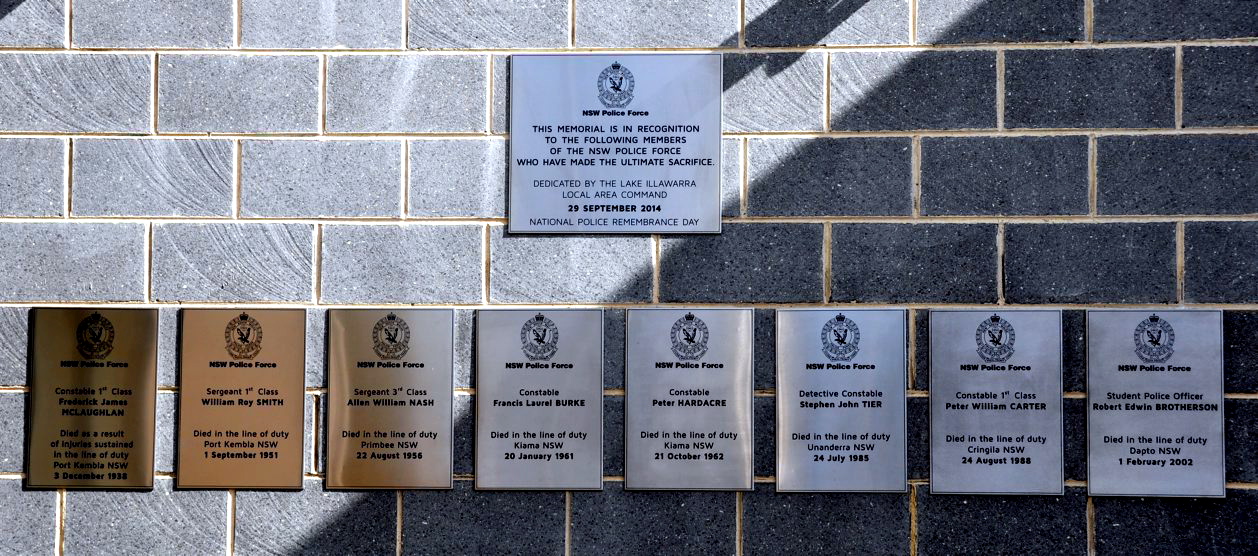
Constable Francis Laurel Burke.
Drowned at Kiama on the 20th January, 1961, whilst assisting two boys who were in difficulties in the water. The Constable was On annual leave at the time and holidaying with his family at Kiama.
Mentioned twice, on page 29 of 1962 Parliament of NSW – Report of the Police Department for 1961
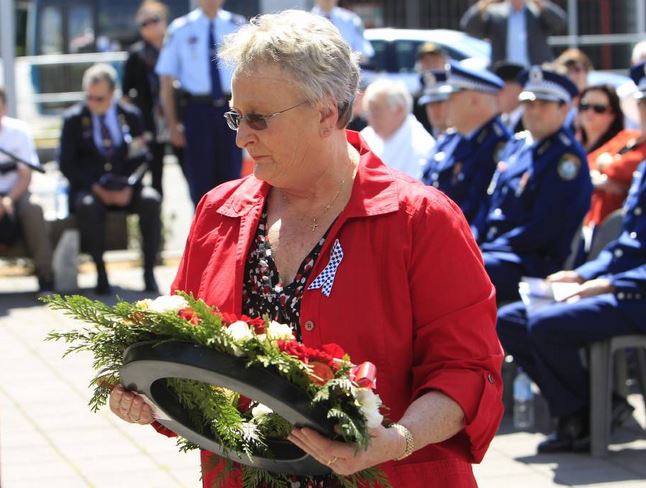
A family member of Constable Francis Laurel Burke, who died in 1961, laid a wreath at the Police Remembrance Day commemorations on Monday. Picture: ANDY ZAKELI
Almost 60 years on, Kenneth Nash still misses his uncle Allen.
Sergeant Allen William Nash, aged 40, was killed in the line of duty by a gun-wielding offender at Primbee in 1956.
Sgt Nash was one of eight officers stationed in the Lake Illawarra local area command who were recognised with memorial plaques on a wall of honour outside Lake Illawarra police station on Monday, as part of Police Remembrance Day commemorations.
Dozens of current and retired officers, families, friends, politicians, councillors and members of the public gathered at Oak Flats for a ceremony to unveil the memorial wall, and honour past and present officers.
THURSDAY 4 SEPTEMBER 2014
Since 1862, more than 250 NSW Police officers have died in the line of duty.
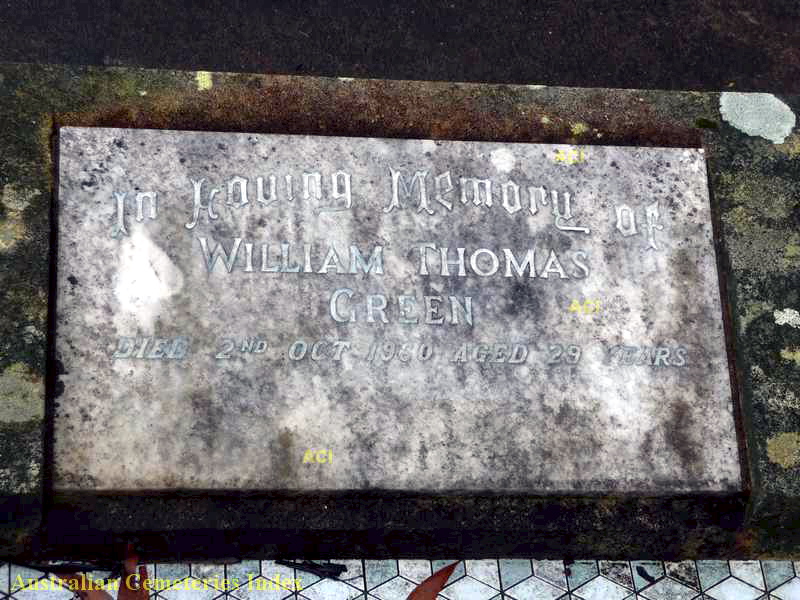
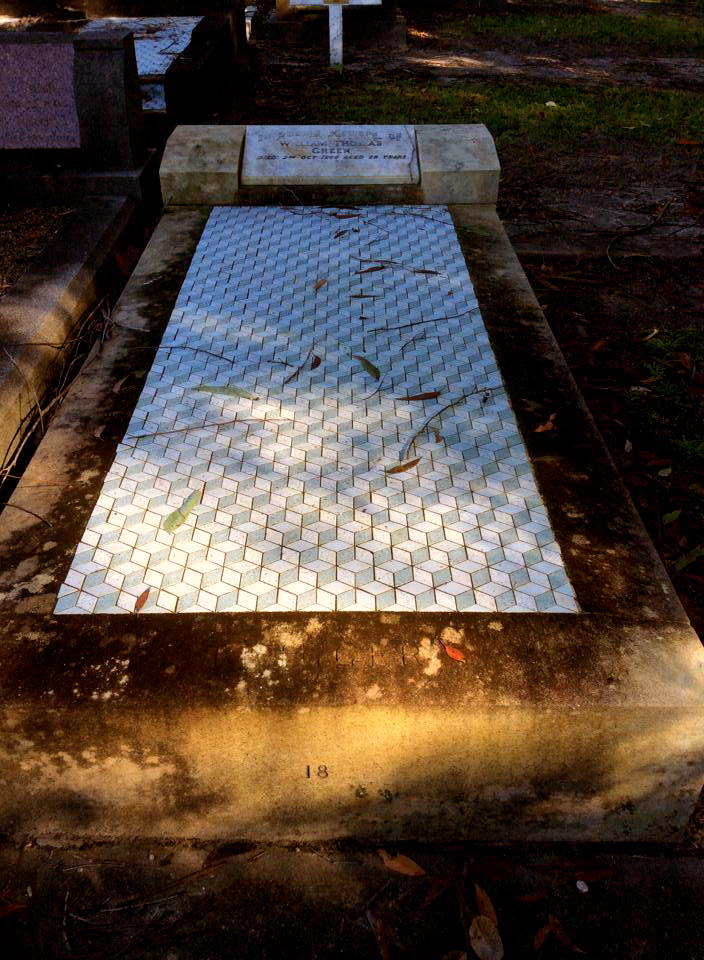
About 6pm on 1 October, 1960 Constable Green left the Gosford Police Station to assist at the scene of a serious motor vehicle accident at Terrigal. At the time he was riding a Special Traffic Patrol motor cycle. As he was travelling along Victoria Street a panel van travelling in the opposite direction began to turn into Adelaide Street in front of the police cycle. The cycle collided with the front of the panel van, throwing the constable to the roadway. He was conveyed to the Gosford District Hospital where he died the following morning.
The constable was born in 1931 and joined the New South Wales Police Force on 1 February, 1955. At the time of his death he was stationed at Gosford.
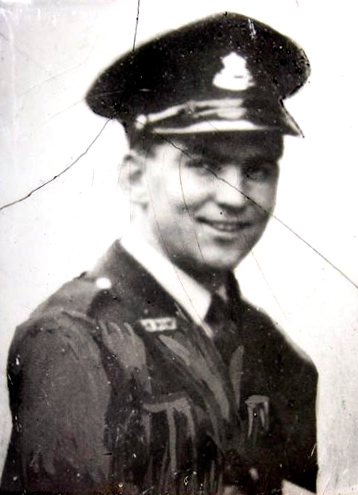
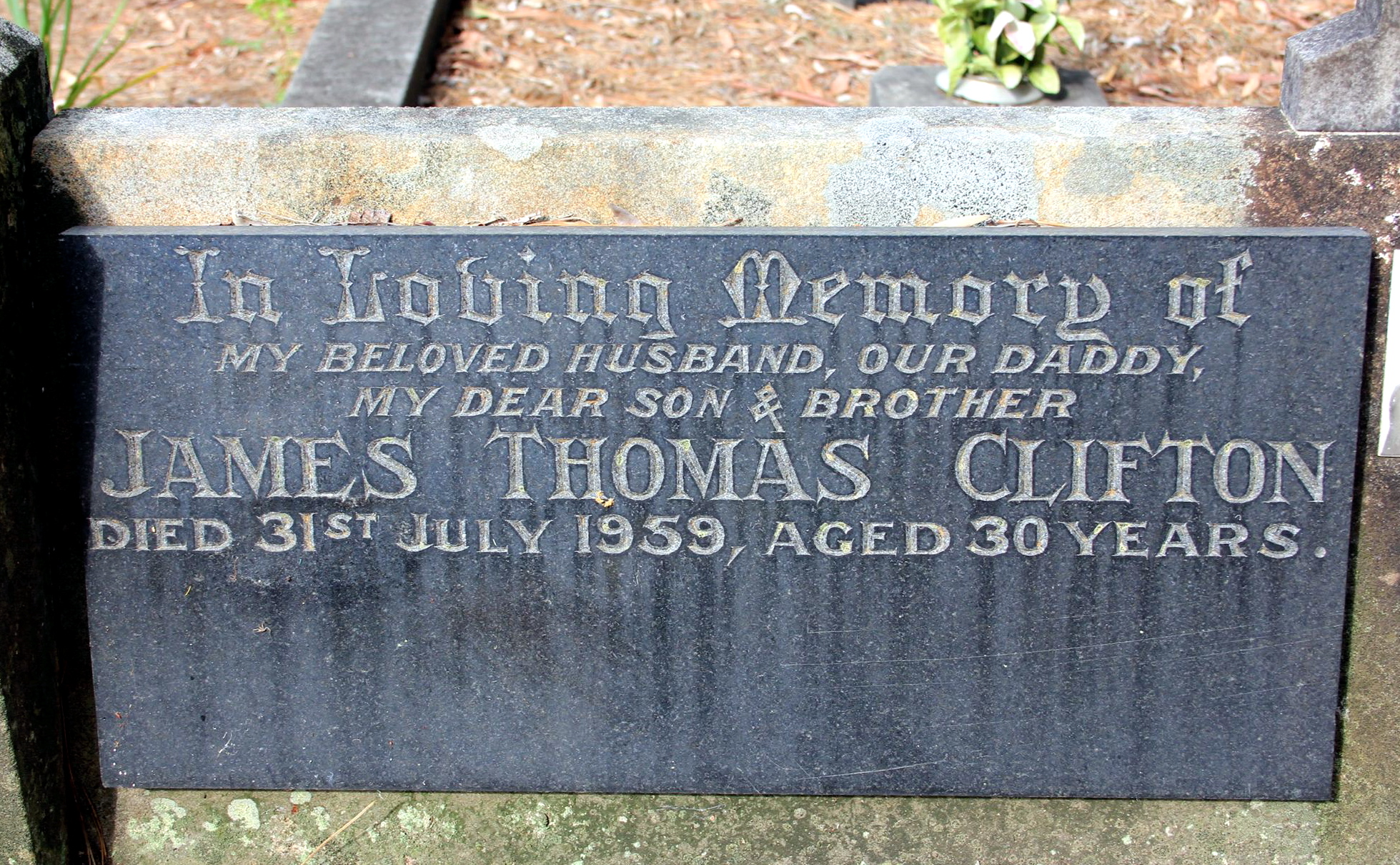
James Thomas CLIFTON
| 26/10/2012
James Thomas CLIFTON
New South Wales Police Force
Regd. # ?
Rank: Constable
Stations: ?, Balmain – death
Service 1: From 5 June 1950 to August 1954 = 4+ years Service
Service 2: From 26 August 1957 to 31 July 1959 = 1+ years Service
Awards: No find on It’s An Honour
Born: ? ? 1928
Died on: 31 July 1959
Cause: Motor Vehicle Accident – Police cycle – Rider
Event location: Victoria Rd near Gagin St, Parramatta
Age: 30
Funeral date: ? ? ?
Funeral location: ?
Buried at: ?
Memorial location: ?
JAMES IS mentioned on the Police Wall of Remembrance
On 31 July, 1959 Constable Clifton rode his police motor cycle outfit from his home to the Parramatta Police Station where he had a meeting with local detectives. Following the meeting he set out to ride to the Balmain Police Station to commence his rostered shift at 7pm. As he was travelling along Victoria Road, Parramatta a pedestrian ran out onto the roadway near the intersection of Gagin Street. Although he took evasive action and braked the sidecar on Constable Clifton’s cycle hit the pedestrian. The cycle then veered across the road, throwing the constable head first beneath a car travelling toward him. He was killed instantly.
The constable was born in 1928 and joined the New South Wales Police Force on 5 June, 1950. He resigned in August, 1954 and rejoined on 26 August, 1957. At the time of his death he was stationed at Balmain.
Brian James BOADEN
| 26/10/2012
Constable Brian James BOADEN
Motor Vehicle Accident
Ulladulla
14 November, 1958
About 3pm on 14 November, 1958 Constable Boaden was riding a police solo motor cycle along the Princes Highway at Ulladulla. While he was pursuing a speeding vehicle, another car commenced to turn into the driveway of a dwelling. The constable increased his speed in an attempt to pass in front of the turning vehicle, however the cycle struck the front of the vehicle. Constable Boaden was thrown over the vehicle, his helmet came off and he landed head-first on the roadway. Although he was conveyed to the Milton District Hospital, he died about three hours later.
The constable was born in 1936 and joined the New South Wales Police Force on 1 April, 1957. At the time of his death he was stationed at Moruya.
Brian is buried in the Orange Cemetery, Lone Pine Ave, Orange, NSW.
Grave location: Old Section, Grave 68.
” In Loving Memory of our dear son and brother Constable Brian James BOADEN, died 14 Nov 1958 aged 22 years, Who died doing his duty sometime we will understand. ”
Deadly toll
By Jonathan Pearlman November 6, 2004
Alone in his patrol car, Chris Thornton had the police siren flashing as he chased a white sedan through Woy Woy.
Thornton, 35, a highway patrolman, had been in the force for 15 years. He was, his mother says, “the best driver I have ever seen”.
The reason for the chase that night in April 2002 is unknown. Both cars were seen travelling at high speed. Thornton was about 50 metres behind.
Meanwhile, Leonard Rowley, 56, an unlicensed driver, was driving to his local KFC to pick up dinner. He saw the first car flash past and judged – wrongly – that he had time to turn out in front of the patrol car. Thornton tried to avoid Rowley’s car but clipped the back, veered onto the wrong side of the road and hit a power pole.
Thornton died on the spot, which is marked by a permanent stainless-steel cross. Rowley later received a suspended two-year sentence.
“His life from the age of 12 was about helping people,” says Thornton’s mother, Freada Thornton. “He was in the surf club and he was there to rescue people and then he went into the force and he was doing the same thing.” His father, Barry Thornton, says: “He loved life. He had been in Gosford for 15 years and was so popular with the community there.”
Police pursuits are, says Barry, a necessary evil: “If they don’t catch the criminals there will be more deaths on the roads. The ones that they’re in pursuit of are the idiots that have done the wrong thing to start with.”
But pursuits have come at a cost to the NSW Police Department. Fifteen officers have died as a result of high-speed chases, beginning with the death of Constable George Boore in 1937.
Details provided by the NSW Police Association show a steady stream of fatalities involving cars and motorcycles. The full list of casualties is as follows:
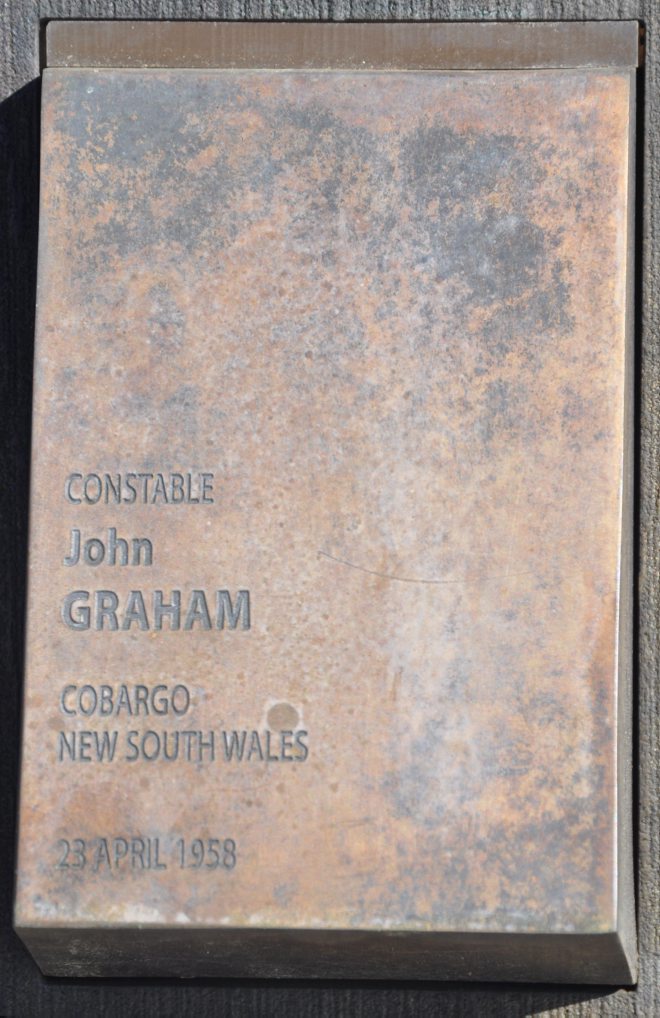
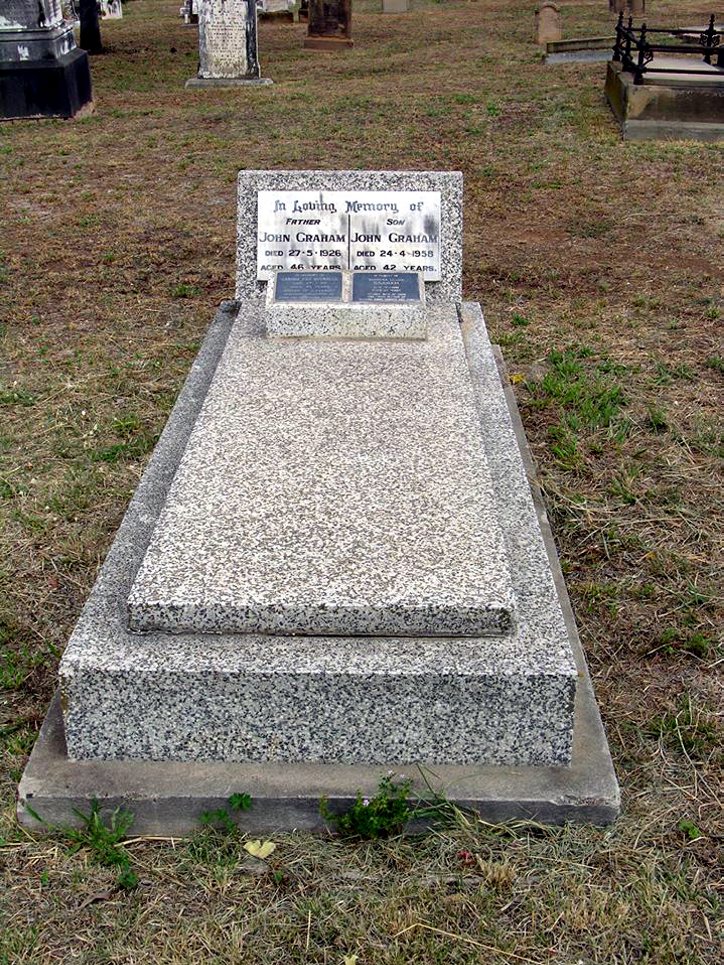
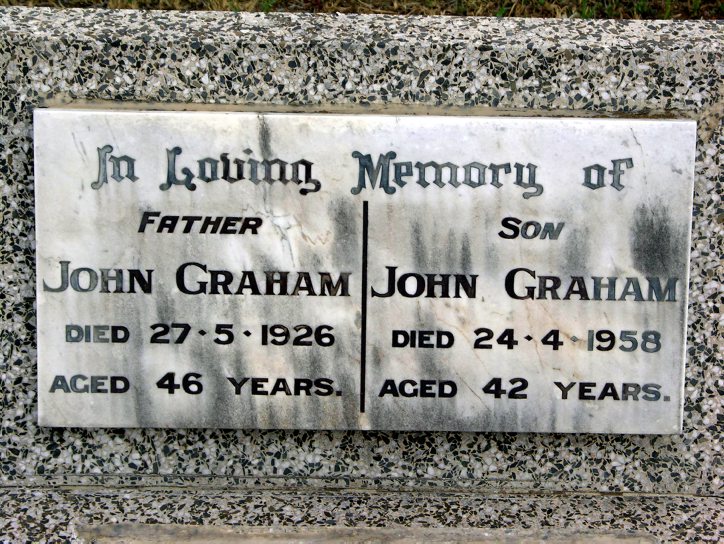
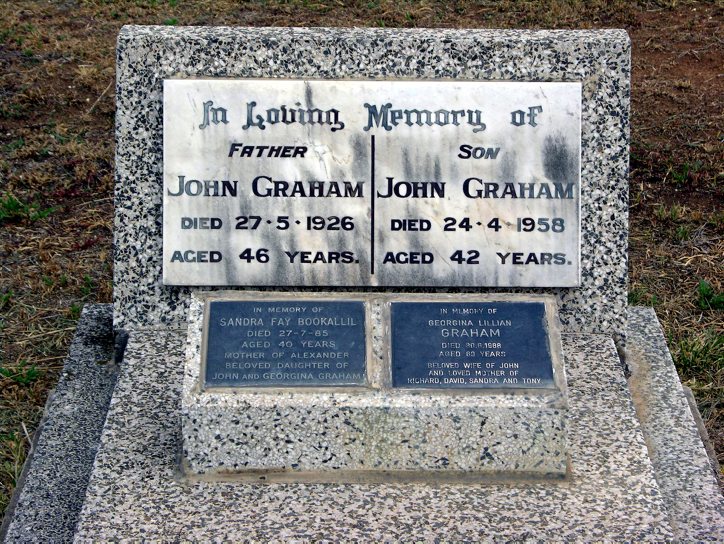
On 29 July, 1948 Constable Graham was riding a police motor cycle outfit along the Bermagui-Cobargo Road.
At the time the constable was riding along an unfamiliar area in an effort to locate and apprehend a rape suspect.
As he was negotiating a sharp bend in the roadway, the cycle skidded in loose gravel, left the roadway and mounted an embankment. It then tipped over, pinning the constable beneath it.
Constable Graham was admitted to the Bega District Hospital suffering from internal injuries, including a ruptured kidney and concussion.
Over the ensuing years his health deteriorated due to the original injuries and he died on Thursday 25 April, 1958.
The constable was born in Tamworth in 1915 and joined the New South Wales Police Force on Saturday 14 June, 1947.
At the time of his death he was stationed at Bodalla.
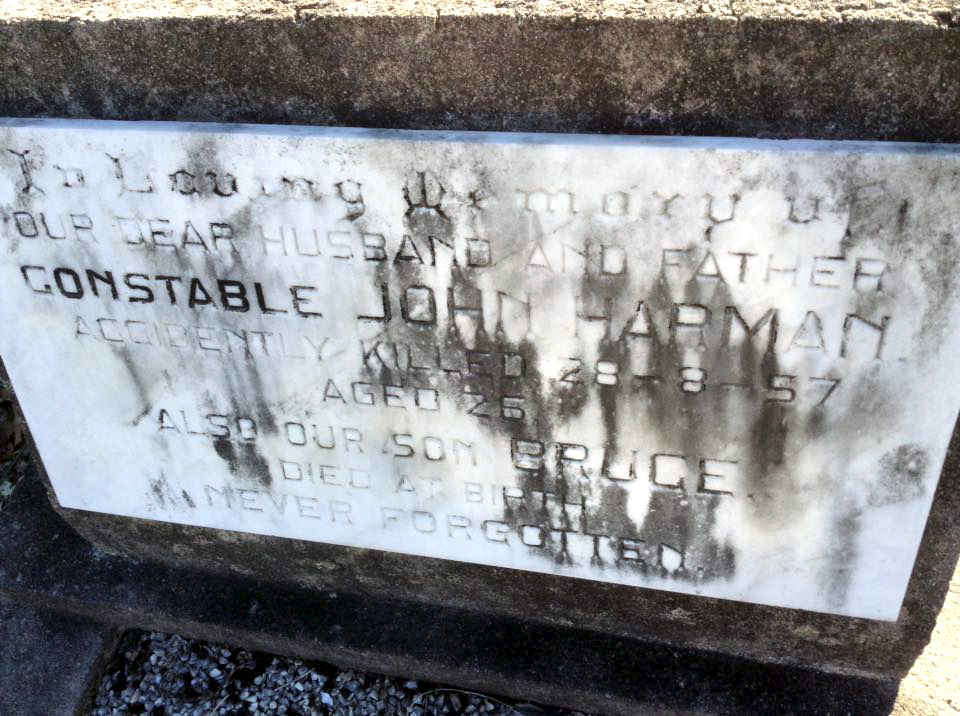
Constable Harman sustained fatal injuries when the Police Special Traffic Patrol Cycle he was riding was involved in a collision with a motor car. At the time the constable was riding the motorcycle from home to work at the Parramatta Police Station.
The constable was born in 1931 and joined the New South Wales Police Force on 19 April, 1953. At the time of his death he was stationed at Parramatta.
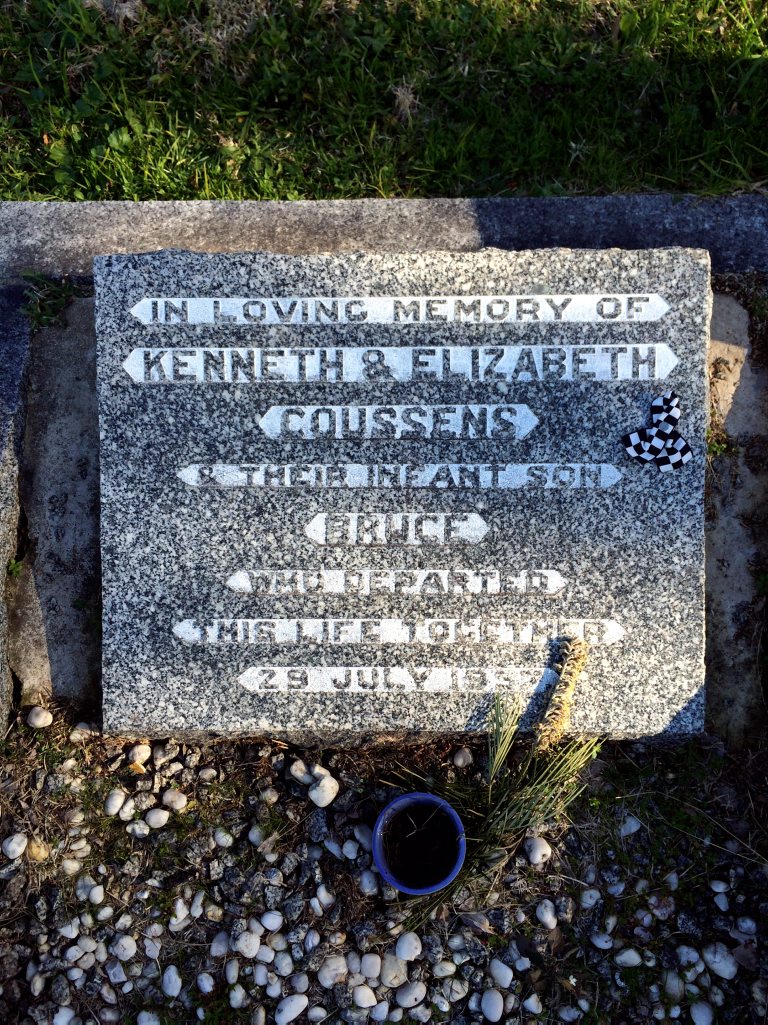
Elizabeth COUSSENS nee McCampbell nee Gowing 34 old
Bruce James COUSSENS 7 months old
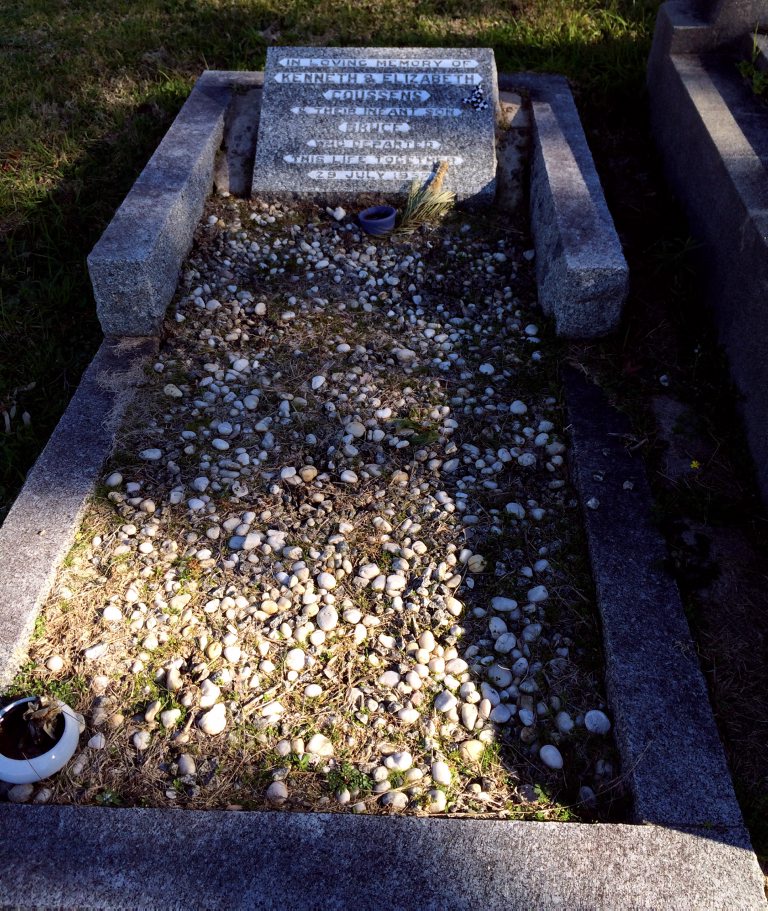
Funeral date: 31 July 1957
Funeral location:
Buried at: Bega Cemetery
Anglican, Section 7, Row A, Grave 3
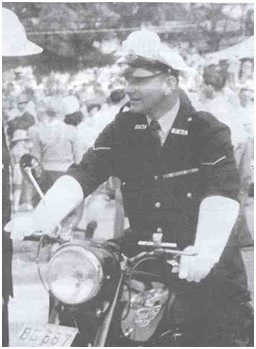
Constable Kenneth Coussens ( 1957 )
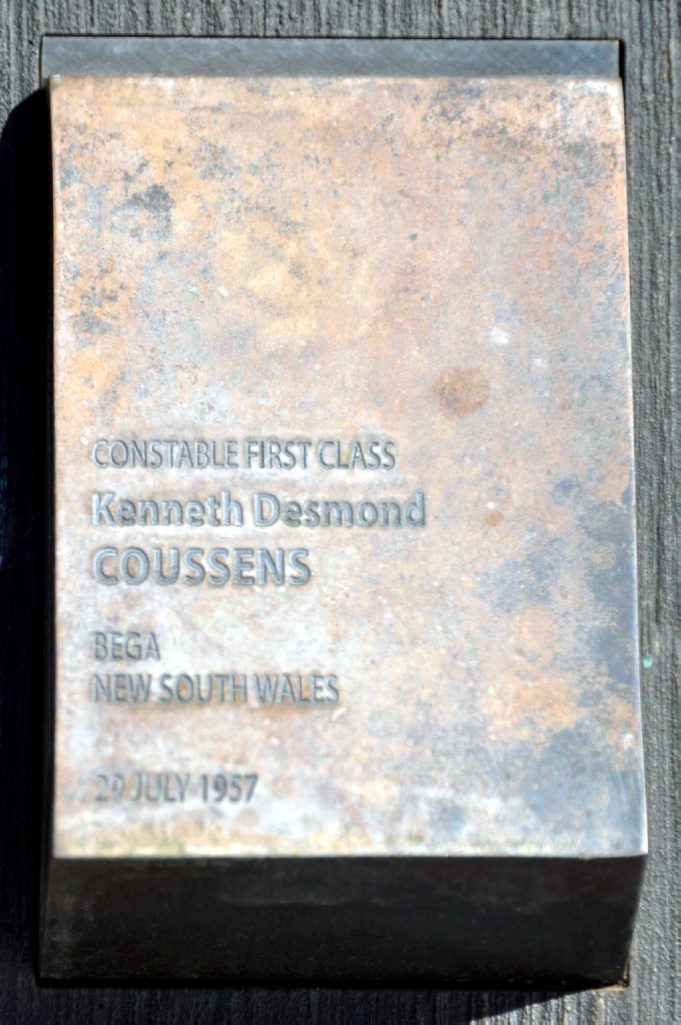
Kenneth Desmond COUSSENS touch plate in Canberra
[alert_green] KENNETH IS mentioned on the Police Wall of Remembrance[/alert_green]
The constable, his wife Elizabeth and baby son Bruce were murdered by the offender Kelly who had placed a bomb on the front verandah of the constable’s home at Bega. The offender had become incensed at being spoken to by the constable regarding traffic offences and on 29 July, 1957 he placed a metal dairy container packed with over 200 sticks of stolen gelignite at the constable’s home. About 2am the offender lit the fuse to the bomb and the dwelling was almost obliterated in the resultant explosion.
Constable Coussens‘ stepson, eight year-old Roger McCampbell, was the sole family survivor of the explosion. The offender Kelly was arrested after a major police investigation and was later sentenced to life imprisonment.
The constable was born in 1926 and joined the New South Wales Police Force on 18 October, 1948. At the time of his death he was stationed at Bega.
OBITUARY
Senior Constable Kenneth Coussens; wife – Elizabeth Coussens; infant – Bruce Coussens 7 months old.
Killed by a bomb blast on July 29, 1957.
Senior Constable Ken Coussens moved to Bega in 1954 where the officer took up motor cycle traffic duties for the Public Safety Bureau (now known as the Highway Patrol).
He married a local girl Elizabeth who came from a well known local family and they had two children, Roger nine (from Elizabeth’s first marriage) and an infant son Bruce, seven months old.
Constable Coussens performed his police duties in a conscientious and professional manner in the Bega area attending to traffic duties, attending the scene of motor vehicle accidents and performing other police and community duties as required of a country police officer.
About 1956, in the course of his traffic duties Constable Coussens came into contact with a local man named Myron Bertram Kelly, 32.
The officer had cause to speak to Kelly regarding traffic offences and issued traffic fines to the man on a number of occasions.
Kelly appears to have become enraged when Constable Coussens issued fines and defect notices to Kelly’s tractor and rotary hoe.
As a result Kelly formed a grudge against Constable Coussens.
After this event Kelly went to a silica mine at Rock Flat between Nimmitabel and Cooma in his truck and removed five cases of gelignite and took it to Nethercote where he buried it.
He then stole a six gallon cream can from Curtis Brothers Creamery and took that to Nethercote.
He later built a home made bomb by placing 240 sticks of gelignite and a fuse into the cream can.
In the late hours of July 28, 1957 Kelly sneaked to the officers home while he was asleep in the house with his wife and young family.
He set the bomb at the front of the fibro and iron home situated in Girraween Crescent, Bega and ignited the fuse a few hours later.
Kelly left the scene and went home and at about 2am the bomb detonated causing a huge explosion which completely demolished the house.
The bomb also caused extensive damage to other homes and windows in the vicinity, up to a mile away.
More than 100 windows at Bega Hospital were shattered by the blast.
Constable Coussens and his wife and young baby were killed instantly.
The 9-year-old son Roger survived the blast as he was sleeping at the rear of the house.
Shocked neighbours saw him emerge from the wreckage dazed and confused.
Local residents did not know what had happened and due to the enormity of the blast rumours quickly spread that the gas works had exploded or a Navy plane from HMAS Albatross Nowra had accidentally bombed the town.
However, when it was learned a police officer had been killed by a bomb, police quickly recognised it had all the hallmarks of an assassination.
A criminal investigation swung quickly into action with detectives from Sydney travelled to Bega.
Forensic evidence from the crime scene indicated the explosion was caused by a home made bomb and fragments of a dairy can were located at the scene.
An intense investigation followed, lead by crack homicide squad detectives. Subsequently Kelly was identified as the prime suspect when his hatred of Constable Coussens became known as a motive.
Investigators later searched Kelly’s home and found explosives, fuses and gelignite and a demolition hand book.
Kelly was subsequently arrested and charged with the murder of Constable Coussens and his wife and baby.
He was also charged with the theft of six cases of gelignite, 800 detonators, 1000 feet of fuse, an army .303 rifle, 50 rounds of ammunition and possessing an unlicensed pistol.
The trial was conducted in Central Criminal Court and Kelly was convicted by a jury on the murder charges.
On December 6, 1957 he was sentenced to life imprisonment by Mr Justice McClemens who said at the time: “One could only hope for the sake of common human nature that a crime as terrible and devilish as the Bega bombing on July 29 sprang from some deep seated mental derangement. It is not a case where in the interest of the community one could recommend or hold out any hope for mercy”.
Constable Coussens was also a returned serviceman having served in the Royal Australian Navy.
(Research courtesy of David Gardner Australian Police Journal March 2005.Vol 59 No 1.)
Plaque commemorates a local policeman and his family who were murdered in 1957.
Senior Constable Ken Coussens, his wife and seven-month-old son were blown up by 240 sticks of gelignite. It was discovered that local man Myron Kelly had held a well-known grudge against the constable and in the absence of other leads this seemed worth following up. The offender had become incensed at being spoken to by the Constable regarding traffic offences and placed a metal dairy container loaded with the stolen gelignite outside the front door of the Constable’s home.
When Kelly’s house was searched, four and half sticks of gelignite, 20 feet of safety fuse and 58 detonators were discovered. The offender was arrested after a major Police investigation and later sentenced to life imprisonment. Myron Kelly was released from jail in 1980 and returned to the district. He died in Cooma in July 2007 aged 83.
Kenneth Desmond COUSSENS, born to Albert James & Edith Mabel COUSSENS.
NSW Deaths Registration number 34296/1957
National Archives of Australia:
Merchant Navy & Royal Australian Navy
Service # 32875
Born: Hastings, England Trade: Ex Apprentice Fitter & Turner
He reported for Duty on the 30 June 1944 as a ‘Ordinary Seaman II’ and Served upon the H.M.A.S. Cerberus as of the 3 July 1944.
He was described as being 5′ 10 1/2″, with brown hair and brown eyes with a scar on his right thigh.
It appears as though he was still ‘Serving’ with the R.A.N. on 12 June 1947.
He was ‘Rated’ as a ‘Ordinary Seaman’ on 2 July 1944
‘Rated’ ‘Able Seaman’ on 1 June 1945
Was transferred to Royal Australian Navy for 2 years from 4 October 1946.
On his ‘Blue card’ of the R.A.N. it appears, in the Medals, Clasps, etc. section, that the date of May 1958 appears with Const. Police Station Bega NSW.
In the area of the ‘Blue Card’ of the R.A.N. it appears, in the Good Conduct Badges, he was ‘Granted’ a ‘Penguin’ in July 1947.
Other data, written in pen and pencil, on his R.A.N. Service cards is hard to decipher.
The Canberra Times Tuesday 30 July 1957 page 1 of 12
SYDNEY, Monday. – Mystery still obscures the cause of the explosion which killed a police constable, his wife and their six-month-old son when it shattered their Bega home early to-day.
Police said to-night it would be several days before they could sift and examine the wreckage to determine the cause of the explosion, but they have found fragments of metal which appear to be from the casing of a high explosive shell.
Victims of the tragedy were: Constable Kenneth Desmond Coussens, 31, his wife Elizabeth, 34, and their son, Graham.
Their bodies were hurled from their beds and thrown 50 yds. into a neighbour’s garden. The sole survivor of the tragedy was Roger, 9, a son of Mrs. Coussens by a former marriage.
Detectives of Sydney Arson Squad were to-night uncertain of the cause of the explosion.
Fragments of metal which may be from the casing of a high explosive shell, will be examined by an R.A.N. explosive expert called in from Nowra Fleet Air Arm Base.
The explosion, shortly after 3 am. rocked Bega, damaging other houses and breaking 100 windows in Bega Hospital, almost half a mile away.
Awakened by the explosion, terrified neighbours rushed into the streets, which were blanketed by heavy fog.
Thick smoke hung over the Coussen’s house, which was shattered.
As horrified neighbours watched, young Roger Coussens staggered from the ruins, screaming, and slowly walked past torn down electricity and telephone wires which crackled and sparked.
He collapsed into the arms of a neighbour, dazed but uninjured.
The bodies of Constable Coussens and his wife were found near each other in a neighbour’s garden, 50 yards away.
It was almost five hours before the shattered body of the baby boy was found, behind a tree in the backyard.
Panic
As the explosion shattered windows of the four storey Bega Hospital, panic broke out among patients.
Men and women screamed and jumped from their beds as nurses ran through the wards, soothing patients.
Ambulanceman Keith Beresford said the house was like a scene in war time.
“Dense fog and hovering smoke hung over the wrecked building with sparkling electric wires on the ground,” he said.
At dawn, hundreds of people had gathered and Superintendent Mijch, officer in charge of the South Coast District Police to cordon off the area.
Pieces of furniture and personal possessions of the Coussens family were strewn over hundreds of yards.
The mattress from the bed on which the couple were sleeping together with bloodstained children’s clothing, were hurled many yards.
Supt. Mijch ordered that nothing be touched until Sydney. C.I.B. detectives, Sergeants Behrens and Bateman, and Det. Bradbury of the Arson Squad arrived.
Explosives expert, J. Parsons of the N.S.W. Mines Department and Det. Sgt. Ray Kelly of the C.I.B. Homicide Squad, were also rushed from Sydney.
Detectives are working on theories that the Coussens were the victims of a bomb plot perpetrated by a madman with a grudge, or that the explosions may have been caused by a war souvenir collected by Constable Coussens, who had served in the R.A.N, for a short time.
Bomb Theory
The theory of the bomb plot was strengthened this afternoon when police found a tunnel had been dug under the Coussens’ bedroom.
Police say the explosive could have been placed in the tunnel.
They have ruled out the possibility of a gas explosion.
Police are mystified at the escape of Roger Coussens.
Dazed and terrified, the boy said the only thing he remembered was a large piece of timber falling across his bed.
It was the boy’s second escape. His father, an American businessman, was killed in a car crash in the United States when Roger was still a baby.
Roger and his mother, then Mr. McCampbell, who were in his car, escaped unhurt.
Police said the only thing that saved Roger to-day was the fact that he was sleeping in a separate bedroom.
Under Room
The explosion apparently occurred in or beneath the bedroom where his mother, step-father and step-brother lay sleeping.
Residents told police that after the first tremendous explosion, shock waves spread across the district.
Mr. Kevin Barham, a neighbour, said he rushed into the street and heard screaming.
“I saw Roger staggering towards me, dressed only in his pyjama top.
“He was bare footed and crying and had dirt in his hair.
“He kept screaming ‘The house is ruined – the house is ruined.’
“When Roger walked towards me, he was stepping through live wires brought down by the explosion,” Mr. Barham said.
Barham said there was a strange smell about the Coussens’ home after the explosion, but he could not identify it.
Constable Coussens had been attached to Bega for about three years.
He had been a member of the police force for 11 years and was attached to the Safety Bureau in Sydney before being sent to Bega.
He had been stationed at Kogarah and also Cooma.
Police to-night placed a guard over the wreck of the home.
They said it would “be several days before they could sift and examine the debris to determine the cause of the explosion.
Earlier to-day a giant mobile crane was used to lift huge blocks of reinforced concrete which had been scattered over a wide area.
Police to-night appealed to residents to examine their gardens for any strange fragments of metal which may have come from the seat of the explosion.
They said even the smallest fragment could play an important part in solving the mystery.
The Canberra Times Wednesday 31 July 1957 page 1 of 12
SYDNEY, Tuesday. – Detectives are carefully investigating the background of a constable, who with his wife and seven-months-old son, was killed in a bomb explosion at Bega yesterday.
Detectives will also inquire into his activities and arrests since he joined the police force, about 10 years ago.
Those killed were Const. First class Kenneth Desmond Coussens, 31, his wife, Elizabeth, 34, and their son, Graham.
The trio were killed when a mysterious explosion wrecked their home at Bega and smashed windows throughout the town, a half mile away. Coussens step-son, Roger, escaped unharmed.
Detectives to-day discovered metal casings, which strengthens a theory that a maniac with a grudge against the constable, placed a bomb under the house.
They are also interviewing the hoodlum element in the town, for the constable, despite his unblemished police record, was described as a “hard man” by certain sections of the public.
His application to duty had earned him a number of “threats.”
With this in mind, a team of detectives headed by Detective Superintendent Norman Mitch, are investigating his local arrests.
The State Police explosives expert, Mr. S. W. Parsons, has established that the blast was not caused by gelignite.
No traces of a detonator been found.
A theory, described as “doubtful,” is that Coussens became involved in the fishing war on the South Coast.
Detectives have established that Coussens had purchased a £1,500 fishing launch 12 months ago and had engaged a crew of three to fish commercially.
The launch, registered in his wife’s name, was sold two weeks ago.
The Canberra Times Thursday 1 August 1957 page 4 of 16
BEGA, Wednesday. – Fragments of metal found at the site of the fatal explosion which killed a police constable, his wife and his young son on Monday, were sent to the C.I.B. to-day.
The fragments will be examined by the Scientific Bureau and metallurgists in the hope of identifying them.
Police are now certain that the explosion occurred from a container which was under the front verandah of the house. However, it is not yet known if it was a war souvenir or a home-made bomb planted by a maniac.
Victims of the blast were Constable Kenneth Coussens, 32, his wife, Elizabeth, 32, and his son, Graham Bruce, 7 months.
They were buried at Bega to-day. More than 1,500 people attended the funeral service and many wept at the cortege passed through the crowded main street. Shops and businesses were closed as a mark of respect.
Fifty police from all parts of the South Coast formed a guard of honour and police who had worked with Constable Coussens acted as pall-bearers.
The couple and their child were buried in a family grave two miles out of Bega.
Sole survivor of the explosion was Mrs. Coussens’ son by a former marriage nine-year-old Roger.
Roger’s father, a U.S., businessman, was killed in a car crash when Roger was a baby.
The Canberra Times Saturday 10 August 1957 page 1 of 16
BEGA, Friday. – Hatred had led a man to make a milk can bomb which exploded killing a police constable, his wife and baby son, police alleged in Bega Court to-day.
Before the court was Myron Bertram Kelly, 32, agricultural contractor, of Gipp Street, Bega.
Kelly has been charged with the murder of Const. Kenneth Desmond Coussens, 31, his wife, Elizabeth Coussens, 34, and their son, Bruce Coussens (7 months), of Girrawheen Crescent, Bega, on July 29.
Police Prosecutor Det. Sgt. J. Behrens told Mr. W. Cobcroft, J.P., that Coussens, his wife and son were killed after a violent explosion near the front door of their home.
Sgt. Behrens said police alleged Kelly made a bomb by stacking stolen gelignite into two milk cans and detonating them with a home-made time fuse.
Inquiries, he added, had shown that the milk cans had been stolen from Bega and the explosives from Nimmitabel.
“The explosion was sufficiently violent to catapault their bodies out of the house on to the adjacent vacant allotment,” Sgt. Behrens said.
Metal Found
“A scientific examination was made and a large number of pieces of metal were recovered embedded in woodwork and in the ruins of the house.
“Pieces were collected in various positions in the vicinity, approximately 400 yards away.”
Sgt. Behrens said Kelly was a native of Nimmitabel
and had an intimate knowledge of the places from where the explosives were stolen.
Kelly had been questioned by police about his knowledge of explosives, Sgt. Behrens said.
“He has had experience of explosives and when questioned he denied that he had any explosives in his possession.
In Bedroom
“This was found to be false, as a search of his home revealed a quantity of gelignite and detonators stored in his bedroom.
“During the search, identical nameplates from the missing milk cans referred to were found at his home.
“He has not offered any explanation of their presence there,” Sgt. Behrens said.
The prosecutor said Kelly had put forward an alibi for his movements on the night before and the morning of the explosion, but this alibi would be disproved.
He said, “We contend that the defendant had the strongest motive, which is hatred.”
”Differences”
“Evidence will be given,” Det. Sgt. Behrens said “that the defendant had had differences with the late Constable Coussens in connection with traffic matters over a lengthy period.”
Mr. Cobcroft remanded Kelly to Bega Court on September 4. He refused bail.
Immediately after Kelly had been remanded, Mr. Cobcroft opened the Coroner’s Court inquest into the death of Coussens, his wife and son.
On a request from Sgt. Behrens, he adjourned the hearing to a date to be fixed.
The Canberra Times Tuesday 15 October 1957 page 1 of 12
BEGA, Monday: A 9 year-old boy told the Bega coroner’s Court to-day that a blast which killed his mother, stepfather and baby stepbrother, had caused his house “to come down on top of him.”
The boy, Roger Clinton McCampbell, said he thought he was dreaming and called out to his mother, but she did not come to him.
The District Coroner, Mr. W. Cobcroft, opened the inquiry into the deaths of Constable Kenneth Desmond Coussens, 31, his wife, Elizabeth, 34, and his 7-months-old son Bruce.
All three died in an explosion which wrecked Constable Coussen’s home in Girrawheen Crescent, Bega, on July 29.
Before the court, charged on three counts of murder, was Myron Bertram Kelly, 34, agricultural contractor, of Gipps Street, Bega.
He was also charged with stealing six cases of gelignite, 800 detonators and 1,000ft of fuse.
The Canberra Times Wednesday 16 October 1957 page 3 of 12
BEGA, Tuesday.—A man allegedly told police he planned and lit a home-made bomb which later exploded, killing a police constable, his wife and baby son, Bega Coroner’s Court was told to-day.
In a statement allegedly made by Myron Bertram Kelly, 32, of Gipps Street, Bega, Kelly said he and the policeman were “bitter enemies”.
Kelly has been charged with the murder of Constable Desmond Kenneth Coussens, 31, his wife, Elizabeth Coussens, 34 and their eight-months-old son, Bruce James Coussens.
The three died when an explosion rocked, their home in Girawheen Crescent, Bega, on July 20.
The statement alleged to have been made by Kelly was handed to the Coroner, Mr. Cobcroft, S.M., by Detective Sergeant C. Behrers.
Not Particular
It read “The first trouble I had with Constable Coussens was about three years ago. That was a series of defect notices about a Howard tractor and rotary hoe.
“Coussens was not very particular what he did.
“The first real trouble was two years ago when he overtook a taxi I was travelling in and arrested me for riding an unregistered motor cycle and then carried out a search of my premises, where I am now living. “I was fined £5 for that offence.
“The next incident was a collision in front of the Bega Police Station on April 13, 1956.
Collision
“I had been working on the river bank below the town. On my way home I saw him on the corner of Auckland and Bega Streets. I was driving a rotary hoe.
“He then followed me a fair way behind along Bega Street and up Gipps Street.
Opposite the police station, he closed in and collided with the tractor.
“He then charged me with everything, he could think of, although the accident was of his own neglect.
“I appeared before the Bega Court and I was fined a total of about £40.”
The statement also alleged several other traffic incidents between Coussens and Kelly, but no charges were laid.
“From these incidents, we were bitter enemies,” the statement said.
It continued: “About the middle of June this year, I went in my truck to Rock Flat and I took five cases of gelignite from there.
Stole Can
“A week before the tragedy when Constable Coussens was killed, I stole a six-gallon milk can from the platform at the Bega butter factory. It had ‘Curtis Bros.’ on the can.
“I took the labels off the can, dug up the gelignite and made a bomb out of the milk can and brought it back in my car to my home in Bega.
“That week I fitted it up with about 20ft. of fuse and a detonator and sealed it up with mud.
“About midnight that night, I put the bomb in the back of my car and drove into Auckland Street.
“I took it out of the car and put it on the verandah of Constable Coussens’ house, near the front door.
“At about 2 o’clock in the morning, I walked up to Constable Coussens’ house and lit the fuse on the bomb.
“After that I went back to bed. Not being a strong container, I expected very little damage to be done and a lot of noise.
“I thought it would go no further than to break some fibro off the walls and give the constable a bad fright, causing the Police Department to move him.
“I did not think that it would kill him, his wife and his child.
“It was the last thing in the world that I wanted to happen.
The Canberra Times Thursday 17 October 1957 page 5 of 20
BEGA, Wednesday: The inquiry into the deaths of Constable Desmond Coussens, his wife and baby son in an explosion which wrecked their home, was adjourned to-day till tomorrow.’
The hearing was adjourned because some witnesses could not attend.
The Canberra Times Friday 18 October 1957 page 18 of 20
BEGA, Thursday: A farmer told the Coroner’s Court to-day that he had believed a milk can filled with explosives was to be placed on a police constable’s verandah as a practical joke.
The farmer, Edward Morris Williams, said he had been a close friend of Bartram Myron Kelly, 32, contractor, of Bega, who has been charged with murder.
The inquiry is being held into the deaths of Constable Kenneth Coussens, 31, his wife, Elizabeth, 34, and his son, Bruce, 8 months, at Bega on July 29.
The three died when a bomb wrecked the house.
Williams said Kelly had shown him a milk can containing gelignite, at the back of Kelly’s home, and said he was going to put a burnt-out fuse in it and leave it on the patio to frighten Coussens.
Williams said he had not reported the matter to the police because he had understood it was a practical joke by Kelly.
The Canberra Times Saturday 19 October 1957 page 6 of 16
BEGA, Friday,— An agricultural contractor was committed for trial to-day by the Bega District Coroner on a charge of having murdered a police constable, his wife and baby son.
The coroner, Mr. W. Cobcroft, found Constable Kenneth Coussens, 31, his wife, Elizabeth, 34, and son Bruce James, 8 months, died from injuries received on July 29 in an explosion, in their home in Girrawheen Street, Bega.
The explosion had been feloniously and maliciously brought about by Myron Kelly, he said.
He committed Kelly for trial at Central Criminal Court.
Mr. Cobcroft said a bomb had been placed on the patio of the constable’s home near his bedroom and detonated. The bomb had been housed in a cream can. It has been established that the cream can was stolen from the Bega Butter Factory shortly before the explosion and that the can was in the possession of Kelly.
Kelly was also found to be in possession of a quantity of gelignite, detonators and a fuse.
Mr. Cobcroft said he was not satisfied with the evidence of one of the 40 witnesses who appeared at the inquest, Edward Morris Williams, farmer, of Pambula, who said that he had seen and handled the bomb made by Kelly.
One would have expected that in these circumstances Williams would have gone to the police and volunteered information which probably would have led to the “frustration of Kelly’s intention,” said Mr. Cobcroft.
“I don’t believe Williams’ evidence where he stated he thought the whole affair was to be nothing more than a practical Joke,” he added.
Had Williams acted as a prudent man, the tragedy might have been averted.
The Canberra Times Saturday 7 December 1957 page 1 of 16
SYDNEY, Friday: An agricultural contractor found guilty of setting off a bomb which killed a police constable, his wife and child, was sentenced to life imprisonment by Mr. Justice McClemens in the Central Criminal Court to-day.
The contractor is Myron Bertrand Kelly, 32, of Gipps Street, Bega.
Kelly pleaded not guilty to the murder of Constable Kenneth Desmond Coussens, 31, of Girraween Crescent, Bega.
Coussens, his wife Elizabeth, 34, and their baby son, Bruce, 9 months, were killed when an explosion wrecked their home on July 29.
The Crown alleged that Kelly confessed to placing a home-made bomb under the patio of Coussens’ home and lighting the fuse.
The bomb was a milk can filled with gelignite.
In a statement from the dock yesterday Kelly said he had no intention of harming the Coussens’ family.
“I have thought the matter over day and night and still cannot believe that the explosive I had did that damage and killed three people,” he said.
TRAGIC incidents litter the Bega Valley’s long and proud history – fire, homicides and accidents cutting lives far too short.
However, very few incidents stir emotions, ignite debate and were more widely reported than a bombing that claimed the lives of a local police constable, his wife and infant son.
This coming Sunday (July 29) marks the 50th anniversary of this tumultuous event in 1957 when the town was rocked by the monumental explosion about 2.10am on that fateful day.
The cold air of the winter’s night was pierced by the noise of the explosion that woke everyone in town and many in the surrounding farming districts.
Hundreds of windows were smashed by the concussion, more than 100 in the hospital alone, and some up to a mile away from the explosion site.
Residents initially were confused as what exactly had blown up.
The obvious culprit, the gasworks, was still standing as were Slater’s fuel depot and the various service stations.
As emergency service personnel fumbled for their boots and warm clothing the initial cacophony was replaced by an eerie, yawning silence.
It took several minutes of fruitless searching before the source of the blast was identified.
It was the two-year-old home of Constable Kenneth Coussens and his family on the northern side of Girraween Crescent that had borne the brunt of the explosion.
The entire front of the house had been blown away, with the remainder barely standing.
Vast sections of the roof were missing and supporting wooden tresses had fallen into the void.
Such was the force of the blast, that Constable Coussens, his wife Elizabeth (nee Gowing) and infant son Bruce, who had all been sleeping in the front bedroom at the time, were flung large distances through the air.
All three sustained devastating injuries and were killed instantly.
Horrified and instantly sickened by the war-like scene they found when arriving at the house, those who converged were stunned when, incredibly, Mrs Coussens’ elder son Roger (9) crawled physically unscathed from the hotchpotch of metal and wood that only minutes earlier had been his family’s home.
While the cloak of night may have hampered emergency workers in their efforts, it enabled neighbours to shield the boy from the horrors that lay only metres away.
As daylight greeted investigators, reminders of the horror of the incident continued to emerge, with soiled children’s books and bloodstained booties among the items that littered the lawn and street.
The investigation
Superintendent Mitjch of Wollongong, along with detectives Bevan, Bateman, Clark and Davenport, arrived in Bega shortly before noon on the day of the blast to commence investigations.
The chief explosive expert of the Department of Labour and Industry, Mr Parsons, followed shortly after.
Accident or murder?
The house had been destroyed and apart from a vast hole and the devastation there were precious few leads.
With inquiries leading nowhere, speculation an innuendo continued to mount throughout the community.
One popular story (which was quickly disproved) was that planes from the Nowra naval base had mistakenly dropped a bomb during a flyover.
The subject of gossip also turned to Constable Coussens who had served in the Navy during World War II prior to joining the force.
The story went that he was a souvenir hunter and had stored a mortar bomb on the landing – this theory was also kyboshed.
It wasn’t until detective Bob Bradbury suggested: “I wonder if those bits of metal could have come from a cream can which might have been used as bomb” that things started to fall into place for the investigative team.
A number of checks were made and the investigators scored a hit: the Bega Creamery Society confirmed that a six-gallon cream can had been stolen from the factory recently.
The owner of the can, the Curtis family, was contacted and it was ascertained that the stolen item was one of two bought years previously.
The second can was subsequently examined and the metal was found to be identical to that located at the explosion site.
Further investigation revealed that a substantial quantity of gelignite had been stolen from a mine at Rock Flay (between Nimmitabel and Cooma).
The detectives continued to pore over Constable Coussens’ life in an attempt to discover a reason for such a malicious act and it was quickly discovered that local man Myron Bertrand Kelly, 32, had held a well-known grudge against the constable.
In the absence of other leads it seemed worth following up.
So on August 7 a search was made of Kelly’s house and a safety fuse and an unexploded detonator in a tobacco tin were found in a tool shed on the property.
Also located was an empty landmine, and brass nameplates bearing the name ‘Curtis Bros, Brogo’ – the plates from a dairy cream can.
In a cabinet in the main bedroom four and half sticks of gelignite, 20 feet of safety fuse and 58 detonators were discovered.
There was also an empty hand grenade, powder tins and equipment for loading rifle and gun cartridges, together with a demolition handbook.
A search of Kelly’s Dodge vehicle revealed a circular marking on the floor mat in the back that matched up perfectly with the identical cream can the police had procured from the dairy.
Two weeks later, upon receipt of further information, five cases of gelignite were located under a rock on a property at Nethercote frequented by Kelly.
The grudge
Constable Coussens had been stationed at Bega since 1954 on motorcycle traffic duties for the Public Safety Bureau (now known as the Highway Patrol).
He was praised by his fellow officers and a large proportion of the local community for his vigilance in dealing with hoodlums and ‘hoons’, but it was his zeal that had him offside with some – including Myron Kelly.
Kelly had been booked of a number of occasions by the constable and harboured palpable ill-will towards him.
In an interview at Bega Police Station on August 14, Kelly outlined his dealings with Constable Coussens.
He said he had received a number of defect notices on his tractor and rotary hoe and had been stopped frequently for licence checks by the officer.
He also made the accusation that Constable Coussens had instigated a collision between the pair in order charge him with a number of offences.
“It was April 13, 1956… I saw him on the corner… I was driving the rotary hoe. He followed me and opposite the police station he closed in to collide with the tractor. He then charged me with everything he could think of, although the accident was mainly of his own neglect. I appeared before the Bega Court and was fined a total of 40 pounds,” Mr Kelly said.
Minor incidents also had occurred in May and July 1957 (just before the bombing), no breaches were issued but there were words between the pair.
There remain some people in the community who are sympathetic to Kelly and who speak of the constable “having it in for him”.
The bomb
In the same interview with police, on August 14, Kelly also outlined how he made the bomb.
On Sunday, June 16 he had gone to Rock Flat in his truck, entered a silica mine and removed five cases of gelignite. He then returned to a property at Nethercote and buried it.
Then about a week before the bombing he stole the six-gallon cream can and also took that to Nethercote.
Kelly told investigators, “A few days after, instead of going to work, I removed the labels from the can and dug up the gelignite. I packed 240 sticks into the can like cigarettes and made a bomb. I took in my car home and put it in my shed. Later, I fitted it with about 20 feet of fuse and a detonator and sealed it with mud.”
Then, just before midnight on July 28, he sneaked over to the Coussens residence and set the can down on the front landing, then hurried home to bed.
Two hours later he returned, lit the fuse and walked away – he was at his home again by the time the blast shook Bega.
Court proceedings
After being charged with the murders of Constable Coussens, Elizabeth and Bruce on August 9, Kelly appeared in the Bega Local Court of Petty Sessions before being remanded to reappear at a later date.
The coroner’s inquiry into the three deaths began on October 14 before William Cobcroft, JP.
During the lengthy inquiry, Mr Cobcroft heard evidence from a large number of witnesses, including the detectives involved in the case, family members of the deceased, and Kelly, among others.
During his time in the stand, Kelly reiterated his accusations that the constable had unfairly targeted him and that his intention had been simply to frighten the officer after his requests to councillors and high ranking police for Constable Coussens to be transferred fell on deaf ears.
“I have all the regrets in the world for what happened,” Kelly said.
The following is an extract of Mr Cobcroft’s findings, handed down on October 15:
“Kenneth Desmond Coussens, Elizabeth Mary Hamilton Coussens and Bruce James John Coussens died from injuries received on July 29, 1957, in an explosion felonously and maliciously brought about on that date by Myron Bertrand Kelly, and I further find in the manner aforesaid that the said Myron Bertrand Kelly did felonously and maliciously murder them.”
Mr Cobcroft committed Kelly to the Central Criminal Court, Sydney.
After five days of evidence the jury retired and after just one hour they returned with a guilty verdict.
Justice McClemens asked Kelly if he had anything to say. Kelly shook his head and said loudly, “No!”
In sentencing the then 32-year-old farming contractor to life imprisonment on December 6, 1957, Justice McClemens said: “One could only hope for the sake of common human nature that a crime as terrible and devilish as the Bega bombing on July 29, sprang from some deep-seated mental derangement.
“It is not a case where in the interest of the community one could recommend or hold out hope for mercy.”
When being led away Kelly turned to his elderly father, waved his hand and simply said in a loud voice: “Goodbye!”
The miracle boy
Amazingly, this hideous event was not the first time that nine-year-old Roger’s (the sole survivor) life had been touched by tragedy.
Eight years earlier his American father (Elizabeth’s first husband) was killed in car accident in the United States.
The youngster had been in his mother’s arms in the car at the time and somehow, miraculously, both had survived.
Upon returning to Australia and the Bega Valley, Elizabeth met, fell in love with, and married Constable Coussens.
Roger, who now lives in Sydney, has a family of his own and is returning to Bega this weekend for the memorial service.
Myron Bertrand Kelly
After being sentenced to life imprisonment on December 6, 1957, Kelly was released in 1980 and returned to the district.
In the ensuing years he lived a quiet life at Austral Farm, Nimmitabel, before moving to the Sir William Hudson Memorial Centre in Cooma where he died, aged 83, on July 4 this year. He never re-offended.
Kelly was married to Viola and the father of two sons – David (dec) and John – and a daughter, Jeanette.
There are still some in the community who believe Kelly was provoked and others who believe his version of events that he didn’t intend to physically harm Constable Coussens or his family.
Senior Sergeant, Garry Nowlan, of Bega Police disputes this.
“It is easy to see from the evidence the man had a fixation with explosives,” Mr Nowlan said.
“He knew what they could do. You don’t use 240 sticks of gelignite to scare somebody. You don’t murder a family because you got a few traffic tickets.
“Kelly was judged by a jury of his peers and they got it right. He was a cold, reckless killer.”
Whatever the truth is, there is no doubt Myron Bertrand Kelly will always hold an infamous place in the history of Bega.
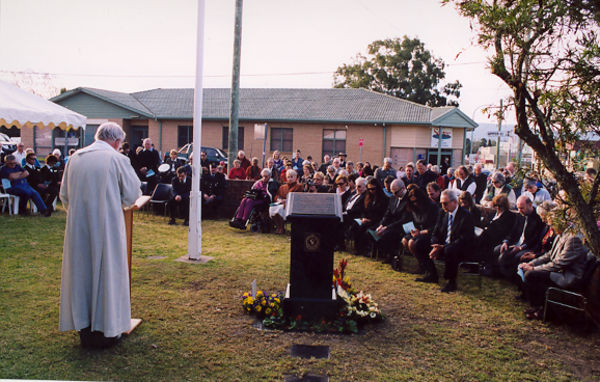
Around 150 people gathered alongside police officers in Bega to remember the tragedy that claimed the lives of Constable Kenneth Coussens, his wife Elizabeth and baby son Bruce, who were murdered by Myron Kelly, who had placed a bomb outside the Constable’s home in Bega.
Fifty years ago a policeman, his wife and baby were murdered in Bega in south-east New South Wales.
Around 150 people gathered alongside police officers to remember the bombing tragedy that claimed the lives of Constable Kenneth Coussens, his wife Elizabeth and baby son Bruce, who were murdered by Myron Kelly, who had placed a bomb outside the Constable’s home in Bega.
NSW Police Commissioner Ken Moroney stated, “This was a very important occasion, not only for the Coussens family who had gathered from as far as Adelaide and Sydney. It was important for people in the Bega Valley to come together, with members of the NSW Police Force to acknowledge the 50th Anniversary of when Senior Constable Ken Coussens his wife Elizabeth and their seven month old son Bruce were murdered in Bega.”
“It’s was an occasion to reflect, to remember but also acknowledge that which is good about this community. These are always occasions for sadness and reflection but they also give you optimism for the future, said Commissioner Moroney.”
He continued, “Mr Coussens is one of 280 officers in NSW who have lost their lives in the execution of their duties. It’s a reflection on the legacy that people like Ken Coussens leave us and on the proud history and traditions of the NSW Police.
Locals recall the enormous explosion at about 2am as hundreds of windows were smashed close to the Constable’s home and some up to a mile away from the explosion site.
The home was almost obliterated by the explosion with the entire front of the house being blown away and the remainder barely standing. Much of the roof was missing and Constable Coussens, his wife Elizabeth and infant son Bruce, who had all been sleeping in the front bedroom at the time, were flung through the air and killed instantly.
I can think of no greater breach of civil liberty than the taking of another life
In search of a suspect, detectives intimately examined Constable Coussens’ life in an attempt to discover why such a violent act had occurred in the usually quiet town.
It was discovered that local man Myron Kelly had held a well-known grudge against the constable and in the absence of other leads this seemed worth following up.
The offender had become incensed at being spoken to by the Constable regarding traffic offences and placed a metal dairy container loaded with over 200 sticks of stolen gelignite outside the front door of the Constable’s home.
When Kelly’s house was searched, four and half sticks of gelignite, 20 feet of safety fuse and 58 detonators were discovered. The offender was arrested after a major Police investigation and later sentenced to life imprisonment.
Myron Kelly was released from jail in 1980 and returned to the district. He died in Cooma in July 2007 aged 83.
Commissioner Moroney said, “This was a terrible act of evil…from my reading of the historical documents, Mr Kelly stated he only ever intended to frighten the constable. However, I can think of no greater breach of civil liberty than the taking of another life.”
Incredibly, Mrs Coussens’ elder son Roger who was 9 years old at the time was physically unharmed by the attack.
For the Commissioner, being able to meet Roger who was the sole survivor from that day was very inspiring.
Commissioner Moroney said of Roger, “He had a bit of a tear in the eye as he reflected on his mother, brother and step-father. I think it was also an opportunity for him to catch up with family and to reflect what I believe was the honour that his step-father holds in terms of service Kenneth Coussens gave to the NSW Police Force and the community.”