The Sydney Morning Herald dated 3 November, 1908 contained the following brief story of the death of the constable. He had been treated for depression shortly prior to his death.
SENIOR CONSTABLE’S SUICIDE – SHOOTS HIMSELF IN BATHROOM.
Casino, Monday.
Senior Constable O’Connor shot himself this morning in his bathroom at 8 o’clock. He fired three times, the last shot tearing the side of his face and head away. Lately O’Connor seemed quieter than usual, but there was nothing to suggest that he contemplated taking his own life. He leaves a wife and six children.
At the time of his death by suicide, the constable was aged 42 years and was stationed at Casino. He had previously served at Maclean, Broadwater and Lismore.
Constable John FURNAUX
| 25/10/2012
Constable John FURNAUX
Illness
Warialda
1 July, 1908
The following brief article from The Mercury(Hobart)of 5 July, 1908 describes the death of Constable Furnaux, which appears still to be a mystery.
CONSTABLE’S STRANGE DEATH.
The police are making inquiries into the cause of the death of John Furnaux, a constable of police, lately stationed at Warialda. About a week ago he was suddenly taken ill, and came to Sydney for medical treatment. He was admitted to the Royal Prince Alfred Hospital on Monday last and, gradually becoming worse, died on Wednesday. It is alleged that the last symptoms to manifest themselves were similar to those following arsenic poisoning, and the man’s stomach has been forwarded to the Government analyst for examination.
The Sydney Morning Herald6 July, 1908 added the following information.
Â
HEALTH FAILING FOR SOME TIME – WARIALDA, Sunday.
Furneaux was stationed here forsome months as a mounted constable. About a fortnight ago he left for Sydneyto be examined by the police doctor as to whether he was capable of performingordinary duty.It is reported that he regularly received remittancesfrom England and was very highly connected, being related to leading Englishfamilies. He appeared to be in failing health for some time. His widowleft for Sydney immediately on receipt of the wire announcing the death. She has now returned, and apparently was unable to get any satisfactoryexplanation as to the cause of death. The deceased leaves three young children.
Â
At the time of his death the constable was stationed at Warialda.
William JUSTIN
| 25/10/2012
Constable 1st Class William JUSTIN
New South Wales Police Force
Horse Accident
Thuddungra
8 March, 1905
On the day of his death Constable Justin was patrolling about ten miles from Thuddungra (Young district) when his horse became skittish and began to buck. The constable was driven into a wire fence by the animal, where he sustained severe injuries to his face and hands. He was found some three hours after the incident by some girls going home from school, and was quickly taken to the home of a Mr Webb. He was taken to Young Hospital the next day however he unfortunately passed away.
The constable was born in 1859 and joined the New South Wales Police Force on 19 November, 1881. At the time of his death he was stationed at Young.
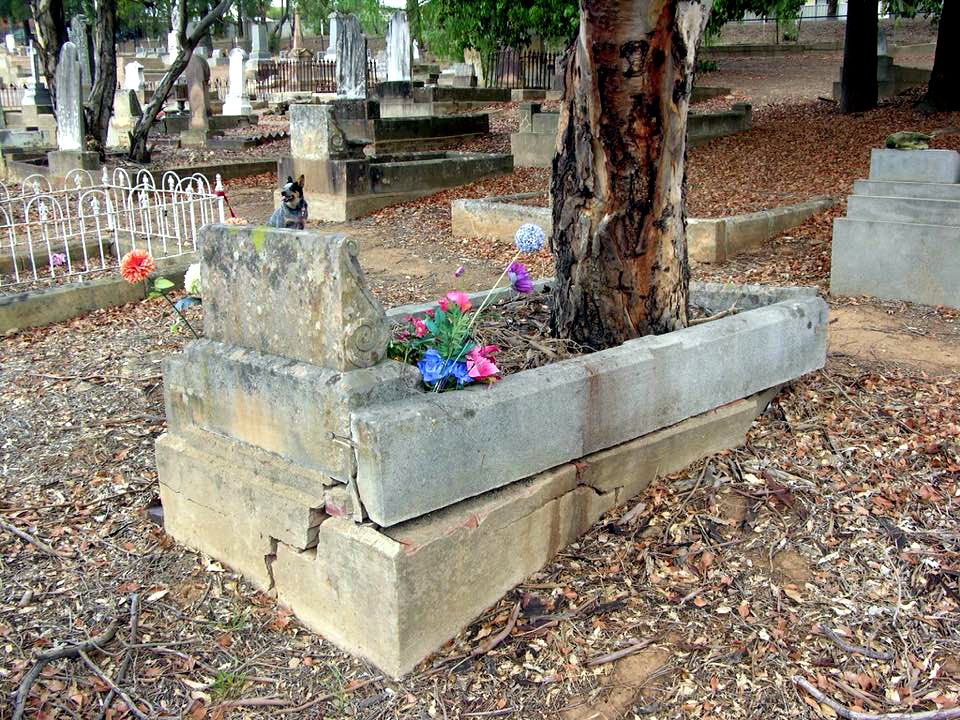
Today, Missy and I paid a visit to William JUSTIN at Young.
*
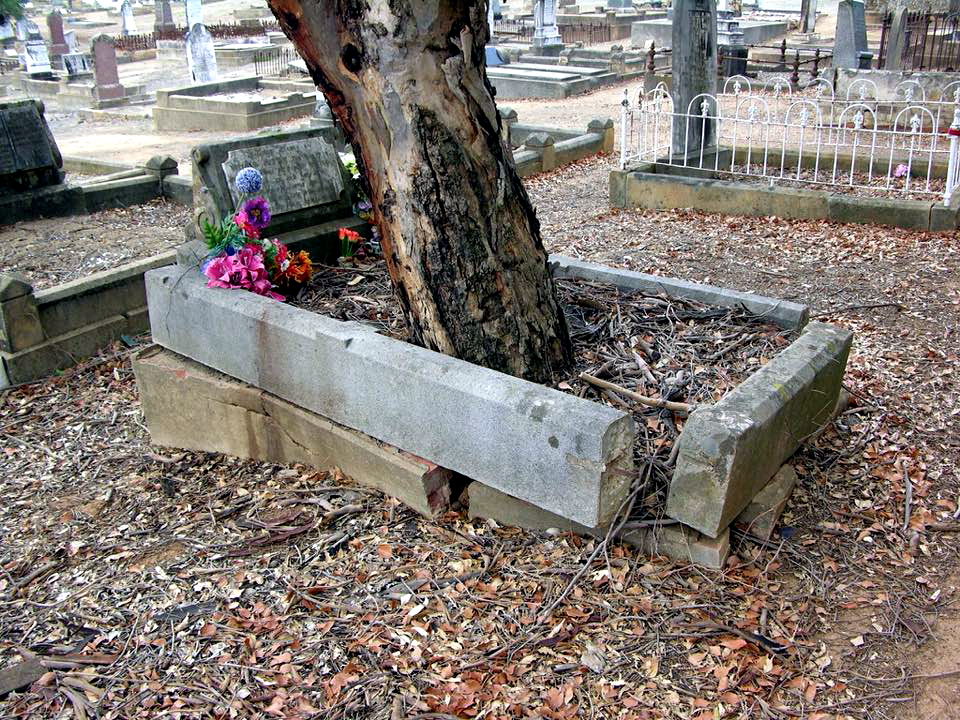
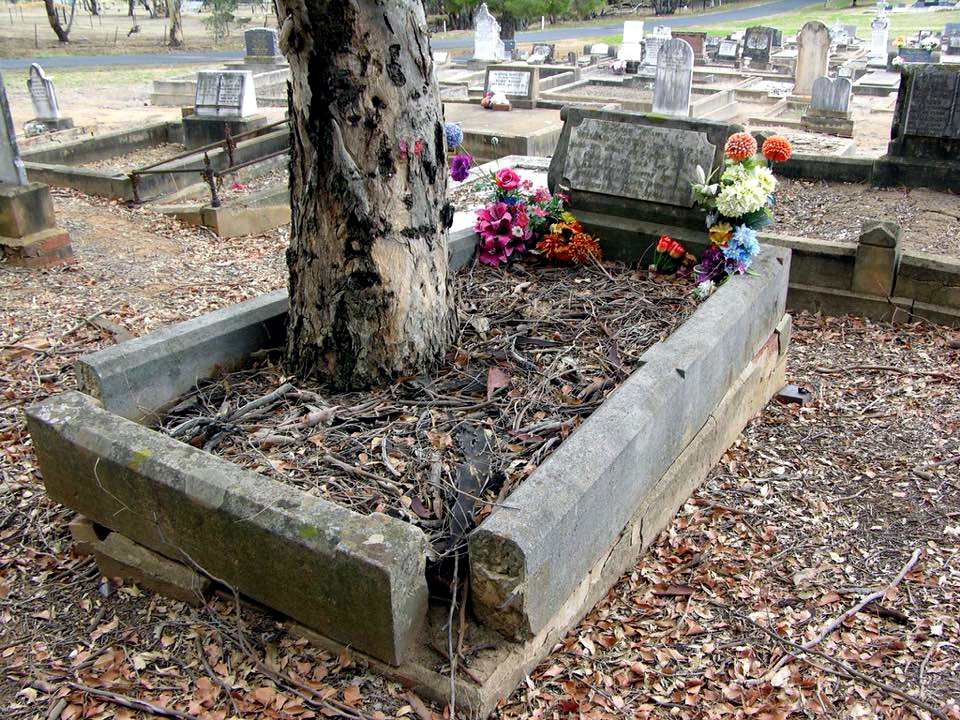
As you can see from these and previous photos of this grave, there is a bloody huge gum tree growing right on top of him. There is a remembrance day ribbon pinned to the tree and the flowers and trinkets have obviously been placed in recent years.
Please take the time to read a little about NSWPF history, or at least just have a look at the state of a grave that belongs to an officer killed in the line of duty, Cst 1/c William Justin. Yes- that is a large tree growing through the centre of the grave.
I’m at a loss to understand how the grave of a Police officer, who died in the service of this state, can be allowed to reach this condition. I seriously wonder what his family and colleagues would think of us.
Remembered…
Constable 1st Class William JUSTIN
Young Police
Horse Accident – 8 March, 1905
Resting Place – Young General Cemetery, Young
In early March, 1905 Constable Justin was patrolling about ten miles from Thuddungra (Young district) when his horse became skittish and began to buck. The constable was driven into a wire fence by the animal, where he sustained severe injuries to his face and hands. He was found some three hours after the incident by some girls going home from school, and was quickly taken to the home of a Mr Webb. He was taken to Young Hospital the next day however he unfortunately passed away. The Shoalhaven Telegraph dated 29 March, 1905 reported the following some weeks later.
“DEMISE OF FIRST-CLASS CONSTABLE JUSTIN.
[Written by Daniel McMillan, an old and sympathetic Friend.]
A great gloom was cast over this neighbourhood and surrounding district on Monday week last, when the sad news became known that First-class Constable Justin had succumbed to injuries which he received through being thrown from his horse whilst on duty the Wednesday previous, some 20 miles from Young, at which place he has been stationed for a considerable time. It would appear from the evidence adduced that while Mr Justin was in the act of shutting a gate, which was a complicated one, his horse, being a spirited animal, started to buck, and ran away, causing the rider to lose his balance and fall to the ground. The unfortunate man, being dragged a considerable distance by the stirrup, was brought into contact with a barb-wire fence, thence with a tree. It is also surmised that the horse kicked him on the head. He was found in an unconscious state some hours, it is supposed, after the accident occurred. At the time of the accident Constable Justin was over 20 miles away from his home. He was found by a Mr Webb, a farmer residing some distance away from the scene of the untoward incident, who took him to his home, and did all that he could to relieve the sufferer until medical aid was obtained, From the first but little hope was entertained of his recovery. He only regained consciousness for a few minutes before his death, which sad event took place on the Saturday evening following, at 8 o’clock. Mr Justin, who was, it may be said, in the prime of life, being only 45 years of age at the time of his death, was the eldest son of the late Mr W. Justin, so long and favourably known in connection with the Harbors and Rivers Department; he was born in Sydney, and whilst only a child removed with his parents to Shoalhaven, where his aged mother still re sides, with several other members of the family. The deceased, at the early age of 21, joined the police force, with which he had been associated ever since, and during his 24 years’ service he had been stationed at many places in New South Wales, including Goulburn, Braidwood, Myrna, Queanbeyan, Frogmore, Young, and other stations. In referring to the deceased gentleman, an up-country paper says: ‘He was the popular constable, who was loved and respected by all, and will be greatly missed.’ The same can be said by everybody at every place where he has been. Besides a wife and 5 children, the deceased leaves a mother, 2 brothers, and 4 sisters, together with a large circle of friends and acquaintances, to mourn their loss. The funeral, which took place at Young on Sunday week, was largely attended…”
The constable was born in 1859 and joined the New South Wales Police Force on 19 November, 1881. At the time of his death he was stationed at Young. He is listed in the official New South Wales Police Honour Roll.
https://police.freom.com/william-justin/
https://police.freom.com/william-justin/
https://police.freom.com/william-justin/
Samuel William LONG
| 25/10/2012
Samuel William LONG
New South Wales Police Force
Regd. # ?
Rank: Constable
Stations: ?, Auburn
Service: From 6 July 1894to 19 January 1903 = 7+ years Service
Awards: ?
Born: ? ? 1865
Died on: 19 January 1903
Cause: Murdered – shot
Age: ?
Funeral date: ?
Funeral location: ?
Buried at: Rookwood Cemetery, NSW
Memorial at: ?
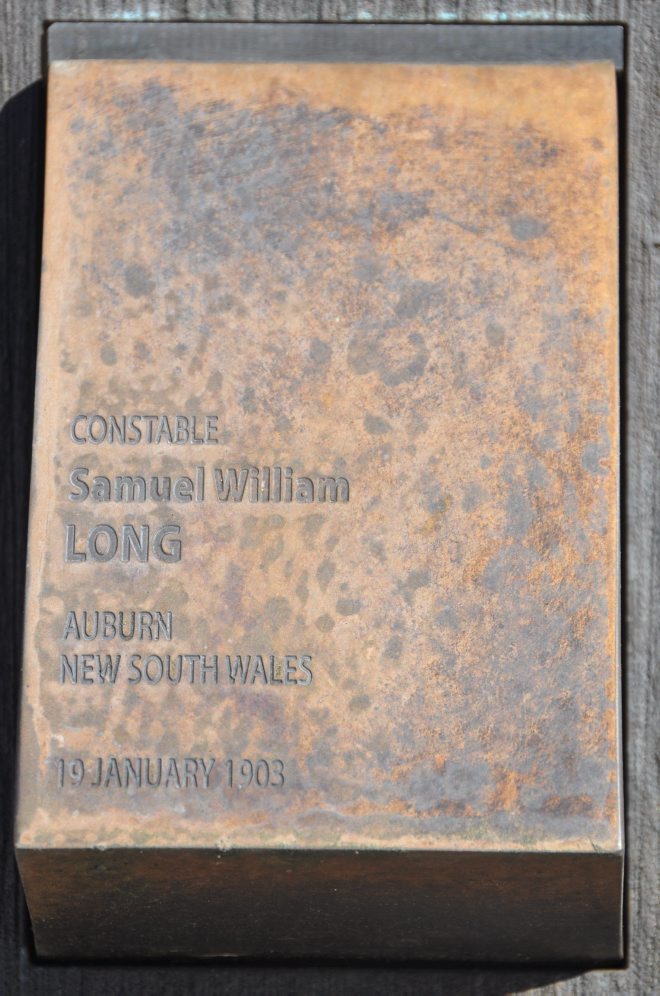
[alert_green]SAMUELIS mentioned on the Police Wall of Remembrance[/alert_green]
Touch plate at National Police Wall of Remembrance
[divider_dotted]
Funeral location: ?
[divider_dotted]
FURTHER INFORMATION IS NEEDED ABOUT THIS PERSON, THEIR LIFE, THEIR CAREER AND THEIR DEATH.
In the early hours of 19 January, 1903, Theodore Trautwein, the licensee of the Royal Hotel at Auburn was awakened by a loud noise. The sound had appeared to come from the bar area of the hotel, and taking a revolver with him, Trautwein went to investigate. In the bar he saw and heard a person lying on the floor, apparently in great pain. As other residents of the hotel appeared, a candle was lit and it was found that the injured person was a local constable, Samuel Long. A doctor was called and it was found that the constable had suffered a severe gunshot wound to his head. He died a short time later, unable to identify his attacker. A lengthy investigation eventually revealed that the constable had been shot while trying to apprehend two offenders, Digby Grand and Henry Jones, whom he had caught after they had broken into the hotel. After the shooting the offenders had escaped by horse and sulky, however they were both later arrested, charged and convicted of the murder of Constable Long.
The North Western Advocate of 8 July, 1903 announced the execution of the murderers.
EXECUTION OF AUBURN MURDERERS
Sydney, Tuesday ” The State Cabinet having considered the petition for the respite of Digby Grand and Jones, convicted for murdering Constable Long at Auburn, declined to interfere and the men were hanged this morning at 9 o’clock. ”
The constable was born in 1865 and joined the New South Wales Police Force on 6 July, 1894. At the time of his death he was stationed at Auburn.
[divider_dotted]
The Auburn Murder Trial.
The Sydney Mail 11 February 1903 p 8
At the Central Police Court on Monday, before Mr. E. H. Wilshire, S.M., the hearing of the case in which Digby Grand, 32, alias Newbold, alias Stephens, alias Ward, bootmaker, a native of Victoria ; John Thomas Woolford, 27 butcher ; and Albert Yeomans, 24, horse trainer, were charged with having, in company, feloniously and maliciously murdered Constable Samuel William Long, at Auburn, on January 19 last year, was resumed.
Mr. Cargill, of the Crown Law Office, appeared to prosecute ; Mr. E. R. Abigail appeared for the accused Grand, and Mr. W. Niland for the accused Yeomans.
Mr. Cargill said that there was no further evidence to call against Woolford, and he was discharged.
Joseph Daniel Gallagher and William Gallagher were cross examined by Mr. Abigail and Mr. Niland as their personal habits and connection with the police.
Francis Henry Furnval, qualified medical practitioner, residing at Auburn gave evidence as to having examined the dead body of Constable Long about 2.30 on the morning of the murder.
JONES ARRESTED.
Henry Jones, for whom the Government offered 200 pound reward, was arrested in a terrace house at Ada street, Ultimo, on Tuesday afternoon.
Sergeant Carson and Constable MacKay, plain clothes officers at No. 4 station located the suspect. Sergeant Carson and Constable Clarke went to the front of the house about 2.30pm and Detectives Jones, MacKay, and Lenehan to the rear.
They entered simultaneously, revolvers drawn, and found the man they wanted seated playing cards with other men and women. He differed from the photo we published last week in that he had grown a pointed reddish beard, and with the protection of this disguise was in the habit of going out by night. He admitted his identity on the police entering, revolvers drawn, and attempted no resistance. The inmates of the house said he had been only living with them a week.
He was taken to the Central Police Court and placed in the dock with Grand and Yeomans at 3.30pm. Their trial had been proceeding for an hour before Mr. Wilshire, and Woolford was in the witness box giving evidence, which followed the lines of his confession given by us last week, and which was to the effect that he saw Grand and Jones enter the hotel bar after vainly endeavouring to get him to actively participate, saw Constable Long come along and go through the open door to investigate, heard a shot, and saw Grand and Jones rush out and run away. Jones, described as alias John Maguire, alias Baker, 36, clerk, was charged and remanded for eight days. Grand and he exchanging a few quiet words as he left the dock, and the hearing of the evidence was then resumed.
The constable was shot by an offender named Shaw at Redfern whilst attempting to arrest him and another man for passing counterfeit coins. Following an incident involving a storekeeper, Constable Guilfoyle had sought the assistance of an off-duty member, Constable Michael Maher, and after checking several shops the offenders had been in they located them in Shepherd Street. As the two constables approached the offenders, one produced a revolver and shot Constable Maher three times. Shaw then also produced a pistol and shot Constable Guilfoyle twice. Constable Maher later recovered, however Constable Guilfoyle’s wounds proved to be fatal. Shaw then made good his escape, making his way to Victoria.
Constable Guilfoyle was a native of Ireland, having been born at Scariff in County Clare. He arrived in Sydney in 1885 and joined the New South Wales Police Force in November of that year. He did his initial training at the old Belmore Barracks and was first sent to Bathurst, where he remained for about two years. He was then transferred to Redfern in 1887, and was destined to remain attached to that station until his death. He was described as a very powerful, muscular man of nearly 17 stone. Prior to his death the constable had recently been severely injured in an accident and after a spell in hospital had been incapacitated for five or six weeks. He also had the misfortune to recently lose three of his children, one of them being a girl 12 years old. Although he could have retired from the police force on half pay, he apparently preferred to continue to work, and had continued working ‘street duty’ at Redfern and Darlington.
(About 11am on 12 October, 1902 Constable Richard Johnston was off duty at his home at Elwood (Victoria) when a neighbour informed him that a man had attempted to abduct her eight year-old daughter. The constable quickly set off on his bicycle after the suspect and located him a short distance away. When he saw the approaching policeman the offender drew a revolver and shot Constable Johnston, inflicting fatal wounds. The offender then left the scene, only to commit suicide a short time later when confronted by other police. It was later found that the man who had murdered Constable Johnson was the same offender (Shaw) who had murdered Constable Guilfoyle at Redfern (NSW) three months earlier.)
Constable Guilfoyle was born in 1859 and joined the New South Wales Police Force on 7 November, 1885. At the time of his death he was stationed at Redfern.
William HIRD
| 25/10/2012
Constable 1st Class William HIRD
Assault – Axe
Canterbury
13 August, 1885
On the evening of the 13 August, 1885 the constable challenged a group of drunken Kempsey Park labourers near the bridge over the Cooks River at Canterbury. The group were returning to camp following a day on the grog in the city and had been causing a disturbance. One of the men, named Birch, then became involved in a scuffle with the constable, and while this was going on another of the group struck the unfortunate Constable Hird on the head several times with an axe, killing him almost instantly.
Over the next few weeks the death of the constable, the capture of the murderers and the subsequent criminal trial were covered by the Sydney Morning Herald in great detail. The following are extracts.
(14 August, 1885 edition):
MURDER OF A CONSTABLE AT CANTERBURY.
A constable named William Hird was found dead early this morning near the Canterbury bridge, under circumstances that revealed the perpetration of a brutal murder. About 3 o’clock yesterday morning two market gardeners brought word into the township that a man was lying dead near the bridge. Several people went to the spot and found the body of the constable who lived in Canterbury. A terrible blow had driven in the skull near the left eyebrow, and the right side of the head, including the eye, was completely smashed. The body lay in a pool of blood, and near it was a large blood-covered stone, which it is presumed had been used in part perpetration of the deed. The deceased was lying on his back, with his hands clenched and his arms fixed. Two buttons, of his jumper were open, as though he had been in the act of drawing his baton…
(21 August, 1885 edition):
It was “a gratifying though mournful pleasure to testify to the indefatigable manner in which the late constable had performed his arduous duties. Of the fearless manner in which he had discharged his duties they had had ample proof. They had, he thought, a bright example set before them by his action on his last return home. Wearied with his day’s work, and doubtless contemplating retiring to rest, the constable heard some ruffians making the night hideous with their cries. He knew that should he succeed in arresting them he would have to convey the prisoners to the Newtown Police Station, and he would have to walk there and back. Instead of pleading to himself fatigue as an excuse for a partial neglect of duty, he went at once to the spot where he met his death”
(4 September, 1885 edition):
The two young men Joseph Thompson and Ellis Birch, who had been found guilty at the Criminal Court on Tuesday of the manslaughter of Constable Hird at Canterbury on the 13th of August, were placed in the dock again yesterday to receive sentence. The prisoners, it will be remembered, were indicted for murder, but the jury returned a verdict of manslaughter. Several witnesses were called, who gave Birch a very good character. His Honor, in sentencing the prisoners, stigmatised their crime as a horrible and cruel murder. He considered that the verdict of the jury, in the teeth of the evidence given, had caused a grave miscarriage of justice, for which he was assured that he was not in any way responsible. He had pointed out that there was no evidence of any provocation by which the crime might have been reduced from murder to manslaughter, and he would, therefore, speak of it as murder despite the finding of the jury. He would endeavour, however, in the interests of society to rectify as far as lay in his power the wrong that had been done by inflicting, in the case of Thompson, the highest penalty allowed by law for the crime of which he had been found guilty, namely, penal servitude for life, the first three years in irons. With regard to Birch, there was no doubt that he had been an assenting and consenting party to the murder and he would therefore sentence him to 15 years’ penal serviende. [sic, ie. servitude]
The constable was born in 1852 and joined the New South Wales Police Force on 5 July, 1882. At the time of his death he was stationed at Canterbury. He had previously been a sergeant in the East Riding Police Force in Yorkshire and left a wife and five children.
[divider_dotted]
Bernard Joseph John DOWLING
| 25/10/2012
Bernard Joseph John DOWLING
New South Wales Police Force
Constable
Horse Accident
Brewarrina
22 old
Death: Reported as 11 January, 1882 but grave stone indicates he died on 19 January 1882.
On 11 January, 1882 the constable was riding near Milroy Station, Brewarrina, when his horse bolted and threw him against a tree. He landed across the saddle and was then dragged some distance. Unfortunately Constable Dowling had received severe injuries and despite being treated by a doctor, he passed away the following day.
The Maitland Mercury reported on 14 January, 1882 that “Yesterday evening while mounted Constable Bernard Dowling was riding near Mrs. Whitmarsh’s on Milroy Station, his horse bolted with him and ran him against a tree. He was thrown across the saddle and dragged some distance. A messenger came in for the police and doctor. Dowling was still insensible when the messenger left which was about an hour after the accident. Senior Constable Steele and the doctor left here about midnight.”
The constable was born in Ireland about 1860 and was a single man. At the time of his death he was stationed at Brewarrina.
[blockquote]
Launceston Examiner newspaper, Thursday 2 February 1882, page 1 of 4
DEATHS
DOWLING – Near Brewarrina, N.S.W., Bernard J., son of the late W. P. Dowling, of Launceston, aged 22 years.
Inscription: In Memory of Bernard Joseph John DOWLING born at Launceston Tasmania July 17th 1883 Died Jan’ry 19th 1882 R.I.P.
5 April 2014: From Ken Medway, Beyond Courage Facebook page:
We recently visited Brewarrina and located the grave of Bernard Joseph John DOWLING who died in January 1882 as a result of a horse accident.
*
According to his headstone he died on 19 January and was 22 years old being born on 17 July 1859 at Launceston.
*
GPS Location 29 58′ 10S / 146 50′ 46E
Old Catholic Section right over on western fence
Beyond Courage Page 69.
*
A thorough search of the cemetery failed to locate the grave of John Charles DONOVAN aka DONAVON who is also recorded as being buried there. Inquiries with Brewarrina Shire revealed that all records were destroyed some years ago so his precise whereabouts will probably never be known.
NOTE:
From Cal: “See Yackandandah Times story article attached to the death of John Charles DONOVAN. Body re-interred in Yackandandah Cemetery, Victoria, pre 27 January 1922.”
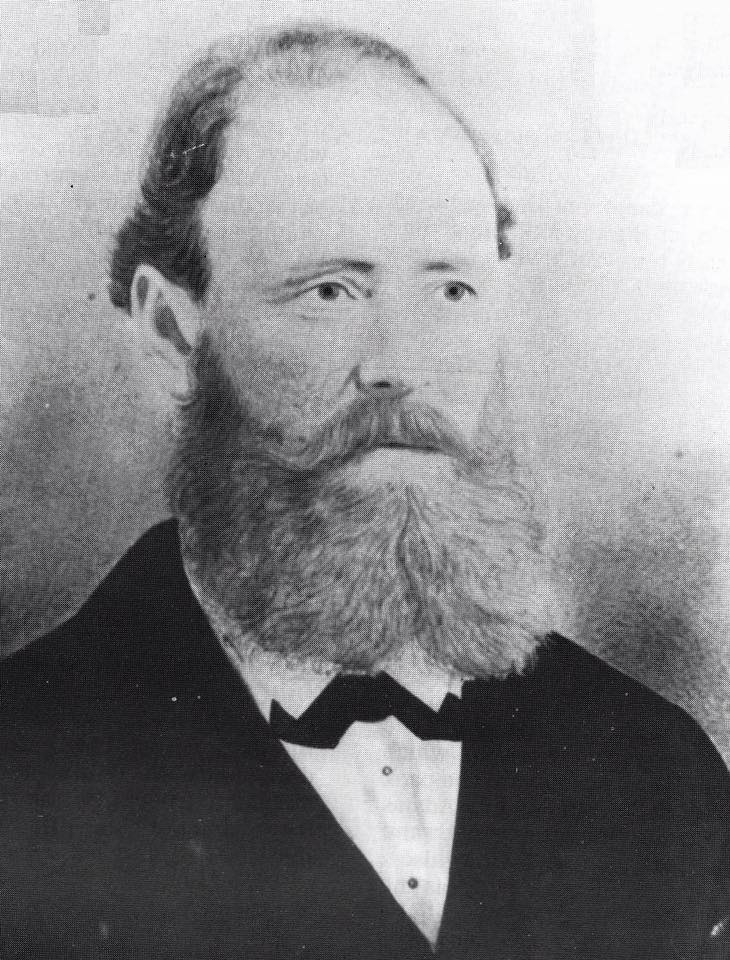
Thomas Edward WALLINGS
| 25/10/2012
Thomas Edward WALLINGS
New South Wales Police Force
Regd. # ‘ P ‘ 716
( ‘P’ = Pre 1862 when NSWPF “Officially” commenced )
Rank: Mounted Constable – 15 July 1855
Senior Constable – appointed 1 March 1862
Sergeant 2nd Class – appointed 1 June 1868
Senior Sergeant – appointed 1 November 1877
Stations: , Molong ( January 1865 ), Mudgee ( September 1869. Sgt In Charge of Mudgee to Bathurst Gold Escort ), Dubbo – death
Service: From 15 July 1855 to 20 September 1878 = 23+ years Service
Awards: ?
Born: ? ? 1838 in Dubbo ( although other records state a native of England )
Died on: Friday 20 September 1878
Cause: Shot – Murdered
Event location: Marthaguy Creek, ( near Warren ), NSW
Age: 40
Funeral date:
Funeral location:
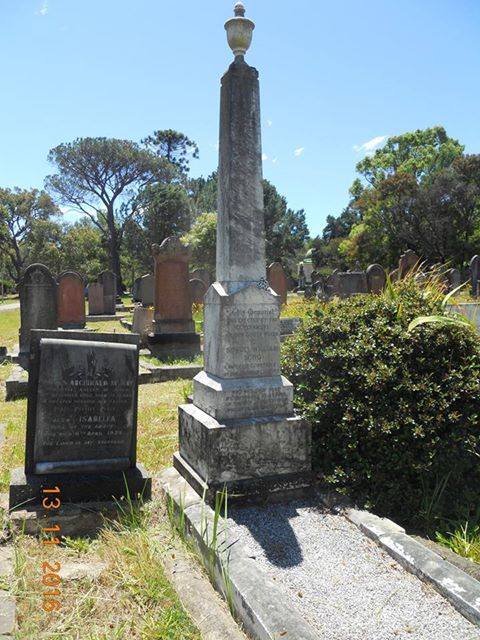
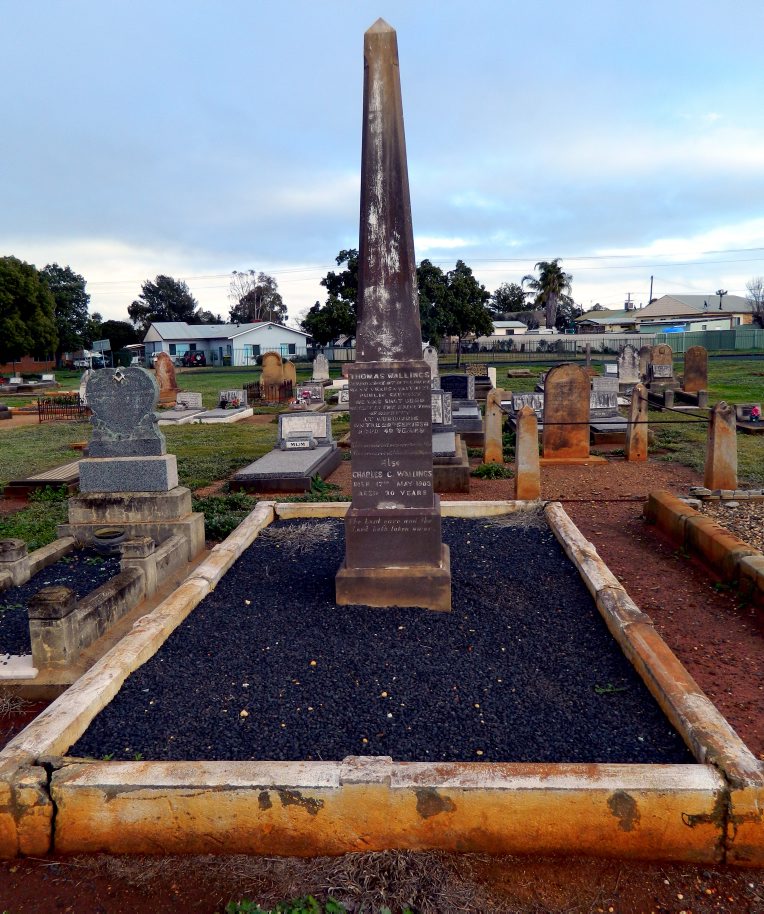
Buried at: Old Dubbo Cemetery, Myall St, Manera Hts, Dubbo, Church of England Portion, Section R2
Memorial location:
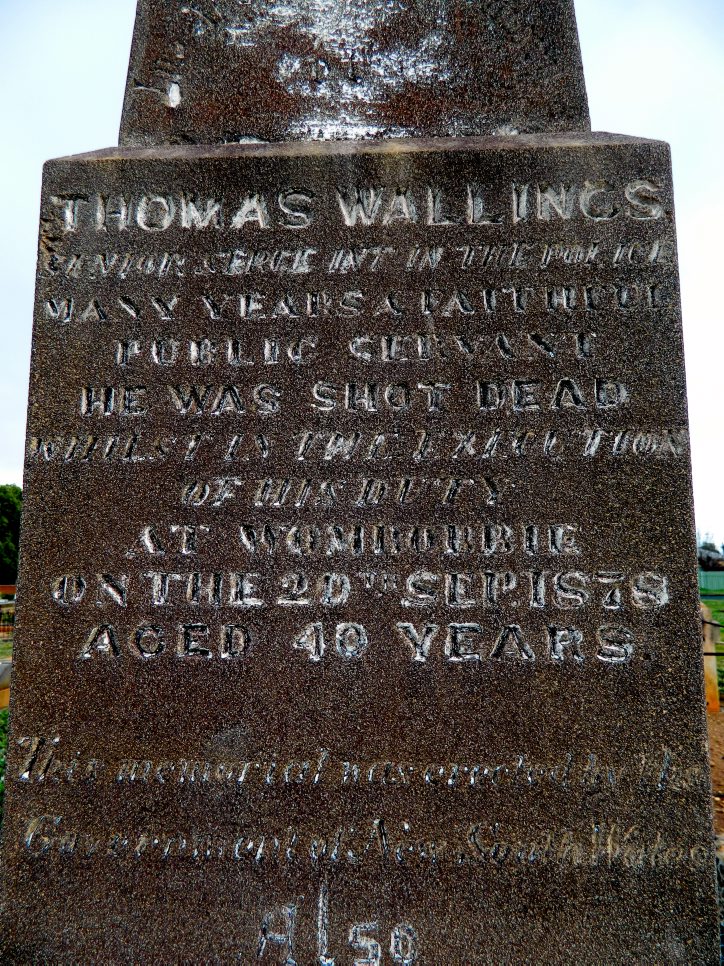
Thomas WALLINGS
INSCRIPTION: THOMAS WALLINGS ? in the Police many years a faithful public servant He was shot dead whilst in the execution of his duty at Wombobbie on the 20th Sep. 1878 aged 40 years This memorial was erected by the Government of New South Wales also Charles C. WALLINGS died 17th May 1903 aged 30 years The Lord gave and the Lord hath taken away.
INSCRIPTION: THOMAS WALLINGS ? in the Police many years a faithful public servant He was shot dead whilst in the execution of his duty at Wombobbie on the 20th Sep. 1878 aged 40 years This memorial was erected by the Government of New South Wales also Charles C. WALLINGS died 17th May 1903 aged 30 years The Lord gave and the Lord hath taken away.
Thomas IS mentioned on the Police Wall of Remembrance
On the night of Thursday 19 September, 1878Sergeant Wallings, Senior Constable William Souter and Constable John Walsh were searching for a gang of bushrangers ( Captain Midnight & his gang ) when they set up a bush camp near the Wonbobbie Inn, Marthaguy Creek (near Warren).
The following day ( Friday 20 September ) at 6am the three police rode to the inn where they suspected they might find the bushrangers. Constables Souter and Walsh remained on guard outside while Sergeant Wallingsapproached the inn. Meanwhile, Constable Souter saw a man about 50 metres away carrying a rifle. He rode over to him and was told he would be shot if he came any closer. Souter called to the other police who rode down to him.
Sergeant Wallings then fired a warning shot and told the man to surrender, however the man replied that he himself would fire if the police came any closer. Sergeant Wallings then advanced on the man and pointed his revolver at him. The man then turned suddenly and dropped to one knee. As he did so, he fired at the sergeant, hitting him in the chest. In the confusion the offender ran a short distance away and took cover from the police. A short gun battle took place, however, the offender, being far better armed with a rifle, compared to the police revolvers, managed to escape. The two constables then directed their attention to assisting the wounded sergeant. The wound suffered by Sergeant Wallings ( shot through the heart and lung ) proved to be severe, and he unfortunately passed away almost immediately.
A few weeks later, the Sydney Morning Herald dated 10 October, 1878 reported the death of the murderer, informing its readers that “News has just reached the metropolis that the man who shot Senior Sergeant Wallings at Dubbo has been killed by the police, shortly after he committed the murder. The cold-blooded villain shot Wallings in the execution of his duty. He was pursued by Sub-Inspector Duffy and Constables Latton and Gray of Bourke, in the most unrelenting manner, and traced to the borders of Queensland, where he made a desperate resistance. The police shot at the horse he was riding and fatally wounded the murderer, whose name is said to be George Gibson. This man’s death is one which has not in any way been regretted by the general community. It was such a death as luckily there is not much necessity for now-a-days. The police deserve the congratulations of the public here for their bravery in this instance, which however, is only of a piece with much the New South Wales police have accomplished in the suppression of crimes of this nature. A movement has been initiated for relieving the widow and eight children of Wallings.
The sergeant was born in 1838 and joined the police force on 15 July, 1855. In 1862 he became a member of the newly-formed New South Wales Police Force. At the time of his death he was stationed at Dubbo. The offender was the bushranger “Midnight“.
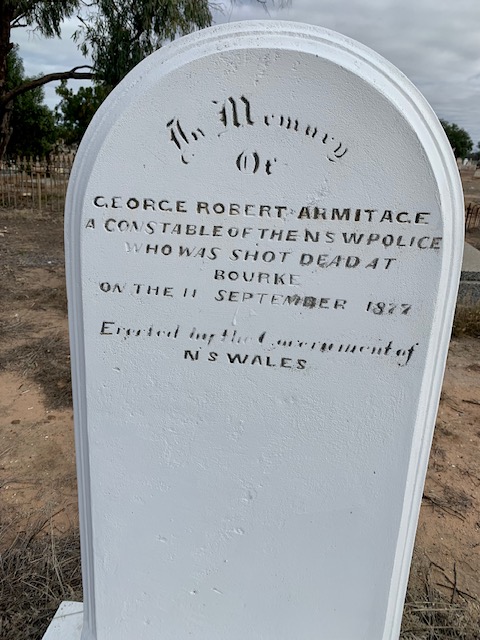
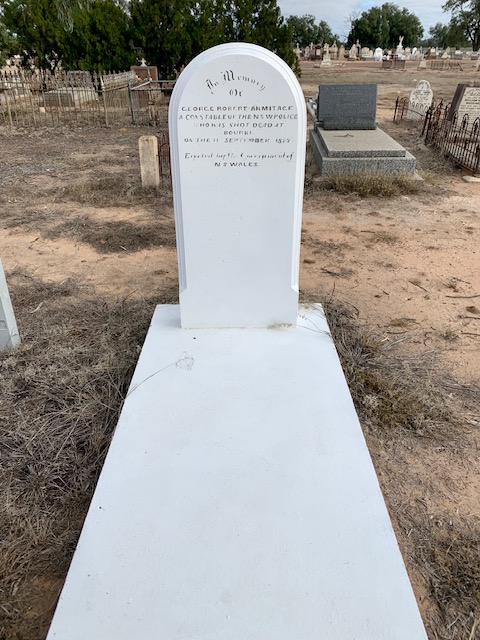
George Robert ARMYTAGE & Michael COSTIGAN
| 25/10/2012
George Robert ARMYTAGE
New South Wales Police Force
Constable
&
Michael COSTIGAN
New South Wales Police Force
Constable
Shot – Murdered
Bourke
11 September, 1877
Double Police Murder
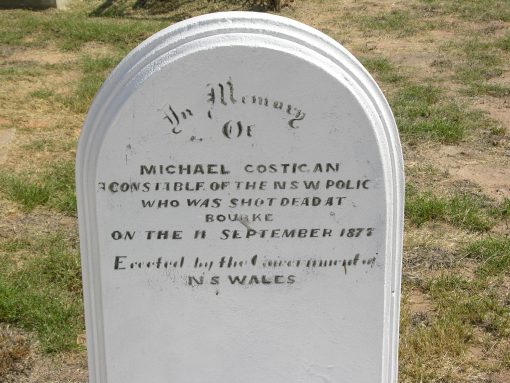
Grave of Michael COSTIGAN
On Tuesday 11 September, 1877 Samuel Getting, a barman at the Royal Hotel in Bourke, was speaking with Constable Michael Costigan in the bar of the hotel. The constable had just paid Getting for his room and board, and after having a drink and chatting with the barman for a short time, he left the bar.
Getting, for some unknown reason, also left the bar about that time and went to his room in the hotel, where he took possession of his rifle. He then left his room and walked to the front of the hotel, where he saw Constable Costigan and Constable George Armytage standing on the verandah, having a conversation. He immediately shot both constables from behind before running into the street and attempting to reload his rifle.
Sub Inspector James Keegan, who was nearby, noticed people running toward the river, and when he asked what was happening he was told that Sam, the barman, had shot two of the police and was running away with a loaded gun in his possession.
He then saw Getting running along the bank of the river with a gun in his hand, being chased by several people. The inspector then went towards these people and told them to move away from Getting so he could speak with him. He then followed Getting for a short distance along the river until he stopped and waited for the inspector to approach. The inspector then spent some time talking with the offender and trying to get him to surrender, all the while edging closer as he spoke.
At a later inquest, the inspector described what happened next.
“I rushed at him, being at this time between 10 and 15 paces from him. The ground was very muddy, and there was a gully between us. I got my hands upon him being beneath the gun, and we both stumbled and nearly fell. He again got a few paces from me, turned round, took deliberate aim, and shot at me. He called to me to keep back. I knew I was shot, but it did not weaken me, and I still went forward.
He then raised the gun, holding it by the barrel, and struck me on the head. I put up my arm to ward off the blow, and it bruised my arm very much and cut my head. He struck me several times, and I at length secured the gun. He then ran parallel with the river for a few yards, and as I followed him he suddenly plunged into the river, and kept his head beneath the water until he was drowned. He went but a short distance into the river.
That is his body I have recently seen lying in an outhouse. He had plenty of opportunity of shooting me at first had he so desired, but he did not attempt to do so until I sought to arrest him. When he shot at me, one shot struck me near the eye, two shots went into my coat, two entered my chest, and two others grazed it.
The Deceased…was a man of very good character and very good behaviour, and I can ascribe no motive for his acts. He said he had no intention of doing what he did, and that he had loaded the gun to go out for some duck shooting.”
Constable Costigan was born in 1853 and joined the New South Wales Police Force on 11 September, 1873. At the time of his death he was stationed at Bourke.
Constable Armytage was born in 1855 and joined the New South Wales Police Force on 4 May, 1877. At the time of his death he was stationed at Bourke.
Grave Location/s:
ARMITAGE: 30 06′ 03S / 145 56′ 12E
Old C of E, Bourke
As seen in June 2022. Photo: Alan BLAKE # 19779
As seen in June 2022. Photo: Alan BLAKE # 19779
COSTIGAN: 30 06′ 05S / 145 56′ 14E
Old Catholic, Bourke
as seen in April 2007 Photo: Ken Owen
as seen in April 2014 Photo: Ken Owen
as seen in April 2014 Photo: Ken Owen
Location of Old Royal Hotel
32 Mitchell St, Bourke, 2840
GPS: -30.088854, 145.936134
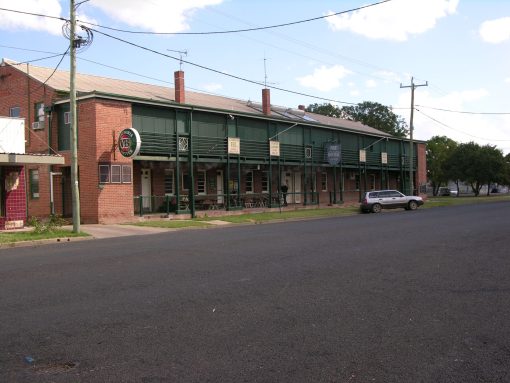
2014: Port of Bourke Hotel which was formerly the Old Royal Hotel where these murder took place.
For the purposes of this website ‘Q‘ represents those Police joining between 1 March 1862 ( commencement of NSWPF ) – 23 February 1915 ( Commencement of NSWPF current numbering system )
Rank: Constable – appointed 7 January 1863
Senior Sergeant – appointed ? ? ?
Final Rank: Senior Sergeant
Stations: ?, Cowra – Death ?
Service: From 7 January 1863 to 1 May 1872 = 9+ years Service
Awards: ?
Born: ? ? 1840, Wick, Scotland
Died on: 1 May 1872
Cause: Shot – Murdered
Event location: Binni Creek, Cowra, NSW
Age: 31
Funeral date:
Funeral location:
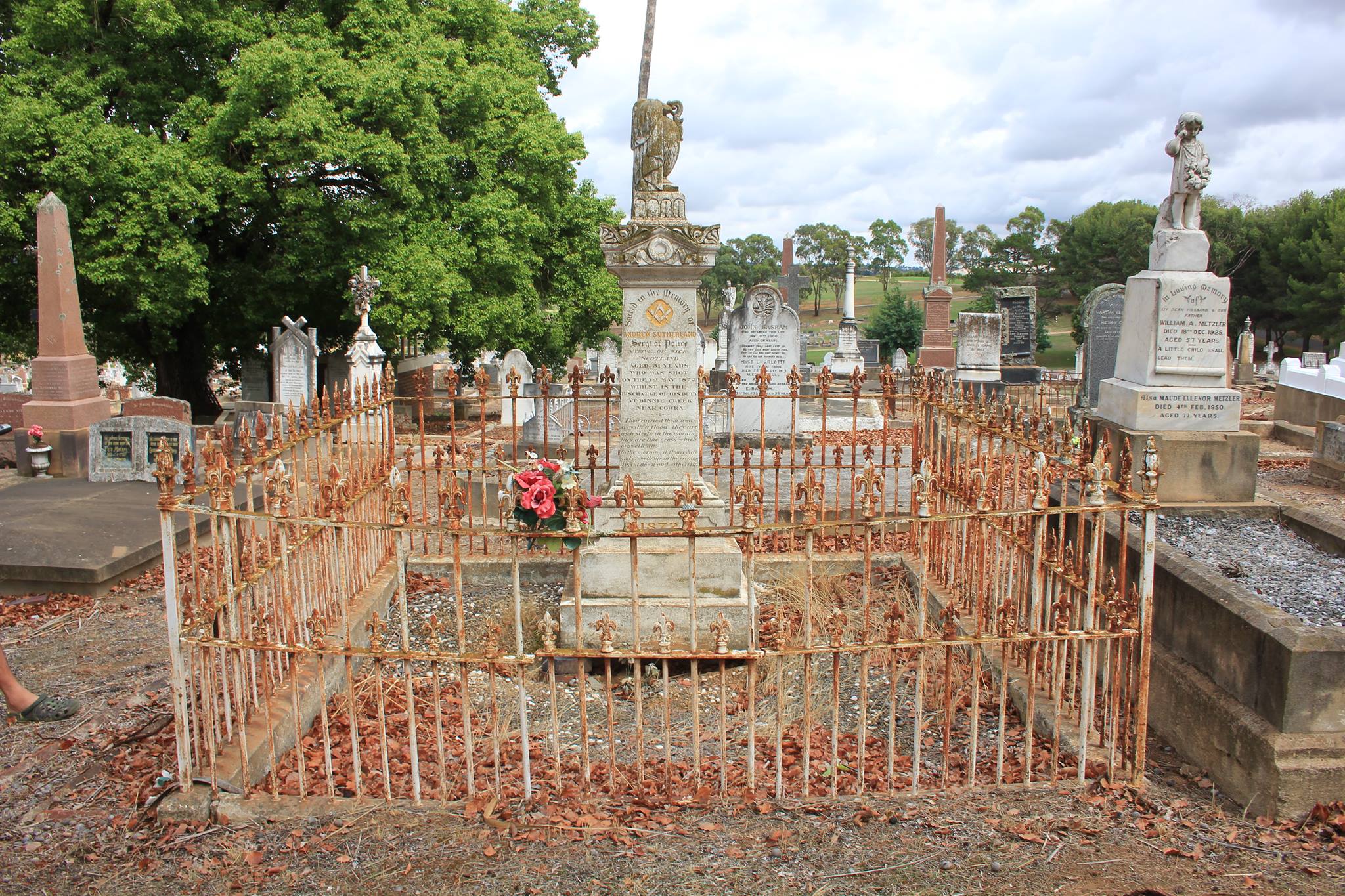
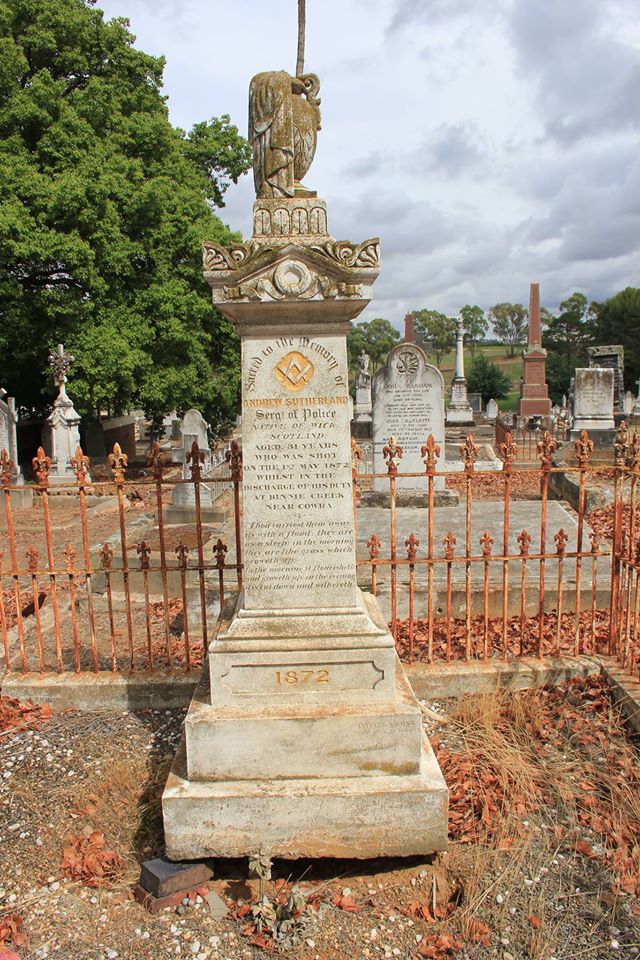
Buried at: Anglican section of the Young General cemetery
Memorial at: Cowra Police Station, 88 Brisbane St, Cowra, NSW
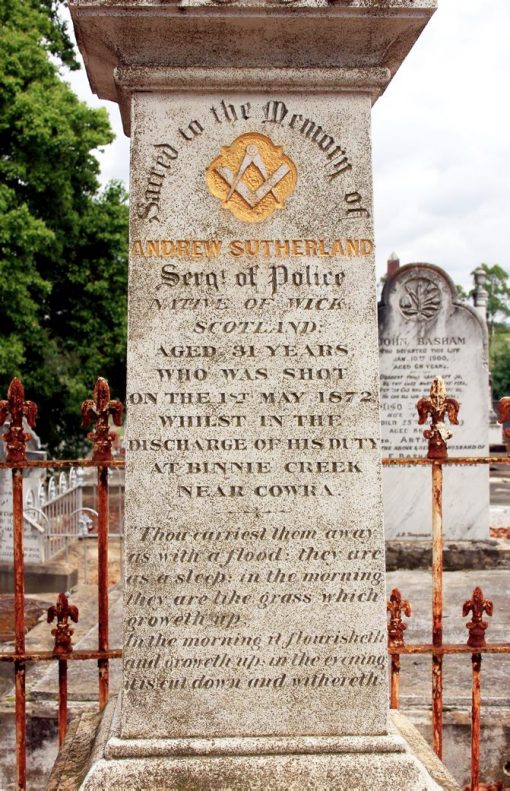
INSCRIPTION: Sacred to the Memory of Andrew SUTHERLAND Sergt. ( Sergeant ) of Police Native of Wick, Scotland. Aged 31 years Who was shot on the 1st May 1872 whilst in the discharge of his Duty at Binnie Creek near Cowra. ” Thou carriest them away as with a flood ; they are as a sleep ; in the morning they are like grass which groweth up. In the morning it flourisheth and groweth up ; in the evening it is cut down and withereth.”
ANDREW IS mentioned on the Police Wall of Remembrance
On 1 May, 1872 the sergeant was returning to Cowra from Bathurst Court.
During his journey he was told that two men who were wanted for robbery, George Gray and William Bristow, were at Daniel Horan‘s hut at Binnie Creek, twelve miles from Cowra.
The sergeant rode over to investigate and as he neared the door of the dwelling the offenders suddenly emerged and shot him to death.
The Clarence and Richmond Examiner dated 7 May, 1872 provided a brief account of the tragedy, which tends to suggest that the offenders were known to the sergeant.
SERGEANT SUTHERLAND SHOT DEAD BY BUSHRANGERS –
CARCOAR ” Thursday – I regret to have to announce that Sergeant Sutherland, of the Cowra police force, was shot dead last evening, by bushrangers, at a place about five miles from Cowra.
It appears that two armed men called on a settler named Daniel Oram, whose house is distant about two miles from Cowra and demanded food, which he placed on the table for them.
Sergeant Sutherland, who was going home from the Bathurst Assizes, rode up to the door during the meal, and was dismounting, when one of the men stopped to the door, gun in hand, and said, “I have been looking for you, you wretch,” and then shot him through the heart, causing instant death.
The men then went off and Oram started to Cowra, and upon arriving there, informed the police, who are now in pursuit of the murderers.
The fate of the unfortunate but brave officer is universally regretted. He leaves a wife, and had only been married a few months.
The sergeant was born in 1839 and joined the New South Wales Police Force on 5 January, 1863.
At the time of his death he was stationed at Cowra.
The Queenslander
Sat. 9 Aug 1873 p 10
ST. GEORGE.
(FROM OUR OWN CORRESPONDENT.) July 31.
We have also to record the arrest of a man named Frank Riley alias George Gray by Sergeant Cranney, on the charge of murdering Senior-sergeant Andrew Sutherland, of the New South Wales force, at Hordern’s hut, Beni Creek, on the 1st of May, 1872.
The prisoner had been staying in town for some few weeks, and left accompanied by another man with the avowed intention of going to the Surat races, but parted with his comrade about three miles from Weribone, his comrade going on into Surat, while he went out into the bush to camp.
Sergeant Cranney, in the meantime, appearing to have some clue to his identity, followed the pair, and finding that only one had reached Surat, returned on his tracks, and camped in the bush for two nights endeavouring to ascertain the whereabouts of the prisoner.
Becoming faint from fasting, he went to Weribone Station for food, and just dropped on to the man he was looking for, and who had also been there on the same errand. The officer arrested him at once, and prisoner was taken to Surat and remanded to Roma, and we believe by this time is on his way to Brisbane.
This is the second arrest of New South Wales offenders made by Sergeant Cranney during the past few months, the other being that of James Madgwick, whose capture and exploits were narrated in your columns a short time since. Sergeant Cranney was also the officer who arrested the notorious Patrick Collins.
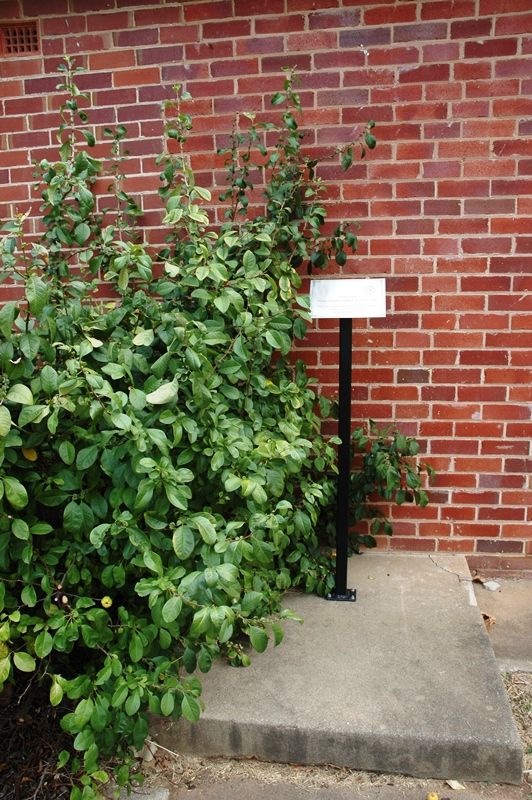
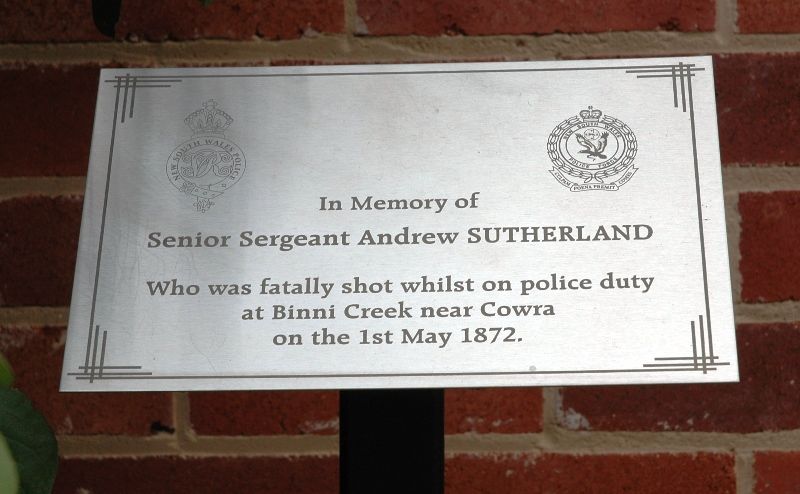
A plaque commemorates Sergeant Andrew Sutherland who was fatally shot in the line of duty as a New South Wales Police officer.
Sergeant Second Class Andrew Sutherland was shot whilst on duty at Binni Creek near Cowra on May 1, 1872. On May 1, 1872 he was returning to Cowra from Bathurst Court. En route he was told two offenders wanted for robbery, George Gray and William Bristow, were at Daniel Horan’s hut at Binni Creek, 12 miles from Cowra.
The Sergeant rode over to investigate and as he approached the door of the dwelling, two offenders emerged and shot and killed him. Gray and Bristow were subsequently arrested but both were later released without charge. No-one was ever convicted of the crime.
Actual Event Start Date: 01-May-1872
Actual Event End Date: 01-May-1872
Actual Monument Dedication Date: 01-March-2012
Front Inscription:
In memory of
Senior Sergeant Andrew SUTHERLAND
who was fatally shot whilst on police duty
at Binni Creek near Cowra
on the 1st May 1872.
The Portland Guardian and Normanby General Advertiser of 20 May, 1872 reported on the magisterial inquiry which was held at the Cowra courthouse before Mr G. Campbell J.P, “touching the death of Andrew Sutherland, who was shot dead by a ruffian at the residence of Daniel Horan a farmer living on Binni Creek…” One witness to the murder, Mrs Eliza Seery, gave the following evidence.
“I am the wife of James Seery, and reside at Binni Creek.
About 4 o’clock in the evening of Wednesday, the 1st inst., two men rode up to Horan’s hut on two dark looking horses.
Mrs Horan and I were in the hut at the time. They bid me good day, and asked if I had seen a bay horse, to which I replied “No”. One then said to the other, “We’ll get down and have a light”. The taller man was the spokesman.
He remarked that the weather was very dry.
The dogs began to bark. I went out to see what they were barking at, and observed Sergeant Sutherland riding towards the place.
The tall man asked me who was coming, and I answered, “Sergeant Sutherland”. The smaller man then walked outside, and Sutherland called him to the corner of the hut.
After talking to the sergeant for a short time, the man came towards the door, when I heard Sutherland ask him who was inside.
Sutherland then rode up to the door, and told the man who was inside to come out, or he would shoot the two of them.
The tall man, who was in the hut, said, “I won’t” and went towards the door.
The sergeant then got off his horse, when the tall man fired at him.
He said, “I’ll shoot”, before he shot at the sergeant.
Directly after the shot was fired, Sutherland, let his horse go, and ran towards a tree standing near the hut.
The man followed Sutherland and fired two shots, one after the other, as quick as he could.
The Sergeant, whose back was towards the man who shot at him, fell before he got to the tree. He fell directly after the last shot was fired.
There were only three shots fired.
The man was within a yard or two of Sutherland when the last two shots were discharged. This man brought Sutherland’s horse, and rode him away immediately after firing the last shot.
I did not see the smaller man of the two after the first shot was discharged.
I ran to the Sergeant when he fell, and asked if he was dead. He made no reply.
He was not quite dead, but never spoke.
Mrs Horan came directly after, and I told her to run for some water. She got some water, which she poured over the Sergeants mouth. He died while I was standing by him. He was lying partly on his side, and partly on his back.
Horan came up, and asked what was the matter. I told him the sergeant was shot dead.
Horan reported the murder to the police.”
The Brisbane Courier of 11 August, 1873 was to later report on the arrest of one of the offenders by Queensland Police Sergeant Cranney.
“We have also to record the arrest of a man named Frank Riley alias George Gray by Sergeant Cranney, on the charge of murdering Senior-sergeant Andrew Sutherland, of the New South Wales force, at Hordern’s [sic] hut, Beni [sic] Creek, on the 1st of May, 1872.
The prisoner had been staying in town for some few weeks, and left accompanied by another man with the avowed intention of going to the Surat races, but parted with his comrade about three miles from Weribone, his comrade going on into Surat, while he went out into the bush to camp.
Sergeant Cranney, in the meantime, appearing to have some clue to his identity, followed the pair, and finding that only one had reached Surat, returned on his tracks, and camped in the bush for two nights endeavouring to ascertain the whereabouts of the prisoner.
Becoming faint from fasting, he went to Weribone Station for food, and just dropped on to the man he was looking for, and who had also been there on the same errand.
The officer arrested him at once, and prisoner was taken to Surat and remanded to Roma, and we believe by this time is on his way to Brisbane.”