Service: From? ? pre Aug 1975?to? ? ? = ? years Service
Awards: National Medal – granted 17 March 1992 ( SenCon )
Born: Saturday 26 May 1956
Died on: Tuesday 22 June 1999
Age: 43yrs 27days
Cause: Motor Vehicle Collision – Upper Hunter region
Event location: ?
Event date: ?
Funeral date: Saturday 26? June 1999
Funeral location: ?
Wake location: ?
Funeral Parlour: ?
Buried at: ?
Memorial located at: ?
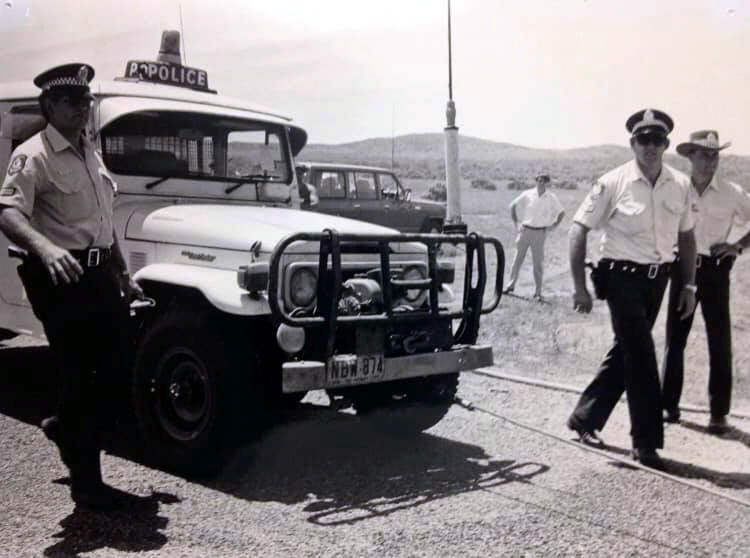
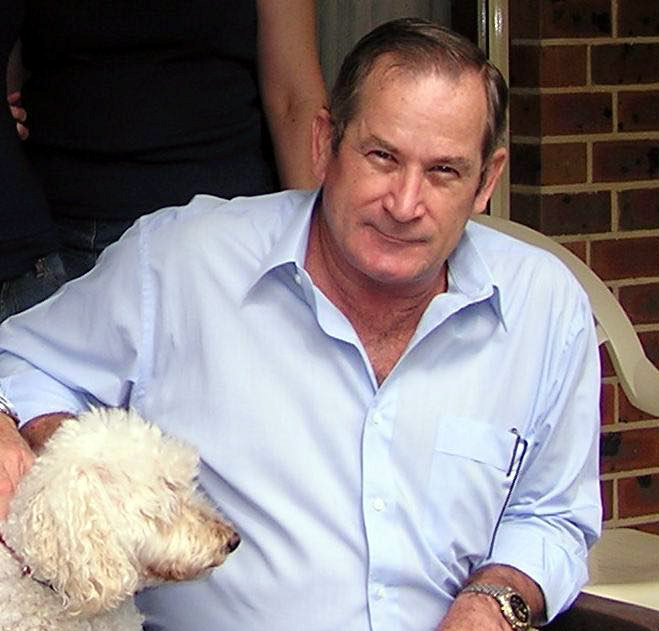
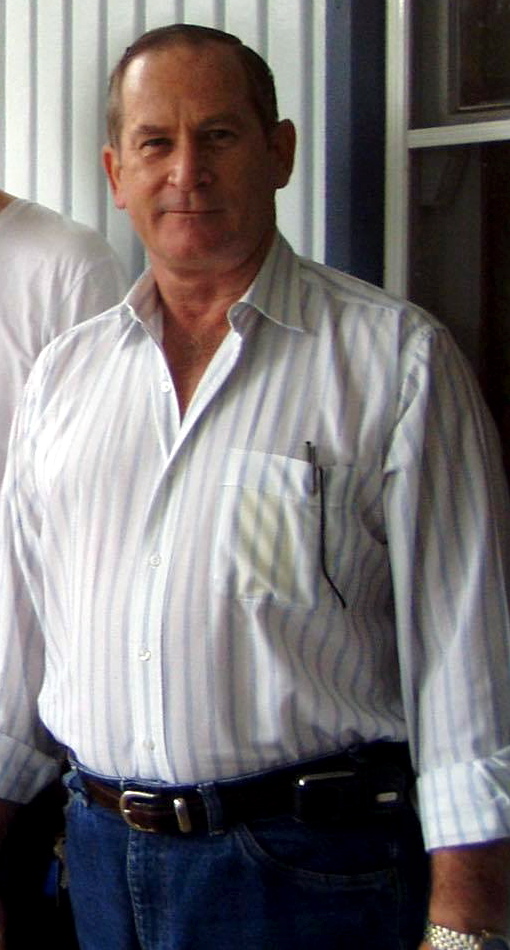
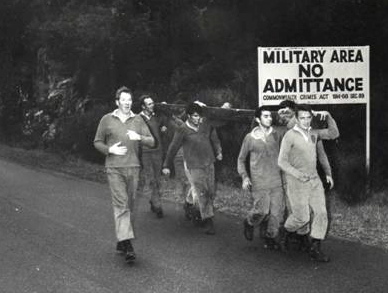
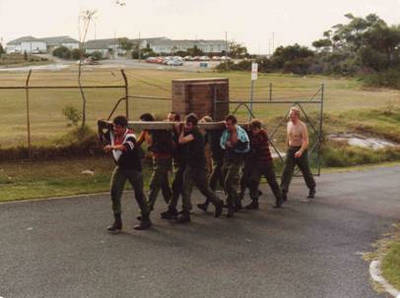
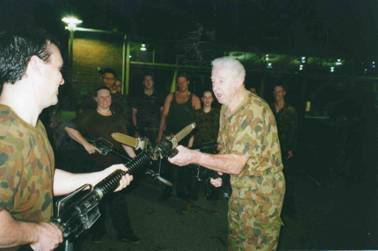
This is a picture of John Hardaker. He is the one on the right of the picture walking. Location – Broken Hill. I presume during the Mad Max 3 filming. Courtesy of his son Mitch Hardaker. John Hardaker passed away in 1999.
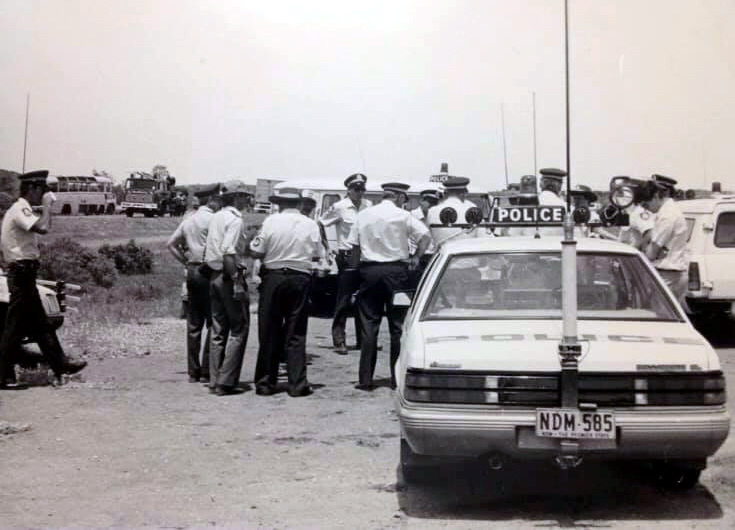
Location – Broken Hill, Mitch Hardaker, John Hardakers son, was told that this was taken whilst Mad Max 3 was being filmed out there. You can see the old bus on the left of the picture. This picture is of John Hardaker and other officers. Most probably Don BRATTAN with his back to camera and the large Crown ( Sgt 1/c ) on the left sleeve.
John is NOT mentioned on the Police Wall of Remembrance *NEED MORE INFO
FURTHER INFORMATION IS NEEDED ABOUT THIS PERSON, THEIR LIFE, THEIR CAREER AND THEIR DEATH.
After working for the NSWPF for a number of years, Peter left and then joined Ambulance NSW where he worked at Charlestown as a Control Centre Assistant from around 2010 until his death.
Got the nickname POC from the personalised number plates on his immaculate Toyota Celica with plates (POC-007).
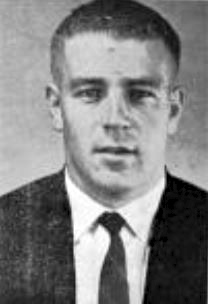
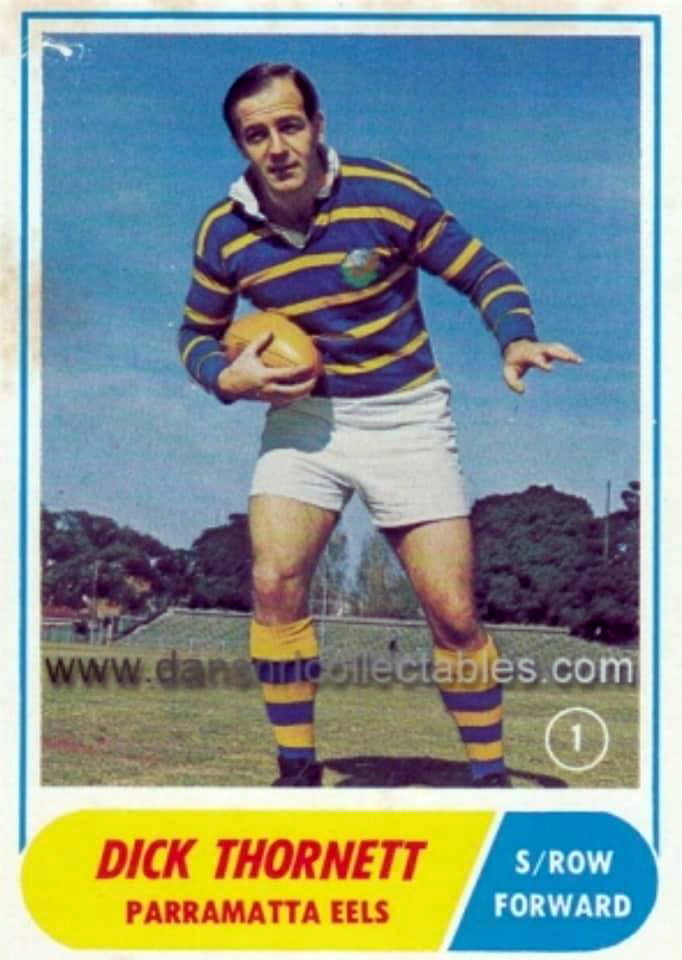
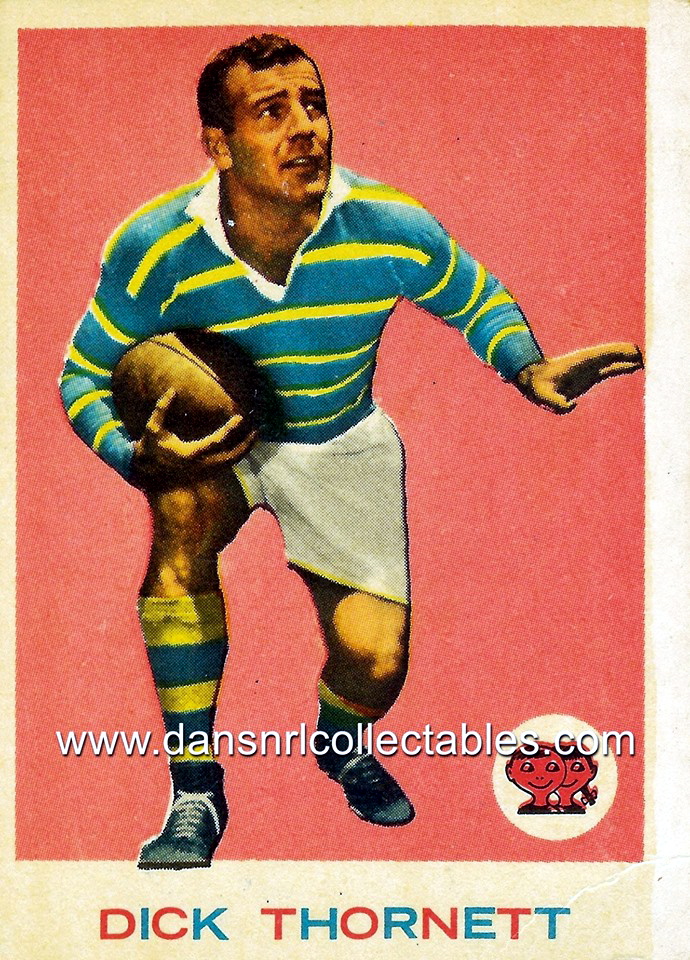
Richard Norman THORNETT
| 09/11/2019
Richard Norman THORNETT
AKA Dick
Late of Milthorpe, formerly of Bronte, NSW
NSW Redfern / Penrith Police Academy Class # 065
NSW Police Cadet # 1429
New South Wales Police Force
Regd. # ????
Rank: Commenced NSW Police Cadet training – 28 January 1958
Probationary Constable – appointed around November 1959
?
Final Rank = ?
Stations: ?, Darlinghurst, NSW Police Water Polo Team, 1960 Rome Olympian Water Polo Team, Randwick 1st grade NRL, 1961 Wallabie for the 2nd Test against Fiji, – Resigned
Service: From28 January 1958to? ? 1965 ( Resigned ) = 7 years Service
Awards: No Find on Australian Honours
Born: Monday 23 September 1940
Died on: Saturday 12 October 2011
Age: 79yrs 19days
Cause: ? possibly heart issue
Event location: ?
Event date: ?
Funeral date: 18 October 2011 @ noon
Funeral location: All Saints, 85 Ocean St, Woollahra, NSW
Wake location: ?
Funeral Parlour: ?
Buried at: ?
Memorial located at: ?
DICK is NOT mentioned on the Police Wall of Remembrance *NEED MORE INFO
FURTHER INFORMATION IS NEEDED ABOUT THIS PERSON, THEIR LIFE, THEIR CAREER AND THEIR DEATH.
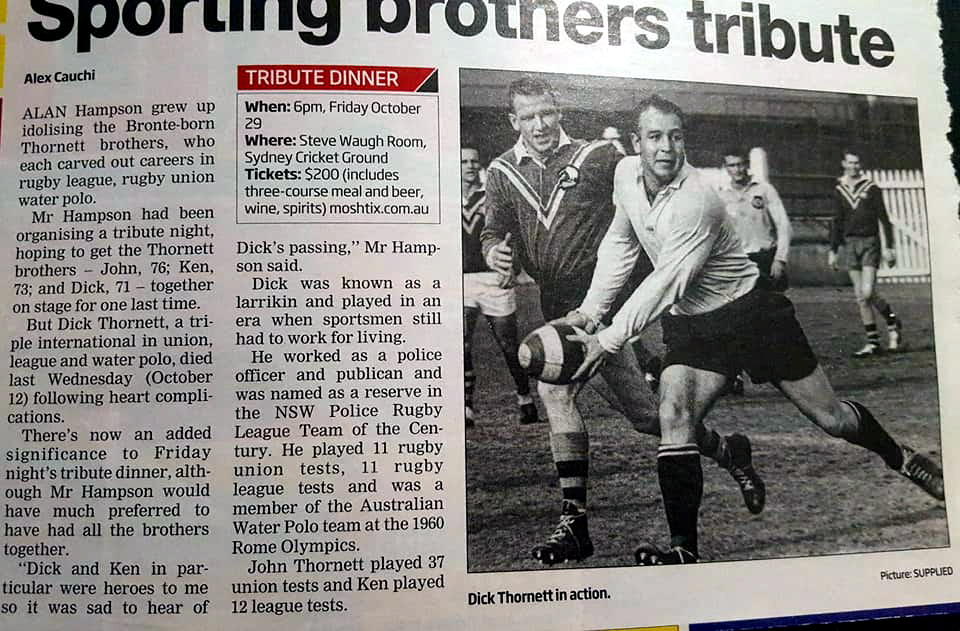
Australian Rugby Union is today mourning the loss of tri-international Dick Thornett, who passed away on Wednesday morning.
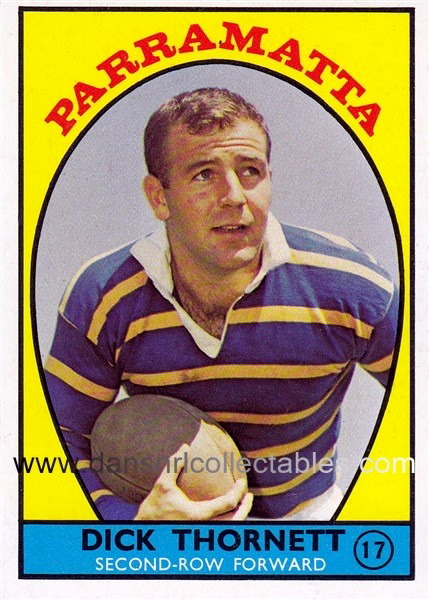
One of three brothers, Dick first sprung onto the international sporting scene in 1960 with the Australian Olympic water polo team, before switching to Rugby in 1961 where his rapid rise through club, state and into the national team was as fast as they come.
After impressing with Randwick he was given a start with NSW and after a strong showing against Fiji joined his brother John in the Test pack for the three Test series against the Pacific Island nation.
His debut against Fiji in 1961 was the start of his career with the Wallabies, which lasted until the end of the 1963 season when he decided to switch codes and excel at rugby league.
In a career that included 11 consecutive Tests and 11 tour matches, Thornett was never dropped from a Wallabies side and is considered to be one of the most extravagantly gifted sportsmen Australia has produced in the last 50 years.
ARU Managing Director and CEO, John O’Neill AO, said Thornett would always be remembered for his deeds in both Rugby codes.
“There could be no greater tribute to a Rugby forward than to have former All Blacks great Colin Meads describe you as one of the finest second rowers he ever opposed,” Mr O’Neill said.
“Dick Thornett was paid that honour after playing against Meads in 1962.
“Dick Thornett played his 11 Tests across only a short period of time but his impact was enormous. He was a ferocious ball runner and at more than 100kg was a prototype for the modern day forward.
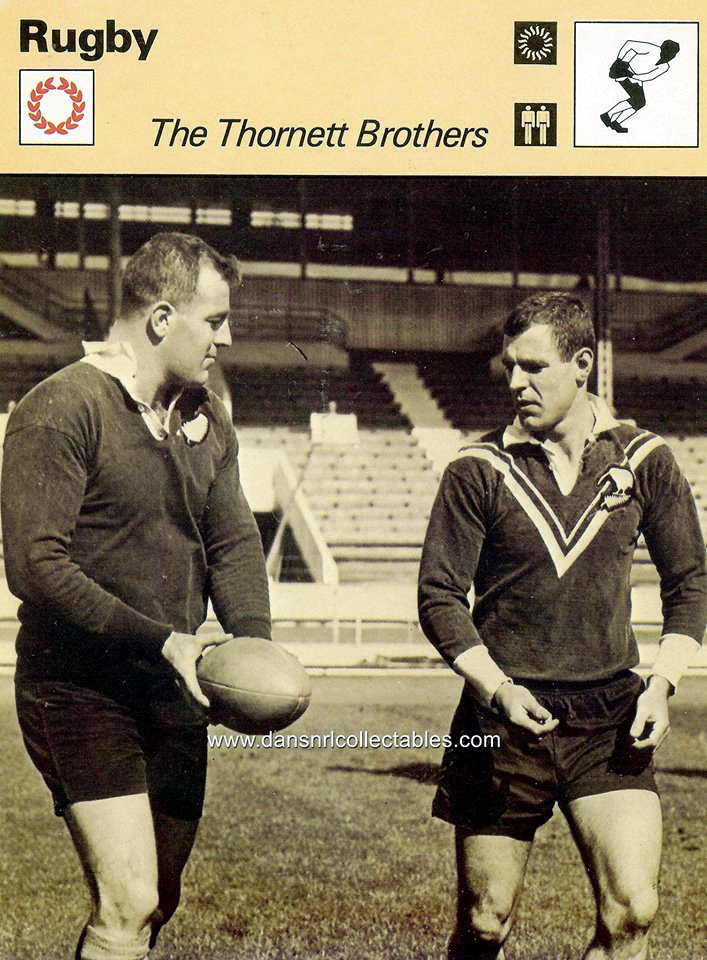
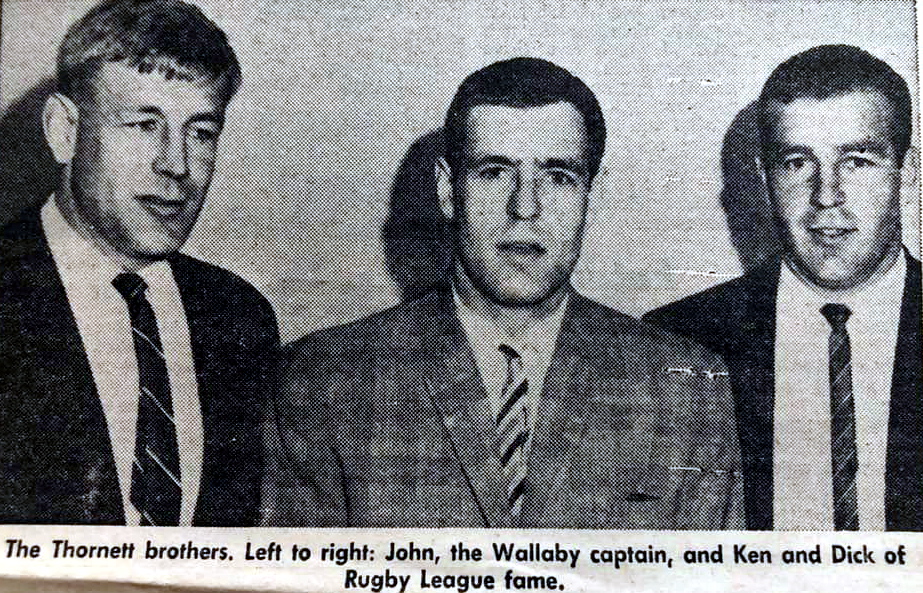
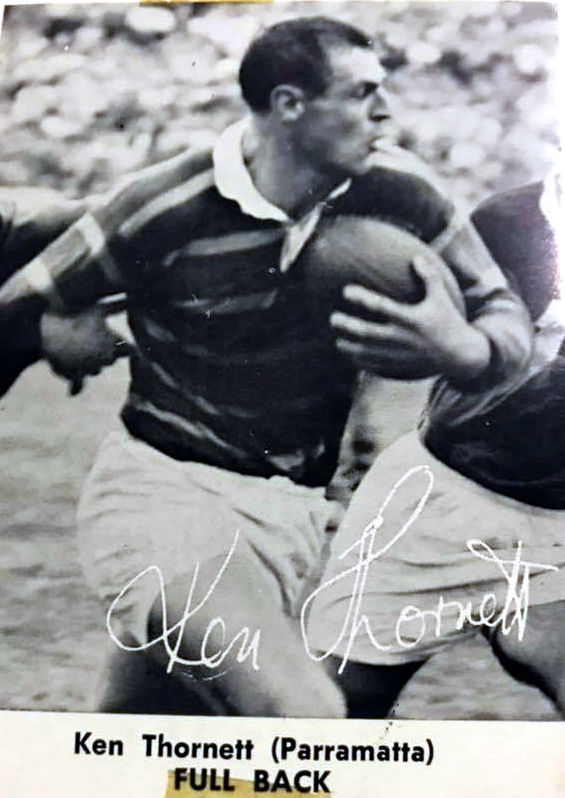
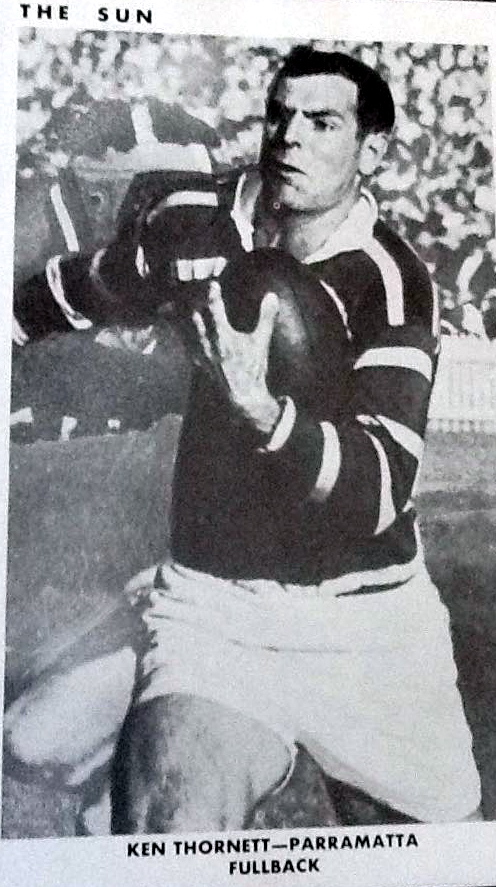
“The Thornett family has given wonderful service to Australian sport. John is a Wallabies legend who captained Australia for many years. Ken never played for the Wallabies but was one of rugby league’s great fullbacks.
“Dick played Tests with them both, across two codes. He was a uniquely talented sportsman and a proud Wallaby. He will be missed.”
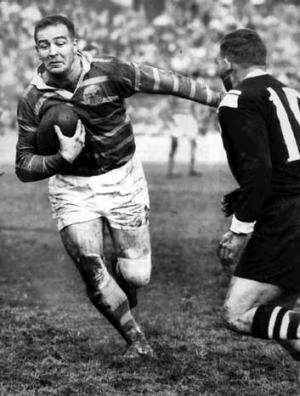
Dick Thornett, the youngest of the three Thornett sporting brothers, represented Australia in Olympic water polo, rugby union and rugby league and could have played just about any other sport.
In a rugby Test against the All Blacks, an opposing forward saw Dick Thornett aim some well-directed retaliatory blows and asked: ”Were you an Olympic boxer as well as a water polo player?” But, as it turned out, when off the field Dick Thornett was very much the gentle giant.
Richard Norman ”Dick” Thornett was born on September 23, 1940, of a Canadian migrant, Harold Thornett, who had settled in Griffith as an irrigator, and Marjorie (nee Attwood). When the family moved to Bronte, the Thornett brothers learnt to swim before they were five and became the mainstays of the Bronte water polo team.
The sport built muscles and Thornett would claim that it gave him wonderful ball control. He captained Randwick High’s rugby team in 1957.
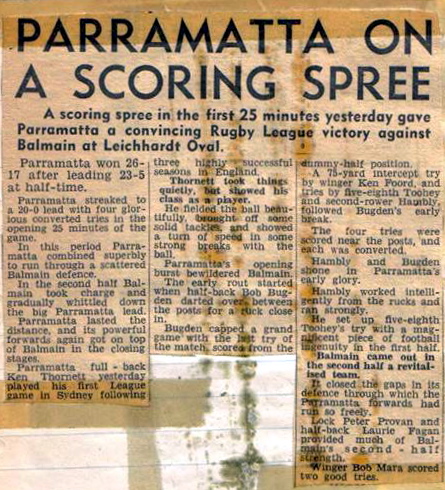
Leaving school, Thornett joined the NSW Police Force and was appointed to Darlinghurst station. He also went to the Randwick Rugby Club as second rower and lock, joining his brother Ken. He also found a place in the NSW water polo team. At 188 centimetres and weighing 104 kilograms, in 1960 Thornett competed for Australia in water polo at the Rome Olympics. In the 1961 season, he played in the Randwick first grade side.
Thornett played with the Wallabies for their second Test against Fiji in 1961, joining his other brother, John. His game was distinguished by his uncanny ball distribution skills.
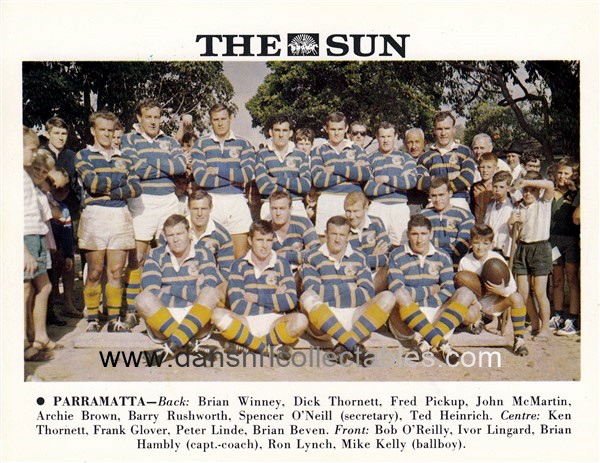
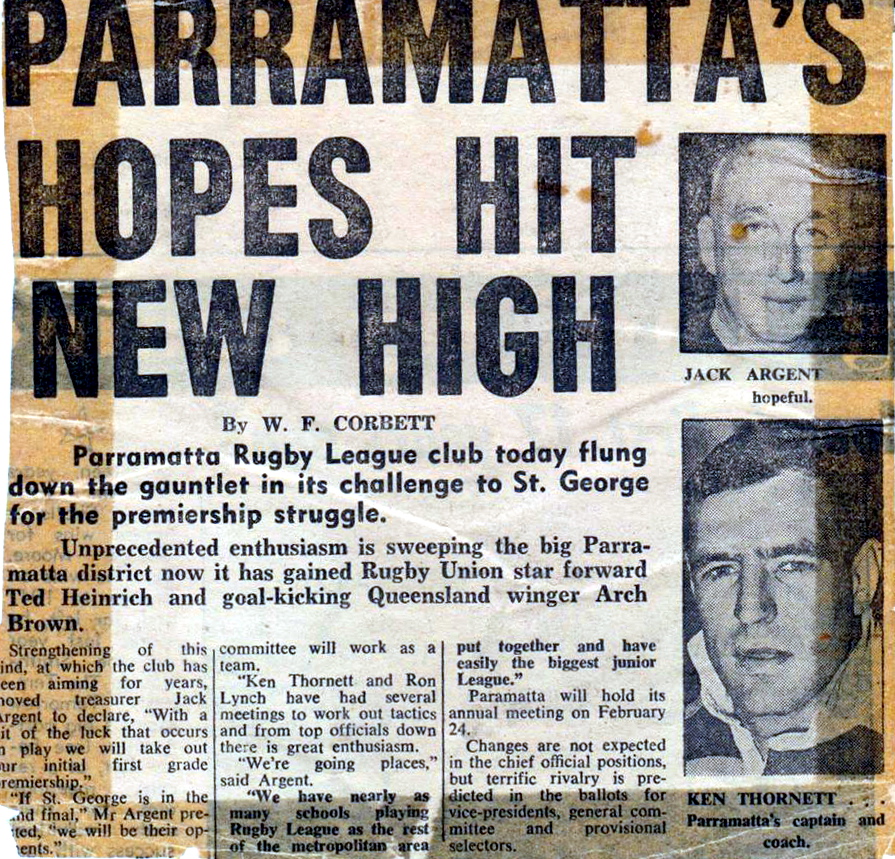
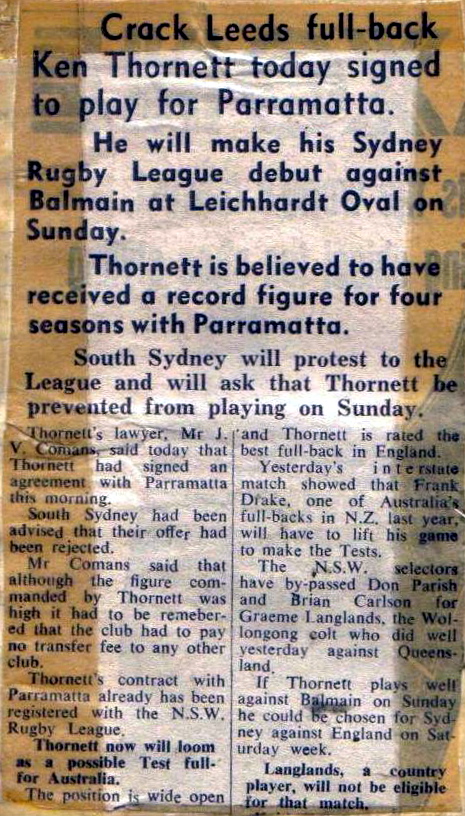
He toured with the Wallabies in South Africa and ended playing 11 rugby Tests for Australia. In 1962, when Dick and John lined up in the second row against New Zealand, Dick Thornett was acknowledged as the finest forward out of both teams. North Sydney, South Sydney, Newtown and St George rugby league clubs were bidding for him. Parramatta, which had already signed on Ken, was said to be prepared to better the offer of any other club.
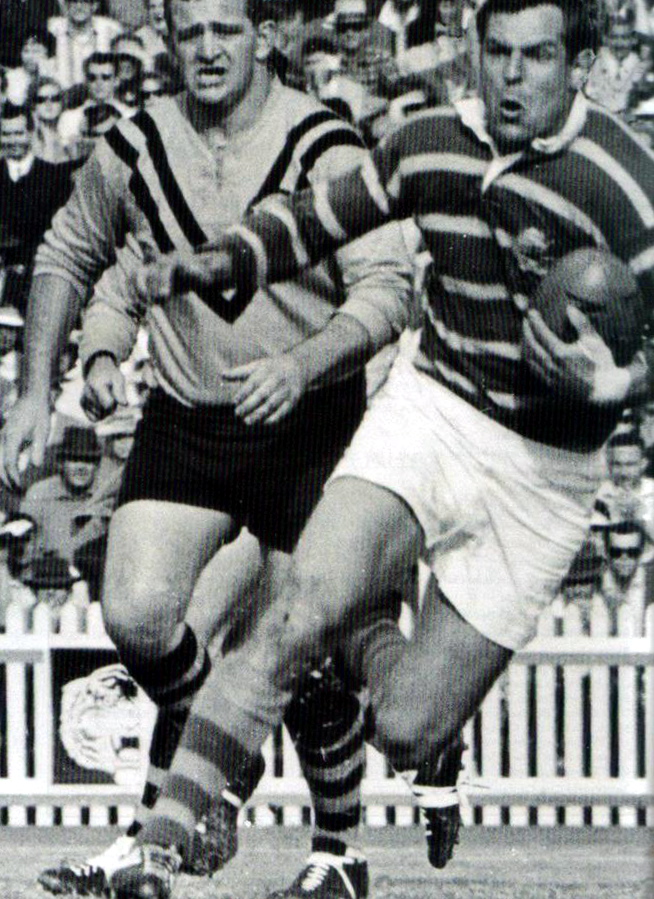
Joining Parramatta in 1963, Thornett handled his fame easily. The sports writer Jim Webster said: ”Despite his massive frame, Dick is docile – off the field – and very quietly spoken. A bit stand-offish to those unknown to him, he is reserved and speaks in very low tones even when a friendship is made.” Parramatta reached the final in the Sydney competition, but they went down to St George.
Thornett had his international rugby league debut on July 20, 1963, when he turned out for the first Test against South Africa.
Later that year, Ken and he joined the Kangaroo tour of England and France. At Swindon, fired by the antagonism of an opposing forward, he produced one of the greatest second-row performances of all time. Thornett played against the French when they toured Australia in 1964.
In 1965, he married Maureen Kay, an airline hostess, and resigned from the police force to help Ken, who was captain-coach of Parramatta.
In 1966 Maureen gave birth to Liesl and in 1967 to Amanda.
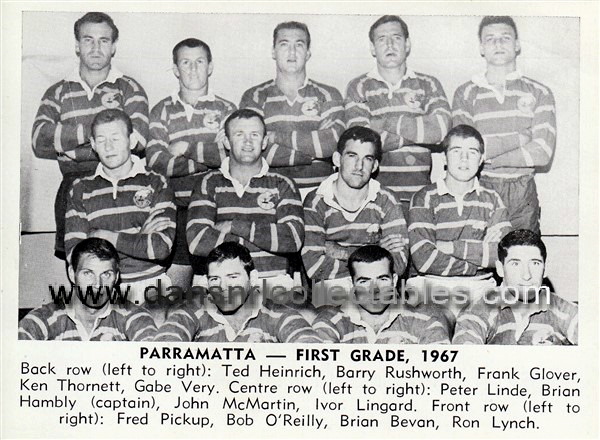
Also in 1967, when Thornett finished a four-year contract with Parramatta, he suffered a form lapse and missed a chance to tour again with the Kangaroos. That year he took over the North Star Hotel in North Sydney. He also signed a five-year contract with Parramatta, and in 1968 scored four tries in one match against Canterbury.
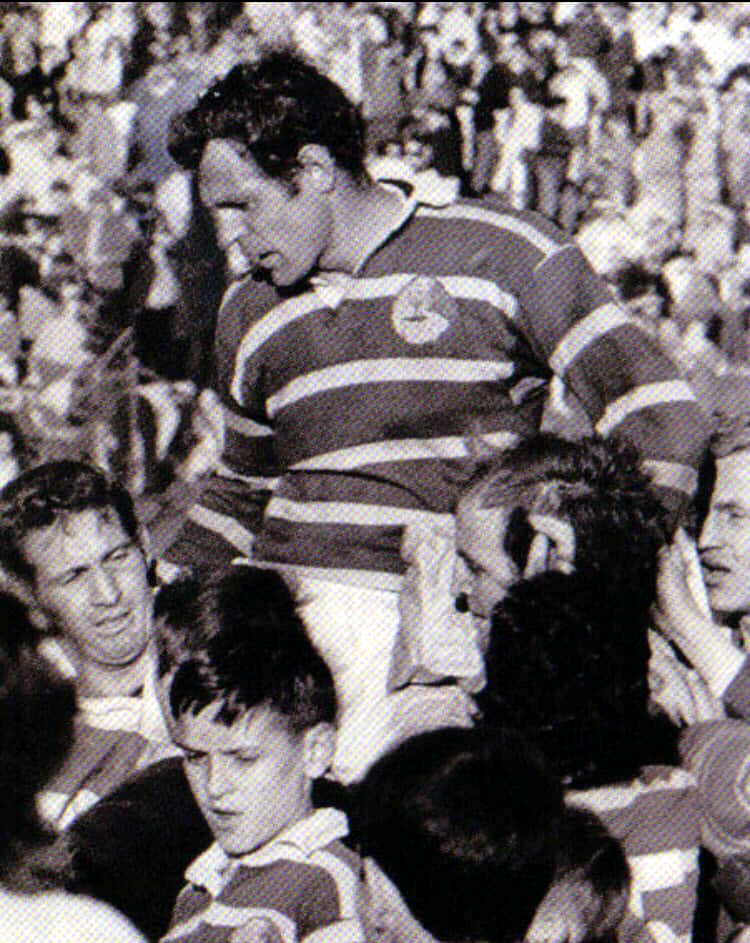
In 1968, Thornett was vice-captain to Johnny Raper in Australia’s successful World Cup campaign. He turned out 13 times in rugby league for NSW and 11 times in Tests for Australia. In 1969, his third daughter, Sophie, was born. Thornett stayed with Parramatta until the end of the 1971 season, totting up 168 appearances for the club.
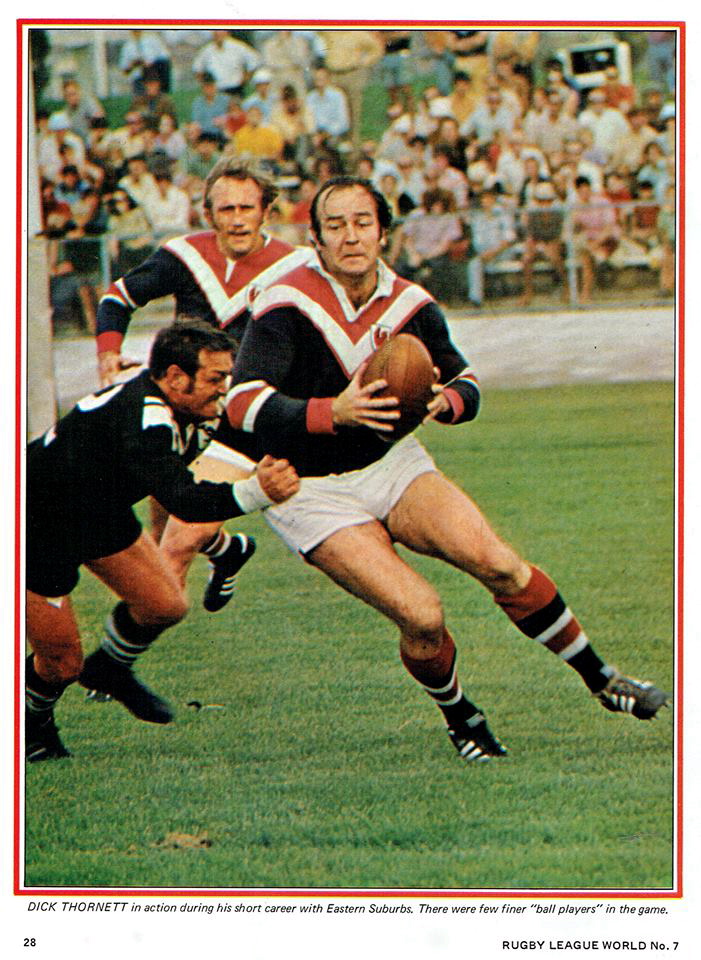
Even that year, he was in the running for a tour with the Kangaroos to New Zealand but he declared himself unavailable because of business. In 1972, he joined Eastern Suburbs but played only a handful of games before announcing his retirement so that he could concentrate on running his hotel.
In 1976, Thornett moved to the Dolphin Hotel in Surry Hills. Ten years later, he and Maureen were divorced and he later married a former Olympic swimmer, Jan Andrew. In 1993 he ran into serious financial problems and had to make ends meet by doing gardening jobs and driving taxis. He then settled in Millthorpe in the state’s central west where he had a small farm and could be near his brothers.
Thornett’s second marriage ended in divorce several years ago and, after battling heart and general health problems for some time, he died in Sydney last Wednesday. Dick Thornett is survived by his brothers and their families, his three daughters, two sons-in-law and five grandchildren. His funeral will be at All Saints, Woollahra, at noon tomorrow.
Loving brother & brother-in-law of Kathleen & Percy (both dec), Joe (dec) & Nonie, John Francis (dec), Joan & John (dec), Frank & Bev (both dec), Bill & Dorothy, Louis (dec), Lucy Anne (dec) & Las, Christine RSJ, Pat & Ann, John & Sue, Marie & Ian, Peter & Brenda and loved Uncle of his many nieces & nephews.
Government Gazette of the State of New South Wales (Sydney, NSW : 1901 – 2001), Friday 18 March 1988 (No.56), page 1676
POLICE REGULATION (SUPERANNUATION) ACT 1906
Notification of Appointments
I, Patrick Darcy Hills, in pursuance of section 2h of the Police Regulation (Superannuation) Act 1906, do, by this notification, appoint as members of the Police Superannuation Advisory Committee for the period from 1st April, 1988, to 31st March, 1990, both dates inclusive:
Lloyd William Taylor, Esquire,
Anthony Lawrence Day, Esquire, Geoffrey Richard Green, Esquire,
Nominees of the Police Association of N.S. W.;
Donald Coates, Esquire,
Nominee of the Commissioned Police Officers’ Branch of the
N.S.W. Public Service Association; Peter John Cox, Esquire,
Nominee of the State Authorities Superannuation Board,
Ella Wietske de Rooy,
Nominee of the State Compensation Board of N.S.W.; and
James Rowan, Esquire,
Nominee of the Minister for Police and Emergency Services. Dated at Sydney this tenth day of March, 1988.
No details of Rods passing can be found via Google search.
Queensland Law Reporter – 11 January 2019 – [2019] 1 QLR64
WOODS, RODNEY WILLIAM BERTIE
After 14 days from today an application for a grant of Probate of the will dated 19th December 2016 of RODNEY WILLIAM BERTIE WOODS late of 3001 Emu Park Road, Tanby Queensland 4703 deceased will be made by CASSANDRA JANE DOBBIN to the Supreme Court at Rockhampton Magistrates Court.
You may object to the grant by lodging a caveat in that registry.
NSW Redfern or Penrith Police Academy Class # ? ? ?
New South Wales Police Force
Regd. # ????
Rank: ?
Final Rank = ?
Stations: ?
Service: From? ? 1950to? ? 1956 = 6 years Service
Awards: Medal of the Order of Australia ( OAM ) granted 12 June 2006
For service to the community, particularly through pipe bands & aged care organisations, & to a range of military and law enforcement authorities as an instructor.
Born: Wednesday 9 September 1925
Died on: Thursday 27 June 2019
Age: 93yrs 9mths 18days
Cause: On 24 May 2019 – Ken was in Arcardia, Pittwater Private Hospital after a heart attack
Event location: ?
Event date: ?
Funeral date: Thursday 4 July 2019 @ 10.30am
Funeral location: St. Martin de Porres Catholic Church, Prahran Avenue, Davidson, NSW
Wake location: ?
Funeral Parlour: Ann Wilson Funerals – 02 9971 4224
Buried at: ?
Memorial located at: ?
In the 1954 Electoral rolls, Ken is living at 91 Connaught St, Dee Why – along with Dory Mary, who was possibly his wife – and his occupation is recorded as ‘Policeman’.
Norma ( dec ), mentioned in his obituary “may have been” his second wife.
Cal via Kevin Banister.
BLUEY is NOT mentioned on the Police Wall of Remembrance * NOT JOB RELATED
FURTHER INFORMATION IS NEEDED ABOUT THIS PERSON, THEIR LIFE, THEIR CAREER AND THEIR DEATH.
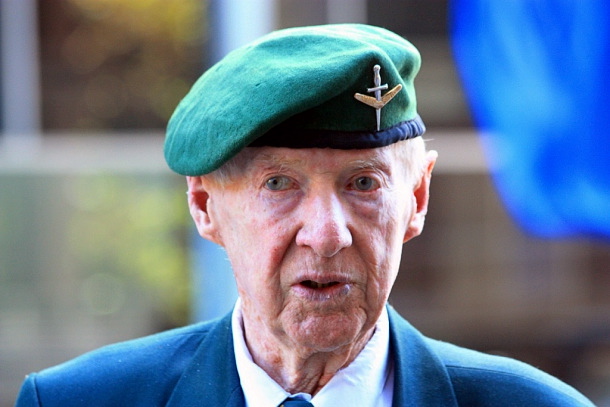
Date listed: 29/6/2019CURRAN, Kenneth Roy OAM NX202327
1st Commando Company “BLUEY”
Aged 93
Late of Frenchs Forest Passed away peacefully 27 June 2019
Dearly loved husband of Norma (dec).
Adored father of Neville, Graeme, Jenny and their partners.
Devoted Pop of seven grandchildren and ten great-grandchildren.
Loved by all his family.
In God’s Care
A Requiem Mass for the repose of the soul of Ken will be held at St. Martin de Porres Catholic Church, Prahran Avenue, Davidson on Thursday, 4 July, 2019 at 10.30am.
Inducted into the A.M.A.H.O.F.(Inc) for 2012
Lifetime Achievement – Army Unarmed Combat
Inducted into the W.K.U.H.O.F. for 2012
Lifetime Achievement – Army Unarmed Combat
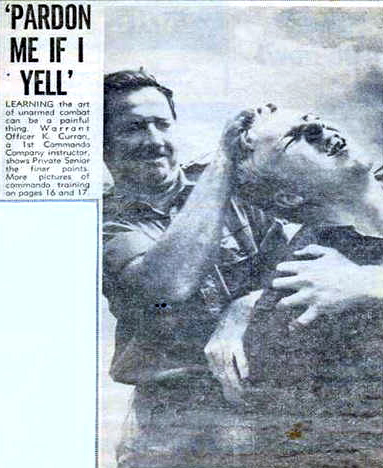
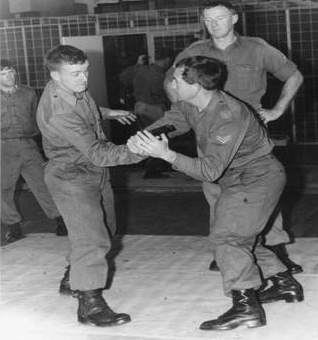
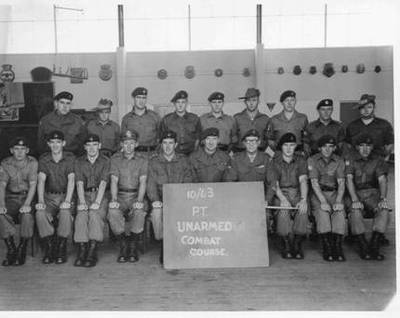
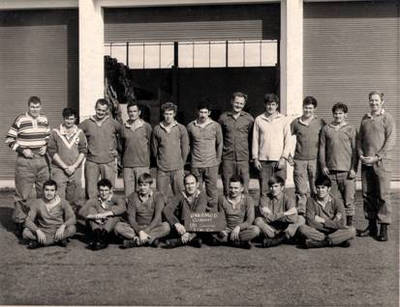
Blue Curran on an unarmed combat course in the early 1960’s
Kenneth Roy “Blue” Curran was born on 9th September 1925 in Waverly NSW. He first joined the army during WW II in 1943 at 18 years of age. His service number was NX 202327 he served in Australia and after reaching 19 years of age and therefore being eligible for overseas operational deployment transferred from Infantry to Commandos. He saw service in 2/11 Cavalry Regiment Commando Squadron, he completed his commando training in far North Queensland and later saw service in Moratai, Labuan, British Borneo and Rabaul before the end of the war.
At wars end he returned to civilian life but reenlisted in the military as a Citizen Military Force (CMF) member of the newly raised 1 Commando Company (1 Cmdo Coy) in 1955 at the age of 30. His CMF service number was 2242907.
Blue was an active member of 1 Cmdo for twenty years up until 1975 when he officially retired from military service. However, as a result of Blue’s experience and skills relating to Military Unarmed Combat (MUC) training over the years he has been retained as a consultant from time to time to the military to assist in MUC training well into the new millennia.
As a consultant to the military he had conducted training for commandos, infantry battalions and other unit’s right through to 2000. From 2004 to 2007 he was requested by the Infantry Training Center at Ingleburn to conduct training in bayonet fighting. In addition to his service to the military Blue has also trained the first members of the then newly raised NSW Police Tactical Response Group (TRG) and continued to provide training support as requested. He has trained numerous other law enforcement groups, prison services and members of the Sheriff’s Department. He has also conducted security training for security firms, and personal self defence training for members of the community. He continues to train security officers in self defence and the use of batons and handcuffing techniques.
Physical fitness in MUC training is heavily emphasized by Blue
During his time in the Australian Military Blue was responsible for keeping alive MUC from his initial training in WW II to its resurgence in the mid 1950’s with the raising of 1 Cmdo Coy. He was also instrumental in the continual review and development of the MUC training program ensuring that outdated techniques were dropped from the syllabus and new information added to keep the MUC syllabus relevant to the changing needs of the military. This also comprised the inclusion of skills from civilian martial arts either through serving soldiers with previous experience or through association with martial arts instructors. However, it was always advocated that any changes to the syllabus was relevant to the operational requirements of the military and were not a stylised application of complicated techniques that did not fit military needs or application.
Blue over time would later become the Army’s senior MUC instructor and the person primarily responsible for its propagation to the next generation of MUC instructors in the early to mid 1960’s who in later years would guide MUC within the military. In this role Blue was the last then serving WWII Commando with MUC training and operational experience remaining from the WW II era. Those instructors who later would have their own significant contributions to MUC that would benefit from this knowledge and experience included Major Greg Mawkes, Major John Whipp, and WO1 Denis Gaskell to name a few.
In 1980 Blue was officially acknowledged for his services related to MUC training within the military and was awarded the Order of Australia Medal. In later years he was recognized further by membership to the International Close Quarter Fighting Instructors Association. Ken currently lives with his wife in French’s Forrest Sydney.
Blue supervising training on a MUC course in the 1950’s
Dialogue and Interview with Ken “Blue” Curran OAM, JP
Recorded by Glen Gardiner 1st April 2010, Sydney
I first joined the army in 1943 when I was 18 years old. I went to recruit training in Warwick in Queensland and returned to Sydney where I was posted to a young soldier infantry battalion.
At that time you could not be deployed overseas on operations until you were 19 years of age. So those of us who were under 19 years of age would end up in these young soldier battalions. There were three of these battalions located in Sydney at the time.
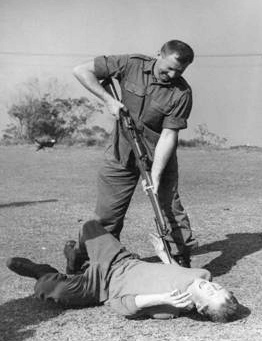
Bayonet training is integral to MUC
While posted to Sydney I was involved in the development of beach defences in and around Sydney. I attended my first Military Unarmed Combat (MUC) course in Sydney which was run by an ex professional wrestler named Alf Vockler. He was a Warrant Officer 2nd Class (WO 2) and the only instructor on the course. In those days MUC was virtually unheard of. To the best of my memory he was posted to the military as a Sgt because of his wrestling experience. He may have come from a corps of instructors but I am not certain.
The MUC course was conducted in the French’s Forrest area at Terry hills around the Xmas period of 1943/1944. The course duration was for a period of 2 weeks, the courses official title was Physical Training and Unarmed Combat Course. There were approximately 20 participants on the course from the infantry corps. To my knowledge all passed the training and qualified as an exponent. In those days the army did not run instructors courses that I am aware of and relied on military personnel with previous experience recruited specifically to instruct.
The training consisted mostly of holds and restraints with a heavy focus on wrestling. There was a little bit of disarm techniques related to pistols. Not much was done with rifles or knives even. Counters to open handed attack with the counters mainly being throw downs was also conducted. There was a very heavy amount of work related to physical fitness training.
Later that year after completing the MUC course I was sent to Cowra as a reinforcement when Japanese POW’s made an attempt to escape. After that I returned to Sydney where I turned 19 and was then sent to Canungra. The course at Canungra was jungle training before we were deployment north on operations. After completing training at Canungra I and 3 others volunteered to be transferred from infantry to Commandos. 3 of us were accepted into 2/11 Commando Cavalry Squadron. This unit had formally been a cavalry unit in the Middle East with the 9th Division prior to their return to Australia. From Canungra I was posted to the Atherton Tablelands with 2/11 Commando Sqn (Divisional Commando with 3 Commando units attached to each Division) at Raven hoe where we conducted pre deployment training. We concluded commando training here in 1944. It included infantry training, MUC, explosives training, etc.
I was used to conduct the MUC training as an instructor for the unit as I was the only one in the unit who had done an MUC course that I was aware of. During this period at Raven hoe which was only several months. During this time I trained the personnel in platoon sized groups. I think would have trained 2 platoons in this period. It was difficult to train more or formalize the training as in those days the members of the unit were scattered all over the place conducting various forms of training before deployment. This was all prepatory to us doing invasion training which was later conducted near Cairns if my memory is correct. Members of the unit would conduct training at the Atherton Tableland and then go to Cairns to do training changing from ships to landing craft, cargo nets and practicing beach landings. The troops would then return to the tableland and do other forms of training some of which included MUC depending on availability. We then were deployed in the invasion of Moratai in 1944 (2/11 Cmdo Cav Regt, 24 Bde, 9 Div). After Moratai we boarded steamers and conducted the invasion of Labuan (1944). After the capture of Labuan we were deployed to British Borneo, Papar on the Padus River pushing up the rail link to Jesselton. While we were in Jesselton we received news that the war was over.
Blue and Lionel “Pup” Currell both WWII Cmdo and MUC Instructors
The 2/11 Cmdo Cav Regt was disbanded and I was sent to Rabaul for several months guarding prisoners as well as being involved in infrastructure rebuilding. I then returned to Australia and after a period when I was hospitalised with malaria I was demobed at the School of Artillery at North Head after I had recovered from my bout of malaria.
After the war I completed my apprenticeship as a photo engraver and joined the NSW police force from 1950 to 1956. I then worked for the NSW railway as a fireman on the steam engines for a year. I then returned to my trade. During my working life I did a lot of different jobs.
In 1955 I joined the Citizen Military Forces (CMF) the pre cursor to the Reserves. I did my CMF recruit course at 1 Commando Company at Georges Heights, Mossman. I remained in that unit until 1975. During this period I instructed MUC courses for the unit and other members of the Army. The chief instructor for MUC training at 1 CMDO at this time was WO 2 Lionel Currell (“PUP” Currell).
Standing Blue last right with John Whipp second from left 1970’s
It was during this period that I requalified as a MUC exponent and later qualified as an Instructor. During my time with Commandos I later assumed the position of chief instructor teaching MUC at 1 Commando. WO 2 Lionel Currell was a regular army soldier and a WW II commando veteran. When I joined 1 Cmdo, he was the 1 Cmdo Coy, Company Sergeant Major (CSM). He was posted to the unit from Western Australia where he was involved in a parachute unit. I have no idea where he learnt MUC but he was very proficient, a disciplinarian and I was his assistant instructor. After his 4 year posting to the unit he was reposted and I became the senior instructor for 1 Cmdo Coy. Prior to his leaving I had risen through the ranks and I was promoted to the position of CSM 1 Cmdo Coy, the first CMF member to reach this position. The Officer Commanding (OC) of 1 Cmdo Coy during this time was a regular army officer, Major Grant, a veteran of WWII and Korea who was later promoted to Brigadier and an ex WWII Commando. He is now living in Melbourne I believe.
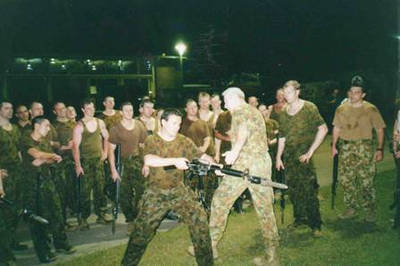
Blue teaching counters to Bayonet attacks at 1 Cmdo in 2007
During my time with 1 Cmdo I trained many units over the years in MUC. I trained the Special Air Service Regiment (SASR) on 4 occasions in Perth as well as their members at 1 Cmdo Coy. The majority of SAS instructors came from 1 and 2 Cmdo with a lot of their first members coming from these units as well. I also gave training to 3rd battalion Royal Australian Regiment (3 RAR) and the 1/19 battalion CMF Bushman’s Rifles at Ingleburn.
It is hard to remember all the courses I instructed on. A lot of the courses would be conducted at 1 Cmdo Coy. After I retired from the CMF in 1975 I would still be asked to conduct MUC courses for my old unit and others. In 2004 I was called by Major Davis at Singleton to teach bayonet work in trenches. I did this as a volunteer for a period of 3 and half years.
I think while I was at 1 Cmdo I ran approximately 2 courses a year from 1955 to 1975. In addition to this I was also involved in conducting training for police instructing the first course for the NSW police Tactical Response Group (TRG) at 1 Cmdo Coy. In subsequent years I conducted follow up training with the police as well as the NSW prisons department and later the Corrective Services, Australian Protective Services, and Sheriff’s Department. I have also conducted numerous self defence and training courses for commercial security personnel in the security industry. I am currently 84 years young and still conducting self defence and security officer training teaching self defence, batons and handcuffing techniques.
“Blue”, who were the Instructors of MUC and what was their backgrounds when you first started training and then through your subsequent time teaching MUC?
The first MUC instructor I met was WO 2 Alf Vockler who was a professional wrestler. As a young digger this man was god to us. I believe he had joined and was recruited by the military to teach MUC. Later in the 1950’s while at 1 Cmdo Coy I met WO 2 Lionel Currell who was the senior instructor for MUC at 1 Cmdo Coy before being posted from the unit. I am not sure where he learnt MUC but he was quite good at it. I believe Lionel was initially trained possibly by British instructors. I am not aware if he had previous training in martial arts other than MUC. I remember that he was a strong disciplinarian.
Blue taking PT on a MUC course in 1980 when he was 55 years old
To your knowledge “Blue” was MUC also being trained in other non commando units and was it widespread in the Army as well as other services during WWII?
I am not certain about that because during this time you only new about what your particular mob was doing. But thinking about it, it is quite possible that this was the case.
After World War II can you describe the attitude toward MUC training by the military command in commandos and the wider military?
After WWII MUC training disappeared within the Australian military. It did not gain resurgence until the formation of the CMF commandos in 1955.
Senior military commanders had lost touch with MUC and felt that it was a specialist skill and not something that was regularly conducted within the wider Army. It was thought of as being more relevant for Special Forces (SF). However, non SF units would contact 1 Cmdo Coy requesting this form of training.
“Blue”, was there a resurgence of MUC training with the onset of the Korean War and if so who were the instructors and where were the courses conducted and what did the syllabus contain?
I am not sure if MUC was taught for the Korean War but it was 1 and 2 Cmdo Coy which revitalized MUC in the Australian army from the mid 1950’s. In 2 Cmdo Coy the main Instructor was Ted Malone. I also qualified Major Greg Mawkes from the SASR in Swanbourne in the 1960’s. He later became OC of 2 Cmdo Coy and then was responsible for MUC training in the SASR.
John Whipp was another instructor qualified by me in 1962 prior to going to Vietnam. He was in an infantry battalion at the time and did the course at 1 Cmdo here in Sydney. John and Greg would both later play important roles in MUC training within the Australian military.
During this period the syllabus for MUC had changed dramatically to that of WWII. The main emphasis now was on killing techniques. This was developed through seeing what was being done in military circles as well as civilian martial arts and then adapting that information for the various roles required in the military. The courses were continually updated for current techniques of the day with the syllabus still displaying a strong emphasis on physical training, rolls and break falls, pressure points, throws, striking techniques, defence against weapons including firearms, knives, machetes, bayonet fighting, elimination techniques and prisoner control.
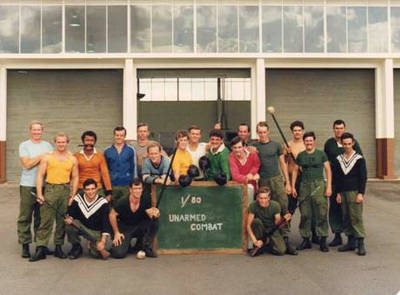
Blue instructing on a MUC course at 1 Cmdo Coy in 1980
“Blue”, did you feel that the support for MUC by the military command was cyclic and stop and go during your years of association with MUC training?
Yes support for MUC in the Australian military was very up and down dependent on the individual interest of senior commanders within the army. Some military commanders understood the value others did not and MUC either benefited or not from this situation.
The problem was however, that after a period of non support the Army would need to re-invent the wheel again and had to either find remaining qualified personnel or start again. I think the cycle now is going downhill once again after some support in recent years.
“Blue”, was there a renewal and subsequent wane of interest in MUC in the Vietnam War era?
Prior to going to Vietnam there was interest by personnel to conduct training however, this conflicted with the need for unit commanders to train troops prior to deployment in normal infantry soldier skills and not ones seen as value added such as MUC.
“Blue”, do you feel that MUC in the Australian military developed in different directions as members of the defence force promoted MUC in the Army as well as the other services for different needs, what can you tell us about this?
Yes I did see MUC go in different directions, but I still think that MUC should be under one banner with different corps requirements being managed under one guiding direction. Each one has its own core requirement but needs to be managed so that MUC heads in one direction; to make my point Military Police don’t need to be taught how to kill for example. But they also need to know techniques for an operational focus.
“Blue”, during the period that you have been involved with MUC training in the military have you seen it evolve and if so what are your thoughts about that evolution?
Yes, MUC has evolved and I think for the best as new techniques are added that support the soldiers role for today.
“Blue”, in your opinion do you feel that there is still a place for MUC training in the military in the 21st century and if so what it is?
Yes, without a doubt. MUC is required to enable our Army to stay relevant with other nations and to develop soldierly skills and techniques that are required on operations.
Blue in his mid 80’s still teaching Bayonet fighting skills
“Blue”, what is your opinion concerning the military sourcing civilian martial artists to teach soldiers, do you think it relevant and are these instructors suitable to teach for various operational roles?
I maintain that an instructor needs to have a military background but it is commonsense to take knowledge from wherever we can find it and adapt it for the military role. You must update to stay current. I don’t think civilian instructors though are the complete answer. But certainly take the knowledge and adapt it for the militaryusing military instructors or previous civilian instructors who are in the military.
“Blue”, in your opinion what do you feel would be the way forward for MUC training today for today’s military?
Training needs to be relevant to the needs of the Army, it is unfortunate that currently MUC in today’s military is not as widespread throughout the military as it should be as in other nations. I think that it is difficult for military commanders to recognize the value of MUC and to support MUC. Until this happens MUC will remain as it always has and will be reliant on the support of individual commanders as they come and go. In today’s Army MUC should be integral in training developing skills and confidence.
“Blue”, can you describe what the training was like? How hard? Injury rates etc
Injury rates in the WWII MUC courses were very low and the same applied during my time teaching MUC. High injury rates are a sign of bad instruction. Training was hard, we had to prove a point, and a lot of the techniques were designed for killing. Physical fitness was a big part of training, it was important to teach soldiers to develop the will to still keep going. It still is important.
“Blue” you have lived to a very fortunate age what pearls of wisdom can you impart to the younger generations on conducting self defence/defensive tactics training?
As is, Keep it up and keep it going, it is something that is needed. Use commonsense, make sure there are no injuries and impart knowledge as best you can.
“Blue” what advice would you give people regarding avoiding fights and once in a fight what should they do?
Walk away from it if possible, if you cannot walk away you have to do the best you can. If you are in it you are in it to win. I don’t care if I have to use dirty tactics to win and survive.
“Blue”, what are your views of the Australian soldier from when you were serving and the current Aussie soldier today?
Blue and the Author, former MUC instructor Glen Gardiner
I think today they are far superior to the soldier of the past. The soldier of the past came up through the depression days. He had to learn the ropes the hard way. Today’s young soldiers in my opinion are far better educated and sophisticated and willing to learn. A far better type of lad mentally and physically to previous years. As an example one participant as a private learning MUC was a qualified medical doctor and he had a genuine desire to learn.
Australian Commando Association (NSW) Inc · June 27 · So passes a great Australian.
Terence Charles Calov DALTON
| 09/11/2019
Terence Charles Calov DALTON APM
AKA Terry, The Admiral
Late of Manly, NSW
NSW Redfern Police Academy Class # 178
New South Wales Police Force
Regd. # 20052
Former member of Tasmania Police 1970s
Former member of Hong Kong Police 1970s
Rank: Commenced Training at Redfern – 3 August 1981
Probationary Constable – appointed 5 February 1982
Constable 1st Class – appointed 5 February 1987
?
Final Rank = Detective Superintendent – Retired
Stations:Training at Academy, Waverley ( 10 Division ), Rose Bay Dets, Special Branch, Negotiators, City Central ( pre 2000 ), NSW Police 150th Anniversary Director – Major Events & Incidents Group, O.I.C. – Marine Area Command ( Water Police ), Chatswood LAC- Retirement
Service: From4 August 1981to29 September 2012 = 30+ years Service
Awards: National Medal – granted 28 May 1990 ( Det Cst )
1st Clasp to National Medal – granted 24 March 2000 ( Sgt )
Australian Police Medal ( APM ) – granted 15 June 2010 ( Supt )
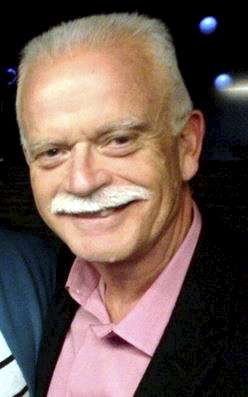
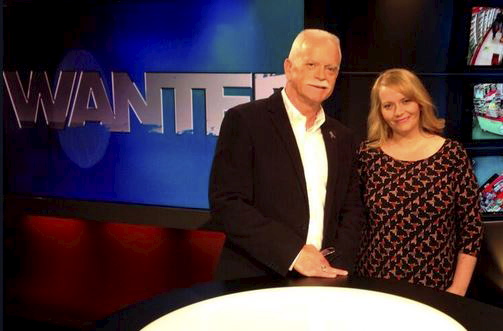
Terry was in the first ever TV show, on channel Ten at 8.30pm on 8 July 2013, called ‘Wanted’ where criminals were shown to the public as ‘Wanted’ offenders.
Taken from Australian Army – Royal Australian Corps of Military Police (with approval to share) .
Posted by Paul Hayton.
Last night, I lost another great mate, to the scourge of Cancer.
NSW Police (ret) Detective Superintendent and Military Police Special Investigation Branch Major; Terence (Terry) Charles Calov Dalton.
Its been an absolute “life experience” knowing you.
31 years ago, we met and you have never let me down. It’s been an honour calling you a brother, through the craft, the Cops and in our personal lives.
You have left a massive footprint on this crazy world.
Be proud of your achievements, none more significant than your amazing family.
Thank you for your tireless service to the community at large, you’ve allowed many of us to sleep safely at night.
I’m a much better human for knowing you TCC.
Rest in Peace my Brother.
“So Mote it Be.” ????❤️
Early knocks provided life-long lessons
“I learnt that valuable lesson early on, you’ve got to keep your eye on people” … Terence Dalton. Credit: Jacky Ghossein
RETIRING superintendent Terry Dalton has a word of advice for young police as he prepares to leave the force: “Make sure the crooks don’t win.”
It’s a sentiment the police veteran has followed all 31 years of his career – that, and make sure you duck when someone throws a punch your way.
“I learnt that valuable lesson early on, you’ve got to keep your eye on people,” he told the Herald yesterday.
Superintendent Dalton says he’s lucky he hasn’t been on the receiving end of much more violence since he copped a broken jaw during that incident, in his first weeks as a police officer in Tasmania in 1972.
He joined the Royal Hong Kong Police a few years later and in 1981 he moved back to Australia for a career in the force that earned him the nickname “the Admiral“.
It’s apt for the man who will today lead 700 officers in a march through central Sydney to commemorate 150th anniversary of policing in NSW.
On March 1, 1862, existing independent police units of the colony were amalgamated into the single NSW Police Force.
Superintendent Dalton said sodden conditions will not stop the parade.
“I think tomorrow will be a proud day for the entire NSW Police Force, just to be a part of it,” he said.
But it will be particularly poignant for him, as he leaves the force in September after more than three decades working in the water police, the police negotiators, in child protection and what used to be called “Special Branch” – which protected the world’s dignitaries here in Australia.
Superintendent Dalton was the first officer to Prince Charles’s side when a man brandishing a starter pistol fired two blank shots at the heir to the British throne during an Australia Day awards ceremony at Darling Harbour in 1994.
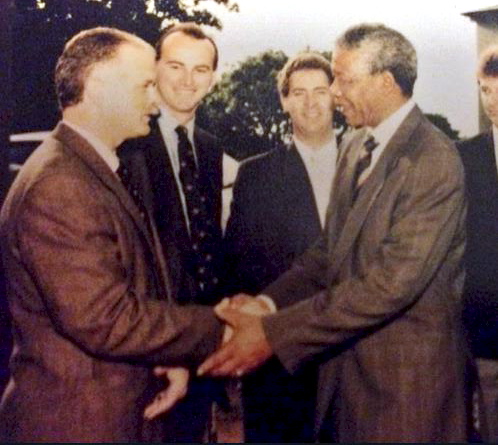
He has also protected the Queen, former US president George Bush, and former South African President Nelson Mandela.
The 150th Anniversary of Policing will be formally launched with the NSW force’s banner being led by a police marine contingent across Sydney Harbour from Watson’s Bay at 9am, down to Circular Quay.
A “Sea of Blue” marching contingent will then take the banner along George Street to Town Hall, arriving there for a civic reception about 10.45am.
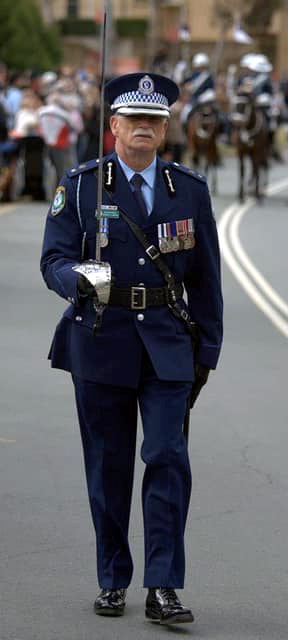
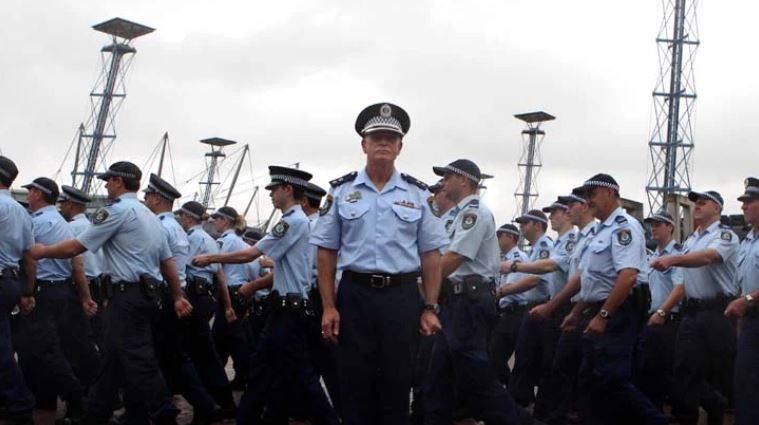
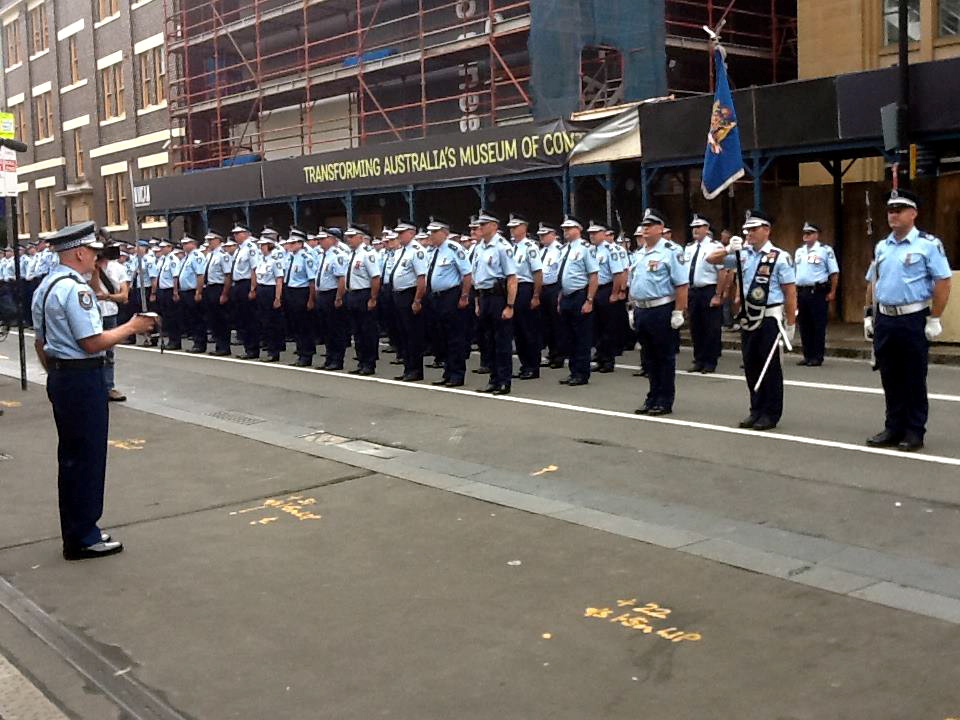
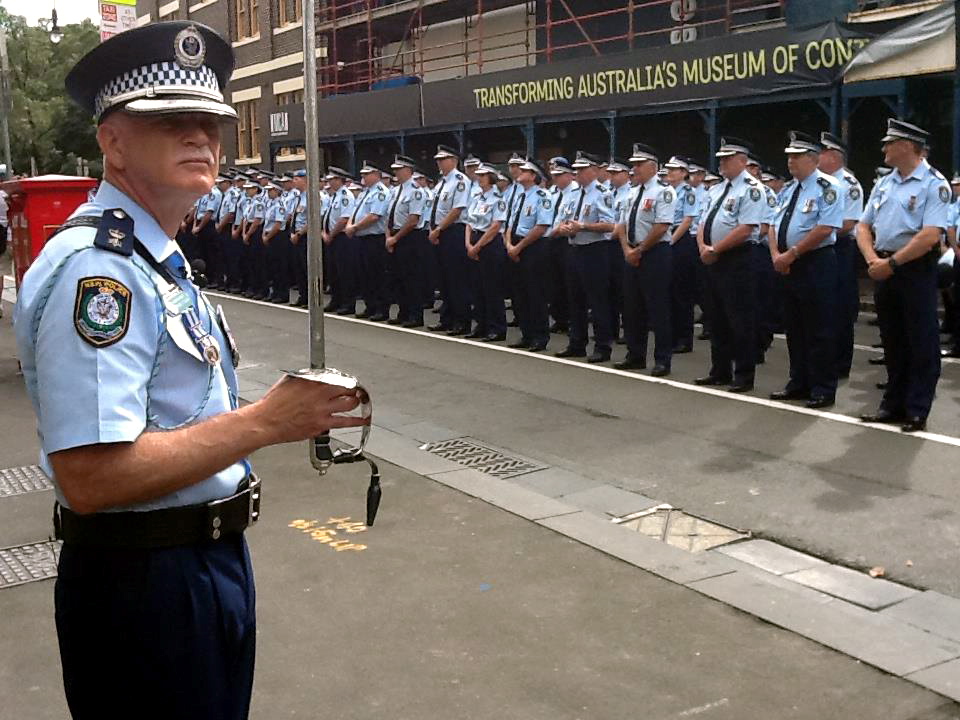
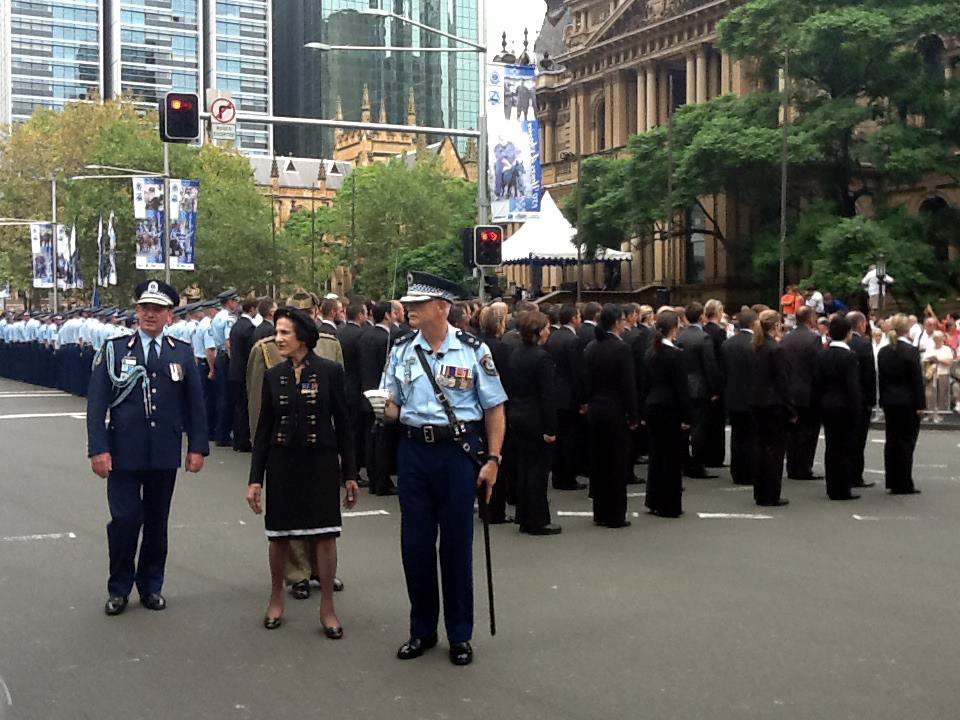
Terence Charles Calov DALTON – 150 years of NSW Policing – 2012
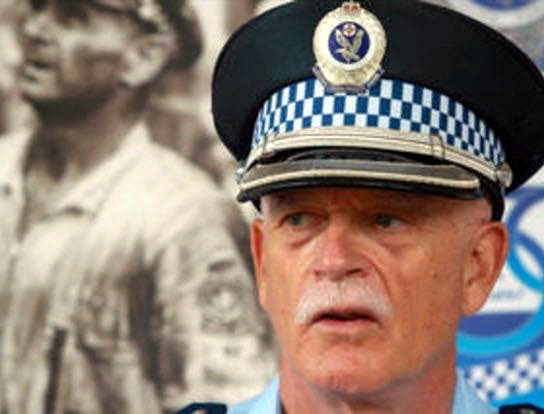
Terence Charles Calov DALTON
Terence Charles Calov DALTON – TasPol member
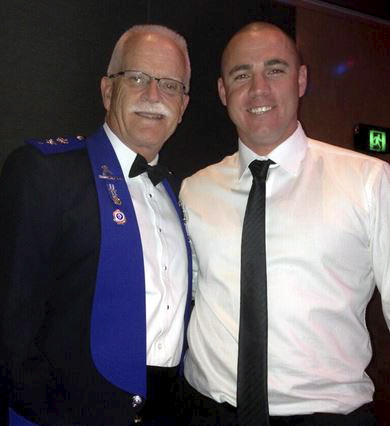
Terence Charles Calov DALTON with Greg Martin: From Greg: One of the most professional Police Officers I have worked with the best person to lead the NSW Police for the 150th celebration worked with Terry over the years and bumped him in Sydney on a visit from the bush RIP Sir
Terry DALTON & Sgt Sean Phillips One of the nicest bosses and blokes, I ever had the fortune too have met. RIP Sir
ANZAC Day: 25 April 2010 from: Dianna Mackay RIP Terry. What a fantastic person and friend. We will miss you especially on ANZAC Day Found this photo of Rupert, Terry, Rick Steinborn and Tony Compton ANZAC Day 2010 ❤️
Terry Dalton – 8 July 2013
Terry Dalton with Wayne Harris. A million dollars worth of cattle gone. Help Wayne harris to solve this mystery. WantedTV 12 Sept 2013
Terry Dalton with Rob Roden ( Blacktown Dets ) at Police Legacy Ball.
With special guest daughter, Katie, on set of WantedTV 23 Sept 2013
Terry Dalton, Special Branch, 1989 with Nelson Mandella ( RIP )
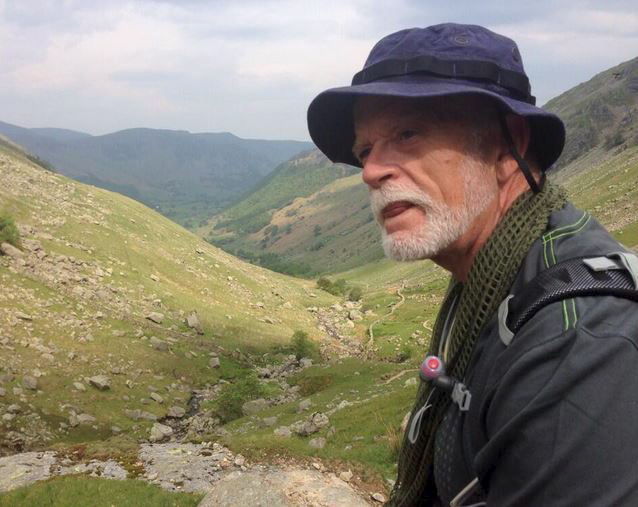
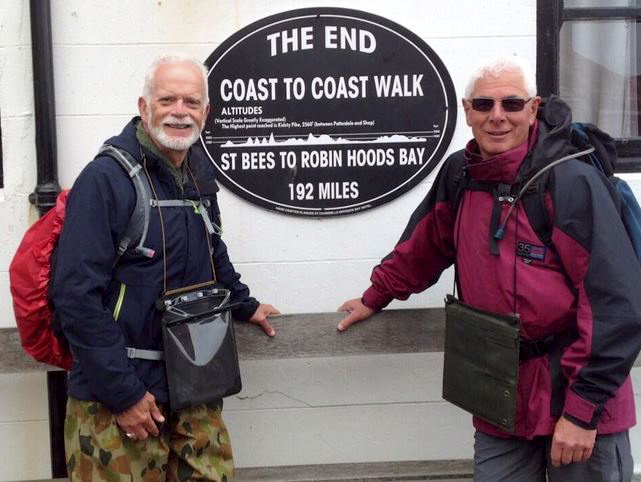
Currently walking Coast 2 Coast walk in U.K. 50 miles down & 130 to go. – 23 May 2014
Just completed the Coast to Coast walk – 2 June 2014 Terry on the left.
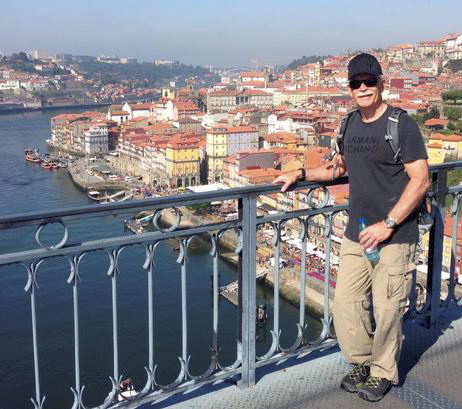
Walking Camino Portugal – 1 Oct 2015
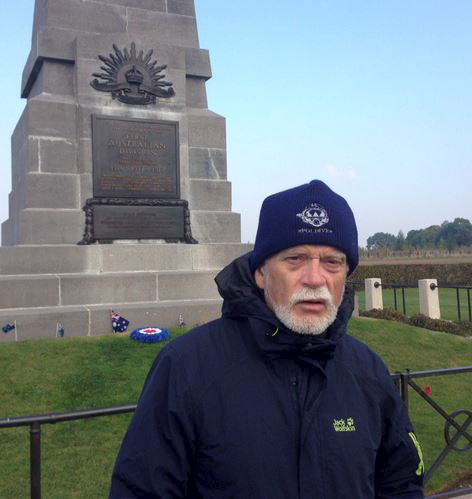
At Australian Memorial WWI France – 28 Oct 2015
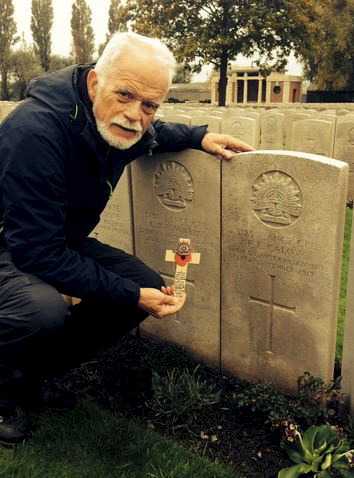
Mum’ great uncle CWGC Cemetery – Belgium 31 Oct 2015 3125 Lance Cpl F.L. CALOV 56th Bn. Australian Inf. 27th September 1917
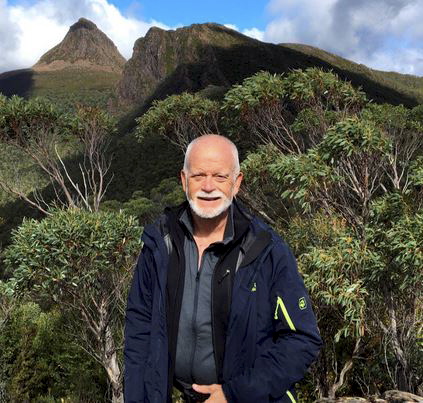
Bush Walking Tasmania – 15 April 2016
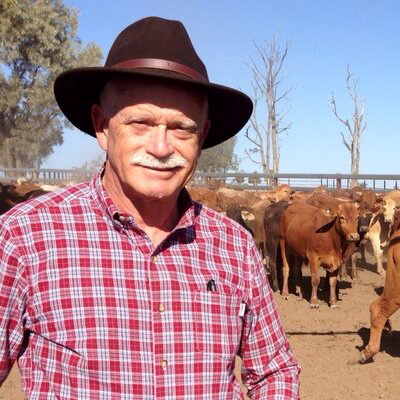
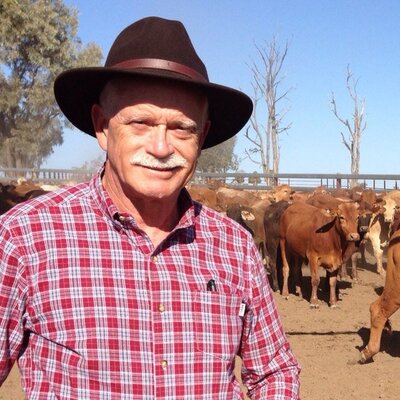
In Charleville, Qld, for WANTED story on cattle stealing – 5 September 2013
Many other links on Facebook that pay tribute to this man, and others, but the families won’t get to see those tributes because they are Private or Secret Groups unfortunately.
John Kevin GODDEN
| 09/11/2019
John Kevin GODDEN
Father to Matthew GODDEN # 28545
Brother to Bob GODDEN # 11669
AKA Johnny
Late of ?
NSW Redfern Police Academy Class # 087
New South Wales Police Force
Regd. # 9695
Rank: Commenced Training at Redfern Police Academy on Monday 30 May 1960 ( aged 24 years, 3 months, 20 days )
Probationary Constable – appointed Monday 4 July 1960 ( aged 24 years, 4 months, 24 days )
Constable – appointed ? ? ?
Constable 1st Class – appointed 30 August 1966 * Lost 3 months Seniority
Senior Constable – appointed ? ? ?
Sergeant 3rd Class – appointed 18 November 1976
Sergeant 1st Class – appointed 30 August 1985
Final Rank = Senior Sergeant
Stations: ?, Sutherland ( 1960s & 1970s ), ?
Service: From 30 May 1960 to? ? ? = ? years Service
Awards: National Medal – granted 15 September 1980 ( Sgt )
1st Clasp to National Medal – granted 22 September 1987 ( Sgt 1/c )
Born: Monday 10 February 1936
Died on: Sunday 27 October 2019
Age: 83 yrs 8 mths 17 days
Cause: Cancer
Event location: ?
Event date: ?
Funeral date: TBA
Funeral location: TBA
Wake location: ?
Funeral Parlour: ?
Buried at: ?
Memorial located at: ?
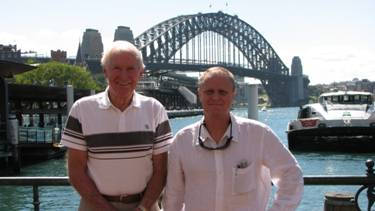
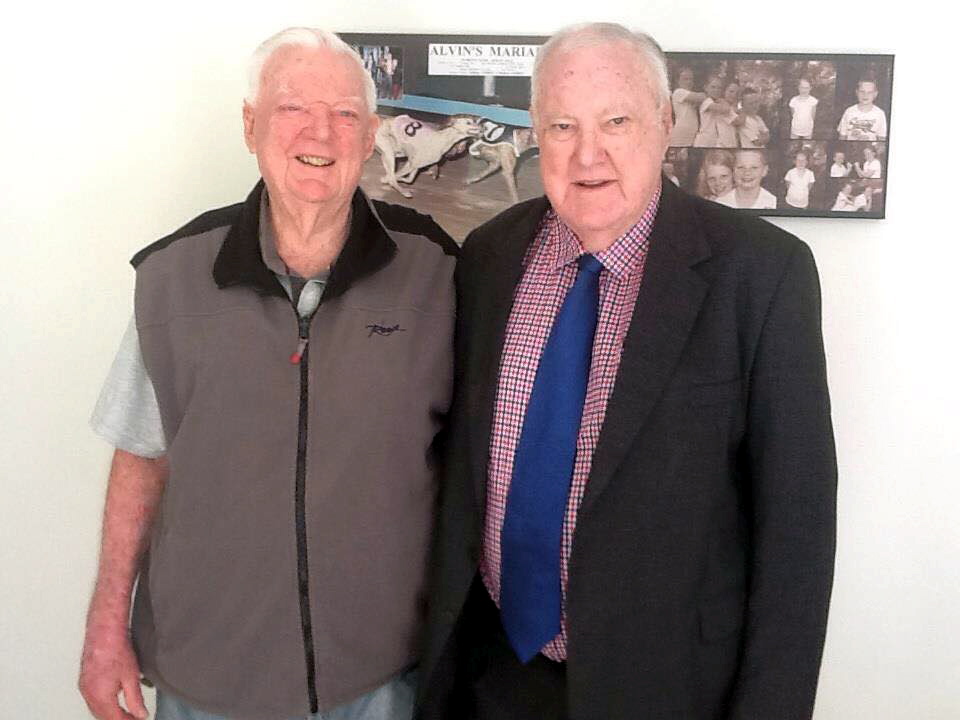
Brothers – John Kevin GODDEN with Retired D/Insp Bob ( Robert G. ) Godden – 2016
JOHN is NOT mentioned on the Police Wall of Remembrance *NEED MORE INFO
FURTHER INFORMATION IS NEEDED ABOUT THIS PERSON, THEIR LIFE, THEIR CAREER AND THEIR DEATH.
Much loved father and father-in-law of Virginia and Greg, Brent(dec’d), Katrina and Jim.
Loving Pop to his grandchildren and great Grandchildren and a good friend to Noelene’s family.
Loved brother and brother-in-law of Robyn and Mike.
Family and Friends are invited to attend JOHN’s Funeral Service to be held in the North Chapel of Newcastle Memorial Park, Anderson Drive, Beresfield, on FRIDAY 27/9/19 at 10.00am.Published in The Newcastle Herald on Sep. 25, 2019.