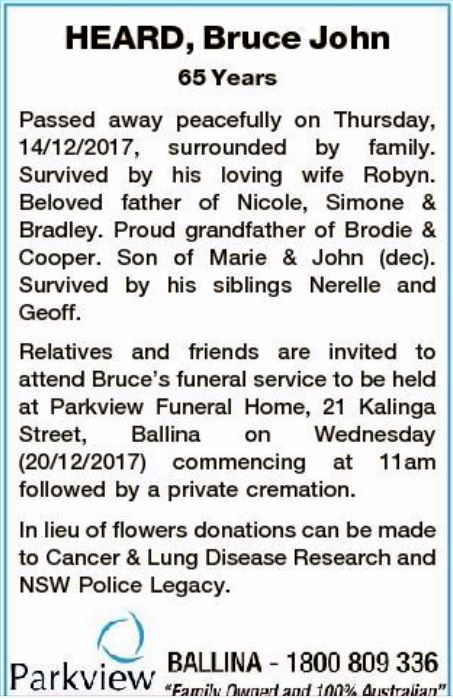
Bruce, prior to joining the NSWPF, was a tow truck operator.
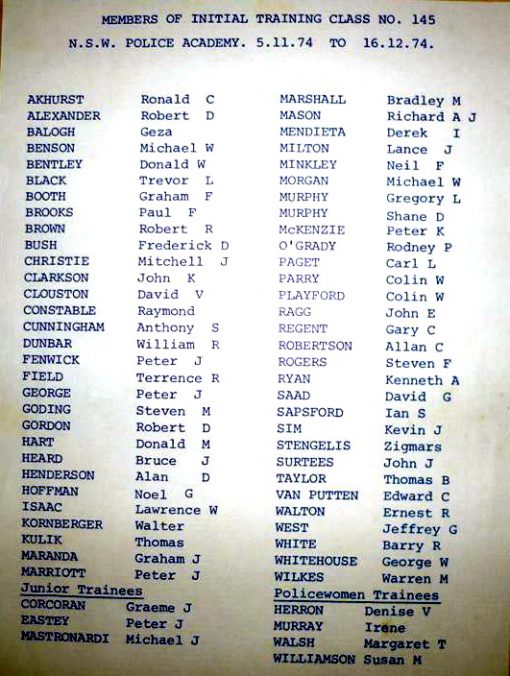
Members of Class 145 who Trained at Redfern Police Station between 5 November 1974 – 16 December 1974 but this list does NOT contain the names of the Cadets who were in this Class.
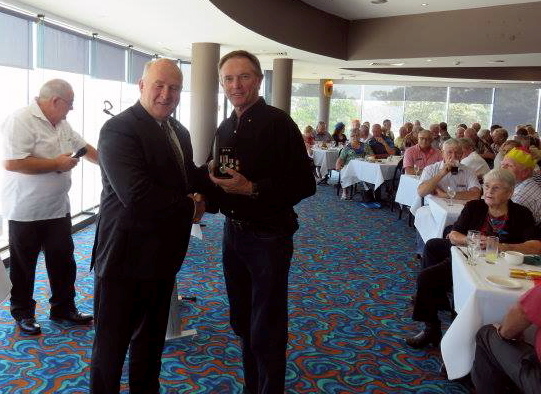
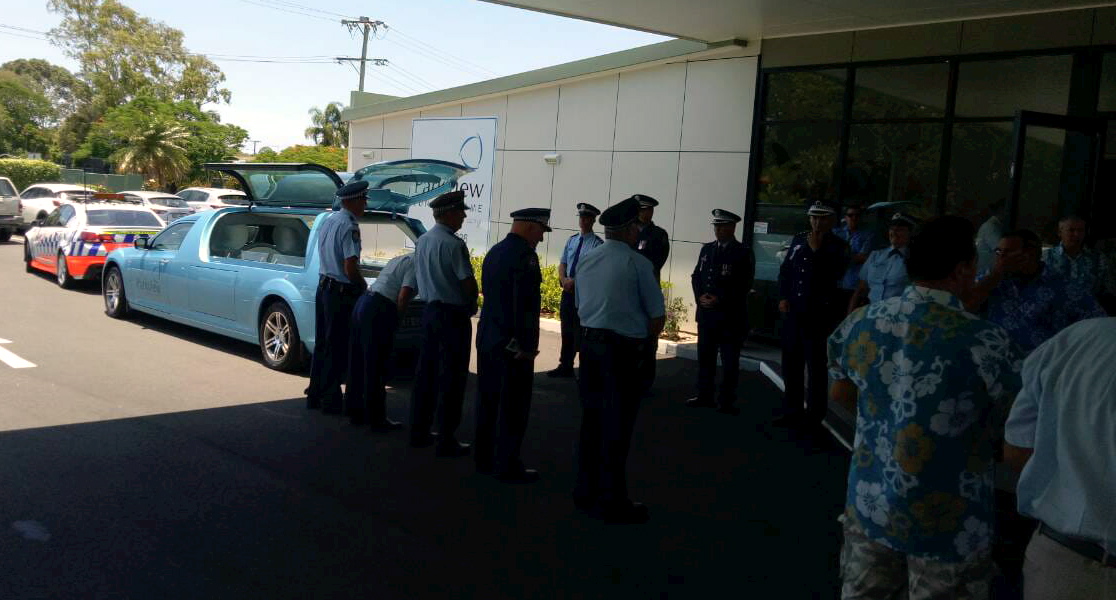
Bruce arriving
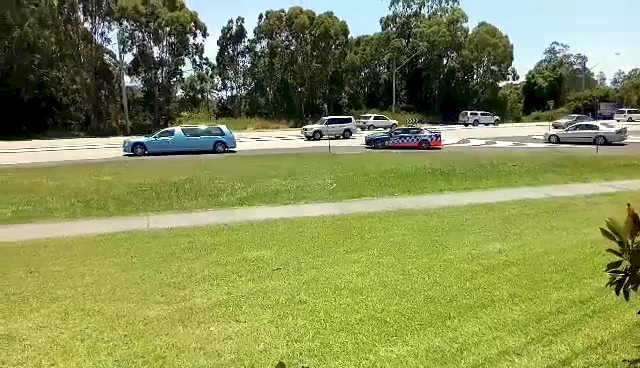
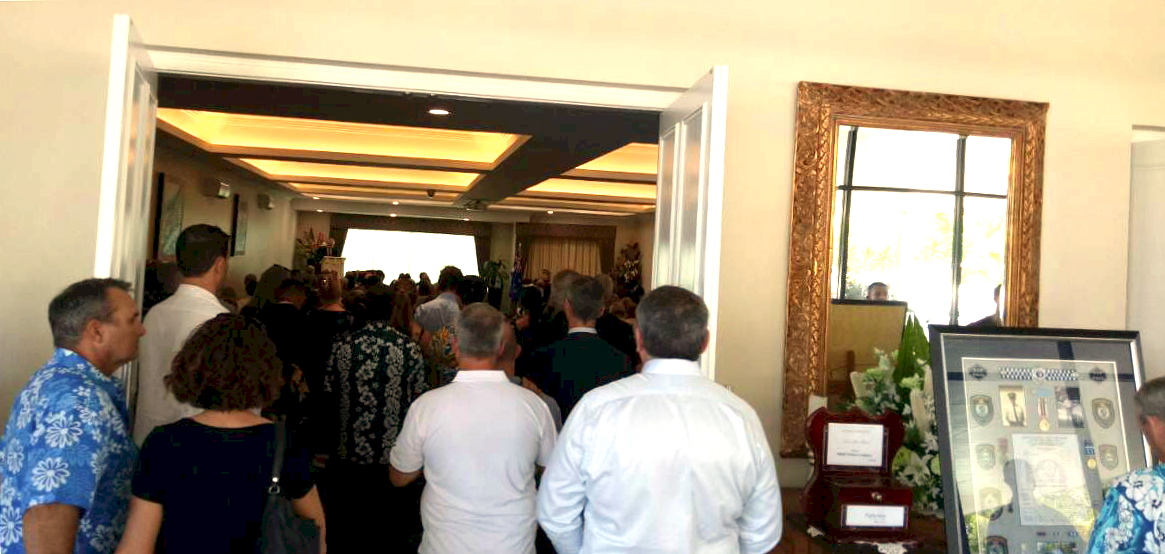
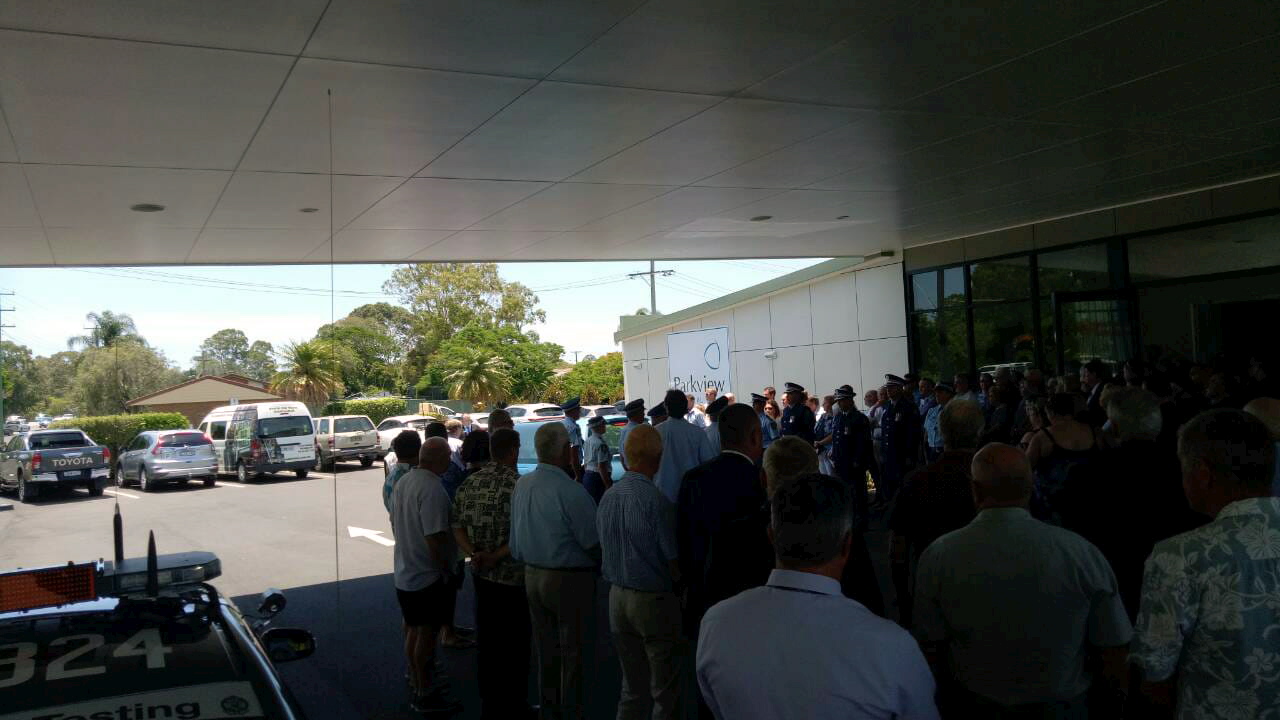
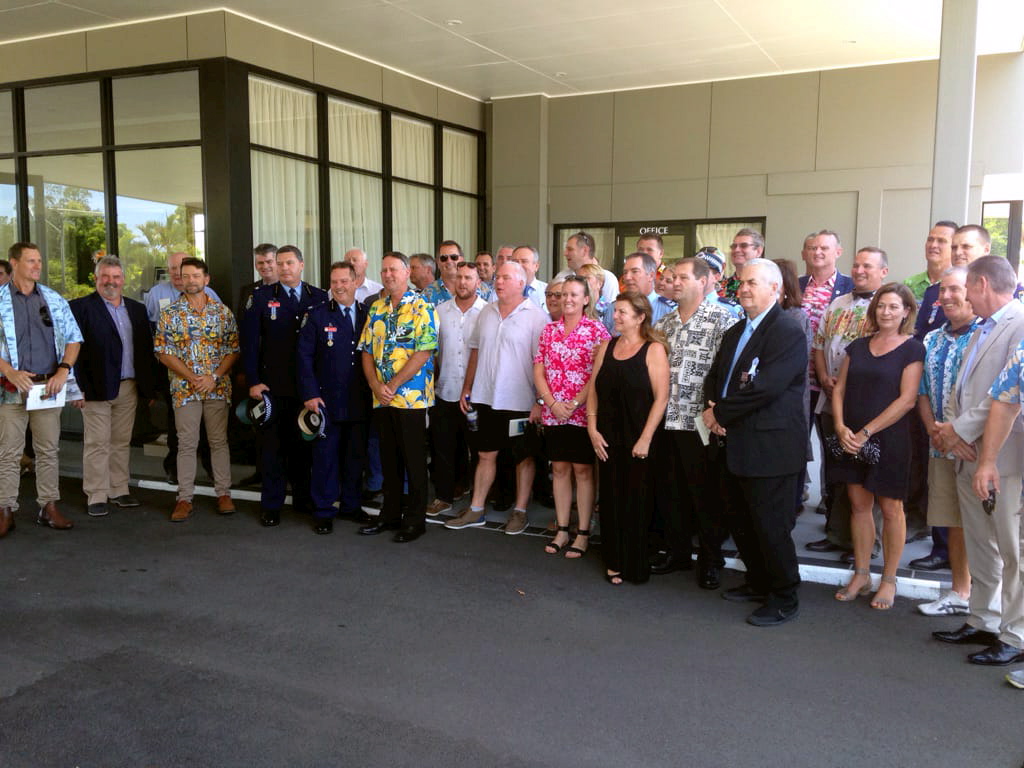
Peter CameronGroup AdminJust for the information of some who knew Bruce; he had a very large turnout for his funeral today. A whole bunch of retired and serving people there and even one bloke, Mick Pearce, who flew in from Melbourne. Bruce was given a very fitting service for his 32 yrs in the cops and I must say camaraderie is still alive and well despite what we sometimes think.
Norman MacKENZIE
| 20/12/2017
Norman MacKENZIE
Late of ?
New South Wales Police Force
[alert_yellow]Regd. # 8710[/alert_yellow]
Rank: Probationary Constable – appointed 10 June 1957
Constable 1st Class – appointed 10 June 1963
Senior Constable – appointed 10 June 1968
Sergeant 3rd Class – appointed 1 June 1973
Sergeant 1st Class – appointed 3 March 1983
Retired – Sgt 1/c on 10 December 1988
Stations: ?, Bankstown – Retirement
Service: From? ? pre June 1957? to 10 December 1988= 31+years Service
Awards: No find on It’s An Honour
Born: 8 October 1934
Died on: Saturday 9 December 2017
Age: 83
Cause: ?
Event location: ?
Event date: ?
Funeral date: was held yesterday – Thursday 14 December 2017 @ 10am
Dear people. This is a VERY long post about Mounted Constable John Thomas O’BRIEN and his time line. Born 1845, died 1906.
I put it up because of the entry in 1883. This was not just a normal sitting on the last day of the Court at Cooranbong for the time being. After all proceedings had been dealt with, it would appear that it was a ‘set up’ by a number of Magistrates, JP’s and persons of note who were present at the end of Court proceedings at which Constable O’Brien was giving evidence. These other Magistrates etc would not normally have been in the one place at the same time.
At the time of his death he had a wife and 6 children ( his second wife ) to which she was paid a ‘gratuity‘ of 240 pounds to pay for funeral expenses. His second wife died September 1906 at Picton 4 months after John. He had about 8 children with his first wife whom had died then married his second wife.
I have NEVER seen/found a testimonial given to a serving Constable under such circumstances as a transfer.
His stations included Muswellbrook, Cessnock, Coonamble, Cooranbong, Lockup Keeper at Preston, Lochinvar, Mulbring and possibly Forster. At the time of his death he was stationed at Raymond Terrace.
1845. John Thomas O’Brien, born 13/10/1845, Menangle, New South Wales to Irish born parents both of whom were born County Limerick, Ireland.
1876
John Thomas O’Brien – Appointment to Mounted Police NSW 4 Oct, 1876. Registered No. 2815. Height: 5ft 7inches. Eyes: Hazel. Hair: Dark. Complexion: Dark. A Native of: N S Wales Married or Single: M. Calling: Timber Dealer. Religion: R C. Appearance: Good. District: North East. Date of Apptmt: 4 Oct, 1876 Rank: Constable. Remarks: 1st Class 1/6/78 1877
Stationed at Muswellbrook, NSW. (Trove court notices) 1878
1/6/1878. Promoted to Constable 1st Class 1880
Stationed at Cessnock, NSW. (Trove court notices) 1883
An extract from Maitland Times 1883 regarding Const John Thomas O’Brien on the final day of the 2 week sitting of the CPS Cooranbong, who gave evidence on a couple of matters.
Before the court adjourned, and whilst the magistrates were still on the bench, between four and five p.m., the Police Magistrate presented to Constable John Thomas O’Brien a very handsome gold watch and chain (Burton make and Indian turned), which had been sent after Mr.O’Brien by the people at Cessnock, where he had lately been stationed, in recognition of had lately been stationed, in recognition of his services there. The watch and chain, valued at £34 sterling, were accompanied by a suitable address.-
The Police Magistrate (Mr. Beeve), in presenting the watch and chain to Constable O’Brien, said:
“Mr. O’Brien, the Cooranbong Bench are very happy indeed to see that your services have been so cordially recognised, and so handsomely acknowledged by those amongst whom, at Cessnock, for some considerable time, you discharged your duties as a peace officer. Speaking for myself personally, and feeling sure that I am only expressing the sentiments of my brother magistrates, Mr. Andrew S. Browne and Mr. Thomas Bussell, J.P, I am bound to state that I esteem this portion of Brisbane Water, and the country adjacent thereto, extremely fortunate in having a police officer stationed here, who is at once courteous, fearless, intelligent, and independent-animated (as we think) by a sincere desire to do all his duty, without any wish whatever to go beyond it, We are then more pleased to be the persons chosen to hand you this very beautiful watch and chain, because their value has been, in our opinion, very greatly enhanced through an official permission, given to us by your superiors publicly to make this presentation to you on behalf of your friends at Cessnock. The neatly engrossed address (above referred to) signed on behalf of the inhabitants of Cessnock, by Messrs. Martin Bouffier, Walter C. Green J.P., J, A. Jones, William Stafford, L, C. Kelman, John Gouldsbury, John Doyle, and Michael Carroll, was also handed over to Constable O’Brien, with the watch and chain.
It was as follows: To Constable J. T, O’Brien, Cessnock.
Dear Sir. Hearing that you are about to be promoted to another station we desire to express our regret at your departure. During the period of two years’ and a-half residence amongst us, you have discharged important and frequently very difficult duties, with benefit to the public and much credit to yourself. The representatives of every interest acknowledge that your activity and vigilance have given security and protection. Your exemplary propriety of demeanour has justly gained for yourself and family our respect and esteem. With this intimation of our appreciation of your meritorious conduct, we solicit your acceptance of the accompanying gold watch and chain. Wishing that you, together with Mrs. O’Brien and family, may be prosperous and happy in your new sphere of action. We remain, dear sir, yours sincerely,.
The two assisting magistrates, Mr. Andrew S. Browne, J.P., and Mr. Thomas Bussell, J.P., intimated their hearty concurrence in all that had been said by their chairman, Mr, E. Beeta-
Mr. J. T. O’Brien, in returning thanks to his good friends at Cessnock for the very handsome testimonial just presented to him in their name and in so complimentary a manner by the Bench, desired to say that he could only hope he might long continue to have a just claim to such terms of approval. It would always be his study to do his utmost to gain and to retain the support of the bench at the place at which he might be stationed; and, at the same time, to do his duty, fearlessly and conscientiously, towards the public at large. Whether he could always expect to please everybody by such a course was, of course, another matter. He begged their Worships to have the goodness to convey to the people of Cessnock his very strong sense of the kind feeling which they had been pleased thus liberally to manifest towards him, and to assure them of the very great pleasure it had given him to receive not only that beautiful watch and chain, but the kind address with which that testimonial was accompanied. He confessed he could hardly understand how he could have merited such a distinguished mark of approval from the people of Cessnock during the comparatively short time that he was amongst them, but during that short time he had, he felt bound to say, always driven to discharge his duty. It might have been that in so doing he might have sometimes have given offence to somebody; but if so, he could not help that.
Every policeman had his duty to do, and that duty he was at all times bound to hold himself ready to discharge, without laying himself out to please any person whatever, outside of it. He had made that, at the outset of his service in the force, a rule of duty, and he would always stick to it, he would never let any secondary consideration come between him and what he thought he ought to do. He begged the Bench to transmit to those who had sent him this watch and chain his heartfelt thanks. He would like also, in the same way to send his heartfelt thanks to Messrs. Carroll, Stafford, and Doyle for their friendly aid in assisting him to shift his things to Cooranbong, at his rather hasty removal from his old station, where, it seemed he had still, he was proud to think, so many friends. A similar acknowledgement was also due from him to those ladies at Cessnock, whose kindness and attention to Mrs. O’Brien and their young family on their leaving Cessnock was something it would be quite impossible for him ever to forget. The Court then adjourned until Monday, the 12th November. 1886
Stationed at Coonamble, NSW. Appointed as Clerk of the Petty Sessions. 1891
Possibly stationed at Greeta 1906.
Constable John Thomas O’Brien died 31/5/1906.
Constable John Thomas O’Brien, of Raymond Terrace, dropped dead outside the courthouse there on Thursday, from heart failure. Deceased was a well-known member of the police force of the State, in which he had served for 29 years and four months, and would have been entitled to retire upon his pension in eight months’ time. He had been in failing health for some time, and was just upon 6O years of age. Deceased, who was a smart, efficient constable, leaves a large family. For many years he occupied the position of lockup keeper at Paterson, and had also been stationed at Cessnock, Cooranbong, Mulbring, Lochinvar, and Foster.
From a public member family tree. – Buried at the “Pioneer Hill” Raymond Terrace Historic Cemetery. Burial service by Father Bernard McKierman.
I have sent off an inquiry to the Raymond Terrace Historical Society regarding our above friend and a possible burial site/headstone. Being the weekend, I may not hear for a while.
Rank: Probationary Constable – appointed 13 August 1962
Constable 1st Class – appointed 13 August 1976
Sergeant 3rd Class – appointed 1 December 1978
Detective Senior Sergeant ( pre 1987 )
Detective Inspector – appointed 7 September 1987
Stations: ?, Licensed Dealers Squad – 21 Division, ‘ I ‘ District Drug Law Enforcement Bureau – 1985 ( 2 I.C. ),Detective Inspector – Regional Controller – North – Drug Law Enforcement Bureau,
Service: From? ? Pre August 1962? to? ? 1994 = 32+? years Service
Awards: National Medal – granted 6 November 1980
1st Clasp to National Medal – granted 17 March 1989
Sydney Morning Herald, page 9, Saturday 16 December 1995
Former scourge of authority now a would-be politician
By MALCOLM BROWN
Members of the Gosford Drug Unit were recommended for a Commissioner’s Commendation in 1991 when some of the unit were suspected of receiving all or part of $300,000 from a huge amphetamine ring, the Police Royal Commission, has heard.
The commission has been told that after allegations were first raised by drug dealer John Barrie Oldfield, members of the unit, headed by Detective Sergeant Wayne Eade, had been advised by an assistant commissioner to vigorously deny the allegations.
The commission has heard members of the drug unit received full support from their line commanders.
The Police Commissioner, Mr Lauer, decided in March, 1992 to award the commendations even though a deputy Director of Public Prosecutions, Mr Mr C.A. Luland, QC, had written to the Assistant Commissioner, Professional Responsibility, in January that “evidence is highly suspicious of the police officers being involved in a conspiracy to pervert the course of justice”.
The royal commission has heard evidence from a middleman in the alleged bribe that he received $300,000, kept $100,000 and passed the rest to the drug unit, whose members included Detectives Eade, Ian Ison and Greg Vicary.
Mr Arthur Raymond Hay, former detective inspector, supervisor of the north region drug units from 1987 until his retirement last year, has told the commission he was aware of allegations against members of the drug unit. Members of the unit had told him in 1990 that there was an Internal Police Security Unit (IPSU) inquiry into them and they were “very upset”. ” I saw it as my role to try and support them and help them get back to work because it hit ( Royal Commission ) them pretty hard“ he said. He had noted that an assistant commissioner had advised that the drug unit members attend the IPSU, deny everything and engage in no further discussion. He did not know whether the assistant commissioner had any basis at all for knowing whether the allegations, were true or false.
Ms Virginia Bell, counsel assisting the commission, asked: “At the outset the attitude from the line command, as best you could judge, was unquestioning support for the officers at a time when line command had no knowledge of the strengths or otherwise of the allegations?“; Mr Hay: “That’s my view of it.“;
At the end of Oldfield’s trial in September, 1991, the trial judge, Justice Allen, made remarks favourable to officers of the drug unit and had said: “It is a twist of fate that honest detectives are accused by criminals of corruption and suffer the heartache and indignity of an internal affairs inquiry.” Mr Hay agreed that on October 31, 1991, he had prepared a report supporting the award of a Commissioner’s Commendation and had said success of Operation Hurricane had been due to the “diligent and outstanding effort of the Gosford Drug Unit who conducted the operation with utmost integrity and professionalism“.
Nothing further is known about this gentleman.
Cal
6 December 2017
Roelof Marinus FLUIT
| 20/12/2017
Roelof Marinus FLUIT
aka RON or RONALD
Late of ?
New South Wales Police Cadet
Cadet # 1488
New South Wales Police Force
[alert_yellow]Regd. # 10205[/alert_yellow]
Rank: NSW Police Cadet – commenced 2 March 1959
Probationary Constable – appointed 22 November 1961
Constable 1st Class – appointed 1 April 1967
Detective Sergeant 3rd Class – appointed 14 February 1978
Detective Senior Sergeant – appointed 28 June 1986
Stations: ?, Manly.
Service: From 2 March 1959to? ? ? = ? years Service
Funeral and cemetery details can’t be found for this person.
It is possible that Ron was a Solicitor after he left the NSWPF. There is/was a Solicitor in the Sydney Northern Suburbs by the name of Ronald M FLUIT Solicitor whose business name registration was cancelled on the 28 May 2015 by ASIC.
[divider_dotted]
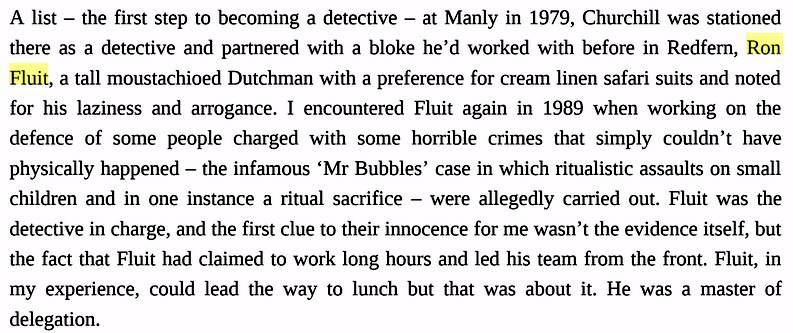
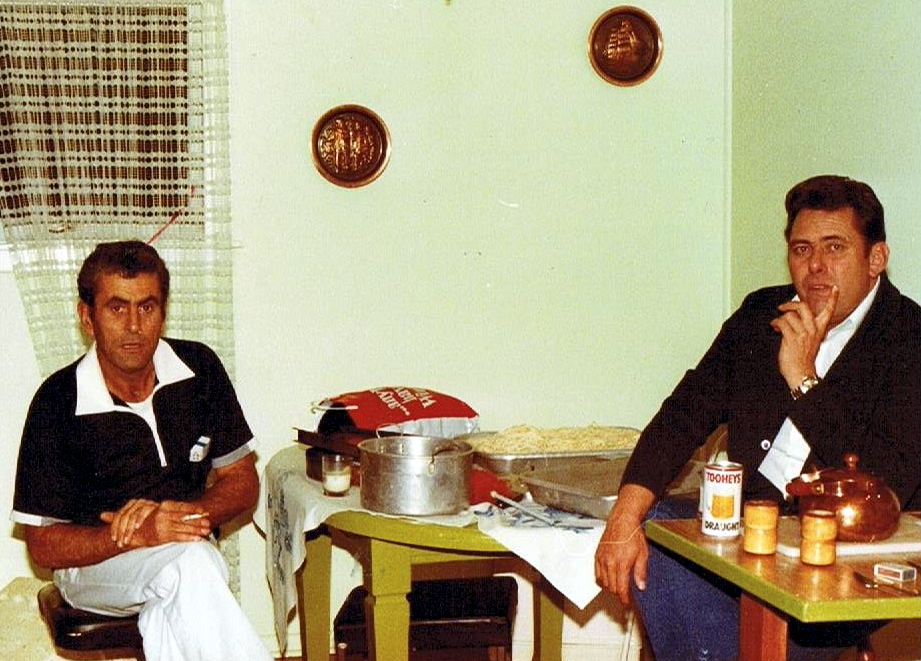
Described as a tall moustachioed Dutchman with a preference for cream linen safari suits.
Excerpt from the book ‘Roger Rogerson by Duncan McNab
[divider_dotted]
Life in the shadows of Mr Bubbles
Mr Bubbles. How false accusations of child sex abuse destroyed the lives of an innocent couple.
Pinned to a noticeboard beside the word-processor in Dawn Deren’s cramped little study is a cartoon depicting a frog halfway down the throat of a heron, only its legs kicking out from either side of the bill. The frog is labelled “Dawn”, the heron “The System” and the caption underneath epitomises the determination with which she has fought, for nearly nine years, to escape from the jaws of what she regards as one of the greatest injustices in NSW criminal history.
The “Mr Bubbles” case, in which she and her husband, Tony, were at the epicentre, was certainly one of the most lurid. It involved allegations of satanic rituals and blood sacrifice, child pornography and a ring of paedophiles preying on children attending a kindergarten on Sydney’s northern beaches.
Although all the charges were thrown out for lack of evidence eight years ago last month, many of the key players in this dark drama – not least the Derens – have remained dissatisfied with the outcome and were hoping a reinvestigation of the case by Justice Wood’s Royal Commission into police corruption and paedophilia would finally lay the ghosts to rest.
Literally hundreds of people were caught up in the hysteria which followed the sensational media coverage of the case: many of the 1,000 or so parents who had had a child at the Seabeach Kindergarten at Mona Vale during the years Dawn Deren ran it; the police who investigated; the lawyers who prosecuted; the social workers and psychologists who counselled the children and their parents; the politicians and the media.
But when Justice Wood’s long-awaited report was released last month, they were doomed to disappointment. “It is now not possible to determine whether or not there was any truth in the underlying allegations,” he reported. “The trail is too old, the evidence of the children is too contaminated, and there was nothing which the commission could find to independently corroborate or disprove the matters raised.”
The report was scathing in its criticism of the police: that none of them had any experience in investigating child sex abuse; of the use of a young probationary policewoman to conduct critical interviews; of a “dubious” identification; of “inaccurate” recording of medical evidence; of the unauthorised use of hypnosis; of the failure to trace a party clown named “Bubbles” who may have given rise to the children’s original fantasies; and of the lack of resources available to the prosecution.
However, to the frustration of some of the parents who have long held suspicions of a cover-up, Wood did not accept evidence that the chief investigator, Detective Sergeant Ronald Fluit, had demanded a $30,000 bribe of the Derens and “found no credible evidence to suggest that Mr Fluit, or any other police officer, corruptly attempted to frustrate the investigation”.
Nor, to the dismay of the Derens, did he find any prima facie evidence that abuse did occur and that someone else may have been responsible. Dawn Deren remains convinced that in at least two or three cases the children had been used in pornographic pictures and that the real perpetrators, whom she calls “the group”, escaped justice because the police wrongly pursued her and her husband.
The case has taken a heavy toll on the Derens. Now in their mid-50s, they have lost the dream home overlooking the Narrabeen Lakes they worked for all their lives and have moved to a small apartment in a suburb where they will not be recognised. She has lost her kindergarten and he his job at Telstra. They now work around the clock cleaning houses. Every cent they had has gone to pay their legal bills.
“I think they [the Wood findings] are fair and I hope the parents read them and realise what we have been put through,” says Dawn. “But they do not go far enough in my opinion.”
For the Derens, justice will have to wait for another day. At last count, the Derens had five defamation actions afoot, including one against the police for putting out false statements to the media: “Only when we win those and get a public apology will I feel our names will be cleared,” Dawn says.
ANOTHER casualty of the Mr Bubbles case who is far from satisfied by the report is Deirdre Grusovin. Remember her? She was the Labor front-bencher whose career was destroyed – she would almost certainly have been a minister in the Carr Government – by her relentless pursuit in parliament of paedophilia allegations.
At the height of the furore, says Grusovin, Liberal MPs would hum I’m Forever Blowing Bubbles when she rose to speak. “Once when I asked [former Premier Nick] Greiner a question on government finances he put his head on his elbow and gave his silly smirk and said, `Ever since the bubble burst you have become obsessive’ and refused to answer.”
Grosovin admits now that she had been “very naive” when she was first drawn into the Mr Bubbles case. “Although I had seven children myself, I had no idea sexual abuse of young boys even existed,” she says.
She has been in touch with the parents of several of the Seabeach children since the commission’s findings were released and says: “I am sure they are devastated at how superficial the inquiry was, how little it found out. There is no doubt in their minds that abuse was taking place, and not only of the 17 [over whom charges were laid] but a large number of other children. After all this, the abuser is still out there.”
The Herald attempted unsuccessfully to contact parents, particularly Mrs X, the first mother to complain to police and who had been described in a psychiatric report six months earlier as “on the border of a psychotic breakdown”. They had either moved or did not return calls.
Grusovin says it is a paradox that parents and children involved had been awarded more than $500,000 by the Victims’ Compensation Tribunal, when the court had dismissed the charges and the royal commission could find no evidence that abuse took place. “This has been enormously damaging … some of these people are still receiving counselling all these years later.”
Grosovin, however, welcomes Justice Wood’s recommendations for improving future handling of such complaints, particularly establishing a “one-stop shop” for expert debriefing of suspected victims and the protection of child witnesses within the court system.
“I am not going to go away,” she vows. “I am going to make sure the Government sticks to its commitment to bring in these changes.”
BETH Brosgarth traipsed down to the royal commission offices in the city three times to make statements to investigators. As president of the Seabeach Kindergarten parents’ and friends’ association, and a qualified psychologist, she believed she had a unique insight into the events of nine years ago.
“Now when I read this,” she says, flicking through a photocopy of the commission’s report, “I wonder why I bothered. There is nothing here we did not know before. I don’t think they took the investigation seriously now that the police involved are no longer in the force.”
Brosgarth does not believe that any of the children at Seabeach were abused. She subscribes to the view of an overseas expert called to testify in the case that it was likely “the children had unwittingly been told a story which grew with each telling, and conformed more to the adults’ interests” than anything that actually occurred. In other words, a mass fantasy.
“If anyone was going to be abused it was my daughter,” says Brosgarth. “She was the youngest child and the most vulnerable. As well, I was away the whole day working in Penrith so I wasn’t around to check up on them. But nothing happened to my daughter, I am certain of that.”
She is disappointed that the role of the professionals in the case, particularly the Family and Community Services officers and one of the psychiatrists, was not subjected to greater scrutiny. And she also believes the police should have been held to greater account.
“It was a bit like saying something against Princess Diana: it was heresy to say that nothing had happened. No matter what the royal commission found, it is too late to change people’s minds.”
October 26, 1988: “Mrs X.” Mother of two children at Seabeach Kindergarten, observes her three-year-old daughter posing suggestively in a restaurant. The girl says “Mr Bubbles” taught her to do it.
Oct 27: Mrs X and tow other parents approach Mona Vale police with suspicions that the children have been sexually abused. The evidence is statements by the children that they had taken off their clothes, had photographs taken and bathed with “Mr Bubbles”.
Oct 28-Nov 4: Det Sgt Ron Fluit places Seabeach under surveillance. Neither he nor any detective at the station has any experience in child sex abuse cases.
Nov 6: Police stage a dawn raid on kindergarten owner Dawn Deren’s home. Police claim occult literature and videos of child pornography have been seized, but Wood Royal Commission finds this is untrue.
Nov 6-7: Kindergarten is named on a Sydney radio station and “the matter became the subject of wide and sensational media coverage”, according to the commission report. Dawn and Tony Deren and two female kindergarten workers are eventually charged with sex offences and kidnapping involving 17 children aged 3-5.
Feb 6, 1989: The Derens face screaming demonstrators outside a remand hearing. The children have been reinterviewed up to nine times and are talking of occult rituals, witchcraft, white robes and “acts of a cultish and bizarre kind”, including sexual penetration. A police inquiry later finds most have no physical sign of abuse.
July 3: At committal hearing the four people plead not guilty, expert testimony is called on the unreliability of evidence given by pre-school children. Magistrate rules the children cannot be called to testify.
August 11: In the absence of any reliable forensic evidence, witnesses or confessions, charges against the four are dismissed. The investigation consumed 15,000 police hours and the court case cost more than $1 million.
August 26, 1997: Justice Wood finds: “… the Seabeach case was a debacle which left a number of persons severely traumatised and questioning of the justice system.”
Publishing Info
Pub: Sydney Morning Herald
Pub date: Wednesday 17 September 1997
Edition: Late
Section: News And Features
Sub section:
Page: 13
Word count: 1674
Classification: Crime/Child Abuse & Neglect Law/Police/Malpractice/Wood Royal Commission
Geographic area: Sydney
Photograph: Robert Pearce
Caption: Aftermath … Tony and Dawn Deren.
Canberra Times (ACT : 1926 – 1995), Wednesday 5 July 1989, page 14
‘Assaulted’ children ‘exorcised’
SYDNEY: Some parents had their children “exorcised” by a church minister after alleged sexual and indecent assaults involving a kindergarten director and her husband, City Court, Glebe, was told yesterday.
Police said they had found books on the occult at the middle-aged couple’s home after the alleged attacks on 17 boys and girls, aged between three and six.
Kindergarten director Dawn Deren, 45, her husband Anthony, 47, and assistants Rima Muir, 45, and Louise Bugg, 24, are facing more than 50 charges including sexual and indecent assault.
The court has heard that between January and November last year, the children were taken from a northern beaches kindergarten to parties where the assaults allegedly occurred.
It is alleged Anthony Deren dressed up as a clown and called himself “Mr Bubbles” to lure the pre-schoolers to the parties.
Seeking an adjournment to consider subpoenaed documents, counsel for Bugg, John Terry, said the defence needed time to study the new material.
From the new files, he said, it appeared the mother of one of the children involved had had episodes described as “floridly psychotic” which could have “contaminated” the child.
Mr Terry told the court that a child’s mother had suggested answers to questions that the child was asked to such an extent that the interview was unable to proceed.
“Other parents have had their children exorcised by a Uniting Church minister,” he said.
Mr Terry said it was these children on which the Crown was depending over its allegations of occultism.
John Gordon, counsel for the Derens, said there was evidence that some of the statements had been “elicited other than by voluntary process”.
It appeared one little girl had been interviewed while under hypnosis, he said.
“Emerging from the subpoenaed documents there is grave evidence of contamination of the stories that now appear on the statement form before the court,” he said.
Magistrate David Hyde rejected the application for an adjournment but defence lawyers renewed their request when Detective Sergeant Ronald Fluit, who led the investigation, took the stand.
Sergeant Fluit told the court that police had found an audio cassette of The Carter Report, Anti-Christ in Action, and four books: Examining the Cults, Mystery 666, Not a White Woman Safe and a Handbook Of Today’s Religion which included the occult, at the Derens’ house.
In a record of interview on November 6, 1988, tendered to the court yesterday, Anthony Deren denied all allegations.
Probationary Constable – appointed 25 February 1963
He was deemed ‘Competent’ to drive departmental vehicles on 14 May 1963
Completed three day course in Civil Defence 24 – 26 February 1964
He was deemed ‘Competent’ to be a Solo Cyclist on 18 March 1964
Was typing 28 word per minute on 16 August 1963
Constable – appointed 25 April 1964
He was deemed ‘Competent’ to ride High Powered Solo Cyclist on 1 July 1964
Passed his Cst 1/c examination on 2 September 1965
Constable 1st Class – appointed 25 April 1968
He was deemed ‘Competent’ to drive Ute’s & light trucks on 10 May 1968
He was deemed ‘Competent’ to drive Buses on 6 November 1973
Passed his Sgt 3/c examination on 16 May 1974
Senior Constable – appointed 24 August 1974 ( loss of 4 months Seniority)
Completed Sergeants’ Course # 65 conducted from 31 August to 16 October 1981
Sergeant 3rd Class – appointed 18 October 1981
Stations: 13 Division – GD’s ( from 1 April 1963 ),
Canterbury – GD’s – 13 Division ( from 11 November 1963 ),
Canterbury Traffic Branch – STP ( Probation from 18 May 1964 ),
Canterbury Traffic Branch – STP ( Permanent from 22 June 1964 ),
Liverpool STP ( Special Traffic Patrol – 22 Division from 5 January 1965 – 8 June 1966 ),
1966 Branch Secretary of NSW Police Association representing 22 Division,
21 Division ( from 9 June 1966 – 3 July 1966 ),
Liverpool GD’s ( from 4 July 1966 – 24 April 1967 ),
Tingah GD’s ( One Manner from 25 April 1967 – 9 September 1969 ),
Cabramatta GD’s ( *26 Division from 10 September 1969 – February 1974 ) * Cabramatta / Fairfield was originally under Merrylands – H District. Later came under Liverpool – I District
Cabramatta GD’s – 34 Division ( from 1 March 1974 – 30 April 1974 ),
34 Division – Assist to Traffic Sgt ( from 1 May 1974 – 10 August 1974 ),
Cabramatta GD’s – 34 Division ( from 11 August 1974 – 6 September 1975 ),
Fairfield GD’s & Information Officer – 34 Division ( from 7 September 1975 – 1 October 1977 ),
Liverpool – 22 Division – Sgt 3/c ( from 2 October 1977 – 27 February 1982 ),
Green Valley – 22 Division ( from 28 February 1982 – 22 May 1993 )
Macquarie Fields – 35 Division – Shift Supervisor ( from 23 May 1993 – ? )
Service: From? ? pre Feb 1963? to? ? ? = ? years Service
Awards: Commended for part played in the search for Monica Schofield, missing from Heathcote Hostel from 17th June, 1963, and whose body was subsequently found buried in the bush on the 25th June, 1963. N. T. W. ALLAN, Commissioner of Police – 9 April 1964
Commended for part played in fighting the disastrous bush fires which occurred in the County of Cumberland during March, 1965. N. T. W. ALLAN, Commissioner of Police – 19 August 1965
National Medal – granted 23 October 1981
1st Clasp to National Medal – granted 28 May 1992
23 March 1972 – “Highly commended for his outstanding courage and devotion to duty on the 30th September 1971, at Lurnea in confronting an armed man who had earlier murdered two members ( RILEY & McDIARMID ) of the Force. On the offender raising a pistol the Constable shot and killed him.
Alf was Awarded a Commissioner’s Commendation & was recommended for Queen’s Commendation for Brave Conduct
Awarded the Queen’s Commendation for Brave Conduct on 28 August 1972
Mid-morning of 30th September 1971, a female walked into Blacktown Police Station to report a murder /rape earlier that day at Toongabbie. Sgt 1/c. William. W. Riley and Sgt 3/c. Maurice. R. McDiarmid attended the scene. Soon after both Officers were shot dead by the suspect Ronald Clark, using a .22 calibre repeating rifle. He then stole both Officers .38 Smith and Wesson revolvers.
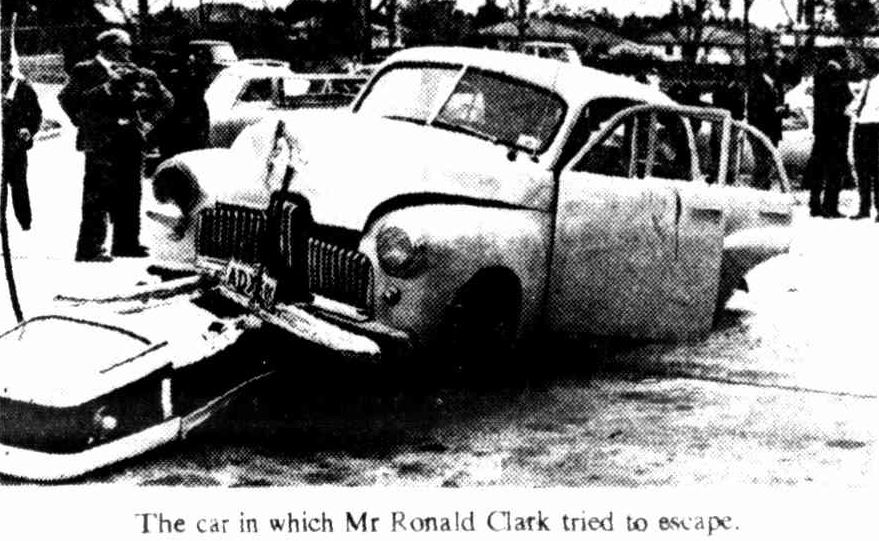
Clark escaped in a vehicle. That afternoon the car and armed suspect were seen travelling in Hoxton Park Rd, Green Valley, in the Liverpool Patrol, by Constable Alfred Gregory and Constable L. A. Crawford of Cabramatta. The suspect was pursued, refusing to stop. On making a right turn into Hill Road, Constable Crawford, heroically rammed the suspect’s car, causing it to crash into petrol pumps at a service stationed at that intersection. Constable 1/c. Gregory immediately alighted from the Police vehicle and confronted Clark who aimed a firearm at Constable Gregory. During this confrontation Clark was fatally wounded by Constable 1/c Gregory. Later in his service Sgt Alfred Gregory was station at Liverpool on General Duties. Annual Report of the Police Department of New South Wales for 1971.
Courtesy of Liverpool ( NSW ) Police Time Line ( 1788 – 2016 )
[divider_dotted]
Canberra Times (ACT : 1926 – 1995), Saturday 1 July 1972, page 3
Bravery awards to policemen
SYDNEY, Friday. — One city and five country policemen had been awarded the Queen’s Commendation for Bravery, the Governor of NSW, Sir Roden Cutler, announced today.
They are Constable Ernest Max MacLeod Chapman, of Nowra, Sergeant Third Class Keith William Krause and Senior Constable John William Hayes, of Orange, Senior Constable Georgi Vsevolodovich Radzievic, of Mudgee, and Senior Constable First Class Alfred George Gregory, of Cabramatta.
The citation for Constable Chapman says that in Lord Street, Kempsey, on October 13, 1970, he saw a car being driven at high speed and in a dangerous manner.
He stopped the driver who pointed a sawn-off .22 calibre rifle at the constable and shouted abuse at him.
The driver disarmed Constable Chapman and forced him at gunpoint to enter the car.
During the journey south along the Pacific Highway, “he held the police revolver at the back of the constable’s head, continued to abuse him, threatened to kill him and fired two shots, apparently out of the car window, as a warning to the constable“.
At Kew Constable Chapman managed to alert the proprietor of a service station.
Sergeant Third Class P. N. Long, of Kew police, arrived but was disarmed, and forced to enter the car.
Constable Chapman purposely dropped the car keys and managed to grasp the revolver, which fired, narrowly missing Sergeant Long.
The man was subdued, later charged with various offences and sentenced to 14 years’ hard labour.
5′ 11″ tall, 12 stone 9 lb, hazel eyes, brown hair, medium complexion.
He was previously employed as “Call Boy”, Cleaner and fireman for 6 years with the Dept. Railways.
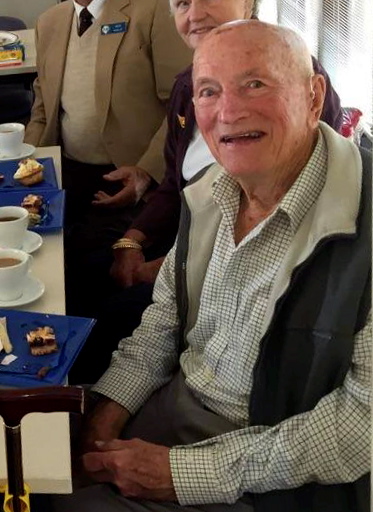
Alf was a train driver prior to joining the Police Force, he loved his beloved trains, he used to talk about the old steamer he shovelled coal on and the runs he made with the railway. A couple of things about Alf, he was very musically talented, he could play any keyboard instrument by ear, no music, he’d just sit down and play. He had his own Organ at his house and he loved it. Another thing that was outstanding with him was his handwriting. He had a beautiful handwriting style. The charge books he wrote in were copperplate, and a short while ago I went to Tingha just to see where he’d worked. I managed to get into the Police Station there and rummaged through some of their old records, sadly a lot of them had been destroyed but I managed to find a sample of this handwriting dating back to the mid to late 1960’s in an old index book. I showed it to the Senior Constable on duty there and he agreed about Alfs style.
On 30 September, 1971, Sergeant 2nd Class Riley and Senior Constable McDiarmid attended a dwelling in Mimosa Avenue, Toongabbie to investigate a report that a man had shot and killed his brother at that address. On arrival the police saw the offender RonaldClarke who quickly ran to the rear of the house. Senior Constable McDiarmid followed him while the sergeant entered through the front door. As the senior constable entered through the back door the offender opened fire with a shotgun, inflicting a fatal wound. It appears the offender then went back through the house where he also shot and killed Sergeant Riley. Although the senior constable was still alive when other police arrived he died a short time later in an ambulance on the way to hospital. The offender was shot and killed by police ( Cst 1/c Alf GREGORY ) the same day.
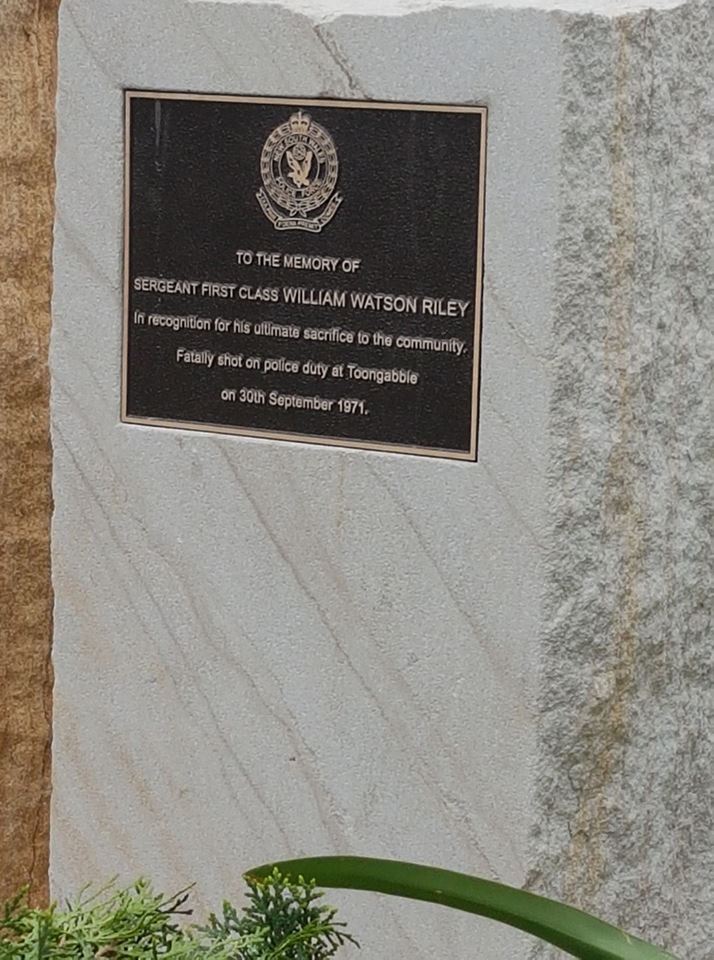
William Riley was born in 1921 and joined the New South Wales Police Force on 3 December, 1945. At the time of his death he was stationed at Blacktown. He was posthumously promoted to Sergeant 1st Class.
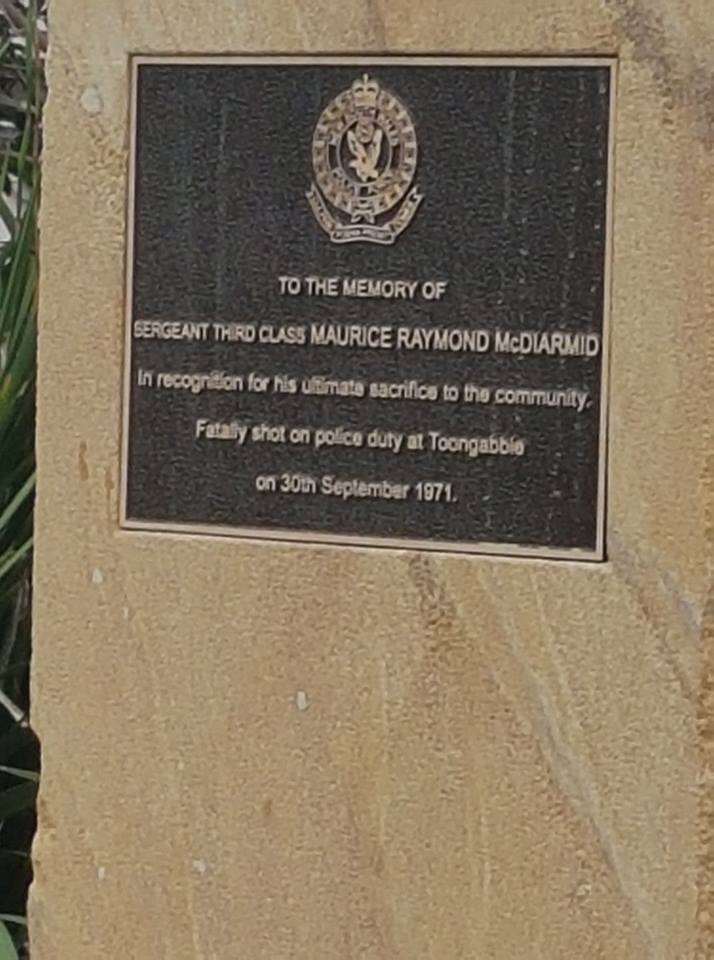
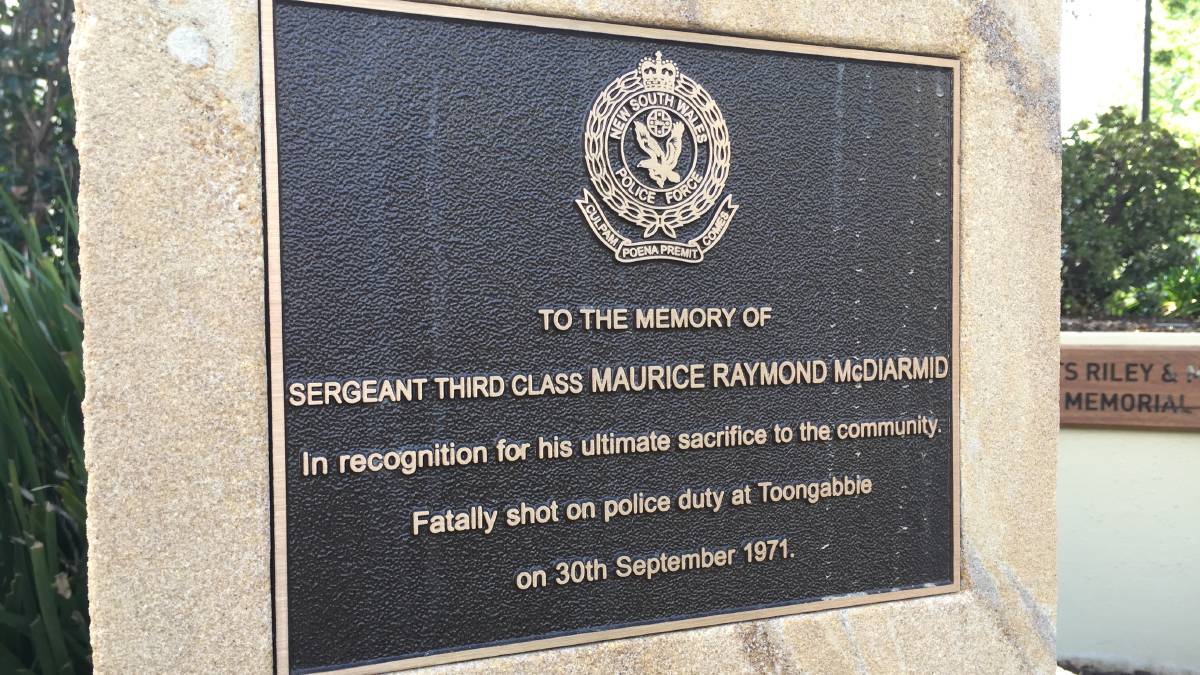
Maurice McDiarmid was born in 1932 and joined the New South Wales Police Force on 9 July, 1956. At the time of his death he was stationed at Blacktown. He was posthumously promoted to Sergeant 3rd Class.
George Lewis Memorial Trophy
This trophy for the year 1971, which is for the most courageous act performed by a member of the New South Wales Police Force, was awarded posthumously to the late Sergeant 1st Class W. W. Riley and the late Sergeant 3rd Class M. R. McDiarmid who were stationed at 27 Division.
The trophies were presented to Mrs Riley and Mrs McDiarmid at the Police Academy during 1972.
PETER MITCHELL TRUST AWARDS
The ten awards under this Trust for the year 1971 were made to the following police, the trophies being presented at the Police Academy during 1972:
Most Courageous Act Posthumously awarded to the late Sergeant 1st Class W. W. Riley and the late Sergeant 3rd Class M. R. McDiarmid in conjunction with the George Lewis Memorial Trophy.
[divider_dotted]
Canberra Times (ACT : 1926 – 1995), Tuesday 21 March 1972, page 3
Plaque
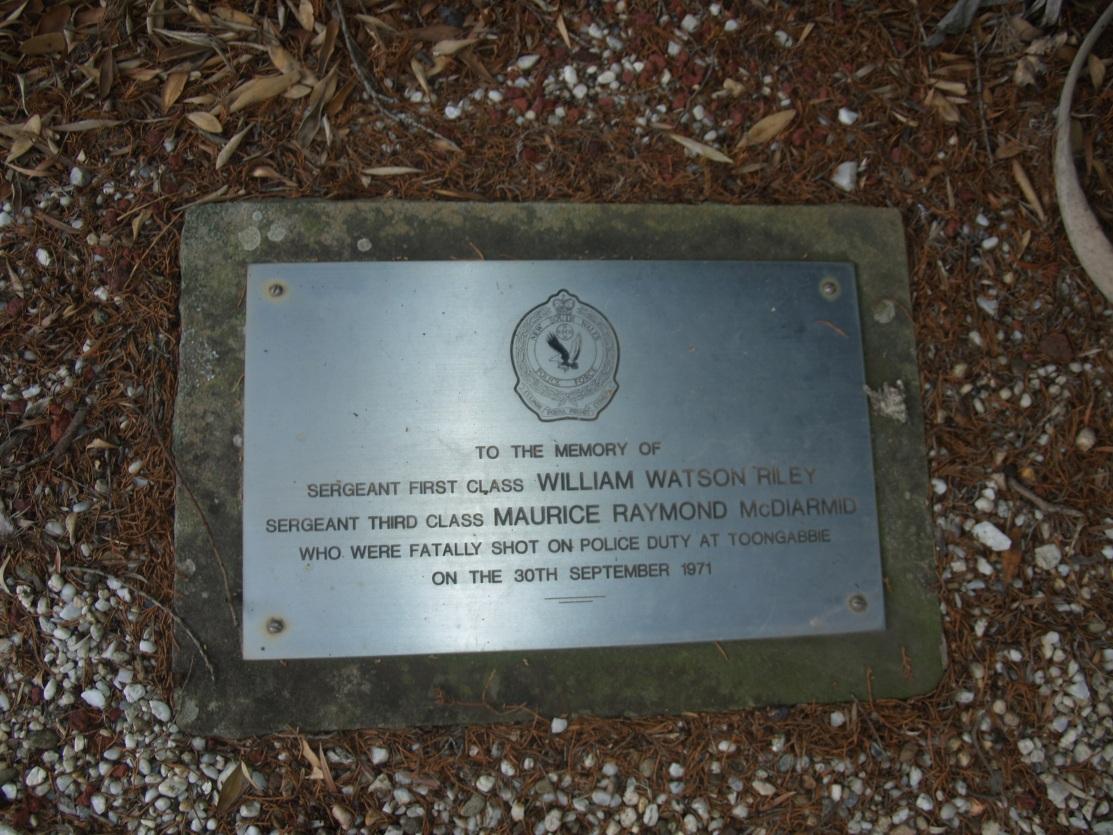
SYDNEY, Monday. — At the Pine Grove Memorial Park near Rooty Hill today, Bishop Hulme-Moir, chaplain of the NSW Police Force, dedicated a plaque in memory of Sergeant Maurice McDiarmid and Sergeant William Riley, who were shot when attempting to arrest an armed man at Toongabbie on September 30 last year.
Canberra Times (ACT : 1926 – 1995), Wednesday 6 October 1971, page 3
Funeral
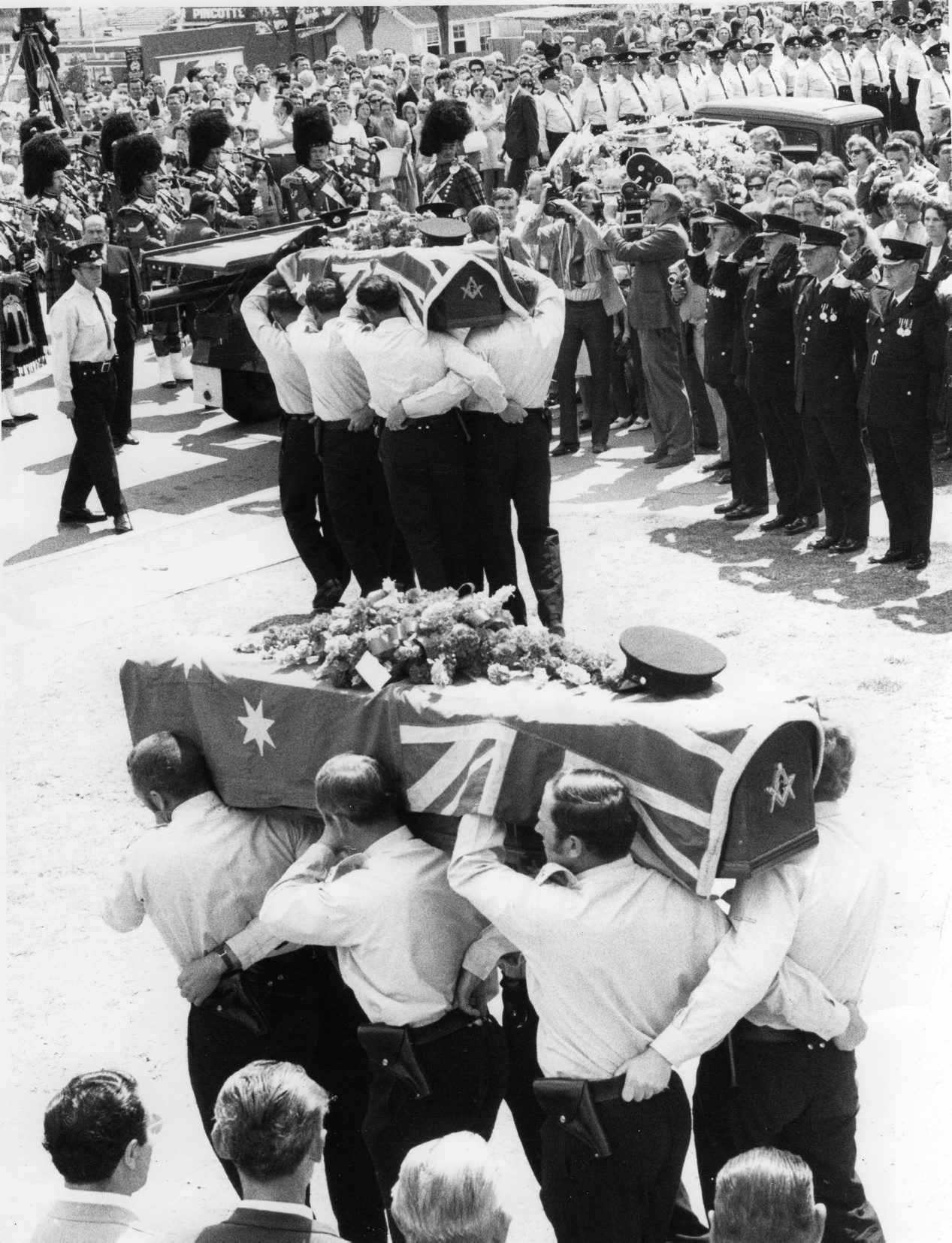
SYDNEY, Tuesday. -More than 400 policemen attended the funeral this morning of the two policemen shot by a man in Toongabbie last Thursday. Both men, Sergeant William Watson Riley and Senior Constable Maurice Raymond McDiarmid, were given full police honours at their funeral.
Canberra Times (ACT : 1926 – 1995), Thursday 13 January 1972, page 11
Payments to 3 police widows
SYDNEY, Wednesday. – The NSW Government agreed today to make, as “an act of grace”, lump-sum payments of $12,500 to each of three police officers’ widows.
“The Premier, Sir Robert Askin, said the payments would be in addition to the pensions and dependant’s allowances already paid out of the police superannuation and reward fund.
The three policemen involved in the payments are Senior Constable W. E. King, who was murdered at East Gresford police station on August 13 last year, and Sergeants W. Riley and M. McDiarmid, who were shot by a man at Toongabbie on September 30 last year.
Sir Robert said members of the police force had always been specifically excluded from the definition of “worker” under the Workers Compensation Act.
He said the Commissioner of Police, Mr Allan, had brought to the notice of the Government that, in certain matters of workers’ compensation, police were in an anomalous position in relation to other Crown employees.
Sir Robert said a full examination would be made of overall benefits of workers’ compensation available to police.
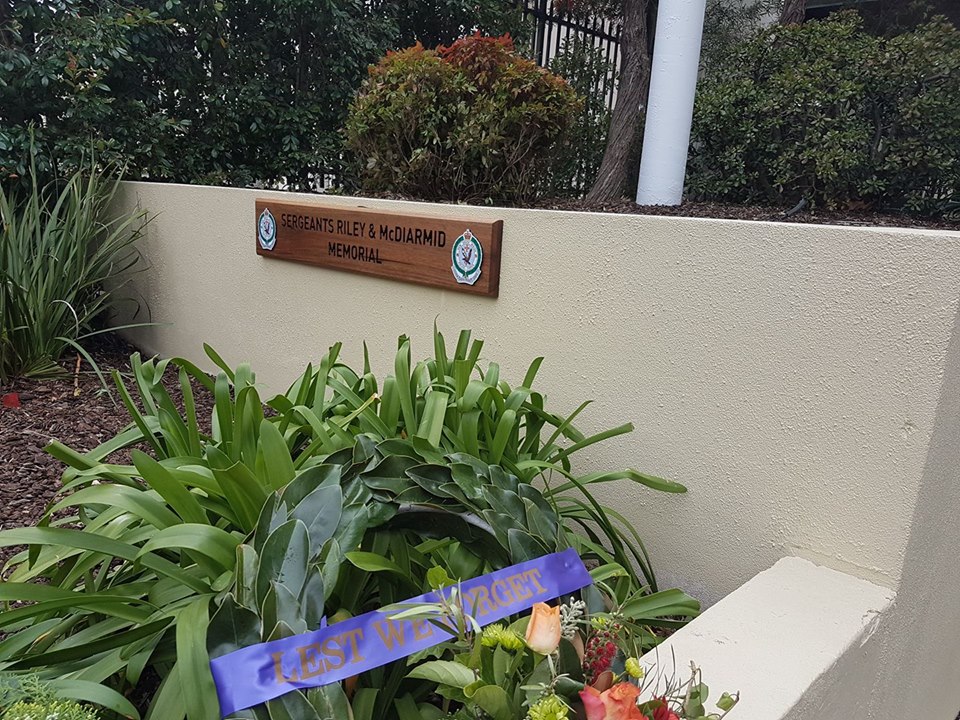
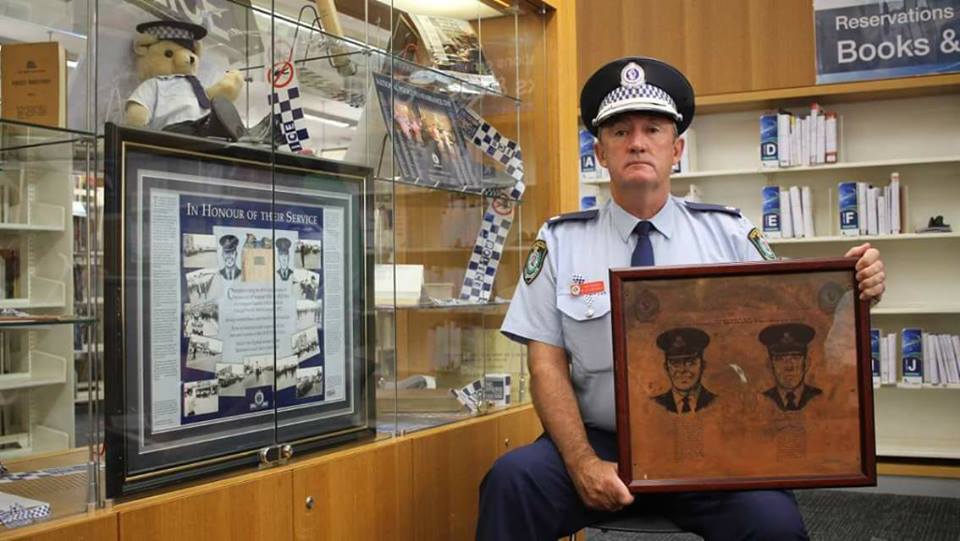
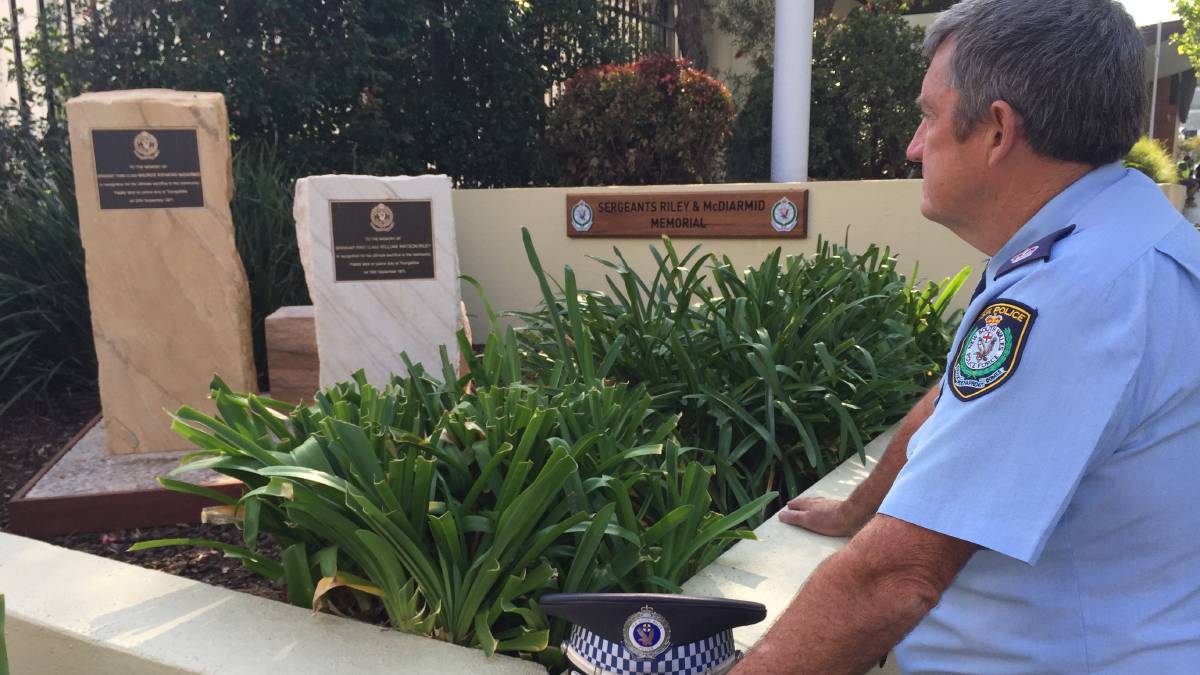
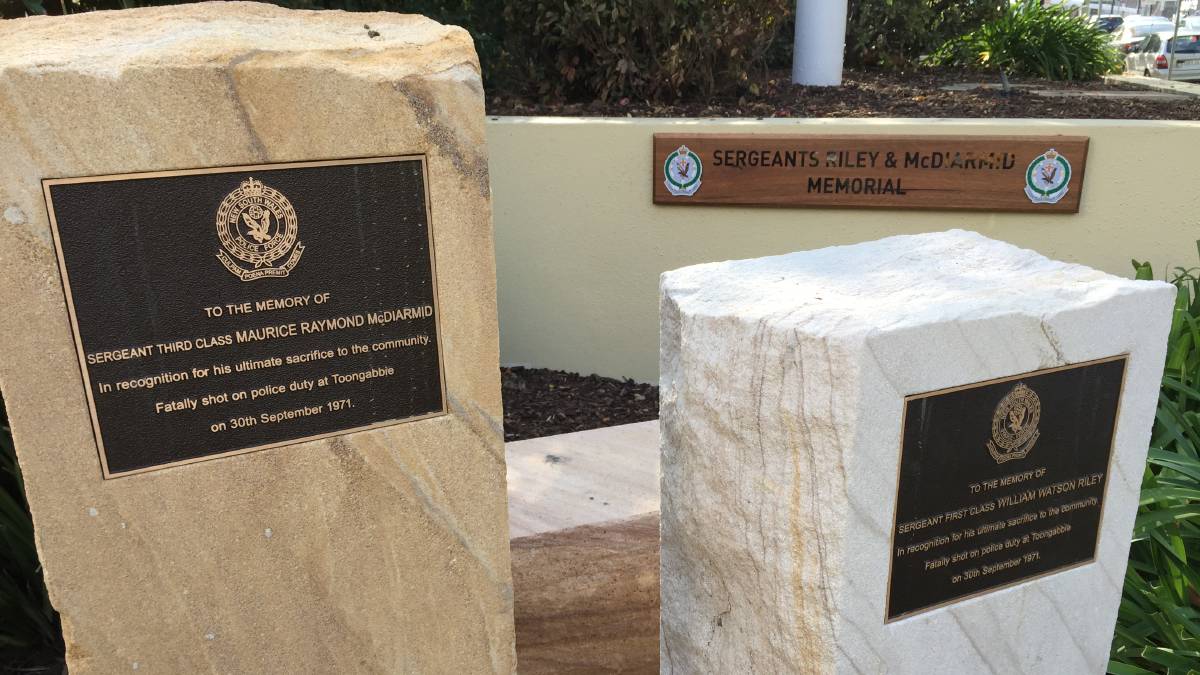
NOT FORGOTTEN: Blacktown Police Chief Inspector Bob Fitzgerald pays his respects at a memorial to slain officers Sergeant 1st Class William Riley and Sergeant 3rd Class Maurice McDiarmid. Picture: Harrison Vesey
A solemn memorial stands to remind Blacktown police officers of the price paid by two of their colleagues.
William Riley and Maurice McDiarmid were both killed in the line of duty on September 30, 1971, while trying to apprehend a murder suspect in Toongabbie.
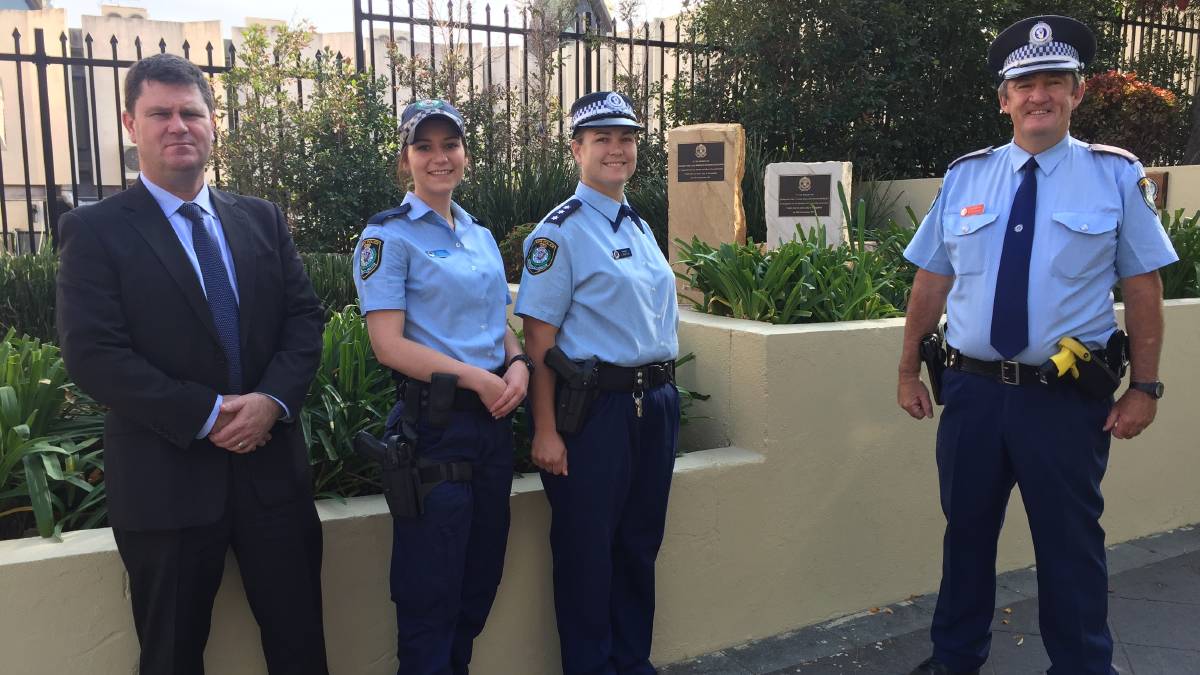
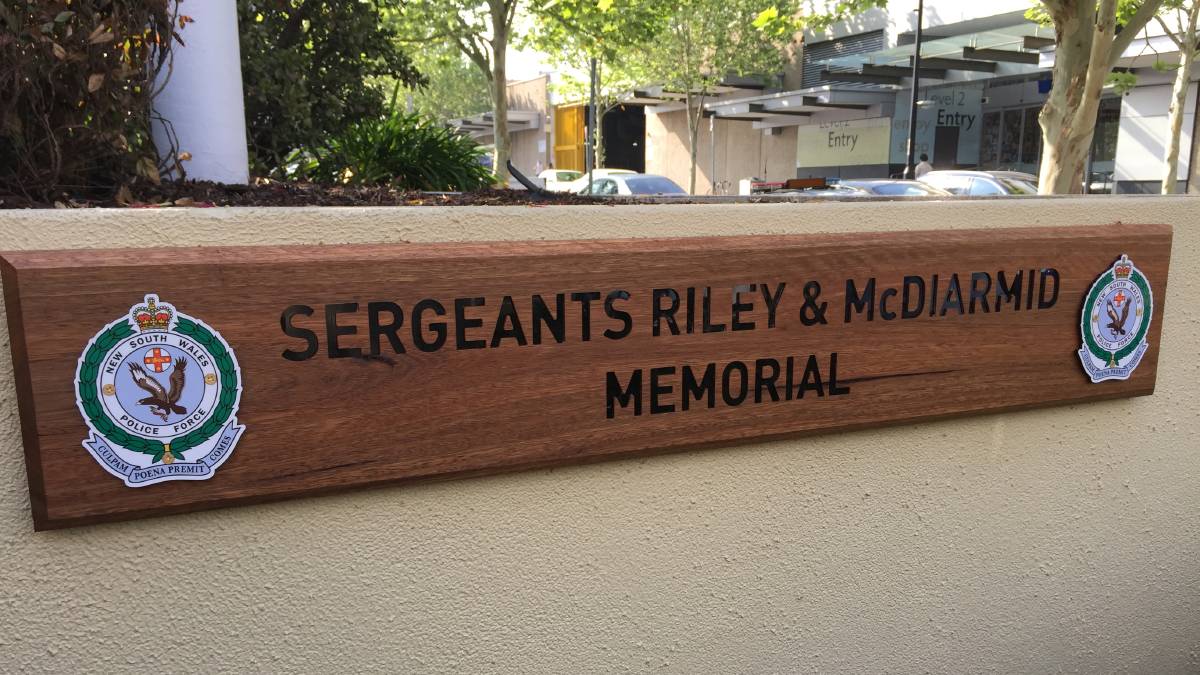
They are now remembered by commemorative plaques outside Blacktown Police Station, as well as a plinth at the entrance to the memorial rose garden at the NSW Police Academy.
The plinth features two police caps pictured the way they fell when the men were murdered, and bears the words: “For The People”.
Detective Senior Sergeant Adam Wilson, Probationary Constable Peta Kendall, Acting Inspector Lauren Martin and Chief Inspector Bob Fitzgerald.
Chief Inspector Bob Fitzgerald said the permanent memorials were important for police and the community.
“I hope it’s a reminder when you come to work, you do the job to the best of your ability and go home to your family,” he said.
Acting Inspector Lauren Martin said Police Remembrance Day gave every officer a chance to think about those who didn’t make it home.
“It’s good to have a visual reminder so you can reflect on what could happen when you come to work,” she said.
Sergeant 2nd class Riley and Senior Constable McDiarmid were attending a home in Mimosa Avenue, Toongabbie, following reports a man had raped a woman and shot her lover, who was also his brother.
The offender, Ronald Clarke, shot and killed both officers as they attempted to surround him. He was shot and killed by police in Hillview later that day.
“It is a very sad day for all those who believe in upholding the law and order,” Police Commissioner Norman Allen said at the time.
Both officers were posthumously promoted for their outstanding courage and devotion to duty.
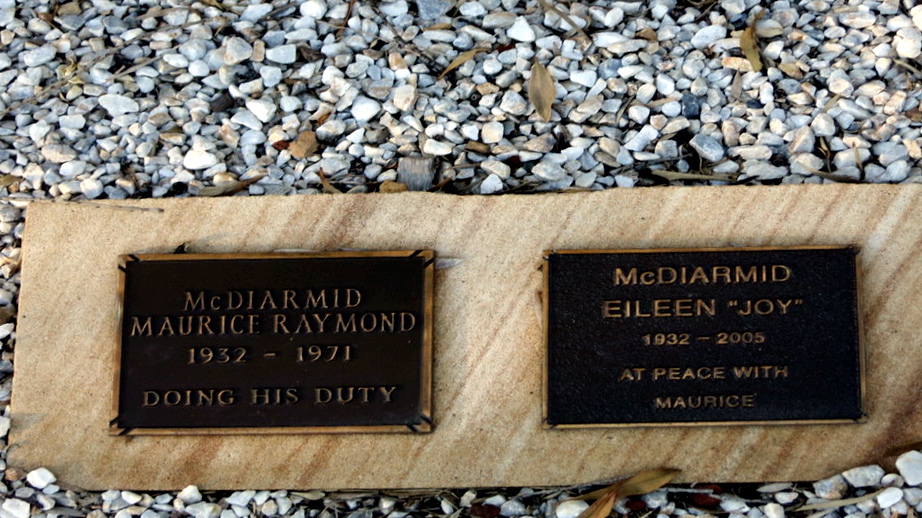
More than 400 officers attended their funeral in Blacktown. They were laid to rest at Pinegrove Cemetery with plaques bearing the inscription: “Doing His Duty”.
Canberra Times (ACT : 1926 – 1995), Saturday 27 November 1971, page 9
Two policemen commended by coroner
SYDNEY, Friday. — A Sydney coroner has commended two policemen who chased and stopped “an armed and desperate man“.
The man, Mr Ronald Desmond Clarke, had earlier shot and killed two other policemen after having killed his own brother in Toongabbie on September 30.
The coroner, Mr J. Parnell, SM, found on Wednesday that Mr Clarke in turn died in a car of cerebral lacerations and gun shot wounds to the brain inflicted by a person defending himself.
Constable A. C. Gregory, giving evidence at the inquest into the deaths of the four men, said that he and Constable L. ( Les ) A. Crawford in a police truck had rammed Mr Clarke‘s car, causing him to lose control.
Constable Gregory had seen Mr Clarke transfer a gun from his left hand to his right. The gun had been pointing at the policeman’s face and the constable had fired “one shot towards his shoulder“.
“The impact of this bullet appeared to throw him towards the passenger side of his car, but he still had the revolver, which he now held in both hands, levelled at my face“, Constable Gregory said.
“He appeared to be endeavouring to discharge the gun and it was then that I fired two quick shots at him“.
The four men who were killed were Sergeant First Class William Watson Riley, 50, and Sergeant Maurice Raymond McDiarmid, 39, of Blacktown, and Ronald Desmond Clarke, 20, and Warren John Clarke, 22, both of Toongabbie.
( Both policemen were promoted posthumously. Sergeant Riley was raised from second-class to first class, and Sergeant McDiarmid from senior constable to sergeant third class. )
Mr Parnell found that Mr Warren John Clarke died from gunshot wounds inflicted by his brother, Mr Ronald Desmond Clarke.
He found also that Sergeant Riley died from a fractured skull and lacerations to the brain, and Sergeant McDiarmid died in an ambulance between Toongabbie and Blacktown Hospital.
Both died as a result of bullet wounds inflicted by Clarke.
He said Mr Ronald Clarke, a professional criminal, had shot his brother, Warren Clarke, after having raped his brother’s de facto wife.
Canberra Times (ACT : 1926 – 1995), Friday 1 October 1971, page 1
Shooting in Sydney Brothers, two police die
SYDNEY, Thursday. – Two policemen and two other men were shot dead in the outer western Sydney suburb of Toongabbie today.
The policemen were shot while investigating a report of rape and murder.
Earlier, Mr Warren Clark about 22, died in his bed. Police said his elder brother, Ronald. 23, had shot him through the head with a .22 calibre repeater rifle.
A young woman, living in the house in Mimosa Ave, Toongabbie. with Mr Warren Clark, told police that Mr Ronald Clark had awakened her and then shot his brother.
The woman alleged that Mr Ronald Clark then raped her and forced her to accompany him in his car.
After driving her around for several hours, he had released her at Black town.
The woman went to Blacktown police station.
She was in a hysterical condition.
Sergeant Second-Class William Riley, 50. and Senior-Constable Morrie McDiarmid, 39. left the station immediately to go to the house.
While they were on their way the police radio directed other police to the house.
The next-door neighbour, in Mimosa Ave, Toongabbie. Mrs Ethel Roberts, 54. said she first knew something was wrong when a police officer ran down a driveway at the side of her house.
He began kicking on the door of the house next door.
“He eventually forced the door and went inside”, she said.
“All was quiet for perhaps two minutes, then three shots rang out.
“I ran to the front porch as a young blond man ran from the house with a rifle in his hand, entered a car and screeched off down the road”‘. Mrs Roberts said.
“After he drove off, I saw a policeman’s blood stained hand grasping the back steps of the house”.
Stem flow of blood
“I ran to the road where a woman was delivering bread and told her to call an ambulance”.
Another neighbour, Mrs Dawn Harris, was called by Mrs Roberts, who was trying to stem the flow of blood from Constable McDiarmid.
“When I reached the house a policeman was propped against the back steps”, Mrs Harris said.
“His mouth and part of his face were torn and shredded from the shotgun blast.
“Another policeman was lying dead on the ground.
“In a bedroom in the house another man covered with a sheet was also dead and blood could be seen everywhere”.
Police said later they believe Sergeant Riley died immediately when he was shot at point-blank range with a shotgun.
Constable McDiarmid was taken by ambulance to Blacktown Hospital. He died shortly after arrival.
Meanwhile an all-points bulletin was broadcast over the VKG police network for all cars to be on the lookout for a bright blue 1950 sedan.
The broadcast warned, ‘This man is dangerous. He has a .22 rifle, a shotgun and two police pistols”.
“We have sighted him”, one car replied. “He is going toward Hillview”.
“We have stopped the car”, was the officer’s next report.
Constable Alfred Gregory and Constable Les Crawford said later they had rammed the suspect’s car with their police van.
The sedan got out of control and crashed into a bowser at a service station.
Constable Gregory jumped out of the van. As he approached the car he saw Mr Clark take one of the police pistols from the seat and transfer it to his right hand.
Three shots from pistol
Constable Gregory fired three shots from his pistol.
One of his shots struck Mr Clark in the side of the head, killing him.
In the car, police found several Commonwealth Bank cash bags, a blood stained nightgown and two suitcases containing mostly women’s clothing.
Two police revolvers, a .22 repeater rifle and a sawn-off shotgun were also recovered.
Tonight forensic and ballistic experts were still examining them.
The policemen killed are each survived by a widow and two children.
Sergeant Riley joined the force in 1945 and Constable McDiarmid in 1956.
A CIB spokesman said this afternoon the families were eligible for a special allowance paid to police killed while on duty.
He said that the lack of witnesses, particularly when the two policemen were shot, was hampering investigations.
POLICE KILLED OR WHO DIED FROM INJURIES RECEIVED IN THE EXECUTION OF THEIR DUTIES
On 13th August, 1971, Senior Constable William Edward King, who was then the officer-in-charge of police, East Gresford, was shot dead at East Gresford Police Station by a man who fired upon him with a rifle.
On 29th August, 1971, Constable 1st Class Patrick Mark Hackett died from injuries received in a motor accident at Polis, Cyprus, whilst performing duty with the New South Wales Police component of the Australian Police Contingent of the United Nations Peace Keeping Force.
On 30th September, 1971, Sergeant Second Class William Watson Riley and Senior Constable Maurice Raymond McDiarmid, both then attached to Blacktown Police Station, were shot dead in a house at Toongabbie which they had entered to arrest a man who a short time before had murdered his brother and raped a woman in the same house.
A police funeral with full ceremonial honours was accorded these deceased officers at which appropriate tributes were paid.
In recognition of their outstanding courage Sergeant Riley and Senior Constable McDiarmid were posthumously promoted by me to Sergeant 1st Class and Sergeant 3rd Class respectively. In addition, I submitted recommendations to the Premier for favour of consideration of Royal Awards being granted in both cases.
To assist the widows of the deceased police the Premier approved the payment to each of them of the sum of $12,500 as a gratuity. This payment did not in any way affect their entitlements to payments under the provisions of the Police Regulation (Superannuation) Act.
In December 2016, Bert had fallen over and broke his leg for which he was an inpatient of Coledale Hospital for about 8 weeks.
On Thursday 23 November 2017, Bert was driving along Jervis Bay Rd, South Nowra, when his vehicle was involved in an MVA whereby Bert hit his head on the windscreen which, ultimately, led to his death. His wife, Beryl, has sustained a broken rib and is resting at home with family.
Bert’s funeral will be held on Monday 4 December 2017 @ 10am at Parsons Funerals, 34 Belmore St, Wollongong, followed by a private burial.
Bert attended the 1st ever BAS Course in Melbourne in 19?? with Dick Brook, Les Austen, Wally Dent & Max Ebrill., Wollongong BAS – ( Breath Analysis Section )
Thomas Edward BACON
| 20/12/2017
Thomas Edward BACON
Late of ?
Unknown Australian Police Force
Regd. #
Rank: ?
Stations: ?
Service: From? ? ? to? ? ? = ? years Service
Awards: No find on It’s An Honour
Born: ? ? 1935 – 36
Died on: ? November 2017
Age: 82
Cause: Suicide – firearm – .38 Smith & Wesson – to the throat
Event location: Bang Khun Thian, Ekachai Soi 88, Bangkok
Event date: ?
Funeral date: ? ? ?
Funeral location: ?
Buried at: ?
Memorial located at: ?
[alert_blue]THOMAS is NOT mentioned on the Police Wall of Remembrance[/alert_blue]*NOT JOB RELATED
[divider_dotted]
Funeral location: TBA
[divider_dotted]
FURTHER INFORMATION IS NEEDED ABOUT THIS PERSON, THEIR LIFE, THEIR CAREER AND THEIR DEATH.
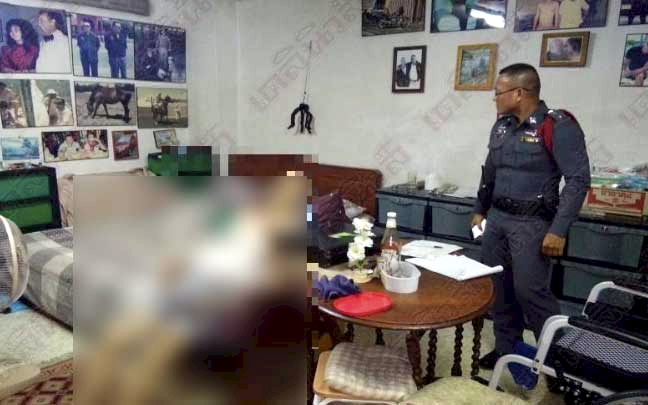
Retired Aussie policeman shot himself because he “didn’t want to be a burden”
Bang Khun Thian police were called to a condominium in Ekachai Soi 88 in Bangkok on Saturday after reports that a foreigner had shot himself.
In the sixth floor room on a bed they found 82 year old Thomas Edward Bacon (name transliterated from Thai) with a single gunshot wound to the throat from a .38 gun.
On a table was a suicide note. It read: “I don’t want to be a burden for anyone to look after”.
The victim’s wife Thanakorn Lomrat, 54, who owns the condominium, said that her husband was a former policeman. He came to Thailand twenty years ago but his health had deteriorated and he had many illnesses.
Recently he had suffered diabetes that had affected his eyesight and was barely able to walk.
The body was sent for autopsy and the embassy have been informed.
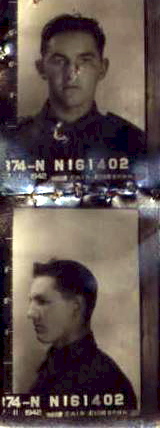
Enlisted: Port Moresby, New Guinea on 5 February 1943 Was 18 when he Enlisted but attempted to to tell them he was 21
Attempted to used the DOB 20 Sept 1921 instead of 1923. Employed as a Farmer and was Single
Service # NX152148 Army # N161402
Rank: Private
Embarkation: ?
Next of kin: William Thomas Algie of Cundletown, Taree. His father.
Religion: Roman Catholic
Single / Married: Single
Returned to Australia: Home address: River View, Merriwa, NSW. Was married at time of Discharge and was 22 old. 6′ tall, brown eyes, fair complexion & brown hair. Embarked on 28 January 1943 and Disembarked in Australia on 8 August 1944. Served on continuous Full Time War Service in the CMF from 24 Feb 1942 to 11 March 1943 and then the AIF from 12 March 1943 to 22 Feb 1946 – a total of 1439 day which included Active Service in Australia of 832 days and Active Service Outside Australia for 588 days.
Retired Sergeant 1st class Alex Algie, reg No. 6421, 94 old of South West Rocks, passed away am Thursday 12 October 2017. Alex played his last game of golf on Saturday. At 94 he was still hitting 100 balls each day, playing golf three days a week and playing off a handicap of 18. Will notify when funeral arrangements are known.
His son who was a serving member of the Commonwealth Police, Canberra, in the late 1960’s.
[divider_dotted]
Algie, Alexander “Alex”
Passed away 12th October 2017
Aged 94 years
Late of Arthur Street, South West Rocks.
Beloved husband of Betty (dec).
Sadly missed by his children and their families.
Alex’s relatives and friends are invited to attend his funeral service at Our Lady Star of The Sea Catholic Church, South West Rocks on Wednesday 18th October 2017, service commencing at 11:00 am then for burial in the Arakoon Cemetery.
All service personnel are respectfully invited to attend.
A very pretty wedding, followed by Nuptial Mass, was celebrated at St. Anne’s Church, Merriwa, on Saturday, 28th April, by Rev. Father Casey, when Betty, youngest daughter of Mrs Duggan, and the late Mr. T. Duggan, was joined in holy matrimony to Private Alexander Algie, A.I.F., eldest son of Mr. and Mrs. W. Algie, of Taree.
Besides the immediate relatives, there was a large gathering of friends present at the Church, testifying to the popularity of the young couple. As the bride, who was given away by her brother, Mr. Vince Duggan, entered the Church, Miss K. Robison, who presided at the organ, played the Wedding March. The choir was present, and during the signing of the register sang an anthem. The bride was charmingly attired in a dress of English satin, and her embroidered tulle veil was held in place by a coronet of orange blossom. Her bouquet was of pale pink and white chrysanthemums.
The bridesmaids were Miss Moreen Dowd and Miss Heather Algie (sister of the bridegroom). The former chose for her costume blue net over satin, with a headdress of tulle,, and carried a bouquet of chrysanthemums of matching shade. The latter was dressed in a pink lace frock, with matching headdress and carried a bouquet of pink and white chrysanthemums. The trainbearers were little Coleen and Pat Egan, daughters of Mr. and Mrs. Maurice Egan. Each was dressed in pink and blue satin, with coronets of net in matching color. The little ones looked charming and, with the bride, were the centre of attraction. The best man was Mr. Ted Duggan, brother of the bride, and Mr. Victor Jones was groomsman.
The reception was held in the School of Arts, where Mrs. Duggan and Mrs. Algie received some sixty guests. Mrs. Duggan chose a smart frock of pink English crepe, with black accessories, and wore a posy, of pale pink roses. Mrs. Algie looked attractive in a suit of grey, trimmed with red, with which she wore black accessories.
Father Casey presided, and the usual toasts were honored. The happy couple were the recipients of many valuable and useful presents.
The honeymoon is being spent at Tuggerah, and the future home of the young couple will be at Taree after Pte. Algie’s discharged from the Army.