For the purposes of this website ‘Q‘ represents those Police joining between 1862 ( commencement of NSWPF ) – 23 February 1915 ( Commencement of NSWPF current numbering system )
Rank: Constable ( Mounted Police Trooper ) – appointed 15 March 1910
Sergeant 3rd Class – appointed ? ? ?
Final Rank = Sergeant 3rd Class
Stations: ?, Hill End ( Constable – 1913 ), Fifield ( SenCon 1920 ), Berrigan ( 2 years ) – Death
Service: From 15 March 1910 to25 March 1931 = 20+ years Service
Embarkation: 201014 at Sydney on H.M.A.T. A14 ‘Euripides”
Age at embarkation: 25 yrs 10 mths
Occupation: Mounted Police Trooper
Address: Bega
Next of kin: Father: George Edward WHITELEY – A farmer
Religion: Roman Catholic
Single / Married: Single
Returned to Australia: 191018 from Plymouth, England on D24, “Sardinia”
Awards: 1914 /15 Star, Returned Solider badge # 87105
Injuries: gunshot ( shrapnel ) wound to lower lip – 130515. 9 days under treatment. Gunshot wound to left leg, left foot & right side of head. He stated that while serving in Gallipoli, he suffered from indigestion for the first time and has suffered on and off whit it ever since. In the past twelve ( months ) the attacks of pain with occasional vomiting have been more frequent…. Twelve days before admission and on the 5th July, he vomited about a couple of pints of blood.
Attributable to service during war and active service conditions in Gallipoli.
Discharge #: 56009
Previously Served in the Colonial Force.
Description: 5′ 8″ tall, fair complexion, blue eyes and fair hair. Chest = 34.5 – 40″. 11 stone 12 lbs. No marks on body.
[/blockquote]
Sgt George Thomas WHITELEY ( 29 old ) of 1st Division H.Q., ( The Hutment Camp, Abbotsbury Rd, Wyke Regis, U.K. married Kate HARPER ( 22 old ), Spinster of 2 Block A, The Flats, Tidworth, England ( occupation: Clerk ) at St. Augustine’s Chapel, Dorchester Rd, Melcombe Regis, Weymount, England by Roman Catholic Priest Thomas Sheehan on the 3 October 1918. Registrar’s Reference # 80.
In 1936 – after the explosion, his wife was living at 134 Railway Pde, Carlton, NSW. This address ( 2019 ) is / was the Westpac Bank, Kogarah.
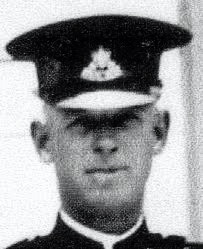
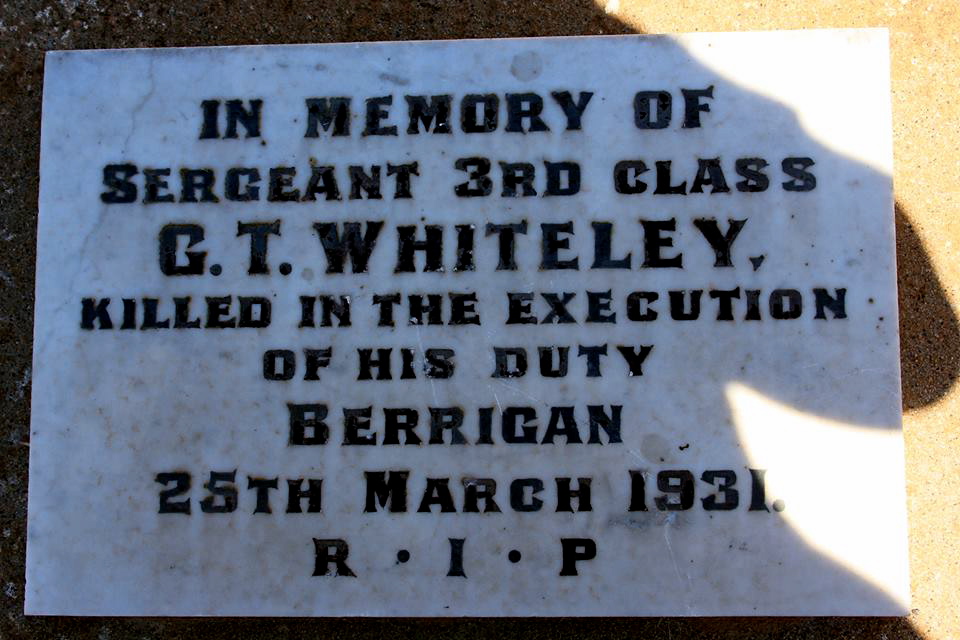
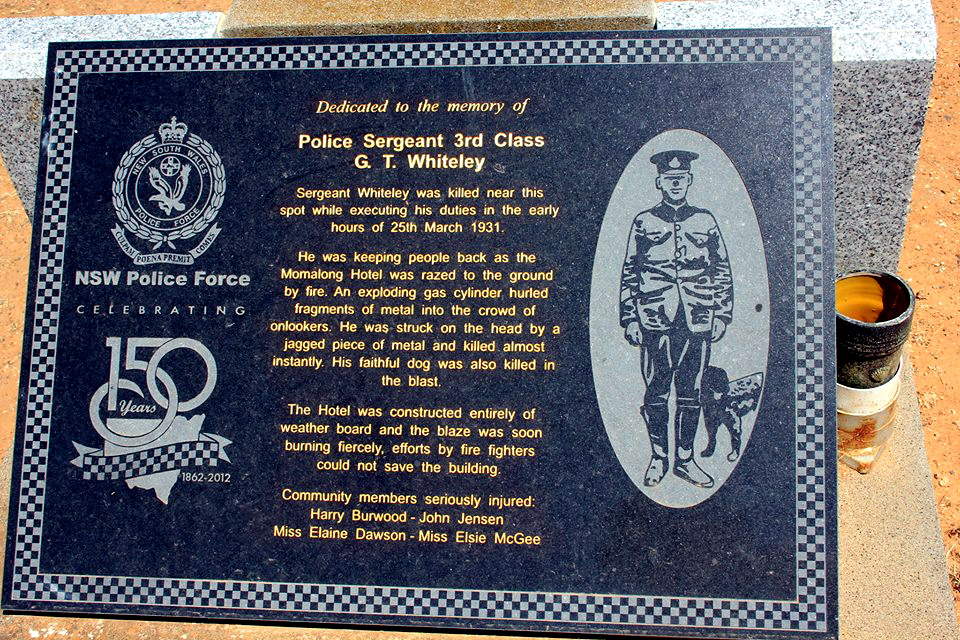
About 4am on 25 March, 1931Sergeant Whiteley and Constable McRae attended a fire at the Momalong Hotel, Berrigan.
During the fire both police officers were standing on the roadway outside the hotel when a gas cylinder exploded and a piece of flying metal struck the sergeant in the face, causing “injuries of a terrible nature” and killing him instantly.
Three bystanders (of an estimated two thousand who were watching the blaze) were also badly injured in the blast and another five were hit by flying steel, however all others recovered.
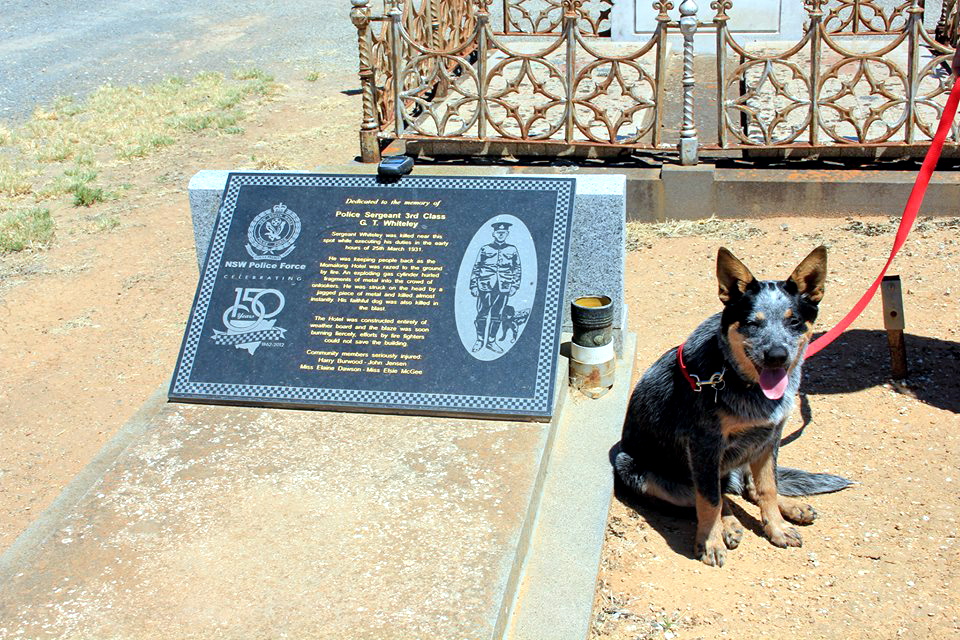
The sergeants faithful dog, which was standing beside his master, was also struck by flying debris and killed instantly.
The Canberra Times of 26 March, 1931 carried the following account of the incident.
FATAL EXPLOSION IN FIRE AT BERRIGAN. Police officer killed by flying steel.
Sydney, Wednesday.
The explosion of a gas cylinder occurred during a fire at the Momalong Hotel, Berrigan. Within a few minutes the entire population had turned out. The flames spread with great rapidity. The occupants of the hotel made a speedy exit. When the cylinder exploded with a terrific roar, Sergeant Whiteley and Constable McRae were standing in the centre of the roadway. A piece of steel became embedded in Whiteley’s head. He was quickly conveyed to a local surgery where life was pronounced extinct.
Michael Hurood, Elsie McGee, and Elaine Dawson were struck by flying steel and badly injured about the body. They are expected to recover.
A bucket brigade did splendid work.
More than two thousand persons turned out to watch the fire, but when the explosion occurred there was a wild dash for safety.
Whiteley, who was 41, suffered injuries of a terrible nature, while a dog standing beside him was killed instantly.
Five other men were hurt by flying steel.
Whiteley was married with five children.
The sergeant was born in Bega in 1886 and joined the New South Wales Police Force on 15 March, 1910.
At the time of his death he was stationed at Berrigan.
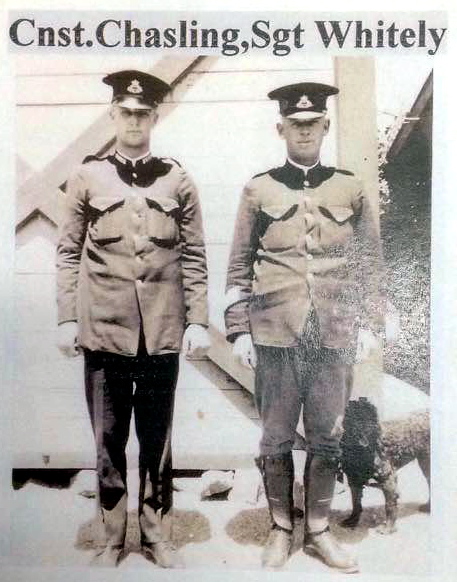
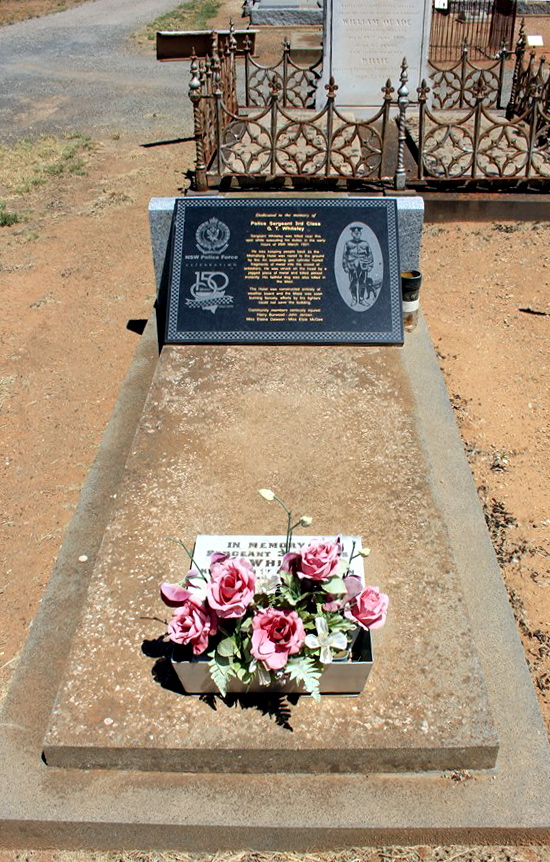
Constable Chasling & Sgt Whitely ( Whiteley ) at Berrigan Police Station. And, no doubt, the “faithful dog of Sgt Whiteley” also killed in the explosion.
Western Argus ( W.A. ) Tuesday 31 March 1931 page 13 of 36
GAS CYLINDER EXPLODES POLICE SERGEANT KILLED. DISASTROUS FIRE AT BERRIGAN. Sydney, March 25.
A police sergeant was killed, three people were hurt and nearly 1000 others scattered in terror when, during a fire at the Momolong Hotel, Berrigan, a gas cylinder exploded. The dead man is Sergeant C. George Whitley (41) married, with five children.
Whitley saw service at the war, and was at the Gallipoli landing. Mick Hurwood, Miss McGee and Miss Elaine Dawson ( was a former Echuca girl, living in High Street ) were injured by flying fragments of steel and wood. The two girls were taken to hospital.
The entire population of 2000 turned out when a fire engine rushed up the main street at 4.30 a.m. Hundreds of people assisted the firemen in trying to quell the outbreak, but the hotel was burned to the ground. In the hotel was a 40 lb. gas cylinder, which exploded during the height of the blaze. With a terrific roar it burst into flames, and sparks shot high in the air. The crowd scattered in terror. Whitley and Constable McRae were standing in the middle of the roadway assisting the fire fighters when there was a yell from the crowd. “Look out,” shouted a number of men, and they and the police ran for safety. McRae tried to catch hold of Sergeant Whitley and threw himself flat on the ground. A piece of steel, became embedded in Whitley’s head. McRae was not injured. Pieces of steel and wood cut their way into Hurwood’s leg, and the two girls were hurt about the body. They are expected to recover. The cause of the fire is unknown. Residents of the hotel hurriedly left the building, which was a single storied one, when the outbreak occurred.
Daily Standard (Brisbane, Qld. : 1912 – 1936), Thursday 26 March 1931, page 9
POLICE SERGEANT KILLED BY EXPLOSION
FIRE BURSTS CYLINDER.
SYDNEY, Wednesday.
Police-sergeant George Thomas Whitley, 41, married, with five children, was killed, three persons hurt, and about 1000 others scattered in terror this morning, when, during a fire at the Momolong Hotel, Berrigan, a gas cylinder burst.
A fire broke out at 4.30 o’clock, and the entire population turned to in an effort to save the hotel. Nothing, however, could be saved, and the hotel was burnt to the ground, though adjoining premises were saved from destruction.
There was a 40lb cylinder of carbonic acid gas in the hotel, and during the fire this exploded with a terrific roar.
Sergeant Whitley was standing in the roadway with Constable McRae when the cylinder burst. McRae threw himself to the ground, endeavoring to pull Whitley with him, but a piece of steel embedded in Whitley’s head, killing him instantly.
Michael Hurwood, Elsie McGee, and Elaine Dawson were injured about the legs and body by flying steel, all being seriously hurt. They were taken in motor cars to Corowa Hospital.
Whitley was a well-known and popular officer, aged 43, and joined the force 21 years ago.
NSW Government Gazette – issue 108, page 3292. Friday 4 June 1920
Electoral Appointments
Second Class Constable George Thomas WHITELEY, Fifield ( near Trundle ). – Electoral District: Murrumbidgee – Polling place: Fifield In lieu of McLean – on leave. To take effect on 22 March 1920
Bathurst Times (NSW : 1909 – 1925), Wednesday 8 January 1913, page 4
POLICEMAN ASSAULTED.
CASE AT HILL END.
HILL END, Tuesday.
Considerable interest was centred in the local Police Court proceedings on Saturday morning, when Vivian Clyde Cook, a resident of Hill End, was charged with assaulting Constable George Thomas Whitley while in the execution of his duty.
The accused was represented by Mr. Casey, solicitor, from Orange, and Inspector Rank appeared for the police.
The facts of the case as stated by Constable Whitley were that on New Year’s night he was in Clarke-street when he heard the Roman Catholic Church bell ringing. He hastened away to the church, and when near there heard stones being thrown on the church. He also saw three men running away.
Witness and Constable Creevy gave chase. After running about 400 yards he came up with one of them, whom he recognised to be the accused. Witness said, “Alright, Cook, I will give you a summons for this.” Then he turned to run after the other two. When he had gone a few paces he was hit on the head with a stone, which knocked him down on the ground. He got up again quickly, and saw the accused lying on the ground, he also heard him saying someone had hit him.
Then witness and Creevy arrested Cook, and locked him up for the night.
Dr. Michael John Ryan stated that about 2.30 on New Year’s morningConstable Whitley was brought to him suffering from a severe wound on the head. He dressed the wound and put in two stitches. The wound was about a quarter of an inch from the temple.
The doctor said that he considered the constable was out of danger, but Constable Whitley could not go on duty for at least one week yet.
At this stage, Mr. Casey, solicitor, made a very strong appeal to the P.M. not to send the accused to gaol.
He pointed out that he had never been before the Court before; that he was a hard-working young man; that he was extremely sorry for what he had done, and that he belonged to a very respectable family.
There were a number of young men, most of whom were in the Court, at the time, who had made up their minds to give the police all the trouble they could. They were known as the “Kelly Gang.”
The police had had no trouble whatever with anyone.
The P.M. said that the case was a very serious one indeed, and on hearing the doctor’s evidence he had made up his mind to send accused to gaol.
The accused promised to be of good behavior.
The P.M. then imposed a fine of £15 and £3/4/ costs.
Four days were allowed in which to pay.
Two other charges— one for insulting language and the other riotous behavior were withdrawn.
For the purposes of this website ‘P‘ = represents those Police joining Pre 1 March 1862 before the amalgamated of all other Policing Units in NSW. i.e. Mounted Police, Boarder Police, Native Police, Gold Escort Police, Water Police etc.
Rank: Commenced Training as a Probationary Constable – appointed 5 February 1858 ( aged 22 years, 4 months, 15 days )
Constable – appointed 18 February 1858
Constable 1st Class – appointed ? ? ?
Detective – appointed ? ? ?
Senior Constable – appointed ? ? ?
Leading Senior Constable – appointed ? ? ? ( N/A )
Sergeant 3rd Class – appointed ? ? ? ( N/A )
Sergeant 2nd Class – appointed ? ? ?
Sergeant 1st Class – appointed ? ? ?
Final Rank: = Sergeant
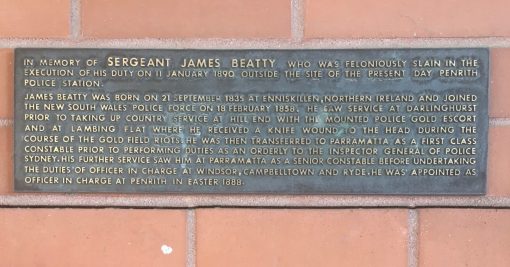
Stations: Darlinghurst ( 3 Division ), Hill End ( Mounted Police gold Escort ), Lambing Flat, Parramatta ( 1st Class Constable ), Orderly to the Inspector General of Police – Sydney, Parramatta ( Senior Constable ), Windsor ( O.I.C. ), Campbelltown O.I.C., Ryde O.I.C., Penrith O.I.C. ( J District )( Easter 1888 – Death )
Service: From 5 February 1858 to11 January 1890 = 31 years, 11 months, 6 days Service
Retirement / Leaving age: = 54 years, 3 months, 21 days
Time in Retirement from Police: Zero
Awards: No Find on Australian Honours system
Born: Monday 21 September 1835 Enniskillen, Northern Ireland
Died on: Saturday 11 January 1890
Age: 54 years, 3 months, 21 days
Organ Donor: N/A
Cause: Murdered – Stabbed – On Duty
Event location: Outside of Penrith Police Station, NSW ( site of the current Station )
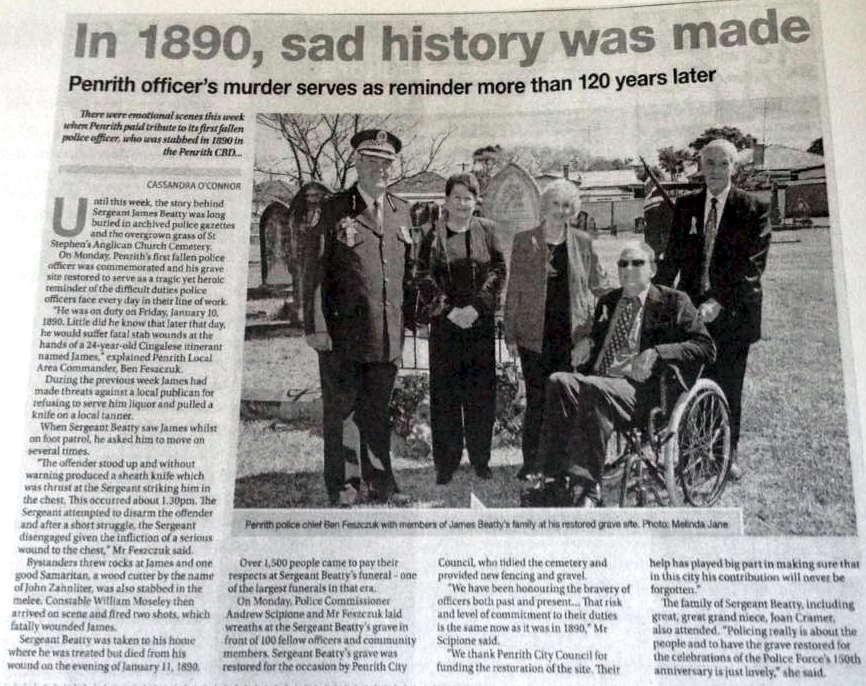
On 11 January, 1890 outside the Penrith Police Station, the sergeant had occasion to speak to an Indian vagrant whom he had earlier asked to leave town.
The man suddenly leapt at Sergeant Beatty, stabbing him five times.
Local people and Constable William Moseley then pursued the offender and cornered him however the man threw a brick which struck the constable in the chest.
Constable Moseley then drew his service revolver and shot the offender, wounding him.
The constable and locals then threw themselves on the offender and he was arrested.
The offender died later that night.
Unfortunately, the wounds inflicted upon Sergeant Beatty also proved to be fatal.
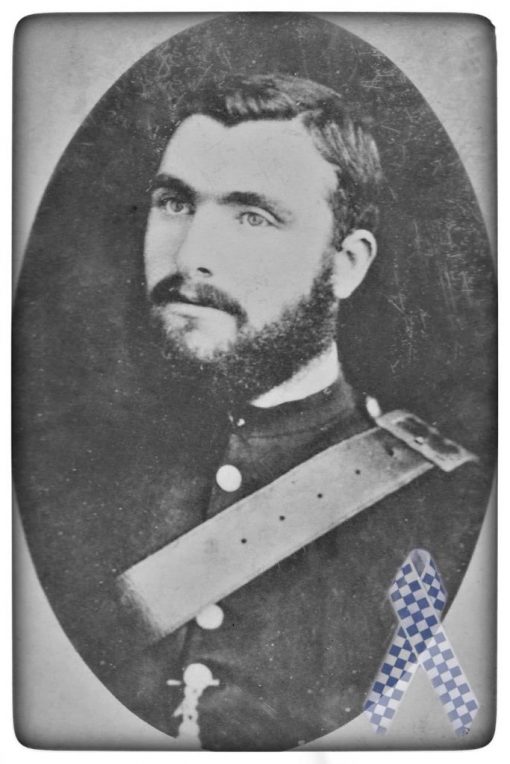
The sergeant was born in 1835 and joined the police force on 5 February, 1858. In 1862 he became a member of the newly-formed New South Wales Police Force. At the time of his death he was stationed at Penrith.
James BEATTY’s mother died five days before his own demise.
James had previously suffered a knife wound to the head during the course of the Gold Field Riots at Lambing Flat, NSW.
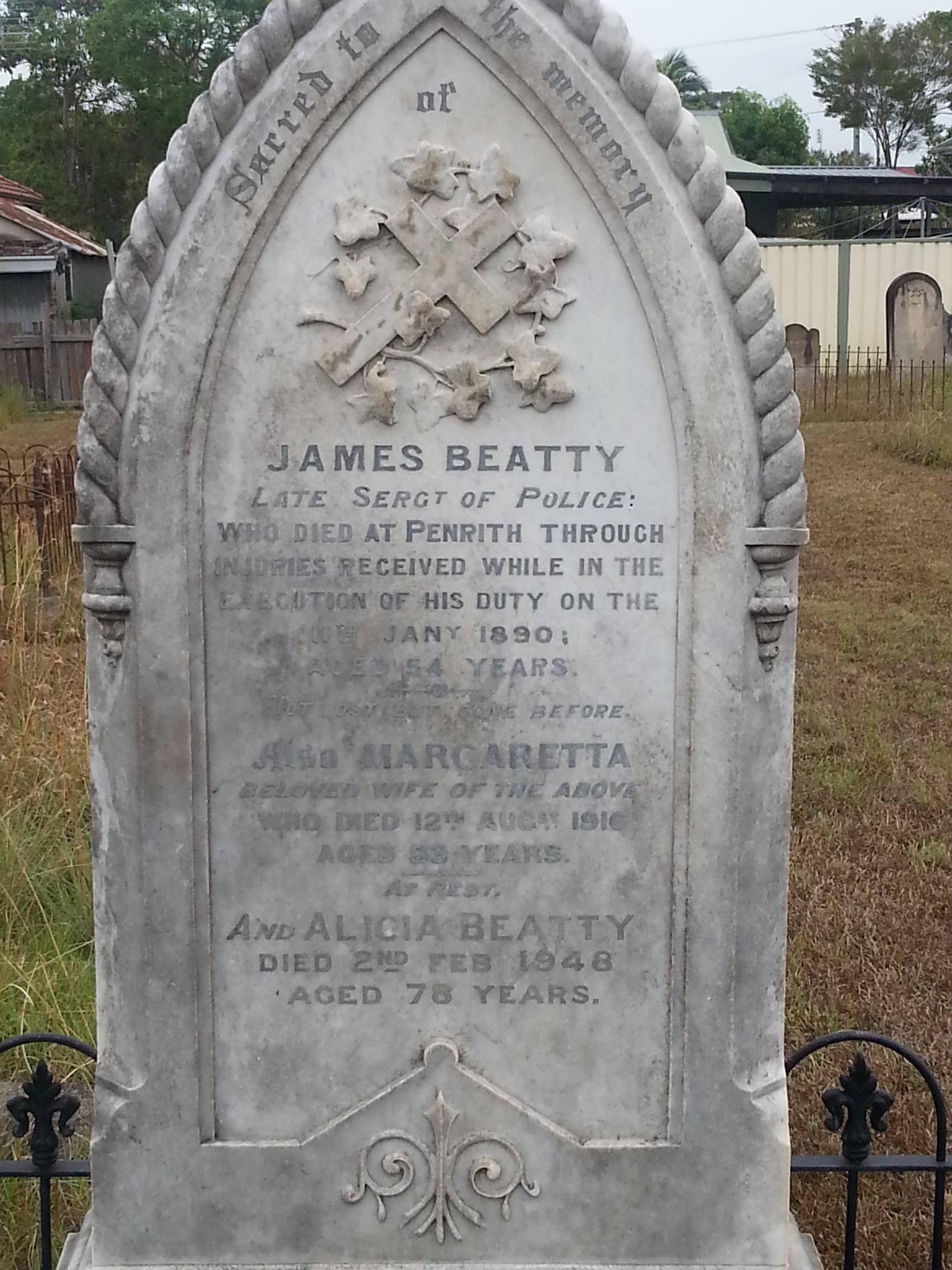
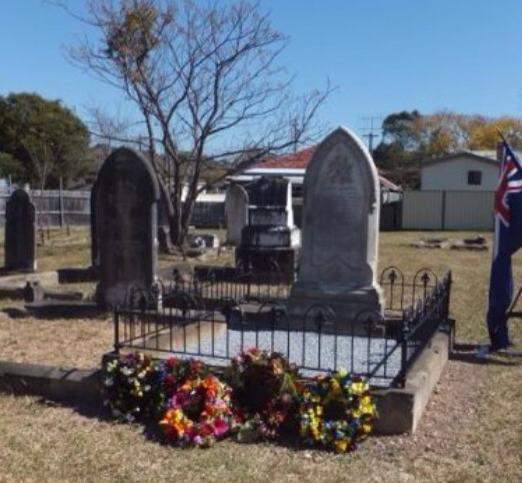
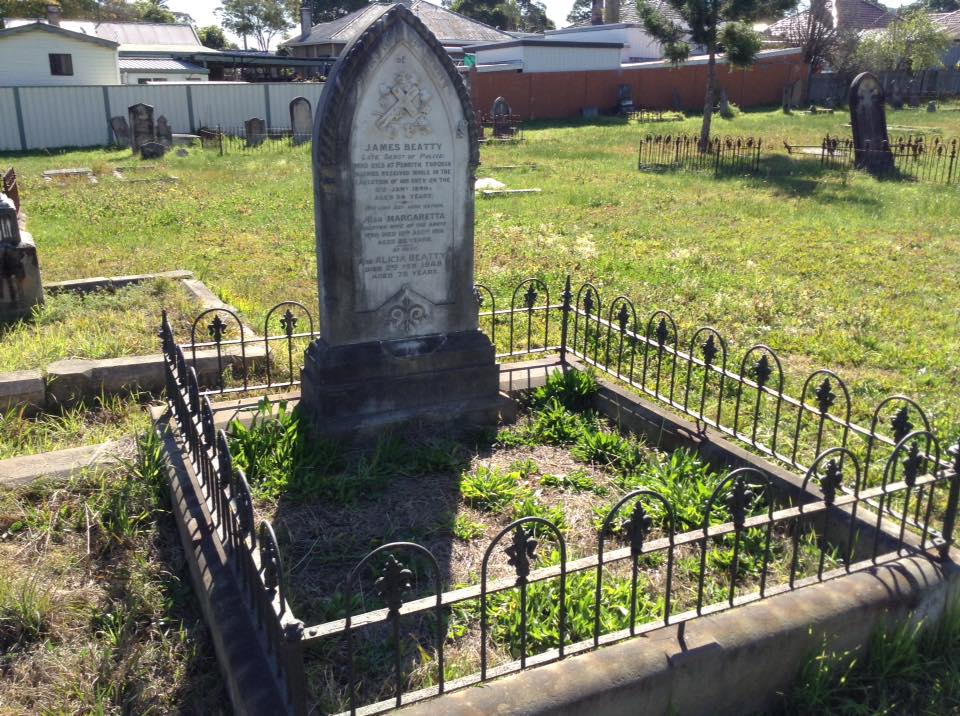
Sgt Beatty’s grave, photo courtesy of Windy Gale – FB
The Launceston Examiner of 11 January, 1990 provided the following news of the tragedy.
TERRIBLE TRAGEDY. A terrible tragedy was enacted this afternoon at Penrith. A coloured man, a stranger in the town, was observed by Sergeant Beatty to be throwing stones at passers-by.
The officer warned him to desist, and was in the act of arresting him when he drew a knife and stabbed Beatty in the chest, the weapon going completely through his body.
Beatty called out, and Constable Mosley came to his assistance, armed with a revolver.
Mosley[Moseley] fired at the coloured man, who was in the act of running away, but missed. A second shot, however, took effect, and the fugitive reeled and was about to fall, when a young man named Zolliner [John Zahnliter] seized him.
Both men rolled over on the street, and the coloured man drew the knife again and stabbed Zolliner.
He was ultimately seized and taken to the lock-up.
Sergeant Beatty, who is not expected to recover, has had his dying depositions taken. Zolliner‘s wound is not serious.
As seen by Col Colman on Friday 28 August 2020 Col Colman Also visited St. Stephens. Anglican Church High Street Penrith and the Cemetery at the rear to visit the grave site of Police Officer James Beatty. Site was cleaned in 2012 by Police and Penrith Council and is in reasonable condition did a little weeding.
Published on Friday, 14 September 2012 06:52 | Written by Mary Thorne | |
On 10th January 1890 Sergeant James Beatty, a long serving officer in the NSW Police Force was fatally stabbed in High Street Penrith. Sergeant Beatty was buried with full police honours in St Stephen the Martyr churchyard cemetery, Fulton Lane, Penrith.
“About 1.30pm on 10 January 1890, Sergeant James Beatty had occasion to interact with an itinerant Cingalese named James in High Street, Penrith outside the Convent of the Sisters of St Joseph. During that interaction the Sergeant was stabbed in the chest.
In the meantime, the offender was contained by townspeople pending the arrival of Constable Moseley who shot the offender. A good Samaritan named John Zahnliter was also stabbed during the melee. Sergeant Beatty died of his wound on the evening of 11 January 1890. He was survived by his widow Margaretta, four sons and two daughters.”
St Joseph’s Convent, High Street Penrith (now Officeworks)
Penrith City Council Library Local Studies collection
On 3rd September, 2012, as part of the 150th Anniversary of the NSW Police Force, a commemorative service was held at Sergeant Beatty’s gravesite to honour his sacrifice, the event a joint venture between Council and Penrith Local Area Command.
Sergeant Beatty’s monument was in a dilapidated and damaged state. Council arranged and funded the restoration of the monument to its former glory by master stonemasons, Monuments in Memoriam who are based at Rookwood Necropolis. All restoration work was in accordance with the National Trust of Australia (NSW) Guidelines for Cemetery Conservation, the Burra Charter and Penrith City Council’s LEP.
Since 1982, Penrith City Council has been the trustee of this significant churchyard cemetery which dates from 1838 with full responsibility for its care and maintenance. The Public Domain Amenity and Safety two man cemeteries crew, maintain five cemeteries, Penrith, St Marys, Emu Plains, Castlereagh and St Stephens.
In preparation for the occasion an intensive clean up of the cemetery took place with staff from the City Presentation Group – Parks, Public Domain and Cemetery Operations spending a day in the cemetery. The heritage nature of the cemetery and fragility of the monuments meant that whipper snipers could not be used and all trimming around and inside monuments was by hand.
Fragile heritage cemeteries are protected by the grasses that grow around and inside the monuments. Plans of Management are currently being prepared for the cemeteries under Council’s control and the consultant’s recommendation for St Stephens is that we should avoid overly detailed or manicured works. The Cemetery should look old, avoid pristine maintenance and maintain the wild character of the grasses within the grave enclosures.
The commemorative service to honour the memory of Sergeant James Beatty was attended by Andrew Scipione APM, Commissioner of Police, Nick Kaldas APM, Deputy Commissioner of Police (Field Operations), Ben Feszczuk APM, Local Area Commander, former Commissioner of Police, Tony Lauer APM, Hon David Bradbury MP, Stuart Ayres MP, Beatty family descendants, Councillor Greg Davies, Mayor of Penrith, Councillor Ross Fowler OAM, Alan Stoneham, General Manager, Barry Husking, Director, David Burns, Group Manager – City Presentation, managers Yvonne Perkins and Barbara McGee, council officers and police personnel.
Mary Thorne, Cemeteries Project Officer
Nepean Times (Penrith, NSW : 1882 – 1962),
Thursday 12 February 1948, page 6
Old Tragedy Recalled
DAUGHTER. OF SERGT. BEATTY PASSES.
Miss Alicia Beatty (68), who died on 2nd inst. and was buried in St. Stephen’s cemetery, Penrith on 3rd, was the daughter of Sergt James Beatty, who was fatally stabbed by a Cingalese in High Street, Penrith, on January 10, 1890, an incident that is often referred to by the older generation of the district.
The story, briefly told, is that the Cingalese had been prowling around the town for a few days and on the day of the tragedy was ” moved on ” by the Sergt, who followed him for some distance. The man then sat down on the pavement near the Convent and Sergt. Beatty, not liking his appearance, again ordered him to clear out.
The Cingalese started to his feet and, without any warning, drew a sheath knife and, rushing in, stabbed the Sergeant in the chest.
A man named John Zahnliter tried to disarm the assailant and was stabbed in the side.
The Cingalese was shot by Constable Moseley.
Sergt Beatty and the Cingalese died subsequently of their wounds, and Zahnliter recovered, though he suffered severe physical disability, for which he received a pension, till his death many years afterward.
Miss Beatty was buried alongside her late father and mother, in the old St. Stephen’s cemetery. Mrs. Beatty died on August 12, 1916.
( For the purposes of this website ‘Q’ represents those Police joining between 1 March 1862 ( commencement of NSWPF ) – 23 February 1915 ( Commencement of NSWPF current numbering system )
Rank: Constable – appointed 27 September 1878
Constable 1st Class- appointed February 1884
Stations: Bathurst, Coonamble – Death
Service: From 27 September 1878 to 13 March 1885 = 6.5 years
Awards: ?
Born: 18 August 1856 in Uig, Ross & Cromarty, Scotland
( This cemetery no longer exists and was turned into a Park around 1970 and the headstones removed. See *below )
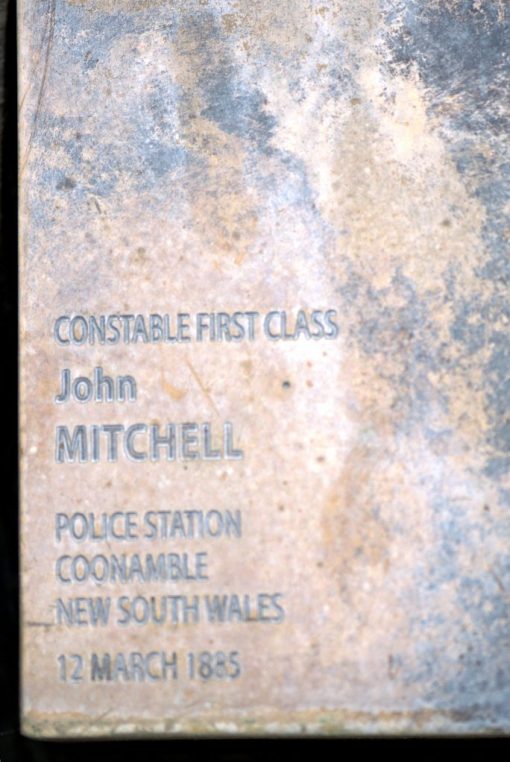
JOHN IS Mentioned on the Police Wall of Remembrance
John MITCHELL – National Police Wall of Remembrance, Canberra – 2015
Early in the morning of 12 March, 1885 two prisoners in the lockup at Coonamble overpowered a warder by the name of Michael Langley who had gone into their cell to place leg irons on a third prisoner by the name of Courtney.
He was knocked to the floor and his revolver taken from him.
Hearing the scuffle, Constable Mitchell, acting Gaoler at the time, arose from his bed and ran to the cells to assist.
One of the prisoners, a man named Angel, warned the constable not to come into the cell however Mitchell ignored this and lunged at the prisoner. As he did so he was shot in the chest. He died about 7am the following day.
In a dying deposition given to the Coonamble Police Magistrate on 12 March, Constable Mitchell said, ‘I am acting Gaoler at Coonamble gaol; at about a quarter past six this morning the 12th March inst., I opened the door of the guard room Coonamble Gaol; the Warder just then came into the cell where the convicted prisoners Angel, Thurston, and Courtney were confined; I heard a noise in the cell as if a man was being strangled; I came in and the warder was lying down on the cell floor; Angel was strangling him and Thurston was taking the revolver from him; I made a rush and Courtney knocked me over; Angel then got the revolver and both he and Thurston rushed at the cell door; Angel said “Keep back or I’ll shoot you”; I made a rush to try and get the revolver from Angel when he shot me; they then shut the warder and myself together with Courtney, who did not get away owing to Warder Langley’s threatening to kill him if he moved in the cell and rushed away. “
Both Angel and Thurston managed to escape, however both were later shot to death by police.
James Alfred Courtney, the third prisoner, was later found not guilty of involvement in the murder as he had been found by other police after the murder and escape, still in the cell attempting to assist Constable Mitchell by bathing his wound with cold tea (there was no water in the cell). A recommendation was then made to have his previous sentence reduced.
The constable was born in 1855 and joined the New South Wales Police Force on 27 September, 1878. At the time of his death he was stationed at Coonamble, and had previously been stationed at Bathurst.
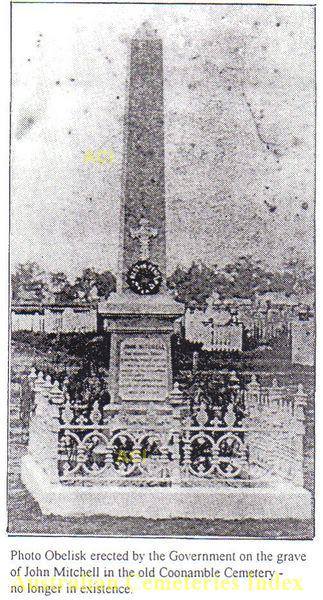
The original general cemetery in Coonamble was in operation from 1869 to 1912 when it was deemed to be full and closed to further burials. Many years later (probably around 1970), Council removed the headstones and converted the area into a park.
In the preface to her book, “Coonamble Memorial Wall Pioneer Profiles”, local historian Joan McKenzie explains: “When the old cemetery at the end of Warrena Street was cleared about thirty years ago, a number of headstones were retained and embedded on and around a large mound of earth. In 1993, a Federal Government grant enabled the Shire Council to move those headstones to the cemetery in West Coonamble, which had been established circa 1902. ”
Appropriately, the site chosen by Council to devote to the display of those old stones adjoined the historically significant Sexton’s Hut, erected in 1912. The display was organised into three sections: a covered double-sided memorial wall, a group of sandstone monuments and a group of marble monuments. The work was completed to a high standard and dedicated on 12 September 1993. A list of 611 names of persons whose deaths were registered at Coonamble during the period that the old cemetery was in operation, and known or presumed to have been buried at the old site, was inscribed and mounted on the side of the Sexton’s Hut.
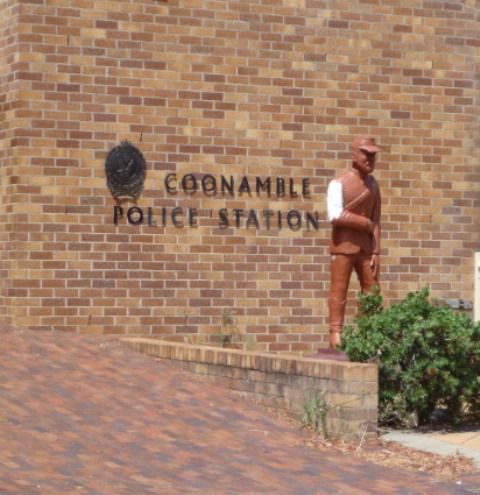
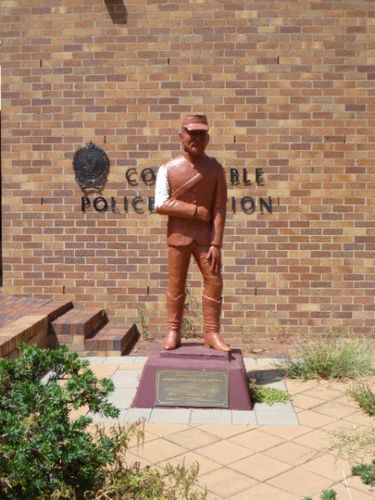
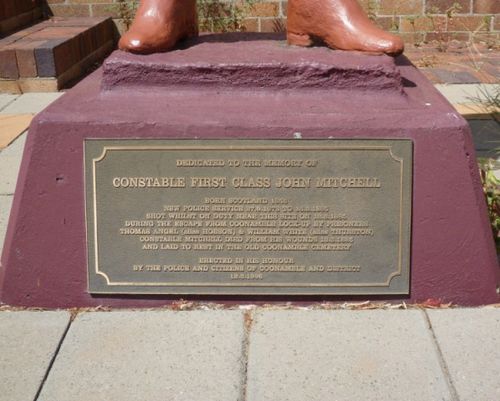
Statue of Constable Mitchell who was shot while trying to prevent the escape from gaol of bushrangers Angel and Thurston in 1885. Front Inscription Dedicated to the memory of Constable First Class John Mitchell. Born Scotland 1856. NSW Police Service 27.9.1878 to 13.3.1885. Shot whilst on duty near this site on 12.3.1885 during the escape from Coonamble lock-up by prisoners, Thomas Angel (alias Hobson) and William White (alias Thurston). Constable Mitchell died from his wounds 13.3.1885 and was laid to rest in the old Coonamble Cemetery. Erected in his honour by the police and citizens of Coonamble and District 12.3.1996. Actual Monument Dedication Date: Tuesday 12th March, 1996 GPS of monument: Lat: -30.952500 Long: 148.388056 Note: GPS Coordinates are approximate. Unveiled by his great grandson.
John Mitchell – Photo Obelisk erected by the Government on the grave of John Mitchell in the old Coonamble Cemetery – no longer in existence.
Bathurst Free Press & Mining Journal ( NSW ) Friday 13 March 1885 page 2 of 4
FRIGHTFUL TRAGEDY AT COONAMBLE.
– * –
A CONSTABLE SHOT.
ESCAPE OF PRISONERS.
( BY TELEGRAPH )
[ FROM OUR OWN CORRESPONDENT. ]
Coonamble, Friday.
A shocking tragedy occurred at Coonamble gaol yesterday morning, in a cell where a prisoner named Angel, who had been sentenced to four years for cattle stealing, another prisoner named Courtney, and a prisoner named Thurstone, who had served a sentence at Berrima gaol, were confined.
When the turnkey ( Warder Langley ) entered to leg iron Courtney and Angel, one of the prisoners pounced upon him, and knocked him down and took his revolver. The turnkey called aloud, when Mitchell, a constable, and formerly of Bathurst, hearing the scuffle, rushed out of bed. The prisoner Angel, who had the revolver, told Mitchell not to dare to come in, Mitchell, however, advanced, and Angel fired. The bullet entered Mitchell’s breast just below the heart, and went right through his body and out at the back. Mitchell at once fell, and the three prisoners made their escape with the revolver.
Five miles from town they pulled a boy off his horse, and the escapees got on to the horse, and galloped into the bush. They have been tracked, and hopes are entertained that they will be soon captured. They are armed with revolvers taken from the gaolers.
The tragic affair has cast quite a gloom over the town.
The warder, Mitchell, is still lingering, but no hopes are held out of his recover.
Later.
On the prisoners getting to the gaol yard, they cut Thurstone‘s irons, leaving the sockets on the legs, and crossed the river at the upper end of the scrub, near the old engine, McMahon’s station. The Police Magistrate and trackers on on their tracks.
Constable Mitchell died at 7 am. to-day. Warder Langley is much prostrated, and quite ill from the effects of the encounter, and will not be able to resume his duties for a time.
The South Australian Advertiser Monday 16 March 1885 page 5 of 8
A good deal of excitement prevails at Coonamble consequent upon the death of Mitchell, the gaolor (sic) of the local prison, from the effects of a wound caused by his being shot at by a prisoner named Angel, who recently escaped from gaol with another prisoner named Thurston.
The men Angel and Thurston, who escaped into the bush, have not yet been tracked, although search parties are in pursuit.
The Government has offered £200 reward for their capture.
The Brisbane Courier Tuesday 17 March 1885 page 6 of 8
The troopers sent out in search of the escaped prisoners Angel and Thurstone, who are charged with the murder of gaoler Mitchell at Coonamble, returned last night without finding any trace of the criminals.
Bathurst Free Press & Mining Journal Tuesday 17 March 1885 page 3 of 4
THE TRAGEDY IN COONAMBLE GAOL.
The following, which is a more detailed account of the shooting of the gaoler, Constable Mitchell, and the escape of two prisoners from the Coonamble gaol, is abridged from the Coonamble Independent : —
After the trial of the prisoner Thomas Angel, at the Quarter Sessions, he, together with two other convicted men, Thurston and Courtney, was locked up for the night in a cell in the gaol.
Thurston had riveted irons on, whilst Angel, who it was surmised was shamming illness, and Courtney, were unfettered.
On the following morning, Mitchell gave orders to the warder to leg-iron Courtney, who was told off to act as cook. The warder was in the act of stooping down to leg-iron Courtney when the three prisoners set upon him, got him down, and endeavoured to strangle him. They seized his revolver in the struggle, leaving him powerless and half stunned. Mitchell jumped into the cell to assist the warder, and it is surmised, was tripped up by Courtney. Mitchell regained his feet and Angel was standing at the cell door with the revolver in his hand, Thurston having gone outside, and Courtney being on the inside.
Angel told the warder that if he (the latter) attempted to stir he would blow his brains out. At this juncture Mitchell jumped from Courtney towards Angel, when the latter deliberately shot at Mitchell. The gaoler fell from the effects of the shot, leaving the warder disabled, and Courtney in the cell. The door of the cell was thereupon bolted by either Angel or Thurston on the outside.
Thurston rushed down the passage with a tomahawk in his hand, and Angel went into the guard room. Angel ran quickly to a Mrs. Canham who was present, caught hold of her by the hand, and wanted to lock her up in a cell. She refused to go, when Angel held the revolver to her forehead. After some parleying, Angel let Mrs. Canham’s hand go, and the two men went through the front door.
Drs. Cortis and Tressider, were quickly in attendance, and upon examination it was found that poor Mitchell was shot in the right breast, the bullet having passed clean through his body, coming out at the lower portion of his back.
From the first the case was pronounced hopeless and the deepest sympathy was evinced for the unfortunate gaoler, his wife, and family.
Poor Mitchell, after lingering until Friday morning, succumbed to the effects of the bullet wound, and his untimely end is universally and deeply regretted. He was a thoroughly efficient officer, esteemed at headquarters, and deservedly respected in Coonamble.
He leaves a wife and children totally unprovided for.
Launceston Examiner ( Tasmania ) Tuesday 24 March 1885 page 2 of 4
A verdict of wilful murder has been returned against the escaped prisoner Angel and his companion Thurston, also against another prisoner who was in the cell at Coonamble Gaol when Warder Mitchell was shot.
The two men have not as yet been re-captured, and the Government have offered £200 reward.
Bathurst Free Press & Mining Journal ( NSW ) Wednesday 25 March 1885 page 2 of 8
MURDER OF ACTING-GAOLER MITCHELL —
The following notice appears in Friday’s Gazette:-
Whereas on the morning of the 12th instant, two prisoners, named William White, alias Thurston and Thomas Angel Hobson, escaped from the Coonamble Gaol ; and whereas one of the said offenders, previous to escape, fired at and mortally wounded Constable John Mitchell, the Acting-Gaoler, who has since died; and whereas at a Coroner’s inquest held upon the body of the said John Mitchell, a verdict of wilful murder was returned against the said offenders, William White, alias Thurston and Thomas Angel alias Hobson, and James Alfred Courteney, who was confined in the same cell with the two prisoners who escaped.
Notice is hereby given that a reward of £200 will be paid by Government for such information as shall lead to the apprehension of each of the said offenders, William White alias Thurston and Thomas Angel alias Hobson.
Description of Offenders. —
White alias Thurston, is 29 years of age, 5 feet 9 inches high, medium build, brown hair and eyes ; a native of New South Wales ; a drover.
Angel alias Hobson, is 27 years of age, 5 feet 9 inches high, dark, beard and whiskers, good looking.
The Goulburn Evening Penny Post Thursday 26 March 1885 page 2 of 6
The Coonamble Outrage.
The Dubbo Despatch regrets to say that the men Angel and Thurston, who escaped from Coonamble gaol, and who have been declared by the Coroner’s jury guilty of the murder of Warder Mitchell, are still at large.
Some information regarding their movements has been gathered by Senior-constable Cusack, of Gilgandra.
On Monday he reached a hut in the warrumbungles, and discovered that the two had been there on the previous Saturday night, Thurston only then got the leg-irons off. He had out the connecting chain, and tied up along each leg the piece of chain. It was not, however, till he reached the hut that he managed to get the rivetted rings off his legs, which were in a fearful condition. They were very much swollen.
Thurston was scarcely able to walk, and several times he had to be carried on his companion’s back. Cusack and other troopers are now hunting the pair in the mountains.
The Government has offered a reward of £200 each for the apprehension of Angel and Thurston.
The following is their description: White, alias Thurston, is 20 years of age, 5 feet 9 inches high, medium build, brown hair and eyes, a native of New South Wales, a drover;
Angel, alias Hobson, is 27 years of age, 5 feet inches high, dark beard and whiskers, good looking.
Courtney, who was also included in the coronial jury’s verdict of murder, arrived at Dubbo on Wednesday, and is now in gaol.
Evening News ( Sydney ) Friday 27 March 1885 page 3 of 8
COWRA. March 25.
The Victim of a Ruffian.— The deepest regret and sympathy were evinced here when it became known that Constable Mitchell, formerly lock-up keeper of this town, had been shot dead by one of the prisoners in the gaol at Coonamble, where he was acting gaoler at the time of his melancholy death.
The deceased leaves a wife — very ill at the time of the occurrence — and two little children.
All the particulars of the case are by this time very well known to our readers, so that we will not state them here.
After the perpetration of the cowardly deed, the murderer and one of his accomplices escaped from the gaol, and have since eluded all attempts at capture. A large reward has been offered for their capture.
Bathurst Free Press & Mining Journal Saturday 28 March 1885 page 2 of 12
THE COONAMBLE TRAGEDY.
The following is the principal evidence taken at the inquest on the body of Acting-Gaoler Mitchell, who was shot by the escaped prisoner Angel: —
Michael Langby states, I am warder at the Coonamble Gaol ; I remember the morning of the 12th inst. Thursday ; about a quarter past six o’clock I knocked at the outer gaol door ; the door was opened by the Acting-Gaoler ; received the keys of the cells from him ; put my revolver on me as usual before I entered the cells ; unlocked the door opened it and went in ; Mitchell was then in the passage but had no arms on him; I knelt down to put the leg irons on the prisoner Courteny; the prisoners knocked me down ; the three prisoners in the cell were Angel, Thurston and Courteny ; I could not see who knocked me down because I was kneeling ; they must have stunned me for I don’t recollect hardly what happened for a few minutes after ; when I came to my senses again I was lying on my back; Angel was at the door of the cell with my revolver in his hand, he pointed the revolver at me and said, ‘ I’ll shoot you dead if you stir ;’ with that the gaoler jumped from the corner of the cell to the door ; Mitchell was then in the cell ; saw the shot fired by the prisoner Angel, it took effect on the gaoler Mitchell in the breast; Mitchell stated in the presence of Courtney that Courteny tripped him up before the shot was fired ; Mitchell fell after receiving the shot ; I heard the prisoners Angel and Thurston outside the cell door for a few minutes ; after the prisoner Courteny made some attempt to move near the door ; I was then standing on my feet as Mitchell received the shot ; the other prisoners did not attempt to rescue Courtney, but left him behind ; when Mitchell was shot Angel, Mitchell, Courtney and I were present ; Thurston had gone out into the passage ; when the prisoner Angel went out, he bolted the door and left Mitchell, Courtney and I in the cell ; Mitchell got up once after he was shot and then fell again ; Courtney wouldn’t let me put the leg irons on ; afterwards put on one of the leg irons, and I believe Constable Newby put the other on; saw the wound in Mitchell‘s breast it was such a one as would be made by a bullet.
By a Juror: It might be a quarter of an hour or 20 minutes from the time the cell door was closed upon me before the police came; can’t say which of the three prisoners took the revolver from me; had my senses when the shot was fired ; I saw Angeldeliver the shot ; knew the prisoners were dangerous characters; my orders are when I have committed men in charge to put on my side-arms or revolver ; when I first saw Mitchell at the cell he was standing behind the door, in the passage ; I think when Mitchell sprang from the cell he was engaged with Courtney ; I don’t think I did sing out for Mitchell ; I might have done so when I was stunned ; I don’t remember doing so.
James Alfred Courtney, a confinee in Coonamble gaol, deposed to Langley‘s coming into the cell to leg-iron him ; somebody gave Langley a shove behind, and knocked him and me over ; it must have been either Angel or Thurston; I was getting up, when Angel hit me in the eye and knocked me down ; I went to get up again when Langley caught me by the throat and Mr. Mitchell rushed into the cell ; he knocked against me, and sent me flying into the corner of the cell ; saw Angel at the door pointing a revolver at Langley ; Mitchell left me and made a rush at Angel, when the latter fired the revolver ; the shot struck Mitchell in the right breast; Mitchell staggered, and I caught him. ( After some words as to the putting on of the leg-irons, witness continued ) : I went and sat down alongside Mitchell; Mitchell said, ” Courtney, get me some water, for God’s sake ;” afterwards bathed Mitchell‘s head with some tea, and then searched and found where he had been wounded ; Mitchell said ” My God, Courtney, I’m dying ;” the sergeant then came to the cell door, walked in, and asked what was the matter, and Mitchell said ” I’m shot;” Mr. Boyd asked who shot him, and Mitchell replied ” Angel;”. the other prisoners did not call out after them — they did not speak to me that I know of ; Mr. Mitchell did not say anything to me when he put his hands on me ; he may have said to me ” You vagabond, you’re as bad as any of them ;” I don’t recollect him saying so ; Mr. Mitchell made no remark about the blood on my neck ; I can’t swear he never mentioned anything about throttling me ; am positive Angel struck me in the face ; I did not know the prisoners were going; I was not assisting or abetting in any way in the escape.
By a Juror : The night before the other prisoners were not sleeping together; did not hear any conversation in the night ; I went to sleep; previous to going to sleep heard Thurston say, ” The mountains would be a good place, or the gulf;” heard Thurston say “Oh, curse these irons.”
By the Coroner: the prisoners did not take me into their confidence at all ; they were strangers to me ; did not assist in taking, nor did I see who took the revolver from Langley ; did not intentionally trip Mitchell; the Gaoler and I were good friends ; he was as good as a father to me ; never struck a blow at Mitchell in anyway ; never heard prisoners planning to escape ; the only thing I heard was Thurston saying one day, ” If he goes to sleep we can get away out of the carriage.”
Harry Tressider, legally qualified practitioner residing in Coonamble, deposed having made a post mortem examination of the body of deceased and as to the cause of death by the bullet wound. ‘The death of Mitchell was consequent upon a gunshot injury.
James Newby, Constable of the Police deposed : I remember Thursday, the 12th inst., on the morning of that day when opening the cell door, heard a great row inside and asked what was up. Saw prisoner Courtney standing in the middle of the floor unironed. Afterwards completed putting on the irons in consequence of Langley‘s being much exhausted; whilst I was putting on the irons Constable Mitchellcrawled over to me on his hands and knees and took hold of me by the hand, I said, ” Who shot you;” the prisoner Courtney said, “It was a cruel b — — y thing of Angel to shoot him like that,”Mitchell said ” You vagabond, you’re as bad as any of them you held the old man’s feet;”Mitchell said, ” When I came in the door was open, they had the old man down and Thurston trying to strangle him, Angel was trying to get the revolver from him, I rushed and struck at Thurston, and when I did this man knocked me down (meaning prisoner Courtney) ; he said we both fell and got our holts in the corner and I throttled him; the next thing I heard, was somebody saying if you move I’ll shoot you; on looking up I saw Tom Angel with the revolver pointing, I jumped up and rushed at him and as I rushed at him I was shot.
Prisoner Courtney was sitting down 3 or 5 feet from me during the conversation which lasted 2 or 3 minutes ; I looked at Courtney‘s neck to see if he had been throttled and I saw three distinct marks as if done by finger nails on his neck and I said, ” You did throttle the wretch. “ I then left and went to the door and saw Warder McGuier ; Prisoner never tried to contradict Mitchell‘s statement about knocking him down.
The dying declaration of John Mitchell, taken before the P.M. Coonamble, 12th March instant. ‘I am acting Gaoler at Coonamble gaol; at about a quarter past six this morning the 12th March inst., I opened the door of the guard room Coonamble Gaol ; the Warder just then came into the cell where the convicted prisoners Angel, Thurston, and Courtney were confined ; I heard a noise in the cell as if a man was being strangled ; I came in and the warder was lying down on the cell floor ; Angel was strangling him and Thurston was taking the revolver from him ; I made a rush and Courtny knocked me over; Angel then got the revolver and both he and Thurston rushed at the cell door; Angel said ” Keep back or I’ll shoot you ;” I made a rush to try and get the revolver from Angel when he shot me; they then shut the warder and myself together with Courtney, who did not get away owing to Warder Langley’s threatening to kill him if he moved in the cell and rushed away. “ After the Coroner’s address to the jury, explaining the law as applicable to the case, a verdict was returned by the jury as follows : ‘ That the deceased John Mitchell came to his death on Friday, the 13th inst., from the effects of a gun shot wound inflicted on him by Thomas Angel, and we also find that William Thurston and James Alfred Courtney were accomplices in the act, and therefore find a verdict of wilful murder against the three of them.’
The Sydney Morning Herald Tuesday 31 March 1885 page 7 of 12
A man was arrested at Granville last evening by Constables Harrison and Wilson on suspicion of being Angel, the Coonamble gaol escapee, who shot Warder Mitchell on the 12th instant. The man corresponds in almost every particular with the description given of Angel. He is very reticent, however, and, in reply to the questions of the police, he merely slated that he was a shearer. He will be brought up before the local Bench to-morrow.
The South Australian Advertiser dated 13 April, 1885 described the shooting and capture of the murderers.
CAPTURE AND DEATH OF THE COONAMBLE MURDERERS. Sydney, April 13.
The Coonamble murderers were captured on Friday night by Sergeant Burns and Constable McKinley at Mr. Stewart’s store, Green’s Swamp. On the arrival of the police at the door of the store Thurston immediately shot Stewart dead. Constable McKinley and Sergeant Burns then fired simultaneously, and killed Thurston and severely wounded Angel, who has since been removed to the Gulgong lockup. Medical assistance was immediately obtained. Inquests will be held to-morrow. Later intelligence has just been received stating that the prisoner Angel died on Sunday morning in gaol. Both prisoners were fully identified. The tragedy caused great excitement.
Our Sydney correspondent telegraphed last night : –Mrs. Georgina Mitchell, matron of the Central Police Station, Sydney, died suddenly on Monday night. She was a recognised fingerprint authority, and had a remarkable memory for prints. Her husband, Constable John Mitchell, was shot dead by two prisoners, Angel and White, when they were escaping from “Coonamble Gaol in 1885.”
Richmond River Herald and Northern Districts Advertiser (NSW : 1886 – 1942),
Friday 11 April 1919, page 4
Tragic Memories Recalled.
DEATH OF MRS. MITCHELL.
The sudden collapse and death last Monday night of Mrs. Georgina Mitchell, matron at the Central Police Station, while she was collecting a parcel at the parcels office on the Central Railway Station, removes an interesting figure in the gaol history of New South Wales. Most of Mrs. Mitchell‘s services was in the position of matron at the old Water Police Station, in Phillip Street, which she occupied for a great number of years.
She was a recognised fingerprint authority, and always assisted the police in the taking of the prints of criminals convicted at the Water Police Court.
It is said that her memory for prints was remarkable.
When the Water Court was abandoned, Matron Mitchell was transferred to the Central Station.
Mrs. Mitchell‘s husband was Constable John Mitchell, acting gaoler at Coonamble lock-up, whose murder in 1885 was a very tragic incident in a sensational escape from the cells made by two notorious criminals, Angel and White.
This affair involved two cold blooded murders.
Mitchell was called into the cell in which the two prisoners were confined on the pretext that one of them was ill. The constable was bending over the man, who was shamming sickness, when the other knocked him down, and, snatching his revolver from his belt, shot him dead. The ruffians then secured the keys of the gaol, and, having let themselves out, took to the bush.
When they reached a store near Mudgee, which they intended to stick up, the men were not a little surprised to find the police awaiting their arrival, and, thinking that the storekeeper had given the warning, they shot him dead too. The police opened fire on the murderers, one of whom was despatched with a bullet, while the other was captured by Senior Sergeant Day, who afterwards became Inspector-General of Police, after he was wounded. He died the following day. Mrs. Mitchell was 58 years old. One of her sons is a member of the postal detective staff at the G.P.O., and another is Ald. J. G. A. Mitchell, of Coraki, G.M. of the North Coast District M.U., I.O.O.F., to whom the sympathy of many friends will go out in his bereavement.
After migrating to Australia some time before about 1876, John Mitchell spent the first few months in Queensland before moving to New South Wales where he spent the remaining years of his life.
He worked as a coachman before joining the Foot Police on 27 September 1878. When 25 years old he married Georgina Diehm (24) at Lidsdale, Wallerawang. John Mitchell was promoted to Constable First Class on February 1884. He was transferred to Coonamble to replace the lockup keeper who had died from heatstroke on 7 January. On 12 March 1885 he was shot when trying to prevent the escape from gaol of bushrangers Angel and Thurston. He died the next day. With his wife and two children – three year old John George Alexander and six month old William James McRae – John Mitchell had been living in the residential portion of the building which had been erected in Aberford Street in 1877 as the Court House/Watch House. At that time and until 1886, it served as the Police Station as well as lockup keeper’s residence attached to the gaol.
A statue of John Mitchell, standing on a pedestal in front of the Police Station in Aberford Street, Coonamble, was unveiled by his great grandson on 12 March 1996. Police and civic dignitaries, Coonamble citizens and Mitchell family descendants were present at the ceremony. John Mitchell was shot in the building which stood on the site in 1885. The plaque reads:
Dedicated to the memory of Constable First Class John Mitchell, Born Scotland 1856
NSW Police Service 27.9.1878 to 13.3.1885
Shot whilst on duty near this site on 12.3.1885 during the escape from Coonamble lock-up by prisoners
Thomas Angel (alias Hobson) and William White (alias Thurston).
Constable Mitchell died from his wounds 13.3.1885 and was laid to rest in the old Coonamble Cemetery
Erected in his honour by the police and citizens of Coonamble and District 12.3.1996.
Georgina Diehm was born 16 February 1860 at Swyers Swamp, NSW, daughter of Johann Georg Michael Diehm and Maria Eva Flegler (see separate file in First Families 2001).
Georgina married her husband John Mitchell at Lidsdale in 1880. After only five years of marriage, she was widowed. She raised her two sons alone and most of spent the remaining years of her life in Sydney.
You and Your Family:
I am Kathy Pearson, nee Dwyer, wife of Bruce Pearson who is the great grandson of John and Georgina. We have three adult children and three grandchildren. My email address is kathypea@yahoo.com.au and we live in Cundletown, NSW. Apart from the first generation of children of each couple, I have entered only my, or Bruce’s, direct line of descent, for the purpose of protecting the privacy of those relatives who may not wish to have their details included. However, if any other descendants of these couples wish to have their families included, please contact me.
See also Margaret Bohan; Annie Clement; William Clement; Melina Clothier; Sarah Coleman; James Colley; Johann Georg Michael Diehm; Oliver Dwyer; Eleanor Ewing; John Farley; Maria Farley; Maria Eva Flegler; Lucy Hetherington; Jemima Hughes; George Hutchinson; Margaret MacFarlane; Donald McDermid; Duncan McDermid; Sarah McDermid; Christopher McRae; Jonathan Pearson; Anne Taylor Pretty; Mary Stewart; Peter Thomas; James Pater Field Walker; Josiah Wesley Walker.
Life Before Australia:
John Mitchell was born in Glasgow in 1856, the son of John Mitchell and Ellen McRae.
Descendants
Children
MITCHELL, John George Alexander 1
MITCHELL, William James McRae 2
Grandchildren
MITCHELL, Minnie Florence 1
Great Grandchildren
PEARSON, Bruce Trevor 1
NB: Superscript behind each descendant name represents the lineage number of that descendant.
This family information was last updated by KATHY PEARSON on the 11 February, 2001.
Service: From? ? ?to23 January 1839 = ? years Service
Awards: No find on It’s An Honour
Born: ? ? 1812 – 1813?
Died on: Wednesday 23 January 1839
Age: 26
Cause: Murdered – Clubbed to death with a Nulla Nulla ( Waddy ) * see below
Event location: Phillip St, Sydney
Event date: Monday 21 January 1839
Funeral date: Friday 25 January 1839
Funeral location: ?
Wake location: ?
Funeral Parlour: ?
Buried at: Devonshire St Cemetery, Sydney – January 1839.
In 1901 his remains were exhumed to make space for Central Railway Station and re-interred, with thousands of others and 2285 tombstones of the first settlers in Australia, at the new cemetery at La Perouse, named Bunnerong Cemetery.
In 1976, the Botany Cemetery Trust destroyed most of these historic monuments by creating a new, low maintenance lawn area. The remaining 746 headstones were reinstalled in concrete strips, unrelated to the graves below them. The new lawn was named Pioneer Memorial Park.
The words recorded as being on his original tombstone are “Peter, the son of Edward and Mary Ann PROSSER, who was struck by John PENDER; in the execution of his duty 25th January 1839 which caused his death in 48 hours. He was an Inspector in the Sydney police and an Active officer. also sisters Adeliza and Jane, passengers in the ship ‘Fairlie’.
Adeliza buried at the Cape in October ???? Jane aged 16 years. Adeliza aged 29 years. Peter aged 26 years”.
Memorial located at: ?
[alert_green] PETERIS mentioned on the Police Wall of Remembrance[/alert_green]
[divider_dotted]
FURTHER INFORMATION IS NEEDED ABOUT THIS PERSON, THEIR LIFE, THEIR CAREER AND THEIR DEATH.
On the afternoon of 21 January, 1839 a man named John Pender ( known to Sydney police as “Jack the Waterman“ ) was behaving in an indecent manner in Raynor’s Public House, Sydney. As a result of his behaviour he was arrested by Inspector Prosser who began to march him to the Sydney Police Watch-house.
En route they passed Pender‘s home in Phillip Street where a mob attacked the inspector and dragged his prisoner into the house. Prosser clung to his prisoner desperately however, until he received a blow from a club to the back of his neck, which resulted in his death a few days later in hospital. Pender was quickly apprehended and charged with murder, while five others were also charged in relation to the riot.
The Sydney Gazette and New South Wales Advertiser of 24 January, 1839 reported the incident in some detail.
BRUTAL MURDER.
On Monday afternoon a man named John Pender, well known about the town as the driver of a water-cart, and a bad character, went into the public-house of Mr. Rayner at the corner of Hunter and Phillip-streets and in the absence of the landlord was guilty of much indecent behaviour.
He was remonstrated with by the landlady, but this seemed to have the effect of urging him on to still farther excesses. He approached Mrs. R., who was behind the bar, when she took up a New Zealand waddy to defend herself; this the brute wrested from her, and after having struck her he left the house, flourishing the weapon over his head and making a great noise.
He was perceived at the time by Inspector Prosser, who was approaching alone. Prosser came up behind him unperceived and took the waddy from him, and desired him to accompany him to the watch-house.
Pender accompanied the Inspector a short distance, when, stopping suddenly, he turned round and struck Prosser a violent blow on the face with his fist, which knocked him down. While he was on the ground, the man stooped down and snatched the waddy from the hands of the Inspector, and as the latter was rising to his feet he struck him a tremendous blow with it on the back of his neck, and then ran into his own house which was close at hand.
“A mob of blackguards, as usual on such occasions, soon assembled on the spot, and although they witnessed this unprovoked outrage none among them were inclined to render the poor fellow any assistance, but rather endeavoured to screen the villain and hasten his escape. After a few moments Prosser was seen to get on his feet with difficulty and move on towards the watch-house, holding his hands to his head. He shortly afterwards met Sergeant Kilpatrick, and desired him to go and apprehend Pender who, he said, had murdered him.
Killpatrick hastened to the station-house for assistance, and procured that of the two keepers, the only persons present, and the three then returned to Phillip-street.
In the meantime, the wounded Inspector got to the watch-house, and was shortly afterwards found by Sergeant Partington lying across one of the benches, nearly dead; he called for assistance, and Mr. Driver, the publican, attended and with vinegar attempted to revive him.
Dr. Whittle, who was near the spot, was then sent for; he immediately attended and by copious bleeding restored animation, but Prosser continued in such a dangerous state that his immediate removal to the Hospital was recommended and performed.
The Police had in the interim secured Pender and five or six other persons who appeared to take a prominent part in the mob assembled in Phillip Street.”
The Sydney Morning Herald dated 25 January, 1839 printed the following brief account of the inquest into Inspector Prosser‘s death.
An inquest was held at the same place the same day, on the body of Peter Prosser, lately an Inspector of the Sydney Police. The evidence was very lengthy but the substance was very simple, viz, that Prosser had a man named Pender in custody, and that Pender in order to make his escape struck the deceased a blow on the head with a New Zealander’s waddy, which was so violent as to cause an extra vasation of blood on the brain, from the effects of which Prosser died. The Jury returned a verdict of willful murder against Pender, who was committed on the Coroner’s warrant.
At the time of his death the inspector was aged 26 and was attached to the Sydney Police.
Judging by newspaper accounts of the time, he was a courageous and energetic policeman who seemed to have worked tirelessly against violent offenders in the inner city of Sydney. He is not listed in the official New South Wales Police Honour Roll.
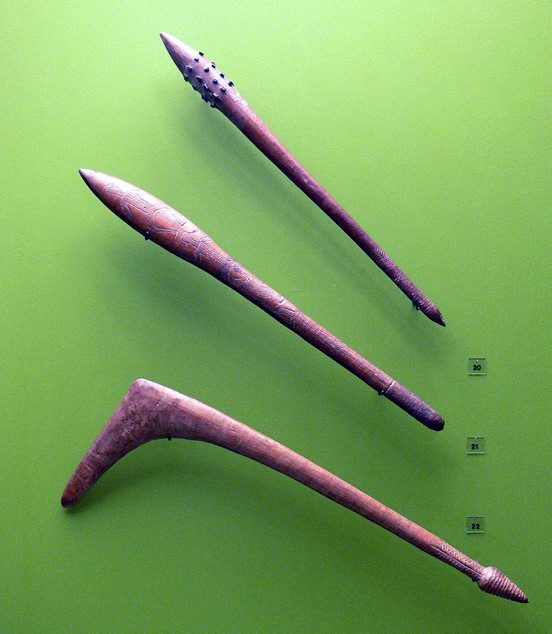
A ‘waddy’, it is believed, is similar to an Aboriginal nulla nulla. A waddy is a heavy club constructed of carved timber and could also be a walking stick. No doubt, the ‘green stone’ referred to, was attached to the end of the Nulla Nulla and held in place with tree resin.
It would appear that the Rank structure of this period ( 1835 ) was:
Patrolman –
Constable –
Conductor –
Inspector –
Sydney Gazette and New South Wales Advertiser (NSW : 1803 – 1842), Saturday 9 August 1834, page 4
Government Gazette
WEDNESDAY, AUGUST 6.
HIS Excellency the GOVERNOR has been pleased to approve of the following Alterations in the Police of the Colony, namely
SYDNEY.
APPOINTMENTS
John Price, free, to be Conductor, from the 18th June.
To be Patrolman – James Woodward, free, from the 25th June; John Murray, free, from the 5th July ; Peter Prosser, free, from the 8th ultimo; John Gorman, free, from the 14th ultimo ; Edward Tierney, free, and John McCarthy, free, from the 15th ultimo ; Bryant Naughton, free, from the 16th ultimo ; Michael Armstrong, free, from the l7th ultimo, and James Cook, free, from the 18th ultimo.
Thomas McConnell, free, to be Constable at the North Shore, from the 16th June, and James Woodward, free, to be Constable of the Water Police, from the 5th July.
RESIGNATION
John William Smith, Constable, North Shore, on the 15th June.
DISMISSALS
Patrolmen – John Sullivan, on 24th June ; Patrick Muleady, on the 7th ultimo; James Drew and Patrick Dougharty, on the 13th ultimo ; David Leighton, on the 14th ultimo , George Stewart, on the 15th ultimo; and Patrick Curran, and John Sheehy, on the 17th July.
Water Police Constable — Alexander Lee, on the 4th July,
STRATHALLAN.
William Berry, free, to be Constable in the room of William Carroll, resigned.
MAITLAND.
Edward Gaynor, holding a Ticket-of-Leave, to be Constable, from the 14th ultimo, in the room of Daniel McFarlane, resigned.
PORT STEPHENS.
Michael Cotton, holding a ticket-of-Leave, to be Constable, in the room of John Jaggers, resigned.
New South Wales Government Gazette (Sydney, NSW : 1832 – 1900), Wednesday 21 January 1835 (No.151), page 45
Colonial Secretary’s Office,
Sydney, 20th January, 1835.
HIS Excellency the GOVERNOR has been pleased to approve of the following alterations in the Police of the Colony ; namely,—
SYDNEY.
To be Conductors.— Edward Rollins and Peter Prosser, raised from Patrolmen, from the 1st instant.
To be Patrolmen.— William Elkins, and to be Market Constable, from the 1st instant ; Mark Gilmore, Michael O’Neal, William Howarth, Thomas Barrett, James Carwell, and William Barnett, from the 1st instant ; James Matthews, Robert Lodge, John Hundley, and James Kennedy, from the 9th instant ; and John McCarthy, from the 13th instant.
Conductors Dismissed.— William Barnett, reduced to Patrolman.
Patrolmen Dismissed.— George Brereton, Market Constable ; Herbert Green, James Matthews, John Cummings, James Carwell, John Smith, Peter Butler, Peter Christie, and Peter Colgan.
New South Wales Government Gazette (Sydney, NSW : 1832 – 1900), Wednesday 29 April 1835 (No.165), page 257
Colonial Secretary’s Office,
Sydney, 28th April, 1835.
HIS Excellency the GOVERNOR has been
pleased to approve of the following alterations
in the Police of the Colony, namely :—
SYDNEY.— To be Wardsman : George Mitchell, from the 6th instant.
To be Conductors : Philip Boyce, from the 1st, John Moore, from the 7th, William Hanson, from Joe 14th, and John Matthews, from the 20th of April.
To be Patrolmen : Peter Prosser, James Shaw, Archibald Kelley, and Dennis Connelly, from the 1st instant ; Thomas Kinchela, from the 14th instant, ; John Thorn, John Pendar, James Jackson and William Troop, from the 16th instant ; John Price, and William Vernon, from the 17th, and Patrick Galvin, from the 20th of April.
Wardsman resigned : John Skinner.
Conductors Dismissed : Peter Prosser, Patrick Ogan, and John Price.
Patrolmen resigned : William Howarth, John Gorman, James Tobin.
Patrolmen dismissed : Robert Grindle, James Cone, John Carey, John Connor, James Wells, Patrick Fitzpatrick, and L. Walsh.
LIVERPOOL.— George Harvey, holding a Ticket-of-leave, to be Constable, from the 20th Instant, in the room of Denis McCarthy, resigned.
PENRITH.— John Baxter, free, to be Constable, from the 26th Ultimo, in the room of John Brown, dismissed.
BONG BONG.— John Coffee and Lawrence Larken, free, to be Constables— the former in the room of, James Harper, resigned, and the latter from the 20th Instant, in the room of William Austin, dismissed.
YASS.— James Donald, free, to be Constable, from the 20th of February last.
MERTON.— Jeremiah Burns, holding a Ticket-of-leave, to be Constable, from the 6th Ultimo, in the room of Thomas Boline, resigned.
PORT STEPHENS.— John McCarthy, free, to be Constable, in the room of Edward Frost, resigned.
HIS EXCELLENCY the Governor has been pleased to approve of the following alterations in the Police of the Colony, viz. :—
SYDNEY.
To be Wardsman.— William Abbott, from the 1st instant.
To be Conductors.— Matthew Thomkins and John Price, from the 1st instant ; James Shaw, from the 4th instant ; Peter Prosser, from the 12th instant.
To be Patrolmen.— Patrick Conner, William Moore, William Cox, John Kelly and Stephen Bunen, from the 1st instant ; Thomas Lynskey, from the 4th instant ; Timothy Foley and Andrew White, from the 8th instant ; James Pearson, Samuel Deacon, and Samuel Freebury, from the 12th instant.
Wardsman resigned.— William Small.
Conductor resigned.— Constantine Molloy.
Conductor Patrick Reid, reduced to Patrolman on 30th ultimo.
Wardsman dismissed.— William Abbott.
Patrolmen dismissed.— William Brown, William McCready, James McGruggan, William Noop, Patrick Petty, Thomas Phillips, John Hauley, Michael Armstrong.
LIVERPOOL.
Daniel McCarthy, holding a Ticket-of-leave, to be Constable, from the 18th instant, in the room of James Silvester, resigned.
PENRITH.
William Rossborough, holding a Ticket-of-leave, and Thomas Shuttleworth, also holding a Ticket-of leave, to be Constables, in the room of Ralph Hodgson and Henry Workman, dismissed— the former from the 10th and the latter form the 30th ultimo.
PATRICK’S PLAINS.
Constable John Brest, dismissed on the 20th instant.
Sydney Monitor and Commercial Advertiser (NSW : 1838 – 1841), Wednesday 13 February 1839, page 2
Before Mr. Justice Willis and a Civil Jury.
John Pendar, alias “‘ Jack the Waterman” was tried yesterday for the murder of Inspector Prosser.
The case occupied Mr Justice Willis and a civil Jury up to half-past nine o’clock, when the Jury returned a verdict of manslaughter.
Mr Windeyer was counsel for the defence, and raised three objections – which were,
that there was no proof of drunkenness to warrant the deceased in taking the prisoner into custody,
that the prisoner would have been justified in using force to any degree to expel the constable, who was in fact transgressing on his premises, and
lastly the learned gentleman relied upon a statute ; which he believed was in force, as far back as Henry the Eighth ( which had never been repealed ; rendering fatal any indictment not drawn up in intelligible English, and
contended that ” Waddy” was not an English word, and therefore fatal to the indictment.
These objections were reserved and the prisoner remanded for sentence.
Commercial Journal and Advertiser (Sydney, NSW : 1835 – 1840), Wednesday 20 February 1839, page 2
James Pendar alias Jack the Waterman, for the manslaughter of Inspector Prosser, was brought up for sentence yesterday, and ordered to be transported for the term of his natural life to Norfolk Island.
Sydney Gazette and New South Wales Advertiser (NSW : 1803 – 1842), Thursday 21 February 1839, page 2
Supreme Court.
MONDAY, FEBRUARY 19, 1839.
(Before their Honors the Chief Justice and Mr. Justice Willis.)
On this day there being no cases ready for trial, the prisoners remanded during the Sessions were brought up for sentence.
John Pender was next placed at the bar. The prisoner had been tried for the wilful murder of Peter Prosser, a policeman, and had been found guilty of manslaughter.
Mr. Justice Willis, before whom the case was tried, said to the prisoner that the mercy of the Jury had saved his life in finding him guilty of manslaughter – the manslaughter was of a more aggravated nature than he had ever known or heard of.
The police must be protected in their duty, and should be protected.
His sentence was that he should be transported for life.
Sydney Gazette and New South Wales Advertiser (NSW : 1803 – 1842), Saturday 26 January 1839, page 2
DOMESTIC INTELLIGENCE.
Coroner’s INQUEST. –
On Thursday morning at nine o’clock an Inquest was held upon the body of Prosser, the late Inspector of Police, who died in the General Hospital on the preceding day. The Jury assembled at the sign of the Bunch of Grapes ( King St ), whence they proceeded to the Hospital to view the body, and then returned to the Jury room, where the following evidence was taken :
John Pender, the man charged with the murder, being in custody.
Jane Rayner, of Phillip-street, being sworn stated, I knew the deceased Peter Prosser, and the prisoner before the Court ( John Pender ); I keep a public-house.
On Monday afternoon the prisoner came into my house very tipsey; he made use of very bad language to me, and I refused to serve him, telling him if he could not use better language to me he should leave the place; he then turned round and exposed his naked person to me twice ; I took up a jug of water and threw it over him, and desired him to be off about his business for an impudent blackguard ; that appeared to enrage him the more ; he turned towards me as if he would strike me; I took up a New Zealand waddy to defend myself as he was making to me ; he snatched it from me, and struck me a blow across the shoulder, and afterwards made several blows at me with the waddy, which I avoided ; I thought he would kill me, and I sent my little girl to the watch-house for a constable ; the prisoner then went into the street making a noise, and flourishing the waddy ; in the mean time Prosser came up, and seeing how badly the prisoner behaved, who was storming violently, and flourishing the waddy, he approached him, and I cautioned him of the weapon the prisoner held in his hand ;
Prosser came up behind the prisoner, and took the waddy out of his hand ; and collared him ; the prisoner forced himself into my house in the custody of the deceased, and said he would not go to the watch-house; I told the deceased of his bad behaviour, and said I would appear the next day against the prisoner;
the deceased then told him he must go to the watch-house ; the prisoner tried to get away by the back door, but the deceased stopped him ; at this time a mob of persons had come into the house ; with some difficulty the deceased induced the prisoner to go quietly with him ; they left the house together; I cannot say which of them had the waddy as I was so confused ; I did not leave the place to look outside to see which way they went, but I saw that they turned towards the watch-house ; they had to pass the prisoner’s house on their way there; the deceased had much difficulty with the prisoner in the house ; I cannot say whether the prisoner was struck ; the deceased had to scuffle with him to make him submit and go with him ; I am dull of hearing, and cannot say whether the prisoner made use of any threatening language to the deceased, but they struggled a good deal with each other ; I saw nothing after they left the house.
By the Prisoner. – I cannot say that I saw any blows struck ; there was much struggling; several people were in the house; Mr. Roberts‘ servant was there.
George Clark, free, was then sworn. I recollect seeing the deceased and prisoner in Mrs. Rayner‘s house on Monday last; I saw Mrs. Rayner point out and give charge of the prisoner to deceased ; Prosser came behind him, snatched the waddy out of his hand, and dragged the prisoner towards the watch-house; the prisoner struggled, and seized hold of a fence, on which the deceased pushed at him with the staff or waddy ; they both got back to Rayner‘s ; I looked in and saw a struggle ; the prisoner attempted to get out by the back door and the deceased either struck or knocked him down ; he was down ; they had some high words in the house, and the prisoner took the staff from Prosser, on which the latter attempted to get it again ; the prisoner refused to let him have it, and said he should not have it, but he would go to the watch-house ; they then went quietly that way, the prisoner holding the staff;
I stood at the corner to watch them ; as they passed the prisoner’s house the prisoner forced himself in ; they had a scuffle ; I went down to them, and saw that Prosser had got the staff from him, and was shaking the prisoner to get him to the watch-house; the prisoner refused, on which the deceased struck him a blow on the head ; the prisoner refused to go to the watch-house, and wanted to get into his own house; I cannot say what occurred immediately in the house ; in about a minute I saw Prosser staggering out holding his hands to his head ; I could not tell whether he said any thing, as there was such a noise at the time; a young man had the waddy in his hand, and said, ” that shall not be used again.”
No one else came out of the house but the deceased ; Prosser went towards the watch-house; he continued reeling as he walked along the street as far as four or five houses; I was not exactly opposite the prisoner‘s house, and could not see into it ; the young man before mentioned was in the yard of the prisoner about a minute after the deceased came but ; the deceased was then going out of the yard, and the prisoner was in his own house; I saw some blood coming down the head of the deceased, but I saw no mark upon his face ; I did not notice the young man who had the waddy until after Prosser came out of the house ; if he had come out of the house I must have seen him ; I walked out of the yard after the deceased into Phillip-street, as I thought he would fall, and I did not return ; Prosser was coming out of the prisoner‘s house when I arrived ; he had no hat on ; I heard no noise of blows when I came to the door ; I should know the person of the young man who had the waddy if I were to see him again; the prisoner and the deceased struggled very much for about seven or eight minutes before they went into the house ; they remained in about three or five minutes; I did not see Prosser fall, nor did I observe any marks of a fall upon his clothes; in about three minutes after I lost sight of Prosser while I was conversing with Mr. West opposite Pender‘s house ; I saw the prisoner standing opposite his fence going down the street, and two constables running round him to get in front of him ; the prisoner got over his fence, and was defending himself with the waddy, and the constables striking with their staves.
By the Prisoner.- I saw the deceased hit you several times; there were several marks upon you.
William Badcock examined- I recollect on Monday last, seeing the prisoner and the deceased in Phillip-street ; I saw the prisoner before he was in custody and afterwards ; I saw the struggle, and saw Prosser lay hold of the prisoner’s hair, and endeavour to knock his head against the door of Mr. Rayner‘s house; I also saw him endeavour to kick him, which the prisoner prevented by holding up his leg ; the prisoner got up and said he wished to speak to Prosser; they went quietly along Phillip-street, till another came up to the assistance of the deceased ; when opposite the prisoner‘s house a scuffle ensued ; I can’t say whether it was occasioned by the violence of the other constable or a desire of the prisoner to get into his house ; the other constable was evidently drunk, and struck the prisoner with his staff on the head ; the prisoner got to his own door, and Prosser sent the other constable away for assistance; the deceased had the waddy in his hand when he entered the house; I did not see the deceased strike prisoner any blows in the struggle that took place as they entered the house ; there was blood on the prisoner‘s face and shirt, which was produced by the blow of the drunken constable ; they entered the house and I followed them ; they were struggling on the bed, the deceased being uppermost ; Prosser was holding the prisoner‘s shirt collar with one hand, and thrusting his knuckles into his throat ; in my opinion with the intention of strangling him, and with the other arm trying to hold the waddy from the prisoner; in the struggle the prisoner succeeded in getting the waddy out of Prosser‘s hand, and the deceased held his hand upon the arm of the prisoner that had the waddy in it ; it was then the prisoner struck the deceased with the flat part of the waddy upon the top of his head ; he did not fall from the blow, but he put his hand to his head and cried “oh,” and walked out of the house and down Phillip-street as far as I then could see him ; he went away without his hat; I did not see the deceased strike the prisoner with the waddy ; I do not believe he struck him at all ; the prisoner was very drunk ; after the drunken constable had been despatched for assistance, the prisoner continued his resistance and violence to Mr. Prosser; I did not consider he intended to injure Mr. Prosser ; he was very lenient to him, and it was only on the deceased taking him by the throat, as I thought to strangle him, that he struck him ; I did not hear the sound of the blow, but it evidently stunned him ; I was so interested in the proceeding that I noticed only the actions of the parties; there was no other person in the house ; after the deceased left the house the prisoner pulled off his shoes and stockings, brandished the waddy, and was more violent than ever ; he only struck one blow ; he appeared stupidly as well as furiously drunk ; when in liquor he appeared almost mad ; I did not hear Prosser say anything to the prisoner in the house, he attempted to conquer him by force.
( Constable Bradley being produced, was identified by him as having struck the prisoner on the head. )
Sergeant ( William ) Kilpatrick of the Police was next examined.- He stated, on Monday last I was in the station-house when Bradley came in, between one and two o’clock, and said that a number of persons had assembled in Phillip street, and that Mr. Prosser was beaten and wanted assistance; I went there immediately with Bradley ; I met the deceased about fifteen or twenty yards from the prisoner‘s house ;
he held both his hands to his head and had his handkerchief to the left side of his face, where a scar appeared ; he turned round and pointed to the prisoner, who was in view with blood upon his shirt, and said, ” there’s the man, Kilpatrick, that struck me, take him into custody ;” he then walked on towards the watch-house ; I went in pursuit of the prisoner, who had a waddy in his hand and put himself in a posture to attack me; I secured him in his own house ; Bradley was with me, he struck the prisoner in my presence; he was perfectly sober.
( The witness here observed that almost immediately afterwards Bradley came to him in the watch-house and said that he heard that a charge of drunkenness had been preferred against him, and he wished him to smell his breath to see if he could distinguish any smell of liquor, he did so but could discover none. )
Bradley struck the prisoner so did I ; I made several blows at his hand with my staff to make him drop the waddy ; Bradley was not violent but cool and deliberate ; the prisoner did not say anything respecting Prosser; he was intoxicated and very violent; he made one determined blow at me with the waddy which I caught on my staff, the dent occasioned by it still remains ; I afterwards saw Prosser in the station-house, he seemed feeble and almost dead. ( The prisoner put a few unimportant questions that did not affect the evidence. )
One of the Jurymen, Mr. Driver, here stepped forward and observed to the Coroner that he saw Constable Bradley about ten minutes after the transaction, and he was then perfectly sober.
Dr. Robertson certified that the deceased was received into the Hospital about ten o’clock on Monday evening in a state of insensibility. There was a small scar of recent formation on his left cheek. On a post mortem examination of the body, he found on opening the skull a large quantity of extravasated blood on the back part of the brain, and the whole of the back part of the brain appeared to have been in a violent state of inflammation, sufficient to produce death. The effects, he was of opinion, were such as would have been produced by the blow of a flat, heavy instrument applied violently, such as a waddy. The extravasation and inflammation consequent thereon produced death.
Dr. Whittel corroborated the evidence of the other Doctor, as to the appearances on the post mortem examination. He in addition, stated that he had been called to attend the deceased shortly after he received the blow ; he bled him and recommended his removal to the Hospital.
The Coroner had commenced summing up the evidence, when it was intimated that a young man was present who was there at the time the blow was given.
He was called in and examined. He stated that his name was Manuel Josephson, and that he arrived at Pender‘s house when the deceased held the prisoner against the wall of the house. On their entering the house he could not tell which carried the waddy, but when they were inside ( the witness having followed them ) he saw the waddy lying on a chest beside the bed. As soon as Prosser observed it there he took it up to secure it, on which the prisoner snatched at it ; they struggled and the deceased got Pender down on the bed, but the prisoner succeeded in getting possession of the instrument with which he struck the deceased on his naked head.
Prosser arose from the bed after receiving the blow, and, uttering a cry, he staggered out of the house ; and shortly afterwards Pender was apprehended. He added, that in his opinion the deceased used no unnecessary violence in securing the prisoner.
The Coroner having summed up the evidence and explained the distinctions between manslaughter and murder, pointed out the fact of the prisoner being in the commission of an unlawful act, was given into the custody of a peace-officer, whose attempts to take him to the watch-house he resisted with a deadly instrument.
The jury, after a short consultation, returned a verdict of wilful murder against John Pender, who was forthwith committed on the Coroner’s warrant.
The prisoner is a man of low stature but of great apparent strength of body and very muscular, whereas the deceased was a man of very delicate habits of body.
Sydney Gazette and New South Wales Advertiser (NSW : 1803 – 1842), Saturday 1 August 1835, page 4
By His Excellency’s Command,
ALEXANDER McLEAY.
Colonial Secretary’s Office, Sydney,
28th July 1835.
HIS Excellency the Governor has been pleased to approve of the following alterations in the Police of the Colony, vis –
SYDNEY.
To be Wardsman – William Abbott, from the 1st instant.
To be Conductors – Matthew Thompkins and John Price, from the 1st instant ; James Shaw, from the 4th instant ; Peter Prosser, from the 12th instant.
To be Patrolmen – Patrick Connor, William Moore, William Cox, John Kelly, and Stephen Bunen from the 1st instant ; Thomas Lynskey, from the 4th instant ; Timothy Foley and Andrew White,
from the 8th instant ; James Pearson, Samuel Deacon, and Samuel Freebury, from the 12th instant.
Wardsman resigned – William Small.
Conductor resigned – Constantine Molloy
ConductorPatrick Reid, reduced to Patrolman on the 30th ultimo.
Wardsman dismissed – William Abbott.
Conductor dismissed – Henry Ball.
Patrolmen dismissed – William Brown. William McCready, James McGruggIn, William Noop,Patrick Petty, Thomas Phillips, John Hanley, Michael Armstrong.
LIVERPOOL.
Daniel McCarthy, holding a Ticket-of-Leave, to be Constable, from the 18th instant, in the room of James Silvester, resigned.
PENRITH.
William Rossborough, holding a Ticket-of-Leave, and Thomas Shuttleworth, also holding a Ticket of Leave, to be Constables, in the room of Ralph Hodgson and Henry Workman, dismissed-the former from the 10th and the latter from the 30th ultimo.
PATRICK’S PLAINS.
Constable John Brest, dismissed on the 30th instant.
Sydney Monitor and Commercial Advertiser (NSW : 1838 – 1841), Friday 26 April 1839, page 2
Perjury
Joseph Cutts , a free man, in the service of Mr. Thompson of Phillip-street, was charged by Constable Callaghan with assaulting him in the execution of his duty.
Callaghan deposed, that as he was passing a dray standing in Phillip-street, about half past seven on Monday evening, a dog under the dray ( chained ) flew at him.
He struck it in return. The prisoner said, he might as well strike him as strike his dog, and he would serve him as Prosser had been served by Jack the Waterman, and immediately struck him, the witness.
The drayman had a child in his arms, which he gave to a woman to hold, while he struck witness. He then made into his master’s house, and witness followed him, and struck him with his staff. He also sprang his rattle.
The prisoner denied having struck the constable, and called witnesses. —
Mary Mahany, a soldier’s widow, residing opposite the master of the prisoner, in Phillip street, deposed, that a person left a loaded team standing opposite her door, with a dog on the chain to guard it, while he went over the way to get tea, and she promised to mind it.
The constable came up drunk, the dog barked, and the constable began to irritate it with his staff, and said, if he had it off the chain, he would knock its brains out.
Witness told him, he had better let the dog alone, and go about his business. He called her a dirty w—–.
The prisoner, who was by with his child in his arms, said, he ought to be ashamed to make use of such language to the mother of children. He immediately ran over and knocked prisoner down twice with his child in his arms, and began springing his rattle and making a disturbance.
John Thomas, a dealer, deposed, that the constable was drunk, and corroborated the evidence of the last witness, as far as it went.
The constable also spit in witness’s face, and would have taken witness to the watch house, had he, witness, not got out of the way. ( When the last witness went into the box, he asked the constable if he had any recollection of him? He denied ever having seen his face before. I thought so, said the witness, you were too drunk. )
Case dismissed.
The constable was ordered to be reported.
Such is the case, as handed to us by our reporter.
We are surprised that men of such tact as Messrs. Windeyer and Innes, did not either order the witness into the box for gross perjury, or the constable; for grosser and more malicious impudent lies, were never told in a court of justice, than what must have been told by one or more of these opposing witnesses.
If Magistrates and Judges will not take the trouble to prosecute for perjury so glaring and open, as that which has evidently been committed by one or other of the witnesses in this case, the land will never be purged of this abominable and daily committed crime.
JOHN PENDER was an ardent collector of curios. In his rough, ignorant fashion, he expressed his love of the beautiful by picking up, from all the seaports of the world, things that were odd and rare, and fetching them to his bachelor home on the Strawberry Hills in Sydney.
Of the hardy sea-faring men of the ‘thirties he was one of the most adventurous. Wanderlust had taken him back and forth over the seven seas, to strange ports and strange lands. His little cottage was a veritable museum of curiosities, a centre of attraction for half the population of Sydney when the owner was ashore after one of his exciting voyages.
Pender, as is not uncommon with men of his calibre and peculiar mental composition, was loquacious concerning his exploits, and insistently eager to confirm the impression that he was more than an ordinary being.
Towards the end of 1838, Pender landed in Sydney after an adventurous trip to New Zealand, bringing back with him a large collection of Maori weapons, including a huge club with a greenstone head, taken by him in single-handed fight with a tattoed chief of the savages.
This curiously carved weapon was regarded by the sailor as the gem of his collection. He never tired relating the story of the fight that made it his, and day by day, he grew more boastful about its alleged intrinsic value.
Throughout the Christmas festivities, he paraded the street with the club over his shoulder, chanting war songs in outlandish tongue, and generally making a nuisance of himself to the more peaceably inclined citizens.
Inspector Peter Prosser, of the Sydney Police Force, did not look with any favor on Pender and his boisterous ways. On several occasions he reprimanded the sailor sternly for his obstreperous behaviour, once or twice driving him off the streets when his boasting and warlike antics with the greenstone club terrified passers by.
Pender was more disturbed than he showed by this unceremonious treatment at the hands of a high officer of the law. Having come to believe that his prowess gave him the right to swagger and riot through the streets of any sea-port town, he bitterly resented that his inclinations should be frustrated In the place where he had made his home, and on Monday, January 21, he was very much in evidence, parading the streets with the club in his hand and a Maori rug tied about his shoulders, loudly proclaiming that he was afraid of no man.
His eccentric behaviour did not seriously impede Sydney’s general affairs during the forenoon, and Inspector Prosser not being about, he progressed from inn to inn accumulating large quantities of spirits. During early afternoon he wandered into the bar of Mrs. Jane Rayner’s Inn in King Street, and, thumping the counter with his club, called for drinks for those assembled. The loungers about the place were only too willing to partake of his hospitality, but as the audience was too insignificant for the sailor, he visited the various parlors and tap-rooms and extended his invitation to the occupants. In this way he gathered another eight men into the bar, but at one parlor his peremptory invitation to drink was as peremptorily refused.
Three squatters from the interior, discussing a matter of important business, so resented his intrusion on their privacy that they threatened stern measures if he did not take himself off.
Pender was not far enough gone in drink to be thoroughly quarrelsome, but nevertheless he expressed his opinion of the squatters with such disgusting profanity that they rose to their feet. One of them rushed the sailor, and, taking him by the shoulders, thrust him down a passage into the street. Then he returned and, calling on his friends, left the house; Before going, however, he informed the landlady that neither he nor any of his associates would patronise the tavern again.
Loss of Profits
Mrs. Rayner was considerably put out at losing such profitable customers, and upbraided Pender in vigorous terms when he re-entered the bar a minute later. The seafarer, now furious and irresponsible, threatened to smash up the bar if anything more were said. The landlady was just as brave and determined as the sailor.
Seizing the war-club, which was lying on the counter, she brought it down with a heavy thwack on Pender‘s shoulders and threatened to crack his skull if he did not leave the premises. From her fortress behind the bar, the landlady whirled the stoneheaded weapon, striking at Pender whenever he attempted to seize it.
The half-crazed man was shouting loudly, and using dreadful language as he rushed about the room, creating such an uproar that a crowd quickly gathered in the street. When the disturbance was at its height, Inspector Prosser entered the bar. Taking in the situation at a glance, he rushed at the sailor, grasped him about the middle, and hurled him through the door. While Pender was attempting to rise, the inspector rushed him again and tried to handcuff him. Both men were of like build, and both in perfect physical condition. The sailor, despite the quantity of drink he had absorbed during the morning, was not greatly affected by his libations, and began to fight for his liberty. For half an hour the pair struggled and fought in the Street, none of the crowd offering to interfere.
Prosser, a skilful boxer, plied his fists vigorously, battering his antagonist’s face until it was a mask of blood, Pender, employing tactics of the sea-front, used his feet and hands impartially, but with scant success.
At length Prosser, planting a blow on Pender‘s jaw, felled him insensible to the ground.
When the sailor recovered he was manacled and helpless.
Signifying his intention to proceed quietly to the watch-house, he was permitted to rise, and, held by Prosser, moved down the street. Over his shoulder the inspector carried the war-club. As they were walking along, the sailor informed his captor that he would like to visit his home before going to prison, there being two cats and several birds in the house he desired to liberate.
Prosser, yielding to persuasion, diverted his progress towards Strawberry Hills, and a quarter of an hour later entered the sailor’s cottage with his prisoner. At the door the inspector was seen to unlock the handcuffs on the sailor’s wrists, a proceeding that many of those among the crowd that followed considered a dangerous proceeding.
No warning of this was shouted to the police officer, but when a few moments later he came reeling out through the door to collapse on the ground, those present realised that something tragic had occurred. In the Inspector‘s head was a ghastly wound, clearly caused by a blow from the war-club.
Two men, George Clark and Richard Roberts -rushed into the house. On the floor of the front room they found the blood-stained club. Pender they beheld escaping through the gate at the rear.
Sergt. W. Kilpatrick and Constable Boadley were soon in pursuit of the murderer. Through the streets they chased him, Pender running at a tangent, and screaming insanely of men he had killed in other parts of the world. People dashed from his path and took shelter in the houses. Doors were slammed in his face, but none attempted to lay hold of him. The police took him at last near the Hyde Park Barracks. He had turned at bay, producing a long sailor’s knife, with which he menaced his pursuers. The constables, however, furious at the death of their superior, braved the maddened seafarer, and overwhelmed him with their truncheons.
They battered him into unconsciousness and then, securing a wheelbarrow, trundled him to the Watch-house where he regained his senses.
At his trial some months later, Pender was the most unconcerned man in the court. He sat in the dock eating pears from a bag and spitting out the skin at the constables.
He refused to plead, or give any explanation of the tragic happening in the cottage, a course which decided his fate.
The Judge had nothing else to do but to order his execution.
The green-stone war-club was given to Mrs. Jane Rayner by a formal order of the court, for what reason was not apparent, and her descendants may have it to this day. .