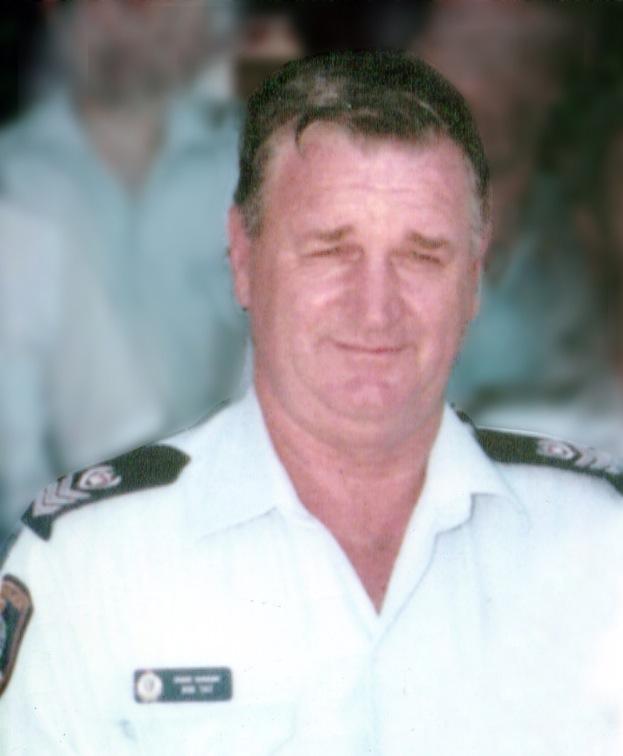
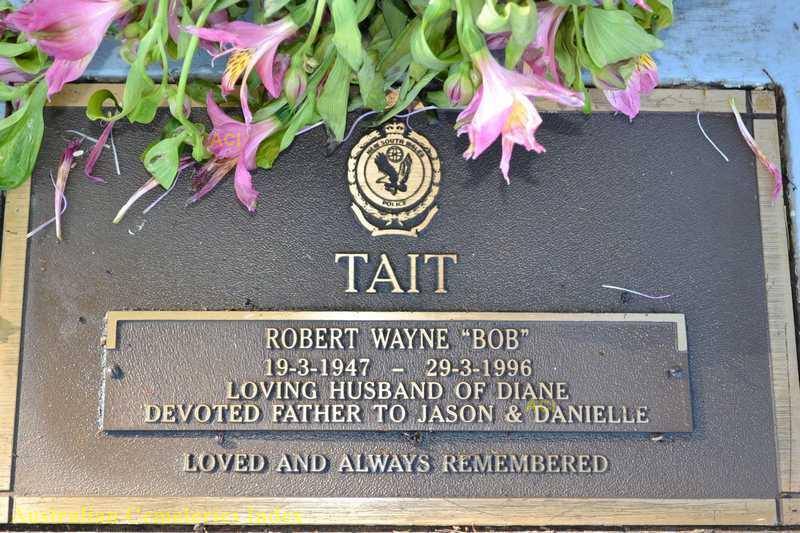
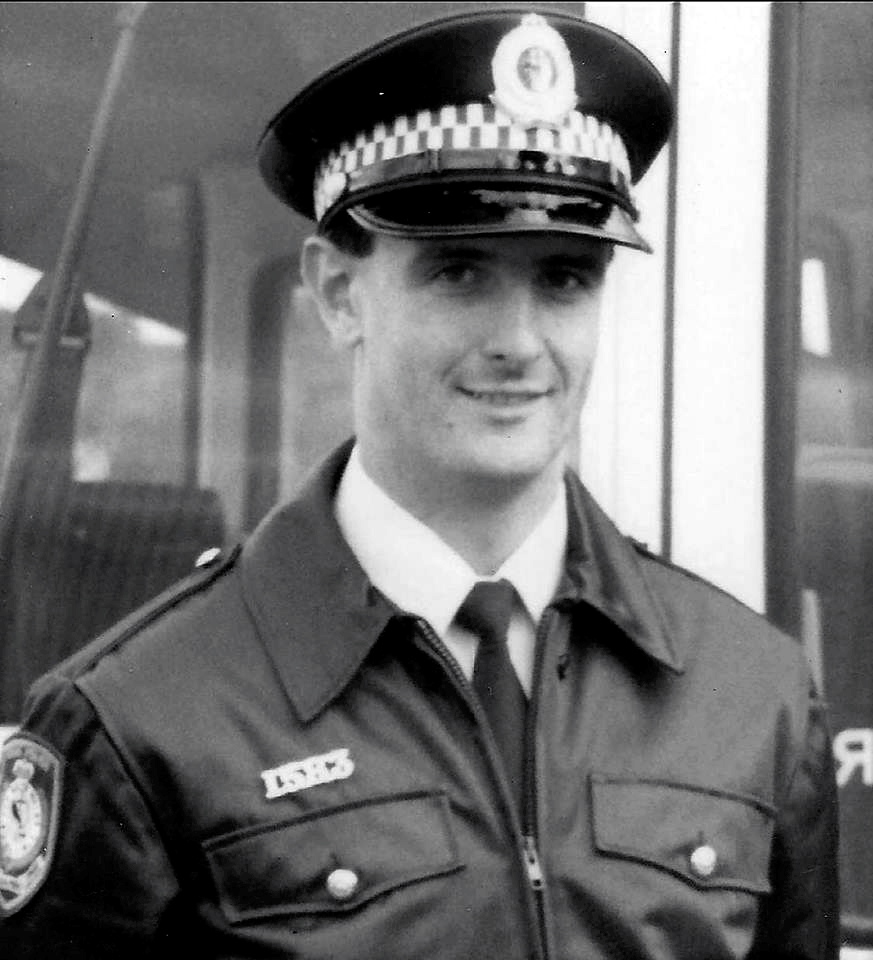
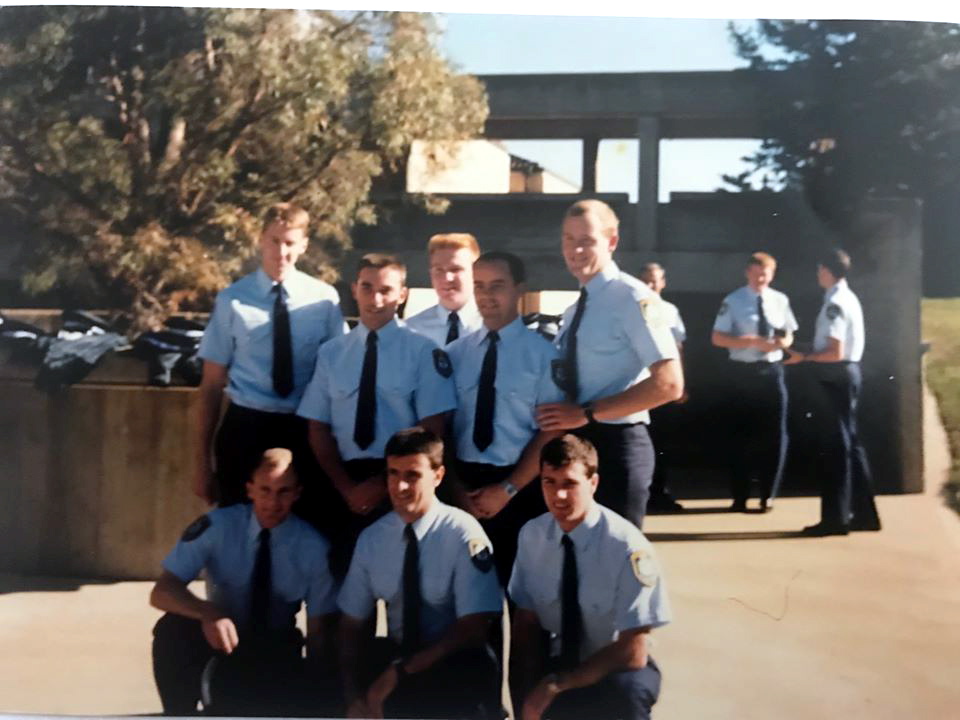
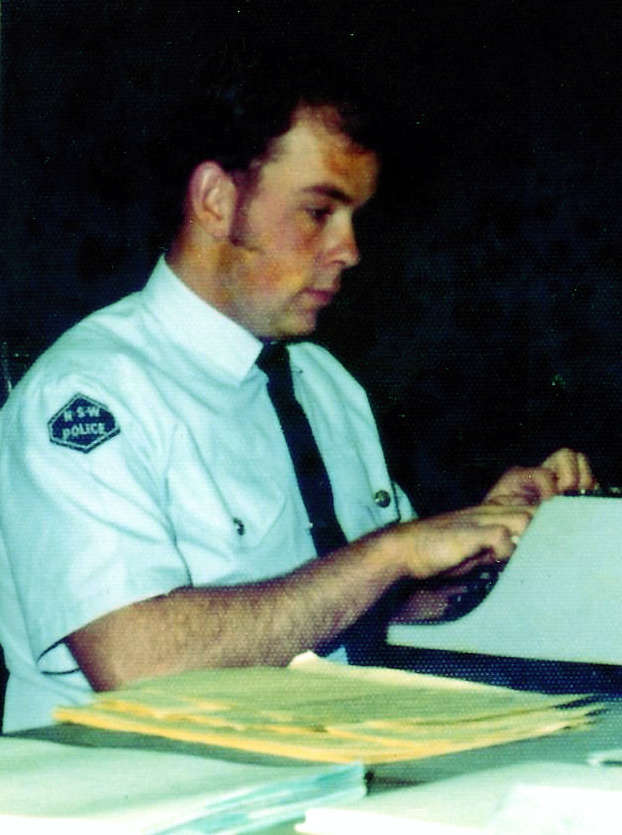
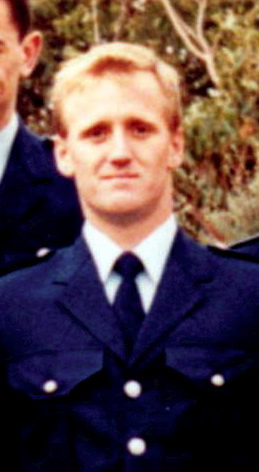
[alert_red]Robert is NOT mentioned on the Police Wall of Remembrance[/alert_red] * BUT SHOULD BE
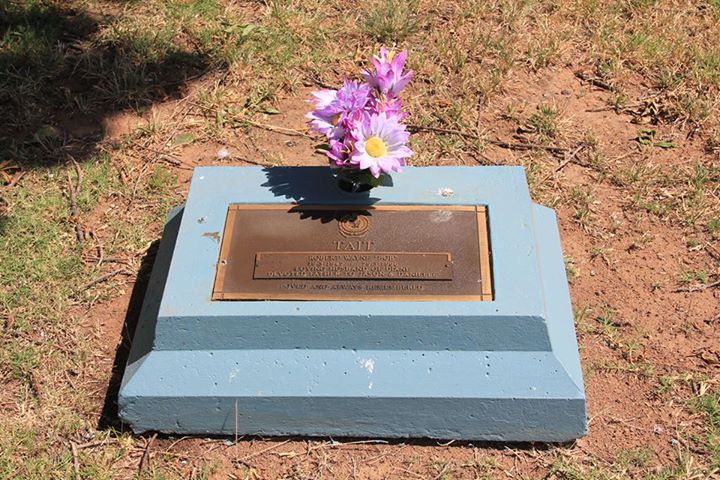
Robert Wayne TAIT headstone – Narrabri Lawn Cemetery. Portion A2, row Q
Robert Wayne TAIT – Grave
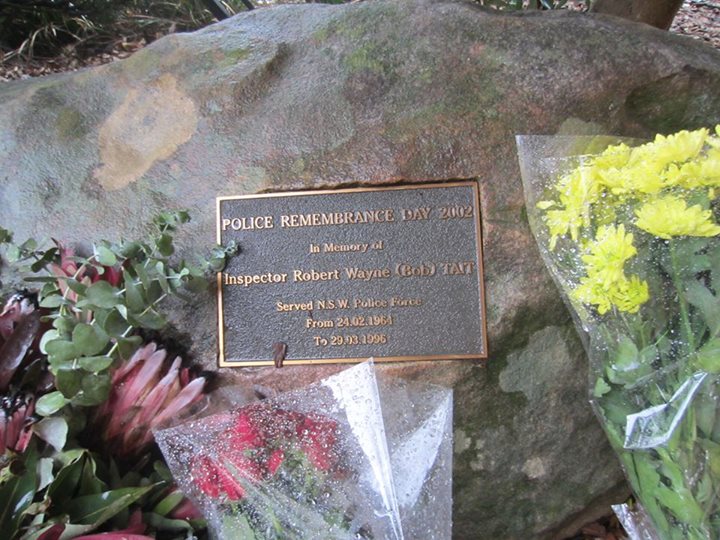
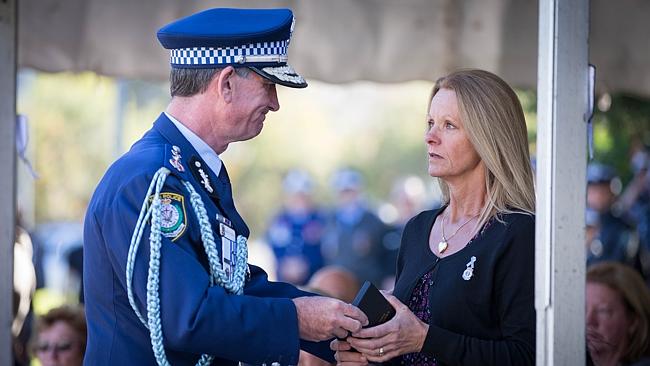
Robert Wayne TAIT – Memorial Stone outside of Narrabri Police Station. Rob’s mother also planted an Olive Tree there at the same time. 29 September 2002
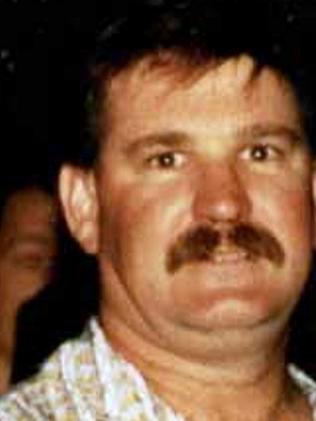
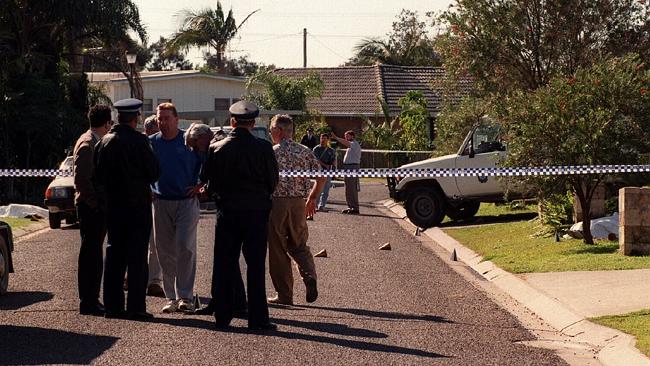
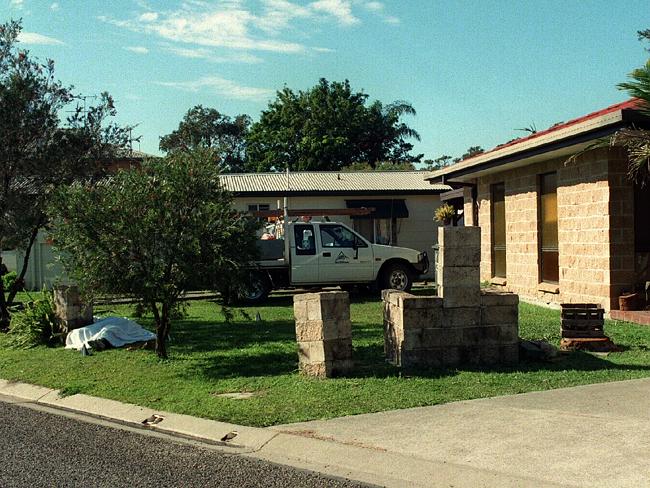
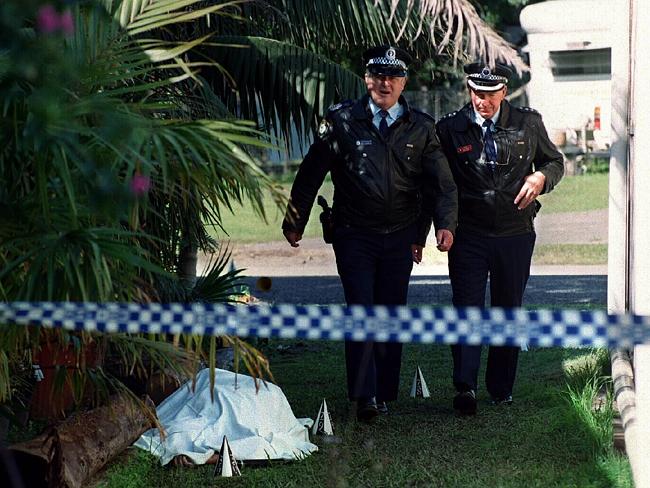
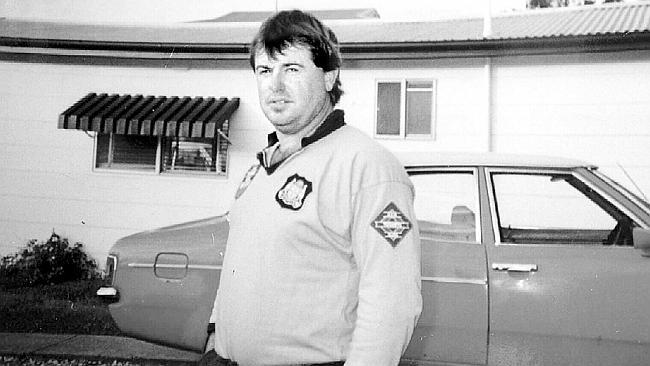
In 1996 Inspector Bob Tait was the officer in charge of police at Narrabri. On the morning of Friday 29 March of that year he ended his own life at the Narrabri Police Station.
The Northern Daily Leader of 30 March, 1996 reported the death.
Stunned colleagues and the Narrabri community are this morning trying to come to terms with why such a respected policeman would kill himself. Inspector Robert Tait, 49, went to work yesterday morning, where he had been serving as the patrol commander, walked into an unoccupied office, took his service revolver and ended his life.
The inspector joined the New South Wales Police Force on 24 February, 1964 as a cadet, and was sworn in on 19 March, 1966. At the time of his death he was stationed at Narrabri, where he was the patrol commander.
It took up 451 hearing days, heard from 902 public witnesses and cost an estimated $64 million. Malcolm Brown reports on the Wood royal commission, 10 years on.
It began on June 15, 1995, when an unnamed Annandale detective jumped to his death from the seventh floor of a building, apparently through fear of the Wood royal commission. The detective’s suicide was followed by those of Ray Jenkins, a dog trainer (July 10), and Inspector Robert Tait, the acting patrol commander at Narrabri ( March 29, 1996 ). Nineteen days later a former Wollongong alderman, Brian Tobin, gassed himself.
On May 8 the same year, Peter Foretic gassed himself the day after giving evidence about pedophilia. On September 23, Detective Senior Constable Wayne Johnson shot himselfand his estranged wife after being adversely named in the royal commission. On November 4, David Yeldham, a retired judge about to face the royal commission on questions of sexual impropriety, killed himself. A month later Danny Caines, a plumber and police confidant, committed suicide at Forster, on the North Coast.
Altogether, 12 people enmeshed in the Wood royal commission took their own lives. Scores of others were so profoundly affected by proceedings that their supporters and families believe it shortened their lives. A former detective, Greg Jensen, suffered a recurrence of the stomach cancer that ultimately ended his life, while another former detective, Ray McDougall, who faced the threat that commission investigators might expose his extramarital affair if he did not co-operate, succumbed to motor neurone disease.
There is no doubt that the Royal Commission into the NSW Police Service, headed by the Supreme Court judge James Wood, purged the force of a rollcall of rotters. A total of 284 police officers were adversely named, 46 briefs of evidence were sent to the Director of Public Prosecutions and by 2001 nine officers had pleaded guilty to corruption offences and three not guilty. Seven police officers received jail sentences, including the former Gosford drug squad chief Wayne Eade and a former chief of detectives, Graham “Chook” Fowler.
Several high-profile police ended their careers in disgrace, including Ray Donaldson, an assistant commissioner, whose contract was not renewed, and Bob Lysaught, the commissioner’s chief of staff, whose contract was torn up. Charges against 14 officers were dismissed because of irregularities in search warrants and their execution.
That left the question of what to do with police who were on the nose but who could not be brought to account by normal means. The solution was the creation of section 181B of the Police Service Act, under which the police commissioner could dismiss an officer on the basis of what had come out of the royal commission. Section 181D allowed the police commissioner to serve an officer with a notice indicating that he “does not have confidence in the police officer’s suitability to continue as a police officer”. The officer could show cause as to why he should be retained, and if dismissed could appeal to the Industrial Relations Tribunal.
In the wake of the two legislative changes, 380 officers were targeted for dismissal or internal investigation. By March 1998, 19 police officers had been dismissed under section 181B and three under 181D. Another had been dismissed under a separate provision of the act, 14 had resigned, four had been medically discharged and 15 had been given performance warning notices. Others were under consideration, and as the Police Integrity Commission – a legacy of the royal commission which became a permanent watchdog – has demonstrated, even officers who had been corrupt many years before were not necessarily in the clear.The former independent MP John Hatton, who was instrumental in setting up the royal commission, said he thought the Police Integrity Commission was the royal commission’s “greatest achievement”. The Child Protection Enforcement Agency, which launched a purge of sex offenders, is another positive legacy of the royal commission.But 10 years on, was the exercise worth it?To some there were considerable benefits. Some appalling malpractice – known as “process” or “noble cause” corruption – prompted Wood to wonder at one point about the quality of a lot of police evidence he had accepted over the years.Despite this, many officers still believe the royal commission was too puritanical. They claim the investigators, not able to grapple with the really big issues, jumped on anything they could: “They had to have runs on the board,” says Michael McGann, who as a policeman in 1984 participated in the so-called Kareela Cat Burglar case, in which police used mace on an unco-operative thief and sex offender. To some critics this treatment did no serious harm and only required a word of caution. But under the spotlight of the royal commission 12 years later, it ended the careers of high-flying police such as John Garvey, Brian Harding and Steve York.A decade later, Harding works in corporate security but insists that the real sting was that the investigators had fabricated evidence. When that finally came out, he says, the group received a confidential settlement, but it did little to redress the feelings of outrage.
Another former policeman, Dr Michael Kennedy, says the commission was a political response to the police commissioner, Tony Lauer, bringing about the downfall of the then police minister, Ted Pickering.
The attorney-general, ministry and judiciary took little responsibility for the state of the force, Kennedy says, while the responsibility of the police rank-and-file grew to “the size of a Pacific driftnet”. “I don’t think the royal commission contributed anything to the reform process except to provide a template for double standards,” he says.
“Chook Fowler put $200 into his pocket from Louis Bayeh. Chook was a lazy, good-for-nothing drunk. But he was put into the same category as Ray Williams and HIH.”McGann says that against the string of petty corrupt activities uncovered, “you have to look at what the government did and did not do with gambling and vice, over the decades. There have been direct links to Parliament for 50 or 60 years. That is hypocrisy.”The critics’ view is that the royal commission has left a demoralised police force, tarnished and rudderless, with limited operational effectiveness and the problem of corruption unsolved. Seven police officers have taken their lives since 2001, including two this year.”It highlights the fact that the structure no longer takes in the needs of the NSW police force,” says Mike Gallacher, the Opposition police spokesman, and a former internal affairs police officer.Gallacher believes, as does the NSW Police Commissioner, Ken Moroney, that the tentacles of corruption no longer spread to embrace entire squads or larger units. But it does not prevent low-level incidents of corruption and there are continuing nests of corruption.In its most recent report, the Police Integrity Commission said it had undertaken 21 major investigations in 2005-06. These dealt with extortion, theft, unauthorised disclosure of confidential government information and perverting the course of justice, police brutality and the handling of $250,000 stolen from automatic teller machines. The then police integrity commissioner, Terry Griffin, said there had been 51 investigations in the 12 months, compared with 44 in 2004-05, and the 1141 written complaints represented a 15 per cent increase.Moroney says all these reports are disappointing, but one of the significant statistics was the number of police who were reporting on other police. “You go back a decade and the number of informants who were police was 5 to 10 per cent,” he says. “In the Ombudsman’s last report, that figure was 49 per cent.”The mechanism for dealing with internal complaints has been expedited: “I have not been afraid to use a section 181D notice,” Moroney says.He believes there is a different mentality in the force. A video of the royal commission had been shown at a recent reunion dinner of the old criminal investigation branch. “It is part of our history. But the interesting thing is that when Chookie came onto the screen, everyone booed. That was a signal to the Fowlers and the Eades that those found to have acted corruptly would not be accepted.”
However, Moroney accepts that corruption is not a thing of the past. “In the contemporary period, there are huge monies to be made from the illicit drug environment. You are talking in some cases of millions of dollars. It is the greatest menace in society today. And the greatest menace to officers is drug money. That is why rotation of officers out of specialist squads on a regular basis is important.”Taking over as commissioner five years ago, he had brought a low-key “Uncle Ken” influence, sorely needed, and had had to balance the principles of police accountability against the public demand for law and order, and the task has been awkward.A senior counsel told the Heraldthis week that the focus on integrity, scrutiny of professional standards and attacks by defence lawyers meant that talented police prepared to do the dirty work were deterred. “In the old days the best and the brightest went into plain-clothes,” he said. “But when the police perceive that when they have to go the extra yard [to get convictions], they are crucified – ‘Why should I go to plain-clothes when I can just get some uniform job with a 12-hour shift, and a second job?”‘Clive Small, a former assistant commissioner who set up crime agencies and established the child protection unit, says that after so many detectives were disgraced in the royal commission, the police force sought to take the spotlight off detectives and put more of the onus of responsibility for crime control onto local area commands. Crime agencies had a continual battle to keep up to strength. Regionalising responsibility for crime control reflected a lack of understanding. “A lot of crime spreads through the metropolitan area, across the state and across the nation,” he says.Kennedy, now a university lecturer, says the “business model” approach is incompatible with good police work. “We cannot expect police to behave like they are in the private sector, where competence is measured in terms of productivity,” he says.Kennedy attended the recent CIB reunion dinner and sat at a table with former drug squad detectives who remained friends of Wayne Eade. He takes issue with Moroney‘s claim that people at the dinner made catcalls when Fowler came on screen. “No one supported Chook,” he says. “But the animosity of the crowd was directed straight at Justice Wood and his commission.”Clive Small, who was also at the dinner, says: “I think it is really a matter of interpretation who they were booing. There were things the royal commission did not take care about. There was a lot of collateral damage. And the implementation [of its recommendations] has been pretty ordinary.”
CRUSADER WHO MADE THE CALL
JOHN HATTON well remembers the audience on May 11, 1994, when he made his speech calling for a royal commission into the NSW Police Service. MPs were listening, of course, but it was a gallery above him, packed with the “top brass of the police force – the commissioner himself, the deputy commissioner, superintendents – they were an intimidating force on the Parliament”.
“They thought they could stare down the Labor Party support for my motion,” Hatton, now retired, says. “It was probably the best indicator of the way in which the police force thought they could control the agenda.”
Hatton won the day, putting paid to a claim by then police commissioner, Tony Lauer, that “systemic corruption” was “a figment of the political imagination”. Hearings started on November 24, 1994, and Justice James Wood delivered his final report on August 26, 1997.
Ten years later, Hatton believes he was vindicated. He says Wood was “the right man” to head the commission and the recruitment of interstate police was crucial, along with the decision to use phone taps and surveillance.
The 11 volumes of material Hatton gave the royal commission had been accumulated over 14 years, he says, from the time he had first spoken up. He had received information on illegal gambling, drug trafficking and police involvement with the mafia.
There had been earlier moves to address police corruption, including inquiries by the Independent Commission Against Corruption, but these had only scratched the surface. “I can remember on one occasion I reported a death threat which had to do with the McKay murder in Griffith and 48 hours later the bloke who had given the information was threatened by a shotgun at his door in Queensland,” Hatton says.
The royal commission came into being because Hatton and other independent MPs held the balance of power in Parliament. The Labor Party may have had high public motives, but also saw a chance to attack the Fahey government. Labor stipulated that an inquiry into police protection of pedophiles, previously in the hands of the ICAC, become part of the royal commission.
The process of gathering information was helped greatly by Trevor Haken, a detective who became an informer and covert investigator as part of a deal to avoid being prosecuted himself.
Hatton says Haken‘s entry was “out of the blue”. Though useful, in the long term it had had a detrimental effect on the fight against corruption. Living in fear and watching his back, Haken had provided “the greatest disincentive for someone coming forward to finger corruption in the system”.
Malcolm Brown
[divider_dotted]
i. ROBERT TAIT
Inspector Tait was a member stationed at Narrabri in 1996. Tait received a letter from the Royal Commission, which set out:
“This is to notify you that evidence will be adduced shortly from a witness who is to be called to give evidence before the Royal Commission into the NSW Police Service to the effect that you did fail to report or investigate complaints of criminal conduct.”
There is ample evidence to support the change in TAIT ‘s demeanour and behaviour following receipt of this letter. He was seen by the Police Psychologist and his own Doctor but on the 26-3-96 he shot himself in his office with his service revolver. He left a note clearly indicating how tortured he had become as a result of being named.
Rank: Commenced training at Redfern Police Academy on Monday 17 August 1981 ( aged 22 years, 6 months, 15 days )
Probationary Constable – appointed 6 November 1981 ( 22 years, 9 months, 4 days )
Constable – appointed 6 November 1982
Constable 1st Class – appointed 6 November 1986
Senior Constable – death
Final Rank: Senior Constable
Stations: ?, Kempsey
Service: From 17 August 1981 to 9 July 1995 = 13 years, 10 months, 22 days Service
Awards: No find on It’s An Honour
Commissioner’s Medal for Valour – posthumously
National Police Service Medal – granted 9 July 2015 – posthumously
Born: Monday 2 February 1959
Died on: Sunday 9 July 1995
Death location: Main Street, Crescent Heads
Cause: Shot – murdered
Age: 36 years, 5 months, 7 days
Funeral date: ?
Funeral location: ?
Buried at: Rose Garden, Innes Gardens Memorial Park, NSW:
Grave location: Lat/Long: -31.462153 , 152.858907
Memorial location: Killuke St, Crescent Head’s
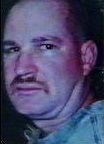
PETER IS mentioned on the Police Wall of Remembrance
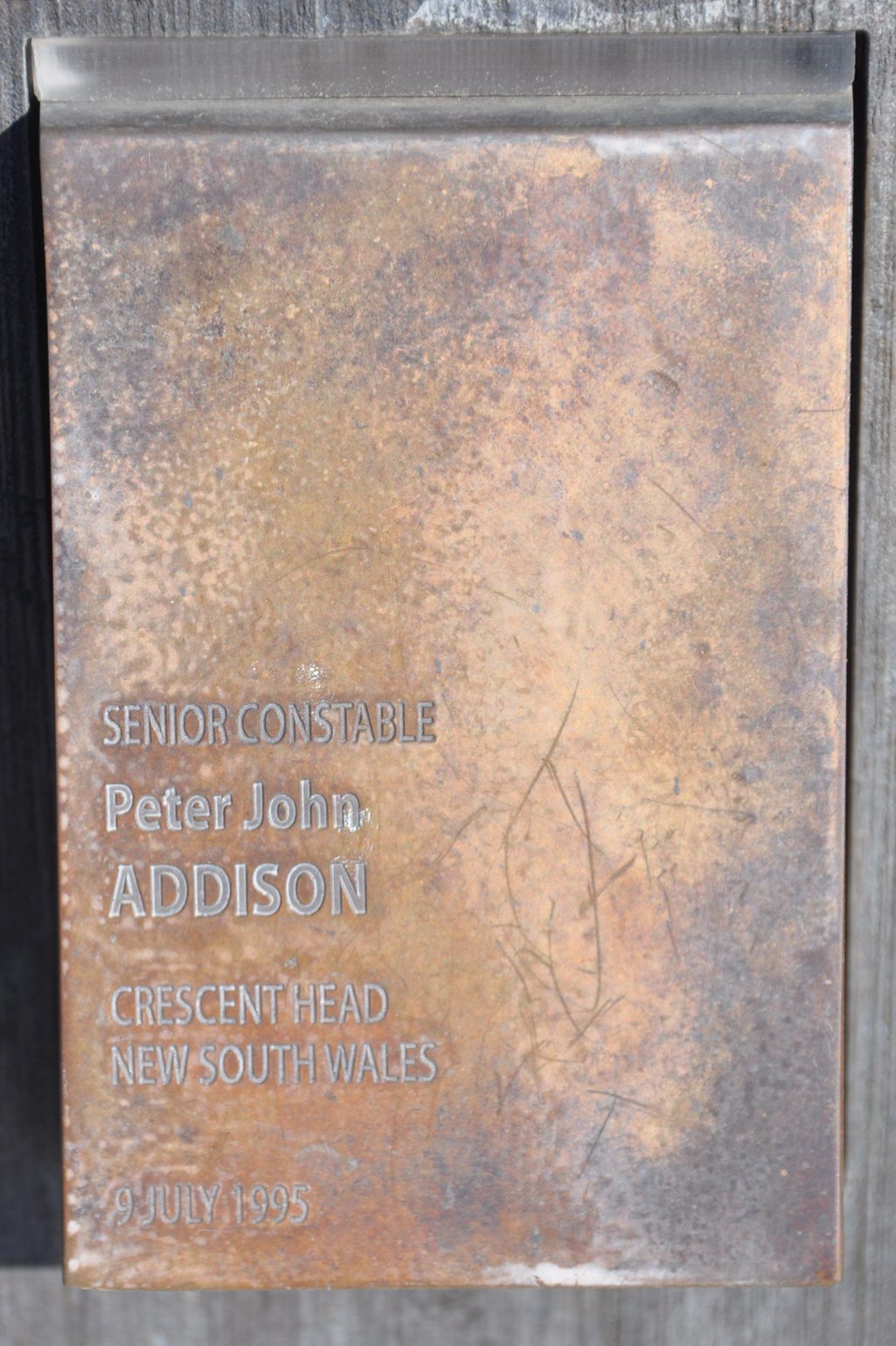
SenCon Peter John ADDISON – shot – 9 July 1995 – Crescent Head
Peter John ADDISON – touch plate at National Police Wall of Remembrance, Canberra.
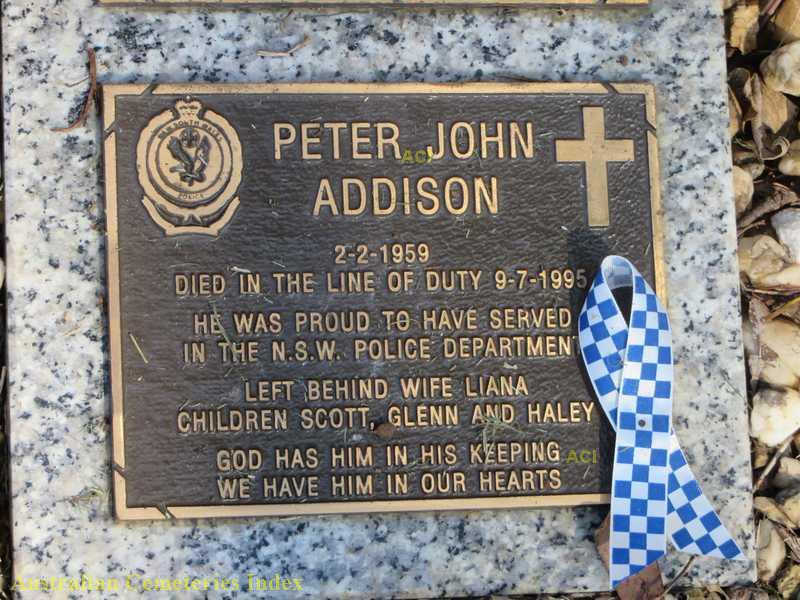
Grave plaque for Peter ADDISON
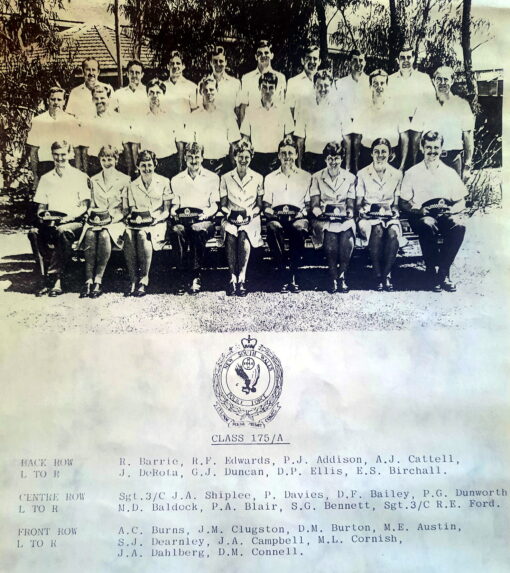
Redfern Police Academy Class 175 – Sub Class A Back Row L to R: R. BARRIE # 19933, R.F. EDWARDS, Peter John ADDISON # 19914, A.J. CATTELL # 20205, J. DeROTA # 19902, G.J. DUNCAN # 19913, D.P. ELLIS # 19906, E.S. BIRCHALL # 19917 Centre Row L to R: Sgt 3/c J.A. SHIPLEE # 11230, P. DAVIES # 19919, D.F. BAILEY # 19916, P.G. DUNWORTH # 19937, M.D. BALDOCK # 20162, P.A. BLAIR # 19942, S.G. BENNETT # 19934, Sgt 3/c R.E. FORD # 10076 Front Row L to R: A.C. BURNS # 19904, J.M. CLUGSTON # 19895, Donna M. BURTON ( Donna McMAHON / Donna Thompson ) # 19929 , M.E. AUSTIN # 19908, Suzanne Joy DEARNLEY # 19945, J.A. CAMPBELL # 19903, M.L. CORNISH # 19898, J.A. DAHLBERG, D.M. CONNELL # 19891
&
Robert Bruce SPEARS
( late of Port Macquarie )
New South Wales Police Force
Redfern Police Academy Class # 227
ProCst # 98500
Regd. # 23854
Rank: Commenced training at Goulburn Police Academy on Wednesday 1 April 1987 ( aged 28 years, 16 days )
Probationary Constable – appointed 26 June 1987 ( aged 28 years, 3 months, 10 days )
Constable – appointed 26 June 1988
Senior Constable – death
Final Rank: Senior Constable
Stations: ?, Liverpool, Kempsey
Service: From1 April 1987 to9 July 1995 = 8 years, 3 months, 8 days Service
Awards: No find on It’s An Honour
Commissioner’s Medal for Valour – posthumously
National Police Service Medal – granted 9 July 2015 – posthumously
Born: Monday 16 March 1959
Died on: Sunday 9 July 1995
Cause: Shot – murdered
Age: 36 years, 3 months, 23 days
Funeral date: ?
Funeral location: ?, Liverpool, NSW
Buried at: ?
Grave location: Lat/Long: -31.462153 , 152.858907
Compass Rose Garden, Innes Gardens Memorial Park, NSW:
Memorial location: Killuke St, Crescent Head’s
ROBERT IS mentioned on the Police Wall of Remembrance
SenCon Robert Bruce SPEARS – shot – 9 July 1995 – Crescent Head
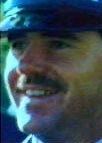
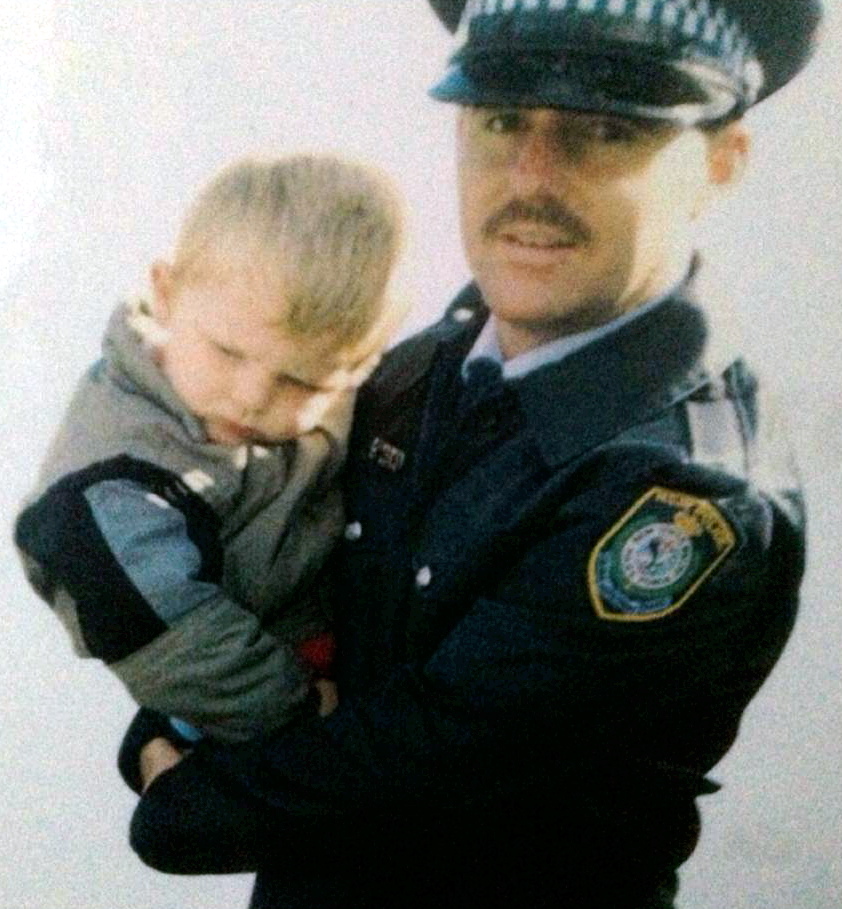
Bob Spears and his son
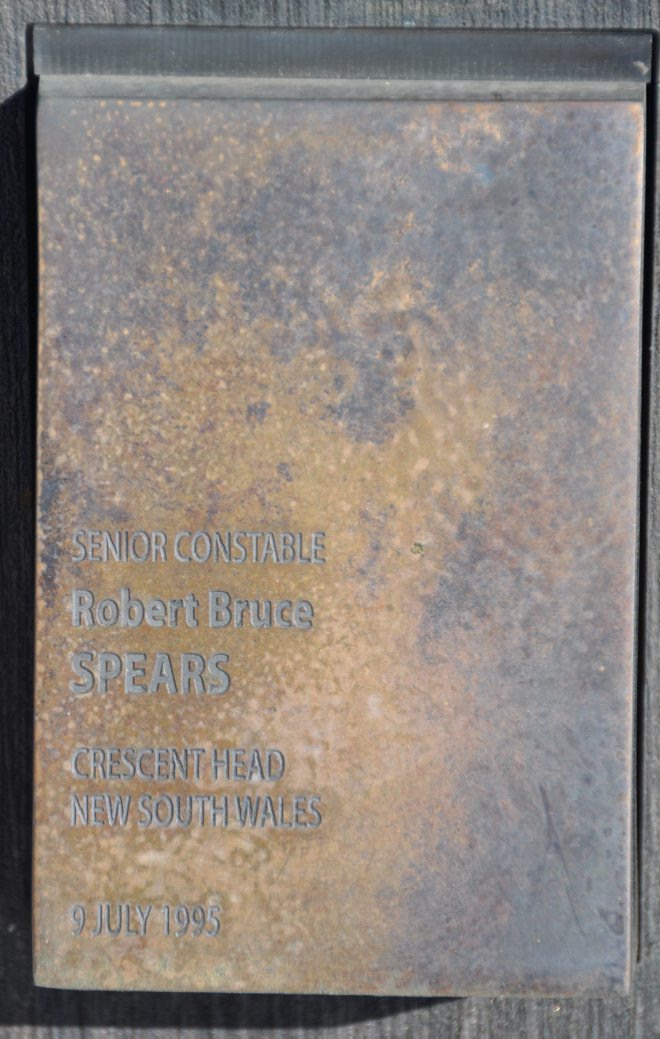
Touch plate for Senior Constable Robert SPEARS at the National Police Wall of Remembrance, Canberra.
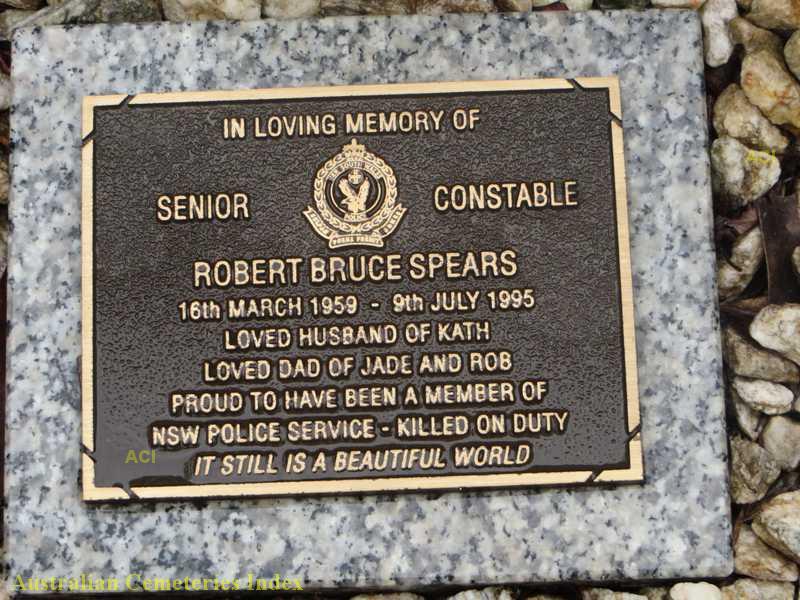
Grave plate for Robert SPEARS
Crescent Head memorial as of July 5, 2013. The memorial to Senior Constables Peter Addison and Robert Spears is being well cared for. 2013 marks the 18th anniversary of their death. Such a sad waste of the lives of such good men. Their bravery was exceptional. R.I.P.
About 12.35am on 9 July, 1995 the constables were performing night shift at the Kempsey Police Station when they were called to a malicious damage complaint at the nearby township of Crescent Head. Having attended one address in relation to the complaint they drove to a dwelling in Main Street, Crescent Head. There they parked the police vehicle in a driveway and began to walk toward the front door.
At 1.22am an urgent radio message was received from Senior Constable Addison requesting urgent assistance. It was later learned that the offender McGowan had hidden near the carport of the dwelling and, camouflaged and armed with a high-powered Ruger rifle, had opened fire on the two police.
While withdrawing to the police vehicle Senior Constable Spears received a severe wound to the head and collapsed onto the ground. After exchanging shots with the offender Senior Constable Addison quickly sought help from neighbours. While apparently seeking a house with a telephone so he could call for assistance for his partner, he was also shot to death.
The murderer then committed suicide with the rifle.
At the inquest into the deaths of the two constables the New South Wales Coroner Mr Derek Hand commended both men for their extraordinary courage. Special mention was made of Senior Constable Addison‘s bravery in that “No-one would have blamed him if he had decided to seek safety. Not only was he obviously concerned about Constable Spears but he was faced with an armed man who could have caused much more death and injury in the neighbourhood”.
Mr Hand also commended the brave actions of Detective Senior Constable Michael Clark, Ambulance Officer Edward Hill and Mr Gregory Barnett.
Senior Constable Addison was born in 1959 and joined the New South Wales Police Force on 6 November, 1981. At the time of his death he was stationed at Kempsey. He was posthumously awarded the Commissioner’s Medal for Valour.
Senior Constable Spears was born in 1959 and joined the New South Wales Police Force on 26 June, 1987. At the time of his death he was stationed at Kempsey. He was posthumously awarded the Commissioner’s Medal for Valour.
New South Wales. State Coroner (1995). [Inquests into the deaths of Robert Bruce Spears, Peter John Addison and John Craig McGowan : transcript of the Coroner’s address, findings and recommendations of 13 October 1995.]. New South Wales State Coroner’s Court, [Penrith, N.S.W ( no link )
Commemorative service 10:30am, Thursday 9 July 2015 Addison/Spears memorial site Corner of Baker Dr and Killuke Cr, Crescent Head
Valour not forgotten
A ceremony this month will mark the 20th anniversary of one of our darkest days.
STORY SHAUN FEWINGS
PUBLIC AFFAIRS BRANCH
On the face of it, it was a routine call to a domestic violence complaint but within an hour two police officers were ambushed and shot dead.
When Kempsey-based police officers, Senior Constables Peter Addison VA and Robert Spears VA arrived in the small mid north coast town of Crescent Head, they came under attack from a hidden assassin. Local electrician John McGowan was drunk and dressed in camouflage gear, hiding near a car port on his Walker Street property.
The 35-year-old, armed with a high-powered modified Ruger 14 rifle, opened fire on the officers as they got out of their 4WD. The pair took cover behind their vehicle and exchanged shots with the gunman.
As Snr Cst Addison got back in the car to radio for backup, McGowan shot his partner in the head.
Snr Cst Addison ran to a neighbouring house to seek help but it didn’t have a telephone. He continued to exchange shots with the offender but was also shot dead. The killer then turned the gun on himself.
It happened at 1.22am on 9 July, 1995 and remains one of the darkest days in the history of the NSWPF. The deaths led to major reforms, including the introduction of automatic pistols and bullet proof vests for first response officers, improved radio equipment and coverage, and advances in police tactical training.
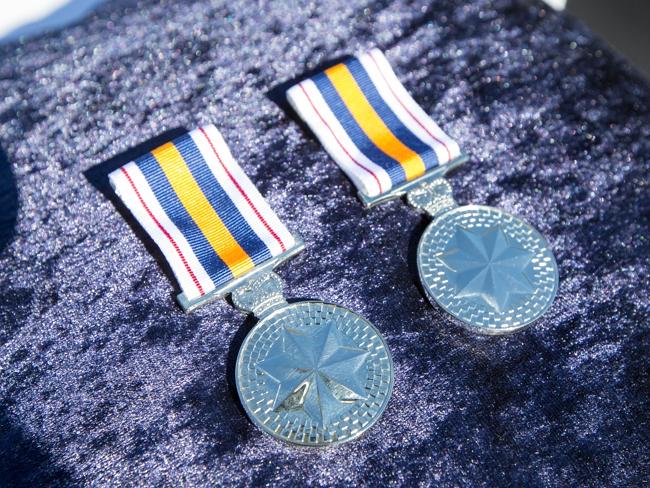
A special ceremony will mark the 20th anniversary of their deaths at a memorial site within the town. Commissioner Andrew Scipione will present the widows of Senior Constables Addison and Spears with National Police Service Medals in honour of their courage, service and diligence.
Today the ranks of the NSWPF are filled with many officers too young to remember the Crescent Head shootings but who remain protected by the legacy of two brave police officers.July 2015Police Monthly3
The medals awarded to widows of Peter Addison and Robert Spears. Picture: Lindsay Moller
$18 loader may have saved police life
Feb. 6, 2001, 9:02 p.m.
ONE of two police officers killed after being ambushed by a drunken gunmen at Crescent Head in 1995 may have survived if he had been issued with an $18 speedloader the Industrial Relations Court has been told.
NSW WorkCover Authority is proceeding with eight summonses against the Crown over alleged Occupational, Health and Safety Act breaches by the NSW Police Service stemming from the shooting deaths of Kempsey policemen, Senior Constables Robert Spears and Peter Addison.
The matter, being heard by Justice Hungerford, began in Sydney on Monday and is expected to take three weeks to complete.
Senior Constables Addison and Spears, both Port Macquarie residents, were shot by John McGowan on July 9, 1995 when they went to investigate a domestic violence complaint.
In the preceding Coronial Inquest, Coroner Derrick Hand found the two officers had been ‘massively outgunned’, lacked bulletproof vests and were hampered by poor radio communications.
WorkCover alleges the breaches of the Act contributed to the deaths of the policemen and specifically refers to inadequate equipment and training and the alleged failure to provide self-loading firearms.
When the officers arrived at the home of McGowan he was armed .223 calibre Ruger Rifle.
Constable Spears was shot dead in McGowan’s first salvo before Const. Addison managed to enter a house across the road to use a phone for help, when he was told there was not one he left the house only to be shot dead himself.
McGowan then shot himself.
WorkCover alleges the Crown failed to ensure the health and safety of Const. Addison and Spears by not providing them with a speedloader or a self-loader weapon such as a the 9mm Glock pistol, which holds 17 rounds, now used by the service.
WorkCover’s Barrister Steven Crawshaw told the court a speedloader, a round device used to load all six bullets into the then standard police weapon, a .38 Smith and Wesson, would have let Const. Addison reload more efficiently under pressure.
Police Service Barrister, Peter Hastings, QC, told the court Const. Addison did not appear to be reloading at the time he was killed so the issue was irrelevant.
The officers were issued with speed strip reloaders that enable rounds to be loaded two at a time.
The court heard Const. Addison had fired all six rounds from his revolver and investigators found his unused speed strip lying near his body.
WorkCover has also alleged that the police service failed to provide the two officers with training addressing in a practical way the tactics to be employed in a high-risk situation such as they were faced with and the systems the police service had in place to ensure training was deficient.
Training of police attacked May 3, 2001, 9:06 p.m.
SIX years after the shooting deaths of two Kempsey police officers a NSW court has found the NSW Police Service negligent in not providing adequate training and communications for the officers.
Senior Constables Robert Spears and Peter Addison, both Port Macquarie residents, were gunned down by a drunken John McGowan when they went to investigate a domestic violence complaint at Crescent Head on July 9, 1995.
NSW WorkCover, in January, started proceedings against the NSW Police Service through the NSW Industrial Relations Court over breaches of the Occupational, Health and Safety Act in relation to the deaths of Constables Addison and Spears.
On Wednesday, Justice Barrie Hungerford found that the NSW Police Service failed to provide adequate training and radio equipment.
Justice Hungerford found that the radio communications equipment was inadequate.
In the judgement Justice Hungerford said Senior Constable Spears and Addison were placed at risk of injury in that they could not communicate with other officers and vice versa.
“This created a working environment in which there was a greater risk of physical harm,” he said.
Justice Hungerford said there was evidence that supported the proposition that the officers concerned had not received up-to-date training in the various matters relevant to operational situations.
“Those subject matters, specifically, were weapons handling, tactics in high-risk situations, method of approach to buildings, concealment and the use of lights and torches.
“The very nature of the circumstances as they existed at Crescent Head during the subject incident made relevant the type of training the two officers had not recently received,” Justice Hungerford said.
Justice Hungerford dismissed eight other charges brought against the NSW Police Service by WorkCover relating to firearms, firearm equipment and training and operational duties.
The case was adjourned for a number of weeks to give the Police Service time to prepare mitigating evidence to be presented to Justice Hungerford before he announces the penalty.
On that night in 1995, after talking to a woman complaining of domestic violence threats, Constables Spears and Addison attended McGowan’s house in Walker Street at Crescent Head.
It is believed an altercation occurred between McGowan and the two officers. At some point McGowan produced a modified Ruger 14 rifle and the two officers retreated behind their 4WD.
McGowan then fired a number of shots at the officers while they sheltered behind their vehicle. Both officers returned fire from their position. A short time later Constables Addison and Spears got into the 4WD.
While Constable Addison radioed that they were in trouble McGowan shot Constable Spears in the head.
Constable Addison then again radioed that an officer was down before retreating across the road and entering a house in a bid to use a telephone to call for help.
After realising the house didn’t have a telephone Constable Addison left the house and exchanged shots with McGowan who was still beside the police vehicle.
A witness stated that then Constable Addison might have emptied his revolver while retreating to the rear of the house he just exited.
For reasons which were not clear, it is believed that Constable Addison attempted to go forward, with an empty gun and his torch shinning, but was shot dead by McGowan .
McGowan then shot himself and was found the next morning slumped on the lawn.
THE NSW Police Service has been fined $220,000 for not providing adequate training to two Kempsey police officers killed in a shootout at Crescent Head in 1995.
Senior Constable Peter Addison and Senior Constable Robert Spears, both residents of Port Macquarie, were shot and killed by John McGowan when they went to investigate a domestic violence complaint in the seaside village on the night of Saturday, July 9, 1995.
NSW WorkCover started proceedings, in the NSW Industrial Court, against the NSW Police Service in January 2001.
NSW WorkCover alleged a number of breaches of the Occupational, Health and Safety Act in relation to the deaths of Constables Addison and Spears.
In May of last year Justice Barrie Hungerford found that NSW Police had not provided Constables Spears and Addison with up-to-date training in high-risk situation tactics.
Justice Hungerford described the offence as being ‘extremely serious’ and noted that the officers had not undergone mandatory training in the use and reloading of weapons, use of torches, defensive tactics and communications.
In assessing the penalty, Justice Hungerford said the action taken by the Police Service since that fatal day to develop training programs and its previously clear occupational health and safety record.
“It is not unreasonable to conclude, in light of the clearly dangerous nature of the industry in which the Police Service operates, that the fact it has a clear occupational health and safety record is a weighty factor in its favour…,” Justice Hungerford said in his decision.
“Another relevant subjective consideration is the action taken by the defendant in respect of the Police Service in developing training programs for police officers, including the important program of ammunition training, and its leading role in that respect compared with police forces in other states,” he said.
WorkCover NSW acting general managerMichelle Patterson said “this tragic incident highlights the need for all employers to undertake appropriate risk management and to provide adequate training so that employees are able to carry out their duties”.
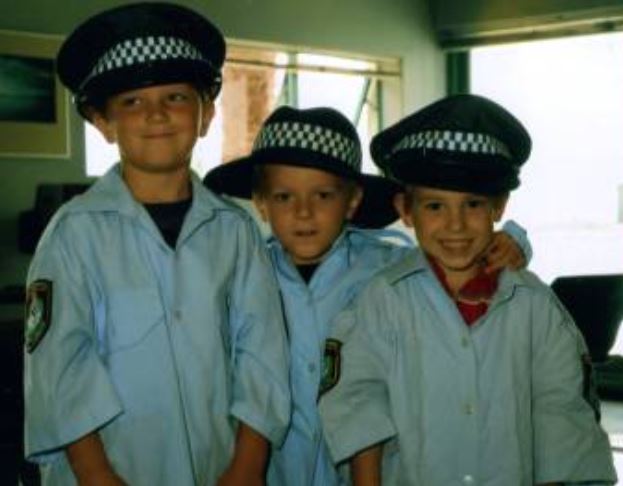
Honouring their grandfathers: Blake Addison, Joey Addison and Liam Jones.
THE memories of former police officers Bob Spears and Peter Addison are being preserved by three Port Macquarie boys who never met their grandfathers. Blake Addison, 6, Joey Addison, 4, and Liam Jones, 4, were not born when the Kempsey-based senior constables were shot down at Crescent Head in 1995. Late last month the boys were taken into their grandparents’ former world of crime and justice during an open day at Port Macquarie Police Station. They joined retired officers and their families on a tour of the station to uphold their family’s connection with the NSW Police Force.“I wasn’t lucky enough to meet them but my brother Joe and cousin Liam and I were treated so special at the open day we know our pops were important and special,” Blake said. There has been a concerted effort by the Addison and Spears families to ensure the boys understand the sacrifices their grandfathers made to protect the community before their death. Policing had been such a dominant part of the Addison and Spears lives before the shooting that the boys’ parents wanted it to be part of the next generation too. Blake and Joey Addison were an indirect result of the tragedy 12 years ago. The shooting brought their parents Jade Spears and Glen Addison together – Jade Spears and Glen Addison were the children of Bob Spears and Peter Addison. Liam Jones is Bob Spears’s grandson – Liam’s mother Hayley Jones changed her maiden name from Addison when she married.
The web of family connections and history has only brought the Addisons and Spears closer.
The trio of boys, their sisters, their parents, and their grandmothers are almost inseparable.
Next year, they will all attend Police Remembrance Day for the first time as a whole family to reflect again on the lives Bob Spears and Peter Addison.
SACRIFICE and sadness will hang heavy in the air on Thursday for officers and wider family of the Mid North Coast Local Area Command.It will be the 20th anniversary of senior constables Pete Addison and Bob Spears‘ murders at Crescent Head.The two officers, stationed at Kempsey but both of whom lived in Port Macquarie, were killed while responding to a violent disturbance on Main Street about 1am on July 9, 1995.Electrician John McGowan killed Sen Const Spears first by using a .223 calibre Rutger Rifle, before taking the other officer’s life.McGowan then shot himself.The two officers were posthumously awarded the NSW Police Force’s highest honour, the Commissioner’s Valour Award, the following month.More than 200 officers and guests are expected at Crescent Head’s Killuke St memorial tomorrow at 10.30am to commemorate the fallen colleagues.
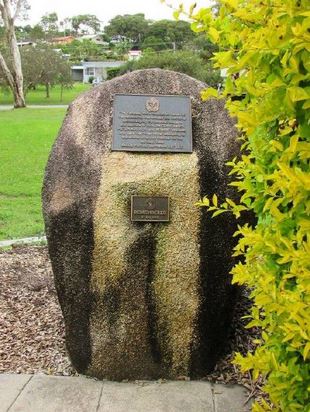
Killuke St memorial Stone to Addison & Spears – 2015
“It will be an opportunity for all colleagues to show we haven’t forgotten what happened,” Superintendent Paul Fehon said on Monday.
“It’s for us to remember, and for us to let the families know we will never forget their bravery.
“There was an impact on so many people.”
Police chaplain Father Paul Gooley will lead the service, which will be co-celebrated by Fr John Casey who was the LAC’s chaplain 20 years ago and conducted Sen. Const. Addison’s funeral.
Police Commissioner Andrew Scipione will then present the National Police Service medals to the widows of the two officers to mark the men’s heroism and diligence to duty.
Deputy commissioners Catherine Burn and Nick Kaldas will also be at the service, as well as former commissioners, politicians and the heads of Ambulance NSW and Fire and Rescue NSW.
Former State Coroner Derrick Hand, who investigated the murders, is another notable guest.
The general public is also invited to attend, with plenty of space available in surrounding parkland.
The slain officers’ families will lay wreaths, followed by Commissioner Scipione and fellow police.
The community are also able to lay a wreath. A reception will take place following the ceremony at the Crescent Head Country Club.
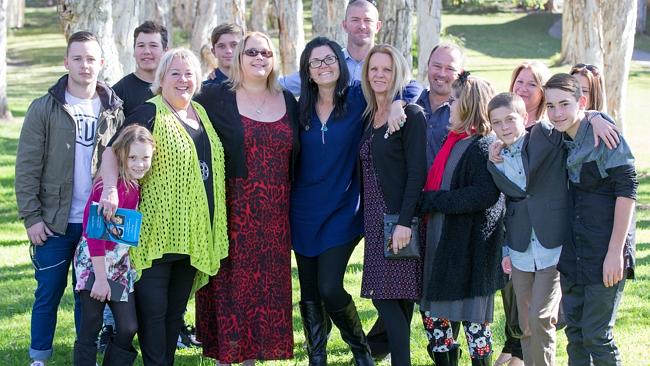
Families of slain officers Peter Addison and Robert Spears united by love
Samantha Townsend
The Daily Telegraph
July 09, 2015 1:02PM
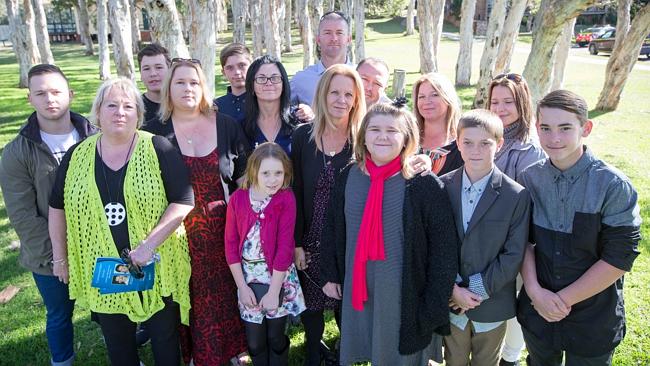
Glenn Addison (centre back) and Jade Spears (centre front in blue) with family members of Peter Addison and Robert Spears at Crescent Head. Picture: Lindsay Moller
TWO families united in the most horrific of circumstances are forever joined through the generations.
Senior Constables Peter Addison and Robert Spears, both 36, were killed by a gunman after responding to a domestic violence call in Crescent Head on the Mid North Coast on July 9, 1995.
Their children Glenn Addison and Jade Spears, who were 16 and 15 at the time, met after their fathers’ deaths and went on to get married.
The pair, with their children Blake, 14, Joe, 12, and Charlie, 10, joined their mothers Liana and Kathy as well as family and friends today at a ceremony in the coastal town to mark the 20th anniversary of the tragedy.
Speaking on behalf of the family, Liana (Addison) Stewart, said their families would always be connected not only because of their loss but through the marriage of their children.
“There has to be good come out of this,” Liana said. “Our families will always be connected.”
Haley Addison and Liana (Addison) Stewart at the special 20th Anniversary ceremony. Picture: Lindsay Moller
Jade Spears with her son and husband Glenn Addison at Crescent Head. Picture: Lindsay Moller
She said the ceremony was a special day for the family and she knew “without a doubt” their legacy would stay strong.
“It’s nice they have never been forgot,” she said.
Police Commissioner Andrew Scipione presented National Police Service medals to the widows of the slain officers today in honour of the men, who gave their lives while attempting to apprehend an armed offender.
The Kempsey-based senior constables had been dispatched to Crescent Head to investigate a report of domestic violence in the early hours of July 9, 1995.
As they arrived in Walker St, the policemen came under fire from drunken gunman John McGowan, dressed in camouflage gear and hiding near a carport.
The officers returned fire as they sought cover behind their four wheel drive. Addison tried to call for back-up on their police radio when Spears was fatally wounded.
Robert Spears was fatally wounded trying to apprehend an armed gunman.
Peter Addison who was gunned down in the line of duty.
In a desperate bid to seek help for his dying friend, Addison ran to a nearby house but it didn’t have a telephone.
As he tried to enter another property, still returning fire, the 14-year police veteran was also shot dead by the gunman, who then turned his high-powered rifle on himself.
Police Commissioner Andrew Scipione said the heroic officers had “stood their ground, defending themselves and their community from a cowardly assassin”.
“Peter Addison was not prepared to leave his wounded friend and colleague… together they made the ultimate sacrifice and we will never forget them for it,” he said
Their deaths led to major reforms within the force including the transition from revolvers to automatic pistols, bulletproof vests for first response officers, improved radio coverage and equipment as well as state-of-the-art tactical training for uniformed police.
Police Commissioner Andrew Scipione handing the National Police Service medal to Kathy Spears. Picture: Lindsay Moller
The Spears and Addison families are connected by love and tragedy thanks to a marriage between the officer’s children. Picture: Lindsay Moller
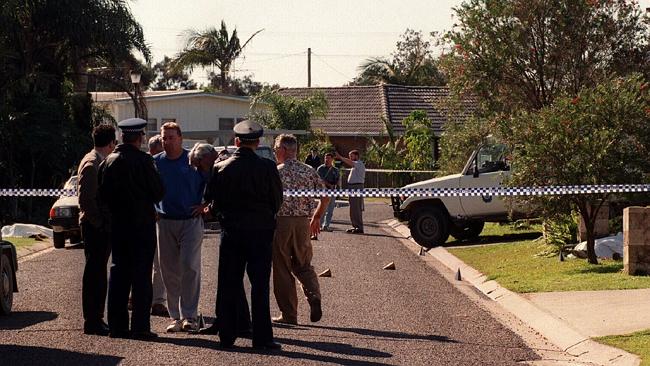
Walker St, the scene of the Crescent Head shootings, on July 9, 1995.
Crescent Heads police killings: Two decades on, ceremony will mark sacrifice made by senior constables on duty
Samantha Townsend Regional Reporter
The Daily Telegraph
July 09, 2015 12:00AM
The scene in Walker Street, Crescent Head, the morning of the shootings, with the body of gunman John McGowan (right) covered by a sheet as police speak with shocked residents.
Pair on night shift when they attended to domestic dispute call
Arrived to find gunman in camouflage gear carrying high-powered rifle
Gunman shot two policemen dead before killing himself
Tragedy led to major reforms within police force
IT WAS supposed to be a routine domestic violence call, but what happened next not only tore apart two families but also stunned a NSW coastal town.
Senior Constables Robert Spears and Peter Addison made the ultimate sacrifice when they were killed in the line of duty while protecting the community of Crescent Head on the Mid North Coast from an armed gunman on July 9, 1995.
Today is the 20th anniversary of their deaths and Police Commissioner Andrew Scipione has presented National Police Service medals to the widows of the slain officers in honour of the pair’s heroism and diligence to duty.
Spears and Addison, both 36, respectively the fathers of two and three children, had moved to the Mid North Coast for a better lifestyle.
The Daily Telegraph reported at that time that on the night on July 8, 1995, the officers had kissed their families goodbye and headed out for the late shift at Kempsey Police Station.
At 12.35am the officers received a distress call about a domestic violence incident at nearby Crescent Head from the former girlfriend of electrician John McGowan.
The scene after two police officers responding to a domestic disturbance call were gunned down by John McGowan.
Senior police officers next to the covered body of McGowan.
When they arrived into the township around 1am, The Daily Telegraph Mirror reported the police officers were confronted by a drunken McGowan dressed in camouflage gear and armed with a high-powered rifle.
THE DAY MURDER CAME TO MY SLEEPY BEACH TOWN
The officers were armed with police-issue .38 Smith and Wesson revolvers.
A call for back-up was made around 1.22am.
A NSW police spokesman told The Daily Telegraph yesterday that Spears was fatally wounded first, having been shot in the head.
John McGowan shot and killed the two policemen before committing suicide in the street.
Unable to get radio assistance, the spokesman said Addison dashed to a nearby home to use the landline but the occupants did not have one.
On his way to a second house, Addison was shot dead.
McGowan then turned the gun on himself.
In the hours after the incident, police swarmed into the town, warning residents to stay inside their homes.
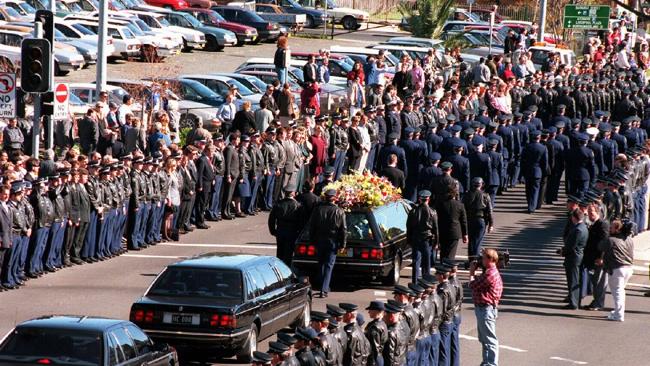
Police guard lines route of Senior Constable Robert Spears‘ funeral at Liverpool.
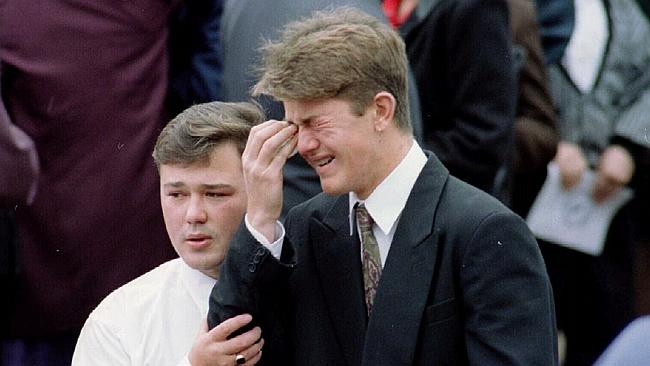
Glen Addison weeps as his brother Scott consoles him at their father’s funeral.
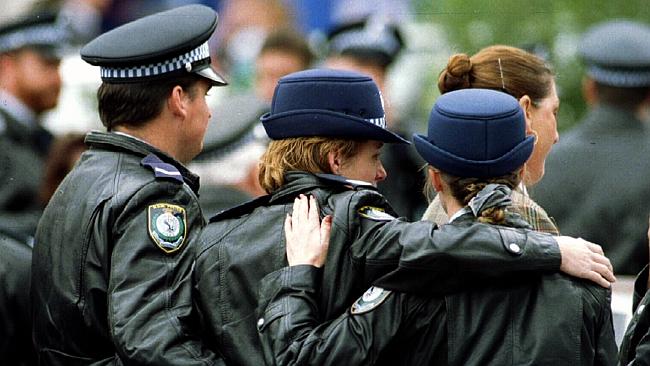
Uniformed police link arms at funeral of colleague Senior Constable Addison.
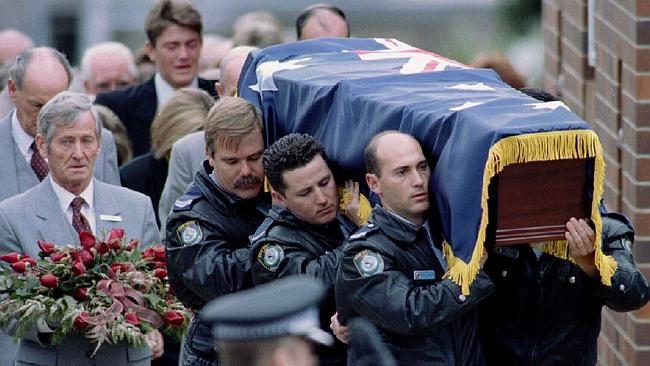
Police carry the coffin of Senior Constable Peter Addison.
At that stage they did not know the gunman had killed himself.
It has been reported that police found his body around 9am.
Not long after the senior constables deaths, the fallen officers were awarded the Police Force’s highest honour, the Commissioner’s Valour Award.
Their deaths led to major reforms within the force including the transition from revolvers to automatic pistols, bulletproof vests for first response officers, improved radio coverage and equipment as well as state-of-the-art tactical training for uniformed police.
NSW Police Commissioner Andrew Scipione says the shootings of two police officers at Crescent head is the darkest day in the NSW police history.
Around 250 people gathered at Crescent head including families and friends of the dead officers where their widows were awarded with medals for officers valour.
“Senior Constables, Peter Addison and Robert Spears, walked into an ambush,” he said.
“Human instinct would demand you remove yourself from harm’s way in a situation like that, but not these brave officers.
“They knew they had to try to stop this gunman who could have gone on to kill or injure others.
“They stood their ground, defending themselves and their community from a cowardly assassin.
“Peter Addison was not prepared to leave his wounded friend and colleague…together they made the ultimate sacrifice and we will never forget them for it.”
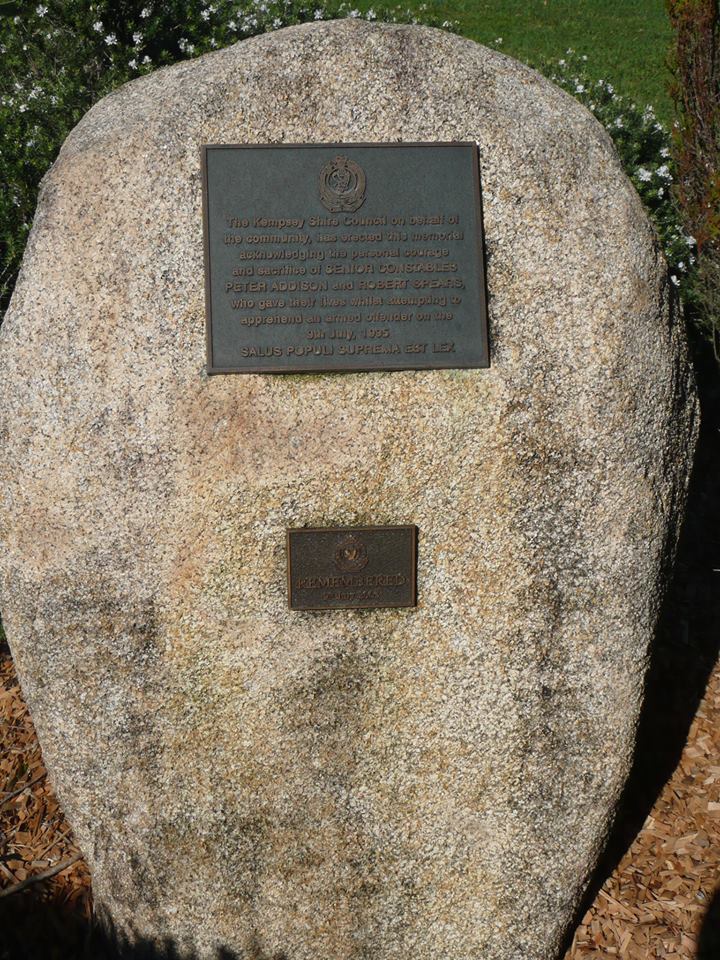
A memorial plaque was unveiled in the town in 1996 just a few hundred metres away from the street where the officers were slain.
The plaque reads: “The Kempsey Shire Council on behalf of the community, has erected this memorial acknowledging the personal courage and sacrifice of Senior Constables Peter Addison and Robert Spears, who gave their lives while attempting to apprehend an armed offender on the 9th July, 1995.”
Police Commission Andrew Scipione joined a host of other dignitaries at the Crescent Head memorial to mark the 20th anniversary of their deaths.
A long list of dignitaries including former Police Commissioners, Tony Lauer and Neil Taylor, attended today’s ceremony to honour the officers for their bravery and dedication to duty.
Following the shooting murders of Senior Constables Peter John Addison and Robert Bruce Spears at Crescent Head, on the 9 July, 1995, the Police Association pressed for a serious review of the firearms on issue to general duties police, with the aim of having
the .38 special Smith & Wesson model 10 revolver replaced with a self loading pistol.
The model 10 had been in service for 30 years. Addison and Spears were shot dead by John McGowan, who was armed with a .223 calibre Ruger Mini 14 self loading rifle.
McGowan had several loaded magazines and his rifle was painted in camouflage paint.
The two policemen went to McGowan’s residence in Walker Street, Crescent Head, following a complaint that McGowan made threats to his former girlfriend. Addison and Spears exchanged shots with McGowan but were obviously outgunned. It appeared that when Spears tried to reload his revolver, the speed strip containing his ammunition fell to the ground. McGowan shot himself dead after shooting Addison and Spears and his rifle was found next to his body. It was estimated that McGowan fired 30 shots from the rifle,
with some of McGowan’s bullets hitting neighbouring houses and killing a stray dog.
Peter Addison joined the police in 1981 and Robert Spears had been in the police since 1987. Both men were posthumously awarded the Commissioner’s Medal for Valour.
Since the late 1980s, the adequacy of the revolver for police duties had been in question and the self loading pistol was favoured as a replacement for the Smith & Wesson model 10 revolver. In 1998, the Glock model 22 self loading pistol chambered for the .40 S&W cartridge was being issued to replace the .38 calibre Smith & Wesson model 10 revolver.
The Glock is not the first type of self loading pistol that has been issued to NSW Police.
From the late 1920s, until phasing in of the Smith & Wesson model 10 revolver in the 1960s, an assorted variety of pistols and revolvers were used for police use, many coming from confiscated and surrendered stocks as well as government purchase. Throughout this period leading up to 1965, revolvers such as the .32 Colt Police Positive, the Colt Pocket Positive and also the .38 special Smith & Wesson model 10, were issued to ranks below sergeants 1st class were issued with .25 calibre self loading pistols. While this may have been the desired mode of issue, the types of pistols and revolvers issued depended on things such as supply and availability.
Canberra Times (ACT : 1926 – 1995),
Friday 14 July 1995, page 6
Firearms amnesty follows tragedy
SYDNEY: The NSW Government has announced a 12 month firearms amnesty effective immediately.
The Premier, Bob Carr, said yesterday that anyone who was holding an illegal firearm should surrender it to police.
” I have asked the Minister for Police, Paul Whelan, to widely publicise the amnesty, ” Mr Carr said.
” The amnesty means the owner of an illegal and prohibited firearm can hand it over to the police without fear of prosecution. ”
The Victorian Government announced a permanent gun amnesty on Tuesday and Mr Carr said then that he wanted an amnesty up and running in NSW as soon as possible.
He made the announcement yesterday after returning from the funeral of Senior Constable Peter Addison, who with his partner, Senior Constable Robert Spears, was gunned down outside a house at Crescent Head on the NSW mid-north coast on Sunday morning.
The pair had gone to the address in response to a domestic dispute.
The gunman, John McGowan, shot himself in the head later.
He had made his Ruger 14 mini-rank rifle illegal by attaching two magazines so the weapon could fire 30 rounds without reloading. The legal limit is five.
And police said the rifle was not licensed.
” The challenge we face here is that there was a gun, illegal under NSW law, in the possession of someone who did not have a shooter’s licence, ” Mr Carr said.
” Now obviously an amnesty that would drain the number of guns out of the community makes sense. ”
NSW had a gun amnesty after the August 1991 Strathfield massacre when Wade Frankum opened fire and shot dead six people in a suburban shopping plaza before turning the gun on himself.
In April 1994, the NSW Police Service switched on its Computerised Operational Policing System list, on which the name and address of every licensed shooter in the state is on the computer database.
There is a also a “persons’ of special interest” category on COPS which would cater for people with a psychological history of violence or a criminal record.
Coastal holiday village woken to the sound of murder
KEMPSEY: The serenity of a north-coast township was broken early yesterday when two police officers were shot dead while on duty and their killer committed suicide by turning his gun on himself.
Police said that just after 1am Senior Constables Peter Addison and Robert Spears, both aged 36, had arrived at a house in Crescent Head, 21km south-east of Kempsey, in response to a call about malicious damage to a car.
Within minutes, the pair, who had transferred to Kempsey with their young families about six months ago, were gunned down as they walked toward the house, by a man reportedly drunk and depressed over a failed love affair.
Police have confirmed that no one else was in the house with the man.
Nearby residents heard a series of shots and shouting then further blasts from a semi-automatic rifle as 35-year-old electrician John McGowan tried to comprehend his deed.
Special Protection Group members and negotiators from Sydney were rushed to the house, and residents were warned to stay in doors.
Traffic was barred from entering the town.
Anita Crowley, who lives a few streets away from the shooting, said she was woken up by the shots.
“I thought it was firecrackers,” she said. “I heard somebody shouting and yelling ‘ get down ‘.”
Police said negotiators were assessing the situation when, just before 9am, McGowan’s body was found on the front lawn of the house. He had turned the gun on himself and died from a single gunshot wound to the head.
The small town is now trying to come to terms with how a man who seemed “just a normal bloke” could shoot two police officers.
One resident, who did not want to be named, said McGowan was well-known. “He was just a normal bloke, just a resident of Crescent Head,” the man said.
“He was a bloke who would go to the club once a week, have a drink with mates, go to work five days a week.”
Another resident, who lives close to Walker Street, said: “This is just a quiet little holiday village where people come to enjoy themselves. This is the last thing you would expect from it.”
Kempsey’s Mayor, Stuart McIntyre, whose shire takes in Crescent Heads, said the shootings were an “absolute disaster” for the close-knit community, which has a population of 1200.
“It has absolutely stunned everybody,” Mr McIntyre said. “It’s one of those things which you think could never happen here.”
NSW Police Commissioner Tony Lauer said he was deeply saddened by the shooting.
“Two young police officers, going about their duties with commitment and dedication, have made the ultimate sacrifice while protecting their community,” Mr Lauer said in a statement. “These tragic events remind us of the unforeseen possibilities any police officer can face while performing their duties.”
NSW Police Association secretary Lloyd Taylor described the killings as “bad and a bloody disastrous day in policing”.
“Policing can be at times a mundane, sedentary job but it is also a job in which you can pay with your life,” Mr Taylor said.
He said the association had sent members to Kempsey to help the dead officers’ wives and children cope with the tragedy.
Local National Party MP Bruce Jeffery called for police to be issued with bullet-proof vests or soft body armour for all potentially dangerous situations.
“What has happened has highlighted the degree of danger police can face every day,” he said.
“The potential cost of these vests is a small consideration when you consider they would be protecting lives.”
The deaths of the constables brought the toll of NSW police shot and killed on duty to six in the past 10 years.
In 1986, Sergeant Paul Quinn died of a gunshot wound received on duty at Bathurst; in 1988 probationary Constable Sharon Wilson died after being accidently shot by a colleague at Leeton; in 1989, Constable Alan McQueen died after being shot when he and his partner disturbed a man trying to steal a car in central Sydney; and in 1992 Constable Juan Hernandez died when he accidently shot himself during weapons training at the Redfern Police Complex.
A police spokeswoman said Senior Constables Addison and Spears would be buried this week. The results of McGowan’s post-mortem examination should be released early this week.
Stations: School of Traffic and Mobile Policing – Goulburn
Service: From 8 December 1980 to 15 August 1994 = 13+ years Service
Awards: National medal – granted 2 December 1994 ( posthumously )
Born: 24 August1957
Died on: 15 August 1994
Cause: Motor Vehicle Accident ( Police motor cycle )
Death location: Lachlan Valley Way, Boorowa
Age: 36
Funeral date: ? August, 1994
Funeral location: ?
Buried at: ?
[blockquote]
Memorial location: ? Lachlan Valley Way, left hand side 5 kms from Boorwoa
Lat: -34.543611
Long: 148.731389
[/blockquote]
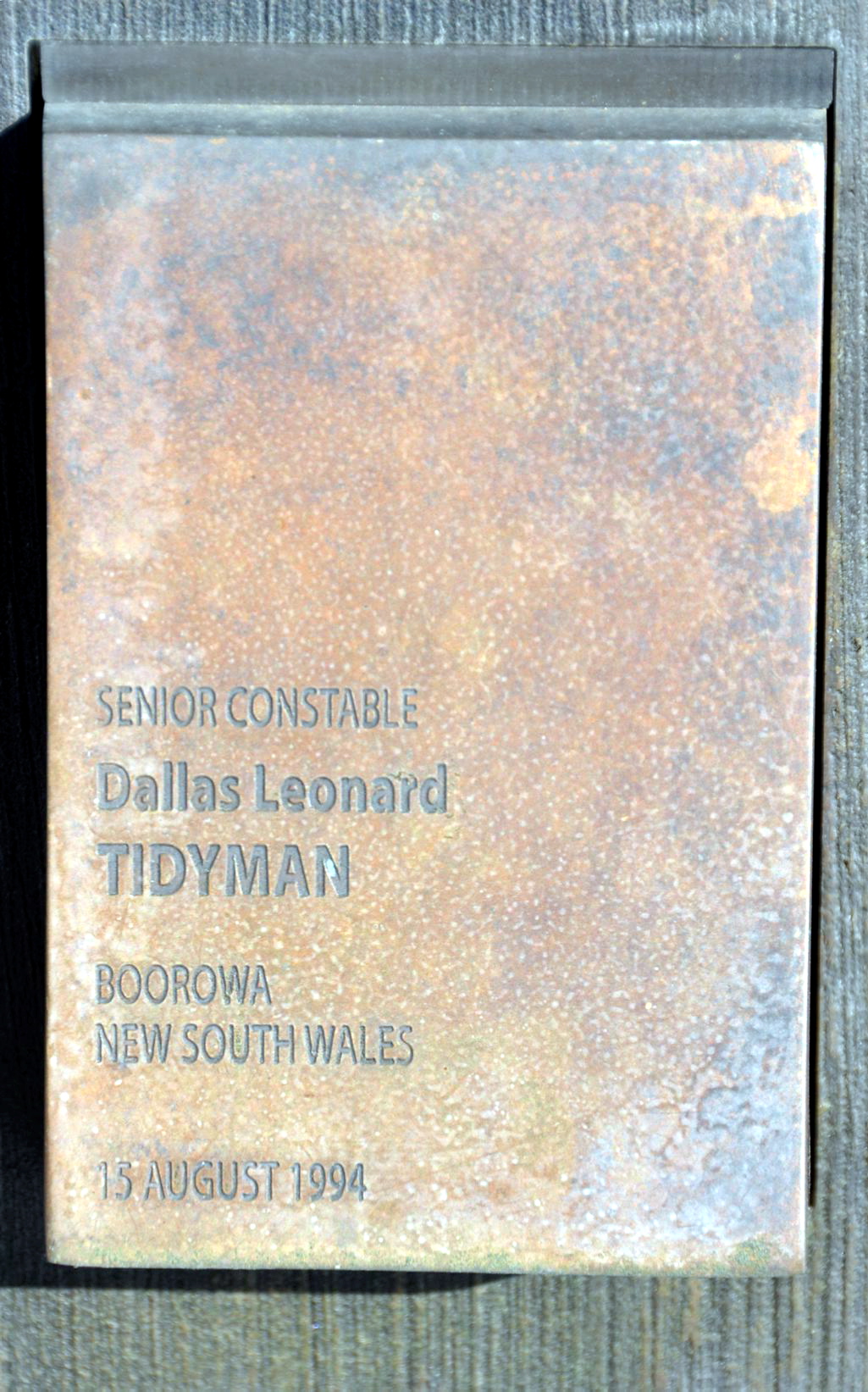
Front Inscription IN LOVING MEMORY OF SENIOR CONSTABLE DALLAS TIDYMAN. 24.8.57. – 15.8.94. TRAGICALLY KILLED WHILST ON DUTY. A TRIBUTE FROM HIS WORK MATES.
[alert_green]DALLAS IS mentioned on the Police Wall of Remembrance[/alert_green]
Dallas Leonard TIDYMAN memorial touch plate at Canberra Wall of Remembrance
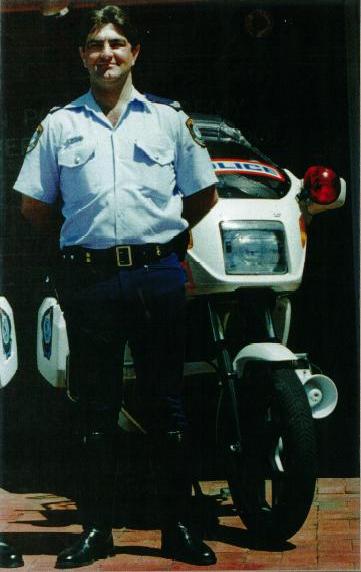
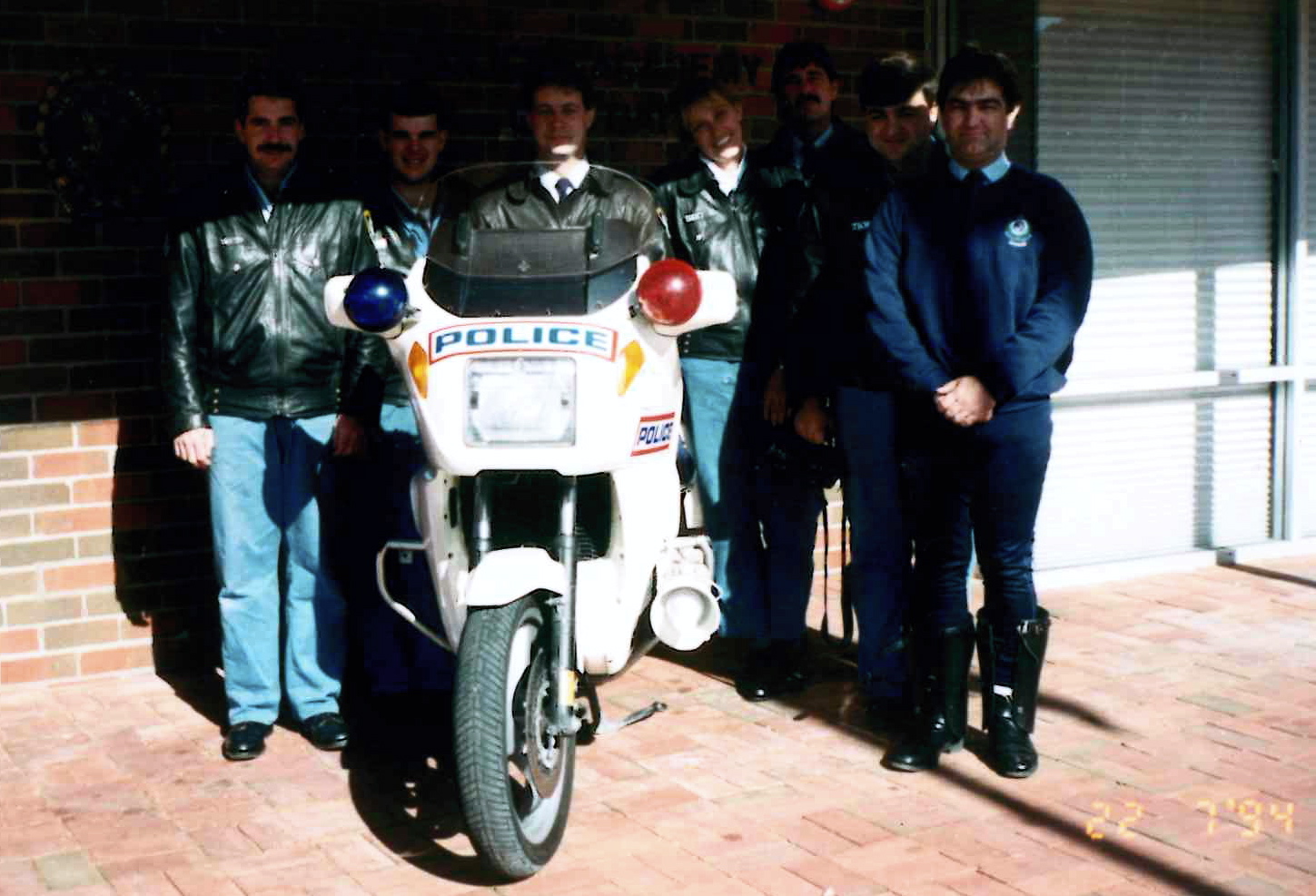
Senior Constable Dallas TIDYMAN at the Police Driver Training Unit
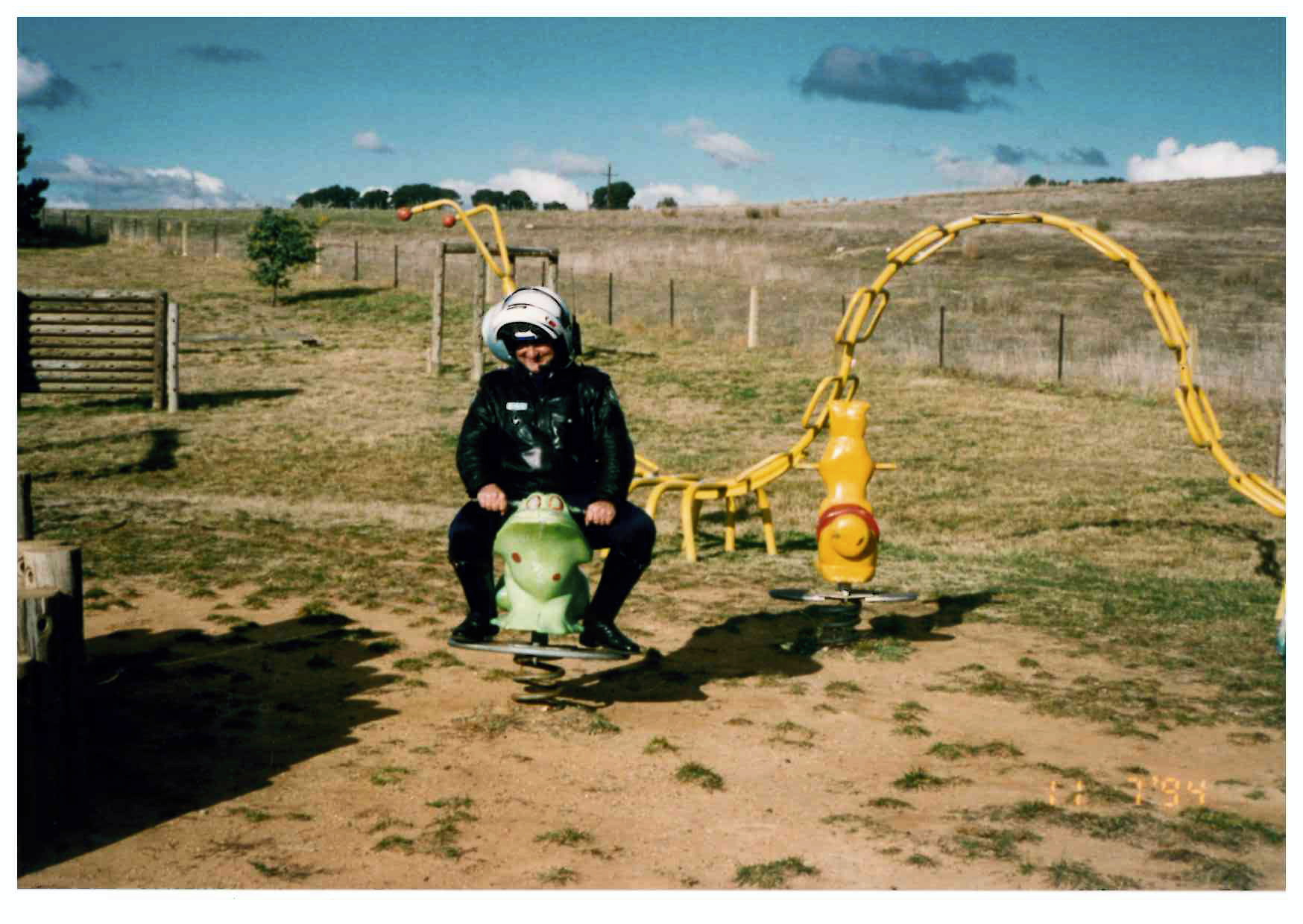
Dallas TIDYMAN – in July 1994. Always in for a laugh.
Dallas TIDYMAN – in July 1994
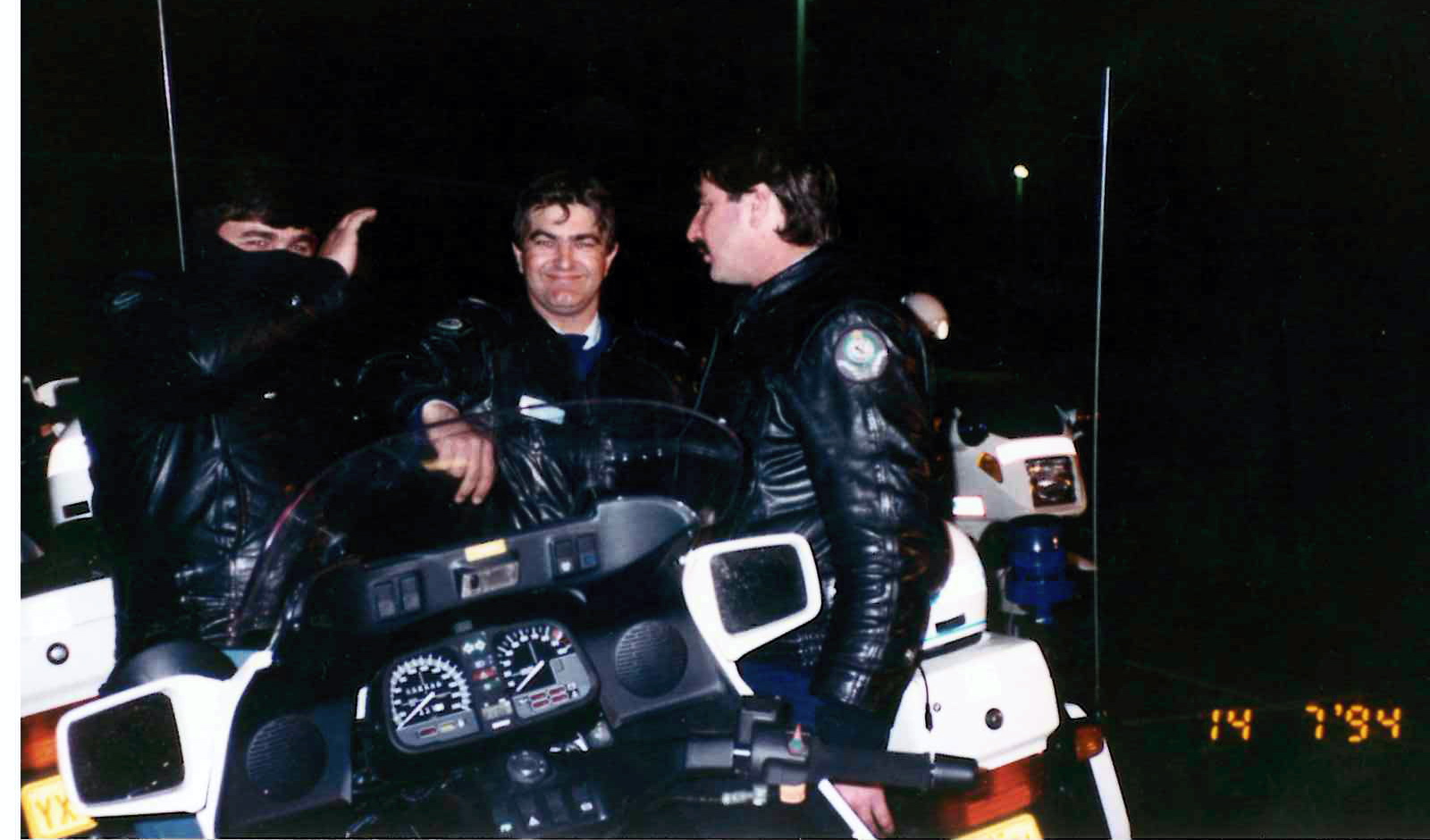
Dallas TIDYMAN – in July 1994 ( Dallas on the far right – just over 3 weeks before his death )
Terry Lester(left) and Dallas Tidyman (right) at the Goulburn PDTS late 1991 or early 1992. Dallas killed whilst instructing on a HWP motorcycle course at Boorowa, NSW. RIP two good friends.Terry died 25 June 2015
At 2.30pm on 15 August, 1994 Senior Constable Tidyman, a senior motor cycle instructor, was riding at the rear of a column of trainee police cyclists. While travelling along the Lachlan Valley Way, Boorowa he was struck by an oncoming vehicle and fatally injured. The offending driver had apparently lost control of the vehicle before veering across the roadway and colliding with Senior Constable Tidyman’s cycle.
The constable was born in 1957 and joined the New South Wales Police Force on 8 December, 1980. At the time of his death he was attached to the School of Traffic and Mobile Policing, New South Wales Police Academy, Goulburn.
[divider_dotted]
John Sidney PROOPS
| 27/10/2012
John Sidney PROOPS
New South Wales Police Force
Joined NSW Police Force via the Police Cadet system on 20 February 1967
Cadet # 2256
[alert_yellow]Regd. # 13782[/alert_yellow]
Rank: NSW Police Cadet – commenced 20 February 1967
Awards: Queens Commendation for Brave Conduct ( Imperial ) – granted on 24 June 1977 – ( Cst ) – Apprehend an armed man
National Medal – granted 3 September 1985 ( SenCon )
1st Clasp to the National Medal – granted 3 October 1995 ( Sgt )
Born: Monday 26 June 1950
Died: Saturday 22 May 1993
Age: 42
Event Date: Saturday 22 May 1993
Event Location: Ashfield
Cause: Heart Attack during arrest
Funeral Date: 23 July 1993
Funeral location: Woronora Cemetery
Buried: Cremated
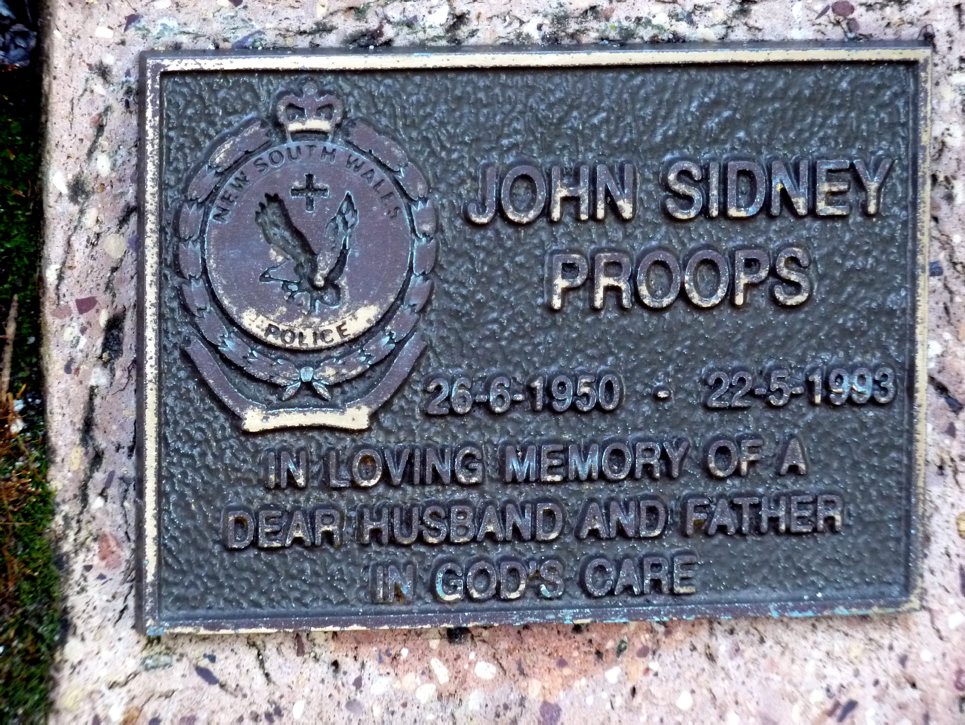
1/ Ashes: Henry Lawson Garden Walk
Section E, Plot 0012
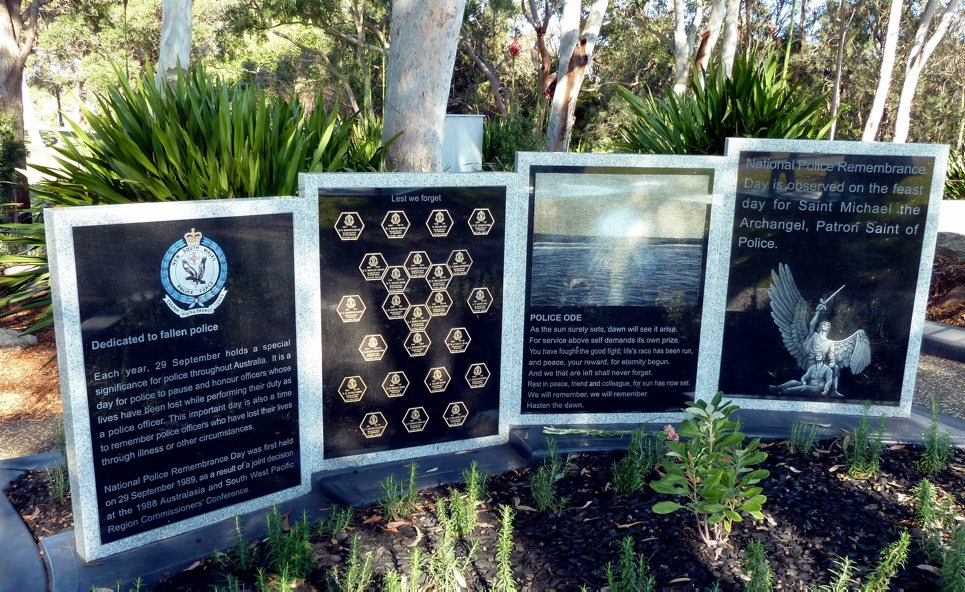
2/ Memorial location: Woronora Cemetery, Police Garden
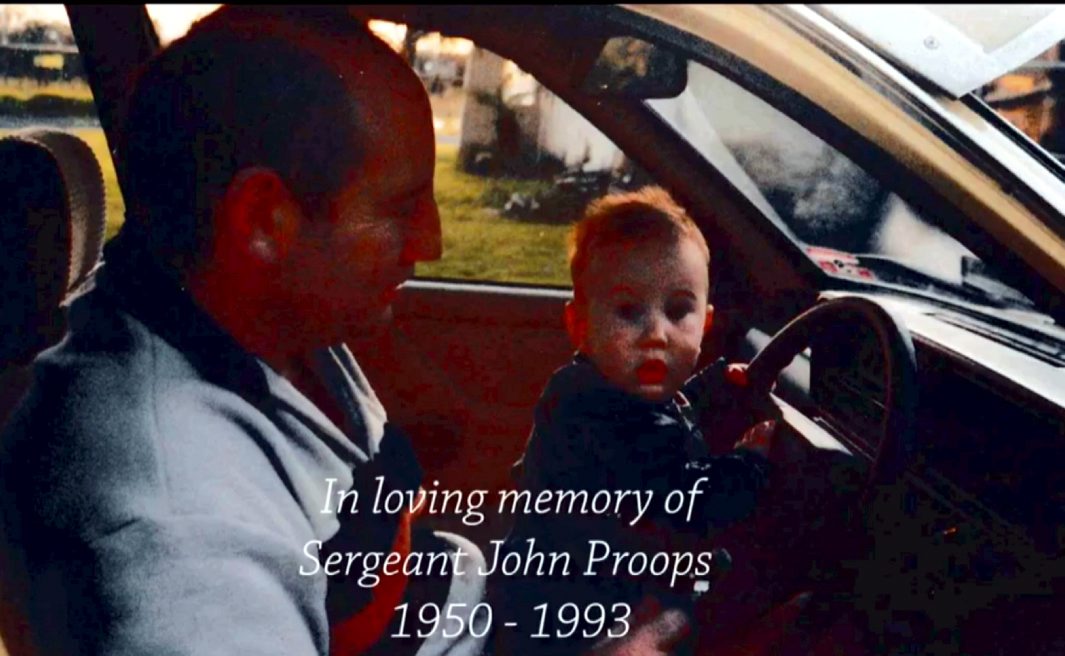
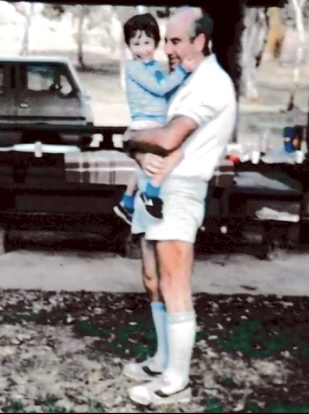
John with his son, Warren, PROOPS
John with his son, Warren, PROOPS
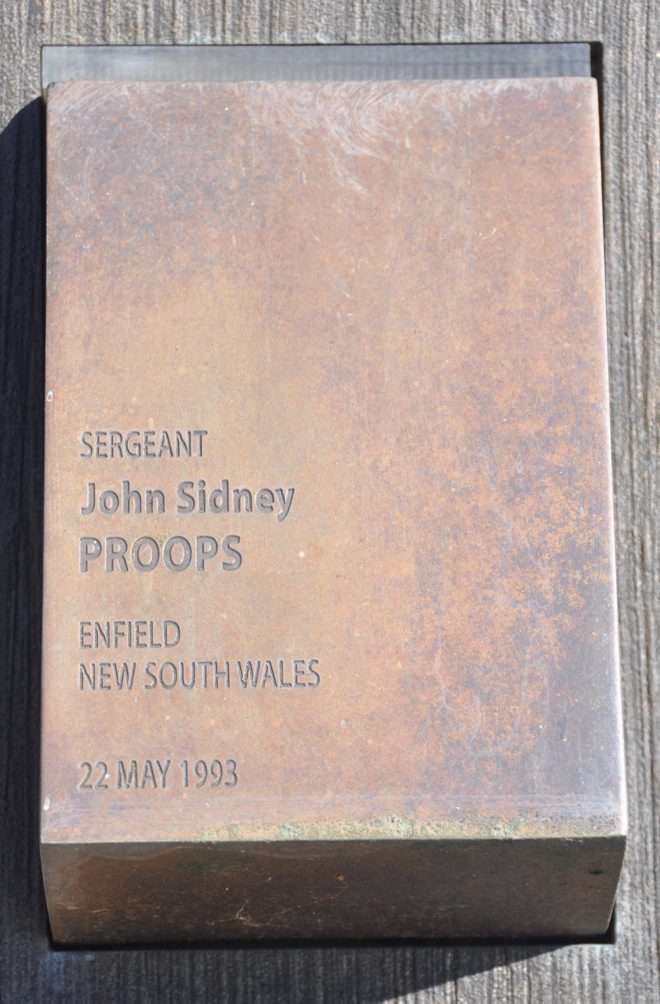
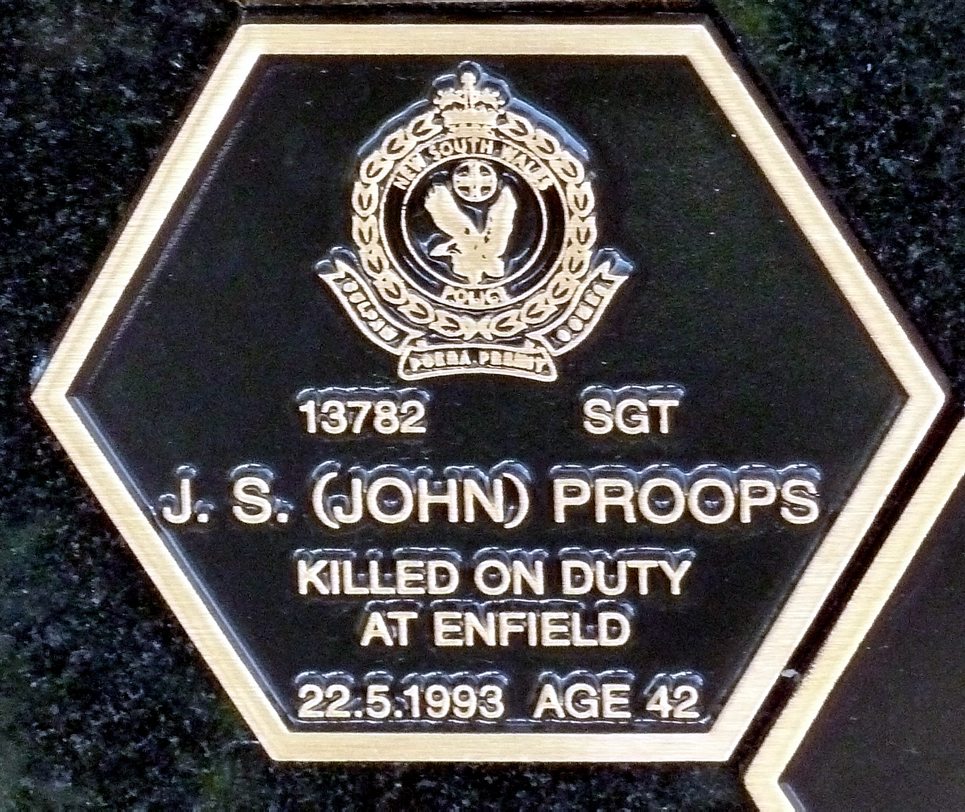
John Sidney PROOPS, Police National Wall of Remembrance touch pad.
On 22 May, 1993Sergeant Proops and Probationary Constable Katie Thompson went to a dwelling in Enfield to arrest an offender for a breach of a domestic violence order. During a struggle with the offender the sergeant is thought to have suffered a fatal heart attack.
Constable Thompson attempted to revive the sergeant however she was unsuccessful. He was conveyed by ambulance to the Western Suburbs Hospital where he was pronounced dead on arrival.
The sergeant was born in 1950 and joined the New South Wales Police Force on 20 February, 1967 as a cadet.
At the time of his death he was stationed at Enfield.
Beyond Courage
[divider_dotted]
[alert_green]John IS mentioned on the Police Wall of Remembrance[/alert_green]
Note: It was also interesting to learn that Sergeant Proops while attending another domestic dispute some years earlier, survived a spear-gun wound to his chest. Apparently, the spear lost much of its penetrating force after striking the sergeant’s police notebook in his tunic pocket.
At just 10-years-old Warren became a NSW Police Legatee, when his father, Sergeant John Proops, passed away after suffering a fatal heart attack while on duty.
Warren has been part of the NSW Police Legacy family for 25 years and took part in the very first trek to Koko
da. Now, he’s returning to the track to help support the team through the physically and emotional journey that is Kokoda.
National Police Remembrance Day 29, September 2000
National Police Remembrance Day has been marked by a minute’s silence at services throughout Australasia.
Remembrance Day is held every year on St. Michael’s Day, the patron saint of police, for all officers who have lost their lives in the line of duty.
During the last 12 months, 10 officers have died in the course of their duties in NSW, Victoria, Queensland, Western Australia, the Northern Territory, Papua New Guinea and Fiji.
233 officers have been fatally wounded while on duty in NSW since 1862. Their names are recorded on a memorial dedicated last December in the Sydney Domain.
The Sydney Service has been attended by Police Minister Paul Whelan, Commissioner Peter Ryan and senior members of the NSW Police Service.
During the service candles were lit by Warren Proops, son of Sergeant John Proops who died on 22 May 1996, Eloise and William Heron, son and daughter of Detective Sergeant William Heron who died on 6 January 1999 and Jessica Ede, daughter of Senior Constable Dallas Tidyman who died on 15 August 1994.
NSW Police Commissioner Peter Ryan said the day offers police and members of the public the chance to remember all officers who have lost their lives while serving their community.
“This important day gives us all the chance to pay our respects to these officers and to reflect upon the role in our society that police play,” he said.
“Police officers killed in the course of their duty must never be forgotten.”
The Canberra Times of 24 May, 1993 briefly reported the sergeant’s death.
“POLICE DEATH
SYDNEY: A police sergeant collapsed and died in a struggle with a man he had been questioning about a domestic dispute in Sydney on Saturday night.
Another police officer had broken his leg in a clash later with the man, who allegedly had breached a domestic violence order, a police spokesman said.
Sergeant John Proops, 42, collapsed in the struggle with the 32-year-old man at a house in Enfield.
The man was remanded in Central Local Court yesterday.”
A District Court judge launched an extraordinary attack on police yesterday, claiming they had been involved in the “evil” business of judge-shopping.
He said it appeared that many of those involved in the matter before him had lied.
Judge Phelan, hearing an appeal by Mr Stephen Smith in the District Court, said in a preliminary appraisal of the case that many police had followed a “screed” when giving earlier evidence before a magistrate and when they got beyond the screed their evidence lacked credibility.
There also appeared to have been an assault upon Mr Smith and that no police were able to explain his injuries.
Judge Phelan said if the matter proceeded, and the police witnesses were called against Mr Smith, it would be likely that he would refer a number of matters to the Attorney-General and the Ombudsman alleging that police had fitted evidence and then lied in court.
The Herald understands that staff from the Police Royal Commission had already shown an interest in the matter.
In May 1993, two police officers went to a house in Enfield where it was alleged Mr Smith had breached a domestic violence order.
It was alleged he had resisted arrest and one officer, Sergeant John Proops, had suffered a fatal heart attack.
Police alleged Mr Smith then tried to attack another officer, Sergeant Southam, and that Sergeant Southam suffered a broken ankle.
Mr Smith alleges he was tackled into Sergeant Southam by other officers and then beaten with a torch. He was later convicted of breaching a domestic violence order, resisting arrest and assault occasioning actual bodily harm.
Judge Phelan said yesterday that a doctor’s report indicated Mr Smith had an injury to his head, consistent with being hit with a torch, a cut on his forehead, bruises over his body, a broken rib and bruises to his legs.
“… the injuries can only be explained rationally and solely by a police attack upon the appellant which the officers have all denied and this leads to the conclusion that many of the police officers are lying,” Judge Phelan said.
He said that a small dog had apparently been kicked in the head and lost its eye during the arrest and that police could offer no explanations as to how this had happened. The dog later died. The judge also stated there had been behind-the-scenes moves to have him removed from the case when it came to an appeal.
“I find it obnoxious and suspicious that there have been police manoeuvres to change the prosecution person [assigned] to these matters,” Judge Phelan said.
“If judge-shopping is an evil, as it is, equally evil is prosecution shopping. I also find it obnoxious and suspicious that there have been manoeuvres to have another judge conduct the appeal.”
The matter will resume before Judge Phelan in the Downing Centre District Court this morning and it is expected that the Director of Public Prosecutions will then make a decision about offering evidence in the case.
SYDNEY, Tuesday. — A notebook in his breast pocket had saved a policeman’s life when a man had fired a spear gun at him, police alleged in Campsie Court today.
The police prosecutor, Sergeant A. Carter, told Mr Hayes. SM. that the constable had been trying to arrest the man when the spear was fired from almost point-blank range.
Before Mr Hayes was Mr Norman Warren Castle, 53, of Albany Road, Petersham, who was charged with shooting Constable John Proops at Belmore last Saturday with intent to murder.
Sergeant Carter said it was alleged that Mr Castle had smashed a door of a house at Belmore and had menaced the two occupants inside with the loaded spear gun.
Police had gone to the house and Mr Castle had allegedly turned on them.
It was alleged he had fired a spear at Constable Proops which had struck the officer’s regulation notebook in the breast pocket of his uniform.
Sergeant Carter said Mr Castle had been taken to Canterbury Hospital yesterday after allegedly swallowing glass.
“The doctors found he had consumed some plastic buttons ‘ — x-rays taken found no glass or other substances”, he said.
People involved in the case “feared for their safety”. Further charges could be laid.
Questioned by Mr Hayes. Mr Castle said he had been “communicating with my dead father”.
Asked how he had been communicating, Mr Castle replied, “In my mind … He has communicated with me before”.
Mr Hayes refused bail, adjourned the case for mention to June 15, and recommended that Mr Castle be physically, and mentally examined.
In 1992 Constable Hernandez was a member of the State Protection Group and a qualified firearms instructor. He was accidentally shot in the chest while testing police in their annual firearms proficiency tests at the Redfern Police Complex. Following emergency surgery Constable Hernandez died at St Vincent’s Hospital, Darlinghurst the same day as the accident.
The constable was born in 1959 and joined the New South Wales Police Force on 18 February, 1987. At the time of his death he was attached to the State Protection Group.
Touch Plate at the National Police Wall of Remembrance, Canberra
Photo credit: Kelvin Harband NSW Fallen Police New Member · Juan Hernandez was accidentally shot in the chest while doing firearms training as an Instructor at the Redfern Police Academy on 1 December 1992. Emergency surgery was unable to save his life and he passed on that same day. Juan and I went through the Academy together in 1987 and he will always be remembered and a great bloke whose life was cut way to short by the tragic accident. Juan is in the middle squatting down in this photo which was taken on the day of our attestation ( 15 May 1987 ).
Carl is also credited with designing the TOU insignia – which was maintained in respect to his.
Canberra Times (ACT : 1926 – 1995),
Tuesday 1 December 1992, page 4
IN BRIEF
Policeman shot dead
SYDNEY: A police weapons training instructor was fatally wounded by another officer during a gun training session yesterday.
Constable Juan Carlos Hernandez, 33, an instructor with the elite State Protection Group, died in hospital several hours after being shot in the chest at the old Police Academy at Redfern.
Constable Hernandez was supervising about 15 officers at a training session when a .38 calibre police-issue revolver discharged, wounding him in the chest.
The Hon. CATHERINE CUSACK: My question is addressed to the Minister for Police and Emergency Services. Will the Minister inform the House about the newest recruits to the New South Wales Police Force?
The Hon. MICHAEL GALLACHER: I thank the honourable member for her question. Last Friday, 23 August 2013, it was my great pleasure to attend the attestation ceremony for class 319 at the Goulburn Police Academy. I assure members that the calibre of probationary constables coming through the doors of the academy to pursue challenging and rewarding careers as police officers in this State remains very high indeed. They passed the stringent physical and academic tests, and have demonstrated the commitment and character befitting their new role. These qualities were no more visible than when the commissioner’s valour award was presented to Senior Constable Justin Knight on the parade ground last Friday. The award was conferred for conspicuous merit and exceptional bravery when an offender armed with a sawn-off rifle fired at Senior Constable Knight with intent to murder on 20 January 2007 at Eveleigh Street, Redfern—the Block.
In the course of pursuing a suspect, Constable Knight alighted from his vehicle and pursued an offender on foot, calling for him to stop. The offender produced a sawn-off rifle and, despite the risk, Constable Knight continued to follow him. The offender fired a number of shots at Constable Knight, narrowly missing him. The constable felt one of the projectiles go past his arm and thought that he had been shot. Being aware of the sensitivity of the local community towards police and despite the escalated danger, Constable Knight did not respond by firing his service firearm. The offender fled the scene, but was later identified and charged with attempted murder of a police officer. The offender was subsequently convicted.
I ask members to reflect on those circumstances and whether we would have acted with the same level of commitment, bravery and judgement as Constable Knight on that occasion. Too often the community reacts to instances where police officers have been accused of wrongdoing, but the events of that night in 2007 remind us of the challenges and risks faced by officers of the NSW Police Force, in this case potentially quite deadly. I am confident that Senior Constable Knight’s example will flow through to the 161 probationary constables who attested and have joined a force with record authorised strength in this State.
A number of the new police officers deserve special mention. The winner of the Robert Brotherson award for the highest level of academic achievement was Probationary Constable Natalie Martin. The winners of the Steven Roser memorial award for the highest male and female achievers in physical training were Probationary Constable Mitchell Thompson and Probationary Constable Guilhermina El-Mir. The Juan Carlos Hernandez award, given to the student with the highest marksmanship score, went to probationary constables David Edwards, Anton Sahyoun and Shanahan Toering—all three tied for that award. Probationary Constable Toering also received the award for the highest achiever in the Simulated Policing Acquiring Competence program.
One of the many proud parents at the attestation was Detective Superintendent Arthur Katsogiannis, whose son Daniel is now a probationary constable and commences his career at City Central Local Area Command. It was terrific to see 23 members of the attestation of class 319 identified as Aboriginal and Torres Strait Islanders, of which 16 were graduates of the Indigenous Police Recruiting Our Way [IPROWD] program that I have spoken about in this forum. Congratulations to them. I had the pleasure of witnessing the graduation of 13 dog teams from the State Protection Group Dog Unit. Some were general purpose dogs and others, obviously, were sniffer dogs. That is good news for Byron Bay and its former mayor, the Hon. Jan Barham. The attestation parades provide an opportunity— [Time expired.]
The Hon. CATHERINE CUSACK: I ask a supplementary question. Will the Minister elucidate his answer?
The Hon. MICHAEL GALLACHER: I pay respect to the following five officers who retired from the NSW Police Force, taking with them collectively 190-plus years: Superintendent Ben Feszczuk, Detective Superintendent Col Dyson, APM, Superintendent Ray Filewood, Detective Inspector Dennis Clarke, APM, and Inspector Leslie Dickens. All five officers led the parade on Friday. It was an incredibly proud moment for them, their families and the communities they have represented in just short of 200 years of policing. As I said to the graduating class, “If you want to look for role models, look at these five as a classic example of what you can give back to a community that will give you so much more.”
The Hon. CATHERINE CUSACK: My question is addressed to the Minister for Police and Emergency Services. Will the Minister inform the House about the newest recruits to the NSW Police Force? The Hon. MICHAEL GALLACHER: On 3 May it was a great pleasure to attend the attestation ceremony for class 318 at the Goulburn Police Academy, and I can assure the House that the calibre of probationary constables coming through the academy to pursue a challenging and rewarding career as a New South Wales police officer remains high. All attesting officers have made it through physical and academic tests, and, most importantly, they have demonstrated the commitment and character of people prepared to ensure the safety and security of the community they will serve. The 202 probationary constables who attested have joined a police force now boasting a record authorised strength of 16,176. As members opposite know full well, we have been increasing the authorised strength of the NSW Police Force since we took office. After the further increase this month of 80 positions from the May class, we have boosted the authorised strength by 370, and we are on our way to increasing the force by a total of 859 positions, to a record authorised strength of 16,665 officers in August 2015. This month 50 additional positions were added to the Police Transport Command, bringing its authorised strength to 401. We have also added 30 positions to the authorised strength of the Traffic and Highway Patrol Command, bringing it to 1,295. That makes an increase of 50 new authorised positions to this command, and that is halfway to our commitment to increase the strength of the command by 100. While another 202 probationary constables have been drawn to this career, I am equally pleased with how many officers stay in this exciting and rewarding profession. Indeed, there is such demand for a career in policing that the NSW Police Force has implemented a freeze on new applications. Members opposite have mischievously tried to claim that this is a sign of cuts to the Police Force. That is as far from the truth as members opposite could possibly get. Thanks to the Government making the necessary reforms to the Death and Disability Scheme set up by members opposite and restoring the confidence of serving police officers by ensuring that they will have the back-up they need, I am advised that attrition within the Police Force is currently averaging about 40 officers a month, down from the average of 70 under the previous administration. Therefore, it stands to reason that if fewer officers are leaving the force, fewer replacements are needed. Under Labor, the NSW Police Force was faced with more than 800 officers on long-term sick leave and officers leaving the force at such a rate that police could not recruit fast enough to plug the holes. Placing a temporary freeze on new applications will ensure that potential applicants do not need to spend application fees, which easily total $500, including on such items as medical certificates, when there is a substantial wait before their application can be considered. We are getting on with the job of ensuring that the NSW Police Force is better resourced, better equipped and better supported than ever before. Members opposite are peddling misinformation and seeking to undermine the community’s confidence in a police force experiencing record numbers. A number of the new police officers deserve special mention. The winner of the Robert Brotherson Award for the highest level of academic achievement was Probationary Constable Thomas Stillwell. The winners of the Steven Roser Memorial Award for the highest male and female achievers in physical training were Probationary Constable Adam Splithof and Probationary Constable Caitlin Billingham. The Juan Carlos Hernandez Award, given to the student with the highest marksmanship score, went to Probationary Constable Matthew Skellern. [Time expired.]
The Hon. CATHERINE CUSACK: I ask a supplementary question. Will the Minister elucidate his answer?
The Hon. MICHAEL GALLACHER: I am sure that all members would like to hear about these outstanding young probationary constables, including Probationary Constable Nathan Dechaufepie, who was the recipient of the Simulated Policing Acquiring Confidence Award. These officers can be proud of their achievements. Their families can be proud of them and, most importantly, their communities are proud of them. I am sure that the House will join me in wishing our newest police officers all the very best for their careers in the NSW Police Force.
The Hon. SCOT MacDONALD: My question is addressed to the Minister for Police and Emergency Services. Will the Minister inform the House of the results of the latest police attestation?
The Hon. MICHAEL GALLACHER: I apologise to the House for my inability to be here last Friday. I had a very important role to fulfil as the Minister for Police and Emergency Services at the graduation of class 312 at the Police Academy in Goulburn. It was my first in my new role as Minister for Police and Emergency Services. One of the first things I had an opportunity to announce down there was clarification of the uncertainty that exists around the name of the organisation.
The Hon. Duncan Gay: It was well received.
The Hon. MICHAEL GALLACHER: It was well received. It will now return to its former name of the New South Wales Police Academy, not the police college. That announcement was very well received by the sworn officers. The attestation certainly brought back memories of when I was in a similar position, standing on the parade ground at Redfern more than 30 years ago. Whilst a lot of things have changed in policing, a lot of things have not. Obviously the equipment, the cars and the uniform have changed, but certainly one thing that has not changed is the high calibre of probationary constables coming through the academy. They are required to pass through a tough course, both physically and academically, to prove they can cut the mustard as officers in the New South Wales Police Force. Who knows, even Eric Roozendaal might apply to join the New South Wales Police Force—although he may not pass the integrity test.
They are men and women who are prepared to do their best for the people of this State and who will undertake this job on a daily basis, often in the most difficult of circumstances. The 111 probationary constables who attested at the ceremony have joined more than 15,000 officers in the Police Force. They come from all walks of life. Over 22 per cent of those who attested are women. Forty per cent come from outside metropolitan Sydney. Sixteen were born overseas, in countries such as Russia, Germany, Malaysia, China and even Botswana. They speak Arabic, Greek, Cantonese, Armenian, Dari, and Khmer. They will be posted to 59 local area commands across the State, from Albury in the south, to Richmond in the north, from Barrier in the west to the heart of Sydney. Forty-four of the officers have been assigned to non-metropolitan or rural regions.
Irrespective of where they have been posted they are on the front line. They stand between the community and the dangers of crime and other antisocial behaviour. A number of these new police officers deserve special mention. Firstly, the winner of the Robert Brotherson Award for the highest level of academic achievement was Probationary Constable Stephanie Hill. The winners of the Steven Roser Memorial Award for the highest male and female achievers in physical training were Probationary Constable John Feuerstein and Probationary Constable Sandra Chaban. The Juan Carlos Hernandez Award, given to the student with the highest marksmanship score, was Probationary Constable James Patrick. Probationary Constable Jessica Agland was the recipient of the Simulated Policing Acquiring Confidence Award.
I met some of the officers on Friday and I can confidently say that the New South Wales Police Force has a strong future. These officers can be proud of their achievements. Their family and friends can be proud of them for all the hard work they have put in to get there. The people of New South Wales can be proud of these people for choosing a selfless profession, dedicating their working lives to ensuring the safety and protection of the community. I am sure all members of the House will join me in wishing our newest police officers all the very best for their careers in the New South Wales Police Force.
Detective Sergeant Lenny Dean passed away in Perth on 29 May, 1991 as a result of a rupture in his mitral heart valve. It was later determined that the medical condition was a result of the sergeant’s stressful policing career.
The sergeant was born in 1953 and commenced training with the New South Wales Police Force on 23 September, 1974. At the time of his death he was stationed at Queanbeyan.
DEAN
Leonard Graham
Funeral notice
29MAY1991
Death
37
at Perth
Northern Star (Lismore)
31MAY1991
DEAN
Leonard Graham
Death notice
29MAY1991
Death
37
at Perth
Canberra Times
31MAY1991
Canberra Times (ACT : 1926 – 1995), Friday 12 October 1990, page 4
COURTS and THE LAW
Papers, TV stations fined $670,000 for contempt of court
SYDNEY: Five media organisations were fined a total of $670,000 by the Court of Appeal yesterday for contempt of court.
The fines related to reports of the arrest of Paul Gerald Mason and his confession in July last year to three pickaxe murders and an attempted murder.
The court found that the reports were likely to, or had a tendency to, interfere with a fair trial. Fines imposed were:
ATN Channel 7 (including rebroadcast through Prime Television ); $200,000.
TCN Channel 9 (including rebroadcast through WIN): $75,000.
TEN Channel 10: $75,000.
Nationwide News: (in The Daily Telegraph and Daily Mirror of July 31): $200,000. ABC: $120,000.
Detective Senior Constable Leonard Graham Dean, who answered questions at a news conference held outside Queanbeyan police station after Mason’s arrest, was also found guilty of contempt.
No fine was imposed on Dean, but he was ordered to pay the NSW Attorney-General’s costs of bringing the prosecution, as were all the other defendants.
Mason, 27, was arrested after surrendering to police on July 29, 1989, and was later charged with the murders of Ruth Ferguson, 25, and her eight-month-old son, Mark, on July 27, 1989, near Eden. Mason was also charged with the murder of Mary Alice Clark, 29, at Gearys Gap, near Canberra, on May 12, 1989, and the attempted murder of her one-year-old son, Samuel, on the same day. On September 11, he hanged himself in his Goulburn jail cell.
The judges said the publication of obviously prejudicial material would, unless emphatically punished, reduce community belief in the capacity of the courts to maintain standards of fairness in trials.
The report in The Daily Telegraph had followed “an embarrassing mistake” by an experienced solicitor, who advised that the report would not be in contempt of court. The position was different with the Daily Mirror report, which was published “simply in reckless pursuit of a good story, and sales”.
The judges said Channel 7’s concern was for the risk to which it was exposed, not for the damage done by the broadcast.
There had been no explanation from the ABC as to how its offending broadcast came to be made. The judges inferred that the persons involved knew there was a risk of contempt and were prepared to run that risk.
The judges assumed the imposition of a fine would have a deterrent effect on the corporation, even though no individual was directly affected financially.
In relation to Channel 10, the judges were “not persuaded that the financial information put before us should have any effect on the outcome of the matter”. The channel was not in liquidation and was carrying on business.
Referring to Dean‘s statement to reporters that Mason had admitted to three murders, the judges said it would be unfair to punish him for defects in the way the police organised media relations.
Canberra Times (ACT : 1926 – 1995), Friday 3 August 1990, page 13
Station admits contempt
SYDNEY: Channel Ten admitted yesterday it was in contempt of court over reporting of events following the surrender last year of alleged pickaxe murderer, Paul Gerald Mason.
The NSW Attorney-General, John Dowd, summonsed the station, alleging its news report of July 31, 1989, could have prejudiced a fair trial.
A videotape of the report named Mason and showed him accompanying police to the scene of his alleged crimes.
Bruce James, QC, for the Attorney-General, said he accepted there were extenuating circumstances in relation to the Channel Ten report.
The station had a system of legal checks in place, but it had broken down on this occasion.
On Tuesday the court reserved its decision on the penalty to be imposed on the ABC, which pleaded guilty to contempt over a similar report.
Judgment was also reserved yesterday on whether Channel 9 is guilty of contempt over its report of the same events. The station has denied its report could prejudice a trial.
Channel 7, Nationwide News Pty Ltd and a police officer, Detective Constable Leonard Graham Dean, have yet to come before the court on similar summonses.
Mason, 27, of Riverstone in Sydney’s west, surrendered to police on July 29, 1989, after the ABC telecast an appeal by his father.
He was charged in Queanbeyan Local Court with the murders of Ruth Ferguson, 25, and her eight-month-old son, Mark, on July 27,1989, at their Pambula Beach home.
Mrs Ferguson had been battered with a pickaxe and her son strangled with a cord.
Mason was also charged with the pickaxe murder of Mary Alice Clark, 29, at Geary’s Gap, near Canberra, on May 12, 1989, and the at tempted murder of her one year-old son Samuel. Mason hanged himself in Goulburn jail on September 11.
Canberra Times (ACT : 1926 – 1995), Wednesday 8 May 1985, page 8
Bond for union official over assault on shearer
A union official who assaulted a shearer on a property near Yass during the shearers’ dispute last year was fined and released on a bond yesterday.
Mr Noel James Ashton, 33, of Murrumburrah, pleaded guilty in the NSW District Court in Yass to assaulting Mr Wayne Lawrence on May 10, 1984, occasioning actual bodily harm.
Detective Senior Constable Leonard Dean, of Queanbeyan police, told the court that police were talking to other people about related assaults and a second man had surrendered to police on Monday and admitted assaulting the property owner.
Mr Ashton, secretary of the Harden branch of the Australian Workers’ Union, said he worked from time to time as a wool-presser in district shearing sheds.
He had been in a delegation of AWU members from all over NSW which had travelled to Canberra on May 10. The delegation had sought ministerial agreement to a proposal that New Zealand shearers, who had been taking work away from AWU members, should have visas before they could work in Australia.
The delegation had not been successful and had been “pushed from one Minister to another”.
Mr Ashton said that he, another man and Mr Bill Sinclair, an AWU organiser, had stopped at the property on their way back from Canberra.
Mr Sinclair had gone into the shear ing shed and spoken to the shearers. He had returned soon after and announced that the shearers were using wide combs, were non-unionists, had refused to join the union and were working illegally.
Mr Ashton said he went into the shed where there was “a bit of pushing and a lot of harsh words”.
When he and about 15 others had left the shed, someone had called out that “a blue” had started and the men had returned. Mr Ashton said he punched Mr Lawrence in the face several times.
When the men had left the property, they had agreed to deny ever having been there if asked. Mr Ashton said he had done this when asked by police about the incident two weeks later.
Feelings had been running high over the wide-comb issue at the time and families had split because of it.
His branch of the AWU was trying to get harmony back into the shearing sheds.
Judge McGuire said that normally he would jail a person for such an offence. However, Mr Ashton had pleaded guilty, saving the community thousands of dollars in legal costs, and had frankly admitted his role in the incident without trying to lay the blame on anyone else.
He deferred passing sentence, released Mr Ashton on a $1,000, three year good-behaviour bond and fined him $500.
Canberra Times (ACT : 1926 – 1995), Saturday 14 July 1984, page 12
Bungendore committal hearing ends
Five for trial on alleged kidnap counts, two freed
Five men charged over the alleged kidnapping of a Bungendore couple were committed for trial at the conclusion yesterday of a 10-day committal hearing in Canberra Petty Sessions.
The men were among seven people charged in connection with the alleged kidnapping of Mr Stephen John Harrison and Ms Heidi Maree Van Leeuwen in February.
Two other defendants were discharged after the Acting Chief Magistrate, Mr Dobson. ruled there was insufficient evidence to find prima facie cases against them.
All charges related to the alleged kidnapping of Ms Van Leeuwen were dismissed after Mr Dobson said he was not satisfied that her detention had been to anyone’s advantage.
One of the five men committed to the ACT Supreme Court, Mr David Graeme Hudson, was refused bail pending his trial after the prosecutor. Mr Wayne Roser, told the court that Mr Hudson had made threats against police and one of the accused.
The five men committed are: Mr Hudson, 25, of Crofts Crescent, Spence; Mr Pasca Ganitis, 32, of Unanderra. Wollongong; Mr Stephen Leonard Jones, 24, formerly of Weetangera; Mr Shane Frederick Raftery, 23, of Belconnen Way, Weetangera; and Mr John Desmond Keenan, 21, formerly of Holder.
Mr Dobson found a prima facie case against each on charges of kidnapping Mr Stephen John Harrison between February 10 and 15. But he discharged Mr Hudson, Mr Ganitis, Mr Jones and Mr Keenan on charges of kidnapping Ms Heidi Maree Van Leeuwen between the same dates. Mr Raftery was not charged with this offence.
All five men then entered pleas of not guilty and reserved their defences.
Mr Dobson discharged also Mr Christian Klug, 22, of Dexter Street, Cook, who had been charged with aiding and abetting Mr Hudson in kidnapping Mr Harrison, and Ms Debbie Lee Towse, 26, of Crofts Crescent, Spence, who had been charged with being knowingly concerned in the kidnapping of Ms Van Leeuwen by Mr Hudson.
Mr Dobson said he was satisfied that Mr Klug had been involved in the offences but in a peripheral way only. Mr Klug had been “skating on thin ice” and had brought the proceedings on himself.
But the peripheral nature of his involvement did not justify the waste of public money involved in putting him on trial and he ordered that Mr Klug be discharged. Mr Dobson refused to make the order for costs in Mr Klug’s favour sought by his counsel, Mr Ben Salmon.
Mr Dobson said he had no doubt that Ms Towse had been present during part of the incident and had known that Mr Harrison was being detained. She had known also that Ms Van Leeuwen was being detained and had been with her some of the time. But mere presence was not enough.
In addition, there was insufficient evidence that the detaining of Ms Van Leeuwen had been for the advantage of Mr Hudson (an element of the charges laid) and he ordered that Ms Towse be discharged.
At the request of her counsel, Mr John Purnell, he ordered police to pay Ms Towse’s costs of $250.
In opposing bail for Mr Hudson, pending his trial, Mr Roser drew the court’s attention to the seriousness of the offences, the threats made to police that had been revealed in tape recordings played to the court on Thursday, a threat made to Mr Jones during the proceedings, and the fear of reprisals held by the victims of the alleged kidnappings.
Mr Dobson refused bail for Mr Hudson but released the other four men on bail of $5,000, with similar sureties, and ordered them to report to police weekly and not approach any witness connected with the case.
Earlier, Detective Senior Constable Leonard Dean, of Queanbeyan, told Mr Roser he had spoken to Mr Ganitis at the Civic Police Station on February 14. Mr Ganitis had told him that he had gone to Mr Harrison’s house in Bungendore with Mr Hudson and a man called Steve on February 10.
While there, Mr Hudson had asked Mr Harrison for drugs. Mr Harrison had told him of the location of some and about 25 grams of “speed”, in one-gram packets, had been found in the back yard. Ms Van Leeuwen had also produced a quantity of marijuana.
Mr Harrison had later been taken to a house in Belconnen and assaulted. He [ Mr Harrison] had said that he and two other men had been involved in the firing of shots at Mr Hudson’s house on an earlier date. Senior Constable Dean said.
During a signed record of interview, Mr Ganitis had denied that any weapons had been produced at Mr Harrison’s home. He had allegedly said that Mr Hudson had said he had a gun but had been bluffing.
Mr Harrison had been tied up at Steve’s house but when he had gone to Mr Hudson’s he had had “the run of the joint”.
Mr Ganitis had said he had made sure that no-one had touched Ms Van Leeuwen “by telling everyone to leave her alone, mainly David”.
On 18 December, 1988 Constable Oakley was at the Wagga Base Hospital where he was involved in restraining a berserk offender.
During the struggle the constable was kicked in the face, causing injuries and swelling to his mouth, face and jaw.
When the swelling did not fully subside he was diagnosed as suffering from metastatic melanoma and was required to undergo surgery.
It was found that the condition had been aggravated by the injuries received on 18 December, 1988.
Although he later returned to full duties Constable Oakley died on 14 August, 1990.
The constable was born in 1964 and joined the New South Wales Police Force on 15 September, 1984. At the time of his death he was stationed at Chatswood.
[divider_dotted]
Detective Course # 21. 22 January 1990 – 2 March 1990
[divider_dotted]
Kenneth John SHORT
| 27/10/2012
Kenneth John SHORT
aka Shorty & John
New South Wales Police Force
Academy Class 211
ProCst # 96609
Regd. # 22101
Rank: Commenced Training at Goulburn Police Academy on Monday ? ? 1985?
Probationary Constable – appointed Friday 21 June 1985 ( aged 22 years, 11 months, 2 days )
Service: From 9 April 1985 to 11 July 1990 = 5+ years Service
Awards: Nil
Born: Thursday 19 July 1962
Died on: Wednesday 11 July 1990
Cause: Motor Vehicle Collision – On Duty – front passenger ( raining )
Event location: Old Princes Hwy & Old Bush Rd, Yarrawarra, NSW
Age: 27 years, 11 months, 22 days
Funeral date: Monday 16 July 1990
Funeral location: St John Bosco Catholic Church, Engadine
Buried at: Woronora Memorial Park, Linden St, Sutherland
General Plaque Lawn
Section: Wattle Lawn Lot: 19
Lat/Lng: -34.03618, 151.04945
KEN IS mentioned on the Police Wall of Remembrance
About 9.30am on 11 July, 1990 Constable Short was the observer in a police vehicle travelling along the Old Princes Highway, Yarrawarra. The police were attending an armed holdup at the ANZ Bank, Jannali and when approaching the intersection of Old Bush Road the police vehicle veered across the roadway and collided head-on with another car. Constable Short was killed instantly.
There was also a Student Police Officer ( S.P.O. ) in the back seat of the Police vehicle at the time of the collision.
The constable was born in 1962 and joined the New South Wales Police Force on 9 April, 1985. He was sworn in on Friday 21 June, 1985. At the time of his death he was stationed at Engadine.
On the day of his funeral, the procession drove past Engadine Police Station – travelling between the Church Service and the Cemetery.
Before he joined ” the job “, Ken was shot by an unknown assailant at George’s Hall @ 1983. That incident was attended by Greg McMahon with Sgt 1/c Alec Morton. Shot in a very private part and very lucky to have not suffered a lasting injury.
RIP Ken.
Grant Charles EASTES
| 27/10/2012
Grant Charles EASTES
New South Wales Police Force
Regd. # 18467
Joined via NSW Police Cadets on 4 July 1977
Cadet # 3345
Class 161 of 1978
Rank: NSW Police Cadet – started 4 July 1977
Probationary Constable – appointed 9 February 1979
Service: From 4 July 1977 to 13 January 1990 = 12+ years Service
Awards: No find on It’s An Honour
Born: Tuesday 9 February 1960
Died: Saturday 13 January 1990
Age: 29 yrs 11 mths 4 days
Cause: Illness – Suicide – overdose – P.T.S.D.
at Fortitude Valley, Brisbane, Qld
Funeral date:?
Funeral location:
Buried at: Casino Lawn Cemetery
Memorial location:
Grant IS mentioned on the Police Wall of Remembrance
Senior Constable Grant Charles EASTES – Grave. Casino Lawn Cemetery, NSW.
Senior Constable Grant Charles EASTES touch plate at the National Police Wall of Remembrance, Canberra.
On 13 January, 1990 Senior Constable Eastes took his own life in a Brisbane Motel. On 20 October, 1989 he had been one of the first police to arrive on the scene of the horrific bus crash upon the Pacific Hwy, Cowper, ( commonly referred to as the Grafton bus crash ) in which twenty one people died and twenty two more were injured. At the time it was the worst road accident in Australia’s history. Following the accident the senior constable reported off duty on sick report, suffering from Acute Post Traumatic Shock Syndrome.
The constable was born in 1960 and joined the New South Wales Police Force as a Cadet on the 4 July, 1977. At the time of his death he was attached to the Lismore District Accident Investigation Squad.
[blockquote]It was during that time that I had a lengthy conversation with a highway patrol officer, Grant Eastes. I could sense that this man was in quite a bad way, finding it hard to cope. It was just his attitude, what he was saying, how he expressed how he was feeling. As we talked he brought up all these other incidents on the highway that he’d attended in recent months. I was so concerned that I mentioned the conversation to some senior police officers and later, Major Errol Woodbury, who was one of the State’s senior police chaplains at the time.[/blockquote]
A postscript to the Grafton tragedy. Three months after the accident, 29 year old Senior Constable Grant Eastes, the officer I was so concerned about on the night of the tragedy, was found dead in a motel room in the Brisbane suburb of Fortitude Valley. He’d taken an overdose of pills.
Grant’s father Ken told journalists his son’s life had been destroyed by the sight of the dead and injured at the Grafton bus crash scene.
I’m afraid to say his suicide didn’t surprise me. Here was a crash investigation officer who had witnessed a real slathering of fatal accidents up and down that highway. The bus crash was the catalyst for his suicide. It was just too much.