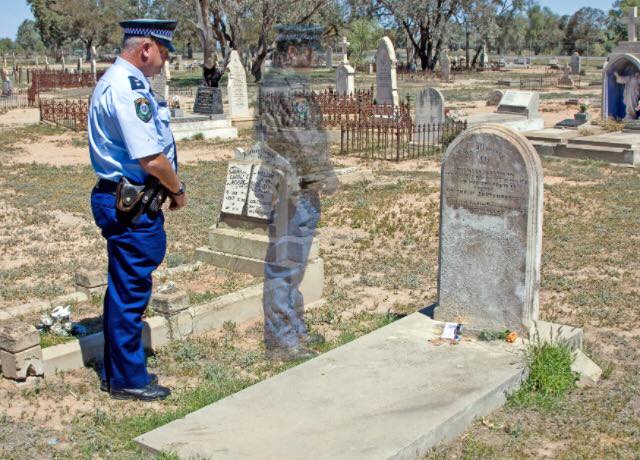
On Tuesday 11 September, 1877 Samuel Getting, a barman at the Royal Hotel in Bourke, was speaking with Constable Michael Costigan in the bar of the hotel. The constable had just paid Getting for his room and board, and after having a drink and chatting with the barman for a short time, he left the bar.
Getting, for some unknown reason, also left the bar about that time and went to his room in the hotel, where he took possession of his rifle. He then left his room and walked to the front of the hotel, where he saw Constable Costigan and Constable George Armytage standing on the verandah, having a conversation. He immediately shot both constables from behind before running into the street and attempting to reload his rifle.
Sub Inspector James Keegan, who was nearby, noticed people running toward the river, and when he asked what was happening he was told that Sam, the barman, had shot two of the police and was running away with a loaded gun in his possession.
He then saw Getting running along the bank of the river with a gun in his hand, being chased by several people. The inspector then went towards these people and told them to move away from Getting so he could speak with him. He then followed Getting for a short distance along the river until he stopped and waited for the inspector to approach. The inspector then spent some time talking with the offender and trying to get him to surrender, all the while edging closer as he spoke.
At a later inquest, the inspector described what happened next.
“I rushed at him, being at this time between 10 and 15 paces from him. The ground was very muddy, and there was a gully between us. I got my hands upon him being beneath the gun, and we both stumbled and nearly fell. He again got a few paces from me, turned round, took deliberate aim, and shot at me. He called to me to keep back. I knew I was shot, but it did not weaken me, and I still went forward.
He then raised the gun, holding it by the barrel, and struck me on the head. I put up my arm to ward off the blow, and it bruised my arm very much and cut my head. He struck me several times, and I at length secured the gun. He then ran parallel with the river for a few yards, and as I followed him he suddenly plunged into the river, and kept his head beneath the water until he was drowned. He went but a short distance into the river.
That is his body I have recently seen lying in an outhouse. He had plenty of opportunity of shooting me at first had he so desired, but he did not attempt to do so until I sought to arrest him. When he shot at me, one shot struck me near the eye, two shots went into my coat, two entered my chest, and two others grazed it.
The Deceased…was a man of very good character and very good behaviour, and I can ascribe no motive for his acts. He said he had no intention of doing what he did, and that he had loaded the gun to go out for some duck shooting.”
Constable Costigan was born in 1853 and joined the New South Wales Police Force on 11 September, 1873. At the time of his death he was stationed at Bourke.
Constable Armytage was born in 1855 and joined the New South Wales Police Force on 4 May, 1877. At the time of his death he was stationed at Bourke.
Grave Location/s:
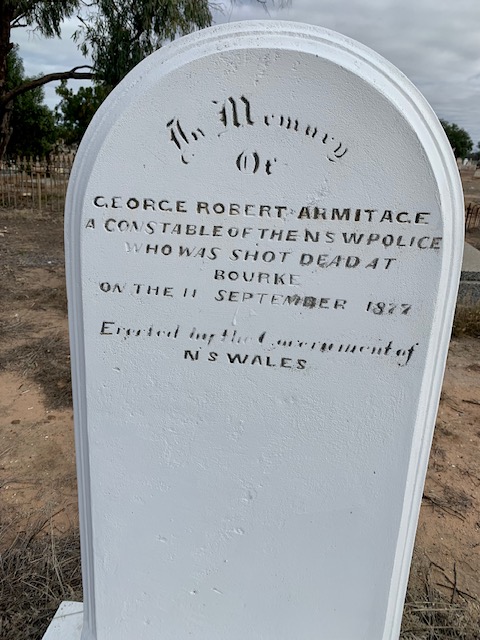
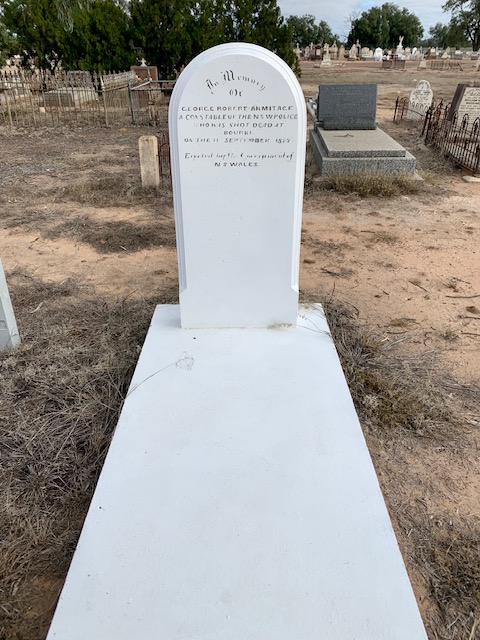
ARMITAGE: 30 06′ 03S / 145 56′ 12E
Old C of E, Bourke
As seen in June 2022. Photo: Alan BLAKE # 19779
As seen in June 2022. Photo: Alan BLAKE # 19779
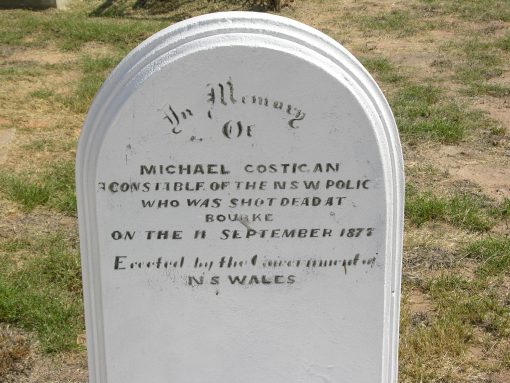
COSTIGAN: 30 06′ 05S / 145 56′ 14E
Old Catholic, Bourke
as seen in April 2007 Photo: Ken Owen
as seen in April 2014 Photo: Ken Owen
as seen in April 2014 Photo: Ken Owen
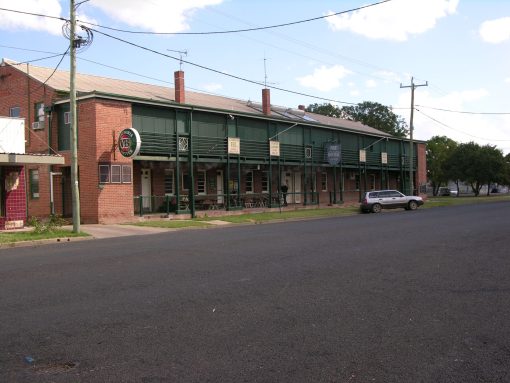
Location of Old Royal Hotel
32 Mitchell St, Bourke, 2840
GPS: -30.088854, 145.936134
2014: Port of Bourke Hotel which was formerly the Old Royal Hotel where these murder took place.
Rank: 1st Class Constable ( Foot Policeman – not mounted )
Description: 5′ 11.5″ tall, blue eyes, fair hair, fair complexion. Single. Previously a farmer. He was Protestant.
Stations: Darlinghurst
Service: From 26 December 1874 to 20 June 1877 = 2+ years Service
Awards: a valuable gold watch and chain for the gallant capture of a convicted burglar, named Wright
Born: ? ? 1850 in Ireland
Event date: Thursday 22 March 1877
Died on: Monday 11 June 1877 @ Wooloomooloo
Cause: Assault with a Police Baton & other assaults
Age: 26
Funeral date: Tuesday 12 June 1877 @ 2.15pm
Funeral location: Graveside
Buried at: Rookwood Cemetery
Memorial location:
A record of his brave conduct for arresting and bringing to justice a notorious burglar at whose hands he received such savage injuries as to ultimately cause his death
[alert_red]JOHN is NOT mentioned on the Police Wall of Remembrance[/alert_red] * BUT SHOULD BE
Just after 4pm on Thursday 22 March, 1877 Constable Blain was on duty in Bourke Street, Wooloomooloo when he saw two men carrying a “bundle” in Forbes Street. He called on them to stop, however they ignored him and ran off, quickly pursued by the constable. One of the men then stopped and threw himself at Constable Blain, whose baton unfortunately had dropped to the ground during the chase. As he grappled with one offender, another took up the dropped baton and struck the constable several severe blows to the head, inflicting terrible wounds. Blain bravely held his ground however, and succeeded in handcuffing one of his assailants before staggering a short distance to the home of Dr Pattison. The doctor assisted the stricken Blain and also quickly sent a message to the police for assistance.
Constable Williamson ( possibly Williams ) soon attended and spoke to Constable Blain, who told him that he had arrested and handcuffed one of his attackers before walking to the doctor’s home. Williamson then attended the site of the incident where he indeed found one of the offenders (John Wright) lying handcuffed and bleeding in the street. The courageous Blain had in fact arrested one of his own murderers (a rare accomplishment), as his injuries were to prove fatal.
Prior to his death the Mercurynewspaper of Friday 23 March, 1877 reported the story of Constable Blain’s encounter with the offender John Wright and his unknown accomplice.
The article indicated that “The constable who was so barbarously assailed is suffering greatly from the wounds he received. His extraordinary courage and resolution in securing the man in the manner he did is worthy of lasting record.” And thus it is.
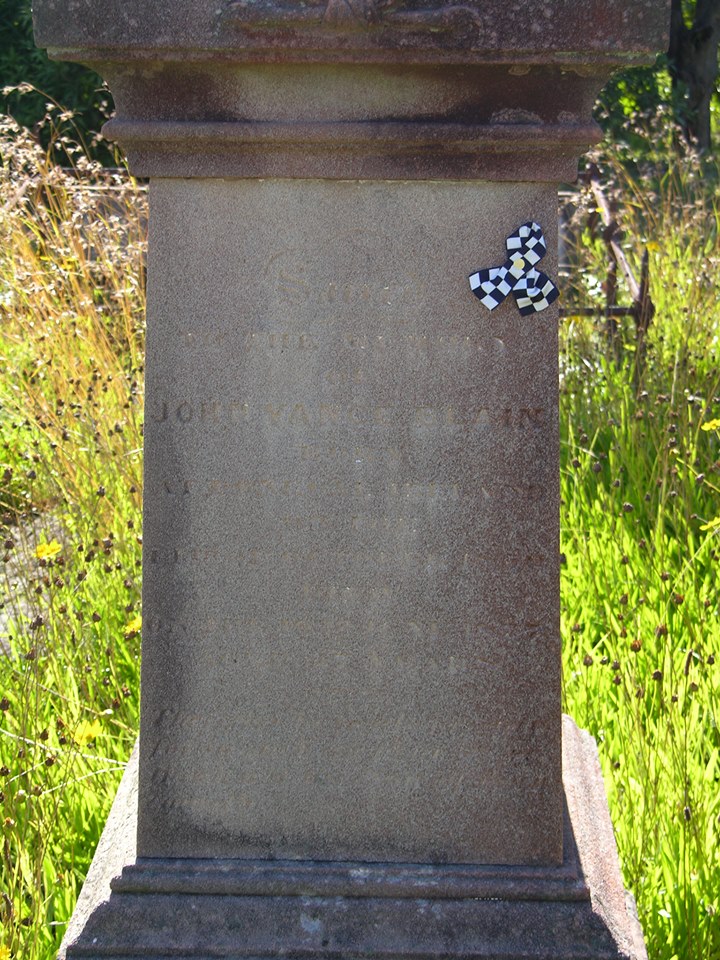
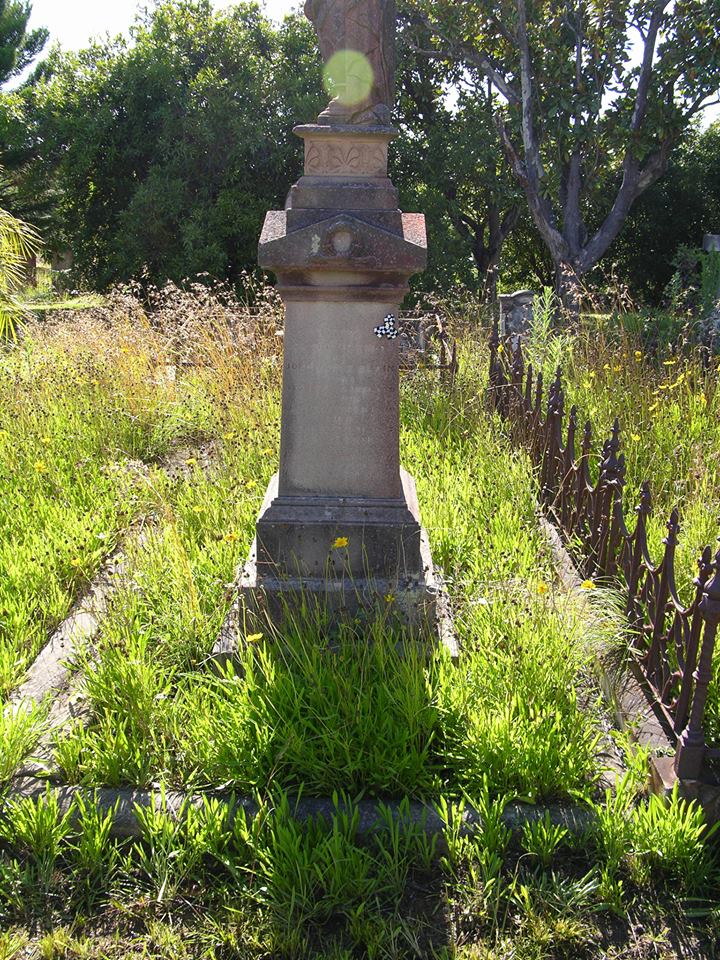
His headstone at Sydney’s Rookwood Cemetery reads: “A record of his brave conduct for arresting and bringing to justice a notorious burglar at whose hands he received such savage injuries as to ultimately cause his death”.
The constable was born in 1850, and at the time of his death he was stationed at Darlinghurst.
[divider_dotted]
The Sydney Morning Herald Friday 16 March 1877
“SERIOUS ENCOUNTER WITH A BURGLAR.
Some time on Thursday night the premises of Mr J C W Hinsch of 160 Pitt Street, were broken into, and a number of Crimean shirts and other goods valued at about £20, were stolen. Shortly after 4 o’clock yesterday morning, Constable Blain who was on duty in Bourke Street, Woolloomooloo, saw two men carrying a bundle in Forbes Street. He called upon them to stop but as they took no notice he gave chase, and gained upon them. One of the men threw himself down in front of the constable who fell upon him. In running after the men the constable’s truncheon dropped out of his pocket, and the second man took it up and struck the constable several heavy blows inflicting very severe wounds on the back of the head. The constable, though stunned by the blow, bravely grappled with the man, and after a most desperate struggle succeeded in over-powering and handcuffing his assailant. Becoming weak from loss of blood he had just sufficient strength to reach the residence of Dr. Pattison, when he fainted from exhaustion. Dr Pattison sent information to the police that a constable was at his house who had been nearly murdered in the street. Constable Williams, who soon arrived in obedience to the summons, found Blain lying on a sofa bleeding from wounds on his head, and scarcely able to speak. Eventually he learned from him that a man whom he had captured was handcuffed in the street, and on proceeding to the spot indicated, he found the man lying and bleeding from the head. He was conveyed first to the Infirmary, and afterwards to the Darlinghurst Police Station.
Later in the day Detectives Wilmott and Camphin found one blanket and 31 Crimean shirts in a sack on a piece of waste ground near Judge Street, Woolloomooloo… The constable who was so barbarously assailed is suffering greatly from the wounds he received. His extraordinary courage and resolution in securing the man in the manner he did is worthy of lasting record.”
Then on Saturday 16 June, 1877 the Australian Town and Country Journal reported the death of Constable Blain, including the following information.
“It will be remembered that, a short time ago, the Inspector-General of Police, on behalf of various citizens, presented constable Blain with a valuable gold watch and chain for the gallant capture of a convicted burglar, named Wright, who brutally assaulted that officer when being arrested for the burglary at the premises of Mr. J. O. W. Hinsch, in March last. Wright was sentenced to six years hard labour.
Blain, who was assaulted on the head with a policeman’s baton, recovered somewhat from the effects of the affray; but three weeks ago was again brutally assaulted by some roughs in Oxford-street.
About a fortnight ago he went into the Infirmary for medical treatment, and typhus fever setting in, he expired early on Monday morning. It is alleged that his death was caused by the effects of the beatings he received. It is said that a foul drain under the bedroom which Blain had occupied, in Stanley-street, was the cause of his taking ill. Blain had been about three years in the Force. He was unmarried. His grade was first class constable; and he was a young man of superior intelligence and some promise, and a most efficient officer.”
The constable was born in 1850, and joined the New South Wales Police Force on 26 December, 1874. At the time of his death he was stationed at Darlinghurst. His headstone at Sydney’s Rookwood Cemetery reads: “A record of his brave conduct for arresting and bringing to justice a notorious burglar at whose hands he received such savage injuries as to ultimately cause his death”. He is not listed in the official New South Wales Police Honour Roll.
[divider_dotted]
The Sydney Morning Herald Tuesday 12 June 1877 page 1 of 10
DEATHS:
BLAIN. — June 10, at the Sydney Infirmary, John Vance Blain, aged 26.
The Sydney Morning Herald Tuesday 12 June 1877 page 10 of 10
THE FRIENDS of the deceased Mr. JOHN VANCE BLAIN, late of the Sydney Police, are respectfully invited to attend his Funeral ; to move from the Infirmary THIS DAY, Tuesday, at a quarter-past 2 o’clock, to the Necropolis.
The Evening News ( Sydney ) Wednesday 13 June 1877 p 2
Constable Blain’s Funeral,
Yesterday afternoon, the remains of that efficient and lamented young police officer, constable Blain, were interred at Haslem Creek Cemetery. The funeral was attended by the Inspector General of Police ( Mr. Fosberry ), Inspector Read, Sub-Inspectors Waters, Anderson, and Johnson, and a large number of his fellow officers. The procession, as it moved through the city, attracted general attention, and considerable regret was expressed at the untimely end of a promising a young officer. The members of the force, as may be seen from an advertisement, intend erecting a monument over his grave.
The Evening News ( Sydney ) Saturday 4 August 1877 p 4
Monument to Constable Blain.
It is satisfactory to learn that there has been a prompt and generous response to the proposal for a monument over the remains of that distinguished but unfortunate police officer, Constable Blain. It will be remembered that Blain had a desperate encounter with a burglar who had broken into Mr. Hinch’s establishment in Pitt-street, and that he received such severe injuries as accelerated, if they were not mainly
the cause of his death shortly afterwards in the Infirmary. The Inspector-General and his officers and the whole force accorded his remains every honor by following them to the grave ; but they thought something more ought to be done, A suitable monument over the grave was proposed, and the matter having been taken in hand by Mr. Smart, J.P., the necessary funds were subscribed in the course of a few days. We have been shown the design of the monument together with the inscriptions, and it deserves to be said that the selection has been dictated by good taste and judgment.
For the purposes of this website ‘Q‘ represents those Police joining between 1 March 1862 ( commencement of NSWPF ) – 23 February 1915 ( Commencement of NSWPF current numbering system )
Rank: Constable – appointed 7 January 1863
Senior Sergeant – appointed ? ? ?
Final Rank: Senior Sergeant
Stations: ?, Cowra – Death ?
Service: From 7 January 1863 to 1 May 1872 = 9+ years Service
Awards: ?
Born: ? ? 1840, Wick, Scotland
Died on: 1 May 1872
Cause: Shot – Murdered
Event location: Binni Creek, Cowra, NSW
Age: 31
Funeral date:
Funeral location:
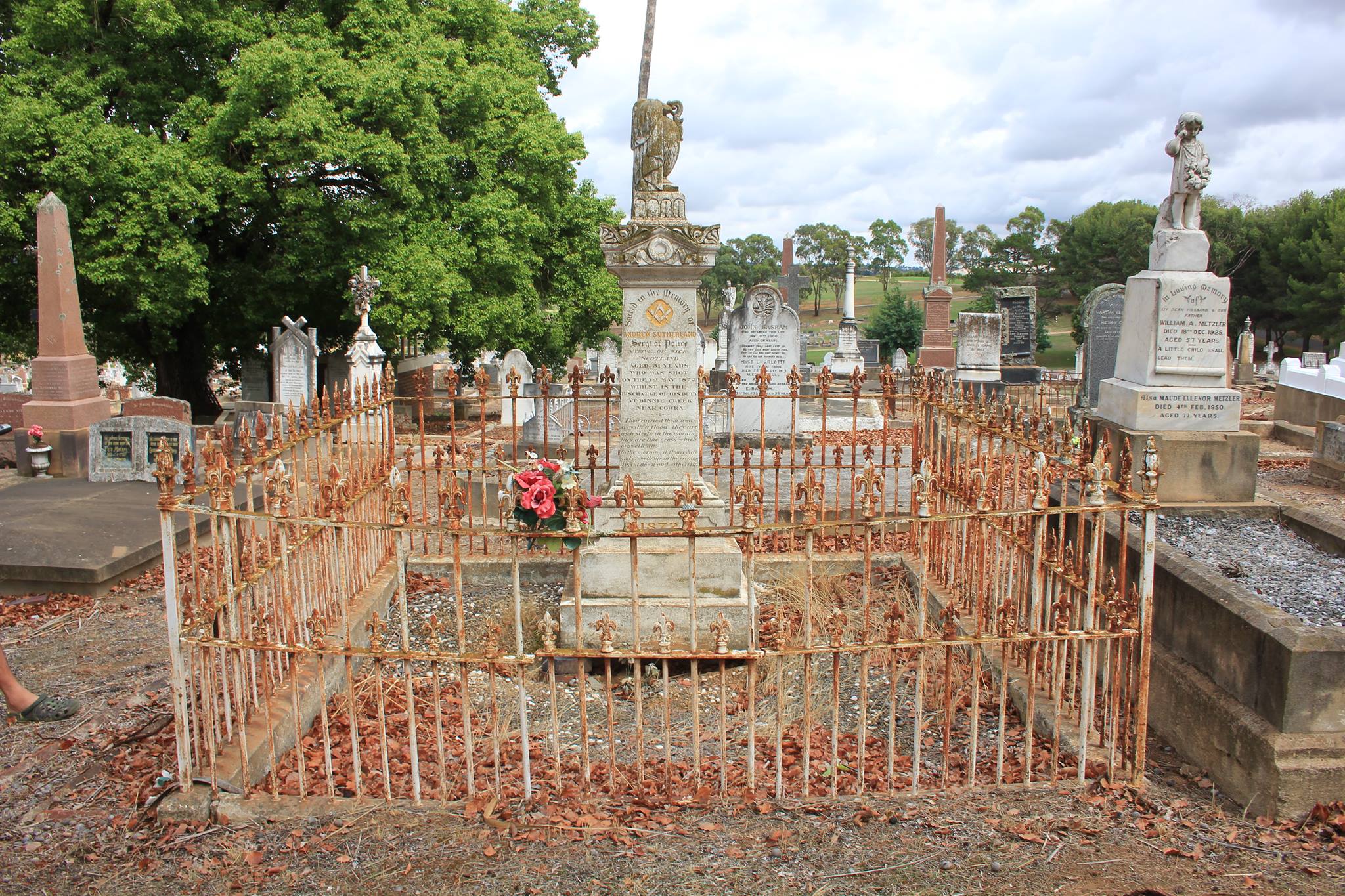
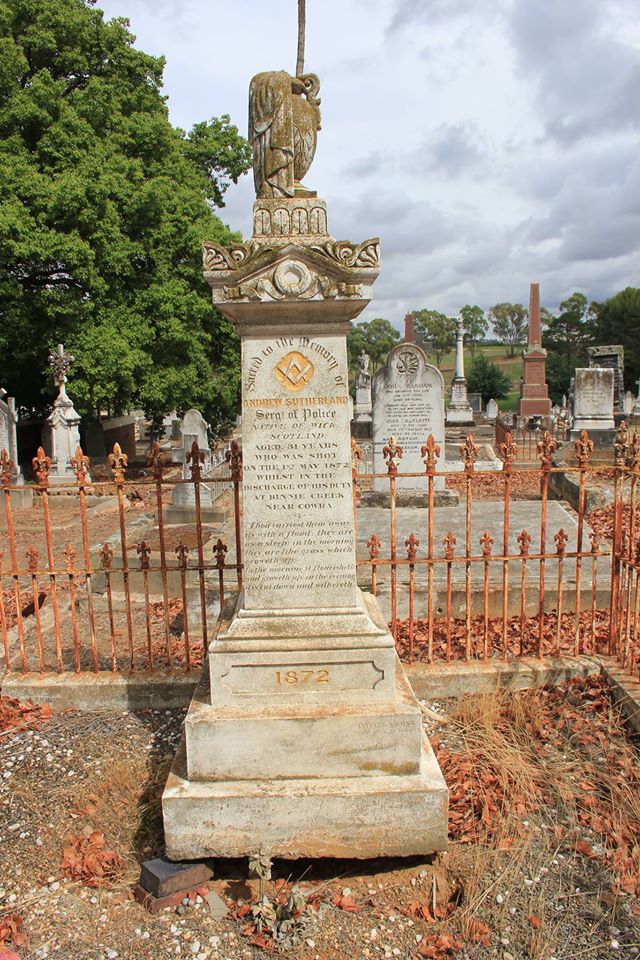
Buried at: Anglican section of the Young General cemetery
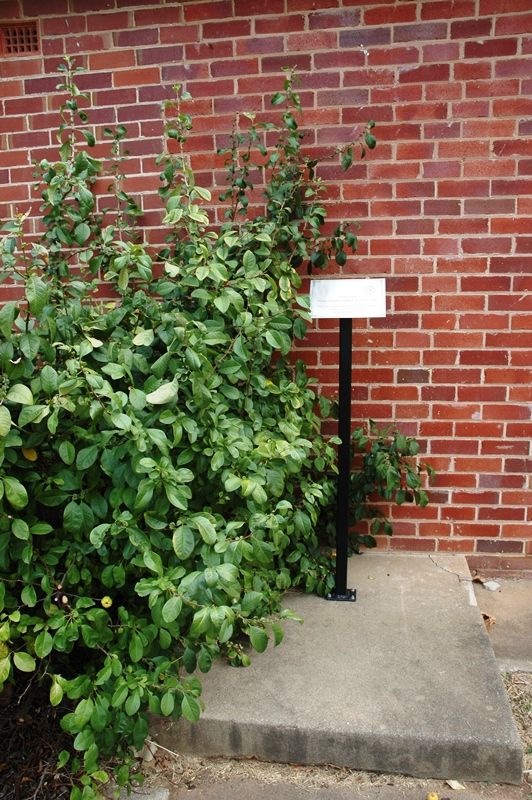
Memorial at: Cowra Police Station, 88 Brisbane St, Cowra, NSW
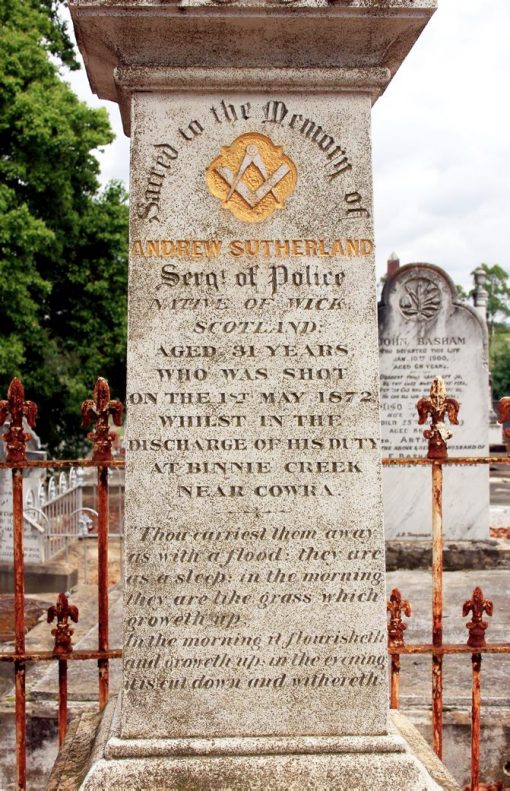
INSCRIPTION: Sacred to the Memory of Andrew SUTHERLAND Sergt. ( Sergeant ) of Police Native of Wick, Scotland. Aged 31 years Who was shot on the 1st May 1872 whilst in the discharge of his Duty at Binnie Creek near Cowra. ” Thou carriest them away as with a flood ; they are as a sleep ; in the morning they are like grass which groweth up. In the morning it flourisheth and groweth up ; in the evening it is cut down and withereth.”
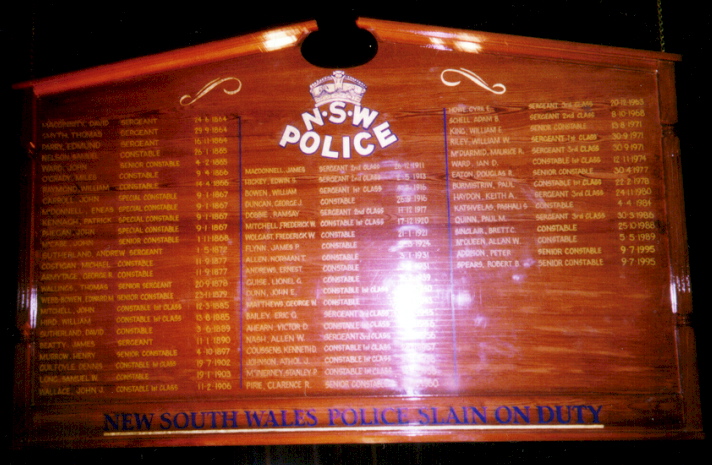
ANDREW IS mentioned on the Police Wall of Remembrance
On 1 May, 1872 the sergeant was returning to Cowra from Bathurst Court.
During his journey he was told that two men who were wanted for robbery, George Gray and William Bristow, were at Daniel Horan‘s hut at Binnie Creek, twelve miles from Cowra.
The sergeant rode over to investigate and as he neared the door of the dwelling the offenders suddenly emerged and shot him to death.
The Clarence and Richmond Examiner dated 7 May, 1872 provided a brief account of the tragedy, which tends to suggest that the offenders were known to the sergeant.
SERGEANT SUTHERLAND SHOT DEAD BY BUSHRANGERS –
CARCOAR ” Thursday – I regret to have to announce that Sergeant Sutherland, of the Cowra police force, was shot dead last evening, by bushrangers, at a place about five miles from Cowra.
It appears that two armed men called on a settler named Daniel Oram, whose house is distant about two miles from Cowra and demanded food, which he placed on the table for them.
Sergeant Sutherland, who was going home from the Bathurst Assizes, rode up to the door during the meal, and was dismounting, when one of the men stopped to the door, gun in hand, and said, “I have been looking for you, you wretch,” and then shot him through the heart, causing instant death.
The men then went off and Oram started to Cowra, and upon arriving there, informed the police, who are now in pursuit of the murderers.
The fate of the unfortunate but brave officer is universally regretted. He leaves a wife, and had only been married a few months.
The sergeant was born in 1839 and joined the New South Wales Police Force on 5 January, 1863.
At the time of his death he was stationed at Cowra.
The Queenslander
Sat. 9 Aug 1873 p 10
ST. GEORGE.
(FROM OUR OWN CORRESPONDENT.) July 31.
We have also to record the arrest of a man named Frank Riley alias George Gray by Sergeant Cranney, on the charge of murdering Senior-sergeant Andrew Sutherland, of the New South Wales force, at Hordern’s hut, Beni Creek, on the 1st of May, 1872.
The prisoner had been staying in town for some few weeks, and left accompanied by another man with the avowed intention of going to the Surat races, but parted with his comrade about three miles from Weribone, his comrade going on into Surat, while he went out into the bush to camp.
Sergeant Cranney, in the meantime, appearing to have some clue to his identity, followed the pair, and finding that only one had reached Surat, returned on his tracks, and camped in the bush for two nights endeavouring to ascertain the whereabouts of the prisoner.
Becoming faint from fasting, he went to Weribone Station for food, and just dropped on to the man he was looking for, and who had also been there on the same errand. The officer arrested him at once, and prisoner was taken to Surat and remanded to Roma, and we believe by this time is on his way to Brisbane.
This is the second arrest of New South Wales offenders made by Sergeant Cranney during the past few months, the other being that of James Madgwick, whose capture and exploits were narrated in your columns a short time since. Sergeant Cranney was also the officer who arrested the notorious Patrick Collins.
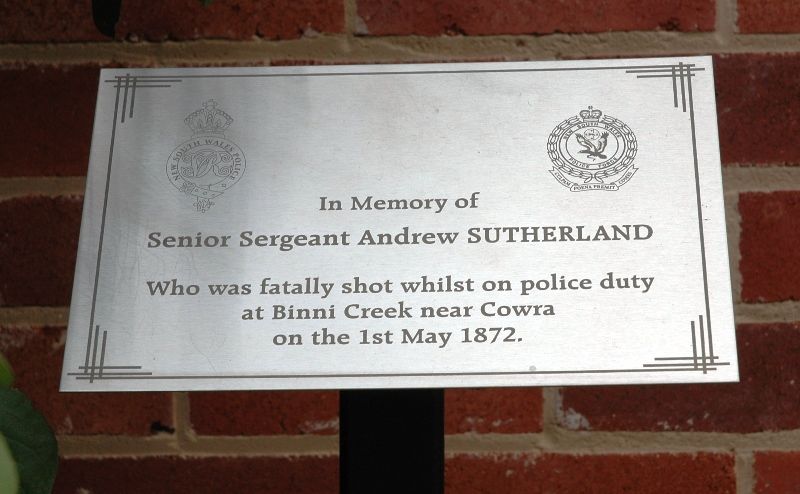
A plaque commemorates Sergeant Andrew Sutherland who was fatally shot in the line of duty as a New South Wales Police officer.
Sergeant Second Class Andrew Sutherland was shot whilst on duty at Binni Creek near Cowra on May 1, 1872. On May 1, 1872 he was returning to Cowra from Bathurst Court. En route he was told two offenders wanted for robbery, George Gray and William Bristow, were at Daniel Horan’s hut at Binni Creek, 12 miles from Cowra.
The Sergeant rode over to investigate and as he approached the door of the dwelling, two offenders emerged and shot and killed him. Gray and Bristow were subsequently arrested but both were later released without charge. No-one was ever convicted of the crime.
Actual Event Start Date: 01-May-1872
Actual Event End Date: 01-May-1872
Actual Monument Dedication Date: 01-March-2012
Front Inscription:
In memory of
Senior Sergeant Andrew SUTHERLAND
who was fatally shot whilst on police duty
at Binni Creek near Cowra
on the 1st May 1872.
The Portland Guardian and Normanby General Advertiser of 20 May, 1872 reported on the magisterial inquiry which was held at the Cowra courthouse before Mr G. Campbell J.P, “touching the death of Andrew Sutherland, who was shot dead by a ruffian at the residence of Daniel Horan a farmer living on Binni Creek…” One witness to the murder, Mrs Eliza Seery, gave the following evidence.
“I am the wife of James Seery, and reside at Binni Creek.
About 4 o’clock in the evening of Wednesday, the 1st inst., two men rode up to Horan’s hut on two dark looking horses.
Mrs Horan and I were in the hut at the time. They bid me good day, and asked if I had seen a bay horse, to which I replied “No”. One then said to the other, “We’ll get down and have a light”. The taller man was the spokesman.
He remarked that the weather was very dry.
The dogs began to bark. I went out to see what they were barking at, and observed Sergeant Sutherland riding towards the place.
The tall man asked me who was coming, and I answered, “Sergeant Sutherland”. The smaller man then walked outside, and Sutherland called him to the corner of the hut.
After talking to the sergeant for a short time, the man came towards the door, when I heard Sutherland ask him who was inside.
Sutherland then rode up to the door, and told the man who was inside to come out, or he would shoot the two of them.
The tall man, who was in the hut, said, “I won’t” and went towards the door.
The sergeant then got off his horse, when the tall man fired at him.
He said, “I’ll shoot”, before he shot at the sergeant.
Directly after the shot was fired, Sutherland, let his horse go, and ran towards a tree standing near the hut.
The man followed Sutherland and fired two shots, one after the other, as quick as he could.
The Sergeant, whose back was towards the man who shot at him, fell before he got to the tree. He fell directly after the last shot was fired.
There were only three shots fired.
The man was within a yard or two of Sutherland when the last two shots were discharged. This man brought Sutherland’s horse, and rode him away immediately after firing the last shot.
I did not see the smaller man of the two after the first shot was discharged.
I ran to the Sergeant when he fell, and asked if he was dead. He made no reply.
He was not quite dead, but never spoke.
Mrs Horan came directly after, and I told her to run for some water. She got some water, which she poured over the Sergeants mouth. He died while I was standing by him. He was lying partly on his side, and partly on his back.
Horan came up, and asked what was the matter. I told him the sergeant was shot dead.
Horan reported the murder to the police.”
The Brisbane Courier of 11 August, 1873 was to later report on the arrest of one of the offenders by Queensland Police Sergeant Cranney.
“We have also to record the arrest of a man named Frank Riley alias George Gray by Sergeant Cranney, on the charge of murdering Senior-sergeant Andrew Sutherland, of the New South Wales force, at Hordern’s [sic] hut, Beni [sic] Creek, on the 1st of May, 1872.
The prisoner had been staying in town for some few weeks, and left accompanied by another man with the avowed intention of going to the Surat races, but parted with his comrade about three miles from Weribone, his comrade going on into Surat, while he went out into the bush to camp.
Sergeant Cranney, in the meantime, appearing to have some clue to his identity, followed the pair, and finding that only one had reached Surat, returned on his tracks, and camped in the bush for two nights endeavouring to ascertain the whereabouts of the prisoner.
Becoming faint from fasting, he went to Weribone Station for food, and just dropped on to the man he was looking for, and who had also been there on the same errand.
The officer arrested him at once, and prisoner was taken to Surat and remanded to Roma, and we believe by this time is on his way to Brisbane.”
Thomas MADDEN
| 25/10/2012
Thomas MADDEN
New South Wales Police Force
Regd. # ????
Rank: Constable
Stations: ? , Bathurst
Service: From 20 January 1864 to 30 April 1867 = 3+ years Service
Awards: ?
Born: ? ? 1836 – 1837, County Mayo, Ireland
Died on: 30 April 1867
Cause: Accidentally Shot – ” Friendly fire “
Event location: Pulpit Hill ( near Katoomba )
Age: 30
Funeral date:
Funeral location:
Buried at: Hartley Cemetery, Great Western Hwy, Hartley, NSW
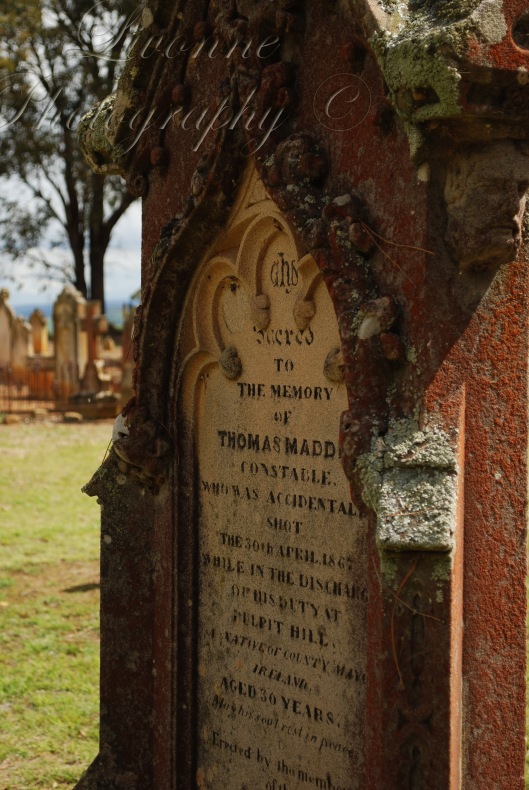
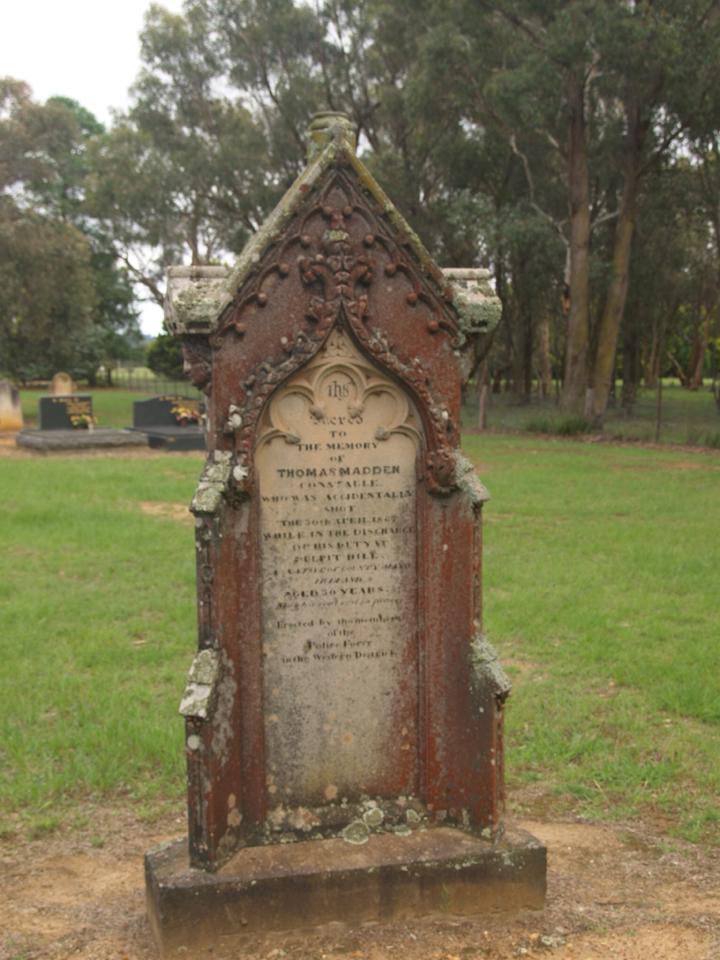
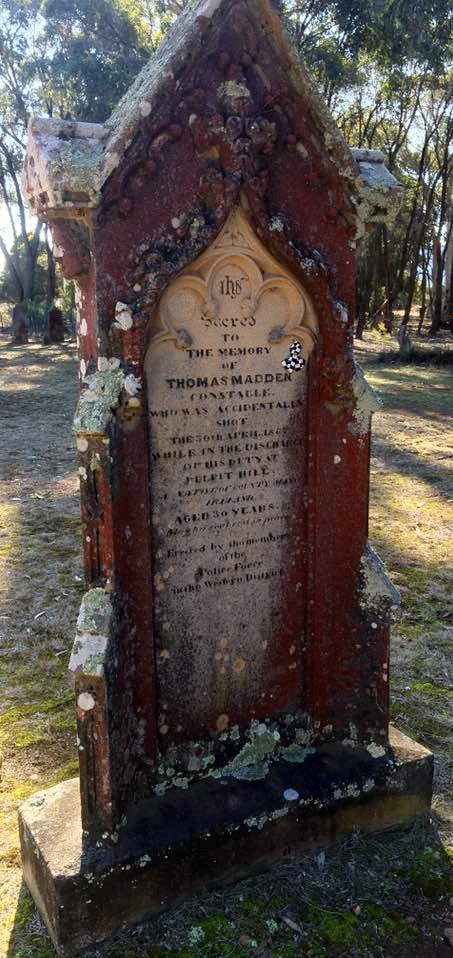
Sacred to the memory of Thomas Madden Constable. Who was accidentally shot 13th April 1867 while in the discharge of his duty at Pulpit Hill. A native of County Mayo Ireland. Aged 30 years. May his soul rest in peace. Erected by the members of the Police force in the Western District.
THOMAS IS mentioned on the Police Wall of Remembrance
On the 29 April, 1867 a party of eight police led by Sergeant Walter Casey camped at Pulpit Hill (near present day Katoomba) with fifteen or sixteen ‘heavily ironed’ prisoners they were escorting from Bathurst Court to Darlinghurst Gaol.
At midnight Constable Madden took his turn to watch over the lockup in which the prisoners were housed. When he was relieved at 2am by Constable Hitchcox, Constable Madden went to check the prisoners. When he opened the door of the lockup, the prisoners, who had apparently been waiting for their chance to escape, rushed the constable. Sergeant Casey, who realised what was occurring, began firing at the prisoners. Unfortunately, of the five shots fired by the sergeant, three accidentally struck Constable Madden, inflicting fatal wounds. Two prisoners were also wounded.
The Sydney Morning Herald of
14 May, 1867, page 3 gave news of the inquest into the death of Constable Madden.
INQUEST ON THE BODY OF CONSTABLE MADDEN.
At the inquest held by the District Coroner, at Hartley, on view of the body of the unfortunate deceased Constable Thomas Madden, who was accidentally shot by Sergeant Casey while resisting the attempt of prisoners to escape from the lockup at Pulpit Hill, depositions were taken.
Walter Cassels Casey, sergeant of police, stationed at Sofala, on oath saith
On the 29th April I was in charge of an escort of fifteen prisoners en route from Bathurst to Sydney ; that night the escort stopped at Pulpit Hill lock-up, I was on guard over the prisoners from 7 to 10 p m ; and was relieved by constable Duggan, who was on guard from 10 to 12, when he was relieved by the deceased, who remained on guard from 12 to 2a.m. of the 30th instant, Constable Hitchcox had to relieve him then.
After I was relieved from guard by constable Duggan, I laid down on the sofa (marked A in the plan), and had my revolver loaded on the window sill at hand ; anxiety kept me from sleeping, and I conversed with every sentry ; at twelve minutes past 2 a.m, deceased called Constable Hitchcox from an adjoining room ; deceased then said, ” I will look to see that they are all right,” immediately after this, the prisoners, led by Rutherford, Holmes, Moran, Smith, Southgate, and Kerr burst into the front room, out of the cell (C), and through the door (B), I jumped up, seized my revolver, and fired at the prisoner Moran ; he appeared to fall, I then fired at Kerr, who sang out, I fired at Kerr, who was rushing at deceased ; Kerr fell, I then fired at Southgate, who had hold of deceased ; the pistol hung fire , Southgate was not hit ; I fired again at one I supposed to be prisoner Holmes, I believe that something was put over the lamps very soon after the rush ; I found a blanket and a prisoner’s jacket on the table after all was over ; as the room seemed to get very dark after the two first shots ; it may have been caused by the smoke ; after I had fired five shots, the prisoners all but two ran into the cell, these two, who were Holmes and Rutherford, ran out of the front door (D), taking the direction of G and F ; I followed Holmes, and snapped the pistol at him ; it did not go off ; I then ran in and shut the door on the prisoners, who were in the cell at the time senior-constables McArthur and McNanamy and other police ran up from the barracks ; McArthur told me that Madden was shot in three places, and that the prisoners must have a revolver, I said, ” Than they got Madden‘s,” I said three or four of the prisoners are shot. I then looked at Hitchcox‘s revolver, it was not discharged, nor was any other of the police revolvers but my own, which had been fired five times, I then said, “Oh, my God! I must have shot poor Madden,”
I went up to the barracks, and saw deceased ; he complained of pain in his bowels ; I said, ” Oh, Madden it was I shot you,” he said, ” No, it was the prisoners,” I said, ‘ No, it was me, as no other revolver was discharged,” he said then, “If it was, I forgive you ; I know you did not do it on purpose,” and shook hands with me. I was so overcome at the thought of shooting my comrade, I do not know what I did, I believe I fainted.
I saw in the afternoon that prisoner Moran and Kerr were each wounded in two places – Moran on the breast and in the thigh, and Kerr having a graze on his head and a severe wound through his right arm.
When I went in, Moran said:, “You b—— butcher, if I had a revolver I would have got away ; I would as it was but for the sergeant.”
I was standing on the sofa when I fired, and the deceased was struggling with the prisoners ; my revolver has six chambers ; one chamber had two round bullets in it, one of which struck Moran on the left breast ; it is usual to see if the prisoners are all safe when changing guard ; the whole affair did not last more than five minutes ; I have been about eleven years in the police, I think Kerr had hold of deceased by the throat ; Kerr was shot through the right arm, and deceased on the left side ; I believe deceased was trying to keep prisoner from me and the door ; the property found on deceased consisted of £7 16s 3d and a silver watch and chain.
Thomas Hitchcox sworn: ” I am a constable stationed at Pulpit Hill, on the morning of the 30th April I was called shortly after 2 a m to relieve the deceased constable Madden, who was on duty guarding fifteen prisoners in the Pulpit Hill watch-house. When I came out of my own roomsergeant Casey was lying on a sofa, after I had been out of my room a few moments, constable Madden said, “I’ll see if the prisoners are all right ”
He took the padlock off and drew the bolt, immediately, the prisoners rushed the door open and I believe knocked deceased down ; at least l lost sight of him ; prisoner Rutherford sprang at my throat, with, I believe the intention to get at Sergeant Casey‘s revolver, which was lying on the window ; I got away from him ; he followed me, and got hold of me a second time ; I then got away ; sergeant Casey jumped up and commenced to fire his revolver at the prisoners. Rutherford again caught me by the throat ; I had great difficulty in getting away from him ; I rushed into my bedroom ; got out of the window ; and went to the barracks to call the escort, who were sleeping in the barrack room, and to get arms, as the prisoners were between myself and my own ; I believe had not sergeant Casey fired as promptly as he did we should have been disarmed ; and the prisoners would have escaped ; my revolver was hanging behind the cell door ; the place where I generally keep it,
Sergeant Casey was standing on the sofa when he fired.
Daniel Murray O’Hara being duly sworn said I am a duly qualified medical practitioner residing at Hassan’s Walls, I have this day made a post mortem examination on the body of Thomas Madden ; there were no external marks of violence on the body, except three punctured wounds ; one on the left jaw in front of the ear, one on the left shoulder blade, and one on the left side, between the ninth and tenth ribs ; these three wounds are gunshot ; where the ball entered I found the ball that caused the wound on the jaw had passed through the lower jaw blade fracturing it and wounding parts inside the jaw, viz muscles etc, and passing through the roof of the tongue in which I found the ball lodged in its substance ; on the right side the bone had split the ball, and one small portion was found immediately inside the left jaw bone, and the principal portion on the place stated, with a small portion of bone adhering to it ; this wound would not necessarily have proved fatal ; I found that the wound on the left side was more serious ; and on opening the chest and abdomen, I found that the ball had passed through the chest and abdomen, from the left to the right side, wounding in its course the pleura, peritoneum, and spleen, liver, and stomach, I found the ball under the skin on the right side ; there had been a great deal of internal haemorrhage along the course of this ball ; I believe it was from the causes of this wound that death took place ; I was not able to discover the ball that had entered the shoulder blade but as it had not entered the chest I did not consider it necessary to make any further search for it. The round hallmarked “X” is the one which had entered the side, and was the cause of death ; the ball marked “T” I found in the substance of the tongue.
The jury returned the following verdict – “That on the 30th day of April last, at Pulpit Hill, the said Thomas Madden died from pistol shot wounds, fired by Sergeant Casey while in the execution of his duty, and not by any other violent means whatever to the knowledge of the said jurors, did die.” The jury also added that they consider no blame attached to Sergeant Casey.
The constable was born in Ireland and joined the New South Wales Police Force on 20 January, 1864 at the age of 28 years. He had previously served in the Royal Irish Constabulary. At the time of his death he was a mounted trooper in the New South Wales Police Force and was stationed at Bathurst.
NSW BDM – Death 5356/1867
I visited this grave today, Saturday 29 October 2016 and it is still in great shape.
Cal
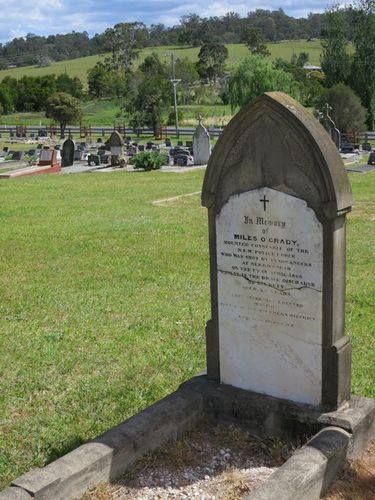
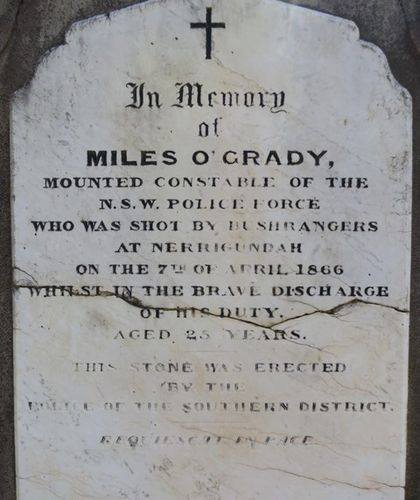
Miles O’GRADY
| 25/10/2012
Miles O’GRADY
New South Wales Police Force
Regd. # ?
Rank: Constable
Stations: Nerrigundah
Service: From 15 June 1863 to 9 April 1866 = 2+ years Service
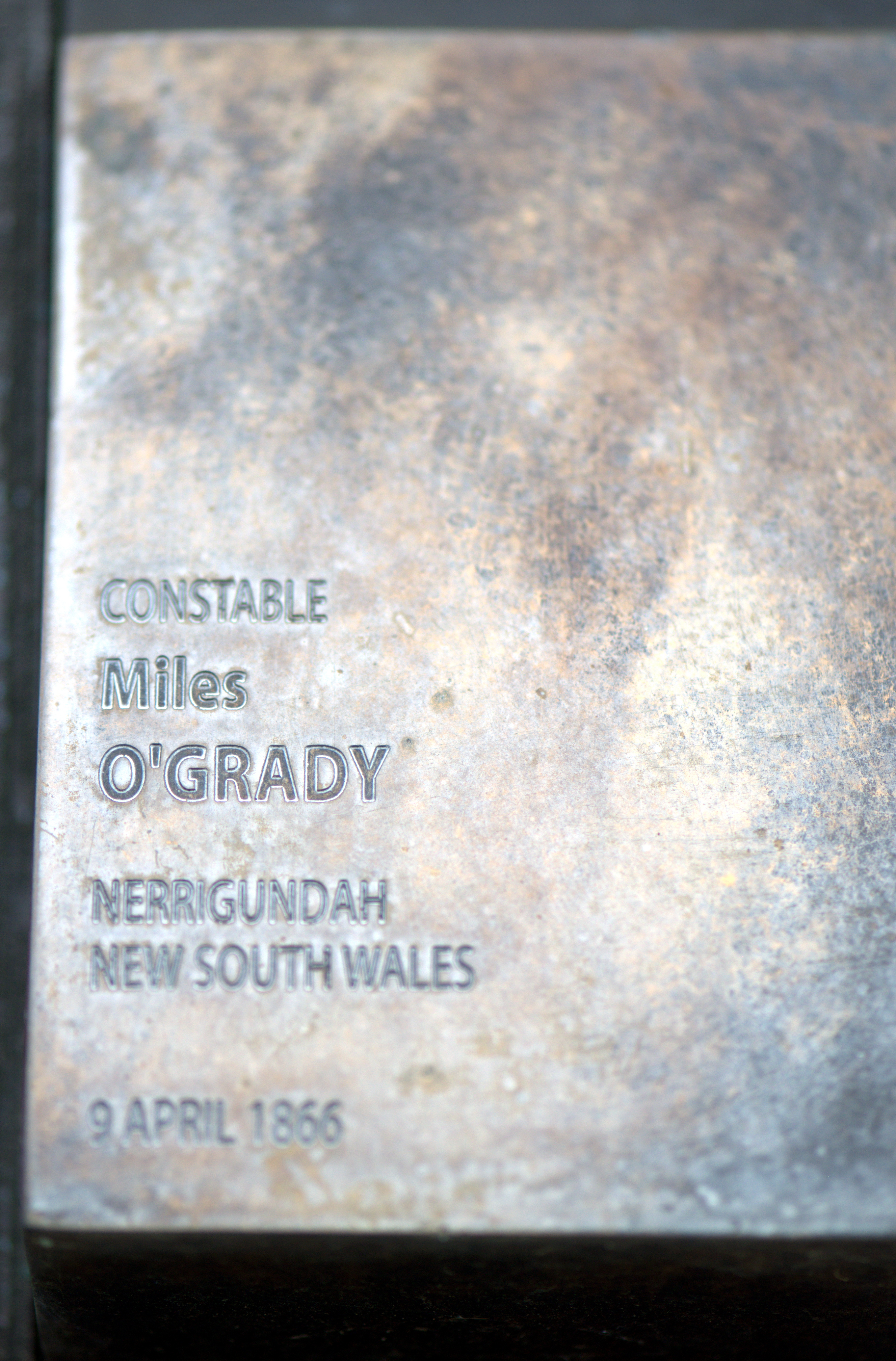
Touch plate at the National Police Wall of Remembrance, Canberra
[alert_green]MILES IS mentioned on the Police Wall of Remembrance[/alert_green]
On the morning of 9 April, 1866Thomas Clarke and his gang of bushrangers appeared at Deep Creek near the Gulph Goldfields and spent the day robbing passing travellers. At nearby Nerrigundah, 19 km west of Bodalla, Constable Patrick Smythe was performing his duties alone. Sergeant Nelson Hitch was absent at Braidwood Court and Constable O’Grady was in bed seriously ill with ‘colonial fever‘ (probably cholera). When Clarke learned of the police situation at Nerrigundah he led his gang into the township. Upon their arrival they held up Wallis’ Hotel and Pollock’s Store. Mrs Pollock (wife of the local gold buyer), however, threw the keys to the safe into the street and the gang spent considerable time searching for them in the darkness.
News of the events reached Constables Smythe and O’Grady at the police barracks and, against the wishes of his colleague, Miles O’Grady arose from his sick bed and dressed in his uniform. The two constables then set out to engage the bushrangers although O’Grady was very ill, and was having difficulty walking. As they approached Wallis’ Hotel, the police spotted the bushrangers and O’Grady fired, killing bushranger William Fletcher. In the ensuing gun battle O’Grady was shot in the side and as both police fell back, the gang ran to their horses and escaped. O’Grady was carried to the police barracks where he died a few hours later in great pain.
The Mercury newspaper dated 16 April, 1866 announced the constable’s unfortunate death from the wounds received, informing its readers that “Additional news respecting Clarke’s gang states that they burned down a settler’s homestead near Moruya and robbed Pollock’s station [store?]of £800, and several others of smaller amounts! Constable O’Grady has died of the wounds he received. The ringleader has been identified as Tommy Clarke. The Government is now taking steps to outlaw all connected.”
The constable was born in 1841 and joined the New South Wales Police Force on 15 June, 1863. At the time of his death he was stationed at Nerrigundah.
[divider_dotted]
The Kiama Independent & Shoalhaven Advertiser ( NSW ) Thursday 29 November 1866 p 3 of 4
The Bushranger Thomas CONNELL. – This prisoner, who was arrested by sergeant Byrne on Wednesday last, was charged at the Braidwood police court on Monday with the murder of constable O’Grady, at Nerrigundah, on the 9th of April last, and remanded to Moruya, there to be dealt with. Yesterday morning he was forwarded under escort of the police to Nelligen, en route to Moruya. – Braidwood Dispatch.
At 1pm on 9 April,2016, a commemorative service and presentation will be held at the re furbished monument at Nerrigundah to commemorate the 150th anniversary of the murder of our brother, Miles O’GRADY, by members of the Clarke gang bushrangers. There will also be a presentation by the Moruya and districts historical society at 2pm. There will be a detachment from the mounted police as well as a flag party.
If interested the contact for this is A/Supt Greg Flood at Far South Coast LAC on 02 44789910.
[divider_dotted]
Bushranger shootout in Nerrigundah commemorated with NSW Police flag ceremony
Well before anyone had heard of Ned Kelly, a gang of bushrangers robbed and murdered across an area from present day Canberra to the south-east coast of NSW.
The Clarke Gang have been dubbed “the bloodiest bushrangers”. They shot and wounded some of their victims, and killed others, and they’re suspected of killing all four of a police special squad sent from Sydney to track them down.
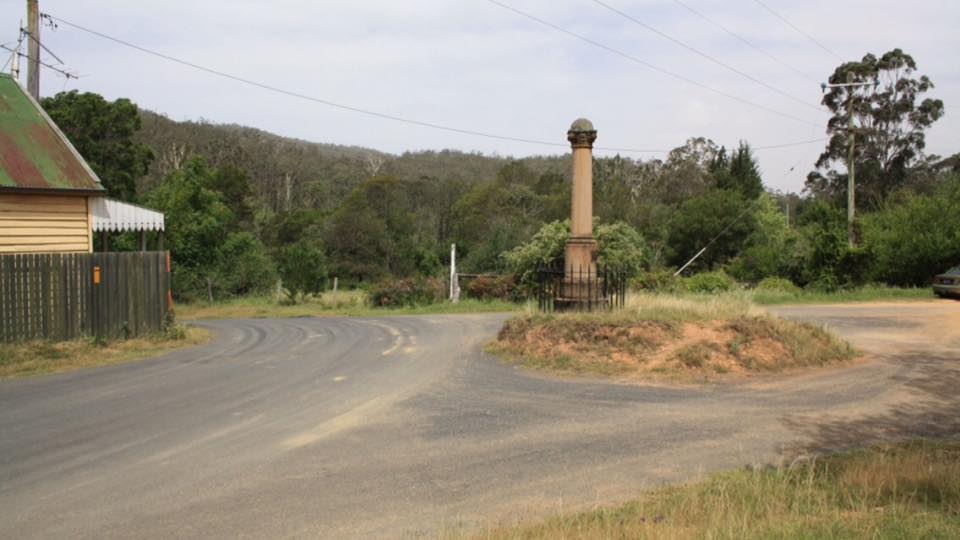
On April 9 1866 they killed Constable Miles O’Grady in a shootout in the then thriving mining town of Nerrigundah, which is now a quiet, isolated settlement of about 30 people, connected to the world by a public telephone.
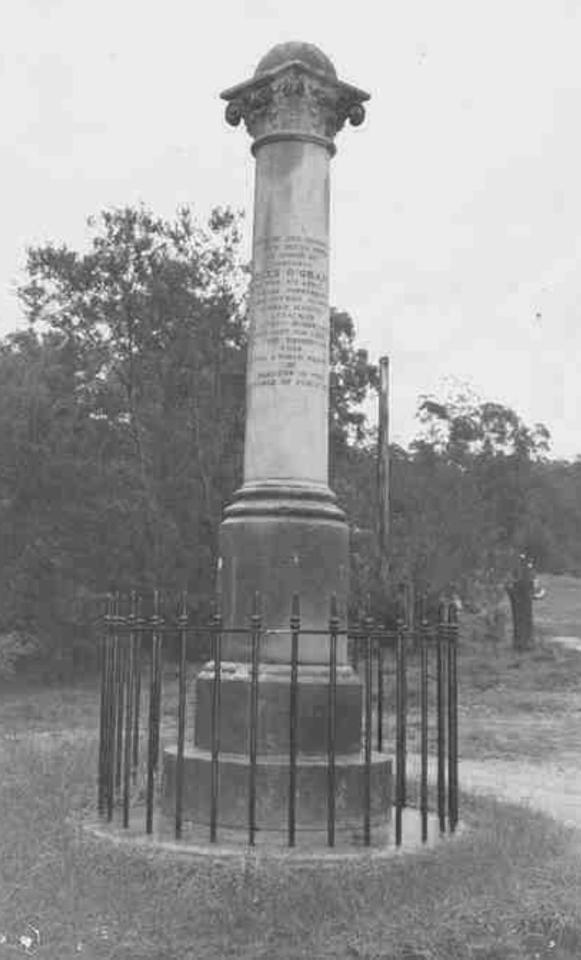
Very little is left now of the many hotels, shops, houses and shacks that supported thousands of miners who came to the town during its 1860s gold rush, but a stone memorial to the murdered policeman stands proud.
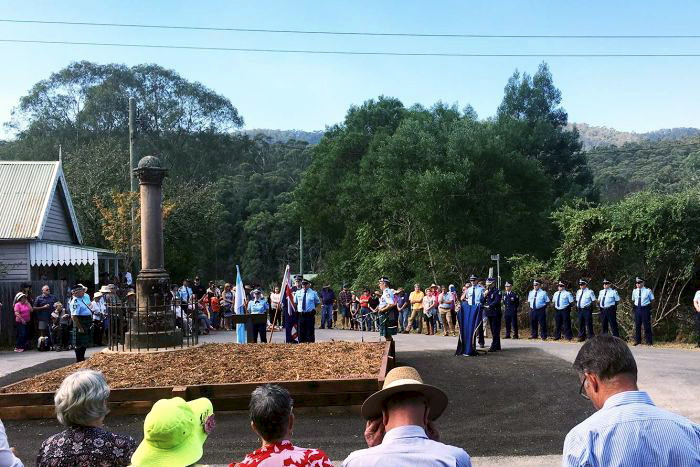
The community and around 200 visitors gathered at that memorial on the 150th anniversary of the shootout to attend a NSW Police flag ceremony to honour Constable O’Grady.
The author of a book about the gang, Peter Smith, said that if bushrangers were measured by how violent they were, and how many people they murdered, then the Clarke Gang were at the top of the scale.
“They were a lawless lot that started off taking horses out of paddocks and returning the horses and claiming the rewards,” said Mr Smith.
“They drifted further into crime, then highway robbery, then full-scale bushranging.”
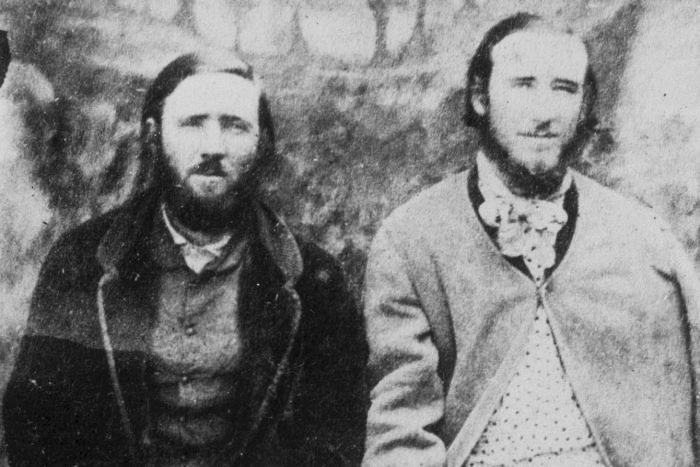
Thomas and John Clarke after their capture a year after murdering Constable Miles O’Grady in Nerrigundah. Prior to their capture they are alleged to have killed four special police sent from Sydney to track them down. They were hanged after a one-day trial. (Supplied: Peter Smith)
By the time they rode into Nerrigundah in April 1866 they had a fearsome reputation.
“They were an amalgamation of families that started in the area south of Braidwood,” Mr Smith said.
“The whole area south of Braidwood had a reputation for many years as a lawless area.”
The core of the gang comprised their leader Thomas Clarke and his brother John, together with their uncles, Pat and Tom Connell.
By 1865 Thomas Clarke had warrants issued for his arrest — for crimes that he denied.
He calculated that the police case was weak and he would avoid a conviction and so he surrendered at Braidwood. But the police by now regarded him as a notorious bushranger and were preparing cases that would see him imprisoned for a very long time.
Then when Clarke heard that he would be transferred to Goulburn Gaol and his trial heard there, he escaped from Braidwood Gaol.
“There was no return after that. He had to become a full-time bushranger,” Mr Smith said.
The gang came to Nerrigundah after travelling well south to the Bega races. Horse races were always an opportunity to steal another racehorse or perhaps someone’s winnings.
On their return north they held up the road leading into Nerrigundah, about five kilometres from town, robbing travellers as they came by. They shot and wounded one and beat up another.
Meanwhile, Constable O’Grady was severely ill in bed with what was then called colonial fever, his sergeant was away in Moruya, and the one remaining policeman was a newly arrived recruit, Constable Patrick Smythe.
[blockquote]
Once they were outlawed … they could be shot by anybody. There was no reason to surrender.
Peter Smith, author of The Clarke Gang
[/blockquote][blockquote][/blockquote]
“It’s difficult to know that they really intended to come into Nerrigundah in the first place,” Mr Smith said.
“When they found out that the place was basically unprotected, it’s probably when they thought they’d come into town.”
Leaving two of the gang to guard their captives, the gang rode into town. With them was a new member of the gang, William Fletcher. It was to be his only day as a bushranger.
They rode to one of the hotels and began taking captives and robbing them.
Mr Smith said the hotel was across the road from Pollocks Store where there was “probably 200 or 300 ounces of gold, which in present days would be worth a million dollars or more”.
Word got to O’Grady on his sick bed a little further down the road, and with Constable Smythe they made their way up the road to confront the bushrangers.
The publican of one of the other nearby hotels, Mrs Jones, tried to stop O’Grady as he was so ill he was staggering.
His response was, “I will do my duty.”
The two Constables confronted the gang outside the hotel. The bushranger William Fletcher was the first to be shot, and then Constable O’Grady was shot, and the gang fled the town.
“Once they’d murdered a police constable they were outlawed,” Mr Smith said.
“Once they were outlawed it meant that they had no rights. They could be shot by anybody. Basically they were already condemned to death. There was no reason to surrender. They were committed.”
The Clarke Gang would eventually be tracked down but not until after more robberies and more killings. Tommy Clarke and his brother John would get a one-day trial and then were hanged.
Ever since that day in Nerrigundah, Constable Miles O’Grady has been a police hero.
Speaking after the NSW Police flag ceremony, Detective Superintendent Kevin McNeil said, “The poignant moment in his death is when O’Grady is staggering and Mrs Jones says ‘Don’t go’ and he says ‘I will do my duty’. And from that point on he’s doing his duty for the people of New South Wales”.
“He knew what he was confronting. This Clarke Gang was very famous. He knew all about the Clarke Gang. Later on they killed four police at Jinden Station near Braidwood. That’s how violent they were.
“That was the moment, yet he still went out there because other people were at risk, to protect their life and property.”
NSW Police conduct a flag ceremony on the 150th anniversary of the shootout in which Constable Miles O’Grady was murdered at Nerrigundah. (ABC: Bill Brown) April 2016
Constable Chapman was the officer in charge of Booligal Police Station, in the Deniliquin District.
In mid-February, 1866 he set out on horseback to visit several properties in his area to serve summonses and carry out other duties. A few days later a report was received that his riderless horse had been seen near Tooragama, about twenty miles from Booligal, so Constable Barry went in search of him.
Barry found the horse, without either saddle or bridle, and then he proceeded to call at every place where it had been Chapman’s intention to have called.
The unfortunate constable was never seen alive again.
On 6 March, 1866 the Maitland Mercury reported that “Our correspondent at Hay reports that Constable Chapman is missing. It appears that, being stationed at Booligal, he left that place on Thursday fortnight to serve a summons at a station about forty miles distant. His horse, without saddle or bridle, was subsequently found, as were his waistcoat hanging on the branch of a tree, probably put there by the unfortunate man as a guide to those who might be, and are now, searching for him. Our correspondent hints at foul play but the central office here has no suspicion of such, believing that, having lost his way, he has perhaps perished from thirst. Let us hope not.”
Then, a fortnight later the Sydney Morning Herald of 21 March, 1866 reported that “The remains of the unfortunate Constable Chapman, lost in the bush near Deniliquin, were found a few days since and buried at Booligal Cemetery.”
The New South Wales Police Gazette of 7 March, 1866 recorded that “Chapman Charles, Senior Constable (No. 467), lost in the bush; body found on February 22nd.”
The constable joined the police force on 6 September, 1861 and in 1862 he became a senior constable in the newly-formed New South Wales Police Force. At the time of his death he was aged 30 years and was stationed at Booligal. He was not long married when he passed away and his wife was expecting their first child. He is not listed in the official New South Wales Police Honour Roll.
New South Wales Police Gazette and Weekly Record of Crime (Sydney : 1860 – 1930), Wednesday 7 March 1866 (No.10), page 86
DEATH.
Chapman Charles, Senior Constable ( No. 467 ), lost in the bush; body found on February 22nd ( Thursday ).
The Deniliquin Chronicle states that the remains of constable Chapman, who was lost in the bush lately, have been found by a man named Patrick Hardy and another, within three-quarters of a mile of where some men were making a dam. He was buried in the Booligal cemetery, and followed by a good many people to the grave.
His horse was found naked.
The body was as black as ink, and in an advanced state of putrefaction.
In his struggles he had torn his shirt, and forced his pants up to his knees, and by his tracks it was seen that he had been rolling round and round the tree under which he was found to avoid the sun.
He must have had a horrible death.
He is said to have been lying on his side, with a coat under his head for a pillow.
The spot was a dry creek, about twenty-five miles from Booligal, and seven from the Lachlan River.
It is understood that there were no mark of violence on deceased’s person, but that he had evidently perished from exhaustion, and had, after rambling about for some time in a circuitous direction, being overcome with fatigue and thirst, lain himself down to die, having, it is supposed, hung his waistcoat on a tree or bush near as a guide to his last resting-place.
The Pastoral Times reports a fatal occurrence in Riverina : — ” Constable Chapman, who is in charge of Booligal Station, went out on duty, and being longer away than his business required, has, it is feared, got lost.
He left the station on Thursday week, about four o’clock.
On the Saturday following his horse had been seen near Tooragama, about twenty miles from Booligal.
Constable Barry went in search of him, and picked up the horse, without either saddle or bridle, on Tuesday.
Fears are entertained that something serious has happened to Chapman. No trace has been obtained of him, although Barry called at every place where it was his ( Chapman‘s ) intention to have called. He must, therefore, have met with the mishap shortly after leaving the station ; and if he has been without assistance for so long a time, the worst may be anticipated.
The feelings of Mrs. Chapman, who has been but a short time married, and about to become a mother, may be easily imagined.
Our latest account states that Booligal had turned out in search, but nothing definite had been ascertained.
Our telegram reports that the remains of Chapman have been found.
Wagga Wagga Express and Murrumbidgee District Advertiser (NSW : 1858 – 1859; 1866; 1872 – 1874), Saturday 10 March 1866, page 2
CONSTABLE CHAPMAN. -The remains of poor Chapman have been found by a man named Patrick Hardy and another within three-quarters of a mile of where some men were making a dam, and within five miles of where he hung up his waistcoat.
He was buried in the Booligal cemetery, and followed by a good many people to the grave.
His horse was found naked. The body was black as ink and in an advanced state of putrefaction.
In his struggles he had torn his shirt and forced his pants up to his knees, and by his tracks it was seen that he had been rolling round and round the tree under which he was found, to avoid the sun. He must have had a horrible death. He is said to have been lying on his side, with a coat under his head for a pillow.
The spot was a dry creek, about twenty five miles from Booligal, and seven from the Lachlan river.
It is understood that there were no marks of violence on deceased’s person but that he had evidently perished from exhaustion, and had, after rambling about for some time in a circuitous direction, being overcome with fatigue and thirst, lain himself down to die – having it is supposed, hung his waistcoat on a tree or bush near, as a guide to his last resting-place.
It is to be regretted that he was not better acquainted with the bush. Had it been so his life would have been saved.
When search was made for Chapman, a human skull was picked up, no doubt part of the remains of some unfortunate. – Deniliquin Papers.
On the morning of 3 February, 1865 Constable Ward was returning to Coonabarabran from a prisoner escort to Mudgee. Near the locality known as Barney’s Reef he was informed that a Chinese gold miner, Sam Poo, thought to be mentally unbalanced, started sticking up people on the road to Mudgee. He also kidnapped and raped a young woman. Ward was told that Poo was nearby in the scrub. After a short search Constable Ward located the offender’s camp and approached him. When the offender saw the constable he ran into the bush. Ward rode after him, and when he caught up, called on him to stand and drop his weapon ( a cut down shotgun ). Sam Poo aimed at the trooper and said “You policeman – me fire”.
The Trooper leapt from his horse and tried to use the animal as cover as he drew his Colt navy revolver. Ward‘s hesitancy in shooting the Chinaman proved to be fatal for him, for Sam Poo fired, hitting the policeman in the pelvic area. Ward fell to the ground, discharging one shot from his Colt in the process. He then fired twice more at the Chinaman, who was running away through the bush.
The trooper lay bleeding on the ground until he was found by Mr M J F Plunkett, the squatter on whose run the shoot out had taken place. Plunkett arranged for Ward to be taken to his homestead, and sent for the doctor who lived 50 miles away. The doctor arrived the next day, but examination showed that Ward was beyond medical help.
The trooper told Mr Plunkett that he knew he was dying and asked what would become of his wife and family. Later he dictated a full statement about his encounter with Sam Poo to the squatter. Ward said he was a member of the Church of England, and asked Plunkett to pray for him. This the squatter did using a book of Common Prayer. The trooper then asked the squatter to send for his wife and family. However, John Ward died shortly after giving his request, passing away on 4th February 1865. His family arrived at the homestead after he had been buried.
A meeting was held in Mudgee, where a large sum of money was raised for Senior-Constable John Ward’s widow and children. This support acknowledged the supreme sacrifice the trooper had made in the performance of this duty.
The murderer, Chinese bushranger Sam Poo, thought to be mentally unbalanced, was later captured and hanged, as described by the Clarence and Richmond Examiner of 2 January, 1866.
EXECUTION, AT BATHURST: Wednesday’s Free Press states that on the previous day, the Chinese convict Sam Poo, who at the last assizes was convicted of the murder of constable Ward, suffered the extreme penalty of the law, within the precincts of the gaol. In the absence of any of his countrymen outside the prison walls, three Chinese prisoners, who are at present confined in Darlinghurst Gaol, were brought to see the end of Sam Poo, there were also about a dozen other persons present besides the police and the officers of the gaol. The wretched man, who, ever since his apprehension has been quite weak in intellect, appeared perfectly unconscious of his fate, and until his arms were pinioned by the executioners, stood in the door of his cell clapping his hands. The ceremony of pinioning over, he was led to the gallows without speaking a word, or even lifting his head. The rope was fixed, the bolt drawn and Sam Poo ceased to exist. The body was, after the lapse of little more than half an hour, cut down, and taken away for burial.
The senior constable was born in England in 1829 and joined the police force on 1 February, 1858. In 1862 he became a member of the newly-formed New South Wales Police Force as a mounted trooper. At the time of his death he was stationed at Coonabarabran.
He was described as 29 years old, 5′ 10 1/2″ tall, had brown hair and blue eyes and his complexion was fair. Ward was promoted to Senior Constable on 1st May 1863.
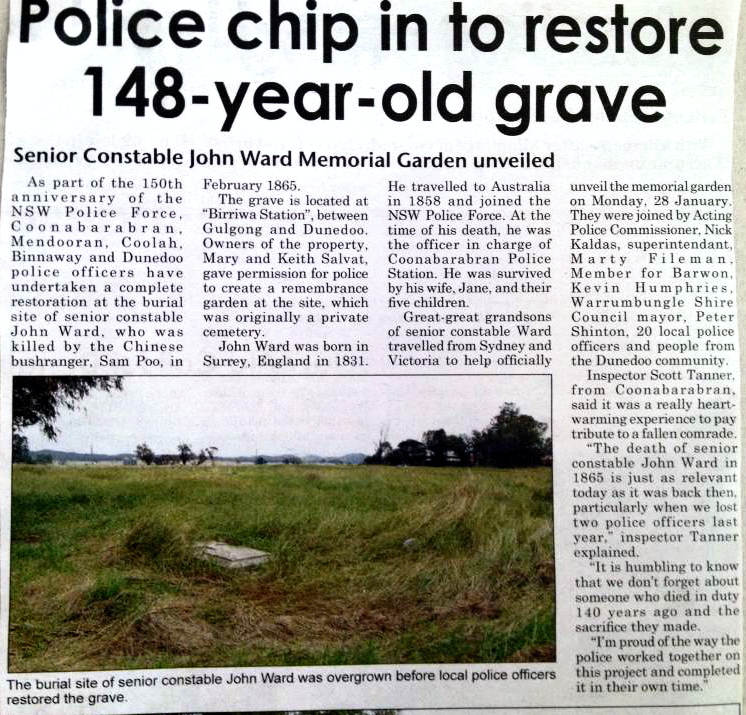
IT’S not unusual that the state’s most senior policemen, the mayor and local MP would turn out on Monday to attend the memorial service for an officer lost in the line of duty.
Senior Constable John Ward was shot at point blank range and died the next day from his appalling injuries. The dignitaries stood in silence enduring steady rain as the prayers and dedications were delivered at Birriwa Station near Coonabarabran.
What makes the scene rather remarkable is that the officer’s blood was spilt almost one and a half centuries ago.
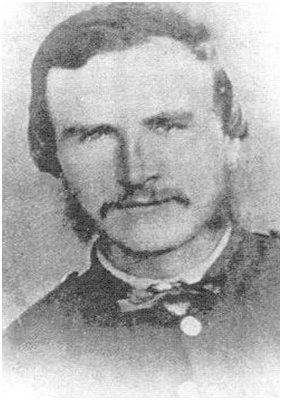
Senior constable John Ward. Photo: Supplied
Gun drama … Australia’s only Chinese bushranger Sam Poo. Photo: Supplied
Sam Poo, who committed the murder, achieved fleeting infamy as Australia’s only Chinese bushranger.
The gold prospector, apparently weary of thin pickings on the Talbragar claims, decided to switch jobs and take up bushranging. Fellow diggers were alarmed by news a man reported to look like a Chinaman had stuck up a woman and her little girl on the Mudgee Road. There were more reports of a Chinaman ”bailing up” travellers.
Ward, married with five children and with five years’ experience in the police force, was soon on his trail. On seeing his man after some hard riding, he called out ”Put down that gun.”
Poo responded: ”Me fire: you policeman.” And he did.
A stockman took the officer to his homestead. The nearest doctor travelled 80 kilometres to tend to him, arriving the next day.
By then Ward was reportedly beyond the reach of human aid and died soon after.
Two weeks later three constables aided by a ”smart half-caste Aboriginal stockman and tracker Harry Hughes” found Poo hiding in scrub. The fugitive was shot in the neck. He recovered at Mudgee Hospital and was later convicted of murder. He was hanged at Bathurst Jail in 1866.
Fast forward to the service last week, part of the NSW Police Force recognition of the sacrifice made by officers over 150 years of policing.
Inspector Scott Tanner, of the Mudgee area command, said: ”We were looking at how to mark the 150 years of policing. We have a plaque in Coonabarabran police station to John Ward and then there was the loss of Dave Rixon [the senior constable shot dead in Tamworth last March] so we started thinking about how to also remember John Ward – he walked the same streets that we walk today. When I first came here I lived in the house he had lived in.”
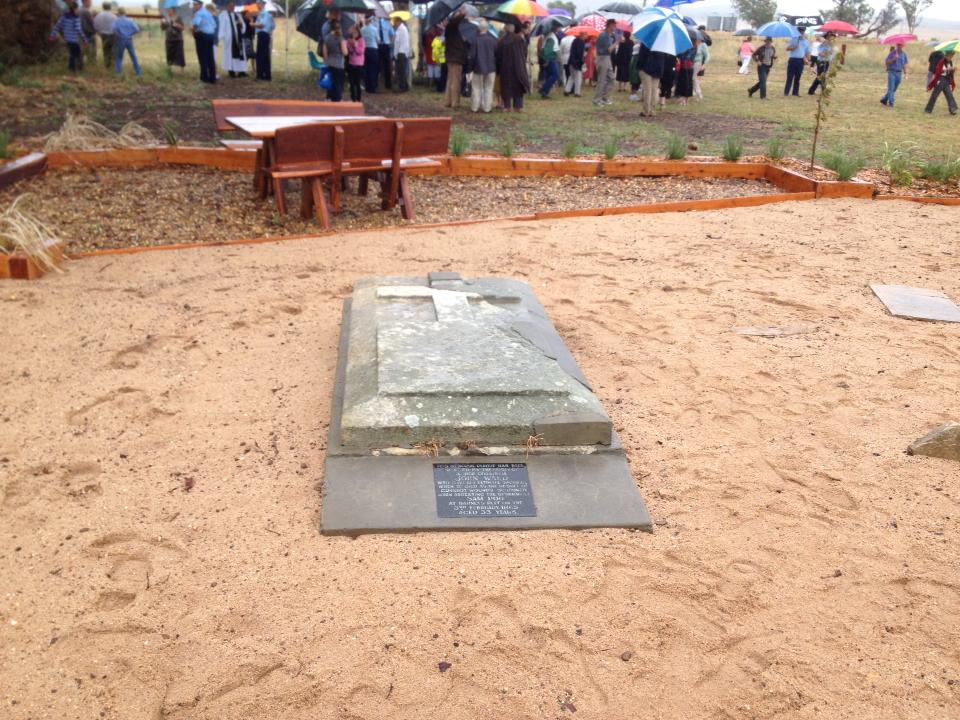
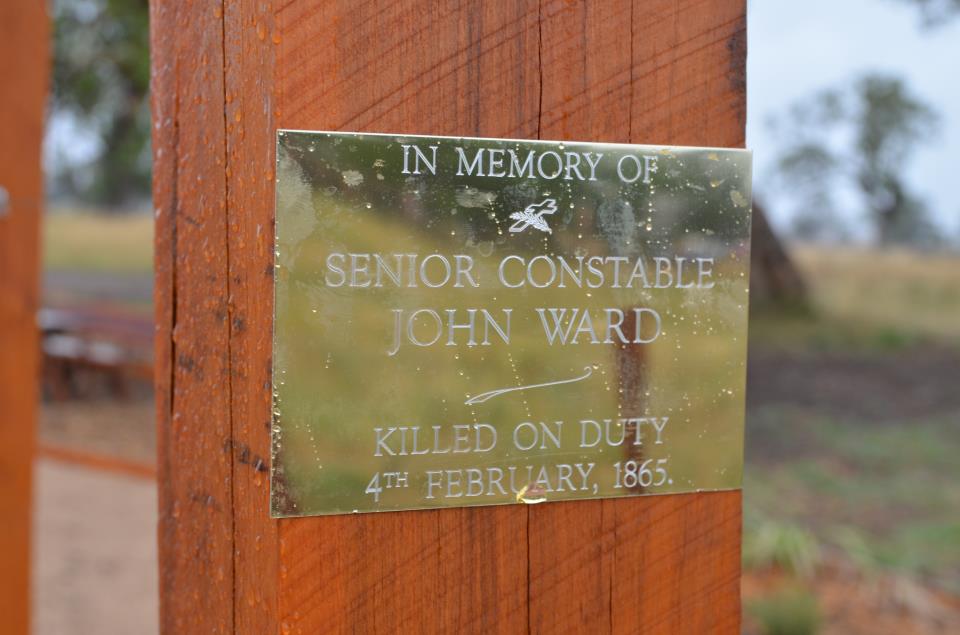
https://www.facebook.com/groups/514697128544865/ The grave of Senior Constable John Ward who was the OIC of Coonabarabran in 1865. Below are a few photos of the official opening in 2012 after restoration ( the 150th birthday of NSW Police ). Acting Commissioner Nick Kaldas, Ass Com McKechnie and descendents of the Ward family attended.
[divider_dotted]
Homestead’s website to preserve history
SAM PAINE
The owners of Birriwa Homestead, Mary and Keith Salvat, are working to rediscover and preserve the history of the sandstone house.
The property, on the Dunedoo side of Birriwa, has a long and rich history and often attracts visitors who remember visiting the house as children.
Mrs Salvat said she wanted to use a new website being established at www.birriwahomestead.org to collect the stories surrounding the homestead, the balls it hosted and the families who lived or worked there.
Mrs Salvat said she wanted to create an opportunity for families with connections to the house to reach each other and share stories that could otherwise be lost.
“We’re just beginning a journey of rediscovering the history,” she said.
The website is under development, and currently consists of a form that can be used to submit stories to be published on the website, or to ask to be alerted when the site launches.
“It’s a very democratic website. Everyone owns their own intellectual property,” Mrs Salvat said.
“The purpose is really to act as a library – a 21st Century library.”
She said a house was bricks and mortar, but at the same time, it contained a subtle energy left by the people who had lived there or developed a connection with the place.
The Salvats have owned Birriwa Homestead for 15 years, and maintained and restored it while living in Sydney before moving there permanently in 2009.
They are often visited by descendants of the families who owned the house in the past – the Lanes, Cowards, Lowes and McMasters – including a 90-year-old woman who remembered playing in the garden as a very small child.
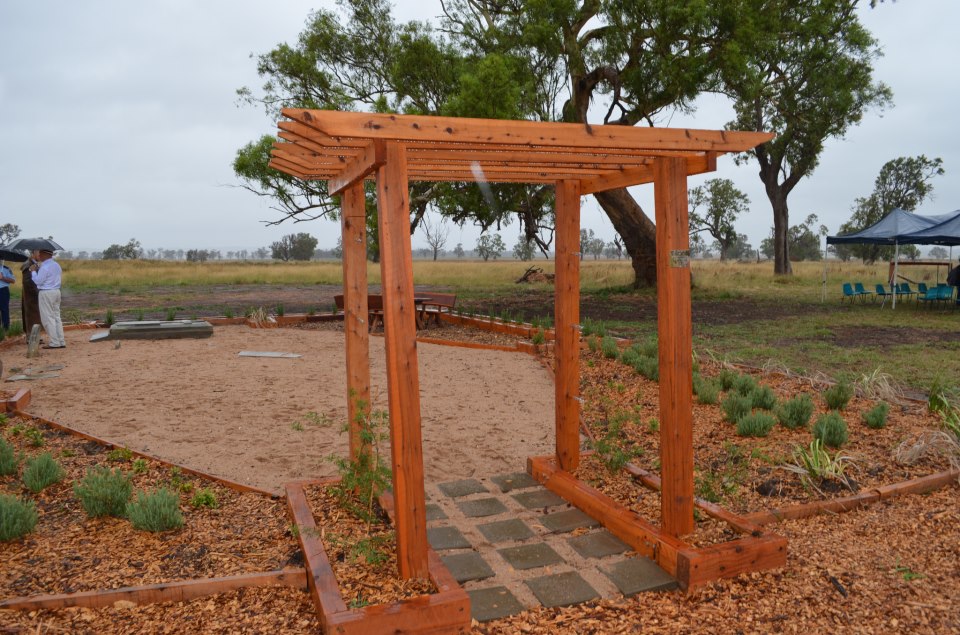
The property was opened on Monday for the dedication of a memorial garden surrounding the grave of Senior Constable John Ward, who was shot by a bushranger at Birriwa in 1865.
As well as police and descendents of Senior Constable Ward, guests included people who were raised at the homestead, a former Birriwa jackaroo, and a neighbour whose family had lived on the next property for three generations.
The memorial garden includes infant graves alongside the grave of Senior Constable Ward, and others that are unidentified as the stones and crosses have been washed away.
Mrs Salvat said working with the police on the project had been a wonderful experience.
“They were very respectful and incredibly well-mannered,” she said.
“This has been a beautiful journey for me and my husband over the last 12 months.”
Mr Salvat said the memorial garden made the grave site more approachable for members of the public who wouldn’t like to intrude on a private residence, while the planned website would allow visitors to read about the memorial before visiting.
Mrs Salvat plans to invite people with relatives buried at Birriwa Homestead to visit the property in autumn to plant trees that can bear plaques naming the people interred there.
Service: From 5 August 1857 to 26 January 1865 = 7+ years Service
Awards: ?
Born: ? ? 1823 – arrived in N.S.W., from England, aboard the ship ‘ Parsee ‘ in 1855
Died on: 26 January 1865
Cause: Shot – murdered
Location of Event: Collector, NSW
Age: 38
Funeral date: ?
Funeral location: ?
Buried at: Grave in the C of E portion of the Catholic and C of E Cemetery, Collector
Grave: 34 54’54S, 149 25’51E
Monument: 34 54’44S, 149 25’53E
[alert_green]THOMAS IS mentioned on the Police Wall of Remembrance[/alert_green]
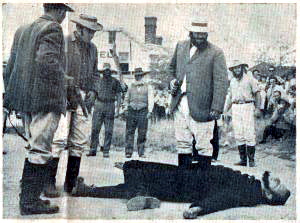
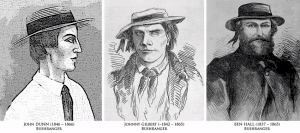
Shortly before 6pm on 26 January, 1865 bushrangers Hall, Dunn and Gilbert attacked Kimberley’s Inn at Collector. At the time the local police were out searching the area for the bushrangers, and the only man on duty in town was the lockup-keeper, Constable Nelson. When news of the attack reached the constable, he remarked to his wife that he would simply “have to do his best” against the gang. As he approached the hotel, armed only with a police carbine with bayonet attached, the constable was shot by Dunn who had hidden behind a fence post. Nelson was hit in the chest by a shotgun blast and, as he staggered, Dunn fired again, hitting him in the face. He died almost instantly.
The bushrangers then stole the constable’s personal belongings and the carbine, and escaped. The entire incident had been witnessed by young Frederick Nelson, one of the constable’s nine children, who was also fired at by Dunn. Frederick Nelson would later go on to have a long and successful police career himself. Hall, Dunn and Gilbert all met with violent deaths shortly after this incident. Hall and Gilbert were shot dead by police, and Dunn was convicted of Constable Nelson’s murder and was hanged: fitting results for this extremely violent gang of criminals.
Many years after the murder the Australian Town and Country Journal dated 27 November, 1907 printed the following story.
BUSH RANGING DAYS RECALLED.
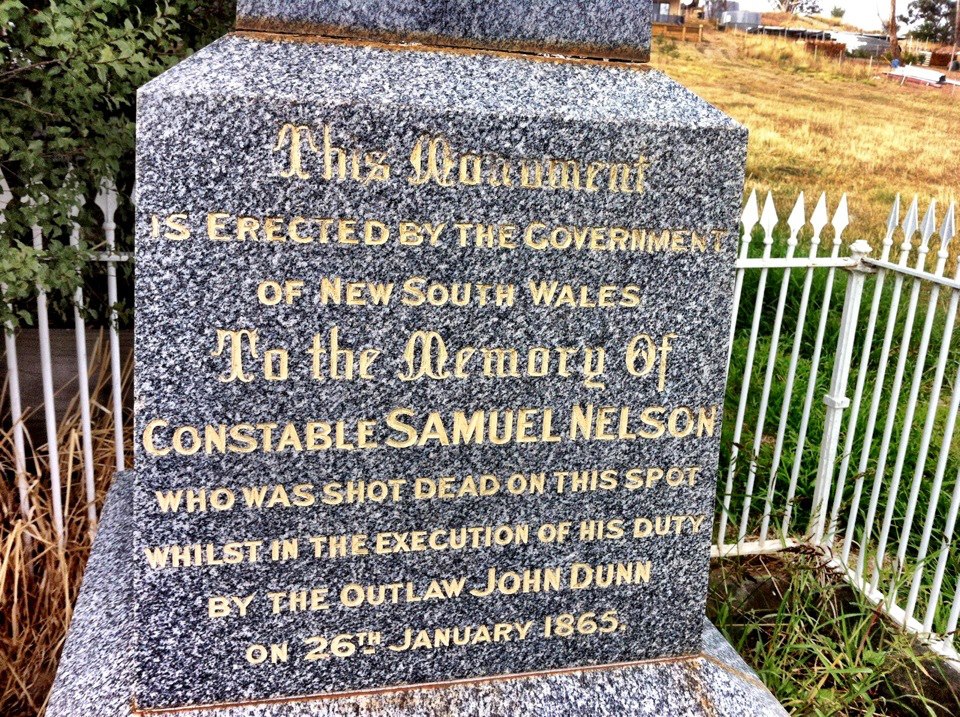
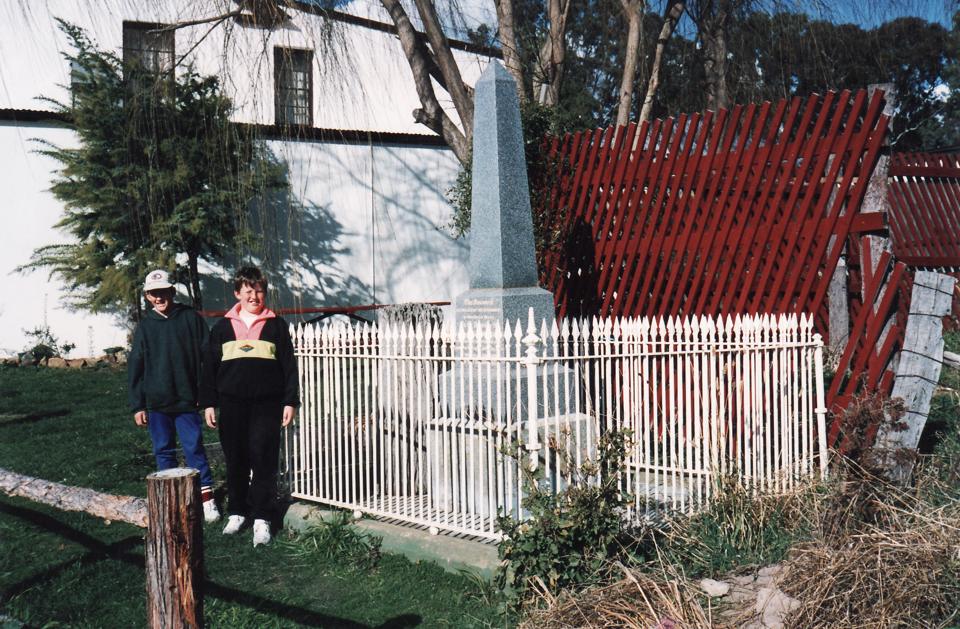
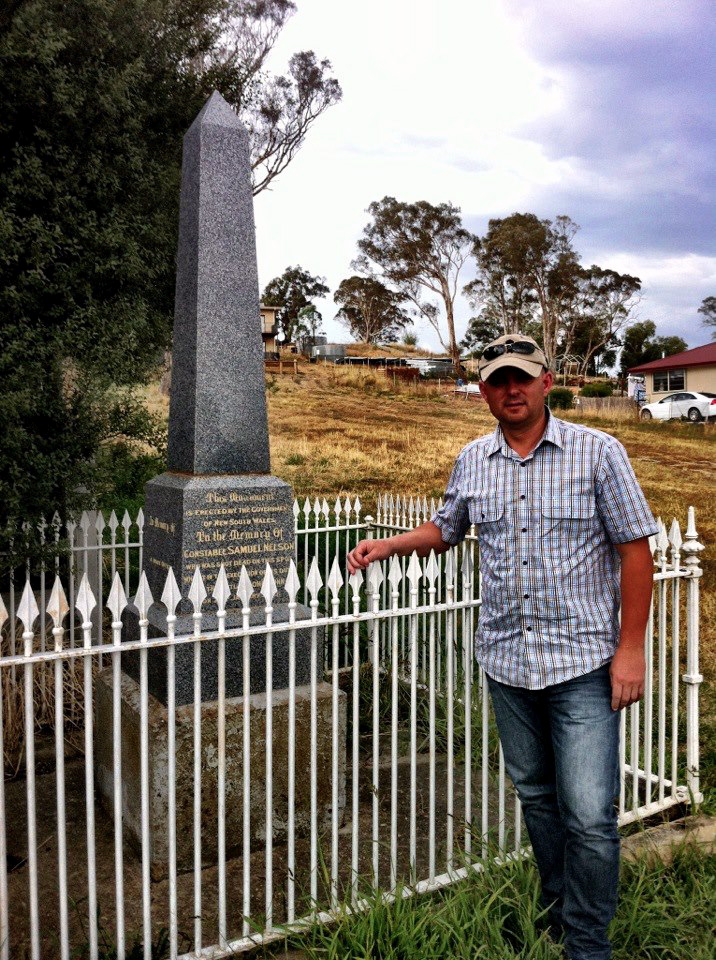
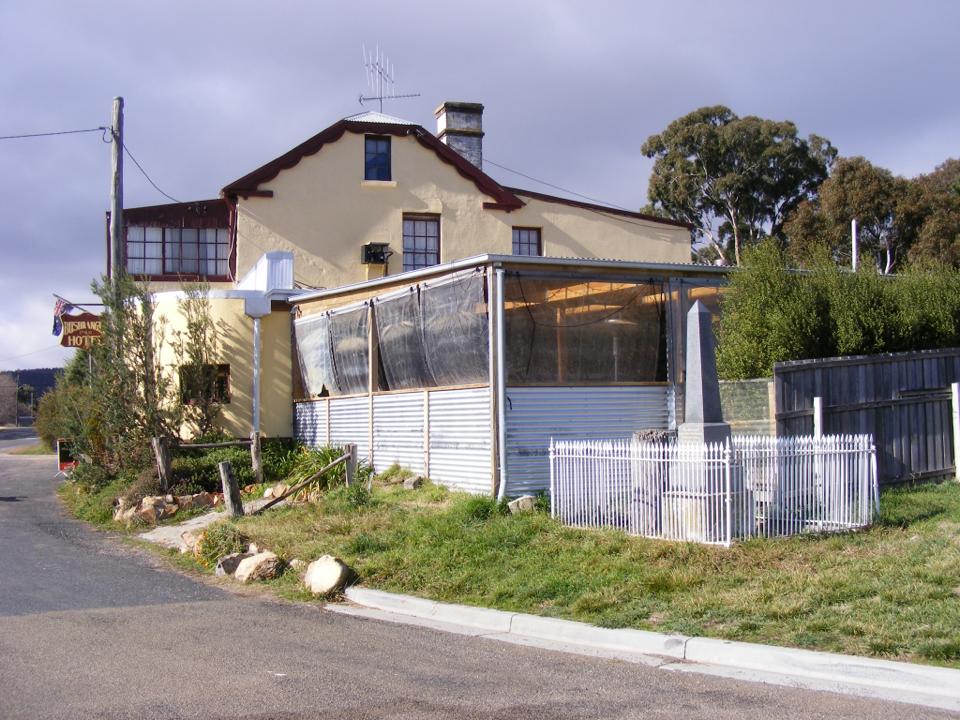
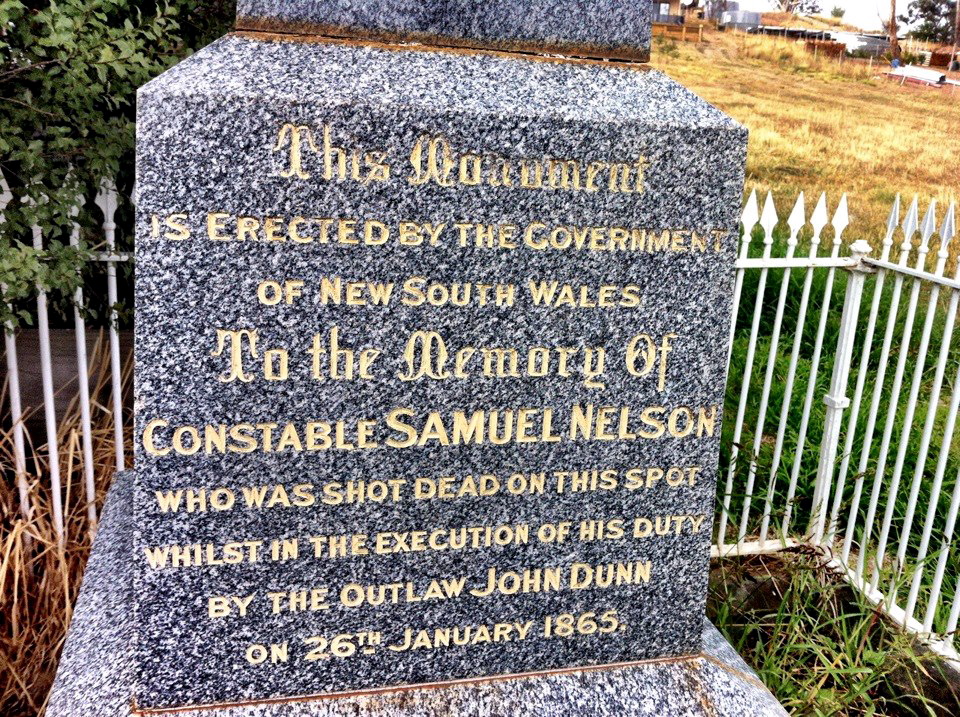
When Mr. Carruthers, in his capacity of Premier, visited the country some time ago, a spot was pointed out to him at Collector, in the Goulburn district, at which Constable Nelson was shot dead over 40 years ago, while assisting in the capture of the notorious bushranger, John Dunn. The then Premier promised that a suitable monument would be erected to mark the spot, and that has just been completed by Messrs. Ross and Bowman, of Pitt-street. It will be unveiled at an early date by the Treasurer, Mr. Waddell. The Metropolitan Superintendent of Police, Mr. Sherwood, has received a photo of the monument, which stands 9ft 6in high. It shows the stump of what “was at that time a tree near where Nelson stood when he received the fatal wound, and another higher stump behind which some of those held up by the outlaws took refuge. The monument bears the following inscription near the base: “Erected by the Government of New South Wales to the memory of Constable Samuel Nelson, who was shot dead on this spot while in the execution of his duty, by the outlaw John Dunn, January 26, 1865.” On the other side are the words, “In memory of a brave officer”.
The constable was born in 1823 and joined the police force on 5 August, 1857. In 1862 he became a member of the newly-formed New South Wales Police Force. At the time of his death he was stationed at Collector.
[divider_dotted]
Wollongong police memorials
ALEX ARNOLD
The NSW Police Force carries on its logo the phrase “Proud Traditions since 1862“, but capturing the history of these traditions at an operational level has never been a priority for the force.
However, almost 150 years after it was first formed, NSW Police – and Acting Southern Region Commander Gary Worboys in particular – is using history as a tool to instil pride in those wearing the uniform.
Three memorials for Wollongong police officers who died while serving the community were unveiled at Wollongong Police Station yesterday at a ceremony attended by family members and former colleagues of the deceased officers.
The memorials, located in the hallway of the detectives’ floor, feature images and biographies of the men as well as an account of the incidents that led to their deaths.
The memorial wall was Mr Worboys’ idea, with Senior Constable Dave Henderson given the task of completing the project.
Snr Const Henderson said the project had involved research through police archives, old copies of the Illawarra Mercury and interviews with family members.
Mr Worboys, who will return to his former role as Wollongong Local Area Commander at the end of the month, said he became inspired to record police history during his time as commander of the Goulburn LAC. It was there he heard about a policeman who’d been shot by bushranger Ben Hall’s gang at Collector.
Mr Worboys said research led to the discovery of the grave of the officer, Samuel Nelson, in a cemetery near the police station, but it was found to be an “absolute shambles“.
The grave was restored and distant family members invited to take part in a subsequent ceremony, proving to Mr Worboys the value of history to the police force.
“There is so much history associated with police stations, but as walls get painted and people move on we don’t capture that history.”
“The memorials and the stories they have attached to them provide officers with a link to the past and makes them realise they are not the only ones who have walked these corridors.”
Mr Worboys said the memorials not only represented distinguished service, but the trauma, grief and heartache suffered by families.
He said the last death of a Wollongong officer on duty was in 1969, and he hoped no more stories would be added to the wall: but the memorials were a reminder that policing was a dangerous occupation.
Among those at yesterday’s ceremony were Constable David Reiher‘s father Bruce, and Constable Ray Paff‘s widow Valerie, who described the memorial as “a wonderful tribute” to her late husband.
“It may have been a long time ago. But you never forget,” she said.
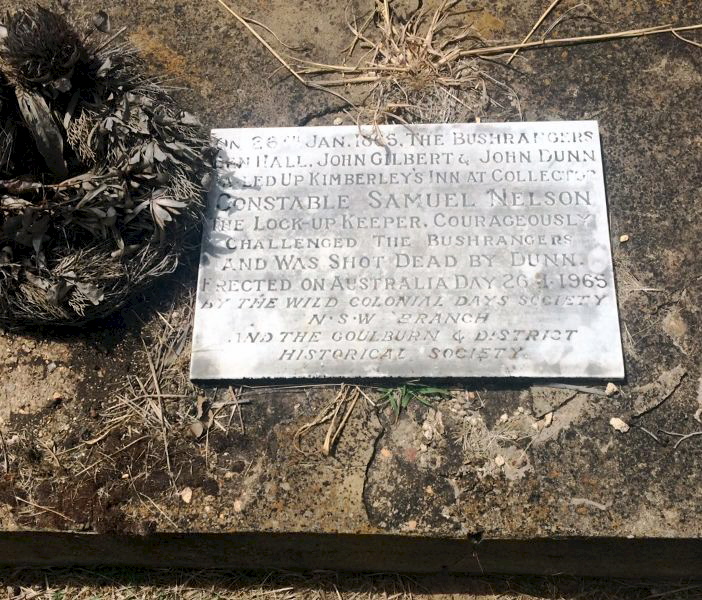
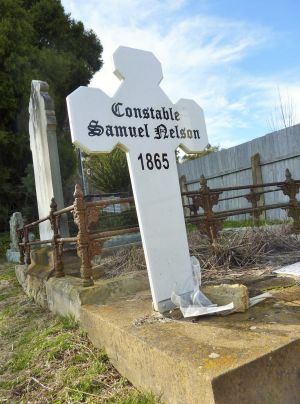
Samuel NELSON – Memorial at the location he was shot.
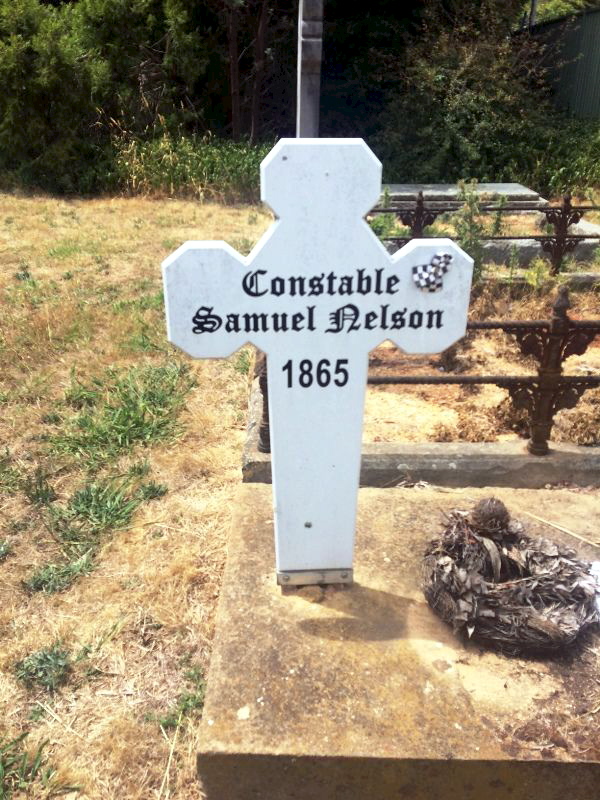
Samuel NELSON – grave
Grave in the C of E portion of the Catholic and C of E Cemetery, Collector.
The plaque on Constable Nelson’s resting place reads: On 26th Jan. 1865. The Bushrangers Ben Hall. John Gilbert & John Dunn bailed up Kimberley’s Inn at Collector Constable Samuel Nelson the Lock-Up Keeper, courageously challenged the bushrangers and was shot dead by Dunn. Erected on Australia Day 26.1.1965 by the Wild Colonial Days Society NSW Branch And the Goulburn & District Historical Society.
[divider_dotted]
Sydney Mail Saturday 4 February 1865 page 6 of 12
Inquest on Constable Nelson.
( From the Herald’s Correspondent. )
On Friday last Dr. Waugh, coroner, held an inquest at Mr. Kimberley’s Inn, Collector, on the body of Samuel Nelson, who was shot by the bushrangers on the previous evening.
The following witnesses were examined : —
Mr. Edwards, who gave similar evidence to that given at the magisterial investigation, and which has been already published.
Maurie Mellan deposed : I am a labouring man, looking for work; yesterday afternoon I was stuck-up by bushrangers and detained till near dark ; I remained at the spot all night and this morning, coming towards Collector, when within about a hundred and thirty yards of this house I found two single barrelled fowling-pieces which had apparently been thrown carelessly down beside a tree ; I gave them to the police ; I believe the bushrangers were Gilbert, Hall, and Dunn.
Constable Bourke deposed that one of those guns was leaded with two balls, the other was not loaded.
Frederick Nelson, aged about eighteen, oldest son of deceased, deposed : I am farming about Collector, and resided with my father, the deceased ; my father was named Samuel Nelson, and was lock-up keeper here ; he was aged about thirty-eight years, and had been in the police force here about seven years and a half, and had previously been in the police force at Moreton Bay ; I had tea with my father yesterday evening, and afterwards went over to Mr. Waddell’s and remained there about half an hour and on leaving I saw my father in constable Bourke’s yard ; he left and walked towards home ; I did not speak to him as he was a good way off ; I had heard that the bushrangers were at Kimberley’s, and went towards there to see if it was true ; on my way I met Mr. Edwards, who told me it was true ; while I was going towards Kimberley’s my father was also doing so, but from a different direction, and got near the house before I did ; when my father got near a fence close by the house, a bushranger sprang from behind the fence and called to my father to stand, and fired immediately afterwards, on winch my father staggered into the road and called out ” Oh! ” the bushranger fired again, and my father fell ; I was inside the fence at this time, and about ten yards from my father; the bushranger called on me to stand, but I ran away, on which the bushranger fired at me, but did not hit me ; it was light enough for me to see, but not to recognise the man who shot my father ; I spread the alarm through the township of what was going on, and after a while my brother came and said that the bushrangers had gone, on which I went up to Kimberley’s and found my father’s body had been taken inside the house ; he was quite dead ; while this took place my brother was compelled to hold the bushrangers horses outside Kimberley’s house, having before this been compelled to march there, a distance of three miles ; when my father fell I heard his carbine fall from his hands on to the ground.
Dr. Hanford deposed : I have made a post-mortem examination of the body of the deceased ; on examining the body externally, I found a bullet wound midway between the nose and the ear on the left side of the face ; also a wound, two inches long and two and a half inches broad, on the left side of the chest, and twenty shot marks round the wound ; the wound took an oblique direction downwards ; the stomach was protruding through the opening ; on examining the cavity of the chest, I found the heart lacerated to the extent of one and a half inch at the anterior and lower half towards the left side; the remaining viscera wore healthy ; on examining the abdomen, I found several shots in the liver, and a portion of a wire cartridge with several shots in it, which I produce ; the shots correspond with those I have just taken from a wire cartridge given to me now; the stomach was perforated, but the other viscera were healthy ; the fifth, sixth, seventh, and eighth ribs on the left side were fractured; the brain and membranes were uninjured ; the ball most probably, passed into the deep muscles of the neck, as I could not trace its course ; death resulted from the wound I have described and no other cause.
Elizabeth Nelson, widow of the deceased, deposed : Yesterday evening I got word that the bushrangers were at Kimberley’s ; deceased was out but was speedily found, ran home, put on his belt, took his loaded carbine with the bayonet on it, and left the house saying, ” now, I am just going to do my best ; ” I did not again see him alive.
Thomas Kimberley gave evidence to that a already published, and added : The bushrangers brought down from upstairs and took away two single-barrelled fowling-pieces, both loaded with cartridge ; the guns now produced are the same ; the bushrangers took from me property to the value of about £26, consisting of boots and men’s and boys’ clothing, and a six-barrelled revolver ; directly after they went away some of the people who had been brought here or stuck-up by them, went to deceased and found him quite dead ; I have examined the place where deceased was found, and ascertained that it is about twenty yards from where the bushranger stood when he fired.
Thomas Mensey, a bootmaker, deposed to having been stuck up by three bushrangers and kept in custody till nearly dark ; afterwards returned to Mr. Kimberley’s, when he met the same parties within a hundred and fifty yards of the house ; believed them to be Ben Hall, Gilbert, and Dunn ; at Kimberley’s was told the bushrangers had just left.
Eliza Mensey, servant at Kimberley’s, deposed: I was here yesterday when the house was stuck-up by bushrangers ; I went upstairs with one of the bushrangers with the keys to open the drawers; he remained there a few minutes and conversed with me ; he told me his name was Hall, and that the man outside on guard was Dunn ; I was standing on the step outside the front door when the shot was fired ; the man who fired the shot was the man Hall called Dunn.
The jury returned a verdict that deceased was wilfully murdered by John Dunn, and that Benjamin Hall and John Gilbert were aiding and abetting. The jury added a rider strongly recommending the family of the deceased to the favourable consideration of the Government.
[divider_dotted]
Sydney Morning Herald, 28 January 1865, p 7
Nelson, Samuel (1827–1865)
Goulburn correspondent:—Yesterday Hall’s gang stuck up about thirty pcrsons on the road, taking from them various amounts, from half-a-crown to £11 12s. Twelve drays were stopped. The robbers broke open cases, took a little clothing, and a double barrel gun. They drank bottled porter, and gave some to the people. Two watches were stolen, one horse, saddle and bridle. Judge Meymot passed along the road just before escorted by two troopers, Gilbert rode out from the bush, and constable Gray gave chase, but was called back by the Judge. The police on reaching Collector, were joined by two others, and accompanied by Mr. Voss and a magistrate, went in search of the bushrangers. After they had gone, Hall, Gilbert and Dunn, went into Collector and stuck up Kimberley’s Inn. On this reaching the ears of the lock-up keeper, Samuel Nelson, who was the only policeman there, he took his carbine and went up towards Kimberley’s. Dunn met him on the road, called upon him to stand, firing at the same instant. Nelson cried out “stop,” and fell. Dunn fired again. Both shots took effect, one on the head or neck, the other in the heart. Nelson never spoke after receiving the second wound. After he committed this murder, Dunn went to Kimberley’s Inn, and the bushrangers left the township. Subsequently the police sighted them on the brow of a hill and charged them, the bushrangers leaped their horses over logs and made off, and were lost sight of, the evening being intensely dark. They abandoned a stolen horse.
Mr. Voss held a magisterial inquiry on the body of Nelson last evening, and the coroner held an inquest to-day.
Nelson had been in the police force for some years, and was much respected. He leaves a wife and eight children. Two of his sons saw him shot; one was holding the bushrangers’ horses at the time.
The outrages by Hall’s gang cause great excitement here.
We have been kindly favoured with the following extracts of a letter from Mr. District Judge Meymott to his brother. Dr. Meymott. It bears date, Gunning, January 28th, and the writer says : —
I am thankful to be able to tell you that I have arrived safely at this place, about halfway between Goulburn and Yass. But though my journey from Goulburn has been safe, it has not been without adventure.
I left Goulburn about eleven forenoon, on Thursday, the 26th, escorted by two mounted troopers, one in advance, and the other immediately behind my carriage. I came by way of Collector, partly to visit Mr. Murray and partly in hopes of avoiding the bushrangers who were known or believed to be between this place and Goulburn. However instead of avoiding them, I fell in with them.
After having journeyed about eighteen miles, we had to descend rather a long hill winding through thickly wooded country. At the bottom of the hill was open country, and a lagoon called Rose’s Lagoon on the left ; on the right, rising hills highly timbered near the base, but increasing in thickness of bush towards the top, where it became dense forest. When near the lagoon, the trooper in advance galloped on towards the hill on the right, making signs to the man behind to follow, which he very soon did, and away they went at high speed up this hill. I drove gently down towards the lake, and, on nearing it, I saw eight or ten people under a tree near the water, about fifty yards off the road, and two drays and a cart, and several horses. I drove up to them and found they had been there, some two or three of them, since six in the morning (it was then past two), having been stuck-up by Ben Hall, Gilbert, and Dunn ; the number of persons stuck-up increasing as the day wore on. The spokesman told me that the ruffians had only a short time before lit a fire and ordered him to make tea for them, and they were about to have a meal (other prisoners being found in the cart) when Dunn who was on the look-out, spied my advance guard through the trees about half a mile off, and called out ” Here’s a — trap! ” Gilbert said, ” If there’s only one let’s face him. ” Directly afterwards, my carriage and the other trooper coming in sight, Ben Hall said, ” No, there’s more of them, let us be off. ” So saying, they leaped on their horses and galloped away as hard as they could up the hill I have described, and it was on my advance guard seeing them in the distance, that he put spurs to his horse and made towards that hill.
A few moments after I had joined the bailed-up party, my troopers returned, having lost sight of the bushrangers in the thickness of the bush. When the police heard who the men were, for they did not and could not know before (especially as they were fully a mile ahead when the trooper first saw them), they were desirous of going in pursuit. Mr. Voss, a magistrate, came up at that time, and, after a little consultation, it was thought best for us to come on to Collector. So we parted from the captives, who were very glad to be released, and came on to Collector, Mr. Voss, with what force he could collect, intending to go in pursuit of the bushrangers, and myself proceeding onward to Mr. Murray’s, about a mile and a half farther, which I reached in safety shortly after four o’clock.
But the exciting events of the day we not yet over, the worst part remains to be told. About eight o’clock in the evening, Mr. Edwards (Mrs. Murray’s brother), came in with the news that the highwaymen had been in to Collector, and had robbed one or two stores, and that while Hall and Gilbert were in a public-house and store kept by Mr. Kindesley, or some such name, (Dunn watching outside,) a policeman was seen to approach, and Dunn shot him dead on the spot. The gang then made off from the place, and, according to rumour, fell in with Mr. Voss and his party. Some shots were exchanged, and the thieves escaped, minus one horse, saddle, and bridle, which are now in custody of the police at Collector.
Mr. Edwards also said he had heard that before leaving Collector, the robbers had been heard to state that they meant to visit Mr. Murray’s.
This news, of course, created some excitement, but I am pleased to say, no weak, foolish fear among the household.
All the available men and arms were, as speedily as possible, collected, the entrances secured, and watch was kept by turns all night. About ten yesterday, the police came to Mr. Murray’s, to escort me onwards ; but as the bushrangers were still hovering about in the neighbourhood, I thought it best not to take away two out of the three policemen in the place, and that it was much better for them to stay where they were, in case their services might be needed. So we kept watch, and were all day under arms at Mr. Murray’s, and the police kept a good look-out about the town ; but all remained quiet.
This morning I heard of one report, that the gang had come on this way with the determination of attacking me for interfering with them the day before; but another report seemed to be more likely to be correct, viz. that they intended to waylay me and see me safe on the road for some miles with the police, and then to go back and finish robbing the town.
I left Mr. Murray’s about 10.30 a.m. with the two troopers and a civilian who was coming this way, and arrived here in safety. We met two villainous looking fellows on the road, whom the senior constable (Bourke) questioned, but could elicit nothing from them. They were doubtless Ben Hall’s scouts, and I think it very possible these fellows would soon have told Hall that I had passed on and that the gang would return to finish their work at Collector. If they do, they will meet with a warm reception, for special constables have been sworn in, and everybody round is prepared to give them battle.
Queanbeyan Age and General Advertiser Thursday 29 March 1866 page 4 of 4
EXECUTION OF JOHN DUNN FOR THE MURDER OF CONSTABLE NELSON.
(From the Empire.)
John Dunn, the notorious bushranger, paid the penalty of his misdeeds yesterday morning, upon the scaffold inside the walls of Darlinghurst Gaol.
At 9 o’ clock precisely the death-bell tolled, and the prisoner, attended by the Revds. Fathers Dwyer and McCarthy, came forth pinioned from his cell. These reverend gentlemen had been with him since eight o’clock, and it is satisfactory to know, that since his conviction he received their ministrations, and those of the Sisters of Charity, with sincere good will.
As they walked towards the scaffold the prisoner repeated in an audible voice the prayers after the Rev. Father McCarthy. Owing to the wound received at his capture, the unfortunate man limped along painfully, but still he bore himself bravely up, and appeared as cool and collected as any of the spectators. At the foot of the scaffold, Father McCarthy bade him adieu, and he dragged himself up the ladder, accompanied by the Rev Father Dwyer, who remained with him to the latest moment. When the rope was adjusted round his neck, he still continued to pray, and his lips were moving when the white cap shut out from him the crowd who faced him and the bright sunshiny morning. At this time, when only a moment intervened between him and death, he clasped his hands together, and not a quiver or tremor of the limbs betokened that he was afraid to die. He died indeed like a penitent Christian, without fear, and without bravado.
His death, owing to the length of rope allowed him, was instantaneous. As he hung suspended, he was absolutely motionless, and it is most likely, from the absence of nervous or muscular contraction, that the spinal marrow was completely disjointed. After hanging the prescribed time, his body was cut down, put into a coffin provided for him by his godmother, Mrs Pickard, and then carried to the hearse outside the gaol walls, where it was received with wailings and moanings from a great number of women collected there. Mrs Pickard, with the dead man’s brother and his uncle, followed the body in a mourning coach, which proceeded to the Catholic burial ground, near the Railway Station. The rites of the church having been duly performed, the body was interred amidst the tears and groans of a very motley lot of people, old women prevailing, the majority of whom seemed to have but little regard to the precept of the Apostle, that, “Cleanliness is next to Godliness;” and so ended the career of the youngest of Frank Gardiner’s gang.
Dunn, in conversation with the gaol authorities, attributed his fate to Gilbert and Ben Hall’s “Old Man ” who pursuaded him to leave his parents roof for a lawless and murderous life.
When he was received into the gaol he was in very bad condition, owing to the hard life he had led in the bush, and the suffering produced by his wound. He then weighed only 9 st. 6 lbs., but yesterday he weighed 10 st 8 lbs., thus showing that regular food and a resigned mind are conductive to health. Those who saw him at his trial were struck by his greatly improved appearance yesterday.
A day or two before his execution he wrote a letter to the governor of the gaol, and thanked him for his kindness and attention, and also to Mr Carroll, a warder, who was his chief attendant for a fortnight. On Sunday he was engaged up till midnight in religious duties. He then went to bed, and slept soundly till half past 6, when he rose, washed himself, and ate a hearty breakfast, and concluded his last meal with a pipe of tobacco. He then gave himself up entirely to the priests, from whose ministrations he derived great consolation; and he asked Father John to “stand close to him till the last moment.” He made no regular confession to any of the officials, nor did he deny his guilt.
An unusually large number of people assembled to see him hanged, and amongst them was a man who came from Windsor for that purpose. The spectators, amounting to about seventy, were deeply impressed with this last act in the career of Dunn.
We learn from reliable authority, that Dunn was born December 14th, 1846. His mother was in the service of Mr James Manning, brother of Sir William Manning, and was married to Dunn’s Father at the age of seventeen. Mrs Pickard, who is the wife of Mr W. P. Pickard, storekeeper to Mr Keele, merchant, was present at Dunn’s birth, and became godmother to him. She had a special order from the Colonial Secretary to visit the condemned criminal, and we understand she called to see him daily. She may be truly said to have behaved like a mother to him, and to have acted like a noble, kindhearted, good woman. When Dunn joined the bushrangers, his father rode in search of him in the hope of rescuing him from an evil life but his horse died from over-exertion, and he was compelled to return home from his unsuccessful search. Dunn’s parents are settled on a small farm and are in poor circumstances.
Queanbeyan Age ( NSW ) Tuesday 7 April 1914 Page 2 of 4
Obituary.
MRS. ELIZABETH NELSON.
MRS. ELIZABETH NELSON, relict of the late Constable Samuel Nelson, of Collector, died at her late residence, Goulburn, aged 85 years, the cause of death being senile decay.
She leaves three daughters and five sons, also 44 grand children, 14 great grand children, and 5 great great grand-children.
The funeral took place on Thursday morning at half past 10 o’clock.
The late Constable Samuel Nelson was shot by Bushranger Dunn at Collector on 16th January, 1864. He was aged 40 years, and left a widow and eight children.
The story of the bailing up of the township of Collector by the notorious bushrangers, Ben Hall, Gilbert, and Dunn, on the evening of January, 26 1865, is well-known to the older residents of the district.
The bushrangers took charge of the Commercial Hotel and store at one end of the town, conducted by Mr. and Mrs. T. Kimberly. A little girl brought word to Nelson that the bushrangers were at Kimberly’s. Though advised not to go near them single handed, the brave fellow, arming himself with his carbine, said his duty commanded him to go. Dunn, who was in front of the hotel on seeing Nelson approach shot him as he stood behind a post. The constable staggered and fell, whereupon Dunn killed him outright with another shot. Dunn was after wards caught, found guilty, and hanged.
Travelled across from Gunning to Collector yesterday and checked out the monument to Samuel Nelson and his grave.
GPS Co-ordinates for grave 34 54’54S/149 25’51E for monument 34 54’44S/149 25’53E
Page 48 in Beyond Courage
[divider_dotted]
Canberra Times
January 16, 2015
Hall gang re-enactment in Collector for 150th anniversary
Tim the Yowie Man takes a look at Collector’s Wild Colonial Day over the Australia Day long weekend. A re-enactment will commemorate the 150th anniversary of the Hall gang’s hold-up, which resulted in John Dunn killing Constable Samuel Nelson.
Tim the Yowie Man
It’s the murderous event which put the village of Collector on the map. On January 26, 1865, outlaw John Dunn shot dead Constable Samuel Nelson outside the Kimberley Inn while his partners in crime, the notorious Ben Hall and Johnny Gilbert raided the hotel.
The brave Nelson, on being informed that the Hall Gang was in town, had earlier marched defiantly from the nearby police station towards the hotel with the aim of stopping the infamous mob of bushrangers in their tracks.
Scan of photo from The Canberra Times of the re-enactment at the 100th anniversary of the shooting of Constable Nelson (played by Edgar Penzig) by bushranger John Dunn (played by Chris Woodland) on January 26, 1965. (Photo: Courtesy Chris Woodland) Collector re-enactment 2 CT.jpg Photo: Chris Woodland
Constable Samuel Nelson (date unknown and thought to be damaged/altered from the original). Photo: Boyd Trevithick Collection
Next Sunday, to commemorate the 150th anniversary of the dramatic hold-up, a Wild Colonial Day is being held in Collector in which descendants of both Nelson and the Hall Gang will converge on the town.
One of the most anticipated highlights of the day is the planned re-enactment of the tragic events of January 26, 1865. Although playing out such a momentous event in our region’s history will be no doubt be entertaining for the crowd, I don’t envy the performers of the Gold Trails Re-enactment Group who will need to settle on an agreed sequence of events that unfolded on that fateful day in 1865, the exact details of which appear to have been lost in the mists of time.
This pistol, which supposedly once belonged to bushranger Ben Hall and held pride of place on the wall of the Bushranger Hotel late last century, but has since gone missing. Photo: Tim the Yowie Man
One person who has spent months poring over the evidence is Boyd Trevithick, Nelson’s great-great-grandson. In doing research for his family history book, Believe Nothing That You Hear and Only Half of What You See: a compilation of sundry articles, facts, photographs, maps, poems and family anecdotes dating back to 1087AD, (self-published, 2011) Trevithick reports he was “constantly confronted with conflicting accounts”.
“Discrepancies exist as to precisely where John Dunn stood to shoot, what course Nelson took, the distance from which the shooting occurred, the times of the day, the words uttered, whether Nelson staggered forwards, backwards or towards the road and where exactly Nelson fell,” explains Trevithick.
Trevithick isn’t the only one to have struggled to provide a definitive account of the details leading up to Nelson’s death. Respected historian, the late Stuart Hume, whose widely lauded article published in the Goulburn Evening Post on January 26, 1965, to commemorate the 100th anniversary of Nelson’s death, wrote “to try and get an accurate account of what actually did occur is to find the wayside strewn with garbled, highly coloured accounts from old hands who’d ‘heered telled’ arguments from bush lawyers with a misguided sympathy for the bushrangers and bush balladists using poetic licence to cover a multitude of sins”.
Two of the most contentious issues concern what have subsequently become Collector landmarks – first, a rotting wooden stump standing next to the Bushranger Hotel, and second, Nelson’s final resting place.
1. Stumped
Trevithick reports that his “family members have handed down two versions of the role the stump played in events of 26 January 1865,” and he cites the following references to illustrate these disparate accounts.
The Queanbeyan Age (11/2/1908) reports “… The railing encloses the stump near which Nelson stood when he received his fatal wound.” Meanwhile, The Sydney Morning Herald (10/2/1908) reports “. Inside the railing [of the memorial] is one of the posts of the fence behind which Dunn concealed himself on approach of the Constable …”
The final resting place of Constable Nelson, or is it? Photo: Tim the Yowie Man
Regardless of the significance of the stump, cynics have questioned whether it’s plausible that a 150-year-old stump could still be standing, suggesting that perhaps the stump isn’t the original from 1865 and, is, in fact, a ‘replacement’.
The Bushranger Hotel. Photo: Colleen Petch
2. Grave diggers
Nelson died during the height of summer and with no morgue within cooee of the Collector, Hume reports, “research indicates that he was hastily buried without the aid of a minister in the grounds of the police station [still operational] … over the grave they struck a willow stave which grew, and, in the course of time, only the willow wept there”.
“Although there is currently no marked grave in the grounds of the police station, some old-timers did recall a willow growing there mid last century,” reports life-long local Gary Poile. However, the precise location of the willow may be a moot point for those who wish to pay their respects to the slain police officer, for it appears that Nelson was unlawfully exhumed about 50 years later.
Hume reveals that “just after World War I someone decided to remove Nelson’s remains from the Police Station without an exhumation order or permission from the family”. “Not knowing exactly where Nelson lay…they sank several ‘duffers’ till they struck paydust in the shape of the constable’s bones. These they reverently gathered and crawling through a hole in the dividing fence put them in a grave alongside the Kimberleys [in the neighbouring cemetery].”
According to Hume, with the public becoming more history conscious, some years later a cross was placed on the freshly dug unmarked grave in the cemetery and inscribed “Constable Nelson 1865”.
Neither Hume (nor Trevithick) uncovered the identity of those who allegedly moved Nelson’s bones, nor their motives. Trevithick hypothesises that it may have been “so that Nelson was buried in consecrated ground”.
While snooping around Collector this week I bumped into a couple of bushranger-era enthusiasts who questioned whether Nelson’s remains were moved at all. The duo suggested that a ground-penetrating radar, or perhaps something even more invasive, ought to be employed to prove the presence of remains.
I don’t know about you, but I think poor old Constable Nelson suffered enough trauma in the final moments of his life and that he should be left to lie in peace, wherever that may be.
Fact file
Collector Wild Colonial Day: Commemorating the 150th anniversary of the day Constable Samuel Nelson was killed on duty by John Dunn outside the Bushranger Hotel. Next Sunday, January 25, from 10am–4pm in Collector Village (about a 30-minute drive north of Canberra on the Federal Highway). Free admission.
Expect: Historical displays, re-enactments, bush poetry, author talks, food, wine, local produce, art and craft. Devonshire tea and all day barbecue.
For the kids: Horse and cart rides, face painting (small charge) and bushranger activities (if you dare!) all day.
Shoot-outs: The Gold Trails Re-enactment Group will perform a realistic re-enactment of the murder of Constable Nelson at 3pm near the Collector Police Station (Bourke St) and again outside the Bushranger Hotel (Church St) about 6pm.
Become a star: At midday, there will be a re-enactment of the trial of John Dunn, including an opportunity for “extras” to participate (scripts will be provided).
Don’t miss: The rare collection of guns and equipment used by bushrangers and police during the colonial period (in the Memorial Hall).
Nelson’s Grave: Located in the Anglican Cemetery in Bourke St. About 3.30pm, the NSW Police Chaplain will lead a graveside Memorial Service, followed by a wreath-laying ceremony.
The stump: Takes pride of place next to Nelson’s Memorial outside the Bushranger Hotel. Unfortunately, there’s precious little information on the state of the stump in 1865, so it’s difficult to determine if it’s the original. However, if any suitably qualified foresters would like to offer an educated opinion, I’d love to hear from you.
Gang-gang: 150 years ago – Constable Samuel Nelson shot in Collector
Ian Warden
The bushrangers (left to right) Dunn, Gilbert and Hall
One hundred and fifty years ago this week the brigands Ben Hall, John Gilbert and John Dunn descended on Collector and Dunn shot dead brave constable Samuel Nelson. The gang fled. The Sydney press throbbed with the news. The murder was on 26 January and the inquest, held at Collector the next day, was reported in great and grisly detail by the Sydney Morning Herald.
Frederick Nelson, 18, eldest son of the dead man’s many children, saw his father shot dead.
” ‘A bushranger sprang from behind the fence and called to my father to stand, and fired immediately afterwards [with a shotgun], on which my father staggered into the road and called out “Oh!”. The bushranger fired again and my father fell. I heard his carbine fall from his hands on to the ground.
“Dr. Hanford deposed: I have made a post-mortem examination of the body of the deceased; I found a bullet wound midway between the nose and the ear on the left side of the face; also a wound, two inches long and two and a half inches broad, on the left side of the chest, and twenty shot marks round the wound; on examining the cavity of the chest, I found the heart lacerated … I found several shots in the liver … the stomach was perforated. Death resulted from the wounds I have described and no other cause.
“The jury returned a verdict that deceased was wilfully murdered by John Dunn, and that Benjamin Hall and John Gilbert were aiding and abetting.”
Samuel Nelson was born in 1828 in Chesterton, Oxfordshire, England. His Father was Samuel Nelson and mother Elizabeth Taylor. In England he married Elizabeth Goode who was born in 1828.[1]
They came on the ship called “Parcee” and arrived in Sydney on 11th January 1853. Samuel and Elizabeth could both read and write. They came with their three children who were born in England, Fredrick 6 years born 1846, Henry 1848 4 years, Jonas 2 years 1850. While the ship was at sea Elizabeth Nelson gave birth to Matilda Parcee Nelson. The ship anchored in Sydney and then proceeded to Queensland.[2]
Samuel Nelson worked at Drayton Darling Down’s then made his way to Collector N.S.W. which is between Canberra and Goulburn. Four more children were born at Collector Emma born 1857, Samuel 1860, David 1862 and Thomas 1864.
It was on a Thursday, Foundation Day 26th January 1865 in the country town of Collector, when the team of bushrangers, John Dunn and his group, were spotted in the District. They had bailed up Judge F.W. Meymott and two escorting troopers at Geary’s Gap a few miles south of the town. The gang of bushrangers were almost on the outskirts of Collector, when they bailed up a bootmaker named Tom Menzy; three farmers named Mitchell and William Deveron and James Bull; and a 16 year old boy named Henry Nelson – the constable’s son.
At the police station Constable Samuel Nelson was studying his day’s labour. He had chopped a good supply of wood and his gardens were in fine shape. He was looking forward to cleaning up a hearty supper and a quiet evening with his family, including his wife who was eight months pregnant with their ninth child. Suddenly, a young girl came running towards him calling “Mr Nelson come quickly the bushrangers are at the Kimberley’s Inn”, then shots from Dunn’s gun were heard.[3]
Samuel Nelson entered the station and put on his uniform, jacket and belt while Elizabeth his wife looked on in surprise. At the trial of Dunn, Kimberley’s Inn Keeper said “John Dunn came back from direction and said there one of your bloody are down”. When somebody asked who was shot Dunn said “a little sandy bugger”. Kimberley replied “I felt sure it was Nelson knowing he was a short sandy man”.
Some of the other people brought in the dead body of Constable Samuel Nelson who had a wound on his cheek and a large wound over his heart. Fredrick Nelson was fired upon by the accused. Henry Nelson was forced to hold the estranger’s horses under the threat of having his brains blown out.[4]
The trial of John Dunn on the 19th February 1866 jury returned the verdict of guilty, the sentence of John Dunn was to be hanged by the neck till he was dead. On the 19th March 1866 the 19 year old murderer was taken from Darlinghurst to the place of execution and was hanged.
Service: From 5 May 1862 to 16 November 1864 = 2+ years Service
Awards: ?
Born: ? ? 1832
Died on: Wednesday 16 November 1864
Cause: Shot – Murdered
Event location: Jugiong
Age: 32
Funeral date: Saturday 19 November 1864
Funeral location:
Buried at: Gundagai Cemetery
( GPS: Lat: -35.051389
Long: 148.111944 )
Memorial location: Old Hume Highway (Riverside Drive) , Jugiong Memorial Park, Jugiong, 2726
( GPS: Lat: -34.823664
Long: 148.326496 )
Located on the north bound lane of the Hume Hwy near Jugiong.
EDMUND IS mentioned on the Police Wall of Remembrance
On 16 November, 1864Sergeant Parry ( Gundagai ), Sub Inspector O’Neill ( Gundagai ) and Constable Roche ( Yass Police ) formed the mounted police escort for the Gundagai mail coach on its journey to Yass. Roche was seated beside the coach driver, Gundagai Police Magistrate Mr Rose was inside the coach and Parry and O’Neill followed on horseback. Shortly before 3pm as the coach approached the township of Jugiong, the escort was attacked by bushrangers Hall, Dunn and Gilbert. Sub Inspector O’Neill closed with Dunn and Hall and when he had emptied his rifle he hurled the weapon at Hall, striking him on the head. He then drew his revolver and fired at Dunn. Meanwhile, Parry and Gilbert fired on each other, with the bushranger calling on the sergeant to surrender. Parry continued to fight until he was fatally shot in the head.
The Australian News for Home Readers dated ( Monday ) 19 December, 1864 carried the results of an inquest into the sergeant’s violent death, informing its readers that “An inquest was held before Mr Rose, at Jugiong, on the body of the brave sergeant of police, when the jury returned the following verdict: ‘That on the 16th day of November, in the year of our Lord 1864, at a spot about four miles to the south of Jugiong ( the Black Springs ), in the colony of New South Wales, the deceased Edmund Parry did die from the effects of a gunshot wound, at that time and in that place wickedly, maliciously, and feloniously inflicted upon him by one John Gilbert, and that two other certain persons, named Benjamin Hall and John Dunn, were then and there unlawfully aiding and abetting the said John Gilbert in so feloniously destroying the life of the said Edmund Parry.”
The murderer Gilbert and accomplice Hall would later be shot dead by police in separate incidents, while Dunn (who would murder Constable Samuel Nelson at Collector less than two months after this incident) was destined to be hanged for his crimes.
The sergeant was born in 1832 and joined the New South Wales Police Force on 5 May, 1862. At the time of his death he was stationed at Gundagai.
Sgt Parry is buried at the Gundagai cemetery.
Erected In Memory Of Edmund Parry, Sergeant Of The N.S.W. Police, Who Lost His Life In The Execution Of His Duty Whilst Courageously Endeavouring To Capture The Bushranger Gilbert By Whom He Was Shot Dead Near Jugiong On 16th Nov 1864 Aged 32 This Stone Was Erected By Some Of His Officers And Comrades By Whom The Deceased Was Much Respected And Regretted
Senior Constable Wes Leseberg (NSW Police) portrays Sgt Edmund Parry in this upcoming Australian movie. Opening in December 2016.
first-look trailer for upcoming Australian bushranger film The Legend Of Ben Hall, out December 1, 2016. Start practising your pistol-twirling now…
Senior Constable Wes Leseberg as Sergeant Edmund Parry in “The Legend of Ben Hall”
(Plaque) (NSWPF Logo) NEW SOUTH WALES POLICE FORCE CULPAM POENA PREMIT COMES NSW Police Force Sergeant Edmund PARRY Killed in the courageous execution of his duty on the 16th of November, 1864 in a gun battle with the Hall Gang at Black Springs, Jugiong New South Wales
Yesterday, took a detour to Jugiong and checked out the memorial there to Sgt Edmund Parry. A very fitting tribute to a brave man.
* GPS Co-ords 34 49 25S/148 19 35E.
*
Can I also say that the Police Station and residence at Jugiong were immaculate. Not something you see often these days but a pristine NSW Flag flying (not a tattered mess hanging from the flag pole that we see so often) and the yard and surrounds a credit to the OIC who no doubt works the majority of the time in Cootamundra or Tumut or Young or all three.
Parry, Edmund (1832–1864)
from South Australian Advertiser
On Tuesday afternoon the mail from Gundagai reached the hill at Deep Creek, about four or five miles on the Yass side of Jugiong, between 4 and 5 o’clock. Mr. Sheahan, of Jugiong, the mail contractor, and Mr. Bradbury, of Queanbeyan, were passengers by the coach, and had alighted to walk up he hill. They were some distance in advance of the coach. Mr. Sheahan was in the act of pointing out the spot where the mail was stuck-up a few weeks before, when three horsemen appeared on the top of the hill, and spreading out—one on each aide, the third in the centre of the road—they galloped towards the coach. On coming near it was noticed that each had a revolver in his hand, and the order was given by Ben Hall to “Bail up.” Hall pointed and told them to “walk up there; we have got a little township there.” After going up the hill for some distance, they were ordered to turn off to the left, and approached a spot where twelve teams were stock up, as well as a number of horsemen. The mail was then stopped. Mr. Sheahan was asked if he had any money; he replied that he had not, and they might search him if they liked. Hall declined to search, remarking that Mr. Sheahan was not a “bad sort of fellow.” Bradbury was then searched; although he handed them a cheque for one pound, stating that that was all he had, yet they examined his pockets, and asked him if he had not a watch. They got nothing from him but the cheque, and subsequently, on his telling them it was all he had to carry him on the road, the cheque was returned. Hall and his companions then took out the mail bags, six in number, and cut them all open. Before proceeding to examine the letters they asked Mr. Sheahan and Mr. Bradbury if they would have some wine. They answered “Yes,” when Hall called to one of the teamsters to “fetch over port wine.” The wine was brought, in a quart pot, and a portion of it drunk by those present. The examination of the mail-bags meanwhile proceeded, the three bushrangers sitting down on the ground with the bags before them. The letters were speedily ransacked of any bank-notes they contained, Mr. Bradbury remarking to them that they sorted the letters much quicker than was generally done in Sydney. Mr. Sheahan asked if he would be allowed to sit down, and Hall told him he could do so. Mr. Sheahan availed himself of an empty mail-bag close beside him, and noticing a large number of whole and half cheques, remarked that they were of no use to them, and asked permission to gather them up. The bushrangers consented, and Mr. Sheahan was enabled to bring on to the Yass Post Office his coat pocket as full of cheques as it would hold, as well as three bank drafts. The coach and passengers were kept an hour before they were permitted to depart, Mr. Sheahan and Mr. Bradbury gathering up the remains of the letters and placing them in a mail bag. On the bushrangers completing their work, the driver of the coach pushed on as fast as possible to Yass, and reached here only half an hour behind time. The matter was instantly reported to Sub-Inspector Brennan, who, with a couple of mounted men, took the road within half an hour.
It was fully expected in town that the mail on Wednesday would also be robbed, and the spot where it was expected to take place was mentioned to the police before they left Yass. The anticipation was realised, and even the locality surmised as the scene of the outrage proved to be the spot selected. The mail is due in Yass at eleven a.m., and as it is generally very punctual to the time, and not having arrived at a quarter to twelve, it began to be thought very likely that it had been stopped. A few minutes before twelve it was heard approaching, and much anxiety was felt to learn what had occurred to cause its detention. It was then ascertained that on the mail leaving Gundagai, Constable Roche, of the Yass police, who had gone as guard of the mail the previous day to Gundagai, and Mr. Rose, police magistrate of Gundagai, were its occupants. It was escorted by Sub-Inspector O’Neill, and Sergeant Edmund Parry, of the Gundagai police. On reaching within about four miles of Jugiong, at a place known as the Black Springs, Hall and his companions appeared from behind some rocks. The moment they were noticed a signal was made from the coach to the Sub-Inspector and Sergeant to ride up, which they at once did; and one of the bushrangers remarking that “the bobbies” were with the coach, Gilbert said “There are only two of them; come on, let us rush them.” They then darted towards the coach, and on getting near the police called out “Come on you —— wretches; we will fight you like men.” A deadly encounter followed, in which poor Parry, who acted very bravely throughout, was shot through the shoulder and dropped dead. Before, however, narrating what transpired in the encounter with the police, we may state that Hall, Gilbert, and Dunn took up their position on the road early in the day, and stuck up a large number of teams and two carts, the latter followed by 20 or 30 Chinamen. Amongst those detained were a son of Mr. Owen Ryan, of Derrengullen Creek; Mr. Hayes, wife, and young man, who were in a buggy; and others, to the number of 40 or 50. Some considerable time before the coach came up Constable McLaughlin, of the Gundagai police, approached, leading a pack horse. Gilbert rode up to him and ordered him to surrender, but he replied by a shot from his revolver, which was returned by Gilbert, who then turned his horse and rode off a short distance. Hall then took up his position and fired at the constable, who again discharged his revolver. Hall’s horse stumbled, and Dunn rode up and fired at McLaughlin. The constable discharged the six barrels of his revolver in the encounter, and then surrendered, some nine or a dozen shots having previously been fired at him by the bushrangers. Dunn remarked that one of the constable’s shots was a very good one, and they would “have it in for him” on that account.” The constable was added to the mob of captives. The coach subsequently came in sight, and the affray commenced as stated above. Constable Roche, who was on the coach armed with two large pistols, a six barrel revolver, and a carbine, is stated to have slipped off the coach when the fight began, and to have darted into the bush, carrying his firearms along with him. He did not subsequently appear on the scene. Gilbert fought with Sergeant Parry, who refused to surrender, and discharged every barrel of his revolver before he fell; Hall and Dunn attacked Sub-Inspector O’Neill, who first discharged his carbine, and then several shots from a revolver. On Parry falling dead, the Sub-Inspector surrendered. The bushrangers disarmed him, and took from him a ring and his watchchain, but we believe he was permitted to keep his watch on his informing them it had belonged to his father. The horse Mr. O’Neill rode was, however, taken, one of the bushrangers remarking it would make “a good pack-horse.” It seems singular that the driver of the coach did not take advantage of the proceedings going on to put his horses to their mettle and save the mails. This, however, he did not do, for Hall and his mates on the termination of the fight ordered Mr. Rose to throw out the bags, which the bushrangers cut open in the usual manner, and appropriated all they desired. The mail was a very heavy one, and it is supposed they secured a large amount of money. From Constable McLaughlin they took £7105; from Mr. Rose a watch and chain. We have not heard what was taken from Mr. Hayes, but he was searched; the lady who accompanied him they did not molest. Gilbert is said to have turned over poor Parry’s body, and to have remarked—”He’s got it in the cobra (head) ; I am sorry for him, as he was a game fellow.”
We may state that the bushrangers informed the police that they intended to rob the mail next day (Thursday), and told them to send as many police men as they liked, and they would fight them. On the mail reaching Yass on Wednesday night Sergeant Scully, who was in charge of the force in the absence of Sub-Inspector Brennan, at once despatched five mounted men, four of whom are connected with the Goulburn force, and had reached Yass the previous day, after eight days’ unsuccessful search for the whereabouts of the bushrangers.
The coroner’s jury returned the following verdict:—”That on the 16th day of November, in the year of our Lord, 1864, at a spot about four miles to the south of Jugiong, in the colony of New South Wales, the deceased Edmund Parry did die from the effects of a gunshot wound, at that time and in that place wickedly, maliciously, and feloniously inflicted upon him by one John Gilbert; and two other certain persons, named Benjamin Hall and John Dunn, were then and there unlawfully aiding and abetting the said John Gilbert in so feloniously destroying the life of the said Edmund Parry.”
Sergeant O’Neill‘s report of the recent murderous affray with Hall and his gang: Gundagai. 17th November.
“Just returned from Jugiong with the remains of Sergeant Parry. Yesterday morning early I started with Constable O’Loughlin to Jugiong, with instructions to the police station there to be at readiness to relieve Sergeant Parry and myself, who would escort the down mail to Jugiong.
At 11 a.m. Sergeant Parry and I left here riding behind the coach. Constable Roach, from Yass, was with the driver on the box set. When we got within four and a half miles of Jugiong, we there found sixty or seventy people, including Constable McLoughlin, some carriers, a lot of Chinese, and others, stuck up by Mr. Hall, Gilbert, and John Dunn.
Sergeant Parry and myself charged the bushrangers, when a deadly encounter ensured.
Ben Hall and Dunn opened fire on me and Gilbert on Parry. We all fired simultaneously several times. I had one bullet pass through the upper part of my sleeve, and one in left side of coat, neither injuring me.
Sergeant Parry was less fortunate. He received two mortal wounds, one in his left side and another in the back of his head, and he died immediately.
Constable Roach, on witnessing the engagement, took his carbine, revolver, and two old pistols with him and bolted into a paddock of Pring’s, where he took shelter. Had he stood by usParry‘s life would have been spared, and Gilbert shot.
After emptying my revolver and rifle, I let the latter fly at Hall, striking him severely on the left side of his head. He and Dunn then had hold of my horse, and all was over—Parry shot, I a prisoner and Roach an absconder. The party having rifled the mail bags left.”
Sydney Morning Herald Saturday 19 November 1864 p6
GUNDAGAI. Friday, 8 p.m.
After Hall’s gang left the scene of the encounter with the mail escort, the dead body of sergeant Parry was taken on to Jugiong, where an inquest was held, Mr. Rose, district coroner, who was a passenger in the coach, was an eye-witness of the tragedy. A verdict of wilful murder was given against John Gilbert, Benjamin Hall, and John Dunn, and warrants issued for their apprehension.
The remains of Sergeant Parry was brought in a coffin to Gundagai yesterday, and buried to-day with every mark of respect and commisseration for the fate of so brave a man. All business was suspended during the day.
The encounter was witnessed by several persons, who were detained by the bushrangers, and who, as well as Mr. Rose, speak in the highest terms of the courage of sub-inspectors O’Neill and sergeant Parry.
Illustrated Sydney News Friday 16 December 1864 p5
MURDEROUS ENCOUNTER BETWEEN HALL’S GANG & THE
POLICE, AND DEATH OF SERGEANT PARRY.
IT has unhappily been our duty during the past few months to record a series of high-handed outrages and deeds of blood, which are rendering this Colony a bye-word throughout the civilised world. Our exchanges from every part of the globe contain annals of crime committed by the bushrangers of New South Wales, — crimes unparalleled save by the banditti of Italy, degrading to us as a people, the commission of which renders the Government of the Colony positively criminal for the apathetic and ineffectual efforts which they have made. The time for mincing our words has long since past. The position of affairs in the interior of New South Wales is a disgrace to any civilised community. Our legislators appear to be too much engrossed in party quarrels, and our Government in their own aggrandizement, to properly estimate the enormity of the crimes which are being daily committed in our southwestern districts, within a couple of hundred miles of the head-quarters of a police system which cost a colony containing some 350,000 inhabitants, during the past year £242,715 7s. 11d. What wonder will it be if we hear of the people whose lives and properties have been rendered insecure taking the law into their own hands, and, following the example of California, establishing Lynch Law. Much as such a system is to be deplored, we question if it would not be preferable to the present state of things.
During the past four months Morgan has murdered two police sergeants and and unoffending bushman. His immunity from arrest has probably rendered Hall and his gang from paying much regard to human life, for we find them following his example with all the recklessness which has marked Morgan’s career. The culminating act of Hall, Gilbert, and Co.’s villainous career has been that perpetrated on the 16th ultimo. On the morning of that day Hall, Gilbert, and Dunn took up their position on the road about four miles from Jugiong, and stopped all passers by. Among the number were several residents of Tumut, Mr. Johnstone, of Gundagai, about a dozen teamsters, and thirty Chinese. About noon Constable McLaughlin, going to Jugiong, was stopped by two bushrangers. Gilbert rode up and ordered him to surrender ; his reply was a shot from his revolver, which was returned by Gilbert, who then rode off a short distance. Hall then fired at the constable, who again returned it. Dunn also fired. Some of the shots cut McLaughlin’s bridle rein, and slightly wounded his horse. Having used the whole of his ammunition, and being hotly pressed, he galloped away hoping to be able to reload ; but Dunn being better mounted followed, and, firing at him, ordered him to surrender. Having no other alternative he did so, and was conducted to where the other persons were detained. On searching McLaughlin they took £7 10s. and his watch and chain, but returned the latter to him, as they admired his bravery in resisting three of them.
About three o’clock the mail from Gundagai came in sight, escorted by Sub-Inspector O’Neil and Sergeant Parry on horseback, and Constable Roach, who was seated on the box with the driver. The bushrangers rode down the hill to meet the coach, and on being perceived by Mr. Rose, Police Magistrate at Gundagai, who was a passenger, that gentleman raised his handkerchief as a signal for the police to close up, and as they did so the bushrangers turned and rode off, but seeing there were only two policemen they drew their revolvers, and rode back to meet them, screaming like madmen. The first shot fired was the signal for Constable Roach to drop from his seat and bolt into the bush, leaving O’Neil and Parry to maintain the murderous contest ; the former being opposed to Hall and Dunn, and the latter to Gilbert — the two latter fired shot for shot. Parry was first wounded in the head, but refused to surrender, and, having fired every shot in his revolver, was in the act of unslinging his carbine when Gilbert again fired. The ball entered his back on the left side, passed through his body — and the brave fellow fell from his horse a corpse. O’Neil continued fighting until his ammunition was expended, when, seeing the uselesness of prolonging the contest, he surrendered, and was taken prisoner. Dunn and Gilbert then mounted guard on the road, while Hall ransacked the mail bags ; the latter asked O’Neil where the other constable had gone to, and, on hearing he had bolted, remarked, “You should dismiss the fellow at once ; he is a coward and wretch to leave you and your mate to fight ; but I will say this for you both, you are two game men.” Hall then addressed himself to Mr. Rose, asking his name. Mr. Rose gave it, and told them in a fearless manner that he was Police Magistrate of Gundagai, to which Hall replied, “You are as bad as the —— traps.” “That may be,” said Mr. Rose, I am what I am.” After disposing of all the booty the bushrangers decamped, taking the police horses and arms. The remains of Sergeant Parry were removed to Jugiong, where an inquest was held next day by Mr. Rose. The jury returned a verdict of wilful murder against John Gilbert, Benjamin Hall, and John Dunn, against whom warrants were issued.
Sergeant Parry was formerly a member of the detective force, and during his residence in this city was remarkable for his good conduct.
The Government have recently issued a proclamation offering £1,000 reward each for Hall, Gilbert, and Dunn, and we trust that some energetic colonist may speedily enrich himself, and rid the country of one of its plague spots.
BY ELECTRIC TELEGRAPH. SYDNEY.Thursday afternoon.BEN HALL and his gang are visiting the Bathurst district.
Constable ( William ) Roach was tried before the Yass bench on Tuesday, and found guilty of deserting his comrades in the late encounter with Gilbert’s gang.
He was fined five pounds with the alternative of a month’s imprisonment.
In late September, 1864 the sergeant was camped in the bush with three troopers near Albury during a search for bushrangers, when two men, one of whom the bushranger Daniel Morgan, crept up and fired several shots into the police tent. One shot hit the sergeant, entering his shoulder and exiting through his back. Despite these wounds the sergeant was able to return fire, forcing the offenders to retreat and escape. Sergeant Smyth was soon treated by a doctor however he died of the effects of the wound within a couple of days. The vicious Morgan was shot to death by a farmhand in April, 1865.
The Empire newspaper dated 5 October, 1864 printed the following brief account of the incident.
DEATH OF SERGEANT SMYTH – It is with deep regret that we have to record the death of Senior-Sergeant Smyth, at Albury, on Thursday night, from the wound he received in the cowardly night attack a few weeks back at Doodle Cooma Swamp. It was at first hoped that the unwearied care of Dr Wilkinson would have brought him round; but haemorrhage having set in, little hopes were entertained of his recovery, and he gradually sank until he yielded up his brave spirit on Thursday night. He was a very deserving officer, possessed of more than average intelligence and shrewdness, which eminently fitted him for a police officer. His courage was unquestionable. Previous to his being stationed at Albury he was at Lambing Flat, on leaving which town be was presented with an address by the inhabitants, expressive of their appreciation of his valuable services in the repression of crime on that large goldfield.
The McIvor Times and Rodney Advertiser of 23 September, 1864 printed a detailed account of the incident.
“THE BUSHRANGER MORGAN.
A party of police, consisting of Senior Sergeant Smyth, Senior Constable Baxter, Constables Connor, and Maguire, and a blackfellow named Jimmy Reed, were camped on Sunday night at Dougal’s [sic] Swamp, near Keighran’s station. They had just got tea, and were lying in the tent yarning, as is usually done by persons camped out. They had no sentry on guard – that duty being delayed until they “turned in” for the night. Suddenly their discourse was cut short by a volley being fired into the tent amongst them. Sergeant Smyth immediately jumped to his feet, calling on his men to follow him – he firing two shots in the direction he fancied the volley came from. The men who rushed out of the tent immediately after him, scoured the bush in every direction, as well as the darkness would allow them, but failed to find any traces of the ruffians; but, from the tracks discovered at daylight next morning, they must have overrun the bushrangers in the dark.
“They remained in the scrub about an hour, when they, after some consultation, deemed it better to return to the tent, which, considering that the night was dark, arid the surrounding scrub would completely shelter the attacking party, was, to say the least, attended with some danger. Baxter and Connor crawled on their hands and knees to the tent, and found Smyth lying on his back dangerously wounded, and fast bleeding to death. They took everything out of the tent and, having covered poor Smyth up in the few blankets they had, they managed to convey him to Keighran’s station, he still bleeding and suffering great pain, where they remained until daylight. Constable Baxter and the blackfellow then took up the track near the tent, and started to follow the ruffians up. The other two constables proceeded to the Ten Mile Creek, to give information and obtain medical aid for Smyth.
“Superintendent McLerie who was proceeding to Sydney on sick leave, happened to be at that place; and he immediately ordered his buggy to be taken off its springs, and the body to be used as a stretcher to convey Smyth to Ten Mile Creek. From the position of the bullet holes in the tent, there cannot have been less than five bushrangers. There are seven bullet holes in the tent; the bullets were picked up inside of it, some of them belonging to a large bore pistol. Constable Connor had a very narrow escape. He was lying down, leaning on his elbow, in the tent, when one of the balls went through the sleeve of his coat, inflicting a slight wound about two inches above the elbow joint. Superintendent McLerie has deemed it necessary to return to Albury for the present. Sub-inspector Morrow and a party of police have started from Albury in pursuit of the bushrangers; and Sub-inspector Zouch has left Wagga Wagga on similar duty.
“A strange incident occurred in connection with this cowardly attack. Shortly after the party were camped, two men came up and were admiring the site chosen for the camp, remarking that they could not have chosen better. They are well known as bush “telegraphs,” being the two men to whose house Sergeant Carroll traced Morgan some time back. Sergeant Smyth’s wound is a very dangerous one. The ball entered immediately above the nipple of the left breast, following the course of the ribs, and came out under the left shoulder-blade; so that, while the wound may not be considered mortal, yet fatal results may ensue from it. The people are greatly excited on this murderous attack, which in cold-blooded treachery far surpasses the Lachlan escort robbery.”
The Empire newspaper dated 5 October, 1864 printed the following brief account of the death of the sergeant.
“DEATH OF SERGEANT SMYTH
It is with deep regret that we have to record the death of Senior-Sergeant Smyth, at Albury, on Thursday night, from the wound he received in the cowardly night attack a few weeks back at Doodle Cooma Swamp. It was at first hoped that the unwearied care of Dr Wilkinson would have brought him round; but haemorrhage having set in, little hopes were entertained of his recovery, and he gradually sank until he yielded up his brave spirit on Thursday night. He was a very deserving officer, possessed of more than average intelligence and shrewdness, which eminently fitted him for a police officer. His courage was unquestionable. Previous to his being stationed at Albury he was at Lambing Flat, on leaving which town he was presented with an address by the inhabitants, expressive of their appreciation of his valuable services in the repression of crime on that large goldfield.”
In April 1865 the vicious and cowardly bushranger Morgan was shot to death by a farmhand in at Peechelba Station, near Wangaratta (Vic).
The sergeant was born in 1830 and joined the police force on 8 February, 1858. In 1862 he became a member of the newly-formed New South Wales Police Force. At the time of his death he was stationed at Albury.
It’s taken 153-years but moves are finally underway to give some restitution to Senior Sergeant Thomas Smyth, who was murdered by notorious bushranger ‘Mad Dog’ Dan Morgan in the hills near Henty in 1864.
Sergeant Smyth’s unmarked grave is now set to receive a memorial headstone to rectify what is believed to have been an administrative oversight lost in the 1951 transferral of Albury’s three cemeteries from church to council.
Police officers, both active and retired, had bemoaned as “a sad end and undignified burial” of Senior Sergeant Smyth after he was shot trying to recapture the bushranger, who had been terrorising the region.
In 1864, ‘Mad Dog’ Morgan had recently committed his second and third murders before he arrived in the Henty area. Widespread fear and an outcry from the press at the time saw the reward for Morgan’s capture raised to £1000, and parties of special police were sent to track and capture him.
On September 4, Senior Sergeant Smyth had set up camp with three troopers in the Henty hills, when Morgan and another man crept up and fired several shots into the police tent, hitting the sergeant in the shoulder and exiting through his back. Morgan later said he had been watching the camp for some time.
Despite his wounds, the sergeant ran out of the tent and returned fire, forcing the offenders to retreat. The wounded officer then collapsed. He was transferred to Kiamba and then Albury where doctors claimed he was recovering, before he hemorrhaged several times.
The Empire newspaper dated October 5, 1864 reported that “he yielded up his brave spirit on Thursday night. He was a very deserving officer, possessed of more than average intelligence and shrewdness, which eminently fitted him for a police officer. His courage was unquestionable”.
Senior Sergeant Smyth was buried in an unmarked grave in an Albury cemetery, however there is a memorial stone on Pleasant Hills Road just outside Henty.
NSW Police is hoping to rectify other unmarked police graves. Dan Morgan was holding hostages when he was shot dead in Victoria by a farmhand in April,1865.
This excerpt is from an Australian Government site about bushrangers:
“Daniel Morgan brought discredit to the popular ‘currency heroes’ by his mixture of violence, abuse and seemingly meaningless murders. Morgan claimed his innocence at his first conviction in 1854, at the diggings near Castlemaine, which he said was ‘framed‘ by a squatter. During his time at Pentridge Prison, he developed a violent dislike for police. Upon his release, he began a campaign against society at large and the police in particular.
Morgan once took issue with an overseer’s wife when the man was away on business, demanding money from her as he forced her against a blazing fire until she suffered severe burns to her legs. Morgan also tried to burn squatter Isaac Vincent by setting fire to his woolshed after he had tied Vincent to a nearby fence. After Morgan bailed up coaches, he would stampede the horses – sending them and their drivers to destruction.
Eventually he was shot and captured in 1865 after being outwitted by a nursemaid and station hand at Peelhelba Station near Wangaratta, owned by the McPhersons.”
MEMORIAL: Senior Sergeant Thomas Smyth will get a memorial headstone on his unmarked grave in Albury, after he was shot by bushranger Dan Morgan in 1864.
MEMORIAL: The memorial stone to Senior Sergeant Thomas Smyth is two kilometres west of Henty on Pleasant Hills Rd (the Lockhart road).
DETAIL: The plaque detailing the death of Senior Sergeant Thomas Smyth after he was shot by bushranger ‘Mad Dog’ Dan Morgan in September 1864.
MURDERER: A post-mortem photograph of notorious bushranger ‘Mad Dog’ Dan Morgan who murdered several people, including Senior Sergeant Thomas Smyth.