1

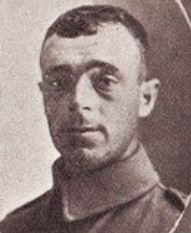
Clifford Stanley LOVE

Clifford Stanley LOVE

( late of Warners Bay, NSW )

aka  Cliff

NSW Police College, Penrith – Class # 003

New South Wales Police Force

Regd. #  4958

Rank:  Probationary Constable – appointed 21 January 1946 ( aged 23 years, 2 months, 24 days )

Sergeant 2/Class – appointed 20 February 1967 ( North East District – Muswellbrook )

Inspector 3rd Class – appointed 31 November 1974

Senior Inspector – appointed 21 December 1978


Stations?, Lithgow, Muswellbrook, Newcastle – O.I.C. – retirement


ServiceFrom  ? ? 1945  to 27 October 1982 = 36 years Service

Age at Retirement:  59 years, 11 months, 29 days

Time in Retirement:  33 years, 6 months, 27 days


[blockquote]

World War II

Australian Imperial Force – ARMY

Regiment:                                           2/14 Battalion

Enlisted:                                              17 March 1942 at Paddington, NSW

Service #                                            NX92797

Rank:                                                    Private

Embarkation?

Next of kin:                                        John LOVE

Religion?

Single / Married?

Returned to Australia ?

Date of Discharge:                          21 August 1944

[/blockquote]

Awards:  No find on It’s An Honour


Born:  Saturday  28 October 1922 at Bega, NSW

Died on:   Tuesday 24 May 2016

Cause?

Age93 years, 6 months, 26 days


Funeral date:  Monday  30 May 2016 @ 10am

Funeral location:  the Chapel of Lake Macquarie Memorial Park Cemetery & Crematorium


Buried at:  Lake Macquarie Memorial Park, Palmers Road, Ryhope, NSW
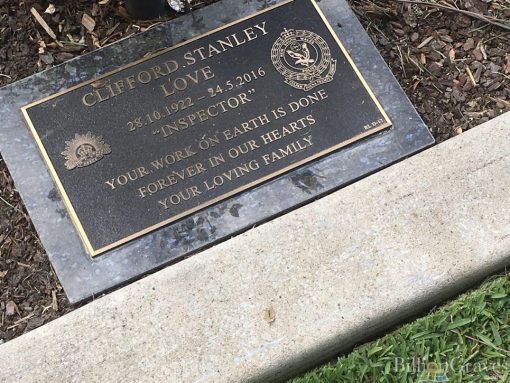
Clifford Stanley LOVE, Cliff LOVE Grave


Grave location:

GPS:  Approx:  -32.992211295758345    151.52122129192654

 Memorial at?


CLIFF is NOT mentioned on the Police Wall of Remembrance * NOT JOB RELATED


 Funeral location


FURTHER INFORMATION IS NEEDED ABOUT THIS PERSON, THEIR LIFE, THEIR CAREER AND THEIR DEATH.

PLEASE SEND PHOTOS AND INFORMATION TO Cal


LOVE,  CLIFFORD STANLEY
Late of Warners Bay
passed away 24th May 2016

Aged 93 Years

‘Inspector First Class,
Officer in Charge, Newcastle District’
(Retired 1982.)

Dearly loved husband of JOYCE.

Much loved father and father in-law-of MAX LOVE & RAE COUGHLAN, MAREE & MICHAEL, COLLEEN & DIAMOND.

Loving Grandfather of MARC & SARAH.

Great Grandfather to HARMONY.

Also a much loved uncle, great uncle, Police colleague and Friend to many.

Relatives and Friends are warmly invited to attend a Celebration of CLIFF’s Life to be held in The Chapel of Lake Macquarie Memorial Park, Palmers Road, Ryhope this MONDAY 30/5/2016 commencing at 10AM.

An interment will follow in the Lawn Cemetery.


Published in The Newcastle Herald from May 27 to May 28, 2016

http://tributes.theherald.com.au/obituaries/theherald-au/obituary.aspx?n=clifford-stanley-love&pid=180110994&fhid=31483

May you forever Rest In Peace.


Cliff LOVE was the Officer In Charge of the infamous Star Riot in Newcastle on the night of 19 September 1979 when police had to deal with an estimated 4000 rioters when the Star Hotel was closed down.

The Police vehicle Cliff had at the scene was rolled over by the hoodlums and ‘ torched ‘ ( burnt ) at the riots.  Paddy Wagons ( Police trucks ) were also rolled and burnt.  One officer lost his .38 Smith & Wesson which was later recovered some distance away.

Some of the 40 Police, but not limited to, who attended and were confronted by odds of 100:1 were:

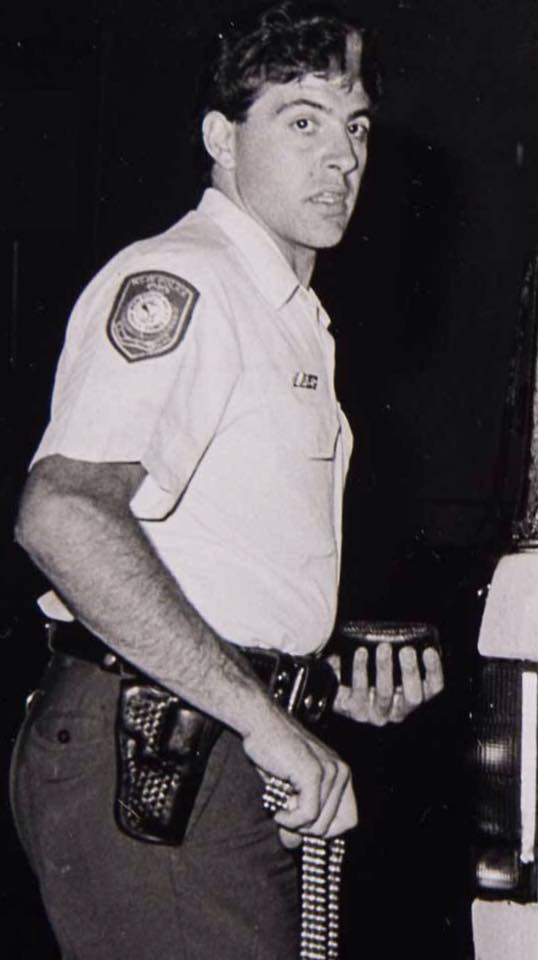
Cliff LOVE

Cliff Judd

Paul Baker

Brian Atkins ( broken wrist )

The night the Star exploded

September 17, 2004

null

Twenty-five years after the infamous Newcastle riot, many are still wondering who was to blame, writes John Huxley.

The trouble started just after 10pm when, to scattered cries of “kill the pigs”, an angry, alcohol-fuelled crowd started pouring out of the pub and on to the street to confront a painfully thin blue line of police officers.

Within minutes, missiles were – in the words of one witness – “raining down like rice at a wedding”. Rocks, bottles and beer cans. Watched by several hundred spectators gathered in the middle of the road, the mob rushed police lines and overturned paddy wagons. It was only after two hours of violent mayhem that the crowd was dispersed by fire-brigade hoses. By then, the street had been transformed, says a witness, into a “a sea of rubbish”.

Fourteen officers and eight civilians were on the way to hospital with injuries. Eventually, 46 people were charged with 79 offences, ranging from assault occasioning actual bodily harm to resisting arrest and riotous assembly.

To this day, it is remembered as Newcastle’s “night of infamy”: a Wednesday night, almost exactly 25 years ago, which started much like any other but ended in violent confrontation as about 40 police battled more than 4000 rioters angered by the closure of the Star Hotel in the city’s West End.

As dramatic pictures of the riot flashed round the world, putting the ugly face of Newcastle on front pages of newspapers everywhere, the then NSW premier, Neville Wran, called the events of September 19, 1979, un-Australian. “It was a shocking, disgraceful episode,” he said.

Possibly. But that has not prevented the riot becoming part of Australian folklore. Newcastle City Council produced a lengthy report. The band Cold Chisel recorded a famous song about it (see above). A Hunter Valley theatre group staged a controversial musical about it.

“From this distance it’s easy to lose sight of what really happened, ” Phillip McIntyre, a music writer and lecturer in communications at Newcastle University, explains. “There’s been a lot of myth-making going on.”

Indeed, Cold Chisel frontman Jimmy Barnes recently said people still came up to him to say how f—ing great he was at that gig he played on the last night of the Star. The band never performed at the hotel. Doubts have even been raised about the authenticity of some of the pictures taken that night.

It’s not surprising, then, that a quarter of a century on, the riot remains the subject of controversy. What sparked it? Was it a drunken rabble, a provocative band or heavy-handed police. Or was it the media, who were in place for hours, waiting for something to happen? Was it premeditated or largely spontaneous? And, most importantly, just what was its significance? Nothing more than a shocking show of drunken hooliganism, as Wran put it? Or a political demonstration by an alienated youth triggered into action by the loss of one of the few focuses of community expression?

Like it or not, few would dispute that the Star Hotel was, if not salubrious, then special. Built in 1885 – its distinctive facade dated from 1925 – it was a huge, rambling place stretching a block between King and Hunter streets, and comprising three very different bars and clienteles.

As the National Times newspaper wrote at the time, the front bar “served sailors from around the world, RAAF men, petty criminals and pimps, parachutists and ‘short back and sides’ misfits who didn’t fit into sophisticated taverns”. The middle bar catered for local gays entertained by drag acts, such as that staged by the notorious “Stella the Fella”. And the back bar was where the young people went, where the bands played for free almost every night of the week.

Far from being at each others’ throats, the different groups rubbed along peacefully. “There was a real sense of community, of belonging to the place,” recalls Mark Tinson, of the Heroes, the band playing the last set at the Star on that memorable night.

“Aesthetically though, it was a big toilet. But for the fact I was being paid to perform there, I don’t think I’d have been seen dead in the place.”

Unusually, bands played on a raised stage behind the bar, upon which young girls danced. Often they were semi-naked. Money and $1 cans of beer, dispensed from large ice-filled troughs, were traded across the boozing, cheering crowd.

Most nights, drinkers at the Star could be counted in their hundreds. Estimates of the number of people present on September 19 to drink, to farewell the hotel – peacefully or forcefully – range from 3000 to 8000.

Though only one week’s notice was given to the licensee Don Graham, the writing had been on the Star’s white-brick walls for some time. For the same reasons that patrons loved it – for its rebelliousness, its rowdiness, its unruliness – licensing authorities loathed it. “The Star had a definite reputation,” says McIntyre, with heavy emphasis. A few years earlier, a sailor had been stabbed to death at the hotel. There were regular reports of drugs and of underage drinking. Even Stella the Fella had been given her-his marching orders a few months earlier.

As Tooths Brewery moved to close the Star, its regulars mobilised to defend it. “Save the Star” T-shirts were produced, a petition supported by several thousand names was started, and a group of tradespeople who used the pub even offered their services free to renovate the fallen Star.

“People strongly believed it was ‘their’ pub and they weren’t going to allow anybody take it off them,” McIntyre recalls. Even without the offer of one happy hour’s free beer, the scene was set for an emotional, potentially explosive closing night.

By the time the Heroes started their final number, shortly before the scheduled 10pm shutdown, the crowd had swelled to thousands. Many had been drinking heavily for several hours. “You could feel the electricity in the room,” Tinson says. “But, really, more like a mardi gras or a street party.”

How the party turned into a riot remains unclear. Tinson says the “pivotal moment” occurred shortly before 10pm when police entered the bar and insisted they finish immediately. “I mean we’d 30 seconds to go. And everyone was, well, you’ve got to be kidding.”

In the ensuing chaos, the Heroes stopped playing. There were cries, Tinson says, of “kill the cops, from a couple of idiots”. As the mood turned ugly, the Heroes decided to play their final encore, as they had planned. “I mean we didn’t want to cause a riot.”

Their choice of song, The Star and the Slaughter, led later to singer Peter de Jong being charged with the incitement to riot. One verse runs: “I want action, And I want fighting in the streets. Gonna take this town by storm, Gonna burn the buildings down … ”

Prophetically, the chorus proclaimed, “They will remember the night of the Star and the Slaughter.” Within minutes, the band were interrupted again, Tinson says. “One of the crew came in and said, ‘you should see what’s happening out there’.” The infamous Star Hotel riot had begun.

Tinson, a lifelong teetotaller and still a respected member of the music industry, does not defend the behaviour of the rioters. “They behaved abominably,” he says. And he was reluctant to do or say anything that might prompt people to celebrate – or recreate – the riot. But he insists that by their action, the police inflamed the situation. “I think if they’d given us a few more minutes, the situation could have been avoided,” he says.

He also defends the band’s choice of song which, he insists, did not originally refer to the hotel, had been a regular item on their playlist and had been written many months previously – not, as some critics alleged, earlier that evening. “If only we had that sort of ability.”

For their part, the police, supported by the politicians, insist they had no alternative but to act after the crowd started interfering with traffic and a difficult situation threatened to turn dangerous. Senior officer Cliff Love said at the time that there was no way a force of 40 would choose to confront a crowd of thousands, most of them out of control on alcohol, many of them at least prepared for trouble. “It’s no exaggeration to say that police were in fear for their lives.”

As Mike Scanlon, a Newcastle Herald journalist and historian, recalled, it was also subsequently revealed that authorities were concerned a lost police firearm had been stolen by a rioter. It was later found away from the scene.

Whoever was to blame, whatever the degree of premeditation involved, one thing does appear clear with hindsight: the riot was the product of booze and boredom. More, drunken rabble or not, the rioters – most of them young, many of them unemployed – were representatives of a bigger, nationwide group of boozed, bored people who felt increasingly at odds with the political system.

Over the next few years, similar riots, brawls, battles were to occur across Australia.

As the Newcastle City Council report concluded, across the land there was a “general sense of anger and frustration”.

Life has moved on. Tinson lectures at the local TAFE. He, de Jong and the other Heroes reunited last month to perform at a hospital fund-raiser.

And the Star Hotel, after many incarnations, is scheduled to be demolished to make way for a swish, 12-storey apartment block. Perhaps the old facade will be retained. Perhaps a plaque recording the events of September 19, 1979 will be erected. Perhaps not.

As Tinson says, “The idea of celebrating a riot is a bit off.”

http://www.smh.com.au/articles/2004/09/16/1095320899843.html


The Star Riot

https://youtu.be/648H4D17w3s/


Lithgow Mercury ( NSW )

Friday  22 March 1946     p2

EARLY OFFER TO WINGER

Lithgow this season can easily lose a player to the octupus city clubs before he even appears locally.

He is Constable Cliff Love, who had been posted as a player in the newly formed Diggers‘ team.

Reported to be extra fast, Love, last Sunday was contacted by Sydney Eastern Suburbs officials and asked to appear with them in this week’s trials. Hard on the heels of Easts’ offer came another from Balmain, who will be meeting Easts in this week-end’s series. However, it was a case of first come, first served, and Love will try out with Easts.

If background is anything, Love should be a footballer whom Lithgow will not want to lose. In his younger days, he played school football and was also an athlete of no mean ability, while in later years he appeared with Group 16 on the South Coast prior to his enlistment in the Army, with which he served in New Guinea.

http://trove.nla.gov.au/newspaper/article/219612993


Lithgow Mercury ( NSW )     Wednesday  14 August 1946     p2

Alleged Hit-Run Driver Committed For Trial

Eight police witnesses testified against Henry Lam, of Newtown-street, Alexandria, in Lithgow police court yesterday, when he was committed for trial at Bathurst Quarter Sessions next Tuesday on a charge of having, by a negligent act – driving a motor vehicle negligently – caused grievous bodily harm to Const. Clifford Stanley Love on the night of July 20.

Mr. J. S. Hart, P.M, was on the Bench. The charge was a sequel to an alleged hit-run accident several weeks ago when Const. Love was struck by a car and thrown against an ambulance when investigating an accident in which Mr. Harry Earp, of McKellar’s Paddock, had been injured by another car.

After the accident, said Det. Sgt. E. E. Mabbutt in evidence, he went to Church-street and saw an “A” Model Ford in front of George Corney’s residence. He had a conversation with Corney, examined the car and with Corney took the vehicle to the police station, where it was subsequently photographed. The near side mudguard had a slight dent.

Witness continued that on July 25, accompanied by Det. Armstrong, of Redfern police, he saw the defendant at his home and had a conversation with him.

In respect to the accident and injuries sustained by Constable Love, Lam, he alleged, said he was very sorry to hear that the Constable had been Injured.

Det. Sgt. Mabbutt stated that the defendant admitted that he had been in Lithgow on the Saturday and had left for Sydney on the 6.30 p.m. train and that prior to his departure he had had an arrangement with George Corney to use a car, owned by a man named Purcell, for the purpose of driving to Littleton to pick up his port at his sister’s place.

ADMITTED SWERVING

Lam, he added, also admitted that he had seen an ambulance in Main-street east and had swerved to the right to avoid a collision. He denied having seen the light in the rear of the ambulance or having seen a Constable standing nearby.

When told that the crowd in Main-street had became hostile after he struck the Constable and called out, “stop, you have hit someone,” Lam said he had not felt a bump, nor did he hear any one call out. Lam, added the witness, said he had not been licenced to drive at the time of the accident.

Det. Sgt. Mabbutt then exhibited an overcoat, which, it was claimed, had been worn by Const. Love on the night of July 20. It was torn in several places and streaked with duco.  An envelope containing strips of duco taken from the mudguard of the car was also tendered.

VISIBILITY BAD

In reply to Mr. Ian L. Higgins, witness said that at the time of the accident the night was damp and visibility was bad. He said he did not know Lam had been a transport driver in the R.A.A.F. or that he was on discharge leave when the accident occurred.

George Burgess, a miner, said he was the driver of a car which had collided with a pedestrian about 50 yards west of the Court House Hotel corner. He was standing near the ambulance when he heard Superintendent Purdie ( A. Purdie, NSW Ambulance ), or someone call out a warning. He moved towards the Superintendent, heard a terrific bump and saw Const. Love knocked by a car. Love struck the ambulance door and fell to the ground. He helped him to his feet and saw a car turning Bridge-street comer an increasing speed.

Just as he was stepping from the ambulance, after having placed an Injured pedestrian inside, Const. Love spoke to him about the accident and at the same moment was struck by the mudguard of a car, said Superintendent A. Purdie.

UNSUCCESSFUL CHASE

He told the Constable to get into the front of the ambulance and they would try to catch the car. They were unsuccessful and he took Love to the hospital, where five stitches were inserted in his head wounds.

Alexander John Jenkins, a bus driver, stated that he was standing near the bus stop on the northern side of Main-street and saw the car which it was alleged had struck Const. Love. He knew the vehicle well because he had sold it a few days before.

Evidence was given by Athol Joseph Rigg, a grocer, that he was standing near Leighton’s tailor shop when he noticed a car approaching from the west. Before it reached the ambulance it swerved to the right, hit the open door of the ambulance and caught Const. Love. The car kept going and passed between the vehicle involved in the first accident, which was in the centre of the road, and the footpath near the Court House Hotel. It cut the corner and went up Bridge-street.

George Corney, garage proprietor, said he allowed Lam, who was well known to him, to use the car to assist him to catch the 6.30 p.m. train. He did not know the car had been returned to his home until Sgt. Mabbutt questioned him. When he examined the vehicle he noticed a slight dent on the near side mudguard.

DID NOT REMEMBER MUCH

Victim of the accident, Const. Clifford Stanley Love, told the police prosecutor ( Sgt. H. Taylor ) that he did not remember much after being hit. He added he had suffered much pain as a result of head and hip injuries, which had resulted in him being off duty for several weeks.

A description of Love’s injuries was given by Dr. Geoffrey Athol Williams, R.M.O., Lithgow hospital.

Mr. Higgins, who asked the Bench to dismiss the charge, said there was no evidence of criminal negligence. It could not be shown in the evidence that the defendant had planned to cause an accident, nor that he had deliberately committed the act.

Mr. Hart said he was satisfied that there was sufficient evidence to support a charge of negligent driving and committed the defendant for trial. Bail of £50 was allowed. Lam declined to make a statement and reserved his defence.

On two charges of failing to stop after an accident and driving without a licence Lam was remanded until September 29 on £20 bail. He was discharged on a third count of causing bodily harm by wanton driving.

http://trove.nla.gov.au/newspaper/article/219621273


National Advocate ( Bathurst NSW )

Thursday  22 August 1946     p4


DRIVING CHARGE FAILS

Lithgow Man Acquited at Bathurst

Henry Lamb, of Lithgow, recently discharged from the RAAF, was also discharged by Judge Shortland at Bathurst Quarter sessions yesterday.

Lamb was charged with driving a motor vehicle upon a public street, negligently, whereby he caused Constable Clifford Stanley Love bodily harm.

After hearing evidence, his Honor directed the jury to acquit Lamb. Judge Shortland pointed out that it would be necessary to prove criminal negligence on the part of Lamb and it did not appear that such evidence was forthcoming. Under another section of the Act, a case might have been made out, but under the section by which Lamb was charged a definition – not so far made – was necessary if the court was to be clear on the matter.

Evidence heard was to the effect, that Lamb had been driving a car along Main Street, Lithgow, on the night of July 20, and had hit Constable Love when Love was standing at the rear of an ambulance car. An accident had occurred a short time before Lamb drove along the street. The ambulance was parked in the street with all lights on, an injured person was receiving attention, visibility was bad, and there were buses parked near the scene of the accident, and a crowd had gathered in the street.

Lamb’s defence was that he did not see the ambulance car until almost upon it and swerved to avoid it. He was not aware, however, that he had hit the constable.

http://trove.nla.gov.au/newspaper/article/161327371


Lithgow Mercury ( NSW )

Wednesday  19 November 1947     p5

LITHGOW WEDDING

LOVE – TRIPLETT

St. Paul’s Church of England was, on Saturday, November 8, the scene of a pretty wedding, the parties being Joyce Isobelle Triplett, youngest daughter of Mrs. C. Triplett and the late C. Triplett, of Read Avenue, and Clifford Stanley Love, youngest son of Mr. and Mrs. F. T. Love, of Bega. Rev. A. E. Begbie officiated.

The bride, who was given away by her brother, Mr. E. R. Triplett, was gowned in French Chantilly lace over taffeta, cut with sweetheart neckline and trained hem. Her veil of billowy tulle was surmounted by a coronet of white flowers. The bridal bouquet was of roses, sweet-peas and lily of the valley. The matron of honor was Mrs. A. N. Thomas, of Wallangarra, the bride’s sister. She wore heaven-blue crepe with matching straw hat veiled with stiffened net. She carried a bouquet of crimson roses.

Mr. B. Schonbeck was best man.

Many guests were received at Bolt’s Hall by the bride’s mother, who wore a pastel pink frock with navy accessories and a shoulder spray of roses. The bridegroom’s sister, Mrs. H. Lush of Sydney, who was acting in the absence of his parents, wore a suit of navy and white silk jersey, with white accessories and shoulder spray of red roses.

The chairman, Rev. A. .E.. Begbie, rendered a solo, “Passing By.” The wedding cake was made by the bride’s mother and decorated by Mr. W, Smith.

The happy couple left for Sydney, the bride travelling in a suit of turquoise blue crepe, with black accessories. The honeymoon is being spent at Surfer’s Paradise and Bega.

Mr. and Mrs. Love will make their home in Lithgow.

http://trove.nla.gov.au/newspaper/article/22075844


Lithgow Mercury ( NSW )

Monday  17 April 1950     p2

BREVITIES

Following annual leave spent at Bega, on the South Coast, Constable G. Love resumed duty at the Lithgow police station this morning.

http://trove.nla.gov.au/newspaper/article/219761445


Murray John GARDEN

Murray John GARDEN

aka   Joe

Joined NSW Police Force via NSW Police Cadet system on Monday 2 February 1976

Cadet #  3221

Redfern Police Academy Class  157

New South Wales Police Force

Regd. #  17762

Rank: NSW Police Cadet – commence 2 February 1976 ( aged 17 years, 2 months, 9 days )

Probationary Constable – appointed 24 November 1977 ( aged 19 years, 0 months, 0 days  )

Constable – appointed ? ? ?

Detective – appointed ? ? ? ( YES )

Detective Constable 1st Class – appointed 24 November 1982

Senior Constable – appointed 24 November 1986


Final Rank?


Stations?, Mossman, Mudgee ( G.D’s then ‘ A ‘ List Detectives), Dubbo – death


ServiceFrom  2 February 1976  to  ? ? ( 1990’s )


Awards? National Medal – granted 15 January 1996 ( can’t verify this is the same person )


Born:  Monday  24 November 1958

Died on:  Saturday 24 May 1997

Cause:  Suicide – (1) Attempted – unsuccessful Drug over dose  ( 2 ) Committed – Police revolver

Age:  38 years, 6 months, 0 days

Event location:  Dubbo – at home

Funeral date?

Funeral location?


Buried at:  plaque in a rose garden at Western Districts Memorial Park, Boothenba Rd, Dubbo, NSW

 Memorial at?


JOE is NOT mentioned on the Police Wall of Remembrance, nor the Remembrance Wall, Sydney Police Centre, Surry Hills ( last checked Oct 2022 )  * BUT SHOULD BE


 Funeral location ?


FURTHER INFORMATION IS NEEDED ABOUT THIS PERSON, THEIR LIFE, THEIR CAREER AND THEIR DEATH.

PLEASE SEND PHOTOS AND INFORMATION TO Cal


Joe GARDEN was at Mudgee Police Station around 1987-88 in uniform. Not sure where he was prior to that.
Joe started in the Detectives office as an ‘A’ lister around that time. He was left high and dry after the designated detectives moved on and he was forced to run the detectives office ‘one out’.
Apparently Joe hit the bottle quite badly and finished up banging up a police vehicle ‘on duty’ whilst intoxicated.
Had some major fights with ‘senior officers’ and was forced onto sick leave.
Joe was ‘Force transferred’ to Dubbo Intelligence Office and worked there for a year or two before he drew his service revolver, went home and shot himself.
It is believed that Joe was aged in his late 20’s or early 30’s, married with young kids at the time.
( 2019 ) Information is that Joe had attempted a drug over dose and had been admitted to Dubbo Base Hospital where, apart from other methods, he was orally administered ‘charcoal’ to absorb the poison.
He was seen, in Hospital, by a Mental Health worker who asked how he was.  Joe’s forceful reply was ” I’m FINE !! ” and Joe repeated that statement.
Later, that morning, Joe was discharged home.
Joe attended Dubbo Police Station where he picked up his Police issued revolver and went home where he placed a pillow slip over his head before fatally shooting himself, in the head, whilst on the lawn.
May you forever be at Peace Joe.
Further information is sought about this man, his life and his death.

Internet searches have failed to find anything further as of this date – 1 June 2016 or 5 June 2019 – on this man.
Further information is sought.

Update:
31 October 2022 

From K.O. Medway

Greg Callander, Murray John GARDEN died on 24 May 1997 (aged 38). He was survived by his wife Debra and children Matthew, Grace and Alexander.
There is a plaque in a rose garden at Western Districts Memorial Park, Dubbo, NSW.


William Albert BLEECHMORE

William Albert BLEECHMORE 

New South Wales Police Force

Regd. # ‘Q‘ 6172

For the purposes of this website ‘Q‘ represents those Police joining between 1 March 1862 ( commencement of NSWPF ) – 23 February 1915 ( Commencement of NSWPF current numbering system )


Rank:   Probationary Constable – 14 April 1891

Constable 1st Class – 1902

Sergeant 2/C – appointed   June 1912


Stations?, Byerock ( Constable 1892 ), Mt Drysdale ( Constable in 1896 – Bourke District ), Burraga ( Cst 1/C – 1902 ), Carcoar ( SenCon around 1905 ), Gulgong ( SenCon 1913 – Sgt ) – O.I.C.

ServiceFrom  14 April 1891 to  16 May 1917 = 26+ years Service

Awards?

Born:  27 May 1868, Auburn S.A.
Died on:  Wednesday  16 May 1917

Cause:  Paralytic Stroke

Age:  48

Funeral date:  Friday  18 May 1917

Funeral location:  C of E section, Gulgong cemetery

Buried at:  Gulgong Cemetery, Castlereagh Hwy, Gulgong, NSW

Portion:  Anglican   Row:  BA

 Memorial at?William Albert BLEECHMORE - NSWPF - Died 16 May 1917

 WILLIAM is NOT mentioned on the Police Wall of Remembrance  *NEED MORE INFO

FURTHER INFORMATION IS NEEDED ABOUT THIS PERSON, THEIR LIFE, THEIR CAREER AND THEIR DEATH.PLEASE SEND PHOTOS AND INFORMATION TO Cal


About 9am on 16 May, 1917 the sergeant was speaking with two men in the street in Gulgong when he suddenly became ill and had to be assisted to his home. He sadly passed away later that afternoon. He had apparently been ill with neuritis for about two years prior to his death.

The Mudgee Guardian and North-West Representative of 17 May, 1917 reported on the sergeant’s sudden death.

POLICE SERGEANT BLEECHMORE – SUDDEN DEATH AT GULGONG.
A painful sensation was caused at Gulgong on Wednesday afternoon, when it became known that Sergeant Bleechmore, officer in charge of the local police, had died suddenly. About nine o’clock on Wednesday morning the sergeant, as he was standing in Mayne-street opposite the Centennial Hotel, talking to Mr. W. G. Ashford MLA, Minister for Lands, and a representative of the Sun, who were both on their way to Coonabarabran to attend the Show there, was taken suddenly and seriously ill. He was taken to his home, where he lingered until two o’clock in the afternoon, about which time he breathed his last. Sergeant Bleechmore had been in ill health for some time, suffering from neuritis, but none of his friends (nor, it may be believed, he himself) anticipated that matters were so serious with him as it has transpired they were.

The sergeant was held in high esteem in Gulgong and the news of his tragically sudden death gave the townspeople a painful shock.

Sergeant Bleechmore was 49 years of age, and had been 27 years in the police force, and six years in charge the police at Gulgong. He leaves a wife and five children — four sons and one daughter.

The eldest son, who is 20 years of age, is employed at the Railway Station at Dunedoo. A second son is a school teacher, whilst the daughter is the youngest of the family. The three younger children – (as was also Mrs. Bleechmore) with their father when, he died.

The Leader of 25 May, 1917 provided a few more details of the incident and death of the sergeant.”Referring to the death of Sergeant Bleechmore, at Gulgong, the town’s “Advertiser” says: About two years ago deceased developed an attack of neuritis, and had sometimes suffered very much from the complaint. He lately had a recurrence of the attacks, but not to that extent to provoke uneasiness amongst his family and friends. He finished his work at the stable, and then went and had breakfast. At this time he appeared to be in the best of health and spirits.

The Hon. W. G. Ashford was passing through Gulgong on Wednesday morning, and he sent a message to Sergeant Bleechmore that he would be pleased to see him. Shortly after 9 o’clock Sergeant Bleechmore went out and met the Minister, who had with him a representative of the “Sun” newspaper. The trio were talking near the Centennial Hotel, when Sergeant Bleechmore remarked that he had suddenly become unwell, and said to the Minister, “May I put my hand on your shoulder?” Almost immediately he collapsed, and would have fallen only for Mr. Ashford’s promptitude in catching him. It was seen that Sergeant Bleechmore’s condition necessitated his removal to his home, where he was taken by Messrs. A. E. Souter and B. J. Naughton. Dr. Lees was immediately summoned.

“The sergeant was born in 1868 and joined the New South Wales Police Force on 14 April, 1890. He was the officer-in-charge of police at Gulgong and was survived by his wife Maria and five children.

Sergeant Watts succeeded him at Gulgong Police Station in July, 1917. He is not listed in the official New South Wales Police.

https://www.facebook.com/groups/514697128544865/permalink/1312544512093452/


Leader (Orange, NSW : 1912 – 1922),

Wednesday 23 May 1917,

page 1

The interment of the late Sergeant W. A. Bleechmore, who died from a paralytic stroke on Wednesday, took place in the C.E. portion of the Gulgong cemetery on Friday. Members of the police force were the pall-bearers, and brethren of the Mundooran, Mudgee and Gulgong Masonic Lodges preceded the hearse in the funeral procession, while deceased’s horse was led in the rear of the corpse.

The mortal remains were first taken to the Church of England before being consigned with Masonic honors to their last resting place.

http://trove.nla.gov.au/newspaper/article/117826843


William Albert BLEECHMORE, husband of Maria May Bleechmore ( nee Robinson ) – married 9 April 1895 in Dubbo, NSW.


Government Gazette of NSW

Tuesday  15 March 1892     p2106

THE Bench of Magistrates at Byerock have this day appointed Constable William Albert Bleechmore to be Small Debts Bailiff for the said Court, vice Hogan, resigned.Police Court, Byerock,3rd March, 1892.C. McA, KING, P.M. F. H. PERRY, J.P.

http://trove.nla.gov.au/newspaper/article/222041580


Government Gazette of NSW

Friday  5 September 1902    p6332

THE Bench of Magistrates in Petty Sessions assembled have this day appointed First Class Constable William Albert Bleechmore to the position of Bailiff of the Small Debts Court at Burraga,—from this dateT. ARKELL SMITH, P.M.THOS. P. HACKNEY, J.P.ATHERDEN BOOTH, J.P.Dated at Burraga, this 1st day of September, 1902. [2332]

http://trove.nla.gov.au/newspaper/article/222045696


Lithgow Mercury ( NSW )

Friday  2 February 1906   p4

FROM THE ” GAZETTE.”The undermentioned police officers have been appointed inspectors to carry out the provisions of the Shearers’ Accommodation Act in the specified districts: — Sen. Const. William Albert Bleechmore, Carcoar; First class Constable John Edwin Williams, Burraga; Constable J. Valins, Trunkey.

http://trove.nla.gov.au/newspaper/article/218746323


Government Gazette of NSW

Wednesday 1 March 1911    p1265

THE Police Magistrate and Justices of the Peace in Petty Sessions assembled at the Court-house, Carcoar, have this 21st day of February, 1911, appointed Arthur Henry Higgs to be Bailiff of the Small Debts Court at Carcoar, vice Senior-Constable William Albert Bleechmore, transferred.

F. B. TREATT.[ 54191 ]

Police Magistrate;

http://trove.nla.gov.au/newspaper/article/221616377


Government Gazette of NSW

Wednesday 29 March 1911    p1866

MUNICIPALITY OF GULGONG.

NOTICE is hereby given that Senior-constable William Albert Bleechmore has been duly appointed as Inspector of Slaughter-houses, and of cattle intended for slaughter, under the ” Cattle-slaughtering and Diseased Animals and Meat Act, 1902,” for the Municipality of Gulgong.W. G. GIBBS,Town Hall, Gulgong, Town Clerk.24th March, 1911.

http://trove.nla.gov.au/newspaper/article/221617544


Lithgow Mercury ( NSW )

Wednesday  19 June 1912   p2

In the list of recent police promotions appears the name of William Albert Bleechmore, formerly of Hartley Vale, but now of Gulgong, who has been made a second-class sergeant.

http://trove.nla.gov.au/newspaper/article/218742602


Mudgee Guardian & North West Representative ( NSW )

Thursday 19 March 1914  p7

Leo Smith’s Death.Coronial Inquiry.An inquest touching the death of Leo Alexander Smith, who was recently found dead at Cumbandry, was held at the Court House, Gulgong, before the District Coroner, Mr. W. Arnott, P.M. on the 9th instant.

William Albert Bleechmore deposed that at about 7 p.m. on Friday night he was coming from Home Rule, and met a lady and two children in a sulky half-way down Caffrey’s Hill, which is 1 mile from the Post Office. About 160 yards behind the sulky he met deceased, who was riding horseback. Spoke to him and passed on. About 9 p.m. on the same night saw Mrs. Smith drive to Judge’s shop. Went down and saw the dead body of deceased whom he had spoken to on the hill, and which he identified as Leo Smith, son of Michael Smith, of Cumbandry. Carefully examined the body. Found a large abrasion on the right knee and a small scratch on the top of the right ear. There were no other external marks of violence. At 6 o’clock this ( Saturday ) morning went to a place on the Home Rule road just across where the railway line crosses the road, saw tracks where a horse had suddenly turned off the road and a great number of horse tracks where it had evidently been bucking. There was a mark where something had lain on the ground, and a small damp patch about the size of the palm of his hand. Two yards further on from the mark found the hat ( produced ), which is similar to that worn by deceased. Went to Smith’s residence at Cumbandry, and examined the pony that deceased was riding. It did not show any marks of having fallen, but on the saddle the right knee pad and right flap had marks of where it had grazed the ground. Was of opinion that the horse had bucked on to its side without falling and had thrown deceased who was an exceptionaly good rider for a boy.

William Richard Wall deposed that he was a Butcher, residing at Gulgong. He identified the boy as Leo Alexander Smith, who was his nephew, and was 13 years and 10 months old. He was born near Mudgee and was a schoolboy. Saw him about quarter past 6 yesterday ( Friday ), in Gulgong. He was just going to get his horse to start home. At about 8 p.m. his sister, Mrs. Smith, came to his place and saw that Leo had not come home, and she had found his pony, near Avery’s gate. Went with her in the sulky and found deceased lying not far from the road. Picked him up and handed him into the sulky to his mother. He was then quite warm. Brought him to Mr Judge’s and sent for a doctor.

Henry Joseph Harris, a duly qualified medical officer, residing at Gulgong. deposed that at about 9 a.m. last night ( Saturday ) he was summoned to the house of Mr. J. Judge. On arrival he saw the body of Leo Alexander Smith. He was fully clothed, with the exception of his boots and stockings. The only mark visible was an abrasion on the right knee. Was of opinion his neck was broken. He appeared to have been dead at least one hour.His Worship found that the deceased died from the effects of injuries accidentally received by falling from his horse.

http://trove.nla.gov.au/newspaper/article/156819852


Mudgee Guardian & North West Representative ( NSW )

Monday  22 February 1915  p1

“I AM GOING TO DIE, TED.”EVIDENCE AT INQUEST.A coronal inquiry into the circumstances surrounding the death of Mrs. Gray was held by Mr. Arnott, P.M., at the Gulgong Police Court on Thursday morning last.

William Albert Bleechmore, Sergeant of Police, deposed ” About 12 o’clock midnight on the 17th instant Mr. Gray, husband of deceased, came to the police station and informed me that his wife was dead. I immediately went round for Dr. Harris, the Government Medical Officer, and in his company went to Gray’s residence at Lagoon Paddock, about two miles from Gulgong. I saw the deceased lying on the bed. In company with Dr. Harris I took the body inside the house and the doctor carefully examined the body.

Edmund Gray, manager for Geo. Rouse‘s farm and residing at Lagoon Paddock, Gulgong, deposed: Only my late wife and myself were living at the house. My family were away in Sydney and Portland. We retired to bed about 10 p.m. We were sleeping on the front verandah. Deceased was in her usual state of health just before she went to bed. She did not complain. During the last few days, which were very hot, she complained of a smothering feeling about her chest. During the last two years she complained about shortness of breath if she had much exercise. As far as I know she was never treated for heart trouble, but, about two years ago, she underwent an operation for the removal of veins from one of the legs. About a quarter to eleven on Wednesday got her a drink. She started coughing. I was half asleep and was slow in getting up. The deceased got up and went to the water near by. I overtook her and gave her a drink from the water bag. She then came back to the verandah and sat on a sofa. She started spitting up phlegm and said, “I’m going to die, Ted.” I made no reply as I did not take her seriously. She asked me to strike a light and see what she was spitting up. I struck a match and she again said “I am going to die, Ted.” She jumped up off the couch and went to the bed and lay down. She was still coughing. I lifted her upon one knee as she seemed to be smothering. She then gave one long breath and died.The deceased was 51 years old, and was born at Gulgong. He and his wife attended a funeral the day before, and at the graveside his wife was overcome by the heat and fell on to her knees.

Dr. H. Harris, residing at Gulgong, deposed: About 12 midnight, accompanied by Sergeant Bleechmore, I visited the house of Mr. Gray, about two miles from Gulgong, and there saw deceased lying on a bed in her night dress. I could see no marks of violence on the body. About two years ago I gave deceased a course of treatment, and found that she had a somewhat enlarged fatty heart. I should say from indications, after listening to Mr. Gray’s evidence, and from my own knowledge, that deceased died from a disease of the muscle of the heart.The P.M. found that death was due to natural causes.

http://trove.nla.gov.au/newspaper/article/156866391


Mudgee Guardian & North West Representative ( NSW )

Thursday  3 June 1915  p8

Horse Trainer Killed   Death of John Hartley.

Members of the racing fraternity were greatly shocked when they learned that John Hartley had been killed as the result of an accident on the Tallewang road on May 25th. He was about 50 years of age and was well known as a horse trainer. He had been for some time residing at Mundooran. He was well known in Mudgee and Gulgong.

A magisterial inquiry was opened at the Gulgong Police Court on Thursday morning last by Mr. George Rouse, deputy coroner.William Albert Bleechmore, Sergeant of Police, stationed at Gulgong deposed: At 12 midnight on the 25th May, I received a telephone message from the Rev. H. Woodger, at Tallewang, to the effect that he had found a man lying on the road near the Tallewang school, with his face covered with blood. I immediately proceeded to the place, accompanied by Dr. Payne. I there saw a man lying on the left-hand side of the traffic part of the road. I turned the body over and saw that it was that of a man about 50 years of age. I knew the man by sight, but did not know his name. The body was fully clothed, including an overcoat ( produced ). About six yards from where the body was lying I was shown this piece of an overcoat ( produced ) which corresponds to the portion of an overcoat missing from that found on deceased. The body was lying with the face downwards, and the left arm straight out from the body. There was a mark five yards back along the road, as if the body had been dragged. There was a number of abrasions on the face, particularly a large one over the right eye, and on the right side of the nose. The left ear was black or bruised, and had blood about it, and the bottom lip of the mouth had teeth marks buried in it. Both knees had a little skin off, and on the left shin there was an abrasion about three inches long. I saw no other marks of violence on the body. I found the sum of £1/3/ on deceased, also a metal watch and chain. About 100 yards further along the road from which the body was found, I found a bottle full of spirits, which I believed to be rum, and for over two miles further along the road at intervals I found a rug, a blanket, and an enamel plate. Late in the morning I went along the road in the direction of Stringy Bark, and six miles from where the body was found. I came across deceased’s horse and sulky. The sulky contained blankets, tent, and general cooking utensils, and rabbit traps. It looked as if deceased had been shifting his camp. I had the body brought to Gulgong. I know nothing of deceased’s antecedents. The soles of deceased’s boots were torn off from the front part. In my opinion deceased fell out of the sulky, and was dragged for five yards along the road, and probably by his over coat catching in some part of the vehicle. The lost piece of the coat, including the pocket, was caused to be torn from the overcoat.

Harold Woodger, Rector of Gulgong deposed On the 25th instant I was at Tallewang, and left the public school at 11.30 p.m. About 100 yards from the house I noticed the body of a man. Standing over the body was a yellow dog. I was accompanied by Clarence Bleechmore, and I sent him back to the public school to ask Mr. Kinder, the teacher, to come, and he came and looked at the body, and said the man was apparently dead. I drove to Tallewang Hotel and rang up the Sergeant of Police in Gulgong, informing him that there was a dead man on the road near Tallewang School. I then returned to the scene of the accident, and awaited the arrival of the Sergeant and doctor.

Kenneth Campbell, hotelkeeper, residing at Tallewang Hotel, deposed that he saw the body and knew the deceased. He was at my place on the 25th instant, arriving about 12 o’clock. He left about 2 o’clock, and returned about 6 p.m. Whilst at my place he had drinks during the day. He left my place about a quarter or half-past ten at night. He was travelling alone in a sulky. When he left he was a little under the influence of liquor. He took a bottle of rum with him. He said he was going to Stringy Bark. Another old man named Kelly was going to the same place, but I am not sure whether he was riding or driving. They had been drinking together that day. I believe deceased was going to Kelly’s camp to stay. Kelly had a bottle and a flask of whisky. I considered deceased was capable of managing his horse when he left my place.

Percy Herbert Payne deposed: I am a legally qualified medical practitioner, residing at Gulgong. On the morning of the 26th May about 12.30 a.m. I was awakened by Sergeant Bleechmore, who informed me that he had received word from Tallewang that a man had been injured, and asked me if I would accompany him. Sergeant Bleechmore and I set off and after proceeding about 17 miles along the road to Tallewang we were stopped by a party who informed us where the body of the man was lying. I examined the body and found the man was dead. There was a contused wound over the right eyebrow, and blood over the side of the face, and clotted blood was issuing from both nostrils and mouth. There was also an abrasion on the left knee cap, and one about four inches long on the shin-bone of the left leg. Death, in my opinion, was instantaneous, and due to a fractured skull. This could have been caused by deceased falling from his sulky directly on to his head.

John Andrew Lynch, hotelkeeper, residing at Gulgong, deposed to having identified the body as that of John Hartley, who by occupation was a horse-trainer; and a native of Grenfell (N.S.W.). Witness thought he was about 52 years of age. Deceased generally lived at Stringy Bark with James Kelly.The Coroner returned a verdict of accidental death.

THE FUNERAL The remains were interred in the Gulgong general cemetery on Thursday day afternoon last, the Rev. Mr. H. Woodger officiating. The mortuary arrangements were carried out by Mr. S. J. L. Turner.

http://trove.nla.gov.au/newspaper/article/156865536


The Sydney Morning Herald

Wednesday  23 May 1917   p14

IN THE SUPREME COURT OF NEW SOUTH WALES – Probate Jurisdiction. -In the Estate of WILLIAM ALBERT BLEECHMORE, late of Gulgong, In the State of New South Wales, Sergeant of Police, deceased, intestate. – Application will be made after fourteen days from the publication hereof that Administration of the Estate of the abovenamed deceased may be granted to MARIA MAY BLEECHMORE, the Wife of the said deceased And all creditors in the said Estate are requested to send in particulars of their claim to the undersigned, upon whom all notices may be served.

JAMES JOSEPH DOWD,

Solicitor for the Applicant, Gulgong.

By his Agent, R A. MONRO KING,

3 Castlereagh-street, Sydney.

http://trove.nla.gov.au/newspaper/article/15722004


Government Gazette of NSW

Friday  20 July 1917    p3735

MUNICIPALITY OF GULGONG.

NOTICE is hereby given that Police Sergeant Charles James Watts has been appointed as Inspector under the Cattle Slaughtering and Diseased Animals and Meat Act for the abovenamed Municipality in place of Sergeant William Albert Bleechmore, deceased.W. G. GIBBS,Town Hall, Gulgong, Town Clerk.16th July, 1917.

http://trove.nla.gov.au/newspaper/article/226217806


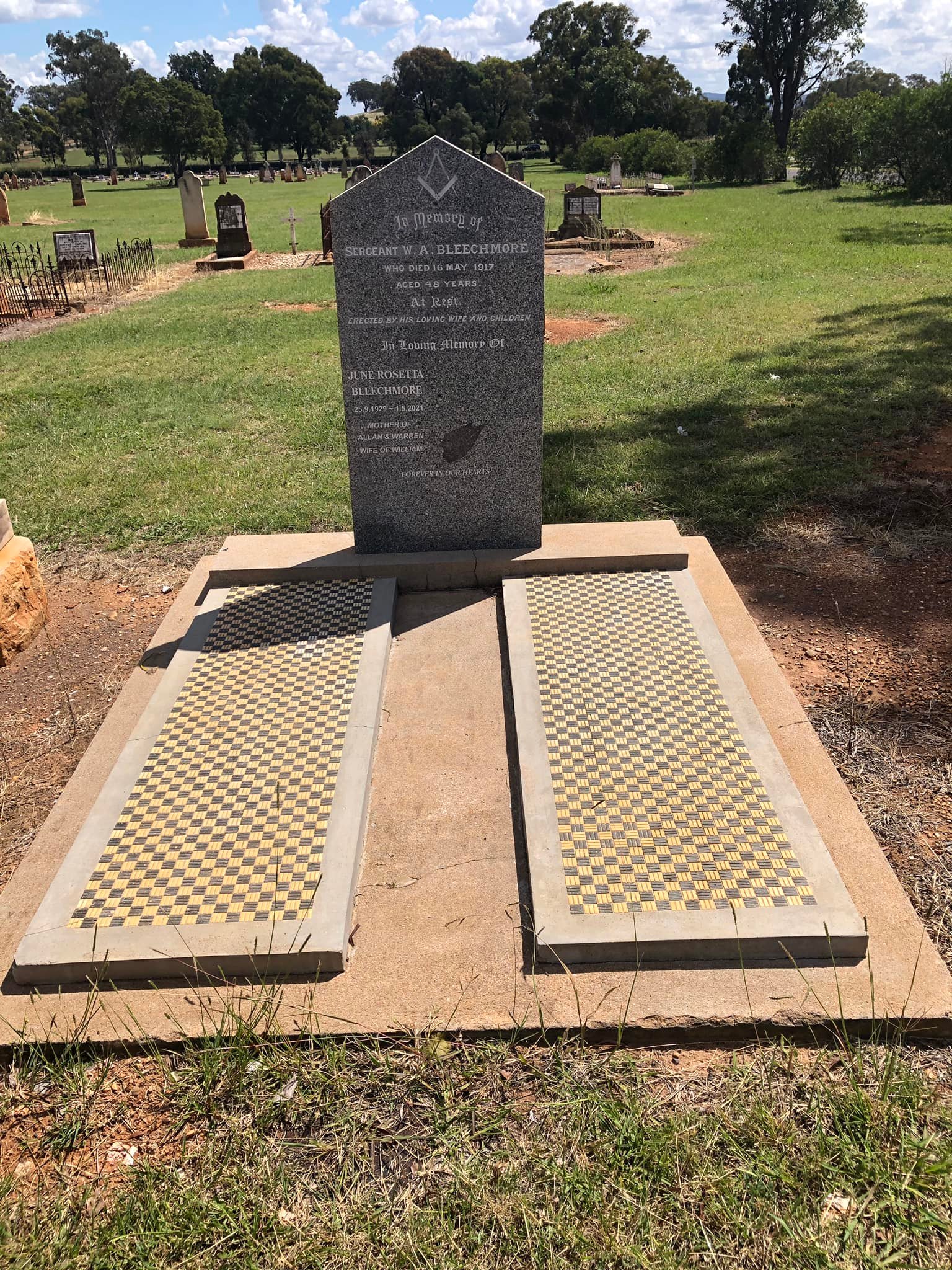
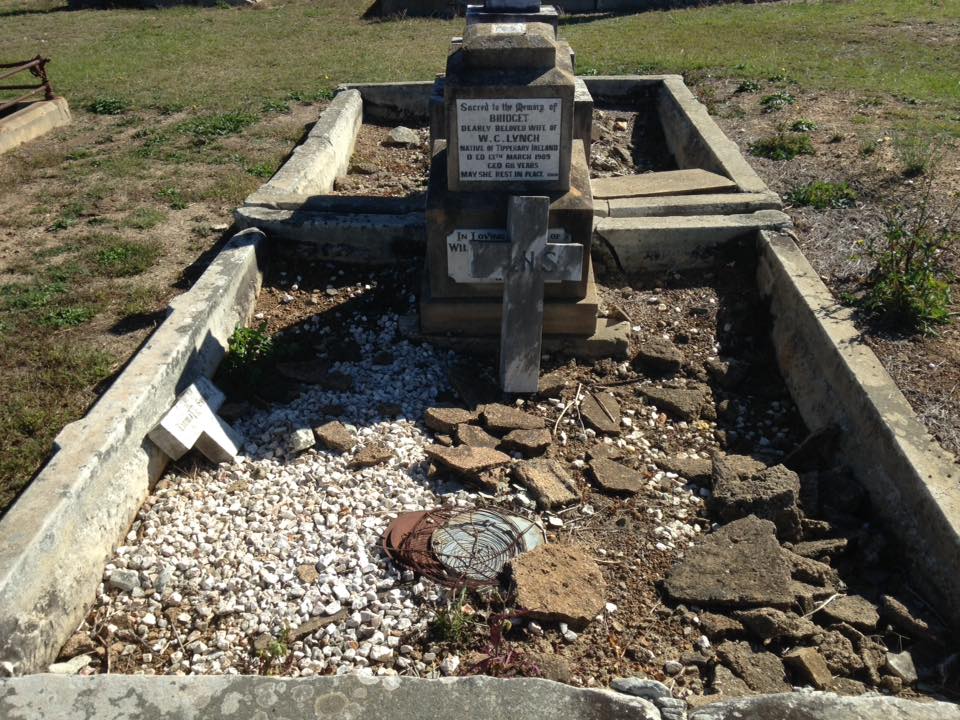
William Albert BLEECHMORE - Grave

William Albert BLEECHMORE - Grave
Grave – as seen April 2022  Photo:  Monte Jones


William Albert Bleechmore not a miner but a Police Officer

Di Nash of Canberra is a descendant of Samuel Nash and Harriet née Coombe (Chapter 12 in The Complete History). She has emailed us with information about William Albert Bleechmore who was born in Auburn in 1867, son of Caroline Bleechmore née Coombe, Harriet’s younger sister. Caroline was widowed in 1869. William spent his adult life in mining areas of New South Wales but was not, as we surmised, a miner. He was a police officer. Di informed us that he was appointed a probationary constable on April 14 1891. He worked in various places west of Sydney and was the sergeant in charge at Gulgong when he died quite suddenly in May 1917. He had been chatting to the Minister for Lands and a Sydney reporter in Mayne Street Gulgong when he collapsed and was taken to his home, where he died several hours later. [1] Wendy Walker, who is a great-great granddaughter of William and Jane Jacka through their eldest daughter Mary Lilla Jane, is a long time researcher of Jacka and Coombe family history. She recently sent us related information about William Albert Bleechmore’s career in the New South Wales Police Force including references to the New South Wales Police Gazette for 1902 and 1911.

Di has suggested that perhaps Caroline and William went to New South Wales after the death of Benjamin Bleechmore, Caroline’s husband and William Albert’s father. Unfortunately the fate of Caroline is still a mystery. Di told us that William Albert’s death certificate listed his deceased father but had no information under the heading ‘mother’. This suggests William lost touch with his mother, perhaps because she was long dead by 1917 or perhaps because they had a falling out.

Samuel Coombe and his descendants — The Complete History of Arthur and Rose


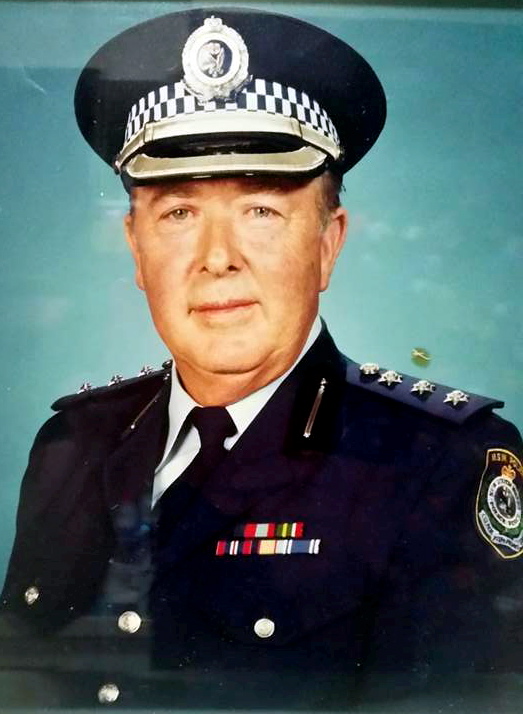
James Clements Joseph ROYAN

 James Clements Joseph ROYAN

aka  Jim

( late of Canterbury, NSW )

Uncle to Michael John ROYAN, NSWPF # 10241


Penrith Police College Class # 023

New South Wales Police Force

Regd. #  5896

Uniform number:  3324

Rank: Commenced Training at Redfern Police College on Monday 6 October 1947 ( aged 22 years, 4 months, 13 days )

Probationary Constable – appointed 27 October 1947 ( aged 22 years, 5 months, 4 days )

Constable – appointed 27 October 1948

Constable 1st Class – appointed 27 October 1954

Senior Constable – appointed 27 October 1959

Sergeant 3rd Class – appointed  20 September 1964

Sergeant 2nd Class – appointed 12 November 1971

Sergeant 1st Class – appointed 1 April 1974

Inspector – appointed 1 December 1978


Final Rank – Inspector – retirement


Stations:  Balmain ( 8 Division )( GDs )( 10 November 1947 – 18 November 1948 ),

Balmain ( 8 Division )( Traffic )( 19 November 1948 – 8 March 1951 ),

* Traffic Office ( Lecturer )( 9 March 1951 – 17 December 1964 ),

Traffic Office ( Parking Police Supervisor )( 18 December 1964 – 30 April 1974 ),

Traffic Office ( O.I.C. – Parking Patrol )( 1 May 1974 – 1 September 1974 ),

Campsie ( 13 Division )( GDs )( 2 September 1974 – 31 November 1978 ),

Fairfield ( 34 Division )( Assistant Officer )( 1 December 1978 – 31 May 1980 ),

Balmain ( 8 Division )( Assistant Officer )( 1 June 1980 – 1982 ) – Retirement


School Lecturing Section, Central Police Station Traffic Office ( 1960’s ) – No. 1 Division  ( rode a police bike with side-car ), Grosvenor St Annexe – Cnr Gloucester & Grosvenor St, Sydney ( 1974 – 1978 ), Inspector at Fairfield ( 34 Division ) Police Station 1978 – 1980,

ServiceFrom  6 October 1947  to  ? ? 1982 = 35+ years Service


World War II

Australian Imperial Force  Army

Regiment:                                    2 Corps Provost Co.

Enlisted:                                      29 July 1942 at Castle Hill, NSW, aged 19 years

Service #                                      NX120422 ( A.M.F. # N162244 – Corporal with 2 Corps Provost Co. )

Rank:                                            PRIVATE

Embarkation?

Next of kin:                                Patrick Leo ROYAN ( Father ) – ‘Willow Grove’, Stuarts River,

                                                     via Johns River.

Religion:                                     R.C.

Single / Married:                     SINGLE

Returned to Australia ?

Served between:                      9 April 1942 – 17 July 1946 = 1561 days.

                                                    1354 days in Australia.   202 days overseas. ( their math wasn’t good )

http://recordsearch.naa.gov.au/SearchNRetrieve/Gallery151/dist/JGalleryViewer.aspx?B=5654680&S=1&N=13#/SearchNRetrieve/NAAMedia/ShowImage.aspx?B=5654680&T=P&S=1


Awards: Police Long Service & Good Conduct Medal – granted 13 May 1971

National Medal – granted 13 November 1984

No other awards, which is obviously wrong, were found on It’s an honour


Born:  Saturday 23 May 1923 – Nabiac, NSW

Died on:  Thursday  4 April 2013

Cause?

Age:  87 years, 10 months, 12 days


Funeral date:  Wednesday  10 April 2013 @ 10.30am

Funeral location:  Mary Mother of Mercy Chapel, at the Rookwood Catholic Crematorium, Lidcombe, NSW


Buried at:  Cremated at Rookwood but Interred

Kemps Creek Catholic Lawn Cemetery on 17 April 2013

Christian portion, Row 75, Plot 2


 Memorial at?

James ROYAN 1 - NSWPF - Died 2014


JAMES is NOT mentioned on the Police Wall of Remembrance * NOT JOB RELATED


 Funeral location ?


FURTHER INFORMATION IS NEEDED ABOUT THIS PERSON, THEIR LIFE, THEIR CAREER AND THEIR DEATH.


Jim – may you forever Rest In Peace.


Jim was the Uncle of Michael John ROYAN – also a member of NSWPF.


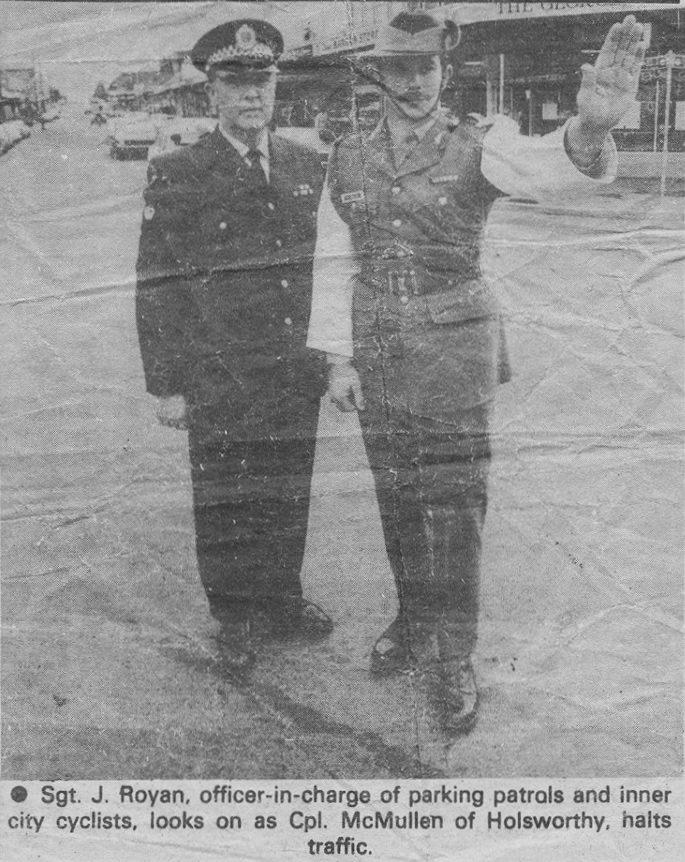
Sgt J. Royan, officer-in-charge of parking patrols and inner city cyclist, looks on as Cpl. McMullen of Holsworthy, halts traffic.

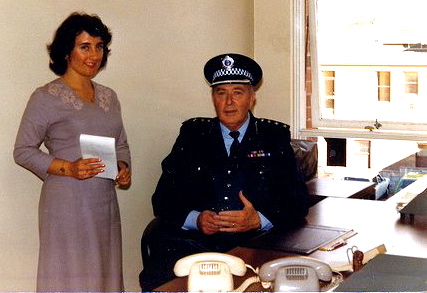
Diane Reid, Inspectors Clerk, with Jim at Fairfield Police Station in 1980. Diane also worked at Merrylands Police Stn.

Diane Reid, Inspectors Clerk, with Jim at Fairfield Police Station in 1980. Diane also worked at Merrylands Police Stn.

DESPITE THE OFFICIAL NSW 1979STUD BOOK‘ HAVING JAMES BIRTHDAY AS 23 MAY 1925, THE FAMILY ASSURE ME THAT HE WAS ACTUALLY BORN ON 23 MAY 1923 AND DIED IN APRIL 2013 JUST SHORT OF HIS 90th BIRTHDAY.


James “Jim” ROYAN

Notice
1 entry
  • “Our deepest Sympathies To Leslie & Annette and Families at…”
    – William & Bernadette Royan


ROYAN, James Clement.
(Jim).
April 4, 2013
Late of Canterbury.
Loving husband of Neita (deceased). Loving father and father-in-law of Leslie and Michele, Annette and Haig, loving grandfather of Scott, Lisa, Sharon, Brett, Paul (deceased) and Mark. Loving great-grandfather of Cooper, Max, Jackson, Sienna, Cate, David, James, Arisa, Will and Emma.

Loved by all his family, relatives and friends.
Aged 89 years
In Gods loving care.

A Requiem Mass for the Eternal Repose of JIM will be Celebrated within the Mary Mother of Mercy Chapel, at the Rookwood Catholic Crematorium, Lidcombe on Wednesday (April 10, 2013)
commencing at 10.30am.

Southern Cross Funerals
ALL SUBURBS
PROUDLY AUSTRALIAN
9529 6644 9521 4422


Published in The Sydney Morning Herald on Apr. 6, 2013

http://tributes.smh.com.au/obituaries/smh-au/obituary.aspx?pid=164048336


Australian Electoral rolls:


1949 – lived in Belmore

1958 – lived in Parkes

1977 – lived in St George


*

From 1906 the Police Traffic Branch operated from Police Headquarters, but in 1917, owing to wide expansion of affairs, the branch moved to offices at the Water Police Court. In 1924 the branch moved to the old model Lodge House at 211 Kent Street, and in 1930 to Phillip House in Phillip Street. A further move was made to Clarence Street Police Station in 1931, and in 1938 the branch returned to Phillip House. In 1948 the branch finally moved to the Police Training Centre at Redfern where it remained until the 1960’s.

Source:  Kevin BANISTER, NSWPF # 16382


Updated:  12 January 2024 with Promotion History, Transfer History & Awards.

Cal


Mark Alexander WYLIE

Mark Alexander WYLIE   VA

Victoria Police Force

Regd. # ?

Rank:  Detective Senior Sergeant – retired

Stations?, Armed Robbery Squad

ServiceFrom  to  ?

Awards:  National Medal – granted 7 September 1990

No find on It’s An Honour in relation to his VA

Born?

Died on:  Monday  14 July 2014

Cause:  Suicide

Age:  61

Funeral date:  Tuesday  22 July 2014 @ 2pm

Funeral location:  Chapel of the Victoria Police Academy, View Mount Rd, Glen Waverley

Buried at:  Macedon Cemetery, Bent St, Macedon

 Memorial at?


 [alert_red]MARK is NOT mentioned on the Police Wall of Remembrance[/alert_red]  * BUT SHOULD BE


 [divider_dotted]

 Funeral location ?

[divider_dotted]

FURTHER INFORMATION IS NEEDED ABOUT THIS PERSON, THEIR LIFE, THEIR CAREER AND THEIR DEATH.

PLEASE SEND PHOTOS AND INFORMATION TO Cal

[divider_dotted]

WYLIE, Mark Alexander

WYLIE. A Funeral Service celebrating the life of Detective Senior Sergeant (Ret. ) Mark Wylie will be held in the Chapel of the Victoria Police Academy, View Mount Rd, Glen Waverley on TUESDAY (July 22, 2014) commencing at 2 p. m. Mark’s Burial will be held in the Macedon Cemetery, Bent St, Macedon on WEDNESDAY (July 23) at 10.30 a. m. POLICE HONOURS In lieu of flowers, please consider a donation to beyondblue in memory of Mark. Envelopes at the Service.
Funerals
Published in Herald Sun on 18/07/2014

http://tributes.heraldsun.com.au/notice/56462057/view#sthash.fEoCgqrH.dpuf

[divider_dotted]

This is how his daughter Fiona would like everyone to remember him.

Broken pieces.
The warrior still fights on.
Travelling into the cosmos at lightning speed.
The universe will cuddle you.
Deep. Transcendental.
Unrelenting in the pursuit to eradicate the pain.
Your heart is glowing.
Surrounded by radiant beacons to heal the open wounds that still remain.
Singing along with Barry White.
The eclectic superstar dancing into the light.
Transformative. Pure essence. You are unfolding at a rapid pace.
I pray to God that you find a majestic and beautiful place.

[divider_dotted]

Russell Street Bombing claims last victim

Date 

John Silvester

It is surprisingly easy to break into a hospital, even one filled with cops.

Detective Sergeant Mark Wylie was recovering after he was badly wounded in a gun battle with a suspect in the 1985 Russell Street bombing that killed policewoman Angela Taylor and wounded another 21 people.

Shot through the chest, Wylie nearly died at the scene and again on the operating table, but his elite fitness and stubbornness helped him defy the odds.

Detective Sergeant Mark Wylie (inset) was shot in 1986 during a police operation targeting a man suspected of being involved in the Russell Street bombing. Photo: Ian Riley Read more: http://www.theage.com.au/victoria/russell-street-bombing-claims-last-victim-20140718-3c6k4.html#ixzz48q7l4Hkd Follow us: @theage on Twitter | theageAustralia on Facebook
Detective Sergeant Mark Wylie (inset) was shot in 1986 during a police operation targeting a man suspected of being involved in the Russell Street bombing. Photo: Ian Riley

He was sent to the old St Kilda Road Police Hospital to recuperate and his visitors were suppose to be vetted. So the thought of a couple of stray reporters wandering in was out of the question.

So we took the back door. There were allegations that we ( police reporter Jim Tennison and myself ) wore doctors’ coats and borrowed stethoscopes to gain access, but that would be unethical, outrageous and possibly true.

I had a standing joke with the good-looking and perpetually tanned Wylie, suggesting he had a ray lamp in his office, a sunroof in his police car and spent his leave playing French cricket on a Bahamas beach.

With Wylie out for therapy we ”decorated” his room with tropical fruits and summer props so it looked like a set out of Gilligan’s Island. Wylie returned and immediately got the joke. In between profanities he laughed so much he claimed his stitches were about to burst.

We weren’t the only illegal visitors. One evening Melbourne identity Mick Gatto, whose two-up school had been raided by Wylie, turned up to pay his respects.

The patient thanked him before suggesting he should probably leave. As he turned, Gatto asked what food he missed and the policeman mentioned an occasional craving for a Chinese feed.

( Wylie always enjoyed ethnic food. In recovery his surgeon asked him what he had for dinner the night before the dawn raid. When told it was a Sri Lankan curry, the doctor said, ”That explains it”, before revealing they had removed a seemingly endless number of sesame seeds with tweezers from the patient’s perforated bowel. )

The night after the Gatto visit a taxi turned up with enough food from the Flower Drum to feed the entire ward plus some strays from Prince Henry’s Hospital next door.

It was Anzac Day 1986 when Wylie, who was to lead the raid to arrest bomb suspect Peter Reed in his Kallista home, woke with a sense of dread. The raiding party had not worked together and it was way too late for rehearsals. They had three ballistic vests between 10 and while Wylie was trained to use a shotgun, he had not fired the type assigned for this job.

He familiarised himself by pumping it three times in the Nunawading police station car park at 3am as the team met inside.

As Wylie was to be one of the last through the door he didn’t wear a vest, but as the team fanned through the house, he was the first to see Reed, crouching in a bedroom. ”He’s on his haunches … and he’s pointing a .45 revolver straight at me.

Reed fired two shots and Wylie returned fire with two rounds until his shotgun jammed.

He fired off his third and fourth, and basically I walked into the fourth and it went straight through me … It was bang bang, it was like cracker night, it was just on for young and old. There was lead flying everywhere,” Wylie told ABC documentary Trigger Point, which aired earlier this year.

I knew that I’d been shot. You know, unless you’ve been shot, it’s hard to describe. It’s just a weird, weird feeling.”

Reed, who was also shot and survived, was later acquitted of the Russell Street bombing but convicted of the attempted murder of a policeman.

As the wounded Wylie lay down he started to lose consciousness. ”What I sense is that death, even in violent circumstances, is an extremely peaceful event. A couple of times I was pegging down; I was getting almost peaceful, surreal, elevated. You just drift, you drift peacefully, even in violent circumstances as a result of a gunshot wound; you drift into the big sleep.”

As he drifted he felt another policeman removing his wallet from his back pocket. ”I asked him what he was doing and he said, ‘If you die we will have to put some money on the bar, so it may as well be yours’.” It was that dose of police black humour that brought him back to reality and made him fight to stay awake.

It took months for Wylie to recover physically, but there were deeper scars time couldn’t heal. Sometimes after a few drinks with him you could feel its presence – an invisible cloud that would descend without warning.

While on sick leave he started tertiary studies and when he returned to the armed robbery squad he found there was something missing.

Wylie was always a 100 per cent character: intense, intelligent, meticulous and self-aware. He knew the shooting had changed him and after another armed raid decided he had to leave the squad.

The psychological stuff just hangs all over you; it’s like an ivy; just crawls all over your body. You just cannot beat it sometimes; it just knocks the daylights out of you. It’s awful.”

He was presented with the prestigious Valour Award and promoted, but he had lost his passion for policing and quit.

For a while he withdrew from old copper mates, perhaps seeing them as a reminder of the morning he nearly died. ”I basically wanted to be on my own so I could nut through the challenge that I had before me.”

He found many of the skills he had developed in the police force were in short supply in private enterprise and became a risk management expert, working in Australia, Asia, Africa and Europe.

We kept in touch and he would ring from time to time from Dubai or Hong Kong for a gossip and a laugh. When I was asked to assist in the Trigger Point documentary on police shootings, I wanted Wylie to tell his story. He instantly agreed.

As we sat in a small Carlton motel room ready to film, the soundman wanted the air-conditioner turned off to avoid the distracting hum. Wylie baulked, saying he would sweat buckets if the room was not cold. I thought the stress would be too much, but once the camera rolled Wylie told his story from beginning to end without a break.

Even though it had been nearly 30 years he remembered every detail as if it was yesterday. Which was hardly surprising, as virtually every day he would think about how he ran into that darkened house without a ballistic vest, carrying a shotgun he wasn’t trained to use, and how the bullet ripped through him before ending trapped in his parka lining.

We spoke to many police involved in shootings and Wylie was perhaps the keenest to have his story told.

Sometimes people say things publicly they can’t bear to say in private. He watched the episode with one of his sons, who held his hand as the story was told. It was a simple act of love which seemed to say, ”Now I understand”.

When he went to bed his son put on his father’s favourite music and just lay with him in silence. As Wylie told me that story his voice cracked with a father’s sense of pride.

Old mates contacted him after the show. Bridges that hadn’t been burnt but had fallen into disrepair were rebuilt.

In the aftermath he decided to use his terrible experience to help another generation of police and wanted to work as a mentor at the Police Academy and with the Police Association.

The last time we spoke he said, ”You don’t know what this means to me. I love you. You’ve saved my life.” And he wanted a long lunch with the police who told their stories on Trigger Point.

At the end of last week he had a chat with an old armed robbery squad mate. ”He seemed in a good place.”

Mark Wylie, 61, took his own life last weekend, leaving a wife, three sons, a daughter from a previous marriage and a thousand questions.

He never recovered from the shooting. He is another victim of the Russell Street bombing as far as I’m concerned,” a former colleague said.

Chief Commissioner Ken Lay knew Wylie struggled with his demons. ”He was a good man and a much loved police officer.”

There are many critics of the old-style crime squad mentality, but no one can doubt that ingrained sense of loyalty. They backed each other up in armed raids and now back each other up in retirement. They were there for him, but for Wylie it wasn’t enough.  On Tuesday they will be there for his funeral.

http://www.theage.com.au/victoria/russell-street-bombing-claims-last-victim-20140718-3c6k4.html

[divider_dotted]


[divider_dotted]


Our condolences on the passing of Mark Wylie

by Charlie Walker

The Moonee Valley Cricket Club joins with the Moonee Valley Football Club in passing on our condolences to the Wylie family on the passing of Mark.

Mark and Louise’s three sons, Daniel, Nick and Sam played a combined 60 games of junior cricket at Moonee Valley.

Mark was a regular at the junior cricket games, particularly the Friday night home matches when there was an opportunity to relax at the end of the week with other parents.

Our Club is saddened by his passing.

Below is a tribute written for the Football Club by our MVCC Fourths captain Brett Curran – a close friend of Mark.

*************************************************

Moonee Valley Football Club is sad to announce the passing of Mark Wylie who died on Monday 14 July 2014.

Mark had a long association with the Football Club.

Over the last decade Mark was fixture at junior matches watching his sons Sam, Nick and Daniel play for our juniors.

His wife Louise and he have been stalwarts of the junior club with Louise pioneering a professional approach to our junior training volunteers.

Mark was renowned for his sharp mind, good humour and company. Mark held a number of senior executive positions in various organisations and was an expert in security systems.

Earlier Mark had an extensive and successful career with Victoria Police and was the recipient of the Valour Award, the highest award for bravery.

We pass on our deepest sympathies to Louise, Sam, Nick and Daniel.

http://www.mooneevalleycricket.com.au/article/our-condolences-on-the-passing-of-mark-wylie

[divider_dotted]


Hate was the motive. Innocence was the victim

Author: JOHN SILVESTER
Date: 19/03/2011
Words: 1353
Source: AGE
Publication: The Age
Section: News
Page: 28
SOMETIMES life and death can be decided by something as simple as the toss of a coin.Twenty-five years ago, a young policewoman named Angela Taylor was working in the watchhouse at Russell Street when she lost the toss over who would do the staff lunch run.

It was March 27, the Thursday before Easter, and the last day before she would go on leave.

Just on 1pm she was crossing the road as she headed down Russell Street to the northern door of the police canteen.

She was only a metre away when a car bomb, containing around 60 sticks of gelignite, exploded at 47 seconds past 1pm. She was caught in the fireball, suffered horrendous injuries and died 24 days later.

While Melbourne was shocked, those who made the bomb were disappointed with the level of devastation. While they killed one and left another 21 injured, they expected a much greater death toll.

That is why they set the bomb inside the stolen Commodore to explode just after 1pm, reasoning the street would be crowded with police from Russell Street and court staff spilling from the Melbourne Magistrates Court opposite as it broke for lunch.

But it was unusually quiet as the courts were winding down for Easter. On an average weekday a school bus would have been parked in front of the bomb car as up to 40 children visited D24 on excursion. “Luckily the bombers picked the wrong day,” taskforce investigator Gary Ayres reflected this week.

The bomb detonated in one huge blast simultaneously scarring Russell Street and community confidence. The explosion hurled debris hundreds of metres: some landing on the Queen Victoria Hospital roof three blocks away.

Before the smoke cleared there was one giant suspect. His name was Phillip Grant Wilson, a 200-centimetre tall businessman and neo-Nazi. (Although he didn’t have the last bit on his business card.)

He was an explosives expert who had vowed to kill police after his mate, Tom Messenger, died during a raid in Wantirna in January, 1985. Messenger fired shots at police, hitting one in the bullet-proof vest. This was a serious tactical blunder as he was being raided by the Special Operations Group who immediately returned fire, shooting him dead.

Wilson was in court the day of the bombing on firearms charges and his case was adjourned at 11.30 because a shorthand writer was sick. If it had proceeded to lunch, the police witnesses against him would have been crossing the road when the bomb discharged.

Fearing he would go the way of Messenger, he contacted your correspondent to publicly declare his innocence. “I am not a terrorist. I’ll take a lie detector test or truth serum to prove I am not involved.”

This time he was right. It wasn’t him.

Not that it did him much good. He was shot dead outside a South Yarra chiropractic clinic 17 months later.

Another red-hot suspect was armed robber and police hater Claudio Crupi.

Consider the circumstantial case.

Taskforce Russell learned Crupi had built a bomb on his kitchen table  the day before the explosion  intending to attack a police station. Tick.

As if this wasn’t good enough, he was known to have shot at police. Tick.

Two of the taskforce’s best investigators, Ayres and Gordon Davie, interviewed him. Crupi admitted he built a bomb but claimed it was a fake to frighten Flemington police. Answering the second last question on the formal record of interview, he admitted to hating police. He was asked where those police worked. He replied: “Russell Street.” Double tick.

Both investigators believed they had their man, but were concerned they couldn’t link him to the bomb car. Senior police, keen on a quick result, glossed over the details and told them to charge Crupi.

They refused as they both had nagging doubts.

Just as well, as Crupi didn’t do it, although Ayres maintains he probably would have been convicted if the case had gone to a jury. Again it was a toss of the coin. He could have been charged and convicted and no one would have ever listened to his claims of innocence.

Meanwhile, experts carefully reconstructed the stolen Commodore wreck, and it would be the eye of a veteran that would provide the breakthrough.

Stolen car squad Sergeant Arthur Adams noticed the bomb car and a second one used later that day in a Donvale bank raid had the chassis numbers drilled off the same way. To Adams, it was as good as a fingerprint and he nominated car thief Peter Reed as the offender.

The theory was Reed was recruited to steal the bomb car for Crupi. In reality, he was one of the key planners. A brooding, vicious gunman, he blamed police for his mother’s mental illness and wanted to kill as many as possible.

The raid on Reed‘s Kallista house was carried out on Anzac Day, 1986, by a team recruited from the armed robbery and stolen car squads.

It wasn’t his investigation, but Detective Sergeant Mark Wylie was selected as one of the 10-man raiding party. The trouble was there were only three ballistic vests and, as he was to be the second last through the door, it was decided he didn’t need one. Wylie was given a shotgun. The trouble was he was not trained to use one.

In the pitch black they filed in through the back door. Wylie found himself opposite the suspect. Reed immediately opened fire, hitting Wylie in the body before the gunman was shot by another policeman. For Wylie the distance between life and death could be measured in centimetres. He survived and is now a successful consultant in private industry.

Police quickly linked Reed to the bombing and to another young crook  Craig Minogue  then considered to be just another fat thug.

The taskforce found the puppet-master was Stan Taylor, a full-time criminal and part-time actor, who turned his young followers from a gang of car thieves to a professional armed robbery unit.

Taylor recruited brothers Craig and Rod Minogue and Peter Reed. As soon as he was arrested Taylor dobbed in his followers, but he was too late to cut a deal. Another member of the gang, Paul Hetzel, had already signed up and became the prosecution’s star witness.

Taylor got life with no minimum, Reed beat the bombing charge but was convicted of a series of offences, including the attempted murder of Mark Wylie. He was released in 1994 only to return to prison.

Minogue, an angry, obese, illiterate, was sentenced to a minimum of 30 years. Exactly two weeks after his July 12, 1988, conviction, he killed multiple murderer Alex Tsakmakis inside Pentridge Prison by hitting him with a pillowcase filled with gym weights (perhaps illustrating the dangers of vigorous exercise for those with homicidal inclinations).

Then something strange happened: he has since become a model prisoner, losing weight and gaining knowledge. Through hard work he completed a series of academic qualifications and is now studying for his PhD in applied ethics at La Trobe University.

His earliest release date is 2016 and he will provide members of the Parole Board with many sleepless nights before then. He committed a murderous terrorist act and many of us would like him to rot in jail. And yet he has done all we could ask in the past 20 years and could be the pin-up boy for rehabilitation.

Angela Taylor didn’t get a second chance. At 21, she was already seen as a rising star who had duxed her academy class. If she stayed in the job you wonder what she would have achieved. Would she now be an officer marked for higher posts or would she be an experienced street copper mentoring juniors and doing her best to deal with conflict and crisis?

They stole from all of us the day the bomb went off. Police became a little more cautious, a little less open and more inclined to unholster their guns. Their training changed and they became more inclined to see the person in the shadows as a threat to be confronted rather than a victim to be helped.

All on the toss of a coin.

http://newsstore.fairfax.com.au/apps/viewDocument.ac;jsessionid=07AB2300ED432B70A34C82F52E3A813D?sy=afr&pb=all_ffx&dt=selectRange&dr=1month&so=relevance&sf=text&sf=headline&rc=10&rm=200&sp=brs&cls=177&clsPage=1&docID=AGE1103191A7FM7MQINB

[divider_dotted]


John Thomas TURNER

John Thomas TURNER  SC  VA

( late of Alstonville, NSW )


Redfern Police Training Centre – Class # 058 or 059


New South Wales Police Force

Regd. #  8931


Rank:  Commenced Training at Redfern Academy on Monday ? ? ?

Probationary Constable – appointed 3 March 1958

Constable – appointed ? ? ?

Constable 1st Class – appointed 16 March 1964

Senior Constable – appointed 1 July 1968

Sergeant 3rd Class – appointed 26 March 1974

Sergeant 2nd Class – appointed ? ? ?

Sergeant 1st Class – appointed 1 December 1983

Inspector – appointed 17 December 1986

Chief Inspector – appointed ? ? ?

Superintendent – appointed ? ? ?

Retirement


Stations?, Burwood Detectives, ?, North West Region – retirement


ServiceFrom  ? ? pre March 1958  to  30 September 1993 = 35 years Service

Years in Retirement: 22 years, 7 months, 9 days

Age at Retirement:  56 years, 8 months, 5 days


Awards:  National Medal – granted 22 August 1980 ( Det Sgt 3/c )

1st Clasp to National Medal – granted 3 September 1985 ( Det Sgt 3/c )

2nd Clasp to National Medal – granted 7 May 1994 ( Det Sgt 3/c )

Star of Courage ( SC ) – granted 27 October 1992 – NSW POLICE SERVICE. SC/FOR ACTS OF CONSPICUOUS COURAGE IN CIRCUMSTANCES OF GREAT PERIL. (MAR 93) ( Det Supt )


Born:  Monday 25 January 1937

Died on:  Monday  9 May 2016

Cause?

Age:  79 years, 3 months, 14 days


Funeral date:  Monday  16 May 2016 @ 110am

Funeral location:  Our Lady of the Rosary Catholic Church, Main Street, ALSTONVILLE, NSW

Grave Location:  Lawn A, Plot 168


Buried at:  followed by a Committal service at 11.15am at the Alstonville Cemetery, Bruxner Highway.

 Memorial at?


John Thomas TURNER, John TURNER

John Thomas TURNER, John TURNER In Memory of John Thomas TURNER SC VA 25 January 1937 - 9 May 2016 Loved husband of Pat, Father of Wayne & Megan Grandfather of Luke, Michael, Amy Always Remembered. 'Rest In Peace'
In Memory of John Thomas TURNER SC VA 25 January 1937 – 9 May 2016 Loved husband of Pat, Father of Wayne & Megan Grandfather of Luke, Michael, Amy Always Remembered. ‘Rest In Peace’

JOHN is NOT mentioned on the Police Wall of Remembrance  *NEED MORE INFO


 Funeral location


FURTHER INFORMATION IS NEEDED ABOUT THIS PERSON, THEIR LIFE, THEIR CAREER AND THEIR DEATH.

PLEASE SEND PHOTOS AND INFORMATION TO Cal


May you forever Rest in Peace.


At this stage, I am unable to find the circumstances surrounding the awarding of the Star of Courage.


Burwood Detectives


Cal

13 May 2016


David Christopher BOURKE

David Christopher BOURKE

Queensland Police Force

Regd. #  ?

Rank:  Constable

Stations?

ServiceFrom  ?  to  ?


[blockquote]

David Christopher BOURKE - QPol - Died 2 May 1915

David Christopher BOURKE


Regimental number 1310
Place of birth Irvinestown, Ireland
Place of birth Fermanagh, Ireland
Religion Roman Catholic
Occupation Labourer
Address Police Station, South Brisbane, Queensland
Marital status Single
Age at embarkation 26
Height 5′ 10.5″
Weight 175 lbs
Next of kin Mother, Mrs K Bourke, 90 Coventry Drive, Dennistown, Glasgow, Scotland
Previous military service Served for 5 years in the Royal Irish Constabulary.
Enlistment date 13 January 1915
Place of enlistment Brisbane, Queensland
Rank on enlistment Private
Unit name 15th Battalion, 2nd Reinforcement
AWM Embarkation Roll number 23/32/2
Embarkation details Unit embarked from Brisbane, Queensland, on board HMAT A48 Seang Bee on 13 February 1915
Rank from Nominal Roll Private
Unit from Nominal Roll 15th Battalion
Other details from Roll of Honour Circular Enlisted 13 January 1915 – 15th Bn, 2nd Reinforcements. Taken on strength, 15th Bn, 12 April 1915. Mortally wounded, 2 May 1915.
Fate Died of wounds 2 May 1915
Place of death or wounding Gallipoli, Turkey
Date of death 2 May 1915
Age at death 26
Place of burial Chatby War Memorial Cemetery (Row E, Grave No. 83), Egypt
Panel number, Roll of Honour,
Australian War Memorial
75
Other details War service: Egypt, Gallipoli

Embarked Brisbane o HMAT ‘Seang Bee’, 13 February 1915.

Proceeded to join Mediterranean Expeditionary Force, 12 April 1915.

Wounded in action, Gallipoli, April 1915; admitted to Egyptian Government Hospital, 1 May 1915.

Died of wounds, 2 May 1915.

Buried at Chatby Military Cemetery, Alexandria, 3 May 1915.

Medals: 1914-15 Star, British War Medal, Victory Medal

Sources NAA: B2455, BOURKE David Christopher


[/blockquote]

Awards?

Born? ? 1888 in Irvinestown, Ireland

Died on:  Sunday  2 May 1915

Place of death:  Gallipoli, Turkey

Cause:  Died of wounds

Age:  26

Funeral date:  Monday  3 May 1915

Funeral location:  Chatby Military and War Memorial Cemetery, Alexandria, Egypt

Buried at:  Chatby War Memorial Cemetery (Row E, Grave No. 83), Egypt

Memorial at?

[alert_green]DAVID is mentioned on the Police Wall of Remembrance[/alert_green] * CONSIDERED POLICE JOB RELATED

[divider_dotted]


FURTHER INFORMATION IS NEEDED ABOUT THIS PERSON, THEIR LIFE, THEIR CAREER AND THEIR DEATH.

PLEASE SEND PHOTOS AND INFORMATION TO Cal@AustralianPolice.com.au

[divider_dotted]


Scottish Military History Website

Hi, I am trying to find is a David Christopher BOURKE who immigrated to Australia and was a Queensland Police Service Officer. He took leave from the police to join the Australia Army during WWI. He died on 2 May 1915. His NOK was his mother, Mrs K Bourke, 90 Coventry Drive, Dennistown, Glasgow. I am looking to see if his name appears somewhere on a local war memorial or cenotaph where his family is from. Mel

Comment by: Melanie Wilkins

26 January 2015 – 12:17:29

http://www.scottishmilitaryresearch.org.uk/letters-to-the-guest-book

[divider_dotted]


William Carter LYNCH

William Carter LYNCH 

New South Wales Police Force

Regd. #  ‘P’ 0035

For the purposes of this website ‘P’ = represents those Police joining Pre 1862 when NSWPF “Officially” commenced

Rank: Inspector -18

Licencing Inspector – for Newcastle District – appointed 22 March 1893

Honourable Superintendent – appointed 10 July 1903??

Inspector – retired

Rank / StationsIreland as a Constable in the 1800’s for 2 years ( with his father ),

4 January 1860 – joined NSW Police in Sydney,

11 March 1860 – won a ‘ clerkship ‘ with rank of acting Sergeant in the office of Captain McLerie, Inspector-General of Police of NSW,

1862 The Police Regulations Act is Passed.  Lynch is involved in that framework.

October 1862 he is promoted to Sergeant & transferred to Goulburn as Clerk to Superintendent Zouch.

1862 – promoted to Senior Sergeant.

October 1862 – January 1883 ( 21 years ) he was connected with Supt. Zouch and had entire charge during Zouch’s absence. 2 months at a time on occasions.

1883 – promoted to sub-Inspector & transferred to Temora gold field district where he stated until June 1884.

Newcastle ( from 1 June 1884 – 1 June 1903 = 19 yrs)

Around 1887 was promoted to First Class sub-Inspector

March 1893 was promoted to Inspector & appointed O.I.C. of Newcastle Division which included 28 police stations, 100 men of all ranks & a population of 92,000 people

June 1888 Fire Insurance Companies – they presented him a valuable plate.

January 1894 – appointed by Sir George Dibbs to the Commission of the Peace


ServiceFrom 4 January 1860 to  ? July 1903 = 43+ years Service

Awards? – Imperial Service Order – granted 12 April 1912

Born? ? 1839 ,Tipperary, Ireland

Died on:  Saturday  30 June 1923

Cause: Syncope

Age:  85

Funeral date?

Funeral location?

Buried at:  Kenmore Cemetery, Goulburn, NSW

 Memorial at:  Newcastle Regional Museum received a donation, some time ago from the family via the NSW Police Museum, of a coffee / tea set that was given to William as recognition of fine service in 1888.  See additional notes at the base of this page ( when I get time to update it.  As of 25 May 2016 I have yet to update it )

William Carter LYNCH - NSWPF - Grave - Died 30 June 1923


WILLIAM is NOT mentioned on the Police Wall of Remembrance * NOT JOB RELATED


FURTHER INFORMATION IS NEEDED ABOUT THIS PERSON, THEIR LIFE, THEIR CAREER AND THEIR DEATH.

PLEASE SEND PHOTOS AND INFORMATION TO Cal


This amazing man was William Carter LYNCH, he was a member of the police constabulary in Ireland in the 1800’s and he immigrated with his wife Bridget to Australia where he
became a NSW police officer in Goulburn. He served in Goulburn as an Inspector General for twenty years and then as an Inspector at Cooma and Temora and then a Superintendent at Newcastle and retired in 1902 (don’t quote me on exact dates) when he retired.

He passed away at the age of 84 years on the 30th June 1923 and was buried in Goulburn. His wife Bridget and two of his brothers share his family plot in the cemetery at Goulburn.

Bridget died on 13 March 1903? aged 68.


The Sydney Morning Herald     Tuesday  3 July 1923     p 6

EX-SUPERINTENDENT LYNCH.

GOULBURN, Monday. ( 2 July )

The death occurred on Saturday night, at the age of 85 years, of ex-Police Superintendent William Carter Lynch. The late Mr. Lynch was one of the veteran police officers of the New South Wales force, having joined in the early ‘sixties ( 1860’s ). He was stationed at Goulburn for about twenty years, and in the ‘eighties ( 1880’s ) was promoted to the rank of sub-inspector, and was transferred to Cooma and then to Temora. Later, he assumed charge of Newcastle, where he remained until his retirement as superintendent 22 years ago. The deceased officer was awarded the decoration of the Imperial Service Order in recognition of his services shortly after his retirement. He is survived by six sons and three daughters, Misses Birdie and Julia Lynch, of Goulburn, Mrs. Theo Sheehy, of Young, and Messrs. Richard (Customs Department), James, and William (Newcastle), Chris. (Mandurama), Maurice (Summer Hill), and Joe (secretary of the Pastures Protection Board, Goulburn).

The Interment took place at the Kenmore Cemetery yesterday, the Rev. Father Cahill, assisted by Fathers Athanatius and Linus, officiating at the graveside.

http://trove.nla.gov.au/newspaper/article/16078017#


BDMNSWMarriage:  305/1861

William Carter LYNCH Married Bridget M, STARR in 1861 in Sydney.

BDMNSWDeath of Bridget, 1477/1909, who died on 13 March 1909 in Goulburn, NSW, and is buried with William.

BDMNSWDeath of William Carter LYNCH  13908/1923.  Father = Thomas.  Mother = Ann F.


The Sydney Morning Herald      Tuesday  16 March 1909    p 6

LYNCH.— March 13 at her residence Summerhill,  Goulburn, Bridget the beloved wife of William Carter Lynch, late Superintendent of Police,  Newcastle.

http://trove.nla.gov.au/newspaper/article/15043393


Newcastle Morning Herald & Miner’s Advocate    Saturday  13 April 1889    p7

NEWCASTLE POLICE COURT. FRIDAY, APRIL 12th, 1889.

( Before Mr. Jas. Mair, P.M.) 

THE LAKE ROAD ” PUSH. ” Brutal Assault.

William Smith and John Cunningham were summoned for assaulting Henry Fieldhouse,. at Newcastle, on the 7th inst:.

Mr. Gorrick appeared for the complainant, and Mr. Readett for the defendants.

Complainant deposed that on the day in question he met both of the defendants in Darby-street. Smith asked him when he was going to pay some money he owed him, and then struck him and knocked him down. He became insensible. He gave Smith no provocation. He could not say whether Cunningham struck him.

Miss McGlinchy deposed that she saw Smith strike complainant, and he fell down.

Sub-inspector William Carter Lynch deposed that he was walking along Darby-street on the day in question, when he saw two men strike at each other, and then fall down. They got up again and recommenced fighting, but fell to the ground. A third man stood over them, and either struck one or the two of them in a most cowardly manner. Smith was covered in mud, and the complainant was very much knocked about. He looked upon the scene as a most disgraceful one on a Sunday evening. He could only recognise Smith.

For the defence, John Cunningham deposed that he did not strike or kick Fieldhouse. Complainant said to Smith, ” I suppose your father is going away, and you are going to live on him. ” Smith replied, ” If I do I can go out of the colony. ” Complainant then struck him, and Smith, in self-defence, retaliated. They struggled together. They fought three rounds after that in Darby-street. The third round Fieldhouse caught Smith by the throat, and witness pulled him off.

By Mr. Gorrick: Witness never said ” Let us fit the old ——- , and give it to him. ” No one struck complainant whilst he and Smith were on the ground. There were only three present altogether.

William Smith deposed that the complainant struck him first, and they had a fight. Complainant caught hold of him by the throat, and Cunningham dragged him off. Witness thought complainant received the marks through falling on the kerbstone. No one but Cunningham stood over the complainant.

Thomas Reece deposed that he saw complainant strike Smith first with his fist.

George Forsyth also gave corroborative evidence.

Mary Jane Doolan deposed that she saw Smith striking the complainant whilst he was lying on the ground, and remarked that it was a great shame to hit an old man. She did not see Cunningham do anything.

This was all the evidence, and after Messrs. Readett and Gorrick had addressed the Bench at some length.

Mr. Mair said that as Sub-inspector Lynch was a considerable distance away, it was possible he was mistaken as to the striking, and that if he was not mistaken, at that stage of the encounter Smith might have been in danger of being choked. The evidence against Cunningham was not satisfactory, and he was discharged. He found Smith guilty, although he thought it likely that Fieldhouse himself was to blame a good deal.

Smith was ordered to pay a fine of 40s, 6s 6d costs of court., 21s professional expenses, and 10s for witnesses, in default 21 days imprisonment.

http://trove.nla.gov.au/newspaper/article/138836068


Newcastle Morning Herald & Miner’s Advocate    Saturday  13 May 1893    p5

LICENSING

SUB-INSPECTOR. The Lieutenant-Governor has appointed Sub-inspector John Saunders to be a district sub-inspector, under the Licensing Acts, 1882 – 1883, for the Licensing District of Newcastle, vice Lynch, promoted – to take effect from the 1st instant.

LICENSING INSPECTOR. The Lieutenant-Governor has appointed Inspector William Carter Lynch to be district inspector, under the Licensing Acts, 1882 – 1883, for the Licencing District of Newcastle, vice Brennan, transferred – to take effect from the 22nd March last.

http://trove.nla.gov.au/newspaper/article/136400888


Newcastle Morning Herald & Miner’s Advocate     Tuesday  2 June 1903       p7

INSPECTOR LYNCH. An HONOURABLE CAREER,

The retirement of Mr. W. C. Lynch, inspector of Police in Newcastle, which was foreshadowed a week or so ago, took practical effect yesterday, when he began a months’ leave, at the expiration of which he will retire on a superannuation allowance, and will reside at Goulburn, where he did many years service. Mr. Lynch took his leave with nothing but the best wishes of the members of the force. This, it is said, will be exemplified in tangible form later on, for it is the intention of the men to show him practical proof of the esteem in which he has been held by them. A requisition is also being signed asking the Mayor of Newcastle to convene a meeting, so that the citizens might have an opportunity of marking their esteem for his good qualities as a responsible officer, and for his worth as a citizen for the past 19 years. It so happened that yesterday was the nineteenth anniversary of Mr. Lynch’s arrival – in Newcastle to take up the duties of sub-inspector.

He leaves the force without having been subjected to even a reprimand, after a service of 43½ years, His duties were formally handed over to Sub-Inspector McVane, who has a thorough knowledge of the district and its surroundings.

There are only two Officers in the police force who have had longer service than Inspector Lynch. One is Superintendent Granger, of Goulburn, who is retiring this month, and the other is Superintendent Brennan, in charge of the Eastern District at the Police Depot, and who was formerly in Newcastle. The latter has had fifteen days more service, having joined in December, 1859.

Mr. Lynch Joined the Irish Constabulary at a very early age. His father being an officer in that Constabulary, no objection was raised to his age, as he had reached the required height. He remained two years in the service in Ireland, and then came to this country. He joined the police force in Sydney on 4th January, 1860. In March 11th of that year, in competition with the entire Sydney police, he gained a clerkship, with the rank of acting-sergeant, In the office of Captain McLerie, the late Inspector-General of Police in New South Wales. At the beginning of 1862, during the passing of the Police Regulation Act, Mr. Lynch was engaged in the preparation of the first regulations framed under that Act. In October 1862, he was promoted to the rank of sergeant, and transferred from Captain McLerie‘s office to Goulburn as clerk to Superintendent Henry Zouch. In December. 1862, he was promoted to the rank of senior-sergeant. From October, 1862, to January,1883, he was connected with Superintendent Zouch‘s office, which he managed, and in the absence of the superintendent he had entire charge – on some occasions for two months at a time.

During this long time, which embraced the period when such notorious criminals as Hall, Gilbert, Dunn, Burke. Vane, Clarke, and others terrorised the south and western districts, he rendered most valuable service and in 1865 he received a special reward from the Government for the capture of armed offenders and for the recovery of the proceeds of several robberies. In the year 1864, when the late Chief Justice, Sir James Martin was a member of the Government, he offered Mr. Lynch an appointment as clerk of petty sessions at Yass, a position then worth from £700 to £800 per annum. At that time there was no superannuation in the Civil service and. preferring the active work of a police officer, Mr. Lynch did not accept the offer. In 1883 he was promoted to the grade of sub-Inspector, and transferred to the Temora goldfield district, where he remained until June 1884. This was the year he was removed to Newcastle, exactly 19 years ago yesterday. A few. years later he was promoted to the grade of first-class sub-Inspector, In March 1893, he was advanced to the rank of inspector and appointed the charge of the important division which includes the city of Newcastle, with supervision over twenty eight stations and 100 men of all rank, and a population.of 92,000 people. He has held this position ‘ever’ since with credit to himself and with the goodwill of the men under.

During the nineteen years Inspector Lynch has been in the Newcastle district he has had to deal with conditions arising out of some great labour troubles;. and whilst always being firm he never was officious, the result being that he succeeded well. In June, 1888, the fire insurance companies so highly appreciated his services in having successfully brought to justice offenders’ charged with arson ( four cases ), that they made him a valuable presentation of plate. In January, 1894, he was appointed by Sir George Dibbs to the commission of the peace. Mr. Lynch has now reached the age of 63 years. He was born at Mungret, near the city of Limerick; but his father having been removed to Kerry whilst he was an infant, he has always claimed Kerry as his native country.

His first start in life was a at the age of 15 years, when, in a competition, he gained an appointment as assistant teacher In one of the Irish National Schools. This was a probationary appointment, which was confirmed a few months later, and at the time he joined the Irish Constabulary he had obtained two stages of promotion and was under orders for the training school in Dublin. But he followed in his father’s footsteps, and took to police work in preference to the hum-drum life of a teacher.

In the early part of 1857 he formed the acquaintance of a young lady. ( now his wife ) who was leaving for New South Wales, This young lady some two years after paid his passage to this country. They married, and Mrs. Lynch is still his companion in life and the mother of a large family. In the early sixties Mr. Lynch was appointed gold receiver at Goulburn, and he held this position during the whole time he was there. When the fields were in full work his Iron safes were frequently unable to hold all the gold placed in his keeping, and it happened at times that he had boxes of gold, aggregating in value £10,000 stowed away under his bed, and this in an old wooden police station.


Coffee pot
Type Museum Collection
Registration Number 2005/184
Creator
R. Broadhead & Company Silverware Manufacturer
Date Created 1888
Place of Creation United Kingdom
City Sheffield
Physical Description Tall coffee pot, possibly Britannia ware/Plated silver. Hinged oval lid at top with ivory oval lid handle. Engraved borders and decorations with engraved dedication at bottom front. Handle and spot attached separately. Makers stamp at base
Subject Classification BEVERAGE
LAW
Notes William Carter Lynch 1839 – 1923, Born in Limerick Ireland, son of a school teacher. Joined Irish constabulary and in 1859 migrated to Australia. After moving to Goulburn from Sydney, William became a clerk in the Mounted Police during the gold rush. He was described in police records as being 5’8″ tall, blue eyes, brown hair, and a fresh complexion. His general appearance was described as smart & active. Constable 1860, Senior Constable March 1862, Sergeant November 1862, Senior Sergeant 1863, retired as Superintendent in 1902. Father of 10 children (see object file)

Makers info: Broadhead Rogers, silver plated ware, &c. manufacturer, (Broadhead and Atkin;) house: West bank, Glossop road. From A DIRECTORY OF THE BOROUGH
AND PARISH OF SHEFFIELD, 1852
Britannia Ware Sometimes called Grade A Pewter. It consists of tin, antimony and copper. Widely used in the mid-part of the 19th century for ornate hollowware, it is now used as a base metal in the modern plated hollowware industry.

Death certificate cause of death: Syncope (SIN’ko-pe) is temporary loss of consciousness and posture, described as “fainting” or “passing out.” It’s usually related to temporary insufficient blood flow to the brain. It’s a common problem, accounting for 3 percent of emergency room visits and 6 percent of hospital admissions. It most often occurs when the blood pressure is too low (hypotension) and the heart doesn’t pump a normal supply of oxygen to the brain.

Inscription Presented to Police Inspector William C. Lynch, Fire Insurance Companies
Newcastle, N. S. Wales
In recognition of Meritorious Public Services
June 7th 1888


http://trove.nla.gov.au/newspaper/article/138314604?searchTerm=%22inspector%20lynch%20%20an%20honourable%20career%22&searchLimits=#


Evening News ( Sydney )     Saturday  11 July 1903   p6

POLICE PROMOTIONS.

In Friday’s ” Government Gazette,” the promotion of Police-Inspector William Carter Lynch to the rank of hon. superintendent, and of Senior Detective William Blackburn to the rank of Acting Sub-inspector are announced. Superintendent Lynch is retiring from the control of the Newcastle division, while Sub-inspector Blackburn is proceeding to Narrabri to take charge of the division of which that town is the official centre.

http://trove.nla.gov.au/newspaper/article/115856684


Goulburn Evening Penny Post      Tuesday  6 July 1915     p4

MAUD-STREET FIRE.

OPEN VERDICT.

The inquiry into the Maud-street fire was resumed on Monday morning before. Mr H. O’Brien, J.P.

Mr. A. M. Betts appeared for Mr. S. Pritzler ; Mr. Thomas for Mr. and Mrs. Hetherington.

Catherine Pritzler, recalled, deposed that at the time the alarm was given she said to her mother, ” Perhaps I did it; ” witness had also said something about matches, referring to having been in the house ; witness did not think she threw a match down ; she had not been hysterical that day ; witness saw the little girl bring the parcel to her father’s house ; witness never mentioned about the matches to Sergeant Avery or any one else.

Nellie Pritzler, neice of the previous witness, said that the parcel delivered to the house by the girl contained keys ; witness identified the tag as that attached to the keys when returned ; witness thought there had been bad blood between Mrs. Hetherington and Mr. Pritzler ; witness remembered her aunt saying to her grandfather on the night of the fire, ” I must have done it and dropped a lighted match; ” witness’s aunt was then hysterical.

Kathleen Kidd deposed that the writing on one of the letters was Mrs. Hetherington’s.

Simon Pritzler, recalled, said he was for 33 years in the police force and 12 years in the British army ; his father was born in Germany ; witness never heard any conversation such as sworn to by Mrs. Hetherington as to Germans ; witness had not previously heard of the matches alluded to ; he was a friend of Mr. Lynch, the handwriting expert.

William Carter Lynch, retired police-superintendent, said that he had made a study of handwriting ; he would say that the writing on the key-tag was not Pritzler’s. ( Witness described the differences in detail between the writing on the various exhibits. )

Albert Joseph Evans, who shared the house in Sydney Road occupied by Mr. and Mrs. Hetherington, stated that Mr. and Mrs. Hetherington were at home on the night of the fire ; witness passed their bedroom window at 11 p.m. and saw them in bed.

Sgt. Avery gave details respecting his discovery of the fire ; the flames first appeared on the eastern side ; witness gave the alarm, and on asking young Pritzler whether the fire started outside or inside, was told that it started on the right-hand side ; later witness made a careful examination of the wall-plate; witness described the condition of the timbering, and said that the wall-plate was burnt through in one spot ; in witness’s opinion the fire started there ; witness walked round the building when he first arrived, and could see nothing to lead one to suspect that the fire was lit from the outside ; witness found that Miss Pritzler had been at the place with a candle and matches ; in witness’s opinion the skirting where the fire started would have taken two or three hours to burn through ; when witness knocked at Pritzler’s door Miss Pritzler was crying ; the side of the hose where the fire was said to have started was next to Pritzler’s place.

To Mr. Thomas: There would be the same facilities for an incendiary on the other side and no fear of detection.

This concluded the evidence.

The Coroner returned an open verdict.

http://trove.nla.gov.au/newspaper/article/98846656


Goulburn Evening Penny Post      Wednesday  5 July 1939     p4

MR. J. LYNCH Public Figure Passes

Mr. Joseph Michael Lynch, one of Goulburn’s best known citizens and for many years secretary of the Pastures Protection Board, died at the Goulburn District Hospital at 8 o’clock this morning. He was 62 years of age.

For the past 12 months Mr. Lynch had been in failing health and, after undergoing medical treatment in Sydney, returned to Goulburn and on April 29 entered the District Hospital, where he remained until the time of his death.

Although it was known for some time that he was seriously ill, the news of his death this morning came as a great shock to his relatives and many friends in this city. A native of Goulburn, Mr. Lynch was born at his home, “Summer Hill.”

His father, the late Senior Sergeant William Carter Lynch, came to Goulburn during the sixties ( 1860’s ), and later founded the home now occupied by the surviving members of his family. In 1884, when Mr. Lynch was still a boy, his father was transferred to the Newcastle police district, where he ultimately attained the rank of inspector, and finally superintendent.

Mr. Joseph Lynch was educated at the Sacred Heart, College, Maitland, where he matriculated. He later joined the service of a banking company, and on the retirement of his father from the Police Force, he returned to Goulburn to make his home.

He was best known in Goulburn and District for his work in connection with the Pastures Protection Board, of which he was secretary. On January 10, 1917, a meeting of the directors of the board was held, and it was decided to appoint Mr. Lynch to the secretaryship in succession to Mr. J. J. Roberts, who had retired. Prior to that Mr. Lynch had held the position of assistant secretary.

At that time the offices of the Board were situated in Montague Street and Mr. Lynch had retained his associations with the body since his appointment. He attended his first meeting in the capacity of secretary on June 20,1917. Mr. Lynch proved a very popular official and his genial nature made him well liked and respected by the district graziers who came in contact with him during his term of office.

Throughout his life he maintained a keen interest in public affairs and was associated with several bodies up till the time of his death. Soon after his return from Newcastle he became associated with the Goulburn Liedertafel, and up to the last he acted as treasurer of the Trust. On Friday last he performed one of his last duties by signing a cheque for the committee. He was also one of the society’s trustees.

His association with the society extended over the past 20 years, and in the early days he was responsible for the 3d a week fund, which provided £100 to enable the society to build the present Lieder Hall. He also took an active part in some of the early stage productions and concerts. Together with the late Charles Holloway and Lee Hunt, Mr. Lynch and Mr. Wm. Bladwell formed the trustee committee, of which. Mr. Bladwell is now the only surviving original member.

WORK FOR FOOTBALL

By the death of Mr. Lynch the Goulburn Rugby Football League has lost one of its oldest and most enthusiastic supporters. When the League code was introduced in Goulburn more than 20 years ago he became the first patron, and had held that office ever since, while some years ago he was created a life member in recognition of his long and loyal service. A foundation member of Group 8, he was patron of that body and also a life member.

In the days of the old Christian Brothers’ Club, one of the leading clubs of that time, Mr. Lynch held office, and in that capacity did much to further Christian Brothers’ interests. At the same time he had always manifested a keen interest in the Christian Brothers’ primary school team.

Until his health began to fail he devoted himself wholeheartedly to football, regularly attending meetings of the G.R.F.L. committee and rarely missing a match in which the representative team participated. He had a sound knowledge of the Rugby League constitution and frequently assisted both the Group and League in surmounting knotty problems. One of the prime movers in the G.R.F.L. securing its own ground, he worked assiduously towards this and and the assistance that he was able to give contributed materially to Rugby League Park becoming an established fact. He was a trustee of League Park.

He was keenly interested in most other branches of sport, trotting attracting a good deal of his attention. As a member of the Goulburn Trotting Club he acted as honorary auditor for many years and in his younger days bred several trotters. Among other activities, Mr. Lynch also found time to become associated with the Goulburn A., P. and H Society, and had been a member of that body for many years. In spite of his varied public duties, Mr. Lynch always interested himself in anything relating to the social work of the Catholic Church in Goulburn, and up till the time of his last illness was an active member of the congregation.

Mr. Lynch, who was unmarried, is survived by three brothers, William and James (Newcastle) and Christopher (Sydney), and three sisters, Mrs. Sheehy (Sydney) and Misses Bridget and Julia Lynch (Goulburn). A solemn Requiem Mass will be celebrated at SS. Peter and Paul’s Cathedral at 7 o’clock tomorrow and the funeral will leave the Cathedral for the Kenmore Cemetery at 3 p.m.

http://trove.nla.gov.au/newspaper/article/103165258


Stephen INGLESE

Stephen INGLESE

aka  Steve

Relatives in ‘The Job’ = brother – Frank INGLESE, NSWPF # 20267 & 28255 ( rejoinee )

Sister-in-Law – Karen INGLESE nee KELSO, NSWPF # 20233


New South Wales Police Force

Academy Class 210

Regd. #  22064


Rank:  Commenced training at Redfern Police Academy on Monday ? ? ?

Probationary Constable – appointed 17 May 1985 ( aged 23 years, 0 months, 26 days )

Constable – appointed 17 May 1986

Constable 1st Class – appointed

Senior Constable L11


StationsRedfern ( 7 Division ), Gaming Squad, Green Valley ( 22 Division )( around 1985 ), Dog Squad – Menai ( from around 1997 ) – Death


ServiceFrom  4 March 1985  to  21 December 2001 = 16+ years Service


Awards:  National Medal – granted 6 April 2001 ( SenCon )


Born:  Saturday  21 April 1962

Died on:  Friday  21 December 2001

Cause:  Leukaemia

Age:  39 years, 8 months, 0 days


Funeral date:  Thursday  27 December 2001

Funeral location?


Buried at:  Forest Lawn Memorial Park, Camden Valley Way, Leppington, NSW

Location: Crypt C

Section: Crypts 46

Lot: Level B  No. 42

 Lat/Long: -33.95533, 150.83500


 Memorial at?

Steve Inglese - NSWPF - Died

Stephen INGLESE - NSWPF - Grave 3 - Died 21 Dec 2001

Stephen INGLESE - NSWPF - Grave - Died 21 Dec 2001

Beloved Husband Of Teresa Devoted Father Of Frank To the World He Was But One To Us He Was The World With God By Your Side You Never Have To Be Alone "Love You Forever"

STEVE is NOT mentioned on the Police Wall of Remembrance *NEED MORE INFO


FURTHER INFORMATION IS NEEDED ABOUT THIS PERSON, THEIR LIFE, THEIR CAREER AND THEIR DEATH.

PLEASE SEND PHOTOS AND INFORMATION TO Cal


May you forever Rest In Peace.


An interesting footnote is that Steve was the first handler to bring his own dog into the Squad and successfully passed out with this dog; Rebel was his name, and when Rebel passed on he was going to be interred with Steve. Don’t know if he was but that was the plan.


Bruce Anthony George DURRANT

 Bruce Anthony George DURRANT

New South Wales Police Force

Joined NSW Police Force via NSW Police Cadet system on 4 January 1949

Cadet # 783

[alert_yellow]Regd. #  7030[/alert_yellow]

Rank:  Probationary Constable – appointed 22 June 1951

Sergeant 1st Class – appointed 29 June 1978

Stations?, Bega ( early 1980’s as Sgt 1/C ),

ServiceFrom  to  ?

Awards:  National Medal – granted 21 August 1989

Born:  22 June 1932

Died on:   Friday  15 April 2016

Cause?

Age:  83

Funeral date:   Thursday  21 April 2016 @ 11am

Funeral locationSt John the Evangelist Anglican Church, Church Street, Bega

Buried at:  Bega Cemetery, NSW

 Memorial at?


[alert_yellow]BRUCE is NOT mentioned on the Police Wall of Remembrance[/alert_yellow]  *NEED MORE INFO


[divider_dotted]

FURTHER INFORMATION IS NEEDED ABOUT THIS PERSON, THEIR LIFE, THEIR CAREER AND THEIR DEATH.

PLEASE SEND PHOTOS AND INFORMATION TO Cal

[divider_dotted]

Bruce Anthony George DURRANT (1932 – 2016)

Chief Inspector Bruce Anthony George Durrant (Ret)
22.6.1932 – 15.4.2016
Aged 83 years
Beloved husband of Patricia. Cherished father and father-in-law of David & Maree, Lyzette & Peter. Adored Grandpop of Nathan, Thomas, Michael, Morgan and Kate.
Forever in our thoughts Till we meet again

The funeral service for Bruce will be held in St John the Evangelist Anglican Church, Church Street, Bega at 11.00am, Thursday 21st April, 2016. Burial will follow at Bega Cemetery. JOHN R WHYMAN FUNERAL SERVICES BEGA 6492 4111

Published in The Daily Advertiser on Apr. 19, 2016

Wednesday, 20 April 2016

with my deepest sympathy ,thinking of you and the family.

Tuesday, 19 April 2016

In loving memory of a wonderful person. We will love you and miss you always.

http://tributes.dailyadvertiser.com.au/obituaries/dailyadvertiser-au/obituary.aspx?n=bruce-anthony-george-durrant&pid=179659673
[divider_dotted]