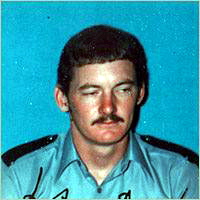
August 29th, 1985, Police Officer Lyncon Robert Dix Williams from Holden Hill police was murdered at Blair Athol. First Class Constable Lyncon (Lync.) Williams Aged 30 years, of Holden Hill Patrol Base, died in his patrol car after he responded with his junior partner to reports of gunfire at Ross Avenue Blair Athol. A 17-year-old shot him as he arrived on the scene. He had not even had the chance to step out of his car ahead of the fatal shot.
Police arrested and charged the shooter with murder. He was convicted and sentenced to imprisonment at the Governor’s pleasure. A non-parole period was later fixed at 13-and-a-half years.
Police Association President Peter Alexander reflected on William’s death as he laid a wreath at a Police Remembrance Day memorial service. “I didn’t know Lync Williams personally but, I’ll always remember the circumstances of that murder”, he said.
’I remember the shock of it and the grief for his family and workmates. It was a tragedy that was reflected right across the job.’
[divider_dotted]
Frederick MEREDITH
| 30/08/2015
Frederick MEREDITH
late of Liverpool, NSW
New South Wales Police Force
Regd. # ?
Rank: Chief Constable
Stations: Sydney area (see below) andLiverpool
Service: 1800 – 1811.
Was 1 of 50 ‘free men’ who volunteered and were accepted to join the Loyal Sydney Association set up by Governor Hunter to quell a possible uprising by ‘the Irish’. They were under the control of a civilian by the name of William Balmain. Frederick was involved in the Battle of Vinegar Hill in 1804. The 50 were known as armed volunteer Police (Militia)
1811 – 1828.
Sworn in 1811 as Constable under the newly formed NSW Police set up by Governor Macquarie.
Served at Liverpool 1822-1828 becoming Chief Constable in 1826.
Believed to have resigned in *1828 to become the first Post Master at Liverpool Post Office.
A story, below, indicates that Meredith – as the Chief Constable of Liverpool, was shot in both legs during a bush-ranger’s robbery in 1830.
Awards: ?
Born: 5 October 1763 in Dinham, Ludlow, Shropshire, England
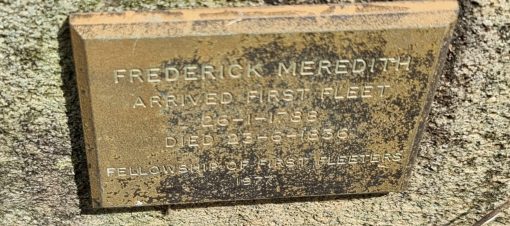
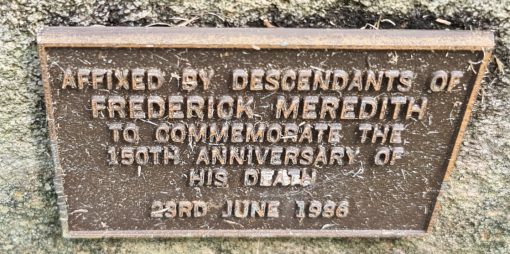
Died on: Thursday 23 June 1836
Event location: Bankstown, NSW
Cause: ?
Age: 73
Funeral date: ?
Funeral location: ?
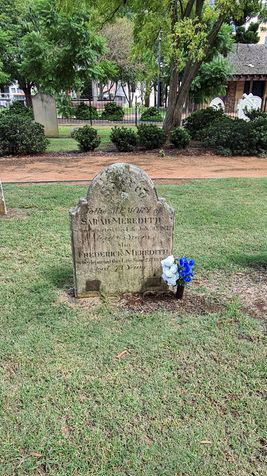
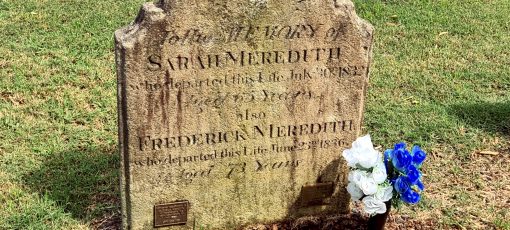
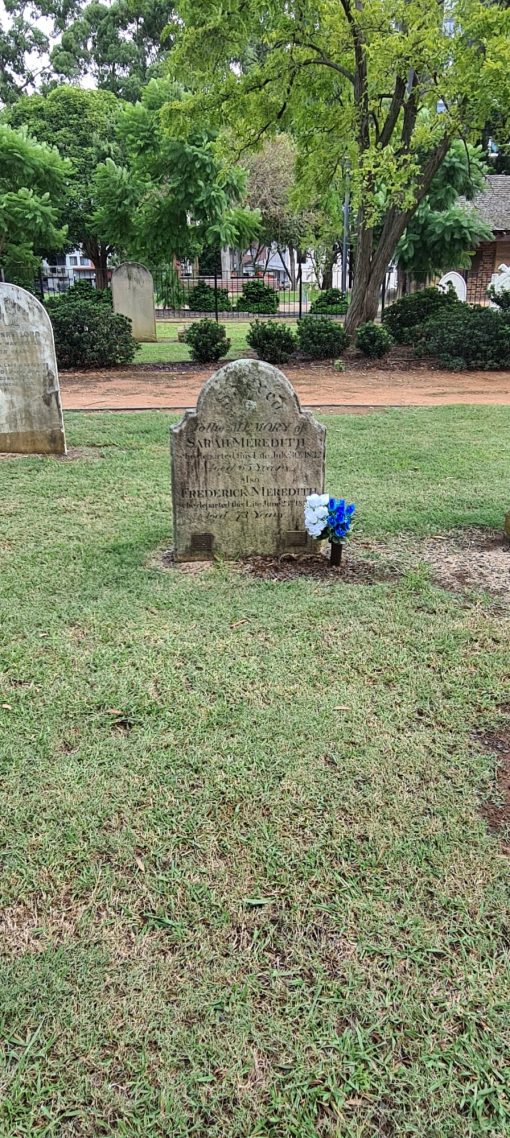
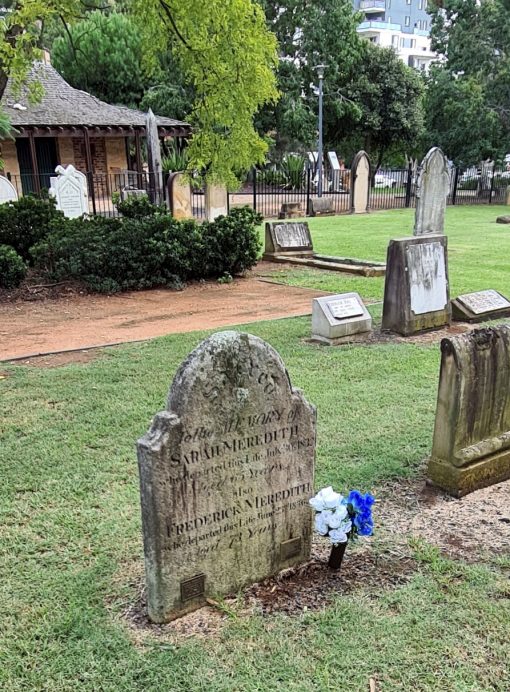
Buried at: Pioneer Memorial Park, Liverpool
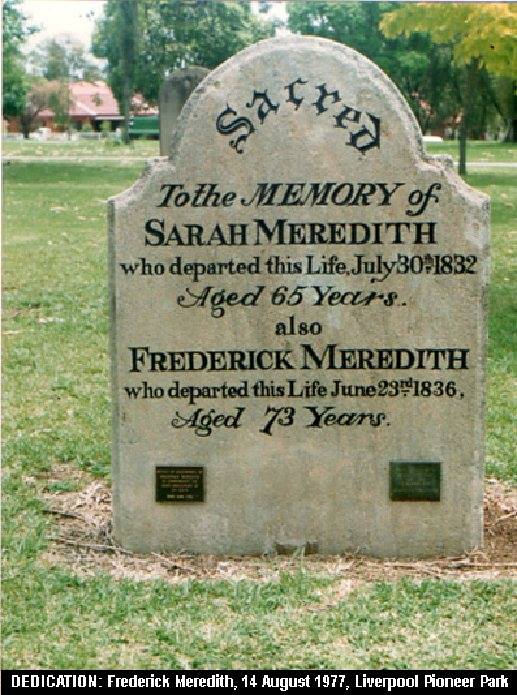
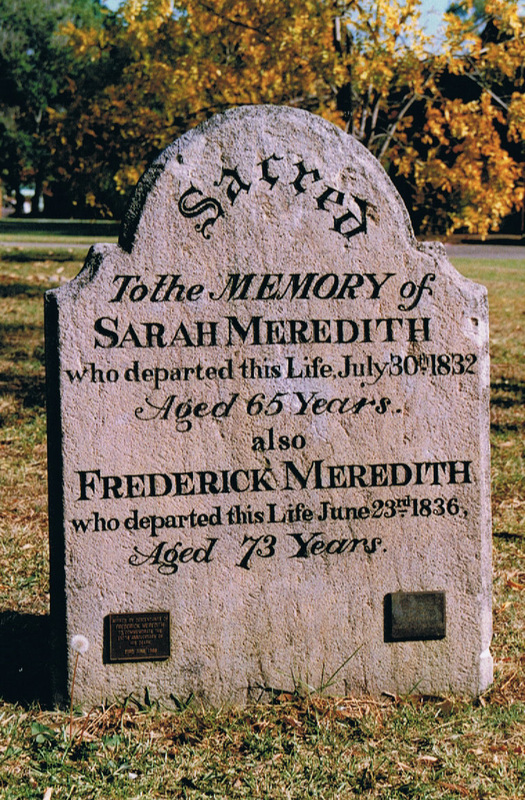
Frederick MEREDITH – Headstone in Liverpool Pioneer Park – 14 August 1977
FREDERICK is NOT mentioned on the Police Wall of Remembrance *NEED MORE INFO
Funeral location: ?
Frederick is believed to be the “third” Chief Constable of Liverpool until 1833.
He arrived on the First Fleet on the Scarborough.
His grave is at Liverpool Cemetery.
In 1811 Frederick joined Governor Macquarie’s police force. He was later appointed the first constable, then the “third” chief constable of Liverpool.
He remained in the police until 1833, holding positions of Constable, Chief Constable & District Constable.
Info via Jay Chappo – Beyond Courage FB page – 20 August 2015
They Sydney Gazette & New South Wales Advertiser Saturday 7 February 1835 page 2 of 4
SUPREME COURT.
FRIDAY, FEBRUARY 6.
(Before Mr. Justice Dowling and a Civil Jur..)
In a murder trial in the Supreme Court on Friday 6 February 1835, Frederick MEREDITH describes himself to the Court as “Chief Constable at Liverpool”
They Sydney Gazette & New South Wales Advertiser Thursday 7 July 1836 page 3 of 4
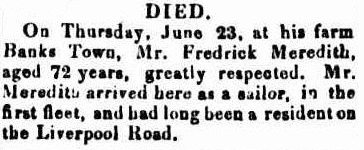
DIED.
On Thursday, June 23, at his farm Banks Town, Mr. Fredrick Meredith, aged 72 years, greatly respected. Mr. Meredith arrived here as a sailor, in the first fleet, and had long been a resident on the Liverpool Road.
Ordinary constables appointed to operate under Macquarie’s 1811 regulations were, John Jones, John Godwin, Edward Tulby, Matthew Quinn, Patrick Field, Samuel Reid, George
Cochrane, John Ayres, Joseph Evans, John Smith, James Mannek, William Goodman, William Donnelly, Abraham Lee, William Welch, Joseph Welch, Michael Simpson, John
Pauley, John Webb, Thomas Colebrook, James Phelan, William Thorn, Charles Evans, Thomas Jones, Abraham Bateman, George Atkins, John Anslie, William Foster, John Randall, Robert McAlister, Aaron Packenham, Thomas Mansfield, John Burgess, Thomas Salmon, John Smith, George Phillips, Ambrose McGuiggan, Gilbert Baker, Frederick Meredith, Joseph Smith, John Lyster, Thomas Dunn, James Chamberlin (also shown as Chamberlain).
Matthew Gibbons was Clerk of the Market and William Hawkins was Assistant Clerk of the Market.
Daniel Cubitt was Gaoler. In 1811, Macquarie also introduced traffic regulations.
NSW Police Heritage Story p231
Liverpool Police complained in July, 1845, that the police establishment there was completely without serviceable firearms. Consistent with outlying districts of Sydney in
those days, Liverpool District was plagued at times by bushrangers. Liverpool Police, like police throughout the colony, faced dangerous situations in which they depended on
their government issue firearms.
For instance, in 1830, Liverpool’s Chief Constable Frederick Meredith, was seriously wounded in a clash with a bushranger gang. ( Later reading, below, indicates that this would have been Frederick Meredith ( Jnr ). )
In March, 1830, a gang of 6 bushrangers entered a public house on the Liverpool Road and stole 8 pounds in cash, plus 5 gallons of spirits and a brace of pistols.
The robbers later entered the residence of a man named Jackson on the Liverpool Road and gained entry to the premises by posing as constables.
When the robbers entered the premises, the men were confronted by Jackson and Chief Constable Meredith. The candle illuminating the inside of Jackson’s place was extinguished and an affray followed, resulting in Jackson and his wife being injured. Meredith was shot in both legs.
One of the gang was captured, but the other bushrangers escaped, leaving behind a number of firearms.
Two of the bushrangers were John McNamara and William Dalton.
Following the demise of Dalton and McNamara, in June, 1830, McNamara was shot dead by Samuel Horn, wardsman of Parramatta, and Dalton came to the end of his life on the
hangman’s rope, Frederick Meredith was given a land grant for his conduct in protecting Jackson’s premises.
The Governor also commended Jackson for his conduct against the bushrangers. Jackson’s assigned servant William Johnston, received a ticket of leave for courageously protecting his master’s property.
Frederick Meredith
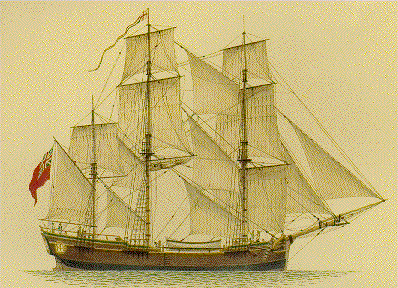
Frederick Meredith arrived with the First Fleet as a steward to Captain John Marshall of the convict transport Scarborough. He came before a magistrate for exchanging a “squirrel” for rum, apparently on the orders of the captain, and was sentenced to 100 lashes. Governor Phillip reduced the sentence to 50 lashes on representations from the captain and others. Shortly before the Scarborough sailed to China, he signed on to the HMS Sirius with the duties of a baker. He was twenty three and gave his birthplace as Denham Wales.
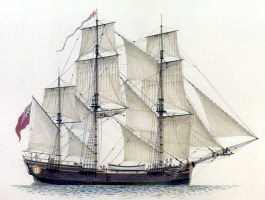
Convict transport Scarborough
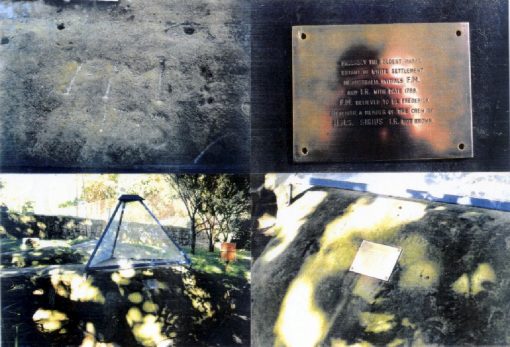
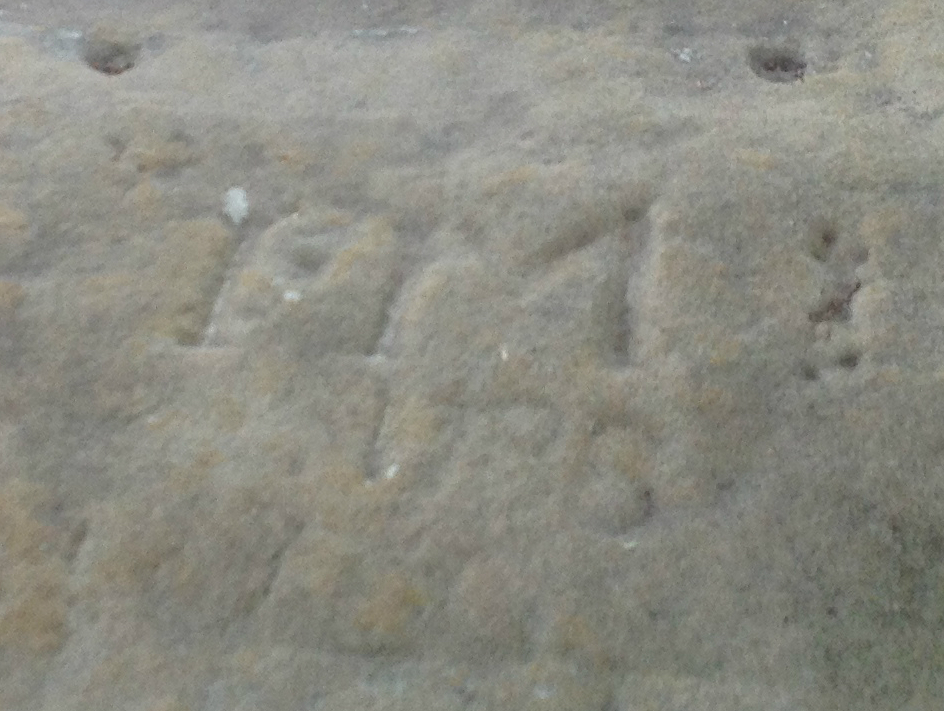
His initials are still visible at Garden Island where the crew were assigned to preparing a garden. After the Sirius was wrecked off the coast of Norfolk Island on 19 March 1790, Frederick and some of the other crew members returned to Port Jackson on HMS Supply.
Frederick Merediths initials at Garden Island ” Possibly the oldest marks er?ant of white settlement in Australia. Initials F.M. and I.R. with date 1783. F.M. believed to be Frederick MEREDITH, a member of the crew of H.M.S. SIRIUS. I.R. not known. ” Frederick Meredith’s initials at Garden Island
Captain Hunter of the wrecked Sirius and the crew embarked for England in March 1791. Frederick was then paid off by the navy in 1792 and decided his future lay in Botany Bay.
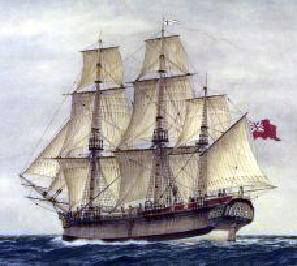
HMS Sirius
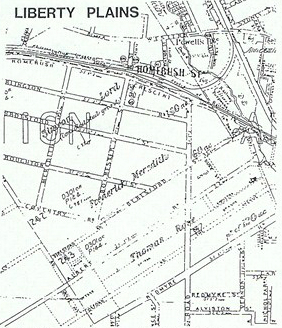
He returned on the Bellona in 1793 with a small group of the first free settlers. They were given land grants at Liberty Plains (now Strathfield). His second grant was 60 acres, where Rhodes railway station is today. Both land grants were unsuited to farming.
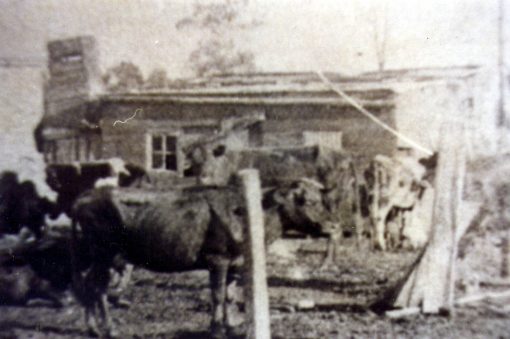
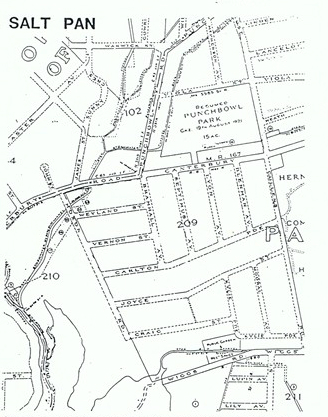
Frederick received a further grant of 120 acres near his farm at Salt Pan Creek (pictured at left and now part of Punchbowl) in 1809, for aiding a neighbour in an affray with the aborigines.
He also had a bakery in Chapel Row (now Castlereagh Street) which he sold in 1810.
Frederick had several children with convict women: Charlotte born to Mary Allen (Allein) in 1790; Amelia to Anne Case in 1793; and Charlotte to Mary Kirk in 1794.
Salt Pan Creek Grant
In 1800, Governor Hunter set up the Loyal Sydney Association, following reports of rebellion by Irish convicts. Frederick enrolled as a volunteer armed policeman and was involved in the Vinegar Hill uprising.
Frederick married Sarah Mason, a convict who also arrived on the Bellona. Their relationship had begun in 1800 and they were married in 1811 when Frederick joined Governor Macquarie’s police force. He was later appointed the first constable, then chief constable of Liverpool. Their children were Frederick junior, born in 1801, Sophia in 1803, Elizabeth in 1806, William in 1807, Anne in 1811 and Eleanor in 1813.
In 1823 he joined the Liverpool and surrounding districts police force. He remained in the police until 1828, holding positions of Constable, Chief Constable and District Constable. His final land grant was 60 acres at Liverpool Road, Banks Town in 1826. The farm was called Gunsborough.
The first post office was opened at Liverpool in 1828 and Frederick acted as the first postmaster until Donald MacLeod took up his appointed position.
Frederick and Sarah lived at Gunsborough until her death in 1832. He married Mary Ann Day in 1833. He died at the property in 1836 and was buried next to Sarah at Liverpool Cemetery.
Birth
Death Marriage
Spouse
Marriage
Spouse
Marriage
Spouse
Marriage
Spouse
Marriage
Spouse
Father
Mother
Sibling/s
Children
5 October 1763
23 June 1836 (didn’t marry)
Mary Allen
(didn’t marry)
Anne Case
(didn’t marry)
Mary Kirk
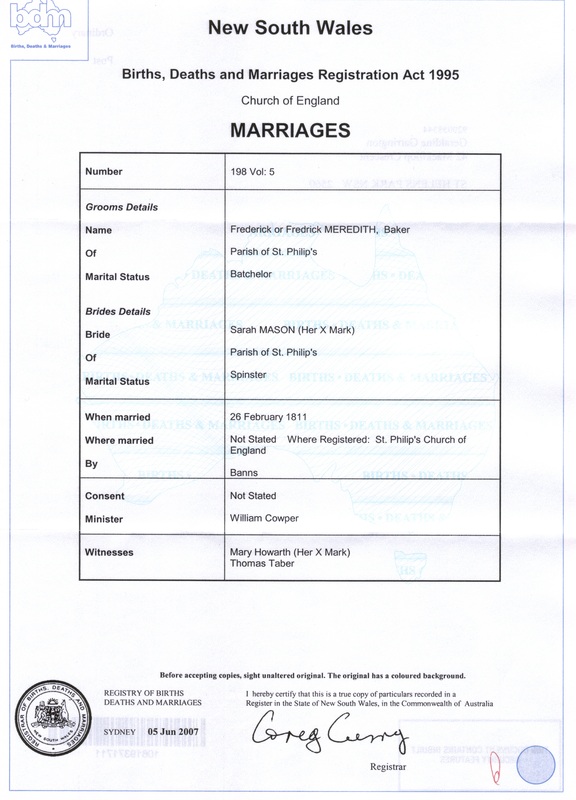
26 February 1811 Sarah Mason
19 February 1833
Mary Ann Day Charlotte Allen(mother; Mary Allen)
Amelia Case (mother; Anne Case)
Charlotte M Kirk/Meredith (mother; Mary Kirk) Frederick Meredith (mother; Sarah Mason)
Sophia Meredith (mother; Sarah Mason)
Elizabeth Meredith (mother; Sarah Mason)
William Meredith (mother; Sarah Mason)
Ann Meredith (mother; Sarah Mason)
Eleanor Caroline Meredith (mother; Sarah Mason)
Dinham, Ludlow, Shropshire, England
Bankstown, Sydney, New South Wales, Australia Sydney, New South Wales, Australia Liverpool, Sydney, New South Wales, Australia
Frederick Meredith was born on the 5th of October 1763. It is thought that he was born in Dinham, Ludlow, Shropshire, England. It is unclear where exactly Frederick was born, with people speculating that he may have been born in Denham, Buckinghamshire, London, England which is just South East of Harefield, home to many bakers, which Frederick later became (see Frederick Meredith by David Swinfield).
Many of his descendants are currently using DNA research to try and narrow down an area of the UK he and his ancestors are from. If you are one of Frederick’s descendants and would like to know more you can get in touch with Paul Gallagher at the Frederick Meredith Descendants Group (FMDG).
Not much is known of Frederick’s early life in England.
On the 13th of May 1787 Frederick left from Portsmouth, England on board the “Scarborough” as part of the First Fleet. There were 208 male convicts onboard. Frederick came free as steward to Captain John Marshall.
The Scarborough by marine artist Frank Allen
The “Scarborough” was a ship of 430 tons built at Scarborough in 1782. She was 111 feet (34m) long and 30 feet (9m) wide. The prison deck was very small and cramped. The height of the space was only 53 inches (135cm). The ship had a contract with the British Government to carry convicts. The owners were paid at a rate of 10 shillings per ton per month. They had to agree to keep the prisoners secure and in safe custody. After transporting the convicts to New South Wales, the “Scarborough” was under contract to work for the East India Company. The “Scarborough” sailed back to England and returned to Port Jackson in the Second fleet. Apart from the ‘Sirius’ and ‘Supply’, she was the only other ship from the first fleet to return.
The First Fleet consisted of 11 ships which sailed from Great Britain on the 13th of May 1787 with about 1,487 people, including 778 convicts (192 women & 586 men), to establish the first European colony in Australia. The fleet was led by Captain Arthur Phillip.
The ships arrived at Botany Bay between 18 & 22 January 1788. HMS Supply arrived on the 18th of January. The “Alexander”, “Scarborough” & “Friendship” on the 21st of January. The remaining ships, “Charlotte”, “Lady Penrhyn”, “Prince of Wales”, “Borrowdale”, “Fishburn”, “Golden Grove” & “Sirius” on the 22nd of January.
So on the 21st of January 1788, aged 24 years, Frederick arrived in Botany Bay, Sydney, with 201 male convicts, 30 crew and 50 marines surviving the 251 day voyage aboard the “Scarborough”. They sailed into Port Jackson (Sydney Harbour) on the 26th of January. The new site had everything the first settlers needed; deep water close to the shore, shelter and fresh water. Phillip named the site Sydney Cove, after Lord Sydney the British Home Secretary. Today this date is still celebrated as Australia Day, marking the beginnings of European settlement.
This was one of the world’s greatest sea voyages — eleven vessels carrying about 1,487 people and stores had travelled for 252 days for more than 15,000 miles (24,000 km) without losing a ship. Forty-eight people had died on the journey, a death rate of just over three per cent. Given the rigours of the voyage, the navigational problems, the poor condition and sea-faring inexperience of the convicts, the primitive medical knowledge, the lack of precautions against scurvy, the crammed and foul conditions of the ships, poor planning and inadequate equipment, this was a remarkable achievement.
On the 22nd of February 1788 Frederick was charged with exchanging goods with convict James Stow. Frederick had given the convict beef and bread as well as rum in exchange for a ‘curious beast’ a possum. Such exchanges were against government orders, and although Meredith had his master’s
permission, he was sentenced to receive 100 lashes, on his bare back, with a cat of nine tails, in the middle of the convict’s camp. Governor Phillip reduced the sentence to 50 lashes in response, said surgeon Arthur Bowes Smyth, to appeals from ‘several gentlemen’ who respected Meredith and who believed the punishment too harsh for the crime. He was the fourth person to appear before the magistrate and received 50 lashes as punishment.
In 1788 Frederick was assigned to look after the vegetable patch on Garden Island in Sydney Harbour. While there Frederick, along with 2 other European Settlers, carved his initials FM along with the year 1788 in a rock.
The other initials are believed to belong to marine private Joseph Redford of HMS Sirius and William Bradley, first lieutenant of HMS Sirius, who was a cartographer. Frederick was chosen because of his ability to both read and write and thus his ability to document the time spent there. All three men were crew members of HMS Sirius during the winter months of 1788 at a time when Sirius was anchored off Garden Island and the ship’s crew had planted a garden there to grow vegetables to help the reduction of scurvy.
Frederick’s initials carved in sandstone at Garden Island, Sydney Harbour in 1788. Possibly the oldest marks extant of European settlement in Australia.
Frederick was on the “HMS Sirius” when it sailed from Sydney in October 1788 for the Cape of Good Hope, South Africa in search of food for the starving colony. They returned to Sydney in May 1789.
On the 9th of May 1790 a daughter was born to Mary Allen. She was named Charlotte.
In Sydney he was given the care of 25 sheep and lambs, the property of commissary John Palmer. In August, Frederick and Mary gave evidence before the Court of Criminal Jurisdiction in the trial of Hugh Low, charged with stealing one of the lambs. Low was sentenced to death and executed the next day. Judge-Advocate David Collins noted that no leniency could be extended because ‘the preservation of our stock was an object of so much consequence to the colony’.
After being back in Sydney for 1 month he then departed aboard the Dutch merchant ship “Waakzaamheid” (alternate spelling “Waaksamheyd”) bound for England, with 125 men on board. He was hired to sail to Batavia to collect supplies and then on to England for Captain John Hunter to face court-martial, for the loss of HMS Sirius, in which he was eventually honourably acquitted.
On the 22nd of April 1792, Frederick arrived in Portsmouth, England aboard the “Waakzaamheid”. Owing to her bad sailing, contrary winds, and calms, the voyage to Batavia had lasted for 26 weeks (onboard they only had provisions for 16 weeks). While attempting to get provisions at Mindanao, the party had a serious affray with the Malays, fortunately without sustaining any loss.
Unknown to him, back in Sydney his daughter Charlotte had died in May 1792 and the child’s mother Mary Allen was living with another convict, Edward Pales.
Frederick departed Gravesend in Kent, England on the 8th of August 1792 aboard the “Bellona”. After a 163 day voyage the “Bellona” arrived in Sydney Harbour on the 16th of January 1793.
The ship was carrying 17 female convicts, including Ann Case whom he had impregnated during the voyage and Sarah Mason who was to become his future wife and mother to 6 of his children. His daughter, Amelia Meredith, born to Ann Case, was born on the 10th of May 1793. The affair with Ann was brief and by the time Amelia died, on the 27th of February 1794, Frederick had formed a liaison with Mary Kirk, who was transported on the “Royal Admiral” in 1792.
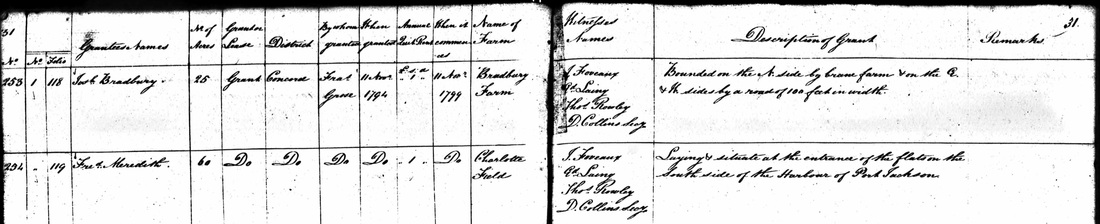
On the 28th of May 1793 Frederick was granted 60 acres of land at Liberty Plains (now Strathfield) which he named “Charlotte Farm”. He later sold this property to Thomas Rose, as it was unsuitable for farming.
The earliest use of the name Liberty Plains is found in the description of grants of land to Thomas Rose, Frederick Meredith, Thomas Webb and Edward Powell on 28 May 1793. They had arrived as passengers on the “Bellona” in January of the same year. With the help of families and servants, they cleared the land and grew wheat and corn. However, the fertility of the ground was exhausted within four to five years, so that their families were dependent on government rations.
Clearing the land was slow. Samuel Crane was killed in 1794 by a falling tree when felling timber on his 25 acres at Concord. His farm was advertised for sale as having ‘a comfortable hut, four acres planted to corn and half an acre to potatoes’.
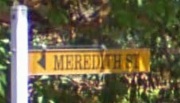
The grant can be seen to the south of the railway line, between Strathfield and Homebush stations. Meredith Street, Homebush, runs down to one corner of the grant.
Meredith St, Homebush
Frederick St, Bankstown
Meredith St, Bankstown
On the 26th of April 1794, Frederick fathered another child, this time to Mary Kirk. The daughter was named Charlotte. Charlotte and a man named William Stewart had 3 children; Jane Rebecca, Robert, and John, born in 1812, 1816, and 1818. Charlotte then married James Charles Farrell in 1825. Their children were James Lawrence (1825), Mary Elizabeth (1828), Charlotte Rosina (1831), Charles Frederick (1833), and William Thomas (1835). She died in 1852 in Port Macquarie, New South Wales, aged 58.
On the 11th of November 1794 Frederick received his 2nd land grant, 60 acres at Concord which he named “Charlotte Field”. He later sold this property in 1798 to John Colethread/Coulthread for 87 pounds, as it too was unsuitable for farming.
On the 17th of March 1801, Frederick’s partner Sarah Mason gave birth to a boy, Frederick Meredith Junior. Frederick and Sarah would have 6 children in total; Frederick, born 1801, Sophia, born 1803, Elizabeth, born 1805, William, born 1807, Ann, Born 1811, and Eleanor Caroline, born in 1813. Frederick and Sarah would later marry in 1811.
In September 1800 he was subscribed to the rules and orders of the Sydney Loyal Association (an armed body which was formed to guard against the possibility of an insurrection by seditious Irish convicts). Governor Hunter set up the Sydney Loyal Association in 1800, following reports of rebellion by Irish convicts. Frederick volunteered as an armed policeman & was involved in the Vinegar Hill uprising.
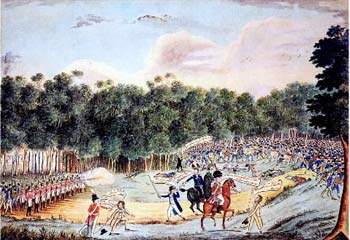
On 4 March 1804, 233 convicts led by Phillip Cunningham, escaped from a farm, intent on capturing ships to sail to Ireland. In response, martial law was quickly declared in New South Wales. The mostly Irish rebels, having gathered reinforcements, were hunted by the colonial forces until they were sequestered on 5 March 1804 on a hillock nicknamed Vinegar Hill. Under a flag of truce, Cunningham was arrested and troops charged and the rebellion was swiftly crushed by raid. Of the nearly 300 rebels directly engaged in the battle, 15 were killed, nine executed, seven whipped with 200 or 500 lashes then allotted to the Coal River chain gang, 26 sent to the Newcastle coal mines, others put on good behaviour orders against a trip to Norfolk Island, and most pardoned as having been coerced into the rising. Cunningham was court martialled under the Martial Law and hanged at the Commissariat Store at Windsor. It was the first and only convict uprising in Australian history.
In March 1809 Frederick had resumed his trade as a baker. He had a bakehouse in Chapel Row (now Castlereagh St, Sydney).
On the map it may be seen to be bounded by Moxon Rd, Canterbury Rd, Punchbowl Rd, Ross St, Cullens Rd, and Wiggs Rd.
Frederick was awarded a 3rd Land Grant of 120 acres by Governor Lachlan Macquarie in the Botany Bay district Salt Pan Creek (now Punchbowl) on the 1st of January 1810. It was called “Meredith’s Farm” and was bounded on the southern side by a line of ponds, which provided the property with water. This grant was awarded for aiding a neighbour in an affray with the aborigines.
New farms bordered the pathways to the Georges River, Kogarah Bay and Salt Pan Creek, and when William Bond and Frederick tried to occupy their land between Cox’s Creek and Salt Pan Creek, they had to battle a possession dispute with Aboriginal leader Tedbury and his group, the Gwea Gal tribe. During this clash, a spear went close enough to graze Frederick’s ear. Frederick and the other settlers retreated, only to return when the aborigines had moved on.
In 1811 Governor Lachlan Macquarie formed a regular police force and Frederick was among those appointed as constable. He eventually became the first Chief Constable at Liverpool NSW Australia.
He married Sarah Mason on the 26th of February 1811 at the St Phillip’s Church of England in Sydney.
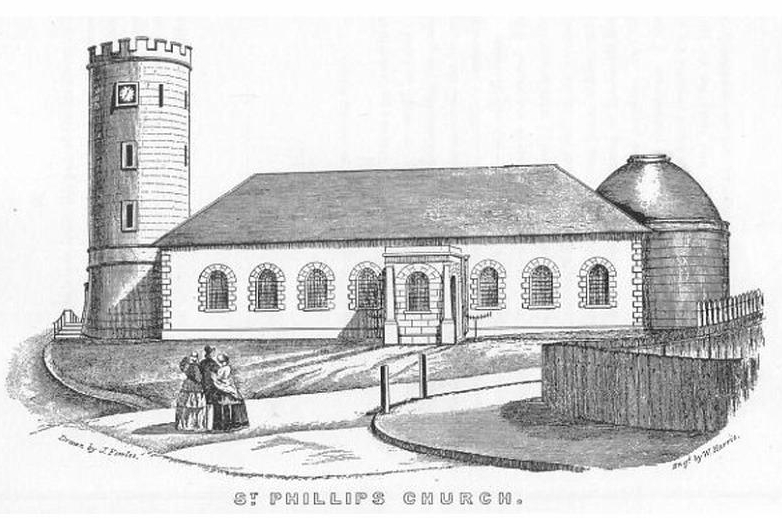
St Phillip’s Church 1798-1856, was on part of the site now covered by Lang Park, which is bounded by York, Grosvenor and Lang Streets, Sydney NSW Australia. The church had a 150-foot high, round clock tower. It was made from poor materials and gained a reputation as “the ugliest church in Christendom”. The church was named in honour of the colony’s first Governor, Arthur Phillip.
On the 23rd of May 1822, he was appointed constable at Liverpool. On the 11th of March 1823, Frederick was nominated to act as Chief Constable at Liverpool.
In 1828, when the first post office was opened at Liverpool, Frederick acted as the first postmaster until Donald MacLeod took up his appointed position.
Frederick remained Chief Constable at Liverpool up until at least 1833.
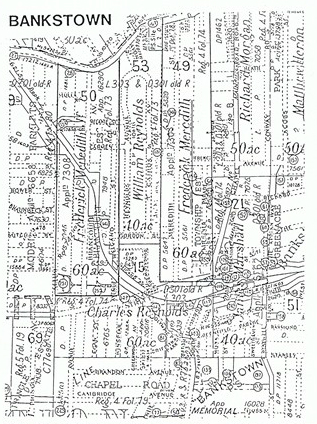
In 1831, aged 68, a 4th Land Grant was awarded to Frederick of 60 acres at Liverpool Rd, Bankstown (now the Hume Highway). Although promised earlier (by Governor Macquarie) the grant was not made legal until signed by Governor Darling. The farm was named “Gunsborough”.
The position of the grant is clearly marked by the line of present day Meredith St which runs from North to South through the full length of the farm. To the West lay Frederick Meredith Junior’s grant – called “Merefield”.
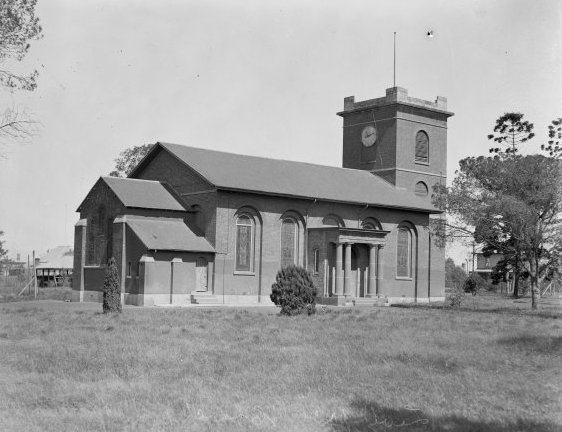
St Luke’s Anglican Church, Liverpool; built in 1815, it is the oldest Anglican Church in Australia.
On the 19th of February 1833, aged 69, Frederick married Mary Ann Day at St Luke’s, Liverpool.
Frederick died on the 23rd of June 1836 at his residence “Gunsborough” Liverpool Rd, Bankstown aged 72 years.
7 July 1836, The Sydney Gazette and New South Wales Advertiser, page 3
He is buried alongside Sarah Mason at Liverpool Pioneers Memorial Park.
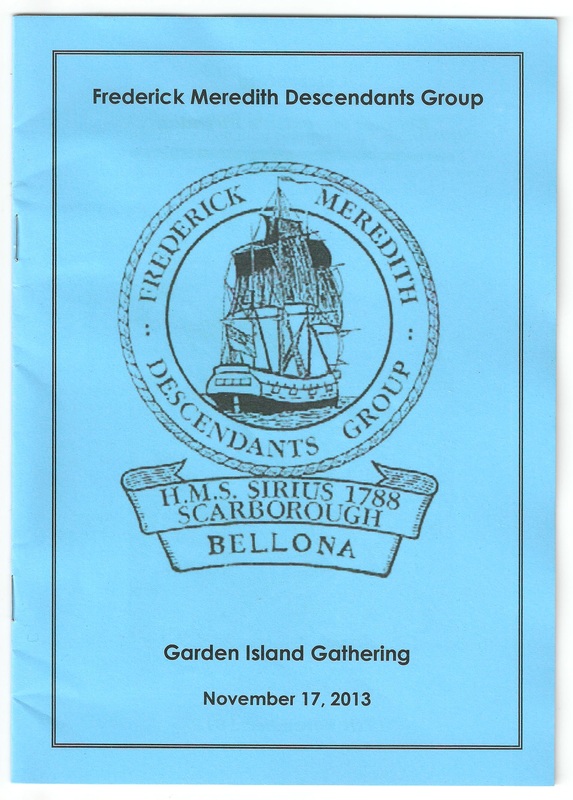
In 2013 they met at Garden Island, where Frederick’s initials are carved, on the 200th anniversary of the birth of his youngest child Eleanor Caroline Meredith.
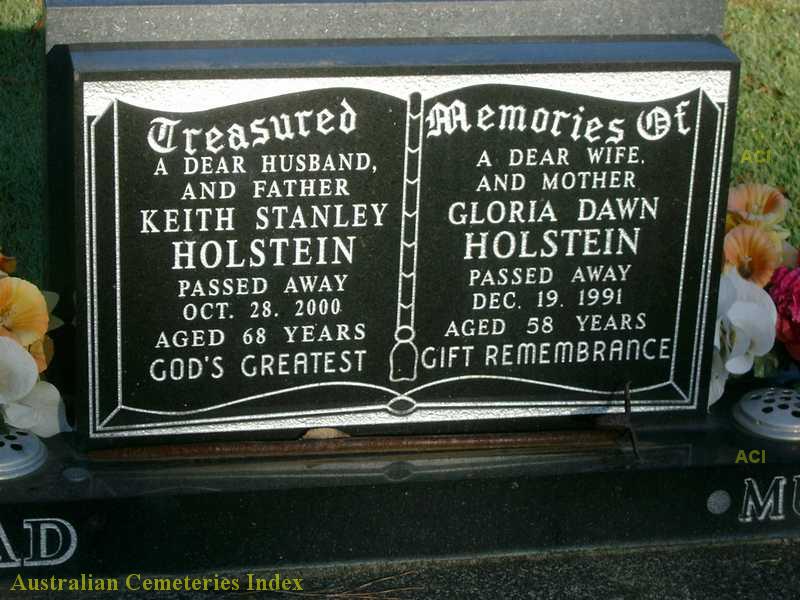
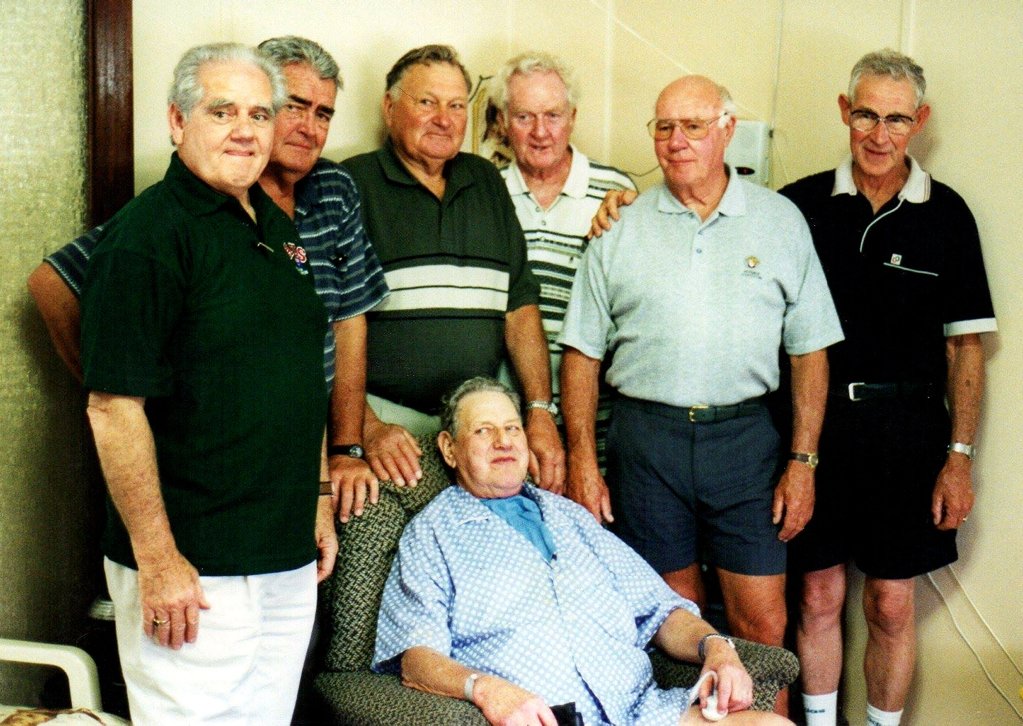
Eighteen years ago Class 9 /1951 from the Penrith Police College held the final get together with my father Keith Holstein as he was too sick to travel to a reunion. The group changed their plans and visited dad at home. He passed away 18 years ago today. Sadly missed.
Keith HOLSTEIN: Class 9 /1951 from the Penrith College held the final get together with my father Keith Holstein as he was too sick to travel to a reunion. The group changed their plans and visited dad at home.
( L-R at rear ) ?, ?, ?, ?, ?, Eric MAURER # 7134
[divider_dotted]
Government Gazette of the State of New South Wales (Sydney, NSW : 1901 – 2001), Friday 21 June 1968 (No.76), page 2537
Department of Mines, Sydney, 21st June, 1968.
APPOINTMENT
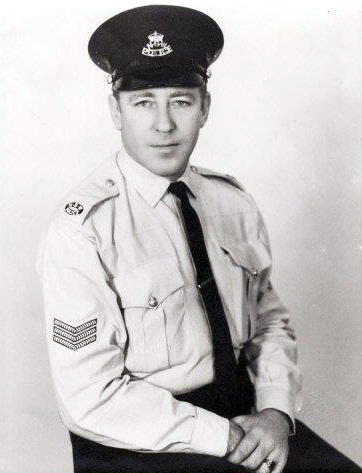
HIS Excellency the Governor, with the advice of the Executive Council, and in pursuance of the provisions of section 6, Mining Act, 1906, as amended, has approved of the appointment of Sgt 3rd Class Keith Stanley Holstein, Officer-in-Charge of Police, Nundle, as Warden’s Clerk, Mining Registrar and Officer authorized to issue Miner’s Rights and Business Licenses at that place, such appointment to take effect on and from 12th February, 1968, vice Senior Constable Victor John Feltis.
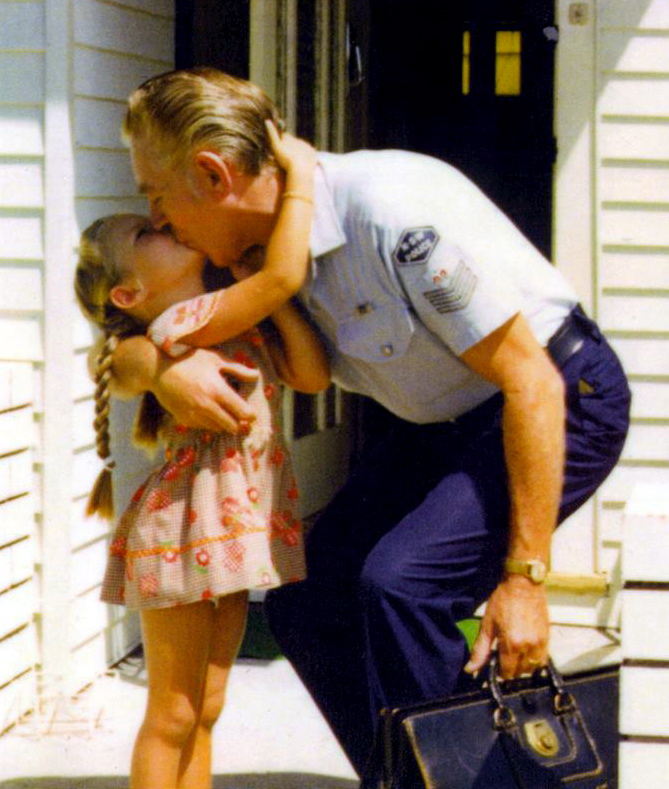
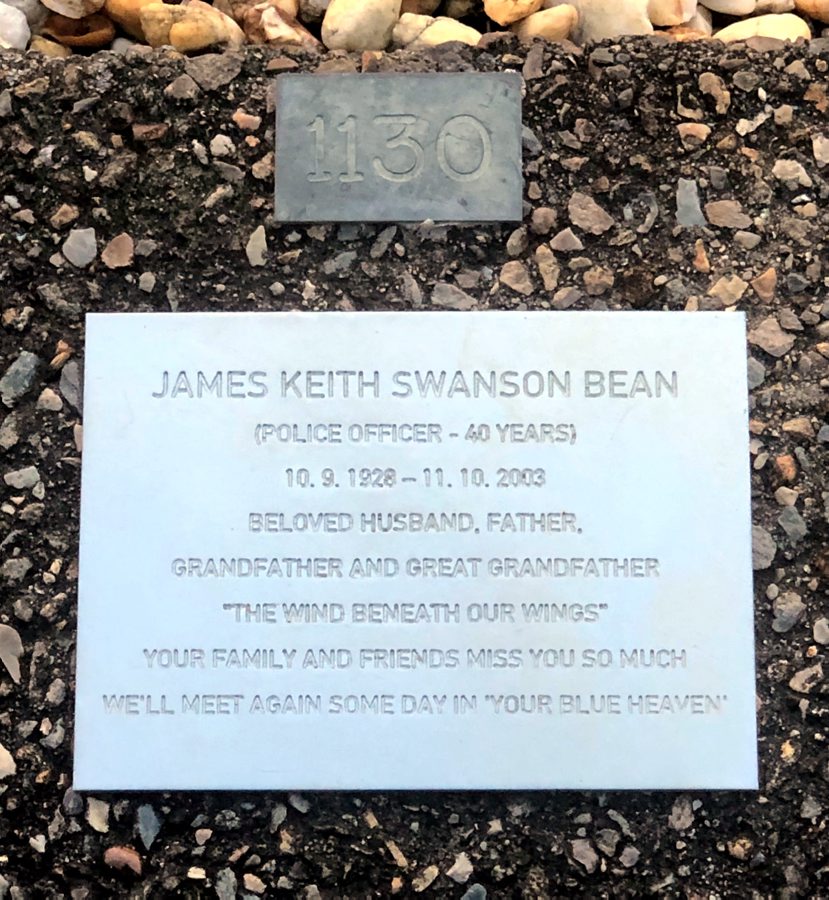
SERGEANT KEITH BEAN – KISSING HIS DAUGHTER – MELINDA.
James Keith Swanton BEAN aka Keith, Duke Husband to Mary SCHNEIDER OAM ( for 35 years ) and Father to Melinda SCHNEIDER ( Country singer )
KEITH is NOT mentioned on the Police Wall of Remembrance * NOT JOB RELATED
Finding Melinda Schneider
…….
So just how is Melinda planning on touring with a 16 month-old and remaining sane? “I don’t know yet!” she exclaims. “We will probably just go out for weekends or for a few days at a time. Mark will come out with me and help out. It’s not going to be easy and I’m sure it will have its challenges. However Sully [Sullivan] loves new adventures, they [children] need such stimulation anyway. I’ll just take one day at a time.”
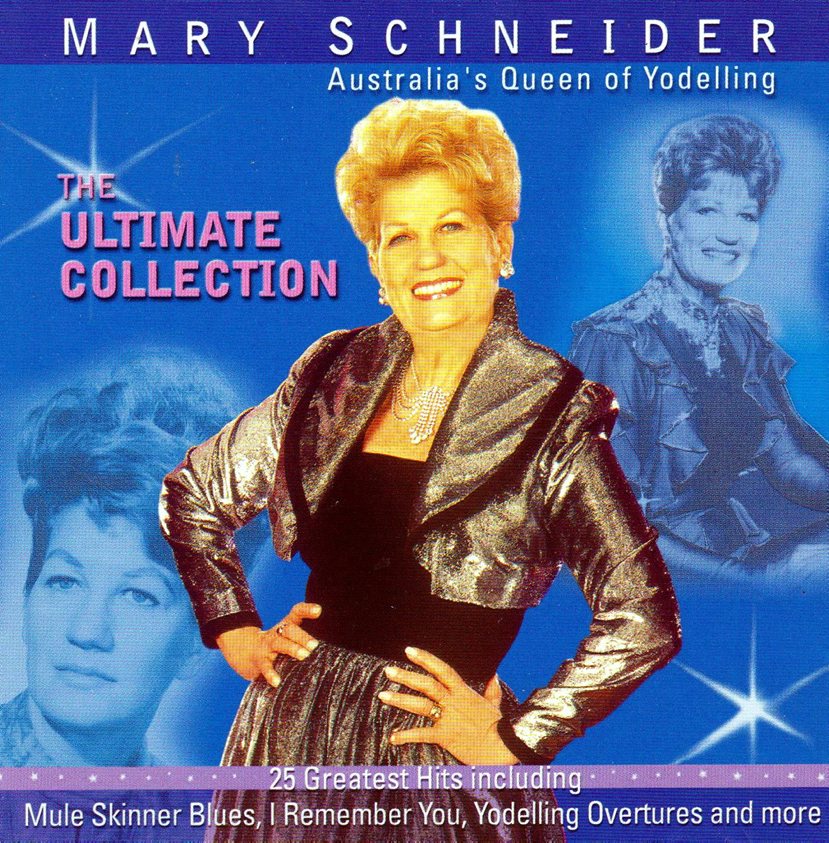
Listening to Melinda chatting about going on tour with her family reminded me that her own upbringing was not dissimilar. Melinda is the only child of yodelling great, Mary Schneider, and her policeman father, Keith Bean, was also from a musical family. Melinda spent many a night backstage whilst her mother performed, sometimes sleeping in her mother’s fur coat. I touch on this subject with Melinda and ask if having famous parents will impact the way she raises her son.
“It was interesting writing this show – when you have a child you look at your own upbringing – as much as your parents did the best they could you don’t want to make some of the same mistakes they made. It takes you a while to figure out who you are with famous parents. I recall Chaz Bono [offspring of Sonny and Cher Bono] saying that it’s difficult to know where you belong when your parents are famous. It’s not a normal family situation – the attention is on the parents the whole time rather than the children. I talk about that in the show.
“With Sully I want to keep a good balance of making sure he is number one focus and it’s not all about me – I want him to have a good sense of self. Growing up, my mum had taught me dancing, juggling, yodelling … and I didn’t really have a great interest in it myself. I want to see who he is – what’s in his heart. I’m fascinated to know who he is.”
Continuing on the subject, Melinda adds, “When I was three I recorded on Mum’s albums, I had a show by age of eight. People would come up to me after the show and say ‘You’re not as good as your mother’. That used to really upset me – no one wants to hear that. Growing up I was quite confused about what I wanted to do musically and what was my truth. I just didn’t know who I was.”
Most people don’t realise that Melinda didn’t become a recording artist in her own right until her late 20’s. In fact, Melinda left school young and went and studied fashion. She remembers, “I had my own fashion label working out of Mum and Dad’s garage – I made stage costumes and all sorts for loads of people. Mum’s grandma was an amazing seamstress – perhaps that is where I got the talent from. It was funny, during my early 20s I would be in the garage running the business and always singing at top of my lungs to Top 40 hits and Michael Bolton songs. Mum used to come in and ask ‘Are you sure you don’t want to be a singer?!’ I think I was denying myself. Then I realised, deep down, I really did want to be a singer.”
DAVE’S DIARY – 23/1/13 – PREVIEW OF EPISODE 7 – SERIES 19
Elizabeth collaborated with former Nu Country TV host and recording stage star Melinda Schneider, now 40, to write the title track of her fourth album Balls.
They both recorded their co-writes Some Times It Takes Balls To Be A Woman and Rest Your Weary Mind on recent albums.
Elizabeth and Melinda co-wrote more than a dozen songs including I Like Men in Trucks on Melinda’s fourth album Stronger.
Melinda also wrote songs about late father – Sgt Keith Bean – a policeman.
Keith and Tom didn’t meet at a still but Melinda’s mum – famed yodeller Mary Schneider – sang with Tom and Joyce backstage at the Grand Ole Opry during one of Cook’s many dates there.
“I used to sing The Black Hills Of Dakota with my mum (yodelling icon Mary) and my Aunt Rita when I was a little girl,” Melinda revealed as she romped through one of many songs from 1953 movie Calamity Jane and its successors.
“We’d do the three-part harmony at family get-togethers.”
She accentuated the family flavour with a shout out to her duet partner at ground zero who responded with a yodel – her unique GPS beacon.
“I could never lose mum in the dark,” she joked.
Melinda also tickled the family tree when she revealed how her late sire – Sgt Keith Bean – greeted her decision to revert to her mama’s name after cruel Kogarah schoolyard taunts ranging from “string been to les been.”
Melinda Schneider long ago mastered cross genre pollination with music and dance.
But she made a huge leap to the mainstream with her writing, narrating and performing in this energised Doris Day tribute show.
And the dynamic diva also disproved the adage about dangers of working with animals.
Schneider’s rapport with her teenage Labrador-Kelpie crosses Rosie and Daisy was also a stroke of magic.
They were all ears and eyes when she serenaded them on the stage front couch with Your Eyes Don’t Lie.
It was fitting that she returned to the scene of the rhyme – Mike Walsh’s Melbourne mecca Her Majesty’s – to premiere her show.
Seven years ago in the Yarra city the seeds for the show were sown when the singer was a guest artist on a Doris tribute concert.
So it was no surprise there was a capacity crowd for the premiere of a fast paced trip through the back pages of the octogenarian Hollywood legend.
When Schneider bumped Canadian balladeer Michael Buble from ARIA chart tops with her 12-song disc Melinda Does Doris she was thawing out that metaphorical iceberg.
This time, in collaboration with co-writer David Mitchell, Melinda tapped a deep well.
“I used to sing The Black Hills Of Dakota with my mum (yodelling icon Mary) and my Aunt Rita when I was a little girl,” Melinda revealed as she romped through one of many songs from 1953 movie Calamity Jane and its successors.
“We’d do the three-part harmony at family get-togethers.”
She accentuated the family flavour with a shout out to her duet partner at ground zero who responded with a yodel – her unique GPS beacon.
“I could never lose mum in the dark,” she joked.
Melinda also tickled the family tree when she revealed how her late sire – Sgt Keith Bean – greeted her decision to revert to her mama’s name after cruel Kogarah schoolyard taunts ranging from “string been to les been.”
“Dad said I was now a has-been,” she joked.
This was a winner with the ageing audience, daubed with dowagers and duchesses from the demographic that 3AW and Magic leg-ropes to the wireless.
Despite the acrid aroma of mothballs from stoles and furs liberated from suburban closets (not those that once housed much younger opening night au pair boys) the wearers knew most of 26 songs from a Golden era when lyrics reigned supreme.
Just like roots country – the genre banished from commercial radio here.
Not for these Day devotees grunge or techno trash that energises ecstasy bunnies down on King, Queen and William Streets.
This was a gramophone-generated posse waltzing down memory lane to the refined refrains of his or her majesty’s voice.
You know the songs – Everybody Loves A Lover, Perhaps, Perhaps, Perhaps, Sentimental Journey, I’ll See You In My Dreams, Secret Love and Teacher’s Pet before the latter two became a trigger for the Victorian court name suppression industry.
Schneider, enhanced by her 14-piece orchestra, also revived romance in Love Somebody, Put Em In A Box, The Deadwood Stage and It’s Magic.
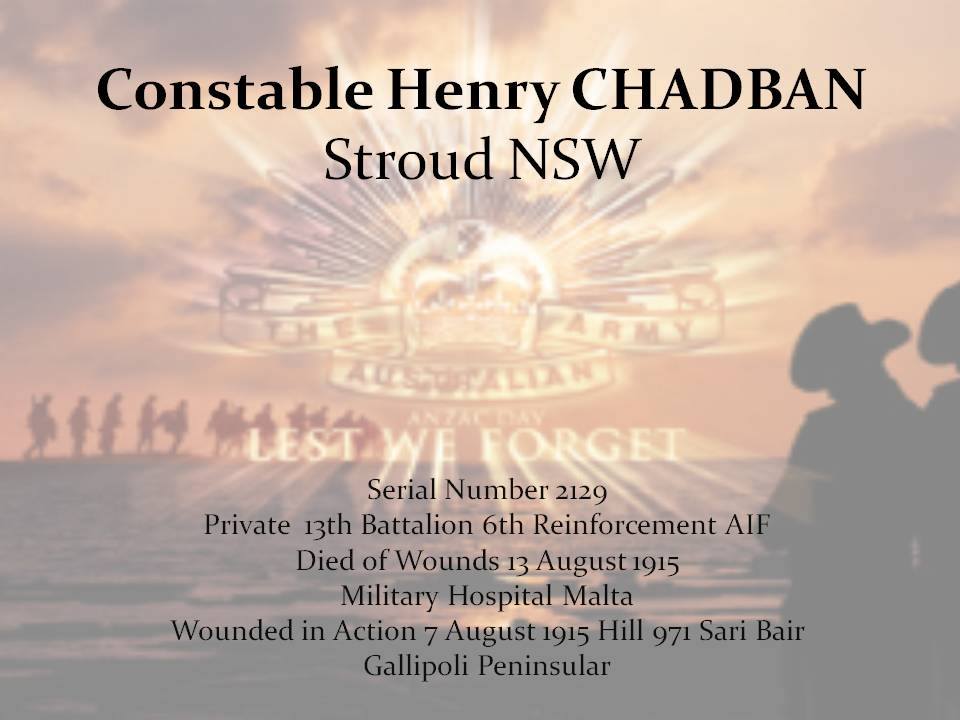
Embarkation: 14 June 1915 from Sydney aboard HMAT Wandilla A62
Next of kin: Son of Henry & Mary Jane Chadban
Religion: C of E
Single / Married: Single
Australian Ware Memorial Panel number: 68
[/blockquote]
Awards: Memorial Scroll & King’s Message – received by his father on 29 August 1921
Memorial Plaque & King’s Message received by his father on 3 April 1922
Victory Medal – posthumously received by his father on 25 December 1922
Born: ? ? 1887
Event date: Saturday 7 August 1915
Event location: Hill 971, Sari Bair, Gallipoli Peninsular
Died on: Friday 13 August 1915
Place of death: Military Hospital, Malta
Cause: Died of wounds – WW I
Age: 28
Funeral date: 14 August 1915
Funeral location: ?
Buried at: Pieta Military Cemetery, Malta. Row 6B grave 3
Memorial at: ?
Harry CHADBAN aka Henry
[alert_blue]HENRY is NOT mentioned on the Police Wall of Remembrance[/alert_blue] * NOT JOB RELATED
[divider_dotted]
Funeral location:
[divider_dotted]
Newcastle Morning Herald & Miner’s Advocate Friday 14 March 1913 page 7 of 8
A Violent Customer. Olaf Anderson (21), seaman, was charged with maliciously damaging one door and two windows, the property of Cenuto Gabriel Anderson. Accused said he pleaded guilty to breaking one window, but to nothing else.
Prosecutor stated that the accused came to the Blue Bell Hotel, of which witness was lessee, somewhat the worse for liquor, shortly before eleven o’clock on the previous evening. He smashed in the panel of the door, but whether he kicked it in or struck it with a stone he did not know. He also broke two of the windows with a stone.
Constable Chadban deposed to arresting the accused, and corroborated the extent of the damage done. Accused was fined £1, and ordered to pay £3, the amount of the damage done, in default, one month’s imprisonment.
Newcastle Morning Herald & Miner’s Advocate Thursday 6 November 1913 page 7 of 8
William Craig was charged with having been drunk and disorderly in a railway carriage on October 26. Defendant, who was represented by Mr. A. H. James, pleaded not guilty.
Constable Chadban said he was a passenger on the train which left Toronto for Newcastle at 6p.m. on October 26. Defendant got in the train at Cockle Creek. He was very much under the influence of drink, and went into the guard’s compartment. He sat on the guard’s seat, and when asked to go into the other part of the compartment refused to do so. He stopped arguing with the guard for five minutes. Witness told the defendant he was a constable, and took his name and address.
To Mr. James: The guard’s compartment was the end portion of a long American car. Defendant could walk straight, and board the train. Defendant denied that he was drunk, or in any way disorderly. He was not aware that the compartment was reserved for the guard. He had been to Speers’ Point to see some friends, and had spent an hour and a half watching White law training. He had five medium-sized glasses of beer, but was by no means drunk. He put his foot on the guard’s tucker tin, and apologised for doing so. He had not travelled in such carriages before.
Thomas Gould said that the defendant was not drank. There were other people drinking beer out of bottles in the carriage, and they were pretty jolly. Neither defendant nor witness took any part with them. Evidence was given by E. Hunter, and the case was dismissed.
The Sydney Morning Herald Saturday 18 September 1915 page 20 of 26
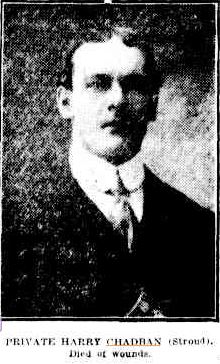
PRIVATE H. CHADBAN.
Private Henry Chadban (died of wounds) was 28 years of age, and a son of Mr. and Mrs. H. Chadban, of Stroud. He was educated at the Stroud Public School and afterwards worked in the Gloucester and Bellinger River districts as a timber-getter gaining a reputation as a wood chopper.
Deceased was a prominent member of the East Raleigh Football Club and was also a good cyclist, and the holder of several gold medals won at those sports. In 1912 he joined the police force and was stationed at Newcastle until war broke out when he enlisted with the 13th Battalion. Private Chadban was in 1913 awarded the Royal Humane Society’s certificate for life saving.
The Gloucester Advocate ( NSW ) Saturday 18 September 1915 page 2 of 4
PRIVATE HENRY CHADBAN
The late Private Henry Chadban, reported killed at the Dardanelles, was 28 years of age, and a son of Mr. and Mars. H. Chadban, of Stroud. In his youthful days, Private Chadban was working about Gloucester, and afterwards went to the Belinger River, where he was engaged in the timber industry.
In January, 1912, he joined the Police force in Sydney, and later went to Newcastle. He was a prominent footballer and sportsman generally, and held the certificate of the Royal Live Saving Society. Private Herbert Chadban, a brother, is in hospital in Malta.
Newcastle Morning Herald & Miners’ Advocate (NSW) Saturday 2 October 1915 page 5 of 16
A.N.A. SOLDIERS
Constable Harry Chadban, who, enlisted from Newcastle, where he was stationed for some months, died on August 13th of wounds received at the Dardanelles. His parents live at Stroud, and he was the first member of the Newcastle branch of the Australian Natives Association to be killed, although about thirty members have enlisted, a great many of whom are already at the front. At a meeting of the branch this week a special minute was passed appreciatively recording Mr. Chadban’s services, and the mortuary allowance of £20 was passed for payment to his next-of-kin.
Mr. C. H. Tonkin, the secretary of the branch, has formulated a scheme, which is to be considered at next meeting, whereby the members who are remaining at home will by special contribution keep those who have gone to the front financially good on the books during their absence. This scheme, which appears to be generally approved, will have the twofold effect of avoiding the need for the branch calling upon the ‘headquarters’ funds for the purpose, and of ensuring to members’ relatives the mortuary allowance of £20 in the event of them being killed or ensuring to members, in the event of injury, the full benefit of £1 1s per week for 52 weeks, and 5s per week for life should they be permanently incapacitated.
Dungong Chronicle ( NSW ) Tuesday 2 May 1916 page 2 of 6
Whilst in Newcastle last week, the writer observed opposite the post office, in Hunter Street, a marble monument, erected in memory of the fallen of Newcastle. On ‘ Anzac Day ‘ the stone was covered with most beautiful wreaths; on looking over them, I discovered a magnificent wreath from the police of Newcastle to the late Pte. Chadban, of Stroud, who was in the police force at Newcastle at the time of enlisting. I was pleased to note that the police of Newcastle did not forget their comrade on that memorable day, who was so brave to give his life for King and country.
The Newcastle Sun ( NSW ) Thursday 18 July 1918 page 5 of 6
POLICE HONOR ROLL
Unveiling Next Wednesday
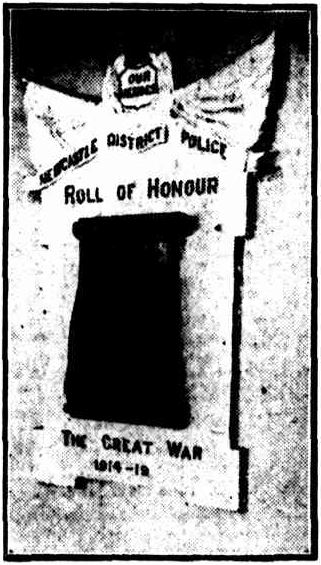
A beautiful marble honor roll, one of the finest of its kind, will be unveiled at the city police station on Wednesday night. The names are inscribed in gold lettering on a black marble scroll, and this is set on a white marble tablet. The roll faces the public entrance to the station, and at present it is draped with the Southern Cross. The words: ” Our Heroes, ” surrounded by a wreath of laurel in bas-relief, with the words ” Newcastle District Police Roll of Honor ” beneath the wreath, are chiselled into the head of the white tablet. At the bottom of the same tablet is chiselled the inscription, ” The Great War, 1914-19. ” So the police apparently believe that the war will conclude next year.
Eight constables‘ names appear on the scroll: — H. Chadban ( of Newcastle, killed ), F. M. Doonan ( of Lambton, killed ), H. W. Hancock ( of Newcastle Water Police, killed ), T. Connell ( of Minmi, killed ), C. W. J. Grant ( of Newcastle Water Police, returned wounded ), D. J. Long ( of Newcastle, still on active service ), V. Digre ( of Newcastle, who served with the naval bridging train and is now in the artillery ) and S. Pender ( who has re-enlisted ). Constable Connell served with the Imperial Forces, being called up as an Irish Reservist.
Newcastle Morning Herald & Miners’ Advocate Thursday 25 July 1918 page 5 of 8
NEWCASTLE POLICE. ROLL OF HONOUR UNVEILED. A roll of honour to the members of the Newcastle police who have gone to the war was unveiled at the police station last night, in the presence of a very large muster of members of the force.
The officers present were: Superintendent Goulder, who has entered on leave of absence prior to retirement; Superintendent Childs, his successor; Inspectors Cook, Buzacott, Hood, and Hojel. There were more than 40 police present.
Alderman Kilgour, the Mayor of Newcastle, Mr. C. F. Butler, S.M., and Mr. W. G. Chiplin, chamber magistrate at Newcastle, were also present.
There are eight names on the roll– H. Chadban, F.M. Doonan, H. W. Hancock,T. Connell, C. W. J. Grant, D. J Long, V Digre, and S Pender. The first four have made the supreme sacrifice. The last mentioned, as Superintendent Childs said, was mentioned in despatches for meritorious work at the Dardanelles. ( S. Pender )
On his return he rejoined the force, but had felt the call so strong that he had again resigned and enlisted. The names are inscribed on a scroll of black marble, which is mounted on a white polished panel, and surmounted with a white marble pediment richly carved, with a laurel wreath and the flags of the Empire and Australia. At the top is inscribed ” Our Heroes, ” and immediately below ” Newcastle District Police. ” Below the names are the words, ” For King and Country, ” and lower down, ” The Great War, 1914-19, ” space being left to fill in the year in which the war ends.
Superintendent Childs. who unveiled the roll, said it was with feelings of pleasure mingled with regret that he performed that function, pleasure because he felt proud of belonging to the same force as the men whose names were inscribed on the roll, and regret that four of them had laid down their lives, two in Gallipoli and two in France. When the Empire was in danger these men did not hesitate, but freely and voluntarily gave their services to their King and country. They had the satisfaction of knowing that the Empire was fighting for a righteous and just cause. He took that opportunity of mentioning that since the war began 158 members of the police force had enlisted, 40 had died on active service, 32 had returned, and 81 were still on military service. In addition, six clerks, who were attached to the Inspector-General’s Office, had enlisted. One of them died on the way to the front, another was invalided home, and the four others were still on active service. The Mayor briefly supported the remarks of Superintendent Childs, and paid a warm tribute to the patriotism of the men who had enlisted. He expressed his appreciation at being invited to take part in the function.
Superintendent Goulder said he felt it a great privilege to say a few words regarding their honoured comrades who had offered their lives on the altar of duty and patriotism. He always felt a thrill when he saw two or three soldiers who were voluntarily prepared to give their lives without any advantage whatever to themselves, apart from the satisfaction of knowing they had done their duty in the highest and fullest degree. ” I have always said ” added Superintendent Goulder, ” that military offenders who are going to the war, or have been, should not be treated in the same category as civilians guilty of similar minor offences. I would ask, as a special personal favour, if you have occasion to interfere with soldiers, do it as kindly and as charitably as you can, remembering the sacrifices they have made and the hardships they have suffered “.
In unveiling the roll, Superintendent Childs said he would apply words used by the Governor-General recently in unveiling a roll of honour, ” I unveil this roll to the honour of those connected with the Newcastle Police Force. I dedicate it to the glory of God, to the memory of those who have fallen, who have been wounded, who are returning to us, and who are about to serve in our renowned Australian Divisions. ” Inspector Cook paid a tribute to Constable J. Chandler, from whom the idea of having the memorial emanted, and who, once the superintendent’s permission was obtained, pushed the matter ahead with great energy. Constable Chandler expressed his pleasure at seeing such a large muster, and said when the movement was started the money was rapidly subscribed.
Dungong Chronicle Tuesday 22 August 1916 page 2 of 6
ROLL OF HONOR. CHADBAN. —
In loving memory of our dear Son and Brother, Private Henry Chadban, No. 1292, 6th of 13 Batt., 4th Aus. Inf. Brigade, who died of wounds at Malta, on 13th Aug., received at Lone Pine Aug. 7th, 1915. Aged 29
He rose responsive to his country’s Call
And gave for her his best, his life, his all.
He fell a hero in the deadly strife,
For, King and Country he laid down his life.
Inserted by his loving Mother and Father, Sisters and Brothers.
The Newcastle Sun ( NSW) Friday 10 January 1919 page 3 of 6
POLICE HONOR ROLL
From ‘The Sydney Sun”
Newcastle Police Honour Roll
The names on the roll are H. Chadban, F. M. Doonan, H. W. Hancock, T. Connell, all of whom have made the supreme sacrifice, and C. W. J. Grant, D. J. Long, V. Dicre and S. Pender. Many other Newcastle policemen volunteered for active service, but were rejected.
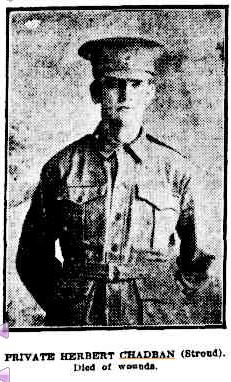
Private Herbert CHADBAN, Service # 1926, with the 2nd Australian Infantry Battalion, Australian Army, died on 4 May 1917, in France, aged 26.
Herbert is mentioned / buried at: Villers-Bretonneux Memorial, Villers-Bretonneux, Picardie, France
[divider_dotted]
John FARMER
| 30/08/2015
John FARMER
New South Wales Police Force
Regd. # ?
Rank: Constable
Stations: ?
Service: From ? to ?
Awards: ?
Born: ?
Died on: ? between 1792 – 1820
Cause: ?
Age: ?
Funeral date: ?
Funeral location: ?
Buried at: ?
[alert_yellow]JOHN is NOT mentioned on the Police Wall of Remembrance[/alert_yellow] *NEED MORE INFO
[divider_dotted]
Funeral location: on the site of the present site of the Sydney Town Hall. Exhumed in 1869 & interred at Rookwood Cemetery, Lidcombe.
[divider_dotted]
Mystery solved in time for Police Remembrance Day
Exclusive By Gemma Jones
The Daily Telegraph
September 28, 200712:00AM
MORE than 200 years after Constable Joseph Luker was bashed to death while investigating a robbery near a Sydney brothel, the officer’s grave has finally been found again.
With the discovery of Constable Luker‘s original grave underTown Hall, the police have solved a Sydney mystery over the burial site of the first officer in Sydney to die on duty.
As the force prepares to commemorate fallen officers on Police Remembrance Day today, the story of Constable Luker’s final resting place can finally be told.
After years searching graveyard records, recent excavations under the Town Hall have revealed Constable Luker was buried in the Old Sydney Burial Ground, which was used from 1792 to 1820. Constable Luker’s grave was marked “assassinated“.
Records show the bodies of three policemen, including Constable Luker, were exhumed in 1869 when building began on the Town Hall site and they were interred at Rookwood Cemetery in Sydney’s west.
“It is important to police as an organisation that we ensure we honour and pay respect to those who have served before us and that is why we have continued to search for Joseph Luker’s burial place,” Police Commissioner Andrew Scipione said yesterday.
“Joseph Luker paid the highest price for protecting the citizens of the then fledgling colony. No organisation should ever forget the sacrifices of its staff.”
Sydney City Council found records showing another two officers, Constables Joseph Haynes and John Farmer, were buried on the Town Hall site but nothing is known about how they died.
Constable Luker was on a midnight patrol after a spate of burglaries near prostitute Mary Breeze’s brothel in Phillip St, then known as Back Row, east Sydney Town, in August 1803.
He had been beaten to death and his cutlass guard was wedged in his skull when his body was found near Macquarie St.
In one of the first scandals to rock the police, two of his colleagues were suspected but were never convicted.
A message to his killers was posted on his headstone at the Town Hall site telling them: “My midnight vigils are no more, Cold Sleep and Peace succeed . . . But when my murderers appear, before JEHOVAH’s Throne, Mine will be to vanquish there, And theirs t’endure alone.”
The 35-year-old was a convict who served seven years transportation before joining a fledgling police force.
Mr Scipione urged people to wear a blue ribbon on the right-hand side of their shirt today to show support for police. He said remembering lost officers was a way to offer continued support and comfort to their families.
“It means we will never forget their courage and sacrifice,” he added.
Stations: No. 4 Division ( Phillip Street – Water Police Court )
Service: From ? about 1893 to 13 November 1899 = about 6 years Service
Awards: ?
Born: ? ? 1873
Died on: Monday 13 November 1899
Cause: Influenza
Age: about 27
Funeral date: Wednesday 15 November 1899
Funeral location: Waverley Cemetery
Buried at: ?
[alert_yellow]THOMAS is NOT mentioned on the Police Wall of Remembrance[/alert_yellow] *NEED MORE INFO
[divider_dotted]
Funeral location: ?
[divider_dotted]
Windsor and Richmond Gazette ( NSW ) Saturday 18 November 1899 page 11 of 14
Death of Constable Chaseling.
REGRET was felt in this district when it became known on Monday evening that Constable Thomas W Chaseling, of No 4 Police Station( Phillip Street – Water Police Court ) had succumbed that day at his residence, Bent-street Paddington, from the effects of an attack of influenza, which incapacitated him from duty some ten days ago. Constable Chaseling, who was about 27 years of age, leaves a widow and a young child. He had been a member of the force for about six years, during which time be bad achieved a reputation for fearlessness, promptness, and efficiency in the performance of his duty, which caused him to be looked upon as one of the most promising of the young men in the service.
During the whole period of his service in the police he was attached to No. 4 Division.
He distinguished himself on several occasions, the last being that upon which he captured a burglar named George Harris, after a desperate chase of about a mile and a half, and shooting the man in the leg. Harris is now serving a long term of imprisonment, and has since been identified as a dangerous Melbourne criminal named Brown, at one time a confederate of Montgomery and Williams, who were hanged in Sydney some years ago.
Speaking of Chaselings death, a sergeant under whom he had served said that the loss which it would mean would be a serious one to the division and one difficult to overcome. Inspector-General Fosbery also spoke highly of the young officer.
The funeral took place at Waverley Cemetery on Wednesday, when the Police Band and a large number of his brother constables were in attendance, as well as many other friends and relatives.
Constable Chaseling was the son of Mr Matthew Chaseling, who lives on the Hawkesbury River.
“possible” relation in “the job”: A.R. WHITTAKER, NSWPF # 8649
New South Wales Police Force
Regd. # 18588
Joined NSW Police Force via NSW Police Cadet system on 1 February 1977
Cadet # 3334
Rank: NSW Police Cadet – commenced 1 February 1977 ( aged 16 years, 9 months, 16 days )
Probationary Constable – appointed 17 April 1979 ( 19 years, 0 months, 1 day )
Detective – appointed ? ? ? ( YES )
Constable – appointed ? ? ?
Constable 1st class – appointed 16 April 1984
Senior Constable – appointed 16 April 1988
Sergeant 3rd Class – appointed 27 September 1991
Final Rank: Detective Sergeant – Death
Stations: ?, Gosford Drug Unit ( Brisbane Waters LAC ) – Death
Service: From 1 February 1977 to 28 September 1991 = 14 years, 7 months, 27 Service
Time in Retirement: 0
Age at Retirement: n/a
Awards: No find on It’s An Honour
Born: Saturday 16 April 1960
Died on: Saturday 28 September 1991 @ Royal North Shore Hospital, NSW
Cause: Cerebral Haemorrhage
Age: 31 years, 5 months, 12 days
Funeral date: ? October 1991
Funeral location: ?
Buried at: CREMATED:
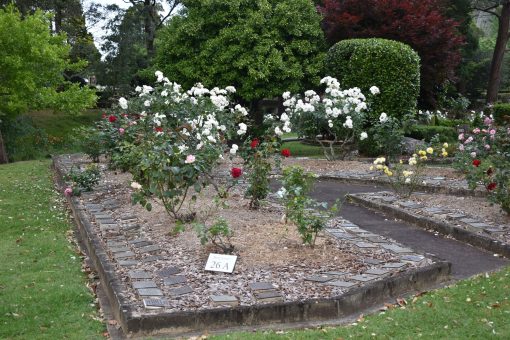
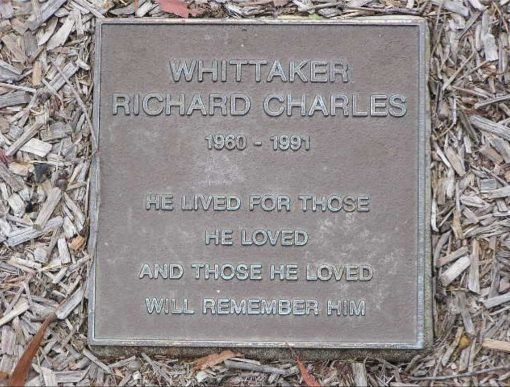
Ashes Interred in the Palmdale Lawn Cemetery & Memorial Park, Palmdale Rd, Palmdale, NSW
Rose Garden, 26A, Site 58
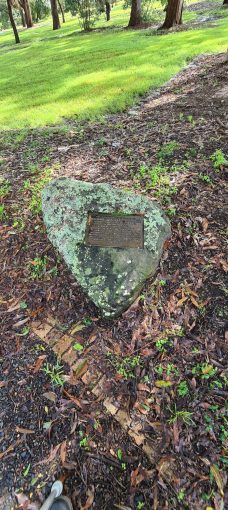
Memorial Plaque: Point Frederick Pioneer Park, 1 Albany St, Pt Frederick, NSW
-33.449594151.341945
Memorial Plaque location:
RICHARD WHITTAKER
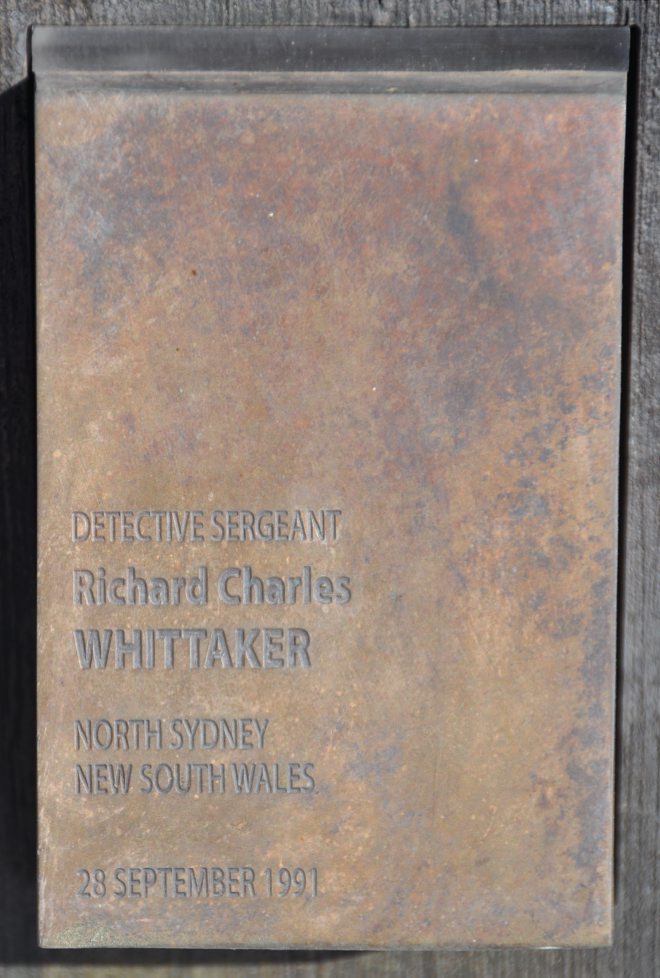
Touch plate for Richard Charles WHITTAKER at the National Police Wall of Remembrance
DICKIS mentioned on the Police Wall of Remembrance
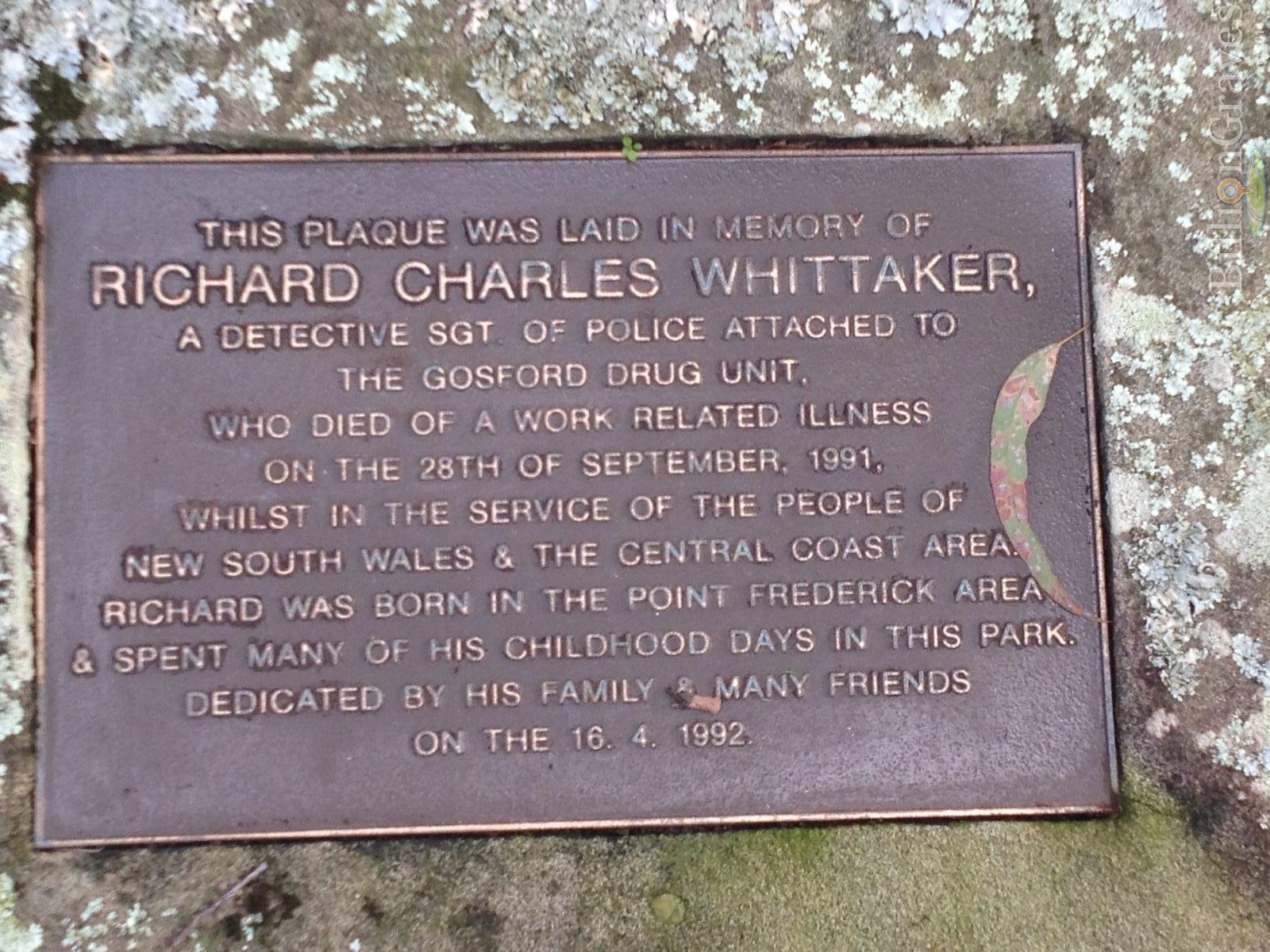
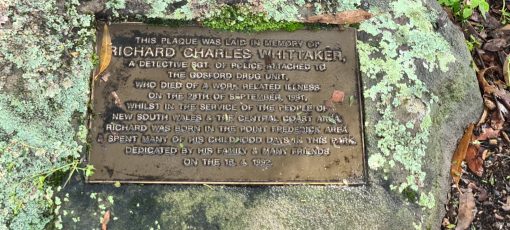
Memorial plaque: This plaque was laid in memory of RICHARD CHARLES WHITTAKER, a Detective Sgt of Police attached to the Gosford Drug Unit, who died of a work related illness on the 28th of September, 1991, whilst in the service of the people of New South Wales & the Central Coast area. Richard was born in the Point Frederick area and spent many of his childhood days in this park. Dedicated by his family & many friends on the 16. 4. 1992.
Richard Charles WHITTAKER – Memorial Plaque – Pt Frederick, ( Central Coast ), NSW, as of April 2022. Credit: Kevin Banister.
Memorial Plaque – Pt Frederick, ( Central Coast ), NSW, as of April 2022. Credit: Kevin Banister.
Richard Charles WHITTAKER – Grave location. Palmdale Cemetery, Palmdale, NSW
Richard Charles WHITTAKER – Grave location. Palmdale Cemetery, Palmdale, NSW
Before his death Detective Sergeant Whittaker and other Police had been involved in a major drug investigation which had resulted in the arrest of eighteen offenders. Corruption allegations were made by a number of the offenders resulting in a Police Internal Security Unit investigation.
During the protracted internal investigation the Sergeant was under enormous pressure and as a result suffered a cerebral haemorrhage.
He passed away at the Royal North Shore Hospital on 28 September 1991.
He was posthumously cleared of all allegations by Judge Allen at the Sydney District Court on 30 September 1991.
The Sergeant was born in 1960 and joined the New South Wales Police Service, via the NSW Police Cadet system on 1 February 1977 and was Attested, as a Probationary Constable on 17 April 1979.
At the time of his death he was attached to the Gosford Drug Unit.
‘Our boys haven’t been forgotten’: Policemen honoured in Brisbane Water row
September 15, 2015 3:16pm
Geraldine Cardozo Central Coast Gosford Express Advocate
(L-R) Sarah Matthews, Kylie Kerr and Tracey Holt remember their police officer partners at Gosford waterfront. Brisbane Water LAC officers will be taking to the water in honour of the policemen.
When Sarah Matthews returned home after her shift at Gosford Hospital on the evening of April 13, 2002 and spotted a row of waiting police cars she thought the neighbours were having a noisy party.
“It never struck me what was coming next,” remembers the emergency nurse who was told the worst — her fiancée Senior-Constable Chris Thornton had been killed on duty hours earlier.
“It didn’t hit me. Even when I was told. I don’t think that’s something that ever leaves you.”
This week Miss Matthews, Kylie Kerr and Tracey Holt will get together to remember their partners, Sen-Constable Thornton, Sen-Constable Peter Gordon Wilson and Sergeant Richard Whittaker, who all died on duty while with the Brisbane Water Local Area Command.
(L-R) Brisbane Water Inspector Paul Nicholls, Tracey Holt, Brisbane Water Commander Daniel Sullivan, Sarah Matthews and Kylie Kerr at Gosford Waterfront ahead of the NSW Police Legacy row. Picture: Mark Scott
On Thursday officers from Brisbane Water LAC will take part in a paddle to raise money for NSW Police Legacy to support the families of fallen officers.
“You never want to be a part of Legacy but now we are part of this unique group and without Legacy we wouldn’t have each other,” Miss Matthews said.
But for two of the women, the close bond was forged by their shared loss and haunting similarities in how their partners lost their lives.
Sen-Constable Thornton, 35, died in a motor vehicle accident while on patrol in Woy Woy in 2002, while Mrs Kerr’s long-term partner Sen-Constable Wilson, 41, was killed when he was hit by a car while carrying out speed checks on the M1 at Somersby in 2006.
Both men were based at Brisbane Water LAC, both died in car accidents on a Saturday night, and both had the same patrol car number — 202.
Senior Constable Peter Gordon Wilson with fiancée Kylie Kerr.
“This special event means our boys haven’t been forgotten,” Miss Matthews said, adding that the support of Legacy has enabled her to move on. “You have to take that step forward. You can’t be angry, because that just eats away at you.”
Senior Constable Chris Thornton was killed on duty during a high-speed pursuit at Woy Woy in 2002.
“This special event means our boys haven’t been forgotten,” Miss Matthews said, adding that the support of Legacy has enabled her to move on. “You have to take that step forward. You can’t be angry, because that just eats away at you.”
“This special event means our boys haven’t been forgotten,” Miss Matthews said, adding that the support of Legacy has enabled her to move on. “You have to take that step forward. You can’t be angry, because that just eats away at you.”
Mrs Holt, whose husband Sgt Whittaker was stationed at the Gosford drug unit and was involved in drug investigations at the time of his death when he died from a brain haemorrhage in 1991, said the annual paddle is a “beautiful day”. “It is amazing the effort Daniel Sullivan and the team put in to keep the memory going of old work mates and have a good time doing it,” she said.
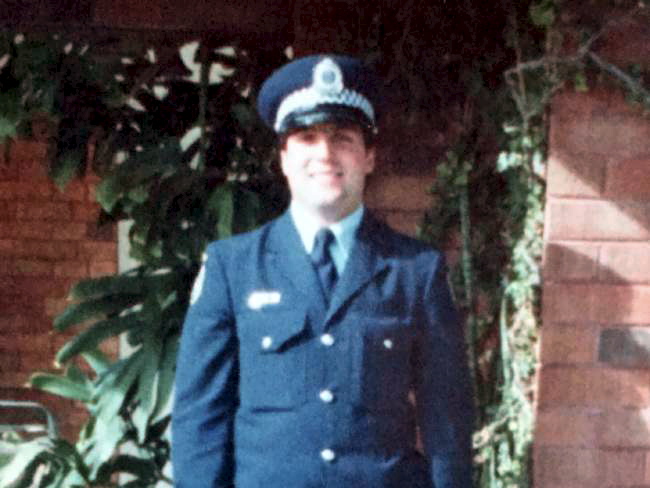
Sergeant Richard Whittaker who died on duty with Brisbane Water Local Area Command in 1991. Picture: Supplied
SYDNEY: The stress of unfounded corruption allegations killed a policeman who suffered a stroke at the weekend, according to the Police Association.
The association’s president, Tony Day, said yesterday that Gosford-based Detective Senior Constable Richard Whittaker, who was promoted to detective sergeant last Friday, had been implicated in a bribery conspiracy by a drug dealer.
Yesterday, the dealer, an industrial chemist, was sentenced to a minimum of 11 years jail after pleading guilty to manufacturing and supplying amphetamines with a street value of more than $4 million.
Handing down the sentence in Darlinghurst Supreme Court, Justice Allen said John Oldfield, 52, of Winston Hills in Sydney’s west, had stated he had tried to bribe a police officer through a contact known as “M” in November, 1990.
After the alleged bribe attempt had failed, Oldfield had gone to the Police Internal Security division and made a detailed statement, implicating the officer. The judge said he was satisfied the detective knew nothing about the alleged bribe.
Mr. Day said the Police Internal Security division investigation into Oldfield’s allegations had been “dubious”.
“Every crim in NSW knows that if they want their case adjourned they just have to implicate the police, and there will have to be an investigation,” he said.
“Eighty per cent of corruption and bribery charges are disproved.”
Detective Whittaker, 31, was married with two-year-old twin daughters.
Mr Day said the Oldfield affair had played a major role in causing Detective Whittaker stress, resulting in his death.
The Brisbane Water LAC has tragically lost three staff members in the execution of their duty: Sergeant Dick Whittaker and Senior Constables Gordy Wilson and Chris Thornton. The 12 September is the annual sports charity day to remember these officers.
Paddling from Ocean Beach Surf Club to Bluetongue Stadium along the Brisbane Water on the NSW Central Coast (approximately 15km).
SYDNEY: The stress of unfounded corruption allegations killed a policeman who suffered a stroke at the weekend, according to the Police Association.
The association’s president, Tony Day, said yesterday that Gosford-based Detective Senior Constable Richard Whittaker, who was promoted to detective sergeant last Friday, had been implicated in a bribery conspiracy by a drug dealer.
Yesterday, the dealer, an industrial chemist, was sentenced to a minimum of 11 years jail after pleading guilty to manufacturing and supplying amphetamines with a street value of more than $4 million.
Handing down the sentence in Darlinghurst Supreme Court, Justice Allen said John Oldfield, 52, of Winston Hills in Sydney’s west, had stated he had tried to bribe a police officer through a contact known as “M” in November, 1990.
After the alleged bribe attempt had failed, Oldfield had gone to the Police Internal Security division and made a detailed statement, implicating the officer. The judge said he was satisfied the detective knew nothing about the alleged bribe.
Mr. Day said the Police Internal Security division investigation into Oldfield’s allegations had been “dubious”.
“Every crim in NSW knows that if they want their case adjourned they just have to implicate the police, and there will have to be an investigation,” he said.
“Eighty per cent of corruption and bribery charges are disproved.”
Detective Whittaker, 31, was married with two-year-old twin daughters.
Mr Day said the Oldfield affair had played a major role in causing Detective Whittaker stress, resulting in his death.
The WA Police Union has extended its deepest condolences to the family of an officer who died of a gunshot wound.
The union is supporting family and friends of the officer, who died after a firearms incident while he was on duty on Kalgoorlie’s outskirts on Friday evening.
“We will continue to work with WA Police to ensure the best possible outcome for all involved, given the circumstances.
“We extend our deepest condolences to the member’s family, friends and colleagues,” union president George Tilbury said in a statement on Saturday.
Investigators said earlier the incident was not being treated as suspicious.
* For support and information about suicide prevention, call Lifeline on 13 11 14 or MensLine Australia 1300 78 99 78)
Today our hero from Western Australia police will be laid to rest.
Our condolences and thoughts go out to his family, friends and the thin blue line at this difficult time.
Thank you for your service and dedication sir. We will keep you and your family in our hearts, never forgotten.
Rest easy Detective Sergeant.
”As the sun surely sets,
dawn will see it arise.
For service above self,
demands it’s own prize.
You have fought the good fight,
life’s race has been run,
and peace, your reward,
for eternity begun.
And we that are left,
shall never forget,
rest in peace friend and colleague,
for sun has now set.
We will remember, We will remember ,
hasten the dawn.”
[divider_dotted]
BLANCHARD:
WA POLICE UNION Members are invited to attend the Funeral Service for our late serving member Scott Andrew Blanchard 9360 at Karrakatta Cemetery on THURSDAY (6.8.2015) at 2.30pm.
BLANCHARD (Scott):
Our hearts once beat together, my Scotty, but now mine beats alone. I know we’ll be together one day. Until then, I continue alone. My soul mate, my lover, my best friend and rock. Scotty, you meant the world to me and will be forever in my heart.
Love you babe, Jussy.
BLANCHARD (Scott):
Dad, we love you more than life itself and we will miss you every single day. Forever you’ll be in our hearts and we’ll see you in our dreams.
Jarrod, Ayden, Miranda
Published in The West Australian on July 28, 2015
41 entries | 20 photos
“Deepest sympathies to Rod, Susan, Dale, Lee and families on…”
A 50-year-old Derby man has survived a night at sea in crocodile infested waters after being washed off his boat and having to swim ashore.
Police say the man was sleeping alone on his boat about two nautical miles north of Point Torment.
Large waves washed him overboard and sank the boat before he could activate an EPIRB.
The next morning a fisherman spotted the empty dinghy and called police, sparking a land and sea search.
The missing man was spotted in mangroves, exhausted and dehydrated but able to cry out to authorities.
Acting Senior Sergeant Scott Blanchard says the man is lucky to get away unharmed.
“One of the police cars that was up there searching the land actually just saw a crocodile that was estimated to be about four metres in the blue holes,” he said.
“So my advice would be just not to go out on your own overnight and just always be checking your boats before you go away.
“On a boat make sure all your EPIRB gear and your life jackets are working correctly.
“Going out to those areas is not the best idea on your own, especially overnight.
“You know you’re talking about areas where the tides can range up to 11 metres, so one minute you’re on sand or in water and the next minute you’re off the water on a rock or something worse might happen like … what happened overnight.”
WA Police officer dead from apparent self-inflicted gunshot wound at Cockburn station
Updated
WA Police are investigating the death of an officer at a police station in Perth’s southern suburbs.
Key points:
Officer apparently shot himself at Cockburn Police Station with his police-issue firearm
WA Police Commissioner Chris Dawson said the force was in shock at the news
Death comes after state coroner calls for more support services
It is understood First Class Constable Darren Igglesden, 50, died from an apparent self-inflicted gunshot wound at Cockburn Police Station on Monday morning.
In a statement, WA Police said support services were being offered to other officers.
The station has been temporarily closed, and the public has been asked not to attend the station until further notice. They have instead been redirected to nearby Fremantle or Mandurah stations, both of which operate 24 hours a day.
‘Popular member of the force’
Police Commissioner Chris Dawson extended his condolences to the family of Constable Igglesden and colleagues at Cockburn Police Station.
“It appears Darren has drawn his service-issued pistol from the police armoury this morning (Monday), shortly after 6:00am,” he said.
“He was found deceased by colleagues within the Cockburn police building.
“Darren’s death has come as a complete shock to his family, to his friends, and indeed the entire police force.
“At this difficult time I extend my condolences to Darren’s family, his friends, his work colleagues and everyone who knew him.
“A coronial investigation is now underway and so we should let that full investigation be completed, but there does not appear to be any other persons present at the time Darren lost his life.”
Commissioner Dawson said Constable Igglesden was a popular member of the police force.
“Constable Igglesden has been with the WA Police Force for six-and-a-half years, he joined us at about 44 years of age, he has had a varied career in the private sector prior to joining police,” he said.
“Well liked, well respected, a very popular member of the police force.”
Coroner called for more police support
The tragedy comes nearly a month after WA Deputy Coroner Evelyn Vicker released her findings into the suicide of police officer Scott Blanchard, who shot himself while on duty at Kalgoorlie in July 2015.
Ms Vicker found that while Detective Sergeant Blanchard appeared to be coping well with his job as a police officer, he had become “obsessed” that health problems he had were undiagnosable and “consequently took matters into his own hands …”
The inquest into Sergeant Blanchard‘s death heard details of the WA Police Service’s Health and Safety Division, which provides services such as confidential psychological counselling, peer support programs and chaplaincy services to officers and their families, to try to help them manage stress or issues that may arise as a result of their employment.
“At this difficult time I extend my condolences to Darren’s family, his friends, his work colleagues and everyone who knew him.
“A coronial investigation is now underway and so we should let that full investigation be completed, but there does not appear to be any other persons present at the time Darren lost his life.”
Commissioner Dawson said Constable Igglesden was a popular member of the police force.
“Constable Igglesden has been with the WA Police Force for six-and-a-half years, he joined us at about 44 years of age, he has had a varied career in the private sector prior to joining police,” he said.
“Well liked, well respected, a very popular member of the police force.”
Coroner called for more police support
The tragedy comes nearly a month after WA Deputy Coroner Evelyn Vicker released her findings into the suicide of police officer Scott Blanchard, who shot himself while on duty at Kalgoorlie in July 2015.
Ms Vicker found that while Detective Sergeant Blanchard appeared to be coping well with his job as a police officer, he had become “obsessed” that health problems he had were undiagnosable and “consequently took matters into his own hands …”
The inquest into Sergeant Blanchard‘s death heard details of the WA Police Service’s Health and Safety Division, which provides services such as confidential psychological counselling, peer support programs and chaplaincy services to officers and their families, to try to help them manage stress or issues that may arise as a result of their employment.
Police Minister Michelle Roberts said she believed the culture within the organisation was changing.
“I think the police force has changed dramatically over the last 10 years or so, in terms of encouraging officers to come forward and to show some additional care for themselves and their fellow officers,” she said.
“It used to certainly be the case that the attitude was ‘toughen up’ and to show any emotional vulnerability was seen as some kind of weakness. That’s not the attitude that’s been taken by police in recent years.
“We have had some shocking and tragic incidents in recent times where officers have had to turn out to shocking scenes, and sometimes they go to road crashes where they see shocking scenes, so we need to know that they have got the support there.
“And I have certainly received assurances from the Commissioner of Police and others that we have got good supports in place. Sometimes, though, people need to avail themselves of that support.”