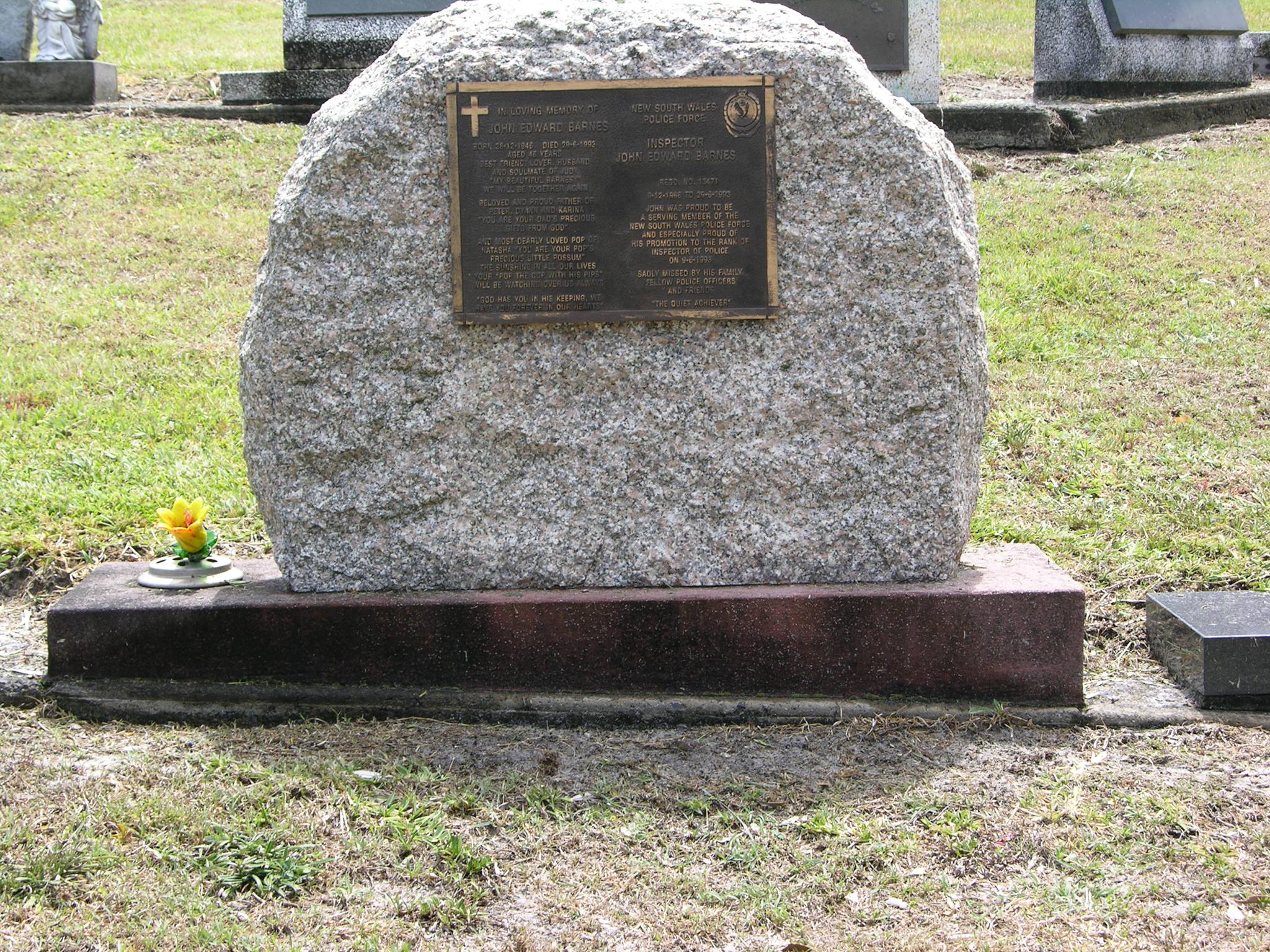
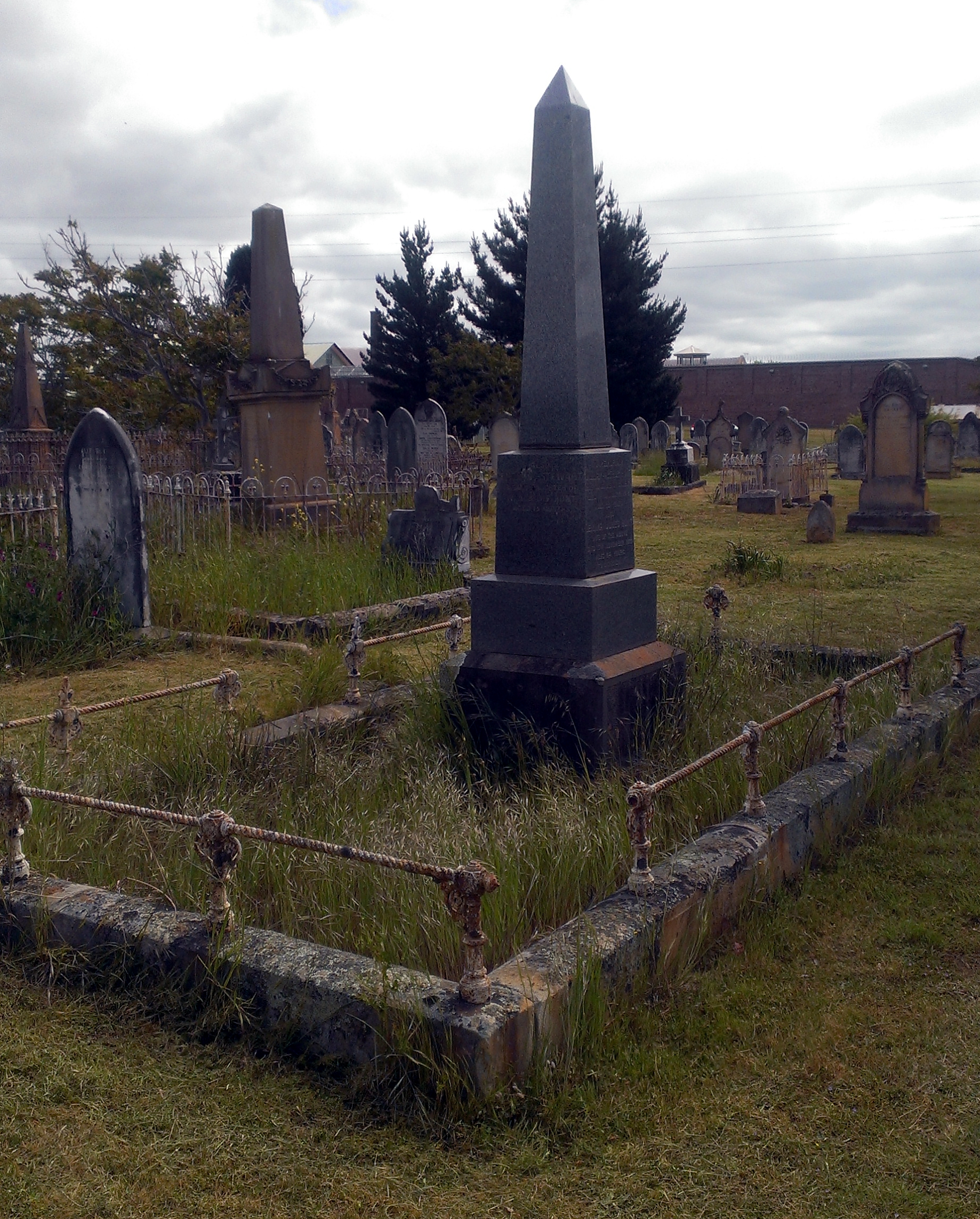
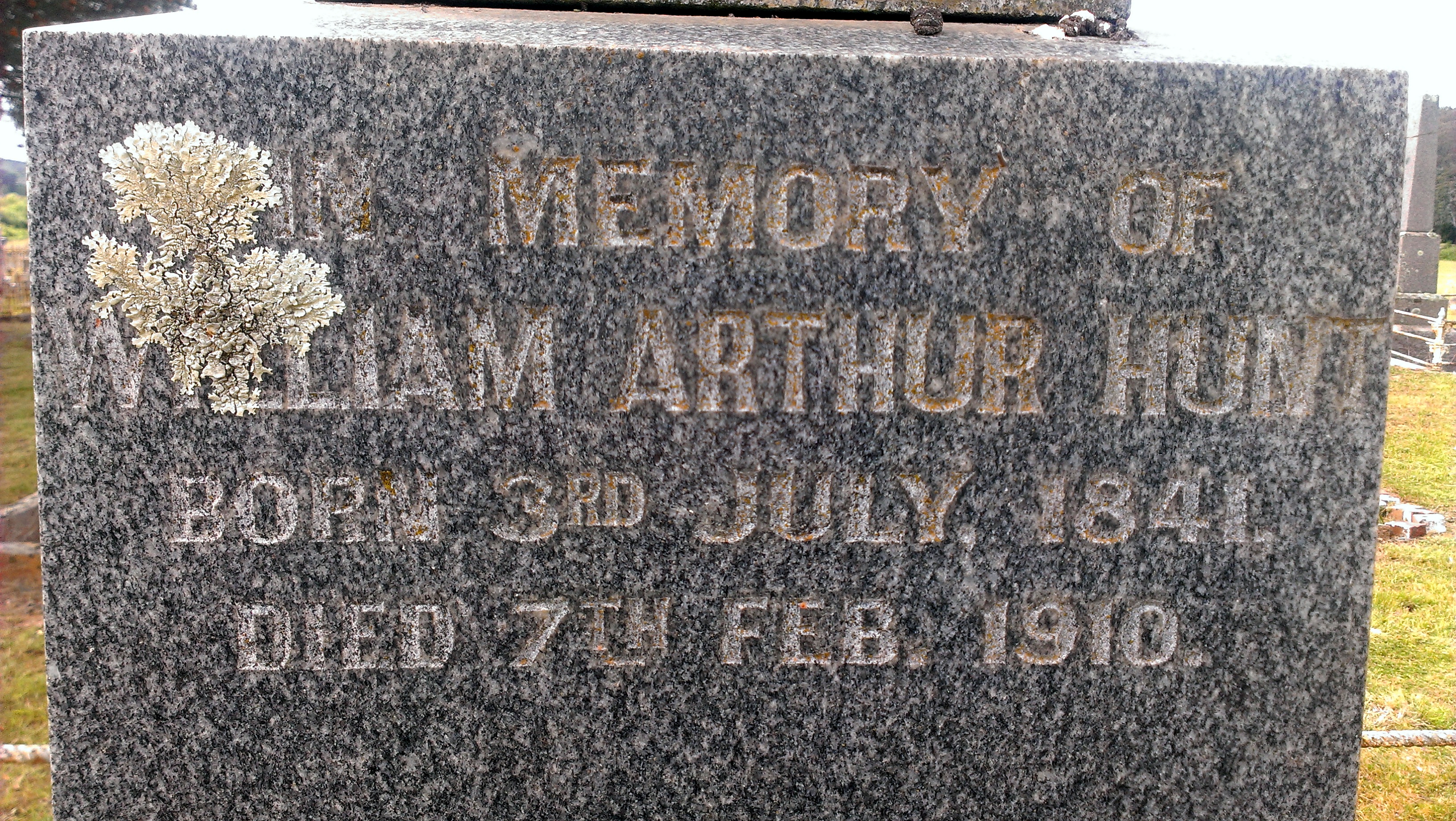
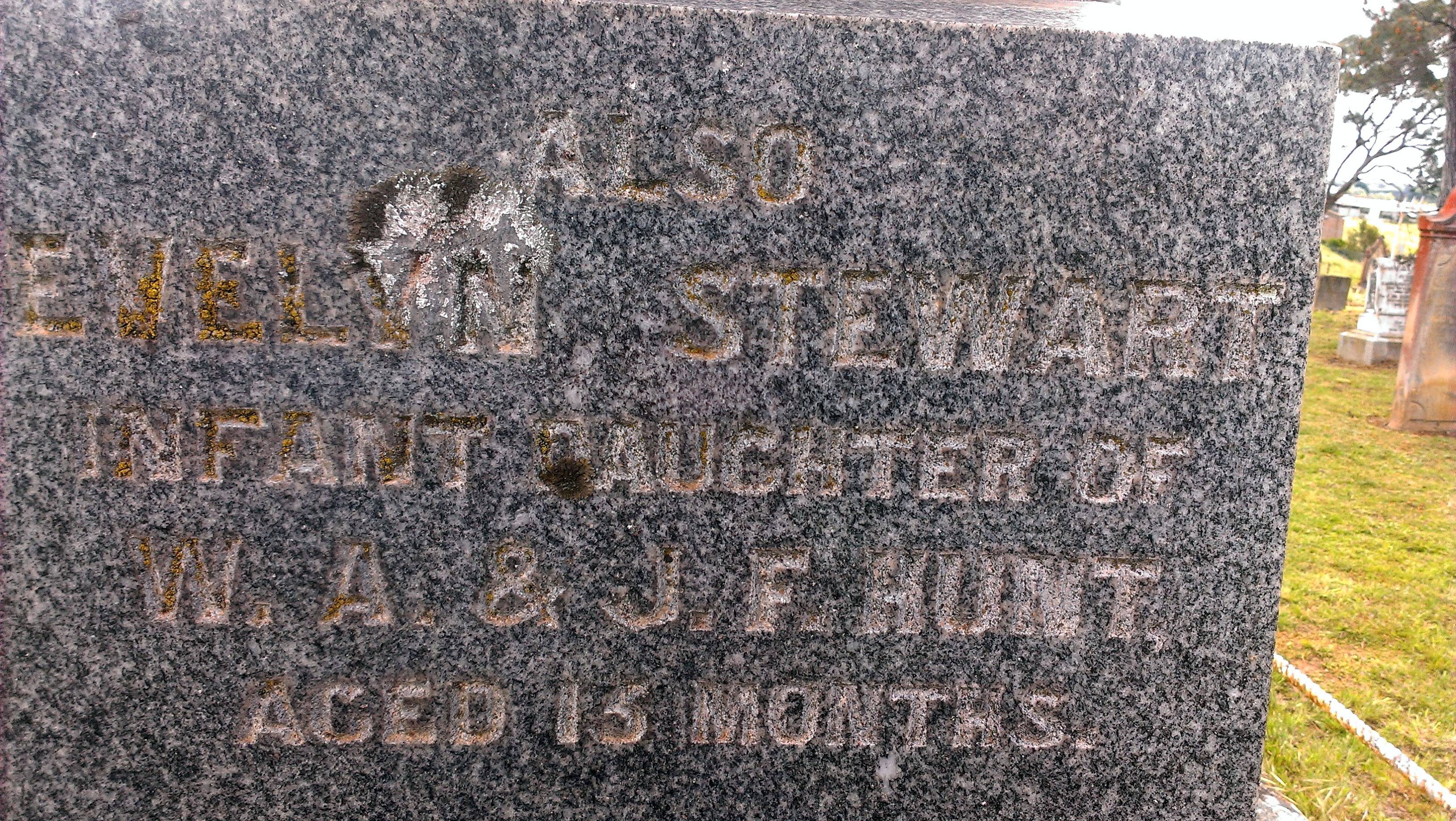
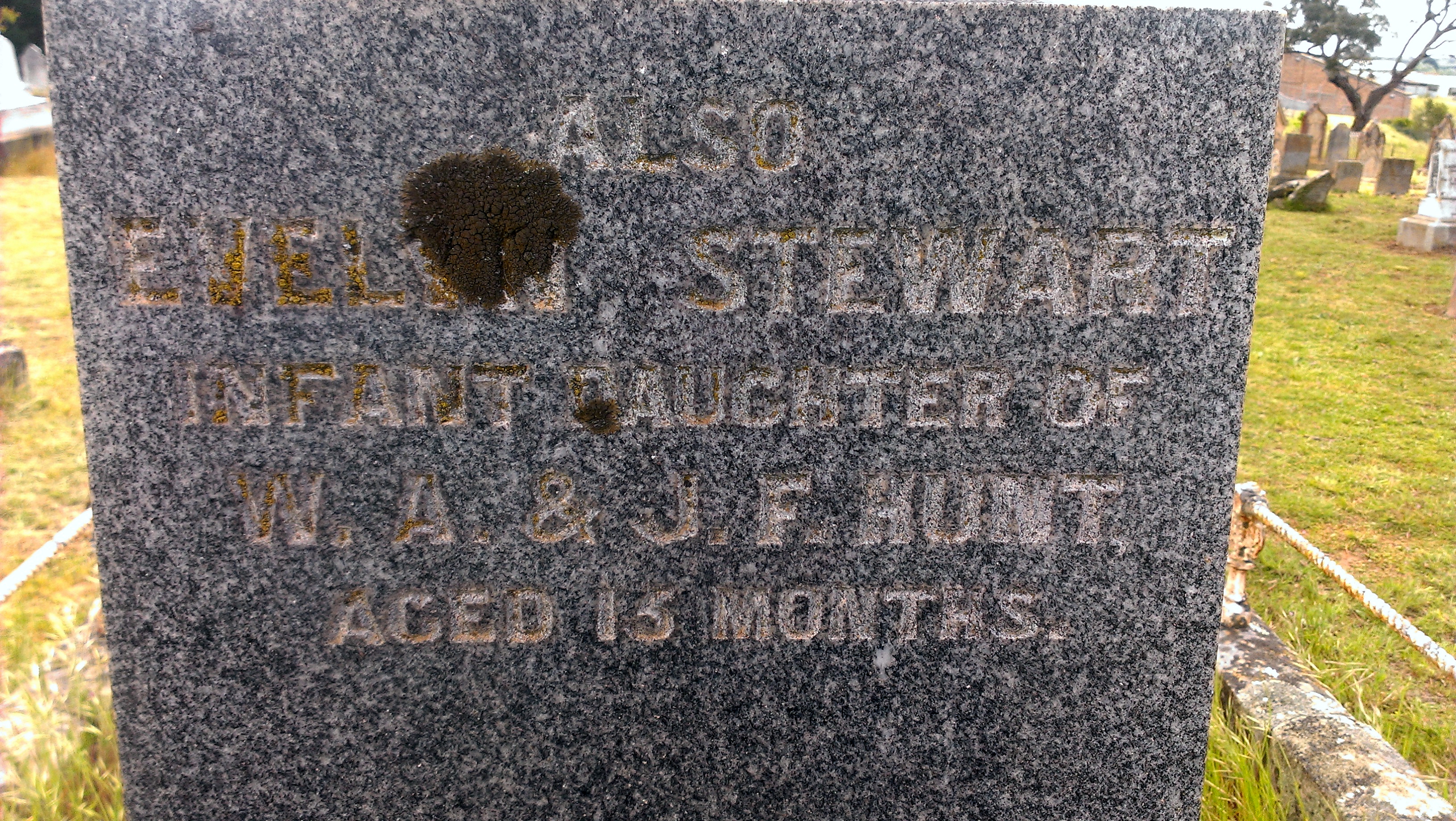
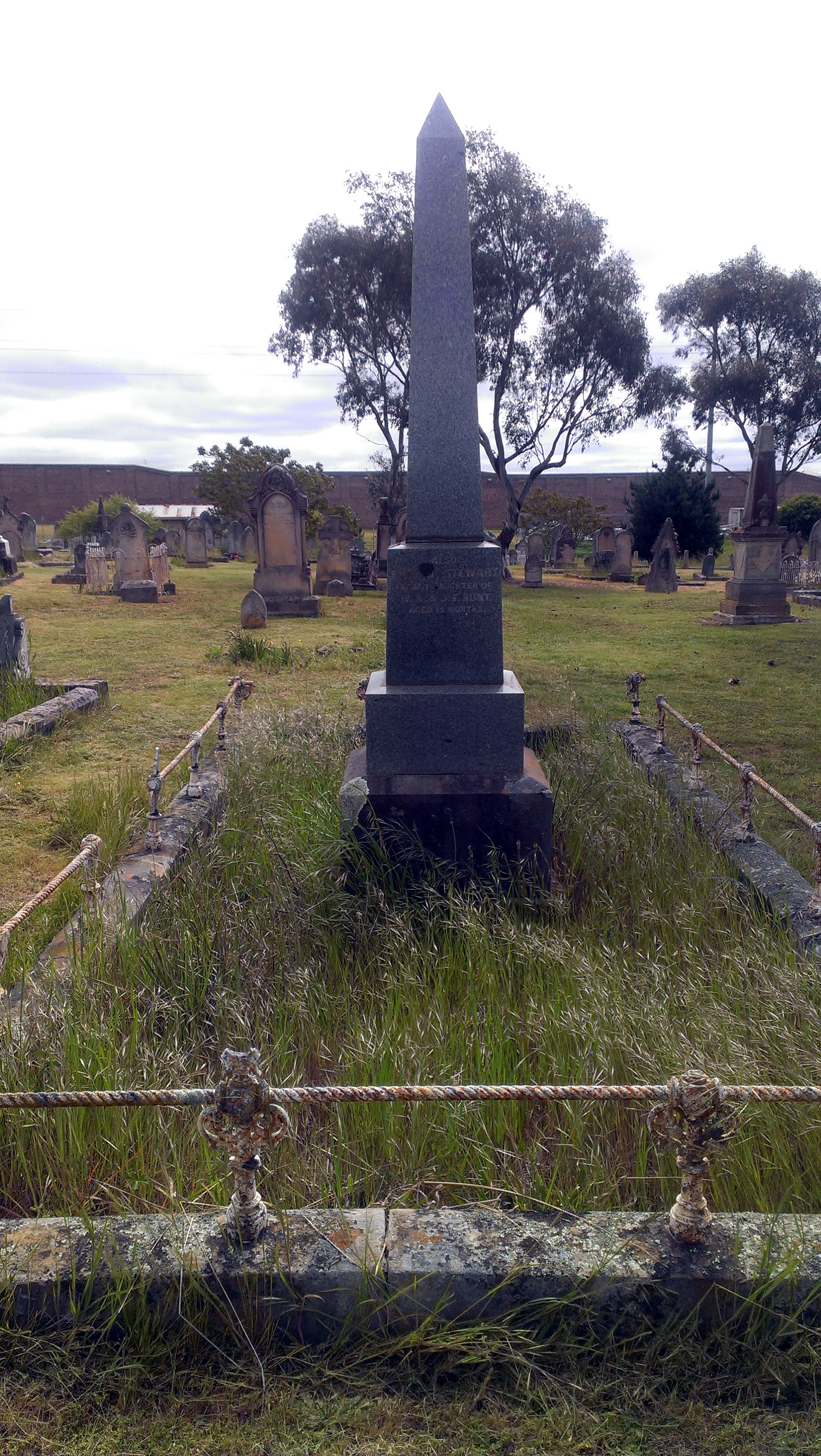
John Edward BARNES – Grave stone – Ballina Cemetery
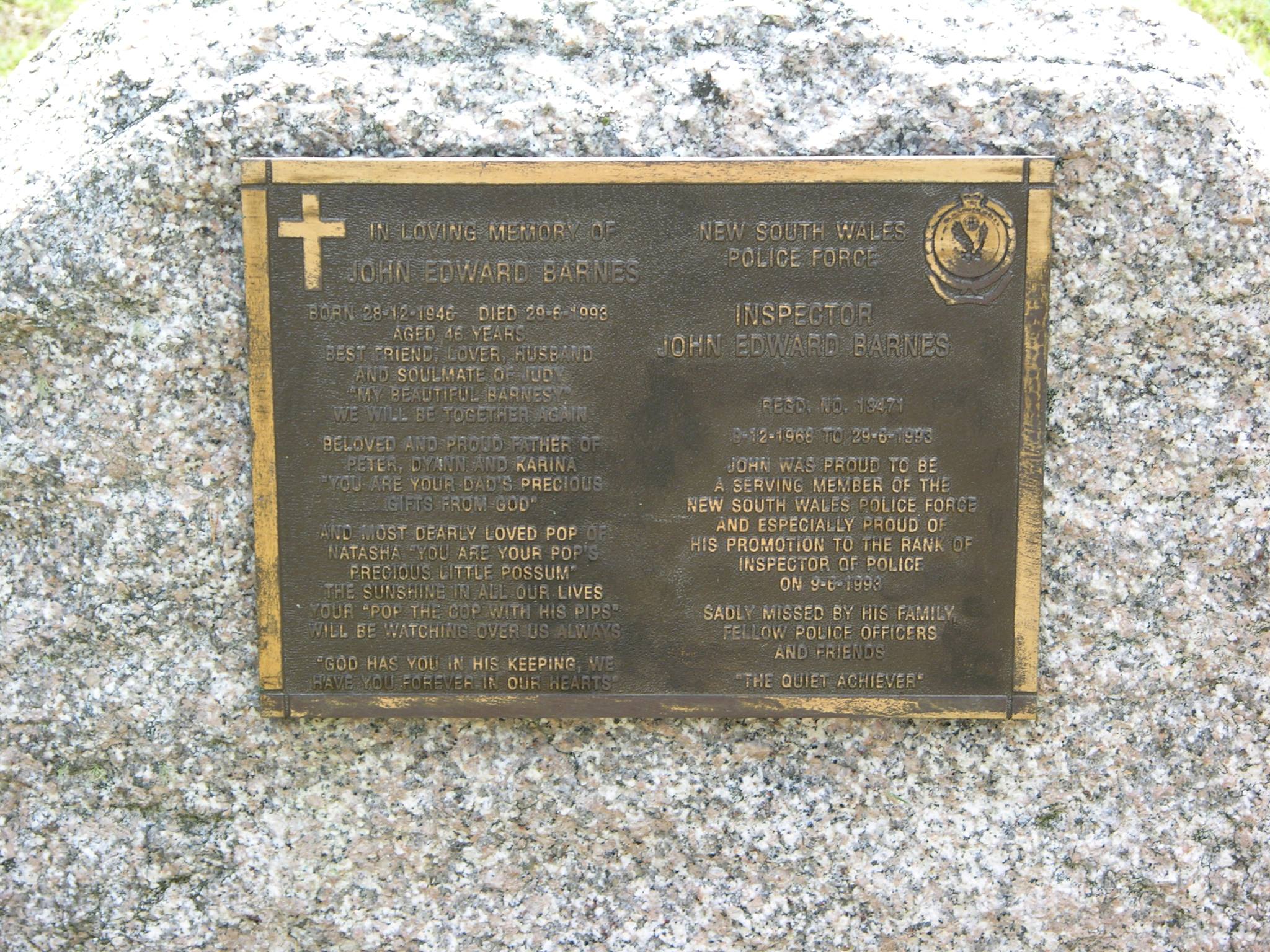
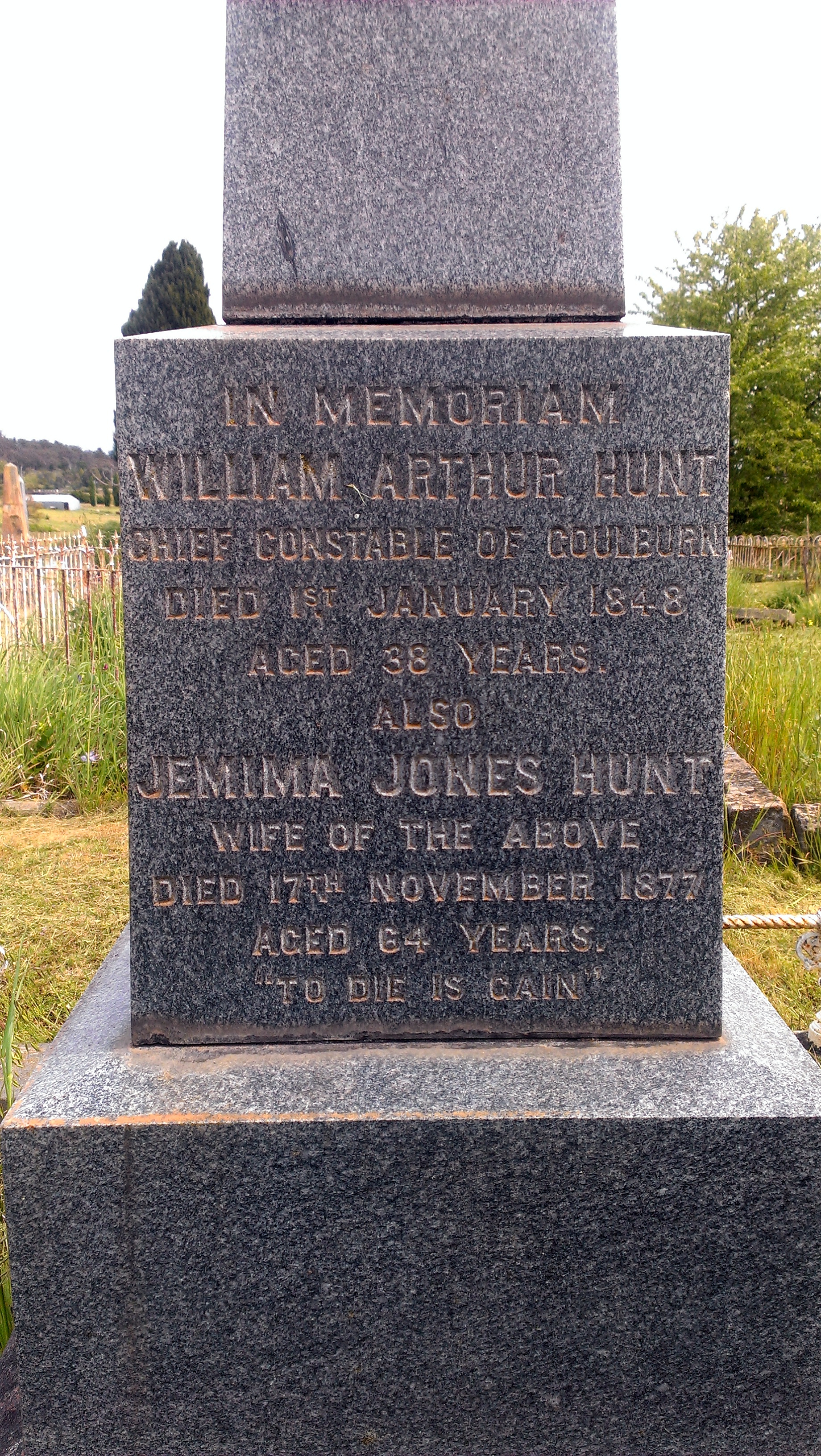
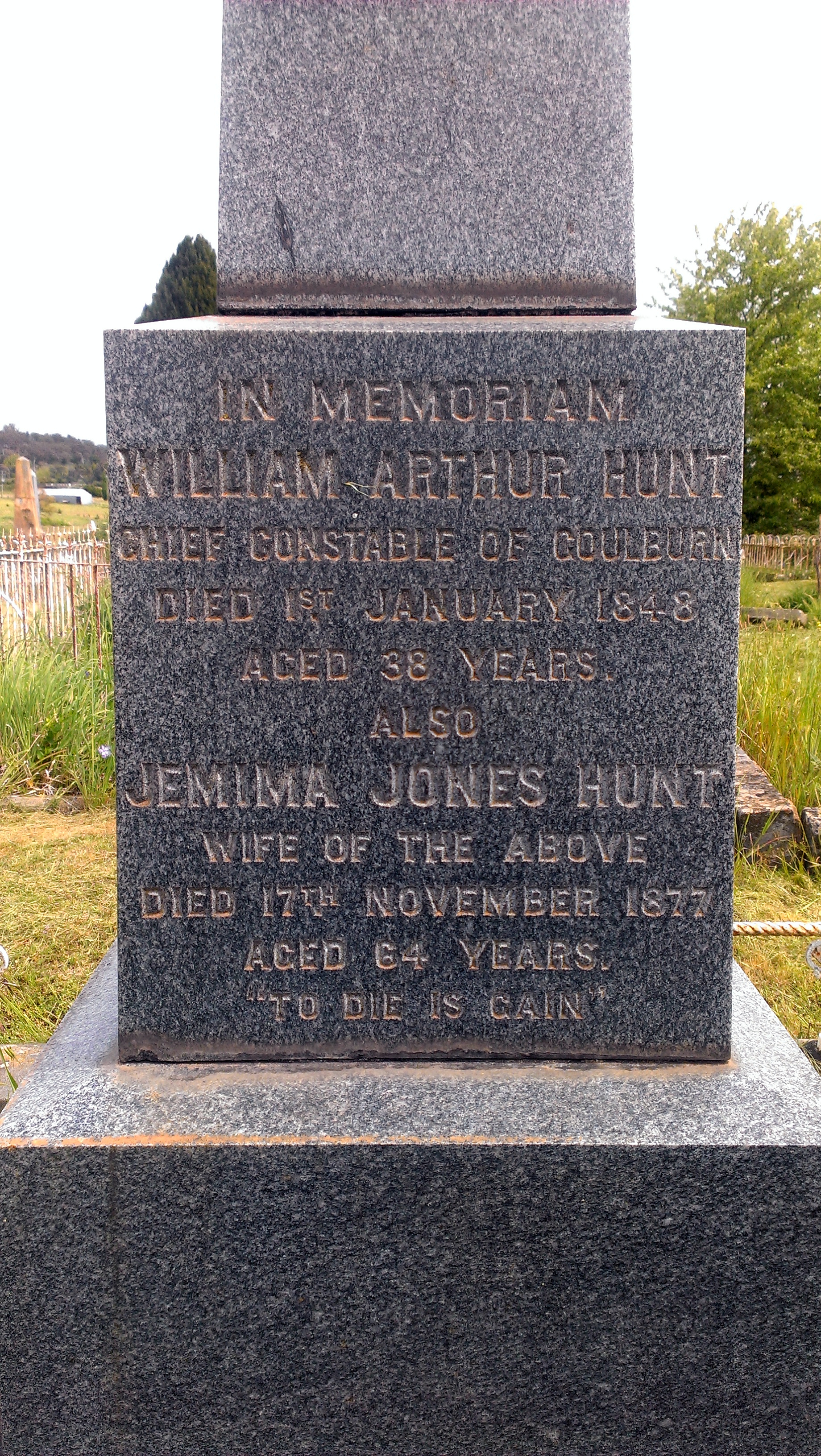
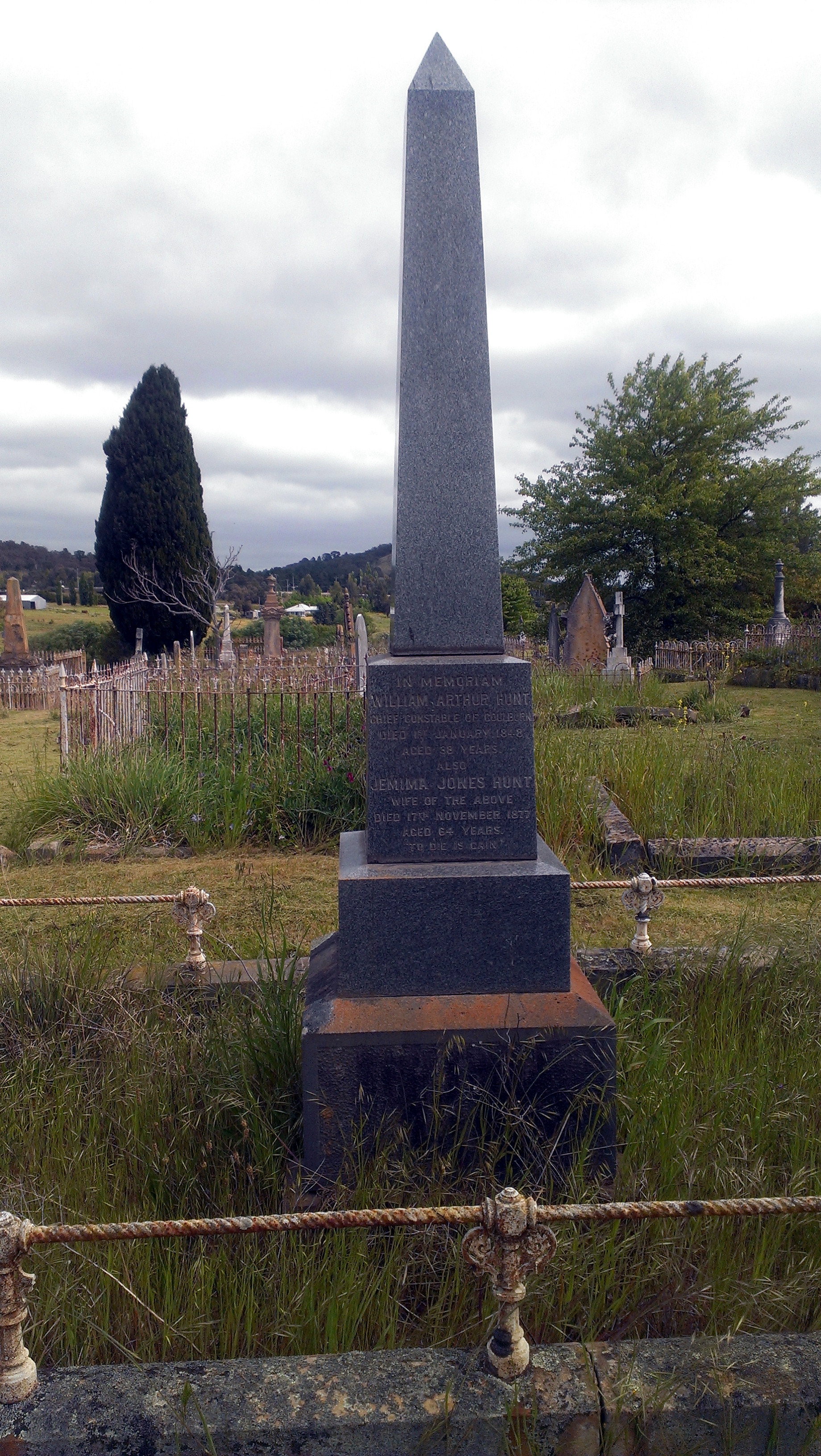
Grave plate reads:
[blockquote]
In loving memory of John Edward BARNES.
Born 28-12-1946 Died 29-6-1993
aged 46 years
Best friend, lover, husband and soulmate of Judy. ” My beautiful Barnesy ” We will be together again
Beloved and proud father of Peter, Dyann and Karina ” You are your dad’s precious gifts from god ”
And most dearly loved pop of Natasha ” you are your pop’s precious little possum ”
The sunshine in all our lives
Your ” Pop the cop with his pips ” will be watching over us always
” God has you in his keeping, we have you forever in our hearts ”
New South Wales Police Force
Inspector John Edward BARNES
Regd. No. 13471
9-12-1968 to 29-6-1993
John was proud to be a serving member of the New South Wales Police Force and especially proud of his promotion to the rank of Inspector of Police on 9-6-1993
Sadly missed by his family, fellow Police Officers and friends.
” The quiet achiever ”
[/blockquote]
* Note: Died 20 days after his promotion to Inspector.
[divider_dotted]
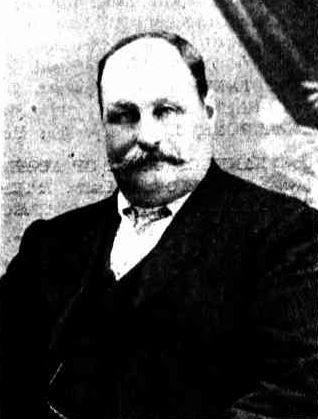
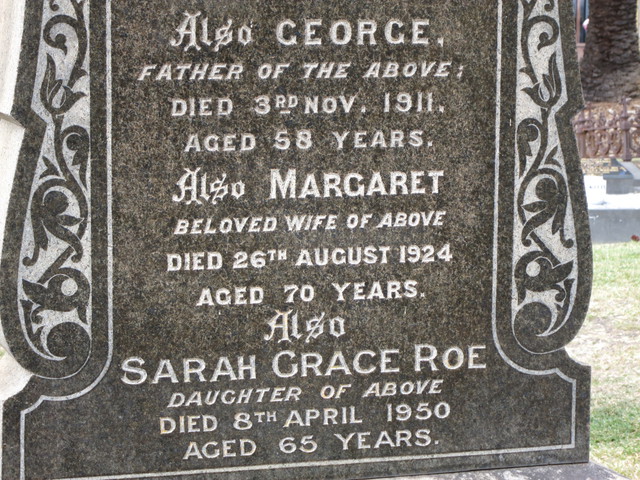
George JEFFES
| 20/11/2014
George JEFFES
New South Wales Police Force
Constable 1st Class 1885
Senior-constable in 1889
Sergeant in 1895
Regd. # ?
Stations: Darlinghurst, Botany,
Darlinghurst ( again ), Regent Street ( No. 2 Division )
Injuries: Traffic Accident – pedestrian with tram
Haymarket
About 4pm on 2 November, 1911 the sergeant was on duty carrying out inspections of pawn shops. At the intersection of Campbell and Castlereagh Streets he failed to hear a tram coming in his direction (he was suffering from diminished hearing) and he was struck by the tram and knocked to the roadway. He was quickly conveyed to the Sydney Hospital suffering from a fractured skull and other head injuries; however he passed away the following day.
[divider_dotted]
The Evening News of 3 November, 1911 carried quite a lengthy report of the tragedy.
“SERGEANT JEFFES KILLED. KNOCKED DOWN BY A TRAM. AN OLD SYDNEY POLICEMAN
Sergeant George Jeffes died in Sydney Hospital early this morning as the result of a city tram accident. He was on duty delivering pawn slips and inspecting pawn shops in the No. 2 (Regent-street) Police District yesterday afternoon, and while crossing Castlereagh-street, at the corner of Campbell-street, he was knocked down by tram No.81 proceeding from the railway station to Circular Quay. Senior-constable Young spoke to Jeffes at the corner of Campbell and Liverpool streets, and a few seconds later on seeing a crowd collect he went to the scene and found his comrade badly injured. He secured the Civil Ambulance, which conveyed the injured man to the hospital where he was admitted with a fractured skull. He was operated on and a lot of blood removed from his brain, but he never rallied. He will be given a police funeral tomorrow afternoon, the cortege leaving the corner of Elsternwick-street and Allen-street, Leichhardt at 1.30 p.m. for Rookwood Cemetery.
Sergeant Jeffes, who was 58 years of age, was an Englishman, and served as a bluejacket till 1882, when he came to Australia, and joined the New South Wales force. He was made a first class constable in 1885, senior-constable in 1889, and sergeant in 1895. He had thus 30 years’ service and could have retired two months ago, taking six months’ leave, but being still strong, he was, at his own desire, allowed to continue in harness, and was working in plain clothes on light duty among the pawn shops.
” THE GOOD SHEPHERD. ” Sergeant Jeffes was for many years known as, the good shepherd, and he did great work reclaiming white girls from the Chinese dens, and children from the slums and from parental hurt to their care. He was associated with Mr. Sherwood in the famous Botany poisoning case, in 1888, when Louisa Collins was hanged.
Senior-constable Sherwood ( now Metropolitan Superintendent of Police ), and Jeffes, then a constable, had charge of the cases. Superintendent Mitchell, who is acting, said this morning that Sergeant Jeffes was a good and capable officer who had the interests of the service and the community at heart, and was most energetic in the discharge of his duties. A daughter of Sergeant Jeffes was murdered in George-street a little over twelve months ago, being shot by a young man.”
With regard to the death of the sergeant’s daughter, the Evening News of 3 July, 1909 reported that “Miss Kate Jeffes, 21, the young woman who was shot in the arm and breast by a French Canadian, named Felix Perrier, in George-street on the night of June 21, died at the Sydney Hospital at 3.30 this morning from the effects of the wounds, accentuated by the shock. She was the daughter of Sergeant Jeffes, of No. 2 Police Station”.
Evening News ( Sydney ) Friday 3 November 1911 Page 9 of 16
[divider_dotted]
The sergeant was born about 1853 and joined the New South Wales Police Force in 1882. At the time of his death he was stationed at Regent Street Police Station. He is buried at Rookwood Cemetery.
[alert_red]He is NOTincluded in the NSW Police Honour Roll.[/alert_red]
[divider_dotted]
SERGEANT JEFFES’ DEATH.
CORONER’S INQUIRY.
The Coroner, Mr. Murphy, yesterday held an
inquiry Into the death of Sergeant George Jeffes, who was knocked down by a tram at the intersection of Castlereagh and Campbell streets, on Thursday afternoon last.
Evidence was tendered to the effect that the deceased was crossing the street at the intersection of Castlereagh and Campbell streets at about 4 pm. As the car approached, a witness called out to him, and the driver sounded the gong, cut off the current, and applied the emergency brake. The car moved on a couple of yards after striking deceased, who was carried along by the cow-catcher. Deceased’s hearing, it was stated, had been defective of late.
The Coroner found that death had resulted from injuries accidentally received through being knocked over by a tram.
The Sydney Morning Herald Tuesday 7 November 1911page 11 of 14
[divider_dotted]
DEATH OF SERGEANT JEFFES.
The ” Good Shepherd. ” A RESPECTED MEMBER OF THE SYDNEY POLICE FORCE.
As the result of a tram accident on Thursday afternoon last, the death occurred on Friday of a well-known figure in the Sydney police force, and a much-respected and admired officer – Sergeant George Jeffes, at the age of 58 years.
Born at Northwich, Cheshire, young Jeffes was apprenticed to the ironworking trade, beginning work when but 8 years of age, in a foundry in Salford, Manchester. At 15 he was seized with the adventurous spirit, and ran away to sea, completing a term of service in the Imperial Navy. Returning to Salford, he joined the fire brigade, and in this capacity had his first experience as a police officer, for in those days the fire-fighter did dual duty. Soon he was again seized by the wanderlust, and landed in Victoria in 1879. A year later Mr. Jeffes arrived in New South Wales, shortly afterwards joining the police.
He was first stationed at Darlinghurst, but subsequently was transferred to Botany, where he was instrumental in bringing to justice Louisa Collins, the last woman who suffered the extreme penalty of the law in New South Wales. In 1889, he was again stationed at Darlinghurst, and promoted to the rank of senior-constable. He was next promoted to Sergeant, when, in 1896, he was attached to Regent-street Police Station, where he ended his career.
To a large extent the suppression of opium traffic, rampant in Sydney a few years back, was the work of Sergeant Jeffes, who, while engaged in this duty, was responsible for saving countless unfortunate women from infamy, earning for himself the sobriquet of the ” Good Shepherd ” for the splendid success attending his efforts. Although stern with Chinese law-breakers, Sergeant Jeffes had the confidence of the whole Chinese quarter. He was regarded in the slums as one whose inclination was more to assist that portion of humanity generally regarded as homeless, than to treat them with the harshness which is generally their lot. His knowledge of the back streets and the opium trade was vast ; and Sergeant Jeffes could always openly enter houses and places that might prove dangerous indeed to any other officer.
His untimely death is greatly deplored in the police force, and by many whom he succeeded in setting on the right path again. The later Sergeant Jeffes was a staunch and practical Catholic, and a member of the Sacred Heart Confraternity. He leaves a widow and two children — a daughter and a son. The Rev. Father Darby was in attendance at the last, and administered spiritual consolation.
The funeral took place on Saturday afternoon, and the cortege conveyed an idea of the esteem in which the late sergeant was held. The Police Band played the ” Dead March in Saul ” and the ” FuneralMarch, ” and 70 uniformed policemen accompanied the hearse from deceased’s residence in Leichhardt to Petersham Railway Station, where the remains were entrained for Rookwood. There was a large gathering at the graveside, and among the mourners were his widow, Thomas Jeffes (son), Sarah Grace Jeffes (daughter), Messrs. Mark Anthony Jeffes and Charles Jeffes (brothers), Robert, Steve and Mark Jeffes (nephews), Mr. and Mrs. James Ryan ; Mr. and Mrs. Peter Ryan, Mr. and Mrs. James Paxton, Mr. and Mrs. Michael Ryan ; Mr. and Mrs. Thomas Ryan, Mr. and Mrs. Denis Ryan, Mrs. Tyler, Misses Tyler (2), Mr. and Mrs. Wm. Landrigan and Miss Mary Landrigan, Mrs. Thomas O’Toole, and Mrs. Wm. O’Toole, Mrs. J. O’Toole, Mr. and Mrs. James O’Toole, Mrs. Coghlan, Mrs. Crooks, Mr. Murphy, Mr. McQuirk, Mrs. Kembo, Mrs. Byrom, Mrs. Moran, Mrs. Hayes, Miss Vaughan, Mrs. Danhy, Mr. and Mrs. Sheedy, Miss L. Murphy, Miss Vera Jeffes, Mr. Fitzgerald, Mrs. Keating, Mrs. Angles, Mrs, Corcoran, Mr, Kilcoyne. Six brother-sergeants acted as pall-bearers, their names being Sergeants Curry, J. Hogg, Sherwood, Curtis, Corcoran and Walker. Others present were: Superintendent Mitchell ( representing the Inspector-General ) Sub- Inspectors Kelly, Brookes and Davis, ex-Inspectors Collins and Broderick, Senior Sergeant O’Dea, Sergeant Meahan, Detective Pauling ( representing the Detective Office ), Senior-Constable’s Young, Meadth, Gambold, Neary, and Mr. Twiss ( ex-senior-constable ), There were also representatives of the different branches of the police, and the Chinese community, and a number of retired officers and friends of Mr. Jeffes’s. The Rev. Father J. Peoples, assisted by the Rev. Father M. Kirby, said the last prayers. The Police Band then played ” The Long Day Closes ”
. ” – R.I.P.
[divider_dotted]
Burial Location:
[divider]
A City Sensation.
A YOUNG WOMAN SHOT. SUICIDE OF HER ASSAILANT.
A sensational shooting affray took place in George-street, near Goulburn-street, city, about half-past 9 o’clock on Monday night, during which Kate Jeffes, 21, a daughter of Sergeant Jeffes, a well-known officer connected with the Regent-street Police Station, was wounded twice, while her assailant committed suicide.
Some weeks ago, Miss Jeffes took a situation in a Pitt-street cafe, where Felix Perrier, a French-Canadian, 35 years of age, was employed as cook. Perrier, it appears, conceived a strong attachment for the young woman, but his attentions were not encouraged, although he occasionally accompanied her to the tram of an evening, at the close of the day’s work. Perrier became so persistent in his attentions that Miss Jeffes decided to leave, and she secured a situation in dining rooms in George-street.
Eventually Perrier found out where she was employed, and called there on Monday, but she refused to see him, and he went away. On ceasing work a little after 9 o’clock, Miss Jeffes started for home, and on reaching the corner of George and Goulburn streets, saw Perrier on the footpath. He addressed her, but she refused to have anything to say to him, upon which the man drew a revolver, and at close quarters fired two shots at her. The first bullet penetrated the cartilage of the left arm and spent itself in a brown paper parcel, which contained her apron and a blouse, and which she was carrying under her arm at the time. The second bullet had a more serious effect striking her beneath the right breast. The bullet did not penetrate very deeply, however, but struck the breast-bone, which caused it to deflect, and travel around a rib under the left arm, eventually embedding itself in the back portion of her left side. She fell bleeding to the footpath, and Perrier, evidently believing that his second shot had taken fatal effect, placed the muzzle of the revolver in his own mouth, and fired.
Naturally a crowd soon gathered, and Miss Jeffes was placed in a Cab, and taken to the Sydney Hospital. The Civil Ambulance was sent for and took Perrier to the Sydney Hospital, where life was pronounced extinct, and the body was conveyed to the Morgue, at Circular Quay. The bullet in Perrier’s case had entered at the mouth, and travelled upwards towards the brain. Dr. Parry extracted the bullet from Miss Jeffes’ side, and she was admitted to the hospital, where she is progressing satisfactorily, the wounds not being regarded as serious.
Evening News ( Sydney ) Tuesday 22 June 1909page 6 of 8
[divider_dotted]
A Cook’s Terrible Crime
ATTEMPTED MURDER AND SUICIDE SENSATION IN SYDNEY
Sydney. Monday
A cook named Felix Perrier, 35, employed at the Glenrock Cafe, Pitt Street and residing at Druitt Street, City, created a sensation to night by attempting to murder Kate Jeffes, 21, daughter of Sergeant Jeffes, of the Metropolitan police, by shooting her with a revolver, and afterwards shooting himself.
The affair took place in George Street, Perrier had been keeping company with Miss Jeffes, but she resented his intentions. To night when he met her in George Street near Druitt Street, he spoke to her and she refused to answer. He then drew a revolver and fired two shots. One bullet entered the young lady’s left arm and the other the side of the right breast. Neither wound is serious. Perrier then fired another shot and put an end to his own life.
National Advocate ( Bathurst, NSW ) Tuesday 22 June 1909page 2 of 4
[divider_dotted]
A GEORGE-ST. TRAGEDY.
ATTEMPTED MURDER AND SUICIDE.
A DISAPPOINTED LOVER TRIES TO MURDER A YOUNG WOMAN.
THEN BLOWS HIS BRAINS OUT.
Felix Perrier, 35, lately living in Druitt-street, city, attempted to murder a young woman named Kate Jeffes, 21, in George-street, near Goulburn-street, at about 9.30 last night. He fired two shots at her at a range of less than a couple of feet, both of which took effect, and then put the muzzle of the revolver into his own mouth and blow his brains out.
Perrier, who was apparently a foreigner, has been employed as a cook at a cafe in Pitt-street for some time, and the young woman, who is a daughter of Sergeant Jeffes, at the No. 2 police station, met him at the cafe some nine weeks ago, when she took a situation there as a waitress. Perrier conceived a strong affection for the young woman, but she refused to encourage him. She, however, occasionally allowed him to see her to the tram of a night when work was over. He eventually became so persistent in his attentions that the young woman was compelled to leave her situation at the cafe and seek employment elsewhere. She afterwards obtained work as a waitress at some dining rooms in George-street, and her troubles with Perrier ceased for a while. But he eventually found out where she was, and, yesterday afternoon, he called at the premises in George-street, and asked to be allowed to see her. Miss Jeffes refused to see him, and in order to be free of him, she asked one of the girls in the cafe to inform Perrier that she had left the place. Perrier, on receiving this information, took his departure. After work Miss Jeffes started for home shortly before 9.30, and was walking down George-street. On nearing Goulburn-street she noticed Perrier standing on the footpath. She tried to evade him, but he stepped up to her and said: “Good night.” The young woman turned her head away, and refused to speak to him, whereupon he drew a five-chambered Belgian revolver, and fired two shots point blank at her. The first bullet penetrated the cartilage of the left arm, and spent itself in a brown paper parcel, which contained her apron and a blouse, and which she was carrying under her arm at the time. The second bullet had a more serious affect, striking her beneath the right breast. The bullet did not penetrate very deeply, however, and luckily struck the breast-bone, which caused it to deflect and travel around a rib under the left arm, eventually embedding itself in the back portion of her left side. She fell bleeding to the footpath, and Perrier, evidently believing that his second shot had taken fatal effect, placed the muzzle of the revolver in his own mouth and fired. The shots had been fired at such short range that the sleeve of the young woman’s blouse was burned with powder, and powder marks were visible on the front of her dress.
There were a number of people about, and a large crowd soon gathered. A woman named Eliza O’Connor, living in Francis street, Hyde Park, who was close by at the time, put Miss Jeffes in a cab, and took her to the hospital, while a traffic constable rang up the Civil Ambulance, which was speedily in attendance, and removed Perrier to the hospital, where Dr. Parry pronounced life extinct. The body was then removed to the Morgue.
The bullet in Perrier’s case had entered at the mouth, and travelled upwards towards the brain. Dr. Parry extracted the bullet from Miss Jeffes’ side, and she was admitted to the hospital; where she made a statement to the police. Her injuries are not considered serious.
The revolver which Perrier used was a Belgium make, and contained four cartridges, three of which had been discharged.
Edward Crampton, a tobacconist, of 48 Druitt-street, who identified the body, and with whom Perrier had lately been living, stated that Perrier bought a revolver on Saturday last, and said that a young woman had been “pulling his leg.” His French blood would get the better of him,’ he said, and he would shoot her. The revolver was taken from him, together with a number of cartridges, but he appears to have regained possession of it. On the body were found Perrier’s discharge papers from the South African Light Horse, dated 1902. These show that he was a French Canadian by birth.
The Sydney Morning Herald Tuesday 22 June 1909page 7 of 12
[divider_dotted]
ATTEMPTED MURDER AND SUICIDE
PERRIER’S FRENCH BLOOD. MUST SHOOT THE GIRL
Sydney, June 22.
Felix Perrier, who last night shot at Kate Jeffs and then committed suicide, was a French-Canadian and had served in the South African light horse. Edward Crampton, with whom Perrier resided, told the police that Perrier bought a revolver on Saturday last. He told Crampton that a young lady had been ‘pulling his leg’ and that his French blood would ‘ get the better of him and he would shoot her ‘. Crampton took the revolver and cartridges from him, but Perrier, however, again got possession of them.
Miss Jeffs is not seriously hurt.
Kalgoorlie Miner ( W.A. ) Wednesday 23 June 1909page 5 of 10
[divider_dotted]
George-street Tragedy.
DEATH OF THE VICTIM.
Miss Kate Jeffes, 21, the young woman who was shot in the arm and breast by a French Canadian, named Felix Perrier, in George-street on the night of June 21, died at the Sydney Hospital at 3.30 this morning from the effects of the wounds, accentuated by the shock. She was the daughter of Sergeant Jeffes, of No. 2 Police Station.
Evening News ( Sydney ) Saturday 3 July 1909page 8 of 16
[divider_dotted]
THE GEORGE-STREET TRAGEDY.
MISS JEFFES’ DEATH.
Kate Jeffes, 21, the young woman who was shot in the arm and breast by Felix Perrier, a French Canadian in George-street near Goulburn-street, on the night of June 21 last, died at the Sydney Hospital early on Saturday morning from the effects of the wounds and the subsequent shock. She was the daughter of Sergeant Jeffes of No 2 Police Station.
The wound in Miss Jeffes’s breast proved more serious than was at first believed but it was not anticipated that it would cause death. While in hospital, however, deceased suffered considerably from shock and was unable to sleep. On Wednesday and Thursday last she was in a low state but rallied on Friday morning. At 11 o’clock on Friday night she became worse and gradually sank, death taking place at about 3.30 a.m. on Saturday.
The Sydney Morning Herald Monday 5 July 1909page 7 of 12
[divider_dotted]
THE GEORGE-ST. TRAGEDY.
SHOOTING OF MISS JEFFES. EVIDENCE AT THE INQUEST. VERDICT OF MURDER AND SUICIDE.
Mr.. H. Hawkins, P.M., at the City Coroner’s Court yesterday, held an inquiry into the deaths of Felix Perrier, 35, a cook, and Catherine Margaret Jeffes, 21 a waitress, the principals in the tragedy on the night of June 21, when Perrier mortally wounded Miss Jeffes and afterwards took his own life by firing two shots into his head, in George-street, near Goulburn street, City.
Edward Crampton, hairdresser and tobacconist, carrying on business in Druitt-street, City, said he had known Perrier for some time. He was a French-Canadian by birth, and a native of Montreal. Perrier came to lodge at his place on June 19, and told witness he was employed at a cafe in Pitt-street. Next day Perrier brought a revolver to the house, and witness asked him what he wanted it for. He replied, ‘I want to fight a duel.’ Witness, however, obtained the weapon. On June 21 Perrier asked.; him for it, saying that the man he was going to fight with had disappeared, and he wanted to raise a few shillings on the gun. Witness gave it to him.
George Jeffes, sergeant of police, stationed at the Regent-street Police Station, and living at 135 Rose-street, Darlington, said Catherine Jeffes was his daughter. He last saw her alive about half past 7 on the morning of June 21, in George-street. She was then going to work at a cafe in Pitt-street. Witness did not know his daughter was acquainted with Perrier. Catherine came home one night not long ago, and said she wasn’t going to business the next morning. Witness asked why, and his daughter replied, ‘A man is pestering me, and has made appointments to meet me.’ Witness then said, ‘You stay at home. I don’t want you to work’
Dr. Edmund Pauling said Perrier was dead when taken into Sydney Hospital. Miss Jeffes was admitted, a bullet having passed through the cartilage of the left arm, and one having entered the body below the right breast. She died on Thursday night last. Dr. Palmer, who made a post-mortem examination, said the cause of death was a bullet wound in the head.
Maria Webber, living in Lewis-street, Redfern, said she was in George-street on the night of June 21. When near Goulburn-street she saw a man accost a girl, and say, ‘Good night.’ The girl did not take any notice, and the man put his hand to his hip pocket. He fired a revolver at the girl, and she screamed, and cried out, ‘My God!’ The man fired again, and the girl dropped to the ground insensible. Perrier then shot himself twice in the head, and dropped. Witness heard no quarrel.
Sarah Williamson, a resident of Glebe, corroborated the previous witness’ evidence.
Traffic Constable Wilson searched Perrier’s body at the Morgue. He found military discharge papers in one of the pockets. Eliza O’Connor, living at 32 Francis-street, Hyde Park, deposed she was outside Messrs. Anthony Hordern and Son’s business premises, George-street, about 9.30 on the night of June 21. Witness heard three revolver shots, and rushed round into Goulburn-street. A young woman was lying on the ground. She told witness she had been shot by a man, and asked to be taken home. Witness took her to Sydney Hospital.
Senior-constable Leary had a conversation with Catherine Jeffes at Sydney Hospital on the night of June 21. She told him she went to work at the Glenrock Cafe, in Pitt-street, about four months ago. She stayed there for some time, and made the acquaintance of a man named Perrier, who was employed as a cook at the same place. They exchanged letters. She soon afterwards left the Pitt-street cafe, and went to one in King-street. Perrier pestered her there, and she had tried to avoid him.
Mark Anthony Jeffes, uncle of the deceased girl, narrated a conversation he had had with his niece two days after the shooting. She told him that she did not want to have any thing to do with Perrier.
The Coroner found that Catherine Jeffes was murdered by Felix Perrier, and that Perrier committed suicide.
Evening News ( Sydney ) Friday 9 July 1909page 3 of 12
[divider_dotted]
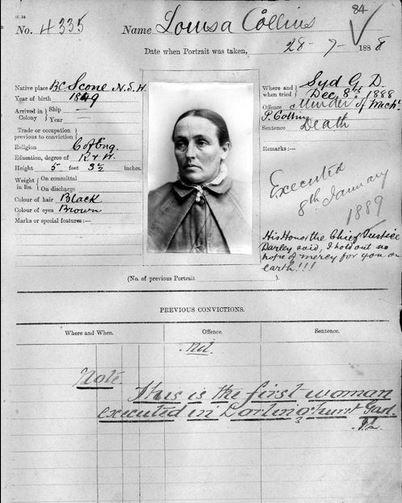
Louisa Collins – last woman hanged in NSW
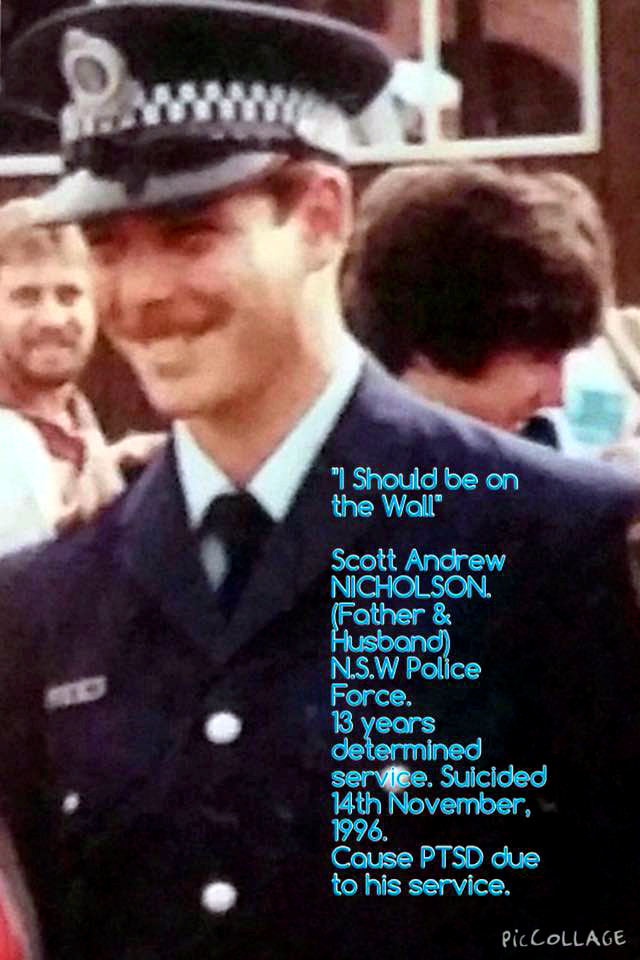
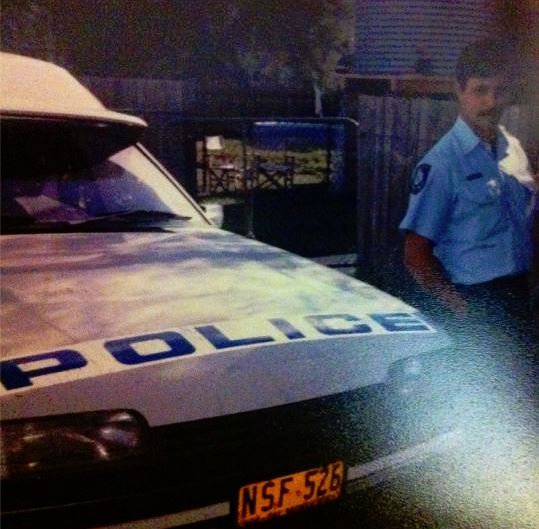
Scott Andrew NICHOLSON
| 20/11/2014
Scott Andrew NICHOLSON
New South Wales Police Force – Resigned
Regd. # 20237
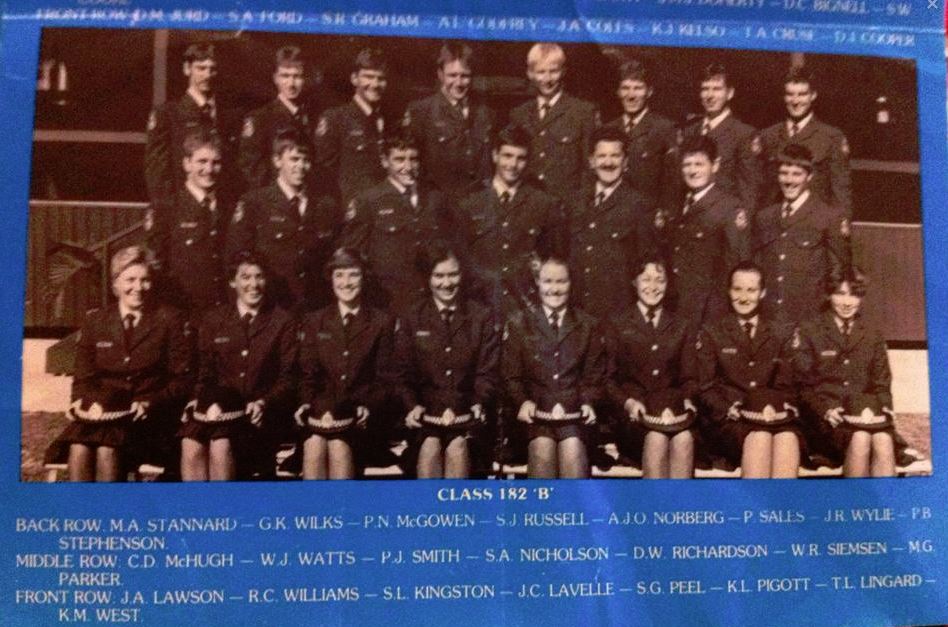
Redfern Police Academy Class 182 B
Rank: Probationary Constable – appointed 28 May 1982
Constable 1st Class – appointed 28 May 1987
Detectives Training Course 28/ 20 May – 28 June 1991
Senior Constable – level 9 upon Resignation
“possibly” Acting Detective Sergeant – Resigned
After resignation ( due to PTSD ) Scott was a Ranger with Liverpool Council until his death
Stations: Campbelltown ( 1980’s ), Camden,
Bulga, Fraud Squad, Child Mistreatment Unit
Service:From? February 1982 to? ? 1996= 13 years Service
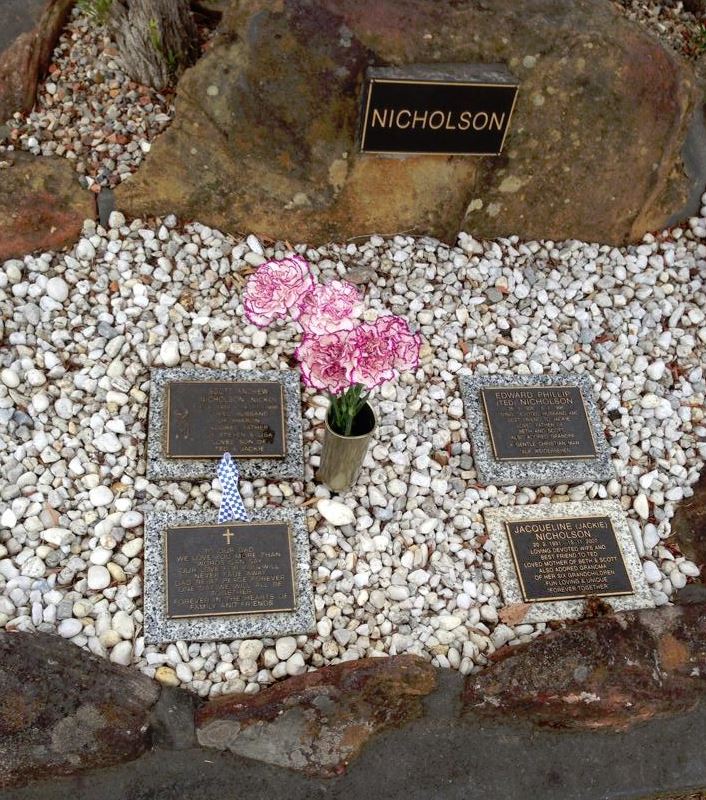
Buried at: Cremated & Resting in the Fountain Garden, Nicholson plot,
Location: Beside Cafe Pagona Area
Section: Gazebo 3 bed 3
Lot:
Lat/Lng: -33.95538, 150.83279
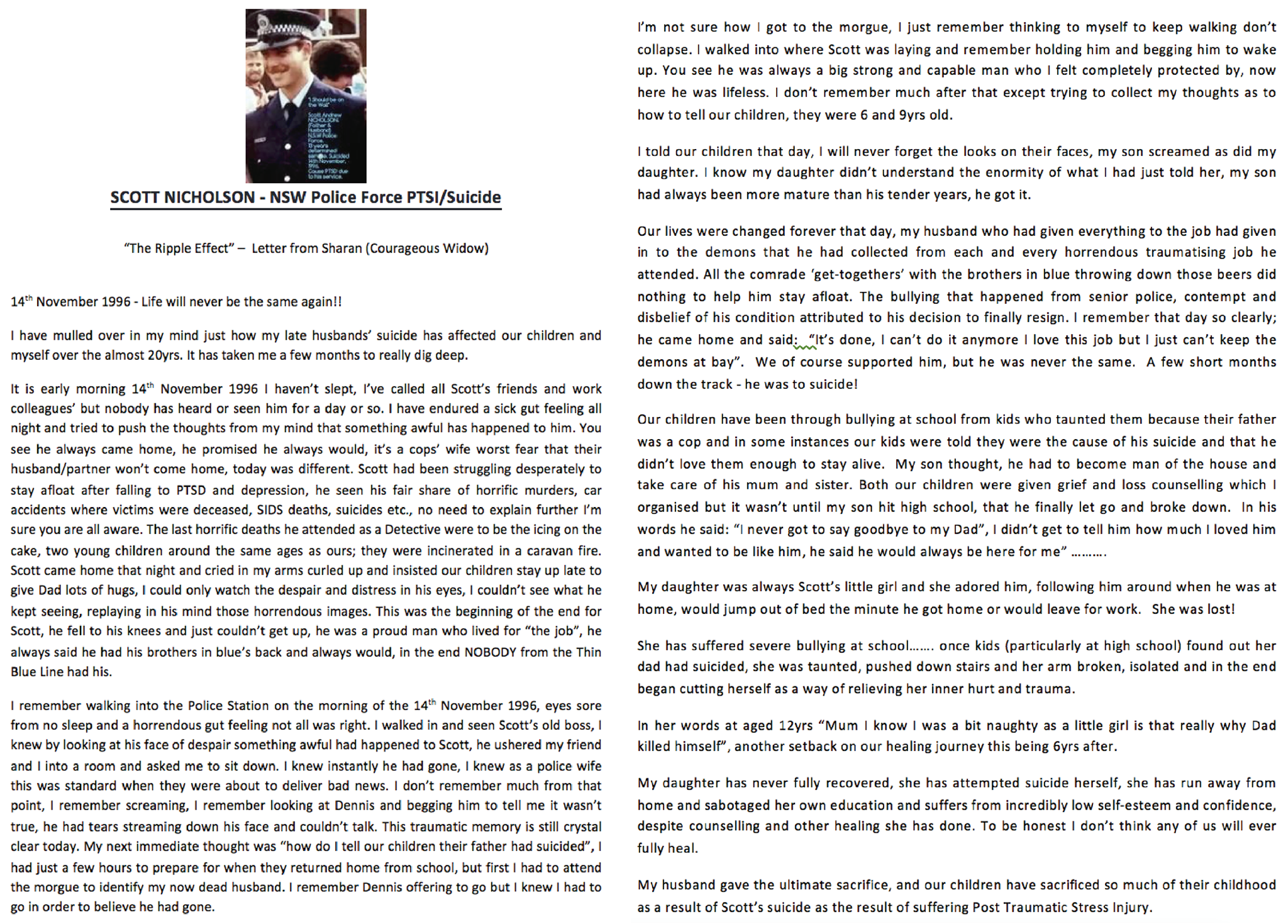
“I should be on the Wall.” I was once a Policeman, I served you for years, I saw so much pain, It reduced me to tears. I saved many lives, Did the best I could do, I served with distinction, All to protect you. Year after year, Without self regard, I lived for the job, No matter how hard. The toll it was taking, Eventually broke through, My brain now was broken, I did not know what to do. I keep telling myself, It will get better in time, Just keep pushing yourself, All will be fine. But it did not get better, It only got worse, The trauma I suffered, Became my own curse. It brought to an end, The job that I live, I can’t do this anymore, No more I could give. The pain did not stop, In fact it just grew, The demons took over, I did not know what to do. I was empty inside, Lost and in pain, I tried to fight on, But I could no longer remain. The trauma had won, I saw no other way, So I took my own life, On a cool summer day. It was because of Policing, You all know it’s true, It destroyed who I was, From the things I went through. The trauma of death, Seen hundreds of times, The witnessing of evil, The wickedest of crimes. Yet now I’m forgotten, By the job I died for, Even though I gave my all, After everything I saw. If I had died on duty, Answering the same call, You would all see my name, My name on the wall. I was still on duty, I just could not let go, I was still a Policeman, My brain made it so….. Written 12.2.15.
Scott Andrew NICHOLSON
Scott Andrew NICHOLSON – Class photo taken at Redfern Police Academy. Class 182 ‘B’
Scott Andrew NICHOLSON – Memorial
[alert_red]Scott is NOT mentioned on the Police Wall of Remembrance[/alert_red] * BUT SHOULD BE
SCOTT ( as of 2017 ) IS mentioned on the NSW Police Wall of Remembrance
SCOTT ( as of March 2019 ) IS NOT mentioned on the NATIONAL Police Wall of Remembrance – Canberra * BUT SHOULD BE
* Stemming from the continued work of the wives & parents of four Fallen NSW Police to Suicide – those four names will now be included in the newly refurbished NSW Police Wall of Remembrance, Sydney, as of 2017
Congratulations to those family members who fought the fight to right this wrong.
Commissioner Scipione has telephoned each of us today to advise that our loved ones names are being added to the replacement NSW Police Force Wall of Remembrance, to be unveiled in the next few weeks.
We would like to thank everyone who has offered support over a long and difficult journey and truly hope this sets a precedent for all police departments, not only in Australia but the global policing community.
It is so very important to remember that policing can and often does have a detrimental effect on those who serve.
We believe that the inclusion of suicide deaths, stemming from a work related psychological injury, is the most compassionate way of showing that the police hierarchy truly cares.
Scott was a member of the New South Wales Police Force for 13 years and, suffering from the effects of PTSD ( Post Traumatic Stress Disorder ) took his own life on the 14 November 1996 by gassing himself in a car and leaving behind two children, aged 6 & 9 ( at the time ) and a wife.
Scott worked at various stations such as Campbelltown in the 1980’s, Camden and the One Man station at Bulga before leaving the Police Force and gaining employment as a Ranger with Liverpool Council.
Dimmy NicholsonHi, my late husbands name is Scott Andrew Nicholson reg number 20237 who died by gassing himself on 14th November 1996 shortly after he resigned from the job when he could no longer cope with his PTSD, worked at Campbelltown police, Camden, one Man Bulga Police Station, Fraud Squad both in uniform & D’s, Child Mistreatment & others. Hope that’s enough info & thank you for all u do
PLEASE EVERYONE I ASK THAT YOU TAKE THE TIME OUT OF YOUR LIVES TO READ MY STORY. I’M LISA NICHOLSON AND MY FATHER WAS SCOTT NICHOLSON.
PLEASE JUST READ LIKE AND SHARE!!!!!!!!
[blockquote]Hi my name’s Lisa Nicholson and my father is Scott Nicholson. They say we are one big police family and we look after our own yet they don’t even care to see the damage there doing. My dad suicided when I was just 6 years old he was my world my life my everything. The day he died my world fell apart and the older I got the harder it hit me. I suffered and battled countless years of depression, I was raped and beat as a child and teenager and I had the balls to follow this through with court. But, tragically, all of this led to many suicide attempts.
Thankfully my dad had my back though I actually believed the world was so awful and painful that I belonged with my dad. I had a very hard time seeing other officers thinking that’s my dad he is as good a officer as you, yet why is he not remembered!??
He was so proud to be an officer and truly lived through his work right to the end! The end that the line of work he did helped drive him too!!! He worked his ass off to get the respect and acknowledgement that he gained and I’ve always been so proud to say that my daddy was a police officer!! Yet here these ass wipes are claiming that everything my father worked for his whole life everything he believed in and followed isn’t recognised. They claim that we’re one big family and in truth it has felt like that thanks to police legacy but then there’s the fact that I’ve got to, every single day, deal with the emotional grief that I will never see my daddy again and then there’s the fact that the man I love so much and am so proud to say he was an officer will never meet my daughter and my daughter will never meet her grandfather and that, in itself, has me pretty low but on top of all that these guys wanna destroy me; even more, give me no choice and take whatever is left in me to fight to have my daddy’s name on the police Remembrance wall; a wall that all our fallen officers are on, all except the ones who took things into there own hands. We’re one big family yet not only has their line of work taken my father and my daughters grandfather but they wanna take everything that I’ve left because they won’t respect what they’d say “one of our own” my dad deserves that respect and so do so many others and again they say we’re one big family but can they even see that their own choices, actions are killing us even more!!!!
I know I’m not the only one but I can only speak on behalf of myself. I wanna know why?? my daddy, the man that the only image I can recall is of him in his uniform, the man who tragically lost his life, the man who they claim death is not tragic enough to be remembered. Why??? I wanna know why?? my dad’s dead the same as officers who’ve died in the line of duty. Dead not coming back; he died from the pain and suffering from his job and they die in the line of duty but they’re telling me my dad’s death isn’t good enough or tragic enough.
No wonder half the population have lost faith in these guys. I will continue to support and stand tall and for as long as I can with everyone else and I won’t ever stop speaking out.
Your secret is no longer!
He will be remembered.
Thank you for reading my story. Please like and share this around. The more this gets around the more I hope will get in their face and finally remember all our lost men and women.
Thank you for sharing such a deeply personal and heart wrenching story of your journey Lisa! This is so courageous of you. The impact that your father’s death had on you and your family is something that the Police force haven’t been around to witness, acknowledge or support and sadly have contributed to your grief in doing so!
Stations Gordonvale, Cairns, Thursday Island & Brisbane
Born: 1928 – Shepparton, Victoria
Joined QPol in 1951 aged 22
Died 27 October 1964 at Little Mulgrave, FNQ
Funeral
Buried Gordonvale Cemetery, FNQ
Plot 10408, Site 181 Division SR Sect. Mon, Row RC
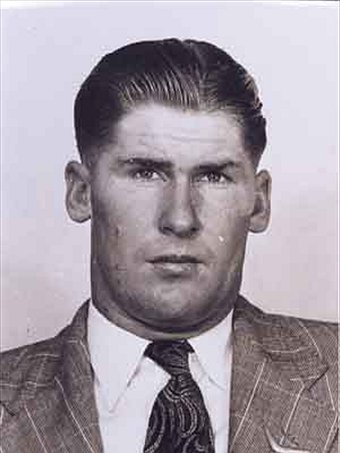
On Sunday October 26 it will be 50 years since Des Trannore (pictured) was shot and killed by John Thomas Verney. (Queensland Police Media)
24 October, 2014 12:07PM AEST
Remembering a hero: Senior Constable Des Trannore
By Isaac Egan and Phil Staley
Desmond Trannore is more than just a name on a far north Queensland bridge or the name of a Gordonvale police officer; it is the name of a hero who lost his life in the line of duty and saved the lives of two children in the process.
Sergeant Steve Webb has spent a lot of his life researching what happened on that fateful day and descibed the experience to the ABC’s Phil Staley.
Born in Shepparton, Victoria, Senior Constable Trannore came to Queensland to work in the cane fields before deciding he wanted to be a police officer.
“Des couldn’t swim a stroke before deciding to join the police force, so he actually used to jump off the old bridge to teach himself to swim,” said Sgt Webb.
After being sworn in he served at Gordonvale, Cairns, Thursday Island and Brisbane, before coming back to serve in Gordonvale in 1956.
Sgt Webb describes it as a time where in the small farming town of Gordonvale police officers were well known local figures in the community and some like Senior Constable Trannore were something more.
“He was a bit of a knock about bloke, he played Aussie rules and he taught boxing and he was well known to give a few of the young blokes a fair kick up the backside if they played up,” he said.
“He was well respected in that town amongst the young people and the older people, and he still is to this day.”
A dark day for FNQ
On the evening of October 27, 1964 Senior Constable Trannore was on the 4pm to midnight shift alone.
At 5:45pm he received a call saying there was a domestic disturbance on a property at Little Mulgrave.
“Des wrote a note that said ‘5:45pm, domestic brawl, Little’s place, Little Mulgrave’ and left it on the typewriter so that the officer-in-charge would know what was going on if anything happened,” said Sgt Webb.
“You’ve got to bear in mind that in those days radios were pretty well non-existent and there was no such thing as mobile phones.”
Mr Verney had assaulted one of his stepsons and was assaulting his wife.
“Verney had caught Clifford and his sister Karen playing in the creek down the road and he attempted to drown Clifford and he smashed Clifford’s head against the side of his utility,” said Sgt Webb.
“Mrs Little came down and tried to intervene and told Clifford to go to the neighbours and get them to call the police.
“Des arrived at the neighbour’s house where he saw young Clifford and he told him to get into the police car.”
Senior Constable Trannore then drove to the farmhouse and asked Mrs Verney and her daughter to get in the police car.
Mr Verney confronted Senior Constable Trannore, threatened him and repeatedly ordered him off the property before disappearing into the house.
He came back out with a .310 rifle and aimed it at Senior Constable Trannore.
“Desmond turned around, approached Verney with no fear and said ‘that’s it, I’ve had enough, give me the bloody rifle’,” said Sgt Webb.
“And with that Verney pointed the rifle and fired from the hip through Des Trannore’s chest – piercing his heart.
“Des turned and ran 20 metres towards the children and said to them ‘run for your life’ before collapsing to the ground.”
Clifford ran towards the cane fields as Mr Verney lifted his rifle to shoot at him.
“He didn’t get a shot out because Clifford disappeared into the cane,” said Sgt Webb.
Mrs Verney heard the shot and ran outside to where Senior Constable Trannore was lying dying.
She attempted to resuscitate him, but he died at the scene. Mr Verney, meanwhile ,fled in his ute.
When word got back to Gordonvale, one of the largest manhunts in far north Queensland history began.
Around 300 on and off-duty police joined the hunt for Mr Verney as well as a large group of Gordonvale residents.
The following day Mr Verney presented himself at the Cairns police station.
“It is thought that Verney got word of the lynch mob at Gordonvale and surrendered for his own safety,” said Sgt Webb.
John Thomas Verney was charged and later convicted of the wilful murder of Senior Constable Trannore and sentenced to life in prison.
Remembering Desmond Trannore
A quote from an unknown Gordonvale resident in the Cairns Post on Tuesday October 27, 1964 reads:
“[Senior Constable Desmond Trannore] was a terrific man and one of the most popular police officers we have ever had, if they ever brought the killer here I would not give much for his chances.”
A letter by Clifford Little describes the event and praises Senior Constable Trannore as a hero and a man unlike any other.
Here is an excerpt from that letter:
“He died with dignity and kept that dignity to his last breath. Desmond Trannore was a humanitarian. His actions that day went beyond that of a serving police officer. Concern for fellow human beings is the most honourable emotion. It becomes even more commendable when the courage of one’s convictions is carried out. I knew a man that other men could only hope to be.”
Researching the case became a passion of Sergeant Webb and in 2009 he suggested the new bridge over the Mulgrave River be named after Senior Constable Desmond Trannore.
“People should remember who he was and the fact that he gave his life to save a family and he did save that family,” he said.
Minister for Main Roads
The Honourable Craig Wallace
Monday, December 07, 2009
Local officer honoured in naming of Mulgrave River bridge
Main Roads Minister Craig Wallace today announced the new bridge over the Mulgrave River at Gordonvale will be officially named ‘Desmond Trannore Bridge’ as part of Queensland’s 150th birthday celebrations.
“This name is chosen in honour of Senior Constable Desmond Trannore, whose bravery and dedication to both the community and his profession is held in high regard by many Gordonvale locals,” Mr Wallace said.
“Mr Trannore was a well respected police officer and member of the Gordonvale community, where he was stationed throughout most of the late 1950s and early 1960s.
“He was heavily involved in community activities – teaching boxing at the local youth club and running the Gordonvale Pony Club, Aussie Rules, tennis and cricket clubs.
“Mr Trannore was tragically killed in the line of duty in 1964 while attending a domestic dispute at Little Mulgrave, north of Gordonvale, and this bridge naming is a community tribute to his bravery.”
Mr Wallace said the bridge name was chosen from more than 50 nominations received across the community.
“It is wonderful to see the Gordonvale and greater Cairns community getting behind this Q150 initiative,” he said.
Mr Wallace said members of the Trannore family will join local members and representatives of the Cairns community in celebrations to officially commission and name the $48 million bridge on Thursday, 17 December.
Jim Turnour, Federal Member for Leichhardt, will join Curtis Pitt, State Member for Mulgrave, on the banks of the Mulgrave River to officially commission the $48 million bridge and unveil the new name sign for the bridge.
“The new bridge is a valuable and vital piece of road infrastructure for Far North Queensland,” Mr Turnour said.
“It will reduce the duration of closures due to wet season flooding and better serve to stabilise the local economy by keeping communities connected all year round.”
The new bridge is part of the Rudd Government’s commitment to improving flood immunity and accessibility between Cairns and Townsville.
“The new 480-metre-long bridge, which opened to traffic in April this year, ahead of time and under budget, is providing significant benefits for far north Queensland.
“Standing five metres higher than the existing bridge and located on a better road alignment, this bridge will limit disruptions to residents and motorists during the wet season by minimising delays caused by wet season flooding.”
The bridge was just one component of the Australian Government’s $347 million Accelerated Bruce Highway Upgrade Package, delivered by the state government.
The majority of works have been delivered, with remaining projects to be completed in early 2010.
Mr Wallace said naming the new bridge over the Mulgrave River after Desmond Trannore recognised the integral role people have in building a community.
“We have chosen a name that recognises an important local identify and also reflects community spirit and local history,” he said.
“This is what the Q150 bridge naming celebrations are all about – Queenslanders having their say on what makes our state unique and being able to recognise these things through the naming of significant road structures.”
A memorial ceremony will be held at the Gordonvale Police Station this week:
WHEN: 10.30am Friday 24 October 2014
WHERE: Police Station, Cannon Street, Gordonvale
Gordonvale Police and members of the Trannore family would like to extend an invitation to members of the community, to help commemorate and honour the memory of Senior Constable Desmond Trannore, who so bravely gave his life in service to the community.
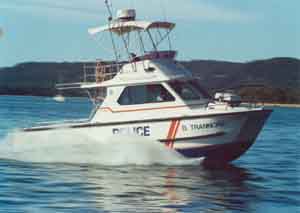
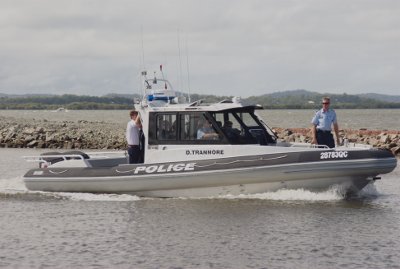
A 8.25 metre glass reinforced epoxy resin planing catamaran powered by twin 225 h.p. Outboard motors.
Qld Police Vessel “D.TRANNORE III” – Brisbane
“D. Trannore III”
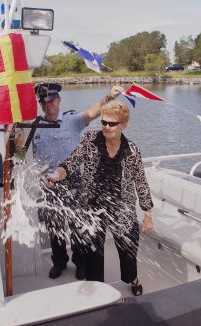
The “D. TRANNORE III” was launched on the 9th April 2009 by Senior Constable Trannore’s widow (see photo right) in the presence of the Police Minister Neil Roberts, Deputy Commissioner Kathy Rynders and invited guest.
Capable of speeds in excess of 45 knots the “D. TRANNORE II” was built by Swift Marine of the Gold Coast and is a rigid hull inflatable speedboat capable of carrying up to 12 people. The “D. TRANNORE II” was purpose built for use by the Redland Bay Water Police to patrol the waterways and islands of Moreton Bay.
Widow of the late Constable Desmond Trannore launches the D Trannore III
[divider_dotted]
Queensland Police Service remembers fallen colleagues during Cairns march
Rebecca Elliott
The Cairns Post
September 30, 201412:00AM
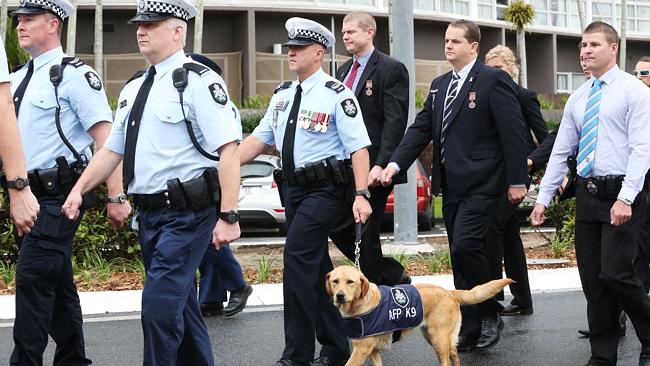
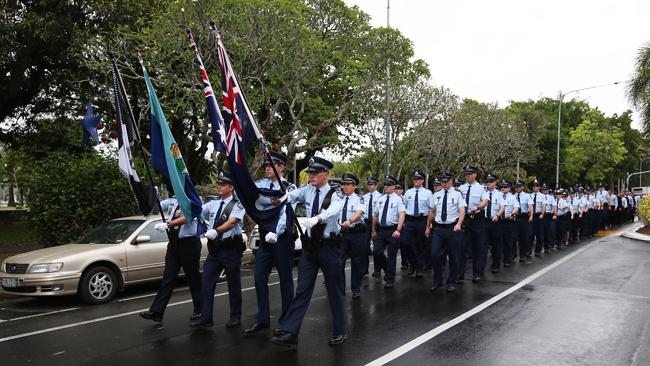
RESPECT: Cairns police march down the Esplanade and towards St John’s Anglican church to mark National Police Remembrance Day. The Federal Police canine squad participated in the march. Picture: Brendan Radke.
KATELIN and Kieren Trannore never got to meet their grandfather, but yesterday the Queensland Police Service showed them just how exceptional his sacrifice was.
As the rain came down, the 16-year-old and 14-year-old marched with their dad, Shane Trannore, Aunty Karen Trannore, and Cairns police as part of National Police Remembrance Day.
The Trannores’ father and grandfather was recognised at this year’s Cairns service for the 50th anniversary of his death.
“I didn’t know much about my grandfather except that he died in the force and just being here is really nice, I am really proud,” Katelin said.
Katelin said it was overwhelming to be part of the day which honoured her grandfather.
“It was, just being part of the march and walking down the street,” she said.
“It was amazing, I really enjoyed it.”
Senior Constable Desmond Trannore was stationed at Gordonvale in 1964 when he attended a domestic disturbance and was gunned down while he was trying to get the mother and the children medical attention.
Senior Constable Trannore’s daughter, Karen, who was only a child when her father was killed, said it was a great honour to be there.
“It was very important and quite emotional to march with the officers,” she said.
“It’s such a hard job to do and I respect each and every one of them and they always have our support.”
RESPECT: Cairns police march down the Esplanade and towards St John’s Anglican church to mark National Police Remembrance Day. Picture: Brendan Radke.
Just under 80 Queensland Police and Australian Federal Police officers marched in the parade.
Acting Chief Superintendent, Brett Schafferius said the dangers involved in policing were always in the back of officers’ minds.
“Today is the most important day on the policing calendar, it is the day we get to recognise and remember the sacrifice police women and men have made over the past 150 years of policing in Queensland,” he said.
“We acknowledge our job at times can be inherently dangerous, that’s why we are here, we are here for the community and to attend those matters on their behalf.”
The names of the 140 fallen police officers were read out during the service.
There are about 850 sworn officers in the Far North district and about 1050 employees overall.
Over the past 150 years, 25 fallen Queensland officers have been from the Far North district.
[divider_dotted]
Desmond Trannore Bridge, Gordonvale, Qld:
[divider_dotted]
Gordonvale Cemetery:
David James GUFF
| 20/11/2014
David James GUFF
aka ‘ Guffy ‘
NSW Goulburn Police Academy Class # 229
New South Wales Police Force
ProCst # 98810
Regd. # 24260
Rank: Commenced training at Goulburn Academy on 29 June 1987 ( aged 24 years, 8 months, 4 days )
Probationary Constable – appointed 18 September 1987 ( aged 24 years, 11 months, 13 days )
Cause: Illness – Suicide possibly due to departmental ‘ proceedings ‘
Age: 41 years, 10 months, 12 days
Funeral date: 25 August 2004
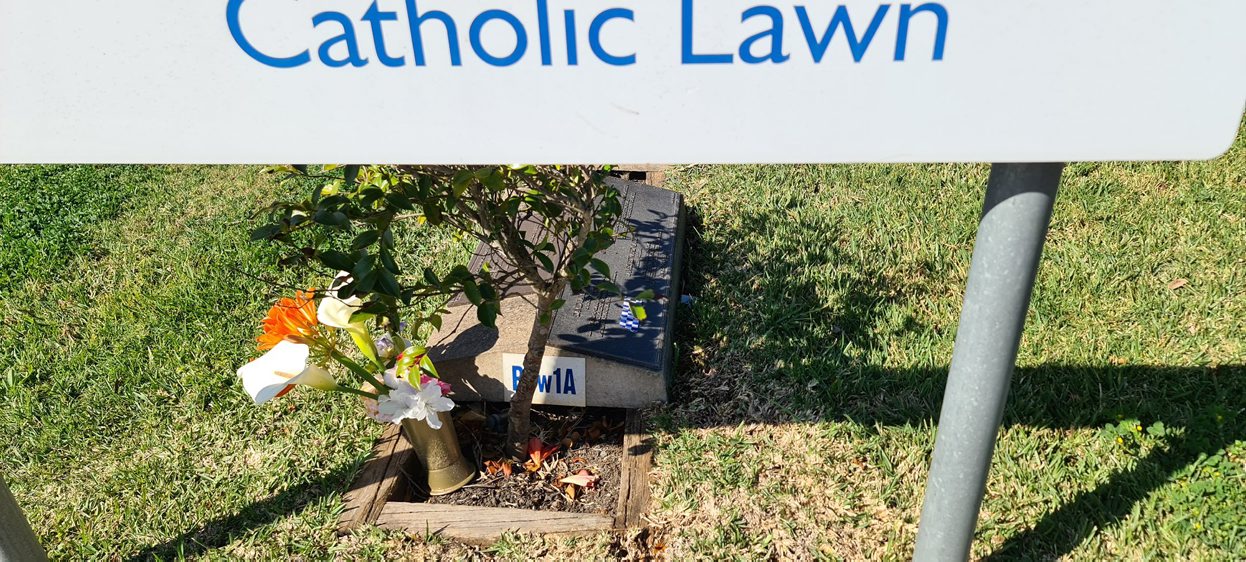
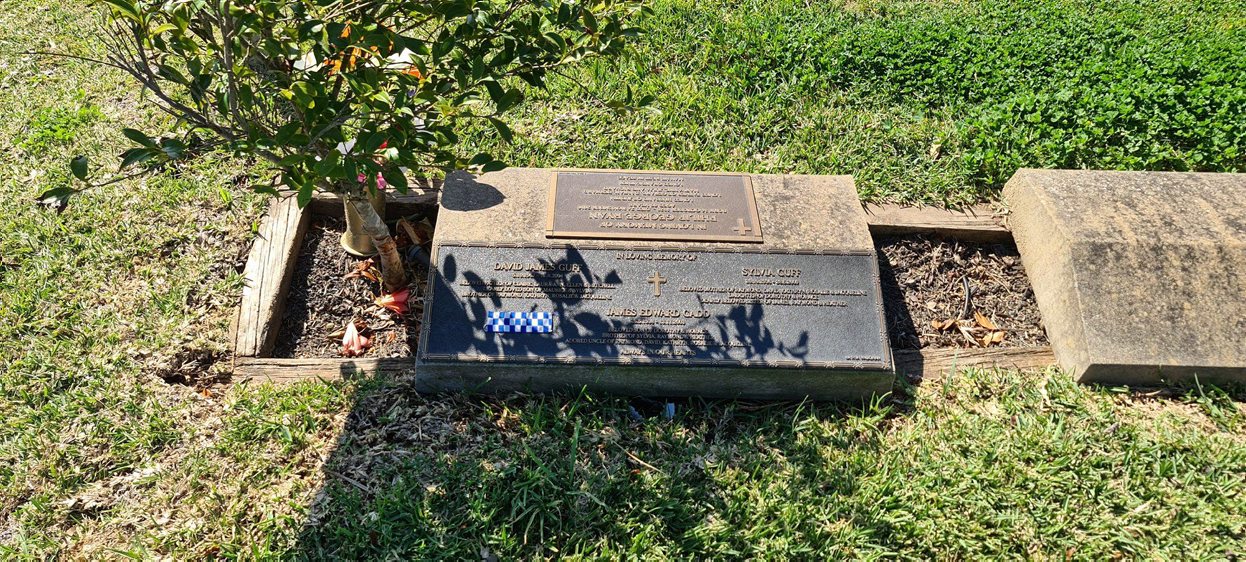
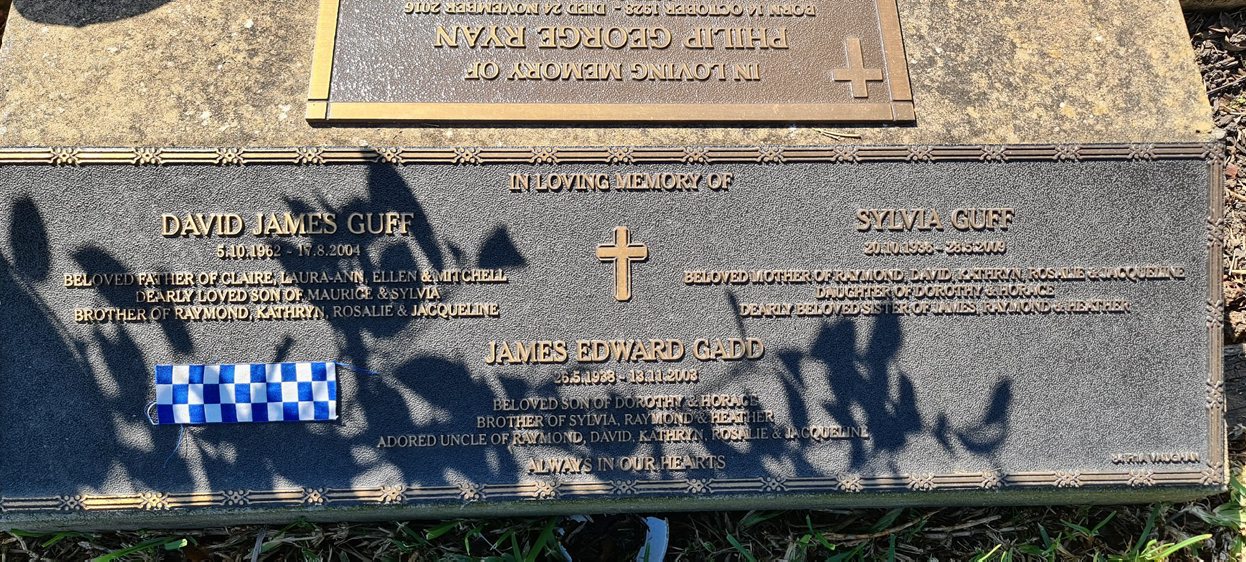
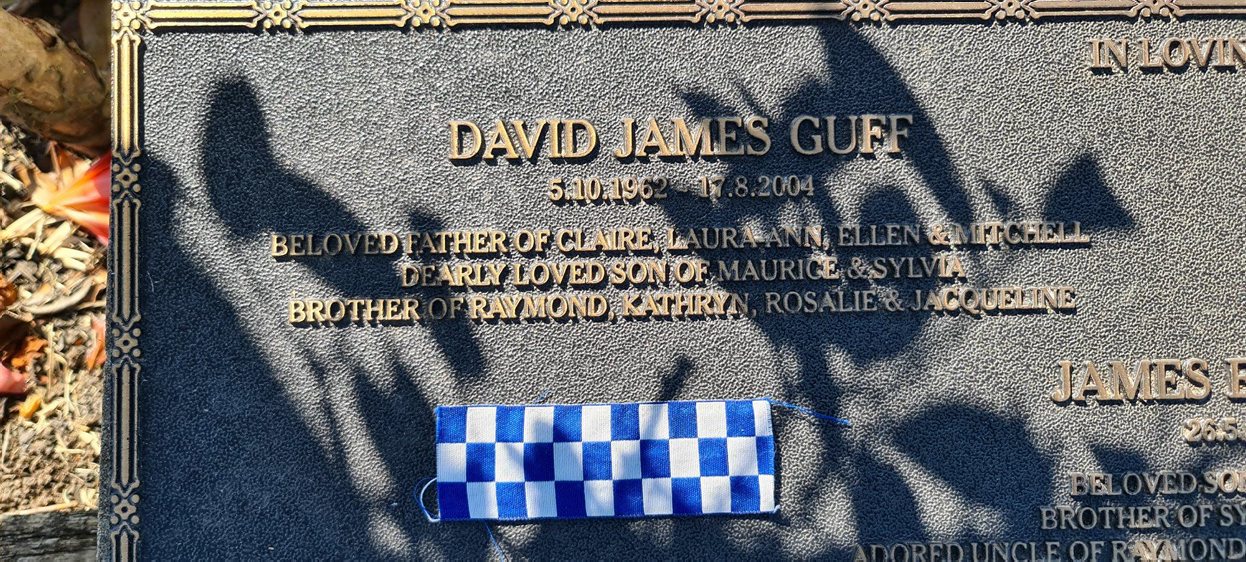
Buried in Vaughan Catholic Lawn Cemetery,
Grave location: Row 1A, Grave 0084,
Freeman Ave, Macquarie Park, Nth Ryde.
David is NOT mentioned on the Police Wall of Remembrance
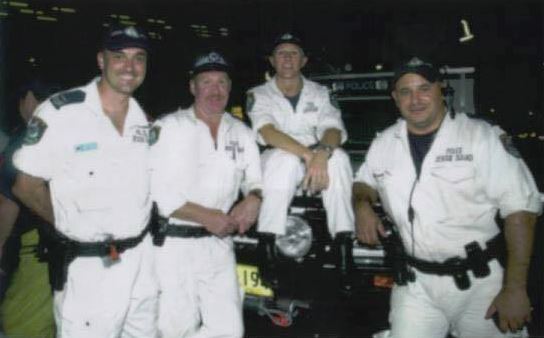
David James GUFF – 2nd from left. Pennant Hills Rescue Squad.
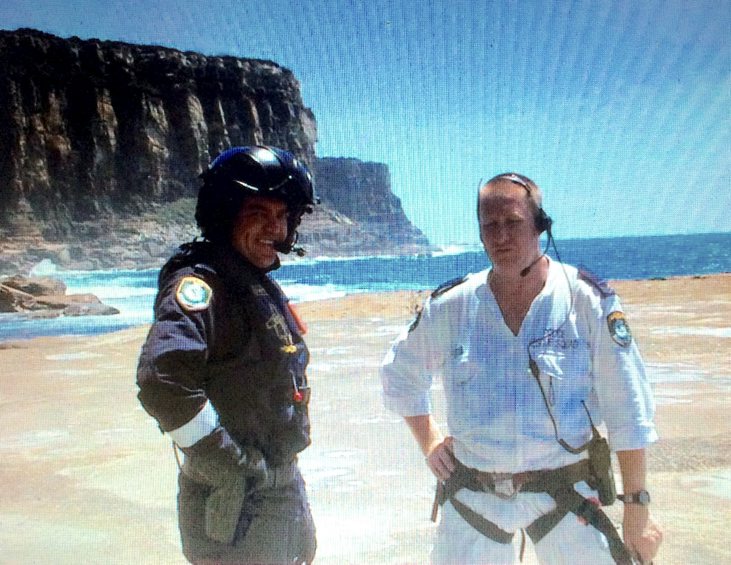
Dave working in with Polair
Dave ( on right ) working in with Polair ( unknown operator )
It is believed that David was subject of a departmental ‘ proceeding ‘ and that he may have been on long term sick report.
It is understood that he committed suicide by hanging himself inside the family garage.
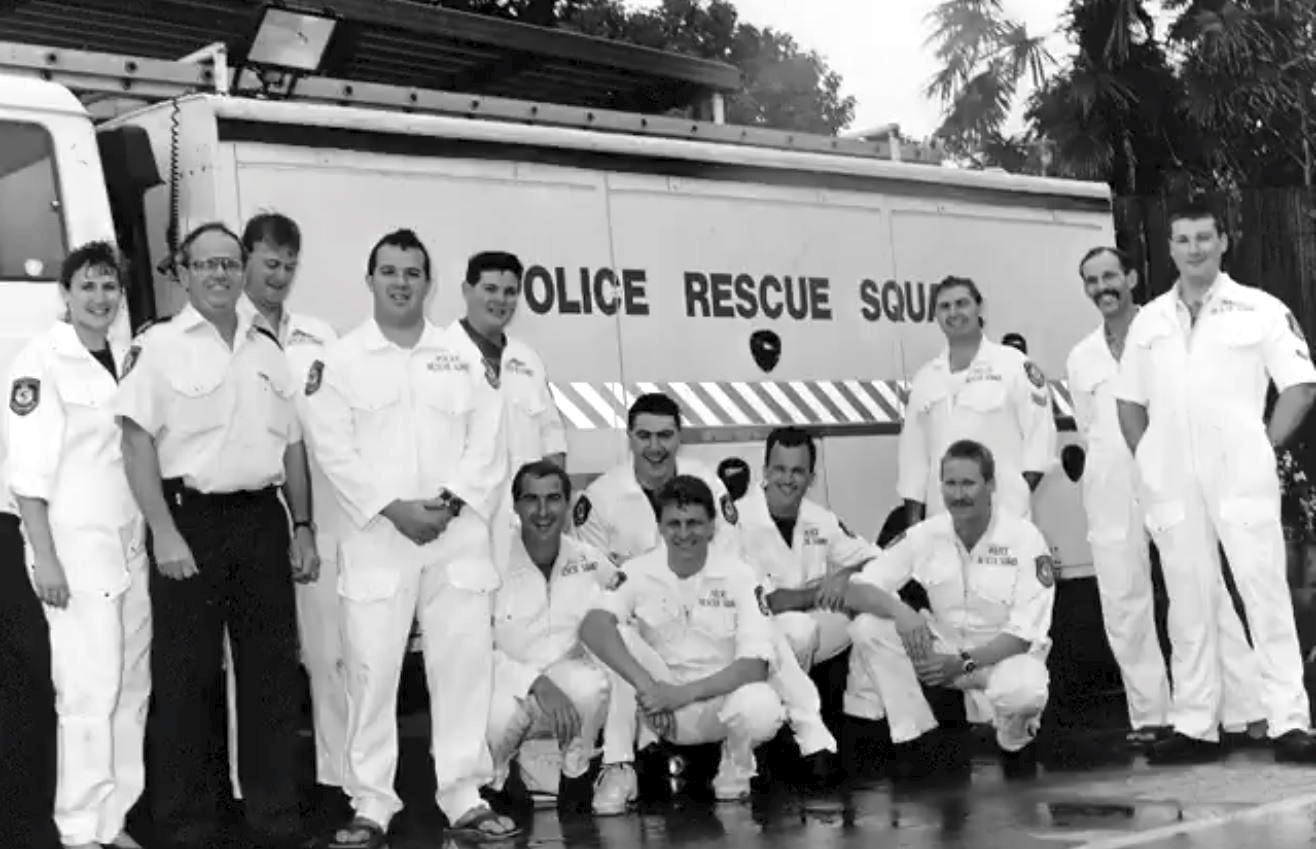
Pennant Hills Police Rescue Squad – around 2000
as seen on 7 September 2020
May he forever Rest In Peace
Ellen Marshall – daughter of David.
Ellen Marshall – daughter of David.
Grave location ( Row 1A )
Olga McALEER
| 20/11/2014
Olga McALEER
New South Wales Police Force – Widow of Kevin ( died 7 Aug. 2011 )
Police Widow
Born 16 June 1932
Died 15 October 2014
82 old
Funeral Friday 24 October 2014 @ 2pm
Buried Molong Cemetery, NSW.
Police Widow, a Veteran Member of the Central Tablelands Branch of the RPA.
Olga passed away on 15/10/2014 and her funeral is proposed to be held at 2pm on Friday 24th Instant at St Lawrence O’Toole Catholic Church, 44 Riddell Street, MOLONG.
Obituary:
McALEER, Olga.
16.6.1932 – 15.10.2014
Peacefully and with dignity at Orange Hospital
Late of Molong Street, MolongDearly beloved wife of Kevin (deceased). Much loved mother and mother-in-law of Yvonne and Alan Evans (Molong), Karen (Sydney), Janelle and David Newham (Nowra), David (Shoalhaven Heads). Loving and devoted “Nan” to her grandchildren, Kate and Chris, Lucy and Matt, Sophie and Nick, Tom and Kirsty, Matt, Jane and Josh, Andrew, Geordie, Simon and great-grandchildren Bailey, Freya, Lilly and Abbey. Loved sister and sister-in-law of Norman and Megan McPhee (Sydney) and Ian, Miriam and Ross (all deceased). Loved aunt of her nieces and nephews and their families.
“Mum and Dad
Together Again”
In God’s Loving Care
Requiem Mass for the Eternal Repose of the soul of the Late OLGA will be celebrated at St. Laurence O’Toole Catholic Church, Molong on Friday (October 24, 2014) commencing at 2.00 pm. At the conclusion of prayers following the Mass, the cortege will proceed to the Molong Cemetery. Family and friends are warmly invited.
By family request in lieu of flowers, donations may be made at the Service to The Molong Hospital.
NORMAN J. PENHALL
FUNERALS
Deidre and Norman Penhall
A.F.D.A. F.D.A. (N.S.W.)
33 William St, Orange.
Phone (02) 6362 3751
Published in The Sydney Morning Herald on Oct. 18, 2014
For anyone that may have served in the Shoalhaven I received this message from the Retired Police Association today:
Olga McALEER, 82 old, Police Widow, a Veteran Member of the Central Tablelands Branch of the RPA. Olga passed away on 15/10/2014 and her funeral is proposed to be held at 2pm on Friday 24th Instant at St Lawrence O’Toole Catholic Church, 44 Riddell Street, MOLONG.
Kevin died on 7/8/2011. Two great people.
Ken MedwayPlease can any serving officer in the Molong area who is able, attend this service as Olga was a great and gracious lady.
Linda WoodsWonderful people. Will always remember the day Ken had a fellow in the Vincentia Police Station doing a gun Licence test ( I think that was what it was) and Olga was out the front, with Kevin and I, telling me all about how men come to have receding hairline at the temples! I have never laughed so much when, after she said it was actually THIGH BURN, the guy in the office popped his head out and said “So, that’s why I have lost the hair around my temples!” We three did not realise he was there! Sadly missed Olga and Kevin.
He first appears in issue dated 7 December 1904 & sworn in as a Probationary Constable attestation date 24 November 1904. His next appearance was in issue dated 11 July 1906 which states he was confirmed as a Constable on 1 June 1906.
His next appearance is in issue dated 14 April 1915 where he was promoted to Constable First Class effective 1 February 1915.
Also found him in the NSW Electoral roll of 1933 electorate of Lakemba residing at “Carrissima” Faux St Punchbowl with wife Maude McEwen. His occupation was listed as Police Sergeant.
[divider_dotted]
RIFLE SHOOTING, GOOD SCORING.
CIVILIANS AND TRAINEES.
( BY RIFLEMAN. )
……
THE RESCH CUP.
This trophy was presented with the object of encouraging interchange of visits between city and country clubs, and is open to Randwick, Waverley, Yorkshire Society, Goulburn Railway Ambulance, Norah Head, and Catherine Hill Bay combinations. It is a handicap event, and last year was won by Norah Head.
The distance for the trophy this quarter is 500yds, where the bullseye is still 18in. Last quarter Waverley and Yorkshire fired in error at 600yds, a distance that is only used for the last year of the competition, 1926 27. The intention, of course, is to allow the two weaker combinations, Norah Head and Catherine Hill Bay, to develop their shooting before going to the more difficult ranges. Mr. R. Fox ( secretary ) has allotted handicaps of 64 and 48 points for the current quarter to Norah Head and Catherine Hill Bay. The contest has given a great stimulus to rifle-shooting in the small coal-mining centre at Wallarah. Two years ago the local club was practically defunct, but now has a membership of 86. Norah Head numbers 38 members. The match is conducted on the home-and-home principle, and on Saturday Randwick’s best eight totaled 511. D. Mitchell scored 32 in one stage, and a possible in the other. Sergeant McEwan, who holds the record for 34 consecutive bull’s-eyes from 500yds 20in bullseye, scored 64, as did McDiarmid, Howarth, and R. Hunt.
The Sydney Morning Herald Monday 27 July 1925page 7 of 20
[divider_dotted]
.
GOLD IN PAPERWEIGHT ANALYSED AFTER 25 YEARS.
One night 25 years ago, Sergeant McEwan, of Regent Street (Sydney) police — he was then a raw young constable — was walking along Bathurst Street, when he chanced to find a lump of metal among the debris of a fire. Some thing prompted him to pocket it.
Last week he had it analysed. The metallurgist gave him £6/5/- for it ! The alloy contained about two ounces of pure gold.
How he managed to keep the metal which he thought valueless, for a quarter of a century, is more than the sergeant himself can tell.
For years it graced the counters of city police stations to which he was attached. He used it as a paper-weight. Often it disappeared for days at a time.
Once it was snatched up by a drink- maddened prisoner, who went berserk in a station. It was thrown on the floor. McEwan forgot about it, but somebody placed it back on the counter.
For many years it was hidden among odds and ends in a locker at Randwick Rifle Range, where McEwan practised shooting.
Years later it was transferred with other trifles to Liverpool Range. When McEwan gave up rifle shooting he took the “nugget” to his home. As the years went by, he came to regard it as a lucky token.
It might still have been lying in a corner at his home had he not chanced to catch sight of it the other day, while he was cleaning some old coins with spirits of salts. Idly, he sprinkled some spirits on the metal, and was surprised to see a gleam of yellow.
He thought nothing of that, but, just curious to find out what the metal really contained, he took it to be analysed. Mr. Garrett, who made the test, believes that the gold was from old jewelery which had been melted down.
The Northern Miner ( Charters Towers, Qld ) Saturday 2 April 1932page 7 of 8
[divider_dotted]
NSW Births, Deaths & Marriages.
Birth: Registration # 10089/1875 McEwen, Alexander James Father: James Mother: Ann District: Coonabarabran
Marriage: Registration # 2896/1905 McEwan, Alexander J Maud HEGGARTY District: Sydney
Death: Registration # 926/1933 McEwan, Alexander James Father: James A Mother: Ann District: Canterbury
[divider_dotted]
Funeral Notices
McEWEN — The Relatives and Friends of Mrs. MAUD M. McEWEN and FAMILY, of 4 Faux-street, Punchbowl, are invited to attend the Funeral of their late beloved HUSBAND and FATHER, Alexander James McEwen ( Sergeant of Police ) ; to leave Charles Kinsela’s Funeral Parlour, 143 Oxford street, city, THIS THURSDAY at 1 pm for Presbyterian Cemetery, Rookwood, by Funeral Train leaving Mortuary Station, Regent-street, Sydney, at 1.50 o’clock.
CHARLES KINSELA,
Funeral Director, Sydney.
The Sydney Morning Herald Thursday 23 March 1933page 7 of 16
[divider_dotted]
McEWEN – The BANKSTOWN RIFLE CLUB –
The Members of the above Club are requested to attend the Funeral of their late Member, Sergeant A J McEWEN ; to leave Charles Kinsela’s Funeral Parlour, THIS THURSDAY at 1 p m for the Rookwood Cemetery. ( See family notice )
G HEMISTER, Captain
G DEHN, Secretary
The Sydney Morning Herald Thursday 23 March 1933page 7 of 16
[divider_dotted]
LATE SERGEANT McEWAN.
Police Sergeant A J McEwan who died last week and was buried at Rookwood on Thursday was one of the best known riflemen in the State.
A familiar figure at every October meeting he had hundreds of friends among visiting riflemen from the other States. Up to two years ago he was a member of Randwick Rifle Club and it was with this club that he achieved his highest success as a marksman. A winner of several individual competitions at N. R. A. and Metropolitan Unions meetings, he put up a record of 44 consecutive bull’s-eyes in a club shoot on Randwick range in 1918. Two years later he was a member of the club team which won the Sands trophy outright. For the past couple of years he was a member of Bankstown club. He was accorded a police funeral and among the riflemen present were Mr J R Wallace ( vice president N. R. A. ) Mr Wilde ( captain ) and Mr R M Fox ( honorary secretary ) Randwick club, also Messrs H Dakin and Stanford, of the Bankstown club.
The Sydney Morning Herald Monday 27 March 1933 page 7 of 14
Where Born :Hythe Hants. (baptised St. Mary the Virgin, Eling Hants.)
Occupation : Labourer / Soldier / Policeman
Date Arrived :14 February 1827
Ship Arrived on :‘Albion’
Port Arrived : Sydney
Rank on Discharge :
Date of Army Enlistment: 22 January 1826
Where Enlisted Army : Kent
Regimental 39th # :
Last Regimental # : 1079
Last Regiment Served : 4th Regiment
Regiment Enlisted from : 39th Regiment
Date Enlisted Mounted Police : 1 October 1827
Rank Mounted Police : Govenor’s Body Guard
Date Discharge Mounted Police: 1 October 1836
Regiment Re-Joined : 4th Regiment
Date Discharged Army : 1 October 1836
Comments Regarding Army Discharge : For Discharge by purchase (£18*) to join civil police – “the character of William Hunt has been that of a good soldier”
Where Discharged :
Died :2 January 1848
Where Died / Buried :Chippendale NSW / St. Lawrence’s CofE Sydney (with memorial in St. Saviour’s Cemetery, Goulburn NSW – GPS: -34.74098, 149.74360 )
Parents Names :Arthur Hunt (b……..d) & Jane Metyard (b……..d)
Spouse’s Name :Jemima Jones Davis
Date Married :28 January 1834
Where Married : St. John’s CofE Parramatta NSW
Spouse’s Parents : Pte. Evan Davis #2, NSW Corps & 73rd Regt. (b circa 1776 …. d 24 March 1828) & Grace Moyle (b circa March 1769 … d January 1850)
Born :14 December 1811
Where Born :Port Dalyrmple (Launceston) Tas.
Occupation :
Date Arrived :
Ship Arrived on :
Died :18 November 1877
Where Died / BuriedTowrang NSW / St. Saviour’s Cemetery, Goulburn NSW.
Descendants
Pte. Hunt’s descendents can be contacted through Colin Roe
Area Settled :
Parramatta and Goulburn NSW
Children :
Olive Jane Hunt (married George Woodall), Jemima Hunt (m. William Richardson), Louise Grace Hunt (m. Uriah Smith), Mary Emily Hunt (m. David John Marsh Broadhead), William Arthur Hunt Jnr. (m. Jane Fuller Stewart), James Evans Hunt (m. Mary Josephine Futton), Arthur Moses Hunt (m. Mary Jane Wilson) and Grace Meatyard Hunt (m. Alexander McClung). See also members.pcug.org.au/~croe/dat1.htm#3
History & Achievements :
Sgt.* Governor’s Bodyguard ( … 1836), Chief Constable at Parramatta, NSW (1838-1842) and Goulburn, NSW (1842-1848). Pte. Hunt’s police baton is in the Parramatta Municipal Museum.
References
Family Members, Military records ,Pay rolls, Pay Musters, Cemetery Records, Church Records & General Muster Records, Mitchell Library ,Sydney Australia
John Waistell ORRIDGE
| 20/11/2014
John Waistell ORRIDGE
New South Wales Police Force
Regd. # ?
Superintendent from 1 January 1864
Stations: Victoria,
Sydney Deport ( Redfern Academy ),
Braidwood – 1864,
Armidale (NSW ) – 1870,
Goulburn ( NSW ) – 1887
Born June 1830
63 old
Died 11 January 1894
Funeral ?
Buried St Saviour’s Cemetery, Cemetery Rd, Goulburn
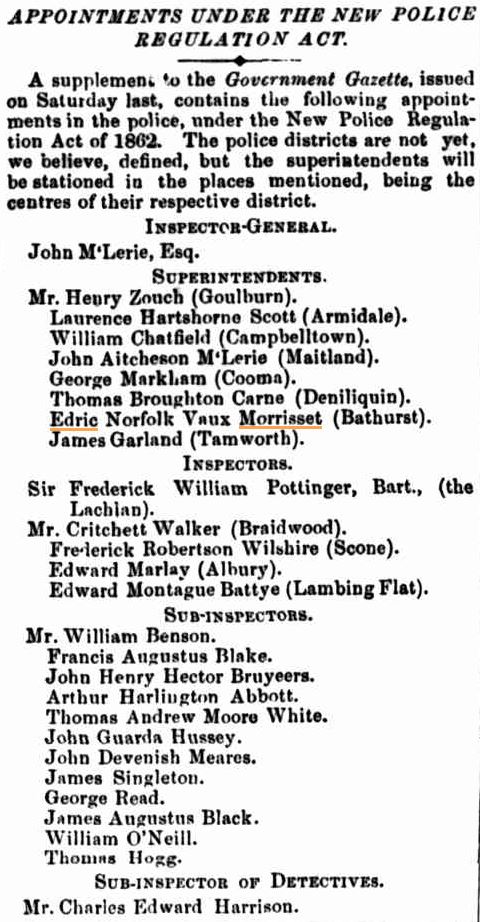
His Excellency the Governor, with the advice of the Executive Council, has been pleased to appoint John W. Orridge, Esq., Inspector of Police, to be Acting Superintendent, and to the charge of the detective police force.
The Maitland Mercury & Hunter River General Advertiser Saturday 7 March 1863page 6 of 8
DEPLORABLE ACCIDENT.— It is our painful duty to record the occurrence of a very serious accident to J. W. Orridge, Esq., the Superintendent of Police. He was proceeding to Major’s Creek on Saturday afternoon last, in company with Dr. Moreton, and was riding up to Durham Hall, the residence of Mr Hassall, at Jembaicumbene, when his horse shied at something and bounded off into the bush, rearing and plunging in a furious manner. The ( horse ) was very spirited, and Mr Orridge had that day for his first time, we believe, ridden him with a curb upon the bridle. Whether it was in consequence of the pulling too heavily upon the curb, or from whatever cause the animal while rearing up, fell right over on his back and came with his full weight upon Mr Orridge to the ground, crushing him in a dreadful manner. The horse immediately scrambled up and made off, Mr Orridge’s feet having got clear of the stirrups, and he being left mangled and bleeding in an insensible state. Dr Moreton immediately procured assistance from Mr Hassall’s and the sufferer was removed there, where he has since remained, and where he has had the most assiduous care and attention.
Dr Pattison and Dr Moreton have been in constant attendance upon him, and everything has been done for him that human efforts can do, but we regret exceedingly to state that very little hopes are entertained of his recovery. The full weight of the animal came upon his body and the internal injuries which he has sustained are of such a character that it will be a miracle if he gets over them.
The horse,which was shortly afterwards recovered, was found to have scarcely injured himself at all, and so completely did all his weight rest upon Mr Orridge, that the saddle was not damaged in the slightest degree. The horse prior to Mr Orridge purchasing him, had been in the possession of the bushranger Thomas Clarke, during a portion of his career on the highway.
The sad event has cast a gloom over the whole town and district wherever the intelligence has been conveyed. How forcibly are we sometimes reminded of the terrible import of the scripture precept, that in the midst of life we are in death, and that we know not what a day may bring forth.
– Braidwood Dispatch.
Queanbeyan Age Saturday 16 November 1867page 3 of 4
Illustrated Australian News for Home Readers ( Melbourne )
ATTEMPTED ASSASSINATION OF THE DUKE OF EDINBURGH: …………
SEIZURE OF THE ASSASSIN. While this painful examination was in progress another scene, which almost defies description, was going on in another part of the ground. No sooner had Mr Vial grasped the arms of the man who had fired the shots, than Mr Benjamin Mortimer ( an American gentleman ), Mr Whiting ( of the firm of Drynan and Whiting ), A. L. Jackson, and other gentlemen seized him ; and had it not been for the closing in around them of the police and other persons, they would speedily have placed him beyond the reach of the law courts. The people shouted “Lynch him,” “Hang him,” “String him up,” and so on, and there was a general rush to get at him.
The police, headed by Superintendent Orridge, got hold of the assassin, and they had the greatest difficulty in preventing, the infuriated people tearing him limb from limb. In this the police were ably assisted by the Chief Justice, Lord Newry, and the men of the Galatea band. Both Lord Newry and Sir Alfred Stephen exerted themselves to get the prisoner on board the steamer lying at the wharf, while Mr Orridge, with herculean strength, kept back the crowd as much as possible. The task of putting the prisoner on board the ship was not an easy one, and it was fully ten minutes before they could got him on to the wharf. By that time all the clothing from the upper part of his body was torn off, his eyes, face, and body were much bruised, and blood was flowing from various wounds ; and when he was dragged on to the deck of the Paterson he appeared to be utterly unconscious.
No sooner was he on board than a number of sailors had a rope ready to string him up, and it was only by the interference of Lord Newry that his life was spared. The people out of whose hands the prisoner had been rescued immediately gave vent to their disappointment, and at an indignation meeting, summarily convened, determined to bring him back from the steamer, and despatch him at the scene of his crime.
A rush was then made for the steamer, which had just hauled off a few feet from the wharf, and they shouted to the captain to haul in. For a moment this officer appeared to waver, but the hon. John Hay, who was on the bridge, doubtless divining the intentions of the crowd, peremptorily ordered the captain to haul off. This he did, and the vessel accordingly proceeded on her voyage to Sydney.
MARRIAGE. On the 16th instant, at St. Andrew’s Cathedral, by the Very Rev. Dean of Sydney, JOHN WAISTELL ORRIDGE, Esq., of Braidwood to EMELINE LESLIE, second daughter of the late HUGH GORDON, Esq., of Manar.
John Waistell Orridge was born at Carlisle, in Cumberland, England, in June, 1830, reached Victoria in 1853, and shortly afterwards entered the police force there, obtaining rapid promotion to the rank of sub-inspector owing to his efficiency and courage. When the police force of this country was reorganised in 1862 Mr. Orridge was offered and accepted the position of inspector, being promoted to be superintendent at Braidwood in 1864.
The notorious Tommy Clarke managed to escape from Braidwood Gaol, where he was awaiting trial for horse-stealing. This escape put Mr. Orridge on his mettle, and for years he and his police were in pursuit of Clarke and his gang, then becoming very numerous. Murders and encounters with the police followed in rapid succession, bushranger after bushranger being shot. Houses were stuck up, stores robbed, and the whole district was in a state of terror. Clarke’s career of crime culminated in the murder of four men, warders of Darlinghurst Gaol, who volunteered to try and capture the outlaws, urged thereto no doubt by the reward of £500 offered by the Government. Finally Tommy Clarke and his brother surrendered, and to Mr. Orridge’s great relief were safely incarcerated in Braidwood Gaol, and afterwards forwarded to Sydney, where they expiated their crimes on the scaffold.
Subsequently Mr. Orridge was appointed to the charge of the escort of the Duke of Edinburgh, and was at Clontarf when Farrell made his attempt at assassination, and with difficulty prevented some of the leading men of the colony from stringing up the latter to the yardarm of the steamer.
Mr. Orridge was afterwards removed to Armidale, and in 1887 was transferred to Goulburn, where he died on the 11th instant. In 1871 he married the second daughter of the late Mr. Hugh Gordon, of Manar, near Braidwood, who with her two sons and two daughters survive him.
Illustrated Sydney News Saturday 27 January 1894page 15 of 40
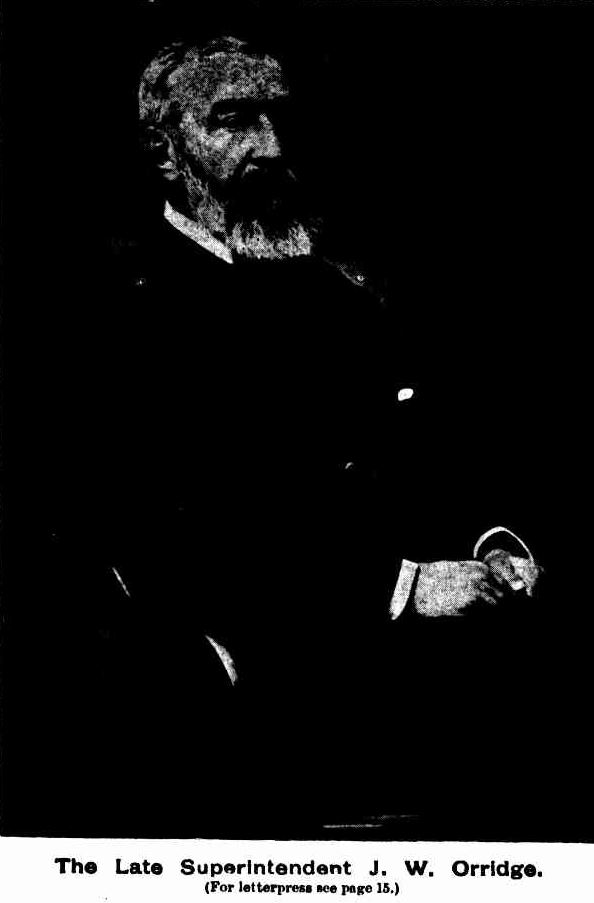
The Late Superintendent J. W. Orridge.
John Waistell Orridge was born at Carlisle, in Cumberland, England, in June, 1830, reached Victoria in 1853, and shortly afterwards entered the police force there, obtaining rapid promotion to the rank of sub inspector owing to his efficiency and courage. When the police force of this country was reorganised in 1862 Mr. Orridge was offered and accepted the position of inspector, being promoted to be superintendent at Braidwood in 1864.
The notorious Tommy Clarke managed to escape from Braidwood Gaol, where he was awaiting trial for horse-stealing. This escape put Mr. Orridge on his mettle, and for years he and his police were in pursuit of Clarke and his gang, then becoming very numerous. Murders and encounters with the police followed in rapid succession, bushranger after bushranger being shot. Houses were stuck up, stores robbed, and the whole district was in a state of terror. Clarke’s career of crime culminated in the murder of four men, warders of Darlinghurst Gaol, who volunteered to try and capture the outlaws, urged thereto no doubt by the reward of £500 offered by the Government. Finally Tommy Clarke and his brother John surrendered, and to Mr. Orridge’s great relief were safely incarcerated in Braidwood Gaol, and afterwards forwarded to Sydney, where they expiated their crimes on the scaffold.
Subsequently Mr. Orridge was appointed to the charge of the escort of the Duke of Edinburgh, and was at Clontarf when Henry O’Farrell made his attempt at assassination, and with difficulty prevented some of the leading men of the colony from stringing up the latter to the yardarm of the steamer.
Mr. Orridge was afterwards removed to Armidale, and in 1887 was transferred to Goulburn, where he died on the 11th instant. In 1871 he married the second daughter of the late Mr. Hugh Gordon, of Manar, near Braidwood, who with her two sons and two daughters survive him.
Mr. J. W. Orridge, superintendent of police in the Goulburn district, died last evening. He joined the police service in 1862, and took charge of the Sydney depot as acting superintendent. In 1864 he was appointed to Braidwood, and took a prominent part in dealing with the Clarke gang of bushrangers. In 1870 he was transferred to Armidale, and in 1887 he came to Goulburn to succeed the late Superintendent Morrisset. Superintendent Orridge was popular with the men under his control, whom he encouraged in the pursuit of athletic sports. He leaves a widow, two sons, and 10 daughters. The funeral was attended by the Inspector-General of Police.
Mr. John Waistell Orridge, senior superintendent of the New South Wales police force, died at Goulburn at the ripe age of 63. During his connection with the police, extending over 31 years, Mr. Orridge was admired by the police and public. Previous to joining the New South Wales force, Mr. Orridge held the rank of sub-inspector in Victoria, but when the present Inspector-General took charge of the police department, well knowing the high qualifications of Mr. Orridge, he induced that officer to come over the border, and when Mr. Orridge entered on his duties he was placed in charge of the detective police, and made such headway that on January 1, 1864, he was appointed superintendent. He continued in charge of the detectives for some time. His first country appointment was at Braidwood, and he was in charge of that extensive district during the time the Clarkes held the country in terror, and it was under Superintendent Orridge’s directions to the courageous troopers under him that the brothers were run to earth. From Braidwood Mr. Orridge was transferred to Armidale, and at the death of Superintendent Morrissetin September, 1887, he succeeded to the charge of the Goulburn district, where he has since been stationed, and has done his duty well, and has now ended a life marked by great success. The deceased officer ranked next to the Inspector-General, Mr. Fosbery, who had known him ever since they joined the Victorian police together.
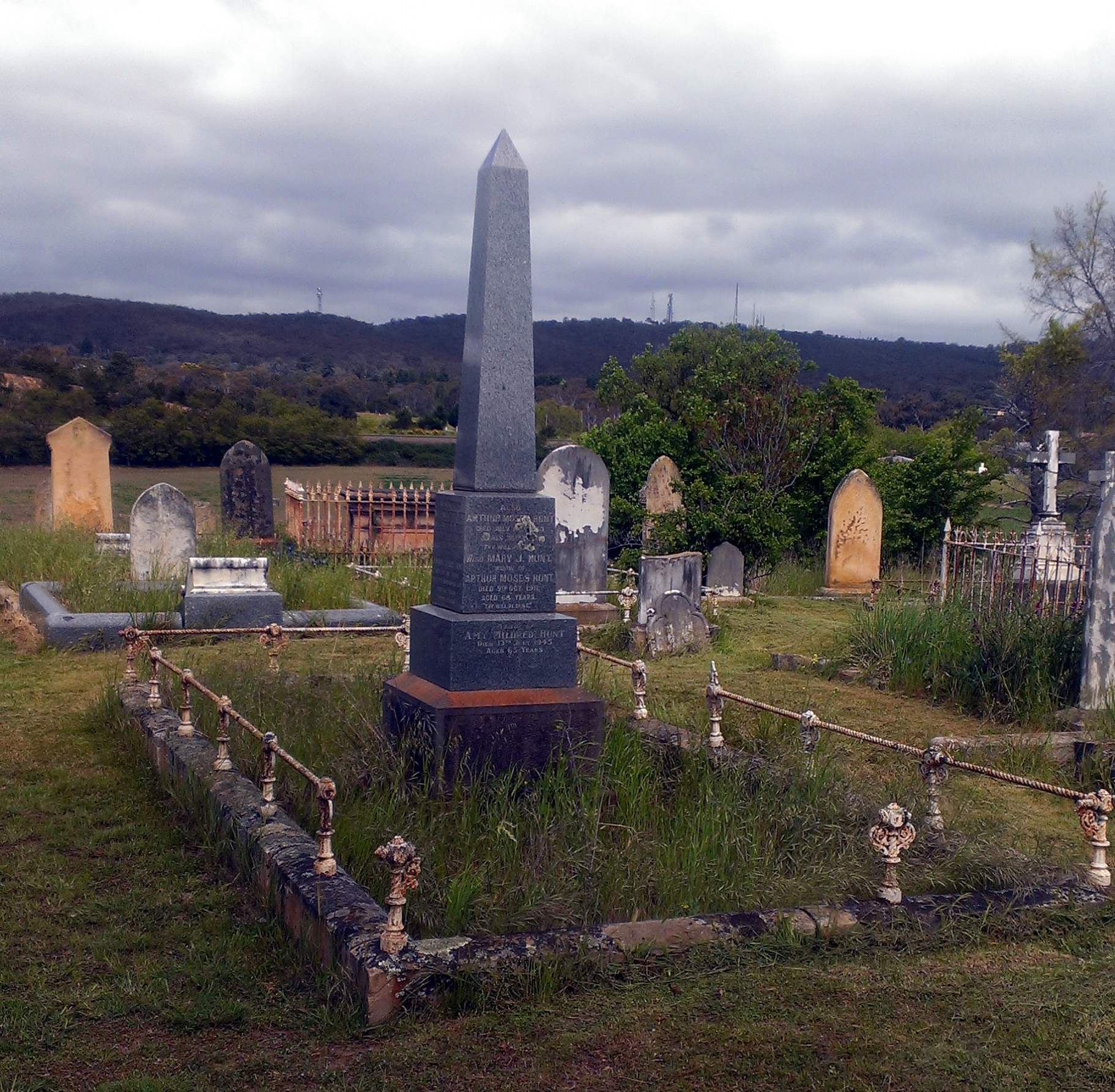
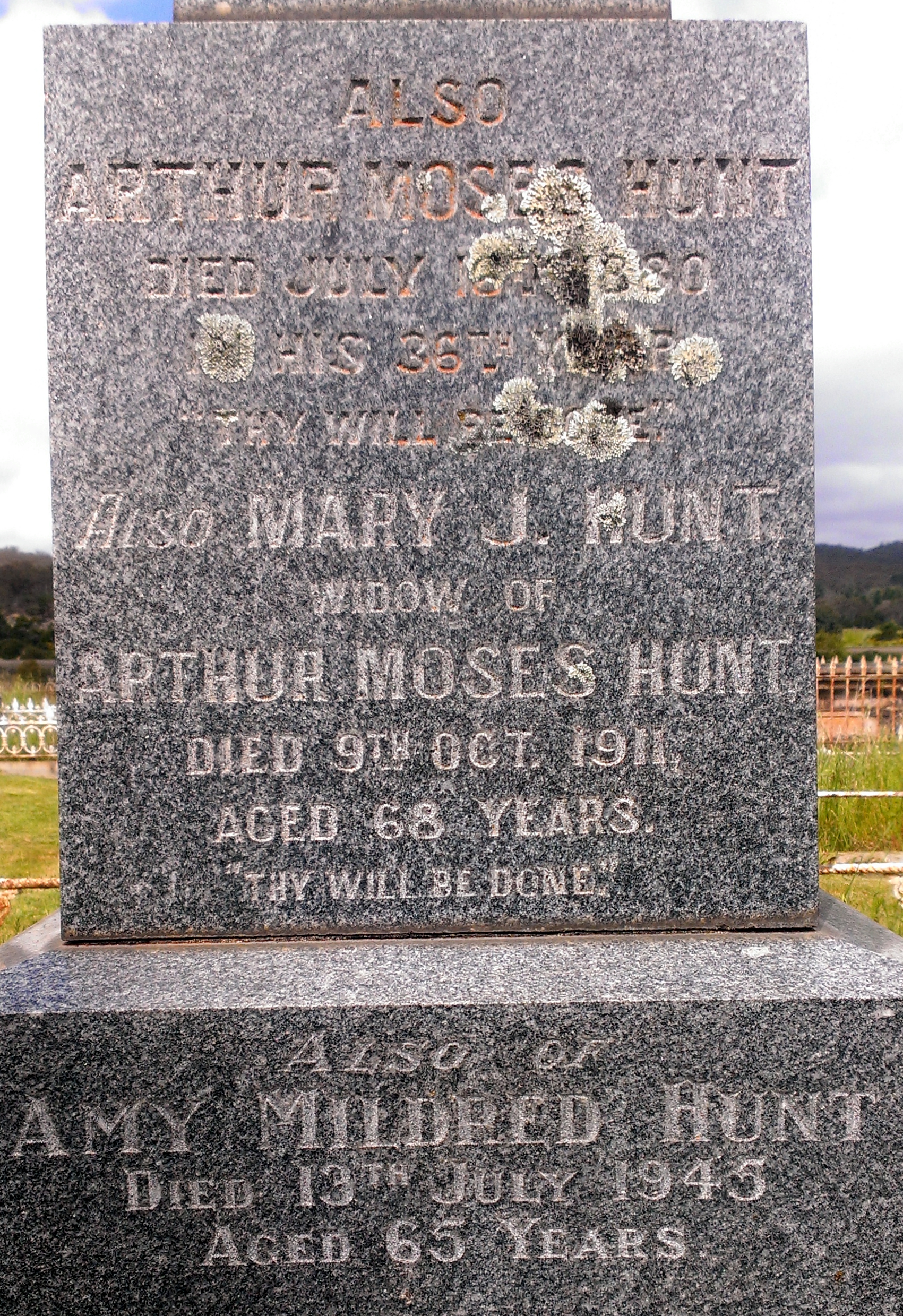
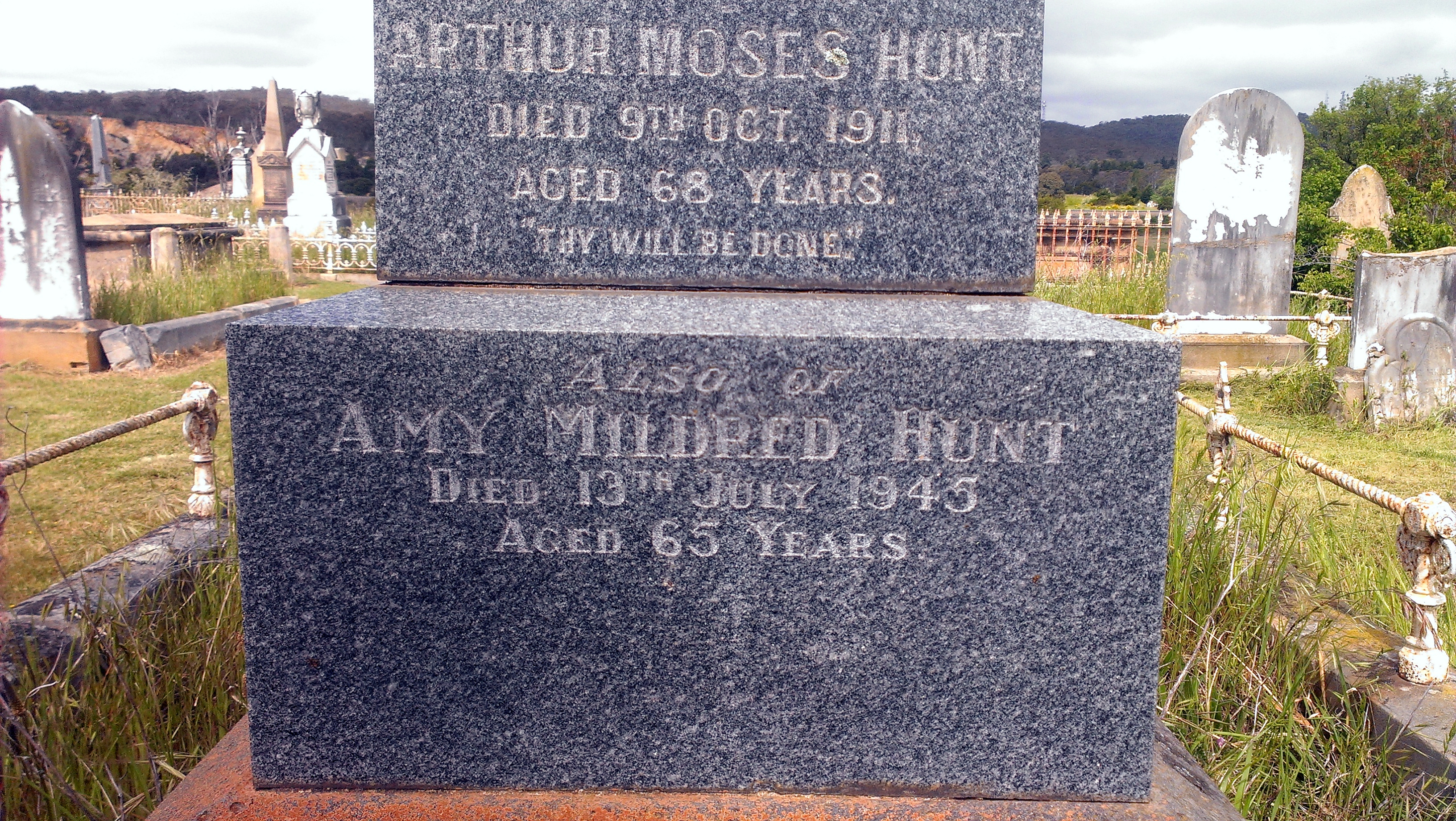
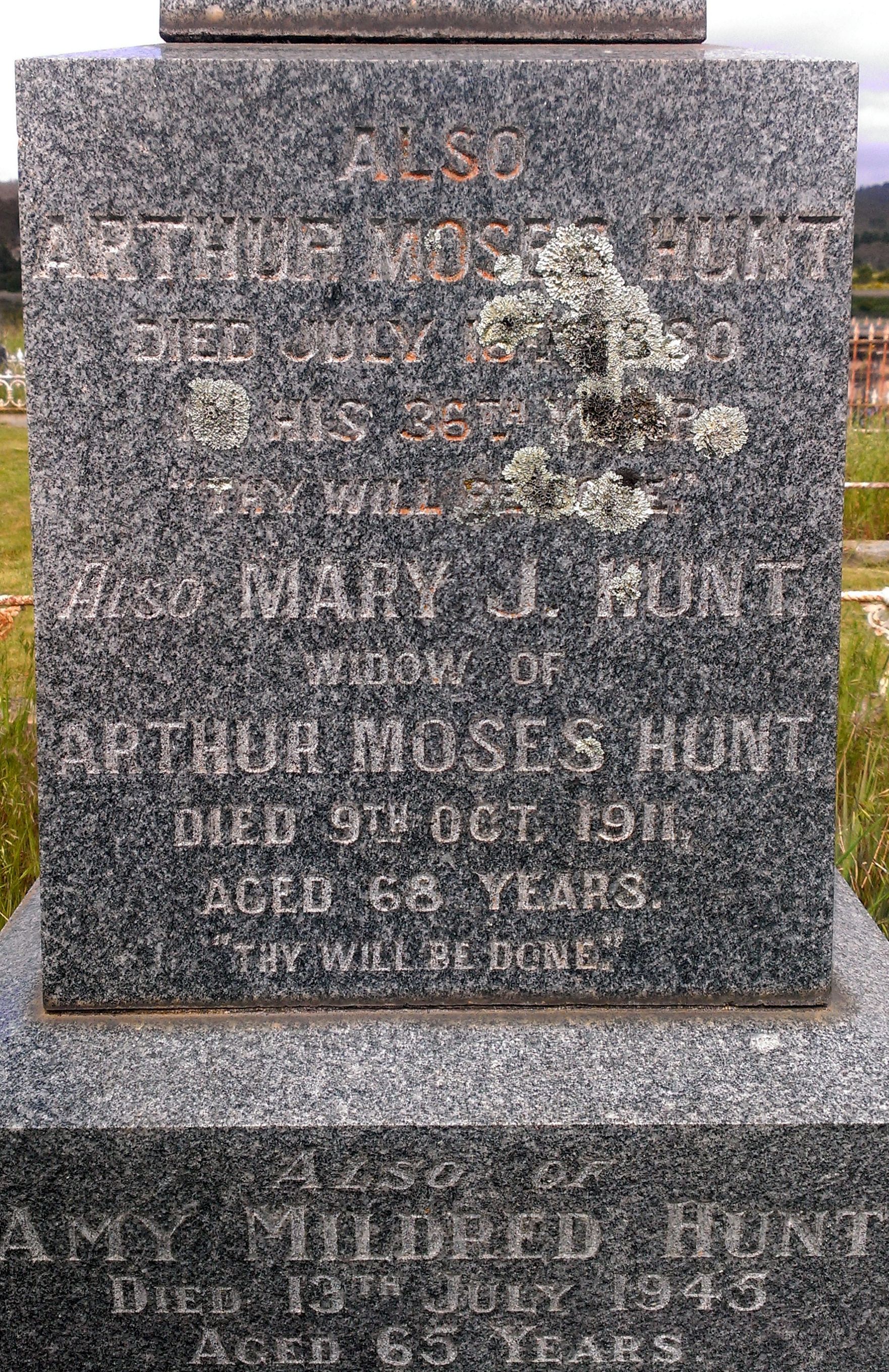
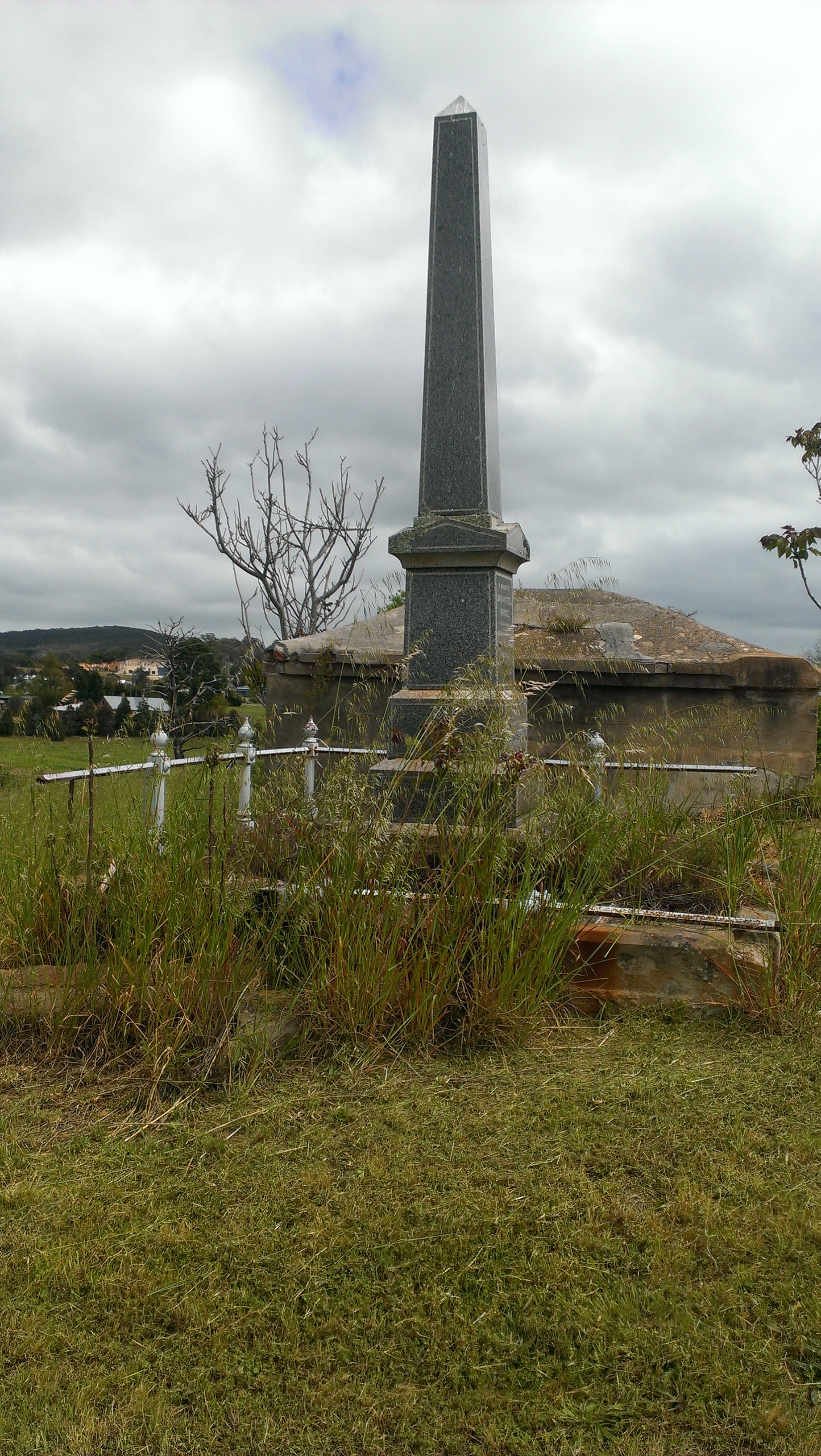
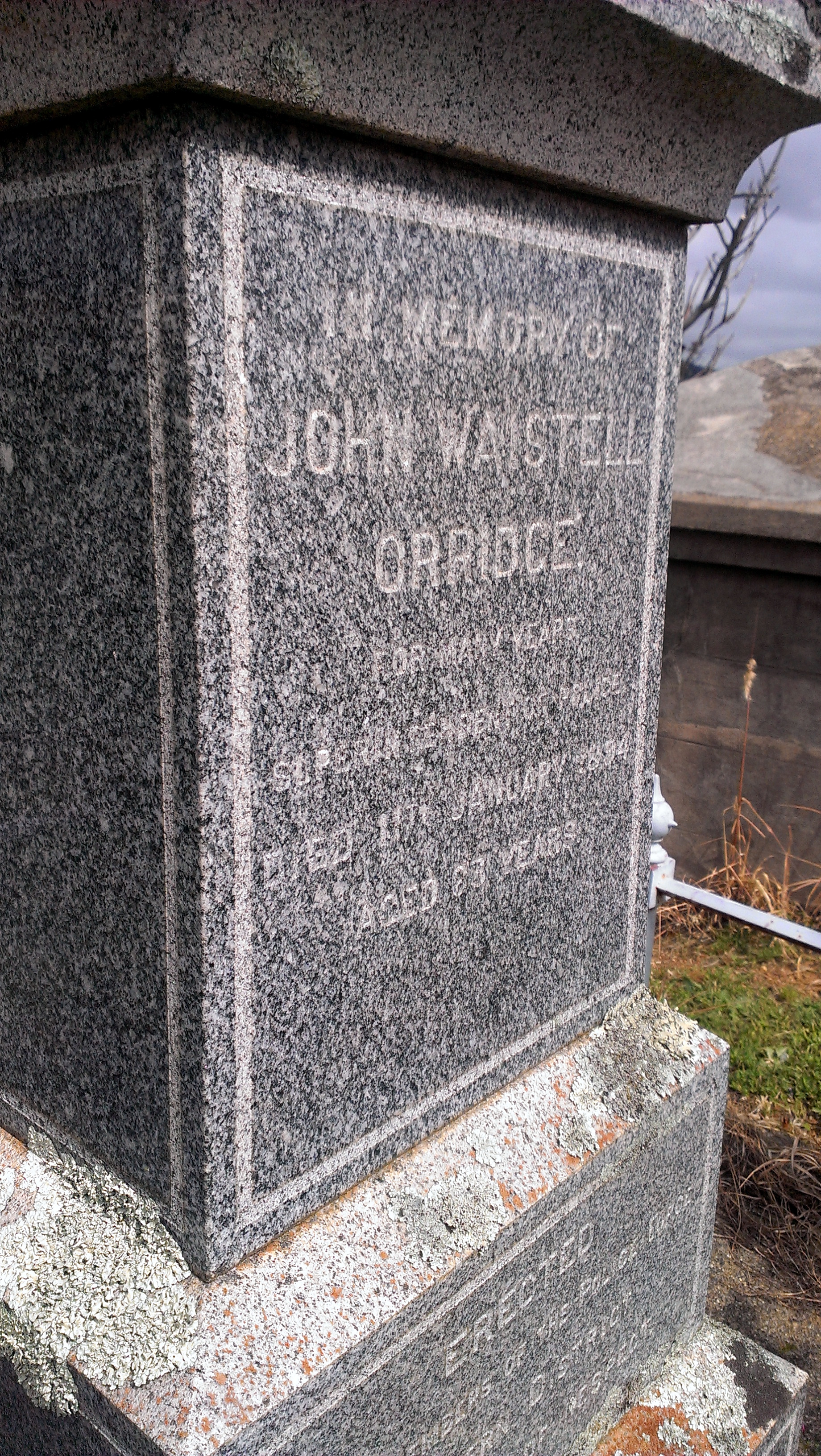
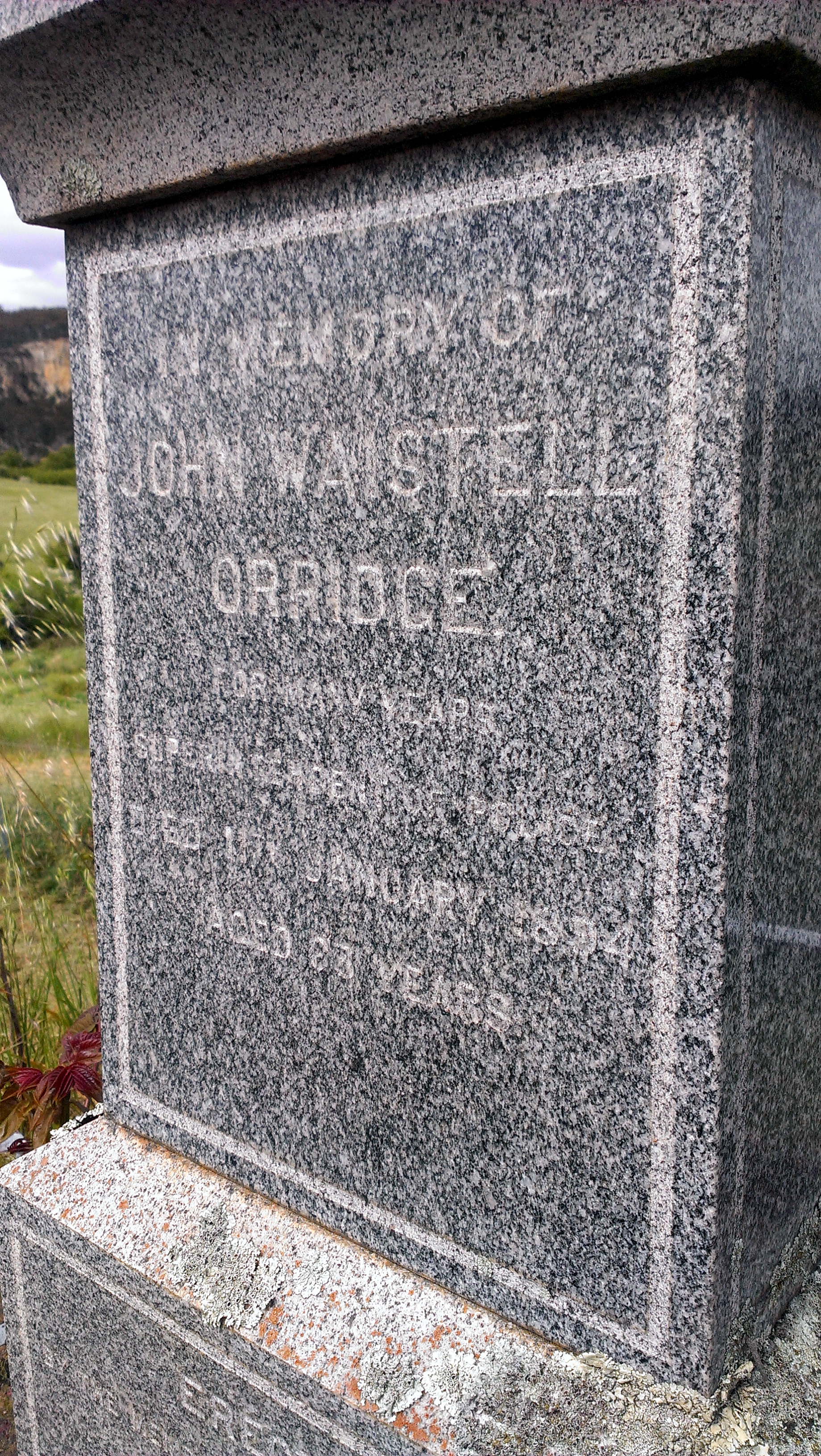
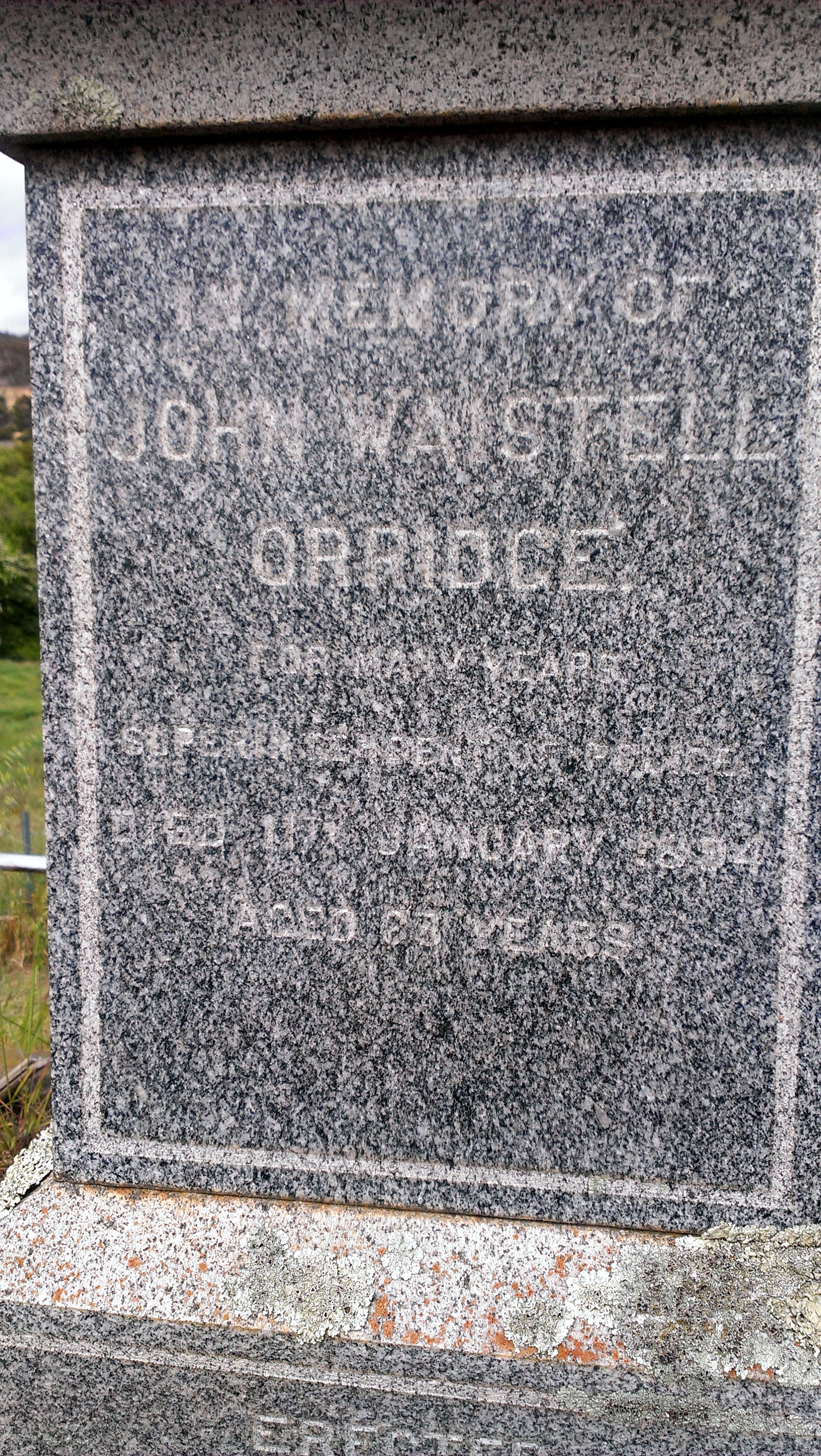
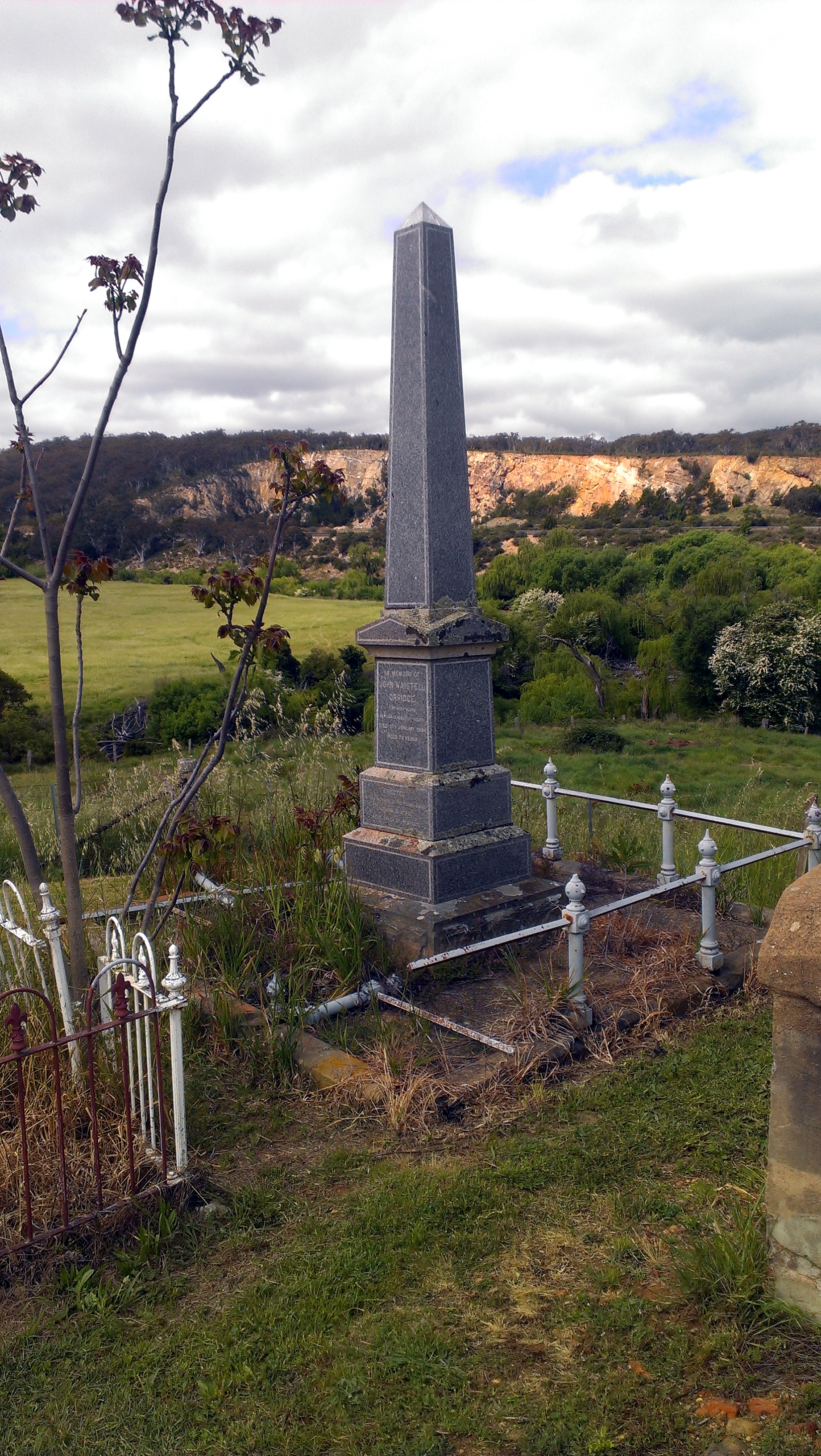
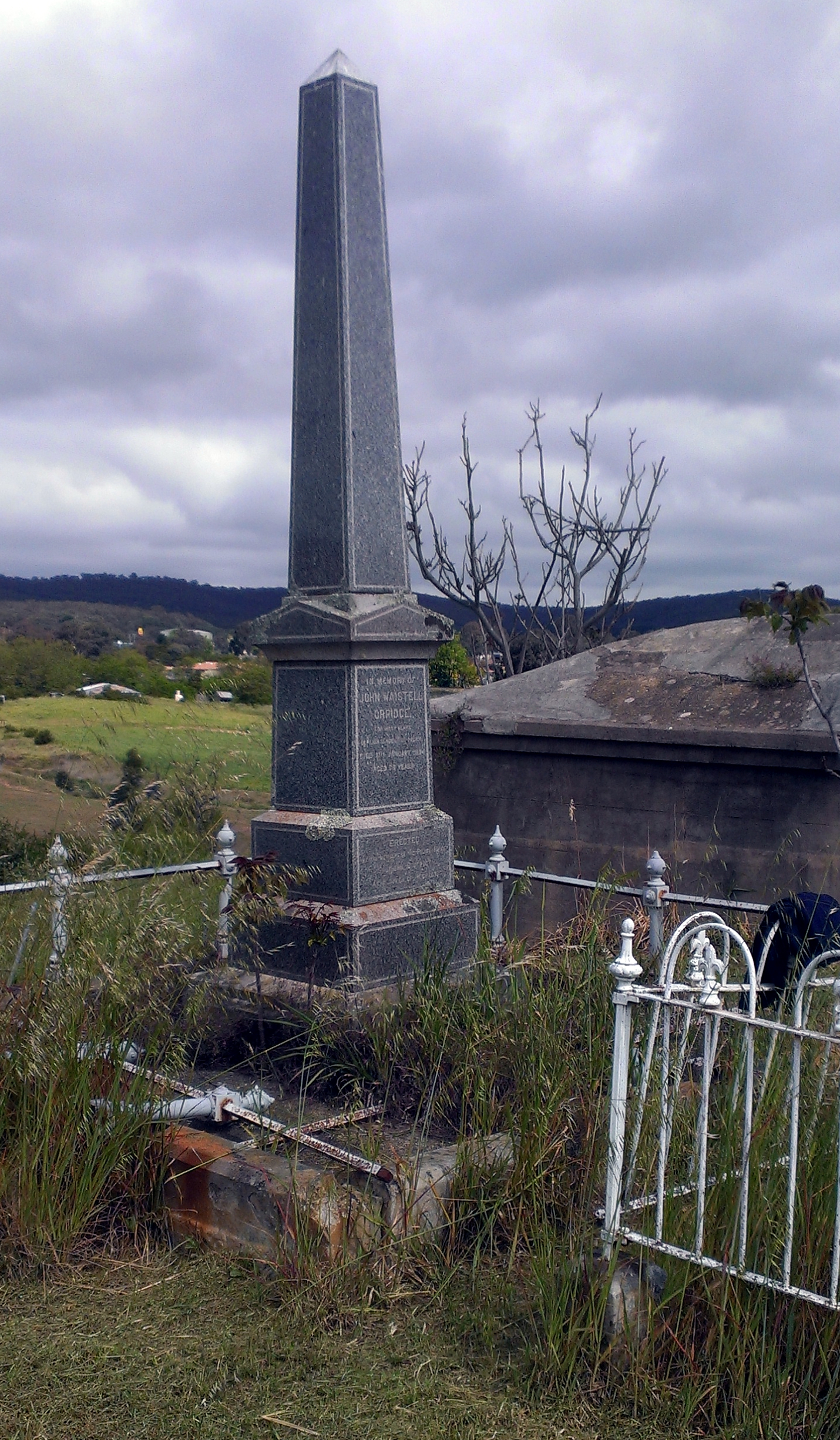
John Waistell ORRIDGE – Grave
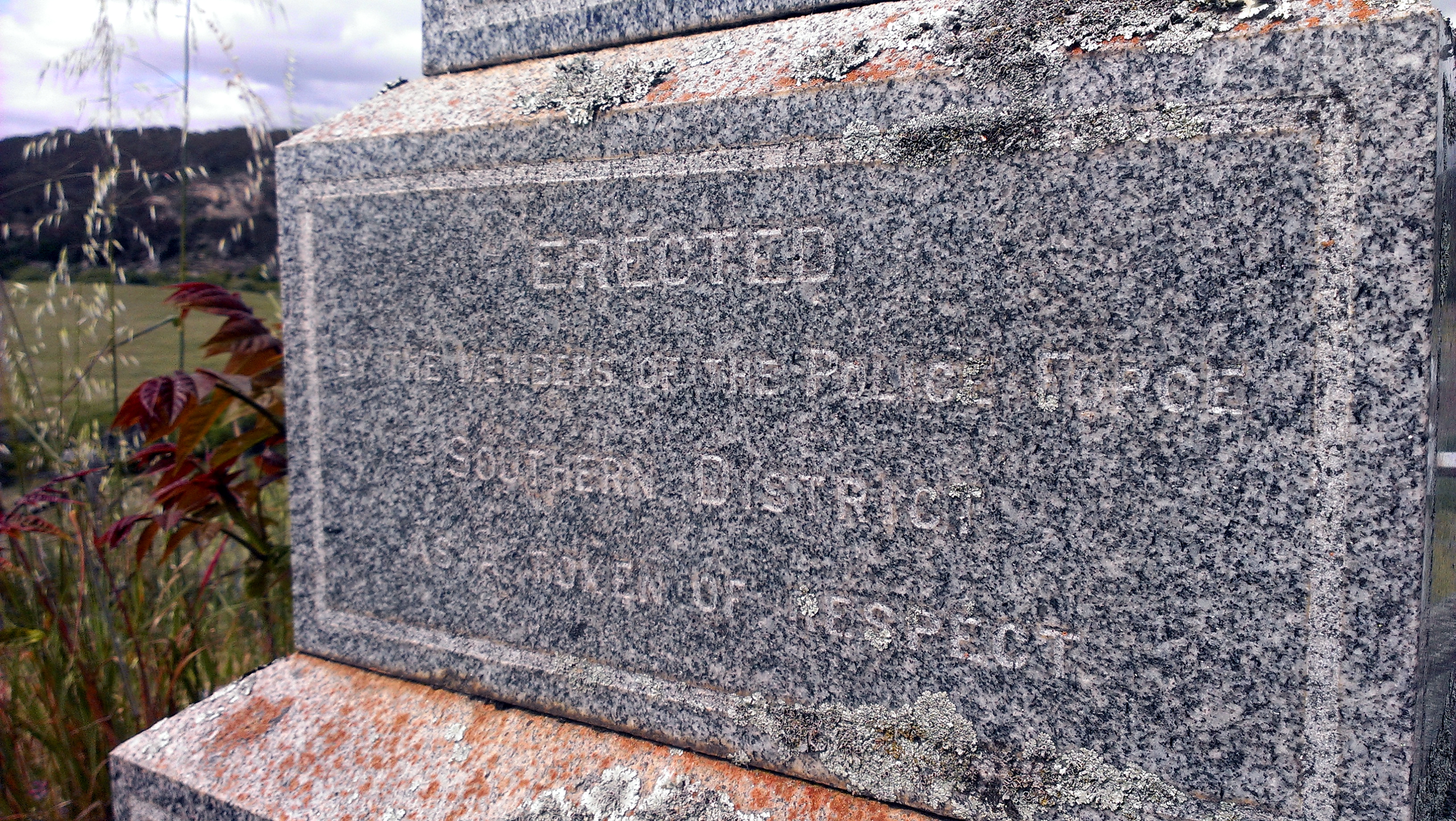
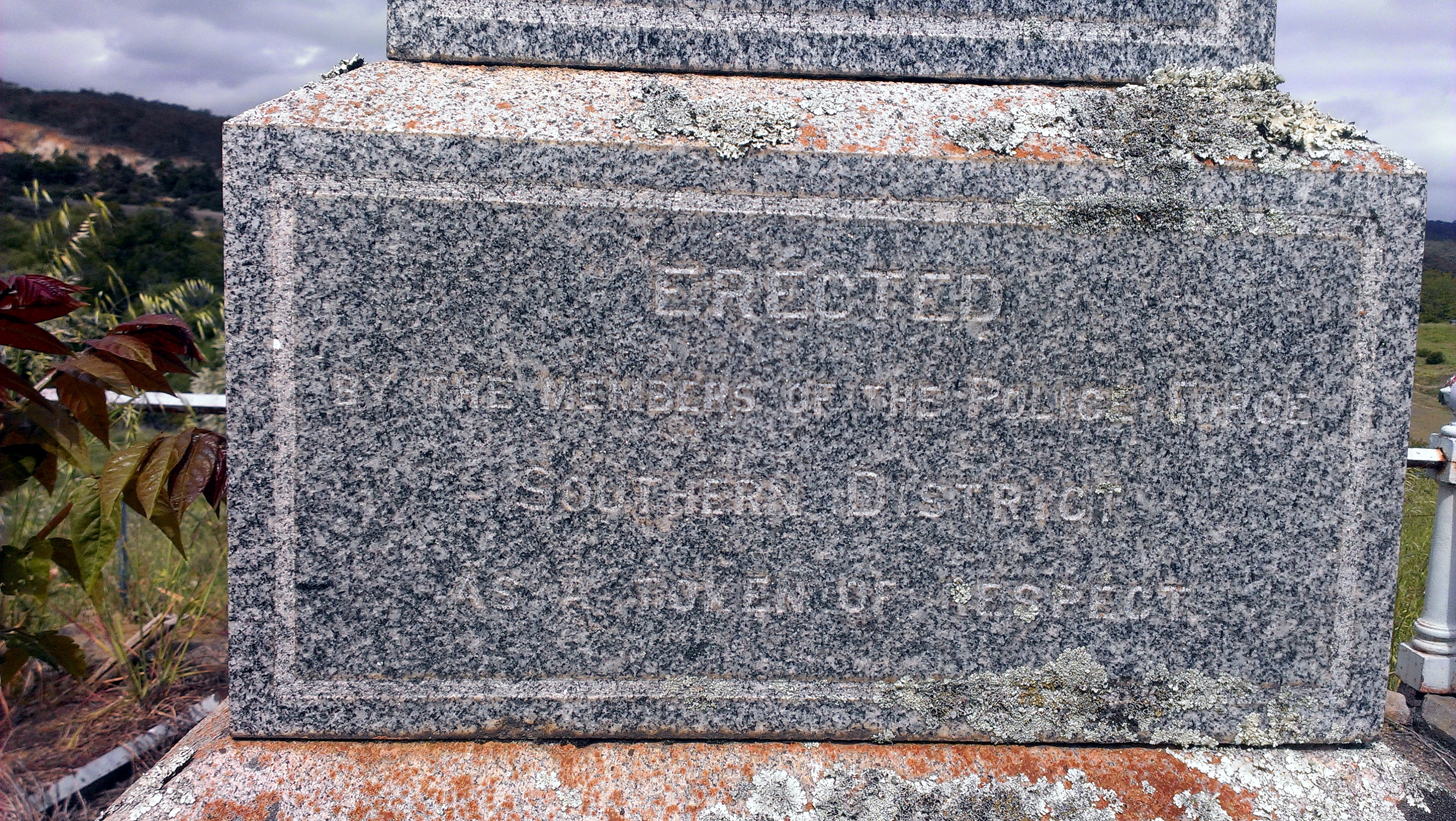
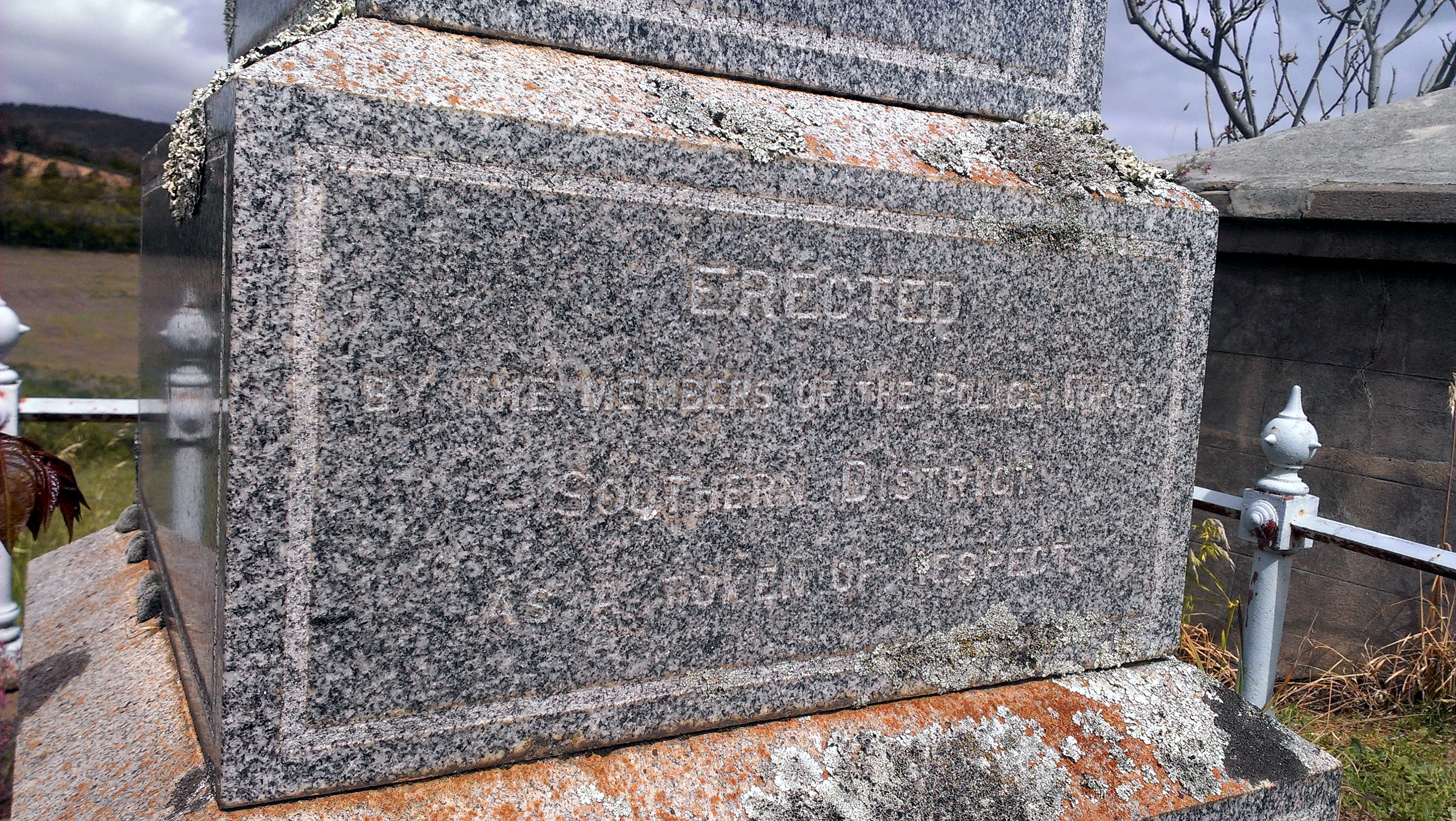
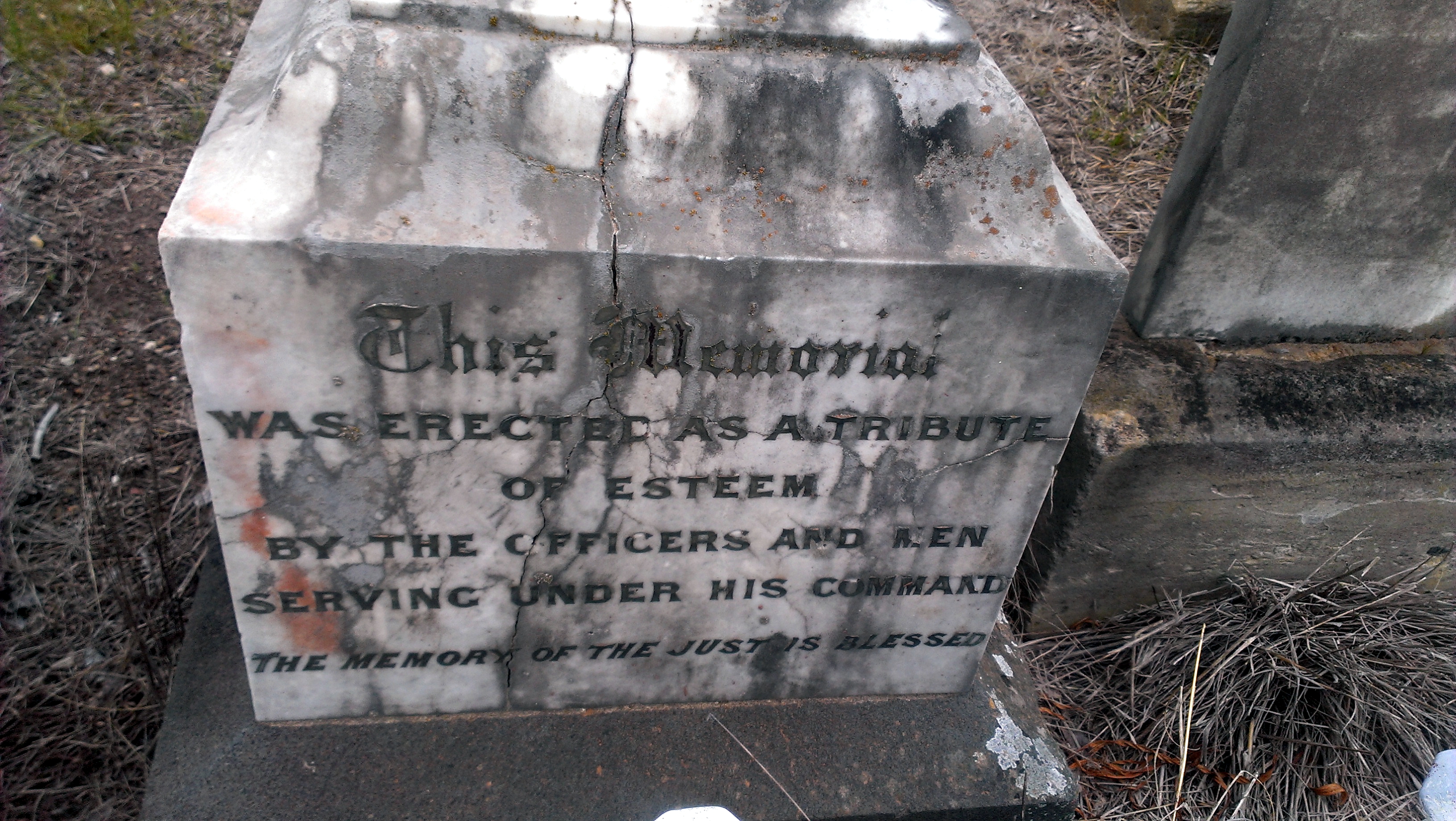
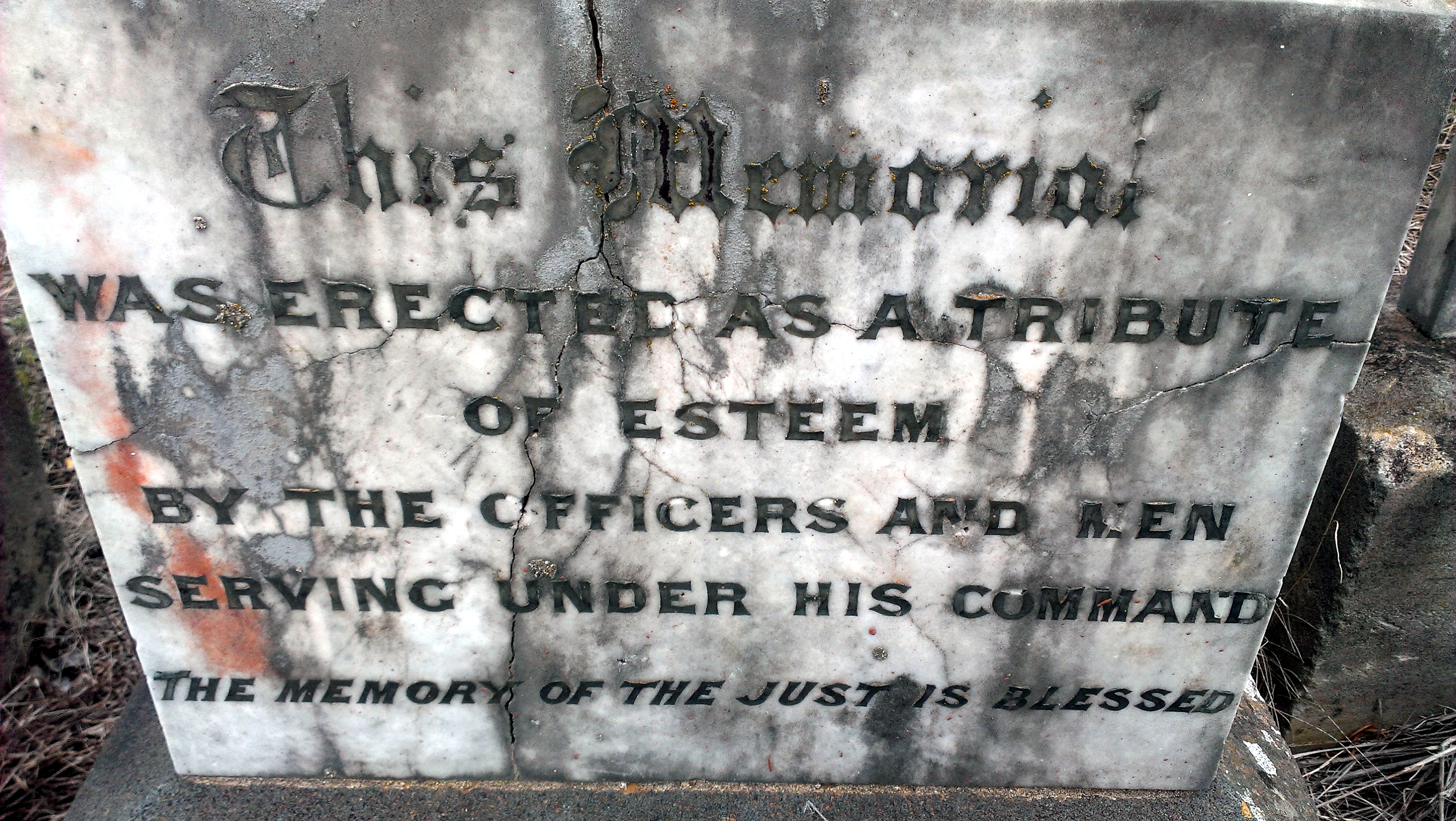
Erected by the members of the Police Force Southern District as a token of respect
Erected by the members of the Police Force Southern District as a token of respect
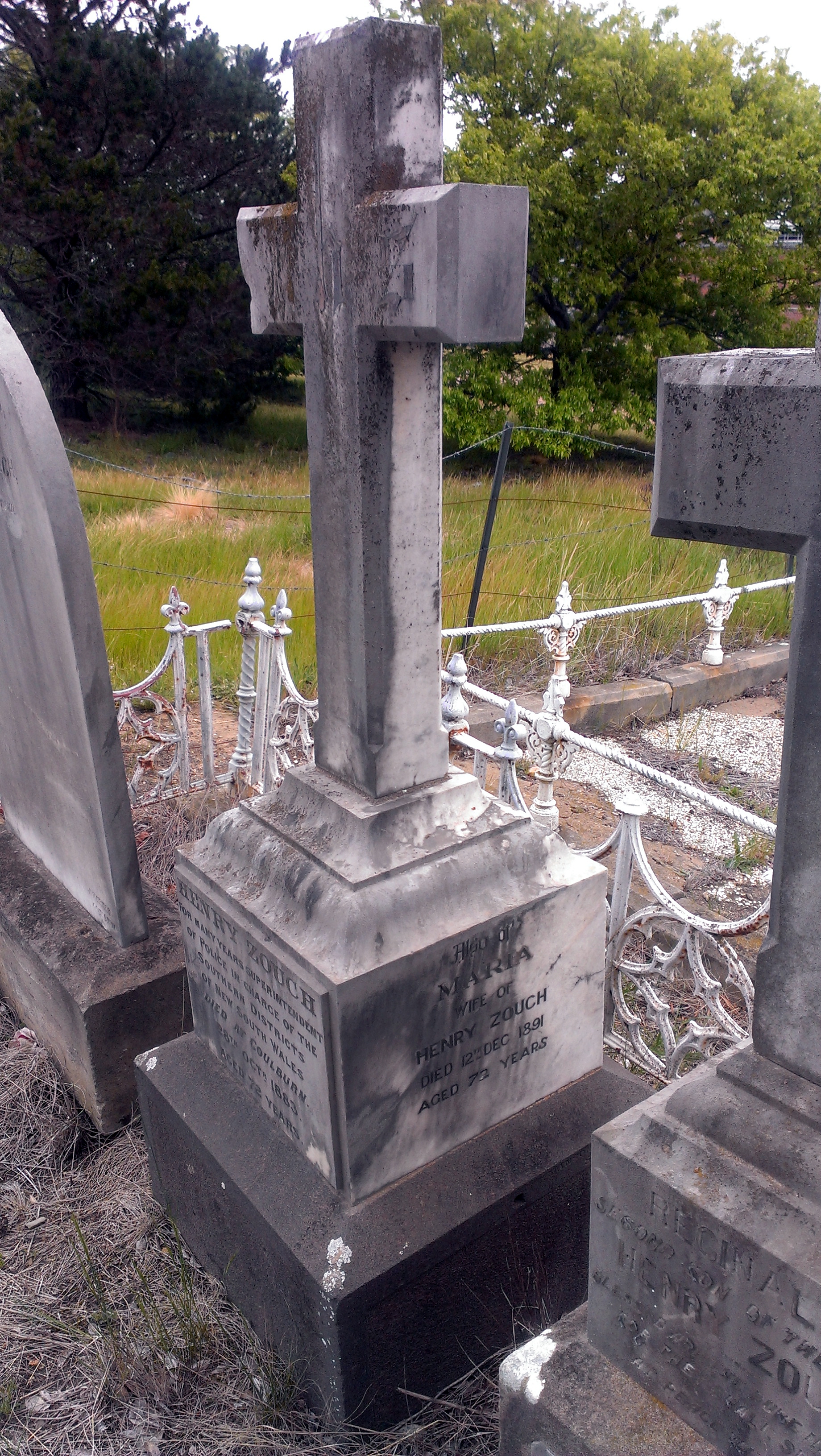
In memory of John Waistell ORRIDGE. For many years Superintendent of Police Died 11th January 1894 Aged 63 years
In memory of John Waistell ORRIDGE. For many years Superintendent of Police Died 11th January 1894 Aged 63 years
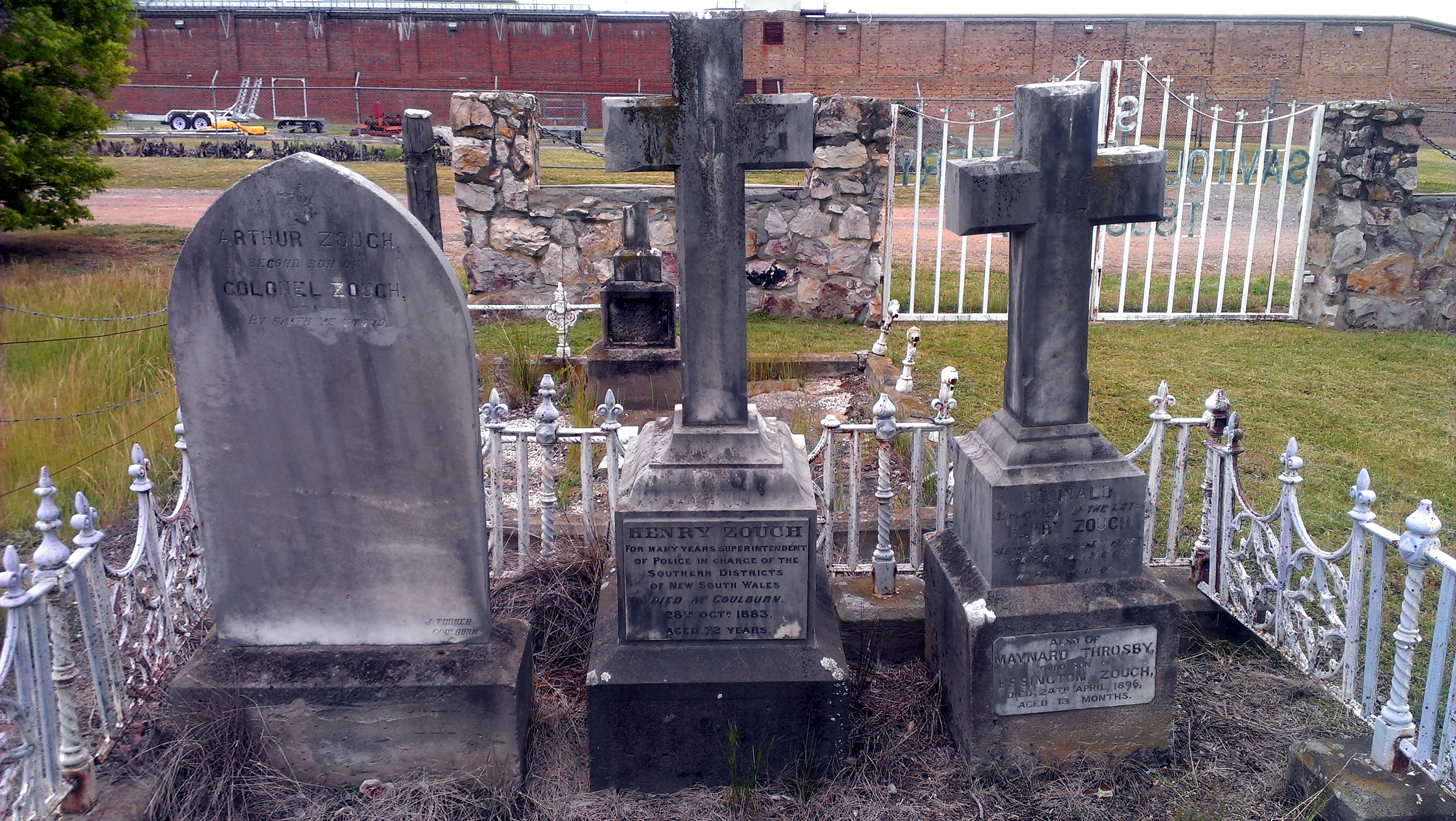
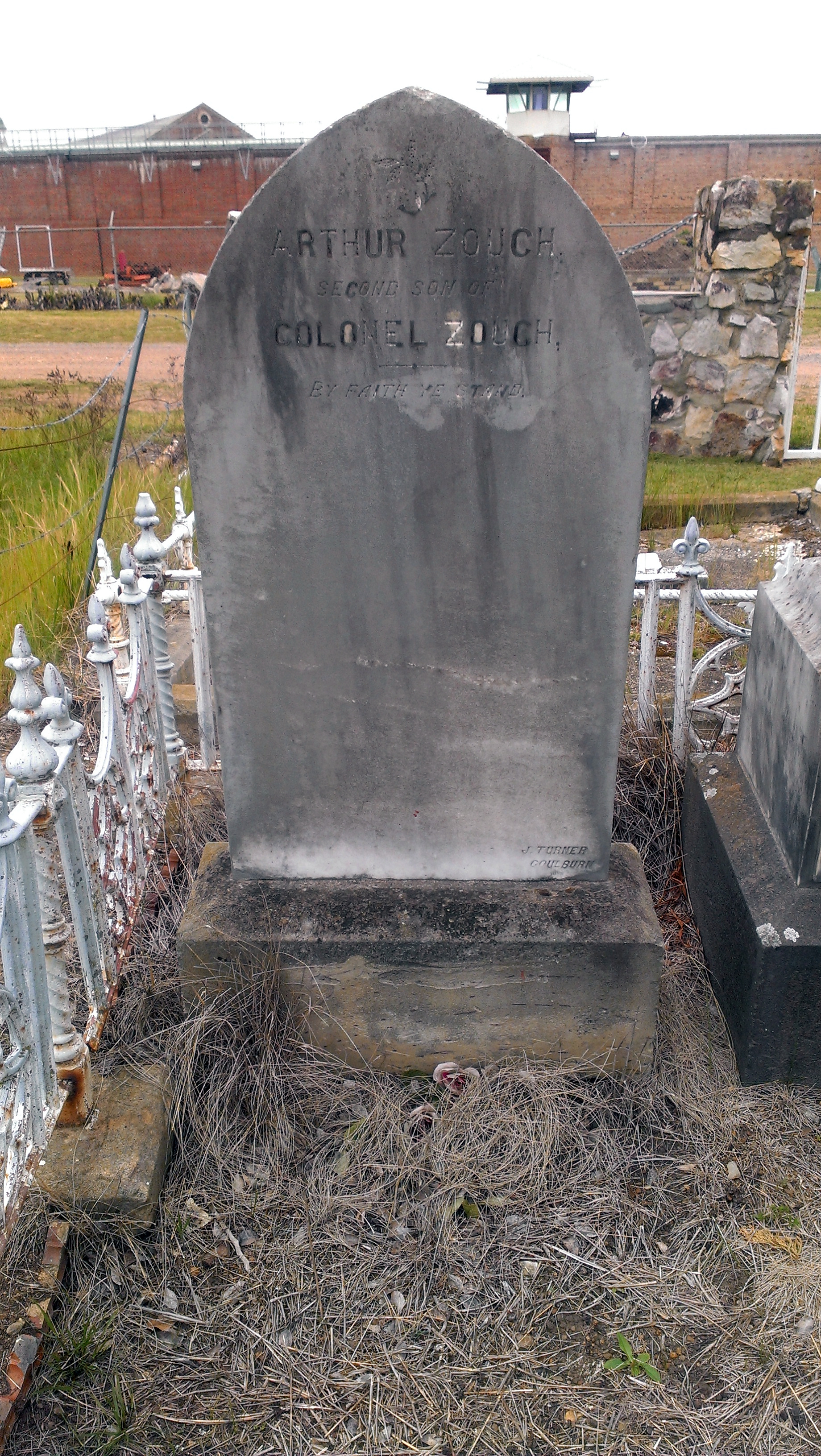
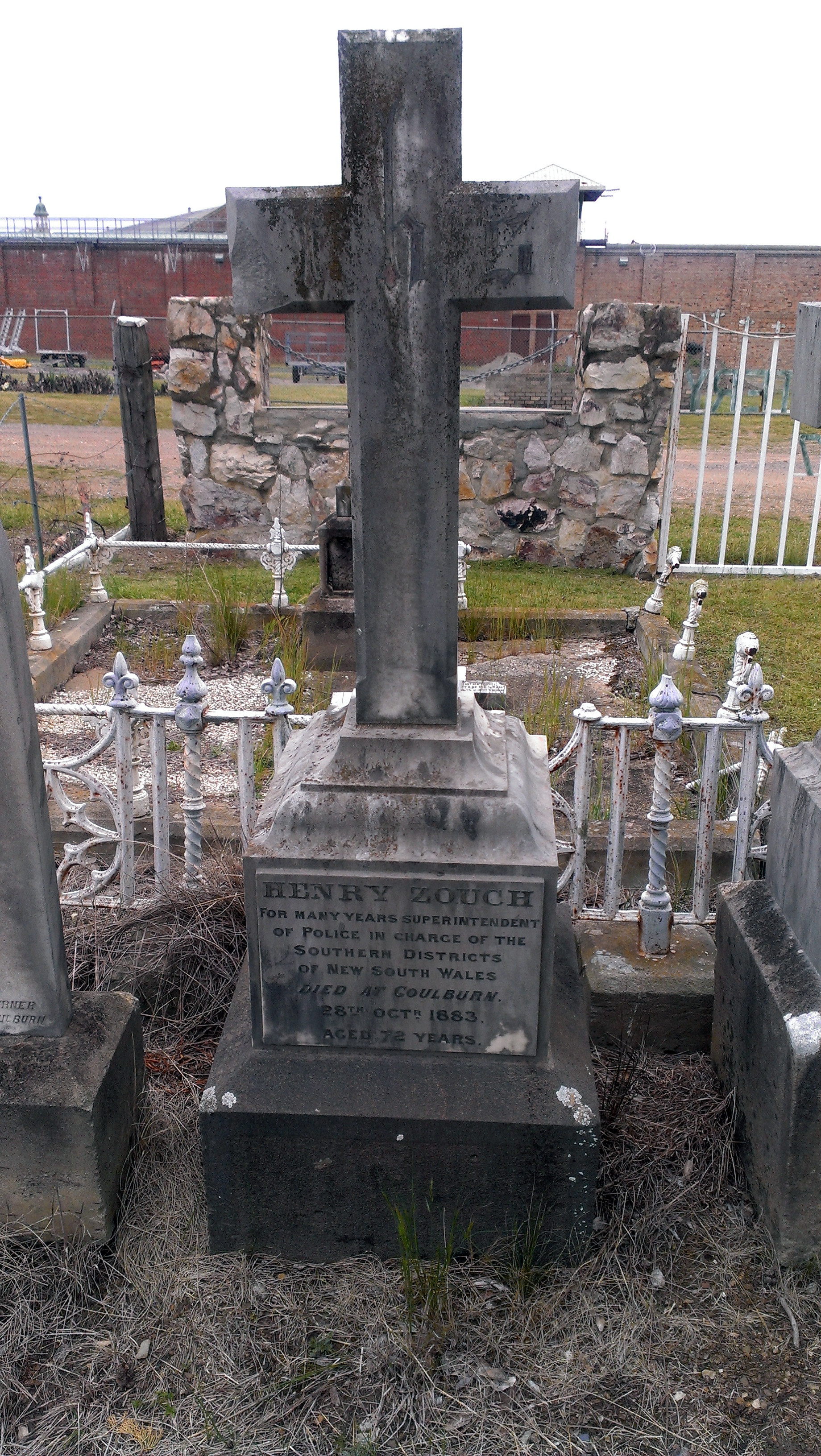
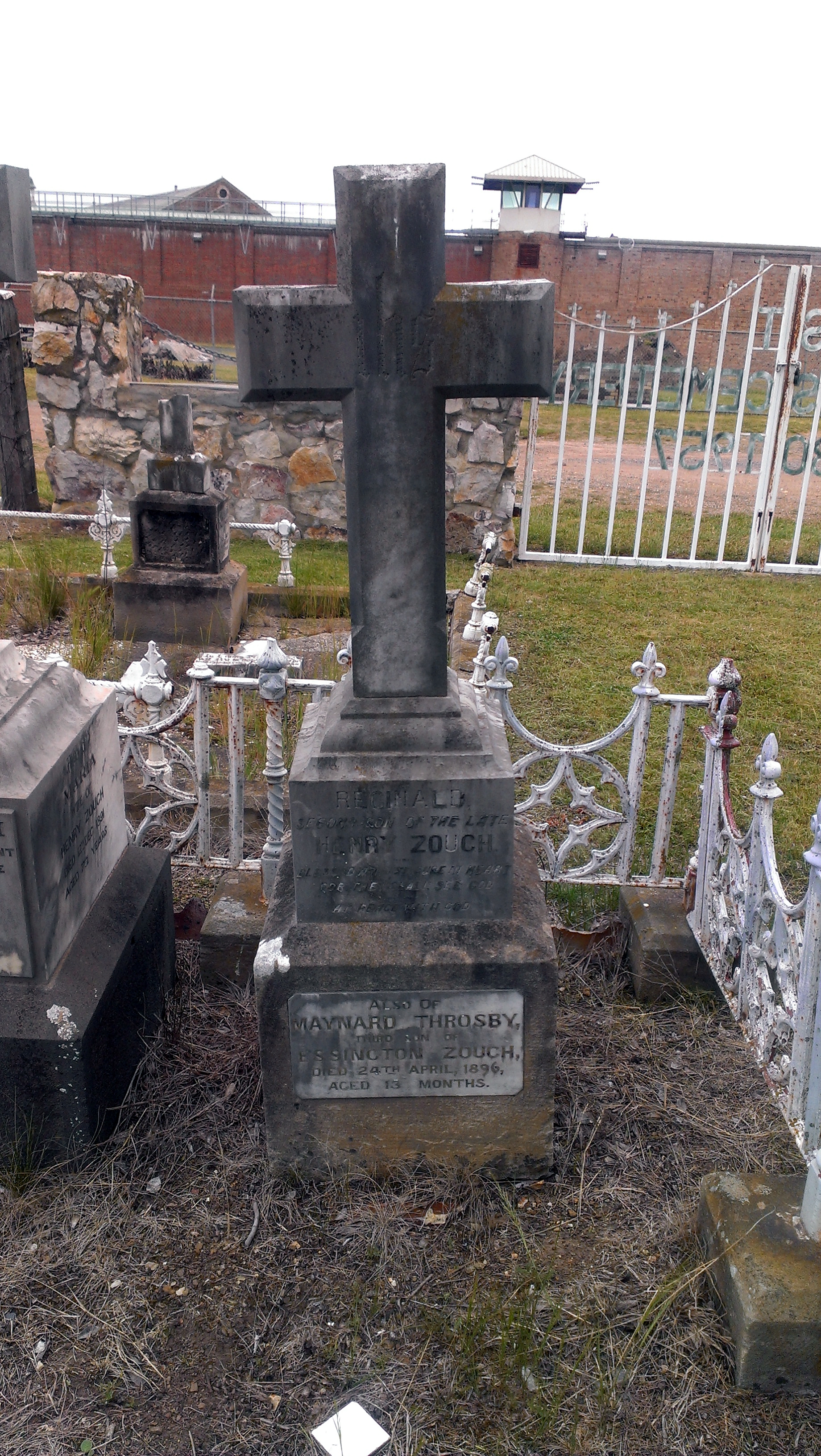
Captain R. Zouch, Superintendent of Police in the Goulburn district, is dangerously ill.
The Gundagai Times Tuesday 23 October 1883page 2 of 4
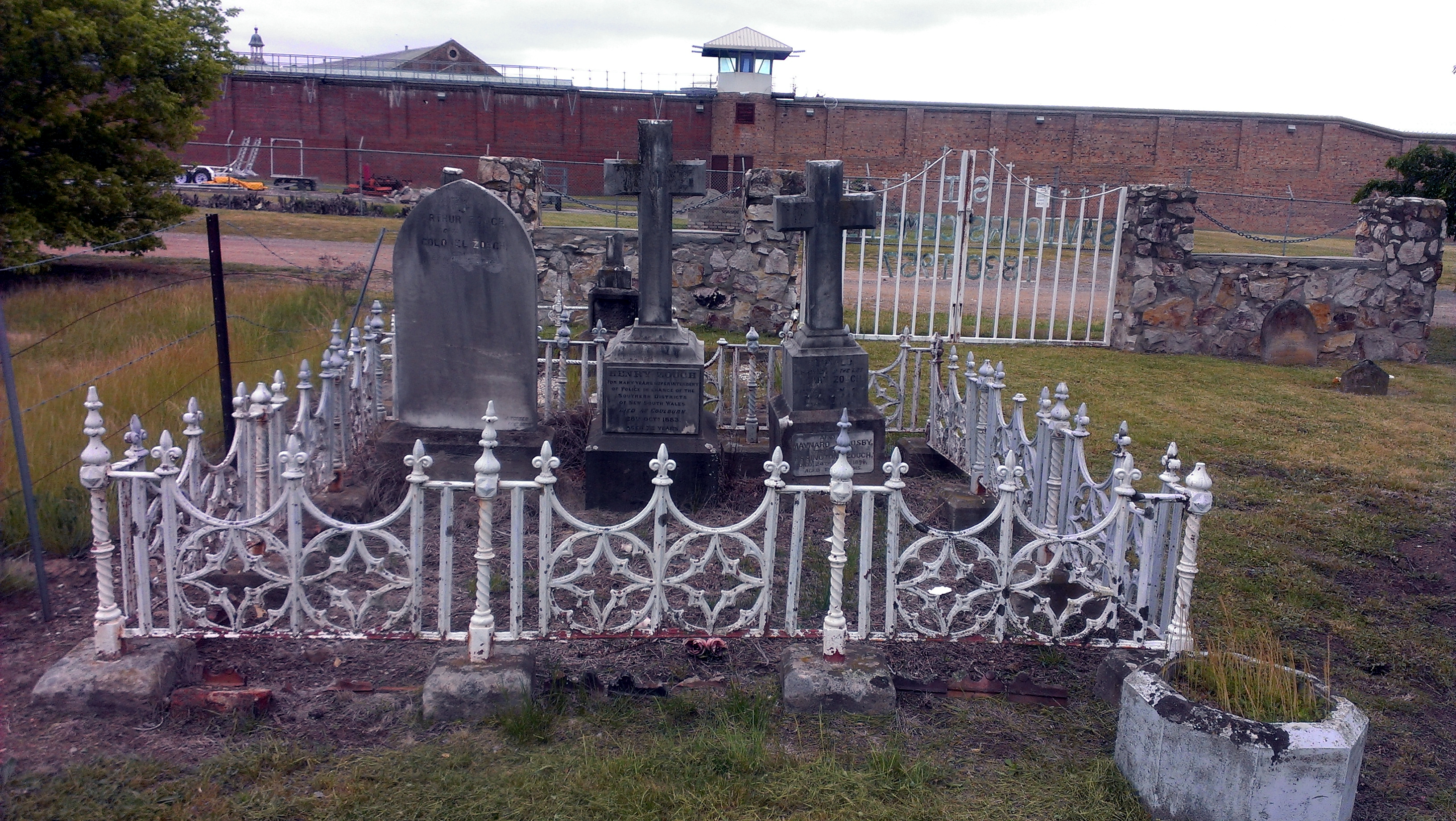
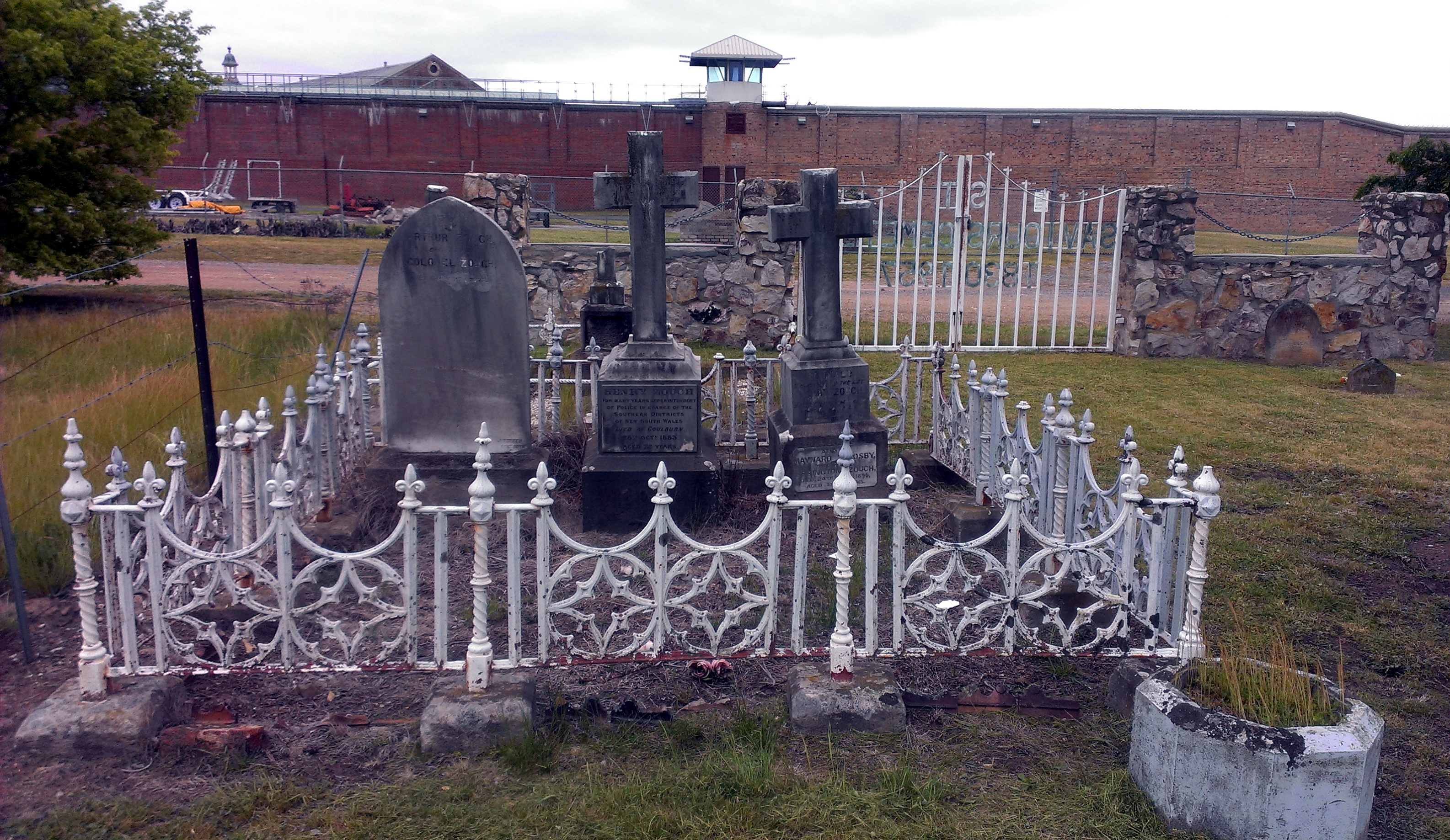
DEATH OF CAPTAIN ZOUCH.
THE people of Goulburn heard with sad surprise on Monday morning that death had claimed for his own one of the oldest residents of the city – Captain Henry Zouch. For some two or three weeks the deceased gentleman had been ill ; but as it was circulated that his condition was improving fears for him were allayed, and his recovery was generally looked for. This being so, the news of his death came with a greater shock. It was on Saturday morning that the deceased gentleman became worse, and throughout the day he remained in a dangerous state, being hardly conscious. Sunday saw no improvement, but on the contrary he became lower, and was unconscious the greater part of the day ; and in the evening at 6 o’clock he breathed his last. His illness was brought on by exposure to the sun, which he experienced last Friday fortnight whilst tending to his garden, of which occupation the Captain was very fond. To the effects of that exposure, and to decay of the system, his death is attributed. The Captain was in his 73rd year, and has resided in New South Wales for about 50 years.
The following, which is taken from Mr. J. Henniker Heaton’s “Australian Dictionary of Dates, and Men of the Time,” gives an outline of his career :
Zouch, Captain Henry, son of Colonel Zouch, commander of a British regiment during the last American war of 1812-14, was born in Quebec, where his father was for some time commandant. When a young man, Mr. Henry Zouch repaired to England, and received his education in the military college at Sandhurst. In 1826 he obtained a commission as Ensign in the fourth or ” King’s Own Regiment.” After serving in several garrison towns in England, he came out to the colony of New South Wales with his regiment. In those days every convict ship was conducted and guarded hither by a detachment of troops. Captain Zouch was appointed in 1834 to the first division of the military mounted police, stationed at Bathurst. There were then three divisions, one at Bathurst, one at Goulburn, and one at Maitland. He was despatched to the Bogan to find the remains of Richard Cunningham, the botanist, and succeeded in doing so, and a tablet was erected on the spot. On the fourth regiment proceeding to India Captain Zouch sold out. He was for some years engaged in pastoral pursuits at Ashly, Lake George. On the discovery of gold at Ophir, and the consequent rush thither, he received the appointment as Gold Commissioner at the town, where he remained until 1853, in which year he accepted the post of Superintendent of Mounted Patrol for Main Roads. This position he retained until the mounted patrol was amalgamated with the general police under Police Act of 1862. Since then Captain Zouch has remained in charge as General Superintendent of Police for the Southern Districts. He has the excellent qualification of always obtaining the confidence and esteem of the men under his control. During the bushranging era and on many other occasions Captain Zouch was distinguished for his courage, foresight, and ability. He has at various times during the absence of Mr. Fosbery fulfilled the duties of Inspector-General of Police.
The captain was a man universally respected and liked. Actuated partly perhaps by disinclination for it, and prevented maybe by pressure of official duties, he never figured prominently as a public man. For some years he occupied the honorable position of president of the Goulburn Hospital, and he was also for a great length of time a warden of St. Nicholas’ Church. With all classes of the community he has always been a favorite, rendered so by his gentlemanly demeanour and his quiet mode of life ; for, meddling not with things which did not concern him, he was one of those of whom it might be said –
[blockquote]Along the cool sequestc’d vale of life He kept the noiseless tenor of his way. [/blockquote]
He was of a most benevolent disposition, and was full of a charity that loves to exercise itself in unostentatious acts of benevolence. To the appeal of suffering he never turned a deaf ear, but was ever ready to relieve those who came to him in genuine distress. To that no doubt is to be attributed his great popularity amongst the poorer classes, who lose in him a friend they will find it hard to replace.
As an officer the captain was one of the most efficient in the public service. His career was one of honor, and he has never had one of his decisions questioned. To the men under him he was at once just and considerate; and in their great respect for him is one of the strongest proofs of his worth as a man and a superior.
Captain Zouch’s near surviving relatives are a widow, four sons, and three daughters.
Before opening the business of the Police Court yesterday, the Police Magistrate said he regretted to learn-last night the death of Captain Zouch, a late member of the Goulburn bench of justices, and an officer of the crown for 50 years in this colony. It was usual, he believed, to show respect to the memory of deceased gentlemen in such cases, by adjourning courts with which they had been connected, but on the present occasion this custom could not be well adhered to, as it would prove detrimental to the public business. Be could only therefore express the regret of the bench to learn of the deceased’s death.
The funeral takes place this afternoon at four o’clock.
Goulburn Evening Penny Post Tuesday 30 October 1883 page 2 of 4