1

Constable Joseph Hilary Eden DONNELLY

Constable Joseph Hilary Eden DONNELLY

Traffic Accident

Randwick

19 November, 1929


On the evening of 19 November, 1929 Constable Donnelly was struck by a car while crossing Belmore Road after finishing his shift at the Randwick Police Station. He sustained a compound fracture of the skull and was taken to St Vincent’s Hospital where he passed away. The driver of the vehicle responsible, Cecil McIntyre was later committed for trial on a charge of manslaughter.


The Sydney Morning Herald of 29 November, 1929 reported that “At the Central Police Court yesterday, before Mr. McMahon SM, Cecil James McIntyre, pastry cook aged 22 years, was charged I with having at Randwick on November 19 feloniously slain [Joseph] Hilary Eden Donnelly, a constable of police. Sergeant Dennis, Police Prosecutor, applied for a remand to December 2, on which date the coroner’s inquiry was to be held, and this was granted by the magistrate.”


At the time of his death the constable was aged 23 and was stationed at Randwick.


Constable James Phillip FLYNN

Constable James Phillip FLYNN

Shot

Cordeaux Dam

9 March, 1924


On 9 March, 1924 Constable Flynn went to a construction site at Cordeaux Dam (where a temporary police station had been established), south of Appin, where he arrested a man named William Simpson who had broken into the office of the construction site manager and had stolen two pistols. While the offender was being conveyed to Campbelltown Police Station in the victim Mr Guy Clift’s car, the offender suddenly produced a pistol and shot Constable Flynn in the side of the body. Mr Clift stopped the vehicle and took hold of the offender, however after a furious struggle he too was shot in the groin and Simpson escaped.


Mr Clift then drove his vehicle to Appin, however it was found that Constable Flynn had succumbed to his wounds. The brave Guy Clift also died the following day. Simpson was later convicted and hanged at Long Bay Gaol.


The Western Argus dated 18 March, 1924 printed an extensive account of the tragedy, including the following extract.


CORDEAUX TRAGEDY: Sydney, March 10.

Public indignation at the murder of Constable James Flynn, of Cordeaux, on Sunday was intensified to-day when it was learned that Mr. Guy Chalmers Clift who was shot by the man who killed Constable Flynn, had died at the Camden Hospital. Mr. Clift was the engineer in charge of the work at Cordeaux and was held in very high esteem in the Public Works Department. The courage he displayed in attacking the man with the revolver after the constable had been shot, his fight with the armed man and his gallant effort to reach Appin with the dying constable, although he was himself bleeding to death from a wound in the groin, made him a hero in the public eye and his death has stirred many people to very keen feeling against the apparent increasing disregard by desperate men for the sacredness of life.


What drove the man under arrest to shoot the constable is difficult to understand, as he was not regarded as a desperate individual. He had been, employed at the Cordeaux dam, and was so well-known to Constable Flynn that the constable did not deem it necessary to handcuff him. Indeed, he is said to have been friendly with Constable Flynn who, having the unpleasant duty of arresting him, bought him a drink and cigarettes and walked in a friendly manner with him to the motor car, where he was treated more like a respected passenger than a prisoner. As they rode together on the back seat of the motor car, with Mr. Clift driving, towards Campbelltown the constable and the prisoner talked freely. That the constable’s friendly disposition should have been so cruelly abused is regarded as one of the worst features of the tragedy. Although Constable Flynn had been in the police force only two and a half years he was exceedingly popular…


His mother, who lives in Lithgow, New South Wales, travelled all night to see her dead son, and her grief was intense. It was beyond her comprehension why any man should even desire to injure her son, who, she declared, had often said that he did not think he had an enemy in the world. Constable Flynn was aged 25 years.


The constable was born in 1897 and joined the New South Wales Police Force on 4 July, 1921. At the time of his death he was stationed at Cordeaux Dam.

Constable Frank McGRATH

Constable Frank McGRATH

Motor Vehicle Accident

Sydney

1 January, 1923


About 10pm on 1 January, 1923 Constable McGrath of the Redfern Police Station was riding on the rear of a police vehicle escorting prisoners from his station to Central Police Station. As the vehicle bumped over a rough section of tram lines at the intersection of Park and College Streets the constable lost his hold and fell to the roadway. As a result he suffered a fractured skull and died after being conveyed to hospital.The Argus dated 2 January, 1923 described the incident.


CONSTABLE KILLED ON DUTY.

SYDNEY, Monday.-While on duty on a patrol waggon tonight Constable Frank McGrath fell on to the road and fractured his skull. He died soon afterwards in hospital. The patrol waggon was collecting prisoners for the Central Police Court in the morning, and when crossing the tram lines at the intersection of Park and College Streets the vehicle bumped violently and McGrath, losing his hold, fell backwards, striking his head on the road. The waggon travelled some distance before it was discovered that McGrath was missing. McGrath was aged 30 years, married, and lived at Marrickville. He was stationed at Redfern.


The constable was born in 1893 and joined the New South Wales Police Force on 14 July, 1914. At the time of his death he was stationed at Redfern.


Constable 1st Class Andrew George BRIDGE

Constable 1st Class Andrew George BRIDGE

Horse Accident

Cundletown

1 December, 1920


Constable Bridge was stationed at Cundletown (Taree area) between 1917 and 1920. He passed away on 1 December, 1920 apparently from peritonitis which was the result of injuries sustained when he fell from his troop horse which shied during a patrol. (This information is from a family history and the circumstances of the death are otherwise unverified as yet).


Constable Bridge’s Police Service Register indicates that between January, 1907 and February 1915 he was stationed at Cobar, Mt Drysdale, Cobar again, and Taree. He was attached to Cundletown from 7 July, 1915 until his death. The Register simply lists his cause of leaving the police as “Died”. The New South Wales Police Gazette dated 16 February, 1921 lists him under the heading “deaths” but gives no cause. The same Gazette also records the fact that “Bridge, Mrs Margaret, widow of the late Constable 1st Class, Andrew George Bridge, Gratuity of £416-5s.”


The constable was born on 31 January, 1881 and joined the New South Wales Police Force on 4 September, 1906. At the time of his death he was stationed at Cundletown.


Detective Sergeant 2nd Class William ROBERTSON

Detective Sergeant 2nd Class William ROBERTSON

Horse Accident

Braidwood

24 October, 1918


On 19 October, 1918 the sergeant was in the Braidwood area on special assignment. On the day prior to his death, he had left Braidwood with Sergeant Face and an Army Intelligence Officer with the intention of executing a search warrant in the Upper Deva River area. When the party had travelled about thirty kilometres along a bridle track, Sergeant Robertson started to remove some papers from his pocket. His horse took fright at this and began to buck. The sergeant was thrown very heavily to the ground where he sustained severe internal and spinal injuries. Due to a heavy storm, the party were unable to seek help and so they sheltered the sergeant overnight before conveying him to Braidwood the following morning. Unfortunately he died at 2am on 24 October.


He was a native of Scotland and prior to coming to Australia had served in the 1st Forfarshire Volunteer Regiment. He left behind a wife and a daughter at home, and a son who was then serving at the front in Europe (World War 1).


The detective sergeant was born in 1865 and joined the New South Wales Police Force on 16 October, 1890. At the time of his death he was attached to the Sydney Metropolitan Detectives Office.


Constable Edward MOLONEY

Constable Edward MOLONEY

Traffic Accident

Sydney

12 February, 1903


In early February, 1903 the Adelaide Advertiser reported that “Constable Edward Moloney, lately residing at Surry Hills, died from injuries sustained by being knocked down and run over by a van at the intersection of Crown and Campbell Streets. The deceased was crossing Campbell Street, when he turned around to speak to a friend, apparently not noticing the near approach of the van. The driver of the vehicle shouted to him and pulled up, but the deceased then faced the van, and the near shaft struck him on the chest and knocked him down, the wheel passing over his legs. The cause of death was a puncture of the lung by the fractured ribs.”


The NSW Register of Coroners Inquests and Magisterial Inquiries, 1834-1942 indicates that an inquest was held into Constable Moloney’s death at the Sydney City Coroner’s Court on 12 February, 1903. It was found that he died from the “effects of injuries accidentally received by being knocked down and run over by a van attached to a horse being driven along the street by Arthur Bentley”. He died at the Sydney Hospital.


Not known whether the constable was on duty when he was fatally injured. Research into this incident is ongoing. He was aged 65 at the time of his death, was born in Ireland, and was stationed in Sydney.


Senior Constable James Gibson MURDOCH

Senior Constable James Gibson MURDOCH

Cholera

Burrangong

25 December, 1900


Senior Constable Murdoch is recorded as having “died after he drank bad water whilst fighting bushfires”. The constable had been out for the weekend fighting bushfires before returning to Burrangong Police Station where he soon fell ill. Stricken with diarrhoea and vomiting, the constable was treated by the local doctor before being taken to Burrangong Hospital. He died two days later, on Christmas Day, probably from cholera.


The Sydney Morning Herald of 26 December, 1900 reported the following.


YOUNG, Tuesday.

Senior Constable James Murdoch died this morning from dysentery and colic, supposed to be due to his exertions at the recent bush fires, and to the drinking of bad water. Deceased had been in the force about 16 years, and was much respected.


The senior constable was born in 1862 and joined the New South Wales Police Force on 7 March, 1884. At the time of his death he was stationed at Burrangong.


Sergeant Joseph WIRRELL

Sergeant Joseph WIRRELL

Drowned

Maitland

18 September, 1899


It is thought that while on foot patrol in the Maitland township in the early hours of 18 September, 1899 the sergeant stumbled and fell, or slipped, into the Hunter River and drowned. When he failed to return home at the completion of his 10pm to 6am shift, the river was dragged by other police and the sergeant’s body recovered near Belmore Bridge. The Sydney Morning Herald of 19 September, 1899 carried a very brief article, as follows.


A POLICE OFFICER DROWNED – WEST MAITLAND.

Monday – The body of Sergeant Wirrell, who was reported missing this morning, was found at 5 o’clock in the river below the bridge. There were no marks of violence on the body.


The sergeant was born about 1846 and joined the New South Wales Police Force in 1876. At the time of his death he was stationed at Maitland.


Constable Walter TOMBS

Constable Walter TOMBS

Horse Accident

Moruya

25 November 1897

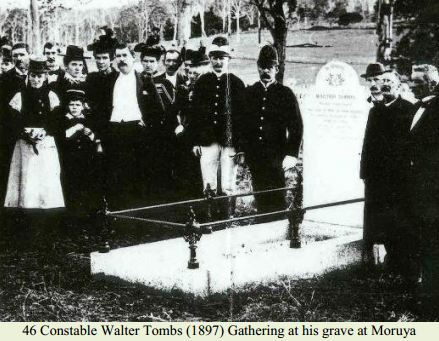
Constable Walter Tombs (1897) Gathering at this grave at Moruya Cemetery

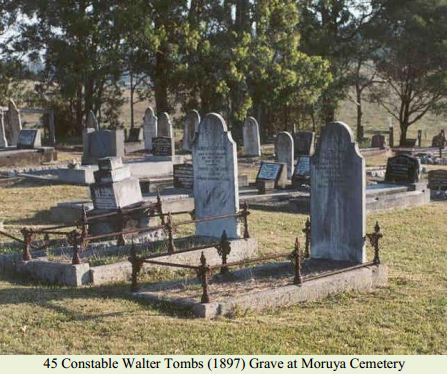
Constable Walter Tombs (1897) Grave at Moruya Cemetery

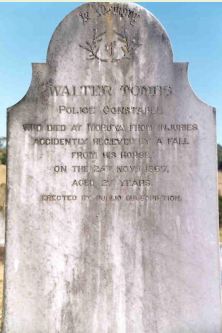
Constable Walter Tombs (1897) Grave stone inscription at Moruya Cemetery


Shortly after 9am on 25 November, 1897 Constable Tombs led a troop horse from the police stables at Moruya to travel on patrol to Pedro Point. The horse, on loan from Braidwood Police, was known as a rogue and when the constable stepped into the saddle the horse began to run backwards. Despite Constable Tombs attempts to control the horse it fell, landing on top of him. The horse then regained its feet and began to kick out at the constable who was hanging from the stirrups. When Constable Tombs fell to the roadway the horse ran off. Local people then came to the constable’s assistance and he was taken to Senior Sergeant Henry Bragga’s residence where he was attended to by Dr John Quilter. A short time later he was taken home, however he passed away about midday.


The cause of death was later found by a coroner’s jury to have been “from the effects of injuries accidentally received on 25th November, 1897, in Moruya, through his horse falling upon and kicking him” causing effusion of blood on the brain. He was buried at Moruya.


The constable was born in London in 1870 and joined the New South Wales Police Force on 7 April, 1894. At the time of his death he was stationed at Moruya.


Constable Andrew BYRNE

Constable Andrew BYRNE

Exposure/Pneumonia

Shepherdstown

20 May, 1897


Constable Byrne is thought to have died from pneumonia caused by exposure to the elements during a lengthy bush patrol. No other details of the incident are known as yet. Prior to joining the New South Wales Police Force he spent six years in the Irish Constabulary.


The constable was born in 1857 and had joined the New South Wales Police Force on 5 July, 1882. At the time of his death he was probably stationed at Shepherdstown or Adelong.


Buried in an unmarked grave in Adelong Cemetery, NSW.