1

Constable Alexander KENNEDY

Constable Alexander KENNEDY

Illness

West Maitland

8 December, 1894


Nothing is known of the death of Constable Kennedy other than a very brief notice in the Sydney Morning Herald dated 10 December, 1894 advising that on Saturday last “Senior Constable Alexander Kennedy, who had been stationed at West Maitland for an extended period, died suddenly this morning.”


At the time of his death the constable was stationed at West Maitland.


Constable William THOM

Constable William THOM

Horse Accident

Goulburn

28 August, 1890


On 28 August, 1890 the constable was patrolling on his police horse along the Taralga Road near Goulburn when he was either thrown or fell from his horse and was killed.

Little is known of this event, other than the following account in the:


Sydney Morning Herald of 30 August, 1890.

A fatal accident occurred yesterday on the Taralga Road, about 15 miles from Goulburn. Mounted Constable Thorn [sic], recently appointed to Taralga, had been attending the Quarter Sessions here, and was returning home, when he was thrown from his horse. His dead body was found by Mr Wilkie, contractor, who was coming to Goulburn. In his hand there was some hair, showing that he had grasped the mane. The horse was a young one. Thorn was married about three months ago, and was held in much esteem by the members of the force and the general public. About a fortnight ago he had a narrow escape from being killed through being thrown from a horse.


The constable was born at Burnside, Aberdeenshire, Scotland on 24 December, 1858. His headstone reads ” This monument was erected by Officers and men of the Police Force, Southern District “, and shows his name as Thom and not Thorn.


At the time of his death the constable was stationed at Taralga.

[divider_dotted]


Probationary Constable Thomas Lyons HACKETT

Probationary Constable Thomas Lyons HACKETT

Horse Accident

Belmore Park

4 September, 1886


The probationary constable died as a result of serious head injuries received when he fell from his horse at Belmore Barracks during drill exercises. The Sydney Morning Herald of Tuesday 7 September, 1886 carried the following paragraph in relation to the incident.


At the South Sydney Morgue yesterday, the Coroner instituted an inquiry into the death of a probationary constable named Thomas Lyons Hackett, who expired at the Police Barracks, Belmore Park, on Saturday. The deceased, who was well connected, was said to be the son of Sir William Hackett of Dublin; he was a native of Ireland and 33 years of age. At an early hour on Saturday the deceased and others were doing their drill when the order was given for Hackett to prepare for sword exercise. Upon taking his sword which was handed to him by a constable, his horse swerved and, after plunging violently, fell, bringing his rider with him. The deceased became unconscious after the fall, and despite the attention which was paid to him by the authorities, he expired the same evening. He was accustomed to riding. The medical evidence was to the effect that the man died from injuries to the head, and the jury, after consideration, returned a verdict of “accidental death”.


The probationary constable was 33 years of age at the time of his death and appears to have been a member of the mounted police.


Senior Constable DUNDAS

Senior Constable DUNDAS

Exposure / Pneumonia,

Dubbo

2 April, 1886


The Bathurst Free Press and Mining Journal of 8 April, 1886 reported the death of constable Dundas. Nothing further is known of this incident, nor the constable’s full name.


DEATH OF SENIOR CONSTABLE DUNDAS:  On Friday morning Senior Constable Dundas, of Timberabongie, died in the Dubbo Hospital. He was suffering from inflammation of the lungs. The seeds of the disease were sown when he was camped out, looking after the prisoners who shot [Constable] Mitchell in the Coonamble gaol. He then contracted a severe cold and a few weeks back when collecting the Electoral Roll, he caught a fresh cold; it settled on his lungs, eventually developing into pneumonia, from which Dundas died. He leaves a widow and eight children. A meeting was held at Narromine on Friday evening, and it was determined to start a subscription in aid of the family and at the same time to represent the case as one worthy the attention of the Government. It was contended that Dundas died in harness, and hence his family should be looked after. £20 was subscribed at the meeting.


At the time of his death the constable was stationed at Timberabongie, where he had been since at least 1882.


William HIRD

Constable 1st Class William HIRD

Assault – Axe

Canterbury

13 August, 1885


On the evening of the 13 August, 1885 the constable challenged a group of drunken Kempsey Park labourers near the bridge over the Cooks River at Canterbury. The group were returning to camp following a day on the grog in the city and had been causing a disturbance. One of the men, named Birch, then became involved in a scuffle with the constable, and while this was going on another of the group struck the unfortunate Constable Hird on the head several times with an axe, killing him almost instantly.


Over the next few weeks the death of the constable, the capture of the murderers and the subsequent criminal trial were covered by the Sydney Morning Herald in great detail. The following are extracts.


(14 August, 1885 edition):

MURDER OF A CONSTABLE AT CANTERBURY.

A constable named William Hird was found dead early this morning near the Canterbury bridge, under circumstances that revealed the perpetration of a brutal murder. About 3 o’clock yesterday morning two market gardeners brought word into the township that a man was lying dead near the bridge. Several people went to the spot and found the body of the constable who lived in Canterbury. A terrible blow had driven in the skull near the left eyebrow, and the right side of the head, including the eye, was completely smashed. The body lay in a pool of blood, and near it was a large blood-covered stone, which it is presumed had been used in part perpetration of the deed. The deceased was lying on his back, with his hands clenched and his arms fixed. Two buttons, of his jumper were open, as though he had been in the act of drawing his baton…


(21 August, 1885 edition):

It was “a gratifying though mournful pleasure to testify to the indefatigable manner in which the late constable had performed his arduous duties. Of the fearless manner in which he had discharged his duties they had had ample proof. They had, he thought, a bright example set before them by his action on his last return home. Wearied with his day’s work, and doubtless contemplating retiring to rest, the constable heard some ruffians making the night hideous with their cries. He knew that should he succeed in arresting them he would have to convey the prisoners to the Newtown Police Station, and he would have to walk there and back. Instead of pleading to himself fatigue as an excuse for a partial neglect of duty, he went at once to the spot where he met his death”


(4 September, 1885 edition):

The two young men Joseph Thompson and Ellis Birch, who had been found guilty at the Criminal Court on Tuesday of the manslaughter of Constable Hird at Canterbury on the 13th of August, were placed in the dock again yesterday to receive sentence. The prisoners, it will be remembered, were indicted for murder, but the jury returned a verdict of manslaughter. Several witnesses were called, who gave Birch a very good character. His Honor, in sentencing the prisoners, stigmatised their crime as a horrible and cruel murder. He considered that the verdict of the jury, in the teeth of the evidence given, had caused a grave miscarriage of justice, for which he was assured that he was not in any way responsible. He had pointed out that there was no evidence of any provocation by which the crime might have been reduced from murder to manslaughter, and he would, therefore, speak of it as murder despite the finding of the jury. He would endeavour, however, in the interests of society to rectify as far as lay in his power the wrong that had been done by inflicting, in the case of Thompson, the highest penalty allowed by law for the crime of which he had been found guilty, namely, penal servitude for life, the first three years in irons. With regard to Birch, there was no doubt that he had been an assenting and consenting party to the murder and he would therefore sentence him to 15 years’ penal serviende. [sic, ie. servitude]


The constable was born in 1852 and joined the New South Wales Police Force on 5 July, 1882. At the time of his death he was stationed at Canterbury. He had previously been a sergeant in the East Riding Police Force in Yorkshire and left a wife and five children.

[divider_dotted]


Constable Cornelius HICKEY

Constable Cornelius HICKEY

Horse Accident

Port Macquarie

15 October, 1871


Little is known of the death of Constable Hickey other than the brief details on his death certificate. The certificate states that the constable died as a result of idiopathic gangrene at Port Macquarie on 15 October, 1871. The Hickey/O’Neill family history suggests the illness was the result of a fall, possibly on duty, from a police horse. To date this has not been otherwise verified, and despite the fact that in his day the constable was a very active and high profile member of the police force at Port Macquarie, almost nothing has been found to date regarding the reasons for the illness which ultimately led to his death at the age of 30.


The Australian Town and Country Journal of 28 October, 1871 reported the passing “On the 15th October, at his residence, Port Macquarie, Constable Cornelius Hickey, eldest beloved son of Michael and Elizabeth Hickey, and beloved husband of Mrs. Ellen Hickey, leaving an affectionate wife and three children and large circle of friends to mourn their loss, aged 30 years and 2 months.”


The constable was born in 1841 and at the time of his death was stationed at Port Macquarie.


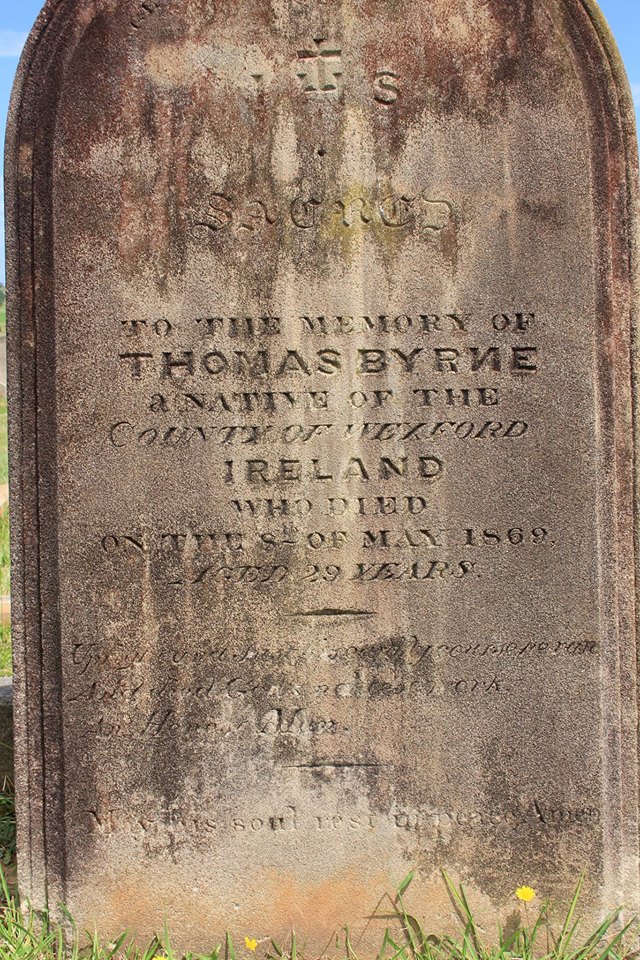
Constable Thomas BYRNE

Constable Thomas BYRNE

Drowned

Camden

8 May, 1869


Thomas BYRNE - NSWPF - Died Camden 8 May 1869 - grave

On Saturday 8 May, 1869 Constables Byrne and Beck launched the police boat on the flooded Cowpasture River near Camden. The mail coach from Campbelltown, waiting on the far side of the river, had been unable to cross. The two constables rowed across and collected the mail and a number of passengers before attempting to return. Nearing the bank of the river on the return journey, the boat suddenly overturned, casting the occupants into the water. Constable Byrne, unable to swim, weakened by rowing on the flooded river, and heavily clothed with a cape about his neck, sank beneath the surface and was drowned.


The Empire newspaper dated 11 May, 1869 informed its readers that “It is my melancholy duty to record the deaths by drowning, on last Saturday morning, of Mr. John Lakeman, of Camden, and Constable Byrnes, while crossing the river in a boat with the mails from Sydney. It appears that there were five people in the boat, when by some accident, not yet explained, it overturned. The constable sank at once, and was seen no more; three of the party succeeded in reaching the shore, and Mr. Lakeman managed to get to a log or tree, where, it is said, he remained for more than an hour, when the people got a rope to him which he tied round himself, but sad to relate, in drawing him towards the land, the rope became fouled in a tree and broke, and the unfortunate gentleman perished close to the view of many of his friends, who were unable to offer the least assistance.


The constable was born in 1841 and joined the New South Wales Police Force on 25 February, 1864. At the time of his death he was stationed at Camden.

[divider_dotted]


Sergeant Charles WARREN

Sergeant Charles WARREN

Horse Accident

Eastern Creek

11 October, 1868


On the afternoon of Saturday 10 October, 1868 Sergeant Warren was thrown from his horse at Eastern Creek, however when his foot became caught in a stirrup he was dragged at full speed for a distance of over ten metres. He was taken to Mr. Pike’s public house, at Eastern Creek, and a mounted messenger was dispatched to Parramatta for Dr. Pringle, who arrived promptly. The doctor treated the injured man as best he could, and Senior Sergeant Kelly and Senior Constable Buckelman remained with the sergeant until he died about 1.30pm on Sunday 11 October, without having regained consciousness.


The Sydney Morning Herald of 13 October, 1868 reported that the sergeant had been “about fourteen years in the police force, twelve or thirteen years of which time he was stationed at Penrith, and was, we believe, an officer not only zealous in the discharge of his duty, but much respected and esteemed in his district. His wife died about eight or nine months ago. He leaves two children, who are therefore orphans in the fullest sense of the word”


The sergeant joined the police force about 1856 and became a member of the newly-created New South Wales Police Force in 1862. At the time of his death he was stationed at Windsor.


Constable Hugh CAMPBELL

Constable Hugh CAMPBELL

Horse Accident

Green Swamp

7 April, 1868


On 7 April, 1868 Constable Campbell was riding from Mudgee to Green Swamp in search of an offender who had attacked Naughton’s Public House at Green Swamp the previous evening. The constable had spent most of the night searching for the offender. He was a foot policeman and was not an accomplished rider however at the time there were no mounted troopers at the police barracks to pursue the offender. While riding at a fast canter the constable fell from his horse. He died of his injuries.


The Sydney Morning Herald dated 13 April, 1868, printed the following account.


“FATAL ACCIDENT TO A CONSTABLE WHILE AFTER A BUSHRANGER –

It is with deep regret… we announce the death, through a fall from his horse, of Senior Constable Campbell of the local police. The inquest was held at the Court House on Wednesday before Dr. King, coroner, when Bernard Naughton deposed: I am a publican, residing at Green Swamp; Yesterday about 3 o’clock, I, my wife, my brother, and the deceased, were going out together from Mudgee to Green Swamp; my wife and the deceased were about 200 yards ahead of us, just beyond Crossing’s; I saw deceased’s horse swerve and deceased thrown; I immediately went up, and found him lying in a ditch insensible; I took him out, and sent home for my spring-cart; I then started into Mudgee for medical assistance; deceased was riding at a sharp canter at the time of the accident; I assisted to escort the cart into town, and deceased expired just as we entered the court-house yard; deceased told me that he was going out to endeavour to capture Johnson the bushranger…”


The constable was born in 1823 and joined the police force in July, 1855. In 1862 he became a member of the newly-formed New South Wales Police Force. At the time of his death he was probably stationed at Mudgee.


Constable John CHAMBERS

Constable John CHAMBERS

Illness

Sydney

May, 1866


From sketchy contemporary newspaper accounts, it is believed that Constable Chambers was “wounded in the head by a villain in the discharge of his duty”. He was then “unfit for duty so discharged about 6 months” but was then “attacked by a lingering disease after moving his family to Sydney”. An article in The Mercury dated Saturday 16 May, 1863 contains depositions from the Campbelltown Police Court sessions on Monday 11 May, 1863 in which Constable Chambers gave evidence. During his career he performed duty at Nelligen, Moruya, Nerrigundah and Campbelltown.


At the time of his death the constable was stationed at Campbelltown, where he was the lockup-keeper.