Funeral location: St Paul’s Catholic Church, Tongarra Road, ALBION PARK
Buried at: ?
Funeral Director: Hansen & Cole – Kembla Grange,
Ph (02) 4272 4900
[divider_dotted]
Funeral location:
The family request that in lieu of flowers donations be made to NSW Police Legacy.
[divider_dotted]
With sincere regret I advise the death of Marie May YOUNG, 85 old, the wife of John Young, the Secretary of the Illawarra Branch of the RPA. Marie passed away on 16/07/2015 and her funeral is proposed to be held at 1pm on Tuesday 21st Instant at St Paul’s Catholic Church, Tongarra Road, ALBION PARK.
The family request that in lieu of flowers donations be made to NSW Police Legacy.
Passed away in Albion Park on Thursday 16th July 2015.
Dearly loved wife of John.
Loved mother and mother-in-law of Julie, Therese & Graeme, and Helen & Kimmis.
Loved Ma of her grandchildren James, Angela & Joshua, Samuel & Rhiannon, Veronica, Lawrence & Caroline, and of her great grandchildren Eli and Jett, and Isobel and Felix.
Aged 85 Years
Fondly remembered and sadly missed
Relatives and friends are invited to attend a Mass of Christian Burial for Marie at St Paul’s Catholic Church, Tongarra Rd, Albion Park on Tuesday 21st July 2015 at 1 pm.
In lieu of flowers donations are invited to Police Legacy, a donation box will be provided at the church door.
Joined the NSW Police Force via NSW Police Cadet system on 21 January 1954
Cadet # 1081
[alert_yellow]Regd. # 8577[/alert_yellow]
Rank: NSW Police Cadet – commenced 21 January 1954
Probationary Constable – appointed 19 November 1956
Sergeant 3rd Class – appointed 22 April 1973
Superintendent – appointed 30 March 1988
Chief Superintendent – retired
Stations: ?, Upper Hunter District ( last posting )
Service: From 21 January 1954to 19 April 1994 = 40+ years Service
Awards: National Medal – granted 17 March 1992
Born: Paddington, NSW – 19 November 1937
Died on: Wednesday 8 July 2015
Cause: ?
Age: 77
Funeral date: Thursday 16 July 2015 @ 2.30pm
Funeral location: All Saints Church of England,
29 Tomaree St, Nelson Bay
Buried at: Buried at Anna Bay Lawn Cemetery, Nelson Bay Road, Anna Bay.
[alert_blue]RICHARD is NOT mentioned on the Police Wall of Remembrance[/alert_blue] * NOT JOB RELATED
[divider_dotted]
Funeral location:
[divider_dotted]
Rick Kane
Born in Paddington, NSW, Australia on 19 November 1937
Passed away on 8 July 2015
Late of Nelson Bay
Aged 77 years
Loving husband of 57 years to Esma. Father and father-in-law to Ian and Liz, and Max. Loving grandfather to Lauren and Ben, Ben, Andrew, Emma (dec’d) and Lisa. Great grandfather to Jack. Brother of Robyn and family. Brother-in-law to Nell. Uncle to Cathie, John, Douglas (dec’d) and family.
Family and Friends are invited to attend Rick’s Funeral Service to be held in All Saints Anglican Church, corner of Church and Tomaree Streets, Nelson Bay on Thursday 16th July, 2015 commencing at 2:30pm followed by interment at Anna Bay Lawn Cemetery, Nelson Bay Road, Anna Bay.
Patience wearing thin as residents still without power
By DAN PROUDMAN
THE most destructive storm to ever smash the region’s vital electricity networks could see some residents remain in the dark for most of this week, as community leaders vow to introduce reforms to rid streets of troublesome trees.
As frustrated victims became increasingly stir crazy on Sunday, battered power supplier Ausgrid continued to work on getting the grid back on track after nearly half of the Hunter lost power.
A spokeswoman pleaded for the remaining 22,000 customers still without power a week after the cyclonic storm tore through the region to remain patient, as fears grew that the supply would not be restored to large sections for at least a few more days.
The understanding held by many without connection is being eroded as time passes and they continue to go without essentials whilst counting the cost of being left in the dark.
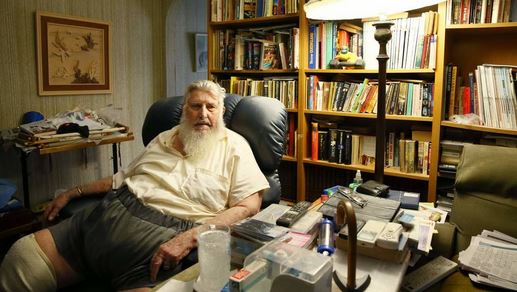
Former police superintendent Rick Kane, who as a Hunter police chief in the 1990s was in charge of disasters similar to last week’s storm, said he and his elderly wife Esma were struggling to continue in their Nelson Bay home.
They were among nearly 5000 customers on the Tomaree Peninsula, and 9000 in Port Stephens, who were still without power on Sunday.
Ausgrid said late on Sunday night it had restored power to 2000 properties at Nelson Bay and Anna Bay.
Rick Kane has light, thanks to a generator. But he is incredulous that the power is still out. Picture: Max Mason-Hubers
Mr Kane said he and his wife counted themselves lucky they had bought a generator a few months ago and it was enough to generate one light and power for cooking and making a cup of tea. But that was it.
‘‘I think this is absolutely bullshit, I am used to disasters and I cannot believe it would hit last Tuesday and we still find ourselves without power or hot water,’’ Mr Kane said.
‘‘If you told me last week that I would wake up at 2.45am, look at the alarm clock and it was out, and the bastard would still be out now, well I would have laughed at you.
‘‘We have had no phones, we have had no one to talk to us about what is going on, I know it is Mother Nature but this is ridiculous.’’
Medowie resident Darrel Slade said his family’s love of the outdoors had helped them, with their faithful camping equipment used to counter the fact they have not been able to shower or cook properly for six days. Mr Slade, who worked as a volunteer in the SES and Rural Fire Service before moving into their new place just two weeks ago, said his wife and three sons were trying to stay patient.
His car had been crushed and a tree remained on his shed.
‘‘No matter how much jumping up and down you do, it won’t quicken things up,’’ Mr Slade said.
‘‘But you can understand why people have had enough. This is a long time to go without power, and people are thinking they are not being looked after. But there is no use strangling each other about it.’’
Port Stephens mayor Bruce MacKenzie said he would table a mayoral minute to council to spend $100,000 to set up a system to identify and cut down troublesome trees in streets before they brought down lines.
Mr MacKenzie, who had to collect water for his horses when his Salt Ash property was blacked out, said he believed the clearing of tree debris could have also occurred quicker.
‘‘I sympathise with the old folk; all I had was a radio and a gas cooker down at the feed sheds with horses,’’ he said.
‘‘I have seen first hand the damage that has been done with trees and I think trees and power lines simply don’t mix.
‘‘I think council and Ausgrid need to look at that, there are dangerous trees on council footpaths and … could have cost lives.’’
Ausgrid spokeswoman Philippa Wheeler said the storm caused more damage to the electricity infrastructure across the Hunter than any other weather event, including the 2007 Pasha Bulker storm.
Ausgrid said about half of the Hunter experienced blackouts, and the 135,000 customers in the dark had been reduced to 22,000.
In the process, Ausgrid has received more than 250,000 calls to its hotline.
But the progress could be stalled in areas such as Nelson Bay because the high-voltage issues had been resolved only to leave time-consuming work on low-voltage problems.
‘‘We absolutely understand the frustration in not having electricity for a day, let alone for six days,’’ Ms Wheeler said.
‘‘No one wants to be in that situation and that is why we have called in extra crews.
Escaping from Castlemaine reformatory teenager Nathaniel Baker was tracked to the bank of the Murray at Braund’s farm, Wharparilla, 3 miles from Echuca. Mounted Constable Daniel O’Connor noticed impressions, which he recognised as those of boots worn by prisoners. Following the tracks for some distance, he learnt Braund’s boat having been taken from its mooring, evidence suggesting the fugitive travelled down stream. Setting off in pursuit, 3 miles from Lockington, he discovered the abandoned boat however no trace of the escaped prisoner.
Establishing through diligent enquiry a person, in possession of a double-barrelled gun, answering the description of Baker called at the farm of Mr. Williams, partaking of an evening meal. A request for cartridges was complied with without fuss with the provision of four. Departing, Baker informing Williams he intended travelling to Gunbower.
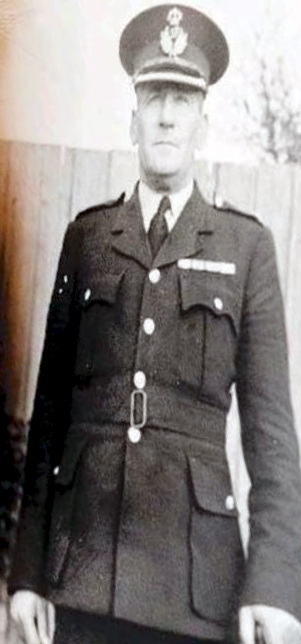
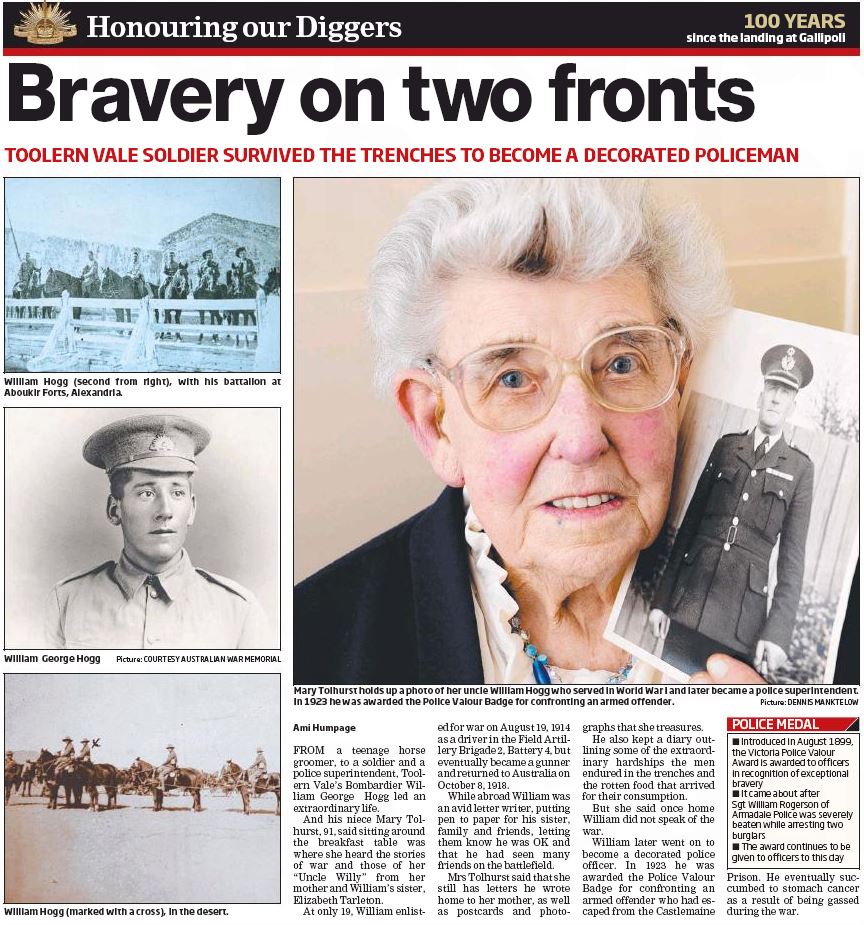
Assisting in the search, officer in charge of Gunbower, Bill Hogg, upon receiving the information, travelled on the night of Tuesday 18 June 1923 with Mounted Constable Daniel O’Connor, to an abandoned hut on Gunbower Island, arriving about 11.30 p.m.
Cautiously approaching, the policing pair discovered their man asleep in the room; double-barrelled shotgun within easy grasp. Making a dash through a window, Bill Hogg secured the weapon, whilst Daniel O’Connor arrested the escapee without resistance. Without food and with little clothing, Baker told the police that he would not have attempted to use the gun even if the opportunity presented itself.
Placing a good mark on their records, Superintendent Donovan of Bendigo, recommended Constable Bill Hogg, of Gunbower, and Mounted Constable Daniel O’Connor, of Echuca, for pre-eminent valor and bravery in the discharge of their police duties in capturing Nathaniel Baker, on Gunbower Island on Thursday 15 June 1923, recommended the pair receive a Merit Badge.
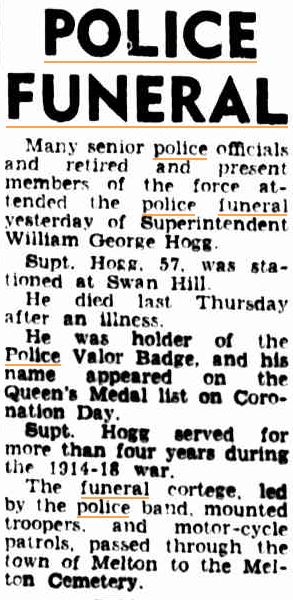
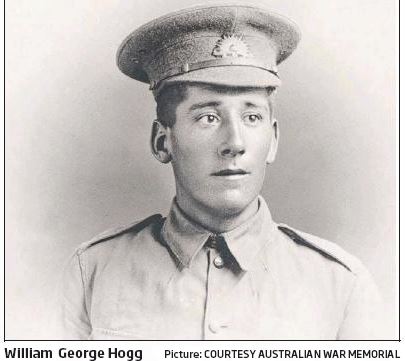
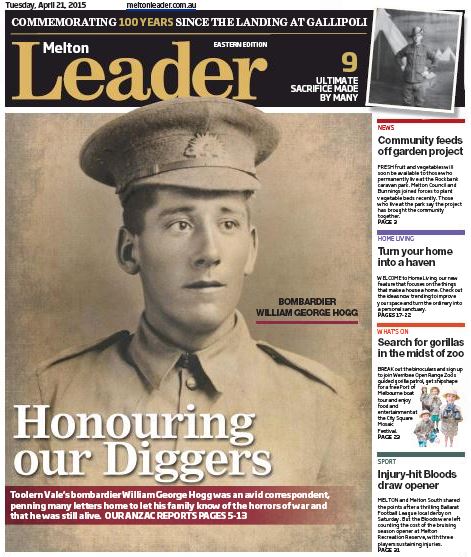
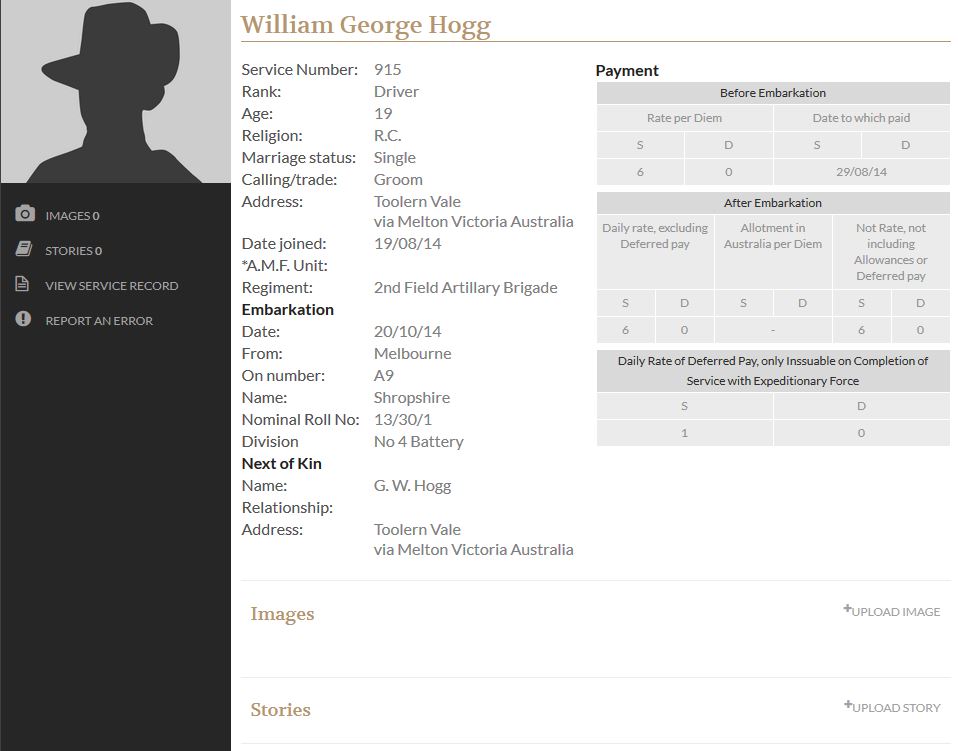
Superintendent William George Hogg, of Swan Hill, died in the Police Hospital, St. Kilda Road, on 4 June 1953, aged 57 years, after a brief illness [stomach cancer]. Bacchus Marsh, Victoria born son of George William Hogg and Catherine Jane Watts, 19 years old groom, Bill Hogg landed at Gallipoli on Anzac Day with the 4th Battery; later to be gassed in the battle trenches of the Western Front, France.
Joining the Victoria Police Force in 1919, at the outbreak of the Second World War, Bill Hogg was one of the original team of four to establish D24. Superintendent William George Hogg was buried with full police honours at Melton, Victoria, leaving a wife and three daughters to mourn their loss.
Maurice graduated from the old Redfern Police Barracks ( year unknown ) and was the son of Detective ‘ Tiger ‘ Richards – an investigating officer in the Sydney Razor Gang case.
[divider_dotted]
Alexander Binning WALKER
| 19/07/2015
Alexander Binning WALKER
( late of Richmond-avenue, Cremorne )
New South Wales Police Force
Regd. # 1765 ( pre 24 February 1915 which commenced the current Regd. # system )
Stations: ?, Sydney,Grafton, Armidale, Uralla ( October 1867 – 1870 ), Glen Inness as O.I.C. ( 1 June 1870 – ? ), Wagga ( 1979 as acting sub-Inspector ), Urana ( for 8 months )-( Riverina Police District ), Walgett ( 1880 – 1882, sub-Inspector ), Gunnedah ( short time ), Young ( for 8 years. promoted to Inspector ), Wagga Wagga ( 1891 ), O.I.C., South Western District at Deniliquin ( Supt. 1896 – ? ), Albury ( 1 year as Supt. ), Goulburn ( from around 1903 – 1911 )
Service: From4 March 1867to 31 May 1912 = 45 years of Service
Ranks: Constable – 1867
Senior Constable – 1 June 1870 – O.I.C. Glen Inness
Sergeant – August 1870
Senior Sergeant – 1874
acting sub-Inspector – 1879
Inspector – 18??
Superintendent – 1896 – 1911
Awards: ?
Born: ? ? 1847 in Oldbury, near Berrima, NSW
Died: Saturday 30 March 1929
Cause: ?
Age: 81
Funeral date: Monday 1 April 1929
Funeral location: Northern Suburbs Cemetery
according to the cemetery records, there are two Alexander B Walker’s buried in the same grave.
One having died on 30 March 1929, the other having died on 21 December 1942.
Buried at: Macquarie Park Cemetery & Crematorium, Delhi Rd, Macquarie Park, NSW
Church of England, H11, Grave 0056
Alexander Binning WALKER NSWPF
ALEXANDER is NOT mentioned on the Police Wall of Remembrance * NOT JOB RELATED
My wife is a direct descendant of this ‘Old & Bold’ Constable.
Original publication
Sydney Morning Herald, Monday 1 April 1929, p 8
Walker, Alexander Binning (1847–1929)
Ex-police Superintendent Alexander B. Walker, who killed the notorious bushranger, Thunderbolt, died on Saturday at his residence, Richmond-avenue, Cremorne. Mr. Walker had a remarkable career in the police force, rising from the ranks to the rank of superintendent. For three months in 1907 Mr. Walker relieved the late Mr. Garvin as Inspector-General of Police. Mr. Walker was 81 years of age.
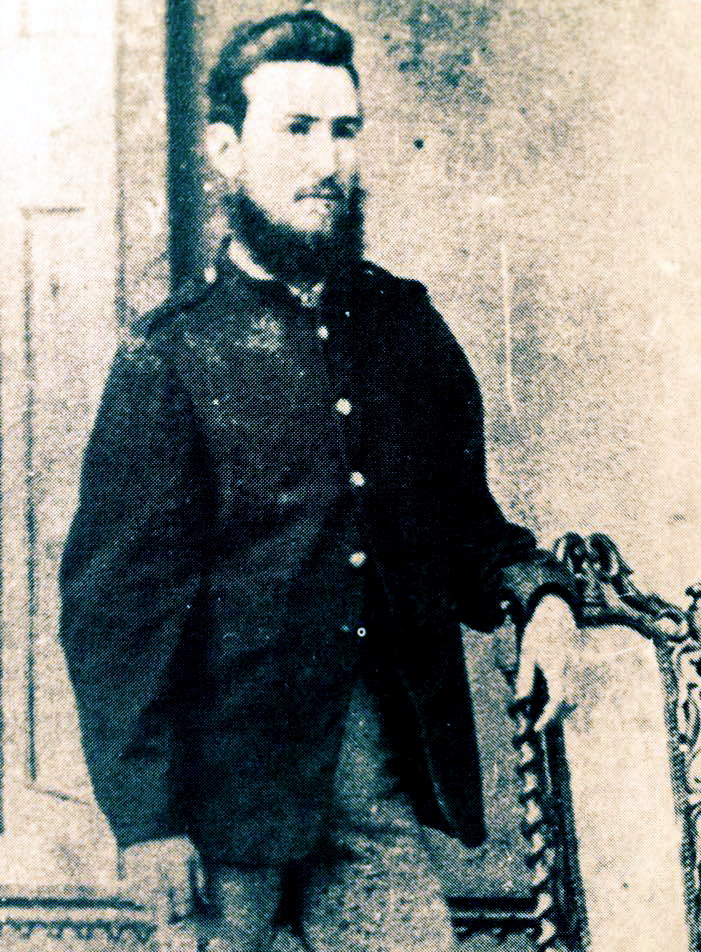
Mr. Walker was born at Oldbury, England, in 1847, and came to Australia when a young man. He enlisted in the mounted police, and when a constable shot Thunderbolt dead on May 27, 1870, at Kentucky Creek, near Uralla. Walker had a thrilling encounter with the bushranger, and after the latter had been shot he grappled with the young constable. During the encounter at Kentucky Creek, Walker’s horse fell and Thunderbolt rushed at him with his revolver in his hand. Walker then fired at the bushranger, who rose and attempted to grapple with the constable. The latter then struck Thunderbolt over the head with the revolver. It was Walker’s last shot that killed the bushranger.
Thunderbolt, whose name was Frederick Ward, was in 1856 at the Maitland Assizes, sentenced to ten years’ hard labour for felony. He obtained a ticket of leave, and was again convicted at Mudgee in 1861. While serving a sentence on Cockatoo Island, on 11 September 1863 he escaped, in company with another convict named Frederick Britton. Ward evaded capture for seven years until he was shot by Constable Walker.
Mr. Walker was subsequently presented with a public subscription, and received a Government reward of £200. He soon afterwards received promotion, and continued to rise in the service until, in 1895, he was made superintendent at Deniliquin. He later served in a similar capacity at Albury and Goulburn.
Mr. Walker is survived by three sons and three daughters. The sons are William Robert Walker (ex-Superintendent of Police, who only some time ago was in charge at Grafton), Alexander Walker (manager of the Commercial Bank, Narrandera) and Walter Walker (manager of the Union Bank, Oxford-street). The daughters are the Misses Pearl Walker, Olive Walker, and Mrs. Cedric Fitzhardinge (of Newcastle).
The funeral will leave the residence in Richmond-avenue, Cremorne, at quarter past 10 o’clock this morning for the Northern Suburbs Cemetery.
Goulburn Evening Penny Post ( NSW ) Tuesday 31 October 1911 p 2 of 4
AN HONOURABLE CAREER A SUPERINTENDENT’S REMINISCENCES. HOW THUNDERBOLT DIED.
On 1st December next Mr. Alexander Binning Walker, Superintendent of Police in the Southern District of New South Wales, will commence his six months’ leave of absence prior to retiring from the service owing to the age limit. Mr. Walker, although he is in his sixty-fifth year, is still an active and clear-thinking man, and good enough, to put it somewhat crudely, for another ten years’ service, but there it is – the inexorable limit.
Mr. Walker has nearly completed forty five years of service, and he leaves behind him an honourable record of which anyone would feel proud. It is the universal rule that there shall be law, and so long as there is law there will be law-breakers.
One of the worst of the notorious law-breakers in the history of New South Wales was Thunderbolt, and it stands to the great credit of Superintendent Walker that, single-handed, he faced and overcame the bush ranger who proved such a scourge to society.
Mr. Walker was born at Oldbury, near Berrima, in 1847. He joined the police force before he was twenty years of age, and as a trooper was sent from Sydney to Grafton, then Armidale. After a stay of a couple of weeks he went to Uralla. This was in October, 1867, ” the roaring days. ” So that at this time the young trooper was still in his nonage.
He only stayed at Uralla for three years, but during that time he had plenty of excitement. He was often engaged in guarding the mail from Armidale to Tamworth. One can scarcely realise it now. His regular work, for four days in the week, was to guard the mail from Uralla to Bendemeer. He was stationed at Uralla with Senior-constable Mulhall, and while there information was sent from Mr. Innes Taylor’s property at Terrible Vale – the very name jumps one back to the bushranging days – that a suspicious character had been seen at the station. Amongst other information, it was stated the man had a saddle bearing the brand of the Burburget Station, and this led the police to believe that the suspicious character was Rutherford, the bushranger, who had some time previously, in company with Dr. Pearson, shot Senior-constable McCabe on the Biree, at Goodooga.
After this outrage Pearson went down the river, and was captured by the Bourke police, while Rutherford came through the Liverpool Plains up into New England, and so to Terrible Vale.
The messenger who brought the information, instead of coming immediately, stayed the night on the station and made the trip to Uralla next day. Senior-constable Mulhall and Constable Walker arrived at the out station where Rutherford was expected to be. One of the troopers came at the hut in front, and the other from the rear, thinking that the bush ranger might make a break for it at any moment, but they found the place empty. Rutherford had left that morning.
They followed him for four days, but on the Friday night Constable Walker had to leave to take his place escorting the coach from Carlyle’s Gully to Uralla. On the Saturday they discovered that on the Thursdaynight they had camped within half a mile of Rutlherford! As Constable Walker left the public-house where the coach changed horses at Carlyle’s Gully, and went out of sight, Rutherford rode down the back. He had evidently been watching the coach and the constable. Rutherford cleared out again, but was shot three days later by the publican at Pine Ridge while endeavouring to stick up the house.
The story is only an illustration of some of the things that happened in ” the good old days. ” But shortly after there was another and far more dramatic incident – the end of Frederick Ward, better known as Thunderbolt.
On 24th May, 1870, races were held at Uralla, and there were many visitors and strangers in the township. The next morning was settling day. About 3 o’clock in the morning an excited Italian hawker, Cappasotti by name, came into town and reported at the police station that he had been stuck up and robbed near Blanch’s Hotel, about five miles from Uralla. Senior-constable Mulhall and Constable Walker started out immediately.
It might be Thunderbolt, it might be someone else. Before four o’clock they were well on the road, Senior-constable Mulhall, who was riding a better horse, leading the way. He arrived at Blanch’s about half a mile ahead of Constable Walker, and met two men riding grey horses towards Uralla. He had little time to ask questions, as one of them immediately drew a revolver and fired at the senior constable, who exchanged shots. It was still dark at the time. Both the strangers then turned and fled, the senior constable-galloping after them. He over took them round the fence surrounding Blanch’s place and fired, again missing his mark. Constable Walker came galloping up, and the senior constable said ” Go ahead and shoot that wretch. We have exchanged shots. ”
They both pursued the two men. One of them doubled back and the senior constable followed him, but lost him in the dark. The man, however, was apprehended shortly afterwards at Blanch’s as an accomplice. Such was not the case, as it happened.
Thunderbolt had taken the man into his custody, as he wanted the horses he had with him. In the meantime Constable Walker had followed Thunderbolt. In the excitement the constable’s revolver went off, and Thunderbolt turned in his saddle and shot at him. The constable returned the fire. It was at this stage that the two men, Thunderbolt and the stranger, separated. ” Come on, ” cried Thunderbolt, putting the spurs into his horse. ” All right, ” shouted back the young constable, nothing loth.
They galloped on, and Thunderbolt had another flying shot, which fortunately was resultless. The constable fired in reply, but the end was not to come yet. Still they raced on over rough country, both taking risks in the darkness, and never dreaming of the consequences of a fall. Over creeks they went. At the top of a rise out of one of these creeks Thunderbolt wheeled round, and it looked for a moment as if he had the constable at his mercy, as he came up towards him. The constable fired, and Thunderbolt turned, and again the wild race went on.
For a quarter of an hour it continued, the constable‘s horse gradually pulling the bush-ranger’s. Thunderbolt then led the way over a spur down into a creek they could not gallop through. Into the water he dashed, but a shot from the constable‘s revolver killed the horse. The bushranger was at bay ! Constable Walker turned his horse down the stream to cross, and when he came back he found Thunderbolt running up the creek. Before he could get to close quarters Thunderbolt crossed the stream again at a narrow channel. He stood on the opposite side until the constable came up. ” You had better surrender before you do any harm, ” said Constable Walker. ” Who are you ?” asked the bushranger. ” Never mind, ” retorted the constable. ” What’s your name ?” ” Walker, ” came the answer. ” Are you a trooper ?” queried Thunderbolt. Being answered in the affirmative, and after a pause, Thunderbolt asked ” Are you a married man ” ” Yes, ” came the answer. The two men were facing one another, with a narrow strip of water flowing between them, four or five yards of it, and each had his revolver in his hand. Any moment might mean death to one or both of them.
” Walker, keep back ! You are a married man !” came the warning cry from Thunderbolt as the constable edged forward. ” Will you surrender ?” ” No ; I’ll die first. ” ” All right, you and I for it. ” The constable put his horse to the water, head first. While the horse was under the water Thunderbolt rushed at the constable. A shot, the fatal one, rang out from the constable‘s revolver and Thunderbolt went under. He rose and grappled, and the constable struck him on the head with the butt of his weapon. Again the bushranger went down, and when he came up the blood rushed from his mouth. Thunderbolt‘s career was over. The shot had passed through the chest, and the effect was not instantaneous, this accounting for the struggle in the water. Thunderbolt‘s revolver was found in the creek bed with one shot still in it. The cap had failed to explode, although the mark of the hammer was on it. Had it taken effect there might have been a very different story to relate. Needless to say the courageous behaviour – one might almost call it the reckless disregard of danger – on the part of Constable Walker aroused the greatest enthusiasm.
At the inquest £32 was subscribed in the room, and the warmest feelings were entertained for him at Uralla. Of course, the Government reward of £300 was handed over, but more dear to the heart of the young constable was his promotion, on 1st June, to the rank of senior constable, and being placed in charge at Glen Innes. In August he was made sergeant.
In 1871 or 1872 the tin mines were discovered, and the number of men stationed at Glen Innes was increased from two to five. Ordinary police work followed.
While at Glen Innes Senior-sergeant Walker effected a clever capture of a notorious character in the person of Aboriginal Tommy, while the black had a loaded revolver in his possession. Tommy had stuck up some fencers, and after being arrested escaped. It became Senior-sergeant Walker‘s duty to re-capture him. In company with a constable he set about the task. They found Tommy working for a selector, ring-barking. He was in the selector‘s house at the time of his capture. The sergeant and constable stepped in smartly, and before Tommy was quite aware of what had happened Senior-sergeant Walker had him by the breast with a revolver at his head. ” I’ll shoot you if you move, ” he rapped out. But Tommy did move, and tried to get possession of a revolver in his pocket. The constable, however, snapped the handcuffs on. Even then the trouble was not over. They put the black on a horse, but he threw himself off his horse and fought for six miles. They had to tie him to a tree while the constable went to Shanahan Vale to get a cart. Tommy was eventually committed for trial. The charge was that he threatened to shoot the fencers, and he got out on a technical point, as the Crown Prosecutor had failed to prove the firearm was loaded ! The jury consequently brought in a verdict of not guilty. But Tommy had not learnt his lesson. He got a horse, and near Oban robbed a digger‘s hut, where he also got powder and bullets. He rode into the blacks’ camp and deliberately shot a blackfellow dead.
The police were after him immediately, and used to give him a chasing now and again, but they never got within sight of him. They had black trackers, but, ’tis said, Tommy used to often track them.
One day he stuck up a public house at Bald Knobson, the Glen Innes – Grafton road. Two mounted constables, Wainwright and Goodhew, the latter a brother to Senior sergeant Goodhew, of Taralga, were sent out. They followed him, and had an encounter. Tommy was armed with a revolver and a tomahawk. They came on him lying on the ground taking stock of them. ” Are you Tommy MacPherson ?” asked one of them. ” That’s the question, ” said the black. He let drive with the tomahawk, which grazed the back of one of the troopers as he bent down to dodge it. A bullet from the weapon of the other trooper, however, quietened Tommy, who died the same night.
In 1874Mr. Walker attained the rank of senior sergeant, and in 1879, when the Kelly Gang stuck up Jerilderie, he was promoted to the rank of acting sub-inspector, and sent to take charge of Wagga, during the absence of the sub-inspector there at Albury. On his return Mr. Walker was sent to Urana in charge of a party of police in the Riverina, remaining there for eight months. The police were on the look out for the Kelly Gang, but from then till the time they were captured the gang never re-visited New South Wales.
Mr. Walker went to Walgett in 1880 as sub-inspector, remaining there for two years. After a short stay at Gunnedah he went to Young for nearly eight years, during which time he became inspector. Wagga Wagga saw him again in 1891, and in 1895 he was placed in charge of the South-Western District, with headquarters at Deniliquin. Next year he was made superintendent, the district comprising Broken Hill, the South Australian and part of the Queensland borders. After a year in Albury Mr. Walker. came to Goulburn, where he has been for the last eight and a half years, during which time he has had charge of the whole of the South Australian border in New South Wales, the Victorian border, and portion of the Queensland border. During his time Mr. Walker has had men under him who have risen to the rank of superintendent, a fact speaking volumes.
Mr. Walker is the last of ” the old brigade ” who joined during ” the sixties, ” and his experience is wide and varied.
Speaking of the police work now, he says it is only child’s play to what it used to be in the olden days, and in a sense one can well agree with him. As for the men of the Southern District, Mr. Walker says he leaves behind him a staff of good men, all sober and reliable. ” They are second to none. I am very pleased to say that. I cannot specialise any of them. They are all good. ”
Mr. Walker will finally retire on 31st May, and by next March he will have completed forty five years of service.
Constable Alexander Binning Walker has become a foot note in history despite the heroism he displayed in the pursuit of notorious bushranger Frederick Ward alias Captain Thunderbolt. Ward is often portrayed as the bushranger who never used violence in his crimes (if you discount pointing a gun at his victims and demanding their property or shooting at and wounding Police).
Frederick Ward (1835 to 1870) was a horse thief and armed robber. He committed offences in the New England, Upper Hunter and Liverpool Plains areas of New South Wales during the height of the bushranger era. After shooting and wounding a Policeman in 1865 a £200 reward offer was made. Senior Constable Lang was the wounded policeman but his name seems to escape the history books.
Alexander Binning Walker was born on the 31 May 1847 at Oldbury near Berrima. His name is sometimes misspelt at Binney. He married Eliza Elizabeth King in 1868 at Armidale. They had two children. Eliza died of typhoid on the 29th June 1874. He married Emily Susan Hawke in 1879 at Willingrove. They had six children together.
Alexander Binning Walker was a Supernumerary before being confirmed as a Constable on the 1st April 1867, No. 1765. He joined the Police Force at 20 years of age. Mounted Trooper Walker was sent to Grafton then Armidale. In October 1867 he was sent to Uralla where he stayed for 3 years. His principal duty was to guard the mail from Uralla to Bendemeer.
On the 24th May 1870 a race meeting was held at Uralla which attracted many visitors. About 3am the next morning a hawker named Cappasotti reported to the Police that he had been held up near Blanch’s Hotel about five miles from Uralla. Senior Constable Mulhall and Constable Walker stared out immediately. Senior Constable Mulhall was on a better horse and arrived at the hotel about a half mile ahead of Walker. He encountered two men on horseback. One man started shooting at him. He pursued them, overtook them and shot at them. Constable Walker caught up and they continued the pursuit. The two men split up. Senior Constable Mulhall pursued one and Constable Walker pursued Frederick Ward (Captain Thunderbolt). Constable Walker accidentally fired his revolved and Ward shot at him. The pursuit continued with more shots exchanged. Ward rode into a creek and Constable Walker shot and killed Ward’s horse. Constable Walker called on Ward to surrender but he refused and said he would rather die. As Constable Walker rode into the creek Ward rushed him. Constable Walker shot him. A struggle ensued. Constable Walker hit him in the head with his revolver. Ward died from his wound. His revolver was found in the creek with one round in it that had misfired.
Constable Walker was given a £300 reward for capturing Captain Thunderbolt.
In June of 1870 Constable Walker was promoted to Senior Constable and placed in charge of Glen Innes. In August he was promoted to Sergeant. In 1874 he was promoted to Senior Sergeant. In 1879 he was Acting Sub-Inspector in charge of Wagga Wagga. On the 1st January 1880 he was promoted to Sub-Inspector and sent to Walgett. He was then sent to Gunnedah and then Young. In 1895 he was placed in charge of the South Western District. In 1896 he was promoted to Superintendent and placed in charge of the Southern District.
On the 1st December 1911 Superintendent Walker of the Southern District commenced six month leave before retirement. He had completed 45 years of service. He retired to Richmond Ave, Cremorne.
Alexander Walker died on the 30 March 1929 at North Sydney. He is buried in the Church of England Portion of the Macquarie Park Cemetery and Crematorium in H11 Grave 0056. His son was Superintendent William Walker who had been in charge of the Grafton District and had recently retired from the Police at the time of his father’s death.
For the purposes of this website ‘P‘ = represents those Police joining Pre 1 March 1862 before the amalgamated of all other Policing Units in NSW. i.e. Mounted Police, Boarder Police, Native Police, Gold Escort Police, Water Police etc.
Ancestor of Retired NSWPF Member Kevin Banister # 16382
Rank: Chief Constable
Stations: George St, Sydney. Constable.
Sydney 5th District. District Constable.
George St, Sydney. Chief Constable
Service: From1810to 1827. Resigned due to ill health (on going infirmities)
Awards: ?
Born: ? ? 1776 in England or Ireland
Died on: 6 April 1832, possibly ???
due to ongoing complications as a result of a snake bite in 1827
Cause: Infirmities
Age: 55
Funeral date: 9 April 1832
Funeral location: ?
Originally Buried at: Devonshire Cemetery on 9 April 1832 ( now the site of Central Railway Stn, Sydney )
Re-Buried at: St. James Anglican, Macquarie St, Sydney but other records have him reburied at Botany Cemetery.
THOMAS is NOT mentioned on the Police Wall of Remembrance * NOT JOB RELATED
From Kevin Banister:
Dear people. Below is a bit of a story of one of my ancestors Thomas DUNN. NSW Fallen Police does not only mean those who made the ultimate sacrifice, but those that served and lived and, hopefully, had their story told. If you had an ancestor that served, please tell us the story.
Thomas Dunn is a direct ancestor of one of my mothers sister. Something I will add to my ‘Mums Memories’. He was a copper, as I was. Mum would not have known of this.
THOMAS DUNN was born in 1776 in England or Ireland. In 1796 he was described as: 5ft 8in, dark complexion, dark hair and dark eyes.
At the age of 19 he was a servant for a brewer in King St, Westminster backing onto the Thames. In Sept 1796, he was caught stealing money from his employer and was convicted and sentenced at Newgate Prison on 28/10/1796 to 7 years deportation. He was 20 years of age.
After sentencing, he spent a few months at Newgate before being sent to the Hulks in Portsmouth Harbour on 12/3/1797, where he spent the next 21 months. He sailed from Portland Roads on 23/12/1798 on the ship “Hillsborough” (764 tons) with 300 male convicts aboard, some of whom had typhus.
The Master of the ship was William Hingston who treated the convicts harshly. It arrived in Sydney, after 212 days, on 26/7/1799 with typhus raging on board.
Ninety five of the 300 convicts had died during the voyage and a further 6 died after they landed, Gov. Hunter describing the survivors as “the most wretched and miserable convicts I have ever beheld, in the most sickly and wretched state”. Almost every prisoner required hospital treatment, due to the sickness; the treatment on board where they were kept double ironed and chained together on deck; their bedding which was constantly wet due to the stormy weather; plus being inadequately fed.
After serving his term, Thomas married Rose Bean in 1804. She had arrived in the Colony aboard the ship “Buffalo” in 1799 at the age of 13. She arrived with her parents and siblings as free settlers, her father James Bean having signed up as a builder under a “Terms of Settlement” agreement. James Bean would be contracted to build the Rum Hospital in Macquarie Street in 1811. Rose and her siblings were all born in London.
In 1803, when Rose was 17, she was raped by two Irish convicts who had escaped and attacked the Bean homestead. Thomas Dunn, who may have been assigned to the Bean farm at the time, married her the following year at St John’s Church, Parramatta. Dunn and Bean were both involved in the quashing of the rebellion of Irish convicts at Castle Hill in 1804, known as the Battle of Vinegar Hill.
In the 1806 Muster, Thomas was self-employed and renting 30 acres. He had 20 acres under pasture, growing maize and barley.
In 1810 he was appointed a constable in Sydney, victualled by the Government. He was also a landholder in Baulkam Hills.
In 1814 he received a grant of land.
By 1817, he was a District Constable, paid a salary from the Police Fund.
On Oct 19, 1820, he was appointed a Chief Constable for Sydney and was receiving a wage of 150 pound.
In 1824/25 he was granted 600 acres which he sold in 1830 for 125 pounds sterling.
In the 1828 Census, he was a pensioner on 50 pound a year, living in Cumberland Street. On his retirement, many praised his “exemplary conduct during his time as Chief Constable.”
Thomas died on 6/4/1832 aged 55 and was living in Castlereigh St, Sydney at the time of his death. Rose had died the year before on 5/11/1831. They had 8 children. Their daughter, Margaret, married Walter Butler (son of convict Laurence Butler), and had two children. Margaret would die at the young age of 31 years.
Jonas Goode NELSON
| 19/07/2015
Jonas Goode NELSON
New South Wales Police Force
Regd. # ?
Rank: Mounted Constable
Stations: Glen Innes, Grafton & several other country towns
Service: From ? to ?
Awards: ?
Born: ? ? in Bicester, Oxfordshire, West of England
arrived in N.S.W. with his father – Samuel NELSON aboard the ‘ Parsee ‘ in 1855
Died on: 3 May 1924
Cause: Heart failure
Age: 72
Funeral date: 5 May 1924
Funeral location: ?
Buried at: Goulburn Old Cemetery
[alert_blue]JONAS is NOT mentioned on the Police Wall of Remembrance[/alert_blue] * NOT JOB RELATED
[divider_dotted]
Funeral location:
[divider_dotted]
Goulburn Evening Penny Post ( NSW ) Tuesday 6 May 1924 page 6 of 6
OLD SUDAN SOLDIER
Mr. Jonas Nelson Passes
One of the members of the rapidly thinning band of Sudan contingenteers –Mr. Jonas Goode Nelson – died at the residence of Mr. T. Cambridge, Braidwood Road, on Saturday morning, the cause of death being heart failure.
He was 72 years of age, and leaves a daughter, Mrs. Percy King, of Ifield, and two sons, Messrs. G. .E. Nelson, Auburn-street, and W. L. Nelson, W.A..
The late Mr. Nelson was born in Bicester, Oxfordshire, West of England, coming to New South Wales with his parents in the ship Parsee in 1855.
His father, Constable Nelson, was killed at Collector by Ben Hall’s gang, and the monument to his memory is a prominent feature in the old village.
Mr. Jonas Nelson also joined the mounted police, and was stationed at Glen Innes, Grafton, and several other country towns.
When the Sudan Contingent was organised, he Joined the force, and on returning became a member of the citizen forces in Goulburn.
His wife, a Miss Bill, of Braidwood, died over 25 years ago.
He was one of the oldest members of the local Druids’ Lodge, and was for many years caretaker of the Goulburn Race Club’s course.
He was always an enthusiast in military affairs, and took part in the Anzac Day procession to Rocky Hill twelve days ago.
At one time he was a member of the Goulburn Fire Brigade, under Captain Mayne. Messrs. Samuel Nelson (another Sudan veteran), A. E. Nelson (Clifford-street), and Thos. Nelson (Vic.) are brothers. Mesdames Ifield and Raynor, of Sydney, are sisters.
The funeral took place on Monday afternoon at the C. of E. Old Cemetery.
No further information is known about this man, his career or his death. Further information about the man and his grave, and photos, would be appreciated.
Cal
290819
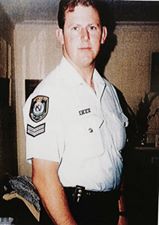
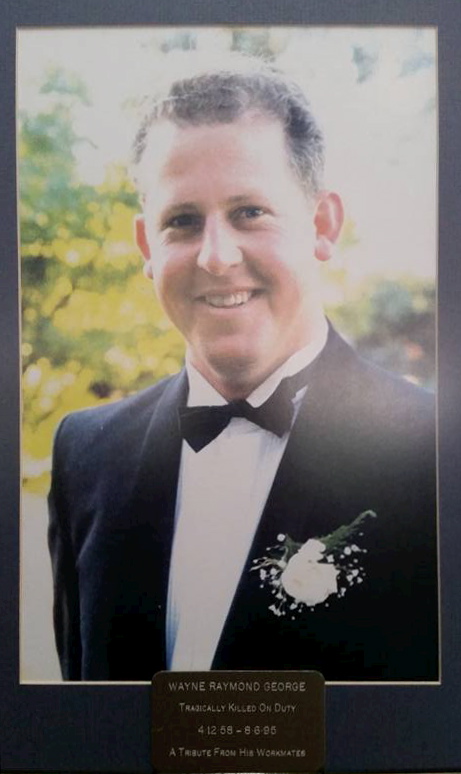
Wayne Raymond GEORGE
| 19/07/2015
Wayne Raymond GEORGE
New South Wales Police Force
Joined NSW Police Force via NSW Police Cadet system on 2 February 1976
Cadet # 3222
Redfern Police Academy Class 157
Regd. # 17765
Uniform # 1822
Rank: NSW Police Cadet – commence 2 February 1976
Probationary Constable – appointed 5 December 1977
Constable – appointed 4 December 1978
Senior Sergeant – Death
Stations: ?, The Rock – O.I.C., School of Traffic and Mobile Policing ( S.T.A.M.P. ), Police Academy, Goulburn
Service: From 2 February 1976 to 8 June 1995 = 19+ years Service
Awards: National Medal – granted 16 September 1993
Born: Thursday 4 December1958
Died on: Thursday 8 June 1995
Cause: Motor Vehicle Accident – Police cycle – Rider
Location: Picton Rd near Almond St, Picton
Age: 36
Funeral date: ?
Funeral location: NSW Police Academy, Goulburn
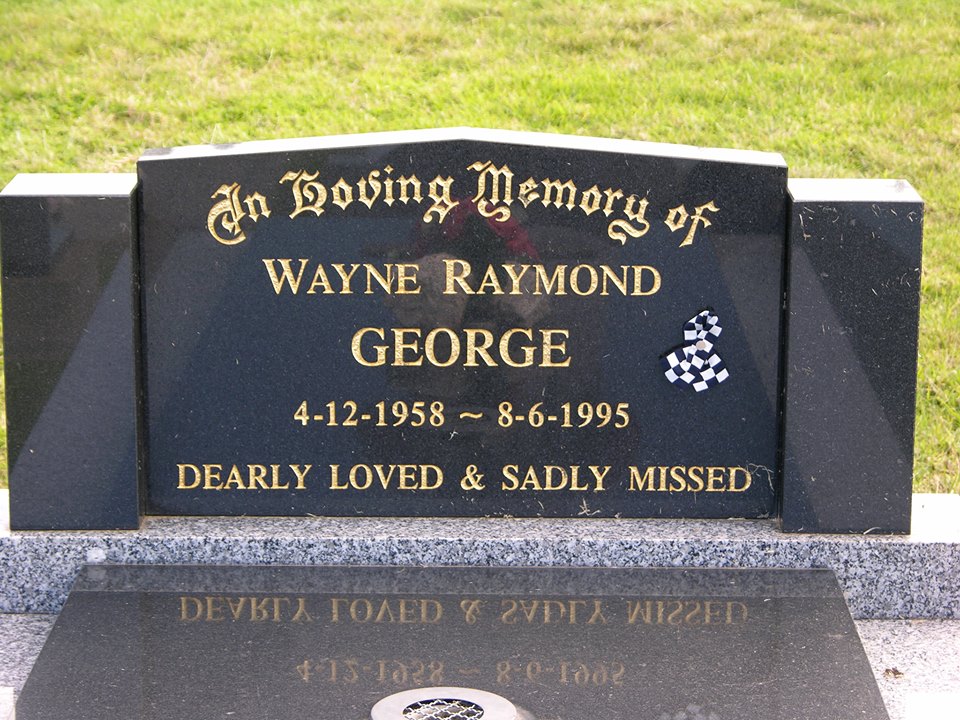
Buried at: Bega Cemetery, Princes Hwy ( South )
General Section 6, Row E, Lot 11
Wayne Raymond GEORGE
Hanging at the Police Driver Training School, Goulburn.
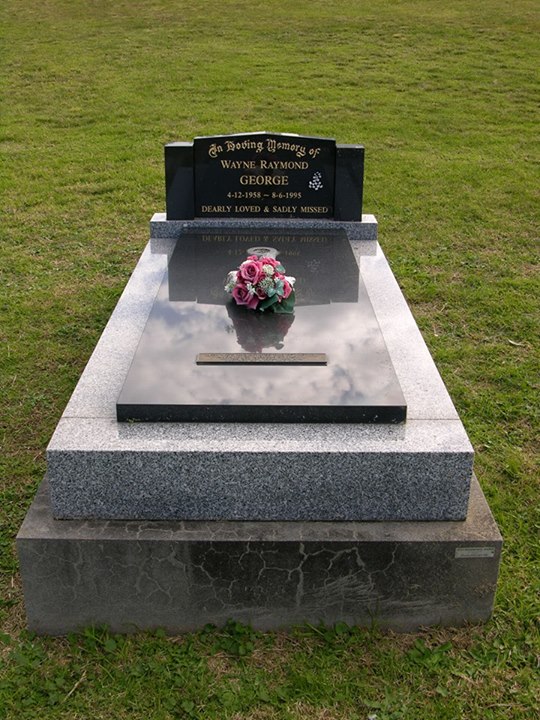
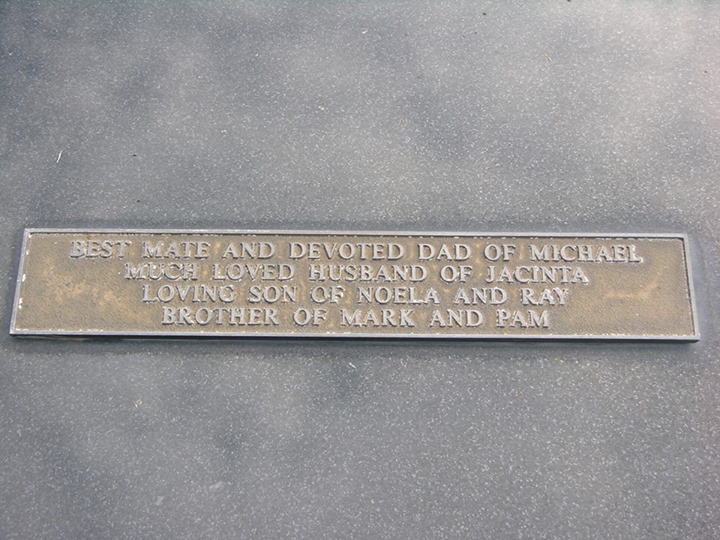
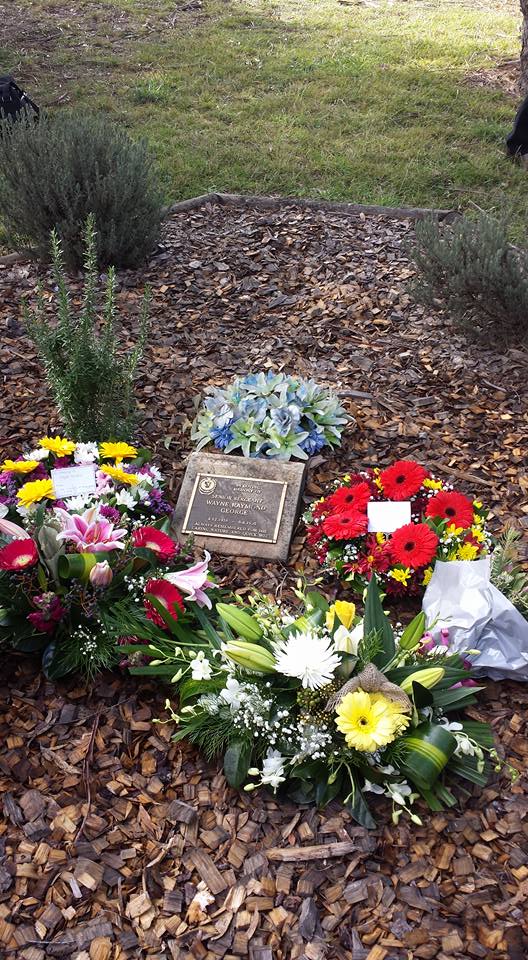
Wayne Raymond GEORGE – Grave
Wayne Raymond GEORGE – Grave
Wayne Raymond GEORGE – Grave
Wayne Raymond GEORGE memorial plaque at NSW Police Driver Training ( S.T.AM.P. ), Goulburn
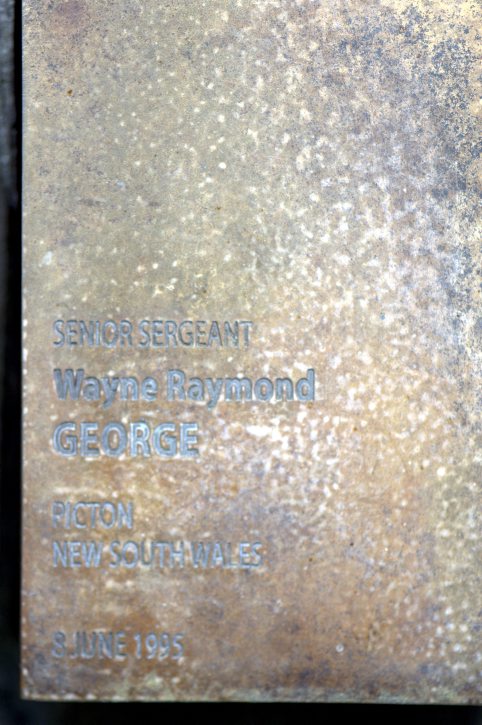
WAYNE IS mentioned on the Police Wall of Remembrance
Touch plate at the National Police Wall of Remembrance, Canberra.
Funeral location: ?
On 8 June, 1995 Senior Sergeant George was riding a police solo motor cycle from Goulburn to Sydney to attend a meeting. Whilst he was riding along Picton Road, near Almond Street, Picton his cycle was struck by a motor vehicle. The sergeant was thrown to the roadway where he was run over by a number of passing vehicles including a semi-trailer. He died as a result of injuries received.
The senior sergeant was born in 1958 and joined the New South Wales Police Force as a cadet in February, 1976. He was sworn in on 5 December, 1977. At the time of his death he was attached to the School of Traffic and Mobile Policing, Police Academy, Goulburn.
Have searched Trove and Google without success for the articles in relation to this man.