JOAN MUDIE GAY 8 February 2019
Passed away peacefully at Bourke Street Health Service, Goulburn.
Much loved wife of William Gordon (dec).
Loving mother and mother-in-law of Peter, Robert & Marcell, Maureen & Terry, Patricia & Barry and Margaret.
Very proud and loving nan to her seventeen grandchildren and a much loved great ‘Nanny Gay’ to all of their children.
Aged 89 years.
‘Forever In Our Hearts’
Joan’s family and friends are invited to attend her Mass of Christian Funeral commencing at 1:30pm Friday 15 February 2019 at St Peter & Pauls Cathedral, Bourke Street Goulburn. A private cremation will take place.
R. J. Sidney Craig Funeral Directors
EST. 1837 – AFDA / FDA (NSW)
298 Sloane St, Goulburn NSW 2580
Telephone: (02) 4821 2122
Nothing further, at the time of publication, is known about this man or his career other than what is now shown.
When / if further information is obtained, it will be reflected upon this Memorial Page.
Penned by Richard John CRICKMORE – NSW Police Cadet # 1287:
My first attempt to join the N.S.W. Police Cadets ended in bitter disappointment – deferred – under weight – back to the Rural Bank, Parramatta – “Eat plenty of bananas!” My mate John Valdmanis and I used to go and look at the police exhibits at the Royal Easter Show. There was the famous pyjama girl and the shark – tattooed arm murder cases, which absolutely fascinated us. John passed the medical first try. Oh, well, persevere! So I waited a couple of more months and applied again – got through the G.M.O this time. One of my ancestral great grandfathers, Edward Moloney, had been a member of the N.S.W. Police Force in the latter part of the 19th century. First Class Sergeant Wal Glascock, then head of the Police Wireless Section, resided just up the road from us on the corner of Dorritt & Little Streets, Lane Cove. Detective Sergeant Stanley Dugald Cameron lived just around the corner at 177 Longueville Road, Lane Cove and Inspector Ken O’Hara resided not very far away. It was my ultimate objective in life to be a policeman and a detective.
On the 8 February 1956 I reported at the Police Training Centre, Redfern with a number of other fresh police cadet recruits where I was advised by Sgt. 3/c Jack Hyslop that a cadet aged 17 years or more had to be able to not only write and transcribe shorthand at the rate of 100 words per minute but to be also proficient at typing and pass rates of 45 words per minute prior to attaining 19 years of age as one of the mandatory requirements to qualify for acceptance as a probationary constable.
The officer in charge of cadets, Sgt. l/c McCorn, then accompanied three of the fresh recruits, including yours truly, to the Police Rules Section, which at that time was located on the northern side of the quadrangle near the Traffic Infringement Office. Our duties there included updating Police Rules and Instructions which, incidentally, gave me a very good introduction to the various facets of law with which I was to be associated with in numerous capacities during my entire working life – Criminal, Mining, Environmental, Local Government, Valuation, Land, Commercial and Civil Acts in N.S.W., Queensland and Papua/New Guinea. We had only been in this section for a matter of two weeks when one of my fellow recruits aged 15 committed suicide at Liverpool over a girl friend.
The O.I.C. Police Training Centre was Inspector Jim Ferguson, Brian Ferguson (son). The Cadet Sergeants were Sgt. 1st Class McCorn, Sergeants 3rd Class Jock Stewart, “Bricky”, Jack Hyslop, while Sgt. Len Barber and Sgt. Porche were law instructors. Drill/Gym instructors were Senior Constable Ben Hall, Constables Dave Ferguson, Roy Dykes, Brian Andrews and Barry Harris. Finallym, the Shorthand Instructors were Sgt 3rd Class Jack Hyslop, Constable 1st Class Joe Smith, and Constables Keith Belcher, Ernie Carmichael and Ron Gould until he left the force to sell AMP insurance in the latter part of 1956.
Shortly afterwards I was transferred to Regent Street No. 2 Division where I carried out telephone operations and intercepted wireless messages in a small alcove alongside of the charge room. The time spent there was very enlightening, to say the least. Les Walsh was one of the station sergeants and Jack Healey was in charge of No. 2 Detectives at that time.
During this transitional period between March/April 1956, Ian Beckett, Neil Taylor, Merv Lane, Brian Bourne and myself were learning elementary shorthand at the Metropolitan Business College, Macquarie Street, Parramatta, which was located about two blocks south of the Parramatta Police Station. On one occasion a girl sitting behind me took an epileptic fit and I managed to place a ruler in her mouth to stop her biting her tongue. The college later wrote to the Cadet Sergeants and I was permitted to read the complimentary letter. I studied very hard concentrating on learning and utilising the various phonetic outlines and grammalogues, building up my shorthand writing speed by taking down and transcribing parliamentary sessions and songs during this period. I was very concerned about the limited period that I had to pass the required shorthand and typing rates before I turned 19. Constable 1/c Joe Smith was in charge of the elementary shorthand class at that time. The cramming certainly helped me a lot because I breezed through the low speed class up to 80 words per minute in eleven working days and I was writing and transcribing shorthand at a 100 words per minute in four and a half months. This then enabled me to apply for a country transfer.
During this period we were attending the Police Training Centre on a daily basis, carrying out physical training, learning law and debating as well as participating in sport. While we were members of the N.S.W. Police Amateur Swimming and Life Saving Club, we swam mainly at the Sydney Domain Baths but on occasions held long distance swimming events at Brighton (outside of the baths). During the earlier part of 1956, various ideas were put forward as suitable “shark repellants” and on one occasion, just prior to our swimming out to the two distant buoys and returning to the shore, dry ice was used as “an efficient shark repellant”. All it appeared to do was send up enormous amounts of bubbles and whilst swimming back to the beach when some cadet yelled out “Shark!” That sure encouraged everyone to treble the speed and be running by the time we reached the shore. Johnny Raper (with Ray White and Andy Lynch hanging out of the box) rang the Daily Mirror from a public telephone down the road and reported the incident. I do remember that dry ice was not used as a shark repellant on any future occasion we swam there.
After working at Regent Street for a period of about three months, I was transferred to Parramatta Police Station No. 18 Division where I carried out similar station duties – Jack Fisher was in charge of the Detectives at that time about May, 1956.
Two months later I was transferred to country duties at Maitland Police Station arriving there in early July 1956. My duties there were carried out in the Public Safety Bureau office, typing up traffic breaches for PSB officers Dick Burgess and Ted Hamilton – Inspector Dave Sutherland was in charge at Maitland, assisted by Sgt 1/c Fraser with Ted Cahill, Prosecuting Sergeants Maurie Baker and Tom Sleeman were in the detective office at that time.
For the first four weeks that I carried out duties at Maitland, I did not receive my fortnightly salary, as there was a mail strike in Sydney. Things were really tough as I was boarding in Church Street and was unable to pay my second fortnight’s board until my parents had wired some money up to me. To the best of my knowledge the pay rate was seven pound twelve shillings and sixpence per week at that time because prior to my leaving home, my parents deducted five pound per week board and I had approximately two pound left, which just managed to see me through until the next fortnightly pay.
One day whilst performing duty at the old Maitland police station, which was directly behind and part of the court house, a list of stolen vehicles was broadcast over the radio from Newcastle police station and included: “Stolen – one sanitary motor truck”. The on duty police constable Tommy King called Newcastle by radio and said: “We’re all pretty browned off about that up here!” On another occasion, I was requested to accompany Detective Tommy Sleeman to a tennis court at East Maitland where I was directed to walk into the shelter at the rear of the courts and in a discreet manner, ask a man who had been previously identified to me by Det. Sleeman, to accompany me back to the car where he was interviewed by the detective and arrested on warrant for committing Bigamy.
In August 1956 I attended a medical examination at Maitland Hospital for National Service, which was compulsory in that decade – Hunter River Lancers. I was then transferred back to Police Training Centre, Redfern in September 1956 for initial induction of 28 Police Cadets into uniform and pedestrian crossing duties.
After the parade, I was transferred to the Public Safety Bureau, Parramatta No. 18 Division for duties on school pedestrian crossings and typing up breach reports etc. After receiving suitable instructions in signalling etc. on pedestrian crossings, I was taken out to the then pedestrian crossing adjacent to the four way intersection on Victoria Road, Rydalmere (Family Hotel corner) in motor cycle and sidecar by O.I.C. Public Safety Bureau, (Parramatta) Sgt. 3rd Class Arthur Hancock. Traffic was considerably heavy on this main road. One afternoon shortly after commencing duties and whilst operating the intersection, I had occasion to signal traffic travelling in both easterly and westerly directions in Victoria Road to stop prior to allowing school children and pedestrian traffic from the nearby factories to cross at the pedestrian crossing. The leading vehicle travelling in an easterly direction failed to stop when clearly signalled and continued east across the pedestrian crossing. All other vehicles became stationary. I obtained the registration number and typed out a breach report when returning to the station. The driver was subsequently summonsed and appeared at Parramatta Court where he pleaded “Not Guilty”. Cadet Sergeant Brickell was present as an observer in the courtroom. After I had given evidence under oath, the magistrate found the offence proved and a conviction was recorded. I am not aware whether any other cadets in the first uniform intake had similar experiences or not but it was my first and one of many later court appearances. If my memory serves me correctly, the offender’s name was William Henry Diggleman and he had prior convictions including for D.U.I.
At some time about November, 1956, Cadet Bill Scotcher and I were requested to attend Police Headquarters then located in Phillip Street where we were paraded before the then Commissioner of Police, Colin John Delaney and complimented on our outstanding shorthand ability. Christmas 1956 saw uniformed cadets on duty at the pedestrian crossing at George and Park Streets, Sydney and I was temporarily stationed at Clarence Street, No. 1 Division.
Between February and June 1957, I served my compulsory National Service with No. 12 Battalion, Holsworthy, N.S.W. for the first six weeks of training. Another police cadet, Nelson Chad, was also in “A” Squadron with me at that time, where we both attended O.T.C (Officer Training Course) and were promoted to the rank of corporal. For the remaining initial three month period, I was transferred for specialist duties to the Armoured School, Puckapunyal, Victoria.
After this phase of national service, I was transferred to Burwood Detectives, No. 9 Division conducting school pedestrian crossing work there as well as clerical duties in the detective office until passing my final medical, being sworn in as a probationary constable after completing the inductional class at the Redfern Police Training Centre during August/September 1957.
Government Gazette of the State of New South Wales (Sydney, NSW : 1901 – 2001), Friday 4 October 1974 (No.121), page 3908
HIS Excellency the Governor, with the advice of the Executive Council, has approved of the following appointments:
The undermentioned Members of the Police Force to be Inspectors under the Liquor Act, 1912, as amended by subsequent Acts, for the Licensing District preceding their names, from the dates specified, viz.:
Peak Hill.—Sergeant 3rd Class William John Scotcher, stationed at Peak Hill, vice Sergeant 3rd Class Reginald James Southam,; from 14th June, 1974.
Peak Hill.—Sergeant 1st Class William Bryant, stationed at Peak Hill, during the absence on leave of Sergeant 3rd Class William John Scotcher, from 25th August, 1974.
Rank: *Terrence was a Rejoinee having only done 1 month as a Probationary Constable
*Probationary Constable – appointed 26 June 1978
Constable – appointed 26 July 1978
Senior Constable – appointed 26 July 1986
Sergeant –
Final Rank = ?
Stations: ?, Newtown ( 1970’s ), Marrickville ( early 1980’s ), Newtown ( Sgt – 1990’s ), ( Coach of the Newtown Jets Police Rugby League Football Club )
Service 1 NSWPF: From? ? ?to? ? pre June 1978? = 4 years Service
Between his 1st & 2nd Service with NSWPF, Terry worked as a Psych Nurse at Callan Park Psychiatric Ward. Terry originally left NSWPF due to the death of his 1st wife having passed away.
Service 2 NSWPF : From ? ? pre June 1978? to 8 November 2001 = total of 27 years Service
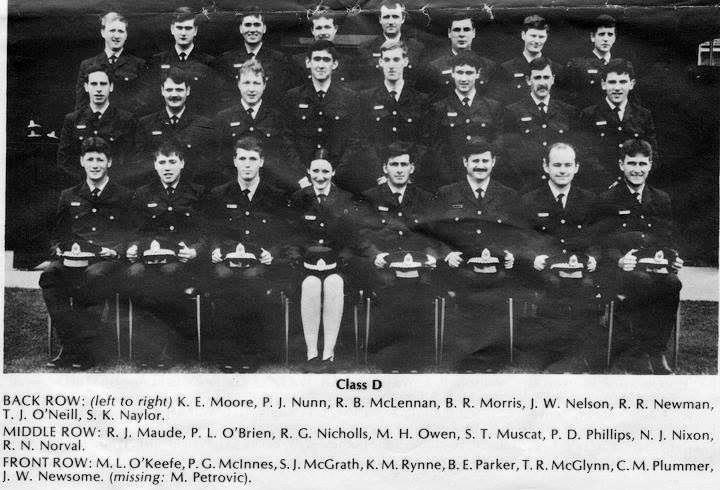
Class 159. Group D. Monday 26 June 1978. Back Row: ( L – R ) K.E. MOORE, P.J. NUNN, R.B. McLENNAN, B.R. MORRIS, J.W. NELSON, R.R. NEWMAN, T.J. O”NEILL, S.K. NAYLOR. Middle Row: R.J. MAUDE, P.L. O’BRIEN, R.G. NICHOLLS, M.H. OWEN, S.T. MUSCAT, P.D. PHILLIPS, N.J. NIXON, Robert N. NORVAL. Front Row: M.L. O’KEEFE, P.G. McINNESS, S.J. McGRATH, K.M. RYNNE, B.E. PARKER, Terrence Raymond McGLYNN ( R.I.P. ), C.M. PLUMMER, J.W. NEWSOME ( Missing: M. PETROVIC )
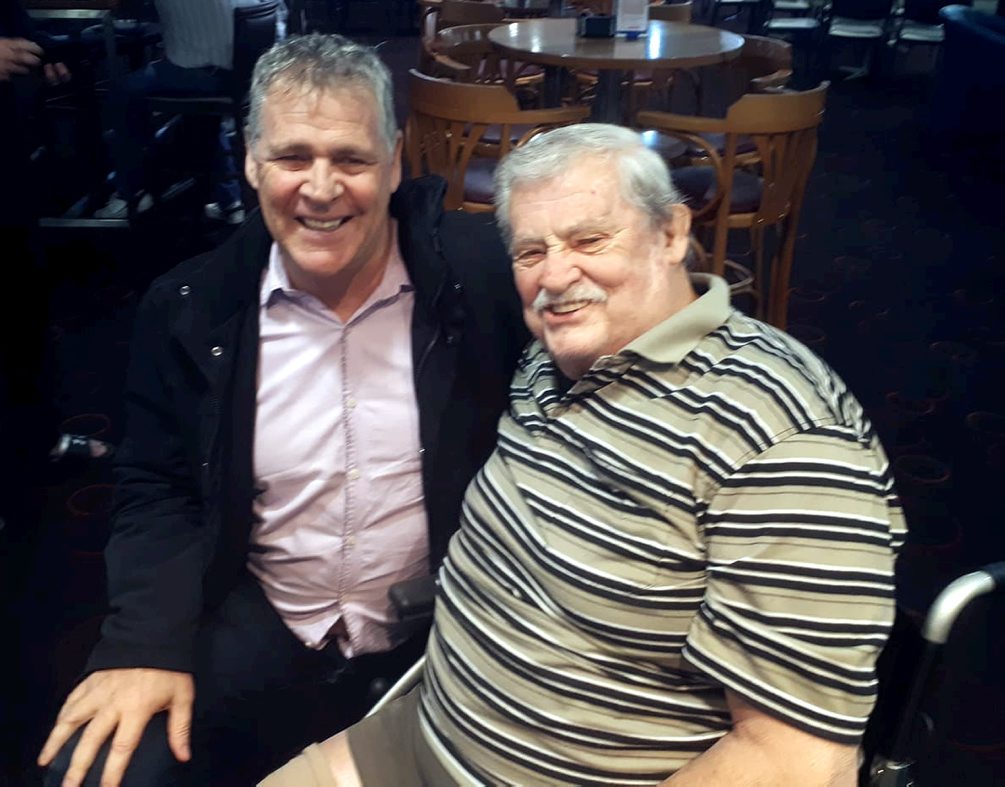
Peter NISSEN ( #18778 ) & Terry McGLYNN
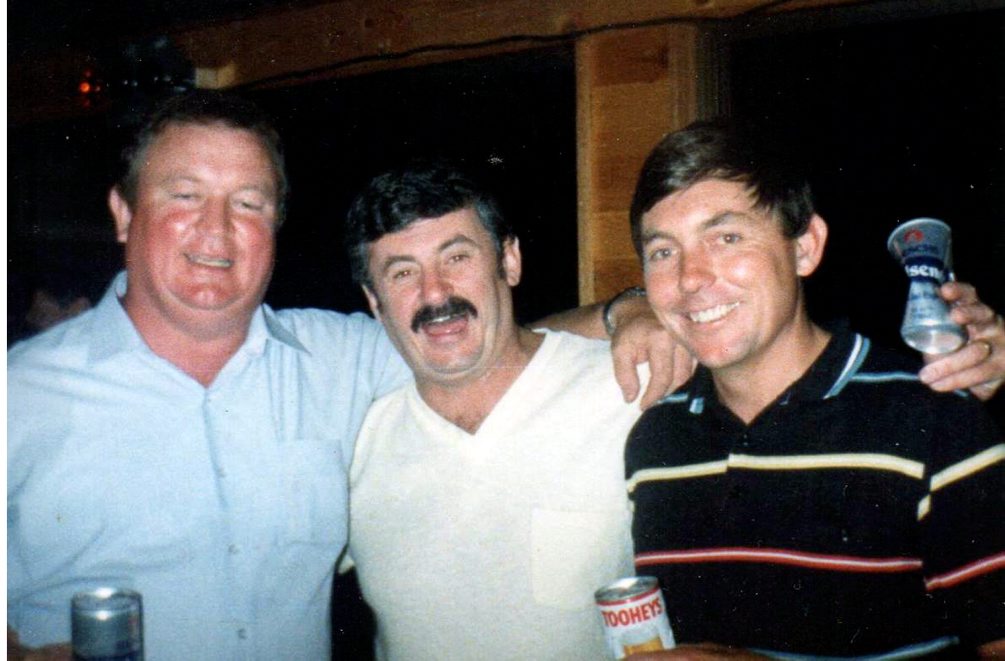
Worked with Terry at Rozelle Psychiatric Hospital prior to us both joining the job. On the left of photo is Jeff Prentice ( # 14115 ) another ex Psychiatric nurse and NSW Police Officer, Terry in the middle and myself ( Phillip Brand # 14273 ) on right.
Terry is in second row in the middle, did not have his moustache then.
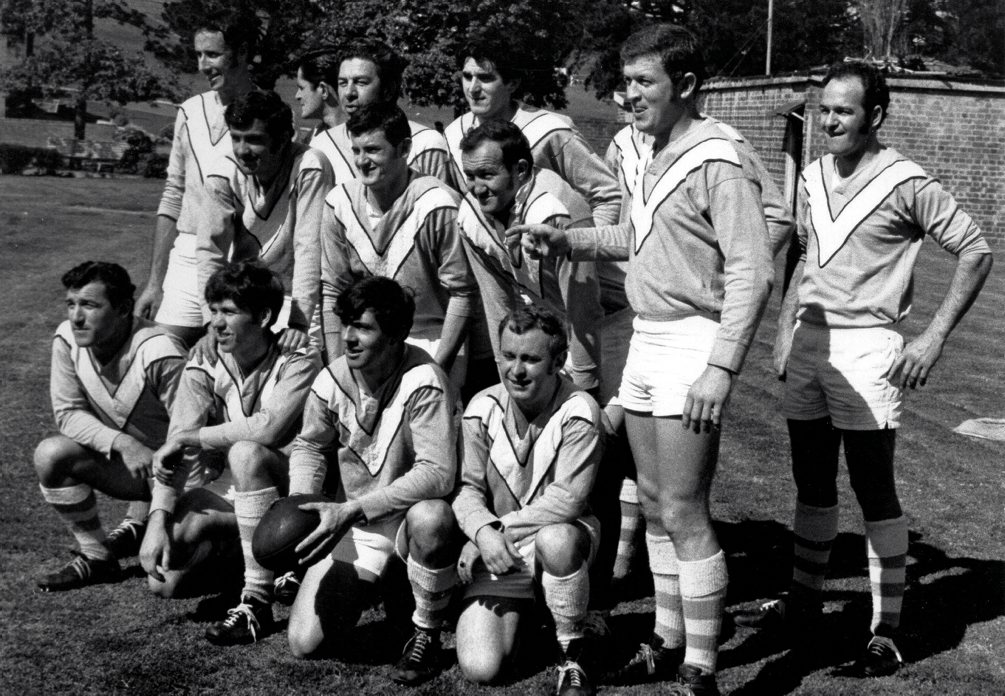
The Callan Park Rugby League team, probably late 1960’s.
Terry is in second row in the middle, did not have his moustache then.
TERRY is NOT mentioned on the Police Wall of Remembrance *NEED MORE INFO
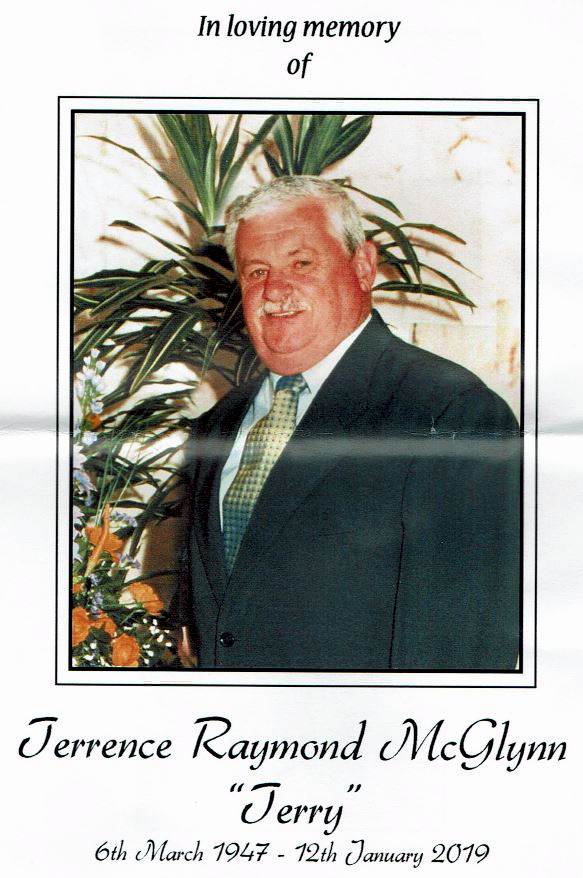
Funeral pamphlet
FURTHER INFORMATION IS NEEDED ABOUT THIS PERSON, THEIR LIFE, THEIR CAREER AND THEIR DEATH.
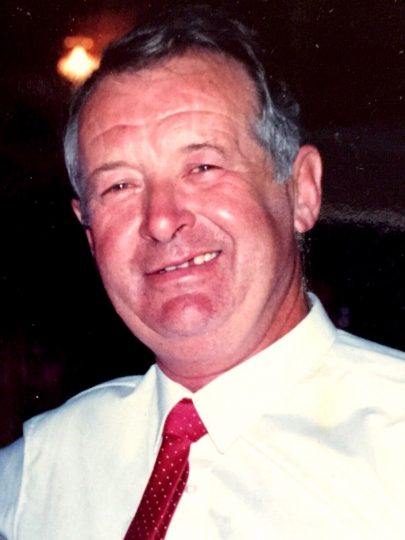
By all accounts, Terry appeared to be a great bloke and great policeman who had the respect of all whom worked with him.
He apparently joined the NSWPF some time prior to 1978 and Served for probably 4 years before ” pulling the pin ” and working as a Psychiatric Nurse at Callan Park where he was given the nickname of “Maggots” before eventually returning to the NSWPF where he apparently Served all of his Service at Newtown and Marrickville.
Terry Retired in November 2001 and eventually he and his 2nd wife, Fran, moved to warmer climes in far north NSW.
Terry suffered various conditions which required hospitalisation. These conditions caused the removal of a leg and also the removal of multiple large skin cancers off his face.
His funeral was recently attended by around 25 of his former mates from the old Newtown Police days.
May he forever Rest In Peace.
Cal
Brian Joseph COUPER
| 14/02/2019
Brian Joseph COUPER
AKA ?
Late of Wagga Wagga, NSW
“possibly” related to Police Woman J.D. COUPER, NSWPF P/W 139
NSW Redfern Police Academy Class # 101
New South Wales Police Force
Regd. # 11196
Rank: Commenced Training at Redfern Police Academy on Monday 2 November 1964 ( aged 24 years, 4 months, 9 days )
Probationary Constable – appointed Friday 4 December 1964 ( aged 24 years, 5 months, 10 days )
Constable – appointed 7 January 1965
Constable 1st Class – appointed 7 January 1969
Senior Constable – appointed 7 January 1973
Final Rank = ?
Stations: ?, North East District, Wollongong ( pre 1973 ), School Lecturing, Redfern Police Academy ( pre 1974 ), Goulburn Police Academy – Senior Lecturer ( 1986 ),
Service: From 2 November 1964 to? ? ? = ? years Service
Passed away in Palliative Care at Calvary Hospital, Wagga Wagga.
Devoted and dearly loved husband of Dianne.
Loved and respected stepfather of Scott, Craig and Fiona and
father-in-law of Tony.
Much loved Grandpa of Kirra Leigh, Taneasha and Lochlann.
Highly respected son-in-law of Noel and Anice.
Dear brother-in-law of Gary, Carol & Ray, Susan & Aris and David & Angela.
Loved brother & brother-in-law of Tony & Diana, Marys (dec’d) & Bob. Loved by all his nieces and nephews.
He will be sadly missed by all his family and friends.
He fought a long courageous battle and is now resting peacefully.
A Requiem Mass for the Repose of The Soul of Brian Joseph Couper will be held in Our Lady of Fatima Catholic Church, Wagga Wagga on Tuesday, 22nd January 2019, commencing at 10:30am.
Family and friends are respectfully invited to attend.
Published in The Daily Advertiser on Jan. 19, 2019
Brian is described as a “very talented man”.
Other than being a Policeman, he was also a Barrister, a ventriloquist, a radio announcer and all round good bloke. He also studied to be a priest.
His first wife was a plainclothes Police Woman from Wollongong in the 1970’s.
Brian, together with Ray WILKINSON, authored the book ‘ A guide for Senior Sergeant’s and Inspector’s ‘ course in the Unit “Management” in 1986
Brian also penned ‘ The use of case studies in police education ‘ in 1988
Brian also penned ‘ Teacher development course ‘ in 1988
Brian also penned an unpublished paper with Peter SHINFIELD ( # 16630 ) & Paul TROTMAN ( # 13882 ) – ‘ The use of case studies in police education ‘
Brian also penned ‘ Residential police education and its implications for curriculum design ‘ in 1987
‘ Transparent Reflections in a Pool of Blue ‘ is also attributed to Brian
Brian also penned ‘ Economic loss and experimental farms a discussion of the High Court decisions in Perre v. Apand and Dovuro v. Wilkins
Samantha Jane BAGLIN-LIMU
| 14/02/2019
Samantha Jane BAGLIN-LIMU
AKA BAGGERS & SAMMY
Late of ?
Police Academy Class # ? ? ?
Australian Federal Police Force
Regd. # 10496
Rank: ?
Final Rank = Sergeant
Stations: ?, IDG ( International Deployment Group ),
Service: From? ? ?to9 December 2018 = 15 years Service
Awards: No find on It’s An Honour – but
National Medal – granted ???
Born: ? ? ?
Died on: Sunday 9 December 2018 a.m.
Age: 44
Cause: Depression – Suicide – Service weapon – shot
Event location: vault room of the AFP National Headquarters, Edmund Barton building, Canberra
Event date: Sunday 9 December 2018
Funeral date: Tuesday 18 December 2018 @ 2pm
Funeral location: Victoria Police Academy Chapel, 1 View Mount Rd, Glen Waverley, Melbourne
Wake location: ?
Funeral Parlour: White Lady Funerals, Essendon 93510788
Buried at: Cremated
Memorial located at: ?
SAMMY is NOT mentioned on the Police Wall of Remembrance * BUT SHOULD BE
FURTHER INFORMATION IS NEEDED ABOUT THIS PERSON, THEIR LIFE, THEIR CAREER AND THEIR DEATH.
Today we farewell our friend Sam Baglin-Limu aka “Baggers”.
There are still answers sought and comprehending how this all happened.
But today is not for that, today is to remember our friend, work mate, AFP agent in different roles, wife, daughter, sister, advocate, carer, support officer for others trauma, many, many roles she did.
Sam you will be missed, you will always be loved. We will continue through our work to give you a voice. You’ve left us too soon, our hearts broken, as yours must have been to for this to happen.
Sammy’s funeral is today at 2pm, in Melbourne.
An AFP remembrance service was also held at the AFP national headquarters in Canberra at the same time.
Rest now Sammy, your shift is over, your duty done. ❤
BAGLIN-LIMU, Samantha Jane
BAGLIN-LIMU.
The Funeral Service to Celebrate the Life of Samantha Jane Baglin-Limu will be held at the Victoria Police Academy Chapel, 1 View Mount Road, Glen Waverley on TUESDAY (Dec 18, 2018) commencing at 2.00 p.m.
Private Cremation will follow.
No flowers by request.
In lieu, donations to Beyond Blue would be appreciated.
Envelopes will be available at the Service or donate online to www.beyondblue.org.au
AFP has ‘blood on its hands’ over agent’s death
EXCLUSIVE
WARNING: Distressing.
A FEDERAL agent who provided crucial support to family members of flight MH17 victims has died in an apparent workplace suicide at the Australian Federal Police national headquarters.
Sergeant Samantha Baglin, 44, was found dead in the vault room at the Edmund Barton building in Canberra on Sunday morning. It comes just six weeks after Superintendent Richard Roberts also took his own life in the same place and less than two years after another two AFP agents separately died by suicide at the Melbourne headquarters.
Friends of Sgt Baglin told news.com.au that the AFP “has blood on its hands” over its alleged failure to provide adequate support for members suffering from mental health issues.
An AFP spokesperson confirmed in a statement to news.com.au “that on Sunday, 9 December 2018, a member of the AFP appears to have taken her own life”.
“A brief is now being prepared for the ACT coroner,” the spokesperson said.
The AFP did not respond to further questions regarding the matter.
Several AFP sources told news.com.au that Sgt Baglin was involved in the organisation’s Safe Place – a cultural reform initiative led by AFP commissioner Andrew Colvin amid widespread revelations of internal bullying and a spate of workplace suicides.
Those who knew Sgt Baglin described her as kind, with “a heart of gold”, and said she would make others “laugh to the point where we would suffer cramps”.
Sgt Baglin married just over a year ago but battled with work-related PTSD.
Former AFP agent and Australian of the Year finalist Katie Tonacia told news.com.au she was “shocked” and “devastated” over the loss of her close friend.
The pair met through Ms Tonacia’s organisation Picking up the Peaces, which provides support to uniformed service personnel struggling with Post Traumatic Stress Disorder (PTSD), almost a decade ago.
“None of us saw this coming,” Ms Tonacia said.
“But she was upset in terms of a few things occurring in the workplace, and the fact she did this at work is such a statement to all of us.”
According to Ms Tonacia, Sgt Baglin was “desperate to see change within the organisation and wanted to see mental health education implemented”.
“If she’d identified as mentally unwell to the AFP it would have gone against her in her career and she loved her career,” she said.
“The stigma and lack of education about mental health at the top level of management just below the commissioner is rife and that’s why she came to us in 2009.”
Ms Tonacia’s husband David is medically retired from the AFP. He told news.com.au that the organisation “has blood on its hands” over its alleged failure to provide adequate support for members suffering from mental health issues.
Sgt Baglin had an extensive policing career both in Australia and as part of the AFP’s International Deployment Group in which she served on overseas missions. She had also operated as a family liaison officer for the AFP and worked closely in Perth with the Maslin family, who lost their three children and their grandfather, in the flight MH17 disaster in 2014.
One close friend of Sgt Baglin’s, who spoke to news.com.au on the condition of anonymity, said she was “such a big-hearted and sensitive person” who “loved being a cop and loved helping people”.
“It was like a therapy for her to help other people in dealing with trauma,” he said. “She was especially good at it.”
Samantha Jane BAGLIN-LIMU
Ms Tonacia told news.com.au that Sgt Baglin had recently expressed frustrations to her about the AFP having only two in-house qualified psychologists for the entire organisation of some 6000 members, as previously revealed by news.com.au.
“Wherever there’s smoke, there’s fire and by God it is blazing at that building right now,” Ms Tonacia said.
“The AFP has failed (Sgt Baglin) and so many others because they don’t trust the system.
“There needs to be a royal commission so we can get to the bottom of it and get all of those responsible out. We won’t let her death be in vain.”
Another AFP whistle-blower said it was “petty managerial and micro-managerial bulls**t breaking people devoted to their jobs” in the AFP.
“We can’t attribute all bad things to the AFP’s culture but one thing is for certain, had (Sgt Baglin) been a kindergarten teacher, or run her own business, we wouldn’t be talking about this,” he said.
“There is nothing worse than coming back to the office after a day of dealing with death or whatever, only to be counselled for not ticking the correct box in a case report, or something similar that is easily corrected and carries no operational consequence.”
One AFP source told news.com.au he was a friend and former colleague of Sgt Baglin’s and that “she didn’t deserve this”.
Six weeks prior to Sgt Baglin’s death, Superintendent Richard Roberts also walked into the AFP national headquarters and didn’t come out alive.
The Australian Federal Police Association revealed Supt Roberts “appears to have taken his own life” on October 27.
An AFP spokesman also confirmed at the time that “a member of the AFP” had died, in a statement to news.com.au. The AFP did not respond to further questions.
News.com.au understands Commissioner Colvin “spoke to troops” to inform them of Supt Roberts’ death in an email and video to colleagues nationwide. It’s a process he is likely to repeat sometime today.
The latest AFP workplace suicide is the fourth incident in which an officer appeared to take their own life inside one of the organisation’s buildings since the start of last year.
In November 2017, AFP member Malcolm Scott, 59, walked into the foyer of the organisation’s Melbourne building and took his own life just before 9am on a Saturday.
Mr Colvin said at the time that it was “with great sadness I can confirm one of our police officers has died in Melbourne”.
“The male officer was found by colleagues in the AFP’s Melbourne Headquarters in La Trobe Street,” he said.
Mr Scott’s death followed that of colleague Sue Jones, 53, a mother-of-two who died in shockingly similar circumstances in the same building earlier that year. Mr Scott and Ms Jones had worked on the same team within the Melbourne branch, according to colleagues who spoke to news.com.au. Both deaths were later deemed to be non-suspicious.
An independent police advocacy spokesman, who asked not to be named, previously told news.com.au he was concerned officers might be trying to send a message by taking their lives in the workplace.
‘THIS JOB’S F***ED’
One AFP source, who spoke on the condition of anonymity, previously told news.com.au that the organisation “needs intense scrutiny that the agencies can’t cover up”.
“We have an expression in our job: TJF – this job’s f***ed,” the source said.
“Morale is in the toilet. We know we have no support and no backing from most of the management.”
The source described the company’s external Employee Assistance Program as inadequate.
“If the Employee Assistance Program they always reference was adequate we wouldn’t have members falling like flies.”
There are more than 6000 AFP members – 3481 of those are in sworn roles – nationwide.
An AFP spokesperson previously said the organisation “acknowledges first responders are at higher risk of trauma-caused mental injury than almost any other profession”.
According to the AFP in 2017, the organisation employs two social workers, “5.6 full-time equivalent” psychologists and “4.4 full-time equivalent nurses” – all based in Canberra.
But AFP members outside of Canberra do not have face-to-face access to qualified psychologists through the organisation. They are instead given a number for an employee assistance program with over-the-phone support from any one of 658 outsourced psychologists and 132 registered social workers through Davidson Trahaire.
A Confidant Network made up of volunteers and AFP members is also in place to “provide guidance to staff on options for professional support if needed”. According to the AFP, it also employs seven chaplains across the country.
“There is also one part-time family support officer based in Canberra, who is available for families of members deployed with International Operations and ad hoc government response to large-scale disasters such as the downing of MH17,” an AFP statement read.
But many AFP agents have criticised the services, labelling them ineffective and impersonal. They say they need face-to-face access to qualified psychologists so they don’t have to “retell (their) stories to a different person every time (they) call”.
“We need someone to talk to in person who is qualified in psychology and who understands the nature of issues AFP agents deal with … it’s not that complicated,” a sworn member said.
In March this year, the high rate of suicide deaths and mental health conditions experienced by first responders – including emergency service workers and volunteers – prompted a federal Parliament committee to launch an inquiry into the role of the Commonwealth and the states to address the issues.
The inquiry is expected to release its report on the matter in February 2019.
It came after almost 100 past and present AFP agents contacted news.com.au to report widespread mental health issues among first responders within the organisation, mismanagement of the issue and a disturbing internal bullying culture.
News.com.au exposed the issues in an investigative series, which prompted the Australian National Audit Office (ANAO) to audit the AFP’s management of mental health within the organisation.
The report, released on March 7 this year, found that the “AFP lacks a comprehensive and consolidated organisational health and wellbeing framework to enable effective management and support of employee mental health”.
“While the AFP offers a variety of mental health support services, there is no evidence that these services are effective and they are not supported by sound governance, risk management, evaluation or an articulated business rationale,” the report read.
“The AFP does not currently have in place mechanisms or sufficient data to appropriately align resources with key mental health risks.”
The ANAO made six recommendations, which the AFP agreed to implement as part of its “new Health and Wellbeing Strategy for the organisation” by mid-May this year.
The AFP also engaged the Phoenix Australia Centre to conduct an independent mental health review into the organisation. It released its report earlier this year and made 37 recommendations to be implemented over five years.
But for some, it’s already proven too little, too late.
If you or someone you know needs help call Lifeline on 13 11 14 or Beyond Blue on 1300 224 636
For more information on how to support others who might need help and what warning signs to look for, visit: Conversations Matter
a carpenter for 6 years, 8 mths and in the Army for 6 years.
He Enlisted in the Permanent Military Forces on 6 September 1963 and was Discharged on the 15 April 1969 “having requested his discharge”.
His Rank upon Discharge was Corporal.
He saw Service outside of Australia for 1 year and 224 days. He was issued with Returned from Active Service Badge # A415518.
He was Awarded the General Service Medal # 1962.
Upon joining the NSWPF – William was:
5′ 9″ Tall, 11st 2 lb in weight, Hazel eyes, dark brown hair with a dark complexion. He was born in rosewood, Qld and married on the 27 January 1968.
Upon completion of his Training Course with Class 122, he obtained 74.25%.
He passed his Police Driver Training on GD cars and light trucks / utes on the 9 April 1971.
At one stage, at Liverpool, he held the record for the most number of vehicle accidents attended during one eight hour shift.
He failed his first attempt at his Constable 1st Class exam on 29 August 1972 but ‘passed’ the exam on the 28 August 1973.
As he had a ‘Trade Certificate’ in Carpentering – he was “Considered to have potential for criminal investigation duty. To be considered for this duty upon completion of two years’ service”
He completed his Detectives’ Course, # 3 of 1976 at the NSW Police Academy between 20 September to 10 December 1976 with a 74.30% Pass mark.
[divider_dotted]
Husband to Barbara who would have been married 51 years on the 27 January 2019.
Bill touched many people’s lives over the years and had a drawing quality within him.
When he Resigned from the NSWPF, he, Barbara and family went Rice Farming in Coleambally – Murrumbidgee Irrigation Area of Western NSW.
On behalf of all of us old NSW Police ( and the new ) we wish a safe journey for Bill and hope that he Rests In Peace.
Cal
[divider_dotted]
Anthony John PROBST
| 14/02/2019
Anthony John PROBST
AKA TONY or PIGEON
Late of Moonan
NSW Redfern Police Academy Class # 159
NSW Police Cadet # 3279
New South Wales Police Force
ProCst # 92316
Regd. # 18219
Rank: NSW Police Cadet – commenced 5 July 1976
Probationary Constable – appointed 15 August 1978
Senior Constable – appointed 15 August 1987
Final Rank = ?
Stations: ?, 15 Division,
Service: From 5 July 1976 to? ? ? = ? years Service
Awards: No find on It’s An Honour
Born: 15 August 1959
Died on: Tuesday 25 December 2018 ( Christmas Day )
Service: From? ? pre Aug 1965?to25 August 1999 = 34 years Service
Awards: National Medal – granted 15 April 1981
1st Clasp to National Medal – granted 28 May 1992
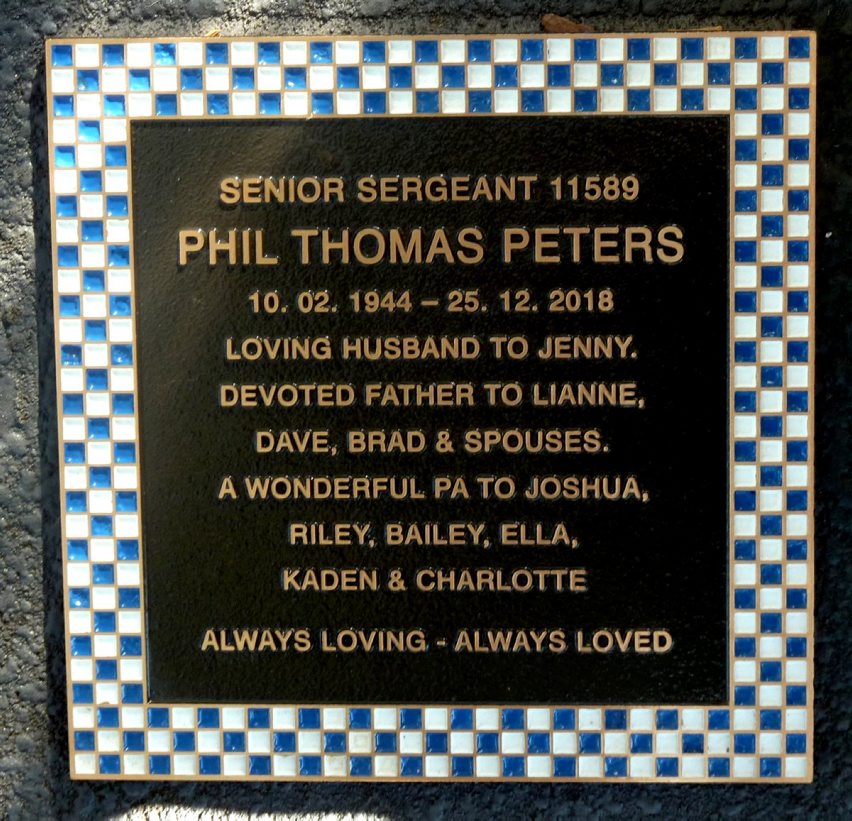
Born: Thursday 10 February 1944
Died on: Tuesday 25 December 2018 ( Christmas day ) with family by his side
Age: 74yrs 10mths 15 days
Cause: Phil had major surgery on 18 December for bladder cancer. He went home to recover but, unfortunately, a blood clot had developed that went into his lungs.
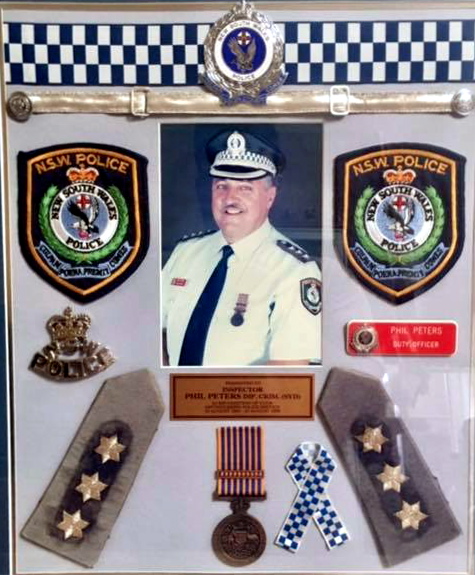
Phil was also the Editor of the Australian Police Journal ( APJ ) for many years and also did a lot of work with the Metropolitan South – Associates Branch of the Retired Police Association.
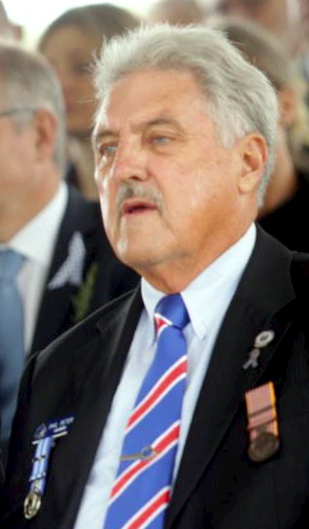
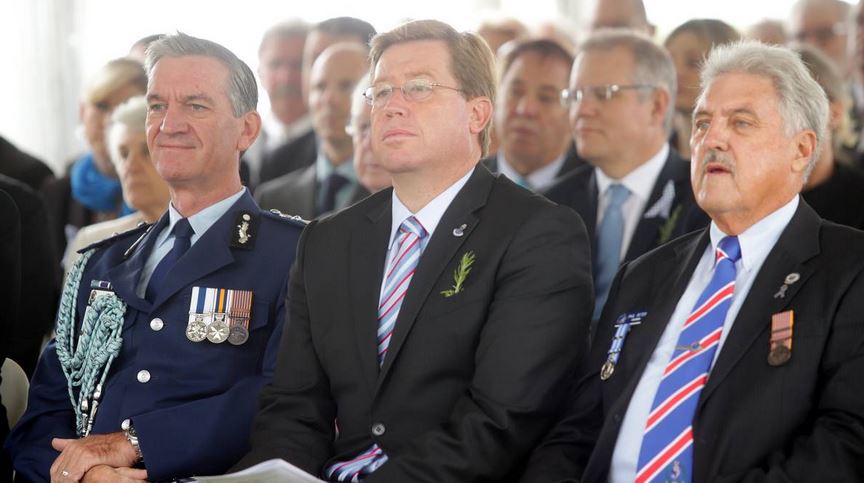
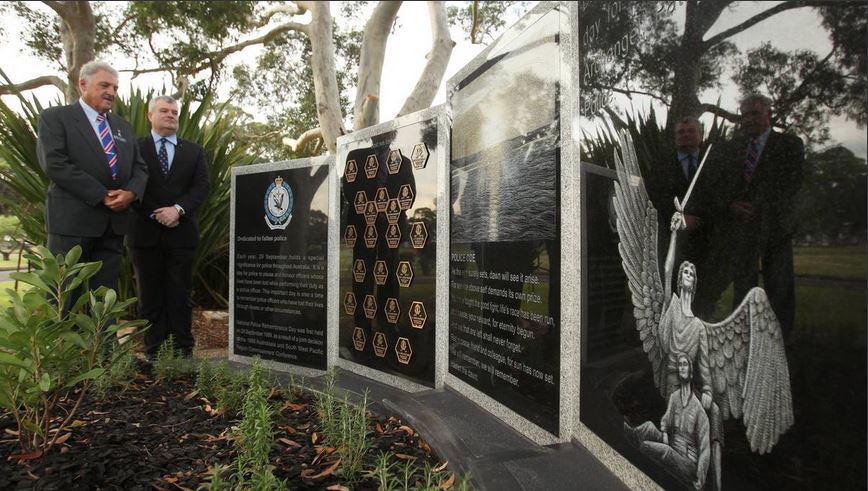
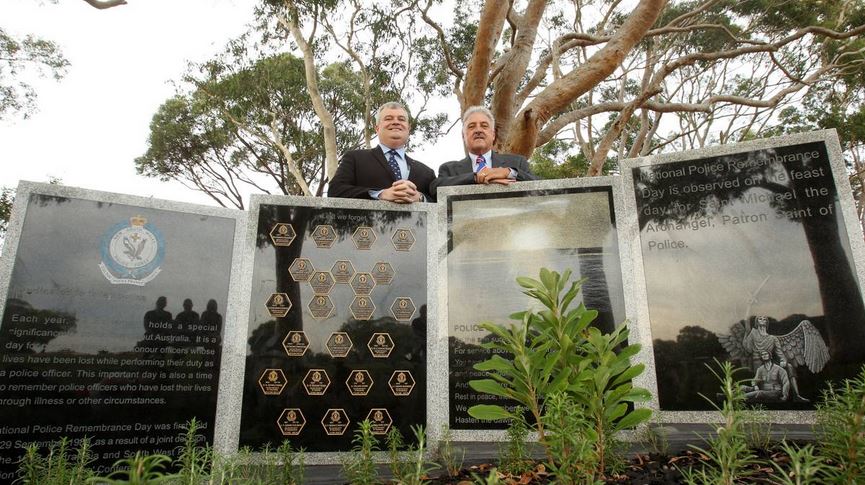
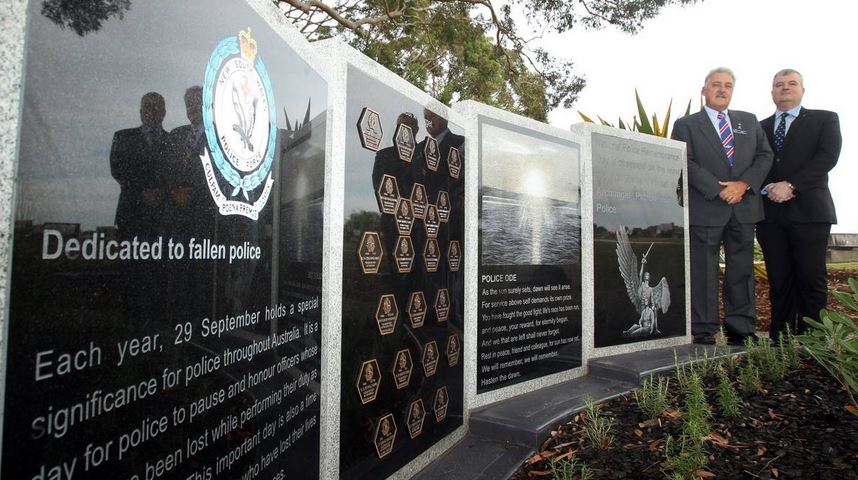
NSW Police Commissioner Andrew Scipione helped unveil a new police memorial at Woronora Cemetery, Sutherland on Thursday. Pictured from left: Andrew Scipione, Tony Grant and Phil Peters. Picture Chris Lane
Remembered: Graham Boyd and Phil Peters at the police memorial will will be opened on Thursday. Picture: Chris Lane.
Remembered: Graham Boyd and Phil Peters at the police memorial will will be opened on Thursday. Picture: Chris Lane.Remembered: Graham Boyd and Phil Peters at the police memorial will will be opened on Thursday. Picture: Chris Lane.
Kenneth Philip DWYER
| 14/02/2019
Kenneth Philip DWYER
AKA ?
Late of Ulladulla, NSW
“possible” relatives in ” The Job “: ?
NSW Redfern Police Academy Class # 082
New South Wales Police Force
Regd. # 9609
Rank: Commenced Training at the Redfern Police Academy on Monday 29 February 1960 ( aged 20 years, 5 months, 19 days )
Probationary Constable – appointed 4 April 1960 ( 20 years, 6 months, 25 days )
Constable – appointed ? ? ?
Constable 1st Class – appointed 1 March 1966
Detective – appointed ? ? 1973 ( YES )
Senior Constable – appointed 1 March 1970
Sergeant 3rd Class – appointed 18 December 1975
Sergeant 2nd Class – appointed ? ? ?
Senior Sergeant – appointed 28 May 1985
Final Rank = Detective Senior Sergeant
Stations: ?, 21 Division, Gundagai,
Darlinghurst,
Revesby ( 1970s ),
Bass Hill ( 19 Division ),
Hurstville,
Kogarah,
Bankstown ( 19 Division ),
Flemington
(Darlinghurst through to Bankstown, CIB)
Completed Detectives course approx 1973.
Served, Revesby, Bass Hill and Bankstown on several occasions. (OIC)
Service: From 29 February 1960 to? ? 1994 = 35 years Service
Awards: National Medal – granted 15 September 1980
1st Clasp to National Medal – granted 22 September 1987
Loving father & father-in-law of Chris & Joh, Shane & Donna and Jodie & Geremy.
Cherished “Pop” of Brittany, Jacob, Courtney, Christian, Tyler and Darcie.
Relatives and friends are warmly invited to attend Ron’s funeral service to be held at St Andrew’s Chapel, Wingewarra Street, Dubbo on Friday 19th October 2018 commencing at 12 noon followed by a private cremation.
All retired & current Police Personnel are cordially invited to attend.
In lieu of floral tributes donations to the Cancer Council would be appreciated and may be left with the funeral director at the service.
Funeral arrangements are in the caring hands of W. Larcombe & Son Dubbo’s Premier Funeral Home FDA Approved
RIP Mr STEER. I worked your last shift with you on the truck, at Dubbo. I remember you said it was most fitting you did your first shift on a truck. You were going out doing the same. What a great man.
[divider_dotted]
Satisfying retirement with helping troubled youth
SIMON CHAMBERLAIN
AFTER Ron Steer retired from more than 40 years involvement with the police force he did not expect continued involvement with law enforcement and the justice system.
But a decade on after his retirement he is finding satisfaction and fulfilment as a mentor and being part of the youth conferencing process.
Mr Steer grew up in Sydney and at the age of 16 decided to follow the example of a cousin and choose the police force as a career. He joined the force as a cadet and for three years worked alongside trained officers as “a bit of a roustabout”.
“It was on the job training, working in traffic and around the office and picking up the mundane jobs,” he said.
Aged 19 and then a fully-fledged policeman he “went bush” to Harden as the manager of the Police Citizens Youth Club.
“It was a vibrant railway town back then,” he said.
“We had a lot good young kids involved with football and boxing.”
His next posting in the force was a transfer to Broken Hill for a two-year stint and a step up the promotion ladder.
He admitted it was a case of extremes moving from Harden to a strong industrial town in the far west of the state.
His next posting was to Ivanhoe for a four-year stint.
“It was a good town then,” he said.
He then took a posting at Wilcannia as a senior constable, the first of two five-year stints in the town.
After his first posting at Wilcannia, he and his family moved to Moree where he was promoted to the rank of sergeant and was the “lock-up keeper”.
Another promotion to second class sergeant and a move to Lake Cargelligo followed where he was officer-in-charge for a five-year spell.
A phone call from the then police commissioner put Mr Steer on the path of his greatest policing challenge.
“There was a death in custody in Wilcannia and the commissioner asked me to go back as the officer-in-charge,” Mr Steer said.
“It was the greatest challenge of my career,” he said.
Mr Steer said all of the staff at the Wilcannia station were replaced and his team was made up of young officers in their early 20s without much experience.
“We started from scratch,” he said.
“The advantage for me was I’d been there before but we had to get back to community-based policing.
“Talking to people face-to-face, foot patrols getting involved with the youth and the football club.
“It was daunting for the young police who were aged between 19 and 21 years who hadn’t been around for long.
“It was a different world in Wilcannia.”
After a five-year posting at Wilcannia, Mr Steer was commissioned as an inspector and took a posting in the Upper Hunter at Muswellbrook.
He admitted he found life across the eastern side of the Great Divide less to his liking and before long he and the family moved west when he was promoted to chief inspector and the officer in charge at Walgett. His daughter still lives in Walgett working in child care.
After Walgett he was posted to Dubbo where he worked until retiring after 38 years as a commissioned officer in the NSW police Force.
His efforts during his second posting in Wilcannia earned him an Australian Police Service Medal.
He said in the decade since retirement he was almost “back full time” working in the youth justice system, mentoring and working one-on-one with young people in strife with the law.
“I do a lot of one-on-one mentoring with kids in the Staysafe system,” he said.
“It’s hard for kids today to come to terms with the real world.
“I enjoy working with them.”
Mr Steer said retirement for him was not about just sitting around all day.
“That’s a disaster and you can’t be forever packing a suitcase and moving around. ”
He said it was about finding a balance, and working with young people in trouble was proving fulfilling and rewarding.
Government Gazette of the State of New South Wales (Sydney, NSW : 1901 – 2001), Friday 19 November 1993 (No.127), page 6834
NEW SOUTH WALES POLICE SERVICE
Commissioned Officer Appointments
HIS Excellency the Governor, with the advice of the Executive Council, has approved of the undermentioned Commissioned Officer appointments, effective from the date indicated:
Commander, Region Investigative Unit, Police Internal Affairs Branch, Region North — Chief Inspector: Inspector PAUL ROBERT WHITMORE, date of entry on duty.
Patrol Commander, Walgett — Chief Inspector: Inspector RONALD NORMAN STEER, date of entry on duty.
District Staff Officer, Personnel, Central Coast — Inspector: Senior Sergeant PATRICK JAMES KEYS, date of entry on duty.
Government Gazette of the State of New South Wales (Sydney, NSW : 1901 – 2001), Friday 1 May 1992 (No.55), page 3028
NEW SOUTH WALES POLICE SERVICE
Commissioned Officer Appointments
HIS Excellency the Governor, with the advice of the Executive Council, has approved of the undermentioned Commissioned Officer appointments, effective from the dates indicated:
Patrol Commander, Petersham — Inspector – Senior Sergeant BRUCE ERIC BELL, date of entry on duty.
Patrol Commander, Muswellbrook — Inspector – Senior Sergeant RONALD NORMAN STEER, date of entry on duty.