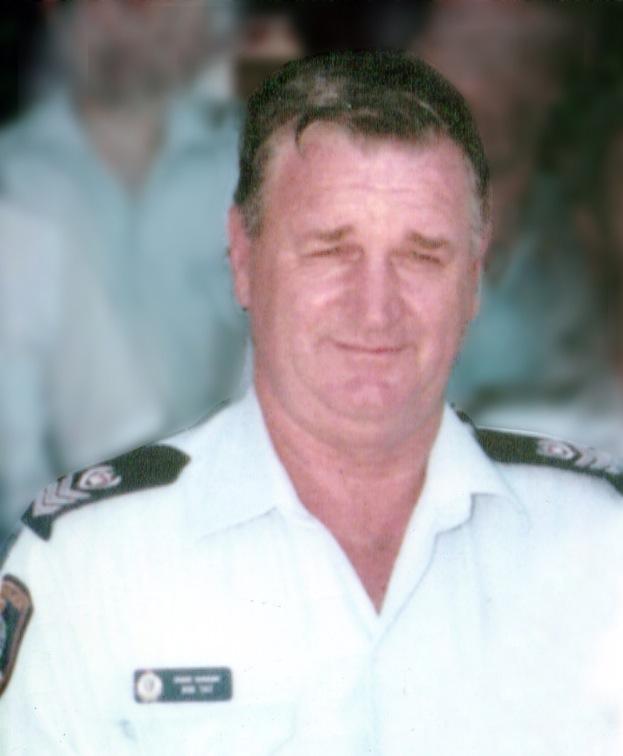
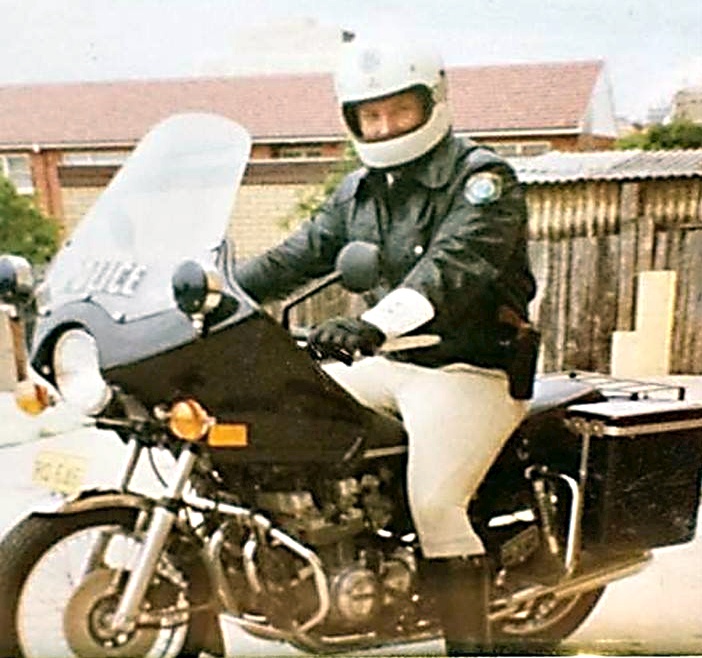
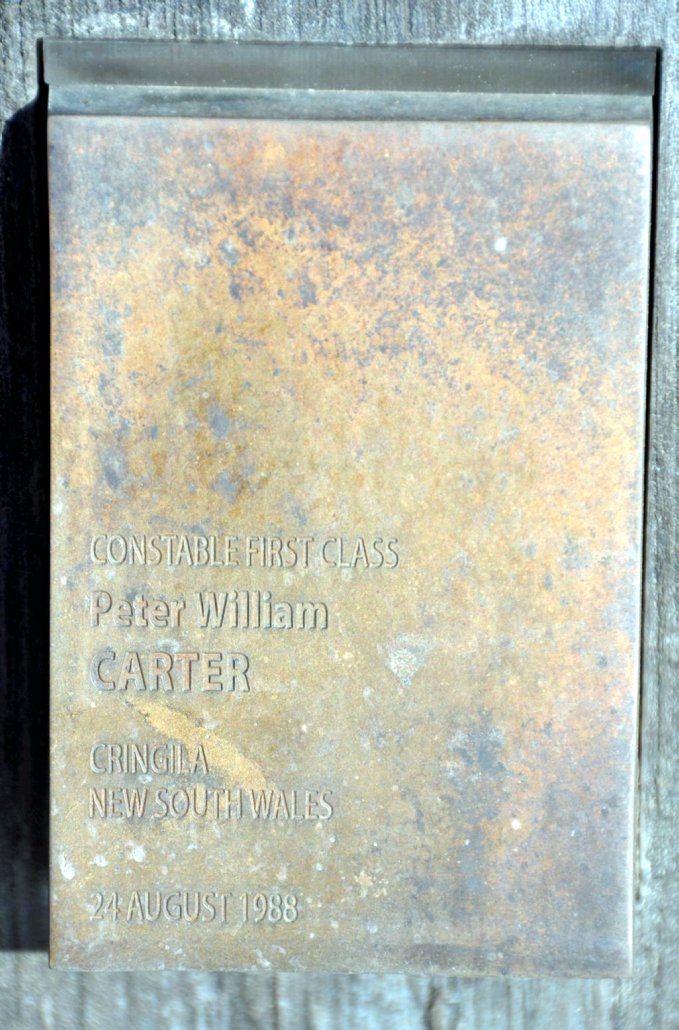
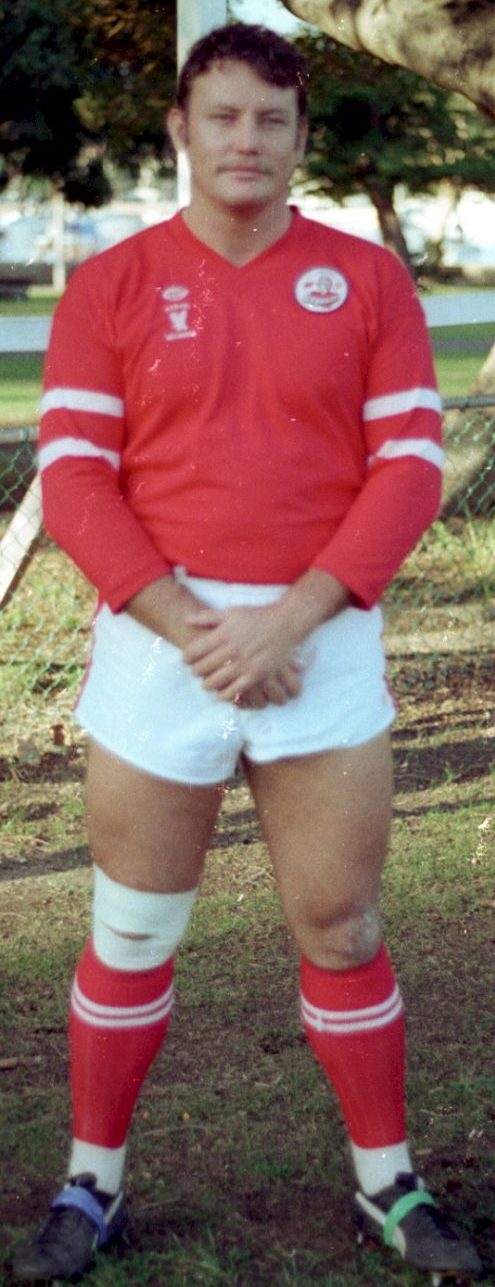
[alert_red]Robert is NOT mentioned on the Police Wall of Remembrance[/alert_red] * BUT SHOULD BE
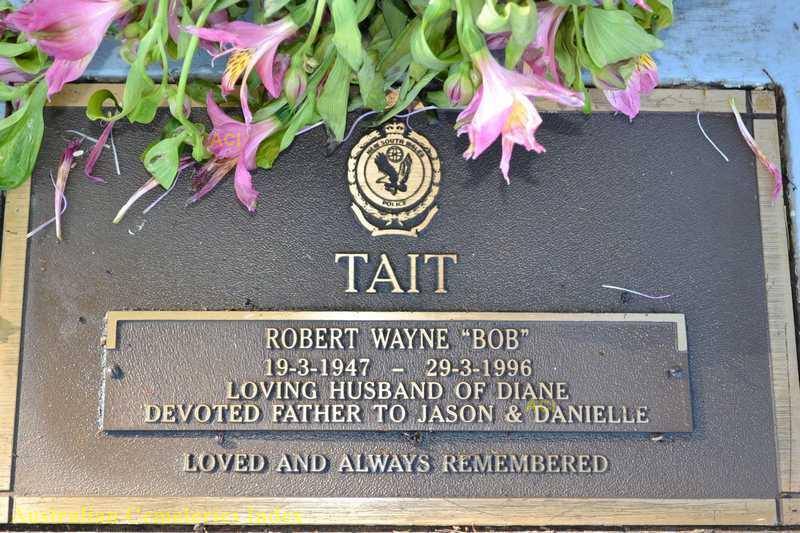
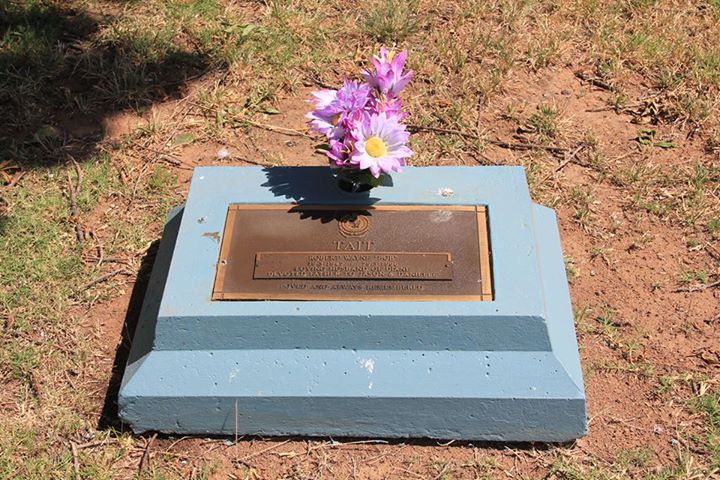
Robert Wayne TAIT headstone – Narrabri Lawn Cemetery. Portion A2, row Q
Robert Wayne TAIT – Grave
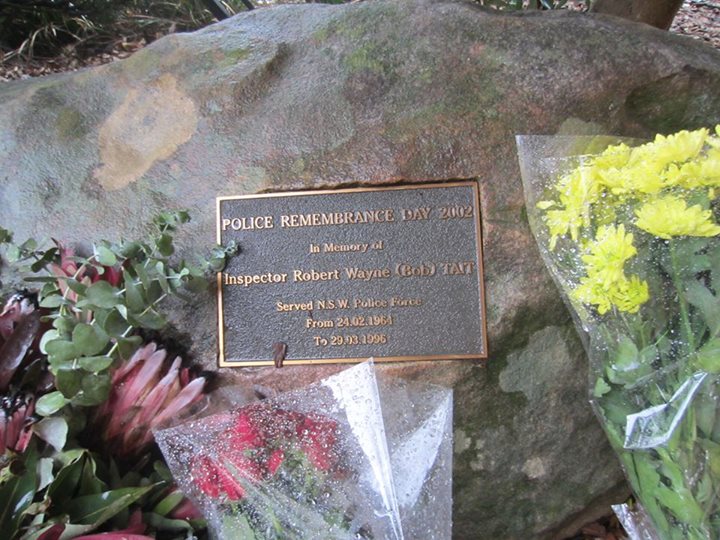
Robert Wayne TAIT – Memorial Stone outside of Narrabri Police Station. Rob’s mother also planted an Olive Tree there at the same time. 29 September 2002
In 1996 Inspector Bob Tait was the officer in charge of police at Narrabri. On the morning of Friday 29 March of that year he ended his own life at the Narrabri Police Station.
The Northern Daily Leader of 30 March, 1996 reported the death.
Stunned colleagues and the Narrabri community are this morning trying to come to terms with why such a respected policeman would kill himself. Inspector Robert Tait, 49, went to work yesterday morning, where he had been serving as the patrol commander, walked into an unoccupied office, took his service revolver and ended his life.
The inspector joined the New South Wales Police Force on 24 February, 1964 as a cadet, and was sworn in on 19 March, 1966. At the time of his death he was stationed at Narrabri, where he was the patrol commander.
It took up 451 hearing days, heard from 902 public witnesses and cost an estimated $64 million. Malcolm Brown reports on the Wood royal commission, 10 years on.
It began on June 15, 1995, when an unnamed Annandale detective jumped to his death from the seventh floor of a building, apparently through fear of the Wood royal commission. The detective’s suicide was followed by those of Ray Jenkins, a dog trainer (July 10), and Inspector Robert Tait, the acting patrol commander at Narrabri ( March 29, 1996 ). Nineteen days later a former Wollongong alderman, Brian Tobin, gassed himself.
On May 8 the same year, Peter Foretic gassed himself the day after giving evidence about pedophilia. On September 23, Detective Senior Constable Wayne Johnson shot himselfand his estranged wife after being adversely named in the royal commission. On November 4, David Yeldham, a retired judge about to face the royal commission on questions of sexual impropriety, killed himself. A month later Danny Caines, a plumber and police confidant, committed suicide at Forster, on the North Coast.
Altogether, 12 people enmeshed in the Wood royal commission took their own lives. Scores of others were so profoundly affected by proceedings that their supporters and families believe it shortened their lives. A former detective, Greg Jensen, suffered a recurrence of the stomach cancer that ultimately ended his life, while another former detective, Ray McDougall, who faced the threat that commission investigators might expose his extramarital affair if he did not co-operate, succumbed to motor neurone disease.
There is no doubt that the Royal Commission into the NSW Police Service, headed by the Supreme Court judge James Wood, purged the force of a rollcall of rotters. A total of 284 police officers were adversely named, 46 briefs of evidence were sent to the Director of Public Prosecutions and by 2001 nine officers had pleaded guilty to corruption offences and three not guilty. Seven police officers received jail sentences, including the former Gosford drug squad chief Wayne Eade and a former chief of detectives, Graham “Chook” Fowler.
Several high-profile police ended their careers in disgrace, including Ray Donaldson, an assistant commissioner, whose contract was not renewed, and Bob Lysaught, the commissioner’s chief of staff, whose contract was torn up. Charges against 14 officers were dismissed because of irregularities in search warrants and their execution.
That left the question of what to do with police who were on the nose but who could not be brought to account by normal means. The solution was the creation of section 181B of the Police Service Act, under which the police commissioner could dismiss an officer on the basis of what had come out of the royal commission. Section 181D allowed the police commissioner to serve an officer with a notice indicating that he “does not have confidence in the police officer’s suitability to continue as a police officer”. The officer could show cause as to why he should be retained, and if dismissed could appeal to the Industrial Relations Tribunal.
In the wake of the two legislative changes, 380 officers were targeted for dismissal or internal investigation. By March 1998, 19 police officers had been dismissed under section 181B and three under 181D. Another had been dismissed under a separate provision of the act, 14 had resigned, four had been medically discharged and 15 had been given performance warning notices. Others were under consideration, and as the Police Integrity Commission – a legacy of the royal commission which became a permanent watchdog – has demonstrated, even officers who had been corrupt many years before were not necessarily in the clear.The former independent MP John Hatton, who was instrumental in setting up the royal commission, said he thought the Police Integrity Commission was the royal commission’s “greatest achievement”. The Child Protection Enforcement Agency, which launched a purge of sex offenders, is another positive legacy of the royal commission.But 10 years on, was the exercise worth it?To some there were considerable benefits. Some appalling malpractice – known as “process” or “noble cause” corruption – prompted Wood to wonder at one point about the quality of a lot of police evidence he had accepted over the years.Despite this, many officers still believe the royal commission was too puritanical. They claim the investigators, not able to grapple with the really big issues, jumped on anything they could: “They had to have runs on the board,” says Michael McGann, who as a policeman in 1984 participated in the so-called Kareela Cat Burglar case, in which police used mace on an unco-operative thief and sex offender. To some critics this treatment did no serious harm and only required a word of caution. But under the spotlight of the royal commission 12 years later, it ended the careers of high-flying police such as John Garvey, Brian Harding and Steve York.A decade later, Harding works in corporate security but insists that the real sting was that the investigators had fabricated evidence. When that finally came out, he says, the group received a confidential settlement, but it did little to redress the feelings of outrage.
Another former policeman, Dr Michael Kennedy, says the commission was a political response to the police commissioner, Tony Lauer, bringing about the downfall of the then police minister, Ted Pickering.
The attorney-general, ministry and judiciary took little responsibility for the state of the force, Kennedy says, while the responsibility of the police rank-and-file grew to “the size of a Pacific driftnet”. “I don’t think the royal commission contributed anything to the reform process except to provide a template for double standards,” he says.
“Chook Fowler put $200 into his pocket from Louis Bayeh. Chook was a lazy, good-for-nothing drunk. But he was put into the same category as Ray Williams and HIH.”McGann says that against the string of petty corrupt activities uncovered, “you have to look at what the government did and did not do with gambling and vice, over the decades. There have been direct links to Parliament for 50 or 60 years. That is hypocrisy.”The critics’ view is that the royal commission has left a demoralised police force, tarnished and rudderless, with limited operational effectiveness and the problem of corruption unsolved. Seven police officers have taken their lives since 2001, including two this year.”It highlights the fact that the structure no longer takes in the needs of the NSW police force,” says Mike Gallacher, the Opposition police spokesman, and a former internal affairs police officer.Gallacher believes, as does the NSW Police Commissioner, Ken Moroney, that the tentacles of corruption no longer spread to embrace entire squads or larger units. But it does not prevent low-level incidents of corruption and there are continuing nests of corruption.In its most recent report, the Police Integrity Commission said it had undertaken 21 major investigations in 2005-06. These dealt with extortion, theft, unauthorised disclosure of confidential government information and perverting the course of justice, police brutality and the handling of $250,000 stolen from automatic teller machines. The then police integrity commissioner, Terry Griffin, said there had been 51 investigations in the 12 months, compared with 44 in 2004-05, and the 1141 written complaints represented a 15 per cent increase.Moroney says all these reports are disappointing, but one of the significant statistics was the number of police who were reporting on other police. “You go back a decade and the number of informants who were police was 5 to 10 per cent,” he says. “In the Ombudsman’s last report, that figure was 49 per cent.”The mechanism for dealing with internal complaints has been expedited: “I have not been afraid to use a section 181D notice,” Moroney says.He believes there is a different mentality in the force. A video of the royal commission had been shown at a recent reunion dinner of the old criminal investigation branch. “It is part of our history. But the interesting thing is that when Chookie came onto the screen, everyone booed. That was a signal to the Fowlers and the Eades that those found to have acted corruptly would not be accepted.”
However, Moroney accepts that corruption is not a thing of the past. “In the contemporary period, there are huge monies to be made from the illicit drug environment. You are talking in some cases of millions of dollars. It is the greatest menace in society today. And the greatest menace to officers is drug money. That is why rotation of officers out of specialist squads on a regular basis is important.”Taking over as commissioner five years ago, he had brought a low-key “Uncle Ken” influence, sorely needed, and had had to balance the principles of police accountability against the public demand for law and order, and the task has been awkward.A senior counsel told the Heraldthis week that the focus on integrity, scrutiny of professional standards and attacks by defence lawyers meant that talented police prepared to do the dirty work were deterred. “In the old days the best and the brightest went into plain-clothes,” he said. “But when the police perceive that when they have to go the extra yard [to get convictions], they are crucified – ‘Why should I go to plain-clothes when I can just get some uniform job with a 12-hour shift, and a second job?”‘Clive Small, a former assistant commissioner who set up crime agencies and established the child protection unit, says that after so many detectives were disgraced in the royal commission, the police force sought to take the spotlight off detectives and put more of the onus of responsibility for crime control onto local area commands. Crime agencies had a continual battle to keep up to strength. Regionalising responsibility for crime control reflected a lack of understanding. “A lot of crime spreads through the metropolitan area, across the state and across the nation,” he says.Kennedy, now a university lecturer, says the “business model” approach is incompatible with good police work. “We cannot expect police to behave like they are in the private sector, where competence is measured in terms of productivity,” he says.Kennedy attended the recent CIB reunion dinner and sat at a table with former drug squad detectives who remained friends of Wayne Eade. He takes issue with Moroney‘s claim that people at the dinner made catcalls when Fowler came on screen. “No one supported Chook,” he says. “But the animosity of the crowd was directed straight at Justice Wood and his commission.”Clive Small, who was also at the dinner, says: “I think it is really a matter of interpretation who they were booing. There were things the royal commission did not take care about. There was a lot of collateral damage. And the implementation [of its recommendations] has been pretty ordinary.”
CRUSADER WHO MADE THE CALL
JOHN HATTON well remembers the audience on May 11, 1994, when he made his speech calling for a royal commission into the NSW Police Service. MPs were listening, of course, but it was a gallery above him, packed with the “top brass of the police force – the commissioner himself, the deputy commissioner, superintendents – they were an intimidating force on the Parliament”.
“They thought they could stare down the Labor Party support for my motion,” Hatton, now retired, says. “It was probably the best indicator of the way in which the police force thought they could control the agenda.”
Hatton won the day, putting paid to a claim by then police commissioner, Tony Lauer, that “systemic corruption” was “a figment of the political imagination”. Hearings started on November 24, 1994, and Justice James Wood delivered his final report on August 26, 1997.
Ten years later, Hatton believes he was vindicated. He says Wood was “the right man” to head the commission and the recruitment of interstate police was crucial, along with the decision to use phone taps and surveillance.
The 11 volumes of material Hatton gave the royal commission had been accumulated over 14 years, he says, from the time he had first spoken up. He had received information on illegal gambling, drug trafficking and police involvement with the mafia.
There had been earlier moves to address police corruption, including inquiries by the Independent Commission Against Corruption, but these had only scratched the surface. “I can remember on one occasion I reported a death threat which had to do with the McKay murder in Griffith and 48 hours later the bloke who had given the information was threatened by a shotgun at his door in Queensland,” Hatton says.
The royal commission came into being because Hatton and other independent MPs held the balance of power in Parliament. The Labor Party may have had high public motives, but also saw a chance to attack the Fahey government. Labor stipulated that an inquiry into police protection of pedophiles, previously in the hands of the ICAC, become part of the royal commission.
The process of gathering information was helped greatly by Trevor Haken, a detective who became an informer and covert investigator as part of a deal to avoid being prosecuted himself.
Hatton says Haken‘s entry was “out of the blue”. Though useful, in the long term it had had a detrimental effect on the fight against corruption. Living in fear and watching his back, Haken had provided “the greatest disincentive for someone coming forward to finger corruption in the system”.
Malcolm Brown
[divider_dotted]
i. ROBERT TAIT
Inspector Tait was a member stationed at Narrabri in 1996. Tait received a letter from the Royal Commission, which set out:
“This is to notify you that evidence will be adduced shortly from a witness who is to be called to give evidence before the Royal Commission into the NSW Police Service to the effect that you did fail to report or investigate complaints of criminal conduct.”
There is ample evidence to support the change in TAIT ‘s demeanour and behaviour following receipt of this letter. He was seen by the Police Psychologist and his own Doctor but on the 26-3-96 he shot himself in his office with his service revolver. He left a note clearly indicating how tortured he had become as a result of being named.
Awards: Queens Commendation for Brave Conduct ( Imperial ) – granted on 24 June 1977 – ( Cst ) – Apprehend an armed man
National Medal – granted 3 September 1985 ( SenCon )
1st Clasp to the National Medal – granted 3 October 1995 ( Sgt )
Born: Monday 26 June 1950
Died: Saturday 22 May 1993
Age: 42
Event Date: Saturday 22 May 1993
Event Location: Ashfield
Cause: Heart Attack during arrest
Funeral Date: 23 July 1993
Funeral location: Woronora Cemetery
Buried: Cremated
1/ Ashes: Henry Lawson Garden Walk
Section E, Plot 0012
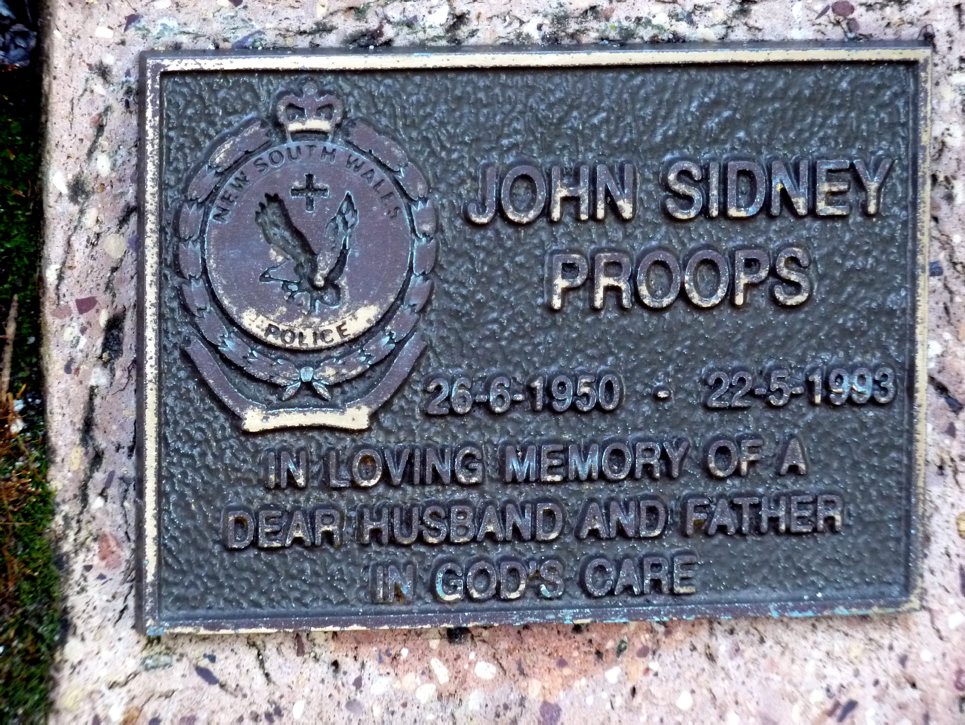
2/ Memorial location: Woronora Cemetery, Police Garden
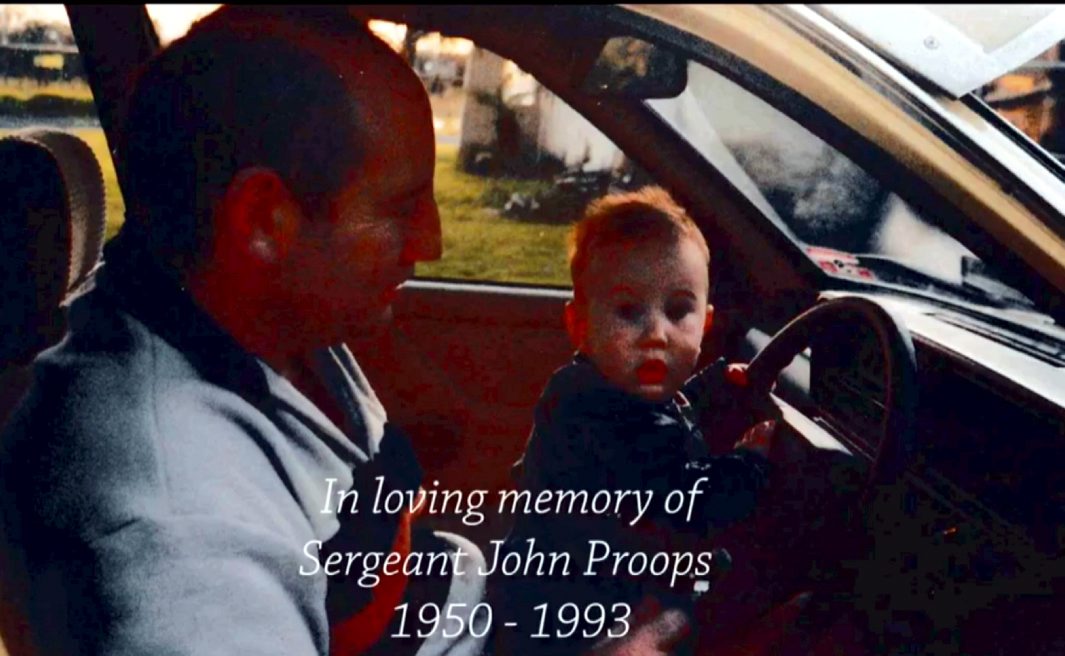
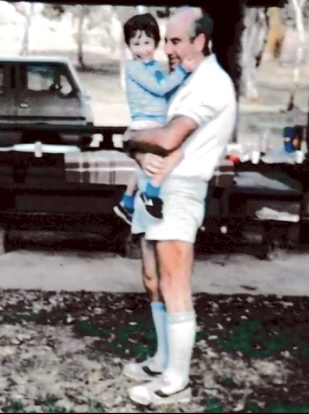
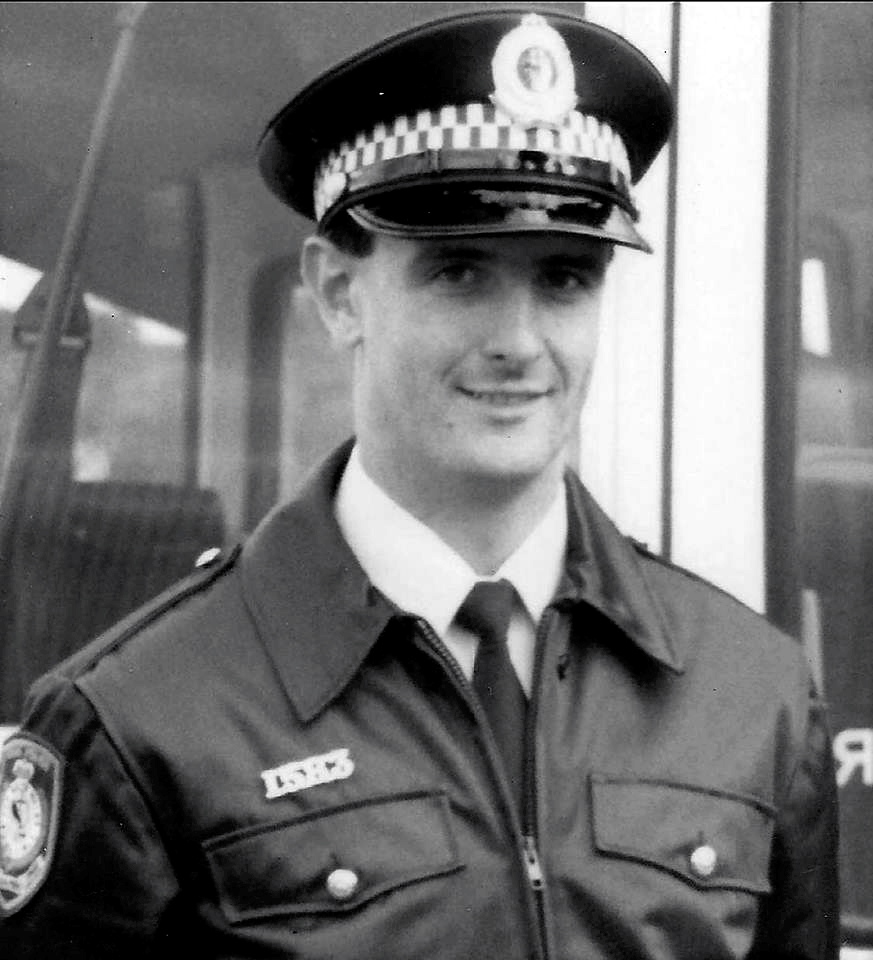
John with his son, Warren, PROOPS
John with his son, Warren, PROOPS
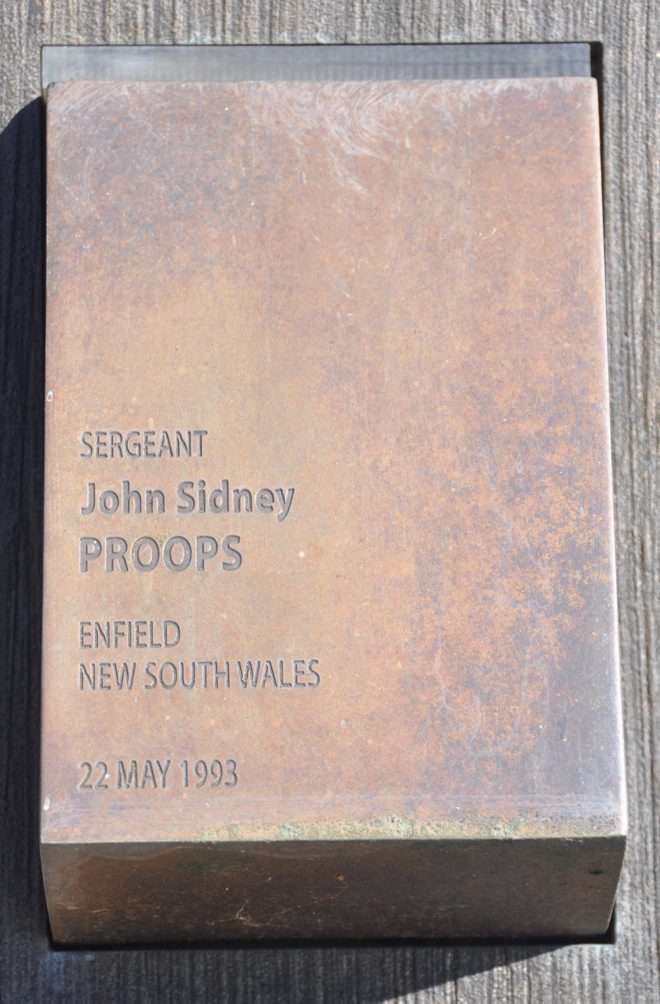
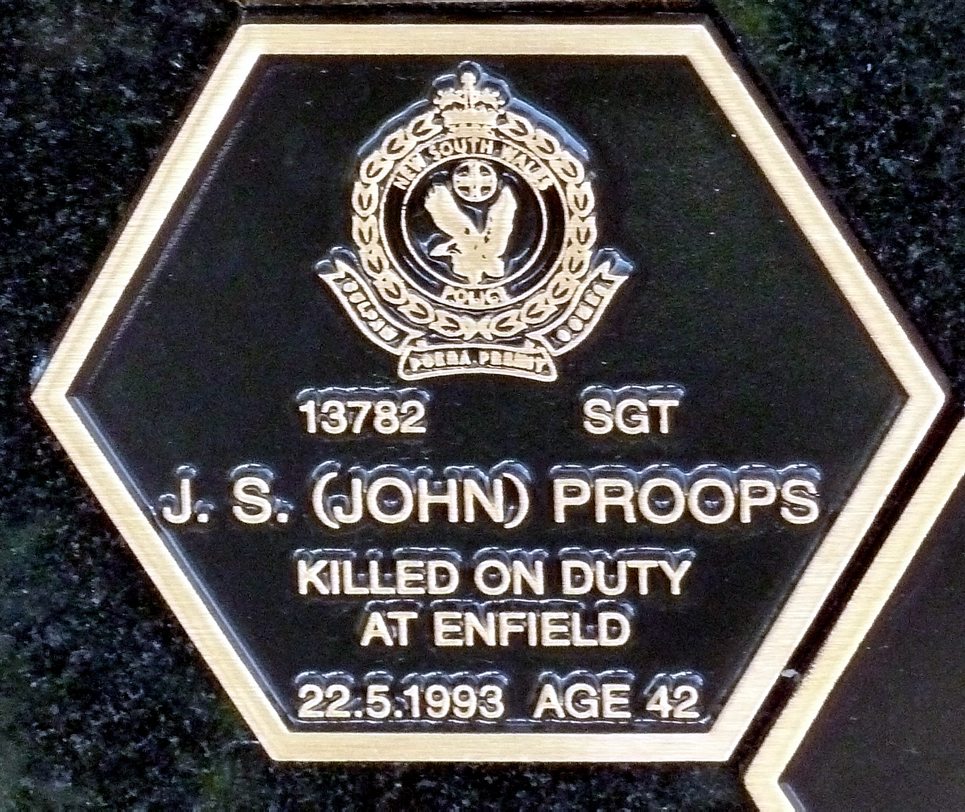
John Sidney PROOPS, Police National Wall of Remembrance touch pad.
On 22 May, 1993Sergeant Proops and Probationary Constable Katie Thompson went to a dwelling in Enfield to arrest an offender for a breach of a domestic violence order. During a struggle with the offender the sergeant is thought to have suffered a fatal heart attack.
Constable Thompson attempted to revive the sergeant however she was unsuccessful. He was conveyed by ambulance to the Western Suburbs Hospital where he was pronounced dead on arrival.
The sergeant was born in 1950 and joined the New South Wales Police Force on 20 February, 1967 as a cadet.
At the time of his death he was stationed at Enfield.
Beyond Courage
[divider_dotted]
[alert_green]John IS mentioned on the Police Wall of Remembrance[/alert_green]
Note: It was also interesting to learn that Sergeant Proops while attending another domestic dispute some years earlier, survived a spear-gun wound to his chest. Apparently, the spear lost much of its penetrating force after striking the sergeant’s police notebook in his tunic pocket.
At just 10-years-old Warren became a NSW Police Legatee, when his father, Sergeant John Proops, passed away after suffering a fatal heart attack while on duty.
Warren has been part of the NSW Police Legacy family for 25 years and took part in the very first trek to Koko
da. Now, he’s returning to the track to help support the team through the physically and emotional journey that is Kokoda.
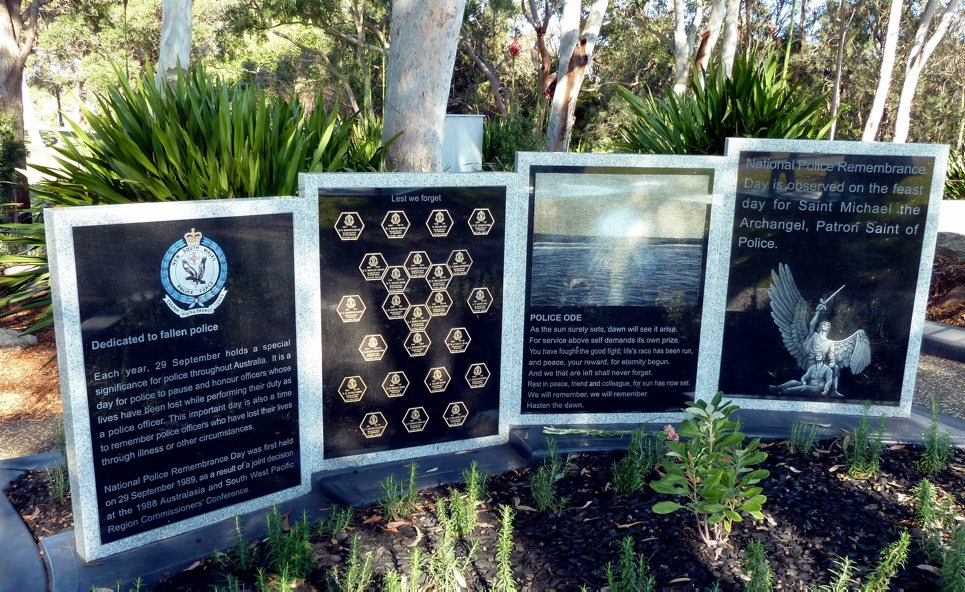
National Police Remembrance Day 29, September 2000
National Police Remembrance Day has been marked by a minute’s silence at services throughout Australasia.
Remembrance Day is held every year on St. Michael’s Day, the patron saint of police, for all officers who have lost their lives in the line of duty.
During the last 12 months, 10 officers have died in the course of their duties in NSW, Victoria, Queensland, Western Australia, the Northern Territory, Papua New Guinea and Fiji.
233 officers have been fatally wounded while on duty in NSW since 1862. Their names are recorded on a memorial dedicated last December in the Sydney Domain.
The Sydney Service has been attended by Police Minister Paul Whelan, Commissioner Peter Ryan and senior members of the NSW Police Service.
During the service candles were lit by Warren Proops, son of Sergeant John Proops who died on 22 May 1996, Eloise and William Heron, son and daughter of Detective Sergeant William Heron who died on 6 January 1999 and Jessica Ede, daughter of Senior Constable Dallas Tidyman who died on 15 August 1994.
NSW Police Commissioner Peter Ryan said the day offers police and members of the public the chance to remember all officers who have lost their lives while serving their community.
“This important day gives us all the chance to pay our respects to these officers and to reflect upon the role in our society that police play,” he said.
“Police officers killed in the course of their duty must never be forgotten.”
The Canberra Times of 24 May, 1993 briefly reported the sergeant’s death.
“POLICE DEATH
SYDNEY: A police sergeant collapsed and died in a struggle with a man he had been questioning about a domestic dispute in Sydney on Saturday night.
Another police officer had broken his leg in a clash later with the man, who allegedly had breached a domestic violence order, a police spokesman said.
Sergeant John Proops, 42, collapsed in the struggle with the 32-year-old man at a house in Enfield.
The man was remanded in Central Local Court yesterday.”
A District Court judge launched an extraordinary attack on police yesterday, claiming they had been involved in the “evil” business of judge-shopping.
He said it appeared that many of those involved in the matter before him had lied.
Judge Phelan, hearing an appeal by Mr Stephen Smith in the District Court, said in a preliminary appraisal of the case that many police had followed a “screed” when giving earlier evidence before a magistrate and when they got beyond the screed their evidence lacked credibility.
There also appeared to have been an assault upon Mr Smith and that no police were able to explain his injuries.
Judge Phelan said if the matter proceeded, and the police witnesses were called against Mr Smith, it would be likely that he would refer a number of matters to the Attorney-General and the Ombudsman alleging that police had fitted evidence and then lied in court.
The Herald understands that staff from the Police Royal Commission had already shown an interest in the matter.
In May 1993, two police officers went to a house in Enfield where it was alleged Mr Smith had breached a domestic violence order.
It was alleged he had resisted arrest and one officer, Sergeant John Proops, had suffered a fatal heart attack.
Police alleged Mr Smith then tried to attack another officer, Sergeant Southam, and that Sergeant Southam suffered a broken ankle.
Mr Smith alleges he was tackled into Sergeant Southam by other officers and then beaten with a torch. He was later convicted of breaching a domestic violence order, resisting arrest and assault occasioning actual bodily harm.
Judge Phelan said yesterday that a doctor’s report indicated Mr Smith had an injury to his head, consistent with being hit with a torch, a cut on his forehead, bruises over his body, a broken rib and bruises to his legs.
“… the injuries can only be explained rationally and solely by a police attack upon the appellant which the officers have all denied and this leads to the conclusion that many of the police officers are lying,” Judge Phelan said.
He said that a small dog had apparently been kicked in the head and lost its eye during the arrest and that police could offer no explanations as to how this had happened. The dog later died. The judge also stated there had been behind-the-scenes moves to have him removed from the case when it came to an appeal.
“I find it obnoxious and suspicious that there have been police manoeuvres to change the prosecution person [assigned] to these matters,” Judge Phelan said.
“If judge-shopping is an evil, as it is, equally evil is prosecution shopping. I also find it obnoxious and suspicious that there have been manoeuvres to have another judge conduct the appeal.”
The matter will resume before Judge Phelan in the Downing Centre District Court this morning and it is expected that the Director of Public Prosecutions will then make a decision about offering evidence in the case.
SYDNEY, Tuesday. — A notebook in his breast pocket had saved a policeman’s life when a man had fired a spear gun at him, police alleged in Campsie Court today.
The police prosecutor, Sergeant A. Carter, told Mr Hayes. SM. that the constable had been trying to arrest the man when the spear was fired from almost point-blank range.
Before Mr Hayes was Mr Norman Warren Castle, 53, of Albany Road, Petersham, who was charged with shooting Constable John Proops at Belmore last Saturday with intent to murder.
Sergeant Carter said it was alleged that Mr Castle had smashed a door of a house at Belmore and had menaced the two occupants inside with the loaded spear gun.
Police had gone to the house and Mr Castle had allegedly turned on them.
It was alleged he had fired a spear at Constable Proops which had struck the officer’s regulation notebook in the breast pocket of his uniform.
Sergeant Carter said Mr Castle had been taken to Canterbury Hospital yesterday after allegedly swallowing glass.
“The doctors found he had consumed some plastic buttons ‘ — x-rays taken found no glass or other substances”, he said.
People involved in the case “feared for their safety”. Further charges could be laid.
Questioned by Mr Hayes. Mr Castle said he had been “communicating with my dead father”.
Asked how he had been communicating, Mr Castle replied, “In my mind … He has communicated with me before”.
Mr Hayes refused bail, adjourned the case for mention to June 15, and recommended that Mr Castle be physically, and mentally examined.
In 1992 Constable Hernandez was a member of the State Protection Group and a qualified firearms instructor. He was accidentally shot in the chest while testing police in their annual firearms proficiency tests at the Redfern Police Complex. Following emergency surgery Constable Hernandez died at St Vincent’s Hospital, Darlinghurst the same day as the accident.
The constable was born in 1959 and joined the New South Wales Police Force on 18 February, 1987. At the time of his death he was attached to the State Protection Group.
Touch Plate at the National Police Wall of Remembrance, Canberra
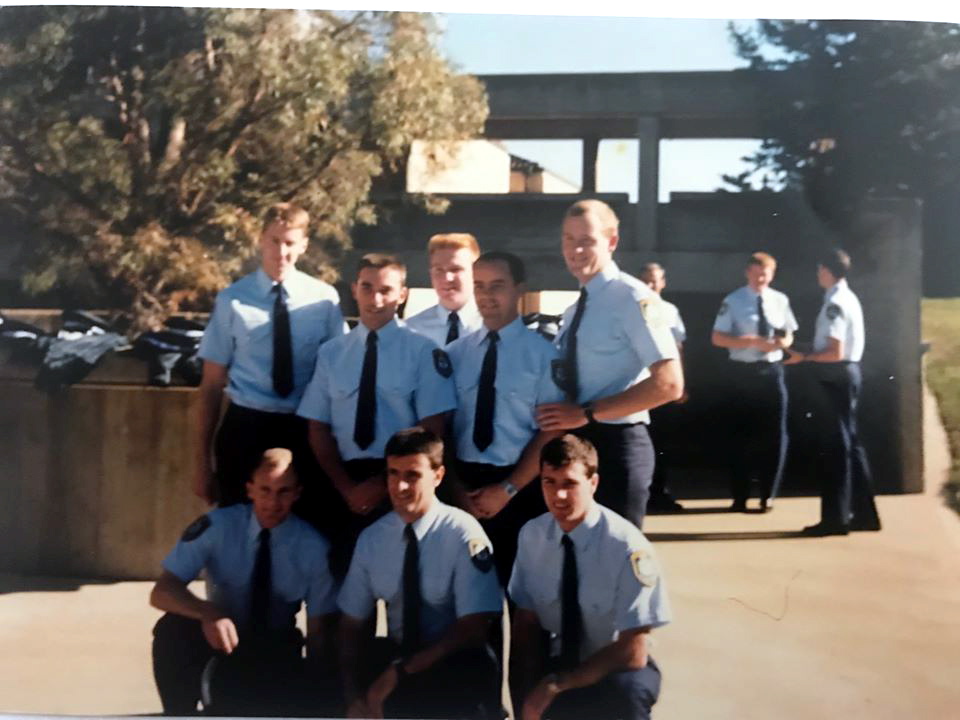
Photo credit: Kelvin Harband NSW Fallen Police New Member · Juan Hernandez was accidentally shot in the chest while doing firearms training as an Instructor at the Redfern Police Academy on 1 December 1992. Emergency surgery was unable to save his life and he passed on that same day. Juan and I went through the Academy together in 1987 and he will always be remembered and a great bloke whose life was cut way to short by the tragic accident. Juan is in the middle squatting down in this photo which was taken on the day of our attestation ( 15 May 1987 ).
Carl is also credited with designing the TOU insignia – which was maintained in respect to his.
Canberra Times (ACT : 1926 – 1995),
Tuesday 1 December 1992, page 4
IN BRIEF
Policeman shot dead
SYDNEY: A police weapons training instructor was fatally wounded by another officer during a gun training session yesterday.
Constable Juan Carlos Hernandez, 33, an instructor with the elite State Protection Group, died in hospital several hours after being shot in the chest at the old Police Academy at Redfern.
Constable Hernandez was supervising about 15 officers at a training session when a .38 calibre police-issue revolver discharged, wounding him in the chest.
The Hon. CATHERINE CUSACK: My question is addressed to the Minister for Police and Emergency Services. Will the Minister inform the House about the newest recruits to the New South Wales Police Force?
The Hon. MICHAEL GALLACHER: I thank the honourable member for her question. Last Friday, 23 August 2013, it was my great pleasure to attend the attestation ceremony for class 319 at the Goulburn Police Academy. I assure members that the calibre of probationary constables coming through the doors of the academy to pursue challenging and rewarding careers as police officers in this State remains very high indeed. They passed the stringent physical and academic tests, and have demonstrated the commitment and character befitting their new role. These qualities were no more visible than when the commissioner’s valour award was presented to Senior Constable Justin Knight on the parade ground last Friday. The award was conferred for conspicuous merit and exceptional bravery when an offender armed with a sawn-off rifle fired at Senior Constable Knight with intent to murder on 20 January 2007 at Eveleigh Street, Redfern—the Block.
In the course of pursuing a suspect, Constable Knight alighted from his vehicle and pursued an offender on foot, calling for him to stop. The offender produced a sawn-off rifle and, despite the risk, Constable Knight continued to follow him. The offender fired a number of shots at Constable Knight, narrowly missing him. The constable felt one of the projectiles go past his arm and thought that he had been shot. Being aware of the sensitivity of the local community towards police and despite the escalated danger, Constable Knight did not respond by firing his service firearm. The offender fled the scene, but was later identified and charged with attempted murder of a police officer. The offender was subsequently convicted.
I ask members to reflect on those circumstances and whether we would have acted with the same level of commitment, bravery and judgement as Constable Knight on that occasion. Too often the community reacts to instances where police officers have been accused of wrongdoing, but the events of that night in 2007 remind us of the challenges and risks faced by officers of the NSW Police Force, in this case potentially quite deadly. I am confident that Senior Constable Knight’s example will flow through to the 161 probationary constables who attested and have joined a force with record authorised strength in this State.
A number of the new police officers deserve special mention. The winner of the Robert Brotherson award for the highest level of academic achievement was Probationary Constable Natalie Martin. The winners of the Steven Roser memorial award for the highest male and female achievers in physical training were Probationary Constable Mitchell Thompson and Probationary Constable Guilhermina El-Mir. The Juan Carlos Hernandez award, given to the student with the highest marksmanship score, went to probationary constables David Edwards, Anton Sahyoun and Shanahan Toering—all three tied for that award. Probationary Constable Toering also received the award for the highest achiever in the Simulated Policing Acquiring Competence program.
One of the many proud parents at the attestation was Detective Superintendent Arthur Katsogiannis, whose son Daniel is now a probationary constable and commences his career at City Central Local Area Command. It was terrific to see 23 members of the attestation of class 319 identified as Aboriginal and Torres Strait Islanders, of which 16 were graduates of the Indigenous Police Recruiting Our Way [IPROWD] program that I have spoken about in this forum. Congratulations to them. I had the pleasure of witnessing the graduation of 13 dog teams from the State Protection Group Dog Unit. Some were general purpose dogs and others, obviously, were sniffer dogs. That is good news for Byron Bay and its former mayor, the Hon. Jan Barham. The attestation parades provide an opportunity— [Time expired.]
The Hon. CATHERINE CUSACK: I ask a supplementary question. Will the Minister elucidate his answer?
The Hon. MICHAEL GALLACHER: I pay respect to the following five officers who retired from the NSW Police Force, taking with them collectively 190-plus years: Superintendent Ben Feszczuk, Detective Superintendent Col Dyson, APM, Superintendent Ray Filewood, Detective Inspector Dennis Clarke, APM, and Inspector Leslie Dickens. All five officers led the parade on Friday. It was an incredibly proud moment for them, their families and the communities they have represented in just short of 200 years of policing. As I said to the graduating class, “If you want to look for role models, look at these five as a classic example of what you can give back to a community that will give you so much more.”
The Hon. CATHERINE CUSACK: My question is addressed to the Minister for Police and Emergency Services. Will the Minister inform the House about the newest recruits to the NSW Police Force? The Hon. MICHAEL GALLACHER: On 3 May it was a great pleasure to attend the attestation ceremony for class 318 at the Goulburn Police Academy, and I can assure the House that the calibre of probationary constables coming through the academy to pursue a challenging and rewarding career as a New South Wales police officer remains high. All attesting officers have made it through physical and academic tests, and, most importantly, they have demonstrated the commitment and character of people prepared to ensure the safety and security of the community they will serve. The 202 probationary constables who attested have joined a police force now boasting a record authorised strength of 16,176. As members opposite know full well, we have been increasing the authorised strength of the NSW Police Force since we took office. After the further increase this month of 80 positions from the May class, we have boosted the authorised strength by 370, and we are on our way to increasing the force by a total of 859 positions, to a record authorised strength of 16,665 officers in August 2015. This month 50 additional positions were added to the Police Transport Command, bringing its authorised strength to 401. We have also added 30 positions to the authorised strength of the Traffic and Highway Patrol Command, bringing it to 1,295. That makes an increase of 50 new authorised positions to this command, and that is halfway to our commitment to increase the strength of the command by 100. While another 202 probationary constables have been drawn to this career, I am equally pleased with how many officers stay in this exciting and rewarding profession. Indeed, there is such demand for a career in policing that the NSW Police Force has implemented a freeze on new applications. Members opposite have mischievously tried to claim that this is a sign of cuts to the Police Force. That is as far from the truth as members opposite could possibly get. Thanks to the Government making the necessary reforms to the Death and Disability Scheme set up by members opposite and restoring the confidence of serving police officers by ensuring that they will have the back-up they need, I am advised that attrition within the Police Force is currently averaging about 40 officers a month, down from the average of 70 under the previous administration. Therefore, it stands to reason that if fewer officers are leaving the force, fewer replacements are needed. Under Labor, the NSW Police Force was faced with more than 800 officers on long-term sick leave and officers leaving the force at such a rate that police could not recruit fast enough to plug the holes. Placing a temporary freeze on new applications will ensure that potential applicants do not need to spend application fees, which easily total $500, including on such items as medical certificates, when there is a substantial wait before their application can be considered. We are getting on with the job of ensuring that the NSW Police Force is better resourced, better equipped and better supported than ever before. Members opposite are peddling misinformation and seeking to undermine the community’s confidence in a police force experiencing record numbers. A number of the new police officers deserve special mention. The winner of the Robert Brotherson Award for the highest level of academic achievement was Probationary Constable Thomas Stillwell. The winners of the Steven Roser Memorial Award for the highest male and female achievers in physical training were Probationary Constable Adam Splithof and Probationary Constable Caitlin Billingham. The Juan Carlos Hernandez Award, given to the student with the highest marksmanship score, went to Probationary Constable Matthew Skellern. [Time expired.]
The Hon. CATHERINE CUSACK: I ask a supplementary question. Will the Minister elucidate his answer?
The Hon. MICHAEL GALLACHER: I am sure that all members would like to hear about these outstanding young probationary constables, including Probationary Constable Nathan Dechaufepie, who was the recipient of the Simulated Policing Acquiring Confidence Award. These officers can be proud of their achievements. Their families can be proud of them and, most importantly, their communities are proud of them. I am sure that the House will join me in wishing our newest police officers all the very best for their careers in the NSW Police Force.
The Hon. SCOT MacDONALD: My question is addressed to the Minister for Police and Emergency Services. Will the Minister inform the House of the results of the latest police attestation?
The Hon. MICHAEL GALLACHER: I apologise to the House for my inability to be here last Friday. I had a very important role to fulfil as the Minister for Police and Emergency Services at the graduation of class 312 at the Police Academy in Goulburn. It was my first in my new role as Minister for Police and Emergency Services. One of the first things I had an opportunity to announce down there was clarification of the uncertainty that exists around the name of the organisation.
The Hon. Duncan Gay: It was well received.
The Hon. MICHAEL GALLACHER: It was well received. It will now return to its former name of the New South Wales Police Academy, not the police college. That announcement was very well received by the sworn officers. The attestation certainly brought back memories of when I was in a similar position, standing on the parade ground at Redfern more than 30 years ago. Whilst a lot of things have changed in policing, a lot of things have not. Obviously the equipment, the cars and the uniform have changed, but certainly one thing that has not changed is the high calibre of probationary constables coming through the academy. They are required to pass through a tough course, both physically and academically, to prove they can cut the mustard as officers in the New South Wales Police Force. Who knows, even Eric Roozendaal might apply to join the New South Wales Police Force—although he may not pass the integrity test.
They are men and women who are prepared to do their best for the people of this State and who will undertake this job on a daily basis, often in the most difficult of circumstances. The 111 probationary constables who attested at the ceremony have joined more than 15,000 officers in the Police Force. They come from all walks of life. Over 22 per cent of those who attested are women. Forty per cent come from outside metropolitan Sydney. Sixteen were born overseas, in countries such as Russia, Germany, Malaysia, China and even Botswana. They speak Arabic, Greek, Cantonese, Armenian, Dari, and Khmer. They will be posted to 59 local area commands across the State, from Albury in the south, to Richmond in the north, from Barrier in the west to the heart of Sydney. Forty-four of the officers have been assigned to non-metropolitan or rural regions.
Irrespective of where they have been posted they are on the front line. They stand between the community and the dangers of crime and other antisocial behaviour. A number of these new police officers deserve special mention. Firstly, the winner of the Robert Brotherson Award for the highest level of academic achievement was Probationary Constable Stephanie Hill. The winners of the Steven Roser Memorial Award for the highest male and female achievers in physical training were Probationary Constable John Feuerstein and Probationary Constable Sandra Chaban. The Juan Carlos Hernandez Award, given to the student with the highest marksmanship score, was Probationary Constable James Patrick. Probationary Constable Jessica Agland was the recipient of the Simulated Policing Acquiring Confidence Award.
I met some of the officers on Friday and I can confidently say that the New South Wales Police Force has a strong future. These officers can be proud of their achievements. Their family and friends can be proud of them for all the hard work they have put in to get there. The people of New South Wales can be proud of these people for choosing a selfless profession, dedicating their working lives to ensuring the safety and protection of the community. I am sure all members of the House will join me in wishing our newest police officers all the very best for their careers in the New South Wales Police Force.
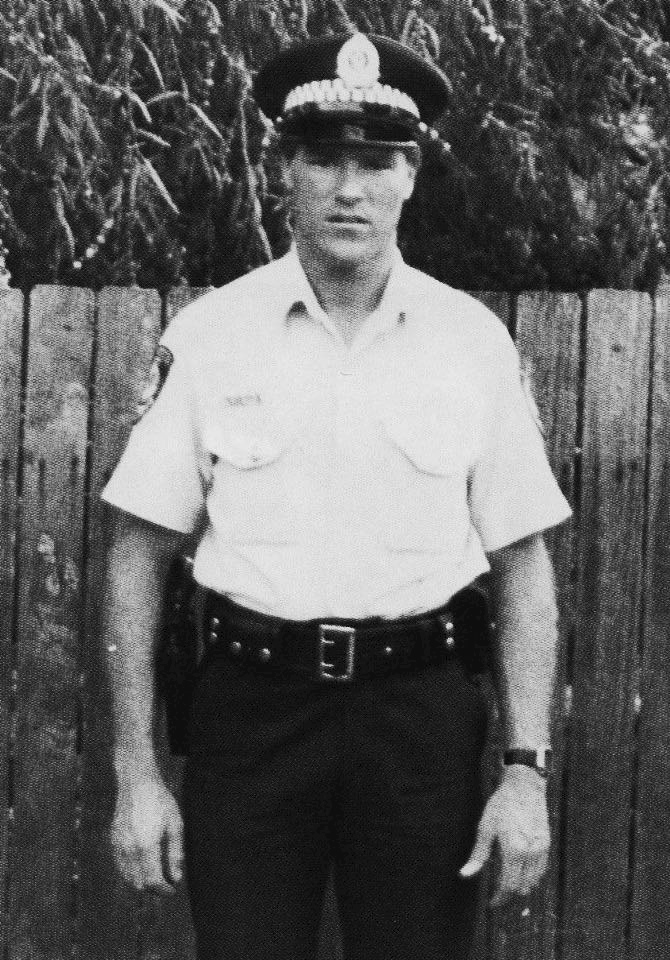
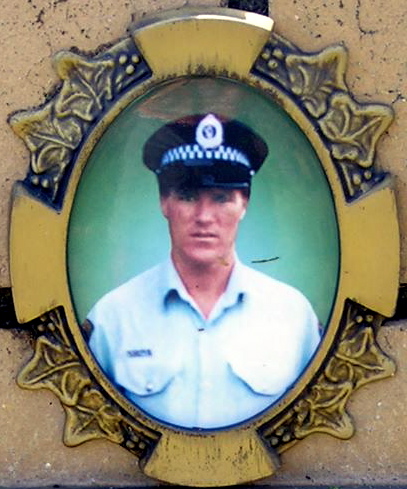
Commissioners Valour Award ( VA ) ( Posthumously )
Born: Friday 1 June 1962
Died On: Friday 5 May 1989
Event: Shot – wounded – Murdered
Event location: Woolloomooloo
Event Date: 24 April 1989
Died: 5 May 1989 ( 9 days after event )
Cause: Murdered – shot twice
Age: 26 yrs 11 mths 4 days
Funeral date: 9 May 1989
Funeral location: St Mary’s Anglican Church
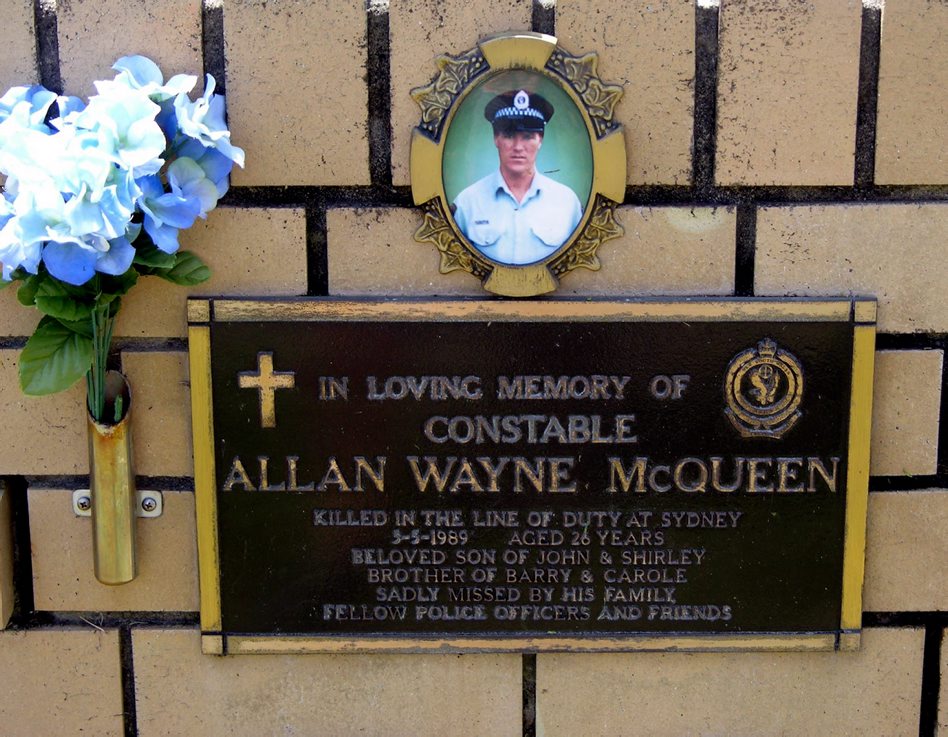
Buried at: Cremated. East Ballina Cemetery, McQueen Family Wall, Sec: Niche, Lot # 2
GPS: 28*51’47″S / 153*35’26″E
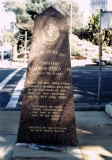
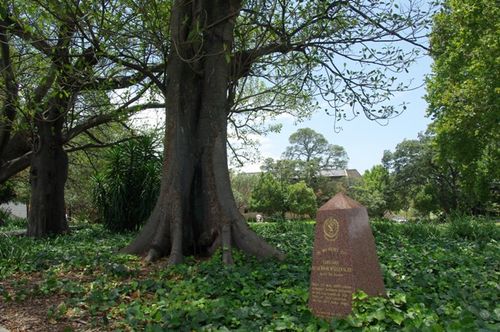
Memorial: 1/ Yurong Parkway, Phillip Park , Sydney, 2000
GPS: Lat: -33.872583 / Long: 151.213778
2/ Sydney Police Centre, McQueen Room, 151 – 241 Goulburn Street, Surry Hills.
3/ Police Launch McQueen???.
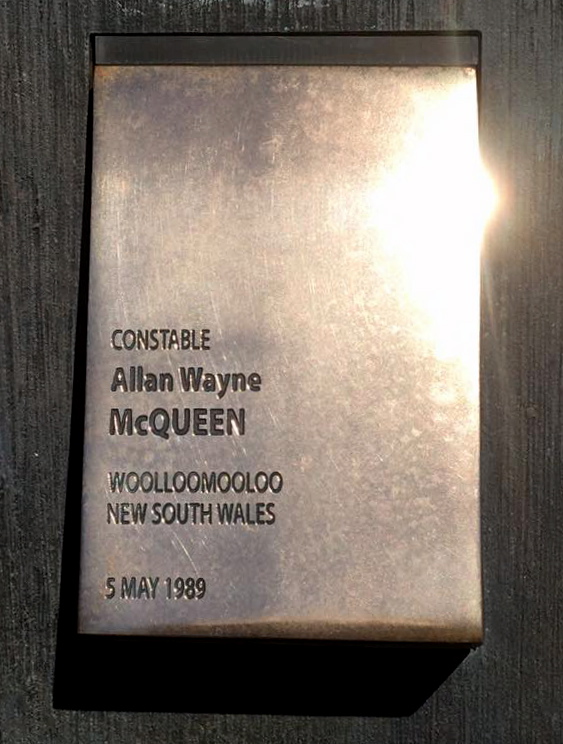
Allan’s touch plate was polished today, this 27th anniversary, 5 May 2016, by a mate, Craig Coleman, at the National Police Wall of Remembrance, Canberra.
ALLAN IS mentioned on the Police Wall of Remembrance
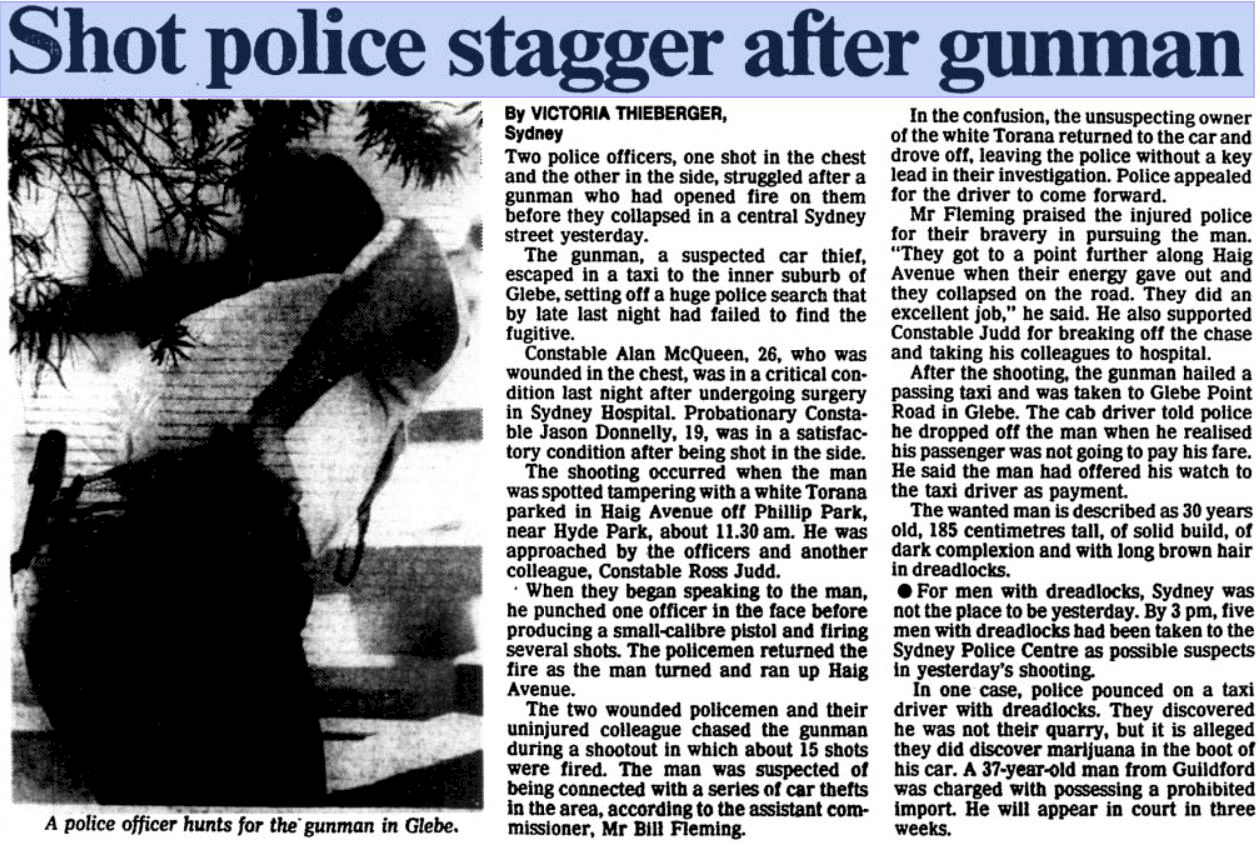
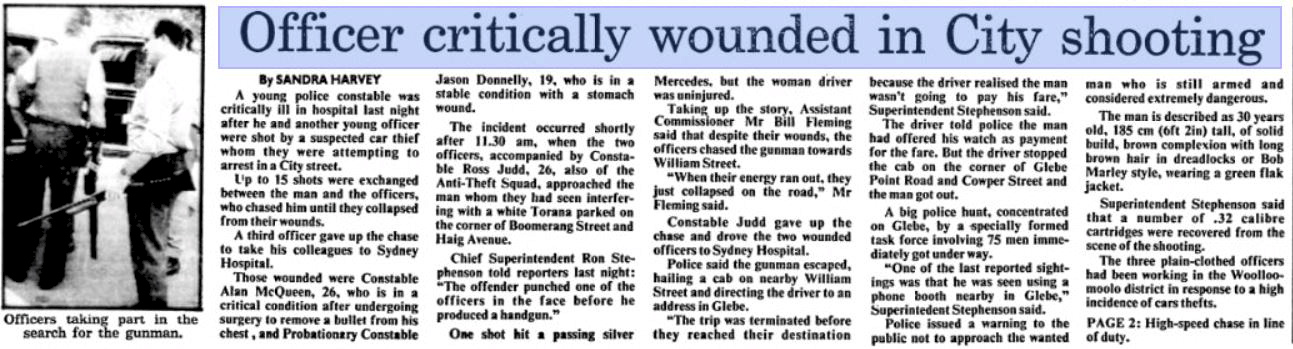
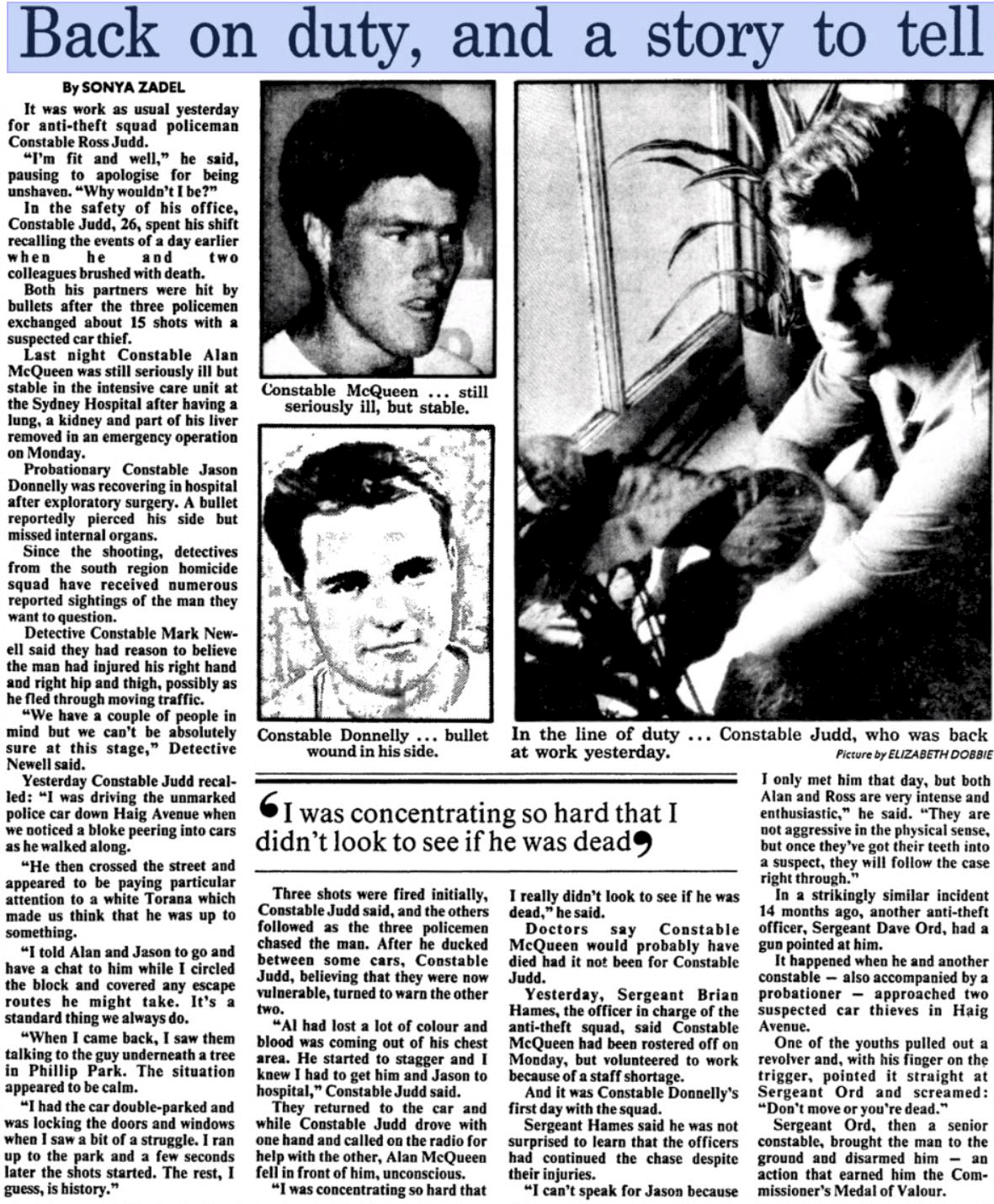
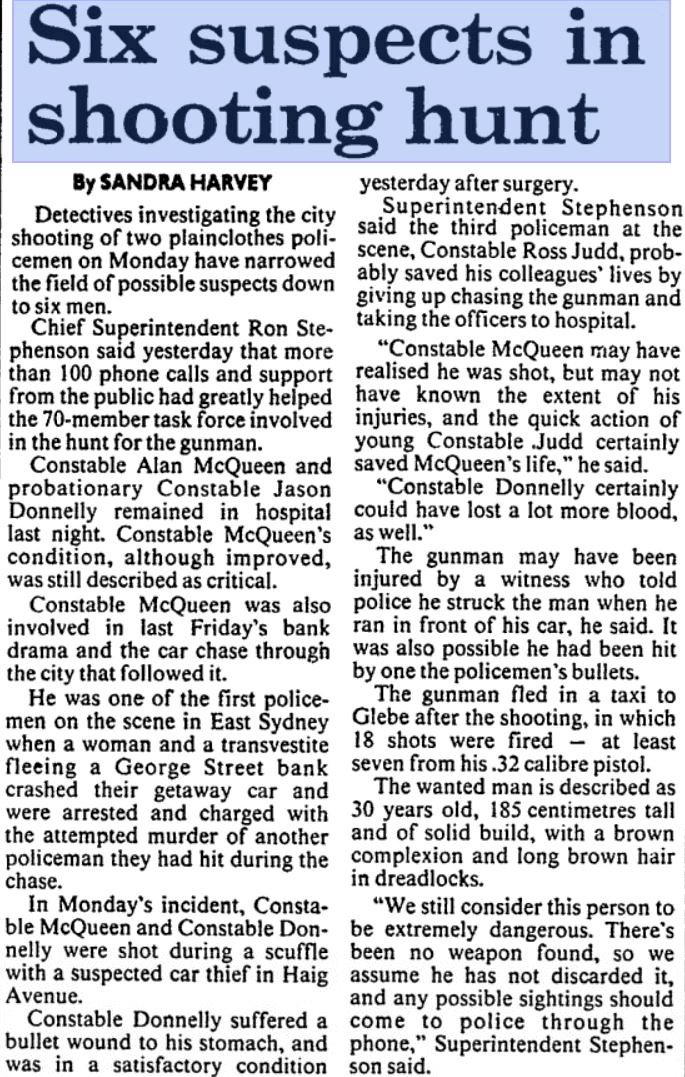
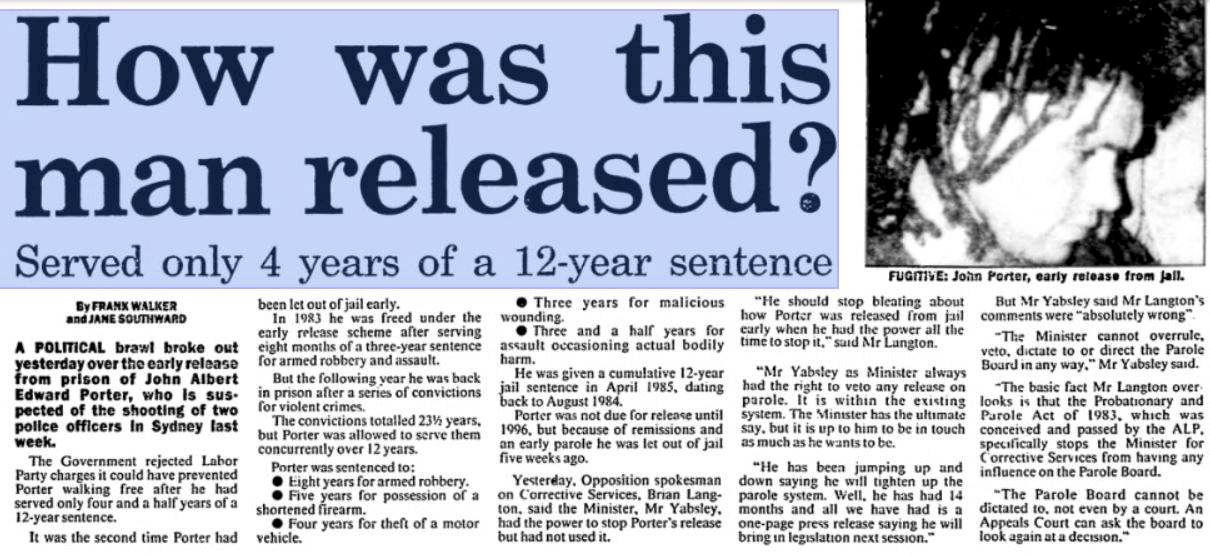
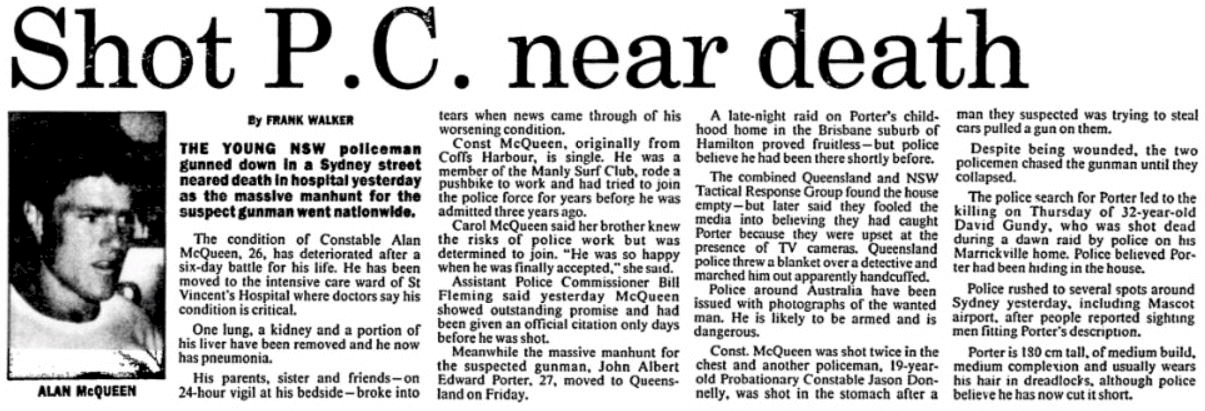
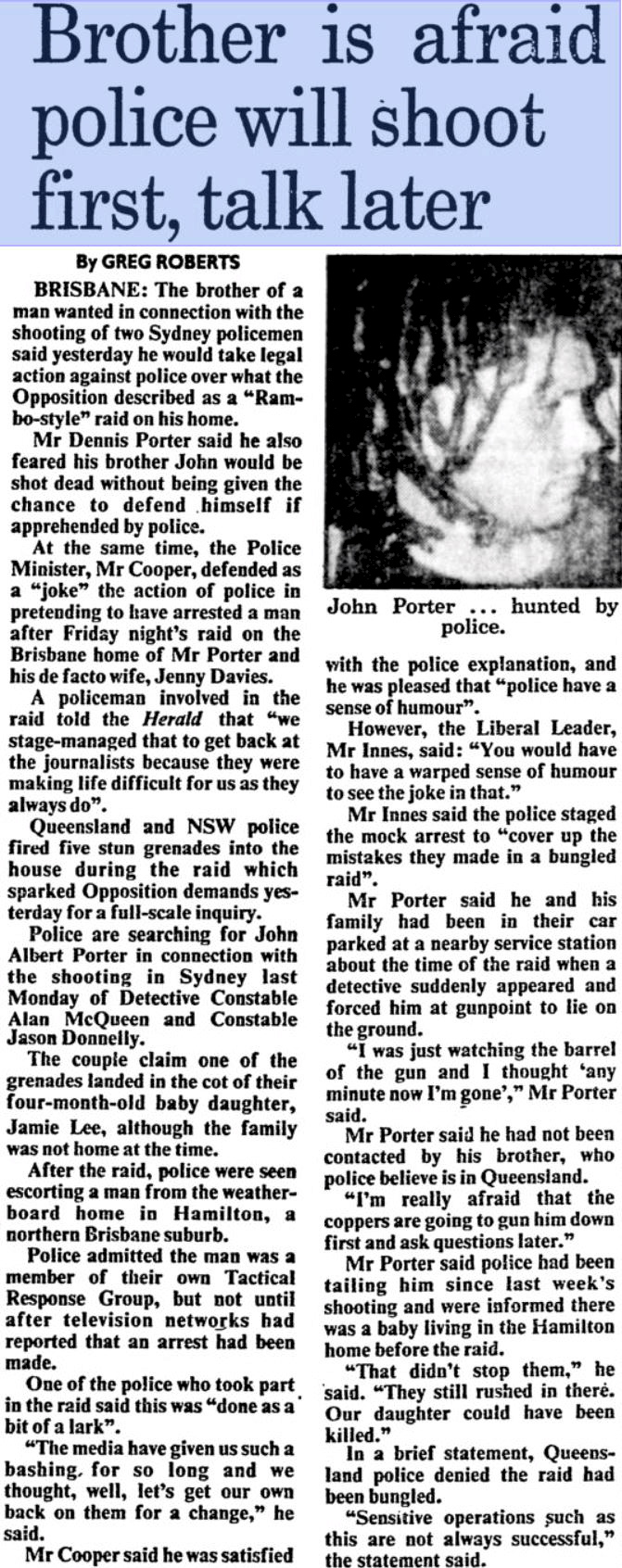
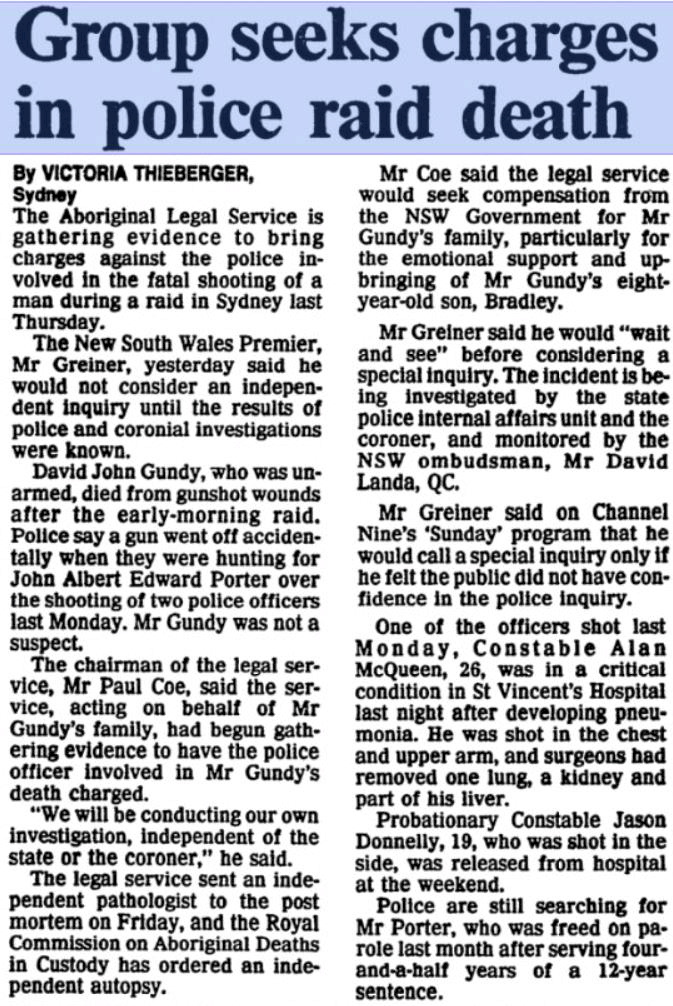
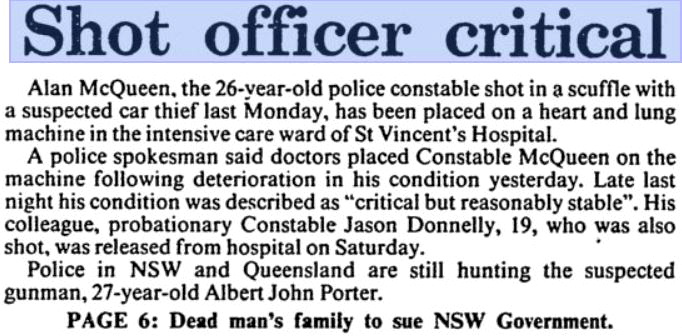
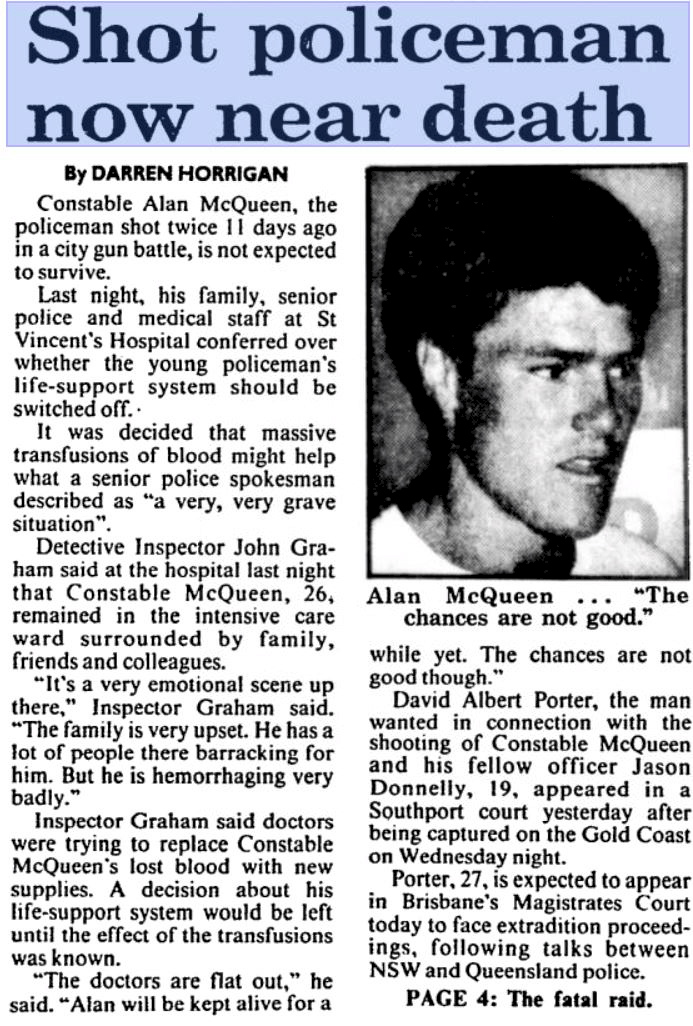
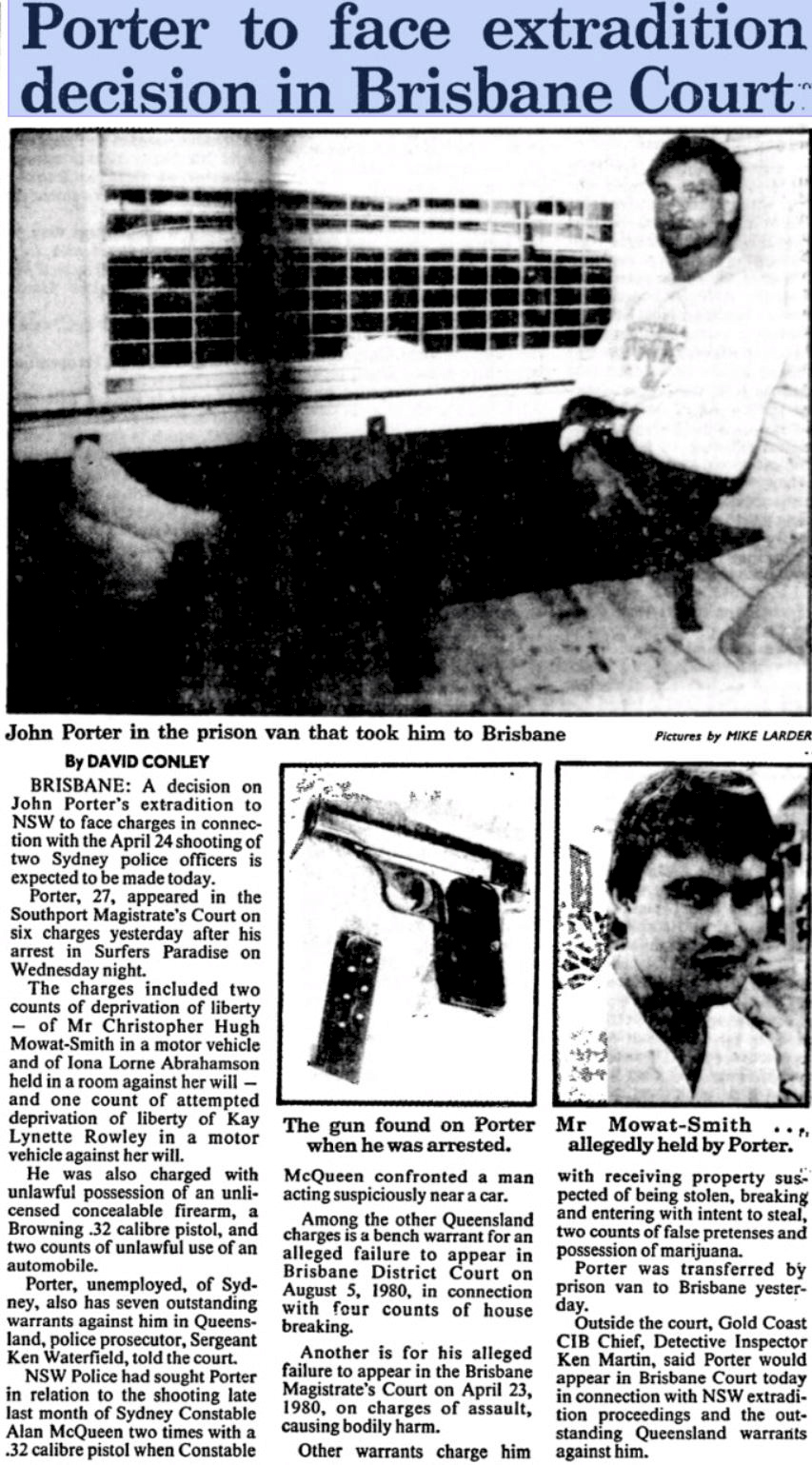
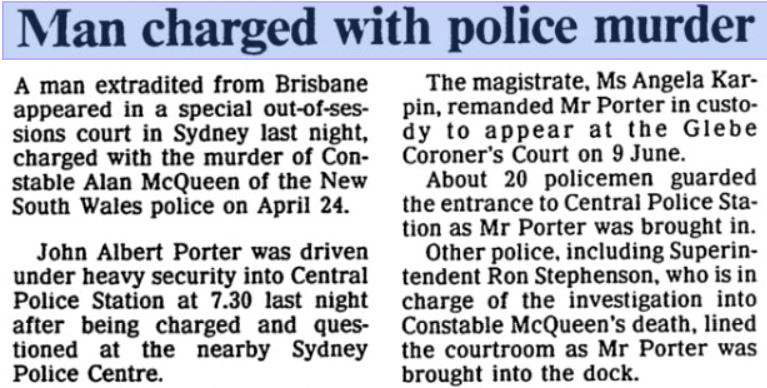
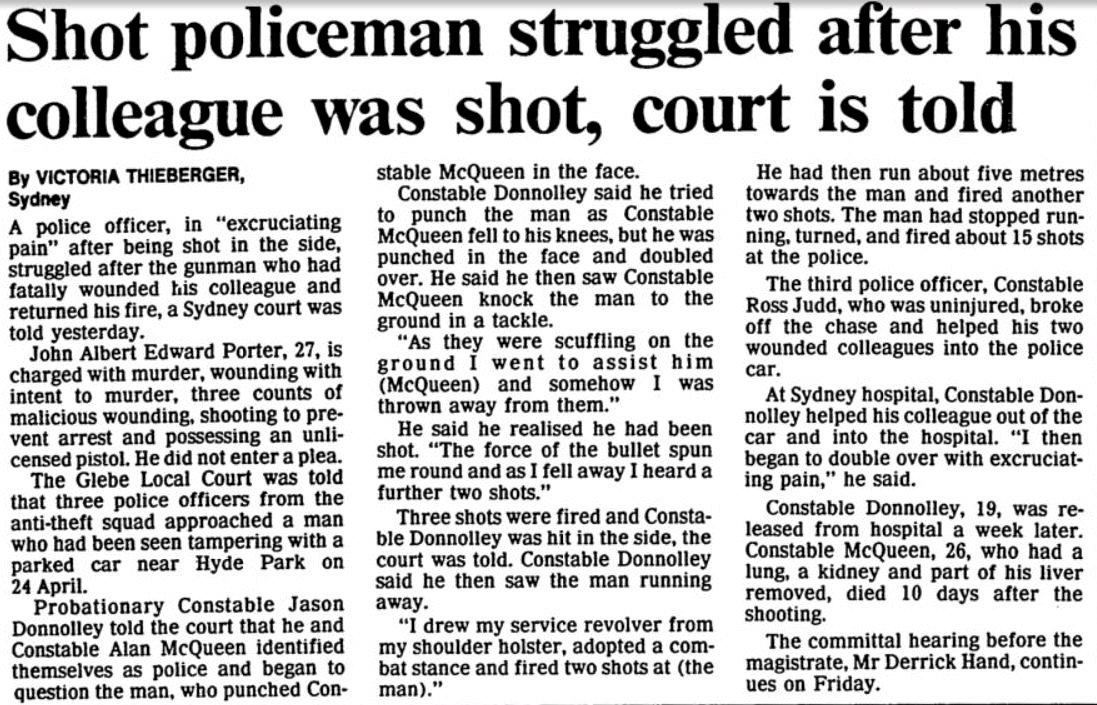
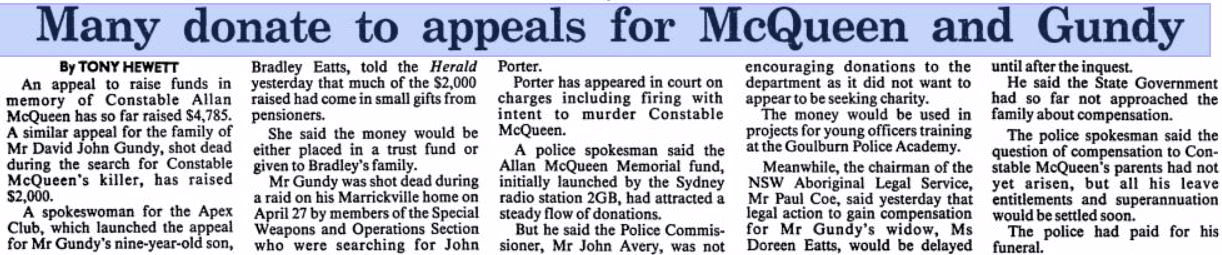
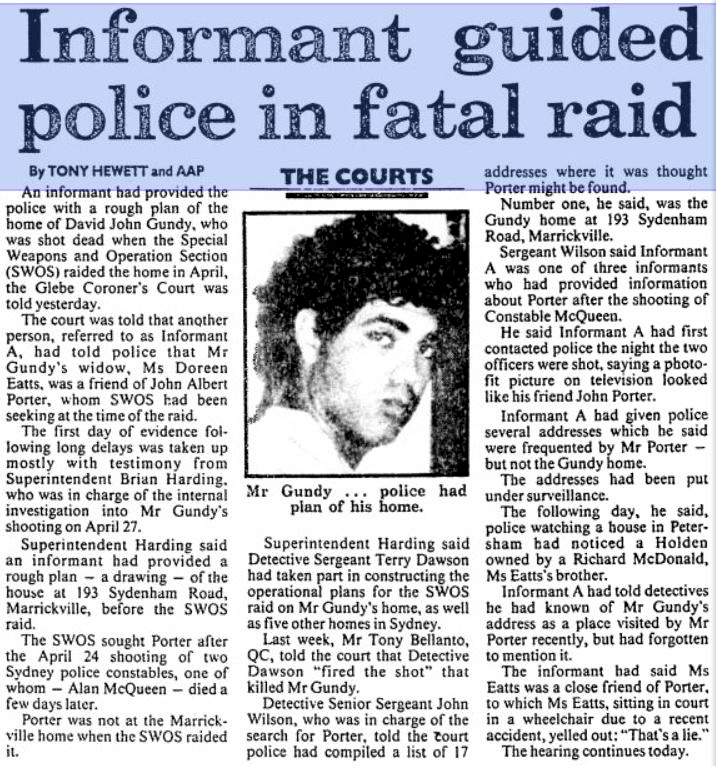
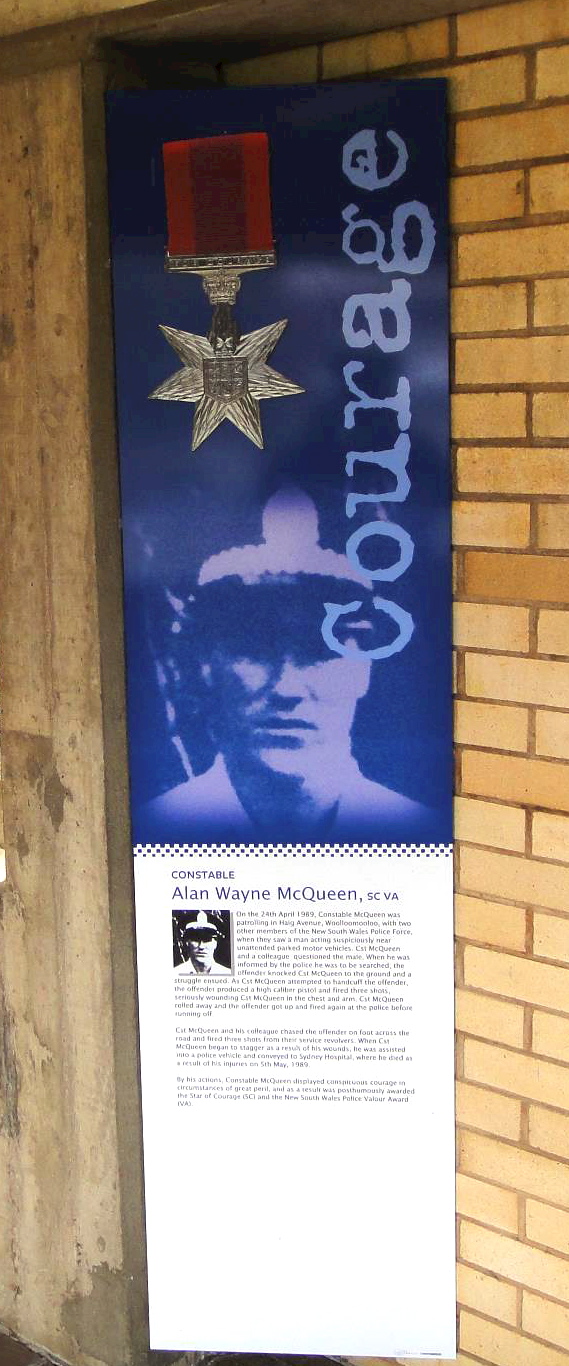
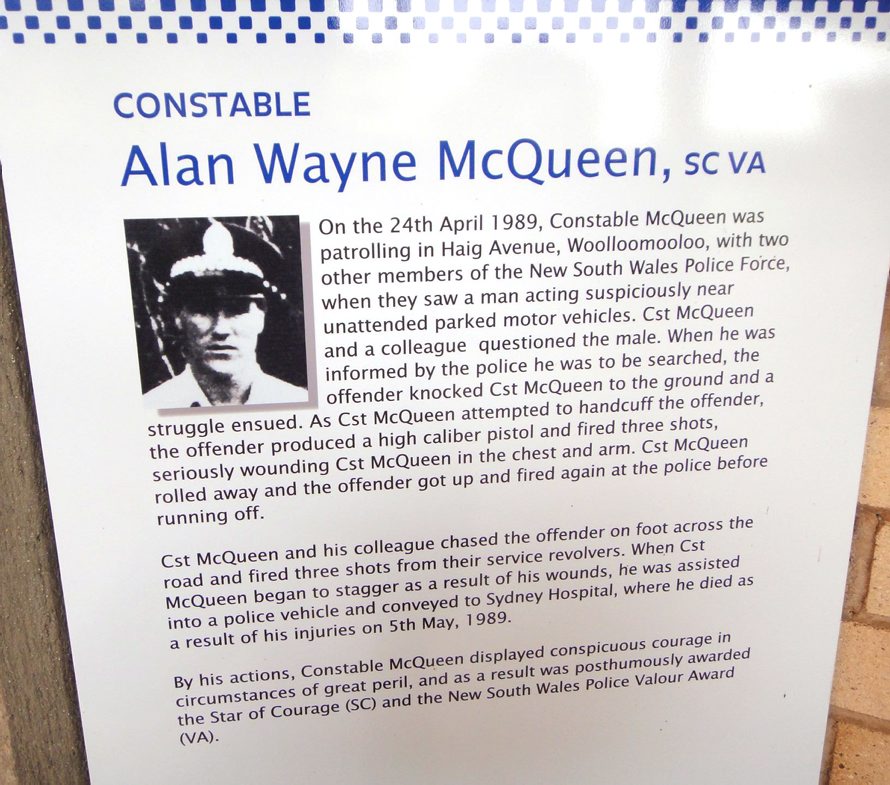
On the morning of 24 April, 1989 Constable McQueen, Constable 1st Class Ross Judd and Probationary Constable Jason Donnelly were patrolling the Woolloomooloo area. All were members of the District Anti-Theft Squad. About 11.35am they saw the offender Porter, apparently attempting to break into a motor vehicle. While Constable Judd parked the police vehicle, Constables McQueen and Donnelly went to speak to the offender. As he was being detained, the offender produced a concealed weapon and shot Constable McQueen twice in the chest and Constable Donnelly in the abdomen. Both constables then chased the offender, who continued firing at them, until both collapsed from their wounds. Constable Ross Judd also pursued and fired at the offender before returning to assist his colleagues. He then carried both wounded constables to the police car and drove them to the Sydney Hospital.
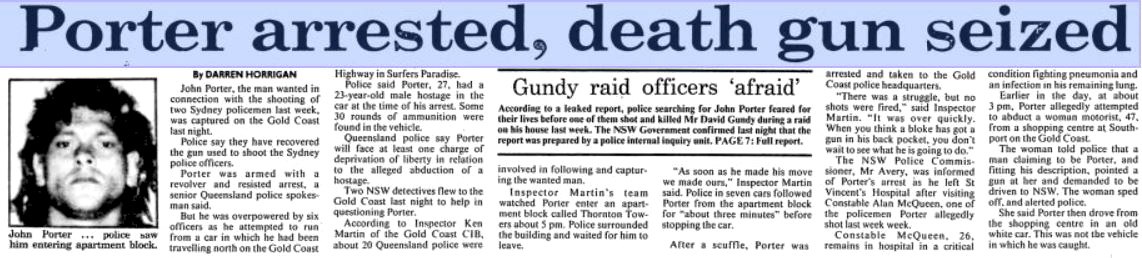
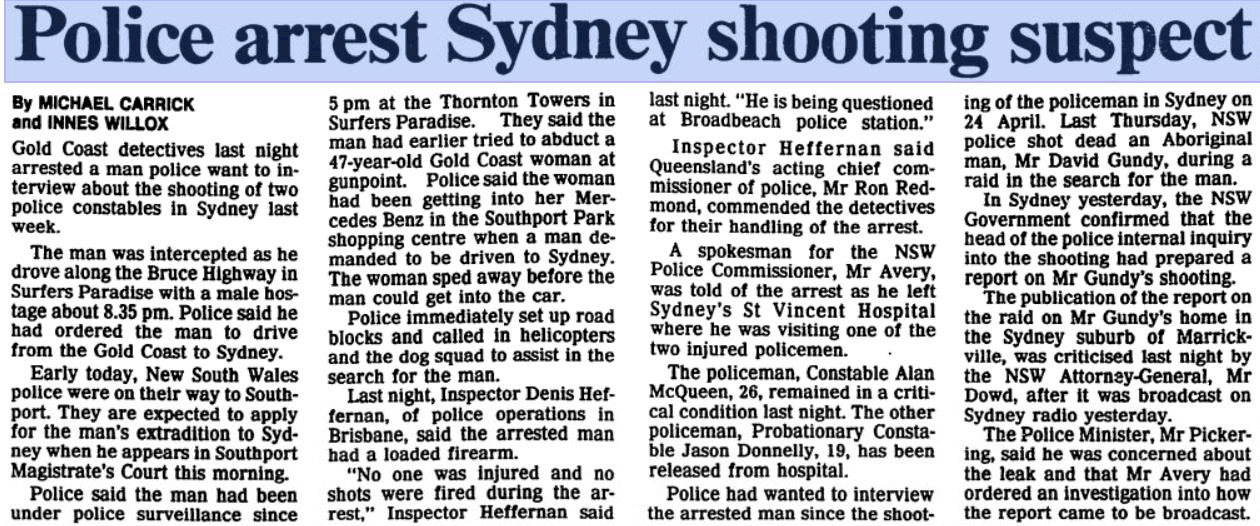
Constable Donnelly was to recover from his wounds however Constable McQueen had sustained extensive internal injuries and died on 5 May, 1989. The offender was later arrested by Queensland Police.
The Canberra Times of 12 July, 1990 reported on the result of the trial of the offender.
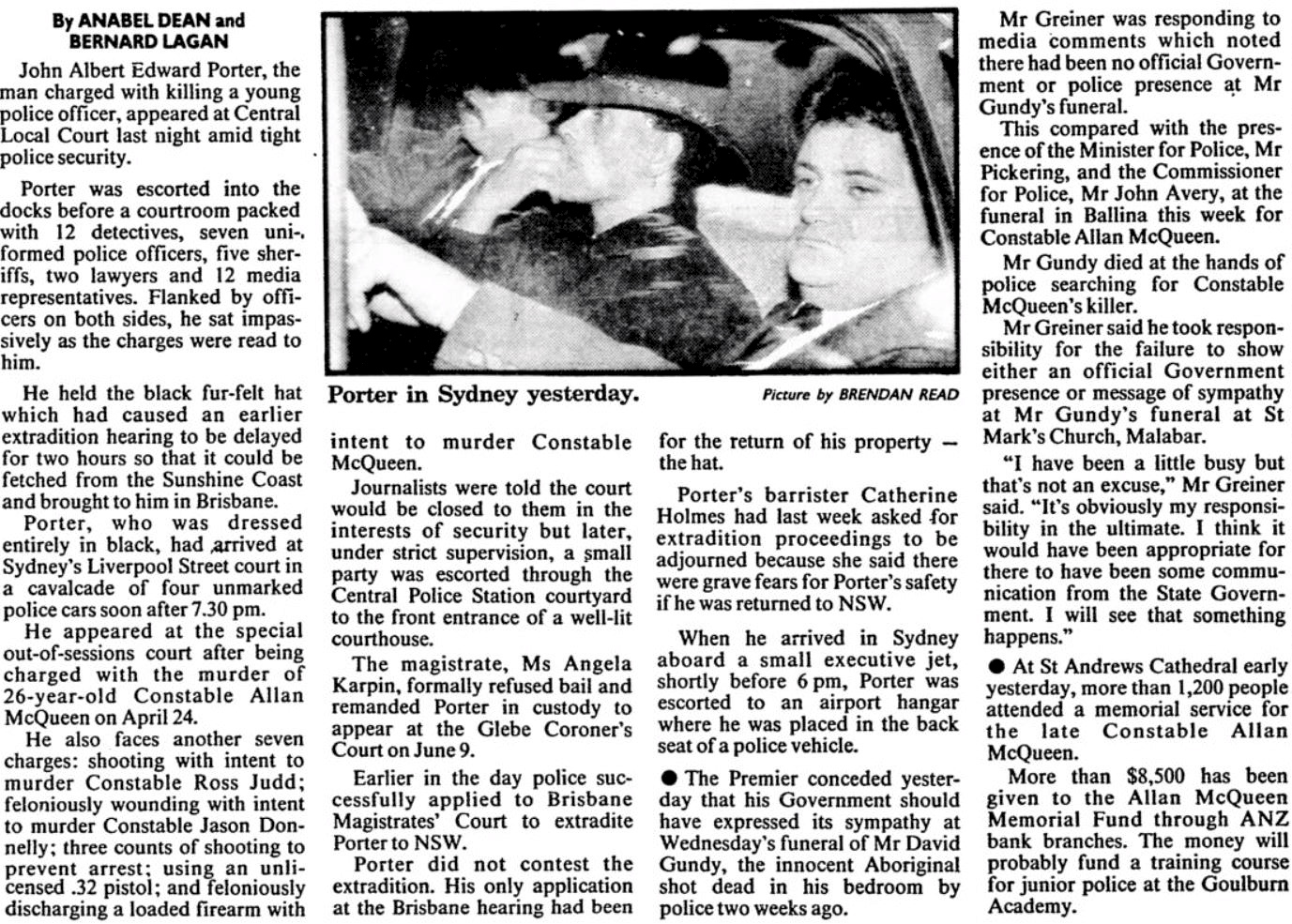
CONVICTION IN POLICE DEATH SYDNEY:John Albert Edward Porter has been found guilty of the murder last year of Sydney police constable Allan McQueen. A Supreme Court jury deliberated for nearly 10 hours before finding Porter, 28, guilty of shooting the policeman on April 24 last year. Porter was remanded in custody for sentencing on August 3. The jury also found Porter guilty on one count of shooting with intent to cause grievous bodily harm and three counts of shooting to avoid arrest. He was found not guilty on a sixth charge of attempting to murder Constable Jason Donnelly.
Justice Badgery-Parker had directed the jury to find Porter not guilty on the charge of attempting to murder Constable Donnelly. Porter had pleaded not guilty to all charges.
Friends and relatives of Constable McQueen sat comforting each other in the public gallery as the verdict was returned. Constable McQueen, 26, died in St Vincent’s Hospital nine days after the April 24 shooting.
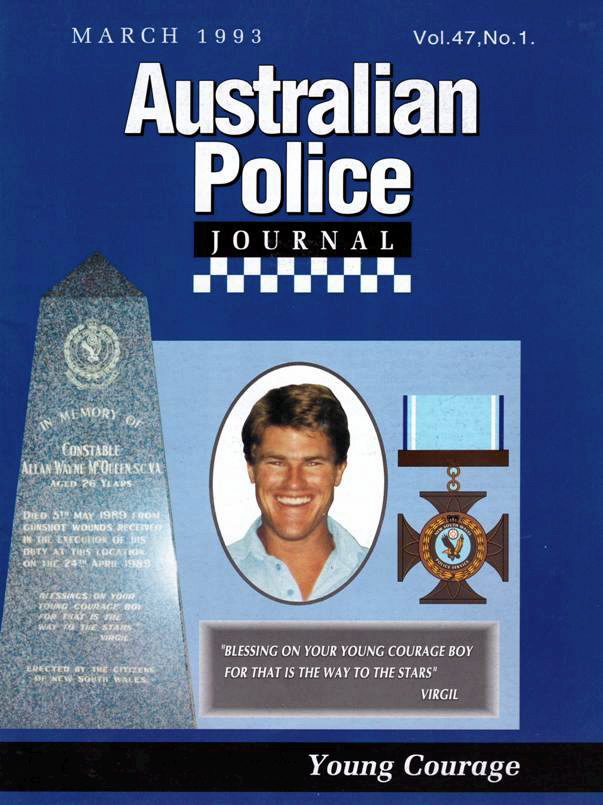
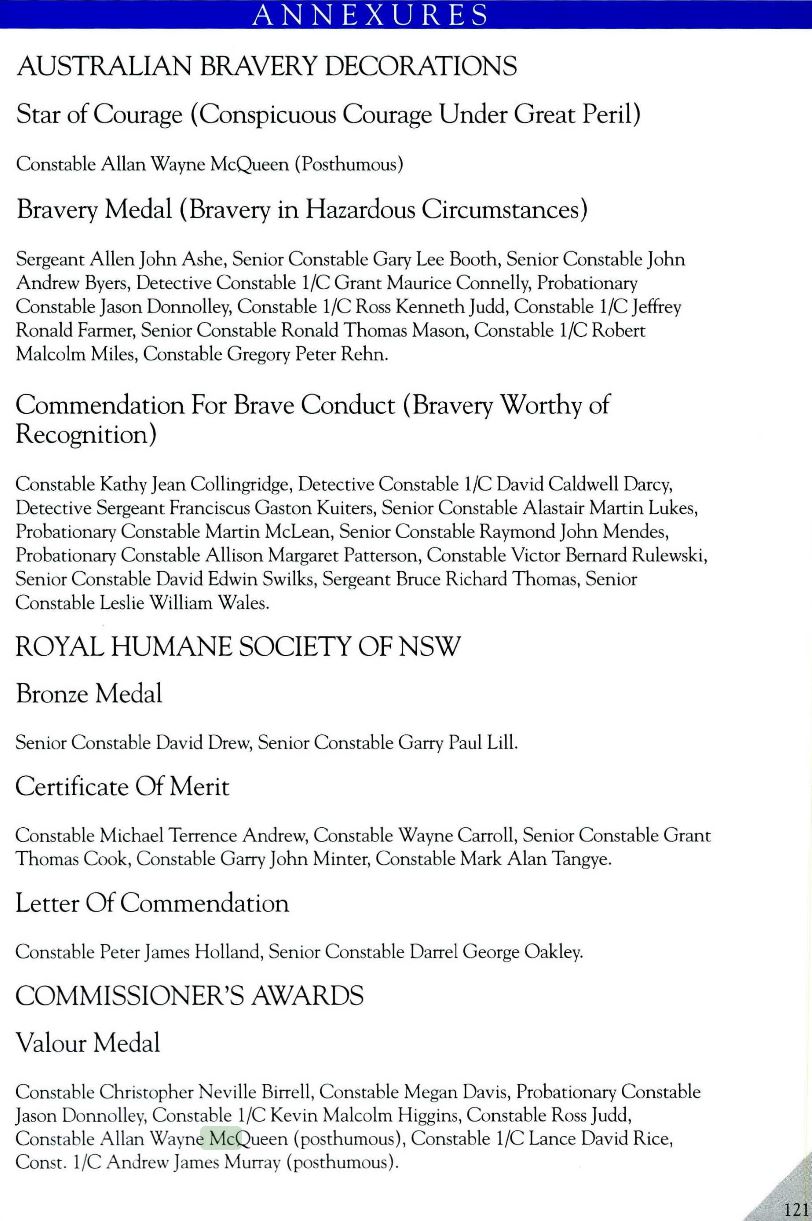
The constable was born in 1962 and joined the New South Wales Police Force on 27 June, 1987. At the time of his death he was attached to the Sydney District Anti-Theft Squad. He was posthumously awarded the Commissioner’s Medal for Valour and the Star of Courage.
Date: 24 August 1989. Memorial unveiled on corner of Haig Ave & Boomerang St, sydney.
November 2013
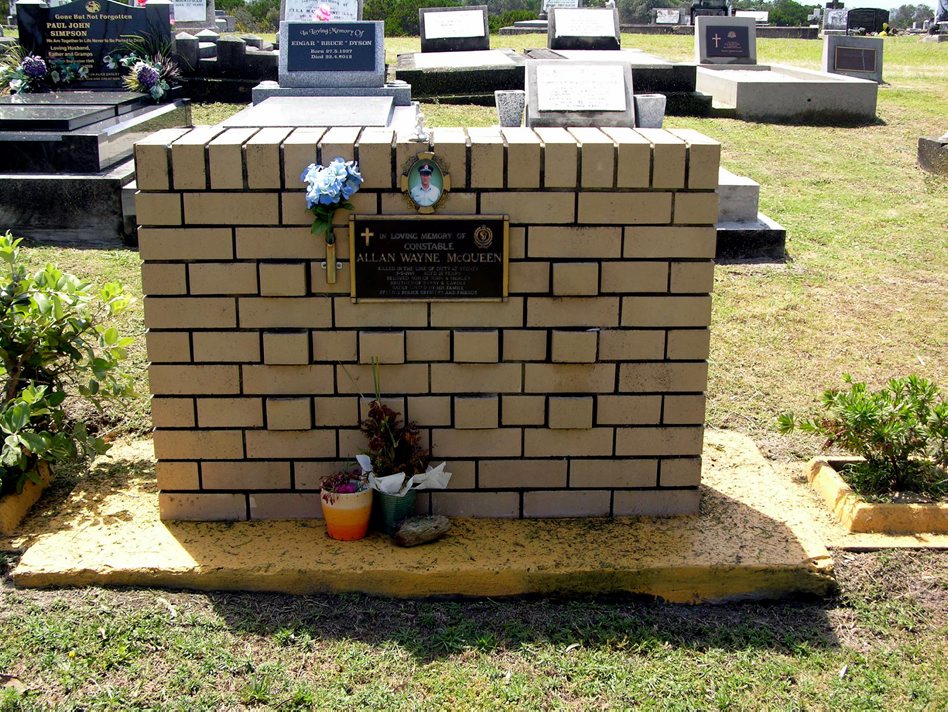
Constable Allan Wayne McQueen
Constable Allan Wayne McQueen : November 2013
Photographs supplied by Peter F Williams
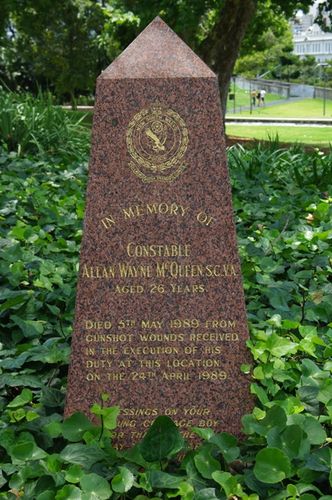
Memorial erected in memory of Constable Allan James McQueen who was shot in the line of duty and died from his injuries on the 5th May 1989.
On the morning of 24 April 1989, Constable McQueen, Constable 1st Class Ross Judd (MV, BM ), and Probationary Constable Jason Donnelly (MV, BM ) were patrolling the Woolloomooloo area. All were members of the District Anti-Theft Squad. About 11.35am they saw the offender Porter apparently attempting to break into a motor vehicle. While Constable Judd parked the Police vehicle Constables McQueen and Donnelly went to speak to the offender. As he was being detained the offender produced a concealed weapon and shot Constable McQueen twice in the chest and Constable Donnelly in the abdomen. Both Constables then chased the offender who continued firing at them until both collapsed from their wounds. Constable Ross Judd also pursued and fired at the offender before returning to assist his colleagues. He then carried both wounded Constables to the Police car and drove them to the Sydney Hospital. Constable Donnelly was to recover from his wounds however Constable McQueen had sustained extensive internal injuries and died on 5 May 1989. The offender was later arrested by Queensland Police.
Front Inscription
IN MEMORY OF
CONSTABLE
ALLAN WAYNE McQUEEN S.C.,V.A.
AGED 26 YEARS
DIED 5TH MAY 1989 FROM
GUNSHOT WOUNDS RECEIVED
IN THE EXECUTION OF HIS
DUTY AT THIS LOCATION
ON THE 24TH APRIL 1989
Location
Address:
Yurong Parkway, Phillip Park , Sydney, 2000
State:
NSW
Area:
AUS
GPS Coordinates:
Lat: -33.872583
Long: 151.213778 Note: GPS Coordinates are approximate.
By LINDSAY SIMPSON ” Chief Police Reporter As one of “Big Al’s” best mates read a moving eulogy, burly police officers, hats in hands, bowed their heads and cried. Big Al was Constable Allan Wayne McQueen, the well-mannered policeman from Kyogle who died in the line of duty, shot trying to apprehend a suspected car thief in Sydney.
Constable McQueen, who had been in the force two years, had been picked to work with the Anti-theft Squad a training ground for young officers on their way to becoming detectives. Big Al, who spent three years trying to become a police officer, was known by that name “not so much because of his height but because of his heart”, said Cheryl Coleman, whose husband had shared a house with Constable McQueen in Coffs Harbour.
As Senior Constable Steve Tedder, who gave one of the eulogies said, “Big Al had the basic love and desire to become a police officer”. In 1986, while running his own cleaning business in Coffs Harbour, he built his own house and several local police officers became his flatmates. At that stage he had five jobs and was studying at night for his HSC English in an attempt to become a police officer. About this time, before he was even in the force, he saved a man’s life. The man had quarrelled with his girlfriend outside a local night club and had head-butted a pane of glass. The glass had cut his throat and Al tore his shirt off and stemmed the flow of blood while waiting for the ambulance.
Big Al. who trained as a boxer and played Rugby League, was not always the muscle builder he was at the time he joined the force. His former Rugby League coach at Kyogle High School, Mr Stan McBride, said that in the 14-year-old competition he had been the second smallest kid in the group.
Ballina townspeople also came to the funeral service. One local, Mrs Val Studdert, said she had never met Allan McQueen but had come out of respect for what he had done. “If we don’t have law and order, we have nothing,” she said.
The pallbearers wore pistols. Perhaps that’s the way it has to be these days, but they touched the pretty white wooden church in the green countryside with vulgarity. They were big, strong young men and their bulky police uniforms made them bigger, so that when they came to the narrow church door carrying their mate’s coffin, they could barely squeeze through. In any case, the coffin seemed too narrow for a young man as big as Allan McQueen.
Nearly 300 police went to his funeral in Ballina yesterday along with his mother and father, Mr John and Mrs Shirley McQueen, and 300 family and friends. They spilled out of St Mary’s Anglican Church into a church hall, where the service was shown on video, and out of the hall on to the grass, where they listened through loudspeakers.
If we are to still violence, we must cherish life. Yesterday, 26-year-old Allan McQueen’s life was cherished. Today, others will cherish the life of 32-year-old David Gundy, the unarmed man killed in a police raid following Constable McQueen’s mortal wounding. Spring had sung in both men for only a while before life escaped them in violence. Senior Constable Graham White told the mourners that Allan McQueen had been a man of honour, love and integrity and a man whose word could be relied upon. He did not search for riches but for life itself, said Constable White. “Today he would be saying, ‘Let’s get on with it. Let’s not have all this fuss and bother’.”
Detective Senior Constable Steve Tedder said that the day McQueen received the letter of his acceptance into the force, “his face lit up as if Manhattan had lit up”.’ Constable Tedder lived with Constable McQueen in Manly and called his mate “Big Al”. “What a joy he was to live with,” he said. Constable McQueen had made more friends in 18 months in Manly than Constable Tedder had in 28 years.
Colleagues of slain policeman Allan McQueen weep as he is laid to rest in Ballina yesterday. One of his favourite expressions was: “Not a problem“. Another was: “I’m here for a good time, not a long time.” Constable Tedder said it was somehow appropriate that Allan McQueen began his long battle for life on April 24, the day before Anzac Day. That was the day Allan McQueen became a hero. Police Commissioner John Avery said Constable McQueen had exhibited the qualities of a police leader of the future. “His father said it was a waste of a fine young life, and I agree,” said the Commissioner. “His was an unforgettable example of courageous service that will enshrine his name in the annals of the history of NSW.” Mr Avery quoted Virgil: “Blessings on your young courage, boy, for that is the way to the stars.”
Outside the church, a senior policeman said: “There’s a finality to heroism.” Mr Athol McQueen, a cousin and the boxer who knocked down champion Joe Frazier in the 1964 Olympic Games, said: “I hope there are more young blokes around like him.”
” The police band played a funeral march for their colleague, past Sunnyhaven Flats. The open-faced country folk let the tears run down their cheeks. As the cortege passed a place called Camelot, on the way to the Lismore Crematorium and another place called Goonellabah, an old woman stood at the roadside and said : “Poor little fellow.” At the crematorium flowers spelled out the letters NSWP -New South Wales Police on the hillside.
A young policeman picked up a rose and handed it to a young woman. , ‘ Mr John McQueen wipes away a tear as he stands with his wife Shirley at their son’s funeral.
Probationary Constable – appointed 17 January 1986
Constable – appointed 17 January 1987
Final Rank: Constable
Service: From28 October 1985to29 April 1989 = 3+ years Service
Stations: ? ,Balmain ( 8 Division ) – death
Awards: ? nil find on It’s An Honour
Born: Monday 25 April 1960
Event date: Thursday 27 April 1989
Event location: Booth St & Jonston St, Annandale, NSW
Event type: Motor Vehicle Accident – Driver – Caged vehicle – Urgent Duty ( Passenger: Cst Andrew Mortimer )
Died: Saturday 29 April 1989
Age: 29 yrs 4 days ( 4 days into his 29th year )
Funeral date: ?
Funeral location: Woronora Cemetery, Sutherland
Buried at: Cremated;
Ashes – Wall of Memories, Panel 30, GG, 0256
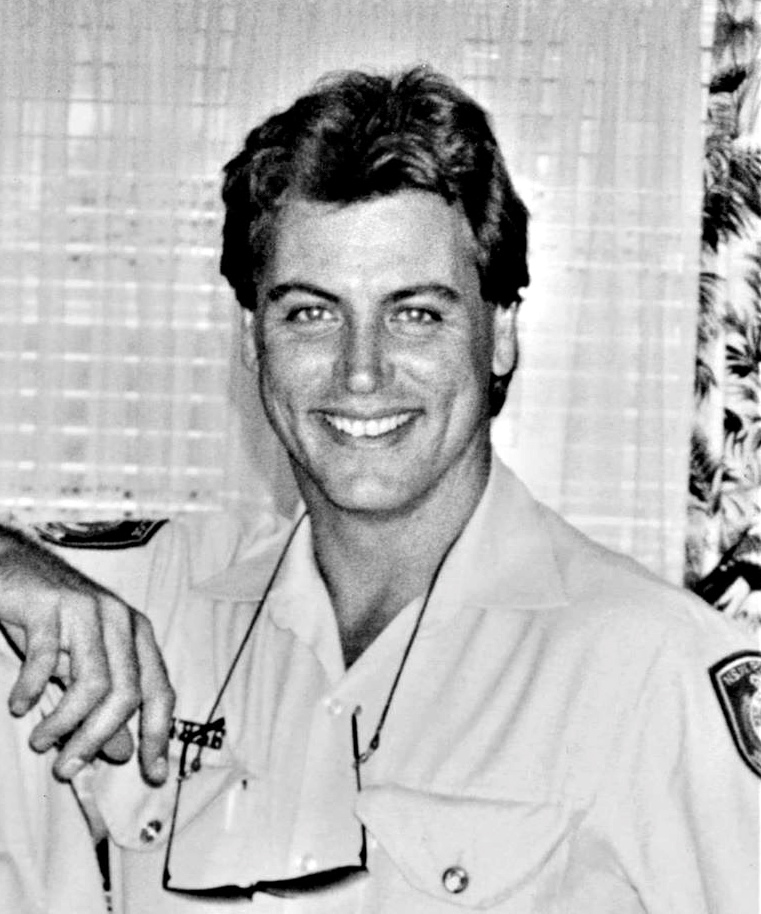
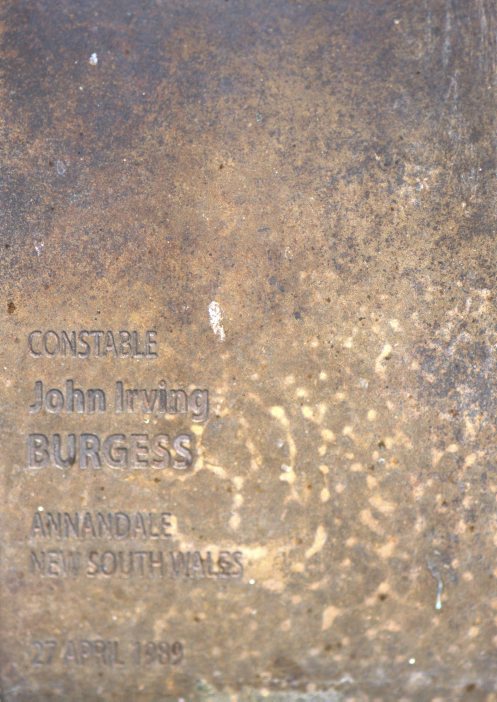
John Irving BURGESS
Constable John Irving BURGESS – Touch plate at National Police Wall of Remembrance, Canberra.
JOHN IS mentioned on the National Police Wall of Remembrance but the DATE is INCORRECT
Should read 29 April 1989
About 2.25am on 27 April, 1989 Constable Burgess was driving a caged police vehicle in Booth Street, Annandale. Constable Andrew Mortimer was observer in the vehicle and they were responding to an urgent call for assistance from Gaming Squad police. At the intersection of Johnston Street, the police vehicle collided with a semi trailer and deflected onto a power pole. As a result of the accident Constable Andrew Mortimer suffered fractures to his ribs and jaw, and Constable Burgess suffered severe head and internal injuries. Constable Burgess died two days later ( on the 29 April ) at the Royal Prince Alfred Hospital when life support systems were turned off.
The constable was born in 1960 and joined the New South Wales Police Force on 28 October, 1985. At the time of his death he was stationed at Balmain.
The Canberra Times
Monday 1 May 1989 page 3 of 36
Policeman dies
SYDNEY: A policeman who received severe injuries in a collision involving a police paddy wagon last Thursday died late on Saturday.
Constable John Burgess, 29, received head and chest injuries in the accident between the paddy wagon and a refrigeration truck at Annandale in Sydney’s inner-west, shortly before 2am.
Yesterday I attended Balmain Town Hall for the 30-year memorial service of the tragic death of Constable John Burgess on the 27 April 1989 whom died whilst on duty responding to an urgent call for assistance from Gaming Squad Police.
At the intersection of Johnston Street, Annandale the police vehicle he was driving collided with a semi-trailer and deflected onto a power pole. As a result of the accident Constable Andrew Mortimer suffered fractures to his ribs and jaw, and Constable Burgess suffered severe head and internal injuries. Constable Burgess died about twelve hours later at the Royal Prince Alfred Hospital.
John was one of life’s true gentlemen and one of the nicest blokes I ever had the privilege of knowing. He was an excellent Police Officer, compassionate, empathetic and always willing to help. I’m proud to have called him a mate.
It’s been a while since I’ve seen my old 8 Division buddies and whilst under sad circumstances it was great to see Paul Winfield, Don Stuart, Sean Hampstead and Ron Page and share a few laughs about our time working together in the late ‘80’s.
It was also great to see Deputy Commissioner Dave Hudson, a friend who gave a very moving and emotional speech about his friendship with John and how missed he is. It was refreshing to hear such a senior officer in the NSW Police share such personal reflections about a fellow officer.
It was a tragic time for Policing back then as a week earlier we also lost Constable Alan McQueen fatally shot whilst on duty. We have lost many other Officers before and after that time confirming how dangerous a job it is.
Whilst I was only in the Police from ‘85-‘90 I still feel a part of the thin blue line brotherhood and yesterday confirmed how friendships forged 30 years ago endure the test of time.
RIP John Burgess. ❤️
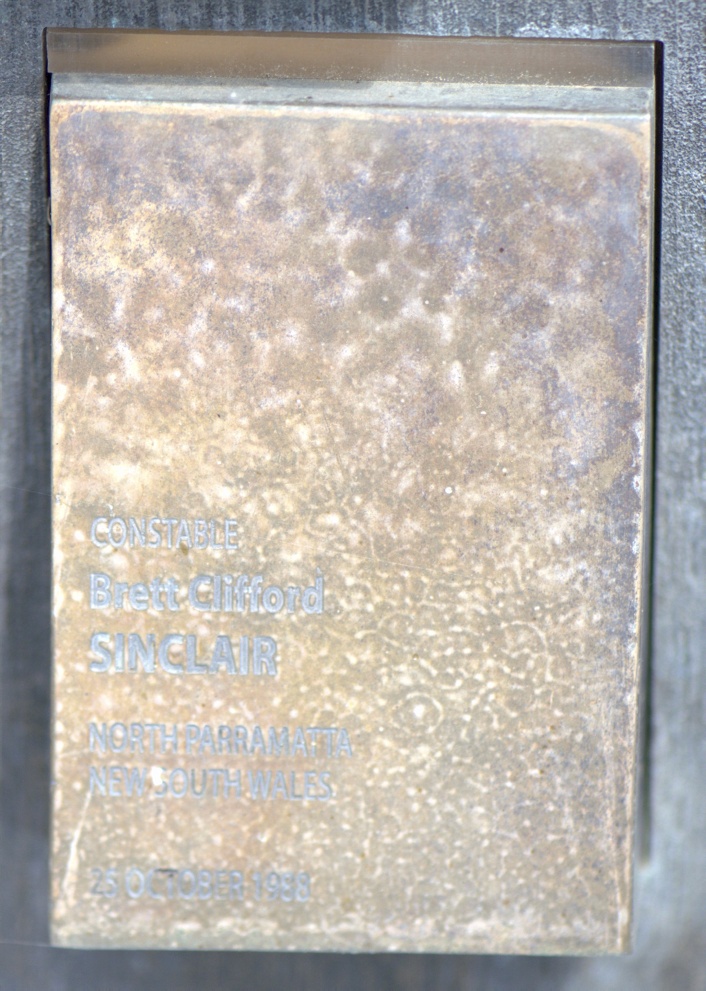
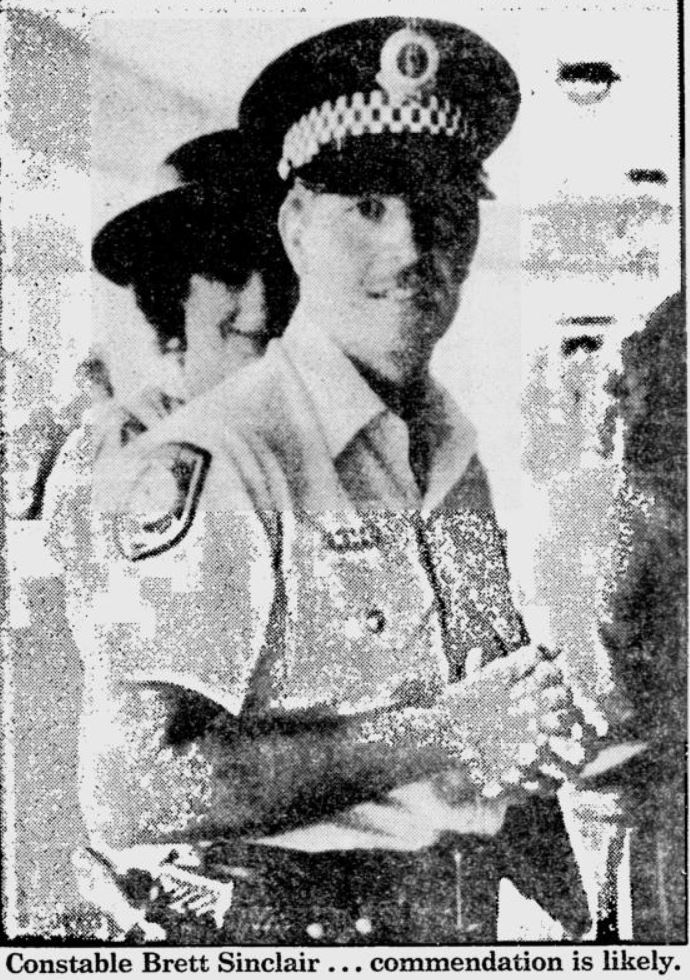
Brett Clifford SINCLAIR
| 27/10/2012
Brett Clifford SINCLAIR – V.A.
( late of Eastwood )
New South Wales Police Force
[alert_yellow]Regd. # 21771[/alert_yellow]
Rank: Constable
Stations: ?, Parramatta HWP
Service: From 8 December 1984to 25 October 1988 = 3+ years Service
Awards: Commissioner’s Valour Award for Bravery and Devotion to Duty
Born: 12 March 1959
Died on: Tuesday 25 October 1988
Cause: Murdered – by motor vehicle
Event location: Jeffrey Ave, Nth Parramatta
Age: 29
Funeral date: Friday 28 October 1988 @ 11am
Funeral location: St Anne’s Anglican Church. Church Street, Ryde.
Buried at: Cremated
Memorial at: National Police Wall of Remembrance, Canberra &
Parramatta Police Station, NSW.
[alert_green]BRETTIS mentioned on the Police Wall of Remembrance[/alert_green]
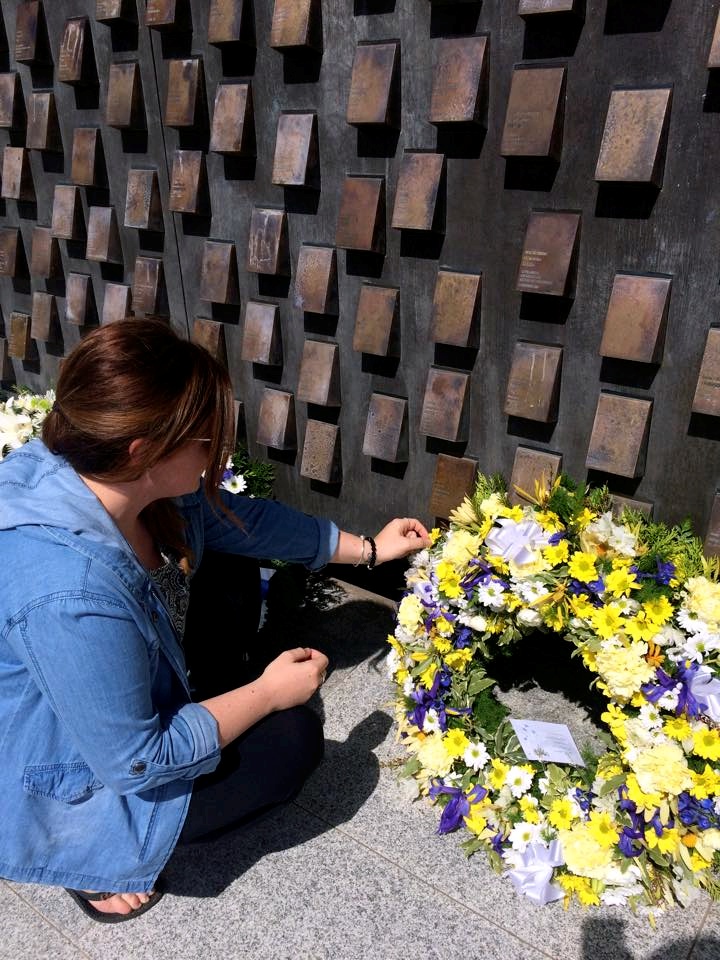
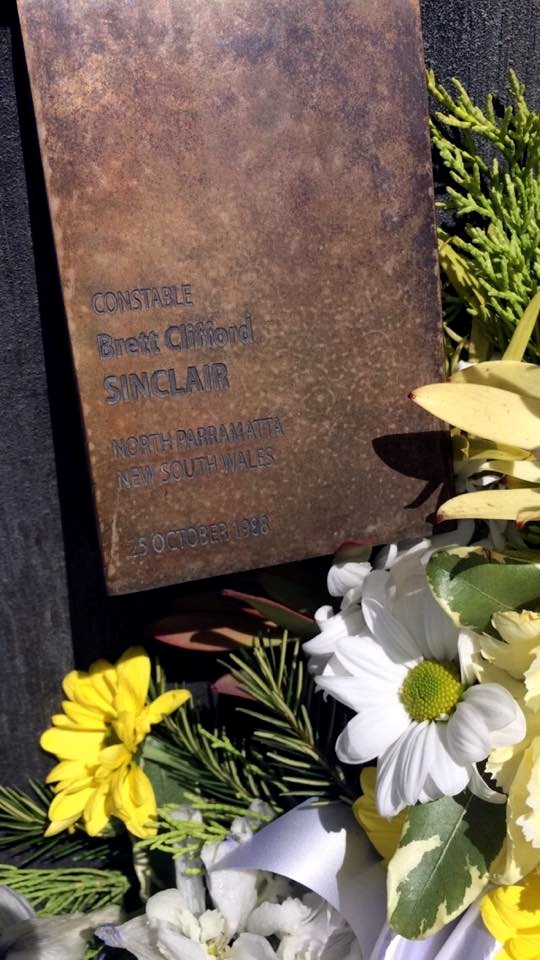
BRETT CLIFFORD SINCLAIR Touch plate at the National Police Wall of Remembrance, Canberra
[divider_dotted]
FURTHER INFORMATION IS NEEDED ABOUT THIS PERSON, THEIR LIFE, THEIR CAREER AND THEIR DEATH.
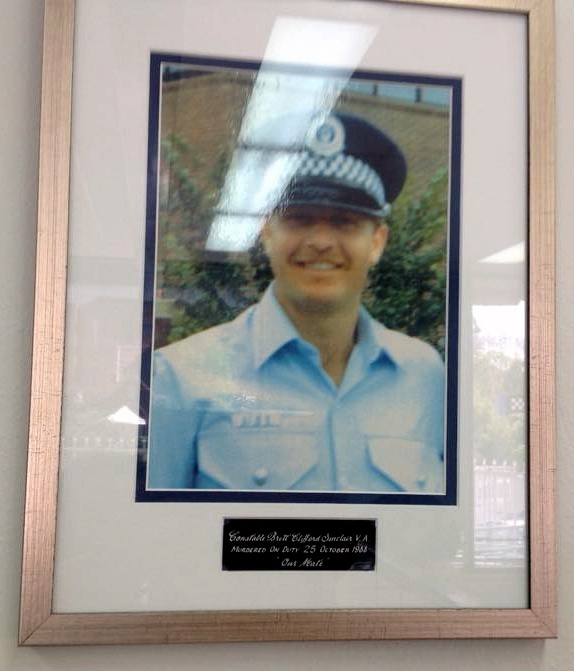
Hanging at Parramatta Police stn. Constable Brett Clifford Sinclair V.A. Murdered On Duty 25 October 1988. ” Our Mate “
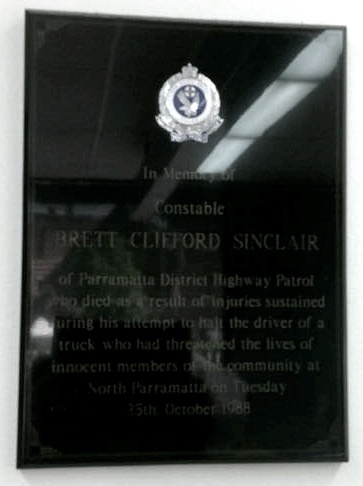
PARRAMATTA POLICE STN In Memory of Constable Brett Clifford Sinclair of Parramatta District Highway Patrol who died as a result of injuries sustained during his attempt to halt the driver of a truck who had threatened the lives of innocent members of the community at North Parramatta, Tuesday 25th October 1988.
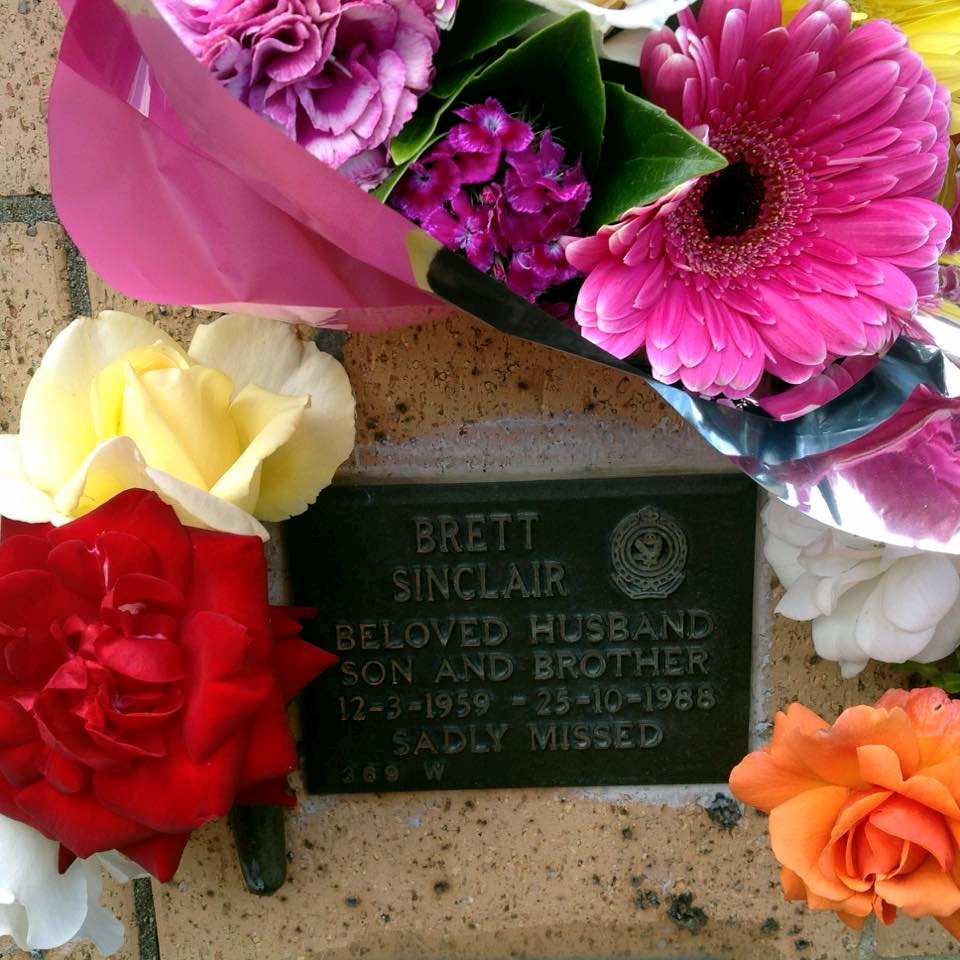
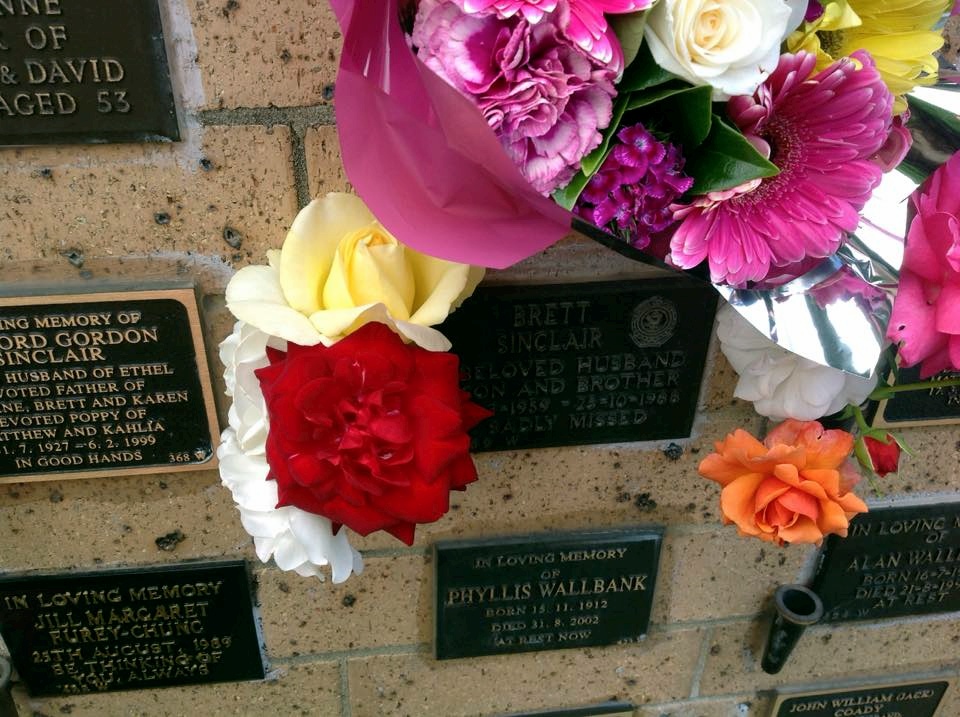
BRETT SINCLAIR BELOVED HUSBAND, SON AND BROTHER. 12-3-1959 – 25-10-1988 SADLY MISSED
National Police Wall of Remembrance Family – paying respect on Brett’s death anniversary – 2015
[divider_dotted]
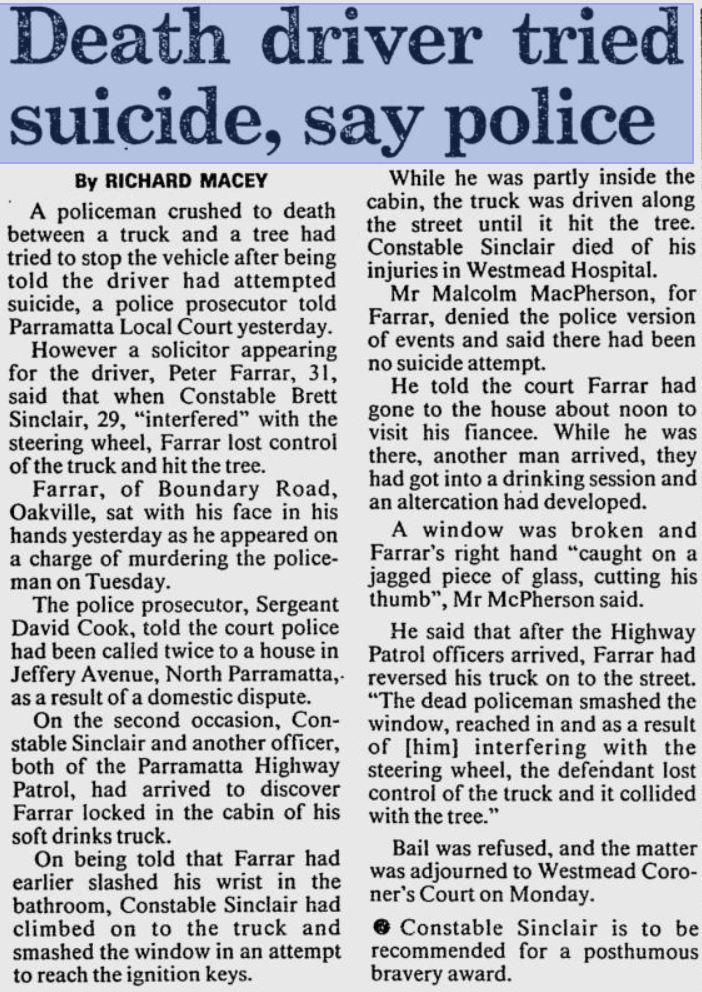
About 5.50pm on 25 October, 1988 Constable Sinclair suffered severe head and internal injuries at North Parramatta whilst attempting to arrest an offender following a domestic dispute. Earlier, police had been called to assist ambulance officers at the disturbance in Jeffrey Avenue. The offender, who was bleeding from the arm, had locked himself in his truck. While Constable Sinclair and Constable Cummins spoke with him, he continually threatened them while revving up his truck engine. As the police approached the offender wound up his window. The police then smashed the window and attempted to remove the driver from the cabin of the truck. With both police standing on the step of the truck, the offender began to drive along Jeffrey Avenue.
Constable Cummins was able to get off the step, but due to his falling to the roadway, was unable to assist his colleague.
The truck’s speed increased with Constable Sinclair still partially inside, and partially outside, the cabin. The offender then drove across the roadway where the vehicle collided with a tree, crushing the constable.
He was conveyed to the Westmead Hospital where he died a short time later. Constable Sinclair was awarded the Commissioner’s Valour Award for Bravery and Devotion to Duty.
The constable was born in 1959 and joined the New South Wales Police Force on 8 December, 1984. At the time of his death he was attached to the Parramatta Highway Patrol.
[divider_dotted]
Pre Police, Brett worked for QANTAS
[divider_dotted]
The Sydney Morning Herald 27 October 1988 p36
The relatives and friends of the late BRETT CLIFFORD SINCLAIR (Cons NSW Police Force), of Eastwood, are invited to attend his funeral, tomorrow (Friday), to leave St Anne’s Anglican Church. Church Street. Ryde., 11am.
At the conclusion of the service the funeral will leave for the Northern Suburbs Crematorium.
Crimes Amendment (Murder of Police Officers) Bill 2007
Extract from NSW Legislative Council Hansard and Papers Thursday 10 May 2007.
Second Reading
The Hon. MICHAEL GALLACHER
(Leader of the Opposition)
[4.30 p.m.]: I move:
That this bill be now read a second time.
I am honoured to introduce this bill on behalf of the Opposition, all New South Wales police officers and their families. The bill amends the Crimes Act 1900 to provide that compulsory life sentences are to be imposed by courts on persons convicted of murdering police officers. A compulsory life sentence is to be imposed if the murder was committed while the police officer was executing his or her duties or as a consequence of, or in retaliation for, actions undertaken by any police officer. This bill is one of the most important pieces of legislation that I have spoken on in my time in Parliament.
In recent weeks the deaths of police officers have been receiving publicity for all of the wrong reasons. The tragic suicides of our young officers, the attempted suicide of even the more senior and the very public breakdown of another young officer are a reminder to all of us of just how tough it is to be a police officer in 2007. Last year, along with the police commissioner, the then Minister for Police and many police, former police and their families, I attended the eighteenth annual National Police Remembrance Day memorial service and laying of wreaths at the Wall of Remembrance in the Domain next to the Art Gallery. The Wall of Remembrance marks the sacrifice of all police officers in the execution of their duties, and in particular the 248 officers whose names have been added to the New South Wales Police honour roll. On the night of Police Remembrance Day, as a mark of respect, Sydney Opera House was bathed in a blue light.
For members who are not aware, National Police Remembrance Day is held on 29 September, which is St Michael’s Day. St Michael is the patron saint of police and archangel to protect and defend people. Last September’s commemoration was even more significant with the official opening of the National Police Memorial by the Prime Minister in Canberra. The memorial is to all police officers throughout Australia who have served our community and have lost their lives in the execution of that service. The ceremony was tinged with sadness. Just the day before Police Remembrance Day, Sergeant Colin McKenzie, a highway patrol officer based at Ballina, became ill during rehearsals for the Canberra service and subsequently passed away. He was yet another officer to die while undertaking his duty.
As honourable members would be aware, I joined the New South Wales Police Force in 1980. It is a sad fact that since then the names of 73 New South Wales police officers have been added to the New South Wales Police honour roll. The honour roll commemorates those members of the New South Wales Police who have paid the ultimate sacrifice in the execution of their duty. These officers gave their life to protect us. This bill acknowledges that police play a unique role in protecting the community. As the law currently stands, there is not a sufficient deterrent to attacking and murdering a police officer in New South Wales. Police put their lives on the line every time they walk or drive into a situation that they do not have control of and in which they seek to gain control and effect the arrest of an offender or offenders.
Since 1995 at least 18 police officers have died as a result of duty-related incidents. These include five who were murdered in the course of carrying out their duty. Another four police officers are assaulted every day. It is unacceptable that people involved in some of these murders are now enjoying freedom. That should change and this bill seeks to effect that change. There can be no clearer justification for this legislation than the fact that since 1980, 11 officers have lost their lives as a result of the actions of offenders who have attacked police executing their duty to protect the community. They are Sergeant Keith Haydon, shot by an offender on 24 November 1980; Constable Pashalis Katsivelas, shot by an escaping prisoner on 4 April 1984, from recollection at Concord Hospital; Sergeant Paul Quinn, shot by an offender following a pursuit on 30 March 1986; Constable Brett Sinclair, from in juries sustained whilst affecting an arrest on 25 October 1988; Constable Allan McQueen, shot whilst affecting an arrest of a fellow attempting to break into a motor vehicle only a few hundred metres from where we are now on 5 May 1989; on 9 July 1995, two officers, Senior Constable Peter Addison and Senior Constable Robert Spears, shot by an offender at Crescent Head as they got out of their vehicle to enter a home; Constable David Carty, stabbed during an affray in Wester n Sydney on 18 April 1997; Constable Peter Forsyth, stabbed whilst affecting an arrest on 28 February 1998; Senior Constable James Affleck, struck by a motor vehicle whilst deploying road spikes to stop a stolen car on 14 January 2001; and Constable Glenn McEnallay, shot by an offender at Matraville following a pursuit on 3 Apr 2002.
Honourable members should be aware that in response to this bill, which was introduced into the other place by the New South Wales Liberal leader in May last year, the New South Wales Police Association issued a circular to their members throughout New South Wales, which stated:
Members are advised that, following discussions last evening with the State Opposition, your Association has determined to support the Bill which proposes mandatory life sentences for anyone convicted of murdering a police officer.
In light of the recent decisions relating to the murders of David Carty and Glen McEnallay it is apparent that there is strong community support for police and for the introduction of measures which would deter offenders from assaulting and killing members.
Delegates elected to attend your Association’s Biennial Conference commencing on 21 May will be asked to endorse a campaign for 3,000 additional police and to strengthen laws aimed a protecting members. In the interim members are asked to contact their local member of state parliament and express their support for this legislation.
It is only by hearing first hand the concerns of constituents that politicians will be motivated to act. The circular was signed by Bob Pritchard, President of the New South Wales Police Association. I have no doubt that some member s will argue that police should not be given special consideration. The simple fact is that police have a legislated duty to go to the assistance of community members who are in need or to confront offenders, whether they are on duty or not. Twenty-four hours a day, whether they are wearing the uniform or not, they have a legislated duty to act.
Coming to the assistance of the community at any time, whether they are on or off duty, is not something that they have a choice about. This House needs to acknowledge that being a police officer brings with it a different set of dangers than any other occupations or professions.
As I mentioned earlier, Senior Constable Jim Affleckwas run down when he tried to stop an offender’s car during a high-speed pursuit in south-western Sydney. He was attempting to deploy road spikes designed to deflate the tyres of speeding vehicles and bring them to a stop. The offender who ran down Senior Constable Affleck received only a minimum sentence of 12 years. Today is an opportunity for all honourable members to vote in support of our police. This bill inserts a new section into the Crimes Act 1900 after section 19A. It reads:
19B Compulsory life sentences for murder of police officers
1) A court is to impose a sentence of imprisonment for life on a person who is convicted of murder of a police officer if the murder was committed:
(a) While in the execution of the police officer’s duty, or
(b) As a consequence of, or in retaliation for, actions undertaken by that or any other police officer in the execution of the officer’s duty.
2) A person sentenced to imprisonment for life under this section is to serve the sentence for the term of the person’s natural life.
3) This section applies to a person who is convicted of murder of a police officer only if the person was of or above the age of 18 years at the time the murder was committed.
4) If this section requires a person to be sentenced to imprisonment for life, nothing in section 21 (of any other provision) of the Crimes (Sentencing Procedure) Act 1999 or in any other Act or law authorises a court to impose a lesser or alternative sentence.
5) Nothing in this section affects the prerogative of mercy.
The concept of protecting police has support on both sides of the Chamber. In April 2002, just after Glenn McEnallay was murder ed, then Premier Carr said:
I want those who murder police officers to go to jail forever. I want those who murder police officers to go to the dingiest, darkest cell that exists in a prison system …
In May last year one of those involved in Glenn’s murder had his conviction for murder quashed. A few short days later, his parents spoke out in favour of this bill when it was introduced into the other place. Bob McEnallay said:
They support us in our time of need but when some thing goes wrong there’s no one there to support them.
Bob and his wife, Judy, were joined by the father of David Carty in support of this bill. Member s would remember the tragic murder of Constable David Carty, who was stabbed to death after being brutally assaulted in the car park of the Cambridge Tavern at Fairfield in April 1997.
These parents know that this bill will not bring their sons back. And, unfortunately, it will not keep their killers in jail. But it will keep future killers of police where they belong: behind bars—as the former Premier said, in the dingiest, darkest cell forever.
The quashing of the conviction of the driver of the car that carried the killer of Constable McEnallay highlights the important issue of joint criminal enterprise and whether people were jointly involved in an act of murder. The community and the Opposition—and certainly Glenn McEnallay’s parents—believe the driver of the car involved was implicated in the murder and should have stayed in jail for the murder of Glenn. The cases of those involved in the murders of David Carty and Glenn McEnallay highlight the soft stance taken in New South Wales against people who murder police officers. This bill is another step in providing a higher level of protection for police.
In 1997 former Attorney General Jeff Shaw spoke on the Crimes Amendment (Assault of Police Officers) Bill, saying:
The bill is predicated upon a belief that police officers are rightfully owed a measure of protection by the community. That is so for at least two reasons.
First, police officers place themselves in positions of risk on behalf of the community. Second, an attack on a law enforcement officer strikes at the core of our system of democratic government. Those who seek to harm the persons responsible for the enforcement of laws passed by our Parliament should be subject to special punishment.
That principle is already recognised in the Crimes Act. Section 58 of that Act imposes a higher maximum gaol penalty for the offence of common assault of a police officer than is imposed for the same offence against a civilian. Indeed, the relative maximum penalties are five years and two years respectively. Surprisingly, and anomalously, the principle is not carried through by the Crimes Act to apply to more serious assaults that in fact inflict injury.
In June 2002 the then Leader of the Opposition in the other place introduced a similar private member’s bill to this bill. At that time John Brogden wrote to the Premier foreshadowing the bill, and sought bipartisan support for it. When introducing the bill he said:
… this bill will require that anybody who murders a police officer acting in the line of duty will go to gaol for life. We believe that, because of the nature of the job, police officers in New South Wales should be afforded extra protection under the law when they are on duty.
When police officers are in uniform on duty or have recalled them selves to duty they put themselves forward when others step back. They put themselves in danger and do so to protect you, and me and the citizens of the State.
The law should recognise that to murder a police officer is one of the most serious crimes in the State.
In response the Parliamentary Secretary for Police, who led for the Government, said:
The Government wants people who murder police officers to rot in prison; we have never resiled from that position. Today Government members have the opportunity to stand by this commitment and that of former Premier Carr, who, I remind members, said:
I want those who murder police officers to go to gaol forever. I want those who murder police officers to go to the dingiest, darkest cell that exists in a prison system …
They have the opportunity to stand by the commitment of the Premier, who said on 11 May:
We want these people to rot in jail. Government members have the opportunity to vote for this legislation, which will mean that those who murder police officers will rot in prison. In conclusion, my experiences during more than 16 years of service shaped my belief that those who murder police officers should spend the rest of their natural lives behind bars. I do not anticipate that the use of this legislation will be required all that often—in fact, I hope that it is never needed. But it should be on the statute book to deter those who would consider, even for a second, acting to murder our police.
I ask all members to carefully consider this bill and vote to support our police officers, and indeed their families, who every day they go to work kiss their loved ones good-bye knowing the dangers that confront them.
A series of gunshots fired at close range killed 26-year-old police officer Glenn McEnallay in his highway patrol car after he responded to a report of a stolen car in Matraville in March 2002.The man who pulled the trigger, Sione Penisini, was sentenced to 36 years in prison, but his accomplices escaped with much shorter sentences after they pleaded guilty to manslaughter. A public outcry followed and the murdered officer’s father, Bob McEnallay, described the seven-year jail term handed to one of them as “an absolute bloody joke”.
But this week he made it clear he does not believe his son’s life was worth more than that of any other citizen. He says the state government’s plan to introduce mandatory life sentencing for people who murder police is unfair to other victims of serious crime. Bob McEnallay says the life of his surviving son, Troy, not a police officer, should not be valued less than that of Glenn. He believes there should be a minimum sentence for murder, regardless of who the victim is.
“I wouldn’t like to think my son’s case would attract more attention from the courts than some other citizen,” he says. “I know the [government’s] intentions are good, but I would rather see a system where the maximum possible sentences for murder are issued for any citizen who is murdered.”
The NSW Attorney-General, Greg Smith, says the bill to be introduced in Parliament this week was developed in response to the murder of police officers David Carty in 1997 and Glenn McEnallay. His office confirms the new law will not apply to accessories to murder, such as the Taufahema brothers who were involved in the McEnallay killing. The new law will mean only the murderer would serve the term of his natural life in prison.
The Premier, Barry O’Farrell, says the Coalition has been committed to the policy since 2002 and will “ensure that those who murder police officers spend their lives behind bars”.
But in 2010, Mr Smith denounced those who called for mandatory sentencing as “rednecks”, who were indulging in a “law and order auction”. He now says police killings are an exception. “The murder of a police officer is a direct attack on our community and warrants exceptional punishment,” he says. “It sends a serious message of support to our police, but I hope it is never used.”
Mr Smith prosecuted two trials in relation to the murder of Carty and he conducted the committal hearing. “I gave my blood, sweat and tears to that case in honour of that policeman. I then appeared in the appeals to the Court of Criminal Appeal and the High Court, both of which were dismissed,” he says.
Mr McEnallay says he can appreciate the support of John Carty, David’s father, for the new law, but does not agree that police officers should be treated differently. “I am very pro-police,” McEnallay says. “But I just hope some good legislation comes out of this for everybody.”
Mary Cusumano, whose husband Angelo was shot dead in his Penshurst computer store 15 years ago, leaving her to raise four children on her own, says she is angry with the new law. This week she learnt her husband’s murderer is up for parole.
“It just infuriates me,” she says. “My husband was a wonderful human being and he served his community. It is as if the government is saying his life is worth less than somebody else’s.
“With all due respect to the police, they make a choice to enter that career, with all the risks it involves. They are armed, my husband wasn’t. My husband never thought he would go to work and that a person would put a rifle to his head.”
Martha Jabour, who represents the Homicide Victims Support Group, says the new law will divide families. “If the government is thinking of making it mandatory life, why not mandatory life for every life. I cannot say that one occupation is far more worthy than the life of a nurse or a vulnerable child.
“If my son was murdered I would want his murderer to get life, but my son isn’t a police officer.”
The vice-president of the Victims of Crime Assistance League, Howard Brown, says ambulance and other emergency service personnel will not be treated equally under the new law. “It is a dangerous piece of legislation because it has not been well thought out,” he says. “We are told by the judiciary and by politicians that everyone is treated equally before the law. But for some reason they have decided to place police above everyone else, including judges.”
Mark Findlay, a professor of criminal justice at the University of Sydney, says it is “a pity that the new government’s legislative agenda for criminal justice should be opening with what is largely something for appearances”.
“The murder of a police officer should be condemned. But if the families of police officers are meant to be comforted by this proposal it would only be at the level of retribution,” he says. “There is no convincing evidence that mandatory life sentences have any significant deterrent effect on those who kill police officers in the circumstances in which such murders take place.”
The Greens MP David Shoebridge says mandatory life sentencing has not worked in other countries and does not produce a reduction in crime. The US Sentencing Commission delivered a report to Congress nearly 20 years ago denouncing mandatory minimum sentences. In its 1991 report, it said mandatory sentencing failed to improve public safety or deter crime.
Nicholas Cowdery, who retired last month as the head of the Department of Public Prosecutions, was involved in the prosecution of McEnallay’s killers. He says the new law “appears to be a purely political exercise to in some way satisfy an obligation to the NSW Police Association.
“I say that because there is no present criminal justice need for this legislation. There are no miscarriages of justice or anomalies that have occurred in the past that justify departure from the existing law. The present law is well capable of imposing a suitably severe penalty on a person who murders a police officer or a person in other categories of employment which have an increase in risk of harm attached to them.”
The existing law allows judges to impose a sentence of natural life for murder, and about 50 people are serving that sentence.
Death on duty
NSW police killed since 1980
1980 Sergeant Keith Haydon, shot at Mount Sugarloaf.
1984 Constable Pashalis Katsivelas, shot by an escaping prisoner at Concord.
1986 Sergeant Paul Quinn, shot during a pursuit at Perthville.
1988 Constable Brett Sinclair, died from injuries while making an arrest in North Parramatta.
1989 Constable Allan McQueen, shot while making an arrest in Woolloomooloo.
1995 Senior Constables Peter Addison and Robert Spears, shot at Crescent Head.
1997 Constable David Carty, stabbed outside a Fairfield hotel.
1998 Constable Peter Forsyth, stabbed while making an arrest in Ultimo.
2001 Senior Constable James Affleck, deliberately run over as he set up road spikes to stop a stolen car in Campbelltown.
2002 Constable Glenn McEnallay, shot at Matraville after a pursuit.
The object of the Crimes Amendment (Murder of Police Officers) Bill is to amend the Crimes Act 1900 to provide that compulsory life sentences are to be imposed by a court on persons convicted of murdering police officers. A compulsory life sentence is to be imposed if the murder was committed while the police officer was executing his or her duties or as a consequence of, or in retaliation for, actions undertaken by any police officer.
COMMENTS:
The tragic suicides of young officers, the attempted suicide of a senior officer and the recent very public breakdown of another young officer are reminders to us all of how tough it is to be a police officer in 2007. Every day police officers kiss their loved ones goodbye and go to work, knowing the dangers that may confront them. Supporters of the bill argue that those convicted of murdering police officers do not deserve another chance to be free members of society. Murdered police officers do not have another chance at life and their killers should not have another chance at freedom. I would also mention, however, that it is grieving families, aside from those convicted and those who are murdered, who endure the pains of such actions.
Since 1995 at least 18 police officers have died as a result of duty-related incidents. These include five who were murdered in the course of carrying out their duty. Another four police officers are assaulted every single day, as a previous speaker has mentioned. It is unacceptable that people involved in some of these murders are now enjoying their freedom. That should change and this bill seeks to effect that change. There can be no clearer justification for this legislation than the fact that, since 1980, 11 officers have lost their lives as a result of the actions of offenders who have attacked police executing their duty to protect the community.
They are Sergeant Keith Haydon, shot by an offender on 24 November 1980; Constable Pashalis Katsivelas, shot by an escaping prisoner on 4 April 1984, from recollection, at Concord Hospital—a probationary constable, I am reminded; Sergeant Paul Quinn, shot by an offender following a pursuit on 30 March 1986; Constable Brett Sinclair, from injuries sustained whilst effecting an arrest on 25 October 1988; Constable Allan McQueen, shot whilst effecting an arrest of a man breaking into a motor vehicle only a few hundred metres from where we are now sitting on 5 May 1989; Senior Constable Peter Addison and Senior Constable Robert Spears, shot by an offender at Crescent Head as they got out of their vehicle to enter a home on 9 July 1995; Constable David Carty, stabbed during an affray in Western Sydney on 18 April 1997; Constable Peter Forsyth, stabbed whilst effecting an arrest on 28 February 1998; Senior Constable James Affleck, struck by a motor vehicle whilst deploying road spikes to stop a stolen car on 14 January 2001; and Constable Glenn McEnallay, shot by an offender at Matraville following a pursuit on 3 April 2002.
In the light of recent decisions relating to the murders of David Carty and Glen McEnallay it is apparent that there is strong community support for police and for the introduction of measures to deter offenders from assaulting and killing members. The bill is predicated upon a belief that police officers are rightfully owed a measure of protection by the community. This so for at least two reasons. First, police officers place themselves in positions of risk on behalf of the community. Second, an attack on a law enforcement officers strikes at the very core of our system of democratic government. Those who seek to harm the persons responsible for the enforcement of laws passed by our Parliament should be subject to special punishment.
That principle is already recognised in the Crimes Act. Section 58 of that Act imposes a higher maximum jail penalty for the offence of common assault of a police officer than is imposed for the same offence against an ordinary civilian. Indeed, the relative maximum penalties are five years and two years respectively. Surprisingly, and anomalously, the principle is not carried through by the Crimes Act to apply to more serious assaults that in fact inflict injury or permanent damage to officers. When police officers are in uniform on duty or have recalled themselves to duty they put themselves forward when others step back. They put themselves in danger and do so to protect you and me and citizens of the State. The law should recognise that to murder a police officer is a serious crime in this State. The Parliamentary Secretary for Police, who led for the Government, said:
The Government wants people who murder police officers to rot in prison; we have never resiled from that position.
Today Government members have the opportunity to stand by this commitment and that of former Premier Carr. He said:
I want those who murder police officers to go to gaol forever. I want those who murder police officers to go to the dingiest, darkest cell that exists in a prison system …
Government members have the opportunity to vote for this legislation, which will mean that those who murder police officers will rot in prison. There are certainly some contentious provisions that merit further examination. However, there are two aspects of this bill that do concern me. The first is: Is there any evidence that the likelihood of a compulsory life sentence would have any deterrent effect? I ask whether a compulsory life sentence can achieve reduced recidivism and increased rehabilitation in our society. Can a compulsory life sentence stop future acts of violence? Is the life of a police officer more valuable than the life of anyone else, such as a doctor treating a patient, teachers or others in the community?
If honourable members consider any aspect of my speech today I ask them to reflect on this one point: I remind them that the stark account of prison life presents powerful challenges in our liberal democracy. During my whole life, from the time I was a parole and probation officer as a young man through to all my years at Wesley Mission, I have visited numerous prisons around the country. In fact, at different times I have been detained in her Majesty’s finest. Most of them are characterised by routine, regulation, boredom and depression associated with serving a long-term sentence. They are also characterised by claustrophobia, noise, chaos and the real risk of being compelled to inhabit a very violent world, including not only other prisoners but also others who enter the prison. Inmates that I have talked to over the years inevitably possess low intelligence quotients or have suffered brain damage, frequently from extensive alcoholism, and mental illness. Critical criminologists and sociologists have long since documented the squalor and brutality associated with incarceration. Even in today’s society, public complacency generally surrounds the plight of the incarcerated.
The growing fear of crime, fuelled at least partially by the media, and the frustration with the seeming lack of positive results of rehabilitation provide public support for hardened policies. This trend has become amplified by the rhetoric of politicians who have found that being tough on crime is an unbeatable popular issue.
CONCLUSION:
However, with all of that said, with the limitations of our current prison system and acknowledging the absolute futility of long-term incarceration of individuals, there is no question in my mind that the Crimes Amendment (Murder of Police Officers) Bill is needed. I commend the bill to the House.
Rank: Probationary Constable – appointed 2 April 1979 ( aged 20 years, 5 months, 1 day )
Constable 1st Class – appointed 29 August 1984
Final Rank = Constable 1st Class
Stations: ?, Sydney Inner City Cycles, St Ives Driver Training, Warilla HWP – Death
Service: From? ? pre April 1979? to24 August 1988= 9+years Service
Awards: No find on It’s An Honour
Born: Saturday 1 November 1958
Died on: Wednesday 24 August 1988 about 8.40pm
Age: 29 years, 9 months & 23 days
Cause: Motor Vehicle Collision – Police Bike – Rider
Event location: Five Islands Rd, Cringila just south of the right sweeping bend ( southbound ) from Springhill Rd and just prior to Cringila Railway Stn
Event date: Wednesday 24 August 1988
Funeral date: ? ? ?
Funeral location: ?, Berkeley
Wake location: ?
Funeral Parlour: ?
Buried at: Cremated
Memorial located at: ?
CARTSIS mentioned on the Police Wall of Remembrance
FURTHER INFORMATION IS NEEDED ABOUT THIS PERSON, THEIR LIFE, THEIR CAREER AND THEIR DEATH.
About 8.40pm on 24 August, 1988 Constable Carter and Constable Eric Renes were riding police motor cycles in Five Islands Road, Cringila in pursuit of a motor vehicle. As the cycles travelled around a sweeping right hand bend Constable Carter‘s cycle became unstable and despite his best efforts left the roadway. The cycle collided with a light pole and the constable was killed instantly.
The constable was born in 1958 and joined the New South Wales Police Force on 2 April, 1979. At the time of his death he was attached to the Warilla Highway Patrol.
Carts in 1980 with Inner City Cycles.
Cst 1/C Peter Carter, Warilla HWP. Playing Police Football for Wollongong on 20 April 1983 at Rose Bay.
PETER CARTER & JAMIE WILSON-CALLANDER JET SKIING AT BERKELEY HARBOUR.
WOLLONGONG POLICE FOOTBALL
PETER CARTER WITH MARK JONES IN BACK GROUND
MARK JONES & PETER CARTER WITH KID’s FROM YELLOW ROCK (ALBION PARK) M.M.C.C. M. Motor Cross Club 1988
[divider_dotted]
Deadly toll
By Jonathan Pearlman November 6, 2004
Alone in his patrol car, Chris Thornton had the police siren flashing as he chased a white sedan through Woy Woy.
Thornton, 35, a highway patrolman, had been in the force for 15 years. He was, his mother says, “the best driver I have ever seen”.
The reason for the chase that night in April 2002 is unknown. Both cars were seen travelling at high speed. Thornton was about 50 metres behind.
Meanwhile, Leonard Rowley, 56, an unlicensed driver, was driving to his local KFC to pick up dinner. He saw the first car flash past and judged – wrongly – that he had time to turn out in front of the patrol car. Thornton tried to avoid Rowley’s car but clipped the back, veered onto the wrong side of the road and hit a power pole.
Thornton died on the spot, which is marked by a permanent stainless-steel cross. Rowley later received a suspended two-year sentence.
“His life from the age of 12 was about helping people,” says Thornton’s mother, Freada Thornton. “He was in the surf club and he was there to rescue people and then he went into the force and he was doing the same thing.” His father, Barry Thornton, says: “He loved life. He had been in Gosford for 15 years and was so popular with the community there.”
Police pursuits are, says Barry, a necessary evil: “If they don’t catch the criminals there will be more deaths on the roads. The ones that they’re in pursuit of are the idiots that have done the wrong thing to start with.”
But pursuits have come at a cost to the NSW Police Department. Fifteen officers have died as a result of high-speed chases, beginning with the death of Constable George Boore in 1937.
Details provided by the NSW Police Association show a steady stream of fatalities involving cars and motorcycles. The full list of casualties is as follows:
Rank: Commenced Training at Goulburn Police Academy on 18 August 1986
Probationary Constable – appointed 7 November 1986
Final Rank: Probationary Constable
Stations: Pennant Hills October 1986 to 3 June 1987
Awards: Nil
Service:
From 18 August 1986to 3 June 1987 = 11 months
Born: ? ? 1966
Died: Wednesday 3 June 1987
Age: 20
Cause: Illness – Suicide by Service firearm
Location: at Lane Cover River Park, Lane Cove.
Funeral date: ?
Funeral location:
Eastwood
Grave Location:Cremated
Memorial plaque at Northern Suburbs Crematorium, Delhi Road, North Ryde, NSW
Niche: Row ‘TO’, plaque # 348
Touch plate at the National Police Wall of Remembrance, Canberra.
Andrew Thomas DIXON. Plaque condition as of 8/9/2020
ANDREW IS mentioned on the Police Wall of Remembrance
In April, 1987 Constable Dixonand other police attended a serious motor vehicle accident at Mt Colah. A person trapped in the vehicle became violent when released and Constable Dixon assisted in restraining him. During the struggle the constable was covered in a considerableamount of the injured person’s blood. It was later discovered that this person suffered from HIV/AIDS. Due to stress and concern over the disease, Constable Dixon drove to the Lane Cove River Park on 3 June, 1987 and committed suicide.
The constable was born in 1966 and joined the New South Wales Police Force on 18 August, 1986. At the time of his death he was stationed at Pennant Hills.
From Kevin Banister – I remember this very well. I was working at Pennant Hills when Andrew arrived as a fresh faced Probationary Constable. He was a fine young man built like a brick s**thouse. When he was told that the accident victim had HIV/AIDS he began to withdraw very quickly. All at the station were concerned for his welfare and tried to help where possible.
On the afternoon of 3/06/87 Andrew had worked morning shift and I was on afternoon shift. At the hand over Andrew said goodbye with a smile on his face and went home, or so I thought. I was not aware that he was supposed to be attending the PMO (Police Medical Officer) for an appointment after work. I got a call from his mother just before sundown to say that Andrew had not come home and were concerned for his welfare. Pennant Hills was a Rescue Squad/General duties station at the time and I was the senior operator rostered on. I made a number of phone calls including to the Lane Cove station and Marrickville Rescue base. Not long after we received info that Andrew’s car had been located in a dead end street off Delhi Road beside the Lane Cove river.
As a result I and my offsider Bob Hanson attended in the Rescue vehicle. Numerous other Police vehicles arrived along with the Water Police. I organised a number of search parties and headed into the scrub towards the river. Reached the riverbank and saw that the Water Police had also began a search in the area we were in. Again, a short time later I and my offsider found the body of Andrew with his service revolver by his side. I indicated to the Water Police to come over (not using the radio) and told them that they were no longer required. The boat crew saluted and left the scene. A discrete message was sent to the command post as I knew that his parents were at the post and could hear the radio transmissions.
When we emerged from the bush with Andrew’s body many of the Police were in tears as he was a local boy and well known. His funeral was standing room only and the street blocked off for the overflow. During the period of the time of the accident and Andrew’s death he had a number of blood samples taken, but due to the technology of the time he was told that it could be some time before they knew if he had became infected. About a month after his death we were informed that he had not become infected. R.I.P. my friend.
Stewart COOK
| 27/10/2012
Stewart COOK
Late of Nelson Bay
Academy Class 110
New South Wales Police Force
Regd. # 12431
Rank: Probationary Constable – appointed 3 April 1967
Senior Constable – appointed 3 April 1976
Sergeant 3rd Class – appointed 1 January 1983
Sergeant 2nd Class – Death
Stations: ?, Newcastle ( Carrington 3 April 1976 – 5 January 1968 ), Hamilton ( 6 January 1968 – 25 February 1969 ),
Tarro ( 26 February 1969 – 14 April 1975 ), Beresfield ( 15 April 1975 – 2 June 1977 ), Berrima ( 3 June 1977 – 18 October 1982 ),
Bowral ( 19 October 1982 – 7 October 1986 ), Newcastle District Licencing ( 8 October 1986 – 7 May 1987 )
Service: From 20 February 1967to 7 May 1987= 19+years Service
Awards: National Medal – granted 22 April 1983 ( SenCon )
Born: Monday 9 January 1939
Died on: Thursday 7 May 1987
Age: 48 years, 3 months, 28 days
Cause: Motor Vehicle Accident – Driver – returning home from shift
Event location: Anna Bay, NSW
Event date: ?
Funeral date: possibly 14 May 1987
Funeral location: St Joseph’s Catholic Church, East Maitland
About 8.10pm on 7 May, 1987, Sergeant Cook was returning home to Nelson Bay at the end of his shift. As he was driving through Anna Bay his vehicle crossed to the incorrect side of the roadway and collided with an oncoming vehicle. He sustained severe head and internal injuries and died a short time later.
The sergeant was born in 1939 and joined the New South Wales Police Force on 20 February, 1967. At the time of his death he was attached to the Newcastle District Licensing Section.
Canberra Times (ACT : 1926 – 1995),
Wednesday 21 June 1978, page 11
Rescue of chef in Berrima fire
BERRIMA: A motel chef spent 20 minutes trapped by fire on a ledge 15cm wide and 13 metres above the ground at Berrima on Monday night.
Mr Michael Birt, 62, the chef at the historic White Horse Inn, now a mote! and restaurant,found the stairs leading from his second-floor bedroom to safety were on fire.
He climbed through a window and on to the ledge outside his room to await rescue.
Senior Constable S. Cook and a bystander using an extension ladder they found nearby , rescued Mr Birt as the flames spread upward.
The fire broke out on the first floor of the 100-year-old brick building just after 9.30pm.
Mr Birt was the only occupant and was in his room when he smelt smoke and found his path to safety blocked by flames.
Service: Frompre February 1974 to 10 September 1986 = 12+ years Service
Awards:
No find on It’s An Honour
Born:
13 February 1952
Died on:
10 September 1986
Cause:
Motor Vehicle Accident – front seat passenger
Event location:
Tweed Heads
Age: 34
Funeral date:
12/09/1986
Funeral location:
St. James Anglican Church, Kingscliff
Buried at:
Cremated
Memorial location:
Tweed Heads Memorial Gardens and Crematorium – Peace Wall
Located in the station area of Tweed Heads Police Station.
Located in the station area of Murwillumbah Police Station.
[alert_green]Warren IS mentioned on the Police Wall of Remembrance[/alert_green]
About 7.30pm on 10 September, 1986 Senior Constable James was a passenger in a police vehicle returning to Tweed Heads Police Station after attending Lismore Court, when the vehicle left the roadway and collided with a tree. The constable was killed instantly.
The constable was born in 1952 and joined the New South Wales Police Force on 26 February, 1974. At the time of his death he was stationed at Tweed Heads.
[divider_dotted]
NSWBDM – Death Registration 107402/1986 Father = Keith Mother = Gloria
[divider_dotted]
TIMELINES The Quarterly Newsletter of Murwillumbah Historical Society Inc. April 2016 Vol. 4 No. 4
Murwillumbah Police Station
Thanks to Nick Gouliaev for another excellent installment in his series on our historic buildings. This is the final part (2) of the story of this Main Street icon.
The Police Station is in the Federation style, in complete architectural and visual harmony with the rest of the precinct; an architectural delight. The roof is high pitched with gable roof ends, framed and clad with corrugated metal roof sheets matching the other precinct buildings, although the roof cladding now needs replacement due to the metal sheets showing visible degradation with rust. Facing the main street is a main entry to the Detectives’ part of the building, with a roofed entry porch with double doors entry to the actual building, although today this is hardly ever used.
The porch roof is supported by timber posts decorated with Federation fretwork and brackets, as in the police station entry porch. All windows are original timber framed, clear glazed, of double – hung style and fitted with metal security grilles.
The brickwork is original, as used throughout all the precinct buildings. It is in first class condition and fitted with original terracotta air vents laid in stretcher bond with flush struck joints.
The main entry to the police station has been altered to be facing the main street instead of facing Police Lane. Today a concrete pedestrian access ramp with stainless steel handrails leads from the police entry porch to the entry gate at the Main Street boundary. The original main entry door has been replaced with a contemporary glass sliding door, electronically operated and CCTV monitored for a high level of security.
The internal walls are brickwork finished with smooth cement render, painted, and fitted with wide 150mm grooved Federation style skirtings at floor level. The air vents are original metal, adjustable and with a Federation floral decorative motif and are fitted to all external walls. The doors and windows are fitted with wide Federation grooved jambs and wide architraves. The doors are still in original Federation style; multi – paneled with glazed ventilation window above. The secure
areas have been upgraded with new generation doors and high security locks. The other areas however still retain their original brass locks and latches, retaining the charming originality and authenticity of the internal atmosphere of 1909. The corridors have decorated arched openings and terminating with beautiful arch brackets, in harmony with the wide plaster cornices throughout the building.
The ceilings are a combination of plaster lined ceilings and tongue and groove timber ceiling linings with recent alterations to some areas now lined with flat plaster boards. Wide plaster cornices with flower and leaf imprints decorate the edges of the ceilings throughout. The ceiling heights in the original areas of the building are 4800mm but in altered areas are lower, to 4500mm or less.
Various rooms have an original fireplace but the hearths of all the fireplaces are now closed off with a thin panel of white – painted Masonite. There are a total of four fireplaces in the building, but all would require careful refurbishment to re – awaken their 1909 architectural beauty, not only of the hearth and mantle shelves but also of the rooms.
The floors are of timber construction with timber floor boards, carpeted to some areas and covered with vinyl in others.
The Police lock up area consists of four cells, although only two are in use with the others used as storage rooms. The floors are concrete and all windows are fitted with heavy duty security grill/bars. Tweed Regional Museum Murwillumbah has an original steel cell door complete with “scratched surface graffiti” compliments of past prisoners in its collection. The cell door is solid sheet steel, approximately 25mm thick x 820mm wide x 2040mm high, hung on very heavy duty hinges,
with a rectangular inspection hatch. These days the delivery of individuals in police custody is at the rear of building to a secured area close to the lock up cells.
The Police Officers have use of a recreational area with a BBQ and seating under a timber pergola at the rear of the building. This area is called “The Mango Bar” and was opened Friday 15 Feb 1985 by Hon. W.[Bill] Bugden. The patron is His Honor Judge K.F.E. Torrington. One of the pergola posts has another plaque affixed to it with the wording “SWOS RAIL” in honour of Patrol Officer Warren James.
A third plaque is inside the Police Station, on the wall in one of the corridors, dedicated to “Senior Constable Warren Keith James”, born 13 Feb 1952, died 10 Sep 1980. The plaque was presented by Murwillumbah Jaycees.
Research and Acknowledgements
Murwillumbah Historical Society research team: Nick Gouliaev, Tony Clark , Max Boyd , Joan Cuthel , Judy Keane (TRM)
Police Officers; Dean Wilson and others
Tales of our Times, Ron Johansen
Red Sunday, Kath Pritchard, Murwillumbah Historical Society 2nd Edition 2015
Northern Star (1876 – 1954) 8 Jan 1908 Page 2
Municipal Murwillumbah 24 Oct 1907 (Reprint of municipal announcements)
Georgian Architecture in Australia; Uri Smith in association of the National Trust of Australia
The Federation House, Ian Evans, The Flannel Flower press.
Australia’s Yesterdays, Reader’s Digest Pty. Ltd.
Australia – The First Hundred Years, Being a Facsimile of Volumes 1 and 2 of The Picturesque Atlas of Australia, edited by Hon. Andrew Garran, M.A., L.L.D.,M.L.C.