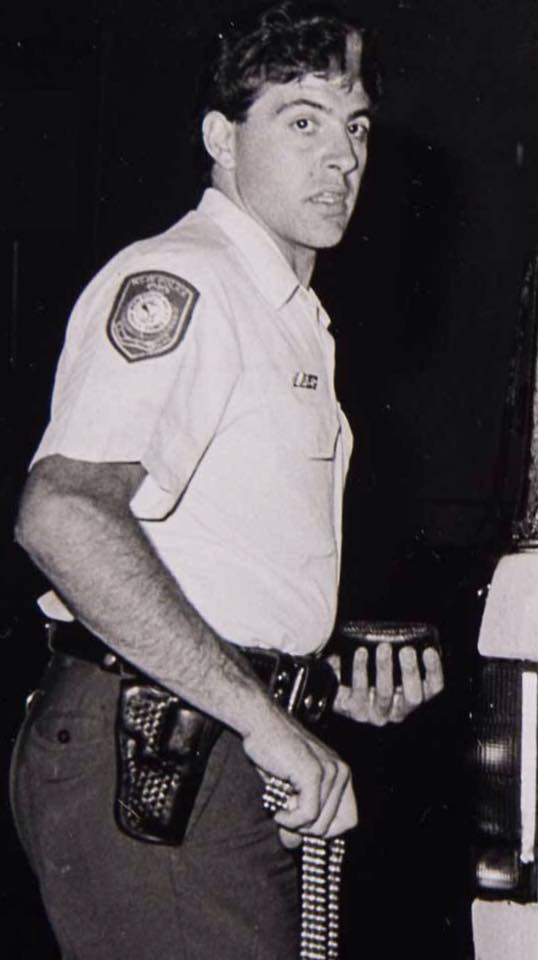
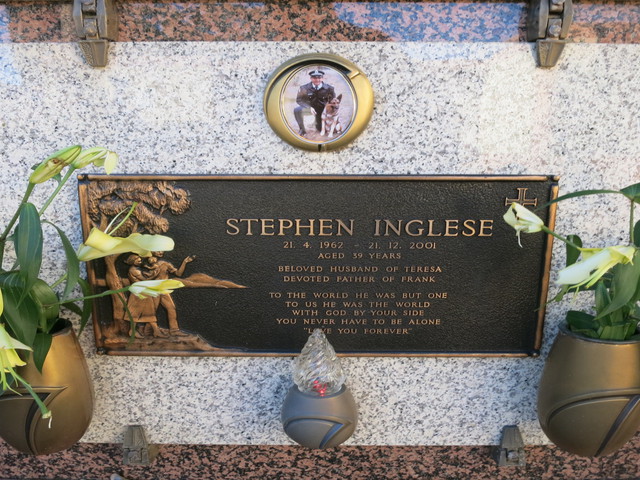
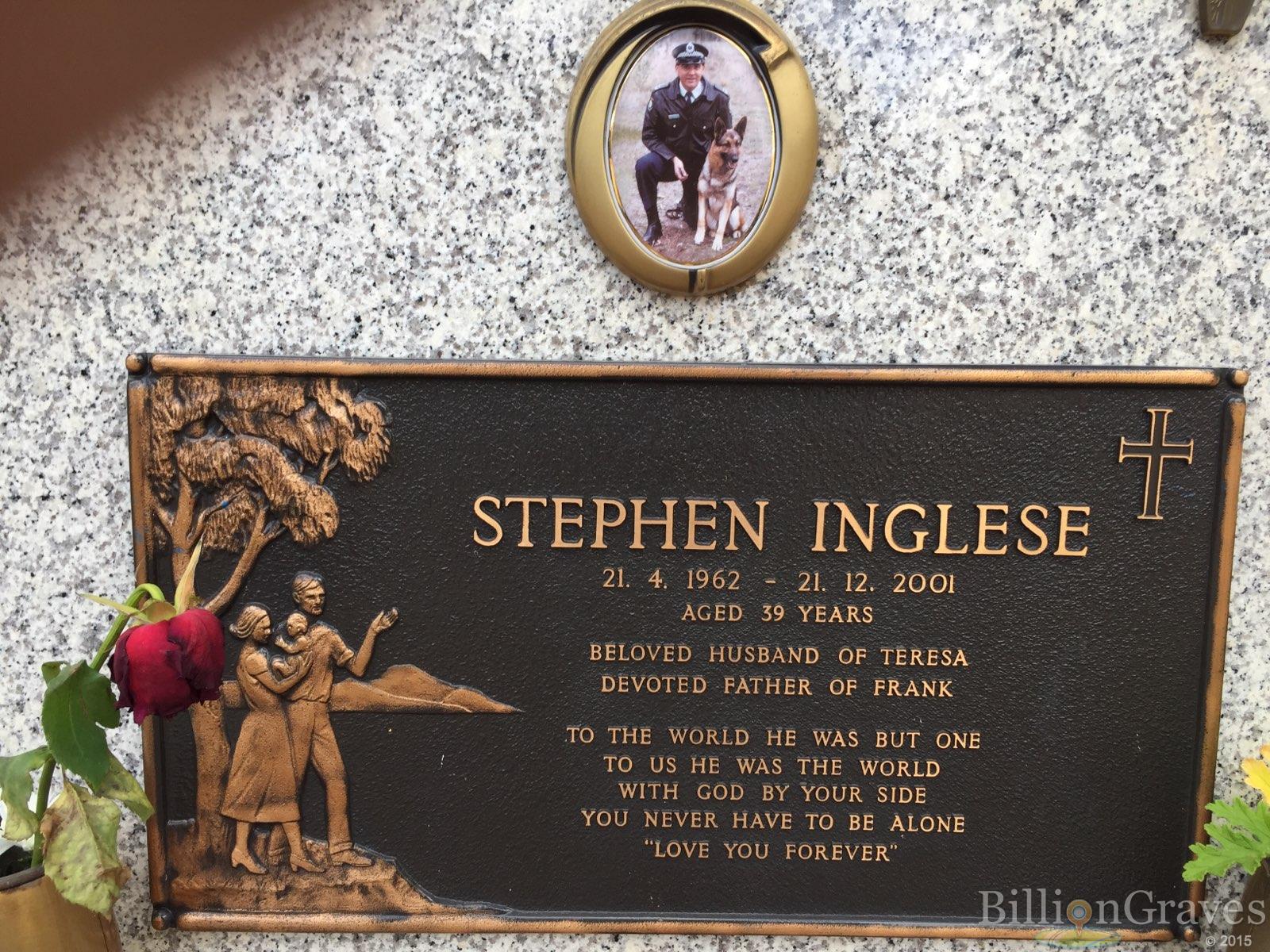
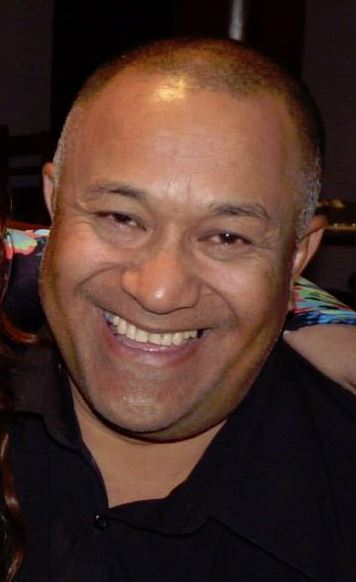
An interesting footnote is that Steve was the first handler to bring his own dog into the Squad and successfully passed out with this dog; Rebel was his name, and when Rebel passed on he was going to be interred with Steve. Don’t know if he was but that was the plan.
Sonia WILLIAMS – nee TURNER
| 21/04/2016
* ARTICLE ONLY *
Sonia WILLIAMS – nee Sonia TURNER
New South Wales Police Force
Regd. # 36424
Rank: ?
[blockquote]”First female to be stationed with the NSW ‘ Public Order & Riot Squad ‘ “[/blockquote]
Stations: ?, MEOCS, PORS, THE ROCKS
Service: From? May 2002to24 October 2013 = 11 years Service
Awards: ? – No find on It’s an honour
Born: ?
Cause for leaving: HOD Injuries – Depression – Suicide attempts
Age: ?
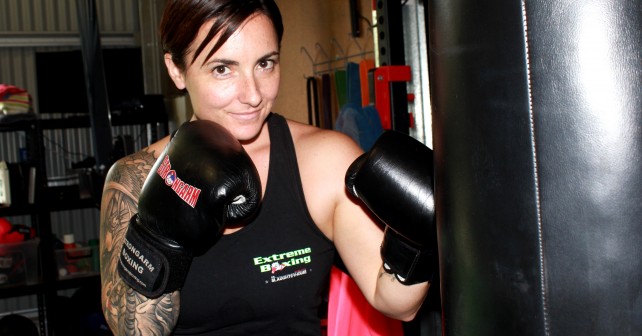
An article on P.T.S.D., attempted suicide and coming out on the other side Life trials spur boxer toward first pro fight
“Posts by Sunshine Valley Gazette” on April 7, 2016
The bright eyes of Mooloolah boxer Sonia Williams do nothing to reveal the scars of the challenges she’s faced over the past five years.
She endured sexual discrimination and physical abuse as the first female member of the New South Wales police riot squad, countless work-related injuries and 22 surgeries, a medical discharge from the police force, depression and four suicide attempts – but she is now rebuilding her life and a boxing career, and hoping to be a role model for others.
The 33-year-old won all three rounds to record a dominant victory in her first amateur boxing bout in Caloundra in February, and she is now training for her first professional fight on the Gold Coast in December.
“People ask me who I aspire to, who is my role model,” Mrs Williams said.
“But I’m my own role model, because I don’t know anyone who has been through what I’ve been through and survived.”
Mrs Williams grew up as a self-confessed tom boy, and was a competitive body builder and first degree Tae Kwon Do black belt by age 18.
She was NSW Womens Full Contact Sparring Champion from 14 to 18, and won a bronze medal in bare knuckle contact fighting at the World Martial Arts Games in 2000.
At 18, she followed her life dream and joined the NSW police force, where she went on to become the first female ever to be signed to the riot squad, with some 80 male colleagues.
That’s where life started bombarding her with challenges.
She was advised by a colleague she was unwelcome in the male-dominated squad and that she would be “broken”. Her knee was busted badly in her first “soft” training event on her very first day.
However, she persevered, before eventually leaving the riot squad in 2010, but was medically discharged from the police force, perhaps somewhat ironically, after being badly injured in a student university protest in May 2012.
Her list of medical procedures is quite daunting – knee reconstructions, broken wrists, hearing loss, hip injuries, multiple muscle tears and tendon damage, herniated and bulging discs, disc replacement, nerve damage, cysts and foot injuries.
After her discharge, and despite moving to Queensland with husband Glenn, she battled lingering injury and pain, lost life focus and fell into depression. She attempted suicide four times, the fourth when she smashed her car at high speed into telephone pole on Steve Irwin Way in late 2014 – she escaped with only two broken feet.
It was the crash that changed her life.
“I had the sense knocked into me,” she confesses. “I had no goals, I wasn’t boxing, I had nothing; I had the injuries that were always there and nothing seemed to be getting any better.”
From there Mrs Williams started training seriously with legendary Sunshine Coast boxing trainer Bobby Stimson.
She’s also being helped by Glenn, a former special services soldier-turned personal trainer.
“I’d be lying if I said I didn’t have bad days, but I’ve come a long way,” she said.
Her boxing career takes the next step when she heads to a training camp to Thailand in July to train with some of the toughest kickboxers and Mixed Martial Arts fighters in the world.
Mrs Williams has launched a crowd funding campaign to help her and two other female boxers make the Thailand training camp in July. To donate, visit www.gofundme.com/78rmpbn8
“I’m going to be the next world champion in my weight division,” she said confidently.
The powerful words of affirmation are themselves a necessary positive force for this fighter’s rebirth.
From there, she knows not even the sky is the limit.
Photo caption: Mooloolah boxer Sonia Williams has overcome countless challenges on her journey toward her first professional bout in December.
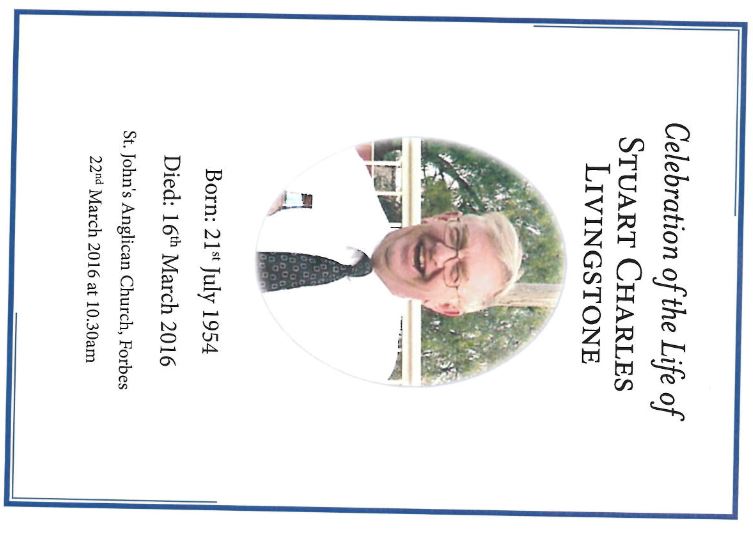
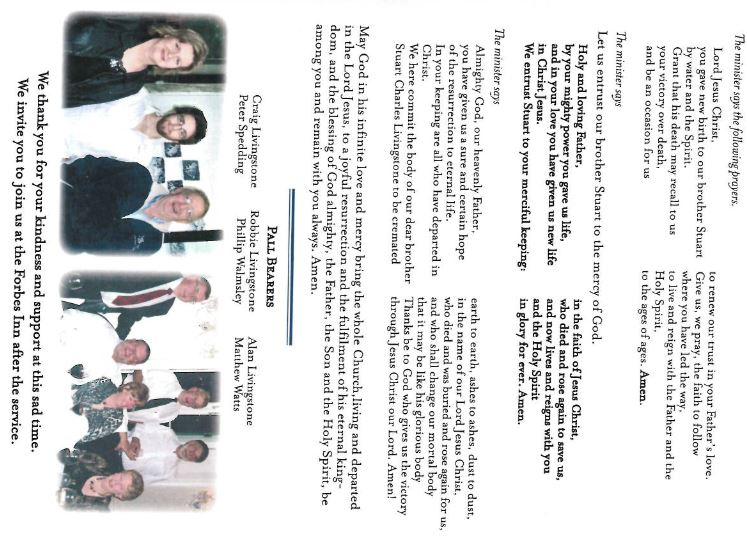
The relatives and friends of the late Stuart Charles Livingstone aged 61 years of ‘Rivergum’ Orange Road Forbes, beloved husband of Catherine and loved father and father-in-law of Adam and Katie, loving brother of Judith, Robert, Alan, Jan and Craig are respectfully invited to attend his funeral service to be held at St Johns Anglican Church Forbes commencing at 10.30am Tuesday 22 March 2016 followed by a private family cremation at Michael Hanley’s Crematorium Forbes.
MICHAEL HANLEY’S FAMILY Independent Funerals and Cremations
Neil wrote this song in the days following the death of colleague Olly Isaac. He hopes that this message will encourage anyone who might be struggling to reach out for help.
Written & performed by Neil Pynenburg
ISAAC, Olly
ISAAC, Olly
He wasn’t a good man He was a great man
Passed away on 16th March.
All who loved him are welcome to join his Family on Wednesday, 23rd March, at 10 a. m. , at the Broadwater Road Uniting Church, 481 Broadwater Road, Mansfield.
It is with heavy hearts that we report the death of a serving QPS member today. Our deepest condolences to family, friends and the entire Centenary Patrol Group in Brisbane. We understand that your friend and colleague was a highly valued and extremely well thought of member of your team.
To all directly involved, we cannot ease your pain but rest assured that our thoughts, and those of all your blue brothers and sisters nation wide are with you now…
Out of respect for friends and family, details at this point have been withheld. Should anyone need a little extra help right now, Blue HOPE stands ready…
Michael Robert KNIGHT
| 21/04/2016
Michael Robert KNIGHT
( late of Queanbeyan, NSW )
New South Wales Police Force
Joined NSW Police via NSW Police Cadet System on 8 September 1958
Cadet # 1462
Regd. # 9785
Rank: NSW Police Cadet – Commenced Training at Redfern Police Academy from 8 September 1958 ( aged 16 years, 10 months, 21 days )
Probationary Constable – appointed 18 October 1960 ( aged 19 years, 0 months, 0 days )
Awards: National Medal – granted 6 November 1980 ( SenSgt )
1st Clasp to National Medal – granted8 June 1988 ( SenSgt )
Born: Saturday 18 October 1941
Died on: Wednesday 27 January 2016 around 7pm in Canberra Hospital
Cause: existing medical condition
Age: 74 years, 3 months, 9 days
Funeral date: Wednesday 3 February 2016 @ 10.30am
Funeral location: St Raphael’s Catholic Church Lowe Street, Queanbeyan
Buried at: Cremated
Memorial at: ?
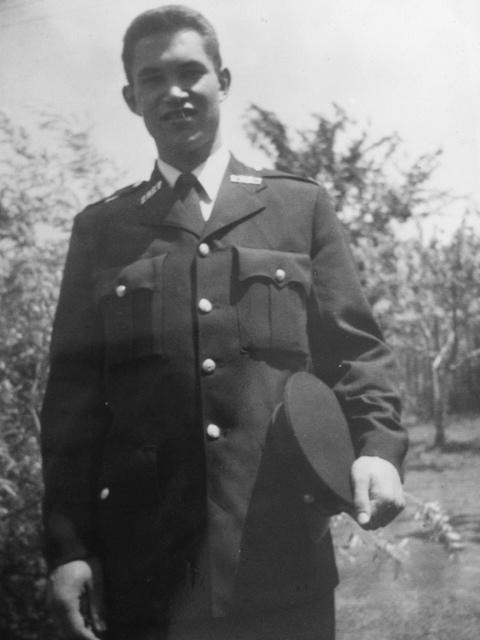
NSW POLICE CADET MICHAEL ROBERT KNIGHT
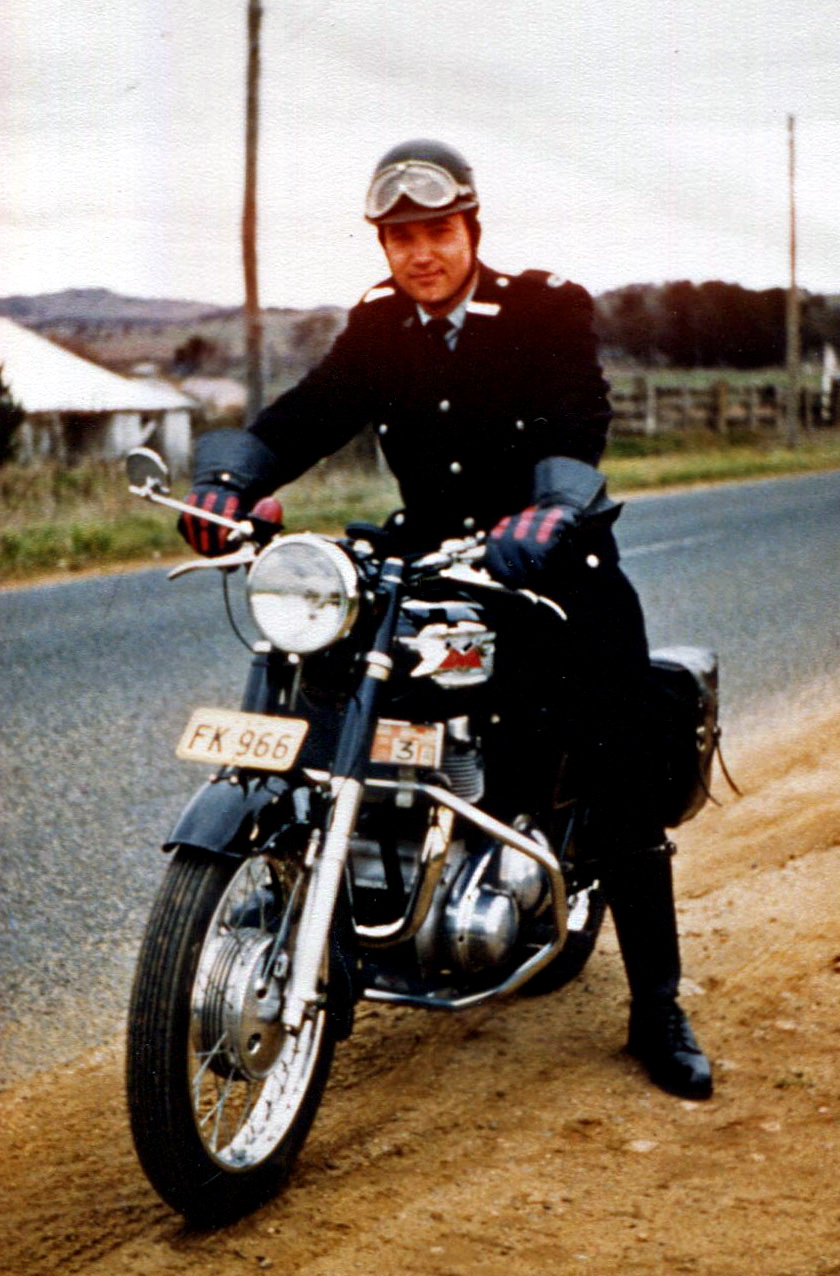
MICHAEL ROBERT KNIGHT ON A POLICE MOTOR CYCLE AT GUNNING.
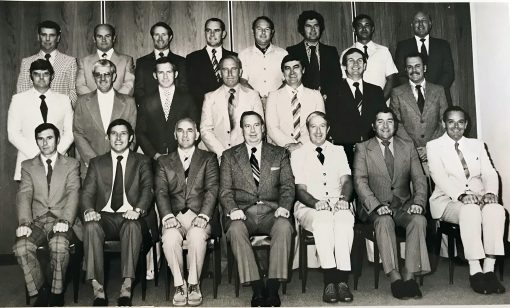
Sergeants Course Redfern 12/2/79 to 30/3/79 – Back Row (L to R) John Dooley, Clem Rankin, Alan Hines, Ron Hockey, Brian Mays, Noel Parkinson, Mick Knight, Ron Rogerson.
Middle Row Col Campbell, Laurie Carroll, Mike Stephens, Len Maloney, Col Wedderburn, John Wakefield, Gary Jennings
Front Row – Ian Campbell, Barry Cafe, Alex Morton (Instructor), Trevor Thompson (Instructor), Warwick Hensley, Jude Maloney, Bill Shute.
MICHAEL is NOT mentioned on the Police Wall of Remembrance *NEED MORE INFO
FURTHER INFORMATION IS NEEDED ABOUT THIS PERSON, THEIR LIFE, THEIR CAREER AND THEIR DEATH.
Loving husband to Robyn. Father to Tom, Anna, April, Jamie, Sam and Zach.
Loving brother of Chris, Nick and Sylvia. Poppy to Amy, Lani, Manaal, Lizzie, Daniel and Tyler.
The funeral service for Michael
will be held in St Raphael’s Catholic Church Lowe Street, Queanbeyan
On Wednesday, 3 February 2016, commencing at 10.30 am
Private cremation will follow.
In Lieu of flowers donations may be made to NSW Police Legacy.
Published in The Canberra Times on Jan. 30, 2016
Wednesday, 3 February 2016
~
Kristy Gordon,
QUEANBEYAN, New South Wales
Tuesday, 2 February 2016
My deepest sympathy to Robyn and family on the passing of Mick, So many memories of fun times at The Tumbled Tree Wine Bistro, Shamrock Rode & Thistle. So many stories and great laughs from the past. Love always Cheryl Brooks
~
Cheryl Brooks,
Sydney, New South Wales
Saturday, 30 January 2016
Fond memories of our Cooma days. Deepest sympathy with Robyn and children. Linda & Peter Bower Hopetoun WA
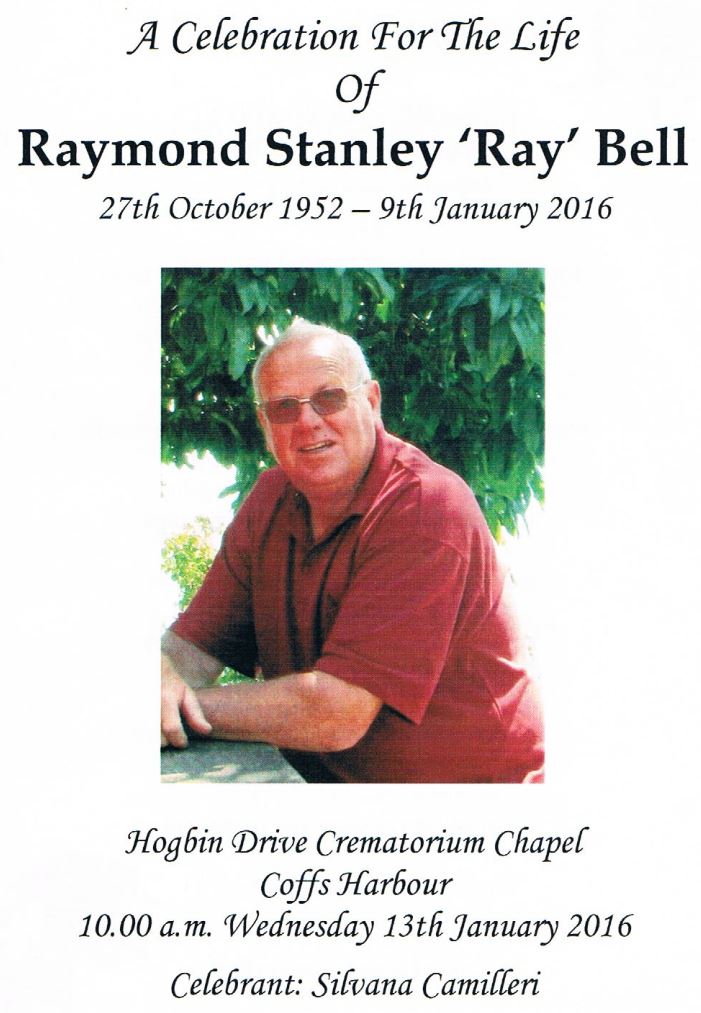
9th January 2016, peacefully at Coffs Harbour Health Campus, late of Glenreagh.
Dearly beloved husband of Glenice,
loving father & father-in-law of Melissa & Matthew Zielinski, Reannan & Steve Loughlin,
loving Poppy of Ryan, Luke, Sunny & Cooper,
dear brother & brother-in-law and
uncle of his nieces & nephews.
Aged 63 Years
“Sadly missed”
Relatives and friends are invited to attend Ray’s Funeral Service to be held in the Chapel of Hogbin Drive Crematorium & Memorial Gardens, Stadium Drive, Coffs Harbour TODAY, Wednesday 13th January 2016 commencing at 10.00 am.
All retired and serving Police Personnel are kindly invited to attend.
Friends are invited to join the family in the Garden Lounge for light refreshments following the Service.
RICE, David Neil. The funeral service of the Late David Rice will be held at Piddingtons Crematorium Chapel, Armidale commencing at 10:00 am followed by a cremation at Piddington’s Crematorium, Armidale.
Service: From 5 January 1959to? ? 1991 = 33+ years Service
Awards: Queen’s Gallantry Medal QGM – granted 1 October 1976 ( SenCon )( apprehend an armed man )
National Medal – granted 6 November 1980 ( DetSgt )
Born: Monday 9 February 1942
Died on: Friday 8 January 2016
Cause: ?
Age: 73 years, 11 months, 1 days
Funeral date: Wednesday 20 January 2016 @ 1pm
Funeral location: North Chapel, Pinegrove Crematorium, Kington Street, Minchinbury, NSW
Wake: Wake to be held at the Waratah Room, Rooty Hill RSL, Sherbrooke Street, Rooty Hill, from 2.30pm. All welcome.
Buried at: Cremated
Memorial at: ?
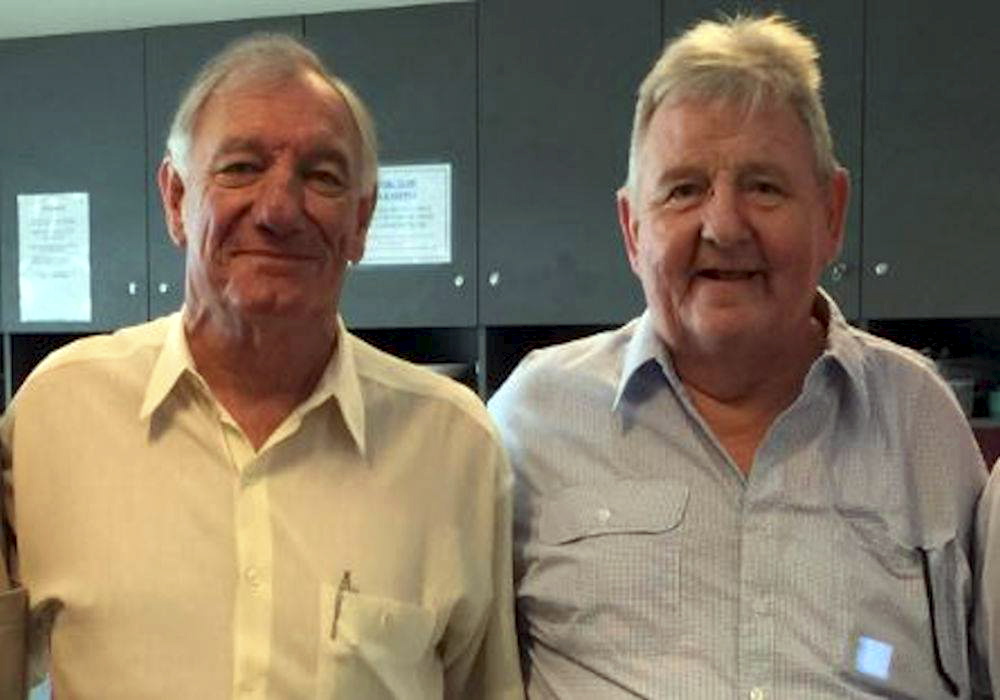
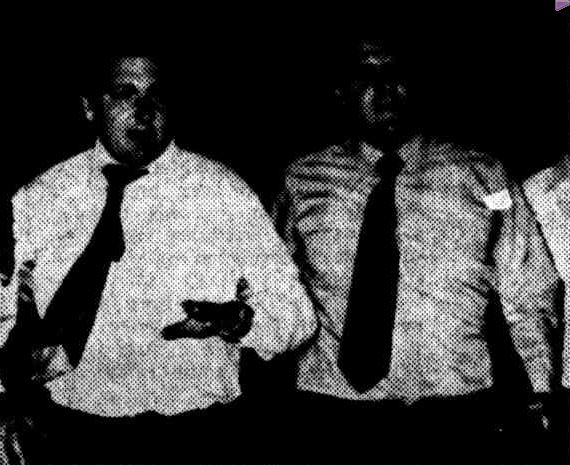
From John Cooke 7 September 2020 – NSW Fallen Police: Homicide Squad reunion at Police HQ in 2016 with Geoff McDowell on left & Wilfred ‘ Bill ” TUNSTALL ( who died shortly after in 2016 ). Both Geoff and Bill received bravery awards following a siege at Granville in 1975 in which Bill received a gunshot wound to his shoulder/arm. Geoff continued to back up Bill despite being severely affected by tear gas. The offender died in the shootout.
BILL is NOT mentioned on the Police Wall of Remembrance *NEED MORE INFO
Funeral location:
FURTHER INFORMATION IS NEEDED ABOUT THIS PERSON, THEIR LIFE, THEIR CAREER AND THEIR DEATH.
Loving husband of Maureen. Beloved father and father-in-law of Andrew & Cheresa and Matthew & Kirstie. Loving and adored grandfather of Sean, Holly, Breanna, Harvey and Amber.
Decorated Police Officer of 33 years service in the NSW Police Force
Bill’s family and friends are warmly invited to attend a Celebration of his Life to be held in the North Chapel of Pinegrove Crematorium, Kington Street, Minchinbury on WEDNESDAY (January 20, 2016) commencing at 1 pm.
Published in The Sydney Morning Herald on Jan. 18, 2016
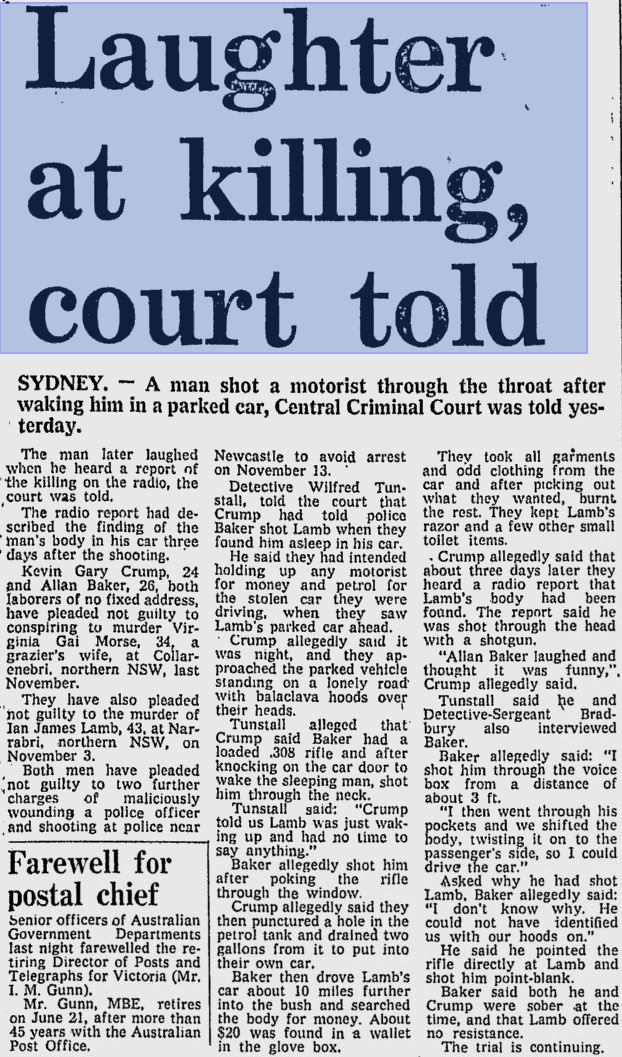
The Canberra Times ( ACT ) Tuesday 13 May 1975 p1 of 18
Man shot dead in Sydney siege
SYDNEY, Monday. — Police used tear gas to force a man from a Sydney house today and shot him dead as he ran out firing a high powered rifle.
The man, 55, had held police at bay in the house in Glanville *( possibly Granville ) for nearly three hours.
He wounded a policeman (Wilfred TUNSTALL ) in the arm before he was shot dead.
Another policeman suffered from gas inhalation when two cannisters of gas were lobbed into the house.
Earlier witnesses reported that a woman *( Nadia Wehbe ) staggered out of the house wounded and collapsed in the gutter. A man who went to her aid was ordered away.
The woman and the policemen are in a satisfactory condition.
The wounded policeman ( left ) is led away from the siege in Sydney.
The Canberra Times ( ACT ) Thursday 15 May 1975 p3 of 26
Recovering
SYDNEY, Wednesday. — Detective Bill Tunstall, who was shot in the arm during a two-hour siege at a Western Suburbs house on Monday afternoon, has left hospital. The condition of Mrs Nadia Wehbe, 40, who was hit in the right shoulder and later underwent emergency surgery, is satisfactory.
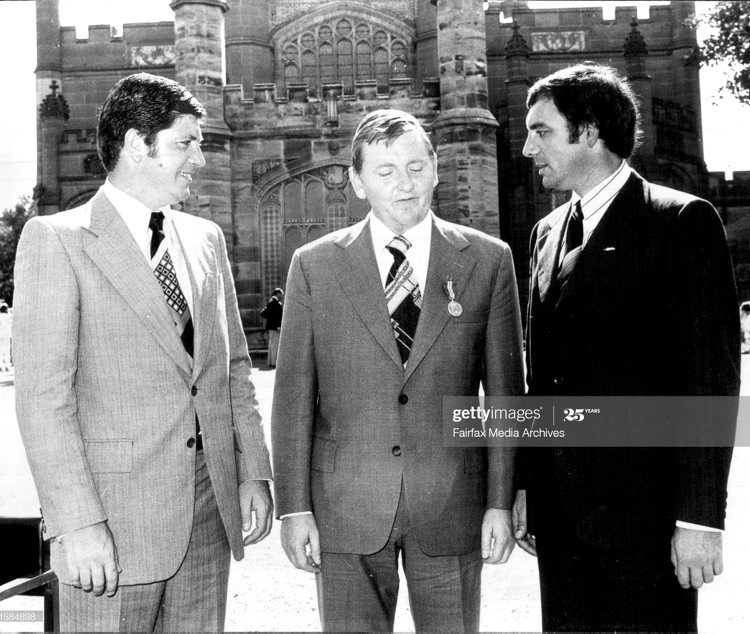
Queens Awards at the Government House today. Detective Senior Constable Wilfred Tunstall awarded with Queen’s Gallantry Medal. Det Tunstall (middle) with other awarded with Queens Commendation for Brave Conduct for the same action left Det Sen. Const. Aldo Lorenzutta and Det. Sen. Const. Geoffrey Neil McDowell. April 18, 1977. (Photo by Antonin Cermak/Fairfax Media via Getty Images).
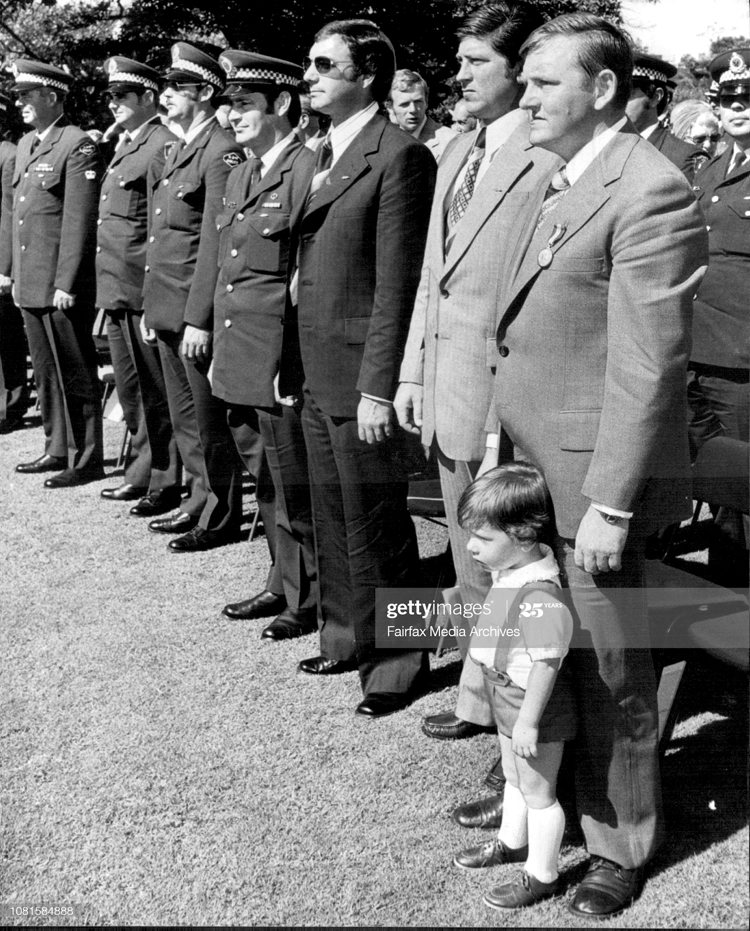
23 months old son of Mathew Tunstall, could not resist to join his father despite the strict protocol and National Anthem during the ceremony. On the right side of Tunstall are Detective SenConst Aldo Lorenzutta and further Det SenConst Geoffrey Neil McDowell, awarded with Queens Commendation for Brave Conduct for the same action. Queens’ Awards at the Government House today ( 17 April 1977 ). Detective Senior Constable Wilfred Tunstall awarded with Queens Gallantry Medal. Two-year-old Matthew Tunstall ignored protocol and the National Anthem to run to his father, Detective Senior Constable Wilfred Tunstall, who was awarded the Queen’s Gallantry Medal at Government House yesterday. April 18, 1977. (Photo by Antonin Cermak/Fairfax Media via Getty Images).
The Canberra Times ( ACT ) Wednesday 31 December 1980 p3 of 20
New code name for bomber sought
SYDNEY: Sydney police have appealed to the Woolworths bomber to give them a new code name to avoid confusion with hoax callers.
Many of the hoax callers have used the bombers code name – “Mr Dunmore” – since it was published in a Sydney newspaper on Monday.
Police said yesterday that they believed the bomber has not made contact with Woolworths for at least 48 hours.
“Even though his code name has been revealed there are many many other ways he could establish that he is the real bomber when he makes contact with Woolworths again”, a detective said.
“It is his turn to make a move now – although we are still following several leads which might prove fruitful”.
Woolworths received more than 20 hoax bomb threats against its Sydney stores yesterday, despite a police warning that hoaxers could be sent to jail.
The threats were mostly against suburban stores but the main city store, which was the scene of the Christmas Eve blast, was evacuated for more than an hour while police carried out a search after a threat.
Heavy city traffic was slowed to a crawl as police blocked part of George and Park Streets and diverted traffic around the area.
Detective Sergeant W. Tunstall, of the special bomb squad, said any person caught making hoax threats would be charged with creating a public mischief.
“This is a very serious charge carrying a penalty of six months in jail and a $1,000 fine”, he said.
The bomb hoaxes have fully extended police manpower.
Police estimated that more than 200 uniformed police have been taken from other duties to patrol Woolworths stores and carry out the searches after many of the threats.
“It is most frustrating”, they said. “Every hoax has to be checked out thoroughly and in many of the cases the stores have to be evacuated of staff and customers causing great inconvenience”, they said.
The Acting NSW Minister for Police, Mr Hills, said yesterday that no stone would be left unturned by police to bring those responsible for the Woolworths bombings and extortion demands to justice.
The total resources of the police force would continue to be available to protect the public and employees of the company from those responsible.
A special task force was working around the clock on the case.
A 19-year-old man was arrested yesterday at Ringwood, Melbourne, after a hoax call to a Woolworths store, police said last night.
They said that the man was arrested after increased activity by Telecom to help catch hoax callers. He is due to appear in court today charged with making a menacing phone call and a false report to police.
The Canberra Times ( ACT ) Tuesday 3 February 1981 p1 of 22
Woolworth-bombings charges later, court told
NOWRA: A man who appeared in Nowra Court yesterday would be charged later as the principal in connection with the Woolworths bombings, police told the court yesterday.
Police said that the charges would relate to placing explosives at the stores in Warilla, Maitland and Sydney Town Hall.
The allegations were made by the police prosecutor, Sergeant Ken Earl, as he put questions to Detective-Sergeant W. Tunstall, of the CIB.
Before the court was Mr Larry Burton Danielson, 48, a club entertainer, of Huskisson, a small town near Nowra.
Mr Danielson already faces charges of having conspired with Mr Gregory McHardie and others to demand money with menaces and with having attempted to steal $1 million, the property of Woolworths.
Mr Danielson entered no plea yesterday before Mr Butler, SM. He was remanded in custody to appear in Sydney Central Court on Monday.
Opposing bail, Sergeant Earl said Mr Danielson had used the name Bradford to commit false pretences in the 1960s.
Sergeant Tunstall agreed with Sergeant Earl that Mr Danielson had changed his name to what it was now by deed poll.
Sergeant Earl said, “He will be charged as the principal in relation to the bombings in Warilla, Maitland and Town Hall.
“The charges relate to placing explosives and charges.
“Serious damage was caused to the store at Warilla, the Maitland store was destroyed, and five people were slightly injured in the explosion at Town Hall”, he said.
Sergeant Tunstall agreed with Sergeant Earl that it had been only the wide investigation by the CIB which had prevented detectives from presenting the explosives charges yesterday.
Sergeant Earl said the police had “a very strong case against the defendant”; “strong charges” would be laid against the defendant on Monday.
Mr Danielson’s lawyer, Mr David Crampton, applying for bail, said Mr Danielson was a single man who owned property at Huskisson, where he had an equity of $12,000 to $14,000.
The three times Mr Danielson had been interviewed he had denied the offences laid against him.
Despite the fact the first time Mr Danielson had been spoken to was 10 days before his arrest, he had made no effort to leave the area.
Mr Crampton said Mr Danielson did not have a current passport although he had come from New Zealand originally.
The Canberra Times ( ACT ) Thursday 23 April 1981 p10 of 22
COURT REPORTS
Charged man said ‘You’re kidding’, SM told
SYDNEY: An entertainer told a detective, “You’re kidding”, when informed he would be charged over the Woolworths extortion attempt, Central Court was told yesterday.
Detective-Sergeant Wilfred Tunstall said this was the reaction of Mr Larry Burton Danielson, 48, of Huskisson, who, with Mr Gregory Norman McHardie, was appearing before Mr Webb, SM, charged with conspiring to demand money with menaces and by force between July 1 last year and January 13, 1981.
Each is also charged with attempting to steal $500,000 in cash, 22 diamonds and 10 50-ounce gold bars, the property of Woolworths, on January 13. Mr Danielson is further charged with breaking into Pro Diving Services at Huskisson on October 15, 1980, and January 13, 1981.
No plea has been entered.
Sergeant Tunstall said he had interviewed Mr Danielson at Nowra police station on January 29. He had also played tapes of two telephone calls made to Woolworths employees by an
extortionist.
“I told him he would be charged in relation to these matters”, Sergeant Tunstall said. “He said, ‘You’re kidding’ “.
Earlier, evidence was given that on January 17 Mr Danielson had bought a diver’s oxygen tank from a shop at Rushcutter Bay, Sydney. That night the shop had been broken into and other diving equipment stolen.
Mr Christopher Charles Benning, diving instructor, of Manly Vale, said he had locked the shop when he left it at 10.30pm. After the robbery, diving gear and a diver’s propulsion unit had been missing.
Mr Benning said a propulsion unit produced in court was of the same colour and type as the one stolen.
Mr John Pritchard, for Mr Danielson, objected when the police prosecutor, Sergeant Garry Wells, tried to tender the propulsion unit as an exhibit. He said there was nothing to connect his client with the unit.
Sergeant Wells said the unit had been found in Sydney Harbour about a mile from where a diver, alleged to be Mr McHardie, had tried to collect a bag of extortion money from under a wharf at Taronga Park.
Mr Webb said he would admit the exhibit, but was doubtful about its value. He adjourned the case until 10am today.
The Canberra Times ( ACT ) Tuesday 18 May 1982 p3 of 20
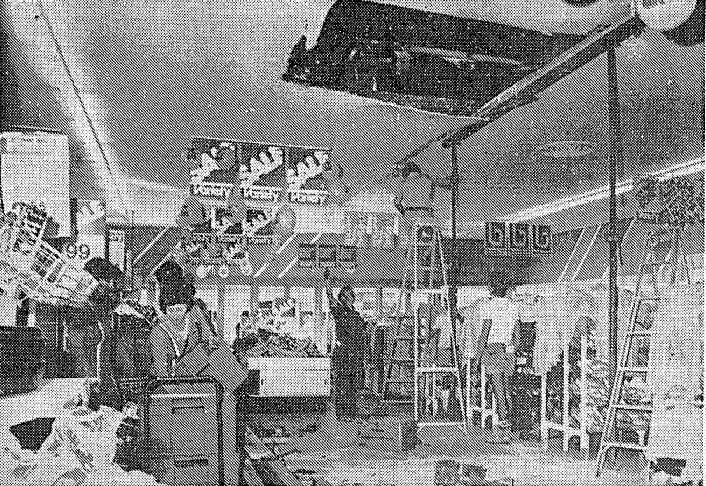
Workmen patch the hole in the roof of Woolworths store in Liverpool yesterday after an early-morning bombing. Store staff rearrange stock to allow the store to open in the afternoon.
Escaper, store bomb link SYDNEY: Police are “keeping an open mind” on the possibility of a link between convicted Woolworths bomber Mr Graham McHardie and an explosion at the Woolworths variety store at Liverpool early yesterday.
Detective Superintendent Noel Morey ( NSWPF # 5283 ), of the Sydney CIB, confirmed that two sticks of gelignite had exploded, causing damage estimated at about $10,000.
Police intensified their search for Mr McHardie, 28, who escaped from Parramatta jail last month during his trial for the extortion bombings of three Woolworths stores in 1980. The police believe Mr McHardie or some of his associates could be responsible for yesterday’s explosion.
They also have not ruled out the possibility that the explosion was intended as revenge. “We are keeping an open mind,” a police spokesman said.
Detectives from the Special Breaking Squad, which investigated the 1980 bombings, spent several hours in the store yesterday, with members of the Police Scientific Squad, after it was found that the explosion was similar to previous Woolworths explosions.
Police said last night that the explosion had been caused by two sticks of gelignite which blew a hole three metres by one metre in the roof of the store about 4.40am. It also blew a hole in the wall of a second-storey office and was heard five kilometres away.
The means of detonating the explosive had not been discovered, although the area was searched yesterday by an officer from the Army Bomb Disposal Unit.
The bomb could have been placed on the roof, or thrown up, since there was no sign of breaking and entering, or theft.
Police said blasts at Woolworths stores in Warilla and Maitland in 1980 were caused by gelignite bombs placed on the roof.
The store opened to the public at 3.30pm after workmen had repaired the damaged corrugated-iron roof and cleared debris.
A spokesman for Woolworths, Mr John Hendry, said security would not be increased “because previous experience shows it to be at a pretty high level”.
No ransom demand had been made by last night to Woolworths, and Detective-Sergeant Bill Tunstall, who investigated the previous Woolworths bombings, said that at that time demand letters had not come for two days. If the style was to be the same this time “we might not get any letter for a few days yet”, he said.
The Canberra Times ( ACT ) Thursday 23 December 1982 p6 of 22
Valuable paintings recovered
SYDNEY: Two valuable Australian paintings, stolen in 1976, have been recovered in a raid on a Darling Point house in Sydney.
The raid was carried out on Sunday by the Penrith-based regional crime squad, led by Detective-Sergeant Bill Tunstall.
Six paintings by well-known Australian artists were stolen from the Manly Art Gallery in May, 1976.
The recovered paintings were an oil by Tom Roberts, painted in 1895, and entitled ‘The Flower Seller’ and a Norman Lindsay water colour entitled ‘Swans and Peacocks’.
No arrests were made and inquiries are continuing in relation to the other paintings.
The Canberra Times ( ACT ) Saturday 9 July 1988 p10 of 68
Rogerson used false name, bank man says
SYDNEY: Former Sydney detective Mr Roger Rogerson had used a false name for an account he opened at a Penrith bank in July 1985, Glebe Local Court heard yesterday.
A former Westpac Bank branch manager, Mr Albert Blatch, told the court that Mr Rogerson had opened an account at his bank using the name Robert Tracey with a $58,000 bank cheque on July 9 that year.
Mr Blatch was giving evidence at committal proceedings against Mr Rogerson and two others charged with conspiring to pervert the course of justice.
He said that Mr Rogerson had come into the bank with Detective Sergeant Bill Tunstall — whom Mr Blatch knew — and two others to discuss opening the account.
Mr Blatch said the cheque represented the balance of an account from another bank. Mr Rogerson had said he was not happy with the service.
Mr Rogerson had been introduced to him as Mr Rogerson, but had indicated he would like to keep his account in the name of Robert Tracey.
Mr Blatch said he understood the account was opened to hold funds “coming from Mr Rogerson refurbishing motor vehicles that had been sold”.
Mr Blatch said that Mr Rogerson had telephoned three days after the account had been opened and inquired about withdrawing $40,000.
Mr Blatch said the funds subsequently had been transferred to the Taxation Department.
Earlier yesterday, “Miss Jones”, the protected witness giving evidence about a drug deal she allegedly made with Mr Rogerson in May 1985, broke down and wept after she was questioned about fears for her safety.
Under cross-examination by counsel for Mr Rogerson, Miss Jones said she feared for her safety after the death of Mr Dennis Allen, who died in April last year.
She told the court she feared one person and she wrote that name on a piece of paper.
Mr Rogerson, Sydney businessman Mr Maurice Nowytarger and Mr Nick Paltos have been charged with conspiring with Mr Ross Karp between May 1985 and March 1986 to pervert the course of justice.
Rank: Probationary Constable – appointed 14 September 1970 ( aged 29 years, 2 months, 8 days )
Constable 1st Class – appointed 14 September 1975
Sergeant 3rd Class – appointed 3 May 1986
Final Rank: ?
Stations: ?, Fairfield ( 34 Division ), Burwood ( 9 Division ), Castle Hill, Windsor, Wetherill Park – retirement
Service: From? pre 14 September 1970 to 10 August 1996 = 26 years Service
Awards: National Medal – granted 15 November 1982
1st Clasp to National Medal – granted 7 October 1991
Born: Sunday 6 July 1941
Died on: Tuesday 29 December 2015
Cause: ?
Age: 74 years, 5 months, 23 days
Funeral date: Wednesday 6 January 2016 @ 10am
Funeral location: Garden Chapel, Castlebrook Memorial Park, Windsor Road, ROUSE HILL
Buried at: ?
Memorial at: ?
BILLY is NOT mentioned on the Police Wall of Remembrance *NEED MORE INFO
Funeral location:
FURTHER INFORMATION IS NEEDED ABOUT THIS PERSON, THEIR LIFE, THEIR CAREER AND THEIR DEATH.
You were a nice bloke Billy. May you forever Rest In Peace.
LOWE, William ”Billy” Claude
6.7.1941 – 29.12.2015
Passed away peacefully at home surrounded by his loving family after a long illness.
Beloved husband of Margaret. Devoted father and father-in-law of Natasha and Joe, James and Lara.
Adored Poppy to Allegra and Joey.
Very much missed by his devoted dog Hammer.
Family and friends are warmly invited to attend a Celebration of BILL’S Life to be held in the Garden Chapel, Castlebrook Memorial Park, Windsor Road, Rouse Hill on Wednesday, 6th January 2016 at 10.00am.
If pelicans could cry – the passing of the pelican man
By Justine Frazier and Jonathan Atkins
Sixty year old Lance Ferris died on Sunday the 14th of October, 2007 at Lismore base Hospital after suffering a stroke on Saturday.
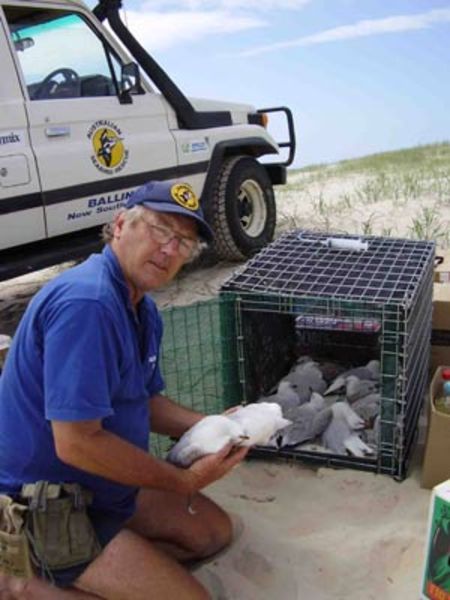
Lance Ferris from Australian Seabird Rescue collects dead birds from the beach areas of Evans Head. It is thought the birds died from botulism after eating dead fish.
The man many of us fondly knew as the “Pelican Man” has passed away leaving a massive whole in the community. Sixty year old Lance Ferris died on Sunday the 14th of October, 2007 at Lismore base Hospital after suffering a stroke on Saturday.
Lance dedicated his life to the rescue, rehabilitation and preservation of seabirds, turtles, and in particular the magnificent pelican and it was through his many years as a dedicated volunteer, using his own money and whatever donations he could find that Australian Seabird Rescue (ASR) came into existence in Ballina, New South Wales in 1992.
Close friend Marny Bonner said, “We’re receiving emails and phone calls from all over Australia from people who are so deeply saddened and shocked.”
Marny Bonner says, “Lance has always had huge compassion for Australia wildlife, his entire life has been rescuing and rehabilitating wildlife. It wasn’t until he noticed not one but two pelicans with hooks in their legs, on the same day, that he realised that there was a problem out there. So he borrowed a boat and had a look around the Richmond River and found that 37 out of 100 pelicans were injured.”
After surveying other estuaries, Lance Ferris realised that what was needed was a huge education program campaign and the passion began.
“We got good support from the North Coast community and some important sponsorship. Over the last 15 years we’ve managed to reach 20,000 children, so there will be a lot of children upset about losing the Pelican man.”
Since that time, ASR volunteers have been involved in the rescue and rehabilitation of seabirds and shorebirds, marine turtles and to date, have rescued over 1000 Australian Pelicans.
Lance Ferris never lost his passion the rescuing injured seabirds.
Marny Bonner believes, “Ultimately that’s what claimed him, his passion for wildlife led to him not looking after himself as well as he might have. It led to many, many hours in loss of sleep trying to save those little lives.”
“I would like to absolutely commend the staff at Lismore base Hospital who worked so hard with Lance. It was a very upsetting time for everybody because everybody knew who he was and knew how hard he’d worked to save so many lives and yet there was nothing we could do to save this most important life,” says Marney Bonner.
In 2004 as president of Australian Seabird Rescue, Lance led the volunteer organisation to win the inaugural National Coastcare Community award.
In an earlier life Lance worked a police officer based in Casino and was a member of APEX. He also worked as a teachers aid for children with disabilities, was a well respected musician and a member of the Sonset Orchestra and could be found at any given weekend at the Lismore Car Boot Markets. Ballina Mayor, Phillip Silver says the death of Lance Ferris is a huge loss for the community.
“I guess in many ways he was ahead of his time in terms of the recognition of that vulnerability of the environment and the water animals. Because he was doing it 20 years ago when it was certainly happening but people weren’t thinking about it,” said mayor Silver.
ASR is always looking for more volunteers and as Marny Booner says “the pelicans have lost their best friend, if pelicans could cry, there would be a wailing around the nation that could not be ignored. It will take an army of volunteers to replace Lance Ferris”.
Jason Ferris believes his Dad would never really let on if he was feeling unwell.
Jason recalls, “At 3am on Saturday morning he sent out a bunch of emails with instructions regarding seabird rescue, so we suspect over the last week or so, he was aware something was going on.”
“My Dad’s always run pretty close to the edge. Dad lived and breathed seabird rescue 24/7. I would often find him sleeping in all sorts of places in the back cars, on seats… his focus was never on his own health, more on the animals in care,” said Jason.
A passion that Jason and Lance shared was music.
“I developed an interest in music as a result of Dad. Dad was really an amazing musician and beautiful singer. In my 20’s he and I started playing music together around the North Coast. Definitely some of my most treasured memories of Dad,” said Jason.
As much as it can be…it will be business as usual for Australian Seabird Rescue.
According to Jason, “Dad’s put 13 or 14 years into this organisation, you can’t just pull the plug. He would be most unhappy with me if that happened.”
In 2003, ABC TV’s Australian Story took a look at a Ballina based former police officer called Lance Ferris, who’s dedicated his life to fixing the plight of the pelicans… read more
ABC North Coast reported when Lance Ferris and his team of seabird rescuers headed to Victoria for a series of training sessions with wildlife carers… read more
A public memorial service will be held for Lance Ferris.
“Thank you to the ABC crew for your lovely, sincere tribute to Lance, and thanks to all who phoned to share the ways in which Lance touched their lives. Lance’s life and work will be commemorated at the WildlifeLink Sanctuary in Ballina this Friday 19/10 at 11am. All are welcome to join us. The centre will be open from 10am. It is located at the end of North Creek Rd, which runs off the Pacific H’way as it heads out of Ballina towards Bangalow. On behalf of Jason’s family and Australian Seabird Rescue volunteers, thank you for your condolences and support… Marny.”
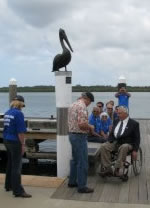
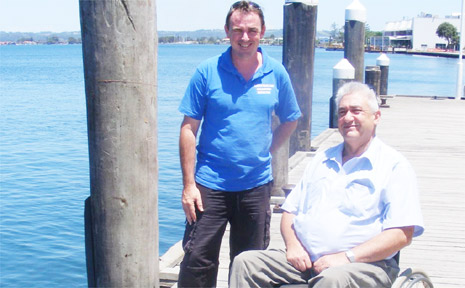
LANCE FERRIS WHARF: Ballina’s mayor, Cr Phillip Silver, (right) with acting general manager of Australian Seabird Rescue, Keith Williams, announcing the naming of the wharf at Fawcett Park as the Lance Ferris Wharf.
IT’S official.
The wharf at Fawcett Park is now the Lance Ferris Wharf, named after the late Lance Ferris – the Pelican Man – who founded Ballina-based organisation Australian Seabird Rescue.
And work is currently being undertaken on the design for a statue of a bronze pelican to be perched on the jetty in Ballina’s CBD.
Ballina’s mayor, Cr Phillip Silver, was due to make the official announcement on the naming of the wharf at the inaugural Lance Ferris Memorial Dinner scheduled for December 12.
But with last week’s decision by Australian Seabird Rescue to postpone the dinner, the announcement was made early.
He said council wanted to recognise the work of Mr Ferris, who died in October 2007, aged 60.
After Mr Ferris’ death, council resolved to rename Fawcett Park as Lance Ferris Park. But that move was knocked back by the NSW Geographical Names Board following objections.
There won’t be any problem with the naming of the wharf, Cr Silver said, as it is a piece of council-owned infrastructure.
Keith Williams, acting general manager of ASR and partner of Mr Ferris’ daughter, Rochelle Ferris, welcomed the decision to name the wharf after Lance.
He said the move not only acknowledged the work of Mr Ferris but also the Richmond River which Mr Ferris was so passionate about.
“This is a fantastic,” he said on behalf of the family and the broader family of ASR volunteers.
He is the father of Finn, Lance’s grandson, who was born just over a month ago.
Mr Williams said he enjoys taking Finn to the wharf.
“This (naming the wharf) is to say ‘your granddad was someone really special’. And much of the respect (for Lance) comes from the community – you can’t manufacture that,” he said.
A local artist has been commissioned to create the life-size bronze statue of a pelican which will be installed on the wharf early next year.
Cr Silver said the council had budgeted $10,000 for the statue, which had come from the staff operational budget.
He said he hoped the pelican would become an icon for Ballina now that nothing stood in the way of the demolition of the Big Prawn at the southern entrance to the town.
“Whether it (the pelican statute) evolves to be an icon of the town is a function of the community,” he said.
Cr Silver has already suggested Ballina could rebrand itself, replacing the seahorse, so the shire can be Ballina bypass-ready. Work on the new highway route is expected to be finished by 2012.
He said a rebranding of the shire wouldn’t be expensive, as things like stationery stocks would be used up in time.
Meanwhile, the Lance Ferris Memorial Dinner will be held on June 5 next year, World Environment Day.
Mr Williams said anybody who had purchased a ticket would receive a full refund.
This Friday, 24 September, 2010, Mayor Phillip Silver will unveil a sculpture at Fawcett Park, Ballina, to commemorate and acknowledge the work of the late Lance Ferris.
The sculpture is dedicated to the coastal conservation work carried out by Mr Ferris, affectionately known as ‘the Pelican Man’.
“In fostering and supporting local art, council commissioned a local artist to create a unique bronze sculpture that is befitting of the animal conservation work carried out by Lance. The artist behind the sculpture is Wollongbar-based sculptor Frank Miles,” Cr Silver said.
As part of the commemoration Cr Silver will also be officially name the wharf in Fawcett Park ‘Lance Ferris Wharf’.
“It is an appropriate place to acknowledge Lance’s work which started in earnest in 1992 on the sand spit opposite the Fawcett Park wharf after he noticed pelicans were injured by fishing line and hooks,” Cr Silver said.
“The pelicans were rescued, rehabilitated and released. The work soon extended from pelicans to other coastal birds as well as marine turtles.
“Lance was passionate about educating the community in preserving and protecting the coastal environment and all marine wildlife, and it’s fitting that we not only acknowledge his work but also raise awareness for the continued operation of the organisation he founded, the Australian Seabird Rescue.
“Based in Ballina, the volunteer organisation continues to operate around Australia to protect and rescue seabirds and shorebirds.
“This is also largely due to the continued dedication of the Ferris family and the support they receive from volunteers and the community in enduring Lance’s legacy.”
Lance Ferris family members representing the Australian Seabird Rescue service will be present at the unveiling ceremony which will take place at 11am at the wharf in Fawcett Park.
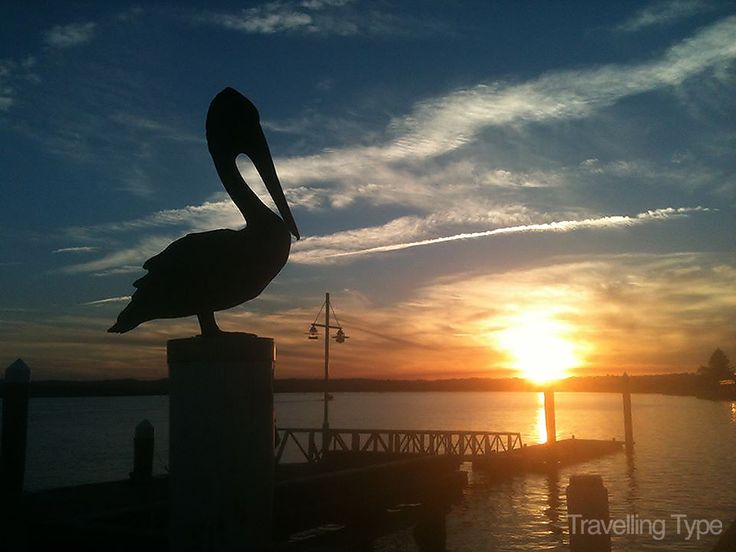
A recent unveiling on 24th September of Frank Miles life-size bronze pelican “Steptoe”, (pictured left) commissioned by the Ballina Shire Council, at the Fawcett Park Wharf. This wharf was renamed on the day to the “Lance Ferris Wharf” in honour of the late Lance Ferris the towns’ famed ‘Pelican Man’. This was a very exciting moment for Frank as well the Australian Seabird Rescue Service and Lance’s family members.
If there’s one Australian bird that we’ve all watched with awe it’s the pelican.
But as we’ve admired this bird we are mostly oblivious to the tragedy that the nation’s most popular hobby, fishing, is visiting upon our feathered friends.
Accidental hooking by recreational fishing, discarded hooks and fishing line have become the birds’ most lethal enemy. Bills, legs and wings are being hooked or entangled. The result, all too often, is a painful death.
Tonight’s Australian Story is about one man, a Ballina based former police officer called Lance Ferris, who’s dedicated his life to fixing the plight of the pelicans.
With spectacular physical agility, he “bribes” the pelicans with fish and then dives to catch injured animals so they can be treated and saved.
Over the past 12 years, often living well below the poverty line, he has rescued and rehabilitated hundreds of birds and conducted educational workshops in schools and fishing clubs up and down Australia’s east coast.
Featuring stunning wildlife images, Australian Story retraces the rough, tough and exciting life of Lance Ferris.
We see first hand his unconventional but effective pelican catching methods and the extent of this problem along with the solutions he has employed.
REX HUNT: Hello. I’m Rex Hunt. Tonight’s Australian Story is about a man who has dedicated his life to solving the problems sometimes unwittingly created by us anglers. He is Lance Ferris – known as ‘The Pelican Man’ for his incredible work in saving these magnificent birds from terrible injuries. And his efforts are changing attitudes on the water. This is Lance’s story.
EVAN KOSACK – VET:Lance and the fishermen in the area started out being at loggerheads a little bit.
LANCE FERRIS: I don’t think they believed that the problem was as bad as it was. Pelicans torn to pieces, basically, by fishing tackle.
EVAN KOSACK – VET: Lance was telling people, basically, that their beloved hobby was causing a lot of damage and that they were acting irresponsibly. Lance is not the norm.
ANTHONY MUYT: He’s very independent, he’s very focused, he thinks outside of the square. He’s a bit of a mad scientist. He was just some joker who rolled up and was jumping off boats into pelicans. They thought he was nuts at first – thought he was a madman. He is extremely professional. He likes perfection. He’ll work at something until he has it.
DEBBI DEVINE – SAM’S MUM :I look at him sometimes and I think, “Wow. This grown man – the way he is with these animals.” It’s amazing. It’s like they’re his children.
LANCE FERRIS: We were on an excursion with the children from the special school. I noticed a pelican in a park that had a hook buried in its leg. So, I grabbed some fish from a bait shop and the bird came up to me and I grabbed it, held it and looked down at it, and I thought, “The hook’s in the left leg. “I’m sure the bird that I saw “before I got the bait had a hook in the right leg.” I was absolutely positive of it. I made up some posters to hang in shop windows – “Wanted, a pelican with a hook in its leg.” I thought, “There’s another bird out there. I know there’s another one.”
MARNY BONNER: There are many, many people that would go, “Oh, gee. “Gee, fancy seeing two pelicans in one day, you know, “both with hook injuries,” and continue about their business. But the interesting thing is that it engaged Lance’s curiosity such that he went out and searched to see if there was an even bigger problem.
LANCE FERRIS: That led us into going out on the island to see if there were other pelicans out there. 108 birds on the island, there were, with 37 tangled up in fishing line on our first visit.
MARNY BONNER: For Lance, standing there with binoculars in hand observing bird after bird after bird coming into his vision with crippling, cruel injuries would be very overwhelming.
LANCE FERRIS: I was in shock and horror. I couldn’t believe how bad the situation was. I went back to the boat and cried for half an hour. I just couldn’t believe… I’m no bronze Anzac hero. I might have been in the police force, but that doesn’t mean to say you don’t get cut up when you see so much damage. There were some with amputated wings and gangrene in their legs. It was a horrible thing. Being a wildlife carer for some years, at that stage, I was just amazed that I wasn’t aware of it and nor had it been brought to our attention by any member of the public or any other wildlife people.
ROCHELLE FERRIS: He was so devastated by that, but he was also looking at the bigger picture, and he sat back and thought, “You know, how many estuaries are there in Australia “that are so populated by humans? “And I’m only looking at this one.” And the problem just blew out in his head.
LANCE FERRIS: I knew we had a major problem on our hands. I had caught a couple and I’d caught them, I suppose, relatively easily, but when I saw so many I just got back to the boat and thought, “How do I cope with so many injured? “How can I catch that many? “They’re everywhere.”
MARNY BONNER: Lance fell asleep that night surrounded by crippled and injured birds and woke up and he was still surrounded by crippled and injured birds, and was compelled to do something – to start action right there and then.
LANCE FERRIS: It was three months and I had that 37, but as I was getting that 37, more became entangled as I went.
ROCHELLE FERRIS: The focus on getting out there and attending to all these sick pelicans really did take over his life.
MARNY BONNER: That was the dawning of the obsession and the birth of Australian Seabird Rescue.
LANCE FERRIS: I didn’t really think about it changing my life at that time.
MARNY: In the early days, some of these injuries were quite old. They had had longstanding chronic injuries and they did require a lot of treatment. And to his amazement, the local vets were extremely interested and extremely supportive.
LANCE FERRIS: I had to look closely at the pelicans to see a line trailing under a wing, or a hook somewhere.
MARNY BONNER: Because it’s difficult to see injuries on pelicans, people don’t notice. I believe pelicans don’t look sick when they are injured. Pelicans can’t cry.
LANCE FERRIS: Everybody believed that the hook would rust away in two or three days. We’ve done some tests on all different sorts of hooks and it’s at least six months before the hooks rusted away. So there were lots of things that make people not sort of bother.
ROCHELLE FERRIS: He was so concerned and frustrated by the lack of interest from the community that these birds were just all being tangled and no-one seemed to care.
LANCE FERRIS: But it’s not all bad out there. There are some people who really have the right concept. If the bird’s quiet and fairly well under control, we give everyone that opportunity to, say, pat a pelican or to have a close contact with it.
MARNY BONNER: Lance experienced quite a lot of loneliness in his childhood. He didn’t have a lot of affection in it. He is essentially a shy person and a bit of a loner.
LANCE FERRIS: I can remember vividly as a boy, after I’d found a little frog with a broken leg, I think we taped it up with a matchstick, and for the life of me I can’t remember whether it survived or not.
MARNY BONNER: That’s what I saw in Lance when I first met him, was this uncanny ability to really spend a lot of time thinking about how he could improve life generally for a particularly severely disabled child. Lance had his fairly demanding job of teacher’s aide with disabled children. The realisation of the enormity of the problem on Pelican Island did change Lance’s life, but I don’t think he was conscious of that at that time. He was merely solving the problem on the day.
LANCE FERRIS: But then there were cutbacks with the school and then came the word that said, There’s no more work. I’m sorry, we have to put you off. There’s no more funding. We don’t have enough children. And I had to drive away from the place. And I…I won’t forget that day.
I wept all the way home. I was at a little cattle dairy, a converted place. The very next day the landlord drove down the paddock and I went up and I said, “About the rent…” He said, Oh, yeah. He said, I was gonna tell you about that. He said, I really like what you’re doing with the pelicans and things. That’s fantastic, that’s a really good thing. And he said, And you’ve rescued my cattle out of the bogs here from time to time, “and I’ve decided not to charge rent anymore. Oh. You know, sort of looking around waiting for lightning to strike and pinching myself to see if I was awake. I was just ecstatic.
MARNY BONNER: Days rolled into weeks, and weeks rolled into months, and he was spending more and more time doing everything he possibly could to catch all the birds. And so it just became increasingly consuming of his time and his resources – all his resources. So it became a situation for Lance where if there was a choice of providing food for himself or getting fish to catch an injured pelican, the fish for catching the injured pelican always came first.
LANCE FERRIS: And I thought, “Oh, no, what am I doing?” And I thought, This is absolutely crazy. No-one would ever believe this, for starters, and this is just madness. I looked at the pelicans in the cage and they were eating, you know, the best fish at 10 a box and I just thought, I don’t think I can do this anymore. But then I took my shoes off and plodded round in the grass under the tree and found a bowl of bush nuts, macadamia nuts. I pigged out till I just couldn’t eat another macadamia and I’m sitting there going, Yes. Yes, I’m right. I looked at the pelicans. It’s alright, fellas. Everything’s under control.
MARNY BONNER: When I first met Lance he was living very, very frugally. And if he was unable to pay his electricity bill or his gas bill he would simply accept that and go scrummage around the tip or something and come out with some ingenious way of getting hot water for himself. Or he would just not eat cooked food.
LANCE FERRIS: And I thought, Well, I’ve got no power. And the answering machine – it was the biggest problem, because it was the mainstay of Seabird Rescue when I wasn’t there. I had some electronic knowledge and I had a little solar panel. And I had an old battery. It worked like a dream. Nobody knew my predicament. Nobody knew how we were running the show. It still looked OK on the surface. You know, if we sort of still had some credibility – I had an answering service – Oh, well, they must be alright. You know, so it gave me a feeling of, I suppose, wellbeing.
That first one, as I held it in my arms, I was awe-struck by the majesty of it. I think the immense size of the bird, no-one would realise that a pelican is as gentle as it is.
MARNY BONNER: A beautiful, benign creature that doesn’t deserve the treatment that it gets. If pelicans could cry, there would be a wailing across the nation that could not be ignored. We could open a tackle shop on the hooks and line and sinkers and traces and lures that we have extracted from the pelicans we’ve caught to date, easily.
LANCE FERRIS: Everyone loves Percy Pelican, and they don’t want to see anything injured irrespective of what species it is.
ROCHELLE FERRIS: And pelicans were dying and, you know, no-one really counted and knew how vast the problem was. The people from one estuary don’t really communicate with the people from the next estuary what they’ve seen.
In a small percentage of cases, there are people who deliberately hook pelicans. But again, it’s never an approach of accusing or retribution – always a case of education. And for him to do something about that, he needed money to do it. You know, it’s not… He was broke as it was. So he needed to get that information out there to make them aware.
MARNY BONNER: Lance’s move from the dairy to the house on the same property was quite timely in a way because Seabird Rescue really required a bit more space to accommodate volunteers. But clearly there’s no point continuing to rescue birds if you don’t do something about the cause of it. How do you start re-educating millions of fisherfolk and hundreds and hundreds of waterside residents in such a way that they stay on your side, that they will work with you and not be offended? There is no room for blame or guilt or anything else.
LANCE FERRIS: I had to get volunteers and I had to get public support to address the whole of the coastline, and I knew that media was the way to go. So I hammered every media outlet – television, newspaper – everything that I could get my hands into. A lot of it was rejected. Then one of the local papers said, Would you like to do a column? So I got the column going and things just took off from there. Quite often we were getting phone calls from the TV stations locally, and saying, Can we do a story on this?
ROCHELLE FERRIS: After Dad’s first media exposure and the call backs he got from that, and people recognising him in the street and patting him on the back and saying, Good job, he twigged. He said, I’m onto something here, and this is going to make the difference. From that day on, every time there was a really badly injured pelican, he would be on the phone to them so quick. So this media coverage that went to all those communities was priceless in being part of the solution and making them open their eyes and, yeah, pick up their tackle.
LANCE FERRIS: I could see that educating the children was really important.
MARNY BONNER: Kids these days are growing up with the environmental message. Getting to the kids and educating the kids is one of the most important activities that we do. They’re the ones that will carry that message. On many an occasion we see them run off and tug on Dad’s shirt or Mum’s shirt and say, You mustn’t drop that, Mum. Mustn’t drop that, Dad. Have to pick this up now. And….the parents are kind of shamed into being more environmentally responsible than they might otherwise have been.
ROCHELLE FERRIS: I guess when Dad started to realise that the problem was so national, he knew he needed volunteers. He couldn’t pay them – he can’t pay himself. Once word got out, it definitely made a difference. There was some real dedicated people.
LANCE FERRIS: The volunteers come from all walks of life. They all have their own areas of expertise, if you like. We’ve got Jenny, who’s just absolutely marvellous. She’s got a lovely, lovely rapport with the birds.
MARNY BONNER: Young Sam in particular was a fairly troubled child when Lance first met him – so much so that Lance thought that he was even beyond his ability to rescue him, if you like.
SAM DEVINE: I was just playing up in class, then he just started doing talks at the school about Seabird Rescue. I could talk to him and he would help me with my work… ..when I was having trouble.
MARNY BONNER: He’s turned around from a child who did not want to cooperate or be involved in school work or achieve anything.
SAM DEVINE: If it wasn’t for Lance I probably would be in a behavioural class.
LANCE FERRIS: Anthony was a person that came up here to study science with a background of being a member of the police SWAT team.
MARNY BONNER: He was a very quick learner, but more importantly, he was most definitely an action man. He’s almost a younger, more energetic Lance, if you like.
It’s very important to have volunteers that won’t be too offended if we’re not always as socially adept as we ought to be. We both suffer from burnout, from exhaustion, and in so doing, Lance in particular might sometimes forget to pay attention to his manners or be as thoughtful of that person or as considerate of that person as he…as he might be.
He is consumed by this calling. The unfortunate consequence of that kind of dedication is that Lance can neglect important relationships in his life.
ROCHELLE FERRIS: Having Marny in Dad’s life has been his Rock of Gibraltar. And, you know, they’ve had their quarrels, and people do. If Marny wasn’t in his life – God, I would have so much on my hands.
MARNY BONNER: It’s been very difficult for everyone that’s close to Lance. Even acquaintances frequently become offended, um, by his lack of presence.
ROCHELLE FERRIS: I wanted to throw a tantrum and get so angry because he’d missed my birthday or he’d forgotten Mother’s Day or, you know, just everything else in his life seemed to fade out.
MARNY BONNER: Those of us that are close to Lance can really joke that, you know, maybe if we pierced our ears and hung a jag hook in one and a lure in the other, he might look at us intensely and say, How are you?
LANCE FERRIS: We started recording all the problems that happened to the pelicans. It was very difficult for us to convince National Parks or Fisheries or anyone in the first few years that there was a problem.
ROCHELLE FERRIS: He gathered so much information over time about pelican behaviour, but he needed that notoriety from the scientific community to understand what he was talking about and for him to be able to approach them on their terms, academically.
LANCE FERRIS: Marny’s got the letters after her name, so too has my daughter, being a marine biologist, and that was a blessing to me. I had the information. They basically put it together and shaped it.
ROCHELLE FERRIS: It was really good for our relationship, writing that paper together, to get a bit of recognition from him from what I’d studied and learnt. And I wasn’t this little girl anymore who was wide-eyed and looking at everything he did, and I…I had something to give him.
LANCE FERRIS: When the report on the impact of fishing was accepted, or when they called for more copies at NSW Fisheries, I was just overjoyed. I thought, Finally! We’re gonna have to start working fairly quickly. As fast as we catch ’em, they’re getting entangled now. RecFish Australia included some of our concepts in their code of conduct for fishermen, and NSW Fisheries handed us one of their ex-service boats. Petrol companies offered fuel for the vehicle. A telephone company offered us a mobile phone. The council offered us free ferry journey. And the Coastcare, under the Natural Heritage Trust, gave us two grants so far of 26,000, which has enabled me to get to the schools and teach the children. I look back at the road we’ve travelled and people are taking more care. Well, I mean, some fishermen who used to say, Shoot the bastards… ..come up to me in the pub and say, You owe me a beer, mate. I caught one of your bloody pelicans. And don’t tell anybody about it either. I gave him a fish too after I took the hook out.
MARNY BONNER: People began to call us when they noticed other things on the beach. Well done. And so the turtles were added to the repertoire of pelicans, seabirds.
LANCE FERRIS: To see trained personnel at strategic locations all around the coast of Australia – that would be the ultimate goal. In July we have to vacate the premises we’re in at the moment. We were in big trouble. It was very, very heart-warming to realise the strength of the support we got from the council. The council has offered us some land for free and also a second-hand house. It’s been a fairly hard road. I guess Marny and I will have to start really getting on really, really well together, and not fighting on occasions.
MARNY BONNER: I do have grave concerns about his emotional and physical health because there is so little balance in his life. He does not take the time to rescue himself, I suppose. But I can’t live that life for him. The best thing that I can do is be his best friend.
LANCE FERRIS: I couldn’t have done this without her – there’s no doubt about that – irrespective of the rocky road that we’ve been along.
MARNY BONNER: He’s extremely important to me. He sets a fine example constantly of what can be achieved with patience, sheer determination, a great deal of tolerance and, above all, extraordinary compassion for creatures that can do nothing to alleviate their own suffering.
CAPTION: Lance and SeaBird Rescue are currently homeless while they wait for clearance of the council owned land and rebuilding. The latest injured pelican tally is 595.