1

Eric George BAILEY GC

Eric George BAILEY GC

Arrested his own Murderer

Father to John ‘Jack’ George BAILEY – NSWPF # 6293

Grandfather to Stephen Colin MARTIN, NSWPF # 24821

New South Wales Police Force

NSW Redfern Police Academy Class # ???

( Class # 001 was in March 1947 – so Eric pre dates that. )

Regd. # 2382


Rank: Commenced Training on ? ? ?

Probationary Constable – appointed Wednesday 16 March 1927

Constable 1st Class – appointed 23 April 1938

Constable 1st Class – posthumously promoted to Sergeant 3rd Class


Stations: No. 4 Division from 14 June 1927,

The Rocks in 1928, then Gundagai, Narrandera & other rural stations.

Moruya 1938 then Blayney from 4 January 1945


ServiceFrom 16 March 1927 to 12 January 1945 = 18 years Service


Awards:  * George Cross  ( GC ) awarded, Granted 20 October 1946 – posthumously

also the George Lewis Trophy.

Bravery Commendation re arrest at Batemans Bay in 1940.

Highly Commended and awarded six months seniority for Conspicuous Bravery for the rescue of survivors, at sea, off Moruya on the 3 August 1942, after a fishing trawler had been attacked by a Japanese submarine.  Also received a Certificate of Merit from Royal Shipwreck Relief and Humane Society of NSW.


Born:  Sunday  14 October 1906 at Tenterfield

Died:  Friday  12 January 1945

Age:  38 years, 2 months, 29 days old

Cause:  Shot – Murdered

Event location:  Outside of Exchange Hotel, Adelaide St, Blayney


Funeral date:  Monday  15 January 1945

Funeral location:  Buried in Rookwood Cemetery


Grave location:  Anglican Section, Rookwood Cemetery.  Zone C, Section 08, Grave 1959

GPS:  -33.87119050511541,  151.05958014008522

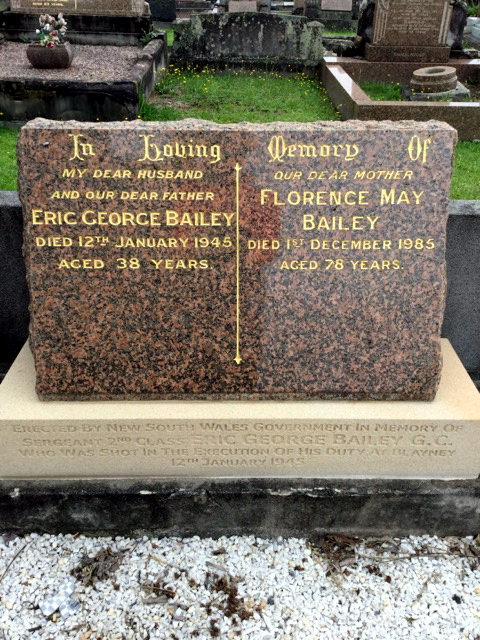
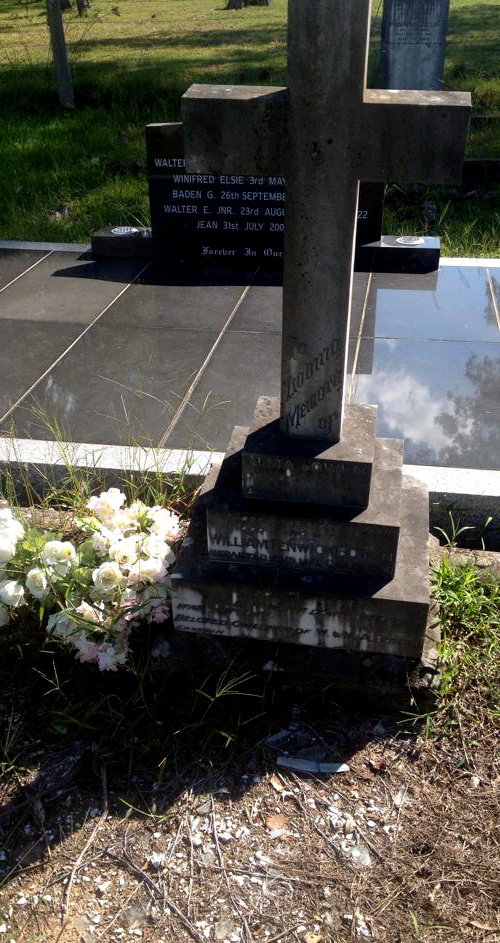
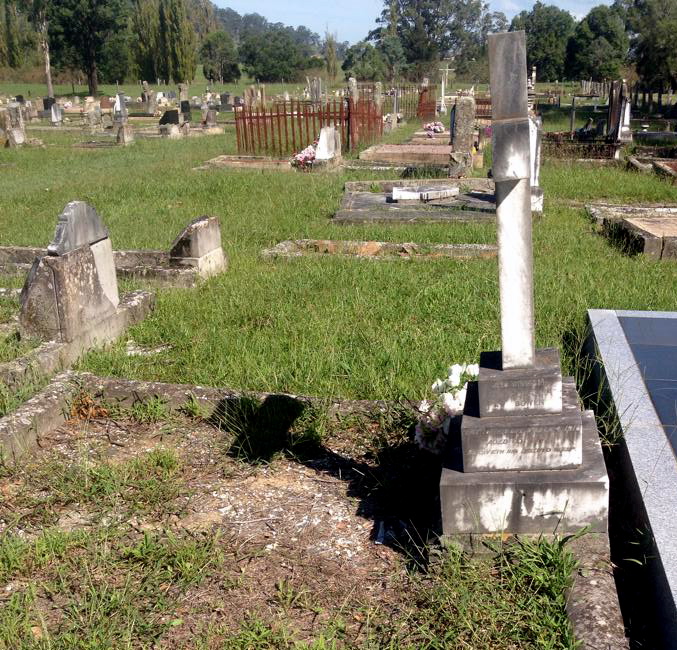
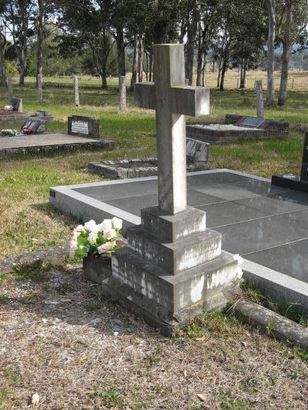
Grave

Inscription:<br /> In Loving Memory of<br /> My Dear Husband and our Dear Father<br /> Eric George BAILEY<br /> Died 12th January 1945<br /> Aged 38 years<br /> Our Dear Mother<br /> Florence May BAILEY<br /> Died 1st December 1985<br /> Aged 78 years.<br /> Erected by New South Wales Government in Memory of Sergeant 2nd Class Eric George BAILEY G.C. who was shot in the Execution of his Duty at Blayney<br /> 12th January 1945.<br />

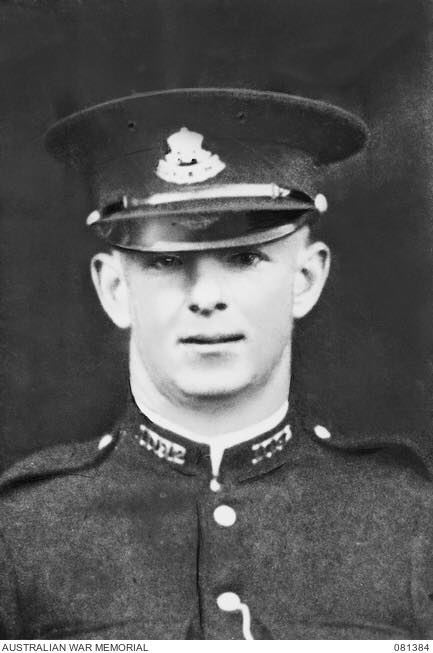
Sergeant Eric George Bailey ( 1945 )

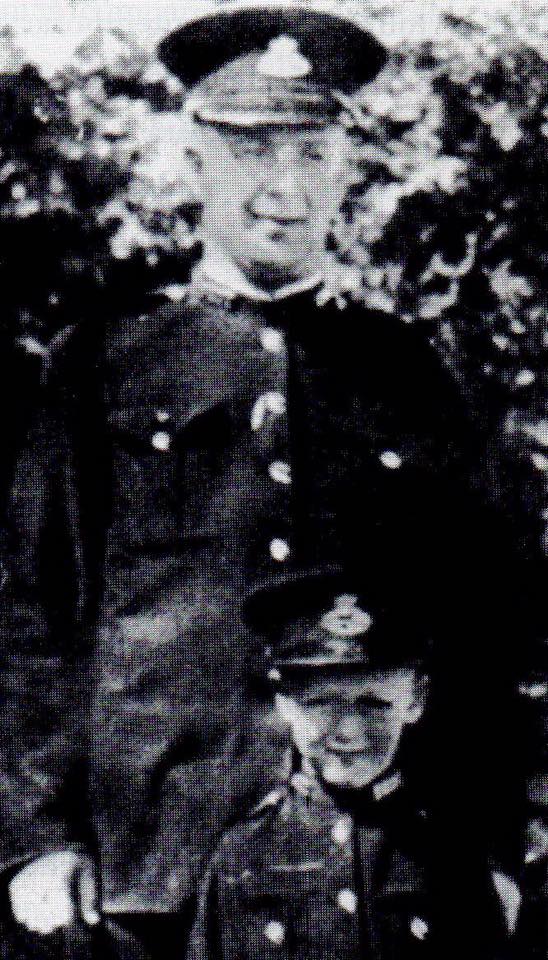
Eric George BAILEY and his son - John
Eric George BAILEY and his son – John “Jack” BAILEY ( NSWPF # 6293 )


ERIC IS mentioned on the Police Wall of Remembrance
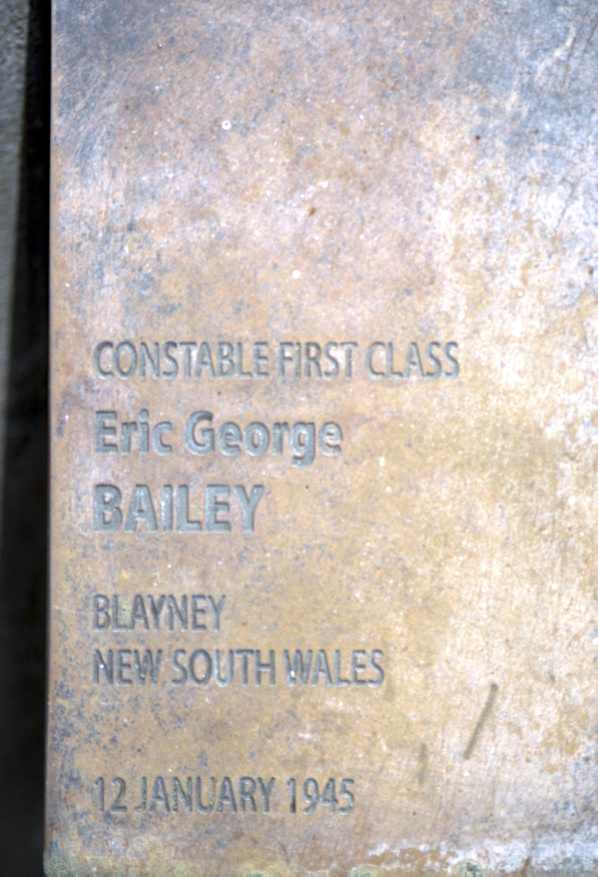
 

Eric George BAILEY GC. Touch plate at National Police Wall of Remembrance, Canberra
Touch plate at National Police Wall of Remembrance, Canberra

Memorial location:  Below plaque is located at the location of the murder.
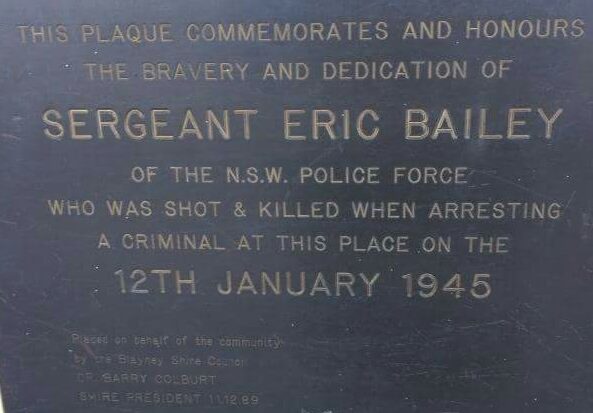
This plaque commemorates and honours the bravery and dedication of Sergeant Eric Bailey of the N.S.W. Police Force who was shot and killed when arresting a criminal at this place on the 12th January 1945. Placed on behlaf of the community by the Blayney Shire Council by Barry Colburt, Shire President, 11 December 1989.

On 4 January 1945, Constable 1st Class Bailey commenced duty at Blayney Police Station.  On his 8th day at that station, he was dead.

On a hot summer evening, eight days later, while on duty in Adelaide Street, he was informed that a drinker at the Exchange Hotel was displaying a revolver.

Shortly after 8pm on 12 January 1945, Constable 1st Class Bailey spoke to a man, Cyril Norman, who was dressed in an American Naval Uniform outside the Exchange Hotel, Blayney. The constable told the man that he intended to search him and his belongings regarding his alleged possession of a revolver. The man suddenly produced the revolver and shot Constable Bailey in the stomach. The constable then took hold of the offender and during the ensuing struggle two more shots were fired and the offender was wounded in the wrist. Three railway employees quickly came to the constable’s aid and the offender was handcuffed and detained until the arrival of Constable GradyBailey told Grady: ” He shot me through the back.  Don’t let him get away …I had a go.  I didn’t squib it “.

The wound suffered by Constable Bailey proved to be severe and he died on admission to the Orange Base Hospital with his wife by his side. He had in fact arrested his own murderer.


Allegations were later made suggesting that the offender was a contract killer sent to murder another local policeman, Constable Stan Grady, who had been enthusiastically investigating sly grog sellers and SP bookies in the area. The offender was said to have inadvertently shot Constable Bailey, whom he mistook for Grady, who was off duty at the time. When shot, Constable Bailey was in mounted police uniform, and until that day Stan Grady had been the only mounted constable in Blayney, thus the offender’s error. The offender, well-known Sydney criminal Cyril Normanalias Thomas Couldrey – was convicted and sentenced to death.

Norman was charged with the murder of Bailey and that of Maurice Hannigan, a Sydney shopkeeper from whom he had stolen guns and ammunition. Although he was convicted, the death sentence was later commuted to life imprisonment.


Bailey was posthumously awarded the George Cross, instituted in 1940 by King George VI and intended primarily for civilians, which recognized ‘acts of the greatest heroism or of the most conspicuous courage in circumstances of extreme danger’.

The first Australian policeman to be so honoured, he was also posthumously promoted sergeant 3rd class and awarded the George Lewis trophy in 1945 for the most courageous act by a policeman.

Bailey was accorded an official police funeral in Sydney and was buried in the Anglican section of Rookwood cemetery. His daughter and son John, who was to join the New South Wales police at the age of 16, also survived him.

( John ‘Jack’ George BAILEY, NSW Police Cadet # 0613, Regd. # 6293 )


28 May 2020

Maz Herrmann His son John “Jack” Bailey an ex cadet was our boss at Albury during the 80s and the day he retired I spoke to him that evening and said “Jack what are you fkn doing at work; today is your last day”? He said “I’m just tidying up some things before I go.
I knew Jack when he was a Snr Sgt at Wollongong and I was the Inspectors Clerk in 1977-1980.
I joined the cops the following year 1981 – then I had to call him Sir!
He was definitely an old school copper – enough said.
May he R.I.P.

https://www.facebook.com/groups/1087842541279097/


The Sydney Morning Herald of 11 September, 1947

announced the presentation of Sergeant Bailey’s George Cross by Sir William McKell.


GEORGE CROSS AWARD – INVESTITURE BY MR. McKELL.

Mrs. F. M. Bailey, of Cleveland Street, Moore Park, widow of Police Sgt. Eric G. Bailey, yesterday received the George Cross awarded to her husband for holding a man who had fatally wounded him until assistance arrived, at Blayney in January, 1945. The decoration was made at an investiture held by the Governor General, Mr. McKell, at Government House.


Sergeant Bailey was born in 1906 and joined the New South Wales Police Force in 1927. At the time of his death he was stationed at Blayney. He was posthumously promoted to Sergeant 3rd Class ( Although his grave states Sgt 2/c ) and awarded the George Cross and the George Lewis Trophy.

* Eric BAILEY is the ONLY Australian Police Officer to be awarded the Imperial Honour, namely the George Cross Medal.


Bailey, Eric George (1906–1945)

by Christa Ludlow

This article was published in Australian Dictionary of Biography, Volume 13, (MUP), 1993

Eric George Bailey (1906-1945), policeman, was born on 14 October 1906 at Tenterfield, New South Wales, ninth child of Arthur Peter Bailey, compositor, and his wife Jane, née Bush, both native-born. Eric worked as a postal assistant before joining the New South Wales Police Force on 16 March 1927. After training, he was transferred to Sydney’s No.4 Division on 14 June, and sent to The Rock in 1928; he then served at Gundagai, Narrandera and other rural stations. Bailey was confirmed an ordinary constable on 16 March 1928. He married Florence May O’Connor at Mount Carmel Catholic Church, Waterloo, on 24 November that year.

Promoted constable 1st class on 23 April 1938, Bailey was next stationed at Moruya on the south coast. In 1940 he arrested a criminal at Batemans Bay and was commended for bravery, cool-headedness and devotion to duty. Learning that a fishing trawler had been attacked by a Japanese submarine off Moruya on 3 August 1942, he and Sergeant Horace Miller set out at night in a pleasure launch in heavy seas to assist with the rescue of the survivors. Bailey was highly commended and awarded six months seniority for conspicuous bravery; he also received a certificate of merit from the Royal Shipwreck Relief and Humane Society of New South Wales.

On 4 January 1945 Bailey was transferred to Blayney, south-west of Bathurst. On a hot summer evening eight days later, while on duty in Adelaide Street, he was informed that a drinker at the Exchange Hotel was displaying a revolver. When Bailey questioned the offender, Cyril Norman, and declared that he would search his room, Norman drew a revolver and shot him. In the ensuing struggle two more shots were fired, but Bailey managed to handcuff Norman and restrain him until Constable Grady arrived. Bailey told Grady: ‘He shot me through the back. Don’t let him get away . . . I had a go. I didn’t squib it’. Fatally wounded by the first shot, Bailey died hours later on 12 January 1945 in Orange Base Hospital, his wife at his side.

Norman was charged with the murder and that of Maurice Hannigan, a Sydney shopkeeper from whom he had stolen guns and ammunition. Although he was convicted, the death sentence was later commuted to life imprisonment.

Bailey was posthumously awarded the George Cross, instituted in 1940 by King George VI and intended primarily for civilians, which recognized ‘acts of the greatest heroism or of the most conspicuous courage in circumstances of extreme danger’. The first Australian policeman to be so honoured, he was also posthumously promoted sergeant 3rd class and awarded the George Lewis trophy in 1945 for the most courageous act by a policeman. Bailey was accorded an official police funeral in Sydney and was buried in the Anglican section of Rookwood cemetery. His daughter and son John, who was to join the New South Wales police at the age of 16, also survived him.

Select Bibliography

  • I. Bisset, The George Cross (Lond, 1961)
  • L. Wigmore (ed), They Dared Mightily (Canb, 1963)
  • Police News (Sydney), Feb 1945, p 7, Sept 1945, p 9, Oct 1947, p 44
  • Sydney Morning Herald, 14, 20 Jan, 8, 22 Feb, 5 Aug 1945, 30 Oct 1946, 11 Sept 1947
  • Sun (Sydney), 17 Jan 1979
  • service records of E. G. Bailey (police registry, New South Wales Police Dept, Sydney).

Citation details

Christa Ludlow, ‘Bailey, Eric George (1906–1945)’, Australian Dictionary of Biography, National Centre of Biography, Australian National University, http://adb.anu.edu.au/biography/bailey-eric-george-9403/text16527, published first in hardcopy 1993, accessed online 6 January 2015.

Life Summary [details]

Birth

14 October 1906
Tenterfield, New South Wales, Australia

Death

12 January 1945

Orange, New South Wales, Australia

Religious Influence
Occupation
Workplaces


This article was first published in hardcopy in Australian Dictionary of Biography, Volume 13, (MUP), 1993

http://adb.anu.edu.au/biography/bailey-eric-george-9403
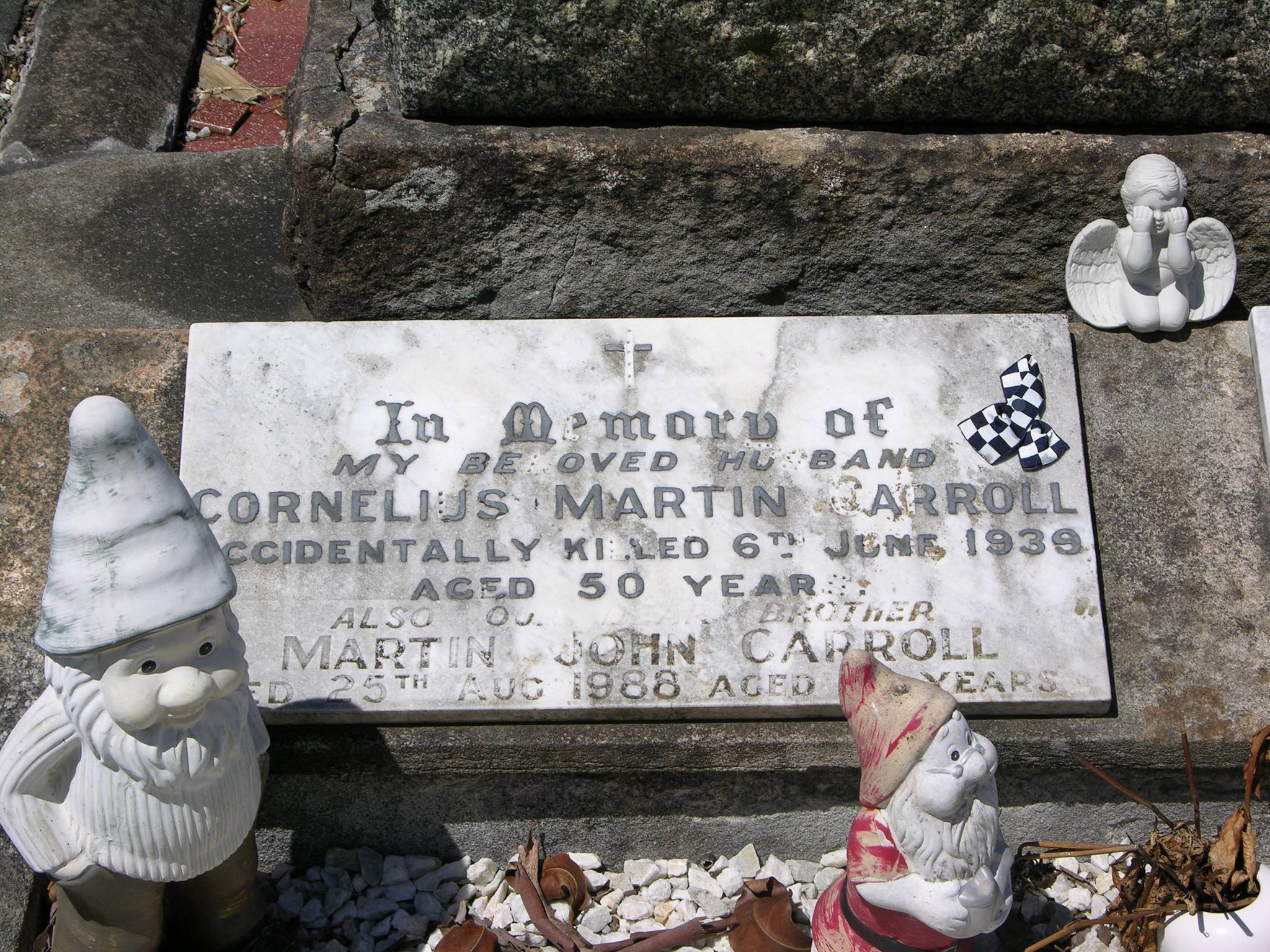


Cornelius Martin CARROLL

Cornelius Martin CARROLL

aka  Con

( late of 8 St David’s Road, Concord )

New South Wales Police Force

Regd. #   ??

Rank:  Detective Sergeant 3rd Class

Stations: ?, Burwood, Petersham ( O.I.C. – Detectives )

ServiceFrom  24 February 1915  to  6 June 1939 = 24+ years Service

Awards: No Find on It’s an Honour

Born? ? 1888 in Ireland

Died on:  Tuesday  6 June 1939

Cause:  Struck by a Motor Vehicle

Event location:  Parramatta Rd, near Ross St, Camperdown

Age: 50

Funeral date:   Thursday  8 June 1939 @ 8am

Funeral location: St Mary’s Church, Concord

Buried at:  Rookwood Catholic Cemetery @ 2.30pm

Section:  Mortuary 2 – 12  533

Lat / Long:  -33.88171, 151.05267

 In memory of my beloved husband Cornelius Martin CARROLL. Accidentally killed 6th June 1939. Aged 50 years. Also our beloved brother Martin John CARROLL Died 25th August 1988 aged 71 years

 CORNELIUS IS mentioned on the Police Wall of Remembrance

About 6pm on 6 June, 1939 Detective Sergeant  ‘ Con ‘ Carroll, the Officer in Charge of Detectives at Petersham, left his station to meet with an informant near the Sydney University.

In Parramatta Road near Ross Street, Camperdown he was accidentally hit by a car and was killed instantly. A report of the death was published in the Sydney Morning Herald of 7 June,1939.


DETECTIVE KILLED – Knocked Down by Car.  1939

Detective Sergeant Cornelius Carroll, 50, of St David’s Road, Concord was knocked down and killed by a motor car in Parramatta Road near Ross Street, Forest Lodge last night. Detective Sergeant Carroll had been in the police force 25 years, mostly in the Burwood and Petersham areas. He was in charge of the detectives at Petersham.

Detectives Brown and Rowland were informed that Detective Sergeant Carroll was either walking across the road or had just alighted from a tram when the accident occurred. The driver of the motor car did not see him until the impact, which fractured Detective Sergeant Carroll’s skull and limbs, killing him instantly.

Detective Sergeant Carroll’s body was taken to the Royal Prince Alfred Hospital by the Central District Ambulance. Detective Brown who was a close friend did not know whose death he was investigating until Detective Sergeant Carroll’s papers were found at the city morgue.

http://trove.nla.gov.au/newspaper/article/17604312

Anyone who witnessed the accident is asked to communicate with Detective Parmeter or Detective Wiggins at the Camperdown police station.


The sergeant was born in 1888 and joined the New South Wales Police Force on 24 February, 1915.

At the time of his death he was stationed at Petersham.

He was buried at Rookwood Catholic Cemetery.


As an aside, there was a Cornelius Daniel CARROLL who joined the NSW Police Force, as a Police Cadet, on the 12 February 1941.  Cadet # 309.

It is not known if C.D. Carroll is related to Cornelius CARROLL who died in June 1939.


The Sydney Morning Herald

Thursday  8 June 1939    p8

CARROLL – June 6 1939 suddenly Cornelius John ( Con ) Carroll detective sergeant of police dearly loved husband of Catherine Mary Carroll and father of Martin Josephine (Greta) Mary and Cornelius ( Conny ) aged 51 years Requiescat in pace.

http://trove.nla.gov.au/newspaper/article/17612052


Crookwell Gazette

Wednesday  21 June 1939    p 1

FULLERTON NEWS

SERGT. CARROLL’S DEATH SUCCUMBED TO INJURIES

On June 6 th. Detective-Sergeant Cornelius Carroll (“Con” to every one) had just signed off from duty at 6 p.m. and was waiting on the Parramatta Road, near the University, Sydney, for a bus to take him home to Concord, when he observed that a car coming along was one he was looking for.

On the impulse he stepped in front of the car to stop the driver, but the car crashed right into Carroll, who was flung and carried 100 yards.

He was picked up and given medical attention but died very shortly afterwards from his injuries.

The driver had gone on and escaped.  ( This doesn’t appear to be true – after reading other articles stemming from the Coroners Court )

The funeral on Thursday went from Burwood R.C. Church to the R.C. portion of Rookwood Cemetery.

The cortege was headed by the Sydney Police Band playing The Dead March. Over 200 police followed as a tribute of respect to a comrade who had always been popular in the Force for his geniality and readiness to do a good turn.

He was well known to the “underworld,” who regarded him as a “holy terror.”

Con Carroll was liked and known to many of the people of the Fullerton district, as up to a few years ago he was a frequent visitor to his parents-in-law, Mr. and Mrs. Philip Horgan, of Cartwright’s Creek, he having married their eldest daughter. Besides his widow, he is survived by his four children, Martin, the Misses Gretta and Mary and Cornelius.

Detective Carroll was born in Ireland 51 years ago and always retained a great love for his native country and his church. He came to Sydney as a young man and had been in the Police Force in the Sydney district ever since his arrival in Australia. He had resided at Davis Street, Concord, for many years. The sudden tragedy came as a great shock to his aged mother-in-law, Mrs.

Mary Anne Hogan, who always looked upon the deceased as one of her own sons.

http://trove.nla.gov.au/newspaper/article/221299636


The Sydney Morning Herald

Tuesday  11 July 1939    p16

DETECTIVE’S DEATH.

Finding of Accident.

The City Coroner Mr Oram at an adjourned inquest yesterday into the death of Detective sergeant Cornelius John Carroll, 50, of Davidson Street Concord who was knocked down by a motor car in Parramatta Road Forest Lodge on June 6, found that he was killed accidentally.

In previous evidence it had been stated that Carroll was on his way to keep an appointment with a female informer near the University grounds when he met his death.

In announcing his finding Mr Oram said that he could not commit the driver of the car for trial on a charge of manslaughter. Evidence was conflicting but it seemed to suggest that the car that struck the dead man was travelling in excess of 30 miles an hour in a built up area when the accident occurred. It was a border line case but there was no evidence that the driver displayed gross carelessness amounting to criminal negligence.

http://trove.nla.gov.au/newspaper/article/17616515


Other readings can be found at:

http://trove.nla.gov.au/newspaper/article/17595388

http://trove.nla.gov.au/newspaper/article/133740103

http://trove.nla.gov.au/newspaper/article/133733182


The Newcastle Sun ( NSW )

Tuesday  12 September 1939     p 8

SERGT.’S DEATH IN ACCIDENT

Motor Driver Fined For Negligence

SYDNEY. Tuesday

A trail of broken glass for 120 feet and a blood trail 33 feet long were described by Constable Cecil Stanley Jardine in the Traffic Court to-day when Archibald William Johnson, of Ashfield. was convicted by Mr. Wood. S.M., of negligent driving and fined £7.plus 23s 6d costs and expenses.

The charge arose out of an accident in Parramatta-road, Forest Lodge, on June 6, which resulted in the death of Detective-Sergeant Cornelius John Carroll, of Petersham. James Aubrey Gibson told of a man crossing the road as though to board a tram when a car approached fast. It had dim lights. The man put a hand up but the car hit him and carried him along the road 40 or 50 yards.

Johnson, who is a printer, pleaded not guilty. He said he eased to about 12 miles an hour and then increased speed to about 30. He felt a bump and saw a form disappear in front of the radiator. ” I applied the brakes and drew into the side, ” said Johnson.

Mr. Wood said he would recommend the Transport Department to test whether Johnson was fit to drive a car. Either he had not been paying proper attention or there was a defect in his vision.

http://trove.nla.gov.au/newspaper/article/167327081


Riverine Herald ( Vic. )

Friday  17 February 1933     p3

DETECTIVE WOUNDED.

Accidental Discharge of Revolver.

SYDNEY, Thursday

Although wounded in one shoulder when his companion’s revolver was accidentally fired last night, Detective Cornelius Carroll insisted on carrying on with the task of searching for burglars in a house before going to hospital.

When Mr W. T. Coggins, of Chalmers Rd, Strathfield, returned home last night he saw lights burning in the house and rang the police on a neighbor’s telephone.

Detective Carroll, Detective Clifton and Constable Gordon answered the call. Sir Coggins and Constable Gordon went to the rear of the dwelling, while Detectives Carroll and Clifton approached the front.

Carroll, with revolver drawn, was walking a few yards in front. Clifton was drawing his revolver from its holster when it went off, and the bullet, ricocheting off a brick wall, buried itself in the fleshy part of Carroll’s right shoulder.

Carroll took part in a search of the house, saying that the wound was a mere scratch. The burglars had decamped, however, taking £20 worth of clothing.

Examination at the hospital revealed the detective’s injury was not serious, but the bullet was still embedded.

So little did Carroll think of it that he rang the Burwood police station to inform officers there of his injury, joking with his mates and asking them to send him along a pair of slippers.

http://trove.nla.gov.au/newspaper/article/116480254


Goulburn Evening Penny Post

Friday  3 March 1933     p 2

Detective Carroll, who was shot accidentally during a raid in search of suspects at Ashfield, is Cornelius John Carroll, a son-in-law of Mr. and Mrs. Philip Hogan, of Cartwright’s Creek, Fullerton. ” Con. ” is often to be seen in Crookwell when on a visit to his wife’s parents. His genial nature and his coolness and pluck are outstanding attractions of this big, genial Irishman.

http://trove.nla.gov.au/newspaper/article/102864809


Leslie Andrew NASH

Leslie Andrew NASH

New South Wales Police Force

Late of 6 Clarence St, Penshurst, NSW


Regd. #  ????

Uniform #  87A or 97A


Rank:  Commenced Training at ? Academy on Tuesday 5 April 1921

Probationary Constable – appointed ? ? ?

Constable 1st Class – appointed ? ? ?


Final Rank: Constable 1st Class


StationsParramatta ( 1924 ), Sutherland, Hurstville ( 1928 – 1935 )


ServiceFrom 5 April 1921 to 15 April 1935 = 14 years, 0 months, 10 days Service

Awards?

Constable Leslie Nash ( 1935 )

Born:  22 December 1898 in Parkes, NSW

Died: Monday  15 April 1935

CauseIllness – Suicide- service revolver

Age:  36 years, 3 months, 24 days


Event locationHurstville Police Station


Funeral dateTuesday  16 April 1935

Funeral locationSt Declan’s Church, Penshurst @ 2.30pm


Buried atWoronora Cemetery, Sutherland

Grave Location:  Roman Catholic Monumental Section 3 – Plot: 0493

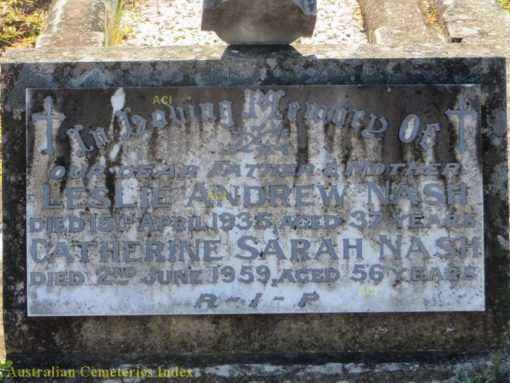
In Loving Memory of our dear father and mother. Leslie Andrew NASH, Died 15 April 1935 aged 37 years. Catherine Sarah NASH, Died 2 June 1959, aged 56 years. R.I.P.

Coroners InquestTuesday  30 April 1935


 LESLIE is NOT mentioned on the National Police Wall of Remembrance ( 2021 )  * BUT SHOULD BE


Constable Nash is thought to have been shot to death, possibly while on duty, on 15 April, 1935. It was thought that he had committed suicide however little is known about this incident and to some extent it remains a mystery.

The Hurstville Propeller newspaper dated 18 April, 1935 published the following article.


CONSTABLE FOUND SHOT AT HURSTVILLE POLICE STATION.

First-Class Constable Leslie Andrew Nash, station officer at the Hurstville Police Station, was found dead at the station early on Monday morning. Constable Nash commenced duty at 5 a.m. Constable Harvey left the station and when he returned Nash was missing. A search revealed his body in the bathroom attached to the station. Nash’s service revolver was nearby.


The Sydney Morning Herald of 16 April, 1935 added a bit more to the story.

POLICEMAN FOUND SHOT. Constable Leslie Andrew Nash, 38, was found dead in the bathroom at the Hurstville Police Station yesterday morning with a bullet wound in his head. A revolver was found nearby. Nash was to have sat for an examination yesterday morning and had been in ill-health for some time. For the last eight years, Nash, who was a first class constable with 14 years service, had been stationed at Hurstville and was well liked and respected in the district. He had previously been stationed at Sutherland. He is survived by a widow and five children.

The constable was born in 1897 and joined the New South Wales Police Force on 5 April, 1921. At the time of his death he was stationed at Hurstville.


Newcastle Morning Herald & Miners’ Advocate

Tuesday  30 April 1935   P9


WORRIED OVER LECTURES

Constable Committed Suicide

SYDNEY, Monday,

Forgetting what he had been told at lectures, Constable Leslie Nash, 37, committed suicide at Hurstville Police Station on April 15.

At the inquest today, Constable James Harvey said that Nash told him that he was worrying over a departmental examination that day, and had forgotten what he had been told.

Returning a verdict of suicide, the Coroner said that the case was very sad.

http://trove.nla.gov.au/newspaper/rendition/nla.news-article139251811.txt


Armidale Express and New England General Advertiser (NSW : 1856 – 1861; 1863 – 1889; 1891 – 1954),

Monday 15 April 1935, page 1

CONSTABLE SUICIDES

Strain of ill-Health Too Great

Sydney, Monday.

Constable Leslie Andrew Nash (38), was found dead at the Hurstville Police Station early this morning with a gun shot wound in the head.

He was acting as station officer. It appears that the man, who had been in ill health, had been told that he would have to undergo a serious operation. Some time later he was missing, and a search resulted in the discovery of his body in the bathroom attached to the station, with a revolver lying nearby.

http://trove.nla.gov.au/newspaper/rendition/nla.news-article192714831.txt


News (Adelaide, SA : 1923 – 1954),

Monday 15 April 1935, page 4


CONSTABLE FOUND DEAD AT STATION

Advised of Operation

SYDNEY, Monday. – Shot in the head,.

Constable Leslie Andrew Nash. aged 38, was today found dead at the Hurstville Police Station, where he had performed duty as station officer.

Nash, who has been in ill health and had been told that he would have to undergo a serious operation, began duty at 5 a.m. He asked Constable Harvey to go on an errand, and when Harvey returned Nash was missing.

A search revealed his body in the bath room attached to the station. His service revolver was nearby.

Nash left a widow and four children.

He had been in the force for 14 years and was a first-class constable.

Today he was to have sat for an examination, which his inspector said he would have passed without the slightest difficulty.

http://trove.nla.gov.au/newspaper/rendition/nla.news-article128816003.txt


The Sydney Morning Herald

Tuesday  16 April 1935   p 9

NA8H.- H.A.C.B.S. St. DECLAN’S BRANCH, No. 659.- The Officers and Members of the above Branch are requested to attend the Funeral of their late Bro.. LESLIE A. NASH: to leave St. Declan’s Catholic Church. Penshurst, THIS DAY. at 2.30 p.m., for Woronora Cemetery. By road.

W. J. MEACHMAN. Tres.

R. J. MADDEN. Sec.

http://trove.nla.gov.au/newspaper/rendition/nla.news-article17166023.txt


Further reading:  https://police.freom.com/woronora-cemetery-wall-of-remembrance/


The Coroners Inquest returned a verdict of “Effects of a bullet wound in his head, wilfully self inflicted

Inquest was concluded on 29 April 1935.


In the attached photo, his Uniform #  is 87A or 97A.

The ‘ A ‘ used to depict the District that the member was attached to.  ‘ A ‘ District was Sydney – so he may, at the time of the photo being taken, have been stationed at one of the Sydney CBD Stations.


NSWBDM

Birth   =   6089/1898             Father = Patrick                 Mother = Amelia             District = Parkes

Marriage = 2105/1925           Bride  = McDonnell or MacDonnell                           District = Kempsey

Death =   7008/1935              Father = Patrick                 Mother = Amelia             District = Hurstville


Leslie Andrew Nash (1898 – 1935)

Leslie Andrew Nash
Born in Parkes, New South Wales, Australiamap

Ancestors ancestors

Husband of Sara Catherine Ellen McDonnell — married [date unknown] [location unknown]
[children unknown]
Died at age 36 in Hurstville, New South Wales, Australiamap
Problems/Questions Profile manager: Rita Kidd private message [send private message]
Profile last modified
This page has been accessed 33 times.

Biography

Leslie was born in 1898, the son of Patrick and Amelia, Leslie married on 10 Jan 1925 to Catherine McDonnell. Leslie was a First Class Constable Leslie passed away 15 Apr 1935 (aged 36)

Sources

  • NSW BDM
  • BIRTH NASH LESLIE A 6089/1898 PATRICK AMELIA PARKES
  • MARRIAGE 2105/1925 NASH LESLIE A MCDONNELL CATHERINE KEMPSEY
  • DEATH NASH LESLIE A 7008/1935 PATRICK AMELIA HURSTVILLE
  • RYERSON INDEX
  • NASH Leslie Andrew Death notice 15APR1935 Death 37 at Hurstville, late of Penshurst Sydney Morning Herald 16APR1935
  • The Sydney Morning Herald NSW 1842 – 1954

Tue 16 Apr 1935 DEATH NASH-April 15, 1835, suddenly, at Hurstville, Leslie Andrew, of 6 Clarence-street, Penshurst, dearly beloved husband of Catherine and father of Pat, Francis , Alma, John and Peter aged 37 years. Requiescat in pace.

The Sydney Morning Herald NSW 1842 – 1954 Tue 16 Apr 1935 Page 9 FUNERAL NASH.-The Relatives and Friends of Mrs. CATHERINE NA8H and FAMILY are kindly Invited to attend the Funeral of her dearly beloved HUSBAND and their FATHER. First Class Constable Leslie Andrew Nash: which will leave St. Declan’s Church. Penshurst, THIS TUESDAY, at 2.30 p.m., for the Catholic Cemetery. Woronora. Mrs. P. KIRBY and SON. LTD.. Leadlng Funeral Directors. phone, M2221-2. 263 Elizabeth-street, Sydney.

NASH.-‘The Friends of Mr. WILLIAM ROSS are kindly invited to attend the Funeral of his friend, the Late Mr. Leslie A. Nash: lo leave St. Declan’s Church. Penshurst, THIS DAY (Tues day. For further details please see above notice.

NASH.- H.A.C.B.S. St. DECLAN’S BRANCH, No. 659.-The Officers and Members of the above Branch are requested to attend the Funeral of their late Bro.. LESLIE A. NASH: to leave St. Declan’s Catholic Church. Penshurst, THIS DAY. at 2.30 p.m., for Woronora Cemetery. By road. W. J. MEACHMAN. Tres. R. J. MADDEN. Sec.

  • NASH Leslie Andrew Death notice 16APR1935 Death at Hurstville Sydney Morning Herald 22APR1935
  • The Sydney Morning Herald (NSW : 1842 – 1954)

Mon 22 Apr 1935 Page 8 Family Notices

  • DEATH

NASH.—April 16 (suddenly), at Hurstville, Les- lie Andrew, beloved brother, brother-in-law, and darling uncle of Bob, Rene, and Aileen.

  • Death aged 37 at Hurstville, late of Penshurst
  • BURIAL Woronora Memorial Park

Sutherland, Sutherland Shire, New South Wales, Australia PLOT RC 3 0493

  • MEMORIAL ID 180629133


Nash-9563-1.jpg


Leslie Andrew Nash (1898-1935) | WikiTree FREE Family Tree


William BOWEN

William BOWEN

( late of Dungog )

New South Wales Police Force

Regd. # ‘Q‘ 5316

For the purposes of this website ‘Q‘ represents those Police joining between 1 March 1862 ( commencement of NSWPF ) – 23 February 1915 ( Commencement of NSWPF current numbering system )

Rank:  Probationary Constable – appointed 14 January 1887

Sergeant 1st Class – appointed ? ? ?

Stations: Gloucester, Paterson, Minmi, and other places & Dungog ( 9 years to death ) ( Port Stephens LAC )

ServiceFrom  14 January, 1887 to  4 March 1916 = 29+ years Service

Awards?

Born: ? ? 1859 at Uralla, NSW

Died on:   Saturday 4 March 1916

Cause:  Assault – Murder?

Event location:  Dungog, NSW

Event date? January 1916

Age: 55

Senior police gather to remember fallen colleague Posted Fri at 7:22am Hunter Valley police officer, Sgt William Bowen who died in 1916, after he was attacked by a mentally ill man at Dungog hospital.

Funeral dateSunday 5 March, 1916

Funeral location: Church of England cemetery, Dungog, NSW

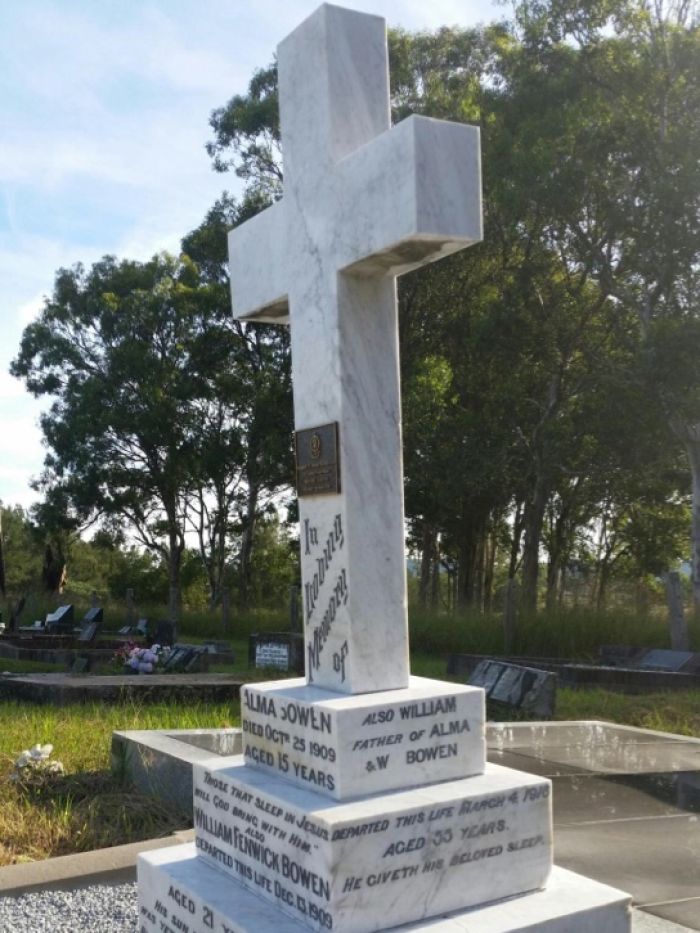
Buried at:  Church of England cemetery with his only son & youngest daughter, Alma

Dungog Cemetery,

Tabbil Creek, NSW,

3 references for the grave

Latitude: -32.419403
Longitude: 151.738657

GPS: -32 25.16418, 151 44.31976

-32.418649, 151.738825

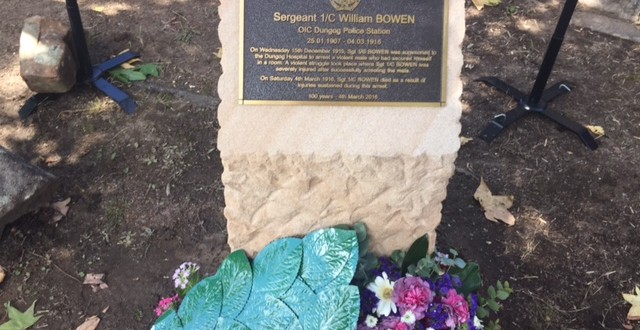
Memorial:  Memorial & Plaque unveiling at Dungog Police Station on 4 March 2016


WILLIAM IS mentioned on the National Police Wall of Remembrance

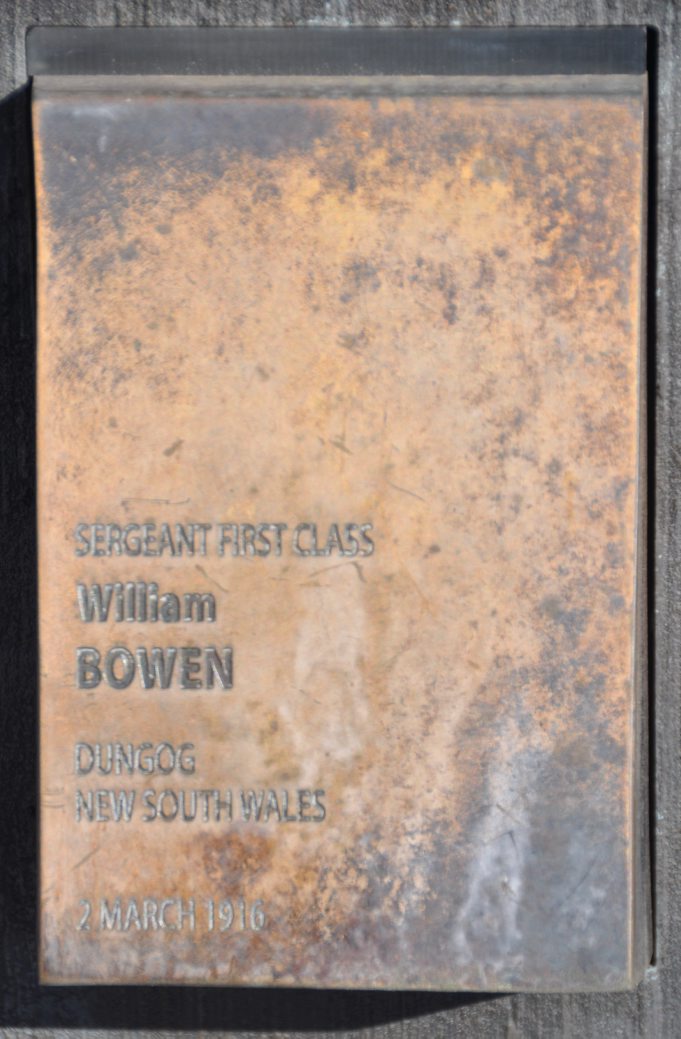
Touch plate at the National Police Wall of Remembrance, Canberra
Touch plate at the National Police Wall of Remembrance, Canberra Incorrect date of death is displayed on plate.


The sergeant suffered serious internal injuries at Dungog when he was assaulted after detaining a mentally ill man in January, 1916. The sergeant had been called to the Dungog Hospital in relation to a violent and disturbed man. He arrested the man and took him to the local police station. Shortly after their arrival at the station the man again went berserk, kicking the sergeant and attacking him with a chair. The sergeant was taken to hospital for treatment and was eventually admitted to Sydney’s St Vincent’s Hospital where he died.


The Sydney Morning Herald of 7 March, 1916 reported news from Dungog to the effect that “The funeral of Senior Sergeant Bowen, of Dungog, who died at St. Vincent’s Hospital. Sydney, on Saturday, took place here yesterday, being one of the largest that have taken place at Dungog.”


The sergeant was born in 1859 and joined the New South Wales Police Force on 14 January, 1887. At the time of his death he was stationed at Dungog.

**  officially recorded as Thursday  2 March 1916 but correct death date appears to be Saturday  4 March 1916.  Date of Death on the grave stone also is 4 March 1916.


Dungog Chronicle
Tuesday  7 March 1916   p 2 of 6

Death.

Senior Sergeant Bowen

It is with deep regret that we record the death of Senior-Sergeant William Bowen, of Dungog. It will be remembered that deceased, who had been ill a short time, was taken to Sydney on Friday last ( 3 March 1916 ) to consult a specialist. He was accompanied by Mrs Bowen, and was conveyed to St. Vincent’s Hospital, and several specialists, including Sir Alex. McCormack, were called in consultation, but these were unable to diagnose the cause of the trouble, and an operation was recommended, as soon as he was strong enough to bear it, but the patient did not rally, and he passed away early on Saturday morning ( 4 March 1916 ). Such a sudden ending was totally unexpected, although it was noticed that the Sergeant had been failing for some time past. He thought he was a victim to acute dispepsia, but there was evidently something more seriously wrong.
Deceased was born at Uralla, 56 years ago, and had been 30 years in the service, the past nine years he had been stationed at Dungog. Previously he had been at Gloucester, Paterson, Minmi, and other places.

He was a very painstaking, conscientious officer, who discharged his duties with the utmost impartiality. He was very considerate to the men under him, and only those who were acquainted with him intimately knew what a very kind and thoughtful man he was, ever cheerful under the most adverse circumstances, and apparently never harboring an ill-thought about anybody. He will be hard to replace.

He leaves a sorrowing widow and three daughters ( Mrs J. Hunt, Mrs O. E. Carter, and Miss Myra Bowen ) to mourn their loss, to whom we extend our sincere sympathy.

His remains were brought from Sydney on Saturday ( 4 March 1916 ) and interred beside those of his only son ( who was killed at Minmi a few years ago ) and his youngest daughter Alma, in the Church of England cemetery.

The funeral took place on Sunday afternoon ( 5 March 1916 ) and was one of the largest ever seen in Dungog. The pall bearers were Sergt. Haynes ( Paterson ), Constable Capp ( Gresford ), Constable Vaughan ( Clarence Town ), and Constables Parker and Bates ( Dungog ).

The chief mourners were his two brothers, Tim ( Uralla ), and John ( Newcastle ), his brother-in-law Mr Reece ( Homebush ), and Mr O. E. Carter ( son-in-law ). Local justices and townspeople followed the chief mourners, walking, and then came a long cavalcade of vehicles and horsemen. The burial service was conducted by the Ven. Archdeacon Luscombe, who paid a fitting tribute to the memory of deceased at the graveside. Amongst the numerous wreaths sent was a beautiful one from the bench of magistrates and one from the local police.

http://trove.nla.gov.au/ndp/del/article/136015191?searchTerm=william%20bowen&searchLimits=l-decade=191|||l-year=1916|||l-month=3#pstart15595996


I have been unable to find any reference to the assault upon William Bowen within Trove as of 15 Jan. 2016.


Cal


NSW Registry of BDM

Birth = 6811/1858 ( possibly )

Death = 359/1916


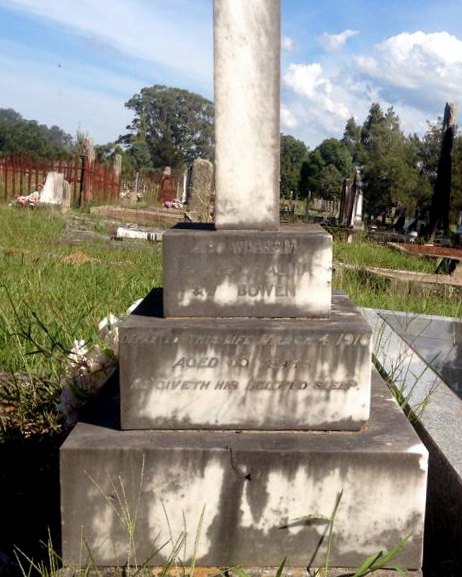
Senior Sergeant William Bowen's grave site at Dungog cemetery
Senior Sergeant William Bowen’s grave site at Dungog cemetery

 ** The person responsible for the assault upon the Sgt was Mentally Ill and sent to the asylum in Newcastle several days after the assault / death.

A Commemoration Day and Plaque Unveiling at Dungog Police Station will happen at 11am on Friday 4 March 2016 for Senior Sergeant William BOWEN.

Senior Constable Mitchell PARKER at Dungog is the person to contact in relation to attending this event.


Dungong Chronicle ( Durham & Gloucester Advertiser ( NSW )
Tues 16 March 1915  p 2 of 6

Police Court On Monday last, before Mr McDougall, S.M., John Dwyer, of Dungog, was charged with stealing about 40 pairs of *naves ( *possibly the central part of a wheel; hub ), valued at £10, the property of Mrs K. B. Walker. Sgt. Bowen represented, the police prosecution ; Mr Borthwick appearing for the accused.   Dwyer pleaded guilty and was fined £10, with a fortnight to pay. in default two months in Maitland goal. The fine would be reduced to £5 if the naves were returned to the owner within a week.

http://trove.nla.gov.au/ndp/del/article/138008263?searchTerm=sgt%20bowen%20-%20dungog&searchLimits=#reloadOnBack


Dungong Chronicle ( Durham & Gloucester Advertiser ( NSW )
Friday  24 January 1919    p 2 of 8

Two Men Shot

BULLAHDELAH SENSATION.

Superintendent Childs, of the West Maitland police, received a message from the police at Bullahdelah on Tuesday, giving brief particulars of a sensational shooting incident at the Crawford River.

The message, which came from Constable Sturgiss, stated that Walter John Edwards, 35 years of age, had shot Frederick Soorley, wounding him in the back. He also shot his father, Henry Edwards.

Edwards, who was stated to be apparently insane, is at large, armed with a shot gun. He is described as being 5ft 7in. high, of medium build and having a fair moustache.

Upon receipt of the message, the Superintendent immediately despatched information to all police stations in the locality.

Later.

Superintendent Childs received a telegraphic message from the police at Bullahdelah, stating that the man Walter John Edwards, who was wanted in connection with the shooting sensation at Crawford River, had been arrested between Bullahdelah and Bungwahl. After the shooting, Edwards cleared off, armed with a shot gun. He was charged with shooting with intent to murder, and with maliciously wounding. Arrangements were also made to prefer a charge of lunacy against him. He is stated to have previously been under mental treatment.

Another message from Bullahdelah states that Mr Edwards, sen., was not shot, but was attacked with a tomahawk. The insane man was found hiding in blackberry bushes and they were set alight. He then came out and was captured. Edwards had put his gun down and could not find it again, otherwise there might have been a casualty amongst the captors. The news of the shooting spread rapidly and upset the whole district. People from the Crawford River and other parts left their homes and went to Bullahdelah for safety. The news of the capture of Edwards was a great relief all round.

It will be remembered that Edwards was in Dungog Hospital some years ago and caused a sensation. He went partially insane and smashed up things generally. When the police were securing him at the Hospital he savagely assaulted the late Sgt. Bowen, breaking his hand with a chair.

http://trove.nla.gov.au/ndp/del/article/134142751?searchTerm=sgt%20bowen%20-%20dungog&searchLimits=#pstart15499332


Dungong Chronicle ( Durham & Gloucester Advertiser ( NSW )
Saturday  19 June 1954    p 8 of 8

REMINISCENCES BY WALLY IRWIN


‘DODGER’ EDWARDS

………….

May I refer to another Edwards, an old schoolmate,  ‘Dodger’ Edwards ( Walter John EDWARDS ). He was a super lad also. There were 50 odd pupils at school at Bendolba and some of them up to 18 years of age. Not one of them ever brought down Dodger in a game of football.   When the ball went to Dodger it was a ‘try.’  Most times the football was made of rags. Our coach then was Mr. Gardiner, our schoolteacher. I   think he replaced Mr. Lord, father of Mr. Dick Lord, of Dungog.

In later years, Dodger left our district and went to Gloucester to live. One evening he left Gloucester River to come over to Salisbury on horse back. He got bushed between Whispering Gully and Flag Staff. He unsaddled his horse and to this day the horse was never found. But ‘Dodger‘ came through. I think the trials experienced slightly derainged his mind.

The late Sgt. Bowen was called to the hospital and nearly met his death from a blow that Dodger gave him by hitting him over the head with a chair.

Some two years later, the late Anthony Hudson, his son Tony, and the late Les Middlebrook and I were out beyond Flag Staff and a horse neighed. Old Tony said: ‘Did you hear that,’ We all did, and we were sure there was a horse somewhere. It was over three weeks before we got that horse to mate up with ours. Eventually we succeeded in bringing that horse back. He was a real outlaw, but it was Les Magennis who mastered him. I think this horse was sold later to a circus. I have never solved the problem; was the horse Dodger’s, or whose was It?

…….

http://trove.nla.gov.au/ndp/del/article/140534498


Dungog Senior Sergeant William Bowen

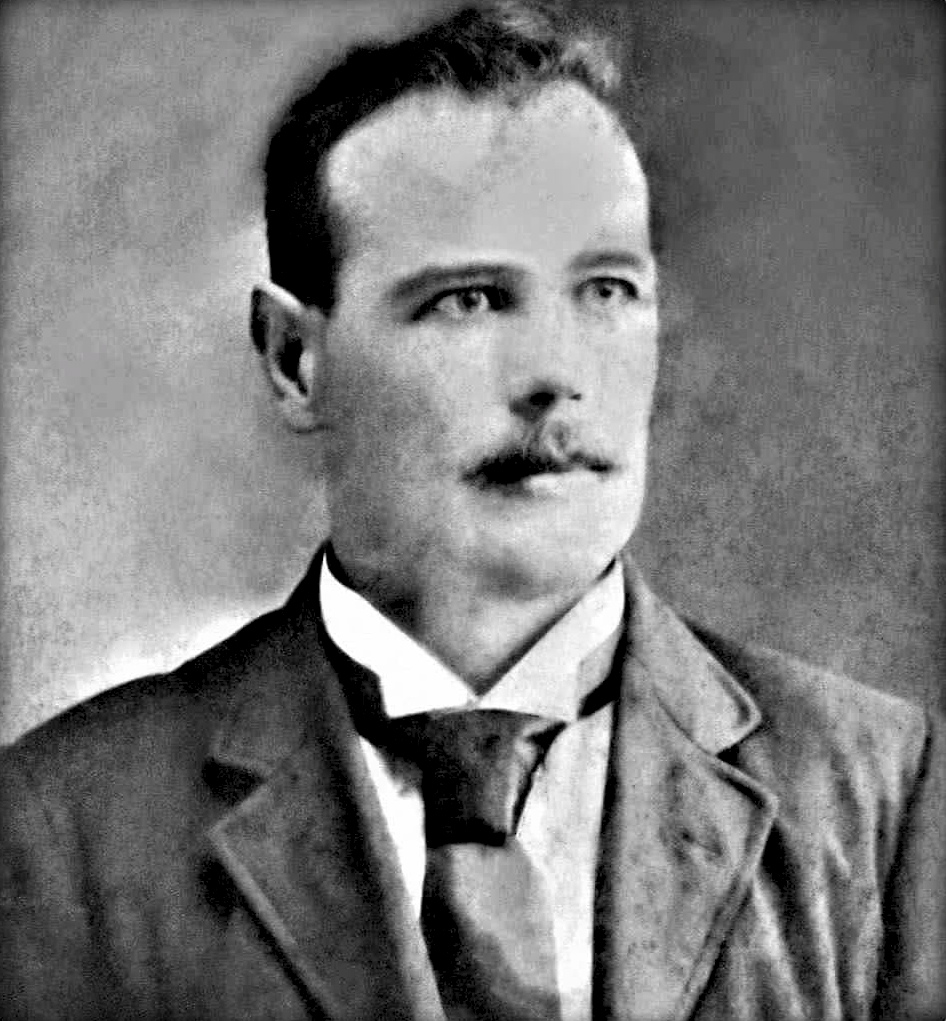
An old photograph of policeman near Dungog. Senior Sergeant William Bowen is among the officers shown.

BELINDA-JANE DAVIS

A Dungog policeman who suffered serious injuries on the job and died a century ago will be remembered in a special ceremony.

Senior Sergeant William Bowen suffered serious internal injuries when a mentally ill man kicked him and attacked him with a chair at Dungog Police Station in December 1915.

He had arrested the man at Dungog Hospital a short time earlier, after reports the man was being violent and disturbing staff and patients.

Sergeant Bowen, 56, was taken to hospital for treatment, but never fully recovered from the incident.

His failing health led him and his wife to travel to St Vincent’s Hospital in Sydney on March 3 to see a specialist.

Several specialists, including Sir Alex McCormack, assessed him but were unable to diagnose his condition.

They suggested an operation when he was feeling stronger but Sergeant Bowen continued to deteriorate that day and died in hospital unexpectedly the next morning.

NSW Police Force Commissioner Andrew Scipione and deputy commissioner Catherine Burn are expected to attend a ceremony at Dungog Police Station on March 4 at 11am, which will mark 100 years since Sergeant Bowen’s death.

NSW Deputy Premier Troy Grant and Dungog community groups will also attend and witness a plaque being unveiled, which will commemorate his service.

The Dungog Chronicle recorded Sergeant Bowen’s death on March 7, 1916, saying he would be “hard to replace”.

“He was a very painstaking, conscientious officer, who discharged his duties with the utmost impartiality,” the article said.

“He was very considerate to the men under him, and only those who were acquainted with him intimately knew what a very kind and thoughtful man he was, ever cheerful under the most adverse circumstances, and apparently never harboring an ill-thought about anybody.”

Sergeant Bowen’s body returned to Dungog on March 4 and he was buried in the town’s Church of England Cemetery on March 5 alongside his only son, who was killed in an accident at Minmi a few years earlier, and his youngest daughter Alma, who died of an illness.

It was one of the largest funerals the town had ever seen.

He was survived by his wife, three daughters, Mrs J Hunt, Mrs O.E Carter and Miss Myra Bowen, his two brothers John and Tim, and his brother-in-law Mr Reece and son-in-law Mr O.E. Carter.

Dungog police Senior Constable Mitch Parker said Sergeant Bowen, who was born in Uralla in 1859, joined the police force on January 14, 1887 and spent 29 years serving the region at Gloucester, Paterson, Minmi, Dungog and other stations.

He spent nine years in Dungog before his death.

Senior Constable Parker urged anyone who wanted to pay tribute to Sergeant Bowen’s service to attend the ceremony.

The story Policeman who died a century ago to be remembered first appeared on The Maitland Mercury.

http://www.dungogchronicle.com.au/story/3758911/policeman-who-died-a-century-ago-to-be-remembered/?cs=171


DUNGOG MARKS POLICEMAN’S DEATH 100 YEARS ON

His name adorns the National Police Memorial, but until recently, the death of Dungog policeman William Bowen a century ago went unrecognised in the town he called home.

Today that changed, thanks to years of research and a lot of hard work.

The restored headstone at Sgt William Bowen’s grave site

Posted

Restoration work has been completed on the grave site of Sgt William Bowen, who died on March 4, 1916 after being attacked on duty at Dungog in the NSW Hunter Valley.


William BOWEN - NSWPF - Grave 5 - Died 4 March 1916
Restored grave stone


Commemorating 100yr anniversary of officer’s death in the Hunter

The New South Wales Police Commissioner Andrew Scipione will be in the Hunter Valley today to commemorate the 100-year anniversary of the death of a Dungog police officer.

Sergeant William Bowen died on March the 4, 1916, three months after he was attacked by a mentally ill man who had barricaded himself inside Dungog hospital.

Today the commissioner will attend the unveiling of a plaque in his honour.

The man had barricaded himself in the committee room, ordered that all patients be killed in the hospital, and then armed himself with surgical instruments.

Snr Constable Mitch Parker, Dungog Police

Dungog police officer, senior constable Mitch Parker, said sergeant Bowen suffered serious injuries as he bravely tried to protect the Dungog community in December 1915.

“There was a patient of the Dungog hospital who had smashed a number of windows and items within the nurses quarters and a wardsman attempted to restrain him and he got viscously assaulted,” he said.

“Police were sent for and the sergeant, who was living in the police lock-up which we still have today, went up the hill to the hospital.

“By this stage the man had barricaded himself in the committee room and he ordered that all patients be killed in the hospital, and then armed himself with surgical instruments of the day — mostly steel and glass.

“Sergeant Bowen, who was 55 years of age at the time, had been in the police for 30 years, forced his way into the room.

“He successfully arrested and apprehended the male, notwithstanding some injuries himself,” he said.

“They brought him back down to the police lock-up and his health just deteriorated from there.

“Several months later he was sent to St Vincent’s Hospital and was seen by a world-renowned surgeon. Unfortunately he passed away in St Vincent’s Hospital before they could ascertain what was wrong with him.”

Senior constable Parker said as part of today’s commemoration, restoration work had also been carried out on sergeant Bowen’s grave.

“With assistance from the Commissioner’s office, the NSW Police Force and Police Association of NSW, we’ve had the original stone-makers who created the gravesite back in the day have restored it.

“It’s quite a long story, but the sergeant’s been put to rest beside his 15-year-old daughter and 20-year-old son who died five years prior, in pretty horrific circumstances themselves.

“So his grave has been redone and we’ve got the plaque unveiling here at the station,” he said.

“There’ll be the police commissioner coming up, and other important people from different agencies, community groups, schools.

“There’ll also be a lot of retired police from the area, who’ve worked here, finished their service and remained in the area.”


Arthur John VIZZARD

Arthur John VIZZARD

New South Wales Police Force

Regd. #   Q 6588  

( Q  = NSWPF – those who worked between 1862 – 23 Feb 1915 )

Great Great Grandfather to Andrew NEW, NSWPF # 22417, Anthony NEW and one other Serving NSWPF members.

Rank: Constable – appointed 12 July 1893 ( aged 22 )

Senior Constable – appointed 1 June 1910

Senior Constable – Death

Stations: Sydney, Richmond River, thence to Armidale, Tenterfield ( Cst 1/c ), Inverell, and on the 26th November, 1909, he was again transferred to Armidale ( Cst 1/c – SenCon ) as lookup-keeper & police prosecutor

ServiceFrom 12 July 1893  to 7 November 1911 = 18+ years Service

Awards:  No find on It’s An Honour

Born:  Monday  9 October 1871 in Corowa, NSW

Died on:  Tuesday  7 November 1911

Cause:  Illness – Suicide – service firearm

Event location:  Armidale Police Station, Cell yard

Age:  40

Funeral date:  Wednesday  8 November, 1911

Funeral location:  Roman Catholic Cemetery, Armidale

Buried at:  Roman Catholic Cemetery, Lynches Rd, Soudon Hts, Armidale, NSW

GPS:  -30.5286111  /  151.65972222222223

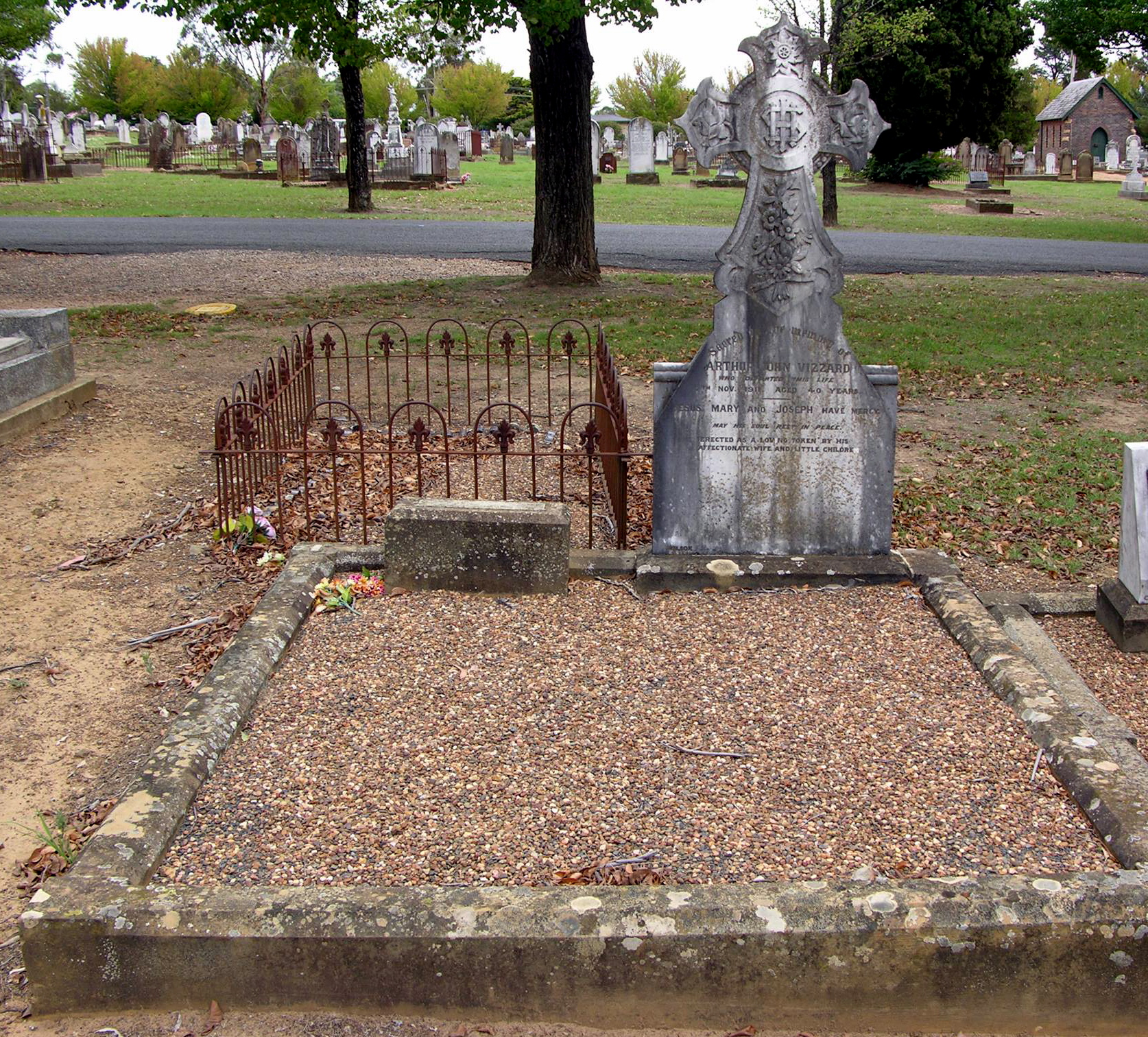
Arthur John VIZZARD

Arthur John VIZZARD Grave

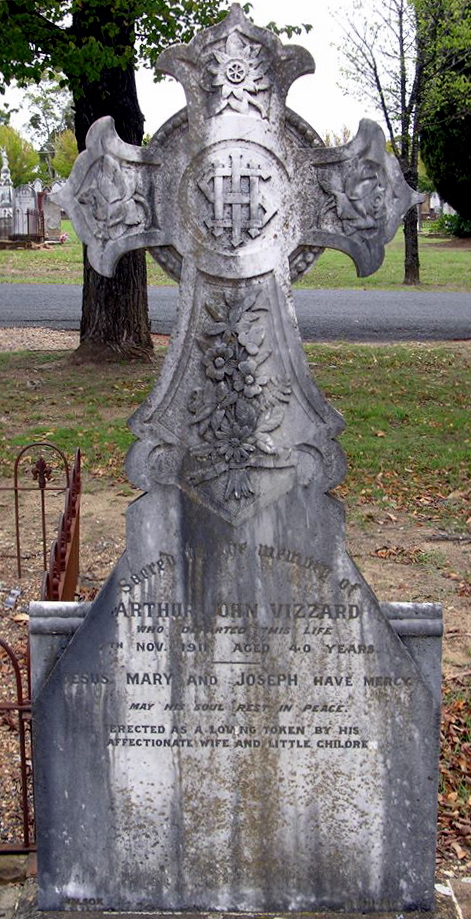
Arthur John VIZZARD Grave. Inscription Sacred to the memory of ARTHUR JOHN VIZZARD WHO DEPARTED THIS LIFE 7TH NOV. 1911. AGED 40 YEARS JESUS, MARY AND JOSEPH HAVE MERCY MAY HIS SOUL REST IN PEACE. ERECTED AS A LOVING TOKEN BY HIS AFFECTIONATE WIFE AND LITTLE CHILDREN
Arthur John VIZZARD Grave:   Inscription:    Sacred to the memory of ARTHUR JOHN VIZZARD WHO DEPARTED THIS LIFE 7TH NOV. 1911.   AGED 40 YEARS    JESUS, MARY AND JOSEPH HAVE MERCY   MAY HIS SOUL REST IN PEACE.    ERECTED AS A LOVING TOKEN BY HIS AFFECTIONATE WIFE AND LITTLE CHILDREN.


 ARTHUR is NOT mentioned on the Police Wall of Remembrance  * BUT SHOULD BE

As of November 2020 – VIZZARD is still NOT recognised as having died as a result of Work Related Injuries.


GRAVE LOCATION


Shortly after 10.30am on 7 November, 1911 the constable was at the Armidale Police Station, where he was the Lockup Keeper.

He walked into the yard of the station where it appears he inflicted a fatal wound to his head with his service revolver.

He died three hours later.

He had been on sick report for about two months, suffering from rheumatism, insomnia and depression.


The Clarence and Richmond Examiner of 14 November, 1911 reported that:

A mild sensation was caused in Armidale when it was known that Senior Constable Vizzard, who was in charge of the lockup, had been found in the lockup yard with a bullet wound in the head.

The unfortunate officer had been suffering greatly lately from muscular rheumatism and insomnia and had been on sick leave for the past few weeks.

During the last few days he appeared very despondent, but nobody suspected he would commit such a rash act.

He was removed into the house in a dying condition.

Senior Constable Vizzard, who came to Armidale from Inverell, was only recently promoted.

He has a wife and three young children. “


The senior constable was born at Corowa in 1871 and joined the New South Wales Police Force on 11 July, 1893. At the time of his death he was stationed at Armidale.


The issue regarding ill health for Senior Constable Arthur Vizzard dates back from approximately 5 years earlier as a result from contracting Dengue Fever when he was required to travel to Queensland and back to execute an interstate warrant and convey back a prisoner. Both he and the prisoner contracted Dengue.

He had ongoing health issues in the following years because of it and as we all know from the inquest findings he finally took his life whilst on “sick leave‘.

I have been aware of full story for about 18 years now. There are three descendants currently working in the NSW Police Force and there was an article in the Police Weekly about the family last decade.

I appreciate what you have said regarding eligibility for inclusion, which I was made aware of prior to the commemoration of the 10th anniversary of the National Police Memorial being opened.

This year will be 2 years since I got the e-mail. Still nothing progressed. Tell me this? Why was I personally notified almost 18 months ago that the inclusion was going to happen, then everything goes silent? It is disappointing to say the least.

I know the effect it had on my Grandmother the stigma growing up, her Mother never coped afterwards and the family ended up having to be split up. It is what it is. 106yrs latter the status quo remains. All we can do is wait and watch this space.


Darling Downs Gazette (Qld. : 1881 – 1922),

Friday 5 May 1905, page 3

DENGUE FEVER AT INVERELL

IMPORTED BY A CONSTABLE INVERELL, Wednesday.

Queensland dengue fever has been introduced into Inverell under conditions which were not to be avoided.

A week or so ago Constable Vizzard was despatched to Charleville to escort a prisoner back to Inverell, and while in the sister State, he contracted dengue.

He returned with his charge on Friday last, and on Saturday took ill.

On Sunday the case was diagnosed as dengue fever, and the patient was at once isolated in a ward at the local hospital.

Another case has since been reported, the victim being Ben. Bridge, the prisoner who was escorted back by Constable Vizzard. Bridge has also been sent to the hospital.

Both victims have the malady in an acute form.

News of the disease being in Inverell has caused some alarm among residents.

05 May 1905 – DENGUE FEVER AT INVERELL – Trove


NSW State Records

Service # 6588   Reel 3043  Item 8/3253

http://srwww.records.nsw.gov.au/indexes/searchhits.aspx?table=Registers%20of%20Police&id=31&frm=1&query=Surname:vizzard;Firstname:arthur


The Armidale Chronicle ( NSW )

Wednesday  8 November 1911   page 4 of 8

Death of Sen-Constable Vizzard.

TRAGIC ENDING.

A mild sensation was caused in Armidale yesterday morning, when the shocking intelligence was made known that Senior-Constable Vizzard had been found in the yard of the lockup in a serious condition.

As was well known, Constable Vizzard had been in indifferent health for the past couple of months. He was a sufferer from muscular rheumatism, which brought on that dreaded complaint insomnia, but not even his nearest relatives anticipated that his career would be terminated in such a tragic manner.

At about 10.30 yesterday morning he appeared to be much the same, and walked through the kitchen of his residence, where his wife and nurse were, out into the lockup yard. The women were shortly afterwards startled by hearing the sounds of a revolver shot, and, proceeding to the spot from whence the sound came, the nurse was horrified to see her charge lying on the ground with a gaping wound in the temple, and a revolver lying close beside the body.

Assistance was promptly summoned, and Dr. Mummery was also quickly on hand, when the unfortunate constable was conveyed into the house.

From the outset, the doctor held out no hope of recovery, his prediction proving all too true, as the end came a few minutes after two o’clock.

The late Constable Vizzard was a zealous, capable, and conscientious officer, in fact, as Senior-Sergeant Hogan remarked to the writer when speaking of his late lieutenant, he was over conscientious.

The deceased was born, at Corowa in October, 1871, and was thus 40 years of age at the time of his sudden death.

As a young man of 22 he joined the New South Wales Police Force, and after going through his term of probation at the barracks, was sent to do duty on the Richmond River, thence to Armidale, Tenterfield, Inverell, and finally on the 26th November, 1909, he was again transferred to Armidale as lookup-keeper.

He was ever active and energetic, and his zeal was not long in being rewarded, for he rose from a constable to a first-class constable, and then to senior-constable.

Although he always did his duty – and a policeman’s work is ofttimes unpleasant – he ” tempered justice with mercy,” thereby gaining for himself universal respect and admiration from all sections of the community.

As prosecutor in the police court, the late officer displayed undoubted ability and knowledge of the law, and was worthy of any attorney’s ” steel. ” Here, again, could be seen his generous disposition for he was always strictly fair and honourable in any cases he was in charge of.

He is survived by a sorrowing wife and three young children, to whom much sympathy has been extended in their hour of affliction.

http://trove.nla.gov.au/ndp/del/article/188117660


The North Western Advocate & the Emu Bay Times ( Tas. )   Wed.  8 Nov. 1911   page 3 of 4

NEW SOUTH WALES.       

POLICE CONSTABLE’S DEATH.     

SUICIDE SUSPECTED.

SYDNEY. Tuesday, — Senior Constable Drizzard was found in the lockup yard at Armidale to-day in a dying condition with a bullet wound in his head.   He suffered from insomnia and is supposed to have committed suicide.

http://trove.nla.gov.au/ndp/del/article/64352863


Daily Telegraph ( Launceston, Tas. )

Wed.  8 Nov. 1911     page 4 of 8

ATTEMPTED SUICIDE         

CONSTABLE SHOOTS HIMSELF.        

( ” DAILY TELEGRAPH ” SPECIAL copyright. )

SYDNEY, Tuesday. — Senior Constable Drizzard shot himself, while in the lock-up yard at Armidale. The unfortunate officer had been suffering from insomnia, and is in a dying condition .

http://trove.nla.gov.au/ndp/del/article/152347646


The Armidale Chronicle ( NSW )

Saturday  11 November 1911   page 2 of 10

Death of Sen.-Constable Vizzard.

The Inquest.

An inquest concerning the death of Senior-Constable Vizzard, which occurred under tragic circumstances in the yard of the Armidale lockup on Tuesday morning last, was held by the Deputy-Coroner ( Mr. C. A. Jackes ) in the Courthouse on Wednesday. The following evidence was elicited:

Frederick Wm. Vizzard, brother of the deceased, said the deceased was born on 9th October, 1871, at Corowa. He was a married man, with three children. Witness had not seen his brother, previous to that day, for nine months.

Senior-Sergeant Hogan deposed to knowing the deceased for the past eight or nine years. At about 11 o’clock on Tuesday morning he received a call to go to the lockup, which place deceased was the keeper of. With Constable Eagleton, witness went to the charge-room, and there saw deceased lying on a stretcher.  The mark of a bullet wound was noticeable on his left temple, and blood was oozing from the place. He was unconscious, but breathing strongly.

Witness next went to the cell yard-room, and there saw a large quantity of blood on the floor. The deceased’s hat was lying near the door, with his pipe. Close by   was a police revolver, containing four loaded cartridges and one recently exploded shell. Witness afterwards went to a drawer in the charge room, which was always kept locked. The lock of the drawer had been forced open, evidently by a tomahawk as such implement was lying in the drawer in the place where deceased’s revolver had been put when not in use. Deceased had been off duty for two months, through illness. He complained of muscular rheumatism and attacks of insomnia. When first going on sick leave, he went to Dr. Nash’s private hospital, but returned, and for the remainder of the time was with his wife and family in their own home. Deceased gave no reason for the police to anticipate that he would take his own life. In conversation with witness on Sunday morning, deceased said, ” I would give everything I possess to be able to resume duty on Monday.

Witness told him not to resume until the doctor had given permission to do so. Deceased was an efficient officer, trustworthy, and very painstaking.

To the Superintendent : During his nine months in Armidale, witness was practically all the time in deceased’s confidence. Deceased had never at any time expressed dissatisfaction with his position or work in the police force.

Dr. N. Howard Mummery said that shortly after 11 o’clock on the fatal morning he, in answer to a summons, proceeded to the lockup. He found the deceased lying on a stretcher, and being attended to by a nurse. He appeared unconscious. There was a wound on the right temple, the skin around which was stained   with gun-powder. There was another and larger wound on the left temple. It was obvious he could not live long. The wound in the head had been caused by a bullet, which had passed through deceased’s head, struck the brick wall of the yard, and rebounded into the middle of the yard, where witness picked it up.

Dr. J. A. J. Murray stated that on his arrival at the scene of the tragedy, deceased was being cared for by Dr. Mummery. Deceased had been ailing since last August. While still on duty, he complained of insomnia, indigestion, and occasional fits of depression. In September he also had an attack of asthma, which was followed by influenza, the after effects of which he never appeared to shake off. He seemed to be in an anxious and dispirited condition.   Witness urged him to get a holiday immediately, because no treatment seemed to do him much good. Deceased took the holiday in Sydney, and, on his return, about three weeks ago, witness was again called in. Deceased was then in a worse condition than when he went away. Witness visited him at intervals up to Monday. Deceased had such a serious nervous breakdown that it was necessary for him to undergo a complete rest cure, and witness had made arrangements for him to enter a suitable hospital for the purpose. Deceased had told witness that some times he felt as if he didn’t care to live, but, from the way he said it, witness did not think he contemplated taking his own life – it was said more to express to witness how really depressed he was. The idea of taking his life would come on him suddenly, owing to the condition he was in.

Nurse Ethel Sheerman, residing in Victoria-street, Sydney, said she came to nurse the deceased, and arrived on Monday. She had been sent by Dr. Nash. At about 10.30 on the morning in question, deceased said he was going down the yard to cut some kindling wood. He then seemed in a normal condition. About five minutes afterwards, witness, who was in the kitchen with deceased’s wife, beard the report of a firearm. Witness and Mrs. Vizzard immediately rushed to the spot. Deceased was reclining on the spot. Deceased was reclining on his left side. There was a great quantity of blood flowing from the wound in the head. She picked a revolver up, which was lying near the body, and threw it on the step. Deceased never regained consciousness, and died about two o’clock. Witness had not the faintest suspicion that deceased contemplated such a rash act.

John Purkiss said that between 10.30 and 11 a.m. on Tuesday morning he heard a woman scream, and immediately ran across. He met Mrs. Vizzard, who said, ” My husband has shot himself in the charge-room. ” and then fainted. Telling another woman to attend to Mrs. Vizzard, witness went into the charge-room and then followed the nurse into the cell-yard, where deceased was lying. With the assistance of the nurse, witness carried the deceased into the charge-room.

The Coroner returned a verdict that the deceased, Arthur John Vizzard, met his death from a bullet wound self-inflicted, whilst- temporarily insane.

http://trove.nla.gov.au/ndp/del/article/188117719


The Armidale Chronicle ( NSW )

Wednesday  8 November 1911   page 4 of 8

The remains of the late Senior Constable Vizzard,. whose tragic death was reported in our last issue, were interred in the Roman Catholic Cemetery on Wednesday afternoon. The funeral was largely attended by members of the M.U.I.O.F. and local police force marching in the cortege. The Rev. Dean Tobin officiated at the graveside, M. Hirschberg having charge of the arrangements.

http://trove.nla.gov.au/ndp/del/article/188117733


The Armidale Chronicle ( NSW )

Saturday  18 November 1911   page 7 of 10

In the Supreme Court of

New South Wales.

PROBATE JURISDICTION.

In the Estate of ARTHUR JOHN VIZZARD, late of Armidale, in the State of New South Wales, Senior Constable of Police, deceased in testate, –

APPLICATION will be made after Fourteen Days from the publication hereof, that Administration of the Estate of the abovenamed deceased may be granted to MARY VIZZARD, the Widow of the said deceased. Creditors are requested to send their Accounts to, and all Notices may be served at, the Office of the undersigned.

H. WEAVES,

Proctor,

Faulkner street, Armidale.

By his Agents MESSRS. Weaver & Allworth,

Australasia Chambers, Martin   Place, Sydney… . . i87

http://trove.nla.gov.au/ndp/del/article/188117888


David SUTHERLAND

 David SUTHERLAND

New South Wales Police Force

Cousin to Senior Constable William SUTHERLAND, NSWPF ‘Q‘ “Possibly” 4257 ( born 1854 in Scotland & joined NSWPF on 26 Sept. 1882 ) OR  6417 ( BORN 1869 in Scotland & joined NSWPF on 27 May 1892 )

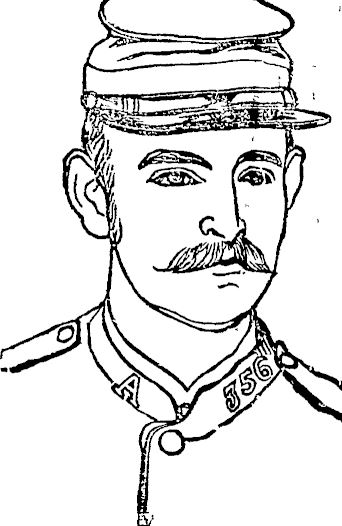
Uniform # A 356

Regd. # ‘Q‘ 5460

For the purposes of this website ‘Q‘ represents those Police joining between 1 March 1862 ( commencement of NSWPF ) – 23 February 1915 ( Commencement of NSWPF current numbering system )


Rank:  Constable


Stations:  Darlinghurst ( No. 3 Division ) – Death


ServiceFrom  11 October 1887  to 3 June 1889 = 1+ years Service


Awards?


Born? ? 1863 @ Canterbury, New Zealand

Died on:  Monday  3 June 1889


Cause:  Shot – Murdered

Event location:  MaCleay St, Potts Point, NSW

Age:  25 – unmarried


Inquest date:  Thursday  6 June 1889


Funeral date:  Wednesday  5 June 1889

Funeral location?


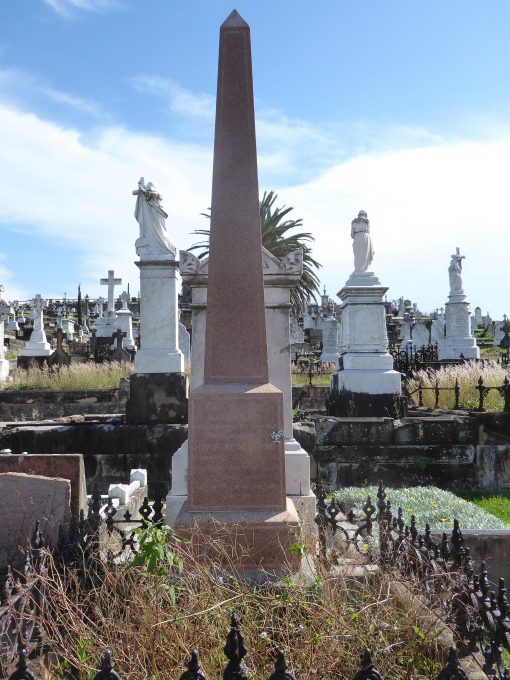
Buried at:  Waverley Cemetery, cnr St Thomas St & Trafalgar St, NSW

Grave Location:  C of E, Sec 9, Grave 941


 Memorial at?


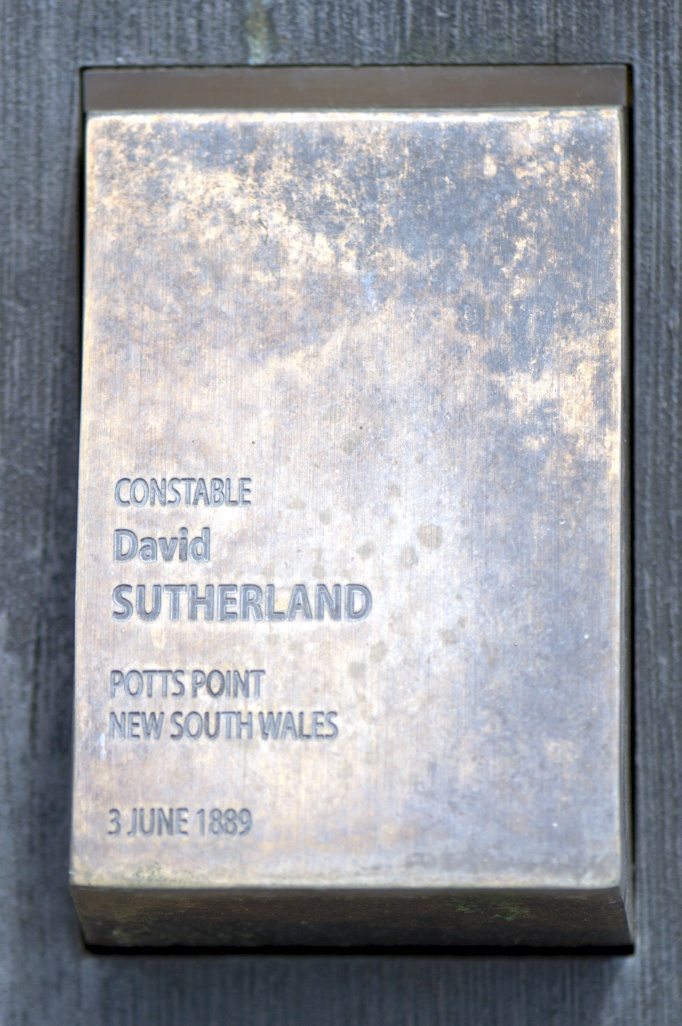
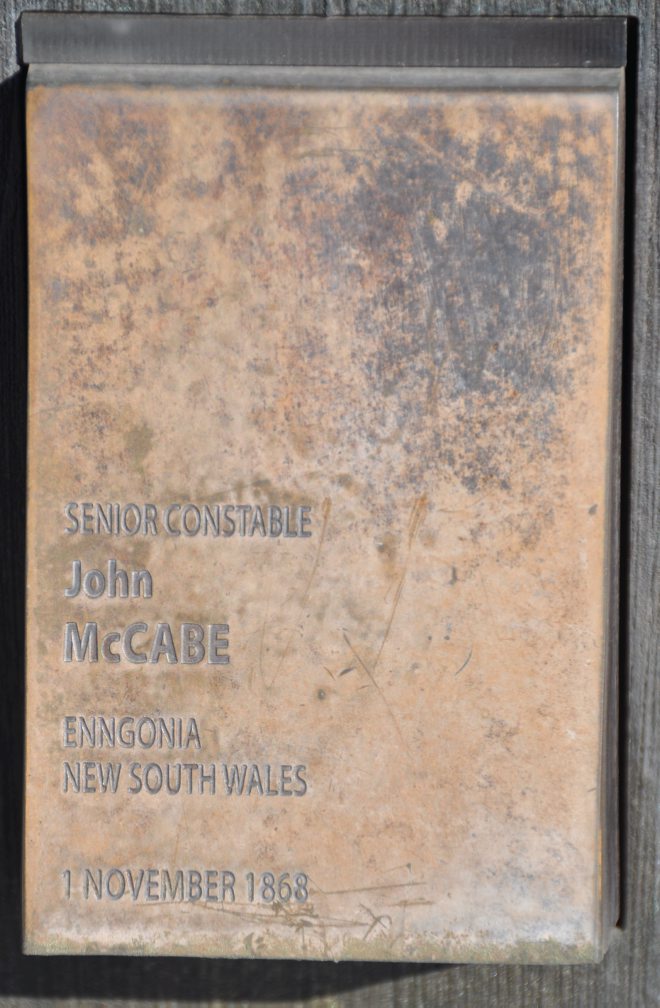
DAVID IS mentioned on the Police Wall of Remembrance

Touch plate at the National Police Wall of Remembrance, Canberra


 Funeral location ?


FURTHER INFORMATION IS NEEDED ABOUT THIS PERSON, THEIR LIFE, THEIR CAREER AND THEIR DEATH.

PLEASE SEND PHOTOS AND INFORMATION TO Cal


About 3am on 3 June, 1889 the constable was patrolling MaCleay Street, Potts Point when he saw a man enter a yard and walk to the rear of a dwelling. He detained the man a short time later as he left the premises and spoke to him regarding his actions. When the man attempted to leave, the constable took hold of him and again asked what he was doing. The offender told the constable to let him go or he would shoot him. A struggle ensued and when both men lost their balance, the offender shot the constable in the abdomen.


While they were on the ground the offender again fired at the constable who drew his baton and struck his attacker. Constable Sutherland was then able to take the revolver from the offender, but as he was quickly losing his strength due to his wounds, the offender quickly retrieved the weapon and escaped. He was very soon arrested by Senior Sergeant Robertson and Sergeant Hogan.

Constable Sutherland died later that day, however not before providing his colleagues with a dying deposition and a positive identification of his attacker, John Morrison.


This death was a major factor which led to the general arming of Sydney Police in 1894. Previously, country and mounted police had always been armed, but the Sydney foot police for some reason had not.


The constable was born in 1863 and joined the New South Wales Police Force on 11 October, 1887.

At the time of his death he was stationed at Darlinghurst.


David SUTHERLAND was identified by his Cousin, Constable William SUTHERLAND after the murder.

William SUTHERLAND was later to be murdered in 1901 by a ‘kosh’ on the head.


David SUTHERLAND - A356

David SUTHERLAND

David SUTHERLAND


Evening News ( Sydney )     Monday  3 June 1889   p5 of 8

POOR SUTHERLAND WAS INSURED.

Mr. G. F. Murnin, resident secretary of the Australian Widows’ Fund, 263, George-street, informs us that Constable David Sutherland, who was murdered this morning, was insured for £250, the policy having only been taken out in April last.

http://trove.nla.gov.au/ndp/del/article/108894588


Barrier Miner (Broken Hill, NSW : 1888 – 1954),

Wednesday 5 June 1889, page 3

The Murdered Constable.

The Inquest.

SYDNEY, Wednesday.

The inquest on the body of Constable David Sutherland, who was shot by a burglar at Potts Point, was commenced yesterday afternoon.

The prisoner, James Morrison, was in custody, handcuffed.

There was a crowded court.

Morrison is a powerful fellow, 28 years of age, and the mark of a heavy blow over the left eye is still visible.

Constable William Sutherland identified the body as that of his cousin. He was a native of Canterbury, New Zealand. He was a single man. His mother, three sisters, and four brothers were living there.

Medical evidence showed that the bullet severed the main artery of the groin.

Benjamin Backhouse, architect, residing at Potts Point, deposed that he was awakened by the reports of a shot. On hearing the second shot, he also heard cries for help. He then saw a man running away. The man was of similar appearance as prisoner. A fence over which the man scrambled was examined afterwards and showed blood marks.

Further evidence similar to that reported already was also given.

The inquiry is still proceeding.

Melbourne, Wednesday.

The Melbourne police have identified the photograph of James Morrison, who is charged with the murder of Constable Sutherland, as that of a man known to them as Jackson, who has recently done two and a half-years in Victoria for an impudent forgery.

05 Jun 1889 – The Murdered Constable. – Trove


Goulburn Herald ( NSW )   Thursday  6 June 1889  p2 of 4

THE MURDER OF CONSTABLE SUTHERLAND.

We subjoin further particulars of the tragedy in Macleay-street, Potts Point, reported by telegraph in our last issue: It appears that at about 3 a.m. on Monday, as Senior-sergeant Robertson and Sergeant Hogan were standing at the corner of William and Victoria streets, they saw a man walking towards them. He was proceeding at a very quick pace, and noticing that he was very much excited and out of breath, they stopped him. His trousers, coat, and vest were all smeared with blood, and there was a severe wound over his left eye. While they were questioning him Mr. McElhone junior came up, and said that there was at constable lying on the footpath in Macleay street. The senior-sergeant and Mr. McElbone at once took a cab and went to where the constable was reported to be lying, and in the meanwhile the blood-smeared man was conveyed to the Darlinghurst lookup.

Sutherland ( the constable ) was found lying, as indicated by Mr. McElbone, dangerously wounded,  but conscious . He was taken to the hospital, where he was found to be wounded in the abdomen, no hope of his recovery being entertained. Sutherland unhesitatingly identified the man who had been arrested, and who gave the name of John Morrison, as the man who had shot him, and Morrison, who had been brought to the hospital for the purpose of identification, responded, ” Well, it’s wrong of you to say that. I did not shoot you.

Subsequently the deposition of the wounded man was taken, and he succumbed to his injuries shortly before seven o’clock on Monday morning.

The substance of Sutherland’s deposition was as follows: – At half-past 2 a.m., while the constable was standing near the residence of Mr. C. J. Roberts, Chatsworth, he saw a man enter the gates in front of the adjacent house and pass towards the rear of the premises. After the man had been inside the gates for a minute or two some dogs which were there began to bark, and they continued doing so until the man left and walked into the middle of the road. The constable and the man exchanged a “ good-night ” greeting, and the constable observed, ” you’re out early. ” The man then attempted to make off. The officer, however, caught hold of him, and asked what he was doing. The man replied, “ let me go. If you don’t I’ll shoot you, ” and he immediately thrust his right hand into his trousers pocket. A struggle ensued, and just as they were about to fall the man fired his revolver. Whilst on the ground he again fired. The constable, however, could not say whether the latter shot took effect. Before either of them regained his feet the constable drew his baton and gave the man a severe   blow on the head. Owing, however, to his weak state the blow was not as severe as he hoped it would be. The constable, though wounded, wrested the revolver from the man, but as he was very weak the other soon got the better of him, and raising himself, snatched back the revolver, and made off. Whilst the injured constable’s depositions were being taken, the prisoner, who had been brought to the bedside of the wounded man, inquired whether the revolver did not go off accidentally. Replying to this the dying man said, ” no, you pointed it direct at me. ”

The next piece of evidence as to the fatal affray is furnished by Mr. Benjamin Backhouse, a gentleman living close to the scene. He was awakened by a pistol-shot, which was followed shortly after by a second report. He then saw a man running at full speed along Rockwell-street, and at the same time heard loud cries for help. He got out of the house in time to see the man who ran down the street scale the fence at the end of the street, and he became lost to view. He then found the wounded constable and afforded him what assistance he could until the arrival of the police and others.

When the scene of the affray was examined later on, a large morticing chisel was found, and this instrument corresponds with a number of marks on premises in the locality. A six-chambered nickel plated revolver was found concealed in the grass in Mr. McElhone’s paddock, close to where Mr. Backhouse saw the man scale the fence. Four of the chambers were loaded, and the remaining two had been discharged. A third article was also discovered, namely, a cloth tweed hat of large size, which gives colour to the report of the captured man having had an associate.

Constable Sutherland was a young and energetic officer, only twenty-five years of age, and unmarried. He had been about twenty months in the force, and was highly spoken of by his superior officers and comrades. Morrison is also a young man of about twenty-five, stiflly built, and described as a cabinet maker by trade. He is said to be a native of England, and was previously unknown to the police.   He has a wound over the left eye, such as would be caused by a constable’s baton. When brought before the police court this morning he made no reply to the charge of murder, and has so far maintained silence as to the part he is supposed to have played.   He was remanded to the coroner’s court.

The coroner commenced an inquest on Tuesday, when William Sutherland, a police constable stationed at the Glebe, identified the body of the deceased as that of his cousin David Sutherland, who was twenty-five years of age, and a native of Canterbury, New Zealand. He was a single man. He had left £32 in the Savings’ Bank, Oxford-street, Sydney, and a life policy for £250. Deceased had left a mother and a number of brothers and sisters in New Zealand. Evidence was given in substantiation of the facts above detailed, and the inquiry was adjourned to Thursday.

http://trove.nla.gov.au/ndp/del/article/100114828


South Australian Weekly Chronicle ( Adelaide, S.A. )   Saturday  8 June 1889  p21 of 24

THE MURDER OF CONSTABLE SUTHERLAND.

( By Telegraph )

Sydney, June 6.

The coroner’s Inquest relative to the death of Constable David Sutherland, who was shot whilst arresting a burglar at Pott’s Point on Monday morning, was concluded to-day, a verdict of wilful murder being returned against James Morrison, the man who fired the shot.

Morrison will come up for trial at the Quarter Sessions, commencing July 15. Whilst Sergeant Hogan, one of the two officers who arrested Morrison, was giving evidence to-day the prisoner told him that he had better tell the truth. When asked if he had any questions to put to Hogan, Morrison said — ‘ No, your honor. He would only tell lies If I was to. ‘

The coroner, in summing up, said there was a great deal of circumstantial evidence to bear out the statement  made by the deceased constable that the fatal shot was wilfully fired. To their verdict the jury added a rider recommending that in future no constables should be allowed to go on night duty in the suburbs or on lonely beats singly, but in pairs, so that in case of emergency they might be in a better position to act. The foreman added that this course would entail an extra expense, but the money would be well spent in the protection thus afforded to life and property.

http://trove.nla.gov.au/ndp/del/article/95148258


The Maitland Mercury and Hunter River General Advertiser ( NSW )

Sat. 8 June 1889

Funeral of Constable Sutherland.

The remains of the late Constable David Sutherland, who met his death early on Monday morning by being shot by a burglar, were conveyed to the Waverley Cemetery on Wednesday afternoon, followed by an imposing procession of the police, the military, and sympathetic citizens.

The funeral was timed (reports the Herald) to leave No. 3 Police Station at 2.30, and almost to the minute the coffin was borne to the hearse by the comrades of the deceased. The streets and roads in the vicinity of the station and Darlinghurst prison were blocked up by some thousands of people, and traffic was consequently suspended along Oxford street as far as the Victoria Barracks, and thence at intervals throughout the route of the cortege. The spectacle was one suggestive of the most marked tribute of respect that could have been paid to the deceased. Four mounted troopers headed the Permanent Artillery Band in the march to the cemetery, followed closely by the hearse and two mourning coaches, carrying the relatives of the deceased; then came upwards of 200 constables four deep, with their officers, Mr. Fosbery, the Inspector – General, Mr. Read, the superintendent, Inspectors Anderson, Larkins, McKay, and Camphin, Sub-inspectors Bremner, Potter, Atwill, Cotter, Long, Hyam, and Lawless. The Permanent Artillery under Major Airey and Lieutenant Kyngdon were next in order, with a body of the Permanent Mounted Infantry on foot, together with the Staff Sergeants and Captains Cuthell and Bayly representing the Permanent Staff. A carriage, containing Sir Henry Parkes and Mr. C. Roberts, M.L.A., was followed by the Mayor’s carriage and a large number of vehicles.

The cemetery was reached shortly after 4 o’clock, and some thousands of persons were in waiting to witness the lowering of the coffin into the grave. The   Rev. A. Gardiner was the officiating clergyman, and after reading the burial service he asked to be allowed to utter a few sentences touching the impressive and solemn occasion. It was always, he said, a solemn thing to stand about an open grave and reflect how suddenly the summons of death might come, but there were special circumstances surrounding the present bereavement which tended to make it more solemn and impressive. Probably not many who were gathered around the grave had known David Sutherland, but their hearts were touched with sympathy under the circumstances, and they felt it due to his memory to give him that ennobling mark of respect. There was always something sad about the death of a young man just beginning life, with prospects before him such as the deceased had, but there was something very bad in the terrible consequences which led to his death. He died at his post ; he was faithful even unto death, and perhaps the last words that fell from his lips, like Nelson at Trafalgar, were, ” I have done my duty.”

The fidelity and worth of the people of Sydney had been touched on this occasion by the disaster which overcame the deceased, and yet why should they mourn so much   for his departure ? Though young, and called away under such circumstances, it should be remembered that he had faith in God and knew that he was going to a better scene ; he had a knowledge of the divine truth, and hoped in Christ.   As for his own part, he would ten thousand times rather be David Sutherland that day lying in his grave than the man who was the cause of his death. Two lessons were taught in the death of the deceased, namely, to be faithful to duty, and to do from day to day what was felt to be right, at any cost. It was gratifying to see the people of Sydney so much moved, because it showed that their hearts were on the right side, and they sympathised with the deceased for his resolution and determination to   stand at his post at the cost of his life. It was that spirit that distinguished the British nation more than any other. The benediction was then pronounced by Rev. C. F. Garnsey. The coffin was covered with wreaths of flowers. One came from the ladies of Macleay-street, as a tribute of respect, another from the gardeners of Potts Point, and a third from his comrades.

http://trove.nla.gov.au/ndp/del/article/18972138


The Sydney Mail and New South Wales Advertiser

Sat. 15 June 1889 

The Late Constable Sutherland.

The inquest relative to the death of Police-constable David Sutherland was concluded on June 6th.   The jury returned a verdict of wilful murder against the prisoner, James Morrison, who was accordingly committed for trial at the next sittings of the Central Criminal Court.

A rider recommending that in the suburbs and on lonely beats, two constables should patrol together was added. The prisoner appeared to feel his position keenly, and towards the conclusion of the inquiry his agitation became apparent. He never asked a question and only spoke twice, on each occasion denying the veracity of a witness.

Sir Henry Parkes has sent the following letter to the Inspector-General of Police with reference to the late Constable David Sutherland: — ” Sir, — You will be good enough to convey to the members of the police force the expression of my deep regret for the loss which the Government has sustained by the murder of Constable David Sutherland. The highest conduct of man in any station of life consists of the fulfilment of trust and the performance of duty. David Sutherland did his duty to the very death. His steady sense of obligation, and his heroic effort to perform his part when his life-blood was ebbing away, furnish an example which could hardly be excelled in front of the enemy on the battle field. His conduct in life and death reflects highest credit upon the force of which he was a member, and will make his memory respected by all good men.

In accordance with the request of the Premier the letter has, under the direction of the Inspector General of Police, been recorded in the Orders, and read on parade at the various stations to all of the metropolitan police force, and was published yesterday in the Police Gazette for the Information of the police generally.

http://trove.nla.gov.au/ndp/del/article/161928600


THE ARMING OF POLICE.

The South Australian Register of

6 February, 1894 printed the following.


OBJECTION TO ARMING THE POLICE.  Sydney, February 5.

The Inspector-General of Police [Fosberry] says that one objection to arming the police with revolvers is that the use of firearms may become too common, and if the public get familiar with the snap of the revolver a similar state of things to that prevailing in the United States may be brought into existence. Concerning the two men injured the constables are improving in health.


The same newspaper on 27 February, 1894:


REVOLVERS USED BY THE POLICE. Sydney, February 26.

Two police had an exciting contest last night at Redfern, when they were arresting four men on a charge of thieving. Directly the constables sought to detain them a rough-and-tumble fight occurred, a number of roughs seeking to enable the suspects to escape. Eventually two of the four men broke away, and the others were on the point of being rescued when the police drew their revolvers and threatened to fire on the larrikins. The presentation of firearms completely cowed them, and the constables succeeded in conveying two of the men arrested to the station. This is the first occasion on which the police have found it necessary to use revolvers since their issue, and had they not been available the constables would have been severely maltreated.


George Robert ARMYTAGE & Michael COSTIGAN

George Robert ARMYTAGE

New South Wales Police Force

Constable

&

Michael COSTIGAN

New South Wales Police Force

Constable

Shot – Murdered

Bourke

11 September, 1877

Double Police Murder

Grave of Michael COSTIGAN

On Tuesday 11 September, 1877 Samuel Getting, a barman at the Royal Hotel in Bourke, was speaking with Constable Michael Costigan in the bar of the hotel. The constable had just paid Getting for his room and board, and after having a drink and chatting with the barman for a short time, he left the bar.

Getting, for some unknown reason, also left the bar about that time and went to his room in the hotel, where he took possession of his rifle. He then left his room and walked to the front of the hotel, where he saw Constable Costigan and Constable George Armytage standing on the verandah, having a conversation. He immediately shot both constables from behind before running into the street and attempting to reload his rifle.

Sub Inspector James Keegan, who was nearby, noticed people running toward the river, and when he asked what was happening he was told that Sam, the barman, had shot two of the police and was running away with a loaded gun in his possession.

He then saw Getting running along the bank of the river with a gun in his hand, being chased by several people. The inspector then went towards these people and told them to move away from Getting so he could speak with him. He then followed Getting for a short distance along the river until he stopped and waited for the inspector to approach. The inspector then spent some time talking with the offender and trying to get him to surrender, all the while edging closer as he spoke.

At a later inquest, the inspector described what happened next.

 “I rushed at him, being at this time between 10 and 15 paces from him. The ground was very muddy, and there was a gully between us. I got my hands upon him being beneath the gun, and we both stumbled and nearly fell. He again got a few paces from me, turned round, took deliberate aim, and shot at me. He called to me to keep back. I knew I was shot, but it did not weaken me, and I still went forward.

He then raised the gun, holding it by the barrel, and struck me on the head. I put up my arm to ward off the blow, and it bruised my arm very much and cut my head. He struck me several times, and I at length secured the gun. He then ran parallel with the river for a few yards, and as I followed him he suddenly plunged into the river, and kept his head beneath the water until he was drowned. He went but a short distance into the river.

That is his body I have recently seen lying in an outhouse. He had plenty of opportunity of shooting me at first had he so desired, but he did not attempt to do so until I sought to arrest him. When he shot at me, one shot struck me near the eye, two shots went into my coat, two entered my chest, and two others grazed it

The Deceased…was a man of very good character and very good behaviour, and I can ascribe no motive for his acts. He said he had no intention of doing what he did, and that he had loaded the gun to go out for some duck shooting.”


Constable Costigan was born in 1853 and joined the New South Wales Police Force on 11 September, 1873. At the time of his death he was stationed at Bourke.

Constable Armytage was born in 1855 and joined the New South Wales Police Force on 4 May, 1877. At the time of his death he was stationed at Bourke.

Grave Location/s:

1396911675_73051 (4)

ARMITAGE: 30 06′ 03S / 145 56′ 12E
Old C of E, Bourke

George Robert ARMITAGE, George ARMITAGE - Grave
As seen in June 2022.
Photo: Alan BLAKE # 19779

George Robert ARMITAGE, George ARMITAGE - Grave
As seen in June 2022.
Photo: Alan BLAKE # 19779

1396911699_73053 (4)

COSTIGAN: 30 06′ 05S / 145 56′ 14E
Old Catholic, Bourke


Michael COSTIGAN - Grave as seen in 2007
as seen in April 2007
Photo: Ken Owen

Michael COSTIGAN - Grave as seen in April 2014
as seen in April 2014
Photo: Ken Owen

Michael COSTIGAN - Grave as seen in April 2014
as seen in April 2014
Photo: Ken Owen


Location of Old Royal Hotel
32 Mitchell St, Bourke, 2840
GPS: -30.088854, 145.936134

2014: Port of Bourke Hotel which was formerly the Old Royal Hotel where these murder took place.


Andrew SUTHERLAND

Andrew SUTHERLAND

New South Wales Police Force

Regd. # ‘Q‘ 1099

For the purposes of this website ‘Q‘ represents those Police joining between 1 March 1862 ( commencement of NSWPF ) – 23 February 1915 ( Commencement of NSWPF current numbering system )

Rank:  Constable – appointed 7 January 1863

Senior Sergeant – appointed ? ? ?

Final Rank:  Senior Sergeant

Stations?, Cowra – Death ?

ServiceFrom 7 January 1863 to  1 May 1872 = 9+ years Service

Awards?

Born: ? ? 1840, Wick, Scotland

Died on:  1 May 1872

Cause:  Shot – Murdered

Event location:  Binni Creek, Cowra, NSW

Age: 31

Funeral date:

Funeral location:

Buried atAnglican section of the Young General cemetery

Memorial at:  Cowra Police Station, 88 Brisbane St, Cowra, NSW

Andrew SUTHERLAND - INSCRIPTION: Sacred to the Memory of Andrew SUTHERLAND Sergt. ( Sergeant ) of Police Native of Wick, Scotland. Aged 31 years Who was shot on the 1st May 1872 whilst in the discharge of his Duty at Binnie Creek near Cowra. " Thou carriest them away as with a flood ; they are as a sleep ; in the morning they are like grass which groweth up. In the morning it flourisheth and groweth up ; in the evening it is cut down and withereth."
INSCRIPTION:
Sacred to the Memory of
Andrew SUTHERLAND
Sergt. ( Sergeant ) of Police
Native of Wick,
Scotland.
Aged 31 years
Who was shot
on the 1st May 1872
whilst in the
discharge of his Duty
at Binnie Creek
near Cowra.
” Thou carriest them away as with a flood ; they are as a sleep ; in the morning they are like grass which groweth up.
In the morning it flourisheth and groweth up ; in the evening it is cut down and withereth.”


ANDREW IS mentioned on the Police Wall of Remembrance


On 1 May, 1872 the sergeant was returning to Cowra from Bathurst Court.

During his journey he was told that two men who were wanted for robbery, George Gray and William Bristow, were at Daniel Horan‘s hut at Binnie Creek, twelve miles from Cowra.

The sergeant rode over to investigate and as he neared the door of the dwelling the offenders suddenly emerged and shot him to death.


The Clarence and Richmond Examiner dated 7 May, 1872 provided a brief account of the tragedy, which tends to suggest that the offenders were known to the sergeant.


SERGEANT SUTHERLAND SHOT DEAD BY BUSHRANGERS

CARCOAR ” Thursday – I regret to have to announce that Sergeant Sutherland, of the Cowra police force, was shot dead last evening, by bushrangers, at a place about five miles from Cowra.

It appears that two armed men called on a settler named Daniel Oram, whose house is distant about two miles from Cowra and demanded food, which he placed on the table for them.

Sergeant Sutherland, who was going home from the Bathurst Assizes, rode up to the door during the meal, and was dismounting, when one of the men stopped to the door, gun in hand, and said, “I have been looking for you, you wretch,” and then shot him through the heart, causing instant death.

The men then went off and Oram started to Cowra, and upon arriving there, informed the police, who are now in pursuit of the murderers.

The fate of the unfortunate but brave officer is universally regretted. He leaves a wife, and had only been married a few months.


The sergeant was born in 1839 and joined the New South Wales Police Force on 5 January, 1863.

At the time of his death he was stationed at Cowra.


The Queenslander

Sat.  9 Aug 1873  p 10

ST. GEORGE.

(FROM OUR OWN CORRESPONDENT.) July 31.

We have also to record the arrest of a man named Frank Riley alias George Gray by Sergeant Cranney, on the charge of murdering Senior-sergeant Andrew Sutherland, of the New South Wales force, at Hordern’s hut, Beni Creek, on the 1st of May, 1872.

The prisoner had been staying in town for some few weeks, and left accompanied by another man with the avowed intention of going to the Surat races, but parted with his comrade about three miles from Weribone, his comrade going on into Surat, while he went out into the bush to camp.

Sergeant Cranney, in the meantime, appearing to have some clue to his identity, followed the pair, and finding that only one had reached Surat, returned on his tracks, and camped in the bush for two nights endeavouring to ascertain the whereabouts of the prisoner.

Becoming faint from fasting, he went to Weribone Station for food, and just dropped on to the man he was looking for, and who had also been there on the same errand. The officer arrested him at once, and prisoner was taken to Surat and remanded to Roma, and we believe by this time is on his way to Brisbane.

This is the second arrest of New South Wales offenders made by Sergeant Cranney during the past few months, the other being that of James Madgwick, whose capture and exploits were narrated in your columns a short time since. Sergeant Cranney was also the officer who arrested the notorious Patrick Collins.

http://trove.nla.gov.au/newspaper/article/27277108


Andrew SUTHERLAND 1 - NSWPF - Murdered 1 May 1872

Andrew SUTHERLAND 2 - NSWPF - Murdered 1 May 1872

Outside Cowra Police Station

Outside Cowra Police Station. Front Inscription: In memory of Senior Sergeant Andrew SUTHERLAND who was fatally shot whilst on police duty at Binni Creek near Cowra on the 1st May 1872.
Outside Cowra Police Station

Sergeant Second Class Andrew Sutherland

Address: 88 Brisbane Street, Cowra Police Station, Cowra, 2794
State: NSW
Area: AUS

Please Note: GPS Co-ordinates are approximate.

Latitude: –33.834062
Longitude: +148.691187

View Google Map

Monument Type: Garden

Theme: People

Sub-Theme: Crime

Description:

A plaque commemorates Sergeant Andrew Sutherland who was fatally shot in the line of duty as a New South Wales Police officer.


Sergeant Second Class Andrew Sutherland was shot whilst on duty at Binni Creek near Cowra on May 1, 1872. On May 1, 1872 he was returning to Cowra from Bathurst Court. En route he was told two offenders wanted for robbery, George Gray and William Bristow, were at Daniel Horan’s hut at Binni Creek, 12 miles from Cowra.


The Sergeant rode over to investigate and as he approached the door of the dwelling, two offenders emerged and shot and killed him. Gray and Bristow were subsequently arrested but both were later released without charge. No-one was ever convicted of the crime.

Actual Event Start Date: 01-May-1872

Actual Event End Date: 01-May-1872

Actual Monument Dedication Date: 01-March-2012

Front Inscription:

In memory of
Senior Sergeant Andrew SUTHERLAND

who was fatally shot whilst on police duty
at Binni Creek near Cowra
on the 1st May 1872.

http://monumentaustralia.org.au/australian_monument/display/97891?image=1


The Portland Guardian and Normanby General Advertiser of 20 May, 1872 reported on the magisterial inquiry which was held at the Cowra courthouse before Mr G. Campbell J.P, “touching the death of Andrew Sutherland, who was shot dead by a ruffian at the residence of Daniel Horan a farmer living on Binni Creek…” One witness to the murder, Mrs Eliza Seery, gave the following evidence.
“I am the wife of James Seery, and reside at Binni Creek.
About 4 o’clock in the evening of Wednesday, the 1st inst., two men rode up to Horan’s hut on two dark looking horses.
Mrs Horan and I were in the hut at the time. They bid me good day, and asked if I had seen a bay horse, to which I replied “No”. One then said to the other, “We’ll get down and have a light”. The taller man was the spokesman.
He remarked that the weather was very dry.
The dogs began to bark. I went out to see what they were barking at, and observed Sergeant Sutherland riding towards the place.
The tall man asked me who was coming, and I answered, “Sergeant Sutherland”. The smaller man then walked outside, and Sutherland called him to the corner of the hut.
After talking to the sergeant for a short time, the man came towards the door, when I heard Sutherland ask him who was inside.
Sutherland then rode up to the door, and told the man who was inside to come out, or he would shoot the two of them.
The tall man, who was in the hut, said, “I won’t” and went towards the door.
The sergeant then got off his horse, when the tall man fired at him.
He said, “I’ll shoot”, before he shot at the sergeant.
Directly after the shot was fired, Sutherland, let his horse go, and ran towards a tree standing near the hut.
The man followed Sutherland and fired two shots, one after the other, as quick as he could.
The Sergeant, whose back was towards the man who shot at him, fell before he got to the tree. He fell directly after the last shot was fired.
There were only three shots fired.
The man was within a yard or two of Sutherland when the last two shots were discharged. This man brought Sutherland’s horse, and rode him away immediately after firing the last shot.
I did not see the smaller man of the two after the first shot was discharged.
I ran to the Sergeant when he fell, and asked if he was dead. He made no reply.
He was not quite dead, but never spoke.
Mrs Horan came directly after, and I told her to run for some water. She got some water, which she poured over the Sergeants mouth. He died while I was standing by him. He was lying partly on his side, and partly on his back.
Horan came up, and asked what was the matter. I told him the sergeant was shot dead.
Horan reported the murder to the police.”


The Brisbane Courier of 11 August, 1873 was to later report on the arrest of one of the offenders by Queensland Police Sergeant Cranney.
“We have also to record the arrest of a man named Frank Riley alias George Gray by Sergeant Cranney, on the charge of murdering Senior-sergeant Andrew Sutherland, of the New South Wales force, at Hordern’s [sic] hut, Beni [sic] Creek, on the 1st of May, 1872.
The prisoner had been staying in town for some few weeks, and left accompanied by another man with the avowed intention of going to the Surat races, but parted with his comrade about three miles from Weribone, his comrade going on into Surat, while he went out into the bush to camp.
Sergeant Cranney, in the meantime, appearing to have some clue to his identity, followed the pair, and finding that only one had reached Surat, returned on his tracks, and camped in the bush for two nights endeavouring to ascertain the whereabouts of the prisoner.
Becoming faint from fasting, he went to Weribone Station for food, and just dropped on to the man he was looking for, and who had also been there on the same errand.
The officer arrested him at once, and prisoner was taken to Surat and remanded to Roma, and we believe by this time is on his way to Brisbane.”


John McCABE

John McCABE

New South Wales Police Force

Regd. #  Q 1181

For the purposes of this website ‘Q‘ represents those Police joining between 1 March 1862 ( commencement of NSWPF ) – 23 February 1915 ( Commencement of NSWPF current numbering system )

Rank:  Constable – appointed Monday  23 February 1863

Senior Constable

Stations:  Biree  ( see description below )

ServiceFrom 23 February 1863 to  1 November 1868 = 5+ years Service

Awards?

Born? ? 1828, Ireland

Event date:  Tuesday  6 October 1868

Died on:  Sunday  1 November 1868

Place of Event:  Enngonia, NSW

Place of death?

Cause:  Shot – Murdered

Age39 – 40

Funeral date?

Funeral location?

Buried at:  Bourke Old C of E Cemetery, Gorrell Ave & Kidman Way, Bourke, NSW

GPS – 30 06′ 05S / 145 56′ 14E

Memorial at?

John McCABE - grave
As seen in June 2022.
Photo: Alan BLAKE # 19779

John McCABE - grave
As seen in June 2022.
Photo: Alan BLAKE # 19779


Inscription:Erected by the Government of N.S. Wales in Memory of Jhon McCabe. Senior Constable in the N.S.W. Police who died on the 1st of Nov. 1868, from the effects of wounds received whilst courageously performing his duty in endeavouring to apprehend an armed bushranger.

Inscription:Erected by the Government of N.S. Wales in Memory of Jhon McCabe. Senior Constable in the N.S.W. Police who died on the 1st of Nov. 1868, from the effects of wounds received whilst courageously performing his duty in endeavouring to apprehend an armed bushranger.

Touch Plate - Police Remembrance Wall, Canberra. Senior Constable John McCABE Enngonia, NSW 1 November 1868
Touch Plate – Police Remembrance Wall, Canberra.
Senior Constable John McCABE
Enngonia, NSW
1 November 1868

JOHN IS mentioned on the Police Wall of Remembrance


On 6 October, 1868 Constable McCabe was searching an area near the Queensland border for bushrangers Frank Pearson (Captain Starlight) and Charles Rutherford. He was accompanied by Constable Hugh McManus of the Queensland Police Force. During their patrol the police stopped for supplies at Shearer’s Inn, Enngonia (about 100 kilometres from Bourke). While they were so engaged, two riders appeared and entered the inn. Almost immediately, Pearson yelled “Bail up!” with the obvious intention of robbing those present. The two police, who had taken their weapons into the inn, turned and fired at the two offenders. Constable McCabe, who had dropped to one knee and fired, was shot in the chest, however he managed to fire several times, hitting Pearson in the wrist and right arm. The two bushrangers then ran from the inn and escaped. After rallying for almost a month, Constable McCabe died as a result of both his wound and the resultant infection. ( This murder is sometimes incorrectly attributed to small-time New England thug and armed robber Fred “Thunderbolt” Ward ).


The Maitland Mercury & Hunter River General Advertiser of 27 October, 1868 featured a lengthy article, informing its readers that Immediately upon the termination of the encounter a special messenger was dispatched from Shearer’s to Bourke, a distance of seventy five miles, for medical assistance. Dr. Roberts, in company with Sergeant Cleary, were promptly upon the spot and the ball has been extracted from McCabe. Its course was through the left breast, passing through a part of the lungs, and finally lodging under the shoulder-blade. Although in a critical state from such a dangerous wound, Dr. Roberts anticipates a favourable result.”


Despite the doctor’s confident prognosis, however, Senior Constable McCabe passed away a few weeks later.


The senior constable was born in 1828 and joined the New South Wales Police Force on 23 February, 1863. At the time of his death he was stationed at Biree (Brewarrina).  Biree (a small outpost Station believed to exist only from 1865 to 1869 in the river country between Brewarrina and Enngonia).


Newcastle Chronicle (NSW : 1866 – 1876),

Thursday 19 November 1868, page 3

Death of Constable McCabe.— The Bourke correspondent of the Dubbo Dispatch writes: —

‘ It regrets me to have to apprise you of the death of McCabe. The poor fellow expired at Shearer’s on the 1st instant, I understand that he lost the use of his senses for some hours previous to his death, but felt no pain, mortification having set in on the left side, extending from the shoulder to the foot. Dr. Roberts has gone out to examine the body, I presume for the purpose of making a post mortem examination. No magisterial or coroner’s inquiry, as far as I can learn, has been, or is to be held. The perpetrators of this murder are closely pursued by five of the Queensland black police and an inspector. After leaving Dowling’s, instead of going into Queensland, as was thought, they followed the Paroo down as far as McGilverey’s station, and then crossed to the Darling. On their way over they were seen by a shepherd twelve miles from the Darling River, at a station of McGilverey’s. They afterwards robbed a hut on the river of every particle of rations, and made for Acre’s back country, on the south east side of the Darling, at which point the black troopers were last seen on their trail, only a day or so behind them. The troopers’ horses, owing to the manner in which they had been ridden, were very weak ; scarcity of water was also telling a tale upon them. Rutherford is well known in this district ; he used to shepherd at Belalie on the Warrego. The other man, who was shot by McCabe, carries his arm in a sling, has a hooked nose, is short, and has dark hair. Rutherford’s description I have been unable to ascertain, but there is hardly any mistaking the pair. Everyone that has seen them identified them at once. They have gone either to Wentworth or to Balligool, or in that direction, and I would advise the Dubbo police to telegraph to both places. I learn that the brave fellow, McCabe, put two balls into the unknown bushranger — one, a revolver bullet, went through the arm below the elbow, and the other from the carbine went through the fleshy part of the muscle, and lodged under the shoulder skin, but in a place where not but a surgeon could extract it. How the fellow has managed to get on so well is a miracle. ”

http://trove.nla.gov.au/newspaper/rendition/nla.news-article111330794.txt


Location: 30 06′ 05S / 145 56′ 14E
Old C of E, Bourke.
Same GPS as ARMYTAGE as they are adjacent as can be seen in the long shot of the grave.


Robert Lovell McDOUGALL

Robert Lovell McDOUGALL

New South Wales Police Force – Mounted Police – Gold Police

Regd. #  ?

Rank:  Corporal

Stations: , Sofala ( under 2 years )

ServiceFrom  1 October 1851   to 23 September 1853 = 2+ years

Awards?

Born? ? 1816 in Coleraine, Londonderry, Ireland

Died on:  Friday  23 September 1853

Cause:  Horse Accident

Event location:  Sofala

Age: 37

Funeral date: Sunday  25 September 1853

Funeral location:

Buried at:  Sofala Cemetery ( Anglican Christ Church ), Sofala Rd, Sofala, NSW

Grave Location:  positioned right hand side upon the entry gate


Robert Lovell MacDOUGALL gravestone
Robert Lovell McDOUGALL gravestone


Robert Lovell McDOUGALL - NSWPF - Died 23 Sept 1853 - grave 1

ROBERT IS mentioned on the Police Wall of Remembrance

Robert Lovell McDOUGALL, Trooper McDOUGALL


It appears that Corporal McDougall met his death in 1853 when returning to Sofala from Wattle Flat, where he had been inspecting gold licences and executing a warrant with another policeman possibly named Johnson. McDougall and Johnson had each then set out for Sofala via different routes, for some reason. As McDougall rode along the road over Whalan’s Hill his horse took fright going down a steep incline and he was thrown. It would appear that one of his feet became caught in a stirrup and he was dragged along, inflicting fatal injuries. When his riderless horse returned to town late that night a search was immediately launched and the unfortunate corporal was found about 2am. He died shortly after being taken home. He left a widow, Mary Ann McDougall and five children. His headstone at Sofala reads”McDougall” however most documents located so far indicate that the correct spelling is probablyMacDougall“.


The Sydney Morning Herald of Wednesday 5 October, 1853, p3,  carried the following account of the incident.


A melancholy accident, which terminated fatally occurred last week to Corporal MacDougall of the mounted police. It appears that the deceased was returning from the new diggings on Thursday evening when about half a mile from Sofala his horse stumbled and fell, probably on the top of him. The fall unseated him, but unfortunately one of’ his feet got entangled in the stirrup, and he must have been dragged a considerable distance on the road, as his body was in a very mutilated condition. The horse arriving in town late at night without the rider, a search was at once instituted, but it was not until two o’clock on Friday morning that he was found on the side of a hill, half a mile from Sofala in a state of insensibility. Deceased was at once removed to Sofala, and medical assistance procured, but the injuries he received were of so severe a nature that he expired on Friday evening. A magisterial enquiry was held by Mr Commissioner Johnson, when a verdict of accidental death was returned. He was a most efficient officer of the police, and the respect in which he was held by the inhabitants of Sofala was fully testified by the large concourse of all classes and denominations which last Sunday followed his remains to their last resting place. He was in the 27th year of his age, and has left a wife and five children.”

A report submitted on 26 September, 1853 by Assistant Gold Commissioner Johnson of Bathurst, sheds a little more light on Corporal McDougall, as follows.


AGC Office Sofala 26th Sept/53.  No. 53/112.

Sir,

I regret to have to report to you the death of Crpl Robt MacDougall of the Gold Police of this State who died on the 23rd instant from the effects of a fall which he received from his horse on returning from executing a warrant on the 22nd instant.

1.   No-one witnessed the occurrence but from the evidence given by persons who were with MacDougall immediately prior to it he appears to have been perfectly sober and that the horse he was riding was very restive.

2.  The deceased had been in the Police at Sofala for nearly two years during which period he bore the character of a steady, sober and efficient policeman having never been brought up for any misconduct whatever.

3rd.   He has left a wife and five children the youngest being only just born and who by this sudden bereavement are left almost destitute. I would therefore urge whether taking into considerations the good character and efficient service of the deceased a gratuity, or pension may not be bestowed upon his widow.


Signed W Johnson AGC

The Gold Commissioner

Western Districts

Bathurst


The corporal was born in 1816 and enlisted in the Gold Escort on 1 October, 1851. At the time of his death he was stationed at Sofala.


Robert Lovell McDougall (son of Samuel McDougall and Margaret McCormack) was born 1816 in Coleraine Londonderry Ireland, and died 1853 in Sofala NSW Australia.He married Mary Ann Saul.
More About Robert Lovell McDougall:
Burial: 1853, Sofala NSW Australia.
Children of Robert Lovell McDougall and Mary Ann Saul are:

  1. +Mary McDougall, b. 1844, Bermuda West Indies, d. date unknown.
  2. +Samuel McDougall, b. 1846, d. date unknown.
  3. +John McDougall, b. 1849, d. date unknown.
  4. +Jane Leslie McDougall, b. 1851, Sydney NSW Australia, d. 1940, Kandos NSW Australia.
  5. +Margaret May McDougall, b. 1853, Sofala NSW Australia, d. 1892, Sofala NSW Australia.

http://www.genealogy.com/ftm/j/a/c/Cindy-Jackson-Rylstone/WEBSITE-0001/UHP-0004.html


National Police Wall of Remembrance touch plate inscription:  – differs slightly on date of joining, his rank and station but especially the date of death.

Trooper Robert Lovell McDOUGALL
Sofala NSW
29 September 1853
Jurisdiction:  New South Wales
Year of Birth:  1816


I have found the headstone of Corporal Robert Lovell MACDOUGALL has broken in half & the inscription has almost been weathered away. He was buried at Sofala C of E cemetery in 1853, positioned right hand side upon the entry gate.
His widow Mary Ann remarried to another Trooper, Owen Valentine PARSLEY, her Headstone is to be found beside that of Corporal MacDougall.
Robert was born in Coleraine, Londonderry, Ireland. 1816
He married Mary Ann (Marion) SAUL, their first child Mary was born in Bermuda.
Two sons were then born in Donegal, Ireland. On arrival in Sydney a daughter Jane Leslie was born, their last child Margaret was born in Sofala a few months before Robert’s death on 26th September, 1853.
Thanking you in anticipation
Janet Aubrey