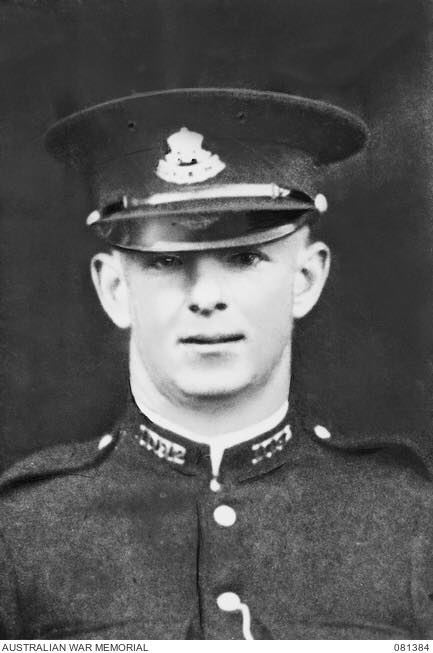
( Class # 001 was in March 1947 – so Eric pre dates that. )
Regd. # 2382
Rank: Commenced Training on ? ? ?
Probationary Constable – appointed Wednesday 16 March 1927
Constable 1st Class – appointed 23 April 1938
Constable 1st Class – posthumously promoted to Sergeant 3rd Class
Stations: No. 4 Division from 14 June 1927,
The Rocks in 1928, then Gundagai, Narrandera & other rural stations.
Moruya 1938 then Blayney from 4 January 1945
Service: From 16 March 1927 to 12 January 1945 = 18 years Service
Awards: * George Cross ( GC ) awarded, Granted 20 October 1946 – posthumously
also the George Lewis Trophy.
Bravery Commendation re arrest at Batemans Bay in 1940.
Highly Commended and awarded six months seniority for Conspicuous Bravery for the rescue of survivors, at sea, off Moruya on the 3 August 1942, after a fishing trawler had been attacked by a Japanese submarine. Also received a Certificate of Merit from Royal Shipwreck Relief and Humane Society of NSW.
Born: Sunday 14 October 1906 at Tenterfield
Died: Friday 12 January 1945
Age: 38 years, 2 months, 29 days old
Cause: Shot – Murdered
Event location: Outside of Exchange Hotel, Adelaide St, Blayney
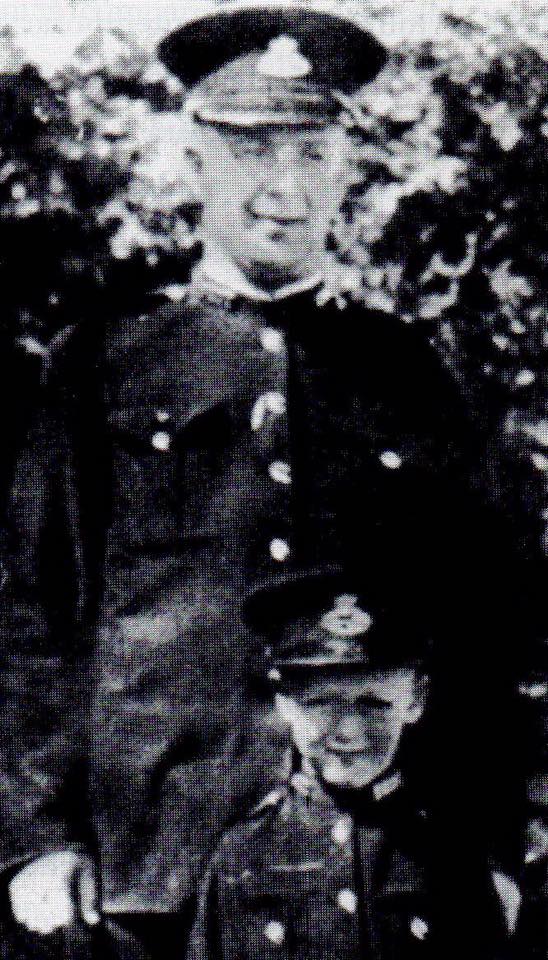
Eric George BAILEY and his son – John “Jack” BAILEY ( NSWPF # 6293 )
ERIC IS mentioned on the Police Wall of Remembrance
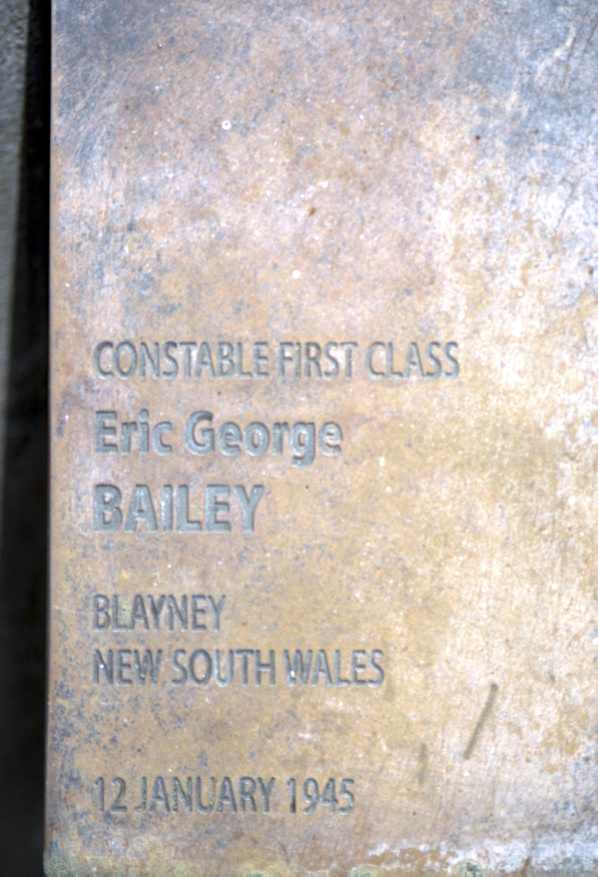
Touch plate at National Police Wall of Remembrance, Canberra
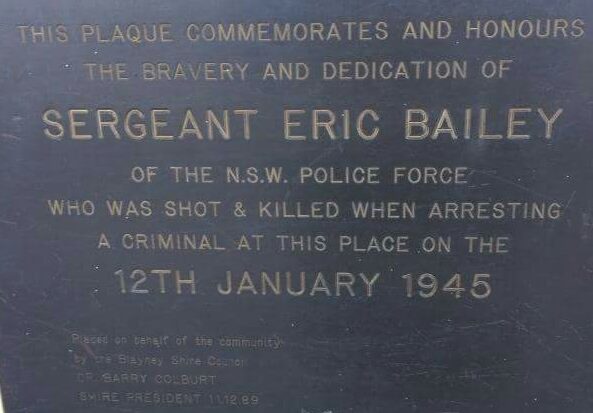
Memorial location: Below plaque is located at the location of the murder.
On 4 January 1945, Constable 1st Class Bailey commenced duty at Blayney Police Station. On his 8th day at that station, he was dead.
On a hot summer evening, eight days later, while on duty in Adelaide Street, he was informed that a drinker at the Exchange Hotel was displaying a revolver.
Shortly after 8pm on 12 January 1945, Constable 1st Class Bailey spoke to a man, Cyril Norman, who was dressed in an American Naval Uniform outside the Exchange Hotel, Blayney. The constable told the man that he intended to search him and his belongings regarding his alleged possession of a revolver. The man suddenly produced the revolver and shot Constable Bailey in the stomach. The constable then took hold of the offender and during the ensuing struggle two more shots were fired and the offender was wounded in the wrist. Three railway employees quickly came to the constable’s aid and the offender was handcuffed and detained until the arrival of Constable Grady. Bailey told Grady: ” He shot me through the back. Don’t let him get away …I had a go. I didn’t squib it “.
The wound suffered by Constable Bailey proved to be severe and he died on admission to the Orange Base Hospital with his wife by his side. He had in fact arrested his own murderer.
Allegations were later made suggesting that the offender was a contract killer sent to murder another local policeman, Constable Stan Grady, who had been enthusiastically investigating sly grog sellers and SP bookies in the area. The offender was said to have inadvertently shot Constable Bailey, whom he mistook for Grady, who was off duty at the time. When shot, Constable Bailey was in mounted police uniform, and until that day Stan Grady had been the onlymounted constable in Blayney, thus the offender’s error. The offender, well-known Sydney criminal Cyril Norman – alias Thomas Couldrey – was convicted and sentenced to death.
Norman was charged with the murder of Bailey and that of Maurice Hannigan, a Sydney shopkeeper from whom he had stolen guns and ammunition. Although he was convicted, the death sentence was later commuted to life imprisonment.
Bailey was posthumously awarded the George Cross, instituted in 1940 by King George VI and intended primarily for civilians, which recognized ‘acts of the greatest heroism or of the most conspicuous courage in circumstances of extreme danger’.
The first Australian policeman to be so honoured, he was also posthumouslypromoted sergeant 3rd class and awarded the George Lewis trophy in 1945 for the most courageous act by a policeman.
Bailey was accorded an official police funeral in Sydney and was buried in the Anglican section of Rookwood cemetery. His daughter and son John, who was to join the New South Wales police at the age of 16, also survived him.
( John ‘Jack’ George BAILEY, NSW Police Cadet # 0613, Regd. # 6293 )
28 May 2020
Maz HerrmannHis son John “Jack” Bailey an ex cadet was our boss at Albury during the 80s and the day he retired I spoke to him that evening and said “Jack what are you fkn doing at work; today is your last day”? He said “I’m just tidying up some things before I go.
I knew Jack when he was a Snr Sgt at Wollongong and I was the Inspectors Clerk in 1977-1980.
I joined the cops the following year 1981 – then I had to call him Sir!
He was definitely an old school copper – enough said.
announced the presentation of Sergeant Bailey’s George Cross by Sir William McKell.
GEORGE CROSS AWARD – INVESTITURE BY MR. McKELL.
Mrs. F. M. Bailey, of Cleveland Street, Moore Park, widow of Police Sgt. Eric G. Bailey, yesterday received the George Cross awarded to her husband for holding a man who had fatally wounded him until assistance arrived, at Blayney in January, 1945. The decoration was made at an investiture held by the Governor General, Mr. McKell, at Government House.
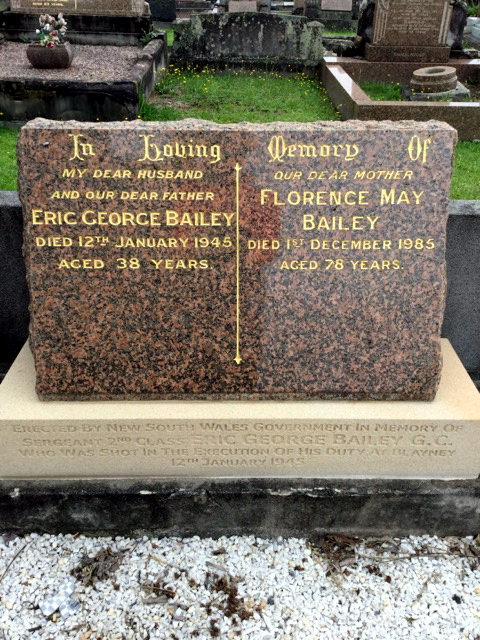
Sergeant Bailey was born in 1906 and joined the New South Wales Police Force in 1927. At the time of his death he was stationed at Blayney. He was posthumously promoted to Sergeant 3rd Class ( Although his grave states Sgt 2/c ) and awarded the George Cross and the George Lewis Trophy.
* Eric BAILEY is the ONLY Australian Police Officer to be awarded the Imperial Honour, namely the George Cross Medal.
Eric George Bailey (1906-1945), policeman, was born on 14 October 1906 at Tenterfield, New South Wales, ninth child of Arthur Peter Bailey, compositor, and his wife Jane, née Bush, both native-born. Eric worked as a postal assistant before joining the New South Wales Police Force on 16 March 1927. After training, he was transferred to Sydney’s No.4 Division on 14 June, and sent to The Rock in 1928; he then served at Gundagai, Narrandera and other rural stations. Bailey was confirmed an ordinary constable on 16 March 1928. He married Florence May O’Connor at Mount Carmel Catholic Church, Waterloo, on 24 November that year.
Promoted constable 1st class on 23 April 1938, Bailey was next stationed at Moruya on the south coast. In 1940 he arrested a criminal at Batemans Bay and was commended for bravery, cool-headedness and devotion to duty. Learning that a fishing trawler had been attacked by a Japanese submarine off Moruya on 3 August 1942, he and Sergeant Horace Miller set out at night in a pleasure launch in heavy seas to assist with the rescue of the survivors. Bailey was highly commended and awarded six months seniority for conspicuous bravery; he also received a certificate of merit from the Royal Shipwreck Relief and Humane Society of New South Wales.
On 4 January 1945 Bailey was transferred to Blayney, south-west of Bathurst. On a hot summer evening eight days later, while on duty in Adelaide Street, he was informed that a drinker at the Exchange Hotel was displaying a revolver. When Bailey questioned the offender, Cyril Norman, and declared that he would search his room, Norman drew a revolver and shot him. In the ensuing struggle two more shots were fired, but Bailey managed to handcuff Norman and restrain him until Constable Grady arrived. Bailey told Grady: ‘He shot me through the back. Don’t let him get away . . . I had a go. I didn’t squib it’. Fatally wounded by the first shot, Bailey died hours later on 12 January 1945 in Orange Base Hospital, his wife at his side.
Norman was charged with the murder and that of Maurice Hannigan, a Sydney shopkeeper from whom he had stolen guns and ammunition. Although he was convicted, the death sentence was later commuted to life imprisonment.
Bailey was posthumously awarded the George Cross, instituted in 1940 by King George VI and intended primarily for civilians, which recognized ‘acts of the greatest heroism or of the most conspicuous courage in circumstances of extreme danger’. The first Australian policeman to be so honoured, he was also posthumously promoted sergeant 3rd class and awarded the George Lewis trophy in 1945 for the most courageous act by a policeman. Bailey was accorded an official police funeral in Sydney and was buried in the Anglican section of Rookwood cemetery. His daughter and son John, who was to join the New South Wales police at the age of 16, also survived him.
Select Bibliography
I. Bisset, The George Cross (Lond, 1961)
L. Wigmore (ed), They Dared Mightily (Canb, 1963)
Police News (Sydney), Feb 1945, p 7, Sept 1945, p 9, Oct 1947, p 44
Sydney Morning Herald, 14, 20 Jan, 8, 22 Feb, 5 Aug 1945, 30 Oct 1946, 11 Sept 1947
Sun (Sydney), 17 Jan 1979
service records of E. G. Bailey (police registry, New South Wales Police Dept, Sydney).
Citation details
Christa Ludlow, ‘Bailey, Eric George (1906–1945)’, Australian Dictionary of Biography, National Centre of Biography, Australian National University, http://adb.anu.edu.au/biography/bailey-eric-george-9403/text16527, published first in hardcopy 1993, accessed online 6 January 2015.
( For the purposes of this website ‘Q’ represents those Police joining between 1 March 1862 ( commencement of NSWPF ) – 23 February 1915 ( Commencement of NSWPF current numbering system )
Rank: Constable – appointed 27 September 1878
Constable 1st Class- appointed February 1884
Stations: Bathurst, Coonamble – Death
Service: From 27 September 1878 to 13 March 1885 = 6.5 years
Awards: ?
Born: 18 August 1856 in Uig, Ross & Cromarty, Scotland
( This cemetery no longer exists and was turned into a Park around 1970 and the headstones removed. See *below )
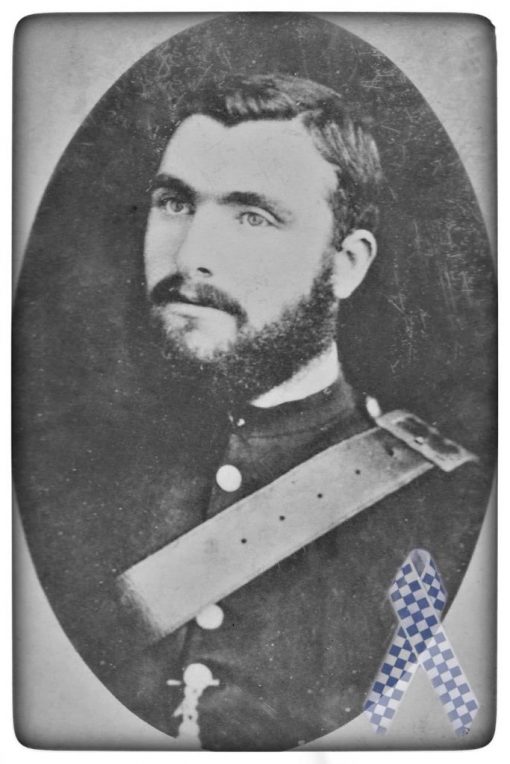
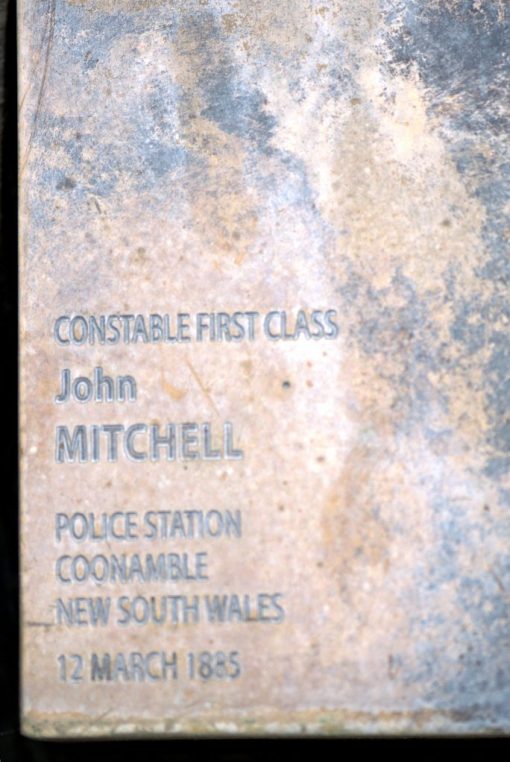
JOHN IS Mentioned on the Police Wall of Remembrance
John MITCHELL – National Police Wall of Remembrance, Canberra – 2015
Early in the morning of 12 March, 1885 two prisoners in the lockup at Coonamble overpowered a warder by the name of Michael Langley who had gone into their cell to place leg irons on a third prisoner by the name of Courtney.
He was knocked to the floor and his revolver taken from him.
Hearing the scuffle, Constable Mitchell, acting Gaoler at the time, arose from his bed and ran to the cells to assist.
One of the prisoners, a man named Angel, warned the constable not to come into the cell however Mitchell ignored this and lunged at the prisoner. As he did so he was shot in the chest. He died about 7am the following day.
In a dying deposition given to the Coonamble Police Magistrate on 12 March, Constable Mitchell said, ‘I am acting Gaoler at Coonamble gaol; at about a quarter past six this morning the 12th March inst., I opened the door of the guard room Coonamble Gaol; the Warder just then came into the cell where the convicted prisoners Angel, Thurston, and Courtney were confined; I heard a noise in the cell as if a man was being strangled; I came in and the warder was lying down on the cell floor; Angel was strangling him and Thurston was taking the revolver from him; I made a rush and Courtney knocked me over; Angel then got the revolver and both he and Thurston rushed at the cell door; Angel said “Keep back or I’ll shoot you”; I made a rush to try and get the revolver from Angel when he shot me; they then shut the warder and myself together with Courtney, who did not get away owing to Warder Langley’s threatening to kill him if he moved in the cell and rushed away. “
Both Angel and Thurston managed to escape, however both were later shot to death by police.
James Alfred Courtney, the third prisoner, was later found not guilty of involvement in the murder as he had been found by other police after the murder and escape, still in the cell attempting to assist Constable Mitchell by bathing his wound with cold tea (there was no water in the cell). A recommendation was then made to have his previous sentence reduced.
The constable was born in 1855 and joined the New South Wales Police Force on 27 September, 1878. At the time of his death he was stationed at Coonamble, and had previously been stationed at Bathurst.
The original general cemetery in Coonamble was in operation from 1869 to 1912 when it was deemed to be full and closed to further burials. Many years later (probably around 1970), Council removed the headstones and converted the area into a park.
In the preface to her book, “Coonamble Memorial Wall Pioneer Profiles”, local historian Joan McKenzie explains: “When the old cemetery at the end of Warrena Street was cleared about thirty years ago, a number of headstones were retained and embedded on and around a large mound of earth. In 1993, a Federal Government grant enabled the Shire Council to move those headstones to the cemetery in West Coonamble, which had been established circa 1902. ”
Appropriately, the site chosen by Council to devote to the display of those old stones adjoined the historically significant Sexton’s Hut, erected in 1912. The display was organised into three sections: a covered double-sided memorial wall, a group of sandstone monuments and a group of marble monuments. The work was completed to a high standard and dedicated on 12 September 1993. A list of 611 names of persons whose deaths were registered at Coonamble during the period that the old cemetery was in operation, and known or presumed to have been buried at the old site, was inscribed and mounted on the side of the Sexton’s Hut.
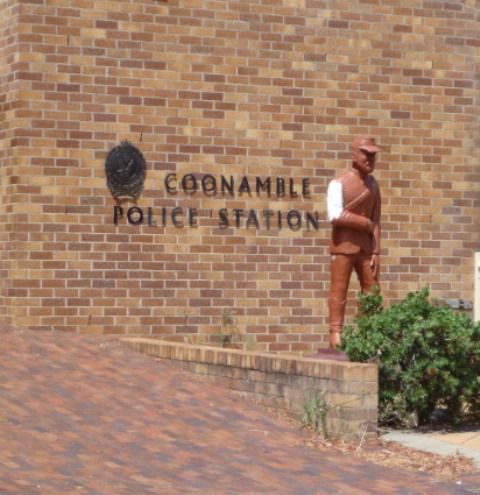
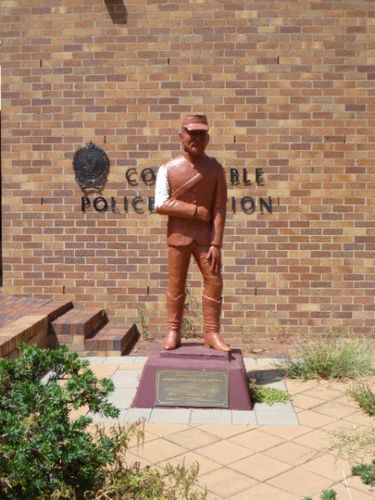
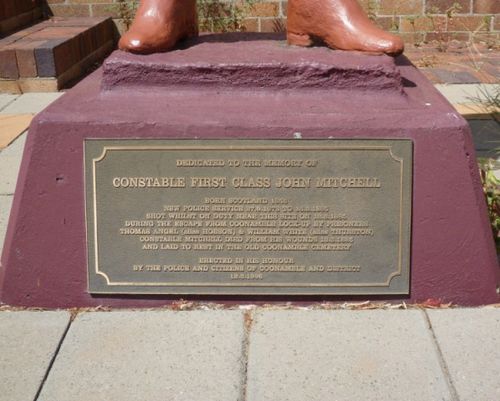
Statue of Constable Mitchell who was shot while trying to prevent the escape from gaol of bushrangers Angel and Thurston in 1885. Front Inscription Dedicated to the memory of Constable First Class John Mitchell. Born Scotland 1856. NSW Police Service 27.9.1878 to 13.3.1885. Shot whilst on duty near this site on 12.3.1885 during the escape from Coonamble lock-up by prisoners, Thomas Angel (alias Hobson) and William White (alias Thurston). Constable Mitchell died from his wounds 13.3.1885 and was laid to rest in the old Coonamble Cemetery. Erected in his honour by the police and citizens of Coonamble and District 12.3.1996. Actual Monument Dedication Date: Tuesday 12th March, 1996 GPS of monument: Lat: -30.952500 Long: 148.388056 Note: GPS Coordinates are approximate. Unveiled by his great grandson.
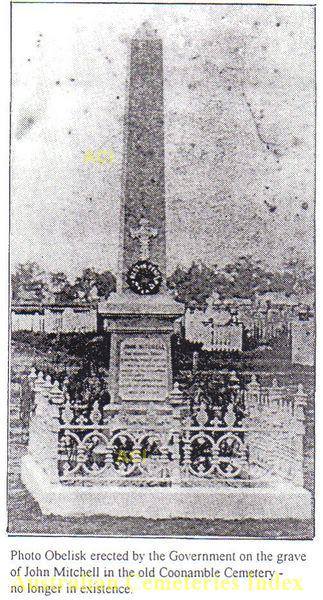
John Mitchell – Photo Obelisk erected by the Government on the grave of John Mitchell in the old Coonamble Cemetery – no longer in existence.
Bathurst Free Press & Mining Journal ( NSW ) Friday 13 March 1885 page 2 of 4
FRIGHTFUL TRAGEDY AT COONAMBLE.
– * –
A CONSTABLE SHOT.
ESCAPE OF PRISONERS.
( BY TELEGRAPH )
[ FROM OUR OWN CORRESPONDENT. ]
Coonamble, Friday.
A shocking tragedy occurred at Coonamble gaol yesterday morning, in a cell where a prisoner named Angel, who had been sentenced to four years for cattle stealing, another prisoner named Courtney, and a prisoner named Thurstone, who had served a sentence at Berrima gaol, were confined.
When the turnkey ( Warder Langley ) entered to leg iron Courtney and Angel, one of the prisoners pounced upon him, and knocked him down and took his revolver. The turnkey called aloud, when Mitchell, a constable, and formerly of Bathurst, hearing the scuffle, rushed out of bed. The prisoner Angel, who had the revolver, told Mitchell not to dare to come in, Mitchell, however, advanced, and Angel fired. The bullet entered Mitchell’s breast just below the heart, and went right through his body and out at the back. Mitchell at once fell, and the three prisoners made their escape with the revolver.
Five miles from town they pulled a boy off his horse, and the escapees got on to the horse, and galloped into the bush. They have been tracked, and hopes are entertained that they will be soon captured. They are armed with revolvers taken from the gaolers.
The tragic affair has cast quite a gloom over the town.
The warder, Mitchell, is still lingering, but no hopes are held out of his recover.
Later.
On the prisoners getting to the gaol yard, they cut Thurstone‘s irons, leaving the sockets on the legs, and crossed the river at the upper end of the scrub, near the old engine, McMahon’s station. The Police Magistrate and trackers on on their tracks.
Constable Mitchell died at 7 am. to-day. Warder Langley is much prostrated, and quite ill from the effects of the encounter, and will not be able to resume his duties for a time.
The South Australian Advertiser Monday 16 March 1885 page 5 of 8
A good deal of excitement prevails at Coonamble consequent upon the death of Mitchell, the gaolor (sic) of the local prison, from the effects of a wound caused by his being shot at by a prisoner named Angel, who recently escaped from gaol with another prisoner named Thurston.
The men Angel and Thurston, who escaped into the bush, have not yet been tracked, although search parties are in pursuit.
The Government has offered £200 reward for their capture.
The Brisbane Courier Tuesday 17 March 1885 page 6 of 8
The troopers sent out in search of the escaped prisoners Angel and Thurstone, who are charged with the murder of gaoler Mitchell at Coonamble, returned last night without finding any trace of the criminals.
Bathurst Free Press & Mining Journal Tuesday 17 March 1885 page 3 of 4
THE TRAGEDY IN COONAMBLE GAOL.
The following, which is a more detailed account of the shooting of the gaoler, Constable Mitchell, and the escape of two prisoners from the Coonamble gaol, is abridged from the Coonamble Independent : —
After the trial of the prisoner Thomas Angel, at the Quarter Sessions, he, together with two other convicted men, Thurston and Courtney, was locked up for the night in a cell in the gaol.
Thurston had riveted irons on, whilst Angel, who it was surmised was shamming illness, and Courtney, were unfettered.
On the following morning, Mitchell gave orders to the warder to leg-iron Courtney, who was told off to act as cook. The warder was in the act of stooping down to leg-iron Courtney when the three prisoners set upon him, got him down, and endeavoured to strangle him. They seized his revolver in the struggle, leaving him powerless and half stunned. Mitchell jumped into the cell to assist the warder, and it is surmised, was tripped up by Courtney. Mitchell regained his feet and Angel was standing at the cell door with the revolver in his hand, Thurston having gone outside, and Courtney being on the inside.
Angel told the warder that if he (the latter) attempted to stir he would blow his brains out. At this juncture Mitchell jumped from Courtney towards Angel, when the latter deliberately shot at Mitchell. The gaoler fell from the effects of the shot, leaving the warder disabled, and Courtney in the cell. The door of the cell was thereupon bolted by either Angel or Thurston on the outside.
Thurston rushed down the passage with a tomahawk in his hand, and Angel went into the guard room. Angel ran quickly to a Mrs. Canham who was present, caught hold of her by the hand, and wanted to lock her up in a cell. She refused to go, when Angel held the revolver to her forehead. After some parleying, Angel let Mrs. Canham’s hand go, and the two men went through the front door.
Drs. Cortis and Tressider, were quickly in attendance, and upon examination it was found that poor Mitchell was shot in the right breast, the bullet having passed clean through his body, coming out at the lower portion of his back.
From the first the case was pronounced hopeless and the deepest sympathy was evinced for the unfortunate gaoler, his wife, and family.
Poor Mitchell, after lingering until Friday morning, succumbed to the effects of the bullet wound, and his untimely end is universally and deeply regretted. He was a thoroughly efficient officer, esteemed at headquarters, and deservedly respected in Coonamble.
He leaves a wife and children totally unprovided for.
Launceston Examiner ( Tasmania ) Tuesday 24 March 1885 page 2 of 4
A verdict of wilful murder has been returned against the escaped prisoner Angel and his companion Thurston, also against another prisoner who was in the cell at Coonamble Gaol when Warder Mitchell was shot.
The two men have not as yet been re-captured, and the Government have offered £200 reward.
Bathurst Free Press & Mining Journal ( NSW ) Wednesday 25 March 1885 page 2 of 8
MURDER OF ACTING-GAOLER MITCHELL —
The following notice appears in Friday’s Gazette:-
Whereas on the morning of the 12th instant, two prisoners, named William White, alias Thurston and Thomas Angel Hobson, escaped from the Coonamble Gaol ; and whereas one of the said offenders, previous to escape, fired at and mortally wounded Constable John Mitchell, the Acting-Gaoler, who has since died; and whereas at a Coroner’s inquest held upon the body of the said John Mitchell, a verdict of wilful murder was returned against the said offenders, William White, alias Thurston and Thomas Angel alias Hobson, and James Alfred Courteney, who was confined in the same cell with the two prisoners who escaped.
Notice is hereby given that a reward of £200 will be paid by Government for such information as shall lead to the apprehension of each of the said offenders, William White alias Thurston and Thomas Angel alias Hobson.
Description of Offenders. —
White alias Thurston, is 29 years of age, 5 feet 9 inches high, medium build, brown hair and eyes ; a native of New South Wales ; a drover.
Angel alias Hobson, is 27 years of age, 5 feet 9 inches high, dark, beard and whiskers, good looking.
The Goulburn Evening Penny Post Thursday 26 March 1885 page 2 of 6
The Coonamble Outrage.
The Dubbo Despatch regrets to say that the men Angel and Thurston, who escaped from Coonamble gaol, and who have been declared by the Coroner’s jury guilty of the murder of Warder Mitchell, are still at large.
Some information regarding their movements has been gathered by Senior-constable Cusack, of Gilgandra.
On Monday he reached a hut in the warrumbungles, and discovered that the two had been there on the previous Saturday night, Thurston only then got the leg-irons off. He had out the connecting chain, and tied up along each leg the piece of chain. It was not, however, till he reached the hut that he managed to get the rivetted rings off his legs, which were in a fearful condition. They were very much swollen.
Thurston was scarcely able to walk, and several times he had to be carried on his companion’s back. Cusack and other troopers are now hunting the pair in the mountains.
The Government has offered a reward of £200 each for the apprehension of Angel and Thurston.
The following is their description: White, alias Thurston, is 20 years of age, 5 feet 9 inches high, medium build, brown hair and eyes, a native of New South Wales, a drover;
Angel, alias Hobson, is 27 years of age, 5 feet inches high, dark beard and whiskers, good looking.
Courtney, who was also included in the coronial jury’s verdict of murder, arrived at Dubbo on Wednesday, and is now in gaol.
Evening News ( Sydney ) Friday 27 March 1885 page 3 of 8
COWRA. March 25.
The Victim of a Ruffian.— The deepest regret and sympathy were evinced here when it became known that Constable Mitchell, formerly lock-up keeper of this town, had been shot dead by one of the prisoners in the gaol at Coonamble, where he was acting gaoler at the time of his melancholy death.
The deceased leaves a wife — very ill at the time of the occurrence — and two little children.
All the particulars of the case are by this time very well known to our readers, so that we will not state them here.
After the perpetration of the cowardly deed, the murderer and one of his accomplices escaped from the gaol, and have since eluded all attempts at capture. A large reward has been offered for their capture.
Bathurst Free Press & Mining Journal Saturday 28 March 1885 page 2 of 12
THE COONAMBLE TRAGEDY.
The following is the principal evidence taken at the inquest on the body of Acting-Gaoler Mitchell, who was shot by the escaped prisoner Angel: —
Michael Langby states, I am warder at the Coonamble Gaol ; I remember the morning of the 12th inst. Thursday ; about a quarter past six o’clock I knocked at the outer gaol door ; the door was opened by the Acting-Gaoler ; received the keys of the cells from him ; put my revolver on me as usual before I entered the cells ; unlocked the door opened it and went in ; Mitchell was then in the passage but had no arms on him; I knelt down to put the leg irons on the prisoner Courteny; the prisoners knocked me down ; the three prisoners in the cell were Angel, Thurston and Courteny ; I could not see who knocked me down because I was kneeling ; they must have stunned me for I don’t recollect hardly what happened for a few minutes after ; when I came to my senses again I was lying on my back; Angel was at the door of the cell with my revolver in his hand, he pointed the revolver at me and said, ‘ I’ll shoot you dead if you stir ;’ with that the gaoler jumped from the corner of the cell to the door ; Mitchell was then in the cell ; saw the shot fired by the prisoner Angel, it took effect on the gaoler Mitchell in the breast; Mitchell stated in the presence of Courtney that Courteny tripped him up before the shot was fired ; Mitchell fell after receiving the shot ; I heard the prisoners Angel and Thurston outside the cell door for a few minutes ; after the prisoner Courteny made some attempt to move near the door ; I was then standing on my feet as Mitchell received the shot ; the other prisoners did not attempt to rescue Courtney, but left him behind ; when Mitchell was shot Angel, Mitchell, Courtney and I were present ; Thurston had gone out into the passage ; when the prisoner Angel went out, he bolted the door and left Mitchell, Courtney and I in the cell ; Mitchell got up once after he was shot and then fell again ; Courtney wouldn’t let me put the leg irons on ; afterwards put on one of the leg irons, and I believe Constable Newby put the other on; saw the wound in Mitchell‘s breast it was such a one as would be made by a bullet.
By a Juror: It might be a quarter of an hour or 20 minutes from the time the cell door was closed upon me before the police came; can’t say which of the three prisoners took the revolver from me; had my senses when the shot was fired ; I saw Angeldeliver the shot ; knew the prisoners were dangerous characters; my orders are when I have committed men in charge to put on my side-arms or revolver ; when I first saw Mitchell at the cell he was standing behind the door, in the passage ; I think when Mitchell sprang from the cell he was engaged with Courtney ; I don’t think I did sing out for Mitchell ; I might have done so when I was stunned ; I don’t remember doing so.
James Alfred Courtney, a confinee in Coonamble gaol, deposed to Langley‘s coming into the cell to leg-iron him ; somebody gave Langley a shove behind, and knocked him and me over ; it must have been either Angel or Thurston; I was getting up, when Angel hit me in the eye and knocked me down ; I went to get up again when Langley caught me by the throat and Mr. Mitchell rushed into the cell ; he knocked against me, and sent me flying into the corner of the cell ; saw Angel at the door pointing a revolver at Langley ; Mitchell left me and made a rush at Angel, when the latter fired the revolver ; the shot struck Mitchell in the right breast; Mitchell staggered, and I caught him. ( After some words as to the putting on of the leg-irons, witness continued ) : I went and sat down alongside Mitchell; Mitchell said, ” Courtney, get me some water, for God’s sake ;” afterwards bathed Mitchell‘s head with some tea, and then searched and found where he had been wounded ; Mitchell said ” My God, Courtney, I’m dying ;” the sergeant then came to the cell door, walked in, and asked what was the matter, and Mitchell said ” I’m shot;” Mr. Boyd asked who shot him, and Mitchell replied ” Angel;”. the other prisoners did not call out after them — they did not speak to me that I know of ; Mr. Mitchell did not say anything to me when he put his hands on me ; he may have said to me ” You vagabond, you’re as bad as any of them ;” I don’t recollect him saying so ; Mr. Mitchell made no remark about the blood on my neck ; I can’t swear he never mentioned anything about throttling me ; am positive Angel struck me in the face ; I did not know the prisoners were going; I was not assisting or abetting in any way in the escape.
By a Juror : The night before the other prisoners were not sleeping together; did not hear any conversation in the night ; I went to sleep; previous to going to sleep heard Thurston say, ” The mountains would be a good place, or the gulf;” heard Thurston say “Oh, curse these irons.”
By the Coroner: the prisoners did not take me into their confidence at all ; they were strangers to me ; did not assist in taking, nor did I see who took the revolver from Langley ; did not intentionally trip Mitchell; the Gaoler and I were good friends ; he was as good as a father to me ; never struck a blow at Mitchell in anyway ; never heard prisoners planning to escape ; the only thing I heard was Thurston saying one day, ” If he goes to sleep we can get away out of the carriage.”
Harry Tressider, legally qualified practitioner residing in Coonamble, deposed having made a post mortem examination of the body of deceased and as to the cause of death by the bullet wound. ‘The death of Mitchell was consequent upon a gunshot injury.
James Newby, Constable of the Police deposed : I remember Thursday, the 12th inst., on the morning of that day when opening the cell door, heard a great row inside and asked what was up. Saw prisoner Courtney standing in the middle of the floor unironed. Afterwards completed putting on the irons in consequence of Langley‘s being much exhausted; whilst I was putting on the irons Constable Mitchellcrawled over to me on his hands and knees and took hold of me by the hand, I said, ” Who shot you;” the prisoner Courtney said, “It was a cruel b — — y thing of Angel to shoot him like that,”Mitchell said ” You vagabond, you’re as bad as any of them you held the old man’s feet;”Mitchell said, ” When I came in the door was open, they had the old man down and Thurston trying to strangle him, Angel was trying to get the revolver from him, I rushed and struck at Thurston, and when I did this man knocked me down (meaning prisoner Courtney) ; he said we both fell and got our holts in the corner and I throttled him; the next thing I heard, was somebody saying if you move I’ll shoot you; on looking up I saw Tom Angel with the revolver pointing, I jumped up and rushed at him and as I rushed at him I was shot.
Prisoner Courtney was sitting down 3 or 5 feet from me during the conversation which lasted 2 or 3 minutes ; I looked at Courtney‘s neck to see if he had been throttled and I saw three distinct marks as if done by finger nails on his neck and I said, ” You did throttle the wretch. “ I then left and went to the door and saw Warder McGuier ; Prisoner never tried to contradict Mitchell‘s statement about knocking him down.
The dying declaration of John Mitchell, taken before the P.M. Coonamble, 12th March instant. ‘I am acting Gaoler at Coonamble gaol; at about a quarter past six this morning the 12th March inst., I opened the door of the guard room Coonamble Gaol ; the Warder just then came into the cell where the convicted prisoners Angel, Thurston, and Courtney were confined ; I heard a noise in the cell as if a man was being strangled ; I came in and the warder was lying down on the cell floor ; Angel was strangling him and Thurston was taking the revolver from him ; I made a rush and Courtny knocked me over; Angel then got the revolver and both he and Thurston rushed at the cell door; Angel said ” Keep back or I’ll shoot you ;” I made a rush to try and get the revolver from Angel when he shot me; they then shut the warder and myself together with Courtney, who did not get away owing to Warder Langley’s threatening to kill him if he moved in the cell and rushed away. “ After the Coroner’s address to the jury, explaining the law as applicable to the case, a verdict was returned by the jury as follows : ‘ That the deceased John Mitchell came to his death on Friday, the 13th inst., from the effects of a gun shot wound inflicted on him by Thomas Angel, and we also find that William Thurston and James Alfred Courtney were accomplices in the act, and therefore find a verdict of wilful murder against the three of them.’
The Sydney Morning Herald Tuesday 31 March 1885 page 7 of 12
A man was arrested at Granville last evening by Constables Harrison and Wilson on suspicion of being Angel, the Coonamble gaol escapee, who shot Warder Mitchell on the 12th instant. The man corresponds in almost every particular with the description given of Angel. He is very reticent, however, and, in reply to the questions of the police, he merely slated that he was a shearer. He will be brought up before the local Bench to-morrow.
The South Australian Advertiser dated 13 April, 1885 described the shooting and capture of the murderers.
CAPTURE AND DEATH OF THE COONAMBLE MURDERERS. Sydney, April 13.
The Coonamble murderers were captured on Friday night by Sergeant Burns and Constable McKinley at Mr. Stewart’s store, Green’s Swamp. On the arrival of the police at the door of the store Thurston immediately shot Stewart dead. Constable McKinley and Sergeant Burns then fired simultaneously, and killed Thurston and severely wounded Angel, who has since been removed to the Gulgong lockup. Medical assistance was immediately obtained. Inquests will be held to-morrow. Later intelligence has just been received stating that the prisoner Angel died on Sunday morning in gaol. Both prisoners were fully identified. The tragedy caused great excitement.
Our Sydney correspondent telegraphed last night : –Mrs. Georgina Mitchell, matron of the Central Police Station, Sydney, died suddenly on Monday night. She was a recognised fingerprint authority, and had a remarkable memory for prints. Her husband, Constable John Mitchell, was shot dead by two prisoners, Angel and White, when they were escaping from “Coonamble Gaol in 1885.”
Richmond River Herald and Northern Districts Advertiser (NSW : 1886 – 1942),
Friday 11 April 1919, page 4
Tragic Memories Recalled.
DEATH OF MRS. MITCHELL.
The sudden collapse and death last Monday night of Mrs. Georgina Mitchell, matron at the Central Police Station, while she was collecting a parcel at the parcels office on the Central Railway Station, removes an interesting figure in the gaol history of New South Wales. Most of Mrs. Mitchell‘s services was in the position of matron at the old Water Police Station, in Phillip Street, which she occupied for a great number of years.
She was a recognised fingerprint authority, and always assisted the police in the taking of the prints of criminals convicted at the Water Police Court.
It is said that her memory for prints was remarkable.
When the Water Court was abandoned, Matron Mitchell was transferred to the Central Station.
Mrs. Mitchell‘s husband was Constable John Mitchell, acting gaoler at Coonamble lock-up, whose murder in 1885 was a very tragic incident in a sensational escape from the cells made by two notorious criminals, Angel and White.
This affair involved two cold blooded murders.
Mitchell was called into the cell in which the two prisoners were confined on the pretext that one of them was ill. The constable was bending over the man, who was shamming sickness, when the other knocked him down, and, snatching his revolver from his belt, shot him dead. The ruffians then secured the keys of the gaol, and, having let themselves out, took to the bush.
When they reached a store near Mudgee, which they intended to stick up, the men were not a little surprised to find the police awaiting their arrival, and, thinking that the storekeeper had given the warning, they shot him dead too. The police opened fire on the murderers, one of whom was despatched with a bullet, while the other was captured by Senior Sergeant Day, who afterwards became Inspector-General of Police, after he was wounded. He died the following day. Mrs. Mitchell was 58 years old. One of her sons is a member of the postal detective staff at the G.P.O., and another is Ald. J. G. A. Mitchell, of Coraki, G.M. of the North Coast District M.U., I.O.O.F., to whom the sympathy of many friends will go out in his bereavement.
After migrating to Australia some time before about 1876, John Mitchell spent the first few months in Queensland before moving to New South Wales where he spent the remaining years of his life.
He worked as a coachman before joining the Foot Police on 27 September 1878. When 25 years old he married Georgina Diehm (24) at Lidsdale, Wallerawang. John Mitchell was promoted to Constable First Class on February 1884. He was transferred to Coonamble to replace the lockup keeper who had died from heatstroke on 7 January. On 12 March 1885 he was shot when trying to prevent the escape from gaol of bushrangers Angel and Thurston. He died the next day. With his wife and two children – three year old John George Alexander and six month old William James McRae – John Mitchell had been living in the residential portion of the building which had been erected in Aberford Street in 1877 as the Court House/Watch House. At that time and until 1886, it served as the Police Station as well as lockup keeper’s residence attached to the gaol.
A statue of John Mitchell, standing on a pedestal in front of the Police Station in Aberford Street, Coonamble, was unveiled by his great grandson on 12 March 1996. Police and civic dignitaries, Coonamble citizens and Mitchell family descendants were present at the ceremony. John Mitchell was shot in the building which stood on the site in 1885. The plaque reads:
Dedicated to the memory of Constable First Class John Mitchell, Born Scotland 1856
NSW Police Service 27.9.1878 to 13.3.1885
Shot whilst on duty near this site on 12.3.1885 during the escape from Coonamble lock-up by prisoners
Thomas Angel (alias Hobson) and William White (alias Thurston).
Constable Mitchell died from his wounds 13.3.1885 and was laid to rest in the old Coonamble Cemetery
Erected in his honour by the police and citizens of Coonamble and District 12.3.1996.
Georgina Diehm was born 16 February 1860 at Swyers Swamp, NSW, daughter of Johann Georg Michael Diehm and Maria Eva Flegler (see separate file in First Families 2001).
Georgina married her husband John Mitchell at Lidsdale in 1880. After only five years of marriage, she was widowed. She raised her two sons alone and most of spent the remaining years of her life in Sydney.
You and Your Family:
I am Kathy Pearson, nee Dwyer, wife of Bruce Pearson who is the great grandson of John and Georgina. We have three adult children and three grandchildren. My email address is kathypea@yahoo.com.au and we live in Cundletown, NSW. Apart from the first generation of children of each couple, I have entered only my, or Bruce’s, direct line of descent, for the purpose of protecting the privacy of those relatives who may not wish to have their details included. However, if any other descendants of these couples wish to have their families included, please contact me.
See also Margaret Bohan; Annie Clement; William Clement; Melina Clothier; Sarah Coleman; James Colley; Johann Georg Michael Diehm; Oliver Dwyer; Eleanor Ewing; John Farley; Maria Farley; Maria Eva Flegler; Lucy Hetherington; Jemima Hughes; George Hutchinson; Margaret MacFarlane; Donald McDermid; Duncan McDermid; Sarah McDermid; Christopher McRae; Jonathan Pearson; Anne Taylor Pretty; Mary Stewart; Peter Thomas; James Pater Field Walker; Josiah Wesley Walker.
Life Before Australia:
John Mitchell was born in Glasgow in 1856, the son of John Mitchell and Ellen McRae.
Descendants
Children
MITCHELL, John George Alexander 1
MITCHELL, William James McRae 2
Grandchildren
MITCHELL, Minnie Florence 1
Great Grandchildren
PEARSON, Bruce Trevor 1
NB: Superscript behind each descendant name represents the lineage number of that descendant.
This family information was last updated by KATHY PEARSON on the 11 February, 2001.
For the purposes of this website ‘Q‘ represents those Police joining between 1 March 1862 ( commencement of NSWPF ) – 23 February 1915 ( Commencement of NSWPF current numbering system )
Rank: Constable – appointed 7 January 1863
Senior Sergeant – appointed ? ? ?
Final Rank: Senior Sergeant
Stations: ?, Cowra – Death ?
Service: From 7 January 1863 to 1 May 1872 = 9+ years Service
Awards: ?
Born: ? ? 1840, Wick, Scotland
Died on: 1 May 1872
Cause: Shot – Murdered
Event location: Binni Creek, Cowra, NSW
Age: 31
Funeral date:
Funeral location:
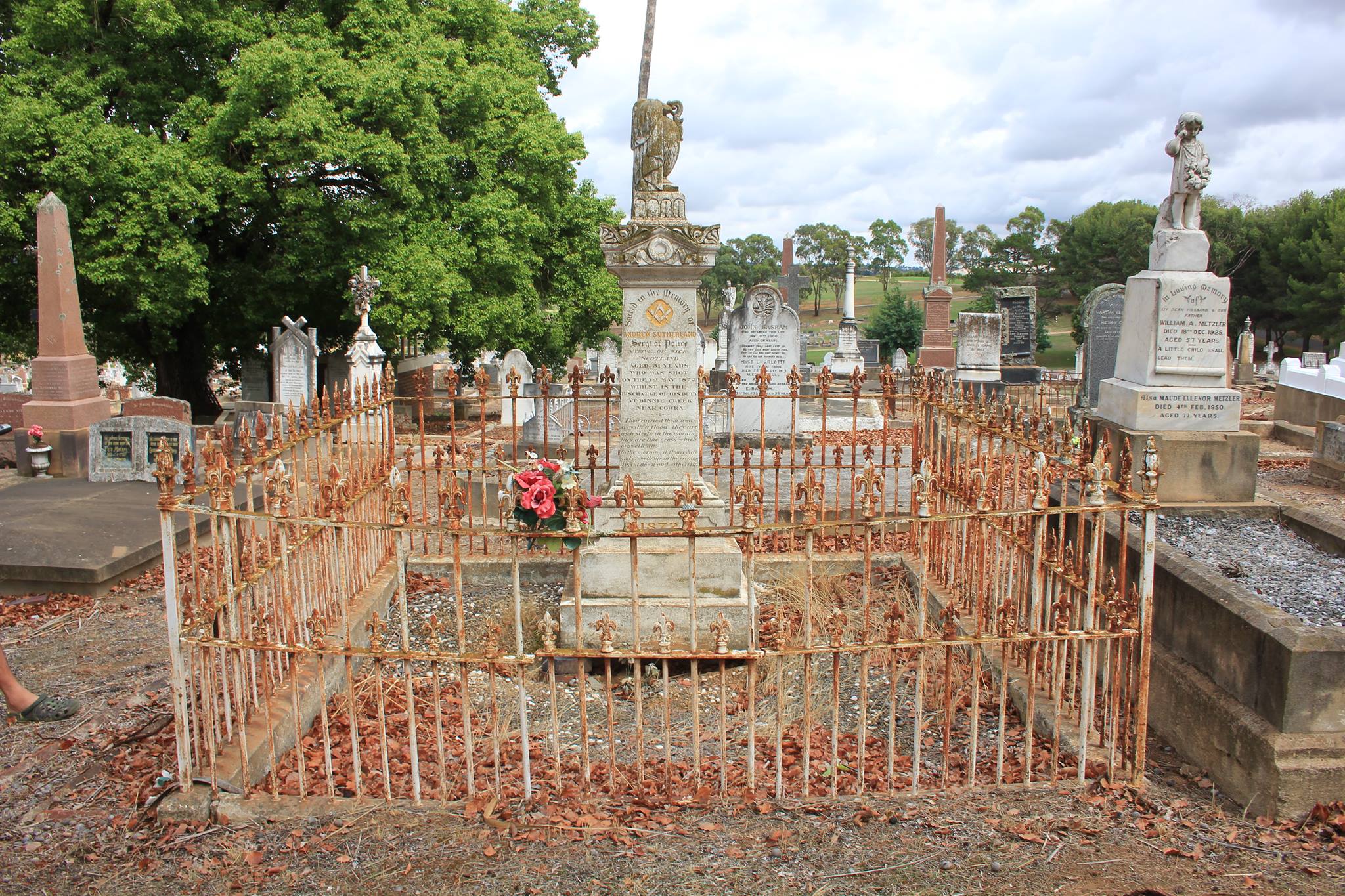
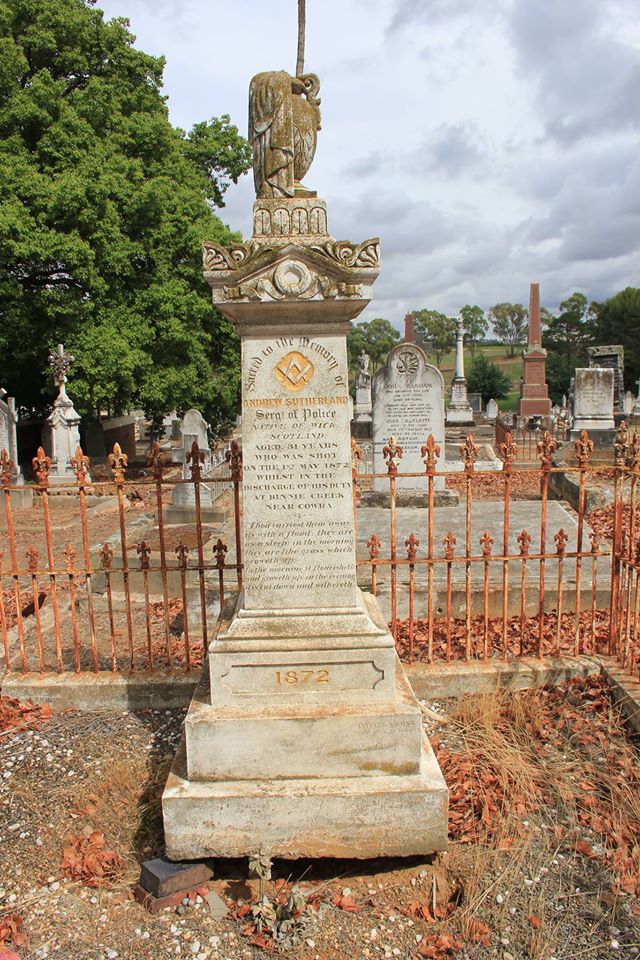
Buried at: Anglican section of the Young General cemetery
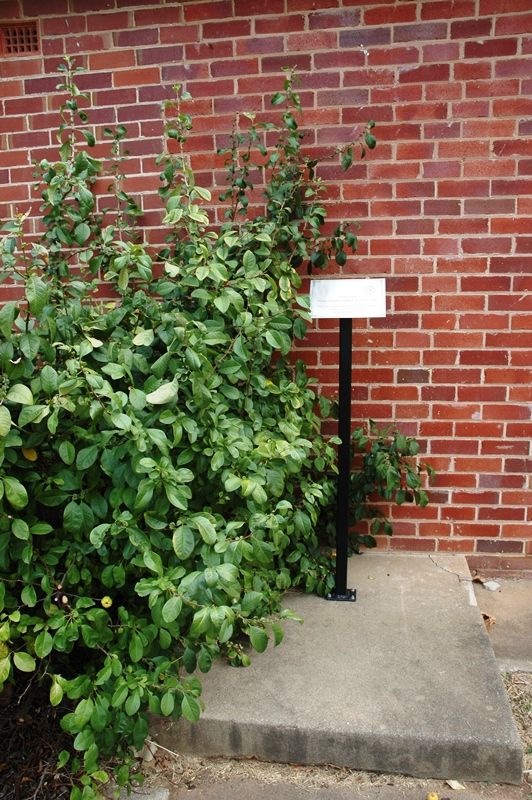
Memorial at: Cowra Police Station, 88 Brisbane St, Cowra, NSW
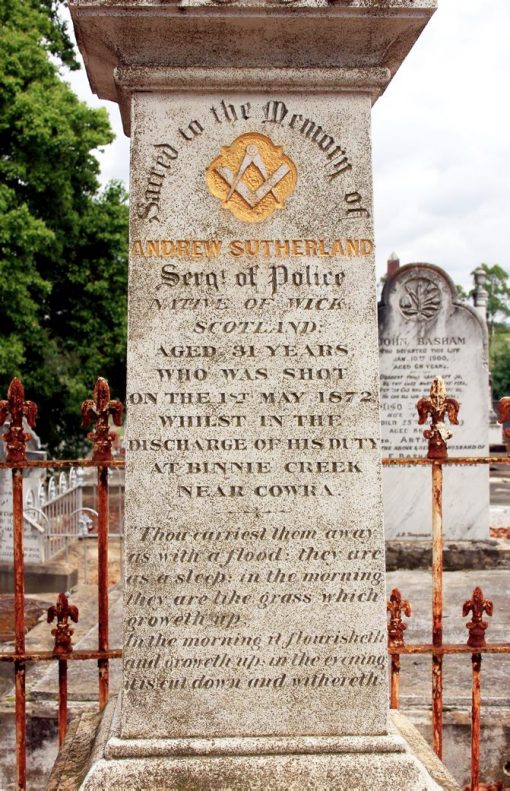
INSCRIPTION: Sacred to the Memory of Andrew SUTHERLAND Sergt. ( Sergeant ) of Police Native of Wick, Scotland. Aged 31 years Who was shot on the 1st May 1872 whilst in the discharge of his Duty at Binnie Creek near Cowra. ” Thou carriest them away as with a flood ; they are as a sleep ; in the morning they are like grass which groweth up. In the morning it flourisheth and groweth up ; in the evening it is cut down and withereth.”
ANDREW IS mentioned on the Police Wall of Remembrance
On 1 May, 1872 the sergeant was returning to Cowra from Bathurst Court.
During his journey he was told that two men who were wanted for robbery, George Gray and William Bristow, were at Daniel Horan‘s hut at Binnie Creek, twelve miles from Cowra.
The sergeant rode over to investigate and as he neared the door of the dwelling the offenders suddenly emerged and shot him to death.
The Clarence and Richmond Examiner dated 7 May, 1872 provided a brief account of the tragedy, which tends to suggest that the offenders were known to the sergeant.
SERGEANT SUTHERLAND SHOT DEAD BY BUSHRANGERS –
CARCOAR ” Thursday – I regret to have to announce that Sergeant Sutherland, of the Cowra police force, was shot dead last evening, by bushrangers, at a place about five miles from Cowra.
It appears that two armed men called on a settler named Daniel Oram, whose house is distant about two miles from Cowra and demanded food, which he placed on the table for them.
Sergeant Sutherland, who was going home from the Bathurst Assizes, rode up to the door during the meal, and was dismounting, when one of the men stopped to the door, gun in hand, and said, “I have been looking for you, you wretch,” and then shot him through the heart, causing instant death.
The men then went off and Oram started to Cowra, and upon arriving there, informed the police, who are now in pursuit of the murderers.
The fate of the unfortunate but brave officer is universally regretted. He leaves a wife, and had only been married a few months.
The sergeant was born in 1839 and joined the New South Wales Police Force on 5 January, 1863.
At the time of his death he was stationed at Cowra.
The Queenslander
Sat. 9 Aug 1873 p 10
ST. GEORGE.
(FROM OUR OWN CORRESPONDENT.) July 31.
We have also to record the arrest of a man named Frank Riley alias George Gray by Sergeant Cranney, on the charge of murdering Senior-sergeant Andrew Sutherland, of the New South Wales force, at Hordern’s hut, Beni Creek, on the 1st of May, 1872.
The prisoner had been staying in town for some few weeks, and left accompanied by another man with the avowed intention of going to the Surat races, but parted with his comrade about three miles from Weribone, his comrade going on into Surat, while he went out into the bush to camp.
Sergeant Cranney, in the meantime, appearing to have some clue to his identity, followed the pair, and finding that only one had reached Surat, returned on his tracks, and camped in the bush for two nights endeavouring to ascertain the whereabouts of the prisoner.
Becoming faint from fasting, he went to Weribone Station for food, and just dropped on to the man he was looking for, and who had also been there on the same errand. The officer arrested him at once, and prisoner was taken to Surat and remanded to Roma, and we believe by this time is on his way to Brisbane.
This is the second arrest of New South Wales offenders made by Sergeant Cranney during the past few months, the other being that of James Madgwick, whose capture and exploits were narrated in your columns a short time since. Sergeant Cranney was also the officer who arrested the notorious Patrick Collins.
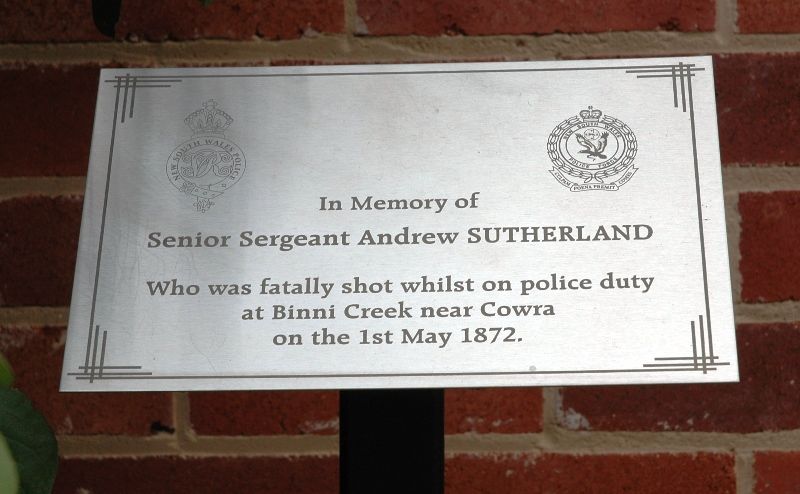
A plaque commemorates Sergeant Andrew Sutherland who was fatally shot in the line of duty as a New South Wales Police officer.
Sergeant Second Class Andrew Sutherland was shot whilst on duty at Binni Creek near Cowra on May 1, 1872. On May 1, 1872 he was returning to Cowra from Bathurst Court. En route he was told two offenders wanted for robbery, George Gray and William Bristow, were at Daniel Horan’s hut at Binni Creek, 12 miles from Cowra.
The Sergeant rode over to investigate and as he approached the door of the dwelling, two offenders emerged and shot and killed him. Gray and Bristow were subsequently arrested but both were later released without charge. No-one was ever convicted of the crime.
Actual Event Start Date: 01-May-1872
Actual Event End Date: 01-May-1872
Actual Monument Dedication Date: 01-March-2012
Front Inscription:
In memory of
Senior Sergeant Andrew SUTHERLAND
who was fatally shot whilst on police duty
at Binni Creek near Cowra
on the 1st May 1872.
The Portland Guardian and Normanby General Advertiser of 20 May, 1872 reported on the magisterial inquiry which was held at the Cowra courthouse before Mr G. Campbell J.P, “touching the death of Andrew Sutherland, who was shot dead by a ruffian at the residence of Daniel Horan a farmer living on Binni Creek…” One witness to the murder, Mrs Eliza Seery, gave the following evidence.
“I am the wife of James Seery, and reside at Binni Creek.
About 4 o’clock in the evening of Wednesday, the 1st inst., two men rode up to Horan’s hut on two dark looking horses.
Mrs Horan and I were in the hut at the time. They bid me good day, and asked if I had seen a bay horse, to which I replied “No”. One then said to the other, “We’ll get down and have a light”. The taller man was the spokesman.
He remarked that the weather was very dry.
The dogs began to bark. I went out to see what they were barking at, and observed Sergeant Sutherland riding towards the place.
The tall man asked me who was coming, and I answered, “Sergeant Sutherland”. The smaller man then walked outside, and Sutherland called him to the corner of the hut.
After talking to the sergeant for a short time, the man came towards the door, when I heard Sutherland ask him who was inside.
Sutherland then rode up to the door, and told the man who was inside to come out, or he would shoot the two of them.
The tall man, who was in the hut, said, “I won’t” and went towards the door.
The sergeant then got off his horse, when the tall man fired at him.
He said, “I’ll shoot”, before he shot at the sergeant.
Directly after the shot was fired, Sutherland, let his horse go, and ran towards a tree standing near the hut.
The man followed Sutherland and fired two shots, one after the other, as quick as he could.
The Sergeant, whose back was towards the man who shot at him, fell before he got to the tree. He fell directly after the last shot was fired.
There were only three shots fired.
The man was within a yard or two of Sutherland when the last two shots were discharged. This man brought Sutherland’s horse, and rode him away immediately after firing the last shot.
I did not see the smaller man of the two after the first shot was discharged.
I ran to the Sergeant when he fell, and asked if he was dead. He made no reply.
He was not quite dead, but never spoke.
Mrs Horan came directly after, and I told her to run for some water. She got some water, which she poured over the Sergeants mouth. He died while I was standing by him. He was lying partly on his side, and partly on his back.
Horan came up, and asked what was the matter. I told him the sergeant was shot dead.
Horan reported the murder to the police.”
The Brisbane Courier of 11 August, 1873 was to later report on the arrest of one of the offenders by Queensland Police Sergeant Cranney.
“We have also to record the arrest of a man named Frank Riley alias George Gray by Sergeant Cranney, on the charge of murdering Senior-sergeant Andrew Sutherland, of the New South Wales force, at Hordern’s [sic] hut, Beni [sic] Creek, on the 1st of May, 1872.
The prisoner had been staying in town for some few weeks, and left accompanied by another man with the avowed intention of going to the Surat races, but parted with his comrade about three miles from Weribone, his comrade going on into Surat, while he went out into the bush to camp.
Sergeant Cranney, in the meantime, appearing to have some clue to his identity, followed the pair, and finding that only one had reached Surat, returned on his tracks, and camped in the bush for two nights endeavouring to ascertain the whereabouts of the prisoner.
Becoming faint from fasting, he went to Weribone Station for food, and just dropped on to the man he was looking for, and who had also been there on the same errand.
The officer arrested him at once, and prisoner was taken to Surat and remanded to Roma, and we believe by this time is on his way to Brisbane.”