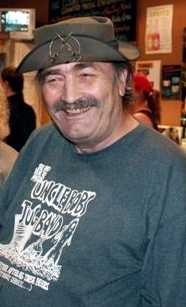
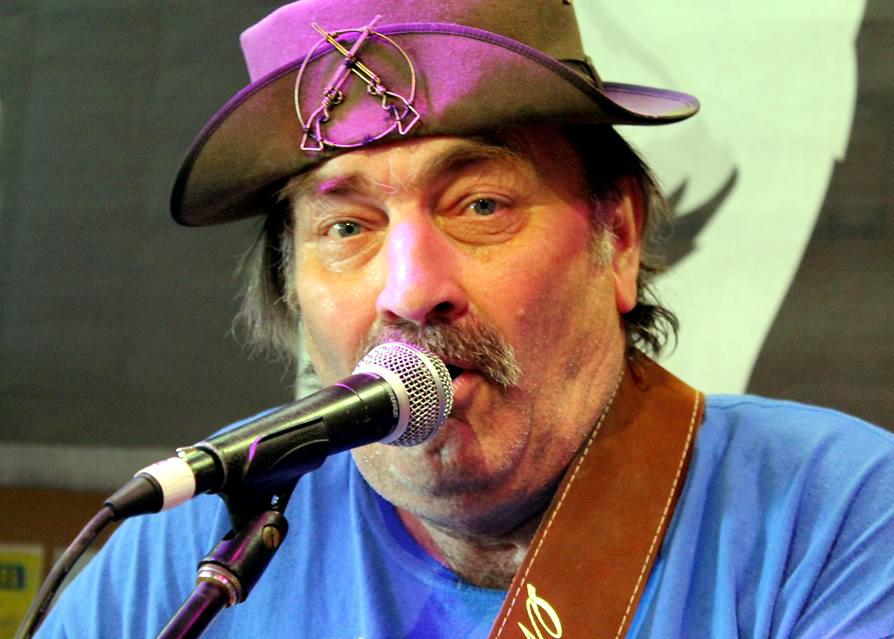
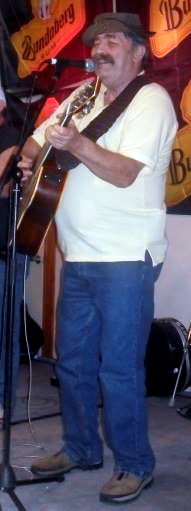
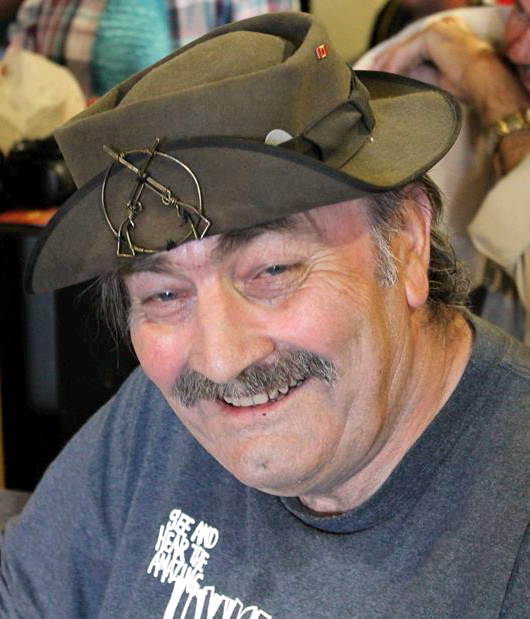
It is with regret that we advise of the death of Les Gorman, a NSW member of the 12th Contingent to Cyprus (1975-76). Les passed away on 26 May. An email from John Crowley advising of his death and funeral details is below.
On behalf of the UNOPAA National Executive, our National Committee, our NSW Branch and all members of UNOPAA, I would like to acknowledge Less service, particularly to overseas peacekeeping, and to express our sympathy to his wife Val, his family and his friends.
He will be missed.
Regards
P McD
Peter McDonald
National Secretary/Treasurer
United Nations & Overseas Policing Association of Australia (UNOPAA)
HIS Excellency the Governor, with the advice of the Executive Council, approved of the following appointments:
The undermentioned members of the Police Force to be Inspectors under the Liquor Act, 1912, for the Licensing Districts preceding their names, for the dates specified viz.:
Queanbeyan.— Sergeant 1st Class Leslie Lyall Gorman, stationed at Queanbeyan, during the absence on leave of Inspector 2nd Class Percy Roy Hale, from 7th August, 1977, to 20th August, 1977.
Canberra Times (ACT : 1926 – 1995), Sunday 30 July 1978, page 17
POLICE AND COURTHOUSE OPENING
GRAND DAY FOR QUEANBEYAN
It will be a gala occasion tomorrow when the Premier of NSW, Mr Wran, officially opens the new police station and courthouse in Queanbeyan.
The two buildings, costing $4 million, took 2½ years to complete.
The opening ceremony will be performed at 4pm in the foyer of the courthouse and about 400 people are expected to attend.
After the ceremony, the guests will move to the Queanbeyan Leagues Club for afternoon tea.
Among the dignitaries who will attend the function with their wives will be the NSW Attorney-General, Mr Walker, the NSW Police Commissioner, Mr Woods, and Deputy Commissioner, Mr Lees, a previous Queanbeyan police inspector, Mr Percy Hale, and the Superintendent in charge of country districts, Mr Alec Birnie.
In the evening, there will be a dinner at which the public will have an opportunity to meet members of the NSW Cabinet which will be in town for a meeting on Tuesday.
Forty policemen, including the policewoman, are now working in the comfort and luxury offered by the new station which is a far cry from the previous surroundings. The NSW Police Commissioner is considering an application to increase the number of general duties and traffic police.
The new station has elaborate safety measures. These include sensitive alarm systems, a closed circuit TV which keeps constant watch on the backyard and an internal public-address system.
The courthouse is another modern building and comprises a district court and a court of petty sessions.
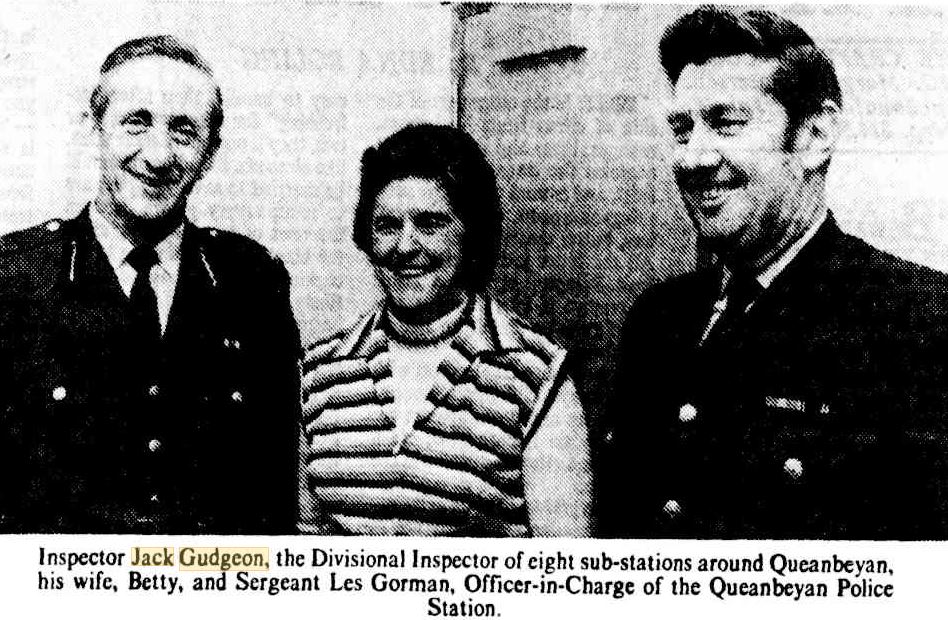
Inspector Jack Gudgeon, the Divisional Inspector of eight sub-stations around Queanbeyan, his wife, Betty, and Sergeant Les Gorman, Officer-in-Charge of the Queanbeyan Police Station.
For the purposes of this website ‘Q‘ represents those Police joining between 1 March 1862 ( commencement of NSWPF ) – 23 February 1915 ( Commencement of NSWPF current numbering system )
Rank: Constable
Stations: ?, Stroud, Gloucester – Death
Service: From 18 September 1912to 31 January 1913 = 4+ months Service
Awards: ? No find on It’s An Honour
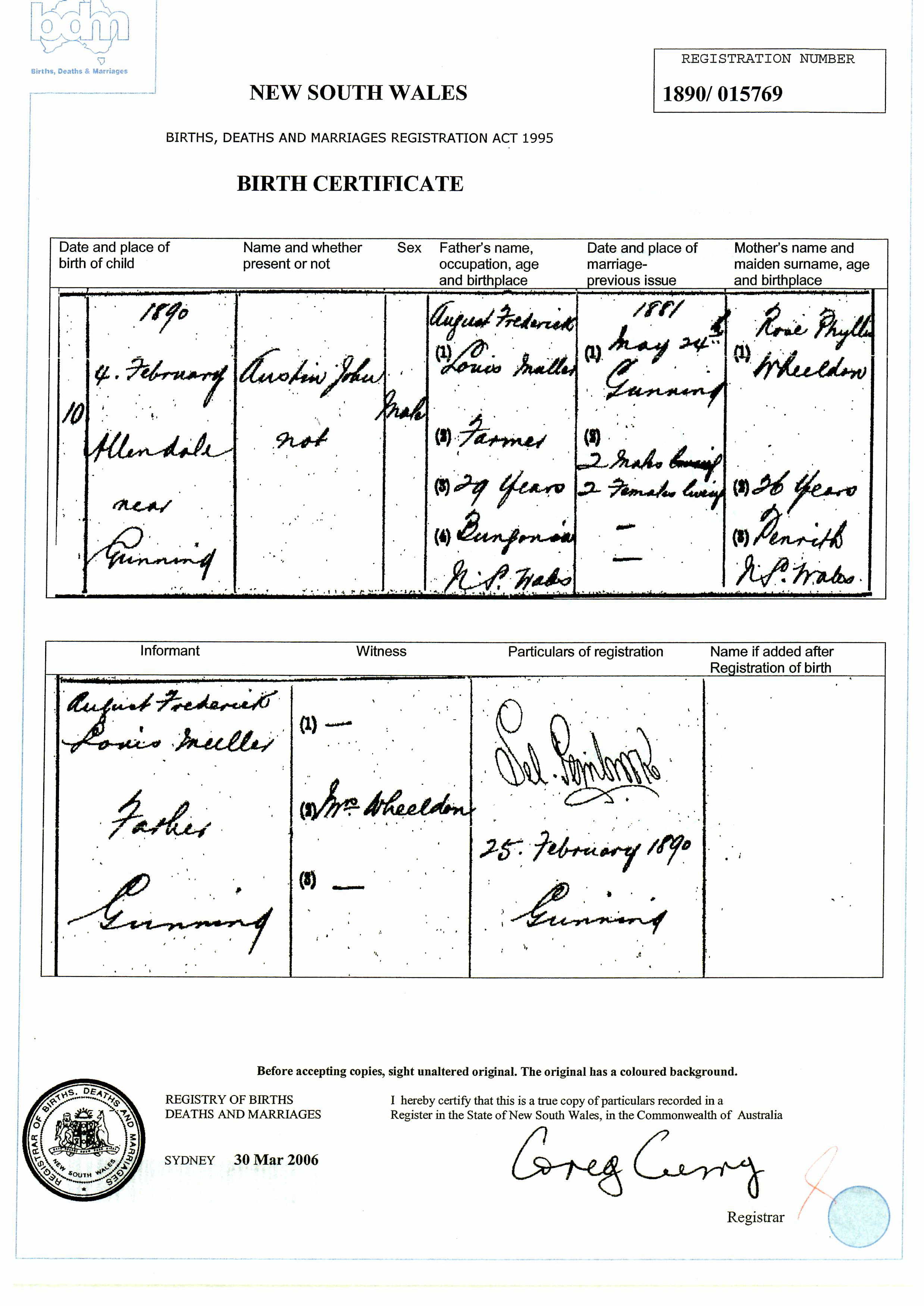
Born: 4 February 1890 – “Allandale”, near Gunning, NSW
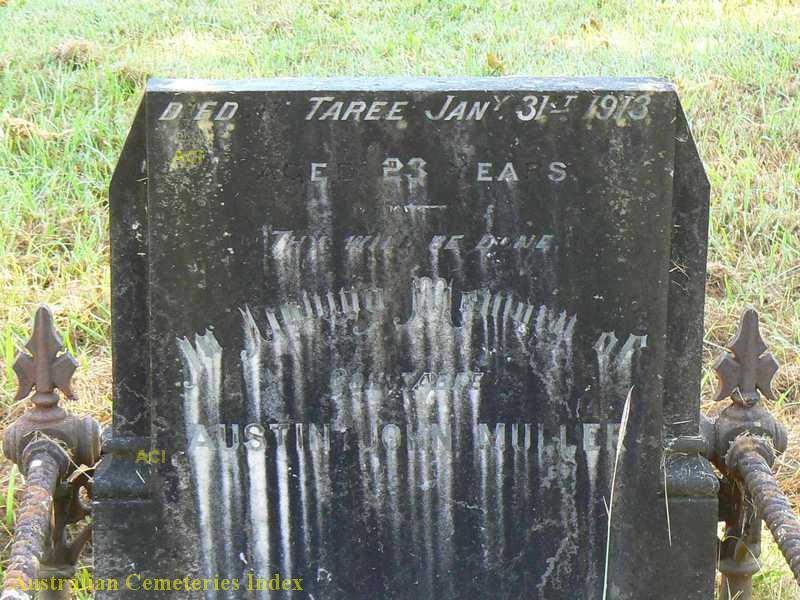
Died on: Friday 31 January 1913
Place of death: Manning River District Hospital, Taree
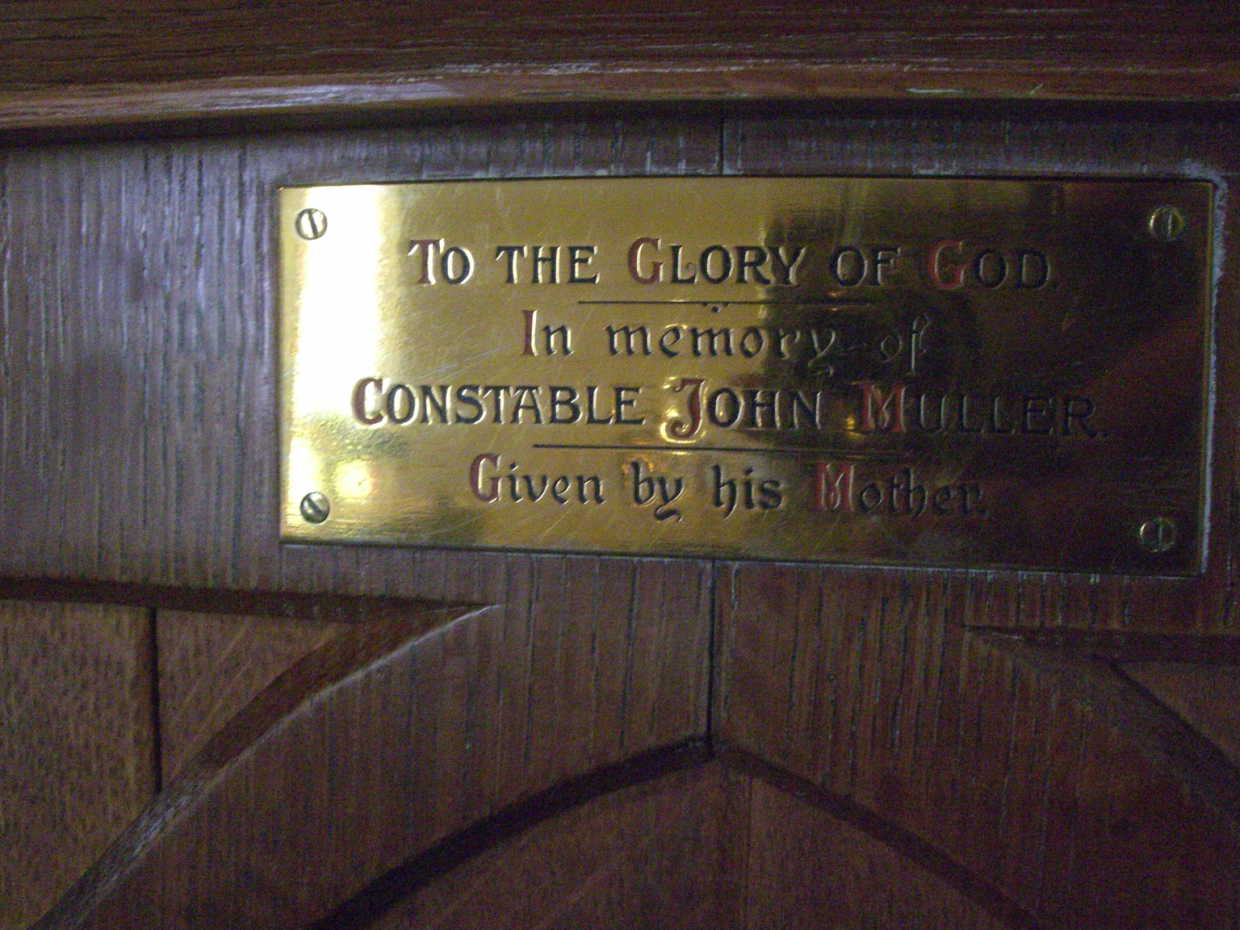
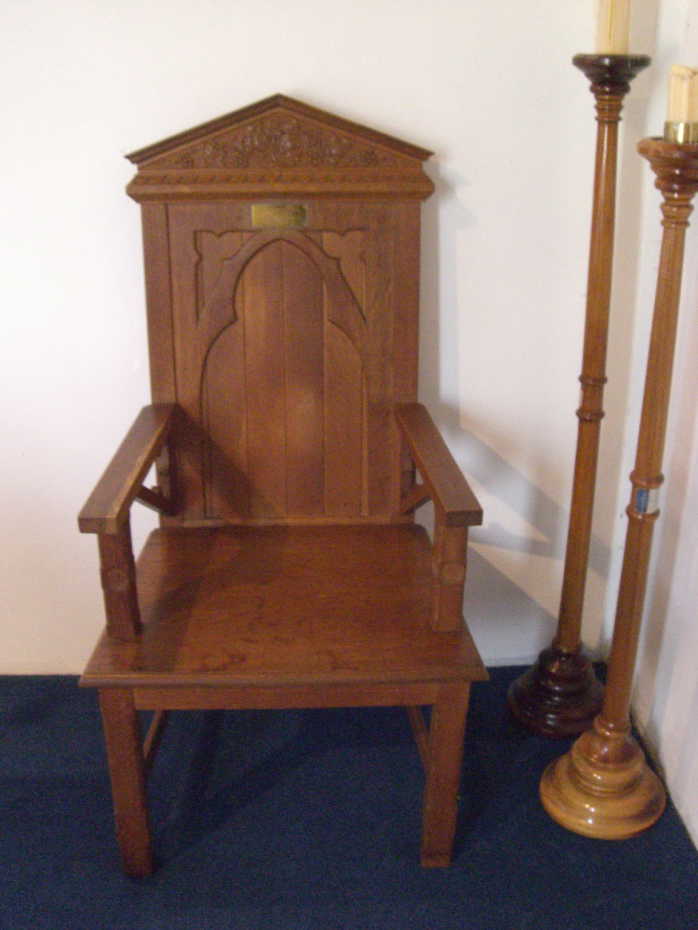
Memorial at: St Edmunds Church of England, Gunning, NSW Gift of Bishops Chair to St Edmunds Church of England, Gunning NSW by his mother Rose Muller. Inscription: To the Glory of God In memory on Constable John MULLEN Given by his mother
Memorial at: St Edmunds Church of England, Gunning, NSW Gift of Bishops Chair to St Edmunds Church of England, Gunning NSW by his mother Rose
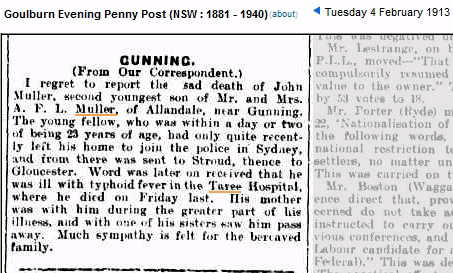
Death Notice: Goulburn Evening Penny Post Tuesday 4 February 1913 GUNNING ( From Our Correspondent. ) I regret to report the sad death of John Muller, second youngest son of mr. and Mrs. A. F. L. Muller, of Allandale, near Gunning. The young fellow, who was within a day or two of being 23 years of age, had only quite recently left his home to join the police in Sydney, and from there was sent to Stroud, thence to Gloucester. Word was later on received that he was ill with typhoid fever in the Taree Hospital, where he died on Friday last. His mother was with him during the greater part of his illness, and with one of his sisters saw him pass away. Much sympathy is felt for the bereaved family.
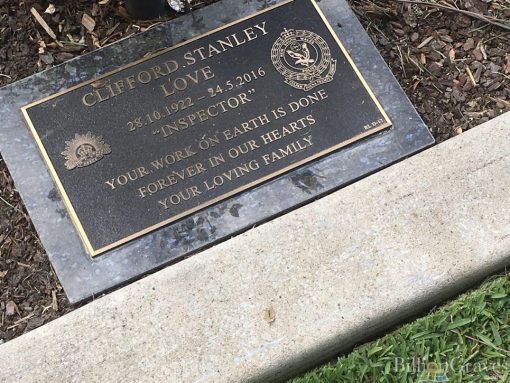
Clifford Stanley LOVE
| 30/05/2016
Clifford Stanley LOVE
( late of Warners Bay, NSW )
aka Cliff
NSW Police College, Penrith – Class # 003
New South Wales Police Force
Regd. # 4958
Rank: Probationary Constable – appointed 21 January 1946 ( aged 23 years, 2 months, 24 days )
Sergeant 2/Class – appointed 20 February 1967 ( North East District – Muswellbrook )
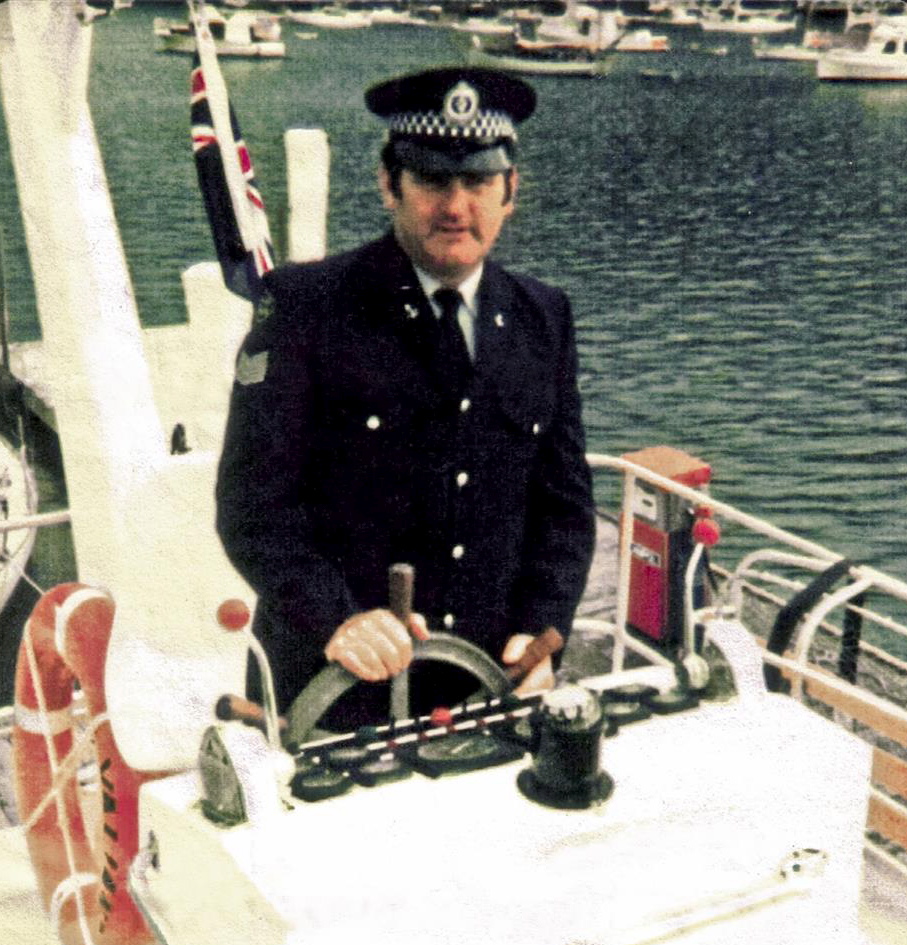
‘Inspector First Class,
Officer in Charge, Newcastle District’
(Retired 1982.)
Dearly loved husband of JOYCE.
Much loved father and father in-law-of MAX LOVE & RAE COUGHLAN, MAREE & MICHAEL, COLLEEN & DIAMOND.
Loving Grandfather of MARC & SARAH.
Great Grandfather to HARMONY.
Also a much loved uncle, great uncle, Police colleague and Friend to many.
Relatives and Friends are warmly invited to attend a Celebration of CLIFF’s Life to be held in The Chapel of Lake Macquarie Memorial Park, Palmers Road, Ryhope this MONDAY 30/5/2016 commencing at 10AM.
An interment will follow in the Lawn Cemetery.
Published in The Newcastle Herald from May 27 to May 28, 2016
Cliff LOVE was the Officer In Charge of the infamous Star Riot in Newcastle on the night of 19 September 1979 when police had to deal with an estimated 4000 rioters when the Star Hotel was closed down.
The Police vehicle Cliff had at the scene was rolled over by the hoodlums and ‘ torched ‘ ( burnt ) at the riots. Paddy Wagons ( Police trucks ) were also rolled and burnt. One officer lost his .38 Smith & Wesson which was later recovered some distance away.
Some of the 40 Police, but not limited to, who attended and were confronted by odds of 100:1 were:
Cliff LOVE
Cliff Judd
Paul Baker
Brian Atkins ( broken wrist )
The night the Star exploded
September 17, 2004
Twenty-five years after the infamous Newcastle riot, many are still wondering who was to blame, writes John Huxley.
The trouble started just after 10pm when, to scattered cries of “kill the pigs”, an angry, alcohol-fuelled crowd started pouring out of the pub and on to the street to confront a painfully thin blue line of police officers.
Within minutes, missiles were – in the words of one witness – “raining down like rice at a wedding”. Rocks, bottles and beer cans. Watched by several hundred spectators gathered in the middle of the road, the mob rushed police lines and overturned paddy wagons. It was only after two hours of violent mayhem that the crowd was dispersed by fire-brigade hoses. By then, the street had been transformed, says a witness, into a “a sea of rubbish”.
Fourteen officers and eight civilians were on the way to hospital with injuries. Eventually, 46 people were charged with 79 offences, ranging from assault occasioning actual bodily harm to resisting arrest and riotous assembly.
To this day, it is remembered as Newcastle’s “night of infamy”: a Wednesday night, almost exactly 25 years ago, which started much like any other but ended in violent confrontation as about 40 police battled more than 4000 rioters angered by the closure of the Star Hotel in the city’s West End.
As dramatic pictures of the riot flashed round the world, putting the ugly face of Newcastle on front pages of newspapers everywhere, the then NSW premier, Neville Wran, called the events of September 19, 1979, un-Australian. “It was a shocking, disgraceful episode,” he said.
Possibly. But that has not prevented the riot becoming part of Australian folklore. Newcastle City Council produced a lengthy report. The band Cold Chisel recorded a famous song about it (see above). A Hunter Valley theatre group staged a controversial musical about it.
“From this distance it’s easy to lose sight of what really happened, ” Phillip McIntyre, a music writer and lecturer in communications at Newcastle University, explains. “There’s been a lot of myth-making going on.”
Indeed, Cold Chisel frontman Jimmy Barnes recently said people still came up to him to say how f—ing great he was at that gig he played on the last night of the Star. The band never performed at the hotel. Doubts have even been raised about the authenticity of some of the pictures taken that night.
It’s not surprising, then, that a quarter of a century on, the riot remains the subject of controversy. What sparked it? Was it a drunken rabble, a provocative band or heavy-handed police. Or was it the media, who were in place for hours, waiting for something to happen? Was it premeditated or largely spontaneous? And, most importantly, just what was its significance? Nothing more than a shocking show of drunken hooliganism, as Wran put it? Or a political demonstration by an alienated youth triggered into action by the loss of one of the few focuses of community expression?
Like it or not, few would dispute that the Star Hotel was, if not salubrious, then special. Built in 1885 – its distinctive facade dated from 1925 – it was a huge, rambling place stretching a block between King and Hunter streets, and comprising three very different bars and clienteles.
As the National Times newspaper wrote at the time, the front bar “served sailors from around the world, RAAF men, petty criminals and pimps, parachutists and ‘short back and sides’ misfits who didn’t fit into sophisticated taverns”. The middle bar catered for local gays entertained by drag acts, such as that staged by the notorious “Stella the Fella”. And the back bar was where the young people went, where the bands played for free almost every night of the week.
Far from being at each others’ throats, the different groups rubbed along peacefully. “There was a real sense of community, of belonging to the place,” recalls Mark Tinson, of the Heroes, the band playing the last set at the Star on that memorable night.
“Aesthetically though, it was a big toilet. But for the fact I was being paid to perform there, I don’t think I’d have been seen dead in the place.”
Unusually, bands played on a raised stage behind the bar, upon which young girls danced. Often they were semi-naked. Money and $1 cans of beer, dispensed from large ice-filled troughs, were traded across the boozing, cheering crowd.
Most nights, drinkers at the Star could be counted in their hundreds. Estimates of the number of people present on September 19 to drink, to farewell the hotel – peacefully or forcefully – range from 3000 to 8000.
Though only one week’s notice was given to the licensee Don Graham, the writing had been on the Star’s white-brick walls for some time. For the same reasons that patrons loved it – for its rebelliousness, its rowdiness, its unruliness – licensing authorities loathed it. “The Star had a definite reputation,” says McIntyre, with heavy emphasis. A few years earlier, a sailor had been stabbed to death at the hotel. There were regular reports of drugs and of underage drinking. Even Stella the Fella had been given her-his marching orders a few months earlier.
As Tooths Brewery moved to close the Star, its regulars mobilised to defend it. “Save the Star” T-shirts were produced, a petition supported by several thousand names was started, and a group of tradespeople who used the pub even offered their services free to renovate the fallen Star.
“People strongly believed it was ‘their’ pub and they weren’t going to allow anybody take it off them,” McIntyre recalls. Even without the offer of one happy hour’s free beer, the scene was set for an emotional, potentially explosive closing night.
By the time the Heroes started their final number, shortly before the scheduled 10pm shutdown, the crowd had swelled to thousands. Many had been drinking heavily for several hours. “You could feel the electricity in the room,” Tinson says. “But, really, more like a mardi gras or a street party.”
How the party turned into a riot remains unclear. Tinson says the “pivotal moment” occurred shortly before 10pm when police entered the bar and insisted they finish immediately. “I mean we’d 30 seconds to go. And everyone was, well, you’ve got to be kidding.”
In the ensuing chaos, the Heroes stopped playing. There were cries, Tinson says, of “kill the cops, from a couple of idiots”. As the mood turned ugly, the Heroes decided to play their final encore, as they had planned. “I mean we didn’t want to cause a riot.”
Their choice of song, The Star and the Slaughter, led later to singer Peter de Jong being charged with the incitement to riot. One verse runs: “I want action, And I want fighting in the streets. Gonna take this town by storm, Gonna burn the buildings down … ”
Prophetically, the chorus proclaimed, “They will remember the night of the Star and the Slaughter.” Within minutes, the band were interrupted again, Tinson says. “One of the crew came in and said, ‘you should see what’s happening out there’.” The infamous Star Hotel riot had begun.
Tinson, a lifelong teetotaller and still a respected member of the music industry, does not defend the behaviour of the rioters. “They behaved abominably,” he says. And he was reluctant to do or say anything that might prompt people to celebrate – or recreate – the riot. But he insists that by their action, the police inflamed the situation. “I think if they’d given us a few more minutes, the situation could have been avoided,” he says.
He also defends the band’s choice of song which, he insists, did not originally refer to the hotel, had been a regular item on their playlist and had been written many months previously – not, as some critics alleged, earlier that evening. “If only we had that sort of ability.”
For their part, the police, supported by the politicians, insist they had no alternative but to act after the crowd started interfering with traffic and a difficult situation threatened to turn dangerous. Senior officer Cliff Love said at the time that there was no way a force of 40 would choose to confront a crowd of thousands, most of them out of control on alcohol, many of them at least prepared for trouble. “It’s no exaggeration to say that police were in fear for their lives.”
As Mike Scanlon, a Newcastle Herald journalist and historian, recalled, it was also subsequently revealed that authorities were concerned a lost police firearm had been stolen by a rioter. It was later found away from the scene.
Whoever was to blame, whatever the degree of premeditation involved, one thing does appear clear with hindsight: the riot was the product of booze and boredom. More, drunken rabble or not, the rioters – most of them young, many of them unemployed – were representatives of a bigger, nationwide group of boozed, bored people who felt increasingly at odds with the political system.
Over the next few years, similar riots, brawls, battles were to occur across Australia.
As the Newcastle City Council report concluded, across the land there was a “general sense of anger and frustration”.
Life has moved on. Tinson lectures at the local TAFE. He, de Jong and the other Heroes reunited last month to perform at a hospital fund-raiser.
And the Star Hotel, after many incarnations, is scheduled to be demolished to make way for a swish, 12-storey apartment block. Perhaps the old facade will be retained. Perhaps a plaque recording the events of September 19, 1979 will be erected. Perhaps not.
As Tinson says, “The idea of celebrating a riot is a bit off.”
Lithgow this season can easily lose a player to the octupus city clubs before he even appears locally.
He is Constable Cliff Love, who had been posted as a player in the newly formed Diggers‘ team.
Reported to be extra fast, Love, last Sunday was contacted by Sydney Eastern Suburbs officials and asked to appear with them in this week’s trials. Hard on the heels of Easts’ offer came another from Balmain, who will be meeting Easts in this week-end’s series. However, it was a case of first come, first served, and Love will try out with Easts.
If background is anything, Love should be a footballer whom Lithgow will not want to lose. In his younger days, he played school football and was also an athlete of no mean ability, while in later years he appeared with Group 16 on the South Coast prior to his enlistment in the Army, with which he served in New Guinea.
Lithgow Mercury ( NSW ) Wednesday 14 August 1946 p2
Alleged Hit-Run Driver Committed For Trial
Eight police witnesses testified against Henry Lam, of Newtown-street, Alexandria, in Lithgow police court yesterday, when he was committed for trial at Bathurst Quarter Sessions next Tuesday on a charge of having, by a negligent act – driving a motor vehicle negligently – caused grievous bodily harm to Const. Clifford Stanley Love on the night of July 20.
Mr. J. S. Hart, P.M, was on the Bench. The charge was a sequel to an alleged hit-run accident several weeks ago when Const. Love was struck by a car and thrown against an ambulance when investigating an accident in which Mr. Harry Earp, of McKellar’s Paddock, had been injured by another car.
After the accident, said Det. Sgt. E. E. Mabbutt in evidence, he went to Church-street and saw an “A” Model Ford in front of George Corney’s residence. He had a conversation with Corney, examined the car and with Corney took the vehicle to the police station, where it was subsequently photographed. The near side mudguard had a slight dent.
Witness continued that on July 25, accompanied by Det. Armstrong, of Redfern police, he saw the defendant at his home and had a conversation with him.
In respect to the accident and injuries sustained by Constable Love, Lam, he alleged, said he was very sorry to hear that the Constable had been Injured.
Det. Sgt. Mabbutt stated that the defendant admitted that he had been in Lithgow on the Saturday and had left for Sydney on the 6.30 p.m. train and that prior to his departure he had had an arrangement with George Corney to use a car, owned by a man named Purcell, for the purpose of driving to Littleton to pick up his port at his sister’s place.
ADMITTED SWERVING
Lam, he added, also admitted that he had seen an ambulance in Main-street east and had swerved to the right to avoid a collision. He denied having seen the light in the rear of the ambulance or having seen a Constable standing nearby.
When told that the crowd in Main-street had became hostile after he struck the Constable and called out, “stop, you have hit someone,” Lam said he had not felt a bump, nor did he hear any one call out. Lam, added the witness, said he had not been licenced to drive at the time of the accident.
Det. Sgt. Mabbutt then exhibited an overcoat, which, it was claimed, had been worn by Const. Love on the night of July 20. It was torn in several places and streaked with duco. An envelope containing strips of duco taken from the mudguard of the car was also tendered.
VISIBILITY BAD
In reply to Mr. Ian L. Higgins, witness said that at the time of the accident the night was damp and visibility was bad. He said he did not know Lam had been a transport driver in the R.A.A.F. or that he was on discharge leave when the accident occurred.
George Burgess, a miner, said he was the driver of a car which had collided with a pedestrian about 50 yards west of the Court House Hotel corner. He was standing near the ambulance when he heard Superintendent Purdie ( A. Purdie, NSW Ambulance ), or someone call out a warning. He moved towards the Superintendent, heard a terrific bump and saw Const. Love knocked by a car. Love struck the ambulance door and fell to the ground. He helped him to his feet and saw a car turning Bridge-street comer an increasing speed.
Just as he was stepping from the ambulance, after having placed an Injured pedestrian inside, Const. Love spoke to him about the accident and at the same moment was struck by the mudguard of a car, said Superintendent A. Purdie.
UNSUCCESSFUL CHASE
He told the Constable to get into the front of the ambulance and they would try to catch the car. They were unsuccessful and he took Love to the hospital, where five stitches were inserted in his head wounds.
Alexander John Jenkins, a bus driver, stated that he was standing near the bus stop on the northern side of Main-street and saw the car which it was alleged had struck Const. Love. He knew the vehicle well because he had sold it a few days before.
Evidence was given by Athol Joseph Rigg, a grocer, that he was standing near Leighton’s tailor shop when he noticed a car approaching from the west. Before it reached the ambulance it swerved to the right, hit the open door of the ambulance and caught Const. Love. The car kept going and passed between the vehicle involved in the first accident, which was in the centre of the road, and the footpath near the Court House Hotel. It cut the corner and went up Bridge-street.
George Corney, garage proprietor, said he allowed Lam, who was well known to him, to use the car to assist him to catch the 6.30 p.m. train. He did not know the car had been returned to his home until Sgt. Mabbutt questioned him. When he examined the vehicle he noticed a slight dent on the near side mudguard.
DID NOT REMEMBER MUCH
Victim of the accident, Const. Clifford Stanley Love, told the police prosecutor ( Sgt. H. Taylor ) that he did not remember much after being hit. He added he had suffered much pain as a result of head and hip injuries, which had resulted in him being off duty for several weeks.
A description of Love’s injuries was given by Dr. Geoffrey Athol Williams, R.M.O., Lithgow hospital.
Mr. Higgins, who asked the Bench to dismiss the charge, said there was no evidence of criminal negligence. It could not be shown in the evidence that the defendant had planned to cause an accident, nor that he had deliberately committed the act.
Mr. Hart said he was satisfied that there was sufficient evidence to support a charge of negligent driving and committed the defendant for trial. Bail of £50 was allowed. Lam declined to make a statement and reserved his defence.
On two charges of failing to stop after an accident and driving without a licence Lam was remanded until September 29 on £20 bail. He was discharged on a third count of causing bodily harm by wanton driving.
Henry Lamb, of Lithgow, recently discharged from the RAAF, was also discharged by Judge Shortland at Bathurst Quarter sessions yesterday.
Lamb was charged with driving a motor vehicle upon a public street, negligently, whereby he caused Constable Clifford Stanley Love bodily harm.
After hearing evidence, his Honor directed the jury to acquit Lamb. Judge Shortland pointed out that it would be necessary to prove criminal negligence on the part of Lamb and it did not appear that such evidence was forthcoming. Under another section of the Act, a case might have been made out, but under the section by which Lamb was charged a definition – not so far made – was necessary if the court was to be clear on the matter.
Evidence heard was to the effect, that Lamb had been driving a car along Main Street, Lithgow, on the night of July 20, and had hit Constable Love when Love was standing at the rear of an ambulance car. An accident had occurred a short time before Lamb drove along the street. The ambulance was parked in the street with all lights on, an injured person was receiving attention, visibility was bad, and there were buses parked near the scene of the accident, and a crowd had gathered in the street.
Lamb’s defence was that he did not see the ambulance car until almost upon it and swerved to avoid it. He was not aware, however, that he had hit the constable.
St. Paul’s Church of England was, on Saturday, November 8, the scene of a pretty wedding, the parties being Joyce Isobelle Triplett, youngest daughter of Mrs. C. Triplett and the late C. Triplett, of Read Avenue, and Clifford Stanley Love, youngest son of Mr. and Mrs. F. T. Love, of Bega. Rev. A. E. Begbie officiated.
The bride, who was given away by her brother, Mr. E. R. Triplett, was gowned in French Chantilly lace over taffeta, cut with sweetheart neckline and trained hem. Her veil of billowy tulle was surmounted by a coronet of white flowers. The bridal bouquet was of roses, sweet-peas and lily of the valley. The matron of honor was Mrs. A. N. Thomas, of Wallangarra, the bride’s sister. She wore heaven-blue crepe with matching straw hat veiled with stiffened net. She carried a bouquet of crimson roses.
Mr. B. Schonbeck was best man.
Many guests were received at Bolt’s Hall by the bride’s mother, who wore a pastel pink frock with navy accessories and a shoulder spray of roses. The bridegroom’s sister, Mrs. H. Lush of Sydney, who was acting in the absence of his parents, wore a suit of navy and white silk jersey, with white accessories and shoulder spray of red roses.
The chairman, Rev. A. .E.. Begbie, rendered a solo, “Passing By.” The wedding cake was made by the bride’s mother and decorated by Mr. W, Smith.
The happy couple left for Sydney, the bride travelling in a suit of turquoise blue crepe, with black accessories. The honeymoon is being spent at Surfer’s Paradise and Bega.
Mr. and Mrs. Love will make their home in Lithgow.
For the purposes of this website ‘Q‘ represents those Police joining between 1 March 1862 ( commencement of NSWPF ) – 23 February 1915 ( Commencement of NSWPF current numbering system )
WILLIAM is NOT mentioned on the Police Wall of Remembrance *NEED MORE INFO
FURTHER INFORMATION IS NEEDED ABOUT THIS PERSON, THEIR LIFE, THEIR CAREER AND THEIR DEATH.PLEASE SEND PHOTOS AND INFORMATION TO Cal
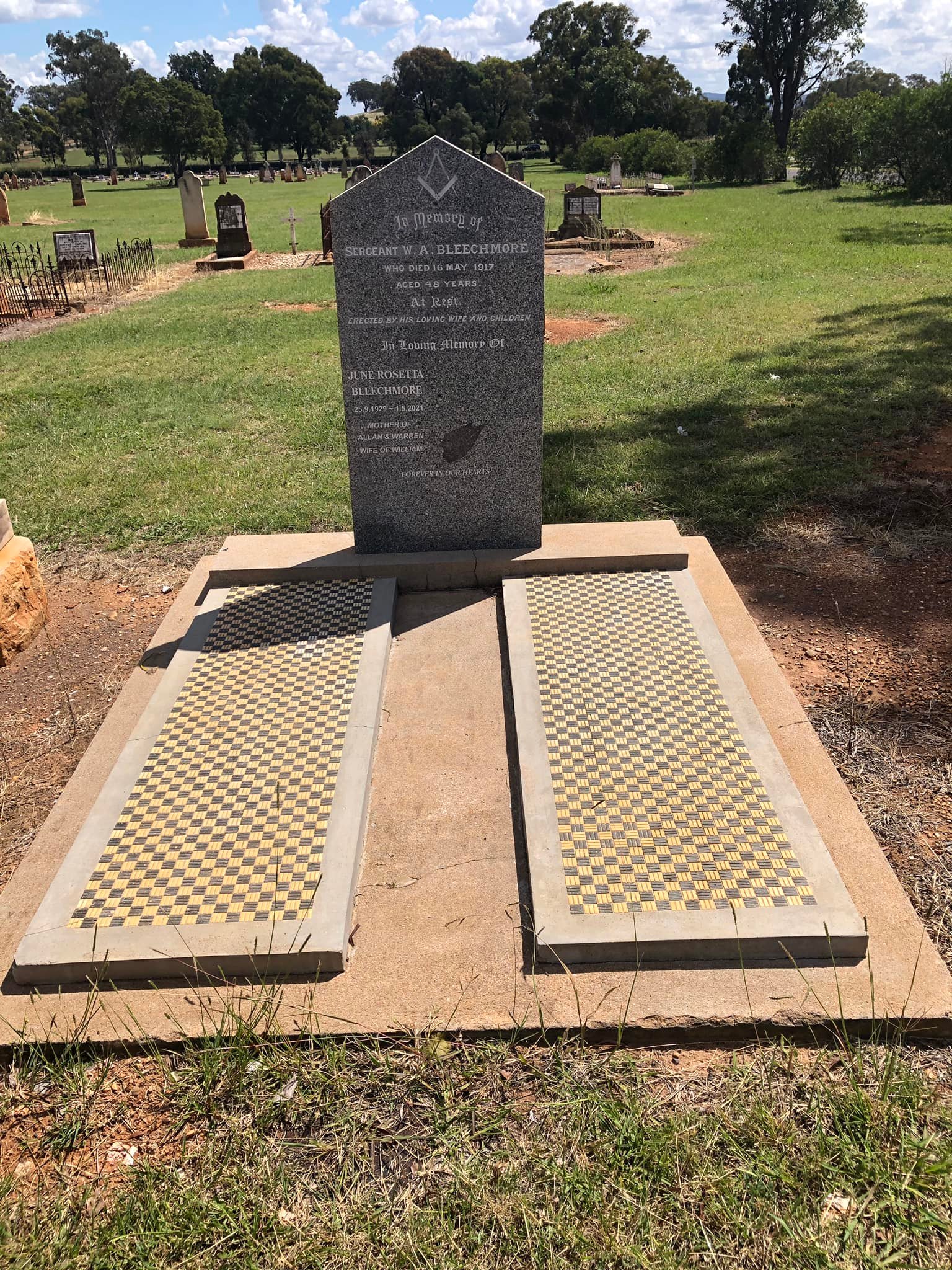
About 9am on 16 May, 1917 the sergeant was speaking with two men in the street in Gulgong when he suddenly became ill and had to be assisted to his home. He sadly passed away later that afternoon. He had apparently been ill with neuritis for about two years prior to his death.
The Mudgee Guardian and North-West Representative of 17 May, 1917 reported on the sergeant’s sudden death.
POLICE SERGEANT BLEECHMORE – SUDDEN DEATH AT GULGONG.
A painful sensation was caused at Gulgong on Wednesday afternoon, when it became known that Sergeant Bleechmore, officer in charge of the local police, had died suddenly. About nine o’clock on Wednesday morning the sergeant, as he was standing in Mayne-street opposite the Centennial Hotel, talking to Mr. W. G. Ashford MLA, Minister for Lands, and a representative of the Sun, who were both on their way to Coonabarabran to attend the Show there, was taken suddenly and seriously ill. He was taken to his home, where he lingered until two o’clock in the afternoon, about which time he breathed his last. Sergeant Bleechmore had been in ill health for some time, suffering from neuritis, but none of his friends (nor, it may be believed, he himself) anticipated that matters were so serious with him as it has transpired they were.
The sergeant was held in high esteem in Gulgong and the news of his tragically sudden death gave the townspeople a painful shock.
Sergeant Bleechmore was 49 years of age, and had been 27 years in the police force, and six years in charge the police at Gulgong. He leaves a wife and five children — four sons and one daughter.
The eldest son, who is 20 years of age, is employed at the Railway Station at Dunedoo. A second son is a school teacher, whilst the daughter is the youngest of the family. The three younger children – (as was also Mrs. Bleechmore) with their father when, he died.
The Leader of 25 May, 1917 provided a few more details of the incident and death of the sergeant.”Referring to the death of Sergeant Bleechmore, at Gulgong, the town’s “Advertiser” says: About two years ago deceased developed an attack of neuritis, and had sometimes suffered very much from the complaint. He lately had a recurrence of the attacks, but not to that extent to provoke uneasiness amongst his family and friends. He finished his work at the stable, and then went and had breakfast. At this time he appeared to be in the best of health and spirits.
The Hon. W. G. Ashford was passing through Gulgong on Wednesday morning, and he sent a message to Sergeant Bleechmore that he would be pleased to see him. Shortly after 9 o’clock Sergeant Bleechmore went out and met the Minister, who had with him a representative of the “Sun” newspaper. The trio were talking near the Centennial Hotel, when Sergeant Bleechmore remarked that he had suddenly become unwell, and said to the Minister, “May I put my hand on your shoulder?” Almost immediately he collapsed, and would have fallen only for Mr. Ashford’s promptitude in catching him. It was seen that Sergeant Bleechmore’s condition necessitated his removal to his home, where he was taken by Messrs. A. E. Souter and B. J. Naughton. Dr. Lees was immediately summoned.
“The sergeant was born in 1868 and joined the New South Wales Police Force on 14 April, 1890. He was the officer-in-charge of police at Gulgong and was survived by his wife Maria and five children.
Sergeant Watts succeeded him at Gulgong Police Station in July, 1917. He is not listed in the official New South Wales Police.
The interment of the late Sergeant W. A. Bleechmore, who died from a paralytic stroke on Wednesday, took place in the C.E. portion of the Gulgong cemetery on Friday. Members of the police force were the pall-bearers, and brethren of the Mundooran, Mudgee and Gulgong Masonic Lodges preceded the hearse in the funeral procession, while deceased’s horse was led in the rear of the corpse.
The mortal remains were first taken to the Church of England before being consigned with Masonic honors to their last resting place.
William Albert BLEECHMORE, husband of Maria May Bleechmore ( nee Robinson ) – married 9 April 1895 in Dubbo, NSW.
Government Gazette of NSW
Tuesday 15 March 1892 p2106
THE Bench of Magistrates at Byerock have this day appointed Constable William Albert Bleechmore to be Small Debts Bailiff for the said Court, vice Hogan, resigned.Police Court, Byerock,3rd March, 1892.C. McA, KING, P.M. F. H. PERRY, J.P.
THE Bench of Magistrates in Petty Sessions assembled have this day appointed First Class Constable William Albert Bleechmore to the position of Bailiff of the Small Debts Court at Burraga,—from this dateT. ARKELL SMITH, P.M.THOS. P. HACKNEY, J.P.ATHERDEN BOOTH, J.P.Dated at Burraga, this 1st day of September, 1902. [2332]
FROM THE ” GAZETTE.”The undermentioned police officers have been appointed inspectors to carry out the provisions of the Shearers’ Accommodation Act in the specified districts: — Sen. Const. William Albert Bleechmore, Carcoar; First class Constable John Edwin Williams, Burraga; Constable J. Valins, Trunkey.
THE Police Magistrate and Justices of the Peace in Petty Sessions assembled at the Court-house, Carcoar, have this 21st day of February, 1911, appointed Arthur Henry Higgs to be Bailiff of the Small Debts Court at Carcoar, vice Senior-Constable William Albert Bleechmore, transferred.
NOTICE is hereby given that Senior-constable William Albert Bleechmore has been duly appointed as Inspector of Slaughter-houses, and of cattle intended for slaughter, under the ” Cattle-slaughtering and Diseased Animals and Meat Act, 1902,” for the Municipality of Gulgong.W. G. GIBBS,Town Hall, Gulgong, Town Clerk.24th March, 1911.
In the list of recent police promotions appears the name of William Albert Bleechmore, formerly of Hartley Vale, but now of Gulgong, who has been made a second-class sergeant.
Mudgee Guardian & North West Representative ( NSW )
Thursday 19 March 1914 p7
Leo Smith’s Death.Coronial Inquiry.An inquest touching the death of Leo Alexander Smith, who was recently found dead at Cumbandry, was held at the Court House, Gulgong, before the District Coroner, Mr. W. Arnott, P.M. on the 9th instant.
William Albert Bleechmore deposed that at about 7 p.m. on Friday night he was coming from Home Rule, and met a lady and two children in a sulky half-way down Caffrey’s Hill, which is 1 mile from the Post Office. About 160 yards behind the sulky he met deceased, who was riding horseback. Spoke to him and passed on. About 9 p.m. on the same night saw Mrs. Smith drive to Judge’s shop. Went down and saw the dead body of deceased whom he had spoken to on the hill, and which he identified as Leo Smith, son of Michael Smith, of Cumbandry. Carefully examined the body. Found a large abrasion on the right knee and a small scratch on the top of the right ear. There were no other external marks of violence. At 6 o’clock this ( Saturday ) morning went to a place on the Home Rule road just across where the railway line crosses the road, saw tracks where a horse had suddenly turned off the road and a great number of horse tracks where it had evidently been bucking. There was a mark where something had lain on the ground, and a small damp patch about the size of the palm of his hand. Two yards further on from the mark found the hat ( produced ), which is similar to that worn by deceased. Went to Smith’s residence at Cumbandry, and examined the pony that deceased was riding. It did not show any marks of having fallen, but on the saddle the right knee pad and right flap had marks of where it had grazed the ground. Was of opinion that the horse had bucked on to its side without falling and had thrown deceased who was an exceptionaly good rider for a boy.
William Richard Wall deposed that he was a Butcher, residing at Gulgong. He identified the boy as Leo Alexander Smith, who was his nephew, and was 13 years and 10 months old. He was born near Mudgee and was a schoolboy. Saw him about quarter past 6 yesterday ( Friday ), in Gulgong. He was just going to get his horse to start home. At about 8 p.m. his sister, Mrs. Smith, came to his place and saw that Leo had not come home, and she had found his pony, near Avery’s gate. Went with her in the sulky and found deceased lying not far from the road. Picked him up and handed him into the sulky to his mother. He was then quite warm. Brought him to Mr Judge’s and sent for a doctor.
Henry Joseph Harris, a duly qualified medical officer, residing at Gulgong. deposed that at about 9 a.m. last night ( Saturday ) he was summoned to the house of Mr. J. Judge. On arrival he saw the body of Leo Alexander Smith. He was fully clothed, with the exception of his boots and stockings. The only mark visible was an abrasion on the right knee. Was of opinion his neck was broken. He appeared to have been dead at least one hour.His Worship found that the deceased died from the effects of injuries accidentally received by falling from his horse.
Mudgee Guardian & North West Representative ( NSW )
Monday 22 February 1915 p1
“I AM GOING TO DIE, TED.”EVIDENCE AT INQUEST.A coronal inquiry into the circumstances surrounding the death of Mrs. Gray was held by Mr. Arnott, P.M., at the Gulgong Police Court on Thursday morning last.
William Albert Bleechmore, Sergeant of Police, deposed ” About 12 o’clock midnight on the 17th instant Mr. Gray, husband of deceased, came to the police station and informed me that his wife was dead. I immediately went round for Dr. Harris, the Government Medical Officer, and in his company went to Gray’s residence at Lagoon Paddock, about two miles from Gulgong. I saw the deceased lying on the bed. In company with Dr. Harris I took the body inside the house and the doctor carefully examined the body.
Edmund Gray, manager for Geo. Rouse‘s farm and residing at Lagoon Paddock, Gulgong, deposed: Only my late wife and myself were living at the house. My family were away in Sydney and Portland. We retired to bed about 10 p.m. We were sleeping on the front verandah. Deceased was in her usual state of health just before she went to bed. She did not complain. During the last few days, which were very hot, she complained of a smothering feeling about her chest. During the last two years she complained about shortness of breath if she had much exercise. As far as I know she was never treated for heart trouble, but, about two years ago, she underwent an operation for the removal of veins from one of the legs. About a quarter to eleven on Wednesday got her a drink. She started coughing. I was half asleep and was slow in getting up. The deceased got up and went to the water near by. I overtook her and gave her a drink from the water bag. She then came back to the verandah and sat on a sofa. She started spitting up phlegm and said, “I’m going to die, Ted.” I made no reply as I did not take her seriously. She asked me to strike a light and see what she was spitting up. I struck a match and she again said “I am going to die, Ted.” She jumped up off the couch and went to the bed and lay down. She was still coughing. I lifted her upon one knee as she seemed to be smothering. She then gave one long breath and died.The deceased was 51 years old, and was born at Gulgong. He and his wife attended a funeral the day before, and at the graveside his wife was overcome by the heat and fell on to her knees.
Dr. H. Harris, residing at Gulgong, deposed: About 12 midnight, accompanied by Sergeant Bleechmore, I visited the house of Mr. Gray, about two miles from Gulgong, and there saw deceased lying on a bed in her night dress. I could see no marks of violence on the body. About two years ago I gave deceased a course of treatment, and found that she had a somewhat enlarged fatty heart. I should say from indications, after listening to Mr. Gray’s evidence, and from my own knowledge, that deceased died from a disease of the muscle of the heart.The P.M. found that death was due to natural causes.
Mudgee Guardian & North West Representative ( NSW )
Thursday 3 June 1915 p8
Horse Trainer Killed Death of John Hartley.
Members of the racing fraternity were greatly shocked when they learned that John Hartley had been killed as the result of an accident on the Tallewang road on May 25th. He was about 50 years of age and was well known as a horse trainer. He had been for some time residing at Mundooran. He was well known in Mudgee and Gulgong.
A magisterial inquiry was opened at the Gulgong Police Court on Thursday morning last by Mr. George Rouse, deputy coroner.William Albert Bleechmore, Sergeant of Police, stationed at Gulgong deposed: At 12 midnight on the 25th May, I received a telephone message from the Rev. H. Woodger, at Tallewang, to the effect that he had found a man lying on the road near the Tallewang school, with his face covered with blood. I immediately proceeded to the place, accompanied by Dr. Payne. I there saw a man lying on the left-hand side of the traffic part of the road. I turned the body over and saw that it was that of a man about 50 years of age. I knew the man by sight, but did not know his name. The body was fully clothed, including an overcoat ( produced ). About six yards from where the body was lying I was shown this piece of an overcoat ( produced ) which corresponds to the portion of an overcoat missing from that found on deceased. The body was lying with the face downwards, and the left arm straight out from the body. There was a mark five yards back along the road, as if the body had been dragged. There was a number of abrasions on the face, particularly a large one over the right eye, and on the right side of the nose. The left ear was black or bruised, and had blood about it, and the bottom lip of the mouth had teeth marks buried in it. Both knees had a little skin off, and on the left shin there was an abrasion about three inches long. I saw no other marks of violence on the body. I found the sum of £1/3/ on deceased, also a metal watch and chain. About 100 yards further along the road from which the body was found, I found a bottle full of spirits, which I believed to be rum, and for over two miles further along the road at intervals I found a rug, a blanket, and an enamel plate. Late in the morning I went along the road in the direction of Stringy Bark, and six miles from where the body was found. I came across deceased’s horse and sulky. The sulky contained blankets, tent, and general cooking utensils, and rabbit traps. It looked as if deceased had been shifting his camp. I had the body brought to Gulgong. I know nothing of deceased’s antecedents. The soles of deceased’s boots were torn off from the front part. In my opinion deceased fell out of the sulky, and was dragged for five yards along the road, and probably by his over coat catching in some part of the vehicle. The lost piece of the coat, including the pocket, was caused to be torn from the overcoat.
Harold Woodger, Rector of Gulgong deposed On the 25th instant I was at Tallewang, and left the public school at 11.30 p.m. About 100 yards from the house I noticed the body of a man. Standing over the body was a yellow dog. I was accompanied by Clarence Bleechmore, and I sent him back to the public school to ask Mr. Kinder, the teacher, to come, and he came and looked at the body, and said the man was apparently dead. I drove to Tallewang Hotel and rang up the Sergeant of Police in Gulgong, informing him that there was a dead man on the road near Tallewang School. I then returned to the scene of the accident, and awaited the arrival of the Sergeant and doctor.
Kenneth Campbell, hotelkeeper, residing at Tallewang Hotel, deposed that he saw the body and knew the deceased. He was at my place on the 25th instant, arriving about 12 o’clock. He left about 2 o’clock, and returned about 6 p.m. Whilst at my place he had drinks during the day. He left my place about a quarter or half-past ten at night. He was travelling alone in a sulky. When he left he was a little under the influence of liquor. He took a bottle of rum with him. He said he was going to Stringy Bark. Another old man named Kelly was going to the same place, but I am not sure whether he was riding or driving. They had been drinking together that day. I believe deceased was going to Kelly’s camp to stay. Kelly had a bottle and a flask of whisky. I considered deceased was capable of managing his horse when he left my place.
Percy Herbert Payne deposed: I am a legally qualified medical practitioner, residing at Gulgong. On the morning of the 26th May about 12.30 a.m. I was awakened by Sergeant Bleechmore, who informed me that he had received word from Tallewang that a man had been injured, and asked me if I would accompany him. Sergeant Bleechmore and I set off and after proceeding about 17 miles along the road to Tallewang we were stopped by a party who informed us where the body of the man was lying. I examined the body and found the man was dead. There was a contused wound over the right eyebrow, and blood over the side of the face, and clotted blood was issuing from both nostrils and mouth. There was also an abrasion on the left knee cap, and one about four inches long on the shin-bone of the left leg. Death, in my opinion, was instantaneous, and due to a fractured skull. This could have been caused by deceased falling from his sulky directly on to his head.
John Andrew Lynch, hotelkeeper, residing at Gulgong, deposed to having identified the body as that of John Hartley, who by occupation was a horse-trainer; and a native of Grenfell (N.S.W.). Witness thought he was about 52 years of age. Deceased generally lived at Stringy Bark with James Kelly.The Coroner returned a verdict of accidental death.
THE FUNERAL The remains were interred in the Gulgong general cemetery on Thursday day afternoon last, the Rev. Mr. H. Woodger officiating. The mortuary arrangements were carried out by Mr. S. J. L. Turner.
IN THE SUPREME COURT OF NEW SOUTH WALES – Probate Jurisdiction. -In the Estate of WILLIAM ALBERT BLEECHMORE, late of Gulgong, In the State of New South Wales, Sergeant of Police, deceased, intestate. – Application will be made after fourteen days from the publication hereof that Administration of the Estate of the abovenamed deceased may be granted to MARIA MAY BLEECHMORE, the Wife of the said deceased And all creditors in the said Estate are requested to send in particulars of their claim to the undersigned, upon whom all notices may be served.
NOTICE is hereby given that Police Sergeant Charles James Watts has been appointed as Inspector under the Cattle Slaughtering and Diseased Animals and Meat Act for the abovenamed Municipality in place of Sergeant William Albert Bleechmore, deceased.W. G. GIBBS,Town Hall, Gulgong, Town Clerk.16th July, 1917.
William Albert Bleechmore not a miner but a Police Officer
Di Nash of Canberra is a descendant of Samuel Nash and Harriet née Coombe (Chapter 12 in The Complete History). She has emailed us with information about William Albert Bleechmore who was born in Auburn in 1867, son of Caroline Bleechmore née Coombe, Harriet’s younger sister. Caroline was widowed in 1869. William spent his adult life in mining areas of New South Wales but was not, as we surmised, a miner. He was a police officer. Di informed us that he was appointed a probationary constable on April 14 1891. He worked in various places west of Sydney and was the sergeant in charge at Gulgong when he died quite suddenly in May 1917. He had been chatting to the Minister for Lands and a Sydney reporter in Mayne Street Gulgong when he collapsed and was taken to his home, where he died several hours later. [1] Wendy Walker, who is a great-great granddaughter of William and Jane Jacka through their eldest daughter Mary Lilla Jane, is a long time researcher of Jacka and Coombe family history. She recently sent us related information about William Albert Bleechmore’s career in the New South Wales Police Force including references to the New South Wales Police Gazette for 1902 and 1911.
Di has suggested that perhaps Caroline and William went to New South Wales after the death of Benjamin Bleechmore, Caroline’s husband and William Albert’s father. Unfortunately the fate of Caroline is still a mystery. Di told us that William Albert’s death certificate listed his deceased father but had no information under the heading ‘mother’. This suggests William lost touch with his mother, perhaps because she was long dead by 1917 or perhaps because they had a falling out.
School Lecturing Section, Central Police Station Traffic Office ( 1960’s ) – No. 1 Division ( rode a police bike with side-car ), Grosvenor St Annexe – Cnr Gloucester & Grosvenor St, Sydney ( 1974 – 1978 ), Inspector at Fairfield ( 34 Division ) Police Station 1978 – 1980,
Service: From 6 October 1947to? ? 1982 = 35+ years Service
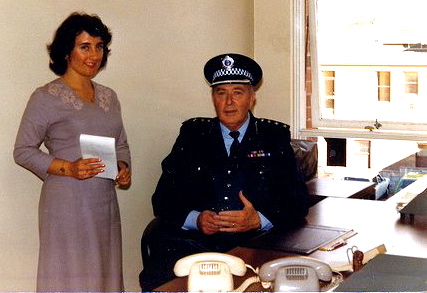
Diane Reid, Inspectors Clerk, with Jim at Fairfield Police Station in 1980. Diane also worked at Merrylands Police Stn.
DESPITE THE OFFICIAL NSW 1979 ‘STUD BOOK‘ HAVING JAMES BIRTHDAY AS 23 MAY 1925, THE FAMILY ASSURE ME THAT HE WAS ACTUALLY BORN ON 23 MAY 1923 AND DIED IN APRIL 2013 JUST SHORT OF HIS 90th BIRTHDAY.
“Our deepest Sympathies To Leslie & Annette and Families at…”
– William & Bernadette Royan
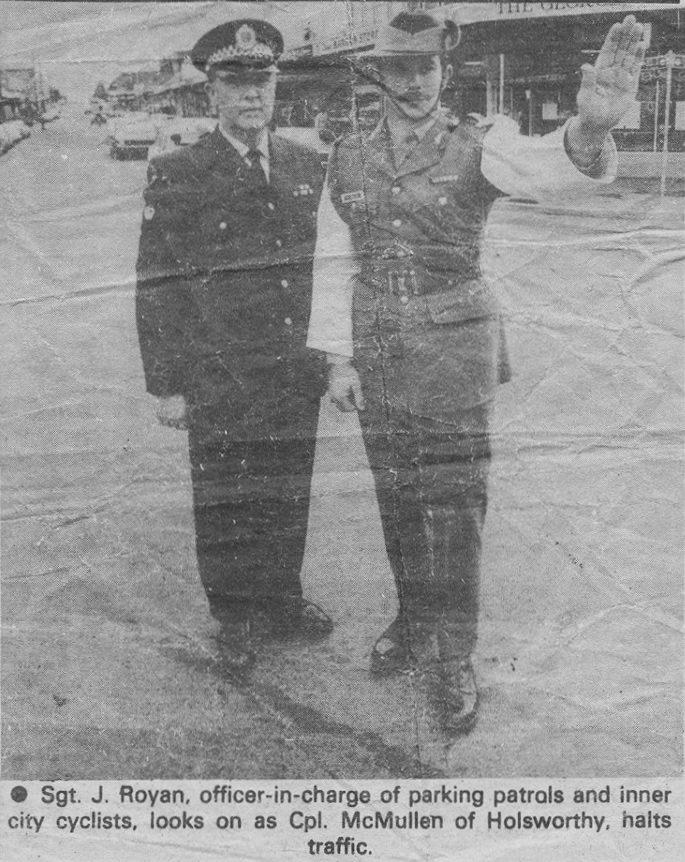
ROYAN, James Clement.
(Jim).
April 4, 2013
Late of Canterbury.
Loving husband of Neita (deceased). Loving father and father-in-law of Leslie and Michele, Annette and Haig, loving grandfather of Scott, Lisa, Sharon, Brett, Paul (deceased) and Mark. Loving great-grandfather of Cooper, Max, Jackson, Sienna, Cate, David, James, Arisa, Will and Emma.
Loved by all his family, relatives and friends.
Aged 89 years
In Gods loving care.
A Requiem Mass for the Eternal Repose of JIM will be Celebrated within the Mary Mother of Mercy Chapel, at the Rookwood Catholic Crematorium, Lidcombe on Wednesday (April 10, 2013)
commencing at 10.30am.
Southern Cross Funerals
ALL SUBURBS
PROUDLY AUSTRALIAN
9529 6644 9521 4422
Published in The Sydney Morning Herald on Apr. 6, 2013
From 1906 the Police Traffic Branch operated from Police Headquarters, but in 1917, owing to wide expansion of affairs, the branch moved to offices at the Water Police Court. In 1924 the branch moved to the old model Lodge House at 211 Kent Street, and in 1930 to Phillip House in Phillip Street. A further move was made to Clarence Street Police Station in 1931, and in 1938 the branch returned to Phillip House. In 1948 the branch finally moved to the Police Training Centre at Redfern where it remained until the 1960’s.
Source: Kevin BANISTER, NSWPF # 16382
Updated: 12 January 2024 with Promotion History, Transfer History & Awards.
Redfern Police Training Centre – Class # 058 or 059
New South Wales Police Force
Regd. # 8931
Rank: Commenced Training at Redfern Academy on Monday ? ? ?
Probationary Constable – appointed 3 March 1958
Constable – appointed ? ? ?
Constable 1st Class – appointed 16 March 1964
Senior Constable – appointed 1 July 1968
Sergeant 3rd Class – appointed 26 March 1974
Sergeant 2nd Class – appointed ? ? ?
Sergeant 1st Class – appointed 1 December 1983
Inspector – appointed 17 December 1986
Chief Inspector – appointed ? ? ?
Superintendent – appointed ? ? ?
Retirement
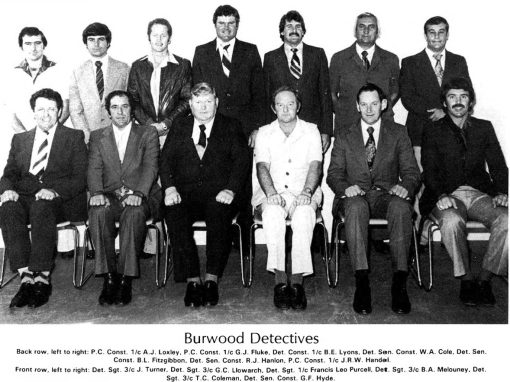
Stations: ?, Burwood Detectives, ?, North West Region – retirement
Service: From? ? pre March 1958 to 30 September 1993 = 35 years Service
Years in Retirement: 22 years, 7 months, 9 days
Age at Retirement: 56 years, 8 months, 5 days
Awards: National Medal – granted 22 August 1980 ( Det Sgt 3/c )
1st Clasp to National Medal – granted 3 September 1985 ( Det Sgt 3/c )
2nd Clasp to National Medal – granted 7 May 1994 ( Det Sgt 3/c )
Star of Courage ( SC ) – granted 27 October 1992 – NSW POLICE SERVICE. SC/FOR ACTS OF CONSPICUOUS COURAGE IN CIRCUMSTANCES OF GREAT PERIL. (MAR 93) ( Det Supt )
Born: Monday 25 January 1937
Died on: Monday 9 May 2016
Cause: ?
Age: 79 years, 3 months, 14 days
Funeral date: Monday 16 May 2016 @ 110am
Funeral location: Our Lady of the Rosary Catholic Church, Main Street, ALSTONVILLE, NSW
Grave Location: Lawn A, Plot 168
Buried at: followed by a Committal service at 11.15am at the Alstonville Cemetery, Bruxner Highway.
Memorial at: ?
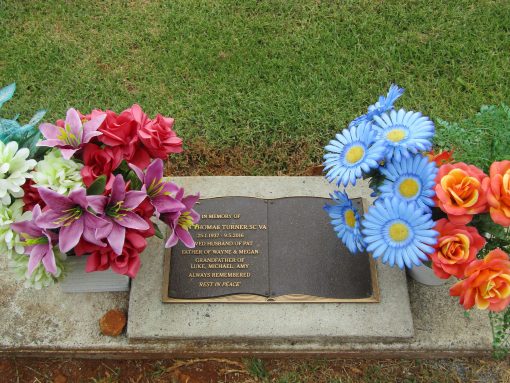
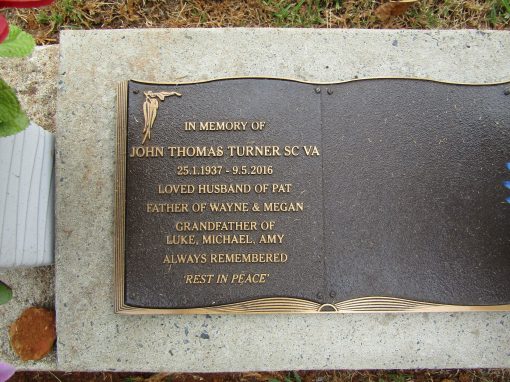
In Memory of John Thomas TURNER SC VA 25 January 1937 – 9 May 2016 Loved husband of Pat, Father of Wayne & Megan Grandfather of Luke, Michael, Amy Always Remembered. ‘Rest In Peace’
JOHN is NOT mentioned on the Police Wall of Remembrance *NEED MORE INFO
Funeral location:
FURTHER INFORMATION IS NEEDED ABOUT THIS PERSON, THEIR LIFE, THEIR CAREER AND THEIR DEATH.
He went on Long Service Leave whilst at North Sydney some weeks/months prior to his death on 24/06/1951. Not definitely known if he was still serving at the time of his death while on leave, or had retired very shortly before his death.
Service:
From pre 29 December 1916 to 24 June 951 = 35 years Service.
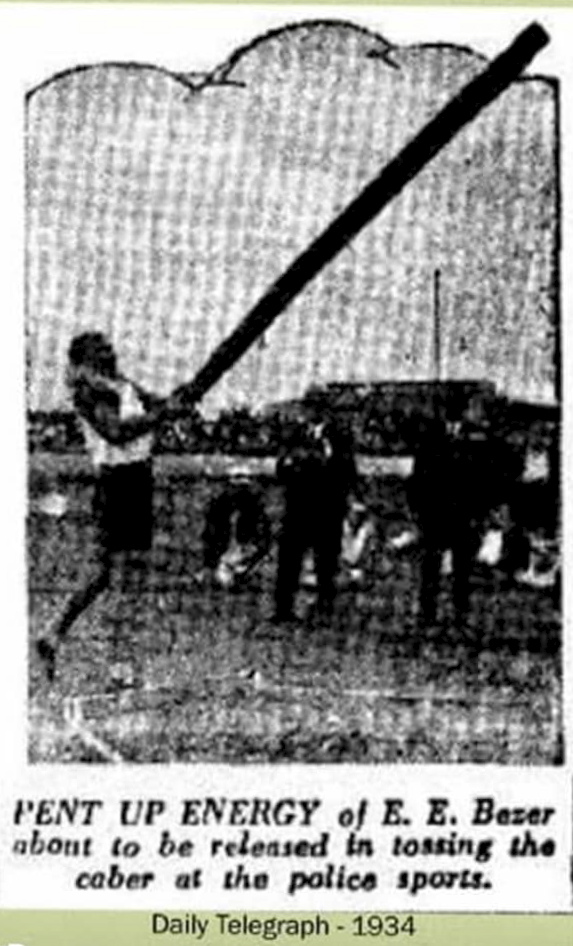
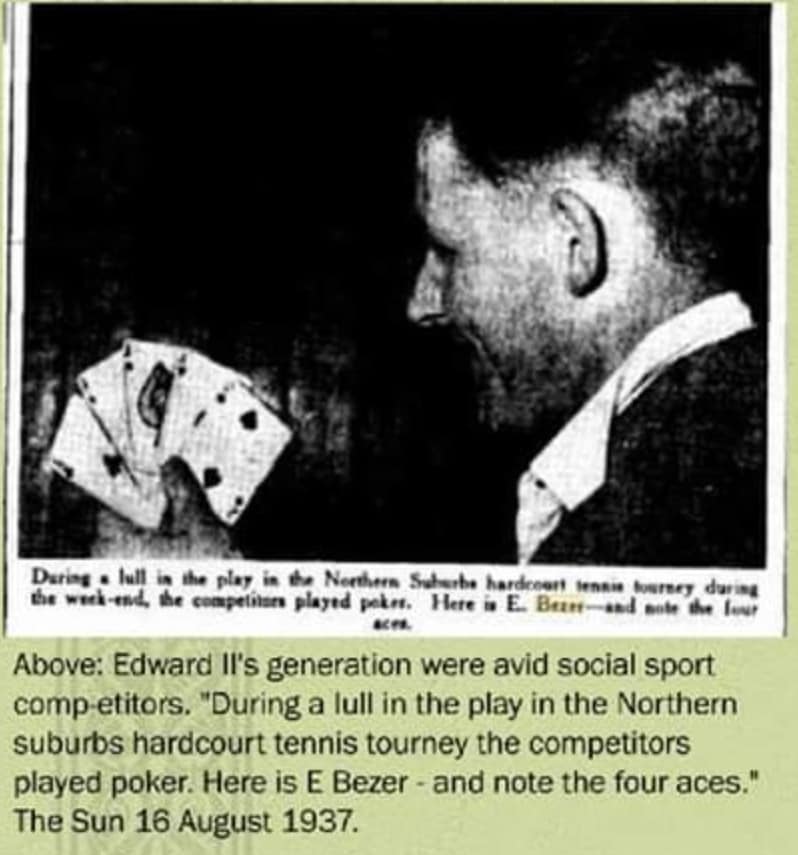
During his Service he was involved in flood boat operations at Narrabri in 1920 during devastating floods that hit the area. Manned a boat with other Police that rowed and floated down flooded creeks and rivers searching for survivors/victims. In 1934 he competed in the Police (Carnival) Games held at the Sydney Show Grounds. Tossing the Caber and 16lb Shot Put.
Edward served in the Navy prior to enlisting in the Police service in 1916 and because of being a police officer with a German surname received the white coward feather, even though he wasn’t allowed to enlist.
Government Gazette of the State of New South Wales (Sydney, NSW : 1901 – 2001),
Friday 11 April 1919 (No.78 (SUPPLEMENT)), page 2198
CHIEF SECRETARY’S DEPARTMENT.
HIS Excellency the Governor, with the advice of the Executive Council, has, in pursuance of the provisions of the ” Fisheries ( Amendment ) Act, 1910,” and with the concurrence of the Public Service Board, approved of the appointment of the undermentioned officers of police as Assistant Inspectors of Fisheries for New South Wales : —
Constable Second Class Edward Ernest Bezer, of Sutherland. Constable Thomas Ledger, of Leeton.
Constable First Class Nathaniel Herbert Maddern, of Tocumwal.
Constable First Class Ernest Garnett Turnbull, of Captain’s Flat.
Constable First Class Harold Richard Worland, of Miranda.
Government Gazette of the State of New South Wales (Sydney, NSW : 1901 – 2001),
Friday 30 March 1928 (No.43), page 1442
[12527] Sydney, 30th March, 1928.
PARLIAMENTARY ELECTORATES AND ELECTIONS
ACT, 1912, AS AMENDED BY SUBSEQUENT ACTS.
IT is hereby notified that the undermentioned persons have been appointed Electoral Registrars for the Electoral Districts set against their respective names, in pursuance of the provisions of the abovementioned Act,— to take effect from the dates specified, viz.:—
Clerk of Petty Sessions, Campsie, Canterbury, in lieu of Constable McLaughlan, relieved,— from 1st January, 1928.
Constable Rowe Hannaford, Chatswood, Gordon and Willoughby, in lieu of Taylor, transferred,— from 8th November, 1927.
Constable Edward Ernest Bezer, Mosman, Mosman, in lieu of Walsh, transferred,— from 27th January, 1927.
A REVISION COURT, to revise the List of the Electoral District, of Mosman, which is now on exhibition at every Court House, Post-office, and Police Station within the District, will be holden at the Court House, North Sydney, on Friday, the 6th July, 1928, at 10 a.m. EDWARD ERNEST BEZER, Electoral Registrar, Mosman. 14/6 “28._
A REVISION COURT to revise the list for the Electoral District of Mosman, which is now on exhibition at every Court House, Post-office and Police Station within the District, will be holden at the Court House, North Sydney, on Friday, the 28th day of June, 1929, at 11 a.m.
Efforts are being made to trace relatives of Allan McLean Sinclair, a returned soldier, and a native of New Zealand, who died as a result of a fall in Harris-street, Pyrmont, yesterday. He was formerly a steward. Sergeant Bezer, of Pyrmont, is inquiring.
A man is believed to have been drowned from a launch which was wrecked on rocks near Maroubra Beach early yesterday morning.
Claude Burr, 38,. Prince Edward Theatre commissionaire, who engaged the launch, for a fishing excursion on Tuesday, is missing.
One side of the launch had been torn away, and was found 50 yards from the main hull, which was wedged between rocks.
Seats and pieces of timber were littered over 100 yards.
Mrs. J. McGann, wife of a Watson’s Bay shipyard proprietor, said yesterday she hired the boat to Burr.
He left Watson’s Bay in it about 1.30 p.m. on Tuesday.
“He said he was going just outside the Heads to fish, and would return in a few hours,” Mrs. McGann said. “He asked my husband’s father, Mr. J. McGann, an ex-sergeant of police, to go with him.
“No Old Clothes”
“Mr. McGann said he wouldn’t go, as he had no old clothes, so Mr. Burr left by himself.
It was blowing hard at the time. ‘
” The launch was a 22ft. open boat with a 41 horsepower engine. The tank was filled with petrol, and there was a reserve tank containing two gallons.
” My husband had been away all day and noticed the launch was not at its mooring when he returned at 10.30 p.m. on Tuesday.
” He did not suspect any trouble as regular customers often take the boats without asking.
” When the launch had not been returned at 10.30 a.m. today, my husband made a search of the Harbor.
” Mr. McGann, Senr., then went to Burr’s home in Phillip Street, Bondi.
Mr. Burr’s wife said be had not returned home.
The police were then notified, and found the boat at Maroubra.”
Rough Seas
Sergeant Bezer, of Daceyville police, who found the launch, said the seas were very rough on Tuesday night.
A badly torn coat was the only clothing found.
Mr. Fred. Burr, manager of the Cameo Theatre, brother of the missing man, said last night that his brother was an exceptionally strong swimmer.
” He was an experienced fisherman and often went outside the Heads in small boats,” said Mr. Burr.
Burr had been employed as commissionaire at the Prince Edward Theatre for 15 years. He has two children, aged six and eight.
Government Gazette of the State of New South Wales (Sydney, NSW : 1901 – 2001),
Friday 3 June 1949 (No.90), page 1538
APPOINTMENTS.
HIS Excellency the Governor, with the advice of the Executive Council, has approved of the appointment to the rank of Acting Inspector of Police of the following Sergeants 1st Class on and
Government Gazette of the State of New South Wales (Sydney, NSW : 1901 – 2001),
Friday 14 October 1949 (No.194), page 3016
APPOINTMENTS.
Premier’s Department.
HIS Excellency the Governor, with the advice of the Executive Council has approved of the—
Cancellation of the appointment of Superintendent 2nd Class David Fraser as Superintendent of Traffic, on and from the 1st September, 1949.
Appointment of Superintendent 3rd Class Walter Richard Lawrence as Superintendent pursuant to the provisions of sub-section (2) of section 6 of the Metropolitan Traffic Act, 1900, as amended, to be known as the Superintendent of Traffic, such appointment to take effect as on and from the 1st September, 1949.
HIS Excellency the Governor, with the advice of the Executive Council, has approved of the confirmation in the rank of Inspector 3rd Class of the following Acting Inspectors of Police,— on and from the date indicated in each case:—
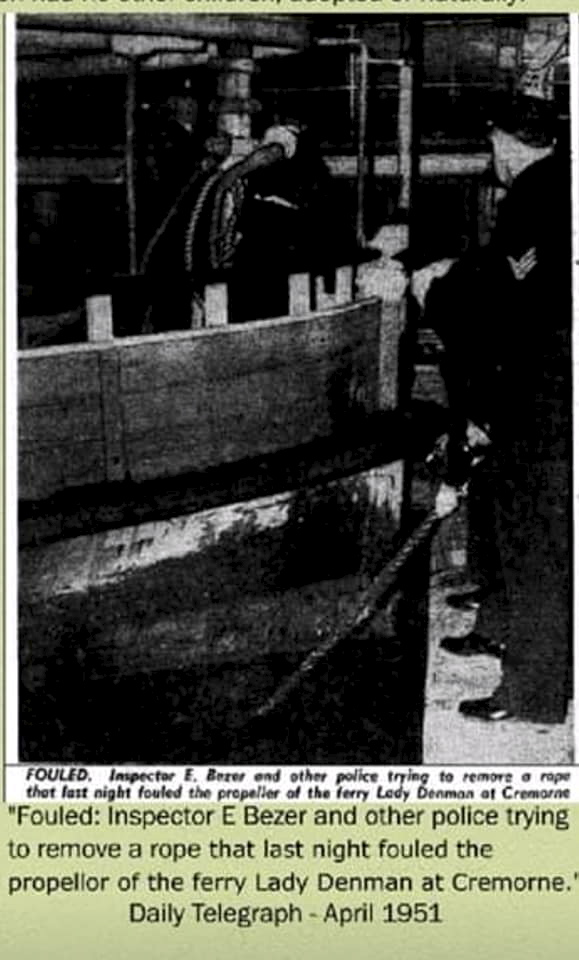
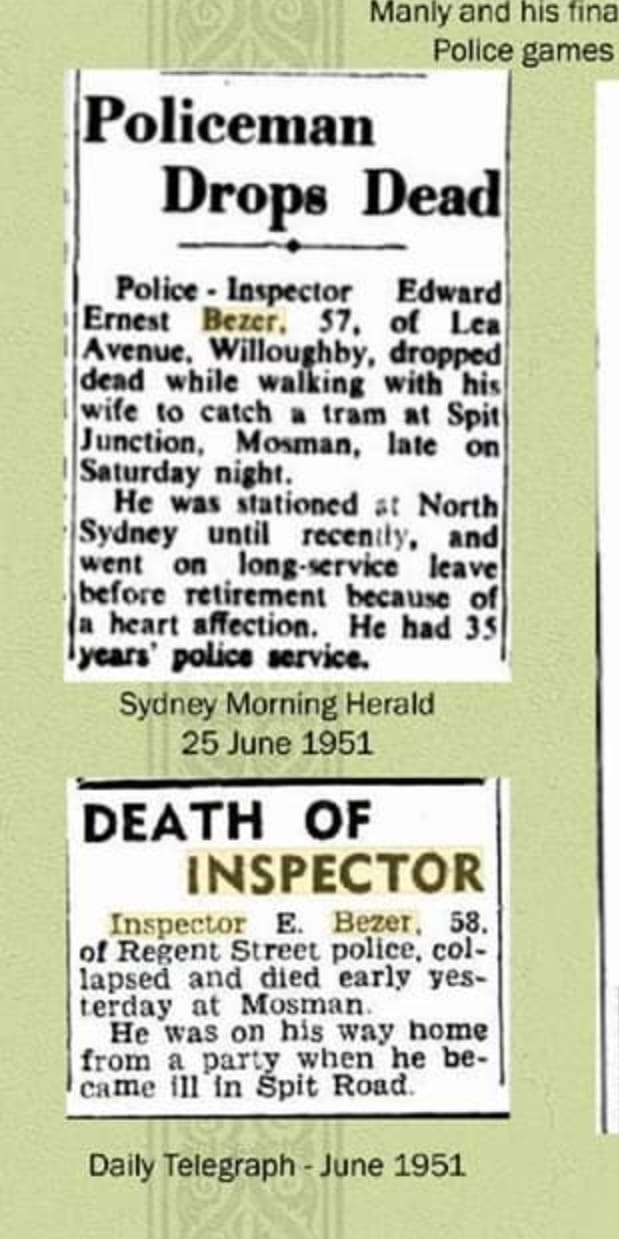
Police – Inspector Edward Ernest Bezer, 57, of Lea Avenue, Willoughby, dropped dead while walking with his wife to catch a tram at Spit Junction, Mosman, late on Saturday night.
He was stationed at North Sydney until recently, and went on long-service leave before retirement because of a heart affection. He had 35 years’ police service.
BEZER -The Relatives and friends of the late EDWARD ERNEST BEZER ( TED ) of No 8 Lea Avenue, Willoughby, are kindly invited to attend his Funeral ; to leave Christ Church, Lavender Bay. This Day at 10.45 o’clock for the Northern Suburbs Crematorium. A service will commence at 10.30 a.m.
IN the Will of EDWARD ERNEST BEZER late of Lea Avenue, Willoughby in the State of New South Wales, Inspector of Police, deceased.
Application will be made after 14 days from the publication hereof that Probate of the last Will and Testament dated the 25th July, 1933 of the abovenamed deceased, may be granted to Kathleen Emiline Bezer the Executrix named in the said Will and all notices may be served at the undermentioned address.
All creditors in the Estate of the deceased are hereby required to send in particulars of their claims to the undersigned N. D. THOMAS, Proctor for the Applicant, 51 Castlereagh Street, Sydney.
IN the Will of EDWARD ERNEST BEZER late of Lea Avenue, Willoughby in the State of New South Wales, Inspector of Police, deceased.
Application will be made after 14 days from the publication hereof that Probate of the last Will and Testament dated the 25th July, 1933 of the abovenamed deceased, may be granted to Kathleen Emiline Bezer the Executrix named in the said Will And all notices may be served at the undermentioned address. All creditors In the Estate of the deceased are hereby required to send in particulars of their claims to the undersigned
Hi, Edward Ernest Bezer was born in 1893 to parents Edward Bezer ( my Grandfather ) and Emily Mooney.
At the time of Edward Ernest’s death on the 24th June 1951 he was an Inspector of Police at Mosman, N.S.W.
Edward Ernest married Kathleen Emmeline Edwards in 1913 at St. Leonards, N.S.W.
Kathleen died on the 21st September 1962 and her parents are named as William Edwards and Annie O’Rielly on her death certificate.
She is reported as having been born in Goulburn, N.S.W.
Son Edward’s age is reported as 19 on his father’s death certificate of 1951, by his Uncle Henry Richard Bezer.
Strawberry Hill is now known as Surrey Hills.
Edward Ernest snr.’s father Edward was born 12 July 1862 in Blues Point, North Sydney and died 17 June 1922.
His first wife Emily Mooney was born in 1863 in Sydney and died in St. Leonards on the 22 April 1903.
Emily and Edward had 4 children Leslie, Irene Isabel, Harry Richard and Ernest Edward.
His second wife was Rachel Collins, married 31 December 1906 in Sydney.
They had two children, Keiven Edward and Ina Philomena.
Rachel died 1st. June 1926.
Important Note:
The author of this message may not be subscribed to this list. If you would like to reply to them, please click on the Message Board URL link above and respond on the board.
Hi, I am trying to find is a David Christopher BOURKE who immigrated to Australia and was a Queensland Police Service Officer. He took leave from the police to join the Australia Army during WWI. He died on 2 May 1915. His NOK was his mother, Mrs K Bourke, 90 Coventry Drive, Dennistown, Glasgow. I am looking to see if his name appears somewhere on a local war memorial or cenotaph where his family is from. Mel
To our oldest and dearest mate, member and comrade, may you rest in peace Big Dan Keating. You not only gave US hours of musical pleasure but all that came to our shows. Nobody could do “Rambling Rose” the way you could Dan, it never failed to bring a tear to our eyes. You will be sorely missed but never forgotten! See you on the other side.
Daniel J. Keating may “possibly” be Daniel James KEATING who received the National Medal on 13 April 1994 and the 1st Clasp to the National Medal on 30 August 2000 – BUT this is UNCONFIRMED as of 5 April 2016.