Bill didn’t see any War, as such, and was signed up with the Army for mandatory service. His father was also in the Army during WWII and was one of the Rats of Tabrook.
[/blockquote]
Awards: No find on It’s An Honour
Born: 7 November 1934
Died on: 25 January 1990
Age: 55
Cause: Severe PTSD. Accident – internal rupture of the ?
Funeral date: ?
Funeral location: ?
Buried at: Cremated at Rockhampton with Ashes interred at Tewantin Cemetery, Cooroy Noosa Rd, Noosa Heads, Qld
Memorial at: ?
BILL is NOT mentioned on the Police Wall of Remembrance *NEED MORE INFO
Funeral location: ?
FURTHER INFORMATION IS NEEDED ABOUT THIS PERSON, THEIR LIFE, THEIR CAREER AND THEIR DEATH.
Weary Police searchers lining up for refreshments at a canteen established in the area.
Dad and other Police at Mascot airport Protecting Frankie Avalon.
Dad in the side car . NSW Police Force
Dad left , and his fellow plain clothes Police Officers. Detective Sergeant 3rd class. Photos and information from Carolyn Logan – daughter of Bill ( 24 Jan 2017 )
Stephen INGLESE
| 23/06/2016
Stephen INGLESE
aka Steve
Relatives in ‘The Job’ = brother – Frank INGLESE, NSWPF # 20267 & 28255 ( rejoinee )
Sister-in-Law – Karen INGLESE nee KELSO, NSWPF # 20233
New South Wales Police Force
Academy Class 210
Regd. # 22064
Rank: Commenced training at Redfern Police Academy on Monday ? ? ?
Probationary Constable – appointed 17 May 1985 ( aged 23 years, 0 months, 26 days )
Constable – appointed 17 May 1986
Constable 1st Class – appointed
Senior Constable L11
Stations: Redfern ( 7 Division ), Gaming Squad, Green Valley ( 22 Division )( around 1985 ), Dog Squad – Menai ( from around 1997 ) – Death
Service: From 4 March 1985to 21 December 2001 = 16+ years Service
Awards: National Medal – granted 6 April 2001 ( SenCon )
Born: Saturday 21 April 1962
Died on: Friday 21 December 2001
Cause: Leukaemia
Age: 39 years, 8 months, 0 days
Funeral date: Thursday 27 December 2001
Funeral location: ?
Buried at: Forest Lawn Memorial Park, Camden Valley Way, Leppington, NSW
Location: Crypt C
Section: Crypts 46
Lot:Level B No. 42
Lat/Long: -33.95533, 150.83500
Memorial at: ?
STEVE is NOT mentioned on the Police Wall of Remembrance *NEED MORE INFO
FURTHER INFORMATION IS NEEDED ABOUT THIS PERSON, THEIR LIFE, THEIR CAREER AND THEIR DEATH.
An interesting footnote is that Steve was the first handler to bring his own dog into the Squad and successfully passed out with this dog; Rebel was his name, and when Rebel passed on he was going to be interred with Steve. Don’t know if he was but that was the plan.
Robert Kenneth PHELPS
| 23/06/2016
Robert Kenneth PHELPS
New South Wales Police Force
Regd. # 10500
Had two sons: Peter Robert PHELPS – NSW Liberal ( MLC )
Andrew Dorin PHELPS – Former member of NSWPF, Regd # 27139 ( Started 29 Oct. 1989 )( Class 243 )( Pennant Hills HWP )
“Possibly” related to District Constable Richard PHELPS ( 2nd District )( 1811 )
Joined NSW Police Force via NSW Police Cadet system on 2 March 1959
Cadet # 1492
“possibly” started with Class # 077 and finished with Class # 093 ( who were Sworn In on Monday 29 October 1962 )
Rank: NSW Police Cadet – commenced Training at Redfern Police Academy on Monday 2 March 1959 ( aged 15 years, 3 months, 11 days )
Probationary Constable – appointed Monday 19 November 1962 ( aged 19 years, 0 months, 0 days )
Constable – appointed ? ? ?
Detective – appointed ? ? ? ( YES )
Constable 1st Class – appointed 19 November 1967
Senior Constable – appointed 19 November 1971
Sergeant 3rd Class – appointed ? ? ?
Sergeant 2nd Class – appointed 23 May 1985
Sergeant 1st Class – appointed 6 March 1987
Inspector – appointed 31 August 1988
Final Rank: ?
Stations: ?
Service: From 2 March 1959 to ? ? ? = ? Years Service
Awards: National Medal – granted 20 January 1981 ( Det Sgt )
1st Clasp to National Medal – granted 8 June 1988 ( SenSgt )
2nd Clasp to National Medal – granted 7 March 1995 ( Sgt 3/c ? )
Born: Friday 19 November 1943
Died on: 27 October 2005
Cause: ?
Age: 61 years, 11 months, 8 days
Funeral date: ?
Funeral location: ?
Buried at: ?
ROBERT is NOT mentioned on the Police Wall of Remembrance *NEED MORE INFO
Funeral location: ?
NOTHING FURTHER IS KNOWN ABOUT THIS MAN. FURTHER INFORMATION & PHOTOS ARE REQUIRED.
Funeral location: Magnolia Chapel, Macquarie Park Crematorium, Plassey Road, NORTH RYDE
Buried at: Cremated
HARRY is NOT mentioned on the Police Wall of Remembrance * NOT JOB RELATED
Location of Funeral:
TUPMAN, Harry Desmond, QPM
Detective Inspector (Retired) NSW Police
05.02.1921 – 07.04.2015
Late of Ashfield
Loved husband of Yvonne for 65 years. Beloved father of Robyn and Lyn and father-in-law of Geoff Graham. Proud and treasured grandfather of Jessica, Paul, Emily, Aleisha and Tom and great grandfather to his namesake, Harry. Younger brother of Kath, Connie and Peggy (all deceased) and brother-in-law of Eric Robertson.
A gentleman and a man of integrity. He will be missed by his family and friends and will be remembered always.
Aged 94 years.
HARRY’S family and friends are warmly invited to attend a Celebration of his Life to be held Monday (April 13, 2015) in the Magnolia Chapel of the Macquarie Park Crematorium, Plassey Road, North Ryde to commence at 2pm.
TREVOR LEE & SON
FUNERAL DIRECTORS
Australian Owned
All Suburbs 9746 2949
F.D.A of N.S.W.
Published in The Sydney Morning Herald on Apr. 8, 2015
SYDNEY, Monday: Judge Lloyd in the Quarter Sessions today declared a 24-year-old shopbreaker an habitual criminal, and warned a younger man that he was heading for a similar punishment.
Norman Benaldo Brazemall ( 24 ) and Alwayn John Howard, ( 19 ), pleaded guilty to five shop robberies.
Judge Lloyd sentenced Brazemall to three years and declared him an habitual criminal. He sentenced Howard to two years.
Detective Harry Tupman, of 21 Division, said that both men had been released from gaol in February. They had almost immediately begun a series of robberies, using stolen motor cars.
Brazemall had had convictions since he was 15 and Howard’s convictions went back to 1947.
Ben Goffman returned to his home at Mosman, N.S.W., from an average working day last summer. His wife and youngest daughter were not there. They have never been seen since. Here are the clues in a tragic story for which the police ending is, temporarily, “missing, believed murdered”.
STRANGERS have bought the house that Mary Goffman made.
Husband Ben used to say, in better times: ” Look around. This house is Mary. ”
Last February 11, in broad daylight, with her little daughter Emma, Mary disappeared from the white house in the quiet suburban street on the north side of Sydney.
It may have been the scene of their murder.
On July 1 police informed Ben that the “grave fears” he had entertained from the first appeared to be justified.
Mary and Emma were almost certainly dead. So was their probable killer, Robert John Hynes.
Thin, dark, and bearded, with convictions for robbery while armed, Hynes died of injuries suffered in a car crash on June 20. while trying to evade police.
He had rented the car in the name of a Missing Person, Allan John McColm.
In the wreck, in a briefcase, police found a sawn-off rifle, and certain property of Allan McColm’s. Later, after an anonymous tip, they found McColm’s body in bush at the side of the Mona Vale Road. He had been shot through the head with a bullet from the same sawn-off rifle.
( During the long months of uncertainty, while Mary and Emma too were Missing Persons, Ben often said: ” There’s so much heavy bush on the north side. They could be dead in there, where nobody might ever find them. ” )
There were other alarming developments.
When Hynes was taken from the wreck, a telephone number was inked on his hand.
Police traced it to a housewife at North Curl Curl, also on the north side. She told a terrifying story.
On June 16 a man had telephoned in the name of a well-known carrying company. He was checking, he said, that someone would be at home to help him with a heavy parcel.
The housewife was instantly suspicious. She was expecting no parcel, and said so.
But in due course the man appeared. He was thin, dark, and bearded.
The housewife let him leave the heavy parcel. But she resisted every pretext he gave to get inside the house.
That parcel contained sand. The man she has now identified as Robert John Hynes.
Her quick wits that day had probably saved her life. But how often, the alarmed police wondered, had Hynes used this ploy and succeeded’?
In Hynes’ house at West Ryde, they found certain names and telephone numbers. Allan McColm’s was among them.
So, on a slip of paper, was B. C. Goffman’s.
The detectives called for the Missing Persons file on Mary and Emma.
What they read deepened their fears. On July 1 they cabled the English police to contact Ben.
By then, the house that Mary made had been sold to strangers. Over the months, Ben had found it increasingly unbearable to live there.
And besides, he needed money.
Since February, desperate to turn up information, he had spent hundreds of dollars on advertisements.
He had even employed a private detective.
And on that afternoon of February 11 when his loved ones disappeared, a “bearded man” had gone to his bank with two cheques signed by Mary.
They cleaned the Goffman’s joint account of all $44.
Ben needed money badly.
Late in June, broken in heart and health, he went back to his native London.
Jane (9) and Sarah were soon to follow.
Teddy the dog, beloved of Mary, had been found a new home.
Mary’s elderly mother, pencil-thin from the months of anguish, still lived about 50 yards up the road from the white house.
But she too planned to leave Australia.
She had never believed for a moment that Mary had willingly left home and family.
But the news, when it came, nearly killed her.
In distant London, Ben reacted bitterly. From the first, he insisted, the police should have regarded the case as a homicide.
On July 3 he rang me.
I never met Mary or Emma, but I heard the story through a mutual friend.
Before he left, I spent weeks, off and on. with Ben, his friends, and family, probing what seemed a impenetrable mystery.
Now, with the link to the man Hynes, we knew at least part of the answer.
But Ben wanted us to publish this story. Some clue might emerge, some reader come up with information that would help solve the rest of the mystery.
Detectives in charge of the case concurred strongly.
Here. then, is what I learnt of the Goffmans, and the known events of that February day.
It was a golden Friday. Second daughter Sarah had just turned six and Mary ( the most devoted of mothers ) was planning a birthday party to be held the next day.
Youngest daughter Emma was small for her age – almost four. Ben describes her as ” build medium, eyes blue, straight hair, light-brown to honey-blonde; probably wearing a short-sleeved navy-blue dress; articulate, trained to quote her name, address, and telephone number. ”
Mary was 43. ” build slim, complexion tanned, height 5ft, 7in., hair brown and greying, speaking with an attractive Border lilt; probably wearing slacks, a yellow knit top, a distinctive ring, and a man’s Omega calendar watch. ”
She and Ben had been married ten years. It was Mary’s first marriage, his second.
They met on a boat that brought them to Sydney, him from New Zealand, her from the United States. A telephonist, she had lived and worked in several countries since leaving Britain.
She passionately wanted children. In the ten years she had Jane, Sarah. Emma, and a miscarriage.
Friends and neighbors testify that the couple were unusually close. So does Mrs. White, Mary’s mother, who migrated to Australia to be near them.
Mary enjoyed home-making and was good at it, though she suffered at times from ” suburban ennui. ”
Ben handled all the business, including paying the bills and marketing in bulk.
Mary had a very real flair for interior decoration, and turning up bargains in antique shops.
With their own hands, she and Ben transformed the broken-down old house they were paying off at Mosman into a distinctive and charming home.
Dozens of books, records, photographic equipment, testified to the Goffmans’ catholic interests.
So did their friends, ranging (said one of them) “from professors to the man who runs a stall at the city markets; from quiet suburbanites to pot-party goers.”
Last year there was a minor burglary at the house and Mary was nervous. She never went out without double-locking doors and windows and fixing the fly screens.
Nor would she go out, even to garden, without wearing sunglasses.
All these facts have significance in the story.
Throughout, like a leit- motif, is a “bearded man.”
The first mention came from Mary herself, to Ben, her mother, and a woman neighbor, a week before she disappeared.
Ben’s car was advertised for sale. A bearded man (she said) called at the house to inspect it, presumably on foot.
Something about him Bearded man at Goffmans’ house frightened her. She described him to Ben, to her mother, and to a woman friend as “sick.” He asked her to go with him in the car for a test drive. She refused. (She herself never drove.)
When she suggested he leave his briefcase with her as surety, he appeared to take umbrage and walked off.
( Says Detective-Sergeant Harry Tupman, now in charge of the case: “No wonder he took umbrage. That briefcase probably contained the sawn-off rifle.” )
That same night Ben sold the car to quite another buyer, later paying the cheque into the couple’s joint current account at a local bank.
It turned a deficit into a credit. On that Friday, February 11, the credit stood at exactly $744.
That morning, Ben testifies, all seemed normal when he left for work. Mary was to deliver Teddy, their airedale, to a dog salon at the Spit for clipping and shampooing.
She and Emma did, around 9 a.m. The salon offered to ring when Teddy was finished.
Mary said not to bother, she’d call back before five.
Nothing in her manner caused remark.
A neighbor who spoke to her walking back found her “perfectly normal.”
The local milkman was waiting to collect his weekly money. He found her “her usual bright self.”
He thinks she was wearing dark jeans and a darkish top (but only a yellow-knit top appears to be missing).
Emma, he thinks, “wore a plain dark dress.”
Mary went into the house and got the money. The milkman gave her change and a receipt. He got into his van and drove away.
He estimates the time at 10.15 a.m.
And no one who knows Mary and Emma has seen them since, or at least has come forward to say so.
They were still (Ben says) in the house at 12.30. He rang from his city office, as he did at least once a day.
He said, “She sounded a bit sick, but she had a period, and both she and Emma had colds. Also we’d been out late the night before.
“She talked a bit about Sarah’s party, and at the end seemed quite bright and normal.”
Around 1.30, the elderly couple next door heard Emma coughing in the yard.
“Shortly after lunch” (the police were told later), a man claiming to be Ben rang the bank with a query about the state of the joint account.
About 2.20. Mary rang her mother.
Mrs. White’s last sight of her daughter had been late on the night before. The Goffmans had been to a dinner party, and the grandmother “baby-sat.” Mary and Teddy walked her home, as they always did, and at the gate Mary kissed her and said. “See you tomorrow. Mother.”
Her manner then was “normal.” Now it was markedly agitated.
She asked Mrs. White to pick up Jane and Sarah after school. This was by no means unusual. What followed was.
“She asked me to bring them hack to my place, instead of taking them home.” said Mrs. White. “That had never happened before, never once.
“She asked me to keep them there till she called. I thought she must be preparing some surprise for Sarah’s birthday next day.
“I said. “Yes, of course, dear. But what about Emma’?’
“For about a week, after being on the waiting list for months, Emma had been going to a nearby pre-school in the afternoons. I think Mary must have kept her home that day because of her cold.”
Mrs. White’s voice shook. “Mary.” she went on, “said, in such a funny way. ‘I’ve got Emma.’ Got. She put an emphasis on ‘got.’
“I said, ‘Mary, are you all right’?’ and she said ‘Yes, Mother’ and hung up.”
And that was the last time anyone has heard Mary’s voice, or at least has come forward to say so.
“I nearly went down,” said Mrs. White. “Only 50 yards away. How I wish I had! But I was afraid she’d think me foolish.”
Some time around three, the elderly woman next door saw “a tall, thin man with a small beard” standing across the road from the Goffmans’, looking toward the house.
“He held a handkerchief up to his face,” she said. ” I watched him for some time. until he noticed me at the window. Then he turned on his heel and walked up the road.
“He made me so nervous I wore all my rings when I went shopping a bit later. On the way, I saw him walking back toward the Goffmans’. ”
There was no sign of him, and all seemed quiet, when she got home around 4.30. At 4.55, just on closing time, a bearded man entered the Goffmans’ bank and presented two cheques.
Together they totalled $700. Both were signed “Mary C. Goffman.”
The signatures were unmistakably Mary’s. But she invariably added the words: “per B. C. and M. C. Goffman.” They appeared on neither cheque. ( Ben: “I’m positive she signed under duress, perhaps from a threat to Emma. Mary wasn’t businesslike. I think she believed leaving off the extra words would invalidate the cheques.” )
Both cheques were apparently legal. Even so, the teller referred them to a superior, who referred them to the manager. The manager came out and looked at the man. who seemed perfectly at ease.
The bank officers later described him to the police as: “about 30. 5ft. 10in., slim build, dark complexion, dark wavy hair, beard closely cropped, no moustache, dark glasses, well dressed in a dark suit.” ( They have since identified him as Robert John Hynes. )
When the manager saw no sign of Ben or Mary, he rang both the Goffman house and Ben’s office. Neither answered.
Meanwhile, the bank doors had been closed and locked. Still the bearded man seemed unperturbed.
The bank felt obliged to honor the cheques, for $50 and $650. When they paid over the cash, it left $44 in the joint account.
The bearded man asked to be let out by the back door, which led into a Mosman car park.
The bank officers are said to have watched him, intending to note his car number.
But he walked calmly out of the car park and was lost to sight.
Ben Goffman takes up the story: “After work I’d been to the markets to buy vegetables, as I always did on a Friday night. “I drove up about ten to six in the new car, expecting to find the whole family, including Teddy, at home.
“But the bedroom blinds were drawn and all the windows shut. “I pressed the front-door bell and it didn’t work. So I got out my key. The door opened right away, which meant it wasn’t double locked. That wasn’t like Mary, if she were going out.
“As soon as I got inside I saw why the bell hadn’t worked. The plastic casing and two of the batteries were lying on the floor, along with some of Emma’s toys. “The receipt for the milk money and some change were still on the hall table.
All this seemed strange. “Beside them on the table were her sunglasses. “I went through to the kitchen and tried the back door. It was locked, but not chained, again not like Mary since the burglary.
” The vitamiser was on the sink, with the remains of some milk in it. It was new, and Mary was fanatical about washing it right after use. Alongside was an empty yoghurt carton. She’d often give Emma milkshake with yoghurt for lunch.
“The kitchen window was shut but not locked, and the flyscreen not replaced properly. “And the whole knife drawer from the cupboard under the sink was missing.
“Later I found it on the bed in the spare bedroom off the kitchen.
” I couldn’t understand any of it. I thought perhaps they’d all gone down to the dog salon, and drove there via the park.
” The salon had closed at five. When Mary hadn’t turned up as promised, they’d left Teddy at the adjoining vet’s.
” Then I tried Mary’s mother’s, and found Jane and Sarah there, and heard about Mary’s phone call.
” Even then I was puzzled rather than scared. I had no reason to suspect anything sinister. Mother and I took the girls home, thinking it would soon be Emma’s bed time.”
By 8.15, after vainly checking with various friends, Ben was ringing the police, while his closest friend, Ron Poison, tried the hospitals.
The police came, and that night two more names were added to the bulging files of Missing Persons.
” I don’t know what I thought.” Ben said. ” That she’d had some sort of breakdown, all sorts of things. But a breakdown between breakfast and lunchtime? I didn’t know then about the cheques and the bearded man.”
Next morning, late, he rang nine little girls, to cancel Sarah’s birthday party.
He and Mrs. White, Ben said, searched the house to see what was missing.
” She seemed to have gone just in old slacks and the yellow top, and Emma in the thin navy-blue dress. So far as we could see, she had no purse, no bag, nothing warm for Emma, and was without any sunglasses.”
Mrs. White discovered that one of a pair of highly distinctive large sheets was missing. They were a gift from Mary’s brother in the United States, and would certainly be rare in Australia.
The sheet was a tan color, with a pattern of white flowers on a black grid, labelled “Vera Collection by Burlington.”
Also missing were the scissors Mary kept in the kitchen. (A large pair of scissors was found in Hynes’ home, identified as Mary’s by Mrs. White. There was also a broken pair of sunglasses.)
A joint savings-account book containing $600 (held by Mary for her mother) was safely hidden. But the chequebook was missing.
That was what sent Ben to the bank on Monday morning, to be told about the two signed cheques and the bearded man.
Ben said, “From that moment, I was sure Mary and Emma had come to harm.”
In those days before either of us had heard of Robert John Hynes, many things puzzled me.
If Mary had the wit to leave off the extra words, why not sign even more incorrectly, to alert the bank?
“I think she tried to.” Ben said. “The cheque immediately preceding those two has never been presented. She could have used it first that day, signing it incorrectly.
“But there were several things in the house signed “Mary C. Goffman.’ The man could have checked with them, and forced her to tear the cheque up.
“So leaving off the initials was the best she could do.”
How did he get the two away, in broad daylight, and without an outcry?
“Mary would do anything,” Ben said, “if he threatened Emma. Or perhaps they were dead when he took them out.”
Always Ben came back to the “bearded man”, who called about the car, and frightened Mary.
At first, the man was to inspect the car at night, when Ben was home.
“Then he rang back and cancelled, ‘because he had to work back at a Parramatta pharmacy’, and arranged to go out to the house when I wasn’t there.
“Afterwards my friends and I, then the private detective, combed Parramatta but we never found that man.”
Ben’s life over those months was torture.
It happened when he was especially tired, closest to breakdown. Very soon he would think: Not Mary. Mary wouldn’t have just run away, deserting Jane and Sarah too, putting him and her mother on this rack, causing Teddy to fret. Not Mary.
Had she broken down? Were she and Emma wandering about in God knew what condition?
One witness thought so. After reading a newspaper story, she identified them as a lost-looking, dirty woman and child she had seen wandering about at Circular Quay.
Ben felt the descriptions didn’t fit. But for a long time afterward, he haunted the Quay. Deep down, though, he knew the truth from that first moment in the bank, when he heard about the bearded man.
His last words to me before he left were: “That man killed them, and hid them somewhere in the bush.”
Now Ben and the police appeal for aid.
If you observed anything on that February day, or before, or since, which might be of assistance, please contact your local police or the Sydney C.I.B. (Tel. 20966).
Det.-Sgt. Tupman: ” Someone may have seen Hynes acting in unusual or suspicious circumstances. He may have used his own car or a stolen one.
” Particularly contact us if you were ever approached, either by telephone or in person, in a similar manner to the North Curl Curl housewife.
“Someone may have seen the missing sheet from the Goffman home, or Mary’s distinctive ring.
” Any information, however slight, may help us to break this case, and who knows how many others? ”
SYDNEY, Monday. – A missing Sydney woman and her three year-old daughter are believed to have been murdered by a man killed in a car accident while being pursued by police on June 16 this year, police said today.
The Senior City Coroner, Mr K. M. Waller, SM, today opened a magisterial inquiry into the disappearance of Mrs Mary Crozier Goffman, 43, and her daughter Emma, of Mosman, on February 11.
Detective Sergeant Harry Desmond Tupman, of the Special Crime Squad, told the Coroner he believed that Mrs Goffman and her daughter had been killed by Mr Robert John Hynes.
He said Mr Hynes had been involved in a car accident on June 16 after being pursued by police and had died as a result of his injuries on June 19 in the Royal North Shore Hospital.
Sergeant Tupman said police inquiries had shown that on February 11, two cheques for $50 and $650 had been drawn from the Goffman’s joint account by a man who had later been identified as Mr Hynes by bank officials from a photograph.
The manager of the Mosman branch of the Commercial Bank of Sydney, Mr Henry John Barnard, told the court he had tried to ring Mrs Goffman at work but had been unsuccessful in contacting them.
Mr Barnard said he had initialled the cheques and the money, in $10 notes had been handed to the man.
He said the amount of the cheques, the fact that they were to be presented in cash and that it was not Mr Goffman accepting the money, had worried him.
However, the man’s actions had not revealed any fear and he bad not acted suspiciously.
“I felt at that point that I was satisfied it was all right”, he said.
SYDNEY, Tuesday. – A coroner acting as a Justice of the Peace found today that Mrs Mary Crazier Gofman, 43, and her daughter Emma, of Mosman, died on February 11 this year at the hands of a person since deceased.
The Senior City Coroner, Mr Wallen, SM, said, “But as to the manner and cause of death and place, the evidence does not enable me to say. I further find that although no bodies have been found I am satisfied death actually took place”.
He said he was satisfied that they had been killed by Mr Robert John Hynes who, he had been told at an earlier inquiry, had died in Royal North Shore Hospital on June 19 after a car accident while being pursued by police.
Police positively identified today two skeletons found at Ingleside on Friday as Mrs Mary Goffman, 43, and her daughter, Emma, 3.
At a coroner’s inquiry on December 5, 1972, Mr K. M. Walker, SM, found the mother and daughter had been murdered by Robert John Hynes, 34, who died in a car accident while being chased by police on June 19, 1972.
A junior sailor had been charged by the Navy yesterday afternoon with a number of serious offences in relation to the fire at the Nowra naval air station on December 4, the Minister for Defence, Mr Killen, said in a statement yesterday.
Able Seaman G. J. Trent, 19, of the base, was charged after lengthy questioning at the base yesterday.
A spokesman for Mr Killen said that the man had been charged under the Naval Discipline Act, but no further details of the charges were available yet. He is in naval custody.
12 aircraft
Investigations into the fire, which damaged or destroyed 12 Grumman Tracker aircraft and a hangar, have been in progress since the fire.
Mr Killen said that the investigation had been greatly assisted by the NSW Police Arson Squad, led by Detective Inspector Harry Tupman, Common wealth Police and Navy officers had also inquired.
‘Relentless’ Harry Tupman – ‘the detective’s detective’ – dies at 94
LEGENDARY detective Harry Tupman, whose arrests included prison escapee and killer Ronald Ryan, passed away yesterday aged 94.
Janet Fife-Yeomans
less than 2 min read
April 7, 2015 – 11:00PM
LEGENDARY detective Harry Tupman, whose arrests included prison escapee and killer Ronald Ryan, died yesterday aged 94.
Mr Tupman, the first head of the state’s homicide squad when it was formed in 1977, was known as the “detective’s detective” in the days before CCTV, DNA, the internet and mobile phones made the job easier.
Among his high-profile cases was the tracking down and arrest of Ryan, who had shot and killed a prison officer during an escape from Melbourne’s Pentridge Prison in 1965. Ryan was caught while visiting a woman in Sydney in a car with a boot full of loaded firearms and became the last man to be hanged in Australia.
In 1960, the former detective inspector Tupman solved the kidnapping and murder of eight-year-old Graeme Thorne, whose father had won $£100,000 on the Opera House lottery, the equivalent of more than $5 million in today’s money. The killer, Stephen Bradley, was tracked down after he fled to Sri Lanka and was extradited to Australia.
Mr Tupman was guest of honour at a recent reunion of the elite homicide squad when those who had worked with him as young officers spoke of him as a “super sleuth”, a “relentless hunter” and a meticulous professional. Mr Tupman said at the time that technology would never replace the key to being a good detective, which was to be a good listener.
Mr Tupman had suffered from Alzheimer’s disease and died in hospital, leaving his wife Yvonne, 94, their daughters Robyn Tupman — a NSW District Court judge — Lyn Bardetta, five grandchildren and a great-grandson.
Stations: ?, Liverpool ( 1959 – ? )( Det Cst – Sgt ), Lidcombe Detectives early 1970’s, Parramatta Detectives ( O.I.C. )( March 1972 – 1974+), ?, Fairfield ( 34 Division )( 1980s ), ?
Service: From 26 August 1946 to ? ? ?
Awards: ? – NO Find on It’s An Honour
Born: Thursday 24 May 1923
Died on: Thursday 12 December 2013
Cause:
Age: 90 years, 6 months, 18 days
Funeral date: Tuesday 17 December 2013
Funeral location: St Michael’s Chapel, Rookwood Cemetery, Lidcombe, NSW
Buried at:
Phillip John CHILD, 90 old, former Regd. No. 5339, an Unattached Member of the RPA of Carlingford, NSW.
Phillip passed away on 12/12/2013 and his funeral has been held.
CHILD, Phillip John.
(NX165122)
Aged 90
24/03/1923 – 12/12/2013
Dearest husband of Colleen, brother in law of Marie, Ken and Joan.
Uncle and Great Uncle.
Phillip was a man who loved and fought for his country.
Family and Friends are invited to attend PHILLIP’S Funeral service to be held at St Michael’s Chapel, Rookwood Cemetery, on Tuesday 17th December 2013 Commencing at 11am.
RIP
Published in The Sydney Morning Herald on Dec. 14, 2013
– See more at: http://tributes.smh.com.au/obituaries/smh-au/obituary.aspx?pid=168514320#sthash.StlYUuyi.dpuf
Rank: Commenced Training at Goulburn Police Academy on 9 May 1988 ( aged 18 years, 11 months, 6 days )
Probationary Constable ( # 60233 ) – appointed 29 July 1988 ( aged 19 years, 1 months, 26 days )
Constable 1st Class – appointed ? ? ?
Detective – appointed ? ? ? ( YES )
Senior Constable – appointed ? ? ?
Sergeant 3rd Class – appointed ? ? ?
Sergeant 2nd Class – appointed ? ? ?
Final Rank: Detective Sergeant – Retired – Hurt on Duty 6 December 2012
Stations: Manly, TRG North Region, Manly, Moree, Kempsey, Port Macquarie, The Rocks, Special Crimes, City Central, Unsolved Homicide, Homicide Squad, Bourke, Ballina
Service: From 9 May 1988 to 6 December 2012 = 24 years, 6 months, 27 days Service
Age at Retirement: 43 years, 6 months, 3 days
Time in Retirement: 1 year, 0 months, 10 days
In Service Awards: Detective – 1 March 2000
Bachelor of Policing (Investigations), CSU – 25 October 2002
Detective Sergeant – 9 January 2007
Statement of Attainment in Bachelor of Laws (Posthumous) – 12 April 2014
Awards: No find on It’s An Honour
Born: Tuesday 3 June 1969
Died on: Monday 16 December 2013
Cause: Suicide stemming from PTSD – Jump
Event location: Minyon Falls, Border National Park, NSW
Age: 44 years, 6 months, 13 days
Funeral date: Saturday 21 December 2013 @ 11am
Funeral location: Innes Gardens Memorial Park Crematorium, Phillip Charley Drive, Port Macquarie.
Buried at: Cremated
* Stemming from the continued work of the wives of four Fallen NSW Police to Suicide – those four names will now be included in the newly refurbished NSW Police Wall of Remembrance, Sydney, as of 2017
Congratulations to those family members who fought the fight to right this wrong.
Inquest: initially set for 5 days, 18 – 22 May 2015, at Downing Centre Courts, Sydney & being led by the State Coroner, Michael Barnes.
Now set for 4 days 29 Feb – 3 March 2016 at Glebe Coroner’s Court, Sydney, by State Coroner, Michael Barnes.
Feb – March 2016 vacated at family request.
Now scheduled for 25 – 29 July 2016,
Coroner was unavailable for the scheduled Inquest of 25 – 29 July
New Inquest date is from Wednesday 26 April 2017
at Glebe Coroner’s Court, Sydney, by State Coroner, Michael Barnes.
Date of Coronial findings – Tuesday 17 October 2017. Result
Ashley Newton BRYANT
Ashley Newton BRYANT
With regret I advise the death of Ashley Newton BRYANT, 44 old, former Regd. No. 25603, a non-member of Port Macquarie.
Ashley passed away on 16/12/2013 and his funeral is proposed to be held at 11am on Saturday 21st Instant at Innes Gardens Memorial Park Crematorium, Phillip Charley Drive, PORT MACQUARIE.
The family requests the company of former colleagues and friends of Ashley to join them following the service at The Westport Club (Upstairs) Address: 25 Buller Street, Port Macquarie.
Memorial plaque upon the front wall of Bourke Police Station, NSW, remembering Ashley Bryant. Set in place – June 2015
Memorial plaque upon the front wall of Bourke Police Station, NSW, remembering Ashley Bryant. Ash’s plaque is on the right side of the window ( closest to door ). The plaque on the left of window is the memorial for Jacko. Set in place – June 2015
The final call made by former detective Ashley Bryant before he killed himself was an explanation and a plea for help for the families of those suffering post traumatic stress.
In the four years since her husband made the 000 call, his widow Deb Bryant has continued his campaign.
Here we look at one man and why he died, and how his life and death affected those around him.
A warning that this program contains references to suicide. If it raises any issues for you please contact Lifeline or Beyond Blue.
I joined the Tasmania Police force in 1976.
Unfortunately, after a couple of years, I started to change but I could not put my finger on the cause.
I was addicted to the job. I attended every accident I could, went to as many domestic situations as possible and made my aim to attend any occurrence which involved serious injury and death.
In December 1989 when I had returned to my station, whilst walking down the hall towards the lunch room, I just stopped as if I had walked into an invisible wall and just stood there. In the station at the time was our resident doctor, having a smoke and a coffee.
He later told me that when he saw me I was just standing erect with a blank look in my eyes. He informed me that he had turned me around and taken me home. I lived in the station residence at the time some 10 metres away. He undressed me, put me into bed and gave me a sedative.
He returned the next morning and told me that I was unfit to return to work because of PTSD and gave me a certificate to cover me. The doctor arranged an appointment with a Consultant Psychiatrist whom I still see now.
During the years from 1990 ’til now, I have attempted suicide on too many occasions to count, spent not months but years in psychiatric hospitals and used numerous antidepressants to control my feelings. I was given the nickname “Loopy” by a group of Vietnam Vets.
And I use this name with pride.
I have been asked what is my illness like and can I describe it? I just say what I can about it but I do not understand how or why I am the way I am. It is all too hard. I just try to accept it and I don’t care what others think or say so long as it is to my face.
The Police Force dropped me like a hot brick and did not want to know me. I received no help of any sort from the Police Force and if anything I was ignored totally.
As the result of my illness, I lost the job I loved, a spouse of nearly thirty years and any love for myself. In fact, I no longer know what it is to love or hate… which may or may not be a good thing.
I have tried to end it but it never works, i suppose because i am not fair dinkum about ending this misery.
I have a wonderful daughter, grand daughter and son in law. Sister and partner. But no one to sit with and talk to when the garbage hits the fan. it can happen at anytime anywhere and without notice. The first thing that happens is tears rolling down my cheeks uncontrollably. I can feel for his family, unfortunately my wife of nearly 30 years walked away.
Brett carhart :
15 Aug 2017 3:44:02pm
You are a top bloke bill, you should remember me from all those years ago on your beat, I went through the same thing as you, tried to take my life 2 times and there are places out there that listen but no one that can answer your questions. Guidance in the right direction is what’s called for. Chin up bill and maybe we have a chat sometime over a coffee about old times. The cop and the crim.
Paul Olsen :
15 Aug 2017 3:04:57pm
I read this story and tears started rolling down my cheeks. It is a story that is in a lot of ways similar to mine. I had 34 years as a general duties Policeman in Victoria. The last 20 years as a Sergeant in a busy suburban Police Station. I also spent 5 years on a 2 man station in the bush. Bush Policing in a lot of ways had more stress, trauma than the city. motorcar fatalities, suicides, and even a triple fatal small airplane crash. Working one up and being 22 years old with all that responsibility. None of this worried me at the time. In fact nothing worried me ever in the job. I too grabbed every death message I could get my hands on and found myself drawn to every serious accident situation that I could get to. After 25 years service I noticed changes in my life. Began to withdraw and being super sensitive to things that were happening around me. Conflict in the workplace became a common occurrence and although I would leave for work with the hope of no conflict I would find myself yelling within 5 minutes of arriving at work. I used to think I would see the Doctor but it took me 7 years to actually go and see the doctor about my continuing problems. I saw the doctor and went to work that afternoon. I had a complete breakdown started crying and left the station within 5 minutes of arriving. I have never returned and still now 10 years later I cry for no reason and have been diagnosed with Chronic PTSD, major depressive disorder, anxiety and other assorted mental disorders. Psychiatrists say I will never work again but Workcover send me to the IME every 18 months in the hope that one will say I can work and they will get me off their books. I continue treatment and have been lucky enough to still have my wife of 40 years and 2 kids that still talk to me. I gave up drinking 25 years ago and I think that was a lucky decision. Nightmares poor sleep habits. unable to concentrate or stay focused and basic antisocial behavour are a regular part of my life. I consider myself lucky as the ESSS has looked after me and to date I have never tried suicide or self harm. The Police Force gave me no support and sacked me after I had been off for 2 years. I am a firm believer that there needs to be a Royal Commission into the behavour of Work Cover Insurance Agents and the sooner the better.
Ross Beckley :
15 Aug 2017 4:43:18pm
An amazing interview and one that brought tears….many tears as the loss of Ash was so preventable by those supposedly there to help us in times of crisis.
Insurance Companies / Case Managers the whole Workers Compensation System and Organisational Heads should all feel ashamed for their participation in yet another life lost.
I have so much admiration for you Deb, in your commitment in making CHANGE and ensuring the loss of Ash and the effects on you and your family aren’t in vain.
You hold the light of hope for a lot of us still on this journey of PTSD due to our work a Emergency Service Personnel.
I also am thankful for William Verity and the ABC for airing this well presented story.
Much respect to you,
Cheers
Rossco.
#herotozero
Our family thank William Verity for his compassion in telling part of Ashley’s story.
I feel it is important to state, though, that Ashley’s alcohol use was but a symptom of his PTSD and he clearly stated that he used it to ‘self-medicate’, as do a large number of Police Officers due to the culture in the Force.
It is undoubtedly a fact that if the NSW Police Force Insurers allowed Ashley time to recover, rather than denying his TPD & pressuring him to seek job counselling (against medical advice), then Ashley’s downward spiral would not have occurred & he would still be here today.
Our family plead with the NSW State Coroner to shine a light on the hidden side of this tragedy.
I listened to this today, Deborah, through many tears. You are such an amazing wife and mother-Ash would be so very proud of you, I know we all are xxxx
I miss Uncle Ashley so much and I know that He would be proud of us all. Thinking of you always Auntie Deborah Bryant and I will never ever forget Uncle Ashley as He was the best Uncle to me and the best Dad to Joel, Blake and Claire and He was also the best Husband to you and the best brother to my Dad and one of the best sons to Grandma. xx ❤️
An amazing interview and one that brought tears….many tears as the loss of Ash was so preventable by those supposedly there to help us in times of crisis.
Insurance Companies / Case Managers the whole Workers Compensation System and Organisational Heads should all feel ashamed for their participation in yet another life lost.
I have so much admiration for you Deb, in your commitment in making CHANGE and ensuring the loss of Ash and the effects on you and your family aren’t in vain.
You hold the light of hope for a lot of us still on this journey of PTSD due to our work a Emergency Service Personnel.
I also am thankful for William Verity and the ABC for airing this well presented story.
Much respect to you,
Cheers
Rossco. #herotozero
A beautifully presented piece by my good friend William Verity. Painful, heartbreaking, honourable and thought provoking. My heartfelt wishes to Deb, children, friends, family and colleagues of Ashley. One could not possibly listen without tears ❤️
I joined the Force in 1968, and I know first hand that a large number of police used alcohol on a regular basis to help them cope with the stressors of the job. In those days PTSD was non existent by name. Usually small groups of mates would get together to debrief with a glass of beer or two. There were no other support given to us. So I understand how police use alcohol as a crutch to cope. My heart ???? goes out to all those involved. Deborah you amaze me!
So many tears, so heartbreaking to hear the despair!! These bastard insurance filth have got to be held accountable for the atrocious vindictive way in which they treat the men & women who struggle with the mental health conditions brought on by the nature of the jobs they are faced with from day to day! Deb your one incredibly strong woman & I’m so very proud of what you have done to bring about positive change!
Commissioner Scipione has telephoned each of us today to advise that our loved ones names are being added to the replacement NSW Police Force Wall of Remembrance, to be unveiled in the next few weeks.
We would like to thank everyone who has offered support over a long and difficult journey and truly hope this sets a precedent for all police departments, not only in Australia but the global policing community.
It is so very important to remember that policing can and often does have a detrimental effect on those who serve.
We believe that the inclusion of suicide deaths, stemming from a work related psychological injury, is the most compassionate way of showing that the police hierarchy truly cares.
NSW police officer Ashley Bryant called for review into own death
Wednesday 26 April 2017
A former NSW policeman made a triple-zero call minutes before his suicide requesting his death be investigated, a Sydney coroner’s court has heard.
Ashley Bryant fell to his death in December 2013 in the Border National Park after battling for several years with a multitude of mental health problems brought on by exposure to traumatic events in his job.
“I understand this is being recorded and that’s exactly what I want,” the 44-year-old former detective sergeant said a triple-zero call from Minyon Falls shortly before his death.
“I want this to get to the coroner.”
In the call, Mr Bryant said he suffered from PTSD and could “no longer live with the pain”.
Asked by the operator if he could wait for police to arrive at the National Park, he responded “no, I’ll be gone before they arrive, thank you,” and hung up.
Police soon arrived at the falls to find his body.
Chilling The court heard on Wednesday morning that Mr Bryant had suffered from PTSD, alcoholism and anxiety for several years.
Council assisting the coroner Ian Bourke said Mr Bryant had once told his wife that he hadn’t initially disclosed his mental health problems to police because he was scared of losing his job.
A former colleague and friend, Detective Inspector Matthew Kehoe, told the court he had not known of Mr Bryant’s alcohol problems for several years, but there had been a “strong culture of abuse of alcohol” in the NSW police force when he began his career.
“We may go out and drink until the sun comes up,” Det Insp Kehoe said of the 1990s.
Officers were inclined to hide the fact they were struggling as they didn’t want to feel they were letting anyone down by leaving work or seeking help, he added.
“Police are very good at hiding things from people.”
A lawyer for Mr Bryant’s family, Jim Glissan, asked: “They will go on until they break?”
“Yes,” the detective inspector replied.
The inquest continues.
Readers seeking support and information about suicide prevention can contact Lifeline on 13 11 14.
Like soldiers returning from combat, police officers around Australia are battling the symptoms of post traumatic stress after years of front-line work.
For their troubles, they’re shunned, isolated, and further traumatised by insurance companies when they seek compensation.
In extreme cases they end their suffering by taking their own lives.
But police forces won’t reveal suicide figures and the PTSD epidemic has remained hidden.
Now, the dramatic final words of one police officer, and a push for a Parliamentary inquiry, may end the silence.
Listen to the full report on Background Briefing, Sunday 2nd March at 8am, repeated Tuesday 4th March at 7pm
Death in the line of duty
Sunday 2 March 2014 8:05AM
Image: Detective Inspector Bryson Anderson is the most recent police officer to be killed in the line of duty in NSW. Since his death in December 2012 there have been at least five police suicides in NSW. (AAP: Dean Lewins)
Too often, traumatised police officers are shunned, isolated and put under surveillance. They lose their careers, friendships and often their homes, marriages and children, and a growing number are taking their own lives. William Verity investigates the silence around police, post traumatic stress and suicide. (Warning: some listeners and readers may find the content of this report disturbing).
For decades, silence has surrounded the issue of traumatised police officers taking their own lives.
Police forces and unions have viewed public discussion as taboo, arguing that raising the issue will only encourage more suicides.
But the final words of a suicidal former NSW detective sergeant look set to change that.
The minute you put up your hand and say, listen I am just not coping, I am ill and I can’t sleep and I’m crying uncontrollably in the corner of the office, and you can’t type because your fingers won’t send the message from your brain … that’s career suicide.
Karol Blackley, former police officer
Ashley Bryant left behind a wife and three young children when he killed himself at a waterfall near Byron Bay in NSW on 16 December 2013.
Before he died, he called 000.
‘I suffer post traumatic stress disorder,’ he said.
‘I can no longer live with the trauma of it and I want this to go to the coroner.’
‘There needs to be more things put in place for what happens. For partners of those that suffer, because I suffer and so do the partners.’
‘And there has to be more done for them. Alright, I have no more to say.’
His widow, Deborah Bryant, is taking up the campaign and has launched a scathing attack on the lack of support provided by the NSW Police Force.
‘I don’t think we were even a glitch on their radar,’ she told Background Briefing.
As a first step, she is calling for police who commit suicide with post traumatic stress to be included at remembrance days and included on the honour board. Suicides are specifically excluded from the National Police Memorial in Canberra.
She believes that nothing short of a change of culture is necessary to prevent further deaths.
‘These people have given their life for their career, and they have gotten to the point where they are broken and they should be recognised for that,’ she said.
‘As far as I am concerned, that’s death in the line of duty.’
This article represents part of a larger Background Briefing investigation. Listen to William Verity’s full report on Sunday at 8.05 am or use the podcast links above after broadcast.
The lack of recognition hit home last year for another widow, Kimberley Galvin, whose husband, Tom Galvin, killed himself after living with chronic post traumatic stress for six years.
She said Police Remembrance Day was one of the hardest times of her life.
‘It came in the same year as an officer killed on duty,’ she said.
‘With all due respect, it was like no-one else had died that year.’
‘It was very difficult for me to comes to terms with … your husband goes to work and he doesn’t come back, as opposed to your husband suffering and suffering and suffering and ends his life.’
‘That those two things are acknowledged in such different ways. Or one is acknowledged extensively and one is not acknowledged at all.’
Although the order of service listed many police who had died from a variety of causes—including old age and ill health—Tom Galvin’s name was conspicuous by its absence.
The story of isolation is repeated by thousands of police officers across Australia who become too sick to work.
Karol Blackley was dux of her class when she graduated and enjoyed a distinguished 22-year career in the NSW Police Force before—in police jargon—’falling off the perch’.
‘They didn’t care about me at all, not one iota,’ she said.
‘It was astounding, disappointing, hurtful, gut-wrenching. Here I am, with what could be a permanent psychological debilitation and they couldn’t give two hoots.’
At her lowest point, Blackley tried to hang herself and then drove to a local hotel, drank as much as she could stomach, and then drove her car in the hope that she would crash and die.
‘The minute you put up your hand and say, listen I am just not coping, I am ill and I can’t sleep and I’m crying uncontrollably in the corner of the office, and you can’t type because your fingers won’t send the message from your brain … that’s career suicide,’ she said.
‘So people hang on and they hang on until they commit actual suicide.’
Blackley runs one of several Facebook support sites set up by former officers—there is no site run by NSW Police—and says isolation can be one of the most damaging effects of post traumatic stress disorder.
‘No-one from the police department contacts you when you are off sick,’ she said.
‘No-one contacts you when you are medically discharged and certainly no-one contacts you when you are not in the police [force] anymore.’
The experience of these officers is in stark contrast to the message from Assistant Commissioner Carlene York, head of human resources at the NSW Police Force.
‘Whilst they are with us we have many intervention programs that we will go through with the officers to make sure those services are given to them urgently and immediately,’ York said.
‘They are very much supported in the workplace by their commanders and fellow officers.’
Although she declined to reveal suicide statistics, York maintained that indicators such as the number of officers leaving the force due to mental stress had improved dramatically in recent years.
‘We put a lot of services in place and we very much rally around the family in the regretful circumstance where there is a suicide,’ she said.
‘We make sure we can help them through those difficult times.’
One aspect of the treatment received by traumatised officers may soon face scrutiny thanks to NSW Greens MP David Shoebridge.
Next week, he will call for an inquiry into the treatment of sick officers seeking compensation from their insurance companies.
Shoebridge became aware of the issue when he represented injured police as a barrister, before entering parliament.
‘We need to ensure that those claims are handled promptly, fairly and independently,’ he said.
‘At the moment, there are many outstanding psychological injury claims that have been running for years. That aggravates the injury.’
The inquiry will look into the treatment of officers such as Andy Peverill, who has been fighting for compensation for three years with no end in sight.
The former constable sits in his farm outside Parkes, in western NSW, with the blinds drawn for fear of surveillance by his insurance company, MetLife.
The company has already made him see 10 psychologists—they all confirm that he has post traumatic stress disorder—but no decision is on the horizon.
Peverill’s wife, Michele, believes it is a tactic to grind them down and told Background Briefing that more than half of the officers who put in a claim end up giving up.
Like other officers, they say they have received no support from NSW Police or from former colleagues.
‘When I ask Andy he says he thinks they are frightened of catching it,’ Michele Peverill said.
‘Almost like it is contagious. I don’t know if there are any undermining things where senior officers say you mustn’t have a bar of him, I don’t know.’
‘They won’t even reply to my texts if I text them, so I don’t know.’
If you need help, or know someone who does, then contact Lifeline on 13 11 14.
This issue is not isolated to NSW Police. I am currently in similar circumstances as a member of the AFP. The lack of contact and support from both the AFP and the Police Association are truly saddening.
It seems the only concern they have is in covering the force’s backside. I left on an ‘assisted exit’ but was told you either come back full time, resign or we will sack you. When a debrief after a critical incident is the whole team in a room with the duty officer asking, “are we all okay?”. Who wants to be the one raising their hand?
I have attended a number of ‘ugly’ jobs in the past. The only
Comment ever made to me was in the week following where
I was told, “here’s the number for EAP”…
I find comfort in the good mates I’ve made in the job. I’ve been asked by more junior staff ‘Are you ok’? It has never been asked by a senior officer. Now I’m that person who will always pull aside individually each officer & ask them are they coping? Do they need anything?
We all have a duty of care for our fellow officers. Our mates. Whilst I agree management Should be doing more you might find that by asking your mate how are you coping may be the best thing to ask. We need to be there for each other. At the end of it all, we are the ones who look out for and after the community. Who’s going to look out for and after us? Simple answer, we are! We look out for and after ourselves.
To any and all who have, are currently or know someone who is suffering and not coping. Please don’t ever be ashamed at putting your hand up. I know I’ve met some damn good mates in this place and I’m sure everyone else has too. Talk with them. Ask how’s things going? Keep an eye on them and most of all, be a mate to them and make sure they are looked after.
It makes me angry when I read responses like A/Com York…” The number of police leaving in recent years has decreased due to interventions in the work place” (paraphrased). They aren’t leaving because they can’t afford it! The death and disability scheme was altered to provide a lesser and negligible payout figure for mental health issues caused by policing. Instead I foresee a future of mentally injured police remaining in the Force because of no other option. Shame Barry Shame.
It is a feature of Rightwing neo-liberal regimes, particularly in the Anglosphere, that pay and conditions, pension entitlements, healthcare etc, are all being eviscerated as ‘savings’ are sought, to be transferred to the rich rulers. When this process is even affecting the forces of ‘Law and Order’, then you know that the proverbial is about to hit the fan. I suspect that the wealthy owners of society put more faith in the burgeoning private security industry.
My husband died by suicide after having exited the police service with PTSD. No-one from NSW Police has ever contacted me, no-one from the Police seemed to acknowledge what happened. We have small children. I thought we were alone in this, it’s very sad this has happened to others too.
You are not alone ooxoxo RIP to your partner. If you are on facebook join the Forgotten 300 you will find alot of support there… i am sorry for your loss .
My heart goes out to you Anon. I acknowledge the struggle for your husband but I equally acknowledge the struggle you have and are enduring. This is an aweful situation which none of us would ever have predicted when applying for the job. It has turned your life upside down through no fault of yours or your husbands. I cry when I stop to think about everything my partner has done to support me over the past 3 years of hell. The partners are the forgotten ones. You are the passenger in an out of control vehicle. You couldn’t reach the brake or control the steering wheel. You just had to watch and plead with the driver to calm down. I wish you every ounce of happiness you can find in the rest of your years as he rest in peace.
Sorry for your loss, as someone on the job17+ years I understand your anger. I’m sorry for your children. Unfortunately the one things that bonds us in the job is the uniform, there is an alleged brotherhood, basically if you don’t play police footy, drink or womainse, you are on the outer. You are probably better off without them . My respect to u ma’am
Yes, the force rallied around Ashley’s family immediately after he committed suicide. A dignified guard of honor was formed by uniformed officers; a police chaplain respectfully led the service at the cemetery; and a deputy commissioner formally presented Ashley a police hat, flag, and a posthumous award.
There were around 100 officers at the funeral and wake, most of whom Ashley knew well and had worked with him over many years. They were all visibly moved by his passing. However, in my conversations with these brave men and women, it was clear that none of them knew Ashley was depressed and suicidal. Not one.
Police men and women must be allowed to support one-another. In order to do so, they need to know when one of their own is struggling. For 100 police from all over the state to turn up to a funeral in Port Macquarie at short notice, it is clear that someone at the force knew who Ashley’s friends and supporters were. Sadly, calling them together for a funeral is too little, too late.
There is no honor in suicide it is an insult to those who put down their lives in the service to our community to be held in the same regard as those who took the easy way out
More often than not, people who take their own life have struggled against that option for many years. Far from being the easy way out – to them suicide seems to be the only way out.
In some ways it is an incredibly brave action. The complexities of suicide are easy to dismiss until you are unfortunate enough to have someone you know go through it.
It is brave to leave your kids with the grief for the rest of their lives?. I agree it is a terrible situation and something I pray I never face however how can you call it brave or honourable to leave someone else to clean up the mess and somehow fill the hole you left?
What is easy about suicide???? and how dare you . Shame on you sir for even commenting that when a grieving widow is reading these posts. I couldn’t imagine being at the point where i felt that was my only option the mental torment alone before the act is committed is horrific. How dare you say its the EASY WAY OUT. Its your lack of sensitivity and empathy in regard for human life that GREATLY concerns me. There is nothing EASY about suicide. These men and woman are worthy of the same respect and HONOR as any serving or past serving officer. Your mentally for this day and age is disgusting. And i truly pray you never find yourself in the same position as these men and woman before you who have ended their lives…. SHAME ON YOU !
Do you honestly think for ten seconds they believe they are leaving their loved ones in a worse place ??? They arent Sardistic ? They are mental health …. What you believe and what they believe they have done are completely different things…. Do you think its easy for the families of those who suffer from PTSD to watch their loved ones walking about muddled,confused often drinking to numb to the pain…. The Anger that can be built up can lead to horrific changes in the persons mentality and often children are left scared and cowering in the corner from a man or woman they love and normally isnt aggressive at all.The guilt of the changes that PTSD brings often makes the sufferer feel their families and loved ones are better off without them cause they are walking every step with them.Once a VERY PROUD parent and now can no longer provide emotionally mentally or physically for their families having to go to salvation army for food ? or Housing commission and ending up in the same lines at centrelink or Gov assistance places with the crooks they had arrested just months earlier. Being shunned by your work colleagues completely. Yes at the funeral of ASH you all did the Guard of honor cried your tears and WALKED AWAY ….. Who has been to deb recently ? to check her and the kids are ok ? who has even made a phone call to ensure she is coping ? everyone walked away….. there is NO HONOR IN PTSD!!! and not because of the disease but because of the LACK OF SUPPORT FROM THOSE THAT ARE MEANT TO SUPPORT THE PEOPLE WHO SUPPORT THE PUBLIC!
Suicide is a very honorable death especially for these fine men and woman. They gave their lives for this job and it gladly took every last piece of mental health it could and then threw them away. RIP ASH
Now, Daniel, a little compassion and empathy might be in order. Perhaps at least stop a while before you post, and put yourself in the victim’s situation, or realise that you, luckily, can not.
Daniel,you obviously have never been brought to the end of your tether. People who ACTUALLY follow through with the ACT of SUICIDE reach a point of feeling OUT OF CONTROL of ANYTHING, their pain, humiliation and disgrace is BEYOND anything that you could imagine.B4 U make illinformed & uneducated heartless comments,perhaps U should know a bit more about the content of your remarks.
Don’t go too for off the rocker to him – why is he so passionate in his reply and hatred of suicide? (maybe apart from seeing and dealing with it’s immediate effects)
Maybe he’s intimidated by it’s possibility in his own demise.
(But he can’t tell his boss, or he’ll be sacked and then be unemployable) (and he won’t get any workers comp or rehab…)
When years of mental health options have been tried over and over and your partner continues to cry and lash out from the pain you continue to cause to them and the children and you cannot afford or have the energy to forge a life on your own, Suicide becomes the hard option to ease the pain of those around you. I hope you never have to learn this first hand.
How dare you. Suicide is not an easy way out. People are dying on the inside, struggling, desperate for help, maybe even ashamed for feeling like this. Police and other essential services need help and the government, unions and associations must realise and provide support, both financially and medically.
Your comment is offensive to a grieving widow.You acknowledge you have no experience in this type of loss…Therefore your ignorance is profound…Let us not forget these officers suffered AND STILL put their own lives at risk often for many years before they took their own.My husband included.
Sometimes when you speak from a place of no experience and no knowledge,silence is an option.In my opinion those who suffer from a lack of compassion and ignorance lack honor, integrity and an array of other horrible afflictions
Daniel,
Listen to the views and emotions expressed by others to get a different perspective on the tragedy, and the notion of courage and honour.
Ashley was an honourable and courageous man. I knew his courage in the line of service. He was a man you would be thankful to have on your side. He didn’t puff and beat his chest – but you could be certain he would be there when others may not. He had bucket loads of courage. He could just as easily have been amongst those other fallen officers – he was no less selfless in his exposure to personal risk to serve community…and did so for a greater time than most.
Even more special – he was a genuine gentleman – courteous and respectful. He was humble – a genuine quiet achiever. I’ve never heard a bad word spoken against him – not even a syllable….no easy reputation amongst a tough, strong minded culture.
His pride as a person who embodied such admirable character – a man who others could depend on, could trust, who seemed to want to do right and good by others could well have been as much a curse – motivating him to conceal his suffering – not to “bother” or “complain” to others and to manage the “stigma” of an illness. It’s so saddening to find that such a wonderful person found himself so consumed.
So please don’t judge him or others who seem trapped in a lonely place where the hard decision to end their life seems their only choice.
Daniel you obviously have never experienced the traumatising effects PTSD can cause, then there is the treatment from insurance companies and their alleged Doctors. the loneliness ans isolation you feel from everyone except fellow sufferers.
People say suicide is selfish etc.
It takes the pain away from the sufferer, the pain they have tried to explain to Doctors yet tried to spare loved ones.
I will attempt to enlighten you.
Q, is the glass of water half full or half empty?
A. who cares the correct questions is this, how long can you carry that glass around with you before it seems like a ton of bricks? a day? 3 days? a week? month?
Perspective Daniel, look from another perspective before you condemn someone.
The cops beat the shit out of protestors who have serious problems with so-called democracy, then they lie through their teeth in court about why they did what they did. To anyone who has been almost killed by a cop, or just ridiculously manhandled and even spat upon by a cop, it comes as sweet music to find that they also treat each other like shit.
This is not the type of forum to bad mouth the police. It a horrible topic that is not wished upon anyone. How dare you say things like that, it reads to me that you could not care less that they commit suicide and that you are glad this occurs. It is a tragedy that should not occur as a result of being in a job that helps people. I can guarantee you are one of those people that calls us constantly if you have an issue that is of minuscule proportions but expect police to assist. I bet you also have been charged by police and have resisted arrest and assaulted police and they have had to react but as usual you say police lie and ‘manhandle’ you. The amount of times police get spat on by criminals, I don’t believe you got spat on by an officer.
I don’t believe this and know if this did happen to you it was by one of a very few minority in the police in Australia.
You should be ashamed of yourself.
Dear No Surprises Here and Daniel,
I am appalled that you would use this forum as a topic for your own self interest when clearly the people who have voiced their grief by getting on air and writing in are using it to better educate people about post traumatic stress disorder.
No Surprises Here,
Many of the PEOPLE working in our Police Force have had to deal with extremely rude, aggressive, violent and/ or disrespectful filth such as yourself. They are human. You are speaking of a very few number who have taken power into their hands as is the case in all courses/ professions and walks of life. Bare your grudge but do not applaud others for their mistreatment of any worker/ policeman or policewoman. What they have to deal with on a day to day basis is just horrific and soul destroying. I could not do their job and you obviously wouldn’t either.
Daniel,
I have no words to describe the sorrow I feel for you right now. You must be such a warm, caring and sympathetic fellow. You show a lack of intelligence and understanding. SHAME on you.
You don’t even have the balls to identify yourself. You are a gutless coward who hides behind anonymity. Go on another more appropriate forum and have your whinge. Idiot
I know not of the circumstances your engagement with Police members has been, but I am guessing that you really have idea what Police members can and do encounter. Are we all perfect? No, but the overwhelming majority I have worked alongside with have been decent people.
Does it take a toll? Hell yes. For me-
Assaulted on duty? Yep.
Cut bodies from vehicles? Yep.
Cut living people from vehicles? Yep (even worse- the dead don’t scream)
Recover body parts from a plane crash? Yep…took 2 days to do.
Investigate SIDS deaths? Yep…multiple.
Done body recoveries at Police suicides. Sadly yes more than once.
I could go on as with 26 years plus, and a fair chunk of that in the Rescue role plus overseas deployments, I have seen and done a lot that was not pretty but I hope you get my point.
And the toll? PTSD….Who would have thought?
While you may or may not have a grievance with Police members now or in the past, this is certainly not the place to vent your angst.
And finally, do Police Agencies deal with PTSD well? In my experience, no. Three operations since (1 at least pending) back me on this when I was later deployed to duties that I clearly unsuitable for.
No surprises here, are you for real? When was the last time you had to zip up a body bag containing a three year old child, pulled your firearm on a person wielding an axe walking towards other people or got spat in the face by someone with hep C? Get over yourself!
While I too found a lot of the comments on here insensitive, responding to someone making allegations about violent behaviour with “i am not a cop but my goodness i would love to watch you tasered” is stupid and I hope you can see why.
I am not at all surprised to hear that the police have no understanding of the dangers of PTSD for their colleagues. I have PTSD and have been repeatedly harassed by my local police now for over 12 months. When I lodge formal complaints with them it is abundantly clear they have zero understanding and empathy of people who have PTSD.
Having read this article I can now understand why I have experienced the attitudes I have from as high as the divisional inspector on the mid North Coast.
if I am pushed to suicide by their actions I will certainly be leaving a very detailed letter for the coroner. I pity those officer who have to work in such a culture. It is inhumane in this day and age.
1. I hope you have found yourself some good quality mental health experts to keep you going. Currumbin Clinic on the Gold Coast is a great option if you find yourself at breaking point. I dial their number before I reach for the noose and three weeks later I feel much better. If you have private health insurance, put there number in your phone!
2. Rest rest and then rest. No just physically. Take a rest from bashing yourself up mentally. You are ill and you need to be gentle on yourself. Let 10% of you fight off the insurance companies and police paper pushers and play body guard to the other 90% of you which is recovering from a chronic illness that very few understand.
3. You are not alone. I feel for you and wish you so very well in your ongoing battle. Its a long battle (3 years for me) but it gets easier in time as you learn to adapt and live with it. BIG HUG
After nearly 25 years on the road and a lot of that in Prime Real Estate of domestic welfare and substance abuse, it only took a few seconds whilst prepping the trigger of my Glock to terminate my career. This was followed by the quickest movements I have ever seen within the QPS to get rid of me. Whilst our Commissioner dwelt over 4 years whether we should be wearing a tie whilst in operational duties. It only took them 12 months and a number of quick succession psyc visits to terminate my employment whilst directing HSO staff not to visit as I was a danger to them. Its was only due to the strength of my wife, family and close friends that I am still here to tell the story. Senior management brag as to how they look after their staff but the reality is most are only interested in their pay and bonuses for staying within their budgets and wont spend money on assisting staff getting help even when it is so obvious to everyone that they are suffering. Funnily enough a lot of these managers rose through the ranks in protected positions where they rarely if ever had to deal with an angry or drug f*&ked client, and the closest thing to dealing with a suicide or accidental death is reading the crime report. 4 years on and am still trying to get some employment and here I thought someone would like to employ an ex copper but the wording “medically retired” appear to have a stigma attached to it. I see some of the new staff coming through with the enthusiasm and wonder how many will last and for how long. For those still “in the JOB” take care and look after yourself and don’t let it get to you before it is too late..
There’s no ‘support’ If you speak to the more common self serving supervisor, rather than the rarer sergeant with real ‘on the truck’ time – the former will red flag you as a problem, put you on restricted duty and double padlock your gun.
That gives them more management arrows to their quiver and can help with a promotion. Career advancement is the primary consideration for a large percentage of career cops. They don’t care about you or your career, just don’t be a problem and carry on.
“I see dead people” – well yes, often. Vehicle collisions, train incidents, suicides, deceased people in their homes (in varying stages of decomposition) Do the job, deal with it, get the paperwork done, next job.
With car crashes I have always found it easier if the persons involved were already dead, it’s pretty awful to see people suffer so badly as they die in front of you or they get carted off by ambo’s and you generally don’t find out how they went.
No wonder they amount of cops going out on workers comp has gone down, the Japanese company that now owns the scheme doesn’t fund the ‘mortgage busters’ that a certain % of cops ran away with and destroyed the scheme. Most of the previous people off on the scheme were genuine don’t get me wrong, but a small group ruined it. Now, if you have dramas – good luck sunshine.
There should be some form of rememberance for police suicides – but It’s a form of immortality to be etched onto a wall forever. Unfortunately suicide is seen as the ultimate weakness – and they became a cop killer. It’s not nice, they spread their hurt and damage to their workmates who witness and deal with what they have done. And all the associated families.
PTSD needs to be addressed, the ordinary people that put their hand up to maintain law and order need to be looked out for properly.
Where’s the police association? Ha, probably off at some police funded drinking junket. They showed their true worth when they surrendered to the new D&D scheme. We all got ‘schemed’ there.
This type of denial by Gov departments must be universal.
I am a Worksafe Inspector who has seen his fair share of incidents and in particular a fatal “workplace incident’ that was the trigger for a downward spiral.
No support no acknowledgement only advise was to contact eap to “tick that box”
I wish I was like some of my collegues who have no regards for human life, unfortunatly I am not like that and I am the one made to suffer.
Goes on everywhere
It is so sad that nothing has changed. My husband went out with PTSD about 7 years ago with 23 years service and has never fully recovered. I am unsworn (still – 28 years service) and have given up waiting for someone to ask if we are ok. The damage this illness caused to our marriage, our children’s lives and my faith in the ‘Police Family’ was and is collateral .
That it still happens and very few care is heartbreaking. Why do police consider PTSD a weakness rather than an illness?
1) Once the “do you have access to a firearm” question has been asked and answered, the level of management interest dwindles.
2) When a uniformed welfare officer in his initial visit describes part of his role as dealing with the “broken biscuits” you gain a sense your worth to the job.
After enduring severe PTSD as a result of experiencing pretty much every bad job imaginable in the NSW Police and also losing a best mate and former Police Officer to suicide, I concur that there is nothing more Ex than an Ex Cop. It is a hidden problem that nobody wishes to acknowledge. There are current Police who think its funny to target Ex Police. Some of us didn’t get “mortgage busting payouts” We are the ones they know about, but don’t want to know us. Thanks only to a Forensic Psychiatrist who continues to help me (as I continue to see him), nobody else comes near. Perhaps they think its contagious…..
This problem is just as prevalent in the Ambulance Service of NSW.
They forget about you, brush it under the rug or ignore the warning signs. Trent Speering was a perfect example of this. Any Ambulance official that says it has improved is lying.
As if dealing with constant trauma everyday is not bad enough, the bullying that is rampant pushes you even further!
If you push back or say you need a break then they make you feel weak and push you out. And don’t get me started on what happens when you fight back…lets just say they will ignore every fact just to make you look bad!
Where has this YORK character been.. under a rock.. Do you really know that Commands support officers they go out on stress.. REALLY???? From the day I put in a complaint about begin spat at… YES spat at and verbal abused and held in a room by no other then my A/Sgt I was harrased, belittled, swapped teams to isolate me from fellow officers who I had a good relationship with and who would have been able to support me in this difficult stage I was being subject too. Officers were told by senior staff “she won’t get away with this complaint we will make her life hell till she quits” and “if you don’t want a bad name now too Id stay away from her”.. This went on for 7 months before I went off on stress.. Only to receive harassing phone calls saying if I didn’t return to work immediately I would be placed in an inner city station (over 2 hours from home) rather then asking if I was Ok.. ANYTHING to tick those little boxes they have in order to look like they care…and cover their butts.. As several other senior management began the harassment too.. On 3 occasions after contacting Professional Standards begging for help the complaint was sent back to my command ( as they felt it was important enough for them to complete the investigation ) and those who were harassing me helped complete it and/or their close work colleagues.. It was a joke plenty of witnesses that observed my harassment were never spoken too.. I went from an officer receiving 3 awards within 14 months prior to the first initial incident to an officer being labelled now since putting in my harassment complaints as now “a poor worker”.. REALLY !!! Anything to protect their butts.. Yet the Act/sgt (the spitter) won a Promotion that they assist him to achieve.. It was mind-blowing for myself and other staff to witness it all happening…I would have to say the harassment I endured from the command management including Duty Officers and Professional Standards following my initial complaint was more horrific then that of being spat on.. Unfortunately your then slowly forgotten about by even the colleagues that you did have a good working relationship with as they are conscience of not looking like they are going against the management they have to work with on a daily basis.. My HOD took 3 years through insurance to prove.. 7 independent psychologists to try and discredit me, which they all supported me apart from one..He informed me he red all the statements from my harasses (including Sgts, duty officers.. wow even the uniform lady provided a statement yet I had never met her and was a statement of all hearsay information.. They I was given 15 minutes to tell my side of the story…. what a joke… in the end and now I am left with a very poor taste about the New South Wales Police one which I dreamt of joining for so many years, was good at and thought it would be a lifelong career till I went against them and tried to prove officers should not be subject t
‘Witnesses’ who may not be favourable to the investigating officers questions are either excluded or asked questions in a certain way that makes it impossible to support your accusation.
“Did you see officer X ever not do what is alleged?”
Well, yes, they were seen not doing that thing a lot.
They operate on the CARE principle – Cover Arse Retain Employment. They cover each others arses very well.
Dishonesty, small scale corruption (yes, corruption is corruption) dangerous driving, workplace bullying – oh yes, investigated but recorded as ‘a lapse of judgement’ and the bullying as ‘sour grapes’ Funny that, sour grapes were quite common in that particular office.
The majority of cops are good, honest, hard working people that do a tough job well. There are some genuine pigs amongst them. And they herd.
Your story sounds exactly like mine, Albeit I wasn’t spat on, instead in statements the police said I was a slovenly, drug affected domestic violence victim who had been put in hospital due. to domestic violence. ( none of which was true), at the time they were investigating the actions of bullying and harrassment, they gave me shit jobs, sticking stickers on envelopes for months, they being NSWPF done everything in their power to try and make me quit. My psychological mental breakdown was declined by EML as they claimed I had sustained a psychological injury due to my physical injury, rather than from being harassed. They claim I had a bad attitude as I didn’t want to work with my employer and try to get back to full duties, even though the NSWPF were told by six specialist that it will never happen, as I had a fusion in my neck in 2010, to wit I was made PRD. They unfairly dismissed me from my PRD position, with the only excuse given, I want a sergeant in this role. My case is before the ombudsmen at present, and the ombudsmen believe I have a case for the NSWPF to answer, I think it is a disgrace the way injured police are treated, their is no care factor, because they would rather cut their losses and hire another graduate from the college of knowledge. Due to their being no partial disability anymore we are thrown on a garbage heap, with everything thrown at us to make our lives miserable in the workplace, including writing to the RTA in an attempt to cancel our licence, writing to the insurance company and lying about things we did on holiday, when questioned about who their informant is the cover ups occurr. I hope their is an inquiry, it is well over due. Having gone through depression, I wouldn’t wish it on anyone. I am now working at a different LAC where my Sgt is supportive and understanding, this helped a lot in my recovery. I can look back now and think WTF, when reading their statements, as it is quite obvious they had an agenda to make me quit, but I have come full circle and know now their is more to life than the NSWPF, to which I gave so much.
Well, to help people –
No.1. To really help people, that’s what it’s all about. Bad things happen and we are there to deal with it and help people deal with it. Thats why ‘we’ are police. Not the bullies and the jerks who get paid by the police to wear a uniform.
That stuff hurts people and we are there to help you with it.
Stuff is all sorts of ‘stuff’ You name it.
It hurts you a lot, and it hurts us too. Sometimes because you are physically hurt – maybe you are burnt in a house fire and we have taken you out – yeah, you may die, but you are in my hands (like really, you are holding my hands) and you are still #$%@& smoking and you are trying to talk to me. Maybe you died, I don’t know. I tried mate. I could smell you on my jacket for weeks. How many years later, it’s like that job was last week.
The deceased people. We are there to give you respect and help your family begin to grieve. I climb in through your back window and tap you on the shoulder – oh your died X weeks ago. We pity you that no-one found you earlier. I won’t say how long earlier.
The motor vehicle accidents. Yes, I see what has happened, it wasn’t your fault but you are about to die and you are looking at me to save you. I can’t. But…
Another accident – oh you are already dead – I search your pockets and get a car crew to your home while I continue.
Oh, was that upsetting? Never mind that – why are your person search/move along stats down for this month? You aren’t being pro-active enough. What? You are being lazy and not suited to being a cop.
wow, so glad that I have stumbled across this. Here I was thinking it only happens in the QPS.
Could not agree more, when you go on sick leave you are the ‘he who should not be named’. They don’t give a damn about you. My husband has recently gone on sick leave and its like he never existed. Prior to this there was a long list of harassing management action that drove him out. Just what the bosses want hey. They would rather have a junior officer who dares not ask questions then an experienced officer of over 20 years.
The worst thing is that I am also in the job and now its started on me. Bullying by ignoring me, under valuing my skills and isolation. Boy its hard to go to work.
Its nice to hear about life on the other side of policing, because that’s what the QPS never want you to hear about in case you dare to leave.
When you joined this job you hated grubs then over time you hate management because they are just looking out for themselves, have to cling to this job because they have no other options. They are the ones who make the job hard, zero support.
Police are the only organisation who torture their wounded. I am a former member of the NSW Police Force with 20 years service. I was “discharged, medically unfit, hurt on duty for physical and psychological injuries received in a major incident in 1988, leading to my discharge in 1993.
I was one of the first members to be assessed with PTSD which, at the time, had no guidelines for treatment or convalescence. Some 25 years after the event I still suffer from the incident and as I approach middle age, my physical injuries are compounded by the onset of arthritis. During my time in the Police Force and subsequent discharge,
I have had no contact from the NSW Police Association, which I have been a member for 35 years or the Welfare Section inquiring about my health nor any subsequent followup treatment. There is a saying in the NSW Police – “There is nothing more EX than and EX Copper”, which is a very apt description, a case of out-of-sight-out-of-mind.
I thank ABC RN for this story, it highlights those of us who have given all but received very little from the Department in return. Maybe something will come of it.
Ambos, Police & Child Protection Workers see what no one should see. “Debriefing” is “at the pub”!
The images never leave.
PTSD is not handled well & any sign of weakness is often targeted by Supervisors.
Thank you for this program.
More assistance for family members of all these careers
should be mandatory.
They are also placed in a vulnerable position.
When you read the NSWPF values: integrity, honesty, respect… Then reflect on the way members with PTSD are treated by senior management, it is no surprise that these poor souls are committing suicide. I say to members & former members partners, husbands, wives, friends, family – rally around your loved one. Keep a close eye one them, help them get the support & medical treatment that they desperately need to get back to some resemblance of the person they were before they joined the police.
I am appauled at the way injured cops are and have been treated not only by the NSW Police and Government but their poisonous agents undertaking their manipulating “dirty deeds” This is not limited to their contracted insurers, GIO, ALLIANZ, EMPLOYERS MUTUAL.
What is always not mentioned is the decision makers in executive of the NSW pilice are all on lifetime CPI pensions of over 160k per year.
The current NSW Police and other front bench Ministers are also on the same, and do not even have to be injurerd. A little hypercritical dont you think?.
There is no help when you are injured so ms York stop the B/S. You are only helped or forced out the door and thrown on the police scrap heap. Then treated like beggers and or criminals by some insurance clerk when you are Discharged offically by the Commissoner.
The Statutory bodies of the Government are empowered to stop individuals seeking proper remedy as a result of the appalling corruption and clear bullying within.
Time for another Royal Commission.
Bless you all.
My thoughts are with the Bryant families and others suffering this trauma, including my own loved ones.
xxxooo
When you add the extreme callousness displayed to these fellow officers by the police hierarchy, to the tsunami of hideous abuse, continuing over decades, inflicted on children in ‘care’, to the cruelty and barbarity inflicted on refugees, to the readiness to join in genocidal aggressions like Iraq, the villainous Northern Territory ‘Intervention’, the creation of a New Stolen Generation far greater than that revealed by the ‘Bringing Them Home’ Report, the epidemic of bullying, and myriad other daily nastinesses and displays of contempt by the powerful for the rest, you see a true picture of Australian ‘society’ as it really is, not the pretty, self-deluding image we like to paint in our boundless smug self-satisfaction.
What a sad world you inhabit; it is not the Australia in which I live. Also, spleen-venting of your egregious sort is especially unpleasant when it’s off-topic.
While I do not agree with the aggression expressed in the first comment, I can relate because there is a pandemic in our lives. We all see many of the symptoms and we all know many of the causes. We don’t talk about it, we don’t confront it, instead we defer our focus and delegate our lives to more comfortable dreams. Only briefly do we reflect when we are forced by the empty mark it leaves on us with stories like this. It is not isolated and it is growing.
Just today I have seen it defended by individuals like Assistant Commissioner Carlene York or William Churchill of Ausveg, instead of the men and women who live and die around us everyday.
I am invigorated by the splendor of our growing knowledge and technology only to watch it be perverted by those we place our trust in. Our political mechanisms are antiquated, our law dysfunctional, our economics a racket, our environment dying, our education corrupt, our day-to-day passion regulated by hierarchies open for abuse.
I don’t think his comment is off-topic, I think it is more likely that we don’t want acknowledge that there is truth in it.
An interesting article. Perhaps the police forces should undertake better resilience testing practices. It could lessen the PTSD instances; choosing the right people for the right job may be the answer. Some people may be more prone to suffering and psychological issues arising from exposure to death, violence etc than others. We select and employ people based on traits in other employment fields so why not with policing?
After 20+ years ‘in the job’ any level of resilience is well and truly exhausted. Perhaps a 20 year retirement option would be the most compassionate way for these great men and women to end their careers with dignity.
Elizabeth,
How exactly do you ascertain whether a person is going to be resilient to constant exposure to abused children, death and threats to their life. No one is resistant to that level of trauma forever. It is the ‘cost of Policing’. We just need support, recognition, respect, and the means to financially support ourselves and our families after the fall out. I am a very resilient person… but at well over 20 years.. There are cracks. I’m pretty confident at 19 I’d have got through resilience testing.
My husband is currently at the academy finishing in the next couple of months and to date has had no counselling lectures, grief work or anything that would prepare him for the potential horrors ahead.I find this very concerning ,surely concentration in these areas will minimize this chance of mental burnout and reduce suicide numbers-
Jo, he wont get it either. They paint it as rosy and its anything but. He will appear to cope with attending tragedy on a constant basis but eventually the bucket gets full. You don’t have a great deal of responsibility in the first few years as its all put on the fellow officer he will work with. I am out of the job, medically discharged and am trying just to cope day to day. It ruined my life.
Jo
They will not discuss the bad side of policing at the Academy. When he get out he will discover that the bad side is revealed and talked about in the pub. My advice to your husband is to start a journal from his first day and continue to the last. Include in that all the nasty incidents he attends and the support he receives. You will find that there is no support and as soon as he ask for it, his career will be over. They will bully him and harass him until he resigns or goes on long term sick report. Once gone he will be forgotten and all the mates he had in the job will disappear. He will be left alone to deal with his Demons and then he will need your support to get through each and every day and night. I hope for you and your family that he is blessed and gets through because the other is a constant nightmare. Good luck!
I cried. I was listening Sunday morning and I cried. I haven’t cried over this issue since 2007 when I resigned from the Australian Federal Police, diagnosed with PTSD.
Briefly. High achiever. Det Sgt. Drugs. Undercover. Terrorists. Financial scams. Same as the rest of these correspondents. Attended a 6 week Sgt’s course. Was bastardized by the lead instructor. Brutally held up to ridicule in front of the class. Two weeks in I’m on top of the college ready to jump and land on the pavement outside her office. That will show her. That will bring her down. I came home. Never the same. Depression and anger.
Like a bucket of water, slowly accumulating drops of water, it built up. Eventually, one more drop and I fell over. Drugs. Psychiatrists. The AFP went after me like a criminal. From 2IC of a State to working a line at an airport.
The AFP’s psyche said it was the instructor. My Psyche said it was the instructor. The AFP sent me to a high end forensic psychiatrist for 6 weeks. He said it was the instructor.
Years of limbo, depression, drugs and anger. I missed out on my family growing up.
Insurance company refused liability. We started to collect evidence. We found 7 other people similarly attacked by this instructor, willing to go to court. We even told AFP Professional standards and they did nothting.
She was a serial abuser and workplace bully. The medical people said that if we sue, it will take years and the stats are that I wouldn’t survive. Turn into a vegetable. My choice was drop the action or go mad. I dropped the action. Resigned. Slowly earned some self respect and a sunrise of happiness.
This program broke the dam. If a serial killer was persisting with this course of conduct, injuring people it would invoke a national taskforce. Because it’s an insurance company, supported by police service that say your weak winging malinger, somehow they can get away with it.
In the words of Rake. “My old life. I want it back.”
I am a statistic now.
The flashbacks, the dreams,the anxiety, the sweats, the overwhelming sadness, the alcohol, the anger, the noose, the medication, hiding behind the facade, the powerlessness, the guilt, the fights with spouse, the kids, everyone walking on eggshells around you, no motivation, the struggle to get out of bed, even though it’s such a negative place where a lot of the bad thoughts and dreams are, the powerlessness, the anxiety, every time you see a train thinking of suicide, or at any given time having suicidal thoughts, the lack of support, the insurance company, the medication and side effects, the disassociation, not being able to show love to the people you love the most, being unable to show love, feeling unloved, not caring about yourself, not eating for days at a time, the endless cigarettes, the memory loss, the obsessive compulsive times, no compassion but crying at the slightest thing, and so, so much more. I didn’t think it would happen to me. I didn’t choose this. I loved the job. I was good at it. I am seeking and getting help. I have spoken out. I am off the grog. I hope I come through the other side. It’s is going to take a long time and I am hopeful that I will be able to have some semblance of normal in the future. It was 9 years in the making. I wonder how long I will take to fix me, or if I am even fixable.
This problem within Emergency Service Personnel is getting to crisis point.
There are so many personnel suffering from the effects of incident stress across Australia BUT the Organisational management are not taking action to help us cope.
I’ve been a member of the Fire Service Industry for over 20 years and am now paying price for the “Harden Up” culture that we are all expected to abide by.
I’m the silent victim nobody sees after helping the general public deal with their loss of family members BUT nobody thinks of me or my mates that are affected.
As Emergency Service Organisations DONT have a proactive approach to incident stress, I have started a program to fill that gap and help others not fall down like I did.
Police are but a part of this bigger issue effecting all emergency services. Fire Ambulance etc.
PTSD is the silent killer of emergency service workers.
As a firefighter of 30 years I can assure you many of my friends are no longer alive. I myself feel like I walk a tightrope.
To be treated like a pedophile with the clap by insurance companies is dehumanising in itself let alone their so called doctors.
You have but scraped the tip of the iceberg Sir.
Death in the line of duty: breaking the silence on police psychological injuries
This week’s Background Briefing on ABC Radio National covers the issue of post-traumatic stress and police suicides.My office has heard from many current and former police officers who have been shunned, isolated and left without meaningful assistance after suffering psychological injuries at work.Before I came to Parliament I acted for a number of police in similar situations and saw first-hand how badly they were treated by the force and insurers.Having heard first hand how police and their families are suffering I can’t turn a blind eye on this issue.I would urge you to take the time to listen to the report on ABC and then see if you also think it is time to break the silence.ABC Radio National Background Briefing: Death In The Line Of Duty by David Shoebridge GreensToo often, traumatised police officers are shunned, isolated and put under surveillance. They lose their careers, friendships and often their homes, marriages and children, and a growing number are taking their own lives. William Verity investigates the silence around police, post traumatic stress and suicide.For decades, silence has surrounded the issue of traumatised police officers taking their own lives.Police forces and unions have viewed public discussion as taboo, arguing that raising the issue will only encourage more suicides.But the final words of a suicidal former NSW detective sergeant look set to change that.Ashley Bryant left behind a wife and three young children when he killed himself at a waterfall near Bryon Bay in NSW on 16 December 2013.
Before he died, he called 000.
‘I suffer post traumatic stress disorder,’ he said.
‘I can no longer live with the trauma of it and I want this to go to the coroner.’
‘There needs to be more things put in place for what happens. For partners of those that suffer, because I suffer and so do the partners.’
‘And there has to be more done for them. Alright, I have no more to say.’
His widow, Deborah Bryant, is taking up the campaign and has launched a scathing attack on the lack of support provided by the NSW Police Force.
‘I don’t think we were even a glitch on their radar,’ she told Background Briefing.
As a first step, she is calling for police who commit suicide with post traumatic stress to be included at remembrance days and included on the honour board. Suicides are specifically excluded from the National Police Memorial in Canberra.
As a first step, she is calling for police who commit suicide with post traumatic stress to be included at remembrance days and included on the honour board. Suicides are specifically excluded from the National Police Memorial in Canberra.
She believes that nothing short of a change of culture is necessary to prevent further deaths.
‘These people have given their life for their career, and they have gotten to the point where they are broken and they should be recognised for that,’ she said.
‘As far as I am concerned, that’s death in the line of duty.’
The lack of recognition hit home last year for another widow, Kimberley Galvin, whose husband, Tom Galvin, killed himself after living with chronic post traumatic stress for six years.
She said Police Remembrance Day was one of the hardest times of her life.
‘It came in the same year as an officer killed on duty,’ she said.
‘With all due respect, it was like no-one else had died that year.’
‘It was very difficult for me to comes to terms with … your husband goes to work and he doesn’t come back, as opposed to your husband suffering and suffering and suffering and ends his life.’
‘That those two things are acknowledged in such different ways. Or one is acknowledged extensively and one is not acknowledged at all.’
Although the order of service listed many police who had died from a variety of causes—including old age and ill health—Tom Galvin’s name was conspicuous by its absence.
The story of isolation is repeated by thousands of police officers across Australia who become too sick to work.
Karol Blackley was dux of her class when she graduated and enjoyed a distinguished 22-year career in the NSW Police Force before—in police jargon—’falling off the perch’.
‘They didn’t care about me at all, not one iota,’ she said.
‘It was astounding, disappointing, hurtful, gut-wrenching. Here I am, with what could be a permanent psychological debilitation and they couldn’t give two hoots.’
At her lowest point, Blackley tried to hang herself and then drove to a local hotel, drank as much as she could stomach, and then drove her car in the hope that she would crash and die.
‘The minute you put up your hand and say, listen I am just not coping, I am ill and I can’t sleep and I’m crying uncontrollably in the corner of the office, and you can’t type because your fingers won’t send the message from your brain … that’s career suicide,’ she said.
‘So people hang on and they hang on until they commit actual suicide.’
Blackley runs one of several Facebook support sites set up by former officers—there is no site run by NSW Police—and says isolation can be one of the most damaging effects of post traumatic stress disorder.
‘No-one from the police department contacts you when you are off sick,’ she said.
‘No-one contacts you when you are medically discharged and certainly no-one contacts you when you are not in the police [force] anymore.’
The experience of these officers is in stark contrast to the message from Assistant Commissioner Carlene York, head of human resources at the NSW Police Force.
‘Whilst they are with us we have many intervention programs that we will go through with the officers to make sure those services are given to them urgently and immediately,’ York said.
‘They are very much supported in the workplace by their commanders and fellow officers.’
Although she declined to reveal suicide statistics, York maintained that indicators such as the number of officers leaving the force due to mental stress had improved dramatically in recent years.
‘We put a lot of services in place and we very much rally around the family in the regretful circumstance where there is a suicide,’ she said.
‘We make sure we can help them through those difficult times.’
One aspect of the treatment received by traumatised officers may soon face scrutiny thanks to NSW Greens MP David Shoebridge.
Next week, he will call for an inquiry into the treatment of sick officers seeking compensation from their insurance companies.
Shoebridge became aware of the issue when he represented injured police as a barrister, before entering parliament.
‘We need to ensure that those claims are handled promptly, fairly and independently,’ he said.
‘At the moment, there are many outstanding psychological injury claims that have been running for years. That aggravates the injury.’
The inquiry will look into the treatment of officers such as Andy Peverill, who has been fighting for compensation for three years with no end in sight.
The former constable sits in his farm outside Parkes, in western NSW, with the blinds drawn for fear of surveillance by his insurance company, MetLife.
The company has already made him see 10 psychologists—they all confirm that he has post traumatic stress disorder—but no decision is on the horizon.
Peverill’s wife, Michele, believes it is a tactic to grind them down and told Background Briefing that more than half of the officers who put in a claim end up giving up.
Like other officers, they say they have received no support from NSW Police or from former colleagues.
‘When I ask Andy he says he thinks they are frightened of catching it,’ Michele Peverill said.
‘Almost like it is contagious. I don’t know if there are any undermining things where senior officers say you mustn’t have a bar of him, I don’t know.’
‘They won’t even reply to my texts if I text them, so I don’t know.’
David introduced a Notice of Motion into the NSW Upper House on Tuesday seeking support for a Parliamentary Inquiry into how the NSW Police Force and insurers deal with serving and former NSW police who have suffered psychological injuries.
The suffocating silence around suicide in the police force and the lack of support for officers suffering mental trauma amounts to a national scandal, writes William Verity.
If it takes the death of yet another police officer to wake us up to the scandal occurring all around us, his life may not be entirely wasted.
Ashley Bryant was not the last serving or former officer in NSW to take his own life, despite the fact that he only died just before Christmas.
Another officer killed himself in Sydney in January.
In fact, since the last NSW officer – Inspector Bryson Anderson – was killed in the line of duty in December 2012, at least five officers have taken their own lives.
You won’t have heard their names, you won’t hear them honoured at Police Remembrance Days, and their names are specifically excluded from the National Police Memorial in Canberra.
It’s as if their many years of honourable service leading to the ultimate sacrifice never happened.
Ashley Bryant was 44 years old when the “head noises” (as he called them) of post traumatic stress disorder finally pushed him over the edge.
As his widow, Deborah Bryant, relates, it was an act of mercy. He had become so impossible to be around. His cycling through heavy drinking followed by bouts of manic exercise, his anger, his moods, his nightmares.
He killed himself because he believed it was his compassionate act towards his wife and three young children.
Yet before he died, the former detective sergeant made one last call – to 000 – where he broadcast to the world a desperate plea on behalf of the thousands of police in Australia who suffer mental stress.
“I can no longer live with the trauma of it and I want this to go to the coroner,” he said.
“There needs to be more, more things put in place for what happens. Listen, for partners, of those that suffer, cause I suffer and so do the partners. And there has to be more done for them.
“Alright, I have no more to say.”
We are used to hearing about post traumatic stress in the military, and it was the condition of Vietnam veterans in the 1970s that first formalized the condition in the psychiatric diagnostic manual.
Yet conditions for police can be every bit as traumatic as for soldiers, some would argue worse.
One officer described putting out the washing and seeing a dead body that wasn’t there. Or feeding her cat and when the animal looked up at her, it had the face of a murder victim.
Another officer would bang his headboard as he suffered nightmares and he put a hole in the wall. He would relive crime scenes in his sleep, shouting out orders, so his partner learnt more about his work from his nightmares than his conscious self.
All of them contemplate suicide at some point, many of them attempt either violently or over time, often drinking themselves to an early grave or overdosing on their medication.
If you’ve ever wondered about that semi-comical police jargon used, where a dead man is described as “a deceased male person”, ask yourself, why the special language?
Could it be a defence mechanism, a way of distancing yourself from the daily horror, an imperfect shield against impending head noises?
This need to defend oneself may explain why, almost universally, police who fall sick with mental trauma are shunned by colleagues and isolated from any meaningful help from the police bureaucracy.
As one recent widow put it: “When you can’t do what you’re supposed to do, you’re just out and move up and someone else fills your spot. You’re just out.”
The astonishing fact is that this mental carnage is nothing new. There are many thousands of sick and medically discharged police around Australia, one or more in every suburb. It’s been going on for decades.
So why the silence?
One issue is that police forces and unions will not discuss the issue of suicide, arguing that it will only encourage more. As if police officers, who deal with death on a daily basis and carry a Glock pistol on their belt, could be so easily swayed into taking their own lives.
Another issue may be one of money. Police forces may fear a deluge of claims coming their way if there is any suggestion that they have failed in their duty of care.
A third issue is that in this male culture, post traumatic stress is seen – quite understandably – as a contagious disease. If I lower my defences to become empathetic to my colleagues, I become vulnerable to breakdown myself.
Though blame will not save a single life, there is no doubt that the silence and lack of action by police unions is a national scandal.
Can you imagine the CFMEU staying silent – even having a policy to stay silent – if five of its members had died on building sites in NSW alone in the past 14 months? God knows how many more have died in other states.
Or the journalists’ union? Even the Health Services Union in the hands of Thompson and Williamson would have done a better job.
The systemic problem here, it seems, is that the NSW Police Association is staffed by serving officers, with the same blind spots as other serving officers.
In addition, there appears to be a game played where they can campaign on behalf of their members, but only within certain parameters. Unlike other relationships between employers and unions, the NSW Police Association and the NSW Police Force are so close as to be a single organisation.
There is no room here to describe the shameful treatment – surveillance, delays, harassment – meted out to sick officers seeking the compensation owed to them after years of paying their insurance premiums.
If you want to hear the full catastrophe, you will need to download “Death In the line of duty” from the ABC Radio National Background Briefing website.
Let’s remember, these are men and women who have performed one of the hardest, most selfless jobs in society. And when they become sick, we discard them and leave them to shattered lives or worse.
We all bear a responsibility for that and it’s time we did better. The time for silence is over.
If you or someone you know needs help, call Lifeline on 13 11 14.
William Verity has been a journalist for more than 20 years. View his full profile here.
First posted
Comments (89)
Comments for this story are closed, but you can still have your say.
Serenity:
03 Mar 2014 10:05:24am
It’s typical of governments and the hierarchy of the services and their union leaders that they overlook what’s happening on the ground.
Having to do the dirty work of governments and seeing the horror of reality of crime on the streets, having to check for bodies in car wrecks and in domestic violence situations.
Union leaders, governments and bureaucrats live in a world divorced from the reality of life.
“deceased male” means nothing when a person knows the name and sees the family of a person that an officer is forced to shoot because the victim is drug-enraged or suffering mental problems (that have been exacerbated by the closing down of “mental hospitals” and the degradation of mental health units)
As someone who has looked at suicide as a solution myself, without seeing the trauma of daily life, I fully support anything that can be done to help these heroic men and women who protect us.
In our society males have always been considered “disposable” when they are no longer useful or performing the tasks so necessary to keep things going.
Plus, a few decades ago, by my observations, at least most of the people respected the work of the men and women of the force. They were seen to be relatively low-key, helping keep the community safe from criminal activities.
Now they don’t have that respect, being seen to be working for the State rather than the people, as surveillance and infringement taxes and random stopping and restriction of movement increase. Another contributor to the stress of many officers?
Sadly, there are also many people who still have their blinkers on, and believe the claim that this is all done for our own good.
The police have always been a political tool rather than a group working for the people. It seemed to you that they got worse a few decades ago because we only realise how bad he police are as an organisation as get older.
A few decades ago we were automatically gaoling people for low level drink driving and we were also doing the same to people who attempted to commit suicide. Being treated as a criminal is just the thing that a suicidal person needs to make them more determined than ever to succeed in their suicide bid.
Still goes. Threating suicide is considered an act of domestic violence. So you will be arrested held while a temporary order is obtained. If you breach you will probable be locked up. No mental health intervention is available under these conditions. Would be easier to hand the man a rope. The law is written gender neutral however it seems it is only applied to men.
That’s a perceptive comment, Leigh. There’s a lot more ‘questioning’ of authority now. At least, it seems that way. But I don’t think this is a direct cause of the boys and girls in blue. Rather, it has more to do with a peculiar societal need to keep on pushing the boundaries of what’s currently permissible. It’s as though ‘obeying the law’ is just not enough anymore. Who keeps turning up as the nay-sayer in this scenario, those people in blue uniforms, again and again.
Yes Jimob and if you do your best to drive properly (don’t speed or drink drive) then you won’t be paying those extra taxes, eh? If you haven’t got it by now that these are taxes for stupidity then I feel really sorry for you.
This article indicates that mental health issues, no matter where they occur do not have the full understanding and sympathy of the general community they should have.
Most, undoubtedly, all, police forces have occupational health and welfare units,staffed with full time psychologists. Officers are generally advised, or in fact ordered to seek counselling following traumatic incidents. This is well known, and the problem does not lie there.
The problem is obviously with those officers that do not respond to early treatment, or continue in a position where traumatic incidents are the norm, and their condition worsens.
No two officers react the same to any given situation, and some may be entirely non affected by situations that cause others stress.
Unaffected officers, and probably even the Department could easily get hard nosed, and accuse the affected person of malingering, or not being up to the job.
Most police services had a fairly extensive list if officers on permanent stress leave. Suicide is probably the tragic end result of an officers position of not being taken seriously.
What to do about this is the question, and probably, as the author suggests, ending the silence is a start.
Something has changed in the Police culture. I’m not sure what it is, but it isn’t nice.
Recently I was assaulted by a total stranger. The ambulance arrived before the police did, although the police station is only a 6 minute walk from where the incident occurred. Next day I attended the police station to give a statement. There was a total lack of empathy from the police involved.
I didn’t expect them to make me a cup of tea and hold my hand, but the process of taking the statement was just that, a process. The officer involved was an automaton operating a computer terminal on a very impersonal level.
I’ve noticed the same reaction whenever I’ve gone to the station to report stolen vehicles parked in my street. There is an invisible wall between me and the person on the other side of the glass barrier. They don’t seem to have time to smile or be human. It’s just “name, date of birth, etc” as they fiddle with the computer terminal. Not even a “thank you” at the end of it.
Whatever the police are learning at the academy is putting them further and further away from the society they serve. Consequently when they themselves need help society can’t or won’t respond.
I know exactly where you are coming from. Not long ago a drunk totalled his car into a parked car in our suburban street. It took numerous (3 by myself and then the other neighbours) phone calls to 000 to get the police to investigate, during the 70 or so minutes it took for a unit to arrive the drunk had walked off to whereever his house was and returned with other people. He wanted to try and drive his car even though its front axle was totalled.
Lets repeat the pertinent point though – 60min to 70min response time with the local neighbourhood directing traffic around the wrecks and attempting to stop the fool from driving again.
A few weeks later I was rammed by an absoultely moron who was making a left hand turn from the right hand land (3 lane roadway) and then I get the excuse he cant pay for the damage because he is an International student. After calling 000 again OUR police force was too busy to attend an accident clearly caused by reckless driving and said let the insurance company sort it out. Guess shutting down those speed cameras booking people a day’s pay for travelling a few clicks over the posted speed whilst in a controlled manner would cost their political overlords a nice fat lunch.
I have zero respect for todays revenue raisers or their political masters.
Unless someone is injured or a vehicle is unable to be moved, Police don’t routinely attend minor accidents. You have the guy’s details, or at the very least the registration number of the car he is driving, take some pictures with your phone and call your insurance company.
The trend these days is for enforcement of traffic laws to be carried out by civilians. Expect to see more of these RMS operated speed camera vehicles and less police on the roads.
Wouldn’t you rather have the Police take their time with anincident similar to what you have reported rather then give up chasing a drug dealer or child molester?
Firstly I could have died following the assault. Calling the police is usually a waste of time. All I’ve ever got from them is excuses and a little card with a reference number on it to give to my insurance company.
Secondly, the person who assaulted me was a drug dealer. If the police had walked from the police station (6 minutes) they would have been able to arrest him, but as usual, the ambulance beat them to the scene of the crime by at least an hour.
P of M. There are innumerable bikies, criminals, and other low life elements that resent police too. However that is hardly the point.
Your particular gripe seems to be at the government. The police no longer set up speeding cameras, nor attend them, any intelligent correspondent would know that.
Are you prepared to pay for what is necessary to get immediate police attention for all of your own personal life dramas?
I should point out that the police didn’t arrive at my home before the ambulance whisked me off to hospital to have my head stitched up.
On another recent occasion I went to the local police station to report a crime. I was told by the interviewing officer that nothing much would be done about the crime because all police resources were allocated to surveillance on members of bikie gangs.
Putting a handful of bikies in prison is more important in Queensland than protecting the public from ordinary decent criminals.
You want a super-efficient police force, capable of fighting all crime, stopping all criminals, and attending to all scenes (no matter how insignificant) within seconds?
You want cops who can switch from compassion to ruthless pursuit in a second? Cops who can take down armed criminals without using violence or getting hurt themselves? Who can make accurate snap judgements in milliseconds? Who can appease the demands of every single citizen, no matter how trivial?
I reckon that’ll cost a few trillion dollars. Let me know when you come up with the money.
My partner has PTSD and depression, a police officer of 24 years. There are no confidential support services within the police force for him. He is at work more than he is at home because his biggest fear is that someone from work will find out and he will be ‘gone’. I listened to the full 000 call from Ashley Bryant yesterday. The goosebumps took so long to calm. My partner could be next.
Silenced, it is indeed a shame when you consider that so many corporate entities pay third party providers for the provision of confidential counselling and advice services known as “Employee Assistance Services”.
In any event, if your partner needs help, he needs to get it. If that means doing it privately, then that’s what you have to do. The alternative result is pretty worrying.
Police Officers like Prison Officers, Firies and Ambos, deal with situations every day that the average person would never encounter. They are also under intense public and media scrutiny and their every action is examined to determine if any blame can be attributed to them as bad news makes news.
During my time as a Police Officer and then a Prison Officer I personally experienced things that went beyond what a reasonable person should have to see and endure. Coupled with this we have to put up with the armchair critics and the civil libertarians who are anti authority and never miss an opportunity to put the boot in, not to mention defence lawyers who aren’t interested in the truth and are prepared to do or say anything however outrageous to get their client off. It’s hardly surprising that some police choose to end it all. Just remember, when everyone else is fleeing an incident we are the ones going the other way.
I understand and appreciate every point you’ve made Traveller.
If you had been sold into the job by human traffickers or press-ganged as a youth by a roving gang of recruitment special constables armed with clubs I would feel sympathy as well.
Barring that, you may wish to appreciate that the rest of us don’t have the luxury of taking on a job voluntarily and thinking we’ve got unlimited access to people’s heartstrings for the substantial challenges it poses.
If it all got too hard you should have taken a tip from the current Prime Minister and liberated yourself. Otherwise, deal with it as quietly as you can like everyone else.
“Otherwise, deal with it as quietly as you can like everyone else.”
Isn’t that the point of the article ? That everyone else is dealing with the issue in as quiet a manner as possible, including the officers themselves, & if people completing suicide is the aim then it is a successful policy.
If suicides are not the desired result, then perhaps it’s time we shone some light into the dark corner.
Your comment makes me think that you haven’t understood either the article or Traveller’s comment at all.
Think about how you might feel if the distressed person was a close family member, your child perhaps or even your own spouse.
I believe your ‘understanding’ & attitude would be markedly different.
Read it again, got the same result, so perhaps I need further clarification of your meaning.
“Barring that, you may wish to appreciate that the rest of us don’t have the luxury of taking on a job voluntarily and thinking we’ve got unlimited access to people’s heartstrings for the substantial challenges it poses.”
Yep, read it once more just to be really certain that I think you are saying suck it up officer, after all, you volunteered. Please go away & deal with your issues where I can’t notice you.
All I’m getting is that the”it” you refer to is the job that they voluntarily do. I must have misunderstood.
Clearly you must have; Traveller also spent considerable time rambling about “armchair critics”, “civil libertarians”, and “defence lawyers” – all potentially annoying species to be sure, but hardly suicide-inducing material (at least in my opinion). You are, by all means, entitled to view someone with all the sympathy you can muster who has to endure such outrageous slings and arrows, myself – well, I struggle to build up the same amount of empathy.
And, as regard the earlier comment that “…you haven’t understood either the article or Traveller’s comment at all”, could I gently point out that there is (or, at least, there used to be) a world of difference between understanding someone’s point of view and agreeing with it.
Police are armed by the state, and therefore have life and death powers over people , in particular circumstances.
Why shouldnt people , armed with potentially lethal force, be scrutinised?
Why do police always think they are victimised.?
After all, to use a well known police clich? – what have they got to hide, why are they nervous?
If that is good enough for the police to justify a lot of what they do, then it equally applies to police officers.
As I whinged to my dad about a crap, poor paying job I was doing years ago he told me to take my labour elsewhere where I would be happy to go to work. It’s like the saying, “if you can’t stand the heat, get out of the kitchen”.
Having done some very unpleasant jobs which most people would baulk at due to gross/dirty/grizzly nature of the tasks I have found that not everyone can do them & will leave ASAP when they find out it isn’t like it is on TV (no smellovision). Just remember it’s people like me that tidy up after the event, after all someone has to do it. However I don’t whinge about it if I don’t like it & unhappily stay there, I just change to a ‘better’ job.
Oh, and BTW my brother took his life years ago, as well as two work collegues who I looked up to (not at the same time or over the same issues) so I do understand the huge effect on all the people around the recently deceased. If only the issue of suicide was given a bit more concern than speeding 1km over the limit, then some of these people may still be with us today.
I am sick & tired of hearing the same old sad story from the police & their supporters. Police officers elected of their own free volition to undertake this line of work. Nothing has greatly changed in the scenes which they must deal with. They are now better protected & supported by advanced equipment & technology than they have ever been in the past & yet they still cry “Foul”. If they can’t do the job then they should never undertaken a career in policing. The NSW Police are well known for their rorting of their own self insured workers’ compensation scheme. Common usage of the “Mortgage Buster” mental breakdown is all too well known amongst the staff who look after their workers’ compensation claims. These people after receiving their very generous payout can go on to pursue other careers & make a motza. Police should “Man Up” & stop crying & selling the story that the world is a bad place.
You may well have a point…sorta…kinda…but I’d raise two issues. Firstly, the training received for community policing doesn’t really prepare people to see severed heads or squashed babies. These things are disturbing for anyone. Secondly, employers have an obligation to provide a safe workplace, but given that you can’t control the world, then support mechanisms. Policing, like the military, have a culture which can do much more in terms of couselling, suppoting and treating PTSD and a variety of other work related illnesses. We’re not talking about the minority of rorters here, but rather the majority of those that are genuinely injured.
Don: Spoken like someone that has cause to resent law enforcement on any kind.
“Nothing has greatly changed” Oh really, over what time period are you talking. Certainly not the period on our streets when drugs were unknown. When harming a police officer to escape, or spend years in gaol was not the option.
Certainly not since drive by shootings, and criminal activities causing pay back killings were a rarity.
Certainly not since cars could not do excessively high speeds, and the human body was more able to cope with the impact.
Things have changes. Numbers of police have increased. They are recruited from the general public,and it is probably true to say that because of the numbers required, it is more difficult to the best suited for such an onerous occupation.
No guesses where you work. It’s very easy to be an armchair critic when you sit behind a desk pushing a pen and waiting for YOUR bonus when one of your ‘clients’ case gets knocked back.
How about walking a day in a Police Officers shoes. You have got absolutely no idea!
You guys put profits before people and their families.
$100m policy for only $138K payout – who’s got the ‘mortgage buster’??
Please keep you appalling and offensive opinion to yourself.
I’d like to think you are a troll, but I hear people in the community and media commentators saying similar things. I would suggest that people join the police because they have a deep desire to make things better – otherwise why on earth would you continue.
At least in the armed forces you aren’t also expected to be a revenue-raising arm of government – as well as deal with domestic situations where both perpetrator and victim turn on the police, scrape people out of their cars, be vomited on, spat on, kicked – and with absolutely no recourse. Any physical response becomes a civil liberties issue and is plastered all over the media. No “alleged” when you are a cop.
Dear Police, thank you for pulling me over to random breath test. It makes it safer to be on the road. Thank you for fining texters and speeders. It makes it safer on the road. Thank you for putting up with people who seem to think you are a heartless automaton, when you are just like the rest of us, except you have the courage to try to make a difference. While most of us just sit and put words on a screen.
And I’m not a police spokesman of any kind, just a grateful member of the community.
I suspect one of the ones that approaches every claim on the basis that the insurer’s prime responsibility is to its shareholders first, the insured a long way last.
Every person I have spoken to who has had call to use Income Protection has had a nightmare getting anything out of the insurer. “Mortgage Buster”? You can’t even get a proportion of your salary!
Don spoken like a true coward. It is easy to hide behind a ABC opinion piece to slag off Cops and I suppose the Soldiers who suffer PTSD should man up because they chose to be soldiers. Like I said spoken like a true coward.
Don: If everyone working in the police force took your advice, we wouldn’t have cops at all. Or firefighters, or paramedics, or any profession that faces significant stress and danger.
No problem in the world was ever solved by the words “Like it or leave it”.
Yes Don, I’m sure the officers who complete suicide are really just in it for the compensation payout.
No doubt they’ve had some good financial advice that detailed just how quickly they’ll pay off their mortgage & be on easy street, all at the expense of the down trodden, honest taxpayer such as yourself.
Taking care of one’s family is the highest of priorities for most working people, so naturally one wouldn’t hesitate to do what ever it took to ensure a secure & comfortable future for loved ones.
If this includes denying yourself the ability to enjoy said future then sometimes life involves sacrifices & well, that’s just life isn’t it. Or, in this case, death.
Because remember Don, they have killed themselves, haven’t they.
Don
Mortgage buster what a joke, people assessing these claims should spend a month on the streets before they comment on whether a rort is in place or not, its just a perception. The effects of PTSD or not something that can be tested for prior to an event or after, but in your wisdom you say get out, sadly by the time Police realize they need to get out it is well beyond that point, the damage has been done.
The police are one of the most essential of services. Where would we be without a group of people who voluntarily put themselves in harm’s way? If you are a law-abiding citizen, you have very little direct contact and hence a bad attitude towards authority does not cause yourSELF consequences. Funding is also a huge issue. Individual police officers have no say in how much or in what way things are prioritised. No organisation on this earth is perfect. Can’t we put aside our own personal irks or even very serious concerns about response times, for this article/topic- and agree that all essential service organisations need a culture of support and to look after their members, like we expect a family or any service org to do? Silence and suicide are two GLARING SYMPTOMS.
I think our respect should go out to the police services in general, and our sympathies for the families of individual policemen who’ve succumbed to whatever it is was that drove them to the fateful decisions they took.
I don’t know that we’ve cause for more or less reason for sympathy among certain occupations than others. Individual cases in any less statistically significant sample need to be examined on their merits rather than lumped together to make generalisations that prove difficult to extrapolate to a wider class of cases. Yet if part of the honour and respect we afford police officers is for their apparent capacity to function user extraordinary stress then we do individual members a disservice if that creates an expectation not to seek help when it is needed.
If we need to more widely address stressors within law enforcement then we probably do better to acknowledge a link between community standards and expectations of policing when they begin to diverge making life more difficult. If most people’s main impression of police is a negative one then they attitudes and tension that creates can’t be good for morale.
The kind of enforcement that creates those impressions is almost always overdue for reconsideration by our political masters whose obsession, nowhere more obvious than in Queensland at present, with “getting tough on crime” creates laws that are an absolute nightmare for police public relations. The stress that must put on the people who chose to serve their community in that role must be enormous and is by and large mostly unnecessary.
Work stress no doubt contributes to police shootings in confronting situations. They’re scared, the fight or flight button is pushed once too often, and they finally snap – and shoot. Other instances of police violent over-reaction could be stress related. Personality would determine your tipping point. Horror and anger at what is encountered. Empathy.
Pity the poor souls who finally turn the gun on themselves.
The only way out of that sort of stress is treatment or escape. Police management should include regular stress monitoring & early intervention. Shorter hours and longer holidays for police generally as a circuit breaker – unions should try offsetting wage rises for these conditions.
My Dad was a cop and an active in his union both before and after retirement. I’m very proud of what he achieved for police superannuation and the wellbeing of his colleagues. He was a decent man. Unions made of decent men and women who know about the issues confronting police are a potent force for good. Police union leaders do not live in a world divorced from real life. They connect to it. My late Dad in proof positive.
I have great sympathy for those police who try to “battle on”, even though I know it is the wrong thing for them to do.
I did it for years before being forced to stop work. I was grateful though, that I had income protection insurance. At least I would continue to receive a proportion of my salary.
How na?ve I was! Little did I know that after a year I would be dumped by my insurance company. They argued that I should take a job that paid less than a quarter of my salary, as that was all I was now capable of doing.
My argument that “income protection” meant just that was treated as a joke. Apparently it means until the insurers think they have paid enough. That my employer fired me on the basis that I was incapable of performing my duties was irrelevant: the insurer thought I was as good as new.
So I can understand why police try to cover up any sign of “weakness” or feelings that they cannot go on. They have families to support and take these responsibilities seriously. Unfortunately this leads to the problems getting worse.
The first step should be a change in the way we control insurers. At the moment, they are have a “win-win” situation. They cut off payments, and the worst that can happen is they are forced to pay, years later. In most cases, the person suffering the disability has no funds to fight and gives up. Unlike the USA, there is no chance of damages or penalties: a court win just forces the insurer to pay what they owed anyway.
So the insurers keep blatantly breaking their own agreements, confident that this immoral behaviour will lead to bigger profits.
Fix this and then those, like the police, who are covered by insurance and who may be suffering early stages of mental illness, can take time off to recover without condemning their families to poverty.
Married to an ex detective for 30 years. The damage done began to show with massive adrenaline needs – speed in anything on water, land, cars, bikes. Maybe to cover for ED. Bad temper, and constant orders on how to do anything and everything a better way. Very nasty personal attacks were the norm.
This was closely followed by ED so no marriage to speak of for 15 years. No discussion, no treatment, just ignore the problem. He became severely addicted to serious porn and has now moved on out of our lives.
He was a fine man, but hid all emotion and ran away from any problem – job after job. He could cope as long as I could fund his needs, but I couldn’t keep up the money and needed peace so turned away from him.
He found solace with someone forty years his junior in a far away place. Hopefully he will find peace and not be ripped off and torn apart.
A sad story. You know better than I do, but is it possible that he joined the police because of his desire for speed and excitement?
A lot of young cops I have known or seen are big risk-takers, and love car chases, prangs, accidents, adrenalin-causing interaction with local crims.
By contrast, they are bored stiff with essential jobs like patrolling trains and chasing people who don’t have tickets.
It’s hard to know which is the chicken and which is the egg, but a lot of male ambos and firies also get stuck into the grog pretty heavily, and more than a few will indulge in gambling, money-making schemes and illicit substances.
I once worked for the police (as a public servant) and have every sympathy for them as young people entering the job. Each day is a lottery as to what they will have to face, and many of the public tend to make their job more difficult.
The work has become increasingly dangerous with the introduction of the drug culture into our society. Politics intrude and distort their functionality and popularity. Partners have a big load to carry in supporting Police members.
I often provided tea and sympathy for recruits after their first road accident attendance on their first posting from Russell Street. As an untrained and very young counsellor I have no idea whether that helped, but it did give them an opportunity to talk it out. The other police were very supportive, but I am guessing they are now much busier than in those long-gone days and the new rather tougher culture born of tv dramas probably precludes much discussion.
The selection and training process could do much to prepare Police Trainees for the ordeals they will face, as would competent debriefing after trying experiences. It all comes down to funding and resources, but I believe that more attention to this area would improve morale and prevent so much aftermath.
There are two main types of people who join the police force, The ones that want to help and the ones that see police harassment and think ” I want some of that.”.
Unfortunately the people who want to help can be easily overruled by the others as they always have to look after each other. This creates an atmosphere where the helpful police feel like the job is not what they wanted to do and leave the police force for other work. Also arresting and harassing people for self harm legislation must also effect their self esteem since they want to help people but are instead told they have to arrest those people who often need the most help. These power issues within the police mean that the best police are often hounded out of the police force and very few ever climb the police hierarchy which leaves the police with the worse people for the job and even worse people in charge.
Police on the ground are not the only people within police who suffer, there are also the people who have to read the reports every day and also people in the police ministers office who often need to read about the worse situations that have arisen. A friend of mine was working within the police ministers office a number of years ago and had to read a report that went into great detail about a car accident and my friend read how the people in the accident had suffered for a long time in great detail, the problem was that the report was for a family members death that had occurred some time before that and it caused them great distress.
I have met few former police officers who are not alcoholics who are often divorced and their lives are falling apart.
It’s a difficult balancing act. We expect a level of psychological fortitude in those taking Queen Elizabeth’s penny for work in which it ought not be surprising to be stressful, distressing and sometimes ugly. At the same time political masters of both stripes at state level are addicted to exploiting police as revenue raisers and being “tough” which causes dissonance between community members and coppers.
Tough coppers who deal with an assault by way of retaliatory force are prosecuted, even where it would otherwise be seem as acceptable by general community standards, while the politically correct and inquisitorial culture encourages informing against ones comrades and causes division within the forces between those who join to police and political careerists in the force.
I’m not sure what the answer is, the fact that many officers no longer trust their comrades and the ironic catch .22 in which if an officer decides he requires no assistance in dealing with an on duty incident it is often read as a symptom of needing treatment, means that too often the strongest are unable to progress.
I personally advocate a return to community policing, the removal of road traffic enforcement from the purview of the police and the creation of a separate enforcement body with limited powers and policy aim of fostering trust and comradeship amongst serving officers. Not sure it’s the answer though.
The concept of suicide reality is further dismissed by the shear nature of a large percentage of the Police Forces domestic incident call outs. With everyone from over indulged Teenagers to alcoholic wife bashers threatening suicide at the merest mention of consequences for actions or taking responsibility, then it’s hardly surprising that they would distance themselves from any possible perception they might also be similaly weak.
There is so much “cry wolf” syndrome attached to the word suicide these days that it isn’t just the Police Force that take it with a pinch of salt. Add to this the leniency applied by Courts to Sociopaths and their sociopathic defence Lawyers who use depression and Suicide to manipulate legal outcomes and the Moral destruction is complete.
Where ever did you get your information? Women are more likely to threaten suicide but not carry it through, whereas men generally do carry out their stated intention to suicide. Oh and gender neutral studies are showing women are more likely to commit DV while under the influence of alcohol than men.
Occupations like police officers, ambos, nurses and doctors should be treated much better. They should have less time on the front line and more time to recover.
The public are rightly concerned when police ‘snap’ and use excessive violence and it is easy to assume that a significant percentage join up because they like to be tough but sometimes some poor bugger is in the wrong place at the wrong time with a stressed out officer.
Maybe they should make marijuana legal so not only do they stop wasting their time chasing non-violent users but could chill out with the occasional cookie instead of alcohol and the violence and despair that it leads to.
A work colleague whose husband was in the force told me that a lot of the officers liked doing a roster with 12 hour shifts so they could work a second job. 12 hours is too long on the front line especially combined with ‘security work’ instead of relaxation during time off.
This was at least six years ago. Has the rostering changed?
You are spot on! For these people, the 3 twelve hour shifts provide them with their basic income, and their real interest lies in their furniture importing business, working as bouncers or security, lawn-mowing, painting, landscape gardening, home-lending, personal training, etc.
Same with many nurses and firefighters.
PTSD is a recognised mental illness and those who suffer from it are seriously ill, just because there are no external manifestations does not make it any less serious. Having said this, I believe that any employer (Police, emergency services, Defence etc) has the responsibility to train their staff with the aim of providing resilience against this condition. A previous poster mentioned that what is devastating for one person might have no effect on another, mandatory de-briefs after every serious incident for all involved should be the norm. De-briefs with a person highly trained to spot the tell tale signs – some people may claim to be unaffected by an incident to ward off a possible diagnosis of PTSD given the stigma that it attracts.
Its time we did better with mental health accross the board.
Frontline public servants are just the tip of the iceberg.
If we cant get it sorted for them… were there is a obvious cause and effect for their distress, how do we ever hope to have effective positive intervention for the general population?
I would have assumed that by now PTSD was a recognised occupational hazard just as NIHL (noise induced hearing loss) is for industry.
I have great sympathy and empathy for those who are so depressed that they take their own lives. I have had family and friends over years who have taken this as the way out, even some I have known about who have gone the voluntary euthanasia route and one who has had a family member take the opportunity of this in Europe.
In police forces, these pressures and risks to good mental health have been known for many years and not many organisations will have their profession stress-test-compared with policing anywhere in the western world. But the state police have been dealing with these issues for hundreds of years and over a century in Australia alone.
That said, some caution has to be taken when buying into the current NSW police union battle against the government closing loopholes to shut off the flood of new claims which were presented once the ?mortgage busters? lump sum payments were approved some years ago. Only the na?ve would think that the psycho-social false or minor claims would not rise to muddy the waters and allow good intentions to be diverted into unjust enrichment for questionable claims. In fact, the rise of such claims, some of which are so contentious that doing anything commonly associated with police work for the past 150 years has seemingly been included in the ?over the edge? mental collapse of certain officers screamed for caution to be exercised before they were accepted without question. The fact that legitimate claims are swamped by the potential for fraud is regrettable, but whilever the ?sight of a dead body and one bad dream? is sufficient to made a police officer forever dependent on the state (as one long-serving NSW detective put it on his retirement a few years ago)puts into the spotlight the issue of whether the current hard line on such claims hasn?t disadvantaged the truly damaged because of the questionable claims.
The pity of it all is that when a certain handful of psychiatrists are the referral for many claims (recently one was running over 100 NSW cases) the current response of the government insurer getting their own ‘brick wall’ psychiatrist in opposition, we are back to the bad old days of negligence claims when it was always black v white in court.
The police need to receive instruction on presenting a professional face to the public, and doing their job of serving. They also need to be better educated, psychologically tested and extensively trained. Recently I was tailgated and harrassed by an irrate driver very late at night after he tried to pass at high speed but couldn’t since the second lane reduced to a single lane. I was in a rural area, approaching the suburbs and due to my fear, I was going too fast in a 60 area and was stopped by NSW police. Before I had a chance to say anything, the officer just demanded my license and went back his vehicle. He returned to inform me that I had an ‘appalling’ driving record and should be ashamed. My record over the last 30 years is a few speeding fines and a couple of red light cameras! I haven’t harmed anyone, hit anything, nothing like that. I was stunned at his attitude. I tried to explain about the driver harrassment but of course, since the other driver was nowhere to be seen it was dismissed out of hand. Funny how the police on real life cop shows on TV always seem eminently reasonable, must be something to do with the camera. And I notice they don’t have a show about the NSW police!
If the numbers of serving Police committing suicide is of concern, well I suggest you do not look at the number of former Police who have taken this route, and the number that have tried to do so. Not that long ago it was easier to charge Police than it was to seek medical assistance for obvious deficiencies.
The current NSW promotion system just leaves those that are depressed and suffering as mere tools for another officers promotion.
Its not only…Police Officers. What about us that HAD to retire Medically unfit and there was NO such thing as counselling!!!!,
oh sorry there was ….grab another stubbie you’ll be right!!!!
We are left with horrendous medical bills for hospital, counselling and medications.
I am a serving member of an Australian police force, and am a little taken back regarding (a few) comments. I joined quite young with a mindset of joining an occupation that involves helping people. And mostly, nothing has changed. I pride myself in how I speak with people, and the impression that I leave with them. But what I noticed from day 1 was the overwhelming number of people who will stereotype, and often abuse you, from word go. Like the people here leaving comments such as ‘ambulances and tow trucks always get there before the police’ (proof?) After a bad day I often question why bother. After a good day where I help someone in a bad situation I remember exactly why I do what I do. I’m not claiming that were perfect (who is?) But personally I feel that the unrealistic expectations contribute to the pressures that this article is all about. We don’t ask to be treated like heroes, just be realistic. Police don’t sit around in the police station ignoring calls (as much as some seem to think). Slow response times are nearly always due to lack of staff dealing with a high number of taskings of varying natures. I guess my point is, if you appreciate what police do, when you see them, let them know. You have no idea how much it will mean to them. If you feel like you can do a better job, state police forces are always recruiting ; )
I always wonder if in the NSWPA, they think that it’s better to remain silent as they believe that suicide is a cowards way out.
But let me say this: isn’t it society’s fault as a whole – that we allowed them (what were once the very people that protected us) to feel that they had to take their own life, as the only way to end the battle?
The same goes for our vets coming home and our emergency services men and women;
ambos, firefighters, doctors and nurses and let’s not forget our state emergency service responders in times of natural disasters.
For me and those I know who’ve gone throug this themselves or watched a love one go through it, the fight against the black dog of PTSD starts in the community. It’s a fight we need to fight together, in our police stations, our safe base bravos, our ambulance stations, fire houses, hospitals and emergency response teams at a whole of state govt departmental level and most of all in our homes and over the back fence.
Do one thing for all those who’ve passed on to the other side –
make sure their death is not in vain by taking the simple concept of paying it forward to ask a real life hero are they ok? You may just save a life.
It’s at least a little likely that those police officers more prone to PSTD are officers who are more negatively affected by some of the shocking incidents they have to attend to. If there’s any truth in this then our society should instigate better management, better support, of PSTD in the police force because otherwise the police force will become dominated by officers who don’t care, who are immune to the tragedies that make up their work day, and that’s not a good look.
Let’s not isolate the Police in this tragic issue, although I can see that the Macho image of the tough cop must be withheld at all cost.
But this also applies to other people in professions that serve the public; Ambulance Officers & Nurses on the front line.
I have spent 35 years on the front line as an Intensive Care/ Emergency/ Cardiac Nurse. Dealing with trauma and death are things we share with our colleagues in the Police Force and Ambulance Services, but we are supposed to “suck it up”!
We are not meant to feel, we are not allowed to cry for the people we fight so desperately to save, and lose.
And all the while the ante is upped by Governments who expect more and more from us, for very poor returns! I haven’t included Doctors in this, because at least they have the financial rewards available to them, and in a sense a means of escape, by climbing the ladder and leaving the really hard stuff to their underlings.
I have always believed that people who work at the front line of death, dying and human cruelty need greater support, a lot more opportunities for more leave, and a greater acknowledgement, and positive action, when we are reaching the limits.
This means we need open access to counselors, not token access, but active involvement by professionals who can identify the signs that we are falling apart, i.e. the increased use of alcohol, silence in the presence of people who should be trusted, and general withdrawal from “normal society”. Because we are not “normal society”.
But the cone of silence will persist, particularly for the front line workers, because we cannot be seen to be weak. We have to possess no feelings because it is our job!
Meanwhile the Politicians who rule us take the credit for our work and take the profits by demanding higher wages, more leave, and lifetime benefits.
But I despair, we will never see proper reforms because our rulers would never bend to our needs.
In March last year I walked away from the front line of the Queensland Police Service due to an “incident” that happened in the line of duty two weeks prior. To say that I was utterly deserted by my supervisors would be an understatement. The only help and support I received was that I found myself, via my G.P. who saved my life quite frankly. Lip service was paid to the so called police protocols for stress and it was more than clear that statistics were the only concern, due to the incident being a road traffic death. I have had to endure the most hostile and uncaring administrators who are more concerned with a quick resolution than actively looking to support me. All came to a head when I finally told my “Rehab officer” I use the term loosely, to “stick your money and job……….this is about me and my recovery!” Following that out burst I will admit, things have improved. I have wanted to do nothing more than return to the job I love to do, but time is not on my side. The QPS want me back to work or out via a retraining program. No consideration is given to the serious nature of this injury, and how long it can take just to function as a normal human being. Even the insurer relating to the incident SUNCORP, are taking officers to court to object to claims made by officers who are now out due to similar incidents. So on top of all that can be thrown at you, even the insurers are attempting to remove their responsibilities. I could have very nearly been yet another police statistic re suicide and I have no shame in saying that and my marriage and family have had to travel this road with me. How many more do we lose before someone takes the bull by the horns and realizes that if you deal with Anger, stress, bitterness, hate, sorrow, threats, sleep dep due to ridiculous shift expectations, assaults and death natural, unnatural and violent, not to mention the internal pressures re complaints and discipline ,that something is going to give! “Give yourself an uppercut princess and have a beer” is the usual response. Do the public realise that we don’t even have critical incident debriefs in my service. We get a phone call from a “peer support” who is employed by the same organisation, and you are really going to trust that line of assistance. No one knows the extent of this problem for sure but from first hand experience I can tell anyone that wants to listen that this is a ticking bomb, and one day some poor distressed copper might just crack and do something that we will all live to regret.
For all the ignorant people who have posted ridiculous comments re this article, I implore you to strap on a gun put on the blue suit and walk one day in a Police Officer’s shoes. Witness the trauma see mans inhumanity to man first hand, deliver a death message, hold a dying child who has been shot or killed in a MVA, then feel free to comment on what this story is about. Then you have to understand the police culture..then and only then post a comment!
Police, firees, ambos, teachers, nurses, – are there to serve the public. But it’s tough. Initially because those who are attracted to these roles are not all there to serve. For some it’s money and job stability, for some its the adrenaline rush, for some its status, and regrettably for some its for darker reasons.
Then society lets them down with training which often lacks the capacity to screen out those who are capable but unfit for the realities of the job. Finally once in the role these public servants face the conflicting realities of the public at its best and worst, of traumatized individuals, of people in need of support, of government policy implementation, of departmental bean counters and of the emotional stress that becomes a part of each working day.
All this in the company of colleagues who have adopted various coping mechanisms in order to survive the reality of the job.
It’s time that we the public, and our elected governments realised that a society’s carers (police etc) are only as good as the status and respect we give them, the clarity of the role we assign to them, the quality of the training and support provided and the level of effort put into attracting the right people to these roles.
Suicide and mental illness in all these roles of public service are on the rise. Let’s not blame the individuals but look rather at the inadequacies we the public and our government have created that are the cause.
What sort of job would allow you to hold the power of life in your hands? Doctors. Surgeons and the like. Yet when our officers are witnessing the very horrific, the most awful crime scenes we turn away from not wanting to know. its been going on for years in the Police Force. Yet unfortunately in our society we think going to the counsellor as unattractive as the dentist. Butt worse…at least with the dentist there is some relief. when cops make mistakes they are subjected to the most intense scrutiny as one should be. But where is the scrutiny of occupational health and safety to the officer? Before they come home to their beautiful families? Our most vulnerable are not being supported enough.
it happens in all govt departments and private business.
why such a fuss about cops.
the best thing people can do is leave job if that’s how they start to feel.
really a lot of them should not be cops
If you can’t stand the heat, get out of the hitchen?
What if the kitchen isn’t actually safe for anyone to start with?
While there are always going to be some people who find out they are not suited to a job, telling a worker to leave their job if they get think they are injured a strange fix when all other reasonably practicable avenues remain to be identified, assessed and implement.
… 40 years ago that was the attitudes to physical injury and illness in industry…
its a manual job of course you expect to have a bad back at your age.
Asbestos? No proof it is a real problem!!..
Noisy workplace.. you want earplugs? what are you? bit of a mummy’s boy?
Just drive the tractor, doesn’t matter whats in spray tank..
When people are pointing out the support for psychological injury is inadequate and may be contributing to the problem…
and the culture being exposed is still about blaming the injured worker for being weak, then we have plenty to do waay before telling workers to go get another job if they start feeling stressed/ unsafe
The authorities and associations are not going to do anything about this matter as outlined in the article. So we citizens could(should) form support groups around each police station in our neighbourhoods, investigate and document the current and past trauma instances and make known to our local communities. That will stir the possum whilst lending practical assistance to the victims of this horrendous hidden conspiracy.
A little perspective might help. Dr Allison Milner presented a paper at the National Suicide Prevention Conference in Melbourne last year which stated that the workers at greatest risk of suicide were unskilled, low paid workers. Labourers, cleaners agricultural workers were the occupations most over represented in suicide – not police. Other studies have shown that police suicide is on par with the general population.
Police have a tough job but so do many other people. Many jobs are more dangerous than policing if we look at the work related death statistics in this country. Suicide and mental health are very real issues but to focus on one occupation seems to ignore the reality of the problem.
1. I have dealings with someone who is constantly referring to stress situations and manipulating for a payout.
2. I have dealings with several cops who are working their butts off trying to do a great job.
3. In every job there are people who will try to manipulate the system for their own ends.
4. Why is anyone allowed to go home without immediate conferencing at the end of each day?
5. Mandatory conferencing should be included in costings.
6. Where are the studies to find out what changes a police officer from helpful mode to automaton mode?
7. Why are cops allowed to work all their lives in the job exacerbating the PTSD circumstances?
8. Why aren’t cops constantly assessed without favoritism?
9. Why are the INSURANCE companies allowed to control how much help an officer is able to get?
10. Society has changed. It is now a war out on the streets.
This is not a racist comment but
Everyone that comes from a war zone comes with a certain amount of paranoia. That is then reflected in society, in homes and out on the streets.
That social unrest is reflected in movies, books, pornography and computer games.
Computer games were designed to makes soldiers more efficient in controlling situations and kill scenarios.
Children and adults have access to these games constantly.
Society has changed. The old policing strategy no longer works.
Some cops realize that and their suicides reflect the situation.
Cops are being sent out into a 21st century environment with an almost 18th century training.
I can hear the screams now that the training is good. If that is so – why are so many cops killing themselves?
I find it so distressing that theses brave defenders of our society do not get the help they deserve. All assistance is offered to our criminals in detention and people who enter our country illegally , who claim to be refugees.
Some of the things these dedicated officers have to deal with is enough to traumatise the toughest person .
I work in a small hospital where there are only 2 female nurses on duty after 5pm weekdays and weekends, we deal with some very nasty people, the police could not be more helpful when called .
Finally?. they are human beings with feelings and reactions just the same as you or me.
Thank you William for drawing attention to this very important issue. This situation is very similar to that which affects defense personnel but clearly requires more attention in the public and political spheres than it is currently receiving. Personally I can’t imaging just how difficult it is to be a copper and having to deal with what comes up for them on a daily basis. One thing is for sure – I am always careful on the roads or when I go out to the pub. By doing I hope not to give them anything difficult to deal with. I just wish that morons who think they can do what they please and that there will be no bad consequences for stupid actions (drug taking, drink driving and so on) would come to the same realization. That would make everyone’s life better!
It is an unspeakable tragedy when a young man or woman lays down their life in the line of duty.
I have always had the upmost respect for the men and women who leave their families to protect my own.
It’s much, much more than a job. Yes it’s their choice and yes they get paid to do it but sometimes no money in the world could justify the pressures they are forced to work under or the horrors they are forced to endure.
We watch as they put their lives on the line, time and time again, so we can enjoy the freedom and safety we so often take for granted. Not all of them are perfect (who is?) but the vast majority are irrefutably honest and downright hardworking.
Being a police officer can be an incredibly thankless job. Everyone is eager to point out their shortfalls or scrutinise their lack of action.
The police were too slow to respond. The police don’t do enough. The police give too many tickets, and so on and so on. Very few could comprehend, I mean really comprehend, the complexity of their position.
Most police stations in are understaffed and under resourced.
The stretched officers that man the stations are frequently required to work ridiculously long shifts, usually either side of just a few hours of sleep. They miss out on family birthdays, public holidays and their children’s school assemblies.
They do this so they can be spat at, sworn at, physically abused, and in the worst instance, killed. Yes it’s their choice and yes they get paid to do it but that does not mean for a single second they don’t deserve our upmost appreciation and admiration.
I urge you all to pay your respects to the men and women in blue. Our local police officers live in, and contribute to, the community they serve; they protect our property and our loved ones; they put their lives on the line each and every time they clock on for work; and they do it with very little gratitude and are constantly let down by our courts.
DON’T LIKE COPS? Next time you’re in trouble, call a crack head.
In recent times more and more junior officers are one putting their welfare over the job. Much of this attitude is not just seeing the results or 20 plus years of policing on their senior officers, it is also because of people like Don and his comments. Their thinking is why should I risk my life for a person like that with an obvious dislike for me and what I do. That attitude is brought about by people with Don’s views who represent a growing number of the community.
Many Police don’t like the department they work for but they love their job. Why do they do it, it’s not money, it not working crappy shifts, missing public holidays, Christmas, New Year with their families. Its not the enjoyment of seeing things that no one should ever see, it’s not living with a constant threat of violence, putting yourself in harms way at every job or even your family, children and yourself being on the end of personal attacks just because what you do for a job. There is only one reason you would be a cop and that is because you do care and want to make a difference. If that was not the case they would not last 12 months.
A couple of thing some people leaving comments need to remember:
Firstly, a cop knows what it is like to be a police officer and a citizen but a citizen only knows what it is like to be a citizen. No amount of study or degrees or perception will ever change that.
Secondly, like it or not, a police officer is sworn to protect you arse, not kiss it.
As an ex cop, I can say most cops stay in the job for the job security(even though it’s risky), the holidays and because after a few years in the job, most can’t do anything else that would pay the same with the same perks.
As a serving officer from WA I just wanted to thank all those who have left kind and thoughtful comments on this thread.
Yes, it is an occupation I chose to do 24yrs ago when still a pimply 19yr old and I have had many ups and downs along the way. But I like to think I have helped many people through the years by either catching the crooks or being the first shoulder people cry on after I have informed them a loved one has passed away tragically.
There have been silly comments here about revenue raising and corruption etc but most of the guys and gals do the right thing every shift they book on. Yes, there are bad eggs out there and they embarrass and anger me immensely when I hear about it.
I just know that when I go home after a hectic shift and see my 9 and 7 year old boys I can think I have in some small way contributed to their and the communities safety.
Police officer’s suicide call ‘I’ll be gone before they arrive’
An emergency call from Detective Sergeant Ashley Bryant about to commit suicide has aired as part of an investigation into PTSD in the police force.
WARNING: This article deals with suicide and could be triggering for some readers.
Police refuse to release figures for the number of serving or retired police officers who have taken their lives as a result of PTSD, but in NSW alone in the last 18 months more than five times as many officers died by their own hand than were killed in the line of duty.
These startling figures are revealed in a Sunday Night investigation into post-traumatic-stress-disorder in the police force.
An emergency call from Detective Sergeant Ashley Bryant also aired. The call was placed before he took his own life and in it he asked for more to be done to assist sufferers.
In December 2012, after 23 years with the force, Bryant resigned from the force due to ongoing PTSD.
He had been treated on and off for a decade and considered quitting the job he loved as a last resort.
“It made him feel much, much, worse,” his wife Deb Bryant told Sunday Night.
“From my point of view I was really happy that he’d finally taken that step, but he was devastated.”
“It’s what he called the pinnacle of his career. There’s no greater privilege than to investigate the homicide of someone and so he was very, very, proud to do that.”
When his disability insurance was denied, his world finally fell apart.
“That just began a downhill spiral, things became really difficult at home again.”
“We discussed him going back to the rehab centre, and again he refused to do that.”
In the recording Bryan requests that his reason for taking his life be recorded by the coroner.
“I understand that this is being recorded and I suffer from post-traumatic stress disorder. I can no longer live with the trauma of it and I want this to go to the coroner,” he said in the 000 call.
“There needs to be more done, more things put in place for what happens. Listen, for partners, of those that suffer, because I suffer and so do the partners. And there has to be more done for them alright, I have no more to say.”
Mrs Bryant said her husband’s work began affecting him early in his career.
“From the early days there were always incidents and he could come home and was affected by it. Whether it be motor vehicle accidents or self-harm, suicides, infant deaths.”
“It was really heartbreaking to see that strong person become a shell of himself.”
In over 20 years as a cop Allan Sparkes’ experienced the extremes of the job.
Esther McKay was also a dedicated cop for 21 years – most of it as a forensic crime scene investigator – until she was medically discharged with PTSD in 2000.
She said she felt forced to walk away from the job she loved.
“I realised that I was going to lose my career which was quite devastating and I think when you talk to police you will see that they love their job, it’s a real passion.”
“It got to a stage where I was effectively negotiating with myself not jump off a cliff.”
‘I’ll be gone before they arrive’. Police officer Ashley Bryant’s chilling 000 call before he took his own life
The Daily Telegraph
November 17, 20148:14AM
THE widow of a homicide detective who took his life following a battle with Post Traumatic Stress disorder has called for more support for police officers suffering stress after his final Triple 0 call was aired last night.
Former detective sergeant Ashley Bryant had service for more than two decades when he quit the police service in December 2012.
He had endured several traumatic experiences on the job, had been treated on and off for a decade and had regularly contemplated walking away. Eventually it all became too much.
A year later he phoned Triple 0 from Minyon Falls in the NSW Northern Rivers Region.
Harrowing 000 call … Former Detective Sergeant Ashley Bryant
A job that took its toll … Ashley Bryant who took his own life after battling PTSD
“I understand that this is being recorded and I suffer from post-traumatic stress disorder. I can no longer live with the trauma of it and I want this to go to the coroner,” he said in the call aired by Seven’s Sunday Night program.
“There needs to be more done, more things put in place for what happens.
“Listen, for partners, of those that suffer, because I suffer and so do the partners. And there has to be more done for them all right, I have no more to say.”
The Triple 0 operator then urged Mr Bryant to wait until emergency service arrived. He replied ‘I’ll be gone before they arrive.’
‘Heartbreaking’…. Deborah Bryant’s former police officer husband battled PTSD.
‘He became a shell of himself’ … Bryant pictured with wife Deborah and children.
Mr Bryant’s wife Deborah, who played the recording to Sunday Night’s Melissa Doyle, said the rigours of his job took its toll.“From the early days there were always incidents and he could come home and was affected by it,” she said.
“Whether it be motor vehicle accidents or self-harm, suicides, infant deaths.
“It was really heartbreaking to see that strong person become a shell of himself.”
Despite the devastation of leaving a career he had been intensely proud of, Mr Bryant had optimism for the future.
But when his disability insurance was denied his life went on a downward spiral.
According to Sunday Night in NSW alone in the last 18 months more than five times as many officers died by their own hand than were killed in the line of duty.
In a statement to the program NSW Police Minister Stuart Ayres said the welfare of police officers remained one of his highest priorities
“I am committed to working with the NSW Police Force to improve police officer welfare and note the NSW Government has invested $15-million in welfare focused programs.
‘The NSW Police Force now has over 79 activities and initiatives in place to promote wellbeing and prevent injury, improve injury management, and rehabilitate and redeploy injured officers.”
If you need help, or know someone who does, then contact Lifeline on 13 11 14.
He was suffering from PTSD and killed himself from what seems to be as a result of the poor the treatment he was receiving at the time from the workers compensation insurer. He was such a nice bloke. Such a huge loss. His death should not be in vain….
The documentary highlighted the number of police suicides. What needs to be highlighted as well are those medically discharged police who suicide.
And what about the many police/ex-police who have attempted suicide?
I fall into that category. If it wasn’t for a mate who called the police and their quick response, I may very well have been dead right now.
I just hope that attempt suicide statistics are also gathered as they are part of this greatly important inquiry that seems to be developing in light of the program. There would be a huge amount. And this would correlate closely to the number of police/ex-police hospitalised into psychiatric wards – many repeatedly for suicidal attempts as well as for feeling suicidal (without an attempt) and seeking help, plus those riddled with depressions, anxiety and PTSD symptoms that have got so bad that hospitalisation is the outcome. I believe hospitalisation statistics also should be added to the information provided to an inquiry.
The Forgotten 300 I know have been campaigning as well for the atrocious treatment of injured workers by the insurer MetLife.
Ashley’s suicide surely means that a royal commission or very thorough inquiry and investigation needs to be made throughout the whole Workers Compensation system, the allegations of illegal fraudulent reporting by IMEs (Independent Medical Examiners), the potential criminal conduct of insurance agents, the lack of adherence to OH&S by Police and their relationship with insurers, the carte blanche surveillance approaches, the whole legal process and the defence basing evidence off biased doctors, what levels of integrity were used to decide to use these doctors and what is their history and relationship to insurance companies and police defence teams in court.
What are the levels of bias within the IME system with the appeals being overseen by other IMEs known to each other in the WCC? We need to look at all IMEs and what they are being paid and what they are being used for as well as IMEs in the past who have been favourable towards a claimants claim being struck off their books. My first IME was sacked after he made a mistake as to the type of interview he was supposed to be carrying out. i.e. an administrative oversight – but EML sacked him. Not given another chance. And instead I went to a hired gun IME.
Investigations into IMEs need to be deployed in an intrusive thorough and secretive manner. There needs to be the use of the ICAC and an independent investigative authority with no conflict of interests.
This needs to span deep within the whole system.
Witnesses are needed who can roll-over and provide incriminating evidence. People need to be charged, convicted, gaoled, sued, have their practicing licenses taken off them. They need to be named and shamed.
As has been shown on 60 Minutes New Zealand – there are witnesses within the insurance system for starters who have mentioned using these highly paid IMEs to ‘exit’ difficult and long term claimants. And they are now in Australia.
It makes me feel physically sick.
Please can you set up a page dedicated to Ashley Bryant and address what needs to take place.
This is for all the honest hard working police and ex-police in NSW, but also for everyone else embroiled in this system who has been touched in any way by suicide and/or attempt suicides.
FIVE women have accused an Alstonville based osteopath, Garth Duggan, of sexually assaulting them while they sought professional medical services at his health clinic.
Duggan, 29, appeared in Ballina Local Court yesterday charged with three counts of aggravated sexual assault on November 3, last year, January 28 and February 16, this year; and two counts of aggravated indecent assault on October 27, 2005, and February 26, this year.
The police allegations put before magistrate Kim Pogson involve five different patients with four matters said to have taken place at Alstonville and one matter at Lismore.
Defence lawyer Ralph James made a successful application to reduce his client’s police reporting conditions to one day a week.
Mr James was unsuccessful in his application to have his client not publicly named by the media on the grounds it was ‘a very live issue’, although he acknowledged the defence view was very different to that of Police.
“I ask that the name (of the accused) not be published because it would lead to the identification of the complainants,” argued Mr James.
He made the application to be in place only until next Tuesday when the matter would be mentioned by the Director of Public Prosecutions in the Lismore Local Court.
The police prosecutor opposed any suppression of Duggan’s name stating there were ‘no grounds’ and that the senior police officer in charge of the case had instructed that such publication would not identify the female complainants.
Mr Pogson ruled a non-publication order was in place on any material before the court that would identify the patients making the complaints.
He adjourned the matter to Lismore Local Court on Tuesday, April 20.
Speaking outside the court, investigating officer Detective Sergeant Ashley Bryant said the first complaint was made to police in early February with Duggan accused of carrying out the assault on a patient at his operating rooms in Alstonville.
Five separate complaints had now been made.
“The allegations are that these assaults occurred during treatment with one (allegation) going back to 2005,” Det Bryant said.
“Anyone with information on these matters should contact Crime Stoppers on 1800 333 000 or phone Ballina Police on 66818627.
Det Bryant said Duggan is believed to have been taken off the Australian Osteopathic Association register until the matters are resolved.
Two people have been arrested after a senior police officer died after sustaining critical injuries in an axe attack in Sydney’s north-west.
Police say Detective Inspector Bryson Anderson was among a number of officers called to a dispute between neighbours at ScheyvilleRoad in Oakville about 2pm (AEDT).
About two hours later, Detective Inspector Anderson was seriously injured in what is understood to have been an axe attack.
Det Insp Bryson Anderson killed with an axe on Thu 061212
After treatment by paramedics he was rushed to Windsor Hospital in a critical condition but died a short time later.
Police Commissioner Andrew Scipione said a 19-year-old man and a 42-year-old woman had been arrested at the scene and taken to Windsor Police Station where they were assisting investigators with their inquiries.
Mr Scipione said Detective Inspector Anderson was from a police family and had left a wife and three children.
“They are, as you imagine, distraught, but taking strong support from not only their immediate family, but the police family.
“We will console officers that were part of this particular operation.
“They, as you would also imagine, are traumatised and all support services have been put around them.
“I’ve got to say the strength and courage that is being shown inside (the hospital), not only by the police that are there, but also by the family, is incredible.”
Photo: Police say the officer was called to a dispute between neighbours in Oakville.
Det Insp Bryson Anderson killed with an axe on Thu 061212
Mr Scipione said he could not provide too many details of the events leading up to the attack given the investigation was in its early stages.
“I understand the (neighbourhood) dispute did involve the use of some weapons, but again having said that, we want to get to the bottom of this investigation before we start making too many statements,” he said.
“Suffice to say it was a violent neighbourhood incident that caused the police to attend and there were many police there.
“Some time after they first attended, there was an interaction which led to the death of Inspector Anderson.
“I understand they were trying to communicate with affected parties and were looking to resolve this peacefully.”
Mr Scipione said Detective Inspector Anderson had worked for him more than 10 years ago and paid tribute to his skills as an investigator.
“He was nothing short of a role model to those officers that come after him,” he said.
“Today is a stark reminder how dangerous this job is. These people do this in such a way they put their lives before the lives of others.
“You have an idea what the price is today.”
Anyone with information about the incident are being asked to call Crime Stoppers on 1800 333 000 or use the Crime Stoppers website.
RIP Bryson
A tribute from our Commissioner
Today ( Wednesday 12 December 2012) we honour a brave man. Bryson Anderson. A police officer, and so much more.
A man who was so deeply respected by the community in which he lived, worked and devoted much of his spare time.
A true man of the people. His service to the community was far greater than simply those days when he wore that blue uniform with such pride and distinction. And of course, Bryson was a loving husband, father and brother to his own family. To this family we owe so much. A debt of gratitude for the support you gave Bryson as he went about his duties. Police officers understand that each day they go to work, they put their lives on the line. This tragedy reminds us all of the sacrifice that goes with that understanding. Our community will always rely on men and women of courage who are willing to put up their hands to serve and protect. Bryson Anderson stood tall in their ranks. Detective Inspector Bryson Anderson, friend, you have left us with an enduring legacy, a standard to which we can all aspire and for which we are forever grateful. You will always be remembered.
Andrew Scipione
12 December 2012
Valedictory for Detective Inspector Bryson Anderson
Date
As delivered by NSW Police Force Commissioner Andrew Scipione APM
At 3.30pm on the 6th of December 2012, Detective Inspector Bryson Charles Anderson arrived at the scene of a neighbourhood dispute at Oakville near Windsor that had escalated beyond all reason.
He went to lend support to fellow officers who were seeking to bring matters to a peaceful resolution.
It was not to be.
The approach of police was resisted and Detective Inspector Anderson was fatally wounded.
Detective Inspector Anderson was rushed by ambulance to Hawkesbury Hospital but died as a result of his injuries.
Bryson Charles Anderson began his career as a trainee police officer on the 18th of August 1986 and attested on the 7th of November 1986.
His first general duties posting was here in Parramatta. That was followed by others to Granville and Ermington.
While at Granville in 1991, Constable First Class Anderson commenced criminal investigation duties, successfully gaining his designation as a Detective in November 1993.
Bryson’s designation was a defining moment in his policing career and he quickly displayed an aptitude and an enthusiasm for criminal investigation that was soon recognised by his commanding officers.
At Castle Hill, Task Force Boyne, Ermington, Rosehill and then within Special Crime and Internal Affairs, Bryson honed his detective skills. He was dedicated, analytical and meticulous.
A thoroughly good bloke. I worked with Bryson … and I can vouch for that.
In 2004, promoted to sergeant, Bryson returned to general duties. This time it was to Hawkesbury Local Area Command, where he was to spend three years as a supervisor.
In 2007criminal investigation was again to beckon, Bryson seizing the opportunity to return to Special Crime and Internal Affairs … now known as Professional Standards … where he applied his skills to covert investigations. There he was promoted to the rank of Detective Inspector in 2009.
What was to prove Bryson’s final posting was back in Hawkesbury. He took up the role of Duty Officer in Hawkesbury Local Area Command on the 19th of December 2010, and served with distinction in that role until the moment of his passing.
Throughout his service Detective Inspector Anderson undertook extensive internal training in his chosen policing specialisation.
He was awarded the NSW Police Medal; the National Medal; as well as the first and second clasps to the NSW Police Medal.
In 2003 he received a Commissioner’s Unit Citation for highly professional investigations.
He will posthumously receive the first clasp to the National Medal and the third clasp to the NSW Police Medal.
Impressive as they are, the bare facts I have recounted do Detective Inspector Bryson Anderson little justice. Those who knew him … know that Bryson the man transcended … in achievements and in potential … any chronology of this type.
Those that know it best of all are Bryson’s wife, Donna, and his three children, Olivia, Darcy and Cain. It is with them that Bryson, devoted husband and father, was closest. And it is they who, tragically, must now manage without his love, strength and support.
Bryson’s father, Rex; mother, Shirley; and brothers Warwick and Damian also know the calibre of the man. Bryson’s is a profound loss, but be assured his life was just as profound a credit to you. I know for certain that he enriched the lives of all of us in the NSW Police Force who had the good fortune to know him.
What the record does not disclose is Bryson’s wholehearted embrace of community service.
Even when on holiday, Bryson was thinking of what he could do for others. On packing his bags last year for Vanuatu, in with the board shorts and sunscreen he found room for gifts and sporting equipment for the local village kids.
The demands of policing are great: more than enough for most of us, and often more than a full-time job. But not for Bryson. He was retained as a fire-fighter, serving for eight years between 1994 and 2002 at Number 81 Station, Windsor, rising to the rank of Deputy Captain.
And it didn’t stop there. Bryson coached a number of junior soccer teams for the Colo Soccer Club. And on the day before he died he took part in the final leg of the Law Enforcement Torch Run for Special Olympics, held in Windsor, an event which five months earlier he volunteered to organise.
Bryson loved the Hawkesbury area, where he lived and worked most of his adult life.
And innumerable people, from the Hawkesbury and elsewhere, loved and admired Bryson in return. His personnel file is full to overflowing with complimentary remarks and letters of appreciation, many from the community and victims of crime, moved to write in gratitude for the care, dedication and professionalism with which he went about his work.
In Vanuatu, upon hearing of his passing, the villagers whose lives Bryson had so selflessly touched while on holiday held a service in his memory.
He was equally admired by his fellow police officers, myself among them. On the one hand, a tenacious and committed police officer, driven to pursue offenders for the darkest and most serious of crimes. Yet retaining the most extraordinary empathy, compassion and concern for the victims of those crimes.
He showed initiative and leadership; intelligence and perseverance; dedication and humility; and, memorably, a ready smile and an engaging way. Bryson drew people to him, without guile and without effort. The workplace was a better place for him being there.
The tributes from his fellow officers were immediate and many. They tell variously of a proud husband and father, a keen motor cyclist, an active participant in sporting clubs, and, invariably, of a superb police officer.
He made his vast store of policing wisdom available to young officers but never imposed it. More likely were those officers to hear from Bryson an encouraging “Just play your natural game, it’s first class” – one of his favourite sayings – to go with some tip or insight he’d somehow manage to convey.
Reflecting on her career, one officer … echoing the thoughts of many others I am sure, wrote: “Bryson you are an amazing officer and an even nicer gentleman. I formed this opinion 20 years ago as a naïve female probationary constable. I still hold the same opinion now. You will be truly missed”
There can be no doubt Bryson will be missed.
He lived for the community, died serving it and deserved much better.
His death reminds us that law and order are not givens. They come at a price and that price, on occasion, is a prohibitive one.
With Bryson’s death we realise, suddenly, even if belatedly, that ours is a society worth defending.
We realise that our hard won freedoms and protections are vulnerable and easily demolished.
We realise that not only is each individual’s life precious and fragile … but that so too is our way of life.
We meet Bryson’s death with grief and tears, but that can’t be allowed to suffice.
If he could lend us his voice, I’m sure Bryson would agree that now is not the time to be timid or defensive. It is not a time to be apologetic, nor a time for retreat.
The anger and regret we all feel – for Bryson’s sake and for the sake of all of the officers who have fallen before him – need to find constructive expression. As a society we need to rise up to repudiate violence, however and wherever we can, with all the energy we can muster.
For his wider police family … of which all police officers and their families are a part … Bryson’s death will neither be forgotten nor be in vain. Bryson’s courage and conviction inspire us now … and will into the future. We will continue to protect and serve the community as Bryson did. Of that he can be sure.
It is my honour today to posthumously confer two awards on Detective Inspector Bryson Anderson.
The National Police Service Medal: recognising Bryson’s ethical and diligent service in protecting the community.
And the Commissioner’s Valour Award for the conspicuous action and exceptional courage he displayed at the incident in Oakville where he lost his life. After being attacked with a knife and sustaining wounds that would prove fatal, Detective Inspector Anderson went to the aid of a fellow injured officer without hesitation.
In part the valour citation reads:
Conferred for conspicuous merit and exceptional bravery whilst under attack during the execution of his duties at Oakville on Thursday, 6 December 2012.
By his conspicuous actions and exceptional courage in a dangerous situation, Detective Inspector Anderson evinced the highest standards of the New South Wales Police Force and is so conferred with the Commissioner’s Valour Award.
I am deeply honoured, and indeed privileged, to be able to represent every member of the New South Wales Police Force here today to farewell a man who served his community with courage, honour, and distinction.
A loving husband and father.
A prized friend and colleague.
A police officer.
Our prayers are with you Bryson. May you rest in peace.
Homily for the Funeral Mass for Detective Inspector Bryson Anderson, St Patrick’s Cathedral Parramatta, Most Rev Anthony Fisher OP, Bishop of Parramatta
Wednesday, 12 December 2012 02:57:38 PM
Any death is a loss. The death of a loved one before time is worse. A senseless, violent, innocent death is even more appalling. But a death in the line of duty hits us especially hard. Why is that?
Our word police comes from the Greek word polis, meaning the city-state, its citizens and civilisation. Police are appointed to keep order in the polis and protect persons and property. The word politician comes from the same root, for they too work for the people, with our bureaucracies and courts. Yet none of these is in the front-line the way police are.
We all shelter behind our police officers’ sense of law and order, their character and courage, their instincts, reactions, negotiating and other skills. Detective Inspector Bryson Anderson devoted his life to providing such shelter for his family, friends and community. He lived for this and this was a gift to us all; he died for this and this affronts us all.
His fellow officers also mourn his passing, as Commissioner Scipione testified. I first got to know the Commissioner and his people in the lead-up to World Youth Day in Sydney in 2008. It was a time when hundreds of thousands of youth threw them kisses and told them God loved them and they loved them. If only it was always so! One such beloved of God and people was described in our first Scripture reading today (Wisdom 4:7-15). Being virtuous, untarnished and God-pleasing, the man in that passage was ready for God sooner than most.
Bryson’s fellow officers tell me he was such a man, and that his integrity inspired them. That his death has left them in shock is a sign of that bond within the police family said to be as thick as blood.
Of course, policing was literally in Bryson’s blood, as his father and brother both served in the force, Rex for many years here in Parramatta. When I saw Donna and the family after the terrible news, there were policemen present as if they were his own brothers. Such a death must make all officers aware of their own mortality, must bring to the surface daily anxiety for the safety of the public, their comrades and themselves, and so too for beloved spouses who might be widowed or children orphaned. But it also brings out into the open their fraternity and courage.
Thousands are here today to pray for Bryson and the Anderson family, to share in their natural sorrow and supernatural hope. But proud as they must be and however comforted by our presence, they still have the very personal grief of ones who’ve lost husband, father, son and brother.
Perhaps they are asking themselves: How could an argument over a bird cage end so horribly? Why do bad things happen to good people? Why does God permit such things? Well, God could have made us robots, obedient to His every command. Instead He took the great ‘gamble’ of making us free, able to choose good or evil. He does everything to persuade, encourage, inspire us to live lives of service and self-sacrifice.
Some of us do. Most of us try. Some don’t. When bushfires, floods or other natural evils hurt innocent people, we know that these are part and parcel of a world that is beautiful and bountiful but has its own law and order.
The real mystery for us is man-made evil: why human beings do terrible things to each other, why they misuse the godlike gifts of freedom and intelligence. Like those in our first reading, we “look on uncomprehending”. Few of us will face death by an assailant’s knife or have that happen in our family. But when our own crosses come, we too must try to make some sense of it. In Jesus Christ, we believe, God fully embraced our human condition, including His own violent death as an innocent man before his time.
Why was it necessary for Christ to suffer? Because that was where humanity was. To redeem us, He had to go where we are. So God became a real human being, with friends and enemies, hopes and fears, who wept for His dead friend Lazarus, and later cried out tired, frightened, abandoned.
God in Jesus Christ is the great realist: no evasion, no false front, no easy escape; no pretending away the sin of the world or the suffering of ordinary lives. But He did what any man, any God-made-man, could do.
The problem of evil drives some to atheism, some to despair. But it draws some to the Crucified One, to unite their sufferings with His, as He united His whole being with them at Christmas and beyond.
This doesn’t ‘magic away’ all that is unpleasant; we may still ache that someone we love has been stolen from us. Our hearts may be troubled as Jesus’ was (John 12:27, 13:31). But in time faith can bring new perspective, the courage to face the human condition, the grace to grow through this stage of our life, and compassion for others who suffer also.
Any faith or philosophy worthy of us must face evil straight on. Every police officer knows this. Euphemisms and positive thinking will not do; neither will glorifying evil or emptying it of its mystery. From the side of the Crucified God flows the blood and water of human life and death. But from there, too, flows hope for every hurting heart, every fragile person, even for the dead.
2012 is the sesquicentenary of the New South Wales Police Force and was supposed to be a year of celebration for them. Yet it began with the killing of Senior Constable Dave Rixon and ends with the killing of Detective Inspector Bryson Anderson. He is the 14th to be killed on duty since 1980. Death is no respecter of office, rank or character. And so this week a family, a force, a whole state join Christ in His Passion. We are joined with Him in His mortal combat with evil: proposing the good and beautiful and true to all; preventing violence and injustice where we can; comforting the victims, those who suffer for justice’s sake and those who mourn them.
In our Gospel passage, Christ called Himself the Way, the Truth and the Life for every troubled heart (John 14:1-6). His life offers us the way, as it did to Bryson, the way of justice, mercy and peace. Christ’s death offers us the truth, as it did for Bryson, the truth about human fragility and promise, freedom and intelligence for good or evil. And His Resurrection offers us the life, as it does for Bryson, life eternal for every noble soul.
2012 should have been a year of celebration for police officers and still it should be: a celebration of what is most worthy in the force and in those who bring it credit. It should have been a time of pride and joy for the Anderson family: that will come later, as they treasure what Bryson gave to them and to us all.
But for now: “We seem to be giving Bryson back to you, O God, who gave him to us.
Yet, as you did not lose him in giving him to us, so we do not lose him by his return. For
you do not give as the world gives, O Lover of souls: what you give you never take
away … For life is eternal, and love immortal, and death is only an horizon, and the
horizon is no more than the limit of our sight.
“Lift us up, strong Son of God, that we may see further. Cleanse our tearful eyes that
we may see more clearly. Draw us closer to yourself, that we may know ourselves to be
nearer to Bryson, now that he is with you. And while you prepare a place for us (John
14:1-6), prepare us also for that happy place, that where you and he are, we may be
also, for evermore.” (Prayer of Fr Bede Jarrett OP)
Bryson ANDERSON IS mentioned on the National Police Wall of Remembrance, Canberra
Mitchell Barbieri and his mother Fiona plead guilty to their roles in killing of decorated officer Bryson Anderson
Amy Dale
The Daily Telegraph
November 05, 201412:24PM
Police officers arrive for the trial for Fiona and Mitchell Barbieri charged with the murder of Inspector Bryson Anderson. They pleaded guilty to their roles in his death at the start of the trial this morning. Picture: John Grainger
THE mother and son charged with killing decorated police officer Detective Inspector Bryson Anderson have pleaded guilty on the morning their trial was due to start.
Detective inspector Bryson Anderson, 45, who was killed when he attended a neighbourhood dispute in Oakville on December 6, 2012.
Mitchell Barbieri pleaded guilty to murdering the 45 year old officer, while his mother, 47, pleaded not guilty to murder but guilty of the officer’s manslaughter.
The pleas came as the jury were about to be empanelled and begin to hear the opening address.
Bryson Anderson was killed on December 6, 2012, after being called to the pair’s Oakville home, in Sydney’s north west.
Fiona Barbieri’s plea to manslaughter is being accepted on the grounds of “substantial impairment”, the court heard.
It is expected a sentencing hearing will take place next year.
Mitchell Barbieri, 21, is facing a mandatory life sentence without parole for murdering a police officer.
The Supreme Court was packed with family, colleagues and friends of Det Insp Anderson, some of whom shed tears as the guilty pleas were announced.
Artist impression of Fiona Barbieri and her son Mitchell in the dock of Central Local Court last year. Artist impression by Bernd Heinrich
Flanked by police officers, Det Insp Anderson’s brother Warwick Anderson thanked the investigating officers for their “support and strength” and the hard work of the DPP.
He said the family was very mindful of the officers who were with his brother on the day he died and who continued to suffer physical and psychological injuries.
“The thoughts, care and prayers of our family go out to them,” he told reporters outside court.
There was still a significant way to go for his family to come to terms with the “senseless and tragic loss of Bryson”, he said
Justice Robert Hulme adjourned the case until next Wednesday, when the Crown will begin calling evidence on sentence.
Defence counsel will give their submissions to court on November 24.
Family and friends of murdered Detective inspector Bryson Anderson and police
Constable Brook died as a result of a self-inflicted bullet wound at the Bulli Police Station locker room on 30 April, 1993.
Adam is NOT mentioned on the Police Wall of Remembrance
Location of Event:
May you forever Rest In Peace
Joseph Edward Matthew GIBB
| 23/06/2016
Joseph Edward Matthew GIBB
AKA Joe GIBB
Nickname: ?
Late of Tarren Point, NSW
Relations in ‘the job’: Patrick GIBB, NSWPF # 3673
“possible” relation in ‘the job‘: ?
NSW Police Training Centre – Redfern – Class # 111
Last Class to be issued with the Webley Scott semi auto pistol
New South Wales Police Force
Regd. # 12679
Rank: Commenced Training at Redfern Police Academy on Monday 15 May 1967 ( aged 23 years, 6 months, 25 days )
Probationary Constable- appointed Monday 26 June 1967 ( aged 23 years, 8 months, 6 days )
Constable – appointed ? ? ?
Final Rank: = Constable
Stations: ?, Miranda ( 24 Division ) – Death
Service: From 15 May 1967to23 January 1972 = 4 years, 8 months, 8 days Service
Retirement / Leaving age: = ?
Time in Retirement from Police: ?
Awards: No Find on Australian Honours system
Born: Wednesday 20 October 1943
Died on: Sunday 23 January 1972
Age: 28 years, 3 months, 3 days
Organ Donor: Y / N / ?
Cause: Accidentally Shot – own weapon during a violent arrest
Event location: ? , Miranda, NSW
Event / Diagnosis date: Sunday 23 January 1972
Funeral date: Wednesday 26 January 1972
Funeral location: St Joseph’s Catholic Church, Rosa St, Oatley, NSW
LIVE STREAM N/A
Wake location: ???
Wake date: ???
Funeral Parlour: ?
In Loving Memory of Joseph Edward Matthew GIBB. Loved husband of Therese, fond father of Jude and Josephine. Loved son of Pat & Ella. Died 23.1.1972, aged 28 years. Also Jude Thomas, 3.1.1971. Erected by the New South Wales Police in Recognition of ?, Constable Joseph Edward Matthew GIBB.
Buried at: Woronora Memorial Park, Linden St, Sutherland, NSW
On the afternoon of 23 January, 1972 Constable Gibb was in a police vehicle with Constable Michael Buckley and another constable.
In Shirley Road, Miranda they spotted a stolen vehicle and gave chase.
During a brief pursuit the stolen vehicle drove into a dead-end street where it collided with a fence. Three offenders emerged from the vehicle and ran to a nearby house, with Constables Gibb and Buckley in pursuit.
As the offenders split up the pursuing police each fired a warning shot into the air.
Constable Gibb caught up with the offender he was chasing as he attempted to scale a fence and as the constable took hold of him he began to struggle violently.
While he was grappling with the offender the constable’s service revolver discharged and he was shot in the chest.
Constable Gibb was conveyed to the Sutherland District Hospital where he was pronounced dead on arrival.
POLICE OFFICER SHOT DEAD
SYDNEY. Sunday – A 28-year-old police constable was shot dead today in a struggle with a young man only 70 yds from the policeman’s home at Taren Point, a southern Sydney suburb.
The policeman, Constable Joseph E. M. Gibb, is believed to have been shot through the heart with his own service revolver.
Three young men were being questioned tonight at Sutherland Police Station.
Mrs Therese Gibb, who is expecting a baby in about five weeks, collapsed when she heard of her husband’s death and was taken by ambulance to Sutherland District Hospital.
She had been shopping and arrived home to find the street full of police cars.
Police said Constable Gibb had been just about to finish work at Miranda police station at 3 pm and was getting a lift home with his workmate Constable Michael Buckley.
They had seen a small sedan they suspected had been stolen and had given chase.
The sedan, containing three young men, had turned into a dead-end street and had crashed into a wire fence of Consolidated Timber Pty Ltd at the end.
Three men had jumped out of the car. Constable Buckley had pursued two of the suspects who had climbed a fence and run into bush at the right side of the back garden. Constable Gibb had gone to the left of the house into the back garden and grappled with the other suspect.
A shot had been heard and Constable Gibb had been found dead.
Constable Buckley was too upset later to be interviewed.”
The constable was born in 1943 at Darlinghurst and joined the New South Wales Police Force on 15 May, 1967.
At the time of his death he was stationed at Miranda.
He is listed in the official NSW Police Honour Roll.
picture of Class 111 Sworn In on 26th June, 1967. All the cyclists have the first of the white helmets. They didn’t last long either’, once they realised that the broken necks were coming from the bad design, where the back of the helmet sat at the perfect point to break your neck, if your head was snapped backwards. Second white helmets issued hurriedly, ‘say no more’..!
Funeral Service
Nothing further, than what is recorded above, is known about this person at the time of publication and further information and photos would be appreciated.
Memorial located at: 1/ Glen Davis Rd, Capertee – the Clarence Pirie Memorial Park
Lat: -33.143736 Long: 149.983791
2/ a Wall Plaque at Chifley L.A.C.
SenCon Clarrie Pirie ( 1960 )
Clarence Roy PIRIE – Touch Plate at the National Wall of Police Remembrance, Canberra
CLARENCEIS mentioned on the Police Wall of Remembrance
Grave location: Rookwood Cemetery, NSW
Zone E, Section 19, Grave 3661
INSCRIPTION: In Loving Memory of my dear husband and our dear father Clarence Roy PIRIE died 13th October 1960 aged 40 years. Erected by the New South Wales Government in Memory of Senior Constable Clarence Roy PIRIE who was shot & killed in the Execution of his Duty at Jew’s Creek on the 13th October 1960. Police Crest.
FURTHER INFORMATION IS NEEDED ABOUT THIS PERSON, THEIR LIFE, THEIR CAREER AND THEIR DEATH.
Senior Constable Clarrie Pirie was the Officer-in-Charge of the Capertee Police Station from 1958 until his death on 13 October, 1960. On that day he was informed by Lithgow Police that two male offenders had abandoned a stolen car at Cudgigong, north of Capertee.
While patrolling the area Senior Constable Pirie found two fourteen year-olds with a vehicle at a roadside camping area at Jews Creek, ten miles south of Capertee. These however were not the two offenders the police were searching for and as such Constable Pirie did not know that on the previous day the pair had escaped from the Yasmar children’s detention centre ( Lidcombe ) and had broken into a dwelling where they stole several items of property and the vehicle before driving to the Jews Creek area.
As the constable was talking to the young offenders one of them suddenly produced a .22 rifle and shot Constable Pirie. He died a short time later. Both youths were captured the following day.
The senior constable was born in 1920 and joined the New South Wales Police Force on 15 September, 1947.
At the time of his death he was stationed at Capertee.
Knew Clarie well when I was at Cowra and Clarie was LUK at Young, I was transferred on the PSB at Lithgow and Clarie was transferred to Capertee so I used to see a lot him as the Highway Patrol done daily runs to Capertee.
I took the phone call at Lithgow from a chap from Cullen Bullen to say Clarie had been shot, then drove Insp. Eli Hanson and Det S/Cst Jimmy Foster to the Scene at Jew’s Creek.
Never will forget that day.
His Youngest son John was a Police Support Officer and KAC Manager at Orange.
( Eli HANSON, NSWPF # 2207, Retired in 1962 and died in January 1973 ( aged 71 years, 0 months, 2 days ) )
Police Remembrance Day – 29 September 2022
A message received from one of the daughters of Roy & Frances PIRIE on 21 September 2022:
Dear Greg, Not sure if you are the right person to find out some info on Police Memorial Day Services in the Young area.
I live near Young & would really like to be able to pay my respect to my Dad who was killed on duty in 1960. It’s my only way to keep my memory going & now my Mum has passed, I’m feeling the sadness even more.
My Dad was Constable Clarence Roy Pirie who was shot & killed at Capertee.
I usually find out after the event that there had been a service around Young so what I’m hoping is that someone could let me know beforehand so I could attend.
Sorry to trouble you but just reaching out.
Yours respectfully,
Francine Pirie.
/////////////////////
Hello Francine.
Good choice picking me. lol.
I have tried to phone Young ( without success ) but I have just spoken with the District Commander, Supt. Paul Condon, and he confirms that there WILL be a Service in Young.
He is now on the phone to obtain the ‘where and when’ for us.
/////////////////////
omg, bless you & thank you x
I am on NSW Fallen Police ( FB Group ) so that’s how I got you so; thanks again.
////////////////////
There is a Service at Young Police Station ( only a small Service though ) at 11am on Thursday 29 September. The troops there will be expecting you.
////////////////////
Greg thank you from the bottom of my heart.
I’ll be there
x
////////////////////
You are very welcome Francine.
xoxox
Cal
///////////////////
Dear Greg,
Thank you so much for organising my attendance yesterday.
The staff at Young Police Station were amazing. The young Police Officers were so interested in my family’s story.
Thank you for the link as I read through the article I read things I didn’t know about. Many tears have been cried but I still believe it’s been a healing time for me even though it’s been 62 years.
Sometimes you need a reason & yesterday was a good reason to grieve, not only for my Dad but for all the other families who have lost their loved one.
Again Greg, thank you from my heart as this would not have happened if you hadn’t gone to the trouble to organise this for me.
God bless you
Francine Pirie
xx
The Result
Young Police – Remembrance Day – 2022 – Francine Pirie – Holding picture – Daughter of Clarence Pirie – killed 13 Oct 1960
Great effort from Young Police and Supt. Paul Condon, Goulburn
Mrs Frances Josephine PIRIE sadly passed away last night ( Friday 12 October 2019 ) aged 94 years – 5 days shy of her 95th birthday.
Wife of Senior Constable Clarence Roy PIRIE of the Capertee Police.
Almost 59 years to the day, Frances and Clarey are together again.
Knew Clarie well when I was at Cowra and Clarie was LUK at Young, I was transferred on the PSB at Lithgow and Clarie was transferred to Capertee so I used to see a lot him as the Highway Patrol done daily runs to Capertee.
I took the phone call at Lithgow from a chap from Cullen Bullen to say Clarie had been shot, then drove Insp. Eli Hanson and Det S/Cst Jimmy Foster to the Scene at Jew’s Creek.
Never will forget that day.
His Youngest son John was a Police Support Officer and KAC Manager at Orange.
Almost all visitors to Capertee will notice the large memorial park in the middle of the village close to the Glen Davies turnoff. This recreational area, which includes a car park, childrens’ playground and toilets, is officially named after Clarence Pirie a notable policeman who was stationed in the community during the late 1950s and early 60s. While many police have served the Capertee district well over the years Pirie deserves lasting recognition as he gave his life to protecting the community.
Senior Constable Clarence (Clarie) Roy Pirie was born in Paddington, Sydney, in 1920. During World War 2 he joined the army and served in New Guinea. After the war, in 1947, he joined the New South Wales Police Force, and from 1959 to 1960 he was the Officer-in-Charge at Capertee Police Station.
On the 13th October 1960 he was asked to look out for two male offenders who had abandoned a stolen car north of Capertee.While patrolling the area the following day, Pirie found two 14 year-olds with a vehicle at a roadside camping site at Jews Creeks south of Capertee. According to police records, these were not the suspects who had abandoned the vehicle the previous day but two escapees from the Yasmar juvenile detention centre in Haberfield, Sydney. While interviewing the youths one of them suddenly produced a stolen .22 rifle and shot the officer twice. The Senior Constable died of his wounds at the scene a short time after. The two youths were arrested the following day and were later imprisoned. Pirie was survived by his wife Frances and four young children.
The memory of Clarie Pirie as well as the many other police who have been killed in the line of duty is commemorated each year on Police Memorial Day which is held near the end of September.
INSCRIPTION: This plaque has been erected to perpetuate the memory of Senior Constable Clarence Roy PIRIE in recognition of his ultimate sacrifice when he died as a result of gunshot wounds sustained when arresting two juvenile car thieves at Jews Creek on the 13th October 1960. “to everything there is a season and a time for every purpose under the heaven”
SYDNEY, Thursday: – Police were to-night conducting one of the largest manhunts ever in the Central Western district for two youths who are alleged to have shot dead Senior Constable Clarence Roy Pirie, 40, of Cullen Bullen.
The constable was chasing two youths on the Capertee Cullen Bullen Road early to- night.
Pirie, a father of four, was believed to have been killed with a .22 rifle.
Police from Lithgow, Bathurst, Mount Victoria, Kandos, Rylstone, Katoomba, Oberon, Orange and other centres are searching dense bush near Jews Creek.
Police from other Central Western stations and from Sydney will join the searchers to-morrow.
The searchers are heavily armed with rifles and riot guns.
Other specialised weapons will arrive from Sydney to-morrow.
At 9 a.m. to-day a stolen car was found abandoned at Cudgegong.
Two youths were seen to leave the car and police in the area were alerted.
Constable Pirie sighted two youths in a second stolen car on the Lithgow-Mudgee Road near Jew’s Creek.
Overturned
The stolen car overturned at high speed about a half mile farther on.
Two youths scrambled from the wreck and fled into the bush.
Constable Pirie followed them.
Police believe that the elder youth, realising that Pirie was following them, turned and fired the shot which fatally wounded the policeman.
LITHGOW, Tuesday:- A 14-year-old Sydney boy was remanded in Lithgow Children’s Court to-day on a charge of murdering a policeman.
He was remanded till November 1 without bail and will be detained in custody until that date.
The boy was charged with having murdered Constable Clarence Roy Pirie at Jews Creek camping reserve on October 13.
Police prosecutor Sergeant J. S. Smith said the youth charged with murder had escaped from a Sydney boys’ home on October 12 and together with another boy had stolen a car.
The car was allegedly parked at Jews Creek’ Camping reserve the next day.
When Const. Pirie approached the vehicle he was allegedly shot dead.
The Canberra Times Tuesday 7 March 1961 page 3 of 20
SYDNEY, Monday: — Christopher Lindsay, 15, went to gaol to-day for 15 years for killing a policeman last year.
Mr. Justice Else Mitchell described the fair-haired, well-dressed boy as a “young gangster.”
Lindsay, of Alice Street, Newtown, did not appear to be emotionally upset at the sentence.
He turned to court officials who led him from the dock to the cells below.
The sight of the boy being led away brought an outburst of sobbing from the public gallery.
Lindsay last week had pleaded not guilty to having murdered Constable Clarence Roy Pirie, 39, at Jews Creek Camping Reserve off the Mudgee Road near Cullen Bullen on October 13 last.
The Crown accepted Lindsay’s plea of guilty of man slaughter.
Lindsay – standing in the dock of Central Criminal Court with hands clasped in front of him – heard Mr. Justice Else Mitchell say that the deposition and Lindsay’s own signed statement left slender ground for the lesser offence.
“Before committing this crime, you had shown a refusal both in England and in this country to conform with the laws which are made for the good of society.
“From the record, it is clear that the processes of the habitation and reform which are provided by the country here have made no impact on your attitude or conduct.
“In pursuit of this anti-social conduct you twice escaped from Yasma shelter, where you were being detained awaiting trial for various charges, and on the second occasion in company with a confederate, younger than yourself, stole a rifle, food, other goods and then a motor car in which you travelled to the scene of the crime.
“When you were in fear of apprehension by a constable of the police for the theft of the car you did not hesitate to shoot him because as you said ‘You did not want him to catch you with the car.’
“Your subsequent conduct and your attempt to evade capture though perhaps natural do not appear to have been accompanied by any manifestation of c0ntrition or remorse, a fact which seems to me all the more serious in view of Dr. McGeorge’s conclusion that you are not suffering from any mental or psychiatric disorders.
“A substantial sentence appears to be necessary not only for the reasons I mentioned but as the only possible way in which you may begin to understand your obligations to society.”
SYDNEY, Friday:— The Full Supreme Court to-day dismissed a school boy’s appeal against a 15-year sentence for the manslaughter of a policeman.
The boy, Christopher Lindsay, 15, appealed against the severity of the sentence.
Mr. Justice Else-Mitchell, in Central Criminal Court, had sentenced Lindsay to 15 years gaol for the manslaughter of Constable
Clarence Roy Pirie, at Jew’s Creek, last October.
Pirie was questioning Lindsay on a car theft at the time.
Lindsay to-day conducted his own case before the Full Bench — comprising the Chief Justice, Mr. Justice Evatt, Mr. justice Herron and Mr. Justice Hardie.
He handed the bench a written statement, headed —’ “No Discourtesy.”
The statement read: “I respectfully submit that His Honour, at the time of imposing the severe sentence for manslaughter, regarded the offence as tantamount to murder.
“I further most respectfully submit the crime was not premeditated.
“The whole tragedy took place in a matter of seconds.
“At no time did I intend this man’s death.
“I respectfully submit that a 14-year-old youth to be sentenced to 15 years imprisonment for a crime he did not intend, is too severe.”
Mr. Justice Else-Mitchell, reported to the Full Court, that Lindsay’s offence was hardly distinguishable from murder.
However, he had felt that he was bound by the Crown’s acceptance of the manslaughter plea.
Lindsay originally had been charged with murder.
Mr. Justice Else-Mitchell said it had been submitted he should not impose a crushing sentence.
He also was mindful of the danger with a youthful offender — that the imposition of a heavy gaol sentence often could produce more harm than good.
The Full Court ruled unanimously against Lindsay’s appeal.
It added that Lindsay’s crime called for the greatest condemnation.
PERSONAL LOSS: Inspector Greg Pringle and police administration manager John Pirie have personal experience of the loss of someone close on Police Remembrance Day. Photo: JUDE KEOGH 0926police2
REPRESENTATIVES from Orange Police Station will today attend a national memorial in Canberra for Police Remembrance Day.
For Inspector Greg Pringle and Canobolas Local Area administration manager John Pirie, the day bears a special significance.
John Pirie was just coming up to his fifth birthday when his 40-year-old father Senior Constable Clarence Roy Pirie was shot at point-blank range and killed near Capertee.
It was on October 13, 1960, that Mr Pirie’s father was patrolling when he came across a stolen vehicle. He stopped the vehicle and spoke to two youths inside, but one of them pulled a gun on Snr Const Pirie and shot him.
Inspector Pringle’s experience is in contrast, but he agrees the grief that comes with losing a colleague on the job remains for many years.
“I was with highway patrol working out of Cootamundra in 1988. I had a cup of tea with a fellow officer Constable Kurt Schetor before we headed off to patrol in separate directions,” Insp Pringle said.
Ten minutes later the then Constable Pringle received a call to respond to a crash and he arrived to find his friend and colleague was in involved in a head-on crash with a truck.
“I did my best but I couldn’t revive him,” he said.
Insp Pringle said many police officers carried a burden of grief with them for colleagues who died on the job.
“In many ways it is harder to deal with your own grief,” he said.
“When you are a police officer your ‘tank’ is full of other people’s grief because that’s part of the job. But it doesn’t leave much left.”
Officers from Canobolas Local Area Command will not be marking Police Remembrance Day in Orange this year.
Instead, this year’s service will be held at Cowra which is part of the Canobolas Local Area Command.
A brother and sister came to yesterday’s National Police Remembrance Day ceremony to remember their dad who was killed in the line of duty 50 years ago.
REMEMBER THEM: Police, emergency services personnel and community members gathered in All Saints’ Cathedral yesterday to mark National Police Remembrance Day. Photo: PHILL MURRAY 092901prem
Three generations of Clarence Roy Pirie’s family came together in All Saints’ Cathedral to honour the police officer who was shot and killed by two escapees at Capertee on October 13, 1960.
At the time her father was killed MaryAnne Ford was just three years old – her brother Ron Pirie was seven. There were two more siblings Francine who was not yet two and John who was five. After the police officer’s death, their mum was left to raise the young family alone. Although MaryAnne remembers little of her dad she still treasures the plastic ‘policeman plod’ doll that he gave her before he died. It is something concrete to remember him by.
“The day I got married I left my bouquet on his grave,” she said.
Ron said although he has blocked out a lot of his memories of that sad time there are things that he does remember – like being put in the wooden slab lock up when he was naughty.
Although yesterday’s national remembrance day was to remember all police who lost their lives, for Clarence Pirie’s family it was very personal.
Apart from MaryAnne and Ron, Clarence’s granddaughters Ruth Ford and Kellyanne Howarth were at the special ceremony along with his three-month-old great grandson Jaydon.
They said the ceremony was both moving and beautiful.
“It was hard, but it was good,” Ron said with tears in his eyes.
He paused then and shook his head. “You know it never goes away.”
Slain policeman remembered
DON MAHONEY
15 Oct, 2010 08:40 AM
When Senior Constable Clarence (‘Clarrie’) Roy Pirie went to work on the morning of the October 13, 1960, he fully expected to go home to his wife Frances and their four young children at the end of the day.Sadly, 40-year-old Senior Constable Pirie lost his life that day at Jews Creek, when he was shot by one of two escapees from a juvenile detention centre.
Senior Constable Pirie’s family returned to Capertee this week to remember the events that turned their lives upside down for all time.
On Thursday morning Senior Constable Pirie’s wife Frances, with her children, grandchildren and some great-grandchildren, joined senior police including Deputy Commissioner Dave Owen, Assistant Commissioner Steve Bradshaw, Chifley Area Command Superintendent Michael Robertson, Member for Bathurst Gerard Martin, and many members of the police force at Clarrie Pirie Memorial Park in Capertee to mark the 50th anniversary of his death.
A service was conducted by Police Chaplin Mark Jenkins from the Anglican Diocese of Bathurst and was addressed by the Superintendent Robertson, Mr Martin and Detective Superintendent Jim Foster who investigated Senior Constable Pirie’s death.
“Senior Constable Pirie paid the ultimate sacrifice and was the sixth of eight police officers [in the Chifley command] to lose their life upholding the law,” Superintendent Robertson said.
“Those who follow [in the police force] serve to do his memory proud and he lives on through this park, which was named in his honour.
“The debt owed by society to Senior Constable Pirie cannot be measured and we will always ensure that he is remembered.”
Member for Bathurst Gerard Martin related how Clarrie Pirie served with the Australian Armed Forces in New Guinea during World War II and how he met his wife in military service.
“He undertook a very challenging front line career, which can be extremely dangerous,” Mr Martin said, speaking on behalf of Police Minister Michael Daley.
“His loss will always be a tragedy and compares to the recent death of trainee detective William Crews, the former Glen Innes who lost his life in the line of duty last month.”
Detective Superintendent Jim Foster told how Senior Constable Pirie had joined the police force in 1947 and served at Parramatta and Young before being transferred to Capertee in 1958.
“Those were difficult times with no two-way radios or mobile phones, but the community spirit was evident as we investigated the case,” Detective Foster said.
“The Postmaster at Cullen Bullen kept the phone lines open after the 6pm regular closing time so that we had communications.
“The only police photographer was hours away and a local chemist took the photos we needed to record evidence.
The offenders were arrested at 3am on October 14 as they were attempting to board the Mudgee Mail train at Capertee.”
Detective Superintendent Foster said Senior Constable Pirie was faithful to his duty as a police officer and earned the respect of the Capertee community and the police in the then Lithgow sub-district.
Mrs Pirie said her husband’s attention to detail in his work as a police officer was incredible.
“He knew just about every car that passed through town,” she said.
“Strange cars always attracted his attention.”
Perhaps that attention to duty led him to investigate the stolen vehicle driven by the two escapees, that he saw at Jews Creek that day 50 years ago.
Mrs Pirie, now in her 80s, said her husband’s death changed her life forever as she struggled to raise four children.
“At the time of Clarrie’s death Ron was 8, John 5, Mary Anne 3 and Francene 2,” she said.
“I received a small police pension but had to go out and work to be able to raise and educate them.
“I had to remove our personal effects from the police house at Capertee soon after Clarrie’s death and we moved to Young.”
The ceremony concluded with wreaths being laid by Mrs Pirie and family, Assistant Commissioner David Owen, Superintendent Michael Robertson and the students from Capertee Public School.
John Pirie Wall to Wall – Ride for Remembrance – 2014 I was immensely proud, felt hugely honoured and felt very humbled that the Wall to Wall riders from the Western Region led by Geoff McKecknie stopped at Capertee today. I would also like to express my gratitude to Paul Bousfield and the Capertee Community, especially the school children and those that help with providing lunch for the riders.
by Det. Supt. ( Retired ) Jim FOSTER ( R.I.P. 9 July 2019 )
( 2014 ) The offender, Christopher Lindsay ( assuming he served the full 15 years, would have been 30 years of age when released from gaol in 1975. Assuming he is still alive today, he would now be around 69 years old.
I did a cursory search for him, via Google, but it is a common name and pursued it no further.
Cal
Clarence Roy PIRIE’s Daughter, Maryanne – July 2014 in the park dedicated to her father killed 54 years earlier.
[blockquote]Stopped at my Dad’s park and had a cuppa a few days ago, often wonder how different our lives would have been if he hadn’t been killed. I will, in my elderly mother’s honor, ride the Wall to Wall ( of Remembrance ) this September.[/blockquote]
Clarence Roy PIRIE 13.10.1960 Wall Plaque, Chifley L.A.C.
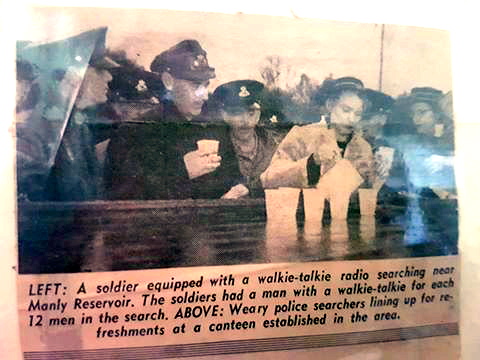
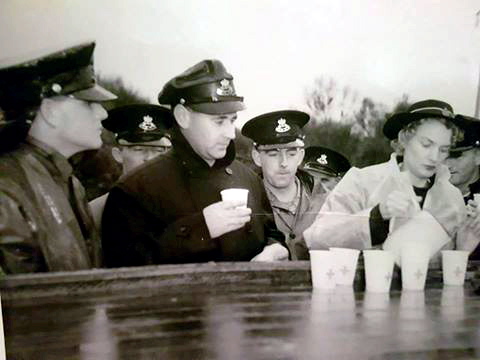
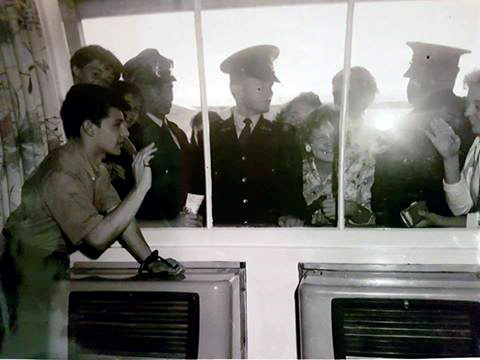
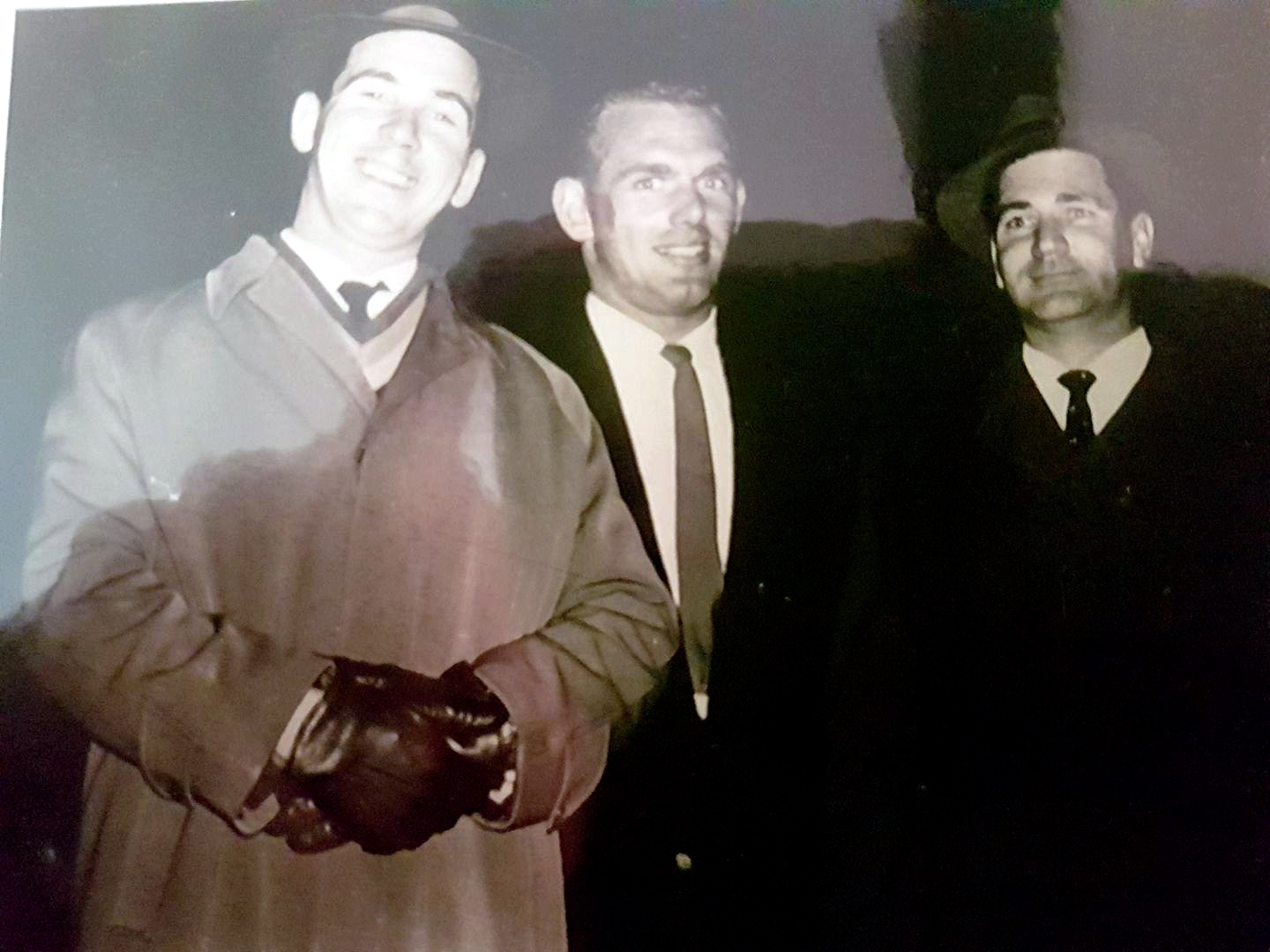
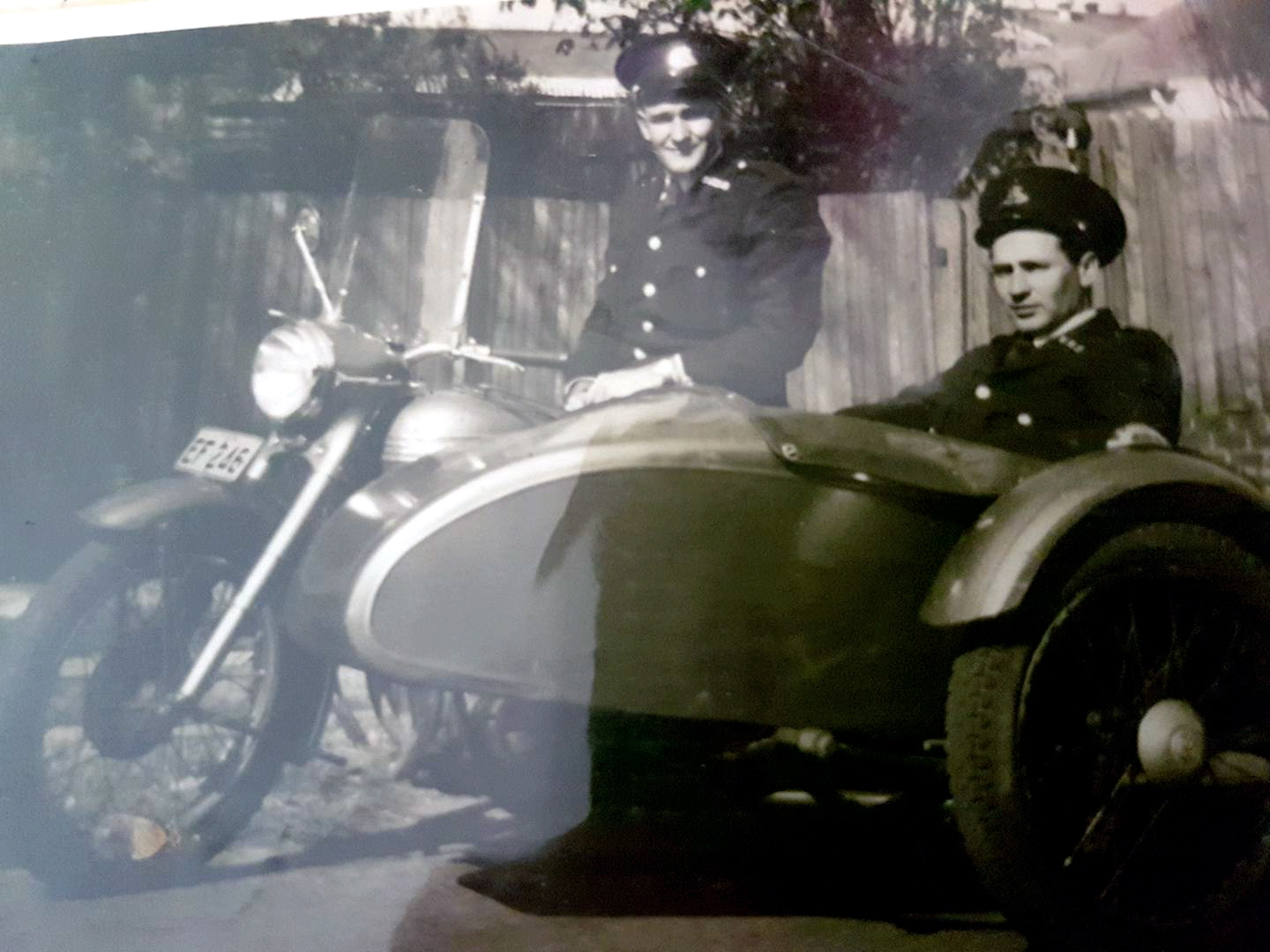
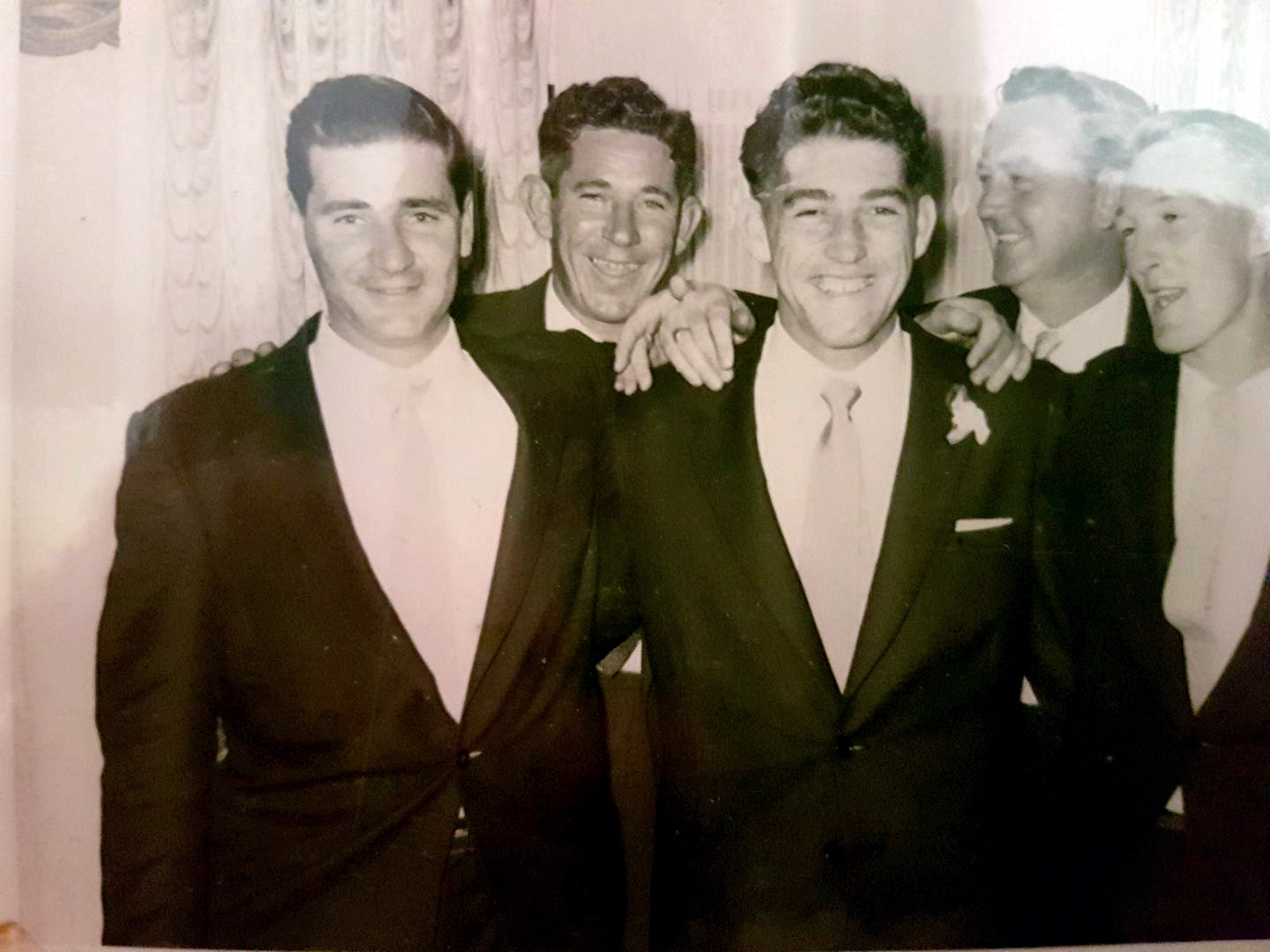
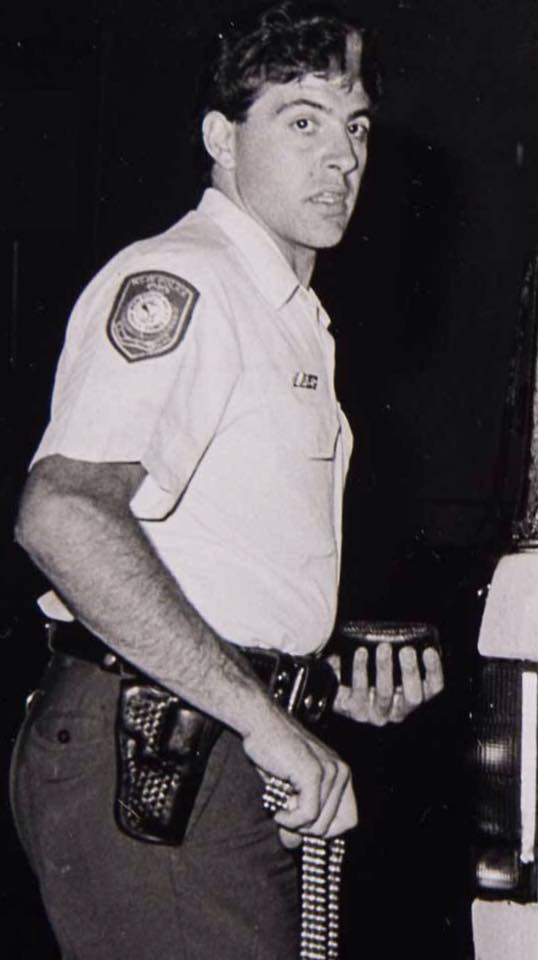
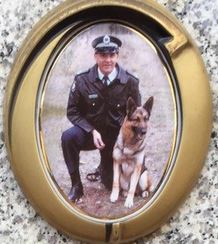
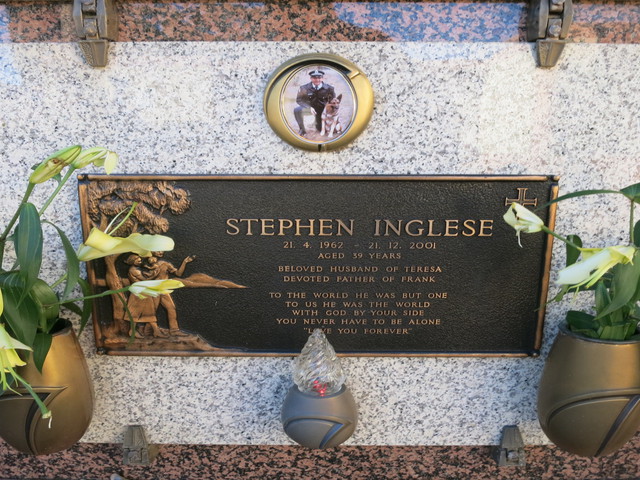
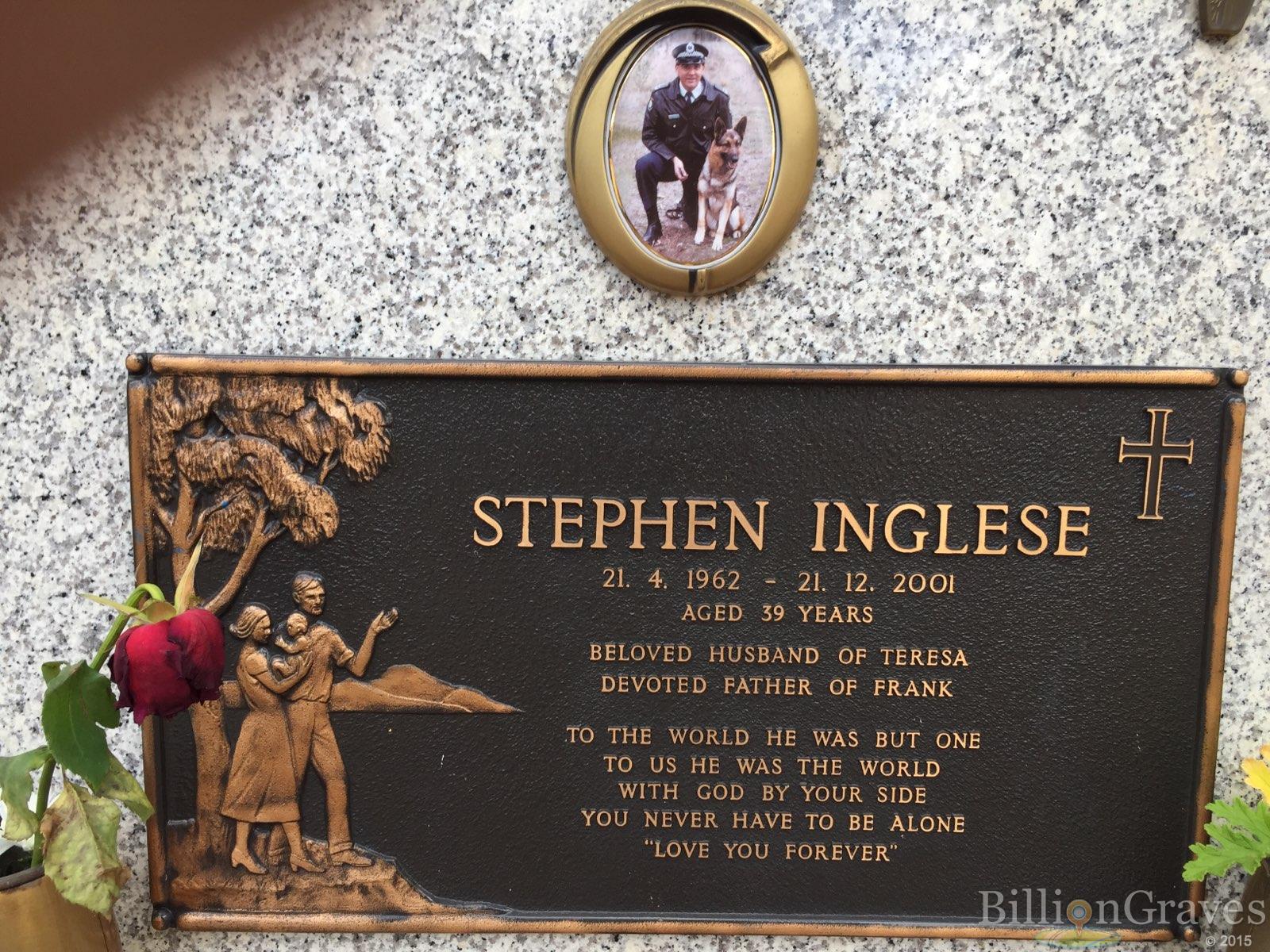
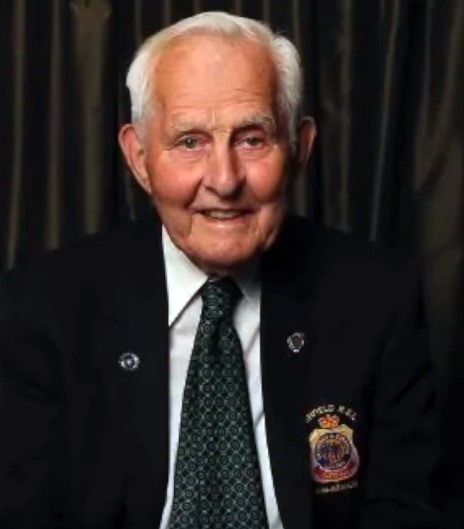
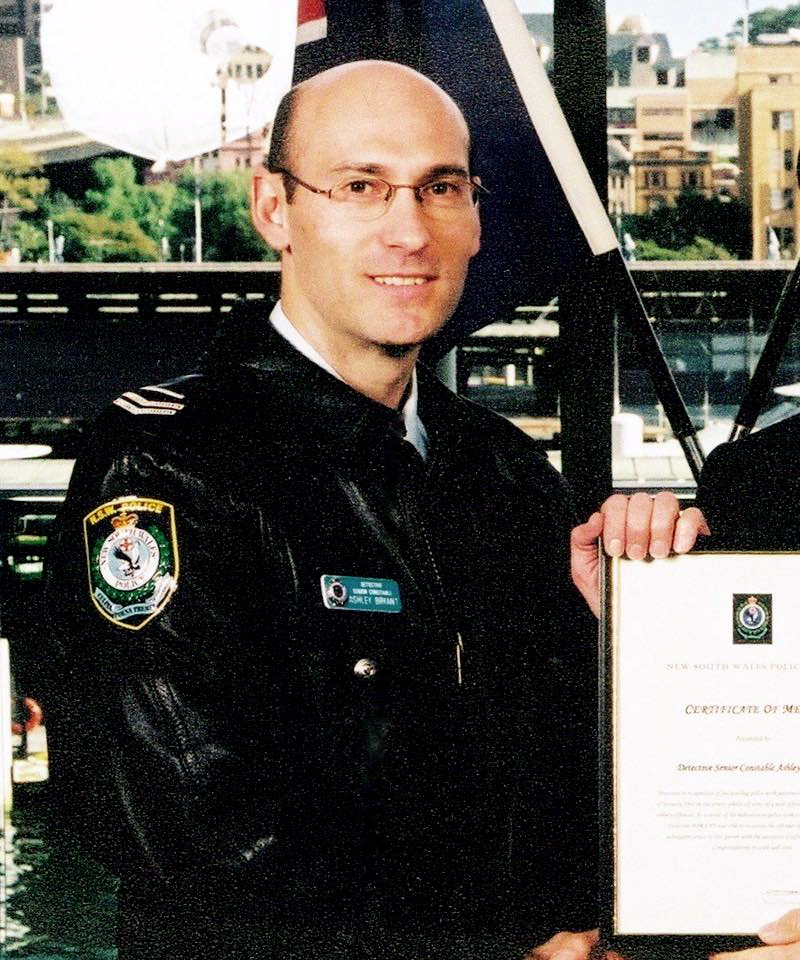
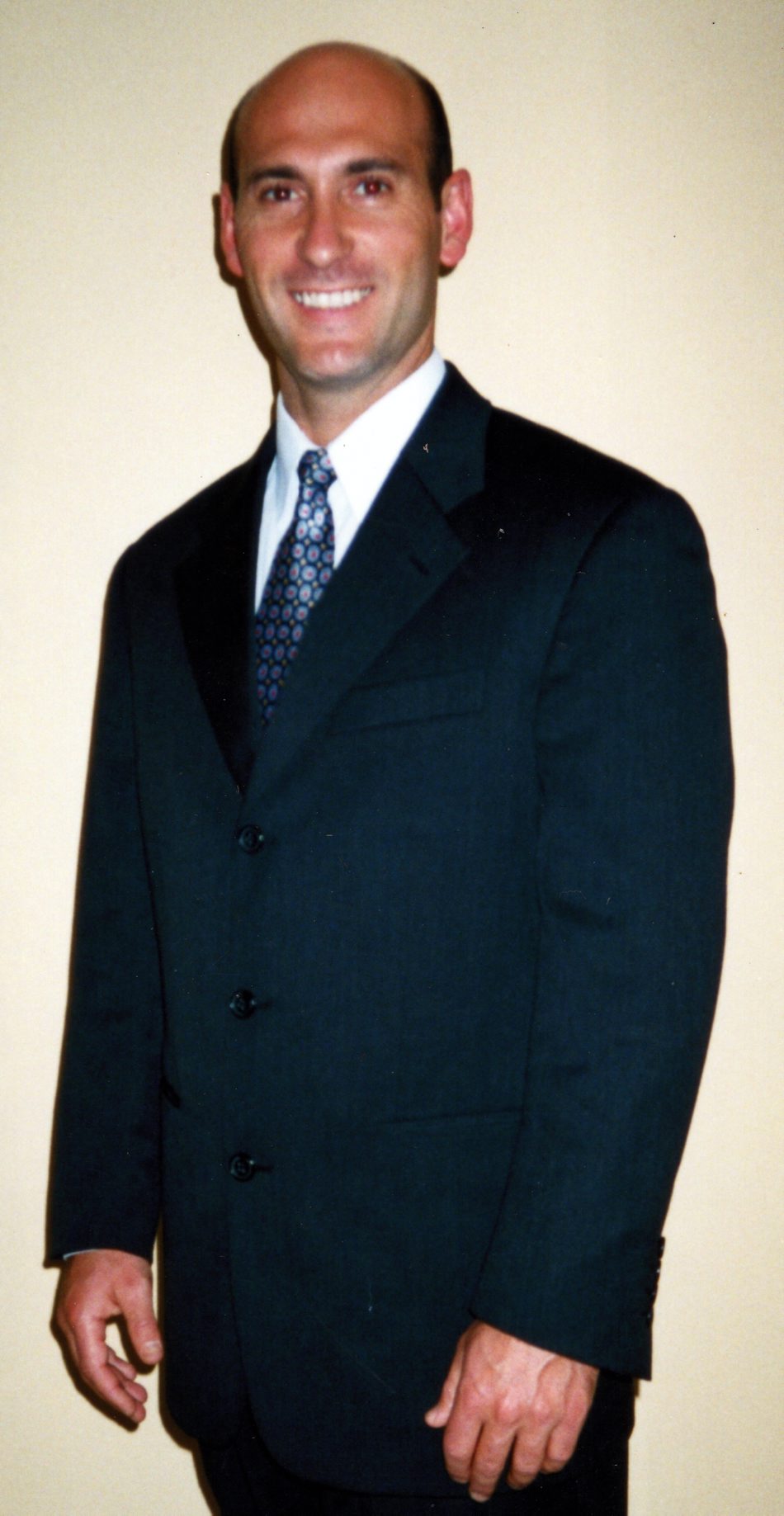
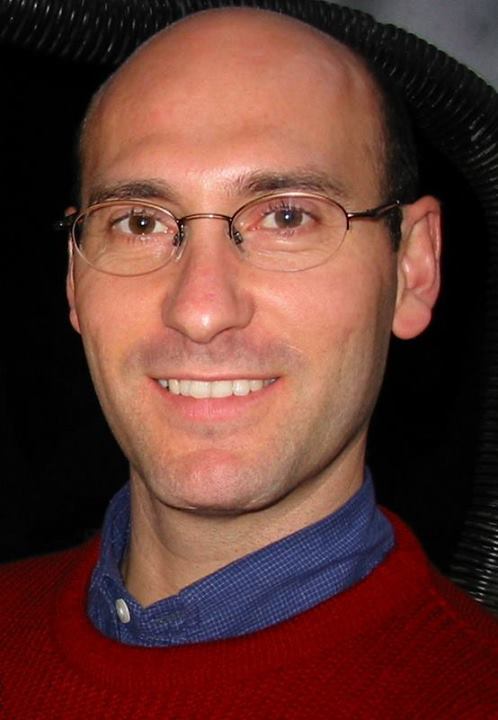
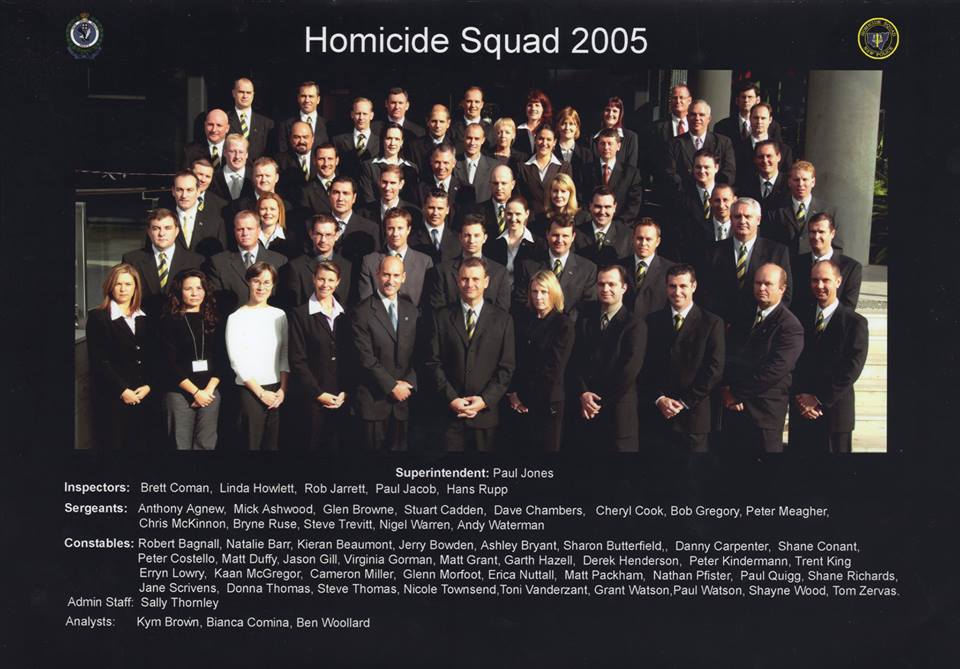
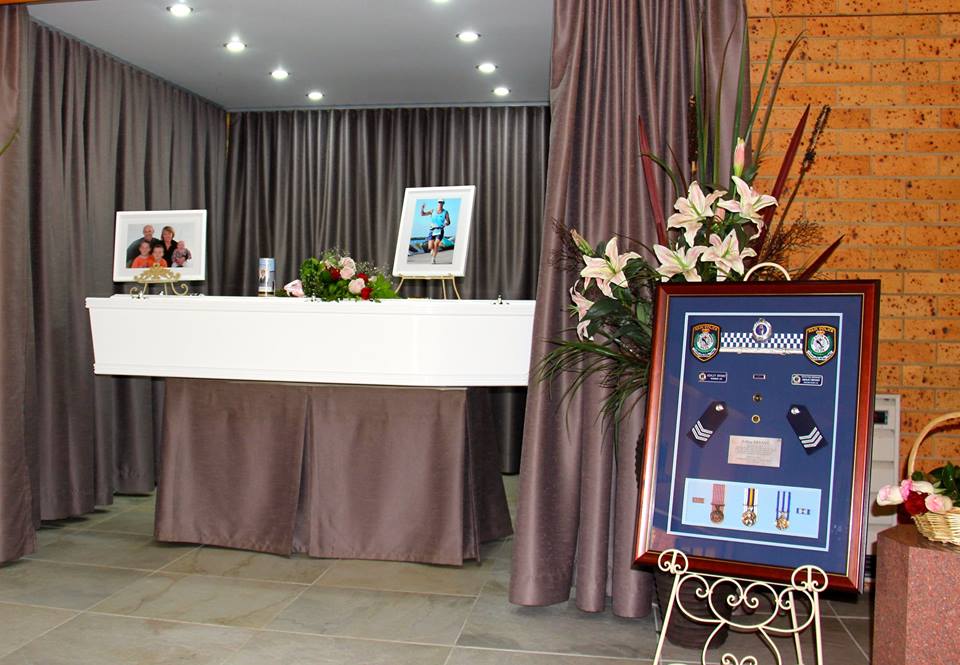

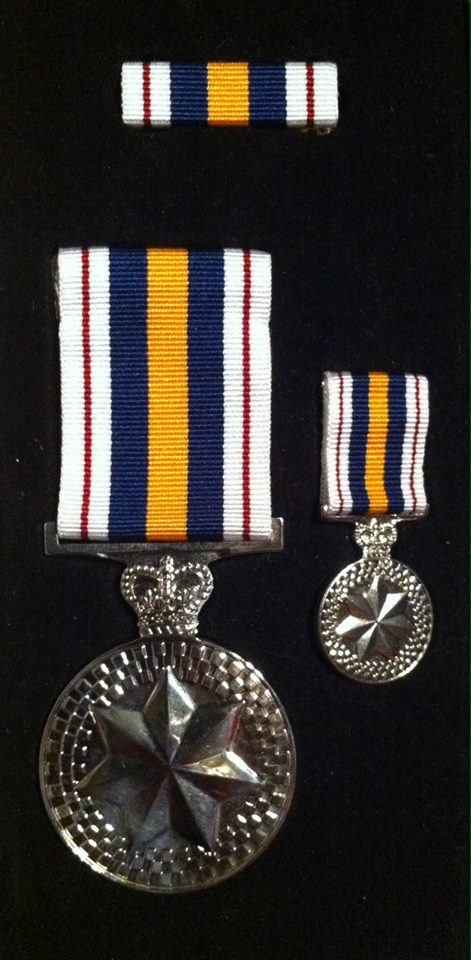
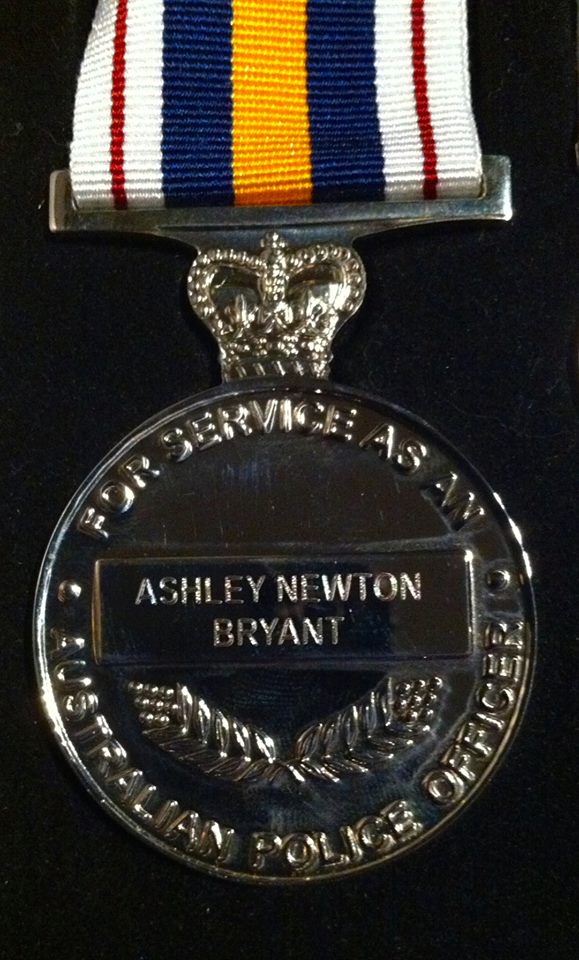
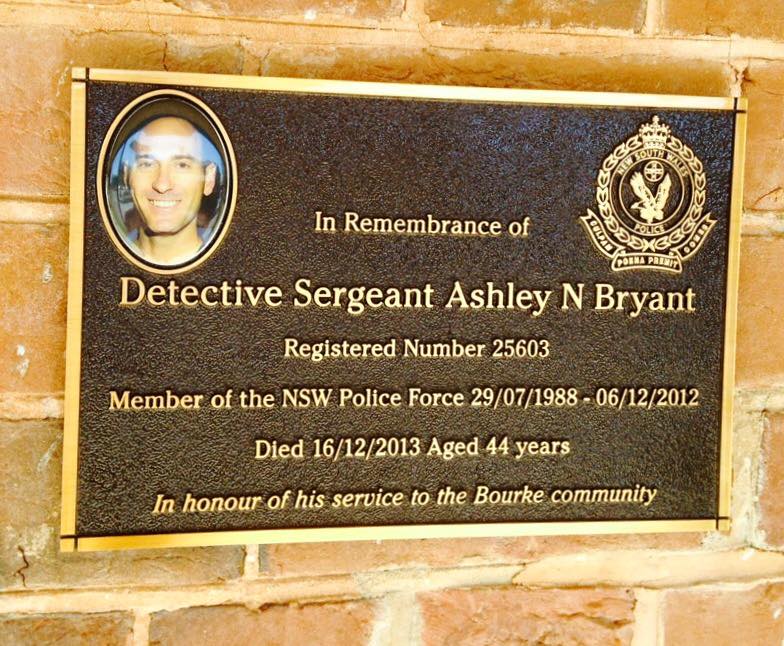
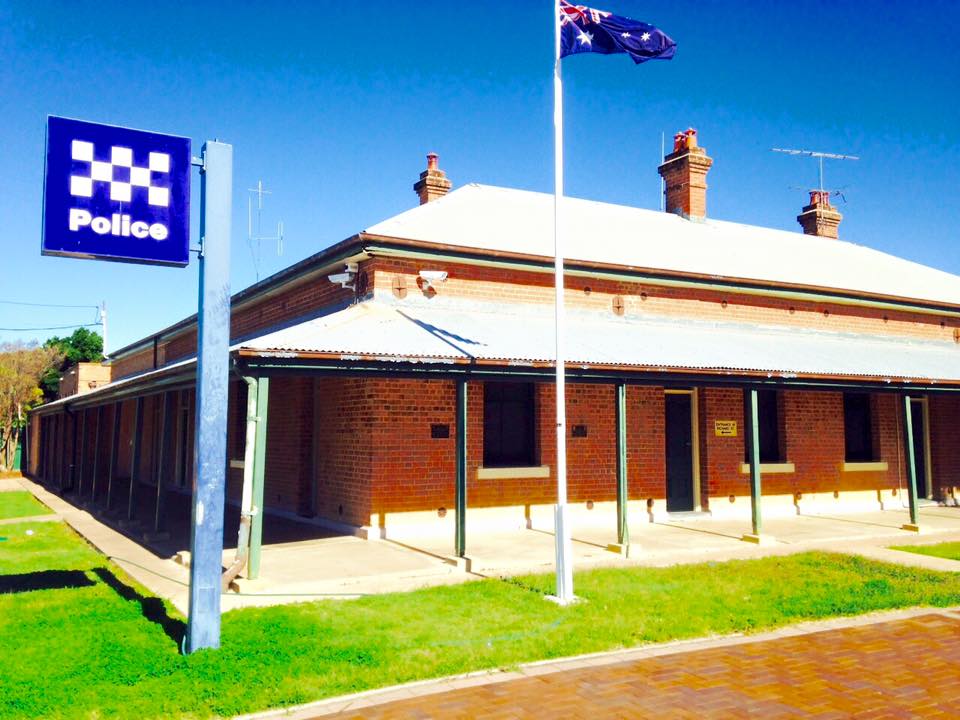


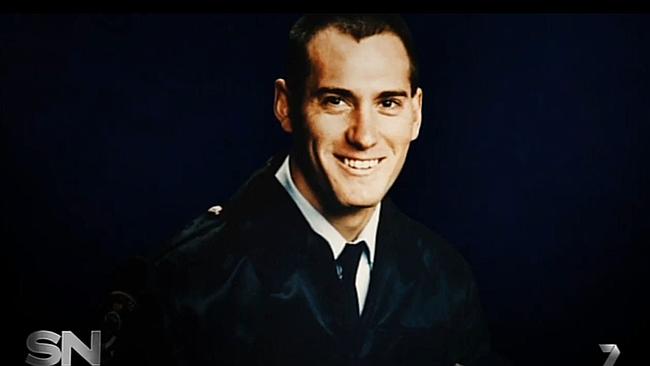
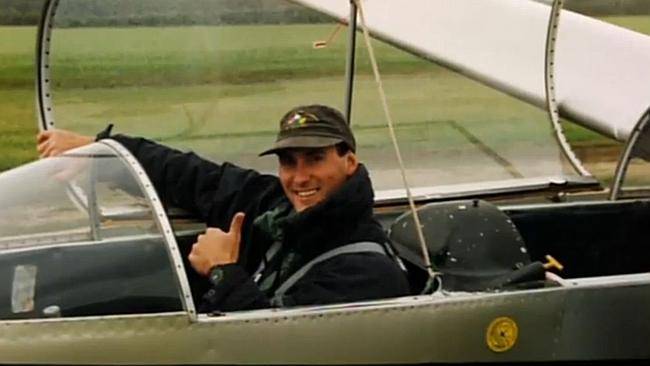
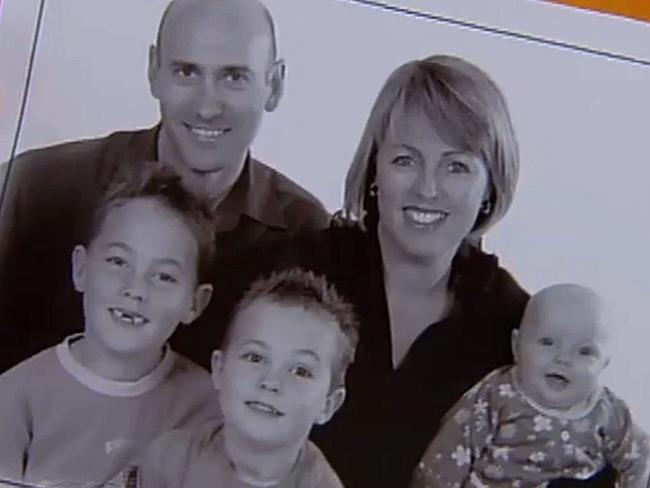
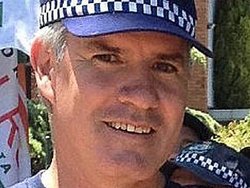

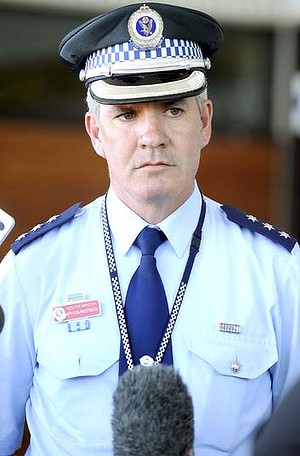
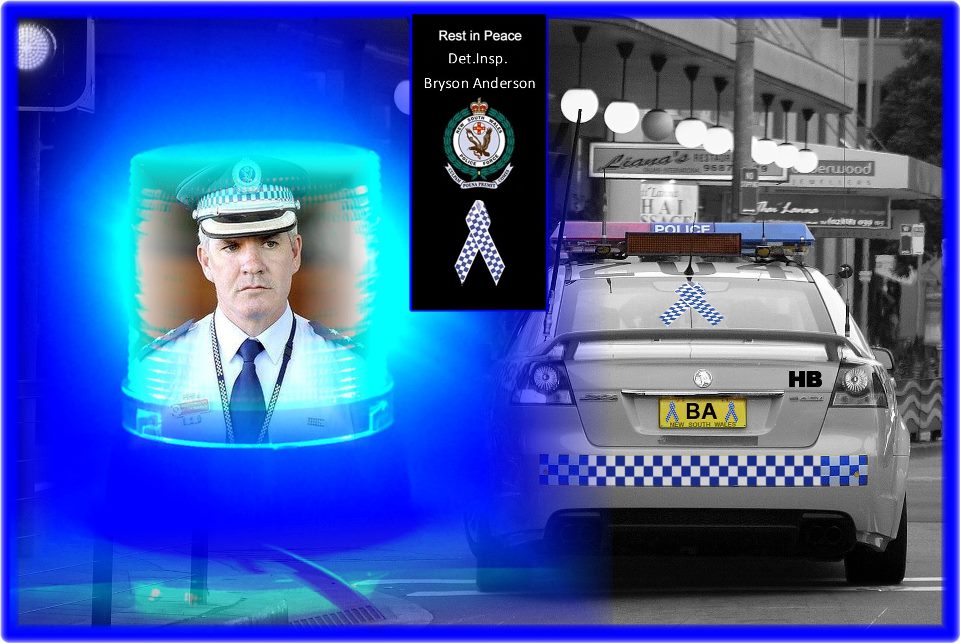
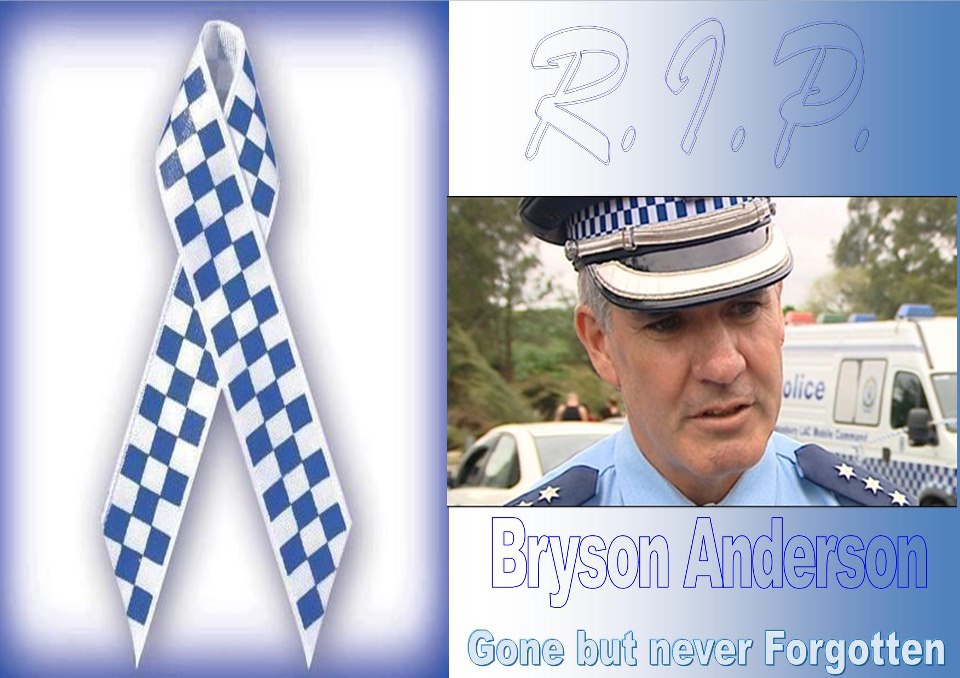
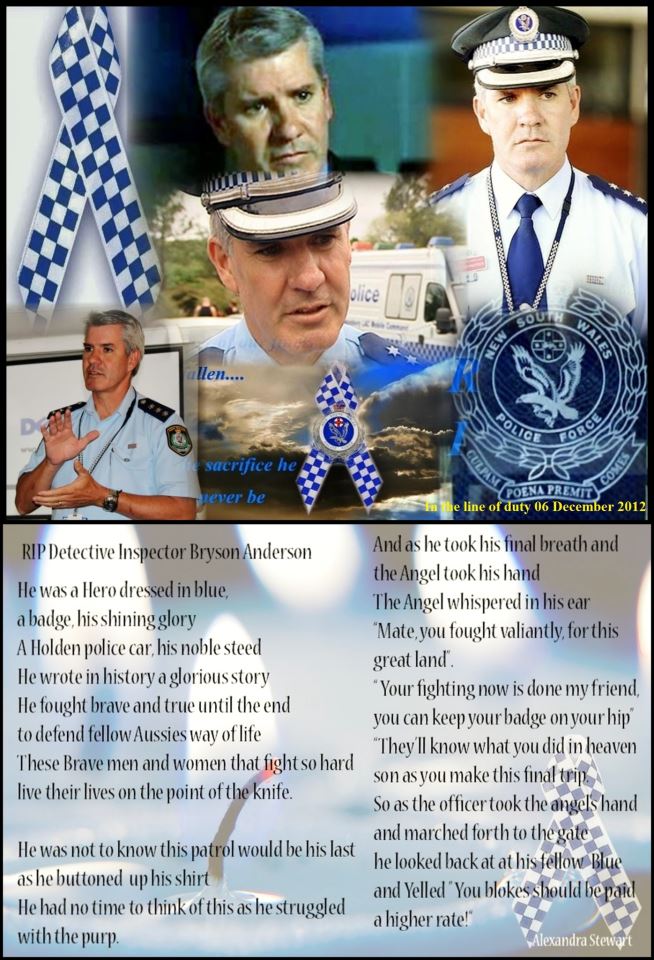
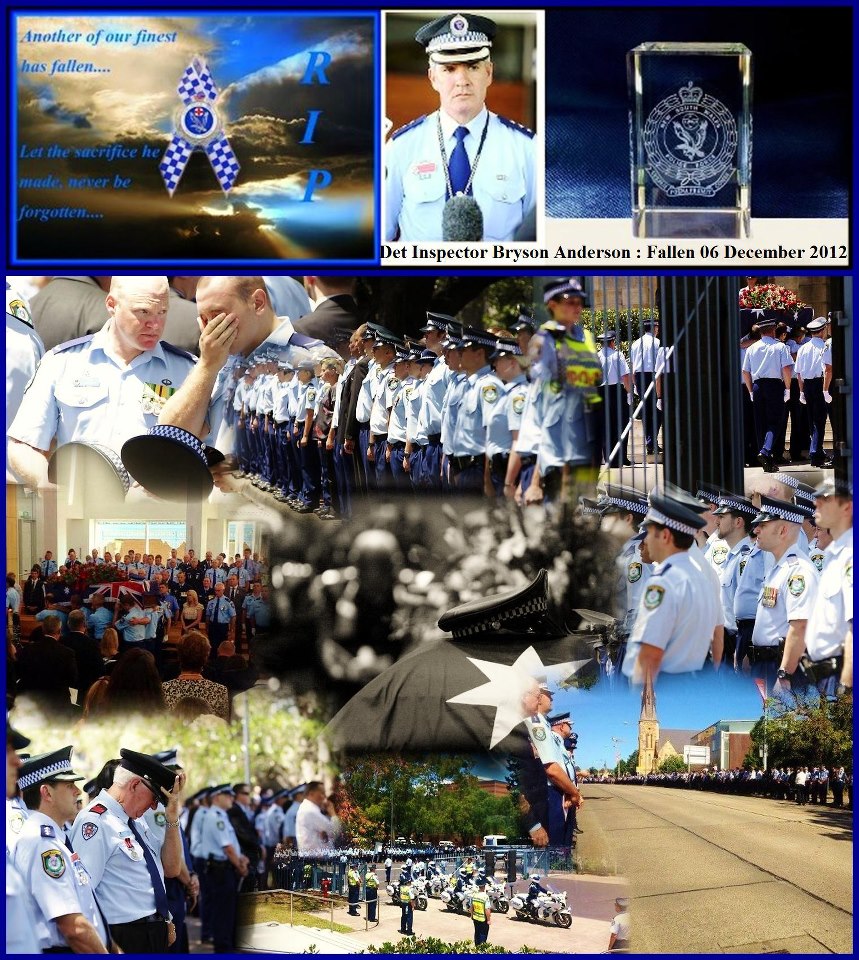
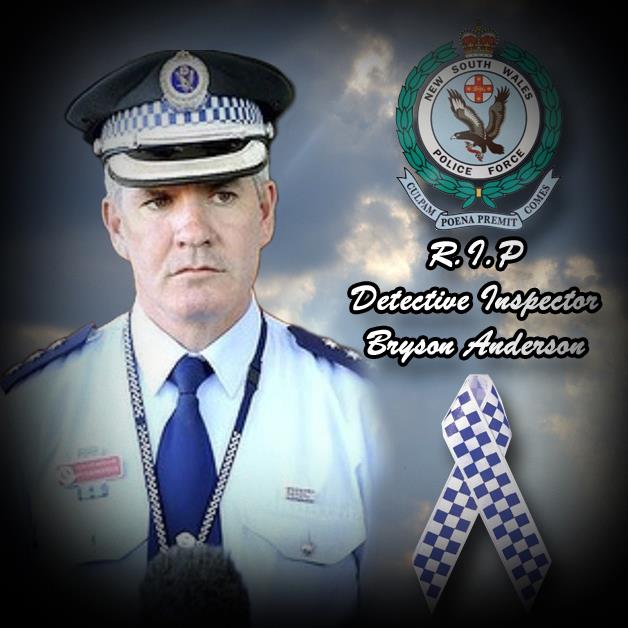
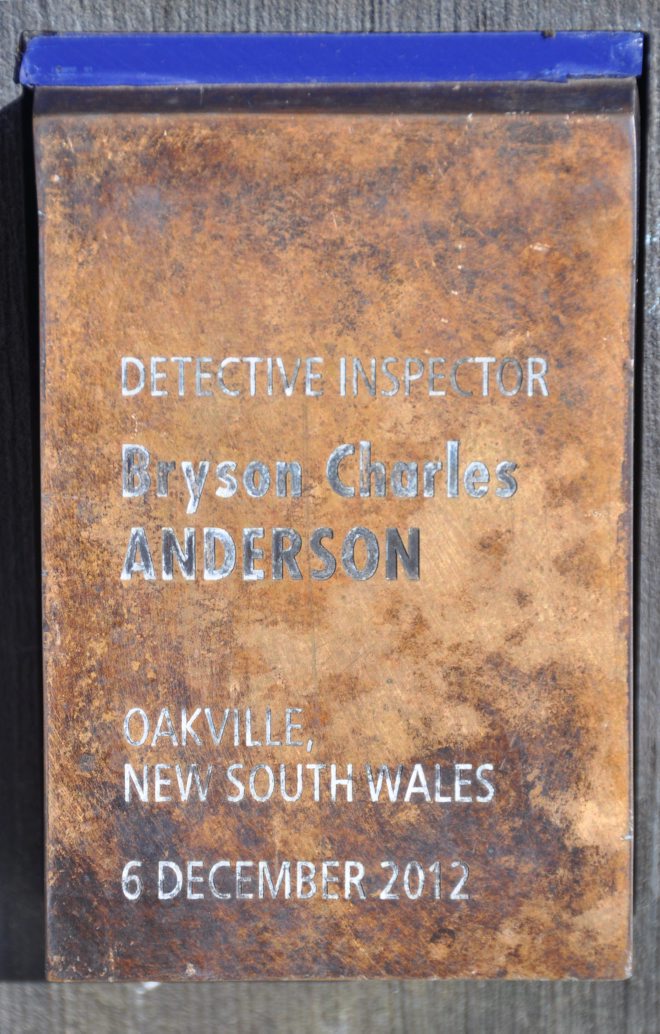
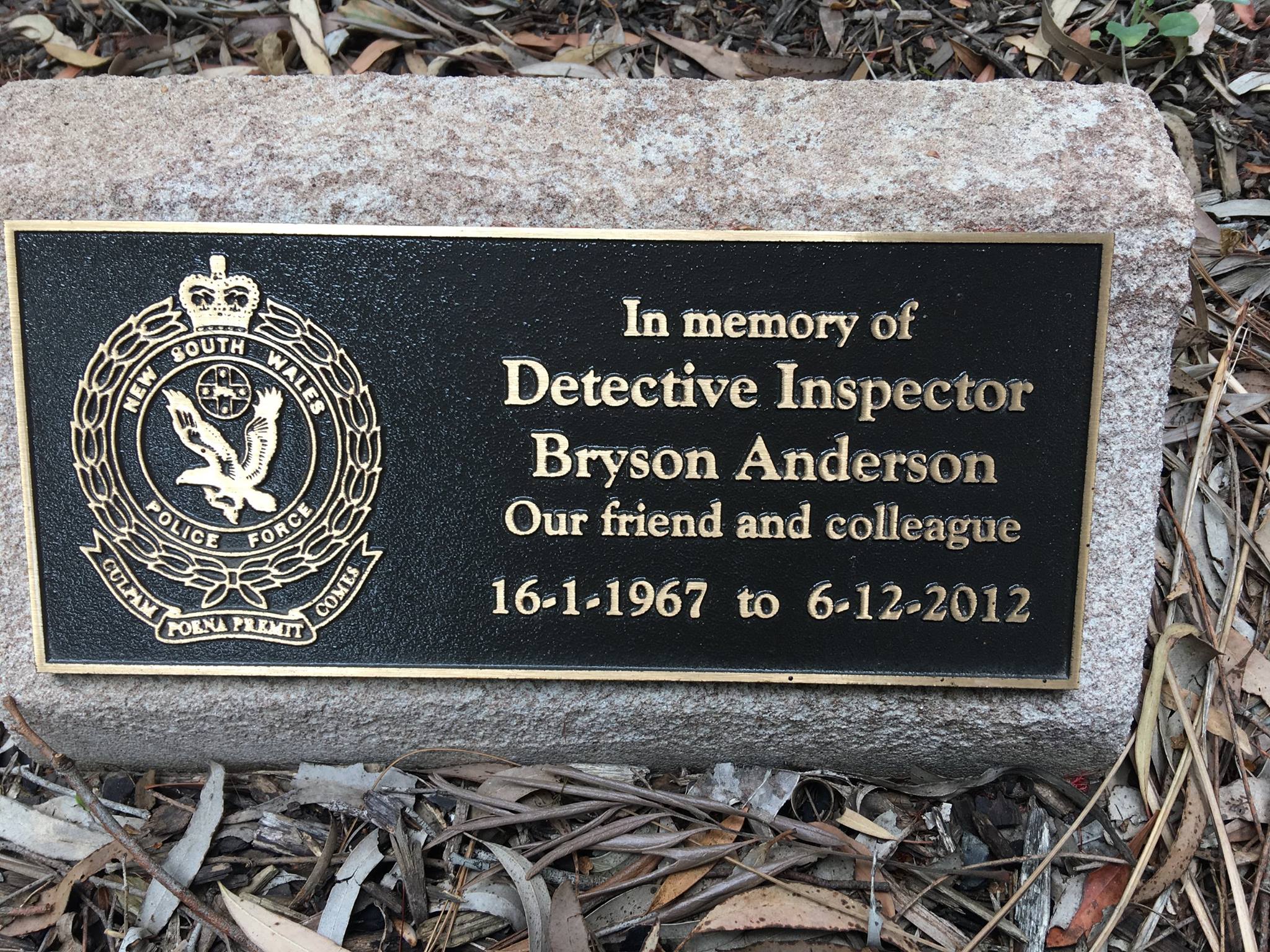
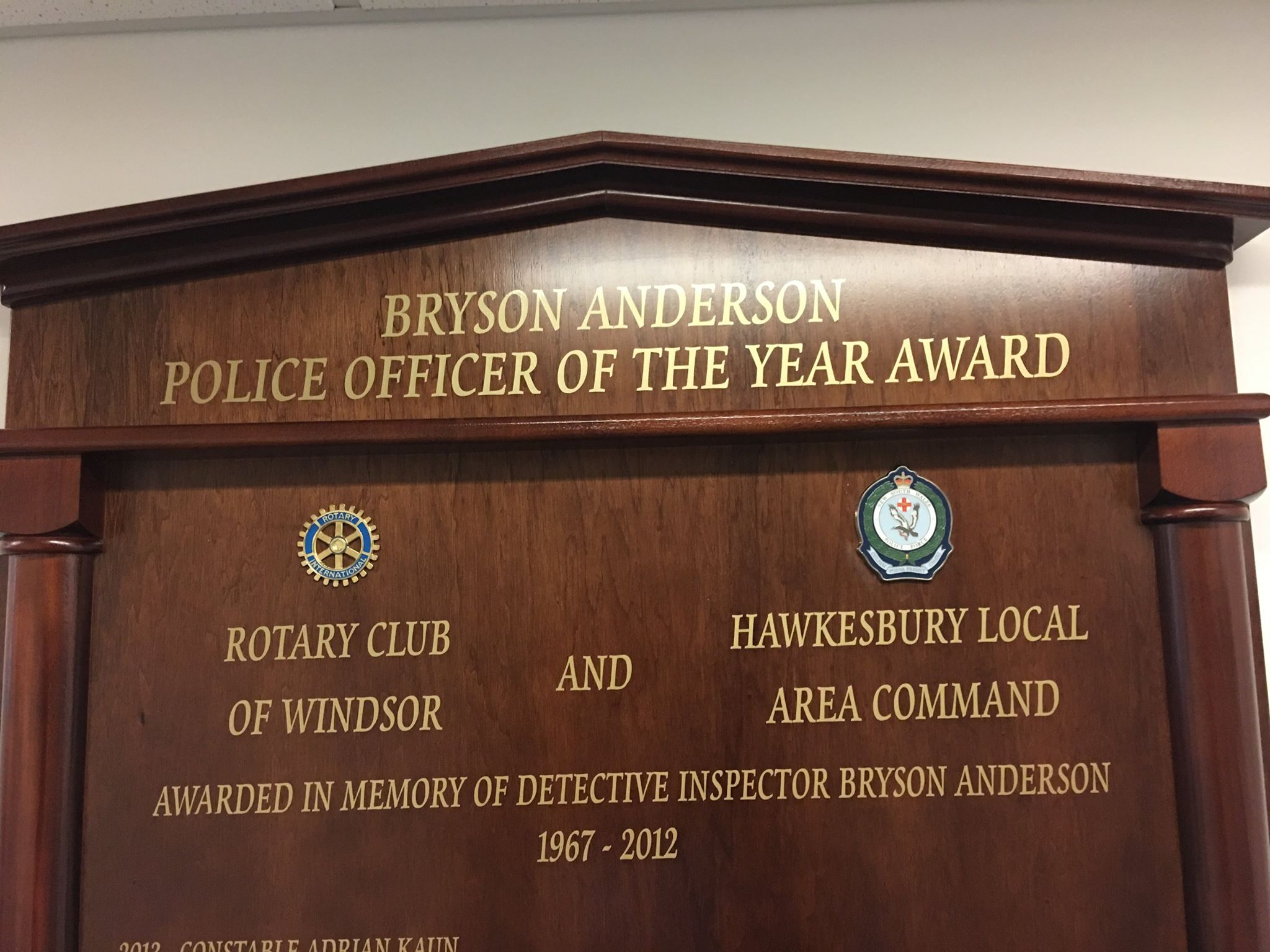
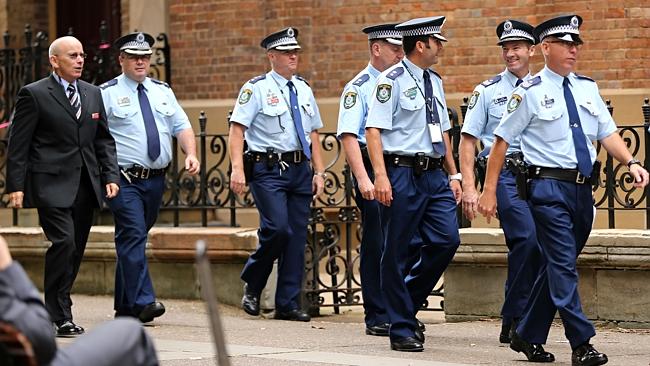
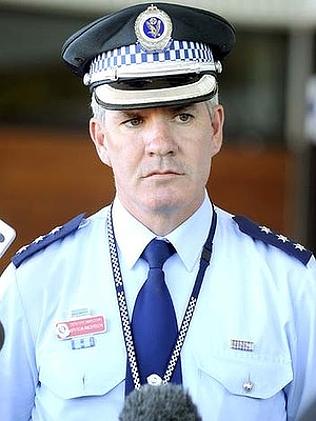
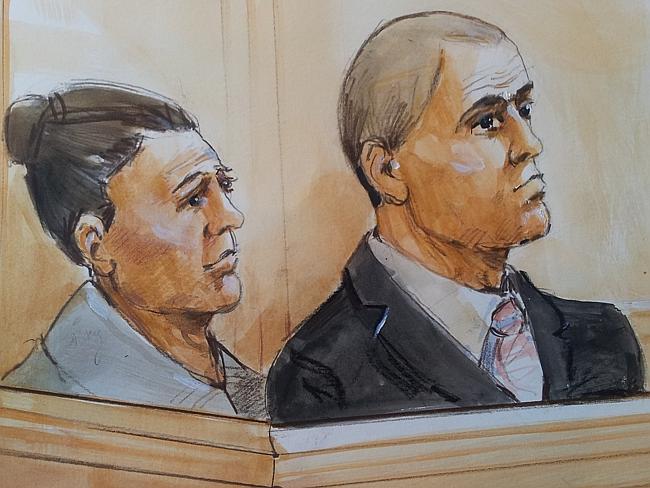
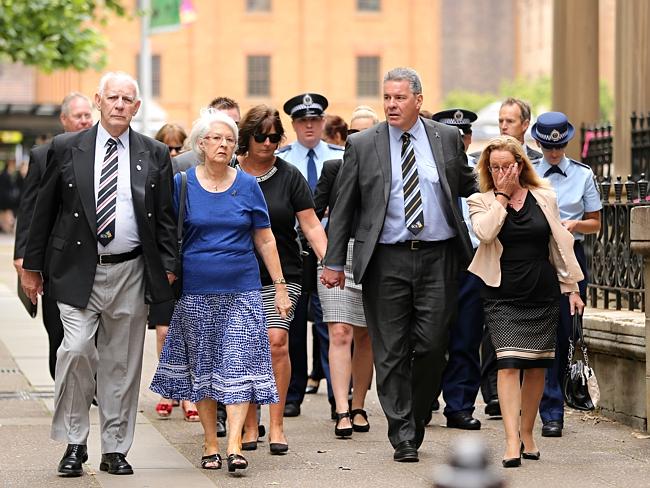
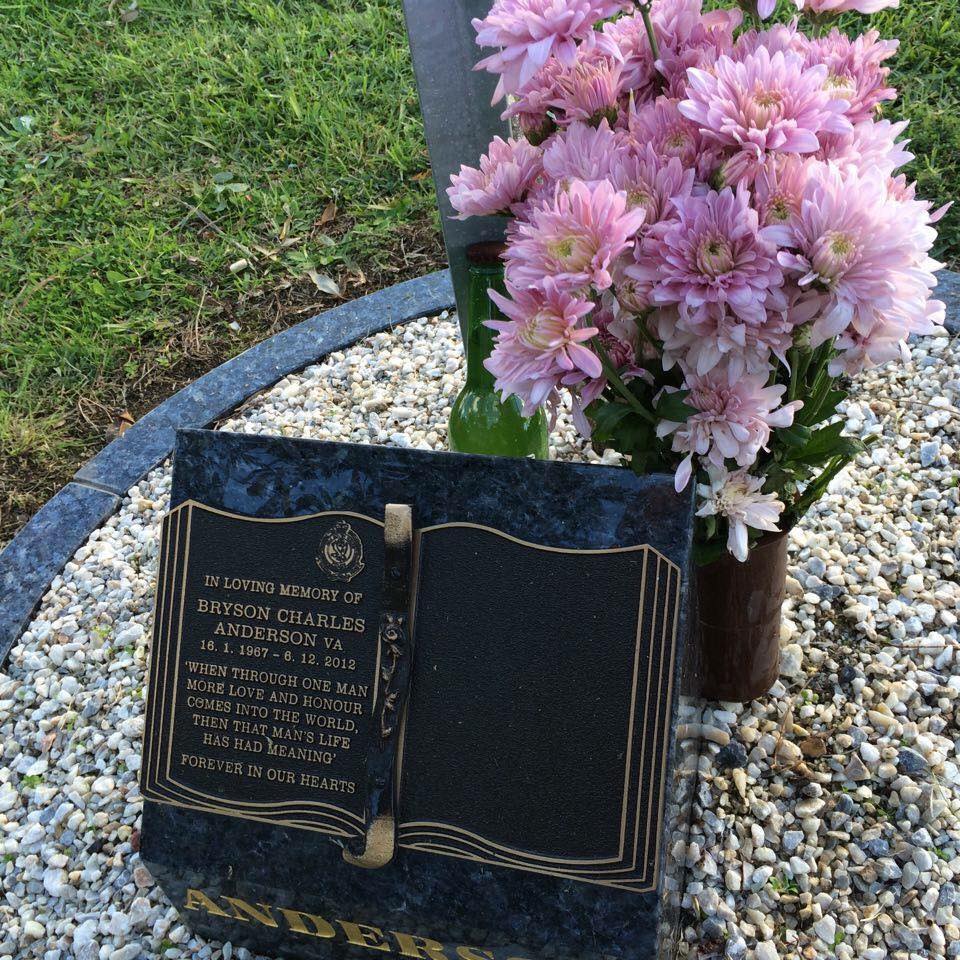


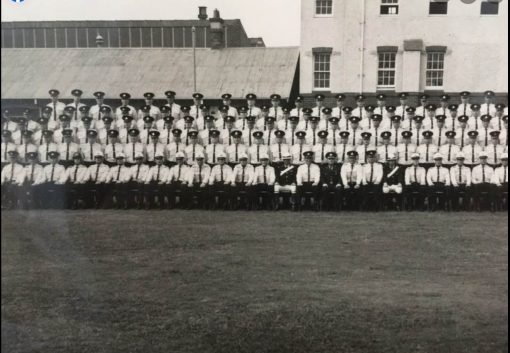


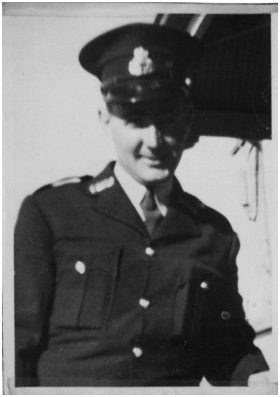
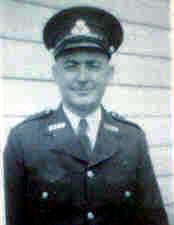
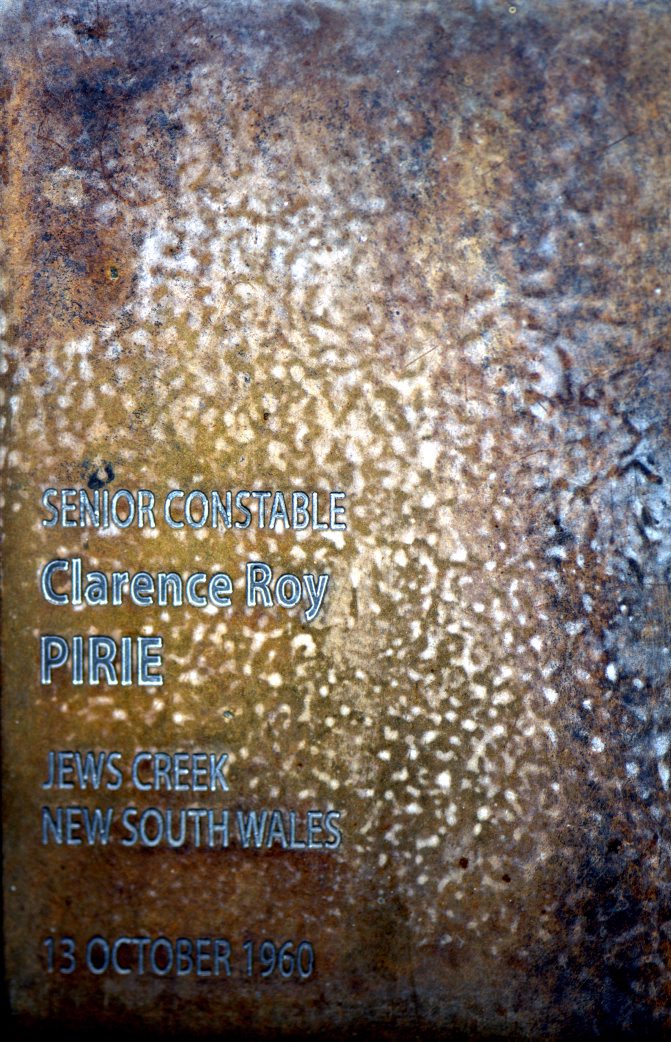
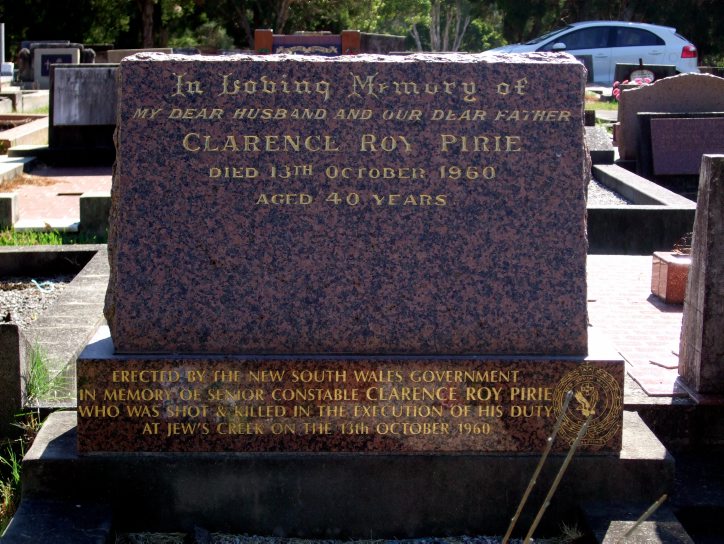
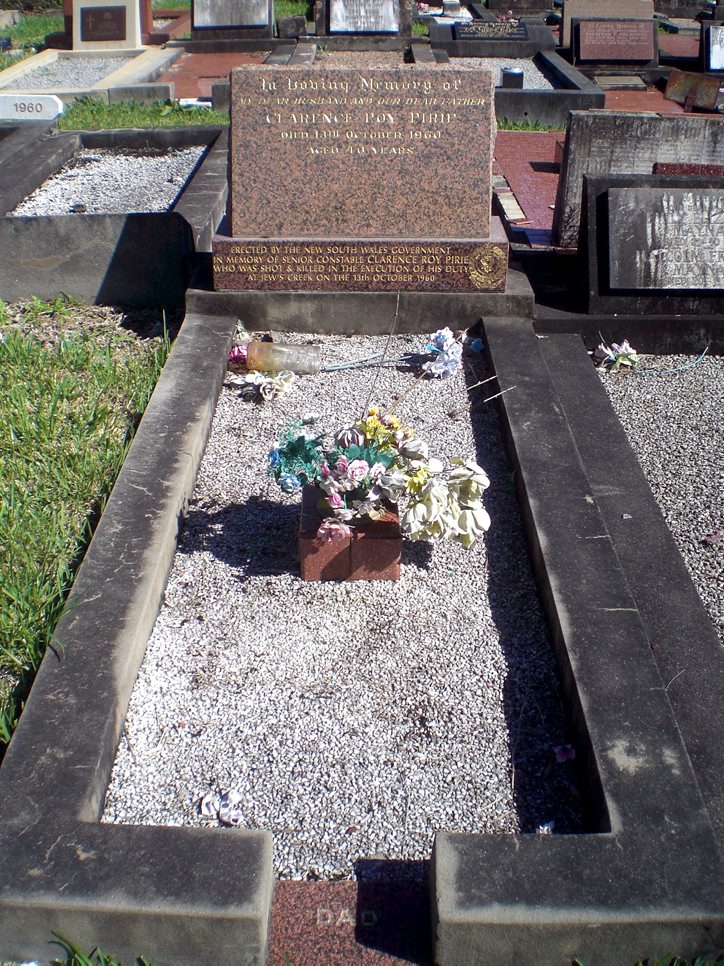
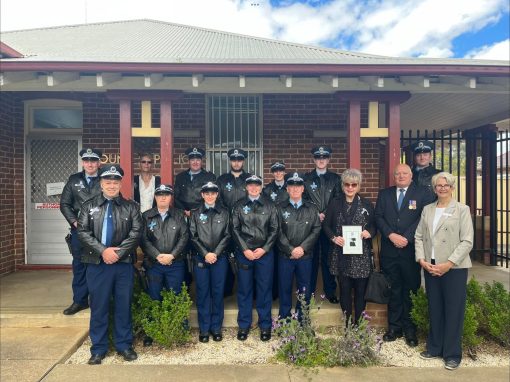
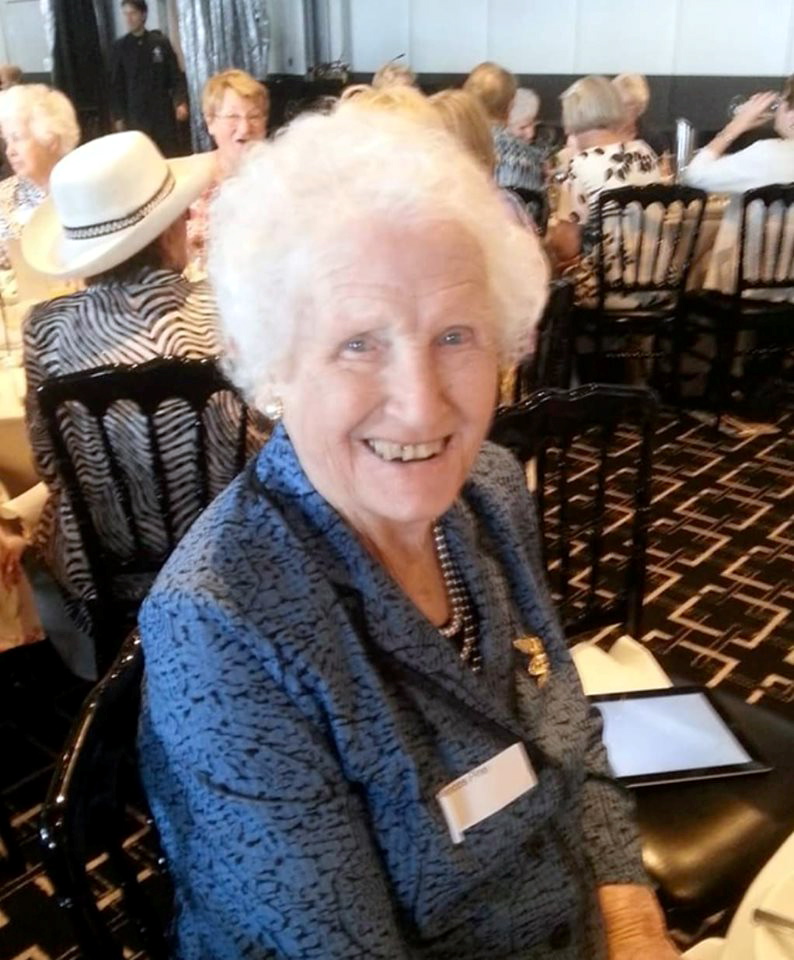
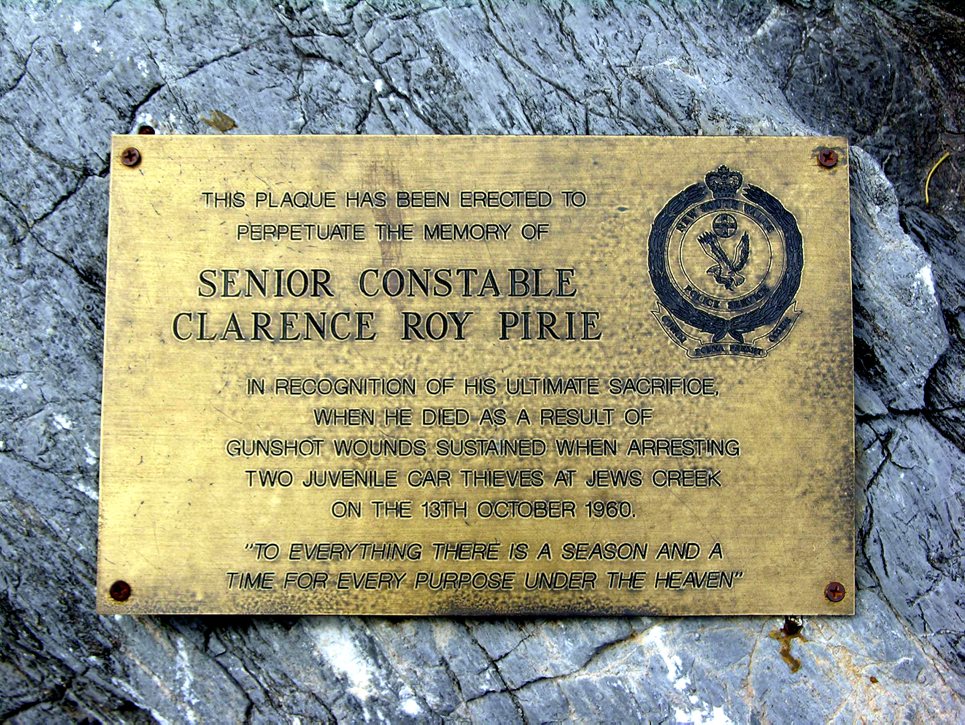
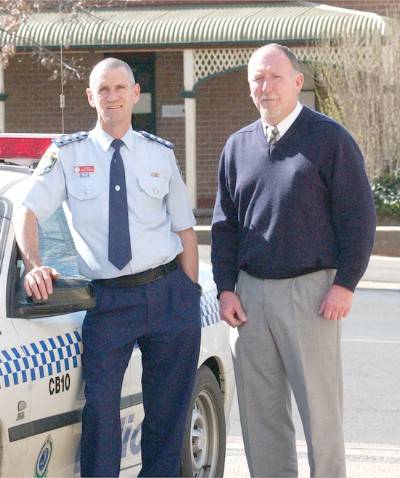
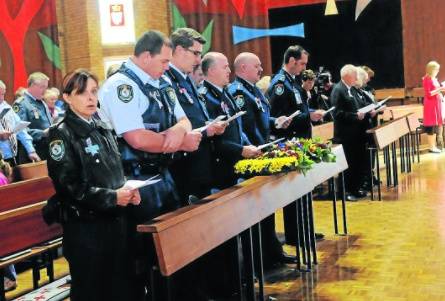
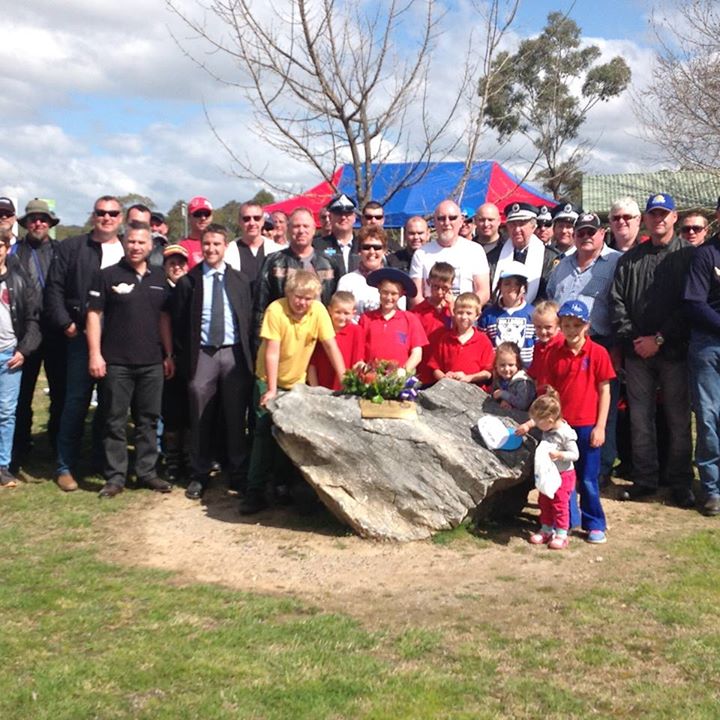
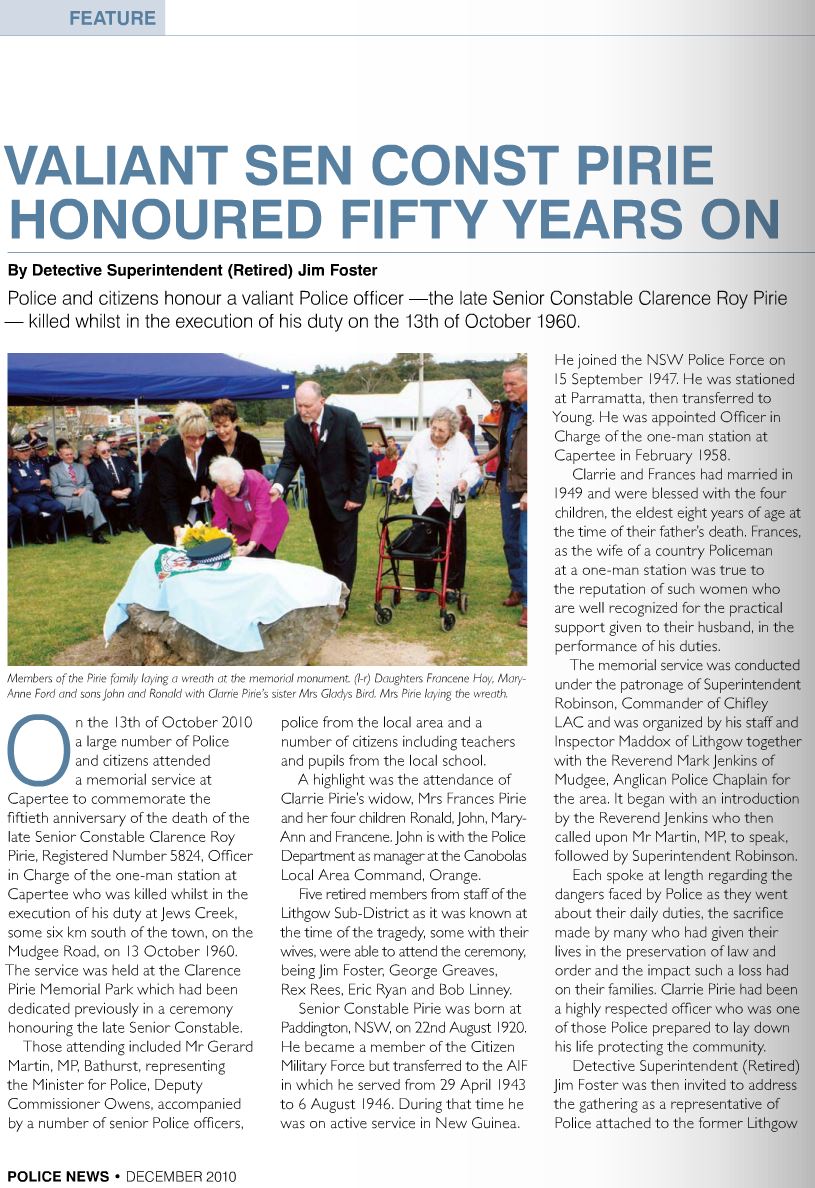
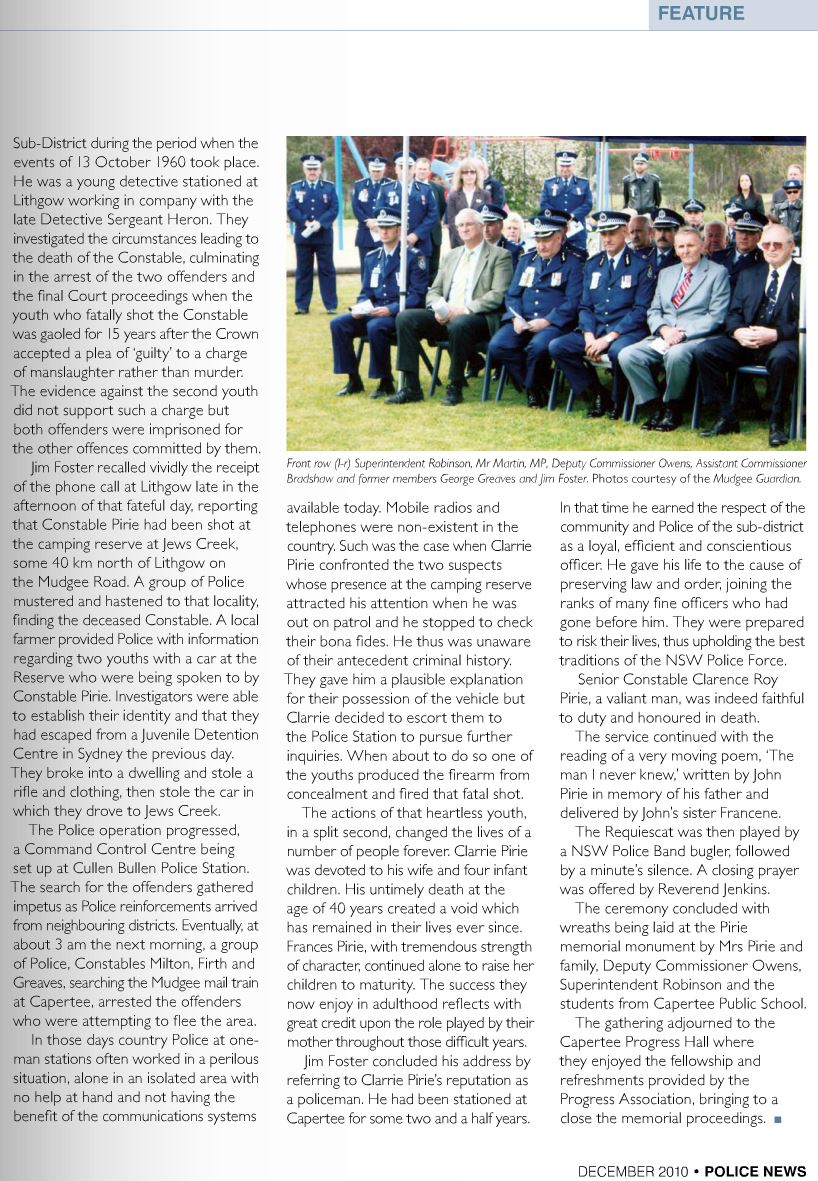
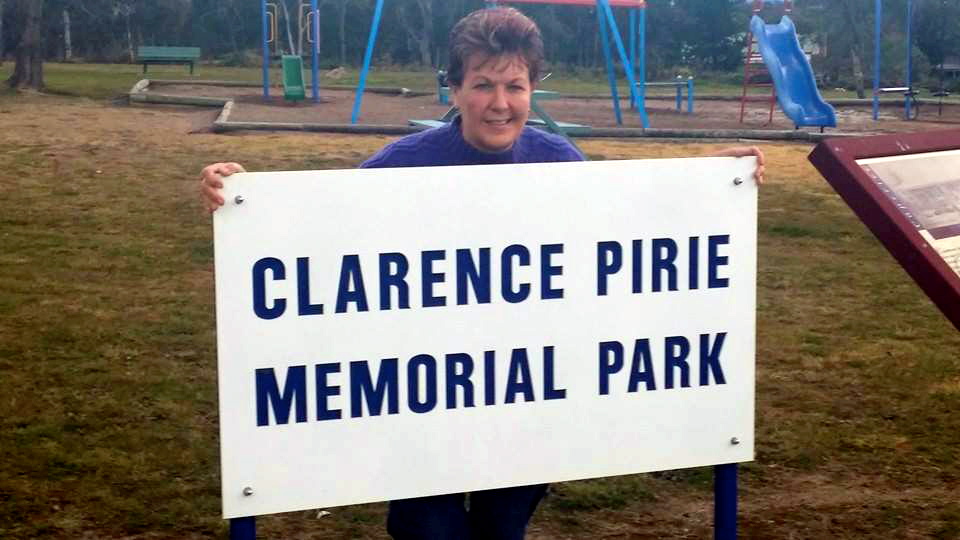
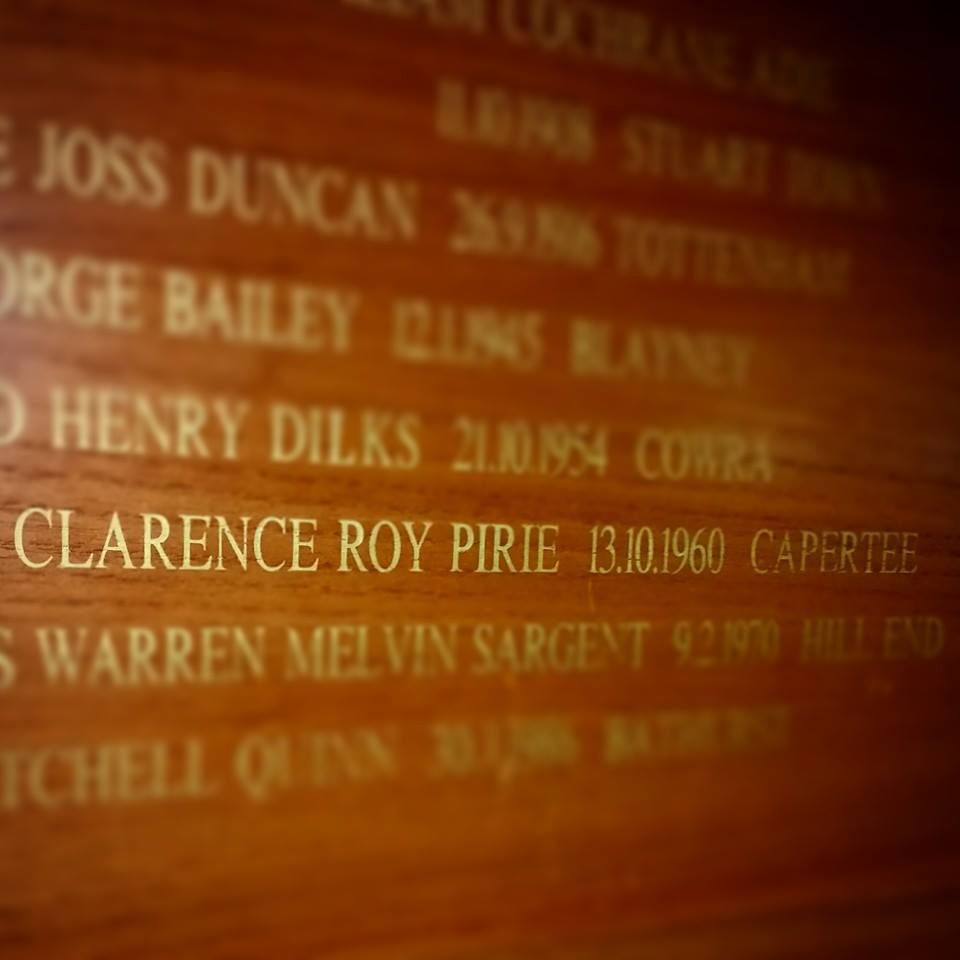
Comments (89)
Comments for this story are closed, but you can still have your say.
Serenity:
03 Mar 2014 10:05:24am
It’s typical of governments and the hierarchy of the services and their union leaders that they overlook what’s happening on the ground.
Having to do the dirty work of governments and seeing the horror of reality of crime on the streets, having to check for bodies in car wrecks and in domestic violence situations.
Union leaders, governments and bureaucrats live in a world divorced from the reality of life.
“deceased male” means nothing when a person knows the name and sees the family of a person that an officer is forced to shoot because the victim is drug-enraged or suffering mental problems (that have been exacerbated by the closing down of “mental hospitals” and the degradation of mental health units)
As someone who has looked at suicide as a solution myself, without seeing the trauma of daily life, I fully support anything that can be done to help these heroic men and women who protect us.
Alert moderator
Bev:
03 Mar 2014 3:14:06pm
In our society males have always been considered “disposable” when they are no longer useful or performing the tasks so necessary to keep things going.
Alert moderator
leigh of Tregevis:
03 Mar 2014 10:09:04am
Plus, a few decades ago, by my observations, at least most of the people respected the work of the men and women of the force. They were seen to be relatively low-key, helping keep the community safe from criminal activities.
Now they don’t have that respect, being seen to be working for the State rather than the people, as surveillance and infringement taxes and random stopping and restriction of movement increase. Another contributor to the stress of many officers?
Sadly, there are also many people who still have their blinkers on, and believe the claim that this is all done for our own good.
Alert moderator
Early Grayce:
03 Mar 2014 12:19:35pm
The police have always been a political tool rather than a group working for the people. It seemed to you that they got worse a few decades ago because we only realise how bad he police are as an organisation as get older.
A few decades ago we were automatically gaoling people for low level drink driving and we were also doing the same to people who attempted to commit suicide. Being treated as a criminal is just the thing that a suicidal person needs to make them more determined than ever to succeed in their suicide bid.
Alert moderator
Bev:
03 Mar 2014 3:10:37pm
Still goes. Threating suicide is considered an act of domestic violence. So you will be arrested held while a temporary order is obtained. If you breach you will probable be locked up. No mental health intervention is available under these conditions. Would be easier to hand the man a rope. The law is written gender neutral however it seems it is only applied to men.
Alert moderator
EarlyGrayce:
04 Mar 2014 3:05:10pm
I thought I might clarify that I did say attempt suicide, not threaten suicide.
Alert moderator
Applaudanum:
03 Mar 2014 5:46:53pm
That’s a perceptive comment, Leigh. There’s a lot more ‘questioning’ of authority now. At least, it seems that way. But I don’t think this is a direct cause of the boys and girls in blue. Rather, it has more to do with a peculiar societal need to keep on pushing the boundaries of what’s currently permissible. It’s as though ‘obeying the law’ is just not enough anymore. Who keeps turning up as the nay-sayer in this scenario, those people in blue uniforms, again and again.
Alert moderator
jimbo:
04 Mar 2014 10:02:21am
I live in WA, we do not have police officers, we only have tax collectors, thats all they are there for. bang thg the motorist.
Alert moderator
Skeptic:
04 Mar 2014 11:54:43am
Yes Jimob and if you do your best to drive properly (don’t speed or drink drive) then you won’t be paying those extra taxes, eh? If you haven’t got it by now that these are taxes for stupidity then I feel really sorry for you.
Alert moderator
Tom1:
03 Mar 2014 10:38:53am
This article indicates that mental health issues, no matter where they occur do not have the full understanding and sympathy of the general community they should have.
Most, undoubtedly, all, police forces have occupational health and welfare units,staffed with full time psychologists. Officers are generally advised, or in fact ordered to seek counselling following traumatic incidents. This is well known, and the problem does not lie there.
The problem is obviously with those officers that do not respond to early treatment, or continue in a position where traumatic incidents are the norm, and their condition worsens.
No two officers react the same to any given situation, and some may be entirely non affected by situations that cause others stress.
Unaffected officers, and probably even the Department could easily get hard nosed, and accuse the affected person of malingering, or not being up to the job.
Most police services had a fairly extensive list if officers on permanent stress leave. Suicide is probably the tragic end result of an officers position of not being taken seriously.
What to do about this is the question, and probably, as the author suggests, ending the silence is a start.
Alert moderator
Rattus rattus:
03 Mar 2014 10:53:48am
Something has changed in the Police culture. I’m not sure what it is, but it isn’t nice.
Recently I was assaulted by a total stranger. The ambulance arrived before the police did, although the police station is only a 6 minute walk from where the incident occurred. Next day I attended the police station to give a statement. There was a total lack of empathy from the police involved.
I didn’t expect them to make me a cup of tea and hold my hand, but the process of taking the statement was just that, a process. The officer involved was an automaton operating a computer terminal on a very impersonal level.
I’ve noticed the same reaction whenever I’ve gone to the station to report stolen vehicles parked in my street. There is an invisible wall between me and the person on the other side of the glass barrier. They don’t seem to have time to smile or be human. It’s just “name, date of birth, etc” as they fiddle with the computer terminal. Not even a “thank you” at the end of it.
Whatever the police are learning at the academy is putting them further and further away from the society they serve. Consequently when they themselves need help society can’t or won’t respond.
Alert moderator
Peter of Melbourne:
03 Mar 2014 11:21:54am
I know exactly where you are coming from. Not long ago a drunk totalled his car into a parked car in our suburban street. It took numerous (3 by myself and then the other neighbours) phone calls to 000 to get the police to investigate, during the 70 or so minutes it took for a unit to arrive the drunk had walked off to whereever his house was and returned with other people. He wanted to try and drive his car even though its front axle was totalled.
Lets repeat the pertinent point though – 60min to 70min response time with the local neighbourhood directing traffic around the wrecks and attempting to stop the fool from driving again.
A few weeks later I was rammed by an absoultely moron who was making a left hand turn from the right hand land (3 lane roadway) and then I get the excuse he cant pay for the damage because he is an International student. After calling 000 again OUR police force was too busy to attend an accident clearly caused by reckless driving and said let the insurance company sort it out. Guess shutting down those speed cameras booking people a day’s pay for travelling a few clicks over the posted speed whilst in a controlled manner would cost their political overlords a nice fat lunch.
I have zero respect for todays revenue raisers or their political masters.
Alert moderator
PW:
03 Mar 2014 12:05:21pm
Unless someone is injured or a vehicle is unable to be moved, Police don’t routinely attend minor accidents. You have the guy’s details, or at the very least the registration number of the car he is driving, take some pictures with your phone and call your insurance company.
The trend these days is for enforcement of traffic laws to be carried out by civilians. Expect to see more of these RMS operated speed camera vehicles and less police on the roads.
Alert moderator
awake:
03 Mar 2014 2:06:11pm
Wouldn’t you rather have the Police take their time with anincident similar to what you have reported rather then give up chasing a drug dealer or child molester?
Alert moderator
Rattus rattus:
03 Mar 2014 4:45:10pm
Firstly I could have died following the assault. Calling the police is usually a waste of time. All I’ve ever got from them is excuses and a little card with a reference number on it to give to my insurance company.
Secondly, the person who assaulted me was a drug dealer. If the police had walked from the police station (6 minutes) they would have been able to arrest him, but as usual, the ambulance beat them to the scene of the crime by at least an hour.
Alert moderator
Tom1:
03 Mar 2014 3:13:53pm
P of M. There are innumerable bikies, criminals, and other low life elements that resent police too. However that is hardly the point.
Your particular gripe seems to be at the government. The police no longer set up speeding cameras, nor attend them, any intelligent correspondent would know that.
Are you prepared to pay for what is necessary to get immediate police attention for all of your own personal life dramas?
Alert moderator
Rattus rattus:
03 Mar 2014 12:18:12pm
I should point out that the police didn’t arrive at my home before the ambulance whisked me off to hospital to have my head stitched up.
On another recent occasion I went to the local police station to report a crime. I was told by the interviewing officer that nothing much would be done about the crime because all police resources were allocated to surveillance on members of bikie gangs.
Putting a handful of bikies in prison is more important in Queensland than protecting the public from ordinary decent criminals.
Alert moderator
Tim P:
03 Mar 2014 1:53:02pm
“When seconds count, the police are only minutes away.”
Alert moderator
Bob:
03 Mar 2014 3:48:34pm
You want a super-efficient police force, capable of fighting all crime, stopping all criminals, and attending to all scenes (no matter how insignificant) within seconds?
You want cops who can switch from compassion to ruthless pursuit in a second? Cops who can take down armed criminals without using violence or getting hurt themselves? Who can make accurate snap judgements in milliseconds? Who can appease the demands of every single citizen, no matter how trivial?
I reckon that’ll cost a few trillion dollars. Let me know when you come up with the money.
Alert moderator
Rattus rattus:
03 Mar 2014 4:38:58pm
Ambulance crews and tow truck drivers always get to the scene of accidents before the police do. How do you account for that?
Alert moderator
Silenced:
03 Mar 2014 10:54:12am
My partner has PTSD and depression, a police officer of 24 years. There are no confidential support services within the police force for him. He is at work more than he is at home because his biggest fear is that someone from work will find out and he will be ‘gone’. I listened to the full 000 call from Ashley Bryant yesterday. The goosebumps took so long to calm. My partner could be next.
Alert moderator
Oztraveller:
03 Mar 2014 5:36:00pm
Silenced, it is indeed a shame when you consider that so many corporate entities pay third party providers for the provision of confidential counselling and advice services known as “Employee Assistance Services”.
In any event, if your partner needs help, he needs to get it. If that means doing it privately, then that’s what you have to do. The alternative result is pretty worrying.
Alert moderator
Traveller:
03 Mar 2014 10:58:14am
Police Officers like Prison Officers, Firies and Ambos, deal with situations every day that the average person would never encounter. They are also under intense public and media scrutiny and their every action is examined to determine if any blame can be attributed to them as bad news makes news.
During my time as a Police Officer and then a Prison Officer I personally experienced things that went beyond what a reasonable person should have to see and endure. Coupled with this we have to put up with the armchair critics and the civil libertarians who are anti authority and never miss an opportunity to put the boot in, not to mention defence lawyers who aren’t interested in the truth and are prepared to do or say anything however outrageous to get their client off. It’s hardly surprising that some police choose to end it all. Just remember, when everyone else is fleeing an incident we are the ones going the other way.
Alert moderator
MJLC:
03 Mar 2014 2:11:13pm
I understand and appreciate every point you’ve made Traveller.
If you had been sold into the job by human traffickers or press-ganged as a youth by a roving gang of recruitment special constables armed with clubs I would feel sympathy as well.
Barring that, you may wish to appreciate that the rest of us don’t have the luxury of taking on a job voluntarily and thinking we’ve got unlimited access to people’s heartstrings for the substantial challenges it poses.
If it all got too hard you should have taken a tip from the current Prime Minister and liberated yourself. Otherwise, deal with it as quietly as you can like everyone else.
Alert moderator
damo:
03 Mar 2014 6:37:35pm
“Otherwise, deal with it as quietly as you can like everyone else.”
Isn’t that the point of the article ? That everyone else is dealing with the issue in as quiet a manner as possible, including the officers themselves, & if people completing suicide is the aim then it is a successful policy.
If suicides are not the desired result, then perhaps it’s time we shone some light into the dark corner.
Your comment makes me think that you haven’t understood either the article or Traveller’s comment at all.
Think about how you might feel if the distressed person was a close family member, your child perhaps or even your own spouse.
I believe your ‘understanding’ & attitude would be markedly different.
Alert moderator
MJLC:
03 Mar 2014 7:27:09pm
I think you might be a tad confused about what “it” I’m referring to. (Hint: try reading the bit that starts “Barring that,…” again)
Alert moderator
damo:
03 Mar 2014 8:00:40pm
Read it again, got the same result, so perhaps I need further clarification of your meaning.
“Barring that, you may wish to appreciate that the rest of us don’t have the luxury of taking on a job voluntarily and thinking we’ve got unlimited access to people’s heartstrings for the substantial challenges it poses.”
Yep, read it once more just to be really certain that I think you are saying suck it up officer, after all, you volunteered. Please go away & deal with your issues where I can’t notice you.
All I’m getting is that the”it” you refer to is the job that they voluntarily do. I must have misunderstood.
Alert moderator
S:
03 Mar 2014 10:36:15pm
I wish I couldn’t notice you, believe me…ignorance is all around us
Alert moderator
MJLC:
03 Mar 2014 11:00:28pm
Clearly you must have; Traveller also spent considerable time rambling about “armchair critics”, “civil libertarians”, and “defence lawyers” – all potentially annoying species to be sure, but hardly suicide-inducing material (at least in my opinion). You are, by all means, entitled to view someone with all the sympathy you can muster who has to endure such outrageous slings and arrows, myself – well, I struggle to build up the same amount of empathy.
And, as regard the earlier comment that “…you haven’t understood either the article or Traveller’s comment at all”, could I gently point out that there is (or, at least, there used to be) a world of difference between understanding someone’s point of view and agreeing with it.
Alert moderator
LeftyRoy:
03 Mar 2014 3:22:56pm
Police are armed by the state, and therefore have life and death powers over people , in particular circumstances.
Why shouldnt people , armed with potentially lethal force, be scrutinised?
Why do police always think they are victimised.?
After all, to use a well known police clich? – what have they got to hide, why are they nervous?
If that is good enough for the police to justify a lot of what they do, then it equally applies to police officers.
Alert moderator
Just sayin’:
04 Mar 2014 6:58:37am
As I whinged to my dad about a crap, poor paying job I was doing years ago he told me to take my labour elsewhere where I would be happy to go to work. It’s like the saying, “if you can’t stand the heat, get out of the kitchen”.
Having done some very unpleasant jobs which most people would baulk at due to gross/dirty/grizzly nature of the tasks I have found that not everyone can do them & will leave ASAP when they find out it isn’t like it is on TV (no smellovision). Just remember it’s people like me that tidy up after the event, after all someone has to do it. However I don’t whinge about it if I don’t like it & unhappily stay there, I just change to a ‘better’ job.
Oh, and BTW my brother took his life years ago, as well as two work collegues who I looked up to (not at the same time or over the same issues) so I do understand the huge effect on all the people around the recently deceased. If only the issue of suicide was given a bit more concern than speeding 1km over the limit, then some of these people may still be with us today.
Alert moderator
Don:
03 Mar 2014 11:10:17am
I am sick & tired of hearing the same old sad story from the police & their supporters. Police officers elected of their own free volition to undertake this line of work. Nothing has greatly changed in the scenes which they must deal with. They are now better protected & supported by advanced equipment & technology than they have ever been in the past & yet they still cry “Foul”. If they can’t do the job then they should never undertaken a career in policing. The NSW Police are well known for their rorting of their own self insured workers’ compensation scheme. Common usage of the “Mortgage Buster” mental breakdown is all too well known amongst the staff who look after their workers’ compensation claims. These people after receiving their very generous payout can go on to pursue other careers & make a motza. Police should “Man Up” & stop crying & selling the story that the world is a bad place.
Alert moderator
Dove:
03 Mar 2014 11:46:38am
You may well have a point…sorta…kinda…but I’d raise two issues. Firstly, the training received for community policing doesn’t really prepare people to see severed heads or squashed babies. These things are disturbing for anyone. Secondly, employers have an obligation to provide a safe workplace, but given that you can’t control the world, then support mechanisms. Policing, like the military, have a culture which can do much more in terms of couselling, suppoting and treating PTSD and a variety of other work related illnesses. We’re not talking about the minority of rorters here, but rather the majority of those that are genuinely injured.
Alert moderator
Tom1:
03 Mar 2014 12:02:11pm
Don: Spoken like someone that has cause to resent law enforcement on any kind.
“Nothing has greatly changed” Oh really, over what time period are you talking. Certainly not the period on our streets when drugs were unknown. When harming a police officer to escape, or spend years in gaol was not the option.
Certainly not since drive by shootings, and criminal activities causing pay back killings were a rarity.
Certainly not since cars could not do excessively high speeds, and the human body was more able to cope with the impact.
Things have changes. Numbers of police have increased. They are recruited from the general public,and it is probably true to say that because of the numbers required, it is more difficult to the best suited for such an onerous occupation.
What they do not need are knockers like you.
Alert moderator
I Care:
03 Mar 2014 12:06:02pm
No guesses where you work. It’s very easy to be an armchair critic when you sit behind a desk pushing a pen and waiting for YOUR bonus when one of your ‘clients’ case gets knocked back.
How about walking a day in a Police Officers shoes. You have got absolutely no idea!
You guys put profits before people and their families.
$100m policy for only $138K payout – who’s got the ‘mortgage buster’??
Please keep you appalling and offensive opinion to yourself.
Alert moderator
Hellen Wheels:
03 Mar 2014 12:08:28pm
I’d like to think you are a troll, but I hear people in the community and media commentators saying similar things. I would suggest that people join the police because they have a deep desire to make things better – otherwise why on earth would you continue.
At least in the armed forces you aren’t also expected to be a revenue-raising arm of government – as well as deal with domestic situations where both perpetrator and victim turn on the police, scrape people out of their cars, be vomited on, spat on, kicked – and with absolutely no recourse. Any physical response becomes a civil liberties issue and is plastered all over the media. No “alleged” when you are a cop.
Dear Police, thank you for pulling me over to random breath test. It makes it safer to be on the road. Thank you for fining texters and speeders. It makes it safer on the road. Thank you for putting up with people who seem to think you are a heartless automaton, when you are just like the rest of us, except you have the courage to try to make a difference. While most of us just sit and put words on a screen.
And I’m not a police spokesman of any kind, just a grateful member of the community.
Alert moderator
PW:
03 Mar 2014 12:09:33pm
Had a few speeding tickets, have you Don?
Alert moderator
awake:
03 Mar 2014 12:22:22pm
Sick and tired are you? Well when you next need help call a grocer or a plumber forget the extremely well paid boys in blue.
You have no idea what you are talking about and foolish to even post your ignorance.
Alert moderator
anote:
03 Mar 2014 12:36:08pm
Oh well, that explains the suicides then; NOT.
Remaining silent is shameful. If the police forces have a policy to remain silent then that is much worse. The people involved can still be respected.
I personally think suicide is the tip of an ice berg that is an ill of our society and spreads far beyond the machinations of the police forces.
Alert moderator
Terry3:
03 Mar 2014 1:04:40pm
What insurance company do you work for?
I suspect one of the ones that approaches every claim on the basis that the insurer’s prime responsibility is to its shareholders first, the insured a long way last.
Every person I have spoken to who has had call to use Income Protection has had a nightmare getting anything out of the insurer. “Mortgage Buster”? You can’t even get a proportion of your salary!
Alert moderator
David:
03 Mar 2014 1:30:05pm
Don spoken like a true coward. It is easy to hide behind a ABC opinion piece to slag off Cops and I suppose the Soldiers who suffer PTSD should man up because they chose to be soldiers. Like I said spoken like a true coward.
Alert moderator
Bob:
03 Mar 2014 3:58:29pm
Don: If everyone working in the police force took your advice, we wouldn’t have cops at all. Or firefighters, or paramedics, or any profession that faces significant stress and danger.
No problem in the world was ever solved by the words “Like it or leave it”.
Alert moderator
damo:
03 Mar 2014 6:10:53pm
Yes Don, I’m sure the officers who complete suicide are really just in it for the compensation payout.
No doubt they’ve had some good financial advice that detailed just how quickly they’ll pay off their mortgage & be on easy street, all at the expense of the down trodden, honest taxpayer such as yourself.
Taking care of one’s family is the highest of priorities for most working people, so naturally one wouldn’t hesitate to do what ever it took to ensure a secure & comfortable future for loved ones.
If this includes denying yourself the ability to enjoy said future then sometimes life involves sacrifices & well, that’s just life isn’t it. Or, in this case, death.
Because remember Don, they have killed themselves, haven’t they.
Alert moderator
shiny in Tville:
03 Mar 2014 9:22:10pm
Don
Mortgage buster what a joke, people assessing these claims should spend a month on the streets before they comment on whether a rort is in place or not, its just a perception. The effects of PTSD or not something that can be tested for prior to an event or after, but in your wisdom you say get out, sadly by the time Police realize they need to get out it is well beyond that point, the damage has been done.
Alert moderator
kezzybear1968:
04 Mar 2014 10:01:14am
The police are one of the most essential of services. Where would we be without a group of people who voluntarily put themselves in harm’s way? If you are a law-abiding citizen, you have very little direct contact and hence a bad attitude towards authority does not cause yourSELF consequences. Funding is also a huge issue. Individual police officers have no say in how much or in what way things are prioritised. No organisation on this earth is perfect. Can’t we put aside our own personal irks or even very serious concerns about response times, for this article/topic- and agree that all essential service organisations need a culture of support and to look after their members, like we expect a family or any service org to do? Silence and suicide are two GLARING SYMPTOMS.
I found this article powerful.
Alert moderator
Hudson Godfrey:
03 Mar 2014 11:10:52am
I think our respect should go out to the police services in general, and our sympathies for the families of individual policemen who’ve succumbed to whatever it is was that drove them to the fateful decisions they took.
I don’t know that we’ve cause for more or less reason for sympathy among certain occupations than others. Individual cases in any less statistically significant sample need to be examined on their merits rather than lumped together to make generalisations that prove difficult to extrapolate to a wider class of cases. Yet if part of the honour and respect we afford police officers is for their apparent capacity to function user extraordinary stress then we do individual members a disservice if that creates an expectation not to seek help when it is needed.
If we need to more widely address stressors within law enforcement then we probably do better to acknowledge a link between community standards and expectations of policing when they begin to diverge making life more difficult. If most people’s main impression of police is a negative one then they attitudes and tension that creates can’t be good for morale.
The kind of enforcement that creates those impressions is almost always overdue for reconsideration by our political masters whose obsession, nowhere more obvious than in Queensland at present, with “getting tough on crime” creates laws that are an absolute nightmare for police public relations. The stress that must put on the people who chose to serve their community in that role must be enormous and is by and large mostly unnecessary.
Alert moderator
Tony Gurnett:
03 Mar 2014 11:12:13am
ADF Vs Police Force(s)…24/7 while in “country”…both sides have weapons often more powerful than ADF (getting blown up)!
ADF aren’t perceived as “crooks and on the take/power crazed) like the police?
Everybody has history of family that have had ADF experience…defend the country…WW1.
While the police have the “ugly history” of graft and corruption and stand-over tactics…tolerated but not respected!
Alert moderator
pearl:
03 Mar 2014 11:21:26am
Work stress no doubt contributes to police shootings in confronting situations. They’re scared, the fight or flight button is pushed once too often, and they finally snap – and shoot. Other instances of police violent over-reaction could be stress related. Personality would determine your tipping point. Horror and anger at what is encountered. Empathy.
Pity the poor souls who finally turn the gun on themselves.
The only way out of that sort of stress is treatment or escape. Police management should include regular stress monitoring & early intervention. Shorter hours and longer holidays for police generally as a circuit breaker – unions should try offsetting wage rises for these conditions.
Alert moderator
Dave:
03 Mar 2014 11:31:30am
My Dad was a cop and an active in his union both before and after retirement. I’m very proud of what he achieved for police superannuation and the wellbeing of his colleagues. He was a decent man. Unions made of decent men and women who know about the issues confronting police are a potent force for good. Police union leaders do not live in a world divorced from real life. They connect to it. My late Dad in proof positive.
Alert moderator
Terry3:
03 Mar 2014 12:10:47pm
I have great sympathy for those police who try to “battle on”, even though I know it is the wrong thing for them to do.
I did it for years before being forced to stop work. I was grateful though, that I had income protection insurance. At least I would continue to receive a proportion of my salary.
How na?ve I was! Little did I know that after a year I would be dumped by my insurance company. They argued that I should take a job that paid less than a quarter of my salary, as that was all I was now capable of doing.
My argument that “income protection” meant just that was treated as a joke. Apparently it means until the insurers think they have paid enough. That my employer fired me on the basis that I was incapable of performing my duties was irrelevant: the insurer thought I was as good as new.
So I can understand why police try to cover up any sign of “weakness” or feelings that they cannot go on. They have families to support and take these responsibilities seriously. Unfortunately this leads to the problems getting worse.
The first step should be a change in the way we control insurers. At the moment, they are have a “win-win” situation. They cut off payments, and the worst that can happen is they are forced to pay, years later. In most cases, the person suffering the disability has no funds to fight and gives up. Unlike the USA, there is no chance of damages or penalties: a court win just forces the insurer to pay what they owed anyway.
So the insurers keep blatantly breaking their own agreements, confident that this immoral behaviour will lead to bigger profits.
Fix this and then those, like the police, who are covered by insurance and who may be suffering early stages of mental illness, can take time off to recover without condemning their families to poverty.
Alert moderator
noname:
03 Mar 2014 12:18:54pm
Married to an ex detective for 30 years. The damage done began to show with massive adrenaline needs – speed in anything on water, land, cars, bikes. Maybe to cover for ED. Bad temper, and constant orders on how to do anything and everything a better way. Very nasty personal attacks were the norm.
This was closely followed by ED so no marriage to speak of for 15 years. No discussion, no treatment, just ignore the problem. He became severely addicted to serious porn and has now moved on out of our lives.
He was a fine man, but hid all emotion and ran away from any problem – job after job. He could cope as long as I could fund his needs, but I couldn’t keep up the money and needed peace so turned away from him.
He found solace with someone forty years his junior in a far away place. Hopefully he will find peace and not be ripped off and torn apart.
Alert moderator
Professor Rosseforp:
03 Mar 2014 9:13:03pm
A sad story. You know better than I do, but is it possible that he joined the police because of his desire for speed and excitement?
A lot of young cops I have known or seen are big risk-takers, and love car chases, prangs, accidents, adrenalin-causing interaction with local crims.
By contrast, they are bored stiff with essential jobs like patrolling trains and chasing people who don’t have tickets.
It’s hard to know which is the chicken and which is the egg, but a lot of male ambos and firies also get stuck into the grog pretty heavily, and more than a few will indulge in gambling, money-making schemes and illicit substances.
Alert moderator
Oaktree:
03 Mar 2014 12:20:17pm
I once worked for the police (as a public servant) and have every sympathy for them as young people entering the job. Each day is a lottery as to what they will have to face, and many of the public tend to make their job more difficult.
The work has become increasingly dangerous with the introduction of the drug culture into our society. Politics intrude and distort their functionality and popularity. Partners have a big load to carry in supporting Police members.
I often provided tea and sympathy for recruits after their first road accident attendance on their first posting from Russell Street. As an untrained and very young counsellor I have no idea whether that helped, but it did give them an opportunity to talk it out. The other police were very supportive, but I am guessing they are now much busier than in those long-gone days and the new rather tougher culture born of tv dramas probably precludes much discussion.
The selection and training process could do much to prepare Police Trainees for the ordeals they will face, as would competent debriefing after trying experiences. It all comes down to funding and resources, but I believe that more attention to this area would improve morale and prevent so much aftermath.
Alert moderator
Early Grayce:
03 Mar 2014 12:44:55pm
There are two main types of people who join the police force, The ones that want to help and the ones that see police harassment and think ” I want some of that.”.
Unfortunately the people who want to help can be easily overruled by the others as they always have to look after each other. This creates an atmosphere where the helpful police feel like the job is not what they wanted to do and leave the police force for other work. Also arresting and harassing people for self harm legislation must also effect their self esteem since they want to help people but are instead told they have to arrest those people who often need the most help. These power issues within the police mean that the best police are often hounded out of the police force and very few ever climb the police hierarchy which leaves the police with the worse people for the job and even worse people in charge.
Police on the ground are not the only people within police who suffer, there are also the people who have to read the reports every day and also people in the police ministers office who often need to read about the worse situations that have arisen. A friend of mine was working within the police ministers office a number of years ago and had to read a report that went into great detail about a car accident and my friend read how the people in the accident had suffered for a long time in great detail, the problem was that the report was for a family members death that had occurred some time before that and it caused them great distress.
I have met few former police officers who are not alcoholics who are often divorced and their lives are falling apart.
Alert moderator
Tombowler:
03 Mar 2014 12:48:50pm
It’s a difficult balancing act. We expect a level of psychological fortitude in those taking Queen Elizabeth’s penny for work in which it ought not be surprising to be stressful, distressing and sometimes ugly. At the same time political masters of both stripes at state level are addicted to exploiting police as revenue raisers and being “tough” which causes dissonance between community members and coppers.
Tough coppers who deal with an assault by way of retaliatory force are prosecuted, even where it would otherwise be seem as acceptable by general community standards, while the politically correct and inquisitorial culture encourages informing against ones comrades and causes division within the forces between those who join to police and political careerists in the force.
I’m not sure what the answer is, the fact that many officers no longer trust their comrades and the ironic catch .22 in which if an officer decides he requires no assistance in dealing with an on duty incident it is often read as a symptom of needing treatment, means that too often the strongest are unable to progress.
I personally advocate a return to community policing, the removal of road traffic enforcement from the purview of the police and the creation of a separate enforcement body with limited powers and policy aim of fostering trust and comradeship amongst serving officers. Not sure it’s the answer though.
Alert moderator
Chris:
03 Mar 2014 1:01:44pm
The concept of suicide reality is further dismissed by the shear nature of a large percentage of the Police Forces domestic incident call outs. With everyone from over indulged Teenagers to alcoholic wife bashers threatening suicide at the merest mention of consequences for actions or taking responsibility, then it’s hardly surprising that they would distance themselves from any possible perception they might also be similaly weak.
There is so much “cry wolf” syndrome attached to the word suicide these days that it isn’t just the Police Force that take it with a pinch of salt. Add to this the leniency applied by Courts to Sociopaths and their sociopathic defence Lawyers who use depression and Suicide to manipulate legal outcomes and the Moral destruction is complete.
Alert moderator
Bev:
03 Mar 2014 3:25:58pm
Where ever did you get your information? Women are more likely to threaten suicide but not carry it through, whereas men generally do carry out their stated intention to suicide. Oh and gender neutral studies are showing women are more likely to commit DV while under the influence of alcohol than men.
Alert moderator
davidlb:
03 Mar 2014 1:21:47pm
All our dangerous services workers are treated with disdain – medals and grandiose words whilst serving.
But ostracized, demoted, ridiculed or fired when the signs and symptoms of mental disorder caused in the line of duty occur.
Suicide is the result of the hypocrisy manifest in the management of our service men and women.
Our society does little to care for the damage caused to those who protect us. Except of course for grandiose words and the occasional trinket.
Alert moderator
Bev:
03 Mar 2014 6:35:12pm
Has been so ever since civilization (city state) first started.
Alert moderator
GraemeF:
03 Mar 2014 1:27:01pm
Occupations like police officers, ambos, nurses and doctors should be treated much better. They should have less time on the front line and more time to recover.
The public are rightly concerned when police ‘snap’ and use excessive violence and it is easy to assume that a significant percentage join up because they like to be tough but sometimes some poor bugger is in the wrong place at the wrong time with a stressed out officer.
Maybe they should make marijuana legal so not only do they stop wasting their time chasing non-violent users but could chill out with the occasional cookie instead of alcohol and the violence and despair that it leads to.
Alert moderator
GraemeF:
03 Mar 2014 1:32:58pm
A work colleague whose husband was in the force told me that a lot of the officers liked doing a roster with 12 hour shifts so they could work a second job. 12 hours is too long on the front line especially combined with ‘security work’ instead of relaxation during time off.
This was at least six years ago. Has the rostering changed?
Alert moderator
Professor Rosseforp:
03 Mar 2014 9:16:37pm
You are spot on! For these people, the 3 twelve hour shifts provide them with their basic income, and their real interest lies in their furniture importing business, working as bouncers or security, lawn-mowing, painting, landscape gardening, home-lending, personal training, etc.
Same with many nurses and firefighters.
Alert moderator
Magoo:
03 Mar 2014 1:50:22pm
PTSD is a recognised mental illness and those who suffer from it are seriously ill, just because there are no external manifestations does not make it any less serious. Having said this, I believe that any employer (Police, emergency services, Defence etc) has the responsibility to train their staff with the aim of providing resilience against this condition. A previous poster mentioned that what is devastating for one person might have no effect on another, mandatory de-briefs after every serious incident for all involved should be the norm. De-briefs with a person highly trained to spot the tell tale signs – some people may claim to be unaffected by an incident to ward off a possible diagnosis of PTSD given the stigma that it attracts.
Alert moderator
leafygreens:
03 Mar 2014 2:06:31pm
Its time we did better with mental health accross the board.
Frontline public servants are just the tip of the iceberg.
If we cant get it sorted for them… were there is a obvious cause and effect for their distress, how do we ever hope to have effective positive intervention for the general population?
I would have assumed that by now PTSD was a recognised occupational hazard just as NIHL (noise induced hearing loss) is for industry.
Alert moderator
M Ryutin:
03 Mar 2014 2:22:13pm
If at first you don’t succeed….
I have great sympathy and empathy for those who are so depressed that they take their own lives. I have had family and friends over years who have taken this as the way out, even some I have known about who have gone the voluntary euthanasia route and one who has had a family member take the opportunity of this in Europe.
In police forces, these pressures and risks to good mental health have been known for many years and not many organisations will have their profession stress-test-compared with policing anywhere in the western world. But the state police have been dealing with these issues for hundreds of years and over a century in Australia alone.
That said, some caution has to be taken when buying into the current NSW police union battle against the government closing loopholes to shut off the flood of new claims which were presented once the ?mortgage busters? lump sum payments were approved some years ago. Only the na?ve would think that the psycho-social false or minor claims would not rise to muddy the waters and allow good intentions to be diverted into unjust enrichment for questionable claims. In fact, the rise of such claims, some of which are so contentious that doing anything commonly associated with police work for the past 150 years has seemingly been included in the ?over the edge? mental collapse of certain officers screamed for caution to be exercised before they were accepted without question. The fact that legitimate claims are swamped by the potential for fraud is regrettable, but whilever the ?sight of a dead body and one bad dream? is sufficient to made a police officer forever dependent on the state (as one long-serving NSW detective put it on his retirement a few years ago)puts into the spotlight the issue of whether the current hard line on such claims hasn?t disadvantaged the truly damaged because of the questionable claims.
The pity of it all is that when a certain handful of psychiatrists are the referral for many claims (recently one was running over 100 NSW cases) the current response of the government insurer getting their own ‘brick wall’ psychiatrist in opposition, we are back to the bad old days of negligence claims when it was always black v white in court.
Alert moderator
Mimi:
03 Mar 2014 5:46:55pm
The police need to receive instruction on presenting a professional face to the public, and doing their job of serving. They also need to be better educated, psychologically tested and extensively trained. Recently I was tailgated and harrassed by an irrate driver very late at night after he tried to pass at high speed but couldn’t since the second lane reduced to a single lane. I was in a rural area, approaching the suburbs and due to my fear, I was going too fast in a 60 area and was stopped by NSW police. Before I had a chance to say anything, the officer just demanded my license and went back his vehicle. He returned to inform me that I had an ‘appalling’ driving record and should be ashamed. My record over the last 30 years is a few speeding fines and a couple of red light cameras! I haven’t harmed anyone, hit anything, nothing like that. I was stunned at his attitude. I tried to explain about the driver harrassment but of course, since the other driver was nowhere to be seen it was dismissed out of hand. Funny how the police on real life cop shows on TV always seem eminently reasonable, must be something to do with the camera. And I notice they don’t have a show about the NSW police!
Alert moderator
shiny in Tville:
03 Mar 2014 9:40:21pm
If the numbers of serving Police committing suicide is of concern, well I suggest you do not look at the number of former Police who have taken this route, and the number that have tried to do so. Not that long ago it was easier to charge Police than it was to seek medical assistance for obvious deficiencies.
The current NSW promotion system just leaves those that are depressed and suffering as mere tools for another officers promotion.
Alert moderator
brad austin:
03 Mar 2014 10:05:06pm
Its not only…Police Officers. What about us that HAD to retire Medically unfit and there was NO such thing as counselling!!!!,
oh sorry there was ….grab another stubbie you’ll be right!!!!
We are left with horrendous medical bills for hospital, counselling and medications.
Alert moderator
Steven:
03 Mar 2014 10:28:58pm
I am a serving member of an Australian police force, and am a little taken back regarding (a few) comments. I joined quite young with a mindset of joining an occupation that involves helping people. And mostly, nothing has changed. I pride myself in how I speak with people, and the impression that I leave with them. But what I noticed from day 1 was the overwhelming number of people who will stereotype, and often abuse you, from word go. Like the people here leaving comments such as ‘ambulances and tow trucks always get there before the police’ (proof?) After a bad day I often question why bother. After a good day where I help someone in a bad situation I remember exactly why I do what I do. I’m not claiming that were perfect (who is?) But personally I feel that the unrealistic expectations contribute to the pressures that this article is all about. We don’t ask to be treated like heroes, just be realistic. Police don’t sit around in the police station ignoring calls (as much as some seem to think). Slow response times are nearly always due to lack of staff dealing with a high number of taskings of varying natures. I guess my point is, if you appreciate what police do, when you see them, let them know. You have no idea how much it will mean to them. If you feel like you can do a better job, state police forces are always recruiting ; )
Alert moderator
standing on the sideline SYD:
03 Mar 2014 10:48:16pm
I always wonder if in the NSWPA, they think that it’s better to remain silent as they believe that suicide is a cowards way out.
But let me say this: isn’t it society’s fault as a whole – that we allowed them (what were once the very people that protected us) to feel that they had to take their own life, as the only way to end the battle?
The same goes for our vets coming home and our emergency services men and women;
ambos, firefighters, doctors and nurses and let’s not forget our state emergency service responders in times of natural disasters.
For me and those I know who’ve gone throug this themselves or watched a love one go through it, the fight against the black dog of PTSD starts in the community. It’s a fight we need to fight together, in our police stations, our safe base bravos, our ambulance stations, fire houses, hospitals and emergency response teams at a whole of state govt departmental level and most of all in our homes and over the back fence.
Do one thing for all those who’ve passed on to the other side –
make sure their death is not in vain by taking the simple concept of paying it forward to ask a real life hero are they ok? You may just save a life.
He’ll let’s start a ‘Ask a Hero – R U OK?’ day!
Alert moderator
AskFor:
03 Mar 2014 11:48:07pm
It’s at least a little likely that those police officers more prone to PSTD are officers who are more negatively affected by some of the shocking incidents they have to attend to. If there’s any truth in this then our society should instigate better management, better support, of PSTD in the police force because otherwise the police force will become dominated by officers who don’t care, who are immune to the tragedies that make up their work day, and that’s not a good look.
Alert moderator
AJ Power:
04 Mar 2014 2:44:07pm
My friend you hit the nail on the head. Its the ones that don’t suffer that scare the crap out of me!
Alert moderator
Gary Lopez:
03 Mar 2014 11:49:55pm
Let’s not isolate the Police in this tragic issue, although I can see that the Macho image of the tough cop must be withheld at all cost.
But this also applies to other people in professions that serve the public; Ambulance Officers & Nurses on the front line.
I have spent 35 years on the front line as an Intensive Care/ Emergency/ Cardiac Nurse. Dealing with trauma and death are things we share with our colleagues in the Police Force and Ambulance Services, but we are supposed to “suck it up”!
We are not meant to feel, we are not allowed to cry for the people we fight so desperately to save, and lose.
And all the while the ante is upped by Governments who expect more and more from us, for very poor returns! I haven’t included Doctors in this, because at least they have the financial rewards available to them, and in a sense a means of escape, by climbing the ladder and leaving the really hard stuff to their underlings.
I have always believed that people who work at the front line of death, dying and human cruelty need greater support, a lot more opportunities for more leave, and a greater acknowledgement, and positive action, when we are reaching the limits.
This means we need open access to counselors, not token access, but active involvement by professionals who can identify the signs that we are falling apart, i.e. the increased use of alcohol, silence in the presence of people who should be trusted, and general withdrawal from “normal society”. Because we are not “normal society”.
But the cone of silence will persist, particularly for the front line workers, because we cannot be seen to be weak. We have to possess no feelings because it is our job!
Meanwhile the Politicians who rule us take the credit for our work and take the profits by demanding higher wages, more leave, and lifetime benefits.
But I despair, we will never see proper reforms because our rulers would never bend to our needs.
Alert moderator
David Caffrey Senior Constable:
04 Mar 2014 12:12:13am
In March last year I walked away from the front line of the Queensland Police Service due to an “incident” that happened in the line of duty two weeks prior. To say that I was utterly deserted by my supervisors would be an understatement. The only help and support I received was that I found myself, via my G.P. who saved my life quite frankly. Lip service was paid to the so called police protocols for stress and it was more than clear that statistics were the only concern, due to the incident being a road traffic death. I have had to endure the most hostile and uncaring administrators who are more concerned with a quick resolution than actively looking to support me. All came to a head when I finally told my “Rehab officer” I use the term loosely, to “stick your money and job……….this is about me and my recovery!” Following that out burst I will admit, things have improved. I have wanted to do nothing more than return to the job I love to do, but time is not on my side. The QPS want me back to work or out via a retraining program. No consideration is given to the serious nature of this injury, and how long it can take just to function as a normal human being. Even the insurer relating to the incident SUNCORP, are taking officers to court to object to claims made by officers who are now out due to similar incidents. So on top of all that can be thrown at you, even the insurers are attempting to remove their responsibilities. I could have very nearly been yet another police statistic re suicide and I have no shame in saying that and my marriage and family have had to travel this road with me. How many more do we lose before someone takes the bull by the horns and realizes that if you deal with Anger, stress, bitterness, hate, sorrow, threats, sleep dep due to ridiculous shift expectations, assaults and death natural, unnatural and violent, not to mention the internal pressures re complaints and discipline ,that something is going to give! “Give yourself an uppercut princess and have a beer” is the usual response. Do the public realise that we don’t even have critical incident debriefs in my service. We get a phone call from a “peer support” who is employed by the same organisation, and you are really going to trust that line of assistance. No one knows the extent of this problem for sure but from first hand experience I can tell anyone that wants to listen that this is a ticking bomb, and one day some poor distressed copper might just crack and do something that we will all live to regret.
Regards
Unashamed and on the road to normality.
Alert moderator
Mark Hawthorne:
04 Mar 2014 1:03:19am
For all the ignorant people who have posted ridiculous comments re this article, I implore you to strap on a gun put on the blue suit and walk one day in a Police Officer’s shoes. Witness the trauma see mans inhumanity to man first hand, deliver a death message, hold a dying child who has been shot or killed in a MVA, then feel free to comment on what this story is about. Then you have to understand the police culture..then and only then post a comment!
Alert moderator
Mark Hawthorne:
04 Mar 2014 1:05:26am
Mimi: RBT, Missing Persons, Recruitment, how many shows by the NSW police do you want?
Alert moderator
jim:
04 Mar 2014 7:01:14am
Police, firees, ambos, teachers, nurses, – are there to serve the public. But it’s tough. Initially because those who are attracted to these roles are not all there to serve. For some it’s money and job stability, for some its the adrenaline rush, for some its status, and regrettably for some its for darker reasons.
Then society lets them down with training which often lacks the capacity to screen out those who are capable but unfit for the realities of the job. Finally once in the role these public servants face the conflicting realities of the public at its best and worst, of traumatized individuals, of people in need of support, of government policy implementation, of departmental bean counters and of the emotional stress that becomes a part of each working day.
All this in the company of colleagues who have adopted various coping mechanisms in order to survive the reality of the job.
It’s time that we the public, and our elected governments realised that a society’s carers (police etc) are only as good as the status and respect we give them, the clarity of the role we assign to them, the quality of the training and support provided and the level of effort put into attracting the right people to these roles.
Suicide and mental illness in all these roles of public service are on the rise. Let’s not blame the individuals but look rather at the inadequacies we the public and our government have created that are the cause.
Alert moderator
bee:
04 Mar 2014 7:18:41am
What sort of job would allow you to hold the power of life in your hands? Doctors. Surgeons and the like. Yet when our officers are witnessing the very horrific, the most awful crime scenes we turn away from not wanting to know. its been going on for years in the Police Force. Yet unfortunately in our society we think going to the counsellor as unattractive as the dentist. Butt worse…at least with the dentist there is some relief. when cops make mistakes they are subjected to the most intense scrutiny as one should be. But where is the scrutiny of occupational health and safety to the officer? Before they come home to their beautiful families? Our most vulnerable are not being supported enough.
Alert moderator
mick:
04 Mar 2014 8:56:02am
it happens in all govt departments and private business.
why such a fuss about cops.
the best thing people can do is leave job if that’s how they start to feel.
really a lot of them should not be cops
Alert moderator
leafygreens:
04 Mar 2014 10:10:49am
If you can’t stand the heat, get out of the hitchen?
What if the kitchen isn’t actually safe for anyone to start with?
While there are always going to be some people who find out they are not suited to a job, telling a worker to leave their job if they get think they are injured a strange fix when all other reasonably practicable avenues remain to be identified, assessed and implement.
… 40 years ago that was the attitudes to physical injury and illness in industry…
its a manual job of course you expect to have a bad back at your age.
Asbestos? No proof it is a real problem!!..
Noisy workplace.. you want earplugs? what are you? bit of a mummy’s boy?
Just drive the tractor, doesn’t matter whats in spray tank..
When people are pointing out the support for psychological injury is inadequate and may be contributing to the problem…
and the culture being exposed is still about blaming the injured worker for being weak, then we have plenty to do waay before telling workers to go get another job if they start feeling stressed/ unsafe
Alert moderator
opavanm:
04 Mar 2014 9:34:14am
The authorities and associations are not going to do anything about this matter as outlined in the article. So we citizens could(should) form support groups around each police station in our neighbourhoods, investigate and document the current and past trauma instances and make known to our local communities. That will stir the possum whilst lending practical assistance to the victims of this horrendous hidden conspiracy.
Alert moderator
Andrew:
04 Mar 2014 10:45:55am
A little perspective might help. Dr Allison Milner presented a paper at the National Suicide Prevention Conference in Melbourne last year which stated that the workers at greatest risk of suicide were unskilled, low paid workers. Labourers, cleaners agricultural workers were the occupations most over represented in suicide – not police. Other studies have shown that police suicide is on par with the general population.
Police have a tough job but so do many other people. Many jobs are more dangerous than policing if we look at the work related death statistics in this country. Suicide and mental health are very real issues but to focus on one occupation seems to ignore the reality of the problem.
Alert moderator
vulcan:
04 Mar 2014 11:38:13am
1. I have dealings with someone who is constantly referring to stress situations and manipulating for a payout.
2. I have dealings with several cops who are working their butts off trying to do a great job.
3. In every job there are people who will try to manipulate the system for their own ends.
4. Why is anyone allowed to go home without immediate conferencing at the end of each day?
5. Mandatory conferencing should be included in costings.
6. Where are the studies to find out what changes a police officer from helpful mode to automaton mode?
7. Why are cops allowed to work all their lives in the job exacerbating the PTSD circumstances?
8. Why aren’t cops constantly assessed without favoritism?
9. Why are the INSURANCE companies allowed to control how much help an officer is able to get?
10. Society has changed. It is now a war out on the streets.
This is not a racist comment but
Everyone that comes from a war zone comes with a certain amount of paranoia. That is then reflected in society, in homes and out on the streets.
That social unrest is reflected in movies, books, pornography and computer games.
Computer games were designed to makes soldiers more efficient in controlling situations and kill scenarios.
Children and adults have access to these games constantly.
Society has changed. The old policing strategy no longer works.
Some cops realize that and their suicides reflect the situation.
Cops are being sent out into a 21st century environment with an almost 18th century training.
I can hear the screams now that the training is good. If that is so – why are so many cops killing themselves?
Alert moderator
Di :
04 Mar 2014 11:50:58am
I find it so distressing that theses brave defenders of our society do not get the help they deserve. All assistance is offered to our criminals in detention and people who enter our country illegally , who claim to be refugees.
Some of the things these dedicated officers have to deal with is enough to traumatise the toughest person .
I work in a small hospital where there are only 2 female nurses on duty after 5pm weekdays and weekends, we deal with some very nasty people, the police could not be more helpful when called .
Finally?. they are human beings with feelings and reactions just the same as you or me.
Alert moderator
Skeptic:
04 Mar 2014 11:52:14am
Thank you William for drawing attention to this very important issue. This situation is very similar to that which affects defense personnel but clearly requires more attention in the public and political spheres than it is currently receiving. Personally I can’t imaging just how difficult it is to be a copper and having to deal with what comes up for them on a daily basis. One thing is for sure – I am always careful on the roads or when I go out to the pub. By doing I hope not to give them anything difficult to deal with. I just wish that morons who think they can do what they please and that there will be no bad consequences for stupid actions (drug taking, drink driving and so on) would come to the same realization. That would make everyone’s life better!
Alert moderator
Mykel:
04 Mar 2014 11:54:05am
It is a very thin blue line…
It is an unspeakable tragedy when a young man or woman lays down their life in the line of duty.
I have always had the upmost respect for the men and women who leave their families to protect my own.
It’s much, much more than a job. Yes it’s their choice and yes they get paid to do it but sometimes no money in the world could justify the pressures they are forced to work under or the horrors they are forced to endure.
We watch as they put their lives on the line, time and time again, so we can enjoy the freedom and safety we so often take for granted. Not all of them are perfect (who is?) but the vast majority are irrefutably honest and downright hardworking.
Being a police officer can be an incredibly thankless job. Everyone is eager to point out their shortfalls or scrutinise their lack of action.
The police were too slow to respond. The police don’t do enough. The police give too many tickets, and so on and so on. Very few could comprehend, I mean really comprehend, the complexity of their position.
Most police stations in are understaffed and under resourced.
The stretched officers that man the stations are frequently required to work ridiculously long shifts, usually either side of just a few hours of sleep. They miss out on family birthdays, public holidays and their children’s school assemblies.
They do this so they can be spat at, sworn at, physically abused, and in the worst instance, killed. Yes it’s their choice and yes they get paid to do it but that does not mean for a single second they don’t deserve our upmost appreciation and admiration.
I urge you all to pay your respects to the men and women in blue. Our local police officers live in, and contribute to, the community they serve; they protect our property and our loved ones; they put their lives on the line each and every time they clock on for work; and they do it with very little gratitude and are constantly let down by our courts.
DON’T LIKE COPS? Next time you’re in trouble, call a crack head.
Alert moderator
Lynn:
04 Mar 2014 1:39:43pm
In recent times more and more junior officers are one putting their welfare over the job. Much of this attitude is not just seeing the results or 20 plus years of policing on their senior officers, it is also because of people like Don and his comments. Their thinking is why should I risk my life for a person like that with an obvious dislike for me and what I do. That attitude is brought about by people with Don’s views who represent a growing number of the community.
Many Police don’t like the department they work for but they love their job. Why do they do it, it’s not money, it not working crappy shifts, missing public holidays, Christmas, New Year with their families. Its not the enjoyment of seeing things that no one should ever see, it’s not living with a constant threat of violence, putting yourself in harms way at every job or even your family, children and yourself being on the end of personal attacks just because what you do for a job. There is only one reason you would be a cop and that is because you do care and want to make a difference. If that was not the case they would not last 12 months.
A couple of thing some people leaving comments need to remember:
Firstly, a cop knows what it is like to be a police officer and a citizen but a citizen only knows what it is like to be a citizen. No amount of study or degrees or perception will ever change that.
Secondly, like it or not, a police officer is sworn to protect you arse, not kiss it.
Alert moderator
Sumit:
04 Mar 2014 2:14:36pm
As an ex cop, I can say most cops stay in the job for the job security(even though it’s risky), the holidays and because after a few years in the job, most can’t do anything else that would pay the same with the same perks.
Alert moderator
Thinblueline:
04 Mar 2014 2:36:47pm
As a serving officer from WA I just wanted to thank all those who have left kind and thoughtful comments on this thread.
Yes, it is an occupation I chose to do 24yrs ago when still a pimply 19yr old and I have had many ups and downs along the way. But I like to think I have helped many people through the years by either catching the crooks or being the first shoulder people cry on after I have informed them a loved one has passed away tragically.
There have been silly comments here about revenue raising and corruption etc but most of the guys and gals do the right thing every shift they book on. Yes, there are bad eggs out there and they embarrass and anger me immensely when I hear about it.
I just know that when I go home after a hectic shift and see my 9 and 7 year old boys I can think I have in some small way contributed to their and the communities safety.
Alert moderator
Comments for this story are closed, but you can still have your say.
http://www.abc.net.au/news/2014-03-03/verity-our-shameful-silence-on-police-suicide/5294142