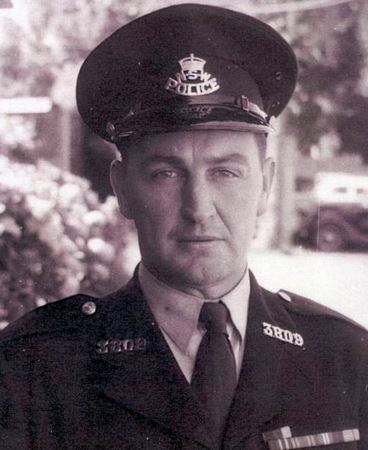
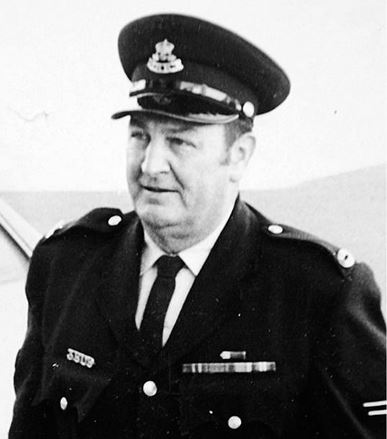
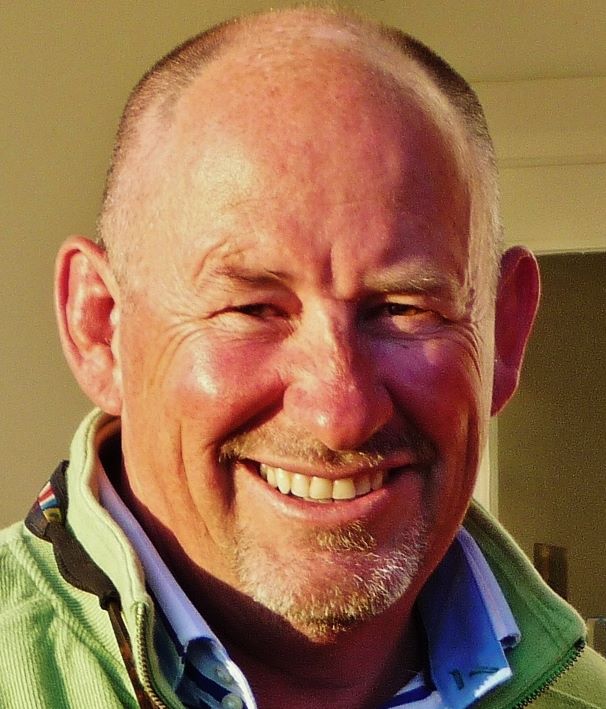
HE was from the old school breed of cops, a senior constable who had the respect of the public and would rather help people than lock them up.
George William Jones was possibly best known for his involvement in the pursuit of two of the nation’s most notorious killers – Allan Baker and Kevin Crump – convicted of the 1973 murders of Ian Lamb and Virginia Morse.
On that day in November, Senior Constable Jones was a passenger in a police car with his partner Senior Constable John Millward.
The pair were in a high speed pursuit of two armed criminals – Baker and Crump – travelling in a stolen car when Baker began firing shots at them from a .308 calibre rifle.
A bullet from the rifle shattered the police car windscreen, hitting Senior Constable Millward in the forehead.
Senior Constable Jones took his partner to hospital before rejoining the pursuit.
Baker and Crump were captured on the banks of the Paterson River at Woodville a few hours later after a dramatic shoot-out.
For his efforts, Mr Jones received a Queen’s Commendation for bravery and a Commissioner’s Commendation for his outstanding courage and devotion to duty.
This high profile case led Mr Jones to become a household name across the country.
But according to his family, Mr Jones was regularly having guns pointed at him by desperate criminals.
“He didn’t back down from a fight, he was a courageous guy,” Mr Jones’s son Mark said.
“There were other occasions he had guns pulled on him and the like and there was a bloke who he was trying to get into the cells who rammed his face into the lock on the door.
“He copped a few hidings but the interesting thing was, often we would be out somewhere and someone would come up and shake his hand and chat with him and when he left Dad would say ‘I locked him up once’.
“How he looked after people and the way he treated them made people like him regardless of what side of the law he was on – he was a fair and honest copper and well respected.”
Born on July 31, 1924, in Dudley, Mr Jones lived in Weston until he enlisted in the RAAF on November, 1942, as a leading aircraftman.
He fought in New Guinea and was discharged in April, 1948, before launching a 31-year career in the NSW police force.
Mr Jones was stationed in Sydney, Broken Hill and for the last 17 years of his service was a senior constable at Maitland.
After his retirement, Mr Jones worked at Tocal College as the afternoon supervisor for 15 years.
He married Margaret in Sydney in 1960 and had three children – Robyn, Bryan and Mark – and seven grandchildren.
Mr Jones’s daughter Robyn said her father had a lot to do with Maitland PCYC.
“He used to take drunk drivers home and young kids as well who were on the streets,” she said.
“There was a lot of respect for police back then and Dad wanted people to not dislike or fear the police.
“He had been shot at heaps of times and had a few close shaves but he wouldn’t tell you many stories because he didn’t like to brag.
“The big one was Baker and Crump, that’s what he got the bravery awards for, but he did heaps of other things that weren’t acknowledged.
“He was a good dad.”
Friends and family attended a moving funeral service at East Maitland Presbyterian on September 6.
George William Jones was an old-school Maitland cop who was always willing to help others and was someone who could be trusted.
Mr Jones died last Tuesday at his East Maitland home with his devoted family by his side.
He was born on July 31, 1924, in Dudley and lived in Weston until he enlisted in the RAAF on November 18, 1942 as a leading aircraftman.
He fought in New Guinea and was discharged on April 14, 1948.
Mr Jones served with the NSW Police Force from 1948 until 1979.
He was stationed in Sydney, Broken Hill and for the last 17 years of service was a senior constable at Maitland.
After his retirement from the police service, Mr Jones worked at Tocal College as the afternoon supervisor for 15 years.
He married Margaret in Sydney in 1960 and had three children – Robyn, Bryan and Mark, and seven grandchildren – Lisa, Justin, Rochelle, Sophie, Nicholas, Abbey and Max.
Mr Jones was a keen lawn bowler, fisherman and supporter of his children’s sports.
He was involved in a number of clubs and associations across Maitland.
Mark described his father as a “larger-than-life character.”
“Dad was known wherever he went, especially in Maitland,” he said.
“He loved a beer and a bet with his mates and always had a project on the go.
“Dad was known to be fair and honest in the community and to his family he was a loving,
caring husband, dad and granddad who loved being with his family.”
A funeral service for Mr Jones will be held at East Maitland Presbyterian Church, George Street, at 9.30am Friday.
HIS ROLE IN CRUMP ARREST
The-late Maitland police officer Senior Constable George Jones is recorded in Australia’s history for his part in the capture of two of nation’s most notorious killers – Allan Baker and Kevin Crump – convicted for the 1973 murders of Ian Lamb and Virginia Morse.
Mr Jones received a Queen’s Commendation for bravery and a Commissioner’s Commendation for his outstanding courage and devotion to duty at East Maitland on November 13, 1973.
On that day, Senior Constable Jones was a passenger in a police car with his partner Senior Constable John Millward.
The officers were in high speed pursuit of two armed and desperate criminals – Baker and Crump – travelling in a stolen car.
Baker fired shots at them from a .308 calibre rifle.
Senior Constable Millward was the driver of the police car and had closed up to the vehicle containing the wanted men despite rifle fire.
He had managed to get within pistol range and Senior Constable Jones fired a number of shots.
A bullet from the high-powered rifle shattered the police car windscreen, hitting Senior Constable Millward in the forehead.
“He had an amazing escape from death but was wounded and forced to give up the chase,” criminal court judge Mr Justice Taylor said at the time.
“These two officers displayed great courage in endeavouring to close with the vehicle of the accused in the face of sustained rifle fire.”
Soon after Senior Constable Millward was shot, another police vehicle received a radio call to take up the chase and Senior Constable Jones took his comrade to hospital before rejoining the pursuit.
A high-speed chase continued with Baker kneeling on the front seat of the stolen car and firing at police.
Many of the shots hit the front of the car containing Detective Senior Constable John Snedden and Detective Senior Constable Wayne Hore.
The officers took evasive action by swerving the car from side to side.
On a number of occasions the car driven by Crump slowed a near halt to allow Baker to take better aim through the back window of the car.
Baker’s and Crump’s car was pursued until it ran into a lucerne paddock near the Paterson River at Woodville where they jumped from the vehicle, each carrying a rifle.
Detectives Snedden and Hore chased Baker and Crump on foot.
The wanted men stopped halfway across a paddock and, falling to their knees aimed and fired their rifles at police, who threw themselves to the ground.
Baker and Crump ran into thick bush and scrub along the riverbank and police continued their search, joined by a number of other officers responding to radio calls.
Baker and Crump were found hiding in sections of the river and were arrested.
Mr Taylor commended the four police officers for bravery in an unprecedented gesture by a criminal court judge during an extraordinary sitting of the Sydney Central Criminal Court in 1974.
He said the police had exposed themselves to great risk of being shot when they were armed with service pistols against high-powered rifles.
“These men displayed bravery and devotion to duty which calls for commendation,” he said.
Baker and Crump were sentenced to life imprisonment following their capture by police at Maitland in November 1973.
Mr Taylor said: “You have outraged all accepted standards of the behaviour of men. The description of ‘men’ ill becomes you. You would be more aptly described as animals, and obscene animals at that. I believe that you should spend the rest of your lives in jail and there you should die. If ever there was a case where life imprisonment should mean what it says – imprisonment for the whole of your lives – this is it.”
Al Sparkes is a retired NSW Policeman and in 1996 Alan dropped himself into a flooded storm water drain in Coffs Harbour to save a drowning boy. Alan was later awarded the Australian Cross of Valour, the highest civilian award available for his heroic acts of bravery.
Alan had a catastrophic breakdown and this is his story.
Alan also penned a book, ‘The Cost of Bravery’.
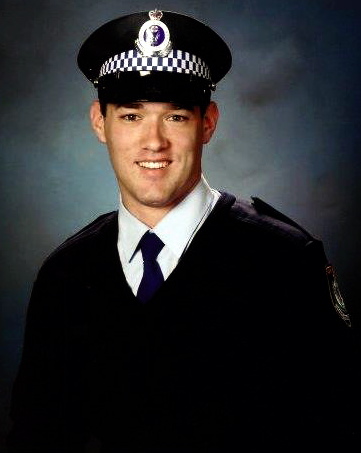
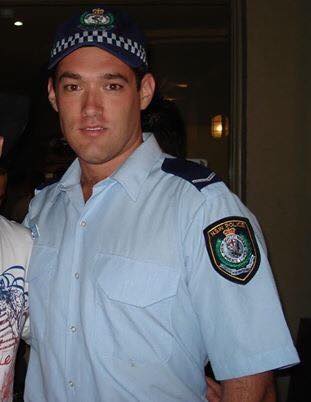
Morgan James HILL
| 24/09/2013
Morgan James HILL
New South Wales Police Force
Goulburn Police Academy Class # ???
Regd. # 40683
Rank: Commenced Training at Goulburn Police Academy on ? ? ?
Probationary Constable – appointed ? ? ?
Constable – appointed ? ? ?
Constable 1st Class – appointed ? ? ?
Final Rank: Constable 1st Class
Stations: Waverley
Awards: Commissioner’s Unit Citation for actions on Sunday 11 December 2005
Service: From 29 April 2005 to 27 March 2009 = 3+ years Service
Born: Tuesday 25 January 1983
Died: Friday 27 March 2009
Age: 26 years, 2 months, 2 days old
Cause: Severe PTSD – Suicide – self inflicted gunshot wound, with Service Glock, at Fishermans Rd, Malabar
Funeral date: Thursday 2 April 2009
Funeral location: Our Lady of Sacred Heart Church, 193 Avoca St, Randwick
Grave location: Ashes Interned at Botany Cemetery on 25 January 2010
RC6 – Roman Catholic FM 6 – 560
Morgan commenced his shift at Waverley Police Station at 8pm on the evening of 27 March 2009.
At 8.39pm, at Fisherman’s Road, Malabar, in his private vehicle, Morgan ended his life whilst suffering severe depression induced by the effects of anti-depressant medication he had been prescribed.
Morgan was born on 25 January 1983 and joined the New South Wales Police Force on 29 April, 2005.
He was 26 years of age at the time of his death by suicide and stationed at Waverley, Eastern Suburbs Local Area Command.
Morgan is NOT mentioned on the Police Wall of RemembranceBut Should be
MORGAN ( as of 2017 ) IS mentioned on the NSW Police Wall of Remembrance
* Stemming from the continued work of the wives of four Fallen NSW Police to Suicide – those four names will now be included in the newly refurbished NSW Police Wall of Remembrance, Sydney, as of 2017
Congratulations to those family members who fought the fight to right this wrong.
Commissioner Scipione has telephoned each of us today to advise that our loved ones names are being added to the replacement NSW Police Force Wall of Remembrance, to be unveiled in the next few weeks.
We would like to thank everyone who has offered support over a long and difficult journey and truly hope this sets a precedent for all police departments, not only in Australia but the global policing community.
It is so very important to remember that policing can and often does have a detrimental effect on those who serve.
We believe that the inclusion of suicide deaths, stemming from a work related psychological injury, is the most compassionate way of showing that the police hierarchy truly cares.
7 years ago this Easter Sunday, on 27 March, we lost our only brother and son, Morgan Hill. He took his life on duty that night. I would never wish this type of grief on another family. What has made it worse than losing Morgan though is being subjected to the stigma attached to suicide. With every year that goes by this is reinforced by NSW Police that Morgan’s death (and many before and since) are not worthy of the respect they deserve, because of HOW they died. But…we will continue to highlight this injustice and the shame is not on Morgan or our family…it is actually on YOU – the high ranking officials of the NSW Police Force – and leaders of any Force – that perpetuates this stigma by specifically excluding them from your Wall of Remembrance!
The response, from the Commissioner of Police, to the above Coroners report:
On 2 April 2012, Police Commissioner AP Scipione APM advised the Coroner as follows:
“The NSW Police Force established a Self Harm Prevention Advisory Panel (the Panel) in 2010, following a recommendation of the Deputy State Coroner Dillon in 2009 arising from the death of Sgt Ian Muir. The role of the Panel was recently reviewed and amendments are currently being made to its charter to oversight the NSW Police Force response to Recommendations in all coronial matters involving self-harm by police officers.”
I’d just like to say that it’s my hope sometime down the road after Code Nine has met with much success and people are being helped instead of silenced. I hope I never have to write another poem like this again. Because ending stories like this is what they’re all about. Please remember Mr Hills family and friends in prayer and ask that they be comforted by the memories they treasure. And not haunted by the way his life so suddenly ended. Thanks to all of you for praying. Sincerely Edwin C Hofert
This poem is one of a series of poems written by me for Code Nine Officer Needs Assistance And is intended to honor the fallen officers and their families that are to be featured in the finished documentary. As well as all others.
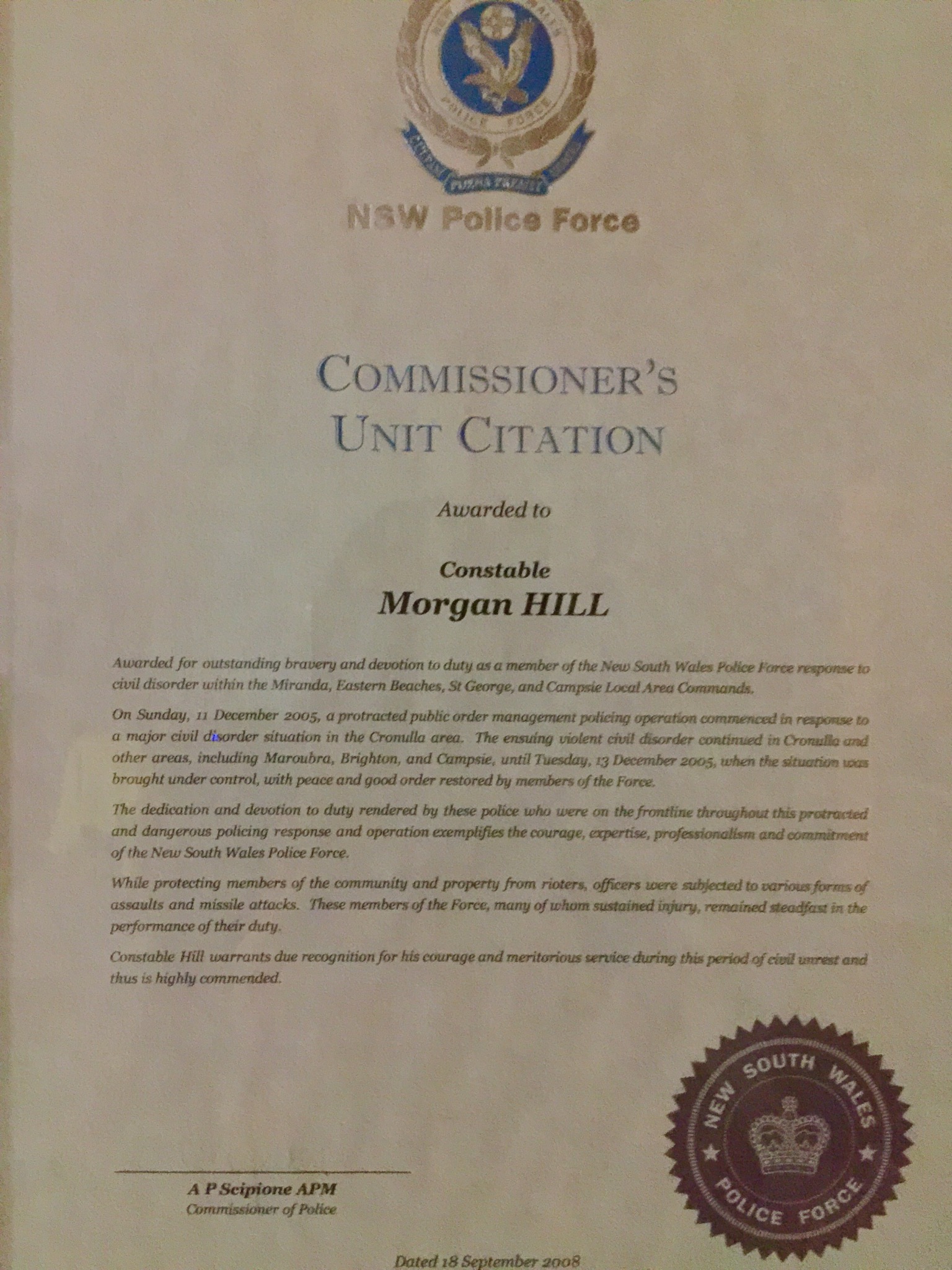
Morgan Hill – Commissioners Unit Citation re 2005 Cronulla Riots
NSW Police Force
Commissioner’s Unit Citation
Awarded to Constable Morgan Hill
Awarded for outstanding bravery and devotion to duty as a member of the New South Wales Police Force response to civil disorder within the Miranda, Eastern Beaches, St George, and Campsie Local Area Commands.
On Sunday, 11 December 2005, a protracted public order management policing operation commenced in response to a major civil disorder situation in the Cronulla area. The ensuing violent civil disorder continued in Cronulla and other areas, including Maroubra, Brighton, and Campsie, until Tuesday, 13 December 2005, when the situation was brought under control, with peace and good order restored by members of the Force.
The dedication and devotion to duty rendered by these police who were on the frontline throughout this protracted and dangerous policing response and operation exemplifies the courage, expertise, professionalism and commitment of the New South Wales Police Force.
While protecting members of the community and property from rioters, officers were subjected to various forms of assaults and missile attacks. These members of the Force, many of whom sustained injury, remained steadfast in the performance of their duty.
Constable Hill warrants due recognition for his courage and meritourious service during this period of civil unrest and thus is highly commended.
A P Scipione APM
Commissioner of Police
Dated 18 September 2008 but NOT signed.
‘Despite the above Commendation being dated 18 September 2008 ( 6 months before Morgan’s death ), the Certificate was handed to the family Posthumously on the very same day that they were also handed documentation stating that Morgan was NOT going to be mentioned on the Wall of Police Remembrance due to the fact he suicided.
These documents were not given to the family until late 2010.’
Today Tonight TV programme Channel 7, aired this show on Wednesday 23 July 2014.
The below comments were copied and pasted from the TodayTonightadelaide website on 23 March 2016
Jean Simpson says: The Government should be looking at a change in the whole health system , to ask the question why are so many young , old , just so many of the population coming down with Depression , (The Back Dog) . Definitely more counselling services. As well as the government ,we should all try to be more considerate , compassionate to all in society , there is so much suffering out there , and so many issues to deal with today than there was a few years ago. Teresa Cranes comments about the corruption , threats and underhanded dealings within the force has been talked about for as long as i can remember. It makes me really sad to see the young adults of today joining the force with all good intent , with a passion to help our society , only to find that they go to work each day fighting against an epidemic of corruption within there own work place. Like Teresa on this page i knew of an elderly Sergeant who has now retired , because he was told to take an early retirement . To find someone in the force that is not corrupt would be a hard task. How does the average person tell who is who anymore? So sorry for the ones that are trying to make this world a better place , for the opinion of a lot of people is that unfortunately they get tarred with the same brush , one can only imagine the affect on the innocent ones , Wow what a fight they have on there hands ! Love and light to all .
: 4 likes
Amanda Schultz says: Teresa Crane you got it spot on! My dad took hi s life in 1981, right in those good old corrupt years! Made a boss aged 32. Took his life aged 37. Left a wife and three daughters. What else do you do when your “boys” are on the take and the bosses buried their heads? I think there needs to be Royal Commissions to make the brass accountable and expose those we know were hypocrites and criminals. SA Police took a good man and destroyed him and his family….we live with it everyday.
: 0 likes
Peter Roberts says: Very interesting story and definitely needs looking into
: 1 likes
Heather Johns says: It’s unfortunate that they aren’t required to debrief or to talk about an issue without being labelled. It is not just police, fire, ambos, we see it a huge amount in defence too. Why can’t we remove the stigma of PTSD & depression & help those in need as they are helping us? Where is the government funding for more counselling services?
: 0 likes
Ross Beckley says: Great story and thanks for making this public. All emergency service personnel are suffering silently and their organisational management need to start addressing these concerns raised in this story.
: 1 likes
Trevor Hardy says: SAPOL officers need to find themselves a good private psychologist and see them regularly. You can work through problems and if SAPOL are going to continue to sweep the problems under the carpet, then members need to do it for themselves. Or quit. No job in this Universe is worth killing yourself over.
: 0 likes
Jessica Courtney Evans says: Yep…. Someone I’m my family was an officer in nz and took his own life. It’s tragic and awful. They need more support….
: 1 likes
Tanya Eldridge-Tregenza says: It’s no bloody secret it’s been happy for a long time.
: 1 likes
Lynette Millowick says: Missed out on story was working
: 1 likes
Clare Heiss says: Oh poo!! Was really looking forward to seeing it! Thanks for letting us know though!
: 3 likes
Today Tonight Adelaide says: Unfortunately we cannot load the video until it has aired in Perth – at the moment it looks like it may run tomorrow so the video won’t be online until Monday morning
: 2 likes
Berrick Boland says: Today Tonight, rocks.
: 4 likes
Lauren Busbridge says: Same with paramedics!!!!!
: 4 likes
Today Tonight Adelaide says: The video will be uploaded tomorrow
: 1 likes
Clare Heiss says: I can’t find the story in this link @TodayTonight
: 2 likes
Ann Krieg says: PTSD needs to be told and understood. We need to know what and how it happens and to whom. The service men, whether police, or army or navy or air, or whether it is from work and a bad boss or bad experience from an accident, we need to know. 🙂
: 3 likes
Berrick Boland says: The Forgotten 300 Facebook page come on and like us for the families of PTSD and Police suicide victims.
: 12 likes
Anne Heinrich says: Well I am only one of many people I know who admire the police for their kindness and care of those in need, their patience and persistence and tenacious spirit to keep people alive! Maybe if more people told them so (and I include the media) they might feel more appreciated and needed. Don’t give up guys- there are lots of us who think you’re great!
: 2 likes
Sandy McLellan says: I have known many Policeman, but one in particular tells me of the many who simply cannot cope with the ghastly things they have to deal with. We have NO idea how bad it is, very sad. They put their lives on the line for us all the time. Maybe they need much more support on the job and from us, the public.
: 3 likes
Tony Crowley says: They should cover SAPOL . We are not clean either
: 10 likes
John Hirst says: Be good to see it’s getting some publicity and not ‘swept under the carpet’. Lost a few good colleagues from this and there are so many more stepping close to the line with little or no support from the employer. Tony Crowley for your info.
Posted Monday 20 June 2016:
CORONERS COURT
Morgan James Hill:
Deputy State Coroner Mitchell On 9 September 2011 at Glebe and Parramatta
FINDINGS.
I find that Morgan Hill who was born on 25 January 1983 died at Fishermans Road Malabar NSW at about 8.39 pm on 27 March 2009 of a gunshot wound to the head, self inflicted while suffering severe depression.
RECOMMENDATIONS;
That a psychiatrist or psychiatrists be employed in the Health and Well being Unit of Welfare Safety Command or retained so as to ensure qualified psychiatric oversight of all police fitness assessments where mental health or emotional stability are an issue.
2. That appropriate criteria be developed and established to guide and inform police medical officers in assessing the fitness of police officers for various duties within the police force and the fitness of police officers to have possession of a firearm.
3. In particular, that the criteria so developed and established provide that fitness for duty and to carry a firearm is not merely a matter of the absence of a diagnosable psychiatric condition or mental illness.
4. That police medical officer be encouraged to explore with police officers referred by commanders for a fitness assessment the history of that officer and any current or recent medical diagnoses and treatment plan or plans and the identity of that officer’s medical practitioner and to seek the consent of the police officer to that medical practitioner providing appropriate medical information to the police medical officer and that unwillingness to provide that consent be among the matters to be reported to the referring commander.
5. That psychologists assisting in the preparation of fitness assessments be accorded independence from police medical officers.
6. That police medical officer be reminded of the provisions of the Health Records and Information Privacy Act 2002 and, so far as the provision of information to commanding officers is concerned, be encouraged to act in accordance with its terms.
7. That the practice of placing reliance on psychological tests in the preparation of fitness assessments be reviewed by an independent expert.
8. That the freedom of commanding officers to make their decisions as to the removal or restoration of firearms informed by considerations other than those dealt with by police medical officers be encouraged.
9. That commanding officers be reminded of their entitlement to the provision of information pursuant to the Health Records and Information Privacy Act 2002.
10. That consideration be given to the establishment of a mentoring system of young officers by more senior officers with a view to the guidance, support and oversight of the performance of those young officers.
RESPONSE
On 2 April 2012, Police Commissioner AP Scipione AMP advised the Coroner as follows:
“The NSW Police Force established a Self Harm Prevention Advisory Panel (the Panel) in 2010, following a recommendation of the Deputy State Coroner Dillon in 2009 arising from the death of Sgt Ian Muir.
The role of the Panel was recently reviewed and amendments are currently being made to its charter to oversight the NSW Police Force response to Recommendations in all coronial matters involving self-harm by police officers.
”Please click here to link to a table which sets out the full Police Force response to the recommendations made by Coroner Mitchell. (Unavailable)
Denise HodderThis is hideous that these precious lives are lost and no one in power seems to care ….?
Clare HeissI can tell you, as Morgan’s sister, whom attended this inquest for the two weeks duration it ran, that our family have not once heard about any follow up to these recommendations. Furthermore my parents were invited to be on the “self harm committee” when it began, BEFORE the inquest mind you, but attended maybe two meetings and as far as we know either does not exist anymore or is called something else, but either way we have not been asked to continue to be a part of the panel in terms of reviewing the recommendations made by then Coroner Scott Mitchell (now deceased) nor any ongoing consultation as a family who have lost a police officer to suicide.
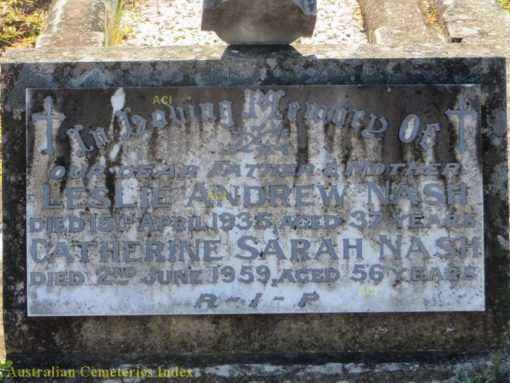
Grave Location: Roman Catholic Monumental Section 3 – Plot: 0493
In Loving Memory of our dear father and mother. Leslie Andrew NASH, Died 15 April 1935 aged 37 years. Catherine Sarah NASH, Died 2 June 1959, aged 56 years. R.I.P.
Coroners Inquest: Tuesday 30 April 1935
LESLIE is NOT mentioned on the National Police Wall of Remembrance ( 2021 ) * BUT SHOULD BE
Constable Nash is thought to have been shot to death, possibly while on duty, on 15 April, 1935. It was thought that he had committed suicide however little is known about this incident and to some extent it remains a mystery.
The Hurstville Propeller newspaper dated 18 April, 1935 published the following article.
CONSTABLE FOUND SHOT AT HURSTVILLE POLICE STATION.
First-Class Constable Leslie Andrew Nash, station officer at the Hurstville Police Station, was found dead at the station early on Monday morning. Constable Nash commenced duty at 5 a.m. Constable Harvey left the station and when he returned Nash was missing. A search revealed his body in the bathroom attached to the station. Nash’s service revolver was nearby.
The Sydney Morning Herald of 16 April, 1935 added a bit more to the story.
POLICEMAN FOUND SHOT.Constable Leslie Andrew Nash, 38, was found dead in the bathroom at the Hurstville Police Station yesterday morning with a bullet wound in his head. A revolver was found nearby. Nash was to have sat for an examination yesterday morning and had been in ill-health for some time. For the last eight years, Nash, who was a first class constable with 14 years service, had been stationed at Hurstville and was well liked and respected in the district. He had previously been stationed at Sutherland. He is survived by a widow and five children.
The constable was born in 1897 and joined the New South Wales Police Force on 5 April, 1921. At the time of his death he was stationed at Hurstville.
Newcastle Morning Herald & Miners’ Advocate
Tuesday 30 April 1935 P9
WORRIED OVER LECTURES
Constable Committed Suicide
SYDNEY, Monday,
Forgetting what he had been told at lectures, Constable Leslie Nash, 37, committed suicide at Hurstville Police Station on April 15.
At the inquest today, Constable James Harvey said that Nash told him that he was worrying over a departmental examination that day, and had forgotten what he had been told.
Returning a verdict of suicide, the Coroner said that the case was very sad.
Armidale Express and New England General Advertiser (NSW : 1856 – 1861; 1863 – 1889; 1891 – 1954),
Monday 15 April 1935, page 1
CONSTABLE SUICIDES
Strain of ill-Health Too Great
Sydney, Monday.
Constable Leslie Andrew Nash (38), was found dead at the Hurstville Police Station early this morning with a gun shot wound in the head.
He was acting as station officer. It appears that the man, who had been in ill health, had been told that he would have to undergo a serious operation. Some time later he was missing, and a search resulted in the discovery of his body in the bathroom attached to the station, with a revolver lying nearby.
Constable Leslie Andrew Nash. aged 38, was today found dead at the Hurstville Police Station, where he had performed duty as station officer.
Nash, who has been in ill health and had been told that he would have to undergo a serious operation, began duty at 5 a.m. He asked Constable Harvey to go on an errand, and when Harvey returned Nash was missing.
A search revealed his body in the bath room attached to the station. His service revolver was nearby.
Nash left a widow and four children.
He had been in the force for 14 years and was a first-class constable.
Today he was to have sat for an examination, which his inspector said he would have passed without the slightest difficulty.
NA8H.- H.A.C.B.S. St. DECLAN’S BRANCH, No. 659.- The Officers and Members of the above Branch are requested to attend the Funeral of their late Bro.. LESLIE A. NASH: to leave St. Declan’s Catholic Church. Penshurst, THIS DAY. at 2.30 p.m., for Woronora Cemetery. By road.
The Coroners Inquest returned a verdict of “Effects of a bullet wound in his head, wilfully self inflicted“
Inquest was concluded on 29 April 1935.
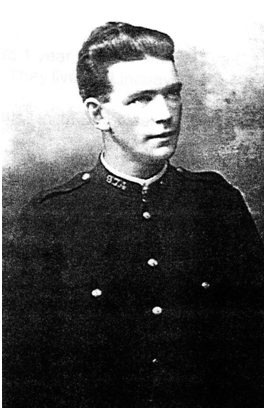
In the attached photo, his Uniform # is 87A or 97A.
The ‘ A ‘ used to depict the District that the member was attached to. ‘ A ‘ District was Sydney – so he may, at the time of the photo being taken, have been stationed at one of the Sydney CBD Stations.
NSWBDM
Birth = 6089/1898 Father = Patrick Mother = Amelia District = Parkes
Marriage = 2105/1925 Bride = McDonnell or MacDonnell District = Kempsey
Death = 7008/1935 Father = Patrick Mother = Amelia District = Hurstville
Leslie was born in 1898, the son of Patrick and Amelia, Leslie married on 10 Jan 1925 to Catherine McDonnell. Leslie was a First Class Constable Leslie passed away 15 Apr 1935 (aged 36)
Sources
NSW BDM
BIRTH NASH LESLIE A 6089/1898 PATRICK AMELIA PARKES
MARRIAGE 2105/1925 NASH LESLIE A MCDONNELL CATHERINE KEMPSEY
DEATH NASH LESLIE A 7008/1935 PATRICK AMELIA HURSTVILLE
RYERSON INDEX
NASH Leslie Andrew Death notice 15APR1935 Death 37 at Hurstville, late of Penshurst Sydney Morning Herald 16APR1935
The Sydney Morning Herald NSW 1842 – 1954
Tue 16 Apr 1935 DEATH NASH-April 15, 1835, suddenly, at Hurstville, Leslie Andrew, of 6 Clarence-street, Penshurst, dearly beloved husband of Catherine and father of Pat, Francis , Alma, John and Peter aged 37 years. Requiescat in pace.
The Sydney Morning Herald NSW 1842 – 1954 Tue 16 Apr 1935 Page 9 FUNERAL NASH.-The Relatives and Friends of Mrs. CATHERINE NA8H and FAMILY are kindly Invited to attend the Funeral of her dearly beloved HUSBAND and their FATHER. First Class Constable Leslie Andrew Nash: which will leave St. Declan’s Church. Penshurst, THIS TUESDAY, at 2.30 p.m., for the Catholic Cemetery. Woronora. Mrs. P. KIRBY and SON. LTD.. Leadlng Funeral Directors. phone, M2221-2. 263 Elizabeth-street, Sydney.
NASH.-‘The Friends of Mr. WILLIAM ROSS are kindly invited to attend the Funeral of his friend, the Late Mr. Leslie A. Nash: lo leave St. Declan’s Church. Penshurst, THIS DAY (Tues day. For further details please see above notice.
NASH.- H.A.C.B.S. St. DECLAN’S BRANCH, No. 659.-The Officers and Members of the above Branch are requested to attend the Funeral of their late Bro.. LESLIE A. NASH: to leave St. Declan’s Catholic Church. Penshurst, THIS DAY. at 2.30 p.m., for Woronora Cemetery. By road. W. J. MEACHMAN. Tres. R. J. MADDEN. Sec.
NASH Leslie Andrew Death notice 16APR1935 Death at Hurstville Sydney Morning Herald 22APR1935
The Sydney Morning Herald (NSW : 1842 – 1954)
Mon 22 Apr 1935 Page 8 Family Notices
DEATH
NASH.—April 16 (suddenly), at Hurstville, Les- lie Andrew, beloved brother, brother-in-law, and darling uncle of Bob, Rene, and Aileen.
Death aged 37 at Hurstville, late of Penshurst
BURIAL Woronora Memorial Park
Sutherland, Sutherland Shire, New South Wales, Australia PLOT RC 3 0493
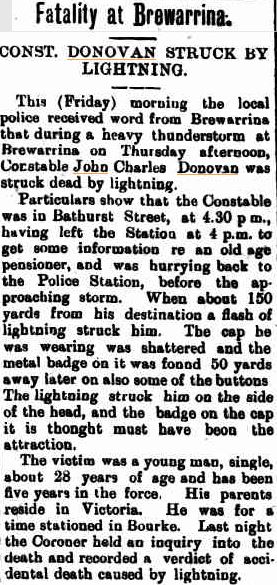
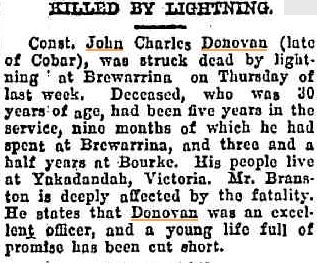
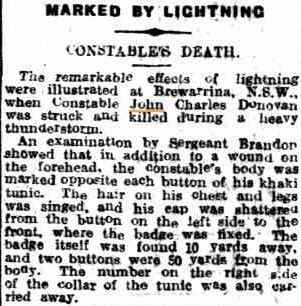
About 4pm on 12 January, 1922 Constable Donovan left the Brewarrina Police Station to carry out some enquiries. About 45 minutes later he was hurrying back to the police station to avoid an approaching thunderstorm when he was hit by lightning in Bathurst Street, about 150 metres from the station. A subsequent inquest heard that the cap badge and metal buttons had been blown off the constable’s uniform with some buttons being found up to 50 metres from the body.
The Sydney Morning Herald of 13 January, 1922 included the following brief paragraph.
CONSTABLE KILLED BY LIGHTNING.
A telegram was received last evening by the Inspector-General of Police (Mr. Mitchell) from Sergeant Brandon at Brewarrina, stating that Constable Donovan of that station had been struck dead by lightning at 4.15 p.m.
The constable was aged 28 years at the time of his death and was stationed at Brewarrina.
Amazingly, the only two recorded NSW police deaths by lightning strike occurred on the same date, sixty years – to the day, apart. The other being Constable James QUINN who was struck at Cockatoo Island, Sydney, NSW, on the 12 January 1862.
From Ken Medway on 5 April 2014 on Beyond Courage Facebook page:
A thorough search of the cemetery at Brewarrina, NSW, failed to locate the grave of John Charles DONOVAN aka DONAVON who is also recorded as being buried there. Inquiries with Brewarrina Shire revealed that all records were destroyed some years ago so his precise whereabouts will probably never be known.
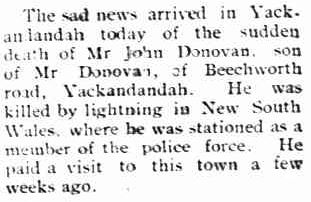
From Cal: “See Yackandandah Times story in this article. Body re-interred in Yackandandah Cemetery, Victoria, pre 27 January 1922.”
The Tragic End of Constable J. C. Donovan. A Yackandandah Native.
The township of Brewarrina is situated in the western portion of New South Wales on the Barwon River, a tributary of the Darling. In April last year Constable J. C. Donovan, son of Mr John Donovan, of Yackandandah, was transferred from Cobar. On Thursday afternoon Constable Donovan went on duty at 4.30 p.m., and immediately left the police station to make some official inquiries and was hurrying back to the station to avoid an approaching storm when he was struck down in the street by lightning, within 150 yards of the station. From the medical examination, it was apparent that the lightning struck him on the forehead over the left eye, which corresponded with the position of the metal button on the peak of the cap. The body was also scorched and burnt just where the buttons would be on the police uniform. The buttons and metal numbers were found blown off the uniform, several buttons being found in the street 50 yards away. The right heel and left sole of the boots were also blown off. Two men named Hutchinson and Smith were also in the street at the time and felt the shock the lightning. At the inquest the Coroner paid a tribute to deceased, and stated the whole town and district would mourn the loss of such an efficient and promising officer.
Requiem Mass was celebrated in St Patrick’s Church by the Rev. Father Behan, P.P., for the repose of the soul of the departed officer on Friday morning. Sergeant Brandon and Constable Korn, his brother officers, were the very esence of kindness throughout the lamentable affair and were deeply affected by the tragedy. The funeral left the Court House at 4 o’clock on Friday afternoon and was largely attended. The handsome silver mounted casket containing the remains was completely smothered in floral tributes. The last sacred rites at the grave-side were performed by the Rev. Father Behan (says the Brewarrina Times). When the body was lowered to the grave (which is beside that of the Late Constable B. J. J. Dowling, who was killed in 1822) the large concourse of people returned to the town, and thus has passed away one to whom the words of Mark Antony referring to the death of Brutus, can well be applied : —
His life was gentle and the elements
So mixed in him that Nature might stand up
And say to all the world ” This was a man. ”
Prayers were read on Sunday in St. Patrick’s Church by the Rev. Father Behan for the repose of the soul of Constable Donovan, after which Chopin’s funeral march was impressively played by Mrs Butler.
Sergeant Brandon in the course of a lengthy letter of condolence to the bereaved relatives said : — ” Mass was said for him this morning at 7 a.m. and the good Priest attended at the Police Station and performed the last sad rites at the bed side. Candles were burned, which I am preserving and am forwarding some floral tributes and cards of sympathy, which I have been requested to convey to you. You will see by them that your dear boy was held in the highest esteem both by rich and poor. His sudden death has cast quite a gloom over the little township. I intend to arrange for a paragraph of ” Return Thanks’ ” to appear in the local paper on your behalf. You will quite understand that the cards of sympathy are addressed to me because his friends here did not know where to send them. I do hope that it will be consoling to you to know and see the respect and esteem shown ; when you take into consideration the short period he has resided here. He arrived at Brewarrina on transfer from Cobar on the 5th. April, 1921, and has been a credit to his Parents, the Police Department and himself. I can assure you no one will miss him more than I will. It is very difficult to replace men of his character and ability, strictly sober, no day too long when there was work to do, confidential, scrupulously clean and tidy in his person and room, and most reliable in the performance of his duty. I mourn with you in the loss you and the Department have sustained by his death ”
The relatives decided to have the body re-interred in Yackandandah Cemetery.
The coffin was railed to Albury from Brewarrina and conveyed to Yackandanduh cemetery on Saturday afternoon by motor. A large attendance of mourners waited at the gate of the cemetery and several others drove along Albury road and formed a cortege to accompany the motor hearse.
Father Griffin read the service at the grave-side. The late Mr John Donovan, who was born in Yackandandah, resided in this township during his young days, and was well known and highly respected. Within the last few months he paid a visit to the district and renewed old friendships. His untimely end is regretted throughout the district and the deepest sympathy is felt for his relatives.
From the Yackandandah Times, Victoria, dated Friday 20 January 1922, page 1 of 4, states ” Some difficulty occurred at Brewarina, New South Wales, where John Donovan died, owing to no lead coffin being available, so that the corpse could be transported to Yackandandah for burial. This difficulty has now been overcome and the body will be re-interred in Yackandand cemetery on Saturday afternoon. ( indicating Saturday 21 January 1922 and the reason why he was originally buried at Brewarrina ).
[google-map-v3 shortcodeid=”19a35ff5″ width=”350″ height=”350″ zoom=”12″ maptype=”roadmap” mapalign=”center” directionhint=”false” language=”default” poweredby=”false” maptypecontrol=”true” pancontrol=”true” zoomcontrol=”true” scalecontrol=”true” streetviewcontrol=”true” scrollwheelcontrol=”false” draggable=”true” tiltfourtyfive=”false” enablegeolocationmarker=”true” enablemarkerclustering=”false” addmarkermashup=”false” addmarkermashupbubble=”false” addmarkerlist=”-36.303766, 146.851609{}catholicgrave.png{}Grave of DONOVAN” bubbleautopan=”true” distanceunits=”km” showbike=”false” showtraffic=”false” showpanoramio=”false”]
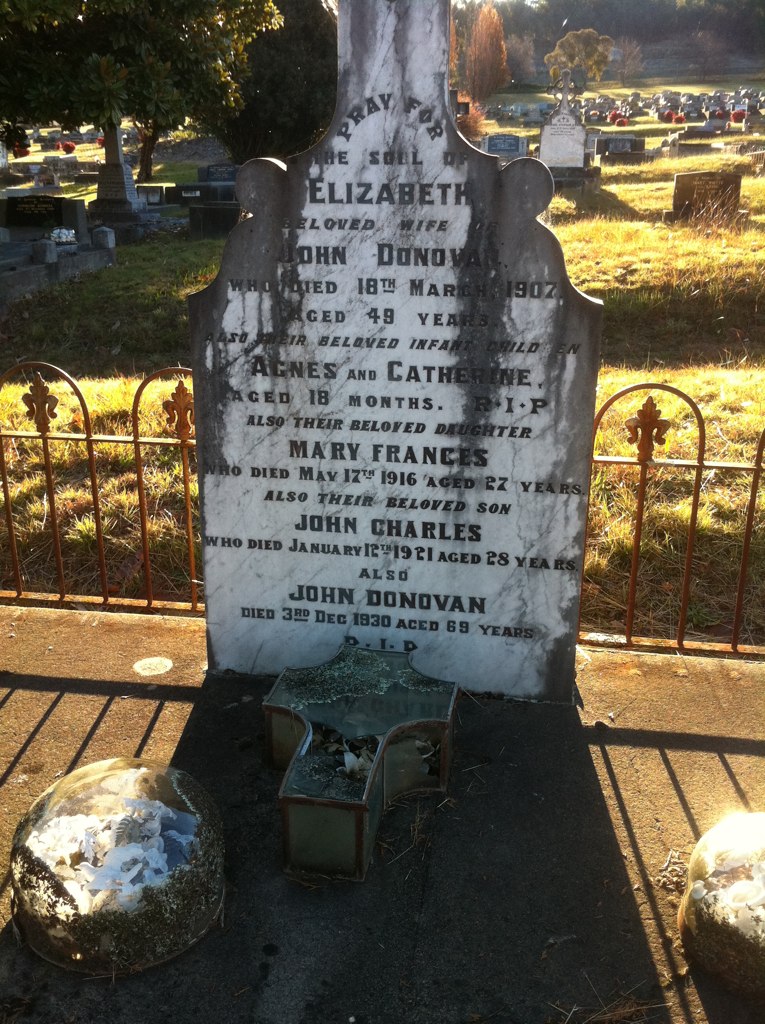
Epitaph & Description: Pray for the Soul of Elizabeth Donovan, Beloved Wife of John Donovan; aged 49 years Also their beloved infant children: Agnes and Catherine, aged 18 months; Their beloved daughter, Mary Frances Donovan, aged 27 years; Their Beloved son, John Charles Donovan, aged 28 years; John Donovan, aged 69 years R.I.P. Lat: -36.303766 Lon: 146.851609
Cal:
Due to the fact that all of the newspaper articles and other documentation state that DONOVAN died on the 12 January 1922, I would say, with a fair deal of certainty, that the date on this grave stone of 12 January 1921 is INCORRECT.
John DONOVAN was originally buried at Brewarrina, NSW, the day after his death but re-interred at Yackandandah Cemetery, Victoria, pre 27 January 1921.
Donovan was buried at Brewarrina close to these co-ordinates:
GPS Location 29 58′ 10S / 146 50′ 46E
Old Catholic Section right over on western fence
John James WALLACE
| 24/09/2013
John James WALLACE
New South Wales Police Force
Metropolitan Police Force ( NSW )
Regd. # ?
Uniform # 64?
Rank: Constable 1st Class
Stations: ?, Newtown Police Station
Service: From 12 July 1894 to 11 February 1806 = 11+ years
Awards: ?
Born: ? ? 1860
Died on: Sunday 11 February 1906
Cause: Shot – Murdered
Event location: King St, Newtown
Age: 41
Funeral date: Sunday 18 February 1906
Funeral location: St Enoch’s Presbyterian Church, Newtown
Buried at: Rookwood Cemetery
GPS of Grave:
[alert_green]JOHN IS mentioned on the Police Wall of Remembrance[/alert_green]
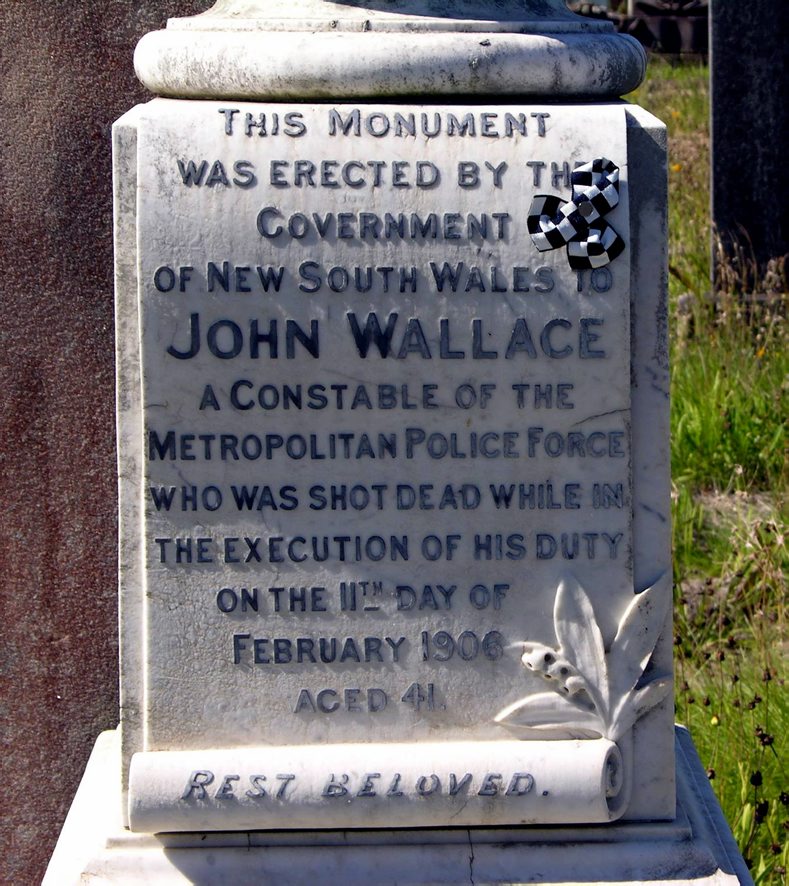
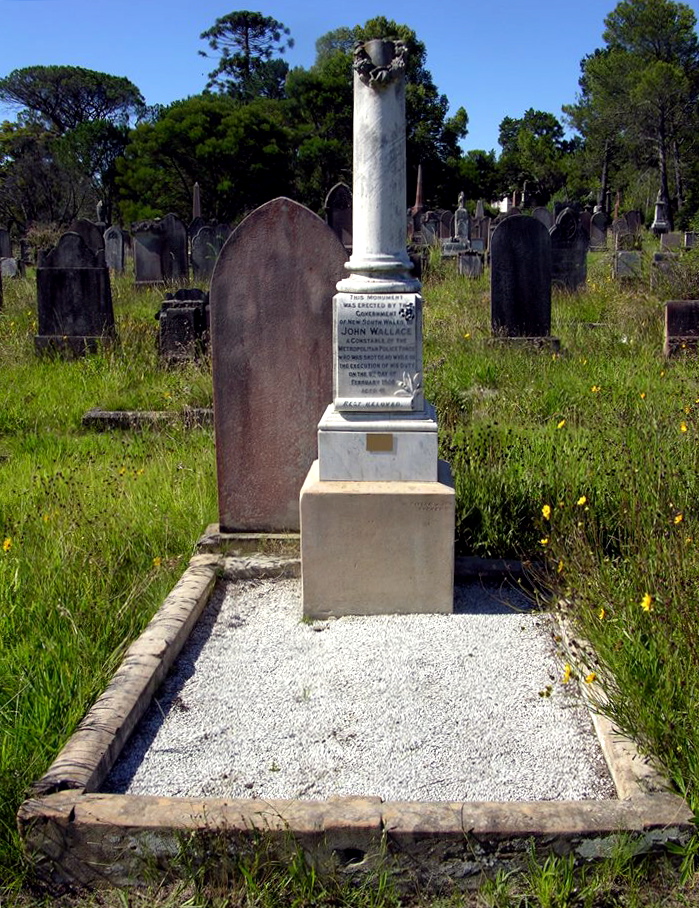
The constable was shot at a dwelling in King Street, Newtown by the offender Tanna, who had been involved in a domestic dispute. Constable Wallace and Senior Constable Maunsell had attended the dispute and had climbed into the home through a window. Constable Wallace attempted to talk to the offender, who was armed with a rifle and a revolver, in the hallway. The offender suddenly raised the rifle and shot Constable Wallace twice. Tanna was later wounded by police, and committed suicide in the siege that followed.
The Australian Town and Country Journal of 21 February, 1906 carried details of the inquest into the constable’s murder, and the performance of the police involved.
THE NEWTOWN MURDER.
The inquest on the bodies of Constable John Wallace and Willie Yass, or Tanna, the victims of Sunday morning’s double tragedy at Newtown, was concluded at the Coroner’s Court, Sydney, on Wednesday. The Coroner said that from the evidence it seemed that the deceased Tanna was fired at by the police some ten, perhaps twelve, times in the course of the affray, but that he was only hit twice by the police, and that both wounds were superficial. The evidence also disclosed the fact that the cartridges were defective. Inspection had shown that. The Coroner said he mentioned that so that the authorities might, if they thought necessary, take action. He found that Constable John Wallace was wilfully murdered by Tanna, and that Tanna had committed suicide. “I think I may be permitted to add”, said the Coroner, “that the deceased, John Wallace, was a brave man and that he died while and because he was doing his duty. As to his comrades, without making any invidious distinction, I think I may also say that those of them who tried to rescue him, and to dislodge the man who murdered him, earned what most men prize very highly, and that is a reputation for physical bravery.”
The constable was born in 1860 and joined the New South Wales Police Force on 12 July, 1894. At the time of his death he was stationed at Newtown.
[divider_dotted]
NEWTOWN LOCAL AREA COMMAND POLICE COMMEMORATION SERVICE
Ms CARMEL TEBBUTT (Marrickville) [7.07 p.m. 8 May 2013]:
Recently at Rookwood Cemetery I attended a memorial service to commemorate police officers from the Newtownlocal area command killed in the line of duty. The moving service was attended by Deputy Police Commissioner Nick Kaldis, Superintendent Simon Hardman, the commander of the Newtown Area Local Command, many other police representatives, and relatives and descendants of the police officers. Those attendees included Ms Avona Wallace, Mr and Mrs Norman Stephenson, Mrs Lynette Everton and Ms Edna Stevenson. Representatives from the emergency services and community members were also in attendance. The member for Campbelltown, Bryan Doyle, attended representing the Premier.
The five officers being remembered at the ceremony gave their lives to protect the community. They were Constable First Class John Wallace, Constable First Class Ruston Stephenson, Constable Lionel Guise, Detective Inspector Reginald Stevenson and Constable Pashalis Katsivelas. The ceremony to mark the sacrifice of these officers reflected on the enormity of their contribution to the community, as well as the impact of their death on their families. It is often said, and it is true, that police officers leave their homes for each shift uncertain of what any day may bring and whether they will return at the end of the day. We owe these men and women our deepest gratitude for the risks they face and take every day in their job. At Rookwood Cemetery we visited each of the graves of those officers who lost their lives in the line of duty and behind each individual was an illuminating life story.
We began at the grave of Constable First Class Ruston Stephenson, who died 80 years almost to the day of the commemoration. Constable Stephenson joined the Police Force in 1912, and four years later enlisted in the army, later joining the fight in France during the First World War. He was awarded the Distinguished Conduct Medal for conspicuous gallantry in rescuing injured soldiers while under fire. Remarkably, when he returned he rejoined the Police Force and continued to serve until his death on 9 April 1933 after a tragic accident involving a motorcycle at the then Newtown Stadium while performing general duties policing.
We were also told the story of Detective Inspector Reginald Hugh Stevenson — I was honoured on the day to meet his widow, Ms Edna Stevenson, who still had strong memories of the incident that led to Inspector Stevenson’s death. Detective Inspector Stevenson joined the NSW Police Force as a cadet in 1943 at the age of 17. In an act of extraordinary selflessness, Detective Inspector Stevenson was on annual leave on 9 December 1974 when he decided to go to work to assist in the planned arrest of a dangerous offender in Newtown, at the time telling his wife, “I don’t want my boys doing this on their own.” During the operation he was shot in the chest after leading his team in pursuit of the offender.
Detective Inspector Stevenson partially recovered and was awarded the Queen’s Commendation for Brave Conduct and the Queen’s Police Medal for Distinguished Service. However, he died in 1980 of a heart attack, deemed to be the result of the injuries he sustained on duty in 1974. These officers are just a few of many across New South Wales whose lives have been cut short as they have gone about performing their duty. I pay tribute to them all. They will not be forgotten and local events such as this are a powerful reminder of their sacrifice.
I also take this opportunity to acknowledge two Marrickville police officers, Sergeant Stewart and Constable Steele, who on Monday of this week rescued an intellectually disabled person from a house fire in Marrickville. Thankfully, those two officers who took huge risks survived and are quite rightly being hailed as heroes by their colleagues and the community. It is yet another example of the risk our police men and women take every day in order to keep the community safe. I take this opportunity to pay tribute to them.
In November, 1879 a gang of young bushrangers led by Andrew Scott (Captain Moonlite) attacked MacDonald’s farm at Wantabadgery Station, holding the occupants captive for two days and nights. After eating and drinking, the gang moved to a nearby pub, The Australian Arms Hotel, and more hostages were taken. Eventually one of the captives, Alexander MacDonald, escaped, rode to Wagga Wagga and alerted the police. A party of mounted police were quickly dispatched to the area & arrived at 4am and a gun battle ensued. During a lull in the shooting, while the police retired to await reinforcements, the gang managed to escape.
They then rode to nearby McGlede’s Farm where they again took siege in the farmhouse from the increasing numbers of police who attended from as far away as Gundagai and Adelong. Again a shootout ensued between the two sides. At one stage, one young offender, Gus Wernicke, moved into the yard in an attempt to shoot the police horses and was quickly shot to death. In a further exchange of fire another bushranger, James Nesbitt, was also shot and killed by Senior Constable Webb-Bowen. During this last exchange, Webb-Bowen was also shot in the throat. This wound also proved to be fatal.
The Sydney Morning Herald of 4 December, 1879 reported that “The funeral of Constable Bowen was very largely attended, and partook of a military character. His widow, with her only child, will, we believe, leave for Pembrokeshire, England, where her late husband’s relatives reside. A subscription has been started to present the constables with a substantial reward of their bravery, and of the great service they have done to society.”
At the trial of Scott and his gang for the murder of Constable Webb-Bowen, Mr. Justice Windeyer concluded sentencing by informing him that “Fortunately, your career of crime was promptly cut short by the courage, the vigilance, and the energy of our police, who are entitled to all praise from every man in the community for the prompt manner in which they arrested and brought you to justice. You young men have had an appeal made on your behalf. But I cannot forget that most of the cruel as well as some of the most bloodthirsty crimes which have been committed by the bushranging class in this country have been committed by young men like yourselves, and the question in your case is — what is mercy? Not only to you, but to the youth that are growing up amongst us; and I have been pained to find, through a long experience in our criminal courts that crime amongst our young men is becoming far more frequent than it was. The recommendation in your favour, of course, I will convey to the Executive, but I would remind you that the shadow of death is upon you. Whether it will pass away is not for me to say. The victim of your murder, shot down by you, when in the execution of his duty, will live in the memory of all who admire devotion to the cause of duty and manliness, whilst your fate will only give an additional warning to the reckless criminal that the way of transgressors is hard, and that a felon’s death and an ignominious grave await those who commence a career of crime. It is useless to moralise further on your case.
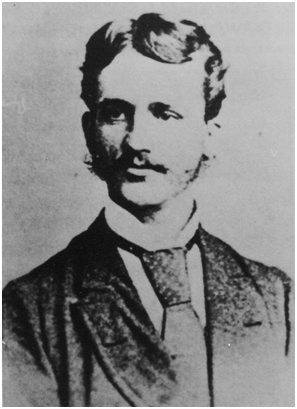
The senior constable was born in 1851 and joined the New South Wales Police Force on 11 March, 1875. At the time of his death he was stationed at Gundagai.
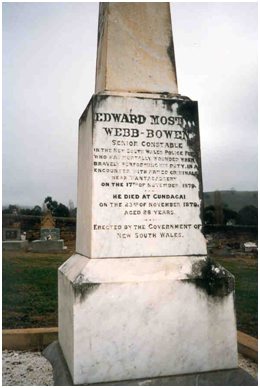
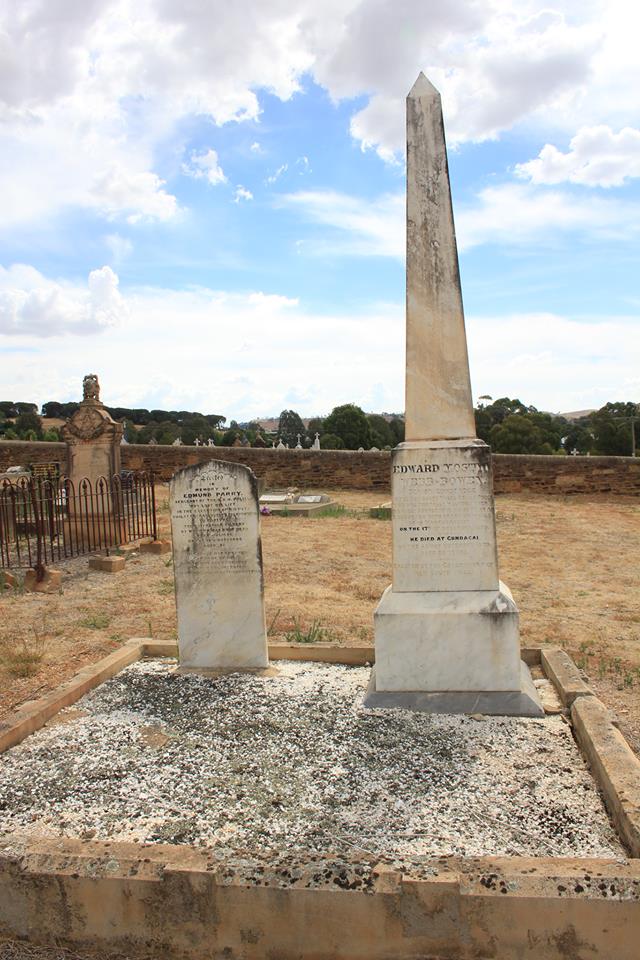
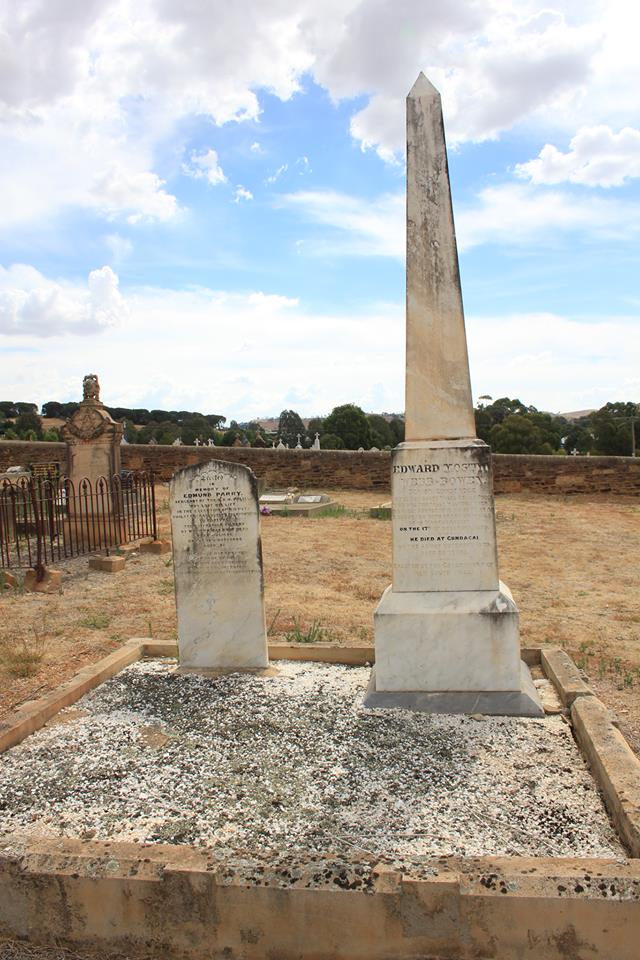
Sgt Edmund Parry & Senior Constable Edward Webb-Bowen graves
TWO Riverina police commands will honour the “Hero of Wantabadgery” – one of their own killed in the exchange of gun fire more than a century ago.
Senior Constable Edward Mostyn Webb-Bowen, known as Edward Bowen, was shot in the neck and died on November 23, 1879 as a result of the wound he sustained.
Now, the Wagga and Cootamundra local area commands (LAC) are working together to restore his grave at Gundagai cemetery.
Staff from the Wagga LAC will meet with Wantabadgery residents on February 1 to discuss ideas regarding a plaque, headstone or statue to honour Sen Con Webb-Bowen.
Wagga police duty officer, Inspector Stephen Radford, labelled the police-led community project – headed by Constable Max Burmeister, who resides in Wantabadgery – as exciting.
“We hope to raise awareness about those who were defending our community and values at a time when bushrangers were a real threat,” Inspector Radford said.
“Unfortunately history has tended to forget the true heroes of this era and instead the names of outlaws such as Captain Moonlight and the Ben Hall Gang, (which are) responsible for the deaths of police officers, hold more recognition than those that did the right thing.
Inspector Radford said the project aimed to help change the imbalance.
Senior Constable Webb-Bowen’s death came after Captain Moonlight and his gang held up Wantabadgery Station one evening in mid-November.
A number of people were taken hostage, and that number increased when the gang moved to the nearby Australian Arms Hotel.
Officers from Wagga police arrived in the early hours of the morning and gunfire was exchanged.
They retreated, waiting for reinforcements from Gundagai, and later visited a farm nearby where they found Captain Moonlight and his gang.
For further information about the project, email waggabowen@police.nsw.gov.au or call Wagga police on 6922 2599.
Responses to the above media post:J. Treanor Jones
It needs to noted here too that though there is a police perspective on the bushranger era, there is also the story of the bushrangers and their families and associates and why what happened, did happen. Social conditions in 2014 are far more equitable then they were in the 1860s -1890s and if anyone carries on similar to what was done to Ellen Kelly these days there are forms of redress. It will be a sign of a grown up police force when they can acknowledge all sides of the bushranger stories, not just the police side. My aunt (b.18802), whose uncle married Emily Byrne, married the son of one of the police, Ned Kelly Gang pursuers so all these groups of people are intertwined. My home was once owned by the son of the Gundagai gaoler where Moonlite was housed and that Eugene McCabe the gaoler had a family connection to my family hence me now owning what was once a McCabe property. My g.g.uncle was a Chartist and later became a notable solicitor, an army commander and a newspaper owner and he also believed no worker should be killed at work – but it does happen. I also have a link or two to the UK artistocracy as well as to a 15 year old and a 16 year old convict, so like many Australian families given the diaspora from overcrowded England, Scotland and Ireland, many, many current day Australian families can be a mix of many backgrounds. In more recent times I worked with the leader of the Cangi massacre at a NSW Government facility so bushranging isn’t all in the past or divorced totally from government employment. J. Treanor Jones
J. Treanor Jones
I hope in their restoration of Webb-Bowen’s gravestones they do not clean them with acid as one Gundagai group did to the old marble stones in Nth Gundagai cemetery in 2002. Acid melts marble as well as cleaning it. One hundred year + graves stones at Gundagai cemetery were made all sparkling white for the 2002 Gundagai 1852 Flood 150 years commemoration.. No matter the honing was taken off the marble and also the patina of age in the interests of having sparkly white gravestones to present to visitors.
One interesting aspect of Moonlite the bushranger was the connection to the Irish ‘Whiteboy’ movement that Charles Sturt was so disgusted by. ‘Moonlite’ was also an Irish culture hero but that Moonlite was not Wantabadgery’s Moonlite though the Wantabadgery Moonlite may have been modeled off the Irish one. That rarely gets mentioned and neither do the Ribbon Boys of this area.
J Treanor Jones (I have a connection to Joe Byrne – Ned Kelly’s lieutenant My great uncle William Jones (b. 1850s) married Joe Byrne’s cousin, Emily Kate Byrne. There are several descendants of bushrangers live in this general area some of whom have joined in marriage with some of the coppers who were chasing the bushrangers.)
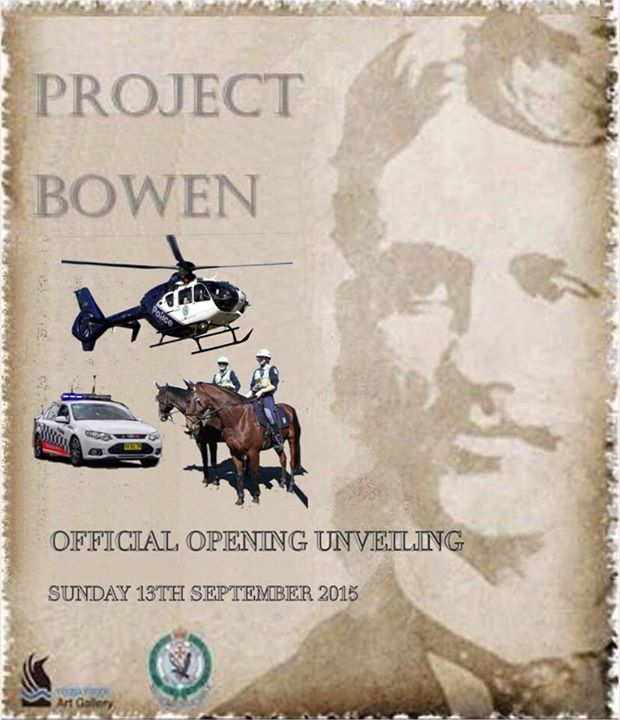
OFFICIAL OPENING – UNVEILING OF MEMORIAL – SUNDAY 13TH SEPTEMBER 2015
Edward Webb-Bowen memorial
Hero of Wantabadgery – Senior Constable Edward Webb-Bowen honoured.
Wagga Wagga LAC – NSW Police Force, is honouring the ‘Hero of Wantabadgery’ Senior Constable Edward Mostyn Webb-Bowen who died in an exchange of gun fire in November 1879.
During an evening in mid November 1879, ‘Captain Moonlite’ and his gang held up Wantabadgery Station and took a number of hostages. After eating and drinking, the gang moved to a nearby pub, The Australian Arms Hotel, and more hostages were taken.
At 4am, officers from Wagga Police arrived and gunfire was exchanged with the gang. Officers retreated and waited for reinforcements from Gundagai. On arrival of Gundagai Police, the officers attended nearby McGlede’s farm and found ‘Captain Moonlite’ and his gang.
Shots were exchanged and Senior Constable Webb-Bowen was shot in the neck. On Sunday 23rd November 1879, Senior Constable Webb-Bowen, known as Edward Bowen, died as a result of the gunshot wound.
Project Bowen, was established in 2012 by the Wagga Wagga Police and Wantabadgery community to raise awareness and funds to build a monument to remember Bowen.
Following an, archaeological survey, art exhibition, art auction, generous donations from individuals and local businesses the monument was completed His grave in Gundagai was also restored.
The monument now proudly stands adjacent to the Wantabadgey MacDonald Memorial Hall in Jewnee Street, Wantabadgery.
The memorial will be officially opened at 11:00am on Sunday 13th September 2015 by the Wagga Wagga Local Area Commander Bob Noble.
The opening will include; a display of modern and historic police vehicles, police command bus, police helicopter, horses and re-enactors. People are encouraged to attend in period 1870’- 80’s attire.
Service: From 5 May 1862 to 16 November 1864 = 2+ years Service
Awards: ?
Born: ? ? 1832
Died on: Wednesday 16 November 1864
Cause: Shot – Murdered
Event location: Jugiong
Age: 32
Funeral date: Saturday 19 November 1864
Funeral location:
Buried at: Gundagai Cemetery
( GPS: Lat: -35.051389
Long: 148.111944 )
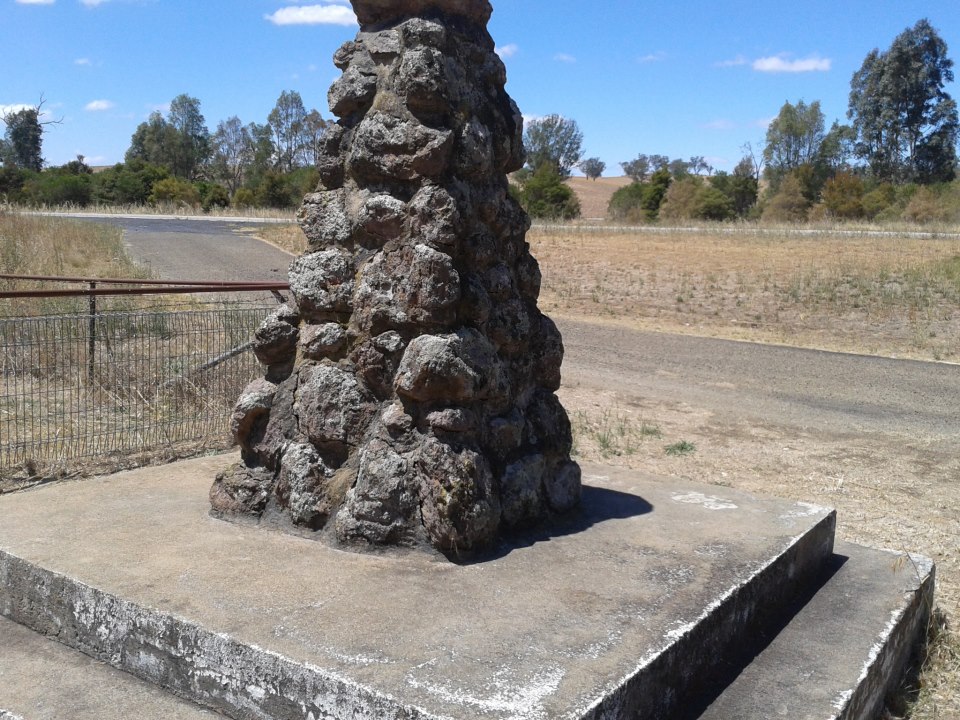
Memorial location: Old Hume Highway (Riverside Drive) , Jugiong Memorial Park, Jugiong, 2726
( GPS: Lat: -34.823664
Long: 148.326496 )
Located on the north bound lane of the Hume Hwy near Jugiong.
EDMUND IS mentioned on the Police Wall of Remembrance
On 16 November, 1864Sergeant Parry ( Gundagai ), Sub Inspector O’Neill ( Gundagai ) and Constable Roche ( Yass Police ) formed the mounted police escort for the Gundagai mail coach on its journey to Yass. Roche was seated beside the coach driver, Gundagai Police Magistrate Mr Rose was inside the coach and Parry and O’Neill followed on horseback. Shortly before 3pm as the coach approached the township of Jugiong, the escort was attacked by bushrangers Hall, Dunn and Gilbert. Sub Inspector O’Neill closed with Dunn and Hall and when he had emptied his rifle he hurled the weapon at Hall, striking him on the head. He then drew his revolver and fired at Dunn. Meanwhile, Parry and Gilbert fired on each other, with the bushranger calling on the sergeant to surrender. Parry continued to fight until he was fatally shot in the head.
The Australian News for Home Readers dated ( Monday ) 19 December, 1864 carried the results of an inquest into the sergeant’s violent death, informing its readers that “An inquest was held before Mr Rose, at Jugiong, on the body of the brave sergeant of police, when the jury returned the following verdict: ‘That on the 16th day of November, in the year of our Lord 1864, at a spot about four miles to the south of Jugiong ( the Black Springs ), in the colony of New South Wales, the deceased Edmund Parry did die from the effects of a gunshot wound, at that time and in that place wickedly, maliciously, and feloniously inflicted upon him by one John Gilbert, and that two other certain persons, named Benjamin Hall and John Dunn, were then and there unlawfully aiding and abetting the said John Gilbert in so feloniously destroying the life of the said Edmund Parry.”
The murderer Gilbert and accomplice Hall would later be shot dead by police in separate incidents, while Dunn (who would murder Constable Samuel Nelson at Collector less than two months after this incident) was destined to be hanged for his crimes.
The sergeant was born in 1832 and joined the New South Wales Police Force on 5 May, 1862. At the time of his death he was stationed at Gundagai.
Sgt Parry is buried at the Gundagai cemetery.
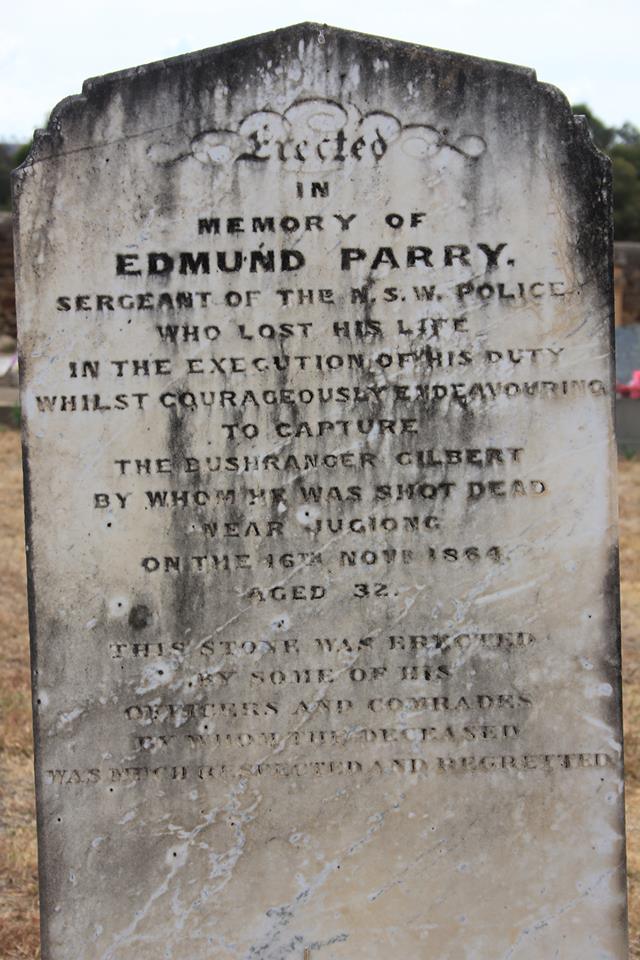
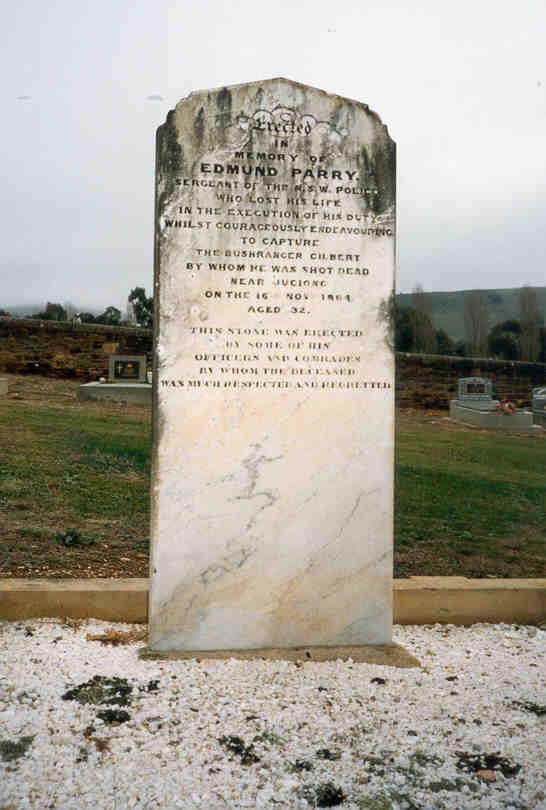
Erected In Memory Of Edmund Parry, Sergeant Of The N.S.W. Police, Who Lost His Life In The Execution Of His Duty Whilst Courageously Endeavouring To Capture The Bushranger Gilbert By Whom He Was Shot Dead Near Jugiong On 16th Nov 1864 Aged 32 This Stone Was Erected By Some Of His Officers And Comrades By Whom The Deceased Was Much Respected And Regretted
Senior Constable Wes Leseberg (NSW Police) portrays Sgt Edmund Parry in this upcoming Australian movie. Opening in December 2016.
first-look trailer for upcoming Australian bushranger film The Legend Of Ben Hall, out December 1, 2016. Start practising your pistol-twirling now…
Senior Constable Wes Leseberg as Sergeant Edmund Parry in “The Legend of Ben Hall”
(Plaque) (NSWPF Logo) NEW SOUTH WALES POLICE FORCE CULPAM POENA PREMIT COMES NSW Police Force Sergeant Edmund PARRY Killed in the courageous execution of his duty on the 16th of November, 1864 in a gun battle with the Hall Gang at Black Springs, Jugiong New South Wales
Yesterday, took a detour to Jugiong and checked out the memorial there to Sgt Edmund Parry. A very fitting tribute to a brave man.
* GPS Co-ords 34 49 25S/148 19 35E.
*
Can I also say that the Police Station and residence at Jugiong were immaculate. Not something you see often these days but a pristine NSW Flag flying (not a tattered mess hanging from the flag pole that we see so often) and the yard and surrounds a credit to the OIC who no doubt works the majority of the time in Cootamundra or Tumut or Young or all three.
Parry, Edmund (1832–1864)
from South Australian Advertiser
On Tuesday afternoon the mail from Gundagai reached the hill at Deep Creek, about four or five miles on the Yass side of Jugiong, between 4 and 5 o’clock. Mr. Sheahan, of Jugiong, the mail contractor, and Mr. Bradbury, of Queanbeyan, were passengers by the coach, and had alighted to walk up he hill. They were some distance in advance of the coach. Mr. Sheahan was in the act of pointing out the spot where the mail was stuck-up a few weeks before, when three horsemen appeared on the top of the hill, and spreading out—one on each aide, the third in the centre of the road—they galloped towards the coach. On coming near it was noticed that each had a revolver in his hand, and the order was given by Ben Hall to “Bail up.” Hall pointed and told them to “walk up there; we have got a little township there.” After going up the hill for some distance, they were ordered to turn off to the left, and approached a spot where twelve teams were stock up, as well as a number of horsemen. The mail was then stopped. Mr. Sheahan was asked if he had any money; he replied that he had not, and they might search him if they liked. Hall declined to search, remarking that Mr. Sheahan was not a “bad sort of fellow.” Bradbury was then searched; although he handed them a cheque for one pound, stating that that was all he had, yet they examined his pockets, and asked him if he had not a watch. They got nothing from him but the cheque, and subsequently, on his telling them it was all he had to carry him on the road, the cheque was returned. Hall and his companions then took out the mail bags, six in number, and cut them all open. Before proceeding to examine the letters they asked Mr. Sheahan and Mr. Bradbury if they would have some wine. They answered “Yes,” when Hall called to one of the teamsters to “fetch over port wine.” The wine was brought, in a quart pot, and a portion of it drunk by those present. The examination of the mail-bags meanwhile proceeded, the three bushrangers sitting down on the ground with the bags before them. The letters were speedily ransacked of any bank-notes they contained, Mr. Bradbury remarking to them that they sorted the letters much quicker than was generally done in Sydney. Mr. Sheahan asked if he would be allowed to sit down, and Hall told him he could do so. Mr. Sheahan availed himself of an empty mail-bag close beside him, and noticing a large number of whole and half cheques, remarked that they were of no use to them, and asked permission to gather them up. The bushrangers consented, and Mr. Sheahan was enabled to bring on to the Yass Post Office his coat pocket as full of cheques as it would hold, as well as three bank drafts. The coach and passengers were kept an hour before they were permitted to depart, Mr. Sheahan and Mr. Bradbury gathering up the remains of the letters and placing them in a mail bag. On the bushrangers completing their work, the driver of the coach pushed on as fast as possible to Yass, and reached here only half an hour behind time. The matter was instantly reported to Sub-Inspector Brennan, who, with a couple of mounted men, took the road within half an hour.
It was fully expected in town that the mail on Wednesday would also be robbed, and the spot where it was expected to take place was mentioned to the police before they left Yass. The anticipation was realised, and even the locality surmised as the scene of the outrage proved to be the spot selected. The mail is due in Yass at eleven a.m., and as it is generally very punctual to the time, and not having arrived at a quarter to twelve, it began to be thought very likely that it had been stopped. A few minutes before twelve it was heard approaching, and much anxiety was felt to learn what had occurred to cause its detention. It was then ascertained that on the mail leaving Gundagai, Constable Roche, of the Yass police, who had gone as guard of the mail the previous day to Gundagai, and Mr. Rose, police magistrate of Gundagai, were its occupants. It was escorted by Sub-Inspector O’Neill, and Sergeant Edmund Parry, of the Gundagai police. On reaching within about four miles of Jugiong, at a place known as the Black Springs, Hall and his companions appeared from behind some rocks. The moment they were noticed a signal was made from the coach to the Sub-Inspector and Sergeant to ride up, which they at once did; and one of the bushrangers remarking that “the bobbies” were with the coach, Gilbert said “There are only two of them; come on, let us rush them.” They then darted towards the coach, and on getting near the police called out “Come on you —— wretches; we will fight you like men.” A deadly encounter followed, in which poor Parry, who acted very bravely throughout, was shot through the shoulder and dropped dead. Before, however, narrating what transpired in the encounter with the police, we may state that Hall, Gilbert, and Dunn took up their position on the road early in the day, and stuck up a large number of teams and two carts, the latter followed by 20 or 30 Chinamen. Amongst those detained were a son of Mr. Owen Ryan, of Derrengullen Creek; Mr. Hayes, wife, and young man, who were in a buggy; and others, to the number of 40 or 50. Some considerable time before the coach came up Constable McLaughlin, of the Gundagai police, approached, leading a pack horse. Gilbert rode up to him and ordered him to surrender, but he replied by a shot from his revolver, which was returned by Gilbert, who then turned his horse and rode off a short distance. Hall then took up his position and fired at the constable, who again discharged his revolver. Hall’s horse stumbled, and Dunn rode up and fired at McLaughlin. The constable discharged the six barrels of his revolver in the encounter, and then surrendered, some nine or a dozen shots having previously been fired at him by the bushrangers. Dunn remarked that one of the constable’s shots was a very good one, and they would “have it in for him” on that account.” The constable was added to the mob of captives. The coach subsequently came in sight, and the affray commenced as stated above. Constable Roche, who was on the coach armed with two large pistols, a six barrel revolver, and a carbine, is stated to have slipped off the coach when the fight began, and to have darted into the bush, carrying his firearms along with him. He did not subsequently appear on the scene. Gilbert fought with Sergeant Parry, who refused to surrender, and discharged every barrel of his revolver before he fell; Hall and Dunn attacked Sub-Inspector O’Neill, who first discharged his carbine, and then several shots from a revolver. On Parry falling dead, the Sub-Inspector surrendered. The bushrangers disarmed him, and took from him a ring and his watchchain, but we believe he was permitted to keep his watch on his informing them it had belonged to his father. The horse Mr. O’Neill rode was, however, taken, one of the bushrangers remarking it would make “a good pack-horse.” It seems singular that the driver of the coach did not take advantage of the proceedings going on to put his horses to their mettle and save the mails. This, however, he did not do, for Hall and his mates on the termination of the fight ordered Mr. Rose to throw out the bags, which the bushrangers cut open in the usual manner, and appropriated all they desired. The mail was a very heavy one, and it is supposed they secured a large amount of money. From Constable McLaughlin they took £7105; from Mr. Rose a watch and chain. We have not heard what was taken from Mr. Hayes, but he was searched; the lady who accompanied him they did not molest. Gilbert is said to have turned over poor Parry’s body, and to have remarked—”He’s got it in the cobra (head) ; I am sorry for him, as he was a game fellow.”
We may state that the bushrangers informed the police that they intended to rob the mail next day (Thursday), and told them to send as many police men as they liked, and they would fight them. On the mail reaching Yass on Wednesday night Sergeant Scully, who was in charge of the force in the absence of Sub-Inspector Brennan, at once despatched five mounted men, four of whom are connected with the Goulburn force, and had reached Yass the previous day, after eight days’ unsuccessful search for the whereabouts of the bushrangers.
The coroner’s jury returned the following verdict:—”That on the 16th day of November, in the year of our Lord, 1864, at a spot about four miles to the south of Jugiong, in the colony of New South Wales, the deceased Edmund Parry did die from the effects of a gunshot wound, at that time and in that place wickedly, maliciously, and feloniously inflicted upon him by one John Gilbert; and two other certain persons, named Benjamin Hall and John Dunn, were then and there unlawfully aiding and abetting the said John Gilbert in so feloniously destroying the life of the said Edmund Parry.”
Sergeant O’Neill‘s report of the recent murderous affray with Hall and his gang: Gundagai. 17th November.
“Just returned from Jugiong with the remains of Sergeant Parry. Yesterday morning early I started with Constable O’Loughlin to Jugiong, with instructions to the police station there to be at readiness to relieve Sergeant Parry and myself, who would escort the down mail to Jugiong.
At 11 a.m. Sergeant Parry and I left here riding behind the coach. Constable Roach, from Yass, was with the driver on the box set. When we got within four and a half miles of Jugiong, we there found sixty or seventy people, including Constable McLoughlin, some carriers, a lot of Chinese, and others, stuck up by Mr. Hall, Gilbert, and John Dunn.
Sergeant Parry and myself charged the bushrangers, when a deadly encounter ensured.
Ben Hall and Dunn opened fire on me and Gilbert on Parry. We all fired simultaneously several times. I had one bullet pass through the upper part of my sleeve, and one in left side of coat, neither injuring me.
Sergeant Parry was less fortunate. He received two mortal wounds, one in his left side and another in the back of his head, and he died immediately.
Constable Roach, on witnessing the engagement, took his carbine, revolver, and two old pistols with him and bolted into a paddock of Pring’s, where he took shelter. Had he stood by usParry‘s life would have been spared, and Gilbert shot.
After emptying my revolver and rifle, I let the latter fly at Hall, striking him severely on the left side of his head. He and Dunn then had hold of my horse, and all was over—Parry shot, I a prisoner and Roach an absconder. The party having rifled the mail bags left.”
Sydney Morning Herald Saturday 19 November 1864 p6
GUNDAGAI. Friday, 8 p.m.
After Hall’s gang left the scene of the encounter with the mail escort, the dead body of sergeant Parry was taken on to Jugiong, where an inquest was held, Mr. Rose, district coroner, who was a passenger in the coach, was an eye-witness of the tragedy. A verdict of wilful murder was given against John Gilbert, Benjamin Hall, and John Dunn, and warrants issued for their apprehension.
The remains of Sergeant Parry was brought in a coffin to Gundagai yesterday, and buried to-day with every mark of respect and commisseration for the fate of so brave a man. All business was suspended during the day.
The encounter was witnessed by several persons, who were detained by the bushrangers, and who, as well as Mr. Rose, speak in the highest terms of the courage of sub-inspectors O’Neill and sergeant Parry.
Illustrated Sydney News Friday 16 December 1864 p5
MURDEROUS ENCOUNTER BETWEEN HALL’S GANG & THE
POLICE, AND DEATH OF SERGEANT PARRY.
IT has unhappily been our duty during the past few months to record a series of high-handed outrages and deeds of blood, which are rendering this Colony a bye-word throughout the civilised world. Our exchanges from every part of the globe contain annals of crime committed by the bushrangers of New South Wales, — crimes unparalleled save by the banditti of Italy, degrading to us as a people, the commission of which renders the Government of the Colony positively criminal for the apathetic and ineffectual efforts which they have made. The time for mincing our words has long since past. The position of affairs in the interior of New South Wales is a disgrace to any civilised community. Our legislators appear to be too much engrossed in party quarrels, and our Government in their own aggrandizement, to properly estimate the enormity of the crimes which are being daily committed in our southwestern districts, within a couple of hundred miles of the head-quarters of a police system which cost a colony containing some 350,000 inhabitants, during the past year £242,715 7s. 11d. What wonder will it be if we hear of the people whose lives and properties have been rendered insecure taking the law into their own hands, and, following the example of California, establishing Lynch Law. Much as such a system is to be deplored, we question if it would not be preferable to the present state of things.
During the past four months Morgan has murdered two police sergeants and and unoffending bushman. His immunity from arrest has probably rendered Hall and his gang from paying much regard to human life, for we find them following his example with all the recklessness which has marked Morgan’s career. The culminating act of Hall, Gilbert, and Co.’s villainous career has been that perpetrated on the 16th ultimo. On the morning of that day Hall, Gilbert, and Dunn took up their position on the road about four miles from Jugiong, and stopped all passers by. Among the number were several residents of Tumut, Mr. Johnstone, of Gundagai, about a dozen teamsters, and thirty Chinese. About noon Constable McLaughlin, going to Jugiong, was stopped by two bushrangers. Gilbert rode up and ordered him to surrender ; his reply was a shot from his revolver, which was returned by Gilbert, who then rode off a short distance. Hall then fired at the constable, who again returned it. Dunn also fired. Some of the shots cut McLaughlin’s bridle rein, and slightly wounded his horse. Having used the whole of his ammunition, and being hotly pressed, he galloped away hoping to be able to reload ; but Dunn being better mounted followed, and, firing at him, ordered him to surrender. Having no other alternative he did so, and was conducted to where the other persons were detained. On searching McLaughlin they took £7 10s. and his watch and chain, but returned the latter to him, as they admired his bravery in resisting three of them.
About three o’clock the mail from Gundagai came in sight, escorted by Sub-Inspector O’Neil and Sergeant Parry on horseback, and Constable Roach, who was seated on the box with the driver. The bushrangers rode down the hill to meet the coach, and on being perceived by Mr. Rose, Police Magistrate at Gundagai, who was a passenger, that gentleman raised his handkerchief as a signal for the police to close up, and as they did so the bushrangers turned and rode off, but seeing there were only two policemen they drew their revolvers, and rode back to meet them, screaming like madmen. The first shot fired was the signal for Constable Roach to drop from his seat and bolt into the bush, leaving O’Neil and Parry to maintain the murderous contest ; the former being opposed to Hall and Dunn, and the latter to Gilbert — the two latter fired shot for shot. Parry was first wounded in the head, but refused to surrender, and, having fired every shot in his revolver, was in the act of unslinging his carbine when Gilbert again fired. The ball entered his back on the left side, passed through his body — and the brave fellow fell from his horse a corpse. O’Neil continued fighting until his ammunition was expended, when, seeing the uselesness of prolonging the contest, he surrendered, and was taken prisoner. Dunn and Gilbert then mounted guard on the road, while Hall ransacked the mail bags ; the latter asked O’Neil where the other constable had gone to, and, on hearing he had bolted, remarked, “You should dismiss the fellow at once ; he is a coward and wretch to leave you and your mate to fight ; but I will say this for you both, you are two game men.” Hall then addressed himself to Mr. Rose, asking his name. Mr. Rose gave it, and told them in a fearless manner that he was Police Magistrate of Gundagai, to which Hall replied, “You are as bad as the —— traps.” “That may be,” said Mr. Rose, I am what I am.” After disposing of all the booty the bushrangers decamped, taking the police horses and arms. The remains of Sergeant Parry were removed to Jugiong, where an inquest was held next day by Mr. Rose. The jury returned a verdict of wilful murder against John Gilbert, Benjamin Hall, and John Dunn, against whom warrants were issued.
Sergeant Parry was formerly a member of the detective force, and during his residence in this city was remarkable for his good conduct.
The Government have recently issued a proclamation offering £1,000 reward each for Hall, Gilbert, and Dunn, and we trust that some energetic colonist may speedily enrich himself, and rid the country of one of its plague spots.
BY ELECTRIC TELEGRAPH. SYDNEY.Thursday afternoon.BEN HALL and his gang are visiting the Bathurst district.
Constable ( William ) Roach was tried before the Yass bench on Tuesday, and found guilty of deserting his comrades in the late encounter with Gilbert’s gang.
He was fined five pounds with the alternative of a month’s imprisonment.
The constable was killed when he was struck by lightning while on duty at Cockatoo Island on the night of 11 January, 1862. The Sydney Morning Herald of 14 January, 1862 reported at some length on inquest into Constable Quinn’s death. It is reproduced here, almost in its entirety, due to the subtle poise and clarity of the writer in describing the sad events which led to the death of the young constable.
THE LATE FATAL ACCIDENT BY LIGHTNING – An inquest was held in the coroner’s office, yesterday, on the body of Constable James Quinn, who, as stated in our issue of yesterday, died from the effects of being struck by lightning on Cockatoo Island on last Saturday night. It appeared that the deceased had only joined the City Police Force on the 2nd of December last, and went over to do duty on Cockatoo Island on the 7th of the present month. At eight o’clock on Saturday night, he, in company with Constable Campbell, went on duty in the prison yard. At about nine o’clock a heavy thunderstorm broke over the island, and in a few minutes there came a flash of lightning more vivid than those that had preceded it, and Inspector Lane, who was sitting in his quarters, heard a heavy crash, and thought the prison had been knocked down. He ran out and saw one constable at his post in the verandah, he then ran to the back and saw another at his post, everything appearing to be alright, but after standing a minute he (the inspector) was conscious of a strong smell of sulphur. As, however, nothing appeared to be touched, he returned indoors, when, in a few minutes, his attention was called to the cry of fire he again ran out and found the prisoners were calling out “fire, fire!” He shook the gate, and the guard having opened it, he inquired where the fire was, but could not ascertain, he called for Constable Campbell, who, after two or three calls, replied in a faint voice, “I am here, sir,” and by the lightning, which was very vivid, he saw him lying on the floor of the building known as the chapel, his head covered with blood. The inspector was under the impression on seeing the blood that some of the prisoners had escaped, and had attacked him. He accordingly at once ordered a double sentry to surround the prison, and enquired of Campbell what was the matter, to which he replied he did not know, but had been knocked down, enquiry was then made as to where his mate was, and Campbell replied “Poor fellow, I saw him over there,” pointing to a shed covered with galvanised iron in the yard.
Thither the inspector went, and inside saw Quinn leaning with his back against the wall, he went up to him, touched his head and found it cold, he then called for the dispenser (there being no qualified medical practitioner resident on the island), who came, and after the injured man had been removed, administered medicine, which revived him. Inspector Lane forthwith sent the police guard boat to Sydney, with messages requesting the immediate attendance of Dr West, and Dr. Rutter, the latter of whom at once responded to the call. On arrival at the island he found Quinn strongly convulsed, requiring several men to hold him. He ordered what he deemed requisite and then left, returning again the next morning, when the injured man was found to be much better. There being no hospital (beside the hospital for prisoners) on the island, Dr. Rutter recommended his removal to the Sydney Infirmary, and thither he was conveyed, arriving there at about one o’clock. Dr Roberts saw him soon after his admission, and treated him as he considered his case required. The sufferer never rallied, but expired about four o’clock on the same afternoon.
It came out in evidence that the rifle carried by the deceased at the time he was struck was untouched by the electric fluid, as also the ammunition on his person, but a gold chain attached to his watch was burnt through in several places. It appeared that the lightning struck the highest port of the building in which the deceased was found, descended through the coping to a lamp, close to the spot where he was discovered. There were no lightning-conductors on the island. The deceased had formerly been in the Irish Constabulary Force, he was a native of Ireland, a steady well conducted man, and about twenty eight years of age. He has left a widow and two children. The jury returned a verdict of “Died from being struck by the electric fluid on Cockatoo Island on the evening of the 11th instant.” The body of the deceased was interred in the Roman Catholic burial ground, in Devonshire Street, yesterday afternoon, all the available police, dressed in uniform, with white gloves and white cap-covers, following him to the tomb.
The constable joined the Sydney Police Force on 2 December, 1861 and at the time of his death he was stationed on Cockatoo Island. He was 28 years of age, and was a former member of the Royal Irish Constabulary.
Amazingly, the only two recorded NSW police deaths by lightning strike occurred on the same date, sixty years – to the day, apart. The other being Constable John Charles DONOVAN who was struck at Brewarrina, NSW, on the 12 January 1922.
Chief Constable Patrick KINSELA
| 24/09/2013
Chief Constable Patrick KINSELA
Horse & Cart Accident
Queanbeyan, NSW
23 February, 1841
On 23 February, 1841 Chief Constable Kinsela and Constable John Scott were travelling in a cart returning to Queanbeyan. While they were crossing a dry creek bed near the Elmsall Inn the cart overturned, killing Constable Kinsela. Scott luckily survived the accident and was later able to give coronial evidence. It is not known whether this accident occurred while the constable was on duty or not, however it is believed that he was, and research is continuing into this aspect of the incident. In those days police were considered to be always on duty.
Rumours were apparently circulated at the time that both Kinsela and Scott were drunk when the accident occurred, however this was soon discredited. The Sydney Gazette of 11 March, 1841 printed information from a correspondent who informed the readers that he had seen a person who has just come from Limestone; he reports that the Chief Constable and another man were killed by the upsetting of a dray in a creek in that neighbourhood; it is said the parties were drunk, but this is contradicted, as Kinsela was a sober man. (In other words, Kinsela did not drink alcohol at all).
The Australasian Chronicle of 4 March, 1841 reported the following.
QUEANBEYAN, FEBRUARY 27- There was an inquest held here on the 24th instant, on the body of Mr. Patrick Kinsala [sic], chief constable, who came by his death by the upsetting of his cart in crossing a creek close to his own house. The night was very dark, and he was thrown with such force on his head that his neck was dislocated. Kinsala was a very active officer, a friend to the poor, and always ready to attend when called on. He had obtained a few enemies for himself by being zealous in the discharge of his duty. He has left a wife and two children to deplore his loss, the youngest only nine days old…
Patrick Kinsela was a native of Ireland and had arrived at Queanbeyan in 1836. On 1 January, 1838 he became the first Chief Constable of Queanbeyan and Limestone Plains (Canberra) on an annual salary of £75. His appointment as Chief Constable was published in the Colonial Secretary’s Notice dated 7 February, 1838 which also listed ordinary constable appointments to Queanbeyan as James Pegg, Lockup Keeper, and Peter Connel and James Crossley. Captain Alured Tasker Faunce was also appointed as the Police Magistrate to Queanbeyan about the same time. Kinsela married Joanna Wigmore (nee Mehegan) on 6 February, 1838 and the couple had two children James and Mary. The constable is thought to have been buried in the Oaks Burial Grounds at Queanbeyan.
At the time of his death the constable was stationed at Queanbeyan and had been a police officer for a little over three years.