1

Bung TU

Bung TU

Western Australia Police Force

Regd. # 85040

Rank?

Stations?

Service:  From  to  ?

Awards?

Born?

Died on?

Cause?

Age?

Funeral date?

Funeral location?

Buried at?


[alert_yellow]BUNG is NOT mentioned on the Police Wall of Remembrance[/alert_yellow]  *NEED MORE INFO


 [divider_dotted]

 Funeral location:

[divider_dotted]

TU, Bung:
The Commissioner of Police and all Members of the Western Australia Police regret the passing of our colleague, Bung Tu, Registered Number 85040.
Deepest sympathy to all of his loved ones.

logo

Published in The West Australian on Apr. 16, 2015

http://www.westannouncements.com.au/obituaries/thewest-au/obituary.aspx?n=bung-tu&pid=174639475&eid=sp_ommatch&eid=sp_ommatch#sthash.5uHN92JV.dpuf

Friday, 17 April 2015
TU (Bung):
Deepest sympathy to Kim, Peter and Alan. A respected work colleague. Tu Tu your broad smile will be missed. From Staff at Crash Vetting and Police Crash, WA Police. RIP.

– See more at: http://www.legacy.com/guestbooks/thewest-au/bung-tu-condolences/174639475?cid=full#sthash.TnRmn0Jq.dpuf


William Bruce McLEOD

 William Bruce McLEOD

aka  Bill

( late of Pt Macquarie )

New South Wales Police Force

Regd. # 5745

Rank:  Inspector – Retired

Stations?, Penrith

Service:  From  to  12 December 1981 = 34 years Service

Awards:  National Medal – granted 10 September 1986

Born? ? 1924

Died on:  Thursday  16 April 2015

Cause?

Age:  91

Funeral date:  Tuesday  21 April 2015 @ 11am

Funeral location:  Port Macquarie Crematorium, 118 Gordon St, Pt Macquarie

Buried at:  Cremated


[alert_blue]BILL is NOT mentioned on the Police Wall of Remembrance[/alert_blue] * NOT JOB RELATED

 [divider_dotted]

 Funeral location

[divider_dotted]

William Bruce MCLEOD (1924 – 2015)

Funeral notice

MCLEOD, William Bruce (Bill) Passed away peacefully on Thursday, April 16, 2015, at Port Macquarie Base Hospital. Late of Bellbowrie Street, Port Macquarie.

Dearly beloved Husband of Gladys. Loving Father and Father-in-law of Anne and Allan, Judith and Vladimer, Tanya, Stephen, and David, and adored Poppa Bill of Angie, Mel, Alexei and Mikhail.
Aged 91 Years
The relatives and friends are invited to attend a Thanksgiving Service for Bill’s life to be held in the Chapel of Innes Gardens Memorial Park Crematorium, Philip Charley Drive, Port Macquarie on Tuesday, April 21, 2015 commencing at 11am.
In lieu of floral tributes donations would be appreciated to the Royal Blind Society in Bill’s memory, a donation plate will be available at the Service. The family also wish to Thank Doctors and Staff of Ward 2C at the Port Macquarie Base Hospital.

logo
Published in The Port Macquarie News on Apr. 17, 2015

http://tributes.portnews.com.au/obituaries/portnews-au/obituary.aspx?n=william-bruce-mcleod&pid=174648945#sthash.ROkovrc8.dpuf

[divider_dotted]


Alexander RILEY

Alexander RILEY  KPFSM

New South Wales Police Force

Regd. # ?

Rank:  Tracker.  Promoted to Sergeant on 5 August 1941 ( 1st Aboriginal Sergeant )

Stations:  Dubbo

ServiceFrom  11 June 1911  to  31 August 1914 ( Resigned ) = 3+ years Service

Reappointed on 1 January 1918 and Served until 13 July 1950 – Retired = 32+ years further Service

Awards:  King’s Police & Fire Services Medal for Distinguished Service – granted 1 January 1943

Born:  26 May 1884

Died on:  29 October 1970

Cause?

Age:  86

Funeral date?

Funeral location?

Buried at:  Dubbo Cemetery  ??

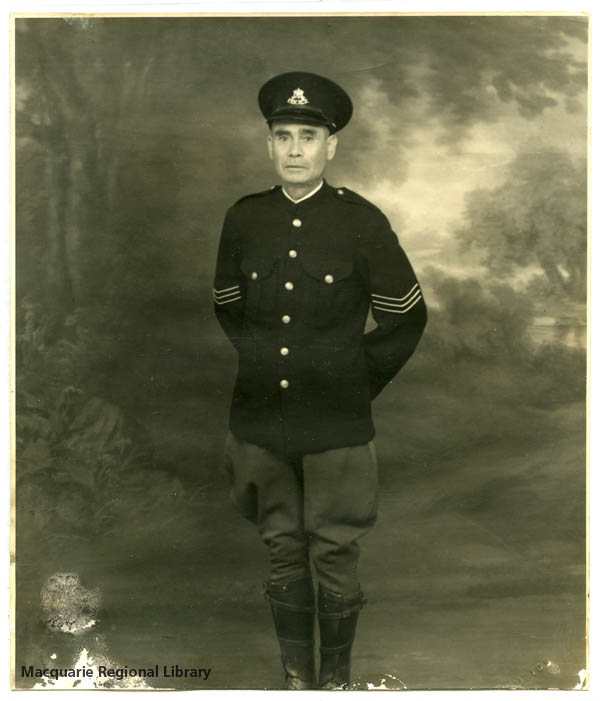
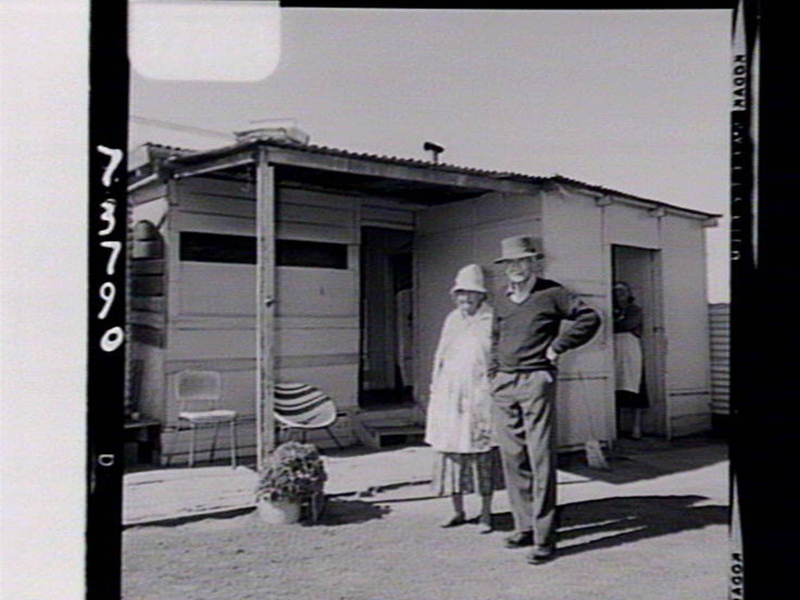
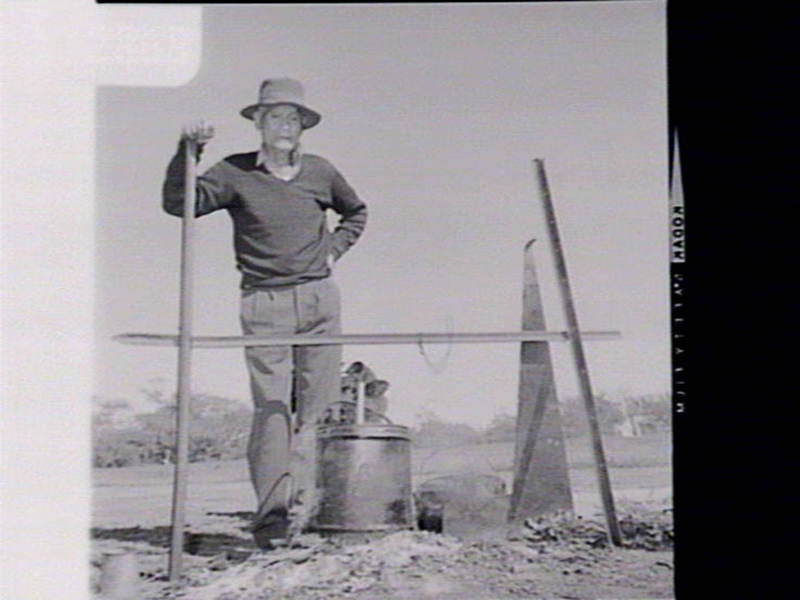
Sergeant Alexander Riley

[alert_blue]ALEXANDER is NOT mentioned on the Police Wall of Remembrance[/alert_blue] * NOT JOB RELATED

 [divider_dotted]

 Funeral location:

[divider_dotted]

[divider_dotted]

Riley, Alexander (1884–1970)

by Geoffrey Gray

This article was published in Australian Dictionary of Biography, Volume 16, (MUP), 2002

Alexander Riley (1884-1970), tracker, was born on 26 May 1884 at Nymagee, New South Wales, son of John Riley, labourer, and his wife Mary, née Calligan. Alec was part-Aboriginal and worked as a stationhand. On 11 June 1911 he joined the New South Wales Police Force as a tracker and was based at Dubbo. His tracking skills helped to break a cattle-thieving ring in 1913. He also assisted in the recapture of two escapees from the Dubbo gaol. Although he resigned from the police force on 31 August 1914, he was reappointed on 1 January 1918.

On Christmas Eve that year, after following her footprints across rough and barren terrain, Riley found a barefooted 6-year-old girl who had been lost for twenty-four hours in the mountains near Stuart Town. He helped to apprehend George Earsman in 1921; Earsman was later sentenced to death for the murder of Alexander Matheson. In the early 1920s Riley was credited with the capture of the ‘last of the bushrangers’, Roy Governor, a younger brother of the notorious Jimmy Governor. Roy, an expert bushman, had evaded thirty policemen and ‘blacktrackers’ for three months until Riley discovered that he tied pieces of sheepskin—wool-side down—to his feet to disguise his tracks.

At the Presbyterian manse, Wellington, on 14 June 1924 Riley married 26-year-old Ethel Taylor. He was a well-known horseman in the Dubbo district, appearing at many country shows and with the travelling rodeo of the Police Boys’ Clubs.

In 1939 Riley helped in the arrest of Andrew Moss, who had reputedly killed thirteen people over twenty years. It had taken him more than twelve months of ‘painstaking investigation to run this man to earth’. Moss was charged with three murders, convicted and sentenced to death, but his sentence was commuted to life imprisonment. That year Riley was officially commended for ‘his excellent tracking work which led to the recovery of property to the value of approximately £80, stolen from a store at Trangie, and also for the arrest of the offenders responsible for the robbery’. In 1940 he was able to demonstrate that the death of a child, whose remains were found in a gorge near Bugaldie, was the result of an accident rather than foul play.

When he was promoted sergeant on 5 August 1941 Riley was the first Aborigine to gain that rank in the New South Wales Police Force. Again officially commended for finding a missing man in April 1942, he was awarded the King’s Police and Fire Services Medal for Distinguished Service in January 1943. He lived all his working life at the Talbragar Aboriginal Reserve, by the Macquarie River, near Dubbo, and was permitted to remain there with his wife after his retirement from the police force on 13 July 1950. Survived by his five sons and three daughters, he died on 29 October 1970 at Dubbo and was buried with Anglican rites in the local cemetery. In 1996 Michael Riley made a short documentary film, Blacktracker, about his grandfather and his ‘legendary skills and deep humanity’. It was screened by the Australian Broadcasting Commission in September 1997.

http://adb.anu.edu.au/biography/riley-alexander-11525

[divider_dotted]

MRL Local History and Family History

Tracker Riley Dubbo Cycleway

Sunday, May 26, 2013

Born on this day…

Alexander (Alec) “Tracker” Riley was born on 26 May 1884 at Nymagee N.S.W., son of John Riley, a labourer, and his wife Mary, nee Calligan.

He worked as a stationhand before joining the New South Wales Police Force as a tracker on 11 June 1911, and was based in Dubbo.

His tracking skills helped to break a cattle-stealing ring in 1913, and he found a bare-footed 6 year old girl who had been lost in the mountains for twenty-four hours  near Stuart Town on Christmas Eve in 1918.   He also assisted in the capture of two escapees from Dubbo Gaol, and in locating many other offenders, missing people, and stolen property, during his career.

He married Ethel Taylor at Wellington in 1924. He was promoted to Sergeant on 5 August 1941, and was the first Aborigine to gain that rank in the New South Wales Police Force. His excellent tracking skills lead to him being awarded the King’s Police and Fire Services Medal for Distinguished Service in January 1943.

An article titled “A Black-Tracker tells his story”, published in The Sunday Herald on 9 July 1950 (p. 9 http://nla.gov.au/nla.news-article18480263) reports that “Alex Riley is generally considered the State’s most outstanding black-tracker”, and that he “has tracked down and rescued more than 20 lost people in as many years”.

He was also an excellent horseman, and over the years trained footballers, cyclists, athletes, swimmers, and boxers in the Dubbo district.

He lived all his working life, and after his retirement from the police force on 13 July 1950, at the Talbragar Aboriginal Reserve near Dubbo.  He died on 29 October 1970 at Dubbo.

The Tracker Riley Cycleway around the Macquarie River at Dubbo was named in his honour and is 1 year old today.

http://www.mrl.nsw.gov.au/mrl-local-history-and-family-history/tracker-riley-dubbo-cycleway

[divider_dotted]

Further reading:

http://trove.nla.gov.au/ndp/del/article/18480263

http://nga.gov.au/exhibition/riley/Default.cfm?MnuID=4&Essay=8

Alexander Riley

[divider_dotted]

Friday 3 September 2004, 6 pm ABC1

Blacktracker

Have Your Say

Black Tracker

Black Tracker is a 1990s ABC documentary about the late police officer and tracker Sergeant Riley produced by the late Michael Riley. At its wrap up there is a beautiful piece of classical music which then lasts throughout the credits. The name of the music is not in the credits. …

Teresa

Purchase Message Stick DVDs

For a custom DVD copy of Message Stick episodes for educational use visit the Non-Theatric Sales website

Non-Theatric Sales

Mark Olive aka “The Black Olive” is back to show us how to do a picnic with a twist.

Transcript

RACHAEL MAZA, PRESENTER: Hi, welcome to Message Stick. I’m Rachael Maza. This week’s show is a special tribute to Indigenous film-maker and artist Michael Riley, who passed away after battling a long illness He was 44. Michael produced some beautiful films for us over the years, and we’d like to replay one of them. It’s called ‘Blacktracker’. This is dedicated to Michael Riley.

‘BACKTRACKER’ OPENING SUPER: From the early 1800s, Aboriginal people have been used as guides and trackers by the police force. This century, one of the most highly was Sergeant Tracker Alexander Riley of Dubbo, NSW.

‘SYDNEY MORNING HERALD’ REPORTER FROM 1949: “Ex-Sergeant Tracker Alex Riley of Dubbo has done more to solve major crime, recapture jailbreakers and save lives than any other coloured man in this State. Almost everyone in Dubbo knows Alex Riley, who retired several years ago after 40 years service in the NSW Police Force. ‘A white man,’ they’ll tell you, when they talk about him. Alex Riley smiles when he hears it. He understands that a compliment is intended. And he’s tolerant. Here is his story, as he told it to me.”

‘SYDNEY MORNING HERALD’ REPORTER RECOUNTING RILEY’S WORDS: “‘Credit for any skill I had as a tracker goes to a tribe of full-blooded blacks who roamed the bush near Condobolin 60 years ago. We lived at the mission station, but I liked to hunt with the full-bloods. When I was eight years of age, they started to teach me how to track. They first showed me how to recognise the hooves of the police horses by the way they were shod. They always knew when a trooper was in the area. I was horse-breaking until I joined the Police Force at the age of 26 years. I got most satisfaction out of finding people who were missing or lost. Catching criminals was interesting, but it never really appealed to me. Now that I’m out of the force, I’ll stick to bush work. But if they want me back on any job, I’ll help in any work except investigation of crime.'”

‘SYDNEY MORNING HERALD’ REPORTER: “On Christmas Eve of 1918, a six-year-old girl was lost in rugged bush and barren mountains near Stuart Town. Alex Riley arrived on the scene at daylight.” Later that day, he found the exhausted child in a gully, bogged to her waist in thick mud. He gave her milk from a bottle he always carried when searching for lost people.”

BERNADETTE YHI RILEY, GREAT GRANDDAUGHTER OF ALEX RILEY: I first started to research about Alec Riley in 1989 – he’s my great-grandfather – when I’d gone to visit my grandmother with some friends and one of my friends had a child and we were looking for things to do, so I decided to take my friend’s son to Old Dubbo Gaol. And while we were there, I was remembering back from when I was a child, being at the Old Dubbo Gaol, and I remember this particular photograph of my great-grandfather being in the gaol, and I took my friend’s son around to show him this photograph and tell him that that was my great-grandfather and that he was an Aboriginal tracker, but that was all I knew about him. I didn’t really know that much about his life or his exploits or his special talents that he had. So after thinking about it, I went back to Sydney and I was looking through books to see if there was anything about him, because there’s things in books about other Aboriginal leaders and Aboriginal people that have worked in al
sorts of different areas. So I just assumed that there would be something about Tracker Riley. There was a few articles in the local newspaper and there were some articles in a Sydney-based paper, like, one article. I was really astonished to find that a journalist from England and America had come here because they’d heard of him and they did a story about him, but not many people in Australia ever had much time to write a story about the things that he did. So I rang my grandmother and I said, “Oh, Nan, I’ve decided that I’d like to write a book about Grandfather Riley and let people know of his life and his exploits.” And not only that, I was more motivated to do it because it was such a positive story, because he was such a positive person and he’d done so many good things and I just thought that we need some more positive stories and I thought that his life would provide that. When I first started to research about Grandfather Riley, I got to interview a lot of my own family and I got to interview a lo
of Kooris from around New South Wales. And I interviewed the local police. And I got to interview ex-Detective Sergeant Claude Oakman, who’s now retired and has a lot of fond memories of Grandfather Riley and worked with him quite closely on a number of very important cases.

CLAUDE OAKMAN, EX-SUPERINTENDENT, DUBBO REGIONAL POLICE FORCE: I came to Dubbo in January 1940, on transfer, and Alec was there then, of course. I came as the mounted man and given a Harley Davidson motorcycle and sidecar. Had to do all the country inquiries. And that’s where Alec came over with me and we did a lot of the travelling and visiting at the different farms and stations and properties, and Alec showed me the area, introduced me – he knew practically every one of them – and introduced me to the homesteaders and the farmers and the graziers. And from there on, we were friends…

BERNADETTE YHI RILEY: Everybody, like all the Kooris and all the non-Aboriginal people, all said virtually the same thing about Grandfather Riley. They said that when he was tracking that the reason why he found people so quickly and he was so good at finding people, was not only the physical tracking, but it was the mental stuff – he had a sixth sense, perhaps.

CLAUDE OAKMAN: He was more than a tracker. As far as abilities were concerned…where he learnt them I don’t know, but he knew every bird and beast, knew their calls, what they did, how they reacted. He could track any signs, see any signs…marks, footprints. Show him a pair of shoes and he could say whether that was the same mark, tracks, that he was looking for, or not. But in doing that, he had the knowledge of what those tracks meant. He could read tracks. And he could deduce from that what that person was doing, whether he was running, walking, whether he was ill, whether he was hurrying away, fatigue had set in. And he read that and that was part of his tracking. And to start off and follow a track, he would go, quite often, 100, 200, 300 yards and not see a sign and then came onto some tracks. But he had that happy knowledge or ability of finding which way that person or thing that he was tracking was travelling. Where he would go if he was lost, if he was injured, thirsty or dying – it was a different set-up to a man that was trying to escape and going straight. And he would follow those tracks from intuition and I don’t know of any other person that could do that. I’ve seen other trackers and they could follow tracks and the average bushman could follow tracks. But to come to an area… I mean, he might see… They talk about ants – he might see ant tracks there – where they’ve been – and he could read those. But I mean, he could also read whether they’d been disturbed recently or hadn’t been disturbed for some time.

BERNADETTE YHI RILEY: I think one of the most disturbing cases that Grandfather Riley was ever involved in was the case of Desmond Clark. Desmond Clark was a 2\-year-old boy that went missing in the Pilliga Scrub. They had a 750-man search party trying to find Desmond and they couldn’t find him anywhere. So the superintendent, he found Tracker and got Tracker to come out to this property. But when he got to the property, the old cocky who owned the property turned around and said to Tracker Riley he didn’t want any blacks on his property…and wouldn’t allow him to participate in the search for his 2\-year-old grandson. So Grandfather Riley had no choice. He had to go back to Dubbo He hounded the superintendent to let him go out there because he believed that he knew which direction the boy was going in. Because it was coming on nightfall and there was a full moon that night, the child would be walking towards the light. But of course, nobody bothered to search in that particular direction and Desmond Clark was never found. About 12 months later, Desmond Clark’s grandfather died and Tracker Riley went back out to the Pilliga. And he decided to follow through on his theory about the young boy following the moon. And within 12 hours, he found the boy’s remains in a chalk pit. But the most startling point of it all was that his remains were only 500m from the actual homestead and the search party of 750 people had been looking in the wrong direction. And that, for him, was very disturbing. And although he never complained to anybody or said anything, my Aunty Ruby said that there was a change in his behaviour and that indeed, he was very upset, because Grandfather Riley believed wholeheartedly that if he was allowed on that property, he would’ve been able to save that boy’s life. So I suppose that just shows you how powerful racism can be.

CLAUDE OAKMAN: Alec was very reserved about his talking of work done and to whom the benefit arose. With the police that worked with him, some gave him full credit, others took all the credit, I’m sorry to say, but Alec never complained. To the turns that he’d done for the public in possibly tracking stock, recovering of stock, recovering of property, I think Alec combined with the police that were there to do that and he never, ever got the same credit as the policeman, which he should have done. But because he was a tracker, he missed out on that and bypassed a lot of commendation that he should’ve got.

‘SYDNEY MORNING HERALD’ REPORTER FROM 1949: “Riley was present when Andrew Moss was arrested at Dubbo in 1939. Moss was subsequently sentenced to death for murder. He was charged with murdering three men. Moss was supposed to have killed 13. His own boast was that he had ‘done the baker’s dozen’.”

BERNADETTE YHI RILEY: What about when Grandfather tracked down Andrew Moss, when he could tell which way the sulky went by the twigs?

RUBY McGUINNESS, ALEX RILEY’S DAUGHTER: Yeah, between… Well, you know, like, the sticks were broken on the side of where he went in…round about and that, where he felt, you know, these people would be. And it was in a creek down on Narromine Road, out the Narromine Road. And Dad sifted the… There was a fire, see? And he sifted all the ashes and he found all the human bones, belonged to this bloke that he murdered for his sulky and his horse.

BERNADETTE YHI RILEY: Well, he said he killed 13, the baker’s dozen. The most sensational case that Tracker Riley was ever involved in was the case of Andrew Moss. Andrew Moss killed three people and was finally charged in 1939. But to actually catch Andrew Moss, Grandfather Riley had to track a distance of around 200km radius. He went to places such as Narromine, Dubbo, Gilgandra, Peak Hill, and he was quite instrumental in the capture of Andrew Moss. He led the police to Andrew Moss and he was also instrumental in getting Andrew Moss charged with murder, because all of the evidence was circumstantial and Tracker Riley, not only was he a good tracker but he was also an excellent witness in court. I think the most difficult person that Tracker Riley ever had to track down was Roy Governor. Roy was the youngest brother of Jimmy and Joe Governor. In fact, he was four years old when Jimmy and Joe were involved with the Breelong Massacre.

‘SYDNEY MORNING HERALD’ REPORTER FROM 1949, RECOUNTING RILEY’S WORDS: “‘For three months, I hunted Governor through the scrub, from hideout to hideout. I followed him by a peculiar track. I noticed a strand of string had marked each pad, so I knew it was a human wearing a foot pad to cover tracks. I first surprised him in a hideout and as he fled into the scrub, I saw the foot pads were made of sheepskin. I also recognised him as one of the Governors and saw that he was armed.'”

‘SYDNEY MORNING HERALD’ REPORTER FROM 1949: “Police fire was concentrated on the hideout and Governor fell with a bullet through the back. It penetrated his chest and chopped the top off a lung. After a Dubbo doctor had saved his life, Governor was sentenced to death at the Dubbo Supreme Court. The sentence was commuted to life.”

BERNADETTE YHI RILEY: What about when Grandfather resigned from the Police Force and he was a sergeant and everything and he didn’t get the pension? They didn’t give him any money when he left the Police Force.

RUBY McGUINNESS: No, they didn’t give him anything. They didn’t recognise him for anything. When he retired, they gave him a dinner.

SHIRLEY MATTHEWS, ALEX RILEY’S GRANDDAUGHTER: Farewell dinner.

RUBY McGUINNESS: Farewell dinner and a gold watch and that’s what he got.

SHIRLEY MATTHEWS: That was from the people he worked with in the Police Force.

RUBY McGUINNESS: They gave him nothing in Dubbo.

SHIRLEY MATTHEWS: He wasn’t recognised. Apparently he wasn’t recognised as a policeman. Even though they made him sergeant and he got the King George Medal, he still wasn’t recognised. So…

RUBY McGUINNESS: As a policeman.

BERNADETTE YHI RILEY: They wouldn’t give him a pension or…

RUBY McGUINNESS: He only got the Old Age Pension. That’s all he got. When he retired, he and Mum, he didn’t get anything else.

BERNADETTE YHI RILEY: The Police Pension.

RUBY McGUINNESS: No.

BERNADETTE YHI RILEY: Because he contributed…

RUBY McGUINNESS: He didn’t get that.

BERNADETTE YHI RILEY: And he contributed to that Police Fund – it said on his record.

RUBY McGUINNESS: Of course he would’ve been. Of course he did.

BERNADETTE YHI RILEY: Claude, when Alec was awarded the medal in 1943, the King’s Medal…?

CLAUDE OAKMAN: King’s Police and Fireman’s Service.

BERNADETTE YHI RILEY: Yeah, For Distinguished Services.

CLAUDE OAKMAN: Mmm.

BERNADETTE YHI RILEY: How did he feel about that, getting that award?

CLAUDE OAKMAN: Alec was very proud. I was very proud and pleased that he got it. It was not for one individual episode or service, it was for continued service for a number of years and efficient service throughout that period. And in addition to efficient service, it was for good conduct as well. That he lived a very fine and steady way of life, helping other people and always ready to help the police, as well as the public. He was well liked by the public.

BERNADETTE YHI RILEY: What did all the Kooris think of him being a policeman?

RUBY McGUINESS: Well, all the Dubbo people, everybody that knew him, they thought it was great. They said he should have…

BERNADETTE YHI RILEY: Yeah.

RUBY McGUINESS: ..got this medal. But…he was a great old man, you know, although he was my father. And…he was very clever.

BERNADETTE YHI RILEY: What about Grandfather’s funeral?

RUBY McGUINESS: They gave him a State funeral, the police.

SHIRLEY MATHEWS: They had the parade of police.

RUBY McGUINESS: Yeah, they had the parade and everything like that.

BERNADETTE YHI RILEY: There was a few hundred people there.

RUBY McGUINESS: There would’ve been more than that. There was people outside the church. Many people came from everywhere, you know, who knew him.

BERNADETTE YHI RILEY: Did the police offer to help with the funeral?

RUBY McGUINESS: They did, but the boys didn’t want that.

BERNADETTE YHI RILEY: How come?

RUBY McGUINESS: No. They said they wanted to do that for their father, for our father.

BERNADETTE YHI RILEY: When I first started researching about Tracker Riley, I was motivated because it was such a positive story. It wasn’t a story about assimilation and it wasn’t a story about oppression. It was a story about an Aboriginal man who achieved in times of extreme adversity with the Government policy and law of the day and the racism that was around, which, of course, we all know still is, but back in those times it was really quite overt. I mean, he was living in an era where the Government was taking Aboriginal children away from their mothers, where they had assimilation policies going, where they had Aboriginal reserves being set up all around the place, and Aboriginal people were being treated really badly in those days, and he created a lot of goodness and he changed a lot of people’s views. He educated a lot of non-Aboriginal people. And then, for me, I started to realise that it was more than just a positive story. It was more a story about our culture and how rapidly our culture is diminishing. Every time we lose one of our old people, we lose knowledge and we lose experiences and I feel that as young Aboriginal people, that we have a responsibility to find out our roots and to find out as much as we can and preserve it, because if we don’t do that and we don’t pass that on to our children, then we’re just as responsible as the Government of that era of cultural genocide.

‘BACKTRACKER’ CLOSING SUPER: During Tracker Riley’s time with the NSW Police Force, 1911-1950, he was instrumental in solving over seven murder cases and finding numerous people lost in the bush. A great many people owe their lives to his exceptional tracking skills.

[divider_dotted]


Peter Ronald LINCOLN

Peter Ronald LINCOLN

 New South Wales Police Force

Regd. # 11598

Rank:  Commenced Training at Redfern Police Academy on

Probationary Constable – appointed 16 August 1965

Constable – appointed

Constable 1st Class – appointed

Senior Constable – appointed

Sergeant 3rd Class – appointed 28 July 1981

Sergeant 2nd Class – appointed


Sergeant 2nd Class – Retired

Stations:  Warilla HWP, Wollongong HWP, Wollongong GD’s

Service:  From  to  ?

Awards:  National Medal – granted 15 April 1981 ( SenCon )

1st Clasp to National Medal – granted 28 May 1992 ( Sgt )

2nd Clasp to National medal – granted 4 September 2001 ( Sgt )

Born:  Saturday  18 May 1946

Died on:  Tuesday 14 April 2009

Cause:  Heart attack

Age:  62 years, 10 months, 27 days

Funeral date:  Wednesday  22 April 2009

Funeral location:  Wesley Uniting Church, Crown St Mall, Wollongong

Buried at:  Cremated

Sergeant Peter Lincoln


PETER is NOT mentioned on the Police Wall of Remembrance * NOT JOB RELATED


 Funeral location


 Peter Lincoln – Funeral pamphlet


Peter Lincoln giving a Send Off speech to Mark Luchetti & Eric Renes on 10 February 1989
Peter Lincoln giving a Send Off speech to Mark Luchetti # 16913  & Eric Renes # 19791 on 10 February 1989


Beverley Thomas Vincent WALES

Beverley Thomas Vincent WALES

aka ” Big Bev “

New South Wales Police Force

Regd. # 7233

Rank:  Sergeant 3rd Class – Retired

Stations?, Nowra

Service:  From  to  11 March 1971 = 18 years Service

Awards?

Born:  6 October 1931

Died on:  Wednesday  15 April 2015

Cause?

Age:  83

Funeral date:  Thursday  23 April 2015 @ 1pm

Funeral location:  St Augustine Catholic Church, 103 Meehan St, Yass

Buried at:  Rye Park Cemetery, Lot 7003 Cemetery Dr, Rye Park, NSW

GPS -34.52222,  148.92867


[alert_blue]BEV is NOT mentioned on the Police Wall of Remembrance[/alert_blue] * NOT JOB RELATED

 [divider_dotted]

 Funeral location

[divider_dotted]

With regret I advise the death of Beverley Thomas Vincent WALES, 83 old, former Regd. No. 7233, an Unattached Veteran member of the RPA of Stirling, ACT.

Bev passed away on 15/04/2015 and his funeral is proposed to be held at 1pm on Thursday 23rd Instant at the Catholic Church, YASS.

[divider_dotted]

Bev was a Private Inquiry and Commercial Agent within A.C.T. from at least 1991.

 [divider_dotted]

WALLES, Beverly Thomas Vincent
Fondly known as “BIG BEV”
6.10.1931 – 15.4.2015
Beloved husband of Wendy for 59 years. Much loved father of Maureen ‘Maude”, Susan and Kate. Father-in-law to Ross. Brother to Sheila, Lorraine, Bruce, Terry (Dec) and Rod (Dec). Loved friend and snooker “buddy” to Storm.
The “Old Man” has gone to the big pool room in the sky. Now at Peace.
Requiem Mass for the repose of the soul of BEV will be celebrated in St Augustine’s Catholic Church, Meehan Street, Yass on Thursday, 23rd April, 2015 commencing at 1:00pm.
Following Mass, the cortege will then leave for interment in the Rye Park Cemetery.
Special thanks to the staff of Calvary Hospital Bruce for the wonderful care of Bev.
W. T. Dennis & Son Pty Ltd Funeral Directors AFDA79 Rossi Street YASS NSW 2582 Phone: (02) 6226 4871
Funerals
Published in The Daily Telegraph on 18/04/2015

– See more at: http://tributes.dailytelegraph.com.au/notice/149942006/view#sthash.aAcmF8yq.dpuf

[divider_dotted]


Peter Graham MELVILLE

 Peter Graham MELVILLE

Western Australia Police Force

Regd. # 13613

Rank?

Stations?

Service:  From  to  ?

Awards?

Born?

Died on?

Cause?

Age?

Funeral date?

Funeral location?

Buried at?


[alert_yellow]PETER is NOT mentioned on the Police Wall of Remembrance[/alert_yellow]  *NEED MORE INFO


MELVILLE (Peter Graham):
The Commissioner of Police and all Members of the Western Australia Police regret the passing of our colleague, Peter Melville, Registered Number 13613.
Deepest sympathy to all of his loved ones.
 
logo

http://www.westannouncements.com.au/obituaries/thewest-au/obituary.aspx?n=peter-melville&pid=174594969&eid=sp_ommatch&eid=sp_ommatch


Graham FORBES

Graham FORBES

aka ” Melton ”  aka ” Forbsey “

( late of Erskine Park )

Goulburn Police Academy class 231B

New South Wales Police Force

Regd. # 20163

Rank:  Constable 1st Class

Stations?, Ermington

Service:  From  to  2 August 1993

Awards?

Born:  17 August 1964

Died on:  2 August 1993

Cause:  Pedestrian – MVA at Toongabbie

Age:  29

Funeral date?

Funeral location?

Buried at:  Cremated.  Pinegrove Cemetery, Sundial Garden


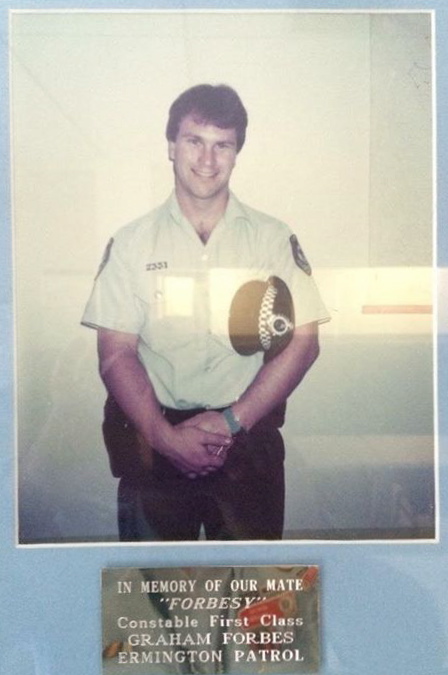
Constable 1st Class Graham FORBES - Ermington Patrol.  Hanging in Granville Police Station.
Constable 1st Class Graham FORBES – Ermington Patrol. Hanging in Granville Police Station.

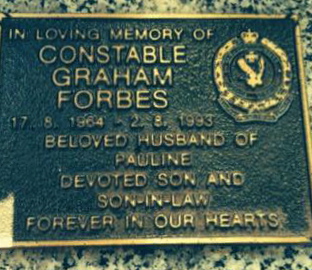
Constable 1st Class Graham FORBES - Grave plaque - Pinegrove Cemetery
Constable 1st Class Graham FORBES – Grave plaque – Pinegrove Cemetery

[alert_blue]GRAHAM is NOT mentioned on the Police Wall of Remembrance[/alert_blue] * NOT JOB RELATED

 [divider_dotted]

It is believed that Graham was standing at the boot of his vehicle whilst parked outside of an old school mates house, in Toongabbie, when he was struck from behind by another vehicle, resulting in the death of Graham.


Keith George BEACROFT

 Keith George BEACROFT

( late of Dubbo )

New South Wales Police Force

Joined NSW Police Force via NSW Police Cadet system on 16 December 1955

Cadet # 1250

[alert_yellow]Regd. # 9362[/alert_yellow]

Rank:  NSW Police Cadet – commenced 16 December 1955

Probationary Constable – appointed 29 June 1959

Constable 1st Class – appointed 29 June 1965

Senior Constable – appointed 29 June 1969

Sergeant 3rd Class – appointed 1 September 1974

Chief Inspector 3rd Class – appointed 1 June 1988

Chief Inspector – appointed 25 January 1989

Final Rank:  Chief Inspector – retired

Stations?, ‘R’ Region – Newcastle?, Helensburgh ( Sgt – OIC ), Dubbo ( Insp – Patrol Commander )

ServiceFrom  16 December 1955  to  5 July 1996 = 40+ years Service

Awards:  National Medal – granted 15 September 1980

1st Clasp to National Medal – granted 15 May 1986

2nd Clasp to National medal – granted 16 June 1993

Born:  29 June 1940

Died on:  Wednesday  8 April 2015

Cause?

Age:  74

Funeral date:  Thursday  16 April 2015 @ 11am

Funeral location:  St Brigid’s Catholic Church, 198 Brisbane Street, DUBBO

Funeral ParlourW. Larcombe & Son6882 3199

Buried at:  Dubbo Lawn Cemetery, Cobbora Rd, Dubbo


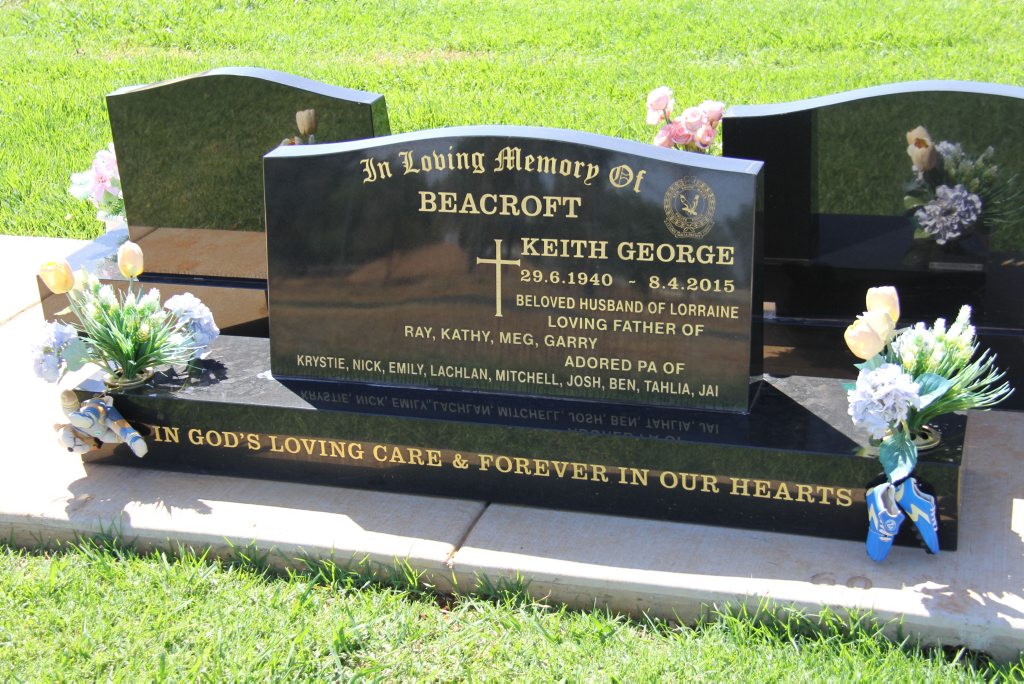
Keith George Beacroft

Keith George BEACROFT - grave.  BEACROFT Keith George 29.6.1940 - 8.4.2015 Beloved husband of Lorraine Loving father of Ray, Kathy, Meg, Garry Adored Pa of Krystie, Nick, Emily, Lachlan, Mitchell, Josh, Ben, Tahlia, Jai In God's loving care & forever in our hearts

[alert_blue]KEITH is NOT mentioned on the Police Wall of Remembrance[/alert_blue] * NOT JOB RELATED

 [divider_dotted]

 Funeral location

[divider_dotted]

KEITH GEORGE BEACROFT
Retired Police Chief Inspector
Late of Dubbo
Passed away 8th April 2015
Aged 74 Years
 
Beloved husband of Lorraine.
Loving father of Ray, Kathy, Meg and Garry.
Loved father-in-law and adored Pa to his grandchildren.
 
Relatives & friends are warmly invited to attend Keith’s funeral service to be held at St Brigid’s Catholic Church Brisbane Street, Dubbo, on Thursday 16th April, 2015, commencing at 11.00am followed by interment in the New Dubbo Lawn Cemetery, Dunedoo Road, Dubbo.
 
In lieu of floral tributes donations to the Leukaemia Foundation would be appreciated and may be left with the funeral directors at the service.
 
Funeral arrangements are in the caring hands of W. Larcombe & Son Dubbo’s Premier Funeral Home, Proudly servicing the community for 120 years. FDA Approved. (02) 6882 3199 www.wlarcombeandson.com.au
Guest book:
Tuesday, 14 April 2015
Our thoughts and wishes are with you Lorraine and your family.  It was a pleasure to know and work with Keith. Kind regards.
Don and Ronnie Barton
 
Tuesday, 14 April 2015
Our thoughts and love are with you and your family at this sad time Lorraine.

 
Published in The Dubbo Daily Liberal on Apr. 14, 2015

http://tributes.dailyliberal.com.au/obituaries/dailyliberal-au/obituary.aspx?n=keith-beacroft&pid=174622420&eid=sp_ommatch&eid=sp_ommatch

[divider_dotted]


Harry Desmond TUPMAN

 Harry Desmond TUPMAN  QPM

( late of Ashfield, NSW )

Husband to Yvonne TUPMAN, nee ROBERTSON, NSWPF Police Woman # ???

Father to Judge Robyn TUPMAN

New South Wales Police Force

Regd. # 5450

Rank:  Commenced Training at ? Academy on Monday 11 November 1946 ( aged 25 years, 9 months, 6 days )

Probationary Constable – appointed ? ? ?

Constable – appointed ? ? ?

Detective – appointed ? ? ? ( YES )

Constable 1st Class – appointed ? ? ?

Senior Constable – appointed ? ? ?

Sergeant 3rd Class – appointed ? ? ?

Sergeant 2nd Class – appointed 1 April 1968

Sergeant 1st Class – appointed ? ? ?

Inspector 3rd Class – appointed 7 January 1976


Final Rank:  Detective Inspector – Retired


Stations?, 21 Division, Arson Squad, Special Crime Squad, Homicide Squad


ServiceFrom 11 November 1946  to  4 February 1981 = 34 years, 2 months, 24 days Service

Age at Retirement: 59 years, 11 months, 30 days

Years in Retirement:  34 years, 2 months, 3 days ( was Retired just about as long as he Served )


Awards:  Queen’s Police Medal ( QPM ) for Gallantry ( Imperial ) – granted 3 June 1978 ( Insp )


Born:  Saturday 5 February 1921

Died on:  Tuesday  7 April 2015

Cause:  Alzheimer’s disease

Age:  94 years, 2 months, 2 days

Death location:  Hospital

Harry Desmond TUPMAN, Harry TUPMAN
Harry Desmond TUPMAN QPM

Funeral date:  Monday  13 April 2015 @ 2pm

Funeral location:  Magnolia Chapel, Macquarie Park Crematorium, Plassey Road, NORTH RYDE

Buried at:  Cremated


HARRY is NOT mentioned on the Police Wall of Remembrance * NOT JOB RELATED


 Location of Funeral


TUPMAN, Harry Desmond, QPM
Detective Inspector (Retired) NSW Police
05.02.1921 – 07.04.2015
Late of Ashfield

Loved husband of Yvonne for 65 years. Beloved father of Robyn and Lyn and father-in-law of Geoff Graham. Proud and treasured grandfather of Jessica, Paul, Emily, Aleisha and Tom and great grandfather to his namesake, Harry. Younger brother of Kath, Connie and Peggy (all deceased) and brother-in-law of Eric Robertson.

A gentleman and a man of integrity. He will be missed by his family and friends and will be remembered always.

Aged 94 years.

HARRY’S family and friends are warmly invited to attend a Celebration of his Life to be held Monday (April 13, 2015) in the Magnolia Chapel of the Macquarie Park Crematorium, Plassey Road, North Ryde to commence at 2pm.

TREVOR LEE & SON
FUNERAL DIRECTORS
Australian Owned
All Suburbs 9746 2949
F.D.A of N.S.W.

Published in The Sydney Morning Herald on Apr. 8, 2015

http://tributes.smh.com.au/obituaries/smh-au/obituary.aspx?n=harry-tupman&pid=174576391


National Advocate ( Bathurst )
Tuesday  25 April 1950                        page 1 of 4

MAN DECLARED HABITUAL CRIMINAL

Companion Warned

SYDNEY, Monday: Judge Lloyd in the Quarter Sessions today declared a 24-year-old shopbreaker an habitual criminal, and warned a younger man that he was heading for a similar punishment.

Norman Benaldo Brazemall ( 24 ) and Alwayn John Howard, ( 19 ), pleaded guilty to five shop robberies.

Judge Lloyd sentenced Brazemall to three years and declared him an habitual criminal. He sentenced Howard to two years.

Detective Harry Tupman, of 21 Division, said that both men had been released from gaol in February. They had almost immediately begun a series of robberies, using stolen motor cars.

Brazemall had had convictions since he was 15 and Howard’s convictions went back to 1947.

http://trove.nla.gov.au/ndp/del/article/161200306


The Sydney Morning Herald
Saturday  2 June 1951  page 36 of 36
TUPMAN (nee Robertson). — May 25, at Crown Street Hospital, to Yvonne and Harry — a daughter (Robyn).
http://trove.nla.gov.au/ndp/del/article/18223470

The Australian Women’s Weekly
Wednesday  26 July 1972   page 6 of 104
By KAY KEAVNEY

The MYSTERY of MARY and EMMA GOFFMAN

Ben Goffman returned to his home at Mosman, N.S.W., from an average working day last summer. His wife and youngest daughter were not   there. They have never been seen since. Here are the clues in a tragic story for which the police ending is, temporarily, “missing, believed murdered”.

STRANGERS have bought the house that Mary Goffman made.

Husband Ben used to say, in better times:  ” Look around. This house is Mary. ”

Last February 11, in broad daylight, with her little daughter Emma, Mary disappeared from the white house in the quiet suburban street on the north side of Sydney.

It may have been the scene of their murder.

On July 1 police informed Ben that the “grave fears” he had entertained from the first appeared to be justified.

Mary and Emma were almost certainly dead. So was their probable killer, Robert John Hynes.

Thin, dark, and bearded, with convictions for robbery while armed, Hynes died of injuries suffered in a car crash on June 20. while trying to evade police.

He had rented the car in the name of a Missing Person, Allan John McColm.

In the wreck, in a briefcase, police found a sawn-off rifle, and certain property of Allan McColm’s.  Later, after an anonymous tip, they found McColm’s body in bush at the side of the Mona Vale Road.  He had been shot through the head with a bullet from the same sawn-off rifle.

( During the long months of uncertainty, while Mary and Emma too were Missing Persons, Ben often said: ” There’s so much heavy bush on the north side. They could be dead in there, where nobody might ever find them. ” )

There were other alarming developments.

When Hynes was taken from the wreck, a telephone number was inked on his hand.

Police traced it to a housewife at North Curl Curl, also on the north side. She told a terrifying story.

On June 16 a man had telephoned in the name of a well-known carrying company. He was checking, he   said, that someone would be at home to help him with a heavy parcel.

The housewife was instantly suspicious. She was expecting no parcel, and said so.

But in due course the man appeared. He was thin, dark, and bearded.

The housewife let him leave the heavy parcel. But she resisted every pretext he gave to get inside the house.

That parcel contained sand. The man she has now identified as Robert John Hynes.

Her quick wits that day had probably saved her life.  But how often, the alarmed police wondered, had Hynes used this ploy and succeeded’?

In Hynes’ house at West Ryde, they found certain names and telephone numbers. Allan McColm’s was among them.

So, on a slip of paper, was B. C. Goffman’s.

The detectives called for the Missing Persons file on Mary and Emma.

What they read deepened their fears. On July 1 they cabled the English police to contact Ben.

By then, the house that Mary made had been sold to strangers. Over the months, Ben had found it increasingly unbearable to live there.

And besides, he needed money.

Since February, desperate to turn up information, he had spent hundreds of dollars on advertisements.

He had even employed a private detective.

And on that afternoon of February 11 when his loved ones disappeared, a “bearded man” had gone to his bank with two cheques signed by Mary.

They cleaned the Goffman’s joint account of all   $44.

Ben needed money badly.

Late in June, broken in heart and health, he went back to his native London.

Jane (9) and Sarah were soon to follow.

Teddy the dog, beloved of Mary, had been found a new home.

Mary’s elderly mother, pencil-thin from the months of anguish, still lived about 50 yards up the road from the white house.

But she too planned to leave Australia.

She had never believed for a moment that Mary had willingly left home and family.

But the news, when it came, nearly killed her.

In distant London, Ben reacted bitterly. From the first, he insisted, the police should have regarded the case as a homicide.

On July 3 he rang me.

I never met Mary or Emma, but I heard the story through a mutual friend.

Before he left, I spent weeks, off and on. with Ben, his friends, and family, probing what seemed a impenetrable mystery.

Now, with the link to the man Hynes, we knew at least part of the answer.

But Ben wanted us to publish this story. Some clue might emerge, some reader come up with information that would help solve the rest of the mystery.

Detectives in charge of the case concurred strongly.

Here. then, is what I learnt of the Goffmans, and the known events of that February day.

It was a golden Friday. Second daughter Sarah had just turned six and Mary ( the most devoted of mothers ) was planning a birthday party to be held the next day.

Youngest daughter Emma was small for her age – almost four. Ben describes her as ” build medium, eyes blue, straight hair, light-brown to honey-blonde; probably wearing a short-sleeved navy-blue dress; articulate, trained to quote her name, address, and telephone number. ”

Mary was 43. ” build slim, complexion tanned, height 5ft, 7in., hair brown and greying, speaking with an attractive Border lilt; probably wearing slacks, a yellow   knit top, a distinctive ring, and a man’s Omega calendar watch. ”

She and Ben had been married ten years. It was Mary’s first marriage, his second.

They met on a boat that brought them to Sydney, him from New Zealand, her from the United States. A telephonist, she had lived and worked in several countries since leaving Britain.

She passionately wanted children. In the ten years she had Jane, Sarah. Emma, and a miscarriage.

Friends and neighbors testify that the couple were unusually close. So does Mrs. White, Mary’s mother, who migrated to Australia to be near them.

Mary enjoyed home-making and was good at it, though she suffered at times from ” suburban ennui. ”

Ben handled all the business, including paying the bills and marketing in bulk.

Mary had a very real flair for interior decoration, and turning up bargains in antique shops.

With their own hands, she and Ben transformed the broken-down old house they were paying off at Mosman into a distinctive and charming home.

Dozens of books, records, photographic equipment, testified to the Goffmans’ catholic interests.

So did their friends, ranging (said one of them) “from professors to the man who runs a stall at the city markets; from quiet suburbanites to pot-party goers.”

Last year there was a minor burglary at the house and Mary was nervous. She never went out without double-locking doors and windows and fixing the fly screens.

Nor would she go out, even to garden, without wearing sunglasses.

All these facts have significance in the story.

Throughout, like a leit- motif, is a “bearded man.”

The first mention came from Mary herself, to Ben, her mother, and a woman neighbor, a week before she disappeared.

Ben’s car was advertised for sale. A bearded man (she said) called at the house to inspect it, presumably on foot.

Something about him Bearded man at Goffmans’ house frightened her. She described him to Ben, to her mother, and to a woman friend as “sick.”  He asked her to go with him in the car for a test drive. She refused. (She herself never drove.)

When she suggested he leave his briefcase with her as surety, he appeared to take umbrage and walked off.

( Says Detective-Sergeant Harry Tupman, now in charge of the case: “No wonder he took umbrage. That briefcase probably contained the sawn-off rifle.” )

That same night Ben sold the car to quite another buyer, later paying the cheque into the couple’s joint current account at a local bank.

It turned a deficit into a credit. On that Friday, February 11, the credit stood at exactly $744.

That morning, Ben testifies, all seemed normal when   he left for work. Mary was to deliver Teddy, their airedale, to a dog salon at the Spit for clipping and shampooing.

She and Emma did, around 9 a.m. The salon offered to ring when Teddy was finished.

Mary said not to bother, she’d call back before five.

Nothing in her manner caused remark.

A neighbor who spoke to her walking back found her “perfectly normal.”

The local milkman was waiting to collect his weekly money. He found her “her usual bright self.”

He thinks she was wearing dark jeans and a darkish top (but only a yellow-knit top appears to be missing).

Emma, he thinks, “wore a plain dark dress.”

Mary went into the house and got the money. The milkman gave her change and a receipt. He got into his van and drove away.

He estimates the time at 10.15 a.m.

And no one who knows Mary and Emma has seen them since, or at least has come forward to say so.

They were still (Ben says) in the house at 12.30. He rang from his city office, as he did at least once a day.

He said, “She sounded a bit sick, but she had a period, and both she and Emma had colds. Also we’d been out late the night before.

“She talked a bit about Sarah’s party, and at the end seemed quite bright and normal.”

Around 1.30, the elderly couple next door heard Emma coughing in the yard.

“Shortly after lunch” (the police were told later), a man claiming to be Ben rang the bank with a query about the state of the joint account.

About 2.20. Mary rang her mother.

Mrs. White’s last sight of her daughter had been late on the night before. The Goffmans had been to a dinner party, and the grandmother “baby-sat.” Mary and Teddy walked her home, as they always did, and at the gate Mary kissed her and said. “See you tomorrow. Mother.”

Her manner then was “normal.” Now it was markedly agitated.

She asked Mrs. White to pick up Jane and Sarah after school. This was by no means unusual. What followed was.

“She asked me to bring them hack to my place, instead of taking them home.”  said Mrs. White. “That had never happened before, never once.

“She asked me to keep them there till she called. I thought she must be preparing some surprise for Sarah’s   birthday next day.

“I said. “Yes, of course, dear. But what about Emma’?’

“For about a week, after being on the waiting list for months, Emma had been going to a nearby pre-school in the afternoons. I think Mary must have kept her home that day because of her cold.”

Mrs. White’s voice shook.  “Mary.” she went on, “said, in such a funny way. ‘I’ve got Emma.’ Got. She put an emphasis on ‘got.’

“I said, ‘Mary, are you all right’?’ and she said ‘Yes, Mother’ and hung up.”

And that was the last time anyone has heard Mary’s voice, or at least has come forward to say so.

“I nearly went down,” said Mrs. White. “Only 50 yards away. How I wish I had! But I was afraid she’d think me foolish.”

Some time around three, the elderly woman next door saw “a tall, thin man with a small beard” standing across the road from the Goffmans’, looking toward the house.

“He held a handkerchief up to his face,” she said. ” I watched him for some time. until he noticed me at the window. Then he turned on his heel and walked up the road.

“He made me so nervous I wore all my rings when I went shopping a bit later. On the way, I saw him walking back toward the Goffmans’. ”

There was no sign of him, and all seemed quiet, when she got home around 4.30.  At 4.55, just on closing time, a bearded man entered the Goffmans’ bank and presented two cheques.

Together they totalled $700. Both were signed “Mary C. Goffman.”

The signatures were unmistakably Mary’s. But she invariably added the words: “per B. C. and M. C. Goffman.”  They appeared on neither cheque.  ( Ben: “I’m positive she signed under duress, perhaps from a threat to Emma.  Mary wasn’t businesslike. I think she believed leaving off the extra words would invalidate the cheques.” )

Both cheques were apparently legal.  Even so, the teller referred them to a superior,  who referred them to the manager.  The manager came out and looked at the man. who seemed perfectly at ease.

The bank officers later described him to the police as: “about 30. 5ft. 10in., slim build, dark complexion, dark wavy hair, beard closely cropped, no moustache, dark glasses, well dressed in a dark suit.” ( They have since identified him as Robert John Hynes. )

When the manager saw no sign of Ben or Mary, he rang both the Goffman house and Ben’s office. Neither answered.

Meanwhile, the bank doors had been closed and locked. Still the bearded man seemed unperturbed.

The bank felt obliged to honor the cheques, for $50 and $650. When they paid over the cash, it left $44 in the joint account.

The bearded man asked to be let out by the back door, which led into a Mosman car park.

The bank officers are said to have watched him, intending to note his car number.

But he walked calmly out of the car park and was lost to sight.

Ben Goffman takes up the story: “After work I’d been to the markets to buy vegetables, as I always did on a Friday night.  “I drove up about ten to six in the new car, expecting to find the whole family, including Teddy, at home.

“But the bedroom blinds were drawn and all the windows shut.  “I pressed the front-door bell and it didn’t work. So I got out my key. The door opened right away, which meant it wasn’t double locked. That wasn’t like Mary, if she were going out.

“As soon as I got inside I saw why the bell hadn’t worked. The plastic casing and two of the batteries were lying on the floor, along with some of Emma’s toys.  “The receipt for the milk money and some change were still on the hall table.

All this seemed strange.  “Beside them on the table were her sunglasses.  “I went through to the kitchen and tried the back door. It was locked, but not chained, again not like Mary since the burglary.

” The vitamiser was on the sink, with the remains of some milk in it. It was new, and Mary was fanatical about washing it right after use. Alongside was an empty yoghurt carton. She’d often give Emma milkshake with yoghurt for lunch.

“The kitchen window was shut but not locked, and the flyscreen not replaced properly.  “And the whole knife drawer from the cupboard under the sink was missing.

“Later I found it on the bed in the spare bedroom off the kitchen.

” I couldn’t understand any of it. I thought perhaps they’d all gone down to the dog salon, and drove there via the park.

” The salon had closed at five. When Mary hadn’t turned up as promised, they’d left Teddy at the adjoining vet’s.

” Then I tried Mary’s mother’s, and found Jane and Sarah there, and heard about Mary’s phone call.

” Even then I was puzzled rather than scared. I had no reason to suspect anything sinister. Mother and I took the girls home, thinking it would soon be Emma’s bed time.”

By 8.15, after vainly checking with various friends, Ben was ringing the police, while his closest friend, Ron Poison, tried the hospitals.

The police came, and that night two more names were added to the bulging files of Missing Persons.

” I don’t know what I thought.” Ben said. ” That she’d had some sort of breakdown, all sorts of things. But a breakdown between breakfast and lunchtime? I didn’t know then about the cheques and the bearded man.”

Next morning, late, he rang nine little girls, to cancel Sarah’s birthday party.

He and Mrs. White, Ben said, searched the house to see what was missing.

” She seemed to have gone just in old slacks and the yellow top, and Emma in the thin navy-blue dress. So far as we could see, she had no purse, no bag, nothing warm for Emma, and was without any sunglasses.”

Mrs. White discovered that one of a pair of highly distinctive large sheets was missing. They were a gift from Mary’s brother in the United States, and would certainly be rare in Australia.

The sheet was a tan color, with a pattern of white flowers on a black grid,   labelled “Vera Collection by Burlington.”

Also missing were the scissors Mary kept in the kitchen.  (A large pair of scissors was found in Hynes’ home, identified as Mary’s by Mrs. White. There was also a broken pair of sunglasses.)

A joint savings-account book containing $600 (held by Mary for her mother) was safely hidden.   But the chequebook was missing.

That was what sent Ben to the bank on Monday morning, to be told about the two signed cheques and the bearded man.

Ben said, “From that moment, I was sure Mary and Emma had come to harm.”

In those days before either of us had heard of Robert John Hynes, many things   puzzled me.

If Mary had the wit to leave off the extra words, why not sign even more incorrectly, to alert the bank?

“I think she tried to.” Ben said. “The cheque immediately preceding those two has never been presented. She could have used it first that day, signing it incorrectly.

“But there were several things in the house signed “Mary C. Goffman.’ The man could have checked with them, and forced her to tear the cheque up.

“So leaving off the initials was the best she could do.”

How did he get the two away, in broad daylight, and without an outcry?

“Mary would do anything,” Ben said, “if he threatened Emma. Or perhaps they were dead when he took them out.”

Always Ben came back to the “bearded man”, who called about the car, and frightened Mary.

At first, the man was to inspect the car at night, when Ben was home.

“Then he rang back and cancelled, ‘because he had to work back at a Parramatta pharmacy’, and arranged to go out to the house when I wasn’t there.

“Afterwards my friends and I, then the private detective, combed Parramatta but we never found that man.”

Ben’s life over those months was torture.

It happened when he was especially tired, closest to breakdown. Very soon he would think: Not Mary. Mary wouldn’t have just run away, deserting Jane and Sarah too, putting him and her mother on this rack, causing Teddy to fret. Not Mary.

Had she broken down? Were she and Emma wandering about in God knew what condition?

One witness thought so. After reading a newspaper story, she identified them as a lost-looking, dirty woman and child she had seen wandering about at Circular Quay.

Ben felt the descriptions didn’t fit. But for a long time afterward, he haunted the Quay.  Deep down, though, he knew the truth from that first moment in the bank, when he heard about the bearded man.

His last words to me before he left were: “That man killed them, and hid them somewhere in the bush.”

Now Ben and the police appeal for aid.

If you observed anything on that February day, or before, or since, which might   be of assistance, please contact your local police or the   Sydney C.I.B. (Tel. 20966).

Det.-Sgt. Tupman: ” Someone may have seen Hynes acting in unusual or suspicious circumstances. He may have used his own car or a stolen one.

” Particularly contact us if you were ever approached, either by telephone or in person, in a similar manner to the North Curl Curl housewife.

“Someone may have seen the missing sheet from the Goffman home, or Mary’s distinctive ring.

” Any information, however slight, may help us to break this case, and who knows how many others? ”

http://trove.nla.gov.au/ndp/del/article/47473545/4906874


The Canberra Times
Tuesday  5 December 1972    page 7 of 24

Missing woman believed murdered

SYDNEY, Monday. – A missing Sydney woman and her three year-old daughter are believed to have been murdered by a man killed in a car accident while being pursued by police on June 16 this year, police said today.

The Senior City Coroner, Mr K. M. Waller, SM, today opened a magisterial inquiry into the disappearance of Mrs Mary Crozier Goffman, 43, and her daughter Emma, of Mosman, on February 11.

Detective Sergeant Harry Desmond Tupman, of the Special Crime Squad, told the Coroner he believed that Mrs Goffman and her daughter had been killed by Mr Robert John Hynes.

He said Mr Hynes had been involved in a car accident on June 16 after being pursued by police and had died as a result of his injuries on June 19 in the Royal North Shore Hospital.

Sergeant Tupman said police inquiries had shown that on February 11, two cheques for $50 and $650 had been drawn from the Goffman’s joint account by a man who had later been identified as Mr Hynes by bank officials from a photograph.

The manager of the Mosman branch of the Commercial Bank of Sydney, Mr Henry John Barnard, told the court he had tried to ring Mrs Goffman at work but had been unsuccessful in contacting them.

Mr Barnard said he had initialled the cheques and the money, in $10 notes had been handed to the man.

He said the amount of the cheques, the fact that they were to be presented in cash and that it was not Mr Goffman accepting the money, had worried him.

However, the man’s actions had not revealed any fear and he bad not acted suspiciously.

“I felt at that point that I was satisfied it was all right”, he said.

The hearing was adjourned.

http://trove.nla.gov.au/ndp/del/article/110623865


The Canberra Times

Wednesday  6 December 1972     page 3 of 36

Finding of murder

SYDNEY, Tuesday. – A coroner acting as a Justice of the Peace found today that Mrs Mary Crazier Gofman, 43, and her daughter Emma, of Mosman, died on February 11 this year at the hands of a person since deceased.

The Senior City Coroner, Mr Wallen, SM, said, “But as to the manner and cause of death and place, the evidence does not enable me to say. I further   find that although no bodies have been found I am   satisfied death actually took place”.

He said he was satisfied that they had been killed by Mr Robert John Hynes who, he had been told at an earlier inquiry, had died in Royal North Shore Hospital on June 19 after a car accident while being pursued by police.


http://trove.nla.gov.au/ndp/del/article/110623946


The Canberra Times

Tuesday  9 July 1972     page 10 of 18

Identified

SYDNEY, Monday. —

Police positively identified today two skeletons found at Ingleside on Friday as Mrs Mary Goffman, 43, and her daughter, Emma, 3.

At a coroner’s inquiry on December 5, 1972, Mr K. M. Walker, SM, found the mother and daughter had been murdered by Robert John Hynes, 34, who died in a car accident while being chased by police on June 19, 1972.

http://trove.nla.gov.au/ndp/del/article/110718575


 The Canberra Times

Friday  21 January 1977        page 1 of 24


Sailor, 19, charged over Nowra fire

A junior sailor had been charged by the Navy yesterday afternoon with a number of serious offences in relation to the fire at the Nowra naval air station on December 4, the Minister for Defence, Mr Killen, said in a statement yesterday.

Able Seaman G. J. Trent, 19, of the base, was charged after lengthy questioning at the base yesterday.

A spokesman for Mr Killen said that the man had been charged under the Naval Discipline Act, but no further details of the charges were available yet. He is in naval custody.

12 aircraft

Investigations into the fire, which damaged or destroyed 12 Grumman Tracker aircraft and a hangar, have been in progress since the fire.

Mr Killen said that the investigation had been greatly assisted by the NSW Police Arson Squad, led by Detective Inspector Harry Tupman, Common wealth Police and Navy officers had also inquired.

http://trove.nla.gov.au/ndp/del/article/110836319


‘Relentless’ Harry Tupman – ‘the detective’s detective’ – dies at 94

LEGENDARY detective Harry Tupman, whose arrests included prison escapee and killer Ronald Ryan, passed away yesterday aged 94.


LEGENDARY detective Harry Tupman, whose arrests included prison escapee and killer Ronald Ryan, died yesterday aged 94.

Mr Tupman, the first head of the state’s homicide squad when it was formed in 1977, was known as the “detective’s detective” in the days before CCTV, DNA, the internet and mobile phones made the job easier.

Among his high-profile cases was the tracking down and arrest of Ryan, who had shot and killed a prison officer during an escape from Melbourne’s Pentridge Prison in 1965. Ryan was caught while visiting a woman in Sydney in a car with a boot full of loaded firearms and became the last man to be hanged in Australia.

In 1960, the former detective inspector Tupman solved the kidnapping and murder of eight-year-old Graeme Thorne, whose father had won $£100,000 on the Opera House lottery, the equivalent of more than $5 million in today’s money. The killer, Stephen Bradley, was tracked down after he fled to Sri Lanka and was extradited to Australia.

Mr Tupman was guest of honour at a recent reunion of the elite homicide squad when those who had worked with him as young officers spoke of him as a “super sleuth”, a “relentless hunter” and a meticulous professional. Mr Tupman said at the time that technology would never replace the key to being a good detective, which was to be a good listener.

Mr Tupman had suffered from Alzheimer’s disease and died in hospital, leaving his wife Yvonne, 94, their daughters Robyn Tupman — a NSW District Court judge — Lyn Bardetta, five grandchildren and a great-grandson.


‘Relentless’ Harry Tupman – ‘the detective’s detective’ – dies at 94 | Daily Telegraph


Police Dog EDGE

Police Dog EDGE

Queensland Police Force

Regd. # ?

Rank:  Police Dog

Stations?

Service:  From  to  ?

Awards?

Born?

Died on:  Saturday  4 April 2015

Cause?

Age?

Funeral date?

Funeral location?

Buried at?


[alert_yellow]EDGE is NOT mentioned on the Police Wall of Remembrance[/alert_yellow]  *NEED MORE INFO


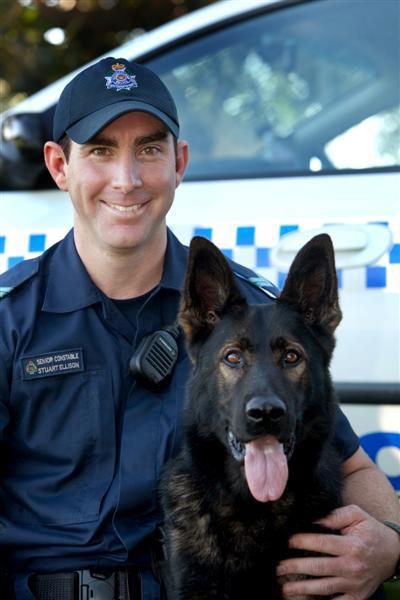
Senior Constable Stuart Ellison & Police Dog EDGE.

It is with sadness we announce the sudden passing of police dog and TV star PD Edge overnight. ( Saturday 4 April 2015 )

PD Edge, who starred in Channel Nine’s factual program Send in The Dogs in 2011, served as a general police dog with the Brisbane Dog Squad alongside Senior Constable Stuart Ellison.

His exceptional skills were demonstrated on many occasions throughout his five years of service with the QPS, often assisting tactical police, drug squad and SERT.

The seven-year-old German Sheppard was responsible for tracking a large number of offenders and became well-known amongst other officers for his ability and skill, especially on Brisbane’s Southside.

Overnight, while off-duty and enjoying rest over the Easter break, PD Edge was unwell and rushed to hospital where he underwent surgery but could not be saved.

Police dogs and their handlers form an incredible bond, working and living together.

Our thoughts are with Senior Constable Ellison and his family who are obviously devastated with the loss of PD Edge.

[divider_dotted]