1

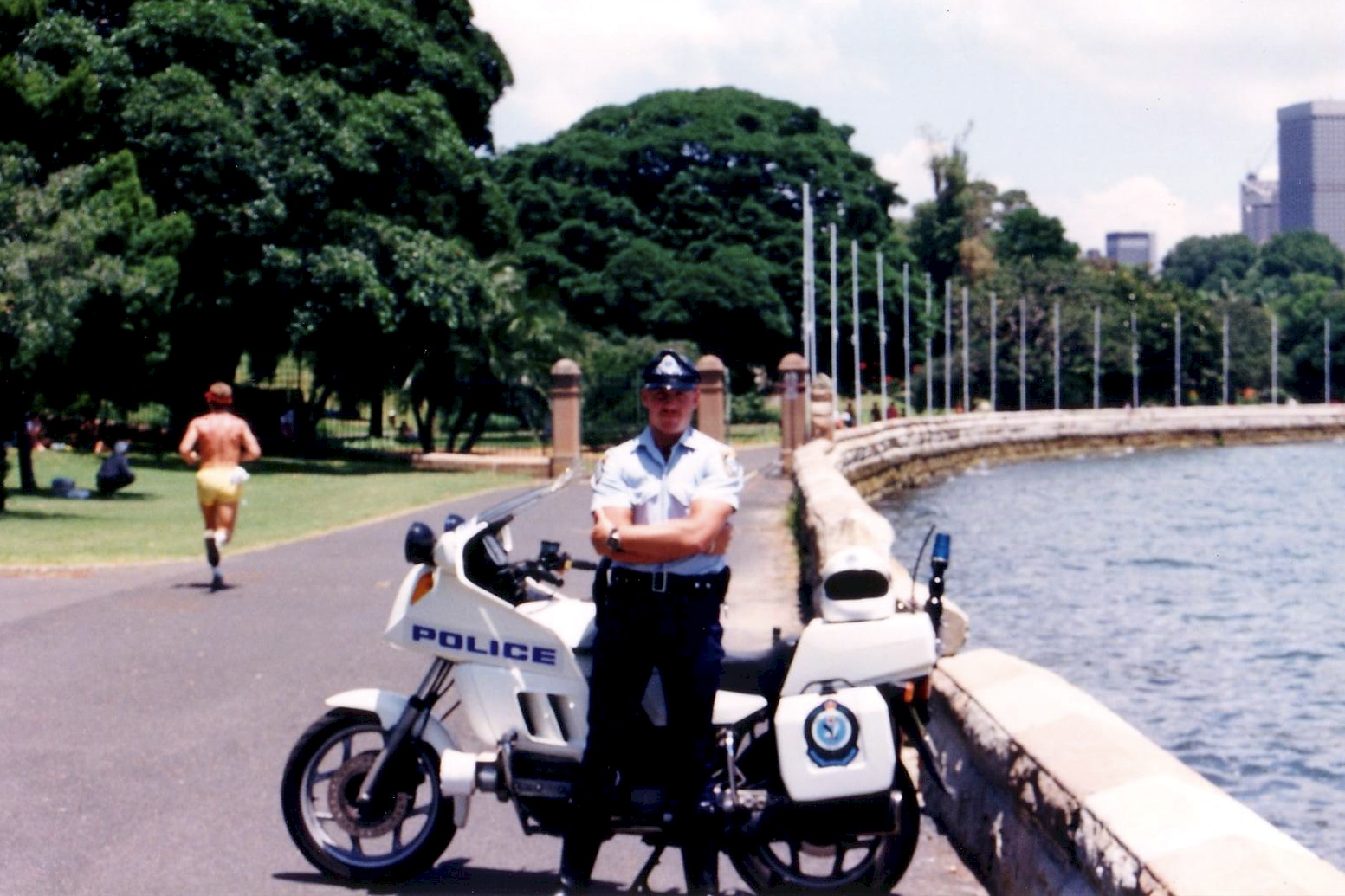
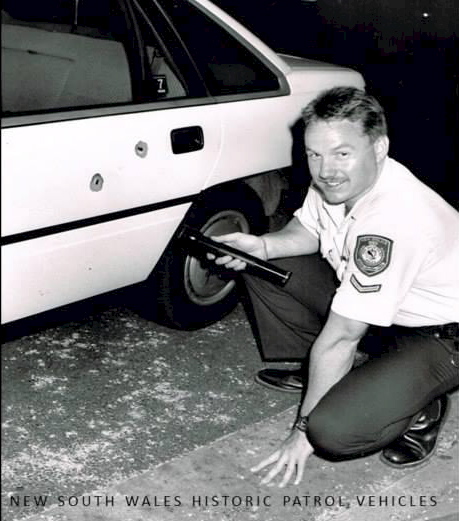
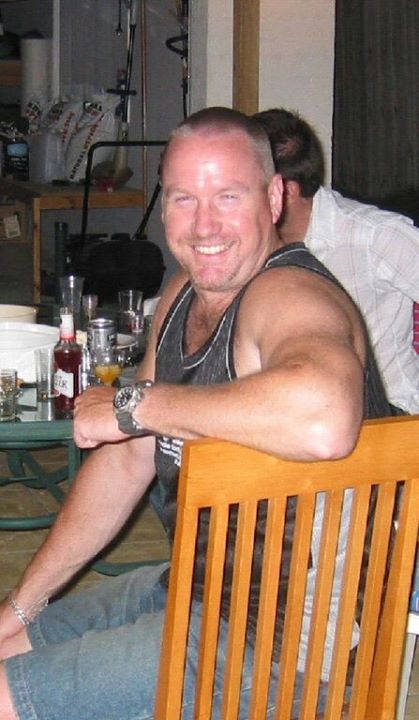
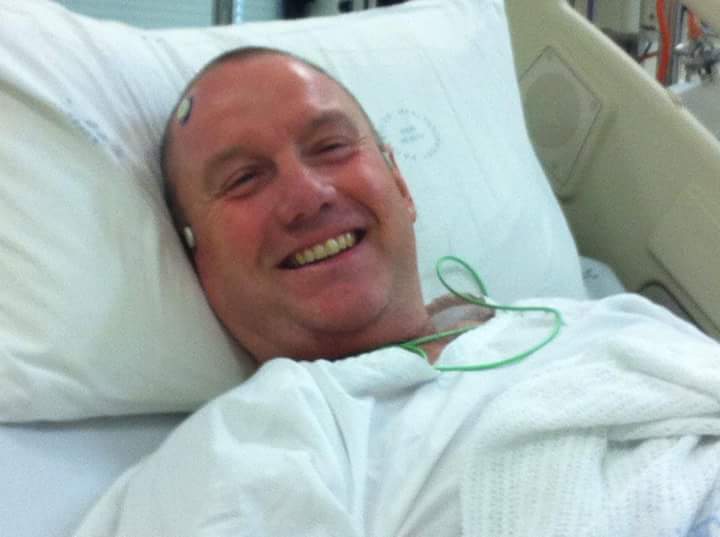
Gregory Joseph JENSEN

Gregory Joseph JENSEN

New South Wales Police Force

Redfern Police Academy – Class 203

( 1st Class at the new Goulburn Police Academy )

Regd. # 21470

Rank:  Commenced Training at Redfern Police Academy on Monday 7 May 1984

Probationary Constable – appointed 20 July 1984

Constable – appointed 20 July 1985

Constable 1st Class – appointed ?

Detective- appointed ? ? 1991

Senior Constable – appointed ? ? ?


Stations:  Regional Crime Squad, Nth West ( Parramatta ), ?


ServiceFrom:  7 May 1984   to  To? ? ?


Awards:  No Find on Australian Honours system


Born:  Thursday 25 July 1963

Died? ? ?

Cause:  Stomach Cancer – H.O.D.


Funeral date?

Funeral location?


Grave site location?


FURTHER INFORMATION IS NEEDED ABOUT THIS MEMBER


GREG IS Mentioned on the Police Memorial Wall, Sydney Police Centre, Surry Hills as of October 2022


25 October 2022

This afternoon, in a quiet and deeply-felt ceremony at the Sydney Police Centre, another thirteen names were added, and the memories of another thirteen dedicated NSW Police Force employees were honoured, at the NSW Police Force Service Memorial:
Detective Senior Constable Vaughan Anthony Hau
Detective Senior Constable Gregory Joseph Jensen
Senior Sergeant John Kelly
Senior Constable David John Koen (Ret’d)
Constable Joseph Lees
Senior Constable Matthew Joseph Rees
Senior Constable Caroline Roberts


http://www.smh.com.au/news/national/holding-judgement/2007/06/08/1181089328815.html?page=fullpage

June 9, 2007

It took up 451 hearing days, heard from 902 public witnesses and cost an estimated $64 million. Malcolm Brown reports on the Wood royal commission, 10 years on.


It began on June 15, 1995, when an unnamed Annandale detective jumped to his death from the seventh floor of a building, apparently through fear of the Wood royal commission. The detective’s suicide was followed by those of Ray Jenkins, a dog trainer (July 10), and Inspector Robert Tait, the acting patrol commander at Narrabri ( March 29, 1996 ). Nineteen days later a former Wollongong alderman, Brian Tobin, gassed himself.

On May 8 the same year, Peter Foretic gassed himself the day after giving evidence about paedophilia. On September 23, Detective Senior Constable Wayne Johnson shot himself and his estranged wife after being adversely named in the royal commission. On November 4, David Yeldham, a retired judge about to face the royal commission on questions of sexual impropriety, killed himself. A month later Danny Caines, a plumber and police confidant, committed suicide at Forster, on the North Coast.

Altogether, 12 people enmeshed in the Wood royal commission took their own lives. Scores of others were so profoundly affected by proceedings that their supporters and families believe it shortened their lives. A former detective, Greg Jensen, suffered a recurrence of the stomach cancer that ultimately ended his life, while another former detective, Ray McDougall, who faced the threat that commission investigators might expose his extramarital affair if he did not co-operate, succumbed to motor neurone disease.

There is no doubt that the Royal Commission into the NSW Police Service, headed by the Supreme Court judge James Wood, purged the force of a rollcall of rotters. A total of 284 police officers were adversely named, 46 briefs of evidence were sent to the Director of Public Prosecutions and by 2001 nine officers had pleaded guilty to corruption offences and three not guilty. Seven police officers received jail sentences, including the former Gosford drug squad chief Wayne Eade and a former chief of detectives, Graham “Chook” Fowler.

Several high-profile police ended their careers in disgrace, including Ray Donaldson, an assistant commissioner, whose contract was not renewed, and Bob Lysaught, the commissioner’s chief of staff, whose contract was torn up. Charges against 14 officers were dismissed because of irregularities in search warrants and their execution.

That left the question of what to do with police who were on the nose but who could not be brought to account by normal means. The solution was the creation of section 181B of the Police Service Act, under which the police commissioner could dismiss an officer on the basis of what had come out of the royal commission. Section 181D allowed the police commissioner to serve an officer with a notice indicating that he “does not have confidence in the police officer’s suitability to continue as a police officer”. The officer could show cause as to why he should be retained, and if dismissed could appeal to the Industrial Relations Tribunal.

In the wake of the two legislative changes, 380 officers were targeted for dismissal or internal investigation. By March 1998, 19 police officers had been dismissed under section 181B and three under 181D. Another had been dismissed under a separate provision of the act, 14 had resigned, four had been medically discharged and 15 had been given performance warning notices. Others were under consideration, and as the Police Integrity Commission – a legacy of the royal commission which became a permanent watchdog – has demonstrated, even officers who had been corrupt many years before were not necessarily in the clear.The former independent MP John Hatton, who was instrumental in setting up the royal commission, said he thought the Police Integrity Commission was the royal commission’s “greatest achievement”. The Child Protection Enforcement Agency, which launched a purge of sex offenders, is another positive legacy of the royal commission.But 10 years on, was the exercise worth it?To some there were considerable benefits. Some appalling malpractice – known as “process” or “noble cause” corruption – prompted Wood to wonder at one point about the quality of a lot of police evidence he had accepted over the years.Despite this, many officers still believe the royal commission was too puritanical. They claim the investigators, not able to grapple with the really big issues, jumped on anything they could: “They had to have runs on the board,” says Michael McGann, who as a policeman in 1984 participated in the so-called Kareela Cat Burglar case, in which police used mace on an uncooperative thief and sex offender. To some critics this treatment did no serious harm and only required a word of caution. But under the spotlight of the royal commission 12 years later, it ended the careers of high-flying police such as John Garvey, Brian Harding and Steve York. A decade later, Harding works in corporate security but insists that the real sting was that the investigators had fabricated evidence. When that finally came out, he says, the group received a confidential settlement, but it did little to redress the feelings of outrage.

Another former policeman, Dr Michael Kennedy, says the commission was a political response to the police commissioner, Tony Lauer, bringing about the downfall of the then police minister, Ted Pickering.

The attorney-general, ministry and judiciary took little responsibility for the state of the force, Kennedy says, while the responsibility of the police rank-and-file grew to “the size of a Pacific driftnet”. “I don’t think the royal commission contributed anything to the reform process except to provide a template for double standards,” he says.

Chook Fowler put $200 into his pocket from Louis Bayeh. Chook was a lazy, good-for-nothing drunk. But he was put into the same category as Ray Williams and HIH.”McGann says that against the string of petty corrupt activities uncovered, “you have to look at what the government did and did not do with gambling and vice, over the decades. There have been direct links to Parliament for 50 or 60 years. That is hypocrisy.”The critics’ view is that the royal commission has left a demoralised police force, tarnished and rudderless, with limited operational effectiveness and the problem of corruption unsolved. Seven police officers have taken their lives since 2001, including two this year.”It highlights the fact that the structure no longer takes in the needs of the NSW police force,” says Mike Gallacher, the Opposition police spokesman, and a former internal affairs police officer. Gallacher believes, as does the NSW Police Commissioner, Ken Moroney, that the tentacles of corruption no longer spread to embrace entire squads or larger units. But it does not prevent low-level incidents of corruption and there are continuing nests of corruption.In its most recent report, the Police Integrity Commission said it had undertaken 21 major investigations in 2005-06. These dealt with extortion, theft, unauthorised disclosure of confidential government information and perverting the course of justice, police brutality and the handling of $250,000 stolen from automatic teller machines. The then police integrity commissioner, Terry Griffin, said there had been 51 investigations in the 12 months, compared with 44 in 2004-05, and the 1141 written complaints represented a 15 per cent increase. Moroney says all these reports are disappointing, but one of the significant statistics was the number of police who were reporting on other police. “You go back a decade and the number of informants who were police was 5 to 10 per cent,” he says. “In the Ombudsman’s last report, that figure was 49 per cent.”The mechanism for dealing with internal complaints has been expedited: “I have not been afraid to use a section 181D notice,” Moroney says.He believes there is a different mentality in the force. A video of the royal commission had been shown at a recent reunion dinner of the old criminal investigation branch. “It is part of our history. But the interesting thing is that when Chookie came onto the screen, everyone booed. That was a signal to the Fowlers and the Eades that those found to have acted corruptly would not be accepted.”
However, Moroney accepts that corruption is not a thing of the past. “In the contemporary period, there are huge monies to be made from the illicit drug environment. You are talking in some cases of millions of dollars. It is the greatest menace in society today. And the greatest menace to officers is drug money. That is why rotation of officers out of specialist squads on a regular basis is important.”Taking over as commissioner five years ago, he had brought a low-key “Uncle Ken” influence, sorely needed, and had had to balance the principles of police accountability against the public demand for law and order, and the task has been awkward.A senior counsel told the Herald this week that the focus on integrity, scrutiny of professional standards and attacks by defence lawyers meant that talented police prepared to do the dirty work were deterred. “In the old days the best and the brightest went into plain-clothes,” he said. “But when the police perceive that when they have to go the extra yard [to get convictions], they are crucified – ‘Why should I go to plain-clothes when I can just get some uniform job with a 12-hour shift, and a second job?”‘Clive Small, a former assistant commissioner who set up crime agencies and established the child protection unit, says that after so many detectives were disgraced in the royal commission, the police force sought to take the spotlight off detectives and put more of the onus of responsibility for crime control onto local area commands. Crime agencies had a continual battle to keep up to strength. Regionalising responsibility for crime control reflected a lack of understanding. “A lot of crime spreads through the metropolitan area, across the state and across the nation,” he says.Kennedy, now a university lecturer, says the “business model” approach is incompatible with good police work. “We cannot expect police to behave like they are in the private sector, where competence is measured in terms of productivity,” he says.Kennedy attended the recent CIB reunion dinner and sat at a table with former drug squad detectives who remained friends of Wayne Eade. He takes issue with Moroney‘s claim that people at the dinner made catcalls when Fowler came on screen. “No one supported Chook,” he says. “But the animosity of the crowd was directed straight at Justice Wood and his commission.”Clive Small, who was also at the dinner, says: “I think it is really a matter of interpretation who they were booing. There were things the royal commission did not take care about. There was a lot of collateral damage. And the implementation [of its recommendations] has been pretty ordinary.”

CRUSADER WHO MADE THE CALL

JOHN HATTON well remembers the audience on May 11, 1994, when he made his speech calling for a royal commission into the NSW Police Service. MPs were listening, of course, but it was a gallery above him, packed with the “top brass of the police force – the commissioner himself, the deputy commissioner, superintendents – they were an intimidating force on the Parliament”.

“They thought they could stare down the Labor Party support for my motion,” Hatton, now retired, says. “It was probably the best indicator of the way in which the police force thought they could control the agenda.”

Hatton won the day, putting paid to a claim by then police commissioner, Tony Lauer, that “systemic corruption” was “a figment of the political imagination”. Hearings started on November 24, 1994, and Justice James Wood delivered his final report on August 26, 1997.

Ten years later, Hatton believes he was vindicated. He says Wood was “the right man” to head the commission and the recruitment of interstate police was crucial, along with the decision to use phone taps and surveillance.

The 11 volumes of material Hatton gave the royal commission had been accumulated over 14 years, he says, from the time he had first spoken up. He had received information on illegal gambling, drug trafficking and police involvement with the mafia.

There had been earlier moves to address police corruption, including inquiries by the Independent Commission Against Corruption, but these had only scratched the surface. “I can remember on one occasion I reported a death threat which had to do with the McKay murder in Griffith and 48 hours later the bloke who had given the information was threatened by a shotgun at his door in Queensland,” Hatton says.

The royal commission came into being because Hatton and other independent MPs held the balance of power in Parliament. The Labor Party may have had high public motives, but also saw a chance to attack the Fahey government. Labor stipulated that an inquiry into police protection of paedophiles, previously in the hands of the ICAC, become part of the royal commission.

The process of gathering information was helped greatly by Trevor Haken, a detective who became an informer and covert investigator as part of a deal to avoid being prosecuted himself.

Hatton says Haken‘s entry was “out of the blue”. Though useful, in the long term it had had a detrimental effect on the fight against corruption. Living in fear and watching his back, Haken had provided “the greatest disincentive for someone coming forward to finger corruption in the system”.

Malcolm Brown
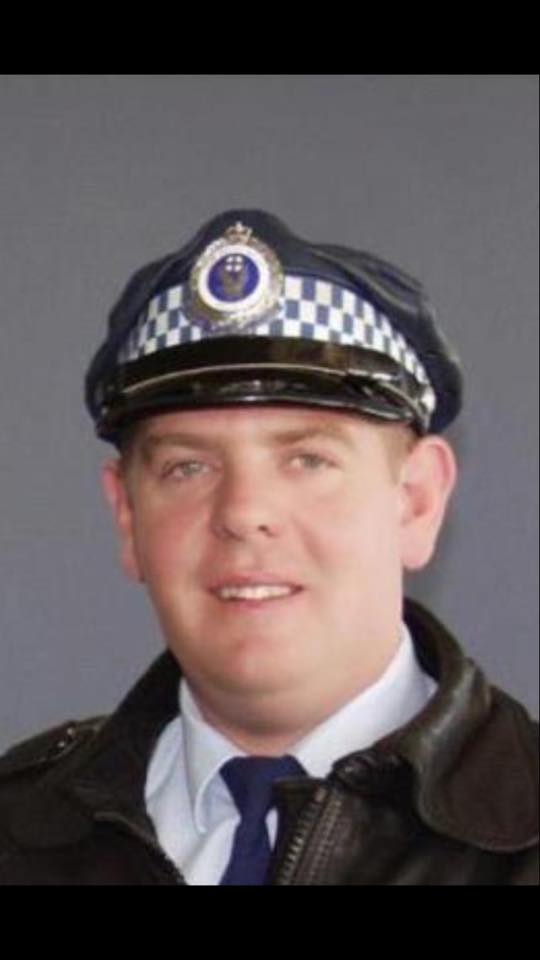


Wayne JOHNSON

Wayne JOHNSON

New South Wales Police Force ?

Regd. # ?

Detective Senior Constable

Stations: Tamworth ( 1989 ) ?

Service:  From:  ?   to  To:  23 September 1995

Awards:  ?

Born:  ?

Died:  23 September 1995

Cause:  Suicide – shot himself.  Murder:  Shot his estranged wife

Funeral date:  ?

Funeral location:  ?

Grave site location:  ?


FURTHER INFORMATION IS NEEDED ABOUT THIS MEMBER


 [alert_yellow]Wayne is NOT mentioned on the Police Wall of Remembrance[/alert_yellow]

[divider_dotted]

http://www.smh.com.au/news/national/holding-judgement/2007/06/08/1181089328815.html?page=fullpage

June 9, 2007

It took up 451 hearing days, heard from 902 public witnesses and cost an estimated $64 million. Malcolm Brown reports on the Wood royal commission, 10 years on.


It began on June 15, 1995, when an unnamed Annandale detective jumped to his death from the seventh floor of a building, apparently through fear of the Wood royal commission. The detective’s suicide was followed by those of Ray Jenkins, a dog trainer (July 10), and Inspector Robert Tait, the acting patrol commander at Narrabri ( March 29, 1996 ). Nineteen days later a former Wollongong alderman, Brian Tobin, gassed himself.

On May 8 the same year, Peter Foretic gassed himself the day after giving evidence about pedophilia. On September 23, Detective Senior Constable Wayne Johnson shot himself and his estranged wife after being adversely named in the royal commission. On November 4, David Yeldham, a retired judge about to face the royal commission on questions of sexual impropriety, killed himself. A month later Danny Caines, a plumber and police confidant, committed suicide at Forster, on the North Coast.

Altogether, 12 people enmeshed in the Wood royal commission took their own lives. Scores of others were so profoundly affected by proceedings that their supporters and families believe it shortened their lives. A former detective, Greg Jensen, suffered a recurrence of the stomach cancer that ultimately ended his life, while another former detective, Ray McDougall, who faced the threat that commission investigators might expose his extramarital affair if he did not co-operate, succumbed to motor neurone disease.

There is no doubt that the Royal Commission into the NSW Police Service, headed by the Supreme Court judge James Wood, purged the force of a rollcall of rotters. A total of 284 police officers were adversely named, 46 briefs of evidence were sent to the Director of Public Prosecutions and by 2001 nine officers had pleaded guilty to corruption offences and three not guilty. Seven police officers received jail sentences, including the former Gosford drug squad chief Wayne Eade and a former chief of detectives, Graham “Chook” Fowler.

Several high-profile police ended their careers in disgrace, including Ray Donaldson, an assistant commissioner, whose contract was not renewed, and Bob Lysaught, the commissioner’s chief of staff, whose contract was torn up. Charges against 14 officers were dismissed because of irregularities in search warrants and their execution.

That left the question of what to do with police who were on the nose but who could not be brought to account by normal means. The solution was the creation of section 181B of the Police Service Act, under which the police commissioner could dismiss an officer on the basis of what had come out of the royal commission. Section 181D allowed the police commissioner to serve an officer with a notice indicating that he “does not have confidence in the police officer’s suitability to continue as a police officer”. The officer could show cause as to why he should be retained, and if dismissed could appeal to the Industrial Relations Tribunal.

In the wake of the two legislative changes, 380 officers were targeted for dismissal or internal investigation. By March 1998, 19 police officers had been dismissed under section 181B and three under 181D. Another had been dismissed under a separate provision of the act, 14 had resigned, four had been medically discharged and 15 had been given performance warning notices. Others were under consideration, and as the Police Integrity Commission – a legacy of the royal commission which became a permanent watchdog – has demonstrated, even officers who had been corrupt many years before were not necessarily in the clear.The former independent MP John Hatton, who was instrumental in setting up the royal commission, said he thought the Police Integrity Commission was the royal commission’s “greatest achievement”. The Child Protection Enforcement Agency, which launched a purge of sex offenders, is another positive legacy of the royal commission.But 10 years on, was the exercise worth it?To some there were considerable benefits. Some appalling malpractice – known as “process” or “noble cause” corruption – prompted Wood to wonder at one point about the quality of a lot of police evidence he had accepted over the years.Despite this, many officers still believe the royal commission was too puritanical. They claim the investigators, not able to grapple with the really big issues, jumped on anything they could: “They had to have runs on the board,” says Michael McGann, who as a policeman in 1984 participated in the so-called Kareela Cat Burglar case, in which police used mace on an unco-operative thief and sex offender. To some critics this treatment did no serious harm and only required a word of caution. But under the spotlight of the royal commission 12 years later, it ended the careers of high-flying police such as John Garvey, Brian Harding and Steve York.A decade later, Harding works in corporate security but insists that the real sting was that the investigators had fabricated evidence. When that finally came out, he says, the group received a confidential settlement, but it did little to redress the feelings of outrage.

Another former policeman, Dr Michael Kennedy, says the commission was a political response to the police commissioner, Tony Lauer, bringing about the downfall of the then police minister, Ted Pickering.

The attorney-general, ministry and judiciary took little responsibility for the state of the force, Kennedy says, while the responsibility of the police rank-and-file grew to “the size of a Pacific driftnet”. “I don’t think the royal commission contributed anything to the reform process except to provide a template for double standards,” he says.

Chook Fowler put $200 into his pocket from Louis Bayeh. Chook was a lazy, good-for-nothing drunk. But he was put into the same category as Ray Williams and HIH.”McGann says that against the string of petty corrupt activities uncovered, “you have to look at what the government did and did not do with gambling and vice, over the decades. There have been direct links to Parliament for 50 or 60 years. That is hypocrisy.”The critics’ view is that the royal commission has left a demoralised police force, tarnished and rudderless, with limited operational effectiveness and the problem of corruption unsolved. Seven police officers have taken their lives since 2001, including two this year.”It highlights the fact that the structure no longer takes in the needs of the NSW police force,” says Mike Gallacher, the Opposition police spokesman, and a former internal affairs police officer.Gallacher believes, as does the NSW Police Commissioner, Ken Moroney, that the tentacles of corruption no longer spread to embrace entire squads or larger units. But it does not prevent low-level incidents of corruption and there are continuing nests of corruption.In its most recent report, the Police Integrity Commission said it had undertaken 21 major investigations in 2005-06. These dealt with extortion, theft, unauthorised disclosure of confidential government information and perverting the course of justice, police brutality and the handling of $250,000 stolen from automatic teller machines. The then police integrity commissioner, Terry Griffin, said there had been 51 investigations in the 12 months, compared with 44 in 2004-05, and the 1141 written complaints represented a 15 per cent increase.Moroney says all these reports are disappointing, but one of the significant statistics was the number of police who were reporting on other police. “You go back a decade and the number of informants who were police was 5 to 10 per cent,” he says. “In the Ombudsman’s last report, that figure was 49 per cent.”The mechanism for dealing with internal complaints has been expedited: “I have not been afraid to use a section 181D notice,” Moroney says.He believes there is a different mentality in the force. A video of the royal commission had been shown at a recent reunion dinner of the old criminal investigation branch. “It is part of our history. But the interesting thing is that when Chookie came onto the screen, everyone booed. That was a signal to the Fowlers and the Eades that those found to have acted corruptly would not be accepted.”
However, Moroney accepts that corruption is not a thing of the past. “In the contemporary period, there are huge monies to be made from the illicit drug environment. You are talking in some cases of millions of dollars. It is the greatest menace in society today. And the greatest menace to officers is drug money. That is why rotation of officers out of specialist squads on a regular basis is important.”Taking over as commissioner five years ago, he had brought a low-key “Uncle Ken” influence, sorely needed, and had had to balance the principles of police accountability against the public demand for law and order, and the task has been awkward.A senior counsel told the Herald this week that the focus on integrity, scrutiny of professional standards and attacks by defence lawyers meant that talented police prepared to do the dirty work were deterred. “In the old days the best and the brightest went into plain-clothes,” he said. “But when the police perceive that when they have to go the extra yard [to get convictions], they are crucified – ‘Why should I go to plain-clothes when I can just get some uniform job with a 12-hour shift, and a second job?”‘Clive Small, a former assistant commissioner who set up crime agencies and established the child protection unit, says that after so many detectives were disgraced in the royal commission, the police force sought to take the spotlight off detectives and put more of the onus of responsibility for crime control onto local area commands. Crime agencies had a continual battle to keep up to strength. Regionalising responsibility for crime control reflected a lack of understanding. “A lot of crime spreads through the metropolitan area, across the state and across the nation,” he says.Kennedy, now a university lecturer, says the “business model” approach is incompatible with good police work. “We cannot expect police to behave like they are in the private sector, where competence is measured in terms of productivity,” he says.Kennedy attended the recent CIB reunion dinner and sat at a table with former drug squad detectives who remained friends of Wayne Eade. He takes issue with Moroney‘s claim that people at the dinner made catcalls when Fowler came on screen. “No one supported Chook,” he says. “But the animosity of the crowd was directed straight at Justice Wood and his commission.”Clive Small, who was also at the dinner, says: “I think it is really a matter of interpretation who they were booing. There were things the royal commission did not take care about. There was a lot of collateral damage. And the implementation [of its recommendations] has been pretty ordinary.”

CRUSADER WHO MADE THE CALL

JOHN HATTON well remembers the audience on May 11, 1994, when he made his speech calling for a royal commission into the NSW Police Service. MPs were listening, of course, but it was a gallery above him, packed with the “top brass of the police force – the commissioner himself, the deputy commissioner, superintendents – they were an intimidating force on the Parliament”.

“They thought they could stare down the Labor Party support for my motion,” Hatton, now retired, says. “It was probably the best indicator of the way in which the police force thought they could control the agenda.”

Hatton won the day, putting paid to a claim by then police commissioner, Tony Lauer, that “systemic corruption” was “a figment of the political imagination”. Hearings started on November 24, 1994, and Justice James Wood delivered his final report on August 26, 1997.

Ten years later, Hatton believes he was vindicated. He says Wood was “the right man” to head the commission and the recruitment of interstate police was crucial, along with the decision to use phone taps and surveillance.

The 11 volumes of material Hatton gave the royal commission had been accumulated over 14 years, he says, from the time he had first spoken up. He had received information on illegal gambling, drug trafficking and police involvement with the mafia.

There had been earlier moves to address police corruption, including inquiries by the Independent Commission Against Corruption, but these had only scratched the surface. “I can remember on one occasion I reported a death threat which had to do with the McKay murder in Griffith and 48 hours later the bloke who had given the information was threatened by a shotgun at his door in Queensland,” Hatton says.

The royal commission came into being because Hatton and other independent MPs held the balance of power in Parliament. The Labor Party may have had high public motives, but also saw a chance to attack the Fahey government. Labor stipulated that an inquiry into police protection of pedophiles, previously in the hands of the ICAC, become part of the royal commission.

The process of gathering information was helped greatly by Trevor Haken, a detective who became an informer and covert investigator as part of a deal to avoid being prosecuted himself.

Hatton says Haken‘s entry was “out of the blue”. Though useful, in the long term it had had a detrimental effect on the fight against corruption. Living in fear and watching his back, Haken had provided “the greatest disincentive for someone coming forward to finger corruption in the system”.

Malcolm Brown
[divider_dotted]


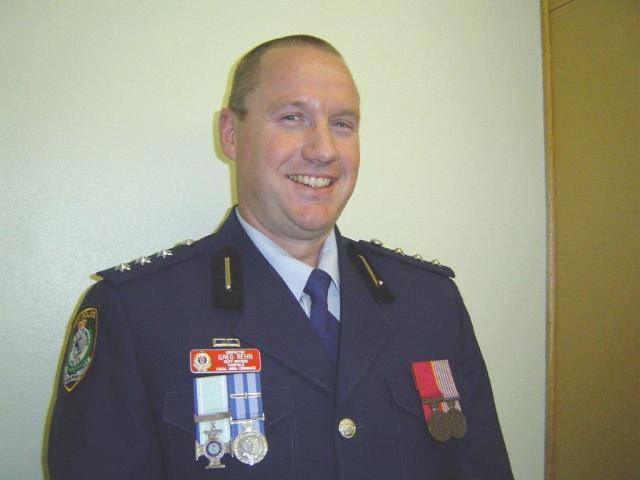
Evan Barry HEINJUS

Evan Barry HEINJUS

New South Wales Police Force

Regd. # 25954

Academy Class 237 ? or 238 ?

Senior Constable

Stations:  Wagga Wagga G.D’s & HWP in 1995, Tarcutta HWP ( paper transfer only ),

Batemans Bay HWP, Bodalla LUK & Jugiong LUK & HWP

Awards:  No Find on Australian Honours system

Service:  From ?  –  To 4 March 2007

Born:  1968

Illnessviral Myocarditis, this illness led to major organ failure.

Hospitalised ( St Vincent’s )  11 September 2006

Heart bypass:  3 March 2007

Died:  Sunday  4 March 2007 @ 6.15am

39 old

Funeral:  9 March 2007 at

Wagga Wagga St Johns Anglican Church ( Full Police Funeral )

Evan was Cremated and remains with the family

Memorial: NSW Police force Service Memorial Wall, Sydney Police Centre, Surry Hills, F31 ( left wall )

 Evan Barry HEINJUS - NSWPF - Died 4 March 2007

Evan contracted an illness – viral myocarditis, this illness led to major organ failure. Evan was airlifted to to Sydney St Vincent’s hospital on 11/9/2006, and was placed in a coma for several weeks until a special total heart bypass machine was bought from England.

This Machine kept Evan alive and awake until a donor heart became available.

This machine bought many months of family time that the family will be forever grateful for.

The transplant surgery was a success on the 3/3/2007 but the effects of the prolonged use of blood thinners was unable to be reversed and Evan passed away 6.15am on 4/3/2007.

Evan is survived by his wife Helen, children Hannah, Olivia and Theo Heinjus.

Evan was a much adored country cop, he always said his mouth was his best weapon and he could talk people around with his manner. Evan loved his work as a NSW Police Officer and received many Superintendent and Commissioners commendation’s and awards.


May you forever Rest In Peace Evan.


The Commissioner’s Police Remembrance Day Scholarship

On the 29th day of each September, police officers, fellow officers, wives, husbands, parents, partners, and children gather at sites across the state to remember those police officers who have lost their lives in the course of serving their community.
A commemoration is held at the NSW Police Force Wall of Remembrance in the Domain, Sydney which includes a service and prayers for those fallen officers.

As the dignitaries laid wreaths they were accompanied by some of our young Legatees. We’d like to thank Theo, Olivia and Hannah Heinjus and Brendon Speechley who laid wreaths in honour of their lost parents and all fallen officers.

Each year at the Remembrance Day Ceremony, the Commissioner’s Scholarship is presented to a young Legatee to assist with furthering their education. Congratulations to Theo Heinjus, 11, who was the 2011 recipient of this $5,000
scholarship.

Theo was only six years old when his father, Senior Constable Evan Heinjus, died from complications after a heart transplant, aged 38.

Theo received the award from NSW Police Commissioner Andrew Scipione. “Theo is a popular and enthusiastic boy, who has exhibited a great deal of courage in dealing with the grief of his father’s death,” Commissioner Scipione said.

“He has enormous potential to reach his dreams and I hope this scholarship will assist him to reach his potential.”

The $5000 scholarship will be put into a trust fund for Theo and will be managed by NSW Police Legacy.

“I am immensely proud that he has been able to achieve this award, it will certainly make a difference to his schooling in the upcoming years,” Theo’s mother Helen Foley said.


Legatee, Olivia Heinjus aged 12 records her experience of the 2011 October Camp
below.

This year we went to the Gold Coast, staying for the week at the Christian Youth Camp (CYC). I was in a room with Maddie, Jasmine, Margaret, Eleano and the new girls, Catlin & Katie.

On the first day we went to Dreamworld and I’m sure everyone loved it. I personally had a thrilling time because I went on the CLAW.  Lara and Amy dragged me on to it!

On Monday we did stand up paddle boarding and surfing. The weather wasn’t great and some of us were being blown away by the wind but standing up paddle boarding was so much fun!

On Tuesday we did canoeing and tubing and it was great. While we were tubing Iveta and James did a switch and swapped sides and Callum and Mitch tried to flip it.

On Wednesday we went to Wet ‘n Wild and had lots of fun on all the rides. On Thursday we went to the movies at this giant shopping centre and after our movie we went shopping.

Friday was goodbye. When we landed Theo and I were back in our mothers arms. We had a great time and can’t wait to go on our next camp.

http://www.policelegacynsw.org.au/PDF/Annual_Review_2011.pdf


Evan is NOT mentioned on the Police Wall of Remembrance

Evan is NOT mentioned on the Retired Police Association Vale list

Evan IS mentioned on the NSW Police Memorial Wall , Sydney Police Centre, Surry Hills, F31 ( left wall )


Location of Church Service 


Gregory Peter REHN

Gregory Peter REHN  BM

New South Wales Police Force

NSW Police Academy Class 212

Regd. # 22204

Rank: Commenced at the Academy  13 May 1985

Probationary Constable – appointed 26 July 1985

Constable – appointed 26 July 1986

Inspector – Resigned, 2006

Stations:  Kings Cross ( early 1980’s ), City Central, The Rocks ( 1985 ),

Darlinghurst, ‘A’ District ( Sydney late 1980’s ) HWP Cyclist,

Blacktown 27 Division ( mid 1990’s – Sergeant ), Parramatta ( 18 Division ) ( SenSgt ), VKG1 ( Sydney ) as 2 I.C.,

Fairfield – 34 Division ( Duty Officer – early 2000’s )

Awards:  * ( BM ) Bravery Medal – granted 26 October 1989, ( Cst )

National Medal – granted 4 September 2001, ( Sgt )

NSW Police Valour Award recipient

ServiceFrom  12 May 1985  to  May 2006 = 21 years Service

Born:  Saturday  18 December 1965

Died  Wednesday  3 December 2014 at his home

Age:  48 old

Cause:  Melanoma ( removed about 18 mths previous from his chest )

which metastasised to the brain,

lymphatic system and throughout his body.

Funeral date:  Tuesday  16 December 2014 @ 11.30am

Funeral location: Camellia Chapel,

Macquarie Park Cemetery & Crematorium,

North Ryde

Funeral Parlour:  Guardian Funerals, Blacktown   9622 1284

and afterwards in the Banksia Room for some light refreshments.

The family has requested that everybody PLEASE wear appropriate civilian attire

Grave location?

Gregory Peter REHN 48 old 18/12/1965 - 03/12/2014
Gregory Peter REHN 48 old
18/12/1965 – 03/12/2014


Constable Gregory REHN - Young Greg Rehn doing the solo cycle course at St Ives in mid 1980's. Greg was at Inner City Cycles. He wasn't the best of riders doing the course though.
Constable Gregory REHN – Young Greg Rehn doing the solo cycle course at St Ives in mid 1980’s. Greg was at Inner City Cycles. He wasn’t the best of riders doing the course though.

Gregory Peter REHN BM

Gregory Peter REHN BM

Greg REHN - Enjoying life
Greg REHN – Enjoying life

Gregory Peter REHN BM

Gregory Peter REHN BM

Gregory Peter REHN BM


Rest In Peace.

Gregory Peter REHN 48 old
18/12/1965 – 03/12/2014

Greg has had a short battle with Melanoma which he had removed, from his chest, about 18 months ago.
It had metastasised to the Brain, Lymphatic System and throughout his body, which he found out about around the beginning of October 2014.

Greg passed away peacefully at his home Wednesday morning, 3 December, 2014.


*BM was Awarded to Greg for a rescue from a burning building at Kings Cross.


In honour of Gregory Peter Rehn
18/12/1965 – 03/12/2014

Greg’s citation for his Bravery Medal, the 3rd highest bravery decoration in the Australian Honours and Awards he received in 1990;

“Constable Gregory Peter Rehn, NSW Police.
On 30 March 1988, a fire broke out in a residential building in Macleay Street, Potts Point. In response to a police radio call, Constable Rehn attended and found the roof well alight with pieces of roofing falling down into the street. While assisting with crowd control, he was told that an elderly woman, who was almost blind and deaf, remained on the fourth floor. Constable Rehn made his way through the smoke filled building and on reaching the third floor found the elderly woman stumbling around in the debris. He took hold of her and began to lead her down the stairs. As he did so, debris and roofing fell from the ceiling and thick smoke and water filled the hallway. Despite breathing and vision difficulties caused by the smoke, Constable Rehn led the woman to safety. By his actions, Constable Rehn displayed considerable bravery.”

Such a sad, sad loss of a brave and inspiring Cop.


Funeral location: 


REHN, Gregory Peter.

Passed away on December 3, 2014 after a short illness.

Aged 48 years

Loved son of Barbara, Peter and Gail.

Loved brother and brother-in-law of Karena & John, Chris & Amy, Kim & Ian and Sam.

Loved Uncle Greg to ten nieces and nephews.

Family and friends are warmly invited to join in a Celebration of GREG’S Life to be held in Camellia Chapel of the Macquarie Park Crematorium (Cnr Plassey and Delhi Rd, North Ryde) at 11.30am on Tuesday (December 16, 2014).

Refreshments will follow in the Banksia Room.

By special request, instead of floral tribute, donations to Melanoma Institute of Australia would be appreciated.

Blacktown 9622 1284
Proudly Australian
Member AFDA

logo
One month on.  Cannot believe you’re gone my love
Louise Harrison
6 January 2015
Mosman, NSW
Totally shocked to discover this news!
Way too young.
Brooke Rose
5 March 2019
Brookvale, NSW
Louise Harrison
5 January 2015
Mosman, NSW
Many years of fun ole mate, never like to say goodbye – always missed but never forgotten.. the memories will live on forever.
Rest now ole mate as we continue the journey.
See you again one day. !
Colin Walsh
22 December 2014
Grenfell, NSW
Prayers and thoughts are with you and your family Rehnny.
Rest In Peace.
James Pasfield
21 December 2014
Sydney, NSW
Greg, you were a good man a good copper and fun to work with.  I will always remember you mate.  R.I.P.
Rick Lettice ( R.I.P. )
21 December 2014
Cairns, Queensland
Rhennie… we were mates for about 30 years, haven’t spoken for over 15, funny thing is I don’t think either one of us would care, you were and always will be considered by me as a friend.  I remember the first shift we worked together – your confidence was contagious…. you will be missed.
Slug
Brett Fifield
21 December 2014
Sydney, NSW
Dear Rehnnie, you left this world far too early.
You were a great man.  I will forever cherish the days we worked together in particular.
I will never forget you mate, you will always be in my heart.
Peter ” Kakadu “
Peter Koudounas
21 December 2014
NSW
Greg, you were a decent, kind and wonderful man and I’ll never forget you.
You will be missed by all who knew you.
I cannot believe you are no longer with us.
Rebekah Wilson
19 December 2014
Bateau Bay, NSW
Rest In Peace Greg.
You will be missed and it was a pleasure knowing you.
Lain Tayler
15 December 2014
Melbourne, Victoria
My Darling Greg, thank you for 8 exciting years.
I fell in love with you on our first date in June 2006 and will love you forever.
I will miss your cheeky grin, your bear hugs, your gig, strong hand, your smell and just you.
Thank you for all you did for me.
It was an amazing, sexy and passionate ride.
I will forever be MDS.
December 16, 2014
I remember you as my wonderful, brave, strong and courageous cousin.
It was a privilege to have known you.
I wish I could have got to know you better.
Love always and farewell.
Your cousin
Bec Trigg 
December 15, 2014
Adelaide, South Australia

Published in The Sydney Morning Herald on Dec. 13, 2014

http://www.legacy.com/obituaries/smh-au/obituary.aspx?n=gregory-rehn&pid=173448073


Retirement of Sergeant Terence O’Rourke – 1924

Terence Joseph O’ROURKE

New South Wales Police Force

Regd. # ?

Sergeant ?

Stations:  Mounted Police, Newcastle District for several years.

Singleton – 7 years

Scone – 1896 ( four months duty here )

Denman – ?

Wyong – 1909 – 1911

Kempsey – 5.5 years

Wyong – ? – 1920

Scone ( Sergeant ) 1 December 1920 – Retirement date ?

Awards:  ?

Service:  From  August 1890  to ?

Born:  ?

Died:  18 January 1938, late of Artarmon,

formerly of Denman.

Funeral date:  ?

Funeral location:  ?

Buried:  Macquarie Park Cemetery,

R.C., row G4, plot 0029 along with other family members

 [divider_dotted]

[alert_yellow]Terrence is NOT mentioned on the Police Wall of Remembrance[/alert_yellow] 

[divider_dotted]

Retirement of Sergeant Terrence O’Rourke.

EPISODES OF A LENGTHY SERVICE.

The Scone Advocate ( NSW )                     Tuesday  25 November 1924                      page 2 of 4


During the reign of Queen Victoria and several years before the birth of the Prince of Wales, there arrived in Australia fresh from   Erin’s Isle, a young man by the name of Terence O’Rourke. Having received his education at the Royal University, Dublin ( now known as the National University ), at which he obtained a first-class Exhibition in French, he entered Queen’s College, Galway, for the purpose of studying medicine, but the dissection room proved to be too great an ordeal for the nerves of a man who appreciated the healthy freedom of the open air, and he gave up the opportunity of becoming a guardian of the health of Her Majesty’s subjects for what proved to be the no less useful career of a keeper of the peace in the antipodes. The late Sir Thomas Moffat, L.L.D., was then president of the college, and the recommendation that the student received from that source was, to say the least, sufficiently inspiring to gratify the vanity and increase the energy of any ordinary young man. In short, Sir Thomas looked for great things from his erstwhile pupil. Only a few years previously, Mr. T. P. O’Connor, member for the Scotland Division of Liverpool, and the father of the House of Commons ‘ at the present time, graduated at the same college.

Shortly after his arrival in Australia, O’Rourke seized the opportunity to go to Noraville, near Nora Head, to become tutor of the three sons of Mr. Edmund Hammond Hargreaves, B.A. ( Sydney ), a member of the Church of England Synod of Newcastle, and a son of the first great gold discoverer of Australia. The impression created by close contact with the family was a pleasing introduction to   Australian life, for the new arrival found in his first employer a typical Australian and a broad-minded gentleman of kindly disposition. The intimacy then created with the sons is evidenced to-day in the friendship of Mr. Dudley Hargreaves, who is now resident at Noraville. Tasting not a little of the outdoor life at Noraville, young O’Rourke felt the need for more, and in August, 1890, he joined the mounted police and served in the Newcastle district for several years, during which time he attained some reputation during strikes. From Newcastle he went to Singleton, where he was stationed for seven years. His success in dealing with cattle stealers, not to mention sly-grog cases, earned for him the commendation of various Judges, and also brought him under the notice of the President of the Stock Stealing Prevention Association, Singleton, Mr. R. H. Dangar, who in his appeal to the Inspector General to prevent the constable’s transfer from Singleton, said that it would mean a great loss to the cattle owners.


SOLD IN SCONE.

It is interesting to note that while at Singleton Constable O’Rourke traced a man who had stolen a horse and buggy from Singleton to Scone, where the turnout had been sold through Messrs. Corbett and Simpson, auctioneers. The criminal escaped to Victoria, and it was several months before the trail led to Pentridge Gaol, where the culprit was found under going a sentence for larceny. A few days before Xmas, 1902, the prisoner was identified and brought by Constable O’Rourke to Singleton, where it was shown that the offender had served sentences in the various States of Australia aggregating 12 ½ years. ‘ At the Singleton Quarter Sessions in March, 1903, a further sentence of three years was imposed. At his own request, Constable O’Rourke was transferred from Singleton to Denman. Here, within a week, he received word that cattle had been stolen from the Baerami Estate, then the property of the Bank of N.S. Wales. In company with Constable Moore, he followed the tracks of the cattle for several days through the mountainous country towards Capertree where, in a basin of the mountains, the stock were found and driven back, although the offenders escaped. His good work on this occasion was warmly commented upon by the stock-owner and the Inspector General. An exciting incident in connection with a Chinaman took place when stationed at Denman.   It so happened that a serious burglary had occurred at Merriwa, and suspicion lighted upon a Chinaman who had just completed two ???s’ imprisonment. The cunning of the Celestial was evinced in that he smothered his footprints by wrapping his boots in strips of blanket.


GAGGED WITH REVOLVER.  

The senior constable, in plain clothes, came upon the foreigner at Dandy Hollow and, having learned the practical value of ” getting in first, “ lost no time, after his preliminary question, in dealing out unexpected justice upon the surprised heathen, who suddenly found himself on the broad of his back with a smoking revolver, which the constable had first fired into the ground, inserted like a throat spray between his teeth, causing his victim to squeal for mercy. For his misdemeanours the Chinaman served a sentence of three years at Newcastle Gaol. The two years following 1909 were spent in Wyong, after which he was given six months leave, which he made good use of by visiting the scenes of his youth in the Green Isle. On his return, he was sent to Kempsey, where again he put up a big record in obstructing the movements of cattle stealers, and here he received the commendation of Judge Edmunds for his generalship in capturing within a few hours of the theft, a burglar who had escaped from the Royal Hotel with booty to the value of £200. In the struggle that followed the arrest, the criminal had got rid of the bulk of the stolen articles but, strange enough, as the constable was passing the Convent grounds some time afterwards, he noticed a child’s handkerchief lying on the ground and going in to pick it up, found most of the missing goods actually lying on and close by the article.  After years at Kempsey, where it was remarked that his name would last as long as the Macleay, he was transferred at his own request to Wyong, where a cordial welcome awaited him. In 1920, he received a public farewell and the staunch friendships made there stand out pleasantly in his memory to-day.


WYONG’S APPRECIATION.

The ” Gosford Times ” said of him: ” There never had been stationed at Wyong an officer who was so fondly and regretfully farewelled by the people. The great success of Sergeant O’Rourke as a police officer lay in his tactful, firm, and gentlemanly demeanour, always doing the right thing in the right way and treating rich and poor alike. The pity is that Wyong is not graded high enough to retain the services of the sergeant. ” On December 1st, 1920, he took up his duties at Scone, where he had previously put in four months in 1896. To all who have had the pleasure of coming into contact with the kindly nature of Sergt. O’Rourke, it will not be surprising to learn that during the whole of his career he has never been assaulted or insulted. His humour — as alive today, despite his grey hairs — as it was in the nineties, proclaims a man of genuine heart and happy, youthful temperament; moreover, his conversation is that of a man who, despite his sanguinary battles with fate in the shape of desperate characters, has not lost heart in the ultimate good inherent in all, not excluding the outcast. To attract the best is better than to subjugate the worst, and it is very apparent that the aim of Sergeant O’Rourke was to construct rather than to destroy and, by so doing, he received the homage and trust of actually those whom it was his duty rigorously to defeat and bring to justice.


RETIRING TO DENMAN.

A well-earned holiday will preface his retirement to Denman, where in 1910, he acquired a very fine property from Mr. E. R. White, of Merton. The deal, one guesses, would not have been made, were it not that the retiring officer was held in high esteem by the seller, and it is only right to add that the sergeant himself speaks of the White family with a respect which finds expression in the words, ” They are men in the best sense of the word. I shall always be proud to salute the White family. ” All will join in the hope that Sergeant O’Rourke will find in his change of occupation all he requires, to make his future a happy and useful one, and that he will live long to enjoy what Robert Browning so ably defines as ” the last of life for which the first was made. ”


http://trove.nla.gov.au/ndp/del/article/157139649?searchTerm=%22Constable%20moore%22%20AND%20kempsey&searchLimits=#pstart17299153

[divider]


*** Note ***

There was no mentioned of a wife or children in this article.

[divider]


Albert Edmund MOORE

Albert Edmund MOORE

New South Wales Police Force

Regd. # 250

Rank:  ?

[blockquote]

Police Gazette dated 14 February 1917

Probationary Constable:  MOORE, Albert E., No 250, September 19, 1916.

[/blockquote]

[blockquote]

Police Gazette dated 31 October 1917

Ordinary Constable:  MOORE, Albert E., No. 250, September, 19, 1917.

[/blockquote]

[blockquote]

Police Gazette dated 2 July 1924

Qualifying Examinations for Higher Rank – MOORE, A. E., No 250, Bellingen

[/blockquote]

[blockquote]

Police Gazette dated 30 December 1925

Constables to be Constables 1st Class

MOORE, A. E., No. 250; date of promotion, 1st January, 1926,

date of last promotion, 19th September, 1917.

[/blockquote]

[blockquote]

Police Gazette dated 2 May 1928

Regd. # 250, MOORE, A. E. Constable 1st Class

Date of Birth  13-4-88

Date of Appointment  19-9-16

Date of Appointment to Present Rank  1-1-26

[/blockquote]

[blockquote]

Police Gazette dated 21 May 1930

Qualifying Examination for Higher Rank.

MOORE, A. E., No. 250, North Coast.

[/blockquote]

 Stations:  Bellingen, Kempsey ( 1924 ) ?

Awards:  ?

Service:  From pre February 1917  To  ?

Born:  13 April 1888

Died:  ? 1960

Age:  ?

Funeral date:  ?

Funeral location:  ?

Grave location:  ?

[divider_dotted]

FURTHER INFORMATION IS REQUIRED RE THIS MEMBER.

[divider_dotted]

[alert_red]Albert is NOT mentioned on the Police Wall of Remembrance[/alert_red]

[divider_dotted]

Policeman Honored

BELLINGEN, Saturday. — Constable Albert E. Moore, who has been stationed here for several years, was presented to-night by Mr. S. J. Piggott, ex-Shire President, with a gold watch and chain on behalf of the business people of the town prior to his departure for Kempsey, where he has been promoted. Constable Moore was congratulated on the splendid work he did during the recent big fires in the town.

Sunday Times ( Sydney )                                    Sunday  17 August 1924                          page 2 of 24

http://trove.nla.gov.au/ndp/del/article/128149814?searchTerm#pstart13784514

[divider_dotted]


LOCAL & GENERAL

POLICE EXAMINATION.

About two months ago several members of the police force of the Macleay sub-district sat for an examination, conducted by Sergeant Jones of the Police Instruction Department.  The results disclose that First Class Constables Moore and Griffiths ( Kempsey ) and Berry ( Urunga ) passed the necessary qualification test for Third Class Sergeants.   Constables Bodman ( Bowraville ) and Peate ( Port Macquarie ) have qualified as First Class Constables.

The Port Macquarie News & Hastings River Advocate ( NSW )

Saturday  14 June 1930                             page 4 of 8

http://trove.nla.gov.au/ndp/del/article/104867300?searchTerm=%22Constable%20moore%22%20AND%20kempsey&searchLimits=#pstart11452241

[divider_dotted]

*** Note ***

An article in the Newcastle Morning Herald and Miner’s Advocate ( NSW ) dated Friday 25 January 1907, page 6 of 8, mentions “Maitland Distrist …….  The following transfers of police officials in the north-eastern police distrist have been approved….. “Senior-constable Moore, Jerry’s Plains to Gladstone”

Whether the Moore mentioned in 1907 is related to Moore born in 1888 is unknown.

http://trove.nla.gov.au/ndp/del/article/136605407?searchTerm=%22Constable%20moore%22%20AND%20kempsey&searchLimits=

[divider_dotted]


Craig Wilson PEARSE

VICPOLCraig Wilson PEARSE

Victoria Police

Regd. # ?

Rank: Sergeant

Stations:  Bendigo 1988-2009 and Maryborough 2009-2011

Awards:  ?

Died: 21 December 2011

Age: 47

Cause: Heart Attack

Funeral date:  30 December 2011

Funeral location:  Bendigo Baptist Church


Sergeant Craig Pearse

[divider_dotted]

 [alert_blue]Not mentioned on the Wall Of Remembrance [/alert_blue]

[divider_dotted]


Police mourn popular peer


Robert ‘ Bob ‘ Donald WARREN

Robert Donald WARREN

aka Bob

New South Wales Police Force

Redg. #  9168

Rank:  ?

Stations:  ?

Awards:  ?

Service:  From ? To ?

Born:  ?

77 old

Died:  28 November 2014

Funeral:  Thursday  4 December 2014 @ 2pm.

All Saints Anglican Cathedral, Church Street, BATHURST.

Grave location:  ?

Robert Donald WARREN

With regret I advise the death of Robert Donald WARREN, 77, former Regd. No.9168, a non-member of Kelso.

Robert passed away on 28/11/2014 and his funeral is proposed to be held at 1400Hrs on Thursday 4th Instant at All Saints Anglican Cathedral, Bathurst.


Obituary:

WARREN, Robert Donald (Bob)  Former Captain/Coach of Newtown and Eden Monaro rugby league teams in the early 1960s.
Passed away at Bathurst on 28th November, 2014. Aged 77years.
Dearly loved husband of Jan, loving father and father-in-law of Bradley & Sharlene, Tracey & Gavin. Cherished Poppy of Tarra, Brittany, Shaye, Taihla, Shauni, Brayden and his 6 beautiful great grandchildren. Loved brother, brother-in-law and uncle.
For funeral details contact Godfrey Smith Funerals Bathurst 63314084
Funerals
Published in The Daily Telegraph on 02/12/2014

http://tributes.dailytelegraph.com.au/notice/100212039?random=1417539057954

Location of Church Service

.


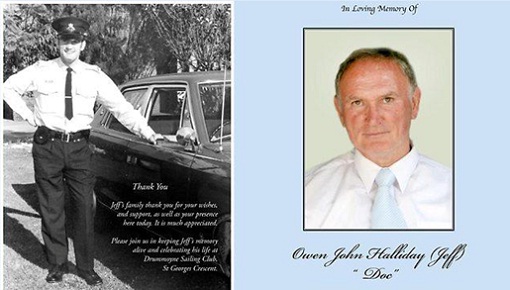
Owen John HALLIDAY

Owen John HALLIDAY

aka  ‘ Doc ‘ & ‘ Jeff ‘

New South Wales Police Force

Redfern Police Academy Class # 123

Joined NSW Police Force via Police Cadet System on 2 December 1968

Cadet #2417

Regd # 14262

Rank: NSW Police Cadet – commenced on 2 December 1968 ( aged 17 years, 3 months, 24 days )

Probationary Constable – appointed 25 August 1970 ( aged 19 years )

Constable 1st Class – appointed 25 August 1975

Detective Sergeant 3rd Class – appointed 24 March 1986

Stations:  Balmain, ?

Service:  From  2 December 1968  to  ? ? 2003 = 34 years Service

Stations: Balmain,  ?

Awards:  National Medal – granted 8 June 1988

1st Clasp to the National Medal – granted 27 September 1996

Born:  Saturday  25 August 1951

Died on:  Thursday  1 December 2011

Cause: Motor Neurone disease

Age:  60 years, 3 months, 6 days

Funeral date:  8 December 2011 @ 12.30pm

Funeral location:  Macquarie Park Crematorium

Buried at:  Cremated


The late detective sergeant Owen John (Jeff) Halliday (aka Doc).


OWEN is NOT mentioned on the Police Wall of Remembrance * NOT JOB RELATED


Top NSW cop Detective Owen ‘Doc’ Halliday to be given full police funeral after losing battle with motor neurone disease

NSW detective Owen ‘Doc’ Halliday mixed it with some of Sydney’s roughest and dirtiest criminals – invariably coming out the winner.

Detective Halliday will be given a full police funeral tomorrow, attended by the state’s top officers after he lost his battle with motor neurone disease earlier this week.

Halliday, 60, was responsible for bringing ‘Mr Rent-a-kill‘, Christopher Dale Flannery, back to Sydney after he went into hiding in Melbourne in the 80s.

”He was one of the most tenacious detectives I have known,’’ said Deputy Police Commissioner Nick Kaldas.

Doc had a sense of fairness you don’t often see and had an incredible disdain for bullies. He was not only a great detective but a wonderful father and a terrific bloke.’’

Halliday was a mentor to many of the state’s now-senior police and worked on some of the most high-profile cases of the 80s.

These included the Family Law Court bombings, the murder of  Justice David Opas and the murders of the Turkish consul and his bodyguard in the eastern suburbs.

He also investigated the gangland murders of underworld figures Mick Sayers and Roy Thurgar .

Halliday, or ‘Doc’ as he was known, joined the force in 1968 as a police cadet and was sworn in as a constable in 1970.

Much of his career was centred in the Balmain area where he became known to locals, both good and bad.

Besides a passion for the police force Halliday was a talented footballer playing first grade rugby league for the Canterbury Bulldogs in the 80s, in the era when they were known as the “Entertainers”.

Halliday retired as a decorated detective sergeant in 2003.

A service will be held at Macquarie Park Crematorium today.

He is survived by his wife Kay and his two sons Shane and Chad, both serving NSW police officers.

http://www.dailytelegraph.com.au/news/nsw/d/story-e6freuzi-1226216288086


Jonathon PATEN


vii. JONATHON PATEN

Senior Constable Paten was stationed at Queanbeyan. For some period of time Paten was exhibiting clear signs of mental illness that were recognised at the time by the Police Psychologist. Paten resigned from the NSW Police and committed suicide. The Coroner found that it was more convenient for the NSW Police to accept a resignation than to attempt to deal with an unwell employee in a professional way.

The Coroners Inquest has made a number of recommendations about dealing with mentally ill officers.

http://unionsafe.org.au/wp-content/uploads/2012/09/NileInquirySubmission.doc

[alert_red]Jonathon is NOT mentioned on the Police Wall of Remembrance[/alert_red]