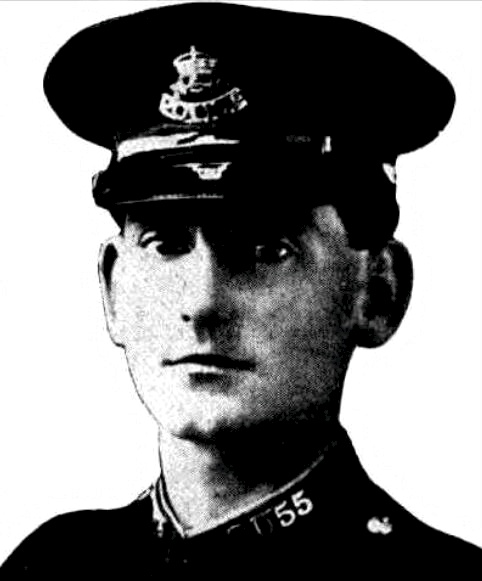
Stations: Sydney?, Holbrook ( about 2 years ), Wagga Wagga ( about 8 months ),
Officer In Charge, Corowa Police Station ( from 1947 )
Illness – Suicide
Corowa
1 August, 1948
Sergeant Millar died from a self-inflicted bullet wound on Sunday 1 August, 1948 at Corowa police residence. No further details are known.
The West Australian dated 2 August, 1948 reported the death as follows.
POLICE SERGEANT FATALLY SHOT SYDNEY, Aug. 1: Sgt. John H. A. Millar (56), whose recent absence from his police duties was being investigated by a high-ranking officer, died in the Corowa hospital last night after he had been found with a revolver wound in the head at his home, adjoining the local police station. An inspector from Albury was walking around the side of Sgt. Millar’s home when he heard a shot and rushed inside to find him lying on the floor dying. Sgt Millar was said to have been extremely worried recently over his official duties.
The sergeant was aged 56 years at the time of his death and was stationed at Corowa.
The Sydney Morning Herald Monday 2 August 1948 page 4 of 12
POLICEMAN’S DEATH
Shot In Head
Sergeant John H. A. Millar, 56, who had been in charge of the Corowa police station for two years, died in the Corowa Hospital on Saturday night from a bullet wound in the head.
A police report states that, soon after Inspector Yardy arrived at the police station to investigate a report that Sergeant Millar had been missing from the station for a few days, he heard a shot.
Going round to the quarters occupied by Sergeant Millar, Inspector Yardy found him lying on the floor. A police revolver was near Millar. He had been shot through the head.
Sergeant Millar was rushed to hospital, but died a short while after admission.
Sergeant Millar’s wife, who was in Sydney, returned to Corowa last night.
Sergeant Millar was a prominent bowler, and was popular in the town.
The Argus ( Melbourne ) Monday 2 August 1948 page 5 of 12
POLICE SERGEANT
FOUND SHOT
SYDNEY, Sun( 1 August ): Sergeant J. H. A. Millar, 56, sergeant in charge of Corowa police station, was found shot in his home behind the station late yesterday afternoon. He died soon after reaching Corowa Hospital.
He was found by Police Inspector Yardley, of Albury, who had gone to Corowa to investigate a report that Sergeant Millar had been missing from the station for several days.
Inspector Yardley heard a shot as he neared the station. He found Millar lying on the floor with a revolver beside him.
Daily Advertiser ( Wagga Wagga, NSW ) Monday 2 August 1948 page 2 of 6
FORMER WAGGA POLICEMAN FOUND DYING AT COROWA
A former Wagga police sergeant, who was found at the rear of the Corowa police station on Saturday night with a bullet wound through his head, died shortly after being admitted to the Corowa Hospital.
HE was Sergeant John A. Millar, 52, offlcer-in-charge of the Corowa Police Station.
Millar was found by Inspector Yardy, who had gone from Albury to Corowa to investigate a report that Millar had been missing from the police station for a few days.
Millar had not been on duty for three days.
Inspector Yardy, accompanied by Sgt. McGuiness, of Albury, arrived at Corowa on Saturday afternoon and interviewed Millar at his home, which adjoins the police station.
Shot Heard
Millar was resting at the time, but agreed to accompany the two police officers to the station.
He went outside for a few minutes and a shot was heard.
Inspector Yardy rushed out the back and found Millar lying on the ground with a bullet wound through his head.
Millar is said to have been worried a good deal lately over his police duties.
As soon as news of the tragedy was received, Superintendent Parmenter, of Wagga, left for Corowa and took over inquiries with Inspector Yardy and Detective Munro, of Albury.
Inspector Parmenter will return to Wagga today after the funeral at Corowa, which he will attend.
Millar’s wife, who was holidaying in Sydney, returned to Corowa yesterday, accompanied by her son, who is a member of the police force.
Was at Holbrook
Sgt. Millar was well-known in Riverina. He took up duty at Holbrook after being transferred from Sydney and was stationed there about two years before coming to Wagga.
After about eight months service at Wagga, he was transferred to Corowa last year as officer-in-charge.
Great Uncle to Vicki Alexis McCrohon – NSWPF – NSWPF – P/W 0123 – Class 120 ( 1964 ) & Rejoinee P/W 0202 – Class 141 ( 1974 )
New South Wales Police Force
Regd. # ‘Q‘ 9403
For the purposes of this website ‘Q‘ represents those Police joining between 1 March 1862 ( commencement of NSWPF ) – 23 February 1915 ( Commencement of NSWPF current numbering system )
Rank: Probationary Constable – appointed 1 April 1912
Final Rank: Sergeant 2nd Class – Death
Stations: ?, Central Police Station – 1 Division, Belmore ( 1916 ), Regent St – 2 Division, Newtown – 5 Division ( ? – 26 March 1939 ), Wagga Wagga ( 27 March 1939 ‘ Sgt ‘ – ? ),
13 Division, Clarence St Police Station – Death
Service: From 1 April 1912 to 17 March 1944 = 31+ years Service
Awards: No find on It’s An Honour
Born: 21 September 1887 – Barraba, NSW
Died on: Friday 17 March 1944 during the evening
Age: 56
Cause: Collision – hit by train
Event location: Hurlstone Park
Event date: Friday 17 March 1944
Funeral date: Monday 20 March 1944
Funeral location: Rookwood Crematorium
Funeral Parlour: Walters and Son, Dulwich Hill
Buried at: Cremated ?
Memorial located at: ?
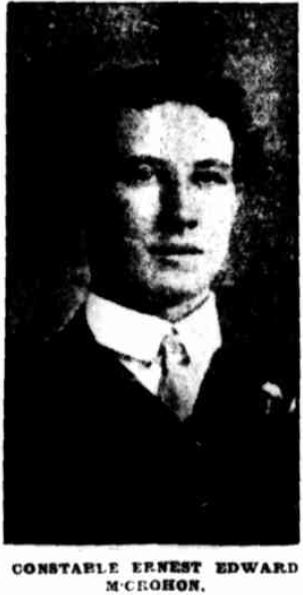
Constable Ernest Edward McCROHON the young policeman, who at Newtown a fortnight ago, had a sensational chase after four suspects and about 3a.m. on Saturday, arrested a man who had been behaving in a suspicious manner. On handcuffing his man, after a struggle, he found that he had a revolver in his hip pocket.
ERNEST is NOT mentioned on the Police Wall of Remembrance * NOT JOB RELATED
FURTHER INFORMATION IS NEEDED ABOUT THIS PERSON, THEIR LIFE, THEIR CAREER AND THEIR DEATH.
18 March, 1944 reported the following double tragedy surrounding the death of Sergeant McCrohon.
POLICE SERGEANT KILLED – MAN DIES GIVING FIRST AID.
Police Sergeant Edward McCrohon, 56, attached to No. 1 Police Station, was killed by a train last night while crossing the railway track between Hurlstone Park and Canterbury stations.
John Whitfield, a railway employee, who was a passenger on the train, collapsed and died as he began to give first aid to McCrohon.
Sergeant McCrohon was on his way home when he was killed.
The sergeant was born on 21 September, 1887 and joined the New South Wales Police Force on 1 April, 1912. He served at Metropolitan Divisions 1, 2, 5 and 13, as well as at Wagga Wagga. At the time of his death he was stationed at No. 1 Division (Central).
McCROHON. – The Relatives and Friends of the late Ernest Edward McCrohon ( Police Sergeant, No. 1 Division ), of 14 Keir Avenue, Hurlstone Park, are invited to attend his Funeral to leave our Funeral Chapel, This Monday, at 11 a.m., for the Crematorium Rookwood.
WHILE CROSSING THE RAILWAY LINES between Hurlstone Park and Canterbury railway stations on Friday night, Sergeant Edward Ernest McCrohon, 56, of the Clarence Street police station was struck by a train, and killed.
When John Whitfield, 62, night officer at the Belmore railway station who was a passenger on the train, alighted to give assistance, he had a sudden seizure and collapsed. He died beside the body of the police sergeant.
Sergeant E. E. McCrohon, formerly of Newtown, Sydney, took up duty in Wagga yesterday in succession to Sergeant Kidd, who has been transferred to Newtown.
Mr. H. Richardson Clark, Parramatta coroner, at an inquest at Bankstown on the dead body of a boy named Thomas Adamson, aged 11½ years, who was drowned in a waterhole in Punchbowl, through getting out of his depth while searching for his sister’s shoe, complimented a brave constable.
The waterhole is in a very secluded position, about eight feet in diameter, and very deep, with no shallow approach, so that directly the hole is entered the water, is about six feet deep, and the sides of it are of clay, being extremely slippery.
The Belmore police were informed of the accident, and Constable McCrohon proceeded to the place with all speed.
He there found a man who was fishing for the boy with a rake, whereupon the constable immediately disrobed and took a header right into the hole.
Before he went in the man with the rake warned him against diving in, as it was dangerous, but notwithstanding that the constable dived right in and brought up the child at once.
The evidence at the Inquest was that the constable knew nothing whatever of the waterhole, and had never seen it before, and that after he recovered the body he and Dr. Miller worked upon it three-quarters of an hour to restore life, but unfortunately without success.
Dr. Miller, in his evidence, stated that he thought the conduct of the constable was most praiseworthy, as had there been any rocks or snags or old stumps in the waterhole McCrohon might have broken his neck when he dived in.
The coroner, in finding a verdict of accidental death, said that he had great pleasure in concurring with the opinion of Dr. Miller as to the conduct of Constable McCrohon, and that he would bring it under the favorable notice of the Inspector-General of Police.
At the Newtown Police Court yesterday, in a case in which Charles Joseph Wall, aged 27, was charged with assault, the evidence of Constable McCrohon was that while he was arresting a man at midnight of April 21, his prisoner resisted, and Wall and others tried to drag the prisoner free.
Finally witness was forced to let the man go, and he then arrested Wall.
Sergeant J. D. Scott said that at the police stationWall accused the constable of having assaulted him. Witness, at his request, looked at Wall‘s mouth, but it was not cut, and there was no sign of blood.
Wall, in defence, said he did not assist the prisoner to escape, all he did was to put his hand on McCrohon and say: ” Constable, let him go quietly. ” McCrohon was then down and was hitting the prisoner as he lay on the ground.
After the prisoner escaped, witness said to the policeman: ” I think you hit that man terrible with the baton. I think it is my place to go up and give evidence against you. ” McCrohon then arrested witness; and in the station he got witness by the mouth and shook him. His mouth was cut, and he was spitting blood.
Sydney Alexander Colls, a barman at the Oxford Hotel, Newtown, said that Wall did not interfere with the constable while the latter was struggling with his prisoner. The defendant was not intoxicated.
Sergeant Moran said he saw no injury. Defendant was shouting and was abusive.
The magistrate ( Mr. Payten ) said that he would not ask for any evidence to be called in rebuttal of the allegations against the police, but as the department might deem it necessary to hold an inquiry, he ordered a copy of the depositions to be forwarded.
In regard to the case itself, he did not think that the probability was that the constable, while violently struggling with his prisoner; could say that Wall was the man who assaulted him when there were other men there too.
No assault was disclosed that would merit punishment.
The plucky action of Constable McCrohon led to the timely capture of a runaway on the Newtown railway bridge last night. A horse in a spring cart, driven by Clarence O’Loughlan, of 163 Lennox-street, Newtown, bolted from the bottom of the Newtown Tramway Depot yard, and, when heading for King-street, had put on a fine turn of speed.
McCrohon, who was crossing the bridge, noticed the galloping steed, and without hesitation caught the horse’s head as it dashed by. He was dragged a little distance, but brought the runaway to a stop before any harm was done.
Many people were about at the time, and the constable’s bravery was favorably commented upon.
Constable McCrohon was in King-street, St. Peters, on June 21, and when he saw Aubrey Harrison, aged 27, urge a dog to attack a horse in a cart he asked Harrison for his name and address. The man refused, and as the policeman closed with him, Harrison called to the dog, and it tore the officer’s trousers.
On the way to the watchhouse the prisoner used indecent language.
At the Newtown Police Court to-day Harrison was charged with offensive behavior, using Indecent language, assaulting McCrohon, and damaging his uniform. He was defended by Mr. L. Gannon.
Harrison denied the truth of the Charges.
The magistrate ( Mr. Smithers ) imposed fines and costs amounting to £7 11s 6d. The option was two months’ gaol.
In regard to a request that time be allowed to pay the magistrate said he would grant seven days to pay in three cases, but as far as the charge of indecent language was concerned he would, if he had the power, order Harrison to gaol.
Filthy language, he said, was the outcome of a filthy mind, and seemed to be part of the nature of a man who used it.
A few weeks ago Constable McCrohon of the Newton Police, captured a burglar under sensational circumstances, and the total municipal council at the instance of Alderman Lewis, sent a letter to the Inspector-General of Police expressing its appreciation of the bravery of the constable.
At the last meeting of the council a communication was received from Mr. Day stating that he was pleased to know of the council’s views in the matter, which coincided with his own, and he had ordered a favorable entry to be made on the constable’s record sheet.
About 2 o’clock yesterday morning Constable McCrohon and Watchman Taylor, who were in King-street, Newtown, noticed two men outside Selig’s pawn office. Being suspicious concerning the men, because of the early hour; the constables went towards them. The men made off immediately, one of them dropping an iron bar about 3 foot long.
They ran down Bucknell street towards McDonaldtown railway station.
Constable McCrohon hurried after the men, calling upon them to stop. They took no notice of his command, and he fired over their heads without effect upon their movements. Three more shots were fired, but the men disappeared and have not been traced since.
An examination of the premises near where the men were first soon showed that nothing had been interfered with.
The sergeant died from a self-inflicted bullet wound at the Hunters Hill Police Station on Saturday 13 January, 1940. Nothing further is known about this incident.
The Sydney Morning Herald of 15 January, 1940 reported the following.
POLICE SERGEANT SHOT.
When a constable called at the Hunters Hill Police Station on Saturday he discovered the body of Sergeant Frank Lund, 41, in a cell with a service revolver near his right hand. There was a bullet wound through Sergeant Lund’s head and a note in his handwriting was found nearby. Sergeant Lund lived at the station, and earlier in the day his family left to visit friends. For some time Sergeant Lund had been suffering from nerves and the note he left indicated that he feared that his mind might become affected.
At the time of his death the sergeant was 41 years old and was stationed at Hunters Hill.
Grave Location: Roman Catholic Monumental Section 3 – Plot: 0493
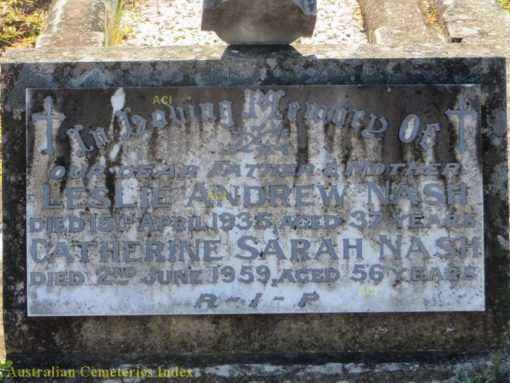
In Loving Memory of our dear father and mother. Leslie Andrew NASH, Died 15 April 1935 aged 37 years. Catherine Sarah NASH, Died 2 June 1959, aged 56 years. R.I.P.
Coroners Inquest: Tuesday 30 April 1935
LESLIE is NOT mentioned on the National Police Wall of Remembrance ( 2021 ) * BUT SHOULD BE
Constable Nash is thought to have been shot to death, possibly while on duty, on 15 April, 1935. It was thought that he had committed suicide however little is known about this incident and to some extent it remains a mystery.
The Hurstville Propeller newspaper dated 18 April, 1935 published the following article.
CONSTABLE FOUND SHOT AT HURSTVILLE POLICE STATION.
First-Class Constable Leslie Andrew Nash, station officer at the Hurstville Police Station, was found dead at the station early on Monday morning. Constable Nash commenced duty at 5 a.m. Constable Harvey left the station and when he returned Nash was missing. A search revealed his body in the bathroom attached to the station. Nash’s service revolver was nearby.
The Sydney Morning Herald of 16 April, 1935 added a bit more to the story.
POLICEMAN FOUND SHOT.Constable Leslie Andrew Nash, 38, was found dead in the bathroom at the Hurstville Police Station yesterday morning with a bullet wound in his head. A revolver was found nearby. Nash was to have sat for an examination yesterday morning and had been in ill-health for some time. For the last eight years, Nash, who was a first class constable with 14 years service, had been stationed at Hurstville and was well liked and respected in the district. He had previously been stationed at Sutherland. He is survived by a widow and five children.
The constable was born in 1897 and joined the New South Wales Police Force on 5 April, 1921. At the time of his death he was stationed at Hurstville.
Newcastle Morning Herald & Miners’ Advocate
Tuesday 30 April 1935 P9
WORRIED OVER LECTURES
Constable Committed Suicide
SYDNEY, Monday,
Forgetting what he had been told at lectures, Constable Leslie Nash, 37, committed suicide at Hurstville Police Station on April 15.
At the inquest today, Constable James Harvey said that Nash told him that he was worrying over a departmental examination that day, and had forgotten what he had been told.
Returning a verdict of suicide, the Coroner said that the case was very sad.
Armidale Express and New England General Advertiser (NSW : 1856 – 1861; 1863 – 1889; 1891 – 1954),
Monday 15 April 1935, page 1
CONSTABLE SUICIDES
Strain of ill-Health Too Great
Sydney, Monday.
Constable Leslie Andrew Nash (38), was found dead at the Hurstville Police Station early this morning with a gun shot wound in the head.
He was acting as station officer. It appears that the man, who had been in ill health, had been told that he would have to undergo a serious operation. Some time later he was missing, and a search resulted in the discovery of his body in the bathroom attached to the station, with a revolver lying nearby.
Constable Leslie Andrew Nash. aged 38, was today found dead at the Hurstville Police Station, where he had performed duty as station officer.
Nash, who has been in ill health and had been told that he would have to undergo a serious operation, began duty at 5 a.m. He asked Constable Harvey to go on an errand, and when Harvey returned Nash was missing.
A search revealed his body in the bath room attached to the station. His service revolver was nearby.
Nash left a widow and four children.
He had been in the force for 14 years and was a first-class constable.
Today he was to have sat for an examination, which his inspector said he would have passed without the slightest difficulty.
NA8H.- H.A.C.B.S. St. DECLAN’S BRANCH, No. 659.- The Officers and Members of the above Branch are requested to attend the Funeral of their late Bro.. LESLIE A. NASH: to leave St. Declan’s Catholic Church. Penshurst, THIS DAY. at 2.30 p.m., for Woronora Cemetery. By road.
The Coroners Inquest returned a verdict of “Effects of a bullet wound in his head, wilfully self inflicted“
Inquest was concluded on 29 April 1935.
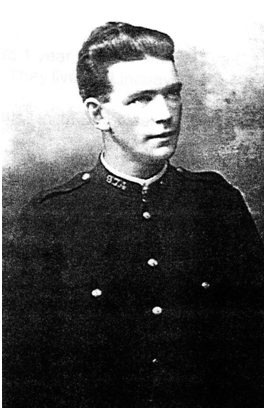
In the attached photo, his Uniform # is 87A or 97A.
The ‘ A ‘ used to depict the District that the member was attached to. ‘ A ‘ District was Sydney – so he may, at the time of the photo being taken, have been stationed at one of the Sydney CBD Stations.
NSWBDM
Birth = 6089/1898 Father = Patrick Mother = Amelia District = Parkes
Marriage = 2105/1925 Bride = McDonnell or MacDonnell District = Kempsey
Death = 7008/1935 Father = Patrick Mother = Amelia District = Hurstville
Leslie was born in 1898, the son of Patrick and Amelia, Leslie married on 10 Jan 1925 to Catherine McDonnell. Leslie was a First Class Constable Leslie passed away 15 Apr 1935 (aged 36)
Sources
NSW BDM
BIRTH NASH LESLIE A 6089/1898 PATRICK AMELIA PARKES
MARRIAGE 2105/1925 NASH LESLIE A MCDONNELL CATHERINE KEMPSEY
DEATH NASH LESLIE A 7008/1935 PATRICK AMELIA HURSTVILLE
RYERSON INDEX
NASH Leslie Andrew Death notice 15APR1935 Death 37 at Hurstville, late of Penshurst Sydney Morning Herald 16APR1935
The Sydney Morning Herald NSW 1842 – 1954
Tue 16 Apr 1935 DEATH NASH-April 15, 1835, suddenly, at Hurstville, Leslie Andrew, of 6 Clarence-street, Penshurst, dearly beloved husband of Catherine and father of Pat, Francis , Alma, John and Peter aged 37 years. Requiescat in pace.
The Sydney Morning Herald NSW 1842 – 1954 Tue 16 Apr 1935 Page 9 FUNERAL NASH.-The Relatives and Friends of Mrs. CATHERINE NA8H and FAMILY are kindly Invited to attend the Funeral of her dearly beloved HUSBAND and their FATHER. First Class Constable Leslie Andrew Nash: which will leave St. Declan’s Church. Penshurst, THIS TUESDAY, at 2.30 p.m., for the Catholic Cemetery. Woronora. Mrs. P. KIRBY and SON. LTD.. Leadlng Funeral Directors. phone, M2221-2. 263 Elizabeth-street, Sydney.
NASH.-‘The Friends of Mr. WILLIAM ROSS are kindly invited to attend the Funeral of his friend, the Late Mr. Leslie A. Nash: lo leave St. Declan’s Church. Penshurst, THIS DAY (Tues day. For further details please see above notice.
NASH.- H.A.C.B.S. St. DECLAN’S BRANCH, No. 659.-The Officers and Members of the above Branch are requested to attend the Funeral of their late Bro.. LESLIE A. NASH: to leave St. Declan’s Catholic Church. Penshurst, THIS DAY. at 2.30 p.m., for Woronora Cemetery. By road. W. J. MEACHMAN. Tres. R. J. MADDEN. Sec.
NASH Leslie Andrew Death notice 16APR1935 Death at Hurstville Sydney Morning Herald 22APR1935
The Sydney Morning Herald (NSW : 1842 – 1954)
Mon 22 Apr 1935 Page 8 Family Notices
DEATH
NASH.—April 16 (suddenly), at Hurstville, Les- lie Andrew, beloved brother, brother-in-law, and darling uncle of Bob, Rene, and Aileen.
Death aged 37 at Hurstville, late of Penshurst
BURIAL Woronora Memorial Park
Sutherland, Sutherland Shire, New South Wales, Australia PLOT RC 3 0493
In 1931 Constable Nowland was the lone policeman attached to the Bendemeer Police Station. On the night of Sunday 4 October, 1931 a man came to the station to complain that he had been camped under the bridge at the river and had been accosted by a “madman” who had threatened to kill him. He requested that the constable come down to the bridge, which was at the McDonald River, a distance of less than 300 metres to look for the madman. The constable obliged, however after a brief search under and around the bridge, the alleged “madman” could not be found. The following night the man again came to the police station with the same complaint. (It was believed to have been the same man both nights as Mrs Nowland heard his voice on both visits, although she never actually saw him). The constable took his revolver and set out to search the bridge area again. When he failed to return home by the morning Mrs Nowland telephoned the police at Tamworth.
Police from Tamworth quickly travelled to Bendemeer and, with the assistance of an Aboriginal tracker, began to search for the missing man. Later that afternoon Constable Nowland’s body was found and recovered from the McDonald River. He was still fully clothed, except for his cap, and the body had no apparent signs of violence, although apparently the constable’s nose had been bleeding before he fell or was thrown into the water. At the spot where the body was found the water was only three to four feet (about 1 metre) deep.
The Brisbane Courier dated 7 October, 1931 reported that “The police believe that Nowland was insensible or dead before he entered the water. It is thought that Constable Nowland did not reach the bridge last night. His way would have taken him past a hotel, and beneath brilliant lights, and it is considered that he would certainly have been seen had he gone direct to the bridge from the police station. It is thought probable that he was attacked almost as soon as he left the police station, and was then taken to the river and thrown into the water insensible. The police are handicapped by the absence of any description of the man who twice called at the police station and spoke of the lunatic. Constable Nowland was the only one who saw him.”
The Sydney Morning Herald of 10 November, 1931 reported the open finding of the inquest into the constable’s death, as follows.
“BENDEMEER MYSTERY – CORONER’S OPEN VERDICT.
TAMWORTH. Monday.
The inquest into the death of Constable Nowland, whose body was found in the McDonald River on October 5, came to an end to-day, when the coroner (Mr. Geikie, P.M.) returned an open verdict. Six sessions of the inquest have been held, and 24 witnesses have been examined. In delivering his finding, Mr. Glekie said that the case was marked by many conflicting and mysterious statements. If it was suicide, then the deceased must either have been sane or insane. If he was sane, the first thing was to look for the motive, and the evidence adduced no such motive. If he was insane, no motive need be looked for. There was not a tittle of direct evidence of mental derangement in the constable up to the time of his death. His finding would be that Nowland was found dead in the McDonald River without any marks on the body; further, that death was due to drowning, but how or by what means drowning came about the evidence did not say.”
The mystery of what exactly happened to the unfortunate Constable Nowland has apparently never been solved, although theories ranging from suicide to poisoning to murder have long been put forward. A coroner’s inquest into the death gave the cause of death as drowning, however the surrounding circumstances remain unknown.
The constable was born in 1901 and was aged 31 years when he died. He joined the New South Wales Police Force on 25 August, 1922. At the time of his death he was stationed at Bendemeer. He is not listed in the official New South Wales Police Honour Roll.
[divider_dotted]
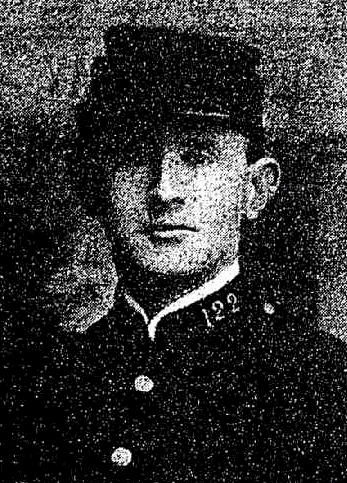
Harry LEEDS
| 26/10/2012
Harry LEEDS
( late of ” Innisfail “, Penkivil St, Willoughby )
New South Wales Police Force
Regd. # ?
Rank: Constable
Uniform #: 122
Stations: Goulburn, Araluen, Crookwell, North Sydney, Phillip Street Police Station, George St North Police Station – Sydney
Service: From 28 May 1907 to 21 August 1924 = 17+ years Service
Awards: ?
Born: ? ? 1885 at Trial Bay
Died on: Thursday 21 August 1924 – on his way to Duty
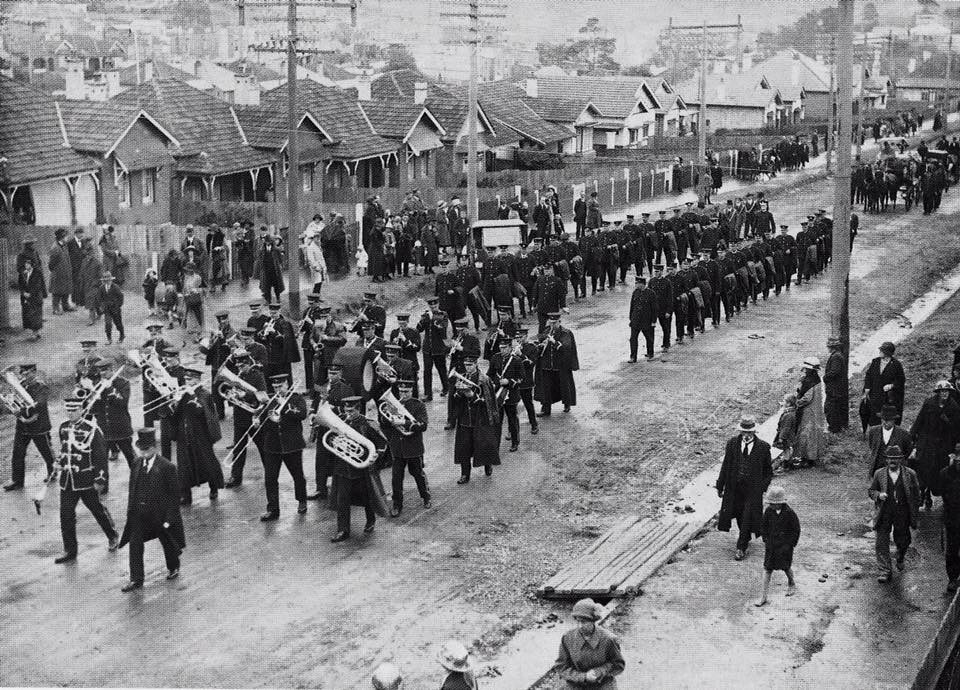
Funeral procession of Constable Leeds at North Sydney
[alert_red]HARRY is NOT mentioned on the Police Wall of Remembrance[/alert_red] * BUT SHOULD BE
Constable Harrie Leeds was killed in a tramway accident at McMahon’s Point, Sydney on Thursday 21 August, 1924. Another man was also killed and several people were injured in the incident. Incredibly, the Inspector General of Police Mr James Mitchell did not consider this death to be “killed on duty”. This decision was later the subject of numerous unsuccessful representations by the Police Association of New South Wales. It was at the very least the death of a constable travelling to work, regardless of other factors and disputed facts.
The publication “Serving the Force”, 75 Years of the Police Association of New South Wales 1921 – 1996 briefly describes how Constable Leeds bravely leapt onto the running board of a runaway tram as it sped through McMahon’s Point. The constable was trying to help stop the tram and had been yelling to passersby to keep clear. Unfortunately, the tram hit an obstacle and the constable was thrown to his death. He was not classified as being killed on duty and his wife and five children received a pittance of a pension because he had only been in the force a short time. [17 years is probably not a “short time”]
One of the bewildering issues with this event is the fact that there were and are many versions of it, as indicated in an article in the Sydney Morning Herald dated 22 August, 1924, which reported that “Constable Harry Leeds, who lived at Willoughby, was on his way to duty when he met his tragic and shocking death. Of the circumstances in which he lost his life there are different versions. One story is that he was pluckily assisting to try to avert the disaster when he was crushed. It is stated, again, that he was on the leading car, and that as he jumped on to the roadway when the cars tore across the rails the rear car hit him and pinned him helplessly underneath it. He was dead when his body was recovered after much effort.”
And again, the Sydney Morning Herald dated 2 October, 1924 reported a lengthy description of the coroner’s findings, including the following extract.
Herbert Gillies Ruthven, a passenger on the tram, described his experience. He said that shortly before the smash he had been conversing with the deceased Leeds. Leeds seemed frightened when the tram had gathered speed while descending the other declines on the route from Victoria Avenue. [Ruthven] had said to him, “How about getting off here, Leeds, and walking down?” That was when the tram stopped at East Crescent Street. Just then the tram started, and the constable did not reply. Witness next saw him crouching in a hesitating manner as if he were about to take the risk of jumping from the tram. He was still on the footboard when the tram first left the rails.
The constable was born in 1885 at Trial Bay, New South Wales and joined the New South Wales Police Force on 28 May, 1907. At the time of his death he was stationed at George Street North Police Station. He lived at Willoughby and had previously served at Goulburn, Araluen, Crookwell, North Sydney and Phillip Street Police Stations.
[divider_dotted]
The Sydney Morning Herald Friday 22 August 1924 page 9 of 16
CASUALTY LIST.
KILLED.
HARRY LEEDS, 47, of Penkivil-street, Willoughby, a police constable attached to the George-street North station.
FREDERICK MAURICE LAMBERT, 30, engineer, of the corner of Alleyne and Mann streets, Willoughby.
The Sydney Morning Herald Friday 22 August 1924 page 7 of 16
FUNERALS:
LEEDS – The Relatives and Friends of the late Constable HARRY LEEDS are invited to attend his Funeral ; to leave his late residence, Innisfail, Penkivil-street, Willoughby, THIS FRIDAY, at 2pm, or Catholic Cemetery, Northern Suburbs.
WOOD COFFILL LIMITED, Funeral Directors.
*
LEEDS. – The Relatives and Friends of Mrs. ALICE E. LEEDS and FAMILY are invited to attend the Funeral of her beloved HUSBAND and their FATHER, Harry ; to leave Innisfail, Penkivil-street, Willoughby, THIS FRIDAY, at 2pm for Catholic Cemetery, Northern Suburbs.
*
LEEDS – Relatives and friends of Mr. HARRY LEEDS, Senior, and Miss ELSIE LEEDS, of Parramatta, are invited to attend the Funeral of his beloved SON and her BROTHER, Harry ; to leave Innisfail, Penkivil-street, Willoughby, THIS FRIDAY, at 2pm, for Catholic Cemetery, Northern Suburbs.
*
LEEDS.- The Friends of Mr. and Mrs. NEIL BOYLE, Mr. and Mrs. FRANK PALMER, Mr. and Mrs. Neil LEEDS, Mr. and Mrs. RICHARD LEEDS, of Summer Hill, are invited to attend the Funeral of their beloved BROTHER, Harry Leeds ; to leave Innisfail, Penkivil-street, Willoughby, THIS FRIDAY, at 2pm, for Catholic Cemetery, Northern Suburbs.
*
LEEDS – The Friends of Mrs. O’REGAN, ELLA & DONA HOWE, of Cairo-Street, North Sydney, are invited to attend the funeral of their beloved SON-IN-LAW and BROTHER-IN-LAW, Harry Leeds ; to leave Innisfail, Penkivil-street, Willoughby, THIS FRIDAY, at 2pm, for Catholic Cemetery, Northern Suburbs.
*
LEEDS. – The Friends of Mr. and Mrs. J. T. LEVITT and FAMILY, of Ashfield, are invited to attend the Funeral of their beloved BROTHER-IN-LAW and UNCLE, Harry Leeds; to lave Innisfail, Penkivil-street, Willoughby, THIS FRIDAY, at 2pm for Catholic Cemetery, Northern Suburbs.
WOOD COFFILL LIMITED
*
LEEDS – N.I.O.O.F., LOYAL PERSEVERANCE LODGE – The Sisters and Brothers of the above lodge are invited to attend the Funeral of the late Brother H. LEEDS; to leave his late residence, Innisfail, Penkivil-street, Willoughby, at 2pm TODAY.
Evening News ( Sydney ) Friday 22 August 1924 page 7 of 12
LAST TRIBUTE TO CONSTABLE LEEDS
A large crowd attended the funeral of Constable Harry Leeds, one of the victims of the North Sydney tramway smash, to-day. It was striking tribute to a popular officer.
The cortege, which left his home in Penkivil-street. Willoughby, for the Northern Suburbs cemetery, was headed by the Police Band playing the Dead March. About a hundred police representative of the whole metropolitan division, besides a number of tramway men marched in procession. The principal mourners were the widow and five young children, Mrs. Boyle, Mrs. Benn, Mrs. Davison, Mrs. Dickman, Mrs Palmer and Miss Elsie Leeds (sister). Mr. Harry Leeds (father). Messrs. Neil and Richard Leeds (brothers). Among those present were Mr. James Mitchell, Inspector-General of Police, Inspector Souter, North Sydney, Mr. G. Holt. District Superintendent of Tramways, North Sydney – (representing the Tramway Department), Mr. Charles Thackeray (representing the Police Association). Many beautiful wreaths were sent by the police. Including several from C.I. Branch and No. 4 Division.
The Sydney Morning Herald Saturday 23 August 1924 page 16 of 26
LATE CONSTABLE LEEDS.
IMPRESSIVE FUNERAL.
The funeral of Constable Harry Leeds, who was killed in the tram accident at McMahon’s Point, took place yesterday afternoon in the Roman Catholic portion of the Northern Suburbs cemetery.
A large crowd assembled in the vicinity of the late Constable Leed’s home in Penkivil- street, Willoughby, and, as the coffin was placed in the hearse, the crowd stood bare-headed, while Inspectors Beatty (George-street North station), to which Constable Leeds was attached and Souter (North Sydney) stood at the salute, at one side, and members of the Loyal Perseverance Lodge (Independent Order of Oddfellows) stood at the other side.
The Police Band, with muffled and draped drums, led the procession, and following the band, there came between 50 and 60 non-commissioned officers and men of the police force, representing 15 divisions. Marching immediately in front of the hearse were the Inspector-General of Police (Mr. James Mitchell) and Inspector Souter. The pall-bearers were Constables Cole, Hansen, Malcolm (No. 6 Division), and Jackson, Kerr, and Reece (No. 4 Division). Following the hearse were the mourning coaches conveying members of the family and other relatives of the deceased, then came members of the Loyal Perseverance Lodge, and about 30 motor cars and other vehicles, conveying friends of the late constable.
The route from the late Constable Leeds’s home to the cemetery was between three and four miles, and practically all the way crowds gathered to view the procession. A large number of people had assembled at Mowbray-road, and as the procession passed into the main street of Chatswood to the strains of the Dead March the scene was a solemn and striking one. The sidewalks of the thoroughfare were crowded, the men standing bare-headed, and the police on street duty standing at the salute as the hearse passed. After crossing the railway line at Chatswood the Police Band and members of the force opened out and halted while the procession passed through. Motor buses conveyed the band and police to the entrance to the cemetery, and on arrival of the hearse and mourners the procession was again formed and marched to the grave. The Rev. Father J. Wall officiated at the graveside, the service being simple but impressive.
The principal mourners were Mrs. Leeds (widow) and five young children, Messrs. Harry Leeds (father), Neil and Richard Leeds (brothers), and Mrs. Boyle, Mrs. Palmer Mrs. Benn, Mrs. Davidson, Mrs. Dickman, and Miss Elsie Leeds (sisters).
Others present Included Mr. G. Holt, District Superintendent of Tramways, North Sydney (representing the Tramway Department), District-officer F. A. Tuck, Crow’s Nest (representing the New South Wales Fire Brigade), Mr. Charles Thackeray (representing the Police Association), ex-Inspector J. Fullarton, Aldermen J. S. Muir, W. L. M. Fry, E. J. Parkes (Willoughby Council), and Messrs. G. A. Bailey (town clerk), Hughes (health Inspector), and Murdock (building Inspector), H. B. Perringnon (Department of Labour and Industry), T. Proctor, H. C. Coulter, P. K, Gorrick, and E. Hewitt.
POLICE TO HELP WIDOW.
At North Sydney Police Court yesterday appreciative remarks regarding the late Constable Leeds were made by Mr. Daley and Mr. Thomas on behalf of the legal profession. Mr. Daley said that he had known Constable Leeds for 15 years, and he was an efficient, courageous, and loyal officer.
Inspector Souter expressed regret on behalf of the police force, and said that it was unfortunate that Constable Leeds had left a widow and five young children. He was sure, however, that the police as a body would not fail to alleviate the suffering of the late constable’s relatives.
The Catholic Press ( Sydney ) Thursday 4 September 1924 page 25 of 52
Tram Accident Victim.
CONSTABLE HARRY LEEDS.
Constable Harry LEEDS
THE LATE CONSTABLE LEEDS.
The recent tram accident at North Sydney was the cause of the death, of Constable Harry Leeds. Constable Leeds was one of the most popular men in the metropolitan area, and news of his death came as a severe shock to his colleagues. He joined the force in 1907, and was appointed to Goulburn, where he was married, and transferred to Araluen. From there he was sent to Crookwell, and later on to North Sydney, where he did duty for a number of years; but for the past five years he was connected with George-street North Police Station.
On the 22nd ult., at the North Sydney Police Court, Mr. Daley and Mr. Thomas, on behalf of the legal profession, paid a tribute to the worth of Constable Leeds, and offered their deep sympathy to his relatives. Inspector Souter said they could ill afford to lose such men of long service and experience. Constable Leeds leaves a widow and five young children, the youngest being a boy only six months old.
The funeral was an impressive tribute to the memory of deceased. The Police Band, under Bandmaster Hawkins and Drum-Major Flynn, together with a squad of sergeants and constables, drawn from the whole of the 15 divisions of the Metropolitan Police Force, led the cortege, and six police pals of the dead man carried the coffin, laden with wreaths. The hearse, too, was piled with wreaths.
The Inspector-General of Police (Mr. Mitchell) walked in the cortege, accompanied by Inspectors Beatty and Souter. The pall-bearers were Constables Cole, Hansen, Malcolm (No. 6 Division), Jackson, Kerr, Reece (No. 4 Division). Also in the cortege were Mr. G. Holt (District Superintendent, North Sydney), representing the Government Tramways Department), District Officer F. A. Tuck (representing New South Wales Fire Brigades), Mr. C. Thackeray (representing Mr. B. Fortesene and Police Association), Alderman Muir (representing the Mayor and Alderman of Willoughby). First-Class Constable Walsh marshalled the cortege to the Catholic portion of the Northern Suburbs Cemetery. The streets through which the cortege passed were lined on each side with thousands of people, who stood with bowed heads. Arriving at the cemetery, the police formed an avenue, through which the cortege passed, and Rev. Father J. Wall, of Ryde, officiated at the graveside.
While the coffin was being lowered, the Police Band played ‘Abide With Me.’
The chief mourners were: The widow and five children, Mr. Harry Leeds (father), Neil and Richard (brothers), Mesdames Boyle, Benn, Davison, Dickman, Miss Elsie Leeds (sisters) Mrs. O ‘Regan, Mrs. Levett, Miss Howe, Miss O’Regan (mother and sisters of the widow). — R.I.P.
Freeman’s Journal ( Sydney ) Thursday 4 September 1924 page 19 of 48
THE LATE CONSTABLE HARRY LEEDS.
Constable Leeds, the victim of the recent tram accident at North Sydney, was one of the most popular men in the metropolitan area, and news of his death came as a severe blow to his colleagues.
He joined the police force in 1907 and was appointed to Goulburn, where he married. He was transferred to Araluen, and from there he went to Crookwell, and later on to North Sydney, where he did duty for a number of years. For the past five years he had been connected with George-street North Police Station.
On August 22, at the North Sydney Police Court, Mr. Daley and Mr. Thomas, on behalf of the legal profession, paid a tribute to the worth of Constable Leeds, and offered their deep sympathy to his relatives. Inspector Souter said they could ill afford to lose men of such experience and long service.
Constable Leeds leaves a widow and five young children, the youngest being a boy only six months old.
The funeral, which took place on Friday, August 22, was an impressive tribute to the memory of deceased. A large concourse of people gathered at ‘Innisfail,’ Penkivil-street, Willoughby, and genuine sorrow was manifested, particularly among those who knew the bond of affection which existed in the domestic life. At 2 p.m. the Police Band, together with a squad of sergeants and constables drawn from the whole of the fifteen divisions of the metropolitan police force, formed up outside, and six police pals of the dead man carried the coffin, laden with wreaths. The hearse was piled with wreaths. As the coffin was borne out, Inspectors Beatty (George-street North) and Souter (North Sydney) stood at the salute at one side, and six members of the Loyal Perseverance Lodge (I.O.O.F.) with bowed heads at the other.
The Inspector-General of Police (Mr. Mitchell) walked in the cortege, accompanied by Inspectors Beatty and Souter. The pall-bearers were Constables Cole, Hansen, Malcolm (No. 6. Division), Jackson, Kerr, and Reece (No. 4 Division). Also in the cortege were Mr. G. Holt (District Superintendent of North Sydney; representing Government Tramways Department), District Officer F. A. Tuck (representing N.S.W. Fire Brigades), Mr. C Thackeray (representing Mr. B. Fortescue and the Police Association), Alderman Muir (representing the Mayor and aldermen of Willoughby); Mr. Scott Fell was also represented.
First-Class Constable Walsh marshalled the cortege to the Catholic portion of the Northern Suburbs Company. The Police Band, under Bandmaster Hawkins, with Drum-Major Flynn at its head, led off with the ‘Dead March in Saul.’ The Loyal Perseverance Lodge (N.I.O.O.F.), with N.G. Bro. C. Bolger and Secretary Bro. Dimond, were also in the procession. The streets, through which the cortege passed, was lined on each side with thousands of people, who stood with bowed heads and tear-dimmed eyes. Arriving at the cemetery, the police formed an avenue through which the cortege passed, and the Rev. Father J. Wall, of Ryde, officiated at the graveside. While the coffin was being lowered the Police Band played ‘Abide With Me.’ The chief mourners were the widow and five children, Mr. Harry Leeds (father), Messrs. Neil and Richard (brothers), Mesdames Boyle, Benn, Davison, and Dickman, Miss Elsie Leeds (sisters), Mrs. O’Regan, Mrs. Levett, Miss Howe, Miss O’Regan (mother and sisters of the widow). — R.I.P.
Evening News ( Sydney) Monday 29 September 1924 page 5 of 10
McMAHON’S PT. SMASH
The Coroner’s inquiry into the cause of the McMahon’s Point tram crash on August 21, in which Constable Harry Leeds and Frederick Maurice Lambert were killed, has been fixed for next Wednesday at 10 a.m.
The Sydney Morning Herald Tuesday 30 September 1924 page 6 of 15
TRAM DISASTER.
The City Coroner’s inquest into the deaths of Constable Harry Leeds, and Frederick Maurice Lambert, in the tram disaster at McMahon’s Point on August 21 is listed to be held tomorrow.
Newcastle Morning Herald & Miners’ Advocate Thursday 2 October 1924 page 5 of 8
SYDNEY TRAM SMASH. CORONER’S VERDICT :
The Sydney Coroner to-day held an inquiry, into the deaths of Frederick Lambert, aged 39, an engineer, of Willoughby, and Constable Harry Leeds, aged 47, of Willoughby, who were killed in the tram smash at McMahon’s Point, North Sydney, on the morning of August 21. It was through the alleged failure of the brakes that a double-set ran down the steep incline towards McMahon’s Point, but when rounding a curve the front car left the rails and crashed into a house. The rear car piled itself up on to the first car, and in the smash Lambert and Leeds were killed, and a number of other passengers injured.
Edward Chambers, electrical subforeman in the Tramway Department, said that on August 20 the two cars, 544 and 543, went into traffic at 6.20a.m., and arrived back at 8.57a.m., and were booked up as ” O.K. ” On August 21, at 1a.m., they were again booked up as ” O.K. ” At 5.49a.m. they went into traffic again, and were in good order. At 7.50a.m. he saw them at McMahon’s Point, after the accident. It was driver’s duty to report any defects in the running of a car.
Thomas Elias James, the driver of the car, was then called. He said that when they left Willoughby on the fatal trip for McMahon’s Point, he found that the controller was jambed (sic), and he could not move it one way or another. He then drove the tram from the rear of the car, and left Conductor Cowan in charge of the air brake in the front. As they neared the long hill near the terminus, he felt the car getting out of control. He attempted to use the third emergency, but found it could not be used, owing to the air control being on. He was absolutely helpless to do anything. Witness considered he had taken the best course in giving Cowan control of the air brake, as it was a very foggy morning. He attributed the accident to the greasy condition of the rails.
Conductor James Cowan, who stuck to the front of the car throughout, and who suffered severe concussion when it left the rails and crashed into the wall, was the next witness.
Mr. D. R. Hall, his solicitor, explained that his memory, so far as the accident was concerned, was an absolute blank, and he was still a very sick man. Consequently he was only asked a few questions. He told the coroner that he could not remember anything of the run down the hill or the final crash.
“I would like to say how greatly I and the public admire him for sticking to his post right up to the end,” said the coroner, as Cowan was assisted from the box. “I an sure he will have the good wishes of the court for his speedy recovery, and its admiration for the way in which he retained his position, in the face of what looked like certain death.”
Edward Wills, chief inspector, said that the working orders put the driver in charge of the tram, and the only part of his duty he could delegate to a conductor when he had to drive from the rear was the operation of the bell and the sand. Wills maintained that the driver delegated his powers to the conductor, and thereby broke the regulations. The conductor, in this case, was in charge of the tram.
The Coroner: A man might easily make a mistake about the meaning of this rule.
Mr. Hall: A department whose motto is “Safety first” might have expressed it in more simple English and more clearly.
The coroner returned a verdict of accidental death.
On a Saturday morning in 1924 Sergeant Ellis of the Brewarrina Police Station ended his life by shooting himself in the chest and head. Little is known of the sergeant and his death other than a brief extract from the local (Brewarrina) newspaper which indicates that: “Sergeant Ellis was up and about on the Saturday morning attending to his duties and seemed as cheerful as ever, and Constable Woodward received a rude shock on going for the sergeant to accompany him to breakfast, to find him lying dead in a pool of blood on the floor. An examination by Dr. Duncan showed that Sergeant Ellis had shot himself twice, over the heart and in the temple. The body of the Sergeant was placed in a lead-lined coffin and forwarded to Singleton yesterday morning for interment”
The NSW Register of Coroners Inquests and Magisterial Inquiries, 1834-1942 indicates that an inquest was held into the sergeant’s death on 12 May, 1924 at Brewarrina. It was found that Sergeant Ellis died at Brewarrina as a result of a “bullet wound in the head wilfully self-inflicted.”
A year after the sergeant’s death the following announcement appeared in ‘In Memoriam’ column of The Argus, dated 9 May, 1925: ELLIS – In fond and loving memory of my dear fiance, Sergeant James Ellis, who died at Brewarrina, N.S.W. on 10th May, 1924. The link that bound us here below still binds my heart to thine. (Inserted by Flora Thomson, Hampton.)
The sergeant was a native of Wyalong and in 1919 was transferred from Broken Hill to Tibooburra as the officer-in-charge of that station. He was then transferred to Brewarrina on 4 March, 1924. He had only been at Brewarrina for two months when he died at the age of 39 years.
Louis Godfrey PETHER
| 26/10/2012
Louis Godfrey PETHER
Late of ?
New South Wales Police Force
Regd. # ‘Q‘ 6909
For the purposes of this website ‘Q‘ represents those Police joining between 1862 ( commencement of NSWPF ) – 23 February 1915 ( Commencement of NSWPF current numbering system )
Rank: Constable – appointed 16 December 1895
Detective
Sergeant 2nd Class
Final Rank = Detective Sergeant 2nd Class
Stations: ?, North Sydney ( 23 years ), Sydney CIB ( from 1919 – death ) – Death
Service: From 16 December 1895 to 21 August 1923= 27+years Service
Awards: No find on It’s An Honour
Born: ? ? post 21 Aug 1867 in Victoria
Died on: Monday 20 August 1923
Age: 55
Cause: Suicide – Firearm – “possible” Service weapon
Event location: Toilet, Police Headquarters, Sydney
Event date: Monday 20 August 1923
Funeral date: Wednesday 22 August 1923
Funeral location: ?
Wake location: ?
Funeral Parlour: ?
Buried at: Rookwood Cemetery, Rookwood
Zone C, Section 07, Row ?, Grave 883
Interred in the same grave:
Olivia May PETHER, aged 58, Interred on 23 Sept 1927
Memorial located at: ?
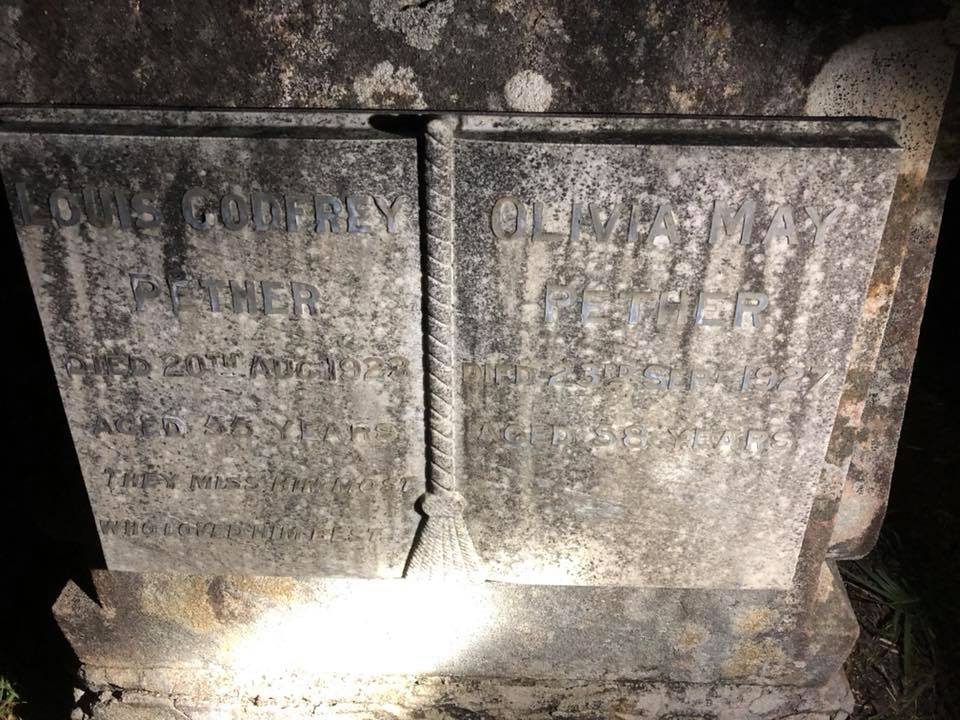
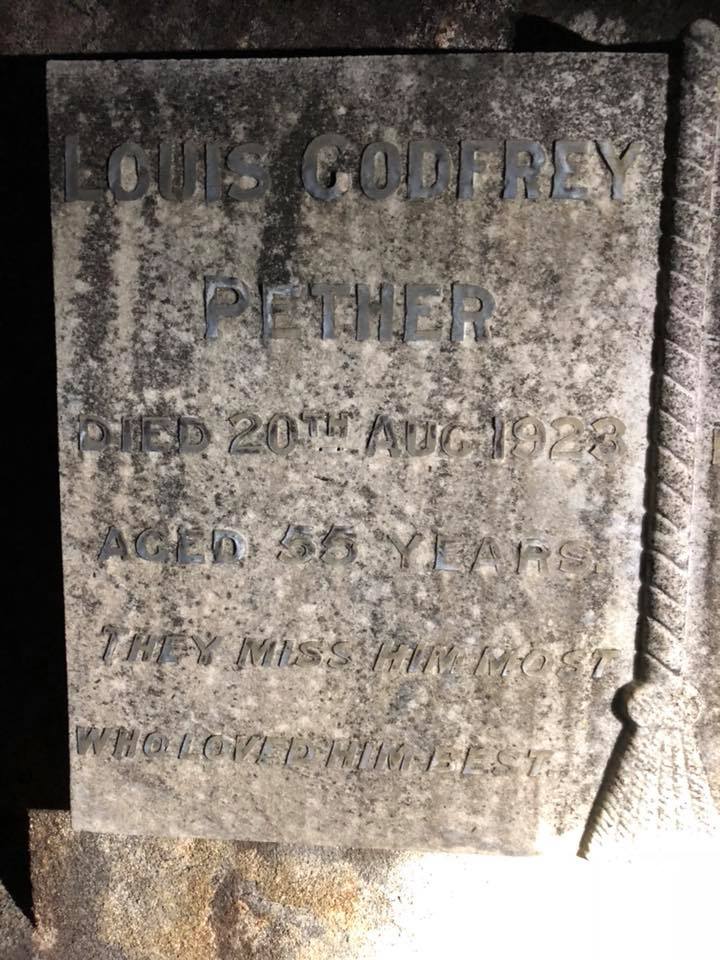
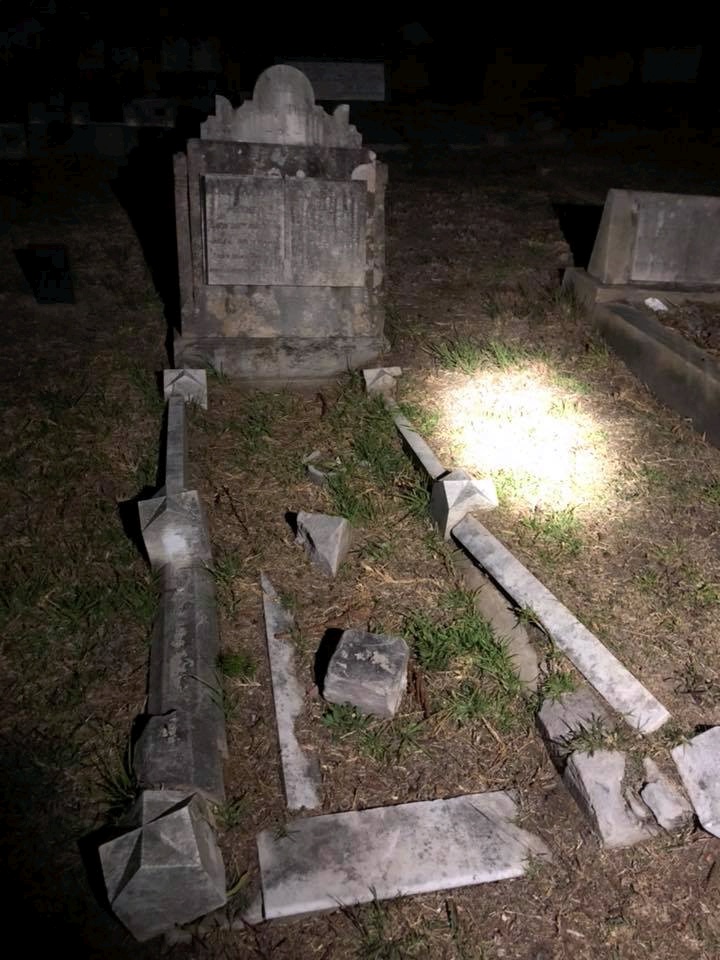
Grave of Detective Sergeant 2nd Class Louis Godfrey PETHER & wife – Olivia May PETHER
[alert_yellow]LOUIS is NOT mentioned on the Police Wall of Remembrance[/alert_yellow] *NEED MORE INFO – BUT MOST PROBABLY SHOULD BE
[divider_dotted]
Grave location: TBA
[divider_dotted]
FURTHER INFORMATION IS NEEDED ABOUT THIS PERSON, THEIR LIFE, THEIR CAREER AND THEIR DEATH.
The Examiner newspaper dated 21 August, 1923 reported the following account of the death of Detective Sergeant Pether.
Detective Found Dead, Sydney, Monday.
Detective Sergeant Louis Godfrey Pether was found dead to-day in a lavatory at the police headquarters, Sydney. He had a bullet wound in his head, and an automatic revolver was lying by his side. He was aged 56 years, and had been in the New South Wales Police Force since 1895.
The Sun of 23 August, 1923 shed a little more light on the tragedy.
“DRIVING ME MAD” – Detective Pether’s Suicide
Detective-Sergeant Louis Godfrey Pether committed suicide at Police Headquarters last Monday while suffering from mental aberration. This was the verdict recorded to-day by the City Coroner (Mr. Jamieson).
Pether contracted influenza two years ago and never recovered. Chest trouble developed, and he suffered from defective memory. Early last Monday morning Pether remarked to Detective Bowie that his illness was driving him mad. A few seconds afterwards a revolver shot was heard, and Pether was found unconscious in the basement and bleeding from a wound behind the ear.
Pether died before he reached Sydney Hospital.”
The sergeant was born about 1867 and joined the New South Wales Police Force about 1895. At the time of his death he was attached to the Sydney Criminal Investigation Bureau, and had previously been stationed at North Sydney.
Detective Sergeant Louis Pether was found dead with a bullet wound in his head in the lavatory at police headquarters, Sydney. He had been indisposed for some time, and had been away from duty for several
months. He visited the office this morning to make application for work at a country station. For the last five years, deceased had been attached to the criminal investigation department.
Sydney Morning Herald (NSW : 1842 – 1954), Tuesday 21 August 1923, page 9
FOUND SHOT.
DETECTIVE-SERGEANT PETHER.
Early yesterday morning Detective-Sergeant Louis Godfrey Pether was found lying in the lavatory, at the police headquarters, at the corner of Hunter and Phillip streets, with a bullet wound in his bead. An automatic revolver was lying at his side. The Civil Ambulance conveyed him to the Sydney Hospital, where Dr. Taylor pronounced life extinct.
Detective-Sergeant Pether, “who was 56 years of age, joined the police force in 1895, and for 23 years was stationed at North Sydney. In 1919 he was attached to the Criminal Investigation Branch. For several months past he had been in bad health, and had intended going to the country for a holiday. He was regarded as a capable and conscientious officer.
Suicide while temporarily insane was the Coroners verdict after his inquiry into the death of Detective Pether who was found shot in a lavatory at Police Headquarters on Monday.
Detective Bowie said that he saw Pether near the lavatory, and inquired how he was. Pether replied: “I am bad — bad — bad: it is driving me mad!” witness advised him not to give way and asked him to wait a minute, and they would go together to see the doctor. He returned in a couple of minutes, and could not see Pether. There was a report of a shot in the lavatory, and when the door was forced open, Pether was found with a bullet wound in the head.
Pether was taken to Sydney Hospital, but was dead on arrival.
Subsequently witness discovered some pencilled words in Pether’s hand writing on the wall of the lavatory.
The message was:-
” I could not have been treated with more consideration by the doctor and my officers: but I feel that I am losing my reason, having already lost my memory. ” Underneath were the Initials ‘G.P’
Stations: Sydney, Richmond River, thence to Armidale, Tenterfield ( Cst 1/c ), Inverell, and on the 26th November, 1909, he was again transferred to Armidale ( Cst 1/c – SenCon ) as lookup-keeper & police prosecutor
Service: From 12 July 1893 to 7 November 1911 = 18+ years Service
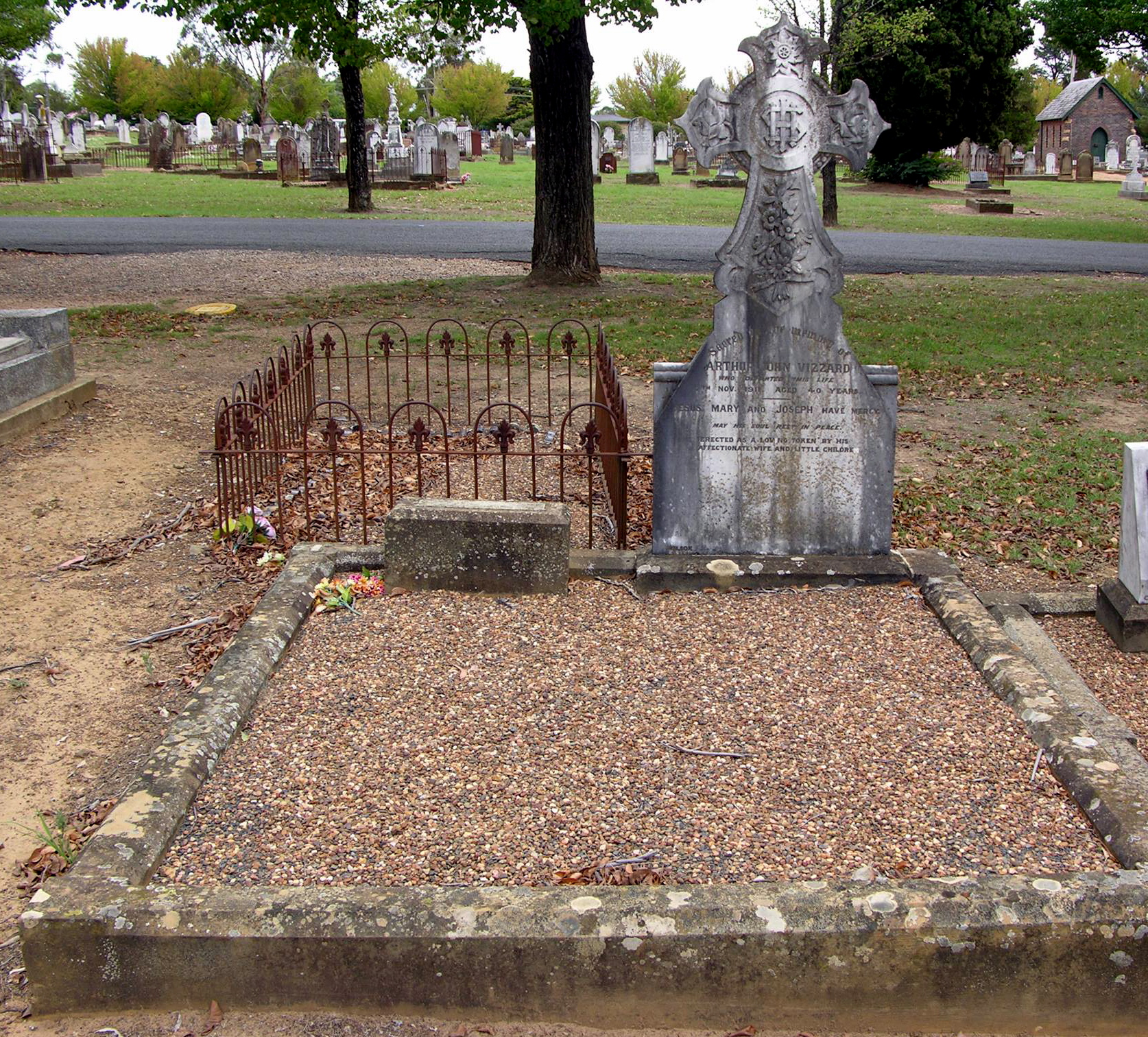
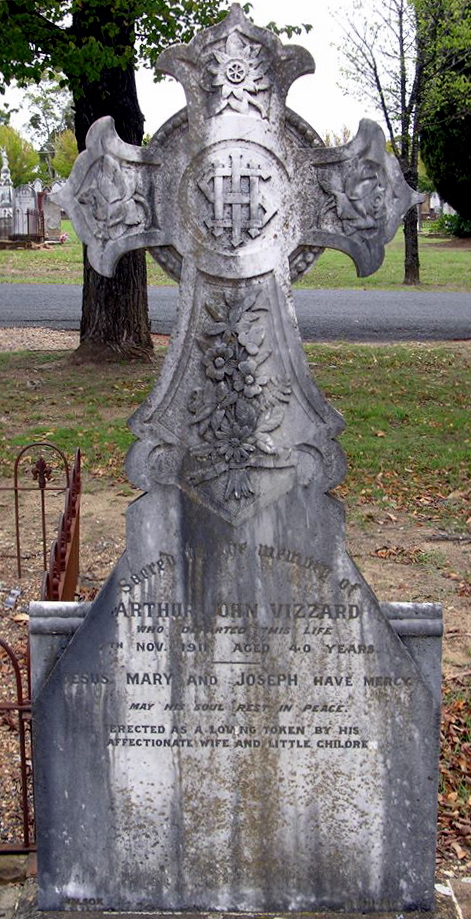
Arthur John VIZZARD Grave: Inscription: Sacred to the memory of ARTHUR JOHN VIZZARD WHO DEPARTED THIS LIFE 7TH NOV. 1911. AGED 40 YEARS JESUS, MARY AND JOSEPH HAVE MERCY MAY HIS SOUL REST IN PEACE. ERECTED AS A LOVING TOKEN BY HIS AFFECTIONATE WIFE AND LITTLE CHILDREN.
ARTHUR is NOT mentioned on the Police Wall of Remembrance * BUT SHOULD BE
As of November 2020 – VIZZARD is still NOT recognised as having died as a result of Work Related Injuries.
GRAVE LOCATION:
Shortly after 10.30am on 7 November, 1911 the constable was at the Armidale Police Station, where he was the Lockup Keeper.
He walked into the yard of the station where it appears he inflicted a fatal wound to his head with his service revolver.
He died three hours later.
He had been on sick report for about two months, suffering from rheumatism, insomnia and depression.
The Clarence and Richmond Examiner of 14 November, 1911 reported that:
” A mild sensation was caused in Armidale when it was known that Senior Constable Vizzard, who was in charge of the lockup, had been found in the lockup yard with a bullet wound in the head.
The unfortunate officer had been suffering greatly lately from muscular rheumatism and insomnia and had been on sick leave for the past few weeks.
During the last few days he appeared very despondent, but nobody suspected he would commit such a rash act.
He was removed into the house in a dying condition.
Senior Constable Vizzard, who came to Armidale from Inverell, was only recently promoted.
He has a wife and three young children. “
The senior constable was born at Corowa in 1871 and joined the New South Wales Police Force on 11 July, 1893. At the time of his death he was stationed at Armidale.
The issue regarding ill health for Senior Constable Arthur Vizzard dates back from approximately 5 years earlier as a result from contracting Dengue Fever when he was required to travel to Queensland and back to execute an interstate warrant and convey back a prisoner. Both he and the prisoner contracted Dengue.
He had ongoing health issues in the following years because of it and as we all know from the inquest findings he finally took his life whilst on “sick leave‘.
I have been aware of full story for about 18 years now. There are three descendants currently working in the NSW Police Force and there was an article in the Police Weekly about the family last decade.
I appreciate what you have said regarding eligibility for inclusion, which I was made aware of prior to the commemoration of the 10th anniversary of the National Police Memorial being opened.
This year will be 2 years since I got the e-mail. Still nothing progressed. Tell me this? Why was I personally notified almost 18 months ago that the inclusion was going to happen, then everything goes silent? It is disappointing to say the least.
I know the effect it had on my Grandmother the stigma growing up, her Mother never coped afterwards and the family ended up having to be split up. It is what it is. 106yrs latter the status quo remains. All we can do is wait and watch this space.
Darling Downs Gazette (Qld. : 1881 – 1922),
Friday 5 May 1905, page 3
DENGUE FEVER AT INVERELL
IMPORTED BY A CONSTABLE INVERELL, Wednesday.
Queensland dengue fever has been introduced into Inverell under conditions which were not to be avoided.
A week or so ago Constable Vizzard was despatched to Charleville to escort a prisoner back to Inverell, and while in the sister State, he contracted dengue.
He returned with his charge on Friday last, and on Saturday took ill.
On Sunday the case was diagnosed as dengue fever, and the patient was at once isolated in a ward at the local hospital.
Another case has since been reported, the victim being Ben. Bridge, the prisoner who was escorted back by Constable Vizzard. Bridge has also been sent to the hospital.
Both victims have the malady in an acute form.
News of the disease being in Inverell has caused some alarm among residents.
A mild sensation was caused in Armidale yesterday morning, when the shocking intelligence was made known that Senior-Constable Vizzard had been found in the yard of the lockup in a serious condition.
As was well known, Constable Vizzard had been in indifferent health for the past couple of months. He was a sufferer from muscular rheumatism, which brought on that dreaded complaint insomnia, but not even his nearest relatives anticipated that his career would be terminated in such a tragic manner.
At about 10.30 yesterday morning he appeared to be much the same, and walked through the kitchen of his residence, where his wife and nurse were, out into the lockup yard. The women were shortly afterwards startled by hearing the sounds of a revolver shot, and, proceeding to the spot from whence the sound came, the nurse was horrified to see her charge lying on the ground with a gaping wound in the temple, and a revolver lying close beside the body.
Assistance was promptly summoned, and Dr. Mummery was also quickly on hand, when the unfortunate constable was conveyed into the house.
From the outset, the doctor held out no hope of recovery, his prediction proving all too true, as the end came a few minutes after two o’clock.
The late Constable Vizzard was a zealous, capable, and conscientious officer, in fact, as Senior-Sergeant Hogan remarked to the writer when speaking of his late lieutenant, he was over conscientious.
The deceased was born, at Corowa in October, 1871, and was thus 40 years of age at the time of his sudden death.
As a young man of 22 he joined the New South Wales Police Force, and after going through his term of probation at the barracks, was sent to do duty on the Richmond River, thence to Armidale, Tenterfield, Inverell, and finally on the 26th November, 1909, he was again transferred to Armidale as lookup-keeper.
He was ever active and energetic, and his zeal was not long in being rewarded, for he rose from a constable to a first-class constable, and then to senior-constable.
Although he always did his duty – and a policeman’s work is ofttimes unpleasant – he ” tempered justice with mercy,” thereby gaining for himself universal respect and admiration from all sections of the community.
As prosecutor in the police court, the late officer displayed undoubted ability and knowledge of the law, and was worthy of any attorney’s ” steel. ” Here, again, could be seen his generous disposition for he was always strictly fair and honourable in any cases he was in charge of.
He is survived by a sorrowing wife and three young children, to whom much sympathy has been extended in their hour of affliction.
The North Western Advocate & the Emu Bay Times ( Tas. ) Wed. 8 Nov. 1911 page 3 of 4
NEW SOUTH WALES.
POLICE CONSTABLE’S DEATH.
SUICIDE SUSPECTED.
SYDNEY. Tuesday, — Senior Constable Drizzard was found in the lockup yard at Armidale to-day in a dying condition with a bullet wound in his head. He suffered from insomnia and is supposed to have committed suicide.
SYDNEY, Tuesday. — Senior Constable Drizzard shot himself, while in the lock-up yard at Armidale. The unfortunate officer had been suffering from insomnia, and is in a dying condition .
An inquest concerning the death of Senior-Constable Vizzard, which occurred under tragic circumstances in the yard of the Armidale lockup on Tuesday morning last, was held by the Deputy-Coroner ( Mr. C. A. Jackes ) in the Courthouse on Wednesday. The following evidence was elicited:
Frederick Wm. Vizzard, brother of the deceased, said the deceased was born on 9th October, 1871, at Corowa. He was a married man, with three children. Witness had not seen his brother, previous to that day, for nine months.
Senior-Sergeant Hogan deposed to knowing the deceased for the past eight or nine years. At about 11 o’clock on Tuesday morning he received a call to go to the lockup, which place deceased was the keeper of. With Constable Eagleton, witness went to the charge-room, and there saw deceased lying on a stretcher. The mark of a bullet wound was noticeable on his left temple, and blood was oozing from the place. He was unconscious, but breathing strongly.
Witness next went to the cell yard-room, and there saw a large quantity of blood on the floor. The deceased’s hat was lying near the door, with his pipe. Close by was a police revolver, containing four loaded cartridges and one recently exploded shell. Witness afterwards went to a drawer in the charge room, which was always kept locked. The lock of the drawer had been forced open, evidently by a tomahawk as such implement was lying in the drawer in the place where deceased’s revolver had been put when not in use. Deceased had been off duty for two months, through illness. He complained of muscular rheumatism and attacks of insomnia. When first going on sick leave, he went to Dr. Nash’s private hospital, but returned, and for the remainder of the time was with his wife and family in their own home. Deceased gave no reason for the police to anticipate that he would take his own life. In conversation with witness on Sunday morning, deceased said, ” I would give everything I possess to be able to resume duty on Monday. ”
Witness told him not to resume until the doctor had given permission to do so. Deceased was an efficient officer, trustworthy, and very painstaking.
To the Superintendent : During his nine months in Armidale, witness was practically all the time in deceased’s confidence. Deceased had never at any time expressed dissatisfaction with his position or work in the police force.
Dr. N. Howard Mummery said that shortly after 11 o’clock on the fatal morning he, in answer to a summons, proceeded to the lockup. He found the deceased lying on a stretcher, and being attended to by a nurse. He appeared unconscious. There was a wound on the right temple, the skin around which was stained with gun-powder. There was another and larger wound on the left temple. It was obvious he could not live long. The wound in the head had been caused by a bullet, which had passed through deceased’s head, struck the brick wall of the yard, and rebounded into the middle of the yard, where witness picked it up.
Dr. J. A. J. Murray stated that on his arrival at the scene of the tragedy, deceased was being cared for by Dr. Mummery. Deceased had been ailing since last August. While still on duty, he complained of insomnia, indigestion, and occasional fits of depression. In September he also had an attack of asthma, which was followed by influenza, the after effects of which he never appeared to shake off. He seemed to be in an anxious and dispirited condition. Witness urged him to get a holiday immediately, because no treatment seemed to do him much good. Deceased took the holiday in Sydney, and, on his return, about three weeks ago, witness was again called in. Deceased was then in a worse condition than when he went away. Witness visited him at intervals up to Monday. Deceased had such a serious nervous breakdown that it was necessary for him to undergo a complete rest cure, and witness had made arrangements for him to enter a suitable hospital for the purpose. Deceased had told witness that some times he felt as if he didn’t care to live, but, from the way he said it, witness did not think he contemplated taking his own life – it was said more to express to witness how really depressed he was. The idea of taking his life would come on him suddenly, owing to the condition he was in.
Nurse Ethel Sheerman, residing in Victoria-street, Sydney, said she came to nurse the deceased, and arrived on Monday. She had been sent by Dr. Nash. At about 10.30 on the morning in question, deceased said he was going down the yard to cut some kindling wood. He then seemed in a normal condition. About five minutes afterwards, witness, who was in the kitchen with deceased’s wife, beard the report of a firearm. Witness and Mrs. Vizzard immediately rushed to the spot. Deceased was reclining on the spot. Deceased was reclining on his left side. There was a great quantity of blood flowing from the wound in the head. She picked a revolver up, which was lying near the body, and threw it on the step. Deceased never regained consciousness, and died about two o’clock. Witness had not the faintest suspicion that deceased contemplated such a rash act.
John Purkiss said that between 10.30 and 11 a.m. on Tuesday morning he heard a woman scream, and immediately ran across. He met Mrs. Vizzard, who said, ” My husband has shot himself in the charge-room. ” and then fainted. Telling another woman to attend to Mrs. Vizzard, witness went into the charge-room and then followed the nurse into the cell-yard, where deceased was lying. With the assistance of the nurse, witness carried the deceased into the charge-room.
The Coroner returned a verdict that the deceased, Arthur John Vizzard, met his death from a bullet wound self-inflicted, whilst- temporarily insane.
The remains of the late Senior Constable Vizzard,. whose tragic death was reported in our last issue, were interred in the Roman Catholic Cemetery on Wednesday afternoon. The funeral was largely attended by members of the M.U.I.O.F. and local police force marching in the cortege. The Rev. Dean Tobin officiated at the graveside, M. Hirschberg having charge of the arrangements.
In the Estate of ARTHUR JOHN VIZZARD, late of Armidale, in the State of New South Wales, Senior Constable of Police, deceased in testate, –
APPLICATION will be made after Fourteen Days from the publication hereof, that Administration of the Estate of the abovenamed deceased may be granted to MARY VIZZARD, the Widow of the said deceased. Creditors are requested to send their Accounts to, and all Notices may be served at, the Office of the undersigned.
H. WEAVES,
Proctor,
Faulkner street, Armidale.
By his Agents MESSRS. Weaver & Allworth,
Australasia Chambers, Martin Place, Sydney… . . i87
The Sydney Morning Herald dated 3 November, 1908 contained the following brief story of the death of the constable. He had been treated for depression shortly prior to his death.
SENIOR CONSTABLE’S SUICIDE – SHOOTS HIMSELF IN BATHROOM.
Casino, Monday.
Senior Constable O’Connor shot himself this morning in his bathroom at 8 o’clock. He fired three times, the last shot tearing the side of his face and head away. Lately O’Connor seemed quieter than usual, but there was nothing to suggest that he contemplated taking his own life. He leaves a wife and six children.
At the time of his death by suicide, the constable was aged 42 years and was stationed at Casino. He had previously served at Maclean, Broadwater and Lismore.