1

James MORRISON

James MORRISON

AKA ?
Late of Moama

New South Wales Police Force

Regd. #   ‘Q‘ 3661

For the purposes of this website ‘Q’ represents those Police joining between 1862 ( commencement of NSWPF ) – 23 February 1915 ( Commencement of NSWPF current numbering system )

Rank: Constable – appointed 15 March 1880

Final Rank = Senior Constable

Stations: ?, Deniliquin – Lockup Keeper ( ? ? ? – 1891 ), Moama ( 7 years ) – Death

Service: From ? ? 1880? to 19 January, 1898 = 18 years Service

Awards: No find on It’s An Honour

Born: ? ? 1857 – Victoria

Died on:  Wednesday 19 January 1898 about 11.30am

Age: 40

Cause: Illness – Depression – Suicide – Firearm

Event location: inside Moama Police Station, NSW

Event date:  Wednesday 19 January 1898 about 11.30am

Funeral date:  Thursday 20 January 1898

Funeral location: Moama Cemetery

Wake location: ?

Funeral Parlour: ?

Buried at: Unmarked & Unknown grave location within Moama Cemetery

Memorial located at: ?


[alert_red] JAMES is NOT mentioned on the Police Wall of Remembrance[/alert_red] * BUT SHOULD BE

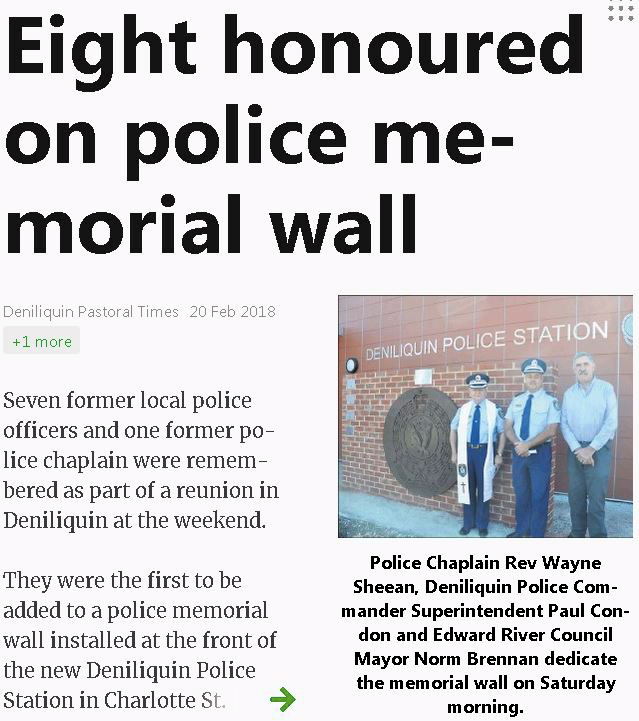
[alert_pink] JAMES IS mentioned on the Memorial Wall, Deniliquin Police Station – 2018[/alert_pink]

[divider_dotted]


FURTHER INFORMATION IS NEEDED ABOUT THIS PERSON, THEIR LIFE, THEIR CAREER AND THEIR DEATH.

PLEASE SEND PHOTOS AND INFORMATION TO Cal

[divider_dotted]

May they forever Rest In Peace

[divider_dotted]

Little is known of the death of Constable Morrison other than the following brief newspaper extracts. The Dubbo Liberal and Macquarie Advocate of 22 January, 1898 printed the following.


SUICIDE OF A CONSTABLE.

A wire from Deniliquin dated Wednesday says, “A telegram was received today announcing the suicide of Senior Constable Morrison, of Moama. The Small Debts Court was being held when the news was received by Mr. N. C. O’Neill, P.M., and he immediately adjourned the case on account of having to proceed to Moama to conduct an inquest. The news caused quite a sensation locally, as Morrison, who was previously lockup keeper at Deniliquin, was always regarded as a zealous officer. No cause is assigned for the deed.


The Camperdown Chronicle of 22 January, 1898 also reported on the death, as follows.


A CONSTABLE’S SUICIDE AT MOAMA.

At halfpast 11 on Wednesday morning a report reached Echuca that Senior Constable Morrison, in charge of the Moama police station, had shot himself. Dr. Eakins was quickly on the spot, but pronounced life to be extinct. Deceased was highly esteemed in the police department, having been 18 years in the force. He was 40 years of age, and had been stationed at Moama for seven years. He leaves a wife and family of eight children, the eldest being 14 years of age. Deceased was on duty in the morning and appeared to be in good spirits until informed of the terrible accident which had befallen Mr. Miller, manager of the Bank of New South Wales, when he seemed greatly depressed. He, however, spoke to his wife, appeared rational, and started doing his office work. Suddenly his wife heard the report of firearms, and rushing in found her husband lying on the floor, with his rifle beside him. The bullet had gone into the mouth and blown the top of the head off.


At the time of his death the constable was aged about 40 years and is thought to have joined the New South Wales Police Force about 1880. He was stationed at Moama.


So far, I have not found any information as to what the initial ‘J‘ stands for ( in relation to his Christian name ).

In NSW State Archives – Registers of Police, there is a James MORRISON – # ‘Q’ 3661 who was born in 1857 in Victoria and appointed to the Police on 15 March 1880.

It is very possible that this James MORRISON is the J. MORRISON in this Memorial Post but that, at this time, has not been confirmed.

BUT the below article from the NSW Government Gazette # 558, page 4964, dated Tues 21 July 1896, throws another angle to this story – naming MORRISON as having the Christian name of William – 2019


Further research finds an Erratum in the NSW Government Gazette, issue 616, page 5375, dated Fri 7 Aug 1896

New South Wales Government Gazette (Sydney, NSW : 1832 – 1900), Friday 7 August 1896 (No.616), page 5375

ERRATUM.

WITH reference to notification in Government Gazette of 21st ultimo, appointing Senior-constable William Morrison to act as Clerk of Petty Sessions at Moama, — for Senior-constable “William” Morrison read Senior-constable ” James ” Morrison.

Department of Justice,

Sydney, 4th August, 1896. T1189]


https://trove.nla.gov.au/newspaper/article/222504923


Newcastle Morning Herald and Miners’ Advocate (NSW : 1876 – 1954), Friday 21 January 1898, page 5

TERRIBLE DISASTERS. DENILIQUIN , Thursday.

A serious accident happened yesterday to Mr. Peter Millar, manager of the Bank of New South Wales at Moama.

He rode a spirited horse across the Murray Bridge from Moama to Echuca Railway Station, where he saw a friend off by the train. He was about to return to Moama, when his horse became exceedingly fractious, and bolted.

The animal careered madly for some distance, till near the railway crossing, when the saddle shifted to the animal’s withers, and the horse plunged and reared, and threw Mr. Millar on to the road, his head striking the metal, causing concussion of the brain, internal hemorrhage, and paralysis of the left side.

No hopes are held out for his recovery.

Additional particulars are to hand with reference to the suicide of Senior Constable Morrison, of Moama.

Yesterday, on the arrival of the train from Deniliquin, he as usual went to the post office for the morning mail and seemed in the best of spirits. He was informed of the accident to Mr. Millar, with whom he was a close friend, and he immediately became depressed and walked into the police station.

He then took down a Martini-Henry carbine hanging on the wall, and putting the barrel into his month, blew his brains out.

His wife heard the report, and went into the room, where she found her husband dying on the floor, blood and brains being scattered all around.

Morrison had been at Moama for seven years, and altogether eighteen years in the police force.

Deceased was 40 years old, and leaves a wife and eight young children.


https://trove.nla.gov.au/newspaper/article/137052154


Riverine Herald (Echuca, Vic. : Moama, NSW : 1869 – 1954; 1998 – 2000), Friday 21 January 1898, page 2

The Death of Senior-Constable

Morrison.

AN OPEN VERDICT RETURNED.

Yesterday morning the inquiry, commenced the previous afternoon at the Police Court building, Moama, before Mr N. o. O’Neill, coroner, was resumed.

On the previous afternoon Dr. Eakins‘ testimony was given.

Yesterday the following evidence was called:

Janet Morrison, widow of the deceased, gave evidence to the effect that she last saw her husband alive on Wednesday morning, about 11 o’clock. He was then in the office at the police station. He arose that morning at about half-past seven o’clock, but had no breakfast – only a cup of tea. About a quarter past 10 he went out, when he seemed very low spirited. A few minutes before 11 he returned to the office. Witness did not then notice anything peculiar about her husband, except that he was very low spirited. She did not speak to him about it. He seemed to be in trouble, but had made no complaint to her about it.

She left the office to make him a cup of cocoa, leaving him alone. She then heard the report of a firearm and, rushing back, found that her husband had shot himself.

She ran outside in search of help and saw a man named Barber, who accompanied her back to the office. The doctor was then sent for. There was no domestic unhappiness of any sort. Deceased was a good husband and father. Deceased, who was 40 years of age, left eight children, but was not possessed of any means,

George Thomas Barber, a farmer, residing near Moama, stated be had been acquainted with the late Senior-Constable Morrison.

On Wednesday he was driving past the police station at about 11 o’clock, when he saw Mrs Morrison run out. She called out to him, and he sprang over the fence and went in. He found deceased lying on the floor, with the rifle lying alongside of his body. The bullet had passed through his mouth, cutting his lip, and had gone out of the top of his head. Deceased’s hat was lying on the floor with the crown blown out, and the pugaree lying alongside. Witness ran across and told his mother, who lived nearly opposite, and got her to go down to aid Mrs Morrison. He then sent Henry Howard for the doctor. As there was no constable at the station he drove over to the look-up and acquainted Constable Flood. He had seen deceased several times lately, but he had not seen him under the influence of drink.

William James Martin, Justice of the Peace, stated he had seen the dead body of the late Senior-Constable Morrison.

He last saw him alive at about 25 minutes to 11 o’clock on Wednesday morning in Meninya street, opposite Chanter, Martin and Co.’s office. Just as he arrived witness and Mr Charles Opitz spoke to him about an accident which had occurred to Mr Miller. The deceased seemed to be rather cut up about the accident. They then dispersed, but, later on, witness and Mr Opitz again met, when it was remarked that deceased was not looking the same that morning as usual. When he last saw deceased he was going in the direction of the police station.

It seemed to him (witness) that deceased had a worried look. He was not so bright in conversation, and seemed dull. He had known deceased for nearly seven years. Of late – during the past 12 months – he had not been so steady in his habits as previously. It was even more noticeable during the past three months. To his (witness’) knowledge deceased had been drinking more than he should have during the past week. Other wise he bore a very good reputation. He knew of no domestic troubles and, speaking from outside judgement, he never saw a father who seemed to look after his family better. He did not know anything about his financial position.

Constable Schweicher, stationed at Moama, said he last saw deceased alive near the Federal store, opposite the Bridge Hotel, shortly before eleven o’clock. Witness spoke to him when he appeared to be despondent on account of Mr Miller‘s accident.

When he left witness deceased went towards the police station. During the past few days witness noticed that deceased was worrying or fretting over something. He was not quite positive on this point, but he imagined that there was something peculiar about him. Usually he was of a distant and reserved disposition. After parting company with deceased witness proceeded on his way collecting returns. Half an hour afterwards he received a message to go to the barracks and he immediately went then. On arrival he saw the body lying on the floor of the office. Deceased was lying fully dressed, with his head against the wall and with fresh blood on his hands and face. Dr Eakins was then present.

The regulation rifle ( produced ) was lying on his right side. It had stains of blood on it. The empty cartridge ( produced ) had been taken out of the rifle by Dr Eakins and it was lying alongside the weapon. The hat ( produced ) with the top blown out, was also found on the floor. The bullet had, apparently, gone through the ceiling of the office.

He had known deceased for the last three years, but had only known him intimately for the last eight months — since he had been stationed at Moama. He searched the body and the office, but found nothing leading to the belief that suicide was contemplated.

This concluded the evidence and the coroner found that deceased met his death by injuries to the brain and skull inflicted by a bullet.

Yesterday afternoon the remains of the deceased were interred in the Moama cemetery, when a large number of citizens of Echuca and Moama paid a last tribute to one who had been held in such great respect in life. The Rev. J. C. Johnstone, M.A., conducted the funeral ceremony, and, in speaking of deceased at the grave, referred to his good qualities in life. The utmost sympathy was felt towards the bereaved widow and family.

One of the most painful features of the sad case is that the widow and family have been left without adequate means of support. The Mayor of Moama ( Ald W. J. Martin ), who was an intimate friend of the deceased, on finding out the condition of affairs, at once took steps to help the bereaved family in their misfortune and has inaugurated a subscription fund. It is his intention to appeal to the country friends of the deceased as well as to those who reside in Echuca and Moama. The following donations have already been made :- Chanter, Martin and Co., £2 2s; Dr. Eakins, £2 2s ; C. L. Blair, £1 1s; W. Milledge, £1 1s; D. McLaren, senr., 10s 6d ; P. Mackey, 10s 6d. The Mayor of Moama will be pleased to take charge of further subscriptions..


https://trove.nla.gov.au/newspaper/article/114959946


2/1/2019, Deniliquin Times.

Eight honoured on police memorial wall’ –

Seven former local police officers and a former police chaplain were honoured during a police reunion in Deniliquin.
They were the first to be added to the police memorial wall at the new Deniliquin police station.
Honoured were
Constable Charles Chapman (died 5/3/1866),
Senior Const James Morrison (19/1/1898),
Senior Const Thomas Smith (19/4/1910),
Superintendent Henry Grugeon (10/1/1911),
Sergeant George Thomas Whiteley (25/3/1931),
Detective Senior Const Risto Vic Baltoski (2/1/1989) and
Senior Const Jennifer Louise Edgerton (August 2015) and

Rev David Bond.


HARRY GRUGEON


New South Wales Government Gazette (Sydney, NSW : 1832 – 1900), Tuesday 21 July 1896 (No.558), page 4964

[633] Department of Justice,

Sydney, 20th July, 1896.

HIS Excellency the Governor, with the advice of the

Executive Council, has been pleased to appoint the undermentioned Officers of the Police Force to act as Clerks of Petty Sessions at the places specified in connection with their respective names, namely:—

Sergeant Charles Earskin Parker, Camden;

Senior-constable William Morrison, Moama;

Sergeant James McIntosh, Murrumburrah

Senior-constable Thomas Johnson, Nundle;

Sergeant Alfred Percy Young, Nymagee

Senior-constable John McNeely, Richmond;

Senior-constable Henry Edgar Ferris, Trunkey,—

to take effect from the 16th instant.

Senior-sergeant Alfred Amos Sykes, Berrima;

Sergeant William Tennent Moss, Crookwell j

Senior constable William Payne, Swamp Oak,

— to take effect from the date of commencing duty.

ALBERT J. GOULD.

https://trove.nla.gov.au/newspaper/article/222503675

Riverine Herald (Echuca, Vic. : Moama, NSW : 1869 – 1954; 1998 – 2000), Friday 19 June 1896, page 2


A TRAVELLER SEVERELY INJURED.

About four o’clock yesterday morning Senior-Constable Morrison, of Moama, brought to the hospital a man named John Turner, who was suffering from severe burns.

Dr. Smith was quickly in attendance and he found that the patient had been burned along the right arm, the hip, and side, whilst his face was also badly seared. He stated that he went to sleep by a fire at his camp, close to the Murray bridge, and during the night a log from the fire rolled on him. His cries attracted attention, and Senior-Constable Morrison was informed. He found Turner in great pain and with the least possible delay had him placed under medical care. The wounds, though not dangerous, are of a most painful character, and will be some time before the man can leave the hospital.

https://trove.nla.gov.au/newspaper/article/114992170

Age (Melbourne, Vic. : 1854 – 1954), Friday 19 April 1895, page 6

CHARGE OF HORSE STEALING.

ECHUCA, Thursday.

A man named McKenzie, alleged to be an old offender, was arrested by Senior Constable Morrison, of Moama, yesterday, on a charge of horse stealing. McKenzie called at the police station and offered to sell the constable a fine looking draught horse for 30s. The price asked was so low that Morrison became suspicious, and having read an account of a similar animal having been stolen from a Mr. Patrick O’Loughlin, of Myers Flat, near Bendigo, he detained the vendor.

Sending a telegram to Eagle-hawk, he soon after received a reply giving a description of the horse stolen. As this tallied with the appearance of the horse in the yard, he arrested McKenzie, and soon found that he was an old offender, well known to the police, having served several sentences for similar offences.

His last appearance was before the Echuca court.

McKenzie was brought before the Moama court this morning and remanded to Eaglehawk.

https://trove.nla.gov.au/newspaper/article/193463565

Riverine Herald (Echuca, Vic. : Moama, NSW : 1869 – 1954; 1998 – 2000), Saturday 25 April 1891, page 2

MOAMA.

Constable Thomas Foss, ( ‘Q’ 5448 ) who has been stationed at Moama for a long time, has received promotion, and it is expected that he will leave Moama on Thursday next. Constable Foss will take charge of a station at Hatfield, near Balranald. During his stay in Moama he has gained many friends.

A little boy, a son of Senior-constable Morrison, of Moama, met with a serious accident on Thursday. Whilst playing in the yard the little fellow fell, striking his forehead against a piece of wood. No particular notice was taken of the accident at the time. Towards Friday morning, however, the condition of the child became worse, necessitating medical assistance.
https://trove.nla.gov.au/newspaper/article/114686753


John HOWARD

John HOWARD

New South Wales Police Force

Constable

Regd. # ‘Q’  6372

For the purposes of this website ‘Q‘ represents those Police joining between 1862 ( commencement of NSWPF ) – 23 February 1915 ( Commencement of NSWPF current numbering system )

 Stations:  Goulburn, Araluen, Braidwood Lock Up Keeper – Death

Awards: No find on It’s An Honour

ServiceFrom  13 April 1892  to  15 November 1895 = 3+ years Service

Born? ? 1870 – Wallsend

Died:  Friday  15 November 1895

Age24

Cause:  Suicide – Firearm – Service issue – right temple

Event dateFriday  15 November 1895

Event location:  Braidwood Lockup Keepers residence

Inquest date:  Saturday  16 November 1895 during the afternoon

Funeral date:  Sunday  17 November 1895

Funeral location:  Graveside service by Rev. J.S. Dobson

Buried atBraidwood General Cemetery, Uabba Rd, Braidwood, NSW 

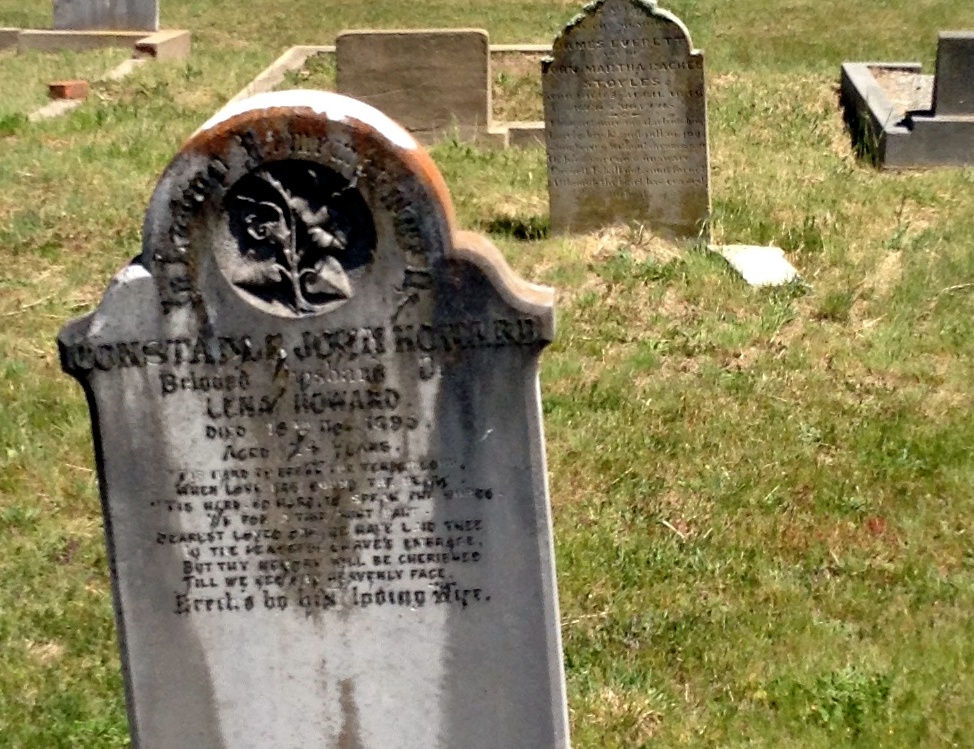
There are 2 entries in the Braidwood General Cemetery index both with the same date of death. 1st is Constable John Howard, age 24, C of E, Headstone. 2nd is John Howard, age 24, C of E, Unmarked.

INSCRIPTION:<br /> In ?<br /> Constable John HOWARD<br /> Beloved husband of<br /> Lena HOWARD<br /> Died 16? th Nov 1895<br /> Aged 24 years<br /> Line: ?<br /> Line: When love<br /> Line: Tis<br /> Line: ?<br /> Line: Dearest ? ? ? ? laid there<br /> Line: By the ? ? ?<br /> Line: But thy ? will be ?<br /> Line: Till we ?<br /> Line: Erected by his loving wife<br />
INSCRIPTION:
In ?
Constable John HOWARD
Beloved husband of
Lena HOWARD
Died 15 th Nov 1895
Aged 24 years
Line: ?
Line: When love
Line: Tis
Line: ?
Line: Dearest ? ? ? ? laid there
Line: By the ? ? ?
Line: But thy ? will be ?
Line: Till we ?
Line: Erected by his loving wife


 [alert_red]John is NOT mentioned on the Police Wall of Remembrance[/alert_red]


Grave location


The following article appeared in the South Australian Register of 16 November, 1895.

SUICIDE OF A CONSTABLE – Sydney, November 15.

Constable John Howard shot himself at Braidwood in unusual circumstances today. He was the plaintiff in a slander case against A. Graham and claimed £200 damages. Damages amounting to a farthing were awarded, and Judge Fitzhardinge remarked that according to the evidence the plaintiff had no character to lose. Howard at once returned to the barracks and shot himself.


At the time of his death the constable was stationed at Braidwood.

[divider_dotted]


Queanbeyan Observer (NSW : 1894 – 1908; 1910 – 1915), Tuesday 19 November 1895, page 4


SUICIDE OF A CONSTABLE AT BRAIDWOOD.

A shocking tragedy occurred at Braidwood on Friday, when Constable John Howard shot himself through the right temple with a police service revolver.

Howard was the plaintiff in a slander action against A. Graham, which was heard at the District Court on the same morning ; £200 damages were claimed.

A large amount of evidence was taken, and the Judge gave a verdict for the plaintiff, with one farthing damages without costs.

His Honor explained that, although there was no truth in the particular slander complained of, he must find for plaintiff. Yet the evidence of another witness, who admitted certain matters in connection with Howard, was such that he could not give damages.

After the case Howard walked out of the court, and went to the police barracks. There he met the black tracker in charge of the constables’ room, and told him to tell his wife the result of the case.

Howard apparently shot himself immediately afterwards.

On the black tracker‘s return with the message from Mrs. Howard to her husband to come to her, he found the constable lying on the floor with the revolver beside him. Death was instantaneous.

Howard had charge of the lockup, which is about seventy-five yards from the scene of the tragedy.

The affair has created quite a sensation.

Howard leaves a widow and two young children.

https://trove.nla.gov.au/newspaper/article/240001276

[divider_dotted]


Kiama Independent, and Shoalhaven Advertiser (NSW : 1863 – 1947), Tuesday 19 November 1895, page 4


A CONSTABLE SHOOTS HIMSELF.

A painful sensation was caused at Braidwood on Saturday by the suicide of Constable John Howard under peculiar circumstances.

At the District Court, before Judge Fitzhardinge, Howard had sued a local resident for alleged slander, claiming £200 damages.

During the hearing of the evidence some disclosures were made against Howard‘s character, and his Honor commented adversely on his conduct.

A verdict for plaintiff for one farthing damages without costs, being returned.

Howard immediately left the courthouse, walked to the barracks, a short distance away and apparently took a loaded six chambered revolver from the armoury, and fired it into his temple, blowing out his brains, and dying instantly.

The deceased had sent the black tracker, who saw him last, on a message.

The tracker returned in a few minutes, and found Howard lying on the floor dead, with the revolver beside him.

At the inquest a verdict of suicide was returned.

https://trove.nla.gov.au/newspaper/article/100863392

[divider_dotted]


Horsham Times (Vic. : 1882 – 1954), Tuesday 19 November 1895, page 4


SINGULAR SUICIDES.

Constable John HOWARD shot himself at Braidwood, N.S.W. under unusual circumstances on Friday.

He was plaintiff in an action for slander against A. Graham, and claimed £200 damages. Damages amounting to a farthing were awarded.

Judge Fitzhardinge remarking that according to the evidence the plaintiff had no character to lose.

Howard at once left the court, sent a message to his wife announcing the result of the case and shot himself.

At the inquest the following letter, written by the deceased just before he died, was read :

“To My Darling Wife, Children, Mother, and all at Home. – I cannot face the world after what has come out today. Forgive me for what I am about to do. Good-bye to all. J.H.”

A very high character was given to the deceased by his superior officer, and no complaints have ( says the Argus ) ever been made against him here.

https://trove.nla.gov.au/newspaper/article/75263157

[divider_dotted]


Goulburn Evening Penny Post (NSW : 1881 – 1940), Saturday 16 November 1895, page 2


Suicide of a Constable at Braidwood.

BRAIDWOOD, Friday. – A shocking tragedy occurred here to-day, when Constable John Howard shot himself through the right temple with a police service revolver.

Howard was the plaintiff in a slander action against Albert Graham ( a local resident ), which was heard at the District Court this morning; £200 damages were claimed.

A large amount of evidence was heard.

His Honor explained that, although there was no truth taken, and the Judge gave a verdict for the plaintiff, with one farthing damages without costs, in the particular slander complained of, he must find for plaintiff. Yet the evidence of another witness, who admitted certain matters in connection with Howard, was such that he could not give damages.

After the case Howard walked out of the court, and went to the police barracks. There he met the black tracker in charge of the constable’s room, and told him to go and tell his wife the result of the case.

Howard apparently shot himself immediately afterwards. On the black tracker‘s return with the message from Mrs. Howard to her husband to come to her, he found the constable lying on the floor with the revolver beside him. Death was instantaneous.

Howard had charge of the lookup, which is about seventy-five yards from the scene of the tragedy. The affair has created quite a sensation.

Howard leaves a widow and two young children.

[ Deceased was stationed in Goulburn about two years ago, and married a Miss McKenzie, who was employed at Bryant’s Hotel.] –

An inquest was held this evening by Mr. J. W. Bunn, the coroner, on the body of Constable Howard.

The jury returned a verdict that the deceased shot himself while temporarily insane.

In his pocket was found the following letter written previous to his committing the rash act :- ” To my darling wife and children, mother, and all at home. — i cannot face the world after what has come out to-day. Forgive me for what I am about to do. Good.bye to all. – J.H.

A very high character was given him by his superior officers, and no complaints were ever made against him during the four years he was in the police force.

It was mentioned in the evidence that deceased was of a very sensitive disposition.

He was a native of Newcastle, where his parents reside.

https://trove.nla.gov.au/newspaper/article/98554907

[divider_dotted]


Braidwood District Court – Slander

Tuesday  19 November 1895

https://trove.nla.gov.au/newspaper/article/98551607


[divider_dotted]


Evening News (Sydney, NSW : 1869 – 1931), Friday 22 November 1895, page 4


Constable John Howard, who shot himself at Braidwood on Friday, was a native of Wallsend, where his parents still reside.

Prior to joining the police, a little over three years ago, he assisted his father, who is a dealer, and was also a member of the 4th Regiment.

He had an unblemished record, and in a measure owed his appointment to the police force to the excellent recommendation given by ex-Sergeant Grennan ( Regd # Q 1350 ), the officer then in charge of the Wallsend station.

The officer under whom he served also gave him a very high character, stating that no complaints were ever made against him during the time he was in the force.

At the inquest which was held by Mr. J. W. Bunn, the coroner, the jury returned a verdict of suicide while temporarily insane.

The following pathetic note was found in the deceased’s pocket : ” To my darling wife and children, mother, and all at home. I cannot face the world after what has come out to-day. Forgive me for what I am about to do. Good-bye to all. J.H.

https://trove.nla.gov.au/newspaper/article/108085753

[divider_dotted]


Goulburn Evening Penny Post (NSW), Thu 21 Nov 1895,
Page 2

The Funeral of the late Constable Howard.

The funeral of Constable Howard took place on Sunday afternoon last. No better indication of the esteem in which the deceased was held in the town
and the deep sympathy which was felt for his widow and children in their terrible bereavement could be found than the large attendance which assembled to pay their last tribute of respect to his remains.

The gathering was representative of every interest in the community. Not alone in this direction did public feeling find expression, but numerous wreaths and crosses were forwarded by many people in the town whose pulse had been deeply moved by the distressing circumstances under which the deceased met his
death.

Mr. Howard, senr., who resides at Wallsend, in the Newcastle district, where he is in business, and a sister and two brothers of Mrs. Howard were the chief mourners.

They arrived in town on Saturday morning, and, as may readily be imagined, were deeply shocked at the distressing nature of the tragedy which had cast such a gloom over the town.

The coffin was borne to and from the hearse by two of Constable Howard’s late comrades, who by the way selected the site for the grave in the Church of England portion of the cemetery.

The Rev. J. S. Dobson conducted the service at the grave in a most impressive manner, and at its conclusion briefly addressed the large assemblage, referring to the exceptionally sad circumstances under which they had met together, and expressing his warmest sympathy with the heart-stricken widow and fatherless children in their sad bereavement.

The rev. gentleman dwelt warmly on the circumstances which led to Constable Howard’s death. He said he owed his death to the vile breath of slander, which had blasted more reputations and caused more misery and heartburnings than could ever be repaired.

He earnestly exhorted those present to keep their tongues from lying and slandering and their minds from evil thinking, in other words, he said, people should mind their own business.

If every one of them, he added, had every one of their little errors and sins they had committed placarded on their backs or proclaimed from the housetops, there were none who would not hang their heads in shame. The rev. gentleman went on to refer to the deceased as a capable and zealous officer, a man who always did his duty, however unpleasant it might be to his feelings, fearlessly and intelligently, and had earned for himself not only the respect of his superior officers, but the esteem of all respectable townsmen.

He had made a mistake-and all were liable to make mistakes-but he would say to them in the words of our Blessed Master when He was rebuked by the multitude for speaking words of comfort to the adultress, “Let him who is himself without sin cast the first stone.”

The stone at the grave was a most impressive and pitiful one.

The widow of the deceased utterly collapsed, and during the course of the church service and Mr. Dobson’s subsequent remarks, numbers of women wept freely, while tears bedimmed the eyes of not a few of the male portion of the large crowd, whose hearts were touched by the inexpressibly sad circumstances under which John Howard parted with this life.

The members of the deceased’s family must have derived a large amount of satisfaction-if indeed it is possible to experience such a feeling under circumstances of such a melancholy character-from the fact that they unquestionably had the heartfelt sympathy of the large crowd assembled round the grave.


-Braidwood Dispatch.


https://trove.nla.gov.au/newspaper/article/98546142

[divider_dotted]


Goulburn Herald (NSW : 1881 – 1907), Monday 18 November 1895, page 2


SUICIDE OF CONSTABLE HOWARD.

IN addition to the particulars given in our last, we gather the following details from the Braidwood Dispatch.

The action in the district court tried on Thursday before his Honor Judge Fitzhardinge was brought by deceased, John Howard, constable of police, stationed at Braidwood, to recover from Albert Graham the sum of £200 damages for slander.

Mr. Ross for plaintiff and Mr. Davidson for defendant, who pleaded not guilty and justification.

The slander consisted of statements alleged to have been made to the effect that the plaintiff had pulled a girl about and that he had had to square the matter with her father for £10. In her evidence the girl denied that this had occurred, and plaintiff also denied it.

Statements in relation to plaintiff’s conduct towards other girls came out in evidence, but formed no portion of the charge of slander.

One of these girls, aged sixteen, admitted that Howard had seduced her; this he denied.

The judge in giving his verdict said he was quite satisfied that the evidence of the witnesses in Araluen as to the statements Graham made concerning plaintiff and the girl Casey were substantially correct.

Nothing had been shown in the evidence that defendant’s statements were true, and consequently it could not have been in the public interest for Graham to retail this spicy gossip to a meeting of ladies in Araluen.

He consequently had to find a verdict for plaintiff.

With regard to the question of the damage which plaintiff’s character had sustained by the publication of this scandal, he regretted that he had no hesitation in coming to the conclusion from the evidence of the girl Carlon, which was to be believed and which had to be forced from her, that plaintiff had no reputation.

Though he would have to find a verdict for plaintiff he would allow only one farthing damage, without costs.

The following are the particulars of the tragedy itself :

The court was occupied till about half-past eleven o’clock bearing the suit. After the judge gave his decision Howard walked to his quarters at the lockup at the rear of the courthouse.

His wife, who had been suffering great mental anxiety over the case, was lying on her bed taking a rest. Howard sat down beside her. They commenced talking about the case, Howard informing her that the case had gone against him and that he was surprised at the result.

Howard, taking hold of her hand, kissed it, and getting up kissed her face. He then walked out, Mrs. Howard being under the impression that he had gone back to the courthouse. Instead of that he walked to the barracks, some sixty yards away. On Joe Alick, the blacktracker, following him into the room a minute or two subsequently, he found Howard sitting on the corner of the table in the room. Alick spoke to him about the case, and Howard asked him to go and see how his wife was getting on. Alick saw Mrs. Howard, who asked him to go back and tell her husband she wanted him. Alick on his return was horrified to find Howard lying on the floor, apparently dead, with a revolver beside him.

He rushed out and told Constable Clemensha ( most probably Constable Wordsworth CLEMESHA # ‘Q4655 ) of the occurrence.

Dr. Llewellyn, who happened to be passing was called in and found Howard was dead.

He had evidently taken one of the revolvers from the stand, and placed the muzzle against his right temple, pulled the trigger, and blown out his brains. The bullet entered the temple passed clean through his head and lodged in the wall at the back of him. Death must have been instantaneous.

The following note was found in his waistcoat-pocket:— To my darling wife, children, mother, and all at home, I cannot face the world after what has come out today. Forgive me for what I am about to do. Good-by to all. J.H.

The writing gives a fair indication of the great mental struggle which must have been agitating his brain, an it was not written in nearly so good a hand as he usually writes.

The news created a profound sensation throughout the community.

When the judge was giving his verdict, it could readily be seen that deceased felt his position, keenly-being a sensitive and impulsive man he naturally would-but when he walked out of the Court he did not present the appearance of a man who was going to meet his doom.

The only reasonable assumption is that he became temporarily insane after leaving his wife, and hastily decided to take the course he did.

Universal regret was expressed for Mrs. Howard and her two children, of whom all those who are in a position to know join in saying he was very fond.

The terrible agony Mrs. Howard suffered on hearing of the dreadful occurrence may be more readily imagined than described — also was almost demented, and could not be pacified till she had learned all there was to know.

Howard had been stationed at Braidwood for about fifteen months, coming from Araluen. He was a most painstaking officer, assiduous in the performance of his official duties, courteous and obliging to everyone.

Sub-inspector Langworthy ( possibly William – # Q 1291 ) says that a more zealous officer he had never had under him.

An inquest was held on Friday before the coroner, when a verdict of suicide while laboring under a temporary fit of insanity was returned.

https://trove.nla.gov.au/newspaper/article/101111190


[divider_dotted]


Goulburn Evening Penny Post (NSW : 1881 – 1940), Tuesday 12 May 1896, page 4


BRAIDWOOD.

At the Small Debts Court, on Wednesday, Mrs. Howard, widow of the late Constable Howard, was summoned by Malone Brothers for 30s, coach hire for four passengers to and from Araluen, for which defendant’s husband was alleged to be liable, and through him defendant as executrix of the estate.

A verdict was given for the amount, with 10s costs.

The amount of the claim was defrayed immediately afterwards by a subscription list.

https://trove.nla.gov.au/newspaper/article/98568405


[divider_dotted]


New South Wales Government Gazette (Sydney, NSW : 1832 – 1900), Tuesday 10 April 1894 (No.218), page 2355


THE Bench of Magistrates at Araluen have this day appointed Constable John Howard Bailiff of the Small Debts Court at that place, vice G. Taylor, deceased,— from 2nd instant.

WILLIAM CLARKE, P.M.,

Pro Bench of Magistrates.

Araluen, 2nd April, 1894. [2552]

https://trove.nla.gov.au/newspaper/article/222330860

[divider_dotted]


James RUSH

James RUSH

New South Wales Police Force

Regd. # 

Rank:  Sub Inspector

Stations: Forbes ( 1862 – 1866 ), Orange ( 1866 – 1875 ), Sydney ( No. 2 Division 1875 – 20 May 1880 )

London Police Force:  From 1852 to 1855

Service:  From 1855  to 20 May 1880

Awards

Born: 1830

Died on:  Thursday  20 May 1880

Location: Residence at No. 2 Division

Cause:  Arrest Injuries –  Erysipela an infection of the skin caused by bacteria

Age:  about 44

Funeral date:

Funeral location:

Buried at:

Sub Inspector James Rush


The circumstances of the death of Sub Inspector Rush are yet to be established conclusively. Rush Family tradition suggests that he died of the effects of making an arrest during a raid on a Chinese gambling house in Goulburn Street, Sydney. This is yet to be confirmed. His death was reported in local newspapers as being  ” sudden and unexpected “.


” The Sleeping City – The Story of Rookwood Necropolis ” indicates that James Rush was born in 1830, joined the London Police Force in 1852 and was one of a contingent of 100 police recruited from England in 1855, in which year he became a police officer in Sydney. After serving in Forbes (1862 to 1866) and Orange (1866 to 1875) he returned to Sydney and was promoted to sub-inspector. Five years later, he organised a police raid against a notorious gambling house. In carrying out the raid he was fatally injured and died on 20 May, 1880. He was given a full police funeral which was attended by the Inspector General of Police (Mr Edmund Fosberry). Contemporary newspaper accounts of the police raid and the death of the inspector fail to mention any connection between the two.

The cause of death appears to have been erysipelas – an infection of the skin caused by bacteria.

The Australian Town and Country Journal of Saturday 22 May, 1880 reported the following.

SUB-INSPECTOR RUSH.
One of the oldest members of the police force of New South Wales, Sub-inspector Rush, died on Thursday at his residence, adjoining No. 2 police station. For the past week Mr. Rush had been suffering from erysipelas, and on Wednesday afternoon became delirious and remained so until about 12 o’clock on Thursday, when he passed away. Mr. Rush came to this colony 25 years ago with other members of the police force under agreement to the Government of N.S.W. in the Ship “Exodus”. Shortly after his arrival he was appointed acting sub-Inspector, and retained that position until he was, under the now Act of 1862, sent to Orange. About five years ago he was again given duty in the metropolis at No. 2 station, which office he had held with credit and efficiency ever since. He leaves a wife and a large family, numbering, we believe, eight children, who will feel the loss of an affectionate parent. Mr. Rush was about 44 years of age [sic], and was attended in his last illness by Dr. Egan who had the assistance of Drs. Day and Halket, when the illness assumed a serious form.”

The inspector was born in England in 1830 and joined the Sydney Police Force in 1855. In 1862 he became a member of the newly-formed New South Wales Police Force. At the time of his death he was stationed in Sydney.

[divider_dotted]


One account of his injuries indicate that he suffered a head injury sustained while in the course of duty ( raid on an opium den )  http://boards.ancestry.com.au/localities.britisles.england.gls.general/2455.2622.2.2.2.2/mb.ashx

[divider_dotted]


John Vance BLAIN

John Vance BLAIN

New South Wales Police Force

Regd. #  2481

Rank:  1st Class Constable ( Foot Policeman – not mounted )

Description: 5′ 11.5″ tall, blue eyes, fair hair, fair complexion.  Single.  Previously a farmer.  He was Protestant.

Stations:  Darlinghurst

ServiceFrom  26 December 1874  to  20 June 1877 = 2+ years Service

Awards:  a valuable gold watch and chain for the gallant capture of a convicted burglar, named Wright

Born? ? 1850 in Ireland

Event date:  Thursday  22 March 1877

Died on:  Monday  11 June 1877 @ Wooloomooloo

Cause:  Assault with a Police Baton & other assaults

Age:  26

Funeral date:  Tuesday  12 June 1877 @ 2.15pm

Funeral location:  Graveside

Buried at:  Rookwood Cemetery

Memorial location:

A record of his brave conduct for arresting and bringing to justice a notorious burglar at whose hands he received such savage injuries as to ultimately cause his death

[alert_red]JOHN is NOT mentioned on the Police Wall of Remembrance[/alert_red]    * BUT SHOULD BE

Just after 4pm on Thursday 22 March, 1877 Constable Blain was on duty in Bourke Street, Wooloomooloo when he saw two men carrying a “bundle” in Forbes Street. He called on them to stop, however they ignored him and ran off, quickly pursued by the constable. One of the men then stopped and threw himself at Constable Blain, whose baton unfortunately had dropped to the ground during the chase. As he grappled with one offender, another took up the dropped baton and struck the constable several severe blows to the head, inflicting terrible wounds. Blain bravely held his ground however, and succeeded in handcuffing one of his assailants before staggering a short distance to the home of Dr Pattison. The doctor assisted the stricken Blain and also quickly sent a message to the police for assistance.


Constable Williamson (  possibly Williams )  soon attended and spoke to Constable Blain, who told him that he had arrested and handcuffed one of his attackers before walking to the doctor’s home. Williamson then attended the site of the incident where he indeed found one of the offenders (John Wright) lying handcuffed and bleeding in the street. The courageous Blain had in fact arrested one of his own murderers (a rare accomplishment), as his injuries were to prove fatal.

Prior to his death the Mercury newspaper of Friday 23 March, 1877 reported the story of Constable Blain’s encounter with the offender John Wright and his unknown accomplice.


The article indicated that “The constable who was so barbarously assailed is suffering greatly from the wounds he received. His extraordinary courage and resolution in securing the man in the manner he did is worthy of lasting record.” And thus it is.

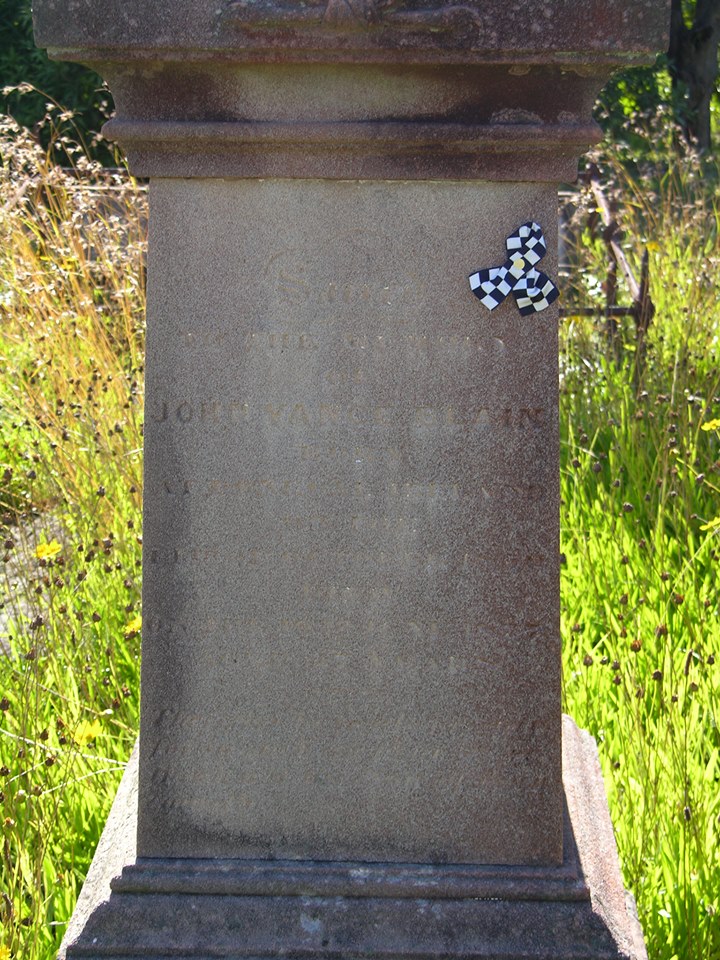
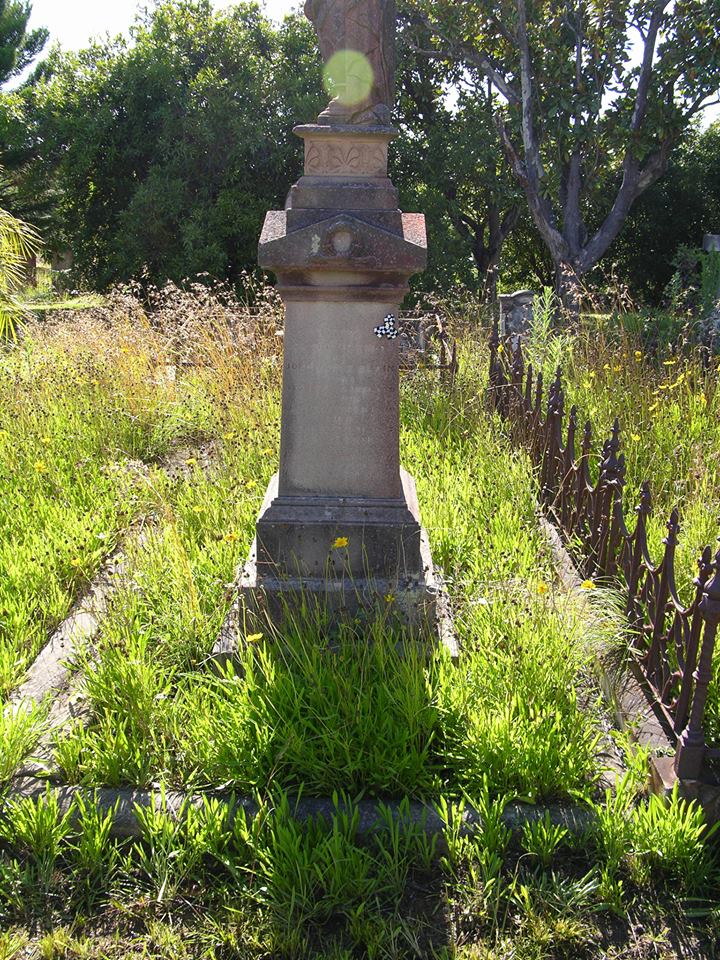
His headstone at Sydney’s Rookwood Cemetery reads: “A record of his brave conduct for arresting and bringing to justice a notorious burglar at whose hands he received such savage injuries as to ultimately cause his death”.


The constable was born in 1850, and at the time of his death he was stationed at Darlinghurst.

[divider_dotted]


The Sydney Morning Herald        Friday 16 March 1877

SERIOUS ENCOUNTER WITH A BURGLAR.
Some time on Thursday night the premises of Mr J C W Hinsch of 160 Pitt Street, were broken into, and a number of Crimean shirts and other goods valued at about £20, were stolen. Shortly after 4 o’clock yesterday morning, Constable Blain who was on duty in Bourke Street, Woolloomooloo, saw two men carrying a bundle in Forbes Street. He called upon them to stop but as they took no notice he gave chase, and gained upon them. One of the men threw himself down in front of the constable who fell upon him. In running after the men the constable’s truncheon dropped out of his pocket, and the second man took it up and struck the constable several heavy blows inflicting very severe wounds on the back of the head. The constable, though stunned by the blow, bravely grappled with the man, and after a most desperate struggle succeeded in over-powering and handcuffing his assailant. Becoming weak from loss of blood he had just sufficient strength to reach the residence of Dr. Pattison, when he fainted from exhaustion. Dr Pattison sent information to the police that a constable was at his house who had been nearly murdered in the street. Constable Williams, who soon arrived in obedience to the summons, found Blain lying on a sofa bleeding from wounds on his head, and scarcely able to speak. Eventually he learned from him that a man whom he had captured was handcuffed in the street, and on proceeding to the spot indicated, he found the man lying and bleeding from the head. He was conveyed first to the Infirmary, and afterwards to the Darlinghurst Police Station.

Later in the day Detectives Wilmott and Camphin found one blanket and 31 Crimean shirts in a sack on a piece of waste ground near Judge Street, Woolloomooloo… The constable who was so barbarously assailed is suffering greatly from the wounds he received. His extraordinary courage and resolution in securing the man in the manner he did is worthy of lasting record.”


Then on Saturday 16 June, 1877 the Australian Town and Country Journal reported the death of Constable Blain, including the following information.

“It will be remembered that, a short time ago, the Inspector-General of Police, on behalf of various citizens, presented constable Blain with a valuable gold watch and chain for the gallant capture of a convicted burglar, named Wright, who brutally assaulted that officer when being arrested for the burglary at the premises of Mr. J. O. W. Hinsch, in March last. Wright was sentenced to six years hard labour.

Blain, who was assaulted on the head with a policeman’s baton, recovered somewhat from the effects of the affray; but three weeks ago was again brutally assaulted by some roughs in Oxford-street.

About a fortnight ago he went into the Infirmary for medical treatment, and typhus fever setting in, he expired early on Monday morning. It is alleged that his death was caused by the effects of the beatings he received. It is said that a foul drain under the bedroom which Blain had occupied, in Stanley-street, was the cause of his taking ill. Blain had been about three years in the Force. He was unmarried. His grade was first class constable; and he was a young man of superior intelligence and some promise, and a most efficient officer.”

The constable was born in 1850, and joined the New South Wales Police Force on 26 December, 1874. At the time of his death he was stationed at Darlinghurst. His headstone at Sydney’s Rookwood Cemetery reads: “A record of his brave conduct for arresting and bringing to justice a notorious burglar at whose hands he received such savage injuries as to ultimately cause his death”. He is not listed in the official New South Wales Police Honour Roll.


[divider_dotted]

The Sydney Morning Herald         Tuesday   12 June 1877   page 1 of 10

DEATHS:

BLAIN. — June 10, at the Sydney Infirmary, John Vance Blain, aged 26.

http://trove.nla.gov.au/ndp/del/article/13387308#pstart1437955

[divider_dotted]


The Sydney Morning Herald         Tuesday   12 June 1877   page 10 of 10

THE FRIENDS of the deceased Mr. JOHN VANCE BLAIN, late of the Sydney Police, are respectfully invited to attend his Funeral ; to move from the Infirmary THIS DAY, Tuesday, at a quarter-past 2 o’clock, to the Necropolis.

JAMES CURTIS.

http://trove.nla.gov.au/ndp/del/article/13387287

[divider_dotted]


The Sydney Morning Herald         Wednesday  13 June 1877      page 8 of 12

MONUMENT over the Remains of the late Constable JOHN VANCE BLAIN – SUBSCRIPTIONS received in aid of the above at the Central Police Station.

J. WALTER SMART.

http://trove.nla.gov.au/ndp/del/article/13390255

[divider_dotted]


The Evening News ( Sydney )     Wednesday  13 June 1877   p 2

Constable Blain’s Funeral,

Yesterday afternoon, the remains of that efficient and lamented young police officer, constable Blain, were interred at Haslem Creek Cemetery. The funeral was attended by the Inspector General of Police ( Mr. Fosberry ), Inspector Read, Sub-Inspectors Waters, Anderson, and Johnson, and a large number of his fellow officers. The procession, as it moved through the city, attracted general attention, and considerable regret was expressed at the untimely end of a promising a young officer. The members of the force, as may be seen from an advertisement, intend erecting a monument over his grave.

http://trove.nla.gov.au/newspaper/article/108196448

[divider_dotted]


The Evening News ( Sydney )     Saturday  4 August 1877     p 4

Monument to Constable Blain.

It is satisfactory to learn that there has been a prompt and generous response to the proposal for a monument over the remains of that distinguished but unfortunate police officer, Constable Blain. It will be remembered that Blain had a desperate encounter with a burglar who had broken into Mr. Hinch’s establishment in Pitt-street, and that he received such severe injuries as accelerated, if they were not mainly

the cause of his death shortly afterwards in the Infirmary. The Inspector-General and his officers and the whole force accorded his remains every honor by following them to the grave ; but they thought something more ought to be done, A suitable monument over the grave was proposed, and the matter having been taken in hand by Mr. Smart, J.P., the necessary funds were subscribed in the course of a few days. We have been shown the design of the monument together with the inscriptions, and it deserves to be said that the selection has been dictated by good taste and judgment.


http://trove.nla.gov.au/newspaper/article/108200225

[divider_dotted]


Thomas CANTY

Thomas CANTY

New South Wales Police Force

Regd. #

Rank:  Constable

Stations?, ( Berrima Police Force & stationed at Nattai

ServiceFrom ? ? ?  to  25 June 1866 = around 5 years Service

Awards?

Born: ? ? ?, Glowenties, Shanagold in Limerick, Ireland

Event date: Monday  25 June 1866

Event location:  New Sheffield (Mittagong)

Died on:  Wednesday  27 June 1866

Cause:  Fall

Age: 49

Funeral date: Friday  29 June 1866

Funeral location:

Buried atBerrima cemetery, Olbury Rd, Berrima

Catholic Section, Row 6, Plot 14

Memorial location:

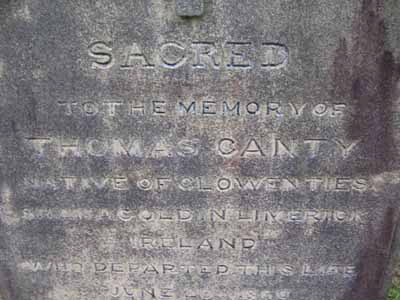
SACRED / TO THE MEMORY OF / THOMAS CANTY / NATIVE OF GLOWENTIES / SHANAGOLD IN LIMERICK / IRELAND / WHO DEPARTED THIS LIFE / JUNE 20TH 1866 / AGED 49 YEARS / REQUIESCAT IN PACE

[alert_red]THOMAS is NOT mentioned on the Police Wall of Remembrance[/alert_red]   * BUT SHOULD BE

Constable Canty died following a fall down a railway cutting at New Sheffield at night, as he made his way home to Berrima. He had earlier been to Bowral to warn a witness for court. He suffered severe spinal injuries in the fall and lay injured at the base of the cutting until morning. New Sheffield is now Mittagong.

The incident was reported in some detail by the Empire dated Saturday 30 June 1866.


FATAL ACCIDENT AT NEW SHEFFIELD.  ”An accident of a fatal character, resulting in the death of Constable Canty, of the Berrima police, occurred on Monday last. The deceased ( who was stationed at New Sheffield ) had been to Bowral to warn a witness to attend before the Berrima bench of magistrates on the following day to give his evidence in a case which was there to be brought before them and was on his return home when he fell down a cutting of the Great Southern Railway on the Mittagong side of the Gib tunnel.

The night was pitch dark and miserably wet, and it is supposed that the foot of the deceased must have slipped over some of the clay soil, which abounds in the neighbourhood. The cutting was about sixty feet deep, and the unfortunate man lay in a pool at the bottom for several hours, until some workmen were on the following morning attracted to the spot by the howling of the deceased’s dog. Having ascertained that somebody was lying below, the men took prompt measures to effect his release, and afterwards conveyed him to his home.

A messenger was immediately despatched to Berrima for medical aid, and no time was lost by Dr. Williamson in repairing to the scene of the sad and melancholy disaster.

Notwithstanding, however, that every effort was made which medical skill could suggest, the unfortunate man breathed his last at a late hour on Wednesday night. On Thursday a magisterial inquiry was held before G. H.Rowley, Esq., P.M., and a post mortem examination was made by Dr. Williamson, who found that the immediate cause of death was a spinal injury, which had doubtless been received by Canty in his fall.

The deceased had been in the police force of this colony up-wards of five years, and was always held in good repute as an efficient officer. A lasting testimony to the esteem in which he was held by residents in the district was afforded by the large and respectable assemblage which followed his remains to their resting place in Berrima cemetery on Friday last.  A wife and a large family are left to lament their loss.

http://trove.nla.gov.au/newspaper/article/60598138


At the time of his death the constable had apparently been a member of the police force for about five years and was stationed at Berrima.

[divider_dotted]


The Maitland Mercury & Hunter River General Advertiser     Tuesday  3 July 1866    p 4

Constable Canty, of the Berrima police, was recently out on duty, and in the darkness of the night fell down a cutting of the Great Southern Railway, sixty feet deep. The next morning some people were attracted to the spot by the howling of his dog and be was removed ; but on the following day he died from the spinal injury he had suffered.

http://trove.nla.gov.au/newspaper/article/18722657


[divider_dotted]


The Sydney Morning Herald      Wednesday  24 January 1866     p 7

ALLEGED MURDER AT NEW SHEFFIELD.

…………  Thomas Canty, being duly sworn, deposed:  I am a constable attached to the Berrima police force, and am stationed at Nattai  ‘ about 1 o’clock on Sunday morning last, John Forward knocked at my door ………..

http://trove.nla.gov.au/newspaper/article/13125295

[divider_dotted]


Frederick William POTTINGER

Frederick William POTTINGER, Bart

New South Wales Police Force

Regd. #  ?

Trooper, Inspector ( 1862 )

Stations:  ?, Lachlan Police District, Forbes

Born:  27 April 1831

Served:  From ? 1857 to 9 April 1865

Awards:  ?

Died:  9 April 1865

Cause:  Accidentally Shot

Age?

Funeral: ?

Buried at: St Judes, Randwick

Further linkshttps://police.freom.com/chief-inspector-of-distilleries-officer-1862/

https://police.freom.com/appointments-under-the-new-police-regulation-act-of-1862/

http://www.benhallbushranger.com/p/police.html

Inspector Frederick William POTTINGER


Sir Frederick Pottinger was the officer-in-charge of the Lachlan Police District when he came under official scrutiny for riding in a public horse race on 5 January, 1865 and was suspended from duty. He was subsequently dismissed despite the submission of many letters and petitions from the public. On 5 March, 1865 he set out for Sydney to apply for reinstatement, and en route, the coach stopped at Wascoe’s Inn in the Blue Mountains (now the town of Blaxland). Pottinger left the coach for a short time to get some fruit, and as he reboarded to resume the journey a pocket pistol he was carrying in his waistcoat accidentally discharged. The shot entered his body just below the rib cage. Following treatment he appeared to be progressing well and was eventually conveyed to Sydney to recuperate. His condition, however, took a turn for the worse and he died on 9 April.


He had gained a reputation as a most fearless and tireless police officer at a time when the bushranging plague was at its peak. Pottinger was the original subject of the derogatory term “Blind Freddy” – which he certainly did not earn or deserve. Some sources also allege that he had committed suicide that day, but this is highly unlikely considering all the circumstances. Another version of the incident is that he was “showing off” with his pistol to some ladies on the coach when the pistol discharged, which appears to be a far more likely event.


It was originally believed that the wound suffered by Sir Frederick would not be fatal however the Clarence and Richmond Examiner and New England Advertiser of 11 April, 1865 announced the following.


DEATH OF SIR FREDERICK POTTINGER.

Sir Frederick Pottinger, who it will be remembered by our readers, received a gun-shot wound, from the accidental discharge of a small pistol, which he carried in his waistcoat pocket whilst on his way from the Lachlan to Sydney some few weeks back, the ball from which lodged in his body, and could not be extracted, has terminated fatally, Sir Frederick having expired on Sunday last.


Sir Frederick joined the police force about 1857 as a trooper. In 1862 he became an inspector in the newly-formed New South Wales Police Force. Prior to his dismissal he was stationed at Forbes. He was not a serving member when he died.

Grave of Frederick William POTTINGER. The broken column indicates a life cut short. Engraved:   SACRED To the memory of SIR FREDERICK WILLIAM POTTINGER -Baronet, Formerly of the Grenadier Guards, and for many years a zealous and active Officer of Police in New South Wales. Born 27th April, 1831-Died 9th April,1865.  This monument is erected by his friends in the Colony.
Grave of Frederick William POTTINGER.
The broken column indicates a life cut short.
Engraved: SACRED
To the memory of
SIR FREDERICK WILLIAM POTTINGER
Baronet,
Formerly of the Grenadier Guards,
and for many years a zealous and active
Officer of Police in New South Wales.
Born 27th April, 1831-Died 9th April,1865.
This monument is erected by his friends
in the Colony.


John Aitcheson McLERIE

John Aitcheson McLERIE

New South Wales Police Force

Regd. # ?

Superintendent

Stations:  Maitland, ?

Service:  From ? to 25 November 1864

Awards?

Born?

Died on:  25 November 1864 at Albury

Cause:  Exposure  “rheumatism caused by the effects of exposure

Age:  26

Funeral Date?

Funeral Location?

Buried at?

 [alert_yellow]JOHN is NOT mentioned on the Police Wall of Remembrance[/alert_yellow] * NEED MORE INFO

Further linkshttps://police.freom.com/chief-inspector-of-distilleries-officer-1862/

https://police.freom.com/appointments-under-the-new-police-regulation-act-of-1862/


Eldest son of the Inspector General of the New South Wales Police Force, Captain John McLerie, the superintendent died at Albury as a result of too many cold, wet nights spent in the bush carrying out his police duties.

The Sydney Morning Herald of 28 November, 1864 listed the death notice, with the cause of death given as “rheumatism caused by the effects of exposure“.


At the time of his death the superintendent was aged about 26 years, and was the Superintendent in Charge of the Murray District (Albury).

[divider_dotted]


John Aitcheson McLerie may have been associated with Sub-Inspector John MORROW.


[divider]


Edward HAMPSON

Edward HAMPSON

New South Wales Police Force

Rank:  Constable

Regd. #:  ? * A search of the ‘on-line’ State Archives does NOT reveal a HAMPSON, or similar, as being a member of the Police

Stations:  East Kempsey ( Lock up Keeper )

ServiceFrom ? ? ? to pre March 1862 = ? years Service

Awards:  No find.

Born:  Sunday 15 May 1825, Lancashire, England

Emigrated:  from USA to Australia between July 1853 and before Nov 1854

Died:  Wednesday 24 December 1862

Cause:  Horse Accident – against a tree

Event location:  East Kempsey – near the Yarrabandinni gates

Age37 – 39?

Funeral date:

Funeral location?

Buried at:  Frederickton Cemetery, Great North Rd, Frederickton, NSW:

Anglican section  row G # 67

GPS:  31 02′ 02S / 152 52′ 38E

Grave location

[alert_red]Edward IS NOT mentioned on the Police Wall of Remembrance[/alert_ed]

Constable Edward HAMPSON - grave
Constable Edward HAMPSON – grave

Constable Edward HAMPSON - grave
Constable Edward HAMPSON – grave

The constable is believed to have suffered fatal injuries when he was either thrown or fell from his troop horse at East Kempsey.

Some 62 years later the Macleay Chronicle of 7 May, 1924 in a related story recounted that the constable had been “killed while riding near the Yarrabandinni gates on Christmas Eve, 1862”. In a contemporary account however, the Empire newspaper of the 5 January, 1863 reported the following.

ACCIDENT
On the 24th instant, a settler named Edward Hampson came by his death through a fall from a young horse he was riding. It appeared from the evidence given before the coroner that the deceased was thrown with so much violence against the spur of a tree as to cause instantaneous death.”

Few details are known at present, however the Macleay Chronicle of 7 May, 1924 reported that the constable had been ” killed while riding near the Yarrabandinni gates on Christmas Eve, 1862 “.


At the time of his death the constable is thought to have been the lockup-keeper at the East Kempsey Police Station, where he had been stationed since at least early 1856 (he is mentioned in the New South Wales Police Gazette of 16 February, 1856).

In 1862 he became a member of the newly-formed New South Wales Police Force.

He is not listed in the official New South Wales Police Honour Roll.

Beyond Courage

[divider_dotted]


MacLeay River Historical Society     November 2012      page 2

An enquiry was received from Kempsey Police re Edward Hampson who was killed Christmas Creek, near Yarrabandinni Gates on Christmas Eve 1862 when his young horse threw him against a tree.

It was believed Edward was a police constable and had died on duty, and the information was required for a book on police killed in the line of duty.

A death certificate in Research records however gave Edward’s occupation as a farmer, as did a marriage certificate for his oldest son, Wright Harrison Hampson. It appears Edward was a police constable at some stage but had left the Force prior to his death.

http://www.kempseymuseum.org/userfiles/newsletters/newsletter%201211.pdf


Edward and his wife Eliza arrived from the United States of America sometime in the late 1840s or early 1850, with three children. They had immigrated to the USA from England, however for some reason they changed their mind about settling in America and came to Australia.

After their arrival, at least another four children were born, 1854 Thomas, 1856 William, 1857 Edward, 1860 Henry and 1862 Mary. The majority of the children’s place of births are registered as Macleay River.

Their father Edward HAMPSON, became a Police Officer, however he was killed while on duty in 1862 near a river.

http://archiver.rootsweb.ancestry.com/th/read/AUS-NSW-NORCO/2005-03/1111738684


[divider_dotted]


From: “Janice Doughty” <adoughty01@optusnet.com.au>
Subject: Re: [NORCO] EDWARD HAMPSON-Police Constable
Date: Sun, 27 Mar 2005 09:24:51 +1000
References: <000001c53113$2b468a30$295d1ed3@ADOUGHTY> <80977F0C-9E24-11D9-88D6-000A95EAA358@ceinternet.com.au>

Thank you to Rod and also to the many other Listers who have helped with my enquiry regarding the Hampson family of Macleay River district.

Within a day of requesting help with the HAMPSON family, I have found out so much from this wonderful List and I would like to share the HAMPSON story with you so far.

Edward HAMPSON was Christened on 15th May 1825, at Saint Michael, Ashton Under Lyne, Lancashire, England. His parents being Thomas and Nancy HAMPSON. Family rumour has it that this family was very well off, living in a large home in the town of Ashton Under Lyne in Lancashire.

Eliza HARRISON was Christened on 23 May 1824 at Saint Michael, Ashton Under Lyne, Lancashire. Her parents were James and Alice HARRISON.

Edward HAMPSON at 20 years of age, married Eliza HARRISON also 20, on 1st January 1844 at the Cathedral, Manchester, Lancashire ENGLAND.

Some time between 1844 and 1848, Edward and Eliza HAMPSON sailed for the United States, and settled on the east coast of the USA. It is believe that there were already relatives of Edward’s living in the U.S.

Children born in the U.S.A were.:-

Wright Harrison HAMPSON born 1848 in Salem, Mass.
Desdemona Ann HAMPSON born 1851 Newark New Jersey
Alice Maria HAMPSON b.1853 Boston, Mass.

After the birth of Alice in Boston in July 1853 and before the birth of Thomas in Australia in Nov 1854, the family sailed from Boston to old Sydney Town, Australia. What ship they sailed on is at the moment unknown.

Children born in the Colony were:-

Thomas 1854,

William 1856,

Edward 1857,

Henry 1860 and

Mary 1862.

All except Thomas, who may have been born in Sydney, not long after the family arrived in Sydney Cove, were born in the Macleay River district. The family settled somewhere near Kempsey, at the moment it is unknown exactly where their property was. Any help with establishing where the family actually lived, would be very much appreciated.

As previously stated, the father Edward joined the police force, and was tragically killed on Christmas Eve 1868 when he was thrown against a tree.
More work has to be done regarding the death of Edward. Not sure if he was on duty when he died.

It was only six month before, when Edward and Eliza‘s son Thomas, at 14 years of age was killed in an accident in July, while driving a team of bullocks, when one of the wheels got on the end of a slab, suddenly lifting the other end, which struck Thomas on the head killing him on the spot.
Thomas at the time was in the employ of Mr. James Ducat (Manning River New – 11.07.1868). Thomas was recovering from a broken arm at the time of his death.

The surviving children all married:-

1870 Wright Harrison HAMPSON, married Isabella Emmeline Reid at Port Macquarie. She died in 1886 and Wright’s second wife was Ellen Berman and they married in 1906, also in Port Macquarie.

Desdemona Ann HAMPSON married Edwin James CLOUGH in 1868 at Macleay River.

Alice Maria HAMPSON married John JONES in 1868 at Macleay River. (The sisters may have married on the same day).

William HAMPSON married Elizabeth BOLSTER in 1884 at Kempsey.

Edward HAMPSON married Annie KELLARD IN 1882 in Sydney.

Henry Frank HAMPSON married Ada Caroline KELLY in 1881 in Sydney.

Mary Amelia HAMPSON married Arthur Pringle STEWART in 1881 in Newtown.

The one member of this family whose name survives today, through his wonderful exploits is Wright Harrison HAMPSON, through his colourful career as a mail contractor and coach driver for Cobb & Co. He was well known for playing on his bugle “The Girl I Left Behind Me”, when his coach was leaving town. There was also his stories of the Boer War, he was 52 years of age when he joined up.

Wright Harrison HAMPSON, died in 1929 in Granville, his son Wright Harrison HAMPSON Jnr, died five years before his father in 1924 at Parramatta.

Again, a big thank you to everyone who contributed to put this story together.

Regards,
Janice
Belrose – Sydney

—– Original Message —–

From: Rod Gow <rgow@ceinternet.com.au>
Subject: Re: [NORCO] EDWARD HAMPSON-Police Constable
Date: Sun, 27 Mar 2005 04:25:59 +1000
References: <000001c53113$2b468a30$295d1ed3@ADOUGHTY>
In-Reply-To: <000001c53113$2b468a30$295d1ed3@ADOUGHTY>


Dear Janice,

We had a look at some newspaper indexes relating to HAMPSON of the Macleay River and found the following which may be of some interest…


Manning River News newspaper – 11 July, 1868     page 2    columns 5 and 6

Another accident happened at Moonebah, by which a boy, named Hampson, lost his life whilst driving a team of bullocks. One of the wheels got on the end of a slab, suddenly lifting the other end, which struck the boy on the head killing him on the spot.

The lad who was killed at Moonebah by being struck on the head by a rail as mentioned by our regular correspondent, was named Thomas Hampson. He was in the employ of Mr. James Ducat. A magisterial enquiry was held.


Manning River News newspaper – 11 September, 1869         page 3 column 3

A son of a Mrs. Hampson has had his leg broken. It is stated that the boy belongs to a particularly unfortunate family. His father was killed by being thrown against a tree, his eldest brother had his arm broken, and had no sooner recovered from that accident than he was suddenly killed, and now this lad comes in for his share of trouble. The boy’s mother certainly deserves the sympathy of her neighbours, and pecuniary aid too, if she needs it.

Also, Janice, in the “NSW – Patriotic Fund Subscribers – Crimean War (1855) index” there is the following entry extracted from the


Sydney Morning Herald …  Hampson EKempsey & Macleay River  16 Aug 1855  page 6 column 1

If this is one of the family it may establish that he was in the Macleay district in 1855

Also, is Wright Hampson one of the family you are researching ? He married Miss Berman on 3 January, 1907.

Hope the above is of some assistance.

Best wishes,

Rod & Wendy Gow


[divider_dotted]

On 25 Mar 2005, at 7:18 PM, Janice Doughty wrote:

Good evening Listers,

I am new to this list and am hoping that SKS maybe able to assist me.
I am helping the wife of my husband’s cousin to find out some history on her gg grandfather one Edward HAMPSON.

Edward and his wife Eliza arrived from the United States of America sometime in the late 1840s or early 1850, with three children. They had immigrated to the USA from England, however for some reason they changed their mind about settling in America and came to Australia.

After their arrival, at least another four children were born, 1854 Thomas, 1856 William, 1857 Edward, 1860 Henry and 1862 Mary. The majority of the children’s place of births are registered as Macleay River. Their father Edward HAMPSON, became a Police Officer, however he was killed while on duty in 1862 near a river. The lady I am helping thinks she can remember the cause of death was a fall from a horse.

Any help regarding this family would be very much appreciated.


Regards,
Janice
Sydney

[divider_dotted]


2013 – Beyond Courage

Chris Stafford Good evening everyone, yesterday I received Edward Hampson Death Certificate and unfortunately, at the time of his death, Edward was no longer a Constable, but was a farmer and settler in the Fredo/East Kempsey (East was the original township). This was back up by one of his children’s marriage certificate.
Even though I have found written reference in newspaper that did indicate Edward was the Lock up Keeper for East Kempsey, but it seems by 1862, at the creation of the NSW Police Force, he was no longer a serving member.
This maybe the reason while there is no record on the NSW Honour Roll or the Canberra Wall. However, I am still going to attempt to fix his grave up and place a new plaque stating Edward as a former Police Officer.


Alexander McGEE

Alexander McGEE

New South Wales Police Force

Regd. #  ?

Rank:  Inspector

Stations:  B District – Sydney

ServiceFrom  ? ? ?  to  22 May 1860 = about 20? years Service

Awards?

Born? ? ?

Event locationCastlereagh Street near Liverpool St, Sydney, NSW

Event date:  26 March 1860

Died on:  Tuesday 22 May 1860

Place of death?

Cause:  Shot – murdered

Age:  46

Funeral date:  Thursday  24 May 1860 @ 3.15pm

Funeral location?

Buried atDevonshire St Cemetery

Upon the closing of Devonshire St Cemetery, McGee’s body was exhumed and relocated to

Rookwood Cemetery, Presbyterian Section, 5C,  Plot 4554

Memorial at:

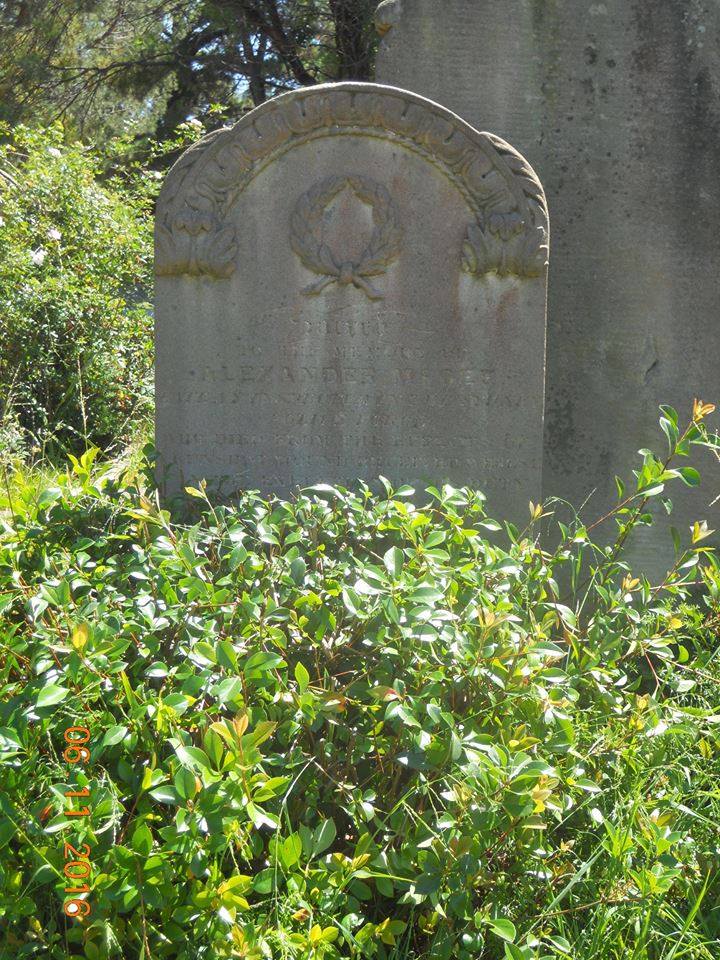
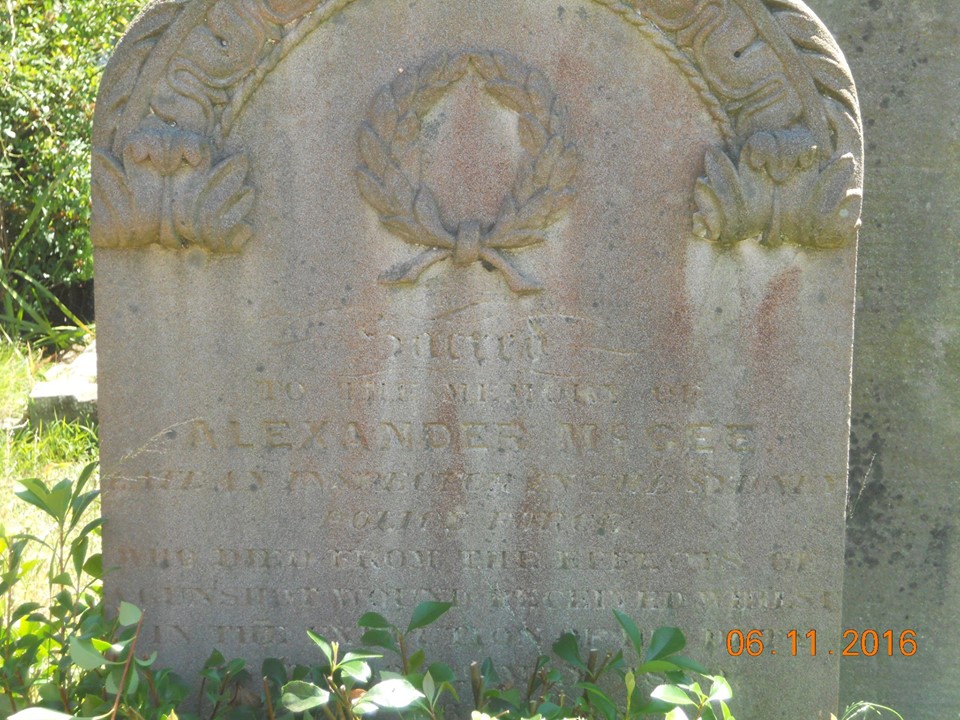
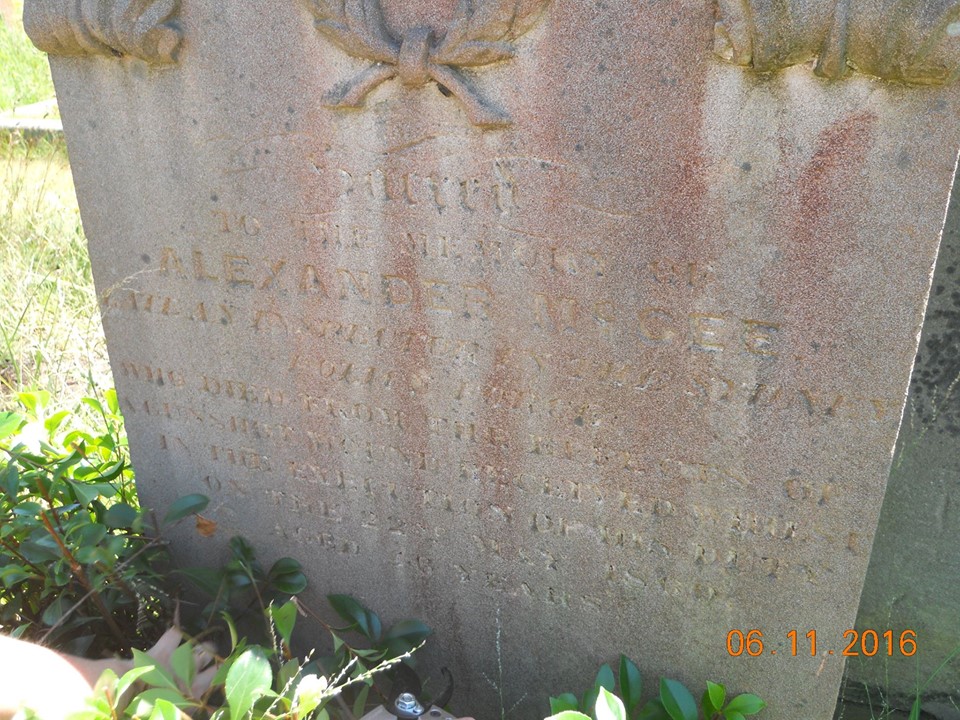
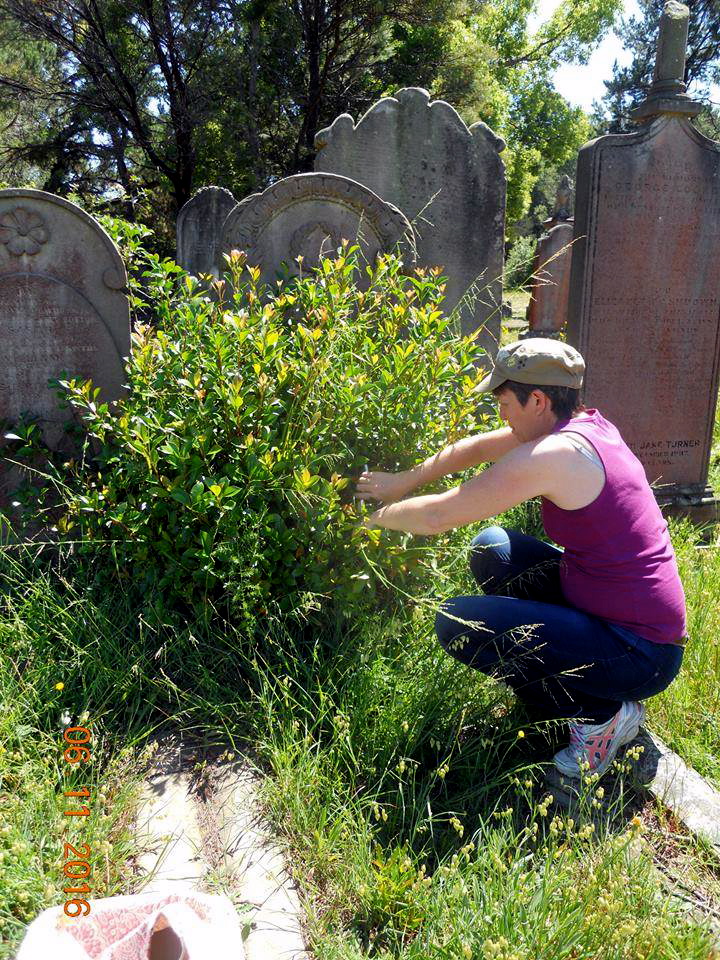
Alison Carter, who is not associated with NSW Police, but went out of her way and took the time to locate & take photos of the grave of our fallen brother - Alexander McGee on 6 November 2016. Thank you Alison.
Alison Carter, who is not associated with NSW Police, but went out of her way and took the time to locate & take photos of the grave of our fallen brother – Alexander McGee on 6 November 2016. Thank you Alison.

ALEXANDER is NOT mentioned on the Police Wall of Remembrance

*  But should be


Between 11pm and 12 midnight on 26 March, 1860 Constable Connaughty was on duty in Goulburn Street, Sydney when he saw two soldiers ( William Pike and Patrick Hughes ) carrying rifles. Believing them to be deserters he followed them along Sussex Street, across the Haymarket and along Pitt Street until he spotted Inspector McGee, Sergeant James Rush and Sergeant Francis Rooney, who were out looking for soldiers who had deserted from the 12th Regiment.

The four police officers then followed the soldiers until, when near Liverpool Street, they began to run. Rush and Rooney quickly caught up with Hughes while McGee and Connaughty chased Pike into Castlereagh Street where he suddenly stopped and pointed his rifle at the inspector.

Pike then said, ” If you attempt to take me I will shoot you. “ McGee replied,  ” Do not fire, coward. “ Pike then ran a few steps, chased by McGee, before turning around and firing at the inspector from point blank range. The bullet struck the inspector in the right groin area, exiting from his lower back. He died from the effects of the wound four weeks later.


The Sydney Morning Herald of Tuesday 12 June, 1860 reported that  ” The Central Criminal Court is sitting. The two soldiers, Pike and Hughes, have been tried for shooting Inspector McGee. Hughes was acquitted, but Pike convicted of manslaughter, and sentenced to three years hard labour in gaol. Hughes was in custody when the shot was fired, and as to Pike, as he was only carrying firearms, which at present is no offence against the law, the arrest of him was not justified as an act of police duty…”


At the time of his death the inspector was aged 46 years and had been a police officer for about 20 years. At the time of his death he was stationed in B Division, Sydney.


NSWBDM – Death Reg  707/1860


Bathurst Free Press and Mining Journal ( NSW )

Saturday  31 March 1860     p 3

OUTRAGE.

Two soldiers belonging to the 12th regiment were brought before the Court in their regimental dress by constable Connaughty, charged, the first with feloniously, shooting, intending to murder Inspector Alexander McGee, and the second with aiding and abetting in the same. Their names are William Pike and Patrick Hughes.

Witness stated, that between 11 and 12 o’clock last night I saw the prisoners in Goulburn-street with firearms in their possession (two Enfield rifles.) Believing they were about to desert, I followed them along Sussex-street down to the Haymarket and from thence into Pitt-street. I there met Inspector McGee, Sergeant Rooney, and Sergeant Rush. We then followed the prisoners into Liverpool-street, where they began to run. Hughes was pursued by Sergeants Rush and Rooney, who succeeded in apprehending him.

The other prisoner continued running and was pursued by Inspector McGee and myself. As he turned the corner of Castlereagh-street, prisoner (Pike) said ‘ If you attempt to follow me I’ll shoot.‘ Finding that we were still pursing him, he presented his rifle. McGee, who was close beside at the time said ” don’t fire you coward,” and prisoner immediately run on for about 10 or 15 yards, and when we got within about a length of his rifle, he turned round, and without saying anything, shot McGee through the thigh. So soon as the prisoner fired McGee said ‘ I am shot.’ I asked him where ? he replied through the thigh. In the mean time I secured the prisoner, who the moment he fired, said, ‘ Oh, you have pulled the trigger. ”

Sergeant Rush deposed as follows : About twenty minutes past 11 o’clock last evening, I was at Cowell’s public house at the corner of Goulburn street, in plain clothes. Pike came in with a rifle, the barrel of which was partly covered by the skirt of a woman’s dress. I noticed blood on his hands. Immediately after entering, he called Hughes in, who was standing at the door, but the latter replied, ” No ; don’t you see, you b—-y fool?Hughes then put his piece, which was clipped, to the charge. They both then went away, and l fancied that, although in plain clothes, Hughes knew me. I then followed them into Sussex-street where, whilst turning round they saw me, and brought their pieces to the charge. Hughes at length said to me, ” Can you tell me where the old Australian Inn is ?” their pieces being still charged towards me. I told them, yes, and that I would go and show them if they chose.

They then brought their pieces to the trail, and I proceeded in company with them. I said, you seem to have just come off a long journey, having your firearms with you. They said they had just come from Melbourne, and were going to a place near Dixon’s mill.

After we had got near the spot indicated, Hughes said, ‘ You had better not come any further.’ but I persisted in following them to the Hay Market, where they had some conversation. They then presented their arms at me and I went away and put on my uniform coat. Immediately after I came up with them again in Pitt-street, where I also saw Inspector McGee and told him what had occurred.

Prisoners next went into Liverpool street and instantly began to run. Sergeant Rooney was at this time close behind, and whilst McGee pursued, Pike stopped Hughes, who thereupon brought his piece to bear. I knocked it aside twice with one hand and struck him in the head with my fist, which caused him to stagger. I took advantage of the opportunity and clasped him round the waist with my two arms, including in the fold the rifle also.

In the mean time Rooney came up and wrenched the rifle from his grasp. Whilst in the act of apprehending him, I heard some one ‘say, ” If you come any further I’ll shoot you, ” and soon after I heard the report of a gun.

I produce the rifle which we took from Hughes. It is loaded and capped. On searching him at the station house, I found in his possession 19 rounds of ball cartridge and 25 percussion caps which I also produce. ( Several rounds of ball cartridges, together with some percussion caps, were also found on the other prisoner. )

Sergeant Rooney gave evidence much to the same effect as that of the previous witnesses.

John Marshland, a sergeant belonging to the 12th Regiment, recognised the two prisoners, who he said had no authority to be out last night. He believed that they effected their escape by climbing the walls. Soldiers were never allowed to carry firearms through the streets except when on duty.

As Inspector McGee is at present dangerously ill in the Infirmary the Bench remanded the case until this day week. — Empire of Wednesday.

http://trove.nla.gov.au/newspaper/rendition/nla.news-article63597117.txt


The Sydney Morning Herald

Wednesday  23 May 1860     p 1

Died on the 22nd instant, Mr. Alexander McGee, aged 46 years, late Inspector of police, after a lingering illness from the effects of a gunshot wound on the 26th March, leaving a wife and large family and a numerous circle of friends to mourn his loss.

http://trove.nla.gov.au/newspaper/article/13040895


The Sydney Morning Herald

Wednesday  23 May 1860     p 8

FUNERAL.— The Friends of the late Mr. ALEXANDER McGEE, late Inspector of police, are respectfully requested to attend his Funeral. The procession to move from his late residence, Police Station, George-street South, on THURSDAY AFTERNOON, at a quarter-past 3 o’clock.
REUBEN THOMAS, undertaker,

141, York-street, late of 54, King-street.


Empire ( Sydney )
Thursday  24 May 1860     p 8
MASONIC.
THE Officers and Members of Lodges No. 260, 206, and 207, are respectfully requested to attend the FUNERAL of Brother ALEXANDER McGEE, late of 260 ; to move from his late residence, Police Station, George-street South, THIS DAY, 24th instant, at 3 o’clock p.m.
H. WILSON, Secretary pro tem.
*   *   *
FUNERAL.-The Friends of the late Mr ALEXANDER McGEE, late Inspector of Police, are respectfully requested to attend his Funeral. The procession to move from his late residence, Police Station, George street South, THIS (Thursday) AFTERNOON, at a 4 o’clock.
REUBEN THOMAS, Undertaker, 141, York-street,

late of 64, King.street.


The Sydney Morning Herald
Thursday  24 May 1860         p 3

THE LATE INSPECTOR McGEE.

IN our obituary of yesterday we had to record the death of Inspector Alexander McGee, of the police force, of Sydney. ” We have long been expecting to make this announcement, for it was on the 26th of March last that McGee, in the firm and intrepid performance of his duties, received the gunshot wound from which, to use the more than ordinary picturesque language of the bar, he, up to the 22nd May ” did live and languish, and languishing ” did die.

The particulars of the occurrence which caused this lamentable event have been recorded in our columns, and are reproduced in the appended, report of the inquest which took place yesterday. The funeral will take place at three o’clock to-day ; and, when it is over, we shall have to add some particulars of Mr. McGee’s career in the police force, all of which we may say are highly creditable to him as a public officer in whatever grade or rank he moved. We are happy to say that we have been informed by the superintendent of Police that a pension to the widow of £50 can be afforded out of the Police Fund.

It is a somewhat singular coincidence that this will be the second instance of relief from the Police Fund which has Mrs. McGee will receive. She was formerly married to a man of the name of Watson, in the police force, who, while conveying a prisoner to the watchhouse, was so seriously kicked in the back that consumption was induced, and he speedily died. On that occasion the donation of £100 was paid to the widow out of the Police Fund. Still we think that some testimonial from the citizens in token of their approval of the gallant conduct of McGee is eminently due.

THE INQUEST.

Mr. J. S. Parker, the city coroner, having, assembled a jury, and viewed the body, commenced the inquest in his office at ten o’clock yesterday morning. The names of the gentlemen who composed the jury are as follows : James Carroll, foreman ; Morris Castle, Edward Sadlier, J. J.E. Lisak, Frederick M. Moore, William Hankin, Thomas S. Pope, R. C. Hordern, John Balantine, Patrick Fox, Timothy Lane, Charles Frazer, and David Baxter.

William Pike, the soldier charged with firing the shot at the deceased ; and Patrick Hughes, charged. with being an accessory thereto, on remand from the Police Court, were brought before the Court by Inspector Foran. The first named prisoner is a young man of about eighteen years of age ; and the other is ‘ something above twenty. The former held down his head, and throughout the inquiry appeared to feel the awful nature of the situation in which his misconduct had placed him ; but the latter appeared intelligent, and asked a number of questions from several of the witnesses.

James Rush, sergeant of police in the B. Division, on being called, deposed as follows : At about half past eleven o’clock on the night of the 26th March last, I went into the Sportsman Inn, at the corner of Pitt and Goulburn streets ; was in plain clothes at the time ; while in the act of drinking a glass of ale a soldier, whom I believe to be the prisoner Pike, came in with a rifle in his hand ; I observed blood on the back of his left hand, and on the rifle something like part of a woman’s dress ; I thought there was something wrong in the soldier having a rifle with him ; I gave Mr. Cowell, the publican, a wink, and turned round for the purpose of closing the door, when I observed another soldier outside with his rifle at the charge pointed towards the house ; the soldier inside said, ” come in and have a drink,” to which the soldier outside replied ” come out of that you b—-y fool, don’t you see ? ” I did not think it safe to interfere ; the soldier in the house, after drinking a glass of ale, went out ; I remarked to Cowell “there is something wrong; I will follow them ; ” I did follow them ; they went down Goulburn-street, and passed constable Potter ; when I came up to constable Potter I told him to follow them at some distance ; when they reached Sussex-street they turned to the left, and went down Sussex-street South ; I saw a Policeman standing at the corner of Sussex and Goulburn streets, and he was joined by constable Potter immediately afterwards ; as I followed after the soldiers I heard one of them remark, ” I tell you it is not ;” I saw that the rifles were capped ; I came up by the men, and Hughes said to me, ” where is the Old Australian Inn? ” I replied ” I do not know ; I know Stewart’s Australian Inn, and I will show it you.” I further remarked ” I suppose you are strangers in Sydney, having your rifles, and come off a long journey;” Hughes replied ” we have just come up from Melbourne by the steamer,” which I knew to be false. When the prisoners got near Mr. Cooper’s wine stores, Sussex-street South, they turned to the right. I said ” you had better not go that way or you will get bogged, it takes you into the harbour.” Hughes said “you had better come no further.” I said ” I will ; I live that way, and am going home; I will show to you the house you asked for,” I saw two policemen coming down Sussex street towards us. The soldiers proceeded into George-street, and passed over to the Haymarket, talking to each other, but I did not hear what they said ; while passing over the Haymarket they turned round and presented their rifles at me ; I thought it best to retreat, which I did very slowly ; as soon as I got out of the soldiers’ sight I ran in to Goulburn street, and asked Mr. Quigley, a publican, to lend me a black coat, which he did ; I went up Goulburn street and met inspector McGee coming out of Durand’s-alley with a female prisoner and several constables ; I said to inspector McGee “there are two soldiers out with rifles, and I think they mean mischief :” he asked ” Where are they? ” and at the same time the soldiers passed up Pitt-street. McGee said ” Come on, let us take them ” I laid hold of the inspector and said ” You had better not go, they will shoot you ; I have changed my clothes since the soldiers last saw me, they will not know me; I will get them into a public-house, and while there you can come up with some other men and secure them;” he replied “that will be the best way ; I followed the soldiers up Pitt-street ; they turned into Liverpool-street, and as soon as they turned the corner I heard some person running ; the soldiers turned round and commenced running also ; I was on the prisoners’ right at the time, and I stepped over and faced Hughes; he presented his rifle at me ; I hit the rifle aside, and struck at the man, but the blow did not take effect ; the soldier stepped back and placed his rifle on my chest ; I knocked the rifle aside again and struck the man on the forehead, which cut his forehead and staggered him ; I flung my arms around him and the rifle and held him tight ; at that moment I saw sergeant Rooney passing, and I called out to him to come and take the rifle ; he came and wrenched the rifle from the prisoner Hughes’ hands ; I then let the man go and knocked him down, and while he was down I, with the assistance of sergeant Rooney, secured him ; I then said to sergeant Rooney, “go and see where the inspector is,” and at the same moment I heard the words ” stop or I will shoot you ” ; in reply, I heard the deceased say, ” Don t fire, you coward ;” immediately afterward I heard the report of a gun ; about half a minute after that sergeant Rooney and constable Connaughty came round with the prisoner Pike ; I took the rifle and found by the smell of gunpowder, as also by its feeling warm, that it had been recently used ; I then picked up the rifle lying on the ground, and found it was loaded and half cocked; with the assistance of the other two officers I took the two prisoners to the B station-house ; I searched Hughes and found on him nineteen rounds of ball cartridge, between twenty and thirty percussion caps, and a stopper to fit in the rifles; I also saw nineteen rounds found on the prisoner Pike; each prisoner had a package broken, as though a charge had been taken out of them ; the next morning the prisoners were brought before the Police Court : on that day (27th March), I went to the Victoria Barracks, and in my presence the charge now produced was drawn from the rifle taken from Hughes ; in the afternoon, as the prisoners were being brought out of the Central Police Court, the prisoner Pike said, “How is the man that was shot? I replied “He is very bad ; you had better not say anything to me about this charge, or I shall give it in evidence against you ; ” he then said, I did not intend to shoot him ; ” I said. ” you did very wrong in bringing your rifles out at all ” ; he answered, ” we wanted something before we left Sydney, as we intended to have taken the bush if you had not come across us.”

By a juryman : I do not know whether the prisoners knew me when they first saw me at the public-house ; they had ample opportunity to shoot me while I was following them ; had I not gone away when they told me, at the Haymarket, I should have been in danger of my life.

By the Coroner : I produce a piece of lead given me by Mr. Dixon, who said he found it in his house ; he lives in Castlereagh. Street, near where the deceased was shot ; the prisoners appeared to know what they were doing, but they were excited ; I saw Mr. McGee at the Dungate Inn the same night, and asked him if he was much hurt ; he replied, ” hurt, yes. ‘ The prisoners declined to ask this witness any questions.

Francis Rooney, sergeant of police in the B division, deposed : On the night of the 26th March last was on duty in company with the deceased, inspector McGee, in Goulburn-street ; sergeant Rush came and reported to us that two soldiers, having guns in their possession, were in Pitt-street, and that one of them had his hands smeared with blood ; all three of us proceeded into Pitt-street at once, and we observed the soldiers going along the middle of the street towards Liverpool -street ; each of the soldiers had a gun ; they turned up from Pitt to Liverpool street, and were walking quickly ; we followed them ; we were dressed in police uniform, and the soldiers were dressed in their military uniform ; we ran after the soldiers, and they, apparently seeing us, ran up toward Castlereagh-street ; sergeant Rush was in advance of me and the deceased ; I saw sergeant Rush lay hold of the prisoner Hughes by the neck and put his arms round his (Hughes’) arms ; the prisoner still held the gun under his arm, and sergeant Rush tried to shift it ; I and the deceased came up, when the prisoner pointed the gun at me ; I caught hold of the gun, pushed it aside, and wrenched it out of his hands ; sergeant Rush then knocked the prisoner down and secured him ; the deceased started off after the other prisoner (Pike), who turned round into Castlereagh-street; a few seconds afterwards, I heard a report of a gun in the direction in which the prisoner had ran ; I left the prisoner Hughes in charge of sergeant Rush, and followed after the deceased, and when I turned the corner I saw the deceased being carried by two men into the Dungate Inn ; I followed after the prisoner Pike, and when I came up to him he was in the custody of constable Connaughty ; I assisted to secure the prisoner, and we proceeded with him to where I had left sergeant Rush with the prisoner Hughes, and we then took both prisoners to the B division watch house ; both prisoners appeared sober, cool, and fluent ; The same night a report was received from the military barracks that Patrick Hughes and William Pike were absent from the barracks with firearms and ammunition ; I am not positive whether the prisoners wore belts when apprehended ; they had no side firearms ; the gun taken from Hughes was loaded. The prisoners declined to ask this witness any questions.

Timothy A. Cowell said ; I keep the inn known by the sign of the Sportsman, at the corner of Pitt and Goulburn streets ; at about five minutes after eleven o’clock on the night of the 26th March last, the prisoner Hughes and a civilian came into my bar ; the civilian called for a pint of ale, which he paid for, and which was drunk between them ; Hughes drank part of his and went outside, and during his absence sergeant Rush came in in plain clothes ; both prisoners came immediately afterwards, each having a rifle in his hand ; Mr. Rush looked at the men with suspicion, and appeared as though he was going to close the doors on them ; one of the rifles had part of a woman’s skirt on it, much smeared with blood I said to Mr. Hush ” there is something wrong them” he replied, ” I will follow them and see what they are up to;” the soldiers then went away, and Mr. Rush followed them; half an hour afterwards I saw the two soldiers come up Pitt-street, and Mr. Rush came up Goulburn-street ; Mr. Rush had changed his coat ; he was followed by inspector McGee and three or four constables, and they all followed the soldiers up Pitt-street ; I closed my door and followed after the police ; just after turning the corner of Liverpool-street, the soldiers commenced running, and the police after them ; I saw Mr. Rush seize hold of Hughes, and I went to assist him I saw Hughes twice place his rifle against Mr. Rush’s breast, as if he wanted to let the rifle off ; before I could render any assistance, sergeants Rush and Rooney had Hughes on the ground and secured ; I then went into Castlereagh -street and saw the barrel of a rifle projecting from a butcher’s shop, and I saw Mr. McGee and two other police officers in front of the rifle ; the rifle was let off, and Mr. McGee said “I am shot;” I took hold of him and assisted him to sit down, and also assisted to put the handcuffs on Pike ; I then assisted to carry Mr. McGee into the Dungate Inn ; I went to the Police Station with the police, and saw a quantity of ammunition taken from both prisoners ; I heard Pike, when he was on his way to the station house, say he was sorry what he had done; when I saw the rifle projecting from the butcher’s shop I heard someone say ” I will fire,” when Mr. McGee said, ” don’t fire you coward;” I think the distance Between Mr. McGee and the rifle, when it went off, was about ten yards ; the rents in the clothes now produced corresponded with those caused by the gunshot wounds, the rifle, when it went off, was pointed in the direction of Mr. Dixon’s house ; Pike was very much excited when apprehended.

By the prisoner Hughes : Sergeant Rush was in front of you when you had your rifle against him ; there was part of a skirt of a dress on your rifle ; I cannot say whether there was any blood on the rifle.

Sergeant John Marsland, of the 12th Regiment, deposed : I know the prisoners before the court ; Hughes belongs to my company, and has been in the regiment since he was a boy ; Pike landed here on the 9th July last and they are both in the habit of drinking, and they have been punished for it ; on the 26th March last Hughes’ was confined in barracks, and was reported absent at about half-past eight o’clock p.m. ; 1 hour later Pike was reported missing ; their rifles were also found to be missing ; it is contrary to the regulations to take arms out of the barracks without orders ; the men are served with twenty rounds ammunition each for their Enfield rifles ; after the prisoners were reported missing I got a picket, by order of the commanding officer, and went down to the town to look for the missing men. ; I reported the absence of the men at the different police stations ; I left the picket at the Detective Police Office, and went with inspector Hogg in search of the prisoners ; we were informed by a constable of the shooting of inspector McGee by one of the prisoners ; I believe Pike was apprehended once before for being a deserter but he had not his rifle with him then ; the men have to be in barracks by eight o’clock in the winter, and at nine o’clock in the summer.

By the prisoner Hughes : The cause of your misfortunes in the regiment is drink.

By the Coroner : I believe that Hughes struck a non commissioned officer once. By the prisoner Hughes : You are a pretty good soldier when sober.

Constable James Potter said : The clothes produced are those worn by Inspector McGee on the night of the 26th March inst. I helped to strip him and to convey him to the infirmary : I was present when he was shot ; and I heard the prisoner Pike say ” stand back or I’ll shot you ; ” and I heard Mr McGee say, ” don’t fire, you coward ;” I saw the rifle go off, and heard Mr. McGee say ” I am shot,” you pulled the trigger yourself ; ” There was no person near enough to Pike when he fired the rifle to pull the trigger but himself.

By the prisoner Hughes : The night was too dark to see the trigger or Pike’s rifle.

Constable Patrick Connaughty, who was also present at the affray, corroborated the testimony of the other witnesses.

Richard Dixon, a tailor residing at 366, Castlereagh–street, deposed : On the night of the 26th March last, I heard the report of a gun ; I got out of bed, procured a light, and found at the foot of my bed the piece of lead now produced ; it appears that one of the posts of my bed had been struck by the bullet : I found the upper square of glass in my window shattered.

John Cecil Read, inspector of the B division, said, the deceased inspector McGee was an inspector under me in the division ; he was shot on the night of the 26th March last, and I had him conveyed to the Infirmary ; I understand he has been twenty years in the police service ; I have known him for five years ; he was generally liked both by the police and the public ; he was a very active police officer ; he leaves a wife and five children not well provided for.

James Robertson, M.D., surgeon to the Sydney Infirmary deposed : Alexander McGee was admitted as an in-patient into the Sydney Infirmary on the 27th March, and died on the 22nd May. He had received a wound on the right groin, immediately to the outside of the artery in that part. There was also a wound in the buttock of the same side. These wounds were no doubt caused by a bullet, the first mentioned being the point of entrance, the latter the place of exit. He died from the effects of this wound. The bullet passed between the points mentioned through the arch of the thigh bone. The wound was almost certain to prove fatal from the first. After death I made an internal examination of the wounded parts. I did not find any foreign body therein ; the deceased told me he had been shot by a soldier ; such a wound might have been caused by such a bullet as that now shown me.

The Coroner then summed up, and the jury, after five minutes’ consideration, agreed to the following verdict :- ” We find that the deceased. Alexander McGee, died from the effects of a gun shot wound, fired by William Pike at inspector McGee, and we pronounce him guilty of wilful murder ; and we find Patrick Hughes guilty of being an accessory before the act, and pronounce him guilty of wilful murder.”

The jury appended the following rider to their verdict:-” We (the jury) unanimously beg, in the strongest possible manner, to recommend the unfortunate widow and five children of the late inspector McGee to the kind consideration of the Government, and more especially after the many years that the late Mr. McGee has discharged his duties with so much, credit to himself, and with such utility to the public. And we also consider it our duty to record, on our behalf as well as on the part of the public generally, our high approval of the conduct of sergeant Rush, who was not on duty on the night in question, and of the conduct of sergeant Rooney and constables Potter and Connaughty.”

The prisoners Pike and Hughes were then removed in custody to the gaol, at Darlinghurst, to await their trial at the next sitting of the Central Criminal Court.


Empire ( Sydney )
Saturday  26 May 1860     p 4

LEGISLATIVE ASSEMBLY.

FRIDAY, 25th MAY.

The SPEAKER took the chair at half-past three o’clock.

THE LATE INSPECTOR McGEE.

Mr. ROBERTSON in reply to a question from Mr. Hoskins, said that the widow of Alexander McGee, late Inspector of Police, recently deceased, who died from the effects of a wound received in the execution of his duty, would receive an allowance, which would be provided from the Police Superannuation Fund, under the recommendation of the Board who managed it.


Empire ( Sydney )
Wednesday  6 June 1860     p 3

CENTRAL CRIMINAL COURT.-Tuesday.

BEFORE Mr. Justice Wise.

MURDER.

William Pike and Patrick Hughes, private soldiers of the 12th Regiment, were indicted for having at Sydney, on the 26th March, 1860, feloniously, wilfully, and of their malice aforethought, killed one Alexander McGee.

The Attorney-General conducted the prosecution. The prisoners were defended by Mr. Isaacs.

The first witness called was constable Connaughty, of the Sydney police. He deposed that on the day named in the indictment, Monday, 30th March, he saw the prisoners going along Goulburn-street, with fire-arms in their possession. Followed them into Pitt-street, where witness was joined by inspector McGee, and two other police officers. The prisoner Hughes was arrested by sergeants Rush and Rooney. Witness and deceased pursued Pike into Castlereagh-street. When they passed Liverpool-street, Pike turned round and said, that if they attempted ” to come near him,” or ” apprehend him” he would shoot them, McGee said, ” don’t fire, you coward,” he afterwards ran up Castlereagh-street, followed by witness and deceased, When they were within three or four yards of the prisoner he turned round and fired, and deceased called out ” I am shot.” The prisoner said ” you pulled the trigger yourself.” Deceased was not near enough to touch the rifle. About half-a-minute elapsed between the time when the prisoner said he would fire and the time when deceased was shot. Prisoner had run about twelve yards. Pike was subsequently taken by witness and some other constables. On his person were found nineteen rounds of ball cartridge and some percussion caps.

Cross-examined by Mr. Isaacs : Witness and deceased were equally close to the prisoner when be fired. Believed that constable Potter was close behind. As the prisoner went along, he had his piece at the trail.

By the Attorney-General: Did lose sight of Pike between his leaving the Haymarket and firing his piece, but did not lose sight of him after he threatened to shoot until he fired.

By his Honor : Before the shot was fired McGee said nothing to the prisoner except what had already been told. After the shot was fired, be said “secure that scoundrel.”

Sergeant Rush, of the Sydney police, deposed that, on the night of the day named in the indictment, he saw the prisoner Hughes drinking ale in Cowell’s public house at the Haymarket. He observed that he had his rifle. Witness was not on duty, and was not in uniform. He observed that Hughes had the skirt of a woman’s gown on his rifle, and that there was blood on the back of his hand. Witness saw Pike outside with his rifle at the charge, pointing into the public-house. Hughes called to him to come in and have a drink, when Pike said ” come out of that you b—-y fool, don’t you see ?” Hughes came out, and both went away, followed by witness. The prisoners asked witness where was the Old Australian Inn, and witness said he knew where Stewart’s Australian Inn was, and he would show it to them. Witness said ” you must be strangers in Sydney, as you have your rifles, and don’t know your way.” Hughes said,”yes, we have just arrived from Melbourne.” After proceeding some distance, one of the prisoners said that he had better not follow them any farther, and witness said he was going home, and would show them the house they asked for. Having gone a little farther, the prisoners turned round and presented their pieces, telling the witness to go away. Believing himself to be in danger, be walked away slowly, until be met inspector McGee, and some other policemen. Witness subsequently apprehended Hughes. Before he was taken he twice placed the rifle at the breast of witness, and kept rambling in his packet for a cap. While he was securing Hughes, he heard someone call out ” Don’t come any nearer or I will fire,” and heard McGee voice calling out ” Don’t fire, you coward.” Witness subsequently took both the prisoners to the watch-house assisted by other officers. Saw the charge produced drawn out of Hughes’ rifle at the watch-house. On Tuesday, after the prisoners were remanded. Pike asked witness ” How is the man who was shot. ‘ On witness making some reply, he said ” I did not intend to shoot him.” Witness said ” You did wrong in coming out of the barracks with your rifles at all.” Pike said ” We wanted something before we left Sydney, as we intended to take the bush for it,”

Cross-examined: It was between eleven and twelve at night when witness saw the prisoners at the public house. Was standing in front of the bar when Hughes came in. Believed it was Hughes that came in and drank at the bar. Believed that he said it was Hughes that came in and Pike that stood outside when he gave his evidence on former occasions. (The witness’ deposition were here placed in his hands.) Believed still that it was Pike who stood outside. He had his piece at the charge, but not presented. When the conversation took place about the Old Australian Inn, the prisoner had their pieces at the trail. Believed he had never said that they had their arms at the charge at this time. [The depositions were handed to the witness.] When witness was apprehending Hughes the prisoner twice brought the piece to the present. The first was not a good present; the second was. At the second time, witness threw his arms round the prisoner, and called to sergeant Rooney, who took the rifle away.

By the Attorney-General: From the time when Hughes first presented his piece till he was arrested, a very short period elapsed.

By Mr. Isaacs : Could have heard the words, ” Don’t come any further,” or ” Don’t follow me,” distinctly, but was otherwise engaged, and did not recollect the exact words.

Sergeant Rooney, of the Sydney police, corroborated the evidence of the preceding witnesses. He accompanied inspector McGee in pursuit of the prisoners. Followed them at a distance of about twenty yards. When they turned round the corner, at the Sugar Works, witness and McGee ran. When they came into Liverpool-street, saw Rush and Hughes scuffling, and took the rifle away. Rush knocked Hughes down and witness handcuffed him. On the way to the station Pike said that if he shot the man he would suffer for it. The prisoners appeared to be sober.

Cross-examined : Witness took the rifle from the prisoner. Never said that it was Rush who took away the rifle.

By his Honor : While witness and McGee were together, neither spoke to the prisoners.

Dr. Robertson, surgeon to the Sydney Infirmary, de-posed to McGee having been received into that institution. He was suffering from a gun-shot wound in the groin. The wound was the cause of death. The ball had gone through the neck of the thigh-bone.

By Mr. Isaacs : Such a wound would almost necessarily be fatal from the first. Never knew a case of recovery wherein the thigh-bone was shattered. The ball had gone right through the neck of the thigh-bone at a place where the bone is thick. Examined the body after death, and observed a variety of symptoms, the natural result of the wound. The external orifice of the wound had at one time completely healed ; that was proper treatment, inasmuch aa the matter passed out at another opening below.

By his Honor : The ball entered in front. If the par-ties were close, the weapon must have been pointed downwards. Deceased appeared to be rather a tall man.

By Mr. Isaacs: McGee died on the 22nd May, and witness first saw him on the 27th March. Did not say that the wound was necessarily fatal from the first, but that it was almost so. That was not a long period for a man to survive after receiving a fatal wound.

Alfred Cowell, a publican, living at the corner of Pitt and Goulburn streets, corroborated the evidence of the preceding witnesses, as to what occurred at his house. Hughes was in company with a civilian when be first came to the house. The witness was also present when McGee was shot, and he accompanied the prisoners to the watch-house. Heard Pike say that he was sorry of what he had done.

By Mr. Isaacs : Could not say how near the rifle was to McGee when it was first presented. When it was fired McGee was about twelve feet away, the rifle projecting from the side of a wooden house, close to which the prisoner stood.

By his Honor: Was distant about ten or twelve yards from McGee and the soldier when tho shot was fired. When Hughes first came into the public-house, he had not the rifle with him. He wanted to take out some drink ; and witness not allowing him to do so, he went out, and came back in company with the other soldier, Hughes this to,e carrying his rifle. It was between his coming in and going out that Rush came in. Pike only took one step inside the door. He d d not come up to the bar.

Constable Potter, of the Sydney police, corroborated the proceeding evidence, as to what took place at the time when McGee was shot.

By Mr. Isaacs : Saw the prisoners go along Goulburn street in the course of the night. Noticed nothing particular about them, except that they had fire-arms, and that the barrels of the rifles were covered up. Witness was behind McGee when the shot was fired. Was not in a line with the deceased, but was a little towards one side. Deceased was at the curb, prisoner was in a gateway. Heard the words used by Pike-” Stand back, or I’ll shoot you,” or some words to that effect. The caution was spoken twice. After it was spoken the second time deceased did not advance. To the best of his belief, McGee was about two yards from Pike when the shot was fired. The prisoner was in a gateway, but was not out of sight or behind a corner.

By his Honor : There were marks of fire both on the coat and trousers of deceased.

Richard Dickson, residing in Castlereagh-street, deposed that on the day following the occurrence, a bullet was found in his house, which was opposite the place where the shot was fired. The bullet had struck the wall about sixteen feet from the ground.

Sergeant Marsden, of the 13 th Regiment, proved that one of the two rifles produced belonged to Hughes ; who the other belonged to, he could not say. Saw the prisoners on the evening of the 27th. Did not see them again till he saw them in the Court.

Mr. Isaacs submitted that there was no case to go to the jury, in regard to either of the prisoners.

His Honor said be could not understand why the case should be shut out from the jury ; but he would like to hear what evidence there was that the police were in the execution of their duty in arresting the men.

The Attorney-General said there was no immediate evidence to that effect; but it was quite clear that a man had lost his life by the acts of the accused.

Mr. Isaacs still adhered to his opinion. He submitted that in regard to Hughes there was no case whatever. It was not shown there was any previous compact, and therefore. Hughes could not be an accessory before the fact.

The Attorney-General submitted that it was clear from the evidence that there was a ” joint object on the part of the prisoners, from beginning to end, namely, to shoot whomsoever interfered with them, in the proceeding which they had adopted, of going about the city at a late hour at night with loaded firearms in their hands.

His Honor thought there was no evidence to show a joint intention to kill anyone, and that, therefore, there was no evidence to criminate Hughes. The only offence of which the prisoners were shown to have been guilty, in the first instance, was carrying loaded fire-arms through the streets, and that was no offence at the present time, although it was an offences three months ago. He should direct the jury to return a verdict of not guilty in the case of Hughes. ‘ ‘

Mr. Isaacs then proceeded to argue that there was no case against the prisoner. There was nothing to justify the police in interfering with the men. No felony had been committed ; there was no reason to suppose that a felony had been committed. The Arms Act, be believed, was not in existence since November last ; but at all events, it was sufficient for his purpose that the Act was not now in force; and if it were, the military were exempt from its operation. There was not word addressed to the men from beginning to end by any policeman in uniform, except the words used by deceased, ” don’t shoot, you coward ;” and there was no reason to believe that the accused were not themselves looking for deserters, and therefore having the best cause to keep themselves aloof from other persons. The learned counsel cited two cases in support of his argument ; but eventually admitted that the several cases went rather to show that the circumstances on which he laid stress, simply went to reduce the crime for murder to a lesser offence.

The Attorney-General contended that the charge of murder was sustainable, inasmuch as the aggression came from the prisoner Pike. That he was the aggressor was shown by the fact that be had, before receiving any provocation from the deceased, either by word or act, held out a threat, saying, ” If you follow me, I will shoot you.”

Mr. Isaacs addressed the jury, for the defence.” He commenced by urging upon them to disabuse their minds of any impression which they might have received from the extensive discussion which the case had received in the public prints and otherwise. He submitted that if they arrived at the conclusion that the prisoner believed the police were about to arrest him, then the crime was reduced from murder to manslaughter, for the deceased had no more right in law to arrest the prisoners than to arrest him, while he was addressing the jury. He contended, however, that there was good reason to believe that the rifle went off accidentally, looking at the fact that the prisoner previously had ample occasion to fire after the commencement of the pursuit, and had, half a-minute before, presented the weapon without firing.

The Attorney-General declined to reply.

His Honor summed up.

The jury, after a consultation of twenty minutes, returned a verdict of not guilty in the case of Hughes, finding Pike guilty of manslaughter.

His Honor sentenced Pike to be imprisoned and kept to hard labour in the gaol at Darlinghurst, for a period of three years. Hughes was remanded to the custody of the military authorities.


John SMITH

John SMITH

New South Wales Police Force

Regd. #  ?

Rank:  Trooper

Stations? , Araluen

ServiceFrom  ?  to  10 February 1860

Awards?

Born? ? ?

Died on:  10 February 1860

Cause:  Drowned

Event location:  Crown Flat, Araluen

Age:  ?

Funeral date ?

Funeral location ?

Buried at: Unmarked grave at Araluen Catholic Cemetery

Trooper SMITH lies in an unmarked grave at Araluen Catholic Cemetery.

[alert_yellow]JOHN is NOT mentioned on the Police Wall of Remembrance[/alert_yellow]


The trooper was drowned in severe floods at Araluen in February, 1860. The Sydney Morning Herald of Monday 20 February, 1860 graphically reported the floods, advising of “Losses to life and property, the extent of which are yet not known, from a subject of a dark page in the annals of Braidwood and surrounding districts.” It went on to describe the sad death of Trooper Smith.


….The next calamity to human life occurred at the police camp. Trooper Smith, who had lately joined the force, was endeavouring to escape to Mr. Sweeney’s house, when the current carried him off, and his corpse was discovered when the water subsided; it was entirely buried in the sand, part of the arm projecting.  Several bodies not known have been recovered, and it is anticipated that at least seventeen human beings have lost their lives in the Araluen flood. ……..

http://trove.nla.gov.au/ndp/del/article/13036792?searchTerm=trooper%20john%20smith&searchLimits=l-decade=186|||l-year=1860

At the time of his death the trooper was stationed at Araluen. No further details are known as yet.

[divider_dotted]


The Goulburn Herald ( NSW )  Saturday  18 February 1860  p 2 of 4

…….

One of the Troopers of the Southern Patrol, a fine young man named John Smith, was drowned while endeavouring to cross from the police camp to the Cornstalk Inn.  In fact the destruction is general and conceivably great. …..

http://trove.nla.gov.au/ndp/del/article/103400139?searchTerm=trooper%20john%20smith&searchLimits=l-decade=186|||l-year=1860|||l-month=2#reloadOnBack

[divider_dotted]


The Empire ( Sydney )  Monday  20 February 1860  p 3 of 8

……. At the Police Camp the water rushed in, and one of the troopers named Smith, whilst making his way from there to Sweeney’s public house, was carried away by the rushing torrent and met with a watery grave : his body, together with the bodies of two Chinamen, have been recovered. ……

http://trove.nla.gov.au/ndp/del/article/64097583?searchTerm=trooper%20john%20smith&searchLimits=l-decade=186|||l-year=1860|||l-month=2

[divider_dotted]