Charles Fox was Chief Constable of Muswellbrook when he took his own life on Monday 25 August, 1856. The following paragraph appeared in the Sydney Morning Herald of 29 August, 1856.
On Monday, the 25th, an enquiry was held at the courthouse, Muswellbrook, before the coroner, Mr J.B.West, and a jury of twelve, touching on the death of Mr Charles Fox, chief constable, who, on the same morning, had committed suicide, by shooting himself with a pistol. It appeared on evidence that the deceased was latterly under medical treatment for general debility and depression of the mental faculties and had been for some time past labouring under hypochondria. It seemed on a view of the body, which presented a shocking spectacle that he had placed the muzzle of the weapon in his mouth, which dreadfully shattered… A finding of ‘Destroyed himself while labouring under temporary insanity’ was accordingly made. The deceased was much respected as a steady inoffensive man, and has left a widow and one son.
At the time of his death the chief constable was stationed at Muswellbrook.
Alexander TWISS
| 23/10/2012
Alexander TWISS
New South Wales Police Force
Regd. # ?
Rank: Constable
Stations: Sydney Police
Service: From 16 November 1852 to 4 May 1853 = 6 months
Awards:
Born: ? ? 1819
Died on: 4 May 1853
Cause: Illness – severe cold – Exposure
Age: 33
Funeral date:
Funeral location:
Grave location: Constable TWISS was interred at the Camperdown Cemetery but his grave is unmarked and location unknown.
[alert_red]ALEXANDER is NOT mentioned on the Police Wall of Remembrance[/alert_red] * BUT SHOULD BE
Constable Alexander Twiss served in the Sydney Police Force from 16 November 1852 until his death on 4 May 1853. His cause of death is recorded as having been ” from the effects of a severe cold caught when on escort duty at night “ .No further details are known as yet.
The constable joined the police force on 16 November, 1852. At the time of his death he was 34 years old and was attached to the Sydney Police. He left a widow named Sarah.
[divider_dotted]
John WATSON
| 23/10/2012
John WATSON
New South Wales Police Force
Regd. # ????
Rank: Constable
Stations: ?, City Police ( Sydney )
Service: From? ? ?to 25 October 1852 = ? years of Service
Awards: ?
Born: ? ? ? about 1827, Downpatrick, Co. Down, Ireland.
Event date: Saturday 14 February 1852
Event location: outside of the Horse and Jockey Hotel, Hunter St, O’Connell St, Sydney @ 9pm
Event type: Assault – kicking
Died on: Monday 25 October 1852
Place of death: ?
Cause: Illness – Tuberculosis
Age: 26
Funeral date: Wednesday 27 October 1852
Funeral location: ?
Buried at: St John’s Anglican Cemetery, Menangle Rd, Camden
Grave location: very end of Row E, Plot 107
Memorial at:
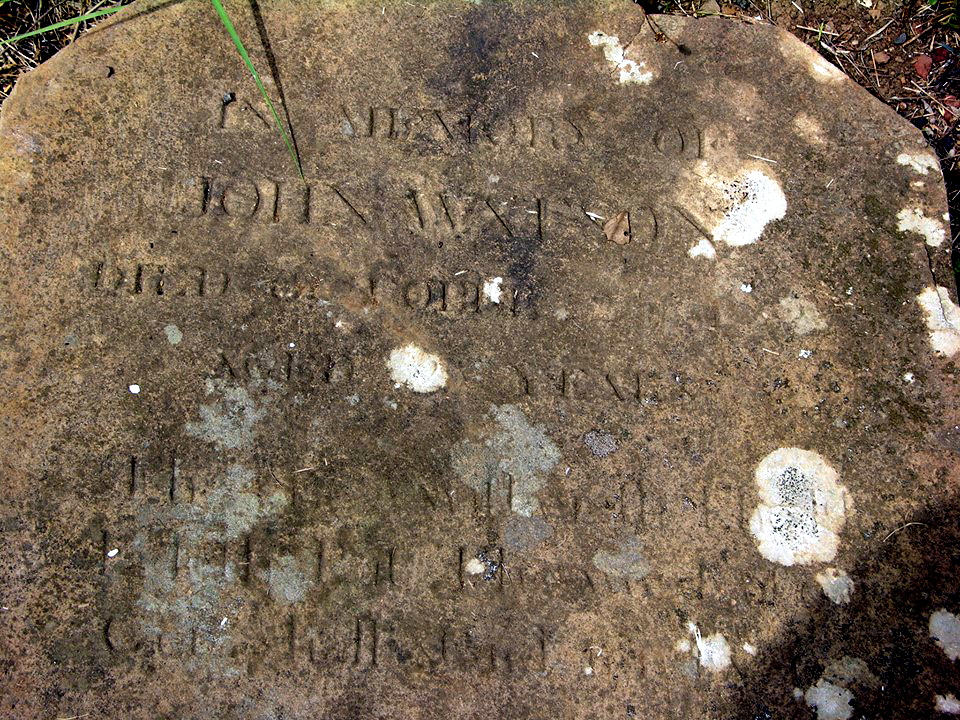
Inscription: In Memory Of John WATSON who died 25th Oct 1852. Aged 26. At Rest ??????
JOHN is NOT mentioned on the Police Wall of Remembrance
* BUT should be
Sergeant John Watson was born c1827, Downpatrick, Co. Down, Ireland.
He, along with his wife Susan Watson (nee Gillespie) 1830-1912, arrived in Sydney 15/10/1851 aboard the “Earl Grey”. During the voyage his wife gave birth to a son John Watson, 1851-1918. Sergeant Watson died 1 year and 10 days after arriving in Sydney.
He is buried in the St. Johns Anglican Church cemetery, Camden, NSW.
Buried at the very end of Row E, plot 107.
♥ Kevin Bannister 041120
Sergeant Watson is thought to have died on 25 October, 1852 as a result of the onset of tuberculosis following an assault by a prisoner he was escorting to a police station.
He was buried at Camden on 27 October, 1852 at which time his residence was recorded as Sydney.
Few details are yet known of the incident, however the Sydney Morning Herald of 24 May, 1860 when reporting on the death of Inspector Alexander McGee, included the following clue.
We are happy to say that we have been informed by the superintendent of Police that a pension to the widow [of McGee] of ” £50 can be afforded out of the Police Fund. It is a somewhat singular coincidence that this will be the second instance of relief from the Police Fund which Mrs. McGee will receive. She was formerly married to a man of the name of Watson, in the police force, who, while conveying a prisoner to the watchhouse, was so seriously kicked in the back that consumption was induced, and he speedily died. On that occasion the donation of ” £100 was paid to the widow out of the Police Fund. Still we think that some testimonial from the citizens in token of their approval of the gallant conduct of McGee is eminently due.
The sergeant was aged 26 years when he died and was apparently stationed in the Sydney Metropolitan Area.
SYDNEY POLICE COURT. – Saturday ( Before the Police Magistrate, and J. McLerie, Esq., J.P. )
ASSAULTING A CONSTABLE.- A well-dressed young man, named William Byrnes, was charged with assaulting Constable Watson, in O’Connell street, at nine o’clock on Saturday night ( 14 February 1852 ).
It appeared from the evidence that some man, whose name is unknown, assaulted the defendant, and knocked him down. The constable interfered for the defendant, and apprehended his assailant, in return for which the defendant struck the constable several blows, and also kicked him in the stomach.
The defendant did not deny the assault, for which he expressed his contrition. The bench sentenced the defendant to pay a fine of 2/., and 2s. 6d. costs, in default to be imprisoned during fourteen days.
Bell’s Life in Sydney and Sporting Reviewer (NSW : 1845 – 1860), Saturday 21 February 1852, page 3
THE POLICE REGISTER.
The Height of Ingratitude. – Police constable Watson answered in the most lively and sonorous manner to his name when called upon to give evidence against William Byrnes, a stiff built nautical, for having inflicted divers kicks upon witness whilst engaged in affording him the protection of the law.
At the late hours on Saturday night Watson was doing his duty in O’Connell-street, when he saw the defendant levelled to the earth by a human fist.
Witness took the offender into custody; whereupon up rose Byrnes, and most ungraciously pitched into his Indigo friend, from whose grasp he rescued his antagonist. ” I am naturally mild,” cried Watson, ” but human flesh and blood cannot stand this. Come to the watchhouse.” ” Not I.” replied Byrnes, ” take me if you can.”
Watson sounded his whistle shrilly, but the Royal Civils did not start up around as did the clansmen – of Roderick Dhu – Watson was left alone with a very pretty little piece of work cut out for him. However, he tightened his belt, and went at Byrnes like a hero, and after a struggle of half an hour placed him carefully under lock and key.
The defendant had nothing to offer in explanation of his conduct but the police office cuckoo note – I was uncommon drunk – knew nothing of it – dare say he’s right – a man don’t like to be pulled and hauled about – did my best to prevent it, no doubt.
This plea was held insufficient by the P.M., who fined him in forty shillings and costs for base Ingratitude to his protector.
The Empire ( Sydney, NSW ) Wednesday 5 May 1852 p 3
PUBLICANS’ ANNUAL LICENSING MEETING,
The Court of Petty Sessions for considering applications for Publicans’ Licenses, adjourned from the 30th of last month, resumed its sittings yesterday.
The Right Worshipful the Mayor presided, and was assisted by the following Justices. The Police Magistrate, the Superintendent of Police, Messrs. Allen, Hill, Chambers, Moriarty, Mitchell, Brenan, Grant, and Brown.
George Snell Clark, applied for license for the Horse and Jockey, in Hunter-street. Mr. Cory appeared for the applicant, who was opposed by Inspector Holmes, for having, on the 14th of February, refused to assist a constable in the City Police, named John Watson, who had a prisoner in custody at the time, and which prisoner was rescued from his custody by a person who assaulted constable Watson, and inflicted severe injuries upon him. The objection further alleged that when a pair of handcuffs were handed to Mr. Clark to assist in securing the prisoner, he threw the handcuffs down on the ground.
Constable Watson related the facts of the case, and said that he had been unwell ever since the night the assault was committed upon him. In reply to a question put to him by Mr. Cory, Watson admitted that Mr. Clark had picked up his truncheon for him, Mr. McLerie stated that no complaint was made against the manner in which the applicant had hitherto conducted his licensed house, and he would therefore consent to withdraw, the objection, which had been raised to let publicans plainly understand that they were bound when called on in similar cases to render aid to the Police. The objection was then withdrawn, and the license granted.
NSWBDM = John WATSON. Death registration # 1131/1852 V1852113138B age 26
Camden General Cemetery is located on the corner of Cawdor and Burragorang Rds, Camden & was established in the late 1800’s.
The above information may have been contaminated with some of the below dates.
Further investigation needed. ( Cal 27 Oct 2016)
Danny WEBSTER has a person by the same name recorded as thus ( 2016 )
Sergeant John WATSON
St James Police Station
Assault Injuries – 25 October, 1852
Resting Place – St John’s Anglican Cemetery, Camden
Sergeant Watson is thought to have died on 25 October, 1852 as a result of the onset of tuberculosis following an assault by a prisoner he had removed from a hotel in Sydney.
On or about the 21 January, 1852 Sergeant Watson and Constables Clifford and Clarke attended the Lemon Tree Hotel and were asked by the proprietor to remove a man from the premises after he had refused to leave until he was served another drink.
The police were forced to drag the man from the premises and a hostile crowd soon formed outside to witness the ensuing brawl.
The Empire of 25 January, 1852 reported on the incident.
ASSAULTING THE POLICE
Robert Thompson appeared to answer the charge preferred against him by Sergeant Watson, for assaulting him in the execution of his duty, in Phillip-street, between the hours of nine and ten o’clock, on Wednesday evening. The defendant bore evident marks of ill-usage, his eyes being severely bruised.
Mr. Cory appeared for the prosecution, Mr. G. Wright, as amicus curia attended on behalf of the defendant.
It appeared from the evidence of Watson and two other constables that the son of Mr. Tuohy, a publican in Phillip-street, called at the St. James’ station-house, requesting the police to eject the defendant from his father’s house, as he was conducting himself in a disorderly manner.
Sergeant Watson went with two constables to Mr. Tuohy’s house, and defendant was ordered to quit, which he refused to do.
The policemen then ejected defendant from the house, and ordered him to go home. He refused, and caught hold of Watson by the legs, and endeavoured to throw him down.
The two constables released the sergeant from the defendant’s grasp, and he then kicked the sergeant in the breast.
The sergeant then said, “Take him to the watch-house.” The defendant was in liquor, and his conduct was very violent while being conveyed to the watch-house.
Several witnesses were called for the defendant, who testified that the policemen ill-used the defendant after the arrest, and that they beat him while conveying him to the watch-house.
The defendant was fined one shilling, and half-a-crown costs, which he immediately paid.
The offender later took civil action against the three police officers, who were defended in court by a Mr Nichols, who said in their defence, “The constables were human beings, and situated as they were, with a mob of upwards of one hundred people surrounding them, and calling out to them to let the man go, must naturally have been excited…
One witness had sworn that a constable waved his stick, and threatened a person in the crowd, but he would call a witness to prove that that constable had no stick with him…
The now complainant had been charged with assaulting a constable, one of the now defendants, and has been convicted and fined…
In conclusion, I would remark that the defendants were duty bound to apprehend the complainant, and they used no more violence than was necessary to take him.”
The hotel proprietor, a Mr Tuohy gave the following evidence during the hearing.
I am a publican residing in Phillip-street. On the night of the late Mayoral election the complainant was in my house between the hours of eight and nine o’clock.
I saw the constables, the three defendants, at my house.
My son went for them, in consequence of Mr. Thompson using threatening language, and saying that he could beat me, and my whole family.
Sergeant Watson told the complainant to go home with his wife. Complainant asked the sergeant if he knew his duty, and told him that his duty was outside instead of inside. I desired the constables to put complainant out of the house, as I was in dread of him. They again requested him to go home, which he refused to do. I was afraid he would do me some injury, because I had refused to draw more liquor for him, and again told the constables to turn him out. They took hold of him quietly, and he rushed against them, and tried to shut the door. They forced him outside, and then twice told him to go home. He replied, that he would remain there as long he liked. When down, he took the sergeant by the legs and the constables tried to loosen his hold. The sergeant caught hold of one of the verandah posts, to save himself from falling.
Thompson’s conduct was violent. I saw him kick when down outside my door. I could not say who he kicked at. I do not think the constables used more violence than necessary during the time I saw them.”
The matter was dismissed by the magistrate.
The sergeant was aged 26 years when he died and was stationed at the St James Police Station.
He was buried at Camden on 27 October, 1852 at which time his residence was recorded as Sydney.
He is not listed in the official New South Wales Police Honour Roll.
John RUTLEDGE
| 23/10/2012
John RUTLEDGE
New South Wales Police Force
Rank: Constable
Stations: Cassilis
Service: From???to 5 May 1843 = ? years of Service
Awards: ?
Born: ?
Died on: 5 May 1843
Cause: Shot – murdered
Event location: Cassilis
Age: ?
Funeral date: ?
Funeral location: ?
Buried at: ?
[alert_red]JOHN is NOT mentioned on the Police Wall of Remembrance – BUT SHOULD BE[/alert_red]
The constable was shot and killed during a prisoner escort to Merton on 5 May, 1843. It appears that two constables were escorting three prisoners and during their journey they stopped for a break at a hut at Pickering at about 10am. For some reason the constables then removed the handcuffs from the prisoners while they were resting. At one stage Constable Rutledge went inside the hut, leaving his musket outside, and the prisoner Harris walked outside, took hold of the musket, presented it at the constable and said that if he did not give up his ammunition he would shoot him. The constable refused and started to walk out of the hut. Harris stepped back a step or two, and fired the musket through the doorway, inflicting a fatal wound to Constable Rutledge’s stomach. The ammunition belt was then taken from his body. Harris then ran off when the other two prisoners came out of the hut. The other two prisoners did not try to escape and gave themselves up.
The story of the capture of the murderer Benjamin Harris by Constable Doyle appeared in the Maitland Mercury newspaper of the 8 July, 1843. (Note that Doyle was a convict constable).
CAPTURE OF HARRIS THE BUSHRANGER.
Harris, the bushranger who murdered Constable Rutledge, of Cassilis, while under escort in May last en route to Merton, was captured on the 28th ult., by Constable Doyle, of the Cassilis establishment; and the prisoner is now on his route to Merton, in which district he stands charged with the murder of Rutledge. Doyle is a prisoner of the crown holding the Governor’s ticket and it is to be hoped that his Excellency will for the praiseworthy conduct he has displayed on this occasion grant him a free pardon. He has been out for a month, fully determined to apprehend Harris, and he captured him without assistance.
At the time of his death the constable was stationed at Cassilis.
[divider_dotted]
The Sydney Morning Herald Saturday 13 May 1843 p 3 of 4
TWENTY-FIVE POUNDS REWARD on A FREE PARDON.— It having been represented to the Government, that Constable Rutledge, of the Cassilis Police, was, on the 6th instant, shot dead at a station of Captain Pike’s, about twelve miles from Merton, by Benjamin Harris, a prisoner of the Crown, per ship James Laing, on escort from Cassilis to Merton, who is now at large, having absconded with the Constable’s arms and ammunition ;
His Excellency the Governor has directed it to be notified, that a reward of twenty-five pounds will be paid to any free person or persons who may apprehend and lodge the said Benjamin Harris in any of Her Majesty’s gaols ; and that if the said Benjamin Harris be apprehended and secured by a prisoner of the Crown, application will be made to Her Majesty for the allowance to him of a Free Pardon.
Description — Benjamin Harris, per ship James Laing, a runaway from the Newcastle Boat’s Crew, 37 years of age, born in Staffordshire, a soldier, 5 feet 5 ¾ inches in height, sallow complexion, brown hair, hazel grey eyes, JHEHJ knot, wreath, BH inside lower right arm, sun inside lower left arm, heart and 7 dots back of left hand.
The Maitland Mercury & Hunter River General Advertiser
Saturday 15 July 1843 p 3 of 4
THE WIDOW OF CONSTABLE RUTLEDGE. –
We are happy to hear that £50 has been raised by subscription in this neighbourhood, and a similar sum has been given by the government, for the use and support of the wife and family of the late constable Rutledge, who was shot by Harris the bushranger.
The Maitland Mercury & Hunter River General Advertiser
Saturday 23 September 1843 p 4 of 4
MURDER.
Benjamin Harris was indicted for the wilful murder of John Rutledge, by shooting him with a gun, on the 5th May last, at Merton.
It appeared that the prisoner was being escorted from Cassilis to Merton by the deceased, along with two other prisoners ; they were not linked or chained together, and only one of them was handcuffed.
On arriving at a station of Captain Pike’s, about twelve miles from Merton, the prisoners went into the hut, and were followed by the constable, who left his musket outside; the prisoner went out of the hut, seized the musket, and said if the constable did not give up his ammunition he would put the contents of the piece through him. The constable said, ” Do it,” and advanced towards the prisoner, who stepped back a few paces ; the constable went out, and in less than a minute the gun was fired, and on the men going out of the hut they found the constable dead. The prisoner took his ammunition, belt, and pouch, and the musket, and made off to the bush. He was apprehended by Patrick Doyle on the 27th June, with the musket, belt, and pouch in his possession.
The prisoner put in a written defence, in which he stated that the gun went off accidentally, and that he was at times, particularly when he had liquor, subject to an affection of the head, owing to some wounds he had received while he was a soldier.
Some evidence was taken for the prisoner on this latter point, but it was not established.
His Honor then summed up, and the jury returned a verdict of guilty. Sentence of death was passed upon the prisoner.
The Sydney Morning Herald Monday 25 September 1843 p 4 of 4
MURDER.
Benjamin Harris was indicted for the wilful murder of John Rutledge, at Merton, by shooting him with a gun, on the 5th May last.
Robert Leaton : Was a prisoner of the crown, and in April last he was punished by the Merton bench, and ordered to be returned to government ; he was given in charge to constable Rutledge, along with the prisoner at the bar and another man, to be brought to Merton ; the constable had a musket and an ammunition belt and pouch; they arrived at Pickering about ten o’clock on the morning of the third day ; they went into the hut, and in a few minutes Rutledge came in leaving his musket outside ; the prisoner went out, took the musket, presented it at the constable, and said that if he did not give up his ammunition he would put its contents through him ; the constable refused to give it, and went out. Harris stepped back a step or two, and fired the musket. Witness went out directly after, and saw Rutledge lying on the ground dead. The ammunition belt was taken from his body ; the ball entered just below the stomach. The prisoner made off when witness went out of the hut, and he saw no more of him until he was apprehended. Witness and the other prisoner went back and gave themselves up.
Patrick Dawe, Innkeeper at Captain Pike’s station : Remembered a constable and two or three prisoners coming to the station ; he did not know the constable ; the prisoners were in charge, one of them had a pair of handcuffs on ; the last witness was one of those in charge ; he could not say whether the prisoner was ; the prisoners went into the hut and sat down ; the constable came in and went to the fire ; the prisoner next the door went out, took up the musket, cocked it, and demanded the ammunition from the constable ; the prisoners were not chained or linked together ; the constable approached him, and said, ” Do it !” Prisoner said he would if he did not give up his ammunition ; prisoner drew back, and the constable went out, and witness soon after heard the report of the musket ; witness went out, saw the constable lying on the ground, and the prisoner took away the ammunition belt and pouch, and went away with the musket ; the other prisoners said they would give themselves up, and left the hut for that purpose.
William Everness, chief constable, Merton : Knew constable Rutledge, his name was John , witness went to Captain Pike’s station in May last, and saw Rutledge dead , the body was covered with a piece of bark, about fifteen or twenty yards from the hut, there was a gun shot wound in the belly, witness found three warrants in his coat pocket, he had known Rutledge about five or six years , had known the prisoner five or six years, he had been a watchman on Mr. Blaxland’s station.
Patrick Doyle : Knew the prisoner , apprehended him on the 25th last as a bushranger ; the magistrates ordered him to
be forwarded to Newcastle to be dealt with, witness saw him off with escort, on the 8th May, heard of the murder, and set out in pursuit on the 14th, and apprehended him on the 27th June, with the constable’s ammunition, pouch, and musket on him, he delivered him up to the Merton Bench , the belt and musket were produced in Court and identified.
This closed the case for the Crown.
The prisoner put in a written defence, which was read, and in which he stated that the constable was shot by him accidentally.
Robert Eden : Had known the prisoner for some years, did not know that he had anything amiss in his mind, had never observed that he was easily excited by drink.
Mr. Charles Boydell, one of the jurors : Knew the prisoner as a shepherd in the late Mr. John Blaxland’s employment ; he was much given to drinking, and Mr. Blaxland said when in liquor he appeared to lose his senses, which Mr. Blaxland attributed to some wounds which he had received in his head while a soldier.
His Honor then summed up, and the Jury without retiring from the box, returned a verdict of guilty.
His Honor then passed sentence of death upon the prisoner in a solemn and impressive manner, exhorting him to prepare for eternity, as there could be no hope of mercy shown towards him in this world.
On 23 February, 1841 Chief Constable Kinsela and Constable John Scott were travelling in a cart returning to Queanbeyan. While they were crossing a dry creek bed near the Elmsall Inn the cart overturned, killing Constable Kinsela. Scott luckily survived the accident and was later able to give coronial evidence. It is not known whether this accident occurred while the constable was on duty or not, however it is believed that he was, and research is continuing into this aspect of the incident. In those days police were considered to be always on duty.
Rumours were apparently circulated at the time that both Kinsela and Scott were drunk when the accident occurred, however this was soon discredited. The Sydney Gazette of 11 March, 1841 printed information from a correspondent who informed the readers that he had seen a person who has just come from Limestone; he reports that the Chief Constable and another man were killed by the upsetting of a dray in a creek in that neighbourhood; it is said the parties were drunk, but this is contradicted, as Kinsela was a sober man. (In other words, Kinsela did not drink alcohol at all).
The Australasian Chronicle of 4 March, 1841 reported the following.
QUEANBEYAN, FEBRUARY 27- There was an inquest held here on the 24th instant, on the body of Mr. Patrick Kinsala [sic], chief constable, who came by his death by the upsetting of his cart in crossing a creek close to his own house. The night was very dark, and he was thrown with such force on his head that his neck was dislocated. Kinsala was a very active officer, a friend to the poor, and always ready to attend when called on. He had obtained a few enemies for himself by being zealous in the discharge of his duty. He has left a wife and two children to deplore his loss, the youngest only nine days old…
Patrick Kinsela was a native of Ireland and had arrived at Queanbeyan in 1836. On 1 January, 1838 he became the first Chief Constable of Queanbeyan and Limestone Plains (Canberra) on an annual salary of £75. His appointment as Chief Constable was published in the Colonial Secretary’s Notice dated 7 February, 1838 which also listed ordinary constable appointments to Queanbeyan as James Pegg, Lockup Keeper, and Peter Connel and James Crossley. Captain Alured Tasker Faunce was also appointed as the Police Magistrate to Queanbeyan about the same time. Kinsela married Joanna Wigmore (nee Mehegan) on 6 February, 1838 and the couple had two children James and Mary. The constable is thought to have been buried in the Oaks Burial Grounds at Queanbeyan.
At the time of his death the constable was stationed at Queanbeyan and had been a police officer for a little over three years.
Source: Beyond Courage
Matthew James EVERINGHAM
| 23/10/2012
Matthew James EVERINGHAM
New South Wales Police Force
Regd. # ????
Rank: District Constable – appointed ? ? 1816
Stations: ?, Portland Head ( Hawkesbury area )
Service: From? ? 1816to 25 December 1817 = 1 year Service
Awards:
Born: 12 July 1768 London, Middlesex, England
Died on: 25 December 1817
Cause: Drowned
Event location: Hawkesbury River
Age: 48
Funeral date:
Funeral location:
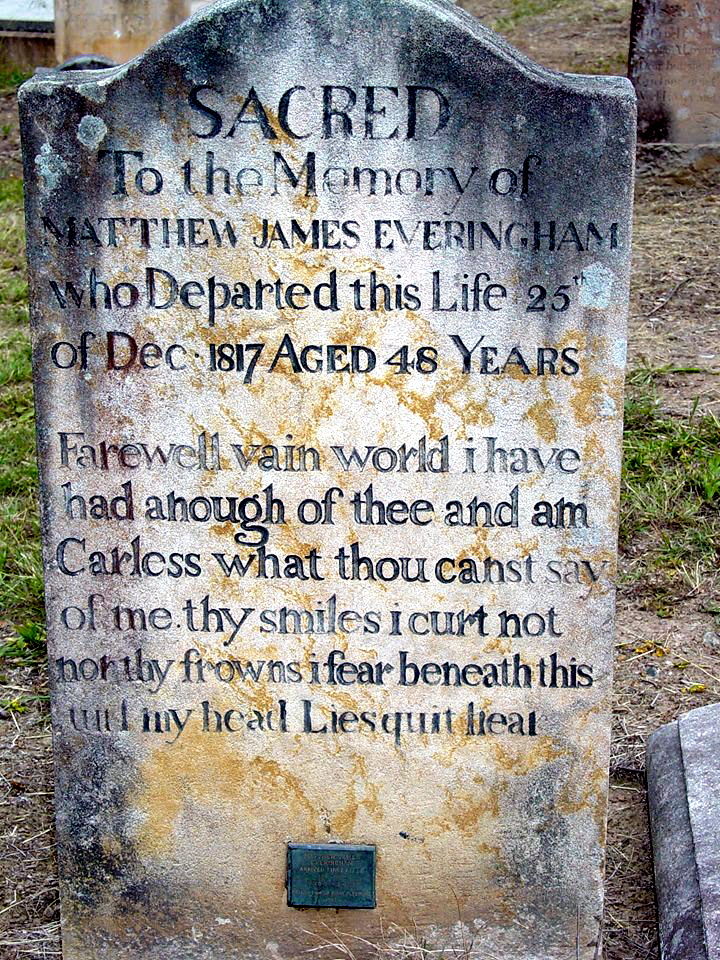
Buried at: ( St John’s Cemetery ) Wilberforce Cemetery, Old Sackville Rd, Wilberforce, NSW
( approx. 600 mts east of the Putty Rd )
Grave Location: right section, Row 7, Plot 20
MATTHEW is NOT mentioned on the Police Wall of Remembrance
The Sydney Gazette dated 3 January, 1818 reported that “On Friday last Mr. Matthew Everingham, settler and district constable at Portland Head, fell overboard from a Hawkesbury boat, and was unfortunately drowned. On the finding of the body an Inquest was convened, who returned a Verdict Accidental Death. He leaves a large family to deplore his premature destiny.”
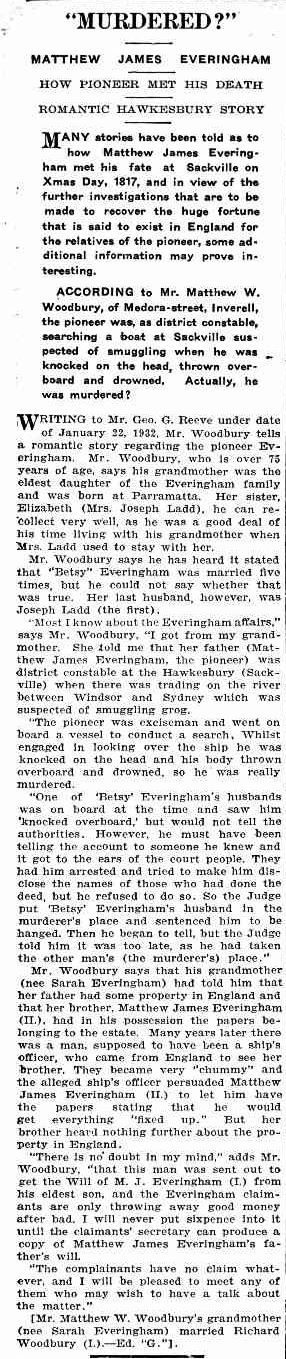
Constable Everingham was still news well over a century after his death. The Barrier Miner of 4 June, 1929 reported the following story.
Matthew James Everingham arrived in Sydney on the ship Scarborough in 1788. In 1791 he was married at Parramatta to Elizabeth Rhymes by the Rev. Samuel Marsden. In the same year he was granted 50 acres of land, then described as “at the Ponds two miles N.E. of Parramatta“. Later he settled on the Hawkesbury River, on the farm afterwards known as Andrew Everingham’s Farm. He also became the owner of land at “Richmond Hills“, believed to be now in the Kurrajong district. He was appointed and remained district constable till his death in 1817. In that year he was drowned in the Hawkesbury River and was buried at Wilberforce, where his grave can still be seen.
At the time of his death the constable was stationed at Portland Head (Hawkesbury).
EVERINGHAM, MATTHEW JAMES (1769-1817), settler, was convicted in London on 7 July 1784 and sentenced to transportation for seven years. Shortly before his conviction he was employed as a ‘servant‘ by an attorney of the Middle Temple, hence the subsequent references to him as ‘attorney’s clerk‘. Allegedly ‘in great distress’ he had obtained two books by false pretences from the servant of another attorney, and these he had offered for sale.
Windsor and Richmond Gazette, NSW. Friday 5 February 1932 page 6 of 12 http://trove.nla.gov.au/ndp/del/page/8914125?zoomLevel=3&searchTerm=Matthew%20James%20EVERINGHAM&searchLimits=
Windsor and Richmond Gazette NSW Friday 21 June 1929 Page 11 of 16
Windsor and Richmond Gazette (NSW : 1888 – 1954),
Friday 23 August 1929, page 7
THE EVERINGHAM FORTUNE?.
NEWCASTLE CLAIMANT
NEWCASTLE has produced a claimant for the Everingham millions in Mr. Ernest Edward Chaseling, who declares that he is a direct descendant of Matthew James Everingham.
He says that his grandmother, Ann Everingham, was a daughter of Matthew. She married John Chaseling in 1818, and his father, Joshua Watford Chaseling, was a son of that union. Mr. Chaseling has two brothers and two sisters.
Matthew Everingham, history tells, was drowned in the Hawkesbury River before he could leave for England to claim £200,000. That was in the early part of last century. Interest on the money has accumulated until the sum of eleven million pounds is said to be now awaiting its rightful claimant.
Mr. John Chaseling, son of Thomas Chaseling I., who married Miss Ann Everingham, one of the three daughters of pioneer Matthew J. Everingham (obit. 1817), is interred, as also is his wife, Mrs. Ann Everingham Chaseling, in the private vault of Matthew James Everingham II., which is situated at ‘Knight’s Retreat Farm,’ near Sackville, on land specially set aside by the will of second Matthew James Everingham as a burial place for any of the Everinghams in descent, or kindred. — “MARMINGA.”
Matthew James Everingham (1769-1817), settler, was convicted in London on 7 July 1784 and sentenced to transportation for seven years. Shortly before his conviction he was employed as a ‘servant’ by an attorney of the Middle Temple, hence the subsequent references to him as ‘attorney’s clerk’. Allegedly ‘in great distress’ he had obtained two books by false pretences from the servant of another attorney, and these he had offered for sale.
He arrived in the First Fleet transport Scarborough and was employed by Assistant Commissary Zachariah Clark. On 13 March 1791 Everingham married Elizabeth Rymes of London, who had arrived in the Neptune on 28 June 1790 and in July he settled on a 50-acre (20 ha) grant near Parramatta. In December Watkin Tench noted that ‘the Attorney’s Clerk’ appeared to find the cultivation of his own land ‘not half so easy a task as he formerly found that of stringing together volumes of tautology to encumber or convey that of his neighbours’; but for once Tench was unjust. Far from being ‘out of his province’ Everingham succeeded as a settler. In 1800 he signed the address to Governor John Hunter setting out ‘the grievous and intolerable burdens’ under which the settlers at the Field of Mars had long laboured; soon afterwards he disposed of his grant to Andrew Hume and like many of the early grantees moved to the Hawkesbury where farming prospects were better. By 1803 he was well established at Portland Head, but in 1804 his home and farm buildings were burned by natives and he, his wife and servant were speared, though happily their wounds were not fatal. In 1816 he acquired 130 acres (53 ha) at Richmond Hill, and became a district constable. A year later, on 25 December 1817, he was accidentally drowned in the Hawkesbury. In a memorial to the colonial secretary in 1825 his widow claimed, apparently without financial result, that he had died while in the execution of his constabulary duties.
Everingham was survived by five sons and four daughters, and was buried in St John’s cemetery, Wilberforce. His career was not spectacular, but over a long period he discharged his duties faithfully and worked steadily as a pioneering settler.
Matthew married Elizabeth Rimes on 13 March 1791 and from that union they had 11 children.
1. Mary (23 December 1791–24 January 1792)
2. Sarah Elizabeth (9 June 1793–29 March 1874)
3. Matthew James (10 May 1795–22 November 1884)
4. William (6 August 1797–6 September 1859)
5. George (9 December 1799–15 April 1881)
6. Ann (7 November 1802–19 March 1849)
7. Elizabeth (10 June 1805–24 June 1879)
8. John Rymes (October, 1806–?)
9. James (25 December 1809–25 July 1895)
10. Maria (6 August 1811–24 February 1835)
11. John (20 July 1814–29 May 1875)
Matthew passed away Hawkesbury River, New South Wales∼
Matthew James Everingham (1768-1817), settler, was born in London on 25? July 1768, son of Joseph Everingham and his wife Mary.
He was convicted in London on 7 July 1784 and sentenced to transportation for seven years.
Shortly before his conviction he was employed as a ‘servant’ by an attorney of the Middle Temple, hence the subsequent references to him as ‘attorney’s clerk’. Allegedly ‘in great distress’ he had obtained two books by false pretences from the servant of another attorney, and these he had offered for sale.
He arrived in the First Fleet transport Scarborough and was employed by Assistant Commissary Zachariah Clark.
On 13 March 1791 Everingham married Elizabeth Rymes of London, who had arrived in the Neptune on 28 June 1790 and in July he settled on a 50-acre (20 ha) grant near Parramatta.
In December Watkin Tench noted that ‘the Attorney’s Clerk’ appeared to find the cultivation of his own land ‘not half so easy a task as he formerly found that of stringing together volumes of tautology to encumber or convey that of his neighbours’; but for once Tench was unjust.
Far from being ‘out of his province’ Everingham succeeded as a settler.
In 1800 he signed the address to Governor John Hunter setting out ‘the grievous and intolerable burdens’ under which the settlers at the Field of Mars had long laboured; soon afterwards he disposed of his grant to Andrew Hume and like many of the early grantees moved to the Hawkesbury where farming prospects were better.
By 1803 he was well established at Portland Head, but in 1804 his home and farm buildings were burned by natives and he, his wife and servant were speared, though happily their wounds were not fatal.
In 1816 he acquired 130 acres (53 ha) at Richmond Hill, and became a district constable.
A year later, on 25 December 1817, he was accidentally drowned in the Hawkesbury.
In a memorial to the colonial secretary in 1825 his widow claimed, apparently without financial result, that he had died while in the execution of his constabulary duties.
Everingham was survived by five sons and four daughters, and was buried in St John’s cemetery, Wilberforce.
His career was not spectacular, but over a long period he discharged his duties faithfully and worked steadily as a pioneering settler.
Birth 12? July 1768
London, Middlesex, England
Death
25 December 1817
Wilberforce, New South Wales, Australia
Cause of Death
drowned
Cultural Heritage
English
Religious Influence
Anglican
Passenger Ship
Scarborough (1788)
Occupation
convict
emancipist
farmer
police officer
Key Events
First Fleet (1788)
settler/indigenous contact
by A. J. Gray
From the Australian Dictionary of Biography, Volume 1, 1966
Constable George was drowned near Parramatta, probably on Friday 30 May, 1816. Little is known of the incident other than the Sydney Gazette article of 15 June, 1816 which reported that Thomas George, a constable of Windsor, was unfortunately drowned near Parramatta during the late inclement season. He left Parramatta to return to Windsor on Friday 13th and was missing until Tuesday last, when his body was discovered in a water course, which it is supposed he had attempted to wade through, but was unhappily foiled in the attempt by the force of the current, which precipitating him into deeper water, every effort to save himself proved ineffectual.
At the time of his death the constable was stationed at Windsor.