1

Samuel NELSON

Samuel NELSON

New South Wales Police Force

Regd. #  ?
Rank:  Constable
Stations:  Moreton Bay, Collector ( 7.5 years )
ServiceFrom  5 August 1857  to  26 January 1865 = 7+ years Service
Awards?
Born? ? 1823 – arrived in N.S.W., from England, aboard the ship ‘ Parsee ‘ in 1855
Died on:  26 January 1865
Cause:  Shot – murdered
Location of Event:  Collector, NSW
Age:  38
Funeral date?
Funeral location?
Buried at:  Grave in the C of E portion of the Catholic and C of E Cemetery, Collector
Grave:  34 54’54S, 149 25’51E
Monument:  34 54’44S, 149 25’53E
[alert_green]THOMAS IS mentioned on the Police Wall of Remembrance[/alert_green]
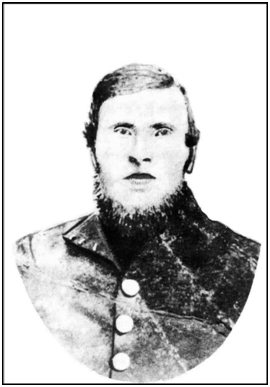
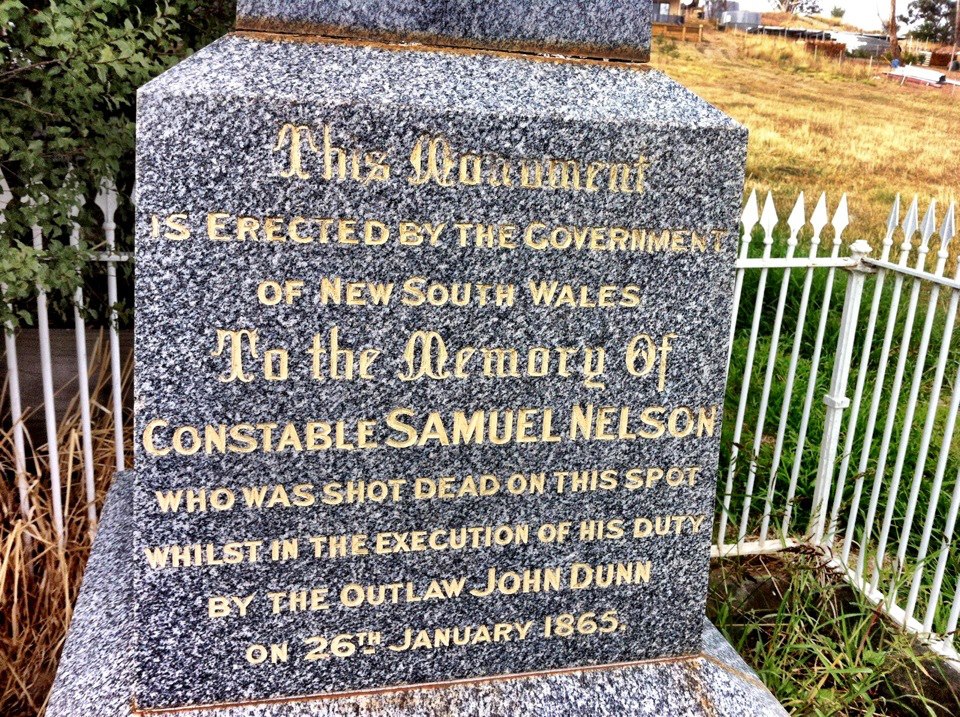
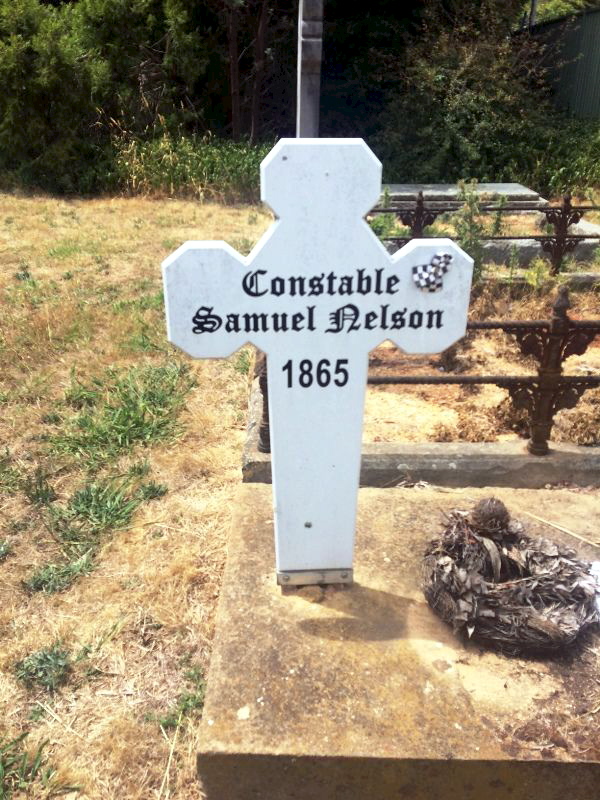
Constable Samuel Nelson ( 1865 )Constable Samuel NELSON - gravestoneShortly before 6pm on 26 January, 1865 bushrangers Hall, Dunn and Gilbert attacked Kimberley’s Inn at Collector. At the time the local police were out searching the area for the bushrangers, and the only man on duty in town was the lockup-keeper, Constable Nelson. When news of the attack reached the constable, he remarked to his wife that he would simply “have to do his best” against the gang. As he approached the hotel, armed only with a police carbine with bayonet attached, the constable was shot by Dunn who had hidden behind a fence post. Nelson was hit in the chest by a shotgun blast and, as he staggered, Dunn fired again, hitting him in the face. He died almost instantly.


The bushrangers then stole the constable’s personal belongings and the carbine, and escaped. The entire incident had been witnessed by young Frederick Nelson, one of the constable’s nine children, who was also fired at by Dunn. Frederick Nelson would later go on to have a long and successful police career himself. Hall, Dunn and Gilbert all met with violent deaths shortly after this incident. Hall and Gilbert were shot dead by police, and Dunn was convicted of Constable Nelson’s murder and was hanged: fitting results for this extremely violent gang of criminals.


Many years after the murder the Australian Town and Country Journal dated 27 November, 1907 printed the following story.


BUSH RANGING DAYS RECALLED.

When Mr. Carruthers, in his capacity of Premier, visited the country some time ago, a spot was pointed out to him at Collector, in the Goulburn district, at which Constable Nelson was shot dead over 40 years ago, while assisting in the capture of the notorious bushranger, John Dunn. The then Premier promised that a suitable monument would be erected to mark the spot, and that has just been completed by Messrs. Ross and Bowman, of Pitt-street. It will be unveiled at an early date by the Treasurer, Mr. Waddell. The Metropolitan Superintendent of Police, Mr. Sherwood, has received a photo of the monument, which stands 9ft 6in high. It shows the stump of what “was at that time a tree near where Nelson stood when he received the fatal wound, and another higher stump behind which some of those held up by the outlaws took refuge. The monument bears the following inscription near the base: “Erected by the Government of New South Wales to the memory of Constable Samuel Nelson, who was shot dead on this spot while in the execution of his duty, by the outlaw John Dunn, January 26, 1865.” On the other side are the words, “In memory of a brave officer”.


The constable was born in 1823 and joined the police force on 5 August, 1857. In 1862 he became a member of the newly-formed New South Wales Police Force. At the time of his death he was stationed at Collector.

[divider_dotted]


Wollongong police memorials


The NSW Police Force carries on its logo the phrase “Proud Traditions since 1862“, but capturing the history of these traditions at an operational level has never been a priority for the force.

However, almost 150 years after it was first formed, NSW Police – and Acting Southern Region Commander Gary Worboys in particular – is using history as a tool to instil pride in those wearing the uniform.

Three memorials for Wollongong police officers who died while serving the community were unveiled at Wollongong Police Station yesterday at a ceremony attended by family members and former colleagues of the deceased officers.

The memorials, located in the hallway of the detectives’ floor, feature images and biographies of the men as well as an account of the incidents that led to their deaths.

The memorial wall was Mr Worboys’ idea, with Senior Constable Dave Henderson given the task of completing the project.

Snr Const Henderson said the project had involved research through police archives, old copies of the Illawarra Mercury and interviews with family members.

Mr Worboys, who will return to his former role as Wollongong Local Area Commander at the end of the month, said he became inspired to record police history during his time as commander of the Goulburn LAC. It was there he heard about a policeman who’d been shot by bushranger Ben Hall’s gang at Collector.

Mr Worboys said research led to the discovery of the grave of the officer, Samuel Nelson, in a cemetery near the police station, but it was found to be an “absolute shambles“.

The grave was restored and distant family members invited to take part in a subsequent ceremony, proving to Mr Worboys the value of history to the police force.

“There is so much history associated with police stations, but as walls get painted and people move on we don’t capture that history.”

“The memorials and the stories they have attached to them provide officers with a link to the past and makes them realise they are not the only ones who have walked these corridors.”

Mr Worboys said the memorials not only represented distinguished service, but the trauma, grief and heartache suffered by families.

He said the last death of a Wollongong officer on duty was in 1969, and he hoped no more stories would be added to the wall: but the memorials were a reminder that policing was a dangerous occupation.

Among those at yesterday’s ceremony were Constable David Reiher‘s father Bruce, and Constable Ray Paff‘s widow Valerie, who described the memorial as “a wonderful tribute” to her late husband.

“It may have been a long time ago. But you never forget,” she said.

https://www.illawarramercury.com.au/story/602982/wollongong-police-memorials/

[divider_dotted]
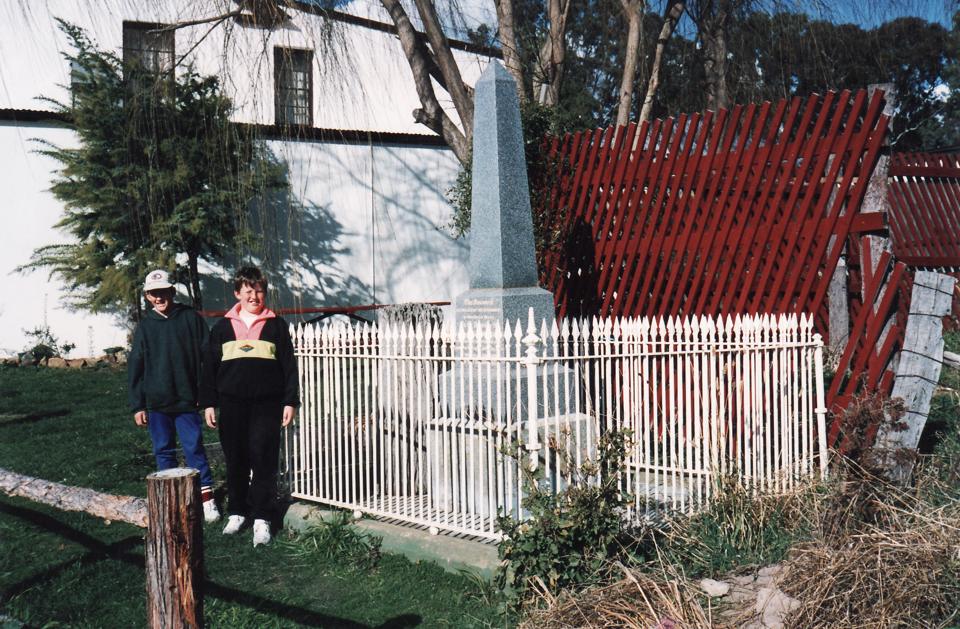


Sam Nelson's monument - 1992
https://www.facebook.com/photo.php?fbid=10151208939806776&set=o.514697128544865&type=1&theater
This is what Sam Nelson’s monument looked like in 1992.  Better then, but it wasn’t looked after very well then or now, by the look of it. Posted on 26 Jan 2013
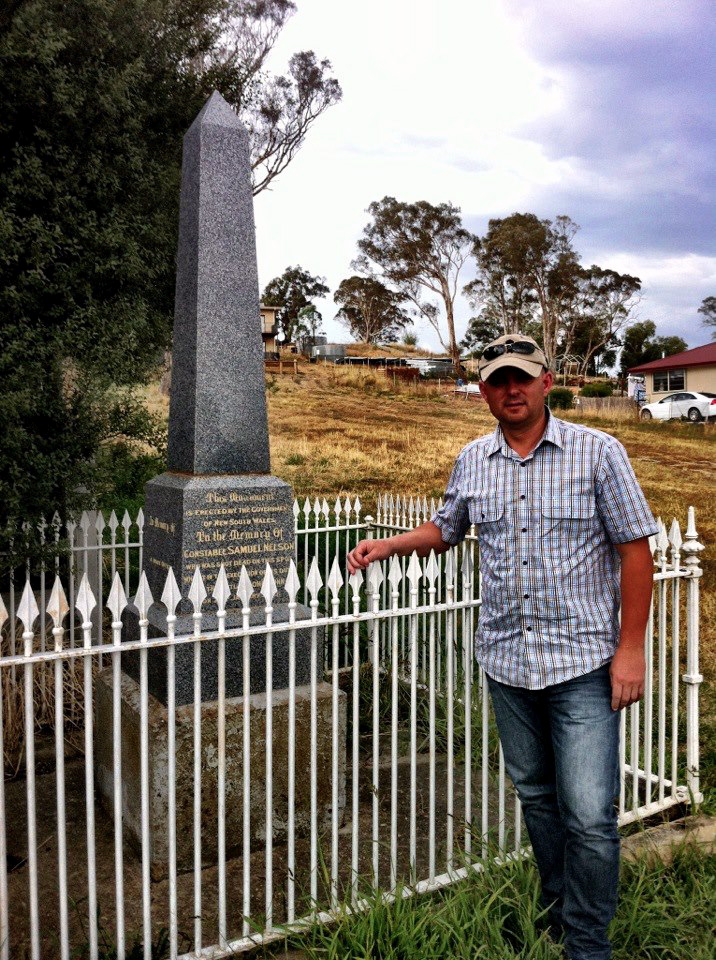
Samuel NELSON & SenSgt Mark ELM

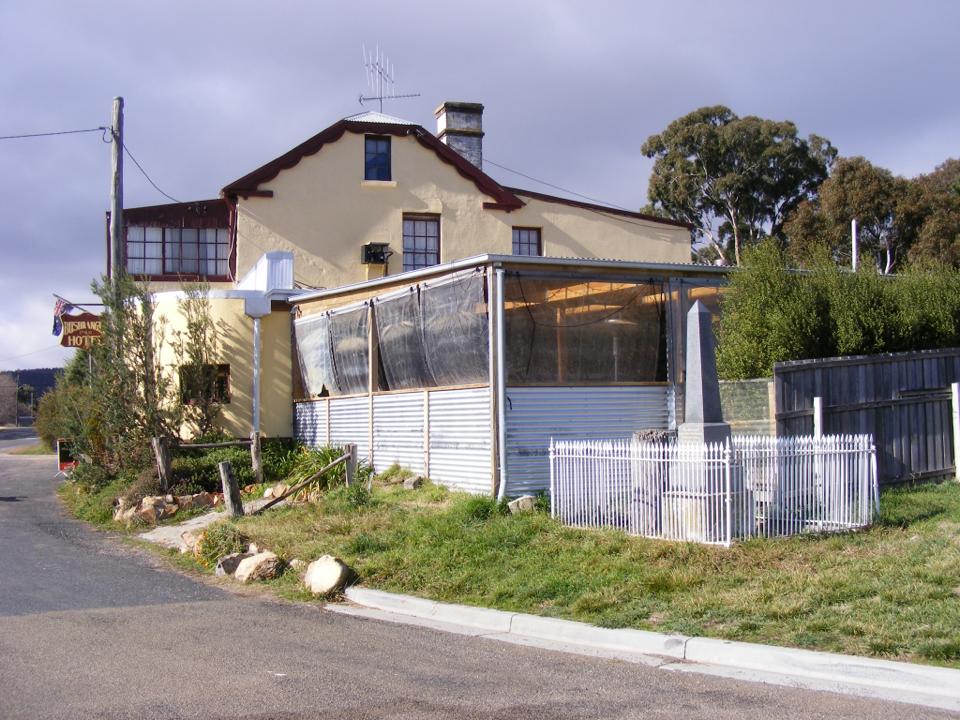
Constable Sam Nelson's monument - Collector NSW
https://www.facebook.com/photo.php?fbid=10151208424886776&set=o.514697128544865&type=1&theater
The Bushranger Hotel at Collector (formerly Kimberley’s Inn) showing Constable Sam Nelson’s monument.  A memorial to a very brave (and probably very stubborn) man. RIP.
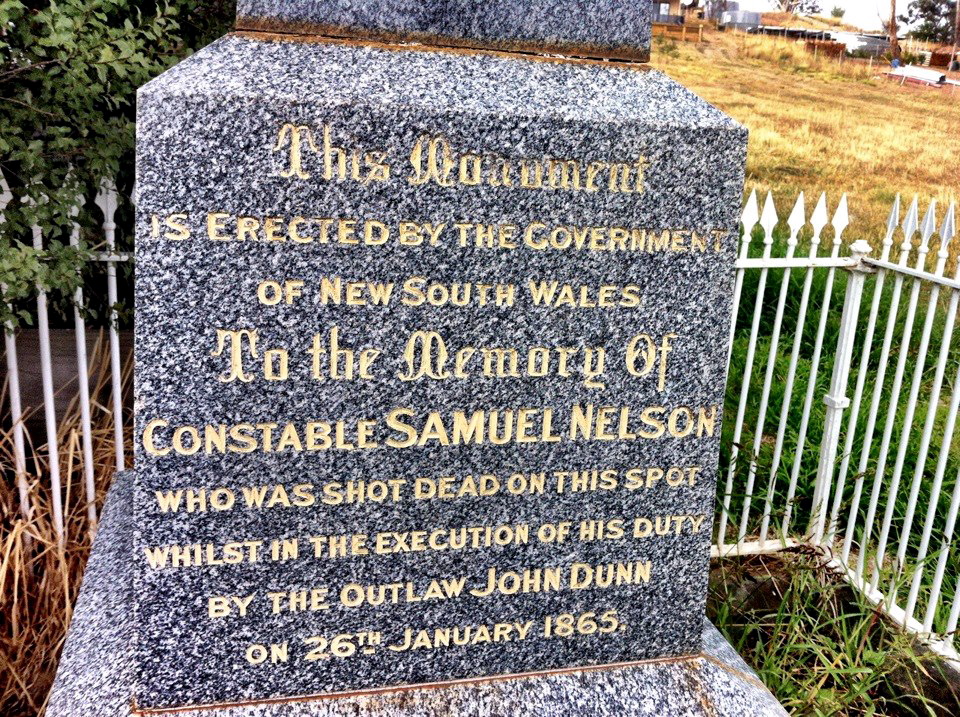
Samuel NELSON
Samuel NELSON – Memorial at the location he was shot.


Samuel NELSON
Samuel NELSON – grave

Grave in the C of E portion of the Catholic and C of E Cemetery, Collector.
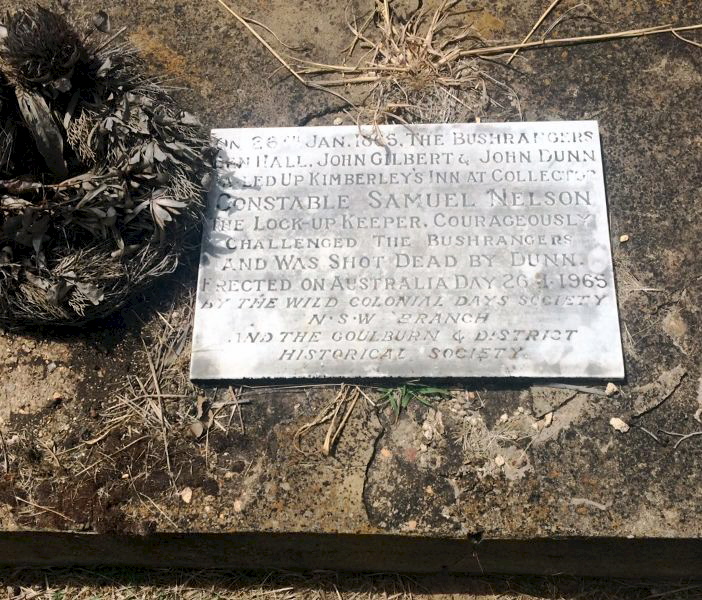
 

Samuel NELSON
The plaque on Constable Nelson’s resting place reads: On 26th Jan. 1865. The Bushrangers Ben Hall. John Gilbert & John Dunn bailed up Kimberley’s Inn at Collector Constable Samuel Nelson the Lock-Up Keeper, courageously challenged the bushrangers and was shot dead by Dunn. Erected on Australia Day 26.1.1965 by the Wild Colonial Days Society NSW Branch And the Goulburn & District Historical Society.

[divider_dotted]
Sydney Mail     Saturday  4 February 1865     page 6 of 12

Inquest on Constable Nelson.  

( From the Herald’s Correspondent. )

On Friday last Dr. Waugh, coroner, held an inquest at Mr. Kimberley’s Inn, Collector, on the body of Samuel Nelson, who was shot by the bushrangers on the previous evening.

The following witnesses were examined : —

Mr. Edwards, who gave similar evidence to that given at the magisterial investigation, and which has been already published.

Maurie Mellan deposed : I am a labouring man, looking for work; yesterday afternoon I was stuck-up by bushrangers and detained till near dark ; I remained at the spot all night and this morning, coming towards Collector, when within about a hundred and thirty yards of this house I found two single barrelled fowling-pieces which had apparently been thrown carelessly down beside a tree ; I gave them to the police ; I believe the bushrangers were Gilbert, Hall, and Dunn.

Constable Bourke deposed that one of those guns was leaded with two balls, the other was not loaded.

Frederick Nelson, aged about eighteen, oldest son of deceased, deposed : I am farming about Collector, and resided with my father, the deceased ; my father was named Samuel Nelson, and was lock-up keeper here ; he was aged about thirty-eight years, and had been in the police force here about seven years and a half, and had previously been in the police force at Moreton Bay ; I had tea with my father yesterday evening, and afterwards went over to Mr. Waddell’s and remained there about half an hour and on leaving I saw my father in constable Bourke’s yard ; he left and walked towards home ; I did not speak to him as he was a good way off ; I had heard that the bushrangers were at Kimberley’s, and went towards there to see if it was true ; on my way I met Mr. Edwards, who told me it was true ; while I was going towards Kimberley’s my father was also doing so, but from a different direction, and got near the house before I did ; when my father got near a fence close by the house, a bushranger sprang from behind the fence and called to my father to stand, and fired immediately afterwards, on winch my father staggered into the road and called out ” Oh! ” the bushranger fired again, and my father fell ; I was inside the fence at this time, and about ten yards from my father; the bushranger called on me to stand, but I ran away, on which the bushranger fired at me, but did not hit me ; it was light enough for me to see, but not to recognise the man who shot my father ; I spread the alarm through the township of what was going on, and after a while my brother came and said that the bushrangers had gone, on which I went up to Kimberley’s and found my father’s body had been taken inside the house ; he was quite dead ; while this took place my brother was compelled to hold the bushrangers horses outside Kimberley’s house, having before this been compelled to march there, a distance of three miles ; when my father fell I heard his carbine fall from his hands on to the ground.

Dr. Hanford deposed : I have made a post-mortem examination of the body of the deceased ; on examining the body externally, I found a bullet wound midway between the nose and the ear on the left side of the face ; also a wound, two inches long and two and a half inches broad, on the left side of the chest, and twenty shot marks round the wound ; the wound took an oblique direction downwards   ; the stomach was protruding through the opening ; on examining the cavity of the chest, I found the heart lacerated to the extent of one and a half inch at the anterior and lower half towards the left side; the remaining viscera wore healthy ; on examining the abdomen, I found several shots in the liver, and a portion of a wire cartridge with several shots in it, which I produce ; the shots correspond with those I have just taken from a wire cartridge given to me now; the stomach was perforated, but the other viscera were healthy ; the fifth, sixth, seventh, and eighth ribs on the left side were fractured; the brain and membranes were uninjured ; the ball most probably, passed into the deep muscles of the neck, as I could not trace its course ; death resulted from the wound I have described and no other cause.

Elizabeth Nelson, widow of the deceased, deposed : Yesterday evening I got word that the bushrangers were at Kimberley’s ; deceased was out but was speedily found, ran home, put on his belt, took his loaded carbine with the bayonet on it, and left the house saying, ” now, I am just going to do my best ; ” I did not again see him alive.

Thomas Kimberley gave evidence to that a already published, and added : The bushrangers brought down from upstairs and took away two single-barrelled fowling-pieces, both loaded with cartridge ; the guns now produced are the same ; the bushrangers took from me property to the value of about £26, consisting of boots and men’s and boys’ clothing, and a six-barrelled revolver ; directly after they went away some of the people who had been brought here or stuck-up by them, went to deceased and found him quite dead ; I have examined the place where deceased was found, and ascertained that it is about twenty yards from where the bushranger stood when he fired.

Thomas Mensey, a bootmaker, deposed to having been stuck up by three bushrangers and kept in custody till nearly dark ; afterwards returned to Mr. Kimberley’s, when he met the same parties within a hundred and fifty yards of the house ; believed them to be Ben Hall, Gilbert, and Dunn ; at Kimberley’s was told the bushrangers had just left.

Eliza Mensey, servant at Kimberley’s, deposed: I was here yesterday when the house was stuck-up by bushrangers ; I went upstairs with one of the bushrangers with the keys to open the drawers; he remained there a few minutes and conversed with me ; he told me his name was Hall, and that the man outside on guard was Dunn ; I was standing on the step outside the front door when the shot was fired ; the man who fired the shot was the man Hall called Dunn.

The jury returned a verdict that deceased was wilfully murdered by John Dunn, and that Benjamin Hall and John Gilbert were aiding and abetting. The jury added a rider strongly recommending the family of the deceased to the favourable consideration of the Government.

[divider_dotted]


Sydney Morning Herald, 28 January 1865, p 7

Nelson, Samuel (1827–1865)

Goulburn correspondent:—Yesterday Hall’s gang stuck up about thirty pcrsons on the road, taking from them various amounts, from half-a-crown to £11 12s. Twelve drays were stopped. The robbers broke open cases, took a little clothing, and a double barrel gun. They drank bottled porter, and gave some to the people. Two watches were stolen, one horse, saddle and bridle. Judge Meymot passed along the road just before escorted by two troopers, Gilbert rode out from the bush, and constable Gray gave chase, but was called back by the Judge. The police on reaching Collector, were joined by two others, and accompanied by Mr. Voss and a magistrate, went in search of the bushrangers. After they had gone, Hall, Gilbert and Dunn, went into Collector and stuck up Kimberley’s Inn. On this reaching the ears of the lock-up keeper, Samuel Nelson, who was the only policeman there, he took his carbine and went up towards Kimberley’s. Dunn met him on the road, called upon him to stand, firing at the same instant. Nelson cried out “stop,” and fell. Dunn fired again. Both shots took effect, one on the head or neck, the other in the heart. Nelson never spoke after receiving the second wound. After he committed this murder, Dunn went to Kimberley’s Inn, and the bushrangers left the township. Subsequently the police sighted them on the brow of a hill and charged them, the bushrangers leaped their horses over logs and made off, and were lost sight of, the evening being intensely dark. They abandoned a stolen horse.

Mr. Voss held a magisterial inquiry on the body of Nelson last evening, and the coroner held an inquest to-day.

Nelson had been in the police force for some years, and was much respected. He leaves a wife and eight children. Two of his sons saw him shot; one was holding the bushrangers’ horses at the time.

The outrages by Hall’s gang cause great excitement here.

http://oa.anu.edu.au/obituary/nelson-samuel-1513


[divider_dotted]

Goulburn, January 28th.

We have been kindly favoured with the following extracts of a letter from Mr. District Judge Meymott to his brother. Dr. Meymott. It bears date, Gunning, January 28th, and the writer says : —

I am thankful to be able to tell you that I have arrived safely at this place, about halfway between Goulburn and Yass. But though my journey from Goulburn has been safe, it has not been without adventure.

I left Goulburn about eleven forenoon, on Thursday, the 26th, escorted by two mounted troopers, one in advance, and the other immediately behind my carriage. I came by way of Collector, partly to visit Mr. Murray and partly in hopes of avoiding the bushrangers who were known or believed to be between this place and Goulburn. However instead of avoiding them, I fell in with them.

After having journeyed about eighteen miles, we had to descend rather a long hill winding through thickly wooded country. At the bottom of the hill was open country, and a lagoon called Rose’s Lagoon on the left ; on the right, rising hills highly timbered near the base, but increasing in thickness of bush towards the top, where it became dense forest. When near the lagoon, the trooper in advance galloped on towards the hill on the right, making signs to the man behind to follow, which he very soon did, and away they went at high speed up this hill. I drove gently down towards the lake, and, on nearing it, I saw eight or ten people under a tree near the water, about fifty yards off the road, and two drays and a cart, and several horses. I drove up to them and found they had been there, some two or three of them, since six in the morning (it was then past two), having been stuck-up by Ben Hall, Gilbert, and Dunn ; the number of persons stuck-up increasing as the day wore on.   The spokesman told me that the ruffians had only a short time before lit a fire and ordered him to make tea for them, and they were about to have a meal (other prisoners being found in the cart) when Dunn who was on the look-out, spied my advance guard through the trees about half a mile off, and called out ” Here’s a —   trap! ” Gilbert said, ” If there’s only one let’s face him. ” Directly afterwards, my carriage and the other trooper coming in sight, Ben Hall said, ” No, there’s more of them, let us be off. ” So saying, they leaped on their horses and galloped away as hard as they could up the hill I have described, and it was on my advance guard seeing them in the distance, that he put spurs to his horse and made towards that hill.

A few moments after I had joined the bailed-up party, my troopers returned, having lost sight of the bushrangers in the thickness of the bush. When the police     heard who the men were, for they did not and could not know before (especially as they were fully a mile ahead when the trooper first saw them), they were desirous of going in pursuit. Mr. Voss, a magistrate, came up at that time, and, after a little consultation, it was thought best for us to come on to Collector. So we parted from the captives, who were very glad to be released, and came on to Collector, Mr. Voss, with what force he could collect, intending to go in pursuit of the bushrangers, and myself proceeding onward to Mr. Murray’s, about a mile and a half farther, which I reached in safety shortly after four o’clock.

But the exciting events of the day we not yet over, the worst part remains to be told. About eight o’clock in the evening, Mr. Edwards (Mrs. Murray’s brother), came in with the news that the highwaymen had been in to Collector, and had robbed one or two stores, and that while Hall and Gilbert were in a public-house and store kept by Mr. Kindesley, or some such name, (Dunn watching outside,) a policeman was seen to approach, and Dunn shot him dead on the spot. The gang then made off from the place, and, according to rumour, fell in with Mr. Voss and his party. Some shots were exchanged, and the thieves escaped, minus one horse, saddle, and bridle, which are now in custody of the police at Collector.

Mr. Edwards also said he had heard that before leaving Collector, the robbers had been heard to state that they meant to visit Mr. Murray’s.

This news, of course, created some excitement, but I am pleased to say, no weak, foolish fear among the household.

All the available men and arms were, as speedily as possible, collected, the entrances secured, and watch was kept   by turns all night. About ten yesterday, the police came to Mr. Murray’s, to escort me onwards ; but as the bushrangers were still hovering about in the neighbourhood, I thought it best not to take away two out of the three policemen in the place, and that it was much better for them to stay where they were, in case their services might be needed. So we kept watch, and were all day under arms at Mr. Murray’s, and the police kept a good look-out about the town ; but all remained quiet.

This morning I heard of one report, that the gang had come on this way with the determination of attacking me for interfering with them the day before; but another report seemed to be more likely to be correct, viz. that they intended to waylay me and see me safe on the road for some miles with the police, and then to go back and finish robbing the town.

I left Mr. Murray’s about 10.30 a.m. with the two troopers and a civilian who was coming this way, and arrived here in safety. We met two villainous looking fellows on the road, whom the senior constable (Bourke) questioned, but could elicit nothing from them. They were doubtless Ben Hall’s scouts, and I think it very possible these fellows would soon have told Hall that I had passed on and that the gang would return to finish their work at Collector. If they do, they will meet with a warm reception, for special constables have been sworn in, and everybody round is prepared to give them battle.

[divider_dotted]
Queanbeyan Age and General Advertiser     Thursday  29 March 1866     page 4 of 4

EXECUTION OF JOHN DUNN FOR THE MURDER OF CONSTABLE NELSON.

(From the Empire.)

John Dunn, the notorious bushranger, paid the penalty of his misdeeds yesterday morning, upon the scaffold inside the walls of Darlinghurst Gaol.

At 9 o’ clock precisely the death-bell tolled, and the prisoner, attended by the Revds. Fathers Dwyer and McCarthy, came forth pinioned from his cell. These reverend gentlemen had been with him since eight o’clock, and it is satisfactory to know, that since his conviction he received their ministrations, and those of   the Sisters of Charity, with sincere good will.

As they walked towards the scaffold the prisoner repeated in an audible voice the prayers after the Rev. Father McCarthy. Owing to the wound received at his capture, the unfortunate man limped along painfully, but still he bore himself bravely up, and appeared as cool and collected as any of the spectators. At the foot of the scaffold, Father McCarthy bade him adieu, and he dragged himself up the ladder, accompanied by the Rev Father Dwyer, who remained with him to the latest moment. When the rope was adjusted round his neck, he still continued to pray, and his lips were moving when the white cap shut out from him the crowd who faced him and the bright sunshiny morning. At this time, when only a moment intervened between him and death, he clasped his hands together, and not a quiver or tremor of the limbs betokened that he was afraid to die. He died indeed like a penitent Christian, without fear, and without bravado.

His death, owing to the length of rope allowed him, was instantaneous. As he hung suspended, he was absolutely motionless, and it is most likely, from the absence of nervous or muscular contraction, that the spinal marrow was completely disjointed. After hanging the prescribed time, his body was cut down, put into a coffin provided for him by his godmother, Mrs Pickard, and then carried to the hearse outside the gaol walls, where it was received with wailings and moanings from a great number of women collected there. Mrs Pickard, with the dead man’s brother and his uncle, followed the body in a mourning coach, which proceeded to the Catholic burial ground, near the Railway Station. The rites of the church having been duly performed, the body was interred amidst the tears and groans of a very motley lot of people, old women prevailing, the majority of whom seemed to have but little regard to the precept of the Apostle, that, “Cleanliness is next to Godliness;” and so ended the career of the youngest of Frank Gardiner’s gang.

Dunn, in conversation with the gaol authorities, attributed his fate to Gilbert and Ben Hall’s “Old Man ” who pursuaded him to leave his parents roof for a lawless and murderous life.

When he was received into the gaol he was in very bad condition, owing to the hard life he had led in the bush, and the suffering produced by his wound. He then weighed only 9 st. 6 lbs., but yesterday he weighed 10 st 8 lbs., thus showing that regular food and a resigned mind are conductive to health. Those who saw him at his trial were struck by his greatly improved appearance yesterday.

A day or two before his execution he wrote a letter to the governor of the gaol, and thanked him for his kindness and attention, and also to Mr Carroll, a warder, who was his chief attendant for a fortnight. On Sunday he was engaged up till midnight in religious duties. He then went to bed, and slept soundly till half past 6, when he rose, washed himself, and ate a hearty breakfast, and concluded his last meal with a pipe of tobacco. He then gave himself up entirely to the priests, from whose ministrations he derived great consolation; and he asked Father John to “stand close to him till the last moment.” He made no regular confession to any of the officials, nor did he deny his guilt.

An unusually large number of people assembled to see him hanged, and amongst them was a man who came from Windsor for that purpose. The spectators, amounting to about seventy, were deeply impressed with this last act in the career of Dunn.

We learn from reliable authority, that Dunn was born December 14th, 1846. His mother was in the service of Mr James Manning, brother of Sir William Manning, and was married to Dunn’s Father at the age of seventeen. Mrs Pickard, who is the wife of Mr W. P. Pickard, storekeeper to Mr Keele, merchant, was present at Dunn’s birth, and became godmother to him. She had a special order from the Colonial Secretary to visit the condemned criminal, and we understand she called to see him daily. She may be truly said to have behaved like a mother to him, and to have acted like a noble, kindhearted, good woman. When Dunn   joined the bushrangers, his father rode in search of him in the hope of rescuing him from an evil life but his horse died from over-exertion, and he was compelled to return home from his unsuccessful search.   Dunn’s parents are settled on a small farm and are in poor circumstances.

[divider_dotted]
Queanbeyan Age ( NSW )     Tuesday  7 April 1914     Page 2 of 4
Obituary.  
MRS. ELIZABETH NELSON.
MRS. ELIZABETH NELSON, relict of the late Constable Samuel Nelson, of Collector, died at her late residence, Goulburn, aged 85 years, the cause of death being senile decay.
She leaves three daughters and five sons, also 44 grand children, 14 great grand children, and 5 great great grand-children.
The funeral took place on Thursday morning at half past 10 o’clock.
The late Constable Samuel Nelson was shot by Bushranger Dunn at Collector on 16th January, 1864. He was aged 40 years, and left a widow and eight children.
The story of the bailing up of the township of Collector by the notorious bushrangers, Ben Hall, Gilbert, and Dunn, on the evening of January, 26 1865, is well-known to the older residents of the district.
The bushrangers took charge of the Commercial Hotel and store at one end of the town, conducted by Mr. and Mrs. T. Kimberly. A little girl brought word to Nelson that the bushrangers were at Kimberly’s. Though advised not to go near them single handed, the brave fellow, arming himself with his carbine, said his duty commanded him to go. Dunn, who was in front of the hotel on seeing Nelson approach shot him as he stood behind a post. The constable staggered and fell, whereupon Dunn killed him outright with another shot. Dunn was after wards caught, found guilty, and hanged.
[divider_dotted]
Samuel was also the father of Jonas Goode NELSON – NSW Police – Mounted Constable who died in 1924 aged 72.
[divider_dotted]
19 February 2014
Travelled across from Gunning to Collector yesterday and checked out the monument to Samuel Nelson and his grave.
GPS Co-ordinates
for grave 34 54’54S/149 25’51E
for monument 34 54’44S/149 25’53E
Page 48 in Beyond Courage
[divider_dotted]
Canberra Times
January 16, 2015

Hall gang re-enactment in Collector for 150th anniversary

Tim the Yowie Man takes a look at Collector’s Wild Colonial Day over the Australia Day long weekend. A re-enactment will commemorate the 150th anniversary of the Hall gang’s hold-up, which resulted in John Dunn killing Constable Samuel Nelson.

  • Tim the Yowie Man

It’s the murderous event which put the village of Collector on the map. On  January 26, 1865, outlaw John Dunn shot dead Constable Samuel Nelson outside the Kimberley Inn while his partners in crime, the notorious Ben Hall and Johnny Gilbert raided the hotel.

The brave Nelson, on being informed that the Hall Gang  was in town, had earlier marched defiantly from the nearby police station towards the hotel with the aim of stopping the infamous mob of bushrangers in their tracks.
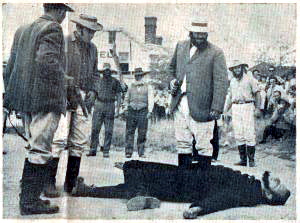
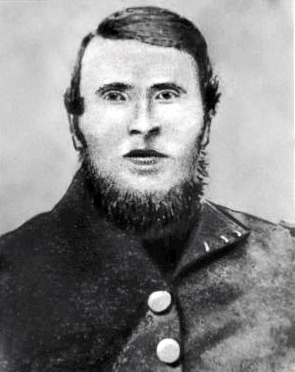
Scan of photo from The Canberra Times of the re-enactment at the 100th anniversary of the shooting of Constable Nelson (played by Edgar Penzig) by bushranger John Dunn (played by Chris Woodland) on January 26, 1965. (Photo: Courtesy Chris Woodland) Collector re-enactment 2 CT.jpg Photo: Chris Woodland

Constable Samuel Nelson (date unknown and thought to be damaged/altered from the original). Photo: Boyd Trevithick Collection


Next Sunday, to commemorate the 150th anniversary of the dramatic hold-up, a Wild Colonial Day is being held in Collector in which descendants of both Nelson and the Hall Gang  will converge on the town.

One of the most anticipated highlights of the day is the planned re-enactment of the tragic events of January 26, 1865. Although playing out such a momentous event in our region’s history will be no doubt be entertaining for the crowd, I don’t envy the performers of the Gold Trails Re-enactment Group who will need to settle on an agreed sequence of events that unfolded on that fateful day in 1865, the exact details of which appear to have been lost in the mists of time.
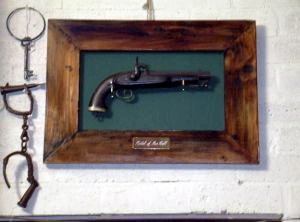
This pistol, which supposedly once belonged to bushranger Ben Hall and held pride of place on the wall of the Bushranger Hotel late last century, but has since gone missing. Photo: Tim the Yowie Man

One person who has spent months poring over the evidence is Boyd Trevithick, Nelson’s great-great-grandson. In doing research for his family history book, Believe Nothing That You Hear and Only Half of What You See: a compilation of sundry articles, facts, photographs, maps, poems and family anecdotes dating back to 1087AD, (self-published, 2011) Trevithick reports he was “constantly confronted with conflicting accounts”.

“Discrepancies exist as to precisely where John Dunn stood to shoot, what course Nelson took, the distance from which the shooting occurred, the times of the day, the words uttered, whether Nelson staggered forwards, backwards or towards the road and where exactly Nelson fell,” explains Trevithick.

Trevithick isn’t the only one to have struggled to provide a definitive account of the details leading up  to Nelson’s death. Respected historian, the late Stuart Hume, whose widely lauded article  published in the Goulburn Evening Post on January 26, 1965, to commemorate the 100th anniversary of Nelson’s death, wrote “to try and get an accurate account of what actually did occur is to find the wayside strewn with garbled, highly coloured accounts from old hands who’d ‘heered telled’ arguments from bush lawyers with a misguided sympathy for the bushrangers and bush balladists using poetic licence to cover a multitude of sins”.

Two of the most contentious issues concern what have subsequently become Collector landmarks – first, a rotting wooden stump standing next to the Bushranger Hotel, and second, Nelson’s final resting place.


1. Stumped

Trevithick reports that his “family members have handed down two versions of the role the stump played in events of 26 January 1865,” and he cites the following references to illustrate these disparate accounts.

The Queanbeyan Age (11/2/1908) reports “… The railing encloses the stump near which Nelson stood when he received his fatal wound.” Meanwhile, The Sydney Morning Herald (10/2/1908) reports “. Inside the railing [of the memorial] is one of the posts of the fence behind which Dunn concealed himself on approach of the Constable …”
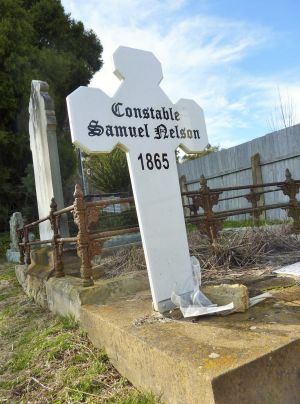
The final resting place of Constable Nelson, or is it? Photo: Tim the Yowie Man

Regardless of the significance of the stump, cynics have questioned whether it’s plausible that a 150-year-old stump could still be standing, suggesting that perhaps the stump isn’t the original from 1865 and, is, in fact, a ‘replacement’.

The Bushranger Hotel. Photo: Colleen Petch

2. Grave diggers

Nelson died during the height of summer and with no morgue within cooee of the Collector, Hume reports, “research indicates that he was hastily buried without the aid of a minister in the grounds of the police station [still operational] … over the grave they struck a willow stave which grew, and, in the course of time, only the willow wept there”.

“Although there is currently no marked grave in the grounds of the police station, some old-timers did recall a willow growing there mid last century,” reports life-long local Gary Poile. However, the precise location of the willow may be a moot point for those who wish to pay their respects to the slain police officer, for it appears that Nelson was unlawfully exhumed  about 50 years later.

Hume reveals that “just after World War I someone decided to remove Nelson’s remains from the Police Station without an exhumation order or permission from the family”. “Not knowing exactly where Nelson lay…they sank several ‘duffers’ till they struck paydust in the shape of the constable’s bones. These they reverently gathered and crawling through a hole in the dividing fence put them in a grave alongside the Kimberleys [in the neighbouring cemetery].”

According to Hume, with the public becoming more history conscious, some years later a cross was  placed on the freshly dug unmarked grave in the cemetery and inscribed “Constable Nelson 1865”.

Neither Hume (nor Trevithick) uncovered the identity of those who allegedly moved Nelson’s bones, nor their motives. Trevithick hypothesises that it may have been “so that Nelson was buried in consecrated ground”.

While snooping around Collector this week I bumped into a couple of bushranger-era enthusiasts who questioned whether Nelson’s remains were moved at all. The duo suggested that a ground-penetrating radar, or perhaps something even more invasive, ought to be employed to prove the presence of remains.

I don’t know about you, but I think poor old Constable Nelson suffered enough trauma in the final moments of his life and that he should be left to lie in peace, wherever that may be.


Fact file

Collector Wild Colonial Day: Commemorating the 150th anniversary of the day Constable Samuel Nelson was killed on duty by John Dunn outside the Bushranger Hotel. Next Sunday,  January 25, from 10am–4pm in Collector Village (about a 30-minute drive north of Canberra on the Federal Highway). Free admission.

Expect: Historical displays, re-enactments, bush poetry, author talks, food, wine, local produce, art and craft. Devonshire tea and all day barbecue.

For the kids: Horse and cart rides, face painting (small charge) and bushranger activities (if you dare!) all day.

Shoot-outs: The Gold Trails Re-enactment Group will perform a realistic re-enactment of the murder of Constable Nelson at 3pm near the Collector Police Station (Bourke St) and again outside the Bushranger Hotel (Church St) about 6pm.

Become a star: At midday, there will be a re-enactment of the trial of John Dunn, including an opportunity for “extras” to participate (scripts will be provided).

Don’t miss: The rare collection of guns and equipment used by bushrangers and police during the colonial period (in the Memorial Hall).

Nelson’s Grave: Located in the Anglican Cemetery in Bourke St.  About 3.30pm, the NSW Police Chaplain will lead a graveside Memorial Service, followed by a wreath-laying ceremony.

The stump: Takes pride of place next to Nelson’s Memorial outside the Bushranger Hotel. Unfortunately, there’s precious little information on the state of the stump in 1865, so it’s difficult to determine if it’s the original. However, if any suitably qualified foresters would like to offer an educated opinion, I’d love to hear from you.

More: www.facebook.com/Nelson150 or ph: 0423 672 153


[divider_dotted]


Canberra Times
January 27, 2015

Gang-gang: 150 years ago – Constable Samuel Nelson shot in Collector

  • Ian Warden

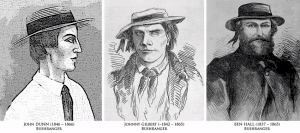
The bushrangers (left to right) Dunn, Gilbert and Hall

One hundred and fifty years ago this week the brigands Ben Hall, John Gilbert and John Dunn descended on Collector and Dunn shot dead brave constable Samuel Nelson. The gang fled. The Sydney press throbbed with the news. The murder was on 26 January and the inquest, held at Collector the next day, was reported in great and grisly detail by the Sydney Morning Herald. 

Frederick Nelson, 18, eldest son of the dead man’s many children, saw his father shot dead.

” ‘A bushranger sprang from behind the fence and called to my father to stand, and fired immediately afterwards [with a shotgun], on which my father staggered into the road and called out “Oh!”. The bushranger fired again and my father fell. I heard his carbine fall from his hands on to the ground.

“Dr. Hanford deposed: I have made a post-mortem examination of the body of the deceased; I found a bullet wound midway between the nose and the ear on the left side of the face; also a wound, two inches long and two and a half inches broad, on the left side of the chest, and twenty shot marks round the wound; on examining the cavity of the chest, I found the heart lacerated … I found several shots in the liver … the stomach was perforated. Death resulted from the wounds I have described and no other cause.

“The jury returned a verdict that deceased was wilfully murdered by John Dunn, and that Benjamin Hall and John Gilbert were aiding and abetting.”

http://www.canberratimes.com.au/act-news/canberra-life/ganggang-150-years-ago–constable-samuel-nelson-shot-in-collector-20150126-12yg5f.html

[divider_dotted]


The New City of Canterbury Bankstown

Samuel Nelson
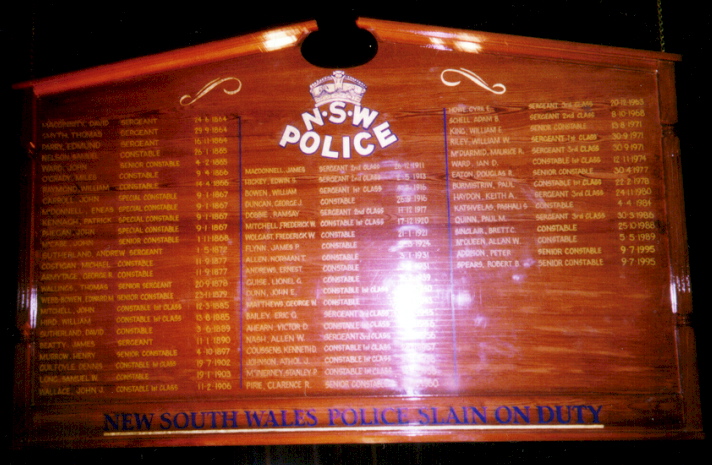
NSW Police Slain On Duty

Samuel Nelson was born in 1828 in Chesterton, Oxfordshire, England. His Father was Samuel Nelson and mother Elizabeth Taylor. In England he married Elizabeth Goode who was born in 1828.[1]

They came on the ship called “Parcee” and arrived in Sydney on 11th January 1853. Samuel and Elizabeth could both read and write. They came with their three children who were born in England, Fredrick 6 years born 1846, Henry 1848 4 years, Jonas 2 years 1850. While the ship was at sea Elizabeth Nelson gave birth to Matilda Parcee Nelson. The ship anchored in Sydney and then proceeded to Queensland.[2]

Samuel Nelson worked at Drayton Darling Down’s then made his way to Collector N.S.W. which is between Canberra and Goulburn. Four more children were born at Collector Emma born 1857, Samuel 1860, David 1862 and Thomas 1864.

It was on a Thursday, Foundation Day 26th January 1865 in the country town of Collector, when the team of bushrangers, John Dunn and his group, were spotted in the District. They had bailed up Judge F.W. Meymott and two escorting troopers at Geary’s Gap a few miles south of the town. The gang of bushrangers were almost on the outskirts of Collector, when they bailed up a bootmaker named Tom Menzy; three farmers named Mitchell and William Deveron and James Bull; and a 16 year old boy named Henry Nelson – the constable’s son.

At the police station Constable Samuel Nelson was studying his day’s labour. He had chopped a good supply of wood and his gardens were in fine shape. He was looking forward to cleaning up a hearty supper and a quiet evening with his family, including his wife who was eight months pregnant with their ninth child. Suddenly, a young girl came running towards him calling “Mr Nelson come quickly the bushrangers are at the Kimberley’s Inn”, then shots from Dunn’s gun were heard.[3]

Samuel Nelson entered the station and put on his uniform, jacket and belt while Elizabeth his wife looked on in surprise. At the trial of Dunn, Kimberley’s Inn Keeper said “John Dunn came back from direction and said there one of your bloody are down”. When somebody asked who was shot Dunn said “a little sandy bugger”. Kimberley replied “I felt sure it was Nelson knowing he was a short sandy man”.

Some of the other people brought in the dead body of Constable Samuel Nelson who had a wound on his cheek and a large wound over his heart. Fredrick Nelson was fired upon by the accused. Henry Nelson was forced to hold the estranger’s horses under the threat of having his brains blown out.[4]

The trial of John Dunn on the 19th February 1866 jury returned the verdict of guilty, the sentence of John Dunn was to be hanged by the neck till he was dead. On the 19th March 1866 the 19 year old murderer was taken from Darlinghurst to the place of execution and was hanged.

http://www.canterburycommons.net/index.php?title=Samuel_Nelson

[divider_dotted]
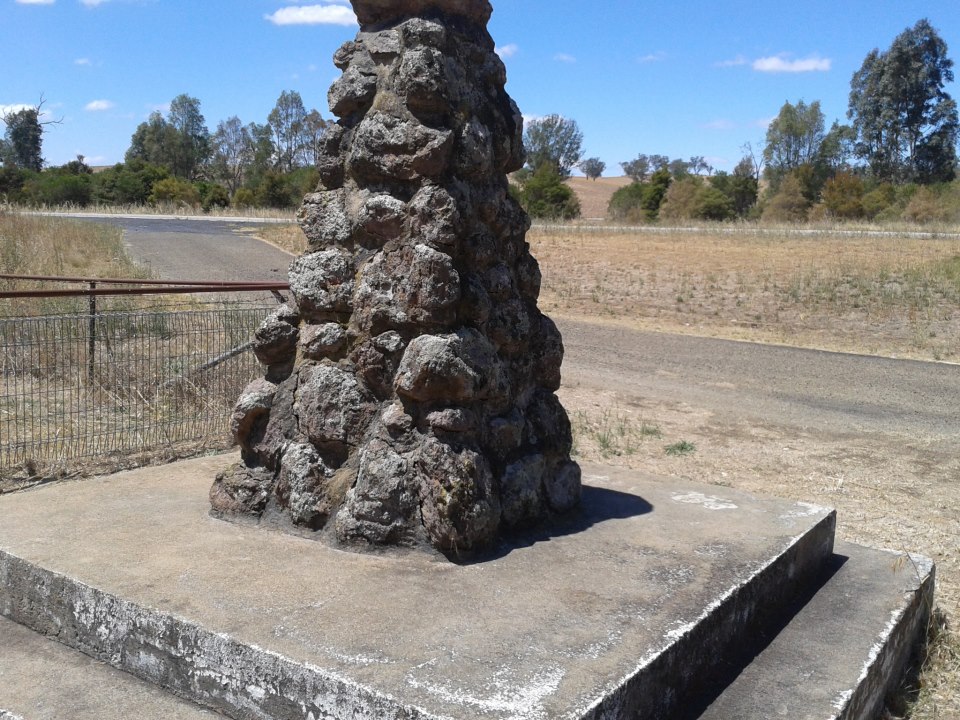


Edmund PARRY

Edmund PARRY

New South Wales Police Force

New South Wales Detective Force

Regd. #  ????

Rank:  Sergeant

Stations?, Gundagai

ServiceFrom 5 May 1862  to 16 November 1864 = 2+ years Service

Awards?

Born? ? 1832

Died on:  Wednesday  16 November 1864

Cause:  Shot – Murdered

Event location:  Jugiong

Age:  32

Funeral date: Saturday  19 November 1864

Funeral location

Buried at: Gundagai Cemetery

( GPS:  Lat: -35.051389
Long: 148.111944 )

Memorial location:  Old Hume Highway (Riverside Drive) , Jugiong Memorial Park, Jugiong, 2726

( GPS:  Lat: -34.823664
Long: 148.326496 )

 Located on the north bound lane of the Hume Hwy near Jugiong.
Located on the north bound lane of the Hume Hwy near Jugiong.


EDMUND IS mentioned on the Police Wall of Remembrance

On 16 November, 1864 Sergeant Parry ( Gundagai ), Sub Inspector O’Neill ( Gundagai ) and Constable Roche ( Yass Police ) formed the mounted police escort for the Gundagai mail coach on its journey to Yass. Roche was seated beside the coach driver, Gundagai Police Magistrate Mr Rose was inside the coach and Parry and O’Neill followed on horseback. Shortly before 3pm as the coach approached the township of Jugiong, the escort was attacked by bushrangers Hall, Dunn and GilbertSub Inspector O’Neill closed with Dunn and Hall and when he had emptied his rifle he hurled the weapon at Hall, striking him on the head. He then drew his revolver and fired at Dunn. Meanwhile, Parry and Gilbert fired on each other, with the bushranger calling on the sergeant to surrender. Parry continued to fight until he was fatally shot in the head.


The Australian News for Home Readers dated ( Monday ) 19 December, 1864 carried the results of an inquest into the sergeant’s violent death, informing its readers that “An inquest was held before Mr Rose, at Jugiong, on the body of the brave sergeant of police, when the jury returned the following verdict: ‘That on the 16th day of November, in the year of our Lord 1864, at a spot about four miles to the south of Jugiong ( the Black Springs ), in the colony of New South Wales, the deceased Edmund Parry did die from the effects of a gunshot wound, at that time and in that place wickedly, maliciously, and feloniously inflicted upon him by one John Gilbert, and that two other certain persons, named Benjamin Hall and John Dunn, were then and there unlawfully aiding and abetting the said John Gilbert in so feloniously destroying the life of the said Edmund Parry.”


The murderer Gilbert and accomplice Hall would later be shot dead by police in separate incidents, while Dunn (who would murder Constable Samuel Nelson at Collector less than two months after this incident) was destined to be hanged for his crimes.


The sergeant was born in 1832 and joined the New South Wales Police Force on 5 May, 1862. At the time of his death he was stationed at Gundagai.

Sgt Parry is buried at the Gundagai cemetery.


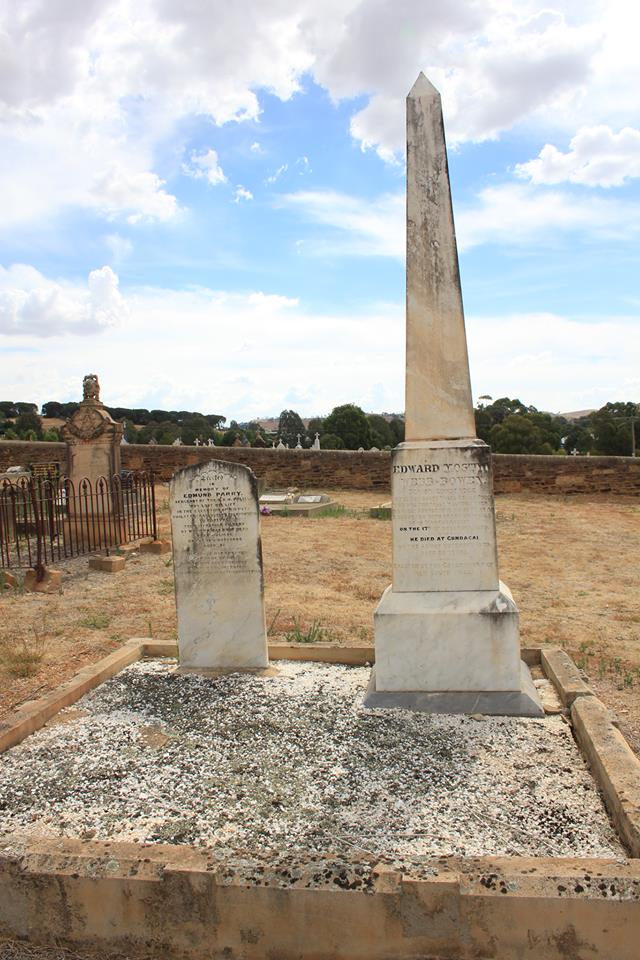
Sergeant Edmund PARRY - Grave


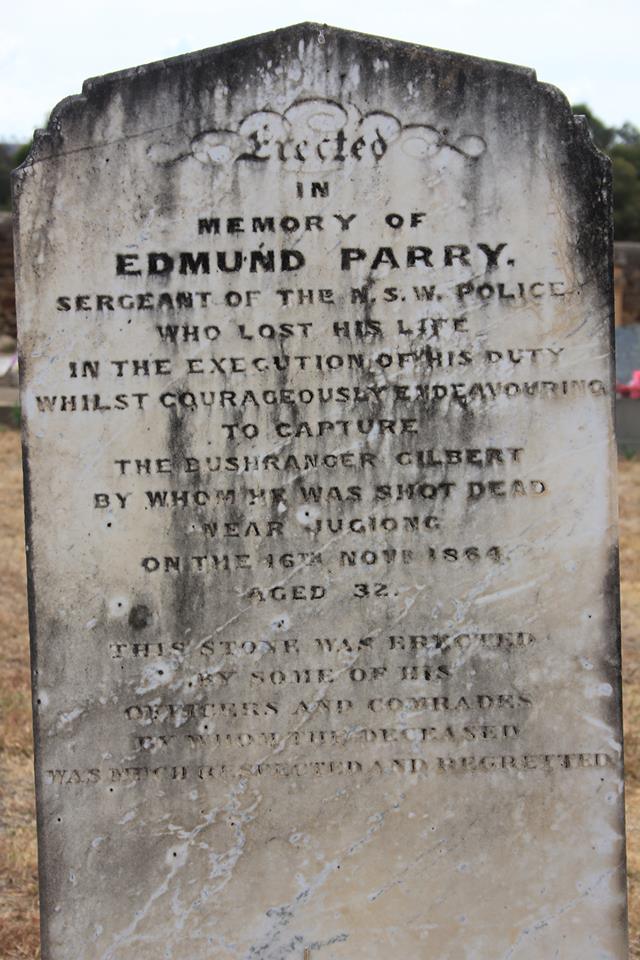
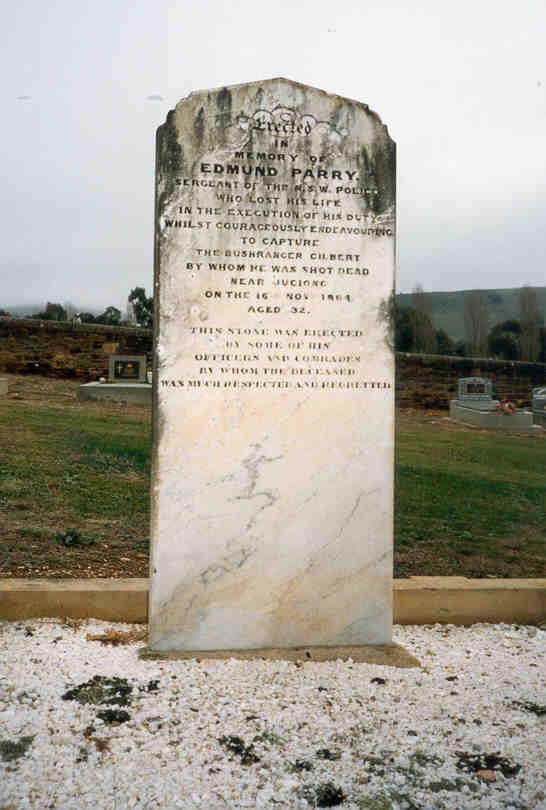
 Erected In Memory Of Edmund Parry, Sergeant Of The N.S.W. Police, Who Lost His Life In The Execution Of His Duty Whilst Courageously Endeavouring To Capture The Bushranger Gilbert By Whom He Was Shot Dead Near Jugiong On 16th Nov 1864 Aged 32 This Stone Was Erected By Some Of His Officers And Comrades By Whom The Deceased Was Much Respected And Regretted
Erected In Memory Of Edmund Parry, Sergeant Of The N.S.W. Police, Who Lost His Life In The Execution Of His Duty Whilst Courageously Endeavouring To Capture The Bushranger Gilbert By Whom He Was Shot Dead Near Jugiong On 16th Nov 1864 Aged 32 This Stone Was Erected By Some Of His Officers And Comrades By Whom The Deceased Was Much Respected And Regretted


Sergeant Edmund PARRY - Grave


Senior Constable Wes Leseberg (NSW Police) portrays Sgt Edmund Parry in this upcoming Australian movie. Opening in December 2016.

first-look trailer for upcoming Australian bushranger film The Legend Of Ben Hall, out December 1, 2016. Start practising your pistol-twirling now…

Senior Constable Wes Leseberg as Sergeant Edmund Parry in "The Legend of Ben Hall"
Senior Constable Wes Leseberg as Sergeant Edmund Parry in “The Legend of Ben Hall”


(Plaque) (Logo) NEW SOUTH WALES POLICE FORCE CULPAM POENA PREMIT COMES NSW Police Force Sergeant Edmund PARRY Killed in the courageous execution of his duty on the 16th of November, 1864 in a gun battle with the Hall Gang at Black Springs, Jugiong New South Wales
(Plaque) (NSWPF Logo) NEW SOUTH WALES POLICE FORCE CULPAM POENA PREMIT COMES NSW Police Force Sergeant Edmund PARRY Killed in the courageous execution of his duty on the 16th of November, 1864 in a gun battle with the Hall Gang at Black Springs, Jugiong New South Wales


Yesterday, took a detour to Jugiong and checked out the memorial there to Sgt Edmund Parry. A very fitting tribute to a brave man.
*
GPS Co-ords 34 49 25S/148 19 35E.
*
Can I also say that the Police Station and residence at Jugiong were immaculate. Not something you see often these days but a pristine NSW Flag flying (not a tattered mess hanging from the flag pole that we see so often) and the yard and surrounds a credit to the OIC who no doubt works the majority of the time in Cootamundra or Tumut or Young or all three.

Parry, Edmund (1832–1864)

from South Australian Advertiser

On Tuesday afternoon the mail from Gundagai reached the hill at Deep Creek, about four or five miles on the Yass side of Jugiong, between 4 and 5 o’clock. Mr. Sheahan, of Jugiong, the mail contractor, and Mr. Bradbury, of Queanbeyan, were passengers by the coach, and had alighted to walk up he hill. They were some distance in advance of the coach. Mr. Sheahan was in the act of pointing out the spot where the mail was stuck-up a few weeks before, when three horsemen appeared on the top of the hill, and spreading out—one on each aide, the third in the centre of the road—they galloped towards the coach. On coming near it was noticed that each had a revolver in his hand, and the order was given by Ben Hall to “Bail up.” Hall pointed and told them to “walk up there; we have got a little township there.” After going up the hill for some distance, they were ordered to turn off to the left, and approached a spot where twelve teams were stock up, as well as a number of horsemen. The mail was then stopped. Mr. Sheahan was asked if he had any money; he replied that he had not, and they might search him if they liked. Hall declined to search, remarking that Mr. Sheahan was not a “bad sort of fellow.” Bradbury was then searched; although he handed them a cheque for one pound, stating that that was all he had, yet they examined his pockets, and asked him if he had not a watch. They got nothing from him but the cheque, and subsequently, on his telling them it was all he had to carry him on the road, the cheque was returned. Hall and his companions then took out the mail bags, six in number, and cut them all open. Before proceeding to examine the letters they asked Mr. Sheahan and Mr. Bradbury if they would have some wine. They answered “Yes,” when Hall called to one of the teamsters to “fetch over port wine.” The wine was brought, in a quart pot, and a portion of it drunk by those present. The examination of the mail-bags meanwhile proceeded, the three bushrangers sitting down on the ground with the bags before them. The letters were speedily ransacked of any bank-notes they contained, Mr. Bradbury remarking to them that they sorted the letters much quicker than was generally done in Sydney. Mr. Sheahan asked if he would be allowed to sit down, and Hall told him he could do so. Mr. Sheahan availed himself of an empty mail-bag close beside him, and noticing a large number of whole and half cheques, remarked that they were of no use to them, and asked permission to gather them up. The bushrangers consented, and Mr. Sheahan was enabled to bring on to the Yass Post Office his coat pocket as full of cheques as it would hold, as well as three bank drafts. The coach and passengers were kept an hour before they were permitted to depart, Mr. Sheahan and Mr. Bradbury gathering up the remains of the letters and placing them in a mail bag. On the bushrangers completing their work, the driver of the coach pushed on as fast as possible to Yass, and reached here only half an hour behind time. The matter was instantly reported to Sub-Inspector Brennan, who, with a couple of mounted men, took the road within half an hour.

It was fully expected in town that the mail on Wednesday would also be robbed, and the spot where it was expected to take place was mentioned to the police before they left Yass. The anticipation was realised, and even the locality surmised as the scene of the outrage proved to be the spot selected. The mail is due in Yass at eleven a.m., and as it is generally very punctual to the time, and not having arrived at a quarter to twelve, it began to be thought very likely that it had been stopped. A few minutes before twelve it was heard approaching, and much anxiety was felt to learn what had occurred to cause its detention. It was then ascertained that on the mail leaving Gundagai, Constable Roche, of the Yass police, who had gone as guard of the mail the previous day to Gundagai, and Mr. Rose, police magistrate of Gundagai, were its occupants. It was escorted by Sub-Inspector O’Neill, and Sergeant Edmund Parry, of the Gundagai police. On reaching within about four miles of Jugiong, at a place known as the Black Springs, Hall and his companions appeared from behind some rocks. The moment they were noticed a signal was made from the coach to the Sub-Inspector and Sergeant to ride up, which they at once did; and one of the bushrangers remarking that “the bobbies” were with the coach, Gilbert said “There are only two of them; come on, let us rush them.” They then darted towards the coach, and on getting near the police called out “Come on you —— wretches; we will fight you like men.” A deadly encounter followed, in which poor Parry, who acted very bravely throughout, was shot through the shoulder and dropped dead. Before, however, narrating what transpired in the encounter with the police, we may state that Hall, Gilbert, and Dunn took up their position on the road early in the day, and stuck up a large number of teams and two carts, the latter followed by 20 or 30 Chinamen. Amongst those detained were a son of Mr. Owen Ryan, of Derrengullen Creek; Mr. Hayes, wife, and young man, who were in a buggy; and others, to the number of 40 or 50. Some considerable time before the coach came up Constable McLaughlin, of the Gundagai police, approached, leading a pack horse. Gilbert rode up to him and ordered him to surrender, but he replied by a shot from his revolver, which was returned by Gilbert, who then turned his horse and rode off a short distance. Hall then took up his position and fired at the constable, who again discharged his revolver. Hall’s horse stumbled, and Dunn rode up and fired at McLaughlin. The constable discharged the six barrels of his revolver in the encounter, and then surrendered, some nine or a dozen shots having previously been fired at him by the bushrangers. Dunn remarked that one of the constable’s shots was a very good one, and they would “have it in for him” on that account.” The constable was added to the mob of captives. The coach subsequently came in sight, and the affray commenced as stated above. Constable Roche, who was on the coach armed with two large pistols, a six barrel revolver, and a carbine, is stated to have slipped off the coach when the fight began, and to have darted into the bush, carrying his firearms along with him. He did not subsequently appear on the scene. Gilbert fought with Sergeant Parry, who refused to surrender, and discharged every barrel of his revolver before he fell; Hall and Dunn attacked Sub-Inspector O’Neill, who first discharged his carbine, and then several shots from a revolver. On Parry falling dead, the Sub-Inspector surrendered. The bushrangers disarmed him, and took from him a ring and his watchchain, but we believe he was permitted to keep his watch on his informing them it had belonged to his father. The horse Mr. O’Neill rode was, however, taken, one of the bushrangers remarking it would make “a good pack-horse.” It seems singular that the driver of the coach did not take advantage of the proceedings going on to put his horses to their mettle and save the mails. This, however, he did not do, for Hall and his mates on the termination of the fight ordered Mr. Rose to throw out the bags, which the bushrangers cut open in the usual manner, and appropriated all they desired. The mail was a very heavy one, and it is supposed they secured a large amount of money. From Constable McLaughlin they took £7105; from Mr. Rose a watch and chain. We have not heard what was taken from Mr. Hayes, but he was searched; the lady who accompanied him they did not molest. Gilbert is said to have turned over poor Parry’s body, and to have remarked—”He’s got it in the cobra (head) ; I am sorry for him, as he was a game fellow.”

We may state that the bushrangers informed the police that they intended to rob the mail next day (Thursday), and told them to send as many police men as they liked, and they would fight them. On the mail reaching Yass on Wednesday night Sergeant Scully, who was in charge of the force in the absence of Sub-Inspector Brennan, at once despatched five mounted men, four of whom are connected with the Goulburn force, and had reached Yass the previous day, after eight days’ unsuccessful search for the whereabouts of the bushrangers.

The coroner’s jury returned the following verdict:—”That on the 16th day of November, in the year of our Lord, 1864, at a spot about four miles to the south of Jugiong, in the colony of New South Wales, the deceased Edmund Parry did die from the effects of a gunshot wound, at that time and in that place wickedly, maliciously, and feloniously inflicted upon him by one John Gilbert; and two other certain persons, named Benjamin Hall and John Dunn, were then and there unlawfully aiding and abetting the said John Gilbert in so feloniously destroying the life of the said Edmund Parry.”

http://oa.anu.edu.au/obituary/parry-edmund-13623


Parry, Edmund (1832–1864)

from Portland Guardian (Vic)

Sergeant O’Neill‘s report of the recent murderous affray with Hall and his gang: Gundagai. 17th November.

“Just returned from Jugiong with the remains of Sergeant Parry. Yesterday morning early I started with Constable O’Loughlin to Jugiong, with instructions to the police station there to be at readiness to relieve Sergeant Parry and myself, who would escort the down mail to Jugiong.

At 11 a.m. Sergeant Parry and I left here riding behind the coach. Constable Roach, from Yass, was with the driver on the box set. When we got within four and a half miles of Jugiong, we there found sixty or seventy people, including Constable McLoughlin, some carriers, a lot of Chinese, and others, stuck up by Mr. Hall, Gilbert, and John Dunn.

Sergeant Parry and myself charged the bushrangers, when a deadly encounter ensured.

Ben Hall and Dunn opened fire on me and Gilbert on Parry. We all fired simultaneously several times. I had one bullet pass through the upper part of my sleeve, and one in left side of coat, neither injuring me.

Sergeant Parry was less fortunate. He received two mortal wounds, one in his left side and another in the back of his head, and he died immediately.

Constable Roach, on witnessing the engagement, took his carbine, revolver, and two old pistols with him and bolted into a paddock of Pring’s, where he took shelter. Had he stood by us Parry‘s life would have been spared, and Gilbert shot.

After emptying my revolver and rifle, I let the latter fly at Hall, striking him severely on the left side of his head. He and Dunn then had hold of my horse, and all was over—Parry shot, I a prisoner and Roach an absconder. The party having rifled the mail bags left.”

http://oa.anu.edu.au/obituary/parry-edmund-13623/text24380


Sydney Morning Herald     Saturday  19 November 1864     p6

GUNDAGAI.   Friday, 8 p.m.

After Hall’s gang left the scene of the encounter with the mail escort, the dead body of sergeant Parry was taken on to Jugiong, where an inquest was held, Mr. Rose, district coroner, who was a passenger in the coach, was an eye-witness of the tragedy. A verdict of wilful murder was given against John Gilbert, Benjamin Hall, and John Dunn, and warrants issued for their apprehension.

The remains of Sergeant Parry was brought in a coffin to Gundagai yesterday, and buried to-day with every mark of respect and commisseration for the fate of so brave a man. All business was suspended during the day.

The encounter was witnessed by several persons, who were detained by the bushrangers, and who, as well as Mr. Rose, speak in the highest terms of the courage of sub-inspectors O’Neill and sergeant Parry.


Illustrated Sydney News     Friday  16 December 1864     p5

MURDEROUS ENCOUNTER BETWEEN HALL’S GANG & THE

POLICE, AND DEATH OF SERGEANT PARRY.

IT has unhappily been our duty during the past few months to record a series of high-handed outrages and deeds of blood, which are rendering this Colony a bye-word throughout the civilised world. Our exchanges from every part of the globe contain annals of crime committed by the bushrangers of New South Wales, — crimes unparalleled save by the banditti of Italy, degrading to us as a people, the commission of which renders the Government of the Colony positively criminal for the apathetic and ineffectual efforts which they have made. The time for mincing our words has long since past. The position of affairs in the interior of New South Wales is a disgrace to any civilised community. Our legislators appear to be too much engrossed in party quarrels, and our Government in their own aggrandizement, to properly estimate the enormity of the crimes which are being daily committed in our southwestern districts, within a couple of hundred miles of the head-quarters of a police system which cost a colony containing some 350,000 inhabitants, during the past year £242,715 7s. 11d. What wonder will it be if we hear of the people whose lives and properties have been rendered insecure taking the law into their own hands, and, following the example of California, establishing Lynch Law. Much as such a system is to be deplored, we question if it would not be preferable to the present state of things.

During the past four months Morgan has murdered two police sergeants and and unoffending bushman. His immunity from arrest has probably rendered Hall and his gang from paying much regard to human life, for we find them following his example with all the recklessness which has marked Morgan’s career. The culminating act of Hall, Gilbert, and Co.’s villainous career has been that perpetrated on the 16th ultimo. On the morning of that day Hall, Gilbert, and Dunn took up their position on the road about four miles from Jugiong, and stopped all passers by. Among the number were several residents of Tumut, Mr. Johnstone, of Gundagai, about a dozen teamsters, and thirty Chinese. About noon Constable McLaughlin, going to Jugiong, was stopped by two bushrangers. Gilbert rode up and ordered him to surrender ; his reply was a shot from his revolver, which was returned by Gilbert, who then rode off a short distance. Hall then fired at the constable, who again returned it. Dunn also fired. Some of the shots cut McLaughlin’s bridle rein, and slightly wounded his horse. Having used the whole of his ammunition, and being hotly pressed, he galloped away hoping to be able to reload ; but Dunn being better mounted followed, and, firing at him, ordered him to surrender. Having no other alternative he did so, and was conducted to where the other persons were detained. On searching McLaughlin they took £7 10s. and his watch and chain, but returned the latter to him, as they admired his bravery in resisting three of them.

About three o’clock the mail from Gundagai came in sight, escorted by Sub-Inspector O’Neil and Sergeant Parry on horseback, and Constable Roach, who was seated on the box with the driver. The bushrangers rode down the hill to meet the coach, and on being perceived by Mr. Rose, Police Magistrate at Gundagai, who was a passenger, that gentleman raised his handkerchief as a signal for the police to close up, and as they did so the bushrangers turned and rode off, but seeing there were only two policemen they drew their revolvers, and rode back to meet them, screaming like madmen. The first shot fired was the signal for Constable Roach to drop from his seat and bolt into the bush, leaving O’Neil and Parry to maintain the murderous contest ; the former being opposed to Hall and Dunn, and the latter to Gilbert — the two latter fired shot for shot. Parry was first wounded in the head, but refused to surrender, and, having fired every shot in his revolver, was in the act of unslinging his carbine when Gilbert again fired. The ball entered his back on the left side, passed through his body — and the brave fellow fell from his horse a corpse. O’Neil continued fighting until his ammunition was expended, when, seeing the uselesness of prolonging the contest, he surrendered, and was taken prisoner. Dunn and Gilbert then mounted guard on the road, while Hall ransacked the mail bags ; the latter asked O’Neil where the other constable had gone to, and, on hearing he had bolted, remarked, “You should dismiss the fellow at once ; he is a coward and wretch to leave you and your mate to fight ; but I will say this for you both, you are two game men.” Hall then addressed himself to Mr. Rose, asking his name. Mr. Rose gave it, and told them in a fearless manner that he was Police Magistrate of Gundagai, to which Hall replied, “You are as bad as the —— traps.” “That may be,” said Mr. Rose, I am what I am.” After disposing of all the booty the bushrangers decamped, taking the police horses and arms. The remains of Sergeant Parry were removed to Jugiong, where an inquest was held next day by Mr. Rose. The jury returned a verdict of wilful murder against John Gilbert, Benjamin Hall, and John Dunn, against whom warrants were issued.

Sergeant Parry was formerly a member of the detective force, and during his residence in this city was remarkable for his good conduct.

The Government have recently issued a proclamation offering £1,000 reward each for Hall, Gilbert, and Dunn, and we trust that some energetic colonist may speedily enrich himself, and rid the country of one of its plague spots.

http://trove.nla.gov.au/newspaper/rendition/nla.news-article63512220.txt


Queanbeyan Age and General Advertiser

Thursday 1 December 1864, page 2

BY ELECTRIC TELEGRAPH. SYDNEY.  Thursday afternoon. BEN HALL and his gang are visiting the Bathurst district.
Constable ( William ) Roach was tried before the Yass bench on Tuesday, and found guilty of deserting his comrades in the late encounter with Gilbert’s gang.
He was fined five pounds with the alternative of a month’s imprisonment.
[divider_dotted]


Thomas SMYTH

Thomas SMYTH

Late of  ?

New South Wales Police Force

Regd. #  ????

Rank:  Senior Sergeant – Death

Stations:  ?, Lambing Flat, Albury – Death

Service:  From  8 February 1858  to  4 September 1864 =  6+ years Service

Awards:   No find on It’s An Honour

Born:   ? ? 1830

Died on:   29 September 1864 in the Imperial Hotel, Albury

Age:  33 – 34

Cause:   Shot – Murdered

Event location:  Doodle Cooma Swamp

Event date:   4 September 1864

Funeral date:   ? ? ?

Funeral location:   ?

Funeral Parlour:

Buried at:   Albury Cemetery, 460 Buckingham St, North Albury, NSW

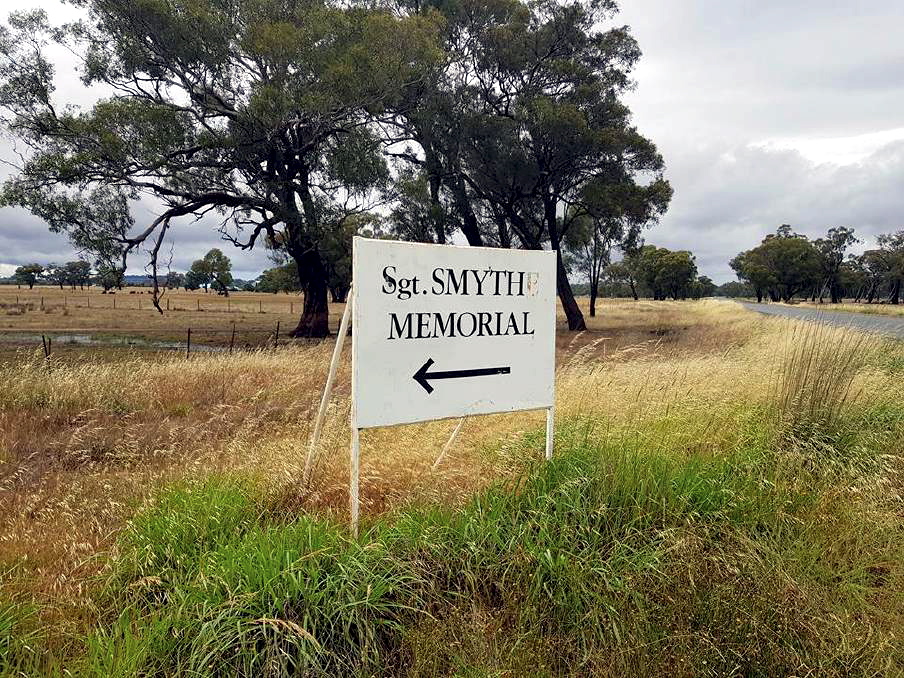
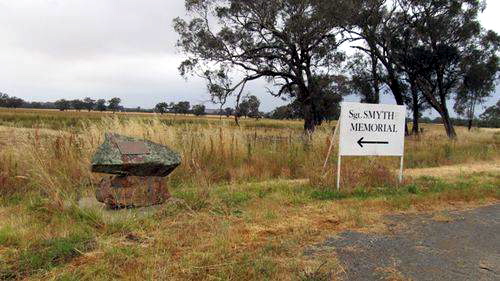
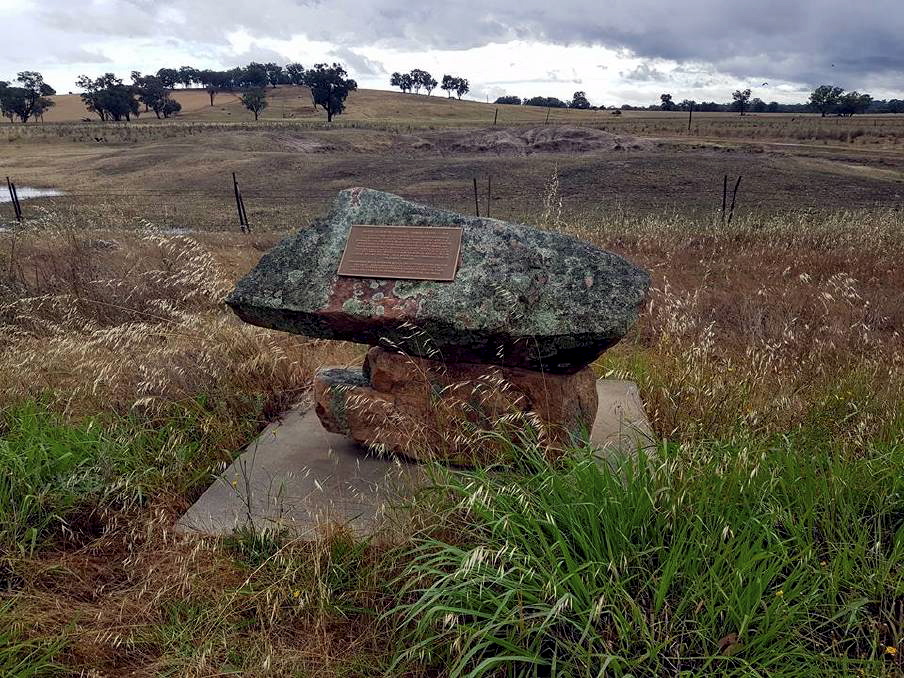
 Memorial located at:   Memorial stone and plaque are located 2 kms west of Henty on Pleasant Hills Rd ( the Lockhart Rd )

[alert_green]THOMAS  IS mentioned on the Police Wall of Remembrance[/alert_green]

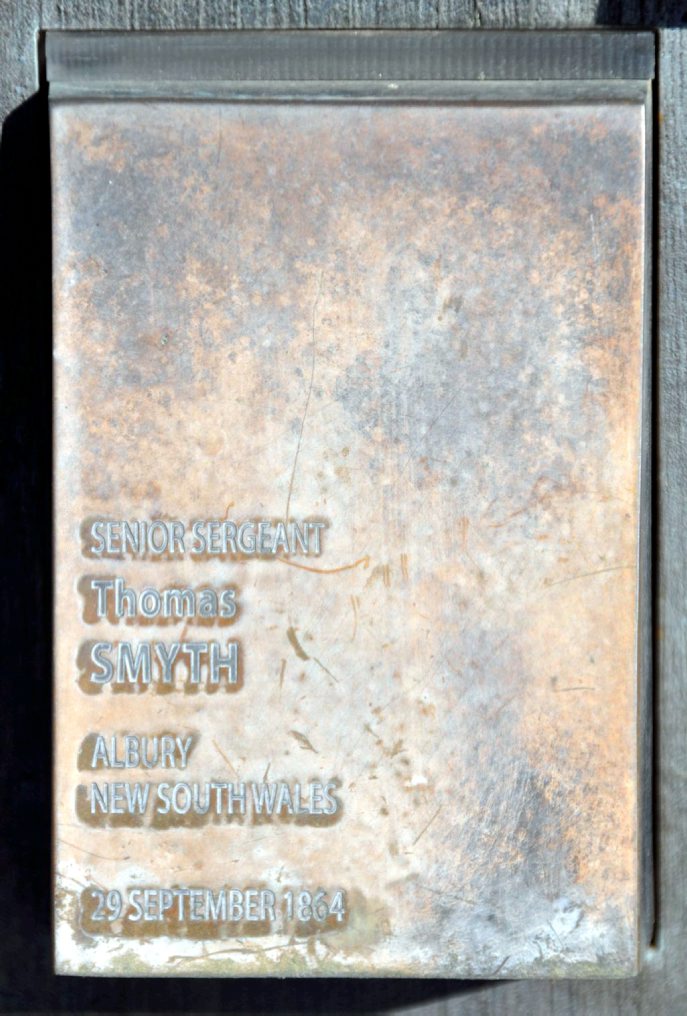
Thomas SMYTH touch plate at the National Police Memorial - Canberra
Thomas SMYTH touch plate at the National Police Memorial – Canberra


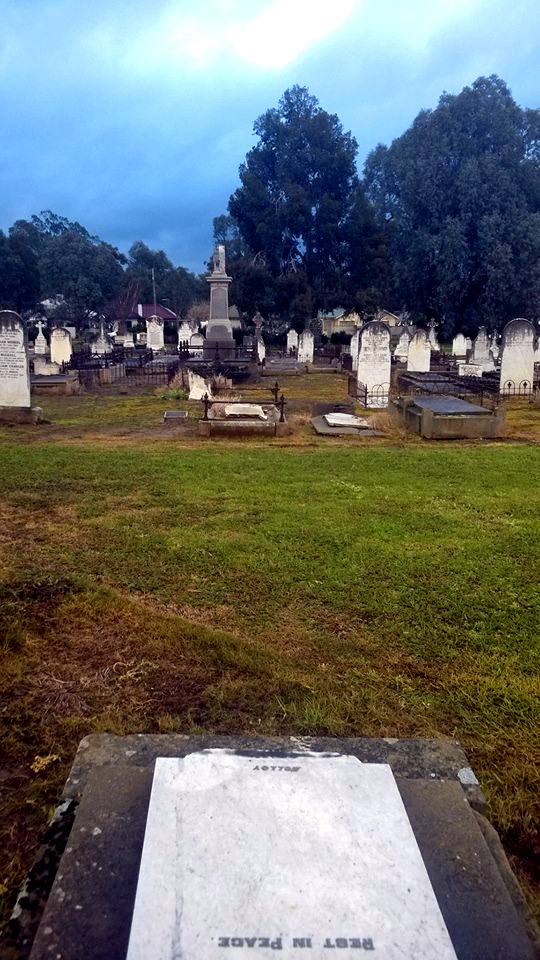
Thomas SMYTH
and this is his grave! (The unmarked one in the background).

 [divider_dotted]

FURTHER INFORMATION IS NEEDED ABOUT THIS PERSON, THEIR LIFE, THEIR CAREER AND THEIR DEATH.

PLEASE SEND PHOTOS AND INFORMATION TO Cal

[divider_dotted]
May they forever Rest In Peace

[divider_dotted]

In late September, 1864 the sergeant was camped in the bush with three troopers near Albury during a search for bushrangers, when two men, one of whom the bushranger Daniel Morgan, crept up and fired several shots into the police tent. One shot hit the sergeant, entering his shoulder and exiting through his back. Despite these wounds the sergeant was able to return fire, forcing the offenders to retreat and escape. Sergeant Smyth was soon treated by a doctor however he died of the effects of the wound within a couple of days. The vicious Morgan was shot to death by a farmhand in April, 1865.


The Empire newspaper dated 5 October, 1864 printed the following brief account of the incident.


DEATH OF SERGEANT SMYTH – It is with deep regret that we have to record the death of Senior-Sergeant Smyth, at Albury, on Thursday night, from the wound he received in the cowardly night attack a few weeks back at Doodle Cooma Swamp. It was at first hoped that the unwearied care of Dr Wilkinson would have brought him round; but haemorrhage having set in, little hopes were entertained of his recovery, and he gradually sank until he yielded up his brave spirit on Thursday night. He was a very deserving officer, possessed of more than average intelligence and shrewdness, which eminently fitted him for a police officer. His courage was unquestionable. Previous to his being stationed at Albury he was at Lambing Flat, on leaving which town be was presented with an address by the inhabitants, expressive of their appreciation of his valuable services in the repression of crime on that large goldfield.

The McIvor Times and Rodney Advertiser of 23 September, 1864 printed a detailed account of the incident.

THE BUSHRANGER MORGAN.

A party of police, consisting of Senior Sergeant Smyth, Senior Constable Baxter, Constables Connor, and Maguire, and a blackfellow named Jimmy Reed, were camped on Sunday night at Dougal’s [sic] Swamp, near Keighran’s station. They had just got tea, and were lying in the tent yarning, as is usually done by persons camped out. They had no sentry on guard – that duty being delayed until they “turned in” for the night. Suddenly their discourse was cut short by a volley being fired into the tent amongst them. Sergeant Smyth immediately jumped to his feet, calling on his men to follow him – he firing two shots in the direction he fancied the volley came from. The men who rushed out of the tent immediately after him, scoured the bush in every direction, as well as the darkness would allow them, but failed to find any traces of the ruffians; but, from the tracks discovered at daylight next morning, they must have overrun the bushrangers in the dark.

“They remained in the scrub about an hour, when they, after some consultation, deemed it better to return to the tent, which, considering that the night was dark, arid the surrounding scrub would completely shelter the attacking party, was, to say the least, attended with some danger. Baxter and Connor crawled on their hands and knees to the tent, and found Smyth lying on his back dangerously wounded, and fast bleeding to death. They took everything out of the tent and, having covered poor Smyth up in the few blankets they had, they managed to convey him to Keighran’s station, he still bleeding and suffering great pain, where they remained until daylight. Constable Baxter and the blackfellow then took up the track near the tent, and started to follow the ruffians up. The other two constables proceeded to the Ten Mile Creek, to give information and obtain medical aid for Smyth.

Superintendent McLerie who was proceeding to Sydney on sick leave, happened to be at that place; and he immediately ordered his buggy to be taken off its springs, and the body to be used as a stretcher to convey Smyth to Ten Mile Creek. From the position of the bullet holes in the tent, there cannot have been less than five bushrangers. There are seven bullet holes in the tent; the bullets were picked up inside of it, some of them belonging to a large bore pistol. Constable Connor had a very narrow escape. He was lying down, leaning on his elbow, in the tent, when one of the balls went through the sleeve of his coat, inflicting a slight wound about two inches above the elbow joint. Superintendent McLerie has deemed it necessary to return to Albury for the present. Sub-inspector Morrow and a party of police have started from Albury in pursuit of the bushrangers; and Sub-inspector Zouch has left Wagga Wagga on similar duty.

“A strange incident occurred in connection with this cowardly attack. Shortly after the party were camped, two men came up and were admiring the site chosen for the camp, remarking that they could not have chosen better. They are well known as bush “telegraphs,” being the two men to whose house Sergeant Carroll traced Morgan some time back. Sergeant Smyth’s wound is a very dangerous one. The ball entered immediately above the nipple of the left breast, following the course of the ribs, and came out under the left shoulder-blade; so that, while the wound may not be considered mortal, yet fatal results may ensue from it. The people are greatly excited on this murderous attack, which in cold-blooded treachery far surpasses the Lachlan escort robbery.”

The Empire newspaper dated 5 October, 1864 printed the following brief account of the death of the sergeant.

DEATH OF SERGEANT SMYTH
It is with deep regret that we have to record the death of Senior-Sergeant Smyth, at Albury, on Thursday night, from the wound he received in the cowardly night attack a few weeks back at Doodle Cooma Swamp. It was at first hoped that the unwearied care of Dr Wilkinson would have brought him round; but haemorrhage having set in, little hopes were entertained of his recovery, and he gradually sank until he yielded up his brave spirit on Thursday night. He was a very deserving officer, possessed of more than average intelligence and shrewdness, which eminently fitted him for a police officer. His courage was unquestionable. Previous to his being stationed at Albury he was at Lambing Flat, on leaving which town he was presented with an address by the inhabitants, expressive of their appreciation of his valuable services in the repression of crime on that large goldfield.”

In April 1865 the vicious and cowardly bushranger Morgan was shot to death by a farmhand in at Peechelba Station, near Wangaratta (Vic).

The sergeant was born in 1830 and joined the police force on 8 February, 1858. In 1862 he became a member of the newly-formed New South Wales Police Force. At the time of his death he was stationed at Albury.


http://trove.nla.gov.au/ndp/del/article/30580797

[divider_dotted]
 

Senior Sergeant Thomas Smyth to get a proper gravesite after he was murdered by bushranger ‘Mad Dog’ Dan Morgan in 1864.

Marguerite McKinnon
Marguerite McKinnon@@marguerite_mck1


It’s taken 153-years but moves are finally underway to give some restitution to Senior Sergeant Thomas Smyth, who was murdered by notorious bushranger ‘Mad DogDan Morgan in the hills near Henty in 1864.

Sergeant Smyth’s unmarked grave is now set to receive a memorial headstone to rectify what is believed to have been an administrative oversight lost in the 1951 transferral of Albury’s three cemeteries from church to council.

Police officers, both active and retired, had bemoaned as “a sad end and undignified burial” of Senior Sergeant Smyth after he was shot trying to recapture the bushranger, who had been terrorising the region.

In 1864, ‘Mad DogMorgan had recently committed his second and third murders before he arrived in the Henty area. Widespread fear and an outcry from the press at the time saw the reward for Morgan’s capture raised to £1000, and parties of special police were sent to track and capture him.

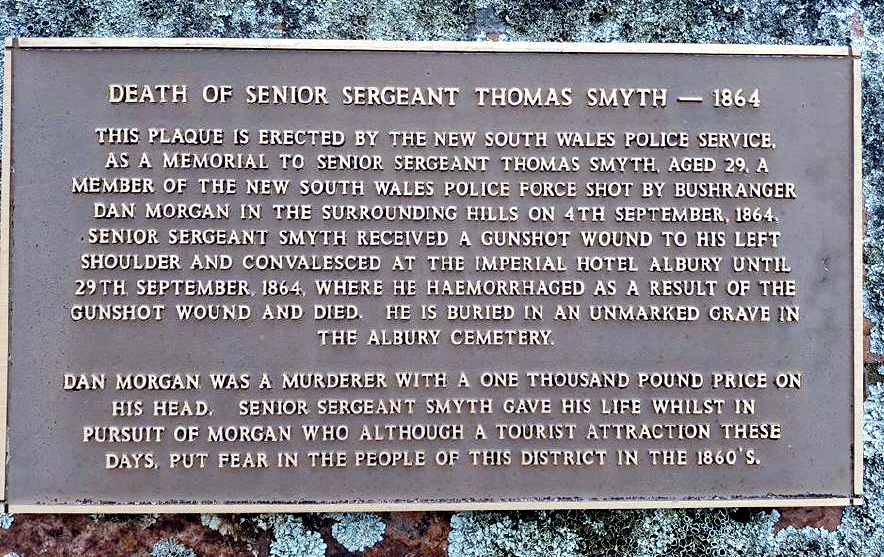
On September 4, Senior Sergeant Smyth had set up camp with three troopers in the Henty hills, when Morgan and another man crept up and fired several shots into the police tent, hitting the sergeant in the shoulder and exiting through his back. Morgan later said he had been watching the camp for some time.

Despite his wounds, the sergeant ran out of the tent and returned fire, forcing the offenders to retreat. The wounded officer then collapsed. He was transferred to Kiamba and then Albury where doctors claimed he was recovering, before he hemorrhaged several times.

The Empire newspaper dated October 5, 1864 reported that “he yielded up his brave spirit on Thursday night. He was a very deserving officer, possessed of more than average intelligence and shrewdness, which eminently fitted him for a police officer. His courage was unquestionable”.

Senior Sergeant Smyth was buried in an unmarked grave in an Albury cemetery, however there is a memorial stone on Pleasant Hills Road just outside Henty.

NSW Police is hoping to rectify other unmarked police graves. Dan Morgan was holding hostages when he was shot dead in Victoria by a farmhand in April,1865.

This excerpt is from an Australian Government site about bushrangers:

Daniel Morgan brought discredit to the popular ‘currency heroes’ by his mixture of violence, abuse and seemingly meaningless murders. Morgan claimed his innocence at his first conviction in 1854, at the diggings near Castlemaine, which he said was ‘framed‘ by a squatter. During his time at Pentridge Prison, he developed a violent dislike for police. Upon his release, he began a campaign against society at large and the police in particular.

Morgan once took issue with an overseer’s wife when the man was away on business, demanding money from her as he forced her against a blazing fire until she suffered severe burns to her legs. Morgan also tried to burn squatter Isaac Vincent by setting fire to his woolshed after he had tied Vincent to a nearby fence. After Morgan bailed up coaches, he would stampede the horses – sending them and their drivers to destruction.

Eventually he was shot and captured in 1865 after being outwitted by a nursemaid and station hand at Peelhelba Station near Wangaratta, owned by the McPhersons.”


Thomas SMYTH
MEMORIAL: Senior Sergeant Thomas Smyth will get a memorial headstone on his unmarked grave in Albury, after he was shot by bushranger Dan Morgan in 1864.


Thomas SMYTH
MEMORIAL: The memorial stone to Senior Sergeant Thomas Smyth is two kilometres west of Henty on Pleasant Hills Rd (the Lockhart road).


Thomas SMYTH<


Thomas SMYTH
DETAIL: The plaque detailing the death of Senior Sergeant Thomas Smyth after he was shot by bushranger ‘Mad Dog’ Dan Morgan in September 1864.


Thomas SMYTH
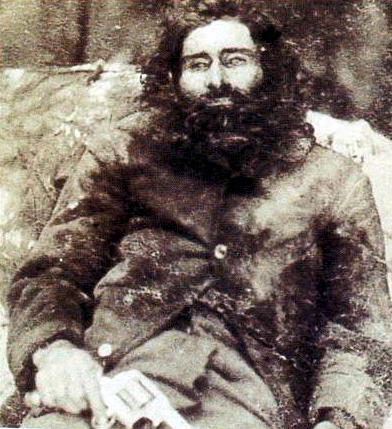
MURDERER: A post-mortem photograph of notorious bushranger ‘Mad Dog’ Dan Morgan who murdered several people, including Senior Sergeant Thomas Smyth.


The story Restitution for murdered police officer after outcry over his unmarked grave | Photos first appeared on The Daily Advertiser.

http://www.theland.com.au/story/5105955/restitution-for-murdered-police-officer-after-outcry-over-his-unmarked-grave-photos/?cs=4951

[divider_dotted]


Robert Dowker CODRINGTON

Robert Dowker CODRINGTON

New South Wales Police Force – Trooper

Regd. #  ?

Trooper

Stations:  Cheshire Creek Barracks (Bathurst/Peel area), Wyagden

Served:  From  about 1854  to  22 December 1857

Awards:  ?

Born:  In Madras, India, about 1836

Died:  22 December 1857

Age:  ?

Cause:  Shot – Murdered

Bathurst

Funeral Date:  ? December, 1857

Funeral location:  ?

Buried at:  ?


Trooper Robert Dowker CODRINGTON

On 22 December, 1857 Trooper Codrington rode out to meet the gold escort from the Turon Valley. His duties included escorting the gold and mail being carried either by coach or packhorse down the steep Wyagdon Hill and into Bathurst. After he was reported missing, a search was conducted and his body, shot through the heart, was found off the side of the Bathurst – Turon Road in a ravine at the top of Wyagdon Hill. Bushes were found nearby piled on the roadside and it is thought that the bushrangers who probably killed the trooper had hidden at that spot to await and rob the escort. No other satisfactory reason could be found for the murder, although the escort passed the spot unmolested on that day. Local legend has it that the trooper was killed by an old enemy who then returned to England after the murder, however this remains unsubstantiated.


In late 1860 John Higgins (alias John Davis) appeared before the Albury Police Court charged with “having, on the 22nd day of November [sic], 1857, shot one Robert Codrington, a mounted trooper, in the District of Sofala, Bathurst”. He was found not guilty. An alleged witness to the murder was Richard Henry Mills Sampson, who was a man known for giving false evidence in a previous, unrelated trial. His statement, which may or may not be truthful, was as follows:


At that time I was going from Louisa Creek to Bathurst to spend Christmas. I there met the prisoner with three other men, two of them were travelling with the deceased trooper. I rode up sharply, and was immediately covered by a gun by one of the men. The prisoner, whom I now distinctly recognise, shot the trooper Codrington, and afterwards proposed to shoot me. A man named Cole, whom I have known for years, was one of the party…[and he] said I would not blab. The murder took place about 3 o’clock in the afternoon. I was about 50 yards from them when I first saw them. The prisoner said several times, “Shoot him,” and called the others cowards. He then shot Codrington himself, and was the only one of the party who had a gun. I did not see what they did with the body.


The constable was born about 1832 and joined the Gold Escort about 1854. At the time of his death he was stationed at Cheshire Creek Barracks (Bathurst/Peel area).


Robert IS mentioned on the Police Wall of Remembrance

[divider_dotted]
Location of ( Wiagdon ) Wyagdon:

[divider]

Born in Madras ( India ) in 1836 to Robert Codrington and Louisa. Robert Dowker married Louisa Kershaw on 5 April 1856 and had a child – Robert William, born 27 November 1856 or 1857 & died 2 April 1930 in NSW.  Robert Dowker CODRINGTON passed away on 22 Dec 1858

http://records.ancestry.com/robert_dowker_codrington_records.ashx?pid=3644377

[divider_dotted]
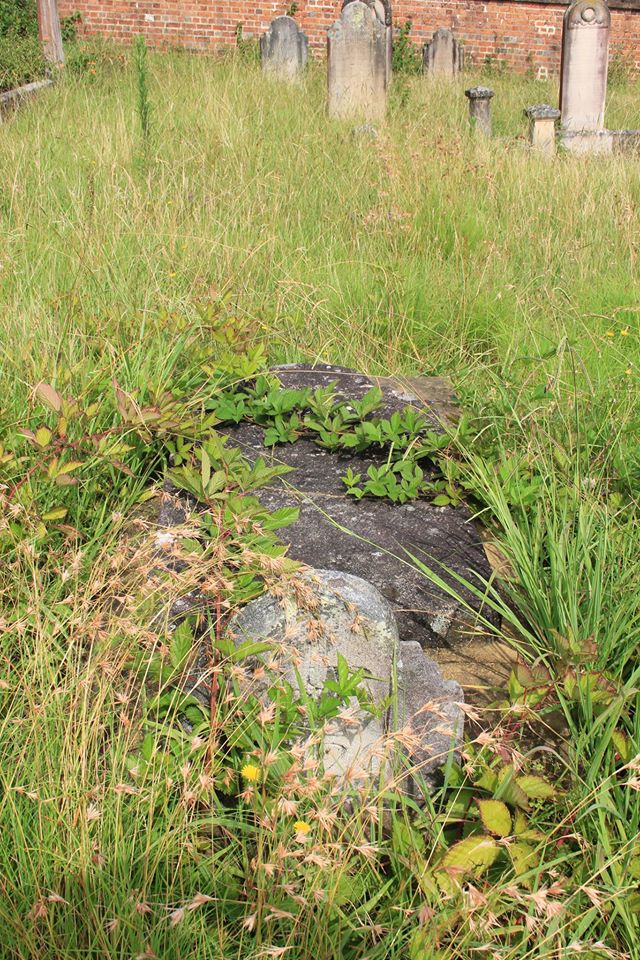
My great great grandfather, Robert Dowker Codrington, a gold trooper (mounted policeman) who was shot at Kelso in about 1856.  He migrated to Australia in 1853 from England.

http://www.stephencodrington.com/dempsey/Great_Grandparents.html

[divider_dotted]
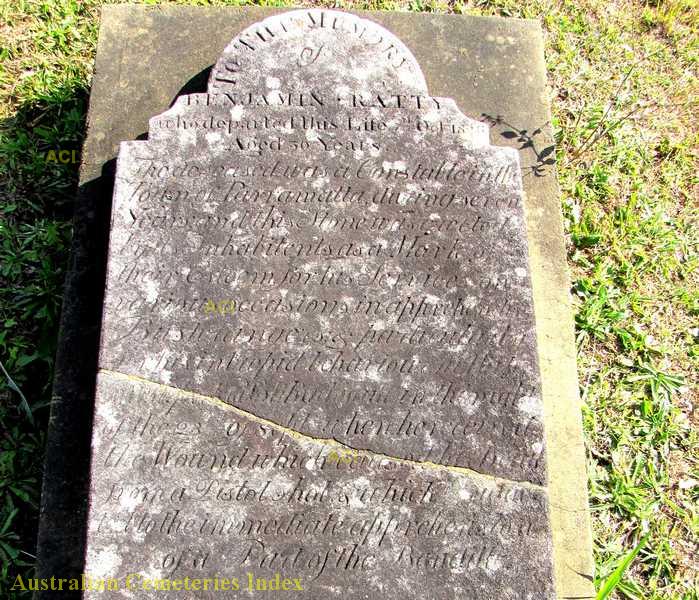
Witnesses to History

By Eric Pratt QC

See chapter 9:  The Murder of Robert Codrington

https://books.google.com.au/books?id=JRMM7n-E_EEC&pg=PA102&lpg=PA102&dq=Robert+Dowker+CODRINGTON&source=bl&ots=BwZ8HDrg6Y&sig=YsTHtPskKJsO3qP6xTcyBDJRdAI&hl=en&sa=X&ei=tR6YVIHYKozZ8gWgqICwBQ&ved=0CDYQ6AEwBA#v=onepage&q=Robert%20Dowker%20CODRINGTON&f=false

 [divider_dotted]
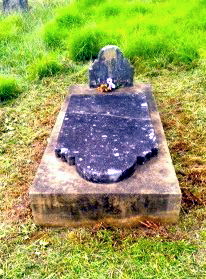
Screen reader users: click this link for accessible mode. Accessible mode has the same essential features but works better with your reader.Bathurst Free Press and Mining Journal             Saturday  26 December 1857        page 2 of 4
HORRIBLE MURDER. Intelligence reached town on Thursday morning, that one of the Gold Escort named Robert Codrington, stationed at Wyagden, had been found murdered under Wyagden Hill. On further enquiry we found that the report was too true. It seems that it had been customary that the trooper stationed at this place, should go out to meet the escort on its return from Sofala, and it is supposed that some party or parties, aware of this circumstance, availed themselves of the opportunity to commit this horrible crime, evidently with the ulterior intention of attacking the Gold Guard. The ill fated man, who had been missing since Tuesday morning, his horse having returned to the Police Station without him, was discovered after a lengthy search by Sergeant Giles, lying headforemost down the hill, with his arms outstretched, and his feet carefully placed   together. The body was in a state of partial decomposition, but the marks of a bullet shot through the stomach were plainly apparent, and the arms, including a carbine and pistol, and all the accoutrements had been removed. The deceased was twenty years of age, bore an excellent character, was the son of a commissioned officer in the Indian army, and was a young man of remarkably fine presence. We regret to add that he leaves a wife and child to mourn his untimely fate. Expresses have been sent out in various directions in quest of the guilty parties, and no pains will be spared to bring the perpetrators of this heinous crime to justice.

http://trove.nla.gov.au/ndp/del/article/62046770?searchTerm=robert%20codrington&searchLimits=l-decade=185|||l-year=1857#pstart6174174

[divider_dotted]
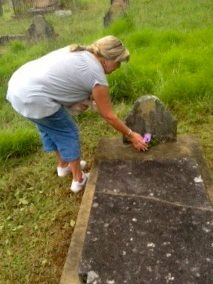
 

The Sydney Morning Herald                  Tuesday  29 December 1857               page 5 of 8
Bushranging. – Accounts have reached town of the wilful murder of trooper Robert Codrington, of the Mounted Police, on the 22nd instant, near Wyagden, when on the way to meet the gold escort. The return of Codrington’s horse, without either rider or trappings, was the first intimation that anything had happened, and on instituting a search the body of the poor fellow was found, having five shot and slug wounds in his body, which would cause instant death. His arms ( firearms ) and accoutrements are missing.
[divider_dotted]
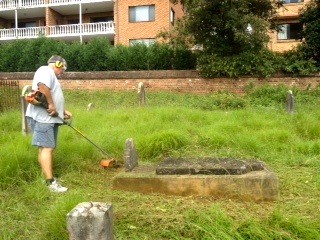
Empire ( Sydney )                                Saturday  2 January 1858                        page 5 of 6

THE TRAGEDY AT WYAGDEN.  

(From a Correspondent of the Bathurst Free Press.)

Our quiet neighbourhood has been thrown into a state of great excitement, in consequence of Trooper Codrington, of the Gold Police being shot, at the top of Wyagden Hill.

It appears that Robert Codrington, trooper in the Gold Police, left the Police Barracks, at Cheshire Creek, where he was stationed, about 8 o’clock on Tuesday morning last, for the purpose of meeting the Gold Escort coming from Sofala; and by his not returning that day, some excitement was caused ; it was conceived that he had ‘received some fresh orders, and had gone on to Sofala. On the Wednesday morning his horse was discovered at the stable, with the saddle on, but without his bridle. So soon as this was known, a search was commenced along the road, but no traces could be discovered. Night coming on, instructions were given, that as many horsemen as could be procured, should be ready by daylight the following morning to renew the search. Just as we were on the point of starting from Wyagdon, our doubts were set at rest, by the arrival of Sergeant Major Giles, of the Gold Police, who communicated that the body of Robert Codrington had been found   in a gulley on the top of Wyagden Hill. We immediately   hastened to the spot, and found that the trooper bad been shot on the road, and the body dragged down the   gulley some distance. The scene was most heartrending,   and became still more so by the presence of his wife, a fine young woman in the bloom of life, with her baby   about twelve months old, who had hastened to the spot   so soon as the bad tidings had been made known to her, anxious to see the last of her affectionate husband.

On the arrival of Dr. Andrews from Sofala, who had been sent for, an inquiry was instituted in the presence of J. B. Suttor and Hugh Bridson, Esquires, magistrates.

It was found necessary to remove the body to the nearest public-house, for the purpose of a post-mortem examination.   Evidence was taken to show that the deceased had been shot, and that six buck shots had passed through the heart. From inquiry it would appear that a plot had been made to waylay the mail, for the purpose of robbing it, and Codrington happening to pass up   first, he was shot by the supposed robbers, and while they were getting him out of the way, the mail must have passed down in safety. It was quite evident from the way the bushes were placed, forming a sort of ambush just on the top of the first point, where the mailman always pulled up to put on the drags, and the guards generally get off, that the intention must have been to have shot the guards, for the purpose of robbing the mail only ; as one pound two shillings was found in Codrington’s pockets, which was all the money he was supposed to have had about him. The carbine and pistols were taken away.

The unfortunate victim of this lawless outrage was a young man of high respectability, and descended from a very high family, who have always stood foremost in the defence of their country ; and he was very much respected in this neighbourhood.

We very much regret that the serious illness of Mr. Johnson, the Gold Commissioner, has prevented his   ready aid and presence on this melancholy occasion.

Every praise is due to Sergeant Major Giles and his troopers, in making every exertion to discover the body ; and it is to be hoped that his well-known experience will enable him and his troopers to discover the perpetrators of this awful murder.

After this tragical sacrifice to mistaken policy and   economy, it is to be hoped that the Government will see the necessity of increasing the gold police force, as well as the rural police in the neighbourhood of the diggings.

http://trove.nla.gov.au/ndp/del/article/60260878?searchTerm=robert%20codrington&searchLimits=l-decade=185|||l-year=1858|||sortby=dateAsc#pstart5720918

[divider_dotted]
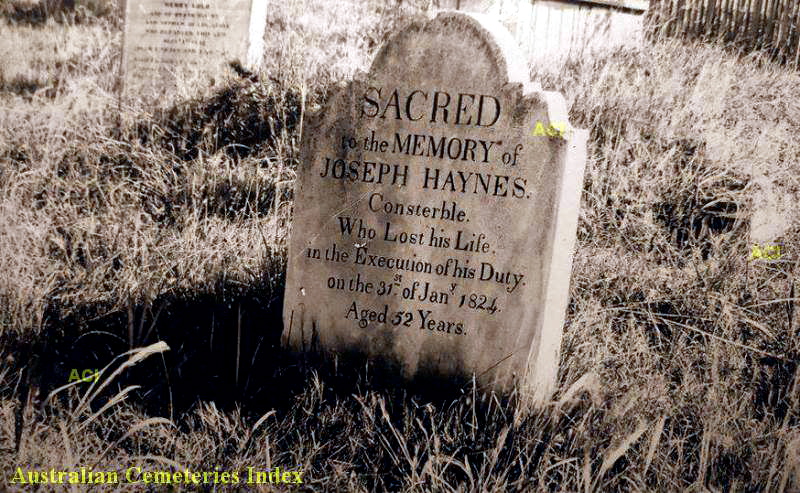
 

Bathurst Free Press and Mining Journal               Saturday  9 January 1858            page 4 of 4

MURDER OF TROOPER CODRINGTON.               Public Meeting.

At a Public Meeting held at the ” Carrier Inn, ”  Bathurst, W. Hall Palmer, Esquire –  P.M. in the Chair, it was proposed by W. H. Suttor, Esquire, seconded by W. Lee, Esquire :-

1st. That the recent barbarous murder of Trooper Codrington, at Wyagden, imperatively calls for some movement upon the part of the public in the district, having for its object, the discovery of the murderer or murderers. Carried.  Proposed by A. Campbell, Esquire, seconded by J. B. McGuyigan, Esquire.

2nd. That a public Subscription be at once set on foot, the amount of which shall be offered as a         reward to any person or persons who shall give such information as shall lead to the conviction of the parties concerned in the perpetration of the murder. Carried.    Proposed by R. Y. Cousins, Esquire, seconded by Mr. D. Kenna.

3rd. That John Blight Suttor, Esquire, be requested to act as Treasurer, and A. G. Shadforth,                   Esquire, as Secretary, and that they shall at as earl a date as practicable, cause to be published in such of the colonial newspapers as they may deem advisable, the amount of the reward offered. Carried.

http://trove.nla.gov.au/ndp/del/article/64378016?searchTerm=robert%20codrington&searchLimits=l-decade=185|||l-year=1858|||sortby=dateAsc#reloadOnBack

[divider_dotted]
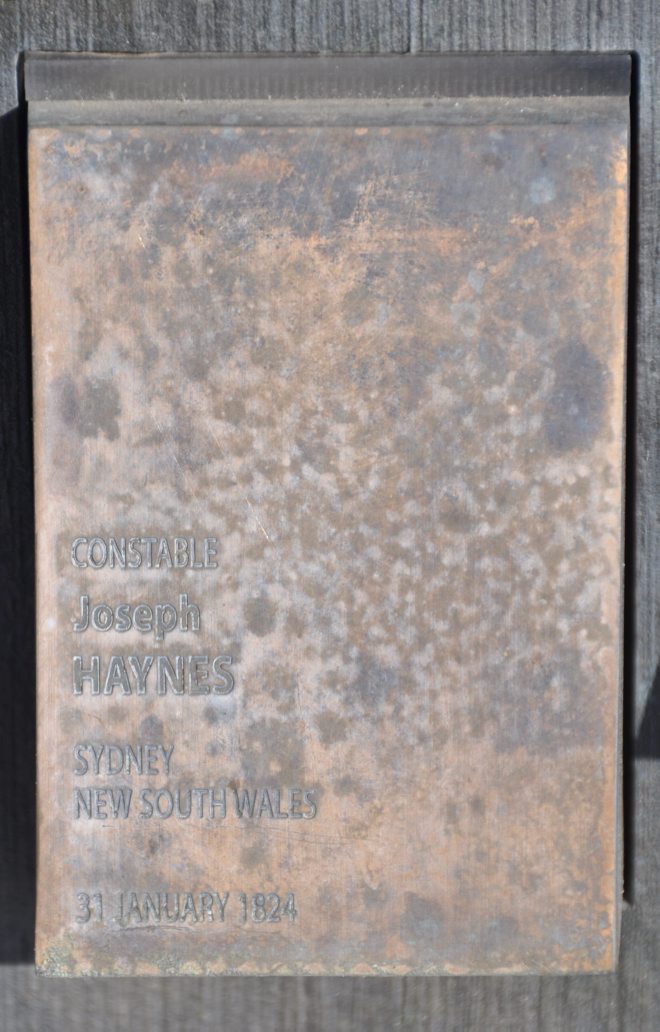


Robert Lovell McDOUGALL

Robert Lovell McDOUGALL

New South Wales Police Force – Mounted Police – Gold Police

Regd. #  ?

Rank:  Corporal

Stations: , Sofala ( under 2 years )

ServiceFrom  1 October 1851   to 23 September 1853 = 2+ years

Awards?

Born? ? 1816 in Coleraine, Londonderry, Ireland

Died on:  Friday  23 September 1853

Cause:  Horse Accident

Event location:  Sofala

Age: 37

Funeral date: Sunday  25 September 1853

Funeral location:

Buried at:  Sofala Cemetery ( Anglican Christ Church ), Sofala Rd, Sofala, NSW

Grave Location:  positioned right hand side upon the entry gate


Robert Lovell MacDOUGALL gravestone
Robert Lovell McDOUGALL gravestone


Robert Lovell McDOUGALL - NSWPF - Died 23 Sept 1853 - grave 1

ROBERT IS mentioned on the Police Wall of Remembrance

Robert Lovell McDOUGALL, Trooper McDOUGALL


It appears that Corporal McDougall met his death in 1853 when returning to Sofala from Wattle Flat, where he had been inspecting gold licences and executing a warrant with another policeman possibly named Johnson. McDougall and Johnson had each then set out for Sofala via different routes, for some reason. As McDougall rode along the road over Whalan’s Hill his horse took fright going down a steep incline and he was thrown. It would appear that one of his feet became caught in a stirrup and he was dragged along, inflicting fatal injuries. When his riderless horse returned to town late that night a search was immediately launched and the unfortunate corporal was found about 2am. He died shortly after being taken home. He left a widow, Mary Ann McDougall and five children. His headstone at Sofala reads”McDougall” however most documents located so far indicate that the correct spelling is probablyMacDougall“.


The Sydney Morning Herald of Wednesday 5 October, 1853, p3,  carried the following account of the incident.


A melancholy accident, which terminated fatally occurred last week to Corporal MacDougall of the mounted police. It appears that the deceased was returning from the new diggings on Thursday evening when about half a mile from Sofala his horse stumbled and fell, probably on the top of him. The fall unseated him, but unfortunately one of’ his feet got entangled in the stirrup, and he must have been dragged a considerable distance on the road, as his body was in a very mutilated condition. The horse arriving in town late at night without the rider, a search was at once instituted, but it was not until two o’clock on Friday morning that he was found on the side of a hill, half a mile from Sofala in a state of insensibility. Deceased was at once removed to Sofala, and medical assistance procured, but the injuries he received were of so severe a nature that he expired on Friday evening. A magisterial enquiry was held by Mr Commissioner Johnson, when a verdict of accidental death was returned. He was a most efficient officer of the police, and the respect in which he was held by the inhabitants of Sofala was fully testified by the large concourse of all classes and denominations which last Sunday followed his remains to their last resting place. He was in the 27th year of his age, and has left a wife and five children.”

A report submitted on 26 September, 1853 by Assistant Gold Commissioner Johnson of Bathurst, sheds a little more light on Corporal McDougall, as follows.


AGC Office Sofala 26th Sept/53.  No. 53/112.

Sir,

I regret to have to report to you the death of Crpl Robt MacDougall of the Gold Police of this State who died on the 23rd instant from the effects of a fall which he received from his horse on returning from executing a warrant on the 22nd instant.

1.   No-one witnessed the occurrence but from the evidence given by persons who were with MacDougall immediately prior to it he appears to have been perfectly sober and that the horse he was riding was very restive.

2.  The deceased had been in the Police at Sofala for nearly two years during which period he bore the character of a steady, sober and efficient policeman having never been brought up for any misconduct whatever.

3rd.   He has left a wife and five children the youngest being only just born and who by this sudden bereavement are left almost destitute. I would therefore urge whether taking into considerations the good character and efficient service of the deceased a gratuity, or pension may not be bestowed upon his widow.


Signed W Johnson AGC

The Gold Commissioner

Western Districts

Bathurst


The corporal was born in 1816 and enlisted in the Gold Escort on 1 October, 1851. At the time of his death he was stationed at Sofala.


Robert Lovell McDougall (son of Samuel McDougall and Margaret McCormack) was born 1816 in Coleraine Londonderry Ireland, and died 1853 in Sofala NSW Australia.He married Mary Ann Saul.
More About Robert Lovell McDougall:
Burial: 1853, Sofala NSW Australia.
Children of Robert Lovell McDougall and Mary Ann Saul are:

  1. +Mary McDougall, b. 1844, Bermuda West Indies, d. date unknown.
  2. +Samuel McDougall, b. 1846, d. date unknown.
  3. +John McDougall, b. 1849, d. date unknown.
  4. +Jane Leslie McDougall, b. 1851, Sydney NSW Australia, d. 1940, Kandos NSW Australia.
  5. +Margaret May McDougall, b. 1853, Sofala NSW Australia, d. 1892, Sofala NSW Australia.

http://www.genealogy.com/ftm/j/a/c/Cindy-Jackson-Rylstone/WEBSITE-0001/UHP-0004.html


National Police Wall of Remembrance touch plate inscription:  – differs slightly on date of joining, his rank and station but especially the date of death.

Trooper Robert Lovell McDOUGALL
Sofala NSW
29 September 1853
Jurisdiction:  New South Wales
Year of Birth:  1816


I have found the headstone of Corporal Robert Lovell MACDOUGALL has broken in half & the inscription has almost been weathered away. He was buried at Sofala C of E cemetery in 1853, positioned right hand side upon the entry gate.
His widow Mary Ann remarried to another Trooper, Owen Valentine PARSLEY, her Headstone is to be found beside that of Corporal MacDougall.
Robert was born in Coleraine, Londonderry, Ireland. 1816
He married Mary Ann (Marion) SAUL, their first child Mary was born in Bermuda.
Two sons were then born in Donegal, Ireland. On arrival in Sydney a daughter Jane Leslie was born, their last child Margaret was born in Sofala a few months before Robert’s death on 26th September, 1853.
Thanking you in anticipation
Janet Aubrey


Peter PROSSER

Peter PROSSER

AKA ?
Late of ?

New South Wales Police Force

Regd. #  Not listed on NSW State Govt. Archives – Registers of Police

Rank: Patrolman – appointed 6 August 1834

Conductor – appointed 1 January 1835

Conductor – Dismissed

Patrolman – appointed 1 April 1835

Conductor – appointed 12 July 1835

Inspector – appointed ? ? ?

Final Rank = Inspector

Stations: ?, Sydney Police

Service: From ? ? ? to 23 January 1839 = ? years Service

Awards: No find on It’s An Honour

Born: ? ? 1812 – 1813?

Died on: Wednesday 23 January 1839

Age: 26

CauseMurdered – Clubbed to death with a Nulla Nulla ( Waddy ) * see below

Event location:  Phillip St, Sydney

Event date:  Monday 21 January 1839

Funeral date: Friday 25 January 1839

Funeral location: ?

Wake location: ?

Funeral Parlour: ?

Buried at:  Devonshire St Cemetery, Sydney – January 1839.

In 1901 his remains were exhumed to make space for Central Railway Station and re-interred, with thousands of others and 2285 tombstones of the first settlers in Australia, at the new cemetery at La Perouse, named Bunnerong Cemetery.

In 1976, the Botany Cemetery Trust destroyed most of these historic monuments by creating a new, low maintenance lawn area. The remaining 746 headstones were reinstalled in concrete strips, unrelated to the graves below them. The new lawn was named Pioneer Memorial Park.

The words recorded as being on his original tombstone are “Peter, the son of Edward and Mary Ann PROSSER, who was struck by John PENDER; in the execution of his duty 25th January 1839 which caused his death in 48 hours. He was an Inspector in the Sydney police and an Active officer. also sisters Adeliza and Jane, passengers in the ship ‘Fairlie’.

Adeliza buried at the Cape in October ???? Jane aged 16 years. Adeliza aged 29 years. Peter aged 26 years”.

Memorial located at: ?


[alert_green] PETER IS mentioned on the Police Wall of Remembrance[/alert_green]

[divider_dotted]


FURTHER INFORMATION IS NEEDED ABOUT THIS PERSON, THEIR LIFE, THEIR CAREER AND THEIR DEATH.

PLEASE SEND PHOTOS AND INFORMATION TO Cal

[divider_dotted]

May they forever Rest In Peace

[divider_dotted]

On the afternoon of 21 January, 1839 a man named John Pender ( known to Sydney police as “Jack the Waterman“ ) was behaving in an indecent manner in Raynor’s Public House, Sydney. As a result of his behaviour he was arrested by Inspector Prosser who began to march him to the Sydney Police Watch-house.

En route they passed Pender‘s home in Phillip Street where a mob attacked the inspector and dragged his prisoner into the house. Prosser clung to his prisoner desperately however, until he received a blow from a club to the back of his neck, which resulted in his death a few days later in hospital. Pender was quickly apprehended and charged with murder, while five others were also charged in relation to the riot.


The Sydney Gazette and New South Wales Advertiser of 24 January, 1839 reported the incident in some detail.

BRUTAL MURDER.

On Monday afternoon a man named John Pender, well known about the town as the driver of a water-cart, and a bad character, went into the public-house of Mr. Rayner at the corner of Hunter and Phillip-streets and in the absence of the landlord was guilty of much indecent behaviour.

He was remonstrated with by the landlady, but this seemed to have the effect of urging him on to still farther excesses. He approached Mrs. R., who was behind the bar, when she took up a New Zealand waddy to defend herself; this the brute wrested from her, and after having struck her he left the house, flourishing the weapon over his head and making a great noise.

He was perceived at the time by Inspector Prosser, who was approaching alone. Prosser came up behind him unperceived and took the waddy from him, and desired him to accompany him to the watch-house.

Pender accompanied the Inspector a short distance, when, stopping suddenly, he turned round and struck Prosser a violent blow on the face with his fist, which knocked him down. While he was on the ground, the man stooped down and snatched the waddy from the hands of the Inspector, and as the latter was rising to his feet he struck him a tremendous blow with it on the back of his neck, and then ran into his own house which was close at hand.

“A mob of blackguards, as usual on such occasions, soon assembled on the spot, and although they witnessed this unprovoked outrage none among them were inclined to render the poor fellow any assistance, but rather endeavoured to screen the villain and hasten his escape. After a few moments Prosser was seen to get on his feet with difficulty and move on towards the watch-house, holding his hands to his head. He shortly afterwards met Sergeant Kilpatrick, and desired him to go and apprehend Pender who, he said, had murdered him.

Killpatrick hastened to the station-house for assistance, and procured that of the two keepers, the only persons present, and the three then returned to Phillip-street.

In the meantime, the wounded Inspector got to the watch-house, and was shortly afterwards found by Sergeant Partington lying across one of the benches, nearly dead; he called for assistance, and Mr. Driver, the publican, attended and with vinegar attempted to revive him.

Dr. Whittle, who was near the spot, was then sent for; he immediately attended and by copious bleeding restored animation, but Prosser continued in such a dangerous state that his immediate removal to the Hospital was recommended and performed.

The Police had in the interim secured Pender and five or six other persons who appeared to take a prominent part in the mob assembled in Phillip Street.”


The Sydney Morning Herald dated 25 January, 1839 printed the following brief account of the inquest into Inspector Prosser‘s death.


An inquest was held at the same place the same day, on the body of Peter Prosser, lately an Inspector of the Sydney Police. The evidence was very lengthy but the substance was very simple, viz, that Prosser had a man named Pender in custody, and that Pender in order to make his escape struck the deceased a blow on the head with a New Zealander’s waddy, which was so violent as to cause an extra vasation of blood on the brain, from the effects of which Prosser died. The Jury returned a verdict of willful murder against Pender, who was committed on the Coroner’s warrant.


At the time of his death the inspector was aged 26 and was attached to the Sydney Police.

Judging by newspaper accounts of the time, he was a courageous and energetic policeman who seemed to have worked tirelessly against violent offenders in the inner city of Sydney. He is not listed in the official New South Wales Police Honour Roll.

https://www.facebook.com/groups/514697128544865/permalink/2504303562917535/?comment_tracking=%7B%22tn%22%3A%22O%22%7D


A 'waddy', it is believed, is similar to an Aboriginal nulla nulla. A waddy is a heavy club constructed of carved timber and could also be a walking stick.
A ‘waddy’, it is believed, is similar to an Aboriginal nulla nulla.  A waddy is a heavy club constructed of carved timber and could also be a walking stick.  No doubt, the ‘green stone’ referred to, was attached to the end of the Nulla Nulla and held in place with tree resin.


SACRED TO THE MEMORY PETER, THE BELOVED SON OF EDWd AND MARY ANN PROSSER, WHO WAS STRUCK BY JOHN PENDER; IN THE EXECUTION OF HIS PUBLICK DUTY! ON THE 21st 1839, WHICH CAUSED HIS DEATH IN 48 HOURS HE WAS INSPECTOR IN THE SYDNEY POLICE, AND MUCH RESPECTED! AS AN ACTIVE AND DILIGENT OFFICER, AND ESTEEMED FOR HIS OFFENCELESS, SOBER, AND STEADY CONDUCT AS A COLONIST. HIS TWO SISTERS ADELIZA, AND JANE, DIED PREVIOUS; PASSENGERS IN THE SHIP FAIRLIE ADELIZA BURIED AT THE CAPE OCTB 1838 JANE 16 ADELIZA 29 PETER 26. LET US CHOOSE TO US JUDGMENT; LET US KNOW AMONG OURSELVES WHAT IS GOOD. JOB XXXIVC-4V. AND IF THEY BE ROUND IN FETTERS, AND BE HOLDEN IN CORDS OF AFFLICTION,; THEN HE SHEWETH THEM THEIR WORK, AND THEIR TRANSGRESSIONS THAT THEY HAVE EXCEEDED. JOB XXXVIC-86-9V


Image may contain: text


It would appear that the Rank structure of this period ( 1835 ) was:

Patrolman –

Constable –

Conductor –

Inspector –


Sydney Gazette and New South Wales Advertiser (NSW : 1803 – 1842), Saturday 9 August 1834, page 4

Government Gazette

WEDNESDAY, AUGUST 6.


HIS Excellency the GOVERNOR has been pleased to approve of the following Alterations in the Police of the Colony, namely

SYDNEY.


APPOINTMENTS

John Price, free, to be Conductor, from the 18th June.

To be Patrolman – James Woodward, free, from the 25th June; John Murray, free, from the 5th July ; Peter Prosser, free, from the 8th ultimo; John Gorman, free, from the 14th ultimo ; Edward Tierney, free, and John McCarthy, free, from the 15th ultimo ; Bryant Naughton, free, from the 16th ultimo ; Michael Armstrong, free, from the l7th ultimo, and James Cook, free, from the 18th ultimo.

Thomas McConnell, free, to be Constable at the North Shore, from the 16th June, and James Woodward, free, to be Constable of the Water Police, from the 5th July.


RESIGNATION

John William Smith, Constable, North Shore, on the 15th June.


DISMISSALS

Patrolmen – John Sullivan, on 24th June ; Patrick Muleady, on the 7th ultimo; James Drew and Patrick Dougharty, on the 13th ultimo ; David Leighton, on the 14th ultimo , George Stewart, on the 15th ultimo; and Patrick Curran, and John Sheehy, on the 17th July.

Water Police Constable — Alexander Lee, on the 4th July,


STRATHALLAN.

William Berry, free, to be Constable in the room of William Carroll, resigned.


MAITLAND.

Edward Gaynor, holding a Ticket-of-Leave, to be Constable, from the 14th ultimo, in the room of Daniel McFarlane, resigned.


PORT STEPHENS.

Michael Cotton, holding a ticket-of-Leave, to be Constable, in the room of John Jaggers, resigned.


By His Excellency’s Command,

ALEXANDER McLEAY.

Colonial Secretary’s Office,

https://trove.nla.gov.au/newspaper/article/2216810


New South Wales Government Gazette (Sydney, NSW : 1832 – 1900), Wednesday 21 January 1835 (No.151), page 45

Colonial Secretary’s Office,

Sydney, 20th January, 1835.

HIS Excellency the GOVERNOR has been pleased to approve of the following alterations in the Police of the Colony ; namely,—


SYDNEY.

To be Conductors.— Edward Rollins and Peter Prosser, raised from Patrolmen, from the 1st instant.

To be Patrolmen.— William Elkins, and to be Market Constable, from the 1st instant ; Mark Gilmore, Michael O’Neal, William Howarth, Thomas Barrett, James Carwell, and William Barnett, from the 1st instant ; James Matthews, Robert Lodge, John Hundley, and James Kennedy, from the 9th instant ; and John McCarthy, from the 13th instant.

Conductors Dismissed.— William Barnett, reduced to Patrolman.

Patrolmen Dismissed.— George Brereton, Market Constable ; Herbert Green, James Matthews, John Cummings, James Carwell, John Smith, Peter Butler, Peter Christie, and Peter Colgan.

By His Excellency’s Command,

ALEXANDER McLEAY.

https://trove.nla.gov.au/newspaper/article/230654664


New South Wales Government Gazette (Sydney, NSW : 1832 – 1900), Wednesday 29 April 1835 (No.165), page 257

Colonial Secretary’s Office,

Sydney, 28th April, 1835.

HIS Excellency the GOVERNOR has been

pleased to approve of the following alterations

in the Police of the Colony, namely :—


SYDNEY.— To be Wardsman : George Mitchell, from the 6th instant.

To be Conductors : Philip Boyce, from the 1st, John Moore, from the 7th, William Hanson, from Joe 14th, and John Matthews, from the 20th of April.

To be Patrolmen : Peter Prosser, James Shaw, Archibald Kelley, and Dennis Connelly, from the 1st instant ; Thomas Kinchela, from the 14th instant, ; John Thorn, John Pendar, James Jackson and William Troop, from the 16th instant ; John Price, and William Vernon, from the 17th, and Patrick Galvin, from the 20th of April.

Wardsman resigned : John Skinner.

Conductors Dismissed : Peter Prosser, Patrick Ogan, and John Price.

Patrolmen resigned : William Howarth, John Gorman, James Tobin.

Patrolmen dismissed : Robert Grindle, James Cone, John Carey, John Connor, James Wells, Patrick Fitzpatrick, and L. Walsh.

LIVERPOOL.— George Harvey, holding a Ticket-of-leave, to be Constable, from the 20th Instant, in the room of Denis McCarthy, resigned.

PENRITH.— John Baxter, free, to be Constable, from the 26th Ultimo, in the room of John Brown, dismissed.

BONG BONG.— John Coffee and Lawrence Larken, free, to be Constables— the former in the room of, James Harper, resigned, and the latter from the 20th Instant, in the room of William Austin, dismissed.

YASS.— James Donald, free, to be Constable, from the 20th of February last.

MERTON.— Jeremiah Burns, holding a Ticket-of-leave, to be Constable, from the 6th Ultimo, in the room of Thomas Boline, resigned.

PORT STEPHENS.— John McCarthy, free, to be Constable, in the room of Edward Frost, resigned.


By His Excellency’s Command,

ALEXANDER McLEAY.


https://trove.nla.gov.au/newspaper/article/230655286


New South Wales Government Gazette (Sydney, NSW : 1832 – 1900), Wednesday 29 July 1835 (No.178), page 518


Colonial Secretary’s Office, Sydney, 28th July, 1835.

HIS EXCELLENCY the Governor has been pleased to approve of the following alterations in the Police of the Colony, viz. :—


SYDNEY.

To be Wardsman.— William Abbott, from the 1st instant.

To be Conductors.— Matthew Thomkins and John Price, from the 1st instant ; James Shaw, from the 4th instant ; Peter Prosser, from the 12th instant.

To be Patrolmen.— Patrick Conner, William Moore, William Cox, John Kelly and Stephen Bunen, from the 1st instant ; Thomas Lynskey, from the 4th instant ; Timothy Foley and Andrew White, from the 8th instant ; James Pearson, Samuel Deacon, and Samuel Freebury, from the 12th instant.

Wardsman resigned.— William Small.

Conductor resigned.— Constantine Molloy.

Conductor Patrick Reid, reduced to Patrolman on 30th ultimo.

Wardsman dismissed.— William Abbott.

Patrolmen dismissed.— William Brown, William McCready, James McGruggan, William Noop, Patrick Petty, Thomas Phillips, John Hauley, Michael Armstrong.


LIVERPOOL.

Daniel McCarthy, holding a Ticket-of-leave, to be Constable, from the 18th instant, in the room of James Silvester, resigned.


PENRITH.

William Rossborough, holding a Ticket-of-leave, and Thomas Shuttleworth, also holding a Ticket-of leave, to be Constables, in the room of Ralph Hodgson and Henry Workman, dismissed— the former from the 10th and the latter form the 30th ultimo.


PATRICK’S PLAINS.

Constable John Brest, dismissed on the 20th instant.


By His Excellency’s Command, ALEXANDER McLEAY.


https://trove.nla.gov.au/newspaper/article/230655922


Sydney Monitor and Commercial Advertiser (NSW : 1838 – 1841), Wednesday 13 February 1839, page 2

Before Mr. Justice Willis and a Civil Jury.

John Pendar, alias “‘ Jack the Waterman” was tried yesterday for the murder of Inspector Prosser.

The case occupied Mr Justice Willis and a civil Jury up to half-past nine o’clock, when the Jury returned a verdict of manslaughter.

Mr Windeyer was counsel for the defence, and raised three objections – which were,

that there was no proof of drunkenness to warrant the deceased in taking the prisoner into custody,

that the prisoner would have been justified in using force to any degree to expel the constable, who was in fact transgressing on his premises, and

lastly the learned gentleman relied upon a statute ; which he believed was in force, as far back as Henry the Eighth ( which had never been repealed ; rendering fatal any indictment not drawn up in intelligible English, and

contended that ” Waddy” was not an English word, and therefore fatal to the indictment.

These objections were reserved and the prisoner remanded for sentence.

The court was crowded during the whole time.


https://trove.nla.gov.au/newspaper/article/32162857


Commercial Journal and Advertiser (Sydney, NSW : 1835 – 1840), Wednesday 20 February 1839, page 2

James Pendar alias Jack the Waterman, for the manslaughter of Inspector Prosser, was brought up for sentence yesterday, and ordered to be transported for the term of his natural life to Norfolk Island.

https://trove.nla.gov.au/newspaper/article/226457240


Sydney Gazette and New South Wales Advertiser (NSW : 1803 – 1842), Thursday 21 February 1839, page 2

Supreme Court.

MONDAY, FEBRUARY 19, 1839.

(Before their Honors the Chief Justice and Mr. Justice Willis.)

On this day there being no cases ready for trial, the prisoners remanded during the Sessions were brought up for sentence.


John Pender was next placed at the bar. The prisoner had been tried for the wilful murder of Peter Prosser, a policeman, and had been found guilty of manslaughter.

Mr. Justice Willis, before whom the case was tried, said to the prisoner that the mercy of the Jury had saved his life in finding him guilty of manslaughter – the manslaughter was of a more aggravated nature than he had ever known or heard of.

The police must be protected in their duty, and should be protected.

His sentence was that he should be transported for life.

https://trove.nla.gov.au/newspaper/article/2548134


Sydney Gazette and New South Wales Advertiser (NSW : 1803 – 1842), Saturday 26 January 1839, page 2

DOMESTIC INTELLIGENCE.


Coroner’s INQUEST.

On Thursday morning at nine o’clock an Inquest was held upon the body of Prosser, the late Inspector of Police, who died in the General Hospital on the preceding day. The Jury assembled at the sign of the Bunch of Grapes ( King St ), whence they proceeded to the Hospital to view the body, and then returned to the Jury room, where the following evidence was taken :

John Pender, the man charged with the murder, being in custody.

Jane Rayner, of Phillip-street, being sworn stated, I knew the deceased Peter Prosser, and the prisoner before the Court ( John Pender ); I keep a public-house.

On Monday afternoon the prisoner came into my house very tipsey; he made use of very bad language to me, and I refused to serve him, telling him if he could not use better language to me he should leave the place; he then turned round and exposed his naked person to me twice ; I took up a jug of water and threw it over him, and desired him to be off about his business for an impudent blackguard ; that appeared to enrage him the more ; he turned towards me as if he would strike me; I took up a New Zealand waddy to defend myself as he was making to me ; he snatched it from me, and struck me a blow across the shoulder, and afterwards made several blows at me with the waddy, which I avoided ; I thought he would kill me, and I sent my little girl to the watch-house for a constable ; the prisoner then went into the street making a noise, and flourishing the waddy ; in the mean time Prosser came up, and seeing how badly the prisoner behaved, who was storming violently, and flourishing the waddy, he approached him, and I cautioned him of the weapon the prisoner held in his hand ;

Prosser came up behind the prisoner, and took the waddy out of his hand ; and collared him ; the prisoner forced himself into my house in the custody of the deceased, and said he would not go to the watch-house; I told the deceased of his bad behaviour, and said I would appear the next day against the prisoner;

the deceased then told him he must go to the watch-house ; the prisoner tried to get away by the back door, but the deceased stopped him ; at this time a mob of persons had come into the house ; with some difficulty the deceased induced the prisoner to go quietly with him ; they left the house together; I cannot say which of them had the waddy as I was so confused ; I did not leave the place to look outside to see which way they went, but I saw that they turned towards the watch-house ; they had to pass the prisoner’s house on their way there; the deceased had much difficulty with the prisoner in the house ; I cannot say whether the prisoner was struck ; the deceased had to scuffle with him to make him submit and go with him ; I am dull of hearing, and cannot say whether the prisoner made use of any threatening language to the deceased, but they struggled a good deal with each other ; I saw nothing after they left the house.

By the Prisoner. – I cannot say that I saw any blows struck ; there was much struggling; several people were in the house; Mr. Robertsservant was there.

George Clark, free, was then sworn. I recollect seeing the deceased and prisoner in Mrs. Rayner‘s house on Monday last; I saw Mrs. Rayner point out and give charge of the prisoner to deceased ; Prosser came behind him, snatched the waddy out of his hand, and dragged the prisoner towards the watch-house; the prisoner struggled, and seized hold of a fence, on which the deceased pushed at him with the staff or waddy ; they both got back to Rayner‘s ; I looked in and saw a struggle ; the prisoner attempted to get out by the back door and the deceased either struck or knocked him down ; he was down ; they had some high words in the house, and the prisoner took the staff from Prosser, on which the latter attempted to get it again ; the prisoner refused to let him have it, and said he should not have it, but he would go to the watch-house ; they then went quietly that way, the prisoner holding the staff;

I stood at the corner to watch them ; as they passed the prisoner’s house the prisoner forced himself in ; they had a scuffle ; I went down to them, and saw that Prosser had got the staff from him, and was shaking the prisoner to get him to the watch-house; the prisoner refused, on which the deceased struck him a blow on the head ; the prisoner refused to go to the watch-house, and wanted to get into his own house; I cannot say what occurred immediately in the house ; in about a minute I saw Prosser staggering out holding his hands to his head ; I could not tell whether he said any thing, as there was such a noise at the time; a young man had the waddy in his hand, and said, ” that shall not be used again.”

No one else came out of the house but the deceased ; Prosser went towards the watch-house; he continued reeling as he walked along the street as far as four or five houses; I was not exactly opposite the prisoner‘s house, and could not see into it ; the young man before mentioned was in the yard of the prisoner about a minute after the deceased came but ; the deceased was then going out of the yard, and the prisoner was in his own house; I saw some blood coming down the head of the deceased, but I saw no mark upon his face ; I did not notice the young man who had the waddy until after Prosser came out of the house ; if he had come out of the house I must have seen him ; I walked out of the yard after the deceased into Phillip-street, as I thought he would fall, and I did not return ; Prosser was coming out of the prisoner‘s house when I arrived ; he had no hat on ; I heard no noise of blows when I came to the door ; I should know the person of the young man who had the waddy if I were to see him again; the prisoner and the deceased struggled very much for about seven or eight minutes before they went into the house ; they remained in about three or five minutes; I did not see Prosser fall, nor did I observe any marks of a fall upon his clothes; in about three minutes after I lost sight of Prosser while I was conversing with Mr. West opposite Pender‘s house ; I saw the prisoner standing opposite his fence going down the street, and two constables running round him to get in front of him ; the prisoner got over his fence, and was defending himself with the waddy, and the constables striking with their staves.

By the Prisoner.- I saw the deceased hit you several times; there were several marks upon you.

William Badcock examined- I recollect on Monday last, seeing the prisoner and the deceased in Phillip-street ; I saw the prisoner before he was in custody and afterwards ; I saw the struggle, and saw Prosser lay hold of the prisoner’s hair, and endeavour to knock his head against the door of Mr. Rayner‘s house; I also saw him endeavour to kick him, which the prisoner prevented by holding up his leg ; the prisoner got up and said he wished to speak to Prosser; they went quietly along Phillip-street, till another came up to the assistance of the deceased ; when opposite the prisoner‘s house a scuffle ensued ; I can’t say whether it was occasioned by the violence of the other constable or a desire of the prisoner to get into his house ; the other constable was evidently drunk, and struck the prisoner with his staff on the head ; the prisoner got to his own door, and Prosser sent the other constable away for assistance; the deceased had the waddy in his hand when he entered the house; I did not see the deceased strike prisoner any blows in the struggle that took place as they entered the house ; there was blood on the prisoner‘s face and shirt, which was produced by the blow of the drunken constable ; they entered the house and I followed them ; they were struggling on the bed, the deceased being uppermost ; Prosser was holding the prisoner‘s shirt collar with one hand, and thrusting his knuckles into his throat ; in my opinion with the intention of strangling him, and with the other arm trying to hold the waddy from the prisoner; in the struggle the prisoner succeeded in getting the waddy out of Prosser‘s hand, and the deceased held his hand upon the arm of the prisoner that had the waddy in it ; it was then the prisoner struck the deceased with the flat part of the waddy upon the top of his head ; he did not fall from the blow, but he put his hand to his head and cried “oh,” and walked out of the house and down Phillip-street as far as I then could see him ; he went away without his hat; I did not see the deceased strike the prisoner with the waddy ; I do not believe he struck him at all ; the prisoner was very drunk ; after the drunken constable had been despatched for assistance, the prisoner continued his resistance and violence to Mr. Prosser; I did not consider he intended to injure Mr. Prosser ; he was very lenient to him, and it was only on the deceased taking him by the throat, as I thought to strangle him, that he struck him ; I did not hear the sound of the blow, but it evidently stunned him ; I was so interested in the proceeding that I noticed only the actions of the parties; there was no other person in the house ; after the deceased left the house the prisoner pulled off his shoes and stockings, brandished the waddy, and was more violent than ever ; he only struck one blow ; he appeared stupidly as well as furiously drunk ; when in liquor he appeared almost mad ; I did not hear Prosser say anything to the prisoner in the house, he attempted to conquer him by force.

( Constable Bradley being produced, was identified by him as having struck the prisoner on the head. )

Sergeant ( William ) Kilpatrick of the Police was next examined.- He stated, on Monday last I was in the station-house when Bradley came in, between one and two o’clock, and said that a number of persons had assembled in Phillip street, and that Mr. Prosser was beaten and wanted assistance; I went there immediately with Bradley ; I met the deceased about fifteen or twenty yards from the prisoner‘s house ;

he held both his hands to his head and had his handkerchief to the left side of his face, where a scar appeared ; he turned round and pointed to the prisoner, who was in view with blood upon his shirt, and said, ” there’s the man, Kilpatrick, that struck me, take him into custody ;” he then walked on towards the watch-house ; I went in pursuit of the prisoner, who had a waddy in his hand and put himself in a posture to attack me; I secured him in his own house ; Bradley was with me, he struck the prisoner in my presence; he was perfectly sober.

( The witness here observed that almost immediately afterwards Bradley came to him in the watch-house and said that he heard that a charge of drunkenness had been preferred against him, and he wished him to smell his breath to see if he could distinguish any smell of liquor, he did so but could discover none. )

Bradley struck the prisoner so did I ; I made several blows at his hand with my staff to make him drop the waddy ; Bradley was not violent but cool and deliberate ; the prisoner did not say anything respecting Prosser; he was intoxicated and very violent; he made one determined blow at me with the waddy which I caught on my staff, the dent occasioned by it still remains ; I afterwards saw Prosser in the station-house, he seemed feeble and almost dead. ( The prisoner put a few unimportant questions that did not affect the evidence. )

One of the Jurymen, Mr. Driver, here stepped forward and observed to the Coroner that he saw Constable Bradley about ten minutes after the transaction, and he was then perfectly sober.

Dr. Robertson certified that the deceased was received into the Hospital about ten o’clock on Monday evening in a state of insensibility. There was a small scar of recent formation on his left cheek. On a post mortem examination of the body, he found on opening the skull a large quantity of extravasated blood on the back part of the brain, and the whole of the back part of the brain appeared to have been in a violent state of inflammation, sufficient to produce death. The effects, he was of opinion, were such as would have been produced by the blow of a flat, heavy instrument applied violently, such as a waddy. The extravasation and inflammation consequent thereon produced death.

Dr. Whittel corroborated the evidence of the other Doctor, as to the appearances on the post mortem examination. He in addition, stated that he had been called to attend the deceased shortly after he received the blow ; he bled him and recommended his removal to the Hospital.

The Coroner had commenced summing up the evidence, when it was intimated that a young man was present who was there at the time the blow was given.

He was called in and examined. He stated that his name was Manuel Josephson, and that he arrived at Pender‘s house when the deceased held the prisoner against the wall of the house. On their entering the house he could not tell which carried the waddy, but when they were inside ( the witness having followed them ) he saw the waddy lying on a chest beside the bed. As soon as Prosser observed it there he took it up to secure it, on which the prisoner snatched at it ; they struggled and the deceased got Pender down on the bed, but the prisoner succeeded in getting possession of the instrument with which he struck the deceased on his naked head.

Prosser arose from the bed after receiving the blow, and, uttering a cry, he staggered out of the house ; and shortly afterwards Pender was apprehended. He added, that in his opinion the deceased used no unnecessary violence in securing the prisoner.

The Coroner having summed up the evidence and explained the distinctions between manslaughter and murder, pointed out the fact of the prisoner being in the commission of an unlawful act, was given into the custody of a peace-officer, whose attempts to take him to the watch-house he resisted with a deadly instrument.

The jury, after a short consultation, returned a verdict of wilful murder against John Pender, who was forthwith committed on the Coroner’s warrant.

The prisoner is a man of low stature but of great apparent strength of body and very muscular, whereas the deceased was a man of very delicate habits of body.

The enquiry lasted seven hours.


https://trove.nla.gov.au/newspaper/article/2544844


Sydney Gazette and New South Wales Advertiser (NSW : 1803 – 1842), Saturday 1 August 1835, page 4


By His Excellency’s Command,

ALEXANDER McLEAY.

Colonial Secretary’s Office, Sydney,

28th July 1835.

HIS Excellency the Governor has been pleased to approve of the following alterations in the Police of the Colony, vis –


SYDNEY.

To be WardsmanWilliam Abbott, from the 1st instant.

To be ConductorsMatthew Thompkins and John Price, from the 1st instant ; James Shaw, from the 4th instant ; Peter Prosser, from the 12th instant.

To be PatrolmenPatrick Connor, William Moore, William Cox, John Kelly, and Stephen Bunen from the 1st instant ; Thomas Lynskey, from the 4th instant ; Timothy Foley and Andrew White,

from the 8th instant ; James Pearson, Samuel Deacon, and Samuel Freebury, from the 12th instant.

Wardsman resigned – William Small.

Conductor resigned – Constantine Molloy

Conductor Patrick Reid, reduced to Patrolman on the 30th ultimo.

Wardsman dismissed – William Abbott.

Conductor dismissed – Henry Ball.

Patrolmen dismissed – William Brown. William McCready, James McGruggIn, William Noop, Patrick Petty, Thomas Phillips, John Hanley, Michael Armstrong.


LIVERPOOL.

Daniel McCarthy, holding a Ticket-of-Leave, to be Constable, from the 18th instant, in the room of James Silvester, resigned.


PENRITH.

William Rossborough, holding a Ticket-of-Leave, and Thomas Shuttleworth, also holding a Ticket of Leave, to be Constables, in the room of Ralph Hodgson and Henry Workman, dismissed-the former from the 10th and the latter from the 30th ultimo.


PATRICK’S PLAINS.

Constable John Brest, dismissed on the 30th instant.


By His Excellency’s Command,

ALEXANDER McLEAY.


https://trove.nla.gov.au/newspaper/article/2199492


Sydney Monitor and Commercial Advertiser (NSW : 1838 – 1841), Friday 26 April 1839, page 2

Perjury

Joseph Cutts , a free man, in the service of Mr. Thompson of Phillip-street, was charged by Constable Callaghan with assaulting him in the execution of his duty.

Callaghan deposed, that as he was passing a dray standing in Phillip-street, about half past seven on Monday evening, a dog under the dray ( chained ) flew at him.

He struck it in return. The prisoner said, he might as well strike him as strike his dog, and he would serve him as Prosser had been served by Jack the Waterman, and immediately struck him, the witness.

The drayman had a child in his arms, which he gave to a woman to hold, while he struck witness. He then made into his master’s house, and witness followed him, and struck him with his staff. He also sprang his rattle.

The prisoner denied having struck the constable, and called witnesses. —

Mary Mahany, a soldier’s widow, residing opposite the master of the prisoner, in Phillip street, deposed, that a person left a loaded team standing opposite her door, with a dog on the chain to guard it, while he went over the way to get tea, and she promised to mind it.

The constable came up drunk, the dog barked, and the constable began to irritate it with his staff, and said, if he had it off the chain, he would knock its brains out.

Witness told him, he had better let the dog alone, and go about his business. He called her a dirty w—–.

The prisoner, who was by with his child in his arms, said, he ought to be ashamed to make use of such language to the mother of children. He immediately ran over and knocked prisoner down twice with his child in his arms, and began springing his rattle and making a disturbance.

John Thomas, a dealer, deposed, that the constable was drunk, and corroborated the evidence of the last witness, as far as it went.

The constable also spit in witness’s face, and would have taken witness to the watch house, had he, witness, not got out of the way. ( When the last witness went into the box, he asked the constable if he had any recollection of him? He denied ever having seen his face before. I thought so, said the witness, you were too drunk. )

Case dismissed.

The constable was ordered to be reported.

Such is the case, as handed to us by our reporter.

We are surprised that men of such tact as Messrs. Windeyer and Innes, did not either order the witness into the box for gross perjury, or the constable; for grosser and more malicious impudent lies, were never told in a court of justice, than what must have been told by one or more of these opposing witnesses.

If Magistrates and Judges will not take the trouble to prosecute for perjury so glaring and open, as that which has evidently been committed by one or other of the witnesses in this case, the land will never be purged of this abominable and daily committed crime.

https://trove.nla.gov.au/newspaper/article/32163822


Smith’s Weekly (Sydney, NSW : 1919 – 1950), Saturday 17 November 1928, page 16


The WAR CLUB of DOOM

A Sailor’s Crime in Old Sydney Town

by The Man in the Mask

CALLOUSLY ATE PEARS IN THE DOCK

John PENDERJOHN PENDER was an ardent collector of curios. In his rough, ignorant fashion, he expressed his love of the beautiful by picking up, from all the seaports of the world, things that were odd and rare, and fetching them to his bachelor home on the Strawberry Hills in Sydney.

Of the hardy sea-faring men of the ‘thirties he was one of the most adventurous. Wanderlust had taken him back and forth over the seven seas, to strange ports and strange lands. His little cottage was a veritable museum of curiosities, a centre of attraction for half the population of Sydney when the owner was ashore after one of his exciting voyages.

Pender, as is not uncommon with men of his calibre and peculiar mental composition, was loquacious concerning his exploits, and insistently eager to confirm the impression that he was more than an ordinary being.

Towards the end of 1838, Pender landed in Sydney after an adventurous trip to New Zealand, bringing back with him a large collection of Maori weapons, including a huge club with a greenstone head, taken by him in single-handed fight with a tattoed chief of the savages.

This curiously carved weapon was regarded by the sailor as the gem of his collection. He never tired relating the story of the fight that made it his, and day by day, he grew more boastful about its alleged intrinsic value.

Throughout the Christmas festivities, he paraded the street with the club over his shoulder, chanting war songs in outlandish tongue, and generally making a nuisance of himself to the more peaceably inclined citizens.

Inspector Peter Prosser, of the Sydney Police Force, did not look with any favor on Pender and his boisterous ways. On several occasions he reprimanded the sailor sternly for his obstreperous behaviour, once or twice driving him off the streets when his boasting and warlike antics with the greenstone club terrified passers by.

Pender was more disturbed than he showed by this unceremonious treatment at the hands of a high officer of the law. Having come to believe that his prowess gave him the right to swagger and riot through the streets of any sea-port town, he bitterly resented that his inclinations should be frustrated In the place where he had made his home, and on Monday, January 21, he was very much in evidence, parading the streets with the club in his hand and a Maori rug tied about his shoulders, loudly proclaiming that he was afraid of no man.

His eccentric behaviour did not seriously impede Sydney’s general affairs during the forenoon, and Inspector Prosser not being about, he progressed from inn to inn accumulating large quantities of spirits. During early afternoon he wandered into the bar of Mrs. Jane Rayner’s Inn in King Street, and, thumping the counter with his club, called for drinks for those assembled. The loungers about the place were only too willing to partake of his hospitality, but as the audience was too insignificant for the sailor, he visited the various parlors and tap-rooms and extended his invitation to the occupants. In this way he gathered another eight men into the bar, but at one parlor his peremptory invitation to drink was as peremptorily refused.

Three squatters from the interior, discussing a matter of important business, so resented his intrusion on their privacy that they threatened stern measures if he did not take himself off.

Pender was not far enough gone in drink to be thoroughly quarrelsome, but nevertheless he expressed his opinion of the squatters with such disgusting profanity that they rose to their feet. One of them rushed the sailor, and, taking him by the shoulders, thrust him down a passage into the street. Then he returned and, calling on his friends, left the house; Before going, however, he informed the landlady that neither he nor any of his associates would patronise the tavern again.

Loss of Profits

Mrs. Rayner was considerably put out at losing such profitable customers, and upbraided Pender in vigorous terms when he re-entered the bar a minute later. The seafarer, now furious and irresponsible, threatened to smash up the bar if anything more were said. The landlady was just as brave and determined as the sailor.

Seizing the war-club, which was lying on the counter, she brought it down with a heavy thwack on Pender‘s shoulders and threatened to crack his skull if he did not leave the premises. From her fortress behind the bar, the landlady whirled the stoneheaded weapon, striking at Pender whenever he attempted to seize it.

The half-crazed man was shouting loudly, and using dreadful language as he rushed about the room, creating such an uproar that a crowd quickly gathered in the street. When the disturbance was at its height, Inspector Prosser entered the bar. Taking in the situation at a glance, he rushed at the sailor, grasped him about the middle, and hurled him through the door. While Pender was attempting to rise, the inspector rushed him again and tried to handcuff him. Both men were of like build, and both in perfect physical condition. The sailor, despite the quantity of drink he had absorbed during the morning, was not greatly affected by his libations, and began to fight for his liberty. For half an hour the pair struggled and fought in the Street, none of the crowd offering to interfere.

Prosser, a skilful boxer, plied his fists vigorously, battering his antagonist’s face until it was a mask of blood, Pender, employing tactics of the sea-front, used his feet and hands impartially, but with scant success.

At length Prosser, planting a blow on Pender‘s jaw, felled him insensible to the ground.

When the sailor recovered he was manacled and helpless.

Signifying his intention to proceed quietly to the watch-house, he was permitted to rise, and, held by Prosser, moved down the street. Over his shoulder the inspector carried the war-club. As they were walking along, the sailor informed his captor that he would like to visit his home before going to prison, there being two cats and several birds in the house he desired to liberate.

Prosser, yielding to persuasion, diverted his progress towards Strawberry Hills, and a quarter of an hour later entered the sailor’s cottage with his prisoner. At the door the inspector was seen to unlock the handcuffs on the sailor’s wrists, a proceeding that many of those among the crowd that followed considered a dangerous proceeding.

No warning of this was shouted to the police officer, but when a few moments later he came reeling out through the door to collapse on the ground, those present realised that something tragic had occurred. In the Inspector‘s head was a ghastly wound, clearly caused by a blow from the war-club.

Two men, George Clark and Richard Roberts -rushed into the house. On the floor of the front room they found the blood-stained club. Pender they beheld escaping through the gate at the rear.

Sergt. W. Kilpatrick and Constable Boadley were soon in pursuit of the murderer. Through the streets they chased him, Pender running at a tangent, and screaming insanely of men he had killed in other parts of the world. People dashed from his path and took shelter in the houses. Doors were slammed in his face, but none attempted to lay hold of him. The police took him at last near the Hyde Park Barracks. He had turned at bay, producing a long sailor’s knife, with which he menaced his pursuers. The constables, however, furious at the death of their superior, braved the maddened seafarer, and overwhelmed him with their truncheons.

They battered him into unconsciousness and then, securing a wheelbarrow, trundled him to the Watch-house where he regained his senses.

At his trial some months later, Pender was the most unconcerned man in the court. He sat in the dock eating pears from a bag and spitting out the skin at the constables.

He refused to plead, or give any explanation of the tragic happening in the cottage, a course which decided his fate.

The Judge had nothing else to do but to order his execution.

The green-stone war-club was given to Mrs. Jane Rayner by a formal order of the court, for what reason was not apparent, and her descendants may have it to this day. .

The Man in the Mask

“The Man in the Mask”


https://trove.nla.gov.au/newspaper/article/234383166


James HARDMAN

James HARDMAN

New South Wales

Corporal

Regd. #  ?

Stations:  Bathurst Mounted Police

Awards?

Service:  From  to  9 August 1836

Born?

Died:  9 August 1836

Age:  27 old

Cause:  Shot – Murdered

Location:  near Bathurst

Date of event:  9 August, 1836

Funeral date:  ?

Funeral location:  ?

Grave location:  ?

 [alert_green]James IS mentioned on the Police Wall of Remembrance[/alert_green]


NSW Trooper James HARDMAN touch plate at the National Police Wall of Remembrance.

( Dabee – as mentioned on the touch plate, is an area near Rylstone / Kandos, NSW which is part of the Mudgee area.  There is also a property by the name of Dabee in the Kandos region )


Mounted Trooper Hardman ( formerly of the 17th and 28th Regiments ) was shot to death by bushrangers near Bathurst, however few details are known other than those contained in a couple of brief newspaper articles of the time. A reward of fifty pounds, or a conditional pardon, was offered on 22 October, 1836 for information leading to the apprehension of those who had ” most wickedly and barbarously murdered “ Corporal Hardman in August of that year.


The Sydney Morning Herald of 7 November, 1836 reported that ” On Saturday, Alexander Lambert was convicted of aiding and assisting in the wilful murder of Corporal Hardman of the Mounted Police. The deceased and another policeman were in the act of apprehending the prisoner, when another bushranger [ John Halloran ] who was in company with him, fired at Hardman, and shot him dead, and then made his escape. Lambert is to be executed this morning. ”


Halloran was later arrested and the Sydney Monitor of 22 May, 1837 carried the following, slightly cryptic, story.


John Halloran, charged with the murder of a mounted policeman.

The Attorney-General stated, that in consequence of a person named Kenny swearing that the prisoner was the man who fired the shot which killed the policeman, he was committed for trial on the 2nd February, but the day before Sessions, from the evidence obtained, it appeared improbable that the prisoner could have fired the shot. Their Honors then directed the case stand over, but ordered that strict enquiry should be made into the circumstances.


At the time of his death the trooper was 27 years of age and was attached to the Bathurst Mounted Police. He is sometimes referred to as Harman or Harding.

[divider_dotted]


Robert WATERWORTH

Robert WATERWORTH

aka  ” Big Bob, the constable “

Late of  Blackburn, Lancashire  and Field Of Mars – Parramatta

   New South Wales Police Force

Regd. #  ???


Rank:  Constable – appointed 20 March 1830


Stations: ?, Parramatta – Death


ServiceFrom  20 March 1830  to  27 June 1831 = 1.5 years Service


Awards:  No find on It’s An Honour


Born? ? 1789

Died on:  Monday  27 June 1831

Age:  41

Cause:  Murdered – Axe to head


Event location:   Governor’s Arms, 3 miles from Parramatta

Event date:  Monday  27 June 1831


Funeral date:  9 July 1831

Funeral location:  ?


Buried atSt John’s Anglican Church, O’Connell St, Parramatta

Minister – Samuel MARSDEN


Memorial located at:  ?

ROBERT is mentioned on the Police Wall of Remembrance


FURTHER INFORMATION IS NEEDED ABOUT THIS PERSON, THEIR LIFE, THEIR CAREER AND THEIR DEATH.

PLEASE SEND PHOTOS AND INFORMATION TO Cal


May they forever Rest In Peace


Constable Robert WATERWORTH<br /> Parramatta, New South Wales <br /> 27 June 1831<br />

NSWBDM = Marriage  3469/1825 V18253469 3B to Mary HAYES  &  4531/1829 V18294531 3B PLUS 652/1829 V1829652 13 – both to Sarah DUGGAN
NSWBDM = Death  V18311312 15/1831  and 9662/1831 v18319662 2c

On 27 June, 1831 Constable Waterworth was searching an area between the Windsor Road and the Governor’s Arms Hotel, Parramatta for five bushrangers who had held up and robbed a cart the previous Saturday morning. Near an area referred to as the “Veteran’s Huts” he came upon one of the bushrangers named Thomas Lucas who was cutting shingles with an axe. Lucas engaged the constable in a conversation before suddenly attacking him, striking him three times to the head and inflicting fatal head injuries. Lucas later said that he had gone into the bush to retrieve some hidden bags of sugar, proceeds of the robbery, when Waterworth appeared and, fearing the constable would discover he was one of the men he was searching for, he decided to kill him.


The court records of the trial of Lucas and two accomplices, Moylan and Knowles, indicates that “Lucas attacked Robert Waterworth & with an axe held in both hands inflicted a wound to the left side of the face & head, a wound & fracture of breadth of 4 inches & a depth of 1 inch“.


The Sydney Gazette and New South Wales Advertiser of 10 September, 1831 reported on the trial.


WEDNESDAY,  SEPTEMBER 7.

Thomas Lucas was indicted for the willful murder of Robert Waterworth, at Parramatta, on the 27th of June last; and John England, as an accessory after the fact.

Mr. John Thorn – I am chief constable at Parramatta; I knew the deceased; his name was Robert Waterworth; he was a constable for the district of Parramatta, about forty years of age, and six feet in height; the last time I saw him was on the 26th of June in the present year, when I accompanied him on the Windsor road, in search of some persons suspected of a cart robbery; he was armed with a gun, a pistol, and a cutlass. On the 27th or 28th, I can’t say which, he was reported absent to me by his wife, who lives on my farm, and on whom I called to enquire after him; on the 3rd of July following I saw him dead at a place called the Governor’s Arms, in the bush, about three miles from Parramatta; near some huts erected for the Veterans; he was lying on the broad of his back, with his arms stretched out, and the left side of his skull beaten in; he was dressed in a blue jacket, white duck trousers, striped waistcoat, white shirt, black handkerchief, and laced half-boots, but no hat; his feet were lying under a small oak tree which drooped over him; on the 4th of August, I found a pistol, about four miles from the spot where the body was found…


Constable Waterworth had arrived in Sydney as a convict on 22 September 1820 aboard the ship Agamemnon and was granted his Ticket of Leave on 30 May, 1828. At the time of his death he was aged about 42 years and was stationed at Parramatta.


Robert Waterworth was transported to NSW, Australia, departing England on 22 April 1820 with 178 other convicts and arriving in NSW on 22 September 1820.

He was employed as a labourer in England but was Sentenced to Life for Sheep stealing.  He was convicted at York Assizes.

When he landed in NSW, Robert was assigned to the Reverend Samuel Marsden as a farm servant on Marsden’s farm at Cabramatta. He was 31 years old
although the shipping file shows him as 21 years, Height 6 foot, of fair complexion, brown hair, hazel eyes.

1825: Married Mary Hayes who died in 1828 aged 37.

1829: Married Sarah Duggan (Princess Charlotte) she was 24 and Robert 40. They had a son James born 1830.


Sydney Gazette and New South Wales Advertiser (NSW : 1803 – 1842),

Saturday 10 September 1831, page 3

SUPREME COURT

WEDNESDAY, SEPTEMBER 7.

(Before Mr. Justice DOWLING.)

Thomas Lucas was indicted for the wilful murder of Robert Waterworth, at Parramatta, on the 27th of June last ; and John England, as an accessory after the fact.

The ATTORNEY GENERAL, with whom was Mr. MOORE, stated the case to the Jury, and proceeded to call the following witnesses :

Mr. John Thorn – I am chief constable at Parramatta, I knew the deceased ; his name was Robert Waterworth ; he was a constable for the district of Parramatta, about forty years of age, and six feet in height ; the last time I saw him was on the 26th of June in the present year, when I accompanied him on the Windsor road, in search of some persons suspected of a cart robbery ; he was armed with a gun, a pistol, and a cutlass ; on the 27th or 28th, I can’t say which, he was reported absent to me, by his wife, who lives on my farm, and on whom I called to enquire after him ; on the 3rd of July following I saw him dead at a place called the Governor’s Arms, in the bush, about three miles from Parramatta; near some huts erected for the Veterans ; he was lying on the broad of his back, with his arms stretched out, and the left side of his skull beaten in ; he was dressed in a blue jacket, white duck trowsers, striped waistcoat, white shirt, black handkerchief, and laced half-boots, but no hat ; his feet were lying under a small oak tree which drooped over him ; on the 4th of August, I found a pistol, about four miles from the spot where the body was found ; I was acquainted with the deceased for some time, and am quite positive of the identity of his person, although the face was much disfigured ; the pistol I found by the direction of a man named Monaghan, who went with me, and pointed it out ; it was in a damp place, covered over with bushes, and not loaded ; the pan was shut, and I believe it was on half cock ; I did not know the pistol, but it was similar to that which Waterworth had ; I also found a musket, about 50 yards from where the body of the deceased was found ; this was on the 4th of August ; I was taken to the place by Monaghan ; the musket was loaded, and was of the same sort of musket as had been issued to Waterworth ; on the same day, I found three empty sugar-bags, on the side of the Kissing Point Road, in the bush, by the information of Monaghan ; the place where I found the bags was about three miles from where the body lay ; I took the whole of the articles I found to the police office ; on the tree, towards which the feet of the body lay, were marks such as an axe would make ; about a fortnight ago, I got an axe from the prisoner England‘s, at Parramatta, and another at Patrick Goggin‘s who lives opposite to England‘s ; the axe at England‘s was lying openly in the yard ; after searching at Goggin‘s, for some time, I could not find the axe, but as I was going away, Goggin called me, and gave it to me ; a man named Cohen, who was in charge of England‘s place, was with me at the time ; the axe so given by Goggin was quite damp, and seemed as if it had been buried in sand ; on the head of it I observed some hairs, but whether human hair or the hair of a beast I could not say; I saw one long hair on it which I believed to be the hair of a human being, and I also observed a soft fleshy substance on the head of the axe ; the iron part of the axe was marked with the initials of England‘s name, I. E. ; when I left the deceased on the 26th of June, he had no musket with him, but he then went home, and I saw his musket standing at his door; the arms issued to the deceased by Government, were a musket, a pistol, and a cutlass ; the body was found about 2½ miles from the house of the deceased ; I have not been in the house since he was missing.

Thomas Atkinson – -I am a Sawyer, and live between the rocks, at the back of the Darling Mills, on the Parramatta river ; I knew the deceased , I saw him last, on the 29th of June ( 2 days after the official death date ), between 11 and 12 o’clock ; he came to my saw-pit in the creek, between the Governor’s Arms and the Windsor road ; he had then a gun and a horse pistol ; he asked me if I had seen any strangers ; I replied no ; he told me that a cart had been robbed on the Saturday evening before by five bushrangers ; he stayed about half-an-hour, during which time, Thomas Wilson, a mate of mine was present ; he asked us the way to the Veterans’ huts, which we told him, and he went away in that direction ; the Veterans’ huts are about a mile or better from my pit ; about half-an-hour or rather better, after he was gone, I heard the report of a gun, in the direction of the Veterans’ huts, as well as I could judge ; we stopped sawing and listened, but heard nothing further ; I did not see Waterworth any more till I saw him carried dead to the hospital ; the features were gone, and I could not swear to the body, but I saw his clothing, and I was then perfectly satisfied that he was the same person.

Thomas Wilson corroborated the evidence of the last witness ; I am not sure of the date of the day on which I saw the deceased at the saw-pit.

Charles Jones — I live with John Duck, at Parramatta, I knew the deceased ; I saw him last alive three or four days before he was murdered ; I was stockman to Duck, and drove cattle to and from the bush for him ; I used to have a dog with me ; whilst I was in the bush, I heard the dog barking and went to the spot, and found the dead body of a man who afterwards turned out to be Waterworth ; at the time I found the body, I did not know for certain whose body it was ; the body was lying on the back without a hat, and putrifying ; eight days after, I found a straw hat about two yards from where the body was found ; after I found the body, I drove my cattle home, and gave information to the police ; I know the prisoner, Lucas ; some time before I saw the dead body, I met him and another man-of whom I took no notice-in the bush, near the Governor’s Arms ; they were in a cart at the time, and appeared to be going towards Penant Hills, about two miles off ; Lucas asked me if I saw any shingles by the road side, and I told him I did not ; I saw nothing in the cart but Lucas and the other man ; they were coming in the direction from Parramatta.

Cross-examined by Lucas — I knew you for eight or ten months at Parramatta, and knew you to work at the Governor’s Arms, splitting shingles; I did not know who worked with you ; you have frequently met me in the bush before when you asked me if I saw any shingles, but I never saw you with a horse and cart in the bush before ; I do not recollect frequently going to you where you used to work, while the cattle were feeding in the bush ; I do not know how you got your living, but I remember having frequently seen you in the neighbourhood of the Governor’s Arms, where you asked me if I had seen any shingles ; I never saw you at work there; but I have frequently seen bundles of shingles tied up there.

By a Juror — The place where I saw the horse and cart was about two miles from where the body was found.

By the Court — I have frequently seen the prisoner with a horse and cart in the streets of Parramatta ; I do not know how he got his living ; he was reported to be a free man.

By the prisoner, Lucas — I do not know how long before the murder I saw you with the horse and cart in the bush; it was before the murder ; I don’t remember having seen you at work splitting shingles, but you have told me that the shingles I saw in the bush belonged to you ; I remember you living in a house belonging to my master, and that a man named Jelly lived with you, but I have never heard you talking together about splitting shingles in the bush; I have seen you bring wood in a cart to my master’s house, but I do not know where you got it ; I believe the horse and cart belonged to Jelly, who lived with you ; when I met you in the bush with the horse and cart, you were driving slowly ; I did not know the man who was with you ; I did not see any thing to lead me to suppose that you were about any thing improper ; I saw nothing in the cart ; I saw no fire arms with you ; I think you were sitting on the side of the cart.

By the Court. — I know Jelly; he was not the man I saw with Lucas in the cart.

Dr. Anderson. — I am a surgeon on the Colonial establishment, at Parramatta; I knew the deceased, about the 9th or 10th of July, his body was brought to the hospital ; I knew it to be the body of Waterworth, having been in the habit of seeing him frequently ; the head and neck were in a far-advanced state of putrefaction ; the skull, on the left side, was beaten into numerous fragments, and the jaw of the same side was also fractured; the injury to the skull was quite sufficient to have caused death ; the fractures appeared to have been done with some weapon, but whether sharp or obtuse I can’t say ; the integuments of the head were completely destroyed.

Cross-examined by Mr. THERRY. — I examined the body superficially ; I observed no other wounds but the fractures I have mentioned, and I think if there had been, I should have observed them ; I observed nothing like a gun-shot wound ; a ball might have entered the head, but the fractures I saw were not such as would be made by a gun-shot wound ; I was quite satisfied that the death was caused by the fractures I saw; I am quite satisfied it was body of Waterworth I saw ; he was known by the name of Waterworth or Watersworth ; the head was in such a state of decomposition, that other wounds might have been inflicted on it besides what I saw ; the deceased might have come by his death from a bullet, if it had entered in the place where I saw the fractures on the head.

James Monaghan an approver. — I am a free man I know the prisoners, I have known Lucas for eight or ten months, and England eight or ten weeks ; Lucas and I worked together, stumping a piece of ground on Mr. Foster‘s farm, at Kissing Point ; on a Monday, about ten weeks ago, or perhaps more, I was at the house of England ; Lucas and I came in on the Saturday before to Parramatta, and stopped at the house of a man named William Wilson, till about 9 o’clock ; on the Monday morning, I was at England‘s house with Lucas, who told me that he was going for his (England‘s) horse and cart to bring in some sugar ; this was said at England‘s where we previously had something to drink ; he said the sugar was at a place called the Governor’s Arms; he asked the cart of England, who said ” Yes my boy” or “my lad” ; Lucas said he wanted six bags to put the sugar in, and an axe to cut some wood ; England gave him the bags and the axe, and said to Lucasyou know where the mare is, go and harness her yourself;” Lucas then told me to go and meet him at the side of the steam-engine on the road to the Governor’s Arms, which I did, and stopped till he came up, with the horse and cart ; this was on Monday, about 10 o’clock in the morning ; I went into the cart with Lucas, and when we came up to where one of the bags was, he pointed it out to me, and I alighted, and put it into the cart, we then went on a little farther and got another bag of sugar; I asked him why he brought six bags, when there were only three bags of sugar, I having brought in one the same morning ; he told me that England would not give his mare for the sake of three bags, which was the reason he said there were six ; after putting in the second bag he stopped the cart, and I went on to get the third where I had “planted” having been concerned in the robbery of it ; I was away about thirty minutes ; when I found the bag, I heard a shot fired, and went to where the cart was, where I saw Lucas with an axe raised over his shoulder, in both hands ; I saw the axe hit a man, who, I believe, was Waterworth, the constable ; when I came down to him, Lucas said to me, ” D–n your soul, plant that gun,” which was lying near Waterford, who was stretched on the ground, and Lucas standing over him with an axe in his hand ; I took the gun and laid it down beside a tree about twenty yards off ; I then returned, and Lucas said to me, ” I called you several times but you did not answer;” I replied I did not hear him ; he said, speaking of the dead man, ” I gave him three blows, and the last was the finishing blow, and that it was better that one man should suffer than three or four“; he said he had been “chopping, chopping beside the tree, till he got the chance, but God spared him his two arms, which never deceived him ;” the dead man was then lying on his back, and the blood flowing from his head ; Waterworth was a constable near Mr. Blaxland’s, and it was his dead body I saw; I know him by the name of Waterworth, but I knew him best by the name of “Big Bob, the constable ;” it was his dead body I saw ; Lucas and I then got into the cart, and went up by another road; and on the way we met, I believe, the town stock-keeper, in the direction of the Governor’s Arms ; Lucas asked him did he see any shingles in such a place — naming some place in the bush, which I have forgotten — and the stock-keeper said he did, or did not, I forget which, for I was very much frightened and did not take much notice; we went on to a place above a place called the Burn’t Bridge ; when we got there, we emptied the sugar bags into two of the canvass bags which we brought from England‘s ; one bag was filled, but the remainder of the sugar did not fill the other bag ; we left the empty sugar-bags behind us, and Lucas then covered the bags of sugar in the cart with the remainder of the canvass bags, which were four ; I told him to go into Parramatta in the cart, and that I should walk in on foot, for fear of us both being seen together, on account of what had happened ; he left me then and went by the high-road, I following through the bush by a bye-road ; when I got to Parramatta, I went to England‘s house, and found Lucas there, in the stable; England was out, and Lucas went after him, and returned in about half an hour ; he went in through the big gate, and England came through the house into the yard where the sugar was, and took one bag of it out of the cart, carried it into the house, and laid it in a room ; he then came for the other bag, which he laid in the same place ; Lucas, England, and I then went into the house, and had each a glass of rum, when Lucas told England that he had saved his cart and mare for him on account of killing the constable, saying “ it is better for one to lose his life than three or four,” on which England said, I believe, ” It is my boy; the Devil’s cure to him ;” we had something more to drink, and about two or three hours after, one bag of sugar was weighed by us together, with a stick across our shoulders — I believe the handle of the fire-shovel-and the steelyards were suspended from it ; after one bag was weighed, England agreed to take both bags at three hundred weight ; we began drinking again, and about eight o’clock two men, named Moyan and Knowles, came to enquire after Lucas, who said ” Here I am my boys;” they spoke a few words, and we then went together into a back room, where we had something to drink ; Moyan said to Lucas, ” Give me a pound for myself and my comrade, on account of what has happened,” by which I thought he had been telling them about the murder ; Lucas asked England for a pound, who gave him five dollars, and he gave them to Moyan ; we then began drinking and playing cards, and I got very drunk, and, I believe, got fighting with some of them ; in the morning I found myself lying by the kitchen fire, in England‘s house ; shortly after that, Lucas and I left the house, and went to Wilson‘s, and from that to the farm where we were working ; in two or three days after, we came into town again, and went to England‘s, where Lucas and I agreed to go and burn the dead body of the constable; England was not present at the first of our agreement to do so ; after this Lucas asked England for some powder and ball, to protect us when we went to burn the dead body, which he gave to Lucas, saying if he, meaning the constable; was out of the way, there would be no danger then, there was no discovery then ; we were going out for the deceased’s pistol which was on the farm where we were working, about ten o’clock at night, but when we got about a mile from England‘s, I “cowed” and would not consent to go ; Lucas called me ” a d–d coward,” and we went on to the farm, where we stopped at the hut, and worked for three or four days, and hearing nothing of the discovery of the body, we came into Parramatta, and returned back the same day ; Lucas took a job of splitting some shingles, for Mr. Foster‘s nephew, and I then left the farm, as I was frightened of Lucas that he would take my life some time, and went to Parramatta; after this I went out to him for the pistol, which he said belonged to the deceased, but he would not give it to me ; I wanted it to commit more robberies if I could ; he would not give it to me, and said he would not trust it in any one’s hands unless he was present himself; in about six or seven weeks after the death of Waterworth, I was taken up for a robbery at Mr. Nash’s at Parramatta; before this Lucas had got a beating on the farm, and came into Parramatta, to the brickmaker‘s, where I was ; this was on a Saturday, and I was taken up on the Wednesday following, on Monday he told me where the pistol was on the farm, and I went out and got it in a hollow log where he told me it was, and “planted” it under some rubbish and leaves, about half a mile from the town, where it lay till I told Mr. Thorn of it, on the Saturday after I was apprehended ; I went with Mr. Thorn and pointed out to him the place where it was ; I also pointed out the musket which I had laid alongside the tree, about 30 rods from where the dead man lay ; I also pointed out the sugar-bags which had been emptied, to him ; Lucas told me that he himself had fired the shot the report of which I heard while I was looking for the sugar in the bush ; I asked him if the constable fired, and he said no, that it was he ; the axe went in along with the sugar, to England‘s place, but I do not know what became of it ; I have since seen an axe that resembles it.

Cross-examined by Dr. WARDELL. — I was an approver in several cases of receiving, about four years ago, against two men named Ford and Bridle ; I was the principal thief myself; Ford was acquitted by persons swearing contrary to what I stated ; I was sent to this colony for cattle stealing ; I was sent to an iron-gang here, for a robbery, or being in the bush, I forget which ; I also got three years to a penal settlement for absconding three times ; I have committed nine or ten robberies, but never a highway robbery but one ; I have known England for 9 or 10 weeks ; I don’t know that I was known at Parramatta as a notorious informer ; if I was, I do not suppose Lucas would have gone with me to commit a robbery ; Waterworth was a very stout man, much stouter than the prisoner, Lucas; I heard only one shot fired ; the deceased’s pistol was discharged, but I did not examine the gun ; I did not live at England‘s house, but I went there several times both before and after the murder; Lucas told me that the constable, when he met him, had no suspicion of him, but that he kept talking to him about old times, and chopping at the tree, until he got an opportunity of striking him with the axe; he said he killed him for fear I should come up with the sugar while he was there, and that when he knocked him down the pistol fell out of his hand, which he (Lucas) fired off to alarm me ; I do not consider myself a good man ; I will tell the truth about every thing I have done ; I gave the information because I could not sleep night or day for thinking of the murdered man, who, I fancied, was constantly appearing to me; I had continual dreams of him; I told, after I was apprehended for a robbery, fearing that I might be accused of the murder also ; I think murder should not be concealed, and I would tell it, even of my brother, if he were guilty of it.

To the prisoner, Lucas. — I have known you about 6 months ; I have been confined in the Sydney gaol, for an offence committed at Windsor ; I was kept separate for fear of some men against whom I had given information ; you desired me to ” plant ” the musket, and I laid it at the foot of a tree, about 30 rods from the body of the deceased ; I saw you standing over the deceased as he lay on the ground, and striking him on the head with the axe ; had I known, when we went for the sugar, that you intended to commit a murder, I would not have gone with you ; I don’t think you knew any thing about my character.

By the Court — After we left the dead body of the deceased, we drove the cart pretty quickly, the mare was trotting ; when we got to Parramatta, she was in a very great heat, owing to her having been driven very hard, and we two, together, with the sugar, being in the cart ; the conversation with the stock keeper, whom we met, lasted about a minute ; the witness, Charles Jones, is the stock-keeper of whom I speak, to the best of my knowledge ; he wore a plaid cap similar to that which Jones now holds in his hand.

The witness, Jones, recalled by the Court, said, I never recollect seeing Lucas and the strange man in a cart, in the bush, or any other occasion but the one I speak of; I cannot say how long this was before the body of the deceased was found by me ; the place where Lucas stopped to speak to me, is about a mile and a half from where the body lay ; the road which they were travelling would take them to Parramatta, but by a round-about way.

Robert Harris — I live at Parramatta, and am a horse doctor; I know the prisoner, Lucas, and the witness, Monaghan ; I remember meeting them at England‘s house, before Watersworth‘s body was found ; it was on a Monday, some time in June, but I am not positive as to the month ; about ten days or a fortnight after, Waterworth‘s body was found ; I saw Monaghan first in the house ; in the evening I saw Lucas and Monaghan, who were accompanied by two blacksmiths, in the house when England was present ; previous to this I saw England‘s mare in the stable ; I was called out by a man named Kehoe, to look at the mare, to see the state she was in ; she was quite sweating, as if she had been driven hard or over-laden ; coming out of the stable, Kehoe went to the cart out of which he took some straw, and I saw some bags in the cart, full of something ; I returned into the house, and found Monaghan there ; this was about 2 or 3 o’clock in the afternoon, and in the evening Lucas and the other man came ; I do not know the names of the blacksmiths who came to enquire for Lucas, but I think I should if I heard them ; they had supper and something to drink, a quarrell ensued between the parties, in the course of which Kehoe was struck by some person, but I do not remember by whom ; some constables were procured, and the two blacksmiths were taken to the watch-house, but Monaghan remained in England‘s house all night ; he was very drunk, and slept by the kitchen fire ; I believe Moylan and Knowles were the names of the blacksmiths ; the constables did not take Lucas or Monaghan into custody, as they were free men.

Cross-examined by Mr. ROWE — I never saw the mare in such a state as on that day ; I can’t say how many bags were in the cart, or whether they contained sugar ; England was in the habit of bringing grain and other matters from his farm, and he might leave such things in his cart in the yard ; I knew Watersworth ; I have heard him called by that name by numbers of persons since his death, but he was more generally known by the name of “Big Bob” ; I cannot say positively that I heard him called by the name of Watersworth.

To the prisoner Lucas — You once lodged in England‘s house, and therefore there was nothing remarkable in being there ; you did not lodge there then ; I recollect the evening in question, on account of the disturbance that took place.

By the ATTORNEY GENERAL — Since the death of the deceased, I heard him called Watersworth, in his life time, I knew him only by the name of “Big Bob.”

James Hansell — I am a quarryman, in the service of Mr. Peyton, of Parramatta ; about 9 or 10 weeks ago, I saw England going towards the Governor’s Arms ; I spoke to, and asked him what o’clock it was, and he said half-past two ; he said his cart was gone to the Governor’s Arms for a load of shingles, and he feared something had happened to it ; on the same day, I heard that Waterworth was missing; he was found about 9 or 10 days after, as I heard.

To the prisoner, Lucas — I did not see you pass on that day ; I worked within three rods of the road, but you might have passed when I was not there ; I went to work about 8 o’clock in the morning, and remained till after 1 o’clock, and during that time I saw no cart pass, nor did I see you.

Re examined — There are two roads in that neighbourhood.

William Cohen — I am a gardener, living at the prisoner, England‘s, at Parramatta ; I remember the evening it was reported that Monaghan was taken up; about dusk in the evening I was in the garden, and saw England come there with an axe in his hand, which he threw down among some growing barley, about a foot high, and pulled up a handful, which he threw over it; that was not the usual place in which he kept his axe ; it remained there till England was taken up ; after that I took it to cut wood, and Mr. Thorn came for it a few days after, and took it away ; a man named Goggin gave it to Mr. Thorn ; I had taken it over to Mrs. Walsh‘s to cut wood, and it was there that Goggin gave it to Mr. Thorn.

Cross-examined by Mr. THERRY — I lodged in England‘s house two nights ; I was never charged with robbing him ; I never had any dispute with him, nor do I owe him any spite ; I will not undertake to swear that the axe given to Mr. Thorn was the axe I saw England put among the barley ; I did not know Waterworth, but I have heard people talk of “Long Bob.”

Patrick Goggin — I live at Parramatta, and am a labouring man , I reside nearly opposite to the house of the prisoner England , I remember Mr. Thorn coming to me for an axe, after England was apprehended ; the axe was left by Cohen at my place, where he had been cutting some wood ; I gave Mr. Thorn the same axe that Cohen had brought to my place.

Mr. John Thorn recalled, said, this is the axe I got from Patrick Goggin, and which has been in the Police-office some time ; I was in England‘s house on the morning of the night Moylan and Knowles, the two blacksmiths, were taken ; the constables reported to me about 2 o’clock in the morning that they had taken these men, and I ordered them to remain at England‘s till I went there, which I did at day-light; I found Lucas, Monaghan, England, Bob Harris, and two other men there; Monaghan was lying on the floor in the front room ; the two blacksmiths were taken to the watch-house, for being absent from their duty, they being prisoners of the crown employed in the Lumber-yard ; I knew the deceased ; he was a constable for 18 months ; I knew him by the name of Waterworth; he always answered to that name ; he never said his name was Watersworth ; he might have been called so by many persons, but I always called him Waterworth ; I was present at the inquest ; I do not know what he was called there, whether Waterworth or Watersworth.

Cross-examined by Mr. ROWE — I do not know that he went by the name of ” Big Bob ;” he might ; I can’t tell whether people call him Waterworth or Watersworth ; I cannot swear that I ever heard him called Waterworth; I may have heard him called “Big Bob,” but not frequently; I apprehended Monaghan on suspicion of robbery, and he was taken to the police-office ; he asked to speak to me in private, but never asked me if he pointed out the murderer of Waterworth, would he be released from the charge he was then under; he said nothing like that to me, nor did I make him any offers ; I did not tell him I would recommend him for mercy ; I found some bags, full of wheat, at England‘s house.

By the Jury — An hour might have elapsed between the time the constables took the two blacksmiths, into custody, and their return to England‘s house by my directions.

William Cohen recalled, said, I think I should know the axe I left at Goggin‘s house, as I drove in an iron wedge between the head and the handle; this axe is like it, but I do not observe the mark on it which I should know it by ; I think it is the same.

Cross-examined by Mr. THERRY — I can’t swear to the axe ; I do not see the iron wedge of which I spoke.

This was the case for the prosecution.

The prisoner, Lucas, on being called upon for his defence, declined saying any thing to the Jury, but stated to the Court, that he had subpoenaed some witnesses from the neighbourhood of Parramatta, and had enclosed the subpoenas, by post, to Mr. Thorn, the chief constable, but that they had not been served, and those witnesses were not in attendance.

Mr. Thorn said, he had never received any such subpoenas ; it was possible that the prisoner might have sent them, and that the letter might be then lying in the Post-office, at Parramatta, although, if it were, he thought he should have received notice of it.

The prisoner then produced, as witnesses, two men, brought up from the gaol, by an order of the Court; but what the evidence was which he expected them to give did not appear, as they denied all knowledge of the prisoner, further than having accidentally seen him once or twice before.

On behalf of the prisoner, England,

Dr. WARDELL contended that the evidence did not support the information which charged him with being an accessory after the fact — an unusual course of proceeding in a case like the present, and for a very good reason ; namely the difficulty of proving the charge, as contemplated by law. The information charged the prisoner, England, that he, after the commission of the felony and murder aforesaid, the said John Lucas did “assist, harbour, relieve, comfort, and maintain” &c. ” Now, he contended, that the mere act of receiving the principal felon, by a party who knew that a felony had been committed, did not constitute the offence of accessory after the fact ;– that there must be some act of the party, done with a view to prevent the apprehension, trial, or the suffering the punishment of his offence, by the individual who committed the felony. In the present case the only evidence against England was, that he had merely received the prisoner, Lucas, into his house; there was no proof that he had afforded him any aid whatsoever, with reference to the danger he might be in.

Mr. THERRY and Mr. ROWE followed on the same side ; and also submitted, as in defending the accessory, they had a right if they could, to controvert the guilt of the principal, that there was no positive evidence, but that the deceased might have met his death from a gun-shot wound, and not from wounds inflicted by an axe, as laid in the information.

The learned Judge held that the objections raised by counsel were questions of fact to go to the Jury, upon the evidence of the approver.

Mr. ROWE then contended, that the information laying the name of the deceased as Robert Waterworth, was not supported by the evidence ; he having been spoken of by the majority of the witnesses, as Watersworth, or ” Big Bob.” Upon this point, the learned counsel called Mr. Hugh Taylor, who stated that he had been for several years in the constabulary at Parramatta ; that he had known the deceased, and always called him Watersworth, to which name he invariably answered ; witness has called him by that name at least one hundred times, and has heard other persons also call him so more than twice that number of times ; has heard him called Waterworth ; he would answer indifferently to either ; he was sometimes called “Long Bob,” and he would answer to that name.

Mr. ROWE again contended at great length, that, at the plurarity of times, the deceased was called Watersworth, and not Waterworth ; and that, upon the authority of several decided cases, which he quoted, the variance between the name laid in the information, and the evidence, was fatal, and the prisoners were entitled to their acquittal.

The learned Judge said, as there was conflicting testimony, he would leave it to the Jury, as a preliminary question, to say, upon the evidence, what the name of the deceased really was.

His Honor then read over those parts of the evidence of the several witnesses who spoke of the name by which the deceased was known, leaving it to the Jury to determine what his name really was ; observing, if they should find it to be Watersworth, and not Waterworth, the variance, upon the authority of the cases cited from the bar, would be fatal and he should order the information to be quashed, leaving it open to the Attorney-General to adopt another course of proceedings.

The Jury retired for some time, and on their return into Court, stated that they could not find, from the evidence they had heard, what the name of the deceased was.

The Court enquired of the Attorney General what course he would pursue, after the intimation from the Jury, and the learned gentlemen said he would consent to their being discharged without giving a verdict.

The Jury were accordingly discharged, and the prisoners were remanded.


FRIDAY 9th.

(Before the CHIEF JUSTICE)

Thomas Lucas and John England were again put to the bar this morning, and about to be arranged before a new Jury, upon the same information, upon which they were tried on Wednesday.

Dr. WARDELL, Mr. THERRY, and Mr. ROWE, contended at great length against the liability of the prisoners to be again indicted on the same information.

The learned Judge reserved his decision to Monday next, after which we shall fully report the arguments of Counsel and the judgment.

https://trove.nla.gov.au/newspaper/article/32076024?searchTerm=%22Robert%20Waterworth%22&searchLimits=sortby=dateAsc


*     *     *     *

Sydney Gazette and New South Wales Advertiser (NSW : 1803 – 1842),

Saturday 17 September 1831, page 4

[code]It would appear that the Crown could not prove the correct spelling of the surname of this Constable and because of that lack of proof and the ‘spelling’ in the indictment for the murder, and for the indictment for Accessory After the Fact, of the Constable, the Crown could not “prove” those indictments against the offenders.

You can not be convicted of Murdering a person who does not exist on record ( unless you plea guilty ).  You can not be convicted of Murdering Joe Blow if, in fact, the victims name is Fred Flintstone.  In this case, the Indictment would have ( possibly ) had the surname as WATERWORTH when is surname was ( possibly ) WATERSWORTH.  Thus was the argument in this case and so the offenders were not convicted of these offences – however, they were then charged with the original Highway Robbery on the person of Charles Martin, and stealing from his person, some money, a knife, a hat, his property, and five bags of sugar, the goods of Thomas Fibbett, at Parramatta, on the 29th June last.


Thomas Lucas, John Moylan and Henry Knowles were either found guilty or plead guilty.  In any case, all THREE were sentenced to DeathLUCAS was hanged on 23 September 1831.


https://trove.nla.gov.au/newspaper/article/2202629/499331


Sydney Gazette and New South Wales Advertiser (NSW : 1803 – 1842),

Thursday 1 December 1831, page 1

GOVERNMENT NOTICE

Colonial Secretary’s Office Sydney, 28th November, 1831.

HIS Excellency the Acting Governor has been pleased to approve of the following alterations in the Police of the Colony; viz.-

Under the Government Order No. 12, of the 23rd May, 1831.

Parramatta – Matthew Hall, per Prince Regent, to be Ordinary Constable, in the room of Robert Waterworth, deceased.

By His Excellency’s Command,

ALEXANDER McLEAY.

https://trove.nla.gov.au/newspaper/article/2203798?searchTerm=%22Robert+Waterworth%22#


Sydney Gazette and New South Wales Advertiser (NSW : 1803 – 1842), Tuesday 31 May 1831, page 4

IMPOUNDED, at Baulkham Hills,

on the 25th Instant,

One Bullock, branded on the near hip, with a bell ; white face; a little down horned; while back and belly; red sides; the near hind leg white ; off hind leg white, with a red spot ; the fore legs red, with a white ring round each fore leg.

If the above is not claimed within 21 days from, the above date, it will be sold, at the public Market-place, Parramatta, to defray expenses.

ROBERT WATERWORTH,

https://trove.nla.gov.au/newspaper/article/2200836?searchTerm=%22Robert+Waterworth%22#  and

https://trove.nla.gov.au/newspaper/article/32075550?searchTerm=%22Robert%20Waterworth%22&searchLimits=sortby=dateAsc


Sydney Gazette and New South Wales Advertiser (NSW : 1803 – 1842),

Saturday 27 March 1830, page 1

Government Notice,

Colonial Secretary’s Office,

SYDNEY, March 26th, 1830.

HIS Excellency the Governor has been pleased to approve of the following Alterations in the Police of the Colony, namely

ParramattaRobert Waterworth, holding a Ticket of Leave, to be Ordinary Constable, in the District of the Field of Mars, from the 20th Instant, in the room of Joseph Eyles, resigned, and

Joseph Thompson, Free by servitude, to be Scourger, from the 23d Instant, in the Room of James Walton, dismissed for highly improper Conduct.

Penrith.- John Franks, holding a Ticket of Leave, to be Ordinary Constable, from the 10th Ultimo, in the Room of George Hughes, dismissed for improper Conduct.

Sutton Forest-Christopher Rhall, dismissed on the 19th Instant, for repeated Neglect of Duty, and other misconduct.

By His Excellency’s Command,

ALEXANDER McLEAY.

https://trove.nla.gov.au/newspaper/article/2194803?searchTerm=%22Robert+Waterworth%22# and

https://trove.nla.gov.au/newspaper/article/32073408?searchTerm=%22Robert%20Waterworth%22&searchLimits=sortby=dateAsc


Benjamin RATTY

Benjamin RATTY

the 3rd longest surviving NSW Police Grave in the state

New South Wales Police Force

Regd. #  ?

Rank:  Constable

Stations?, Parramatta

Service:  From ? ? ?  to  7 October 1826

Awards?

Born?

Event date:  23 September, 1826

Event location:  Parramatta, NSW

Died on:  7 October 1826

Cause:  Shot – Murdered

Age: 30

Funeral date: ? October, 1826

Funeral location: ?

Grave location:  old St Johns Cemetery, Parramatta   Portion 3


Benjamin RATTY the 3rd oldest known 'surviving' Police grave
Benjamin RATTY
the 3rd oldest known ‘surviving’ Police grave in NSW

BENJAMIN IS mentioned on the Police Wall of Remembrance


About 11pm on the night of 23 September, 1826 Parramatta Police received information to the effect that a party of bushrangers were in the area of the Western Tollgate near Parramatta. Chief Constable John Thorn, Constables Ratty and Wells and a Mr John Piesley immediately proceeded to the area.

It was decided that Constable Ratty would walk down the road carrying a large bundle while pretending to be drunk, in an effort to entice the bushrangers to attempt to rob him. The other police would then surprise the bushrangers and arrest them.

Constable Ratty carried out his role and as he approached the toll-house four men accosted him and took his bundle of belongings. As the police party rode up to arrest the offenders Ratty drew his pistol and several shots were exchanged between the police and the bushrangers.

During this exchange Chief Constable Thorn sustained a slight head wound, one of the bushrangers was killed and Constable Ratty was shot in the back.

He passed away two weeks later.

Benjamin Ratty was a former convict who had been tried at Horsemonger Lane, Surrey in January 1814, and was sentenced to transportation for seven years. He arrived in Australia on the Somersetshire on 16 October, 1814. He was married with no children.

A public subscription provided funds for the funeral, coffin and headstone at the old St Johns Cemetery, Parramatta.

The inscription on his headstone reads:

To the Memory of Benjamin Ratty who departed this life 7th Oct 1826. Aged 30 years. The deceased was a Constable in the Town of Parramatta during seven years and this stone was erected by its inhabitants as a mark of their esteem for his services on various occasions in apprehending Bushrangers & particularly for his intrepid behaviour which will be remembered in the night of the 23rd of September when he received the wound which caused his death from a pistol shot & and which conduct led to the immediate apprehension of a Part of the Banditti.

At the time of his death the constable was aged about 30 years and was stationed at Parramatta. He had been a constable at that location for about seven years.

Most probable GPS Location of this grave, by using the background images and Google Earth is:   -33.81730882659942, 150.9981140491085

BENJAMIN RATTY 's grave

Benjamin Ratty's grave

BENJAMIN RATTY 's grave
BENJAMIN RATTY’s grave


Joseph HAYNES

Joseph HAYNES

New South Wales Police Force

Regd. #  ?

Rank:  Constable

Stations?, Sydney

ServiceFrom  ?  to  31 January 1824 = over 7 years Service

Awards?

Born? ? 1771 – 1772

Event date:  26 January 1824

Died on:  31 January 1824

Cause:  Assault – murdered with a wooden staff

Age:  52

Funeral date?

Funeral location?

Buried at:  Devonshire St Cemetery.

This cemetery/land was resumed in 1901 to make way for Central Railway Station. It would appear that his remains and headstone were not relocated

Thanks to Wayne Hill and his research regarding the discovery of his headstone.

Constable Joseph HAYNES touch plate at the National Police Wall of Remembrance, Canberra.

Constable Haynes and Constable Thompson were on duty shortly after midnight on 26 January, 1824 in Sydney when they heard someone call out, “Stop thief”, which set up the hue and cry. They soon heard the footsteps of a number of people running towards them, and seized their opportunity to spring on the man being chased. Constable Thompson was quickly thrown or knocked down, and as he grappled with the offender, Haynes attempted to assist. Two other men then appeared and began attacking the two constables. At this time Thompson “received a blow on the head, which rendered him senseless, it is thought, for a considerable time”, and when he began to recover he heard a deep groaning sound nearby. On investigation he found Constables Haynes lying senseless in a pool of his own blood. The unfortunate man was immediately taken to hospital where he passed away about five days later. He had suffered severe head injuries, almost certainly caused by his own staff, which was found to have a considerable amount of blood and “small particles of skull” adhering to it.


A contemporary account of the circumstances of the constable’s death appeared in the Sydney Gazette and New South Wales Advertiser of the 5 February, 1824, declaring that “The murderous wretches, as there are three concerned, will not long escape it is devoutly to be hoped, the arm of relentless and crying justice.”


(The “hue and cry” meant that every able-bodied man in the vicinity had to join in the pursuit of the criminal. This practice evolved into the “warrant”. The staff carried by each constable was for his own protection. Sydney police weren’t given firearms as a general issue for another seventy years after this incident.)

Haynes had arrived in Australia on the First Fleet aboard the ship Alexander and received his Certificate of Freedom in 1810. He was originally tried at Gloucester on 13 July, 1785 for receiving stolen goods and was transported for 14 years. He was a married man and his wife Mary later made an application to the Governor of New South Wales for a police pension. He is sometimes recorded as Haines, Haynes or Hynes.


At the time of his death the constable was aged 52 years and was serving in Sydney. He served as a constable for over seven years.

[divider_dotted]


NSW Police Memorial & Historical Society Inc.

FUNDING ANNOUNCEMENT

Very pleased to announce that the Police Minister, The Hon. Troy Grant MP has awarded a grant to the NSW Police Memorial & Historical Society Inc in the amount of $55,000 to continue the work of marking and restoring the graves of NSW Police officers killed on duty.

Sincere thanks to Danny Webster and Ken Medway, who collectively provided much of the background research and information to support the application, and Ministry staff. A thank you also to those that have offered to assist and be a local point of contact for some of the memorial sites.

A priority list of sites for restoration has been prepared based on criteria such as those sites that remain unmarked, or in need of urgent repairs. We hope to attend to over 20 locations with this funding.

This is a significant step in carrying out much needed work on these sites, we are extremely grateful to the Minister, and hope this will lead to ongoing support. I’d appreciate it if you could share this around your police contacts.

[divider_dotted]


HAYNES, Joseph. Per “Alexander“, 1788
1810 Jun 23 Received certificate of freedom (Reel 6038; SZ758 p.64)
1821 Sep 8 Constable. On list of all persons victualled from H.M. Magazines; with wife (Reel 6016; 4/5781 p.60)
1822 Signatory to petition from the ordinary constables of Sydney complaining of the diminution of their rations (Reel 6055; 4/1760 p.43c)
1824 Constable of Sydney. Murdered Jan 1823 (Reel 6061; 4/1780 p.233)
HAYNES, Mary. Wife of Joseph Haynes, per “Alexander”, 1788
1821 Sep 8 On list of all persons victualled from H.M. Magazines (Reel 6016; 4/5781 p.60)
1824 Aug Widow. Petition for pension (Reel 6061; 4/1780 p.233)
1824 Dec 31 Received pension as widow of Constable Joseph Haynes (Reel 6039; 4/424 p.445)

http://colsec.records.nsw.gov.au/h/F24c_har-haz-20.htm

[divider_dotted]

The Sydney Gazette and New South Wales Advertiser     Saturday  20 May 1820     page 1  of 4

TOWN AND DISTRICT OF SYDNEY.

In Sydney. – John Redman, Chief Constable.

…..

Thomas Dunn, Thomas Benton, Aaron Barnet, Denis McDonnell, John Massey, John Pearce, Joseph Haynes, 5th District Constables.

…..

http://trove.nla.gov.au/ndp/del/article/2179470?searchTerm=joseph%20haynes&searchLimits=l-decade=182

[divider_dotted]


The Sydney Gazette and New South Wales Advertiser     Thursday 5 February 1824   page 2  of 4

An inquest was convened by George Milndr Slade Esq. Coroner, on Sunday last ( 1 February ), on the body of Joseph Hynes, a constable in the Town of Sydney. It appeared that the deceased was on duty on the previous Monday night ( 26 January ), near Hill’s Tavern, in company with another constable, named Thompson. Between the hours of 12 and 1 o’clock, there was the hue and cry of ” Stop thief” set up ; and, at the same moment, the steps of some persons running towards them. The watchmen put themselves in a detecting posture, and sprang at one man with a hat under his arm ; a scuffle ensued ; and Thompson was thrown down by his opponent. Hynes, the lamented deceased, forthwith went to his assistance ; and, whilst in the act of attempting to secure the fellow, and release Thompson from his grasp, the latter observed two other men, as he lay on the ground, advancing towards them ; and immediately afterwards received a blow on the head, which rendered him senseless, it is thought, for a considerable time.

When Thompson recovered from the violence he had experienced, the first thing that attracted attention was deep groaning. He went to the spot, and found unfortunate Hynes prostrate, weltering in his blood ; The villain had left the hat behind him which, with the staff and hat of the deceased, were lying close to him. The poor man was carried to the Hospital, where, notwithstanding every effort of skill and humanity, he lingered till Saturday night last ( 31 January ), when death relieved him from intense suffering. The deed appears to have been committed with the staff, as it was much stained with blood, and had some small particles of the skull adhering to it, from the severity of the blows.

The murderous wretches, as there are three concerned, will not long escape it is devoutly to be hoped, the arm of relentless and crying Justice.— The inhabitants should co-operate in every possible way, with Government, to bring the monsters to an early doom.— The Verdict was — Wilful Murder against some person or persons unknown.

If we may at liberty to suggest an opinion upon the above transaction, we think that pecuniary reward can have but little influence upon the mind of a murderer. There are, it is said, three parties concerned, dreading each other : as to confidence, there can be but little. If one of the three had only a hope of securing himself, the two would speedily be within the precincts of Justice, and the other would have to wander out his days, like a true descendant of Cain.

http://trove.nla.gov.au/ndp/del/article/2182614?searchTerm=joseph%20haynes&searchLimits=l-decade=182#reloadOnBack


[divider_dotted]

The Sydney Gazette and New South Wales Advertiser     Thursday 12 February 1824   page 3  of 4

TWO HUNDRED DOLLARS REWARD.    POLICE OFFICE. 3rd FEBRUARY, 1824.

WHEREAS Joseph Hynes, a Constable at Sydney, was, on the Night of the 26th of January last, whilst in the Execution of his Duty, and having Charge of a Prisoner for Felony, violently beat and so severely wounded and injured, by some Person or Persons unknown; that the said Joseph Hynes hath since died of the Wounds he received on that Occasion ;— And the Coroner’s Inquest having pronounced a Verdict of Wilful Murder against some Person or Persons unknown ; in Order to bring the Offender or Offenders to Justice, a Reward of Two Hundred Spanish Dollars is hereby offered and will be paid to any Person who shall come forward and give such Information as will convict the Offender or Offenders, concerned in the said Murder.

D. WENTWORTH, Superintendent of Police.

http://trove.nla.gov.au/ndp/del/article/2182640#pstart494795

[divider_dotted]


Mystery solved in time for Police Remembrance Day

MORE than 200 years after Constable Joseph Luker was bashed to death while investigating a robbery near a Sydney brothel, the officer’s grave has finally been found again.

With the discovery of Constable Luker‘s original grave under Town Hall, the police have solved a Sydney mystery over the burial site of the first officer in Sydney to die on duty.

As the force prepares to commemorate fallen officers on Police Remembrance Day today, the story of Constable Luker’s final resting place can finally be told.

After years searching graveyard records, recent excavations under the Town Hall have revealed Constable Luker was buried in the Old Sydney Burial Ground, which was used from 1792 to 1820. Constable Luker’s grave was markedassassinated“.

Records show the bodies of three policemen, including Constable Luker, were exhumed in 1869 when building began on the Town Hall site and they were interred at Rookwood Cemetery in Sydney’s west.

“It is important to police as an organisation that we ensure we honour and pay respect to those who have served before us and that is why we have continued to search for Joseph Luker’s burial place,” Police Commissioner Andrew Scipione said yesterday.

“Joseph Luker paid the highest price for protecting the citizens of the then fledgling colony. No organisation should ever forget the sacrifices of its staff.”

Sydney City Council found records showing another two officers, Constables Joseph Haynes and John Farmer, were buried on the Town Hall site but nothing is known about how they died.

Constable Luker was on a midnight patrol after a spate of burglaries near prostitute Mary Breeze’s brothel in Phillip St, then known as Back Row, east Sydney Town, in August 1803.

He had been beaten to death and his cutlass guard was wedged in his skull when his body was found near Macquarie St.

In one of the first scandals to rock the police, two of his colleagues were suspected but were never convicted.

A message to his killers was posted on his headstone at the Town Hall site telling them: “My midnight vigils are no more, Cold Sleep and Peace succeed . . . But when my murderers appear, before JEHOVAH’s Throne, Mine will be to vanquish there, And theirs t’endure alone.”

The 35-year-old was a convict who served seven years transportation before joining a fledgling police force.

Mr Scipione urged people to wear a blue ribbon on the right-hand side of their shirt today to show support for police. He said remembering lost officers was a way to offer continued support and comfort to their families.

“It means we will never forget their courage and sacrifice,” he added.

http://www.dailytelegraph.com.au/news/nsw/grave-story-of-first-fallen-cop/story-e6freuzi-1111114517756


[divider_dotted]

Registration number at NSW Births, Deaths & Marriages:

Marriage:  93/1790 V179093 3A   Joseph HAYNES to Mary A. MORGAN   District:  CB

Marriage: 3/1790 V17903 147A    Joseph HAYNES to Mary A. MORGAN   District:  CB

* Not known if these details refer to our Constable Joseph HAYNES & Mary.

https://familyhistory.bdm.nsw.gov.au/lifelink/familyhistory/search/result?6

Death:

999/1824 V1824999 8  &  5996/1824 V18245996 2B

https://familyhistory.bdm.nsw.gov.au/lifelink/familyhistory/search/result?2

[divider_dotted]