For the purposes of this website ‘Q‘ represents those Police joining between 1862 ( commencement of NSWPF ) – 23 February 1915 ( Commencement of NSWPF current numbering system )
Rank: Probationary Constable – Death
Stations: Central – 1 Division – Death
Service: From 17 March 1891to 31 May 1891= 6 WEEKS Service
Awards: No find on It’s An Honour
Born: ? ? c1865 – Ireland
Died on: Sunday 31 May 1891 about 1pm at Sydney Hospital
Age: 25
Cause: Horse accident – struck by horse and run over by buggy
Event location: Goulburn St & George St, Sydney CBD
Event date: Saturday 30 May 1891 about 8am
Funeral date: Wednesday 3 June 1891
Funeral location: Rookwood Necropolis
Funeral Parlour: ?
Buried at: Catholic Section, Sec M1, FF, 144
Grave location:
Memorial located at: ?
[alert_green]MICHAELIS mentioned on the Police Wall of Remembrance[/alert_green] * Added to National Police Memorial in 2017
[divider_dotted]
FURTHER INFORMATION IS NEEDED ABOUT THIS PERSON, THEIR LIFE, THEIR CAREER AND THEIR DEATH.
Probationary Constable Michael Thomas DeCourcey O’BRIEN
Born c1865 Ireland.
Died 31/5/1891 aged 26. About 8am on Saturday 30 May, 1891 Probationary Constable O’Brien was on duty in the vicinity of Goulburn and George Streets, Sydney when he attempted to stop a runaway horse and buggy. As he did so he was struck by the horse, knocked to the ground, and was run over by the buggy. He was taken to the Sydney Hospital suffering from extensive head injuries however he passed away about 1pm the following day. He was in the Police for only 6 weeks. He was a single man.
A number of newspaper reports state that he had a large funeral attended by many Police from the Inspector General down with a long Police procession leaving from Sydney hospital where he died from his injuries.
According to the SMH 2/6/1891 the funeral was to leave the Sydney Hospital at 1.30pm on 3/6/1891 for the Necropolis (Rookwood). (Catholic Section) O’Brien, Michael Thomas, 03 Jun 1891, 26, SEC*M1*FF**144.
[divider_dotted]
Sydney Morning Herald (NSW : 1842 – 1954), Monday 1 June 1891, page 4
MONDAY, JUNE 1, 1891.
CONSTABLE Michael Thomas O’Brien, who was injured in George-street on Saturday morning whilst attempting to arrest the progress of a runaway horse, died in the Sydney Hospital yesterday afternoon.
Australian Star (Sydney, NSW : 1887 – 1909), Monday 1 June 1891, page 5
the late constable O’Brien.
The Inspector-General of Police has received with extreme concern the report of the death of Constable Thomas De Coursey O’Brien, which adds another number to the honorable list of the police who have sacrificed their lives in the execution of their duty, the force and the public having in this instance lost the services of a promising and efficient officer.
Mr. Fosbery desires that every respect may be shown at the deceased’s funeral by the attendance of as many of his officers and comrades as can be safely spared from duty.
Australian Star (Sydney, NSW : 1887 – 1909), Monday 1 June 1891, page 6
STOPPING A RUNAWAY.
A Constable Injured.
In his efforts to stop a runaway this morning Constable O’Brien, of No. 1 Station, was somewhat seriously injured. He was on duty in George-street, and when passing the tobacco shop of Messrs. Craig and Aitken a horse attached to a cart belonging to the firm bolted; owing to someone throwing a cracker in front of the animal.
Immediately the runaway made off O’Brien started in pursuit; and, catching up to the horse, seized hold of the reins, when, through the animal swerving, the constable was struck in the chest by the shaft and knocked down.
Before the officer could regain his feet the wheels passed over his body, and O’Brien was left lying on the ground seriously hurt. On being admitted to the Sydney Hospital the victim was seen to have received one or two very nasty scalp wounds, in addition to being seriously injured about the chest and body.
Australian Star (Sydney, NSW : 1887 – 1909), Thursday 4 June 1891, page 6
FUNERAL OF THE LATE CONSTABLE O’BRIEN.
The funeral of the late Constable O’Brien, who succumbed in the Sydney Hospital on Sunday to injuries received the previous day, in a plucky attempt to stop a runaway in George-street, took place this afternoon.
Though only a recent addition to the force, O’Brien had placed himself on the most friendly terms with men and officers alike, and the young fellow’s frank and jovial disposition won what it merited — the high esteem and respect of every comrade.
The funeral, which started from the hospital, was numerously attended, and among those who paid the last tribute to the memory of the deceased were the Inspector-General of Police (Mr. E. Fosbery), Mr. Superintendent Read and nearly all the inspectors of the metropolitan divisions.
About 100 constables walked on foot, preceding the hearse, while about an equal number, including commissioned and non commissioned officers, brought up the rear in cabs and other vehicles. Immediately following the hearse were two mourning couches containing the brother and more intimate friends of the deceased.
Constable O’Brien, who was knocked down in attempting to stop a runaway horse on Saturday, and who succumbed to his injuries in the Sydney Hospital on Sunday, was buried at the Roman Catholic Cemetery, Rookwood, today.
The Inspector-General of Police, the superintendent, a number of inspectors, sub-inspectors, and about 150 men attended the funeral, out of respect to the deceased gallant young officer.
For the purposes of this website ‘Q‘ represents those Police joining between 1862 ( commencement of NSWPF ) – 23 February 1915 ( Commencement of NSWPF current numbering system )
Rank: Probationary Constable
Stations: Redfern Police
Service: From 25 January 1900to 21 April 1900= 2+ MONTHS Service
Awards: ?
Born: ? ? 1875 in Wales
Died on: Saturday 21 April 1900
Age: 28
Cause: Accidentally entangled with a rotating circular saw
Event location: Fresh Food and Ice Company Ltd premises, Harbor and Liverpool Streets, Sydney
Event date: Saturday 21 April 1900
Funeral date: ? ? ?
Funeral location: ?
Funeral Parlour: ?
Buried at: Rookwood Necropolis in an unmarked grave
Memorial located at: ?
[alert_red]FRANK is NOT mentioned on the Police Wall of Remembrance[/alert_red] * BUT SHOULD BE
[alert_green]FRANKIS mentioned on the Police Wall of Remembrance[/alert_green] as of 2017
[divider_dotted]
Funeral location: TBA
[divider_dotted]
FURTHER INFORMATION IS NEEDED ABOUT THIS PERSON, THEIR LIFE, THEIR CAREER AND THEIR DEATH.
Probationary Constable Frank EVANS
Redfern Police
Industrial Accident
21 April, 1900 – 118 years ago
Resting Place – Unknown
About 6am on 21 April, 1900 the constable was on foot patrol in Liverpool Street, Sydney, near Byrne’s Wharf. He apparently walked into the Fresh Food and Ice Company Ltd premises and while examining large circular saws in operation, his cape was caught by a saw blade and he was dragged onto it and almost cut in half.
The Evening News of 23 April, 1900 reported the constable’s horrific death.
“A POLICEMAN’S AWFUL DEATH.
The City Coroner held an inquest on Saturday, at the South Sydney Morgue, concerning the death of Frank Evans, the unfortunate man who, early on Saturday morning, was almost cut in halves by a circular saw at the premises of the Fresh Food and Ice Company, Limited, Harbor and Liverpool Streets.
“Sergeant J. H. Day, of No. 2 Station, deposed that deceased was a probationary constable attached to the depot. According to the police records, he was 28 years of age, a native of Wales, and a single man, who had no relatives in the colony.
Witness saw him on duty about ten minutes to 5 on Saturday morning in Liverpool Street, near Byrne’s Wharf, and witness then stationed him opposite the premises of the Fresh Food and Ice Company, in Liverpool Street.
An hour later witness saw the deceased lying dead near an ice-cutting machine in the company’s shed. Deceased, in the sergeant’s opinion was a very intelligent man.
John Harnett, the foreman delivery labourer at the ice-cutting shed, said that on Saturday morning he was in charge of the ice-cutting machines. Deceased got on to the platform on which the saws were working, and walked into the sheds, and looked at the machines. He afterwards stooped down, and watched the cutting process.
The witness then gave an account of the accident, practically identical with that already published in Saturday’s ‘News.’
Witness did not allow strangers to go into the premises unless on business, but he took no exception to the deceased doing so, as he was a constable.
Prior to the accident witness had no time to warn Evans of his danger, as everything happened so quickly.
The distance between the two sets of saws was about 6ft.
After further evidence of a corroborative character, the jury returned a verdict to the effect that death was due to injuries received by accidentally coming in contact with a circular saw at the works of the Fresh Food and Ice Company, in Liverpool Street.”
The constable was born in Wales in 1875 and joined the New South Wales Police Force on 25 January, 1900. He was stationed at the Redfern Police Depot.
His death is recorded in the New South Wales Police Gazette of 30 May, 1900.
He is now listed in the official New South Wales Police Honour Roll.
[divider_dotted]
William EIFFE
| 31/05/2018
William EIFFE
Late of Singleton
New South Wales Police Force
Regd. # P 1154
For the purposes of this website ‘P‘ = represents those Police joining Pre 1862 when NSWPF “Officially” commenced
Rank: Constable
Stations: ?, Singleton
Service: From 11 August 1857to 24 January 1867= 9+years Service
Awards: ?
Born: ? ? 1833 – 1834
Died on: Thursday 24 January 1867
Age: 33 – 34
Cause: Shot – accidental
Event location: between Bendemeer & Tamworth, NSW
Event date: 16 January 1867
Funeral date: Friday 25 January 1857
Funeral location: Old Bendemeer Cemetery
Funeral Parlour: ?
Buried at: Old Bendemeer Cemetery ( private property and unmarked )
Memorial located at: Bendemeer Cemetery, NSW
[alert_green]WILLIAMIS mentioned on the Police Wall of Remembrance – but under an incorrect surname of EFFE which they won’t correct[/alert_green]
[divider_dotted]
FURTHER INFORMATION IS NEEDED ABOUT THIS PERSON, THEIR LIFE, THEIR CAREER AND THEIR DEATH.
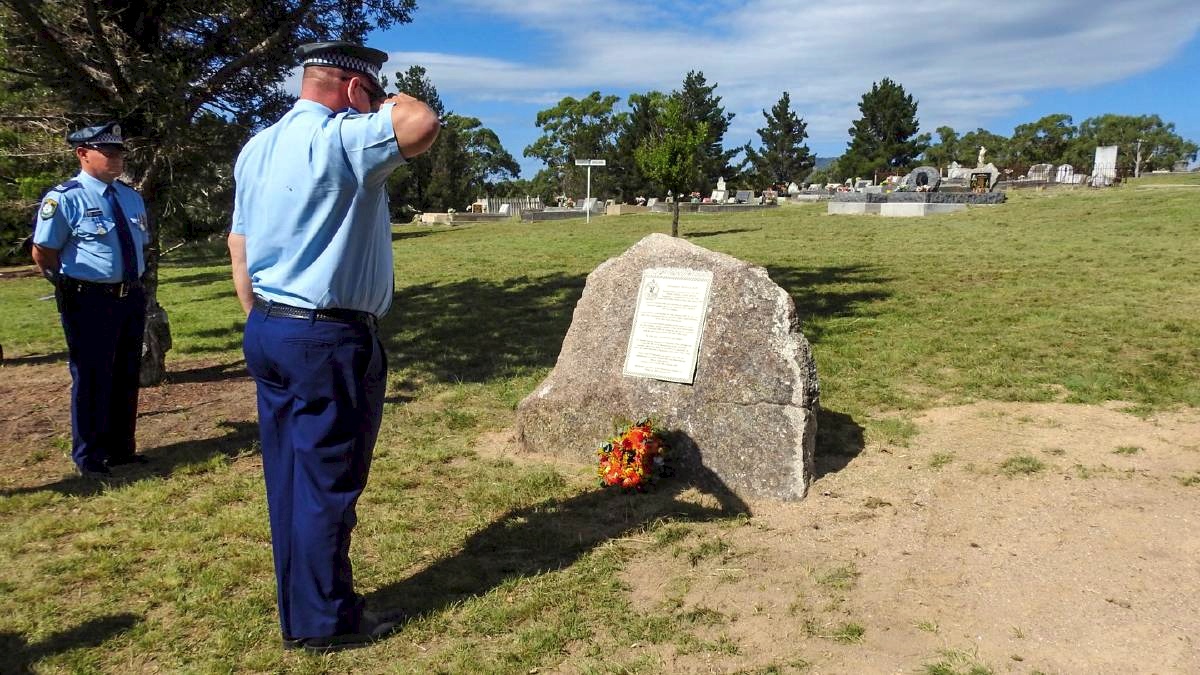
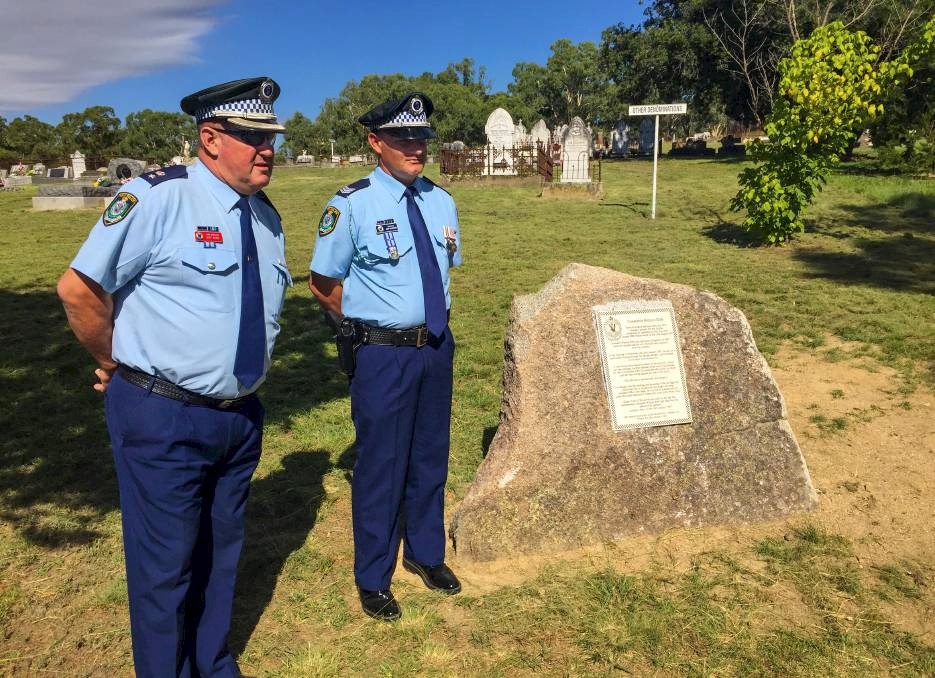
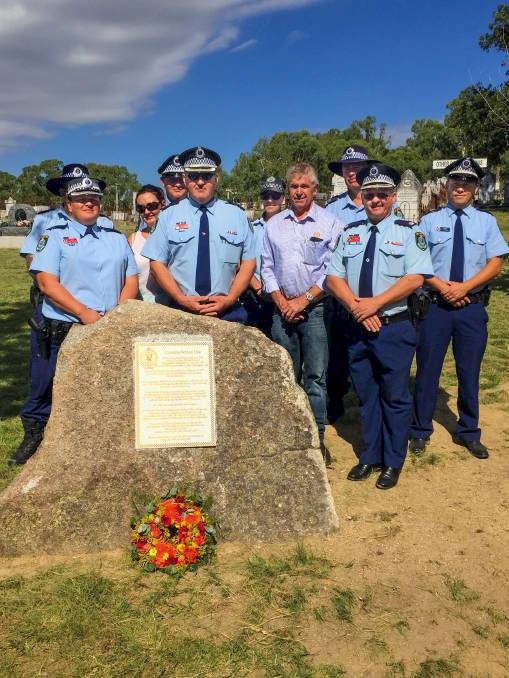
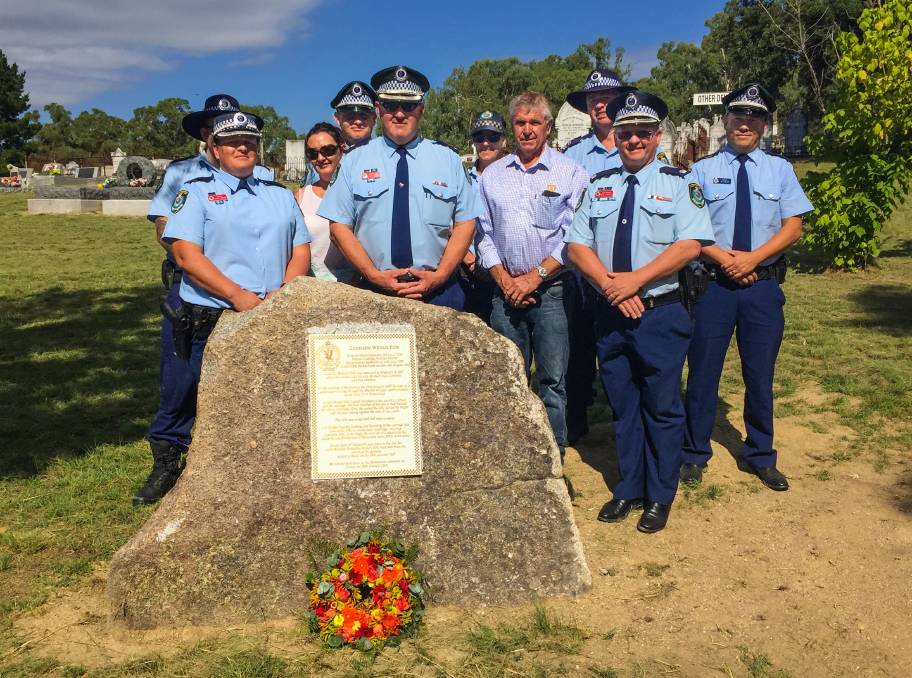
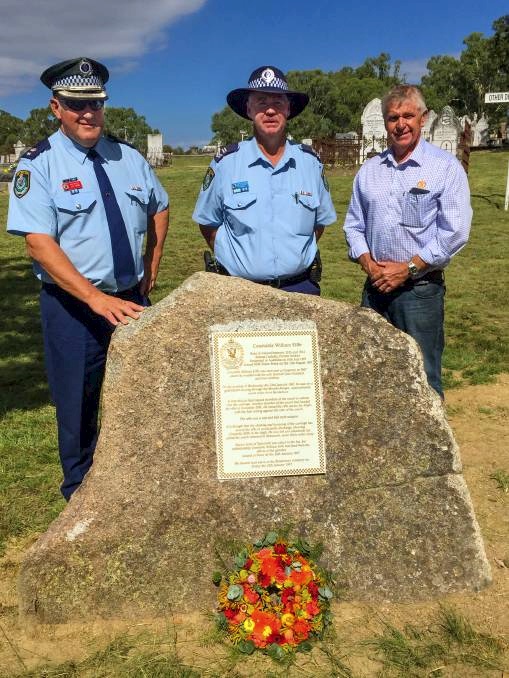
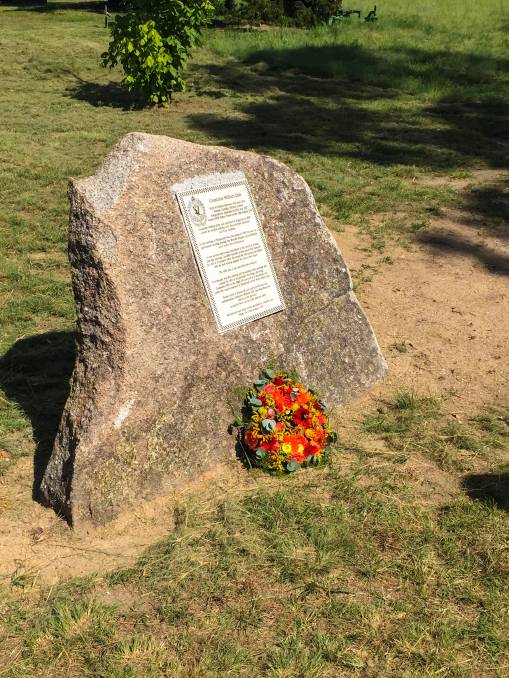
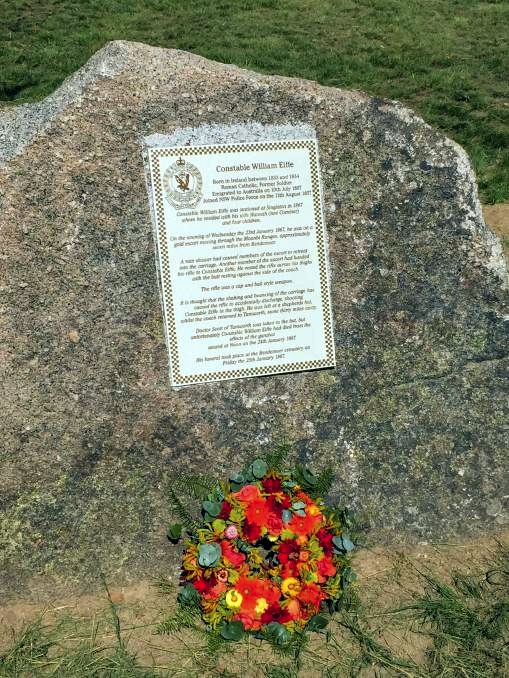
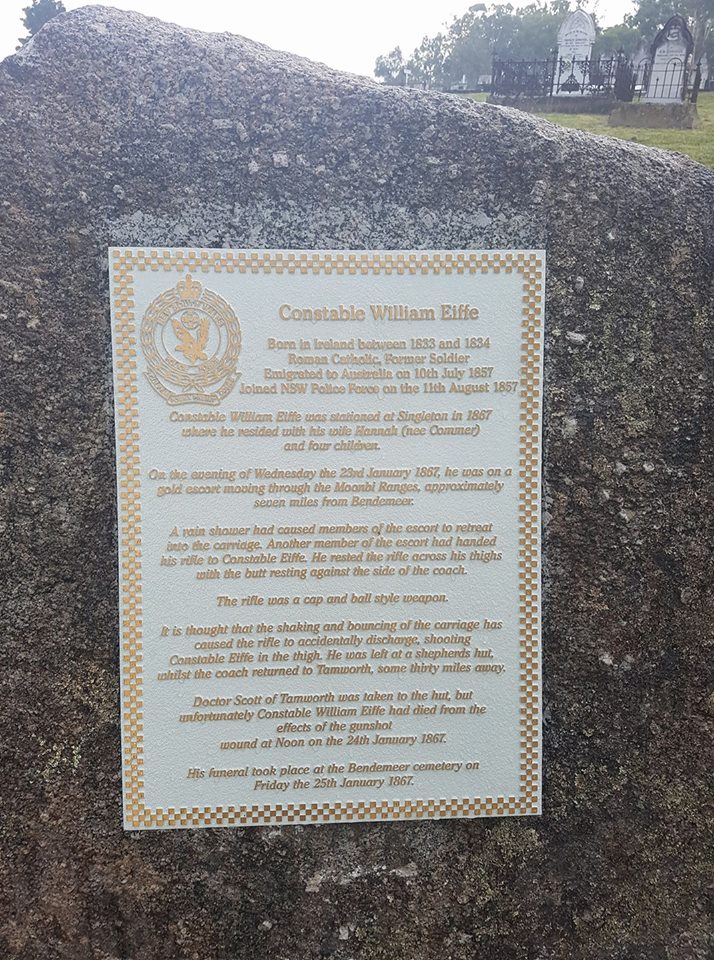
Constable William Eiffe memorial unveiled by Oxley police at Bendemeer Cemetery
Breanna Chillingworth
A PERMANENT memorial to recognise a fallen officer has been unveiled near Tamworth on the 150th anniversary of his death.
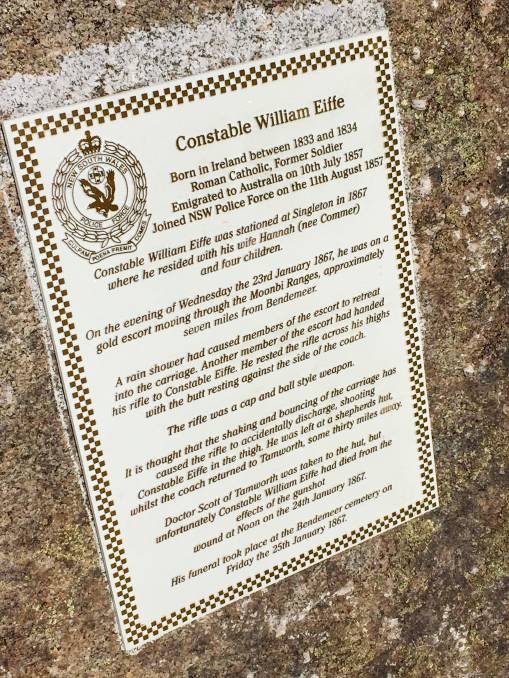
Constable William Eiffe died from a gunshot wound to the thigh on January 24, 1867, and is buried in an unmarked grave in the Bendemeer cemetery.
Oxley police together with Tamworth Regional Council – who helped to construct the memorial – commemorated his career in the force in a service on Tuesday morning.
”It’s a great part of the local history to have this recorded and I think it brings some interest in the local cemetery and the history of Bendemeer,” Oxley Acting Superintendent Jeff Budd said.
“And, hopefully for centuries to come, people will be able to come here and look at this and remember what has happened in our past.”
The Singleton-based officer was on a police escort on the night before his death when he was accidentally shot in the leg.
“On the evening of Wednesday the 23rd of January, 1867, there was a gold escort moving through the Moonbi Ranges, approximately seven miles from Bendemeer,” Oxley Sergeant Josh McKenzie said.
“A rain show had caused members of the escort to retreat into the carriage, another member of the escort had handed his rifle to Constable Eiffe, he rested the rifle across his thighs with the butt resting against the side of the coach.
“It is thought that the shaking and bouncing of the carriage has caused the rifle to accidentally discharge, shooting Constable Eiffe in the thigh.”
Constable Eiffe was left at Shepherds Hut nearby and the coach returned to Tamworth.
Memorial service: Oxley Acting Superintendent Jeff Budd lays a wreath at the unveiling of the plaque at the Bendemeer cemetery. Photos: Breanna Chillingworth Memorial unveiled: Oxley Acting Superintendent Jeff Budd with Sergeant Josh McKenzie in Bendemeer.
Memorial service: Oxley Acting Superintendent Jeff Budd lays a wreath at the unveiling of the plaque at the Bendemeer cemetery. Photos: Breanna Chillingworth Memorial unveiled: Oxley Acting Superintendent Jeff Budd with Sergeant Josh McKenzie in Bendemeer.
Paying tribute: Senior Oxley police, along with officers from Kootingal, Walcha, Nowendoc and Tamworth, pictured with Tamworth councillor Phil Betts.
Memorial unveiled: Oxley Acting Superintendent Jeff Budd with Leading Senior Constable Ron Stoltenberg and Cr Phil Betts.
William EIFFE Memorial William is actually buried in an unmarked grave.
“Dr Scott of Tamworth was taken to the hut but unfortunately Constable William EIFFE died from the effects of the gunshot wound at noon on the 24th of January, 1867.”
Acting Superintendent Budd said the service was a reminder of how far the force had come in 150 years.
It is thought that the shaking and bouncing of the carriage has caused the rifle to accidentally discharge.
Sergeant Josh McKenzie
“One of the things that would be a tragedy today is for this to occur and his family to not be supported,” he said. “In the days of Constable William Eiffe, his wife and four children would have been destitute without the support we have today and we should be grateful for that.”
Of Note: Searching NSW State Archives & Records on 14 May 2018:
There are NO surnames of FYFFE
There are NO surnames of EFFE
There are NO surnames of EIFFE
There were no Williams born in 1834
There is no Registered number 1154 on that website. There is 1153 ( Beatty ) and 1155 ( Moloney ) but no 1154
A wildcard search on ‘FFE‘ didn’t reveal any similar names or anyone born in 1834 on THAT website.
Danny Webster notes on 24 January 2017:
He is sometimes referred to as “Fyffe” and “Effe”, however the Registers of Police Employment 1847–1885 provides the spelling as “Eiffe”, his registered number as 1154, the fact that he was married at the time of appointment and that he was a former soldier.
The New South Wales Police Gazettes of 5 March, 1862, 3 April, 1867 (£100 gratuity awarded to his wife), and 3 July, 1867 indicate “Eiffe”.
His death was registered at Armidale as “Eiffe”.
He is incorrectly listed in the official New South Wales Police Honour Roll as William “Effe”.
[divider_dotted]
This was originally recorded as:
Constable William FYFFE
Accidentally Shot
Tamworth
24 January, 1867
On 16 January, 1867 Constable Fyffe was performing gold escort duty on a coach travelling between Bendemeer and Tamworth. It is thought that the shaking of the coach caused a rifle to accidentally discharge, shooting the constable. The wounded constable was left in a shepherd’s hut while the coach continued to Tamworth to obtain medical assistance. Dr Scott of Tamworth provided assistance for the constable, however the wound was to prove fatal and he died the following Thursday. He is sometimes referred to as William Effe.
The Sydney Morning Herald dated 25 January, 1867 reported that news from Tamworth had been received that ” Last evening, Constable Fyffe, on gold escort duty, was accidentally shot in the thigh whilst riding in the coach on Moonby Ranges, seven miles from Bendemere. His rifle accidentally discharged, it is supposed, by the shaking of the coach. He was left at a shepherd’s hut. The escort proceeded to Tamworth, and on its arrival there Dr. Scott was immediately started off. Fyffe died from the effects of the wound at noon today. He has left a wife and large family at Singleton.
The constable was born in 1834 and joined the police force on 11 August, 1857. In 1862 he became a member of the newly-formed New South Wales Police Force. At the time of his death he was stationed at Singleton.
[divider_dotted]
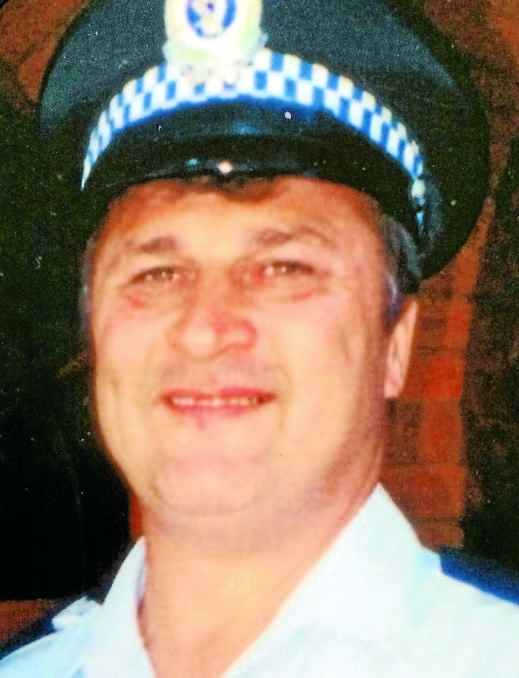
Stephen David Clifford PEPPERELL
| 31/05/2018
Stephen David Clifford PEPPERELL
NSW Police Cadet # 2754
New South Wales Police Force
[alert_yellow]Regd. # 16054[/alert_yellow]
Rank: NSW Police Cadet – commenced 6 December 1971
Probationary Constable – appointed 23 November 1973
Constable 1st Class – appointed 23 November 1978
Senior Constable – appointed 23 November 1982
Final Rank = Senior Constable – Death
Stations: ?, Tamworth ( 1980 – 1982 ), Kootingal ( 1982 – death ) ( 25 years at the ONE Station )
Service: From 6 December 1971to? ? 2007 = 36 years Service
Hundreds of people have packed St Paul’s Anglican Church in Tamworth, in north-west New South Wales, for the funeral today of long serving Kootingal policeman Steve Pepperell.
The crowd at this morning’s service was told of a family man who faced tragedy in his life, but who also made an enormous contribution to the police service since his induction in the early 1970s.
Senior Constable Pepperell was killed in a motorbike accident last week, sending shockwaves through the community he had served for many years.
The overflowing crowd watched the service on big screen TVs that had been placed outside the church.
The head of the Tamworth-based Oxley local area command, Tony Jefferson, says he remembers an officer who trained many young officers, who in turn have made a large contribution to the police service.
“He’d walk in here when he’d report to Tamworth with this devilish smirk on his face, and you’d never know what he’d been up to,” he said.
He says he will miss Senior Constable Pepperell’s roguish sense of humour.
Kootingal police officer honoured on memorial plaque
Breanna Chillingworth
A FORMER Kootingal police officer who died in an accident almost eight years ago has been honoured at an official memorial in Sydney.
Senior Constable Stephen David Pepperell was a familiar face after serving for more than two decades in the Kootingal and Tamworth areas as a police officer, right up until his tragic death in a motorbike accident in southern NSW in 2007.
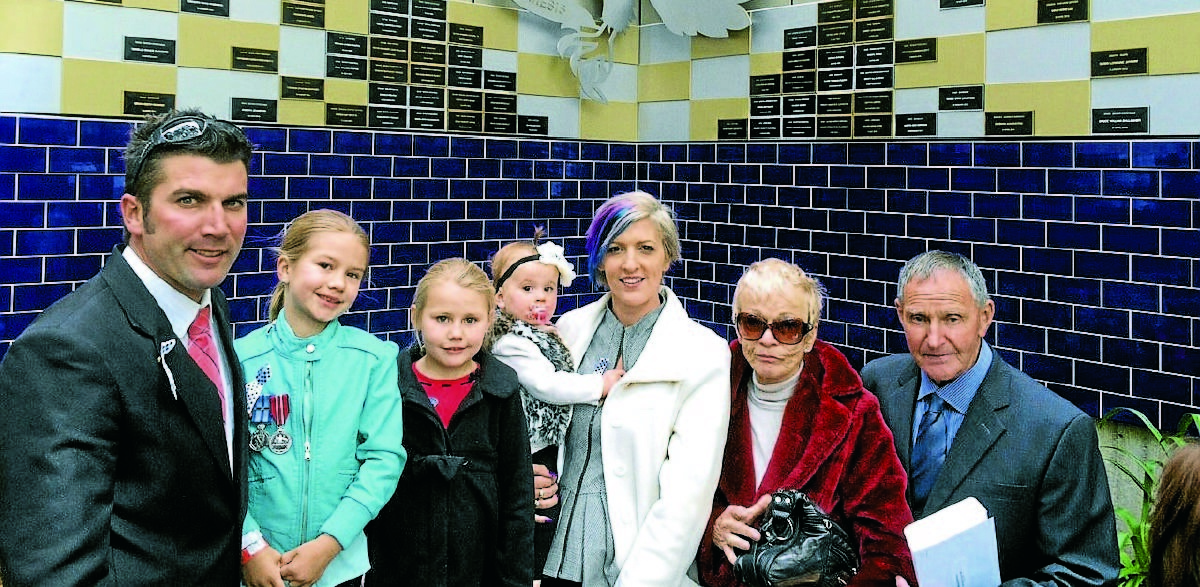
Yesterday, Police Commissioner Andrew Scipione unveiled a commemorative memorial plaque at the Sydney Police Centre in Surrey Hills, featuring the names of several sworn and unsworn officers including Senior Constable Pepperell who have died while serving in the NSW Police Force.
Several of Senior Constable’s Pepperell’s family including his parents travelled to Sydney for yesterday’s service. They said they were touched by the commemoration of their father, son and grandfather.
“We are honoured that Dad, even after his passing, will be recognised for his service and lifelong commitment to the police force,” daughter Natalie Pepperell told The Leader.
“Dad was one of the longest-serving police officers in one station and he was quite proud of that; he was so well-known in the community.”
Senior Constable Pepperell joined the force in Sydney in 1971 and never looked back.
After a city stint, he moved to Tamworth in 1980 and served for two years before transferring to Kootingal, where he was stationed until his tragic death.
“It was very touching because we grew up in the police station, in the police residence for all those years and the police force was a big part of our lives,” Ms Pepperell said.
FAMILY TIES: Anthony, Sienna, Ebony, Jenna, Natalie, Daphne and Edward Pepperell.
“So we have a lot of respect and gratitude towards the police, and appreciation that after seven years they continue to remember Dad. It is a really nice tribute.”
It was also his work outside the force made him a familiar face around Kootingal.
Senior Constable Pepperell was member and president of the Kootingal Lions Club, president of Kootingal Bowling Club, a Group 4 referee and also an avid Harley-Davidson rider.
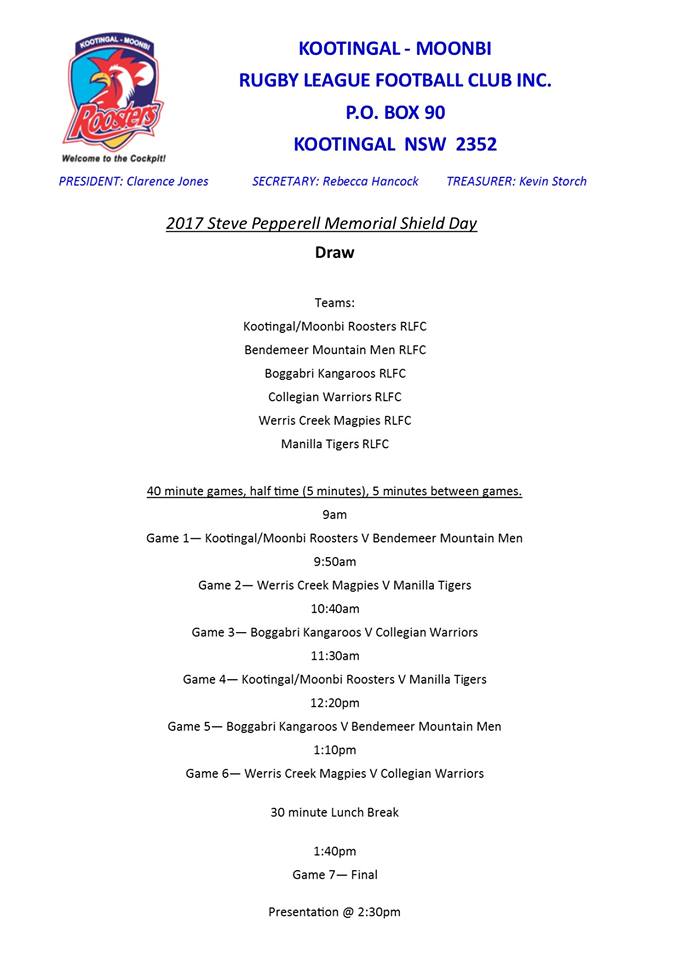
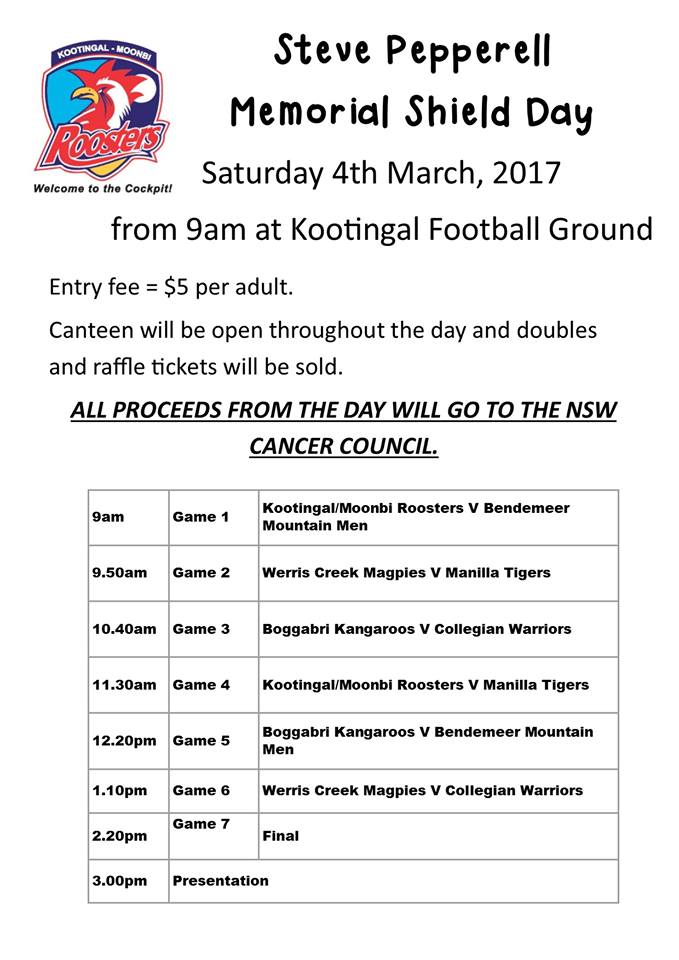
He continues to be honoured with the Steve Pepperell Memorial Shield football match, which is played annually in Kootingal and raises funds for the Cancer Council – a cause close to his heart after he suffered Hodgkin’s lymphoma.
The Kootingal-Moonbi rugby league club is calling on teams competing in Group 4 to pledge their support behind the, 2018 Steve Pepperell Shield Memorial Day.
The day honours Steve Pepperell’s tireless dedication to the community of Kootingal, with all proceeds from the day going to the New South Wales Cancer Council.
Prize money is up for grabs for the winner and runners-up. The fundraiser will be held on March 10.
Pepperell Shield biggest yet as second division gets into gear
GROUP 4 Second Division clubs have been converging on Kootingal for the past five years to play a bit of footy before the start of the season and raise some money for the Cancer Council.
The sixth Steve Pepperell Memorial Shield tomorrow will be one of the biggest yet with eight teams entered.
Even re-formed clubs Walcha and Boggabri have joined their new second division opponents is supporting the event, played in honour of the late Steve Pepperell.
Walcha and Boggabri meet in their first game of the day in an all-Kangaroo derby, before Walcha tackles Quirindi and Boggy faces Manilla.
All teams will play two games each and the winner will be the team with the best record for the day.
Werris Creek is the defending champion having won every trophy available to a second division club last season. With so many teams entered the day is a long one.
The first game is at 9am when Manilla tackles Bendemeer, with the last game to finish about 5.30pm before the presentation of the shield.
There will also be some exhibition league tag games between Dungowan, Kootingal, Quirindi and Walcha – the first league tag games to be played under the Group 4 banner.
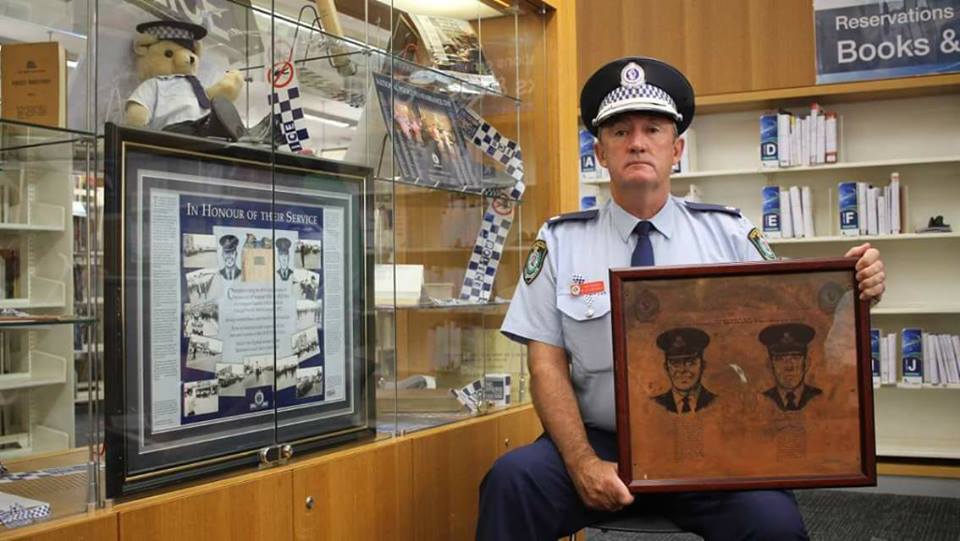
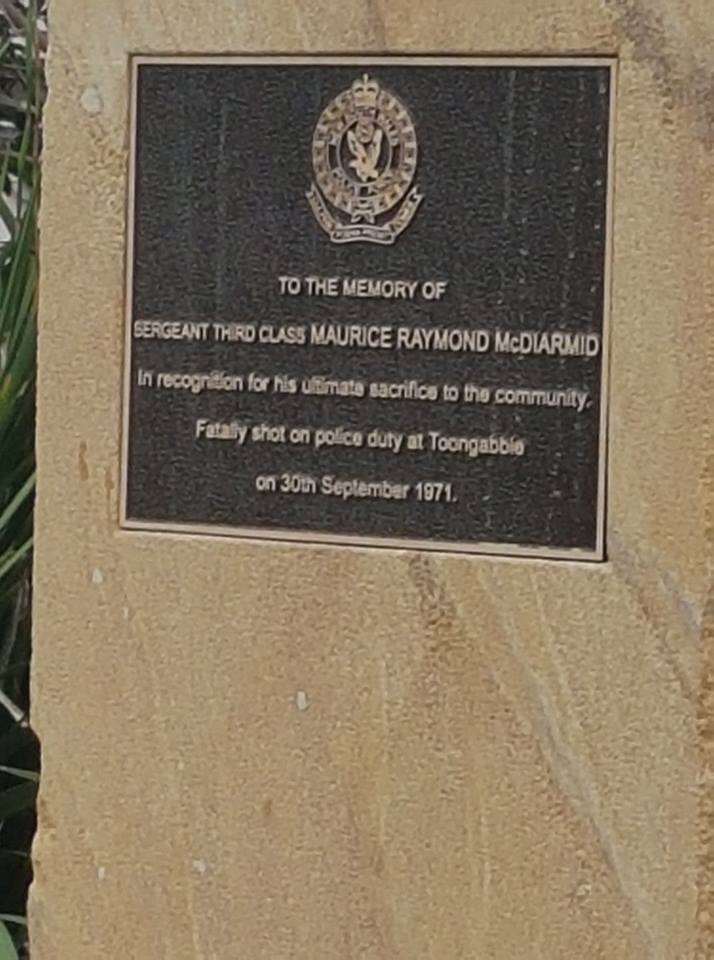
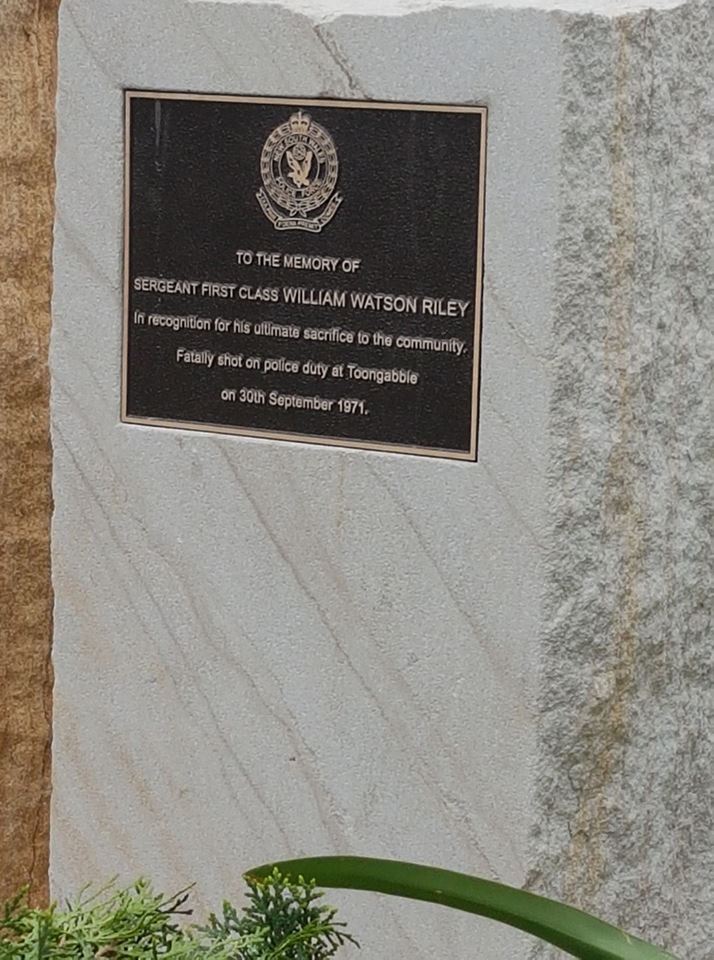
On 30 September, 1971, Sergeant 2nd Class Riley and Senior Constable McDiarmid attended a dwelling in Mimosa Avenue, Toongabbie to investigate a report that a man had shot and killed his brother at that address. On arrival the police saw the offender RonaldClarke who quickly ran to the rear of the house. Senior Constable McDiarmid followed him while the sergeant entered through the front door. As the senior constable entered through the back door the offender opened fire with a shotgun, inflicting a fatal wound. It appears the offender then went back through the house where he also shot and killed Sergeant Riley. Although the senior constable was still alive when other police arrived he died a short time later in an ambulance on the way to hospital. The offender was shot and killed by police ( Cst 1/c Alf GREGORY ) the same day.
William Riley was born in 1921 and joined the New South Wales Police Force on 3 December, 1945. At the time of his death he was stationed at Blacktown. He was posthumously promoted to Sergeant 1st Class.
Maurice McDiarmid was born in 1932 and joined the New South Wales Police Force on 9 July, 1956. At the time of his death he was stationed at Blacktown. He was posthumously promoted to Sergeant 3rd Class.
George Lewis Memorial Trophy
This trophy for the year 1971, which is for the most courageous act performed by a member of the New South Wales Police Force, was awarded posthumously to the late Sergeant 1st Class W. W. Riley and the late Sergeant 3rd Class M. R. McDiarmid who were stationed at 27 Division.
The trophies were presented to Mrs Riley and Mrs McDiarmid at the Police Academy during 1972.
PETER MITCHELL TRUST AWARDS
The ten awards under this Trust for the year 1971 were made to the following police, the trophies being presented at the Police Academy during 1972:
Most Courageous Act Posthumously awarded to the late Sergeant 1st Class W. W. Riley and the late Sergeant 3rd Class M. R. McDiarmid in conjunction with the George Lewis Memorial Trophy.
[divider_dotted]
Canberra Times (ACT : 1926 – 1995), Tuesday 21 March 1972, page 3
Plaque
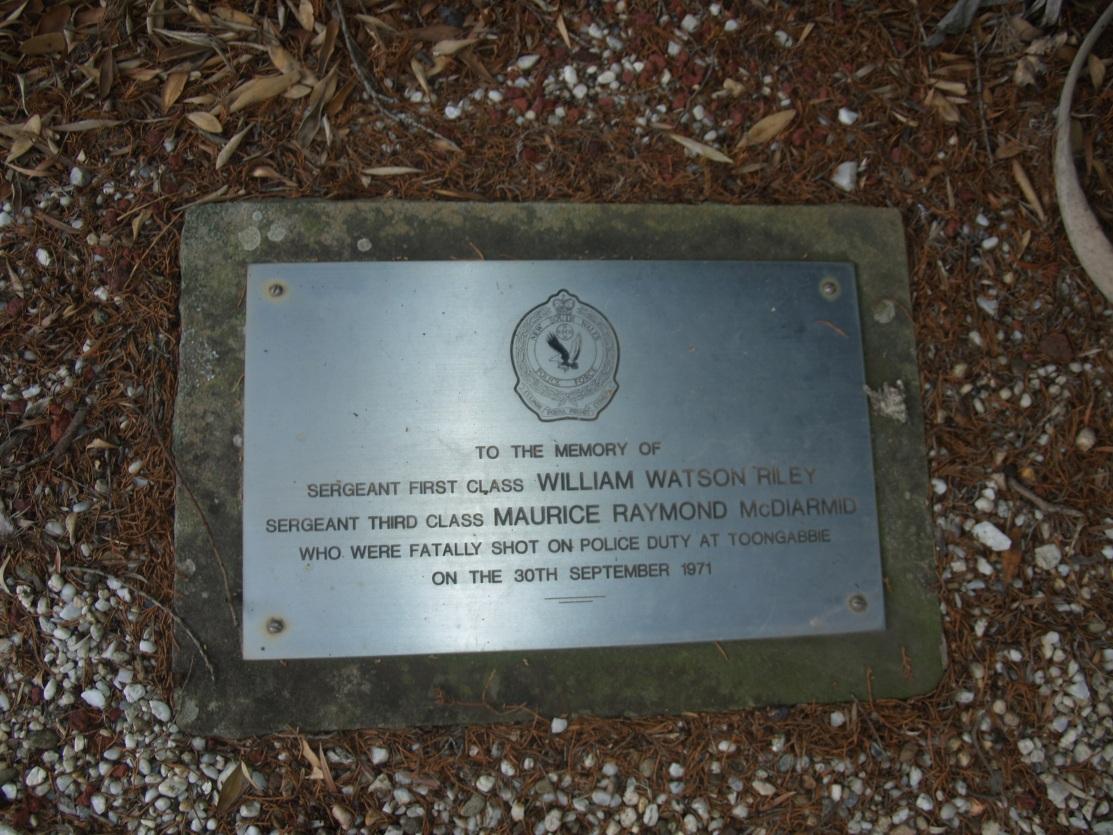
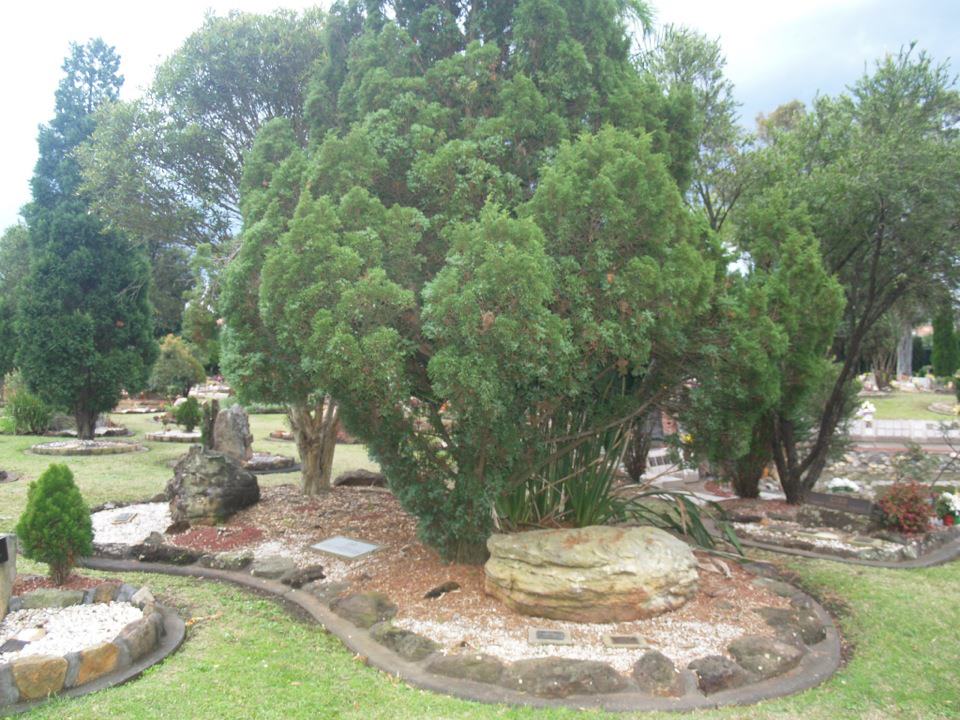
SYDNEY, Monday. — At the Pine Grove Memorial Park near Rooty Hill today, Bishop Hulme-Moir, chaplain of the NSW Police Force, dedicated a plaque in memory of Sergeant Maurice McDiarmid and Sergeant William Riley, who were shot when attempting to arrest an armed man at Toongabbie on September 30 last year.
Canberra Times (ACT : 1926 – 1995), Wednesday 6 October 1971, page 3
Funeral
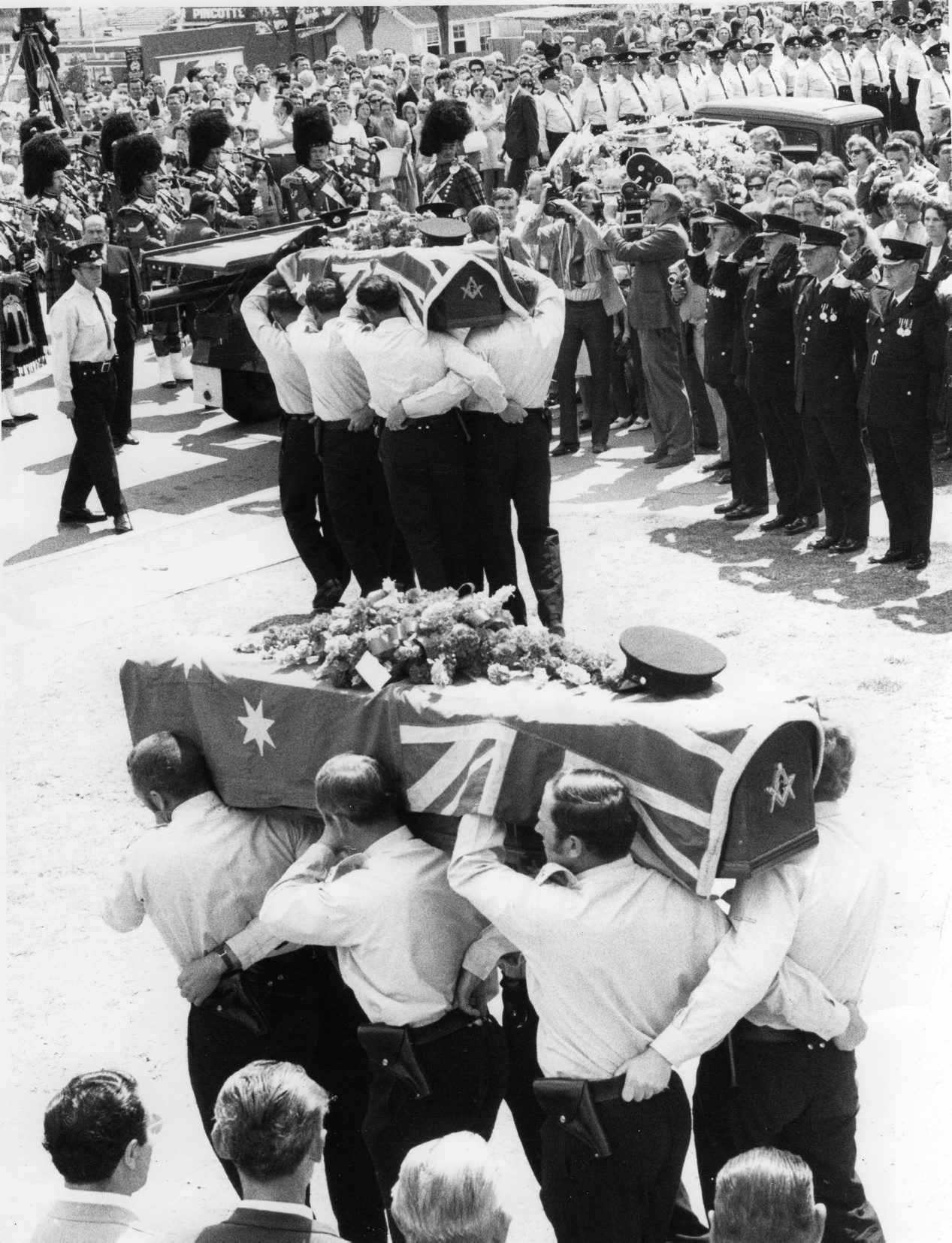
SYDNEY, Tuesday. -More than 400 policemen attended the funeral this morning of the two policemen shot by a man in Toongabbie last Thursday. Both men, Sergeant William Watson Riley and Senior Constable Maurice Raymond McDiarmid, were given full police honours at their funeral.
Canberra Times (ACT : 1926 – 1995), Thursday 13 January 1972, page 11
Payments to 3 police widows
SYDNEY, Wednesday. – The NSW Government agreed today to make, as “an act of grace”, lump-sum payments of $12,500 to each of three police officers’ widows.
“The Premier, Sir Robert Askin, said the payments would be in addition to the pensions and dependant’s allowances already paid out of the police superannuation and reward fund.
The three policemen involved in the payments are Senior Constable W. E. King, who was murdered at East Gresford police station on August 13 last year, and Sergeants W. Riley and M. McDiarmid, who were shot by a man at Toongabbie on September 30 last year.
Sir Robert said members of the police force had always been specifically excluded from the definition of “worker” under the Workers Compensation Act.
He said the Commissioner of Police, Mr Allan, had brought to the notice of the Government that, in certain matters of workers’ compensation, police were in an anomalous position in relation to other Crown employees.
Sir Robert said a full examination would be made of overall benefits of workers’ compensation available to police.
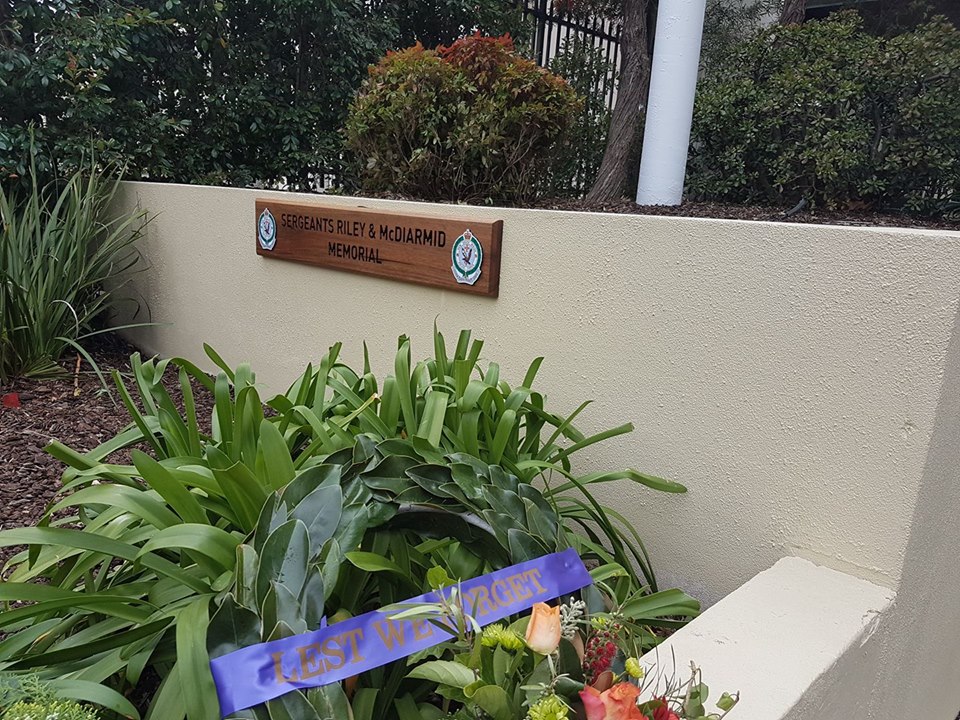
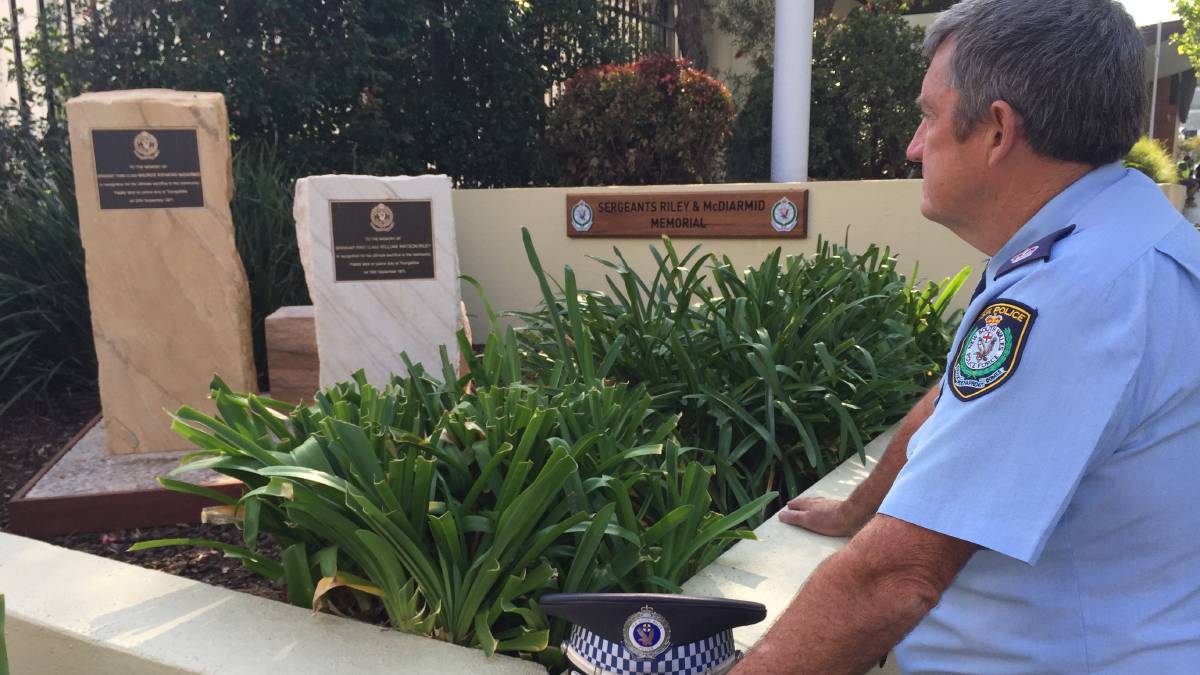
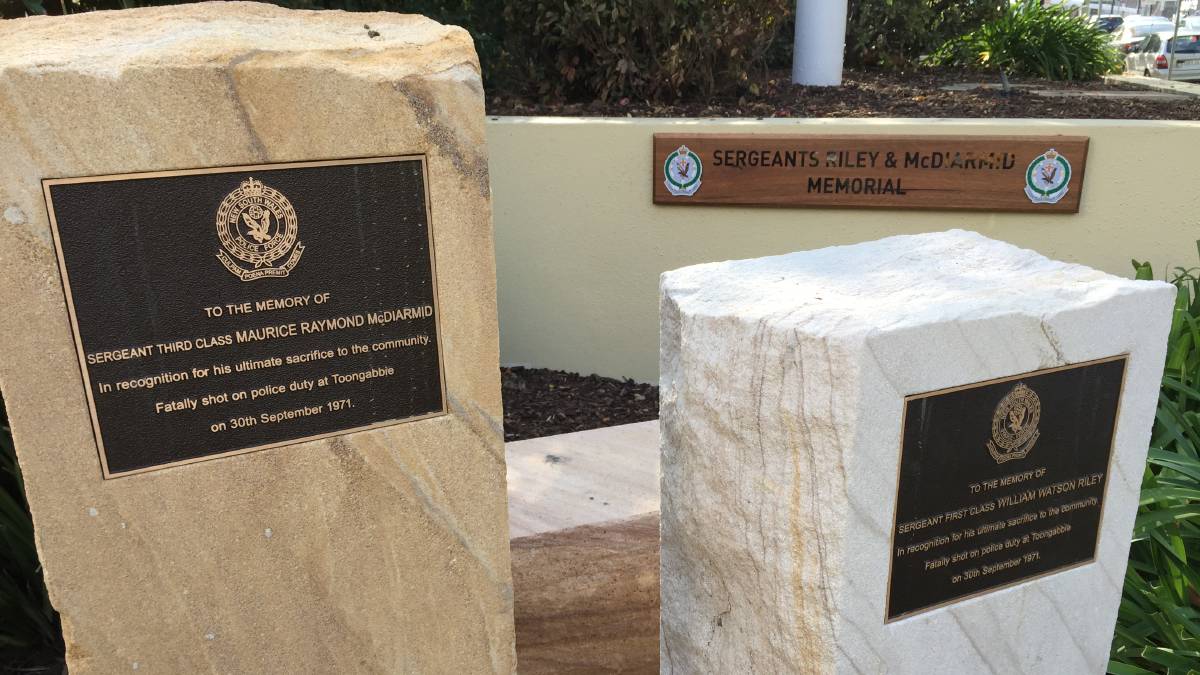
NOT FORGOTTEN: Blacktown Police Chief Inspector Bob Fitzgerald pays his respects at a memorial to slain officers Sergeant 1st Class William Riley and Sergeant 3rd Class Maurice McDiarmid. Picture: Harrison Vesey
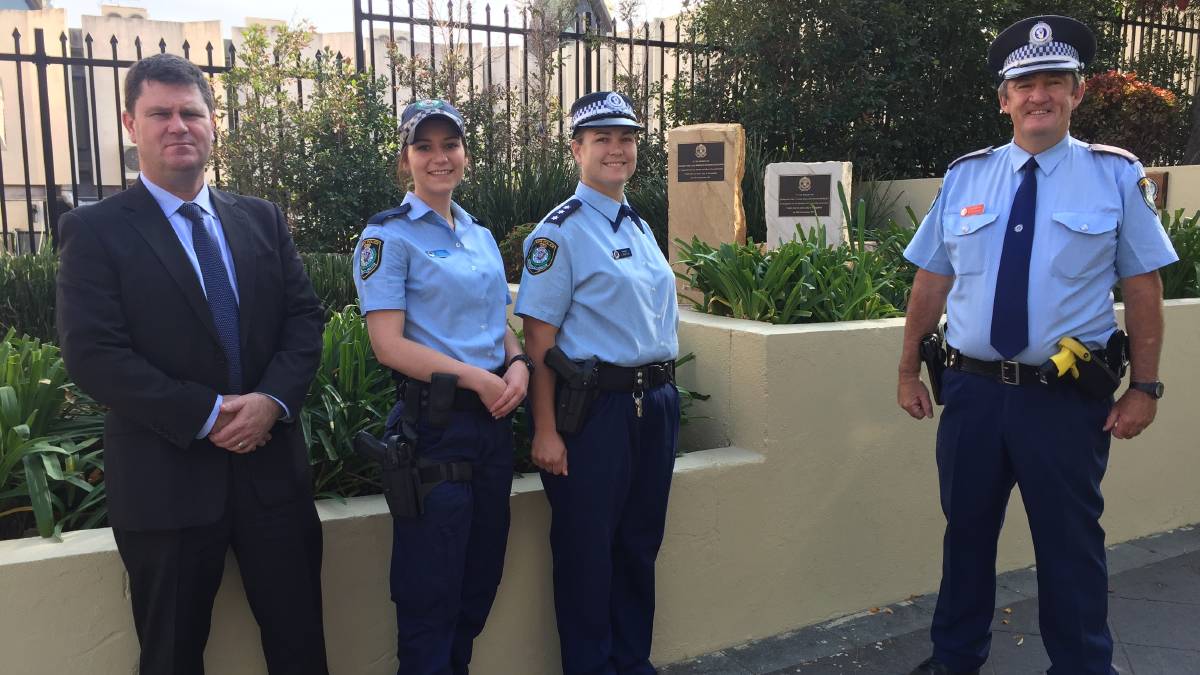
A solemn memorial stands to remind Blacktown police officers of the price paid by two of their colleagues.
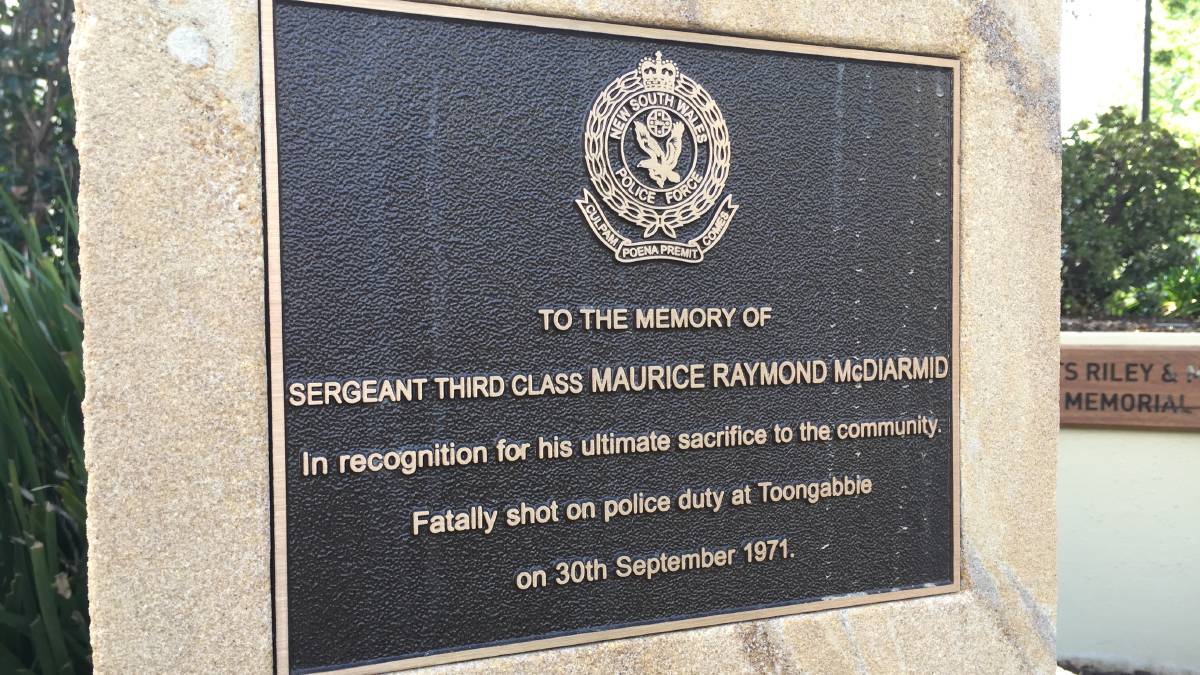
William Riley and Maurice McDiarmid were both killed in the line of duty on September 30, 1971, while trying to apprehend a murder suspect in Toongabbie.
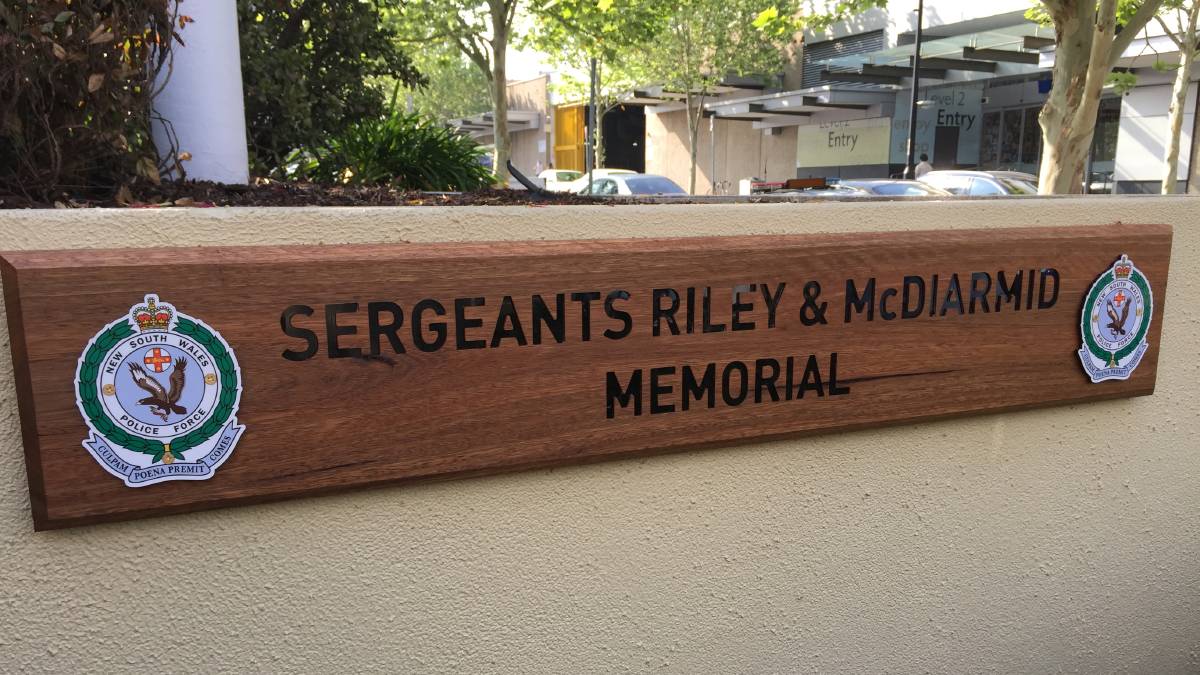
They are now remembered by commemorative plaques outside Blacktown Police Station, as well as a plinth at the entrance to the memorial rose garden at the NSW Police Academy.
The plinth features two police caps pictured the way they fell when the men were murdered, and bears the words: “For The People”.
Detective Senior Sergeant Adam Wilson, Probationary Constable Peta Kendall, Acting Inspector Lauren Martin and Chief Inspector Bob Fitzgerald.
Chief Inspector Bob Fitzgerald said the permanent memorials were important for police and the community.
“I hope it’s a reminder when you come to work, you do the job to the best of your ability and go home to your family,” he said.
Acting Inspector Lauren Martin said Police Remembrance Day gave every officer a chance to think about those who didn’t make it home.
“It’s good to have a visual reminder so you can reflect on what could happen when you come to work,” she said.
Sergeant 2nd class Riley and Senior Constable McDiarmid were attending a home in Mimosa Avenue, Toongabbie, following reports a man had raped a woman and shot her lover, who was also his brother.
The offender, Ronald Clarke, shot and killed both officers as they attempted to surround him. He was shot and killed by police in Hillview later that day.
“It is a very sad day for all those who believe in upholding the law and order,” Police Commissioner Norman Allen said at the time.
Both officers were posthumously promoted for their outstanding courage and devotion to duty.
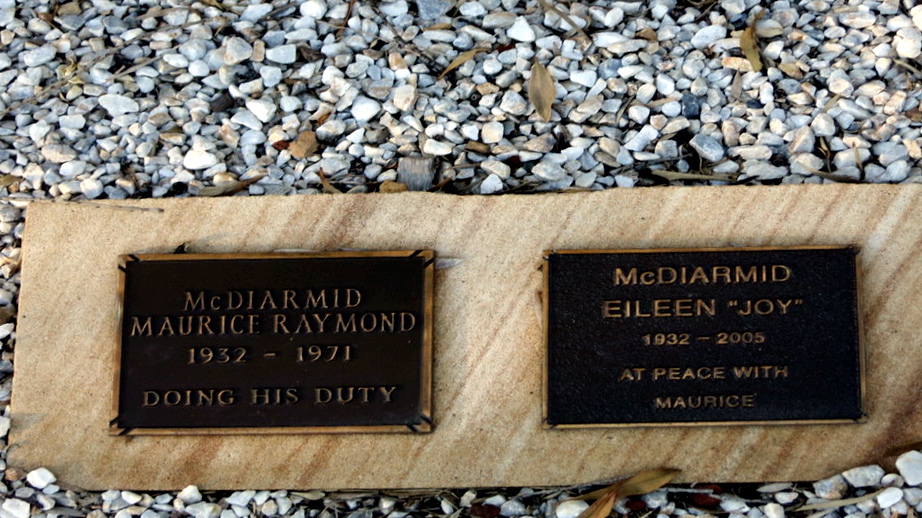
More than 400 officers attended their funeral in Blacktown. They were laid to rest at Pinegrove Cemetery with plaques bearing the inscription: “Doing His Duty”.
Canberra Times (ACT : 1926 – 1995), Saturday 27 November 1971, page 9
Two policemen commended by coroner
SYDNEY, Friday. — A Sydney coroner has commended two policemen who chased and stopped “an armed and desperate man“.
The man, Mr Ronald Desmond Clarke, had earlier shot and killed two other policemen after having killed his own brother in Toongabbie on September 30.
The coroner, Mr J. Parnell, SM, found on Wednesday that Mr Clarke in turn died in a car of cerebral lacerations and gun shot wounds to the brain inflicted by a person defending himself.
Constable A. C. Gregory, giving evidence at the inquest into the deaths of the four men, said that he and Constable L. ( Les ) A. Crawford in a police truck had rammed Mr Clarke‘s car, causing him to lose control.
Constable Gregory had seen Mr Clarke transfer a gun from his left hand to his right. The gun had been pointing at the policeman’s face and the constable had fired “one shot towards his shoulder“.
“The impact of this bullet appeared to throw him towards the passenger side of his car, but he still had the revolver, which he now held in both hands, levelled at my face“, Constable Gregory said.
“He appeared to be endeavouring to discharge the gun and it was then that I fired two quick shots at him“.
The four men who were killed were Sergeant First Class William Watson Riley, 50, and Sergeant Maurice Raymond McDiarmid, 39, of Blacktown, and Ronald Desmond Clarke, 20, and Warren John Clarke, 22, both of Toongabbie.
( Both policemen were promoted posthumously. Sergeant Riley was raised from second-class to first class, and Sergeant McDiarmid from senior constable to sergeant third class. )
Mr Parnell found that Mr Warren John Clarke died from gunshot wounds inflicted by his brother, Mr Ronald Desmond Clarke.
He found also that Sergeant Riley died from a fractured skull and lacerations to the brain, and Sergeant McDiarmid died in an ambulance between Toongabbie and Blacktown Hospital.
Both died as a result of bullet wounds inflicted by Clarke.
He said Mr Ronald Clarke, a professional criminal, had shot his brother, Warren Clarke, after having raped his brother’s de facto wife.
Canberra Times (ACT : 1926 – 1995), Friday 1 October 1971, page 1
Shooting in Sydney Brothers, two police die
SYDNEY, Thursday. – Two policemen and two other men were shot dead in the outer western Sydney suburb of Toongabbie today.
The policemen were shot while investigating a report of rape and murder.
Earlier, Mr Warren Clark about 22, died in his bed. Police said his elder brother, Ronald. 23, had shot him through the head with a .22 calibre repeater rifle.
A young woman, living in the house in Mimosa Ave, Toongabbie. with Mr Warren Clark, told police that Mr Ronald Clark had awakened her and then shot his brother.
The woman alleged that Mr Ronald Clark then raped her and forced her to accompany him in his car.
After driving her around for several hours, he had released her at Black town.
The woman went to Blacktown police station.
She was in a hysterical condition.
Sergeant Second-Class William Riley, 50. and Senior-Constable Morrie McDiarmid, 39. left the station immediately to go to the house.
While they were on their way the police radio directed other police to the house.
The next-door neighbour, in Mimosa Ave, Toongabbie. Mrs Ethel Roberts, 54. said she first knew something was wrong when a police officer ran down a driveway at the side of her house.
He began kicking on the door of the house next door.
“He eventually forced the door and went inside”, she said.
“All was quiet for perhaps two minutes, then three shots rang out.
“I ran to the front porch as a young blond man ran from the house with a rifle in his hand, entered a car and screeched off down the road”‘. Mrs Roberts said.
“After he drove off, I saw a policeman’s blood stained hand grasping the back steps of the house”.
Stem flow of blood
“I ran to the road where a woman was delivering bread and told her to call an ambulance”.
Another neighbour, Mrs Dawn Harris, was called by Mrs Roberts, who was trying to stem the flow of blood from Constable McDiarmid.
“When I reached the house a policeman was propped against the back steps”, Mrs Harris said.
“His mouth and part of his face were torn and shredded from the shotgun blast.
“Another policeman was lying dead on the ground.
“In a bedroom in the house another man covered with a sheet was also dead and blood could be seen everywhere”.
Police said later they believe Sergeant Riley died immediately when he was shot at point-blank range with a shotgun.
Constable McDiarmid was taken by ambulance to Blacktown Hospital. He died shortly after arrival.
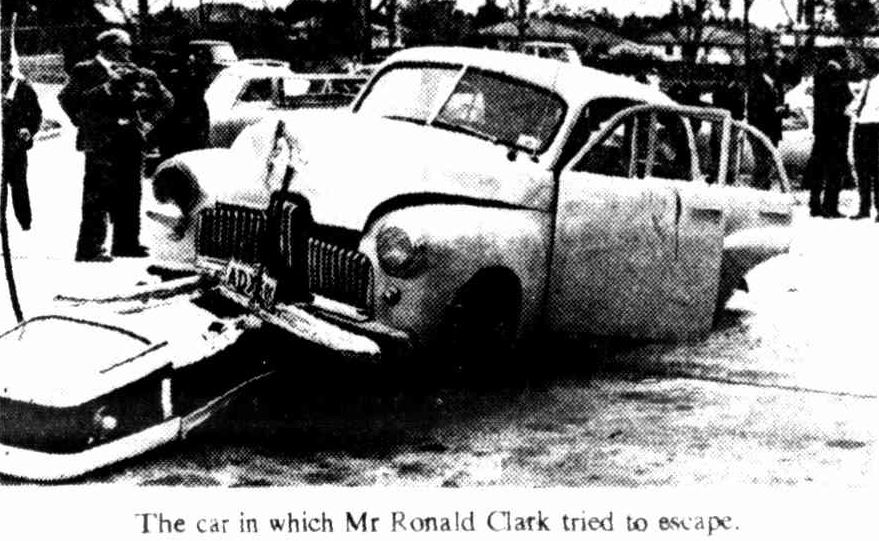
Meanwhile an all-points bulletin was broadcast over the VKG police network for all cars to be on the lookout for a bright blue 1950 sedan.
The broadcast warned, ‘This man is dangerous. He has a .22 rifle, a shotgun and two police pistols”.
“We have sighted him”, one car replied. “He is going toward Hillview”.
“We have stopped the car”, was the officer’s next report.
Constable Alfred Gregory and Constable Les Crawford said later they had rammed the suspect’s car with their police van.
The sedan got out of control and crashed into a bowser at a service station.
Constable Gregory jumped out of the van. As he approached the car he saw Mr Clark take one of the police pistols from the seat and transfer it to his right hand.
Three shots from pistol
Constable Gregory fired three shots from his pistol.
One of his shots struck Mr Clark in the side of the head, killing him.
In the car, police found several Commonwealth Bank cash bags, a blood stained nightgown and two suitcases containing mostly women’s clothing.
Two police revolvers, a .22 repeater rifle and a sawn-off shotgun were also recovered.
Tonight forensic and ballistic experts were still examining them.
The policemen killed are each survived by a widow and two children.
Sergeant Riley joined the force in 1945 and Constable McDiarmid in 1956.
A CIB spokesman said this afternoon the families were eligible for a special allowance paid to police killed while on duty.
He said that the lack of witnesses, particularly when the two policemen were shot, was hampering investigations.
POLICE KILLED OR WHO DIED FROM INJURIES RECEIVED IN THE EXECUTION OF THEIR DUTIES
On 13th August, 1971, Senior Constable William Edward King, who was then the officer-in-charge of police, East Gresford, was shot dead at East Gresford Police Station by a man who fired upon him with a rifle.
On 29th August, 1971, Constable 1st Class Patrick Mark Hackett died from injuries received in a motor accident at Polis, Cyprus, whilst performing duty with the New South Wales Police component of the Australian Police Contingent of the United Nations Peace Keeping Force.
On 30th September, 1971, Sergeant Second Class William Watson Riley and Senior Constable Maurice Raymond McDiarmid, both then attached to Blacktown Police Station, were shot dead in a house at Toongabbie which they had entered to arrest a man who a short time before had murdered his brother and raped a woman in the same house.
A police funeral with full ceremonial honours was accorded these deceased officers at which appropriate tributes were paid.
In recognition of their outstanding courage Sergeant Riley and Senior Constable McDiarmid were posthumously promoted by me to Sergeant 1st Class and Sergeant 3rd Class respectively. In addition, I submitted recommendations to the Premier for favour of consideration of Royal Awards being granted in both cases.
To assist the widows of the deceased police the Premier approved the payment to each of them of the sum of $12,500 as a gratuity. This payment did not in any way affect their entitlements to payments under the provisions of the Police Regulation (Superannuation) Act.
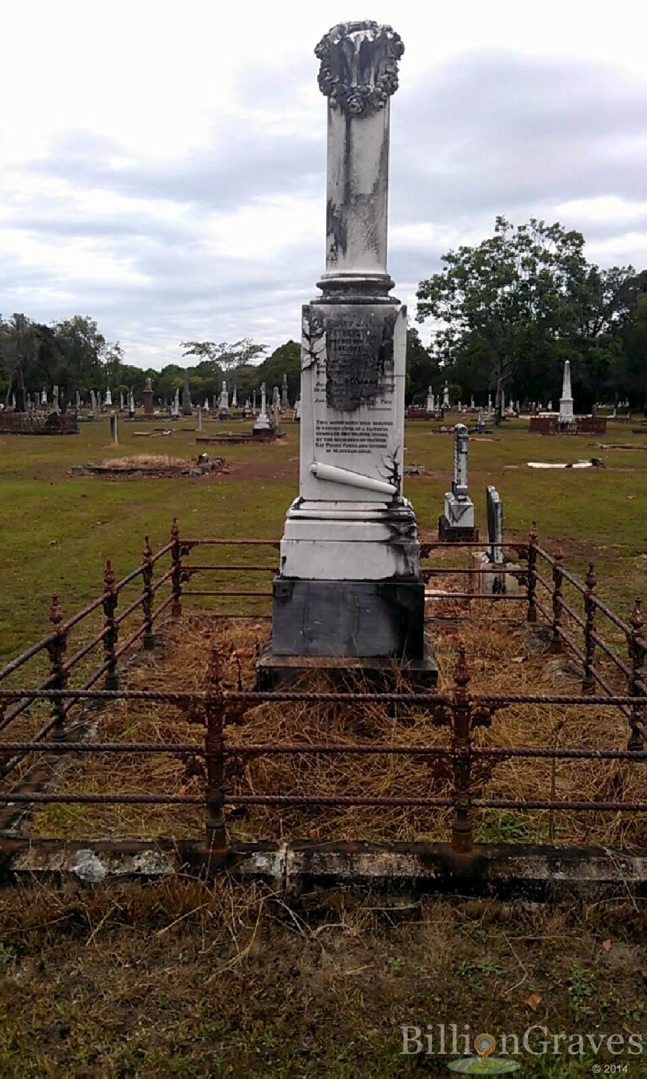
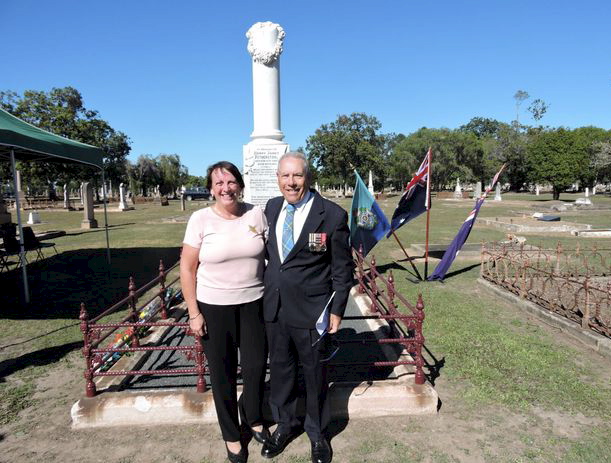
Retired police officer of 41 years Noel Sparks and his wife stumbled across the dilapidated grave of Senior Constable Henry James Fetherston when visiting the Maryborough Cemetery after the 2012 floods to check on Denise’s great-grandmother’s grave.
WHEN Noel Sparks stumbled across the dilapidated grave of a young policeman who died in 1885, he did not know he was starting a journey that would result in the official recognition of the officer’s sacrifice.
Mr Sparks, himself a retired police officer, and his wife Denise visited Maryborough Cemetery in 2012 to check on Denise’s great-grandmother’s grave after the floods.
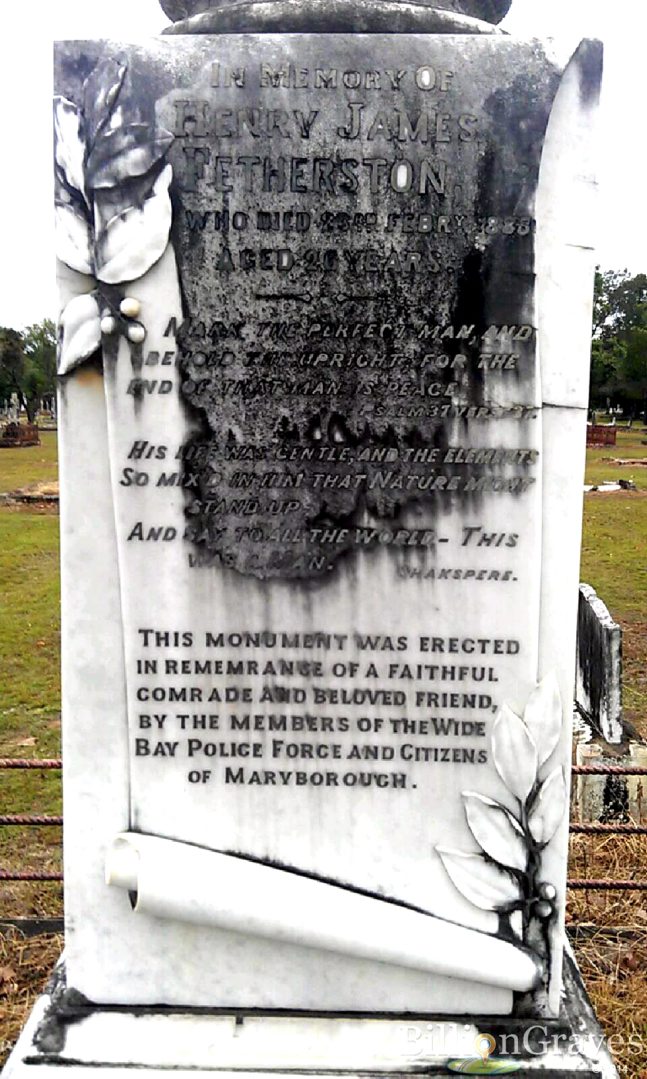
With a reading from Psalms and verses by Shakespeare on the side of the monument, Mr Sparks knew immediately that Senior Constable Henry James Fetheston ( misspelt – should be Fetherston ), who was just 26 when he died, had been a well-respected member of the community.
He would spend the next five years working towards honouring Snr Const Fetheston‘s sacrifice and helping to ensure the monument marking the young man’s grave would be completely restored to its former glory.
Yesterday ( 11 August 2017 ) a crowd of about 50 police officers, the restoration team, dignitaries and the public gathered to unveil the monument.
Snr Const Fetheston was born in Ireland and was sworn into the the Queensland Police Force in 1878 after migrating to Australia.
In 1879 he was posted to Maryborough.
Snr Const Fetheston was riding through the Police Paddocks in Tinana on February 23, 1885 when his horse bolted.
As he tried to calm him, he was thrown off, landing on a log before being crushed by the falling horse.
He was found at 5am and died at 7am the next day from internal injuries. ( this sentence is poorly worded. He died on 23rd, so either this sentence is wrong or the accident happened at 5am on the 22nd February and died at 7am the next day = 23rd )
Just prior to Police Remembrance Day last year ( 2016 ), his name was added to the Queensland Police Honour Roll and the national police Memorial in Canberra, acknowledging the officer had died while on duty.
After his death the community funded the monument that stands over his grave.
It was estimated that the monument would cost at least $70,000 to build if it was made today.
The well respected young man attended Maryborough’s Anglican church regularly and was a member of the rowing club and a local cricket club.
They sought the help of Warren Harland of Wide Bay Memorials.
“We worked under his direction and Warren was responsible for the restoration of the stone works including the marble and sandstone on the monument,” Noel said.
Senior Constable Henry James Fetherston died from injuries sustained from a horse-riding incident in Maryborough in 22 February 1885. He was 26 years of age and was subsequently buried in the Maryborough Cemetery.
A substantial monument commemorates his death and appears to be in a reasonable state of repair.
The FQPM propose to examine the monument in detail with a view to arranging the cleaning and restoration of the headstone and surrounds.
The President and Secretary were fortunate to meet with retired QPS representatives who have an interest in the restoration of police graves, in particular in the Maryborough area. We spoke with retired QPS member Noel Sparks and his wife, who were keen to coordinate the necessary work on the Fetherston’ grave.
Noel has made a preliminary assessment of the work required and is of the view that the monument has been slightly undermined and requires additional support. The remaining work would include cleaning the monument, painting the iron fence and cleaning the grave surface and perhaps covering with weed mat and decorative stones.
It is believed that much of the restoration can be achieved with volunteer labour and any other work necessary quotes obtained. FQPM would consider any submissions for financial support.
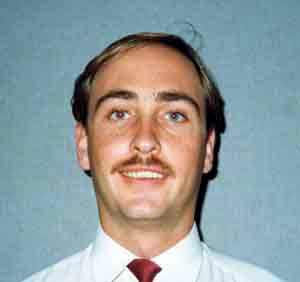
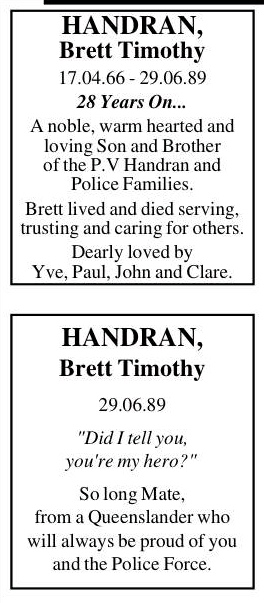
Plain Clothes Constable Handran was fatally shot by Tony Leif Dolerud at Wynnum, Brisbane on 29 June 1989 while attending a serious domestic dispute in company of his partner Plain Clothes Constable ( Stephen ) Clarey ( 24 ).
Dolerud had earlier stabbed his wife in an argument and, as a friend tried to take her to safety, armed himself with a high powered rifle and began firing indiscriminately into the street.
Plain Clothes Constable Handran was fatally shot as he alighted from the police vehicle outside the man’s unit. Constable Clarey was also shot as he took shelter behind the police vehicle.
Dolerud later took his own life ( suicide ) after killing his two-year-old daughter. Four others were wounded.
On Monday 3 July 1989 Brett Handran’s family were joined by a large contingent of his colleagues including senior officers of the New South Wales, Victorian and Australian Federal Police Forces.
The Service was conducted at the Queensland Police Academy Chapel with full police honours.
BRISBANE: On the day that all the headlines were about the Fitzgerald report and its recommendations for massive changes to the Queensland police force, not many would have been thinking of Constable Brett Timothy Handran, 23, who was gunned down last Thursday when he went to investigate a domestic dispute.
His funeral was held an hour after the first embargoed copies of the Fitzgerald inquiry report were handed to state Cabinet and journalists yesterday.
More than 300 police and mourners attended the 10am service.
Constable Handran was shot through the heart at a block of welfare flats in the bayside suburb of Wynnum.
The man who shot him also killed a little girl and then himself.
Four people were injured, including another officer, Constable Stephen Clarey, 24.
The Minister for Police, Russell Cooper, told the congregation, “I express deep regret at the loss of a loved one and a fellow officer.”
Among the mourners were police representatives from NSW, Victoria and the ACT. The Queensland police contingent was headed by Acting Commissioner Ron Redmond.
Some officers at yesterday’s service could not hide their frustration over Constable Handran‘s death, at a time when police morale had taken a battering.
“If only people could accept that we are proud of our job,” one officer said. “You get abused when you hand out a traffic ticket, but there are a lot a crazies running around and it’s the police who are expected to bring them in.”
Constable Handran, a single father, was attached to the Juvenile Aid Bureau. He and Constable Clarey were in Wynnum on another police matter and were the first to respond to the emergency call.
Last week, as police gathered up their equipment and prepared to leave the scene of the Wynnum shootings, one officer said, “Constable Handran will be buried on Monday, the same day the Fitzgerald report is released. Guess which story will get the biggest headlines?”
BRISBANE: The Queensland Government has been criticised for not providing police with bullet-proof vests following a shooting in suburban Wynnum yesterday in which three people were killed.
A two-year-old girl and an unarmed policeman were shot dead outside a flat in Carmichael Court by a man who later turned a rifle on himself and committed suicide.
Police said the shooting was the result of a domestic dispute.
The Opposition spokesman on police affairs, Terry MacKenroth, said every police car in the state should have at least two vests in it to protect officers called to emergency situations such as yesterday’s siege.
“Mr. Cooper, along with every other Ahern Government minister, including Deputy Premier Bill Gunn and the Premier himself, must take the blame for the death of a young police officer today,” he said.
Liberal leader Angus Innes said the Government had promised two years ago to provide police with bullet-proof vests.
He said that it was only in June this year that 1400 bullet-proof vests for police had been finally approved.
“Police know that they are more likely to be killed attending a domestic disturbance than in any other area of police work,” Mr Innes said. .
“The minister for Police, Russell Cooper, said last night that he had ordered a meeting today with Acting Police Commissioner Don Braithwaite to investigate the incident.
“Police said a man, a woman and two children had gone to the Wynnum flat, occupied by the woman’s former de-facto husband, to collect some of the woman’s property.
Police believe an argument started, which resulted in the woman being stabbed several times in the back, chest and arm.
As she fled with her male companion the man in the flat fired a rifle from an upstairs bedroom window, wounding the man in the back.
Police said as the couple drove to a nearby doctor’s surgery for help, a woman neighbour apparently attempted to carry the injured woman’s two-year-old daughter to safety.
The gunman fired another shot from the bedroom window, killing the girl and injuring the woman.
They said two plain-clothed officers from the Juvenile Aid Bureau who were in the area went to investigate.
The gunman then opened fire on the officers as they left their car and 23-year-old Constable Brett Timothy Handran was shot in the back and later died in hospital.
His partner, Constable Stephen Clarey, 24, suffered a bullet graze to the head and was not expected to be detained in hospital overnight.
The woman, her male companion and the female neighbour were also being treated in hospital.
A police spokesman said when the Tactical Response Unit arrived, they were told an eight month-old baby boy was still in the flat with the gunman.
They forced entry through the kitchen and rescued the baby, who was crawling on the floor.
About 45 minutes later police again entered the flat and found the gunman dead in a bedroom with a gunshot wound to the head.
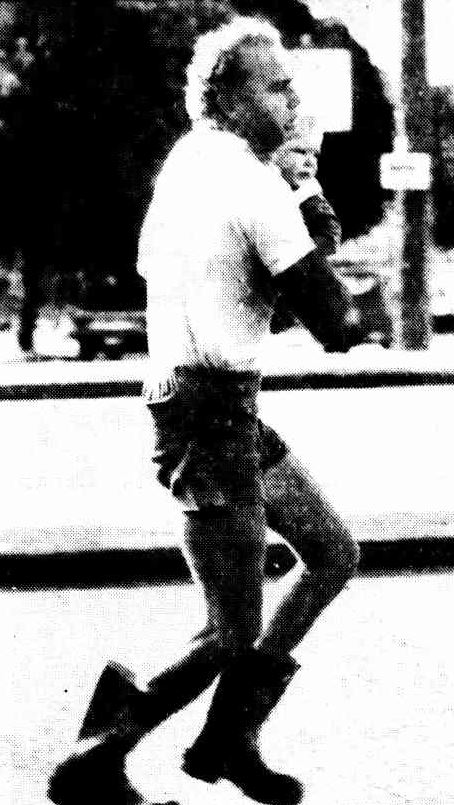
A man with a baby in his arms runs from the siege area.
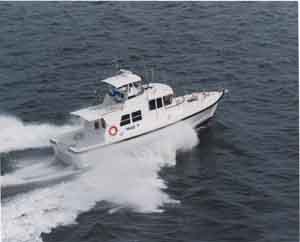
14.8 metre Norman R Wright and Sons fast patrol launch, triple diagonal planked hull with a dynel sheath. Powered by twin 420 hp Detroit 6v 92 series motors.
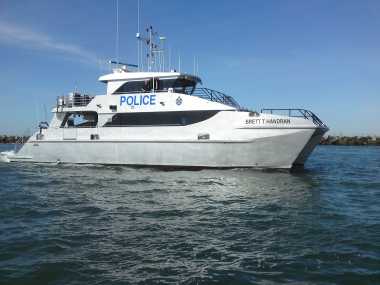
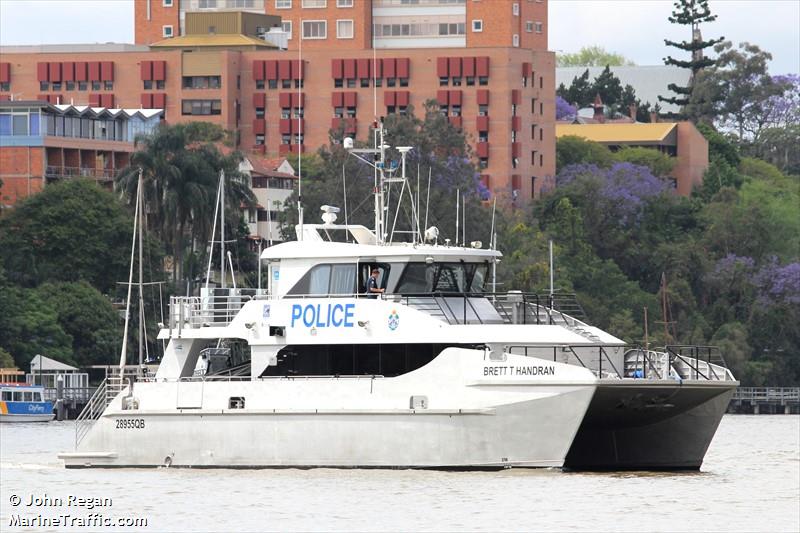
‘BRETT T. HANDRAN II‘
Brett T Handran II
BRETT T. HANDRAN II – 2009
The Brisbane based ‘BRETT T. HANDRAN II‘ was delivered to the Queensland Police Service in March 2009.
Built at a cost of over $1m, and one of three similar vessels (‘W.CONROY V’, ‘LYLE M. HOEY IV’ ), the ‘BRETT T. HANDRAN II‘ was built by Austral at their Margate shipyard just south of Hobart, Tasmania.
The ‘BRETT T. HANDRAN II‘ is a 22 metre aluminium catamaran powered by two MTU Series 60 diesel engines, each rated at 499kw, with Twin Disc Quickshift MGX-51355C gearboxes driving two Bruntons five-bladed fixed pitch propellers giving a maximum speed of 26 knots (cruise speed 20 knots) and a maximum range of approximately 900 nautical miles.
FROM THE VAULT – Star of Courage: Constable Robert Rodgers
Robert Rodgers joined the Queensland Police as Constable number 5904 on 10 October 1986. He served at the following stations: City; Mooroka; Brisbane Mobile Patrols; Inala, Brisbane CIB and Wynnum and retired on 7 February 1990.
On 29 June 1989Constable Robert Rodgers and Senior Constable Peter Edwards of the Wynnum Police, were told to attend an incident at Carmichael Court where a man was going berserk with a gun and where several persons had been shot, including Plain Clothes Constable Brett Handran. Rodgers and Edwards arrived at Carmichael Court, alighted from the vehicle and took cover. Constable Rogers ascertained from local residents the approximate location of the gunman and learned that a child and woman had been shot.
Constable Rogers found a position of safety close to the gunman’s location and communicated with the man to negotiate access to the wounded people. Without thought for his own safety, Constable Rogers successfully removed the child and woman from harm’s way. Constable Rodgers was awarded the Star of Courage on 18 April, 1991 for displayed conspicuous courage.
The Star of Courage is awarded for acts of conspicuous courage in circumstances of great peril. It is the second highest Australian Bravery Decoration. Only four Queensland Police officers have been in receipt of the Star of Courage since the award was established in February 1975.
Australian Bravery Decorations date from the establishment of the Australian honours system in. The Group Bravery Citation was added in 1990. The decorations recognise acts of bravery by members of the community. There are four levels of decoration:
Cross of Valour (CV)
Star of Courage (SC)
Bravery Medal (BM)
Commendation for Brave Conduct
The book – BRAVE, written by Mark Whittaker and first published in 2011 by Pan MacMillan Australia P/L also goes into further detail about this event.
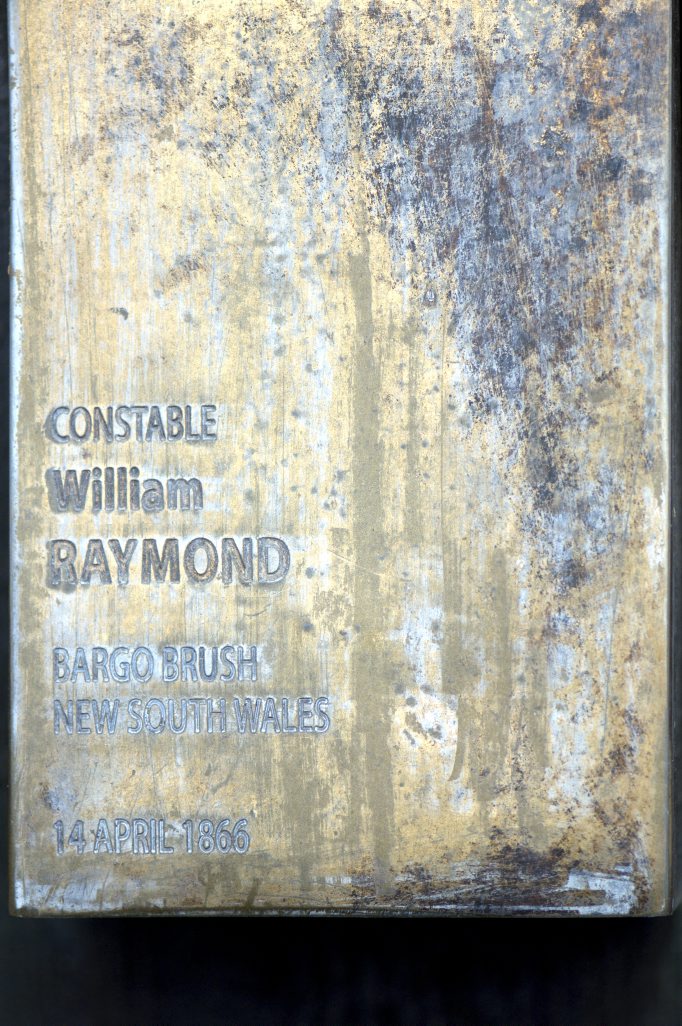
William RAYMOND
| 31/05/2018
William RAYMOND
AKA – William MILLER ( Surname of his Step Father – John Miller )
Late of Berrima, NSW
New South Wales Police Force
Regd. # ????
( No find under RAYMOND, nor MILLER, in the Police Service Registers 1852 – 1913 )
Rank: Constable
Stations: ?, Sydney Metropolitan District – Death
Service: From 3 June 1862to 14 April 1866=3+years Service
At the time of his death Constable Raymond, Senior Sergeant John Healey ( # ‘P’20 ), and Constables Andrew Kilpatrick ( # ‘P’ 54 ) and Edward Mitchell ( # ‘P’1215 ) were escorting eleven prisoners to Darlinghurst Gaol where they were to help with building works. When the wagon in which they were travelling reached Bargo Brush (now Pheasant’s Nest) the prisoners attacked their escort in an escape bid. In the ensuing brawl one of the prisoners (James Crookwell) managed to seize a police revolver. He fired at Sergeant Healey however the bullet struck Constable Raymond in the face, killing him instantly. The constable’s first name is sometimes recorded as Edward.
On 20 April, 1866 an official inquiry into the “murderous assault by prisoners on the police under whose charge they were being brought from Berrima Gaol to Sydney” took place at Darlinghurst Gaol, before Captain Cloete, the Water Police Magistrate. In evidence, Senior Sergeant Healey gave an intimate account of the circumstances of the murder.
“We were proceeding towards Sydney, and about 3 o’clock in the afternoon, when within about ten miles from Picton I heard a shout in the coach, and at the same moment I was seized from behind by both shoulders by two men; I made a spring forward and fell off the coach; I jumped up and went round to the near side of the coach; I saw prisoners Weaver, Slattery, and Lee take hold of Constable Mitchell; they were trying to wrest his arms from him; they were all standing up in the coach; prisoners Berriman, Crookwell and Owens had hold of Constable Kilpatrick on the same side of the coach, but at the back seat; they were trying to wrest his carbine from him; Crookwell had hold of his throat; Berriman and Owens had hold of his carbine; the prisoner Forster, was standing up in the centre of the coach; I presented my rifle, and told the prisoners if they did not let go I would fire; they did not let go; I pulled the trigger, and the cap snapped; I then seized my rifle by the barrel and made a blow at Smith, who was still struggling with Mitchell ; I hit the coach, and broke the stock of the rifle; I then saw most of the prisoners rush to the off side of the coach; I was still on the near side; when I got round I saw that Constable Raymond had got out of the coach and was standing alongside it; when I got up to the coach, I looked in and saw Crookwell with a revolver in his right hand, and holding Kilpatrick’s throat with his left hand; I said to him, “Put down that revolver, or I’ll blow your brains out”; prisoner Lee was shouting out to the others, “Shoot the b-s’. Weaver cried out, “Shoot the b–sergeant;” Berriman was shouting out, “Fire, fire;”‘ directly I said to Crookwell I would blow his brains out, he turned round and said to me, “you b-,” at the same moment he fired; Raymond was standing in front of me, between me and the horses; and Crookwell was standing at the back part of the coach’; I heard something like a bullet pass me, and I immediately fired; I think I hit Slattery; as soon as the shot had been fired by Crookwell, I saw the blood gush from Raymond’s nose; Raymond turned half round and fell on his face.
At this time Constables Mitchell and Kilpatrick were both struggling with prisoners in the coach; I then saw Owens had got out of the coach and was running away; I followed him, and called upon him to stand; he refused; I fired; he immediately fell down and rolled over, and cried out, ” I’m shot, for God’s sake do not fire any more.”; I did not fire again; I went up to him and brought him back to the coach; when I got back to the coach, Mitchell and Kilpatrick had got out, and were standing by the side of the coach; Crookwell was holding up a revolver, and cried out twice, “I surrender”. Several of the prisoners also cried out that they would surrender; I did not hear any other shots fired; I made Owens get into the coach, and handcuffed himself; I noticed blood was coming from Slattery and Bland; two or three civilians then came up, one of whom was a clergyman, who assisted Mr. Whatmore to put the body of Raymond, in the boot of the coach; Raymond, up to this time, had not moved from the place where he had fallen”.
The constable was born in 1838 and joined the New South Wales Police Force on 3 June, 1862. At the time of his death he was stationed in the Sydney Metropolitan District.
Empire (Sydney, NSW : 1850 – 1875),
Tuesday 17 April 1866, page 1
RAYMOND — On the 14th April, on the Southern Road, near Picton, from a gun-shot wound, inflicted by a prisoner while under escort, William Raymond, aged 28 years, a constable of the New South Wales police force, a native of Bishops-gate, London, England.
EXAMINATION OF FIVE PRISONERS AS BEING ACCESSORY TO THE MURDER OF CONSTABLE RAYMOND.
Our readers will remember that eleven prisoners were concerned in the desperate ? ( fight ) at Bargo Brush on Saturday last.
One of those, James Crookwell, was committed, on Monday, by the Coroner, at Picton to take, his trial at the next assizes for the murder of Constable Raymond. Three of the prisoners were wounded, Smith in the elbow, when attempting to snatch the revolver from sergeant Zglenitski ; Slattery near the kidney, when in the act of biting constable Mitchell‘s nose, and attempting to deprive him of his firearms ; and Bland was shot in the side and arm while trying to seize constable Mitchell’s rifle. These three prisoners are in the gaol hospital, and were not in a condition to be removed, Bland being in a somewhat precarious state. Hindmarsh and Webster, who do not appear to have taken any conspicuous part in the assault, will most likely be called by the Crown for the prosecution.
The remaining five prisoners were placed under examination yesterday, in the upper room of the debtors’ prison, Darlinghurst gaol, before the Water Police Magistrate, Captain Cloete.
The names of the prisoners are John Foster, William Lee, Henry Weaver, Thomas Berriman, and John Owens. They were brought into the room in the order named, in prison dress, and leg-ironed.
Foster is a strong young man, of about 24 years of age, and has a determined look about him. Lee, who acted as spokesman, is about, an inch taller than Foster, being 5 feet 7, aged 38, and apparently very familiar with gaols, and the customary preliminaries to them. Weaver is young, sulky, tall, and such a man as can be easily persuaded to anything. Berriman is a little compact, swarthy young man about 28 years of age. Owens is something like Foster, but more intelligent. These five, of themselves, appear almost a match for the escort whom they assaulted.
They were formally charged by senior-sergeant Healey, of the Berrima police, with being accessories to the murder of the late constable Raymond, near Bargo Brush, on Saturday, the 14th April instant.
Prisoner Lee : Your Worship, may I address you before anything further is stated? will you order all the witnesses out of court ? and I should like a piece of paper and a pencil to take notes.
The Magistrate said he would comply with the request, and the prisoner was supplied with paper and pencil.
Mr Williams, Crown Solicitor, then conducted the examination, as follows:-
John Healy deposed: I am a senior sergeant of police, stationed at Berrima.
I left Berrima about 9 o’clock on Saturday morning last, having previously attended the gaol at Berrima, and received in custody eleven prisoners, to be escorted from Berrima to Darlinghurst gaol, Sydney.
The names of the prisoners were, William Lee, Thomas Berriman, John Foster, Henry Weaver, John Owens, Michael Slattery, Hindmarsh, Crookwell, Bland, Smith, and Webster.
The five prisoners now before the Court were among them.
I had with me constables Kilpatrick, Mitchell, and Raymond.
The prisoners were placed in one of Cobb’s coaches, outside the gaol door. The three constables, myself, the driver, and a Mr Whatmore accompanied the coach. I sat on the left of Mr Whatmore, who sat next to the coach driver on the box. Constable Mitchell was placed with his back towards the box, on the near side of the first seat, there being four seats inside the Coach, Constable Raymond was on one of the centre seats on the off side facing the box. Constable Kilpatrick was on the oft, or back seat, facing Mitchell, but two seats between them.
Constable Raymond, Mitchell and myself, were armed with breach loading rifles and revolvers. Constable Kilpatrick had a small carbine and revolver, all were loaded. In this way we proceeded towards Sydney.
When about ten miles from Picton, and at about 3 o’clock in the afternoon, I heard a cry like ” Hurrah ” in the conch. At the same moment I was seized from behind by both shoulders. The cry seemed to be a general cry. When I found hands forcibly upon me and an effort made to pull me back, I sprang forward, and jumped off the coach, and fell.
On recovering, I went round the near side of the coach. I then saw the prisoners Weaver, Smith, Lee, Slattery, and I think Bland surrounding and struggling with constable Mitchell. They were trying to wrest his firearms from him. They were all standing up in a cluster round him in the coach, Berriman, Crookwell and Owens, I saw had hold of constable Kilpatrick : he was on the back seat of the coach, on the same side. They were trying to wrest his carbine from him. Crookwell had hold of Kilpatrick‘s throat ; Berriman and Owens had hold of his carbine. Foster was standing up in the centre of the coach. I did not see him do anything. I did not then see constable Raymond. I was standing on the near side of the coach, with my back to the horses, and presented my revolver, and said to the prisoners Crookwell, Owens and Berriman, if they did not let go I would fire. I pulled the trigger of my rifle and the cap snapped. I then seized it by the barrel, and in striking at Smith, the stock caught the frame of the coach and broke the rifle. I saw the main body of the prisoners rush to the off-side of the coach. When I got round to face them, I then saw that constable Raymond had got out ; he had stumbled and was standing facing the coach near the hind wheel. When I came to Raymond I saw Crookwell with a revolver in his right hand. He had hold of constable Kilpatrick‘s throat with his left. I said to him ” Put down that revolver, or I’ll blow your brains out.” Prisoner Lee was hallowing out: ” Shoot the b—gers. ” Weaver cried out, ” Shoot the b—dy sergeant, ” Berriman cried out, ” Fire ! fire ! ” Directly I said to Crookwell, put down that revolver, or I’ll blow your brains out, ” he turned partly round presented the revolver towards me saying, ” You b–ger, ” at the same time firing.
At this time constable Raymond was on my right. I was between Crookwell and Raymond. I saw the explosion, and felt the lead ball whiz past my face. I returned the fire instantly with my revolver, and I believe I hit Slattery. As soon as Crookwell fired I saw the blood rushing from Raymond’s nose. He wheeled round, and tell forward, dead.
At this time the prisoners were still struggling with constables Mitchell and Kilpatrick, I observed Owens jump from the other side of the coach and run away. I followed, and told him to stand. He did not, and I fired. He immediately fell on his face on the road, and cried out ” I’m shot, for God’s sake don’t fire any more. ” I went up to him and brought him back to the coach. He was not shot.
When I got back to the coach constables Mitchell and Kilpatrick had got out of the coach. I noticed Crookwell holding up the revolver, and heard him crying out ” I surrender ! ” Several of the other prisoners were also calling out ” I surrender !” I could not tell whether any other shots were fired at this time.
I made Owens get into the coach and handcuff himself, and also the other prisoners we’re made to re-seat themselves. I then observed blood coming from Slattery and Bland. Two or three civilians came up then, one was a clergyman and they assisted Mr Whatmore and the driver to lift the body of constable Raymond on the Boot of the coach.
Raymond had never moved from the time he was shot.
After we had got Raymond on the boot of the coach, we three Constables, walked by the side of the coach until we came within about six miles of Picton, when we were met by the sergeant and a constable from the Picton police;
We proceeded on to Picton, secured the prisoners in the watch-house, and placed the body of constable William Raymond in the courthouse. He was quite dead.
When I jumped off the coach and recovered myself, I saw Hindmarsh holding up one hand and saying ” I have nothing to do with this. ” I saw Webster standing up in the coach; So far as I saw, Webster was quiet.
When we left Berrima the prisoners were handcuffed by one hand to a chain, and had leg-irons on. I produced the transmission warrant for the removal of the prisoners from Berrima to Darlinghurst. I handed this warrant over with the prisoners at Picton.
The shot that Crookwell fired was shot in the direction of Raymond.
The prisoners declined to ask any questions.
Andrew Kilpatrick deposed: I am a constable stationed at Berrima. On the 14th April I went to Berrima gaol, in company with senior-sergeant Healey and two other constables. The sergeant received charge of eleven prisoners. The five prisoners now before the Court were of that number. The sergeant was sitting on the box. I and the other constables were inside the coach. I sat on the back seat, Raymond in the centre, and Mitchell on the front seat.
When we came to within three miles of the Bargo River, On the Sydney side of Anderson’s public-house, a prisoner named Crookwell, sitting by my side, gave a shout, saying, ” Now, give it to the b–gers. ” Crookwell seized hold of my carbine, as did also prisoners Berriman and Owens, and endeavoured to wrest it from me. Crookwell then let go, and seized my revolver from the case at my waist belt.
Senior sergeant Healy came round to my side, and I shouted for him to shoot this fellow Crookwell. At this time Crookwell had just got the revolver. The other two had hold of my carbine. The sergeant presented his rifle at Crookwell, and it missed fire. He then clubbed the rifle, made a blow but struck an iron bar in the coach. He ( Healey ) then ran to the other side of the coach, at the same time drawing his revolver. Just as he got round, constable Raymond had just got a fall from a stumbling of the coach. As Raymond was straightening himself up, the sergeant came between him and Crookwell, and told Crookwell to put down the revolver. Crookwell made use of some savage expressions and fired. I saw Raymond fall and observed the blood gashing from his nose. It was with my revolver Crookwell shot him. The sergeant immediately fired in return. I cannot say which prisoner was struck, but one was. After Crookwell fired he turned to me and said ” If you don’t leave go of the carbine I’ll shoot you. ” I said, ” Shoot way. I’ll not let go. ”
He snapped the revolver at breast. As it did not explode he struck my right hand with the revolver. I then jumped out of the coach with my carbine, when I saw sergeant bringing Owens back. I could not see how constable Mitchell was getting on. When the sergeant brought Owens back, the prisoners all called ” Surrender ! we surrender ! ” and sat down in the coach, when the sergeant ordered them to put on the handcuffs. The sergeant and myself were in uniform at the time. I only observed Crookwell and Owens had been un-handcuffed. Could not say whether any of the others had been un-handcuffed.
Crookwell, Owens, Berriman and Weaver, were particularly active about me and and tried to disarm me. I heard Weaver call out ” Shoot the sergeant. “. This was when Crookwell had the revolver. Slattery also called out ” Shoot the b—dy sergeant. ”
The prisoners appeared to me to be acting in concert, and for the general purpose of effecting their escape.
When Slattery called out ” Shoot the b—dy sergeant, ” it was after Raymond had been shot by Crookwell.
I saw the body of Raymond afterwards. It was quite dead.
Prisoner Lee: Your Worship, I think it is stepping a little beyond the bounds of justice for the gentlemen prosecuting to be whispering to the sergeant who has given his evidence. I know that gentleman is conducting the case for the Crown, and he will take care to get out enough from the respective witnesses when under examination.
Mr Williams said he was asking no question but such as was proper, and taken no unfair advantage.
Mr Cloete: I will see that no injustice is done you. The prisoners declined to ask any questions.
Edward W. Mitchell; deposed: I am a mounted constable, stationed at Berrima, and formed one of an escort from Berrima to Sydney, in charge of senior sergeant Healey. The prisoners were Foster, Lee, Bland, Smith, Weaver, Slattery, Hindmarsh, Berriman, Webster, Crookwell and Owners. We were all in of Cobb and Co.’s coaches, the sergeant on the box. I, Raymond and Mitchell were inside the coach. I sat with my back to the box with two prisoners on my left. Raymond was on the third seat on my left front, with three prisoners on his left. Kilpatrick was on the fourth seat, facing me, with two prisoners on his right. Crookwell sat next to Kilpatrick.
When about 400 yards on the Sydney side of Anderson’s public-house; the prisoners made a sudden rush ; some stood up. I saw two of the prisoners jump up and put their hands above the cloth covering of the coach, and seized the sergeant and endeavoured to pull him backward into the coach. Slattery and Weaver were the two men.
The sergeant got away from them. Simultaneously with seizing the sergeant, three of the prisoners seized me. Foster, Lee and Smith seized me. Smith caught me by the throat. Foster endeavoured to force me back, as nears as I can recollect, by throwing his body on me. Lee took hold of the rifle and endeavoured to disarm me. While I was struggling with these prisoners, I saw sergeant Healey coming round the side of the coach. He covered Smith and Lee with his rifle. I heard the cap snap, and the butt of the rifle swing against the coach.
A minute or so after I said ” By G—, if you don’t let go, I’ll fire ! ” They did not let go, and I fired. The rifle was pointed towards the prisoner, Bland, who, at this time, had hold of the rifle, with the others. Bland was wounded on the side and arm by the contents of my rifle. Immediately after this I was seized by the prisoners Weaver and Slattery. Slattery seized me by the throat, and by the hair of my head, and got my nose to his mouth when at that moment, he received a ? and staggered back. Weaver caught me by the body ? ? maintained hold of the rifle. While I was struggling with the remaining three, Foster took hold of my left arm, and endeavoured to pull it away from the pouch which contained my revolver. I was holding and covering my revolver pouch. Lee and Smith made an effort to pull the revolver out of the pouch, but they did not succeed.
About half a minute after Slattery was shot, I heard a remark that some one was wounded. A number of them then called out ” We’ll surrender. ” I was so occupied with the prisoners near me that I could not see what constable Raymond was doing. I just caught a glimpse of Owen escaping from the hind wheel of the coach. I did not notice Hindmarsh, nor Webster; they were away from me. After they called out ” We’ll surrender, ” I got out of the coach, and ran round to the other side, when I there saw constable Raymond lying dead on his face. I observed a gunshot wound on the left side of his nose, just below the eye. I immediately re-loaded my rifle.
The body of constable Raymond was put on the footboard. The prisoners were secured in the coach. We proceeded to Picton and on the way met Senior sergeant Zglenitski, and another constable.
We placed the prisoners in the Picton watch house, and the body of constable Raymond in the Court house. The prisoners were secured at Berrima on a marching chain by handcuffs, and each was leg ironed. The only man I saw free from the chain was Owens. In this attempt to escape the prisoners to me appeared to act in concert, as if they were one man. The prisoners declined to ask questions.
Police sergeant Zglenitski and two other witnesses having to be examined, the further hearing of the case was adjourned until Monday, 30th Instant, at 2 o’clock. o’clock.
The official inquiry into the charge brought by sergeant Healey against Hugh M. Bland and Michael Slattery, of being accessories to the murder of constable William Raymond, near Bargo Brush, on the 11th of April last, was resumed before the Water Police Magistrate, Mr Cloete, in the debtors’ prison at Darlinghurst Gaol, yesterday afternoon.
The inquiry into the case against these two prisoners was commenced at the same place on Monday last, and the evidence taken on that occasion was reported in our issue of yesterday. The remainder of the evidence was taken yesterday and both prisoners were committed for trial. The evidence given was as follows:-
John Frederick Webster, alias Timothy Fuller, a prisoner under sentence, was called and said I was one of the eleven prisoners removed from Berrima gaol to Darlinghurst gaol, under charge of senior sergeant Healey, on the 14th April last , the names of the other prisoners were, James Crookwell, Thomas Berriman, William Lee, Peter Hindmarsh, John Owen, Henry Weaver, John Foster, Michael Slattery, James Smith, and Hugh Montgomery Bland ; I was an assistant warder in Berrima gaol, and on the 14th I was called out of the yard and ironed in the presence of the gaoler, thence I was taken back to my cell, and after breakfast brought out and searched , the other prisoners were then ironed and on the chain , I was also handcuffed to the chain , we were marched out and placed in Cobb’s coach ; there were three policemen beside the sergeant in charge of us, and another young man accompanied us, after going a few miles the coach stopped, and the young man took the fourth horse back to Berrima ; we then went on to Rush’s, and thence, after changing horses, to Bargo, where we again changed horses, we were there ordered out of the coach, and marched into a little yard to get our dinner ; while we were at dinner (which was brought to us by the police), I observed Crookwell, Owen, Berriman, and Smith, with two handcuff keys, and they were trying their handcuffs. Berriman produced one of the keys I don’t know who brought the other. I heard Crookwell and Owen say they could undo their handcuffs. Smith said they were going to rush the police, to choke them, and take their arms from them, and then to make their escape, both he and Crookwell asked me if I would take part in the rush ; I said ” no, I have only twenty months to do, but if I had twenty years to do I would not join you ” ; Smith then called me ” bl–dy dog ” and coward, and threatened to rip me open if I spoke one word, at this time he had a double bladed clasp knife in his hand cutting some bread and meat, I told him I would not have anything to do with it, and I never spoke one word afterwards ; Crookwell afterwards said, addressing Forster, Slattery, and Weaver, ” how is it going to be? ” they said they would be willing the first chance they got after they were in the coach again ; Crookwell, addressing Slattery, asked, ” Is Bland going to be in it ?” Slattery replied that it was no use to ask him, as he had only six weeks to serve, and therefore it was not likely he would join them ; I heard Lee ask Bland if he would be one to rush the police and take their arms from them, and he replied, ” No, he would not on any consideration,” and he should be a free man in six weeks’ time. Crookwell then asked Berriman and Owen, if they knew which of the police they were to assist in taking the arms from, and Owen said, ” I know the man I have to choke. ” Berriman said “You choke him and I’ll take his revolver, and Slattery added, ” I’ll take his rifle. The whole of the prisoners heard what was going on ; Foster said he would make one to pull the Sergeant in off the box of the coach. Lee said, “I will make another” Smith said he would choke the man sitting on the front seat of the coach and take his arms from him ; Hindmarsh said he would assist Crookwell all he could ; Weaver said he would assist in holding the Sergeant down in the coach ; we were about three quarters of an hour in the yard, the sergeant and one of the the police were about eight yards from us in a little shed ; another constable was behind us, the other side of a water hole, and the fourth in front of us near the fence, between four and five yards from us ; I heard Crookwell, Slattery, and Smith, ask the sergeant if he would be kind enough to allow them to take their coats off and he consenting they were taken off ; after this we got into the coach and started on our journey ; we were sitting in the coach the same as before, with the exception of Lee and Foster, who exchanged seats ; we proceeded for about three or four miles on the road, when on turning my head round I saw Crookwell and Owen ; Crookwell was pointing to the near side of the coach, and calling constable Kilpatrick’s attention to something while Owen was taking his handcuffs off with a handcuff key ; I then saw Owen try Crookwell’s handcuffs ; I turned my eye towards the front of the coach and felt the chain to which we were ironed fall quite slack ; I saw John Owen standing up in the coach ; all of a sudden he whipped his arms around the neck of the constable who was afterwards shot, and sang out ” Now then, Tommy and Jimmy ;” Berriman instantly made a snatch at the constable’s revolver, and I tried to stop him ; I struck him and tried to keep his hands off ; Slattery, who was sitting in front of the constable who was afterwards shot caught hold of him to pull him towards him, and tried to get hold of his rifle, but the constable held his rifle at arms length outside the coach, and Slattery could not got hold of it ; at this time I had hold of Berriman with my right hand, and received a blow under the ear – I don’t know who struck me – I was knocked down in the body of the coach ; the policeman got away from Berriman, Owen, and Slattery, and got out of the coach ; when he got on the ground he held his rifle, pointing it towards Crookwell, and said if they did not surrender he would fire at them ; the sergeant stood alongside of him some few feet apart ; the constable was nearer the hinder part of the coach and somewhat behind the sergeant ; I turned my head and saw Crookwell and Hindmarsh struggling with a constable who sat on the hinder part of the coach ; Crookwell had hold of the constable’s revolver, trying to pull it out of his hand ; Hindmarsh had hold of one of the constables legs ; I heard Lee and Smith sing out, ” Shoot the —– sergeant first ; I recognised their voices ; I looked round and saw the sergeant with a rifle in his hand, and he was pointing it towards Crookwell ; he ordered the men to surrender, or he would shoot them ; Hindmarsh, whose chain I had hold of, struck me on the head, and threatened to kill me ; I then let go his chain ; Crookwell, having got possession of the constable’s pistol, pointed it at the sergeant, and said, ” You b—– b——, I’ll shoot you ;” I saw Crookwell fire a shot in the direction of the sergeant, and I saw the policeman who had got out of the coach fall the moment the shot was fired. The sergeant snapped his carbine at Crookwell, and then he ( the sergeant ) rushed upon the side of the oath, but I, being crushed down by the prisoners, did not to what he did ; when I got up, I saw too sergeant away from the coach, and I heard him shout out, ” Stand, or I’ll fire ; ” at this time Owen was running away towards the Bargo River ; the sergeant fired, and Owen fell, saying he was shot ; I heard some other shots fired — one, I believe, inside the coach on the off side ; before Crookwell fired the shot, Smith, Slattery, and Weaver had hold of one of the police, and were trying to get his arms from him ; they were also trying to throw him over the side of the coach ; he sung out to them to let go, or he would shoot some of them ; one shot was fired, and I saw Bland fall, before he was shot he was sitting in the front of the coach, on the off side ; before he was shot, he said ” oh my God, sergeant, don’t shoot me ;” Bland was not interfering in any way in this matter ; shortly after Bland was that I heard the sergeant sing out ” surrender, ” I will shoot you ; when the sergeant caught Owen, be brought him back and put him into the coach, when Slattery, Smith, and Weavers were struggling with the constable I heard Slattery say ” I’ll bite your bl–dy nose off ;” just before Owen was put back into the coach, and immediately after Slattery had threatened to bite the constable’s nose off, a shot was fired which wounded Slattery ; Slattery sung out ” I am shot ;” sergeant Healey said ” then will you surrender ;” Slattery replied ” yes.” Crookwell said it was no use trying any more, it was better to surrender – he had done his best ; Smith said ” we may as well try again, they can do nothing but hang us. ”
Bland said, ” My God, men, keep quiet, ” and immediately he fell back in a faint ; I heard Smith and Lee sing out during the affray to shoot the sergeant ; I wish to mention that at the first commencement of the row Foster, Weaver, and Lee made a snatch at the sergeant, and tore his coat, but he just pod oil and ran round to the near side of the coach ; I held up my hand to him, and said, ” Sergeant, for God’s sake, don t shoot me, for I have nothing to do with it ; ” it was then that I received a blow on my head ; after the row I saw a clergyman and an elderly gentleman come and assist to put the body of the dead constable into the boot of the coach ; when we proceeded on our journey the sergeant and the two constables walked by the side of the coach ; when we were on our way Smith, Lee, and Weaver said, ” The sergeant shot the constable himself ;” shortly afterwards we were met by a sergeant and policemen from Picton, who joined our escort ; Bland was calling for water, and one of the constables brought some in my hat ; after being met by the other sergeant and constable, Lee and Smith called to them to bring some water for Bland, and the sergeant who came from Picton said, ” As soon as I can get water he shall have some. ” Smith said, ” I know you, you b—dy dog, if I could get hold of you I would give you water ;” Smith had one leg out of the coach, and he made a snatch at the sergeants revolver, and the sergeant jumped back ; the sergeant told him if he did not stop in the coach he would shoot him ; he came up again and Smith made a second attempt to got hold of the revolver, and immediately upon the attempt being made the sergeant fired and shot him in the arm ; at the same time Lee tried to get out of the coach on the other side, and the constable who came from Picton, cocked his gun, and told him to sit down ; Lee said he could not sit down, but he said, if he could got held of that gun he would make him sit down ; after getting to Picton and being placed in the lock-up, Owen, Berriman, Lee and Smith, wanted to choke me, saying that I would be an informer, but Hindmarsh, Weaver and Foster said they would not have time as the police would on top of them, and it would only make matters worse.
By the Water Police Magistrate ; It was after the policeman was shot that Bland was shot ; I could see Bland all the time the row was going on ; he remained sitting until a little before he was shot.
By the prisoner Bland ; I should think it was between two and three minutes after the constable was shot before you were shot. I did not hear you make use of an expression to the police, except this, ” For Gods sake, sergeant, don’t shoot me. ” I can swear you did not say ” Shoot the —- sergeant ;” you were shot after the struggle occurred between Kilpatrick, Lee, and Slattery ; it was impossible for Kilpatrick to see you while the struggle was going on.
By the prisoner Slattery ; I have travelled that road with a dray, and also under escort before ; I made my escape from the police on that road, and after being out of the way for three years I was arrested on another charge and sentenced to seven years hard labour on the roads.
The Water Police Magistrate cautioned the prisoners in the usual way as to anything that they might say, but both declined to say anything. Mr Cloete said he had not the slightest hesitation in regard to Slattery, but with reference to Bland, the only evidence against him was that by constable Kilpatrick, who stated that he heard this prisoner say ” Shoot the sergeant. ” Under all the circumstances, he was of opinion that the constable had made a mistake ; but that was a matter entirely for a jury. He should, therefore, commit both prisoners for trial Both prisoners were then committed for trial at the next sitting of the Central Criminal Court, and the proceedings terminated.
This poor bugger was exhumed to prove he was shot by the criminal and not by an offsider.
THE BARGO BRUSH MURDER. — EXHUMATION OF CONSTABLE RAYMOND’S BODY.
It may be remembered by most of our readers that Crookwell, and Slattery in particular, when sentence of death was being passed upon them, and four others, stoutly denied that a revolver bullet killed Raymond, but that it was a ball from senior-sergeant Healey’s rifle that killed him.
This was a point of material importance as regarded the death of Raymond, because several witnesses for the Crown swore he was shot by Crookwell with a revolver, while the prisoners in concert avowed that he was killed by Henley’s rifle.
Yesterday forenoon Dr. Aaron, and Dr. Scouler, of Picton, who first examined the body, were commissioned by the Attorney-General to exhume the body from the grave in the Newtown Cemetery, to examine the ball, and to give a written report whether that ball belonged to a rifle or to a revolver.
Drs. Scouler, and Aaron, accompanied by an inspector of police, and Mr. Fosberry, chief clerk to the Inspector-General, had the body taken up, and the examination conducted with much care.
They first examined the skull, but before any opening was effected, Dr. Scouler was permitted to again place his finger in the wound, at the end of which the bullet was expected to be lodged.
The fleshy integuments were found to be severed, and decomposed; but Dr. Scouler pulled out a large piece of flattened lead, altered from its assumed original shape by coming in contact with a bone of the skull near the right temple.
From the external wound nothing could be gathered, and it was therefore decided to open the skull. Beside the first piece of lead two other smaller pieces were now discovered, and the doctors had to resort to medical scales and weights to decide as to the size of the bullet.
They found that, judging from its weight, the bullet had been fired from a revolver; that a portion of the lead had a groove mark upon it; and that the barrel of the carbine used by senior-sergeant Healey had no groove, but that the revolver taken from constable Kilpatrick, and used by Crookwell, was grooved.
The lead taken from Raymond’s skull was weighed to half a grain in very nice scales, sealed up in an envelope, and handed to the Crown Solicitor.
So far as the medical testimony is concerned, it is against the prisoners and in favour of the police.
A transcript of his Death Certificate:
NSW DEATH REGISTRATION TRANSCRIPTION
REF NO -1866/6230
NAME:- WILLIAM RAYMOND
DATE OF DEATH:- 14/4/1866
PLACE:- BARGO NSW
OCCUPATION:- CONSTABLE
SEX:- MALE
AGE:- 28
PLACE OF BIRTH:- BISHOPS GATE, LONDON, ENGLAND
TIME IN AUSTRALIA COLONIES:- ABOUT 16 YEARS IN NSW
FATHER:- WILLIAM RAYMOND
OCCUPATION:- TAILOR
MOTHER:- HARRIET BIRD
PLACE OF MARRIAGE:- UNMARRIED
AGE AT MARRIAGE:-
NAME OF SPOUSE:-
CHILDREN OF MARRIAGE:-
INFORMANT:- J W ANTILL, JP, CORONER:- JARVIS FIELD
CAUSE OF DEATH:- CORONER’S VERDICT:- WILFULLY MURDERED BY BEING SHOT IN THE HEAD
LENGTH OF ILLNESS:- SUDDEN DEATH
MEDICAL ATTENDANT:- NONE
DATE LAST SEEN:-
DATE OF BURIAL:- 16 Apr 1866
PLACE OF BURIAL:- CAMPERDOWN
MINISTER:- REV THOMAS SMITH, CHURCH OF ENGLAND
WITNESSES:- HENRY SYKES & JOSEPH NINESS
Presumed to have come out to Australia about 1850 with his mother, Harriet, who had married John Miller in London in 1850. He would then have been about 9 or 10 years old. However, no shipping record found. Date of arrival consistent with stated time in colony of NSW in death registration.
And a newspaper item that I don’t think you have that includes a notice from probably his mother. His step father, John Miller, was a Merchant Seaman and probably had died by then. But we’ve never found a record of his death. I assume that’s why he isn’t mentioned in the death notice. His natural father, also William Raymond, died in London a couple of months after he ( son ) was born and his mother then married John Miller in London in 1850. So until he was about 12 he grew up in London with a single mum. Must have been hard on them both.
Sydney Mail 21 Apr 1866
DEATHS
MILLER – April 14th, on the Southern Rd, near Picton, from a gunshot wound inflicted by a prisoner while under escort, William Raymond, aged 28 years, a constable of the New South Wales Police Force, and the beloved son of Mrs Miller, of Brisbane-street, Glebe, beloved and regretted by a large circle of friends.
RAYMOND – April 14th, on the Southern Rd, near Picton, from a gun-shot wound inflicted by a prisoner while under escort, William Raymond, aged 28 years, a constable of the New South Wales Police Force, a native of Bishopsgate, London, England. London papers please copy.
THE LATE CONSTABLE RAYMOND’S FUNERAL. —The remains of the late constable Raymond, who was shot by a prisoner at Bargo Brush on Saturday, were removed from the police depot, Sydney, to their last resting place, Newtown Cemetery, on Monday afternoon.
The relatives of deceased followed the hearse in mourning coaches, and coaches were also provided for intimate friends of the deceased’s parents.
About one hundred policemen, in full dress uniform, formed the procession, and the cortege moved slowly on to the place of interment.
The Rev. Thomas Smith, of St Barnabas’, officiated, and delivered an oration, over the grave of deceased.
The procession then returned to the police depot and separated.
13800
BN13845
Raymond
William
14 Apr 1866
28
6230/1866
Police Dog WACO
| 31/05/2018
Police Dog WACO
” The first working animal recognised as passing On Duty since the establishment of the QPS Animal Memorial in December 2014 “
Late of ?
Queensland Police Force
Regd. # PD 280
Rank: Police Dog
Stations: Moreton District
Service: From? ? 2010to? February 2017=7years Service
Awards: ?
Born: ? ? ?
Died on: 3 February 2017
Age: ?
Cause: Heat Stroke
Event location: Deception Bay, Qld
Event date: 3 February 2017
Funeral date: ? ? ?
Funeral location: ?
Buried at: ?
Memorial date: Wednesday 24 May 2017
Memorial located at: QPS Animal memorial, Oxley, Qld
[alert_green]WACO is mentioned on the QPS Animal Memorial Wall of Remembrance[/alert_green]
[divider_dotted]
FURTHER INFORMATION IS NEEDED ABOUT THIS PERSON, THEIR LIFE, THEIR CAREER AND THEIR DEATH.
A memorial for police dog Waco, who died after suffering heat exhaustion while trying to track down offenders in Deception Bay in February, has been held today.
Commissioner Ian Stewart joined Dog Squad officers at the QPS Animal Memorial in Oxley to honour and pay tribute to the beloved pup.
During the memorial, PD Waco’s handler ( Senior Constable Stephenson ) spoke fondly of his partner saying Waco was dearly missed by him and his family.
“Waco was my first police dog and we worked together as a team for seven years,” Waco’s handler said.
“He never hesitated to protect me and for that I will be forever grateful.”
During his time, PD Waco was responsible for locating missing people and hundreds of offenders for numerous offences ranging from armed robberies and unlawful woundings to break and enters.
Commissioner Stewart said “We remember PD Waco today with fondness and gratitude for the ultimate sacrifice he gave in serving the Queensland community.”
Waco is the first working animal recognised as passing on duty since the establishment of the QPS Animal Memorial in December 2014.
Senior Constable Lindsay Forsythe was lured to a late night ambush at a secluded location in country Victoria in response to a false burglary report. When he arrived at the unoccupied residence he was fatally shot, but returned fire striking his assailant four times before he died.
The investigation resulted in the arrest of Constable Forsythe’s wife and a fellow police officer, Senior Constable Leigh Michael Lawson ( 27 ), who were having an affair.
Both were convicted and Lawson was sentenced to life imprisonment, while Gayle Forsythe received five years imprisonment on the lesser charge of manslaughter.